Drew Lerman’s Snake Creek

2019-10-14_163321

I got a copy of Drew Lerman’s Snake Creek strips a few weeks ago and have been reading a strip a day, or sometimes reading two or four strips a day, or sometimes reading no strips a day.

Snake Creek comprises the first volume of Snake Creek comix created by Lerman between the summers of ’18 and ’19. Lerman made one each day, as far as I can tell, which, like props.

The heroes of Snake Creek are maybe-human Dav (an altar-ego for Lerman?) and maybe walkin-talkin potato/maybe-mutant Roy, who spend their days and nights strolling the beaches, riffing on life, and extemporizing poems and songs. They take up with a dog and one point, and later encounter strange ducks. (I’m sure there’s more—I’ve been trying, like I said, to limit myself to a few strips a day.) It’s all a big anarchic kick.

2019-10-14_163456

Snake Creek has an absurdist and occasionally nihilist bent, flavors I love. Never too bitter, the strip’s sweetness is anchored in the weird friendship betwixt Dav and Roy, who wander and wonder along a Miami Beach that Lerman turns into a kind of desert island running on Prospero’s magic.

2019-10-14_163605

Snake Island’s chords and rhythms resonate with Walt Kelly’s Pogo, another Floridaish strip, as well as George Herriman’s zany strip Krazy Kat. Lerman seems like a willing descendant of Kelly and Herriman, but Snake Island is also wholly contemporary, a comic that begins with a discussion of old G-chats.

I’m really digging the collection, and I hope not to gobble it up too fast.

2019-10-14_163713

The authentic American apocalyptic novel | Harold Bloom and Blood Meridian

The Triumph of Death, Pieter Bruegel the Elder, c. 1562

Harold Bloom’s esteem for Blood Meridian may have done much to advance the novel’s reputation since its publication, especially in pre-social media outlets, like Goodreads, Twitter, or Facebook. His essay on the book, first published in his 2000 collection How to Read and Why and later included as the preface to Random House’s Modern Library edition, makes a strong case for Blood Meridian’s canonical status. Bloom begins, in typical Bloomian fashion–the anxiety of influence is always at work–by situating McCarthy’s book against other heavies:

Blood Meridian (1985) seems to me the authentic American apocalyptic novel, more relevant even in 2000 than it was fifteen years ago. The fulfilled renown of Moby-Dick and of As I Lay Dying is augmented by Blood Meridian, since Cormac McCarthy is the worthy disciple both of Melville and of Faulkner. I venture that no other living American novelist, not even Pynchon, has given us a book as strong and memorable as Blood Meridian . . .

The Garden of Earthly Delights — Hell, Hieronymus Bosch, 1503-1504

Bloom goes  on to rate Blood Meridian over DeLillo’s Underworld, several books by Philip Roth, and even McCarthy’s own All the Pretty Horses. Indeed, Bloom proclaims Blood Meridian “the ultimate Western, not to be surpassed.” This doesn’t mean that Bloom is at home with the book’s violence; he confesses that it took him two attempts to read through its “overwhelming carnage.” Still, he makes a case for reading it in spite of its gore:

Nevertheless, I urge the reader to persevere, because Blood Meridian is a canonical imaginative achievement, both an American and a universal tragedy of blood. Judge Holden is a villain worthy of Shakespeare, Iago-like and demoniac, a theoretician of war everlasting. And the book’s magnificence–its language, landscape, persons, conceptions–at last transcends the violence, and converts goriness into terrifying art, an art comparable to Melville’s and to Faulkner’s.

Bloom repeatedly invokes Melville and Faulkner in his essay, arguing that Blood Meridian’s “high style” is one of its key strengths (unlike fellow aesthetic critic James Wood, who seems to think that McCarthy is a windbag). The trajectory of Bloom’s essay follows Melville and Shakespeare, finding in Judge Holden both a white whale (and not so much an Ahab) and an Iago. He writes:

Since Blood Meridian, like the much longer Moby-Dick, is more prose epic than novel, the Glanton foray can seem a post-Homeric quest, where the various heroes (or thugs) have a disguised god among them, which appears to be the Judge’s Herculean role. The Glanton gang passes into a sinister aesthetic glory at the close of chapter 13, when they progress from murdering and scalping Indians to butchering the Mexicans who have hired them.

I think that Bloom’s great insight here is to read the book as a prose epic as opposed to a linear novel. Bloom intuits that Blood Meridian foregrounds a deeply tragic and ironic reworking of the great American myth of Manifest Destiny. While hardly a pastiche, the book is somehow a collage—a massive, deafening collage that numbs, stuns, and overwhelms with its layers of thick, bloody prose. The effect is akin to the apocalyptic paintings of Hieronymus Bosch and Pieter Bruegel. Dense and full of allusion, paintings like The Triumph of Death and The Garden of Earthly Delights surge over the senses, destabilizing narrative logic. Like Blood Meridian, these paintings employ a graphic grammar that disorients and then reorients. They are apocalyptic in all senses of the word: both revelatory and portentously conclusive. And like Blood Meridian, they showcase “a sinister aesthetic glory” (to use Bloom’s term), a terrible, awful, awesome ugliness that haunts us with repulsive beauty.

[Ed. note–Biblioklept originally published a version of this post in September of 2010].

Girl Reading a Newspaper — Louis Anquetin

Girl Reading a Newspaper 1890 by Louis Anquetin 1861-1932

Girl Reading a Newspaper, 1890 by Louis Anquetin (1861–1932)

Three Books

2019-10-06_172659

Negrophobia by Darius James. Cover design by Katy Homans, employing All Cats Are Black in the Dark by Natasha Xavier. Trade paperback, NYRB, 2019.

Darius James’s Negrophobia, first published in 1992, is ugly, hilarious, abject, and gritty, a deep comic dive into American racism and the ways that massculture and urban living propagate and feed off of racism. NYRB’s blurb rightfully compares the novel to the work of William S. Burroughs and Ishmael Reed, but, in its hallucinatory film script form (an apocalyptic angles), it also recalls Aldous Huxley’s overlooked novel Ape in Essence. I loved it and am too much of a coward to attempt a real review.

2019-10-06_172524

The Haunting of Hill House by Shirley Jackson. Cover photograph by W. Eugene Smith; designer uncredited. Penguin Classics US trade paperback, 2006.

Jackson’s spooky 1959 novel has some of the best opening lines of a novel I’ve read in recent years. Hills’ final section answers to its weird opening, dramatizing fraught consciousness in turmoil, disintegrating in a ping-pong free indirect style that leaves the reader stunned, puzzled, and wishing for an extra chapter against his better judgment.

2019-10-06_172844

Berlin Alexanderplatz by Alfred Döblin. English translation by Michael Hoffmann. Book design by Katy Homans, featuring Georg Grosz’s painting Down with Liebknecht (1919). NRYB trade paperback, 2018.

I picked up Döblin’s 1929 Berlin Alexanderplatz on a whim a while ago at a bookstore and picked it up off the shelf today on a different whim and laughed in sympathy through the first two chapters. It’s a long book but I think I’ll keep going.


Faulkner/Gass (Two Williams acquired, 4 Oct. 2019)


img_4013

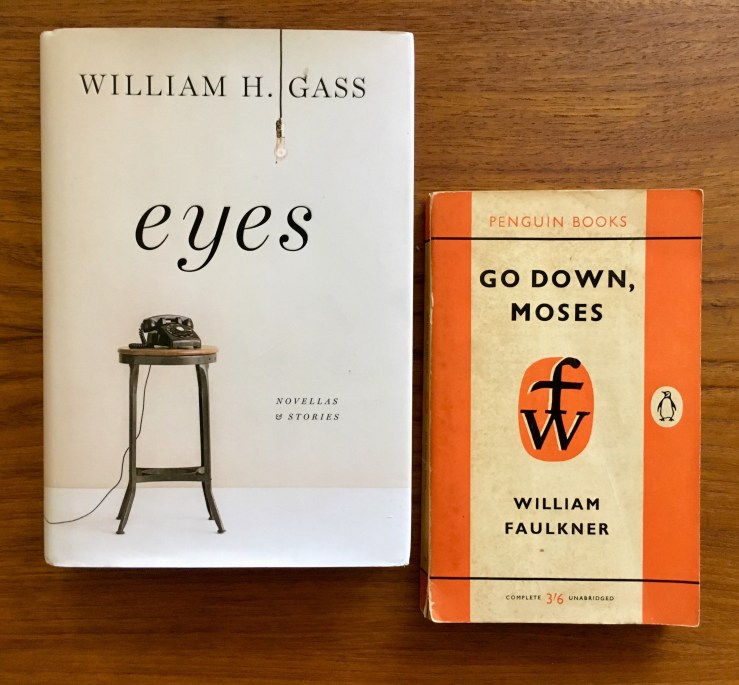
Friday is a day in which I have a few rare spare hours to myself after lunch, and I often like to browse my beloved labyrinthine used bookstore in one of those hours. Last week, I managed to leave without picking anything up, but today I couldn’t resist these two Williams.

Wiliam H. Gass’s last collection of fiction Eyes jumped out at me. I struggled with his bigass opus The Tunnel last year, hardly making a dent, but I loved Middle C as well as the novellas in Cartesian Sonata and Other Novellasso maybe Eyes will be more manageable.

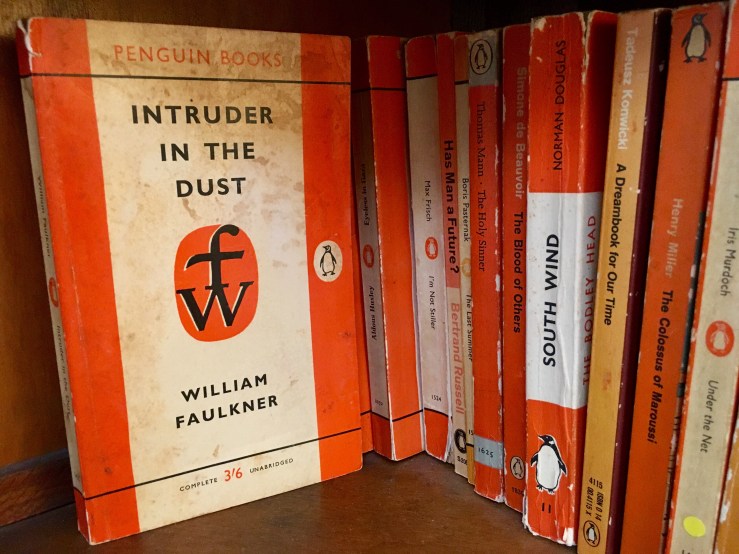
I wasn’t actually browsing the Faulkner section, simply walking past it, but the orange spine of a 1960 Penguin edition of Go Down, Moses jumped out at me. I’m a sucker for these Penguin editions, and Go Down, Moses is my favorite Faulkner (I haven’t read everything Faulkner wrote but I doubt he wrote anything as great as “The Bear”). This edition makes a nice partner with the copy of Intruder in the Dust I picked up a few years ago, too. img_4014

Intruder is a really underrated Faulkner novel in my estimation, and Clarence Brown’s 1949 film adaptation is pretty strong as well.

I was attracted to another orange book, an English-language Japanese publication of Kenzaburo Oe’s The Silent Cry, but I had to pass on it—the print was tiny and my forty-year-old eyes aren’t as strong as they used to be. The cover is gorgeous though:

img_4008


Carl Shuker’s novel A Mistake (Book acquired 27 Sept. 2019)

img_3969

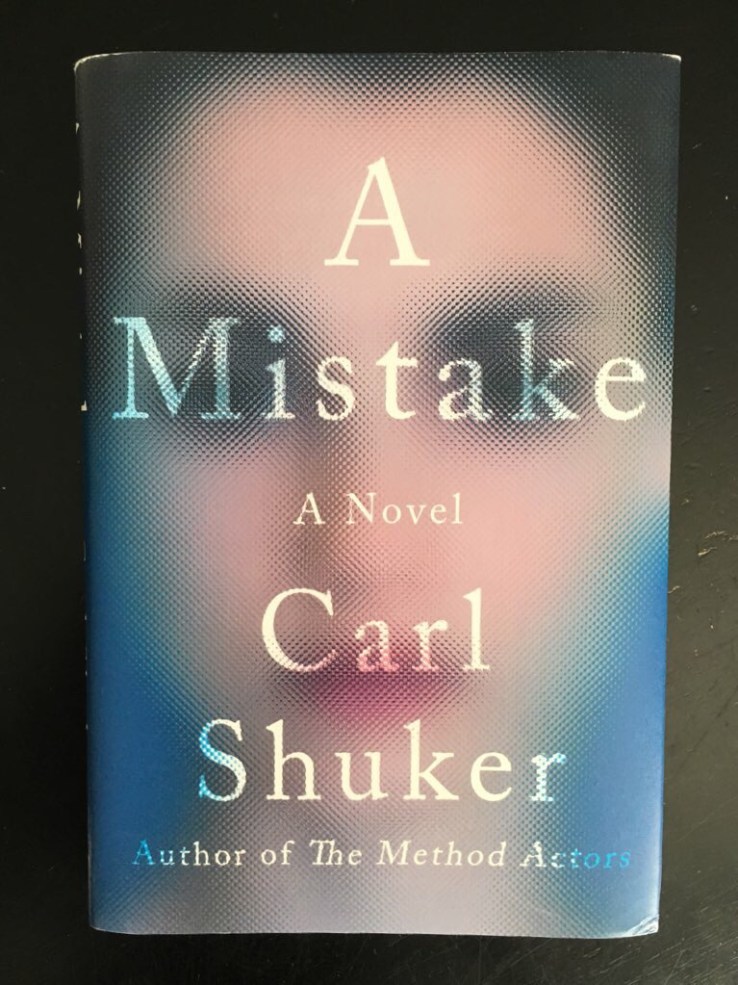
Carl Shuker’s fourth novel A Mistake is new from Counterpress. Their blurb–

Elizabeth is a gifted surgeon—the only female consultant at her hospital. But while she operates on a young woman with life-threatening blood poisoning, something goes horribly wrong. In the midst of a new scheme to publicly report surgeons’ performance, her colleagues begin to close ranks, and Elizabeth’s life is thrown into disarray. Tough and abrasive, Elizabeth has survived and succeeded in this most demanding, palpably sexist field. But can she survive a single mistake?

A Mistake is a page-turning procedural thriller about powerful women working in challenging spheres. The novel examines how a survivor who has successfully navigated years of a culture of casual sexism and machismo finds herself suddenly in the fight of her life. When a mistake is life-threatening, who should ultimately be held responsible?

Carl Shuker has produced some of the finest writing on the physicality of medical intervention, where life-changing surgery is detailed moment by moment in a building emergency. A Mistake daringly illustrates the startling mix of the coolly intellectual and deeply personal inherent in the life and work of a surgeon.

Three Books

2019-09-29_132359

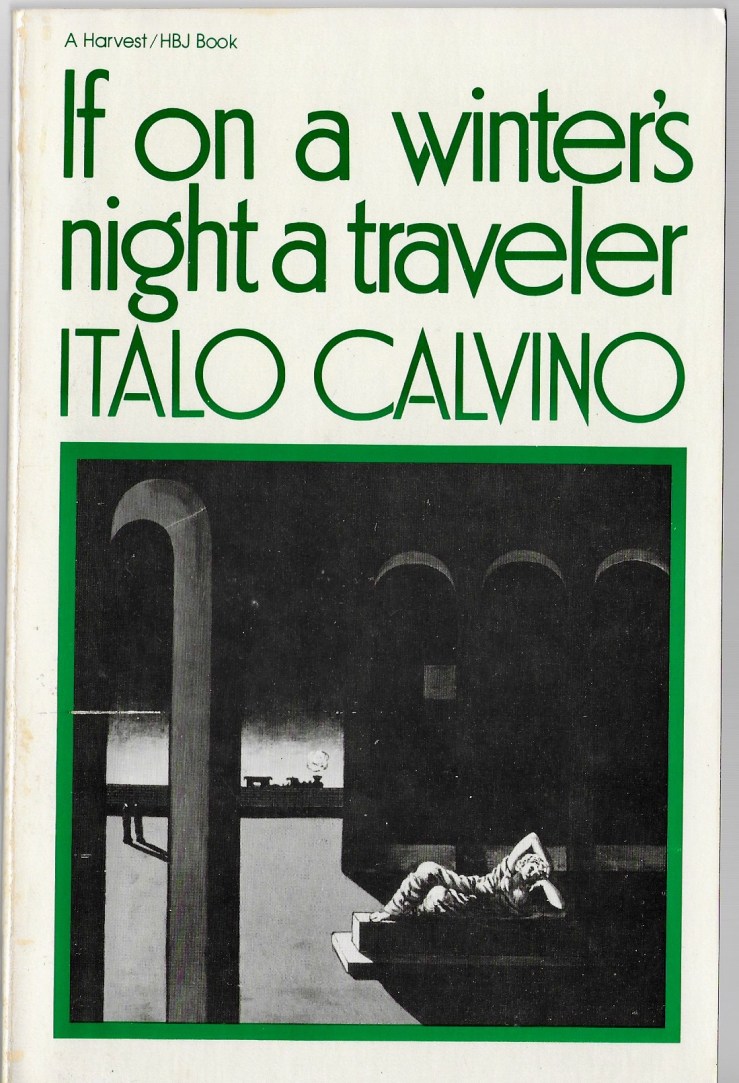
I haven’t read every Italo Calvino novel, but of the ones I’ve read, If on A Winter’s Night a TravelerInvisible Cities, and The Baron in the Trees are my favorites. I have a Harcourt Brace Jovanovich three-volume in slipcase edition designed by Louise Fili. The illustration on the slipcase is uncredited.

2019-09-29_132723

Fili’s design for If on a Winter’s Night a Traveler features Giorgio de Chirico’s 1915 painting Autumnal Melancholy. English translation by William Weaver.

This was the second Calvino novel I read. I was in my early twenties, still very much enamored of John Barth and David Foster Wallace, and Traveler’s formal postmodernism did something electric to me.

2019-09-29_132512

Fili’s cover features a woodcut of a seventeenth-century drawing screen. English translation by William Weaver.

Invisible Cities was the first Calvino novel I read. I read it in 2002 when I was 22, mostly in Chiang Mai, Thailand. A friend who met me in Bangkok had brought it with him in his backpack. I couldn’t find more Calvino in Chiang Mai, but I did manage a copy of Pynchon’s V. 

2019-09-29_132614

Fili’s design for The Baron in the Trees features a detail from on of Pablo Picasso’s drawings for La Guerre et la paix. English translation by Archibald Colquhoun.

Baron is probably my favorite Calvino novel, which is maybe strange because it’s not a very Calvinoesque (Calvinoish?) novel—it’s funny, absurd, and witty, true, but it’s not formally postmodern. It reads very much like a picaresque novel, jaunty and romantic, with an intriguing lead in the rebellious and charismatic hero Cosimo Piovasco di Rondo. Writing this makes me want to read it again.


Miss Auras, The Red Book — John Lavery

john_lavery_27miss_auras2c_the_red_book27_c.18922c_oil

Miss Auras, The Red Book, c. 1892 by John Lavery (1856–1941)

I saw only one tower standing to the south, and that one ringed with fire | Denis Johnson

At the moment, I was heading anywhere at all for breakfast, but when I heard the desk clerk’s radio playing news that an aircraft, I assumed a sightseeing plane, had struck Tower Two of the World Trade Center, I decided to jump on the number 3 subway half a block west, and go have a look.

As I headed toward Eighth Avenue I tried calling Mark Ahearn about lunch, but my cellphone only hammered out a rapid-fire beep. Please don’t ask me how this can be true: I traveled through the busy lobby and walked for half a long block on a crowded Manhattan street and then boarded the World Trade Center subway completely unaware that I was participating in a citywide disaster, and moving toward its center.

The World Trade Center station came a few stops south of Twenty-Third Street, but we didn’t get there. After Christopher Street the train halted in the tunnel and waited, humming. It gave a screech, lurched backward slightly, and stopped again. Somehow the general news had infiltrated the sealed subterranean environment that something historically enormous was happening very nearby, and it got quiet in our compartment, and almost everybody entered into a small, desperate battle with a worthless cellphone. The train moved forward and gained speed, but began braking long before Houston Street, the next station, where it halted with several rear cars sticking out behind into the tunnel. For a tense minute, whoever spoke only whispered. Then came a shout—“Tell us what’s going on!” and others raised the same cry until we heard the conductor’s PA saying something about the tracks, the tracks…“Due to the catastrophe, this train will not go farther. Please exit out the forward cars onto the platform. Do not go onto the tracks.” We were all on our feet, maneuvering selfishly, angling for the doors. But the doors didn’t open. The engine stopped. “Open the doors! Open the doors!” The engine started. A man shouted, “Just everybody stand still!” People from the car behind had pried their way into ours, and somebody almost went down. A woman said, “Stop that, you fool!” A man in front of me pushed a teenage boy beside him. With the meat of his fist he began beating the back of the boy’s head. And I jumped into the fray, didn’t you, Harrington, like a monkey, yes you did, and got yourself an elbow in the eye. The doors to the compartment flew open and people clambered out onto the station’s platform, where a dreadlocked man in a crimson athletic suit jumped up and down on a bench as if it were a trampoline, screaming “God, see what we’re doing to each other down here.” When I came up into the street, dizzy and one-eyed, I couldn’t get my bearings. I saw only one tower standing to the south, and that one ringed with fire. I asked a man nearby—“Where are we? I can’t see the other tower.” He said, “It fell” and I said, “No it didn’t.” He didn’t argue. We stood in the middle of the street with thousands of other people, all of us motionless, like a frozen parade, all silent. I began to believe the man. We watched the flames spreading through the building’s upper stories over the course of about twenty minutes, and then the eighteen-hundred-foot structure seemed to curtsy and dip left, and then it went down.

I turned around and looked at the people behind me. I saw shocked laughter, weeping, horror, bewilderment. The young man next to me bawled at the top of his lungs. I was afraid to ask him if he had a loved one in the buildings afraid to talk to him at all, but he raised his agonized, Christly face to me and suddenly laughed, saying, “Buddy, you are working on one heck of a black eye.” We stood far from the buildings—at least a mile, I’d say—far enough that we didn’t feel the ground shake, and we heard nothing but sirens, and official-sounding voices screaming, “Get out of the street! Stay out of the street!” and others too—“They’re attacking the Capitol!—the Pentagon!—the White House!”

Cop cars and ambulances heaped with dust and chunks of concrete came at us out of the south. I started walking that direction, I don’t know why, but I soon realized I was the only person heading downtown, and then the tide of panic pressing toward me was too heavy to go against, and I turned around and let it take me north.

From Denis Johnson’s short story “Doppelgänger, Poltergeist.” Collected in The Largesse of the Sea Maiden, 2017.


The Green Hammock — John Lavery

2012_cks_05941_0182_000sir_john_lavery_rsa_rha_ra_the_green_hammock

The Green Hammock, c. 1905 by John Lavery (1856–1941)

Daniel Mendelsohn’s Ecstasy and Terror (Book acquired, some time last week)

img_3918

I got a review copy of Daniel Mendelsohn’s collection Ecstasy and Terror some time early last week. I’ve read a few of the pieces in here before (“A Critic’s Manifesto” is one that I recalled in particular). Ecstasy and Terror is out in October from NYRB. Their blurb:

This collection of essays exemplifies the range, depth, and erudition that have made Daniel Mendelsohn “required reading for anyone interested in dissecting culture” (The Daily Beast). Here Mendelsohn once again casts an eye at literature, film, television, and the personal essay, filtering his insights through his training as a scholar of classical antiquity in surprising and illuminating ways.

Many of these essays examine how we continue to look to the Greeks and Romans as models: some argue for the surprising modernity of canonical works (Bacchae, the Aeneid), while others detect a “Greek DNA” in our responses to the Boston Marathon bombings and the assassination of JFK. Modern topics are treated, too, from the “aesthetics of victimhood” in Hanya Yanagihara’sA Little Life to the novels of Karl Ove Knausgaard, and from Game of Thrones to recent films about artificial intelligence—a subject, Mendelsohn reminds us, that was already of interest to Homer.

The collection also brings together for the first time a number of Mendelsohn’s personal essays, including his “critic’s manifesto” and a touching memoir of his boyhood correspondence with the historical novelist Mary Renault.

Blog about some recent reading, some books acquired, Hurricane Dorian, etc.

img_3908-1

I am on my second or maybe third dark and stormy and I have cleaned the house twice from top to bottom two days in a row now and I am ready for my kids to go back to school, which was cancelled through Thursday for Hurricane Dorian. My own school, by which I mean my employer, cancelled classes throughout the week, but I’ve been emailing students and trying to maintain some kind of continuity after this weird disruption. We have power here in NE Florida and all seems well. This ride has been a lot easier than Irma.

img_3910-1

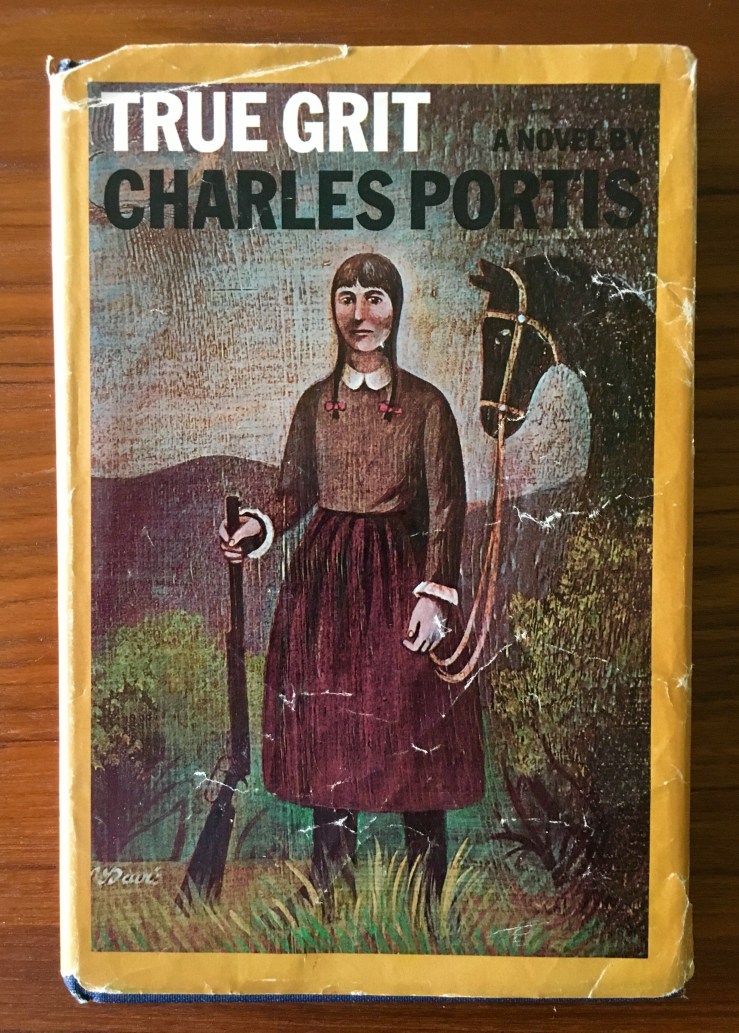
I finished Charles Portis’s famous novel True Grit this afternoon and I must confess it might be my favorite of the four I’ve read by the maestro. I shed a little tear for Little Blackie at the end, and also maybe for Rooster Cogburn. My thought is that I wish I’d read the book years ago, before I’d seen the two film adaptations, both of which are, like, fine, but neither of which capture the pure voice of Mattie Ross. Great stuff. I need to read Gringos next, but maybe I’ll wait a bit.

I have been switching between True Grit and Sylvia Townsend Warner’s nuns-in-the-English-fens-in-the-age-of-the-Black-Death The Corner That Held Them and I love both—both are funny, dry (and wet when they need to be). The Corner That Held Them packs in so much storytelling; pages go on for decades with a sprightly and imaginative and droll clip. I’ve been enjoying it so much I went up to my favorite used bookstore, big box of old books in tow, to find more. I picked up Lolly Willowes, which I understand is excellent, and which I will get to posthaste.

I had burned up most of my credit at this particular bookstore, but the box I done brung afforded me enough trade to not only pick up Lolly Willowes but also a first-edition hardback of Kurt Vonnegut’s Slaughterhouse Five.

img_3909-1

I also got copies of Antoine Volodine’s Writers and Bardo or Not Bardo in the in the mail this week. I don’t rightly recall buying them online, but I know that after finishing In the Time of the Blue Ball by Volodine’s pseudo-pseudonym Manuela Draeger, I went through my Volodines for references to Draeger. I found references in Post-Exoticism in Ten Lessons, Lesson Eleven, but couldn’t find my copy of Writers and then remembered that I gave it to a friend who seemed to promptly move a hundred miles away afterward. (He said he thought it was good.) Anyway: Bardo soon or not soon.

I read Keiler Roberts’ graphic memoir Rat Time yesterday and loved it so much I wrote about it immediately.

Screenshot 2019-09-03 at 3.52.37 PM

The hurricane is not so bad for us.

Girl in a Red Dress Reading by a Swimming Pool — John Lavery

64575156_321670722042429_6261493289650389959_n

Girl in a Red Dress Reading by a Swimming Pool, 1887 by John Lavery (1856–1941)

In 1349 the Black Death came to Oby | An excerpt from Sylvia Townsend Warner’s novel The Corner That Held Them

In 1194 a wandering scholar, very old and shrill, came begging for a meal. As he sat munching his bread and a salt herring he talked to the wicket-nun about the properties of numbers, and of how Abbot Joachim, analysing the arithmetic of the prophecies, had discovered that the end of the world was at hand. He himself expected much of the year 1221, a date whose two halves each added up to three. In such a year, he said, one might look for the reign of Antichrist to be fulfilled, or else it might betoken the coming of the kingdom of the Holy Ghost, as the number six expressed a completion of two-thirds of the Trinity. Something, at any rate, he said, might be expected. Under his arm he carried a monochord. To make himself clearer to the nuns (for several of them had gathered to pity the old man, so wise and so witless), he explained to them about the Proportion of Diapason, the perfect concord which is at once concord and unity, and showed them how, by placing the bridge of the monochord so as to divide the string into a ratio of one and two, the string will sound the interval of the octave. Thus, he mumbled, was the nature of the Godhead perceptible to Pythagoras, a heathen; for it lies latent in all things. He sat on a bench in the sun, but overhead the wind howled, tormenting the willows along the Hog Trail and clawing the thatch, and the nuns could scarcely hear his demonstration of how the Godhead sounded to Pythagoras. It was really no loss, for his hand, shaking with cold and palsy, had failed to place the bridge correctly, and the diapason of the Trinity was out of tune. Then, brushing the crumbs out of his beard and plucking a sprig of young wormwood to stick behind his ear, he sang a lovesong to entertain the ladies and went on his way toward Lintoft. The lovesong had a pretty, catchy tune: for some days every nun and novice was humming it. Then Dame Cecilia began to have fits and to prophesy. This infuriated Richenda de Foley, to whom any talk of the end of the world after she had worked so hard and successfully to put the convent on a good footing for the next century seemed rank ingratitude. But the itch is not more contagious than illuminations, and throughout that summer Oby resounded with excited voices describing flaming bulls, he-goats of enormous size floating above the lectern, apparitions of the founder and shooting pains. In a fury of slighted good intentions and outraged common sense Richenda de Foley packed up and went away, but as she was generous as well as authoritarian she left a great deal of household stuff and provisions behind her. The community, after one universal gasp at finding itself unclasped from that strong and all-arranging hand, settled down to enjoy an unregulated prosperity and comfort; and prosperity and comfort wielding their usual effect, the spirit of prophecy flickered out, and by the close of the year they were looking for nothing more remarkable than improvements to the fish-pond.

In 1208 came the Interdict.

In 1223 lightning set fire to the granary.

In 1257 the old reed and timber cloisters fell to bits in a gale. It was decided that the masons who came to build the new should also build on a proper chapter-house. When it was half-built a spring rose under it. Rather than throw money away, the head mason suggested, why not finish the new building as a dovecot, a wet floor being no inconvenience to doves, and convert the old dovecot, so solid and weatherproof, into a chapter-house? This suggestion, too hastily accepted, led to discomfort all round. The pigeons refused to settle in their new house. Some flew away for good, the others remained in the lower half of the old dovecot, whose upper storey, remodelled with large windows and stone benches, made a very unpersuasive place of assembly. However, the arrangement was allowed as a temporary expedient, and as such it became permanent.

In 1270 there were disastrous floods, and this happened again seven years later. In 1283 hornets built in the brewhouse roof and the cellaress was stung in the lip and died. In 1297 the convent’s bailiff was taken in the act of carnality with a cow. Both he and the cow were duly executed for the crime, but this was not enough to avert the wrath of heaven. That autumn and for three autumns following there was a murrain among the cattle. After the murrain came a famine, and the bondwomen of the manor broke through the reed-fence into the orchard where the nuns were at recreation and mobbed them, snatching at their wimples and jeering at such plump white breasts and idle teats. For this a fine was laid on the hamlet, and the last remnants of the pax Richenda broke down. Tithes and dues were paid grudgingly or not at all, and going along the cloisters to sing the night office the nuns would strain their ears for the footsteps of marauders or the crackle of a fired thatch.

In 1332 a nun broke her vows and left the convent for a lover. Misfortunes always go in threes, was the comment of the prioress: they might expect two more to play the same game. But after a second apostasy there was a painful Visitation by the bishop, when the prioress was deposed and Dame Emily, the novice-mistress, a better disciplinarian, nominated to be her successor. Unfortunately Dame Emily was unpopular, being both arrogant and censorious. Dreading the rule of such a prioress, the nuns refused to elect her and chose instead, out of bravado, Dame Isabella Sutthery, the youngest and silliest nun among them. The young and silly can become great tyrants. Dame Isabella proved fanatically harsh and suspicious, scourging the old nuns till they fainted for anguish and inventing such unforeseeable misdemeanours that no one could steer clear of offending. The convent waited, languishing, for the next Visitation, when each nun in her private interview with the bishop could make her report. But though the bishop came and heard, he was still nursing his wrath about their rejection of Dame Emily whom he had nominated, and though Dame Emily herself was the greatest sufferer under Prioress Isabella he answered every plea for a fresh election by saying that the convent having chosen must abide by its choice. It was not till 1345, when Prioress Isabella choked on a plum-stone, that peace and quiet returned, followed by four ambling years of having no history, save for a plague of caterpillars.

In 1349 the Black Death came to Oby.

From the first chapter of Sylvia Townsend Warner’s 1948 novel The Corner That Held Them, newly reissued by NYRB.

img_3738

The Ledger — F. Scott Hess

the.ledger

The Ledger, 2009 by F. Scott Hess (b. 1955)

Blog about some recent reading

img_3869

Let’s start with the meat in the middle: Charles Portis. Why hadn’t I read Charles Portis until 2019? Maybe I initially dismissed the idea after first seeing True Grit (1969) with John Wayne. I know I was a bit more interested after seeing True Grit (2010), but I still didn’t quite realize that Portis is like Cormac McCarthy or Barry Hannah, picaresque and hilarious, a scion of the dirty south. I picked up his first novel Norwood at a tiny wonderful little bookstore in Portland Oregon this summer, prompted by its being in a Vintage Contemporaries edition more than anything else. I loved its energy and humor, and picked up copies of The Dog of the South and Masters of Atlantis, and promptly read them. (I couldn’t find a decent looking copy of True Grit and ended up ordering one on AbeBooks for four bucks.) I’ve heard Masters of Atlantis referred to as the masterpiece, and I thought it was very funny and even Pynchonesque (and also really relevant in its evocation of con artists and scammery), but Dog of the South was the most affecting of the three novels. A kind of bizarre road trip novel, Dog is told in first person narration by an asshole loser who, like most asshole losers, doesn’t realize that he’s an asshole loser. By the end of the novel he won me over though, and even grew as a person (I hate that I wrote that sentence). Dog’s shagginess is a small virtue; Master’s shagginess is unexpectedly grand. Norwood seems like a trial run at both, but also wonderful and grotesque. I read the first part of True Grit yesterday and loved the voice. I need to do a proper Thing on Portis, but for now, color me a Portishead.

I read Fernando A. Flores’ debut novel Tears of the Trufflepig last month, which I picked up after reading J. David Gonzalez’s review in the Los Angeles Review of Books. The concept of the book—a very-near future where drugs are legal and cartels have taken to trafficking “filtered” (genetically-altered) animals is fascinating—but the prose and structure left something to be desired. Trufflepig suffered perhaps from its proximity to my reading Anna Kavan’s Ice and Portis’s Norwood.

I read the first chapter of Sylvia Townsend Warner’s 1948 historical novel The Corner That Held Them today. Amazing stuff: Ironic, mordant, energetic, and surprising. Set primarily in a spare humble corner of 14th century England, Corner starts with a cuckold murdering his wife’s lover, “sparing” her, and then founding a nunnery in her honor when she dies. Warner’s prose shuttles her nuns into the Black Death plague with bathos and wit. Really loved what I read.

I read In the Time of the Blue Ball by Manuela Draeger this weekend and loved it too. There are three tales in the collection, translated by Brian Evenson and Valerie Evenson. Draeger is one of Antoine Valodine’s pseudonyms, but also one of his characters—a concentration camp librarian who invents tales for the camp’s children. The stories are whimsical with a dark edge, an edge perhaps provided if one know more of Volodine’s project (encapsulated neatly in Writers). The Draeger stories focus on a detective named Bobby Potemkine and his dog Djinn, and they are lovely.

I continue nibbling at Chris Ware’s forthcoming opus Rusty Brown. “Nibbling” is not the right verb—look, I’m gobbling this thing up. It’s astounding: funny, painful, gorgeous, maybe the best thing he’s done to date.

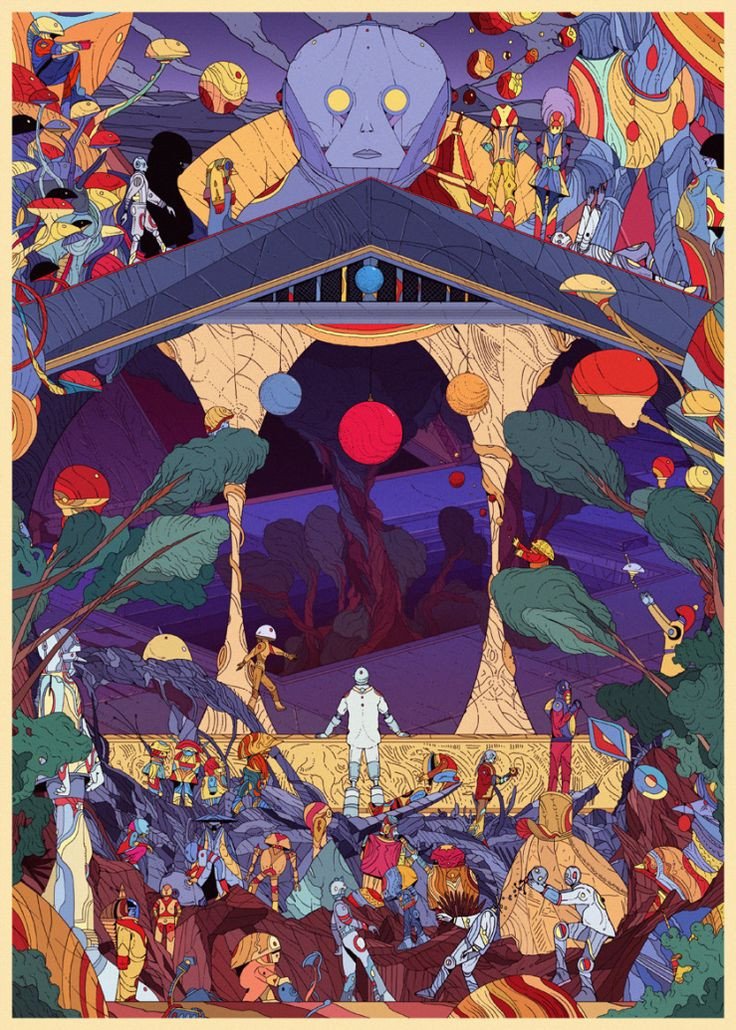
Kilian Eng’s Object 10 simply happens to be at the bottom of the pile. It too is gorgeous.

1dde58cb05363a7d06108f54bab648f4_800x

The Chess Players — John Lavery

The Chess Players 1929 by Sir John Lavery 1856-1941

The Chess Players, 1929 by John Lavery (1856–1941)