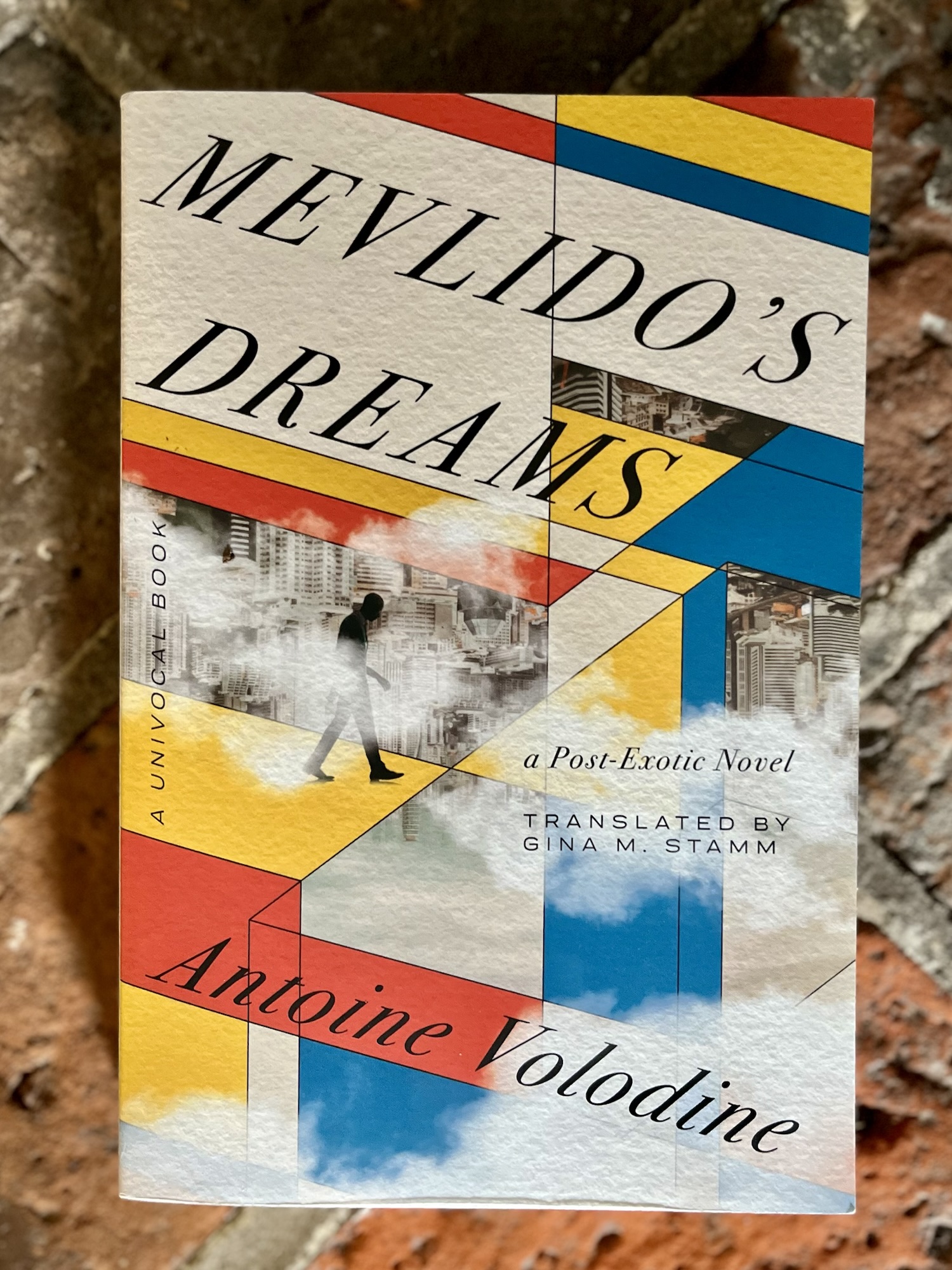
It still believes in night | A review of Antoine Volodine’s post-exotic novel Mevlido’s Dreams

Antoine Volodine’s 2007 novel Mevlido’s Dreams is a bleak, dystopian noir novel set several centuries in the future in the ruined city-state of Oulang-Oulane. Here, weary revolutionary Mevlido lives in a decaying ghetto called Henhouse Four, an eerie quarter inhabited by indigents, junkies, and other remnants of failed uprisings who must contend with the giant mutated birds who terrorize the borough.

Once a soldier of the revolution, Mevlido now serves as a policeman, yet he may also be a double or even triple agent, a sleeper sent through time from a kind of liminal afterlife, a bardo between death and rebirth. The novel drifts between waking and dream states, war memories and spectral futures, as Mevlido’s fragmented consciousness becomes a vessel for Volodine’s haunting post-exotic vision of history, language, and apocalypse.

About halfway through the novel, Mevlido’s bardo boss offers a handy summary of the apocalypse:

They’ve become an inexplicable species. They are just getting out of multiple wars of extermination, but a new conflict is already in sight. The population has decreased by a hundredfold, even more. Entire continents are currently uninhabitable. Those who have survived remain socially organized, but they no longer believe in themselves, or in society. They’ve inherited political systems to which they’ve lost the keys; for them ideology is a prayer devoid of meaning. The ruling classes have become criminalized, the poor obey them. Both classes act as if they were already dead. And as if, on top of that, they don’t even care. … Something in them has changed. You’d think that they no longer have the ability to differentiate between life, dreams, and death.

Our hero will be reborn into this turmoil, his consciousness a roiling mess of anxious irreality. “Even if I’m dreaming, I’m in reality,” he concludes at one point, as if to anchor himself in his mission. What that mission is, exactly, is never fully clear to Mevlido or the reader. Or perhaps the mission is very clear; as translator Gina M. Stamm puts it in her introduction, the plot of Mevlido’s Dreams “has the elements of a fairly classic tragic romance: man and woman are in love, the world prevents their being together, man descends into tragic circumstances.” This motif repeats in dreamlike iterations in the novel; Mevlido drifts through a post-exotic wasteland following orders no one remembers giving, haunted by his dead wife Verena Becker, whose presence threads through his days like a recurring dream or a flickering film reel.

We come to learn that Verena Becker died cruelly, murdered by the “child soldiers” who were pressed in to service by agents of the exploitative upper class. In Mevlido’s present time (or, more specifically one of Mevlido’s present times), the child soldiers are now “ex-child soldiers,” reviled refugees who hide under new identities, hoping to avoid the vengeance of people like Mevlido. The vengeance is not aimed just at these foot soldiers though; one of the novel’s heroes, Sonia Wolguelane, plots the assassination of the upper-echelon genociders who, now absolved of their war crimes, continue to rule the city-state with their one-time political foes. Here is Volodine’s description of one of the men Wolguelane assassinates:

Toni Müller, forty-nine years old, delegate to the Office of Fuel, policy officer during the final project of pacification of the remaining zones, initiator of the so-called controlled genocide practice, threatened with legal action after the disappearance of the Wongres, the Spanish, and the Myrzes, sued for not having been able to provide an explanation for the mysterious annihilation of the inhabitants of the Philippines. Amnestied. Director of the petroleum trusts in the remaining zones, billionaire, numerous books of economics published in his name, numerous honorific titles. During his last self-criticism, he admitted having constantly hidden from the masses the fact that he didn’t share the household chores with his wife.

While the apocalyptic stakes here are swollen to hyperbolic levels, Volodine’s critique of how the ruling class wields power nevertheless applies neatly to our own 21st-century blues. Henry Kissinger, for example, died fat and happy. I’m reminded too here of Thomas Pynchon’s critique of power, particularly in Gravity’s Rainbow, where the narrator laments that the Nazi war criminal Weissmann will not be punished but rather elevated, set to sit “among the successful academics, the Presidential advisers, the token intellectuals who sit on boards of directors. He is almost certainly there. Look high, not low.” Look low for the preterite heroes of Mevlido’s Dreams though. They are the “faded zombies, probably candidates for another hallucinatory expedition, left-behinds who imagine they will be able to leave again.”

I am making the novel sound too grim. It is rich, and much of that richness comes from a bureaucratic, deadpan humor, the laughter of exhausted ideologues trapped in their own paperwork. But what happens to faith in any ideology when it is sundered from observable reality? Consider this exchange, in which a lost Mevlido tries to communicate with a band of men who fail to recognize him as a human being:

“Incredible,” says one of the normal ones, “it’s still talking.”

“And what is it talking about?” asks the red cap.

“About the night,” says the fat one.

“It’s talking about the night?” the bare-chested one asks, surprised.

“Yes, it must still believe in night,” says one of the normal ones.

“Incredible,” says the other normal one, “it still believes in night.”

And beneath the satire, there’s love. Volodine writes love as a metaphysical condition, a persistence that outlasts ideology, memory, and even death. The tenderness between Mevlido and Verena gives the novel its pulse. It’s the one human rhythm left in a mechanical world. Stamm’s translation conveys this rhythm in clipped, moody sentences, wounded and precise.

Like Volodine’s 2014 novel Radiant Terminus, Mevlido’s Dreams operates in the twilight between horror and tenderness. But Mevlido’s Dreams is quieter, more interior—a story of a single man’s dissolution told in flickering vignettes. It reads like the afterimage of a life projected on a cracked wall.

That light, dim and trembling, is what Volodine and Stamm preserve. Mevlido’s Dreams reads not like a film script but like a film itself: shadowy scenes unfolding in silence, broken by bursts of deadpan dialogue and ghostly humor. You can see the ash swirling, hear the echo of curses in an alley haunted by mutant birds.

Oulang-Oulane feels shot through a grim lens, intense, ugly, beautiful, like something from Tarkovsky’s Stalker or a Béla Tarr film, with scenes of desolation punctuated by tenderness. Volodine isn’t cinematic because he borrows film tropes, but because he composes through atmosphere and rhythm. His sentences drift like a camera through fog and memory.

That line above—“it still believes in night”—could be the novel’s credo. Dreaming isn’t retreat; it’s resistance. Writing, too. Mevlido’s Dreams works as both a political fable and a séance for the lost, a way of keeping consciousness flickering in the dark. Highly recommended.


Mass-Market Monday | Donald Barthelme’s Sadness

Sadness, 1972, Donald Barthelme. Kangaroo Pocket Books (1980). No cover artist or designer credited. 159 pages.

Here is the fifth section of “Departures,” a series of vignettes. It stands alone as its own short story–


My grandfather once fell in love with a dryad—a wood nymph who lives in trees and to whom trees are sacred and who dances around trees clad in fine leaf-green tutu and who carries a great silver-shining axe to whack anybody who does any kind of thing inimical to the well-being and mental health of trees. My grandfather was at that time in the lumber business.

It was during the Great War. He’d got an order for a million board feet of one-by-ten of the very poorest quality, to make barracks out of for the soldiers. The specifications called for the dark red sap to be running off it in buckets and for the warp on it to be like the tops of waves in a distressed sea and for the knotholes in it to be the size of an intelligent man’s head for the cold wind to whistle through and toughen up the (as they were then called) doughboys.

My grandfather headed for East Texas. He had the timber rights to ten thousand acres there, Southern yellow pine of the loblolly family. It was third-growth scrub and slash and shoddy—just the thing for soldiers. Couldn’t be beat. So he and his men set up operations and first crack out of the box they were surrounded by threescore of lovely dryads and hamadryads all clad in fine leaf-green tutus and waving great silver-shining axes.

“Well now,” my grandfather said to the head dryad, “wait a while, wait a while, somebody could get hurt.”

“That is for sure,” says the girl, and she shifts her axe from her left hand to her right hand.

“I thought you dryads were indigenous to oak,” says my grandfather, “this here is pine.”

“Some like the ancient tall-standing many-branched oak,” says the girl, “and some the white-slim birch, and some take what they can get, and you will look mighty funny without any legs on you.”

“Can we negotiate,” says my grandfather, “it’s for the War, and you are the loveliest thing I ever did see, and what is your name?”

“Megwind,” says the girl, “and also Sophie. I am Sophie in the night and Megwind in the day and I make fine whistling axe-music night or day and without legs for walking your life’s journey will be a pitiable one.”

“Well Sophie,” says my grandfather, “let us sit down under this tree here and open a bottle of this fine rotgut here and talk the thing over like reasonable human beings.”

“Do not use my night-name in the light of day,” says the girl, “and I am not a human being and there is nothing to talk over and what type of rotgut is it that you have there?”

“It is Teamster’s Early Grave,” says my grandfather, “and you’ll cover many a mile before you find the beat of it.”

“I will have one cupful,” says the girl, “and my sisters will have each one cupful, and then we will dance around this tree while you still have legs for dancing and then you will go away and your men also.”

“Drink up,” says my grandfather, “and know that of all the women I have interfered with in my time you are the absolute top woman.”

“I am not a woman,” says Megwind, “I am a spirit, although the form of the thing is misleading I will admit.”

“Wait a while,” says my grandfather, “you mean that no type of mutual interference between us of a physical nature is possible?”

“That is a thing I could do,” says the girl, “if I chose.”

“Do you choose?” asks my grandfather, “and have another wallop.”

“That is a thing I will do,” says the girl, and she had another wallop.

“And a kiss,” says my grandfather, “would that be possible do you think?”

“That is a thing I could do,” says the dryad, “you are not the least prepossessing of men and men have been scarce in these parts in these years, the trees being as you see mostly scrub, slash and shoddy.”

“Megwind,” says my grandfather, “you are beautiful.”

“You are taken with my form which I admit is beautiful,” says the girl, “but know that this form you see is not necessary but contingent, sometimes I am a fine brown-speckled egg and sometimes I am an escape of steam from a hole in the ground and sometimes I am an armadillo.”

“That is amazing,” says my grandfather, “a shape-shifter are you.”

“That is a thing I can do,” says Megwind, “if I choose.”

“Tell me,” says my grandfather, “could you change yourself into one million board feet of one-by-ten of the very poorest quality neatly stacked in railroad cars on a siding outside of Fort Riley, Kansas?”

“That is a thing I could do,” says the girl, “but I do not see the beauty of it.”

“The beauty of it,” says my grandfather, “is two cents a board foot.”

“What is the quid pro quo?” asks the girl.

“You mean spirits engage in haggle?” asks my grandfather.

“Nothing from nothing, nothing for nothing, that is a law of life,” says the girl.

“The quid pro quo,” says my grandfather, “is that me and my men will leave this here scrub, slash and shoddy standing. All you have to do is to be made into barracks for the soldiers and after the War you will be torn down and can fly away home.”

“Agreed,” says the dryad, “but what about this interference of a physical nature you mentioned earlier? for the sun is falling down and soon I will be Sophie and human men have been scarce in these parts for ever so damn long.”

“Sophie,” says my grandfather, “you are as lovely as light and let me just fetch another bottle from the truck and I will be at your service.”

This is not really how it went. I am fantasizing. Actually, he just plain cut down the trees.

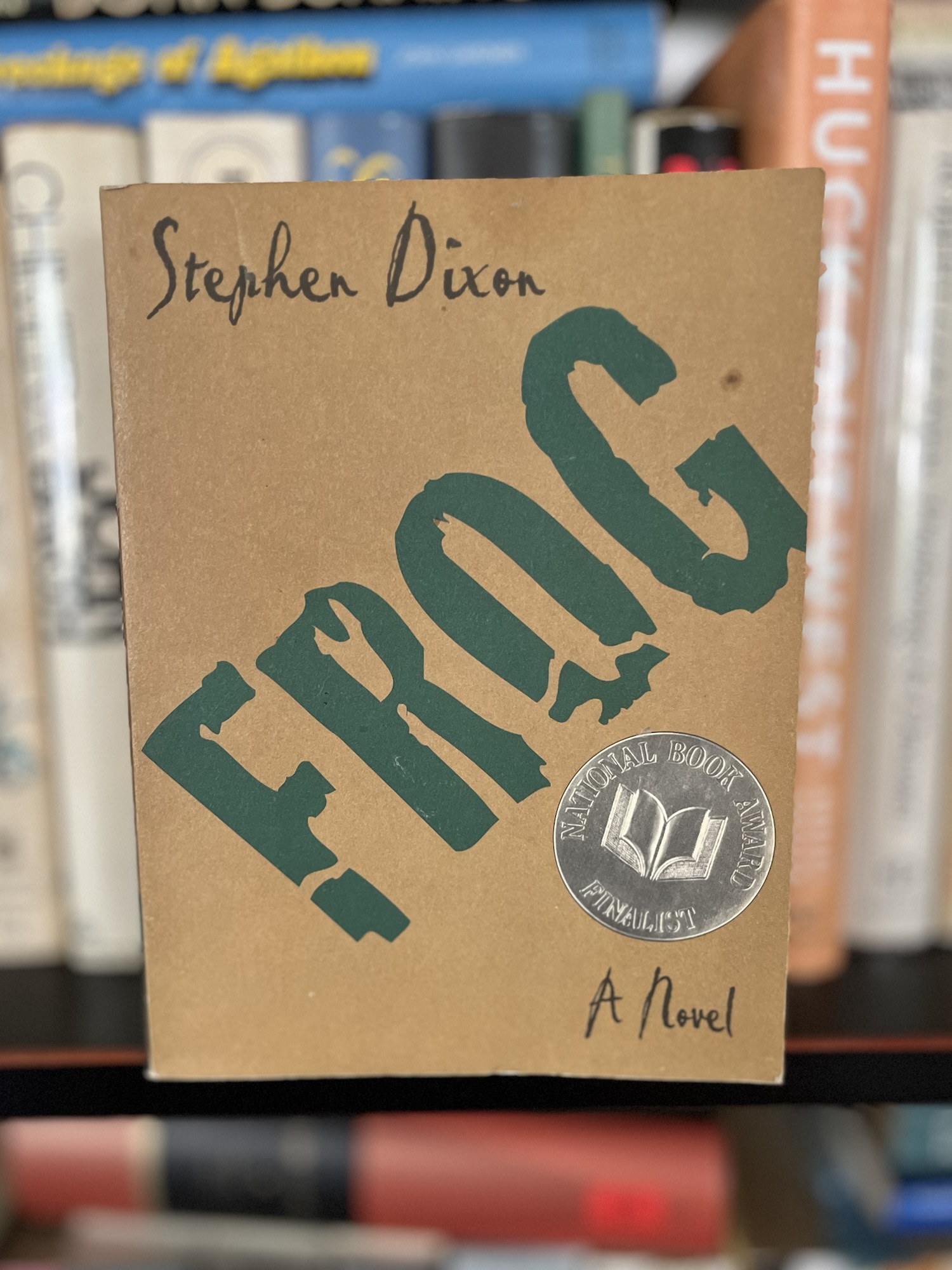
873 words from Stephen Dixon’s 1991 novel Frog, followed by 469 words on Stephen Dixon’s 1991 novel Frog

Here are 873 words from Stephen Dixon’s long looping loopy lucid antilaconic 1991 novel Frog; the words are a segment of the ninth chapter, “Frog’s Brother”:

Alex was the only passenger on the freighter. His father’s patient called his son in England and asked as a favor to the man who’s treated his family’s teeth for forty years if he could take Alex aboard free. Alex was in London then, wanted to get back home, had little money, could have borrowed plane or ocean liner fare from his parents or Jerry, wanted the experience of being on a freighter during a long crossing. Though he got free passage, he asked to work without pay at any job the captain wanted him to. He’ll clean latrines, even, he said in his last letter to Howard. Anything the lowest-grade seaman does, just to get the full feel of it and perhaps seaman’s papers for a paid trip later. He was a newsman turned fiction writer. Two months after the ship disappeared a parcel of manuscripts arrived at their parents’ apartment from England by surface mail. Maybe the manuscripts he didn’t much care about. Maybe the ones he cared most about he took with him on the ship. Howard read the stories and vignettes soon after and then some of them every three or four years till about ten years ago. He never found them very good, but Alex was just starting. Two diaries and some oriental figurines in the parcel also, and lots of letters from his parents, brothers, friends. He’d traveled around the world. Saved up for three years to do it. Did it for a year. A prostitute in a dilapidated hut in a small village outside Bangkok. Why’s that experience come to mind first? It was in a letter to Howard, not the diaries. He searched the diaries for it, thinking an elaboration of it might be interesting, revealing, sexually exciting. She was fourteen years old. That made Alex sad. She asked him to marry her. She said she’d be devoted, would learn to cook and make love American, bear him many children if he wanted, all boys if he wanted (she knew how), would return to grade school. He gave her his silver ID bracelet, pleaded with her to give up prostitution. Then he did it a third time with her the same day and came back the next. Talk about hypocrisy! he said. What’s the trick of turning a customer into a suitor? he asked. But one who’ll be good to her and an adequate provider. If he knew, he’d give it to her. Sent her a pearl necklace from Manila. If he got a venereal disease from her he’d worry more about her than himself. He might go back for her before he leaves for India, or send for her once he gets back to America, and maybe even marry her when she comes of age. Keep this between them just in case it does happen. Taught English to Malaysian businessmen for a month. Met two old men in New Guinea—Canadians—who were living the primitive jungle life. They were good friends of his till they tried to drug and rape him. He’s afraid he had to kick them both in the balls to get out of there and then steal their canoe to get back to town. Fell in love with a witch. Read Proust’s Remembrances in five nearly sleepless days, an experience that’s left him dreaming of the books every night for the last six weeks. A Goan fortuneteller told him his trip would end badly. He said to go home by plane, don’t sail. Remind him when the time comes, for the man wouldn’t take any money. Had a fifteen-year-old girl in Nairobi. What can he tell Howard?—he likes young girls. It’s more than just the way their hair blows and breasts point and bellybuttons dimple and thighs are so even. Maybe it’s because of all the girls who barely let him pet them when he was a teenager. Rode a camel through part of the Sahara. Ate lizard, locusts, grasshoppers, grubs. Never felt very Jewish before till he started hitting all the old synagogues and Jewish cemeteries he could find in the Orient and Middle East. Wait’ll he gets to Poland and Prague and also tries to look the old families up. He’s afraid it’s converted him, but not to the point of wearing a skullcap. Hitchhiked with a sixteen-year-old sabra through Turkey and Yugoslavia, though she might have been younger. When she had to go back she said she thinks he got her pregnant—her device wasn’t put in right a few times, she was so new at it. He told her he’s heard that one before, but if she has the baby and the calendrical configurations fix it as his, or just if she still says it is, he’ll love and provide for it, adopt it if she wishes and take it to America with or without her or emigrate to Israel if she prefers, marry her if that’s what she wants—she’s quite striking and clever and potentially very artistic and smart. He’s written what he thinks is fairly decent work recently, he said in his last letter. He’s glad he’s found something he wants to do for the next twenty to thirty years, has Howard?

The titular “Frog’s Brother” is Alex. (“Frog,” by the way, is “Howard,” the protagonist of Frog.) Alex’s freighter goes missing in the North Atlantic; the ship is never recovered nor are lifeboats. No bodies. The only evidence of the disaster is absence.

In this absence, Frog imagines and reimagines Alex’s death at sea in different looping cycles; these reimaginings are also framed within Frog’s attempt to accurately recall his receiving the news that his brother Alex is lost at sea–was it by phone, that he received this awful news? in his other brother’s apartment? what were the specific conditions of this heartbreak?

Imagining and then reimagining the specific details of a horrifying, horrible, horrendous event is the rhetorical gist of Dixon’s 1995 follow-up to Frog, Interstate, a fucked-up eight-way riff on the narrator’s daughter’s murder by way of random highway violence.

I have read around 120 of Fog’s near 800 pages, and many of those pages feature the same rhetorical and narratological techniques or repetitions with differences that were so off-centered in Interstate: fraying phrases, looping tics, paranoid passages. In the absence of the one thing, Dixon’s narrators pony up iteration after iteration, something after something. But the narrators know that there’s not enough somethings to ever even come close to approximating everything. The iterations sharpen and highlight the beauty of the absence’s abyss.

That abyss was real, or true, or True, for Stephen Dixon, whose brother “Jimmy, a magazine writer, died in 1960 when the freighter he was on in the North Atlantic disappeared,” as the New York Times reported in Dixon’s 2019 obituary. The Times obituary continued: “Mr. Dixon felt that he was continuing his brother’s work. Jimmy Dixon had a short story published after his death.” If Jimmy Dixon was prototype to Alex Frogbrother, what are we to make of the fantastic paraphrase of his letters, above? The passage reads like a bizarre failed adventure tale, something we might expect from William T. Vollmann, who, with his heart of gold, tried to “free” sex workers. It’s also quite queasy when it comes to sex (a constant I’ve noticed in Dixon): “What can he tell Howard?—he likes young girls,” our narrator flatly, grossly reports.

The saddest and realest bit might be this though, the admission that “Howard read the stories and vignettes soon after and then some of them every three or four years till about ten years ago. He never found them very good, but Alex was just starting.” But Alex was just starting. The last bit of the section, “He’s glad he’s found something he wants to do for the next twenty to thirty years, has Howard?” seems both boon and curse, a door that opens and shuts simultaneously, cursing our Stephen Dixon, our Frog, to write write write write write write write write write…


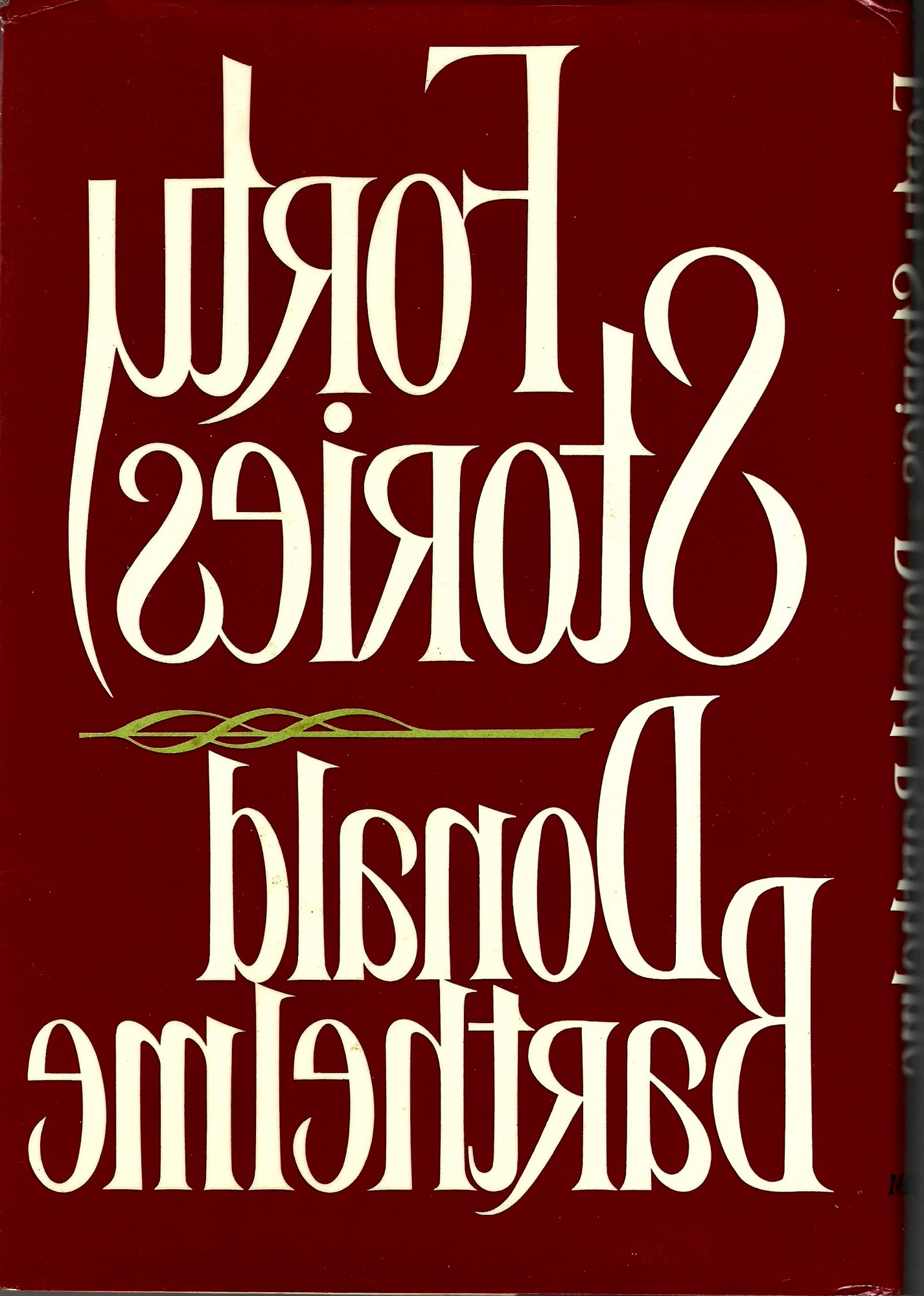
Donald Barthelme’s Forty Stories in reverse, Part V

Previously,

Stories 40-36

Stories 35-32

Stories 31-28

Stories 27-24

23 . “A Few Moments of Sleeping and Waking” (Unspeakable Practices, Unnatural Acts, 1968)

I’ve been reading the stories in Forty Stories as kinda-sorta palate cleansers, usually ingesting one or two between novels; my method is to take a few initial notes to come back to, cross-reference against Tracy Daugherty’s Barthelme biography Hiding Man, and then riff on my general impression. Sometimes a few weeks go by from the time I’ve read or reread one of these stories and the time I actually get around to writing about them. Until now, the title alone has activated some memory or aesthetic impression about the story, but “A Few Moments of Sleeping and Waking” was a total blank for me. I suppose in my memory it simply segued out of the story that preceded it in Barthelme’s excellent 1968 sophomore collection, Unspeakable Practices, Unnatural Acts. That story was “Edward and Pia,” metapseudoautobiographical stand-ins for Barthelme and his third wife Birgit. “A Few Moments” is more droll low-stakes tension between the pair; there’s a little here on films and dreams and their interpretations. The best bit of the story is a moment on cabbage:

Pia was chopping up an enormous cabbage, a cabbage big as a basketball. The cabbage was of an extraordinary size. It was a big cabbage.
“That’s a big cabbage,” Edward said.
“Big,” Pia said.
They regarded the enormous cabbage God had placed in the world for supper.

22 . “The Flight of Pigeons from the Palace” (Sadness, 1972)

A lovely little story, so short and sweet it really can’t be summarized! But I’ll give it a shot: “The Flight” is a comic riff on the audience’s addiction to novelty and sensation. The third-person “we” who narrates “Flight” is a kind of postmodern carnival barker, barking new wonders into existence:

The lineup for opening night included:

A startlingly handsome man

A Grand Cham

A tulip craze

The Prime Rate

Edgar Allan Poe

A colored light

We asked ourselves: How can we improve the show?

We auditioned an explosion.

Barthelme’s not really a moralist, hardly a Hawthorne, but I think he does offer oblique lessons, or warnings really, to his reader. “Flight” culminates thus:

The supply of strange ideas is not endless.

The development of new wonders is not like the production of canned goods. Some things appear to be wonders in the beginning, but when you become familiar with them, are not wonderful at all.

The story concludes in the threatening specter of newly-contracted volcano.

21 . “At the Tolstoy Museum” (City Life, 1970)

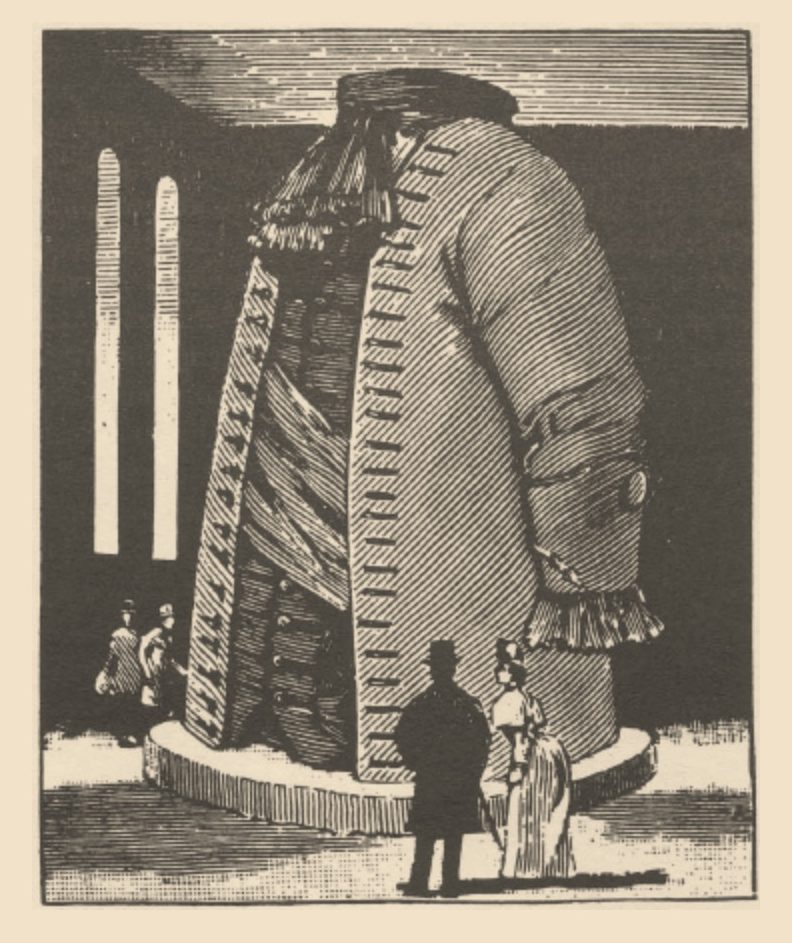
Like “Flight,” “At the Tolstoy Museum” is one of Barthelme’s literal cut-and-paste collage stories — that is, a story to include the author’s own visual collages, juxtaposed against his verbal collages. In “Flight,” the collages seem incidental. They aren’t exactly affectations, and they don’t add anything to the story–but they don’t detract either. The visual collages in “At the Tolstoy Museum” are deployed more judiciously, serving as punchlines that resound off of the narrator’s flat, affectless pose:

I was eating a sandwich at the Tolstoy Museum. The Tolstoy Museum is made of stone—many stones, cunningly wrought Viewed from the street, it has the aspect of three stacked boxes: the first, second, and third levels. These are of increasing size. The first level is, say, the size of a shoebox, the second level the size of a case of whiskey, and the third level the size of a box that contained a new overcoat. The amazing cantilever of the third level has been much talked about. The glass floor there allows one to look straight down and provides a “floating” feeling. The entire building, viewed from the street, suggests that it is about to fall on you. This the architects relate to Tolstoy’s moral authority.

Tolstoy’s Coat

In Hiding Man, Daugherty relates that after “At the Tolstoy Museum” was published in The New Yorker (24 May 1969) “a family from Holly Hill, Florida [wrote to the magazine to learn the location of the Tolstoy Museum.” About two weeks later, Tolstoy’s daughter, the Countess Alexandra L. Tolstoy sent a more indignant letter to the magazine, referring to the story as “Donald Barthelme’s absurd article…What is the aim of such an article? To make people laugh? … How funny! Ha, ha, ha.” Great stuff all around.

20 . “The Wound” (Amateurs, 1976)

A surreal sketch featuring a bullfighter, his mother, his mistress, a bishop, and a famous aficionado (of, implicitly, bullfighting, and, explicitly, breasts), as well as a cast of grumbling minions and peons. Barthelme’s stories are often collage-like, anti-real, hyper-real, or outright absurd, but they are, at least in my estimation, rarely dreamlike. But “The Wound” moves like a dream — a brief, stifled dream, one that reveals something about himself to the dreamer, who later might lament, But I already knew that, like the Bishop who laments his therapy:

The Bishop begins to talk about his psychoanalysis: “I am a different man now,” the Bishop says. “Gloomier, duller, more fearful. In the name of the Holy Ghost, you would not believe what I see under the bed, in the middle of the night.” The Bishop laughs heartily. The torero joins him. The torero’s mistress is filming the Bishop. “I was happier with my whiskey,” the Bishop says, laughing even harder.

The Queen of Gypsies arrives, claiming wounds. There’s “An ecstasy of shrinking” and the final vision of “an immense black bull” blocking the door way. It “begins to ring, like a telephone.”

“The Wound” is a short example that might be handed off to any young person clamoring for meaning or theme or symbolism from every text they read. Sometimes it’s just a dream, a goof, an aesthetic gesture. Sometimes there’s just a surreal punchline that needs to erupt, like a giant black bull ringing like a telephone, blocking the only exit in sight.

Donald Barthelme’s Forty Stories in reverse, Part IV

Previously,

Stories 40-36

Stories 35-32

Stories 31-28

27. “Some of Us Had Been Threatening Our Friend Colby” (Amateurs, 1976)

This is probably the first essential story in Forty Stories—maybe at the end of this silly project I’ll put together something like Fifty Stories, whittling down Sixty Stories and Forty Stories. Here are the first few sentences:

Some of us had been threatening our friend Colby for a long time, because of the way he had been behaving. And now he’d gone too far, so we decided to hang him. Colby argued that just because he had gone too far (he did not deny that he had gone too far) did not mean that he should be subjected to hanging. Going too far, he said, was something everybody did sometimes. We didn’t pay much attention to this argument. We asked him what sort of music he would like played at the hanging. He said he’d think about it but it would take him a while to decide.

Colby finally settles on Ive’s Fourth Symphony.

“Some of Us” showcases in a non-showy way the best of Barthelme—absurdity balanced by syntactic restraint; surreal humor weighted in the visceral specter of impending violence. It’s a very, very funny story, and while I think it resists simple allegorical interpretation, it’s nevertheless a little parcel of domestic fascism in practice. Great stuff. Read “Some of Us Had Been Threatening Our Friend Colby”  here.

26. “Pepperoni” (first published in The New Yorker, 23 Nov. 1980)

Published over four decades ago, “Pepperoni” is a depressingly prescient riff on what happens when capital decides to take over journalism. Newspapers become just another widget, a slice of pepperoni, a trifle, a nothing to sell and sell and resell:

Financially, the paper is quite healthy. The paper’s timber-lands, mining interests, pulp and paper operations, book, magazine, corrugated-box, and greeting-card divisions, film, radio, television, and cable companies, and data-processing and satellite-communications groups are all flourishing, with overall return on invested capital increasing at about eleven percent a year.

Despite the vertical integration, all is not well: “But top management is discouraged and saddened, and middle management is drinking too much.” Barthelme’s hyperbole is jaunty in 1980, where the paper’s “editorials have been subcontracted to Texas Instruments, and the obituaries to Nabisco, so that the staff will have ‘more time to think.'” But in 2024 it reads as a grim warning about the gross intersection of capital and journalism. Read “Pepperoni” here.

25. “Sentence” (City Life, 1970)

I mean what if I just…

Or a long sentence moving at a certain pace down the page aiming for the bottom-if not the bottom of this page then some other page-where it can rest, or stop for a moment to think out the questions raised by its own (temporary) existence, which ends when the page is turned, or the sentence falls out of the mind that holds it (temporarily) in some kind of embrace, not necessarily an ardent one, but more perhaps the kind of embrace enjoyed (or endured), by a wife who has just waked up and is on her way to the bathroom in the morning to wash her hair, and is bumped into by her husband, who has been lounging at the breakfast table reading the newspaper, and doesn’t see her coming out of the bedroom, but, when he bumps into her, or is bumped into by her, raises his hands to embrace her lightly, transiently, because he knows that if he gives her a real embrace so early in the morning, before she has properly shaken the dreams out of her head, and got her duds on, she won’t respond, and may even become slightly angry, and say something wounding, and so the husband invests in this embrace not so much physical or emotional pressure as he might, because he doesn’t want to waste anything-with this sort of feeling, then, the sentence passes through the mind more or less, and there is another way of describing the situation too, which is to say that the sentence crawls through the mind like something someone says to you while you are listening very hard to the FM radio, some rock group there, with its thrilling sound, and so, with your attention or the major part of it at least already rewarded, there is not much mind room you can give to the remark, especially considering that you have probably just quarreled with that person, the maker of the remark, over the radio being too loud, or something like that, and the view you take, of the remark, is that you’d really rather not hear it, but if you have to hear it, you want to listen to it for the smallest possible length of time, and during a commercial, because immediately after the commercial they’re going to play a new rock song by your favorite group, a cut that has never been aired before, and you want to hear it and respond to it in a new way, a way that accords with whatever you’re feeling at the moment, or might feel, if the threat of new experience could be (temporarily) overbalanced by the promise of possible positive benefits, or what the mind construes as such, remembering that these are often, really, disguised defeats (not that such defeats are not, at times, good for your character, teaching you that it is not by success alone that one surmounts life, but that setbacks, too, contribute to that roughening of the personality that, by providing a textured surface to place against that of life, enables you to leave slight traces, or smudges, on the face of human history-your mark) and after all, benefit-seeking always has something of the smell of raw vanity about it, as if you wished to decorate your own brow with laurel, or wear your medals to a cookout, when the invitation had said nothing about them, and although the ego is always hungry (we are told) it is well to remember that ongoing success is nearly as meaningless as ongoing lack of success, which can make you sick, and that it is good to leave a few crumbs on the table for the rest of your brethren, not to sweep it all into the little beaded purse of your soul but to allow others, too, part of the gratification, and if you share in this way you will find the clouds smiling on you, and the postman bringing you letters, and bicycles available when you want to rent them, and many other signs, however guarded and limited, of the community’s (temporary) approval of you, or at least of it’s willingness to let you believe (temporarily) that it finds you not so lacking in commendable virtues as it had previously allowed you to think, from its scorn of your merits, as it might be put, or anyway its consistent refusal to recognize your basic humanness and its secret blackball of the project of your remaining alive, made in executive session by its ruling bodies, which, as everyone knows, carry out concealed programs of reward and punishment, under the rose, causing faint alterations of the status quo, behind your back, at various points along the periphery of community life, together with other enterprises not dissimilar in tone, such as producing films that have special qualities, or attributes, such as a film where the second half of it is a holy mystery, and girls and women are not permitted to see it, or writing novels in which the final chapter is a plastic bag filled with water, which you can touch, but not drink: in this way, or ways, the underground mental life of the collectivity is botched, or denied, or turned into something else never imagined by the planners, who, returning from the latest seminar in crisis management and being asked what they have learned, say they have learned how to throw up their hands; the sentence meanwhile, although not insensible of these considerations, has a festering conscience of its own, which persuades it to follow its star, and to move with all deliberate speed from one place to another, without losing any of the “riders” it may have picked up just being there, on the page, and turning this way and that, to see what is over there, under that oddly-shaped tree, or over there, reflected in the rain barrel of the imagination, even though it is true that in our young manhood we were taught that short, punchy sentences were best (but what did he mean? doesn’t “punchy” mean punch-drunk? I think he probably intended to say “short, punching sentences,” meaning sentences that lashed out at you, bloodying your brain if possible, and looking up the word just now I came across the nearby “punkah,” which is a large fan suspended from the ceiling in India, operated by an attendant pulling a rope-that is what I want for my sentence, to keep it cool!) we are mature enough now to stand the shock of learning that much of what we were taught in our youth was wrong, or improperly understood by those who were teaching it, or perhaps shaded a bit, the shading resulting from the personal needs of the teachers, who as human beings had a tendency to introduce some of their heart’s blood into their work, and sometimes this may not have been of the first water, this heart’s blood, and even if they thought they were moving the “knowledge” out, as the Board of Education had mandated, they could have noticed that their sentences weren’t having the knockdown power of the new weapons whose bullets tumble end-over-end (but it is true that we didn’t have these weapons at that time) and they might have taken into account the fundamental dubiousness of their project (but all the intelligently conceived projects have been eaten up already, like the moon and the stars) leaving us, in our best clothes, with only things to do like conducting vigorous wars of attrition against our wives, who have now thoroughly come awake, and slipped into their striped bells, and pulled sweaters over their torsi, and adamantly refused to wear any bras under the sweaters, carefully explaining the political significance of this refusal to anyone who will listen, or look, but not touch, because that has nothing to do with it, so they say; leaving us, as it were, with only things to do like floating sheets of Reynolds Wrap around the room, trying to find out how many we can keep in the air at the same time, which at least gives us a sense of participation, as though we were Buddha, looking down at the mystery of your smile, which needs to be investigated, and I think I’ll do that right now, while there’s still enough light, if you’ll sit down over there, in the best chair, and take off all your clothes, and put your feet in that electric toe caddy (which prevents pneumonia) and slip into this permanent press hospital gown, to cover your nakedness-why, if you do all that, we’ll be ready to begin! after I wash my hands, because you pick up an amazing amount of exuviae in this city, just by walking around in the open air, and nodding to acquaintances, and speaking to friends, and copulating with lovers, in the ordinary course (and death to our enemies! by and by)-but I’m getting a little uptight, just about washing my hands, because I can’t find the soap, which somebody has used and not put back in the soap dish, all of which is extremely irritating, if you have a beautiful patient sitting in the examining room, naked inside her gown, and peering at her moles in the mirror, with her immense brown eyes following your every movement (when they are not watching the moles, expecting them, as in a Disney nature film, to exfoliate) and her immense brown head wondering what you’re going to do to her, the pierced places in the head letting that question leak out, while the therapist decides just to wash his hands in plain water, and hang the soap! and does so, and then looks around for a towel, but all the towels have been collected by the towel service, and are not there, so he wipes his hands on his pants, in the back (so as to avoid suspicious stains on the front) thinking: what must she think of me? and, all this is very unprofessional and at-sea looking! trying to visualize the contretemps from her point of view, if she has one (but how can she? she is not in the washroom) and then stopping, because it is finally his own point of view that he cares about and not hers, and with this firmly in mind, and a light, confident step, such as you might find in the works of Bulwer-Lytton, he enters the space she occupies so prettily and, taking her by the hand, proceeds to tear off the stiff white hospital gown (but no, we cannot have that kind of pornographic merde in this majestic and high-minded sentence, which will probably end up in the Library of Congress) (that was just something that took place inside his consciousness, as he looked at her, and since we know that consciousness is always consciousness of something, she is not entirely without responsibility in the matter) so, then, taking her by the hand, he falls into the stupendous white puree of her abyss, no, I mean rather that he asks her how long it has been since her last visit, and she says a fortnight, and he shudders, and tells her that with a condition like hers (she is an immensely popular soldier, and her troops win all their battles by pretending to be forests, the enemy discovering, at the last moment, that those trees they have eaten their lunch under have eyes and swords) (which reminds me of the performance, in 1845, of Robert-Houdin, called The Fantastic Orange Tree, wherein Robert-Houdin borrowed a lady’s handkerchief, rubbed it between his hands and passed it into the center of an egg, after which he passed the egg into the center of a lemon, after which he passed the lemon into the center of an orange, then pressed the orange between his hands, making it smaller and smaller, until only a powder remained, whereupon he asked for a small potted orange tree and sprinkled the powder thereupon, upon which the tree burst into blossom, the blossoms turning into oranges, the oranges turning into butterflies, and the butterflies turning into beautiful young ladies, who then married members of the audience), a condition so damaging to real-time social intercourse of any kind, the best thing she can do is give up, and lay down her arms, and he will lie down in them, and together they will permit themselves a bit of the old slap and tickle, she wearing only her Mr. Christopher medal, on its silver chain, and he (for such is the latitude granted the professional classes) worrying about the sentence, about its thin wires of dramatic tension, which have been omitted, about whether we should write down some natural events occurring in the sky (birds, lightning bolts), and about a possible coup d’etat within the sentence, whereby its chief verb would be-but at this moment a messenger rushes into the sentence, bleeding from a hat of thorns he’s wearing, and cries out: “You don’t know what you’re doing! Stop making this sentence, and begin instead to make Moholy-Nagy cocktails, for those are what we really need, on the frontiers of bad behavior!” and then he falls to the floor, and a trap door opens under him, and he falls through that, into a damp pit where a blue narwhal waits, its horn poised (but maybe the weight of the messenger, falling from such a height, will break off the horn)-thus, considering everything very carefully, in the sweet light of the ceremonial axes, in the run-mad skimble-skamble of information sickness, we must make a decision as to whether we should proceed, or go back, in the latter case enjoying the pathos of eradication, in which the former case reading an erotic advertisement which begins, How to Make Your Mouth a Blowtorch of Excitement (but wouldn’t that overtax our mouthwashes?) attempting, during the pause, while our burned mouths are being smeared with fat, to imagine a better sentence, worthier, more meaningful, like those in the Declaration of Independence, or a bank statement showing that you have seven thousand kroner more than you thought you had-a statement summing up the unreasonable demands that you make on life, and one that also asks the question, if you can imagine these demands, why are they not routinely met, tall fool? but of course it is not that query that this infected sentence has set out to answer (and hello! to our girl friend, Rosetta Stone, who has stuck by us through thick and thin) but some other query that we shall some day discover the nature of, and here comes Ludwig, the expert on sentence construction we have borrowed from the Bauhaus, who will-“Guten Tag, Ludwig!”-probably find a way to cure the sentence’s sprawl, by using the improved way of thinking developed in Weimer-“I am sorry to inform you that the Bauhaus no longer exists, that all of the great masters who formerly thought there are either dead or retired, and that I myself have been reduced to constructing books on how to pass the examination for police sergeant”-and Ludwig falls through the Tugendhat House into the history of man-made objects; a disappointment, to be sure, but it reminds us that the sentence itself is a man-made object, not the one we wanted of course, but still a construction of man, a structure to be treasured for its weakness, as opposed to the strength of stones

Is good if not great.

24. “The Temptation of St. Anthony” (Sadness, 1972)

After rereading this one, the thought that dominated my stupid brain was, How the fuck did an editor allow DB to use the word “ineffable” four times in this short story? He uses a version of the word here, in this nice little excerpt in which one of the things that St. Anthony did was the passive doing of being mugged:

 There was the ineffableness I’ve already mentioned, and there were certain things that he did. He was mugged, for example. That doesn’t happen too often here, but it happened to him. It was at night, somebody jumped on him from behind, grabbed him around the neck and began going through his pockets. The man only got a few dollars, and then he threw St. Anthony down on the sidewalk (he put one leg in front of the saint’s legs and shoved him) and then began to run away. St. Anthony called after him, held up his hand, and said, “Don’t you want the watch?” It was a good watch, a Bulova. The man was thunderstruck. He actually came back and took the watch off St. Anthony’s wrist. He didn’t know what to think. He hesitated for a minute and then asked St. Anthony if he had bus fare home. The saint said it didn’t matter, it wasn’t far, he could walk. Then the mugger ran away again.

If not essential, “St. Anthony” is a robust and colorful example of DB riffing in his prime. Read “The Temptation of St. Anthony” here.

Donald Barthelme’s Forty Stories in reverse, Part III

Previously,

Stories 40-36

Stories 35-32

31. “Sakrete” (first published in The New Yorker, 25 Sep. 1983)

“Sakrete” is a silly little domestic riff about garbage can theft, rats, and an alcoholic trying to work with concrete. It’s not a very good story and I have no idea why it was included in Forty Stories. I do like that it shows a general respect for garbage cans and garbage collection (very interested parties should check out Stephen Dixon’s excellent novel Garbage). Here is the last paragraph, the highlight of the story:

 There are now no garbage cans on our street—no garbage cans left to steal. A committee of rats has joined with the Special Provisional committee in order to deal with the situation, which, the rats have made known, is attracting unwelcome rat elements from other areas of the city. Members of the two committees exchange secret grips, grips that I know not of. My wife drives groups of rats here and there in her yellow Pontiac convertible, attending important meetings. The crisis, she says, will be a long one. She has never been happier.

30. “Porcupines At The University” (Amateurs, 1976)

Another trifle—am I regretting this project, this rereading of Forty Stories? The stories in Sixty Stories are so, so much stronger—and those stories were organized chronologically. Going backwards through these is not really going backwards through time, through the artist’s anti-maturation, but rather just, like, making it more difficult to find one’s place in a book. “Porcupines” is a goof on academia that — and I say this as a compliment — at best reads like an alcoholic’s surrealist riff on a college film. Skip it!

29. “The Catechist” (Sadness , 1972)

This is a good story, “The Catechist.” But also a very Catholic one, without being, like, small-c catholic. There’s a bit of narrativizing here that Barthelme would eventually dispense with in his dialogues, the form that he would eventually settle on for his short stories. I say “settle on” but Barthelme died quite young, or, it seems to me, at 45, quite young—dying at 58. Barthelme died from throat cancer, probably a result of his alcoholism (pure conjecture on my part, this last clause):

The catechist reads from his book. “The candidate should be questioned as to his motives for becoming a Christian.”
I think: My motives?
He says: “Tell me about yourself.”
I say: “I’m forty. I have bad eyes. An enlarged liver.”
“That’s the alcohol,” he says.
“Yes,” I say.
“You’re very much like your father, there.”
“A shade more avid.”

28. “Lightning” (Overnight to Many Distant Cities, 1983)

This is a great story. Or at least a very good story, unexpectedly so, written a mode approaching near-realism or even near-dirty-realism. Was Barthelme flexing his muscles in the mirror after having read a story by Raymond Carver? Probably not, but I like to imagine it (I imagine his muscles beefier and musclier than they likely were). “Lightning” has a fairly straightforward ( and unBarthelemesque) plot:

Edward Connors, on assignment for Folks, set out to interview nine people who had been struck by lightning. “Nine?” he said to his editor, Penfield. “Nine, ten,” said Penfield, “doesn’t matter, but it has to be more than eight.” “Why?” asked Connors, and Penfield said that the layout was scheduled for five pages and they wanted at least two people who had been struck by lightning per page plus somebody pretty sensational for the opening page. “Slightly wonderful,” said Penfield, “nice body, I don’t have to tell you, somebody with a special face. Also, struck by lightning.”

The story is ultimately a romantic comedy, with reporter Edward finally finding his “face”:

People would dig slant wells for this woman, go out into a producing field with a tank truck in the dead of night and take off five thousand gallons of somebody else’s crude, write fanciful checks, establish Pyramid Clubs with tony marble-and-gold headquarters on Zurich’s Bahnhofstrasse. What did he have to offer?

He finds something to offer. This is probably the best one yet in Forty Stories (in reverse, anyway).

Donald Barthelme’s Forty Stories in reverse, Part II

Previously,

Stories 40-36

35. ” Overnight to Many Distant Cities” (Overnight to Many Distant Cities, 1983)

In Hiding Man, his 2010 Barthelme biography, Tracy Daugherty notes that Barthelme’s collection Overnight to Many Distant Cities was not particularly well-received by critics. Reviews were a mix of bafflement and derision, as Daugherty has it, which fits the tone near the end of Hiding Man: a career winding-down—Barthelme a happy father, content with a teaching gig, and committed to a new form for his stories, now pared down to spare and often oblique dialogues. Daugherty relays a detail from a rejection letter from Barthelme’s (one-time) champion at the New Yorker, Roger Angell: “Well, maybe we’ll learn to read you. It won’t be the first time that happened.”

In my estimation, Barthelme’s later stories do not diverge too radically from his earlier work. The techniques may have evolved (or devolved, if you like), but collage and pastiche are still a major mode, domestic themes prevail, and Our Bard is ever the ironist.

Barthelme sprinkles vignettes throughout Overnight to Many Distant Cities (like Hemingway’s In Our Time); its title track, coming at the end of the collection, is a travelogue in vignettes with our narrator and his family visiting places like Paris, London, Copenhagen… The story is essentially a series of anecdotes and arch asides (“Asked her opinion of Versailles, my daughter said she thought it was overdecorated”), and, as Barthelme’s wife Marion disclosed in Daugherty’s book, some of the material was directly drawn from their honeymoon in Barcelona (“In Barcelona the lights went out”). A taste:

In Stockholm we ate reindeer steak and I told the Prime Minister… That the price of booze was too high. Twenty dollars for a bottle of J&B! He (Olof Palme) agreed, most politely, and said that they financed the Army that way. The conference we were attending was held at a workers’ vacation center somewhat outside the city. Shamelessly, I asked for a double bed, there were none, we pushed two single beds together. An Israeli journalist sat on the two single beds drinking our costly whiskey and explaining the devilish policies of the Likud. Then it was time to go play with the Africans. A poet who had been for a time a Minister of Culture explained why he had burned a grand piano on the lawn in front of the Ministry. “The piano,” he said, “is not the national instrument of Uganda.”

Is it essential Barthelme? Of course not. But it’s nice enough.

34. ” The Film” (first published as “A Film” in the The New Yorker, September 26, 1970)

A nice little story that never quite transcends it’s marvelous opening lines:

Things have never been better, except that the child, one of the stars of our film, has just been stolen by vandals, and this will slow down the progress of the film somewhat, if not bring it to a halt. But might not this incident, which is not without its own human drama, be made part of the story line?

I just went back and read the last lines though, and they are also very good:

Truth! That is another thing they said our film wouldn’t contain. I had simply forgotten about it, in contemplating the series of triumphs that is my private life.

33. “110 West Sixty-First Street” (Amateurs, 1976)

An ugly tragic domestic comedy in just over a dozen paragraphs: Paul and Eugenie are trying to get over the death of their infant by going to erotic films. It doesn’t work; they take up cruelty–

“You are extremely self-righteous,” Eugenie said to Paul. “That is the one thing I can’t stand in a man. Sometimes I want to scream.”

“You are a slut without the courage to go out and be one,” Paul replied. “Why don’t you go to one of those bars and pick up somebody, for God’s sake?”

“It wouldn’t do any good,” Eugenie said.

32. “Captain Blood” (Overnight to Many Distant Cities, 1983)

So like one of my favorite things that Melville does in Moby-Dick is turn the whole thing into a drama, a play that is taking place in the narrator-cum-Ishmael’s consciousness, with Starbuck and Stubb milling and mulling on various decks, soliloquizing. And while the Captain Blood of “Captain Blood” is no Ahab, he’s still a compellingly goofy brooder:

Blood, at dawn, a solitary figure pacing the foredeck. The world of piracy is wide, and at the same time, narrow. One can be gallant all day long, and still end up with a spider monkey for a wife. And what does his mother think of him?

This isn’t Barthelme at his best—that stock was poured into Sixty Stories—but it’s still the jaunty, boyish fun flavor that I want when I dip into his stuff.

Donald Barthelme’s Forty Stories in reverse, Part I

A few years ago, I reread Donald Barthelme’s collection Sixty Stories and wrote about them on this blog. I enjoyed the project immensely. A recent comment on the last of those Sixty Stories posts asked, or demanded, I suppose (the four-word comment is in the imperative voice) that I Now do Forty Stories. Which I am going to now do, Forty Stories.

40. “January” (first published in The New Yorker, 6 April 1987)

“January” begins as a dialogue between two characters, a mode Barthelme would return to repeatedly throughout his later career. The story is ostensibly a Paris Review style interview with one “Thomas Brecker,” who has authored seven books on religion over his thirty-five year career. The story begins as light satire; our Serious Writer is “renting a small villa” in St. Thomas; the interviewer notes that “a houseboy attended us, bringing cool drinks on a brown plastic tray of the sort found in cafeterias.” The interview quickly takes the shape of a career-spanning reflection, with Brecker sliding into a more melancholy mind frame. By the end of the story, the “interviewer” disappears, leaving us in Brecker’s imagination, where we have likely always been, and it’s hard not to read Barthelme’s autobiographical flourishes beneath Brecker’s mordant quips:

I think about my own death quite a bit, mostly in the way of noticing possible symptoms—a biting in the chest—and wondering, Is this it? It’s a function of being over sixty, and I’m maybe more concerned by how than when. That’s a … I hate to abandon my children. I’d like to live until they’re on their feet. I had them too late, I suppose. 

39. “The Baby” (Overnight to Many Distant Cities, 1983)

“The Baby” was composed around the same time as “Chablis” (1983); both stories are love letters of paternal affection for an infant daughter. Again, it’s hard not to see Barthelme’s own biography here. His daughter Katherine was an infant at the time he wrote them. While I don’t think “The Baby” is as strong as “Chablis” is (or, at least as strong in my memory — “Chablis” is the first story in Forty Stories, so we’ll get there, I guess) — while I don’t think “The Baby” is as strong as “Chablis,” it’s still a fun little ditty with an anarchic punchline. It’s also, like barely five short paragraphs–just read it.

38. “Great Days” (Great Days, 1979)

As I revisit my notes for “Great Days,” I realize I should probably read the story again, more slowly, and try to tune more into its voice. Or voices. Are there two voices here, or one? I think there is more of a n actual story story here than I can summarize — not that anyone wants summary of Barthelme —  but my takeaway is that this is Barthelme doing Stein doing Cubism doing… In his 2009 biography of Barthelme Hiding Man, Tracy Daugherty wrote that New Yorker fiction editor (and early Barthelme champion) Roger Angell rejected an early version of the story (under the title “Tenebrae”). According to Daugherty’s bio, while Angell recognized the story as a “serious work” and a “new form,” he ultimately thought it was too “private and largely abstract” for publication.

I think this bit is lovely read aloud:

 —Purple bursts in my face as if purple staples had been stapled there every which way—

—Hurt by malicious criticisms all very well grounded—

—Oh that clown band. Oh its sweet strains.

—The sky. A rectangle of glister. Behind which, a serene brown. A yellow bar, vertical, in the upper right.

—I love you, Harmonica, quite exceptionally.

—By gum I think you mean it. I think you do.

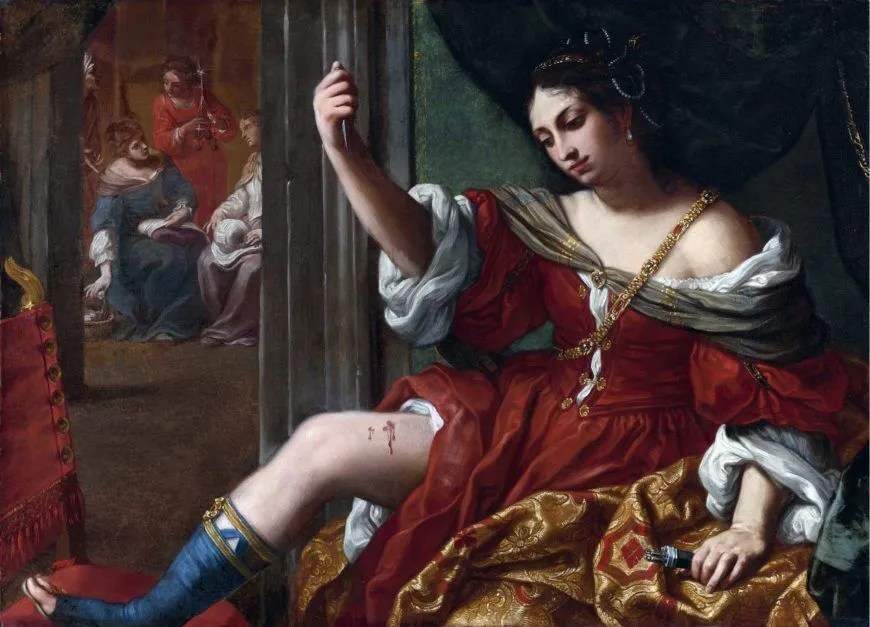
—It’s Portia Wounding Her Thigh.

—It’s Wolfram Looking at His Wife Whom He Has Imprisoned with the Corpse of Her Lover.

Elisabetta Sirani, Portia Wounding her Thigh, 1664


37. “Letters to the Editore” (Guilty Pleasures, 1974)

A lively little gem from Barthelme’s mid-seventies “non-fiction” collection Guilty Pleasures. Its inclusion seems to show an editorial need to pad out Forty Stories with more hits than the old boy had strung together by ’87. Anyway. “Letters to the Editore” is a fantastic send-up of small aesthetic aggressions writ large in the slim pages of little magazines. The ostensible subject is a dust-up surrounding an exhibition of so-called “asterisk” paintings by an American in a European gallery—but the real subject is language itself:

The Editor of Shock Art has hardly to say that the amazing fecundity of the LeDuff-Galerie Z controversy during the past five numbers has enflamed both shores of the Atlantic, at intense length. We did not think anyone would care, but apparently, a harsh spot has been touched. It is a terrible trouble to publish an international art-journal in two languages simultaneously, and the opportunities for dissonance have not been missed.

Barthelme’s comedic control of voices here is what makes this “story” an early (which is to say, late) standout in Forty Stories. It is the “opportunities for dissonance” that our author is most interested in and attuned to.

36. “Construction” (first published in The New Yorker, 21 April 1985)

“Construction” is the non-story of a writer flying out West to complete the “relatively important matter of business which had taken me to Los Angeles, something to do with a contract, a noxious contract, which I signed.” The documents he signs are “reproduced on onionskin, which does not feel happy in the hand.” This is one of two decent verbal flares in “Construction”; the other is an extended episode (as verbal flare-ups go) in which we find our Writer-Hero up against the wall of absurdity:

The flight back from Los Angeles was without event, very calm and smooth in the night. I had a cup of hot chicken noodle soup which the flight attendant was kind enough to prepare for me; I handed her the can of chicken noodle soup and she (I suppose, I don’t know the details) heated it in her microwave oven and then brought me the cup of hot chicken noodle soup which I had handed her in canned form, also a number of drinks which helped make the calm, smooth flight more so. The plane was half empty, there had been a half-hour delay in getting off the ground which I spent marveling at a sentence in a magazine, the sentence reading as follows: “[Name of film] explores the issues of love and sex without ever being chaste.” I marveled over this for the full half-hour we sat on the ground waiting for clearance on my return from Los Angeles, thinking of adequate responses, such as “Well we avoided that at least,” but no response I could conjure up was equal to or could be equal to the original text which I tore out of the magazine and folded and placed, folded, in my jacket pocket for further consideration at some time in the future when I might need a giggle.

Barthelme’s stand-in confesses here to what we’ve always known: He’s a scissors-and-paste man, a night ripper with a good ear, a good eye, but mostly one of us, a guy who needs a good giggle.

RIP Robert Coover, Prince of American Metafiction

RIP Robert Coover, 1932-2024

Robert Coover passed away a few days ago at ninety-two years old. In his decades-spanning career, Coover published twenty-one novels, four plays, and four short story collections. He also published dozens of (as-yet) uncollected stories, essays, and a host of so-called “electronic fiction.” A fifth short story collection, 2018’s Going for a Beer, collected some of Coover’s greatest hits, and is generally an excellent starting place for those interested in Coover’s metatextual fabulism.

Coover didn’t start out as a metatextual fabulist. His first novel, 1966’s The Origin of the Brunists, is vivid, humanist realism with the slightest tinges of magic brightening its edges. 1968’s follow-up, The Universal Baseball Association, Inc., J. Henry Waugh, Prop., strays much deeper into the pop-myth fantasies that Coover would perfect in his mature career.

Coover’s 1969 collection Pricksongs & Descants shows a remarkable shift into postmodern metafiction. Pricksongs features some of his better stories, like “The Brother” (told from the point of view of the biblical Noah’s brother), “The Elevator,” and “The Magic Poker,” which begins with the sentence “I wander the island, inventing it” — a tidy encapsulation of Coover’s growing motif of the self-creating story. At times, this metatextual motif can exhaust the reader, as in Pricksongs’ capper “The Hat Act.” However, the collection features one of Coover’s best stories, “The Babysitter,” in which the titular character serves as a locus for a mundane suburban community’s collective repressed anxieties of sex and violence.

Coover would continue to explore such themes throughout his career, refining and sharpening his metatextual hat act in standout novels like Spanking the Maid (1982), Gerald’s Party (1986), and 1977’s The Public Burning—arguably Coover’s most important novel. It’s easy to think of The Public Burning as the last part of a loose postmodern American trilogy of large daring novels, the first two parts comprised of Pynchon’s Gravity’s Rainbow (1973) and William Gaddis’s J R (1975).

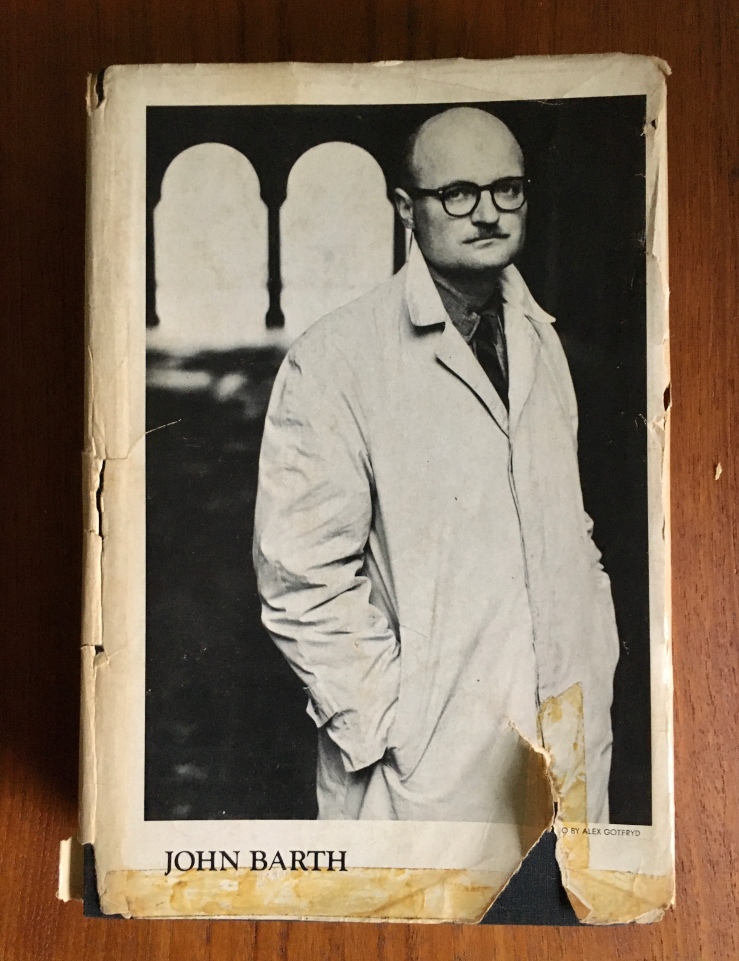
Indeed, Coover was regularly grouped with a (very white, very male) clique of postmodern American writers. In his 1980 essay “The Literature of Replenishment,” John Barth halfheartedly counted up the members: “By my count, the American fictionists most commonly included in the canon, besides the three of us at Tubingen [William H. Gass, John Hawkes and Barth himself], are Donald Barthelme, Robert Coover, Stanley Elkin, Thomas Pynchon, and Kurt Vonnegut, Jr.”

There was some chatter on social media that Coover’s passing left just Pynchon–and maybe Don DeLillo and Joseph McElroy–as the last living luminaries of twentieth-century US American postmodernist fiction. Of course, Pynchon really wasn’t a member of this or any other clique (he declined an invitation to Donald Barthelme’s so-called “postmodernists dinner“), and, as is too often the case with such groupings, Ishmael Reed’s contribution to American postmodernist fiction continues to be marginalized.

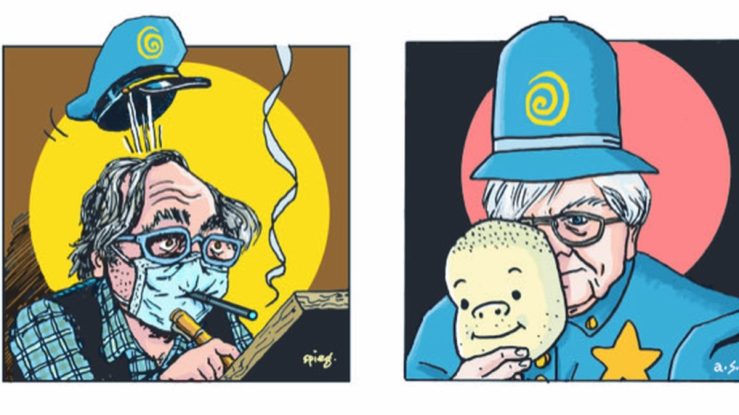
Let it stand then that Robert Coover, despite whatever connections and friendships he held with other writers and artists, was his own special self-made creation. He was prolific, especially later in life, publishing nine novels in the twenty-first century. One of these was The Brunist Day of Wrath (2014), a sequel to his debut; he also collaborated with comix artist Art Spiegelman on the graphic novelette Street Cop (2021) and even found a sliver of mainstream readers with Huck Out West, his wonderful 2017 “sequel” to Adventures of Huckleberry Finn. Coover’s latest novel Open House was published just over a year ago.

Clearly, Coover leaves behind a large body of work, and we’ll likely see more of his work collected and published over the next decade. I won’t pretend to have read most of what he’s written, but I’ve loved a lot of it—particularly Pricksongs & DescantsHuck Out WestSpanking the Maid, and Briar Rose, which, as far as I can recall, is likely the first thing I read of his (my girlfriend at the time’s sister had to read it in college; she professed that she hated it but thought I’d like it). The aforementioned 2018 collection Going for a Beer is a nice starting place for Coover; those more interested in novels might like Spanking the Maid. Or jump into one of his later short novels, like 2004’s Stepmother or 2018’s The Enchanted Prince, both of which exemplify his metamagicianist mode. Or hell, just go for the big boy, The Public Burning. Ultimately, Coover leaves behind a trove of trembling, writhing, vividly-living words, an oeuvre that will continue to engage readers fascinated by a certain stamp of so-called experimental literature–and for that I thank him.


Disjunction, simultaneity, irrationalism, anti-illusionism, self-reflexiveness, medium-as-message, political olympianism, and a moral pluralism approaching moral entropy | John Barth

Disjunction, simultaneity, irrationalism, anti-illusionism, self-reflexiveness, medium-as-message, political olympianism, and a moral pluralism approaching moral entropy—these are not the whole story either.

A worthy program for postmodernist fiction, I believe, is the synthesis or transcension of these antitheses, which may be summed up as premodernist and modernist modes of writing. My ideal postmodernist author neither merely repudiates nor merely imitates either his twentieth-century modernist parents or his nineteenth-century premodernist grandparents. He has the first half of our century under his belt, but not on his back. Without lapsing into moral or artistic simplism, shoddy craftsmanship, Madison Avenue venality, or either false or real naïveté, he nevertheless aspires to a fiction more democratic in its appeal than such late-modernist marvels (by my definition) as Beckett’s Texts for Nothing or Nabokov’s Pale Fire. He may not hope to reach and move the devotees of James Michener and Irving Wallace—not to mention the great mass of television-addicted non-readers. But he should hope to reach and delight, at least part of the time, beyond the circle of what Mann used to call the Early Christians: professional devotees of high art.

I feel this in particular for practitioners of the novel, a genre whose historical roots are famously and honorably in middle-class popular culture. The ideal postmodernist novel will somehow rise above the quarrel between realism and irrealism, formalism and “contentism,” pure and committed literature, coterie fiction and junk fiction. Alas for professors of literature, it may not need as much teaching as Joyce’s or Nabokov’s or Pynchon’s books, or some of my own. On the other hand, it will not wear its heart on its sleeve, either; at least not its whole heart. (In a recent published exchange between William Gass and John Gardner, Gardner declares that he wants everybody to love his books; Gass replies that he would no more want his books to be loved by everybody than he’d want his daughter to be loved by everybody, and suggests that Gardner is confusing love with promiscuity.) My own analogy would be with good jazz or classical music: One finds much on successive listenings or close examination of the score that one didn’t catch the first time through; but the first time through should be so ravishing—and not just to specialists—that one delights in the replay.

Lest this postmodern synthesis sound both sentimental and impossible of attainment, I offer two quite different examples of works which I believe approach it, as perhaps such giants as Dickens and Cervantes may be said to anticipate it. The first and more tentative example (it is not meant to be a blockbuster) is Italo Calvino’s Cosmicomics (1965): beautifully written, enormously appealing space-age fables—“perfect dreams,” John Updike has called them—whose materials are as modern as the new cosmology and as ancient as folktales, but whose themes are love and loss, change and permanence, illusion and reality, including a good deal of specifically Italian reality. Like all fine fantasists, Calvino grounds his nights in local, palpable detail: Along with the nebulae and the black holes and the lyricism, there is a nourishing supply of pasta, bambini, and good-looking women sharply glimpsed and gone forever. A true postmodernist, Calvino keeps one foot always in the narrative past—characteristically the Italian narrative past of Boccaccio, Marco Polo, or Italian fairy tales—and one foot in, one might say, the Parisian structuralist present; one foot in fantasy, one in objective reality, etc. It is appropriate that he has, I understand, been chastized from the left by the Italian communist critics and from the right by the Italian Catholic critics; it is symptomatic that he has been praised by fellow authors as divergent as John Updike, Gore Vidal, and myself. I urge everyone to read Calvino at once, beginning with Cosmicomics and going right on, not only because he exemplifies my postmodernist program, but because his fiction is both delicious and high in protein.

An even better example is Gabriel García Márquez’s One Hundred Years of Solitude (1967): as impressive a novel as has been written so far in the second half of our century and one of the splendid specimens of that splendid genre from any century. Here the synthesis of straightforwardness and artifice, realism and magic and myth, political passion and nonpolitical artistry, characterization and caricature, humor and terror, are so remarkably sustained that one recognizes with exhilaration very early on, as with Don Quixote and Great Expectations and Huckleberry Finn, that one is in the presence of a masterpiece not only artistically admirable, but humanly wise, lovable, literally marvelous. One had almost forgotten that new fiction could be so wonderful as well as so merely important. And the question whether my program for postmodernism is achievable goes happily out the window, like one of García Márquez’s characters on flying carpets. Praise be to the Spanish language and imagination! As Cervantes stands as an exemplar of premodernism and a great precursor of much to come, and Jorge Luis Borges as an exemplar of dernier cri modernism and at the same time as a bridge between the end of the nineteenth century and the end of the twentieth, so Gabriel García Márquez is in that enviable succession: an exemplary postmodernist and a master of the storyteller’s art.


From John Barth’s 1980 essay “The Literature of Replenishment.”

A gifted writer is likely to rise above what he takes to be his aesthetic principles | John Barth

It goes without saying that critical categories are as more or less fishy as they are less or more useful. I happen to believe that just as an excellent teacher is likely to teach well no matter what pedagogical theory he suffers from, so a gifted writer is likely to rise above what he takes to be his aesthetic principles, not to mention what others take to be his aesthetic principles. Indeed, I believe that a truly splendid specimen in whatever aesthetic mode will pull critical ideology along behind it, like an ocean liner trailing seagulls. Actual artists, actual texts, are seldom more than more or less modernist, postmodernist, formalist, symbolist, realist, surrealist, politically committed, aesthetically “pure,” “experimental,” regionalist, internationalist, what have you. The particular work ought always to take primacy over contexts and categories. On the other hand, art lives in human time and history, and general changes in its modes and materials and concerns, even when not obviously related to changes in technology, are doubtless as significant as the changes in a culture’s general attitudes, which its arts may both inspire and reflect. Some are more or less trendy and superficial, some may be indicative of more or less deep malaises, some perhaps healthy correctives of or reactions against such malaises.

From John Barth’s 1980 essay “The Literature of Replenishment.”

Who are the postmodernists? | John Barth

Who are the postmodernists? By my count, the American fictionists most commonly included in the canon, besides the three of us at Tubingen, are Donald Barthelme, Robert Coover, Stanley Elkin, Thomas Pynchon, and Kurt Vonnegut, Jr. Several of the critics I read widen the net to include Saul Bellow and Norman Mailer, different as those two writers would appear to be. Others look beyond the United States to Samuel Beckett, Jorge Luis Borges, and the late Vladimir Nabokov as engendering spirits of the “movement”; others yet insist upon including the late Raymond Queneau, the French “new novelists” Nathalie Sarraute, Michel Butor, Alain Robbe-Grillet, Robert Pinget, Claude Simon, and Claude Mauriac, the even newer French writers of the Tel Quel group, the Englishman John Fowles, and the expatriate Argentine Julio Cortázar. Some assert that such filmmakers as Michelangelo Antonioni, Federico Fellini, Jean-Luc Godard, and Alain Resnais are postmodernists. I myself will not join any literary club that doesn’t include the expatriate Colombian Gabriel García Márquez and the semi-expatriate Italian Italo Calvino, of both of whom more presently. Anticipations of the “postmodernist literary aesthetic” have duly been traced through the great modernists of the first half of the twentieth century—T. S. Eliot, William Faulkner, André Gide, James Joyce, Franz Kafka, Thomas Mann, Robert Musil, Ezra Pound, Marcel Proust, Gertrude Stein, Miguel de Unamuno, Virginia Woolf—through their nineteenth-century predecessors—Alfred Jarry, Gustave Flaubert, Charles Baudelaire, Stephane Mallamd, and E. T. A. Hoffmann—back to Laurence Sterne’s Tristram Shandy (1767) and Miguel de Cervantes’s Don Quixote (1615).

On the other hand, among certain commentators the sifting gets exceedingly fine. Professor Jerome Klinkowitz of Northern Iowa, for example, hails Barthelme and Vonnegut as the exemplary “postcontemporaries” of the American 1970s and consigns Pynchon and myself to some 1960ish outer darkness. I regard the novels of John Hawkes as examples of fine late modernism rather than of postmodernism (and I admire them no less for that). Others might regard most of Bellow, and Mailer’s The Naked and the Dead, as comparatively premodernist, along with the works of such more consistently traditionalist American writers as John Cheever, Wallace Stegner, William Styron, or John Updike, for example (the last of whom, however, Ihab Hassan calls a modernist), or those of most of the leading British writers of this century (as contrasted with the Irish), or those of many of our contemporary American women writers of fiction, whose main literary concern, for better or worse, remains the eloquent issuance of what the critic Richard Locke has called “secular news reports.” Even among the productions of a given writer, distinctions can be and often are invoked. Joyce Carol Oates writes all over the aesthetical map. John Gardner’s first two published novels I would call distinctly modernist works; his short stories dabble in postmodernism; his polemical nonfiction is aggressively reactionary. Italo Calvino, on the other hand, began as an Italian new-realist (in The Path to the Nest of Spiders, 1947) and matured into an exemplary postmodernist (with e.g., Cosmicomics, 1965, and The Castle of Crossed Destinies, 1969) who on occasion rises, sinks, or merely shifts to modernism (e.g., Invisible Cities, 1972). My own novels and stories seem to me to have both modernist and postmodernist attributes, even occasional premodernist attributes.

One certainly does have a sense of having been through this before. Indeed, some of us who have been publishing fiction since the 1950s have had the interesting experience of being praised or damned in that decade as existentialists and in the early 1960s as black humorists. Had our professional careers antedated the Second World War, we would no doubt have been praised or damned as modernists, in the distinguished company listed above. Now we are praised or damned as postmodernists.


From John Barth’s 1980 essay “The Literature of Replenishment.”

Horrors and oneiric aberrations | On Antoine Volodine’s post-exotic novel Radiant Terminus

Antoine Volodine’s novel Radiant Terminus is a 500-page post-apocalyptic, post-modernist, post-exotic epic that destabilizes notions of life and death itself. Radiant Terminus is somehow simultaneously fat and bare, vibrant and etiolated, cunning and naive. The prose, in Jeffrey Zuckerman’s English translation, shifts from lucid, plain syntax to poetical flights of invention. Volodine’s novel is likely unlike anything you’ve read before—unless you’ve read Volodine.

Radiant Terminus begins with its hero Kronauer fleeing into an irradiated wasteland. Kronauer and two of his comrades are escaping from the Orbise, the capital of the Second Soviet Union, which has been invaded by dog-headed fascists. World-wide Marxism-Leninism has fallen, and the stability of nuclear-powered self-sufficiency has collapsed into the apocalyptic promise of a “world that nuclear accidents had made unlivable for ten millennia to come.” The world is indeed increasingly unlivable, but it also has become, we will find, a place for the undying as well. “Hell is on the surface, it’s here,” one character flatly remarks, adding, “No need to dive into the core.”

But Kronauer will have to dive into the core, at least metaphorically. When one of his comrades, succumbing to radiation poison, can no longer move, Kronauer seeks help, crossing the steppe and bravely venturing into the dark forest. Born in the sanctity of the Orbise, Kronauer had been schooled to focus “on the future of Communes for workers and countrymen. His view of the world was illuminated by proletarian morality: self-sacrifice, altruism, and confrontation.” He is driven to save his comrade, but we know from the outset that hopes are slim.

What matters here is Kronauer’s essential idealism. By the end of the novel, Kronauer will suffer, wondering if he will eventually abandon the principles that underwrite his sense of self. He worries that he will eventually slip into a “total regression to primitive hunting, intelligence sidelined for instincts, and, especially, deep down, an irrepressible desire to kill, to slaughter, and to hurt, even if he couldn’t remember anymore what had brought about this nightmare.”

We enter Radiant Terminus in the midst of a nightmare that somehow only intensifies. Kronauer finds his way to what might be the prospect of aid for his comrade, the titular Radiant Terminus, a collective farm that is somehow self-sustaining despite the ever-present specter of irradiated death. Not only is Radiant Terminus out of sync with the physical reality of the post-apocalyptic world, its principles don’t fully square with the tenets of the Second Soviet Union that have guided Kronauer’s mindset:

Radiant Terminus functioned on ideological principles that didn’t match up to the collectivist norms of the Orbise, but, as far as the allocation of goods went, the end result was the same. Disdain for property was, as had been the case throughout the Second Soviet Union, commonplace in the Levanidovo. It was a place where the Party had been extinguished, where the Party no longer existed, but where the idea of reestablishing capitalism and the bourgeoisie hadn’t occurred to anyone, and besides it had to be asked just what this thing called capitalism would have looked like at Radiant Terminus, and what bourgeoisie could be called upon to oppress the working class…

We come to understand, elliptically enough, that Radiant Terminus’s apparent prosperity (or at least sustainability) is purchased in large part via sacrifices made to the village’s old nuclear reactor core, which has melted down and is kept locked away. The core is a kind of doorway to hell. The citizens of Radiant Terminus offer it gifts from the old world:

Every month, indeed, the core was fed. The heavy cover for the well was opened, and some of the bric-a-brac collected over the last season or two was knocked over the edge; just to show that people weren’t panicking and weren’t afraid of pathetic radionuclides. Tables and chairs, television sets, the tarry carcasses of cows and cowherds, tractor motors, charred schoolteachers who had been forgotten in their classrooms during the critical period, computers, remains of phosphorescent crows, moles, does, wolves, squirrels, clothes that looked perfect but had only to be shaken to set off a haze of sparks, inflated toothpaste tubes filled with constantly simmering toothpaste, albino dogs and cats, clusters of iron that continued to rumble with an inner fire, new combine harvesters that hadn’t yet been broken in and which gleamed at midnight as if they were lying in full sunlight, garden forks, hoes, axes, debarkers, accordions that spat out more gamma rays than folkloric melodies, pinewood planks that looked like ebony planks, Stakhanovites in their Sunday best with their hands mummified around their diplomas, forgotten when the event halls were evacuated. The ledgers with their pages turning day and night. Cash-register money, the copper coins clinking and shifting without anyone nearby. These were the sorts of things thrown into the void.

The Gramma Udgul was the one to handle the maneuver

We come to understand the Gramma Udgul as priestess-witch archetype; “condemned to immortality from her first interactions with nuclear reactor cores” she is both immune to the ravages of radiation and cursed by it. The Gramma Udgul has her counterpoint in Solovyei, the dominant antagonist of Radiant Terminus.

Solovyei is the “president” of Radiant Terminus, but his role is something closer to an archduke synthesized with an insane wizard. Like the Gramma Udgul, Solovyei is immortal (indeed, a century earlier, the pair were husband and wife). Solovyei rules greedily over Radiant Terminus, and warns Kronauer to stay away from his three daughters. He is an inverted King Lear; mad, yes, but also deeply capable and cunning. Solovyei seems to find metaphysical sustenance in trips to Radiant Terminus’s nuclear core, emerging from time spent there “sizzling and blackened, weighed down with radiation and opaque poems.”

The development of Solovyei as a controlling intelligence—and Kronauer’s ideological resistance to his monomania as well as his three daughters’ battle against his invasive will—forms the main plot, such as it is, of Radiant Terminus. Solovyei is the author of the “horrors and oneiric aberrations” that haunt the characters and landscape that he is both collapsing center and impossible margin of. “It was hard to determine whether he was a mutant bird, a gigantic sorcerer, or a rich farmer from Soviet or Tolstoyan times,” the narrator declares at one point.

“This necromancer of the steppes,” Kronauer calls Solovyei, and then goes on to try to find language for the metaphysical:

This awful kolkhoz matchmaker, this reviver of cadavers, this horrible shadow, this giant impervious to radiation, this shamanic authority from nowhere, this president of nothing, this vampire in the form of a kulak, this strange man sitting on a stool, this abuser, this dominating man, this sleazy man, this unsettling man, this nuclear-reactor creature, this godless and lordless hypnotizer, this manipulator…

One of the key plot points of Radiant Terminus is that Solovyei can literally resurrect the dead, but cannot reanimate them back to what we would understand as true life:

….we all became bodies inhabited by Solovyei. Who knows whether this magic muzhik hasn’t taken advantage of us being dead, and if we aren’t all puppets within a theater where the manager, the actors, and the audience are all one and the same person

Some of Volodine’s chapters seem to inhabit Solovyei’s consciousness, a space that’s somehow both murky and sharp, an intelligence feasting on the agencies of other human beings:

Our best marionettes, I say. Him or me, doesn’t matter. When he’s stuck I keep going. Zombies, deep shadows, devoted servants. The dead stuck forever in the Bardo. Dead come from the dead. Wives come from unknown mothers. Henchmen. Best puppets and best dolls.

Every character who survives in the pages of Radiant Terminus seems to be susceptible to Solovyei’s oneiric horrors. He is the dream police, the puppet master — “Who’s he?” a minor character asks. The answer: “We don’t know…But we do know that he does with us whatever he wants. We’re in his hell.”

Solovyei’s daughters are the most sympathetic of his vampiric victims. These women, forced into the same unasked-for immortality as their father, find themselves repeatedly invaded by Solovyei, who haunts their dreams and walks around in their minds. One daughter sees herself “a creature imagined, possessed, and brought to life by Solovyei. A daughter of Solovyei, a daughter for Solovyei. A female annex in Solovyei’s life: nothing more than that.” They initiate their own eruptions of opposition: violence, suicidal rejection. Writing.

Near the end of Radiant Terminus, the narrator describes the novels of Hannko Vogulian, Solovyei’s eldest daughter:

In effect, they depicted the same twilit suffering of everyone, a magical but hopeless ordinariness, organic and political deterioration, infinite yet unwished-for resistance to death, perennial uncertainty about reality, or a penal progression of thought, penal, wounded, and insane.

We have here an internal description of the novel Radiant Terminus itself. Indeed, Radiant Terminus is always self-describing and always self-deconstructing: “Everything is in the same place, as in some kind of book, if you want to go to the trouble of thinking about it. That’s the ambiguity of ubiquity and achronia,” the narrator muses. When the narrator throws out the sentence, “These are complete works for no audience,” it almost feels like an inside joke. And Volodine can’t resist metanarrative descriptions of his own so-called post-exotic project:

If a post-exotic writer had been present at the scene, he would have certainly described it according to the techniques of magical socialist realism, with flights of lyricism, drops of sweat, and the proletarian exaltation that were part of the genre. It would have been a propagandist epic with reflections on the individual’s endurance in service to the collective.

Volodine’s Radiant Terminus works in all these modes while simultaneously subverting them. The result is an astounding novel, a work that will haunt any reader willing to tune into its strange vibrations and haunted frequencies. Very highly recommended.

Mass-market Monday | American Short Stories since 1945

American Short Stories since 1945, edited by John Hollander. Perennial Classics, first edition, 1968. Cover design by Emanuel Schongut. 525 pages.

I think it was the title and the spine that first intrigued me when I pulled American Short Stories since 1945 from the shelf of a used book store: What would the selections be? How many years does the collection span? If Emanuel Schongut’s exquisite cover didn’t sell me on the book (which it did, all two dollars of it!), then the track list on the back certainly would have. And not so much for the authors I’d already read–Gass, Pynchon, Barthelme, O’Connor, Baldwin, and so on—but for the ones I hadn’t heard of, or at least didn’t think I’d heard of. Paul Goodman? Gilbert Rogin? Jeremy Larner? George P. Elliott? The poet who compiled the collection, John Hollander, writes in his introduction that it “aims to show the major shapes taken by shorter fiction in America since the end of World War II.” It’s the sort of book I wish I’d found when I was much, much younger, the kind of mixtape that would have sent me a lot of strange, wonderful directions.

RIP John Barth

img_4537

RIP John Barth, 1930-2024

John Barth died yesterday at the age of 93. Between 1956 and 2011, he published thirteen novels and four short story collections. He also published a quartet of nonfiction books—his “Friday” books—that collected the many essays, introductions, lectures, and other pieces he wrote in his life time. The title of the last collection of nonfiction, 2022’s Postscripts (or Just Desserts): Some Final Scribblings, consciously pointed to the end of his road.

Barth will most likely be remembered for the novels and stories he published in the 1960s and 1970s, when he began practicing the metaficitonal arts. Critics and reviewers have alternately accused Barth of being a fabulist, an anti-novelist, a black humorist, a goddamn nihilist (or at least a creator of nihilist fiction), but most predominately, as a postmodernist.

Barth’s run from 1960-1972 is particularly impressive: The Sot-Weed FactorGiles Goat-BoyLost in the Funhouse, and Chimera. In these works, Barth helped to create a new postmodernist tradition in U.S. fiction. Like most postmodern practitioners of his era, he was ambivalent and perhaps suspicious of the term postmodern. But Barth’s 1967 essay “The Literature of Exhaustion”, oft-cited as a postmodernist manifesto, called for a new literature in the face of “the used-upness of certain forms or exhaustion of certain possibilities,” which he cheerfully noted was “by no means necessarily a cause for despair.” (It’s a fine read, but not really a manifesto so much as a love letter to his hero Jorge Luis Borges.)

Many readers have interpreted “The Literature of Exhaustion” as a rebuke to realist fiction; Barth’s first two novels, The Floating Opera (1956) and The End of the Road (1958) are thus surprisingly realistic, at least for the reader who finds himself coming to them after, say, the metafictional fireworks of Lost in the Funhouse or Chimera (that reader was me, reader). 1960’s The Sot-Weed Factor marked a massive shift for Barth–in tone, complexity, structure, themes, and, quite frankly, length.

Interestingly, Barth claimed in his introduction to the 1987 reprint of Giles Goat-Boy that he regarded his first three novels “as a loose trilogy,” noting that in producing The Sot-Weed Factor,

I had put something behind me and moved into new narrative country. Just what that movement was, I couldn’t quite have said; today it might be described as the passage made by a number of American writers from the Black Humor of the Fifties to the Fabulism of the Sixties. For four years, writing Sot-Weed, I’d been more or less immersed in the sometimes fantastical documents of U.S. colonial history: in the origins of “America,” including the origins of our literature. This immersion, together with the suggestion by some literary critics that that novel was a reorchestration of the ancient myth of the Wandering Hero, led me to reexamine that myth closely: the origins not of a particular culture but of culture itself; not of a particular literature, but of the very notion of narrative adventure, especially adventure of a transcendental, life-changing and culture-changing sort.

Barth above offers a concise description of the trajectory of the next few decades of his writing.

In my memory, I’m most fond of The Sot-Weed Factor, a sprawling satire of American colonialism and storytelling itself, simultaneously rich and bloated. In my memory, I think of it as a companion to and forerunner of Pynchon’s masterpiece Mason & Dixon. Revisiting my review earlier today—composed nearly thirteen years ago—I see that I was quite unkind to the novel at times, describing it at one point as “the literary equivalent of a very bright writer jacking off to his own research.” Ah well. I was no doubt exhausted by the assy-turvy thing’s 800 pages.

Giles Goat-Boy (1966) is also very long—Barth would go on to write many long novels—and I think it’s probably the consensus favorite of Barth acolytes. Barth described Giles Goat-Boy as “the adventures of a young man sired by a giant computer upon a hapless but compliant librarian and raised in the experimental goat-barns of a universal university, divided ideologically into East and West Campuses.” Like The Sot-Weed Factor, Giles Goat-Boy is a parodic picaresque of displaced identity. It’s in Giles Goat-Boy that Barth begins his life-long practice of metafiction.

Barth’s metafiction evinces in more bite-sized doses in the collection Lost in the Funhouse (1966). This was the first Barth I read, sometime in the 1990s, and I suspect many readers found their way to it the same way I did, via David Foster Wallace; specifically, through Wallace’s novella Westward the Course of Empire Takes Its Way, an intertextual response to FunhouseLost in the Funhouse is the perfect starting place for anyone interested in Barth’s metafictional postmodernism (and it might also be the last stop for some readers).

I think the next one I read was Chimera (1972), a book that daunted me so much when I was younger that I broke into sweats reading it. Revisiting a few years ago I found it far funnier, sillier, and comprehensible than I would have thought. At the outset of Chimera, Barth inserts himself as a somewhat-feckless genie who appears before Scheherazade and Dunyazade and, in a wonderful time-loop conceit, gives Scheherazade the “1001 Nights” gambit of story-telling-as-a-method-to-stave-off-rape-and-murder. Barth inserts himself into a frame tale around a frame tale around a frame tale. A reread of Chimera’s initial frame tale reveals realistic autofictional tinges into Barth’s metafictional gambit. The Genie–Barth–laments that “At one time…people in his country had been fond of reading; currently, however, the only readers of artful fiction were critics, other writers, and unwilling students who, left to themselves, preferred music and pictures to words.” Barth’s Genie has writer’s block, but he’s unsure “if his difficulty might be owing to his own limitations, his age and stage and personal vicissitudes; how much to the general decline of letters in his time and place; and how much to the other crises with which his country (and, so he alleged, the very species) was beset.” Modernist existential despair was never really exhausted, right? It just found new forms.

I’ll admit that I didn’t read much of Barth’s post-1970’s work, aside from the occasional essay or short story. I didn’t make any kind of dent into the near-800 pages 1979’s LETTERS (in fairness, I find even short epistolary novels tedious), and the last one I took a crack at was 1987’s The Tidewater Tales, making it somewhere farther into its near-700 pages before turning my poor attention elsewhere.

Like many readers, Barth’s 1960s and 1970s was a gateway drug for me to postmodernist writers like William Gaddis, Thomas Pynchon, William Gass, and Robert Coover. Most of that generation of American postmodernists are gone, but I like to think that their stories will go on. I’ll leave it with the opening piece from Lost in the Funhouse, “Frame-Tale.” The story never ends.

You don’t consciously see yourself as John Barth, the postmodernist?

Q: You don’t consciously see yourself as John Barth, the postmodernist?

JOHN BARTH: Oh no, no, and the term now has become so stretched out of shape. I did a good deal of reading on the subject for a postmodernist conference in Stuttgart back in 1991, and I think I had a fairly solid grasp of the term then. At the time, there seemed to be a general agreement that, whatever postmodernism was, it was made in America and studied in Europe. At my end, I would say the definitions advanced by such European intellectuals as Jean Baudrillard and Jean- Francois Lyotard have only a kind of a grand overlap with what I think I mean when I am talking about it.g about it. They apply the term to disciplines and fields other than art-their thoughts about postmodern science, for instance, are very interesting-but when the subject is postmodern American fiction, things get murkier. So often we’re told, “You know, it’s Coover, Pynchon, Barth, and Barthelme,” but that’s just pointing at writers. Perhaps that’s all you can do. It led me to say once, “If postmodern is what I am, then postmodernism is whatever I do.” You get a bit wary about these terms. When The Floating Opera came out, Leslie Fiedler called it “provincial American existentialism.” With End of the Road, I was most often described as a black humorist, and with The Sot-Weed Factor, Giles Goat-Boy, and Lost in the Funhouse, I became a fabulist. Bill Gass resists the term “postmodernist,” and I understand his resistance. But we need common words to talk about anything. “Impressionism” is a very useful term which helps describe the achievements of a number of important artists. But when you begin to look at individual impressionist painters, the term becomes less meaningful. You find yourself contemplating a group of artists who probably have as many differences as similarities. I recall a wonderful old philosophy professor of mine who used to talk about the difference between the synthetic temperament and the analytical temperament. With the synthetic, the similarities between things are more impressive than the differences; with the analytical, the differences are more impressive than the similarities. We need them both; you can’t do without either. In that context, once you’ve come up with some criteria that describe what has been going on in a certain type of fiction composed during the sixties, seventies, eighties, and nineties, I think the differences among Donald Barthelme, Angela Carter, and Italo Calvino are probably more interesting than the similarities.

From an interview with Barth conducted by Charlie Reilly in the journal Contemporary Literature, Vol. 41, No. 4 (Winter, 2000).

On Vladimir Sorokin’s Blue Lard, pp. 48-110 (sheep’s fat, bourgeois voice, stuffed shark, ferret pâté)

The following discussion of Vladimir Sorokin’s novel Blue Lard (in translation by Max Lawton) is intended for those who have read or are reading the book. It contains significant spoilers; to be very clear, I strongly recommend entering Blue Lard cold.

Previously on Blue Lard… We enjoyed the first of our clone narratives, Dostoevsky-2’s  “Count Reshetovsky” (our dear correspondent Boris brag’s that the tale’s composition will yield “up to 6 kg. of blue lard”).

It is now Akhmatova-2’s turn to whip up some blue lard. Boris reports that “During the script-process, the object didn’t become at all deformed. Just heavy bleeding: vaginal and nasal.” Sorokin mixes abjection with creation. The Anna Akhmatova clone composes the song-poem “Three Nights.” I confess much of my idea of Ann Akhmatova’s poetry is informed by her sympathetic characterization in William T. Vollmann’s novel Europe Central—I’ve read fewer than a dozen of her poems, I’d guess—but nevertheless I found “Three Nights” very, very funny. Sorokin skewers Akhmatova in his parodic evocation of her earnest declaiming, perhaps lovingly, perhaps not, but with a fine ear, as telegraphed in Max Lawton’s translation. The plaintive sincerity of Akhmatova-2’s poem culminates in a riff on the old “farmer’s daughters” joke:

They rubbed sheep’s fat over his hard plow,
So that he could better plow the girls,
The three kolkhoznitsas-in-arms stripped down to their skin,
They lay down next to Comrade Akhmat.
Oh my!
Comrade Akhmat plowed them all night,
Gaptieva––three times,
Gazmanova––three times,
Khabibulina––three times.
Oh my!

Oh my! (A few pages later we’re treated (treated?) to the image of Lenin’s “heavy balls…crimson balls…shaggy balls… his hunchbacked balls.)

The clone narratives take over the text proper of Blue Lard (at least for now) and Boris’s tender letters to his tender bastard dwindle in length. (Boris does note in a letter dated 15 January that he’s reading Romance of the Three Kingdoms (attributed to Luo Guanzhong); perhaps the 14th-century historical novel , with its real-life figures and its epic sweep, signals a precursor text for Blue Lard.)

Our next clone is Platonov-3. Of all the cloned writers, Andrei Platonov was the one with whom I was most unfamiliar. That didn’t stop me from enjoying the scenario the first time I encountered it. It’s an actioner, featuring fight scenes on a train—uh, excuse me, a proletarian lumpomotive. Our hero is Bubnov, a stoker, machinist, engineer (and fighter) who takes on a new mission. The passenger who gives him this mission has to yell these new orders over “the class roar of the furnace with his bourgeois voice.” Such satirical lines riddle Platonov-3’s episode; later after digging a mass grave (I suppose such a scene shouldn’t be so slapstick, but it is), Bubnov’s comrade “got ready to say something sentimental, but was only able to growl because of the poverty of a human language that had entirely dried up in revolutionary winds.” I won’t spoil the trick of Platonov-3’s story, but it’s of a piece with Snowpiercer or The Train to Busan; one can easily reimagine Sorokin’s cloned Platonov-3’s riff as a sci-fi horror flick.

Another letter from Boris to bastard transitions to our next clone narrative, a one-act play by Chekhov-3 called “The Burial of Attis” (I should clarify that Boris includes the clone compositions in his letters). On my first reading of Blue Lard, I tuned into the depravity and linguistic difficulty of Boris’s letters. In the letter of 16 January that precedes Chekhov-3’s story, for instance, he complains that the colonel makes a pass at him while they are both drunk, tempting him to “test” some drug called “3 plus Caroline.” Boris’s letters are filled with futurese along with Chinese slang (he describes the colonel as a “hangkong mujian,” for example). A reread reveals more straightforward plotting elements–the letter of the 19th reminds us that this isn’t just a science mission but a military operation; the base is loaded with soldiers. And guns!

But on to Chekhov-3’s play, “The Burial of Attis.” The titular character is a beloved borzoi, now deceased. Attis belonged to Viktor Nikolayevich Polozov, a young aristocrat who seems to be barely maintaining his ancestral estate. He’s aided Anton, an aging footman. A former lover shows up at the burial, but he shouts her away in disgust after she declares that unlike dead people, “Dead dogs look just like dogs that are alive.” Later, an alcoholic neighbor, Dr. Schtange comes by to tie one on; in his drunkenness he urges Polozov to sell the ancestral manse: “Sell everything, sell it all! And as soon as possible! All this junk, all this decay, all this graveside garbage. A Chinese vase, a stuffed shark, these crystal goblets, what the devil are they to you?!” He does recommend keeping the weapons collection though, including a certain Mexican throwing knife. Chekhov-3’s Mexican throwing knife? Again, no spoilers, but the monologue that Polozov delivers at the end of the play is something else. A selection:

All things correspond to their names. The Chinese vase was, is, and shall always be a Chinese vase. Crystal is crystal and shall be thus until the day the moon falls to earth. You stood amidst these dead things––a living, warm-blooded man––and you alone did not correspond to your name. It wasn’t to do with the properties of your soul, not because of your decency or your wickedness, your honesty or your deceitfulness, not because of the good or the evil that was inside of you. You simply did not have a name… A person cannot have a name… They’re mere titles. We have no name. And never shall.

“There’s something M-unpleasant in this script,” muses Boris, “But I can’t figure out just what.” Something to return to later?

Nabokov-7’s “Kardosso’s Way” is up next. The clone has composed this text “in blood,” which, as Boris archly notes, “the original [Nabokov] couldn’t quite manage.” The linguistic fussiness of Nabokov-7’s composition is soaked in some of the foulest culinary abjection since Roger Mexico and Pig Bodine served snot soup, vomit vichyssoise wart waffles in Gravity’s Rainbow. “I only eat white meat!” the golddigger Svetalana exclaims before digging into a “silver dish filled with the prostates of catamites baked in grated cheese and generously sprinkled with lemon juice.” Later, “having nepresnified herself,” Svetlana “immersed her feet in a vase filled with ferret pâté.” And what to order when dining out?

The spouses never betrayed their gastronomic preferences, as they always ordered an 1889 Tokay, a swamp grass salad, the roots of elderly proletarians’ wisdom teeth, marengo made from bolonkas, parchment with toad caviar, and the menisci of third league Belarussian football players under a pile of vomit. For dessert, Svetlana would have rock crystal with whipped bull saliva or “Lair.” Having eaten their fill, they would move on to the jointer-inlaid tabernacle, wipe the prisms and trample the hamsters for forty minutes, then slide down the larded chute into the cloakroom.

The diction above is obscure, to be sure, but it’s possible to figure out what a marengo made of bolonkas might look like (you might not want to imagine what it would taste like, natch). Beyond obscurantism though, Nabokov-7 lards his narrative with terms that seem utterly alien to any known language: geobnorobdy, sodictionepresenifiedhalf-gronzezilyIn his recent interview on this blog, translator Max Lawton stated that he “worked in a few of Nabokov’s pet words,” but I’m not sure if jebraifying was one of those.

“I’m sending this one without comment,” Boris begins his letter of 18 January, referring to Pasternak-1’s 13-stanza poem “Pussy.” “You know I can’t stand Russcenities. Because of this, I offer no commentary,” he appends. I too will withhold commentary on the Pasternak pastiche, but will note that Boris’s brief letter reminds us that their experiment is part of a military operation: a certain Sgt. Prut allows him to shoot off a Cyclops-238 MC, a “slaughtersome thing” that Boris notes “could easily hew a clearing into our taiga all the way to the ocean.”

The last of the clone narratives, Tolstoy-4’s, is my favorite of the group. We get three chapters from the middle of an unnamed novel set in what seems to be 17th-century Russia. In media res, we find out that, “Having spent the whole winter in Pospelov, the old prince Mikhail Savvich found out about Boris’s duel too late, after his son’s wound had already closed up, and, along with it, so too had the whole business of his quarrel with Nesvitsky closed up and scabbed over.” So prodigal Boris returns home, where he will relax by bear hunting with his father and his father’s retainers. These scenes are richly-detailed and wonderful to walk through. Sorokin doesn’t seem to parody or skewer Tolstoy, nor does he mimic or mock him (at least to my ear)—instead the Tolstoy-4 passages evoke what I sense is a tempered if contested respect for the old master. Of all the clones, this narrative points to Sorokin’s intertextual competition with Tolstoy, which Sorokin enters into not with barbed neologisms or depraved abjection (although there is a bit of that here!), but with strange pop-fantasy eruptions. Accompanying the aristocrats and their retinue on their hunt are three “crushers,” a bizarre Cerberus troop of beasts who also seem to be men. The crushers speak in cracked, harsh voices and possess hands, yet walk leashed and lick their master’s lardshined boots. (Tatyana Tolstoya’s 2000 novel The Slynx (in English translation by Jamey Gambrell) would expand on these “crushers,” reinventing them as “degenerators,” human hybrid slaves used as beasts of burden.) Later, as Boris recuperates in a bathhouse, the wound he received in the duel reopens and one of the crushers gently licks it clean. Sorokin weaves abjection and purity in this strange bathhouse tableaux. The wound/scabbing motif here at the end of Tolstoy-4’s narrative echoes a remarkable passage from the section’s outset:

How does an awakened person differ from one who is awakened a s  i t  w e r e ? An awakened individual, that is to say, an individual who has been awakened by their conscience once and for all, has shaken off the evil of indifference to the lives of other people, as if it were a scab strongly and tightly clinging to the body, which, like a shell or suit of armor, clings to the conscience of every contemporary person living in contemporary society, which is based on the lawful oppression of certain people, the weak and the poor, by other people, the strong and the rich; this awakened individual will always evaluate all his deeds and misdeeds based on his new, young conscience, which has just awoken from its slumber. A person who is awakened, a s  i t  w e r e, shall continue to evaluate his deeds and misdeeds based not on his conscience, but on the shape of the scab of socially legitimized deception that clings to his conscience, continuing to flatter himself as before.

I would read an entire novel by Tolstoy-4; at the same time, I love that we only get three chapters, reifying Blue Lard’s apparently discontinuous structure. The writing of the section is evocative enough that we can imagine our own befores and afters if we like.

The first six clone narratives included linguistic aberrations–mechanical repetitions, scatological eruptions, perverted interludes, abject impossibilities–but the only real syntactical tic throughout Tolstoy-4’s story are three iterations of a sentence that might best be understood as “Sonya, get the hammer out of the cupboard” — although we see those words recombined, repeated, and inverted. Is this the Sonya of War and Peace? A version of Sofiya Tostoya? Is this Sonya merely (merely!) the verbal tic of cloned version of a nineteenth-century Russian realist whose erregen object is a stuffed albino panther? Does it matter?

Ahead: cocktail hour, dance party, armed combat, earthfuckers, THE SWIM, THE INDIGO PILL…