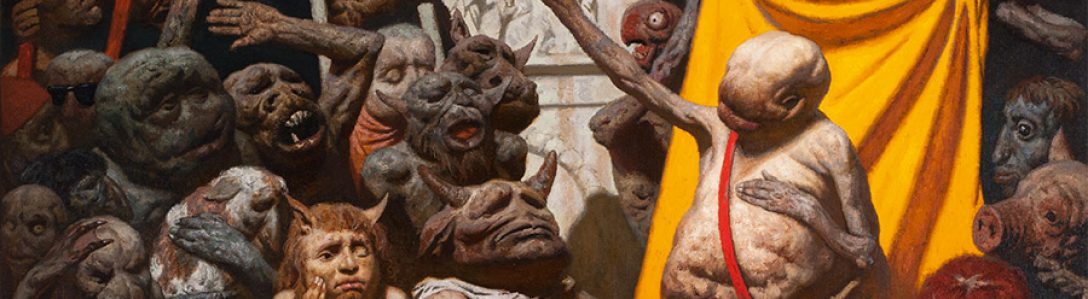

The Pisstown Chaos, David Ohle’s post-convenience novel of abject gags and grotesque japes

Let’s get the obvious out of the way first: The Pisstown Chaos is an improbably perfect and beautiful name for a novel. If you don’t like the title, The Pisstown Chaos isn’t for you. It is a foul, abject, hilarious, zany vaudeville act, a satire of post-apocalyptic literature, an extended riff on American hucksterism. It’s very funny and will make most readers queasy.

The author of The Pisstown Chaos is David Ohle. The novel was published in 2008; it is the second of three “sequels” to Ohle’s 1972 cult classic Motorman. You do not have to have read Motorman or The Age of Sinatra (2004) to “understand” The Pisstown Chaos. (But you’ll probably want to dig into those if you dig The Pisstown Chaos’s uh pungent urinous ammonia bouquet)

Moldenke, hero of Motorman, is a bit player in The Pisstown Chaos, a walk on, a song-and-dance man with no songs or dances. A storyteller. He’s a zombie, too — a “stinker” in the novel’s parlance — adorned in “black rags and a wide-brimmed white hat,” sporting “an inch-long tube of flesh protruding from just below his ear [which] had the general appearance and shape of an infant’s finger, but lacked a nail. In the end of the tube, a small hole leaked a clear, gelatinous fluid.”

Moldenke, we are to infer, is one of the “Victims of the Pisstown parasite…thought of as dead, but not enough to bury. Gray haggard, poorly dressed, they lay in gutters, sat rigidly on public benches, floated along canals and drank from rain-filled gutters.” He may or may not be centuries old.
It’s not clear how far into the future we are in the Ohleverse (it doesn’t really matter). After “the Great Forgetting,” and multiple and ongoing Chaoses, the world has regressed, or progressed, or really mutated, into a dusty, wet, gross, nasty post-infrastructure reality. You might read The Pisstown Chaos as a slapstick zombie Western.

The Reverend Hooker presides over this wonderfully abject world. Hooker’s loose theocratic federation revolves elliptically around a “shifting” scheme. Nothing is permanent, everything is moving, plates spinning on poles. Folks receive their shifting papers and must relocate from, say, a cozy cottage to a prison camp. Or they might end up paired with a new concubine or some such.

That’s the fate of Mildred Balls, née Mildred Vink, who meets Jacob Balls on the road to Witchy Toe. The pair meet cute and get on famously. (And who wouldn’t; after all, suave Jacob Balls was the inventor of  the “finely-grained, yellow-tinged powder” known as “Jake” — a kind of post-apocalyptic Bud Light.) Optimistic Jacob is optimistically optimistic of all the shifting, attesting his belief that “in any culture, when boredom and apathy take hold, the currency is debased and the decline is irreversible…What could be more of a tonic than a random redistribution of the populace?” Mildred is less convinced: “The whole scheme is idiotic.”

The Pisstown Chaos focuses on the Balls clan — primarily an older Mildred and her young adult grandkids, Roe and Ophelia. There are stinkers and imps, shifting folk consuming urpflanz, willy, and Jake on their way via Q-ped to Indian Apple or Bum Bay. Reverend Hooker is always lurking in the margins, too, before taking over the narrative’s final pages in a mock apotheosis that brought a stupid smile to my face.

Ohle’s narrative isn’t exactly a picaresque, but it runs on the same energy. Each chapter opens with a series of frank excerpts from the Pisstown rag, the City Moon. Here’s one update of news you need:

A fondness for pickled lips has led to the arrest of a Kootie Fiyo, a stinker known to be a trader in tooth gold and a vicious biter. Fiyo was just leaving the impeteria in South Pisstown when two Guards entered. The proprietor said, “That stink can eat more imp lips than I can heap in front of him. “

The City Moon is not just a source for the goods on a stinker’s glimpse of pickled imps’ lips, but also a gloss on the undead (or un-undead’s) physiology:

What then is a final-stage stinker’s life like? It has been described by scientists as showing a poverty of sensation and a low body temperature. In their nostrils is the persistent odor of urpmilk. The membrane which lines their mouth is extremely tough and is covered with thick scales. They like to touch fur and drink their own urine. Because they have been known to go without food for as long as eighteen years, we can assume that their sense of time passing is also very different from our own.

The Stinker Problem is likely the signature event of whatever century we are in. There’s probably an icky metaphor or allegory somewhere in there, but I find myself disinterested in that end of the novel. But still: Consider Mildred–who wants to find a “cure” for stinkerism–in charge of a crew of stinkers who, after their daily labors, commit “to walking in circles and searching the ground.” But these are not geologists peering into the navel of the world: “‘No, Miss,’ Spanish Johnny said, ‘We like to get dizzy and faint. It’s the way we have fun.'” We’ve all been there.

Mildred’s granddaughter Ophelia commands much of the narrative, shifting about her stations in life. Her domestic comedy with servants Red and Peters is a class-conscious comic delight. Our Miss Madame goes through a series of abject slapstick routines with the Help (including an enema gag that uh, gag me yeah). Here’s a foul episode in the life of Ophelia Balls:

She walked carefully from slippery stone to slippery stone until she got to the potting shed, then blew out the candle. She tried the door and found it locked. Wiping the dirty door-glass, she looked in at Peters, lying on the peat pile with his pants pulled down, fanning his rear with a handful of straw. Red, sitting beside him in Mildred Balls’s underwear, combed Peters’s coarse hair with a tortoise-shell comb. Peters’s cheeks were flushed, his eyes half-closed. When Ophelia entered, the scene seemed all the more lurid for the dim lantern and its flicker.

“I hope you don’t take any offense,” Red said, “but I’ve just mated with Peters here.”

Peters sat up. “I was quietly potting geraniums when that idiot stepped out of a dark corner and made advances, clumsy, lewd advances, with his big willy sticking out. I tried, but I couldn’t resist him.”

“Is that true, Red, that he put up resistance?”

“He lies like a rug. He clearly indicated he wanted me to sex him good and sex him hard.”

Ophelia saw the pointlessness of going any further with the inquiry. “All is forgiven. Let’s move past this.”

“I’ll serve the swan,” Red said.

If I’ll serve the swan isn’t your kinda punchline, The Pisstown Chaos ain’t your cup of Jake. It’s a rich, smelly, gross novel, fun, funny, fueled with 19th-century inventions viewed through piss-colored glasses, aimed at the apocalyptic future. It’s smoked imp-meat served with urpsmoke, a vaudeville buzz against the zombies in the gutter. When I was a kid we held our breath when we passed cemeteries. There are other ceremonies, other totems, but warding off the dead remains a concern.

I have neglected the Balls scion, young Roe, who eventually finds himself attending the Reverend Hooker. Late in the novel, Roe Balls prepares an enema for the theocrat; Hooker then delivers a sermon:

“I’ll warm up the bathroom right away, sir, and get the enema bag ready.”

Once Roe had firmly inserted the hose, the Reverend sat on the pot and closed his eyes. “There, that’s it, Roe. It’s in well enough.”

“Shall I leave you alone now, sir?”

“No. Don’t leave. Let me sermonize a little. I’ll tell you a story, a story with a lesson. In the days when all men were good, they had miraculous power. Lions, mountains, whales, jellyfish, hagfish, birds, rocks, clouds, seas, moved quietly from place to place, just as men ordered them at their whim and fancy. But the human race at last lost its miraculous powers through the laziness of a single man. He was a woodman in the Fertile Crescent. One morning he went into the forest to cut firewood for his master’s hearth. He sawed and split all day, until he had a considerable stack of hickory and oak. Then he stood before the pile and said, ‘Now, march off home!’ The great bundle of wood at once got up and began to walk, and the woodman tramped on behind it. But he was a very lazy man. Now, why shouldn’t I ride instead of galloping along this dusty road, he said to himself, and jumped up on the bundle of wood as it was walking in front of him and sat down on top of it. As soon as he did, the wood refused to go. The woodman got angry and began to strike it fiercely with his axe, all in vain. Still the wood refused to go. And from that time the human race had lost its power.”

“That certainly explains everything I’ve ever wondered about, sir.”

“You may clean me now.”

“Yes, sir.”

The punchlines accumulate after the Rev. Hooker’s fable — young Roe’s deadpan line “That certainly explains everything I’ve ever wondered about, sir” made me laugh aloud when I read it, and the following asswipe line is too much — but I think we have here in the fable a key to the novel. Not the key, but a key.

In the Rev’s woodman’s fable, humans once wielded Promethean power over the world. But that power’s contingent; it exists only when humans move with the world, attentive to its rhythms and limits. When the woodman attempts to ride the wood and make it a convenience instead of walking alongside it, cooperation collapses. S’all she wrote.

Ohle’s chaotic, grotesque world echoes his some-time collaborator William Burroughs’ alien abjection. It will also be comfortingly/nauseatingly familiar (familiar?!) with anyone who digs David Cronenberg’s corporeal horrors. The Pisstown Chronicles will also appeal to weirdos who dig the abject fictions of Vladmir Sorokin, José Donoso, and Antoine Volodine.


The Pisstown Chaos is not a novel for everyone, but there’s a certain type of reader who will love wading through its abject humor, grotesque imagery, and absurdist chaos. Ohle’s post-convenience world grunts and howls; it’s dark, vivid, gross, and hilarious. That scent will linger. Highly recommended.

I’m getting decrepit, while Pynchon is even older | William T. Vollmann reviews Thomas Pynchon’s Shadow Ticket

I’ve avoided reviews of Thomas Pynchon’s newest novel Shadow Ticket, but I couldn’t help but read William T. Vollmann’s piece on the novel at UnHerd. From Vollmann’s review:

…this author’s longstanding genius there on that private swivel chair of the Department of Character Appellations matches long-gone Lord Dunsany’s for imaginary gods and cities. I cast my grin back upon Tyrone Slothrop, who was first printed in 1973, and wonder to what extent my delight in Shadow Ticket derives from nostalgia. For I’m getting decrepit, while Pynchon is even older, so which will come first, the old lion’s last roar, or my last read? Enriching the nostalgia is Pynchon’s lyrically sad and squalidly beautiful Milwaukee, a place to which I have no connection, and at a time before my parents were born, so why should I care about it? But I do, because it’s a shadow Milwaukee, all the more worth missing for being unreal.

There is a gentleness to Pynchon, and sometimes even a cynical sweetness (and so forth); then come prankish pineapples.

Paul Thomas Anderson’s One Battle After Another is a frenetic, vital reimagining of Thomas Pynchon’s Vineland

Paul Thomas Anderson’s One Battle After Another takes Thomas Pynchon’s 1990 novel Vineland and sets it ablaze, reshaping its abstract paranoia and fractured narrative into something both deliriously immediate and ominously timeless.

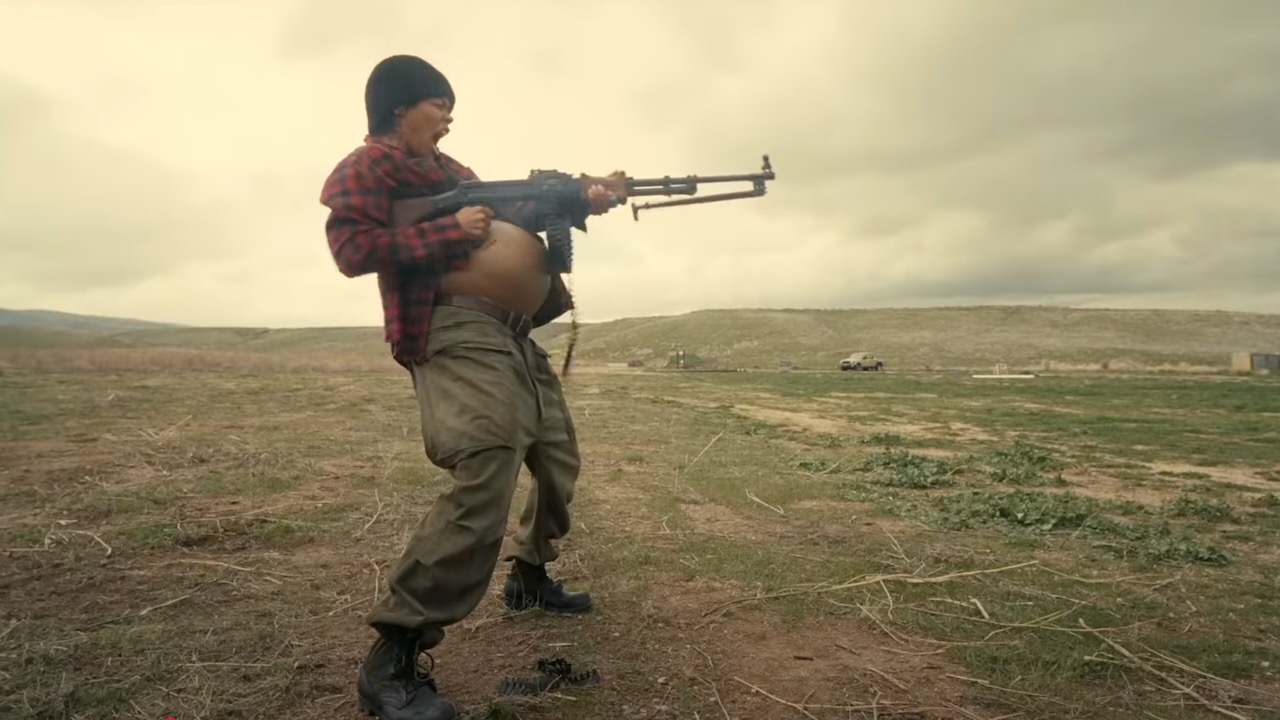
The bones of Pynchon’s original are still present: a family broken by state violence; a daughter growing up without a mother; a father caught between shame and reluctant resistance. In PTA’s feverish recasting of Vineland, Zoyd Wheeler becomes Bob Ferguson (Leonardo DiCaprio), a former “Rocket Man” revolutionary burning out the past in a haze of weed smoke. Frenesi Gates is reimagined as Perfidia Beverly Hills (Teyana Taylor), a revolutionary addicted to the sexual thrill of power. Prairie Wheeler morphs into Willa (Chase Infiniti — and like wow jeez that’s a Pynchonian name the young actress has there, isn’t it?). And villainous Brock Vond is warped into Colonel Lockjaw (Sean Penn), a grotesque embodiment of authoritarian menace. Timelines collapse into themselves, Reagan-era dread transposes into our own disturbed now. Vineland is set in 1984; in One Battle After Another, PTA shows that we’ve never really moved on from that dystopian year. PTA condenses Vineland’s sprawling flashbacks and absurd digressions into an action-forward narrative that’s far more linear yet equally dizzying. The result is enthralling.

The film’s plot might be distilled simply from its title. One Battle After Another follows the trajectory of most of Pynchon’s fiction: individual resistance to authoritarian evil. In PTA’s film, that resistance takes the form of the French 75, a loose clandestine revolutionary group to which Bob and his partner Perfidia once belonged. There’s really no retiring for French 75 agents though, and soon Willa is tangled in the same web her parents sought to sunder in their radical actions. Penn’s maniacal Colonel Lockjaw hunts her down. She’s on the run, and so is papa Bob.

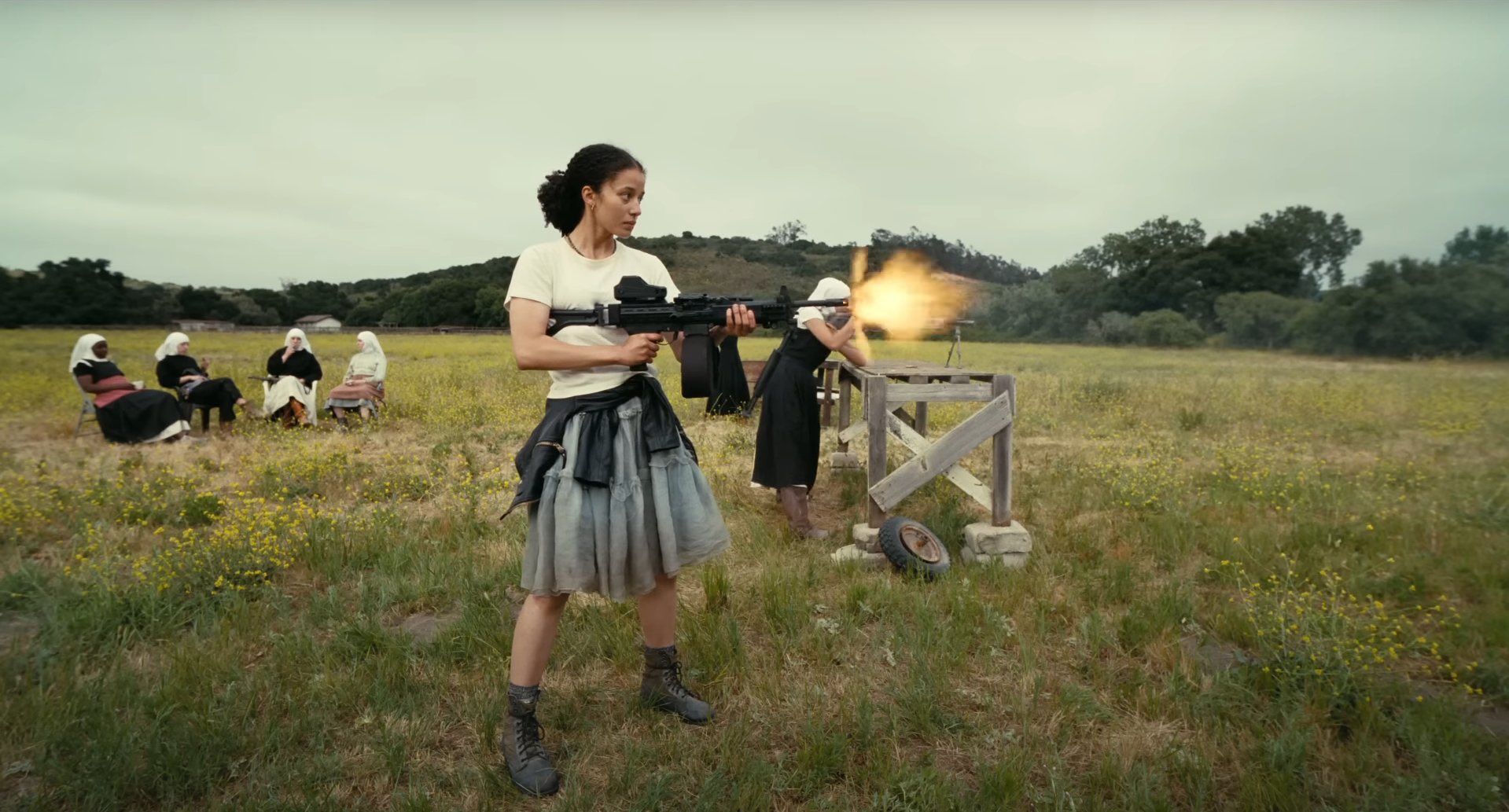
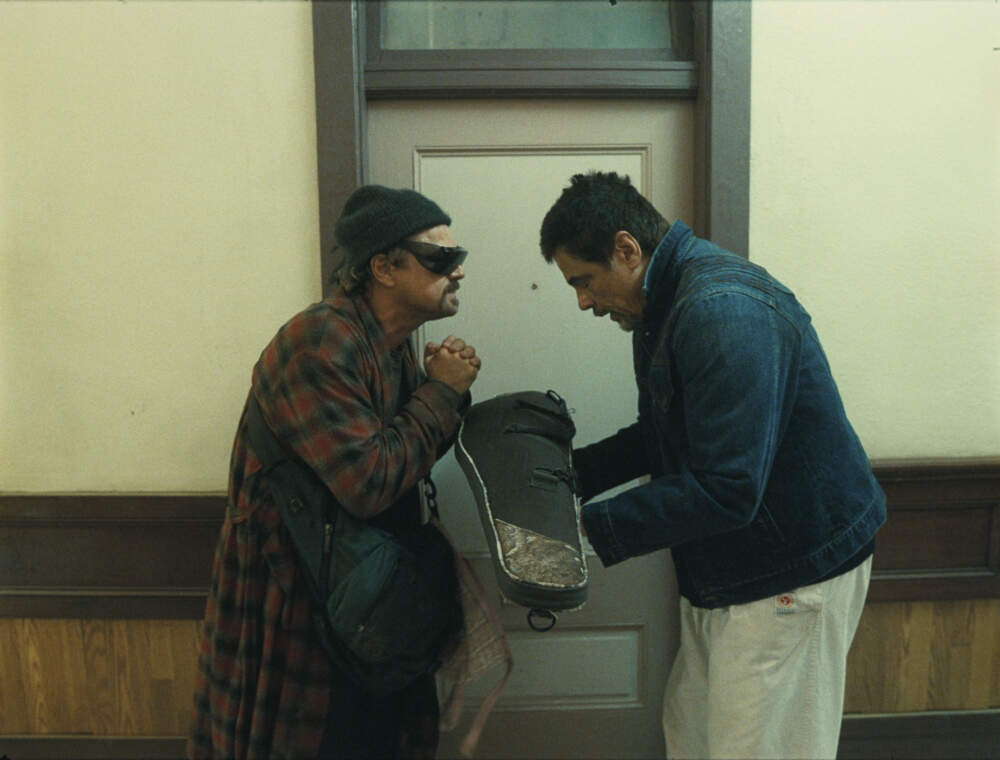
Pynchon’s novels frequently contrast Us vs Them systems — preterite vs. elect; misfits vs. authoritarians; freaks vs. the Man. And like Pynchon’s work, One Battle After Another shows the invisible overlapping and hierarchical confusions these Us/Them systems engender. The French 75’s sympathies directly correlate with the values of the immigrant community in Baktan Cross, the fictional sanctuary city Bob and Willa take refuge in. The de facto leader of these immigrants, Francisco (Benicio Del Toro), aids Bob in his fevered search for Willa. Francisco’s zen calm offers a counterbalance to Bob’s mania. Another Us group are the Sisters of the Brave Beaver (One Battle After another is crammed with Pynchonian vagina jokes), weed-growing nuns who offer Willa a brief safe harbor.

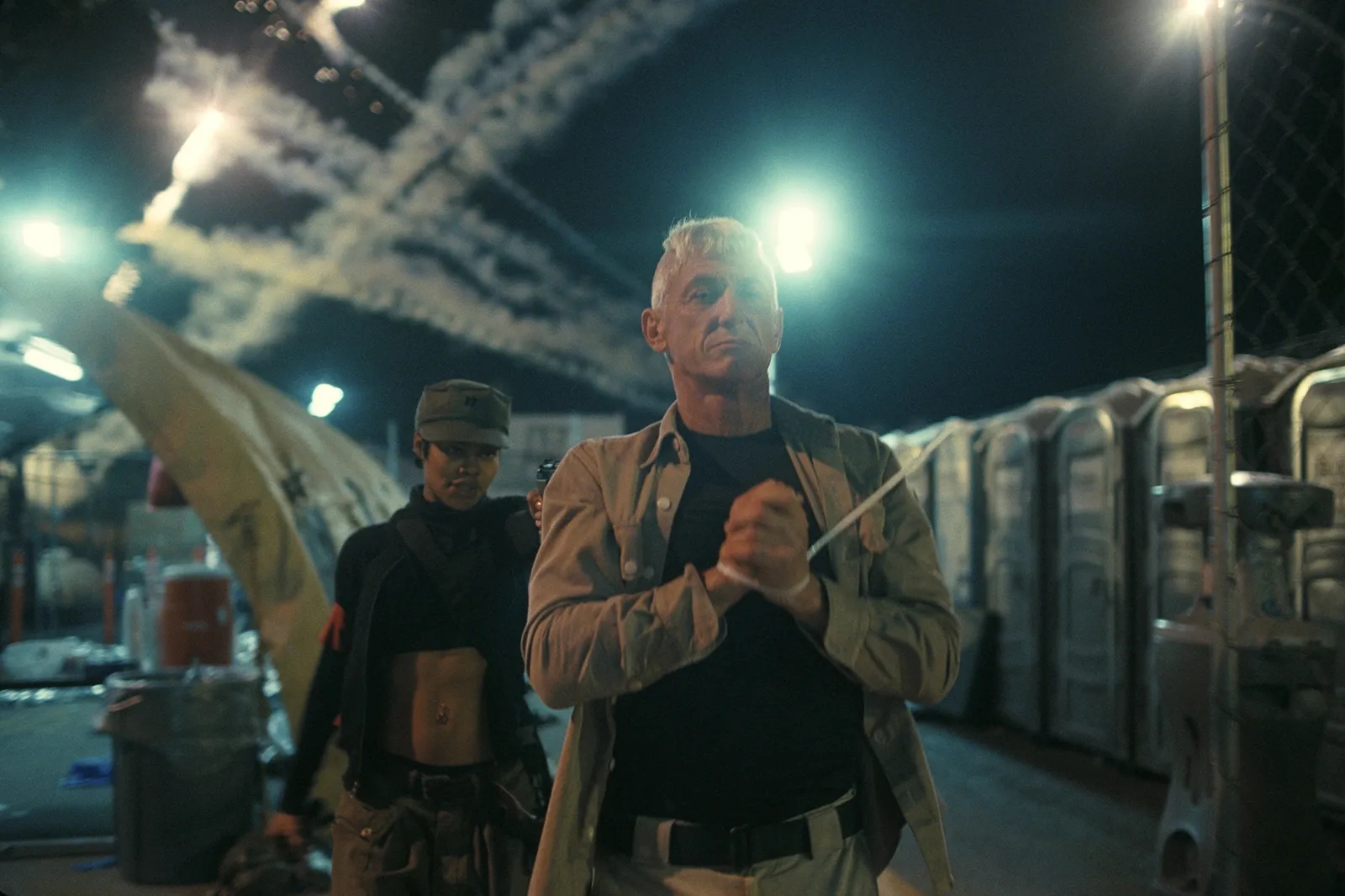
These disparate pockets of rebellion resist the tyranny of the modern racist capitalist system, embodied by Colonel Lockjaw and the military forces he commands (seemingly without any government oversight). We first meet Lockjaw running a migrant detention center — one of many timely PTA updates to Vineland — and his weird, forced, masochistic machismo plays out on the screen with a mix of menace and despair. For all his power and evil though, there’s yet another Them he isn’t part of. That would be the Christmas Adventurers Club, a shadowy cabal of elites on a racist mission to rid the world of “freaks.” Lockjaw would do quite literally anything to become a member of this club; his drive to to become even more Them propels the narrative while showing that Us-Them systems rely on hierarchies to perpetuate oppression.

One Battle After Another zigzags through a whirlwind of absurdity, suffocating paranoia, and frantic action. The film balances chaotic humor with a darker exploration of the emotional impulses that underlie power and attraction. Colonel Lockjaw’s obsessive fixation on Perfidia (arguably the film’s closest connection to Vineland) underscores the irrational power dynamics of obsession and control. PTA frames their relationship—along with Lockjaw’s obsession with Willa—as a twisted mirror reflecting the power imbalances that define both the personal and the political in Us-Them systems. PTA’s films have always explored systems of exploitation that grind people down and the outsiders who try to navigate them; One Battle After Another is, thus far, his most sustained, howling effort in this vein.

The film is gorgeous, too, as fans would expect from PTA. Michael Bauman’s cinematography conveys frenzied energy without sacrificing cohesion or clarity. There are several outstanding set pieces, including a beautiful sequence in which Bob does his best to keep up with a trio of skateboarders traversing rooftops at night, their figures silhouetted against the flames of a riot below. The film’s climactic three-car chase scene is particularly magnificent, its every twist and turn symbolizing not just physical pursuit, but deeper spirals of control, conflict, and paranoia. It made me physical ill. (That’s high praise.)

And while, yes, One Battle After Another is a bona fide action film, it’s still larded with strange little morsels that we’d expect from a PTA film — the image of Lockjaw licking his comb before taking it to his hair, his face contorted in anxious hope, or Bob, in his threadworn bathrobe, shoplifting a pair of cheap sunglasses. (Parenthetically, while the bathrobe is on my mind — Battle plays as a sinister inversion to The Big Lebowski. I will file the pair away for a future double feature.) One of the film’s funniest moments comes from Willa, who, despite being apparently subjugated by Lockjaw, nevertheless delivers the kind of crushing blow that can only come from a teen: “Why is your shirt so tight?” Indeed, Chase Infiniti’s portrayal of Willa is a revelation. In a movie crammed with paranoia and plot twists, she imbues in Willa a kind of moral force. She’s not an anchor exactly, because nothing is steady here. But maybe she’s the string you follow through the labyrinth.

One Battle After Another is almost three hours long, but it never drags, thanks to the tight direction and enthralling plot. Long-time PTA collaborator Jonny Greenwood’s score also keeps the film moving at a quick pace. The score is ever-present — something that usually irritates me in a film — but here the music provides emotional cohesion. It’s also just really fucking pretty.  Frenetic drumming and altered pianos meet up with swelling strings that suggest sirens, banshees. Take “Mean Alley,” for example, which initially greets the ear as if the guitar is out of tune, but then coheres into beautiful dissonance. And although Greenwood’s wall-to-wall score leaves little room for the needle drops we might expect from a PTA joint, the film deploys Tom Petty’s “American Girl” in a moment of transcendent bliss that brought a tear to my eye.

Pynchon has always soundtracked his novels. Pynchonwiki gives close to 400 musical references for Vineland, but I don’t think any of these tracks ended up in One Battle After Another. My giving this data is a weak way of transitioning to the sentence, This is a film inspired by Vineland, not an adaptation of it. And while PTA captures the soul of the book, the vibe, or spirit, or whatever you like to call it, is decidedly different: darker, edgier, uglier. He captures the same strange humor and frustration of Vineland, but it’s amplified here with a chaotic energy that matches our current moment.

It’s also instructive to compare One Battle After Another to PTA’s earlier Pynchon adaptation, Inherent Vice. While Inherent Vice was a hazy sunsoaked journey through the disorienting aftereffects of the muddled sixties, One Battle After Another feels darker, more urgent, as if the timeline of history has compressed itself into an unyielding present. Both films deal with the fracturing of the American dream, but One Battle After Another does so with a sharper edge, drawing clearer political parallels. In some ways, PTA’s Inherent Vice is closer to Pynchon’s Vineland in tone and theme, less angular, more forgiving.

With both of his Pynchon films, PTA foregrounds a sweet final note, a belief in love as a sustaining force against Them. To borrow my favorite lines from Pynchon’s opus Gravity’s Rainbow: “They are in love. Fuck the war.” In his adaptation of Inherent Vice, PTA pulled a loose thread from the novel to neatly weave back into a prettier picture. He allows Doc Sportello to restore the heroin-addicted musician Coy to his family. One Battle offers a similarly fractured, imperfect restoration of family, a rewriting of rat-sins answered on the ghost of radio waves. He cleans up Pynchon’s messiness, but doesn’t sacrifice the deep danger that underwrites radical love.

One Battle After Another feels dangerously prescient, or, more accurately, a diagnosis of the big ugly now. In PTA’s Inherent Vice, there was an underlying fractured partnership between Us and Them; weirdo Doc Sportello tried to find some kind of brotherhood of man with The Man, Detective Bigfoot. No humanity can be extended to Lockjaw — not even from the club that will refuse him. They are unforgiving of any perceived impurity. The themes of mass surveillance, state violence, and detention resonate deeply in today’s climate. The recent death of Assata Shakur—possibly one inspiration for Perfidia Beverly Hills—adds a haunting layer to the film’s exploration of systemic oppression, the ways in which the state seeks to control and erase voices of resistance. The political urgency is palpable, and will undoubtedly alienate a large section of the genpop normies that Warner Brothers has heavily advertised the film to. Some folks will always root for Them.

But fuck Them. One Battle After Another is a triumph, a dizzying, chaotic masterpiece that never loses its grip on the present—one battle after another, all too real, all too important. See it on the biggest screen you can.

A Review of Sonic Life, Thurston Moore’s Rock n’ Roll Fantasia

Thurston’s Rock n’ Roll Fantasy

Thurston Moore’s memoir Sonic Life kicks off in 1963 with his older brother Gene bringing home a 45 of the Kingsmen’s “Louie Louie,” blowing open five-year-old Moore’s mind to the sonic possibilities of raw guitar power.

Moore describes the primal garage hit as the introduction to “a new current of electricity,” one that rewrites the “soundworld” of his earlier suburban life. Our narrator chases that current, finding it in its purest form in The Stooges’ “I Wanna Be Your Dog,” a pre-punk anthem Moore’s band Sonic Youth would cover on their first full-length album, 1983’s Confusion Is Sex. Sonic Youth would also play “I Wanna Be Your Dog” live throughout their career and eventually perform it with Moore’s hero Iggy Pop.

Moore meets many of his heroes in his Sonic Life. It’s a goddamn rock n’ roll fantasy, albeit a fantasy filtered through the gritty reality of punk, No Wave, and smelly indie rock touring vans.

Sure, Moore meets some of the biggies, especially late in the memoir, as Sonic Youth reaches their sonic majority. He chats with Paul McCartney, professing a preference for McCartney’s brother Mike McGear’s stuff to the Beatles. Sonic Youth gets to back David Bowie on “I’m Afraid of Americans.” (Bowie later coos to Moore’s toddler daughter Coco). Moore tours and records with Yoko Ono.

But Moore’s eyes star starrier for the rough luminaries of the New York seventies scene he thrust himself into: Patti Smith, Joey Ramone, Richard Hell, Alan Vega, Tom Verlaine, Lenny Kaye, et al. He’s just as hot for contemporaries like the Minutemen, Black Flag, and Dinosaur Jr., and maybe even hotter for the bands that took Sonic Youth’s squeal to heart, like Pavement, Royal Trux, and My Bloody Valentine.

Sonic Life is larded with people, vibrations, art, life, a love of the weird. Sonic Youth were always as important as curators of the underground, channeling it to seekers of the strange, as they were as a musical act, and Sonic Life is the literary summation of that career.

Thurston’s Literary Fantasy

Any fan who followed Sonic Youth closely, especially in their nineties heyday, would attest that Thurston Moore was the band’s loquacious mouthpiece, a bit of tall charmed ADHD in verbal action, chatting up the world. Sonic Life is liquid, loquacious, loving. Literary protopunk hero Patti Smith populates the pages from the earliest chapters through the last.

Moore also works his decades-long sightings and meetings of William S. Burroughs into the book. Moore first spies Burroughs in 1977 in NYC at a Patti Smith show; decades later the band gets to hang with him a bit. (It’s unclear if Burroughs registers any of this.)

Kathy Acker’s spirit occasionally pops up; it’s clear she was a hero to Moore and his band, but she ghosts them at a planned joint performance in Rotterdam in 1985. The band reads passages of Blood and Guts in High School between songs, tearing out the pages and destroying the book.

Longtime Sonic Youth fans will anticipate Moore’s prose. Seemingly-oblique psychedelic expressions explode, artful phrases dash into each other, ultimately cushioned carefully into a comfortable syntactic register. The effect is not unlike much of Sonic Youth’s post-Sister output, which by turns twisted avant-garde experimentation into pop sugar and deconstructed classic rock riffs into punk scuzz.

Moore’s punchy prose is best summed up in the titles of his 71 chapters, most of them cribbed from song titles and lyrics (including his own): “Flaming Telepaths,” “Mere Animal in a Pre-Fact Clamour,” “Ecstatic Stigmatic,” “Secret Knowledge of Backroads,” “Latex Gold,” etc. The chapter titles are wonderful clues, sometimes direct, sometimes cryptic, always evocative. The prose generally hurtles along, with Moore’s verbal tricks wedged into easy, flowing configurations, but some of the tricks get tired. Particularly, Moore is particularly fond of “Particularly” as a linking expression. Too, we find the book peopled by characters who “could only laugh” at whatever absurdity life has conjured. An editor might have attended these repetitions, but I’m not sure if Moore’s best stuff ever came about via the hands of an editor. The book is generally well-written.

Experimental New York, Seventies and No Wave

Sonic Life begins in 1963, blasting the Kingsmen’s “Louie Louie,” and ends in 2009 with Moore naming Sonic Youth’s last album The Eternal. There are moments outside of this neat chronology though. Discussing his family, Moore goes back a few generations, if only for a paragraph or two. He touches briefly on the dissolution of both Sonic Youth and his marriage to Kim Gordon in 2011. That’s not what the book’s about. Sonic Life compresses events before 1977 and events after 1994. The book is almost 500 pages long; Steve Shelley, who joined the band in 1985 and who most fans think of as “the drummer of Sonic Youth,” shows up around page 300. This isn’t a tour diary or a tell-all.

Instead, much of Moore’s narrative focuses on New York in the scummy seventies and early eighties. Dirt, crime, and drone rock rules. Glenn Branca, Teenage Jesus and the Jerks, the last days of Sid Vicious. Difficulty making even the cheapest rents. No phones, No Wave, and his first stolen guitar. Moore documents an interstitial period in NYC history. He arrives after punk’s (non-)glory daze, too young to partake, too old to really fit in with the emerging wave of hardcore. Along with Kim Gordon and Lee Ranaldo, Moore shapes the noise and grime and angles and raw hope into something new–Sonic Youth.

Kim Gordon

Kim Gordon is a huge part of Thurston Moore’s life and a huge part of Sonic Life. She’s not exactly Moore’s muse, but he clearly looks up to her, as he, tall boy, looks up to so many of the people who people this memoir. Moore is frank in his description of Gordon as an artistic and musical partner, one whom he sometimes clearly grated on and at other times found himself astounded by.

In Moore’s telling, Gordon often felt outside of the band. Moore relates that when the band (working with Mike Watt under the name Ciccone Youth) were putting together the noises that eventually became The White(y) Album, Gordon felt herself out of sync with the band. She went to a mall and recorded a video karaoke cover of Robert Palmer’s “Addicted to Love,” an artistic gesture that confounded and impressed Moore and the rest of the band, lending ironic license to their Pop Art leanings.

Fans looking for anything gossipy in Moore’s memoir about his marriage and divorce from Gordon won’t find it. His focus is on Gordon as an artist and musician. Indeed, much of duo’s communication was rooted in the actual songs they wrote and played. In one of the book’s stronger passages, Moore details creating a punk poster that appropriated the image of a naked young Latina from a calendar he’d found. He scrawled some would-be feminist slogans over the image and hung it in their house. Gordon didn’t say anything at the time. However, when the band rehearsed their new song “Flower” (which would appear on 1985’s Bad Moon Rising), Gordon began singing Moore’s slogans as lyrics: “Support the power of women / Use the power of man.” But Moore then added her own words:

There’s a new girl in your lifeLong red wavy hairGreen, green lips and purple eyesSkinny hips and big round breastsHanging on your wall

Moore ends the chapter by noting that “the two of us never talked about it outright, only through our songwriting. It wouldn’t be the last time that music was the mode of dialogue in our relationship.” Throughout Sonic Life, he heaps praise on his ex-wife as an artist, intellect, musician, and mother, but she ultimately remains a cipher–like the other members of Sonic Youth.

Lee Ranaldo

Moore credits Ranaldo as the better musician and guitar player throughout his memoir, but for the most part he’s a blip in a book of nearly five hundred pages. Maybe that was Ranaldo’s choice—maybe he asked his musical partner of three decades if it was okay to share certain stories and Ranaldo said No.

Richard Edson

Richard Edson was the first drummer of Sonic Youth. Moore credits him with suggesting “the music would be far more effective if there was some semblance of an arrangement, guitars locking into a rhythm so changes could be audibly established.” Moore seems to receive this basic concept of songwriting as a revelation.

Edson went on to star in Stranger Than Paradise and Do the Right Thing, although most people would probably recognize him from a bit part as one of the garage guys in Ferris Bueller’s Day Off. He also had a bit part in Desperately Seeking Susan, a film featuring Madonna.

Madonna

Madonna wasn’t in Sonic Youth, but she floated in the same circles (and even briefly dated Swans frontman Michael Gira).

Moore brings up Madonna more than Lee Ranaldo or Steve Shelley.

Bob Bert

Moore spends a paragraph or two of Sonic Life implicitly apologizing to Bob Bert, whom Sonic Youth as a whole treated pretty shabbily. They fired and rehired him a few times. He gets more air time than Richard Edson or Steve Shelley (but not as much as Madonna).

Steve Shelley

Steve Shelley’s drumming made Sonic Youth Sonic Youth. He continues to play and record with Thurston Moore, so maybe the lack of words on Shelley in Sonic Life was by way of Shelley’s own request.

Our Band Could Be Your Sonic Life

Michael Azerrad’s 2001 book Our Band Could Be Your Life devotes a skeptical chapter to Sonic Youth. The editorial position of that history of indie bands in the eighties seems to posit that Sonic Youth were art rock prima donnas who eventually yoked a bevy of underground bands into major label harnesses. Azerrad’s book is really about real-life social networks and overlaps and DIY—Black Flag, SST, The Minutemen, Dischord, seven inches and tapes, and touring! touring! touring! Sonic Life doesn’t exactly duplicate Azzerad’s indie serial, but it does further authenticate it.

Range Life

Michael Azerrad’s 2001 book Our Band Could Be Your Life, at least in my memory, tends to dwell on touring: stinky vans, unpaid gigs, hard lodging. Moore doesn’t elide this aspect of the band’s identity, but neither does he dwell on it. Moore focuses on the energies on the stage, calling the band a “sonic democracy” — and really, here, I take back what I said above. They are not ciphers but sonics, musicians making the vibrations come alive. What else could we want?

Einstein A Go-Go

Thurston Moore includes the Einstein a Go-Go in a very short list of “clubs that welcomed the underground scene into their chambers, each with [their] own distinct environment.”

Einstein’s was an all-ages club that existed from 1985 to 1997 in Jacksonville Beach, FL. You could go there and dance to wild music for like a five buck cover, and you could see all kinds of cool bands play for maybe eight or ten bucks. I was there pretty much every Friday and Saturday night between ’95-’97 (and sometimes just hung out outside and walked the beach if I didn’t have the cover). Kids wept when it closed. I got to move, leave for college, words that now, as I type them, seem so cruel.

Sonic Youth played Einstein’s with fIREHOSE in the fall of 1986. This performance left a weird little dent in the city that could be felt a decade later by bands who had seen (or at least claimed they had seen) Thurston, Watt, Kim. There were always the older kids who had seen the band, or they had heard about it from older kids who had seen the band…this was called “a scene.”

The Faircloth family who ran Einstein’s were great people. Bands didn’t want to come to Florida; still don’t, really. The Faircloths made sure the bands were comfortable, had good lodging, good food (fried chicken!), leading to a pipeline of bands coming through — 10,000 Maniacs, Flaming Lips, They Might Be Giants, Alex Chilton, Ween, Soundgarden, Mudhoney, Meat Puppets, Dinosaur Jr., Primus, The Replacements, Jane’s Addiction, Nirvana…

By the time I was old enough to go to the all-ages club, the major indie acts that had passed through had graduated to Bigger Times. But I got to see so many great second-wave indie bands: Archers of Loaf, Polvo, Sebadoh, Thinking Fellers Union Local 282, Luna, the Swirlies, Superchunk, and so many, many more.

My stupid high school band got to play there a few times too. We were too loud and used weird tunings on the cheap guitars that we kept swapping between songs in lieu of actual songwriting.

Better than that, at Einstein’s I got to dance to the music I wanted to dance to through an incredibly loud speaker system, including Sonic Youth “hits” like “Teenage Riot,” “100%,” and “Bull in the Heather.” Some of that feeling of fucked up dancing reverberates still in Sonic Life.

Punk Breaks, Major $$$, Nirvana, Ecstatic Peace

Where does it all go? Well, you know. Punk breaks. Nirvana breaks. Sonic Youth signs to a major label, opens for Neil Young, and later makes enough money touring on Lollapalooza to build their Echo Canyon studio on Murray Street. They start their own label, SYR, releasing some of their more avant-garde projects. Opportunities expand. All of their equipment gets stolen. Moore and Gordon have a kid and move to the burbs. They still keep an apartment in NYC; Gordon is there the morning of the September 11, 2001 attacks on the Twin Towers. A plane engine crashes on Murray Street; thankfully, Sonic Youth producer and bassist Jim O’Rourke escapes, though not unharrowed. O’Rourke leaves the band and is replaced by Pavement’s Mark Ibold. Sonic Youth releases their last studio record, The Eternal, on indie Matador, having fulfilled their contract with Geffen. Moore begins an affair with Eva Prinz, an editor at Rizzoli. In 2011 he and Gordon divorce and Sonic Youth is kaput. Moore and Prinz marry and start a poetry imprint, Ecstatic Peace Library. He claims to have found his own ecstatic peace.

Radical Compression

As I mentioned above, Moore’s memoir focuses on the late seventies and the eighties. He condenses the band’s last twenty years (and the last ten of their sixteen studio albums) into about 100 pages, just a fifth of the book. And that’s probably for the better; Sonic Youth, while not exactly overexposed, were pretty well documented in print and film and web by the onset of the mid-nineties.

The radical compression is wonderfully effective at times, giving the book a clipped, propulsive rhythm and allowing Moore’s humor to shine through. A standout is Ch. 66, “Latex Gold,” the first chapter of the book’s final sixth section. It begins in 1996 with a Pacific Rim tour with the Beastie Boys and Foo Fighters. Moore and Gordon have enlisted Thurston’s sweet mother Eleanor to help out with Coco (and see a bit of the world). She gets hurt in the mosh pit, trying to take photographs, and ends up wheelchair-bound, but ex-Germs, ex-Nirvana Foo Fighter Pat Smear takes up her cause, making sure she doesn’t get left behind when everyone heads to a flea market in Jakarta. A page later, the band plays Late Night with Conan O’Brien; a few paragraphs later, Moore is remixing Yoko Ono, then playing guitar with Patti Smith. Then the band is on The Simpsons: “It was the single mainstream cultural event that we’d find ourselves identified with across the world.” A paragraph later, Moore is seated on a couch between Lou Reed and Jim Carroll watching a rough cut of The Basketball Diaries. Moore praises DiCaprio’s performance; Reed describes the film as “Fucking terrible” and leaves immediately. On the next page, Moore is driving an aging, overweight, and likely insane John Fahey around a series of gigs in the northeast. Fahey greets Moore at his motel room door one morning, fully nude, Fahey’s cracked CDs strewn across the floor. Moore tells Fahey he could be selling the CDs at their gigs. Fahey offers Moore to take as many CDs he wants. By the end of the ten-page chapter, Sonic Youth are backing up David Bowie at the Thin White Duke’s Madison Square Garden birthday bash.

End Hits

I really loved reading Sonic Life. It’s not a perfectly-written or balanced book, but it feels real. Moore forges a fascinating tone, at times deeply apologetic, particularly to the best friend of his teenage years, Harold Paris, whom he eventually alienates to the point of a break up in the mid eighties. The memoir is filled with conciliatory gestures and admissions of punk snottiness, whether it’s Moore apologizing for a nasty music review he wrote in his one semester of college, conceding that his brattiness to mentor Glenn Branca was likely misplaced, or expressing regret at getting in Dee Snider’s face to flip the bird at a Twisted Sister concert. Moore doesn’t try to spin his divorce from Kim Gordon; his recollection of his affair with Eva Prinz is brief, blunt, and frankly loving. Perhaps the most fascinating example of his zen reflection in the memoir is his take on the 1999 theft of all of Sonic Youth’s musical equipment while on tour in California. The band relied on racks of guitars in alternate tunings for their sound; the theft struck me as devastating at the time. Moore affords the episode just a few spare paragraphs, concluding that although he would miss his Fender Jazzmaster, he “embraced the liberation of losing things, being stripped of attachments” — a chance to “reignite” their musical mission. What did Moore feel at the time though? He doesn’t tell us, but the outlook he provides suggests wisdom and emotional maturity.

Mixtape

I made a mixtape based on the chapter titles and content of Sonic Life. I enjoyed listening to the music as I read Moore’s memoir, revisiting old gems and hearing cuts I haven’t heard in ages, along with a few tracks and artists new to me. And that’s what I think Moore and Sonic Youth always did best—expand a taste of the weird and the noisy, share the sonic love.


A life obscene | On Cormac McCarthy’s early novel Child of God

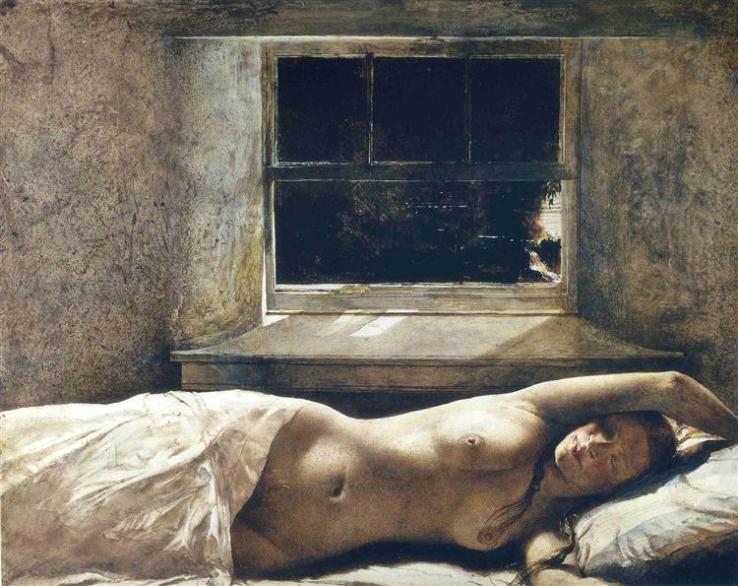
Overflow, 1978, Andrew Wyeth

In ancient Greek drama, acts of violence or sex were “ob skena,” relegated to offstage. Thus, the horrific violence of Oedipus gouging out his eyes is not shown, but rather reported by a messenger. We see the same tradition in Shakespeare, of course, as well as the modern novel. And while many writers elide scenes too taboo or offensive to the sensibilities of the general reading public, books like Ulysses, Lolita, and Tropic of Capricorn, demonstrate that novels are often the site of debate over what can and cannot be shown or described or articulated plainly in our culture. Our concept of “the obscene” (the Greek “ob skena” simply translates to “off stage”) demands that certain actions might only be referred to or implied, but not graphically depicted, that the offensive action takes place out of our vision. The great lie or paradox of the obscene then is that in pushing the offensive action off stage, the author necessitates that the audience must envision that very action that was removed, that they must privately articulate their own understanding or schema or representation of what is taboo.

While this strategy can often be quite effective and affecting (think of Tarantino pulling the camera away as Mr. Blonde cuts off the cop’s ear in Reservoir Dogs), in a character-centered novel it can also lead to a larger denial, a larger exclusion. What if one’s entire life was obscene? In his third novel, Child of God, Cormac McCarthy tells the story of a man who has been pushed from life’s stage, who exists in the uncanny and indigent margins of society.

The ersatz protagonist of Child of God, Lester Ballard, is a poor, stooped, abject wretch of a man. The book opens with Ballard losing his house in a humiliating debacle. From there, he wanders the earth, finding an abandoned shack and barely eking out the means to leave. Ballard is an outsider, literally, always looking in at the lives of more normal, more stable people. His voyeurism leads him to creep up to parked cars to spy on the lovers inside. Wanting some connection or sense of love–or perhaps just out of general dejected weirdness–he masturbates against the cars, watching the people inside. His identity as voyeur is magnified in his only apparent skill. Ballard is an ace sharpshooter who carries his rifle almost everywhere he goes, surreptitiously spying on the normal folks through its lethal scope.

As the book develops in McCarthy’s spare, terse prose, Ballard becomes more and more unhinged. Everywhere he goes he is slighted or outright rejected and cheated by his fellow man. The indignities and affronts against Ballard range from being falsely accused of rape to simply being ignored by his neighbors. At the same time, Ballard is a creep, a loser, and seems largely deserving of this treatment. And yet, as McCarthy points out early in the novel, he is a “child of God, much like yourself perhaps.” This early call to identify with Ballard as a fellow human being is constantly strained by his wildly antisocial behavior, and yet it’s McCarthy’s genius as a writer that anchors the novel in some measure of sympathy for such a wretched anti-hero. When a young girl rejects Ballard’s advances, she taunts him, saying, “You ain’t even a man. You’re just a crazy thing.” In many ways, this is the major question of the novel: Is Ballard a man, or a thing? What makes a person a person, and not simply an object estranged from the human race? To test this question, McCarthy has Ballard plumb almost every conceivable taboo, from murder to arson to necrophilia. However, Ballard isn’t the only one in these Tennessee backwoods who behaves despicably: there’s the father who rapes his daughter, the gangster behavior of the Ku Klux Klan, and the mob justice of the townspeople as a whole. Still, Ballard’s descent into violence and madness–graphically portrayed by McCarthy–is the central action in this compelling novel.

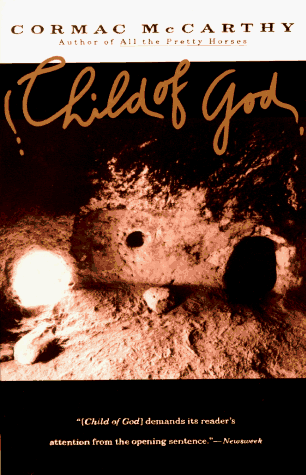
child-of-godReaders looking for redemptive story arcs or tales of heroism will likely be turned off by Child of God, and squeamish readers will probably not get past the first fifty pages. Those interested in McCarthy’s fiction will find more in common here with the visceral grit of The Road or Blood Meridian than the reflective romanticism of his “Border Trilogy” novels (including crowd-pleaser All the Pretty Horses). Child of God continues the Gothicism of Carson McCullers and William Faulkner, bearing a favorable comparison to those writers’ works. And like those writers’ works, McCarthy’s novel has faced its challengers. Those who see the book as obscene are perhaps right, in the sense that the word implies “that which must be shown off stage.” However, one of the legal definitions of obscenity necessitates that the work “lacks serious literary, artistic, political or scientific value,” a claim that I do not think can be seriously substantiated against Child of God. Don’t believe me? Read it for yourself.
[Ed. note–Biblioklept first published a version of this review in 2009. I recently reread the novel in January of 2023, as part of a big McCarthy reread prompted by the publication of his final novels, Stella Maris and The Passenger, and I found Child of God much funnier and sadder than I had remembered.]

Matt Bucher’s The Belan Deck is an unexpectedly moving argument for humanity and serious triviality

I stayed up later than I meant to the other night reading all of Matt Bucher’s new book The Belan Deck in one cover-to-cover go. On his website, Bucher describes The Belan Deck as “a little book…set mostly during a layover at SFO” that “centers around a person who maybe doesn’t really fit in at their AI tech job but still needs to produce one final PowerPoint deck.” This description approximates the plot, in the barest sense, but doesn’t touch on the spirit or form of The Belan Deck.

Let’s talk about the spirit and form of The Belan Deck. Bucher borrows the epigraphic, anecdotal, fractured, discontinuous style that David Markson practiced (perfected?) in his so-called Notecard Quartet (1996-2007: Reader’s Block, This Is Not A NovelVanishing Point, and The Last Novel). “An assemblage…nonlinear, discontinuous, collage-like,” wrote Markson, to which Bucher’s narrator replies, “Bricolage. DIY culture. Amateurism. Fandom. Blackout poems.”

Bucher’s bricolage picks up Markson’s style and spirit, but also moves it forward. Although Markson’s late quartet is arguably (I would say, by definition) formally postmodernist, the object of the Notecard Novels’ obsession is essentially Modernism. Bucher’s book is necessarily post-postmodern, taking as its objects the detritus and tools of postmodern communication: PowerPoint, Google Street View, Wikipedia, social media, artificial intelligence.

At the same time, Bucher continues Markson’s obsessions with artists and death, adding to the mortality lists that wormed through DM’s quartet. Bucher’s updates are odd though, in that they seem to, in their print form, contextualize anew coincidences that were so raw and immediate when they popped up on Twitter and other social media:

Nicanor Parra died the day after Ursula K. LeGuin died.

Larry McMurty and Beverly Cleary died the same day.

(In my memory, William H. Gass died the day before LeGuin, but this is not true. He died almost two months before LeGuin. But I recall teaching selections from both of their work in a literature class in the spring semester of 2018, and pointing out to my students that the empty spaces behind the dashes after their birth years might now be filled in. “An encyclopedia entry demands at least a birth or a death,” notes Bucher’s narrator.)

The encyclopedia, by which I mean Wikipedia, becomes a heroic motif in The Belan Deck. “Wikipedia is the number one result for over 50% of Google searches,” Bucher’s narrator points out, following it up with,

Wikipedia, made by humans, for free, is a better search engine than Google, the most expensive and sophisticated algorithm in the world.

Earlier in The Belan Deck, the narrator points to the “mindless pleasure of going down a deep Wikipedia rabbit hole,” a pleasure that an artificial intelligence, no matter how developed, could never feel. About three dozen pages later, Bucher’s narrator throws a slant rhyme to his previous note on the “mindless pleasures” of Wikipedia rabbit holes, pointing out that Thomas Pynchon had used Mindless Pleasures as a working title for Gravity’s Rainbow. That’s how this book operates: Disparate fragments of information are “Clues rather than trivia.”

The goal is to find the sublime in these connections; Bucher’s narrator repeatedly and succinctly argues that finding the beautiful, much less the sublime, is impossible for an artificial intelligence. The Belan Deck plays out as a discursive, looping, and unexpectedly moving argument for humanity, in all its serious triviality, against the backdrop of capital’s rapid encroachment into the human position in the arts.

“Capitalism is incompatible with being an artist, for most people,” avers our narrator. “Yet you participate!” might come the retort, and it’s true—not only does Bucher’s narrator work in a soulless medium, the deck (trying to inject some soul, some sublime, some humanity into it), he also works for the soulless Belan, a money guy who would love to replace artists with machines. (In what I think has to be a great intentional gag, Bucher’s narrator’s point of contact for Belan is a middleman named  Jimmy Chen. I just have to believe that the character’s a take on the Jimmy Chen who wrote and designed on HTMLGIANT for all those years.)

The narrator participates because there aren’t that many other options, as we all know. “Do you understand what I am saying? Does it also feel this way to you?” the narrator plaintively asks. I mean, for me, that’s a Yes, all the time. 

There’s much more in The Belan Deck than I can get to here—more on art, artists, baseball, airports—it’s voluminous for a “little book.” (“When we buy a book, we think we are buying time to read” is a line I underlined but could not otherwise work into this review, so I’ll include it here parenthetically. (A lot of this review has happened in parentheses.))

I’ll end with two bits of personal trivia, two coincidences.

First: The day The Belan Deck arrived in my mail, which is the day that I read The Belan Deck, some AI-cheerleading dork went viral on Twitter for posting a series of unasked-for renderings of “what the backgrounds of the most famous paintings in the world look like with AI.” He was roundly and rightly mocked for his endeavors, and I found the general antipathy heartening, but still a small cadre of people who know absolutely nothing about art congratulated his vapidity.

Second: Earlier that same day, I read a passage from Walter Tevis’s 1980 dystopian novel Mockingbird, and found its sentiment largely heartening as well. The hero of the novel, staring at a “dumb parody of humanity” declares it “nothing, nothing at all.” He continues, pointing out that the forces of capital “had given robots to the world with the lie that they would save us from labor or relieve us from drudgery so that we could grow and develop inwardly.” But underneath this false promise was a deep “contempt for the ordinary life of men and women,”  a deep hatred of human life itself. The sentiment I find heartening here is in the hero’s recognition and resistance to this contempt.

The Belan Deck isn’t a straightforward guidebook or manifesto or map, but it nevertheless, in its elliptical, poetic approach, offers a winding, thinking, feeling path of opposition to not only the machines themselves, but also the hollow men who would gladly replace artists and creators and thinkers with those machines. It’s also really fun to read. Great stuff.

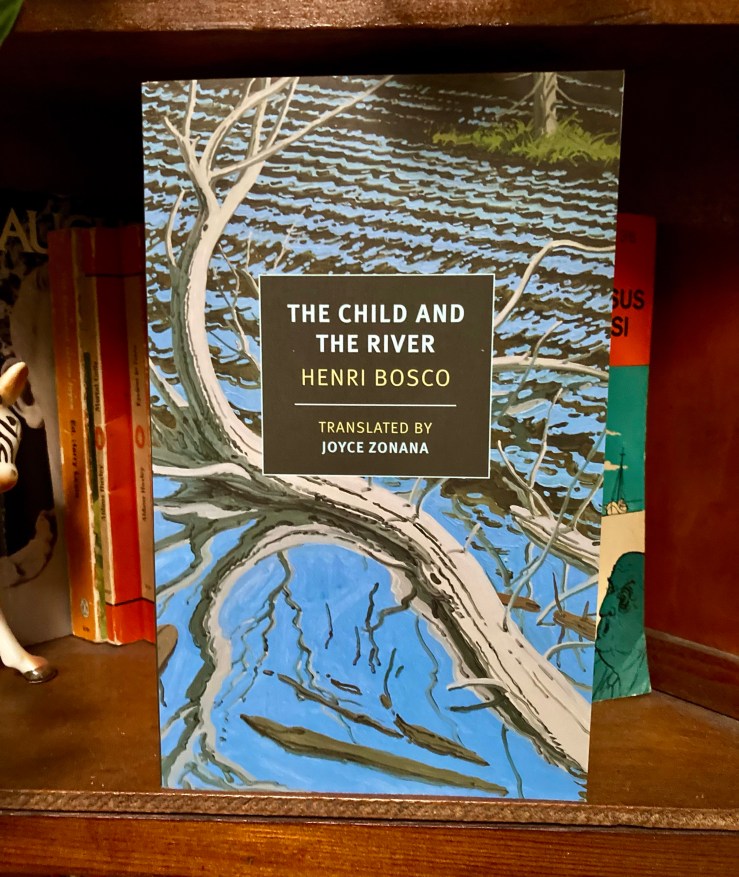
On Henri Bosco’s lovely brief novel, The Child and the River

Last week or maybe the week before last, I received in the mail a review copy of Henri Bosco’s slim 1945 novel The Child and The River. This new translation by Joyce Zonana is available now from publisher NYRB. I picked up The Child and the River this week twice: once before bed, and then again immediately upon waking the next morning, where I finished it before rising.

Set some years before either of the Big Wars, The River and the Child takes place in the countryside somewhere in the south of France (likely Bosco’s native Provence). Narrator Pascalet, now an older man, looks back on a transformational episode in his youth. He relates how as a young boy, he was free to roam the countryside wherever he pleased, excepting the river, where, according to his parents, “there are black holes where you can drown; there are snakes in the reeds and Gypsies on the banks.”

When his parents go on a trip, leaving him in the care of sweet Tante Martine, young Pascalet makes his way to the forbidden river posthaste, blaming any mischief on newly-arrived Spring:

…one fine April morning, temptation caught me unawares. It knew how to speak to me. It was a springtime temptation, one of the sweetest there is, I think, for anyone who is open to clear skies, tender leaves, and newly-blossomed flowers.

That is why I succumbed.

Pascalet’s adventure quickly goes awry, or improves in intensity, depending on how you like to think of it. He falls asleep in an old rowboat, drifts downriver, and ends up on an island inhabited by Gypsies. Hungry, he spies them from behind the brush. Near their cauldron they keep a dog and a bear—and a bound prisoner: “He was a handsome child, sturdy, taller than me and stronger, most likely a Gypsy.” The men in the group beat the young prisoner with a whip, but he endures it. Late in the night, under cover of darkness, Pascalet frees this boy, Gatzo; they then steal a boat and escape to live out a boyhood fantasy of utter freedom—for a few days, at least.

The Child and the River brims with lovely nostalgic pleasures. The boys playact their boyish fantasies, forging crude bows and arrows of reed and pretending that they might have to fend off monsters or “headhunters, cannibals.” Pascalet describes the wonderful sensation of escalating these fantasies:

Then I would feel a mock terror. I enjoyed it. Because when you scare yourself through make-believe, you know well enough that you are not in any danger, but still you are afraid. It is one of the most delicious pleasures.

And yet the boys are not merely playacting—they are surviving: fishing, foraging, strategically moving and mooring their boat to avoid detection. They make fire; they cook. In a lovely little scene, they dig a spring to enjoy fresh water:

We made a hole near a bulge in the clay. Water was seeping through. We continued to dig and fashioned a little basin. Through a breach in the clay, the water moistened a bed of sand. We flattened one side of our hole and stuck in a hollow reed. At first the reed stayed dry. We were aching with impatience, even more than for the fire. At long last, a droplet formed and grew round; for a long time, it hung, uncertain. Suddenly it fell. Another drop came, and slowly, at the tip of the green reed, the spring was born.

This passage exemplifies the simple precision of Bosco’s prose via Zonana’s clean, clear translation. The joy of The Child and the River comes from Pascalet’s gentle, limpid observations of his time on the river, which are generally free of intrusive, muddy “adult” meditations. Instead, we experience what the boys experience:

Everywhere, plants and waters, shorelines and trees, came alive at nightfall with a confused, mysterious life. A duck would flap its wings in the reeds; an owl would screech on a black poplar; a brutal badger would rummage in a bush; a weasel, gliding from branch to branch, would cause two or three leaves to tremble lightly; a roving fox would yelp in the distance.

“It is a sad animal,” Gatzo told me. “It is thinking

The adventures of Pascalet and Gatzo culminate in a strange, dreamlike encounter with “the Puppeteer of Souls.” I won’t remark on the episode at any length, only add that it provides a nearly-mystical, memorable climax to the book. I’ll also add that the novel’s last two sentences are some of the sweetest I’ve read in a while.

I loved reading The Child and the River; I loved the feeling of reading it. It took me back to books I’d loved as a child: Arthur Ransome’s Swallows and Amazons, abridged and bowdlerized versions of Moby-Dick and Huckleberry Finn, and countless Robinsades. In a letter to a friend, Bosco suggested that The Child and the River was “a novel very good, I think, for children, adolescents, and poets.” Is there a better audience?

The Child and the River is one of two Bosco books in publication now from NYRB; they released Zonana’s translation of his 1948 novel Malicroix in early March of 2020. I have it on my shelf, still unread, but not for long. I hope NYRB and Zonana will do a few more Bosco titles. Recommended.

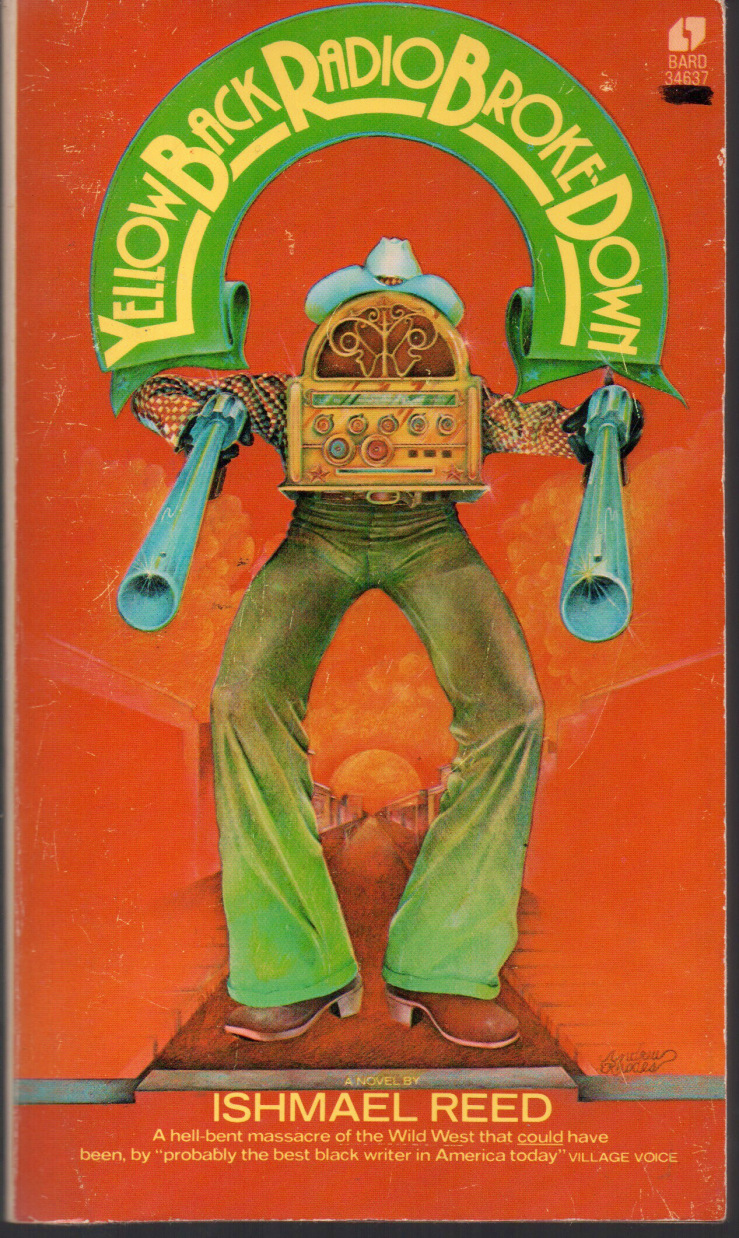
A review of Yellow Back Radio Broke-Down, Ishmael Reed’s syncretic Neo-HooDoo revenge Western

img_0548

Ishmael Reed’s second novel Yellow Back Radio Broke-Down tells the story of the Loop Garoo Kid, a “desperado so onery he made the Pope cry and the most powerful of cattlemen shed his head to the Executioner’s swine.”

The novel explodes in kaleidoscopic bursts as Reed dices up three centuries of American history to riff on race, religion, sex, and power. Unstuck in time and unhampered by geographic or technological restraint, historical figures like Lewis and Clark, Thomas Jefferson, John Wesley Harding, Groucho Marx, and Pope Innocent (never mind which one) wander in and out of the narrative, supplementing its ironic allegorical heft. These minor characters are part of Reed’s Neo-HooDoo spell, ingredients in a Western revenge story that is simultaneously comic and apocalyptic in its howl against the dominant historical American narrative. Yellow Back Radio Broke-Down is a strange and marvelous novel, at once slapstick and deadly serious, exuberant in its joy and harsh in its bitterness, close to 50 years after its publication, as timely as ever.

After the breathless introduction of its hero the Loop Garoo Kid, Yellow Back Radio Broke-Down initiates its plot. Loop’s circus troupe arrives to the titular city Yellow Back Radio (the “nearest town Video Junction is about fifty miles away”), only to find that the children of the town, “dressed in the attire of the Plains Indians,” have deposed the adults:

We chased them out of town. We were tired of them ordering us around. They worked us day and night in the mines, made us herd animals harvest the crops and for three hours a day we went to school to hear teachers praise the old. Made us learn facts by rote. Lies really bent upon making us behave. We decided to create our own fiction.

The children’s revolutionary, anarchic spirit drives Reed’s own fiction, which counters all those old lies the old people use to make us behave.

Of course the old—the adults—want “their” land back. Enter that most powerful of cattlemen, Drag Gibson, who plans to wrest the land away from everyone for himself. We first meet Drag “at his usual hobby, embracing his property.” Drag’s favorite property is a green mustang,

a symbol for all his streams of fish, his herds, his fruit so large they weighed down the mountains, black gold and diamonds which lay in untapped fields, and his barnyard overflowing with robust and erotic fowl.

Drag loves to French kiss the horse, we’re told. Oh, and lest you wonder if “green” here is a metaphor for, like, new, or inexperienced, or callow: No. The horse is literally green (“turned green from old nightmares”). That’s the wonderful surreal logic of Reed’s vibrant Western, and such details (the novel is crammed with them) make Yellow Back Radio Broke-Down a joy to read.

Where was I? Oh yes, Drag Gibson.

Drag—allegorical stand-in for Manifest Destiny, white privilege, capitalist expansion, you name it—Drag, in the process of trying to clear the kids out of Yellow Back Radio, orders all of Loop’s troupe slaughtered.

The massacre sets in motion Loop’s revenge on Drag (and white supremacy in general), which unfolds in a bitter blazing series of japes, riffs, rants, and gags. (“Unfolds” is the wrong verb—too neat. The action in Yellow Back Radio Broke-Down is more like the springing of a Jack-in-the-box).

Loop goes about obtaining his revenge via his NeoHooDoo practices. He calls out curses and hexes, summoning loas in a lengthy prayer. Loop’s spell culminates in a call that goes beyond an immediate revenge on Drag and his henchmen, a call that moves toward a retribution for black culture in general:

O Black Hawk American Indian houngan of Hoo-Doo please do open up some of these prissy orthodox minds so that they will no longer call Black People’s American experience “corrupt” “perverse” and “decadent.” Please show them that Booker T and MG’s, Etta James, Johnny Ace and Bojangle tapdancing is just as beautiful as anything that happened anywhere else in the world. Teach them that anywhere people go they have experience and that all experience is art.

So much of Yellow Back Radio Broke-Down is turning all experience into art. Reed spins multivalent cultural material into something new, something arguably American. The title of the novel suggests its program: a breaking-down of yellowed paperback narratives, a breaking-down of radio signals. Significantly, that analysis, that break-down, is also synthesized in this novel into something wholly original. Rhetorically, Yellow Back Radio Broke-Down evokes flipping through paperbacks at random, making a new narrative; or scrolling up and down a radio dial, making new music from random bursts of sound; or rifling through a stack of manic Sunday funnies to make a new, somehow more vibrant collage.

Perhaps the Pope puts it best when he arrives late in the novel. (Ostensibly, the Pope shows up to put an end to Loop’s hexing and vexing of the adult citizenry—but let’s just say the two Holy Men have a deeper, older relationship). After a lengthy disquisition on the history of hoodoo and its genesis in the Voudon religion of Africa (“that strange continent which serves as the subconscious of our planet…shaped so like the human skull”), the Pope declares that “Loop Garoo seems to be practicing a syncretistic American version” of the old Ju Ju. The Pope continues:

Loop seems to be scatting arbitrarily, using forms of this and that and adding his own. He’s blowing like that celebrated musician Charles Yardbird Parker—improvising as he goes along. He’s throwing clusters of demon chords at you and you don’t know the changes, do you Mr. Drag?

The Pope here describes Reed’s style too, of course (which is to say that Reed is describing his own style, via one of his characters. The purest postmodernism). The apparent effortlessness of Reed’s improvisations—the prose’s sheer manic energy—actually camouflages a tight and precise plot. I was struck by how much of Yellow Back Radio Broke-Down’s apparent anarchy resolves into a bigger picture upon a second reading.

That simultaneous effortlessness and precision makes Reed’s novel a joy to jaunt through. Here is a writer taking what he wants from any number of literary and artistic traditions while dispensing with the forms and tropes he doesn’t want and doesn’t need. If Reed wants to riff on the historical relations between Indians and African-Americans, he’ll do that. If Reed wants to assess the relative values of Thomas Jefferson as a progressive figure, he’ll do that. If Reed wants to attack his neo-social realist critics, he’ll do that. If Reed wants to critique the relationship between militarism and science, he’ll do that. If Reed wants to tell some really dirty jokes about a threesome, he’ll do that. And you can bet if he wants some ass-kicking Amazons to show up at some point, they’re gonna show.

And it’s a great show. Yellow Back Radio Broke-Down begins with the slaughter of a circus troupe before we get to see their act. The real circus act is the novel itself, filled with orators and showmen, carnival barkers and con-artists, pistoleers and magicians. There’s a manic glee to it all, a glee tempered in anger—think of George Herriman’s Krazy Kat, or Thomas Pynchon’s zany rage, or Robert Downey Sr.’s satirical film Putney Swope.

Through all its anger, Yellow Back Radio Broke-Down nevertheless repeatedly affirms the possibility of imagination and creation—both as cures and as hexes. We have here a tale of defensive and retaliatory magic. Yellow Back Radio Broke-Down is the third novel of Reed’s novels I’ve read (after Mumbo Jumbo and The Free-Lance Pallbearers), and my favorite thus far. Frankly, I needed the novel right now in a way that I didn’t know that I needed it until I read it; the contemporary novel I tried to read after it felt stale and boring. So I read Yellow Back Radio Broke-Down again. The great gift here is that Reed’s novel answers to the final line of Loop’s prayer to the Loa: “Teach them that anywhere people go they have experience and that all experience is art.” Like the children of Yellow Back Radio, Reed creates his own fiction, and invites us to do the same. Very highly recommended.

[Ed. note — Biblioklept first published this review in February of 2017.]

A review of Yellow Back Radio Broke-Down, Ishmael Reed’s syncretic Neo-HooDoo revenge Western

img_0548

Ishmael Reed’s second novel Yellow Back Radio Broke-Down tells the story of the Loop Garoo Kid, a “desperado so onery he made the Pope cry and the most powerful of cattlemen shed his head to the Executioner’s swine.”

The novel explodes in kaleidoscopic bursts as Reed dices up three centuries of American history to riff on race, religion, sex, and power. Unstuck in time and unhampered by geographic or technological restraint, historical figures like Lewis and Clark, Thomas Jefferson, John Wesley Harding, Groucho Marx, and Pope Innocent (never mind which one) wander in and out of the narrative, supplementing its ironic allegorical heft. These minor characters are part of Reed’s Neo-HooDoo spell, ingredients in a Western revenge story that is simultaneously comic and apocalyptic in its howl against the dominant historical American narrative. Yellow Back Radio Broke-Down is a strange and marvelous novel, at once slapstick and deadly serious, exuberant in its joy and harsh in its bitterness, close to 50 years after its publication, as timely as ever.

After the breathless introduction of its hero the Loop Garoo Kid, Yellow Back Radio Broke-Down initiates its plot. Loop’s circus troupe arrives to the titular city Yellow Back Radio (the “nearest town Video Junction is about fifty miles away”), only to find that the children of the town, “dressed in the attire of the Plains Indians,” have deposed the adults:

We chased them out of town. We were tired of them ordering us around. They worked us day and night in the mines, made us herd animals harvest the crops and for three hours a day we went to school to hear teachers praise the old. Made us learn facts by rote. Lies really bent upon making us behave. We decided to create our own fiction.

The children’s revolutionary, anarchic spirit drives Reed’s own fiction, which counters all those old lies the old people use to make us behave.

Of course the old—the adults—want “their” land back. Enter that most powerful of cattlemen, Drag Gibson, who plans to wrest the land away from everyone for himself. We first meet Drag “at his usual hobby, embracing his property.” Drag’s favorite property is a green mustang,

a symbol for all his streams of fish, his herds, his fruit so large they weighed down the mountains, black gold and diamonds which lay in untapped fields, and his barnyard overflowing with robust and erotic fowl.

Drag loves to French kiss the horse, we’re told. Oh, and lest you wonder if “green” here is a metaphor for, like, new, or inexperienced, or callow: No. The horse is literally green (“turned green from old nightmares”). That’s the wonderful surreal logic of Reed’s vibrant Western, and such details (the novel is crammed with them) make Yellow Back Radio Broke-Down a joy to read.

Where was I? Oh yes, Drag Gibson.

Drag—allegorical stand-in for Manifest Destiny, white privilege, capitalist expansion, you name it—Drag, in the process of trying to clear the kids out of Yellow Back Radio, orders all of Loop’s troupe slaughtered.

The massacre sets in motion Loop’s revenge on Drag (and white supremacy in general), which unfolds in a bitter blazing series of japes, riffs, rants, and gags. (“Unfolds” is the wrong verb—too neat. The action in Yellow Back Radio Broke-Down is more like the springing of a Jack-in-the-box).

Loop goes about obtaining his revenge via his NeoHooDoo practices. He calls out curses and hexes, summoning loas in a lengthy prayer. Loop’s spell culminates in a call that goes beyond an immediate revenge on Drag and his henchmen, a call that moves toward a retribution for black culture in general:

O Black Hawk American Indian houngan of Hoo-Doo please do open up some of these prissy orthodox minds so that they will no longer call Black People’s American experience “corrupt” “perverse” and “decadent.” Please show them that Booker T and MG’s, Etta James, Johnny Ace and Bojangle tapdancing is just as beautiful as anything that happened anywhere else in the world. Teach them that anywhere people go they have experience and that all experience is art.

So much of Yellow Back Radio Broke-Down is turning all experience into art. Reed spins multivalent cultural material into something new, something arguably American. The title of the novel suggests its program: a breaking-down of yellowed paperback narratives, a breaking-down of radio signals. Significantly, that analysis, that break-down, is also synthesized in this novel into something wholly original. Rhetorically, Yellow Back Radio Broke-Down evokes flipping through paperbacks at random, making a new narrative; or scrolling up and down a radio dial, making new music from random bursts of sound; or rifling through a stack of manic Sunday funnies to make a new, somehow more vibrant collage.

Perhaps the Pope puts it best when he arrives late in the novel. (Ostensibly, the Pope shows up to put an end to Loop’s hexing and vexing of the adult citizenry—but let’s just say the two Holy Men have a deeper, older relationship). After a lengthy disquisition on the history of hoodoo and its genesis in the Voudon religion of Africa (“that strange continent which serves as the subconscious of our planet…shaped so like the human skull”), the Pope declares that “Loop Garoo seems to be practicing a syncretistic American version” of the old Ju Ju. The Pope continues:

Loop seems to be scatting arbitrarily, using forms of this and that and adding his own. He’s blowing like that celebrated musician Charles Yardbird Parker—improvising as he goes along. He’s throwing clusters of demon chords at you and you don’t know the changes, do you Mr. Drag?

The Pope here describes Reed’s style too, of course (which is to say that Reed is describing his own style, via one of his characters. The purest postmodernism). The apparent effortlessness of Reed’s improvisations—the prose’s sheer manic energy—actually camouflages a tight and precise plot. I was struck by how much of Yellow Back Radio Broke-Down’s apparent anarchy resolves into a bigger picture upon a second reading.

That simultaneous effortlessness and precision makes Reed’s novel a joy to jaunt through. Here is a writer taking what he wants from any number of literary and artistic traditions while dispensing with the forms and tropes he doesn’t want and doesn’t need. If Reed wants to riff on the historical relations between Indians and African-Americans, he’ll do that. If Reed wants to assess the relative values of Thomas Jefferson as a progressive figure, he’ll do that. If Reed wants to attack his neo-social realist critics, he’ll do that. If Reed wants to critique the relationship between militarism and science, he’ll do that. If Reed wants to tell some really dirty jokes about a threesome, he’ll do that. And you can bet if he wants some ass-kicking Amazons to show up at some point, they’re gonna show.

And it’s a great show. Yellow Back Radio Broke-Down begins with the slaughter of a circus troupe before we get to see their act. The real circus act is the novel itself, filled with orators and showmen, carnival barkers and con-artists, pistoleers and magicians. There’s a manic glee to it all, a glee tempered in anger—think of George Herriman’s Krazy Kat, or Thomas Pynchon’s zany rage, or Robert Downey Sr.’s satirical film Putney Swope.

Through all its anger, Yellow Back Radio Broke-Down nevertheless repeatedly affirms the possibility of imagination and creation—both as cures and as hexes. We have here a tale of defensive and retaliatory magic. Yellow Back Radio Broke-Down is the third novel of Reed’s novels I’ve read (after Mumbo Jumbo and The Free-Lance Pallbearers), and my favorite thus far. Frankly, I needed the novel right now in a way that I didn’t know that I needed it until I read it; the contemporary novel I tried to read after it felt stale and boring. So I read Yellow Back Radio Broke-Down again. The great gift here is that Reed’s novel answers to the final line of Loop’s prayer to the Loa: “Teach them that anywhere people go they have experience and that all experience is art.” Like the children of Yellow Back Radio, Reed creates his own fiction, and invites us to do the same. Very highly recommended.

[Ed. note—Biblioklept originally ran this review in February of 2017.]

Uncertainty of the real | Blog about the first third of Anna Kavan’s novel Ice

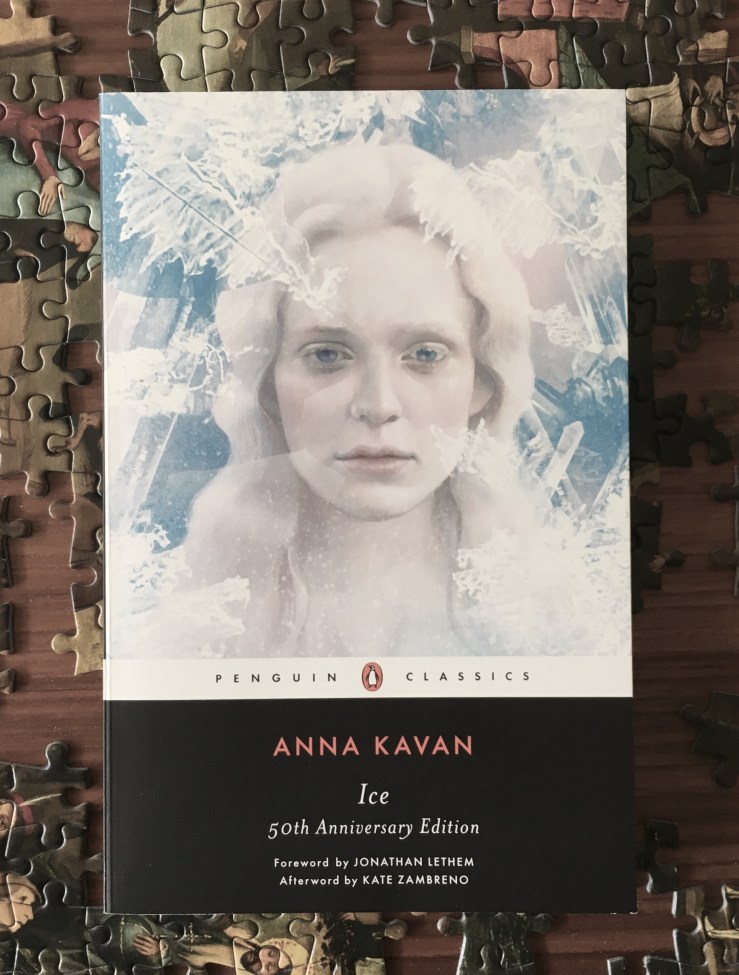
The first three words of Anna Kavan’s 1967 novel Ice are “I was lost,” a simple declaration that seems to serve as a mission statement for the next 60 odd pages. I read these 60 odd pages (63, to be precise, in my Penguin Classics 50th Anniversary Edition of the novel) today, often feeling lost, and glad of it. I like it when I don’t really know what a book is doing, and Ice is such a book.

Ice is told in first-person by an as-yet-unnamed narrator who strikes me as more than a little unreliable. “Reality had always been something of an unknown quantity to me,” he tells us early in the first chapter, admitting that, “At times this could be disturbing.”

Kavan crafts a disturbing, dreamlike tone from the novel’s opening pages, a sinister menace that intensified over the five chapters that I read today. The novel’s settings are detailed but also indistinct, not tethered to any specific time or place, yet nevertheless vaguely familiar. Ice starts in a place like England, and our narrator soon travels to what seems like a Scandinavian country—more on that in a minute—and it’s unclear when exactly the story is taking place: the past? The future? A twisted version of now?

What is clear is that Ice is set in a world that has fallen or is falling into ruin. The word ruins repeats throughout the book; there’s a sense of a post-war world that never recovered—crumbling walls, abandoned buildings, and a reliance on ancient fortresses as symbols of civilization. It’s simultaneously real and unreal, uncanny, disquieting. “The situation was alarming, the atmosphere tense, the emergency imminent,” our narrator tells us, pointing to the vague horror that writhes under the novel’s surface.

Our unnamed narrator repeatedly underscores Ice’s central unreality, an unreality that it is possible he, as the narrator, actually is creating through his witnessing and telling:

I was aware of an uncertainty of the real, in my surroundings and in myself. What I saw had no solidity, it was all made of mist and nylon, with nothing behind.”

Our narrator, who claims to have been at times a soldier and at times an explorer, admits that his medication might contribute to his sense of unreality, to his getting lost. Reading Ice is to get lost from paragraph to paragraph, which I mean in the most complimentary sense. I often had to backtrack, especially in the early chapters, to make sure I hadn’t somehow missed a sentence or stray line of connective tissue that might explain why we had suddenly ended up in, say, a Boschian-nightmare battle, or in the inside of a mesmerist’s chamber in a high tower.

The first swerve into unreality (if it is indeed unreality) happens in the opening paragraphs. Our narrator is lost, driving icy hills, looking for the home of a woman (“the girl”) he claims is his former betrothed, now married to another. It’s not quite clear why he needs to see her, but he’s looking for her, and he’s lost. (I have just describe the plot of the first several chapters.) Here is how we first meet the girl:

An unearthly whiteness began to bloom on the hedges. I passed a gap and glanced through. For a moment, my lights picked out like searchlights the girl’s naked body, slight as a child’s, ivory white against the dead white of the snow, her hair bright as spun glass. She did not look in my direction. Motionless, she kept her eyes fixed on the walls moving slowly towards her, a glassy, glittering circle of solid ice, of which she was the centre. Dazzling flashes came from the ice-cliffs far over her head; below, the outermost fringes of ice had already reached her, immobilized her, set hard as concrete over her feet and ankles. I watched the ice climb higher, covering knees and thighs, saw her mouth open, a black hole in the white face, heard her thin, agonized scream. I felt no pity for her. On the contrary, I derived an indescribable pleasure from seeing her suffer. I disapproved of my own callousness, but there it was.

Kavan’s narrator never fully explains that what he might have just communicated to the readers was an hallucination or other species of unreality. He concedes that his medication (for “trauma” inflicted by the girl’s desertion of him) leads him to have nightmares and visions, always of the girl becoming a “victim” of some kind (the word victim repeats throughout Ice).

He finally arrives at the house of the girl and her husband. Kavan layers this visit with his memories (or fantasies?) of at least one other visit to their home. Kavan condenses these scenes with surreal fabulsim. Our narrator, like Vonnegut’s hero Billy Pilgrim, seems unstuck in time, yet also seems unable, or unwilling, to provide his audience any guideposts. We get lost together.

Our narrator can also see sights that seem impossible to a first-person perspective—he seems able to see the girl in rooms we understand to be closed, in spaces we understand to be private, from distances we understand to be impossible. In one such instance, he even seems to peer through the girl’s own consciousness:

Instead of the darkness, she faced a stupendous sky-conflagration, an incredible glacial dream-scene. Cold coruscations of rainbow fire pulsed overhead, shot through by shafts of pure incandescence thrown out by mountains of solid ice towering all around. Closer, the trees round the house, sheathed in ice, dripped and sparkled with weird prismatic jewels, reflecting the vivid changing cascades above. Instead of the familiar night sky, the aurora borealis formed a blazing, vibrating roof of intense cold and colour, beneath which the earth was trapped with all its inhabitants, walled in by those impassable glittering ice-cliffs. The world had become an arctic prison from which no escape was possible, all its creatures trapped as securely as were the trees, already lifeless inside their deadly resplendent armour.

This apocalyptic vision is a foretaste of images to come later in the novel, although Kavan (or her narrator, I should write) is more interested, for now anyway, in the dream-like psychological apocalypse of the girl over the ecological apocalypse vaguely hinted at in initial chapters (“a steep rise in radioactive pollution, pointing to the explosion of a nuclear device,” “substantial climatic change,” impending secret wars).

The girl moves closer to the “arctic prison” of her vision after running away from home and husband (or is she kidnapped?)—and our narrator follows her, trusting his intuition, which somehow gets him on a ship headed to a Scandinavianish country in a town that pulses with mythical dread. Here, the girl seems to be imprisoned by a man called only “the warden” in a fortress called the High House. Our narrator, as before, is able to access this private space, which he describes for us in horrific, archetypal terms:

She was in bed, not asleep, waiting. A faint pinkish glow came from a lamp beside her. The wide bed stood on a platform, bed and platform alike covered in sheepskin, facing a great mirror nearly as long as the wall. Alone here, where nobody could hear her, where nobody was meant to hear, she was cut off from all contact, totally vulnerable, at the mercy of the man who came in without knocking, without a word, his cold, very bright blue eyes pouncing on hers in the glass. She crouched motionless, staring silently into the mirror, as if mesmerized. The hypnotic power of his eyes could destroy her will, already weakened by the mother who for years had persistently crushed it into submission. Forced since childhood into a victim’s pattern of thought and behaviour, she was defenceless against his aggressive will, which was able to take complete possession of her. I saw it happen

“I saw it happen”: How?

Our narrator poses as a researcher of ruins in the town; the warden allows it (or at least seems to allow it) in the hopes that the narrator will convince his countrymen to help the warden’s country with the coming apocalypse. Meanwhile, the girl seems subject to multiple instances of becoming a victim, sacrificial and otherwise. (There are cliffs, there are dragons, there are battles, there are phosphorescent skeletons). How real these instances are is impossible to say. They are real enough to the narrator in any case, even if he seems able to walk away from them after a paragraph or two. “I had a curious feeling that I was living on several planes simultaneously,” he tells us, adding that “the overlapping of these planes was confusing.”

Confusing is one word, although Kafkaesque would do as well. I have tried to avoid using the word Kafkaesque to describe literature of late—it’s overused, and a bit of a crutch. Ice is reminiscent of The Castle, sure, but that’s not why I use the term here. Kavan’s writing achieves what Kafka’s writing achieves: It evokes the image and psychology of apocalypse while at the same time negating, displacing, suspending, delaying, or otherwise withholding the revelation that apocalypse promises. It is apocalypse without explanation, without understanding, without wisdom. It is being lost.

Kavan’s novel’s fable-like quality also calls to mind Angela Carter’s stories and novels, and the psychological dynamics recall J.G. Ballard (whose blurb appears on my copy). There are other notes of course—Charlotte Perkins Gilman, Robin Hardy’s 1973 film The Wicker Man, Piercy’s Woman on the Edge of Time—but Ice strikes me as its own flavor and idiom of strange, a flavor and idiom I am digging very much right now. More thoughts to come.

The Last Jedi and the Anxiety of Influence

58f13f34dd0895d2098b4814-1888

Let me start by erasing my own anxieties about “reviewing” The Last Jedi (2017, dir. Rian Johnson). I saw it over a month ago in a packed theater with my wife and two young children. We loved it. I haven’t seen it since then, although I’d like to. Because I’ve only seen it once, this “review” will be far lighter on specific illustrating examples than it should be. Now, with some of those (writing) anxieties dispersed, if not exactly erased:

The Last Jedi strikes me as one of the best Star Wars films to date, of a piece with The Empire Strikes Back (1980, dir. Irvin Kershner) and Revenge of the Sith (2005, dir. George Lucas).

Not everyone agrees with me. Clearly, a lot of people hated Rian Johnson’s take on Star Wars. I won’t repeat the laundry list of gripes about The Last Jedi, but instead offer this: the numerous noisy denunciations of The Last Jedi can be rebutted via the terms, tropes, and tones of any of the previous films themselves. Put another way, anything “wrong” (tone choices, plot devices, casting, etc.) with The Last Jedi can be found to be “wrong” with any of the previous films. Furthermore, I don’t intend to directly rebut gripes about The Last Jedi here. Most attacks on the film simply amount to iterations of, “This film did not do what I wanted this film to do,” to which my reply would be, “Well, good.”

“Well, good” — the passionate reactions to The Last Jedi show the film’s power—both narratively and more importantly, aesthetically—to disturb a cultural sense of what the Star Wars franchise “is” or “is not.” In burning down much of the mythos (again, both narratively and aesthetically) of the films that preceded it, The Last Jedi opens up new space for the series to grow.

I enjoyed The Last Jedi’s most immediate predecessor,  The Force Awakens (2015, dir. J.J. Abrams), but was critical of its inability to generate anything truly new. Riffing on The Force Awakens, I wrote that the film “is a fun entertainment that achieves its goals, one of which is not to transcend the confines of its brand-mythos. . . [the film] takes Star Wars itself (as brand-mythos) as its central subject. The film is ‘about’ Star Wars.” And, more to the point:

Isn’t there a part of us…that wants something more than the feeling of (the feeling of) a Star Wars film? That wants something transcendent—something beyond that which we have felt and can name? Something that we don’t know that we want because we haven’t felt it before?

The Last Jedi transcends the narrative stasis of The Force Awakens. “Stasis” is probably not a fair word to describe TFA. Abrams’s film excited viewers, roused emotions, offered engaging new characters, and even killed off a classic character via the classic Star Wars trope of Oedipal anxiety erupting in violent rage. TFA’s stasis is the static-but-not-stagnant excitement of having expectations confirmed. In contrast, Rian Johnson’s The Last Jedi punctures viewer expectations at almost every opportunity, aesthetically restaging tropes familiar to the series but then spinning them out in new, unforeseen directions.

The Last Jedi echoes visual tropes from The Empire Strikes Back in particular. Indeed, many fans believed that Rian Johnson’s TLJ would (or even should) reinterpret Irvin Kershner and Lawrence Kasdan’s entry into the series, much as J.J. Abrams had restaged A New Hope (1977, dir. George Lucas) with The Force Awakens. Instead, Johnson pushes the Star Wars narrative into new territory, with an often playful (and sometimes absurd) glee that has clearly upset many fans.

Johnson’s (successful) attempt to reinvent Star Wars might best be understood in terms of what the literary critic Harold Bloom has called the anxiety of influence. Bloom uses the anxiety of influence to describe an artist’s intense unease with all strong precursors. To succeed, new artists must overcome their aesthetic progenitors. Bloom compares the anxiety of influence to the Oedipal complex. An artist has to symbolically kill what has come before in order to thrive.

An apt description of franchise filmmaking’s inherent anxiety of influence can be found in Dan Hassler-Forest’s essay “The Last Jedi: Saving Star Wars from Itself,”  published last year in the Los Angeles Review of Books:

An overwhelming anxiety of influence predictably permeates any new director’s attempt to elaborate on the world’s most famous entertainment franchise. In J. J. Abrams’s hands, this anxiety was clearly that of a fan-producer struggling to meet other fans’ expectations while also establishing a viable template for future installments. In doing so, his cinematic points of reference never seemed to extend far beyond the Spielberg-Lucas brand of Hollywood blockbusters that shaped his generation of geek directors, and he tried desperately to make up for what he lacks in auteurist vision with energy, self-deprecating humor, and generous doses of fan service.

But Rian Johnson is a filmmaker of an entirely different caliber. Just as Irvin Kershner and Lawrence Kasdan once added complexity, wit, and elegance to Lucas’s childish world of spaceships and laser swords, Johnson makes his whole film revolve around characters’ fear of repeating the past, and both the attraction and the risk of breaking away from tradition.

A break with any tradition, however, paradoxically confirms the power of that tradition. Johnson understands and clearly respects the Star Wars tradition. Despite what his detractors may believe, Johnson hasn’t erased or trampled upon the Star Wars mythos in The Last Jedi; rather, as the Modernist manifesto commanded, he’s made it new. Continue reading “The Last Jedi and the Anxiety of Influence”

Thirty-point riff on Star Wars: The Force Awakens

Rey-Star-Wars-Episode-7-Force-Awakens

  1. Star Wars: The Force Awakens is a fun entertainment that achieves its goals, one of which is not to transcend the confines of its brand-mythos.
  2. SW: TFA takes Star Wars itself (as brand-mythos) as its central subject. The film is “about” Star Wars.
  3. To this end, SW: TFA is basically a remake of A New Hope. My saying this is not insightful and cannot be insightful.
  4. In the first Star Wars film, A New Hope (aka Episode IV, aka simply Star Wars), George Lucas synthesized Flash Gordon and Kurosawa, Joseph Campbell and WWII serials into a cultural product that was simultaneously new and old, hokey and profound, campy and heroic.
  5. SW: TFA is not a synthesis (and does not seek to be a synthesis); rather it is a transcription, repetition, and  replication of the previous Star Wars films—particularly the so-called “original trilogy” (Episodes IV, V, and VI).
  6. Hence, SW: TFA often feels like a greatest hits collection, its sequences and visuals (engaging and visually spectacular) cribbed from the previous films. I could spend the rest of the riff outlining the correspondences—major and minor—but why? The correspondences are intentionally obvious to anyone who has seen the film; furthermore, they are not allusions, but the formal structure of the film.
  7. And this formal technique, this replication—it’s all very enjoyable and often warm and unexpectedly humorous and at times awfully sad even.
  8. And I liked the new characters very much, which I was of course supposed to. They are all in some ways replications of previously existing characters, just as the set pieces and sequences they act in/out/upon are replications.
  9. Let’s consider Rey, the heroine of The Force Awakens really quickly: She is, in some ways, a synthesis, but only a synthesis of the principals of the Star Wars brand-mythos: She is at once Han, Luke, and Leia: A figuration in the foreground: A childhood fantasy.
  10. A childhood fantasy: Watching SW: TFA feels like watching a Star Wars film—which is the film’s intention, obviously.
  11. But not obviously and really quickly and not a gripe: Isn’t there a part of us, by which us I mean me, that wants something more than the feeling of (the feeling of) a Star Wars film? That wants something transcendent—something beyond which we have felt and can name? Something that we don’t know that we want because we haven’t felt it before?
  12. Re: Point 11: I already made an (awfully) oblique argument at some length almost three years ago about franchise films in general and Star Wars films in particular, arguing (maybe arguing) for, say, Wong Kar Wai to direct the next Star Wars film.
  13. In that riff I wrote that, “J.J. Abrams is a safe bet. I can more or less already imagine the movie he’ll make.” That prediction was incorrect only in that I enjoyed the product that he made more than I thought I would. That prediction was wholly correct in that I could imagine the product Abrams made. It was easy to imagine. I’d already seen the film dozens of times before he even made it.
  14. So, to return to point 11, the “not a gripe” point: Is the argument then that film as an art form allows us (the illusion of) a transcendent perspective? That film at its best, at its strongest and strangest, offers us a new way of seeing?
  15. (Yes).
  16. The Force Awakens is strong but not strange. Its major advancement (by which I mean break from previous films) evinces in its casting choices—but these reflect the progress of our own era, not the brand-mythos of Star Wars itself, which was of course always diverse.
  17. The Force Awakens is fun. Entertaining. Like I wrote in point 1.
  18. And, to repeat point 2 after repeating point 1: SW: TFA is “about” Star Wars.
  19. So what do I mean by this? Consider for a minute what the other Star Wars films are “about.”
  20. A New Hope is about escape and rescue, both in the literal, romantic, and metatextual sense.
  21. The Empire Strikes Back is about Oedipal anxieties and Oedipal violence, family entanglements, friendships and loyalties.
  22. Return of the Jedi is about restoration and redemption, a film about the genius of ecology over mechanization.
  23. And while the (so-called) prequels are generally reviled, I like them: They are “about” something.
  24. For example, Revenge of the Sith is about democracy and fascism, community and ego—and more of that Oedipal violence.
  25. Indeed the entire series is Oedipally structured—which The Force Awakens replicates and continues.
  26. Yet Abrams’s reverence for Star Wars bears no clear trace (at least on my first viewing) of Oedipal anxiety towards Lucas. No attempt to transcend or surpass—as such a move would entail a kind of critical (if metaphorical) violence directed at Lucas’s vision. (Notably, many of the criticisms of the so-called prequels rest on the way those films look beyond their predecessors (in a way that Abrams’s film doesn’t)).
  27. “In order to criticize a movie, you have to make another movie,” said Jean-Luc Goddard.
  28. And Harold Bloom: “Every poem is a misinterpretation of a parent poem. A poem is not an overcoming of anxiety, but is that anxiety…There are no interpretations but only misinterpretations, and so all criticism is prose poetry.”
  29. Abrams’s goal was not to criticize Star Wars or poetically engage it; his goal was to praise it—to praise it as stasis, to replicate its comforts, to avow and vindicate its forms and tropes. And he succeeded.
  30. And of course the biggest success of the film: I want to watch it again.


Ed. note–Biblioklept originally ran this riff in December, 2015. I’ll see the new film on Saturday. 

My log has a message for you | Twin Peaks: The Return, Part 1

I’LL SEE YOU AGAIN IN 25 YEARS

Chevron tiles swirl into swaying lush red curtains, into an impressionistic recap, into the framed and cabineted picture of Our Girl, into the opening bars of Angelo Badalamenti’s “Falling,” and we are back in Twin Peaks.

THE OPENING TITLES

Well, I shivered. I wish the opening titles had gone on longer.

The twin waterfalls cascade into silk fire curtains, and then we’re back on the dizzying floor, chevrons swirling into black. The red room.

THE GIANT

The Giant speaks to Special Agent Dale Cooper. He tells him to “Listen to the sounds,” strange scrapings emanating from an old phonograph.” Is this the Black Lodge? “It is in our house now,” we learn. (But what is the “It”?).  The Giant seems to send Cooper on a mission: “Remember 430. Richard and Linda. Two birds…with one stone.”

SHOVELS

Dr. Lawrence Jacoby, still sporting spectacles of varying hues, obtains shovels in a remote mountain forest location. The scene is slow, the sound of the wind in the tall trees seems just as important as the few lines of dialogue here. We’re not really in Twin Peaks yet, but we’re not far.

NEW YORK CITY

Oh, we’re in New York City.

THE GLASS BOX

We’re out of Twin Peaks. The lighting, staging, colors, the low rumbling hum in the background—Lynch paints something here closer to his films after Fire Walk With Me—something sharper, blacker, browner than the soft edges of the original Twin Peaks run.

COFFEE

Tracey brings coffee. Tracy’s curious about what’s behind all those locked doors. Pandora. “You’re a bad girl Tracey.” There’s no pie in the scene, and the coffee is not in the wholesome mugs we might find at, say, the Double R Diner.

 THE GREAT NORTHERN HOTEL

The Horne Brothers are back. Ben survived the last episode of Season 2, apparently (But what about Audrey Horne?!). Ashley Judd is in Twin Peaks now. Jerry Horne has a weed business. There’s a zaniness to the scene, notes of preciousness even—we are back in Twin Peaks, in Twin Peaks.

THE TWO SHERIFF TRUMANS

There are two Sheriff Trumans. “One is sick and the other is fishing,” Lucy—still the receptionist of the Twin Peaks Sheriff’s Office a quarter of a century later–informs us. The quirky vibes of The Great Northern Hotel carry over. But really, Where is Sheriff Truman? Could “sick” and “fishing” be taken as metaphors? Are there literally two Trumans, somehow both Sheriffs?

INTO THE NIGHT

Twin Peaks’s zany daymode could be read as a parodic inversion of television tropes; a quarter century  later, it’s harder to see these inversions, simply because television as a medium (in storytelling, but more importantly, in aesthetics) has caught up to Twin Peaks. The zaniness has a twin—the sinister night, often equally manic, often casually brutal.

DARK COOPER

Hooboy.

David Foster Wallace once described Kyle MacLachlan as “potato faced,” and I’ll admit that I have a hard time seeing him as a sinister figure. He’s no Leland Palmer (or Bob), but he wears his weight well in a scene that tip toes the line between grotesquerie and cartoonish parody. Distortion is necessary.

Dark Cooper—“Mr. C,” as moonshine-swilling addresses  him—comes to collect two teens–Ray and Darya—for what? Are these doppelgängers of Richard and Linda? They go into the night, and we are in Twin Peaks.

MORE COFFEE

We’re back in New York.

Tracey returns with coffee and sneaks her way into the locked room with the glass box and young man. We get something resembling exposition—a billionaire pays the young man to watch the glass box. “We’re not supposed to say anything about this place or that glass box.”

 SEX & VIOLENCE

Tracey and the young man imbibe a bit of coffee, make out, and then she disrobes. Sex ensues. We are clearly in the realms of premium pay cable, and not the American Broadcasting Company.

The glass box fills with a black atmosphere, and a ghostly humanoid appears. The wraith descends on the couple and attacks them. Was Tracey allowed in to the locked room as a kind of bait?

 This is perhaps the goriest thing I can recall in a scene directed by Lynch.

BUCKHORN, SOUTH DAKOTA

We are not in Twin Peaks, but parts of Buckhorn definitely feel like Twin Peaks—there’s a quirkiness here, an at-times belabored zaniness, and even a slowness to the South Dakota scenes. At this point in “My log has a message for you,” we perhaps realize that Mark Frost and David Lynch have no intention of milking nostalgia; they’re going to tell a new story, one with strange new strands. There’s a lot of material on the table by now, here in the episode’s second half. Jane Adams, who I think is a fantastic actress, is the detective who shows up to investigate a murder scene—a woman’s head, missing an eye, paired with a headless male body. Somehow Buckhorn and New York City will connect back to Twin Peaks.

MY LOG HAS A MESSAGE FOR YOU

“Something is missing and you have to find it. It has to do with Special Agent Dale Cooper,” the Log Lady tells Deputy Hawk. She tells him that he will find it by way of “something to do with your heritage.” A reference to the Black and White Lodge? The Giant sends Cooper on a mission; the Log Lady sends Hawk on a mission.

BACK IN BUCKHORN

Jane Adams is really underutilized here. She turns up Principal Hastings as a murder suspect. Hastings is played by Matthew Lillard (who seems so much older here than my memory has preserved him).

SOMETHING IS MISSING

“But Agent Cooper is missing,” Lucy informs Hawk. She helpfully reminds him, in what I take to be a piece of jokey exposition that falls in line with the original series’ jabs at television tropes, that Agent Cooper has been missing for 24 years, since before the birth of her son Wally. (Recall that the second season ended with Lucy very, very pregnant). Hawk, who appears to be in charge of the Sheriff’s Office, tells Andy to pull out all the old files on Cooper. Hawk promises to bring coffee and donuts the next morning.

BACK IN BUCKHORN

Principal Hastings is interrogated and he comes across guilty as hell. The cops get a search warrant. Detectives, one with an oh-so-Lynchian broken flashlight, search Hastings’s Volvo. In the truck, under a cooler, they discover a scrap of flesh. (I can’t help but see here an echo of MacLachlan’s Jeffrey Beaumont finding a severed ear in Blue Velvet.

DID I WATCH THE NEXT EPISODE RIGHT AWAY?

I wanted to but no, my wife had to go to sleep, but I’ll watch it tonight.

FEELINGS

Lynch’s great strength is his evocation of color, light, and sound to create mood. The estrangement this mood often produces can threaten to overwhelm the narrative, and can also create the impression of tonal disjunctions—between characters, characterization, dialogue, motivation, and all of the other things we expect a television show should do. My primary interest in Lynch’s work is the feeling it produces in me, and the finest moments in “My log has a message for you” produced those feelings—feelings that words don’t refer to so easily.

Flann O’Brien’s Novel The Third Policeman Is a Surreal Comic Masterpiece

3911167477981.560ac19fa0b67
Illustration for Flann O’Brien’s The Third Policeman by Nancy Martinez

Here’s the short review: Flann O’Brien’s The Third Policeman is a dark, comic masterpiece—witty, bizarre, and buzzing with surreal transformations that push the limits of language. I am ashamed that I came so late to its cult (how the novel escaped my formative teens and twenties escapes me), but also thankful that I trusted the readers of this blog who kindly suggested I read it.

I’m also thankful that I knew pretty much nothing about the book going in; I’m thankful that I skipped over Denis Donoghue’s introduction (which has the gall to spoil the novel’s end); I’m thankful that I resisted looking up information on de Selby, a philosopher I had never heard the name of before The Third Policeman. I read the novel in an ideal state, a kind of Platonic purity of appropriate bewilderment, at turns gaping and guffawing at O’Brien’s sublime impositions on plot, imagery, thought, language.

To be plain, I think that you should read the book too, gentlest reader, and if you are fortunate enough to possess innocence of its strange virtues, all the better. The less you know about The Third Policeman, the more enjoyable your first time will be. But if such conditions are too much to ask, here are a few fragments of plot:

We have an unnamed narrator, a one-legged orphan and would-be de Selby scholar (don’t ask) who enters into a nefarious plot with a man named Divney. Okay, they plan and execute a murder for treasure. Shades of Crime and Punishment creep into the novel by way of Poe’s nervous narrators; the plot even anticipates in some ways The Stranger, though not as moody and far funnier and honestly just way better. (I’m riffing on books here because, again, it seems to me a disservice to the interested reader to overshare the plot of The Third Policeman).

Let’s just say there’s a two-dimensional house. Let’s just say there’s an absurd picaresque quest to recover a missing black box. Let’s just say there are two policemen (okay, there are three), alternately terrifying, edifying, assuaging, bewildering. Let’s just say there’s an army of one-legged men. Let’s just say there’s a soul. Let’s call him “Joe.”

Let’s just say there are bicycles. Lots and lots of bicycles.

And the wisdom (?!) of de Selby, of course, “the savant,” who, via our unnamed narrator’s erudite footnotes (including the notes of de Selby’s esteemed commentators, of course) offers up opinions and maxims on matters of natural science and philosophy alike. Here’s a taste of de Selby, from the epigraph:

Human existence being an hallucination containing in itself the secondary hallucinations of day and night (the latter an insanitary condition of the atmosphere due to accretions of black air) it ill becomes any man of sense to be concerned at the illusory approach of the supreme hallucination known as death.

It’s also a good taste of the bizarre thrust of The Third Policeman; the first five words might work as a dandy summary, or at least summary enough.

But maybe I should share some of O’Brien’s language (and not just some philosopher that if you’re being honest you’ll admit you’ve never heard of before, although it seems like maybe you ought to have heard of him, hmmm?).

Just the first paragraph, gentle soul. It was enough to hook this fish:

Not everybody knows how I killed old Phillip Mathers, smashing his jaw in with my spade; but first it is better to speak of my friendship with John Divney because it was he who first knocked old Mathers down by giving him a great blow in the neck with a special bicycle-pump which he manufactured himself out of a hollow iron bar. Divney was a strong civil man but he was lazy and idle-minded. He was personally responsible for the whole idea in the first place. It was he who told me to bring my spade. He was the one who gave the orders on the occasion and also the explanations when they were called for.

And: two more excerpts that you can read, funny-stuff, context-free.

Okay. Hopefully I’ve convinced you a) to read The Third Policeman and b) to quit reading this review (let’s be honest, this isn’t so much a review as it is a riff, a recommendation, and it’s going to get even ramblier in a moment). You can get The Third Policeman from The Dalkey Archive, so you know it’s good, but oh-my-God-guess-what-can-you-believe-it? The Dalkey Archive is actually named after one of O’Brien’s novels, The Dalkey Archive.

So, yes, very highly recommended, read it, etc.

The rest of this riff I devote to puzzling out (without resolution) some of the marvels and conundrums of The Third Policeman; if you haven’t read the book, I suggest skipping all that follows.

I imagine that there’s a ton of criticism out there that might try to explain or elucidate the meaning of The Third Policeman, and while I’d love to hear or read some opinions on the book, I think it ultimately defies heavily symbolic readings. I suppose we might argue that the bicycle motif points toward the slow mechanization of humanity in the post-industrial landscape (or some such nonsense), or we might try to find some codex for the plot of the novel in the work of the fictional philosopher de Selby (and his critics), or we might try to plumb the novel’s mystical and religious underpinnings. It seems to me though that the absurd, nightmarish fever-joy of The Third Policeman lies in its precise indeterminacy. Here’s an example, at some length, of our narrator’s marvelous powers to describe what cannot be described:

This cabinet had an opening resembling a chute and another large opening resembling a black hole about a yard below the chute. He pressed two red articles like typewriter keys and turned a large knob away from him. At once there was a rumbling noise as if thousands of full biscuit-boxes were falling down a stairs. I felt that these falling things would come out of the chute at any moment. And so they did, appearing for a few seconds in the air and then disappearing down the black hole below. But what can I say about them? In colour they were not white or black and certainly bore no intermediate colour; they were far from dark and anything but bright. But strange to say it was not their unprecedented hue that took most of my attention. They had another quality that made me watch them wild-eyed, dry-throated and with no breathing. I can make no attempt to describe this quality. It took me hours of thought long afterwards to realize why these articles were astonishing. They lacked an essential property of all known objects. I cannot call it shape or configuration since shapelessness is not what I refer to at all. I can only say that these objects, not one of which resembled the other, were of no known dimensions. They were not square or rectangular or circular or simply irregularly shaped nor could it be said that their endless variety was due to dimensional dissimilarities. Simply their appearance, if even that word is not inadmissible, was not understood by the eye and was in any event indescribable. That is enough to say.

O’Brien’s unnamed narrator repeatedly runs up against the problem of the ineffable, of the inability of language to center meaning.

The policemen—Sergeant Pluck and Policeman MacCruiskeen—are handier at navigating the absurd pratfalls of language. When the Sergeant asks the narrator if he’d like “a velvet-coloured colour,” we see the tautological, self-referential scope to description, and hence the underlying trouble of approaching pure communication. Much of the humor of The Third Policeman comes from such language. The Sergeant tells of an angry mob that “held a private meeting that was attended by every member of the general public except the man in question,” and we see the mutability of oppositions like “private/public” played to absurd comic effect.

When the policemen describe machines that break sensation into opposing and contradictory parts, we get here an anticipation of deconstruction, of the idea that difference and instability governs sensation and meaning. There is no purity:

‘We have a machine down there,’ the Sergeant continued, ‘that splits up any smell into its sub – and inter-smells the way you can split up a beam of light with a glass instrument. It is very interesting and edifying, you would not believe the dirty smells that are inside the perfume of a lovely lily-of-the mountain.’

‘And there is a machine for tastes,’ MacCruiskeen put in, ‘the taste of a fried chop, although you might not think it, is forty per cent the taste of…’ He grimaced and spat and looked delicately reticent.

The policemen’s analytic machinery correlates strongly with the narrator’s interest in philosophy and science. Through de Selby and his various critics, O’Brien simultaneously mocks and reveres the atomizing pursuits of knowledge. Delivered mostly in footnotes that would give David Foster Wallace a run for his money, the absurd philosophy of de Selby underpins the physical and metaphysical conundrums of The Third Policeman (this is, after all, the story of a man traversing a world where the laws of physics do not adhere). Here’s an early footnote:

. . . de Selby . . . suggests (Garcia, p. 12) that night, far from being caused by the commonly accepted theory of planetary movements, was due to accumulations of ‘black air’ produced by certain volcanic activities of which he does not treat in detail. See also p. 79 and 945, Country Album. Le Fournier’s comment (in Homme ou Dieu) is interesting. ‘On ne saura jamais jusqu’à quel point de Selby fut cause de la Grande Guerre, mais, sans aucun doute, ses théories excentriques – spécialement celle que nuit n’est pas un phénomène de nature, mais dans l’atmosphère un état malsain amené par un industrialisme cupide et sans pitié – auraient l’effet de produire un trouble profond dans les masses.’

This is wonderful mockery of academicese, a ridiculous idea presented with some commentary in French. At this point in the novel, I started to doubt the existence of de Selby; as the narrator’s notations of de Selby’s ideas grew increasingly bizarre, I soon realized the joke O’Brien had played on me.

And yet these jokes do not deflate the essential metaphysical seriousness of The Third Policeman: This is a novel about punishment, about crime, about damnation; this is a novel about not knowing but trying to know and describe what can’t be known or described.

This not knowing extends strongly to the reader of The Third Policeman. I was never sure if the narrator was dreaming or hallucinating or wandering through a strange afterlife—and in a way, it didn’t matter. There’s no allegorical match-up or metaphysical scorecard from which to parse The Third Policeman’s final meaning because there is no final meaning. Here’s O’Brien—or really Brian O’Nolan, I suppose; O’Brien was a pseudonym—summarizing the novel in a 1940 letter to William Saroyan:

I’ve just finished another book. The only thing good about it is the plot and I’ve been wondering whether I could make a crazy…play out of it. When you get to the end of this book you realize that my hero or main character (he’s a heel and a killer) has been dead throughout the book and that all the queer ghastly things which have been happening to him are happening in a sort of hell which he earned for the killing. Towards the end of the book (before you know he’s dead) he manages to get back to his own house where he used to live with another man who helped in the original murder. Although he’s been away three days, this other fellow is twenty years older and dies of fright when he sees the other lad standing in the door.

Then the two of them walk back along the road to the hell place and start thro’ all the same terrible adventures again, the first fellow being surprised and frightened at everything just as he was the first time and as if he’d never been through it before. It is made clear that this sort of thing goes on for ever – and there you are. It is supposed to be very funny but I don’t know about that either…I think the idea of a man being dead all the time is pretty new. When you are writing about the world of the dead – and the damned – where none of the rules and laws (not even the law of gravity) holds good, there is any amount of scope for back-chat and funny cracks.

Happily, as I mentioned earlier, I skipped the introduction and thus missed this letter, which I think deflates the novel in some ways, including the authorial spoiler. Also, O’Brien’s just plain wrong when he contends that the “only good thing about it is the plot” — there’s also the language, the ideas, the rhythm, the structure . . .

But 1940 was not ready for such a strange novel, and The Third Policeman wasn’t published until 1967, a year after its author’s death. By 1967 Thomas Pynchon had published V. and The Crying of Lot 49, John Barth has published The Sot-Weed Factor and Giles Goat-Boy, Don DeLillo had quit advertising to start writing novels, Donald Barthelme had published Snow-White, Kurt Vonnegut had gained a large audience—in short, the world of letters had caught up to O’Brien (or O’Nolan, if you prefer). Here was a post-modern novel delivered while Modernism was still in full swing.

But literary labels are no fun. You know what’s fun? The Third Policeman is fun. And unnerving. And energetic. And surreal. And really, really great. Very highly recommended.

[Ed. note—Biblioklept originally published a version of this review in May of 2012].

A review of Yellow Back Radio Broke-Down, Ishmael Reed’s syncretic Neo-HooDoo revenge Western

img_0548

Ishmael Reed’s second novel Yellow Back Radio Broke-Down tells the story of the Loop Garoo Kid, a “desperado so onery he made the Pope cry and the most powerful of cattlemen shed his head to the Executioner’s swine.”

The novel explodes in kaleidoscopic bursts as Reed dices up three centuries of American history to riff on race, religion, sex, and power. Unstuck in time and unhampered by geographic or technological restraint, historical figures like Lewis and Clark, Thomas Jefferson, John Wesley Harding, Groucho Marx, and Pope Innocent (never mind which one) wander in and out of the narrative, supplementing its ironic allegorical heft. These minor characters are part of Reed’s Neo-HooDoo spell, ingredients in a Western revenge story that is simultaneously comic and apocalyptic in its howl against the dominant historical American narrative. Yellow Back Radio Broke-Down is a strange and marvelous novel, at once slapstick and deadly serious, exuberant in its joy and harsh in its bitterness, close to 50 years after its publication, as timely as ever.

After the breathless introduction of its hero the Loop Garoo Kid, Yellow Back Radio Broke-Down initiates its plot. Loop’s circus troupe arrives to the titular city Yellow Back Radio (the “nearest town Video Junction is about fifty miles away”), only to find that the children of the town, “dressed in the attire of the Plains Indians,” have deposed the adults:

We chased them out of town. We were tired of them ordering us around. They worked us day and night in the mines, made us herd animals harvest the crops and for three hours a day we went to school to hear teachers praise the old. Made us learn facts by rote. Lies really bent upon making us behave. We decided to create our own fiction.

The children’s revolutionary, anarchic spirit drives Reed’s own fiction, which counters all those old lies the old people use to make us behave.

Of course the old—the adults—want “their” land back. Enter that most powerful of cattlemen, Drag Gibson, who plans to wrest the land away from everyone for himself. We first meet Drag “at his usual hobby, embracing his property.” Drag’s favorite property is a green mustang,

a symbol for all his streams of fish, his herds, his fruit so large they weighed down the mountains, black gold and diamonds which lay in untapped fields, and his barnyard overflowing with robust and erotic fowl.

Drag loves to French kiss the horse, we’re told. Oh, and lest you wonder if “green” here is a metaphor for, like, new, or inexperienced, or callow: No. The horse is literally green (“turned green from old nightmares”). That’s the wonderful surreal logic of Reed’s vibrant Western, and such details (the novel is crammed with them) make Yellow Back Radio Broke-Down a joy to read.

Where was I? Oh yes, Drag Gibson.

Drag—allegorical stand-in for Manifest Destiny, white privilege, capitalist expansion, you name it—Drag, in the process of trying to clear the kids out of Yellow Back Radio, orders all of Loop’s troupe slaughtered.

The massacre sets in motion Loop’s revenge on Drag (and white supremacy in general), which unfolds in a bitter blazing series of japes, riffs, rants, and gags. (“Unfolds” is the wrong verb—too neat. The action in Yellow Back Radio Broke-Down is more like the springing of a Jack-in-the-box).

Loop goes about obtaining his revenge via his NeoHooDoo practices. He calls out curses and hexes, summoning loas in a lengthy prayer. Loop’s spell culminates in a call that goes beyond an immediate revenge on Drag and his henchmen, a call that moves toward a retribution for black culture in general:

O Black Hawk American Indian houngan of Hoo-Doo please do open up some of these prissy orthodox minds so that they will no longer call Black People’s American experience “corrupt” “perverse” and “decadent.” Please show them that Booker T and MG’s, Etta James, Johnny Ace and Bojangle tapdancing is just as beautiful as anything that happened anywhere else in the world. Teach them that anywhere people go they have experience and that all experience is art.

So much of Yellow Back Radio Broke-Down is turning all experience into art. Reed spins multivalent cultural material into something new, something arguably American. The title of the novel suggests its program: a breaking-down of yellowed paperback narratives, a breaking-down of radio signals. Significantly, that analysis, that break-down, is also synthesized in this novel into something wholly original. Rhetorically, Yellow Back Radio Broke-Down evokes flipping through paperbacks at random, making a new narrative; or scrolling up and down a radio dial, making new music from random bursts of sound; or rifling through a stack of manic Sunday funnies to make a new, somehow more vibrant collage.

Perhaps the Pope puts it best when he arrives late in the novel. (Ostensibly, the Pope shows up to put an end to Loop’s hexing and vexing of the adult citizenry—but let’s just say the two Holy Men have a deeper, older relationship). After a lengthy disquisition on the history of hoodoo and its genesis in the Voudon religion of Africa (“that strange continent which serves as the subconscious of our planet…shaped so like the human skull”), the Pope declares that “Loop Garoo seems to be practicing a syncretistic American version” of the old Ju Ju. The Pope continues:

Loop seems to be scatting arbitrarily, using forms of this and that and adding his own. He’s blowing like that celebrated musician Charles Yardbird Parker—improvising as he goes along. He’s throwing clusters of demon chords at you and you don’t know the changes, do you Mr. Drag?

The Pope here describes Reed’s style too, of course (which is to say that Reed is describing his own style, via one of his characters. The purest postmodernism). The apparent effortlessness of Reed’s improvisations—the prose’s sheer manic energy—actually camouflages a tight and precise plot. I was struck by how much of Yellow Back Radio Broke-Down’s apparent anarchy resolves into a bigger picture upon a second reading.

That simultaneous effortlessness and precision makes Reed’s novel a joy to jaunt through. Here is a writer taking what he wants from any number of literary and artistic traditions while dispensing with the forms and tropes he doesn’t want and doesn’t need. If Reed wants to riff on the historical relations between Indians and African-Americans, he’ll do that. If Reed wants to assess the relative values of Thomas Jefferson as a progressive figure, he’ll do that. If Reed wants to attack his neo-social realist critics, he’ll do that. If Reed wants to critique the relationship between militarism and science, he’ll do that. If Reed wants to tell some really dirty jokes about a threesome, he’ll do that. And you can bet if he wants some ass-kicking Amazons to show up at some point, they’re gonna show.

And it’s a great show. Yellow Back Radio Broke-Down begins with the slaughter of a circus troupe before we get to see their act. The real circus act is the novel itself, filled with orators and showmen, carnival barkers and con-artists, pistoleers and magicians. There’s a manic glee to it all, a glee tempered in anger—think of George Herriman’s Krazy Kat, or Thomas Pynchon’s zany rage, or Robert Downey Sr.’s satirical film Putney Swope.

Through all its anger, Yellow Back Radio Broke-Down nevertheless repeatedly affirms the possibility of imagination and creation—both as cures and as hexes. We have here a tale of defensive and retaliatory magic. Yellow Back Radio Broke-Down is the third novel of Reed’s novels I’ve read (after Mumbo Jumbo and The Free-Lance Pallbearers), and my favorite thus far. Frankly, I needed the novel right now in a way that I didn’t know that I needed it until I read it; the contemporary novel I tried to read after it felt stale and boring. So I read Yellow Back Radio Broke-Down again. The great gift here is that Reed’s novel answers to the final line of Loop’s prayer to the Loa: “Teach them that anywhere people go they have experience and that all experience is art.” Like the children of Yellow Back Radio, Reed creates his own fiction, and invites us to do the same. Very highly recommended.

A review of Robert Coover’s excellent new novel Huck Out West

img_4925

In the final lines of Mark Twain’s 1884 novel Adventures of Huckleberry Finn, our narrator-hero declares: “I reckon I got to light out for the Territory ahead of the rest, because Aunt Sally she’s going to adopt me and sivilize me and I can’t stand it. I been there before.”

We have here the signal trope of so much American literature—escape. Escape into the wild, the unknown, the expanse: the Territory. Ishmael goes to sea, Young Goodman Brown wanders into the woods, Rip Van Winkle retreats into the mountains. American literature loves to posit Transcendental escape, and with that escape, a utopian promise, a chance to reinvent “sivilization.” As the poet-critic Charles Olson puts it in the beginning of Call Me Ishmael, “I take SPACE to be the central fact to man born in America. I spell it large because it comes large here.”

The other side of the utopian facade is much darker: westward expansion, continentalism, war, violence, extinction agendas, and the exploitation of all things mineral, vegetable, animal, and human. Manifest Destiny. Olson noted that American space might be large, but it was “Large, and without mercy.” Manifest Destiny offered nineteenth-century Americans an illusion of mercy, a mimesis of meaning, a rhetorical gloss to cover over predation, violence, and genocide. Manifest Destiny was a story to stick to, a story with a purpose, good guys and bad guys, and an ethos to drive a narrative. Through such a narrative, Americans might come to see their nation allegorically maturing, coming of age, expanding freedom. Manifest Destiny offered a narrative of a nation growing, a narrative that made space for itself via the violent erasure of native peoples.

Robert Coover’s new novel Huck Out West is very much about storytelling and maturation–about how we attempt to give meaning to the passing of time. Sure, it’s a yarn, an adventure tale that answers happens to Huckleberry Finn after he’s lit out into the Territory. But it’s also a story of what it means to grow up, essentially asking whether such a thing is even possible. “It was almost like there was something wicked about growing up,” Huck remarks in the novel’s second chapter. Ever the misfit, Huck cannot square the evil around him with the dominant social narratives that would try to justify injustice. He can’t stick out a story. This is a character who has always preferred immediate truth.

Consider a few early lines:

Tom is always living in a story he’s read in a book so he knows what happens next, and sometimes it does. For me it ain’t like that. Something happens and then something else happens, and I’m in trouble again.

Like Twain’s original novel, Huck Out West is also a picaresque, albeit one in which the main character repeatedly wonders how to stitch together the seemingly random episodes of his life into a meaningful narrative. Huck’s life is essentially picaresque, and without Tom Sawyer around to rein the episodes together into a story, Huck’s left with “something happens and then something else happens.” Here’s a picaresque passage that summarizes Huck’s “adventures” in his new milieu:

I wrangled horses, rode shotgun on coaches and wagon trains, murdered some buffalos, worked with one or t’other army, fought some Indian wars, shooting and getting shot at, and didn’t think too much about any of it. I reckoned if I could earn some money, I could try to buy Jim’s freedom back, but I warn’t never nothing but stone broke. The war was still on, each side chasing and killing t’other at a brisk pace clean across the Territory, and they both needed a body like me to scout ahead for them, watch over their stock at night, pony messages to the far side of the fighting, clean their muddy boots and help bury the dead, of which there warn’t never no scarcity, nuther boots nor dead.

Variations of these scenarios, as well as flashbacks to earlier episodes mentioned here, play out as the early plot in Huck Out West; Huck’s only real aim is to “buy Jim’s freedom back.” Jim’s been cruelly sold as a slave to a tribe of Indians by Tom Sawyer. Tom Sawyer is a fucking asshole.

But Tom is Huck’s main partner, or “pard” in Coover’s Twain’s vernacular. And don’t worry, Jim (Huck’s other pard) ends up okay. We meet him again, along with other members of the old gang, including Becky Thatcher, who’s fallen on harder times, and Ben Rogers. Ben has graduated from his youthful playacting in Tom Sawyers’ Gang to armed robbery as a member of a real gang. Huck Finn accidentally joins up. The scene plays out as one of many dark repetitions of Adventures of Huckleberry Finn, and ends in violence.

Huck Out West is a violent novel, and reading it helps to foreground the violence of Twain’s original novel. In his 1960 study Love and Death in the American Novel, critic Leslie Fiedler highlighted the horror of Twain’s novel, horror which hides in plain sight:

Huckleberry Finn, that euphoric boys’ book, begins with its protagonist holding off at gun point his father driven half mad by the D.T.’s and ends (after a lynching, a disinterment, and a series of violent deaths relieved by such humorous incidents as soaking a dog in kerosene and setting him on fire) with the revelation of that father’s sordid death. Nothing is spared; Pap, horrible enough in life, is found murdered brutally, abandoned to float down the river in a decaying house scrawled with obscenities. But it is all “humor,” of course, a last desperate attempt to convince us of the innocence of violence, the good clean fun of horror.

In Huck Out West, no amount of humor can convince us—and, significantly poor Huckleberry—of the innocence of violence. There is no consolation in Manifest Destiny, only genocidal violence. Take the following passage, for example, in which Huck, conscripted by a malevolent general (well, colonel really—but who hasn’t told a stretcher every now and then?) to break horses for the U.S. Army, witnesses the massacre of an Indian tribe:

What happened a few minutes later come to be called a famous battle in the history books and the general he got a power of glory out of it, but a battle is what it exactly warn’t. Whilst me and Star watched over the spare horses, the soldier boys galloped howling through the burning tents and slaughtered more’n a hundred sleepers, which the general called warriors, but who was mostly wrinkled up old men, women, and little boys and girls. I seen eyes gouged out and ears tore off and bellies slit open with their innards spilling out like sausages.

The language of Huck Out West, here and elsewhere—full of missing scalps, ears, limbs, etc.—often veers closer to Cormac McCarthy’s Blood Meridian than Twain’s Adventures of Huckleberry Finn.

As ever, Huck’s sense of justice simply does not square with the narrative (“history books”… “power of glory”) that others will shape from the raw predation he’s witnessed. He’s unable to connect the letter of the law to its spirit—or rather, he plainly sees that the letter is used to gloss over an evil, evil spirit. He’s still the same kid who, in the moral climax of Adventures, elected to “go to hell” rather than see Jim enslaved again.

Anyone familiar with Adventures of Huckleberry Finn will also know that the novel’s ending is an incredibly problematic vaudeville of cruel comedy. Tom Sawyer pops back into the narrative, overwhelming whatever spirit of growth and maturity Huck achieved in the novel’s climax. The pair undertakes a series of cruel jokes on Jim. Their play is, to invert Fiedler’s terms above, a showcase for the violence of innocence, the horror of good clean fun. Critics over the years have either had to brush away the novel’s final chapters, or to try to reconcile them in some way. More germane is the viewpoint of one of Paul Bowles’s narrators (undoubtedly Bowles himself), who, in the short story “Unwelcome Words” laments: “I’ve often wished that someone would rewrite the end of Huckleberry Finn.” Coover provides a rewrite, in a sense: A fuller, more mature revision, one that takes Tom and Huck out of their adolescence into full-blown, inescapable adulthood—a revision that requires Huck resist the cruelty of both Tom and the “sivilization” he represents.

“The Amazing Tom Sawyer,” as various characters call him in Huck Out West is an awful evil instigator: a con-man, a fake-lawyer, a demagogue of the worst stripe. He’s always been this way, but we failed to notice, perhaps, enthralled by his confidence game. And what American doesn’t love a confidence trickster? Hell, Tom had kids lined up to pay him to whitewash a fence.

Tom pops in and out of Huck Out West with a jolting, picaresque force, and in some ways the central plot of the novel revolves around his partnership with Huck—a partnership that requires Huck buy into Tom’s nihilism. “Ain’t nothing fair, starting with getting born and having to die,” Tom scolds Huck. Huck is right though: It isn’t fair. In this case, Huck is protesting the “largest mass hanging in U.S. history,” the execution of over three dozen Sioux Indians in Minnesota in 1862.

Tom dresses up his core nihilism in any number of narratives. The great lie of all these narratives is, of course, the idea that Tom’s various predatory schemes are actually founded in justice, in some kind of manifestation of destiny. Tom sells the narrative to the people he’s conning. For him, maturation is nothing more than progressing, perfecting, and extending the long con on any rubes he can sucker. He dresses up the tribalist demagoguery he uses to sway the herd in romantic legalese, but at heart he’s a brute.

Huck’s maturation is more profound. He understands, spiritually if not intellectually, that he needs to get away from Tom Sawyer and his tribe “sivilzation.” Huck addresses Tom late in the book:

“Tribes,” I says. “They’re a powerful curse laid on you when you get born. They ruin you, but you can’t get away from them. They’re a nightmare a body’s got to live with in the daytime.”

Coover provides a salient contrast to Tom Sawyer in a character of his own invention, a young Lakota Huck calls Eeteh (he can’t pronounce the full name). Eeteh is a holy fool who tells (and perhaps invents) stories of Snake, Raven, and Coyote—trickster tales and origin stories. Eeteh’s storytelling seems to point in a different direction than Tom’s tall tales. Eeteh describes the trickster and hides a kernel of wisdom in his tales; Tom’s stories are tricks on fools, signifying nothing. Significantly, Eeteh is something of an outcast among the Lakota. He understands Huck in ways Huck doesn’t understand himself:

Eeteh says that both of us growed up too early and missed a lot, so really didn’t grow up at all, just only got older. I says that’s probably better’n growing up and Eeteh was of the same opinion.

Huck and Eeteh have both, through their unique early upbringings (or lack-there-of), missed the “sivilizing” influences that would bind them into a dominant social narrative. Coover’s insight here is that “growing up” doesn’t necessarily mean “growing wise,” and that the old often hide their foolishness and venality behind empty stories.

But Coover’s storytelling is marvelous, rich, full. He colors brightly Huck’s moments of epiphany. In one prominent example, Huck Finn the horsebreaker takes (what I’m pretty sure was) mescaline at the behest of the Lakota tribe that temporarily adopts him. He breaks a wild horse, his metaphorical trip literalized in a wild gallop through American history and geography:

We was pounding over a desert, but when I peeked again we was suddenly splashing through a river, then tromping a wheat field, and next on the grasslands, scattering herds a buffalos and yelping coyotes. I had to scrouch down when he run through a low forest, not to get scraped off, then pull my knees up as we raced through a narrow gorge. We hammered in and out a mining and cow towns, Indian camps and army forts.

Huck’s apotheosis is real—for him, anyway—but the Lakota still enjoy a laugh at his expense, just as they have with inside outsider Eeteh. Tribes of any stripe are a nightmare to try to escape from.

And hence the final moments of Huck Out West recapitulate the final lines of Adventures of Huckleberry Finn. Huck and Eeteh—do I give away too much, dear reader? Very well, I give away too much—Huck and Eeteh dream of new frontiers and new freedoms. On the eve of the American centennial anniversary, the pards venture to fresh Territory. As they set out, Eeteh spins a final tale. In this tale, Fox and Coyote create a new being with “two members” made from pre-existing elements:


So they made a new cretur out a parts borrowed from Whooping Crane, Prairie Dog, Mountain Goat, Rainbow Trout, Turkey Vulture, Jack Rabbit, and Porkypine.

“That must a been something to see!” I says. “A cretur with two members, joined up from a crane, prairie dog, goat and trout, plain stops me cold in my tracks, never mind the rest!”

Eeteh says he’s really glad he didn’t try to tell me about Coyote in the Land of the Dead.

“Ain’t that a story about afterlife soul creturs? I thought you don’t take no stock in souls.”

Eeteh sighed and says that’s just what he means.

The final moments of Huck Out West reinvent Huck’s dream of synthesis at the beginning of Twain’s Adventures: “In a barrel of odds and ends it is different; things get mixed up, and the juice kind of swaps around, and the things go better,” Huck tells us in that much older novel.

And even if Huck digs the swap and the flow of the new, he still can’t fully puzzle out Eeteh’s headscratcher. Our boy Huck never was one for narrative. “I was plumb lost,” he admits in the next line, before signaling the new Territory all storytelling opens: “I reckoned we could start over at the campfire tonight.” Tell the story again, tell it new.

So what does Eeteh’s story mean? Is there a rejection here of metaphysical meaning, of, like, a soul? I don’t know but I don’t think so. Perhaps Eeteh’s evoking here something closer to what Emerson called the Over-Soul (“We live in succession, in division, in parts, in particles…but the whole, of which these are shining parts, is the soul”).

But is “Over-Soul” just another simple gloss, a sturdy but rusty nail to hang a narrative on—like “Manifest Destiny”? Coover’s Huck ends his narrative by admitting, “I was lost again,” which seems like a more than fair metaphor for America, if that’s how we’re to take the novel. (There are plenty of other ways to take it: It’s very funny, and the prose is amazing—I mean, here’s a novel that could’ve fallen into the trap of becoming some bizarre bad fanfiction, but Coover’s too good. The novel is aesthetically marvelous. I hope I’ve shared enough samples here to convey that to you, reader).

If Huck is lost again, he has a few solutions, the first one being to “muddytate” on the problem (with some whiskey, some fish, and the company of his pard). And so Huck the escape artist recalls here at the end of his narrative the other paradigm of American literature: the lazing loafer, the shirker, the dreamer. And what is dreaming but the richest form of escape? I think of Walt Whitman leaning and loafing at his ease observing a spear of summer grass, Ishmael’s sea-dreams, Rip Van Winkle dozing through the Revolutionary War… If Huck Out West posits a utopian escape, it’s an escape through imagination, and it’s an escape utopian only in its rejection of all social order outside of a single “pard.”

But ultimately, I don’t think Huck Out West wants its readers to escape from history, from American history, from the ugly awful violence of Manifest Destiny. Rather, I think the novel calls its reader to look anew through the eyes of our naive experienced insider outsider paradox of a hero, Huckleberry Finn—to look afresh at the Big Narrative that has dominated our society, and to decide whether or not it’s something we want to recapitulate—or something we’d be better off reimagining. Huck and his one pard—there is no utopia outside of a pair, it seems—might get to escape into the sunset, but the rest of us are stuck here. Let us all muddytate and then do better.


Thirty-point riff on Star Wars: The Force Awakens

Rey-Star-Wars-Episode-7-Force-Awakens

  1. Star Wars: The Force Awakens is a fun entertainment that achieves its goals, one of which is not to transcend the confines of its brand-mythos.
  2. SW: TFA takes Star Wars itself (as brand-mythos) as its central subject. The film is “about” Star Wars.
  3. To this end, SW: TFA is basically a remake of A New Hope. My saying this is not insightful and cannot be insightful.
  4. In the first Star Wars film, A New Hope (aka Episode IV, aka simply Star Wars), George Lucas synthesized Flash Gordon and Kurosawa, Joseph Campbell and WWII serials into a cultural product that was simultaneously new and old, hokey and profound, campy and heroic.
  5. SW: TFA is not a synthesis (and does not seek to be a synthesis); rather it is a transcription, repetition, and  replication of the previous Star Wars films—particularly the so-called “original trilogy” (Episodes IV, V, and VI).
  6. Hence, SW: TFA often feels like a greatest hits collection, its sequences and visuals (engaging and visually spectacular) cribbed from the previous films. I could spend the rest of the riff outlining the correspondences—major and minor—but why? The correspondences are intentionally obvious to anyone who has seen the film; furthermore, they are not allusions, but the formal structure of the film.
  7. And this formal technique, this replication—it’s all very enjoyable and often warm and unexpectedly humorous and at times awfully sad even.
  8. And I liked the new characters very much, which I was of course supposed to. They are all in some ways replications of previously existing characters, just as the set pieces and sequences they act in/out/upon are replications.
  9. Let’s consider Rey, the heroine of The Force Awakens really quickly: She is, in some ways, a synthesis, but only a synthesis of the principals of the Star Wars brand-mythos: She is at once Han, Luke, and Leia: A figuration in the foreground: A childhood fantasy.
  10. A childhood fantasy: Watching SW: TFA feels like watching a Star Wars film—which is the film’s intention, obviously.
  11. But not obviously and really quickly and not a gripe: Isn’t there a part of us, by which us I mean me, that wants something more than the feeling of (the feeling of) a Star Wars film? That wants something transcendent—something beyond that which we have felt and can name? Something that we don’t know that we want because we haven’t felt it before?
  12. Re: Point 11: I already made an (awfully) oblique argument at some length almost three years ago about franchise films in general and Star Wars films in particular, arguing (maybe arguing) for, say, Wong Kar Wai to direct the next Star Wars film.
  13. In that riff I wrote that, “J.J. Abrams is a safe bet. I can more or less already imagine the movie he’ll make.” That prediction was incorrect only in that I enjoyed the product that he made more than I thought I would. That prediction was wholly correct in that I could imagine the product Abrams made. It was easy to imagine. I’d already seen the film dozens of times before he even made it.
  14. So, to return to point 11, the “not a gripe” point: Is the argument then that film as an art form allows us (the illusion of) a transcendent perspective? That film at its best, at its strongest and strangest, offers us a new way of seeing?
  15. (Yes).
  16. The Force Awakens is strong but not strange. Its major advancement (by which I mean break from previous films) evinces in its casting choices—but these reflect the progress of our own era, not the brand-mythos of Star Wars itself, which was of course always diverse.
  17. The Force Awakens is fun. Entertaining. Like I wrote in point 1.
  18. And, to repeat point 2 after repeating point 1: SW: TFA is “about” Star Wars.
  19. So what do I mean by this? Consider for a minute what the other Star Wars films are “about.”
  20. A New Hope is about escape and rescue, both in the literal, romantic, and metatextual sense.
  21. The Empire Strikes Back is about Oedipal anxieties and Oedipal violence, family entanglements, friendships and loyalties.
  22. Return of the Jedi is about restoration and redemption, a film about the genius of ecology over mechanization.
  23. And while the (so-called) prequels are generally reviled, I like them: They are “about” something.
  24. For example, Revenge of the Sith is about democracy and fascism, community and ego—and more of that Oedipal violence.
  25. Indeed the entire series is Oedipally structured—which The Force Awakens replicates and continues.
  26. Yet Abrams’s reverence for Star Wars bears no clear trace (at least on my first viewing) of Oedipal anxiety towards Lucas. No attempt to transcend or surpass—as such a move would entail a kind of critical (if metaphorical) violence directed at Lucas’s vision. (Notably, many of the criticisms of the so-called prequels rest on the way those films look beyond their predecessors (in a way that Abrams’s film doesn’t)).
  27. “In order to criticize a movie, you have to make another movie,” said Jean-Luc Goddard.
  28. And Harold Bloom: “Every poem is a misinterpretation of a parent poem. A poem is not an overcoming of anxiety, but is that anxiety…There are no interpretations but only misinterpretations, and so all criticism is prose poetry.”
  29. Abrams’s goal was not to criticize Star Wars or poetically engage it; his goal was to praise it—to praise it as stasis, to replicate its comforts, to avow and vindicate its forms and tropes. And he succeeded.
  30. And of course the biggest success of the film: I want to watch it again.