Donald Barthelme’s Forty Stories in reverse, Part I

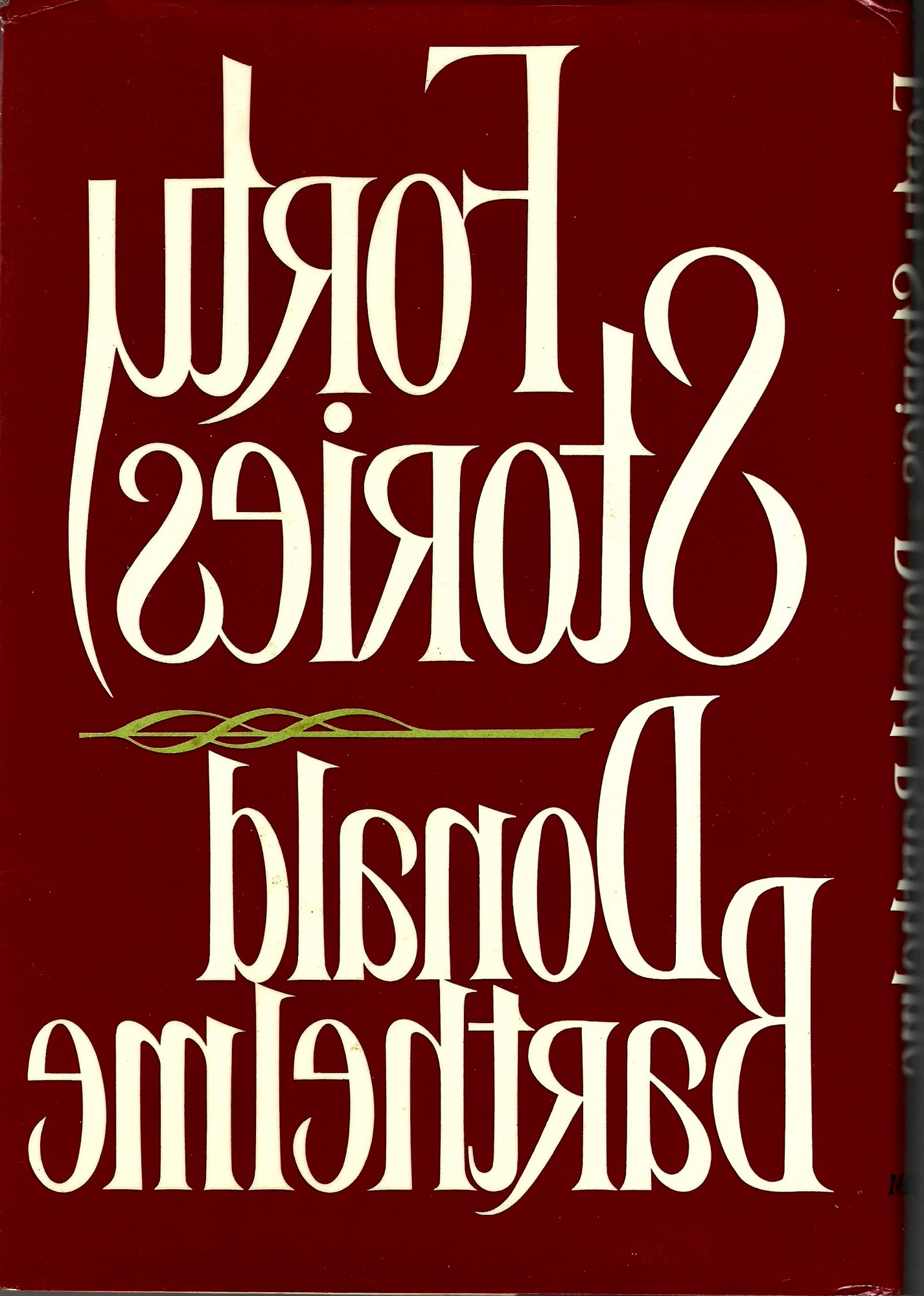
A few years ago, I reread Donald Barthelme’s collection Sixty Stories and wrote about them on this blog. I enjoyed the project immensely. A recent comment on the last of those Sixty Stories posts asked, or demanded, I suppose (the four-word comment is in the imperative voice) that I Now do Forty Stories. Which I am going to now do, Forty Stories.

40. “January” (first published in The New Yorker, 6 April 1987)

“January” begins as a dialogue between two characters, a mode Barthelme would return to repeatedly throughout his later career. The story is ostensibly a Paris Review style interview with one “Thomas Brecker,” who has authored seven books on religion over his thirty-five year career. The story begins as light satire; our Serious Writer is “renting a small villa” in St. Thomas; the interviewer notes that “a houseboy attended us, bringing cool drinks on a brown plastic tray of the sort found in cafeterias.” The interview quickly takes the shape of a career-spanning reflection, with Brecker sliding into a more melancholy mind frame. By the end of the story, the “interviewer” disappears, leaving us in Brecker’s imagination, where we have likely always been, and it’s hard not to read Barthelme’s autobiographical flourishes beneath Brecker’s mordant quips:

I think about my own death quite a bit, mostly in the way of noticing possible symptoms—a biting in the chest—and wondering, Is this it? It’s a function of being over sixty, and I’m maybe more concerned by how than when. That’s a … I hate to abandon my children. I’d like to live until they’re on their feet. I had them too late, I suppose. 

39. “The Baby” (Overnight to Many Distant Cities, 1983)

“The Baby” was composed around the same time as “Chablis” (1983); both stories are love letters of paternal affection for an infant daughter. Again, it’s hard not to see Barthelme’s own biography here. His daughter Katherine was an infant at the time he wrote them. While I don’t think “The Baby” is as strong as “Chablis” is (or, at least as strong in my memory — “Chablis” is the first story in Forty Stories, so we’ll get there, I guess) — while I don’t think “The Baby” is as strong as “Chablis,” it’s still a fun little ditty with an anarchic punchline. It’s also, like barely five short paragraphs–just read it.

38. “Great Days” (Great Days, 1979)

As I revisit my notes for “Great Days,” I realize I should probably read the story again, more slowly, and try to tune more into its voice. Or voices. Are there two voices here, or one? I think there is more of a n actual story story here than I can summarize — not that anyone wants summary of Barthelme —  but my takeaway is that this is Barthelme doing Stein doing Cubism doing… In his 2009 biography of Barthelme Hiding Man, Tracy Daugherty wrote that New Yorker fiction editor (and early Barthelme champion) Roger Angell rejected an early version of the story (under the title “Tenebrae”). According to Daugherty’s bio, while Angell recognized the story as a “serious work” and a “new form,” he ultimately thought it was too “private and largely abstract” for publication.

I think this bit is lovely read aloud:

 —Purple bursts in my face as if purple staples had been stapled there every which way—

—Hurt by malicious criticisms all very well grounded—

—Oh that clown band. Oh its sweet strains.

—The sky. A rectangle of glister. Behind which, a serene brown. A yellow bar, vertical, in the upper right.

—I love you, Harmonica, quite exceptionally.

—By gum I think you mean it. I think you do.

—It’s Portia Wounding Her Thigh.

—It’s Wolfram Looking at His Wife Whom He Has Imprisoned with the Corpse of Her Lover.
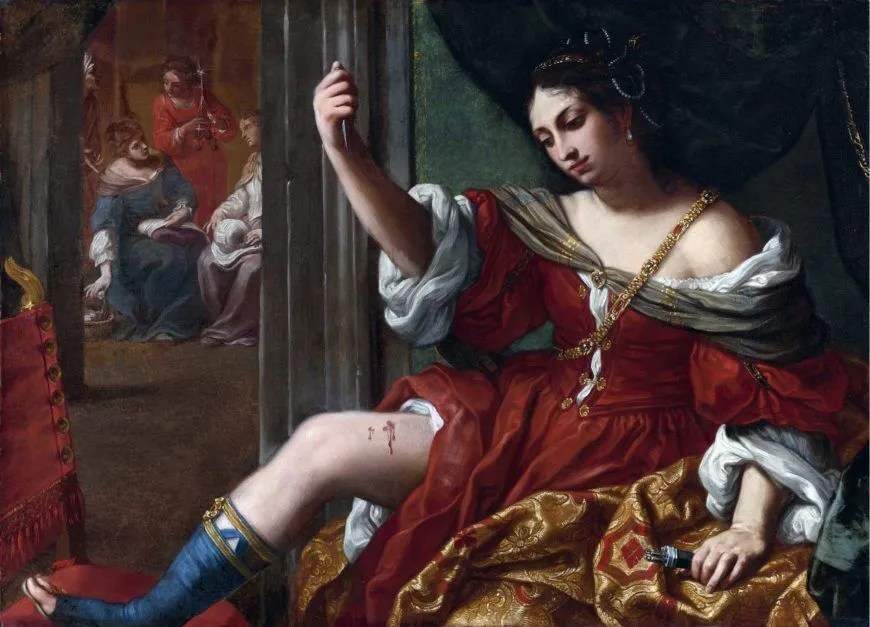
Elisabetta Sirani, Portia Wounding her Thigh, 1664


37. “Letters to the Editore” (Guilty Pleasures, 1974)

A lively little gem from Barthelme’s mid-seventies “non-fiction” collection Guilty Pleasures. Its inclusion seems to show an editorial need to pad out Forty Stories with more hits than the old boy had strung together by ’87. Anyway. “Letters to the Editore” is a fantastic send-up of small aesthetic aggressions writ large in the slim pages of little magazines. The ostensible subject is a dust-up surrounding an exhibition of so-called “asterisk” paintings by an American in a European gallery—but the real subject is language itself:

The Editor of Shock Art has hardly to say that the amazing fecundity of the LeDuff-Galerie Z controversy during the past five numbers has enflamed both shores of the Atlantic, at intense length. We did not think anyone would care, but apparently, a harsh spot has been touched. It is a terrible trouble to publish an international art-journal in two languages simultaneously, and the opportunities for dissonance have not been missed.

Barthelme’s comedic control of voices here is what makes this “story” an early (which is to say, late) standout in Forty Stories. It is the “opportunities for dissonance” that our author is most interested in and attuned to.

36. “Construction” (first published in The New Yorker, 21 April 1985)

“Construction” is the non-story of a writer flying out West to complete the “relatively important matter of business which had taken me to Los Angeles, something to do with a contract, a noxious contract, which I signed.” The documents he signs are “reproduced on onionskin, which does not feel happy in the hand.” This is one of two decent verbal flares in “Construction”; the other is an extended episode (as verbal flare-ups go) in which we find our Writer-Hero up against the wall of absurdity:

The flight back from Los Angeles was without event, very calm and smooth in the night. I had a cup of hot chicken noodle soup which the flight attendant was kind enough to prepare for me; I handed her the can of chicken noodle soup and she (I suppose, I don’t know the details) heated it in her microwave oven and then brought me the cup of hot chicken noodle soup which I had handed her in canned form, also a number of drinks which helped make the calm, smooth flight more so. The plane was half empty, there had been a half-hour delay in getting off the ground which I spent marveling at a sentence in a magazine, the sentence reading as follows: “[Name of film] explores the issues of love and sex without ever being chaste.” I marveled over this for the full half-hour we sat on the ground waiting for clearance on my return from Los Angeles, thinking of adequate responses, such as “Well we avoided that at least,” but no response I could conjure up was equal to or could be equal to the original text which I tore out of the magazine and folded and placed, folded, in my jacket pocket for further consideration at some time in the future when I might need a giggle.

Barthelme’s stand-in confesses here to what we’ve always known: He’s a scissors-and-paste man, a night ripper with a good ear, a good eye, but mostly one of us, a guy who needs a good giggle.

RIP Robert Coover, Prince of American Metafiction

RIP Robert Coover, 1932-2024

Robert Coover passed away a few days ago at ninety-two years old. In his decades-spanning career, Coover published twenty-one novels, four plays, and four short story collections. He also published dozens of (as-yet) uncollected stories, essays, and a host of so-called “electronic fiction.” A fifth short story collection, 2018’s Going for a Beer, collected some of Coover’s greatest hits, and is generally an excellent starting place for those interested in Coover’s metatextual fabulism.

Coover didn’t start out as a metatextual fabulist. His first novel, 1966’s The Origin of the Brunists, is vivid, humanist realism with the slightest tinges of magic brightening its edges. 1968’s follow-up, The Universal Baseball Association, Inc., J. Henry Waugh, Prop., strays much deeper into the pop-myth fantasies that Coover would perfect in his mature career.

Coover’s 1969 collection Pricksongs & Descants shows a remarkable shift into postmodern metafiction. Pricksongs features some of his better stories, like “The Brother” (told from the point of view of the biblical Noah’s brother), “The Elevator,” and “The Magic Poker,” which begins with the sentence “I wander the island, inventing it” — a tidy encapsulation of Coover’s growing motif of the self-creating story. At times, this metatextual motif can exhaust the reader, as in Pricksongs’ capper “The Hat Act.” However, the collection features one of Coover’s best stories, “The Babysitter,” in which the titular character serves as a locus for a mundane suburban community’s collective repressed anxieties of sex and violence.

Coover would continue to explore such themes throughout his career, refining and sharpening his metatextual hat act in standout novels like Spanking the Maid (1982), Gerald’s Party (1986), and 1977’s The Public Burning—arguably Coover’s most important novel. It’s easy to think of The Public Burning as the last part of a loose postmodern American trilogy of large daring novels, the first two parts comprised of Pynchon’s Gravity’s Rainbow (1973) and William Gaddis’s J R (1975).

Indeed, Coover was regularly grouped with a (very white, very male) clique of postmodern American writers. In his 1980 essay “The Literature of Replenishment,” John Barth halfheartedly counted up the members: “By my count, the American fictionists most commonly included in the canon, besides the three of us at Tubingen [William H. Gass, John Hawkes and Barth himself], are Donald Barthelme, Robert Coover, Stanley Elkin, Thomas Pynchon, and Kurt Vonnegut, Jr.”

There was some chatter on social media that Coover’s passing left just Pynchon–and maybe Don DeLillo and Joseph McElroy–as the last living luminaries of twentieth-century US American postmodernist fiction. Of course, Pynchon really wasn’t a member of this or any other clique (he declined an invitation to Donald Barthelme’s so-called “postmodernists dinner“), and, as is too often the case with such groupings, Ishmael Reed’s contribution to American postmodernist fiction continues to be marginalized.

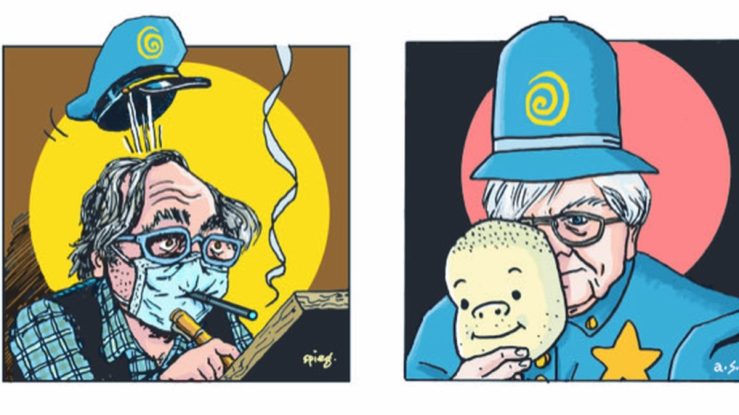
Let it stand then that Robert Coover, despite whatever connections and friendships he held with other writers and artists, was his own special self-made creation. He was prolific, especially later in life, publishing nine novels in the twenty-first century. One of these was The Brunist Day of Wrath (2014), a sequel to his debut; he also collaborated with comix artist Art Spiegelman on the graphic novelette Street Cop (2021) and even found a sliver of mainstream readers with Huck Out West, his wonderful 2017 “sequel” to Adventures of Huckleberry Finn. Coover’s latest novel Open House was published just over a year ago.

Clearly, Coover leaves behind a large body of work, and we’ll likely see more of his work collected and published over the next decade. I won’t pretend to have read most of what he’s written, but I’ve loved a lot of it—particularly Pricksongs & DescantsHuck Out WestSpanking the Maid, and Briar Rose, which, as far as I can recall, is likely the first thing I read of his (my girlfriend at the time’s sister had to read it in college; she professed that she hated it but thought I’d like it). The aforementioned 2018 collection Going for a Beer is a nice starting place for Coover; those more interested in novels might like Spanking the Maid. Or jump into one of his later short novels, like 2004’s Stepmother or 2018’s The Enchanted Prince, both of which exemplify his metamagicianist mode. Or hell, just go for the big boy, The Public Burning. Ultimately, Coover leaves behind a trove of trembling, writhing, vividly-living words, an oeuvre that will continue to engage readers fascinated by a certain stamp of so-called experimental literature–and for that I thank him.


Riff on some Friends of the Library Sale acquisitions

I ducked out of work maybe a little bit early on Friday and filled a brown paper bag with books at a Friends of the Library sale.

I picked up some hardback first editions of books I already own in cheaper formats–Lucia Berlin’s A Manual for Cleaning Women, Denis Johnson’s The Laughing Monsters, P.D. James’s The Children of Men, and Ben Marcus’s Leaving the Sea. I also got hardcover editions of Rachel Cusk’s Second Place, Amy Hempel’s Sing to It, Atticus Lish’s The War for Gloria, and Eugenio Corti’s The Red Horse.

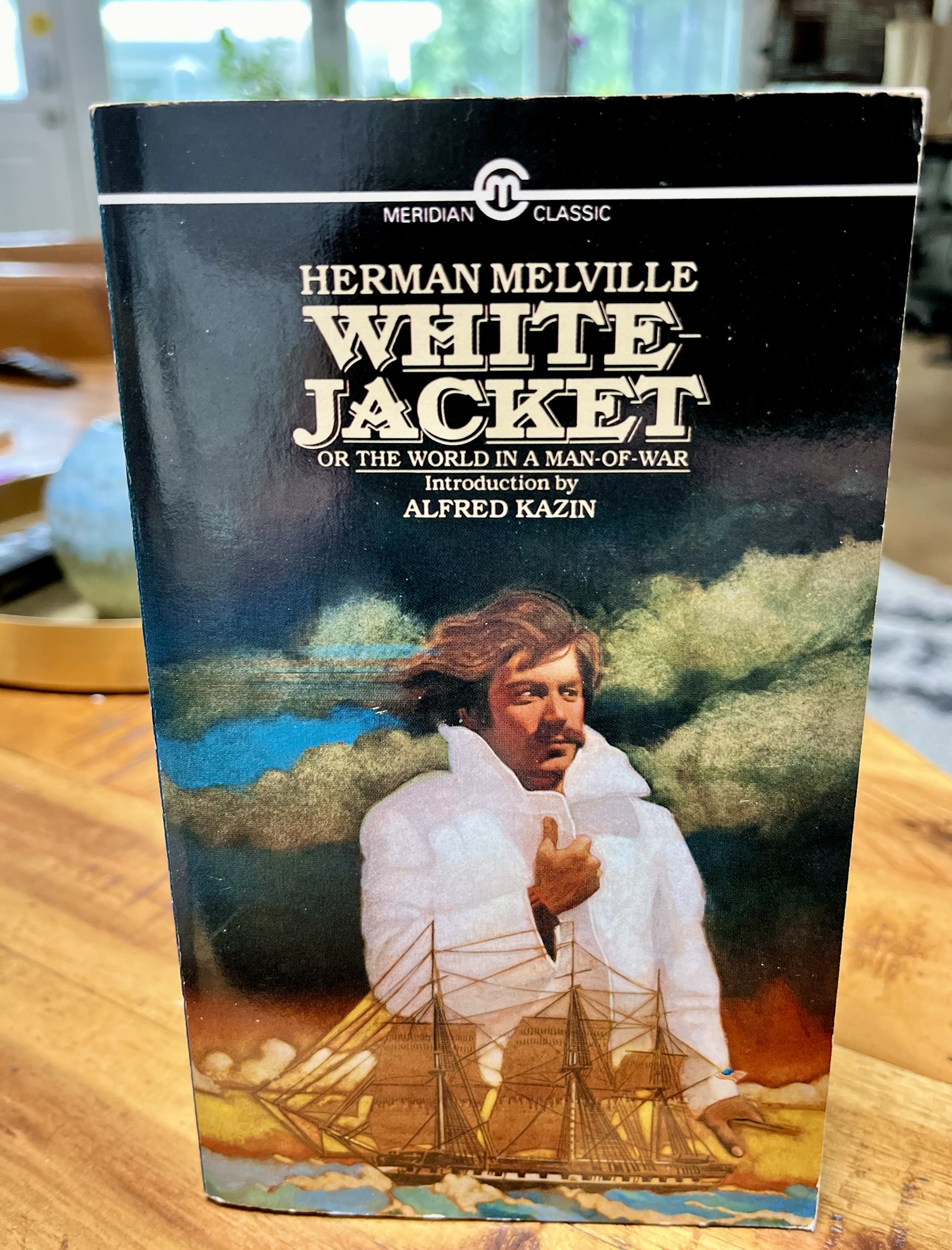
I also grabbed some duplicates or alternate paperback editions of books I already own, including an academically-oriented edition of Gertrude Stein’s Three Lives, Italo Calvino’s If on a winter’s night a traveler, and William Faulkner’s Light in August. I gave the Calvino to my son; the Stein is for a colleague. I’ll give Light in August to a student. (I got the same edition of the Faulkner at the last Friends of the Library sale I went to; my son claimed it.) I’ll also probably offer the Bourdain memoir to a student. I’m pretty sure we have a copy of Kitchen Confidential somewhere around the house. I couldn’t pass up on the cheap mass-market copy of Melville’s White Jacket. I mean, just look at this cover—dude’s wearing a white jacket

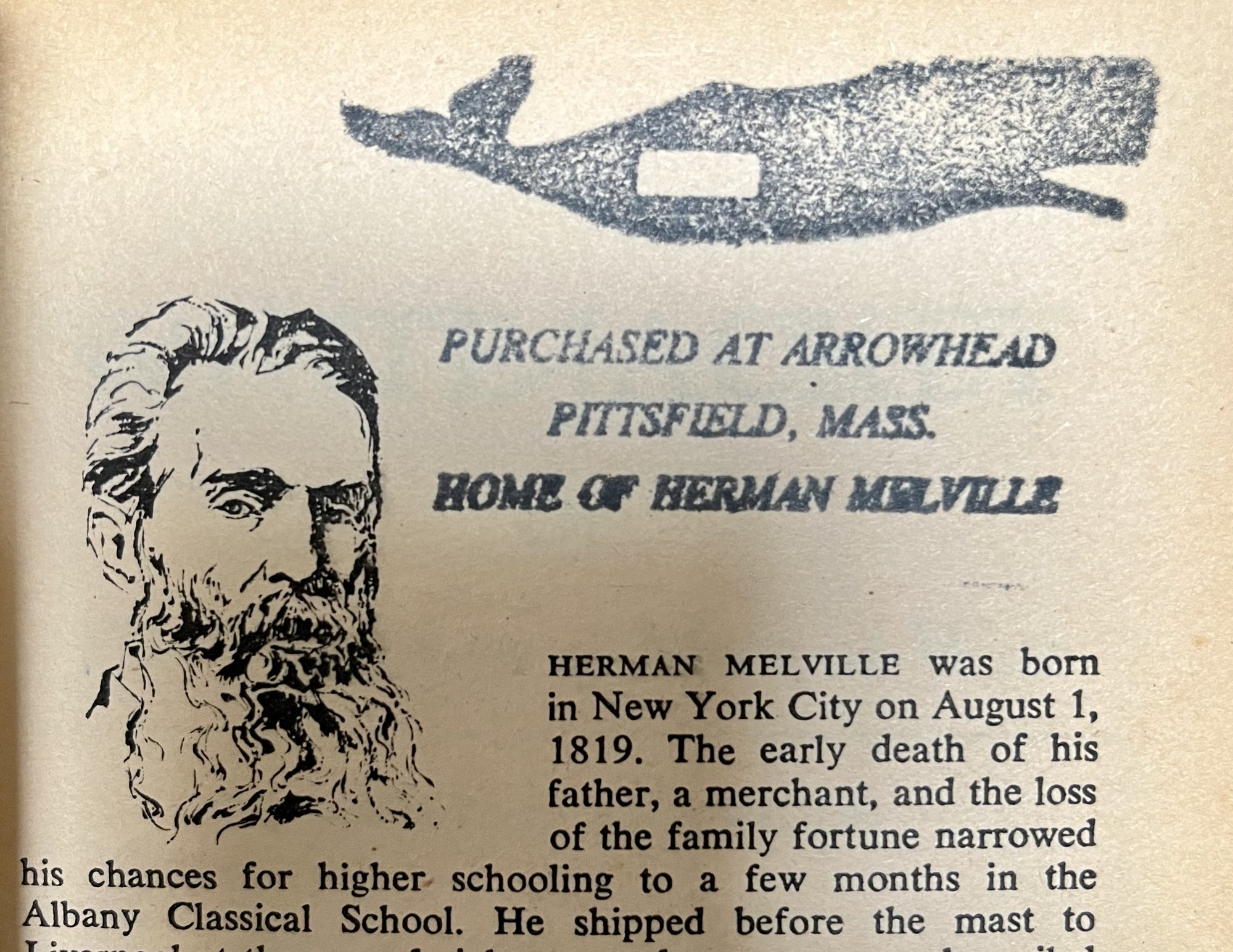
The book also bears a stamp claiming it originated (in a sense) at the old Melville Manse, Arrowhead:

I also couldn’t resist letting a paperback copy of Lucy Ellmann’s Ducks, Newburyport take up a lot of real estate in my paper grocery bag. The hype has died down enough for me to perhaps eventually sink into it. The edition of Alan & John Lomax’s American Ballads & Folk Songs is kinda beat up, but it’s got a lovely cover:

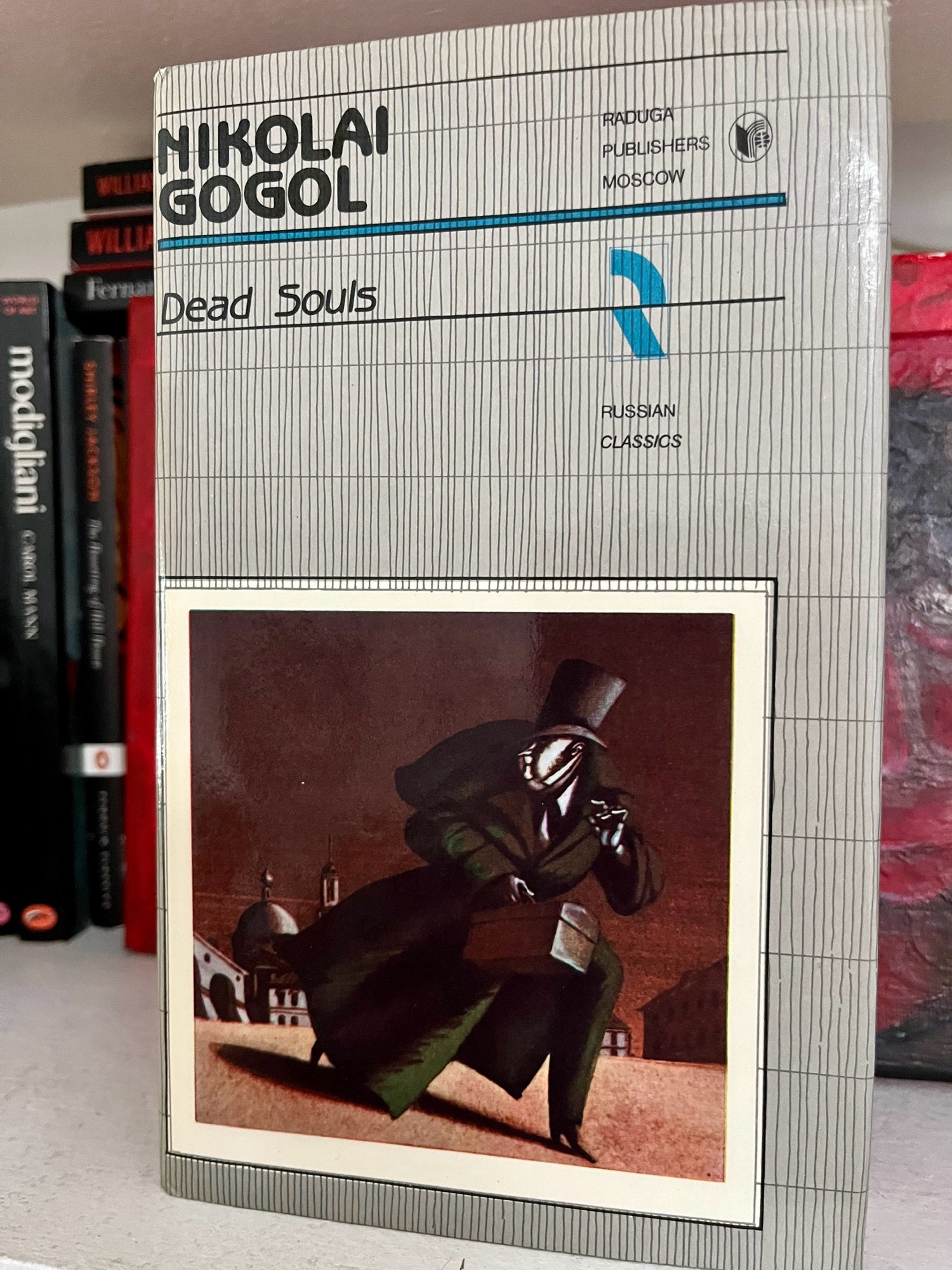
I was also attracted to this strange edition of Nikolai Gogol’s Dead Souls. It’s a 1987 hardback from the Soviet house Raduga Publishers, featuring a full-color portrait of Gogol and blue (?) page headings. The translation is by Christopher English and the book was printed in the U.S.S.R.—I’m not really sure who the intended audience was.

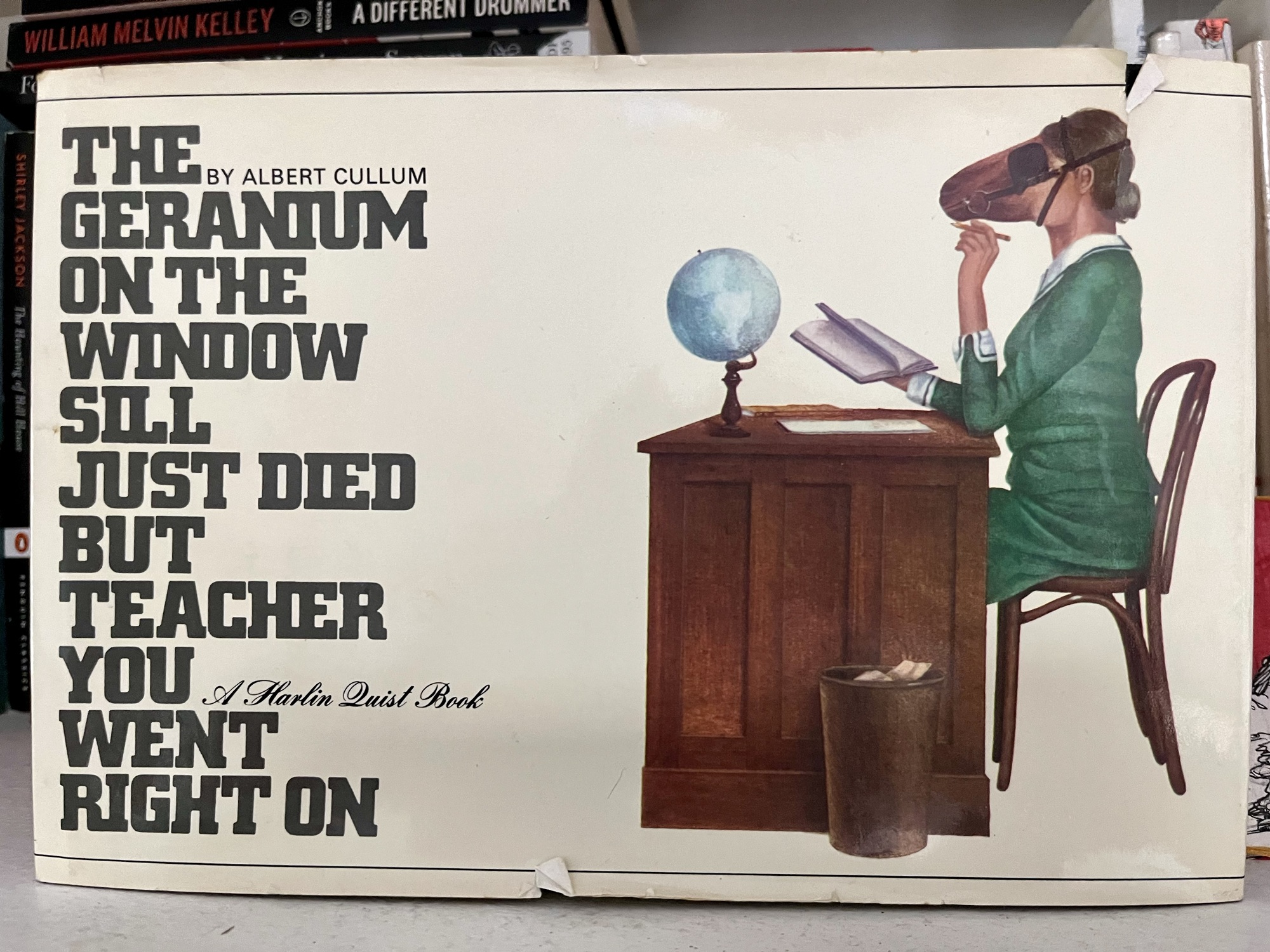
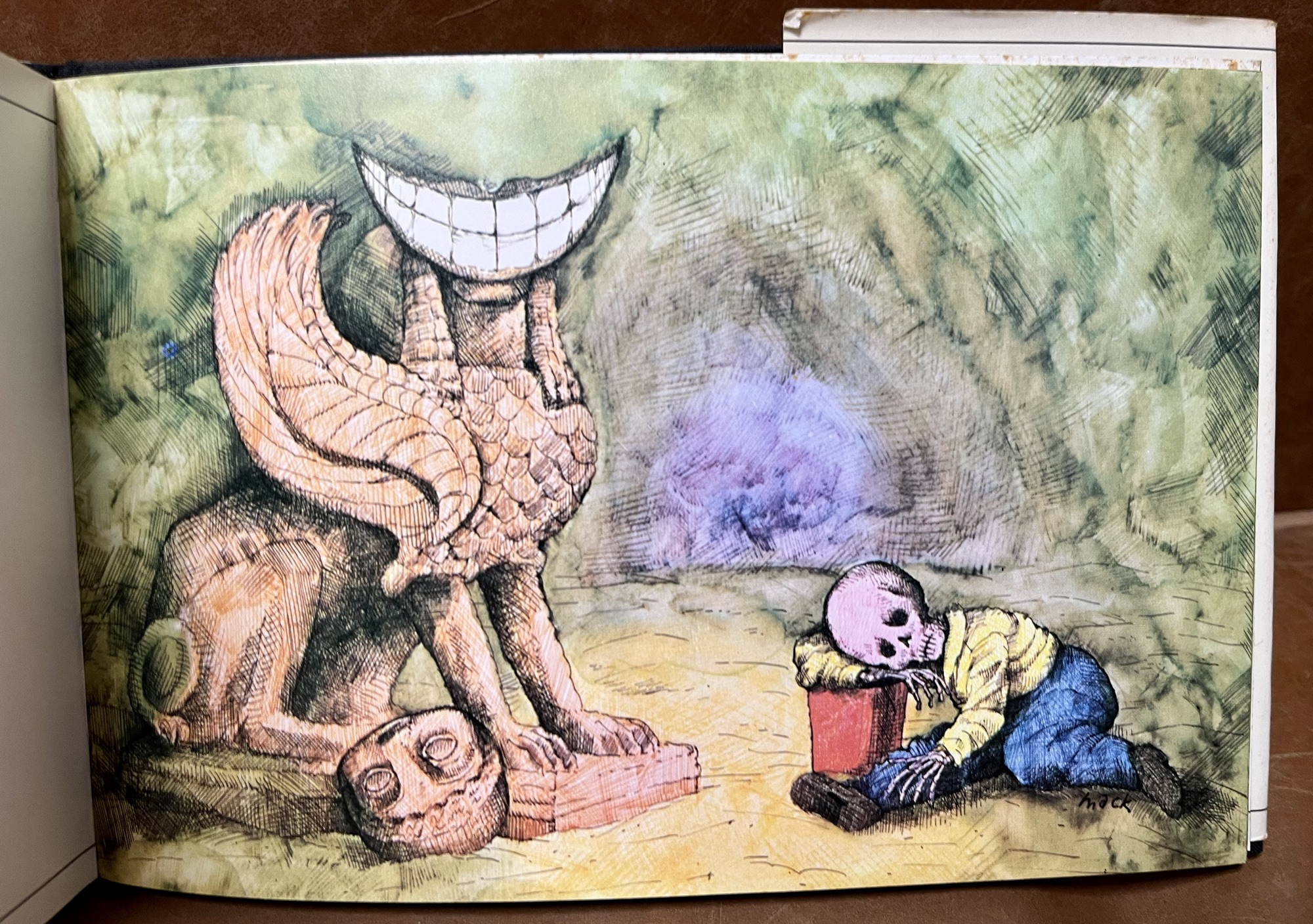
Albert Cullum’s The Geranium in the Window Sill Just Died But Teacher You Went Right On was another oddity I came across. Ostensibly a children’s book, The Geranium ultimately seems aimed at teachers. It features illustrations on every other page, each one by a different artist; many are remarkable, like this one by Stanley Mack–

There were a few titles, not pictured in the image at the top of this post, that I grabbed to cram into my bag simply because I had extra room at the end. I can usually offset the ten dollar bag fee by identifying a handful of pristine trade paperbacks that my local used bookstore will take for trade credit. So maybe I’m not, like, really offsetting the ten dollar fee so much as redirecting it toward obtaining more books.

There were plenty of titles at this particular sale that I would’ve crammed into the bag maybe ten or fifteen years ago—lots of books by Haruki Marukami, who has never been my guy, Jonathan Lethem (who I once really loved), Michael Chabon, Irvine Welsh, and even Chuck Palahniuk (there was a time when I was younger and had a broader range of friends that I could’ve given Palahniuk titles away easily). But I ended up imagining some younger person showing up to the sale, maybe today, Saturday, filling up a bag with titles that promised something beyond the YA formula stuff that makes up their current literary diet.

And if I imagined a younger person growing their library, I also imagined some of the older people whose collections had clearly ended up at the sale. Beyond the obvious airport thrillers and glut of titles by fiction factory Authors™, there were sets of strange, off-brand looking fantasy series in hardback, a seemingly-full run of Agatha Christie mysteries (also in hardback), Westerns no one will read again. Other people’s oddities ended up here; their children had no place for them, having subscribed to their own burdensome addictions.

I’ll have to give away all these books I’ve acquired at some point. But there’s joy in that too.


A(nother) completely subjective and thoroughly unnecessary ranking of Thomas Pynchon’s novels


In 2018—six years ago—on Thomas Pynchon’s 81st birthday, I put together a thoroughly unnecessary ranking of his eight novels. I’m somewhat ashamed of the post, as I included two novels I had abandoned a few times—Vineland and Bleeding Edge. Three years ago, on Pynchon’s 84th birthday, I wrote a few sentences on each of Pynchon’s novels, having, at that point, made my way through all of them. The first post, perhaps because it contains the word “ranking” in its title gets far more traffic to this day than the more thoughtful and finished post from 2021. Indeed, the “ranking” post regularly shows up in the top ten percentile of my weekly and monthly stats on Biblioklept, which, I guess, has bothered me enough to write this (thoroughly unnecessary still) “ranking.”

I know that if I were to approach Pynchon’s eight novels on eight different days, I’d likely end up with a consistent #1, #2, #3, and #8—but the other spots would shift depending on my memory or fancy or whatever spell I’d fallen under, chemical, metaphysical or otherwise. But here’s the list I came up with today.

8. Vineland (1990)

In my 2018 post (where I ranked Vineland at number 7) I noted that “Vineland seems to have a strange status for Pynchon cultists—its a cult novel in an oeuvre of cult novels,” and I’ve found that intuition confirmed over the years. I stick by my assertion in my 2021 post in which I asserted that “Vineland is ultimately depressing and easily my least-favorite Pynchon novel, but it does have some exquisite prose moments.” I’m sure I’ll revisit it before seeing Paul Thomas Anderson’s film adaptation though.

7. Inherent Vice (2009)

Speaking of Paul Thomas Anderson—I think I like his film adaptation of Inherent Vice more than I like the novel. And I love Inherent Vice. But I think PTA provides an emotional ballast that gives the narrative a center that’s missing from Pynchon’s novel (which is, likely, the point, or at least the byproduct of Pynchon’s shaggy dogging it). (I originally ranked Inherent Vice at number 6).

6. Bleeding Edge (2013)

So I finally found my way into Bleeding Edge in the earliest weeks of the COVID-19 lockdown. I’d stuck the book at the bottom of my 2018 list. I’m not really sure why I stalled out on—maybe it feels the closest to my own timeline of any Pynchon novel. Anyway, it’s one I want to revisit again soon. I riffed on it some in 2020, writing “Pynchon captures a time in America during which I was, at least theoretically, becoming an adult (a becoming which may or may not have happened yet). Reading Bleeding Edge helped evoke all the weirdness the 2000s were about to lay out for us. It made me angry again, or reminded me of the anger that I’d sustain for most of the decade. It reminded me of our huge ideological failure after 9/11, an ideological failure we are watching somehow fail even more today.  But I also loved the novel’s unexpectedly sweet domestic plot, and found a kind of solace even in its affirmation of family, even as its final image pointed to the kind of radical inconclusiveness at the heart of being a parent.”

5. V. (1963)

So from here on out my rankings are identical to my stupid 2018 list, with that big caveat that I would easily swap, say, V. and 49 here. I’ll repeat my endorsement that “V. makes a good starting place for anyone new to Pynchon” and recommend that anyone interested in Pynchon but daunted by the scope check out the book from their library and read the ninth chapter, the story of of Kurt Mondaugen.

4. The Crying of Lot 49 (1966)

The Crying of Lot 49 is probably a better novel than V. but I think I like V. better. 49 is very funny and showcases Pynchon’s tonality of paranoia/hope wrapped up in zaniness/horror. It’s an excellent sophomore novel, but also dense, claustrophobic even. I guess I like the Pynchon sprawl a bit better.

3. Against the Day  (2006)

Speaking of sprawl: Against the Day is Pynchon’s biggest novel, just fat and giddy and overstuffed with goodies. I think this novel would make an excellent American history textbook. Its thesis: resist the military-industrial-entertainment-complex. Start here!

2. Mason & Dixon (1997)

A measurement of the world and a story about friendship. It would be Pynchon’s best novel if he hadn’t written—

1. Gravity’s Rainbow (1973)

The best book. I reread it earlier this summer and it’s roomier and stranger and more rewarding each time.

Riff on July 2024 reading, etc.

I experienced the middle weeks of July 2024 as simultaneously rapid and static. Doldrums should never be so frenetic. If this decade were a novel I would’ve put it down several chapters back. I try not to obsess over things I cannot control. I try to get away from screens. I try to go outside, but the feels like heat index here in north Florida goes over a hundred and five every day. (At least it’s raining again and nothing is on fire.) So I try to read more (and actually write more).

This July I read some great stuff.

I finished Katherine Dunn’s first novel Attic a couple of days ago. The book is seriously fucked up—like William Burroughs-Kathy Acker fucked up—an abject rant from a woman in prison in the mode of Ginsberg’s Howl. The narrator seems to be an autofictional version of Dunn herself, which is perhaps why Eric Rosenblum, in his 2022 New Yorker review described it as “largely a realist work in which Dunn emphasizes the trauma of her protagonist’s childhood.” Rosenblum uses the term realism two other times to describe Attic and refers to it at one point as a work of magical realism. If Attic is realism then so is Blood and Guts in High School. I need to read her second and third novels (Truck, 1971 and the posthumous Toad) and then go back and reread Geek Love, which I remember as being Gothic and gross but also whimsical. (I don’t sniff any whimsy in Attic.)

There are eight stories in Oğuz Atay’s story collection Waiting for the Fear (in translation by Ralph Hubbell); I’ve read the first five this summer, including the long title story, which is especially good, as is the opener “Man in a White Overcoat.” Atay’s heroes (I use the term loosely) find their antecedents in Kafka’s weirdos. Or Paul Bowles. Or Jane Bowles. I should have a proper review up near the end of October when NYRB publishes Waiting for the Fear.

I had picked up Mauro Javier Cárdenas’s third novel American Abductions earlier this summer and finally started it a few nights ago after finishing Attic. Each chapter is a run-on sentence that has made me want to keep reading and reading, running on with it. The novel is, at least so far, both challenging and entertaining; it is not difficult, exactly, but rather engrossing. Sometimes I’ll find myself a bit lost in the layered consciousnesses, layers (layerings) of speech in Cárdenas’s sentences—especially when I find myself startled by an image or a joke or idea—and then I’ll wade backwards again and pick up the rhythm and keep going. The plot? I’ll steal from the Dalkey Archive’s blurb: “American Abductions opens in a near-future United States whose omnipresence of data-harvesting and algorithms has enabled the mass incarceration and deportation of Latin Americans—regardless of citizenship.” But that’s not really the plot; I mean, this isn’t a third-person dystopian world-building YA thing. The novel, at least its first half, is about a family, daughters Ada and Eva and their father Antonio, a novelist who was abducted by the titular abductors (the Pale Americans!). It’s also about writing, how we construct memory in a surveillance state, and, I suppose, love.

I reviewed Jean-Baptiste Del Amo’s latest novel The Son of Man (in translation by Frank Wynne) in the middle of July, although I think I probably read it in late June. In my review I suggested that The Son of Man “is ultimately a novel about the atavistic transmission of violence from generation to generation.” I also highly recommended it.

I went on a big Antoine Volodine binge a couple of years ago which stalled out before I got to (what I believe is) his longest novel in English translation, Radiant Terminus. I finally started into it a few weeks ago (in translation by Jeffrey Zuckerman), and I think it might be Volodine’s best work. In my longish review, I declared Radiant Terminus “an astounding novel, a work that will haunt any reader willing to tune into its strange vibrations and haunted frequencies. Very highly recommended.” I think it’s a perfect starting place for anyone interested in Volodine’s so-called post-exotic project.

Denis Johnson’s The Stars at Noon was one of two novels I revisited via audiobook this month (the other is Portis’s Gringos, which we’ll get to in a moment). I honestly didn’t remember much about The Stars at Noon other than its premise and the fact that its narrator was an alcoholic journalist-cum-prostitute in Nicaragua. It hadn’t made the same impression on me as other Johnson novels had when I went through a big Johnson jag in the late nineties and early 2000s, and I think that assessment was correct—it’s simply not as strong as AngelsFiskadoro, or Jesus’ Son. As an audiobook though I enjoyed it, especially in Will Patton’s reading. (His narration of Johnson’s perfect novella Train Dreams is the perfect audiobook.) I guess the audiobook came out in conjunction with Claire Denis’ 2022 adaptation of the film, which I still haven’t seen.

The collection of Remedios Varo’s writings On Homo rodans and Other Writings is another book I read earlier in the summer but didn’t write about until July. I was fortunate enough to get a long interview with the translator, Margaret Carson, and I think the result is one of the better things Biblioklept has published this year.

I picked up Dinah Brooke’s “lost” novel Lord Jim at Home in late June, and then read it in something of a sweat over a few days. In my review, I wrote that

Lord Jim at Home is squalid and startling and nastily horrific. It is abject, lurid, violent, and dark. It is also sad, absurd, mythic, often very funny, and somehow very, very real for all its strangeness. The novels I would most liken Lord Jim at Home to, at least in terms of the aesthetic and emotional experience of reading it, are Ann Quin’s BergAnna Kavan’s Ice, Mervyn Peake’s Gormenghast novels, Virginia Woolf’s Mrs. Dalloway, and James Joyce’s Portrait (as well as bits of Ulysses).

Gringos is the other book I “reread” via audiobook this July. Charles Portis wrote five novels and all of them are perfect—but I think Gringos might be my favorite. David Aaron Baker’s reading of the novel is excellent. He conveys the dry humor of narrator Jimmy Burns as well as the cynical sweet pathos at the core of Portis’s last novel. Highly recommended.

So well I guess July is over; the kids will be back in school again soon, and so will I. The air here will remain swamp thick, humidity that starts cooking you the minute you venture out of the desiccating AC that licensed growth on this weird peninsula. It might let up by November. Maybe because I’ve spent my entire adult career as a teacher I have always thought of August as the end of the year, not December. And some years I feel melancholy at this end, this pivot away from freer hours. But writing this on the last day of July, I think I want a return to routine, to something I can think of as a return to normalcy, the kind of normalcy that makes me appreciate the weird fucked up oddball novels that I do so love to hang out inside of.

Horrors and oneiric aberrations | On Antoine Volodine’s post-exotic novel Radiant Terminus

Antoine Volodine’s novel Radiant Terminus is a 500-page post-apocalyptic, post-modernist, post-exotic epic that destabilizes notions of life and death itself. Radiant Terminus is somehow simultaneously fat and bare, vibrant and etiolated, cunning and naive. The prose, in Jeffrey Zuckerman’s English translation, shifts from lucid, plain syntax to poetical flights of invention. Volodine’s novel is likely unlike anything you’ve read before—unless you’ve read Volodine.

Radiant Terminus begins with its hero Kronauer fleeing into an irradiated wasteland. Kronauer and two of his comrades are escaping from the Orbise, the capital of the Second Soviet Union, which has been invaded by dog-headed fascists. World-wide Marxism-Leninism has fallen, and the stability of nuclear-powered self-sufficiency has collapsed into the apocalyptic promise of a “world that nuclear accidents had made unlivable for ten millennia to come.” The world is indeed increasingly unlivable, but it also has become, we will find, a place for the undying as well. “Hell is on the surface, it’s here,” one character flatly remarks, adding, “No need to dive into the core.”

But Kronauer will have to dive into the core, at least metaphorically. When one of his comrades, succumbing to radiation poison, can no longer move, Kronauer seeks help, crossing the steppe and bravely venturing into the dark forest. Born in the sanctity of the Orbise, Kronauer had been schooled to focus “on the future of Communes for workers and countrymen. His view of the world was illuminated by proletarian morality: self-sacrifice, altruism, and confrontation.” He is driven to save his comrade, but we know from the outset that hopes are slim.

What matters here is Kronauer’s essential idealism. By the end of the novel, Kronauer will suffer, wondering if he will eventually abandon the principles that underwrite his sense of self. He worries that he will eventually slip into a “total regression to primitive hunting, intelligence sidelined for instincts, and, especially, deep down, an irrepressible desire to kill, to slaughter, and to hurt, even if he couldn’t remember anymore what had brought about this nightmare.”

We enter Radiant Terminus in the midst of a nightmare that somehow only intensifies. Kronauer finds his way to what might be the prospect of aid for his comrade, the titular Radiant Terminus, a collective farm that is somehow self-sustaining despite the ever-present specter of irradiated death. Not only is Radiant Terminus out of sync with the physical reality of the post-apocalyptic world, its principles don’t fully square with the tenets of the Second Soviet Union that have guided Kronauer’s mindset:

Radiant Terminus functioned on ideological principles that didn’t match up to the collectivist norms of the Orbise, but, as far as the allocation of goods went, the end result was the same. Disdain for property was, as had been the case throughout the Second Soviet Union, commonplace in the Levanidovo. It was a place where the Party had been extinguished, where the Party no longer existed, but where the idea of reestablishing capitalism and the bourgeoisie hadn’t occurred to anyone, and besides it had to be asked just what this thing called capitalism would have looked like at Radiant Terminus, and what bourgeoisie could be called upon to oppress the working class…

We come to understand, elliptically enough, that Radiant Terminus’s apparent prosperity (or at least sustainability) is purchased in large part via sacrifices made to the village’s old nuclear reactor core, which has melted down and is kept locked away. The core is a kind of doorway to hell. The citizens of Radiant Terminus offer it gifts from the old world:

Every month, indeed, the core was fed. The heavy cover for the well was opened, and some of the bric-a-brac collected over the last season or two was knocked over the edge; just to show that people weren’t panicking and weren’t afraid of pathetic radionuclides. Tables and chairs, television sets, the tarry carcasses of cows and cowherds, tractor motors, charred schoolteachers who had been forgotten in their classrooms during the critical period, computers, remains of phosphorescent crows, moles, does, wolves, squirrels, clothes that looked perfect but had only to be shaken to set off a haze of sparks, inflated toothpaste tubes filled with constantly simmering toothpaste, albino dogs and cats, clusters of iron that continued to rumble with an inner fire, new combine harvesters that hadn’t yet been broken in and which gleamed at midnight as if they were lying in full sunlight, garden forks, hoes, axes, debarkers, accordions that spat out more gamma rays than folkloric melodies, pinewood planks that looked like ebony planks, Stakhanovites in their Sunday best with their hands mummified around their diplomas, forgotten when the event halls were evacuated. The ledgers with their pages turning day and night. Cash-register money, the copper coins clinking and shifting without anyone nearby. These were the sorts of things thrown into the void.

The Gramma Udgul was the one to handle the maneuver

We come to understand the Gramma Udgul as priestess-witch archetype; “condemned to immortality from her first interactions with nuclear reactor cores” she is both immune to the ravages of radiation and cursed by it. The Gramma Udgul has her counterpoint in Solovyei, the dominant antagonist of Radiant Terminus.

Solovyei is the “president” of Radiant Terminus, but his role is something closer to an archduke synthesized with an insane wizard. Like the Gramma Udgul, Solovyei is immortal (indeed, a century earlier, the pair were husband and wife). Solovyei rules greedily over Radiant Terminus, and warns Kronauer to stay away from his three daughters. He is an inverted King Lear; mad, yes, but also deeply capable and cunning. Solovyei seems to find metaphysical sustenance in trips to Radiant Terminus’s nuclear core, emerging from time spent there “sizzling and blackened, weighed down with radiation and opaque poems.”

The development of Solovyei as a controlling intelligence—and Kronauer’s ideological resistance to his monomania as well as his three daughters’ battle against his invasive will—forms the main plot, such as it is, of Radiant Terminus. Solovyei is the author of the “horrors and oneiric aberrations” that haunt the characters and landscape that he is both collapsing center and impossible margin of. “It was hard to determine whether he was a mutant bird, a gigantic sorcerer, or a rich farmer from Soviet or Tolstoyan times,” the narrator declares at one point.

“This necromancer of the steppes,” Kronauer calls Solovyei, and then goes on to try to find language for the metaphysical:

This awful kolkhoz matchmaker, this reviver of cadavers, this horrible shadow, this giant impervious to radiation, this shamanic authority from nowhere, this president of nothing, this vampire in the form of a kulak, this strange man sitting on a stool, this abuser, this dominating man, this sleazy man, this unsettling man, this nuclear-reactor creature, this godless and lordless hypnotizer, this manipulator…

One of the key plot points of Radiant Terminus is that Solovyei can literally resurrect the dead, but cannot reanimate them back to what we would understand as true life:

….we all became bodies inhabited by Solovyei. Who knows whether this magic muzhik hasn’t taken advantage of us being dead, and if we aren’t all puppets within a theater where the manager, the actors, and the audience are all one and the same person

Some of Volodine’s chapters seem to inhabit Solovyei’s consciousness, a space that’s somehow both murky and sharp, an intelligence feasting on the agencies of other human beings:

Our best marionettes, I say. Him or me, doesn’t matter. When he’s stuck I keep going. Zombies, deep shadows, devoted servants. The dead stuck forever in the Bardo. Dead come from the dead. Wives come from unknown mothers. Henchmen. Best puppets and best dolls.

Every character who survives in the pages of Radiant Terminus seems to be susceptible to Solovyei’s oneiric horrors. He is the dream police, the puppet master — “Who’s he?” a minor character asks. The answer: “We don’t know…But we do know that he does with us whatever he wants. We’re in his hell.”

Solovyei’s daughters are the most sympathetic of his vampiric victims. These women, forced into the same unasked-for immortality as their father, find themselves repeatedly invaded by Solovyei, who haunts their dreams and walks around in their minds. One daughter sees herself “a creature imagined, possessed, and brought to life by Solovyei. A daughter of Solovyei, a daughter for Solovyei. A female annex in Solovyei’s life: nothing more than that.” They initiate their own eruptions of opposition: violence, suicidal rejection. Writing.

Near the end of Radiant Terminus, the narrator describes the novels of Hannko Vogulian, Solovyei’s eldest daughter:

In effect, they depicted the same twilit suffering of everyone, a magical but hopeless ordinariness, organic and political deterioration, infinite yet unwished-for resistance to death, perennial uncertainty about reality, or a penal progression of thought, penal, wounded, and insane.

We have here an internal description of the novel Radiant Terminus itself. Indeed, Radiant Terminus is always self-describing and always self-deconstructing: “Everything is in the same place, as in some kind of book, if you want to go to the trouble of thinking about it. That’s the ambiguity of ubiquity and achronia,” the narrator muses. When the narrator throws out the sentence, “These are complete works for no audience,” it almost feels like an inside joke. And Volodine can’t resist metanarrative descriptions of his own so-called post-exotic project:

If a post-exotic writer had been present at the scene, he would have certainly described it according to the techniques of magical socialist realism, with flights of lyricism, drops of sweat, and the proletarian exaltation that were part of the genre. It would have been a propagandist epic with reflections on the individual’s endurance in service to the collective.

Volodine’s Radiant Terminus works in all these modes while simultaneously subverting them. The result is an astounding novel, a work that will haunt any reader willing to tune into its strange vibrations and haunted frequencies. Very highly recommended.

A review of The Son of Man, Jean-Baptiste Del Amo’s novel of atavistic inter-generational violence

Jean-Baptiste Del Amo’s latest novel The Son of Man takes place almost entirely over a three seasons in a dilapidated manor somewhere in rural France, sometime near the end of the 20th century. The plot is deceptively simple: A father returns to his young wife and nine-year-old son after a six-year absence, only to immediately drag them away to his remote childhood home, a place in the mountains called Les Roches. The father desires to refurbish the ancestral manse and restore his family. Complicating matters is the mother’s new pregnancy and frequent migraines and the son’s ambivalence about his relationship with his long-absent father. As the slim novel progresses, the oppressive isolation the mother and son endure tips over into dread and then horror. The Son of Man is ultimately a novel about the atavistic transmission of violence from generation to generation.

Del Amo’s writing, conveyed in Frank Wynne’s limpid translation, is precise and cinematic. Del Amo gives us phenomena and response to that phenomena, but withholds the introspective logic of cause-and-effect or analysis that often dominates novels. Instead, he allows us to see what his characters see and to take from those sights our own interpretations. Consider the following simple passage, where, a few days after arriving at the crumbling old house, the father and mother argue:

The faint voices of the father and mother reach the boy as a confused murmur. He walks to the gable door and looks at the landscape below, at the slow, solemn, hypnotic swaying of the larches and the tall pines on the edge of the forest.

He sees the mother and father standing facing each other.

The mother stands, left hand gripping her right arm, right hand on her hip in a gesture of utter defiance. While the father is speaking, she is shaking her head as though refusing to listen to what he is saying or dismissing his words, while, for his part, the father is nodding in an attempt to convince her or make her see reason.

The father gestures wildly as he speaks, pointing to the house, the grasslands, the mountain peaks that rise into the impassive sky. When he turns towards him, the son suppresses a shudder. Blood drains from his hands, his fingers prickle with pins and needles; if the father sees him standing in the gable window, he might think he has been watching, spying on them, trying to make sense of the words carried on the wind in fits and snatches.

The son cannot fully read the signs and signals in front of him. He’s left with “fits and snatches” and gestures and movements that are, in a certain sense, part of the same material as everything else he can presently behold—the pines, the larches, the wind. And yet the boy intuits in his witnessing an “irrefutable proof of his [own] transgression, perhaps even of his [own] guilt.”

Del Amo conjures a dark, oppressive world where his titular son of man is born into a prelingual state of guilt, a strange inheritance that yields violence. We see much of the novel’s action through the son’s perspective–or not really his perspective, but rather we see the action as through a powerful invisible camera set close to the boy’s head, but never fully inside it. We see the son seeing his mother, whom he loves and understands, in his own way, and seeing his father, who is frightening and likely unknowable:

On the father’s left side, the son notices a scar tracing a line some twenty centimetres long across the skin slantwise towards the shoulder blade, as though the father had been stabbed and the blade had struck a bone and deviated its course. The scar tissue looks smooth, like the skin of a newborn baby or a burn victim.

Spellbound, the boy cannot tear his eyes away, and when the father stops to wipe his forehead with the back of his hand and light a cigarette, he sees the child staring at the scar but says nothing.

The accretion of concrete details coheres into slow burning dread. Del Amo shows us images and gives us details that allow us to infer an explanation for the father’s previous six-year absence that the son cannot yet comprehend. At the same time, we see the father and the mother each moving along separate poles of manic despair. The mother dreams of an impossible escape; the father dreams of an impossible inheritance. The father does not possess the material, tools, or skill to properly restore Les Roches: 

He seems to have decided to do battle with this plot of land whose obstructiveness is an affront, to remove anything and everything that would thwart his plan, or to give free rein, with every swing of the pickaxe, to a blind fury for reasons the child cannot fathom. …

He casts a strangely distended shadow, a vision of disproportionate limbs, an evil doppelgänger that emanates from him, dogging his steps, aping his every gesture, every swing of the axe, every throw of a stone, in a way that is monstrous and terrifying.

In time, through hints and implications, we come to understand that the father’s monomaniacal restoration project has resulted from his own terrible childhood. These hints and implications explode late in the book into a fifteen-page monologue from the father, a bitter screed like something out of a Thomas Bernhard novel. The monologue climaxes in the father’s realization that he has repeated his own awful father’s ways. He declares that buried memories are “simply waiting for someone to come and dredge them from their deep torpor, so that they can resurface and endlessly repeat the same failures, the same disasters.”

It’s true that The Son of Man emanates a startling claustrophobic horror. And yet it also glitters at times with moments of strong beauty. If Del Amo’s lucid, cinematic prose evokes something like Kubrick’s The Shining, it also is capable of something like Malick’s Days of Heaven. There are idyllic moments, such as when the boy and his mother bathe in the plunge pool under the weir of a waterfall, the rumbling of which, from a distance, the son had “first thought was the voice of the mountain.” The son also makes his own adventures into the forest, meeting a family of wild horses, one of which is missing an eye.

Through such encounters, the son achieves a brief moment of transcendence late in the novel. His fleeting epiphany balances his father’s bitter declaration that humans are “born with this void inside, this dizzying void they desperately strive to fill throughout their brief, inconsequential, pitiful time in this world, paralyzed as they are by their transience, their own absurdity, their own vanity…” For the father, this “dizzying void” is something that must be filled — “Just like you might try to fill a grave with a shovelful of earth.” 

Let us contrast the father’s dizzy void with the son’s epiphany:

He sits far away from the nimbus of soft light that radiates from the house, gazing at the inky vault where fires that existed before the world was world still shine, and feeling the presence of the earth, the vastness beneath him. Dizzily, he thinks of the lives simultaneously played out everywhere across its surface, knowing that somewhere a child is walking barefoot, another is falling asleep in a soft bed, that a dog lies dying in the dust in the shade of a sheet of metal, that a city in some far-flung country is shimmering in the darkness, that innumerable creatures are moving about, animated by this mysterious and insistent force that is life, which courses through each of them.

Puzzlingly, he can also feel the great movement – imperceptible yet vertiginous – that carries everything, including him, through time and space, all lives, human and animal, and with them the rocks, the trees, the blazing stars.

Of these moments, he will retain the memory of an epiphany, of being struck by the true nature of things, which no language, no words can communicate; but what lingers will be little more than the trace of a dream, the sense of something being granted and instantly revoked.

The beauty of the first two paragraphs sinks into the reality of the final paragraph. Epiphanies don’t last; we can catch the memories, maybe, but even then, what was granted was “instantly revoked.” We remain trapped in language, outside “the true nature of things.” Will the son then “endlessly repeat the same failures, the same disasters” as his father (and his father and his father and…)? The novel seems to suggest that this will likely be the case, even if it opens other, more optimistic avenues.

In this light, it’s difficult to interpret the novel’s mythic overture. The first fifteen pages of The Son of Man focus on a troop of prehistoric hunter-gatherers. The episode culminates in a hunt scene in which an adolescent son makes his first kill—a doe—and then seems to be fully initiated by his father, who marks him in the deer’s blood. The overture ends with the son fantasizing about “abandoning the group” and laying down in the humus to be swallowed up by the earth. This is, in a sense, a version of the same fantasy the contemporary son will have in the forest around Les Roches tens of thousands of years later. 

It’s unclear how Del Amo would have us read the prehistoric overture. On one hand, it suggests a time of idyllic balance–of humanity in, and not apart from, nature. And on the other hand, it concludes with the same desire to escape civilization that, millennia later, the father will inherit.

Perhaps a second reading of The Son of Man might yield a more conclusive answer, or a second reading of Frank Wynne’s translation of Del Amo’s previous novel, Animalia, a visceral, naturalistic, and very precise rendering of humans as animals that takes on an epic scope. English-only readers interested in Del Amo’s writing couldn’t go wrong with either of these novels, which, unless I’m mistaken, are the only two on the market in English translation. I look forward to reading more of Del Amo’s novels in the future. Until then, I highly recommend The Son of Man.

 Jean-Baptiste Del Amo’s The Son of Man is now available in the U.S. in translation by Frank Wynne from Grove Atlantic.

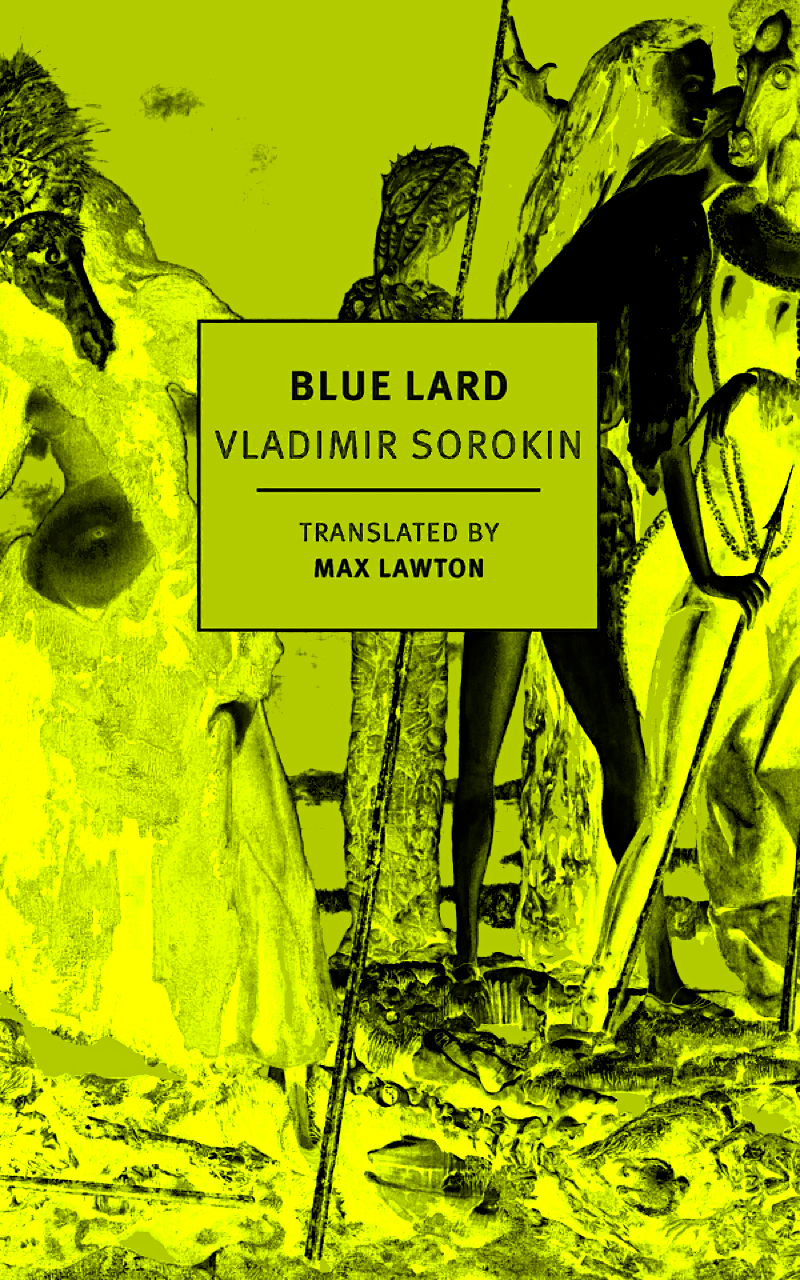
On Vladimir Sorokin’s Blue Lard, pp. 277-354 (Hitler’s head, Stalin’s brain, Blue Lard’s end?)

Previously on Blue Lard…

pp. 1-47

pp. 48-110

pp. 111-61

pp. 162-87

pp. 188-222

pp. 223-76

The following discussion of Vladimir Sorokin’s novel Blue Lard (in translation by Max Lawton) is intended for those who have read or are reading the book. It contains significant spoilers; to be very clear, I strongly recommend entering Blue Lard cold.

I’ve had too many false starts with this last (for now) riff on Blue Lard that I’ve ended up rereading the last 100 or so pages maybe four times now. When I first started this ridiculous series of riffs–way back in February!–I promised to surf Blue Lard’s wave; I have not done that. I’ve bogged myself down in summarizing. I’ve found myself reading Wikipedia entry after Wikipedia entry of the various Soviet luminaries–politicians, artists, writers, scientists, etc.–who lard the end of the novel. I’ve tried to figure out the ending by going back to the epistolary beginning. I’ve tried, I suppose, to flesh out the thesis I arrived at in the last riff I did, where I suggested that “Blue Lard is hypersurreal, shocking, deviant. But it’s also more balanced and nuanced than a first go-through might suggest, not just absurdist shit-throwing and jabberwocky, but an accomplished analysis of the emerging post-Soviet era.”

So well where were we? Or rather, where are we? The novel’s final section begins with Hitler loading his family, his bodyguard, his lover Khrushchev and a retinue of ninjas into his private plane. They abscond with the cache of blue lard and make their way to Germany to meet up with their old pal Hitler, irking Beria and his murderous allies.

On route to Hitler’s Berghof, Stalin’s wife Nadezhda reads aloud the first act of  a new play by Konstantin Simonov, A Glass of Russian Blood. The play seems to be an allegory framing the Soviet intelligentsia as literal bloodsuckers, vampires feasting on the proletariat. Khrushchev dismisses the play’s subject as “fashionable rancor”; Stalin is more charitable, remarking that “Every writer has his ups and downs.” As usual, I found myself going down a rabbit hole, trying to glean a possible critique of the Simonov’s journal Novy Mir in particular and Soviet literature in general. This is not the way to read Blue Lard. Meanwhile, unconcerned with absurd theater, Stalin’s daughter is hungry; she declares she’d like to eat a unicorn. (In one of the earlier translations of Blue Lard I read, Max includes a footnote explaining that he’s substituted unicorn for the original tyanitolkai (тяни-Толкай) in the interest of readability.)

Back in Moscow, Beria is trying to track down Stalin and the missing blue lard. He’s also ordered the torture of Andrei Sakharov who’s been condemned for, as his torturer notes, suggesting that “Time is a head of cabbage and all events are just aphids eating their way through it” — a complete rejection of Soviet communism’s teleological conception of historical materialism.

Sakharov’s torturer is Alexander Khvat, who the narrator informs us was “the lead investigator on the case of the sinister saboteur Vavilov who’d devoted his life to cultivating ‘quick ergot’ and using it to infect Kuban wheat.” The historical Vavilov, which is to say our historical Vavilov, was an agrinomical geneticist who tried to use science to feed the world.

But Sorokin’s critique doesn’t seem to be aimed at Soviet communism alone; rather, he seems to condemn the brutal stupidity and close-mindedness of those who fear what they do not comprehend. Blue Lard’s absurdity and violence critiques power—and the fear of loss of power that consumes those who hold power.

Stalin’s crew passes over the great Prague Wall which separates the West from the East, the Third Reich and its partner the USSR, and soon arrive at the Berghof:

The long, unusually smooth tarmac of the airfield was reminiscent of a frozen mountain lake and ran up against a granite statue of Hitler’s head, carved from an entire mountain by the efforts of Arno Breker and six thousand French and British prisoners.

The Hitlers (the führer has married mistress Eva in this reality) and the Stalins kiss their hellos and with their accompanying entourages head to yet another of Blue Lard’s many, many feasts. (The narrator notes that “Meanwhile, in the plane, Ajooba, Sisul, and the ninjas were quickly and professionally strangling the airplane’s crew” — the adverb professionally there is marvelous.)

Just as he does with Stalin, Sorokin renders Hitler in kitschy pop-glam strokes:

Hitler put his unfinished glass down on a tray held up to him by an SS servant, then, opening his long arms in the narrow sleeves of a dark-blue frock coat, lace cuffs spilling out of them, walked over to Stalin, his high-heeled shoes with their golden spurs loudly knocking against the marble. Eva followed him, her thin body nestled snugly into a leopard dress.

Tacky-glam of Hitler of Blue Lard is also a bit of a carnivore, unlike the vegetarian of our own historical record. “The table was covered primarily in meat-based hors d’oeuvres, as the Führer couldn’t stand fruits and vegetables,” the narrator notes. But he’s still an animal lover. When he pets his dog Blondie, his hands sparkle and crackle with electric energy. This Hitler shoots electrical beams from his fingertips, a talent that helps him win WW2.

Blue Lard’s final sequence in Hitler’s Berghof is full of depravities and (soap) operatics. Hitler essentially rapes Vesta, while her mother Nadezdha watches through a keyhole. Stricken, Nadezdha makes a call to her on-again-off-again lover Boris Leonidovich—presumably Boris Pasternak (we encountered his clone, author of the thirteen-stanza poem “Pussy” in the first section of Blue Lard), who chastises her for the sin of “pleonasm” (!) after she accuses him of cheating on her with “that jester… that clown… that idiot” Shklovsky (presumably the literary theorist Viktor Shklovsky).

Then all kinds of shit goes down. I’ve gotten bogged down in over-summarizing again; not my intention. The final strands of Blue Lard twist about like fragments of old spy films or war films—double crosses, unclear intentions. Heinrich Himmler shows up with just a few pages left in the novel, a thousand-pound mutant (Jabba to Hitler’s Emperor? Did Sorokin, like, get mad coked up and watch Return of the Jedi and write Blue Lard?)

It all ends, or doesn’t end, with Stalin injecting blue lard into his brain, which then expands and expands and expands:

Iosif Stalin’s brain gradually filled up the entire universe, absorbing its planets and stars. After 126,407,500 years, the brain turned into a black hole and began to shrink. After 34,564,007,330 years, the brain had shrunk back to the original size of Iosif Stalin’s brain. But the mass of the leader’s brain was 345,000 times greater than the mass of the sun. Then Stalin remembered about the pear.

And opened his eyes.

And now we are back where we started, a hundred years or so from Stalin’s then-present. An old, old man with a thick rural accent, he attends to the bratty recipient of Boris Gloger’s letters. In fact, he gives the brat the missive from Gloger dated 2 January (2048) that initiates Blue Lard—we are in a strange loop. (Is this an endorsement or refutation of the aphids-in-a-head-of-cabbage theory of time?) The letter’s recipient, Gloger’s “tender bastard,” tosses it to the ground after just a few sentences or two.

He’s more interested in the outfit he’ll wear to the Easter ball, a special outfit Stalin has apparently tailored: a mantle composed of blue lard. So rise again.


On Vladimir Sorokin’s Blue Lard, pp. 223-76 | I love coarse aesthetics! Fucking people up furiosamente!

Previously on Blue Lard…

pp. 1-47

pp. 48-110

pp. 111-61

pp. 162-87

pp. 188-222

The following discussion of Vladimir Sorokin’s novel Blue Lard (in translation by Max Lawton) is intended for those who have read or are reading the book. It contains significant spoilers; to be very clear, I strongly recommend entering Blue Lard cold.

When I started this series of posts, I was rereading the print edition of Blue Lard after having read Max’s manuscript translation a few years ago. I have gotten so behind in this post series that I am now re-rereading. After having read the book essentially three times now, I find that it is far more precise and controlled than my initial impression–which I guess makes sense. Blue Lard is hypersurreal, shocking, deviant. But it’s also more balanced and nuanced than a first go-through might suggest, not just absurdist shit-throwing and jabberwocky, but an accomplished analysis of the emerging post-Soviet era.

We left off our Blue Lard riffs with the pop art glamour and swagger of the Stalin family, drawn in bold but neat caricature. Stalin departs the dramatic inner circle/family circle on his way first to lieutenant Beria’s and then to his part-time lover Khrushchev’s, but as he’s on his way, “a fat woman dressed in rags hurl[s] herself toward the motorcade with a mad cry.” Stalin’s guards draw their weapons, but Our Boy is quicker: “‘Don’t shoot!’ Stalin ordered. ‘It’s Triple-A! Stop!'”

Triple-A is the poet Anna Akhmatova (who we first met via reincarnation as the kindaclone Akhmatova-2 back in the future). She’s fat gross and happy, pregnant with an aesthetic revelation of abjection:

Her wide, round face with its broken nose was flat and her small eyes shone with madness; tiny rotten teeth stuck out from beneath her formless wet lips; her unbelievably tattered rags adorned a squat body that widened freakishly as it went down; her dirty gray hair stuck out from beneath a ragged woolen kerchief; her bare feet were black with filth.

AAA is one of Sorokin’s fouler concoctions, proclaiming proclamations like

“Did you know that Kharms feeds canaries with his worms?” Stalin asks AAA. (The absurdist poet and children’s author Daniil Kharms died in a Soviet prison in his mid-thirties. “Send him to the deepest north!” Sorokin’s Akhmatova advises Sorokin’s Stalin.) The conversation over Soviet writing continues: “‘I have an active dislike for Fadeyev’s Young Guard,'” declares Stalin.” A paragraph or two later, AAA licks the soles of his boots. I don’t know nearly enough about Soviet and Russian literature to figure out what or if Sorokin is satirizing here, but I think I know enough about the relationship of aesthetics and power to take a big hint. 

Stalin’s motorcade drove up to Arkhangelskoye. Here, in a magnificent palace built during the reign of Catherine II, lived the count and previous member of the Politburo and of the Central Committee of the CPSU Nikita Aristarkhovich Khrushchev, who had been removed from his state duties by the October Plenum of the Central Committee.

There is a famous infamous horny sensual sex scene between Stalin and Khrushchev coming up, one that has made Blue Lard famously infamous—but let’s set that aside for now. Sorokin’s Khrushchev’s patronymic Aristarkhovich doesn’t gel with our historical Khrushchev’s patronymic Sergeyevich. Is the “new” patronymic “Aristarkhovich” an allusion to the avant-garde painter Aristarkh Lentulov? 

Sorokin’s presentation of Khrushchev as a hunchback may allude to the following incident, as reported in a 1973 The New York Times profile on the poet Yevgeny Yevtushenko:

Gravity’s Rainbow — annotations and illustrations for pages 712-13 | The Man has a branch office in each of our brains

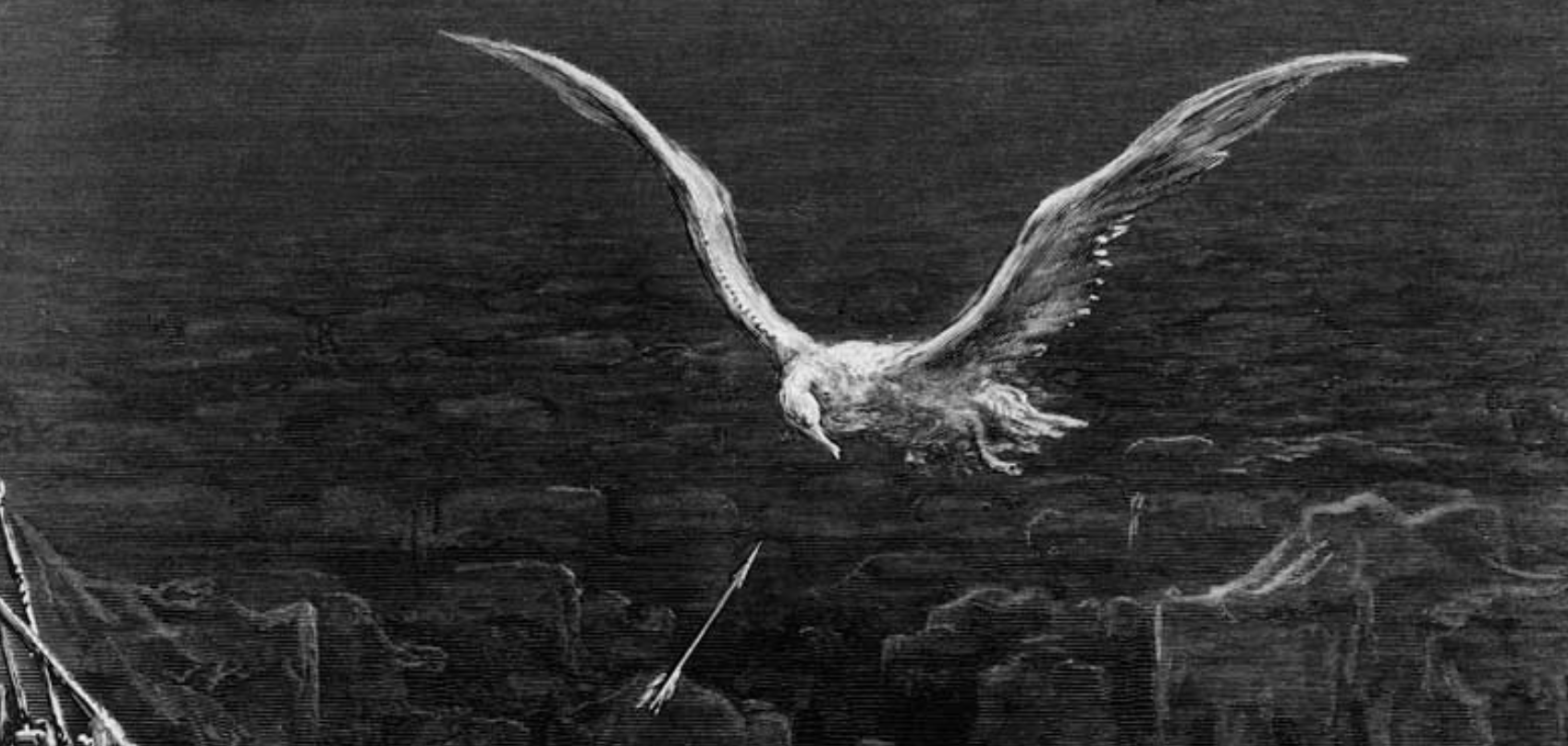
Illustration for Coleridge’s The Rime of the Ancient Mariner, Gustave Doré, 1876

Well1, if the Counterforce2 knew better what those categories3 concealed, they might be in a better position to disarm, de-penis and dismantle the Man4. But they don’t. Actually they do, but they don’t admit it. Sad but true. They are as schizoid, as double-minded in the massive presence of money, as any of the rest of us, and that’s the hard fact5. The Man has a branch office in each of our brains, his corporate emblem is a white albatross, each local rep has a cover known as the Ego, and their mission in this world is Bad Shit6. We do know what’s going on, and we let it go on7. As long as we can see them, stare at them, those massively moneyed, once in a while. As long as they allow us a glimpse, however rarely. We need that. And how they know it–how often, under what conditions. . . .8 We ought to be seeing much popular-magazine coverage on the order of The Night Rog and Beaver Fought Over Jessica While She Cried in Krupp’s Arms, and drool over every blurry photo–9

Roger must have been dreaming10 for a minute here of the sweaty evenings of Thermidor11: the failed Counterforce, the glamorous ex-rebels, half-suspected but still enjoying official immunity and sly love, camera-worthy wherever they carry on . . . doomed pet freaks.

They will use us. We will help legitimize Them12, though They don’t need it really, it’s another dividend for Them, nice but not critical. . . .

Oh yes, isn’t that exactly what They’ll do.

1 Well, hell, the last time I composed one of these silly annotations posts was way back in the unfortunate Fall of 2016, when I lost my goddamn mind for a while. I never made any notes on the novel’s final quadrant, “The Counterforce,” and never mustered any more notes when I reread GR in 2020. Over the past two weeks, I listened to George Guidall’s excellent narration in a long, long audiobook that kept me good company through some serious Spring cleaning projects. As has been the case in each of my treks through GR, I found it intensely prescient, a wonderful, terrifying diagnosis of the grand ugly 20th c. that we will never recover from.

2 I’ve read Gravity’s Rainbow all the way through six or seven times now, and each time I always find myself buoyed by the Counterforce—Pynchon’s heroic band of preterite rebels who resist the forces of Control. And every time I reread it I seem to forget that the Counterforce fails—the Counterforce (I dare not use the appropriate pronoun they, for They is the enemy of the Counterforce’s We) simply can’t stop the coming new world order of the military-industrial-entertainment complex. The short passage I’ve selected here, with Counterforce hero and one-time lover Roger Mexico as its medium, showcases one of the many reasons the Counterforce will fail.

3 Those categories refers to Pynchon’s previous paragraph, an academic spoof highlighting various “albatross nosologies”; nosology refers to the classification of diseases; the albatross is a metaphorical curse, of course.

Illustration for Coleridge’s The Rime of the Ancient Mariner, Gustave Doré, 1876

4 The Man: authority, control, They, the force, the fuzz, the cops, the heat, the money guys, the enemies of art, love, and the human soul…

5 A depressing notion, of course, and one Pynchon would return to in his 1990 follow-up to GRVineland, a novel that parodied the so-called counterculture of the 1960’s massive ideological failure, to, like, follow through with any true revolutionary project. 

6 The economic metaphors here are appropriate. Again, fuck the money guys whose mission in this world is Bad Shit.

7 An even more depressing notion—that the double-mindedness of Counterforce consciousness includes knowing that we let the Bad Shit go on; maybe our resistant spirit curdles into a brittle apathy; maybe we overindulge in mindless pleasures; maybe we explode. 

mindless-pleasures
An early trial cover for GR, featuring one of its working titles, Mindless Pleasures

8 The date of publication for this post coincides with the May 6, 2024 annual Met Gala, a capitalist spectacle of wealth and fame costumed in the trappings of art. This year’s ticket is $75,000, more than the average U.S. salary. And yet it might be fair to consider that those “massively moneyed” costumed revelers at the Met Gala aren’t even really the true massively moneyed, but rather their avatars, projected on innumerable screens, avatars of mindless pleasures to distract us from all the Bad Shit the massively moneyed are up to.

9 Pynchon here plays on lurid tabloid headlines that aren’t too different from the ones we see today, reconfiguring the one-time lovers Jessica and Roger as the elect, figures of celebration. It’s all fantasy though—literally; as the next lines seem to suggest, we’ve been in Roger’s addled mind. Pynchon’s headline reminds me of Donald Barthelme’s 1964 short story “Me and Miss Mandible,” which includes a list of trashy titles about Elizabeth Taylor, Debbie Reynolds, and Eddie Fisher like “The Private Life of Eddie and Liz,” “Debbie Gets Her Man Back?” and “Eddie’s Taylor-Made Love Nest.”

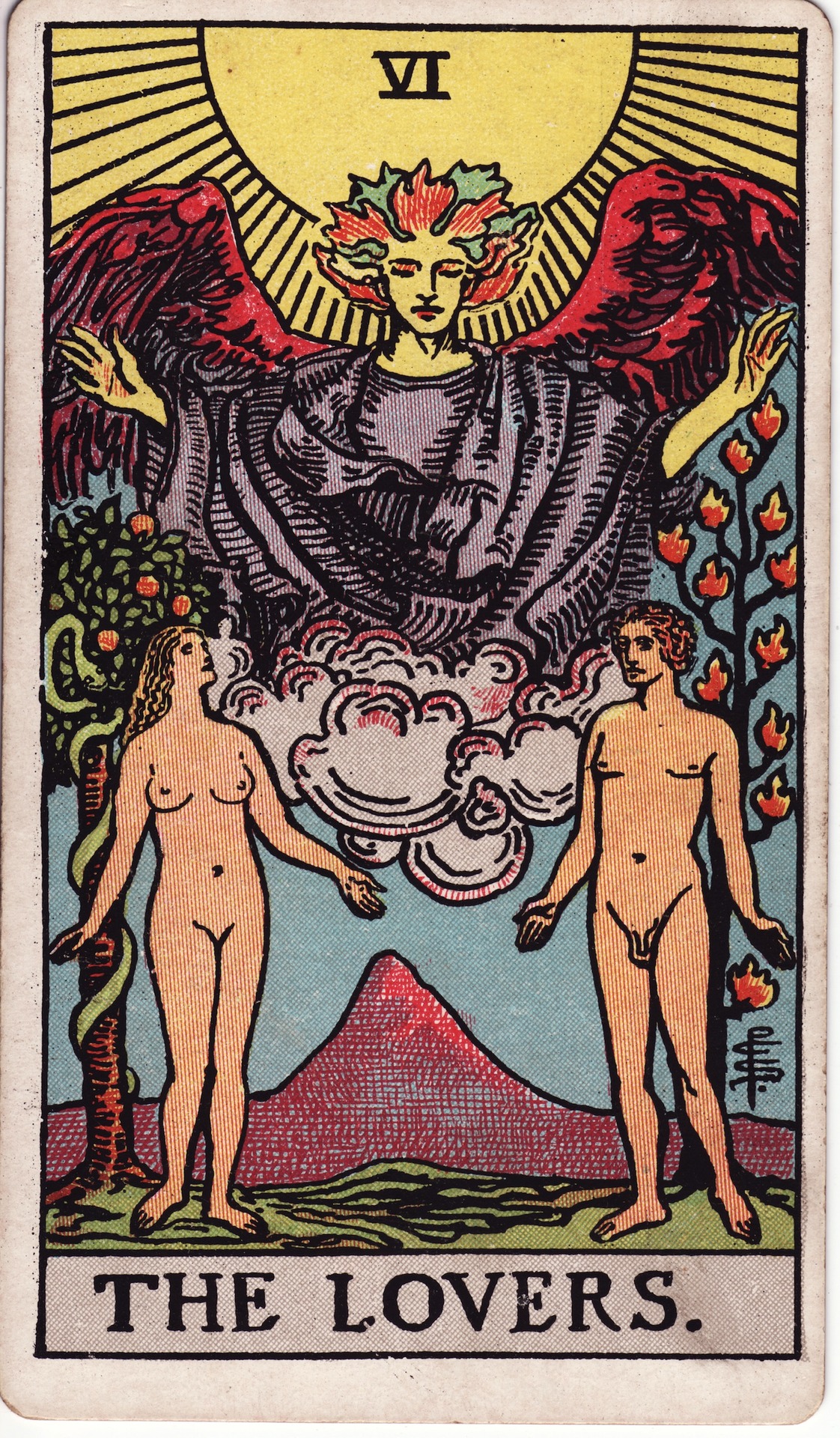
I found the wartime love affair between Jessica and Roger more depressing this time than in previous reads of Gravity’s Rainbow. When we first meet them, we get one of the best lines in the novel: “They are in love. Fuck the war.” But it is the war that licenses their love; in its absence (or, really dormancy), a bureaucratizing control subsumes their ardor. They fail.

The Lovers card from the Rider–Waite tarot deck

10 The gerund dreaming here helps to foreground Roger’s current tabloid-headline-revenge-against-the-powers-that-be-fantasy as fantasy while also analeptically connecting the post-WW2 Counterforce’s nebulous mission to the fallout of the French Revolution. Dreaming also suggests that Roger is the “narrator” of this section; it also reminds me of Roger’s mentor Pirate Prentice, whose dream (of failed escape, “all theater”) initiates Gravity’s Rainbow. Pirate’s psychic power is to inhabit the fantasies of others; this is also Thomas Pynchon’s power.

11 In the second edition of his A Companion to Gravity’s Rainbow, Steven Weisenburger gives the following gloss:

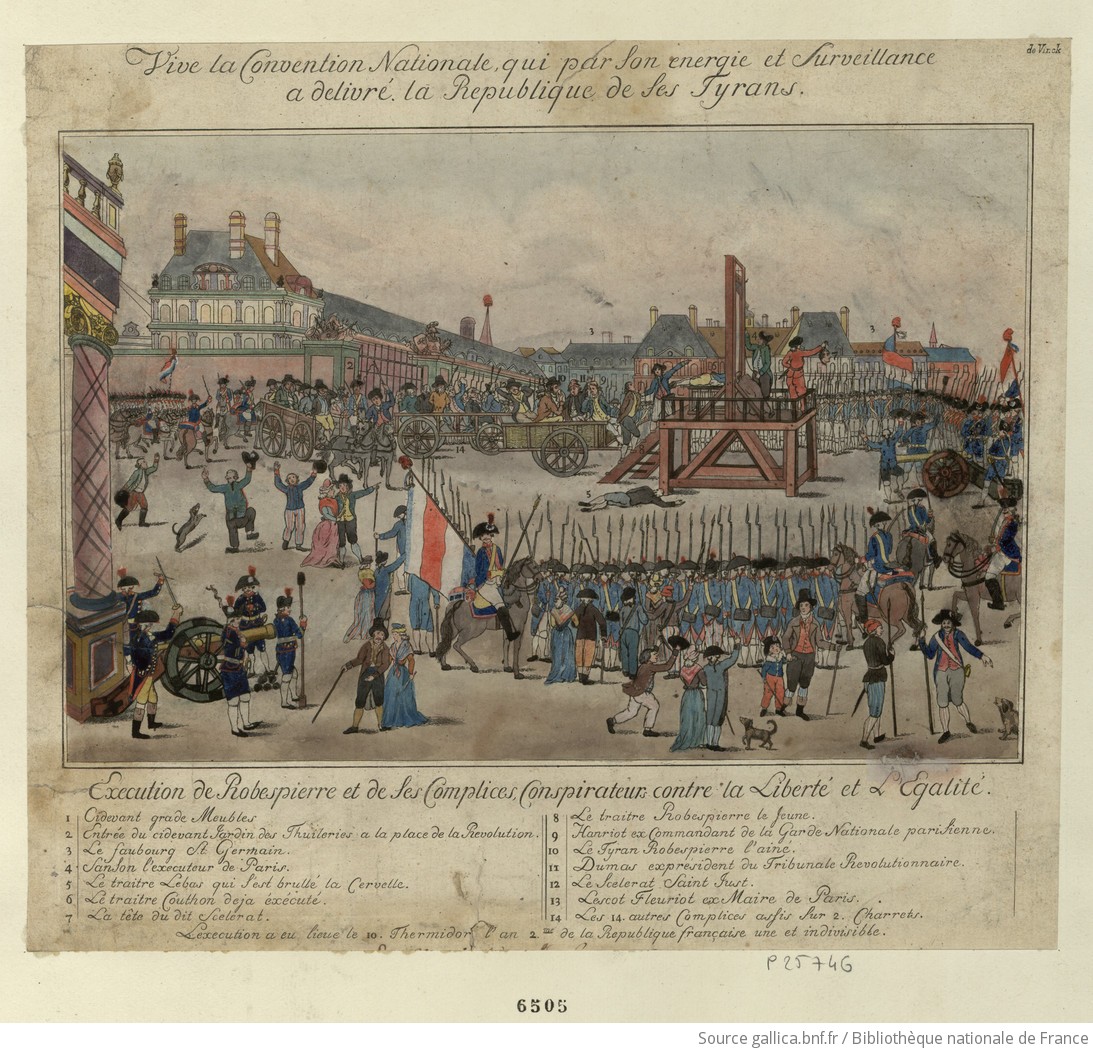
If Roger Mexico is dreaming of these evenings, then his dreams contain a warning. Thermidor was the eleventh month of the French revolutionary calendar, corresponding to the period from July 19 to August 17. Moreover, it was on the eighth of Thermidor, in the French Revolution’s second year (in other words, July 27, 1794), that Robespierre, Saint-Just, and other leaders of massive redistribution of wealth and upheaval of the aristocratic order, known as the Reign of Terror, were arrested and, the next day, executed.

Weisenburger’s annotation here is a significant update from the Companion’s first edition, which essentially gives a brief definition of what Thermidor was without any greater political or historical context.

The Pynchon Wiki Gravity’s Rainbow annotation gives the following,  which repeats (or precedes?) Weisenburger’s note, adding also that, “In one of his newspaper articles later, Pynchon would speak of the Nixon years as a ‘Thermidorian reaction’ to the 1960s.”

I have no idea what “one of his newspaper articles” is being referenced here. What immediately came to mind was likely “Is It Okay to Be a Luddite?” or “Nearer, My Couch, to Thee,” both of which appeared in The New York Times, and neither of which, as far as I can tell, use the phrase “Thermidorian reaction” or “Nixon.” (In “Luddite,” Pynchon does refer to the French Revolution—and also gives us a nice little summary of Roger’s complaint against Power in our little passage here: “there is now a permanent power establishment of admirals, generals and corporate CEO’s, up against whom us average poor bastards are completely outclassed”). The closest phrasing I can find to the Pynchon Wiki’s framing comes from a 2016 essay by James Liner that primarily deals with Inherent Vice. Liner writes: “Even in the Thermidor of Nixon’s 1970s, on the eve of the Reagan/Thatcher ’80s, Doc holds fast to utopian hope and the possibility of antisystemic praxis.”

Execution de Robespierre et de ses complices conspirateurs contre la liberté et l’egalité : vive la Convention nationale qui par son energie et Surveillance a delivré la Republique de ses Tyrans

12 Doomed pet freaks. The money guys will put the counterculture on the market as a Fuck You to freaks and rubes alike, icing on their cake.

Don’t legitimize their grasping at capital as culture. 

We might be freaks, but We are not doomed and We are not Their pets. 

(Some) books acquired, April 2024

April is always a weird month for me, the last few weeks of the spring semester when I try to corral my students (and myself) toward our Grand Project of Just Damn Finishing (while also Learning and Growing as Humans), when the magic of spring break has burned off to memories, scents, traces, when the Florida weather is glorious and perfect, but for only just long enough to get out in the garden before Summer Hell commences.

It’s been a lot of cleaning and clearing out and reorganizing for me, along with meetings with students—and not as much reading as I’d like. I devoured Percival Everett’s novel James early in the month, reading it in just a few days and loved it, but failed to write The Thing I Wanted to Write about it—about Twain’s Huckleberry Finn, about lighting out for the Territory, about Leslie Fiedler, about Robert Coover’s Huck Out West. I did manage to shoehorn bits of it into meetings with an American lit class I particularly liked this semester (we’d read Huckleberry Finn back in January). I also read/am reading Max Lawton’s novel-in-progress, The Abode, and reread Max’s translation of Vladimir Sorokin’s novel Blue Lard. I’ve actually done a lot of re-rereading of Blue Lard, as my project of posting about it seems to get delayed by, like, time constraints and/or exhaustion–

–is this the part where I also rant about my eyes going to seed, my eyes of forty-five years, stalwart fellows for most of those years, but now fading? eyes now needing nose-bridge-irritating lenses to be able to read finer print at first and now not-so-fine print? eyes that will need a new set of so-called readers with a higher rate of magnification simply to comprehend the little marks on the huge copy of RSS’s A Bended Circuity I obtained way back in November of last year? my eyes that are also having a hard time with Dalkey’s reissue of Marguerite Young’s Miss Macintosh, My Darling, not included in this riff and pic of books acquired in April because it is new, a new printing? I guess that was the eye rant, so—

Oh and so anyway to the used books I picked up this month, mostly over a series of Friday-afternoon-special-treat browsings, their purchase entirely subsidized by trade credit from so, so many books I read my children when they were little and cute, books that they no longer wish to place on their shelves (ever the sentimentalist, I found space in my tiny Florida attic for a box or two for the future—and made an agreement with my son to shelve the Maurice Sendak titles in his room for at least the next few years). Those books–

A collection of Virgilio Piñera short stories translated by Mark Schaffer. I admit I was unaware of the Cuban author’s existence until I came across this edition of Cold Tales (once property of the University of Washington Libraries). The spine attracted me, the cover, bearing a reproduction of Goya’s Saturn Snacking enticed me, and I opened, reading a few of the very short stories within, knowing it’d leave with me.

I picked up John Speicher’s 1971 novel Didman because Thomas Pynchon blurbed it; haven’t opened it since.

I picked up first-edition hardbacks of books I already own and have read, books by Stanley Elkin and Jerzy Kosinski—books I already own, in a few cases, in beautiful trade paperback editions (a Vintage Contemporaries edition of Steps; Elkin novels with covers by my favorite, Janet Halverson)—do I need them? Of course not. But I have so few hobbies, reader; my herbs are in good order; my guitars hold their tunings—and I have more regrets about the first editions I let go by years ago.

Perhaps the oddest one stacked here is a first edition of Dag Hammarskjöld’s posthumous 1963 Markings (translated by Leif Sjöberg and W. H. Auden), which collects the Swedish diplomat’s diary entries from 1925 up through his death in 1961. I found it very much at random (in the literary criticism section, where I don’t think it belongs), picked it up, and kept reading. A brief excerpt:

To be “sociable” —to talk merely because convention forbids silence, to rub against one another in order to create the illusion of intimacy and contact: what an example of la condition humaine. Exhausting, naturally, like any improper use of our spiritual resources. In miniature, one of the many ways in which mankind successfully acts as its own scourge-in the hell of spiritual death.

Mass-market Monday | Arkadi & Boris Strugatski’s Hard to Be a God

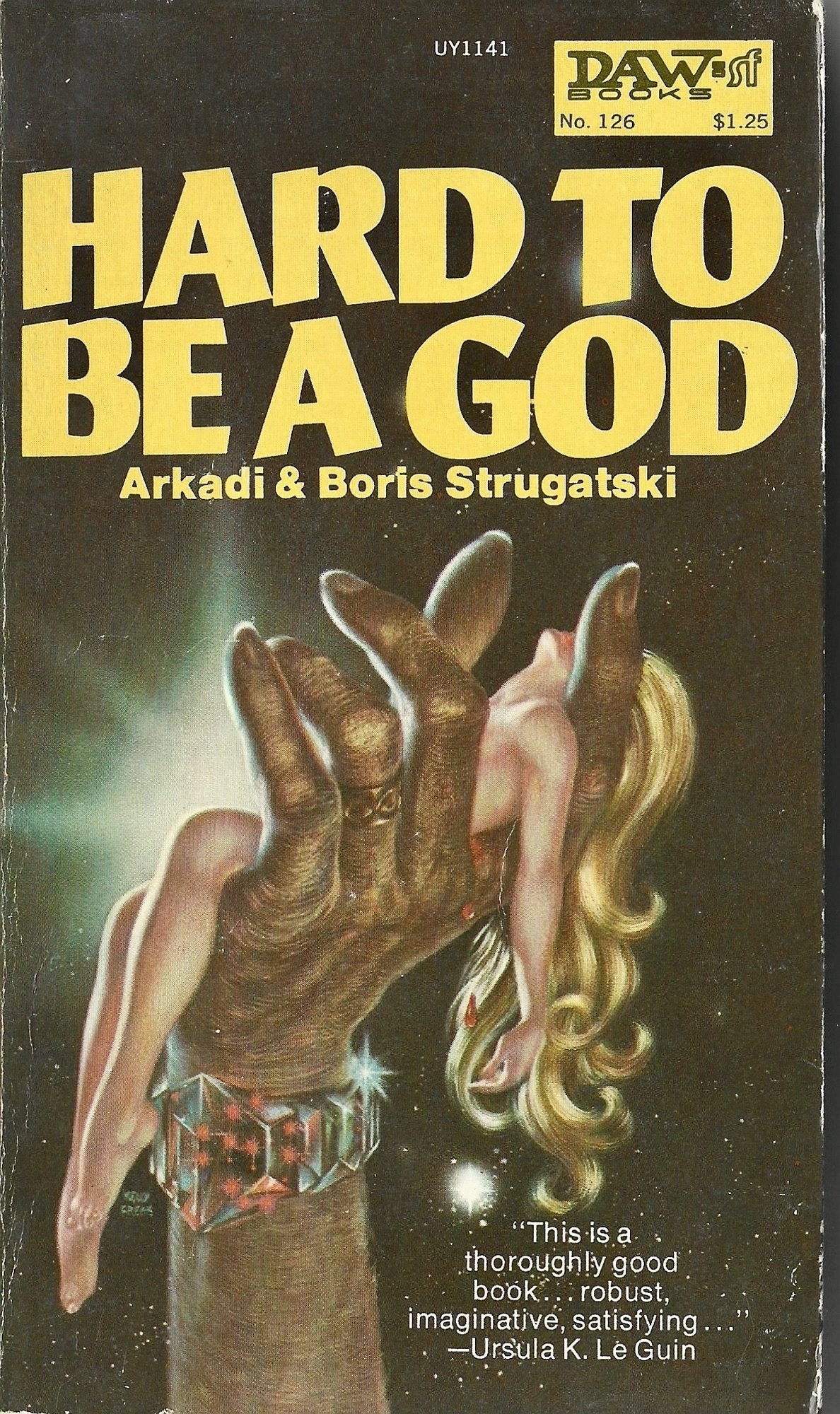
Hard to Be a God, Arkadi & Boris Strugatski. Translation by Wendayne Ackerman. Daw Books, first edition, first printing (1973). Cover art by Kelly Freas. 205 pages.

Like many anglophones, I first sought out the Brothers Strugatsky–which I will continue to spell with a final –y here, in line with the spelling variation I’ve used on this blog for years now, while also above conceding this 1973 Ackerman translation uses the –variant—like many anglophones, I first sought out the Brothers Strugatsky sometime after seeing Andrey Tarkovsky’s 1979 film Stalker, an adaptation of their 1972 novel Roadside Picnic. And, as I expect is the case with many anglophones seeking out Strugatsky novels, I had to wait quite some time to get my hands on one. The English translations of the Strugatsky’s novels were out of print and hard to find second hand.

In 2012, a new translation of Roadside Picnic by Olena Bormashenko was issued by Chicago Review Press; it was the first one I was able to get my paws on. Over the next decade CRP would release several more Bormashenko’s translations of Strugatsky novels, including Hard to Be a God. It was actually this translation of Hard to Be a God that I read, not the Ackerman version above, which I was stunned to find used and in pristine condition a few years ago (I paid about three dollars for it). Bormashenko’s translation came out a year or two after Alexei German’s film adaptation came out (or at least became available for me to watch on Netflix a dozen times over six months). It would be silly to say the book is “nothing” like the film, and the book is very good, but German’s film is a masterpiece. Those interested in the Strugatsky’s sci-fi might want to start with Roadside Picnic; I think my favorite that I’ve read so far is Snail on the Slope.

The translator of this edition, Wendayne Ackerman, also translated Stanisław Lem’s 1964 novel The Invincible, working from a German translation of the book and not the Polish original. Her bread and butter though, it seems, was translating dozens and dozens of novels in the German space opera franchise, Perry Rhodan.

Kelly Freas, the cover artist of this edition, had a long and extensive career creating sci-fi covers and illustrations, including covers for novels by Philip K. Dick and Samuel R. Delany. I like his cover (and love the font!), even if it’s a bit to King-Kongy for the novel.

On Vladimir Sorokin’s Blue Lard, pp. 188-222 (black brows, white silk, silver belt, golden syringe)

Previously on Blue Lard…

pp. 1-47

pp. 48-110

pp. 111-61

pp. 162-87

The following discussion of Vladimir Sorokin’s novel Blue Lard (in translation by Max Lawton) is intended for those who have read or are reading the book. It contains significant spoilers; to be very clear, I strongly recommend entering Blue Lard cold.

We’d left off with the Earth-Fucker’s successfully sending an enormous frozen cherub with enormous frozen genitals backwards in time to land in the middle of the Bolshoi Theater in the Spring of 1954. The alarmed comrades in the audience are (momentarily) pacified by Joseph Stalin’s chief advisers who are in attendance, even if their Leader is not.

In our—which is to say our historical timeline as persons in this historical world, and not our timeline as in our timeline as readers of this novel—in our own timeline, both Stalin and Lavrentiy Beria, the head of his secret police, died in 1953. But the world of Blue Lard is quite different and Beria and Stalin are both quite alive.

Stalin is somehow extra-alive, ultravivid, a kind of holographic pop art caricature of himself whose bearing, attire, and aura seem to owe more to glam rock and Hollywood than drab Mao tunics. We first meet him as his lieutenants try to give him the news of the time-travelling ice cone. His private rooms are opulent pink marble, adorned with Chinese rugs, vases, and priceless art, and attended by “Uzbek governesses in silk Uzbek dresses, bloomers, and tubeteikas” — all guarded by Sisul, his “personal servant” who sleeps like a guard dog upon a carpet in front of Stalin’s rooms. And Dear Leader himself?

The leader was tall and well built with an open, intelligent face that looked as if it had been carved from ivory; his short-cropped black hair was streaked with gray, his tall forehead smoothly intersected with the beginnings of his baldness, and his beautiful, black brows smoothly arched up from his lively, penetratingly brown eyes….Stalin looked to be about fifty years old. He was dressed in a kosovorotka of white silk with a silver belt and tight pants of white velvet tucked into patent leather white ankle books lacquered boots with silver embroidery.

An aging rock star. But he still has the juice.

And no wonder Stalin is aging. When we first meet him, he is berating his sons Yakov and Vasily who are in full evening cross-dress:

A long evening dress of black velvet hugged Yakov’s thin, muscular figure; it was fastened with a diamond scorpion and emblazoned with white spots upon its wearer’s miserly bosom; his curly, chestnut-colored wig drowned in the dark-blue boa around his naked shoulders; black mesh gloves, one of which was torn, reached from his thin, feminine hands to his forearms; three rings of white gold with sapphires and emeralds and two platinum bracelets with the tiniest of diamonds decorated his hands and wrists; his thin face, with his father’s distinctive features, was covered in a thick layer of powder, which couldn’t disguise the swelling of his bruised right cheekbone; his eyes, made up with blue eyeliner, were fixed on the floor; he held a thin snakeskin handbag underneath his armpit. Vasily, short and very portly, was dressed in a beige crepe-de-chine dress with a standing collar and high shoulders cascading down to the floor in tiny ruffles and embroidered with peach-colored roses upon the bosom; a large pearl dangled from his neck along a long, thin chain; his chubby hands were squeezed into white kid gloves soiled with filth from the street; though his blond wig had lost its initial shape, there was still a mother-of-pearl comb stuck into it; his chubby neck was covered with ribbons of black silk; his puffy, painted face, with an abrasion on its chin and features that very much recalled his mother’s, also looked down at the floor; a white patent leather bag on a massive golden chain dangled down from the leader’s youngest son’s shoulder.

Perhaps I have over-quoted here–and I will do so, I fear, in a moment–but I am in love with Sorokin’s lush descriptions of opulent decadence in these scenes (captured in the blue warmth of Max Lawton’s translation). Sorokin’s not exactly crafting a satire or a parody in the alternate Soviet reality he’s ushering us through. Sure, there are satirical and parodical elements and devices, but Sorokin weaves them into something odder, something harder to recognize. It’s beautifully grotesque, and while the bruised cross-dressed half brothers’ attempts to get laid in a fine restaurant and ending up in a brawl is played for slapstick laughs, there’s also real pathos to the familial dynamic Sorokin establishes among the Stalins. And, as I promised to over-share, let me give a description of the rest of Stalin’s family when his second wife and his only daughter enter (giving the half brothers some reprieve):

Both spouse and daughter were dressed in the traditional Russian style. Alliluyeva was wearing an evening dress of apricot-colored silk with a sable fringe and a pearl necklace infiltrated by a large ruby at its lowest extremity; her beautifully styled dark-chestnut hair was fitted into a samshara cap covered in pearls; hanging from her ears shone diamonds on ruby pendants and on her chubby hands gleamed a heavy bracelet and two enchanting diamond rings that once belonged to the Empress Maria Feodorovna. Stalin’s daughter’s slim figure was beautifully enveloped in a tight whitish-grayish-lilac sundress embroidered with gold, silver, and pearl; Vesta’s head was ornamented by a pearl- and diamond-covered kokoshnik and coral threads were woven into her long black braid; dangling from her ears blued earrings of turquoise and pearl and her fingers glittered with emeralds and diamonds.

The lush decadence of the Stalin clan in the second half of Blue Lard mirrors the sordid partying of the BL-3 team way back in the future (?), in the book’s first section (perhaps the monastic Earth-Fuckers, chaste in the main, despite their moniker, mediate these depraved poles). Sorokin’s style is highly-cinematic, and the second half of Blue Lard is particularly filmic, recalling the glittery surrealism of Alejandro Jodorowsky’s The Holy Mountain. But if there’s a tinge of Jodorowsky, there’s also a big dose of Pasolini’s Salò. (Writing this now, I realize that maybe the happy (?!) medium or synthesis of this decadent filmic axis is the comedy/horror of Peter Greenaway’s The Cook, The Thief, His Wife, and Her Lover.)

Blue Lard’s Iosif Stalin exudes a glamorous depravity that’s both charismatic and menacing. Again, Sorikin crafts him into a heightened, pop art reinvention of his historical counterpart. Sorokin’s Stalin dons high-neck collars under bottle-green suits, pomades his thick black hair into a pompadour, and sports a thirty-karat emerald pendant. He’s also addicted to an unspecified substance, which he consumes in an elegant ritual involving a mobile marble column:

Atop the yellowed marble of the column, there was a thin, golden pencil case. Stalin picked it up, opened it, and took out a small golden syringe and a small ampoule. With a deft and laconic motion, he broke the ampoule, filled the syringe with the transparent liquid from the ampoule, opened his mouth, stuck the syringe under his tongue, and made an injection. He then put the syringe and the empty ampoule back into the pencil case and onto the column. This entire procedure, which had long been part of the leader’s life, described and elaborated thousands of times in dozens of world languages, captured by hundreds of film cameras, embodied in bronze and granite, painted with oil and watercolor, woven into carpets and tapestries, carved into ivory and onto the surface of a single grain of rice, glorified by poets, artists, scientists, and writers, sung in simple drinking songs by workers and peasants, was done by Stalin with such striking ease that all those present froze and lowered their eyes, as they had often done in the past.

Again, I didn’t mean to share so much of the language, but I felt myself rushing on the run of Sorokin’s long last sentence there. The decadence of Blue Lard is fun.

And Blue Lard’s fun decadence continues to ramp up as Stalin and his boys prepare for a sumptuous, sinister dinner to discuss the Earth-Fuckers’ time-travelling gift, which they bring into their dining area to observe thawing as they chow. (Meanwhile, elsewhere, Sorokin treats us (?!) to a not-quite-incestuous-but-still-disturbing-sex-scene.) Who is invited to Stalin’s special Earth-Fucker time-travelling ice-cone supper?

In addition to Molotov, Voroshilov, Beria, Mikoyan, Landau, and Sakharov, Stalin had invited Bulganin, Kaganovich, Malenkov, Prince Vasily, the sugar producer Gurinovich, the writers Tolstoy and Pavlenko, the composer Shostakovich, the painter Gerasimov, and the film director Eisenstein to dinner.

For such fine company, a fine meal must be set; again (I repeat again again), I perhaps overshare—but I’ll just lay out the appetizers here (noting that the main course Stalin’s crew will later enjoy a roast pig costumed to resemble “the Judas Trotsky”):

The table was gorgeous; Alexander I’s gold and silver tableware was laid out on a whitish-blue tablecloth, homespun in the Russian style; the abundant Russian appetizers were provocative in their variety: there was smoked eel and jellied sturgeon, venison pâté and stuffed grouse, simple sauerkraut, calf tongue and calf brain, salted mushrooms and jellied suckling pig with horseradish; a golden bear towered up in the middle of the table with a yoke over its shoulders, from which were hanging two silver buckets filled with the oily gleam of black beluga caviar and small, grayish sterlet caviar.

The dinner scene is comic and menacing, giving voices to the various Soviet luminaries and artists assembled. The filmic quality again recalls the aforementioned The Cook, The Thief, His Wife, and Her Lover, as well as the infamous dinner scene in De Palma’s The Untouchables. The violence here never reaches those limits, but it is still grotesque and climaxes in a (literal) punchline.

The night ends with the cone finally cracking, revealing “A frozen giant with monstrous genitals and a small suitcase in his lap was left sitting atop the pallet in the melted water and surrounded by chunks of ice.” Beria and Stalin share an amusing exchange about the creature’s enormous pecker (“How they must love their native soil,” Stalin muses of the Earth-Fuckers), before taking the briefcase and retiring for bed (to Beria’s apparent chagrin).

Next time on Blue Lard: The return of AAA aka Anna Akhmatova and the first appearance of Nikita Khrushchev, whose relations with Blue Lard’s version of Stalin led Russians to protest the book by throwing copies of it into a giant sculpture of a toilet—an abject pop art stunt worthy of a scene from Blue Lard itself.

A review of June-Alison Gibbons’ unsettling novel The Pepsi-Cola Addict

Fourteen-year-old Preston Wildey-King has a lot of problems. He’s on the outs with his girlfriend Peggy. His best friend Ryan always leers at him in a funny way, and Ryan’s older brothers want him to join their gang and do crimes. His older sister Erica accuses him of stealing from her. Preston’s failing at math, and his teacher might be trying to seduce him. His mother doesn’t know what to do with him.

And he’s addicted to Pepsi Cola.

This is, roughly, the premise of June-Alison Gibbons’ 1981 novel The Pepsi-Cola Addict, a raw and distressing young-adult novel that was actually written by a young adult. Gibbons was just sixteen-years-old when she wrote The Pepsi-Cola Addict and pooled her dole money with her twin sister Jennifer to have it published by a vanity press. Two years later, after a spree of petty crimes and then more serious crimes culminating in arson, Gibbons and her sister were committed to a psychiatric hospital and confined there for over a decade. The Gibbons twins’ story was detailed in a book by journalist Marjorie Wallace called The Silent Twins, later followed by a television documentary; in 2022, Wallace’s book was adapted into a feature film of the same name.

I knew nothing of the Gibbons’ sad early life when I picked up The Pepsi-Cola Addict at an indie bookstore, intrigued by the goofy title and bright pop art cover. The jacket copy informed me briefly of the Gibbon twins’ incarceration in Broadmoor psychiatric hospital and called the novel “one of the great works of twentieth-century outsider literature,” but I restrained myself from further exploring the author’s biography until after I’d read her novel (I’d recommend you do the same, reader).

It is difficult to explain how unnerving the world of The Pepsi-Cola Addict is. Gibbons grew up in Wales, the daughter of Barbadian immigrants, but she sets her novel in a version of Malibu Beach the creation of which seems informed primarily by picture postcards and pure fantasy. Preston lives in a shabby apartment in Malibu with his mother and sister. This ratty apartment is across from the beach, where he often wanders at night. He attends something called MALIBU STATE SCHOOL, which (contrary to U.S. school customs) runs year round, even in the (contrary to coastal California meteorological customs) sweltering summer heat.

Everything is more-than-slightly off in Gibbons’ setting. She anchors the plot in realistic visual detail, but the events, mediated via Preston’s bewildered consciousness, can’t square with their own apparent reality. The effect reminds one of the sinister dread the films of David Lynch often evoke from the most mundane of images—a lawn sprinkler, a Dumpster—or the fiction of Roberto Bolaño, which so frequently gnaws at the reader’s stomach, anxiously assuring him that everything could go to shit at any moment.

There’s a grittiness to Gibbons’ version of “Malibu” that belies its pop art contours, an essential griminess that finds its most repeated expression in Preston’s constantly sweating. Our hero sweats and sweats some more. And why shouldn’t he? Preston might be confronted with radical violence or unwanted sexual encounters at any time, and even if it’s not the twin axis of sex and violence coming at him, he’s always in danger of misinterpreting the language, faces, and intentions of every single person he interacts with. But he sweats nonetheless, addict that he is.

I haven’t really touched on Preston’s Pepsi addiction, although it’s definitely a problem, although no one can quite say why it’s a problem. (And, to be clear, he’s addicted to Pepsi, not Coca-Cola, as he makes very clear to Peggy during a date gone wrong (she tries to bring him a Coke)). Girlfriend Peggy has already left Preston once before because of his addiction. Preston’s sister Erica beats him up over the apparent theft of a five-dollar bill she’d saved, which she’s convinced he’s used to buy Pepsi. Preston’s mother is concerned that the Pepsi addiction prevents her boy from his studies—and indeed, he does skip class to surreptitiously sip the sweet nectar from a can he’s hidden in his gym locker.

The novel’s opening scene depicts Preston buying Pepsi in bulk, openly at a grocery store, during daylight, but as the story progresses, his purchases become more coded in furtive anxiety and sexual confusion. Consider this night scene, where a young liquor store clerk looks “somewhat lasciviously” at Preston while he purchases his cans:

He took three cans of pepsi and walked directly toward her. She looked about twenty; her large blue eyes seemed prominent from the rest of her face. Her white pinafore dress strained across her breasts as she turned to calculate money on the large till.

Preston glanced at her hands. Finding no ring on her finger, he looked closer at her. She looked back at him.

“That’ll be one dollar, two nickels please.” Feeling the touch of her hand as he handed her the money, Preston felt a quiver pass through him. He looked intently into her eyes, his excited passion aroused as he sensed a new look come about her. Immediately a hardening pain hit him between his eyes. Preston detached himself from his trance. Hot, speechless he turned and went through the open door, carrying his cans awkwardly.

By the novel’s climax, Preston’s craving for the soda has crossed into criminal territory. He helps a gang ransack a store, but only has eyes for the fizzy dark stuff:

He watched as they pulled down the shelves, scattering food onto the floor. He watched as they raided the store tills, pushing money into their pockets. Preston glanced around nervously. His eyes rested on a familiar stack standing in the corner of the store. With one move of his body Preston was over there, fighting desperately to free them from the cardboard box. His eyes dilated; he ripped off the ring, tilting the can to his lips, as the liquid ran down his chin. The pepsi cola, cool and tingling, entered his throat, like the spray of a fireman’s hose, killing the hotness of the fire.

Have I spoiled the plot’s trajectory by sharing that Preston takes part in the gang’s crime? I don’t think so. The Pepsi-Cola Addict is a picaresque novel, sure, but it also, perhaps paradoxically to the claim I made just a few words before, has clear, linear, and somewhat tragic plot.

And that plot—well, look, I have no idea whether or not Gibbons had read S.E. Hinton’s 1967 novel The Outsiders, a seminal work of American (so-called) “young adult” fiction—but it is the book that, at least in my narrow estimation, The Pepsi-Cola Addict has the most in common with. Like Hinton, Gibbons captures the ever-present anxiety of being a teenager, that time of amorphous body and amorphous mind, that time we find ourselves an outsider among outsiders. And like Hinton, Gibbons was also a teenager writing about teenagers—again, this is truly a “young adult” novel, and to read it is to be thrust into an alienating and alienated consciousness.

It is likely though that we do not immediately think of S.E. Hinton’s The Outsiders as the work of an “outsider artist,” although she likely fits the loosest definitions of that term. (The term’s originator, Roger Cardinal, didn’t really think much of the term; he wanted to use Art Brut for his book’s title, but the publisher made him go with something more “English.”) But The Outsiders was and remains controversial and still faces challenges in school libraries, even if its apparent grittiness has since been synthesized and integrated into the confines of the YA genre proper. In contrast, The Pepsi-Cola Addict truly is “outsider” (even if its author took a correspondence writing course)—the general vibe is closer to a Paul Morrissey or early John Waters film than it is the gentle realism of Francis Ford Coppola. Like Hinton’s teens, Gibbons’ adolescents have their own argot, but it is bewildering at times. Characters call frequently call each other “babe,” for example, no matter if their relationship warrants it or not. At one point, his sister demands to know where he got the “roorback” on her. Has any teen—any person, really—used the term “roorback” in slang?

I’ve neglected so much in this short book—Preston’s confused sexual/nonsexual relationships with his best friend Ryan and his teacher Ms. Rosenberg, in particular, are central to the themes of the book, and will no doubt be of great interest to many readers. I might also have made the book sound befuddling and unattractive, when, to be clear, I fucking loved it—The Pepsi-Cola Addict is odd and distressing, yes, but it’s also very well-written, somehow simultaneously naïve and sophisticated, raw and refined, resoundingly truthful and plainly artificial. It’s full of strange little flickers, images that creep into Preston’s view, never to be explored or explained, simply witnessed in a kind of anxious low-level terror. And while I’ve compared The Pepsi-Cola Addict to The Outsiders, the feeling of reading the book is much closer to, say, Ann Quin’s Berg or João Gilberto Noll’s Quiet Creature on the Corner or Kathy Acker’s Blood and Guts in High School. Obviously, this book Not For Everyone, but I think it will appeal to readers who enjoy a certain queasy, semi-surreal flavor. Finally, I think the novel can and should be enjoyed outside of any lurid interrogation of its author’s mental health and unusual background. Undoubtedly, there will be some readers drawn to Gibbons’ novel by the various Silent Twins stories out there—the film, the documentary, the book…but, to be clear, The Pepsi-Cola Addict is a strange and unsettling tale of teen angst that stands on its own as a small burning testament of adolescent creativity unspoiled by any intrusive “adult” editorial hand. Recommended.

On Vladimir Sorokin’s Blue Lard, pp. 162-87 (indigo pill, fecal culture, piss blood, ice cone)

Previously on Blue Lard…

pp. 1-47

pp. 48-110

pp. 111-61

The following discussion of Vladimir Sorokin’s novel Blue Lard (in translation by Max Lawton) is intended for those who have read or are reading the book. It contains significant spoilers; to be very clear, I strongly recommend entering Blue Lard cold.

We left off right before the gross abject center of Vladimir Sorokin’s novel Blue Lard (in gross abject translation by Max Lawton). The midpoint is a strange short story, “The Indigo Pill” (by one Nikolai Buryak, author of The Flood). “The Indigo Pill” is the textual tissue between Blue Lard’s warped lobes, a segue that marries opera and shit, champagne and piss. Buryak’s setting (which is to say, of course, Sorokin’s setting) is the Bolshoi Theater in Moscow sometime in an alternate 1950s—one that is, presumably, an alternate version of the alternate 1950s Moscow the second half of Blue Lard will deliver.

But “The Indigo Pill” is really about a romantic date. Our first-person narrator will escort his belle to Tchaikovsky’s opera Eugene Onegin. How might one dress for the Bolshoi?

I am wearing a lightweight ultramarine diving suit. The mask is shifted back on my head. Freshly fallen snow crunches beneath my lead soles.

Our country’s main theater is brightly illuminated. All around it are people in diving suits of every possible color and shape. I ascend the steps, stand to the left of the second and third columns, and look at my waterproof watch. 7:22. No Masha.

Don’t worry! Masha’s just a minute or two late. Our young (oldish) lovers will have plenty of time to enter the airlock and descend into the theater, the seat of post-war Soviet big-C Culture:

The hall of the Bolshoi Theater constitutes the primary sump of the Moscow sewage system. Those who are superficially familiar with fecal culture suppose the contents of a sewer system to be a thick, impenetrable mass of excrement. This is not even remotely the case. Excrement makes up only twenty percent of its contents. The rest is liquid. Though this liquid is murky, it is still possible to survey the entire hall with enough lighting––from the floor spread with carpets to the ceiling with its famous chandelier.

(By now you, sweet dear reader, know if the Blue Lard is your particular flavor or not, right?)

Sorokin’s Buryak’s “Indigo Pill” episode ends in textuality: “the Bolshoi opens like a fat book, letters running and jumping, I swallow my own head and wake up.” Again, Blue Lard is writing about writing, writing as a kind of living (or at least counter-history/future). This metatextuality evinces in one of the stranger paragraphs in a novel full of strange paragraphs—a very short paragraph, which begins right after “I swallow my own head and wake up”:

Night.

Must go piss blood. Then make myself a coffee. And disdainfully recall my own ordinary life.

The lines are presumably, at least in the text proper, the final words of Nikolai Buryak reading his story “The Indigo Pill” over a loudspeaker to the Earth-Fuckers. But might they also be an authorial intrusion from Sorokin himself who, even if he may not piss blood (or prepare coffee, for that matter), shows a disdain for “ordinary life” in his fiction? Or not.

We transition back to the Earth-Fuckers who, in a time-travel sequence worthy of the Golden Age of Looney Tunes, explode a giant-testicled babe to deliver a package of iced blue lard (and Blue Lard; and us, the readers) to Sexy Swingin’ Moscow in the Spring of 1954! We land at a “celebratory concert dedicated to the opening of the All-Russian House of Free Love” in the Bolshoi Theater.

In a novel full of twists and turns, the next few pages of Blue Lard are especially challenging. Sorokin offers up an alternate post-war USSR history radiating decadence. Of course he does not follow the “rules” of sci-fi, whereby we might be treated to exposition (or at least a brief overview) that explains the alternate timeline we are about to navigate. Instead, the transition into Blue Lard’s second half is alarming, vivid, and very funny.

A “great Russian bard” delivers a song to the Bolshoi audience from a massive pink granite bathtub “filled with a translucent jellylike substance” (he’s tub-bound from a “pathological softening of bone matter.” The audience is moved by the drama of the bard’s song, but it’s soon interrupted by the interposition of the Earth-Fuckers’ time traveling blue lard in the form of a “semi-transparent funnel about the size of a person.” Luckily Joseph Stalin’s top lieutenants are in attendance to calm the audience and take control of the situation.

The first time I read Blue Lard I went through it stunned and guffawing, jogging in places to keep up and not lingering too long for fear of getting left behind. I didn’t pick up on the significance of that year, 1954–a whole year after Stalin’s historical death in March of 1954. Rereading Blue Lard, I took the time to apply the paltry bits of Soviet history I recalled and to index the various Politburo members who show up in this section.

The predominant of these Politburo ministers is Lavrentiy Beria, chief of the NKVD, Stalin’s secret police. The historical Beria was responsible for purges and other crimes against humanity; some historians conjecture that Beria poisoned Stalin; Beria was executed in the summer of ’53 after Khruschev’s coup. He was also a serial rapist.

Beria explains the rude intrusion of the funnel to the aghast theatergoers:

“This is the so-called ice cone sent to us from the not-too-distant future by the Order of the Earth-Fuckers of Russia. The order will be formed from numerous smaller sects of Earth-Fuckers in 2012. In 2028, some members of the order will settle in Eastern Siberia, on Bald Mountain, in dungeons in which there is evidence of the settlements of Siberian Zoroastrians, descendants of a small sect that… it seems… fled from the great Achaemenid Empire to the north at the end of the sixth century BC. They slowly ended up in the taiga, between the two Tunguskas, then on to Bald Mountain, into the granite of which they successfully burrowed over the course of four centuries. Why? They were searching for the so-called Underground Sun, the rays of which, according to their belief system, would destroy the difference between good and evil and return the human race to a heavenly state. The Siberian Zoroastrians invented a time machine capable of sending small objects into the past. One of those objects is what you see here.”

Wait, didn’t I say this section of the novel eschewed exposition? Because that’s a lovely exposition dump there, friends!

Beria continues his exposition—if we believe it!—assuring his audience that the theater-crashing “ice cone” will likely be the last one: the Siberian Zoroastrians possessed but three time travel devices. These Earth-Fuckers blew their first load in “the summer of 1908 near Torzhok… Inside of it was a book bound in buckskin describing the history and structure of the Order. Nikolai II’s talentless government considered it to be a prank.” Again, in rereading Blue Lard more slowly and deliberately, I was attenuated enough to see the obvious cue here; namely, the Earth-Fuckers precipitated the Tunguska Event. (Blue Lard is a brother book then to Pynchon’s Against the Day.)

Beria’s audience demands to know what was in the second cone, which “destroyed a train going from Moscow to Vladivostok on July twenty-ninth, 1937.” Beria informs them the cargo “was the body of a half-human, half-animal being. A six-year-old boy with horns, hooves, and a tail. There was a tattoo on his forehead that said: ‘A Babe of the Whorish World.'” Beria helpfully adds that the corpse was pickled and then hidden. 

Beria’s audience then asks the question of Blue Lard’s second half “And where is Comrade Stalin?”

And where’s Stalin? We’ll meet him in a few pages. More to come.

On Vladimir Sorokin’s Blue Lard, pp. 111-61 (L-harmony, 2 measures of red ants, a child’s tiny golden hand, fantasies on paper)

Previously on Blue Lard…

pp. 1-47

pp. 48-110

The following discussion of Vladimir Sorokin’s novel Blue Lard (in translation by Max Lawton) is intended for those who have read or are reading the book. It contains significant spoilers; to be very clear, I strongly recommend entering Blue Lard cold.

The first hundred or so pages of Sorokin’s Blue Lard switch between Boris Gloger’s letters to his lover and the narratives of seven cloned Russian writers (the clone-narratives are, textually speaking, included in Boris’s letters).

The shifts between these layered texts are initially quite disarming. Boris’s letters are filled with invented futurese, neologisms, and Chinese slang; the clone-narratives each impose their own linguistic taxes (and rewards) on the reader.

However, these first hundred pages do establish some of the baselines one might expect of a traditional novel: setting (a futuristic laboratory in frozen northeast Siberia), characters (scientists with a military guard—and seven clones), and a basic mission (cloning Russian writers who, in writing their compositions, produce an enigmatic substance called blue lard).

That mission is a clear success by the time we get to Boris’s last letter (dated 8 April for those keeping track), and our team, “the arbiters of the BL-3 Project, have total L-rights to relax.” So they decide to throw a cocktail party. (“It’s sometimes necessary to drink cocktails all day. Not, of course, for L-harmony, rips ni ma de, but JUST ‘CAUSE,” bold Boris boasts boldly.)

As in some of the previous scenes of hard-drinking downtime, the BL-3 Project’s futuristic cocktail party feels like something from a pop sci-fi film. Much of the dialogue seems inscrutable in a first run through the novel, but the jargon and bickering and bantering over political and cultural circumstances alien to the reader are simply texture–verbal adornment to fill out the scene.

Sorokin does bolster his futurese with occasional asides of historical analysis though:

Everything is working out for the Chinese now, just as it did for the Americans in the twentieth century, the French in the nineteenth century, the English in the eighteenth century, the Germans in the seventeenth century, the Italians in the sixteenth century, the Russians in the fifteenth century, the Italians in the fourteenth century, and the Jews in the first (I think) century.

That “I” is Boris, although the style of the party section has subtly but significantly shifted from the flirtatious and gossipy tone of his love letters home.

But enough with style! Back to the party!

There is drinking and dancing and drinking and drinking and drinking. The ol’ fashioned colonel whips up a batch of whiskey sours (“A drink for lonely men who test AEROSEX once a month and prefer books to holo-bubbles,” a geneticist opines), and from there, the BL-3 Project crew goes to town in inventing ever-more daring cocktails.

Here is the recipe for Fan Fei’s CHINA 21:

5 measures of tomato juice

3 measures of spiritus vini

2 measures of red ants

1 measure of salty ice

1 pod of red pepper

Our party is in full drunken swing, abject sweat flung from the dancefloor, another round of cocktails called for, when all of a sudden the novel’s perspective upends itself (again).

The disruptive narrative event here would, again, not be out of place in a sci-fi actioner. A band of rebels (the “Brothers,” as they refer to themselves) breach the laboratory’s bunker, exchange gunshots with the soldiers, and kill everyone but our heretofore main character, Boris.

But the stylistic shift is intense—we go from the strange comfort of Boris’s letters to a new style, one utterly outside of Boris’s consciousness. Indeed, it’s through the eyes of these invading “Brothers” that we actually see Boris for the first time: The Brothers-centered narrator informs us he is “rail-thin… His face was narrow and swarthy skin clung to the bones of his skull. Metal plates in complicated shapes were visible beneath the skin of his temples.” He is the last living witness to the BL-3 Project—but not for long.

Again, the scene plays out as a cinematic trope, the scientist interrogated before his death. Boris isn’t much use explaining just what the blue lard is for or how it works. But he does tell us there’s

something called the MINOBO Project. I don’t know the details… [but] they’re building a reactor on the moon, a constant-energy reactor. They’re building it in the shape of pyramids… pyramids made of fifth-generation superconductors and blue lard… layers… layers and layers of it… and that allows them to plus-directly solve the problem of perpetual energy.

Our one-time narrator is then summarily executed, his brains ironically sprayed over a safety placard.

We are now firmly in the narrative purview of the Brothers. They harvest the blue lard from the bodies of the clones and head back to their lair, mumbling about their poor diet and their ever-constant war with “the whorish” who populate the surface of the earth. They are of the Earth-Fuckers, a bizarre monastic sect dwelling in a strange hierarchical series of underground caverns that seem to descend infinitely into the earth.

The narrative too moves with these earth-fucking brothers, as does the blue lard, a vibrant constant in a constantly-changing scene. Along the way we are treated to ever-stranger rituals and routines. Sorokin, in Lawton’s deft translation, gives us a surreal but limpid portrait of this subterrestrial monastery, where sacred cloister gives way to another sacred cloister:

The descent was quick––the staircase led into a large, dusky hall with a marble floor and marble walls. In the hall, there were ten marble desks, at which bald men in black suits were sitting. Green lamps were burning atop their desks. On the wall, a sigil made of rock crystal, jasper, and granite was illuminated in green light: a man copulating with the earth.

The blue lard slowly makes its way down to “the magister” who informs the reader that when he looks at his hands, he sees tiny golden children’s hands on his wrist. These tiny golden children’s hands speak to him through a language based on wrist rotations. He has transcribed some of these communications, including something called “The Swim,” a very short story about a group of military swimmers who hold torches aloft to create a constellation of language. They are swimming raft of lighted language, passing by crowds who read from afar the quotations they have created—quotations that the swimmers themselves cannot rightly read. They are, quite literally, marks. The story “The Swim” is actually a version of an older Sorokin short story, underscoring the intertextual nature of Blue Lard’s internal and external composition. This is a novel about writing; or, a novel about writing writing.

The Earth-Fuckers section of Blue Lard is probably where, on first reading, I truly gave into the novel’s strange wave and just went with it. After all, my dear epistolarian Boris Gloger was now deceased and I found myself far from the false stability of the BL-3 Project’s base. The section plays out as a series of wonderful deferrals, stories that descend into new stories as one Earth-Fucker descends to a new level of their strange subterranean labyrinth. There’s the infanticidal Nadelina, who gives birth to a child by a different father every year–twenty-six children in total in Max’s translation (one for each letter of the English-language alphabet?). She sacrifices the children so that she might always be able to “water the earth with her milk.” There are three mischievous “babes” — devilishly horny little cherubs who float around in what could be the set of a nightmarish technicolor Hollywood musical. There’s the history lesson of the great schism between the Northern and Southern Earth-Fuckers. There are enormous genitals.

The Earth-Fuckers section is larded with surreal episodes (all anchored in precise, clear imagery), but a re-read reveals that Sorokin is not solely interested in throwing bizarre satirical scenarios at his reader. Traditional novel-making elements are in play here, even if it’s easy to miss them in a dazzled first read. As Sorokin prepares to transition to a new sequence, he offers his readers a recap of the story so far, a blunt summary from an Earth-Fucker’s perspective. After declaring the blue lard an “eternal substance” that will never burn or freeze but “shall forever be exactly as warm as the blood of man,” we get this exchange:

And how did the whorish manage to produce this substance?

By accident, oh my father. They were doing whorish experiments restoring and regrowing people from the memories in their bones. These were people of various professions. But only those people who had at some point written down their fantasies on paper turned out to be capable of producing blue lard.

Again, Blue Lard is writing about writing (about writing about writing…). And, soon, another writer will enter the text and deliver the textual tissue between Blue Lard’s lobes: “The Indigo Pill.”

More to come.

On Vladimir Sorokin’s Blue Lard, pp. 48-110 (sheep’s fat, bourgeois voice, stuffed shark, ferret pâté)

The following discussion of Vladimir Sorokin’s novel Blue Lard (in translation by Max Lawton) is intended for those who have read or are reading the book. It contains significant spoilers; to be very clear, I strongly recommend entering Blue Lard cold.

Previously on Blue Lard… We enjoyed the first of our clone narratives, Dostoevsky-2’s  “Count Reshetovsky” (our dear correspondent Boris brag’s that the tale’s composition will yield “up to 6 kg. of blue lard”).

It is now Akhmatova-2’s turn to whip up some blue lard. Boris reports that “During the script-process, the object didn’t become at all deformed. Just heavy bleeding: vaginal and nasal.” Sorokin mixes abjection with creation. The Anna Akhmatova clone composes the song-poem “Three Nights.” I confess much of my idea of Ann Akhmatova’s poetry is informed by her sympathetic characterization in William T. Vollmann’s novel Europe Central—I’ve read fewer than a dozen of her poems, I’d guess—but nevertheless I found “Three Nights” very, very funny. Sorokin skewers Akhmatova in his parodic evocation of her earnest declaiming, perhaps lovingly, perhaps not, but with a fine ear, as telegraphed in Max Lawton’s translation. The plaintive sincerity of Akhmatova-2’s poem culminates in a riff on the old “farmer’s daughters” joke:

They rubbed sheep’s fat over his hard plow,
So that he could better plow the girls,
The three kolkhoznitsas-in-arms stripped down to their skin,
They lay down next to Comrade Akhmat.
Oh my!
Comrade Akhmat plowed them all night,
Gaptieva––three times,
Gazmanova––three times,
Khabibulina––three times.
Oh my!

Oh my! (A few pages later we’re treated (treated?) to the image of Lenin’s “heavy balls…crimson balls…shaggy balls… his hunchbacked balls.)

The clone narratives take over the text proper of Blue Lard (at least for now) and Boris’s tender letters to his tender bastard dwindle in length. (Boris does note in a letter dated 15 January that he’s reading Romance of the Three Kingdoms (attributed to Luo Guanzhong); perhaps the 14th-century historical novel , with its real-life figures and its epic sweep, signals a precursor text for Blue Lard.)

Our next clone is Platonov-3. Of all the cloned writers, Andrei Platonov was the one with whom I was most unfamiliar. That didn’t stop me from enjoying the scenario the first time I encountered it. It’s an actioner, featuring fight scenes on a train—uh, excuse me, a proletarian lumpomotive. Our hero is Bubnov, a stoker, machinist, engineer (and fighter) who takes on a new mission. The passenger who gives him this mission has to yell these new orders over “the class roar of the furnace with his bourgeois voice.” Such satirical lines riddle Platonov-3’s episode; later after digging a mass grave (I suppose such a scene shouldn’t be so slapstick, but it is), Bubnov’s comrade “got ready to say something sentimental, but was only able to growl because of the poverty of a human language that had entirely dried up in revolutionary winds.” I won’t spoil the trick of Platonov-3’s story, but it’s of a piece with Snowpiercer or The Train to Busan; one can easily reimagine Sorokin’s cloned Platonov-3’s riff as a sci-fi horror flick.

Another letter from Boris to bastard transitions to our next clone narrative, a one-act play by Chekhov-3 called “The Burial of Attis” (I should clarify that Boris includes the clone compositions in his letters). On my first reading of Blue Lard, I tuned into the depravity and linguistic difficulty of Boris’s letters. In the letter of 16 January that precedes Chekhov-3’s story, for instance, he complains that the colonel makes a pass at him while they are both drunk, tempting him to “test” some drug called “3 plus Caroline.” Boris’s letters are filled with futurese along with Chinese slang (he describes the colonel as a “hangkong mujian,” for example). A reread reveals more straightforward plotting elements–the letter of the 19th reminds us that this isn’t just a science mission but a military operation; the base is loaded with soldiers. And guns!

But on to Chekhov-3’s play, “The Burial of Attis.” The titular character is a beloved borzoi, now deceased. Attis belonged to Viktor Nikolayevich Polozov, a young aristocrat who seems to be barely maintaining his ancestral estate. He’s aided Anton, an aging footman. A former lover shows up at the burial, but he shouts her away in disgust after she declares that unlike dead people, “Dead dogs look just like dogs that are alive.” Later, an alcoholic neighbor, Dr. Schtange comes by to tie one on; in his drunkenness he urges Polozov to sell the ancestral manse: “Sell everything, sell it all! And as soon as possible! All this junk, all this decay, all this graveside garbage. A Chinese vase, a stuffed shark, these crystal goblets, what the devil are they to you?!” He does recommend keeping the weapons collection though, including a certain Mexican throwing knife. Chekhov-3’s Mexican throwing knife? Again, no spoilers, but the monologue that Polozov delivers at the end of the play is something else. A selection:

All things correspond to their names. The Chinese vase was, is, and shall always be a Chinese vase. Crystal is crystal and shall be thus until the day the moon falls to earth. You stood amidst these dead things––a living, warm-blooded man––and you alone did not correspond to your name. It wasn’t to do with the properties of your soul, not because of your decency or your wickedness, your honesty or your deceitfulness, not because of the good or the evil that was inside of you. You simply did not have a name… A person cannot have a name… They’re mere titles. We have no name. And never shall.

“There’s something M-unpleasant in this script,” muses Boris, “But I can’t figure out just what.” Something to return to later?

Nabokov-7’s “Kardosso’s Way” is up next. The clone has composed this text “in blood,” which, as Boris archly notes, “the original [Nabokov] couldn’t quite manage.” The linguistic fussiness of Nabokov-7’s composition is soaked in some of the foulest culinary abjection since Roger Mexico and Pig Bodine served snot soup, vomit vichyssoise wart waffles in Gravity’s Rainbow. “I only eat white meat!” the golddigger Svetalana exclaims before digging into a “silver dish filled with the prostates of catamites baked in grated cheese and generously sprinkled with lemon juice.” Later, “having nepresnified herself,” Svetlana “immersed her feet in a vase filled with ferret pâté.” And what to order when dining out?

The spouses never betrayed their gastronomic preferences, as they always ordered an 1889 Tokay, a swamp grass salad, the roots of elderly proletarians’ wisdom teeth, marengo made from bolonkas, parchment with toad caviar, and the menisci of third league Belarussian football players under a pile of vomit. For dessert, Svetlana would have rock crystal with whipped bull saliva or “Lair.” Having eaten their fill, they would move on to the jointer-inlaid tabernacle, wipe the prisms and trample the hamsters for forty minutes, then slide down the larded chute into the cloakroom.

The diction above is obscure, to be sure, but it’s possible to figure out what a marengo made of bolonkas might look like (you might not want to imagine what it would taste like, natch). Beyond obscurantism though, Nabokov-7 lards his narrative with terms that seem utterly alien to any known language: geobnorobdy, sodictionepresenifiedhalf-gronzezilyIn his recent interview on this blog, translator Max Lawton stated that he “worked in a few of Nabokov’s pet words,” but I’m not sure if jebraifying was one of those.

“I’m sending this one without comment,” Boris begins his letter of 18 January, referring to Pasternak-1’s 13-stanza poem “Pussy.” “You know I can’t stand Russcenities. Because of this, I offer no commentary,” he appends. I too will withhold commentary on the Pasternak pastiche, but will note that Boris’s brief letter reminds us that their experiment is part of a military operation: a certain Sgt. Prut allows him to shoot off a Cyclops-238 MC, a “slaughtersome thing” that Boris notes “could easily hew a clearing into our taiga all the way to the ocean.”

The last of the clone narratives, Tolstoy-4’s, is my favorite of the group. We get three chapters from the middle of an unnamed novel set in what seems to be 17th-century Russia. In media res, we find out that, “Having spent the whole winter in Pospelov, the old prince Mikhail Savvich found out about Boris’s duel too late, after his son’s wound had already closed up, and, along with it, so too had the whole business of his quarrel with Nesvitsky closed up and scabbed over.” So prodigal Boris returns home, where he will relax by bear hunting with his father and his father’s retainers. These scenes are richly-detailed and wonderful to walk through. Sorokin doesn’t seem to parody or skewer Tolstoy, nor does he mimic or mock him (at least to my ear)—instead the Tolstoy-4 passages evoke what I sense is a tempered if contested respect for the old master. Of all the clones, this narrative points to Sorokin’s intertextual competition with Tolstoy, which Sorokin enters into not with barbed neologisms or depraved abjection (although there is a bit of that here!), but with strange pop-fantasy eruptions. Accompanying the aristocrats and their retinue on their hunt are three “crushers,” a bizarre Cerberus troop of beasts who also seem to be men. The crushers speak in cracked, harsh voices and possess hands, yet walk leashed and lick their master’s lardshined boots. (Tatyana Tolstoya’s 2000 novel The Slynx (in English translation by Jamey Gambrell) would expand on these “crushers,” reinventing them as “degenerators,” human hybrid slaves used as beasts of burden.) Later, as Boris recuperates in a bathhouse, the wound he received in the duel reopens and one of the crushers gently licks it clean. Sorokin weaves abjection and purity in this strange bathhouse tableaux. The wound/scabbing motif here at the end of Tolstoy-4’s narrative echoes a remarkable passage from the section’s outset:

How does an awakened person differ from one who is awakened a s  i t  w e r e ? An awakened individual, that is to say, an individual who has been awakened by their conscience once and for all, has shaken off the evil of indifference to the lives of other people, as if it were a scab strongly and tightly clinging to the body, which, like a shell or suit of armor, clings to the conscience of every contemporary person living in contemporary society, which is based on the lawful oppression of certain people, the weak and the poor, by other people, the strong and the rich; this awakened individual will always evaluate all his deeds and misdeeds based on his new, young conscience, which has just awoken from its slumber. A person who is awakened, a s  i t  w e r e, shall continue to evaluate his deeds and misdeeds based not on his conscience, but on the shape of the scab of socially legitimized deception that clings to his conscience, continuing to flatter himself as before.

I would read an entire novel by Tolstoy-4; at the same time, I love that we only get three chapters, reifying Blue Lard’s apparently discontinuous structure. The writing of the section is evocative enough that we can imagine our own befores and afters if we like.

The first six clone narratives included linguistic aberrations–mechanical repetitions, scatological eruptions, perverted interludes, abject impossibilities–but the only real syntactical tic throughout Tolstoy-4’s story are three iterations of a sentence that might best be understood as “Sonya, get the hammer out of the cupboard” — although we see those words recombined, repeated, and inverted. Is this the Sonya of War and Peace? A version of Sofiya Tostoya? Is this Sonya merely (merely!) the verbal tic of cloned version of a nineteenth-century Russian realist whose erregen object is a stuffed albino panther? Does it matter?

Ahead: cocktail hour, dance party, armed combat, earthfuckers, THE SWIM, THE INDIGO PILL…