Joanna Russ’ first published novel Picnic on Paradise (1968) delightfully subverts traditional SF pulp adventure tropes. Although not as finely wrought as The Female Man (1975), And Chaos Died (1970), or her masterpiece We Who Are About To…(1976), Picnic is worthwhile for all fans of feminist SF and the more radical visions of the 60s.
Unfortunately, the metafictional implications/literary possibilities of the Alyx sequence of short stories and novels—of which Picnic on Paradise is part of—are not realized until the publication of the short story “The Second Inquisition” (1970).
Debbie Urbanski’s new collection Portalmania is a metatextual tangle of science fiction, fantasy, and horror where portals don’t offer escape so much as expose the fractures beneath family, love, and identity. Her characters navigate asexuality, neurodivergence, and the quiet violence of domestic life against an uneasy backdrop of porous reality. At any moment a portal might appear, or a mutation might take hold, or, a wife might sell her daughter to a witch to assassinate her husband. Nothing is stable in Portalmania.
There are nine stories in Portalmania. Or maybe there are ten stories. Or eleven. Or maybe thirteen. If there are thirteen stories, maybe I could riff on that Wallace Stevens poem for my review titles (that would be too fucking precious and obnoxious though, wouldn’t it).
There are nine or ten or eleven or thirteen discrete “stories” in Portalmania, depending on how you want to count or what you want to count as a discrete story. But this need to count, or, more precisely, to pin down what-something-is-and-is-not, runs counter to the spirit of Portalmania, whose heroes push back on the definitions that are literal placeholders, linguistic lines that bind identities.
Perhaps the biggest through-line of the nineteneleventhirteen stories in Portalmania is the big ole question: What is love? In the story “How to Kiss a Hojacki,” a character puts the problem succinctly, writing a note to her husband: “We need to redefine love.”
The opening story, “The Promise of a Portal,” helps to establish a realistic world punctured by magical sci-fi. In “Promise,” we come to understand portals as personal escape hatches away from the humdrum domesticity of family life. “I think you can love people–children, mothers–and still want to leave them,” the hero of the story muses. These same portals pop up throughout the collection, creating continuity so that the nine (or are we saying thirteen? I misremember) stories here read more like a loose, discontinuous novel.
The second story, “How to Kiss a Hojacki,” also introduces a sci-fi conceit that repeats in the collection. In this story women transform into “Wonderfuls” — “Hojackis,” “Smith-Smiths,” or “Tangers” — asexual beings who must fight for their autonomy against a reactionary Trumpian politician who campaigns on interring them in camps.
“Hojacki” hovers around the viewpoint of a husband who is becoming increasingly resentful and sexually frustrated with his changing wife. He is unwilling to even try to redefine love: “having sex is how people love each other,” he contends. “Hojacki” is most fascinating when set in context against the stories at the back end of Portalmania, which deal far more directly with themes of asexuality, sexual coercion, and marital rape. While it would be a stretch to say Urbanski depicts the husband sympathetically, her rendering is nevertheless nuanced enough to be later deconstructed in far more visceral detail in stories like “The Dirty Golden Yellow House,” “Hysteria,” and “Some Personal Arguments in Support of the BetterYou (Based on Early Interactions).”
“The Dirty Golden Yellow House” is the strongest piece in Portalmania. It rewrites “How to Kiss a Hojacki” (and reimagines Charlotte Perkins Gilman’s “The Yellow Wall-Paper”) from the perspective of an asexual writer trapped in a marriage marked by marital rape and emotional coercion. “Yellow House” combines elements of fairy tales and Gothic horror with the more prosaic forms of the essay and the internet forum to yield a harrowing story. “Yellow House” also quickly registers as a metatextual tale, a self-deconstructing narrative that pauses early to take would-be critics to task:
Certain reviewers and readers have already started complaining about my recent stories, both their thematic similarities and their very specific view of relationships. I have examples. From one reviewer: Other than the overt political addition to the obvious social metaphors which helps extend this to novelette length, this[one of my stories] is exactly like the same author’s [another one of my stories] in being an overlong underplotted offputtingly narrated story of a repugnant asexual wife and a repugnant husband and their repugnant relationship. From another reviewer: It[one of my stories]is probably sending a message about something—menopause maybe?… I have no clue what the ending is supposed to mean.From a reader: My takeaway is that the story[one of my stories] was an exercise in catharsis for the author, and has no real value as a morality tale beyond—
My past self slams her (our?) body against the window glass. Has she not been clear enough. Here is what she expects in my writing: revenge, on me, on him, on them, on the structure of the story itself, and if I ever consider not placing her at the bloody heart of whatever I write, she will do this to me. She acts out what she will do to me. There is so much blood.
Angry, self-aware, and emotionally scorching, “Yellow House” nevertheless offers sparks of mean humor. The narrator observes that her “neighbors staked colorful rainbow signs into their front yard: WE BELIEVE LOVE IS LOVE AND KINDNESS IS EVERYTHING.” While the sentiment of the sign might be progressive, the tautology “love is love” is reductive and unhelpful in a book where redefining what love is is the (de)central problem.
Another highlight of the collection is “LK-32-C,” a triptych of stories about a troubled child’s fantasy world. (We might count “LK-32-C” as three stories, not one; each section has its own title.) The narratives in “LK-32-C” seem to run in concurrent yet divergent directions, where fantasy punctures reality or vice versa. In one such topsy-turvy moment, a distraught mother dreams up a magical totem of familial security: “if anyone questioned whether or not there was some love here, she could have pointed to that sphere.”
And again, in “The Portal,” fantasy punctures reality and metatextuality punctures the narrative. Our narrator interrupts building her fantasy world to tell us that,
I do realize that, as an author, I’m not supposed to let my other worlds become utopias. At least, that was one successful writer’s advice to me when I told him I was working on this story. He explained that when portal worlds are utopias, it’s like a flashing neon sign that says lazy writing. If we want such fantastic places to be believable (and who doesn’t want their writing to be believed?), they have to possess a substantial dark side.
Our author-hero’s rejoinder points out that the dark side is the absence of the utopia: “What if I’m trying to create an untroubled and pleasant world that might haunt someone for as long as they could remember it?” We’re always looking for that perfect portal.
Not everything in Portalmania works. “How to Kiss a Hojacki” has a great premise but its collapse into a political satire is dissatisfying. “Long May My Land Be Bright” is the weakest link in the collection. Its central conceit is that there are literal rifts in the USA, which create two separate antithetical political-cultural realities. It’s not that I’m not sympathetic to the sentiment here, it’s just that I think the metaphor should be pushed even further, to more absurd places.
I’m also not sure how I feel about Urbanski’s decision to include a tenth chapter in her book titled “Story Notes.” By the time I got to the (ostensibly)-last story “The Portal,” I was having a really hard time keeping all the New Criticism, death-of-the-author, grad-school reading training stuff out of my head. With its constant metatextual interruptions and its deeply– personal themes, it became very, very difficult not to read Portalmania as in part a work of autofiction. So the notion of “Story Notes” both intrigued and repelled me. Here is how “Story Notes” begins:
One of the indisputably vital roles of the modern reader is to tease out what is autobiographically true for the fiction writer versus what that writer made up in their stories. What is fiction after all if not a porthole into the author’s private life? So allow me to get this out of the way: Everything you’ve read in Portalmania (or will read, depending on your preferred order) actually happened to me. The portals, the lack of portals, the witches, the monsters, the ghosts, the murders, the space travel of beloved family members—every story in this collection is a factual account of my own experience. And now that you know this, I can spend the remaining space of these notes discussing whatever I want.
And I suppose she does discuss whatever she wants in the notes.
If we are counting “Story Notes” as a story, there are ten stories in Portalmania. If we keep reading after “Story Notes,” there is a final piece, “Coda” an unlisted hidden track of sorts. I love the decision to put this last, brief, and strong piece after “Story Notes.” “Coda” revisits the themes of Portalmania and concludes by pointing to “a terrifying and wide-open future,” which is what I suppose we can all expect as we fumble toward our own redefinition of love, storytelling, and escape. Good stuff.
Hello America, 1981, J.G. Ballard. Triad Grenada (1983). Cover illustration by Tim White. 236 pages.
Today’s mass-market Monday selection was inspired by last night’s rewatch of David Cronenberg’s 1975 film Shivers. Shivers’ first fortyish minutes play as one of the more persuasive Ballardian commitments to film—more Ballardian than Cronenberg’s Crash (2016) or Ben Wheatley’s High-Rise (2015). Indeed, Shivers is an aesthetic foster twin to Ballard’s novel High-Rise, born the same year. High-Rise is far superior to Hello America, but I think Hello America is probably better than it comes off in my short review from 2022:
You’d think a novel where President Manson wants to make America great Again would feel more prescient, but Ballard’s so in love here with the sparkle and pop of Pop Art America that he fails to attend to the dirt, grease, and grime that make the machine run. A fun novel, but its contemporary currency is squashed not so much by historical reality as the weight of Ballard’s oeuvre before it.
Two years after it was first published in Italy, Dino Buzzati’s 1960 novella Il grande ritratto got its first English translation by Henry Reed under the title Larger Than Life. This year, NRYB issued a new translation of Il granderitratto by Anne Milano Appel under the title The Singularity. This is the second new English translation of a Buzzati book from NYRB; last year saw the publication of Lawrence Venuti’s translation of Buzzati’s most famous novel, Il deserto dei Tartari, published as The Stronghold (in lieu of the more recognizable title The Tartar Steppe).
It makes sense, from both a cultural and a marketing stance, that Il grande ritratto would find new life as The Singularity, a term that refers to the hypothetical point where artificial intelligence surpasses human intelligence, which in turn triggers a dramatic existential change for humanity. AI slop abounds on the internet; misinformation replicates and mutates; we are told that the chatbots that frustrate us so frequently are an inevitable part of a future that no one seems to want. A sci-fi novel called The Singularity is pretty zeitgeisty.
The scant plot of The Singularity builds to the revelation of an artificial intelligence, part of a military science project perched high in the Italian Alps. I don’t think I’ve necessarily spoiled the grand reveal; both its title and its publisher’s blurb declare The Singularity “a startlingly prescient parable of artificial intelligence.”
Perhaps it’s this prescience that makes the central sci-fi conceit of The Singularity seem a bit dated. There’s a creakiness to Buzzati’s staging of his grand portrait of an artificial intelligence. The novella is more compelling in its initial chapters, which ignite a mood of slow-burning dread, the kind of Kafkaesque foreboding he served up in his superior novel Il deserto dei Tartari.
That slow-burn starts with a certain Professor Ismani, “who had always had an inferiority complex with respect to figures.” He and his much younger wife, the archetypal innocent Elisa (who “had not gone beyond middle school”) agree to undertake a mysterious journey up the mountain to “Experimental Camp of Military Zone 36,” where Ismani will join a scientific project he knows nothing about. As they zig and zag up the mountain, chauffeured by their military liaison, Ismani and Elisa (and the reader) gather crumbs about their destination. “So many mysteries,” a soldier tells them, at a penultimate stop. “If they at least told us what it is we’re guarding. I mean, let’s call it what it is, a kind of prison.”
In response to all this anxious foreboding, we are told that “Ismani felt the return of apprehension and dismay, the feeling of being insignificant in the face of immense, threatening things, a panic that he had once experienced in the war.” None of Ismani’s time in the war comes to bear on the narrative itself. Indeed, Ismani is thrown to the reader as a decoy; initially presented to the audience as the potential big-brain hero of a sci-fi thriller, he ends up a background ghost.
We eventually achieve the summit, where the natural splendor is overrun by the enormous complex that houses the titular singularity:
But the cliffs were no longer visible, nor could any vegetation be seen, or land, or flowing waters. Everything had been invaded and overwhelmed by a tangled succession of buildings similar to silos, towers, mastabas, retaining walls, slender bridges, barbicans, fortifications, blockhouses, and bastions, which plunged in dizzying geometries. As though a city had crashed down the sides of a ravine.
But there was an exceedingly abnormal element that gave those structures an air of enigma. There were no windows. Everything seemed hermetically sealed and blank.
From this moment, more or less, the best bits of The Singularity come not from sci-fi plotting but rather philosophical asides that add weight to the pulp narrative. Most of these are delivered by the handful of scientists who haunt the experimental camp. One of these scientists repeats the mantra, “Language is the worst enemy of mental clarity.” In their attempt to author an artificial consciousness, these scientists decreed that their singularity would have “No language,” for “Every language is a trap for the mind.”
Here in their “little kingdom, hermetically closed off and apart from the rest of the world,” the scientists have created a “machine made in our likeness” which “will read our thoughts, create masterpieces, reveal the most hidden mysteries.” Through hints, intimations, weird noises, and other creaky trappings of pulp horror, we come to learn that the singularity might not be, like, sane. As one of our (maybe not like exactly sane either) scientists declares, “before we knew it we had lost the reins, and all that was left for us to do was to record the machine’s behavior.”
In a move that would surprise no one familiar with the tropes of Gothic romance, we come to learn that the singularity’s consciousness is based on a beautiful dead woman. The whole operation is powered by a mysterious glowing egg. Indeed, The Singularity is perhaps most interesting if approached through a feminist lens. As it rushes to its climax, Elisa the innocent takes over the role of hero. She somehow learns to speak the strange “language” of the pre-lingual singularity, and through conversation, comes to understand that the singularity views herself as a desiring machine. The singularity wants a body; specifically a female body; specifically a body that can be desired by a male body and bear offspring.
Ultimately, The Singularity feels less like a novella than it does a short story stretched a bit too thin. Buzzati adroitly crafts an atmosphere of suspense and foreboding, but the characters are underdeveloped. Like a lot of pulp fiction, Buzzati’s book often reads as if it were written very quickly (and written expressly for money). Still, Buzzati’s intellect gives the book a philosophical heft, even if it sometimes comes through awkwardly in forced dialogue. Anne Milano Appel’s translation is smooth and nimble; it’s a page turner, for sure, and if it seems like I’ve been a bit rough on it in this paragraph in particular, I should be clear: I enjoyed The Singularity.
Like many of the modernist writers of the twentieth century, Buzzati intuited a future in which technology would become increasingly self-propelled, mutating unchecked in the notion of a progress wholly divorced from the needs of the human spirit. In our own era, we see con artists and hucksters banging the drum for “artificial intelligences” to “read our thoughts, create masterpieces, reveal the most hidden mysteries” for us. The results have been utter shit. Buzzati’s mad scientist isn’t so much prescient as he is simply describing the human condition then, when he declares that “man is doomed to torment himself, he doesn’t see the consolations offered to him, right there, within reach, he has to constantly fabricate new agonies for himself.” We can fabricate the agonies, but we can fight them too.
Moderan, David R. Bunch. Avon Books, first edition (1971). No cover artist credited. 240 pages.
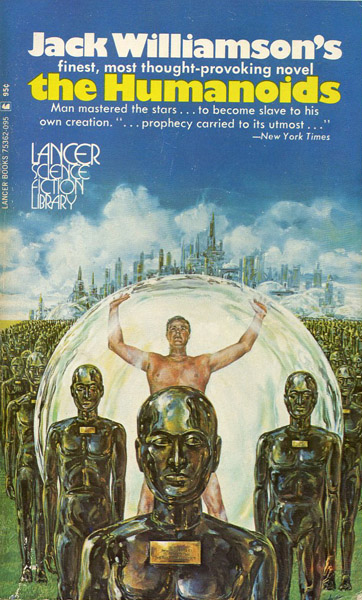
The uncredited Boschian cover for this 1971 mass-market paperback edition of Moderan is by Norman Adams. (Adams did a similar cover in 1972 for Jack Williamson’s novel The Humanoids.)
I think copies of this volume were expensive and hard to find previous to NYRB’s 2018 release of a new edition of Moderan (which included eleven new tales). That’s the version I read—although I was happy to snap this old paperback up for three bucks at a used bookstore. I wrote of the novel in my 2018 reading round-up:
Moderan works as a post-nuke dystopian satire on toxic masculinity. The tropes here might seem familiar—cyborgs and dome homes, caste systems and ultraviolence, a world of made and not born ruled by manunkind (to steal from E.E. Cummings)—it’s the way that Bunch conveys this world that is so astounding. Moderan is told in its own idiom; the voice of our narrator Stronghold-10 booms with a bravado that’s ultimately undercut by the authorial irony that lurks under its surface. The book seems equal to the task of satirizing the trajectory of our zeitgeist in a way that some contemporary satirists have failed to.
I couldn’t make it through Delany’s cult favorite Dhalgren a few years back, but Nova was easier sledding. The book is a riff on Moby-Dick, tarot, monoculture, and the grail quest. It’s jammed with ideas and characters, and if it never quite coheres into something transcendent, it’s a fun quick read (even if the ending, right from the postmodern metatextual playbook is too clever by half).
Hard to Be a God, Arkadi & Boris Strugatski. Translation by Wendayne Ackerman. Daw Books, first edition, first printing (1973). Cover art by Kelly Freas. 205 pages.
Like many anglophones, I first sought out the Brothers Strugatsky–which I will continue to spell with a final –y here, in line with the spelling variation I’ve used on this blog for years now, while also above conceding this 1973 Ackerman translation uses the –i variant—like many anglophones, I first sought out the Brothers Strugatsky sometime after seeing Andrey Tarkovsky’s 1979 film Stalker, an adaptation of their 1972 novel Roadside Picnic. And, as I expect is the case with many anglophones seeking out Strugatsky novels, I had to wait quite some time to get my hands on one. The English translations of the Strugatsky’s novels were out of print and hard to find second hand.
In 2012, a new translation of Roadside Picnic by Olena Bormashenko was issued by Chicago Review Press; it was the first one I was able to get my paws on. Over the next decade CRP would release several more Bormashenko’s translations of Strugatsky novels, including Hard to Be a God. It was actually this translation of Hard to Be a God that I read, not the Ackerman version above, which I was stunned to find used and in pristine condition a few years ago (I paid about three dollars for it). Bormashenko’s translation came out a year or two after Alexei German’s film adaptation came out (or at least became available for me to watch on Netflix a dozen times over six months). It would be silly to say the book is “nothing” like the film, and the book is very good, but German’s film is a masterpiece. Those interested in the Strugatsky’s sci-fi might want to start with Roadside Picnic; I think my favorite that I’ve read so far is Snail on the Slope.
The translator of this edition, Wendayne Ackerman, also translated Stanisław Lem’s 1964 novel The Invincible, working from a German translation of the book and not the Polish original. Her bread and butter though, it seems, was translating dozens and dozens of novels in the German space opera franchise, Perry Rhodan.
Kelly Freas, the cover artist of this edition, had a long and extensive career creating sci-fi covers and illustrations, including covers for novels by Philip K. Dick and Samuel R. Delany. I like his cover (and love the font!), even if it’s a bit to King-Kongy for the novel.
The following discussion of Vladimir Sorokin’s novel Blue Lard (in translation by Max Lawton) is intended for those who have read or are reading the book. It contains significant spoilers; to be very clear, I strongly recommend entering Blue Lard cold.
We left off right before the gross abject center of Vladimir Sorokin’s novel Blue Lard (in gross abject translation by Max Lawton). The midpoint is a strange short story, “The Indigo Pill” (by one Nikolai Buryak, author of The Flood). “The Indigo Pill” is the textual tissue between Blue Lard’s warped lobes, a segue that marries opera and shit, champagne and piss. Buryak’s setting (which is to say, of course, Sorokin’s setting) is the Bolshoi Theater in Moscow sometime in an alternate 1950s—one that is, presumably, an alternate version of the alternate 1950s Moscow the second half of Blue Lard will deliver.
But “The Indigo Pill” is really about a romantic date. Our first-person narrator will escort his belle to Tchaikovsky’s opera Eugene Onegin. How might one dress for the Bolshoi?
I am wearing a lightweight ultramarine diving suit. The mask is shifted back on my head. Freshly fallen snow crunches beneath my lead soles.
Our country’s main theater is brightly illuminated. All around it are people in diving suits of every possible color and shape. I ascend the steps, stand to the left of the second and third columns, and look at my waterproof watch. 7:22. No Masha.
Don’t worry! Masha’s just a minute or two late. Our young (oldish) lovers will have plenty of time to enter the airlock and descend into the theater, the seat of post-war Soviet big-C Culture:
The hall of the Bolshoi Theater constitutes the primary sump of the Moscow sewage system. Those who are superficially familiar with fecal culture suppose the contents of a sewer system to be a thick, impenetrable mass of excrement. This is not even remotely the case. Excrement makes up only twenty percent of its contents. The rest is liquid. Though this liquid is murky, it is still possible to survey the entire hall with enough lighting––from the floor spread with carpets to the ceiling with its famous chandelier.
(By now you, sweet dear reader, know if the Blue Lard is your particular flavor or not, right?)
Sorokin’s Buryak’s “Indigo Pill” episode ends in textuality: “the Bolshoi opens like a fat book, letters running and jumping, I swallow my own head and wake up.” Again, Blue Lard is writing about writing, writing as a kind of living (or at least counter-history/future). This metatextuality evinces in one of the stranger paragraphs in a novel full of strange paragraphs—a very short paragraph, which begins right after “I swallow my own head and wake up”:
Night.
Must go piss blood. Then make myself a coffee. And disdainfully recall my own ordinary life.
The lines are presumably, at least in the text proper, the final words of Nikolai Buryak reading his story “The Indigo Pill” over a loudspeaker to the Earth-Fuckers. But might they also be an authorial intrusion from Sorokin himself who, even if he may not piss blood (or prepare coffee, for that matter), shows a disdain for “ordinary life” in his fiction? Or not.
We transition back to the Earth-Fuckers who, in a time-travel sequence worthy of the Golden Age of Looney Tunes, explode a giant-testicled babe to deliver a package of iced blue lard (and Blue Lard; and us, the readers) to Sexy Swingin’ Moscow in the Spring of 1954! We land at a “celebratory concert dedicated to the opening of the All-Russian House of Free Love” in the Bolshoi Theater.
In a novel full of twists and turns, the next few pages of Blue Lard are especially challenging. Sorokin offers up an alternate post-war USSR history radiating decadence. Of course he does not follow the “rules” of sci-fi, whereby we might be treated to exposition (or at least a brief overview) that explains the alternate timeline we are about to navigate. Instead, the transition into Blue Lard’s second half is alarming, vivid, and very funny.
A “great Russian bard” delivers a song to the Bolshoi audience from a massive pink granite bathtub “filled with a translucent jellylike substance” (he’s tub-bound from a “pathological softening of bone matter.” The audience is moved by the drama of the bard’s song, but it’s soon interrupted by the interposition of the Earth-Fuckers’ time traveling blue lard in the form of a “semi-transparent funnel about the size of a person.” Luckily Joseph Stalin’s top lieutenants are in attendance to calm the audience and take control of the situation.
The first time I read Blue Lard I went through it stunned and guffawing, jogging in places to keep up and not lingering too long for fear of getting left behind. I didn’t pick up on the significance of that year, 1954–a whole year after Stalin’s historical death in March of 1954. Rereading Blue Lard, I took the time to apply the paltry bits of Soviet history I recalled and to index the various Politburo members who show up in this section.
The predominant of these Politburo ministers is Lavrentiy Beria, chief of the NKVD, Stalin’s secret police. The historical Beria was responsible for purges and other crimes against humanity; some historians conjecture that Beria poisoned Stalin; Beria was executed in the summer of ’53 after Khruschev’s coup. He was also a serial rapist.
Beria explains the rude intrusion of the funnel to the aghast theatergoers:
“This is the so-called ice cone sent to us from the not-too-distant future by the Order of the Earth-Fuckers of Russia. The order will be formed from numerous smaller sects of Earth-Fuckers in 2012. In 2028, some members of the order will settle in Eastern Siberia, on Bald Mountain, in dungeons in which there is evidence of the settlements of Siberian Zoroastrians, descendants of a small sect that… it seems… fled from the great Achaemenid Empire to the north at the end of the sixth century BC. They slowly ended up in the taiga, between the two Tunguskas, then on to Bald Mountain, into the granite of which they successfully burrowed over the course of four centuries. Why? They were searching for the so-called Underground Sun, the rays of which, according to their belief system, would destroy the difference between good and evil and return the human race to a heavenly state. The Siberian Zoroastrians invented a time machine capable of sending small objects into the past. One of those objects is what you see here.”
Wait, didn’t I say this section of the novel eschewed exposition? Because that’s a lovely exposition dump there, friends!
Beria continues his exposition—if we believe it!—assuring his audience that the theater-crashing “ice cone” will likely be the last one: the Siberian Zoroastrians possessed but three time travel devices. These Earth-Fuckers blew their first load in “the summer of 1908 near Torzhok… Inside of it was a book bound in buckskin describing the history and structure of the Order. Nikolai II’s talentless government considered it to be a prank.” Again, in rereading Blue Lard more slowly and deliberately, I was attenuated enough to see the obvious cue here; namely, the Earth-Fuckers precipitated the Tunguska Event. (Blue Lard is a brother book then to Pynchon’s Against the Day.)
Beria’s audience demands to know what was in the second cone, which “destroyed a train going from Moscow to Vladivostok on July twenty-ninth, 1937.” Beria informs them the cargo “was the body of a half-human, half-animal being. A six-year-old boy with horns, hooves, and a tail. There was a tattoo on his forehead that said: ‘A Babe of the Whorish World.'” Beria helpfully adds that the corpse was pickled and then hidden.
Beria’s audience then asks the question of Blue Lard’s second half “And where is Comrade Stalin?”
And where’s Stalin? We’ll meet him in a few pages. More to come.
The following excerpt of Roberto Bolaño’s 2666 (in Natasha Wimmer’s translation) is more or less self-contained, or at least as self-contained as anything in that labyrinth. It’s the summary of a character named Ansky’s novel; Hans Reiter (aka Archimboldi) is reading Ansky’s diaries while hiding during the war–
The novel, so unanimously acclaimed, was called Twilight and its plot was very simple: a boy of fourteen abandons his family to join the ranks of the revolution. Soon he’s engaged in combat against Wrangel’s troops. In the midst of battle he’s injured and his comrades leave him for dead. But before the vultures come to feed on the bodies, a spaceship drops onto the battlefield and takes him away, along with some of the other mortally wounded soldiers. Then the spaceship enters the stratosphere and goes into orbit around Earth. All of the men’s wounds are rapidly healed. Then a very thin, very tall creature, more like a strand of seaweed than a human being, asks them a series of questions like: how were the stars created? where does the universe end? where does it begin? Of course, no one knows the answers. One man says God created the stars and the universe begins and ends wherever God wants. He’s tossed out into space. The others sleep. When the boy awakes he finds himself in a shabby room, with a shabby bed and a shabby wardrobe where his shabby clothes hang. When he goes to the window he gazes out in awe at the urban landscape of New York. But the boy finds only misfortune in the great city. He meets a jazz musician who tells him about chickens that talk and probably think.
“The worst of it,” the musician says to him, “is that the governments of the planet know it and that’s why so many people raise chickens.”
The boy objects that the chickens are raised to be eaten. The musician says that’s what the chickens want. And he finishes by saying:
“Fucking masochistic chickens, they have our leaders by the balls.”
He also meets a girl who works as a hypnotist at a burlesque club, and he falls in love. The girl is ten years older than the boy, or in other words twenty-four, and although she has a number of lovers, including the boy, she doesn’t want to fall in love with anyone because she believes that love will use up her powers as a hypnotist. One day the girl disappears and the boy, after searching for her in vain, decides to hire a Mexican detective who was a soldier under Pancho Villa. The detective has a strange theory: he believes in the existence of numerous Earths in parallel universes. Earths that can be reached through hypnosis. The boy thinks the detective is swindling him and decides to accompany him in his investigations. One night they come upon a Russian beggar shouting in an alley. The beggar shouts in Russian and only the boy can understand him. The beggar says: I fought with Wrangel, show some respect, please, I fought in Crimea and I was evacuated from Sevastopol in an English ship. Then the boy asks whether the beggar was at the battle where he fell badly wounded. The beggar looks at him and says yes. I was too, says the boy. Impossible, replies the beggar, that was twenty years ago and you weren’t even born yet.
Then the boy and the Mexican detective set off west in search of the hypnotist. They find her in Kansas City. The boy asks her to hypnotize him and send him back to the battlefield where he should have died, or accept his love and stop fleeing. The hypnotist answers that neither is possible. The Mexican detective shows an interest in the art of hypnosis. As the detective begins to tell the hypnotist a story, the boy leaves the roadside bar and goes walking under the night sky. After a while he stops crying.
He walks for hours. When he’s in the middle of nowhere he sees a figure by the side of the road. It’s the seaweedlike extraterrestrial. They greet each other. They talk. Often, their conversation is unintelligible. The subjects they address are varied: foreign languages, national monuments, the last days of Karl Marx, worker solidarity, the time of the change measured in Earth years and stellar years, the discovery of America as a stage setting, an unfathomable void—as painted by Dore—of masks. Then the boy follows the extraterrestrial away from the road and they walk through a wheat field, cross a stream, climb a hill, cross another field, until they reach a smoldering pasture.
In the next chapter, the boy is no longer a boy but a young man of twenty-five working at a Moscow newspaper where he has become the star reporter. The young man receives the assignment to interview a Communist leader somewhere in China. The trip, he is warned, is extremely difficult, and once he reaches Peking, the situation may be dangerous, since there are lots of people who don’t want any statement by the Chinese leader to get out. Despite these warnings, the young man accepts the job. When, after much hardship, he finally gains access to the cellar where the Chinese leader is hidden, the young man decides that not only will he interview him, he’ll also help him escape the country. The Chinese leader’s face, in the light of a candle, bears a notable resemblance to that of the Mexican detective and former soldier under Pancho Villa. The Chinese leader and the young Russian, meanwhile, come down with the same illness, brought on by the pestilence of the cellar. They shake with fever, they sweat, they talk, they rave, the Chinese leader says he sees dragons flying low over the streets of Peking, the young man says he sees a battle, perhaps just a skirmish, and he shouts hurrah and urges his comrades onward. Then both lie motionless as the dead for a long time, and suffer in silence until the day set for their flight.
Each with a temperature of 102 degrees, the two men cross Peking and escape. Horses and provisions await them in the countryside. The Chinese leader has never ridden before. The young man teaches him how. During the trip they cross a forest and then some enormous mountains. The blazing of the stars in the sky seems supernatural. The Chinese leader asks himself: how were the stars created? where does the universe end? where does it begin? The young man hears him and vaguely recalls a wound in his side whose scar still aches, darkness, a trip. He also remembers the eyes of a hypnotist, although the woman’s features remain hidden, mutable. If I close my eyes, thinks the young man, I’ll see her again. But he doesn’t close them. They make their way across a vast snow-covered plain. The horses sink in the snow. The Chinese leader sings. How were the stars created? Who are we in the middle of the boundless universe? What trace of us will remain?
Suddenly the Chinese leader falls off his horse. The young Russian examines him. The Chinese leader is like a burning doll. The young Russian touches the Chinese leader’s forehead and then his own forehead and understands that the fever is devouring them both. With no little effort he ties the Chinese leader to his mount and sets off again. The silence of the snow-covered plain is absolute. The night and the passage of stars across the vault of the sky show no signs of ever ending. In the distance an enormous black shadow seems to superimpose itself on the darkness. It’s a mountain range. In the young Russian’s mind the certainty takes shape that in the coming hours he will die on that snow-covered plain or as he crosses the mountains. A voice inside begs him to close his eyes, because if he closes them he’ll see the eyes and then the beloved face of the hypnotist. It tells him that if he closes his eyes he’ll see the streets of New York again, he’ll walk again toward the hypnotist’s house, where she sits waiting for him on a chair in the dark. But the Russian doesn’t close his eyes. He rides on.
Cover art for Parable of the Sower by John Jude Palencar
Octavia Butler’s 1993 novel Parable of the Sower imagines what a radical affirmation of life might look like set against a backdrop of impending extinction. Set between 2024 and 2027, Parable of the Sower conjures a crumbling America. Hyperinflation abounds, infrastructure is falling apart, water is scarce, environmental collapse is imminent, and the social institutions that bind the nation have all but frayed.
When we first meet our narrator Lauren Olamina, she is one of the lucky few who has a life of moderate comfort, stability, and security. Lauren lives in a gated community in a sort of compound with her brothers, stepmother, and father, an academic/preacher. Lauren’s father is the ersatz leader of this community, He leads the neighborhood’s shooting practices, trains them in survival skills, and organizes a perimeter watch against the thieves and arsonists that constantly threaten their survival. He is the central role model for Lauren, who takes his lessons to heart. When the community finally fragments under an attack it can’t endure, Lauren is the only one of her family to survive. She even has the presence of mind to grab her bug-out bag.
After this initial staging of events, Parable of the Sower turns into a road novel. Lauren and two other survivors of the compound head north along the California freeways, slowly gathering followers. Lauren’s leadership drives the novel and inspires those around her. She offers her followers an alternative to the predation around them, a predation most strongly figured in the roving bands of arsonists that prey on travelers and communities alike. She offers her followers the prospect of belonging to a We—an interracial, inter-generational collective.
Lauren’s leadership capability derives from two strands. The first strand is the religion she is creating, an idea she calls “Earthseed.” The basic premise of Earthseed (one that the novel repeats ad nauseum) is that “God is Change.” Another tenet is that people are the seeds of the earth (like, uh, Earthseed—get it?). Lauren’s long-term vision is that humanity might seed a new planet. The post-WW2 dream of NASA and the futurity of exploration—a Manifest Destiny of the stars—glows in the background of Sower, and often points to a more interesting conclusion than the novel finally musters.
The second source of Lauren’s drive comes from a condition she suffers called hyperempathy or “sharing,” a mutation that’s the result of her birth-mother’s drug addiction during pregnancy. Simply put, when Lauren witnesses another person’s injury, she feels their pain. This affliction is a devastating weakness in a predatory, violent (non)society: for Lauren, self-defense entails self-harm. At the same time, Lauren’s hyperempathy is a strength—it makes her understand, at the most visceral level, the need for a community to work together in order to thrive in a world that seems to be dying.
Perhaps the greatest strength of Butler’s novel is that she shows her readers what Lauren can never quite see—namely that Lauren’s hyperempathy is a strength. Sower assumes the form of a journal, Lauren’s first-person recollections scrawled out in rare moments of respite from the terrors of the road. While her first-person perspective is generously broad (she seems to see a lot), she still never quite realizes that her hyperempathy contributes to her strength as a leader. Lauren’s hyperempathy necessitates imaginative forethought; it also entails a need to act decisively in times of crisis. And Parable of the Sower is all crisis, all the time.
Lauren’s journal style mixes the high with the low. She cribs the poetry of her Earthseed religion from the King James Version of the Bible, with often corny results. (I am pretty sure the corniness is unintentional). She’s also occasionally psychologically introspective, going through thought experiments to better understand those around her.
Despite its Earthseed flights into poetical musings and boldly-declared profundities, most of Lauren’s narrative is strangely mundane in its accounting of a slow apocalypse though. There are seemingly-endless lists of supplies to be bought or scavenged, survival chores to be checked off, and California roads to be traversed (sections of Parable of the Sower often reminded me more of the SNL recurring sketch “The Californians” than, say, Cormac McCarthy’s The Road). The bulk of Butler’s book hovers around disaster prepping, finding temporary shelter, and looting bodies, motifs that won’t seem strange to contemporary audiences reared on cable television and addicted to battle royale video games.
Lauren is 15 at the novel’s outset in 2024, yet she seems fully mature. If this was a coming-of-age novel, I missed it—Lauren, while far from perfect, is generally self-assured in her powers of decision making. At a quite literal level, she commands the narrative, propelling it forward without any of the wishy-washiness we might get from the narrator of, say, The Handmaid’s Tale. If Lauren second-guesses herself, she doesn’t bother to second-guess her second guesses. Butler seems to envision her rather as a hero-model for the coming disaster the novel anticipates. Much of Parable of the Sower reads like a checklist of What To Do After the End of Civilization.
The novel’s biggest weakness is that it can’t quite articulate just how bad things have gotten. Is this actually The End of Civilization? Butler paints a bleak picture. Drought is the new norm. Most Americans are illiterate. Work is hard to find. The roads are too dangerous to travel at night. Packs of feral dogs hunt down humans. Packs of feral children eat humans. Women live with the constant threat of rape. Overt racism is fully normalized. Company towns make a comeback, issuing scrip instead of currency, leading to indentured servitude. Water is a commodity to literally kill for, the police are essentially an organized gang, and a large portion of the population are addicted to a drug that makes setting fires better than sex. Murder is an open business, and there is no recourse to any established justice.
And at the same time that it evokes all of these apocalyptic images and themes, Butler’s novel points to tinges of normalcy—a presidential election carried out sans violence, the sense that a university system is still in play, various notations of different regulatory bodies. Parable of the Sower often reads like The Walking Dead or The Road, but then it might turn a weird corner to uncanny normalcy, where characters shop in a Walmart-like (if hyperbolized) superstore. As one character puts it,
Federal, state, and local governments still exist— in name at least— and sometimes they manage to do something more than collect taxes and send in the military. And the money is still good. That amazes me. However much more you need of it to buy anything these days, it is still accepted. That may be a hopeful sign— or perhaps it’s only more evidence of what I just said: We haven’t hit bottom yet.
Perhaps what I perceive here is simply Butler showing her narrator’s essential naivete, a naivete that doesn’t evince on the surface of the first-person narration. Lauren doesn’t know what she doesn’t know. She doesn’t fully understand how bad things have gotten because she doesn’t fully understand the potential in America that existed before her own life. But she does intuit how bad things are. Despite her intuition, she’s hopeful. This hope, and the despair that foregrounds it, evinces strongly in the final moments of the book. Lauren has finally made it to a kind of promised-land, a frontier-space where she can create a new life with a new love, a much-older man named Bankole. Bankole was a doctor in his old life, but now he’s a survivor. At the end of the novel, he mourns the American dream, the American we, and mourns that Lauren cannot mourn it with him:
He said nothing for a while. Then he stopped and put his hand on my shoulder to stop me. At first he only stood looking at me, almost studying my face. “You’re so young,” he said. “It seems almost criminal that you should be so young in these terrible times. I wish you could have known this country when it was still salvageable.”
“It might survive,” I said, “changed, but still itself.”
“No.” He drew me to his side and put one arm around me. “Human beings will survive of course. Some other countries will survive. Maybe they’ll absorb what’s left of us. Or maybe we’ll just break up into a lot of little states quarreling and fighting with each other over whatever crumbs are left. That’s almost happened now with states shutting themselves off from one another, treating state lines as national borders. As bright as you are, I don’t think you understand—I don’t think you can understand what we’ve lost. Perhaps that’s a blessing.”
Banokole’s summary of America in the late 2020s seems like a dire if hyperbolic prognostication of our current trajectory. More than a quarter century ago, Butler knew what was up. Butler also offered an answer to the problem in her mouthpiece Lauren, who replies to her (way-too-much older) lover Bankole, “We’ve got work to do.”
Parable of the Sower is not a particularly fun novel, although of course, it never intends to be. The dour tone is appropriate to its subject matter, I suppose, but that grim tone can become exhausting. The novel’s trajectory and moral vision keep it from falling into an exercise in nihilism or apocalypse porn, like, say, The Walking Dead. But like The Walking Dead, Butler’s novel often plods along. Maybe this is a rhetorical feature—maybe Butler intends her reader to feel just as weary and depressed as Lauren.
Parable of the Sower was published just a year after a superficially-similar novel, Neal Stephenson’s Snow Crash, which also presciently envisions a fragmenting America where like-groups seal themselves off from each other. In contrast though, Stephenson’s novel is zany and vibrant, a cartoon world devoid of any hyperempathy that might get in the way of anarchic fun. Over 25 years old now, many of the tropes in both Snow Crash and Parable of the Sower have so fully infiltrated our media—books and video games, films and television shows—that their initial vital strangeness is hard to detect.
The dystopian tropes of Parable of the Sower don’t feel particularly fresh in 2019, but the novel’s prescience still has an alarming bite. (Her sequel, Parable of the Talents, features a right-wing Presidential candidate who runs on the promise to “Make America great again”). Sower works best as an extended thought experiment on what might happen to society—to democracy in particular—when impending ecological collapse threatens our very existence. And Butler proposes a solution to the problems posed in her thought experiment: “We’ve got work to do.”
“We’ve got work to do” not only summarizes Parable of the Sower’s central message, it also describes current zeitgeist. Lauren would have been born in 2009; my daughter was born in 2007 and my son in 2010. She could be one of their classmates; she could be my own daughter. The novel’s vision of hyperempathy in the face of brutality and creeping fascism points back to that phrase — “We’ve got work to do” — which of course, requires a We. The we here is a radical affirmation, an echo even of the We the People that so boldly engendered a U.S. America. But Butler’s vision, conveyed through Lauren, is far more pluralistic and diverse than the We the framers evoked in the Preamble to the Constitution. Butler’s we names the namelessness of a coming society, a society that seems impossible and yet is possible, its possibility instantiated in the simple proof that it can be imagined. Parable of the Sower ultimately points toward the seeds of that imagining.
[Ed. note—Biblioklept first published this review in March of 2019.]
Small Beer Press had a warehouse sale last month, so I ordered two by the late avant-garde sci-fi writer Carol Emshwiller. I ordered Carmen Dog, which is what I take to be her most lauded novel, based on this blurb from Ursula Le Guin:
Carol is the most unappreciated great writer we’ve got. Carmen Dog ought to be a classic in the colleges by now . . . It’s so funny, and it’s so keen.
The pub’s blurb:
The debut title in our Peapod Classics line, Carol Emshwiller’s genre-jumping debut novel is a dangerous, sharp-eyed look at men, women, and the world we live in.
Everything is changing: women are turning into animals, and animals are turning into women. Pooch, a golden setter, is turning into a beautiful woman–although she still has some of her canine traits: she just can’t shuck that loyalty thing–and her former owner has turned into a snapping turtle. When the turtle tries to take a bite of her own baby, Pooch snatches the baby and runs. Meanwhile, there’s a dangerous wolverine on the loose, men are desperately trying to figure out what’s going on, and Pooch discovers what she really wants: to sing Carmen.
I also ordered a story collection, Report to the Men’s Club. Small Beer’s blurb:
What if the world ended on your birthday — and no one came? What if your grandmother was a superhero? What if the orphan you were raising was a top-secret weapon, looked like Godzilla, and loved singing nursery rhymes? What if poet laureates fought to the death, in stadiums?
A day or two before they showed up, I found a copy of Emshwiller’s 2005 novel Mister Boots in the YA section of my local bookshop. I launched into it and I don’t think it necessarily reads as YA-as-genre, but it’s the kind of weird shit I would’ve loved to get a hold of as a sixteen year old. Blurb:
Bobby Lassiter has some important secrets—but it’s not as if anyone’s paying attention. It’s the middle of the Depression, and while Bobby’s mother and older sister knit all day to make money, Bobby explores the California desert around their home. That’s how Bobby finds Boots. He’s under their one half-dead tree, halfdead himself. Right away he’s a secret, too—a secret to be fed and clothed and taken care of, and even more of a secret because of what he can do. Sometimes Boots is a man. Sometimes he’s (really, truly) a horse. He and Bobby both know something about magic—and those who read this book will,
“Well, Corporal Westerburg,” Doctor Henry Harris said gently, “just why do you think you’re a plant?”
As he spoke, Harris glanced down again at the card on his desk. It was from the Base Commander himself, made out in Cox’s heavy scrawl: Doc, this is the lad I told you about. Talk to him and try to find out how he got this delusion. He’s from the new Garrison, the new check-station on Asteroid Y-3, and we don’t want anything to go wrong there. Especially a silly damn thing like this!
Harris pushed the card aside and stared back up at the youth across the desk from him. The young man seemed ill at ease and appeared to be avoiding answering the question Harris had put to him. Harris frowned. Westerburg was a good-looking chap, actually handsome in his Patrol uniform, a shock of blond hair over one eye. He was tall, almost six feet, a fine healthy lad, just two years out of Training, according to the card. Born in Detroit. Had measles when he was nine. Interested in jet engines, tennis, and girls. Twenty-six years old.
“Well, Corporal Westerburg,” Doctor Harris said again. “Why do you think you’re a plant?”
The Corporal looked up shyly. He cleared his throat. “Sir, I am a plant, I don’t just think so. I’ve been a plant for several days, now.”
“I see.” The Doctor nodded. “You mean that you weren’t always a plant?”
“No, sir. I just became a plant recently.”
“And what were you before you became a plant?”
“Well, sir, I was just like the rest of you.”
There was silence. Doctor Harris took up his pen and scratched a few lines, but nothing of importance came. A plant? And such a healthy-looking lad! Harris removed his steel-rimmed glasses and polished them with his handkerchief. He put them on again and leaned back in his chair. “Care for a cigarette, Corporal?”
“No, sir.”
The Doctor lit one himself, resting his arm on the edge of the chair. “Corporal, you must realize that there are very few men who become plants, especially on such short notice. I have to admit you are the first person who has ever told me such a thing.”
“Yes, sir, I realize it’s quite rare.”
“You can understand why I’m interested, then. When you say you’re a plant, you mean you’re not capable of mobility? Or do you mean you’re a vegetable, as opposed to an animal? Or just what?”
The Corporal looked away. “I can’t tell you any more,” he murmured. “I’m sorry, sir.”
“Well, would you mind telling me how you became a plant?”
Corporal Westerburg hesitated. He stared down at the floor, then out the window at the spaceport, then at a fly on the desk. At last he stood up, getting slowly to his feet. “I can’t even tell you that, sir,” he said.
“Notes Towards a Mental Breakdown” (1976) / “The Index” (1977)
By the end of the sixties, Ballard had found a style and rhetoric to match his weird futurism. His output of stories slowed down considerably in the ’70s, as he found financial comfort and some measure of fame as a writer. If 1969’s collection The Atrocity Exhibition didn’t cement Ballard as a voice at the forefront of avant-garde fiction, then Crash (1973) surely did. Ballard published four novels in the seventies, and as usual, the stories he composed around the same time often feel like sketches or dress rehearsals for bigger ideas.
The two strongest stories here—or maybe, I should just admit, the stories I like best—are “Notes Towards a Mental Breakdown” and “The Index.” Ballard’s repetitions can often be draining, especially if you read all these stories back to back, but “Notes” and “Index” feel vital, necessary—essential. Yes, of course they belong in that ideal collection I’ve been imagining, The Essential Short Stories of J.G. Ballard. Both stories condense Ballard’s obsessions into short, strange, experiments.
“Notes Towards a Mental Breakdown” reads as a playful but sinister parody of what a fictionalized autobiography of Ballard might look like. The story consists of a single sentence: “A discharged Broadmoor patient compiles ‘Notes Towards a Mental Breakdown,’ recalling his wife’s murder, his trial and exoneration.” Each subsequent paragraph is a numbered footnote, which complicates and disrupts the levels of fictionality and reality that we might expect to inhere in the plot. With its missing mental patients, psycholinguistics, dead, adulterous wife, surrealism, airplanes, etc., “Notes” encapsulates so many of Ballard’s stories to date, yet makes the reader encounter them with fresh perspective. Sample paragraph:
A vital role seems to have been played during these last days by the series of paintings by Max Ernst entitled Garden Airplane Traps, pictures of low walls, like the brick–courses of an uncompleted maze, across which long wings have crashed, from whose joints visceral growths are blossoming. In the last entry of his diary, the day before his wife’s death, 27 March 1975, Loughlin wrote with deceptive calm: ‘Ernst said it all in his comment on these paintings, the model for everything I’ve tried to do… “Voracious gardens in turn devoured by a vegetation which springs from the debris of trapped airplanes… Everything is astonishing, beart–breaking and possible… with my eyes I see the nymph Echo…” Shortly before writing out these lines he had returned to his Hendon apartment to find that his wife had set off for Gatwick Airport with Dr Douglas, intending to catch the 3.15 p.m. flight to Geneva the following day. After calling Richard Northrop, Loughlin drove straight to Elstree Flying Club.
Ernst’s Garden Airplane Trap
“The Index” tells the story of HRH—
Physician and philosopher, man of action and patron of the arts, sometime claimant to the English throne and founder of a new religion, Henry Rhodes Hamilton was evidently the intimate of the greatest men and women of our age. After World War II he founded a new movement of spiritual regeneration, but private scandal and public concern at his growing megalomania, culminating in his proclamation of himself as a new divinity, seem to have led to his downfall.
After a very short introductory note (which I yanked the above from), “The Index” takes the form of “the index to the unpublished and perhaps suppressed autobiography of a man who may well have been one of the most remarkable figures of the twentieth century.” Ballard crams an analysis of the entire 20th century into the index, with bizarre humor and grand results. Forced to read between the lines, HRH (his royal highness) seems to be present at every single meaningful event of the last century, whether he’s advising Churchill:
Churchill, Winston, conversations with HRH, 221; at Chequers with HRH, 235; spinal tap performed by HRH, 247; at Yalta with HRH, 298, ‘iron curtain’ speech, Fulton, Missouri, suggested by HRH, 312; attacks HRH in Commons debate, 367
Ghandi:
Ghandi, Mahatma, visited in prison by HRH, 251; discussesBhagavadgita with HRH, 253; has dhoti washed by HRH, 254; denounces HRH, 256
–or Hitler:
Hitler, Adolf, invites HRH to Berchtesgaden, 166; divulges Russia invasion plans, 172; impresses HRH, 179; disappoints HRH, 181
I have to share this entry too:
Hemingway, Ernest, first African safari with HRH, 234; at Battle of the Ebro with HRH, 244; introduces HRH to James Joyce, 256; portrays HRH in The Old Man and the Sea, 453
Ballard is at his best when he makes the reader work the hardest (think of “The Beach Murders,” “The Drowned Giant,” or “Why I Want to Fuck Ronald Reagan”), and “The Index” and “Notes” are no exception.
“The Greatest Television Show on Earth” (1972) / “The Life and Death of God” (1976)
“The Greatest Television Show on Earth” and “The Life and Death of God” are both composed in a detached, slightly ironic, and highly-omniscient tone that Ballard rarely employs. Most of the time he uses a free indirect style that floats near the harried, paranoid consciousness of one of his (always male) protagonist, constraining the viewpoint to that character. There’s also the occasional first-person voice. It’s worth noting that Ballard’s omniscient voice, usually reserved for wry fables, is one of his strongest (see also: “The Drowned Giant”). This pair of stories—and I do take them as a pair—are thought experiments that ultimately focus on metaphysics, a subject that is somewhat rare in the Ballardverse.
“The Greatest Television Show on Earth” imagines a future (2001!) in which time travel has been perfected and history itself becomes the history channel as billions become addicted to television broadcasts of historical battles. Over time, however, the producers begin to interfere. They try to make history flashier, more violent (sexier?). The story ends with a metaphysical gesture that might be read ironically, although I find it hard to see the conclusion (which I won’t spoil here) as anything other than Ballard’s moralistic reactionary streak alight.
“The Life and Death of God” takes a cue from Voltaire’s quip that if God did not exist it would be necessary to invent him. In this fable/thought experiment, scientists prove beyond doubt (keyword: doubt) that God is real. Ballard imagines a world relieved of radical doubt—a world without faith:
Within two months of the confirmation of the worldwide rumour of God’s existence came the first indications of government concern over the consequences. Industry and agriculture were already affected, though far less than commerce, politics and advertising. Everywhere the results of this new sense of morality, of the virtues of truth and charity, were becoming clear. A legion of overseers, time–keepers and inspectors found themselves no longer needed. Longestablished advertising agencies became bankrupt. Accepting the public demand for total honesty, and fearful of that supreme client up in the sky, the majority of television commercials now ended with an exhortation not to buy their products.
And then things get worse. “The Life and Death” again shows Ballard’s reactionary, elitist stripe, his lack of faith in the so-called common person to make meaning and organize a life without an anchoring center—illusory or otherwise.
“The Air Disaster'” (1975) / “Low–Flying Aircraft” (1975) /”The 60 Minute Zoom” (1976) / “The Smile” (1976) / “The Intensive Care Unit” (1977) / “Theatre of War” (1977) / “Having a Wonderful Time” (1978) / “One Afternoon at Utah Beach” (1978) /”Motel Architecture” (1978)
In the order they are listed above, with apologies:
Ballard does cargo cult / Ballard explores child-mutation-as-harbinger-of-new-evolutionary-jump / Ballard does Rear Window (the story anticipates Blue Velvet) / Ballard writes about emotional transference and a sex doll / Ballard mashes up his TV obsessions with his displacement obsessions with his Oedipal obsessions / Ballard imagines a contemporary Civil War in Britain, with American aggressors; there’s a gimmick end here that actually works wonderfully / Ballard’s permanent vacation riff / Ballard writes yet another cheating-wife-leads-to-husband’s-attempt-at-revenge, this time with a Nazi motif / Ballard repeats “Intensive Care Unit,” but mixes it up with voyeurism and a kick of Psycho. (The story anticipates what DeLillo will do a decade later).
Sorry to lump all these together. I probably shouldn’t handle the whole decade of stories at once, but I’m almost finished with this enormous, very long book (dear lord I am ready to be finished) and lumping I shall do. Of this set, “The Intensive Care Unit” and “Theatre of War” are the best, and the most mediocre of the bunch (“Low-Flying Aircraft” and “One Afternoon at Utah Beach”) are better than the mediocre stories of the sixties.
“Zodiac 2000” (1978)
Ballard’s most deconstructive, postmodern stories begin with an author’s note, an apologia of sorts, and while I often think these are unnecessary, I’ve also used them to help summarize the stories. So too with “Zodiac 2000”:
An updating, however modest, of the signs of the zodiac seems long overdue. The houses of our psychological sky are no longer tenanted by rams, goats and crabs but by helicopters, cruise missiles and intra–uterine coils, and by all the spectres of the psychiatric ward. A few correspondences are obvious – the clones and the hypodermic syringe conveniently take the place of the twins and the archer. But there remains the problem of all those farmyard animals so important to the Chaldeans. Perhaps our true counterparts of these workaday creatures are the machines which guard and shape our lives in so many ways – above all, the taurean computer, seeding its limitless possibilities. As for the ram, that tireless guardian of the domestic flock, his counterpart in our own homes seems to be the Polaroid camera, shepherding our smallest memories and emotions, our most tender sexual acts. Here, anyway, is an s–f zodiac, which I assume the next real one will be…
If “Zodiac 2000” doesn’t quite work as well as Ballard’s other list-driven/fractured stories, it’s probably because he attempts to screw a plot-driven thriller onto his weird frame. It’s almost as if he has a left-over story that wasn’t quite good enough to sell, and says, hey, I’ve got this idea for a structure, let me mash it all together. In Ballard’s best stuff, frame and content are inseparable; “Zodiac 2000″ is not Ballard’s best” — but it’s still more interesting than his most mediocre.
“The Ultimate City” (1976)
Speaking of mediocre: “The Ultimate City” is a very long short story, a novella really, that I invite anyone reading The Complete Short Stories of J.G. Ballard to feel totally okay about skipping. You’ve read this story before, under several different titles, by this point, or maybe you’ll read it later. It’s another thought experiment dressed up as an essay dressed up as an adventure story. At its best there are some good ideas here infused with a heavy dose of environmentalism. At its worst though, “The Ultimate City” is didactic, ponderous, meandering, overstuffed, and redolent of hoary tropes (there’s even a Magical Negro).
“The Dead Time” (1977)
1977’s “The Dead Time” is, unless I’m mistaken, Ballard’s first attempt to write directly (if still indirectly) about his experiences as a captive ex-patriot in WWII. Ballard, as is well-known, was interred in a prison camp in Shanghai by the Japanese forces, and this traumatic ordeal undoubtedly underwrites so much of his violent, alienated fiction. If we take Ballard’s childhood internment and the subsequent abject horrors he faced to be the cornerstone of the Ballardverse he would later create, then we must also, significantly, recognize that almost all of Ballard’s fiction up to “The Dead Time” is a displacement and revision of those terrors (which Ballard handled most directly in his mainstream breakthrough, 1984’s Empire of the Sun).
“The Dead Time” focuses on a hero who, released from his Shanghai prison in the final days of WWII, wonders hungry and dissociated through a corpse-and-trash-strewn apocalyptic landscape. He’s charged with the bizarre duty of transporting and then burying a truckload of dead bodies. Little else happens. The tale is, without a doubt, Ballard’s most real, and probably most terrifying story to date:
I tried to pick up another of the corpses, but again my hands froze, and again I felt the same presentiment, an enclosing wall that enveloped us like the wire fence around our camp. I watched the flies swarm across my hands and over the faces of the bodies between my feet, relieved now that I would never again be forced to distinguish between us. I hurled the tarpaulin into the canal, so that the air could play over their faces as we sped along. When the engine of the truck had cooled I refilled the radiator with water from the canal, and set off towards the west.
The narrator’s abject trial continues, and we see in the corpses in his charge the grotesque bits and fragments that have fueled the two previous decades of Ballard’s writing:
Under the cover of darkness – for I would not have dared to commit this act by daylight – I returned to the truck and began to remove the bodies one by one, throwing them down on to the road. Clouds of flies festered around me, as if trying to warn me of the insanity of what I was doing. Exhausted, I pulled the bodies down like damp sacks, ruthlessly avoiding the faces of the nuns and the children, the young amputee and the elderly woman.
As we reach the end of the narrative, our hero remarks,
From this time onwards, during the confused days of my journey to my parents’ camp, I was completely identified with my companions. I no longer attempted to escape them.
It’s difficult not to read here some reconciliation here, as if Ballard is finally ready to write through his formative traumas without the intermediary tropes of science fiction or radical paranoia. What we get here is wonderfully, viscerally real. Fantastic stuff, and clearly part of my ideal Essential collection.
On the horizon:
Ballard writes the same story three times in a row! We get one of his best stories, “Answers to a Questionnaire”! And I finish! Yay!
[Ed. note: Biblioklept originally ran a series of posts on The Complete Short Stories of J.G. Ballard between October 2013 and March 2014.]
“The Assassination of John Fitzgerald Kennedy Considered as a Downhill Motor Race” (1966)
“The Beach Murders” (1966)
Up until the mid-sixties, Ballard wasn’t able to find a rhetoric to match his ideas. Perhaps this makes sense if we consider that Ballard’s fiction has always been more interested in art, music, film, and biology than literature itself. He still relied on the tropes of magazine pulp fiction and hard-boiled detective stories to frame his tales, and while even the weakest of these tales was better than an episode of The Twilight Zone, they still occupied the same territory. Although Ballard’s earliest stories are distinctly Ballardian–obsessed with time, saturated in surrealism and psychology, shot through with a Cold War era paranoia and its attendant nihilism—it’s not until 1964, in the fragmentary “The Terminal Beach,” and the wry fabulism of “The Drowned Giant,” that Ballard finally merges form and content.
With “The Beach Murders,” Ballard manages to overstuff all of his tropes into a strange burlesque game. Paranoid, breast-obsessed, violent and funny, “The Beach Murders” comprises 26 sections, one for each letter in the English alphabet. And like the alphabet, Ballard’s story can be combined in any number of possibilities. In his introduction to the story, the narrator hints at a solution to the puzzle, before pointing out that any “final answer” will forever remain unclear:
Readers hoping to solve the mystery of the Beach Murders – involving a Romanoff Princess, a CIA agent, two of his Russian counterparts and an American limbo dancer – may care to approach it in the form of the card game with which Quimby, the absconding State Department cipher chief, amused himself in his hideaway on the Costa Blanca. The principal clues have therefore been alphabetized. The correct key might well be a familiar phrase, e. g. PLAYMATE OF THE MONTH, or meaningless, e. g. qwertyuiop… etc. Obviously any number of solutions is possible, and a final answer to the mystery, like the motives and character of Quimby himself, lies forever hidden.
“The Beach Murders” reads like a postmodern update of one of Edgar Allan Poe’s detective stories. Its gestures recall the fragmentation of his hero William Burroughs, as well as the techniques of his American contemporary Donald Barthelme–not to mention the emerging wave of continental deconstruction. It’s also very, very fun. Part of my ideal collection, The Essential Short Stories of J.G. Ballard.
“The Day of Forever” (1966)
It’s tempting to give in to biographical criticism when considering the subtle but significant shift in Ballard’s work after the shocking death of his wife Helen in 1964. While themes of loss, sleeplessness, and despair reverberate through many (if not most) of his early stories, they become sharper, more defined after 1964.
“The Day of Forever” is not exactly a great story, especially if you do what I’m doing—that is, read all of his stories chronologically. The story, about a world that has ceased to rotate, feels like a series of sketches that Ballard is using for something bigger (or has left out of something bigger). Taken in the context of his wife’s death, however, the story seems richer, sadder, more personal in its evocations of dreamlessness and loss.
When the story’s protagonist Halliday raids an abandoned gallery for its surrealist images, it’s hard not to intuit Ballard’s own desire to recover the unrecoverable:
In the students’ gallery hung the fading reproductions of a dozen schools of painting, for the most part images of worlds without meaning. However, grouped together in a small alcove Halliday found the surrealists Delvaux, Chirico and Ernst. These strange landscapes, inspired by dreams that his own could no longer echo, filled Halliday with a profound sense of nostalgia. One above all, Delvaux’s The Echo’, which depicted a naked Junoesque woman walking among immaculate ruins under a midnight sky, reminded him of his own recurrent fantasy. The infinite longing contained in the picture, the synthetic time created by the receding images of the woman, belonged to the landscape of his unseen night.
Delvaux’s The Echo
“The Impossible Man” (1966)
The theme of recovery surfaces again in “The Impossible Man,” where a young man named Conrad (insert observation here that so many of Ballard’s protagonist’s are nakedly named for writers) is given the chance to walk again after a terrible accident—he’ll receive the limbs of a man who died causing the accident. With its fetishizing of scars, auto accidents, and surgery, “The Impossible Man” points directly toward Ballard’s weirdest works, The Atrocity Exhibition and Crash.
“Storm–Bird, Storm–Dreamer” (1966)
“Storm-Bird, Storm-Dreamer” evokes a rich, Gothic world, a swampland where humans battle mutant birds. Here, a strange woman in mourning awaits the return of her lost child (there’s that theme again!) through some avian agency. There are skiffs and pergolas and feathers and shotguns. There is a dwarf. Dark and romantic, the tale’s themes—and the delivery of those themes—recall Ballard’s earlier forays into magical realism, “The Drowned Giant” and 1962’s “The Garden of Time.”
“Tomorrow is a Million Years” (1966)
Ballard’s narrator in “Tomorrow is a Million Years” directly invokes Robinson Crusoe and Moby-Dick and alludes to the myth of the Flying Dutchman. Allusion is a fundamental trope of literature—indeed, most literature seems to take literature as its own subject—but Ballard’s allusions, beyond his character names (he christens a character in 1967’s “Cry Hope, Cry Fury!” Melville) tend to skew toward art and music. The allusions to doomed voyages and shipwreck are appropriate here, and Ballard synthesizes them into a tale of madness and hallucination. And, at the risk of spoiling the tale’s shocking ending, I’ll suggest again that Ballard is writing through/to/around/beneath the death of his wife.
“The Assassination of John Fitzgerald Kennedy Considered as a Downhill Motor Race” (1966)
Ballard begins “Assassination” with an author’s note:
The assassination of President Kennedy on November 22nd, 1963, raised many questions, not all of which were answered by the Report of the Warren Commission. It is suggested that a less conventional view of the events of that grim day may provide a more satisfactory explanation. In particular Alfred Jarry’s “The Crucifixion Considered as an Uphill Bicycle Race” gives us a useful lead.
Author of the infamous proto-surrealist play Ubu Roi, Alfred Jarry’s pataphysical conceits undoubtedly influenced and engaged Ballard, offering him new ways of writing beyond the constraints of his earlier pulp fiction. Published almost 60 years after Jarry’s death, “Assassination” is just as shocking as the text it’s modeled on, suggesting that the disruptive powers of language that Ballard was beginning to experiment with retain vitality outside of history. It’s worth sharing the opening paragraphs of “Assassination”:
Oswald was the starter.
From his window above the track he opened the race by firing the starting gun. It is believed that the first shot was not properly heard by all the drivers. In the following confusion Oswald fired the gun two more times, but the race was already under way.
Kennedy got off to a bad start.
There was a governor in his car and its speed remained constant at about fifteen miles an hour. However, shortly afterwards, when the governor had been put out of action, the car accelerated rapidly, and continued at high speed along the remainder of the course.
The visiting teams. As befitting the inauguration of the first production car race through the streets of Dallas, both the President and the Vice–President participated. The Vice–President, Johnson, took up his position behind Kennedy on the starting line. The concealed rivalry between the two men was of keen interest to the crowd. Most of them supported the home driver, Johnson.
If “Kennedy got off to a bad start” doesn’t crack you up then it’s likely this story isn’t for you. Ballard’s humor often rests entirely on a kind of moral irony in his earlier stories (you know, like something from the Twilight Zoneseries), but “Assassination” shows a wry constraint, a trust in the reader that probably originated in Ballard’s growing comfort in his own powers. (Later stories like “The Greatest Television Show on Earth” and “The Life and Death of God” advance Ballard’s control of dark humor).
“The Assassination of John Fitzgerald Kennedy Considered as a Downhill Motor Race” was published in The Atrocity Exhibition; for whatever reason, The Complete Short Stories only includes two other stories from that collection (“Why I Want to Fuck Ronald Reagan” and “The Secret History of World War 3,” which wasn’t actually part of the original AE pressing). So maybe Complete is not so complete.
I’m actually almost finished with the book (my Kindle tells me I’m at 72%). I should probably slow down and try to take more notes for these riffs—or just write faster and looser. But the reading becomes far more compelling at this point, as Ballard transcends the limitations of sci-fi pulp and begins to contend with his surrealist forbears. Next time: “Why I Want to Fuck Ronald Reagan”! Another Vermilion Sands story—this one not so bad! Ballard takes on Vietnam! Etc.
[Ed. note: Biblioklept originally ran a series of posts on The Complete Short Stories of J.G. Ballard between October 2013 and March 2014.]
A note about Vollmer. He no longer describes the earth as a library globe or a map that has come alive, as a cosmic eye staring into deep space. This last was his most ambitious fling at imagery. The war has changed the way he sees the earth. The earth is land and water, the dwelling place of mortal men, in elevated dictionary terms. He doesn’t see it any more (storm-spiralled, sea-bright, breathing heat and haze and colour) as an occasion for picturesque language, for easeful play or speculation.
At two hundred and twenty kilometres we see ship wakes and the larger airports. Icebergs, lightning bolts, sand-dunes. I point out lava flows and cold-core eddies. That silver ribbon off the Irish coast, I tell him, is an oil slick.
This is my third orbital mission, Vollmer’s first. He is an engineering genius, a communications and weapons genius, and maybe other kinds of genius as well. As mission specialist, I’m content to be in charge. (The word specialist, in the standard usage of Colorado Command, refers here to someone who does not specialize.) Our spacecraft is designed primarily to gather intelligence. The refinement of the quantum-burn technique enables us to make frequent adjustments of orbit without firing rockets every time. We swing out into high, wide trajectories, the whole earth as our psychic light, to inspect unmanned and possibly hostile satellites. We orbit tightly, snugly, take intimate looks at surface activities in untravelled places. The banning of nuclear weapons has made the world safe for war.
I try not to think big thoughts or submit to rambling abstractions. But the urge sometimes comes over me. Earth orbit puts men into philosophical temper. How can we help it? We see the planet complete, we have a privileged vista. In our attempts to be equal to the experience, we tend to meditate importantly on subjects like the human condition. It makes a man feel universal, floating over the continents, seeing the rim of the world, a line as clear as a compass arc, knowing it is just a turning of the bend to Atlantic twilight, to sediment plumes and kelp beds, an island chain glowing in the dusky sea.
I tell myself it is only scenery. I want to think of our life here as ordinary, as a housekeeping arrangement, an unlikely but workable setup caused by a housing shortage or spring floods in the valley.
Gene Wolfe was born in New York on May 7, 1931. He studied at Texas A&M for a few years before dropping out and fighting in the Korean War. After his return to the US he finished his degree at the University of Houston. He was an engineer, and worked as the editor of the professional journal Plant Engineering. He was also instrumental in inventing the machine that cooks Pringles potato chips.
…Wolfe went on to write over 30 novels, with his best best-known work, The Book of The New Sun, spanning 1980-1983. The series is a tetralogy set in the Vancian Dying Earth subgenre, and follows the journey of Severian, a member of the Guild of Torturers, after he is exiled for the sin of mercy.
Last night, I fell asleep listening to Chapter 15 of the audiobook version of Gene Wolfe’s 1980 novel The Shadow of the Torturer, the first book in The Book of the New Sun.I have been falling asleep to Chapter 15 of this particular audiobook for about three nights now. Before that, I was falling asleep to Chapter 14. There is nothing particularly boring about the book. I put headphones in my ears take sleeping pills and fall asleep to an audiobook every night. There’s something about plugging into a narrative that’s not my own life that takes me out of all the anxieties that creep out at bedtime. I get through 15, maybe 20 minutes, and I’m out. I restart a few minutes before the last bit I remember. Anyway, I fell asleep to Chapter 15 — “Baldanders” — last night. I might’ve even made it a little bit into Chapter 16. I’ll find out tonight.
I first read The Shadow of the Torturer as a young teen. I was too young for the book—I don’t think I fully appreciated its scope. I read the next book in The Book of the New Sun series, but I don’t remember if I finished it out. In a year or two, I had abandoned fantasy, a mistake that I corrected years later. Youthful indiscretion. I reread a chunk of The Shadow of the Torturer again in my twenties and found it more complex than I remember. Then I mistakenly left the mass market paperback copy I was reading at a beach condo we had conned from someone’s friend’s grandmother for the weekend, and that was that—until this February, when a brief Twitter conversation prompted me to get the audiobook. I’ve been listening to it every night since, and at the rate I’m going through it I’ll probably be done by the end of the summer. I’m digging it.
Will Wolfe now gain a wider audience outside of the sci-fi/fantasy cult audience now that he has died? Maybe. I mean, that happens sometimes, right? His work is challenging though, employing strange diction and proffering only the smallest crumbs of exposition. Ultimately, it’s clear that Gene Wolfe was a writer’s writer, as evidenced by a 2015 profile of him in The New Yorkerwhich proclaimed him “sci-fi’s difficult genius”—
Wolfe has published more than twenty-five novels and more than fifty stories, and has won some of science fiction and fantasy’s most prestigious awards. But he has rarely, if ever, been considered fully within the larger context of literature. His books contain all of the nasty genre tropes—space travel, robots, even dragons—and he hasn’t crossed into the mainstream on the strength of a TV or movie adaptation. Wolfe himself sees the trappings of science fiction and fantasy, the spaceships and so on, as simply “a sketchy outline of the things that can be done.” But even within fantasy fandom, Wolfe’s work presents difficulties. His science fiction is neither operatic nor scientifically accurate; his fantasy works are not full of clanging swords and wizardly knowledge. But ask science-fiction or fantasy authors about Gene Wolfe and they are likely to cite him as a giant in their field. Ursula K. Le Guin once called Wolfe “our Melville.”
Cover art for Parable of the Sower by John Jude Palencar
Octavia Butler’s 1993 novel Parable of the Sower imagines what a radical affirmation of life might look like set against a backdrop of impending extinction. Set between 2024 and 2027, Parable of the Sower conjures a crumbling America. Hyperinflation abounds, infrastructure is falling apart, water is scarce, environmental collapse is imminent, and the social institutions that bind the nation have all but frayed.
When we first meet our narrator Lauren Olamina, she is one of the lucky few who has a life of moderate comfort, stability, and security. Lauren lives in a gated community in a sort of compound with her brothers, stepmother, and father, an academic/preacher. Lauren’s father is the ersatz leader of this community, He leads the neighborhood’s shooting practices, trains them in survival skills, and organizes a perimeter watch against the thieves and arsonists that constantly threaten their survival. He is the central role model for Lauren, who takes his lessons to heart. When the community finally fragments under an attack it can’t endure, Lauren is the only one of her family to survive. She even has the presence of mind to grab her bug-out bag.
After this initial staging of events, Parable of the Sower turns into a road novel. Lauren and two other survivors of the compound head north along the California freeways, slowly gathering followers. Lauren’s leadership drives the novel and inspires those around her. She offers her followers an alternative to the predation around them, a predation most strongly figured in the roving bands of arsonists that prey on travelers and communities alike. She offers her followers the prospect of belonging to a We—an interracial, inter-generational collective.
Lauren’s leadership capability derives from two strands. The first strand is the religion she is creating, an idea she calls “Earthseed.” The basic premise of Earthseed (one that the novel repeats ad nauseum) is that “God is Change.” Another tenet is that people are the seeds of the earth (like, uh, Earthseed—get it?). Lauren’s long-term vision is that humanity might seed a new planet. The post-WW2 dream of NASA and the futurity of exploration—a Manifest Destiny of the stars—glows in the background of Sower, and often points to a more interesting conclusion than the novel finally musters.
The second source of Lauren’s drive comes from a condition she suffers called hyperempathy or “sharing,” a mutation that’s the result of her birth-mother’s drug addiction during pregnancy. Simply put, when Lauren witnesses another person’s injury, she feels their pain. This affliction is a devastating weakness in a predatory, violent (non)society: for Lauren, self-defense entails self-harm. At the same time, Lauren’s hyperempathy is a strength—it makes her understand, at the most visceral level, the need for a community to work together in order to thrive in a world that seems to be dying.
Perhaps the greatest strength of Butler’s novel is that she shows her readers what Lauren can never quite see—namely that Lauren’s hyperempathy is a strength. Sower assumes the form of a journal, Lauren’s first-person recollections scrawled out in rare moments of respite from the terrors of the road. While her first-person perspective is generously broad (she seems to see a lot), she still never quite realizes that her hyperempathy contributes to her strength as a leader. Lauren’s hyperempathy necessitates imaginative forethought; it also entails a need to act decisively in times of crisis. And Parable of the Sower is all crisis, all the time.
Lauren’s journal style mixes the high with the low. She cribs the poetry of her Earthseed religion from the King James Version of the Bible, with often corny results. (I am pretty sure the corniness is unintentional). She’s also occasionally psychologically introspective, going through thought experiments to better understand those around her.
Despite its Earthseed flights into poetical musings and boldly-declared profundities, most of Lauren’s narrative is strangely mundane in its accounting of a slow apocalypse though. There are seemingly-endless lists of supplies to be bought or scavenged, survival chores to be checked off, and California roads to be traversed (sections of Parable of the Sower often reminded me more of the SNL recurring sketch “The Californians” than, say, Cormac McCarthy’s The Road). The bulk of Butler’s book hovers around disaster prepping, finding temporary shelter, and looting bodies, motifs that won’t seem strange to contemporary audiences reared on cable television and addicted to battle royale video games.
Lauren is 15 at the novel’s outset in 2024, yet she seems fully mature. If this was a coming-of-age novel, I missed it—Lauren, while far from perfect, is generally self-assured in her powers of decision making. At a quite literal level, she commands the narrative, propelling it forward without any of the wishy-washiness we might get from the narrator of, say, The Handmaid’s Tale. If Lauren second-guesses herself, she doesn’t bother to second-guess her second guesses. Butler seems to envision her rather as a hero-model for the coming disaster the novel anticipates. Much of Parable of the Sower reads like a checklist of What To Do After the End of Civilization.
The novel’s biggest weakness is that it can’t quite articulate just how bad things have gotten. Is this actually The End of Civilization? Butler paints a bleak picture. Drought is the new norm. Most Americans are illiterate. Work is hard to find. The roads are too dangerous to travel at night. Packs of feral dogs hunt down humans. Packs of feral children eat humans. Women live with the constant threat of rape. Overt racism is fully normalized. Company towns make a comeback, issuing scrip instead of currency, leading to indentured servitude. Water is a commodity to literally kill for, the police are essentially an organized gang, and a large portion of the population are addicted to a drug that makes setting fires better than sex. Murder is an open business, and there is no recourse to any established justice.
And at the same time that it evokes all of these apocalyptic images and themes, Butler’s novel points to tinges of normalcy—a presidential election carried out sans violence, the sense that a university system is still in play, various notations of different regulatory bodies. Parable of the Sower often reads like The Walking Dead or The Road, but then it might turn a weird corner to uncanny normalcy, where characters shop in a Walmart-like (if hyperbolized) superstore. As one character puts it,
Federal, state, and local governments still exist— in name at least— and sometimes they manage to do something more than collect taxes and send in the military. And the money is still good. That amazes me. However much more you need of it to buy anything these days, it is still accepted. That may be a hopeful sign— or perhaps it’s only more evidence of what I just said: We haven’t hit bottom yet.
Perhaps what I perceive here is simply Butler showing her narrator’s essential naivete, a naivete that doesn’t evince on the surface of the first-person narration. Lauren doesn’t know what she doesn’t know. She doesn’t fully understand how bad things have gotten because she doesn’t fully understand the potential in America that existed before her own life. But she does intuit how bad things are. Despite her intuition, she’s hopeful. This hope, and the despair that foregrounds it, evinces strongly in the final moments of the book. Lauren has finally made it to a kind of promised-land, a frontier-space where she can create a new life with a new love, a much-older man named Bankole. Bankole was a doctor in his old life, but now he’s a survivor. At the end of the novel, he mourns the American dream, the American we, and mourns that Lauren cannot mourn it with him:
He said nothing for a while. Then he stopped and put his hand on my shoulder to stop me. At first he only stood looking at me, almost studying my face. “You’re so young,” he said. “It seems almost criminal that you should be so young in these terrible times. I wish you could have known this country when it was still salvageable.”
“It might survive,” I said, “changed, but still itself.”
“No.” He drew me to his side and put one arm around me. “Human beings will survive of course. Some other countries will survive. Maybe they’ll absorb what’s left of us. Or maybe we’ll just break up into a lot of little states quarreling and fighting with each other over whatever crumbs are left. That’s almost happened now with states shutting themselves off from one another, treating state lines as national borders. As bright as you are, I don’t think you understand—I don’t think you can understand what we’ve lost. Perhaps that’s a blessing.”
Banokole’s summary of America in the late 2020s seems like a dire if hyperbolic prognostication of our current trajectory. More than a quarter century ago, Butler knew what was up. Butler also offered an answer to the problem in her mouthpiece Lauren, who replies to her (way-too-much older) lover Bankole, “We’ve got work to do.”
Parable of the Sower is not a particularly fun novel, although of course, it never intends to be. The dour tone is appropriate to its subject matter, I suppose, but that grim tone can become exhausting. The novel’s trajectory and moral vision keep it from falling into an exercise in nihilism or apocalypse porn, like, say, The Walking Dead. But like The Walking Dead, Butler’s novel often plods along. Maybe this is a rhetorical feature—maybe Butler intends her reader to feel just as weary and depressed as Lauren.
Parable of the Sower was published just a year after a superficially-similar novel, Neal Stephenson’s Snow Crash, which also presciently envisions a fragmenting America where like-groups seal themselves off from each other. In contrast though, Stephenson’s novel is zany and vibrant, a cartoon world devoid of any hyperempathy that might get in the way of anarchic fun. Over 25 years old now, many of the tropes in both Snow Crash and Parable of the Sower have so fully infiltrated our media—books and video games, films and television shows—that their initial vital strangeness is hard to detect.
The dystopian tropes of Parable of the Sower don’t feel particularly fresh in 2019, but the novel’s prescience still has an alarming bite. (Her sequel, Parable of the Talents, features a right-wing Presidential candidate who runs on the promise to “Make America great again”). Sower works best as an extended thought experiment on what might happen to society—to democracy in particular—when impending ecological collapse threatens our very existence. And Butler proposes a solution to the problems posed in her thought experiment: “We’ve got work to do.”
“We’ve got work to do” not only summarizes Parable of the Sower’s central message, it also describes current zeitgeist. Lauren would have been born in 2009; my daughter was born in 2007 and my son in 2010. She could be one of their classmates; she could be my own daughter. The novel’s vision of hyperempathy in the face of brutality and creeping fascism points back to that phrase — “We’ve got work to do” — which of course, requires a We. The we here is a radical affirmation, an echo even of the We the People that so boldly engendered a U.S. America. But Butler’s vision, conveyed through Lauren, is far more pluralistic and diverse than the We the framers evoked in the Preamble to the Constitution. Butler’s we names the namelessness of a coming society, a society that seems impossible and yet is possible, its possibility instantiated in the simple proof that it can be imagined. Parable of the Sower ultimately points toward the seeds of that imagining.

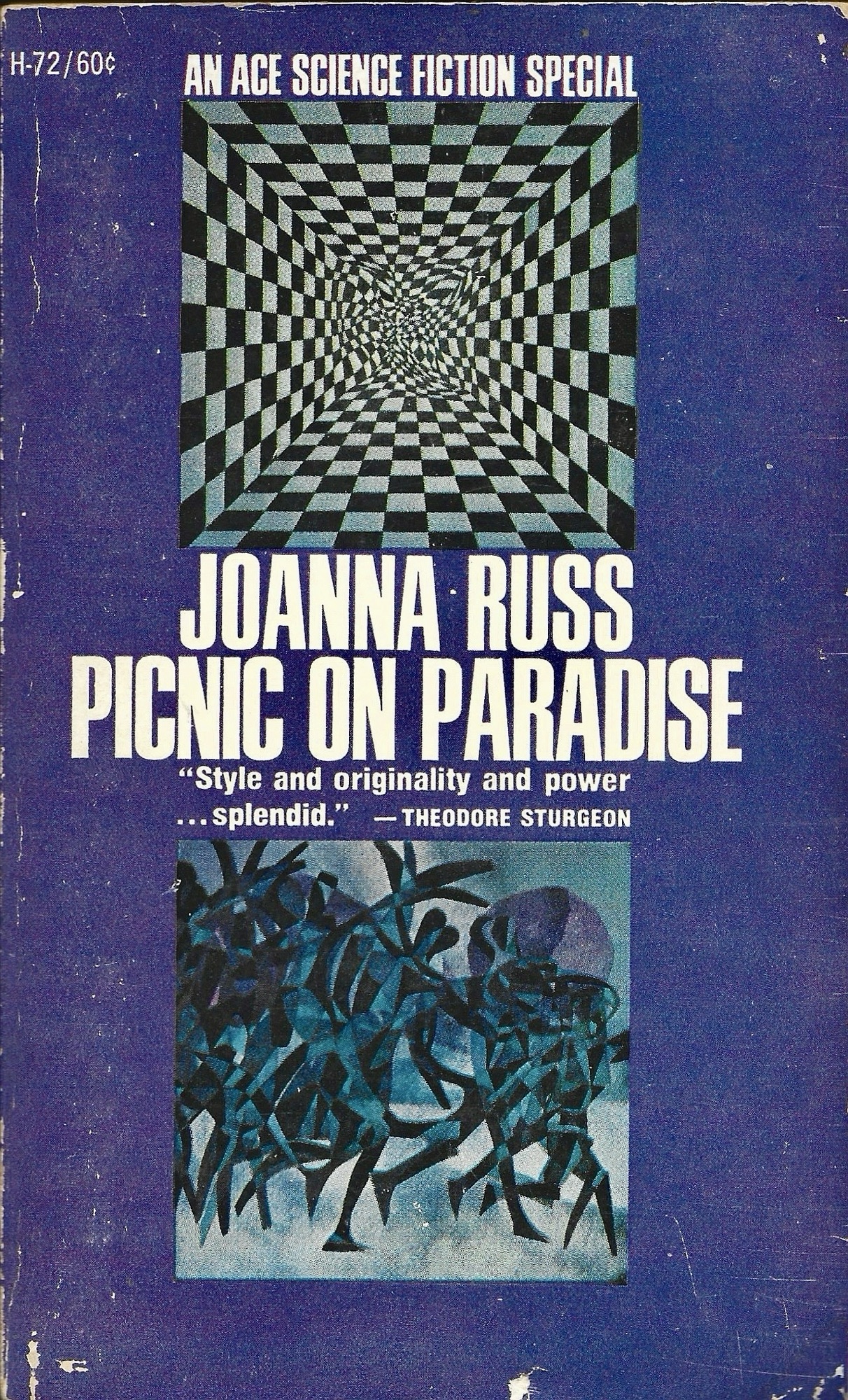
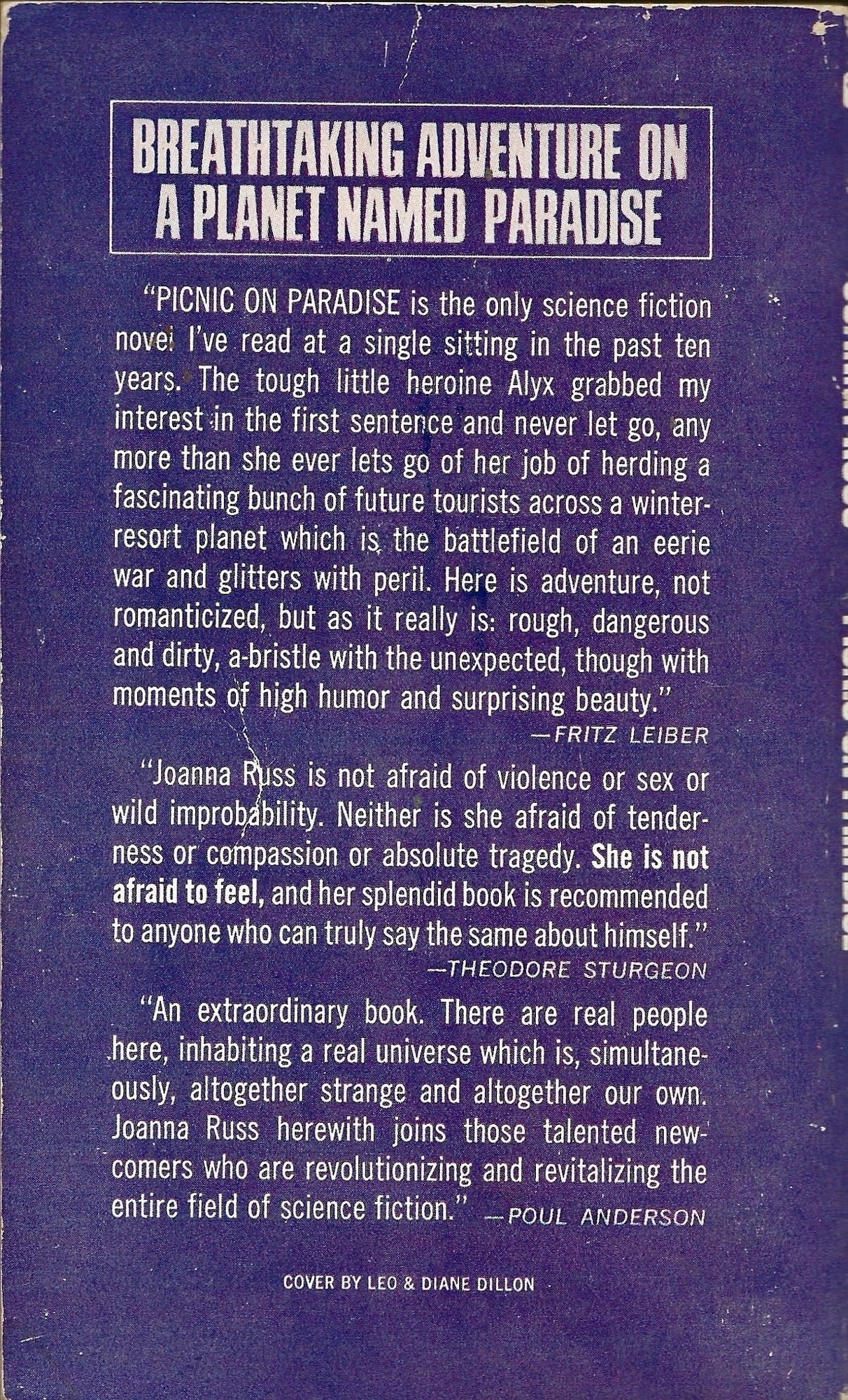
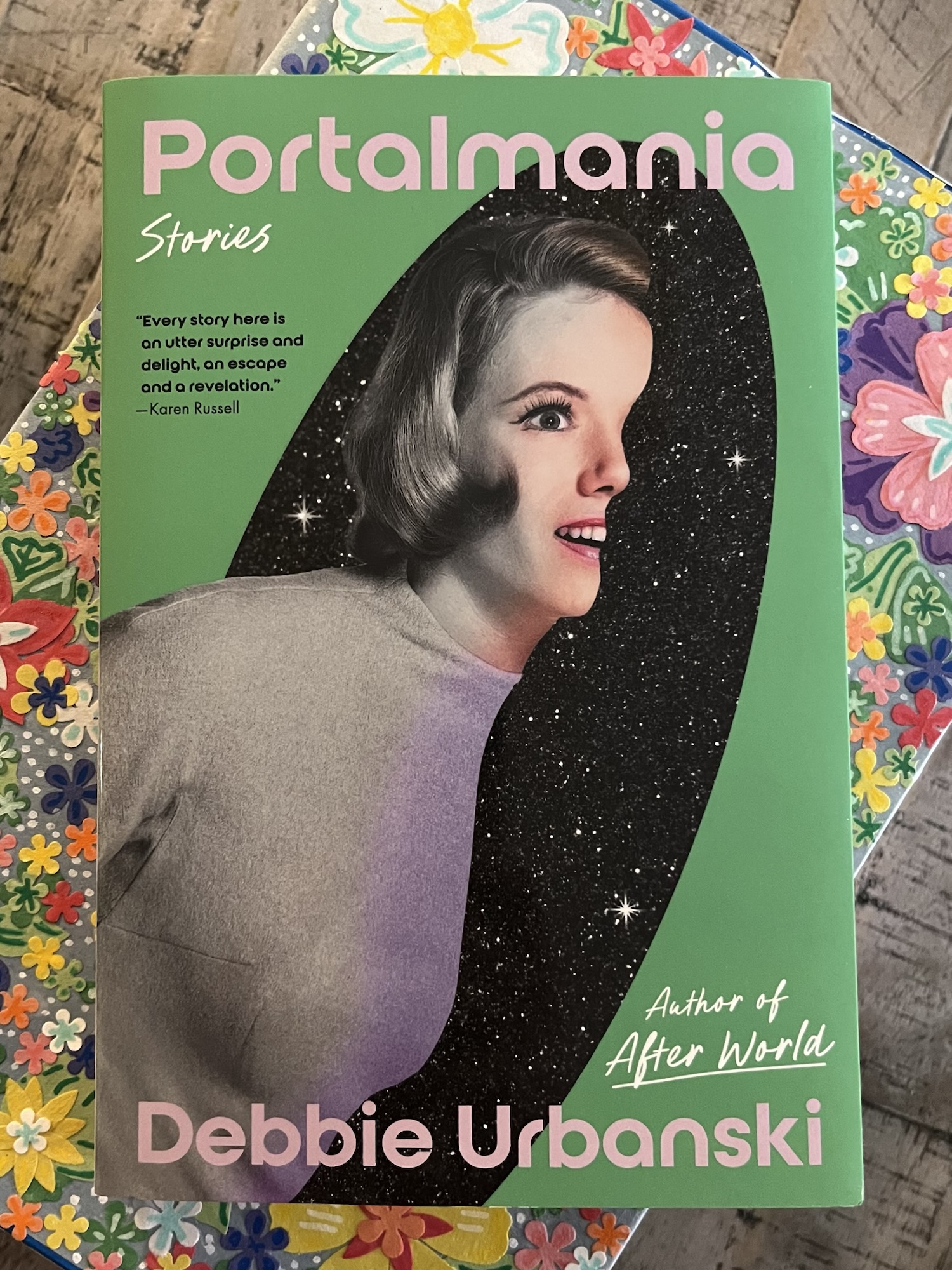


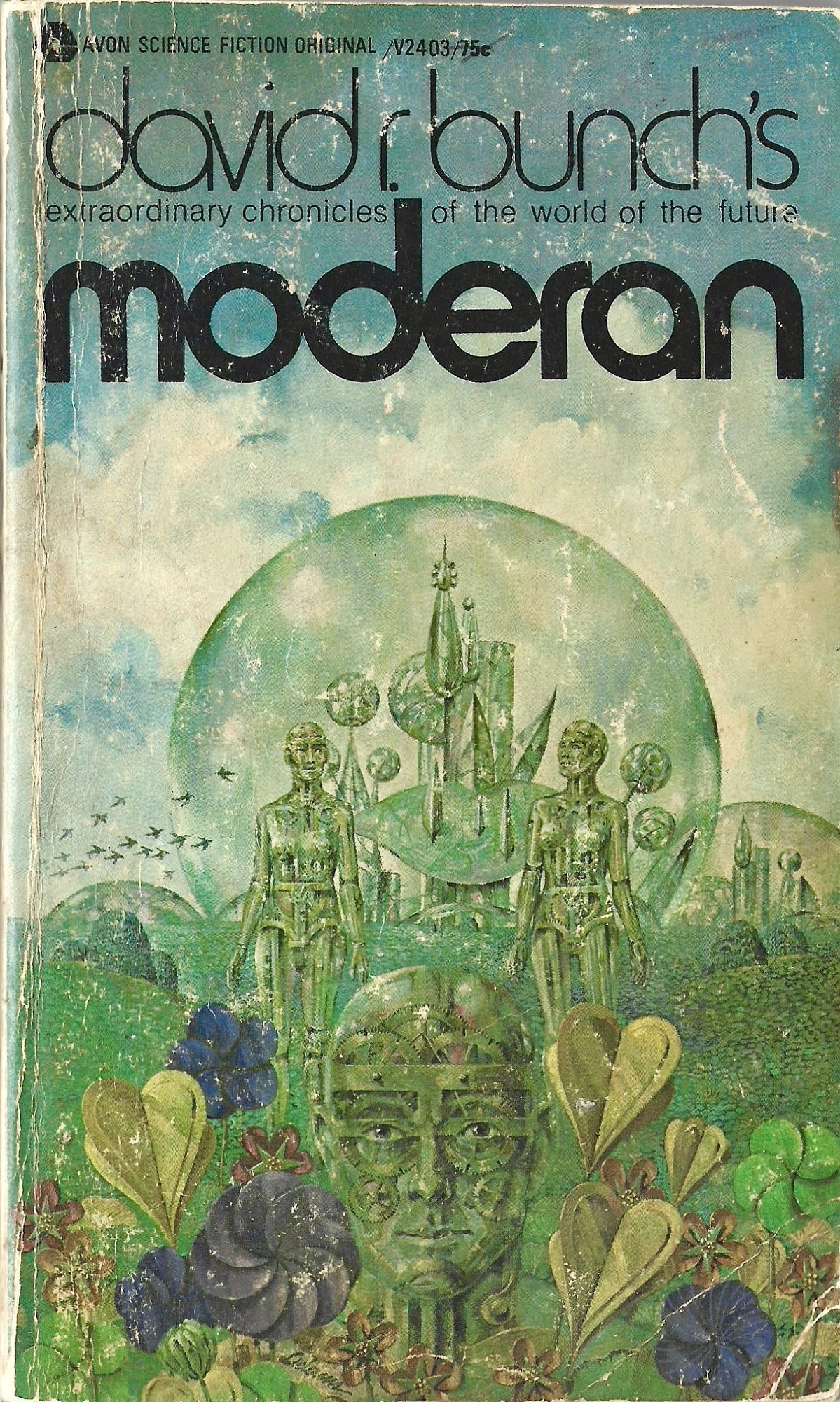
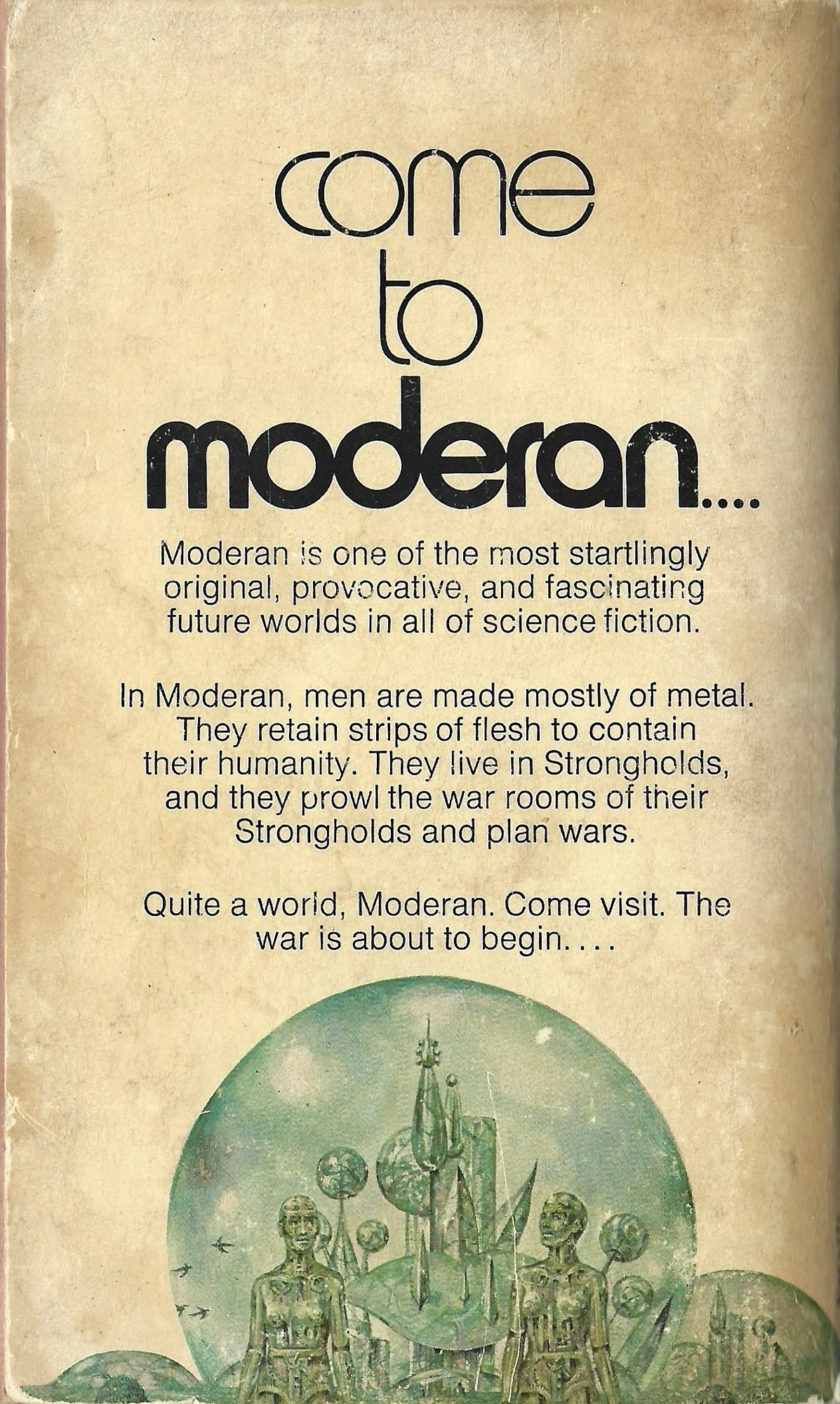


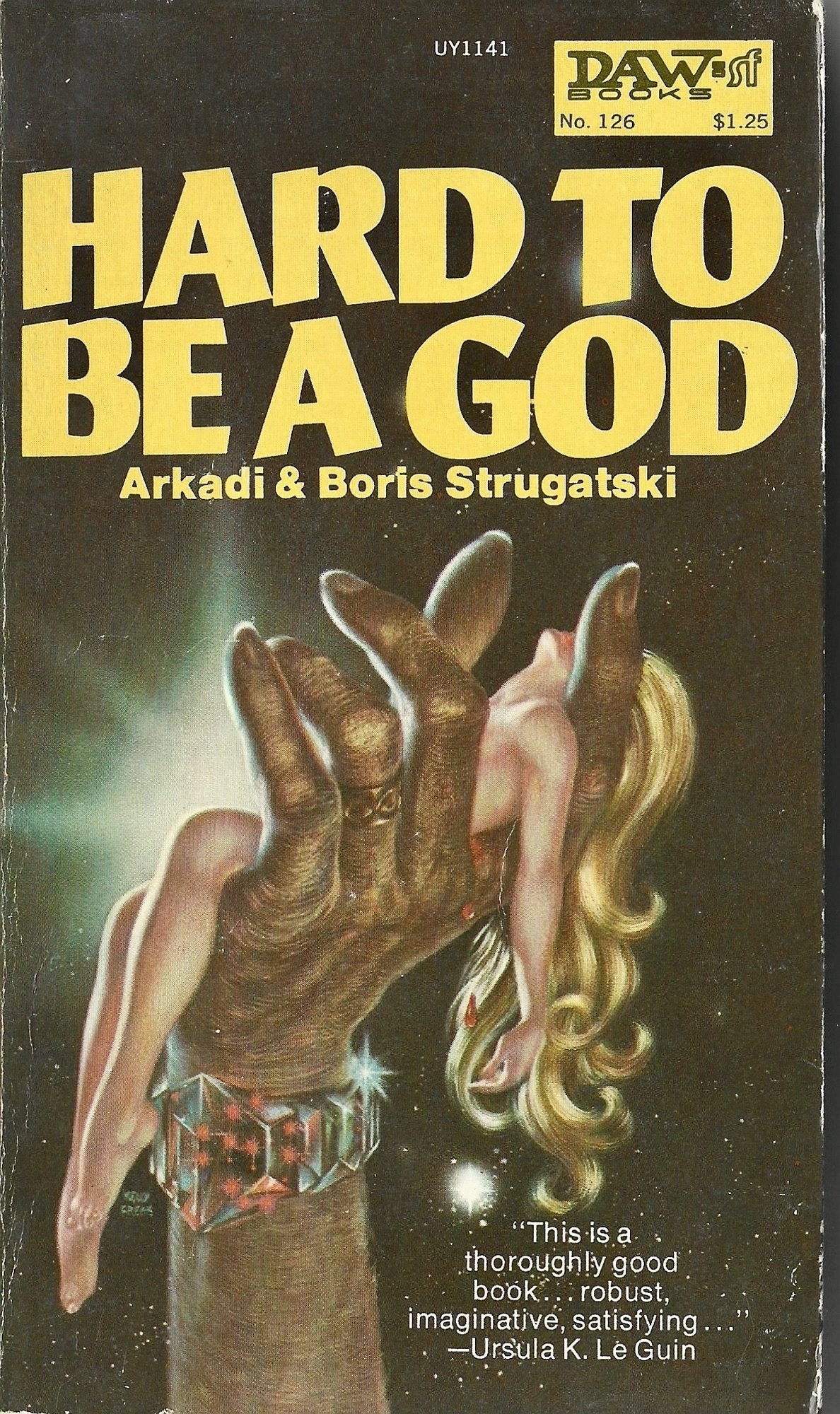
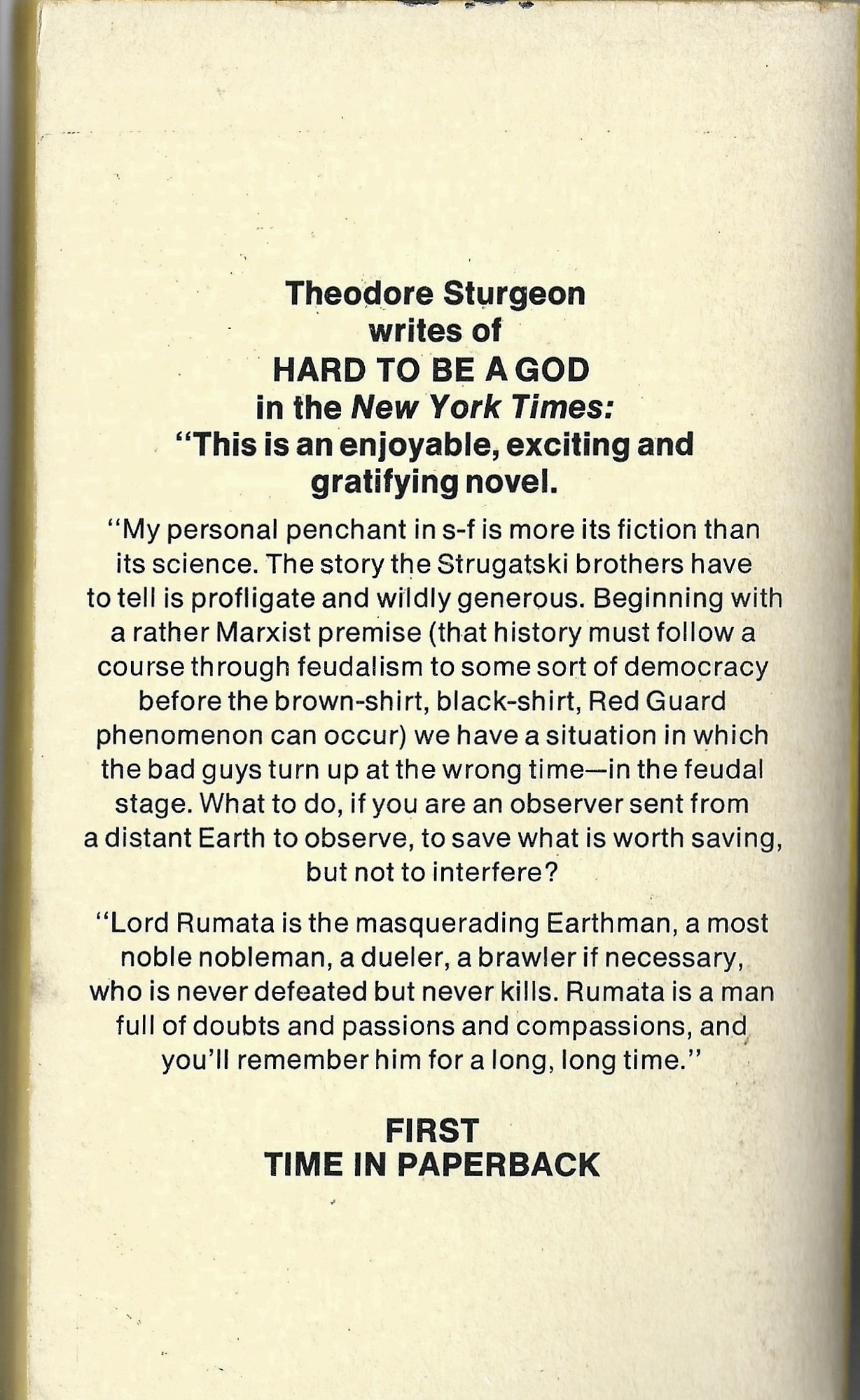
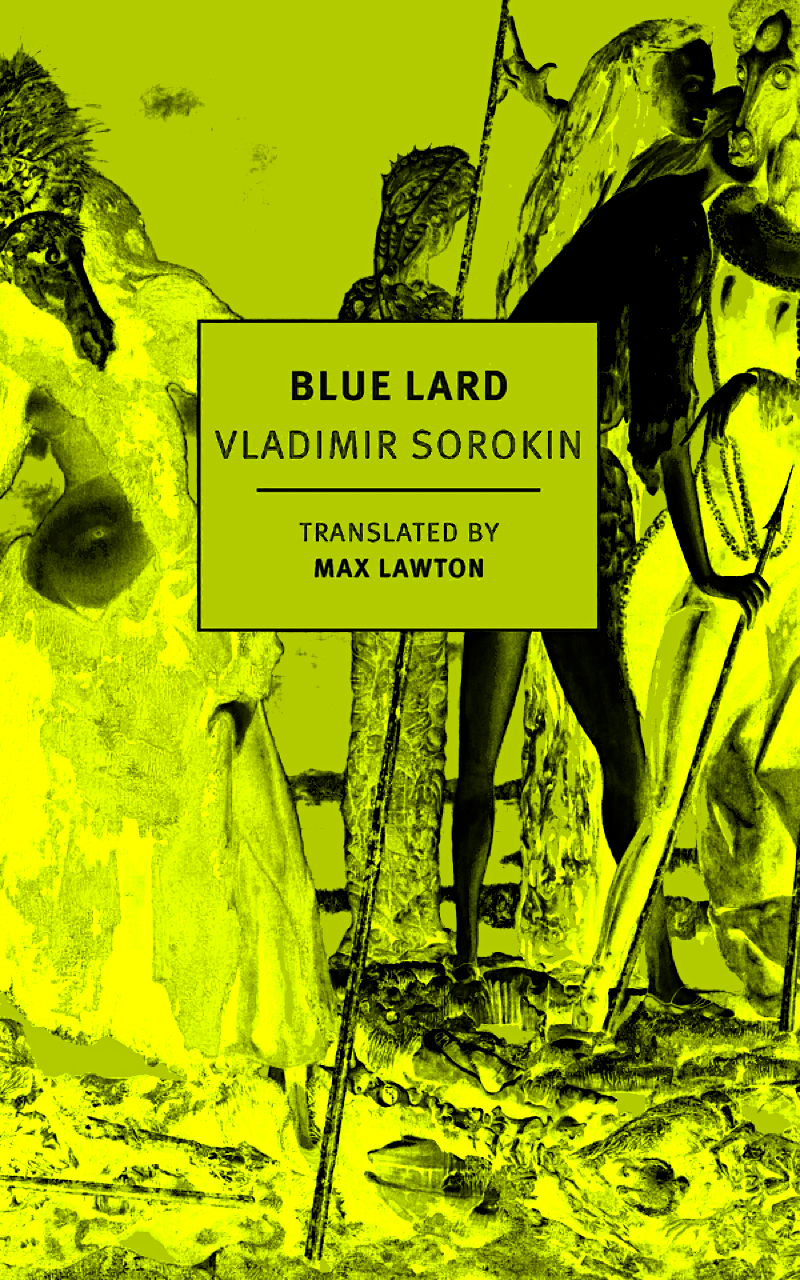 Previously on Blue Lard…
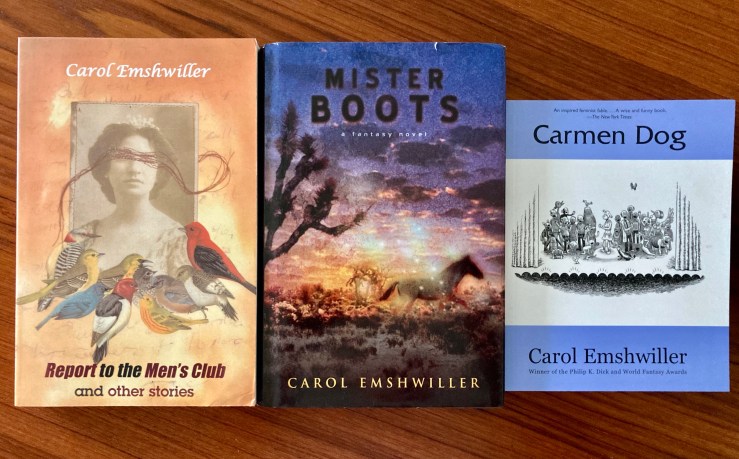 Small Beer Press had a warehouse sale last month, so I ordered two by the late avant-garde sci-fi writer Carol Emshwiller. I ordered Carmen Dog, which is what I take to be her most lauded novel, based on this blurb from Ursula Le Guin:





 Biblioklept