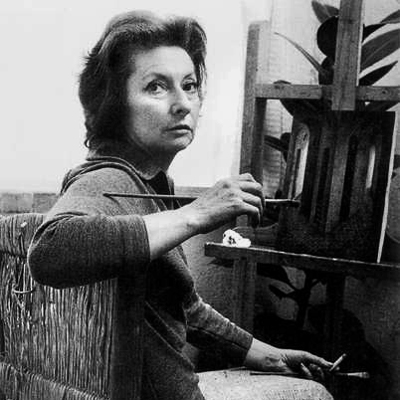
Surrealist Women: An International Anthology (ed. Penelope Rosemont)
“The Birds”
One
He pulled the blanket over and he drew up the blind. The yellow mice rushed into their corners. The spiders ran behind the pictures. The lecture began on Christ the Forerunner. Only the very young mice sat still to listen. The blackbirds flying near the window passed the word to each other. “Come on. Here we may find something. Something to put our beaks into.” Snap went the window cord; down came the blind. The birds, disappointed, did the best they could. They flew nearer and nearer the windowpane. It was dangerous. It wasn’t worth it. But they wanted to get the news—to be the first to know—to pass on the news. What had come to the lecture on Christ? Did one still lie under the blankets? The spiders laughed into their hands to think of the birds outside all twittering and over-anxious.
Two
As she walked into the garden the birds flew down to her pecking at her lips, “Don’t do that,” she cried, “It’s mine. I’m alive you know.” “Well, why don’t you wear colors?” She heard them talking. “Dead people walk, but they don’t wear colors. They scream and they talk too.” The birds went on chattering about dead people. They all perched up on the holly bush but they didn’t peck the soft berries. They just stared down at her. All of them stared with their little black beady eyes. They were looking at her red lips.
Three
“Sing a song for the King. Come on, now sing.” The child was shy to start, but her mother, standing behind her gave her a little push which startled her into opening her mouth and she began, “Wasn’t that a dirty dish to set before the king?” “Begin again dear,” whispered her mother, “at the first line,” “O.k. ma,” and she chanted, “Four and twenty black… oooh,” for a peacock had walked in front of her and spread out its tail and croaked “Frico. Frico.” The little girl went very white. “Frico. Frico,” she said. The birds, who had been sitting on the cornice as part of the decoration, flew down into the court and circled about the heads of the King and Courtiers, fluttering as close as possible. All the people flapped their hands helplessly. Suddenly the little girl pointed at the King. “You must get out of here,” she said in a grown-up voice. “This is their Palace.”
On the 25th March, 18—, a very strange occurrence took place in St Petersburg. On the Ascension Avenue there lived a barber of the name of Ivan Jakovlevitch. He had lost his family name, and on his sign-board, on which was depicted the head of a gentleman with one cheek soaped, the only inscription to be read was, “Blood-letting done here.”
On this particular morning he awoke pretty early. Becoming aware of the smell of fresh-baked bread, he sat up a little in bed, and saw his wife, who had a special partiality for coffee, in the act of taking some fresh-baked bread out of the oven.
“To-day, Prasskovna Ossipovna,” he said, “I do not want any coffee; I should like a fresh loaf with onions.”
“The blockhead may eat bread only as far as I am concerned,” said his wife to herself; “then I shall have a chance of getting some coffee.” And she threw a loaf on the table.
For the sake of propriety, Ivan Jakovlevitch drew a coat over his shirt, sat down at the table, shook out some salt for himself, prepared two onions, assumed a serious expression, and began to cut the bread. After he had cut the loaf in two halves, he looked, and to his great astonishment saw something whitish sticking in it. He carefully poked round it with his knife, and felt it with his finger.
“Quite firmly fixed!” he murmured in his beard. “What can it be?”
He put in his finger, and drew out—a nose!
Ivan Jakovlevitch at first let his hands fall from sheer astonishment; then he rubbed his eyes and began to feel it. A nose, an actual nose; and, moreover, it seemed to be the nose of an acquaintance! Alarm and terror were depicted in Ivan’s face; but these feelings were slight in comparison with the disgust which took possession of his wife.
“Whose nose have you cut off, you monster?” she screamed, her face red with anger. “You scoundrel! You tippler! I myself will report you to the police! Such a rascal! Many customers have told me that while you were shaving them, you held them so tight by the nose that they could hardly sit still.”
But Ivan Jakovlevitch was more dead than alive; he saw at once that this nose could belong to no other than to Kovaloff, a member of the Municipal Committee whom he shaved every Sunday and Wednesday.
“Stop, Prasskovna Ossipovna! I will wrap it in a piece of cloth and place it in the corner. There it may remain for the present; later on I will take it away.”
“No, not there! Shall I endure an amputated nose in my room? You understand nothing except how to strop a razor. You know nothing of the duties and obligations of a respectable man. You vagabond! You good-for-nothing! Am I to undertake all responsibility for you at the police-office? Ah, you soap-smearer! You blockhead! Take it away where you like, but don’t let it stay under my eyes!”
Ivan Jakovlevitch stood there flabbergasted. He thought and thought, and knew not what he thought.
“The devil knows how that happened!” he said at last, scratching his head behind his ear. “Whether I came home drunk last night or not, I really don’t know; but in all probability this is a quite extraordinary occurrence, for a loaf is something baked and a nose is something different. I don’t understand the matter at all.” And Ivan Jakovlevitch was silent. The thought that the police might find him in unlawful possession of a nose and arrest him, robbed him of all presence of mind. Already he began to have visions of a red collar with silver braid and of a sword—and he trembled all over.
At last he finished dressing himself, and to the accompaniment of the emphatic exhortations of his spouse, he wrapped up the nose in a cloth and issued into the street.
He intended to lose it somewhere—either at somebody’s door, or in a public square, or in a narrow alley; but just then, in order to complete his bad luck, he was met by an acquaintance, who showered inquiries upon him. “Hullo, Ivan Jakovlevitch! Whom are you going to shave so early in the morning?” etc., so that he could find no suitable opportunity to do what he wanted. Later on he did let the nose drop, but a sentry bore down upon him with his halberd, and said, “Look out! You have let something drop!” and Ivan Jakovlevitch was obliged to pick it up and put it in his pocket.
A feeling of despair began to take possession of him; all the more as the streets became more thronged and the merchants began to open their shops. At last he resolved to go to the Isaac Bridge, where perhaps he might succeed in throwing it into the Neva.
But my conscience is a little uneasy that I have not yet given any detailed information about Ivan Jakovlevitch, an estimable man in many ways.
Like every honest Russian tradesman, Ivan Jakovlevitch was a terrible drunkard, and although he shaved other people’s faces every day, his own was always unshaved. His coat (he never wore an overcoat) was quite mottled, i.e. it had been black, but become brownish-yellow; the collar was quite shiny, and instead of the three buttons, only the threads by which they had been fastened were to be seen. Continue reading ““The Nose,” an absurd tale by Nikolai Gogol”→
From Surrealist Women: An International Anthology (ed. Penelope Rosemont). The text is from the catalog, Alice Rahon, Willard Gallery, New York, 1951
In earliest times painting was magical; it was the key to the invisible. In those days the value of a work lay in its powers of conjuration, a power that talent alone could not achieve. Like the shaman, the sibyl, and the wizard, the painter had to make himself humble, so that he could share in the manifestation of spirits and forms. The rhythm of our life today denies the primordial principle of painting; conceived in contemplation, the emotional content of of the picture cannot be perceived without contemplation.
The invisible speaks to us, and the world it paints takes the form of apparitions; it awakens in each of us that yearning for the marvelous and shows us the way back to it—the way that is the great conquest of childhood, and which is lost to us with the rational concepts of education.
Perhaps we have seen the Emerald City in some faraway dream that belongs to the common emotional fund of man. Entering by the gate of the Seven Colors, we travel along the Rainbow.
We enjoyed a lovely week between Christmas and New Year’s in Mexico City — great food, great people, great art. I especially enjoyed getting to see paintings by Remedios Varo, one of my favorite artists ever, at the Museo de Arte Moderno in Chapultepec Park.
La huida (The Escape) 1955La huida (The Escape), detail, 1955Roulette (Caravan), 1955Roulette (Caravan), detail, 1955Carta de tarot (Tarot Card), 1957El flautista (The Flutist), 1955El vagabundo (The Vagabond), detail, 1957Paraiso de los gatos, (Cat’s Paradise), detail, 1955Study for Presencia inquietante (Disquieting Presence), detail,1959
Ireland and Scotland are remote; Wales fares little better. Here in this forest of tall, white beanwoods, the already-beautiful saunter. Some of them carry plump red hams, already cooked.
I am, at the moment, seated. On a chair in the forest, listening. I will rise, shortly, to hold the ladder for you. Every beanwood will have its chandelier scattering light on my exercise machine, which is made of cane. The beans you have glued together are as nothing to the difficulty of working with cane, at night, in the dark, in the wind, watched by insects. I will not allow my exercise machine to be photographed. It sings, as I exercise, like an unaccompanied cello. I will not allow my exercise machine to be recorded.
Tombs are scattered through the beanwoods, made of perfectly ordinary gray stone. All are empty. The chandeliers, at night, scatter light over the tombs, little houses in which I sleep, from time to time, with the already-beautiful, and they with me. We call to each other, at night, saying “Hello, hello” and “Who, who, who?” That one has her hips exposed, for rubbing.
Holding the ladder, I watch you glue additional chandeliers to appropriate limbs. You are tiring, you have worked very hard. Iced beanwater will refresh you, and these wallets made of ham. I have been meaning to speak to you. I have set bronze statues of alert, crouching Indian boys around the periphery of the forest, for ornamentation. Each alert, crouching Indian boy is accompanied by a large, bronze, wolf-like dog, finely polished.
I have been meaning to speak to you. I have many pages of notes. I have a note about cameras, a note about recorders, a note about steel wool, a note about the invitations. On weightier matters I will speak without notes, freely and passionately, as if inspired, at night, in a rage, slapping myself, great tremendous slaps to the brow which will fell me to the earth. The already-beautiful will stand and watch, in a circle, cradling, each, an animal in mothering arms — green monkey, meadow mouse, tucotuco. That one has her hips exposed, for study. I make careful notes. You snatch the notebook from my hands.
The pockets of your smock swinging heavily with the lights of chandeliers. Your light-by-light, bean-by-bean career.
I am, at this time, prepared to dance. The already-beautiful have, historically, danced. The music made by my exercise machine is, we agree, danceable. The women partner themselves with large bronze hares, which have been cast in the attitudes of dancers. The beans you have glued together are as nothing to the difficulty of casting hares in the attitudes of dancers, at night, in the foundry, the sweat, the glare. Thieves have been invited to dinner, along with the deans of the great cathedrals. The thieves will rest upon the bosoms of the deans, at dinner, among the beanwoods. Soft benedictions will ensue.
I am privileged, privileged, to be able to hold your ladder.
Pillows are placed in the tombs, together with pot holders and dust cloths. The already-beautiful strut. England is far away, and France is scarcely nearer. I am, for the time being, reclining. In a warm tomb, with Concordia, who is beautiful. Mad with bean wine she has caught me by the belt buckle and demanded that I hear her times tables. Her voice enchants me. Tirelessly you glue. The forest will soon exist on some maps, a tribute to the quickness of the world’s cartographers. This life is better than any life I have lived, previously. I order more smoke, which is delivered in heavy glass demi-johns, twelve to a crate. Beautiful hips abound, bloom. Your sudden movement toward red kidney beans has proved, in the event, masterly. Everywhere we see formal gowns of red kidney beans, which have been polished to the fierceness of carnelians. No ham hash does not contain two beans, polished to the fierceness of carnelians.
Spain is distant, Portugal wrapped in an impenetrable haze. These noble beans, glued by you, are mine. Thousand-pound sacks are off-loaded at the quai, against our future needs. The thieves are willing workers, the deans, straw bosses of extraordinary tact. I polish hares, dogs, Indian boys in the chill of early morning. Your weather reports have been splendid. The fall of figs you predicted did in fact occur. There is nothing like ham in fig sauce, or almost nothing. I am, at the moment, feeling very jolly. Hey hey, I say. It is remarkable how well human affairs can be managed, with care.
Five years ago, I was fortunate enough to interview Margaret Carson about her translation of a collection of the artist Remedios Varo’s written work. Margaret has since expanded on that collection, adding new material from her dive into Varo’s archives, resulting in On Homo rodans and Other Writings, new this summer from Wakefield Press.On Homo rodans and Other Writings offers readers a fascinating trip through Varo’s imagination. Brimming with impossible images, surreal jokes, and dreamy fragments, the work is more than just an addendum to Varo’s career as an artist. I highly recommend it to those interested in surrealist writing in general. Margaret was kind (and patient!) enough to talk with me again over the course of a few weeks via email. I am grateful for her generosity and for her work in bringing Varo’s words to monoglots such as myself.
In addition to her Varo books, Margaret Carson’s translations include Sergio Chejfec’s Baroni, A Journeyand My Two Worlds. She is Associate Professor in the Modern Languages Department at Borough of Manhattan Community College, The City University of New York.
Photograph of Margaret Carson by Beowulf Sheehan.
Biblioklept: Margaret, congratulations on the publication of On Homo rodans and Other Writings, the expanded edition of your English translation of Remedios Varo’s writings! Many of our readers might be familiar with Varo’s wonderful paintings but not know about her writing. How would you characterize the prose collected in On Homo rodans and Other Writings?
Margaret Carson: Thanks, it’s great to have the translation back in print! It’s mainly writings found after Remedios Varo’s death in notebooks and on loose pages. The writings are quite varied: several odd and delightful stories (three of them new to this edition), a fairy tale, letters to friends and strangers, her famous recipe “To Provoke Erotic Dreams,” a poem that invokes the moon, dream narratives, and a few other gems, such as the title piece, “On Homo rodans,” a faux anthropological treatise that accompanied her sculpture of a human-like torso on a giant wheel, made out of chicken, turkey and fish bones.
Homo rodans sculpture in its glass case. Photograph by Margaret Carson.
Varo’s extraordinary creativity and weird sense of humor come across just as much in her writings as in her paintings. I think readers fascinated by Varo, the artist, will also be won over by her gifts as a writer. Simply put, she’s as clever a writer as she is a painter.
Biblioklept: So, let’s get into the stories and other material new to this edition and how you came to translate it into English. Some of this material hasn’t been published before, even in Spanish. If my understanding is correct, Walter Gruen, Varo’s last life partner, donated a significant collection of her works to the Museo de Arte Moderno in Mexico City in 2000. In 2018—after the publication of your translated collection Letters, Dreams & Other Writings—the Varo estate bequeathed more of Varo’s writings to the Museo de Arte Moderno. Is that right?
MC: Yes. In the early 2000s Walter Gruen and his wife Anna Alexandra Varsoviano (a friend of Varo’s who he married after the artist’s death) donated about thirty-eight of her works to the Museo de Arte Moderno (MAM), making it the largest repository of paintings by Varo in the world. Walter Gruen died in 2008, and Anna Alexandra Varsoviano in 2015. (I was lucky enough to meet them both in person: Walter Gruen in 2000 and Anna Alexandra Varsoviano some years later.) In her will, Anna Alexandra bequeathed a trove of Varo’s notebooks, letters, preparatory drawings, photos, and other items to MAM, many of which were displayed in 2018 in an exhibition celebrating the donation: Adictos A Remedios Varo: Nuevo Legado 2018. It was at that exhibition that I first saw Varo’s notebooks, open to pages containing narratives, letters and other pieces, in Varo’s own handwriting. I could instantly recognize them because I’d translated the same texts for Letters, Dreams and Other Writings, except for that book I used a collection of Varo’s writings published in Mexico in the 1990s, Cartas, sueños y otros textos, edited by the Spanish scholar Isabel Castells.
Because the new Wakefield edition mostly uses archival materials as its source, and isn’t a direct translation of texts from an existing book, the estate requested that we give it a new title. So, thinking about Varo’s tour-de-force anthropological spoof, we renamed it On Homo rodans and Other Writings.
A page from the Homo rodans manuscript. Photograph by Margaret Carson.
Biblioklept: What kind of access did the museum give you to the manuscript materials?
MC: When I requested an appointment to consult the archive at MAM, I indicated my area of interest: Varo’s notebooks and any stray papers relating to her writings. So when I visited for a few days in July 2022, an archivist assisted me by bringing out her notebooks one at a time as well as folders containing loose papers. You can’t imagine how excited I was not only to see but to touch these old, faded composition books and to turn their pages to discover what Varo had written or drawn on them. There are about a dozen notebooks in all, mostly school composition books for children. I was snapping photos right and left! I’m very grateful to the Museo and to their archivists for guiding me through the notebooks and for their interest in the project.
Cover of one of Varo’s notebooks. Photograph by Margaret Carson.
Biblioklept: Varo was born in Spain, and her painting career sparked in earnest in France, but she really flourished as a painter in Mexico. Her work seems to find a growing audience in the USA; do you have a sense of her reputation in Mexico?
MC: Remedios Varo came into her own as an artist in Mexico City; when she began to exhibit, she was an immediate success. Her first solo show, in 1956 at the Galería Diana, was a sell-out, as was a subsequent solo show in 1961. Sadly, Varo suddenly died in 1963. Her posthumous reputation is in large part due to Walter Gruen and his efforts to keep her in the public eye. The first catalog of her work, whose publication was overseen by Gruen and funded by Varo’s friend and patron Eva Sulzer, came out just three years after her death, in 1966, with contributions by some heavy hitters: the poet Octavio Paz, the French intellectual Roger Caillois, and the Mexican philosopher Juliana González, a personal friend of Varo’s. Since then, four editions of Varo’s catalogue raisonné have been published in Mexico, the last in 2008. (Alas, all are now out of print but available in many research libraries.) People are deeply fascinated by Varo’s paintings. Special exhibitions of her work at the Museo de Arte Moderno always draw record crowds (as they do in other cities as well, for example, the recent Remedios Varo: Science Fictions exhibition in Chicago, which was one of their best attended shows ever).
Biblioklept: Gruen seems to have led a fascinating life.
MC: Yes, but not without its tragedies. The little I know comes from Janet Kaplan’s biography of Varo, his obituary in the Mexican daily La Jornada, and from the Adictos a Remedios Varo catalog. Like Varo, he was fortunate to get out of war-torn Europe, but only after he experienced the worst. He was born in Austria, started medical school in the 1930s, got kicked out because he was Jewish, was arrested by the Gestapo and sent to Dachau and then Buchenwald. After liberation, he made his way to Mexico City with his wife Klari Willner and it was there that he met Varo and others in the European refugee community. His wife died in Mexico in a drowning accident in the late 1940s, while Varo was living in Venezuela. It was some time after Varo’s return to Mexico that she and Gruen got together. Gruen had established his record store by then, the Sala Margolín, which for decades was the essential go-to place for classical music fans in Mexico City.
A year after Varo’s death, in 1964, Gruen organized an exhibition of her work at the Palacio de Bellas Artes, and it’s at that show that Thomas Pynchon, on a trip to Mexico City, saw Embroidering the Earth’s Mantle /Bordando el manto terrestre, which was immortalized in the novel The Crying of Lot 49. Together with Anna Alexandra Varsoviano, Gruen worked to secure Varo’s legacy as an artist and to safeguard what she left behind. From the perspective of Varo’s writings, it was crucial that her notebooks and papers remain as a single cache of documents and not dispersed. After Varsoviano’s death, the entire archive including this collection of writings passed to the Museo de Arte Moderno.
Embroidering the Earth’s Mantle, 1961, Remedios Varo
Biblioklept: This new edition of Varo’s writings includes three stories that were previously unpublished, even in Spanish. Do you know why they weren’t published before now?
MC: No, I don’t know why. The stories are unquestionably in Varo’s handwriting, and they’re marvelous. It would be a good question to ask Walter Gruen or Anna Alexandra.
Biblioklept: Speaking of her handwriting—did you revise any of the material you’d already translated after seeing it in her manuscript?
MC: To some extent, yes. As I mentioned before, for Letters, Dreams …. (2018), I used as my source text a collection that had already been published in Mexico. As I was translating, I’d occasionally come across bracketed ellipses [. . .], and I wasn’t sure what was being signaled. Had a word or sentence in the original been cut, or was it illegible at that point? I found no editorial explanation, so I simply carried over the bracketed ellipses into the English.
In preparing this new edition, I made sure to look for those same bracketed passages in the manuscripts to see if I could discover what Varo had actually written. I found some wonderful things. All the ellipses in the Mistress Thrompston story, for example, were places where Varo had drawn weird mathematical formulas meant to be read as proper names. So now, instead of “[. . .] Magazine,” you’ll see that its name is “WTrons – X√yl Magazine.” The Marquis of Ornitobello’s daughter, whose name had been dropped completely, returns to the story: she’s called √Ax8. These are the little touches where you see Varo being Varo. She loved playing with math. In Disobedient Plant/Planta insumisashe even painted mathematical formulas into the hair of the scientist and into the tendrils of the plants. Happily, Wakefield Press was able to incorporate Varo’s mathematical doodles and other hand-drawn whimsies into the published book.
Disobedient Plant, 1958, Remedios Varo
Another kind of revision I made after seeing the manuscripts may seem trivial, but in all instances Varo wrote “etc.” not “et cetera,” so I restored “etc.” And in “On Homo rodans” she used the ligature “æ” in her invented Latin, so I restored that as well.
Something that surprised me on reading the original manuscripts was that Varo often wrote super-long sentences—what writing instructors would call “comma splices” or “run-ons.” I initially wanted to restore these sentences to their original length because in their raw state there’s a kind of fast-forward momentum. You get pulled along as she adds one thing after another to her narratives, almost breathlessly. But in the end, for the sake of readability, I normalized the punctuation a bit by breaking up some of the enormously long sentences.
There were maybe only one or two times when I changed the translation of a word after seeing that Varo had written something different from what the editor of the previous volume had transcribed. Nothing major. Of course, like all translators, I’m an obsessive reviser, so in preparing this new edition I couldn’t help but look over the previous translation to polish and tweak. I didn’t need the manuscripts for that. As they say, a translation is never finished….
Biblioklept: I’m curious if your “editor’s voice” clashed at all with your “translator’s voice” when it came to revising Varo’s comma splices and fused sentences. And were there clashes elsewhere, when it came to, say, new word choices?
MC: Hmm, I haven’t thought of the two roles clashing before. I think we worked pretty harmoniously together. The editor would have probably liked more time to revise the introduction and endnotes, and to think about the best way to order the texts within the book, while the translator, eager to get the translation back into print, was more like, “Let’s wrap up!”
Biblioklept: One section new to this edition are a handful of brief poemish texts collected as “Images in Words.” A few of these word-image-poem-texts (?!) contain strikethroughs and doodles, as you mentioned before. Many of these pieces feature phrases that correspond to motifs we see in Varo’s visual art (trees, pulleys, stars, knitters, etc.). To your knowledge, do these image fragments correspond to any of Varo’s paintings? Do you have a sense that these were “plans” for paintings–pieces of visual art that started in language first?
MC: It’s difficult to know with any certainty, but they do seem like plans for paintings that started off in language first. They could be Varo’s earliest ideas: flashes of images, possibly from dreams, that she developed as preliminary drawings and eventually, fully fleshed out in paintings.
When Varo was once asked if she was a writer as well as a painter, she replied, “I sometimes write as if I were making a sketch” (“A veces escribo como si trazase un boceto”).A lot has been made of that one sentence because it’s the only time we know of that Varo speaks of her writing. I used to think she was very modestly describing her writing as a whole, including her creative writing, but now I believe she was referring specifically to these poem-like fragments, these sketches in words. When an idea came to her, I imagine her grabbing her notebook and opening it to a blank page, sometimes to make a quick sketch, other times to jot down a few words. Sometimes she did both on the same page.
Do the fragments correspond to any paintings? Yes, if you’re familiar with her work, you can immediately make connections. For example, from the bottom of p. 131:
character from peeling wall participating in something with another character who is real
Metamorphosis
Mimicry
The abandoned room, someone inside the table, inside the armchair
as well, perhaps inside the wall — — — —
The first two lines seem to describe the painting Harmony / Armonía, in which there’s an ethereal figure emerging from a peeled-back wall to play with an object on a musical staff (a snail?). The other “real” character sits at a table across from the apparition and plays with a polyhedron-like object on the staff. Why did Varo cross the lines out? Walter Gruen speculated that it was because she had finished the painting.
Harmony, 1956, Remedios Varo
The next two lines refer to the well-known painting Mimesis / Mimetismo, in which she depicts a woman undergoing a metamorphosis – she’s taking on the characteristics of the chair she’s sitting in. (Side note: Varo’s catalogue raisonné translates the title of this painting as Mimesis, which isn’t wrong, but it makes me think more of the Erich Auerbach book and literary mimesis. I believe a better English translation would be “Mimicry,” as in insect mimicry, a phenomenon of particular interest to the surrealists. See Roger Caillois’s 1935 essay “Mimétisme et psychasthénie légendaire,” in the surrealist journal Minotaure).
They represent just one moment in the evolution of an artist’s idea. It’s said that Varo was very private in her studio practice. No one knows for sure, but it’s likely she used her notebooks (which also doubled as sketchbooks) at the earliest stages of a painting, when her ideas were hatching.
Biblioklept: Can you expand on how Varo was private in the studio?
MC: I can only talk about her studio in a limited way, from clues provided in photos and in a few accounts. I also talked a bit about Varo’s apartment-studio with Xabier Lizarraga Cruchaga, her godson, who as a boy used to visit Varo in her studio quite often (so she didn’t completely exclude visitors). Her studio was a room on the top floor of the building she lived in, accessible by a private flight of stairs. A wide doorway in the studio opened to a small, north-facing terrace where she kept plenty of plants. You can see the studio in a series of photos Kati Horna took of Varo for a magazine article that appeared in 1960. In the article, two photos show Varo at work, one at a drafting table and the other at her easel. The painting on the easel is Farewell /La despedida, with only the architectural elements of the painting in place (she would later add the departing lovers, their shadows, and the cat that looks on). Observe the white lump on the left side of the easel. That’s a piece of quartz. She apparently used quartz to incise fine lines into her paintings to expose the gesso underneath. Quartz comes up a few times in her writings as well. Let’s say she had an affinity for quartz and its mysterious qualities.
She also mentions her studio in one of her dream narratives, which begins like this:
“I dreamed I was asleep in my bedroom and a loud noise woke me up. The noise came from upstairs, from the studio, and it was as if someone were dragging a chair. I thought that this meant someone was trying to get in from the terrace and was pushing the armchair that was against the door.” (p. 100)
She goes on to narrate a terrifying dream, but note that she’s indirectly giving the basic layout of her apartment-studio.
As to her practices while at work in her studio, more and more is being written in English. In fact, for the first time ever, an in-depth investigation of her paintings by art conservators was done in connection with the recent Remedios Varo: Science Fictionsexhibition at the Art institute of Chicago. For an excellent overview of Varo’s approaches as an artist, and for descriptions of some of her techniques, check out this blog post by members of the AIC curatorial team.
Biblioklept: Varo didn’t strongly pursue exhibiting her art, and she didn’t publish any of her writing in her lifetime, right? Why do you think that was?
MC About her artwork, that’s not true. Varo was totally out there as an artist and very much interested throughout her career in exhibiting her work. As an emerging artist in the 1930s, she didn’t sit back and wait for things to happen. In the 1930s she moves to Barcelona, the home of the avant-garde in Spain, and joins artists who were radically breaking with whatever the conventions were back then. She’s on the map as an artist of note as early as 1936, when her paintings are included in the landmark Exposició Logicofobista in Barcelona. Later, after the Spanish Civil War breaks out and she moves to Paris, she’s in the 1938 Exposition Internationale du Surréalisme and images of her work are published in important Surrealist journals such as Minotaure and Trajectoire du rêve. After the Nazi invasion of France, she flees Europe for Mexico City in 1941 and there’s a pause in her exhibitions (she turned to commercial art to make a living) until 1955, when she exhibits new paintings in a group show of women artists that includes Leonora Carrington and Alice Rahon.
Announcement for “Seis pintoras.” Photograph by Margaret Carson.
This is Varo’s breakthrough show in Mexico City. The following year she is offered her first solo show, which is a great success, leading to new commissions and to (among other things) the magazine article I mentioned above with photos by Kati Horna. In no way did she have a secret life as a painter.
Remedios Varo Wearing a Mask by Leonora Carrington, 1957. Photograph by Kati Horna.
We don’t know as much about her ambitions as a writer, but she wasn’t secretive about that, either. She definitely collaborated with Leonora Carrington on some writings—for example, they have a collaborative play, El santo cuerpo grasoso, not translated yet into English. In this new edition there’s Varo’s part of what I believe was an exquisite corpse novel written with Carrington. Another “public” writing is the title piece of the collection, On Homo rodans. It’s a handwritten manuscript that was never published in the marketplace sense of the word. But Varo certainly intended for others to read it, if only a small audience of friends. (After her death On Homo rodans would be published in a small facsimile edition of 250 copies, put out by a small press in Mexico City in 1970.)
The surprise is that Varo’s excellence as a writer and storyteller still goes unmentioned. It’s a small body of writings, but some of these stories are remarkable. For example, the first three: “In a field in the state of Morelos…,” “Dear friend, I believe it’s necessary to tell you…” “One day when Maria was coming back from school…” (They have no titles, so they’re identified by their opening lines.) I was astounded, amused, captivated when I first read them….talk about the pleasures of the text! Who knew she was such a talented writer? I’m hoping that people who are passionate about Varo, the artist, will be curious about her writings and will find some powerful connections there to her art—and that they’ll also stay with her for her writing alone.
Margaret told me via email that On Homo rodans and Other Writings “includes a few new stories and other interesting things that [she] found in the archive in Mexico City in 2022, and also has a rearranged presentation of everything (as requested by the estate).” I hope to have a second interview with Margaret on this new collection soon; in the meantime, check out our conversation from 2019.
I was quite excited earlier this week to get a pair of books in new English translations from the Czech publisher Twisted Spoon Press.
I started in on Gerhard Rühm’s Cake & Prostheses (translated from the German by Alexander Booth) late last night and kept reading and reading, greedily consuming the surreal, poetic “mini dramas” as thought experiments played out in my head. Here’s an early example of one:
practiced biblical saying
catechist : love thy neighbor as thyself.
exegete: i hate myself! (gives the former a hard hook to the chin tho crumples him to the floor).
I’ll admit I didn’t know of Gerhard Rühm, but I’m enjoying Cake & Prostheses and hope to muster a review in the next week or so. Here’s Twisted Spoon’s blurb:
An inveterate experimenter with image and text and music, Gerhard Rühm is truly one of the major figures of the postwar European avant-garde. Yet reprehensibly little of his work has appeared in English. This edition brings together a selection of his work spanning the past seven decades, displaying a wide thematic range (as he has remarked, “there is nothing that cannot become part of one’s poetic universe”) and ingenious combinations of music, pornography, banality, humor, and mythology. The first section comprises “mini dramas,” the text often combined with images and musical notation to create sensorial episodes, the expression of a singular aesthetic perception. The second section is a wry deconstruction of Grillparzer’s play Hero and Leander that juxtaposes original passages with images from a swimming manual and with a more contemporary erotic retelling of the mythological tale. The final section presents 24 short prose pieces: 12 from the early 1950s and 12 from the past few years.
I had heard of the surrealist Romanian poet Max Blecher, but am still largely unfamiliar with his work. Twisted Spoon is publishing his 1934 collection Transparent Body along with some, uh, other texts, in a translation by Gabi Reigh. Blurb:
Blecher’s very first book, the poetry collection Transparent Body, appeared in 1934, in a limited edition for bibliophiles. Yet general recognition as one of the most inventive European writers of his day came only with the publication of two of his three “novels” a few years later. And then he died, at the age of twenty-eight. But since 1930 Blecher had been publishing his poetry, short prose, essays, critiques, and other texts in the leading Romanian periodicals, some even appearing in important French publications, such as Le Surréalisme au service de la révolution. In addition, the past half century has seen the posthumous first publication of many texts in a variety of Romanian editions.
Transparent Body & Other Texts brings together Blecher’s entire output of poetry and short prose, from the earliest texts published during his lifetime to those appearing for the first time only recently. They range from stories in the vein of his fantastical, hallucinatory longer work to aphorisms, reportage, and notebook fragments. The volume also includes a selection of his correspondence with such major figures of Romanian interwar modernism as Geo Bogza, Ilarie Voronca, and Saşa Pană to give a fuller picture of Blecher’s engagement with the avant-garde and literary life even as his health was progressively deteriorating over the course of the 1930s.
Leonora Carrington’s novel The Hearing Trumpet begins with its nonagenarian narrator forced into a retirement home and ends in an ecstatic post-apocalyptic utopia “peopled with cats, werewolves, bees and goats.” In between all sorts of wild stuff happens. There’s a scheming New Age cult, a failed assassination attempt, a hunger strike, bee glade rituals, a witches sabbath, an angelic birth, a quest for the Holy Grail, and more, more, more.
Composed in the 1950s and first published in 1974, The Hearing Trumpet is new in print again for the first time in nearly two decades from NYRB. NYRB also published Carrington’s hallucinatory memoir Down Below a few years back, around the same time as Dorothy issued The Complete Stories of Leonora Carrington. Most people first come to know Carrington through her stunning, surreal paintings, which have been much more accessible (because of the internet) than her literature. However, Dorothy’s Complete Stories brought new attention to Carrington’s writing, a revival continued in this new edition of The Hearing Trumpet.
Readers familiar with Carrington’s surreal short stories might be surprised at the straightforward realism in the opening pages of The Hearing Trumpet. Ninety-two-year-old narrator Marian Leatherby lives a quiet life with her son and daughter-in-law and her tee-vee-loving grandson. They are English expatriates living in an unnamed Spanish-speaking country, and although the weather is pleasant, Marian dreams of the cold, “of going to Lapland to be drawn in a vehicle by dogs, woolly dogs.” She’s quite hard of hearing, but her sight is fine, and she sports “a short grey beard which conventional people would find repulsive.” Conventional people will soon be pushed to the margins in The Hearing Trumpet.
Marian’s life changes when her friend Carmella presents her with a hearing trumpet, a device “encrusted with silver and mother o’pearl motives and grandly curved like a buffalo’s horn.” At Carmella’s prompting, Marian uses the trumpet to spy on her son and daughter-in-law. To her horror, she learns they plan to send her to an old folks home. It’s not so much that she’ll miss her family—she directs the same nonchalance to them that she affords to even the most surreal events of the novel—it’s more the idea that she’ll have to conform to someone else’s rules (and, even worse, she may have to take part in organized sports!).
The old folks home is actually much, much stranger than Marian could have anticipated:
First impressions are never very clear, I can only say there seemed to be several courtyards , cloisters , stagnant fountains, trees, shrubs, lawns. The main building was in fact a castle, surrounded by various pavilions with incongruous shapes. Pixielike dwellings shaped like toadstools, Swiss chalets , railway carriages , one or two ordinary bungalows, something shaped like a boot, another like what I took to be an outsize Egyptian mummy. It was all so very strange that I for once doubted the accuracy of my observation.
The home’s rituals and procedures are even stranger. It is not a home for the aged; rather, it is “The Institute,” a cult-like operation founded on the principles of Dr. and Mrs. Gambit, two ridiculous and cruel villains who would not be out of place in a Roald Dahl novel. Dr. Gambit (possibly a parodic pastiche of George Gurdjieff and John Harvey Kellogg) represents all the avarice and hypocrisy of the twentieth century. His speech is a satire of the self-important and inflated language of commerce posing as philosophy, full of capitalized ideals: “Our Teaching,” “Inner Christianity,” “Self Remembering” and so on. Ultimately, it’s Gambit’s constricting and limited patriarchal view of psyche and spirit that the events in The Hearing Trumpet lambastes.
Marian soon finds herself entangled in the minor politics and scheming of the Institute, even as she remains something of an outsider on account of her deafness. She’s mostly concerned with getting an extra morsel of cauliflower at mealtimes—the Gambits keep the women undernourished. She eats her food quickly during the communal dinner, and obsesses over the portrait of a winking nun opposite her seat at the table:
Really it was strange how often the leering abbess occupied my thoughts. I even gave her a name, keeping it strictly to myself. I called her Doña Rosalinda Alvarez della Cueva, a nice long name, Spanish style. She was abbess, I imagined, of a huge Baroque convent on a lonely and barren mountain in Castile. The convent was called El Convento de Santa Barbara de Tartarus, the bearded patroness of Limbo said to play with unbaptised children in this nether region.
Marian’s creative invention of a “Doña Rosalinda Alvarez della Cueva” soon somehow passes into historical reality. First, she receives a letter from her trickster-aid Carmella, who has dreamed about a nun in a tower. “The winking nun could be no other than Doña Rosalinda Alvarez della Cueva,” remarks Marian. “How very mysterious that Carmella should have seen her telepathically.” Later, Christabel, another member/prisoner of the Institute helps usher Marian’s fantasy into reality. She confirms that Marian’s name for the nun is indeed true (kinda sorta): “‘That was her name during the eighteenth century,’ said Christabel. ‘But she has many many other names. She also enjoys different nationalities.'”
Christabel gives Marian a book entitled A True and Faithful Rendering of the Life of Rosalinda Alvarez and the next thirty-or-so pages gives way to this narrative. This text-within-a-text smuggles in other texts, including a lengthy letter from a bishop, as well as several ancient scrolls. There are conspiracies afoot, schemes to keep the Holy Grail out of the hands of the feminine power the Abbess embodies. There are magic potions and an immortal bard. There is cross-dressing and a strange monstrous pregnancy. There are the Knights Templar.
Carrington’s prose style in these texts-within-texts diverges considerably from the even, wry calm of Marian’s narration. In particular, there’s a sly control to the bishop’s letter, which reveals a bit-too-keen interest in teenage boys. These matryoshka sections showcase Carrington’s rhetorical range while also advancing the confounding plot. They recall The Courier’s Tragedy, the play nested in Thomas Pynchon’s 1965 novel The Crying of Lot 49. Both texts refer back to their metatexts, simultaneously explicating and confusing their audiences while advancing byzantine plot points and arcane themes.
Indeed, the tangled and surreal plot details of The Hearing Trumpet recall Pynchon’s oeuvre in general, but like Pynchon’s work, Carrington’s basic idea can be simplified to something like—Resistance to Them. Who is the Them? The patriarchy, the fascists, the killers. The liars, the cheaters, the ones who make war in the name of order. (One resister, the immortal traveling bard Taliesin, shows up in both the nested texts and later the metatext proper, where he arrives as a postman, recalling the Trystero of The Crying of Lot 49.)
The most overt voice of resistance is Marian’s best friend Carmella. Carmella initiates the novel by giving Marian the titular hearing trumpet, and she acts as a philosophical foil for her friend. Her constant warning that people under seventy and over seven should not be trusted becomes a refrain in the novel. Before Marian is shipped off to the Institution, Carmella already plans her escape, a scheme involving machine guns, rope, and other implements of adventure. Although she loves animals, Carmella is even willing to kill any police dogs that might guard the Institution and hamper their escape:
Police dogs are not properly speaking animals. Police dogs are perverted animals with no animal mentality. Policemen are not human beings so how can police dogs be animals?
Late in the novel, Carmella delivers perhaps the most straightforward thesis of The Hearing Trumpet:
It is impossible to understand how millions and millions of people all obey a sickly collection of gentlemen that call themselves ‘Government!’ The word, I expect, frightens people. It is a form of planetary hypnosis, and very unhealthy. Men are very difficult to understand… Let’s hope they all freeze to death. I am sure it would be very pleasant and healthy for human beings to have no authority whatever. They would have to think for themselves, instead of always being told what to do and think by advertisements, cinemas, policemen and parliaments.
Carmella’s dream of an anarchic utopia comes to pass.
How?
Well, there’s a lot to it, and I’d hate to spoil the surrealist fun. Let’s just say that Marian’s Grail quest scores a big apocalyptic win for the Goddess, thanks to “an army of bees, wolves, seven old women, a postman, a Chinaman, a poet, an atom-driven Ark, and a werewoman.” No conventional normies who might find Marian’s beard repulsive here.
With its conspiracy theories within conspiracy theories and Templar tales, The Hearing Trumpet will likely remind many readers of Umberto Eco’s 1988 novel Foucault’s Pendulum (or one of its ripoffs). The Healing Trumpet’s surreal energy also recalls Angela Carter’s 1972 novel The Infernal Desire Machines of Doctor Hoffman. And of course, the highly-imagistic, ever-morphing language will recall Carrington’s own paintings, as well as those of her close friend Remedios Varo (who may have been the basis for Carmella), and their surrealist contemporaries (like Max Ernst) and forebears (like Hieronymus Bosch).
This new edition of The Hearing Trumpet includes an essay by the novelist Olga Tokarczuk (translated by Antonia Lloyd-Jones) which focuses on the novel as a feminist text. (Tokarczuk also mentions that she first read the novel without knowing who Carrington was). The new edition also includes black and white illustrations by Carrington’s son, Pablos Weisz Carrington (I’ve included a few in this review). As far as I can tell, these illustrations seem to be slightly different from the illustrations included in the 2004 edition of The Hearing Trumpet published by Exact Change. That 2004 edition has been out of print for ages and is somewhat hard (or really, expensive) to come by (I found a battered copy few years ago for forty bucks). NYRB’s new edition should reach the wider audience Carrington deserves.
Some readers will find the pacing of The Hearing Trumpet overwhelming, too frenetic. It moves like a snowball, gathering images, symbols, motifs into itself in an ever-growing, ever-speeding mass. Other readers may have difficulty with its ever-shifting plot. Nothing is stable in The Hearing Trumpet; everything is liable to mutate, morph, and transform. Those are my favorite kinds of novels though, and I loved The Hearing Trumpet—in particular, I loved its tone set against its imagery and plot. Marian’s narration is straightforward, occasionally wry, but hardly ever astonished or perplexed by the magical and wondrous events she takes part in. There’s a lot I likely missed in The Hearing Trouble—Carrington lards the novel with arcana, Jungian psychology, magical totems, and more more more—but I’m sure I’ll find more the next time I read it. Very highly recommended.
New from Twisted Spoon Press, Edition 69 collects three previously-untranslated volumes of Czech artist and writer Jindřich Štyrský’s private-press books of the same name. Beginning in 1931, Štyrský published six volumes of Edition 69. The series was devoted to outré erotic writing and art — “pornophilia,” as the biologist/poet/philosopher Bohuslav Brouk puts it in an essay accompanying the sixth and final volume of Edition 69.
Because of Czech censorship laws, Štyrský’s project was limited to subscribers and friends, with each volume running under 200 editions (the final volume was limited to 69 copies). Undoubtedly, the material in Edition 69 would present an affront—indeed an intentional affront—to the “supercilious psyches of the ruling peacocks,” to again borrow from Brouk (rendered wonderfully here in Jed Slast’s estimable English translation—I should’ve mentioned Slast earlier!). Much of the material in Twisted Spoon’s new collection of Edition 69 still provokes and disturbs nearly a century after their original publication.
Three of the original volumes of Edition 69 presented Czech translations–in some cases the first—of writers like the Marquis de Sade, along with accompanying illustrations by Toyen and Rudolf Krajc. Following its mission of bringing Czech literature to an English-reading audience, Twisted Spoon’s Edition 69 collects the three volumes by Czech artists in translation by Jed Slast: Vítězslav Nezval’s Sexual Nocturne (1931), František Halas’s Thyrsos (1932), and Štyrský’s own Emilie Comes to Me in a Dream (1933). (Štyrský designed and illustrated each of these volumes.)
Nezval’s fragmentary surrealist dream-memoir Sexual Nocturne is the strongest of the three pieces in Edition 69. Nezval gives us an abject, dissolving reminiscence of an unnamed narrator’s boarding school days, centering on a trip to the local bordello and culminating in a return visit years later, one soaked in alcohol and despair. It’s a creepy and decidedly unsexy story, directly referencing Poe’s “The Raven” and Whitman’s “The City Dead-House” (and cribbing more Gothic gloom from a handful of penny dreadfuls).
Sexual Nocturne is a Freudian ramble into adolescent sexual frustration, voyeurism, and ultimately loss, loneliness, and insanity. It’s also a wonderful exploration of the connection between taboo bodily functions and taboo words. In one notable scene, our narrator sends a missive to a crush containing an obscenity, only to be discovered by the bourgeois landlord of his boarding house:
His views reflected those of society. How ridiculous. A writer is expected to make a fool of himself by employing periphrastic expressions while the word ‘fuck’ is nonpareil for conveying sexual intercourse. Fortunately there are old dictionaries where this world has its monument. How I sought it out! When the kiss of lovers pronounces it during coitus it is infused with a sudden vertigo. I have little tolerance for its disgraceful and comic synonyms. They convey nothing, just mealy-mouthed puffballs that make me want to retch when I encounter them.
The word FUCK is diamond-hard, translucent, a classic. As if adopting the appearance of a gem from a noble Alexandrine, it has, since it is forbidden, a magical power. It is one of the Kabbalistic abbreviations for the erotic aura, and I love it.
I love it! I love that second paragraph so much. It’s one of the best paragraphs I’ve read all year.
The collages by Štyrský that accompany Sexual Nocturne are reminiscent of Max Ernst’s work in A Week of Sundays, but less frenetic. At times they sync with the tale’s dream logic, and when they don’t, fine. It’s interwar surrealism, baby!
František Halas’s Thyrsos is far less successful. Halas’s poems can’t quite live up to their namesake, let alone the Sophocles’ quote that precedes them (“Not to be born is, beyond all estimation, best; but when a man has seen the light of day, this is next best by far, that with utmost speed he should go back from where he came”).
The opener, “Leda’s Sorrow,” isn’t particularly bad, but it’s nothing special either:
Other poems celebrate incest, arcadian bacchanalia, and old-man boners. Halas’s poem about cunnilingus (“The Taste of Love”) is particularly bad. Outlier “In the Field” connects the collection’s larger themes of sex-as-death’s-twin, evoking a scene of what might be a battle field, with trenches and barbed wire, a solitary man jerking off “like a demon” over what I take to be a foxhole. For the most part though, Thyrsos is a strange mix of ribald and whimsical with occasional sex tips thrown in. It’s weak stuff. In his translator’s note, Slast admits that “perhaps it’s understandable that Halas considered this thin collection of poems juvenile and much inferior to his other work.” Štyrský’s pen-and-ink illustrations are simple and charming though, even if their simple charm seems to point to the fact that Halas’s ditties are out of place in the queasy surrealism of the rest of the collection.
Štyrský’s Emilie Comes to Me in a Dream reads like a mix of dream writing and automatic writing. It’s stranger and more poetic than the prose in Nezval’s Nocturne, but neither as funny nor as profound. And yet it has its moments, as it shifts from sensuality to pornography to death obsession. “I came to love the fragrance of her crotch,” our narrator declares, and then appends his description: “a mix of laundry room and mouse hole, a pincushion forgotten in a bed of lilies of the valley.” He tells us he “was prone to seeing in dissolve,” and the prose bears it out later, in a linguistic episode that mirrors Štyrský’s surrealist collage techniques:
Later I placed an aquarium in the window. In it I cultivated a golden-haired vulva and a magnificent penis specimen and delicate veins on its temples. Yet in time I threw in everything I had ever loved: shards of broken teacups, hairpins, Barbora’s slipper, light bulbs, shadows, cigarette butts, sardine tins, my entire correspondence, and used condoms. Many strange creatures were born in this world. I considered myself a creator, and with justification.
After the dream writing, Štyrský delivers a sexually-explicit photomontage that’s simultaneously frank and ambiguous, ironic and sincere, sensual and abject. The photographic collages wed sex and death, desire and repulsion.
Štyrský’s Emilie includes a (previously-mentioned) postscript by Bohuslav Brouk, which, while at times academic and philosophical, plainly spells out that the mission of the so-called “pornophiles” is to give a big FUCK YOU to the repressed and repressive bourgeoisie. Brouk intellectualizes pornophilia, arguing against the conservative mindset that strives for immortal purity. He argues in favor of embracing corporeal animality: “The body will continue to demonstrate mortality as the fate of all humans, and for this reason any reference to human animality so gravely offends those who dream of its antithesis.” Hence, sex and death—blood, sweat, tears, semen—are the abject markers of the fucking circle of life, right? Our dude continues:
The body is the last argument of those who have been unjustly marginalized and ignored, because it demonstrates beyond question the groundlessness of all social distinctions in comparison to the might of nature.
I’ll give Brouk the last quote here because I think what he wrote resonates still in These Stupid Times.
Edition 69 has its highs and its lows, but I think it’s another important document of Czech surrealism from Twisted Spoon, and in its finest moments it reminds us that we are bodies pulling a psyche around, no matter how much we fool ourselves. Nice.
I’ve been slowly enjoying the poems and collages that comprise Jiří Kolář’s collection A User’s Manual (in English translation by Ryan Scott). There are 52 poems and collages here. Each poem is a kind of surrealist recipe, a set of commands that I’ve been trying to follow (in my imagination, I mean).
The book itself is beautiful—hardback with full color and black and white illustrations, it fits perfectly with the aesthetic that its publisher Twisted Spoon has been developing for ages now.
Written in the 1950s and ’60s, the “action poems” comprising a A User’s Manual were published in their complete form in 1969 when they were paired with the 52 collages of Weekly 1967, the first of Kolář’s celebrated series in which he commented visually on a major event for each week of
the year. Taking the form of directives, largely absurd, the poems mock communist society’s officialese while offering readers an opportunity to create their own poetics by performing the given directions. The collages on the facing pages to the poems are composed of layered documents, image cutouts, newspaper clippings, announcements, letter fragments, reports, or decontextualized words, oftentimes forming concrete patterns or the outlines of figures, to create a sort of “evidential” report on the year. Text and image taken together, the volume displays Kolář’s enduring interest in extracting poetry from the mundane to demolish the barrier separating art from reality, or even to elevate reality itself through this dual poetics to the level of art. What art historian Arsén Pohribný wrote about Weekly 1968 equally applies to Weekly 1967: it “shocks with its abrupt stylistic twists” and is “a Babylonian, hybrid parable of multi-reality.” The volume also includes the complete Czech text as an appendix.
I can’t remember which particular Surrealist I was googling when I learned about Gisèle Prassinos. I do know that it was just a few weeks ago, and I’ve had an interest in Surrealist art and literature since I was a kid, so I was a bit stunned that I’d never heard of her before now—strange, given the origin of her first publication. In 1934, when she was 14, Prassinos was “discovered” by André Breton, and the Surrealists delighted in what they called her “automatic writing.” (Prassinos would later reject that label, and go as far as to declare that she had never been a surrealist). Her first book, La Sauterelle arthritique (The Arthritic Grasshopper) was published just a year later.
Prassinos reading her work to the Surrealists; photograph by Man Ray
I somehow found a .pdf of one of her stories, “A Nice Family,” a bizarre little tale that runs on its own surreal mythology. The story struck me as simultaneously grandiose and miniature, dense but also skeletal. It was impossible. Surreal. I wanted more.
Luckily, just this spring Wakefield Press released The Arthritic Grasshopper: Collected Stories, 1934-1944, a new English translation of a 1976 compendium of Prassinos’s tales, Trouver sans checher. The translation is by Henry Vale and Bonnie Ruberg, whose introduction to the volume is a better review and overview than I can muster here. Ruberg offers a miniature biography, and shares details from her letters and visits with Prassinos. She situates Prassinos within the Surrealists’ gender biases: “For a young writer such as Prassinos, being involved with the surrealists would have meant gaining access to resources like publishers, but it also would have meant being fetishized and marginalized.” Ruberg characterizes Prassinos’s tales eloquently and accurately—no simple feat given the material’s utter strangeness:
Taken collectively, their effect is a piercing cackle, a complete disorientation, rather than an ethical lesson. The politics of these stories are absurdist. They upend the world by making children dangerous, by reanimating the dead, by letting the carefully tended domestic deform, foam, and melt. No social structure holds power in the world of these stories—not on the basis of gender, or nationality, or class. The force that reigns is chaos.
Let’s look at that reigning chaos.
In “The Sensitivity of Others,” one of the earliest tales in the volume, we get the sparest narrative action seemingly possible: A speaker walks forward. And yet dream-nightmare touches impinge on all sides and on all senses. The opening line shows a world that is never stable, and if monsters and other dangers lurk just on the margins of our narrator’s shifting path, so do wonders and the promise of strange knowledge. Here’s the tale in full:
I still have no idea what to make of the punchline there at the end, but those final images—a father, a faulty library, a power failure—hang heavy against the narrator’s trembling walk.
Many of Prassinos’s anti-fables conclude with such apparent non sequiturs, and yet the final lines can also cast a weird light back over the previous sentences. In “Photogenic Quality,” a dream-tale about the act of writing itself, the final line at first appears as sheer absurdity. A man receives a pencil from a child, whittles it into powder, blots the powder on paper, and throws the paper in the river (more things happen, too). The tale concludes with the man declaring, “Brass is made from copper and tin.” It’s possible to enjoy the absurdity here on its own; however, I think we can also read the last line as a kind of Abracadabra!, magic words that describe an almost alchemical synthesis—a synthesis much like the absurd modes of transformative writing that “Photogenic Quality” outlines.
You’ll see above one of Allan Kausch’s illustrations for The Arthritic Grasshopper. Kausch’s collages pointedly recall Max Ernst’s surreal 1934 graphic novel Une semaine de bonté (A Week of Kindness). Kausch’s work walks a weird line between horror and whimsy; images from old children’s books and magazines become chimerical figures, sometimes cute, sometimes horrific, and sometimes both. They’re lovely.
Surreal figures shift throughout the book—monks and kings, daughters and mothers, deep sea divers and knights and salesmen and talking horses—all slightly out of place, or, rather, all making new places. Even when Prassinos establishes a traditional space we might think we recognize—often a fairy trope—she warps its contours, shaping it into something else. “A Marriage Proposal,” with its unsuspecting title, opens with “Once upon a time” — but we are soon dwelling in impossibility: “the garter snake appeared in the doorway, arm in arm with the snail, who was slobbering with happiness.” Other stories, like “Tragic Fanaticism,” immediately condense fairy tales into pure images, leaving the reader to suss out connections. Here is that story’s opening line: “A black hole, a little old woman, animals.” At five pages, “Tragic Fanaticism” is one of the collection’s longer stories. It ends with a four line poem, sung by five red cats to the old woman: “Go home and burn / Darling / You’re the only one we’ll love / Trash Bin.”
I still have a number of stories to read in The Arthritic Grasshopper. I’ve enjoyed its tales most when taken as intermezzos between sterner (or compulsory) reading. There’s something refreshing in Prassinos’s illogic. In longer stretches, I find that I tire, get lazy—Prassinos’s imagery shifts quickly—there’s something even picaresque to the stories—and keeping up with its veering rhythms for tale after tale can be taxing. Better not to gobble it all up at once. In this sense, The Arthritic Grasshopper reminds me strongly of another recently-published volume of surreal, imagistic stories that I’ve been slowly consuming this year: The Complete Stories of Leonora Carrington. In their finest moments, both of these writers can offer new ways of looking at art, at narrative, at the world itself.
I described Prassinos’s tales as “anti-fables” above—a description that I think is accurate enough, as literary descriptions go—but that doesn’t mean there isn’t something that we can learn from them (although, to be very clear, I do not think literature has to offer us anything to learn). What Prassinos’s anti-fables do best is open up strange impossible spaces—there’s a kind of radical, amorphous openness here, one that might be neatly expressed in the original title to this newly-translated volume—Trouver sans checher—To Find without Seeking.
In her preface (titled “To Find without Seeking”) Prassinos begins with the question, “To find what?” Here is a question that many of us have been taught we must direct to all the literature we read—to interrogate it so that it yields moral instruction. Prassinos answers: “The spot where innocence rejoices, trembling as it first meets fear. The spot where innocence unleashes its ferocity and its monsters.” She goes on to describe a “true and complete world” where the “earth and water have no borders and each us can live there if we choose, in just the same way, without changing our names.” Her preface concludes by repeating “To find what?”, and then answering the question in the most perfectly (im)possible way: “In the end, the mind that doesn’t know what it knows: the free astonishing voice that speaks, faceless, in the night.” Prassinos’s anti-fables offer ways of reading a mind that doesn’t know what it knows, of singing along with the free faceless astonishing voice. Highly recommended.
[Ed. note–Biblioklept originally ran this review in August of 2017.]
As a huge fan of Remedios Varo’s art, I was thrilled last year when Wakefield Press published Margaret Carson’s Letters, Dreams and Other Writings.I reached out to Margaret, who was kind enough to talk to me about her translation in detail over a series of emails.
In addition to Letters, Dreams and Other Writings Margaret Carson’s translations include Sergio Chejfec’s Baroni, A Journeyand My Two Worlds. She is Assistant Professor in the Modern Languages Department at Borough of Manhattan Community College, The City University of New York.
Margaret Carson
Biblioklept: When did you first see Remedios Varo’s art?
Margaret Carson: I first heard of Remedios Varo in the mid-80s, when I was living in Madrid. But it was by reading Janet Kaplan’s biography, Remedios Varo: Unexpected Journeys, that I learned more about her life and first saw many images of her paintings. That was in the 90s. On a trip to Mexico City at that same time, I was surprised to find in a bookstore a small collection of her writings, Cartas, sueños y otros textos, and I brought it home with me. I started translating parts of it and later heard about an exhibit of her paintings at the National Museum of Women in the Arts in Washington D.C., in 2000: The Magic of Remedios Varo. That was my first experience seeing her paintings up close, and it blew me away. Nothing compares to standing in front of one of her paintings to see the meticulous details, the true color, and the actual scale (her artworks can be much smaller than you imagine). Since then, I’ve seen other paintings, includingMimetismo/Mimicry andLa creación de las aves/The Creation of the Birds, at theMuseo de Arte Moderno in Mexico City, which has over thirty of her paintings—the largest collection in the world.
Creation of the Birds, 1957
Exciting news for Varo fans in the New York area: MoMA has acquired one of her most extraordinary works,The Juggler, which will be put on display when the museum re-opens in October 2019. Can’t wait to see it!
Biblioklept: I’ve yet to see one of Varo’s pieces in a museum, unfortunately—just reproductions in books and online. But I love them. I think the first time I saw one of her works was in Women, Art, and Society by Whitney Chadwick, sometime in the late 1990s. There’s a tiny black and white reproduction of Celestial Pablum in there, next to a reproduction of a Dorothea Tanning painting. Leonor Fini also gets a black and white reproduction in that chapter, while Leonora Carrington’s Self-Portrait gets a larger, full-color reproduction. All of these painters, with the notable exception of Varo, also show up in another of Thames & Hudson’s World of Art series that was important to me when I was younger, Sarane Alexandrian’s Surrealist Art. While internet archives have made images of Varo’s works easily available to those who search for them, she is still something of a comparatively obscure figure, at least next to other Mexican artists like Frida Kahlo or Leonora Carrington. Have you noticed any change in her prominence as an artist since you first encountered her work?
MC: You brought up Whitney Chadwick, which reminds me of her essential book, Women Artists and the Surrealist Movement, first published in 1985 and still in print. If you don’t know it, take a look. That’s where many readers have had their first encounter with women surrealists. Chadwick devotes several pages to Varo and includes three color reproductions and many black and white images of her work. As to how well known Varo is, it’s hard to tell what causes an artist to move up or down in the fame game. Varo seems to have a solid core of admirers who had an encounter with her work, almost always in reproduction, and the images stick. Why is that? What is it about her paintings? Their inherent narrative quality, their mystical elements, their humor? The simple pleasure of looking at her meticulously composed scenes? I think she’s still fairly unknown, but did you know that in the first chapter of Pynchon’s The Crying of Lot 49 there’s a fascinating description of Varo’s Embroidering the Earth’s Mantle? I just met a young bookseller who told me that that’s how she first heard of Varo. And did you know that in chapter 9 of Amulet, Roberto Bolaño imagines that the main character, Auxilio Lacouture, visits Remedios Varo in her house? So Varo has already popped up in ways that go beyond her artwork.
Embroidering the Earth’s Mantle, 1961
Biblioklept: I’m a huge fan of Bolaño, and I read Amulet eight or nine years ago, but I’d honestly forgotten about the Varo episode! I just went back and reread the chapter, and there’s this wonderful strange moment where Varo shows Auxilio a landscape painting, the “last one,” or maybe the “second-to-last one” she’ll paint, and the painting causes an anxiety in Auxilio that manifests in the vision of “a man made of ice cubes, who will come and kiss” her on the mouth. I love the line because it’s so strange; it shows a kind of poetic rivalry on Bolaño’s part with Varo’s own imagery.
I’m also a huge Pynchon fan. I remember that I wasn’t able to find a reproduction of Embroidering the first time I read The Crying of Lot 49—like in the late nineties—but when I reread it a few years ago it was as easy as a simple internet search. So I think the internet is making her work more accessible. Pynchon apparently actually got to see Emboidering at a retrospective of Varo’s work in Mexico City in 1964, and, as Bill Brown notes, Pynchon essentially reinterprets the painting’s details from memory. He probably didn’t have a reproduction of it. Again, the author enters into a kind of rivalry with the poet.
Letters, Dreams & Other Writings contains a section that features Varo’s own descriptions of her paintings, comments intended for her family back in Spain. She describes Embroidering the Earth’s Mantle like this: “Under the orders of the Great Master, they’re embroidering the earth’s mantle, seas, mountains, and living things. Only the girl has woven a ruse in which she is seen beside her beloved.”
I’m curious about your translation here, particularly of the word “Only,” and the singular “girl,” which seems to contrast the “they” referenced in the previous sentence. Varo seems to describe two parts of the triptych, the second and the third panels. Can you talk a little bit about translating this description?
Toward the Tower, 1960
MC: Varo has a description for each of the paintings in the triptych (her descriptions, of course, shouldn’t close off other interpretations). That singular “girl” is introduced in the first painting,Toward the Tower, which shows a group of convent school girls riding fanciful bicycles made in part from their capes. Varo writes that while the eyes of the other girls are “as if hypnotized,” only the girl in front “resists the hypnosis.” (Sólo la muchacha del primer término se resiste a la hipnosis.) The girl clearly has a mind of her own. Varo follows her into the second painting, Embroidering the Earth’s Mantle. The original is: “Bajo las órdenes del Gran Maestro, bordan el manto terrestre, mares, montañas y seres vivos. Sólo la muchacha ha tejido una trampa en la que se le ve junto a su bienamado.” There’s a repetition in the Spanish, “Sólo la muchacha….” that I picked up in the translation “Only the girl has woven a ruse….” She’s the exception—she stands out from the other girls (“they”) who are under the influence and control of the Great Master and are embroidering what he commands. I could have said “Except that the girl has woven a ruse in which she is seen beside her beloved.” to underscore her act of rebellion more clearly, but then the parallelism would have been lost.
Getting back to the Bolaño, I’d like to re-read Amulet and think about how he works Varo into the narrative and whether he’s referencing any of her paintings or making them up — from your description, I suspect the latter. But more importantly, what did Varo represent to Bolaño? How did he come to know about her work? Did she have some sort of underground fame in Mexico City while he was living there?
I’m also fascinated by the fact that Auxilio visits Varo at her house, which I always make a point of passing by when I’m in Mexico City. (Again, Bolaño’s description is not based on reality.) Varo lived in Colonia Roma on Avenida Álvaro Obregón in a four-story building that’s now boarded up—someone told me it was damaged in an earthquake. But lights are on at night behind windows covered with newspapers, so someone’s living there. Is there any memory in the neighborhood that Varo lived there? It’s where she painted her most famous works. To me, it has a special aura, even in its dilapidated and boarded-up state.
Biblioklept: I’m pretty sure Bolaño made the painting up, although I did spend quite a bit of time looking for a real-world corollary for it. He definitely had a penchant for invention, often taking cult or outsider artists and then attributing works to them that don’t always exist. It seems possible that he could’ve been aware of the location of her house, but I’m guessing he was living in Spain and had been away from Mexico for ages when he wrote Amulet.
On of my favorite pieces in Letters, Dreams & Other Writings is “On Homo rodans,” a Borgesian send-up of scientific monographs. (Varo attributes the monograph to one “Hälikcio von Fuhrängschmidt”). While its style isn’t a huge departure from that of the letters or even fragments in the collection, it stands out a bit. Can you tell us a bit about translating “On Homo rodans,” and a bit about the piece itself?
Facsimile manuscript of “On Homo radans“
MC: Homo rodans is one of Varo’s oddest creations. It has two parts: first, the “fossil find” of the humanoid figure with one big wheel instead of legs, which she crafted out of chicken and turkey neck bones and fish vertebrae. The second part is a pseudo-scientific treatise she wrote to accompany the “fossil,” which purports to explain its origin and the great significance it has—it’s basically a missing chapter in human evolution, a predecessor to Homo sapiens that depicts a road not taken: before evolving into a biped, humans were creatures on a monowheel. (That sort of figure is a recurring leitmotiv in her work—seeTransmisión ciclista con cristales from 1943,Caminos tortuosos from 1957.) I’d now like to clear up a misunderstanding that’s arisen with the English translation. To an English-speaking reader, “rodans” might look like a corrupted version of “rodents.” It’s a similarity that exists only in English. To Varo, rodans was a creative spin on rota, the Latin word for wheel, from which the Spanish rueda descends (in English we have rotate, rotary, rodeo). Varo wasn’t suggesting humankind descended from rats; she was imagining a wheeled ancestor and giving it a suitably Latinate name.
The “fossil” in question
Varo wrote “On Homo rodans” by hand, in the style of an old illuminated manuscript (see attached photo), and gave its narrator the farfetched but seemingly authoritative name of Hälikcio von Fuhrängschmidt, an anthropologist who sets out to correct a colleague’s error about bones discovered on the southern slopes of the Carpathians. I think this was all for the sake of fun, like a lot of her writings. She probably never imagined that anyone would be interested in buying the sculpture and the treatise. It was just by accident, apparently, that someone happened to see it when she was showing it at a bookstore and acquired it for his boss, who was none other than the President of the Republic, Adolfo López Mateos. That was in 1959.
On an investigative level, I’d love to find out who owns Homo rodans now—the sculpture and original manuscript (does the López Mateos family still own it?). I’d also like to do some sleuthing to discover how it was that a small facsimile edition of the treatise was published a few years after Varo’s death. What called that into existence? Who read it? Was it reviewed? It’s because of that edition that we have the text in Spanish.
As to the translation itself, something that helped me catch the antiquated tones of the pedantic von Fuhrängschmidt were nineteenth-century bulletins on scientific expeditions and fossil excavations you can easily find using Google Books. But on the whole it was a wild ride. You’ll notice that the Homo rodans itself only comes up once, toward the end of the piece, after countless disquisitions on unrelated subjects (Babylonian wet nurses, the universal tendency toward hardening and softening (wink-wink), the transcendence of canes, the pterodactyl-turned-first-umbrella…), interspersed with quotes by ancient sages in nonsense Latin. Before I translated it, I thought “On Homo rodans” would mostly be about the one-wheeled fossil. It was only after I got into the translation that I realized the fossil find was just one stop on an extended absurdist romp.
Biblioklept: It’s interesting to me that you used old pieces of science writing as reference points. Was this to help convey the flavor of Varo’s prose, and to give an aural sense of what she’s parodying? Did you use similar techniques elsewhere in this translation, or in other translations of yours?
MC: The Edinburgh Encylopaedia, published in 1832, was an excellent resource to mine for old-fashioned scientific prose. Some of it rubbed off on the translation. “Osseous,” for example, referring to bones, was a word that peaked in the nineteenth century, according to Google Ngram, and it fit in perfectly.
For Varo’s recipes “To Induce Erotic Dreams” and “To Dream You Are King of England,” I consulted cookbooks such as Julia Child’s Mastering the Art of French Cooking to see how the instructions were worded. As strange as the recipes are, I had to keep to the conventions of the cookbook genre: “Set hens to boil.” “Reserve feathers.” “Take the four kilos of honey and with a spatula spread on the bedsheets.” It’s one example of how translators often look at companion texts in the language they’re translating into—some text that shares some stylistic feature with whatever is being translated, or that treats a similar topic. In a previous translation I did, Sergio Chejfec’s Baroni, a Journey, there’s a scene in which a cockfight takes place. Knowing nothing about cockfighting, I looked at Nathaniel West’s The Day of the Locust, where there’s a play-by-play of a cockfight in progress. I pilfered some of the language and phrasing there to help make the translation ring true in English.
The Lovers, 1963
Biblioklept: Varo’s “recipes” are a great example the tension between a conventional form and a kind of, I don’t know, absurd pivot in the language that creates a surreal image. Her letters, too, are infused with vivid and surreal images. She describes raising a “supernatural puppy,” details enclosing a “small volcano” and turning it into a kitchen, and tells one unidentified painter that he may be interested in her “residence in a piece of quartz.” Can you tell us a little bit about translating the letters? Were there letters of Varo’s that were perhaps more conventional that aren’t collected in Letters, Dreams & Other Writings?
MC: The original Cartas, sueños y otros textos contains only eight letters, but I’m sure Varo wrote many more. She had a genius for letter-writing, too—it was simply another medium she excelled at. As you say, the letters are infused with all sorts of surreal images and absurd scenarios, such as the “small volcano” that begins to rise on its own in the courtyard of someone’s house, throwing off lava that her friend Leonor Carrington is allergic to. That’s in my favorite letter, no. 7, “To Mr. Gardner,” i.e. Gerald Gardner, the great British popularizer of Wicca in the 1950s. It’s completely over-the-top! The most notorious is Letter 5, a kind of Surrealist prank, in which she picks a person’s name from the phone book and invites him to a New Year’s Eve party. (See Varo’s “Letter to a Stranger”). What comes next is left to your imagination: did the stranger show up, and if so, what happened?
As to other letters being published elsewhere, I’m aware of a few additional ones, to her mother and to some friends from her schooldays back in Spain, which were included in a personal memoir written by her niece, Beatriz Varo. I suppose you could call those letters more conventional, but they’re equally amusing to read, even when she’s telling her friends about her arduous ocean journey to Mexico in 1941, when she sailed from Europe on the Serpa Pinta with many other refugees who had been granted asylum in Mexico.
I was enchanted by all the letters and I’m hoping more of her correspondence turns up. I’d be especially interested in her side of the correspondence with Benjamin Péret after he returned to France in 1948. His letters to Varo are collected in his Oeuvres complètes, but no one seems to know where hers are…
Biblioklept: It’s a shame that we don’t have Varo’s letters to Péret. It seems like a lot of the work by the women surrealists of the twentieth century was perhaps at the time not seen as important as the work by the men. (I think of The New York Times’s obituary for Frida Kahlo, which opened with this line: “Frida Kahlo, wife of Diego Rivera, the noted painter, was found dead in her home today”). I think that your work, the work of Wakefield Press in general, and the work of other independent publishers is helping to bring the work of people like Varo, Leonora Carrington, Gisèle Prassinos, Unica Zürn and others to a wider audience though. What other women writers and artists would you like to see gain a wider audience?
MC: What writings are out there, out of print, or unknown, hidden in archives, uncatalogued, untranslated? The French poet and artist Alice Rahon, who also lived in Mexico City and moved in the same artistic circles as Varo, should be better known. She published a few books of poetry during her lifetime, and there’s an archive of unpublished work in Mexico City in both French and Spanish to be explored. A few poems in translation appear in Mary Ann Caws’s The Milk Bowl of Feathers, an anthology of surrealist writing published last year by New Directions, and I believe Mary Ann has been translating more of Rahon’s work. The Spanish artist Maruja Mallo, who was slightly older than Remedios Varo, also deserves more attention. Like Varo, she graduated from the prestigious Academia de Bellas Artes in Madrid and also lived in exile, in her case in Uruguay and Argentina, before returning to Spain in the 1960s. They both spent time in Paris in the 1930s, and I’m fairly sure they knew one another. Mallo has gotten some renewed interest lately—there was a recent gallery show in New York—and she has a short text “Surrealism as Manifest in My Work” in Penelope Rosemont’sSurrealist Women: An International Anthology. The artworks clearly take the lead for all three women, but their writings give a window into their strange art (and vice-versa), or maybe, can even stand independently, as do Leonora Carrington’s writings.
Biblioklept: Thanks for that list! I’m curious if you know how much of Carrington’s fiction Varo might have read. Was Carrington a stylistic influence? I’m also curious about other influences you detect in her writing, which seems so strange and original. “On Homo rodans” is definitely Borgesian, and Varo mentions reading Borges’s story “Deutsches Requiem” in one of the “Dreams” in the collection…who and what was Varo reading? How might it have influenced her writing?
The Street of Hidden Presences, 1956
MC:It’s hard to talk about influence because there must have always been a back-and-forth between Varo and Carrington and an intense sharing of mutual passions. They collaborated on a play, El santo cuerpo grasoso (“The Holy Oily Body”), written in the late 1940s and as far as I know, never performed for the general public. The original manuscript shows that they composed it in alternating lines, one hand followed by the other and back again, somewhat like a cadaver exquisit. They appear to have written it as a private amusement, to be performed by a small circle of friends. Carrington has a Varo-like character in The Hearing Trumpet, Carmella Velazquez, who, just as Varo did in the letter mentioned above, wrote letters to complete strangers she picked out of the phone book. She was the one who introduced Varo to Gerald Gardner, the Wicca popularizer. She may also have introduced her friend to Frank Sherwood Taylor, the British author of The Alchemists. A Spanish translation of this book was in Varo’s library.The heroine of Varo’s story “Mistress Thrompston Discovers by Accident the Source of the Tremendous Humidity that Reigns in the County of Kent” seems to be modeled on Carrington. There are other appearances by Carrington in the translation. Varo’sMimicry (Mimesis) makes an obvious nod to Carrington’sSelf-Portrait.
Mimicry, 1960
About their writings, keep in mind that Varo, unlike Carrington, never published her work during her lifetime, and it’s not clear she would have done so if offered the chance. Most of the texts I translated were found in Varo’s notebooks after her death. And don’t forget her long relationship with Benjamin Péret. A comparison of Varo’s and Péret’s writings would also be interesting. Her automatic writings probably date back to the time they were together. In Letters, Dreams Péret appears in the Felina Caprino-Mandrágora story as Benjamin Pérez, an avid bicyclist and the owner of a carrier-pigeon business. It’s a funny little scene, perhaps Péret-like in how it unfolds. All speculation, because I don’t know his work that well.
At a recent exhibition at the Museo de Arte Moderno in Mexico City of items from Remedios Varo’s archive, there were a few shelves of books from her library. I saw titles (in the original French, Spanish or English or in translation) by Jean Ray, H. P. Lovecraft, Rodney Collin (a British writer influenced by the mystics Pyotr Ouspensky and Gurdjieff), Orwell, Aldous Huxley, Katherine Mansfield, Simone Weil. That gives you an idea of other directions her reading took besides Borges. No way of knowing, though, all the books she read, or what her earliest reading was like growing up.
Some titles from Varo’s shelves
Biblioklept: Varo clearly read works of literature both in translation as well as in their original languages. In our own era, it’s very easy to quickly access all kinds of media from around the globe, including media that might not be as challenging to understand as literature might be. Why is reading literature in translation still important?
MC: You’re right—there’s more “content” than ever before and you can find it in a split second via Google. But if you’re asking, is there still a place for literature given the glut of writing, etc. on the Internet, I’d say yes, because it’s not an either/or. At the same time, I don’t think reading literature in translation is something meritorious in itself. It’s simply a natural consequence of being curious about what’s being written in other places: fiction, poetry, essays, plays, graphic novels, comics. It’s inevitable: a lot of it has to come to you in translation.
Biblioklept: One of the longer pieces in Letters, Dreams & Other Writings is titled “Project for a Theater Piece,” which you note was likely to be a collaboration with Leonora Carrington. For me, “Project for a Theater Piece” is simultaneously rich and frustrating. It opens with a character list that includes characters that we never get to meet (and omits characters we actually do meet), and has like a dozen plot openings that remain unresolved. This is what we might expect from a surrealist text: aporia, incongruity, dream logic (and some wonderful humor). At the same time, Varo’s writing strikes me as not bound to any kind of genre expectations.
MC: “Project for a Theater Piece” is indeed fragmentary and puzzling. Leonora (Carrington) and Eva (Sulzer) are inspirations for the Ellen Ramsbottom character. Daphne Fitz is inspired by Edward James, the eccentric Scottish arts patron who was a close friend of Leonora Carrington’s. He also seems to be the inspiration for the Poltergeist, who appears in the story wearing a short plaid skirt, sneakers and ankle socks, and is mistaken at first for a woman. I have no idea why it’s called “Project for a Theater Piece,” since it’s basically a cast of characters followed by two unconnected short stories. I’m assuming the editor of the original book, Isabel Castells, gave it that name. All the texts are said to be from Varo’s notebooks, so everything needed to be transcribed: in her introduction, Castells says that Varo’s last partner, Walter Gruen, did the transcription. I’m not sure if Castells saw the original; she may have been working only with Gruen’s transcription. Did the order in the book follow the order of the texts in Varo’s notebooks? Or was there some editorial intervention by Gruen and/or Castells linking them together? I don’t know. Castells also suggests that Leonora Carrington may have written parts that are missing, in a kind of surrealist chain story. If that’s true, it would be interesting to read “Project for a Theater Piece” against the collaborative play I mentioned above, El santo cuerpo grasoso/The Holy Oily Body, for stylistic similarities. Whatever the case, I wouldn’t read it as a finished text. It’s open to all sorts of speculations about the context in which it was written and about the editorial interventions that occurred later on in preparing the original edition of Cartas, sueños y otros textos for publication.
The Call, 1961
Biblioklept: I’m curious about the samples of automatic writing in the collection—specifically, I’m curious about how you approached translating them. Translating strikes me as a hyper-conscious art, a practice that involves a precision and command of tone, diction, rhythm, etc.—but automatic writing is, ostensibly, writing without consciousness.
MC: These texts seemed like prose poems to me, wonderful bizarre and disconnected, which led to some head scratching, and yes, a hyper-conscious translation. The text starts off with what seems to be a list of ingredients, like a recipe… or is it for some kind of magical spell? Each “ingredient” then becomes the lead word for a short sequence of images that often evoke Varo’s art: the egg, the crevice that widens (Harmony/Armonía), the raw silk being spun, which reminded me of the delicate lines crisscrossingFellow Feeling/Simpatía). The sequences in themselves don’t make much sense, but the words themselves are very clear and simple. Sometimes there’s some wordplay, such as “trasto trastorno, torno” in Incense (literally, “dish upset/overturned, turned”) which I translated as “dish depraved, lathe” to get some of the sound effects of the original and suggest the spindle in the next line. We don’t, unfortunately, have Varo’s description of the conditions under which she wrote these texts, or anything that tells us how she understood “automatic writing.” (Also, remember that she didn’t label these writings as such— it was the book’s editor.) She may not have been a purist. Whatever the case, this section is one of my favorites in the book. I love her random scattering of images and the lack of narrative direction. For me, the more nonsensical, the better.
Biblioklept: The issue of the editor’s hand is of course interesting. The “Automatic Writings” do feel…I don’t know, more automatic than some of the project ideas and fragments, which have narrative properties. There’s something wildly imagistic about the “Automatic Writings,” something cinematic really, mental imagery that seems like it couldn’t be painted. But then you read Varo’s descriptions of her own paintings, and you realize that her imaginative vision could realize seemingly impossible images in both paint and words.
MC: Yes, you wonder what her jumping-off points were. There are a couple of clues. In her “Unpublished Interview” at the beginning of the book, for example, she talks about how a painting develops: “I visualize it before I begin painting, and try to make it conform to the image I’ve already fashioned” (“lo visualizo antes de comenzar a pintar y trato de ajustarlo a la imagen que me he formado”). That’s about as close as she comes to describing her process explicitly. (By the way, it’s very possible that she created this interview herself. It was in one of her notebooks, undated, with both the questions and answers in her handwriting. A published version has never been found.)
Varo’s manuscript notebook
I read the comments she made on her paintings a bit differently, though. She wrote these on the back of photos she sent to family in Spain after the paintings were finished, so she had her brother, mother and other family members in mind as she wrote. The wild creative impulses that went into the act of painting them have calmed down now. Still, she’s not giving away any of their secrets. Of course, when you’re reading the descriptions, you should also be looking at the images, just as her family was. She talks about things you notice in the paintings, but not about all of them.Her descriptions of Harmony and Talleur pour dames (p. 102) are little gems, in my opinion.
Varo’s manuscript description of Woman Leaving the PsychoanalystWoman Leaving the Psychoanalyst, 1960
Biblioklept: Can you tell us anything about your next possible translation project?
MC: No projects at the moment and I’m not sure when I’ll pick up a new translation. Right now I’m doing some investigations around Remedios Varo and her circle of friends. I want to put her writings more in context, for example, that play she collaborated on with Leonora Carrington, or the Homo rodans piece. Or widen the lens to write about the “Surrealists of Calle Gabino Barreda,” the street in Mexico City where Varo and Péret lived in the 1940s. It seems to have been the center for a lot of creative and collaborative activity among the European surrealists in exile.
Biblioklept: Have you ever stolen a book?
MC: I’ve taken books people leave in laundry rooms or out on their front stoops, which happens a lot in brownstone neighborhoods in New York City. I also pass by a “Little Free Library” box on my way to work. I’m usually not tempted to take anything, but one day I saw a volume of Virginia Woolf’s Diaries and grabbed it!
I have to admit that I had never heard of the Czech artist Jindřich Štyrský (1899-1942) until a review copy of something called Dreamverse arrived at Biblioklept World Headquarters a week or so ago. I was excited when I saw the package though—the book is from Twisted Spoon Press, and their books are always gorgeous and strange and fascinating. Dreamverseis no exception, collecting Štyrský’s paintings, collages, sketches, poems, essays, and prose in a baffling (and yet simultaneously accessible) compendium translated by Jed Slast. Here is Twisted Spoon’s blurb:
Published posthumously in 1970 as Dreams, Štyrský’s dream journal spanning the interwar years comprises prose, sketches, collages, and paintings. The present volume includes the complete series of texts and full-color and halftone images based on Štyrský’s layout for its publication in the 1940s, his sole volume of poetry (also published posthumously), as well as a selection of his most important essays, articles, manifestos, and assorted other texts. This edition presents in English for the first time the broad range of Štyrský’s contribution to the interwar avant-garde and Surrealism.
Dreamverse begins with an (overly academic) introduction by the Czech avant garde artist Karel Teige dated from 1948, which argues that the Štyrský is deeply underappreciated. Teige describes Štyrský’s gradual artistic shift into surrealism, an excursion Štyrský shared with his partner Toyen.
Teige writes like an art historian, fussily constructing a place for a displaced artist. Dreamverse really takes off when we get to Štyrský’s prose. Dreams (1925-1940) comprises about half of the book, and begins with this lucidly surreal self-description:
Work birthed in the wellsprings of hypnagogic mental models, via faithful representations of dream objects and authentic dream records.
Štyrský then offers a brief introduction in which he dedicates the work to “my CHIMERA, my PHANTOM OBJECT.” This particular chimera is a Freudian’s fantasy: Štyrský begins by discussing his prepubescent infatuation with “the image of a woman’s head, exquisite with golden hair” which he sees in a cheap magazine. This image somehow transmogrifies into “the head of Medusa, the whole of it in a pool of blood,” its hair a “cluster of vipers, erect, ready to penetrate the woman through her mouth, nose, and ears.” Štyrský then tells us that this “ghastly horror,” this “alluring horror” haunts his dreams, and he tries to “place the head” on his mother and sister. The head fits his sister: “So I was madly in love with her.” Štyrský then details his sister’s death in strange, alarmingly sensual language. (She died in 1905 when he was a young boy). His muse then, his chimera, foregrounds the dreamverse he creates: we get a mass media image reconverted into a mythological figure, then reconverted again, through creative imagination, into a sister, who is in turn transformed again into a mythic trope of some kind—a figure like Eurydice for Štyrský to play Orpheus to. Štyrský’s dreamverse is a writhing collage of contradictions. Hope and despair, sex and death, the beautiful and the lurid are all collapsed into surrealist expression.
Take, for example, Dream XXXI:
Štyrský’s dream—and its expression—excavates the sexuality suppressed just beneath the surface of our fairy tales. And while sexual abjection is typical in both Dreams (and in many of the poems collected in the Verse section of Dreamverse, sex is not always the dominant motif. Consider Dream VIII:
The vignette is a perfect slice of dread an horror, and the accompanying illustration—humorous and grotesque—is nightmare fuel.
I’ve been reading the Dreams somewhat slowly, a handful at a time, and then dipping deeper in the book, into the Verse, reading the Dreamverse as a sort of push-pull of image and word.
Štyrský’s writing is abject, evocative of a world that decays and regenerates at the same moment. A poem with the title “In the Swamps” of course stands out to me, a Florida boy always on the look out for abject images:
Štyrský’s imagery here is wonderful: The “fortune of blackcaps” pops out as an invented form of venery. Are the “blackcaps” actually little warblers—or just a surreal transformation of moorhens, the birds we would expect to find in the swamps? In either case, they are merely prey for “compassionate hunters,” susceptible to the arms of unseen brunettes and hunting dogs. The end of the poem is beautifully abject. The “horde of black swine” rumble in, neatly parallel to the “fortune of blackcaps” in the poems’s first line. These pigs slough through the swamp for “Sodden sacks of gold,” some kind of treasure there in the abject muck. Above it all is a speaker—a poet? Language hovers over the swamp.
Jed Slast deserves much praise for his translation, which seems tonally perfect and consistent over both the Dreams and the Verse sections. I’ll admit I haven’t gotten into any of the Writings at the end, which include lectures, essays, manifestos, and other fragments, but that gives me something to look forward to. So far though, Dreamverse has been an unexpected and strange joy, a dark and often perverse collection that plants its own dreamseeds in its reader.




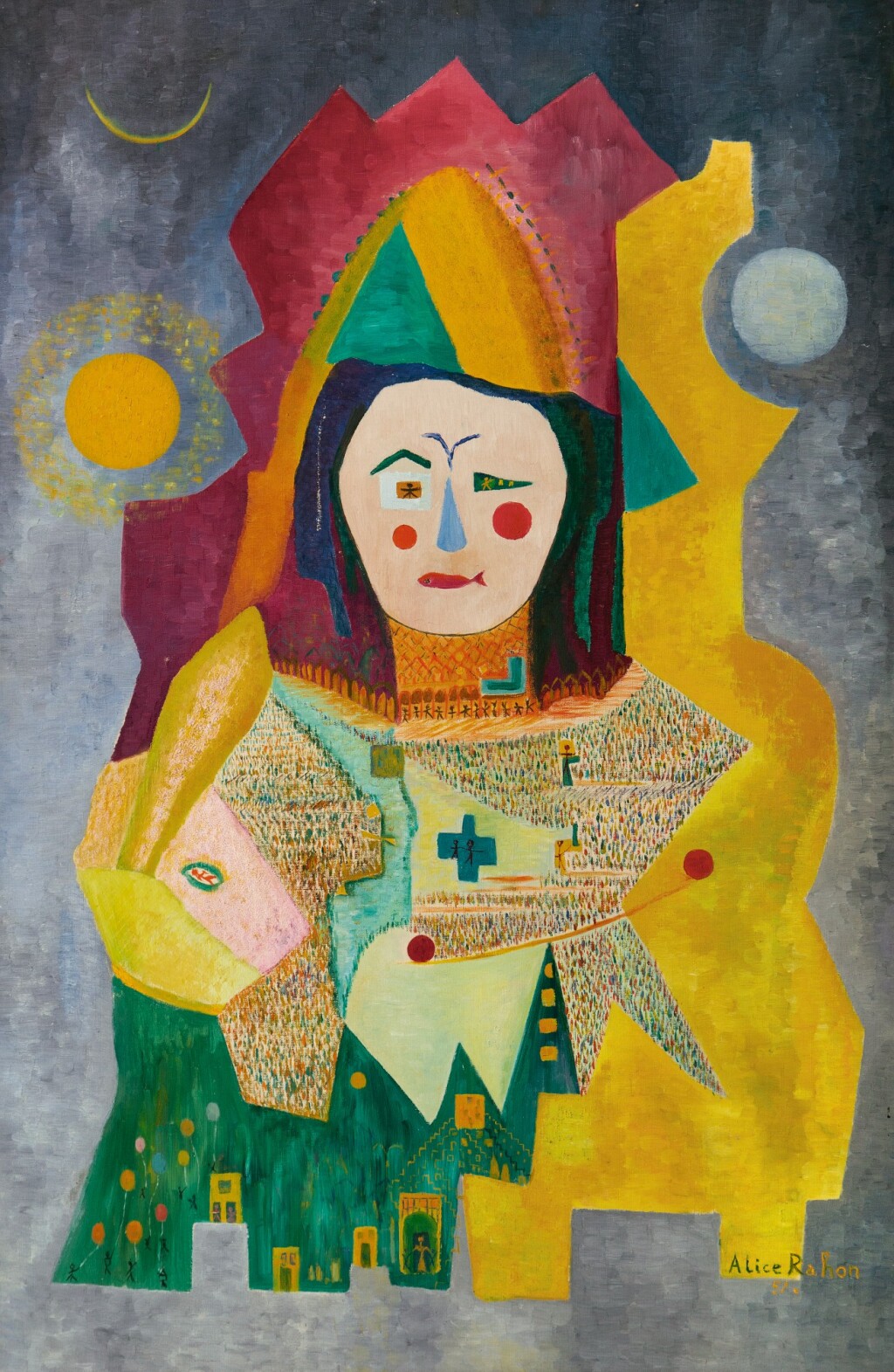
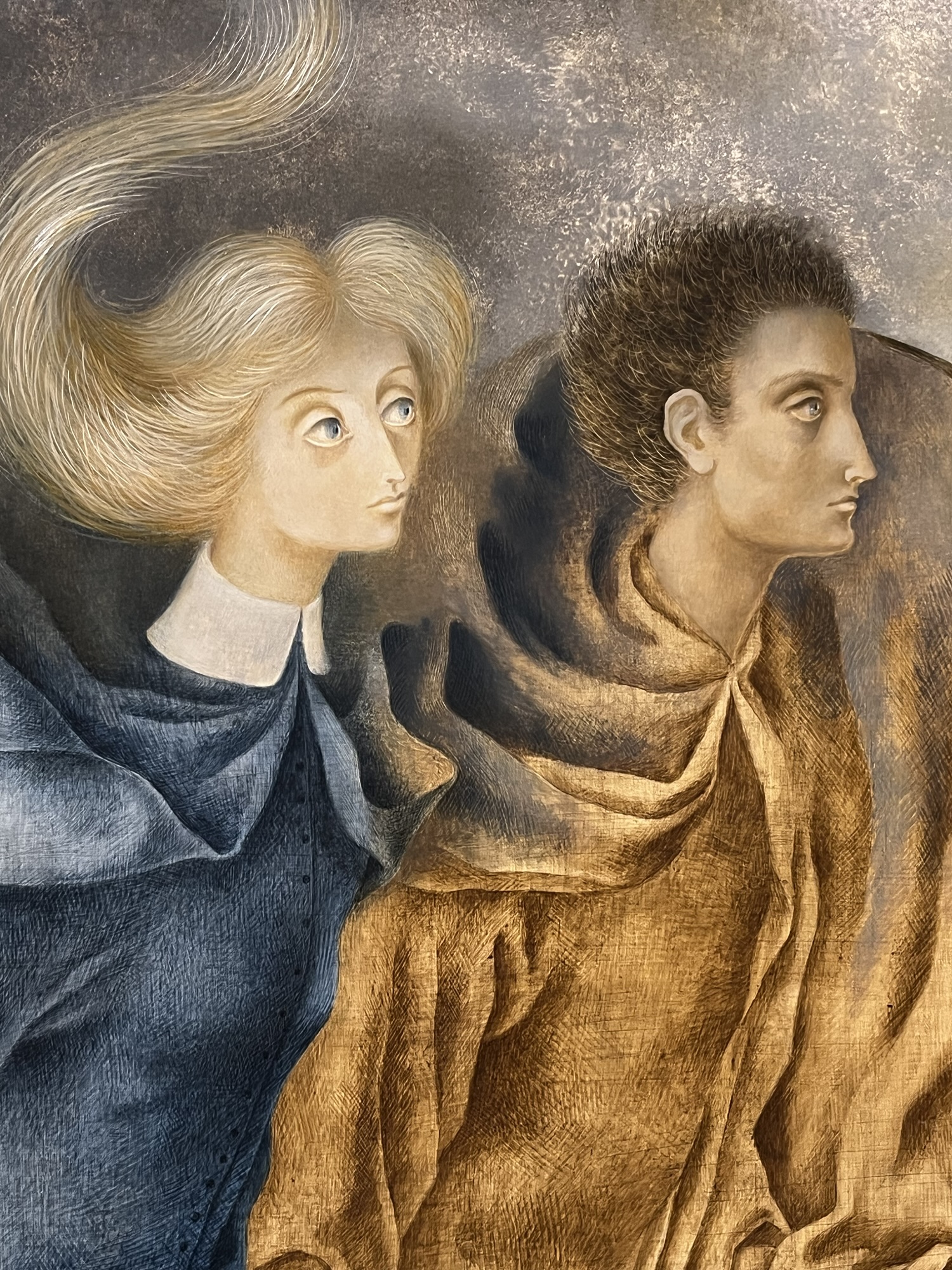
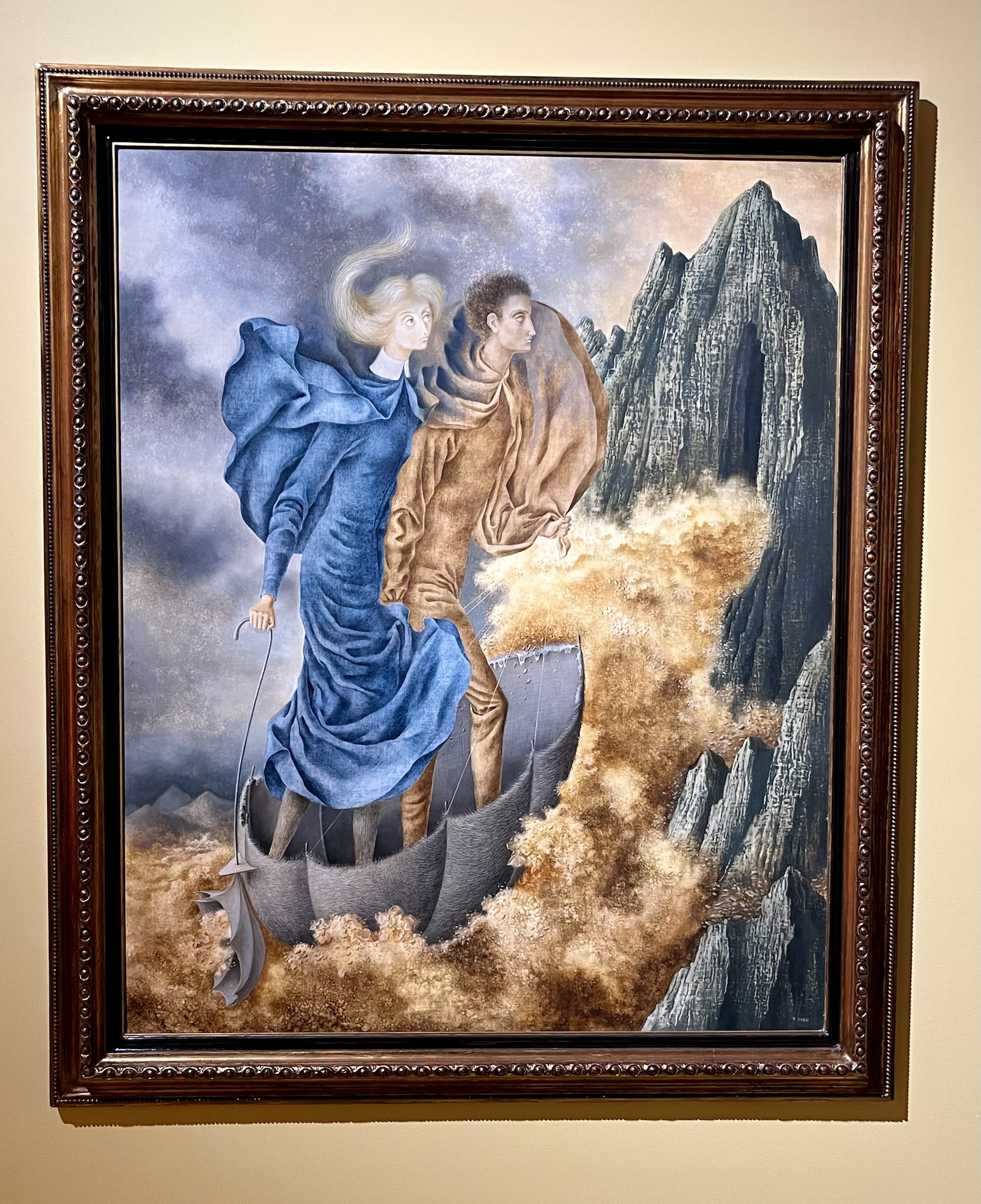
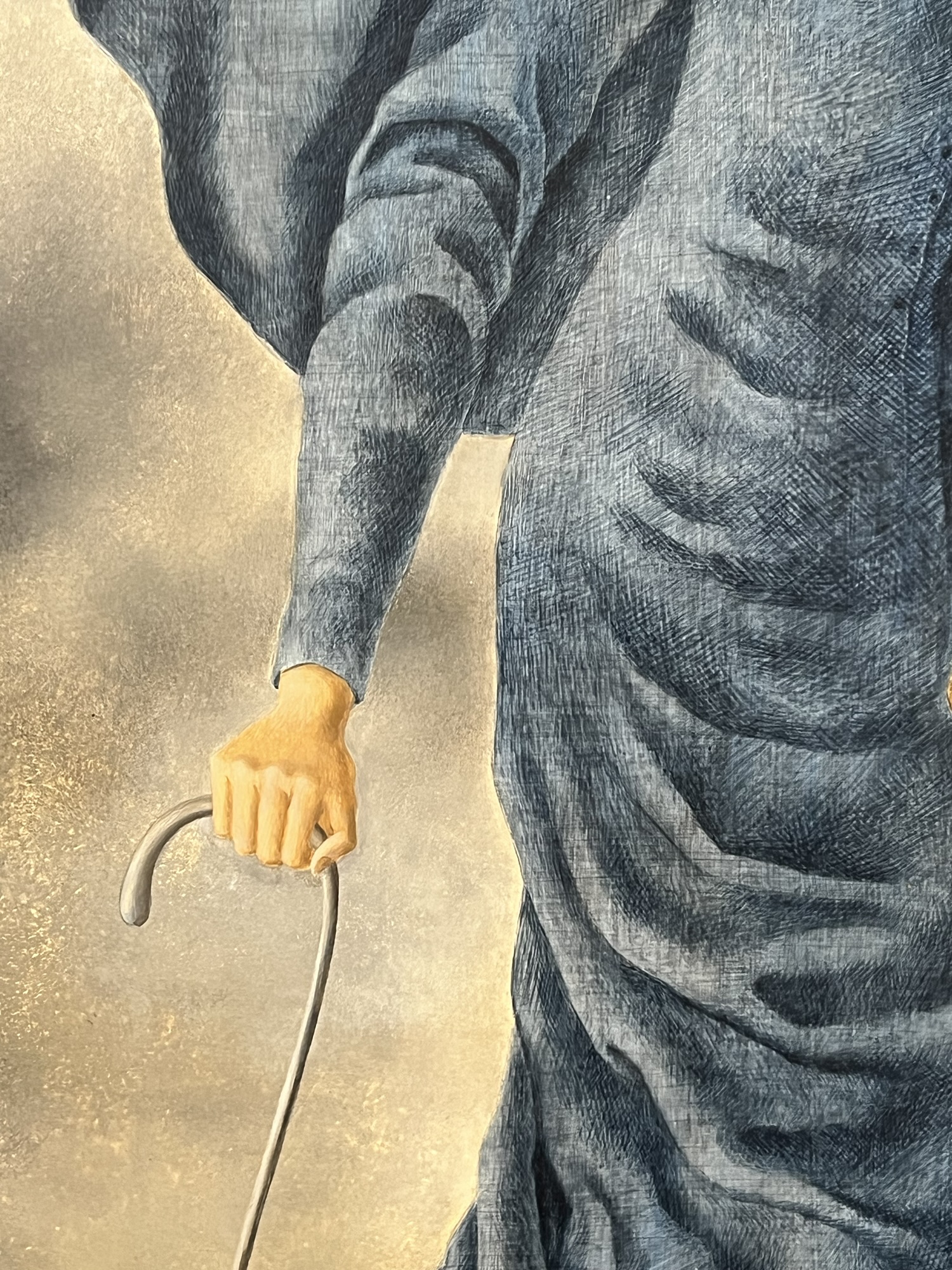
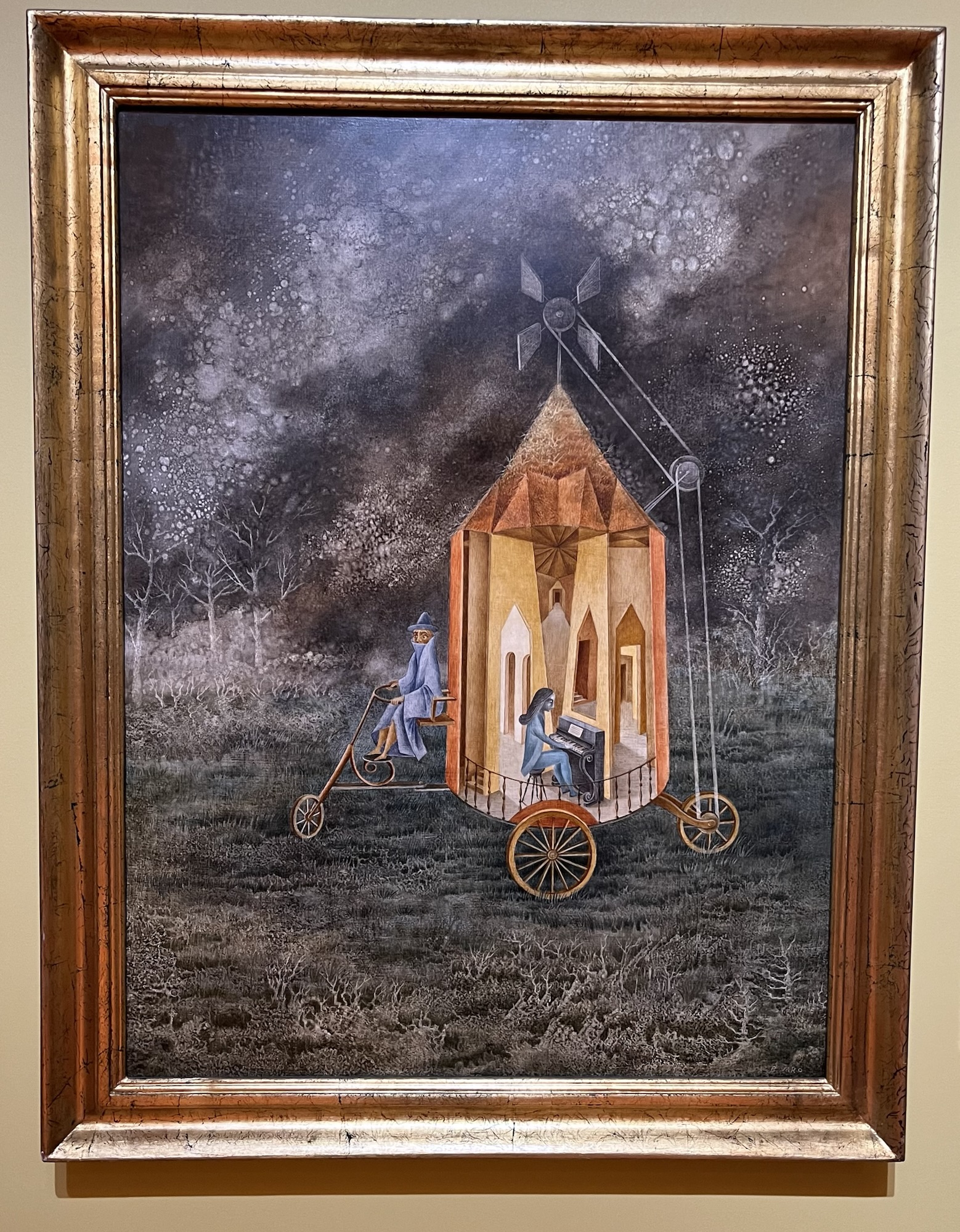
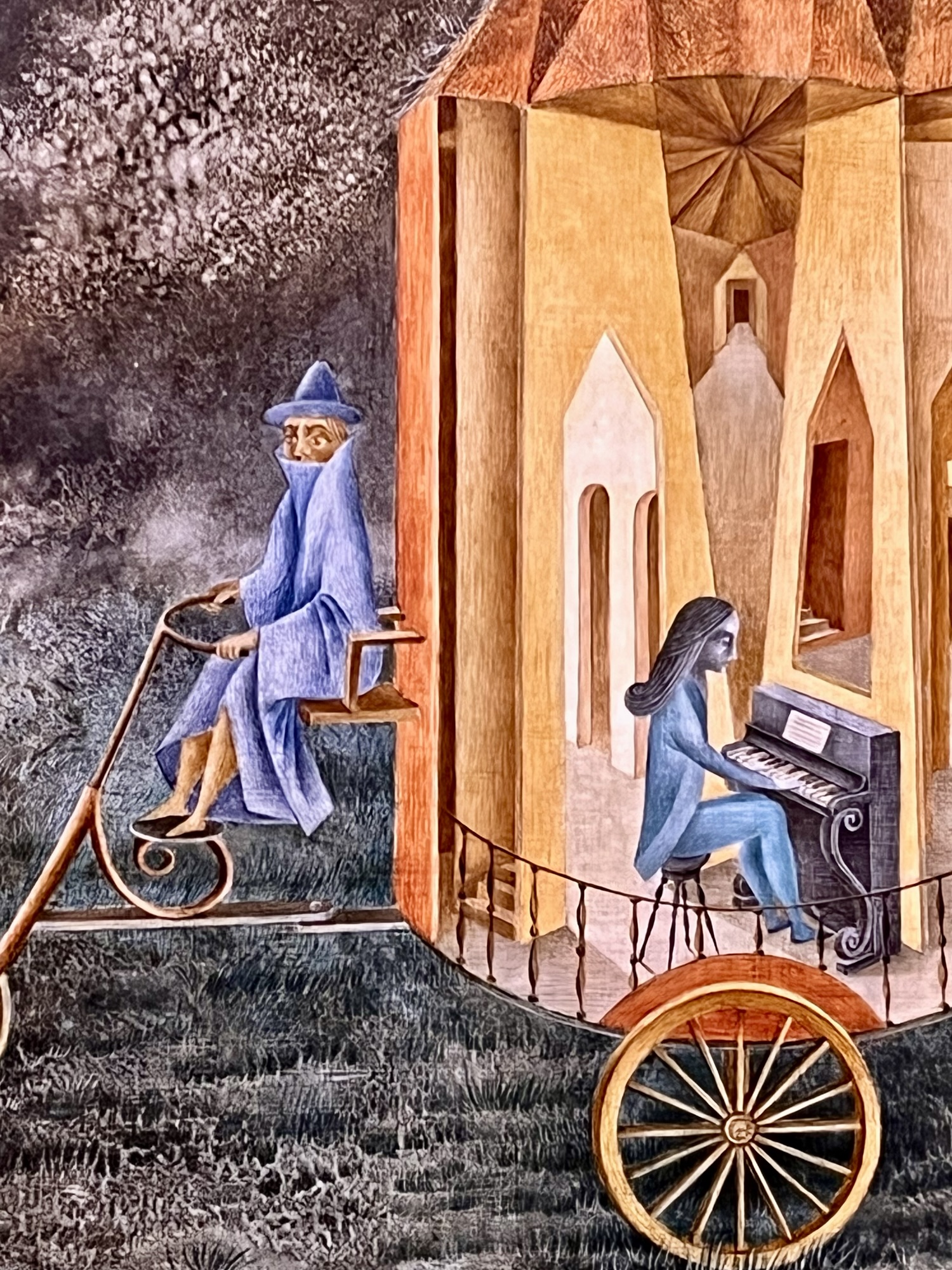
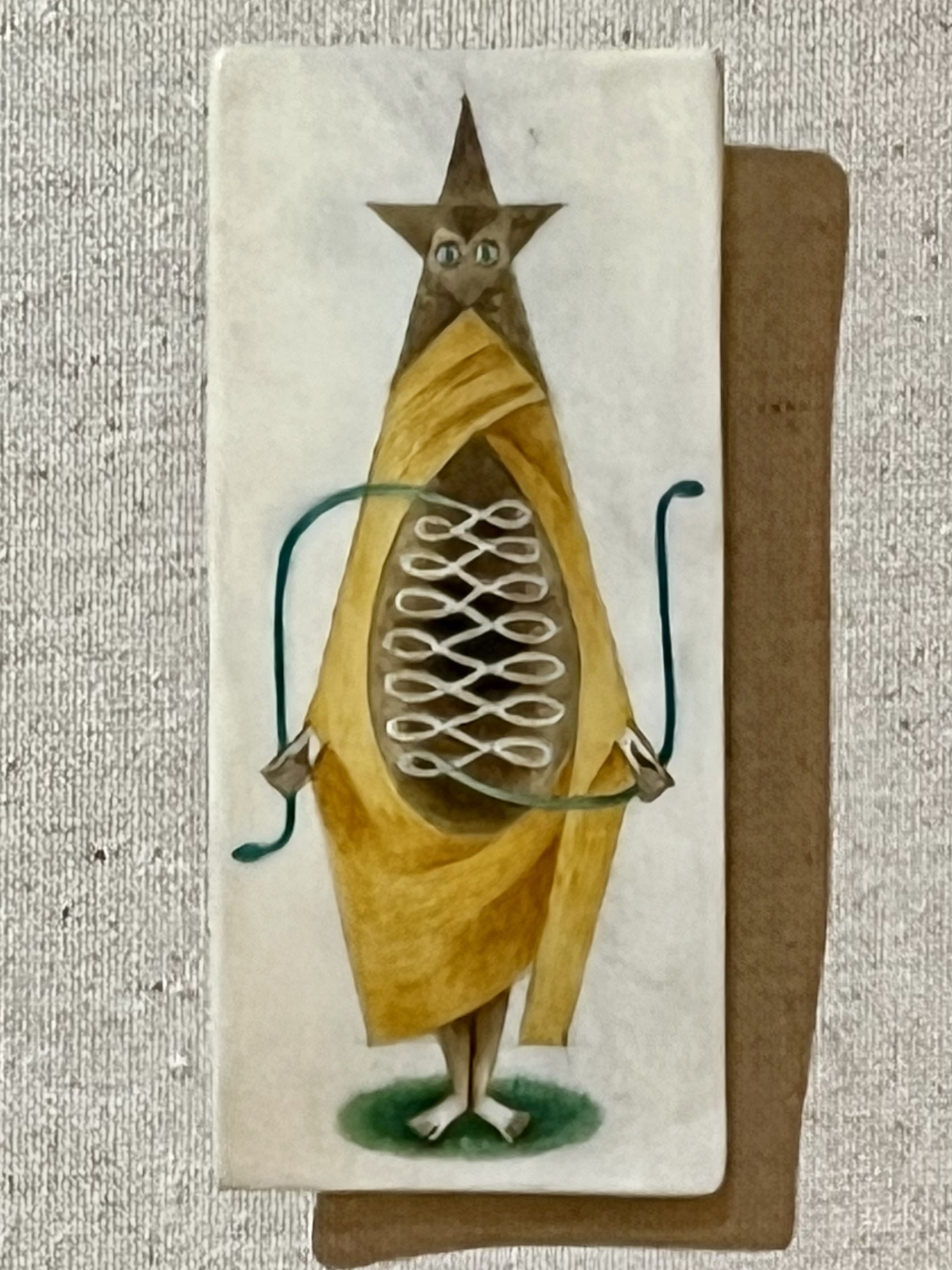
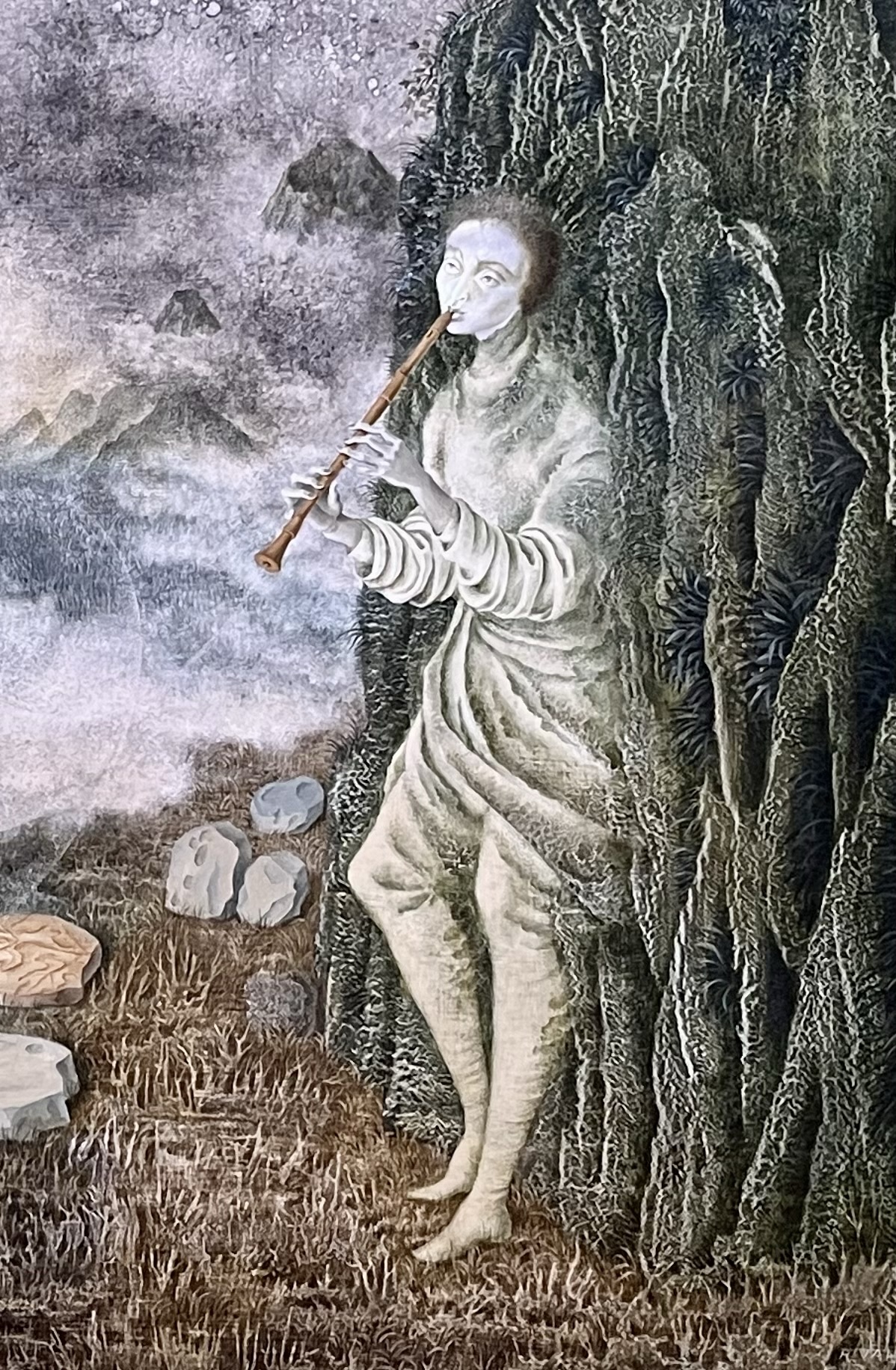
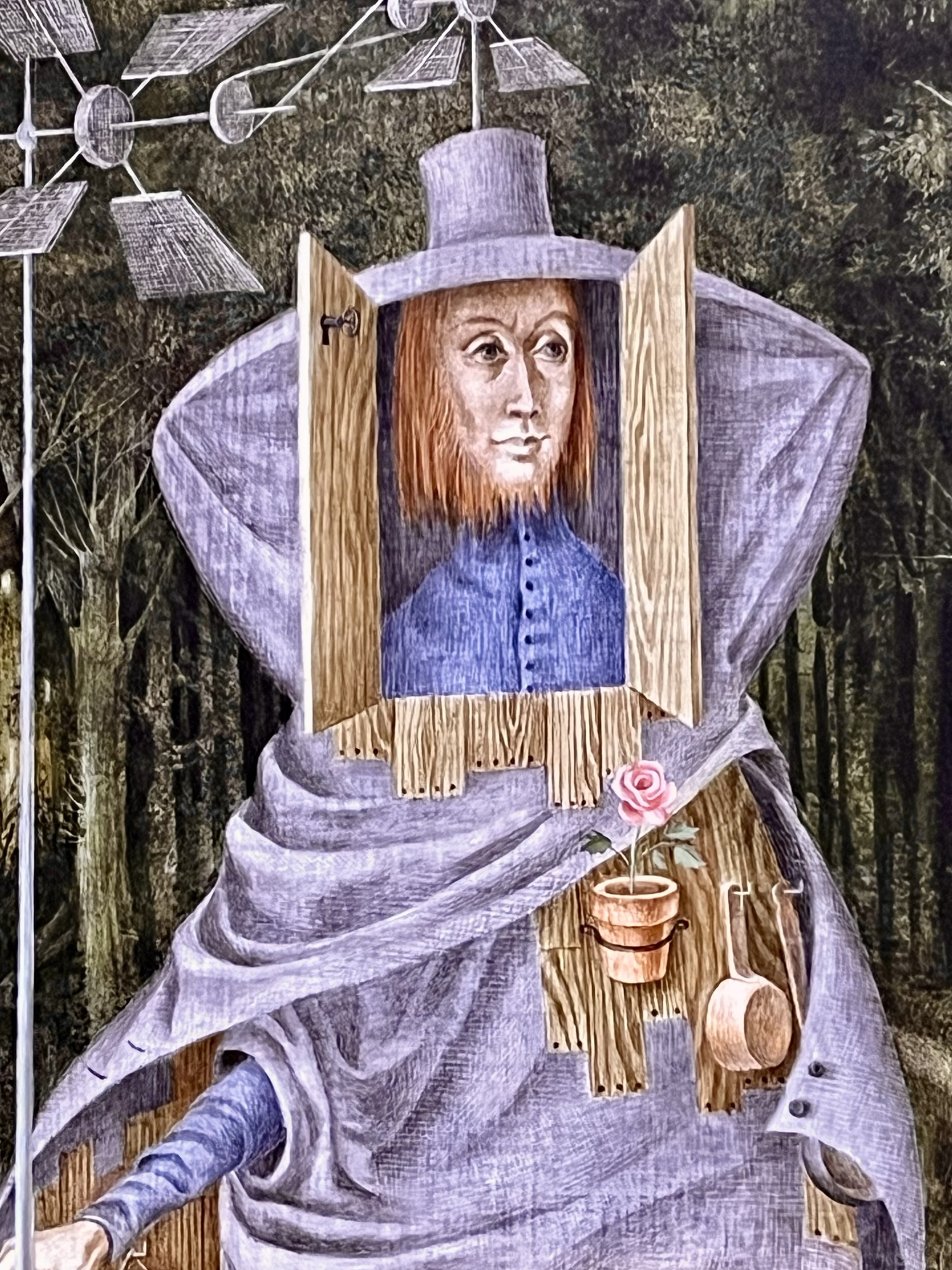

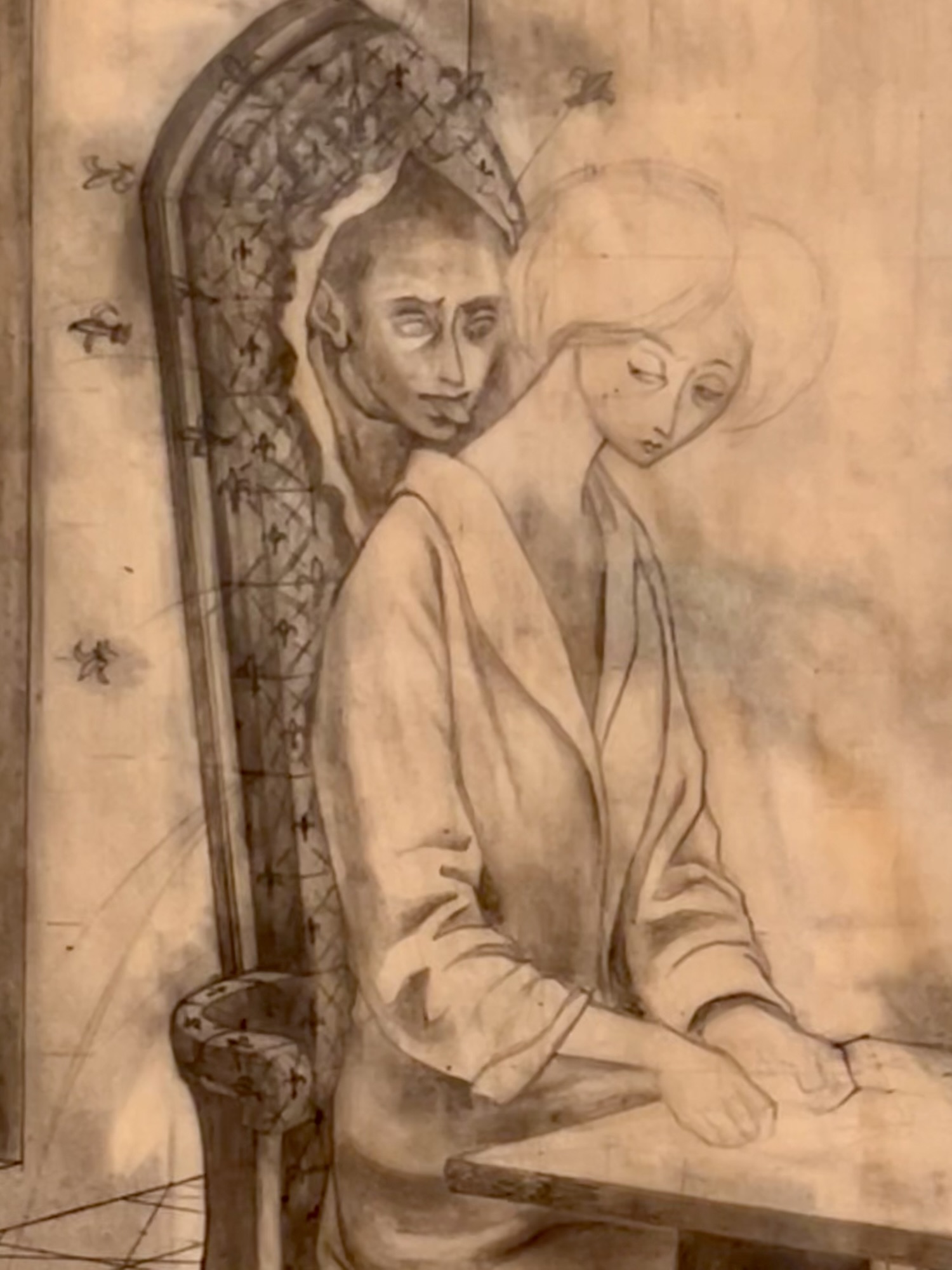


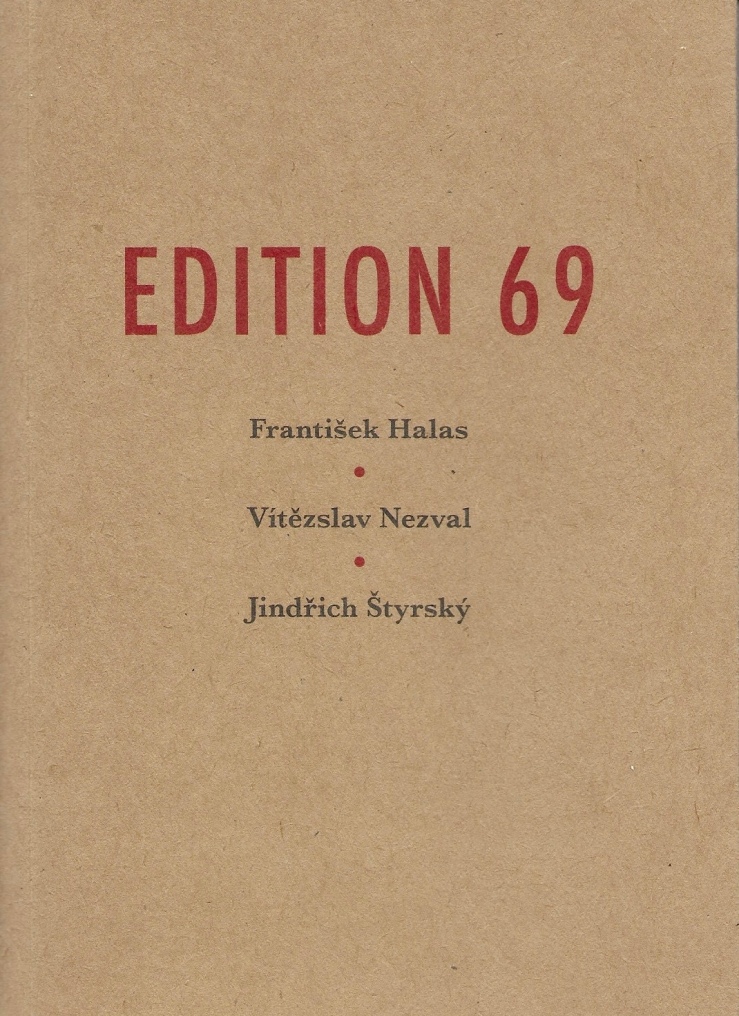


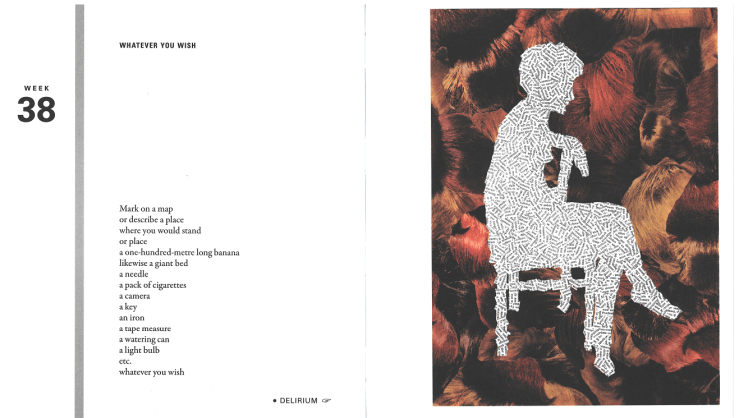
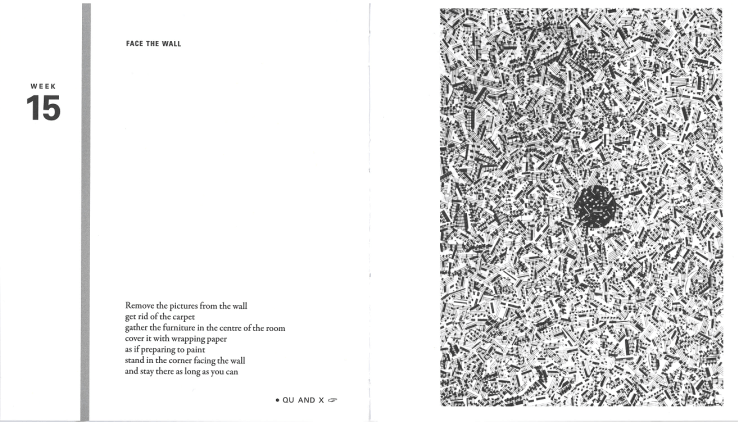


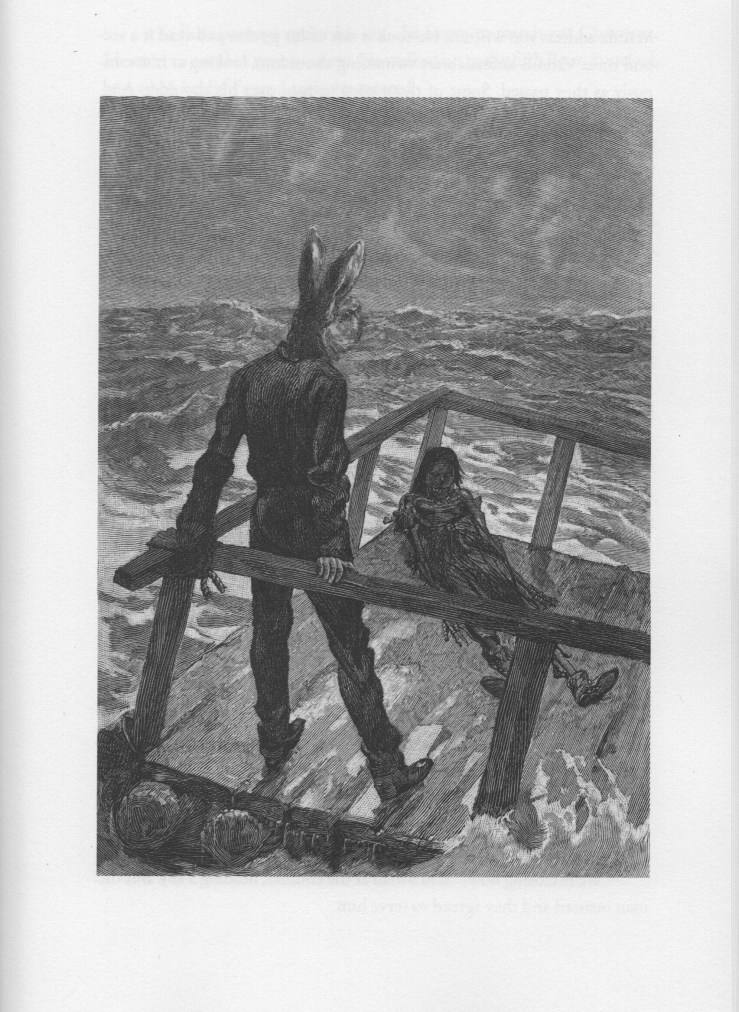


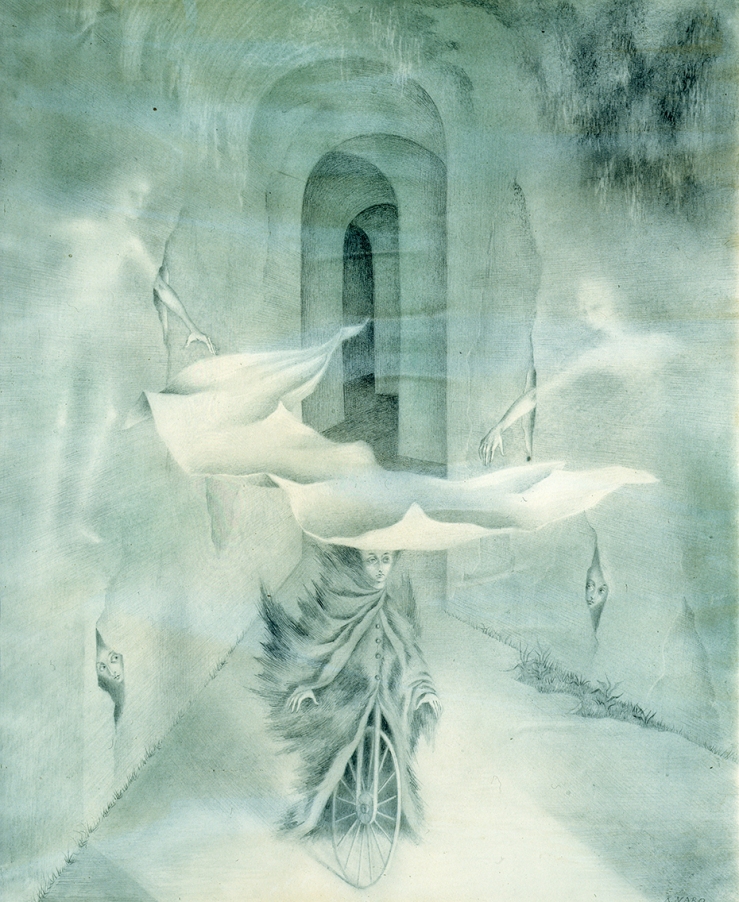


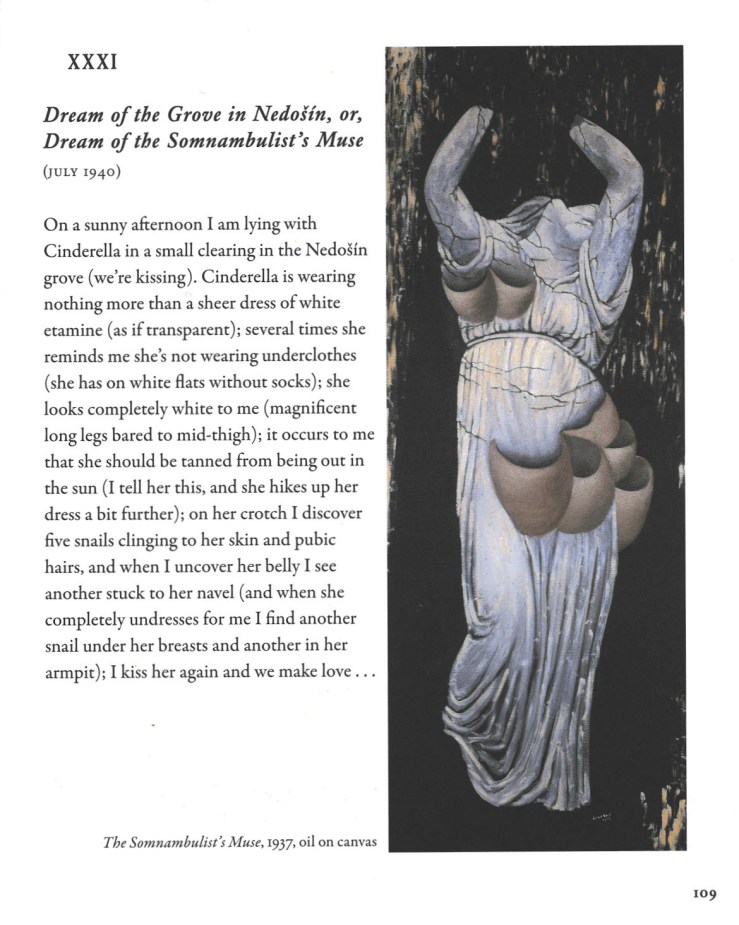
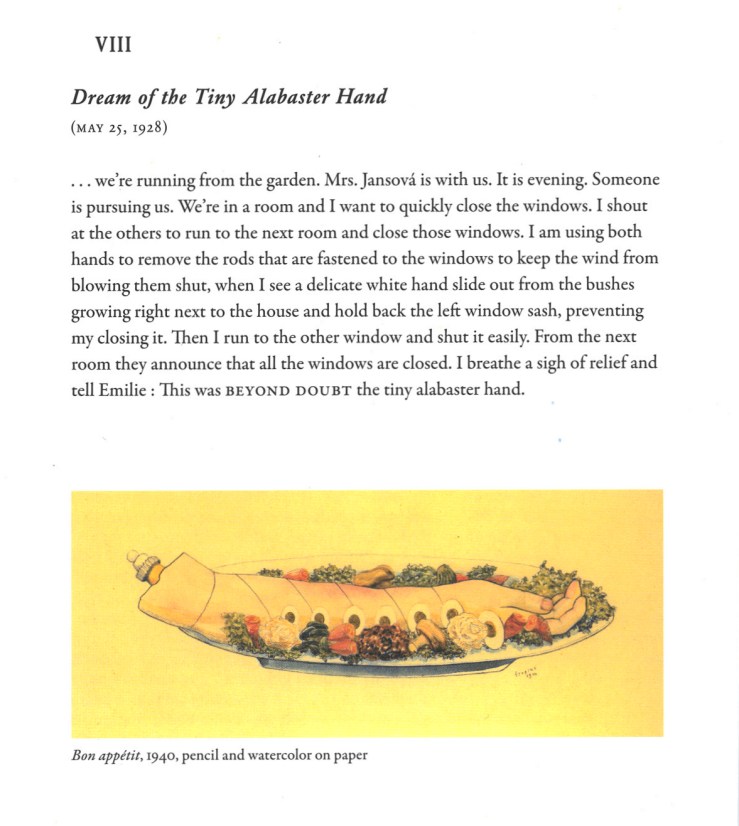
 Biblioklept