
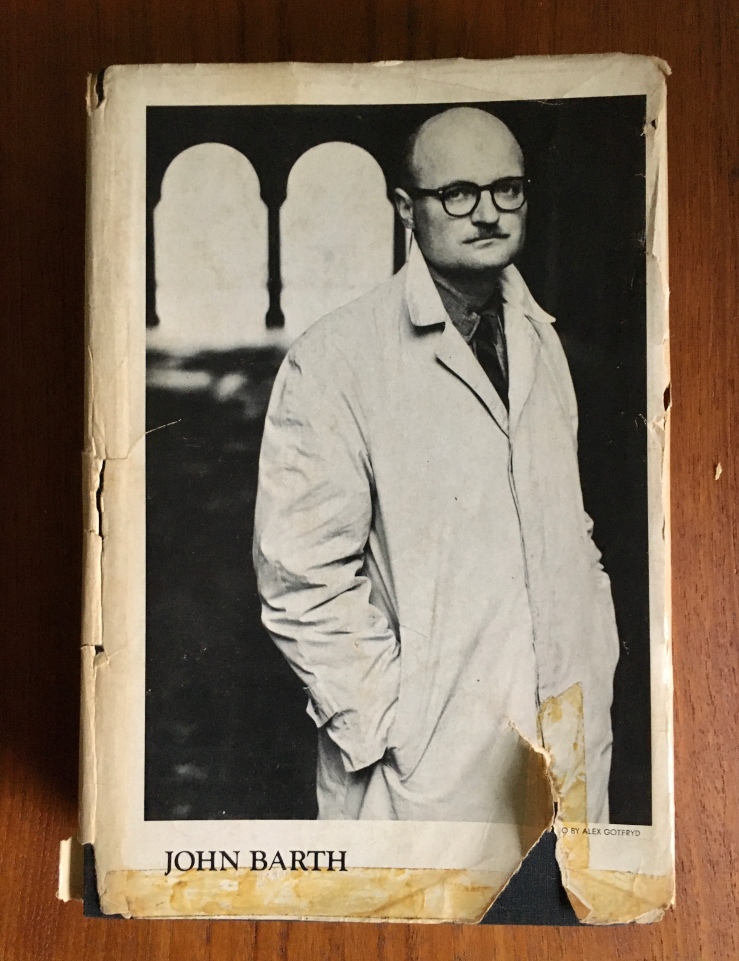
Who are the postmodernists? By my count, the American fictionists most commonly included in the canon, besides the three of us at Tubingen, are Donald Barthelme, Robert Coover, Stanley Elkin, Thomas Pynchon, and Kurt Vonnegut, Jr. Several of the critics I read widen the net to include Saul Bellow and Norman Mailer, different as those two writers would appear to be. Others look beyond the United States to Samuel Beckett, Jorge Luis Borges, and the late Vladimir Nabokov as engendering spirits of the “movement”; others yet insist upon including the late Raymond Queneau, the French “new novelists” Nathalie Sarraute, Michel Butor, Alain Robbe-Grillet, Robert Pinget, Claude Simon, and Claude Mauriac, the even newer French writers of the Tel Quel group, the Englishman John Fowles, and the expatriate Argentine Julio Cortázar. Some assert that such filmmakers as Michelangelo Antonioni, Federico Fellini, Jean-Luc Godard, and Alain Resnais are postmodernists. I myself will not join any literary club that doesn’t include the expatriate Colombian Gabriel García Márquez and the semi-expatriate Italian Italo Calvino, of both of whom more presently. Anticipations of the “postmodernist literary aesthetic” have duly been traced through the great modernists of the first half of the twentieth century—T. S. Eliot, William Faulkner, André Gide, James Joyce, Franz Kafka, Thomas Mann, Robert Musil, Ezra Pound, Marcel Proust, Gertrude Stein, Miguel de Unamuno, Virginia Woolf—through their nineteenth-century predecessors—Alfred Jarry, Gustave Flaubert, Charles Baudelaire, Stephane Mallamd, and E. T. A. Hoffmann—back to Laurence Sterne’s Tristram Shandy (1767) and Miguel de Cervantes’s Don Quixote (1615).
On the other hand, among certain commentators the sifting gets exceedingly fine. Professor Jerome Klinkowitz of Northern Iowa, for example, hails Barthelme and Vonnegut as the exemplary “postcontemporaries” of the American 1970s and consigns Pynchon and myself to some 1960ish outer darkness. I regard the novels of John Hawkes as examples of fine late modernism rather than of postmodernism (and I admire them no less for that). Others might regard most of Bellow, and Mailer’s The Naked and the Dead, as comparatively premodernist, along with the works of such more consistently traditionalist American writers as John Cheever, Wallace Stegner, William Styron, or John Updike, for example (the last of whom, however, Ihab Hassan calls a modernist), or those of most of the leading British writers of this century (as contrasted with the Irish), or those of many of our contemporary American women writers of fiction, whose main literary concern, for better or worse, remains the eloquent issuance of what the critic Richard Locke has called “secular news reports.” Even among the productions of a given writer, distinctions can be and often are invoked. Joyce Carol Oates writes all over the aesthetical map. John Gardner’s first two published novels I would call distinctly modernist works; his short stories dabble in postmodernism; his polemical nonfiction is aggressively reactionary. Italo Calvino, on the other hand, began as an Italian new-realist (in The Path to the Nest of Spiders, 1947) and matured into an exemplary postmodernist (with e.g., Cosmicomics, 1965, and The Castle of Crossed Destinies, 1969) who on occasion rises, sinks, or merely shifts to modernism (e.g., Invisible Cities, 1972). My own novels and stories seem to me to have both modernist and postmodernist attributes, even occasional premodernist attributes.
One certainly does have a sense of having been through this before. Indeed, some of us who have been publishing fiction since the 1950s have had the interesting experience of being praised or damned in that decade as existentialists and in the early 1960s as black humorists. Had our professional careers antedated the Second World War, we would no doubt have been praised or damned as modernists, in the distinguished company listed above. Now we are praised or damned as postmodernists.
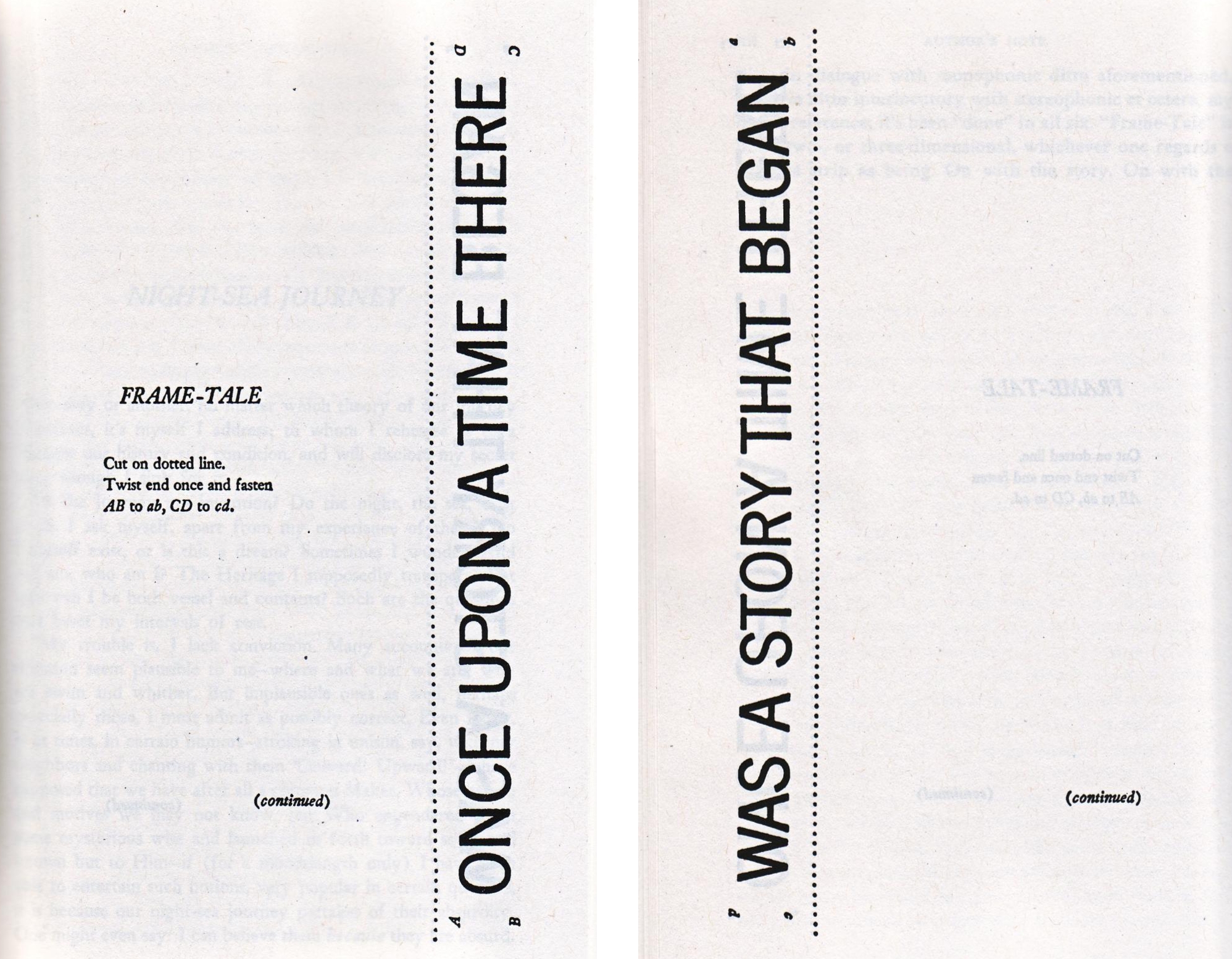
From John Barth’s 1980 essay “The Literature of Replenishment.”
 In his
 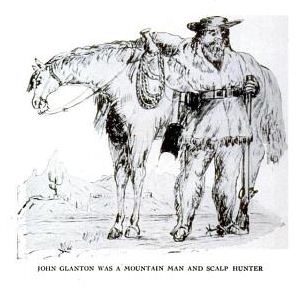 According to Chamberlain, John Glanton was born in South Carolina and migrated to Stephen Austin’s settlement in Texas. There he fell in love with an orphan girl and was prepared to marry her. One day while he was gone, Lipan warriors raided the area scalping the elderly and the children and kidnapping the women- including Glanton’s fiancee. Glanton and the other settlers pursued and slaughtered the natives, but during the battle the women were tomahawked and scalped. Legend has it, Glanton began a series of retaliatory raids which always yielded “fresh scalps.” When Texas fought for its independence from Mexico, Glanton fought with Col. Fannin, and was one of the few to escape the slaughter of that regiment at the hands of the Mexican Gen. Urrea- the man who would eventually employ Glanton as a scalp hunter. During the Range Wars, Glanton took no side but simply assassinated individuals who had crossed him. He was banished, to no avail, by Gen. Sam Houston and fought as a “free Ranger” in the war against Mexico. Following the war he took up the Urrea’s offer of $50 per Apache scalp (with a bonus of $1000 for the scalp of the Chief Santana). Local rumor had it that Glanton always “raised the hair” of the Indians he killed and that he had a “mule load of these barbarous trophies, smoke-dried” in his hut even before he turned professional.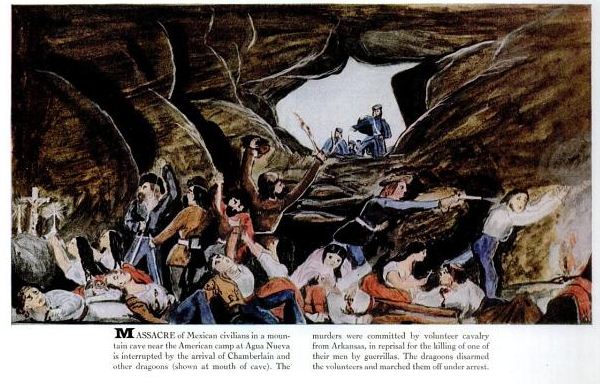
 It’s fascinating to note how much of the Judge is already there–the pedophilia, the marksmanship, the scholarship, and, most interesting of all, the lack of hair. Confession goes on to detail the killing, scalping, raping, and raiding spree that comprises the center of Blood Meridian. Chamberlain even describes the final battle with the Yumas, an event that signals the dissolution of the Glanton gang in McCarthy’s novel.
 Content aside, Chamberlain’s prose also seems to presage McCarthy’s prose. In his book
  You can view many of Chamberlain’s paintings and read an edit of his Confession in three editions of Life magazine from 1956, digitally preserved thanks to Google Books–here’s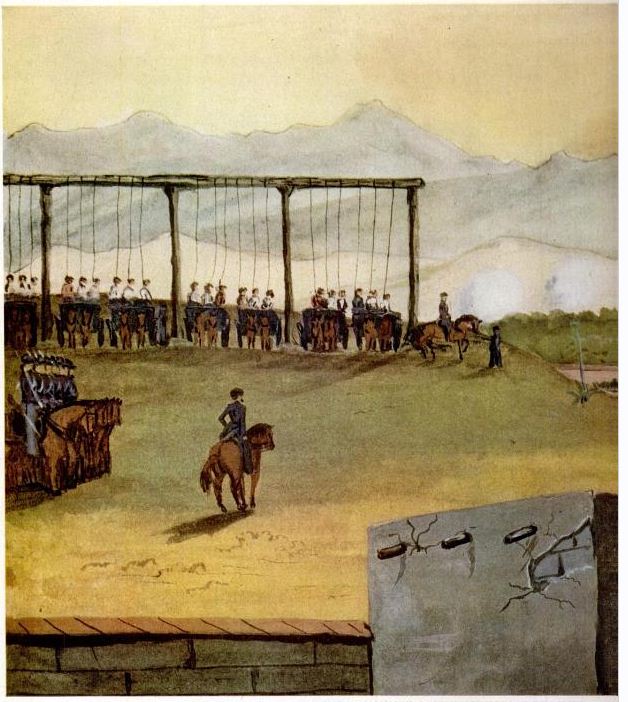




 Biblioklept