Stanley Kubrick: A Life in Pictures (Full Documentary)

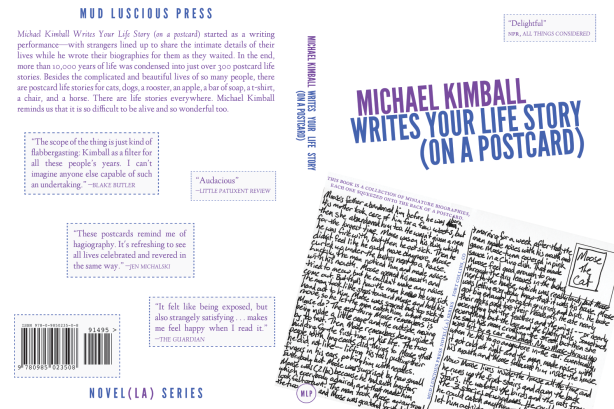
I Review Michael Kimball Writes Your Life Story (On a Postcard)

Kimball final cover copy

“I never expected strangers to tell me so much about themselves, so many things they have never told anybody else, but I found an unexpected intimacy in the postcard life story project,” writes Michael Kimball in the introduction to his new book, the aptly titled Michael Kimball Writes Your Life Story (On a Postcard). Kimball continues: “It tapped into something human and humane. I was continually amazed by what people told me.”

Kimball’s respect for the people whose stories he is telling comes through in his spare but descriptive prose, an economical rhetoric undoubtedly necessitated by the confines of his small canvasses. When I interviewed Kimball about the project, he told me:

There are difficult things at different stages of the process. The first difficult thing is asking the right questions for the particular participant. The second difficult thing is being representative when condensing what I’ve been told. The third difficult thing is writing small enough to squeeze six hundred words or so onto a single postcard.

Through that asking, condensing, and squeezing, Kimball distills his subject’s lives into compact but moving stories.

Michael Kimball Writes Your Life Story (On a Postcard) began as a performance piece at the Transmodern Performance Festival and then continued as a blog. Kimball eventually wrote over three hundred postcards; over fifty of these are collected in the new book. A not-insubstantial number of these are devoted to the biographies of contemporary writers, including folks like Tao Lin, Matt Bell, and Blake Butler:

By 4 years old, Blake was performing considered monologues, crazy dances, music videos, and both sides of talk shows. It’s all on video (his mother will show you, if you want). Despite these performances, Blake was a fat child by the 4th grade. He liked comic books and video games. By 10th grade, he weighed 250 pounds and felt disregarded. His bedroom walls were covered with pictures of women that he tore out of magazines at the grocery store and took home.

There’s also a first-person POV bio of Edgar Allan Poe, the last few paragraphs of which I can’t help sharing:

In 1831, my foster father and I had a terrible disagreement, after which I was court-martialed and kicked out of West Point. In 1834, my foster father died and did not leave me any of his money. To console myself, I married my 14-year-old cousin, Virginia Clemm.

For years, I published poems and stories and criticism, but it did not make me happy or money. In 1837, I was fired from a newspaper job for drinking. After that, I published a novel, but that didn’t help much either. Readers are sick. That’s why Virginia got tuberculosis and died in 1847. I was so lonely and so cold. I could not stop drinking.

It was 1849 when I stopped in Baltimore. I remember going down in the street, and, later, two hazy men taking me someplace white. I don’t remember dying, but I was glad I didn’t have to keep trying.

The mix of empathy and humor we see here resonates throughout the collection, whether Kimball is telling the life story of a U.S. President, or an ex-crack addict who met his wife at an all-you-can-eat buffet, or a rooster. Kimball handles his subjects with an intense honesty appropriate to the often tragic trajectory these tales take—even a piece like “Red Delicious Apple,” which takes metaphysical license of a sort, leads to a sad end:

The first thing Red Delicious Apple remembered was being a flower and the way the birds sounded in the trees. Later, Apple remembered the wind and losing his petals. Apple wanted to jump down after them, but stayed on the branch, in the tree. … Not long after that, Hand delivered Apple to the teeth. Apple could feel the teeth cutting through his skin and into his meat, what was left of his insides turning brown. Afterward, he sickened, softened. The last thing Apple remembered was the trashcan, the lid, the rotting darkness.

Or the fate of “Chair”:Chair thought, Wood and glue.

Chair thought, Next time, I’m letting go.
Chair cracked. He broke one of his legs and then his back.
Chair thought, That didn’t even hurt.

Update : Chair was thrown into a dumpster.

But perhaps I bring up “Chair” and “Red Delicious Apple” because their tragic contours are easier to allude to quickly than many of the biographies here, which often involve missing parents,  mental illness, and suicidal thoughts, all delivered in the spare, striking prose that the confines of Kimball’s project necessitate. The stories are sometimes shocking and sometimes sad and usually very moving. As the titular anonym of “G” suggests, “tragedy can be beautiful.”

Michael Kimball Writes Your Life Story (On a Postcard) is new from Mud Luscious Press.

The Fall of the Damned — Peter Paul Rubens

“Sredni Vashtar” — Saki

“Sredni Vashtar” by Saki

Conradin was ten years old, and the doctor had pronounced his professional opinion that the boy would not live another five years. The doctor was silky and effete, and counted for little, but his opinion was endorsed by Mrs. de Ropp, who counted for nearly everything. Mrs. De Ropp was Conradin’s cousin and guardian, and in his eyes she represented those three-fifths of the world that are necessary and disagreeable and real; the other two-fifths, in perpetual antagonism to the foregoing, were summed up in himself and his imagination. One of these days Conradin supposed he would succumb to the mastering pressure of wearisome necessary things—such as illnesses and coddling restrictions and drawn-out dullness. Without his imagination, which was rampant under the spur of loneliness, he would have succumbed long ago.

Mrs. de Ropp would never, in her honestest moments, have confessed to herself that she disliked Conradin, though she might have been dimly aware that thwarting him “for his good” was a duty which she did not find particularly irksome. Conradin hated her with a desperate sincerity which he was perfectly able to mask. Such few pleasures as he could contrive for himself gained an added relish from the likelihood that they would be displeasing to his guardian, and from the realm of his imagination she was locked out–an unclean thing, which should find no entrance. Continue reading ““Sredni Vashtar” — Saki”

Death of Orpheus — Albrecht Durer

Read “The Piper and the Puca,” an Irish Fairy Tale

“The Piper and the Puca” — Translated literally from the Irish of the Leabhar Sgeulaigheachta by Douglas Hyde.

In the old times, there was a half fool living in Dunmore, in the county Galway, and although he was excessively fond of music, he was unable to learn more than one tune, and that was the “Black Rogue.” He used to get a good deal of money from the gentlemen, for they used to get sport out of him. One night the piper was coming home from a house where there had been a dance, and he half drunk. When he came to a little bridge that was up by his mother’s house, he squeezed the pipes on, and began playing the “Black Rogue” (an rógaire dubh). The Púca came behind him, and flung him up on his own back. There were long horns on the Púca, and the piper got a good grip of them, and then he said——

“Destruction on you, you nasty beast, let me home. I have a ten-penny piece in my pocket for my mother, and she wants snuff.”

“Never mind your mother,” said the Púca, “but keep your hold. If you fall, you will break your neck and your pipes.” Then the Púca said to him, “Play up for me the ‘Shan Van Vocht’ (an t-seann-bhean bhocht).”

“I don’t know it,” said the piper.

“Never mind whether you do or you don’t,” said the Púca. “Play up, and I’ll make you know.”

The piper put wind in his bag, and he played such music as made himself wonder.

“Upon my word, you’re a fine music-master,” says the piper then; “but tell me where you’re for bringing me.”

“There’s a great feast in the house of the Banshee, on the top of Croagh Patric to-night,” says the Púca, “and I’m for bringing you there to play music, and, take my word, you’ll get the price of your trouble.”

“By my word, you’ll save me a journey, then,” says the piper, “for Father William put a journey to Croagh Patric on me, because I stole the white gander from him last Martinmas.”

The Púca rushed him across hills and bogs and rough places, till he brought him to the top of Croagh Patric. Then the Púca struck three blows with his foot, and a great door opened, and they passed in together, into a fine room.

The piper saw a golden table in the middle of the room, and hundreds of old women (cailleacha) sitting round about it. The old women rose up, and said, “A hundred thousand welcomes to you, you Púca of November (na Samhna). Who is this you have with you?”

“The best piper in Ireland,” says the Púca.

One of the old women struck a blow on the ground, and a door opened in the side of the wall, and what should the piper see coming out but the white gander which he had stolen from Father William.

“By my conscience, then,” says the piper, “myself and my mother ate every taste of that gander, only one wing, and I gave that to Moy-rua (Red Mary), and it’s she told the priest I stole his gander.”

The gander cleaned the table, and carried it away, and the Púca said, “Play up music for these ladies.”

The piper played up, and the old women began dancing, and they were dancing till they were tired. Then the Púca said to pay the piper, and every old woman drew out a gold piece, and gave it to him.

“By the tooth of Patric,” said he, “I’m as rich as the son of a lord.”

“Come with me,” says the Púca, “and I’ll bring you home.”

They went out then, and just as he was going to ride on the Púca, the gander came up to him, and gave him a new set of pipes. The Púca was not long until he brought him to Dunmore, and he threw the piper off at the little bridge, and then he told him to go home, and says to him, “You have two things now that you never had before—you have sense and music (ciall agus ceól).”

The piper went home, and he knocked at his mother’s door, saying, “Let me in, I’m as rich as a lord, and I’m the best piper in Ireland.”

“You’re drunk,” said the mother.

“No, indeed,” says the piper, “I haven’t drunk a drop.”

The mother let him in, and he gave her the gold pieces, and, “Wait now,” says he, “till you hear the music I’ll play.”

He buckled on the pipes, but instead of music, there came a sound as if all the geese and ganders in Ireland were screeching together. He wakened the neighbours, and they were all mocking him, until he put on the old pipes, and then he played melodious music for them; and after that he told them all he had gone through that night.

The next morning, when his mother went to look at the gold pieces, there was nothing there but the leaves of a plant.

The piper went to the priest, and told him his story, but the priest would not believe a word from him, until he put the pipes on him, and then the screeching of the ganders and geese began.

“Leave my sight, you thief,” says the priest.

But nothing would do the piper till he would put the old pipes on him to show the priest that his story was true.

He buckled on the old pipes, and he played melodious music, and from that day till the day of his death, there was never a piper in the county Galway was as good as he was.
 

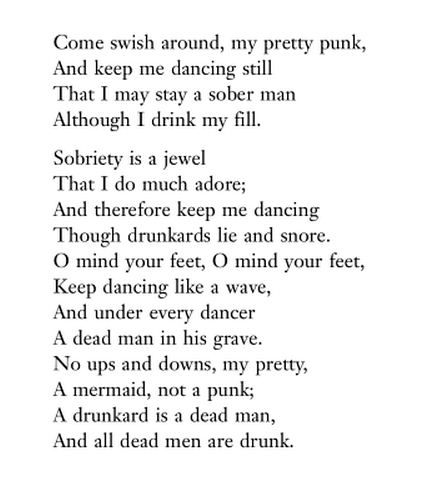
“A Drunken Man’s Praise Of Sobriety” — William Butler Yeats

yeats

Ulysses (1967 Film Adaptation)

St. Patrick’s Day — Childe Hassam

“The Birth of Bran” — An Irish Fairy Tale, Retold James Stephens

“The Birth of Bran”

An Irish Fairy Tale, Retold James Stephens

CHAPTER I

There are people who do not like dogs a bit—they are usually women—but in this story there is a man who did not like dogs. In fact, he hated them. When he saw one he used to go black in the face, and he threw rocks at it until it got out of sight. But the Power that protects all creatures had put a squint into this man’s eye, so that he always threw crooked.

This gentleman’s name was Fergus Fionnliath, and his stronghold was near the harbour of Galway. Whenever a dog barked he would leap out of his seat, and he would throw everything that he owned out of the window in the direction of the bark. He gave prizes to servants who disliked dogs, and when he heard that a man had drowned a litter of pups he used to visit that person and try to marry his daughter.

Now Fionn, the son of Uail, was the reverse of Fergus Fionnliath in this matter, for he delighted in dogs, and he knew everything about them from the setting of the first little white tooth to the rocking of the last long yellow one. He knew the affections and antipathies which are proper in a dog; the degree of obedience to which dogs may be trained without losing their honourable qualities or becoming servile and suspicious; he knew the hopes that animate them, the apprehensions which tingle in their blood, and all that is to be demanded from, or forgiven in, a paw, an ear, a nose, an eye, or a tooth; and he understood these things because he loved dogs, for it is by love alone that we understand anything.

Among the three hundred dogs which Fionn owned there were two to whom he gave an especial tenderness, and who were his daily and nightly companions. These two were Bran and Sceo’lan, but if a person were to guess for twenty years he would not find out why Fionn loved these two dogs and why he would never be separated from them.

Fionn’s mother, Muirne, went to wide Allen of Leinster to visit her son, and she brought her young sister Tuiren with her. The mother and aunt of the great captain were well treated among the Fianna, first, because they were parents to Fionn, and second, because they were beautiful and noble women.

No words can describe how delightful Muirne was—she took the branch; and as to Tuiren, a man could not look at her without becoming angry or dejected. Her face was fresh as a spring morning; her voice more cheerful than the cuckoo calling from the branch that is highest in the hedge; and her form swayed like a reed and flowed like a river, so that each person thought she would surely flow to him.

Men who had wives of their own grew moody and downcast because they could not hope to marry her, while the bachelors of the Fianna stared at each other with truculent, bloodshot eyes, and then they gazed on Tuiren so gently that she may have imagined she was being beamed on by the mild eyes of the dawn.

It was to an Ulster gentleman, Iollan Eachtach, that she gave her love, and this chief stated his rights and qualities and asked for her in marriage.

Now Fionn did not dislike the man of Ulster, but either he did not know them well or else he knew them too well, for he made a curious stipulation before consenting to the marriage. He bound Iollan to return the lady if there should be occasion to think her unhappy, and Iollan agreed to do so. The sureties to this bargain were Caelte mac Ronan, Goll mac Morna, and Lugaidh. Lugaidh himself gave the bride away, but it was not a pleasant ceremony for him, because he also was in love with the lady, and he would have preferred keeping her to giving her away. When she had gone he made a poem about her, beginning:

       "There is no more light in the sky—"

And hundreds of sad people learned the poem by heart. Continue reading ““The Birth of Bran” — An Irish Fairy Tale, Retold James Stephens”

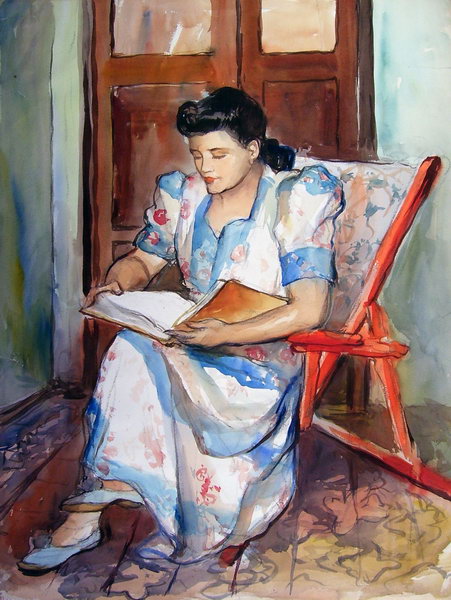
Woman Reading — Teodoro Núñez Ureta

teodoro-nunez-ureta-la-lectura-1930

Stalker — Andrei Tarkovsky (Full Film with English Subtitles)

Portrait of Nico — Ivan Brunetti

nico

Snail Love (Microcosmos)

In the House Upon the Dirt Between the Lake and the Woods (Book Acquired 3.08.2013)

20130308-110107.jpg

I was happy to get an advance copy of Matt Bell’s forthcoming novel In the House upon the Dirt Between the Lake and the Woods, because I like titles with lots of prepositions. No, actually, Bell’s novella-in-vignette’s Cataclysm Baby was one of my favorite new books of 2012. Here’s the pub blurb for House:

In this epic, mythical debut novel, a newly-wed couple escapes the busy confusion of their homeland for a distant and almost-uninhabited lakeshore. They plan to live there simply, to fish the lake, to trap the nearby woods, and build a house upon the dirt between where they can raise a family. But as their every pregnancy fails, the child-obsessed husband begins to rage at this new world: the song-spun objects somehow created by his wife’s beautiful singing voice, the giant and sentient bear that rules the beasts of the woods, the second moon weighing down the fabric of their starless sky, and the labyrinth of memory dug into the earth beneath their house.

This novel, from one of our most exciting young writers, is a powerful exploration of the limits of parenthood and marriage—and of what happens when a marriage’s success is measured solely by the children it produces, or else the sorrow that marks their absence.

You can read my interview with Matt here and excerpts from House at Matt’s site.

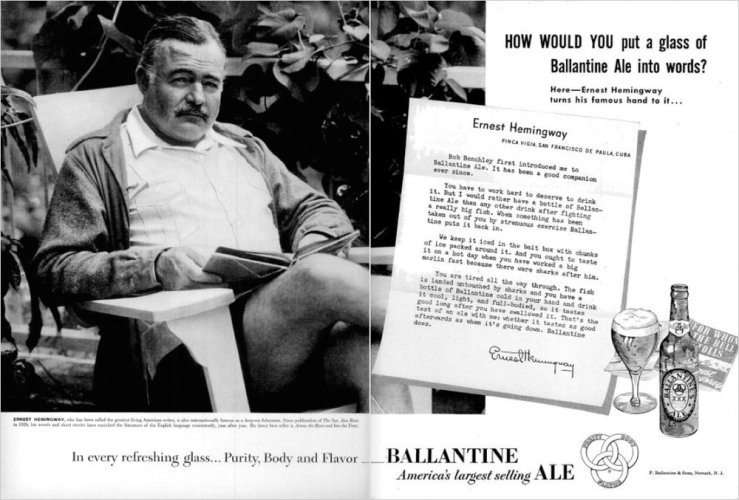
Hemingway Shilling for Ballantine Ale

Ernest Hemingway - Advertisement From P. Ballantine & Sons, Newark (1951)

(Via/about).

“Darwinism” — Walt Whitman

“Darwinism” by Walt Whitman

Running through prehistoric ages—coming down from them into the daybreak of our records, founding theology, suffusing literature, and so brought onward—(a sort of verteber and marrow to all the antique races and lands, Egypt, India, Greece, Rome, the Chinese, the Jews, &c., and giving cast and complexion to their art, poems, and their politics as well as ecclesiasticism, all of which we more or less inherit,) appear those venerable claims to origin from God himself, or from gods and goddesses—ancestry from divine beings of vaster beauty, size, and power than ours. But in current and latest times, the theory of human origin that seems to have most made its mark, (curiously reversing the antique,) is that we have come on, originated, developt, from monkeys, baboons—a theory more significant perhaps in its indirections, or what it necessitates, than it is even in itself. (Of the twain, far apart as they seem, and angrily as their conflicting advocates to-day oppose each other, are not both theories to be possibly reconcil’d, and even blended? Can we, indeed, spare either of them? Better still, out of them is not a third theory, the real one, or suggesting the real one, to arise?)

Of this old theory, evolution, as broach’d anew, trebled, with indeed all-devouring claims, by Darwin, it has so much in it, and is so needed as a counterpoise to yet widely prevailing and unspeakably tenacious, enfeebling superstitions—is fused, by the new man, into such grand, modest, truly scientific accompaniments—that the world of erudition, both moral and physical, cannot but be eventually better’d and broaden’d in its speculations, from the advent of Darwinism. Nevertheless, the problem of origins, human and other, is not the least whit nearer its solution. In due time the Evolution theory will have to abate its vehemence, cannot be allow’d to dominate every thing else, and will have to take its place as a segment of the circle, the cluster—as but one of many theories, many thoughts, of profoundest value—and re-adjusting and differentiating much, yet leaving the divine secrets just as inexplicable and unreachable as before—maybe more so.

Then furthermore—What is finally to be done by priest or poet—and by priest or poet only—amid all the stupendous and dazzling novelties of our century, with the advent of America, and of science and democracy—remains just as indispensable, after all the work of the grand astronomers, chemists, linguists, historians, and explorers of the last hundred years—and the wondrous German and other metaphysicians of that time—and will continue to remain, needed, America and here, just the same as in the world of Europe, or Asia, of a hundred, or a thousand, or several thousand years ago. I think indeed more needed, to furnish statements from the present points, the added arriere, and the unspeakably immenser vistas of to-day. Only, the priests and poets of the modern, at least as exalted as any in the past, fully absorbing and appreciating the results of the past, in the commonalty of all humanity, all time, (the main results already, for there is perhaps nothing more, or at any rate not much, strictly new, only more important modern combinations, and new relative adjustments,) must indeed recast the old metal, the already achiev’d material, into and through new moulds, current forms.

Meantime, the highest and subtlest and broadest truths of modern science wait for their true assignment and last vivid flashes of light—as Democracy waits for it’s—through first-class metaphysicians and speculative philosophs—laying the basements and foundations for those new, more expanded, more harmonious, more melodious, freer American poems.