Americana — Charles Sheeler

hb_1992-24-8

Books acquired, 7.13.2016

img_3010-1

Four review copies in yesterday’s mail (solicited and unsolicited). I get behind on these books acquired posts, so I’ll lump the books in all at once and quickly.

First and foremost: Lucia Berlin’s collection A Manual for Cleaning Women is new in trade paperback from Picador. The book got a ton of buzz last year when it came out in hardback last year, and I didn’t read it then, but I did read the Black Sparrow-published collection HomesickMany of the stories in Manual were first published in Homesick. They are very good stories—funny and gritty and elegant and sad and real. Full review forthcoming; in the meantime here’s Lydia Davis, who wrote the intro to Manual:

I have always had faith that the best writers will rise to the top, like cream, sooner or later, and will become exactly as well-known as they should be-their work talked about, quoted, taught, performed, filmed, set to music, anthologized. Perhaps, with the present collection, Lucia Berlin will begin to gain the attention she deserves.

Continue reading “Books acquired, 7.13.2016”

Nathaniel Hawthorne’s journal entry for July 13th, 1837

Thursday, July 13th.–Two small Canadian boys came to our house yesterday, with strawberries to sell. It sounds strangely to hear children bargaining in French on the borders of Yankee-land. Among other languages spoken hereabouts must be reckoned the wild Irish. Some of the laborers on the mill-dam can speak nothing else. The intermixture of foreigners sometimes gives rise to quarrels between them and the natives. As we were going to the village yesterday afternoon, we witnessed the beginning of a quarrel between a Canadian and a Yankee,–the latter accusing the former of striking his oxen. B—- thrust himself between and parted them; but they afterwards renewed their fray, and the Canadian, I believe, thrashed the Yankee soundly–for which he had to pay twelve dollars. Yet he was but a little fellow.

Coming to the Mansion House about supper-time, we found somewhat of a concourse of people, the Governor and Council being in session on the subject of the disputed territory. The British have lately imprisoned a man who was sent to take the census; and the Mainiacs are much excited on the subject. They wish the Governor to order out the militia at once and take possession of the territory with the strong hand. There was a British army-captain at the Mansion House; and an idea was thrown out that it would be as well to seize upon him as a hostage. I would, for the joke’s sake, that it had been done. Personages at the tavern: the Governor, somewhat stared after as he walked through the bar-room; Councillors seated about, sitting on benches near the bar, or on the stoop along the front of the house; the Adjutant-General of the State; two young Blue-Noses, from Canada or the Provinces; a gentleman “thumbing his hat” for liquor, or perhaps playing off the trick of the “honest landlord” on some stranger. The decanters and wine-bottles on the move, and the beer and soda founts pouring out continual streams, with a whiz. Stage-drivers, etc., asked to drink with the aristocracy, and my host treating and being treated. Rubicund faces; breaths odorous of brandy-and-water. Occasionally the pop of a champagne cork.

Returned home, and took a lesson in French of Mons. S—- . I like him very much, and have seldom met with a more honest, simple, and apparently so well-principled a man; which good qualities I impute to his being, by the father’s side, of German blood. He looks more like a German–or, as he says, like a Swiss–than a Frenchman, having very light hair and a light complexion, and not a French expression. He is a vivacious little fellow, and wonderfully excitable to mirth; and it is truly a sight to see him laugh;–every feature partakes of his movement, and even his whole body shares in it, as he rises and dances about the room. He has great variety of conversation, commensurate with his experiences in life, and sometimes will talk Spanish, ore rotundo, sometimes imitate the Catholic priests, chanting Latin songs for the dead, in deep, gruff, awful tones, producing really a very strong impression,–then he will break out into a light, French song, perhaps of love, perhaps of war, acting it out, as if on the stage of a theatre: all this intermingled with continual fun, excited by the incidents of the passing moment. He has Frenchified all our names, calling B—- Monsieur Du Pont, myself M. de L’Aubépine, and himself M. le Berger, and all, Knights of the Round-Table. And we live in great harmony and brotherhood, as queer a life as anybody leads, and as queer a set as may be found anywhere. In his more serious intervals, he talks philosophy and deism, and preaches obedience to the law of reason and morality; which law he says (and I believe him) he has so well observed, that, notwithstanding his residence in dissolute countries, he has never yet been sinful. He wishes me, eight or nine weeks hence, to accompany him on foot to Quebec, and then to Niagara and New York. I should like it well, if my circumstances and other considerations would permit. What pleases much in Mons. S—- is the simple and childlike enjoyment he finds in trifles, and the joy with which he speaks of going back to his own country, away from the dull Yankees, who here misunderstand and despise him. Yet I have never heard him speak harshly of them. I rather think that B—- and I will be remembered by him with more pleasure than anybody else in the country; for we have sympathized with him, and treated him kindly, and like a gentleman and an equal; and he comes to us at night as to home and friends.

I went down to the river to-day to see B—- fish for salmon with a fly,–a hopeless business; for he says that only one instance has been known in the United States of salmon being taken otherwise than with a net. A few chubs were all the fruit of his piscatory efforts. But while looking at the rushing and rippling stream, I saw a great fish, some six feet long and thick in proportion, suddenly emerge at whole length, turn a somerset, and then vanish again beneath the water. It was of a glistening, yellowish brown, with its fins all spread, and looking very strange and startling, darting out so lifelike from the black water, throwing itself fully into the bright sunshine, and then lost to sight and to pursuit. I saw also a long, flat-bottomed boat go up the river, with a brisk wind, and against a strong stream. Its sails were of curious construction: a long mast, with two sails below, one on each side of the boat, and a broader one surmounting them. The sails were colored brown, and appeared like leather or skins, but were really cloth. At a distance, the vessel looked like, or at least I compared it to, a monstrous water-insect skimming along the river. If the sails had been crimson or yellow, the resemblance would have been much closer. There was a pretty spacious raised cabin in the after part of the boat. It moved along lightly, and disappeared between the woody banks. These boats have the two parallel sails attached to the same yard, and some have two sails, one surmounting the other. They trade to Waterville and thereabouts,–names, as “Paul Pry,” on their sails.

Nathaniel Hawthorne’s journal entry for July 13th, 1837. From Passages from the American Note-Books.

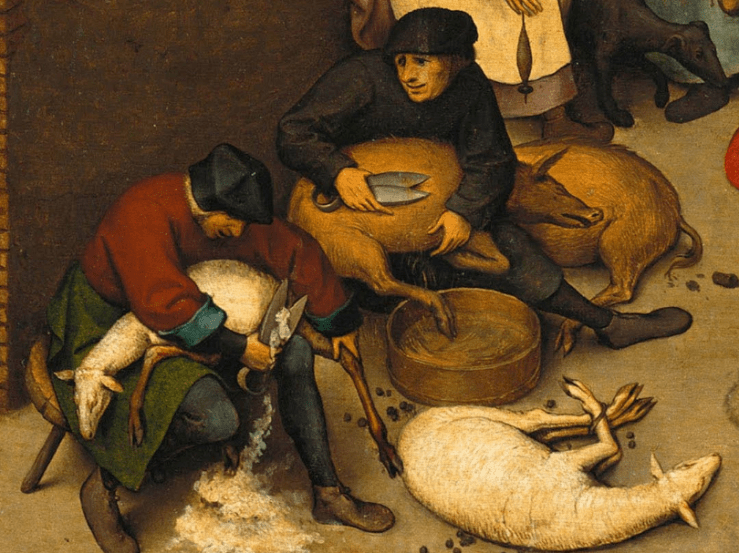
Netherlandish Proverbs (detail) — Pieter Bruegel the Elder

Screenshot 2016-06-26 at 11.08.51 AM

Nude on Checked Cloth (detail) — Egon Schiele

Screenshot 2016-07-02 at 3.46.10 PM

Lethe — Romaine Brooks

12

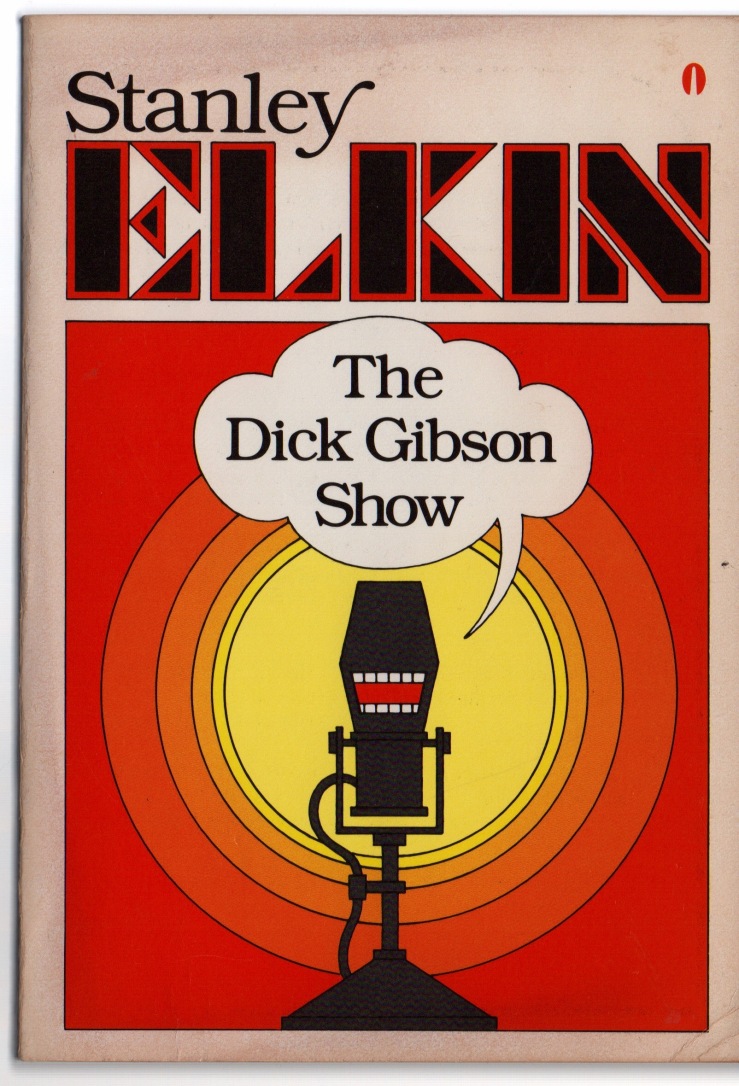
Stanley Elkin reviews Stanley Elkin’s novel The Dick Gibson Show (kinda sorta)

[Ed. note: I finished Stanley Elkin’s 1971 novel The Dick Gibson Show a few days ago. I read The Dick Gibson Show immediately after finishing Elkin’s 1976 novel The Franchiser. I want to write something about these novels, which seem of a piece to me, but I also wanted to get a bit more context first, and the most basic of internet searches led me to Elkin’s 1974 interview in The Paris Review with Thomas LeClair.

What follows are selections from the interview in which Elkin kinda sorta analyzes The Dick Gibson Show, providing what I take to be a Very Good and Fascinating Review of the novel.

Look, I went to school for reading books, I learned about the goddamn intentional fallacy and la mort de l’auteur and all that jazz, and I know that the author isn’t supposed to be the goddamn authority on his own work, I know that what follows isn’t a proper review—but I don’t care. I like it.

My assumption is it’s likely that anyone interested enough in a review of The Dick Gibson Show has probably already read Elkin’s Paris Review interview, and would probably prefer, like, something new on the novel. Which I’ll attempt down the line. But for now: Elkin on Elkin—]

img_2724


INTERVIEWER: I have some questions now about themes or ideas I find in much of your fiction. You have Dick Gibson say, “The point of life was the possibility it always held out for the exceptional.” The heroes in your novels have a tremendous need to be exceptional, to transcend others, to quarrel with the facts of physical existence. Is this a convention—which we’ve just been talking about—or something very basic to your whole view of life?

ELKIN: It is something very basic to my view of life, but in the case of that character it becomes the initial trauma which sets him going. It becomes his priority. Dick Gibson goes on to say that he had believed that the great life was the life of cliché. When I started to write the book, I did not know that was what the book was going to be about, but indeed that is precisely what the book gets to be about as I learned what Dick Gibson’s life meant. Consider the last few pages of the book:

What had his own life been, his interminable apprenticeship which he saw now he could never end? And everyone blameless as himself, everyone doing his best but maddened at last, all, all zealous, all with explanations ready at hand and serving an ideal of truth or beauty or health or grace. Everyone—everyone. It did no good to change policy or fiddle with format. The world pressed in. It opened your windows. All one could hope for was to find his scapegoat . . .

Now, everything that follows this is a cliché:

to wait for him, lurking in alleys, pressed flat against walls, crouched behind doors while the key jiggles in the lock, taking all the melodramatic postures of revenge. To be there in closets when the enemy comes for his hat, or to surprise him with guns in swivel chairs, your legs dapperly crossed when you turn to face him, to pin him down on hillsides or pounce on him from trees as he rides by, to meet him on the roofs of trains roaring on trestles, or leap at him while he stops at red lights, to struggle with him on the smooth faces of cliffs…

and so on. The theme of the novel is that the exceptional life—the only great life—is the trite life. It is something that I believe. It is not something that I am willing to risk bodily injury to myself in order to bring to pass, but to have affairs, to go to Europe, to live the dramatic clichés, all the stuff of which movies are made, would be the great life.

INTERVIEWER: But what if one were aware that they were clichés? Isn’t that what causes so much despair in contemporary fiction—that characters can’t live a life of clichés?

ELKIN: Dick Gibson is aware that they are clichés. What sets him off—what first inspires this notion in him—is his court-martial when he appears before the general and says that he’s taken a burr out of the general’s paw—something that happens in a fairy tale. When Dick realizes what has happened to him, he begins to weep, thinking, oh boy, I’ve got it made—I’m going to have enemies, I’m going to be lonely, I’m going to suffer. That is the theme of that book.

INTERVIEWER: Do the characters in your novels, then, have rather conventional notions of what exceptional is?

ELKIN: Yes, I think so.

Dick can’t stand anybody’s obsession but his own, which is largely the plight of myself and yourself, probably, and everybody. He’s opened a Pandora’s box when he opens his microphones to the people out there. When they find the platform that the Gibson format provides, they just get nuttier and nuttier and wilder and wilder, and this genuinely arouses whatever minimal social consciousness Dick Gibson has. The paradox of the novel is that the enemy that Gibson had been looking for all his life is that audience. The audience is the enemy. Dick builds up in his mind this Behr-Bleibtreau character. That Behr-Bleibtreau is his enemy. That’s baloney paranoia. The enemy is the amorphous public that he is trying to appeal to, that he’s trying to make love to with his voice. Dick Gibson is a bodiless being. He is his voice. That’s why the major scene in the novel is the struggle for Gibson’s voice.

INTERVIEWER: Who is Behr-Bleibtreau? There is a suggestiveness to his name that I can’t articulate.

ELKIN: Neither can I. I used to know a guy named—Bleibtreau. Hyphenating the name made it more sinister than just Bleibtreau itself. You know, you could almost put Count in front of it.

INTERVIEWER: s that why Dick thinks that Behr-Bleibtreau is the enemy—because there is this suggestion of cliché?

ELKIN: That’s right. Behr-Bleibtreau is a charlatan—that’s what he is. He has this theory of the will that is alluded to in the second section of the novel. And he is a hypnotist, exactly the kind of guy who Gibson sees as out to get him. Of course Behr-Bleibtreau isn’t out to get him. When Gibson thinks it is Behr-Bleibtreau calling him from Cincinnati, it isn’t. It’s just Gibson’s own paranoia that creates the conditions for Behr-Bleibtreauism.

INTERVIEWER: Is radio in the novel an index to social change, perhaps the devaluation of language?

ELKIN: That was not my intention. I could make a case that once upon a time there were scripts, a platform and an audience out in front of Jack Benny and Mary Livingstone, that radio then was a kind of art form and now it is an artless form in which you get self-promoters and people with theories about curing cancer by swallowing mosquitoes or something. Language, since it is occurring spontaneously rather than thought out, is devalued. But actually, in real life, modern radio talk shows are much more interesting than The Jack Benny Program ever was because you are getting the shoptalk of personality.

INTERVIEWER: Dick is a professional word man, and by the end he is reduced nearly to silence. Is this your “literature of exhaustion” that Barth talks about, a comment on the futility of language…

ELKIN: No. Certainly not.

INTERVIEWER: He does say less and less as the novel moves along.

ELKIN: Right. And the other people say more and more. That is intentional. But Dick makes an effort to get his program back from the sufferers. He starts hanging up on people. Then he gets the biggest charlatan—Nixon—at the end. Wasn’t I clever to invent Nixon before Nixon did?

INTERVIEWER: In bringing together so many stories and storytellers, did you have a thematic unity in mind?

ELKIN: I had in mind, as a matter of fact, The Canterbury Tales, particularly in that second section where the journey to dawn is the journey to Canterbury. Although there are no particular parallels, when I was sending out sections of the novel to magazines, I would call the sections “The Druggist’s Tale” and so on. There is that choral effect of the pilgrims to Canterbury.

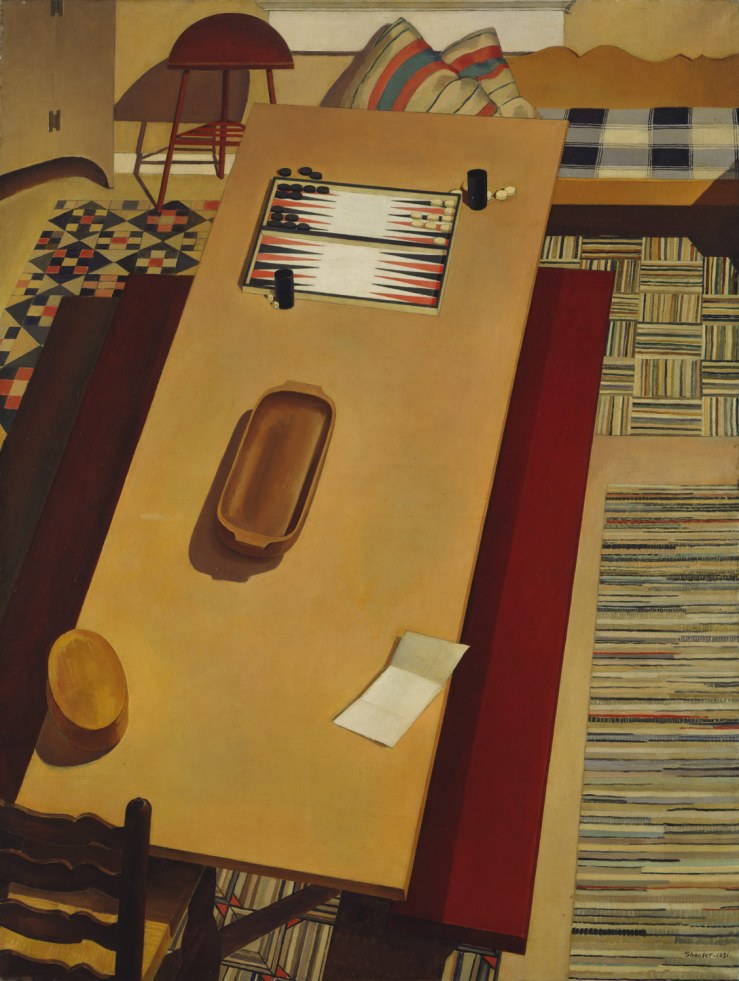
It Is Very Hot Here — Walasse Ting

9039448995_df0dab7525_b

Reading/Have Read/Should Write About

img_2997

From bottom to top:

I had to go hunt through the house for the trio of Hildafolk comics by Luke Pearson because my kids keep swapping them around. We’ve read them a bunch of times now and they are very good and sweet and charming and you can get them from NobrowHilda is going to be a Netflix series, by the way, which I told my kids and they were psyched. (They ten went on Netflix and looked for it. I had to explain production schedules).

W.D. Clarke’s White Mythology (which may or may not take its title from Derrida’s essay of the same name) is actually two novellas, Skinner Boxed and Love’s Alchemy. I finished the first novella before July 4th; Skinner Boxed is about psychiatrist Dr. Ed, who juggles a bunch of maguffins including a detached (and missing) wife, a returned bastard son, and a clinical anti-depressant trial. The novella begins with epigrams from Gravity’s Rainbow and A Christmas Carol, the latter of which it (somewhat perhaps ironically) follows. I finished the second novella Love’s Alchemy yesterday. Its tone is not as zany as that of Skinner Boxed, but both stories require the reader to put together seemingly disconnected events for the plot to “resolve” (if resolve is the right word). Good stuff.

I started the Howard translation of The Charterhouse of Parma by Stendhal. I’m in Chapter 3 right now. We’ll see how it goes this time. For now, I’ll continue to trust Italo Calvino. From his “Guide for New Readers of Stendhal’s Charterhouse:

…many young people will be smitten right from the opening pages, and will be instantly convinced that this has to be the best novel ever written, recognising it as the novel they had always wanted to read and which will act as the benchmark for all the other novels they will read in later life. (I’m talking particularly about the opening chapters; as you get into it, you will find that it is a different novel, or several novels each different from the other, all of which will require you to modify your involvement in the plot; whatever happens, the brilliance of the opening will continue to influence you.)

I finished Stanley Elkin’s The Franchiser and then the novel that chronologically preceded it (and arguably birthed it), The Dick Gibson Show. I need to write a whole Thing on these two novels, but I enjoyed them, and can’t believe it took me so long to read Elkin (although I’m glad I read Pynchon, Gaddis, and Gass first). I preferred the riffing polyglossia of TDGS a bit more than The Franchiser, which occasionally seemed to let its satire tip over into a kind of bathetic melancholy. Both novels diagnose an obsession of nostalgia (or, more directly: an obsession of obsession) that continues to grip America.

Yesterday I picked up Vladislav Vančura’s novel Marketa Lazarova, new in a sharp English translation by Carleton Bulkin from Twisted Spoon Press. Twisted Spoon had sent me the book a few weeks ago, and I’d meant to read it over the week of July Fourth but drank too many beers instead. Anyway, I picked it up yesterday and read the first two chapters (50 pages—the first third, that is) gripped in wonder and laughter, and a bit of happy shock even. A strange and often violent tale of multiple kidnappings and medieval intrigues, Marketa Lazarova reminds me of Le Morte D’Arthur, Nanni Balestrini’s Sandokan (both in its evocations of brutality and in its marvelous poetic prose), Aleksei German’s film Hard to Be a God, Bergman’s film The Virgin Spring, Bolaño’s sweetly ironic narrators, and yes, hell, Game of Thrones. I’d rather be reading this book right now than writing about it in this silly blog post, actually. And no, I haven’t seen the František Vláčil film adaptation—yet.

Netherlandish Proverbs (detail) — Pieter Bruegel the Elder

Screenshot 2016-06-26 at 11.05.53 AM

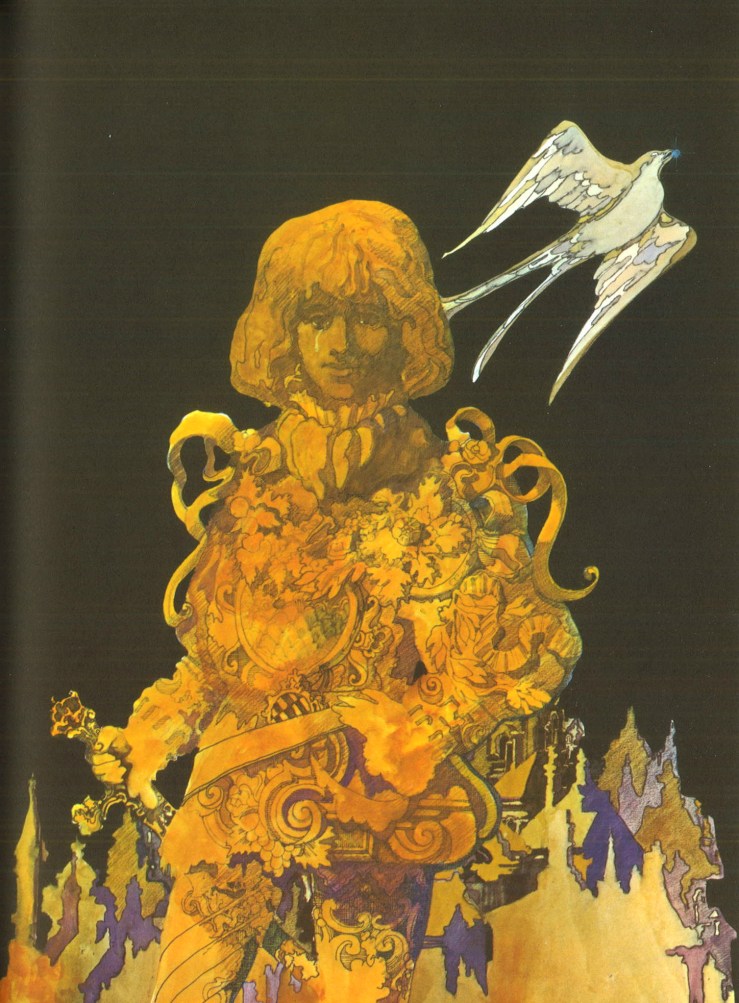
Illustration for Oscar Wilde’s “The Happy Prince” — James Hill

The Happy Prince

James Hill’s illustration for “The Happy Prince” by Oscar Wilde. From The Short Stories of Oscar Wilde, Heritage Press, 1968.


“The Happy Prince”

by

Oscar Wilde


High above the city, on a tall column, stood the statue of the Happy Prince. He was gilded all over with thin leaves of fine gold, for eyes he had two bright sapphires, and a large red ruby glowed on his sword-hilt.

He was very much admired indeed. “He is as beautiful as a weathercock,” remarked one of the Town Councillors who wished to gain a reputation for having artistic tastes; “only not quite so useful,” he added, fearing lest people should think him unpractical, which he really was not.

“Why can’t you be like the Happy Prince?” asked a sensible mother of her little boy who was crying for the moon. “The Happy Prince never dreams of crying for anything.”

“I am glad there is some one in the world who is quite happy,” muttered a disappointed man as he gazed at the wonderful statue.

“He looks just like an angel,” said the Charity Children as they came out of the cathedral in their bright scarlet cloaks and their clean white pinafores.

“How do you know?” said the Mathematical Master, “you have never seen one.”

“Ah! but we have, in our dreams,” answered the children; and the Mathematical Master frowned and looked very severe, for he did not approve of children dreaming.

One night there flew over the city a little Swallow. His friends had gone away to Egypt six weeks before, but he had stayed behind, for he was in love with the most beautiful Reed. He had met her early in the spring as he was flying down the river after a big yellow moth, and had been so attracted by her slender waist that he had stopped to talk to her.
Continue reading “Illustration for Oscar Wilde’s “The Happy Prince” — James Hill”

Escape from New York film poster — Kilian Eng

tumblr_o9shqqz7pm1qbluruo4_1280

Soap Bubbles — Berenice Abbott

dp134076

La Baronne Emile D’Erlanger — Romaine Brooks

cf24d84ec93029ab64616fb578a8b01f

Three Books

img_2987

Grendel by John Gardner. First edition hardback by Knopf (Borzoi imprint), 1971. No designer credited, but the jacket illustration is almost certainly by Emil Antonucci, whose line drawings head each chapter. The blurb on the back, by the way, is from a William H. Gass review of Gardner’s second novel The Wreckage of Agathon, which I have not read.

I usually only do scans of the fronts of books in these Three Books posts, but the clothbound book under the jacket of this edition of Grendel is too lovely not to share (it could also have fit into my three purple books post a while back):

img_2988

img_2990

Mules & Men by Zora Neale Hurston. 1978 trade paperback by Indiana University Press. No designer credited, but the cover illustration is almost certainly by Miguel Covarrubias, whose illustrations accompany the text. Mules & Men is not stuffy catalog of folklore, but rather Hurston’s own synthesis of the tales she collected (and improved upon, if not outright invented in some cases) primarily in Florida in the early 1930s. A sample tale: How the snake got poison:

Well, when God made de snake he put him in de bushes to ornament de ground. But things didn’t suit de snake so one day he got on de ladder and went up to see God. “Good mawnin’, God.” “How do you do, Snake?” “Ah ain’t so many, God, you put me down there on my belly in de dust and everything trods upon me and kills off my generations. Ah ain’t got no kind of protection at all.”

God looked off towards immensity and thought about de subject for awhile, then he said, “Ah didn’t mean for nothin’ to be stompin’ you snakes lak dat. You got to have some kind of a protection. Here, take dis poison and put it in yo’ mouf and when they tromps on you, protect yo’ self. “

So de snake took de poison in his mouf and went on back.

So after awhile all de other varmints went up to God.

“Good evenin’, God.”

“How you makin’ it, varmints?”

“God, please do somethin’ ’bout dat snake. He’ layin’ in de bushes there wid poison in his mouf and he’s strikin’ everything dat shakes de bush. He’s killin’ up our generations. Wese skeered to walk de earth.”

So God sent for de snake and tole him:

“Snake, when Ah give you dat poison, Ah didn’t mean for you to be hittin’ and killin’ everything dat shake de bush. I give you dat poison and tole you to protect yo’self when they tromples on you. But you killin’ everything dat moves. Ah didn’t mean for you to do dat.”

De snake say, “Lawd, you know Ah’m down here in de dust. Ah ain’t got no claws to fight wid, and Ah ain’t got no feets to git me out de way. All Ah kin see is feets comin’ to tromple me. Ah can’t tell who my enemy is and who is my friend. You gimme dis protection in my mouf and Ah uses it.”

God thought it over for a while then he says:

“Well, snake, I don’t want yo’ generations all stomped out and I don’t want you killin’ everything else dat moves. Here take dis bell and tie it to yo’ tail. When you hear feets comin’ you ring yo’ bell and if it’s yo’ friend, he’ll be keerful. If it’s yo’ enemy, it’s you and him.”

So dat’s how de snake got his poison and dat’s how come he got rattles.

Biddy, biddy, bend my story is end.

Turn loose de rooster and hold de hen.

img_2989

By Night in Chile by Roberto Bolaño. English translation by Chris Andrews. Trade paperback by New Directions, 2003. Cover design by Semadar Megged, who adapted a photograph by Kurt Beals. The orange in the cover doesn’t seem so vibrant in the scan I did. It’s as orange as the other two books. Oh well. The prose is vibrant, electric orange.

I wrote about By Night in Chile here.

Netherlandish Proverbs (detail) — Pieter Bruegel the Elder

Screenshot 2016-06-26 at 11.02.50 AM.png

“Exits” — Langston Hughes

Screenshot 2016-07-09 at 12