September 18th.–How the summer-time flits away, even while it seems to be loitering onward, arm in arm with autumn! Of late I have walked but little over the hills and through the woods, my leisure being chiefly occupied with my boat, which I have now learned to manage with tolerable skill. Yesterday afternoon I made a voyage alone up the North Branch of Concord River. There was a strong west-wind blowing dead against me, which, together with the current, increased by the height of the water, made the first part of the passage pretty toilsome. The black river was all dimpled over with little eddies and whirlpools; and the breeze, moreover, caused the billows to beat against the bow of the boat, with a sound like the flapping of a bird’s wing. The water-weeds,where they were discernible through the tawny water, were straight outstretched by the force of the current, looking as if they were forced to hold on to their roots with all their might. If for a moment I desisted from paddling, the head of the boat was swept round by the combined might of wind and tide. However, I toiled onward stoutly, and, entering the North Branch, soon found myself floating quietly along a tranquil stream, sheltered from the breeze by the woods and a lofty hill. The current, likewise, lingered along so gently that it was merely a pleasure to propel the boat against it. I never could have conceived that there was so beautiful a river-scene in Concord as this of the North Branch. The stream flows through the midmost privacy and deepest heart of a wood, which, as if but half satisfied with its presence, calm, gentle, and unobtrusive as it is, seems to crowd upon it, and barely to allow it passage; for the trees are rooted on the very verge of the water, and dip their pendent branches into it. On one side there is a high bank, forming the side of a hill, the Indian name of which I have forgotten, though Mr. Thoreau told it to me; and here, in some instances, the trees stand leaning over the river, stretching out their arms as if about to plunge in headlong. On the other side, the bank is almost on a level with the water; and there the quiet congregation of trees stood with feet in the flood, and fringed with foliage down to its very surface. Vines here and there twine themselves about bushes or aspens or alder-trees, and hang their clusters (though scanty and infrequent this season) so that I can reach them from my boat. I scarcely remember a scene of more complete and lovely seclusion than the passage of the river through this wood. Even an Indian canoe, in oldentimes, could not have floated onward in deeper solitude than my boat. I have never elsewhere had such an opportunity to observe how much more beautiful reflection is than what we call reality. The sky, and the clustering foliage on either hand, and the effect of sunlight as it found its way through the shade, giving lightsome hues in contrast with the quiet depth of the prevailing tints,–all these seemed unsurpassably beautiful when beheld in upper air. But on gazing downward, there they were, the same even to the minutest particular, yet arrayed in ideal beauty, which satisfied the spirit incomparably more than the actual scene. I am half convinced that the reflection is indeed the reality, the real thing which Nature imperfectly images to our grosser sense. At any rate, the disembodied shadow is nearest to the soul.
There were many tokens of autumn in this beautiful picture. Two or three of the trees were actually dressed in their coats of many colors,–the real scarlet and gold which they wear before they put on mourning. These stood on low, marshy spots, where a frost has probably touched them already. Others were of a light, fresh green, resembling the hues of spring, though this, likewise, is a token of decay. The great mass of the foliage, however, appears unchanged; but ever and anon down came a yellow leaf, half flitting upon the air, half falling through it, and finally settling upon the water. A multitude of these were floating here and there along the river, many of them curling upward, so as to form little boats, fit for fairies to voyage in. They looked strangely pretty, with yet a melancholy prettiness, as they floated along. The general aspect of the river, however, differed but little from that of summer,–at least the differencedefies expression. It is more in the character of the rich yellow sunlight than in aught else. The water of the stream has now a thrill of autumnal coolness; yet whenever a broad gleam fell across it, through an interstice of the foliage, multitudes of insects were darting to and fro upon its surface. The sunshine, thus falling across the dark river, has a most beautiful effect. It burnishes it, as it were, and yet leaves it as dark as ever.
On my return, I suffered the boat to float almost of its own will down the stream, and caught fish enough for this morning’s breakfast. But, partly from a qualm of conscience, I finally put them all into the water again, and saw them swim away as if nothing had happened.
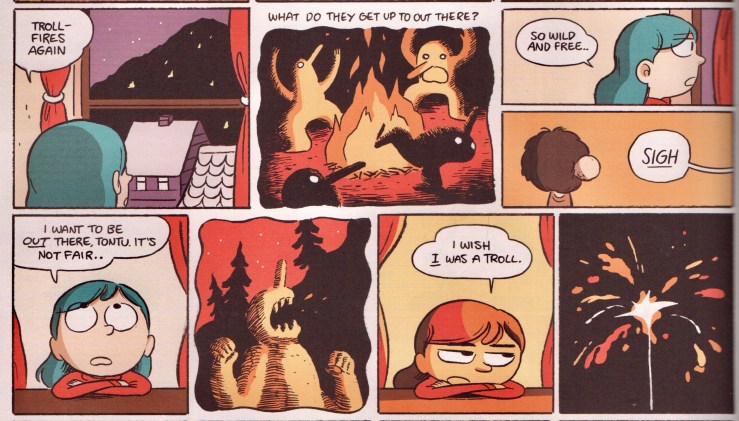
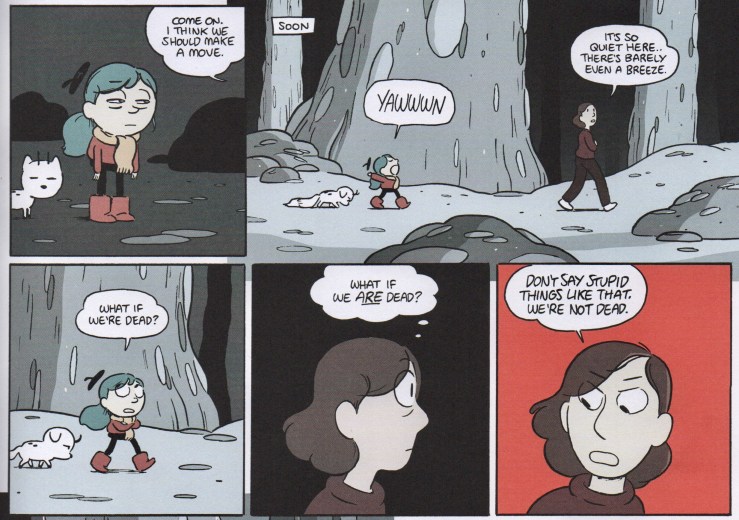
I love love love Hilda and the Stone Forest by Luke Pearson (Flying Eye/Nobrow, 2016). My kids love it too. It’s the richest, funniest, and most heartwarming Hilda book to date.
Pearson manages to stuff The Stone Forest with miniature epics and minor gags, which he hangs on the central story of Hilda and her mother in an otherworldly (literally), uh, stone forest, where they encounter trolls and other dangers (including existential despair).
In high school I was, like many American intellectual kids, a stranger in a strange land. I made the Berkeley Public Library my refuge, and lived half my life in books. Not only American books—English and French novels and poetry, Russian novels in translation. Transported unexpectedly to college in another strange land, the East Coast, I majored in French lit and went on reading European lit on my own. I felt more at home in some ways in Paris in 1640 or Moscow in 1812 than in Cambridge, Massachusetts, in 1948.
Much as I loved my studies, their purpose was to make me able to earn a living as a teacher, so I could go on writing. And I worked hard at writing short stories. But here my European orientation was a problem. I wasn’t drawn to the topics and aims of contemporary American realism. I didn’t admire Ernest Hemingway, James Jones, Norman Mailer, or Edna Ferber. I did admire John Steinbeck, but knew I couldn’t write that way. In The New Yorker, I loved Thurber, but skipped over John O’Hara to read the Englishwoman Sylvia Townsend Warner. Most of the people I really wished I could write like were foreign, or dead, or both. Most of what I read drew me to write about Europe; but I knew it was foolhardy to write fiction set in Europe if I’d never been there.
—(Quietly) 1 It’s been a prevalent notion 2. Fallen sparks 3. Fragments of vessels broken at the Creation 4. And someday, somehow, before the end, a gathering back to home. A messenger from the Kingdom, arriving at the last moment 5. But I tell you there is no such message, no such home 6—only the millions of last moments… no more. Our history is an aggregate of last moments 7.
From pages 82-83 of Thomas Pynchon’s 1973 novel Gravity’s Rainbow.
1 A stage direction. These are the final lines in a one-act play, a small (cosmically-large) tragicomedy featuring two…nerve cells. Rollo Groast of the White Visitation prefaces a page earlier:
It is part…of an old and clandestine drama for which the human body serves only as a set of very allusive, often cryptic, programme notes—it’s as if the body we can measure is a scrap of this programme found outside in the street, near a magnificent stone theater we cannot enter.
In this little play (its rough setting echoes GR’s own martial satire), a younger cell asks a senior cell if she’s ever been to the “Outer Level” and is somewhat shocked when she tells him that “sooner or later everyone out here has to go Epidermal. No exceptions.”
Is this the first episode of Gravity’s Rainbow staged as a play? I think so.
2 The “prevalent notion” the younger cell subscribes to is characterized in the four sentences that follow, and then rejected in the fifth, the sentence that pivots with “But.” A satire of religious hope, perhaps?—the notion of salvation, redemption, an organizing principle to arrive and tidy all the chaos?
3 The preterite. But also/and—
4 The notations on broken vessels and sparks seem to allude to the Kabbalah of Isaac Luria (1534-1572). I will not attempt a bad paraphrase of Lurianic Kabbalah here, but a basic big picture—sparks—souls, fragments of a one-soul—looking to be rectified. Pynchon, inking heavy his preterite-and-elect theme.
5 The deus ex machina in the last act, the game-winning Hail Mary pass, the Messiah, smiling and terrible…
6 Bummer.
Cf. the opening of Gravity’s Rainbow. From the sixth paragraph:
“You didn’t really believe you’d be saved. Come, we all know who we are by now. No one was ever going to take the trouble to save you, old fellow. . . .”
These are the first lines of dialog in the novel. (If they can be called dialog).
7 The “our” here is biological—one cell to another business—but is there more to human history? Are we more than just our cells? Are there sparks for these vessels?
The narrator here seems to superimpose an answer into the senior cell’s line here: History is simply an imposition, a psychological trick, a way to organize chaos via narrative.
Will Postwar be nothing but ‘events,’ newly created one moment to the next? No links? Is it the end of history?
This miniature cellular drama comes after the introduction to a minor character in Gravity’s Rainbow I’ve always found intriguing: Gavin Trefoil.
Trefoil, an agent (?!) of The White Visitation, has powers:
Lately, as if all tuned in to the same aethereal Xth Programme, new varieties of freak have been showing up at “The White Visitation,” all hours of the day and night, silent, staring, expecting to be taken care of, carrying machines of black metal and glass gingerbread, off on waxy trances, hyperkinetically waiting only the right trigger-question to start blithering 200 words a minute about their special, terrible endowments. An assault. What are we to make of Gavin Trefoil, for whose gift there’s not even a name yet? (Rollo Groast wants to call it autochromatism.) Gavin, the youngest here, only 17, can somehow metabolize at will one of his amino acids, tyrosine. This will produce melanin, which is the brown-black pigment responsible for human skin color. Gavin can also inhibit this metabolizing by—it appears—varying the level of his blood phenylalanine. So he can change his color from most ghastly albino up through a smooth spectrum to very deep, purplish, black. If he concentrates he can keep this up, at any level, for weeks. Usually he is distracted, or forgets, and gradually drifts back to his rest state, a pale freckled redhead’s complexion.
I suppose I could riff all day on the symbolic/historic implications of Trefoil’s powers: His gradations of color disrupt the binary (black-white, off-on, zero-one) that a Pavlovian like Pointsman insists upon (Trefoil’s super(?!)power falls in line with Roger Mexico’s gradations between 0 and 1).
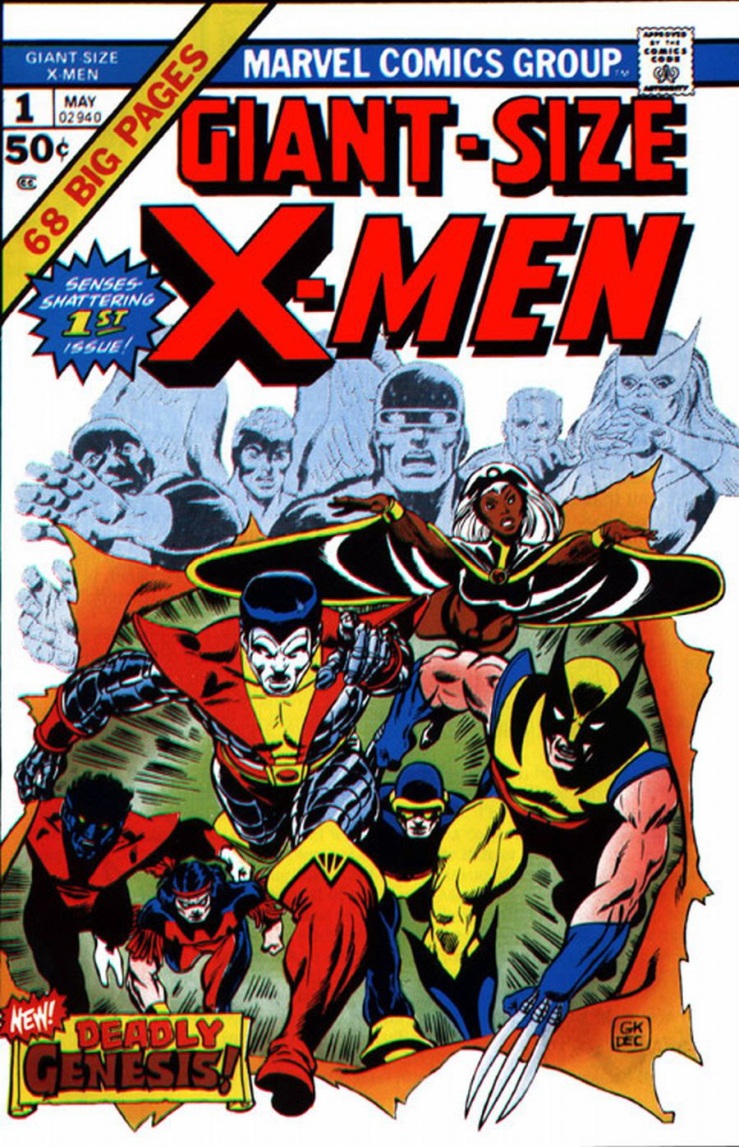
Giant-Size X-Men #1, 1975. Art by Gil Kane and Dave Cockrum, story by Len Wein.
But what really interests me here is Trefoil’s mutant powers and The White Visitation as a sort of potential comic book—I mean what I want to say here is that Pynchon points ahead to the 1975 “reboot” of Uncanny X-Men, and even The New Mutants: Post-global preterite underground weirdos with strange powers. Psychics and witches and protagonists that splinter into nothingness, after going through multiple reboots—(Plechazunga, the Pig-Hero, Rocketman, etc.). (Hell, the Pynchon X-Men team could even have Grigori the Octopus).
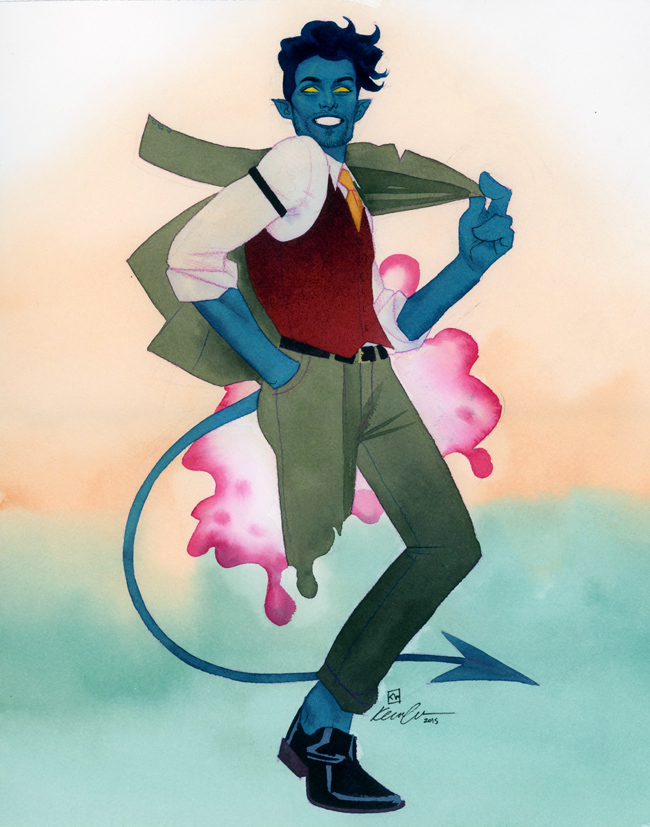
The closest X-Men comparison for Gavin Trefoil is probably the shapeshifter baddie X-Men antagonist Mystique, whose powers are obviously more pronounced than Trefoil’s. And there’s also Nightcrawler—maybe my favorite of Chris Claremont’s run on X-Men—or maybe I mean Excalibur. And also blueskinned Beast.
Nightcrawler, Kevin Wada, 2015
Late in the novel, Our Hero Tyrone Slothrop will help form the superish heroish team the Floundering Four (along with Myrtle Miraculous, zoot-suited Maximillian, and mechanical man Marcel). The Floundering Four will set out to battle the Paternal Peril. (Make of that what you will).
On Trefoil the Blueskin, here’s Steven Weisenburger (A Gravity’s Rainbow Companion):
“The blackmarket blights peace,” Dutch postwar propaganda poster, 1946
Don’t forget the real business of the War is buying and selling 1. The murdering and the violence are self-policing, and can be entrusted to non-professionals. The mass nature of wartime death is useful in many ways 2. It serves as spectacle, as diversion from the real movements of the War. It provides raw material to be recorded into History, so that children may be taught History as sequences of violence, battle after battle, and be more prepared for the adult world 3. Best of all, mass death’s a stimulus 4 to just ordinary folks, little fellows 5, to try ’n’ grab a piece of that Pie while they’re still here to gobble it up. The true war is a celebration of markets 6. Organic markets, carefully styled “black” 7 by the professionals, spring up everywhere. Scrip, Sterling, Reichsmarks continue to move, severe as classical ballet, inside their antiseptic marble chambers. But out here, down here among the people, the truer currencies come into being. So, Jews are negotiable. Every bit as negotiable as cigarettes, cunt, or Hershey bars. Jews also carry an element of guilt, of future blackmail, which operates, natch, in favor of the professionals. 8
From page 105 of Thomas Pynchon’s 1973 novel Gravity’s Rainbow.
1Gravity’s Rainbow is often (unjustly and unfairly) maligned as a messy, even pointless affair—but here’s our author speaking through the narrator, offering up one of the novel’s points—clearly, without equivocation.
2 Our narrator digs irony though…
3 Entropy is all—but entropy doesn’t make for good capitalism, by which our sly narrator means, Their Capitalism. The adult world needs to be organized, systematized, caused and effected.
Cf. Jack Gibbs’s rant to his erstwhile young students, early in William Gaddis’s 1975 novel of capitalism, J R:
Before we go any further here, has it ever occurred to any of you that all this is simply one grand misunderstanding? Since you’re not here to learn anything, but to be taught so you can pass these tests, knowledge has to be organized so it can be taught, and it has to be reduced to information so it can be organized do you follow that? In other words this leads you to assume that organization is an inherent property of the knowledge itself, and that disorder and chaos are simply irrelevant forces that threaten it from the outside. In fact it’s the opposite. Order is simply a thin, perilous condition we try to impose on the basic reality of chaos . . .
4 Note the not-so-oblique reference to GR’s theme of stimulus-response (and upending that response).
Not too much earlier in the narrative, dedicated Pavlovian Dr. Edward W.A. Pointsman worries about the end of cause and effect, the rise of entropy:
Will Postwar be nothing but ‘events,’ newly created one moment to the next? No links? Is it the end of history?
5…the preterite?
6 Pynchon reiterates his thesis.
7 Note that organic (entropic?) markets fall outside of Their System—y’know, Them—the Professionals—these organic (chaotic, necessary) markets must be labeled “black” (preterite?).
Here’s another Dutch propaganda poster:
“Protect them against the black market!”, Dutch propaganda poster, 1944
Page 105 of Gravity’s Rainbow “happens,” more or less, in 1944, in the middle of an extended introduction of Katje Borgesius, a Dutch double agent. (Or is that double Dutch agent?). The propaganda poster above strikes me as overtly racist, but also seems to nod to King Kong (1933, dir. Cooper and Schoedsack). Gravity’s Rainbow is larded with references to King Kong, a sympathetic but powerful force of entropy, a force against the Professionals.
Fay Wray look, 57; Fay Wray, 57, 179, 275; “You will have the tallest, darkest leading man in Hollywood,” 179; “headlights burning like the eyes of” 247; “the black scapeape we cast down like Lucifer,” 275; Mitchell Prettyplace book about, 275; “Giant ape” 276; “the Fist of the Ape,” 277; “orangutan on wheels,” 282; taking a shit, 368; “The figures darkened and deformed, resembling apes” 483; “a troupe of performing chimpanzees” 496; “on the tit with no motor skills,” 578; “Negroid apes,” 586; “that sacrificial ape,” 664; “a gigantic black ape,” 688; Carl Denham, 689; poem based on King Kong, 689; See also: actors/directors film/cinema references;
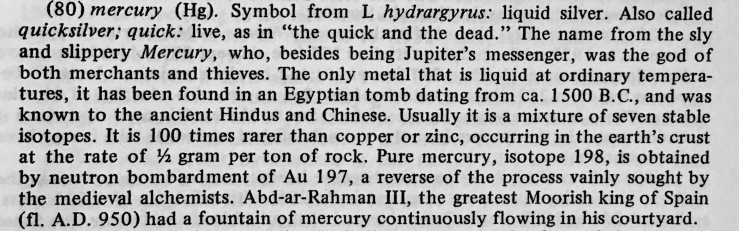
The Kong-figure in the Dutch propaganda poster seems to wear the petasos (winged hat) and wield the caduceus of Hermes or Mercury—god of thieves. But also god of the market, of commerce, merchandise, all things mercenary.
From Joseph T. Shipley’s The Origin of English Words: A Discursive Dictionary of Indo-European Roots (1984):
8 The passage as a whole, which emphasizes war as a conduit for the techne of the market (or do I have that backwards? should I note the market of techne?) echoes an earlier passage. From page 81:
It was widely believed in those days that behind the War—all the death, savagery, and destruction—lay the Führer-principle. But if personalities could be replaced by abstractions of power, if techniques developed by the corporations could be brought to bear, might not nations live rationally? One of the dearest Postwar hopes: that there should be no room for a terrible disease like charisma.
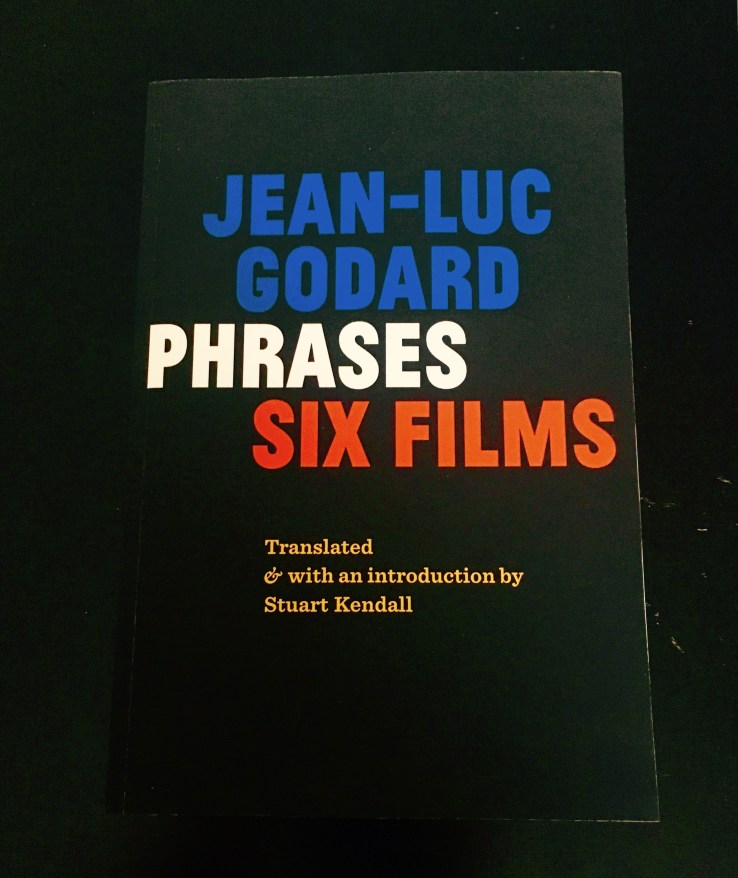
Jean-Luc Godard’s Phrases: Six Films is new in English translation by Stuart Kendall from Contra Mundum Press. Their blurb:
Phrases presents the spoken language from six films by Jean-Luc Godard: Germany Nine Zero, The Kids Play Russian, JLG / JLG, 2 x 50 Years of French Cinema, For Ever Mozart and In Praise of Love. Completed between 1991 and 2001, during what has been called Godard’s “years of memory,” these films and videos were made alongside and in the shadow of his major work from that time, his monumental Histoire(s) du cinema, complementing and extending its themes. LikeHistoire(s), they offer meditations on, among other things, the tides of history, the fate of nations, the work of memory, the power of cinema, and, ultimately, the nature of love.
Gathered here, in written form, they are words without images: not exactly screenplays, not exactly poetry, something else entirely. Godard himself described them enigmatically: “Not books. Rather recollections of films, without the photos or the uninteresting details… Only the spoken phrases. They offer a little prolongation. One even discovers things that aren’t in the films in them, which is rather powerful for a recollection. These books aren’t literature or cinema. Traces of a film…”
In our era of ubiquitous streaming video, ebooks, and social media, these traces of cinema raise compelling questions for the future of media, cinematic, literary, and otherwise.










 Biblioklept