Two Oranges — Avigdor Arikha

two-oranges-1975.jpg!Large

Two Oranges, 1975 by Avigdor Arikha (1929-2010)

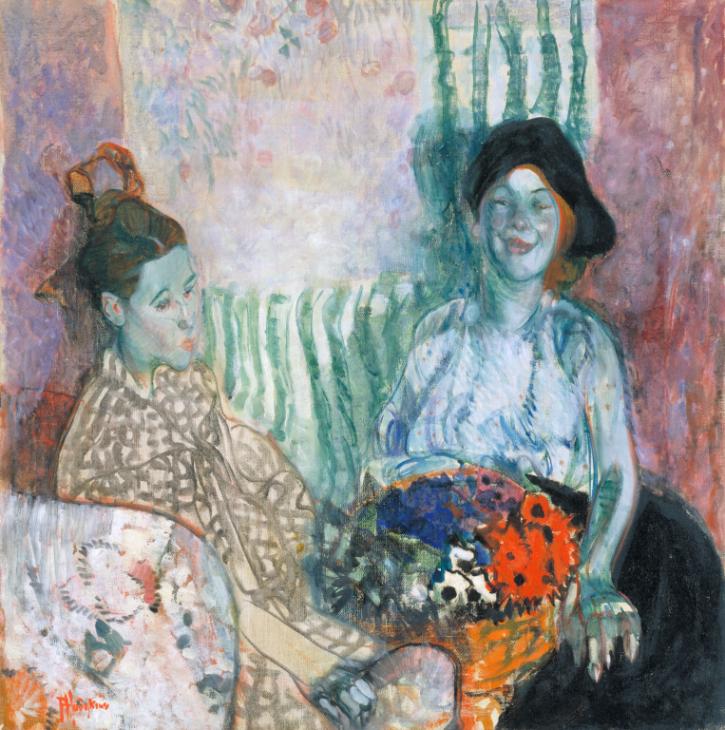
Loveday and Ann: Two Women with a Basket of Flowers — Frances Hodgkins

Loveday and Ann: Two Women with a Basket of Flowers 1915 by Frances Hodgkins 1869-1947

Loveday and Ann: Two Women with a Basket of Flowers, 1915 by Frances Hodgkins (1869–1947)

Sunday Comics 

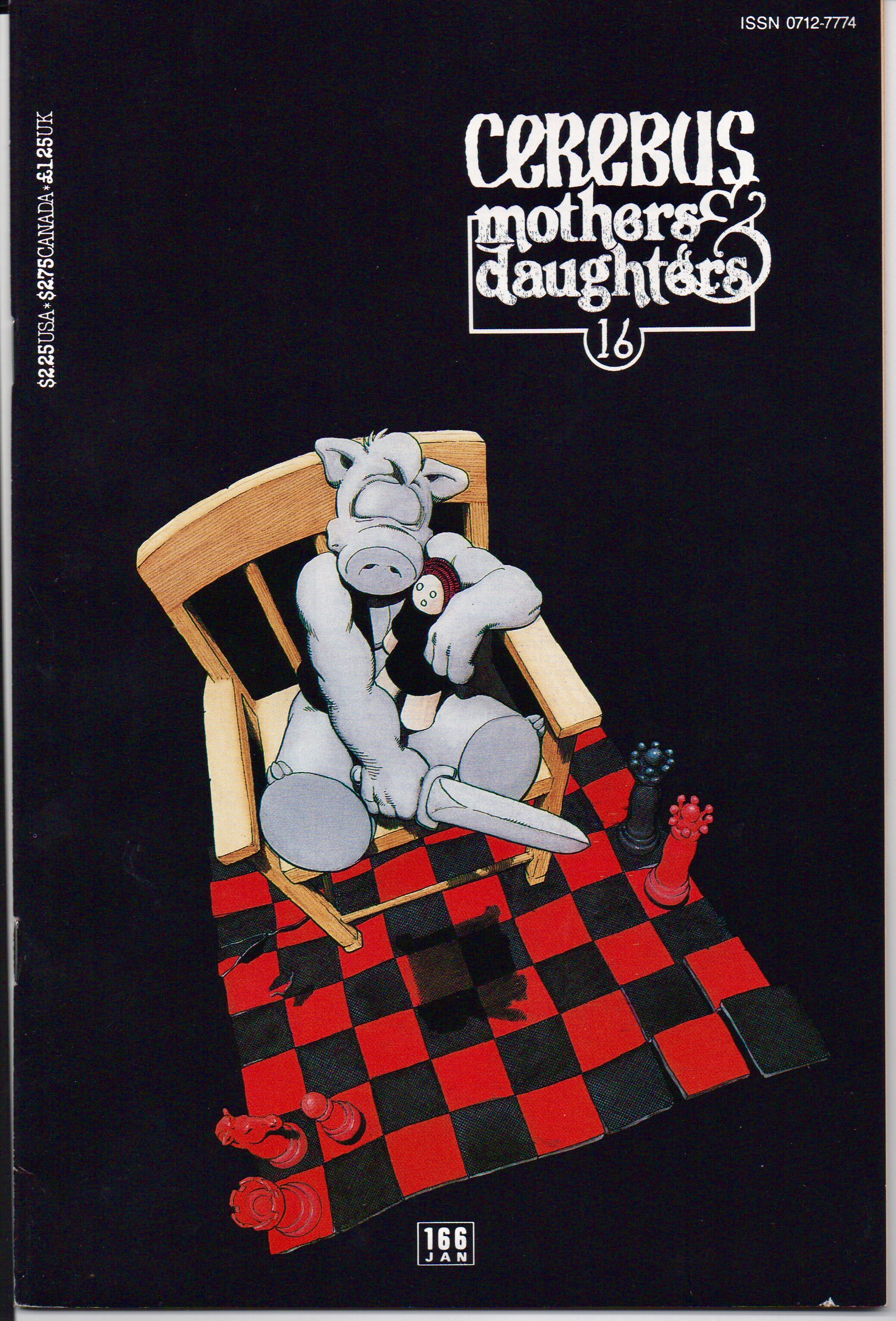
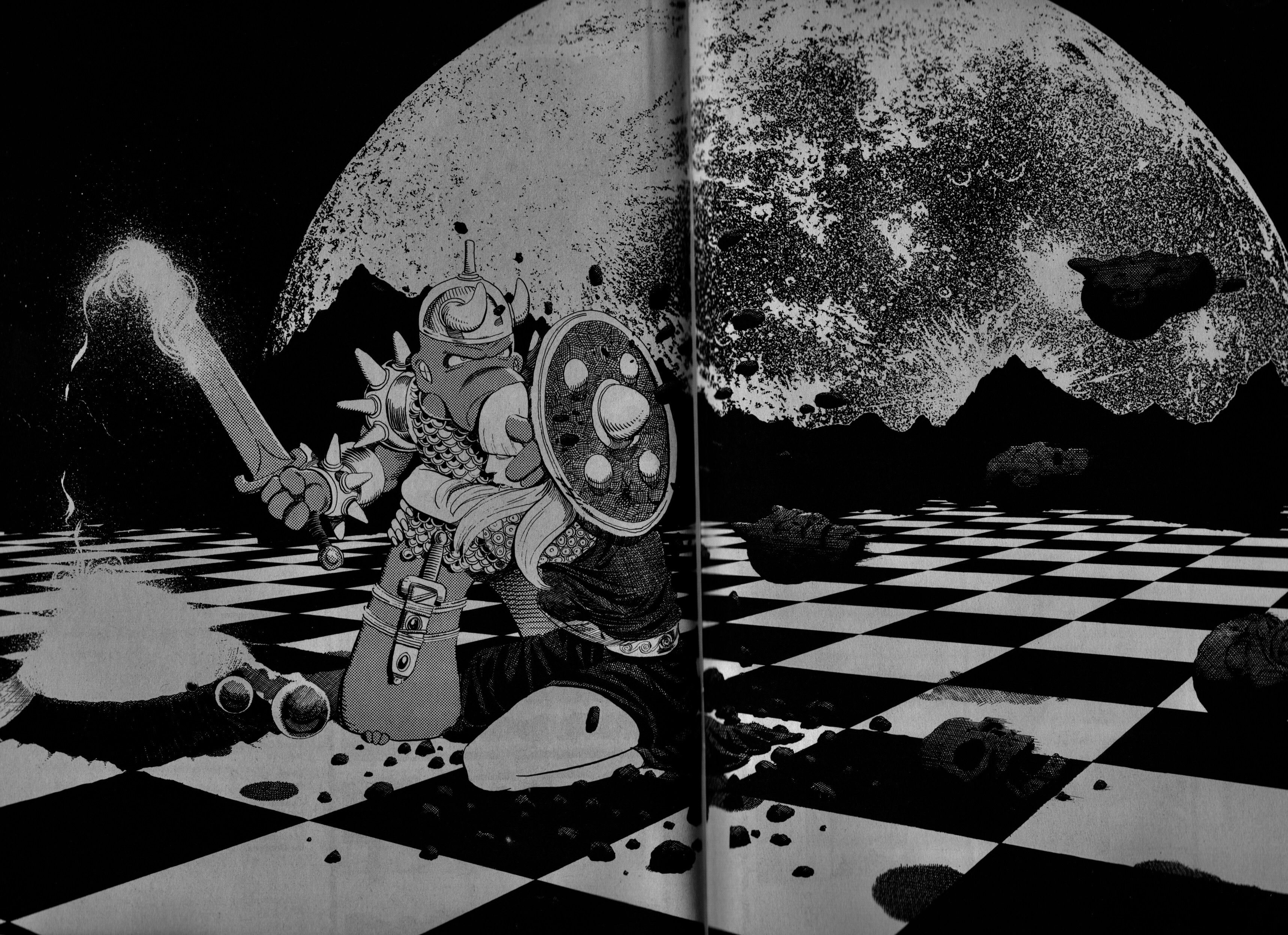
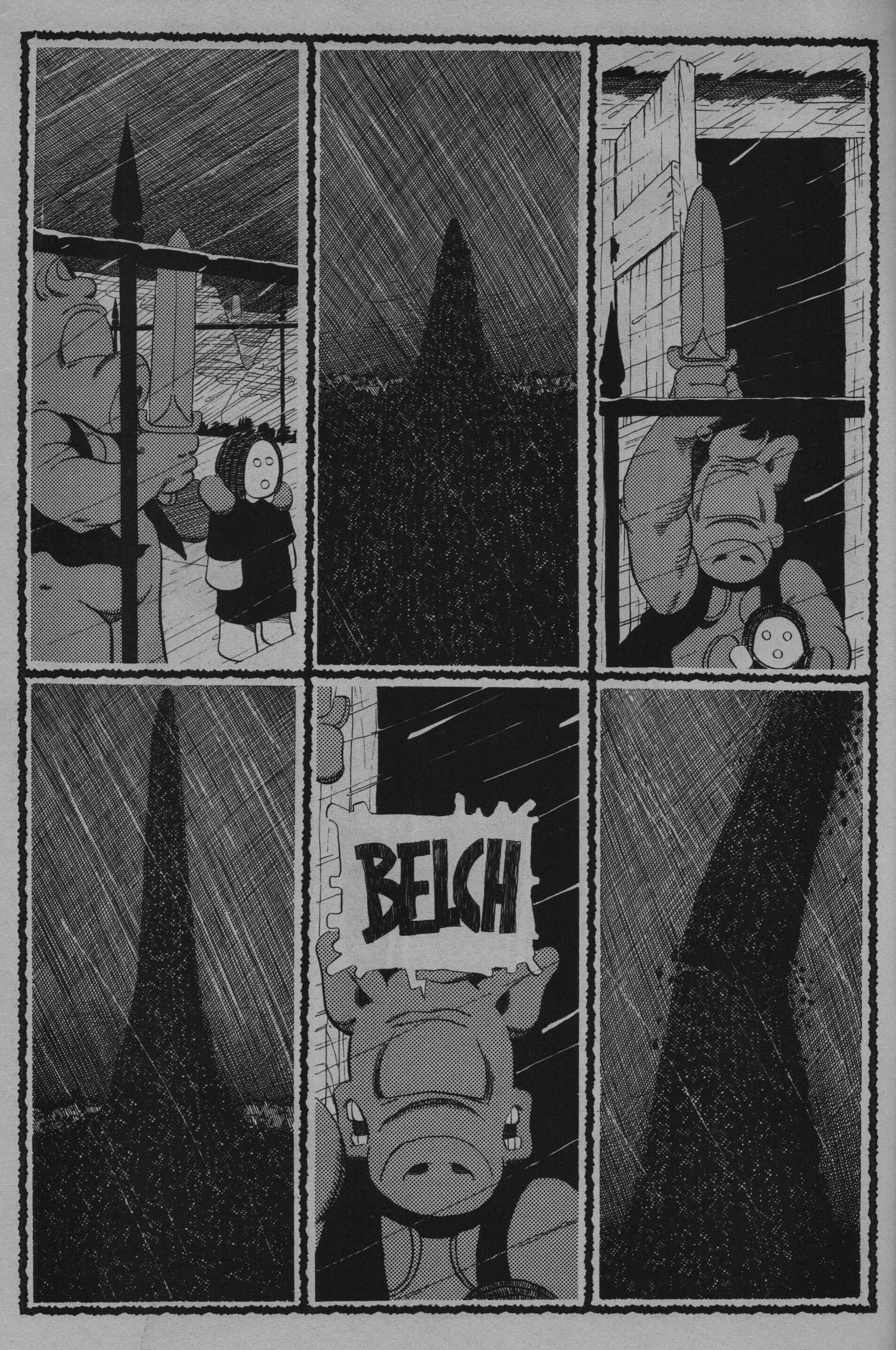
Cerebus #166, January, 1993 by Dave Sim and Gerhard; published by Aardvark-Vanaheim. This issue is Chapter 16 of the Mothers & Daughters storyline, Sim’s imagining of a tyrannical matriarchal state (sort of like The Handmaid’s Tale in reverse, sort of). This issue is one of my favorite chapters in the novel, a riff on Sim’s earlier “Mind Games” issues, wherein Cerebus’s dream-state shapes events in the real world. Mothers & Daughters is pretty much the last good Cerebus novel, before Sim took things completely off the rails in Reads.

Nathaniel Hawthorne’s journal entry for May 14th, 1850

May 14th.–A stable opposite the house,–an old wooden construction, low, in three distinct parts; the centre being the stable proper, where the horses are kept, and with a chamber over it for the hay. On one side is the department for chaises and carriages; on the other, the little office where the books are kept. In the interior region of the stable everything is dim and undefined,–half-traceable outlines of stalls, sometimes the shadowy aspect of a horse. Generally a groom is dressing a horse at the stable door, with a care and accuracy that leave no part of the animal unvisited by the currycomb and brush; the horse, meanwhile, evidently enjoying it, but sometimes, when the more sensitive parts are touched, giving a half-playful kick with his hind legs, and a little neigh. If the men bestowed half as much care on their own personal cleanliness, they would be all the better and healthier men therefor. They appear to be busy men, these stablers, yet have a lounging way with them, as if indolence were somehow diffused through their natures. The apparent head of the establishment is a sensible, thoughtful-looking, large-featured, and homely man, past the middle age, clad rather shabbily in gray, stooping somewhat, and without any smartness about him. There is a groom, who seems to be a very comfortable kind of personage,–a man of forty-five or thereabouts (R. W. Emerson says he was one of his schoolmates), but not looking so old; corpulent, not to say fat, with a white frock, which his goodly bulk almost fills, enveloping him from neck nearly to ankles. On his head he wears a cloth cap of a jockey shape; his pantaloons are turned up an inch or two at bottom, and he wears brogans on his feet. His hair, as may be seen when he takes off his cap to wipe his brow, is black and in perfect preservation, with not exactly a curl, yet a vivacious and elastic kind of twist in it. His face is fresh-colored, comfortable, sufficiently vivid in expression, not at all dimmed by his fleshly exuberance, because the man possesses vigor enough to carry it off. His bodily health seems perfect; so, indeed, does his moral and intellectual. He is very active and assiduous in his duties, currycombing and rubbing down the horses with alacrity and skill; and, when not otherwise occupied, you may see him talking jovially with chance acquaintances, or observing what is going forward in the street. If a female acquaintance happens to pass, he touches his jockey cap, and bows, accomplishing this courtesy with a certain smartness that proves him a man of the world. Whether it be his greater readiness to talk, or the wisdom of what he says, he seems usually to be the centre talker of the group. It is very pleasant to see such an image of earthly comfort as this. A fat man who feels his flesh as a disease and encumbrance, and on whom it presses so as to make him melancholy with dread of apoplexy, and who moves heavily under the burden of himself,–such a man is a doleful and disagreeable object. But if he have vivacity enough to pervade all his earthiness, and bodily force enough to move lightly under it, and if it be not too unmeasured to have a trimness and briskness in it, then it is good and wholesome to look at him.

In the background of the house, a cat, occasionally stealing along on the roofs of the low out-houses; descending a flight of wooden steps into the brick area; investigating the shed, and entering all dark and secret places; cautious, circumspect, as if in search of something; noiseless, attentive to every noise. Moss grows on spots of the roof; there are little boxes of earth here and there, with plants in them. The grass-plots appertaining to each of the houses whose rears are opposite ours (standing in Temple Place) are perhaps ten or twelve feet broad, and three times as long. Here and there is a large, painted garden-pot, half buried in earth. Besides the large trees in blossom, there are little ones, probably of last year’s setting out. Early in the day chambermaids are seen hanging the bedclothes out of the upper windows; at the window of the basement of the same house, I see a woman ironing. Were I a solitary prisoner, I should not doubt to find occupation of deep interest for my whole day in watching only one of the houses. One house seems to be quite shut up; all the blinds in the three windows of each of the four stories being closed, although in the roof-windows of the attic story the curtains are hung carelessly upward, instead of being drawn. I think the house is empty, perhaps for the summer. The visible side of the whole row of houses is now in the shade,–they looking towards, I should say, the southwest. Later in the day, they are wholly covered with sunshine, and continue so through the afternoon; and at evening the sunshine slowly withdraws upward, gleams aslant upon the windows, perches on the chimneys, and so disappears. The upper part of the spire and the weathercock of the Park Street Church appear over one of the houses, looking as if it were close behind. It shows the wind to be east now. At one of the windows of the third story sits a woman in a colored dress, diligently sewing on something white. She sews, not like a lady, but with an occupational air. Her dress, I observe, on closer observation, is a kind of loose morning sack, with, I think, a silky gloss on it; and she seems to have a silver comb in her hair,–no, this latter item is a mistake. Sheltered as the space is between the two rows of houses, a puff of the eastwind finds its way in, and shakes off some of the withering blossoms from the cherry-trees.

Quiet as the prospect is, there is a continual and near thunder of wheels proceeding from Washington Street. In a building not far off, there is a hall for exhibitions; and sometimes, in the evenings, loud music is heard from it; or, if a diorama be shown (that of Bunker Hill, for instance, or the burning of Moscow), an immense racket of imitative cannon and musketry.

Nathaniel Hawthorne’s journal entry for May 14th, 1850. From Passages from the American Note-Books.

Portrait of the Artist’s Mother

portrait-of-the-artist-s-mother-1514
Albrecht Durer
portrait-of-an-old-woman
Guido Reni
portrait-of-bianca-ponzoni-anguissola-the-artist-s-mother-1557
Sofonisba Anguissola
portrait-of-the-artist-s-mother-1890
Mary Cassatt
portrait-of-artist-s-mother-1911.jpg!Large
Giorgio de Chirico
portrait-of-the-artist-s-mother-1912
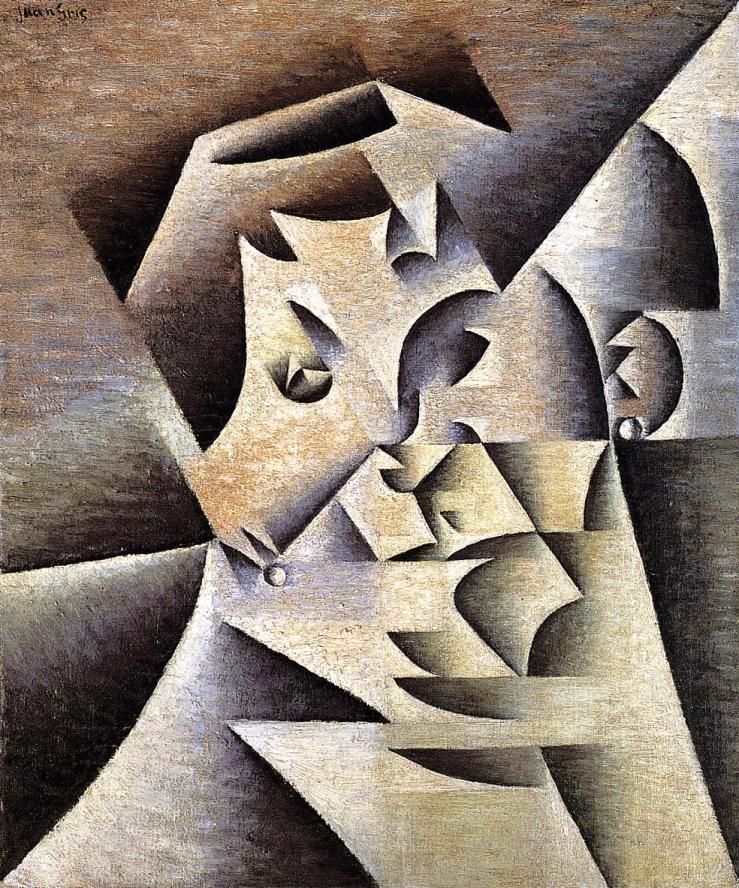
Juan Gris
portrait-of-the-artist-s-mother-1911
Georges Valmier
portrait-of-the-artist-s-mother
Camille Pissarro

The Trojan Horse — Gérard Vulliamy

img_6108

Le Cheval de Troie(The Trojan Horse) by Gérard Vulliamy (1909-2005 )

Bolaño’s Borges

Jorge Luis Borges is first mentioned in the sixth paragraph of Roberto Bolaño’s masterful short story “The Insufferable Gaucho.” In this paragraph, the narrator tells us that the story’s hero, an ex-judge named Pereda, believed “the best Argentine writers were Borges and his son; any further commentary on that subject was superfluous.”

Several paragraphs later, Bolaño’s narrator explicitly references Borges’s short story “The South,” the precursor text for “The Insufferable Gaucho.” The reference to Borges is tied again to Pereda’s son, the writer Bebe.

Leaving tumultuous Buenos Aires, basically destitute from the Argentine Great Depression, Pereda heads to the countryside to take up residence in his family’s ancient ranch. Departing the train and arriving to a rural town, 

Inevitably, he remembered Borges’s story “The South,” and when he thought of the store mentioned in the final paragraphs his eyes brimmed with tears. Then he remembered the plot of Bebe’s last novel, and imagined his son writing on a computer, in an austere room at a Midwestern university. When Bebe comes back and finds out I’ve gone to the ranch . . . , he thought in enthusiastic anticipation.

Bolaño essentially appropriates the plot of “The South” for his tale “The Insufferable Gaucho” and inserts a version of himself into this revision. Bolaño is “Bebe” here, an author who “wrote vaguely melancholy stories with vaguely crime-related plots,” his name phonically doubling the series of mirrors and precursors that Bolaño, mystery man, leaves as clues: Bebe, B-B, Borges-Bolaño, Belano-Bolaño. (Is this too wild a conjecture, dear reader? Mea culpa). 

And Pereda then? A stand-in for Borges’s Juan Dahlmann (hero of “The South,” who “considered himself profoundly Argentinian”), surely, but also, maybe also—a stand-in for (a version of) Borges.

What I mean to say:

Bolaño, displaced Chilean, writes “The Insufferable Gaucho” as an intertextual love letter to his displaced father, the Argentine Jorge Luis Borges.

Bolaño then, to steal a line from Borges’s story, locates in Dahlmann/Borges “his romantic ancestor, his ancestor of the romantic death.” (English translation of the Borges here by Anthony Kerrigan; Chris Andrews translates Bolaño).

Bolaño’s retelling of Borges’s tale is initially marked by a heightened self-consciousness on the part of its hero Pereda, who, over time, gives over to an entirely different consciousness. Let me share a passage of some length; note the hazy dream-tone:

On the way back to his ranch, he dozed off a couple of times. He woke up from his second nap on one of the streets of Capitán Jourdan. He saw a corner store that was open. He heard voices, and someone strumming a guitar, tuning it but never settling on a particular song to play, just as he had read in Borges. For a moment, he thought that his destiny, his screwed-up American destiny, would be to meet his death like Dahlmann in “The South,” and it seemed unfair, partly because he now had debts to repay and partly because he wasn’t ready to die, although Pereda knew that death is an occurrence for which one is never ready. Seized by a sudden inspiration, he entered the store on horseback. Inside, he found an old gaucho, strumming the guitar, the owner, and three younger guys sitting at a table, who started when they saw the horse come in. Pereda was inwardly satisfied by the thought that the scene was like something from a story by di Benedetto. Nevertheless, he set his face and approached the zinc-topped bar. He ordered a glass of aguardiente, which he drank with one hand, while in the other he held his riding crop discreetly out of view, since he hadn’t yet bought himself the traditional sheath knife. He asked the owner to put the drink on his account, and on his way out, as he passed the young gauchos, he told them to move aside because he was going to spit. This was meant as affirmation of his authority, but before the gauchos could grasp what was happening the gob of phlegm had flown from his lips; they barely had time to jump. May the rain fall soft on you, he said, before disappearing into the darkness of Capitán Jourdan.

Is this insufferably romantic episode real or simply imagined by our hero? Borges perhaps would simply answer, Yes.

We can find that Yes in”The South,” which turns the binary of real/imagined on its metaphorical ear. The story is larded with examples, but I’ll share one where Dahlmann dozes on a train ride to the ranch (just as decades later Pereda will doze on his train ride to a ranch, and then (then?!) doze on a horse):

Tomorrow I’ll wake up at the ranch, he thought, and it was as if he was two men at a time: the man who traveled through the autumn day and across the geography of the fatherland, and the other one, locked up in a sanitarium and subject to methodical servitude. He saw unplastered brick houses, long and angled, timelessly watching the trains go by; he saw horsemen along the dirt roads; he saw gullies and lagoons and ranches; he saw great luminous clouds that resembled marble; and all these things were accidental, casual, like dreams of the plain. He also thought he recognized trees and crop fields; but he would not have been able to name them, for his actual knowledge of the country side was quite inferior to his nostalgic and literary knowledge. 

Two men at a time, Borges tells us; Bolaño will continue exploring that bifurcation decades later with Dahlmann’s doppelgänger Pereda. Do either of the men actually ever wake up? Are their journeys merely their own fictions—or, more Borgesian, the fictions they cobble from the fragments of precursor fictions, shot through the lens of “nostalgic and literary knowledge?”

The extent of Dahlmann’s literary knowledge is never quite clear, although Borges (of course) names a precursor text for “The South”: Weil’s The Thousand and One Nights, a book so intertextually fraught and metatextually overdetermined that I feel little need to remark on its Borgesian significance other than to point out that the tales in that volume are Scheherazade’s way of saving her own life. In “The South,” we are told that Dahlmann uses The Thousand and One Nights as a tool for “suppressing reality” and that during his intense illness it “served to illustrate nightmares.”

Does Dahlmann actually die then, or does he, through literature, imagination, and story-telling, like Scheherazade, stave off death for one more night? Again, I think that the Borgesian answer here is, Yes.

Although I’ve been citing Anthony Kerrigan’s early translation of “The South” here, I think Andrew Hurley’s more recent one makes a marvelous emendation that resonates with the spirit of the tale (and actually fits the original Spanish): He translates the last line into the present tense: “Dahlmann firmly grips the knife, which he may have no idea how to manage, and steps out into the plains.”  Dahlmann is still alive at the end of “The South.” Like the enormous sleeping cat that dozes in his memory, Dahlmann “lives in the present, in the eternity of the instant.”

Tellingly, Pereda doesn’t share my interpretation—for him, Dahlmann dies. Recall that “he thought that his destiny, his screwed-up American destiny, would be to meet his death like Dahlmann in ‘The South.’” Bolaño’s tale (typically Bolañoesque) radiates a cryptic, sinister morbidity, one saturated in dark humor. In a moment that seems both ironic and wholly earnest, Pereda fantasizes a death coded through “nostalgic and literary knowledge,” one modeled after “his romantic ancestor, his ancestor of the romantic death.”

I’ve plugged Borges’s lines into a different context here, but they work, and really the context isn’t so different. In “The South,” the specific ancestor alluded to is Dahlmann’s “maternal grandfather…Francisco Flores, of the Second Line Infantry Division, who  had died on the frontier of Buenos Aires, run through with a lance by Indians from Catriel.” Dahlmann figuratively or literally (Yes) repeats his ancestor’s romantic death.

And then Bolaño repeats his ancestor’s romantic death, reconfiguring the climax at the end of “The South,” in which Dahlmann faces off against the muchachones. I consulted three different translations of “The South”; each one does something a bit different with the youths who threaten Dahlmann: country louts, ruffiansyoung thugs.

How does Bolaño translate these young men? At the end of “The Insufferable Gaucho,” our quixotic hero, dirty, haggard, “attired like a cross between a gaucho and a rabbit trapper,” perhaps dreaming, perhaps insane, peers into a cafe, where he sees

. . . a group of writers who looked as if they worked in advertising. One of them, who had an adolescent air, although he was over fifty and maybe even over sixty, kept putting a white powder up his nose and holding forth on world literature. Suddenly, the eyes of the fake adolescent met Pereda’s. For a moment, their gazes locked, as if, for each of them, the presence of the other were a gash in the ambient reality. Resolutely and with surprising agility, the writer with the adolescent air sprang to his feet and rushed out into the street. Before Pereda knew what was going on, the writer was upon him.

Of course Bolaño, list-maker, canon-maker, curator, always registering the competitive anxieties of poets and authors, of course Bolaño will turn the threatening youth into a fucking writer!

Significantly, Pereda sees (or more likely believes he sees, although Bolaño doesn’t tip his hand here) “Bebe and an old man (An old man like me! Pereda thought)…presiding over one of the most animated tables.” The image betokens a fantastic displacement in Pereda’s warped mind, yes, but also perhaps signals Bolaño’s fantasy to hash out literary matters in a buzzing cafe with his father, Borges. In any case, this is the last we hear of Bebe, a detail that undercuts the reality of what happens next, as the coked-up writer advances on the insufferable gaucho:

Pereda realized that he had grasped his knife, then let himself go. He took a step forward and, without anyone noticing that he was armed, planted the point of the blade, though not deeply, in his opponent’s groin. Later, he would remember the look of surprise on the man’s face, in which terror blended with something like reproof, and the writer’s words as he groped for an explanation (Hey, what did you do, asshole?), as if there could be an explanation for fever and nausea.

Bolaño’s gaucho—the fantastic reconfiguration of Borges’s gaucho, son of Borges’s gaucho, but also doppelgänger to Borges’s gaucho—Bolaño’s gaucho performs a symbolic castration, an Oedipally-charged act of violence that seems to tip into visceral reality in the story’s last moments.

Bolaño turns the country louts into cosmopolitan poseurs, writers that look like yuppie admen, and then he has his hero cut one—right in the crotch.The gesture revises the ambiguous ending of “The South,” following through with the once-suspended knife fight.

Whether or not this final episode actually happens or happens only in the protagonist’s mind may or may not matter to you, reader. “The Insufferable Gaucho” is stocked with surreal Lynchian moments, from Pereda riding his horse into the country store, to a publisher being attacked by a feral rabbit (after which Pereda cauterizes the man’s neck wound with his knife!).

As the story progresses, Pereda shakes off nostalgia and literary reference. Like a bedraggled Quixote, he lives his romance. His consciousness, once informed by Borges and Antonio di Benedetto, becomes freer, asserts its own fantasy as self-generative and self-sufficient. When Pereda first entered the country store, “He heard voices, and someone strumming a guitar, tuning it but never settling on a particular song to play, just as he had read in Borges”; later in the tale, holding a party for his son, Pereda “sent for the foremost of Capitán Jourdan’s guitar-strumming gauchos, warning him beforehand that he was to do strictly that: strum, without playing any song in particular, in accordance with the country way.” Pereda omits Borges as the source of style here: Borges becomes the country way

The fantasy Bolaño constructs allows him to simultaneously posit Borges as his literary progenitor and then erase the evidence of that progenitor, even as his contours and essence remain. Bolaño-as-Bebe remains a marginal figure—Bolaño’s own stable consciousness, perhaps?—while knife-weilding Pereda enacts Borges’s revenge on all the poseurs and hacks. And if Pereda is too passionate, too romantic, too violent, too unstable—so be it. At least he thought enough of his son to class him with Borges the Great.

And it’s through this gesture—this literary trick—that Bolaño asserts and defends the literary lineage he lays his claims to: His romantic ancestor, Borges.

[Ed. note–Biblioklept published aversion of this essay in May of 2014].
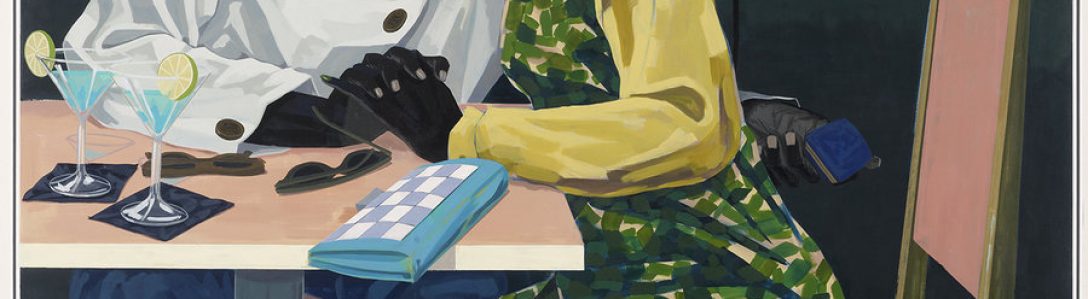
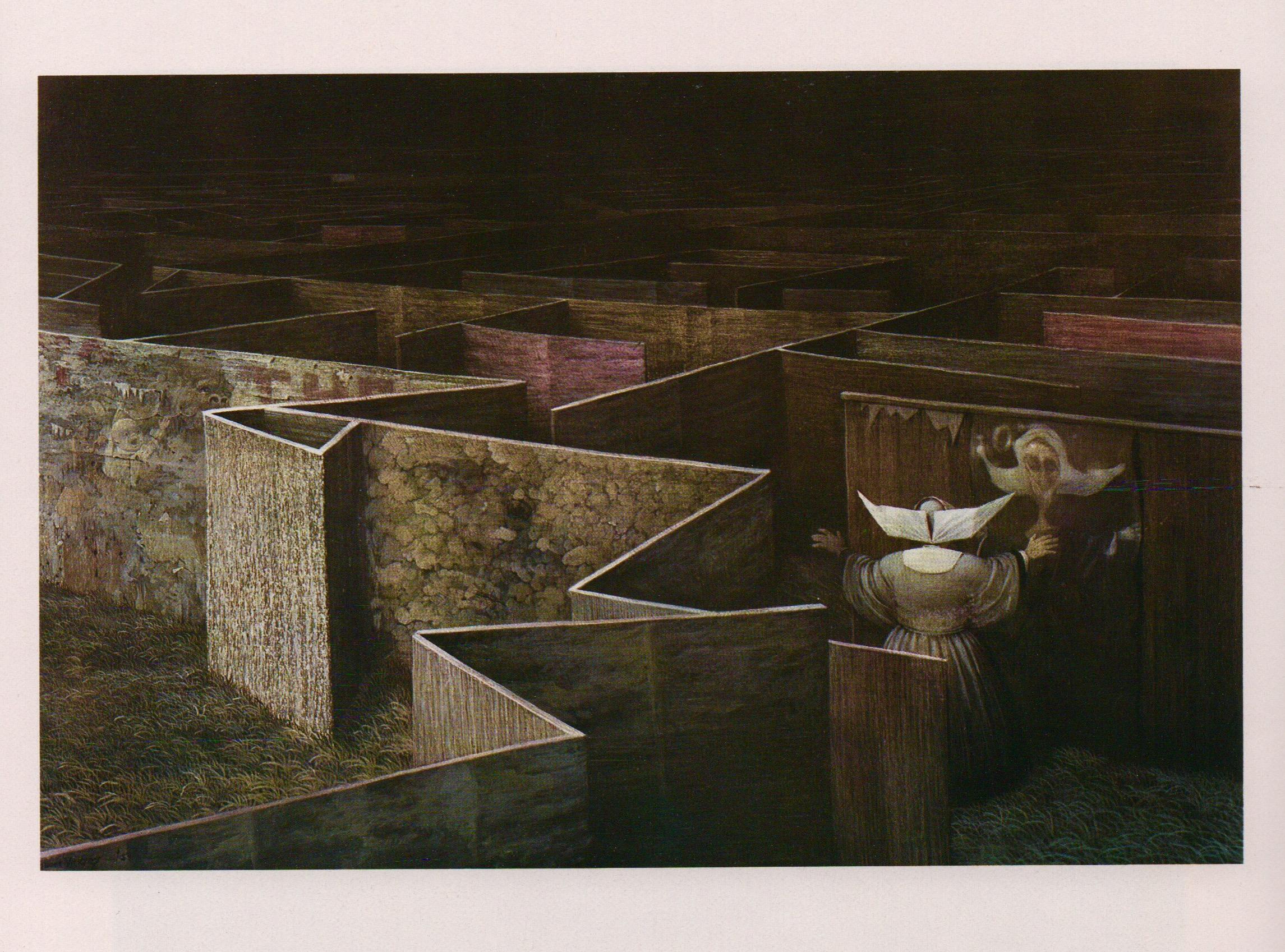
The Labyrinth — Robert Vickrey

img_6109

The Labyrinth by Robert Vickrey (1926-2011)

Atticus Lish’s Preparation for the Next Life (Book acquired, 9 May 2017)

img_6089

The things that compelled my interest in Atticus Lish’s debut novel Preparation for the Next Life were the same things that made me initially wary. First, the book got a lot of buzz when it was published in 2014. Second, and bigger, Lish’s father Gordon Lish is a literary hero of mine. Indeed, Lish the Elder recommends his son’s talents in his (Gordon’s) last “novel,” Cess:

Atticus is, a, you know, a writer by Christ—is a novelist, by Christ, is indeed, if I, by Keerist, may say so myself, ever so proudly so, ever so rivalrously so, a novelist of nothing less than of rank.

Lish the Elder has impeccable taste, but, you know, c’mon. We all tend to think our kids are great at everything.

Anyway, I picked up a copy of Preparation for the Next Life a few days ago. I wasn’t looking for it; I was looking for another “L” novelist, but the spine popped out. I took it home and read the first few paragraphs. Then I just kept reading, consuming the first third in hungry gulps.

Lish’s prose is amazingly concrete. He renders New York City (and the other settings) with seemingly effortless thoroughness; the evocation of place is vivid and refined in its attention to detail, but reads raw somehow. There’s a flavor of prime Denis Johnson or Don DeLillo here, but these comparisons aren’t fair: Lish is original—the prose reads thoroughly real, real to and from the author. The novel so far strikes me as one of the most authentic “post-9/11” novels I’ve read. There’s almost something sci-fi to Preparation—Lish shows us our world through alien eyes that suck in every detail. I wish I’d read it sooner.

Here’s publisher Tyrant Books’ blurb:

Skinner hitchhikes to New York, newly returned from Iraq, hoping to exorcise his demons. Zou Lei, an undocumented immigrant from Central Asia, catches a bus into the city, searching for a way to get by—or at least stay out of jail. Their unlikely love story becomes the heart of one of the most compelling and widely acclaimed novels in years.

A clear-eyed illustration of life in New York City’s margins, Preparation For the Next Life evokes the unsettling realities of the American Dream for U.S. immigrants and unsupported veterans in stark, vivid detail. At once a nightmare and a love letter to New York City (a place one loves partly for its host of nightmares), Lish’s prose is disciplined yet always alive and taut with danger, rendered with the voice of a new and natural talent.

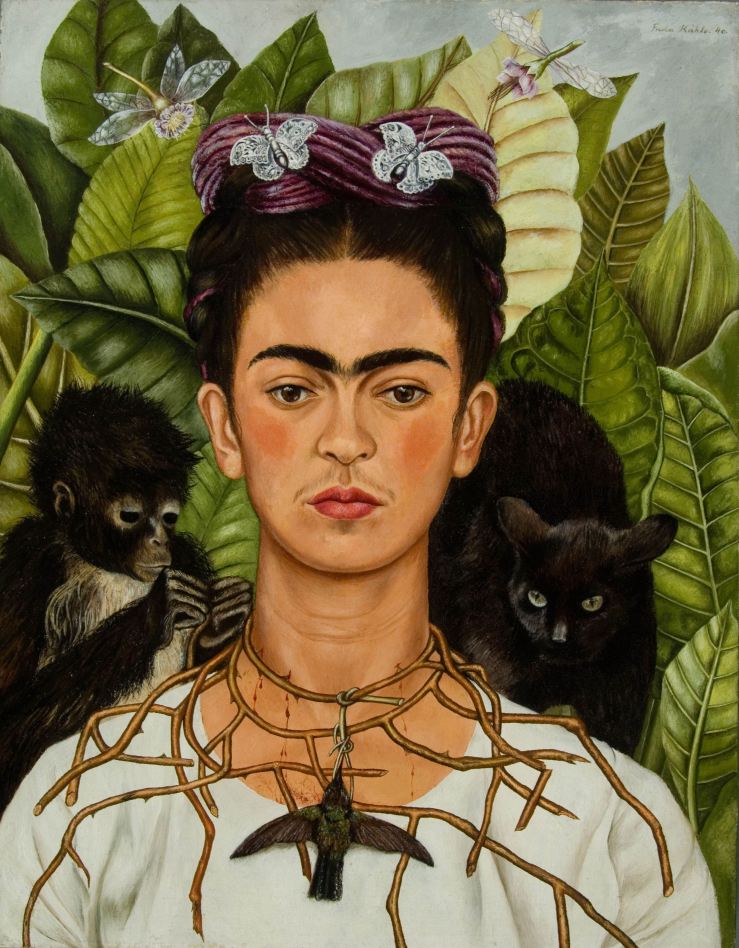
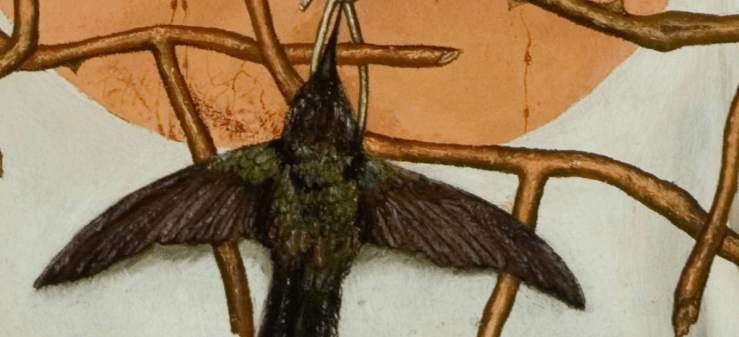
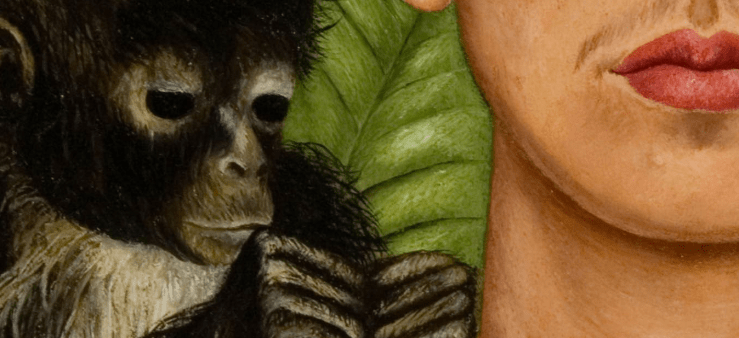
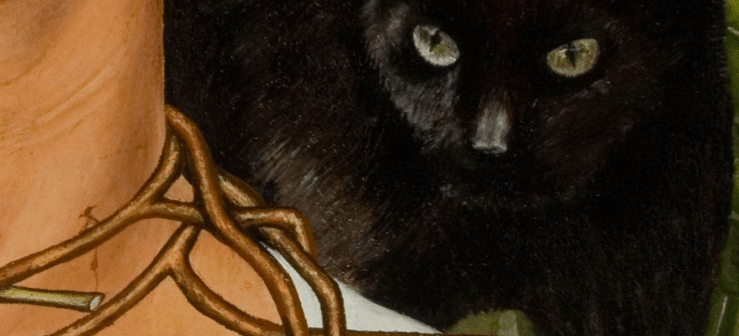
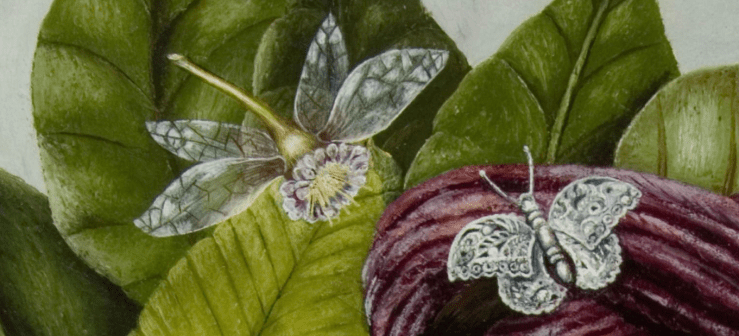
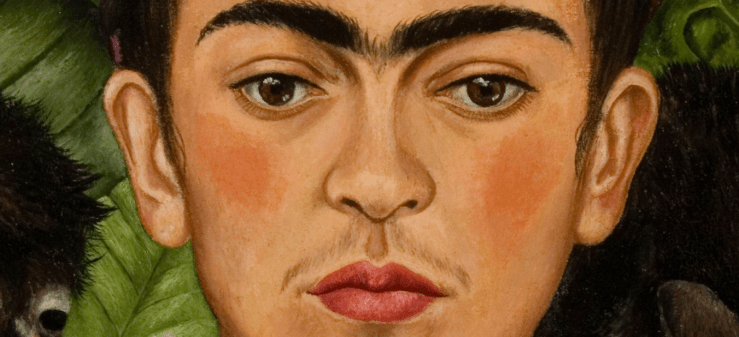
Self Portrait with Necklace of Thorns — Frida Kahlo

frida_011214Screenshot 2017-05-12 at 12.57.40 PMScreenshot 2017-05-12 at 12.57.05 PMScreenshot 2017-05-12 at 12.57.19 PMScreenshot 2017-05-12 at 12.55.59 PMScreenshot 2017-05-12 at 12.56.29 PM

Autorretrato con Collar de Espinas (Self Portrait with Necklace of Thorns), 1940 by Frida Kahlo (1907-54)

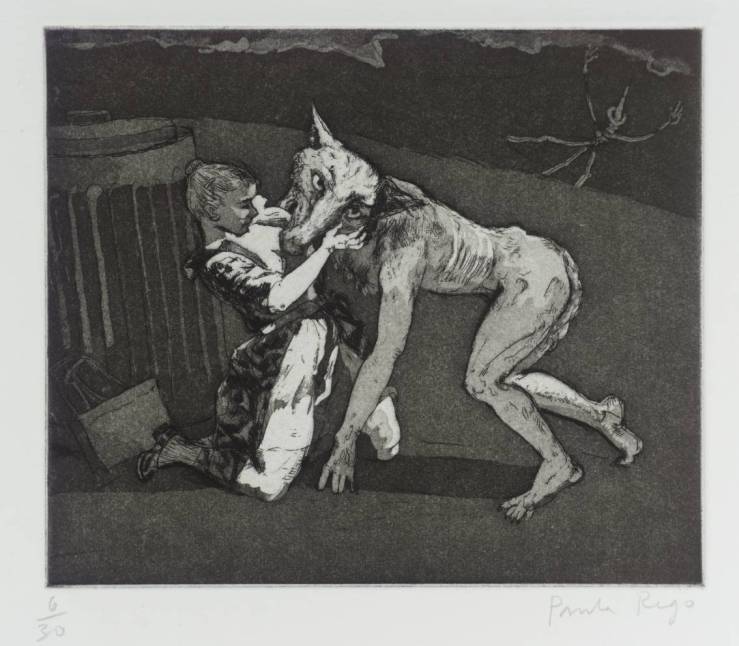
Him — Paula Rego

Him 1996 by Paula Rego born 1935

Him, 1996 by Paul Rego (b. 1935)

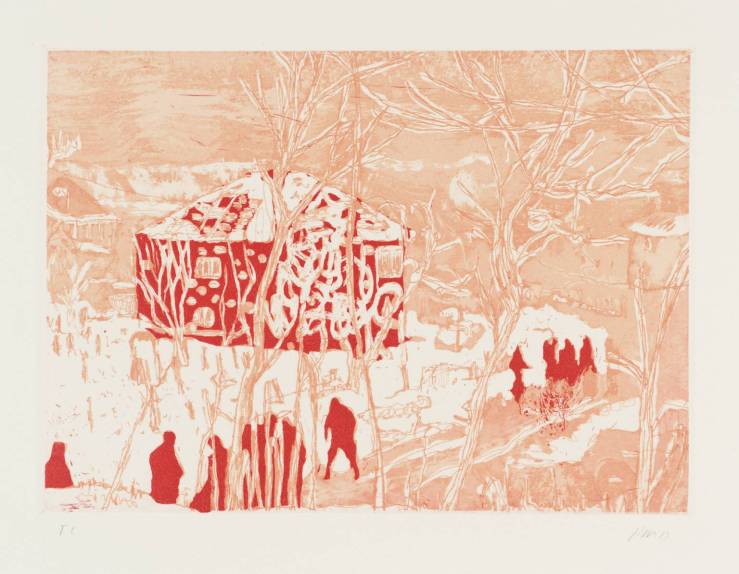
Red House — Peter Doig

Red House 1996 by Peter Doig born 1959

Red House, 1996 by Peter Doig (b. 1959)

Lost in The Vorrh

img_6091-1

I got lost in Brian Catling’s expansive 2012 novel The Vorrh, a phantasmagorical critique of colonialism set in and around a massive, possibly infinite jungle called the Vorrh. Apparently God likes to stroll this primeval forest while he meditates, the original Adam (gray and shrunken) skulks about like Gollum, and anthropophagi lurk in the hopes of capturing a human or two to snack on.

These are just minor moments though in this shaggy opus. The Vorrh is larded with myth, religion, science, history, art, and literature. Catling, a sculptor by trade, synthesizes the nascent 20th-century’s ideas about all the centuries that came before it into what Alan Moore calls “Easily the current century’s first landmark work of fantasy.” Moore goes on to describe The Vorrh as

….a sprawling immaterial organism which leaves the reader filthy with its seeds and spores, encouraging new growth and threatening a great reforesting of the imagination.

Moore is enthusiastic (perhaps overly so), and his introduction to the novel serves as a far better review than anything I can muster here—like I said at the outset, I got lost in The Vorrh. It’s an overstuffed beast of a book, its storylines sprouting strangely (often from nowhere), tangling into other storylines, colliding in a kaleidoscope of blooms that often fall from their vine before bearing fruit.

There are a several main strands to The Vorrh’s plot though, and they do bear strange fruit. There’s a Cyclops named Ishmael, raised by robots underneath a haunted house in the colonial capital of Essenwald. He has sex with a blind woman named Cyrena during Carnival and she becomes sighted, an event that sparks a healing epidemic which in time turns into a plague. There’s Peter Williams, veteran of the Great War, who makes a bow out of his wife’s corpse in the novel’s opening section. (Don’t worry, she was a shaman who wanted him to do that). He treks into the Vorrh.  Tsungali, a warrior of the True People, tracks the trekker. Another warrior tracks him. There’s a shady doctor and a Scottish taskmaster who conspire to keep a hive-mind slave army happy (?) cutting down trees at the periphery of the Vorrh. There’s a knot of historical characters, including the photographer Eadweard Muybridge (the dude who photographed a horse in motion), Queen Victoria’s personal physician Sir William Withey Gull (whom Alan Moore posited as Jack the Ripper in From Hell), and a version of surrealist writer Raymond Roussel. I realize I began this paragraph with the phrase “several main strands” and then listed more than several without even getting to all of the plot points, let alone an articulation of how they come together—or don’t come together.

img_6090

The Vorrh has the feel and texture of grand great shaggy comic book, one rendered in my mind’s eye in the fabulous, expansive style of Moebius. Characters—so many characters!—come and go, and if someone dies, don’t worry—there’s every possibility of resurrection in The Vorrh. Catling delights in giving us the backstory on a pair of twin assassins even after he’s killed them off; he allows his free indirect style to enter the consciousness of a sleeping dog’s sex dream; he spends a few sentences on a charming cannibal’s dinner plans. The Vorrh’s in the details.

In its loose erudition and striking visuals, The Vorrh reminded me of the fiction of China Mieville or Neal Stephenson. In its shaggy weirdness it also reminded me of Chris Claremont’s run on The Uncanny X-Men. Its Victorian Gothicism and syntheses of adventure, horror, and Western tropes also recalls the late Showtime television series, Penny Dreadful. And The Vorrh’s prose style often harnesses some of the bombast we find in classic Weird Fiction of Lovecraft or Lord Dunsany.

If it’s lazy to simply trot out comparisons (and there are so many more I can make), mea culpa. The novel is big, and I’d have to read it again to figure out how its baroque features fit together to do any real proper decent analysis—and I’d rather read its sequel, The Erstwhile. I will say that I liked it despite (and maybe to an extent because of) its faults. I think you can suss out from my weak summary in the fourth paragraph if The Vorrh holds any interest for you.


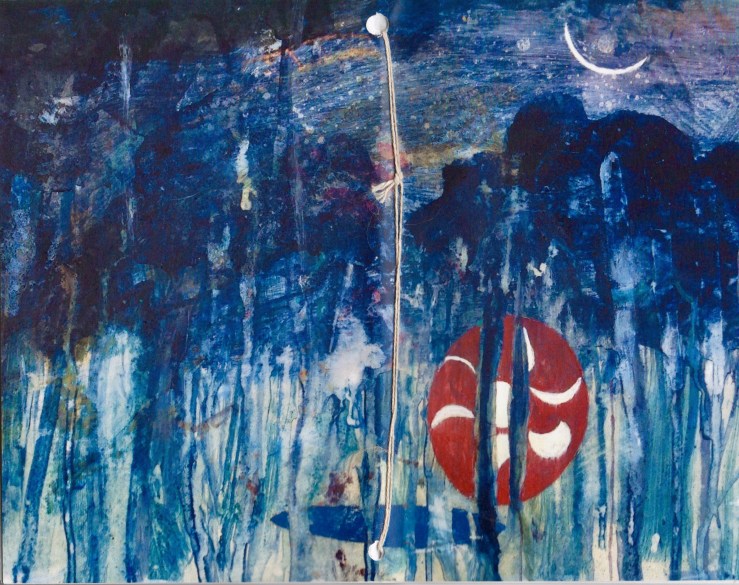
[Ed. note–the image at the top of this review is a scan of a strange press booklet that publisher Vintage sent with original review copies of The VorrhIn addition to Alan Moore’s introduction, the slim, string-bound booklet contains an interview with Catling, and a portrait by Catling of Alan Moore as a cyclops. The cover of the booklet is a painting by Catling].

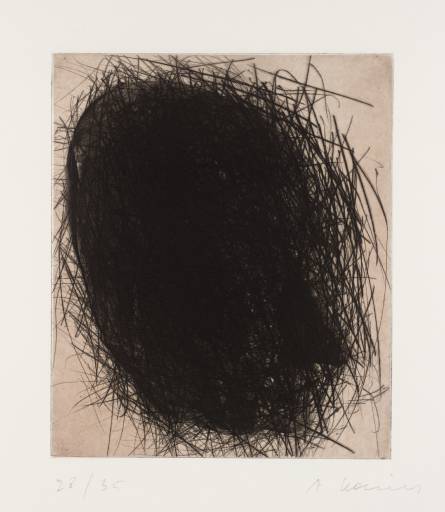
Johann Wolfgang von Goethe — Arnulf Rainer

Johann Wolfgang von Goethe 1982 by Arnulf Rainer born 1929

Johann Wolfgang von Goethe, 1982 by Arnulf Rainer (b. 1929)

Männerpflanze — Arik Brauer

94acf65e8feac33389471ceaaec609e1

Männerpflanze (Plant Men) by Arik Brauer (b. 1929)

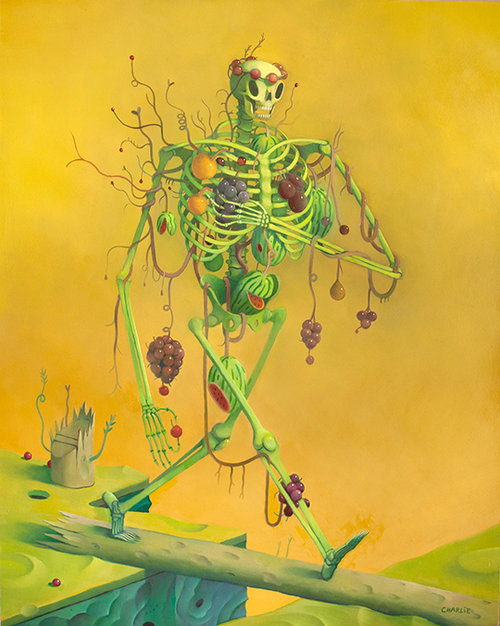
Fruity — Charlie Immer

Fruity_web

Fruity, 2017 by Charlie Immer (b. 1983).

Read Anton Chekhov’s short story “The Chemist’s Wife”

“The Chemist’s Wife”

by

Anton Chekhov

English translation by Constance Garnett


The little town of B——, consisting of two or three crooked streets, was sound asleep. There was a complete stillness in the motionless air. Nothing could be heard but far away, outside the town no doubt, the barking of a dog in a thin, hoarse tenor. It was close upon daybreak.

Everything had long been asleep. The only person not asleep was the young wife of Tchernomordik, a qualified dispenser who kept a chemist’s shop at B——. She had gone to bed and got up again three times, but could not sleep, she did not know why. She sat at the open window in her nightdress and looked into the street. She felt bored, depressed, vexed . . . so vexed that she felt quite inclined to cry—again she did not know why. There seemed to be a lump in her chest that kept rising into her throat. . . . A few paces behind her Tchernomordik lay curled up close to the wall, snoring sweetly. A greedy flea was stabbing the bridge of his nose, but he did not feel it, and was positively smiling, for he was dreaming that every one in the town had a cough, and was buying from him the King of Denmark’s cough-drops. He could not have been wakened now by pinpricks or by cannon or by caresses.

The chemist’s shop was almost at the extreme end of the town, so that the chemist’s wife could see far into the fields. She could see the eastern horizon growing pale by degrees, then turning crimson as though from a great fire. A big broad-faced moon peeped out unexpectedly from behind bushes in the distance. It was red (as a rule when the moon emerges from behind bushes it appears to be blushing). Continue reading “Read Anton Chekhov’s short story “The Chemist’s Wife””