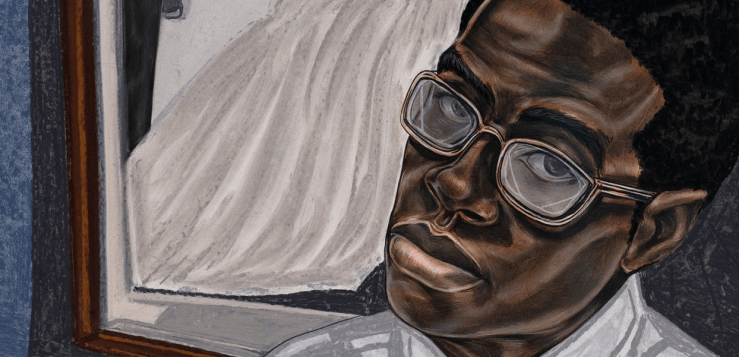
Requisite Attendance — Toyin Ojih Odutola

to18.010_requisite_attendance__crop__hr

Screenshot 2019-02-22 at 7.21.58 PM

Requisite Attendance, 2018 by Toyin Ojih Odutola (b. 1985)

Twins — Falk Gernergross

zwilling_2011_90x120cm_mischtechnik_auf_hdf

Twins, 2011 by Falk Gernergross (b. 1973)

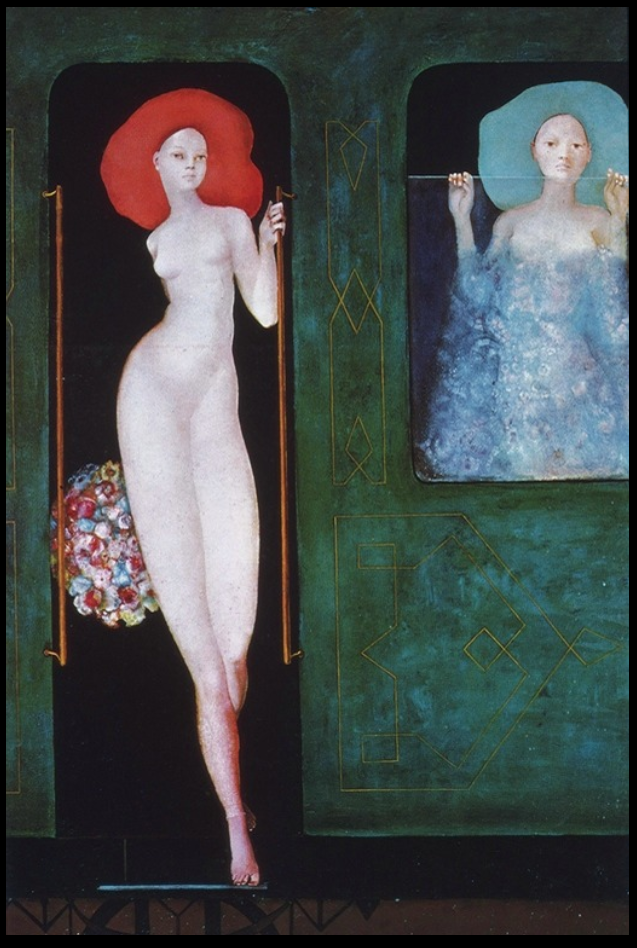
Vesper-Express — Leonor Fini

fini.PNG

Vesper-Express, 1966 by Leonor Fini (1908-1996)

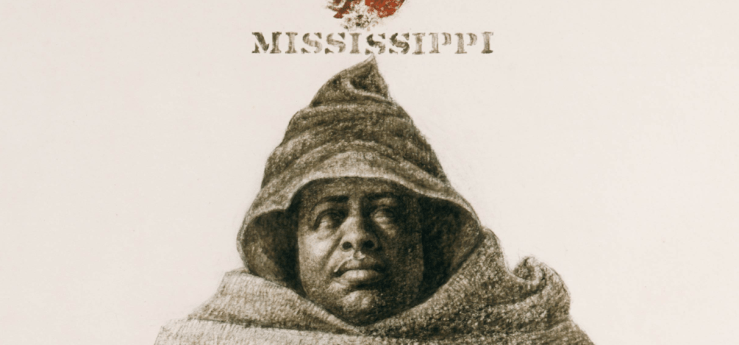
Mississippi — Charles White

dig.21Screenshot 2019-02-12 at 7.23.19 PM

Mississippi, 1972 by Charles White (1918-1979)

Big Dreamer with Failed Poetry — Adrian Cox

adrian-cox-big-dreamer-with-failed-poetry_1024x1024

Big Dreamer with Failed Poetry by Adrian Cox (b. 1988)

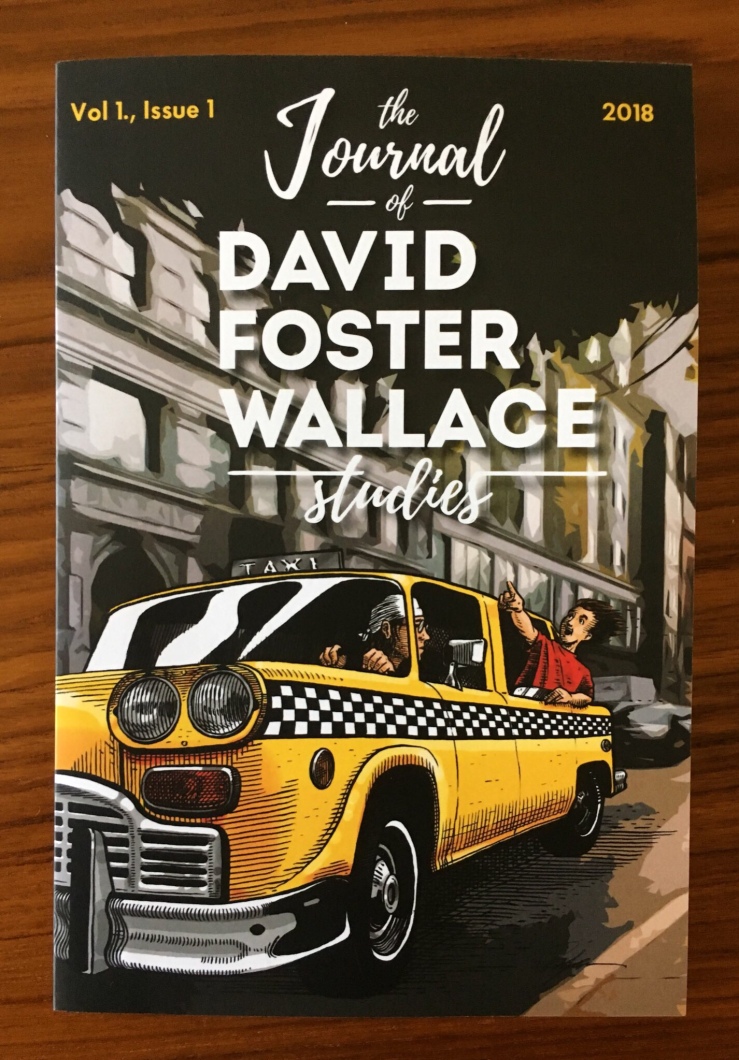
The Journal of David Foster Wallace Studies, Vol. 1, Issue 1 (Book acquired, 28 Jan. 2019)

img_2152

The Journal of David Foster Wallace Studies is a peer-reviewed academic journal devoted to the work of David Foster Wallace. The Journal is published by the DFW Society.

img_2153

Here is the table of contents for Vol. 1, issue 1;

img_2154

I enjoyed Nash’s essay on boredom and attention in The Pale King, and found Saylor’s piece on race in Wallace’s fiction—focusing on Wallace’s whiteness within the context of his overall project of literary empathy–especially interesting.

I’m glad to see the journal finally in print after a few years of chatter about its creation. Perhaps there might be a future article or two that takes on the current wave of anti-Wallace think pieces that have been floating around lately.

Aeschylus and Socrates — Eduardo Paolozzi

Aeschylus and Socrates 1974-6 by Sir Eduardo Paolozzi 1924-2005

Aeschylus and Socrates, 1975 by Eduardo Paolozzi (1924–2005)

A riff on starting Robert Coover’s first novel, Origin of the Brunists

img_2280

Origin of the Brunists is Robert Coover’s first novel. First published in 1966, this long novel tells the story of an apocalyptic religious cult that forms around the sole survivor of a mining accident. The novel begins with the Brunists prepping for the upcoming end of the world (doomsday is scheduled for the weekend). After this somewhat bewildering prologue, the novel shifts back a few months in time, to lay out the cult’s genesis, a fatal mining accident.

Origin of the Brunist’s early chapters are an engrossing and unexpectedly smooth launch into a 500+ page novel. I read the first 70 pages in one night, rapt in the weird world of West Condon, the fictional midwesternish mining town where the Brunist cult originates. I woke up the next morning and continued to read in bed. I was, and am, enthusiastic. 

The second chapter of Origin of the Brunists is especially enthralling. Propulsive and engaging, the chapter zooms through the various consciousnesses of West Condon on the night of the novel’s originating disaster, the horrific mining collapse that imperils hundreds of miners. Coover inhabits the voices and minds of his characters with an easy if often grimy grace here. Evocation of consciousness has marked much of Coover’s work, from the early short story “The Brother” (1962) to his recent novel Huck Out West  (2017). The man can throw his voice around.  Origin of the Brunists overflows with voices. In small snatches of dialog and free-indirect speech, we get an aural and vivid picture of the miners, their children and spouses, as well as the other residents of West Condon.

The mining disaster chapter shuttles along with a filmic quality. Coover intercuts scenes of the miners escaping (or failing to escape) with a highschool basketball game, teenage lust in a parked car, and other odds and ends of West Condon life. The chapter builds in tension, reminding one of the climax of an epic movie, but one wedged unexpectedly at the narrative’s outset.

Indeed, Coover’s contest with film is something of a trademark. A signal example of this style can be found in the stories in his 1987 collection A Night at the Movies, or You Must Remember This. Stories like “The Phantom of the Movie Palace” and “Lap Dissolves” wrestle with film as a medium, deconstructing author and text, filmmakers and audiences, film reels and book pages. In the Night stories (and elsewhere, always elsewhere), Coover employs a host of metatextual techniques, dissolving one narrative into another, overlapping archetypes and synthesizing tropes, blending fables and history and commercial culture into a critique of American Pop mythology.

Coover’s metafiction always points back at its own origin, its own creation, a move that can at times take on a winking tone, a nudging elbow to the reader’s metaphorical ribs—Hey bub, see what I’m doing here? Coover’s metafictional techniques often lead him and his reader into cartoon landscapes, where postmodernly-plastic characters bounce manically off realistic contours. The best of Coover’s metafictions (like “The Babysitter,” 1969) tease their postmodern plastic into a synthesis of character, plot, and theme. However, in  large doses Coover’s metafictions can tax the reader’s patience and will—the simplest example that comes to mind is “The Hat Act” (from Pricksongs & Descants, 1969), a seemingly-interminable  Möbius loop that riffs on performance, trickery, and imagination. (And horniness).

I’m dwelling on Coover’s metafictional myth-making because I think of it as his calling card. And yet Origin of the Brunists bears only the faintest traces of Coover’s trademark metafictionalist moves (mostly, so far anyway, by way of its erstwhile hero, the journalist Tiger Miller). Coover’s debut reads rather as a work of highly-detailed, highly-descriptive realism, a realism that pushes its satirical edges up against the absurdity of modern American life. It reminds me very much of William Gass’s first novel Omensetter’s Luck (1966) and John Barth’s first two novels, The Floating Opera (1956) and The End of the Road (1958). (Barth heavily revised both of the novels in 1967). There’s a post-Faulknerian style here, something that can’t rightly be described as modern or postmodern. These novels distort reality without rupturing it in the way that the authors’ later works do. Later works like Barth’s Chimera (1973), Gass’s The Tunnel (1995), and Coover’s The Public Burning (1977) dismantle genre structures and tropes and rebuild them in new forms. (I might contrast here with the first novels of William Gaddis (The Recognitions, 1955), Thomas Pynchon (V., 1963), and Ishmael Reed (The Freelance Pallbearers, 1967), all of which employ postmodern and metafictional techniques right out of the gate—but that’s perhaps appropriate material for another riff).

While Origin of the Brunists doesn’t tip into Coover’s metatextual mode, it points towards his mythic style, but in a subtle, restrained way, as in this description of the moments preceding a high-school basketball game:

A ritual buzzer alerts the young athletes on the West Condon court and strikes a blurred roar from the two confronting masses of spectators. In a body, all stand. The mute patterns of run-pass-leap-thrust dissolve, congealing into two tight knots on either extremity of the court, each governed by a taut-faced dark-suited hierarch. Six young novices in black, breasts ablaze with the mark of their confession, discipline the brute roars into pulsing chants with soft loops of arm and skirt, while, at their backs, five acolytes of the invading persuasion pressed immodestly into sleek diabolic red, rattle talismans with red and white paper tails, seeking to neutralize the efficacy of the West Condon locomotive. Young peddlers circulate, selling condiments indiscriminately to all. A light oil of warm-up perspiration anoints the shoulders of the ten athletes chosen as they explode out of their respective rings to confront each other. Some of them cross themselves, some clap and cry oaths, others tweak their genitals.

These mythical touches are rare in the first section of Origin of the Brunists though. Instead, Coover seems to tease out the West Condoners’ building of their own mythology, one cobbled from the apocalyptic strands of rural American Christianity, a religion divined through signs and wonders.

Such signs have much of their origin in Ely Collins, a miner-cum-preacher who meets his fate in the disaster. In a shocking scene that plays out with frank realism, Collins loses his leg:

“It’s okay, boys,” Collins whispered up at them. “I kin take it.” And he took to praying again.

Strelchuk lifted the ax in the air and thought: Jesus! what if I miss, I’ve never swung a goddamn ax much, what if I hit the wrong leg, or—?

“Goddamn you, Mike!” Jinx screamed, losing control. “Quit messing around! This gas is knocking me out, man! We got to get us out of here!”

And while he was screaming away like that, Strelchuk came down with the ax, caught the leg right where he aimed, true and clean, just below the knee, and the blood flew everywhere, and Juliano was crying like a goddamn baby, and Bruno, his face blood-sprayed, went dumb, mouth agape, and broke away in a silent fit, but the leg was still hooked on, they couldn’t get him free. Preach was still praying to beat hell and never even whimpered. Mike raised the ax again and drove down with all the goddamn strength he had, felt the bone this time, heard the crack, felt the sickening braking of the ax in tough tissue, and he turned and vomited. He was gagging and hacking and crying and the blood was everywhere, and still that goddamn leg was hooked on. Mario ripped away Collins’ pant leg, took the wedge he had in his pocket, pressed it up against Collins’ thigh. Strelchuk whipped off his leather belt and, using it as a tourniquet against the wedge, they stopped the heavy bleeding. Pontormo whined Italian. Strelchuk grabbed up the ax once more. His hands were greasy with blood and it was wet on his chest and face. He was afraid of missing or losing hold, and the shakes were rattling him, so he took short hacking strokes, and at last it broke off. They dragged him free. And Preacher Collins, that game old sonuvabitch, he was still praying.

I’ve quoted at such length to give a sense of Coover’s meticulousness in Origin of the Brunists. The novel is thick with life, thick with voices, mimetic detail, shapes, smells, colors, sounds. West Condon feels utterly real, making the novel’s dramatic absurdities all the more pronounced. The characters tell stories, weep and pray, bury their desires. Coover’s command of character isn’t absolute, but if his West Condoners sometimes teeter on the edge of grotesquerie they are nevertheless real, or as real as words on a page can be. More to come.


“Pigheaded Poet” — William Carlos Williams

wcw

In Mid-world — Jesse Mockrin

mid-word-2017_1340_c

In Mid-world, 2017 by Jesse Mockrin (b. 1981)

Encounter (detail) — Remedios Varo

02-remedios-varo

Encounter (detail), 1959 by Remedios Varo (1908-1963)

Posted in Art

Ann Quin’s Berg (Book acquired,15 Feb. 2019)

img_2259

Ann Quin’s 1964  novel, Berg, is in print again from And Other Stories. I’m psyched for this one—Quin is a writer I’ve wanted to read for a while now. Here is And Other Stories’ blurb:

‘A man called Berg, who changed his name to Greb, came to a seaside town intending to kill his father . . .’

So begins Ann Quin’s madcap frolic with sinister undertones, a debut ‘so staggeringly superior to most you’ll never forget it’ (The Guardian). Alistair Berg hears where his father, who has been absent from his life since his infancy, is living. Without revealing his identity, Berg takes a room next to the one where his father and father’s mistress are lodging and he starts to plot his father’s elimination. Seduction and violence follow, though not quite as Berg intends, with Quin lending the proceedings a delightful absurdist humour.

Anarchic, heady, dark, Berg is Quin’s masterpiece, a classic of post-war avant-garde British writing, and now finally back in print after much demand.

Here are the first four paragraphs:

A man called Berg, who changed his name to Greb, came to a seaside town intending to kill his father . .

Window blurred by out of season spray. Above the sea, overlooking the town, a body rolls upon a creaking bed: fish without fins, flat-headed, white-scaled, bound by a corridor room—dimensions rarely touched by the sun—Alistair Berg, hair-restorer, curled webbed toes, strung between heart and clock, nibbles in the half light, and laughter from the dance hall opposite. Shall I go there again, select another one? A dozen would hardly satisfy; consolation in masturbation, pornographic pictures hanging from branches of the brain. WANTED one downy, lighthearted singing bird to lay, and forget the rest. A week spent in an alien town, yet no further progress—the old man not even approached, and after all these years, the promises, plans, the imaginative pursuit as static as a dream of yesterday. The clean blade of a knife slicing up the partition that divides me from them. Oh yes I have seen you with her—she who shares your life now, fondles you, laughs or cries because of you. Meeting on the stairs, at first the hostile looks, third day: acknowledgment. A new lodger, let’s show him the best side. Good morning, nice day. Good afternoon, cold today. His arm linked with hers. As they passed Berg nodded, vaguely smiled, cultivating that mysterious air of one pretending he wishes to remain detached, anonymous. Afterwards their laughter bounced back, broke up the walls, split his door; still later the partition vibrated, while he paced the narrow strip of carpet between wardrobe and bed, occasionally glimpsing the reflection of a thin arch that had chosen to represent his mouth. Rummaging under the mattress Berg pulled out the beer-stained piece of newspaper, peered at the small photograph.

Oh it’s him Aly, no mistaking your poor father. How my heart turned, fancy after all this time, and not a word, and there he is, as though risen from the dead. That Woman next to him Aly, who do you suppose she is?

He had noticed the arm clinging round the fragile shoulders; his father’s mistress, or just a friend? hardly when—well when the photo showed their relationship to be of quite an affectionate nature. Now he knew. It hadn’t taken long to inveigle his way into the same house, take a room right next to theirs. Yes he had been lucky, everything had fallen into place. No hardship surely now in accepting that events in consequence, in their persistent role of chance and order, should slow down?

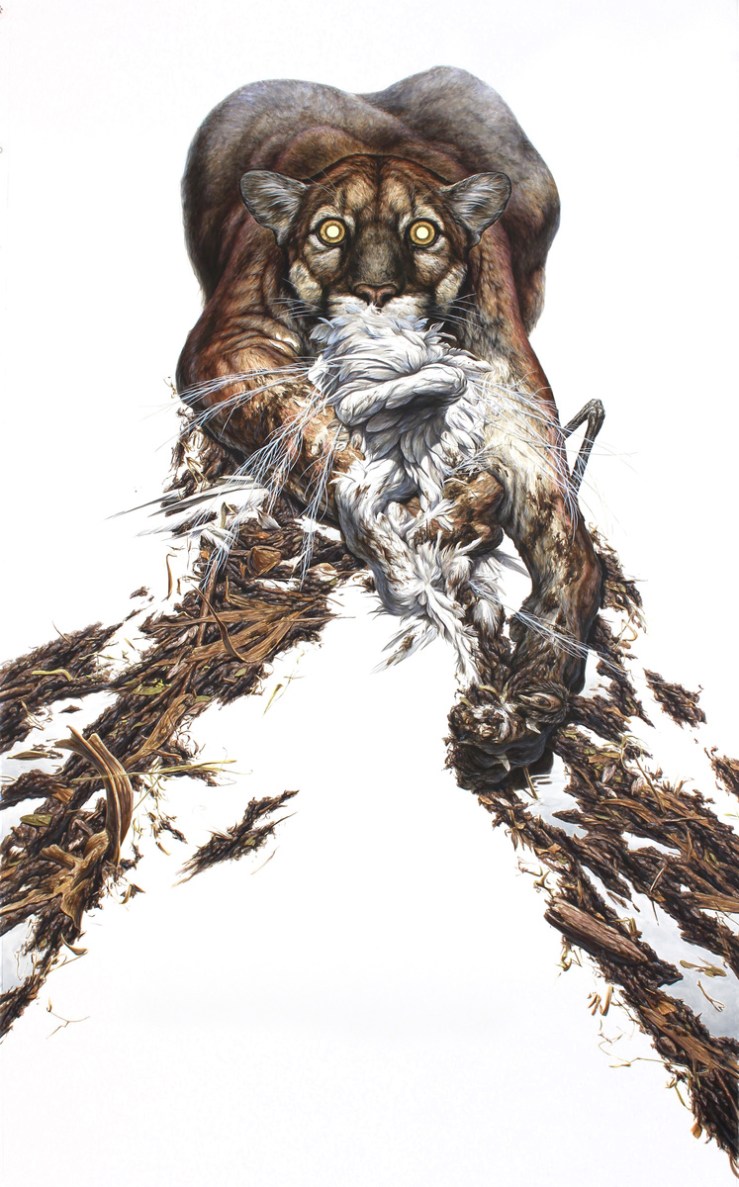
Dredger — George Boorujy

boorujy.dredger.sm_

Dredger, 2017 by George Boorujy.

One finds a greenness | Nathaniel Hawthorne’s journal entry for February 18th, 1851

February, 18th.–A walk, yesterday afternoon, with the children; a bright, and rather cold day, breezy from the north and westward. There has been a good deal of soaking rain lately, and it has, in great measure, cleared hills and plains of snow, only it may be seen lying in spots, and on each side of stone-walls, in a pretty broad streak. The grass is brown and withered, and yet, scattered all amongst it, on close inspection, one finds a greenness;–little shrubs that have kept green under all the severity of winter, and seem to need no change to fit them for midsummer. In the woods we see stones covered with moss that retains likewise a most lively green. Where the trees are dense, the snow still lies under them. On the sides of the mountains, some miles off, the black pines and the white snow among them together produce a gray effect. The little streams are most interesting objects at this time; some that have an existence only at this season,–Mississippis of the moment,–yet glide and tumble along as if they were perennial. The familiar ones seem strange by their breadth and volume; their little waterfalls set off by glaciers on a small scale. The sun has by this time force enough to make sheltered nooks in the angles of woods, or on banks, warm and comfortable. The lake is still of adamantine substance, but all round the borders there is a watery margin, altogether strewed or covered with thin and broken ice, so that I could not venture on it with the children. A chickadee was calling in the woods yesterday,–the only small bird I have taken note of yet; but crows have been cawing in the woods for a week past, though not in very great numbers.

Nathaniel Hawthorne’s journal entry for February 18th, 1851. From Passages from the American Note-Books.

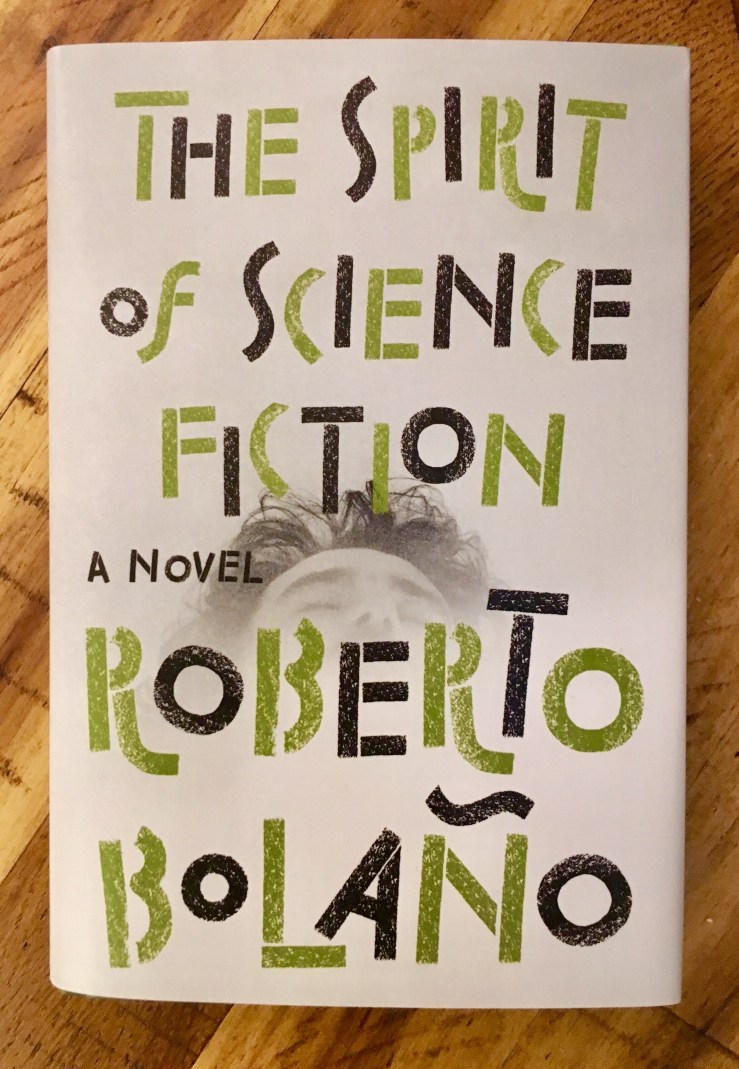
More Bolaño: A review of Roberto Bolaño’s novel The Spirit of Science Fiction

img_2270

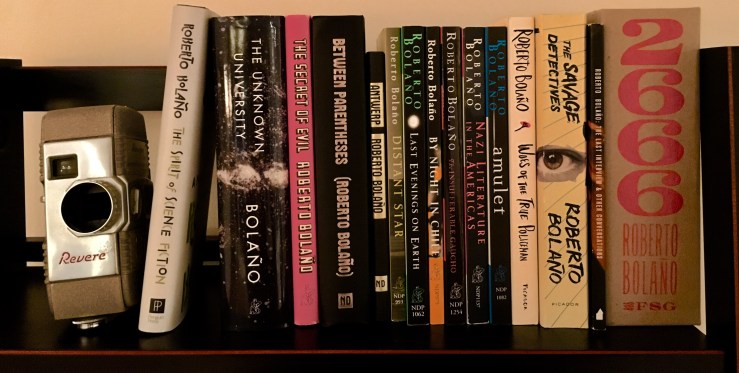
Roberto Bolaño died at the young age of 50 in 2003, just as his work was beginning to gain a wider audience and broader critical acclaim. It wasn’t until after his death that his work was published in English. Just a few months after Bolaño died, New Directions published By Night in Chile in translation by Chris Andrews. A year later, they published Andrews’ translation of Distant Star, and completed the loose trilogy of these short novels with the publication of Amulet in early 2007. A few months after the publication of Amulet, FS&G published Natasha Wimmer’s translation of The Savage Detectives, which had been originally published in Spain a decade earlier. By the time Wimmer’s translation of 2666 hit the shelves in 2008, Bolaño had become a literary sensation in the U.S., only half a decade after his death.

2666 is arguably Bolaño’s masterpiece, and certainly one of the defining books of the first decade of the 21st century. I read the book in a fevered rush, and then read it again, and then again. As far as I can tell, there are more essays and reviews about 2666 on Biblioklept than any other book. It was the second book I read by Bolaño—admittedly, a first reading of The Savage Detectives left me a perplexed and cold, but I’ve since returned to that novel with a broader understanding and appreciation of Bolaño’s project, a project that seemed to expand yearly after Bolaño’s demise.

Indeed, it became something of a joke in literary circles, What, another Bolaño? He drops books from beyond the grave like Tupac drops albums! There are the short story collections (translated by Andrews) that trickled out between 2007 and 2012, along with harder to classify collections, like The Secret of Evil (Andrews, 2012) and Nazi Literature in the Americas (Andrews, 2008), a jangling set of keys to the Bolañoverse. Another set of keys came in the wonderful collection The Unknown University, a compendium of Bolaño’s poetry in translation by Laura Healy published by New Directions in 2013.
img_2273

Then there are the novels that seemed to arrive every year or so: The Skating Rink (Andrews, 2009), Monsieur Pain (Andrews, 2010), Antwerp (Wimmer, 2010), The Third Reich (Wimmer, 2011), A Little Lumpen Novelita (Wimmer, 2014). Bolaño composed these pieces primarily in the 1980s, when he still thought of himself as a poet. These novels lack the vitality and vibrancy of his later work—the short story collections, the trilogy of short novels that began with Distant Star, and his big books, The Savage Detectives and 2666.

Indeed, for many Bolaño fans, reading these early novels feels like its own project—winnowing for seeds, pulling at the threads that will cohere into something grander in the Bolaño’s future (which, from a readerly perspective, is the past). So when FS&G published Wimmer’s translation of Woes of the True Policeman in 2012, it was hard for many readers to see the novel as anything but ancillary materials for 2666—it was hard to read the novel as a discrete work, on its own. Instead, the question Woes asked Bolaño fans was, Where does this fit in the Bolañoverse?

The same question is in play for the latest posthumous Bolaño release, The Spirit of Science Fiction (Penguin, Wimmer). A simple read, and one that is not incorrect, is that The Spirit of Science Fiction feels like a trial run at The Savage Detectives. In particular, Spirit blueprints the first and third sections of The Savage Detectives, sections that revolve around the immature adventures of two would-be poets in Mexico City in the 1970s. Instead of Arturo Belano and Ulisses Lima though, we get Jan Schrella (“alias Roberto Bolaño”) and Remo. These two heroes divide Bolaño’s literary ambitions into poetry and prose, posterity and potboiler pulp fiction. In The Savage Detectives, Arturo Belano and Ulisses Lima will synthesize these ambitions more grandly in their literary quest.

Jan and Remo’s questing in Spirit isn’t quite as grand. Remo wants to figure out why there are so many literary magazines in Mexico City; Jan spends his days writing to American science fiction writers. They manage to get mixed up with a set of sisters and their friend—poets of course. (Everyone in the novel is a poet, even—especially—a skinny motorcycle mechanic). The sisters prefigure the Font sisters of The Savage Detectives, and much of their plot feels like a sketch for that richer work.

Their friend Laura is a more interesting figure—a bit sinister, a cipher really, an iteration of the Lisas and Lupes that we find elsewhere in Bolaño’s fiction—in particular in some of the poetry collected in The Unknown Univeristy. Indeed, the final section of The Spirit of Science Fiction, “Mexican Manifesto,” was originally published in a different form in that collection. Some of the best parts of Spirit feel like failed poems, poems that want to be prose, unpoetical, mad, howling, jolly poems. Like 2666 or The Savage Detectives, the plot of Spirit careens, splinters, dares the reader to put the fragments together.

There is structure though: The main of the novel is told in first-person perspective by Remo. He’s seventeen, and has come from Chile to Mexico City with his friend Jan to live destitute in a garret and write bad articles under a pseudonym while he pursues his poetry. He gets sidetrack by love and other matters.

Running counter to this narrative are the letters that Jan writes to American sci-fi authors like Ursula K. Le Guin and Alice Sheldon. In a metatextual nod, Jan (“alias Roberto Bolaño”) also writes to Sheldon’s alias James Tiptree, Jr. Jan’s letters are a highlight of the novel, setting youthful arrogance and romantic idealism against a kind of quasi-tragic pathos. In a letter to Philip José Farmer, Jan (alias Roberto) suggests that a literary sci-fi anthology called American Orgasms in Space be published as a means to end war and cultivate brotherhood between Latin Americans and North Americans. The punchline to the letter is hilarious. Before signing off (“Warmly”), Jan informs the author of the Riverworld series that, “A week ago, I lost my virginity.”

A third strand runs throughout Spirit. In a series of segments set in some presumable future, a female journalist interviews Jan in the middle of a bizarre drunken party somewhere in the dark woods. Jan has won a prize for a sci-fi novel that he summarizes for the journalist who listens, downing vodka after vodka. Jan’s prize-winning sci-fi novel meshes elements that will be familiar to Bolaño’s readers—apocalyptic desolation, failed communication, esoteric histories of Latin America, mystery authors. Etc. It’s even partially set in the Unknown University. The interview segments seem perched on the edge of their own sinister apocalypse, a typically-Bolañoesque move, as if a seemingly-normal situation might topple over into malevolence at any moment. Unfortunately though, these sections seem to have been abandoned.

Indeed, much of Spirit reads like a patchwork of abandoned drafts, riddled with material and ideas that will pop up in later novels—the tabletop gaming of The Third Reich, the fascination of Nazi iconography we see in Nazi Literature in the Americas, the reckoning of post-colonialism which belongs to The Savage Detectives in particular, as well as the Bolañoverse as a whole. Too, Spirit shares the ominous swells and sinister reverberations that we identify with both Bolaño’s prose and poetry—the book shows the joyful optimism of youth poised on the cusp of unnameable disaster.

And there are plenty of great sections in The Spirit of Science Fiction: Jan desribing the entirety of a Gene Wolfe space novella to his friend, but mashing it into a vision of the screenwriter Thea von Harbou and her Nazi sympathies; the story of a Belgian-occupied village in the Congo that falls into a madness of woodworking, a madness that leads to general slaughter; a nervous late-night ride on a stolen motorcycle named the Aztec Princess; “the story of how Georges Perec, as a boy, prevented a duel to the death between Isidore Isou and Altagor in an old neighborhood in Paris”; a grotesque and enthralling final sequence in a semi-legal Mexico City bathhouse that channels the dark ghost of William S. Burroughs.

In short, there’s a lot of great writing in The Spirit of Science Fiction—plenty of moments that satisfy, if only temporarily, our cravings for more Bolaño. And yet the novel is clearly unfinished, which, if you’ve read Bolaño—and I’m assuming if you’ve hung out this far into this review, you’ve read Bolaño, and like, if you haven’t read Bolaño, I think he’s great, and a great starting point for reading him would be Distant Star or the short story collection Last Evenings on Earth—and, where was I? Okay: The Spirit of Science Fiction is clearly an unfinished piece, which, if you’ve read Bolaño, may seem like a Bolañoesque feature—his works point to an indeterminancy, an oblique, inconclusive, resolutely unfinishedness. (Think of the final lines/images of The Savage Detectives, for example).

And yet Spirit’s unfinishedness is not of a piece with the general aporia that belongs to Bolaño’s finished unfinished works—it seems, rather, an abandoned project, a draft to be repurposed later. Which, of course, it was—we already got the material that Spirit helped inspirit—in The Savage Detectives, in Nazi Literature, in 2666—in Bolaño’s best materials.

Paradoxically then, The Spirit of Science Fiction leaves the reader—by which I mean the Bolaño fan—by which I mean, let’s be honest, this Bolaño fan—Spirit leaves this reader hungry for more, for the pages to gallop on and on, to careen into more dread and manic joy and bad poetry and good poetry and pilfered stories and excessive metaphors. More: More Bolaño.

And then how could this review be a complaint? Well it isn’t. I enjoyed The Spirit of Science Fiction, was hungry for it before I even touched it, and then left hungry, wanting more: More Bolaño.
Read “The Lover,” a short story by Joy Williams

“The Lover”

by

Joy Williams


THE girl is twenty-five. It has not been very long since her divorce but she cannot remember the man who used to be her husband. He was probably nice. She will tell the child this, at any rate. Once he lost a fifty-dollar pair of sunglasses while surf casting off Gay Head and felt badly about it for days. He did like kidneys, that was one thing. He loved kidneys for weekend lunch. She would voyage through the supermarkets, her stomach sweetly sloped, her hair in a twist, searching for fresh kidneys for this young man, her husband. When he kissed her, his kisses, or so she imagined, would have the faint odor of urine. Understandably, she did not want to think about this. It hardly seemed that the same problem would arise again, that is, with another man. Nothing could possibly be gained from such an experience! The child cannot remember him, this man, this daddy, and she cannot remember him. He had been with her when she gave birth to the child. Not beside her, but close by, in the corridor. He had left his work and come to the hospital. As they wheeled her by, he said, “Now you are going to have to learn how to love something, you wicked woman.” It is difficult for her to believe he said such a thing.

The girl does not sleep well and recently has acquired the habit of listening all night to the radio. It is a weak, not very good radio and at night she can only get one station. From midnight until four she listens to Action Line. People call the station and make comments on the world and their community and they ask questions. Music is played and a brand of beef and beans is advertised. A woman calls up and says, “Could you tell me why the filling in my lemon meringue pie is runny?” These people have obscene materials in their mailboxes. They want to know where they can purchase small flags suitable for waving on Armed Forces Day. There is a man on the air who answers these questions right away. Another woman calls. She says, “Can you get us a report on the progress of the collection of Betty Crocker coupons for the lung machine?” The man can and does. He answers the woman’s question. Astonishingly, he complies with her request. The girl thinks such a talent is bleak and wonderful. She thinks this man can help her.

The girl wants to be in love. Her face is thin with the thinness of a failed lover. It is so difficult! Love is concentration, she feels, but she can remember nothing. She tries to recollect two things a day. In the morning with her coffee, she tries to remember and in the evening, with her first bourbon and water, she tries to remember as well. She has been trying to remember the birth of her child now for several days. Nothing returns to her. Life is so intrusive! Everyone was talking. There was too much conversation! The doctor was above her, waiting for the pains. “No, I still can’t play tennis,” the doctor said. “I haven’t been able to play for two months. I have spurs on both heels and it’s just about wrecked our marriage. Air conditioning and concrete floors is what does it. Murder on your feet.” A few minutes later, the nurse had said, “Isn’t it wonderful to work with Teflon? I mean for those arterial repairs? I just love it.” The girl wished that they would stop talking. She wished that they would turn the radio on instead and be still. The baby inside her was hard and glossy as an ear of corn. She wanted to say something witty or charming so that they would know she was fine and would stop talking. While she was thinking of something perfectly balanced and amusing to say, the baby was born. They fastened a plastic identification bracelet around her wrist and the baby’s wrist. Three days later, after they had come home, her husband sawed off the bracelets with a grapefruit knife. The girl had wanted to make it an occasion. She yelled, “I have a lovely pair of tiny silver scissors that belonged to my grandmother and you have used a grapefruit knife!” Her husband was flushed and nervous but he smiled at her as he always did. “You are insecure,” she said tearfully. “You are insecure because you had mumps when you were eight.” Their divorce was one year and two months away. “It was not mumps,” he said carefully. “Once I broke my arm while swimming is all.” Continue reading “Read “The Lover,” a short story by Joy Williams”

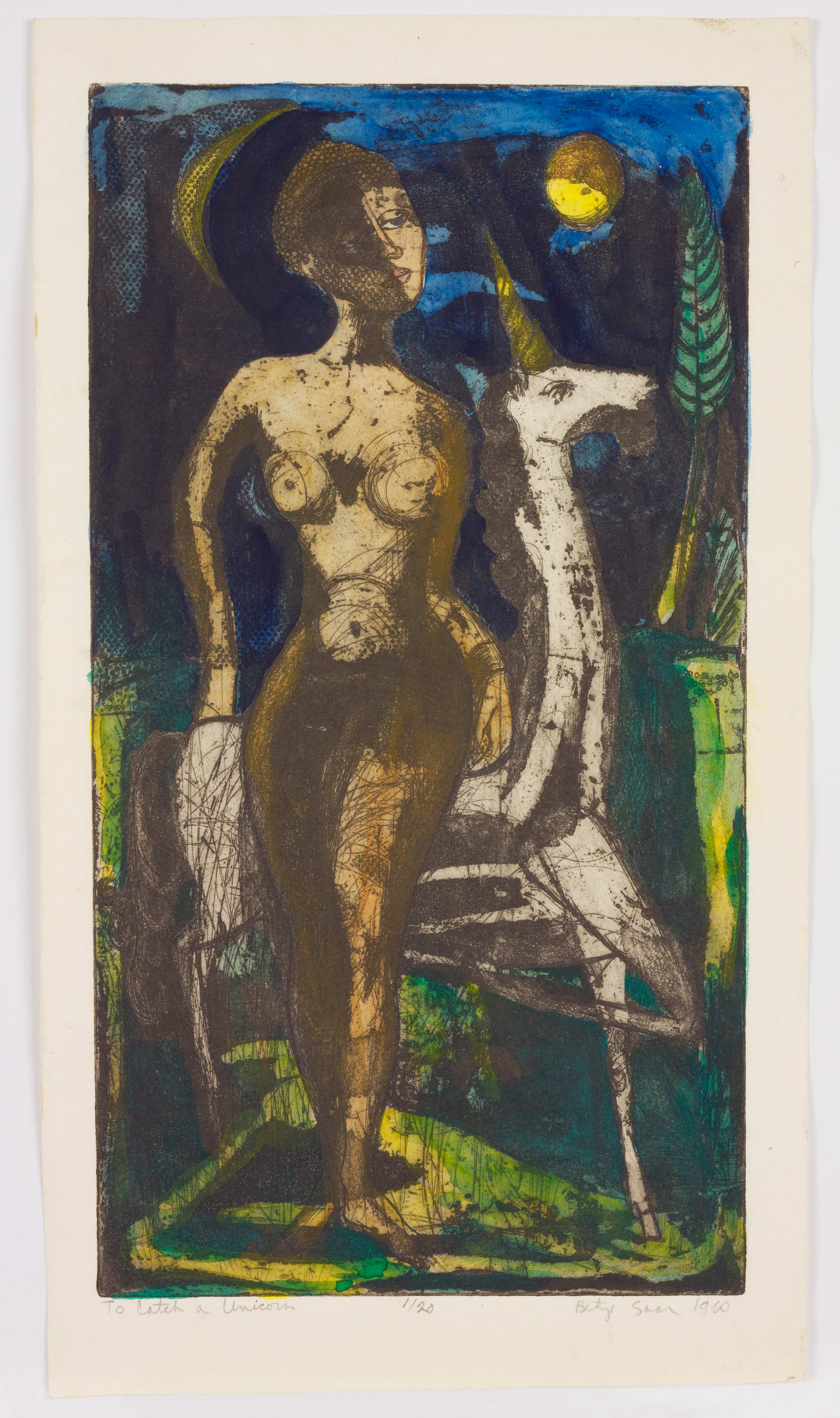
To Catch a Unicorn — Betye Saar

dig.37Screenshot 2019-02-17 at 9.56.13 AMScreenshot 2019-02-17 at 9.55.47 AM

To Catch a Unicorn, 1960 by Betye Saar (b. 1926)