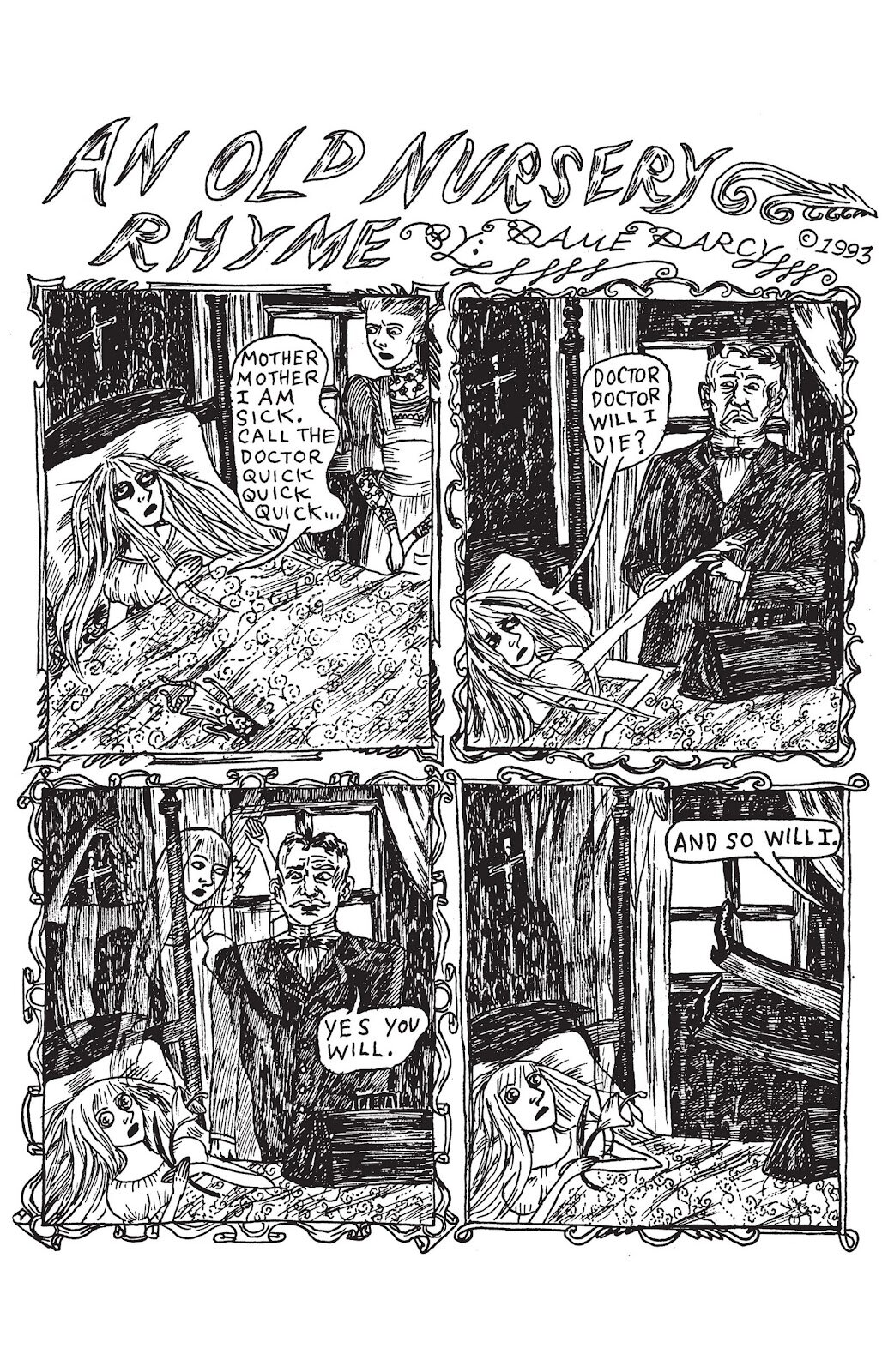
“An Old Nursery Rhyme” by Dame Darcy. From Meat Cake #1, 1993, Fantagraphics.
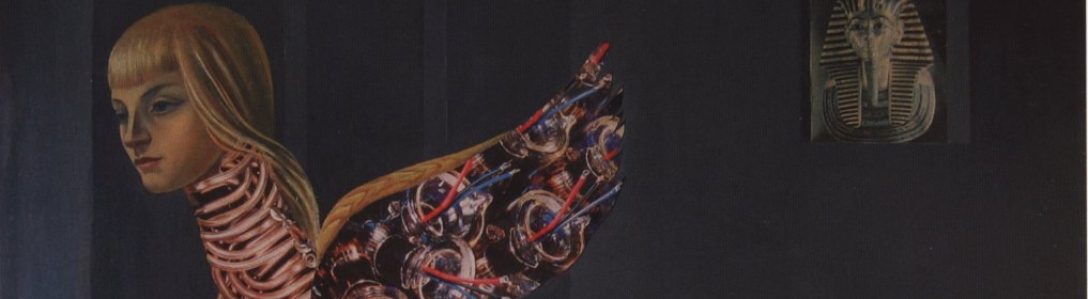
“An Old Nursery Rhyme” by Dame Darcy. From Meat Cake #1, 1993, Fantagraphics.
In answer to the question: “Why do you write?”
Because art blows life into the lifeless, death into the deathless.
Because art’s life is preferable, in truth, to life’s beautiful terror.
Because, as time does not pass (nothing, as Beckett tells us, passes), it passes the time.
Because death, our mythless master, is somehow amused by epitaphs.
Because epitaphs, well-struck, give death, our voracious master, heartburn.
Because fiction imitates life’s beauty, thereby inventing the beauty life lacks.
Because fiction is the best position, at once exotic and familiar, for fucking the world.
Because fiction, mediating paradox, celebrates it.
Because fiction, mothered by love, loves love as a mother might her unloving child.
Because fiction speaks, hopelessly, beautifully, as the world speaks.
Because God, created in the storyteller’s image, can be destroyed only by His maker.
Because, in its perversity, art harmonizes the disharmonious.
Because, in its profanity, fiction sanctifies life.
Because, in its terrible isolation, writing is a path to brotherhood.
Because in the beginning was the gesture, and in the end to come as well: in between what we have are words.
Because, of all the arts, only fiction can unmake the myths that unman men.
Because of its endearing futility, its outrageous pretensions.
Because the pen, though short, casts a long shadow (upon, it must be said, no surface).
Because the world is re-invented every day and this is how it is done.
Because there is nothing new under the sun except its expression.
Because truth, that elusive joker, hides himself in fictions and must therefore be sought there.
Because writing, in all space’s unimaginable vastness, is still the greatest adventure of all.
And because, alas, what else?
From Delta #28, June 1989; republished in Conjunctions.
Beckett liked knockabout drama. Vaudeville acts where somebody just gets pummeled. Trapped, insulted, or kicked. Punch-and-Judy. I love Beckett. I also like the Three Stooges.
Beckett once said, “Nothing is funnier than unhappiness,” and he was thinking about Charlie Chaplin, the genius of unhappiness. And Beckett’s own work is that, too. It’s failure, unhappiness, ignorance. When you’re not involved, other people’s unhappiness seems to be about the funniest damn thing on earth because you think you can solve it, that you are God, that you are above this, and that their unhappiness is just such useless toil and agony. If it’s you, it ceases to be a comedy.
From Barry Hannah’s Paris Review The Art of Fiction interview, Winter 2004
This past Friday, after some spring semester-is-almost-over-time-to-clean-out-the-office-and-take-all-the-plants-home cleaning, I converted some of the review copies, old anthologies, and textbooks in my office I’d crammed into a box into bookstore credit.
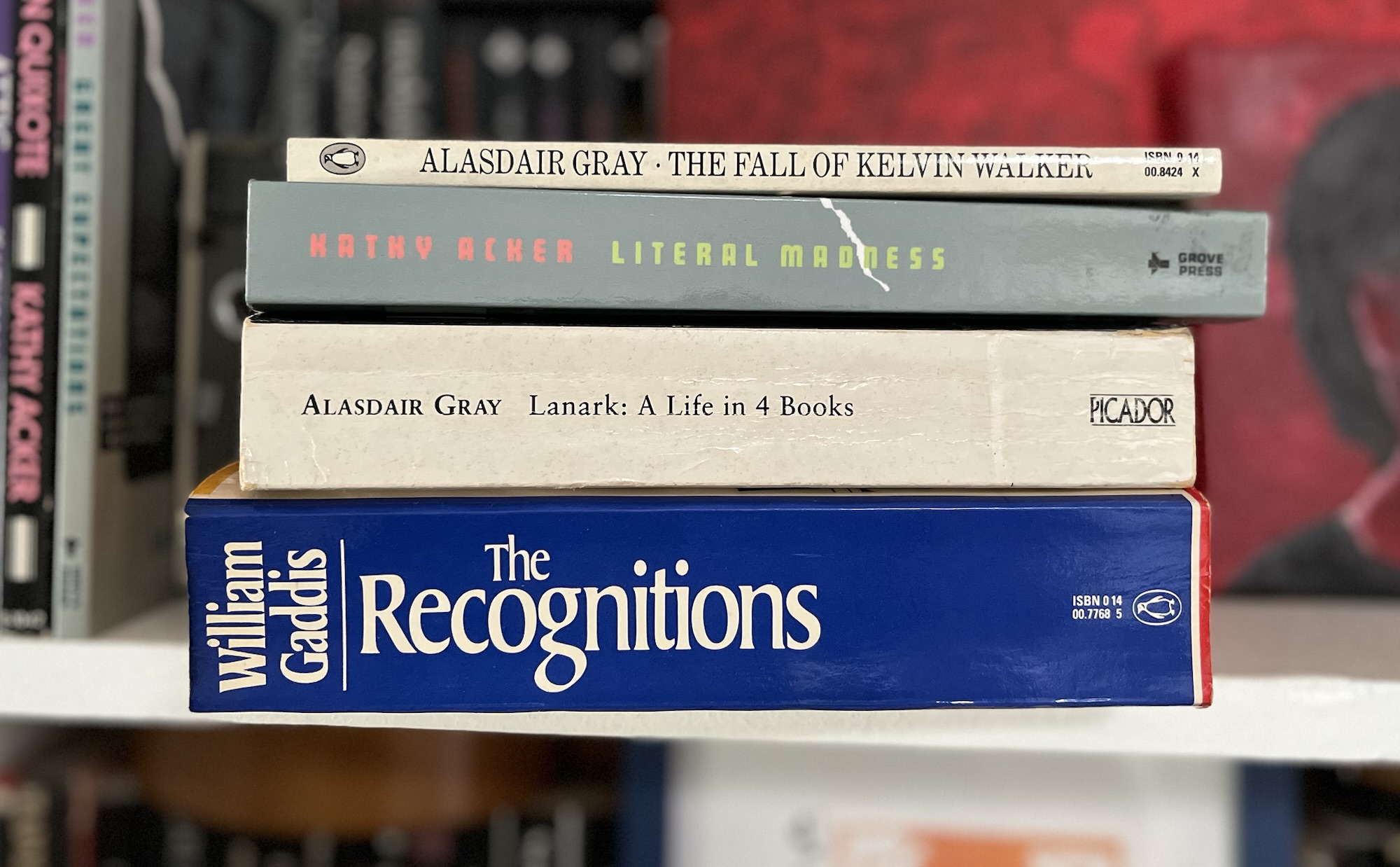
I didn’t intend to pick up anything while browsing, but I couldn’t resist a second copy of William Gaddis’s The Recognitions. I’d never come across the 1985 Penguin Books edition before, and it matches nicely with the edition 1985 Penguin reissue of J R that I found on a dollar shelf in Atlanta a few years ago. This 1985 edition of The Recognitions is a bit stiff in the hand; I’m glad I first read it in the ’93 Penguin Classics edition (with the William Gass introduction that everyone should absolutely skip until after they’ve read The Recognitions for the first time).
I also hit an unshelved seam of Alasdair Gray novels, just sitting in a stack on the floor in the sci-fi section, and picked up The Fall of Kelvin Walker, which I’d never heard of, and a third copy of Lanark. I lent the first copy of Lanark I owned and read to someone who never returned it. I have doubles now, but as a wise man proclaimed, “Triples makes it safe. Triples is best.”
Near the Gray novels, also unshelved, was a copy of Literal Madness, which collects three Kathy Acker novels: Kathy Goes to Haiti, My Death My Life by Pier Paolo Pasolini, and Florida.
It is probably a terrible compulsion to crowd my shelves with duplicates of novels I’ve read several times already. There’s a part of me that imagines I will one day have a small bookselling space with a very specific inventory of titles I will ultimately refuse to part with, and which my children will not-so-reluctantly have to throw away after my demise. I also imagine being able to hand one to a friend, suggest they read it without any anxiety over its return. (If you are reading this, Lanarkklept, the book is now yours, has been for years. I hope you read it.)
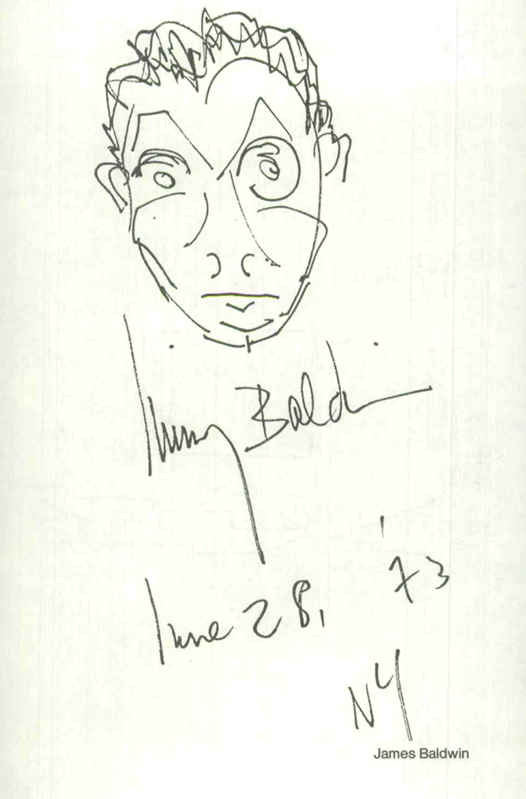
Self-Portrait, 1974 by James Baldwin (1924-1987).
First published in the Paris Review as an excerpt from Burt Britton’s Self Portraits.
“The Boy Scout”
by
David Ohle
The boy scout guides his wooden pedal car up the dirt road and parks it, in the shade of my turkey oak, without ceremony. The little car has tin-can headlights and a false grille. He approaches the steps and begins to climb, a box of rice cookies under one of his frail arms. It is a mystery how he crossed the bottoms in this handmade vehicle, how he avoided sinking in the soft mud ruts and being stung by the wasps in the sumac along the ditch-bank. Twice the boy scout drops the box of cookies, backsteps to the ground, recovers it, and climbs up again. He knocks gently, the sound is as though his knuckles are made of hard rubber. I open the door and allow him in. He sits on the sofa with yellow eyes and looks at my feet and says nothing. I offer him a bowl of soy soup, which he declines, casting his glances on the floor. His face is ageless and simple, with precocious whiskers on the jaw.
I build an oak fire in the woodstove and he warms his hands against the evening chill setting in. In the firelight I first become aware of the suggestion of a seam running down the front of him, over the nose from the khaki tip of the hat, across the lips and chin, into the neckerchief. He seems in the odd light to have been stitched together out of two unmatched bolts of cloth. His eyes are like coat buttons, the fists like ripe tomatoes. He smells of sodden laundry. Crickets bump against the tower window screens. The stink of pinesap and legustrum. The clack of crows in the sky.
I take a cold chicken wing from the refrigerator and offer it to him. His head pivots, the lips emerge tubelike from the face. He says no. At least he has finally spoken. We don’t want to sit here too long on the brink of conversation, like wax figures behind plexiglas. Coffee? Does he want coffee? Cola? I move around the living room mechanically, under an odd influence from this boy scout, as though he were a planet and I his satellite, he earth and I moon. Threads of black yarn drape his forehead under the scout hat, a mockery of hair. He has a sewn-on eyebrow above one eye and nothing above the other one, and a faded disk of scar on the chin. I talk about the weather and he listens without comment.
I ask him about a point of scout lore, and although his mouth opens and the dry tongue quivers, he says nothing. When he moves, which he seldom does, there is a faintly audible rasp, as though his joints are dry of lubricant. I ask him if I might sample one of his cookies. He indicates no. I have to buy or not buy without tasting. I give him the required amount in National coupons. I eat one of the cookies, which have no taste and little consistency. I remember myself as a boy scout, driving my pedal car intricately through alleyways in the city, eating bruised fruit when I found it at the backs of government markets. In the rear compartment of the pedal car I kept a change of khakis and extra shoes. If night came on me I’d throw out my bag and sleep wherever I was. I’ve seen tumbleweed, or something similar, blowing past the house recently. A wild pig comes every night and snufiles around for any garbage I might throw down. I consider dropping something heavy on him from the roof, breaking the spine, dressing him out, cooking him over a fire pit. The boy scout has been here several days now. I’ve noticed a spider’s thread from his shoulder to the windowsill. Two days ago he began an extended smile which has not yet broken. When the wind occasionally blows outside, the shiplap siding of the house gets to wailing in a high-pitched tone. The wind sock is full to the south, the awnings flapping. The fire in the stove belly has died hours ago, the sun’s last yellow angle is narrowing on the tower walls. The old clock is ticking on the mantel. The evening wears on. I rebuild the fire as the night cools and wear my flannel robe and long johns. Before dawn I see an orange light in the pines, someone walking with a lamp, Morning again.
An icicle has formed where the bathroom faucet dripped. The sun has come up in a haze. The boy scout is sleeping on the sofa.
The wind sock is deflated and the day is warming up toward noon.
By mid-afternoon I am perspiring in the humidity, wiping myself with a handkerchief. The boy scout remains dry and still.
A slow drizzle now, hanging on three days. On the fourth day I see an egg of sun above the tree line. A katydid is dead at the bottom of my teacup. Overnight the weather turns cold again, and the drizzle becomes a wet snow. My mouth is sour, my toothbrush worn down to the plastic. It will be nice to chew salty pork meat, sometime, whenever I can kill the pig. I should raise the awnings before the snow collects and breaks through the rotted canvas.
The wind sock is frozen stiff, pointing south. I see the pig outside, standing in the white. He pisses and leaves a yellow circle on the snow crust. The pedal car is gone, tracks of the wooden wheels leading off down the road. The awnings are frozen and won’t go up.
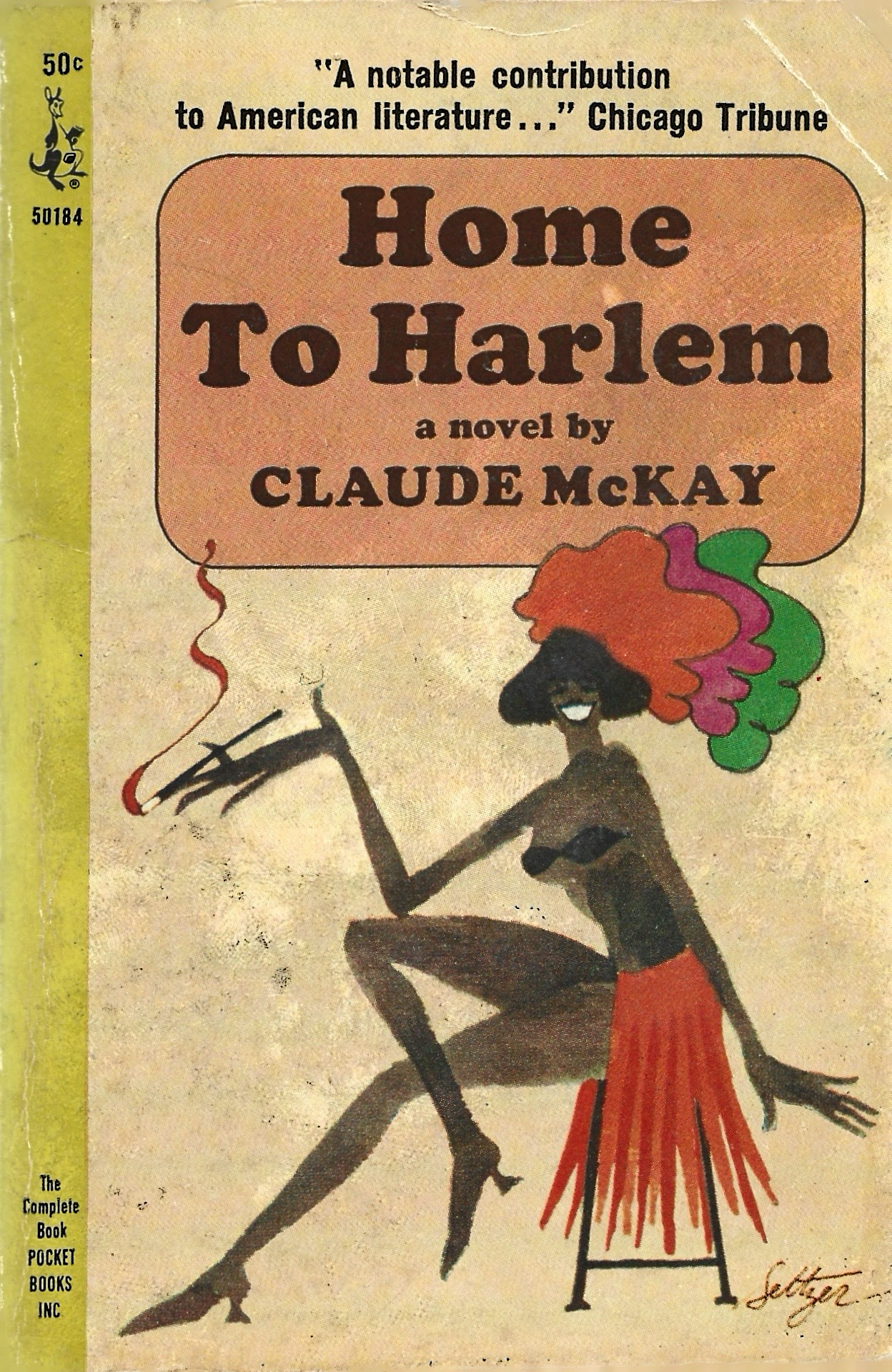
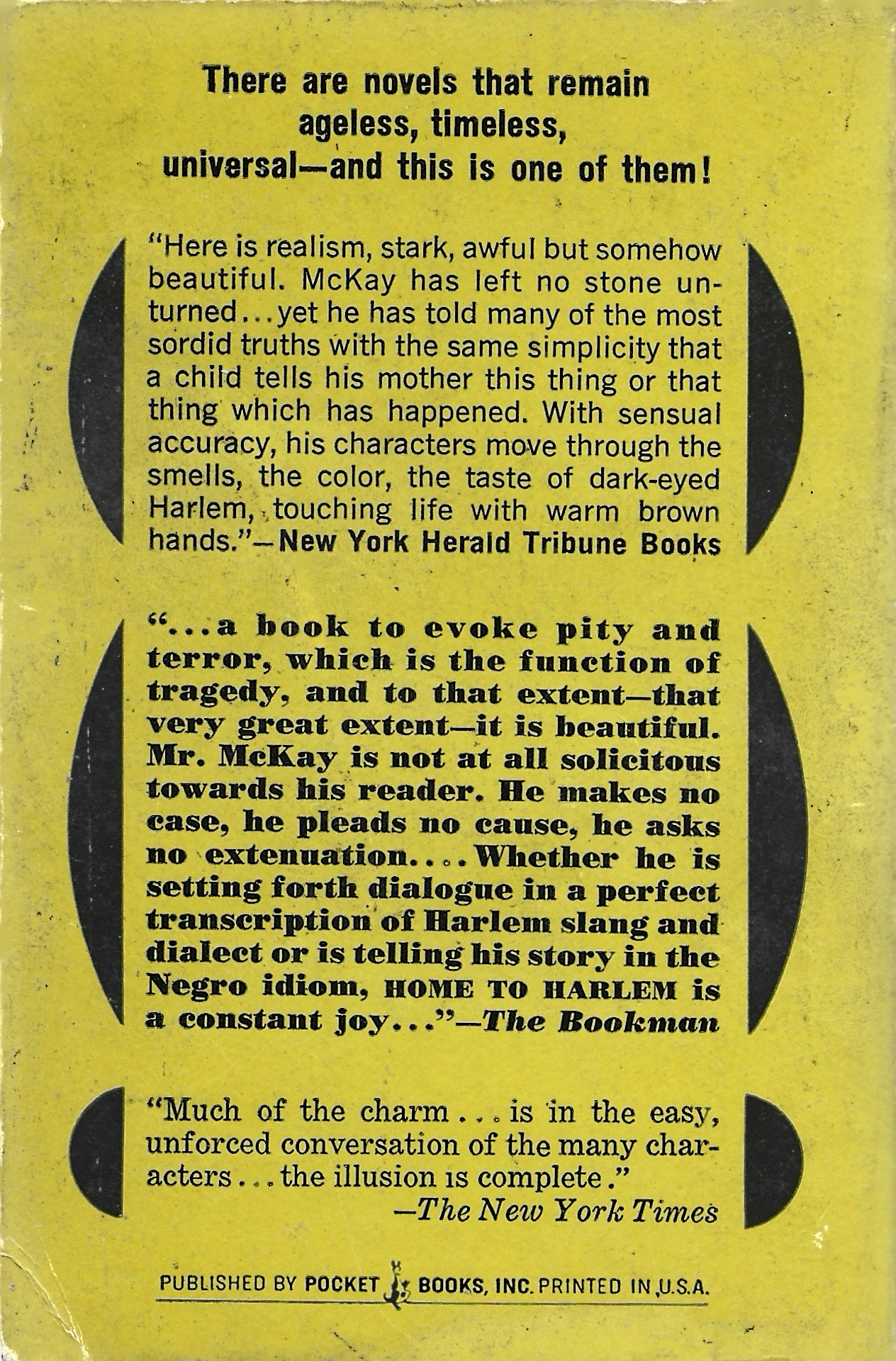
Home to Harlem, Claude McKay, 1928. Pocket Cardinal Editions (1956). No cover artist or designer credited. 180 pages.
The cover art, while unattributed inside the book, is likely the work of Isadore Seltzer. McKay’s first novel is now in the public domain and available online.
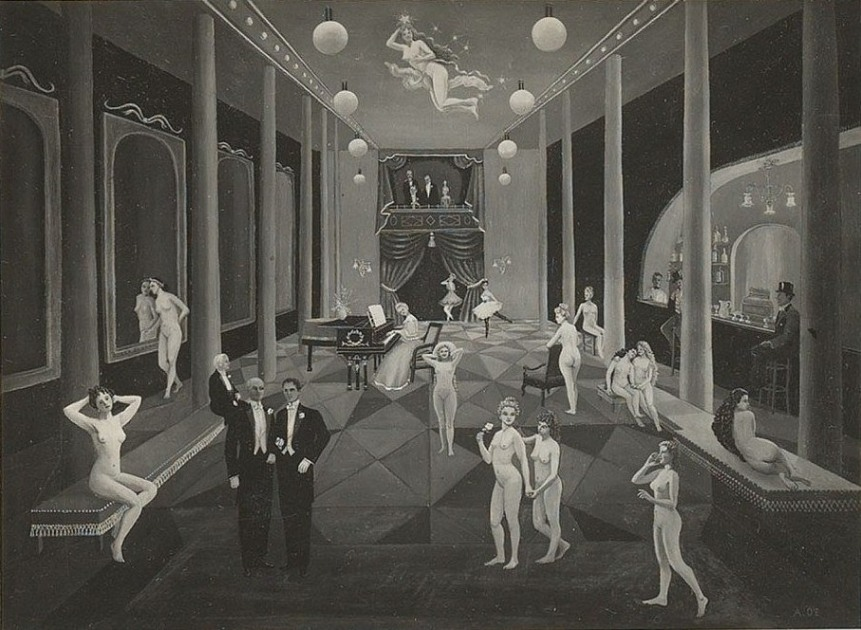
Untitled, 1947 by Suzanne Van Damme (1901-1986)
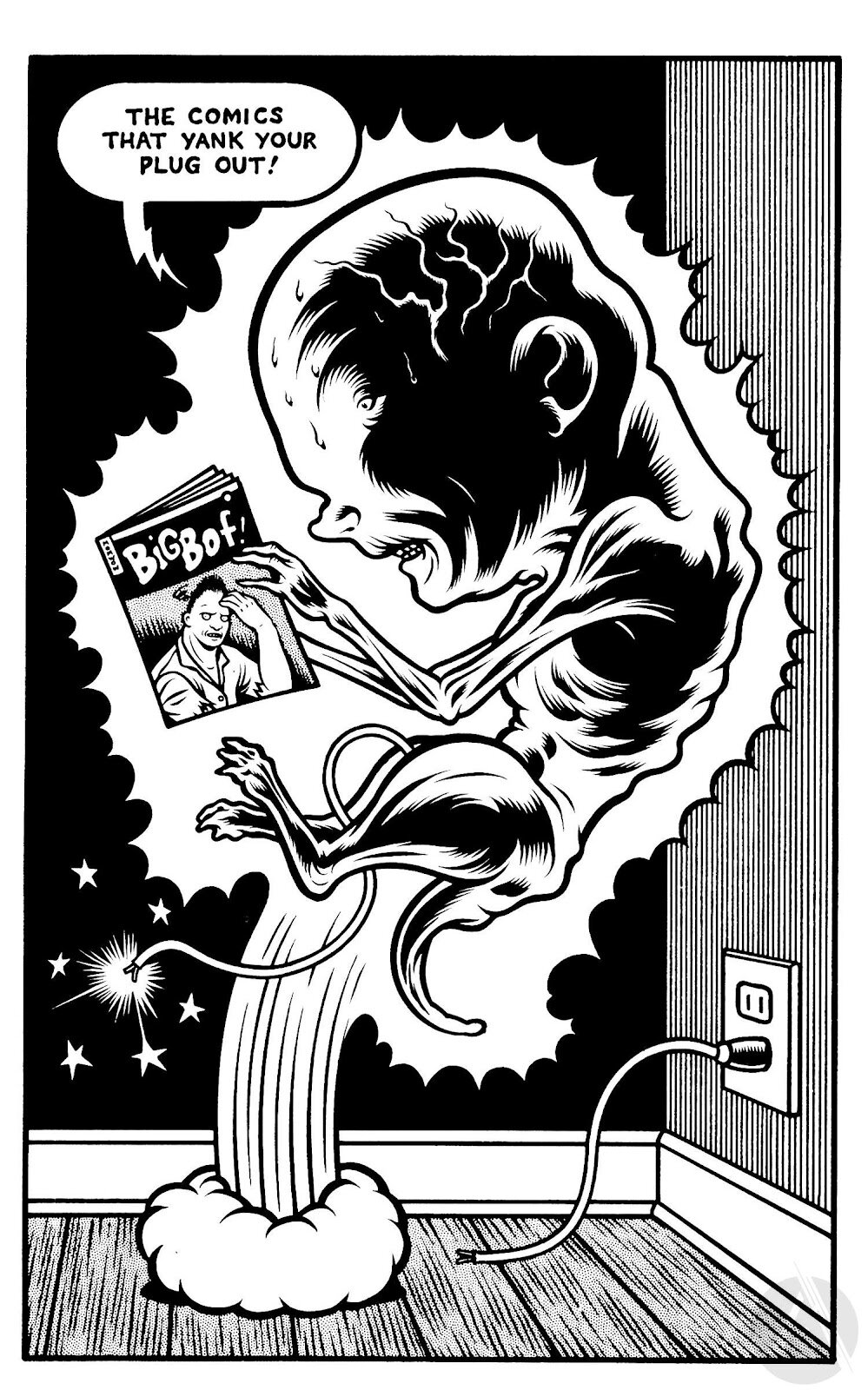
A page by Charles Burns from BLAB! no. 2, Summer 1987, Monte Comix Productions.
February 10, 2022
Ever since I started keeping my diary of remorse, my remorse has evaporated. The answer to a personality problem or spiritual malaise is to keep a diary of it because then the quantity you are quantifying seems to disappear. Therefore I should go on to keep a diary of other troubling quantities. Such as Diary of Lassitude, Lack of Motivation, Failure to Act, etc.
The lockdowns start and stop and then I go back and forth to my odd and unlikely hometown. I see that my interest in my volunteer job (of monitoring justice in the New Orleans criminal courts) is largely prurient. For this I should have remorse but don’t. When I get my docket in the morning I compare it to all the other dockets, pining that they are more exciting. Judge DeBoes has murders, rapes, and kidnappings on his docket today, not to mention a case of False Personation (???), Malfeasance in Office, and False Imprisonment, but I am not assigned to his courtroom. My consolation however is that today I am in the courtroom of the piping mad personality-ridden Judge Hollingsworth.
The defendants in New Orleans always have names like:
Jockward Jones
Curry Carter
Stokes Meilleur
King Malveaux
Narvelle Perrin
Bingo Fox
Margaret LemmonierAnd the judges have names like that too.
Talk about a vanished world. The grandiose criminal court building. The old-time bars and cafés amid the greenery.
From “Diary of Remorse.” Published in Paris Review, no. 241, Sept. 2022.

Initiation, 1999 by F. Scott Hess (b. 1955)
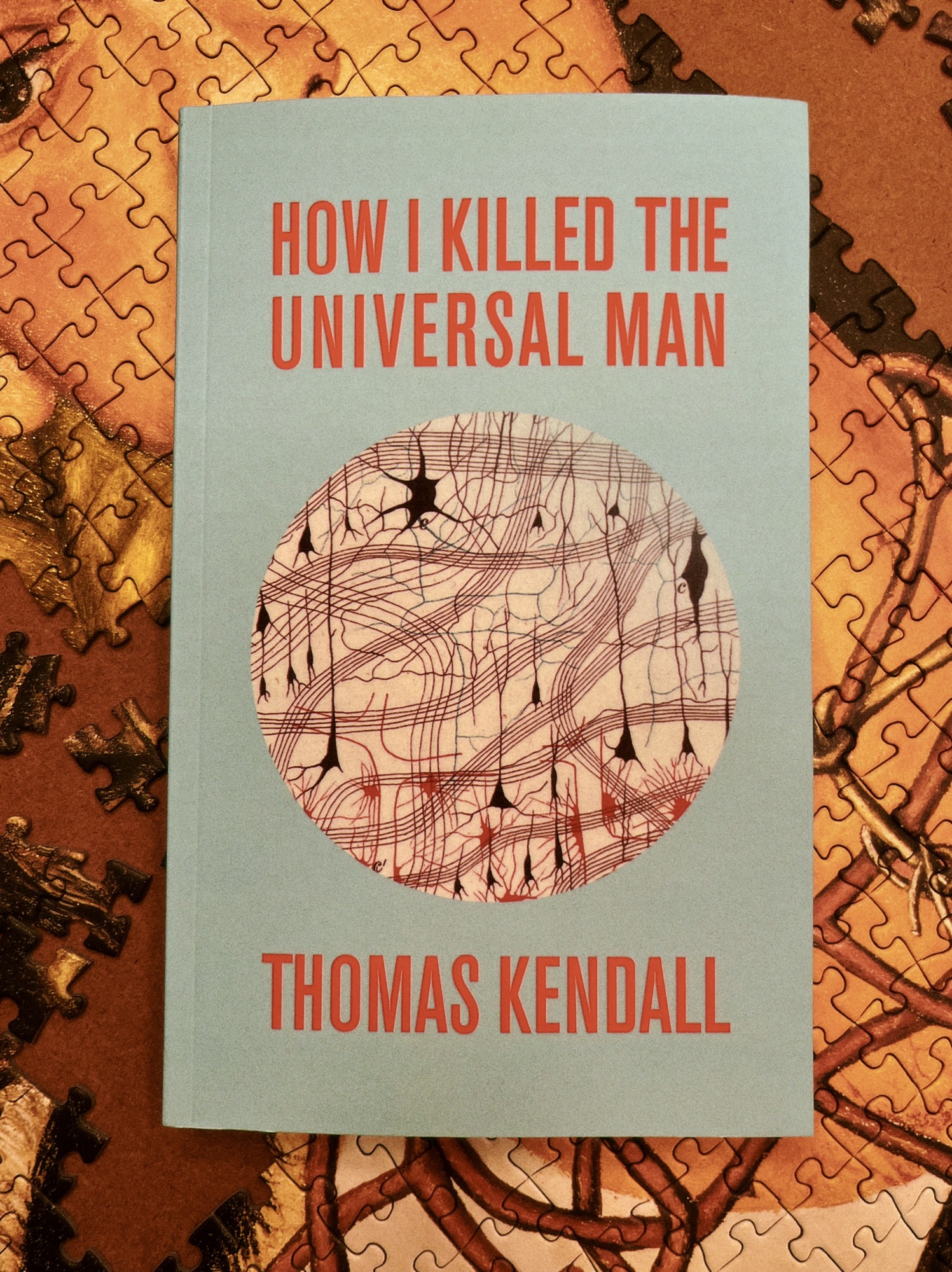
Thomas Kendall’s How I Killed the Universal Man is a near-future sci-fi novel working squarely in the cybernoir tradition of Philip K. Dick and William Gibson. Like Gibson, Kendall constructs a world where corporate systems saturate daily life and set the limits of perception. Like PKD, Kendall foregrounds reality’s instability, where what is seen, felt, and remembered can’t be trusted as one’s own. Kendall reworks the cybernoir lineage through a critique of media culture and wellness technology, showing how late-capitalist systems present themselves as therapeutic while covertly expanding their nefarious authority.
Our hero John Lakerman is a journalist for donkeyWolf, a “self-consciously edgy multi-social new(s) presence with a polyamorous approach to truth and ethics” that profits from “Attention Disordering Content.” From the outset, Lakerman understands himself less as an agent than as a conduit. He describes himself as “merely language, an impoverished language uninhabited by being,” and just “a data leak.” This diminished sense of self becomes explicit in one of the novel’s most telling admissions: “He had always wanted to be a robot…He’d always wanted to be a machine.” Lakerman’s desire isn’t so much a nihilist fantasy as it is an adaptive response to a world that already treats him as a tool, mere equipment.
Lakerman is sent to Miami to investigate Noumenon, a designer drug whose name strikes him as empty philosophical branding, “self-consciously clever and a total misunderstanding of the concept.” It’s a gonzo gig: he’ll take the drug himself and “report back from the other side of its meaning.” Under the supervision of Dr. Andrea Christoff at Lifepax (“here to carry you when nature can’t”), he enters a controlled Noumenon trial before exploring the Miami club circuit, where the drug circulates freely.
Crossing (literally) the threshold, Lakerman reads “cryptic messages” in the movement of club-goers’ bodies: “What they might see meant everything. What they could see was possibility. What they would see was another matter.” Capital, via biotech, mediates, manages, and tiers perception, parceled in preset doses. Kendall’s hyperheated dystopian Miami, a landscape of “block-shaped universes” and horizons “constructed by deprivation,” gives that logic spatial form. Space is segmented, experience preformatted, and Lakerman’s role as “reporter” starts to look like another interface the system ventriloquizes.
Lakerman leaves Miami, but the cityscape’s stratified logic stays with him. Back in London, news of a mass-shooting in Miami finds its way into his feed, and the “quaintness of a non-global catastrophe” showing up there strikes the jaded Lakerman as unusual. A too-specific detail from the report finds him returning to his last story on Noumenon, and his investigation widens into a corporate network linking Lifepax to the now-defunct Phenom Games. What began as a gonzo drug story becomes an inquiry into how experience itself is engineered, circulated, and monetized.
Lakerman’s investigation leads him to UbIQ, a biotech platform offering implants framed as “an advanced biometrics wellness program and early health warning system.” The smooth clinical reassurance of corporate jargon masks UbIQ’s reality as a tool of continuous emotional surveillance: “It registers how much you cry, when you cry, and at what.” As Lakerman encounters UbIQ (the name a loud, clear echo of PKD’s 1969 novel Ubik), the ground of proof gives way beneath him. Official records deny what he remembers, corroborating traces disappear, and even his own logs refuse to stabilize events into something demonstrably real.
He keeps investigating though, and the novel shifts to question not simply what Lakerman can know, but what kind of system makes knowing structurally dependent on corporate infrastructures and then repackages that dependence as “care.” Kendall distills this systemic condition, the internalization of capitalist infrastructure as perception, feeling, and “wellness,” into a blunt image of saturation: “Like plastic in fish, the way everything has a little capitalism mixed in.” Control arrives as smart drugs, implants framed as therapy, games that train attention and identity. It surrounds the self and takes up residence inside it.
A Boschian mural on the side of a church (titled a bit-on-the-nosedly Allegorical Futures) states the book’s critique outright: “This demon is capitalism. Special Ability: Ravenous hunger.” The mural is signed T.OR who Kendall later links to the game-world Lakerman is pulled toward. The mural names the engine; the game teaches how to live with it: “HIKTUM is a game that teaches you how to be multiple.” That “multiplicity” isn’t Whitman’s multitudinous freedom but training: become flexible, divisible, easier to manage. The endpoint is the Universal Man, “a thing [that] cannot be rendered but can be leased.” The novel’s late refrain “Nobody survives love” marks the cost of a world where even intimacy is folded into the logic of extraction.
Lakerman’s trajectory isn’t a personal tragedy so much as a case study in a world where media platforms, pharmaceuticals, and “wellness” tech jointly manage what can be felt, remembered, and proved — and where that management manufactures people who want to be managed. Kendall leaves Lakerman’s final position unresolved, but the arc is clear. The wish to become a machine (seamless, efficient, immune) collapses into submission to the systems already in place. In HIKTUM, control isn’t the existential threat of abstract violence, but rather what we feed to our heads and bodies. The diagnosis is that we don’t experience these systems as coercion. We submit to them as upgrades.
Readers drawn to cybernoir’s paranoiac pressures will get a kick out of Kendall’s transhumanist noir, which I’ve failed to describe the weirdness of here. How I Killed the Universal Man also makes a strong case for seeking out Whiskey Tit, an independent press committed to weirdness. Check it out.
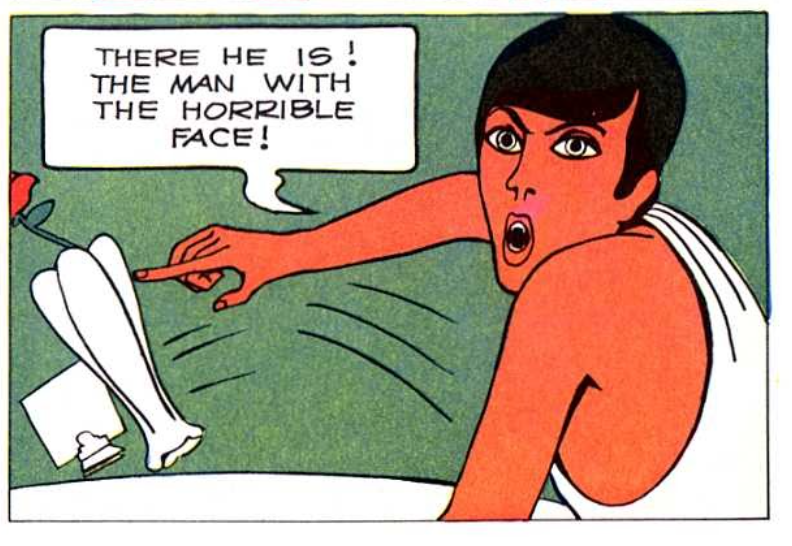
A panel from The Adventures of Jodelle by Guy Peellaert (art) and Pierre Bartier (script), Le Terrain Vague, 1966. English translation by Richard Seaver, Grove Press, 1967. Reprinted by Fantagraphics, 2013.
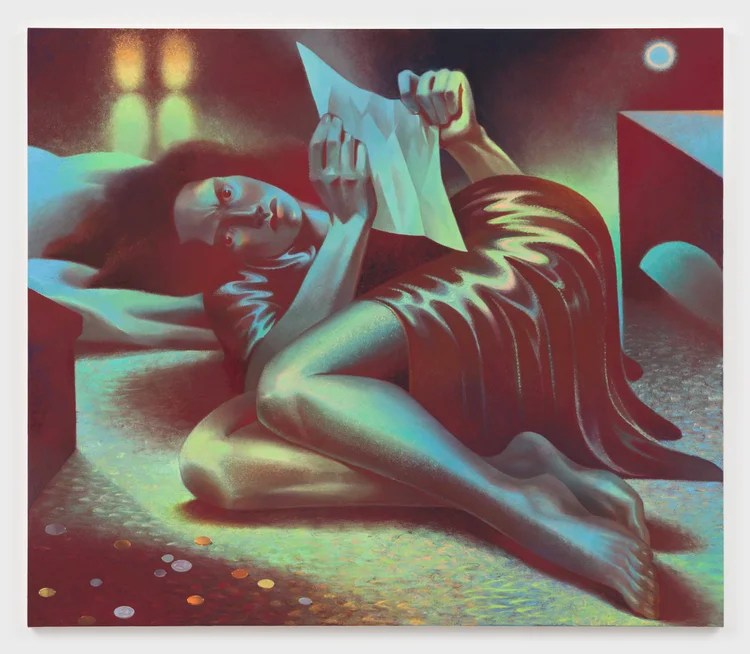
Dear Jane, 2024 by Robin F. Williams (b. 1984)

“0”
by
David Berman
first published in Caliban #8, 1990
On the very first day Jah gave light,
and on the second he made the sun and the stars.
It wasn’t long before things were jumping out of the river.
Later there were some wars, mostly soft and bloodless,
with snow falling on the sleeping tanks
and pieces of field glued to their wheels.
No longer all right to eat our young,
we made the Empire State Building and threw things off it,
then drank sidecars and Harvey Wallbangers until 1961.
People were heard to say that the world doesn’t care,
that the walls don’t listen, and the stars only shine on us
because we’re in the way of their light,
but the world continued to spin on its sturdy axis,
and underneath the Christmas trees the trains still ran on time,
while people united in sexual congress let pride feed.
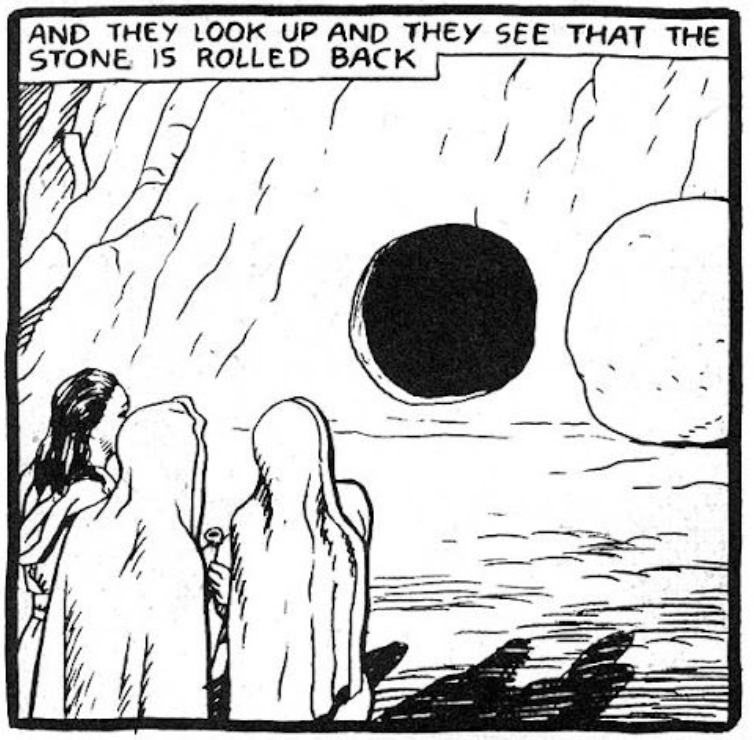
From “Mark 14:53-16:20” by Chester Brown. Published in Yummy Fur #14, January 1989, Vortex Comics.
“The Resurrection Morning”
by
Winifred Holtby
When Mr Barrow died, none of us knew quite what to say to Mrs Barrow. ‘Deepest sympathy in your loss’ perhaps was best, because you can sympathise with fortune as well as with misfortune, and loss may be good riddance of bad rubbish.
Not that Mr Barrow was exactly bad rubbish. The obituary notices called him a ‘prominent citizen of Kingsport,’ and he had been a town councillor and a sidesman at St Agatha’s Church, and left a tidy sum invested in War Loan and corporation stock. A pious man, the vicar of St Agatha’s called him, and sent a cross two feet by one, particularly handsome. Mrs Barrow, however, was not pious. After ten years of married life she had abandoned her belief in God. Her husband could insist upon her attending church, but he could not prevent her from sitting down whenever the rest of the congregation stood up, even during the Creeds. What he said to her after the services we never knew; but Mrs Barrow told me that if the Almighty was such that He could appreciate her husband, Mr Barrow was welcome to Him.
I watched her at the funeral. She was over seventy, a worn-out little woman in her new black. But she held her chin up and her hymn book in both hands, and sang with the perfect confidence of stalwart incredulity:
‘On the resurrection morning
Soul and body meet again . . .’
Of course there was no Resurrection Morning, and there was no God, and Mr Barrow was safely hammered down into his grand mahogany coffin with brass handles. Continue reading ““The Resurrection Morning,” an Easter story by Winifred Holtby”
 Biblioklept