Biblioklept contributor Ryan Chang and I continue our discussion of New American Stories, an anthology edited—or maybe “curated” is the right word, although I’m not sure—by Ben Marcus. Read the first part of our exchange here. In this exchange we discuss holes, white American violence, paranoia, stories by Clare Vaye Watkins, Robert Coover, Lydia Davis, and Tao Lin, and that “Wait! Why? How?” feeling that good fiction can produce.

Ryan Chang: What’d you think of the Claire Vaye Watkins story?
Edwin Turner: Yeah…so… “Diggings.” It’s taken me so long to get back to you about this one because I don’t really have anything intelligent to say about it. Which is really strange: I think I’ve told you that I’ve been obsessed with holes for a few years now, and the aesthetics of digging in particular. I’ve been compiling a bibliography on writings about holes, so I guess “Diggings” fits into that. And I like the general milieu and everything, the Western thing. And I appreciate Watkins lucid storytelling style. I do. But I found myself having to slog through it, and then the end, the sort of climax or whatever…I don’t know. No spoilers for the readers, but it didn’t ring my bell. Again, I’m not saying anything particularly interesting about it. I think my problem might be with the length of the story—to be clear, that’s my problem, not the story’s—but with a few notable exceptions (“Bartleby,” “The Metamorphosis”), superlong short stories don’t do it for me. I’d rather read a novella I guess.
I’m pretty sure “Diggings” is the longest selection in New American Stories. Lydia Davis’s “Men” is obviously the shortest in the book—it’s one of her better ultrashorts, and it’s already been widely anthologized via blogs and Twitter. I wish one of her longer pieces was included though–maybe something like “Marie Curie, So Honorable Woman.” But I’ve fallen into the stupid trap of What Would Ed Do?
Another short piece in the collection is Robert Coover’s “Going for a Beer,” which is a Perfect Short Story. Just perfect. It’s a perfect postmodern gesture without any gimmickry, a story about storytelling that’s actually a story. But maybe I only think it’s so perfect because I’ve read it so many times now and even used it in the classroom. Your thoughts?
RC: There are a few things I really like about Watkins’ “Diggings.” For one, I think the voice is what really carries this story, and the pretense of the subheadings. It certainly lends the story this epic-ness that, for the most part, it does well, but my resistance to this story comes from its place within the collection.
But first, I want to touch on the hole motif. There’s the easy reading of the kind of digging and the value invested in it. The tenuous promises of a new start, or a restart. The neutrality of money; that is, one’s self-worth is in direct proportion to one’s ownership. But Watkin’s story is a critique of that very American myth of manifest destiny. Was it ever good for anything? In this light, the story seems fine. A well-executed story with enough of the right moves to keep me going. I’m impressed by Watkins’ pacing, as well as how convincing this voice is. I don’t think we should forget that. Watkins’ inflection of that gruff, macho Westernly voice is what’s most convincing for me, and contributes to the irony that enables the critique of the American myth overall. Also, to end, I’m happy to see that the principle antagonists—besides the characters’ own desires—are the “Chinamen,” who are often footnoted or forgotten in the long history of white American violence.
But to be a little academic—that the collection ends with this critique of manifest destiny and (white) Americanness strikes me as counterproductive, or redundant, to the kind of politics this collection may (may!) be advocating: the flexibility of the American voice. I’m talking about Sayrafiezadeh’s story, and your point that the protagonist can’t listen, that no one can really listen. It’s redundant to me because that theme is shot through the entire collection. Did we really need it recapitulated again? And have it be our final punctuation mark on an otherwise strong and smart anthology? This is probably my own What Would Ryan Do? situation. The story reads like a watered-down version of the punch this collection attempts to make with “Diggings.” But we should remember that this is only one anthology compiled from one editor—whose own work we both really dig (God; no pun intended)—from a body of literature that would be impossible to completely anthologize. The best things about metaphors is that they fail to fully figure their abstract possibilities in text, fixing their content in time and place; instead, they point outside of themselves. That’s exactly what NAS does here: it says, the “American Story” is flexible, strange, and ever-moving. All its permutations cannot possibly be contained.
OK, but, I like that my response is going to end on a few considerations of Coover’s story, “Going For a Beer.” In an interview, Marcus says that it’s under Coover’s tutelage where he began to cut his storytelling teeth, and you can see a lot of resonance between, say, Marcus’s early work and Coover. But even now, the one thing they share—as well as Watkins—is a commitment to the strange.
You’re right to say that it’s a perfect example of a kind of postmodern fiction without any of the gimmickry, and a “Perfect Story” in this capacity. The way it calls attention to itself is, yeah, by foregrounding the artifice of storytelling through storytelling. But it’s not a “trick,” it’s a tweak: instead of one central conflict for the protagonist, we get a replication of several conflicts, they produce the next in the series. Our readerly expectations of conflict-resolution are turned upside down; Coover collapses the arc between readerly anticipation and pacing. Always, we’re like: “Wait! Why? How?” It hinges on when Coover makes the protagonist think—by merely thinking, the action happens, and we’re led into the next sentence of the story. In that light, it’s very Quixotic, and how the story calls attention to itself in that postmodern way. I could try to break this story down more to its components, but that’s not completely our purpose. But even if I did break this down some more, it wouldn’t suck out any of the magic of Coover’s story. Which is how, I think, Marcus understands language as a drug. The certain, indubitable and inevitable syntactical arrangement of words has this inexplicable effect on both us and the writer. The mystery is what keeps stories going.
ET: I got some of that “Wait! Why? How?” feeling from Tao Lin’s “Love Is a Thing on Sale for More Money Than There Exists,” although at a far more subtle level—maybe more like, wait–why?–huh?. Like Coover’s “Going for a Beer,” Lin’s story feels effortless—but a different kind of effortless. Coover’s tale is masterful and precise. There’s something a little tossed-off to Lin’s story; a riffing poetry which gives the story some of the energy it needs: “You, the botched clone of you, the Miami Dolphins, Cocoa Puffs, paper plates, a dwindling supply of clam juice. That was life.” Wait–why?–huh? “Love Is a Thing on Sale” (wait, do I need to name the whole name? Does it remind you of a Raymond Carver title?) — “Love Is a Thing on Sale for More Money Than There Exists” has almost no plot—it’s very Tao Linish. It also captures something of the post-millennial malaise and paranoia of the previous decade. Reading it I thought, “Ah, yes, that feeling”—like there was still a freshness to that exhaustion. We learn that our protagonist Garret “often suspected that The Future Was Now,” which of course it was. And now passed.
The hole pops up as a metaphor again, although I’m not sure what Lin’s doing with it besides the very, very obvious (“There’ere’s a hole in you/Gets emptier, ah-oh, each day” is a line from “Sigh (Hole),” the “radio hit that year”). The story seems best to me when it strays from its Barthelmesque absurdities into actual emotional contemplation, as when Garret, via Lin’s free indirect style, wonders about love and truth and being considerate—that love requires real attention, consideration, punctuality. (Garret is deeply flawed too, of course).
I was surprised at how much I enjoyed “Love Is a Thing on Sale,” especially because it frequently annoyed me, with its ultra-specific signifiers of capitalism (“KFC spork”!) juxtaposed with its leery vagueness (the protagonists “flew down to Florida” for a vacation. Florida, the fourth largest state in the US. Florida. Florida, which has an east coast but also a west coast. And where do they go in Florida? Fucking Red Lobster, man). One of my favorite moments of the story is actually one of these sparks of vagueness, of sheer impossibility, of how language is a drug that can compress banality into radical action: “A few minutes passed, and then Kristy got up, called the airline place, called a cab, and flew to New York. The next day, though, she flew back, and the rest of the week in Florida was very calm and sunny.” That passage is a piece of fantasy.
RC: Mm, yeah, there’s certainly a confidence in Coover’s story that isn’t in Lin’s, but it doesn’t mean his prose is any less precise. Part of the magic in Coover’s story is watching him handle the technique he’s devised and watching him perform it, amazed that we’re buying his gambit. Though we’re puzzled, we’re not in disbelief as to what’s happening. The absurdity of his narrator’s thought generating the action becomes self-reflexive because, again, it’s an ironic joke of how stories work. Someone thinks of something, and then it happens. Continue reading “A conversation about New American Stories, an anthology edited by Ben Marcus (Part 2)” →
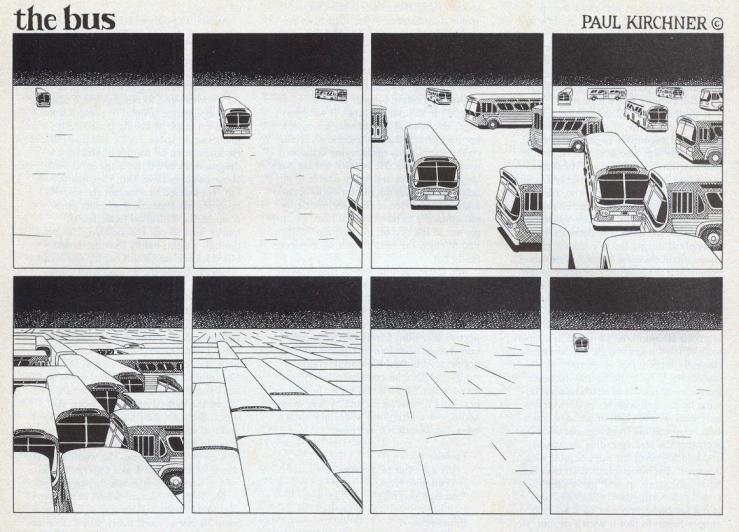
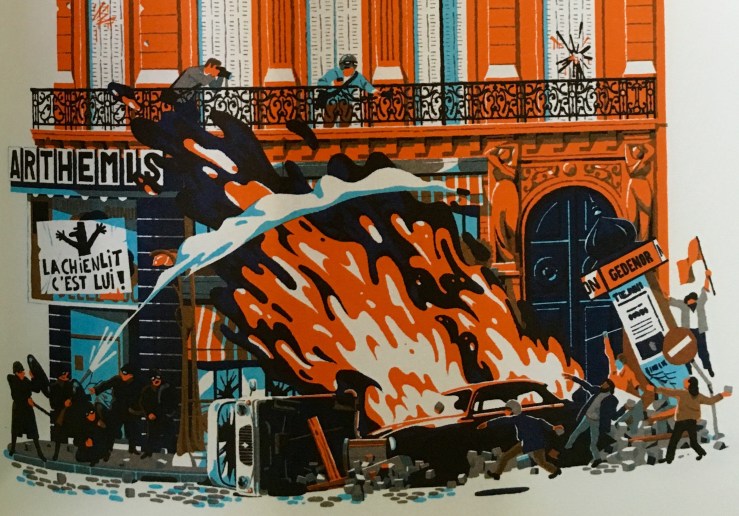 The book ends in 2015; I’ll let Mahé’s image speak for itself:
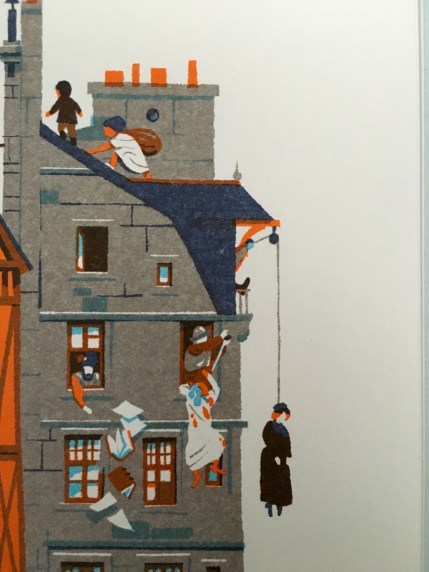
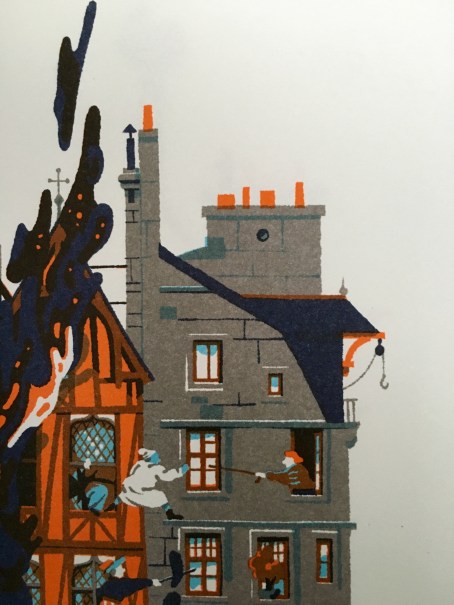
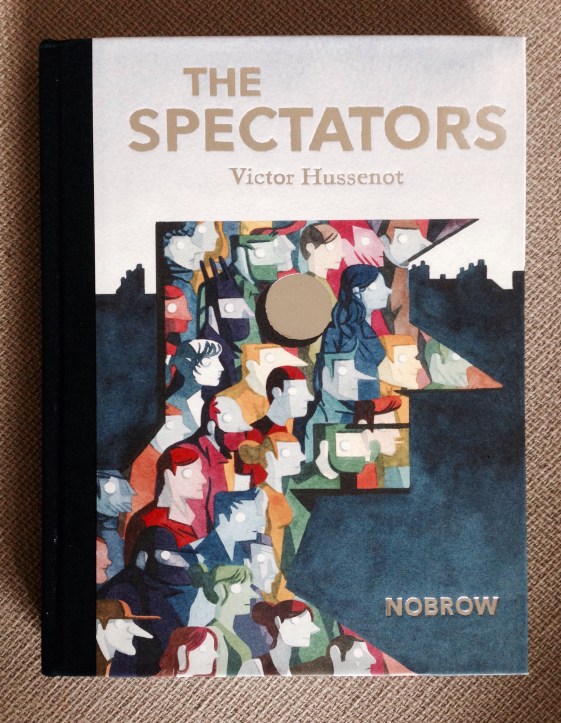
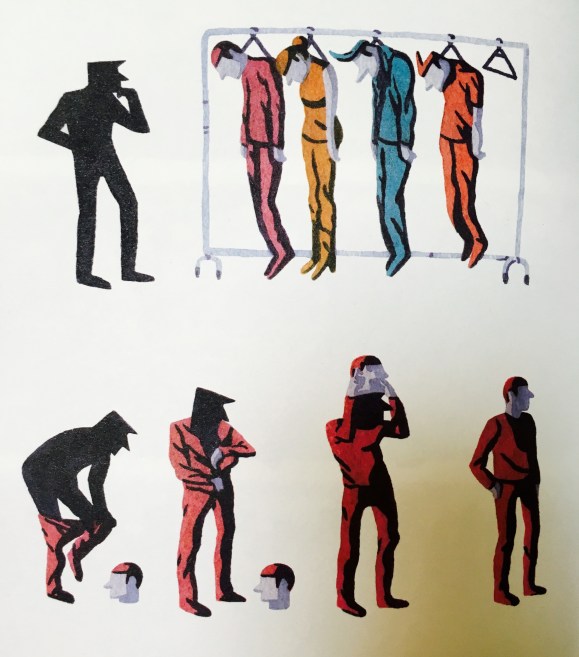


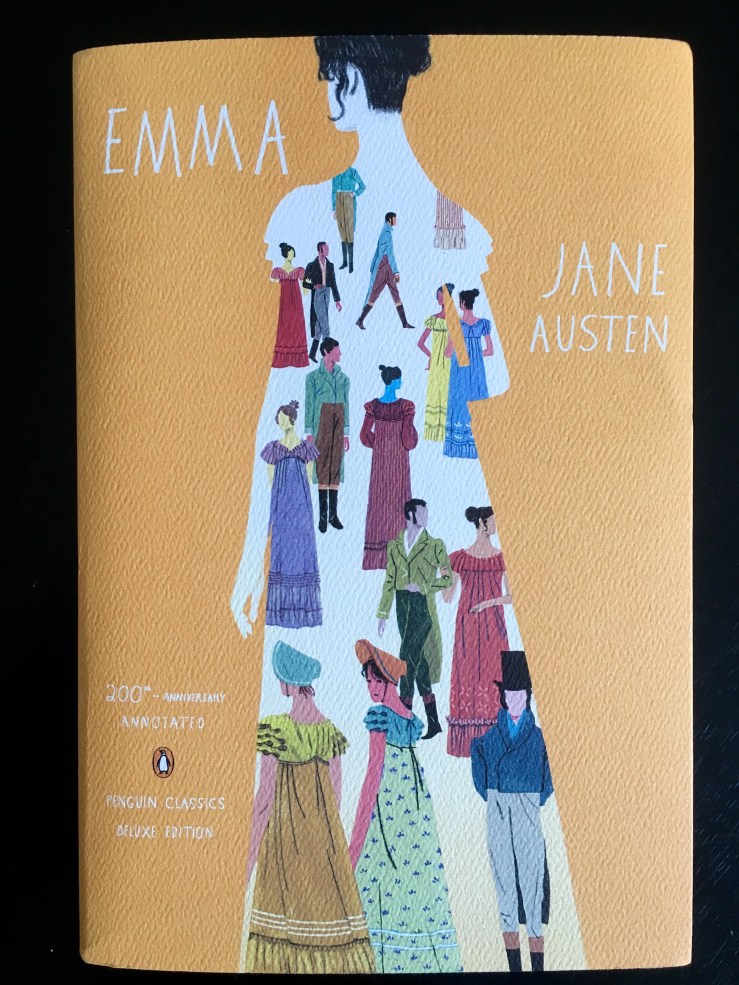
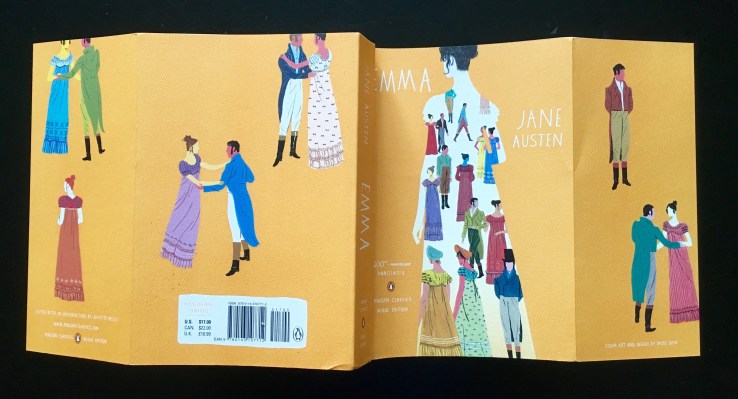





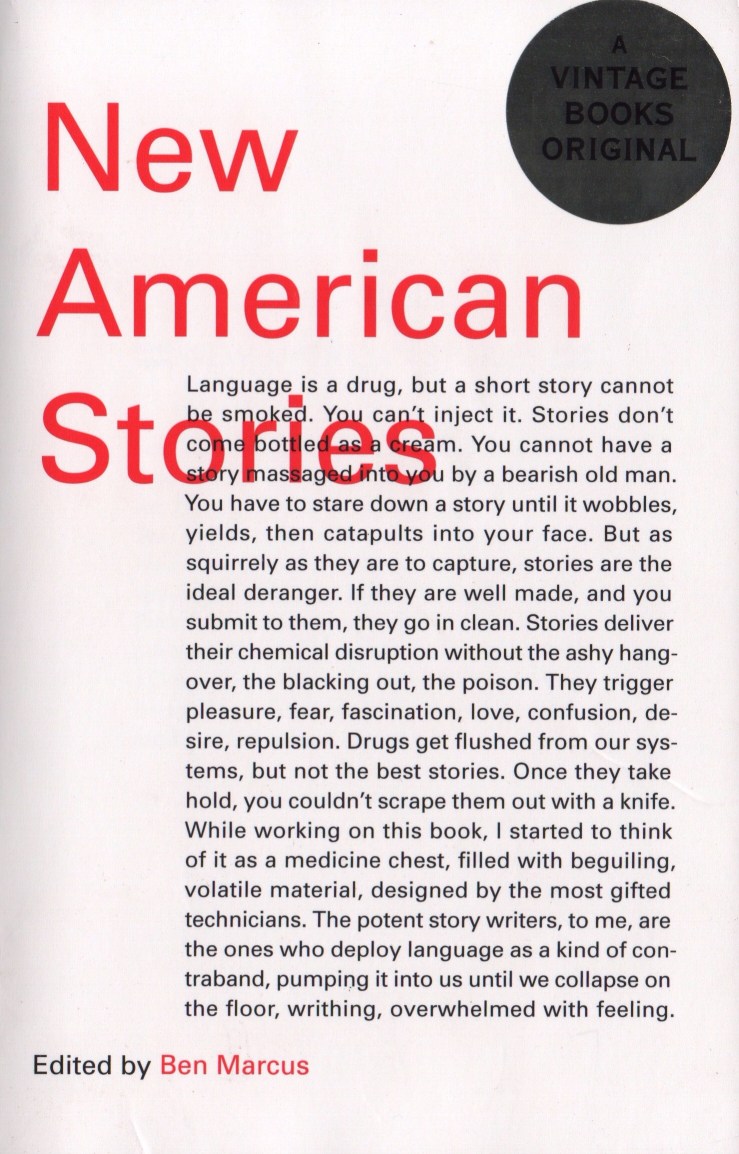
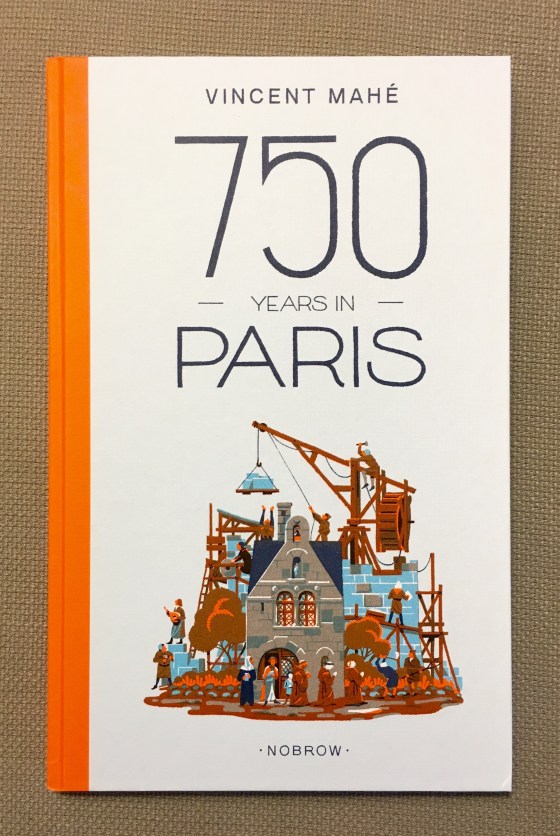
 ET: The cover is great—spine too. I agree with you that it’s “quiet”—although that’s a strange word, y’know, considering there’s so much going on there—so much text. But the book is handsome, and the cover presents as a baseline postmodern conundrum—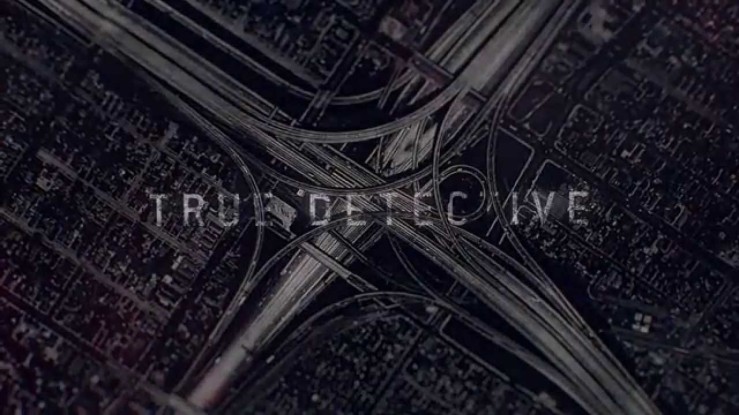
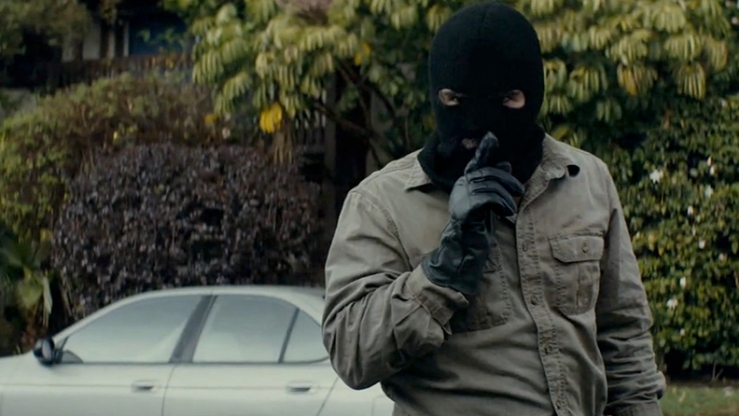 One satirical reading rule for True Detective Season 2 is introduced in the first episode, “The Western Book of the Dead.” In one of
 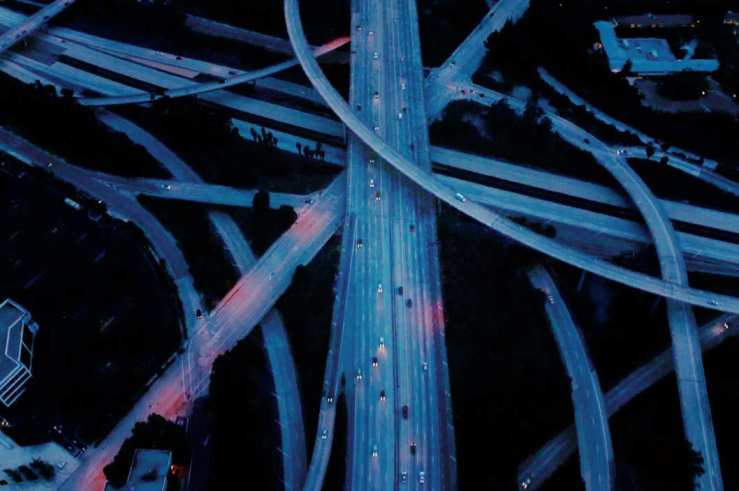 And the plot? What? Another reading rule, indulge me, indulge me, comes in the series’ overuse of aerial shots of L.A. freeways—big converging loops, sometimes black white gray, but often glowing lurid neon at night. The plot is easy to write off as a shaggy dog mess (see also Inherent Vice, Twin Peaks, The Big Lebowski), but it’s not. It does fit together (just like the plots of those examples I proffered parenthetically).


 Biblioklept