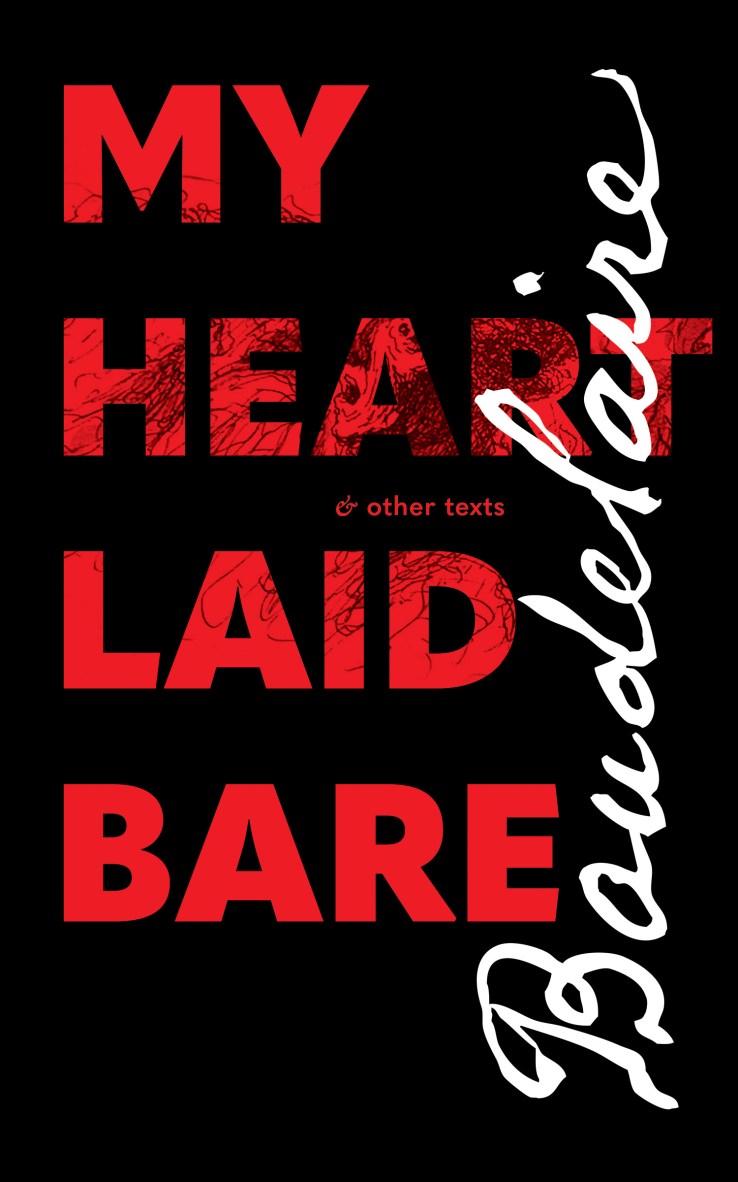
Rainer J. Hanshe is the translator of My Heart Laid Bare & Other Texts, a collection of writings by Charles Baudelaire, new from Contra Mundum Press. Over a series of emails, Hanshe was kind enough to talk to me about My Heart Laid Bare, Baudelaire, dandyism, translation, art, stealing books, and all other manner of topics.
Biblioklept: What is My Heart Laid Bare? Did Baudelaire envision its publication in his lifetime?
Rainer J. Hanshe: The title My Heart Laid Bare is Edgar Allan Poe’s, and it’s he who conceives of a book that, if daring enough, if ‘bare’ enough, could revolutionize human thought, opinion, and sentiment. This could be achieved, Poe said, “by writing and publishing a very little book. Its title should be simple — a few plain words — ‘My Heart Laid Bare.’ But this little book must be true to its title.” Baudelaire took up Poe’s provocation and his Mon cœur mis à nu is one of a number of different books that he dreamt up and hoped to write “without lassitude — in a word to be in good heart day after day.” Others Baudelaire mentioned along with it in an 1864 letter included Histoires grotesques et sérieuses, Les fleurs du Mal, Le spleen de Paris, Les paradis artificiels, Contemporaines, and Pauvre Belgium! The first notes for Mon cœur mis à nu begin in 1859, two years after the initial publication of The flowers of Evil, if not possibly somewhat earlier, and continue until 1865, ceasing only due to Baudelaire’s severe health condition (he would die in 1867 at just 46 years of age), hence they comprise the final decade of his writing life.
Aside from the more direct root of Poe, Rousseau was another of Baudelaire’s models, albeit a negative one to surpass. Baudelaire said that “all the targets of [his] rage” would be collected in Mon cœur mis à nu. “Ah! if ever that sees the light of day, J-J’s Confessions will seem pale.” As I describe in the synopsis, it is an apodictic work of aphorism, maxim, note, and extended reflection. It is not however some memoir-like spewing of Baudelaire’s bios; rather, it is the baring of his l’esprit, and as a crystallization of such, it isn’t some kind of ‘tell-all exposé’ (Rousseau’s notion of absolute transparency, an indulgence we could well do without, especially considering its pernicious ramifications), but to me a much higher form of ‘confession,’ for it is the arc of thought, the play of the mind in its every breadth that is bared. It contains Baudelaire’s exhortations on work, faith, religion, and politics, excoriating sociological analyses, diatribes on literature, the arts (George Sand receives some choice malicious arrows), and love (women, prostitution, sadomasochism, erotics en générale), and outlines of his conception of the dandy and the Poet.
The Poet for Baudelaire is I would say a figure similar in kind to Nietzsche’s untimely personage, the posthumous human, a kind of philosophical anthropologist who hovers over the earth, examining the human species both from within and externally, from a sub species aeternitatis perspective, diagnosing it like a physician (much of the book’s terminology is medical taxonomy).
In 1861, two years after beginning Mon cœur mis à nu, sieged by resignation, calumny, and ill health (nervous disorders, vomiting, insomnia, fainting fits, recurrent syphilitic outbreaks), Baudelaire expresses doubt that he will ever complete his various projects. “My situation as regards my honor, frightful — and that’s the greatest evil. Never any rest. Insults, outrages, affronts you can’t imagine, which corrupt the imagination and paralyze it.” Three years later, it was against the continuing extremities of an exacerbated solitude, frayed nerves, self-described terrors, and constant hounding by creditors that Baudelaire implored himself to remain stalwart (“I must pull myself together, take heart! This may well bring rewards.”) and write.
Clearly, he did envision publishing the book in his lifetime, and he diligently worked at it, steeling himself against his trials to the degree within his power, but it was never completed. The obstructions he faced were abundant; the somatic afflictions inordinately taxing. The threat of his impending decline or decay is sharply articulated in one passage wherein he speaks of “feeling the wind of the wing of imbecility” passing over him. Various translators have rendered that as “the wing of madness,” but Baudelaire says “imbécillité,” not folie or démence. The notion of “the wing of madness” has greater Gothico-Romantic cache, but it’s not what Baudelaire says, and in this case, there’s a relatively exact equivalence of terms. It was more physical weakness and feebleness that he feared, and experienced, and believed would finally incapacitate him, as it did, not madness. His aphasia and heart attacks led to his losing his ability to speak and thereafter, his ability to read and write — the death of the writer.
We have only the existing fragments then, which have been translated in full, but they were published posthumously. Despite no such title existing in the text, or any related material, French editors originally published the work as “Journaux intime” (Intimate Journals), which included two other sections, “Fusées” and “Hygiène.” Translations into English followed suite, and they adopted the false title, which must at last be discarded. If Baudelaire hadn’t been besieged by illnesses as he was, he would have imaginably given us a definitive version of Mon cœur mis à nu considering that he did complete other books he began around the same period (Le spleen de Paris, Les paradis artificiels, et cetera). It remains a fragmentary work then, in both senses, yet one that is substantive enough to merit our continued attention.
Biblioklept: For me, the fragmentary nature of My Heart Laid Bare is in some ways more appealing than the cohesion of a more polished philosophical or poetic text. It’s a discursive read, and there’s joy in tying (or failing to tie) the fragments together. This reading experience is perhaps as close as we can get to seeing Baudelaire thinking (and feeling). At the same time, there’s perhaps a risk of the average reader’s misreading or misinterpreting some of Baudelaire’s riffs, quips, and jabs here. How tempting was it to footnote the hell out of My Heart Laid Bare?
Hanshe: In his poet’s notebook, Paul Valéry said that “a work is never necessarily finished, for he who has made it is never complete, and the power and agility he has drawn from it confer on him just the power to improve it […]. He draws from it what is needed to efface and remake it. This is how a free artist, at least, should regard things.” Similarly, he says elsewhere that, “in the eyes of lovers of anxiety and perfection, a work is never finished but abandoned.” Since Baudelaire never prepared a definitive version of the book, we cannot know what he would have changed, or not, yet as a work closely aligned with his self, it’s something that could never have been completed, only abandoned. Hence, it would always remain fragmentary. Think of Schlegel’s poetics of the fragment where even ‘incompleteness’ is exceptionally refined, an architecturally precise aesthetic form (sculpturally, this calls to mind Giacometti). In his essay on German Romanticism, Walter Benjamin pointed out that aphoristic writing is not proof against systematic intentions (an accurate insight made about Nietzsche’s work in fact, albeit one lost on many of his later readers…), that one can write aphoristically and still think through one’s philosophy or writing “in a comprehensive and unitary manner in keeping with one’s guiding ideas.” In this way, it’s not that Baudelaire’s book lacks cohesiveness; it’s deliberately fragmentary to eschew finality, and because the self, the ‘heart’ being laid bare, is never complete. That Baudelaire worked on it for nearly ten years though makes it probable that its character was quite well defined before illness permanently disrupted his voluntarily abandoning it.
There are certainly unities, or thoughts that overlap and intertwine within the book, as there are with other books of Baudelaire’s, and when I began translating it, I kept track of those I was aware of while also benefitting from the extensive and exemplary notes that the French editors amassed. The critical addendum was therefore unfurling like an infinite papyrus, threatening to end in it being as long, if not longer, than the book itself. In a way, that kind of critical gesture is an act of usurpation and domination, just as overly lengthy introductions can be (consider the grand effrontery of Foucault’s introduction to Binswanger’s Dream & Existence, which is twice the length of the book). At a certain point, I felt that continuing to amass notes would have made the book extremely cumbersome, one unpleasant to read, merely due to sheer volume. There’s also something about a massive critical addendum that’s imposing, if not intrusive, to many readers. Additionally, it was a question of elegance: I didn’t want to litter the book with footnote numbers; alternative methods to that could have easily been devised but, ultimately, I opted against including extensive notes. While as readers we can disavow them altogether, not having them makes for a more comfortable book to wield. Finally, encountering it would be more like coming upon Baudelaire’s own notebook, free of editorial invasiveness, thereby leaving the reader to his or her own rapturous encounter with it, however intractable it may be. As for misreading or misinterpreting, I don’t think such can ever be definitively foreclosed. While errant and contentious readings exist, to fear risking them is to argue that we can fathom authorial intention, or that there are definitive and absolute interpretations. Reading should be dangerous, risky, volatile, something that threatens to undermine, overwhelm, and mutate us, if not put the world into metamorphosis, as books can and have done, though hardly as much in our depleted and toothless epoch. Otherwise, reading is just entertainment, a diversionary narcotic, and we have to be willing to be shattered by books, to undergo both subtle and emphatic shocks.
Biblioklept: What is Flares?
Hanshe: Quite simply, it’s a writer’s notebook; as such, it doesn’t have a single focus but is more motley, something of a hybrid entity. To paraphrase, we could call it The Poet Laid Bare (of poetic form). Nonetheless, I believe it has two principal nerve centers: critique and meditation.
The critique is many-tendrilled, with its points of observation being the craft of the writer, art and aesthetics, love, pleasure, and intoxication (numerous types), religion and theology, politics, etc. The writer’s smelting room and sometimes place of furious venting. As with Mon cœur mis à nu, there is a root in Poe, who in his Marginalia spoke of “a peculiar type of criticism” that “can only be designated by the ‘German ‘Schwarmerei’ — not exactly ‘humbug’ but ‘sky-rocketing’…” Baudelaire took up this idea, naming his work fusées, which is an expansive translation of the English skyrockets. A fusée is a pyrotechnical device (rocket, flare, or firework), musket, or heraldic emblem, hence the title corresponds well with the work’s variegated character. It is something incendiary, combative, and elegant. The manifold subtitles peppered throughout “Flares” offer us a provisional overview of its character, too: Plans, Projects, Suggestions, Notes, Hygiene, Morality, Conduct, Method. Here we see the writer’s notebook, the critique, and the meditation.
In speaking of intellectual gymnastics, the altar of the will, moral dynamics, the great deed, perfect health, the hygiene of the soul, political harmony of character, eurhythmy of character and faculties, self-purification, mastery of time, and accomplishing one’s duties, Baudelaire enumerates a concentration of terms and concepts related to self-cultivation. The book thus contains a kind of technology of the self, the outline of Baudelaire’s martial praxis for the artist — intellectual gymnastics and the sanctification of the will both bespeak an agonistic sensibility, as does his paean to greatness and his call to achieve it in contradistinction to the tremendous oppositional force of nothing less than an entire nation. What is this but Baudelaire’s Miltonic-Satanic typology. “The man of letters rends foundations…” (Flares §6) Such terminology, and the repeated invocations to himself to master his will and to work diligently to become who he is, are part of a regimen of poetic self-shaping. “Want every day to be the greatest of men!!!” (My Heart… §70) The references to Emerson and his Conduct of Life further reinforce that, which is but one reason why in the book’s synopsis I made a parallel to Marcus Aurelius, characterizing the book as Baudelaire’s meditations, which I see as its second nerve center. The poet is clearly concerned with self-government, and this shaping or cultivation of the self is meant to strengthen him, thereby aiding his accomplishing his artistic tasks, of which the book is in part a record.
These notions can be woven together with other parts of the work, i.e. §16 of “Flares,” where Baudelaire speaks of the most perfect type of virile Beauty (the Miltonic Satan), or the Emersonian hero (he who is immovably centered), giving us the supreme artistic model of Satan, that is, Satan as the light-bringer, the visionary, he who is anti-human (“Let us defy the people, common sense, the heart, inspiration, and evidence.” §47; “The man of letters is the enemy of the world.” §53). In §21 of ”Flares” Baudelaire asks, “To give oneself to Satan, what is it?” The book provides us with some answers, as does his poetry (the “Litanies of Satan” et alia), and his Dandy (a superior figure) is another type with similarly sublime aspirations. It is the onset of the anti-Christian hyperanthropos. “The poet, the priest, and the soldier are the only great men among men: … the rest are made for the whip” (§47). Continue reading ““Translation is an act of risk” | An interview with Rainer J. Hanshe on translating Baudelaire’s My Heart Laid Bare”




 Biblioklept