In Chapter 18 of her novel Their Eyes Were Watching God, Zora Neale Hurston imagines a hurricane descending on the Everglades as a cosmic monster. Her description comes in part from accounts of the 1928 Great Lake Okeechobee Hurricane—
Ten feet higher and far as they could see the muttering wall advanced before the braced-up waters like a road crusher on a cosmic scale. The monstropolous beast had left his bed. Two hundred miles an hour wind had loosed his chains. He seized hold of his dikes and ran forward until he met the quarters; uprooted them like grass and rushed on after his supposed-to- be conquerors, rolling the dikes, rolling the houses, rolling the people in the houses along with other timbers. The sea was walking the earth with a heavy heel.
The War has been reconfiguring time and space into its own image 1. The track runs in different networks now. What appears to be destruction is really the shaping of railroad spaces to other purposes, intentions he can only, riding through it for the first time, begin to feel the leading edges of… .2
He checks in to the Hotel Nimbus 3, in an obscure street in the Niederdorf or cabaret section of Zürich. The room’s in an attic, and is reached by ladder. There’s also a ladder outside the window, so he reckons it’ll be O.K. 4 When night comes down he goes out looking for the local Waxwing rep, finds him farther up the Limmatquai, under a bridge, in rooms full of Swiss watches, clocks and altimeters 5. He’s a Russian named Semyavin. Outside boats hoot on the river and the lake. Somebody upstairs is practicing on a piano: stumbling, sweet lieder. Semyavin pours gentian brandy 6 into cups of tea he’s just brewed. “First thing you have to understand is the way everything here is specialized. If it’s watches, you go to one café. If it’s women, you go to another. Furs are subdivided into Sable, Ermine, Mink, and Others. Same with dope: Stimulants, Depressants, Psychomimetics… . What is it you’re after?”
“Uh, information?” Gee, this stuff tastes like Moxie… .
“Oh. Another one.” Giving Slothrop a sour look. “Life was simple before the first war. You wouldn’t remember. Drugs, sex, luxury items. Currency in those days was no more than a sideline, and the term ‘industrial espionage’ was unknown. But I’ve seen it change—oh, how it’s changed. The German inflation, that should’ve been my clue right there, zeros 7 strung end to end from here to Berlin. I would have stern talks with myself. ‘Semyavin, it’s only a temporary lapse away from reality 8. A small aberration, nothing to worry about. Act as you always have—strength of character, good mental health. Courage, Semyavin! Soon all will be back to normal.’ But do you know what?”
“Let me guess.”
A tragic sigh. “Information. What’s wrong with dope and women? 9 Is it any wonder the world’s gone insane, with information come to be the only real medium of exchange?”
“I thought it was cigarettes.”
“You dream.” He brings out a list of Zürich cafés and gathering spots. Under Espionage, Industrial, Slothrop finds three. Ultra, Lichtspiel, and Sträggeli 10. They are on both banks of the Limmat, and widely spaced.
“Footwork,” folding the list in an oversize zoot-suit pocket 11.
“It’ll get easier. Someday it’ll all be done by machine. Information machines. You are the wave of the future.” 12
1 If there is a central thread through these Gravity’s Rainbow annotations—and I’m not claiming that there is one—but if there is a central thread I’ve been trying to tease out, it’s that GR, despite being a complex and confounding conundrum, repeatedly clarifies its thesis. The narrator spells out another summary of the tale, this time in a dozen words.
2 The “he” here is Our Main Man Tyrone Slothrop en route to Zurich. It’s the spring of 1945, and we’re at the end of the second part of Gravity’s Rainbow, “Un Perm ‘au Casino Hermann Goering,” and riding into part three, “In the Zone.” Here, the war—excuse me, The War—is an entropy pushing out into “other purposes.”
3 Weisenburger notes in A Gravity’s Rainbow Companion that “The Nimbus appears to be a fictional hotel.”
You, dear reader, of course know that a “nimbus” is a cloud. I’ve always been partial to Magritte’s clouds.
Black Magic, Rene Magritte, 1945
“Nimbus” is also a term for the halo or aureola that often surrounds sacred or supernatural figures in artistic representation, like the rainbow that shimmers around Albion in Blake’s Albion Rose.
Albion Rose, William Blake, 1793-1796
Later, in his hot air balloon escape from Marvy’s Mothers, Slothrop and his pirate pilot Schnorp will try to hide in a cloud.
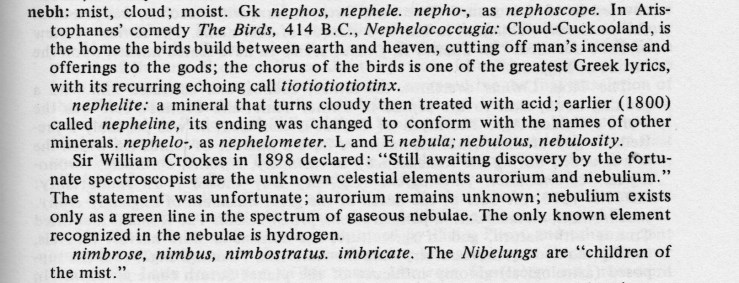
From Joseph T. Shipley’s The Origin of English Words: A Discursive Dictionary of Indo-European Roots (1984). Check his last notation (the Nibelungen are a motif in Gravity’s Rainbow):
4 As GR progresses, Our Free Agent Slothrop gets better and better at spotting means of escape (he’ll note the keys left in an unattended car later in Peenemünde, for example). A ladder up, a ladder down. Rise, ascend, escape. Repeat.
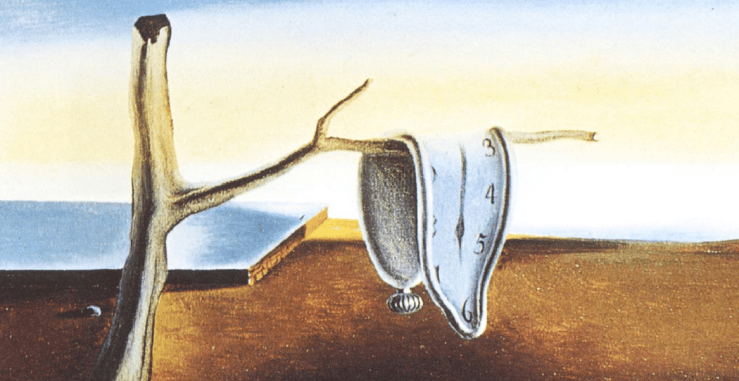
5 All devices for measuring, obviously—ones and zeroes and all that. Slothrop is a disruptive force to traditional means of measurement, natch.
The Persistence of Memory (detail), Salvador Dali, 1931
6 “French and Swiss liqueur distilled from the roots of gentian plants; also called Enzian” (Weisenburger, A Gravity’s Rainbow Companion).
Cf. Oberst Enzian, introduced on page 100—Enzian meets Slothrop a few dozen pages later and pushes Marvy from a train.
7 The inflation, the zeros…Pynchon intricately repeats his motifs, ever-threading them throughout the novel.
8 And who among us has not assured themselves that “it’s only a temporary lapse away from reality”? Semyavin’s complaint seems to be the default position of the 20th century. It’s downright quaint or naive in the 21st.
Reality is not a stable story, a progress, a culmination, but rather a entropic mess, a shuffling chaos, one big etc.
9 Nothing.
10 Weisenburger gives “Ultra, Lichtspiel, and Sträggeli” as nightclubs, and offers that Sträggeli means “‘specter,’ a ‘play of light’ (or Lichtspiel); in the same context, ‘Ultra’ refers to the very high frequency light waves in any spectrum of illumination.” Synonyms.
11 The zoot suit is another motif in GR (another kind of uniform that Slothrop dons—a non-uniform? a uniform of resistance?), and Pynchon’s evocation of the Los Angeles Zoot Suit Riots of 1943 (roughly 10 pages earlier) is a superb little number of storytelling.
Zoot Suit (1940-1942), Los Angeles County Museum of Art
The zoot suit received an unnecessary revival in the 1990s. I was then an impressionable lad in my very-late teens/early twenties, yet still had the sense to find this attire revolting. It’s possible now to see that the zoot suit revival gelled with the zeitgeist’s preference for baggy garb—hip-hop, mall goth, and skate culture clothes in particular.
12 Clearly prescient lines—both in the spring of 1945 and in 1973 when GR was published. Pynchon explores the idea of these information ideas in his 2009 novel Inherent Vice.
I love the metaphorical evocation of Slothrop as “the wave of the future” — a cliche that the narrative literalizes.
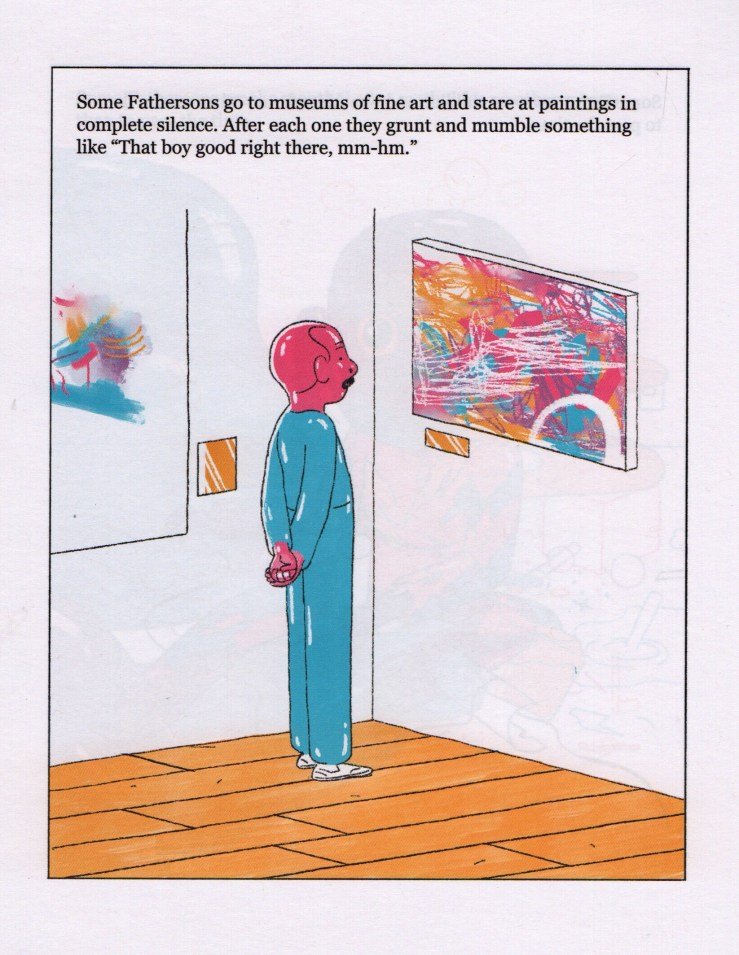
Richie Pope’sFatherson showed up in today’s mail—it’s issue #13 of Youth in Decline’s monograph series Frontier. It’s so, so good—I’ve gone through it a few times now, and its immediate vibrancy and apparently simplicity slips into richer and richer territory each time.
It reminded me at first of a book my wife brought back to me years ago from San Francisco—a kids book called The Daddy Book by Todd Parr (she took our son when he was like, what—six months old?—left me with our daughter, alone, when she was like, what—twoish? Everything was fine and dandy cotton candy). And then, simultaneously, Fatherson reminded me of Donald Barthelme’s novel The Dead Father—particularly the “Manual for Sons” section.
And Fatherson reminded me of other stuff too, but mostly I loved it because of the stuff it didn’t remind me of. Highly recommended.
Just before dawn knocking comes very loud, hard as steel. Slothrop has the sense this time to keep quiet.1
“Come on, open up.”
“MPs 2 , open up.”
American voices, country voices, high-pitched and without mercy. He lies freezing, wondering if the bedsprings will give him away. For possibly the first time he is hearing America as it must sound to a non-American 3. Later he will recall that what surprised him most was the fanaticism, the reliance not just on flat force but on the rightness 4 of what they planned to do… he’d been told long ago to expect this sort of thing from Nazis, and especially from Japs —we 5 were the ones who always played fair—but this pair outside the door now are as demoralizing as a close-up of John Wayne (the angle emphasizing how slanted his eyes are, funny you never noticed before) screaming “BANZAI!” 6.
“Wait a minute Ray, there he goes—”
“Hopper! You asshole, come back here—”
“You’ll never get me in a strait jacket agaaaaain… .” Hopper’s voice goes fading around the corner as the MPs take off in pursuit.
It dawns on Slothrop, literally, through the yellowbrown window shade, that this is his first day Outside. His first free morning. He doesn’t have to go back. Free? What’s free? He falls asleep at last. A little before noon a young woman lets herself in with a passkey and leaves him the papers. He is now an English war correspondent named Ian Scuffling 7.
1 Slothrop has fled the clutches of The White Visitation and made out for Nice, where he hooks up with Blodgett Waxwing’s contacts in a squalid safehouse…the safehouse is actually closer to a madhouse though, or a halfway house.
2 Military Police—a concept that perplexed me when I was five or six, watching MASH reruns with my father. MASH is kinda sorta (slightly) Pynchonian, actually.
3 A fascinating notation.
Some jingoists would insist, of course, that no decent American (i.e., a Real American) ought to hear America the way it must sound to a non-American. Slothrop has already posed as an Englishman, but there’s a bit of a conversion here, I think—a shift for our shifter, who’s moving from not simply performing a double-agency to actually existing (or non-existing) one.
Cf. Walt Whitman’s 1860 poem “I Hear America Singing”:
I hear America singing, the varied carols I hear,
Those of mechanics, each one singing his as it should be blithe and strong,
The carpenter singing his as he measures his plank or beam,
The mason singing his as he makes ready for work, or leaves off work,
The boatman singing what belongs to him in his boat, the deckhand singing on the steamboat deck,
The shoemaker singing as he sits on his bench, the hatter singing as he stands,
The wood-cutter’s song, the ploughboy’s on his way in the morning, or at noon intermission or at sundown,
The delicious singing of the mother, or of the young wife at work, or of the girl sewing or washing,
Each singing what belongs to him or her and to none else,
The day what belongs to the day—at night the party of young fellows, robust, friendly,
Singing with open mouths their strong melodious songs.
To which, Langston Hughes, in 1926 replied in “I Too”:
I, too, sing America.
I am the darker brother.
They send me to eat in the kitchen
When company comes,
But I laugh,
And eat well,
And grow strong.
Tomorrow,
I’ll be at the table
When company comes.
Nobody’ll dare
Say to me,
“Eat in the kitchen,”
Then.
Besides,
They’ll see how beautiful I am
And be ashamed—
I, too, am America.
4 When we most believe we are right we are most susceptible to being wrong. Unconsidered belief is terrifying.
5 Pynchon is too often accused of obscurity; his critique of blind patriotism and government propaganda is so clear that it hardly warrants this footnote. So I’ll comment, rather, on his brilliant modernist style—note the shift here, via free indirect speech, from third-person to first-person, from “he” to “we.”
6 I’m admittedly confused here—does the narrator attribute the expression BANZAI! to the MPs, or to John Wayne? I think what we have here is a conflation of both (which is to say a conflation of the third-person “he” with the first-person “I”—in other words, Slothrop, now attuned (or detuned) to “hearing America as it must sound to a non-American” can recast his country’s jingoistic martial fantasies and see/hear the Hero of the Military-Industrial-Entertainment Complex (John Wayne) as a cartoonish, racialized war trope).
In Japanese, the term banzai translates as ten thousand years, but basically means, as I’m sure you know, something like “Hooray.” During WWII, banzai was an attack cry for Japanese soldiers (review the independent clause after the ellipses in Pynchon’s original sentence).
Is BONZAI! here a strange transposition of GERONIMO!, an exclamation cribbed by U.S. Army parachutists from a 1939 film of the same name?
The ironic notation of John Wayne’s “slanted…eyes”seems like a nod to the notorious 1956 flop The Conqueror, which featured John Wayne as…Genghis Khan.
And speaking of BANZAI—
Have you seen the Pynchonesque 1984 film The Adventures of Buckaroo Banzai Across the 8th Dimension? It is good fun.
(W.D. Richter, director of Buckaroo Banzai, also co-wrote Big Trouble in Little China, in which Kurt Russell did a good/bad John Wayne impression).
7 Slothrop’s always shuffling off identities—or shuffling into them. Here, we get Ian Scuffling, his English journalist identity (for a few dozen pages). Scuffling…shuffling…? Let’s get the etymology.
From Joseph T. Shipley’s The Origin of English Words: A Discursive Dictionary of Indo-European Roots (1984):
Settright Road by Jon Boilard is forthcoming from Dzanc Books. Their blurb:
Settright Road is a collection of 20 short stories and one longer piece of fiction, all set in and around a string of busted Massachusetts mill towns during the cocaine-fueled 1980s.
Its pages are colored by unforgettable characters: a teenage lothario whose plans to escape his one-horse town by hopping a train to California are monkey-wrenched when he impregnates a local girl from a prominent family; fresh-out-of-prison Sean Folan, who nearly kills a man in a bar fight just so he’ll get locked up again; underage Bill Buick, who sells dope to hard-up townies and seduces high school girls, when he’s not driving a wedge between his aunt and her new boyfriend; and Eskimo — trouble in a too-tight dress — a dancer and a poet whose unsavory relationship with a strip club owner comes to a tragic end when she falls in love with a notorious backwoods brawler.
Jon Boilard lets loose these conflicted characters against a backdrop of the abject poverty that sits in stark contrast to the lush New England scenery; then he challenges us to root for these desperados despite the weight of their human errors.
He 1 gets back to the Casino just as big globular raindrops, thick as honey, begin to splat into giant asterisks 2 on the pavement, inviting him to look down at the bottom of the text 3 of the day 4, where footnotes will explain all 5. He isn’t about to look. Nobody ever said a day has to be juggled into any kind of sense at day’s end 6. He just runs. Rain grows in wet crescendo. His footfalls send up fine flowers of water, each hanging a second behind his flight. It is flight. He comes in speckled, pied with rain, begins a frantic search through the great inert Casino, starting again with the same smoky, hooch-fumed bar, proceeding through the little theatre 7, where tonight will play an abbreviated version of L’Inutil Precauzione (that imaginary opera with which Rosina seeks to delude her guardian in The Barber of Seville) 8, into its green room where girls, a silkenness of girls 9, but not the three 10 Slothrop wants most to see, tease hair, arrange garters, glue on eyelashes, smile at Slothrop. No one has seen Ghislaine, Françoise, Yvonne. From another room the orchestra rehearses a lively Rossini tarantella. The reeds are all something like a half tone flat. At once Slothrop understands that he is surrounded by women who have lived a good fraction of their lives at war and under occupation, and for whom people have been dropping out of sight every day… yes, in one or two pairs of eyes he finds an old and European pity, a look he will get to know, well before he loses his innocence and becomes one of them… . 11
So he drifts 12 through the bright and milling gaming rooms, the dining hall and its smaller private satellites, busting up tête-à-têtes, colliding with waiters, finding only strangers wherever he looks. And if you need help, well, I’ll help you… . 13
1 The “he” here is again Our Boy Tyrone Slothrop, and again, these annotations pick up right damn exactly where the last set left off. (Do not worry. I will not be annotating the entire novel paragraph by paragraph. I hope). Slothrop returns to the Casino Hermann Goering after an unsuccessful search for his friend Tantivy Mucker-Maffick.
2 What a wonderful series of transformations here, as the phenomenological world — “rain” — is converted via simile into “honey,” which transforms again into typographical representation — “asterisks.”
3 …and then the phenomenological world—which is to say here, the phenomenological world’s representation in literature—is converted into text. This is, uh, whattayoucall it, that metafiction? Slothrop’s family, recall, made their non-fortune in paper, a fact foregrounded near his introduction. We learn the Slothrops turned the natural world into a medium for text:
…green reaches were converted acres at a clip into paper—toilet paper, banknote stock, newsprint—a medium or ground for shit, money, and the Word. (28)
Shit, money, and the Word—key themes in Gravity’s Rainbow.
4 The phrase “the day” appears like a signature note not just throughout Gravity’s Rainbow but throughout Pynchon proper.
5 “….the bottom of the text of the day, where footnotes will explain all”—well, um. Lovely to look for answers, I suppose.
6 I’ll spell the line out in full again: “Nobody ever said a day has to be juggled into any kind of sense at day’s end.” Lovely on its own, but again, a concise if incredibly oblique gloss on Gravity’s Rainbow’s own end some 556 pages from now.
7 Cf. the fourth line of the novel (page 3): “The Evacuation still proceeds, but it’s all theatre.”
8 Weisenburger’s gloss from A Gravity’s Rainbow Companion:
The opera-within-an-opera is a kind of meta-textual, self-referencing recursion—what André Gide termed a mise en abyme.
Consider, by way of example, Velázquez’s meta-paintingLas Meninas, with its blurring of frame, gaze, reflection, self-reflection, and meta-reflection.
Las Meninas (detail), Diego Velázquez, 1656
You’re undoubtedly familiar with The Murder of Gonzago, the play-within-a-play in Hamlet, which Shakespeare uses to satirize and comment on the “text” proper of his great tragedy.
The Play Scene in Hamlet, Daniel Maclise, 1842
Pynchon posits a play-within-a-play in his earlier novel The Crying of Lot 49 (1969), when he includes a summary performance of The Courier’s Tragedy.
Mise en abyme reaches a sort of apotheosis in Charlie Kaufman’s film Synecdoche, New York (2008):
9A silkenness of girls is the correct and proper term (if overlooked by some, if not most, linguistic authorities). English terms of venery are the best.
Cf. James Lipton’s An Exaltation of Larks (1968).
A Shrivel of Critics, James Lipton, 1968
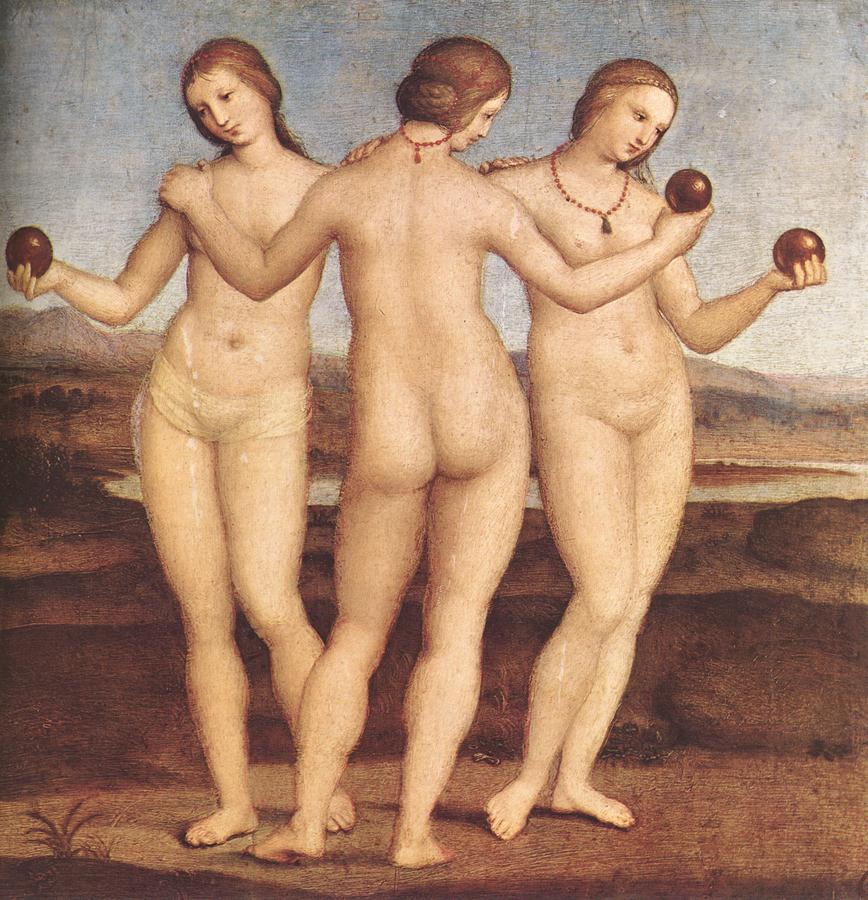
10 The three…Graces? Fates? Furies?
The Three Graces, Raphael, 1504-1505
…or just Ghislaine, Françoise, and Yvonne?
11 Slothrop among the women.
What is the antecedent for the sentence-final pronoun “them”—what does the text promise Slothrop will become once he “loses his innocence”? (And how ironic is this reference to Slothrop the Innocent?)
Possible referents for the “them” included the implied antecedent “European” (later, Slothrop will become the European folk hero Plechazunga the Pig), “pairs of eyes” (not likely), and “women” (also not likely). No, the “them” to which Slothrop shall eventually be elected are those “people [who] have been dropping out of sight every day.” Slothrop the Invisible. Note that Pynchon hides the referent in a tangle.
12 “He drifts”—a key verb for Our Drifter Slothrop.
13 Slothrop alone. The final italicized line are Tantivy’s last words.
Outside, he 1 heads down toward the quay, among funseekers, swooping white birds, an incessant splat of seagull shit 2. As I walk along the Bwa-deboolong 3 with an independent air… Saluting everybody in uniform 4, getting it to a reflex 5, don’t ask for extra trouble, try for invisible 6.… bringing his arm each time a bit more stupidly to his side. Clouds now are coming up fast, out of the sea. No sign of Tantivy out here, either.
Ghosts 7 of fishermen, glassworkers, fur traders, renegade preachers, hilltop patriarchs and valley politicians go avalanching back 8 from Slothrop here, back to 1630 when Governor Winthrop came over to America on the Arbella, flagship of a great Puritan flotilla that year 9 , on which the first American Slothrop had been a mess cook or something 10 —there go that Arbella and its whole fleet, sailing backward in formation, the wind sucking them east again, the creatures leaning from the margins of the unknown sucking in their cheeks, growing crosseyed with the effort, in to black deep hollows at the mercy of teeth no longer the milky molars of cherubs, as the old ships zoom out of Boston Harbor, back across an Atlantic whose currents and swells go flowing and heaving in reverse 11 … a redemption of every mess cook who ever slipped and fell 12 when the deck made an unexpected move, the night’s stew collecting itself up out of the planks and off the indignant shoes of the more elect 13 , slithering in a fountain back into the pewter kettle as the servant himself staggers upright again and the vomit he slipped on goes gushing back into the mouth that spilled it… 14 Presto change-o! 15 Tyrone Slothrop’s English again! 16 But it doesn’t seem to be redemption exactly that this They have in mind… . 17
He’s on a broad cobbled esplanade, lined with palms shifting now to coarse-grained black as clouds begin to come over the sun. Tantivy isn’t out on the beach, either—nor are any of the girls. Slothrop sits on a low wall, feet swinging, watching the front, slate, muddy purple, advancing from the sea in sheets, in drifts. Around him the air is cooling. He shivers. What are They doing? 18
1 The “he” here is Our Dude Tyrone Slothrop, and if anyone’s keeping count, these annotations pick up right damn exactly where the last set left off. Slothrop exits his (tampered with) room at the Casino Hermann Goering to find his friend Tantivy Mucker-Maffick.
2Gravity’s Rainbow is full of shit.
3 Weisenburger offers the following gloss in A Gravity’s Rainbow Companion:
Weisenburger’s second “u” in “Boulougne” seems to be an error. (Or make what you will of a double-you).
Van Gogh depicted promenaders on the Bois de Boulongne in 1886, about six decades before the events in GR and about nine decades before Pynchon composed GR.
The Bois De Boulogne with People Walking, Vincent van Gogh, 1886
4 In Gravity’s Rainbow a uniform is a polyform. Our Boy Slothrop repeatedly changes uniforms; in this vignette, he’s donned an English soldier’s uniform—but just a few pages later he was wearing a purple toga; before that, a tacky Hawaiian shirt, and before that…well…you get the deal.
Pynchon might be suggesting that identity is contingent on circumstance, on external forces, on They—on the uniforms we have to slip on to cover over our shame. And yet many of his characters dress up to participate in shame! Gravity’s Rainbow is a carnival of shifting identities.
5 There’s that Pavlovian theme—will Slothrop break the reflex?
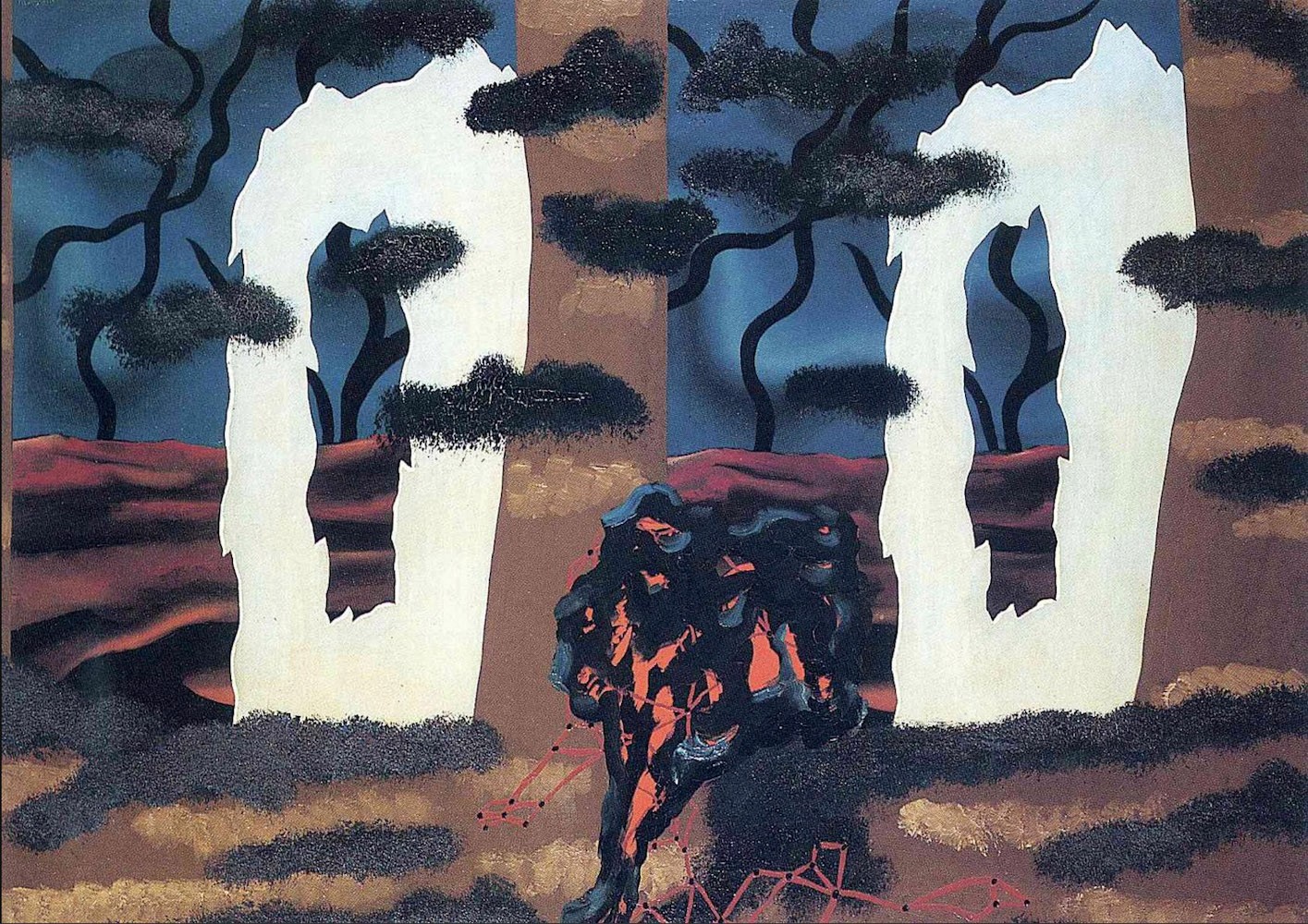
6Invisible is clearly (heh heh heh) a key word for Pynchon—it permeates Gravity’s Rainbow, as well as his other texts—particularly his other big books Against the Day and Mason & Dixon. I’m tempted to riff at length on Invisible in Pynchon, but perhaps it’s better to rack up annotations and try to align them to some, uh, purpose.
For now, it’s worth noting that Slothrop’s salute and uniform are his means of camouflage, his cloak of invisibility.
A Taste of the Invisible, Rene Magritte, 1927
7 Ghosts…invisible (?!) ghosts…what an incredible paragraph this is, one I shouldn’t molest with my grubby annotations…but… .
8 Hold on…we’re gonna do a bit of time travel here. “…avalanching back” — this is a bit of the old assy-turvy, cart-before-horse dealieness—latter-first hysteron proteron business (as Weisenburger and others note).
9 The Arbella and a trio of other ships embarked unto America in the spring of 1630 under the command of Purtitan Man John Wintrhop, He Of “City Upon A Hill” fame, a phrase that in no way (LOL) cursed New World America. Hell, it may even be that Winthrop and his gang had civilization’s best interest in heart when they made the Massachusetts Bay Colony. I’m sure religious freedom ETC. motivated them, and not, like, all that goddamn “free” land.
A postcard depicting The Arbella, printed sometime between 1930 – 1945
The poet Anne Bradstreet was on board. Something of a pre-post-modernist, riffing on writing and paranoia in “The Author to Her Book” :
Thou ill-formed offspring of my feeble brain,
Who after birth didst by my side remain,
Till snatched from thence by friends, less wise than true,
Who thee abroad, exposed to public view,
Made thee in rags, halting to th’ press to trudge,
Where errors were not lessened (all may judge).
At thy return my blushing was not small,
My rambling brat (in print) should mother call,
I cast thee by as one unfit for light,
The visage was so irksome in my sight;
Yet being mine own, at length affection would
Thy blemishes amend, if so I could.
I washed thy face, but more defects I saw,
And rubbing off a spot still made a flaw.
I stretched thy joints to make thee even feet,
Yet still thou run’st more hobbling than is meet;
In better dress to trim thee was my mind,
But nought save homespun cloth i’ th’ house I find.
In this array ‘mongst vulgars may’st thou roam.
In critic’s hands beware thou dost not come,
And take thy way where yet thou art not known;
If for thy father asked, say thou hadst none;
And for thy mother, she alas is poor,
Which caused her thus to send thee out of door.
Or maybe actually naw—not pre- or post- anything there. Just writing. And the paranoia writing entails.
10 Weisenburger and other sources point out that Pynchon’s ancestor William Pynchon was part of Winthrop’s fleet. This historical stitching suggests that Pynchon posits Slothrop as something (?) of an authorial…placeholder (?)—in any case, Pynchon and Slothrop both share Puritan ancestors. Wm Pynchon helped “settle” two places in Massachusetts—Roxbury and Springfield.
Roxbury is a the setting of one of GR’s strangest scenes, in which Slothrop descends into the abject hell of a nightclub toilet. (Around page 62 for those counting).
Pynchon kinda sorta showed up in another Springfield.
11 Hysteron proteron continued.
12 A redemption, a fall—even Pynchon’s note that Slothrop’s ancestor is a mess cook points to the novel’s abject contours.
13 Although consistently accused of willful obscurity, Gravity’s Rainbow telegraphs its central themes repeatedly. Here, we see a bobbing seasick distinction between the pure-elect and the abject-preterite.
14 And again…and gross. A sort of abject magic potion is getting worked up here, cross-Atlantic style (in-reverse)—the stew returns to the cauldron, the vomit returns to the guts. Hysteron proteron.
15 The magic words…
16 But…he was already wearing an English uniform.
17 Of course not—this They have other plans for Slothrop’s preterite soul—there is no return, no way home, no way back—no reversals.
Why here? 1 Why should the rainbow edges 2 of what is almost on him be rippling most intense here in this amply coded room? say why should walking in here be almost the same as entering the Forbidden 3 itself—here are the same long rooms, rooms of old paralysis and evil distillery, of condensations and residues you are afraid to smell from forgotten corruptions, rooms full of upright gray-feathered statues with wings spread, indistinct faces in dust 4 —rooms full of dust that will cloud the shapes of inhabitants around the corners or deeper inside, that will settle on their black formal lapels, that will soften to sugar the white faces, white shirt fronts, gems and gowns, white hands that move too quickly to be seen 5 … what game do They deal 6 ? What passes are these, so blurred, so old and perfect? “Fuck you,” whispers Slothrop 7. It’s the only spell 8 he knows, and a pretty good all-purpose one at that. His whisper is baffled by the thousands of tiny rococo surfaces. Maybe he’ll sneak in tonight—no not at night—but sometime, with a bucket and brush, paint FUCK YOU 9 in a balloon 10 coming out the mouth of one of those little pink shepherdesses there 11… .
He steps back out, backward out the door, as if half, his ventral half, were being struck in kingly radiance: retreating from yet facing the Presence feared and wanted. 12
1 Why…not?
Okay—this seems like a fair question. Let’s not be glib.
The question is Our Hero Tyrone Slothrop’s, via Pynchon’s oft-present free indirect style.
The where is the hotel room of Our Man in the French Riviera. Slothrop is on “furlough” (not really, they—They—have his ass hard at work) at the Hermann Goering Casino.
Poor Tyrone returns to his hotel room after a picaresque run (and wardrobe shift: tacky/sexy Hawaiian shirt to purple toga to English army uniform) to find that “everything in this room is really being used for something. Different. Meaning things to Them it has never meant to us. Two orders of being…”
Two orders of being: I could riff all day (night?) on this, but I suppose we can boil it down to GR’s binary theme. (Or, for fun, because it’s Our Boy Slothrop—Visible/Invisible (“paranoia” is the gradation between that binary).
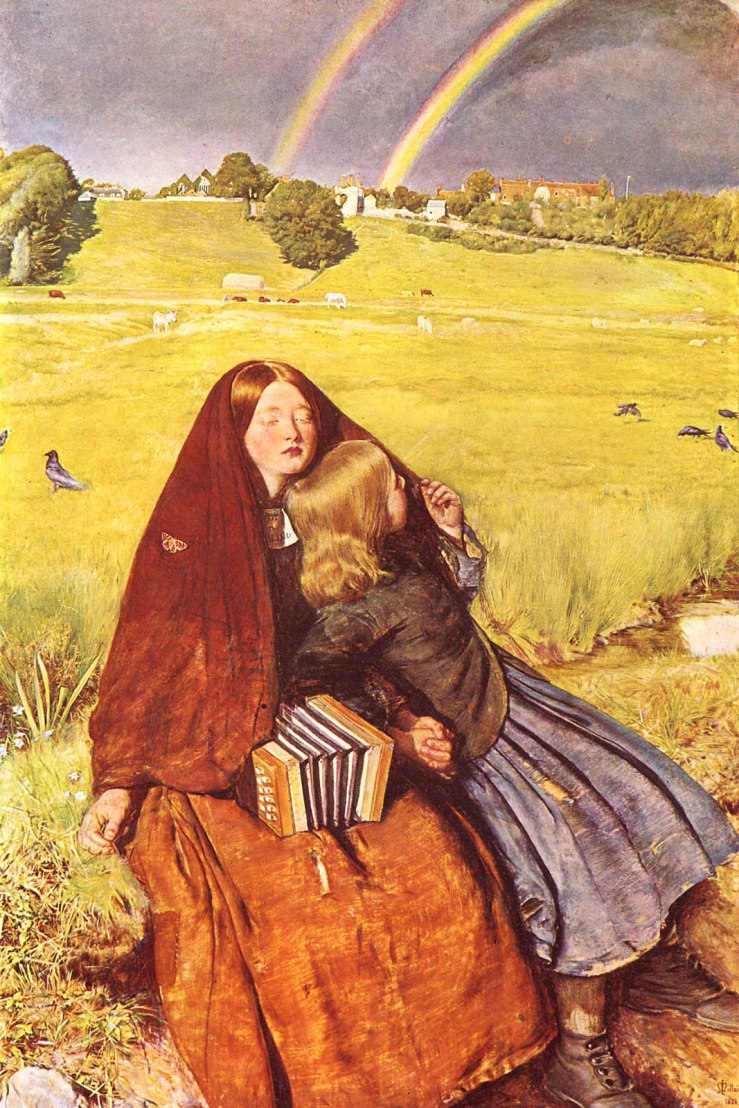
2 The fourth appearance of the word “rainbow” in GR (barring the title, colophon, etc.). Another gradation, the rainbow, between binaries. An arc, a rise, a fall.
11 And I will establish my covenant with you, neither shall all flesh be cut off any more by the waters of a flood; neither shall there any more be a flood to destroy the earth.
12 And God said, This is the token of the covenant which I make between me and you and every living creature that is with you, for perpetual generations:
13 I do set my bow in the cloud, and it shall be for a token of a covenant between me and the earth.
14 And it shall come to pass, when I bring a cloud over the earth, that the bow shall be seen in the cloud:
15 And I will remember my covenant, which is between me and you and every living creature of all flesh; and the waters shall no more become a flood to destroy all flesh.
16 And the bow shall be in the cloud; and I will look upon it, that I may remember the everlasting covenant between God and every living creature of all flesh that is upon the earth.
Cf. A Gravity’s Rainbow Companion: Sources and Contexts for Pynchon’s Novel, Steven Weisenburger:
3 …the Taboo? The Abject? Another description of Gravity’s Rainbow…? Or do we just feel the meaning here? (Yes).
4 The imagery here—desiccation and paralysis, a taxidermist’s row in an old dusty museum—evokes the death|life binary.
5 The Elect (vs Preterite Slothrop). Our Dude TS has his own issues vis a vis whiteness (revisit his adventures down the toilet back during a night in Roxbury).
6 Recall we are in the Casino Hermann Goering. Recall GR’s themes of chance and fate, probability and statistics, zeroes and ones. Recall They.
7 This seems to me like another thesis statement of Pynchon’s in Gravity’s Rainbow.
Actually, fuck that hedging: A fuck you to the They is Gravity’s Rainbow’s mission statement.
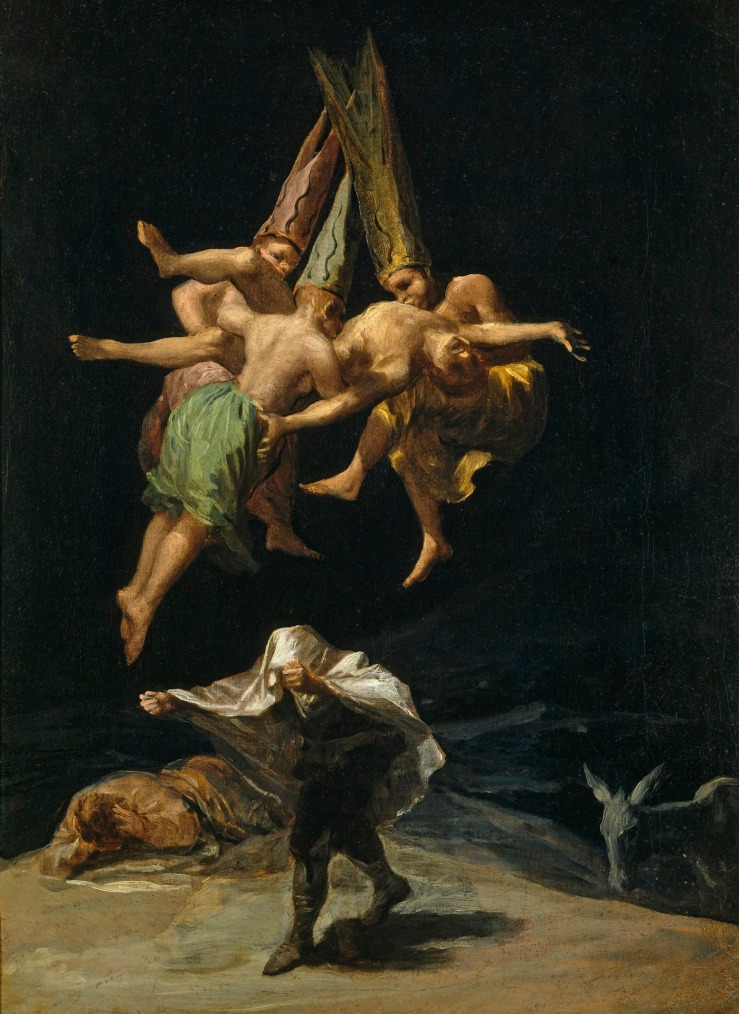
8Gravity’s Rainbow is full of witches, and maybe Slothrop is a lazy novice.
Witches’ Flight, Francisco Goya, 1797-98.
9 Cf. Ch. 25 of J.D. Salinger’s 1951 novel The Catcher in the Rye:
It’s hopeless, anyway. If you had a million years to do it in, you couldn’t rub out even half the “Fuck you” signs in the world. It’s impossible.
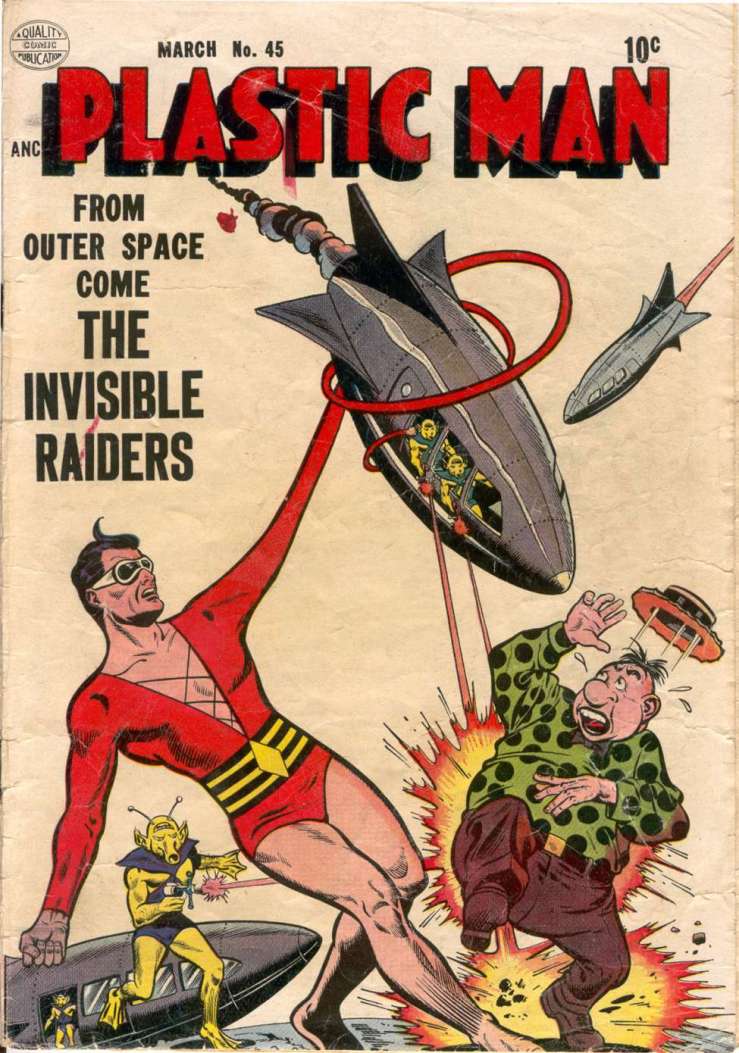
11 A fascinating image, I think. Leave the rococo knickknack of the pink shepherdess alone a moment (perhaps it suggests erotic enticement to you, pervert preterite?) and attend to just how and where Slothrop intends to append this “FUCK YOU” sign—in a comic book speech bubble. The intertextual (do I mean metatextual—it’s hard to keep up) possibilities here bubble and boil. It’s as if Slothrop would rewrite his room (“Two orders of being”) as a comic book.
A page or two later, we find Our Guy Slothrop reading an issue of Plastic Man.
Plastic Man #45 by Jack Cole, 1954.
12 Note here the halving of Slothrop, the text that cuts him—ventral. He’s in and out, facing a Presence but already half Absent. Is Our Savior Tyrone the one radiating the “kingly radiance” — or is he being radiated by it?—Or am I making too much of light?
In high school I was, like many American intellectual kids, a stranger in a strange land. I made the Berkeley Public Library my refuge, and lived half my life in books. Not only American books—English and French novels and poetry, Russian novels in translation. Transported unexpectedly to college in another strange land, the East Coast, I majored in French lit and went on reading European lit on my own. I felt more at home in some ways in Paris in 1640 or Moscow in 1812 than in Cambridge, Massachusetts, in 1948.
Much as I loved my studies, their purpose was to make me able to earn a living as a teacher, so I could go on writing. And I worked hard at writing short stories. But here my European orientation was a problem. I wasn’t drawn to the topics and aims of contemporary American realism. I didn’t admire Ernest Hemingway, James Jones, Norman Mailer, or Edna Ferber. I did admire John Steinbeck, but knew I couldn’t write that way. In The New Yorker, I loved Thurber, but skipped over John O’Hara to read the Englishwoman Sylvia Townsend Warner. Most of the people I really wished I could write like were foreign, or dead, or both. Most of what I read drew me to write about Europe; but I knew it was foolhardy to write fiction set in Europe if I’d never been there.
—(Quietly) 1 It’s been a prevalent notion 2. Fallen sparks 3. Fragments of vessels broken at the Creation 4. And someday, somehow, before the end, a gathering back to home. A messenger from the Kingdom, arriving at the last moment 5. But I tell you there is no such message, no such home 6—only the millions of last moments… no more. Our history is an aggregate of last moments 7.
From pages 82-83 of Thomas Pynchon’s 1973 novel Gravity’s Rainbow.
1 A stage direction. These are the final lines in a one-act play, a small (cosmically-large) tragicomedy featuring two…nerve cells. Rollo Groast of the White Visitation prefaces a page earlier:
It is part…of an old and clandestine drama for which the human body serves only as a set of very allusive, often cryptic, programme notes—it’s as if the body we can measure is a scrap of this programme found outside in the street, near a magnificent stone theater we cannot enter.
In this little play (its rough setting echoes GR’s own martial satire), a younger cell asks a senior cell if she’s ever been to the “Outer Level” and is somewhat shocked when she tells him that “sooner or later everyone out here has to go Epidermal. No exceptions.”
Is this the first episode of Gravity’s Rainbow staged as a play? I think so.
2 The “prevalent notion” the younger cell subscribes to is characterized in the four sentences that follow, and then rejected in the fifth, the sentence that pivots with “But.” A satire of religious hope, perhaps?—the notion of salvation, redemption, an organizing principle to arrive and tidy all the chaos?
3 The preterite. But also/and—
4 The notations on broken vessels and sparks seem to allude to the Kabbalah of Isaac Luria (1534-1572). I will not attempt a bad paraphrase of Lurianic Kabbalah here, but a basic big picture—sparks—souls, fragments of a one-soul—looking to be rectified. Pynchon, inking heavy his preterite-and-elect theme.
5 The deus ex machina in the last act, the game-winning Hail Mary pass, the Messiah, smiling and terrible…
6 Bummer.
Cf. the opening of Gravity’s Rainbow. From the sixth paragraph:
“You didn’t really believe you’d be saved. Come, we all know who we are by now. No one was ever going to take the trouble to save you, old fellow. . . .”
These are the first lines of dialog in the novel. (If they can be called dialog).
7 The “our” here is biological—one cell to another business—but is there more to human history? Are we more than just our cells? Are there sparks for these vessels?
The narrator here seems to superimpose an answer into the senior cell’s line here: History is simply an imposition, a psychological trick, a way to organize chaos via narrative.
Will Postwar be nothing but ‘events,’ newly created one moment to the next? No links? Is it the end of history?
This miniature cellular drama comes after the introduction to a minor character in Gravity’s Rainbow I’ve always found intriguing: Gavin Trefoil.
Trefoil, an agent (?!) of The White Visitation, has powers:
Lately, as if all tuned in to the same aethereal Xth Programme, new varieties of freak have been showing up at “The White Visitation,” all hours of the day and night, silent, staring, expecting to be taken care of, carrying machines of black metal and glass gingerbread, off on waxy trances, hyperkinetically waiting only the right trigger-question to start blithering 200 words a minute about their special, terrible endowments. An assault. What are we to make of Gavin Trefoil, for whose gift there’s not even a name yet? (Rollo Groast wants to call it autochromatism.) Gavin, the youngest here, only 17, can somehow metabolize at will one of his amino acids, tyrosine. This will produce melanin, which is the brown-black pigment responsible for human skin color. Gavin can also inhibit this metabolizing by—it appears—varying the level of his blood phenylalanine. So he can change his color from most ghastly albino up through a smooth spectrum to very deep, purplish, black. If he concentrates he can keep this up, at any level, for weeks. Usually he is distracted, or forgets, and gradually drifts back to his rest state, a pale freckled redhead’s complexion.
I suppose I could riff all day on the symbolic/historic implications of Trefoil’s powers: His gradations of color disrupt the binary (black-white, off-on, zero-one) that a Pavlovian like Pointsman insists upon (Trefoil’s super(?!)power falls in line with Roger Mexico’s gradations between 0 and 1).
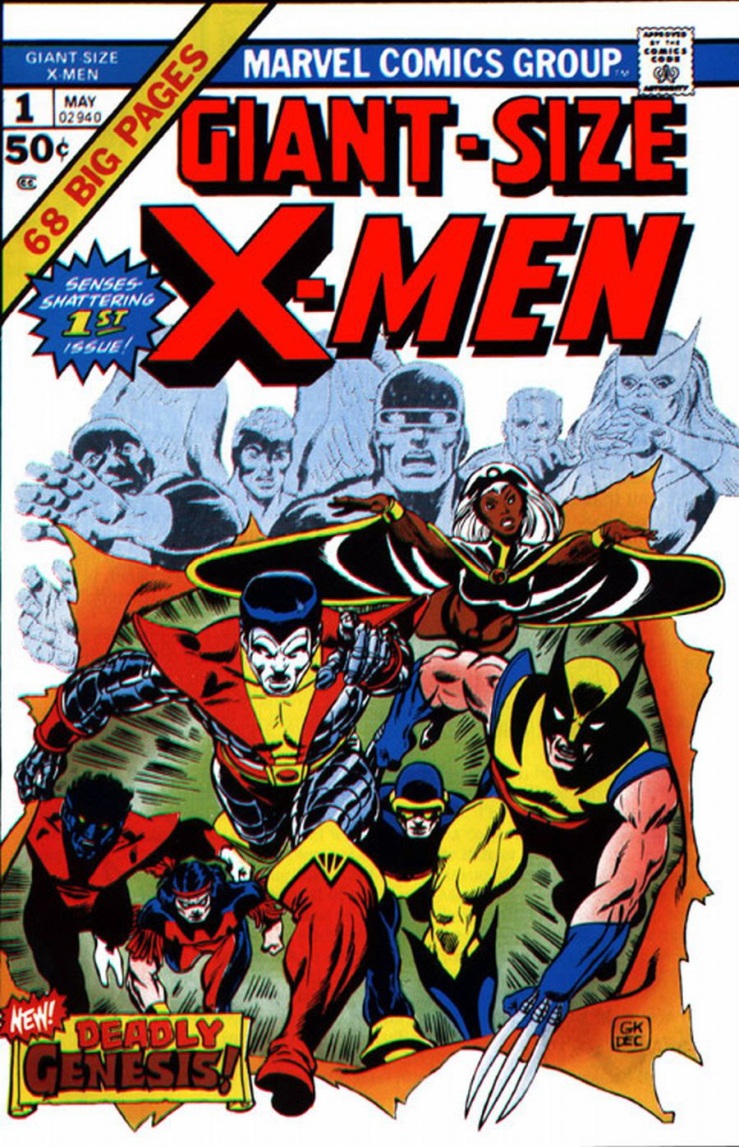
Giant-Size X-Men #1, 1975. Art by Gil Kane and Dave Cockrum, story by Len Wein.
But what really interests me here is Trefoil’s mutant powers and The White Visitation as a sort of potential comic book—I mean what I want to say here is that Pynchon points ahead to the 1975 “reboot” of Uncanny X-Men, and even The New Mutants: Post-global preterite underground weirdos with strange powers. Psychics and witches and protagonists that splinter into nothingness, after going through multiple reboots—(Plechazunga, the Pig-Hero, Rocketman, etc.). (Hell, the Pynchon X-Men team could even have Grigori the Octopus).
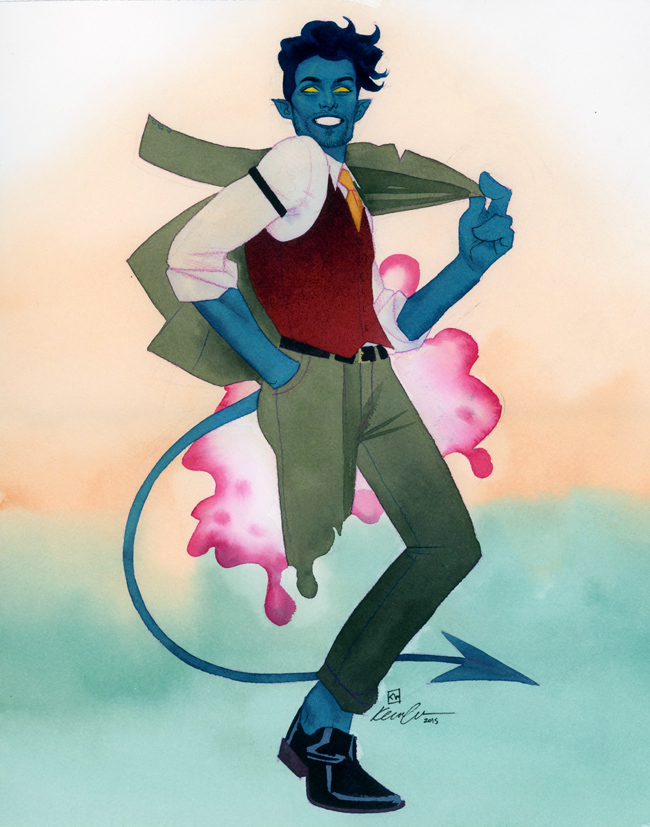
The closest X-Men comparison for Gavin Trefoil is probably the shapeshifter baddie X-Men antagonist Mystique, whose powers are obviously more pronounced than Trefoil’s. And there’s also Nightcrawler—maybe my favorite of Chris Claremont’s run on X-Men—or maybe I mean Excalibur. And also blueskinned Beast.
Nightcrawler, Kevin Wada, 2015
Late in the novel, Our Hero Tyrone Slothrop will help form the superish heroish team the Floundering Four (along with Myrtle Miraculous, zoot-suited Maximillian, and mechanical man Marcel). The Floundering Four will set out to battle the Paternal Peril. (Make of that what you will).
On Trefoil the Blueskin, here’s Steven Weisenburger (A Gravity’s Rainbow Companion):
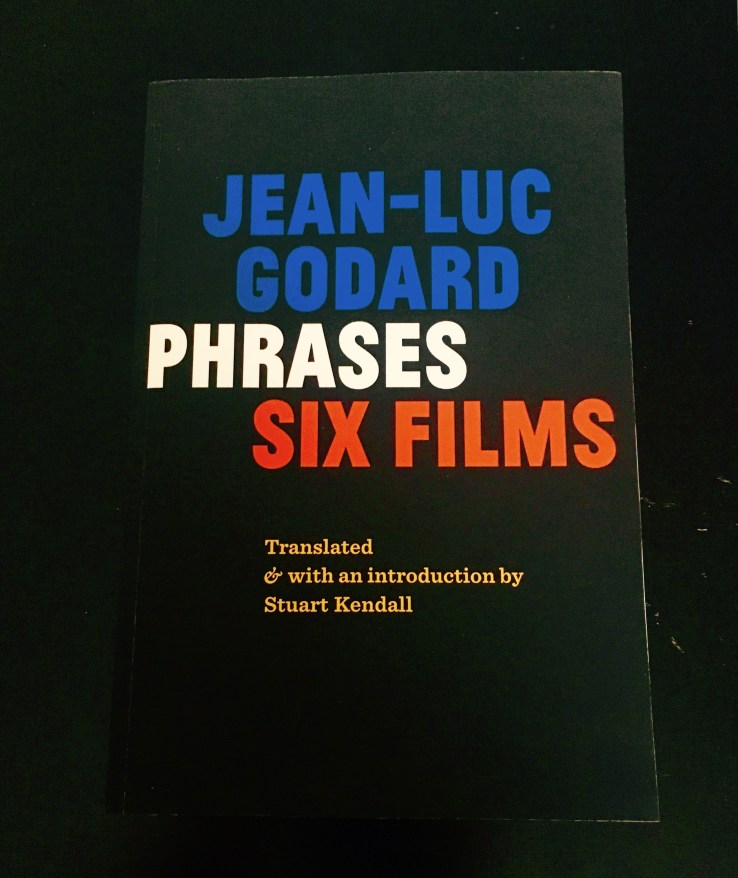
Jean-Luc Godard’s Phrases: Six Films is new in English translation by Stuart Kendall from Contra Mundum Press. Their blurb:
Phrases presents the spoken language from six films by Jean-Luc Godard: Germany Nine Zero, The Kids Play Russian, JLG / JLG, 2 x 50 Years of French Cinema, For Ever Mozart and In Praise of Love. Completed between 1991 and 2001, during what has been called Godard’s “years of memory,” these films and videos were made alongside and in the shadow of his major work from that time, his monumental Histoire(s) du cinema, complementing and extending its themes. LikeHistoire(s), they offer meditations on, among other things, the tides of history, the fate of nations, the work of memory, the power of cinema, and, ultimately, the nature of love.
Gathered here, in written form, they are words without images: not exactly screenplays, not exactly poetry, something else entirely. Godard himself described them enigmatically: “Not books. Rather recollections of films, without the photos or the uninteresting details… Only the spoken phrases. They offer a little prolongation. One even discovers things that aren’t in the films in them, which is rather powerful for a recollection. These books aren’t literature or cinema. Traces of a film…”
In our era of ubiquitous streaming video, ebooks, and social media, these traces of cinema raise compelling questions for the future of media, cinematic, literary, and otherwise.
Overhead, on the molded plaster ceiling, Methodist versions of Christ’s kingdom swarm: lions cuddle with lambs, fruit spills lushly and without pause into the arms and about the feet of gentlemen and ladies, swains and milkmaids. No one’s expression is quite right. The wee creatures leer, the fiercer beasts have a drugged or sedated look, and none of the humans have any eye-contact at all 1. The ceilings of “The White Visitation” aren’t the only erratic thing about the place, either. It is a classic “folly,” 2 all right. The buttery was designed as an Arabian harem in miniature, for reasons we can only guess at today, full of silks, fretwork and peepholes. One of the libraries served, for a time, as a wallow, the floor dropped three feet and replaced with mud up to the thresholds for giant Gloucestershire Old Spots to frolic, oink, and cool their summers in 3, to stare at the shelves of buckram books and wonder if they’d be good eating 4. Whig eccentricity 5 is carried in this house to most unhealthy extremes. The rooms are triangular, spherical, walled up into mazes 6. Portraits, studies in genetic curiosity, gape and smirk at you from every vantage. The W.C.s contain frescoes of Clive and his elephants stomping the French at Plassy 7, fountains that depict Salome with the head of John (water gushing out ears, nose, and mouth)8, floor mosaics in which are tessellated together different versions of Homo Monstrosus, an interesting preoccupation of the time—cyclops, humanoid giraffe, centaur repeated in all directions 9. Everywhere are archways, grottoes, plaster floral arrangements, walls hung in threadbare velvet or brocade. Balconies give out at unlikely places, overhung with gargoyles whose fangs have fetched not a few newcomers nasty cuts on the head. Even in the worst rains, the monsters only just manage to drool—the rainpipes feeding them are centuries out of repair, running crazed over slates and beneath eaves, past cracked pilasters, dangling Cupids, terra-cotta facing on every floor, along with belvederes, rusticated joints, pseudo-Italian columns, looming minarets, leaning crooked chimneys—from a distance no two observers, no matter how close they stand, see quite the same building 10 in that orgy of self-expression 11, added to by each succeeding owner, until the present War’s requisitioning. Topiary trees line the drive for a distance before giving way to larch and elm: ducks, bottles, snails, angels, and steeplechase riders they dwindle down the metaled road into their fallow silence, into the shadows under the tunnel of sighing trees. The sentry, a dark figure in white webbing, stands port-arms in your 12 masked headlamps, and you 13 must halt for him. The dogs, engineered and lethal, are watching you from the woods. Presently, as evening comes on, a few bitter flakes of snow begin to fall 14.
From pages 82-83 of Thomas Pynchon’s 1973 novel Gravity’s Rainbow.
1 This strikes me as a description of Gravity’s Rainbow.
2 An architectural folly, but another description of Gravity’s Rainbow. (Perhaps ironic. Certainly ironic. Meta-ironic).
3 Late in the novel Our Hero Tyrone Slothrop will take up the mantle of “Plechazunga, the Pig-Hero” — one of many Circean (Odyssean?) transformations.
Gustav-Adolf Mossa
4 Bibliophagy, baby. Another meta-description of the novel itself.
5 A reference to the Neo-Palladian baroque style that swept Britain in the 18th century?
6 Another description of Gravity’s Rainbow, a self-describing novel…you see where I’m going with this.
7 Clive of India is a very very minor character in Pynchon’s novel Mason & Dixon.
8 See the Solario painting above; you know this old saw of course. The femme fatale, etc. The lines of leakage from ears nose and mouth point to Gravity’s Rainbow’s themes of abjection and dissolution—of unbecoming from the inside out.
9 Another description of Gravity’s Rainbow (disputed). Monster men populated the undiscovered country. Do you know Gaspar Schott?
10 “…no two observers, no matter how close they stand, see quite the same building” — strike building and replace with novel, and we have, perhaps, another meta-description of Gravity’s Rainbow.
11 You know by this point I’m going to say that “orgy of self-expression” is another meta-description of the novel itself, right?
There is, of course, a real orgy (by which I mean non-metaphorical, orgy-orgy) later in Gravity’s Rainbow, on the Anubis.
12 …your? Wha? Whence this narrative shift?
13You!? And hold on who’s this fellow, this dark figure in white webbing (a sorta kinda oxymoron, maybe)—a sentry sure, a watcher, maybe—a statue? The martial imagery prefigures, perhaps, black and white, Enzian and Tchitcherine, the White Visitation (prefigures? This whole passage is set there!) and the Counterforce…(you’re stretching, dude).
14 Our paragraph begins with “Overhead” and ends with “begin to fall”—the descent of the rocket, the arc of the rainbow, the decline of the human condition. (And curves in other directions too).
I can’t remember where or how I read about Marian Engel’s 1976 novel Bear, but I was intrigued. In lieu of the blurb, here’s Sara Bynoe at Hazlitt on Bear:
The first thing you need to know about Marian Engel’s 1976 novel Bear is that it is about a woman who has sex with a giant bear. Not a metaphorical, figurative, concept-within-a-creature bear: a real, furry, wild brown bear. There’s more to it than that, but why bury the lead?
The second thing you need to know, however, is that this is not some fringe underground chapbook: it won the Governor General’s award—the highest Canadian honour for the literary arts—in a year in which the jury included Mordecai Richler, Margaret Laurence, and Alice Munro.
We’re talking about Bear right now, though, because someone recently posted its cover and some particularly raunchy sections of the book to Imgur under the title, “WHATTHEACTUALFUCK, CANADA?” There was even a little boost in e-book sales after the book’s cover—an illustration of a lithe, topless woman with flowing brunette locks being embraced from behind by a bear standing on its hind legs—went viral. It looks like a Harlequin romance novel: ursine Fabio and his eager human companion, lost together, alone in a world that will never understand the depths of their potentially life-threatening interspecies love.
Elena Ferrante’s Neapolitan Novel Quartet, which I guess actually counts as four novels, but whatever
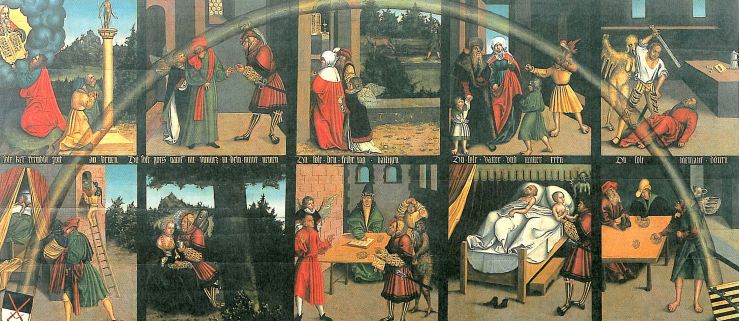
Ten Commandments, Lucas Cranach the Elder
Ten books I want to read soonish:
There Is a Tree More Ancient Than Eden, Leon Forrest, a novel I’m actually reading now so I’m not sure if it counts
Bear, Marian Engel
The Tunnel, William Gass
The Last Days of Louisiana Red, Ishmael Reed
99 Stories of God, Joy Williams
Antigonick, Anne Carson
Vineland, Thomas Pynchon
The Lime Twig, John Hawkes
The Magic Kingdom, Stanley Elkin
The Passenger, Cormac McCarthy—drop the album, Cormac!
Ten Bacchanal Scenes, Jean Philippe Guy Le Gentil
Ten reviews of books (perhaps underrated or under-remarked upon, at least–the books, I mean, not the reviews) by authors whose last names begin with B:
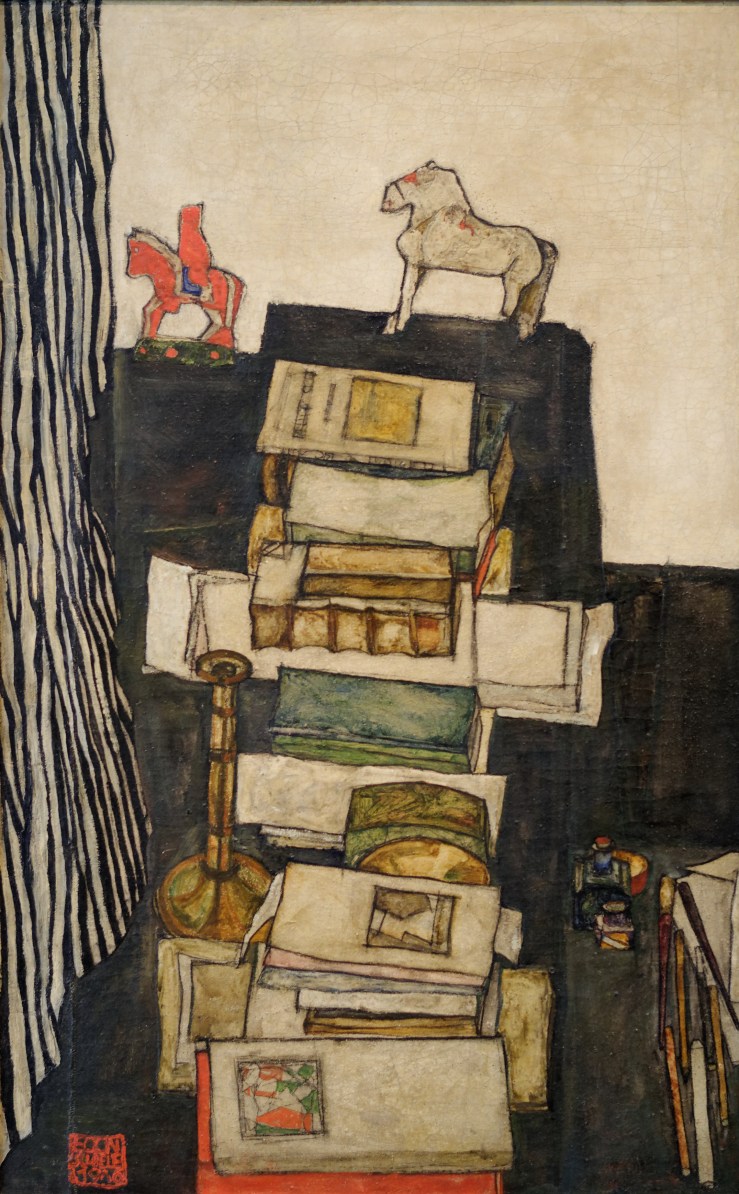
Sketch with Ten Saints (etc.), Albrecht DurerTen Panels of a Scholars Books, unidentified early 20th c. Korean artist
Ten books I aim to re-read sooner rather than later:
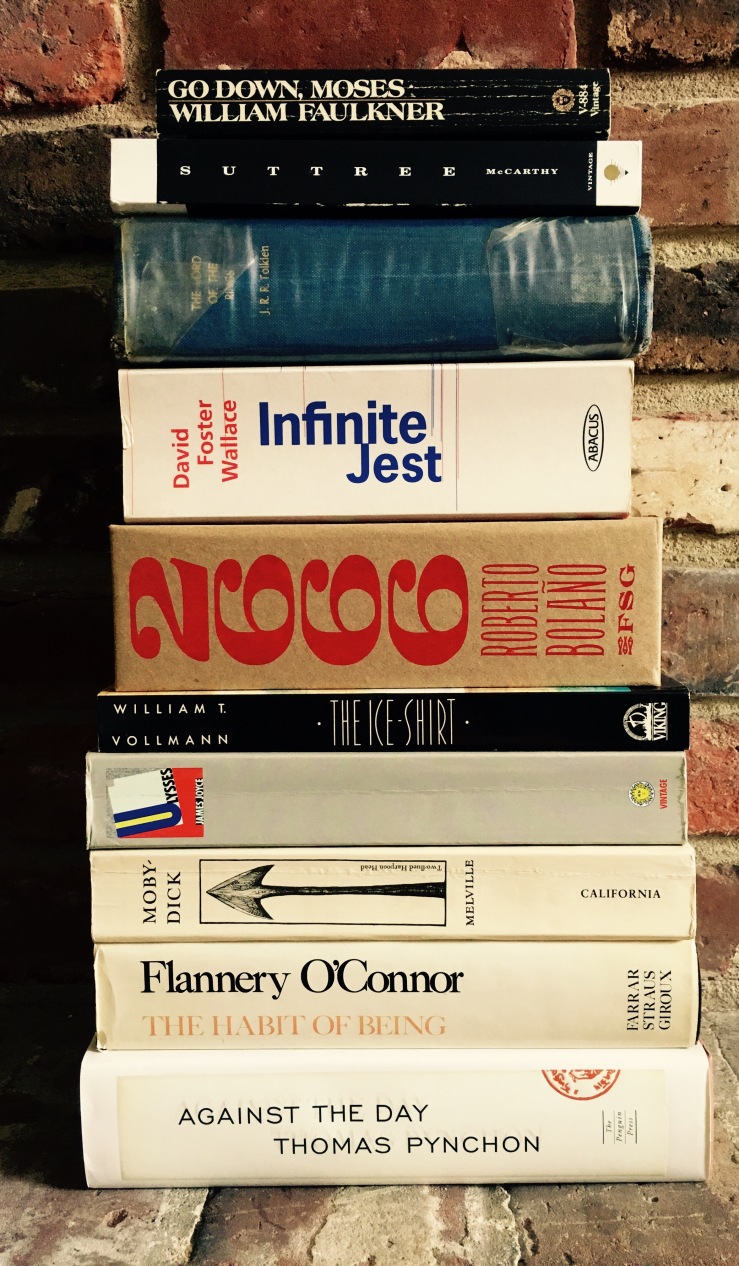
Gravity’s Rainbow, Thomas Pynchon
The Pale King, David Foster Wallace
2666, Roberto Bolaño
Moby-Dick, Herman Melville
The Confidence-Man, Herman Melville
The House of Seven Gables, Nathaniel Hawthorne
Autobiography of Red, Anne Carson
Blood Meridian, Cormac McCarthy (2015 is the first time I didn’t reread it)
Native Son, Richard Wright
The Earthsea Cycle, Ursula K. Le Guin (hopefully with my daughter, who’s just a bit younger than this blog, and with whom I’ve been reading the Harry Potter books way.too.long.).
Ten Cavaliers Forming a Circle, Stefano della Bella
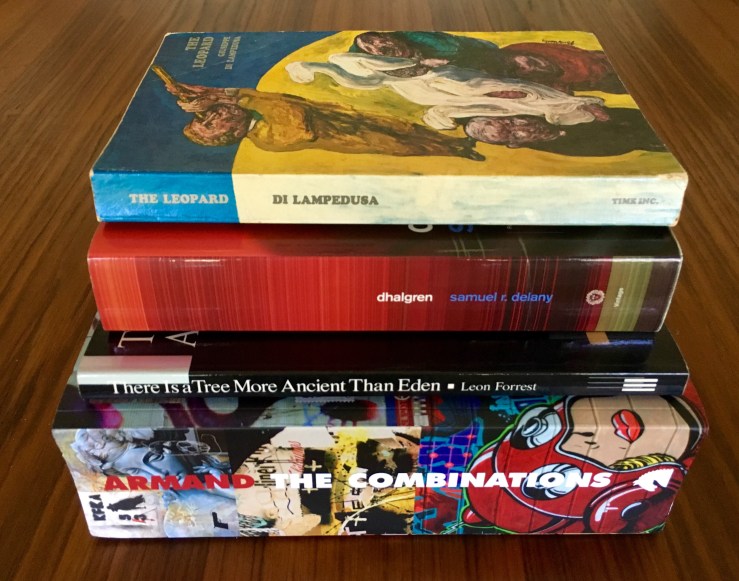
After a few years of false starts, I finally read Giuseppe Tomasi di Lampedusa’s 1958 novel The Leopard this August. Then I read it again, immediately (It’s one of only two novels I can recall rereading right away—the other two were Blood Meridian and Gravity’s Rainbow). The Leopard tells the story of Prince Fabrizio of Sicily, who witnesses the end of his era during the Risorgimento, the Italian reunification. Fabrizio is an enchanting character—by turns fiery and lascivious, intellectual and stoic—The Leopard takes us through his mind and through his times. He’s thoroughly complex, unknown even to himself, perhaps. The novel is impossibly rich, sad, electric, a meditation on death, sex, sensuality—pleasure and loss. More mood than plot, The Leopard glides on vibe, its action framed in rich set pieces—fancy balls and sumptuous dinners and games of pleasure in summer estates. But of course there is a plot—several strong plots, indeed (marriage plots and death plots, religious plots and political plots). Yet the narrative’s viewpoint characters keep the plots at bay, or mediate them, rather than propel them forward. Simply one of the better novels I’ve read in years, its final devastating images inked into my memory for as long as I have memory. (English translation by Archibald Colquhoun, by the way).
Dhalgren, Samuel Delany
I think The Leopard initially landed on my radar a few years ago after someone somewhere (where?) described it as a cult novel. Samuel Delany’s Dhalgren (1975) really is a cult novel. I’m about 200 pages into its 800 pages, and I’m ready to abandon the thing. Delany often evokes a fascinating vibe here, conjuring the post-apocalyptic city of Bellona, which is isolated from the rest of America after some unnamed (and perhaps unknown) disaster—there are “scorpions,” gangs who hide in holographic projections of dragons and insects; there is a daily newspaper that comes out dated with a different year each day; there are two moons (maybe). And yet Delany spends more time dwelling on the mundane—I’ve just endured page after page of the novel’s central protagonist, Kid, clearing furniture out of an apartment. I’m not kidding—a sizable chunk of the novel’s third chapter deals with moving furniture. (Perhaps Delany’s nodding obliquely to Poe here?). Dhalgren strives toward metafiction, with the Kid’s attempts to become a poet, but his poetry is so bad, and Delany’s prose is, well, often very, very bad too. Like embarrassingly bad in that early seventies hippy dippy way. If ever a novel were screaming to have every third or second sentence cut, it’s Dhalgren. I’m not sure how much longer I can hold out.
There Is a Tree More Ancient Than Eden, Leon Forrest
I had never heard of Forrest until a Twitter pal corrected that. I started Tree (1973) this weekend; its first chapter “The Lives” is a rush of time, memory, color, texture…religion and violence, history, blood…I’m not sure what’s happening and I don’t care (like Faulkner, it is—I mean, each sentence makes me want to go to the next sentence, into the big weird tangle of it all). Maybe let Ralph Ellison describe it. From his foreword:
As I began to get my bearings in the reeling world of There Is a Tree More Ancient Than Eden, I thought, What a tortured, history-wracked, anguished, Hound-of-Heaven-pursued, Ham-and-Oedipus-cursed, Blake-visioned, apocalypse-prone projection of the human predicament! Yet, simultaneously, I was thinking, Yes, but how furiously eloquent is this man Forrest’s prose, how zestful his jazz-like invention, his parody, his reference to the classics and commonplaces of literature, folklore, tall-tale and slum-street jive! How admirable the manner in which the great themes of life and literature are revealed in the black-white Americanness of his characters as dramatized in the cathedral-high and cloaca-low limits of his imaginative ranging.
Typing this out, I realize that I’m bound to put away Dhalgren and continue on into Forrest.
The Combinations, Louis Armand
I read the “Overture” to Armand’s enormous so-called “anti-novel” The Combinations (2016)…the rush of prose reminded me of any number of post-postmodern prose rushers—this isn’t a negative criticism, but I’ll admit a certain wariness with the book’s formal postmodernism—it looks (looks) like Vollmann—discursive, lots of different fonts and forms. I’ll leap in later.