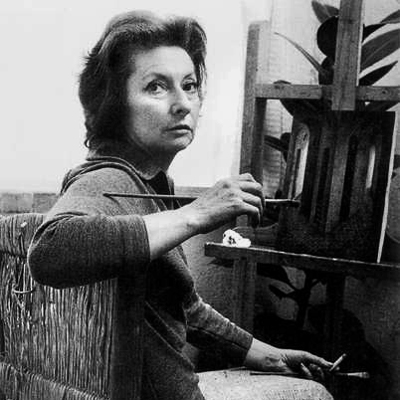
I’ve concluded that whiteness is an American invention. In Europe people have their cathedrals, ancient towns and cities, paintings, opera houses, that have been there for centuries. They have their roots. They’re secure. In the United States we have people who call themselves ‘white.’ They don’t say they’re Irish, or French, or German, or Swedish . . . just white.
The white middle class, however, is in more trouble now than the blacks were thirty years ago. With all the big migrations, this country is not going to be all-white, all English-speaking, in a few years. Of course these migrations, changes, are enriching their culture. But they don’t see it that way. The white middle class has a settler mentality: very paranoid, insecure, embattled. They become more and more isolated. What this class forms at this point in time is a group of people who call themselves white and who feel that their experience is the only permanent, historically viable experience, that everyone else’s—Afro-American, Latin, whatever—is just a short term fad. This point of view affects American education, politics, culture, the psyche.
The white settler culture can’t relate to other cultures. There’s more resistance to cultural change in the United States than in almost any country. But just as there’s transformation, now, from the old technology to a high technology, there’s a transition going on from a settler to an international culture, and this only increases the white settler’s sense of being embattled, and increases anxiety and paranoia.
From persons who are spokespersons for this settler culture, you aren’t going to get an accurate reading of reality. It’s too paranoid. It’s appropriate they have a white settler cowboy for a leader. But I feel sorry for Reagan. I think what’s happened to him is probably the worst tragedy since what happened to the salesman in Arthur Miller’s play. It’s pathetic that he’s been used as he has. He’s just another expendable front man.
The white male can’t rule the roost anymore. He’s in a terrible position. The kind of power he had is disappearing, and looked at over the longer historical view, he didn’t even have power that long. It’s become difficult to be a white man. I didn’t think I’d ever hear myself say that…
A white man…is some kind of homogenized, standardized profile that occurred in the United States. It began in a Yankee puritanical ideal that these old patriarchs, codgers, elders, who formed our leadership class, men like the Mathers and Jonathan Edwards who built the Ivy League schools our leaders—like George Bush, for instance—went to, a man who’s just ignorant, who talks about voodoo economics. Being a white man is an ideal that comes out of that matrix. I guess you would call it ‘patrix.’ All white men—and white women—are supposed to mold themselves in that ideal. They’re supposed to give up their ethnic roots—Polish, Irish, French—and become some kind of bland homogenized… supermen. Some kind of Rocky, the white male wish fulfillment. There’s a lot of narcissism, too, in the white man’s ideal. But this white macho swaggering stuff, the Yankee ideal and old Puritan myth of self help, discipline, self-sufficiency—all that transcendental moralizing you get with Emerson—it doesn’t work in this world. It worked at a time when a man could go out and hunt and fish and raise cattle. But now, more and more white males can’t make it, can’t do it, can’t be successful at it. And then they start striking out.
From “A Conversation with Ishmael Reed” with Judith Moore. First published in Express: The East Bay’s Free Weekly, 18 Feb. 1983; reprinted in Conversations with Ishmael Reed, 1995, UP Mississippi.
“Because they’re a bunch of bloodsucking bastards, quite frankly,” is the kinda thing he tends to say. He’ll clarify that the comic book medium is “perfect,” it is “sublime,” whereas the comics industry is “a dysfunctional hellhole” that “hasn’t had any new ideas in 20 or 30 years,” that it’s run by “sub-human” thieves who employ the same “gangster ethics” by which DC “bought” the rights for Superman off its teen creators, Jerry Siegel and Joe Schuster, for $130.
“I pretty much detest the comics industry” is the gist, most recently for what they’ve done to popular culture and democracy with the Marvel Cinematic Universe and . . . whatever it is that DC’s up to. Moore’s been saying for years that he sees a harbinger of fascism in how young adults flock to see these “franchised übermenschen” zipping across the screen, and yes, he’s also mindful of the fact that he’s basically the cause of all this.
There were a lot of quotes I could’ve pulled from Alexander Sorondo’s new profile of Alan Moore at The Metropolitan Review — getting expelled for selling acid, falling in love with David Foster Wallace, accidentally conjuring the Persian math demon Asmodeus, etc. — but this is the one I chose. Check it out.
Portrait of Alan Moore, 2011, by Frank Quitely (b. 1968)
Photograph of William Vollmann in his studio by Ian Bates
Late last week, The Wall Street Journal published “The Last Untamed Writer in America,” a profile of William T. Vollmann. The piece begins with its author Alexander Nazaryan politely refusing breakfast scotch from Vollmann, who is hosting Nazaryan at his studio (a converted Mexican restaurant):
It was breakfast time at the Sacramento, Calif., home of the novelist William T. Vollmann, which meant time for scotch. Out came two gold-colored shot glasses, modeled after 50-caliber rounds, a gift from a relative to the gun-loving writer. Despite gentle pressure, I stuck to my coffee, so Vollmann poured himself only a perfunctory nip of the Balvenie DoubleWood 12. “This will get me buzzed up,” Vollmann said. Then he added, ruefully, “I can hardly drink at all anymore.”
The piece has some interesting quips from Vollmann, but it doesn’t really expand on Alexander Sorondo’s long essay “The Last Contract: William T. Vollmann’s Battle to Publish an American Epic,” from this spring–notes on Vollmann’s cancer, getting dropped by his publisher Viking, and finding a home for his epic ATable for Fortune with Skyhorse, an iffy group that has published books by RF Kennedy Jr. and Alex Jones. A lot of the notes will be familiar with those tuned into the myth of the Vollmann (guns, drugs, sex, volume, etc.), but it’s kinda sorta interesting to see how the conservative Wall Street Journal frames Vollmann. They play up Vollmann’s enthusiasm for guns and note that he is not an author to be “cowed by sensitivity readers”; they even get a quote from him decrying “people who want trigger warnings.” And yet even when Vollmann professes a tinge of patriotism, he deflates it immediately:
“I love America because it’s my homeland, and I love Americans,” Vollmann says. “What I dislike is the whole hypocritical American exceptionalism. We do all these dirty, crummy things.”
Five years ago, I was fortunate enough to interview Margaret Carson about her translation of a collection of the artist Remedios Varo’s written work. Margaret has since expanded on that collection, adding new material from her dive into Varo’s archives, resulting in On Homo rodans and Other Writings, new this summer from Wakefield Press.On Homo rodans and Other Writings offers readers a fascinating trip through Varo’s imagination. Brimming with impossible images, surreal jokes, and dreamy fragments, the work is more than just an addendum to Varo’s career as an artist. I highly recommend it to those interested in surrealist writing in general. Margaret was kind (and patient!) enough to talk with me again over the course of a few weeks via email. I am grateful for her generosity and for her work in bringing Varo’s words to monoglots such as myself.
In addition to her Varo books, Margaret Carson’s translations include Sergio Chejfec’s Baroni, A Journeyand My Two Worlds. She is Associate Professor in the Modern Languages Department at Borough of Manhattan Community College, The City University of New York.
Photograph of Margaret Carson by Beowulf Sheehan.
Biblioklept: Margaret, congratulations on the publication of On Homo rodans and Other Writings, the expanded edition of your English translation of Remedios Varo’s writings! Many of our readers might be familiar with Varo’s wonderful paintings but not know about her writing. How would you characterize the prose collected in On Homo rodans and Other Writings?
Margaret Carson: Thanks, it’s great to have the translation back in print! It’s mainly writings found after Remedios Varo’s death in notebooks and on loose pages. The writings are quite varied: several odd and delightful stories (three of them new to this edition), a fairy tale, letters to friends and strangers, her famous recipe “To Provoke Erotic Dreams,” a poem that invokes the moon, dream narratives, and a few other gems, such as the title piece, “On Homo rodans,” a faux anthropological treatise that accompanied her sculpture of a human-like torso on a giant wheel, made out of chicken, turkey and fish bones.
Homo rodans sculpture in its glass case. Photograph by Margaret Carson.
Varo’s extraordinary creativity and weird sense of humor come across just as much in her writings as in her paintings. I think readers fascinated by Varo, the artist, will also be won over by her gifts as a writer. Simply put, she’s as clever a writer as she is a painter.
Biblioklept: So, let’s get into the stories and other material new to this edition and how you came to translate it into English. Some of this material hasn’t been published before, even in Spanish. If my understanding is correct, Walter Gruen, Varo’s last life partner, donated a significant collection of her works to the Museo de Arte Moderno in Mexico City in 2000. In 2018—after the publication of your translated collection Letters, Dreams & Other Writings—the Varo estate bequeathed more of Varo’s writings to the Museo de Arte Moderno. Is that right?
MC: Yes. In the early 2000s Walter Gruen and his wife Anna Alexandra Varsoviano (a friend of Varo’s who he married after the artist’s death) donated about thirty-eight of her works to the Museo de Arte Moderno (MAM), making it the largest repository of paintings by Varo in the world. Walter Gruen died in 2008, and Anna Alexandra Varsoviano in 2015. (I was lucky enough to meet them both in person: Walter Gruen in 2000 and Anna Alexandra Varsoviano some years later.) In her will, Anna Alexandra bequeathed a trove of Varo’s notebooks, letters, preparatory drawings, photos, and other items to MAM, many of which were displayed in 2018 in an exhibition celebrating the donation: Adictos A Remedios Varo: Nuevo Legado 2018. It was at that exhibition that I first saw Varo’s notebooks, open to pages containing narratives, letters and other pieces, in Varo’s own handwriting. I could instantly recognize them because I’d translated the same texts for Letters, Dreams and Other Writings, except for that book I used a collection of Varo’s writings published in Mexico in the 1990s, Cartas, sueños y otros textos, edited by the Spanish scholar Isabel Castells.
Because the new Wakefield edition mostly uses archival materials as its source, and isn’t a direct translation of texts from an existing book, the estate requested that we give it a new title. So, thinking about Varo’s tour-de-force anthropological spoof, we renamed it On Homo rodans and Other Writings.
A page from the Homo rodans manuscript. Photograph by Margaret Carson.
Biblioklept: What kind of access did the museum give you to the manuscript materials?
MC: When I requested an appointment to consult the archive at MAM, I indicated my area of interest: Varo’s notebooks and any stray papers relating to her writings. So when I visited for a few days in July 2022, an archivist assisted me by bringing out her notebooks one at a time as well as folders containing loose papers. You can’t imagine how excited I was not only to see but to touch these old, faded composition books and to turn their pages to discover what Varo had written or drawn on them. There are about a dozen notebooks in all, mostly school composition books for children. I was snapping photos right and left! I’m very grateful to the Museo and to their archivists for guiding me through the notebooks and for their interest in the project.
Cover of one of Varo’s notebooks. Photograph by Margaret Carson.
Biblioklept: Varo was born in Spain, and her painting career sparked in earnest in France, but she really flourished as a painter in Mexico. Her work seems to find a growing audience in the USA; do you have a sense of her reputation in Mexico?
MC: Remedios Varo came into her own as an artist in Mexico City; when she began to exhibit, she was an immediate success. Her first solo show, in 1956 at the Galería Diana, was a sell-out, as was a subsequent solo show in 1961. Sadly, Varo suddenly died in 1963. Her posthumous reputation is in large part due to Walter Gruen and his efforts to keep her in the public eye. The first catalog of her work, whose publication was overseen by Gruen and funded by Varo’s friend and patron Eva Sulzer, came out just three years after her death, in 1966, with contributions by some heavy hitters: the poet Octavio Paz, the French intellectual Roger Caillois, and the Mexican philosopher Juliana González, a personal friend of Varo’s. Since then, four editions of Varo’s catalogue raisonné have been published in Mexico, the last in 2008. (Alas, all are now out of print but available in many research libraries.) People are deeply fascinated by Varo’s paintings. Special exhibitions of her work at the Museo de Arte Moderno always draw record crowds (as they do in other cities as well, for example, the recent Remedios Varo: Science Fictions exhibition in Chicago, which was one of their best attended shows ever).
Biblioklept: Gruen seems to have led a fascinating life.
MC: Yes, but not without its tragedies. The little I know comes from Janet Kaplan’s biography of Varo, his obituary in the Mexican daily La Jornada, and from the Adictos a Remedios Varo catalog. Like Varo, he was fortunate to get out of war-torn Europe, but only after he experienced the worst. He was born in Austria, started medical school in the 1930s, got kicked out because he was Jewish, was arrested by the Gestapo and sent to Dachau and then Buchenwald. After liberation, he made his way to Mexico City with his wife Klari Willner and it was there that he met Varo and others in the European refugee community. His wife died in Mexico in a drowning accident in the late 1940s, while Varo was living in Venezuela. It was some time after Varo’s return to Mexico that she and Gruen got together. Gruen had established his record store by then, the Sala Margolín, which for decades was the essential go-to place for classical music fans in Mexico City.
A year after Varo’s death, in 1964, Gruen organized an exhibition of her work at the Palacio de Bellas Artes, and it’s at that show that Thomas Pynchon, on a trip to Mexico City, saw Embroidering the Earth’s Mantle /Bordando el manto terrestre, which was immortalized in the novel The Crying of Lot 49. Together with Anna Alexandra Varsoviano, Gruen worked to secure Varo’s legacy as an artist and to safeguard what she left behind. From the perspective of Varo’s writings, it was crucial that her notebooks and papers remain as a single cache of documents and not dispersed. After Varsoviano’s death, the entire archive including this collection of writings passed to the Museo de Arte Moderno.
Embroidering the Earth’s Mantle, 1961, Remedios Varo
Biblioklept: This new edition of Varo’s writings includes three stories that were previously unpublished, even in Spanish. Do you know why they weren’t published before now?
MC: No, I don’t know why. The stories are unquestionably in Varo’s handwriting, and they’re marvelous. It would be a good question to ask Walter Gruen or Anna Alexandra.
Biblioklept: Speaking of her handwriting—did you revise any of the material you’d already translated after seeing it in her manuscript?
MC: To some extent, yes. As I mentioned before, for Letters, Dreams …. (2018), I used as my source text a collection that had already been published in Mexico. As I was translating, I’d occasionally come across bracketed ellipses [. . .], and I wasn’t sure what was being signaled. Had a word or sentence in the original been cut, or was it illegible at that point? I found no editorial explanation, so I simply carried over the bracketed ellipses into the English.
In preparing this new edition, I made sure to look for those same bracketed passages in the manuscripts to see if I could discover what Varo had actually written. I found some wonderful things. All the ellipses in the Mistress Thrompston story, for example, were places where Varo had drawn weird mathematical formulas meant to be read as proper names. So now, instead of “[. . .] Magazine,” you’ll see that its name is “WTrons – X√yl Magazine.” The Marquis of Ornitobello’s daughter, whose name had been dropped completely, returns to the story: she’s called √Ax8. These are the little touches where you see Varo being Varo. She loved playing with math. In Disobedient Plant/Planta insumisashe even painted mathematical formulas into the hair of the scientist and into the tendrils of the plants. Happily, Wakefield Press was able to incorporate Varo’s mathematical doodles and other hand-drawn whimsies into the published book.
Disobedient Plant, 1958, Remedios Varo
Another kind of revision I made after seeing the manuscripts may seem trivial, but in all instances Varo wrote “etc.” not “et cetera,” so I restored “etc.” And in “On Homo rodans” she used the ligature “æ” in her invented Latin, so I restored that as well.
Something that surprised me on reading the original manuscripts was that Varo often wrote super-long sentences—what writing instructors would call “comma splices” or “run-ons.” I initially wanted to restore these sentences to their original length because in their raw state there’s a kind of fast-forward momentum. You get pulled along as she adds one thing after another to her narratives, almost breathlessly. But in the end, for the sake of readability, I normalized the punctuation a bit by breaking up some of the enormously long sentences.
There were maybe only one or two times when I changed the translation of a word after seeing that Varo had written something different from what the editor of the previous volume had transcribed. Nothing major. Of course, like all translators, I’m an obsessive reviser, so in preparing this new edition I couldn’t help but look over the previous translation to polish and tweak. I didn’t need the manuscripts for that. As they say, a translation is never finished….
Biblioklept: I’m curious if your “editor’s voice” clashed at all with your “translator’s voice” when it came to revising Varo’s comma splices and fused sentences. And were there clashes elsewhere, when it came to, say, new word choices?
MC: Hmm, I haven’t thought of the two roles clashing before. I think we worked pretty harmoniously together. The editor would have probably liked more time to revise the introduction and endnotes, and to think about the best way to order the texts within the book, while the translator, eager to get the translation back into print, was more like, “Let’s wrap up!”
Biblioklept: One section new to this edition are a handful of brief poemish texts collected as “Images in Words.” A few of these word-image-poem-texts (?!) contain strikethroughs and doodles, as you mentioned before. Many of these pieces feature phrases that correspond to motifs we see in Varo’s visual art (trees, pulleys, stars, knitters, etc.). To your knowledge, do these image fragments correspond to any of Varo’s paintings? Do you have a sense that these were “plans” for paintings–pieces of visual art that started in language first?
MC: It’s difficult to know with any certainty, but they do seem like plans for paintings that started off in language first. They could be Varo’s earliest ideas: flashes of images, possibly from dreams, that she developed as preliminary drawings and eventually, fully fleshed out in paintings.
When Varo was once asked if she was a writer as well as a painter, she replied, “I sometimes write as if I were making a sketch” (“A veces escribo como si trazase un boceto”).A lot has been made of that one sentence because it’s the only time we know of that Varo speaks of her writing. I used to think she was very modestly describing her writing as a whole, including her creative writing, but now I believe she was referring specifically to these poem-like fragments, these sketches in words. When an idea came to her, I imagine her grabbing her notebook and opening it to a blank page, sometimes to make a quick sketch, other times to jot down a few words. Sometimes she did both on the same page.
Do the fragments correspond to any paintings? Yes, if you’re familiar with her work, you can immediately make connections. For example, from the bottom of p. 131:
character from peeling wall participating in something with another character who is real
Metamorphosis
Mimicry
The abandoned room, someone inside the table, inside the armchair
as well, perhaps inside the wall — — — —
The first two lines seem to describe the painting Harmony / Armonía, in which there’s an ethereal figure emerging from a peeled-back wall to play with an object on a musical staff (a snail?). The other “real” character sits at a table across from the apparition and plays with a polyhedron-like object on the staff. Why did Varo cross the lines out? Walter Gruen speculated that it was because she had finished the painting.
Harmony, 1956, Remedios Varo
The next two lines refer to the well-known painting Mimesis / Mimetismo, in which she depicts a woman undergoing a metamorphosis – she’s taking on the characteristics of the chair she’s sitting in. (Side note: Varo’s catalogue raisonné translates the title of this painting as Mimesis, which isn’t wrong, but it makes me think more of the Erich Auerbach book and literary mimesis. I believe a better English translation would be “Mimicry,” as in insect mimicry, a phenomenon of particular interest to the surrealists. See Roger Caillois’s 1935 essay “Mimétisme et psychasthénie légendaire,” in the surrealist journal Minotaure).
They represent just one moment in the evolution of an artist’s idea. It’s said that Varo was very private in her studio practice. No one knows for sure, but it’s likely she used her notebooks (which also doubled as sketchbooks) at the earliest stages of a painting, when her ideas were hatching.
Biblioklept: Can you expand on how Varo was private in the studio?
MC: I can only talk about her studio in a limited way, from clues provided in photos and in a few accounts. I also talked a bit about Varo’s apartment-studio with Xabier Lizarraga Cruchaga, her godson, who as a boy used to visit Varo in her studio quite often (so she didn’t completely exclude visitors). Her studio was a room on the top floor of the building she lived in, accessible by a private flight of stairs. A wide doorway in the studio opened to a small, north-facing terrace where she kept plenty of plants. You can see the studio in a series of photos Kati Horna took of Varo for a magazine article that appeared in 1960. In the article, two photos show Varo at work, one at a drafting table and the other at her easel. The painting on the easel is Farewell /La despedida, with only the architectural elements of the painting in place (she would later add the departing lovers, their shadows, and the cat that looks on). Observe the white lump on the left side of the easel. That’s a piece of quartz. She apparently used quartz to incise fine lines into her paintings to expose the gesso underneath. Quartz comes up a few times in her writings as well. Let’s say she had an affinity for quartz and its mysterious qualities.
She also mentions her studio in one of her dream narratives, which begins like this:
“I dreamed I was asleep in my bedroom and a loud noise woke me up. The noise came from upstairs, from the studio, and it was as if someone were dragging a chair. I thought that this meant someone was trying to get in from the terrace and was pushing the armchair that was against the door.” (p. 100)
She goes on to narrate a terrifying dream, but note that she’s indirectly giving the basic layout of her apartment-studio.
As to her practices while at work in her studio, more and more is being written in English. In fact, for the first time ever, an in-depth investigation of her paintings by art conservators was done in connection with the recent Remedios Varo: Science Fictionsexhibition at the Art institute of Chicago. For an excellent overview of Varo’s approaches as an artist, and for descriptions of some of her techniques, check out this blog post by members of the AIC curatorial team.
Biblioklept: Varo didn’t strongly pursue exhibiting her art, and she didn’t publish any of her writing in her lifetime, right? Why do you think that was?
MC About her artwork, that’s not true. Varo was totally out there as an artist and very much interested throughout her career in exhibiting her work. As an emerging artist in the 1930s, she didn’t sit back and wait for things to happen. In the 1930s she moves to Barcelona, the home of the avant-garde in Spain, and joins artists who were radically breaking with whatever the conventions were back then. She’s on the map as an artist of note as early as 1936, when her paintings are included in the landmark Exposició Logicofobista in Barcelona. Later, after the Spanish Civil War breaks out and she moves to Paris, she’s in the 1938 Exposition Internationale du Surréalisme and images of her work are published in important Surrealist journals such as Minotaure and Trajectoire du rêve. After the Nazi invasion of France, she flees Europe for Mexico City in 1941 and there’s a pause in her exhibitions (she turned to commercial art to make a living) until 1955, when she exhibits new paintings in a group show of women artists that includes Leonora Carrington and Alice Rahon.
Announcement for “Seis pintoras.” Photograph by Margaret Carson.
This is Varo’s breakthrough show in Mexico City. The following year she is offered her first solo show, which is a great success, leading to new commissions and to (among other things) the magazine article I mentioned above with photos by Kati Horna. In no way did she have a secret life as a painter.
Remedios Varo Wearing a Mask by Leonora Carrington, 1957. Photograph by Kati Horna.
We don’t know as much about her ambitions as a writer, but she wasn’t secretive about that, either. She definitely collaborated with Leonora Carrington on some writings—for example, they have a collaborative play, El santo cuerpo grasoso, not translated yet into English. In this new edition there’s Varo’s part of what I believe was an exquisite corpse novel written with Carrington. Another “public” writing is the title piece of the collection, On Homo rodans. It’s a handwritten manuscript that was never published in the marketplace sense of the word. But Varo certainly intended for others to read it, if only a small audience of friends. (After her death On Homo rodans would be published in a small facsimile edition of 250 copies, put out by a small press in Mexico City in 1970.)
The surprise is that Varo’s excellence as a writer and storyteller still goes unmentioned. It’s a small body of writings, but some of these stories are remarkable. For example, the first three: “In a field in the state of Morelos…,” “Dear friend, I believe it’s necessary to tell you…” “One day when Maria was coming back from school…” (They have no titles, so they’re identified by their opening lines.) I was astounded, amused, captivated when I first read them….talk about the pleasures of the text! Who knew she was such a talented writer? I’m hoping that people who are passionate about Varo, the artist, will be curious about her writings and will find some powerful connections there to her art—and that they’ll also stay with her for her writing alone.
Q: Do you find some such qualities in a neglected novel, William Gaddis’ The Recognitions?
Barth: I know that book only by sight. 950 pages: longer than The Sot-Weed Factor. Somebody asked me to review the new reprint of it, but I said I couldn’t think of anything worth saying in literature that can’t be said in 806 pages.
Q: You don’t consciously see yourself as John Barth, the postmodernist?
JOHN BARTH: Oh no, no, and the term now has become so stretched out of shape. I did a good deal of reading on the subject for a postmodernist conference in Stuttgart back in 1991, and I think I had a fairly solid grasp of the term then. At the time, there seemed to be a general agreement that, whatever postmodernism was, it was made in America and studied in Europe. At my end, I would say the definitions advanced by such European intellectuals as Jean Baudrillard and Jean- Francois Lyotard have only a kind of a grand overlap with what I think I mean when I am talking about it.g about it. They apply the term to disciplines and fields other than art-their thoughts about postmodern science, for instance, are very interesting-but when the subject is postmodern American fiction, things get murkier. So often we’re told, “You know, it’s Coover, Pynchon, Barth, and Barthelme,” but that’s just pointing at writers. Perhaps that’s all you can do. It led me to say once, “If postmodern is what I am, then postmodernism is whatever I do.” You get a bit wary about these terms. When The Floating Opera came out, Leslie Fiedler called it “provincial American existentialism.” With End of the Road, I was most often described as a black humorist, and with The Sot-Weed Factor, Giles Goat-Boy, and Lost in the Funhouse, I became a fabulist. Bill Gass resists the term “postmodernist,” and I understand his resistance. But we need common words to talk about anything. “Impressionism” is a very useful term which helps describe the achievements of a number of important artists. But when you begin to look at individual impressionist painters, the term becomes less meaningful. You find yourself contemplating a group of artists who probably have as many differences as similarities. I recall a wonderful old philosophy professor of mine who used to talk about the difference between the synthetic temperament and the analytical temperament. With the synthetic, the similarities between things are more impressive than the differences; with the analytical, the differences are more impressive than the similarities. We need them both; you can’t do without either. In that context, once you’ve come up with some criteria that describe what has been going on in a certain type of fiction composed during the sixties, seventies, eighties, and nineties, I think the differences among Donald Barthelme, Angela Carter, and Italo Calvino are probably more interesting than the similarities.
From an interview with Barth conducted by Charlie Reilly in the journal Contemporary Literature, Vol. 41, No. 4 (Winter, 2000).
Max Lawton is the translator of many, many works, including a number of books by the Russian writer Vladimir Sorokin. The recent publication of two of those translations, Blue Lard and Red Pyramid was the occasion for my email-based interview with Max. We began in earnest late last fall and finished up on Leap Day, 2024. While Blue Lard was our starting place, we meandered, discussing future translations of Sorokin’s work, like The Norm and Dispatches from the District Committee, as well as some of Max’s other translation projects, books like Michael Lentz’s Schattenfroh and Stefano D’Arrigo’s Horcynus Orca. We also got into Max’s own fiction, which I anticipate seeing in bookstores soon. I want to express my gratitude to Max for generously sharing his time in this interview, and more importantly, making more Good Weird Stuff available to monolingual slobs like me.
Biblioklept: Max! Congrats on the publication of Blue Lardand Red Pyramid. I want to start with Blue Lard, because I think it’s a big deal that it’s getting an English language publication. It’s also my favorite Vladimir Sorokin book that I’ve read, and I know that it’s one of yours as well. The novel is perhaps Sorokin’s most (in)famous one, and I think it’ll attract new readers. What can readers expect when approaching the novel?
Max Lawton: Like TELLURIA, BLUE LARD is all about textures: literary, historical, ideological… However, unlike TELLURIA, BLUE LARD has a telos to it—an endpoint. I am firmly of the belief that BLUE LARD is Vladimir’s best novel. He had taken a long break from prose (about 7 years) before writing it, so this text simply burst forth from him and ended up as a neat showcase of all of his aesthetic preoccupations, butheld together by an edifice that has proportions none too short of classically harmonious. What should readers expect… hmm… the first section is rather challenging. One needs to surf its wave and not expect full comprehension. There is a glossary of Chinese words and neologisms at the back of the book, but I’m not sure it’s worth consulting in the expectation of further understanding. The middle section of the book—characterized by a faux-archaic language—is also terribly strange, but with fewer neologisms. The last section of the book—an alternate iteration of Post-WWII Europe—is formally very smooth, but insanely transgressive in terms of content. And I haven’t even mentioned the rather unorthodox parodies of Russian classics in the novel’s first section! What should readers expect? In short: to have their minds blown!
Max Lawton, Hollywood, California. Photog. by Ecem Lawton.
Biblioklept: Yeah, Blue Lard zapped me in the wildest way, and you’re right when you suggest the reader should “surf its wave and not expect full comprehension.” The first section is disorienting, but I think it also orients the reader to the radical disorientation to come. And the parodies of Chekhov, Tolstoy, Akhmatova, et al. are fantastic; there’s something really joyful in these deviant mutant performances. Sorokin constantly shifts linguistic registers in his work, which I know poses challenges and opportunities for you as a translator. For example, you’ve stated that in translating the polyglossia of Telluria you tapped into a range of voices including Chaucer, Faulkner, and Mervyn Peake. I’m curious about your process in translating Sorokin’s Russian classics parodies in Blue Lard.
ML: This is a fantastic question. The fundamental issue, however, is that Vladimir isn’t really interested in parody. If the clone-texts were a neat pastiche of Russian greats, that would be one thing. But Vladimir describes them as “essence hunts.” Oftentimes, they do not read like the authors they are “imitating.” This is especially so for Nabokov and Pasternak. Tolstoy and Akhmatova are in the middle. Then Dostoevsky, Platonov, and Chekhov are right on the money; their essence seems to line up with their outer form––their noumena are no different from their phenomena. For Dostoevsky, Platonov, and Chekhov, I did appeal to previous translations of their work, as not to do so seemed like a grave error. But, for the others, I had to think more outside of the box. With Nabokov, the one thing I “added” to the translation was recommended by a couple of professors and approved by Vladimir: I worked in a few of Nabokov’s pet words in English, as he is actually more famous for his writing in English than in Russian. For this reason, the insanely bizarre Nabokov “essence-hunt” reads more like a parody in English than in Russian––not that it isn’t very alienating in both languages. The Dostoevsky parody was especially fun to translate, as it allowed me to indulge the worst instincts of a Dostoevsky translator. I leave it to you to figure out what that might mean. The fundamental question posed by these parodies and the way they both resemble the texts of the original authors and not is: what does it mean, aesthetically speaking, when phenomena do not align with noumena?
Biblioklept: That seems like a central thread of what I’ve read from Sorokin in general—this aesthetic disarrangement of what we know, or what we think we know, and what might actually, I don’t know, be. To go back to Blue Lard: it reads like the work of someone joyfully detonating and reinventing realities. The “plot” of the novel is a series of displacements that culminate in this fucked up and hilarious reinvention of Postwar Europe. But as you mention above, that section is composed in a really precise, lucid, “smooth” manner, which only serves to highlight its transgressive content. The tonal shift isn’t exactly jarring, because by this point the reader has been through a linguistic gauntlet—but it does imbue the “alternate history” at the end of Blue Lard with an uncanny tinge.
ML:I actually think that the second half of the novel was more difficult to translate than the first. There’s a specific rhythm of Russian speech that is pun-filled and, I guess you’d say, overripe. This is how Russians speak in a sophisticated milieu even now. And I think it comes across as if it were wearing a fedora, so to speak, when it’s translated too directly. For that reason, I went back to the rhythms of dialogue at play in Old Hollywood films to find something that felt stilted but didn’t simply register as dissonance to the Anglophone ear. Of course, translating the narration of the book’s second half was more a question of reduction—making it as transparent as possible so that the horrors at its bottom would be visible. This wasn’t difficult, but was a good exercise in Hemingwayesque (or Sadean) style—Vladimir loves Old Man Ham and doesn’t much like Sade. As somebody who has written a lot of screenplays, Vladimir does sometimes enter a mode of narrative prose that seems to owe a lot to the way that screenplays are composed. With reference to the first half of the book with its constant destabilizing, I would say that it can be easier to translate things that sound utterly deranged because the question of normalcy goes out the window. As you will see in 2025, this is why the Soviet rhythms of THE NORM were a particular pain to render… we simply don’t have that register!
Biblioklept: Okay, so the fact that you drew from Old Hollywood patter actually makes a lot of sense to my ear. There’s like a heightened artificiality to the section, but one grounded in “realism,” which, again, lends to this uncanny rhythm.
ML: Yes, exactly. I have made this comparison before, but it bears repeating: Sorokin is a bit like a Russian hybrid of David Lynch and Quentin Tarantino. I very much hope that the dialogue in my translations of his work falls onto the Tarantino side of that spectrum. It should be crisp patter––highly rhythmic. Not stilted and highly unreal like Lynch’s screenplays. But, as with Tarantino and Old Hollywood films, something in Sorokin’s crispness eventually begins to limp, cloy, gum up the works… to glitch!
Max Lawton and Vladimir Sorokin, NYC.
Biblioklept:The Norm is Sorokin’s first novel, right?
ML: THE NORM is more or less Sorokin’s first novel. Things are a bit complicated at the beginning because he was simply writing “into his desk” with no prospect of publication. So, the early novels were sort of composed alongside one another. THE NORM is a Soviet Disneyland of abject horror: eight rides, each representing a different aspect of the USSR’s shittiness. Everyone knows it’s the book in which people eat shit, but it actually goes way deeper than that. The section people most love in Russia is a deranged epistolatory one, in which the distant relation managing an intelligentsia family’s dacha loses his mind with rage at having been saddled with its maintenance. Part 5––the best.
Actually, here’s a fun spoiler-free preview of the book––this diagram-thing will be included in the edition coming out from NYRB Classics in 2025.
TRANSLATOR’S LINATI SCHEMA FOR THE NORM
I. Contemporary dialogue. For a Soviet person, the same shock an Irish person might have had upon reading Dubliners. No point foraging through the American ‘80s. Therefore: the NOW.
II. Critical exegesis. These are mere words. American slang when necessary––then to explain the original by way of scholarly apparatus.
III. A thesis: Russian’s rhythms are generally quite defined by rurality. The agrarian empire was industrialized too quickly––couldn’t do away with the rurality of speech. But, so as not to exaggerate, to make the dialogue in “The Scourge” sound like a film noir about louche characters. Again: contemporary speech when necessary (esp. with the editors interrupting the text). Pilfering phrases from Constance Garnett for the Anton frame-narrative.
IV. Making the poems as perfect as any poems can be in translation. Total metrical adequacy.
V. No contractions. A dash of Benjy Compson. Instead of rhyming insults, total obscenity (“dickass professor” instead of the more literal “dickessor”).
VI. The occasional need to make a slogan more grammatical in English than in Russian.
VII. Not perfect lines, but shattered fragments. A meta-commentary on the clunkiness of official poetry (of poetry an sich as well?). The main thing: that the reader feels the clunky, contorted poetry when it supplants the prose, but that I not give into Miltonic excess entirely. Impossible to translate these as perfect poems as in Part V.
VIII. To occasionally add syntax to the gibberish so that it scans. “Jabberwocky.”
Biblioklept: I’m about halfway through The Norm—haven’t gotten to Part 5, which I’ll read tonight. The first section was, uh, hard to swallow, but also very funny. And once it told me how to read it, I was quite taken with how even in some of his earliest stuff, Sorokin has already found this strange, mutating form, a kind of narrative hot potato (or “hot norm” if we’re feeling extra abject today). I loved the third section, especially the sinister shift it takes.
ML: THE NORM is a highly compressed preview of all the tendencies Sorokin would be working out in the first half of his career—all the way up until BLUE LARD. Of course, you have the binary bomb structure of the short stories, in which a highly ordinary situation that would typically make up the raw material of Soviet official prose is ruptured and gives way to something abject. This will be explored a great deal more in the short stories of DISPATCHES FROM THE DISTRICT COMMITTEE, coming out from Dalkey next year. ROMAN and MARINA’S THIRTIETH LOVE, also binary bombs, but novels rather than stories, belong to the NORM-universe as well. Sorokin’s imitation of the world of Russian classics in ROMAN is as precise as his immersion in Soviet shit. Indeed, in THE NORM, one cannot help but note the intense specificity of Sorokin’s engagement with the Soviet Life-World. His prose would not be quite as specific in and after BLUE LARD—it would be more imaginative and less grounded in any one reality. Perhaps what tortured Sorokin during the first half of his career was his inability to imagine a world other than the Soviet Union. In all books after THEIR FOUR HEARTS (so BLUE LARD AND all that follows), though he may be haunted by the Russian past, the worlds he imagines are light and free—defined by his own language alone. After BLUE LARD, it is only his short stories that are weighted down by the gritty details of Russianness.
Biblioklept: You mentioned Russians love the fifth section, the “deranged epistolatory.” I loved the section too—it’s a kind of linguistic unraveling, but a strangely sympathetic one. Why do you think this chapter resonates with Sorokin’s native audience? Can you tell us a bit about translating it—was it fun? Difficult?
ML: That part was only tricky when Soviet-houseware vocab would pop up—obviously not my area of expertise. But, beyond that, in the sections where Sorokin is exploring a very pronounced directionality, I find it somehow easier to ride along with him. Translation is more about translating intent than individual words, so when the intent is very legible, it makes the translator’s job easier. That section is so beloved because it depicts a Soviet archetype of resentment and envy—wasn’t all of that meant to have gone away? Isn’t this the Shining Future? Well, it turns out that people are still animated by precisely the same sorts of petty evil. The idea of this section is a lot like what Dostoevsky wants to convey with the Underground Man: human beings are immutably illogical, petty… From that perspective, there is something divine about the gibberish at the section’s end—as divine as Dostoevsky’s 2+2=5.
Biblioklept: I really enjoy the gibberish and jabberwocky that infiltrates The Norm (particularly the lulling but clunky rhyming in the seventh section). That polyglossic strand seems woven throughout Sorokin’s work but is more palpable in this early novel than his later stuff. (Not sure if novel is the right word for The Norm but I don’t really care.) In Blue Lard and other later works, Sorokin employs neologisms and a range of non-Russian-language terms, but these are deployed in a more narratively-coherent manner than what’s happening in The Norm. In your estimation, is this simply an evolution in style? Is it purposeful, or just a writer doing his thing? Is this a stupid question?
ML: THE NORM is what all of Sorokin’s later works emerge from. In that sense, it’s undoubtedly true that this “narrative experiment” (you’re also right that it’s not a novel in any real sense) is less laser-focused than books like BLUE LARD, in which tropes like gibberish or corporeal-mutilation-as-metaphor have been worked out to a precise science. Sorokin wrote the book when he was a young man, passing around pamphlets of each part to his friends in the Moscow Conceptualist Underground. They were over the moon about it. In fact, there’s no meaningful way in which THE NORM can be differentiated from MY FIRST WORKING SATURDAY (mostly collected in Dalkey Archive’s forthcoming DISPATCHES FROM THE DISTRICT COMMITTEE), ROMAN, or MARINA’S THIRTIETH LOVE. All these books are a singular meta-work that deconstructs the ideological and literary languages of the Soviet Union, during the period when Sorokin was coming of age as an artist.
Biblioklept: Can you tell us a little more about Dispatches from the District Committee? Also, if this is something you can get into, how do you go about placing Sorokin’s work with the U.S. publishers—is there a thought into which titles go to Dalkey and which go to NYRB?
ML: DISPATCHES FROM THE DISTRICT COMMITTEE is the dark Dale Cooper to the RED PYRAMID’s sweet pie-eating FBI man. Whereas the latter was structured in accordance with a certain sort of classical form (yes, it’s fucked, but its stories are fucked (and fuck) in a harmonious way, as it were), DISPATCHES is a collection of early binary bombs from Sorokin’s famous MY FIRST WORKING SATURDAY collection, along with a few bits of juvenilia and a few late-period stories. Without exception, these are woolly and insane tales, some of my favorite things Sorokin has ever written. And it is in this collection that we truly learn the meaning of the “binary bomb” of which he so often speaks: in such stories, the first half is the technically-accomplished outlining of a typical Soviet situation or Soviet literary mode, but, about halfway through the story, the pin of the grenade is pulled and all that which is “normal” about the tale we’ve been reading gives way to the abject and the obscene––to Joycean gibberish and Bataillean acts of violence. In a way, this collection is the ninth part of THE NORM, and I wouldn’t object to readers approaching it in that way.
The publishers themselves divided the books, but I do think there was a certain logic to how it shook out. The Dalkey books tend to be the cult-classic Sorokin novels that are particularly beloved by people in Russia: by his “cult readers.” And the NYRB books are the books foreign readers tend to come to first. This narrative might become a bit stranger in coming years with NIGHTINGALE GROVE and THE SUGAR KREMLIN, but I’d say that’s how the chips have fallen for the time being.
Art by artist Yaroslav Schwartzstein from ОПРИЧНАЯ КНИГА, a collaboration with Vladimir Sorokin
Biblioklept: Speaking of The Sugar Kremlin and different publishers: the manuscript I have includes wonderful color illustrations by Yaroslav Schwarzstein. If I understand correctly, these illustrations have appeared with other editions of the book? Is the plan to include the illustrations in a U.S. edition? The Dalkey edition of Their Four Hearts includes illustrations by Gregory Klassen—has he collaborated with Sorokin on other works? Can you give us some background on Sorokin’s relationship with visual artists?
ML: I’m not sure those illustrations are going to be in THE SUGAR KREMLIN, alas… But Greg Klassen’s wonderful frontispieces for DISPATCHES are going to be included. Sorokin was a visual artist before he was a writer, so his texts are profoundly visual. He also has a lot of love for illustrated editions of his novels and stories––especially the deluxe editions put out by ciconia, ciconia in Berlin. In the future, I would love to put out English editions of Sorokin’s illustrated works that are just as deluxe as the German ones. In a sense, Sorokin writes like a painter. When I read his books, I can always see exactly what’s happening on the page in my mind’s eye. But it’s funny to imagine an illustrated edition of something like BLUE LARD––his linguistic abilities outpace those of any theoretical artist. I am also working to get a couple of American film adaptations of Sorokin’s books and stories off the ground here in LA. Cinema is very dear to him––and he’s written quite a few scripts.
Sanke’s Love by Gregory Klassen. From Dispatches from the Central Committee.
Biblioklept: Yeah, Sorokin’s writing is very imagistic, photographic, cinematic—for all the wild unreal shit that happens, it’s anchored in highly visual, sensual prose. I think that imagistic quality is important to the storytelling, especially when he drops these “binary bombs” as you put it (or is that Sorokin’s term?). I think the term is appropriate; I also like how novelist Will Self describes this signature structure in his introduction to Red Pyramid: “Each of his stories is a sort of mutant Mobius strip, in which to follow the narrative is to experience the real and fantastic as simultaneously opposed and coextensive.” I’m curious how Self’s introduction came about—can you tell us a little bit about that process?
ML: The binary bomb is Sorokin’s term of art for his own early stories, not my own. In fact, the term in Russian is closer to “lil’ binary bomb”. Will’s introduction is just so beautifully written—Vladimir and I think it’s one of the best texts ever written about him. I’d met Will a long time ago—first when he did a reading from Shark at Columbia when I was doing my undergrad there, then when he debated Zizek in London when I was at Oxford (Will won the debate by a wide margin, you can still find it on YouTube). Will has always been one of my heroes—one of the writers whose books showed me a possible path forward with my own writing when I was starting high school. In fact, for contemporary English-language prose, one couldn’t do better than his “technology trilogy”—UMBRELLA, SHARK, and PHONE. Anyways… I’d emailed Will a few times about my writing and received polite replies, but, when I was in London on the eve of the release of THEIR FOUR HEARTS and TELLURIA, he tried to meet up with me, didn’t succeed, then we met up in NYC, where he was doing a bit of research for his new novel. We became fast friends and, just as Will has become a big fan of Sorokin, so too has he become a mentor to me. To my mind, Will represents all that which is glorious about the English literary tradition: its irreverence, wildness, erudition, biting wit… It means a great deal to both me and Vladimir to have him “coming out to meet the reader”—and doing such a damn fine job of introducing the book! To all those readers who haven’t yet touched Sorokin, I would recommend starting out your odyssey with Will’s intro to RED PYRAMID, then reading the collection itself, then reading BLUE LARD.
Biblioklept: You’ve touched on the timeline for publication for some of your Sorokin translations. Any news on when we might expect to see Roman or The Sugar Kremlin on anglophone shelves? What about your translation of Michael Lentz’s surreal opus, Schattenfroh?
ML: The Sorokin timeline is still a bit unclear. ROMAN and THE SUGAR KREMLIN will be coming out in the next two or three years, I would say. Actually, I take that back: THE SUGAR KREMLIN will be coming out in 2025, but ROMAN is a little bit more unclear. There is some discussion of ROMAN and MARINA’S THIRTIETH LOVE being released together in a slipcase.
SCHATTENFROH is the novel. I am most excited about having translated after BLUE LARD. It is such an incredible, strange masterpiece, and I really don’t think the Anglosphere is ready for it. That will be coming out in 2025 and in fact, my translation, or rather, the very final draft of my translation is due at the beginning of the fall, and my editor Matthias and I are thinking a lot about how much work that will be to get done.
Biblioklept: Who’s publishing Schattenfroh? I’m going to ask you an unfair and stupid question: What is Schattenfroh?
ML: I can’t reveal who will be publishing it, but a press release about all these books is coming within the month. In brief, SCHATTENFROH is about a man named Nobody, who, coincidentally, bears a great deal of resemblance to Michael Lentz, being forced to write a book called SCHATTENFROH by his father’s ghost, whose name is also Schattenfroh. The process of the book’s composition—the journeys undertaken during its composition and the technical elements of its assembly (and deconstruction)—are what it’s about. It also deals with family history, metaphysics, World War II, Hegel, the baroque, German urban planning, incest, the apocalypse, death, and much else. It is one of my favorite novels without question.
Biblioklept: Can you touch briefly on some of what went into translating Schattenfroh? The book is formally daunting; at times reading in it is like walking through a surreal nightmare; other times the prose is austere, even spare…
ML: In certain respects, I felt the inherent affinity to SCHATTENFROH I have felt to other texts I am deeply infatuated with as a translator (BLUE LARD, Antonio Moresco’s trilogy, Céline…). On the other hand, the technical vocabulary that crops up from time to time as a conceptual gag was absolutely brutal to work with and I am indebted to my editor Matthias Friedrich for the good work he’s done, of which there is still much to do. The printing press vocab will require a specialist in medieval printing technology to give it a rather intensive read, just as the section in which a museum guard quizzes the protagonist about a technical architecture article from an East German architecture journal will require an intensive edit by a perfectly bilingual scholar conversant in architecture and physics. Lentz has the luxury of using texts as found objects––we, alas, do not! Matthias has also been a great help with identifying quotes, which we then have to translate or find extant translations of. The latter option is preferable, as it safeguards the encyclopedic quality of the book––you see a quote, Google it, and dive deeper into the world of the novel. The most problematic translation question is what to do with historical quotes from Luther and others like him that have been translated into English, but into modern English, whereas the German is dense as hell and difficult to read due to its archaicism. Translations of Luther from the era he lived would be ideal, otherwise I’m left attempting to kitschify the English into an approximation of the archaic German.
Biblioklept: I expect Schattenfroh to become a cult novel for anglophones after your translation comes out. Do you know if it has a similar reputation in Germany?
ML: The fascinating thing about SCHATTENFROH is that it doesn’t have too much of an audience in Germany. It’s very much a cult novel. Its release in English will provide a new opportunity for more German readers to discover it. With that said, those German readers who have read the book have, for the most part, fallen in love with it. It’s the sort of novel one can’t believe is still being written. On the other hand, there’s a way in which SCHATTENFROH is the sort of book that might find an audience in America more readily than it has in Germany—this is just my suspicion.
ML: Yes, I’m very excited to dredge the depths of its pornographic scatology. It’s one of the most metaphysical projects I’ve ever encountered––moving from Moresco’s own lived experience as a monk and revolutionary to the most distant reaches of interstellar space in a frozen Steinian mode that is as gorgeous as it is infuriating. This trilogy is on the level of SCHATTENFROH and BLUE LARD and will be adored by all readers of 2666, THE 120 DAYS OF SODOM, and SOLENOID. The second book in the trilogy in particular, CANTI DEL CAOS, will be an event in English publishing that I hope will reach the heights of the reception to Bolaño’s masterpiece. I am also translating HORCYNUS ORCA and am still terrified of the Sicilian therein. The great writer and translator Francesco Pacifico will be editing these translations.
ML: It’s thanks to Andrei that I’m going to be translating SCHATTENFROH, Moresco’s trilogy, HORCYNUS ORCA, and, in a few years, Palol’s BOÖTES. He’s a great friend and mentor to me and there are few things in the world I appreciate as much as his taste and total aesthetic honesty. He is a source of great guidance to me, and I am deeply, deeply grateful that I stumbled on his blog and that he responded to me when I sent him the illustrated manuscript of THEIR FOUR HEARTS back in 2019. A true OG.
Biblioklept: Amazing. Andrei is a champion reader. Reading is such a private, internal process; it’s easy to overlook that great writers need great readers. And translators are clearly in the vanguard of great readers.
This is probably a really stupid question, but when you’re writing your own fiction, like your novel The Abode, are you in, like, a totally different zone than the translation sphere?
ML: Will Self always asks me about this and expresses concern that I’m being over-influenced by the fiction I translate, but, for whatever reason, I have found that translation is a self-contained system in my literary life. The words of the original enter me, then are flushed out like water turning into piss. I have the capacity to be influenced by texts, but the very fact of translating means that I also exorcise the influence. The commonality between my own prose and translation is the focus on style, but the difference is the question of what to write that must necessarily plague any original writer. That is the most difficult part of writing––ontological doubts. I have a good feeling that the Anglosphere will soon get to read my first novel PROGRESS, my short-story collection THE WORLD, and my second novel THE ABODE. These three books represent the first era of my writing. After I’m done with THE ABODE, the autofictional monstrosity I’m writing now, I’m going to stop writing for a while––just play black metal with my new band here in LA and read. Then see when I’m driven back to the blank page (though, to be honest, I’m half-lying: I already have two new novels planned out––they’re just very different from the first three books).
Biblioklept: To your parenthetical post-dash clause: When you write that your plans for these two new books differ from the first three, what do you mean? Style? Subject? Did this difference come from a conscious choice?
ML: Yeah, the first three are very selfish books in a sense. MAX LAWTON looms over them rather heavily. For the follow-ups, I’ve been thinking about certain American styles that are generous, biblical: Cormac McCarthy, Marilynne Robinson, etc. I want to write a few books from which I am utterly absent, and I want them to be shorter, with the sentences screwed in tight. In brief, I want to write grown-up books. These first three are my graphomaniacal youth-culture books––Bret Easton Ellis casts a long shadow over them too.
Here are links to a few of my short stories that have recently been published:
Biblioklept: There’s that line near the end of the prologue of The Abode, where the third-person narrator tells us that “Max wasn’t interested in the ups and downs of a typical Bildungsroman or campus novel”…
ML: Yeah, I’ve always wanted to write a massive slab of autofiction but am keenly aware of the clichés that dog the form. This is the sort of cheeky line that might get thrown out in further revisions of the text but represents my desire to combine disparate tendencies: the neuroticism of Proust, the hedonism of Bret Easton Ellis, and the metaphysics of William Blake. Though my German reader says it reminds him of THE CORRECTIONS… In a sense, THE ABODE is all about wanting my cake and eating it too.
Biblioklept: I liked the line, especially in its context, which I hope you don’t mind if I share here with some readers:
“Max wasn’t interested in the ups and downs of a typical Bildungsroman or campus novel, didn’t believe he’d ever end up with a single woman to whom he would pledge his affections––he was the plinks of the second synth coming in over the washes of the first and each click of the metronome showed him something else––something he was meant to see, something pure and visionary that had been vomited up from the very center of the earth.”
The synth metaphor is lovely.
ML: Thanks so much! I tried to make the language chewy and specific without losing the pellucid quality of 19th-century narrative prose. My first novel PROGRESS is very dense stylistically in a way I strived to move away from.
Biblioklept: The style of Progress seems to rhetorically approximate the narrator’s attempt to register the material world he is moving through with his sense of interiority, selfhood, whatever. (That inside/outside distinction manifests in a number of the book’s motifs, including all the pissing and shitting.) I don’t know if I think of the style as dense, necessarily. The clauses stack up, but they also flow and move. I mean, I think the book is quite readable; it’s not like, Oh fuck another giant paragraph! Maybe that’s because Progress is, at least in part, about, “Y’know, like, apocalyptic stuff,” to quote one character out of context.
ML: I wrote PROGRESS during Covid and the lack that seemed to inform it was my feeling that narrative prose had ceased to describe the world as it exists (I was also reading a lot of Heidegger at the time). The conceptual sci-fi narrative is an excuse to describe the freeways and all that exists around them as if it were a natural idyll. The book is a beach on which the detritus of our age washes up––I catalog it.
Ralph Hubbell and Max Lawton pose before the house where Atay wrote The Disconnected (photog. unknown)
Biblioklept: So, besides your novel Progress, your short story collection The World, your autofiction-in-progress The Abode, the Moresco trilogy, Horcynus Orca, Schattenfroh, and a slew of Sorokin–what other projects are you cooking up?
ML: There are a couple of others (as if I didn’t have enough on my plate!). First is my new translation of GUIGNOL’S BAND in a single volume––the previous translations of the book’s two parts were done by two translators and put out by two publishers. It is my contention that GUIGNOL’S BAND may be Céline’s greatest novel. The extremity of his style increased all throughout his career, but,by the time it reached its point of extremity, the content had, alas, curdled (here, I’m thinking of the final trilogy recounting his years spent as a Nazi). GUIGNOL’S BAND, on the other hand, is a showcase of the way Céline would blow up his own idiom, but in the context of a propulsive London novel with a lot of crime and capers. It is my hope that a new translation of GUIGNOL’S BAND will truly bring home to the Anglosphere the quiddity of Céline’s “musical orality.”
My friend Ralph Hubbell and I are also hoping to translate Oğuz Atay’s great novel THE DISCONNECTED, which has already been translated into English, but, speaking delicately, needs to be redone if it is to be published (Ralph and I have written a lot about this and gotten into hot water for what we’ve said). The book is akin to a mix of ULYSSES and CATCHER IN THE RYE. It’s the best novel ever written in Turkish, and I sincerely hope we get good news from Istanbul in the near future––the offer from the Anglophone publisher that wants the two of us to retranslate the book still stands.
Biblioklept: The last time I interviewed you, I ended with my standard last question, Have you ever stolen a book? and you admitted that you hadn’t. Any updates there?
ML: I still haven’t stolen any physical books, but I hope that my work continues to be another kind of theft: stealing great books out of the maw of Anglophone oblivion and putting them into the hands of readers eager for fiction that is dense, extreme, and difficult. I am of the sincere conviction that the demand for these books is high and, to any Anglophone publishers reading this, I say this: take a chance, publish something that pushes the envelope, and you might just be surprised by the reaction…
Werner Herzog: At night, when it gets really cold, at three or four o’clock in the morning, there are people in New York City who live like Neanderthals—they come out at three o’clock, when it gets so cold they can no longer bear it. People gather in an empty, totally deserted street and set the trash cans on fire just to warm themselves, and they do so without saying a word. That’s how it is there, only nobody sees it.
Kraft Wetzel: So all these years had little to do with globetrotting and wanderlust?
Werner Herzog: It’s really like a desperate search for . . . well, for some place I can exist. By existence I mean something different from life. I’ve become increasingly more aware that there’s a big difference between life and existence, and that it’s important to even have an existence. There are many people for whom life and existence diverge and apparently have nothing to do with each other. It’s easier to say it in biographical terms: Take [Franz] Kafka or Robert Walser. Kafka was just an employee of an insurance company. I also think there’s something like a modern tendency for life and existence to deviate more and more. That happened earlier as well, but on a much smaller scale than it does now. Now you have people without existence—that is, they have lives but no existence. Let me put it this way: I was recently in Brittany, where they have big old farm houses, each with just a single room, where the family and the cattle all live together. There are many legends and poems, which they sang, that come from there. I can imagine that for someone who lived back then in such a family community, there was no such thing as life and existence, but rather something that constituted them together and without separation.
Photography by Chris Buck and Brian Hamill; art by Nick Van Der Grinten
It’s been half a day and no one has taken a hit of anything stronger than the vodka and Coke Burroughs is nursing. These days, at seventy-seven and post-triple bypass, Burroughs is taking a break from the opiates. The conversation, however, is free to range where Burroughs no longer does.
It takes a brave man to try and trade drug stories toe-to-toe with William Burroughs, and Cronenberg makes only a perfunctory attempt. “I tried opium once, in Turkey, and there I felt like I had a hideous flu, you know? It was like I was sick.”
“You probably were! It can be very nauseating. You had just taken more than you could assimilate.”
“I did take LSD once,” Cronenberg responds. “It was a great trip. It was a very revealing experience to me, because I had intuited that what we consider to be reality is just a construct of our senses. It shows you, in no uncertain terms, that there are any number of realities that you could live, and you could change them and control them. It’s very real, the effects it left.”
Burroughs nods patronizingly, although he was more of an opiate man.
Talk then shifts to over-the-counter drugs one could abuse, which included the availability of codeine in Canada, opium cold-and-flu tablets in France, and “in England,” says Burroughs, “they used to sell Dr. Brown’s Chlorodine. It was morphine, opium, and chloroform. I used to boil out the chloroform.”
“I was chloroformed once,” says Cronenberg, “as a kid, when they took out my tonsils. I still remember what happened when they put this mask over my face. I saw rockets shooting. Streamers of flame, rockets. . . . I can still see it. And that sickly smell.” He makes a face. After discussing insects, gunshot wounds, and snake bites all day, were finally onto something that can gross out Cronenberg.
“I hate general anesthesia,” says Burroughs. “Scares the hell out me. I had to have it when they did the bypass, but I knew where I was. I knew I was in the hospital having an operation, and there was this gas coming into my face like a gray fog. When I cracked my hip, they put a pin in with a local. A spinal. Of course, it ran out and I started screaming.”
“I was in a motorcycle accident where I separated my shoulder,” says Cronenberg. “They took me into the operating room and gave me a shot of Demerol.”
“Demerol,” says Burroughs, brightening a bit. “Did it help?”
“I loved it. It was wonderful.”
“It helps. I had a shot of morphine up here somewhere,” he says, pointing to the top of his shoulder near his neck, “from my bypass operation. She said, ‘This is morphine.’ And I said, ‘Fine!’ ” Burroughs drags out the word in a sigh of bliss. He closes his eyes in an expression of rapt anticipation. “Shoot it in, my dear, shoot it in.” I ask Burroughs if the doctors and nurses at the hospital knew who he was. “Certainly,” he drawls. “The doctor wrote on my chart, ‘Give Mr. Burroughs as much morphine as he wants.’”
That doormat? That doormat? It was a gift. Got that years and years ago. “Welcome UFOs and crews.”
Churches. Catholics. Jews. Christians. Protestants. Mormons. Muslims. Scientologists. They’re all macrocosms of the ego. When man began to think he was a separate person with a separate soul, it created a violent situation.
Everyone wants an answer. I think it was Gertrude Stein who wrote, “There is no answer, there never was an answer, there’ll never be an answer. That’s the answer.” It’s a hard sell, but that’s the ultimate truth.
For Ride in the Whirlwind, Jack came to me and said, “Harry I’ve got this part for you. His name is Blind Dick Reilly and he’s the head of the gang. He’s got a patch over one eye and a derby hat.” Then he says, “But I don’t want you to do anything. Let the wardrobe play the character.” Which meant, just play yourself. That became my whole approach.
Awareness is its own action.
We had a scene in One from the Heart. Francis Ford Coppola comes up to me and he says, “Harry Dean, why don’t you direct this scene?” Can you imagine that?
Ten seconds from now you don’t know what you’re gonna say or think. So who’s in charge?
I make my living asking questions, too. Acting, you ask questions.
There’s no answer to what made Paul Newman a great actor.
A friend is somebody who doesn’t lie. My friend Logan, great guy, said to me once, “Lie to me once, it’s strike one. Like to me twice, it’s strike three.”
Jack Nicholson could be president, easy.
Marilyn Monroe was used and tossed away. I told Madonna, “You’re not like that. Don’t be.”
I don’t know why I’ve never married. Again, I had nothing to do with it. I just evolved, you know.
No, I’m not curious about anything. I’m just letting it all happen.
There’s no answer to the state of Kentucky. Again, you’re looking for an answer and there is none.
I only eat so I can smoke and stay alive.
The Ten Commandments. What is that? That’s what they do in the army. Give you orders. “Thou shalt not kill?” And we immediately set on killing each other—in spades.
Most people as they get older don’t talk about it. But the sex drive lessens. You’re not driven by it.
I’d love to meet Gandhi. And Christ. I’m sure he’d be interesting. And a lot different than a lot of people would think.
The void, the concept of nothingness, is terrifying to most people on the planet. And I get anxiety attacks myself. I know the fear of that void. You have to learn to die before you die. You give up, surrender to the void, to nothingness.
Oh, yeah, Marlon and I talked about this stuff all the time. On the phone once, he said, “What do you think of me?” And I said, “I think you’re nothing.” And he goes, “Bahahaha!”
Is there an interesting way to go? Who gives a fuck? You’re already gone.
The only fear I have is how long consciousness is gonna hang on after my body goes. I just hope there’s nothing. Like there was before I was born.
Anybody else you’ve interviewed bring these things up?
Hang on, I gotta take this call. “Hey, brother. That’s great, man. Yeah, I’m being interviewed by this Esquire guy. We’re talking about nothing. I’ve got him well-steeped in nothing right now. He’s stopped asking questions.”
HARI KUNZRU: In the great irony-sincerity wars of the ’90s, you and David Foster Wallace came to represent opposite poles, and in literary terms the struggle between the two modes paid off in all sorts of interesting and not so interesting ways. Irony used to feel like a defense against getting played, a way for a writer to ward off received ideas and lazy thinking. It also made us feel nihilistic and defeated. More recently we’ve seen how it can be a screen for reactionary politics. Beige-hued Instagram sincerity is intolerable for all the obvious reasons, but writers are also supposed to be interested in truth. I’ve always thought of you as a closet moralist—that is to say, someone who refuses sentiment because the stakes are too high—and I wonder where you stand on all this now.
ELLIS: Honestly, Hari, I never paid much attention to the struggle even though I know David did (as did another Dave: Eggers). I always thought I was sincere—I still think American Psycho is a very sincere book, perhaps too much. So I never really grasped what it was all about or why it even was an issue. Writing isn’t a contest and it mattered very little to me. I was in my lane, David was in his. I also don’t think writers are supposed to “be” anything—and I think the truth, whatever that is, differs for every writer. And if it’s really only a truth that a writer is after then it’s a version of “the truth,” especially if you’re writing fiction. I don’t even think of myself as a closet anything— the morality is either there for a reader or it isn’t, which I think is what you meant—you can’t force it, or if you do then you’re a bit doomed as an artist. The refusal of sentiment is simply an aesthetic preference. Where do I stand now? Well, I was never a role model, I didn’t want to represent anything, I was interested in the novel as a form of communicating my pain and confusion, and writing helped me work that out. It’s always been as simple as that.
McCarthy’s works have been termed “experimental” by most critics but he thinks that can be said of most serious writers. “Any serious writer is experimental in that he’s trying to do something new or better.” A serious writer, he adds, sits down and begins to write and develop the story as he goes along. “He doesn’t just sit down and 70,000 or 80,000 words come full blown into his head.” He suggests that anyone who intends to write “read to know what’s been written before—both good and bad.” This point complements the theory of author as experimenter, for, as McCarthy said, “you will see things in other writers you admire and that you think you can do better.”
Max Lawton and Vladimir Sorokin, under a painting by Sorokin entitled Whether I Am a Trembling Creature. Photograph by Ecem Lawton.
My favorite book this year is Vladimir Sorokin’s novel Telluria, which is new in English thanks to NYRB and translator Max Lawton. I was deeply impressed with Lawton’s translation—lively, humorous, polyglossic, and lots of fucking fun. I was thrilled that Lawton agreed to an interview. We spent the last few weeks trading emails and also chatting via Twitter in what ended up being a very fun conversation for me.
While our interview takes Telluria as its starting point, Lawton talks at length about his other Sorokin translations, as well as forthcoming translations by Jonathan Littell, as well as his own fiction.
Biblioklept: Please: describe Telluria.
Max Lawton: TELLURIA is “Oxen of the Sun” as sci-fi novel, without any notion of a language’s generation—without any notion of “progress.” It is fractal and rhizome, scattered out over 50 chapters, with the only hint of redemption coming in a narcotic vision of Christ. TELLURIA is about pushing one’s mastery of style to the point where it begins to break down—in the mode of late Miles. It is at these moments of breaking down that something new begins to come into being. On the level of content, TELLURIA suggests that the small is always more charming—more desirable—than the master narrative. Nationalism, he suggests, can only be cute if it’s a doll-sized state that’s doing the nationalizing. Anything bigger is monstrous. The book, then, is an ode to difference. And a challenge to land-grabbing, logos-hijacking imperialists who believe in a single story. For Sorokin, the world is a million different textures, a million different languages, and no ONE can be said to triumph.
Biblioklept: I want to come back to notions of triumph and redemption later, particularly with the final chapter of Telluria in mind. But before we get in the weeds (a favorite place of mine), tell us a little bit about how you came to translate Sorokin. When did you first read him?
ML: I first read Sorokin after encountering a comparison made between him and Houellebecq in a review of ICE (probably in The New York Times). Angsty teen that I was, there could have been no higher praise. As it turned out, however, this was a red herring. Sorokin neither bore nor bears any resemblance to Houellebecq. Given that introduction, ICE was mostly confusing.
A few years after that, I dug into BLUE LARD in French, which was a truly formative reading experience. To read something so chilly, brutal, beautiful, and, most importantly, incomprehensible––it changed me entirely. I read it while teaching at a French immersion camp for children and a fellow counselor and I took to using neologisms from the book as slang between ourselves (“mais, c’est top-direct, mon brave!”). Embarrassing to think about now, but perhaps important.
During my four years of Russian study, then, at constant war with the thorniness of the language, Sorokin was the carrot on the stick that kept me going. All I wanted was to read him in the original. To read what hadn’t been translated. To translate him, perhaps. I bought BLUE LARD in Brighton Beach during a class field trip after one year of study and nearly wept when I tried to read it. It would take a great deal more work than I’d already done.
Immediately after college, my Russian good enough (I thought), I translated a big chunk of BLUE LARD and sent it to Sorokin. He liked it, impressed by whatever promise he saw in first swing, and we began to work together. It was then that I realized how ill-prepared I was for the job and, during the next few years at Oxford, Middlebury, and Columbia, I worked very hard to get my Russian up to snuff––to deserve the work I’d somehow lucked into.
Sorokin and I also began to become friends––a process that was crystallized by my first night in Russia: supper with Vladimir at Café Pushkin and a long stroll through the city.
For the next four years, we worked together relentlessly with no prospect of publication, emailing almost every day. I drafted four books before we eventually broke through with NYRB and Deep Vellum (which acquired Dalkey soon after we got in touch). While I would never recommend this approach to any other young translator, the drafts (fairly polished) helped get editors interested––no one really trusts the readers they hire to write reports about books in languages they can’t read…
Max Lawton. Photograph by Ecem Lawton.
Biblioklept: What I’ve read so far of Blue Lard has made my head spin. The idea of attempting it in a whole other alphabet seems unreal to me, so I could imagine going about translating it might be daunting at times–but also very rewarding.
When I was reading Telluria, I would often think, This seems like it would be really fun to translate! There’s all these different voices, registers, dialects, grammars, and so on bubbling along (I loved the centaur’s voice in particular).
ML: TELLURIA was a work that offered me immense freedom as I translated it. Sorokin’s conceit in writing the thing was not to symbolically represent a particular historical period or something like that, but to give voice to difference itself. 50 voices and 50 differences. Because of that, my task was monomaniacal in its complexity: to follow Sorokin out into deep waters of difference and, like him, give birth to 50 absolutely unique voices. I felt like a guitarist called up to play with Miles Davis on the DARK MAGUS tour. I had to be impenetrable where he was impenetrable, ungainly where he was ungainly, and senseless where he was senseless; anything less would have been a betrayal of what makes the book worth reading. As such, I appealed to Chaucer (for the centaur), Céline (for the bagmen), Turgenev translations (for the hunting), Faulkner and McCarthy (for the oral narratives about highly rural situations––what a blessing that we have a commensurate American tradition of SOUTHERN SKAZ FICTION able to render the Leskovian oral narratives that Sorokin fucks with), Ginsberg (for the “Howl” rip-off), Mervyn Peake (for the overripe fantasy-novel fun), and a great many others. Sometimes, Sorokin’s deranged signifiers come forth from very specific literary and historical phenomena. At others, he plays freely. In the former case, I tread very carefully (and Sorokin also watches my step). You’re right to say that TELLURIA was fun to translate for precisely that reason. And, indeed, BLUE LARD was also very fun to translate at certain points––dealing with the futuristic neologisms in the epistolary section and the Earthfuckers’ world––, but I had to tread carefully when dealing with the arch deconstructions of Soviet speech and the parodies of famous Russian writers.
Maybe the common trajectory of both Miles’s and Coltrane’s careers would be valuable to think of here. Playing in their early bands, you would have been constantly (and neurotically) thinking of the impending changes as you played. Later on, not so much… But that didn’t mean there wasn’t something rather precise at stake within the chaos… I too sometimes think and worry about impending changes––in THE NORM, certain sections of BLUE LARD, certain sections of MARINA’S 30TH LOVE… ––, whereas, at others, I am more free, but still after something very precise.
Biblioklept: Is Blue Lard the next one NYRB will publish?
ML: Yes, BLUE LARD is coming out in 2023, along with a collection of Soviet-themed short stories entitled DISPATCHES FROM THE DISTRICT COMMITTEE from Dalkey (the latter of which will also be illustrated by Greg Klassen).
Then THE NORM is coming out in 2024, along with ROMAN from Dalkey.
Then RED PYRAMID (selected stories) is coming out in 2025, along with MARINA’s 30TH LOVE from Dalkey. All dates are subject to change.
We have yet to place DOCTOR GARIN, THE SUGAR KREMLIN, MANARAGA, some of the short stories, and the complete plays. Sorokin is, thank God, still writing an awful lot. So there is much to look forward to.
In lining up this release schedule, our goal was to marry the extremity of Sorokin’s early work to the evenness and warmth of his later work. Leaving out either side of the equation creates an image that is simultaneously distorted and uninteresting. Insane, aberrant violence is just as valuable as Chekhovian sentence-surface.
Greg Klassen, illustration for “A Hearing of The Factory Committee.” From Dispatches from the District Committee.
Biblioklept: Your use of the adjective “Chekhovian” in your last sentence prompts me to ask where you situate Sorokin within (or perhaps against) the Russian literary tradition. You were quoted in a recent New York Times profile as saying, “Sorokin has earned his place in the canon.” Can you expand on that? How do you believe Sorokin sees himself with respect to the history of Russian literature?
ML: Canon-formation doesn’t depend so much on author as on reception––and, since BLUE LARD, Sorokin has been very lucky in that regard. So, whereas many people once treated Sorokin’s work with a high degree of suspicion, they no longer have that luxury. His influence on younger writers, on philosophers, on philologists, on cinema, on popular thought… his unbelievable ability in having predicted what Russia’s become… beyond the question of quality, Sorokin is simply too important not to be read.
He also happens to be the best writer writing in Russian since Nabokov, but I digress…
In a certain respect, one might think of him as a Sadean trickster who, in the second half of his career, developed a Chekhovian or Zhivago-esque soul… I’m not sure how Sorokin himself would respond to such a characterization. He’s been a very religious dude since he started writing, but I know he’s also highly cognizant of the difference between DOCTOR GARIN (which I’m very excited to translate) and THEIR FOUR HEARTS. His early work has a highly destructive relationship to the canon. For example, here’s the back-cover text of DISPATCHES FROM THE DISTRICT COMMITTEE as I wrote it (which means this will double as a record of the censorship imposed upon me by Dalkey (just kidding Will and Chad!):
For the new to come into being, the old must be destroyed: burnt to the ground. Cultural stagnation and unreflective canon-worship are a sure recipe for aesthetic decay. In the career-spanning Soviet-themed stories that make up DISPATCHES FROM THE DISTRICT COMMITTEE (many of which are drawn from his legendary collection MY FIRST WORKING SATURDAY), Sorokin eviscerates the old, the dull, and the calcified with a feces-dipped dagger. Once upon a time, it seemed that the coprophagia, necrophilia, grievous bodily harm, Joycean gibberish, transgressive sexuality, and aberrant Bataillean metaphysics that make up these stories might be a satanic incantation uttered to bring a New Russia into being. Alas, they’ve now become a monument to that which never was: a rune etched in PUS, SHIT, CUM, and LARD.
Sorokin’s later work still has this pus-, shit-, and cum-drenched side to it, but paired with a deep sort of Christian warmth––as in the chapter in TELLURIA that describes the man who spent a great deal of time with the apostles by way of tellurium-wedges. I can’t help but see Sorokin himself in that man. The latter mode of Christian mysticism is, of course, more in line with the Russian canon as a whole, but what happens when you combine it with the former impulse I describe in the back-cover text?
Greg Klassen, illustration for “Geologists.” From Dispatches from the District Committee.
Biblioklept: So, you’ve now brought up that particular late chapter of Telluria twice, where an exhausted man returns to his family after a long philosophical quest for meaning—the chapter ends in an affirmation, one delivered via a tellurium nail trip.
Many of the characters seek similar confirmations or comforts when they have tellurium nails hammered into their heads by the professional “carpenters” who are almost something like a class of monks. Other voices in the book search for escape or novelty via tellurium—not necessarily transcendence.
Do you think that the returning father in the particular chapter you’ve mentioned embodies a moral vision in Sorokin’s work?
And what do you make of the final chapter, where the driver — the same one we’ve seen earlier in the novel, if I’m not mistaken? — goes alone into the woods to make a new and solitary life for himself: “Seemed like my hands’d been longin’ for carpenters’ work,” he declares, before hewing logs and building a cabin.
ML: As for Sorokin’s moral compass, it’s hard to say. It seems to me that Sorokin mostly portrays God by way of His absence. THEIR FOUR HEARTS is a particularly striking example of this. But there’s also a strain of more old-fashioned Russian mysticism (which I’ve alluded to above) sometimes at play. The religious chapter is a good example of this (the Jesus trip), as is the hankering for a more simple rural life—the plagal cadence with which the novel comes to an end. That ending is a near-perfect rhyme with another Sorokin story called “The Governor,” which I’d be happy to send you. This longing for rural Russian Orthodoxy is often submitted to the same brutal criticism as everything else in his work is (like in ROMAN and THE NORM, in which Sorokin destroys his own personal ideal, just as the Bolsheviks destroyed the great cathedrals of Moscow).
At what point does violence intersect with God? If one were to strip out the explicitly religious and moral moments, what would it look like for a kind religious man to submit what he considers his highest impulses to a brutal species of live surgery—sort of like in the underwhelming [David Cronenberg film] CRIMES OF THE FUTURE? I don’t have the answer to this question. But it’s the same ambiguity that exists between Sorokin’s dissidence and his apolitical aestheticism: the driving enigma of his work.
Biblioklept:Telluria might be many English-language readers’ first introduction to Sorokin. How representative do you think it is of his work as a whole—thematically, formally, linguistically…?
ML: As I suggest above, TELLURIA is the work of a kinder and more gentle Sorokin—a Sorokin whose masterpiece is DOCTOR GARIN. His early work is far more likely to call forth an affective bodily rejection to the content that’s been read (a good, honest response to any work of literature: vomiting).
More than anything else, the early Sorokin responds to a single dictate: in an interview he gave when he was younger, he complains that Tolstoy was such a consummate God of his own creation in WAR AND PEACE that he should also have included descriptions of how Natasha Rostova shits and fucks—of how her sweaty underarms smell at the end of long balls. This is the mission of much of Sorokin’s early work: to become the God of every level of his literary creation.
The later Sorokin operates in a more logocentric world—one in which the body is not quite so overwhelmingly present (though it’s certainly still there…).
I recommend any new reader of Sorokin to immediately chase TELLURIA with THEIR FOUR HEARTS: those two combined give something like a complete picture of the master at work.
Biblioklept: In Telluria and Blue Lard, certain words and phrases are italicized, quoted, or capitalized—and particular voices tend to showcase this kind of emphasized phrasing more than others. Is this part of your translation technique? Something original to Sorokin’s typographic style?
ML: For the most part, I adhere quite rigidly to Sorokin’s own typographical choices. This is true without exception when it comes to boldface, quotes, and capital letters. However, the italics seem to play a more complex role in Sorokin’s voice. Sometimes, they’re merely used to indicate a sort of fantastical technology or a new concept. In those cases, I don’t fiddle. At other moments, they represent a kind of ironical intonation. Or… maybe not ironical. Let’s say: a very Sorokinian tone. As such, when this tone appears in the translation in a way that it didn’t in the original, I think the italics can be used as a powerful tool to smooth out some of the weirdnesses that might otherwise have been bothersome in the new text.
However, I use this technique sparingly. It’s something of an emergency fix––mimicking Sorokin’s sometimes overripe and ironical tone when normal language disappears in the interstitial moment between the two languages…
I’m generally very devoted to Sorokin’s original, but in spirit rather than letter. The experience of reading my translations should be much like that of reading Sorokin in the original; this goal necessitates creative solutions that are not––though fools may call them––mistranslations.
As a footnote: though my own fiction generally couldn’t be more different from Sorokin’s, I did take the italics and run with ’em––a feature of my style for which I’m also indebted to Will Self’s style in the Technology Trilogy––UMBRELLA, SHARK, and PHONE (three of my all-time favorites).
Biblioklept: I’m also curious about the footnotes in Telluria, which give a gloss for certain non-English words and phrases (usually Chinese). Are those Sorokin’s or yours?
ML: All of the footnotes dealing with other languages are Sorokin’s, all of the ones dealing with Russian are mine (I think there are two of the latter).
Biblioklept: There’s no introduction composed for Telluria, which is unusual for NYRB classics. Do you have any insight on that editorial choice?
ML: For a little while, I was rather taken up by the notion (one held very dearly by Vladimir) that the book should speak for itself entirely––without the intercession of any scholar or critic. Part of this has to do with the weird stranglehold held by Slavic scholars over the words of the writers they purport to explain to the world. In no other comparable world literature do scholars demand such a high degree of compliance from their authors. Sorokin has often complained to me that “Slavicists always want the forewords and never the afterwords.” And is it so insane that he should want the first word of the book to be… the first word of the book?
In this context, Sorokin and I love to bring up the anecdote of Pound showing Mussolini the Cantos and being so utterly delighted when il Duce exclaimed, “ma questo è divertente!”
This, then, is what the ideal reader of Sorokin’s work should immediately exclaim upon reading the first few lines of his texts. And his reader will surely not have such an unmediated reaction if, on the first page, he meets, not with the words of the author, but with a tangled gristle-bit of academic jargon:
TELLURIA exists in the interstitial space between the ultra-left Hegelian notion of the state’s disintegration as reinterpreted by Marx, but without reference to the monetary policy predominantly worked out in the initial chapters of DAS KAPTIAL, whereas the aberrant references to rightist dogma serve to underpin the fundamentally ambiguous approach to polyphony-as-palimpsest in the context of a global carnival utterly distinct from Dostoevskian scandal.
However, I’ve since softened.
Sorokin’s stuff could use a little explanation and, especially if we get interesting writers to engage with and write on Sorokin, the benefits of such critical apparati far outweigh the downsides. As such, Will Self will be introducing two of the coming short-story collections, Blake Butler will be introducing another, and I can’t yet reveal the other INCREDIBLE writers we have lined up.
Introductions dope enough to make the ideal reader also exclaim “ma questo è divertente!”
Biblioklept: I totally get Sorokin’s point. When I set out to read a book by an author I love or watch a film by filmmakers I love, I like to go in cold—no summaries or trailers. But the key there is that I already love (or pick your verb) the creator in question, which means at some point there’s already been an introduction. For a lot of us that’s as simple as a friend whose taste we trust (like my friend who insisted we see Fargo in the theater), or maybe a teacher who can present a frame for us to better understand the work (I can’t imagine reading The Sound and The Fury without at least a fuzzy precis). For the record, I think Telluria works great without an introduction, because the book’s shape (or “plot,” such as it is), reveals itself in the reading. And the reading is delicious. I do think though that Blue Lard might benefit from a brief introduction, so I’ll offer my unasked-for services: “This shit is wild. Just go for it. Don’t try to make it do what you think a novel should be doing. Just go with it.”
ML: BLUE LARD is about that state of confusion—ontological and linguistic—as it unfurls. To introduce the text beyond something like your pithy statement above might be a disservice to the book. The reader should be confused and it should hurt—then feel fucking good. This isn’t gloppy OLDOSEX; when reading Sorokin, we’re fucking nostrils with forked dicks (or—getting our nostrils fucked by the same).
The book’s real introduction is the Nietzsche quote at the beginning.
Does FINNEGANS WAKE need an introduction? Is one even possible?
I loved BLUE LARD when I first read it precisely because I had no point of reference for understanding it. Much like SCHATTENFROH (another text I’m working on).
Biblioklept: The Michael Lentz novel, right? Tell us about that one.
ML: Oh man… where to start. The book is a brick. The densest thing I’ve translated and among the densest things I’ve ever read. It’s a story about a Father. And Nazi Germany. And the Baroque (as such). And a chair. And online torture vids. It’s written in a very alienating mode. Like chewing on the blackest of black bread. And yet there’s something so enticing about the damn thing. As with BLUE LARD, a cliff face made of only black ice. I want to climb it, want not to slip, but the sliding down once I’ve lost hold is part of the pleasure. I’m honored to be working with the mighty Matthias Friedrich on this. Without him, I fear my German wouldn’t be quite up to the task.
I’m close online pals with Andrei of THE UNTRANSLATED and SCHATTENFROH is one of a few books he’s proselytized that I’m sampling. I’ll do the first that gets picked up. The others are: Moresco’s GAMES OF ETERNITY trilogy (with the great Francesco Pacifico on board as editor), Laiseca’s LOS SORIAS (would like an editor for this as well––ideally a Hispanophone translator from English into Spanish), and Goldshtein’s REMEMBER FAMAGUSTA. These books are not the easiest of reading (and they’re long––hence: expensive for me (us) to translate). If you’d like to see one of these samples, just ask! Especially if you work at a publishing house!
And there are more possible future plans in the works as well…
Biblioklept: You’re also translating titles by Jonathan Littell. Can you tell us a little about those?
ML: So I’ve just finished his short book on a Belgian Nazi entitled THE DAMP AND THE DRY (turned it in today). Despite all my little polemics with the notion of a Skeleton Key, one might be forgiven for reading THE DAMP AND THE DRY as a Skeleton Key for THE KINDLY ONES (one of my 30 fave books, for sure).
AN OLD STORY is the real juicy bit: a novel, 300-some pages of metaphysics in superposition—war, sex, death, solitude, orgy, pegging, self-dissection… as if Sade had happened to write the best nouveau roman ever put to page. The book absolutely rules. My first time through, I read it in a day. Vomiting, weeping, and throbbingly erect for ten hours straight.
It’s a great experience to work with Jonathan who edits my work a lot, as compared to Vladimir who just hands me the wheel. Two different styles, both with downsides and benefits.
I also want to translate a few old Russian novels: PETER THE FIRST by Alexei Nikolaevich Tolstoy, IT’S ME, EDDIE by Eduard Limonov, THE SILVER PRINCE by Alexei Konstantinovich Tolstoy, THE LESSER DEMON by Fyodor Sologub, and A HUNTER’S SKETCHES by Ivan Turgenev. And am determined to do two novels by the great Turkish novelist Oğuz Atay, working with the formidable Ralph Hubbell (whose translation of Atay’s stories coming out next year from NYRB is a must-read––WAITING FOR THE FEAR). And… and… maybe a few things by Céline, working with Iain Sinclair, one of my favorite novelists. And the three insanely fucked volumes of MICROFICTIONS––the most contemporary of abjectness in 10 frames or less, but 500 times––1000 pages per book. And Guyotat’s late novels––would kill to do those. And be killed by doing them. And… and…
Enough for now. Enough to keep me busy for decades. But also some things I’m not allowed to talk about.
Biblioklept:An Old Story sounds to be cut from the same cloth as The Kindly Ones, which I loved too. You mentioned your own fiction—can you touch on that some?
ML: The cool thing is how different UVH [Une vielle histoire; An Old Story] is from THE KINDLY ONES. It shows the extent to which Jonathan has legs as a writer. To do something that doesn’t deal in history or linear narrative AT ALL, then to succeed no less spectacularly than in THE KINDLY ONES… well, it rocks to have done something that dope.
My own fiction is difficult to talk about. Until it’s published, it really is unbecomingly vain to wax eloquent on the subject. I can say that I have two collections of intertwined stories (THE WORLD vols. 1+2)––tangled up in the same way A HUNTER’S SKETCHES and THE ATROCITY EXHIBITION are––and a novel (PROGRESS). In the interests of being as objective and unannoying as possible, here’s the synopsis of PROGRESS agents and publishers get:
It’s October, 2020. On a Saturday night, a college sophomore and his best friend engage in a radical act of sexual experimentation with their female acquaintance. The next day, a prolonged series of crashes heard through a dormitory window heralds the end of something. In simple terms: all wheels stop spinning and all screens stop shining. Afraid of this new world and the people they share a city with, the two boys make the precipitous decision to begin walking from their place of study in NYC to the narrator’s home in Ohio. As they walk, the formerly platonic contours of their relationship give way to something else. Maneuvering across the concrete skin of America, the boys slumber in the empty belly of a dead country in blissful ignorance of the threat hanging over them.
Opening as a campus novel, morphing into a melancholy psychogeographic exploration of a country-carcass, and ending as a psychedelic vision of the end of history, Progress is about what happens when rules change. Conceived of and started before the pandemic, this novel is a particularly relevant read in our current historical moment. Written with the chilly object-fixation of Peter Handke and the wry humor of Will Self, Progress is also deeply indebted to Vladimir Sorokin’s shamanistic and scatological engagements with Russian history. To put it another way: Progress is The Road meets Call Me By Your Name with a dash of Dhalgren. It is a transmission both awful and enormous from the heart of our new American age.
It’s not for me to say if it’s good or not. Hopefully it sees the light of day soon, then the Owl of Minerva shall get to flying… Greg Klassen will be illustrating both volumes of stories and I hope my friend Zoe Guttenplan, an amazing book designer who will be doing hyper-Soviet designs for four (or more) of the coming Sorokin books, will be doing abstract, pornographic photo-art to accompany them as well. PROGRESS will be simple in its publication: a normal book with only text. I want both volumes of THE WORLD to be hyper-decadent editions. Coming soon. I hope.
As it happens, Zoe might also be snapping pics for an article Will Self and I will hopefully be co-writing next year around Bloomsday… a throwback to a more Gonzo style of journalism… all I can say…
Greg Klassen, illustration for “My First Working Saturday.” From Dispatches from the District Committee.
Biblioklept: Have you ever stolen a book?
ML: For my translation process, digital texts are a necessity. They really do save me a lot of time. As such, the ready availability of Russian novels in PDF form on the internet has been an occasional boon to my work. However, I always then buy the physical copy too (if I don’t have it already).
Digital without physical is like body without soul. Feeling the translated pages tick up from 0 is also something I can’t do without (their almost furred texture on my right thumb as I flip through ‘em).
But I’ve never stolen a physical book. Never even lost a library book. A boring dude who saves his wildest transgressions for the printed page.
Max Lawton is not a boring dude. (Stealing books does not make you interesting, kids. Unless it does.)
Max Lawton is a translator, novelist, and musician. He received his BA in Russian Literature and Culture from Columbia University and his MPhil from Queen’s College, Oxford, where he wrote a dissertation comparing Céline and Dostoevsky. He has translated many books by Vladimir Sorokin and is currently translating works by Jonathan Littell. Max is also the author of a novel and two collections of stories currently awaiting publication. He is writing his doctoral dissertation on phenomenology and the twentieth-century novel at Columbia University, where he also teaches Russian. He is a member of four heavy-music groups.
There’s a nice new big fat interview with Ishmael Reed now up at The Collidescope. In the interview (conducted by George Salis), Reed discusses lots of stuff, including his love of Nathaniel Hawthorne’s “Young Goodman Brown” (“one of the great short stories [by] the greatest of American white male writers for my money”), his contempt for David Simon’s The Wire, most of his novels, and his new play The Slave Who Loved Caviar.
Late in the interview, Salis asks Reed to name a novel he thinks deserves more attention. Here’s Reed’s reply:
IR: Let’s see, there’s a novel by Ron Sukenick, one of the experimental writers about the golden calf [Mosaic Man, 1999]. I can’t figure the title right now, but I think it deserves more readers. I think they like Philip Roth and pedestrian writers like him. But Ron Sukenick was an excellent writer and one of those experimental white writers who don’t get enough attention. I like also A Different Drummer by William Melvin Kelley which I have written a review about but it’s not published and there are a lot of excellent writers, excellent novelists, but the Anglo minds of reviewers is just preventing the public from having access to these writers.
From the interview, on what inspired Licorice Pizza:
A very long time ago I was walking around my neighborhood, and I passed Portola Middle School. It was picture day, and I saw this very energetic teenager flirting with the girl who was taking pictures. It was an instantly good premise. What happens if you have a kid invite an older woman to dinner, and what if that girl against her better judgment says yes? That seemed ripe for humor. That didn’t go anywhere, but then I had a friend who grew up in the San Fernando Valley. He was a child actor who got involved in the waterbed business. And he told me all these stories, and each one was more wonderful than the last. Like there was this time he’d appeared in the movie “Yours, Mine and Ours” with Lucille Ball, and he was on his way to New York for a publicity tour and needed a chaperone. He ended up hiring a burlesque dancer who lived in his neighborhood to take him. And Lucille Ball was on her second marriage to Gary Morton, and she used to scream “Gary!” all the time. That was my friend’s name, so he’d think, ‘Holy shit, she’s yelling at me.” But she was screaming at her husband.
I saw the film this weekend and it’s one of the best musical documentaries I’ve seen in ages. The film is really about the art scene in New York City in the 1960s, and as such, Haynes employs a number of aesthetic conceits, all of which vibrate on just the right side of pretentiousness. There are lots and lots of clips from Warhol’s films and screen tests combined with archival footage (John Cage on teevee, for example), and old interviews interspersed with new interviews with John Cale, Moe Tucker, and a host of other musicians, artists, actors, and folks who bore witness to that whole scene. The film is its own thing—it transcends being “about” the band—indeed, that’s the best thing about The Velvet Underground: it lets you see and hear the band you discovered when you were thirteen or fifteen or thirty with fresh ears and fresh eyes. To this end, it’s possible that the film might turn off folks completely unfamiliar with the band and its influence. Haynes addresses this in his interview with Adams:
I mean, there are some people for whom this will be frustrating and not what they expect from a documentary. They kind of want that tidier oral history. If you’re interested, there’s all kinds of more stuff to find and discover for yourself. But I wanted it to be mostly that experience where the image and the music were leading you, and then it was a visceral journey through the film.
A visceral journey it is.
A highlight for me in the film is a series of late appearances by Jonathan Richman. Adams enjoyed that too:
[Adams]: As someone who’s been listening to him for a long time, the interview with Jonathan Richman is a real highlight of the movie. It makes me hope there’s a Blu-ray someday so you can just release the whole thing as an extra.
[Haynes]: Oh, it’s so fucking great. The whole thing is just, it’s a complete piece. I was crying by the end of it.
Was it your idea for him to have the guitar, or did he just bring it with him?
No, he just brought it. And I mean, come on. It was just so generous and so insightful. And he served the purposes of saying things that I had sort of decided I would not include in this movie: fans, other musicians, critics. It was just going to be about people who were there. That was the criteria. Well, he was there, in spades, and I didn’t realize to what degree.
That picture of him as a teenager with the band, I’d never seen that before.
Fucking crazy. But he could also then speak so informatively as a musician and as a critic and as a fan.
What about the moral responsibility of the artist? I take it that you are a responsible artist (as opposed, say, to X, Y, and Z), but all is irony, comic distortion, foreign voices, fragmentation. Where in all this evasion of the straightforward does responsibility display itself?
BARTHELME
It’s not the straightforward that’s being evaded but the too true. I might fix your eye firmly and announce, “Thou shalt not mess around with thy neighbor’s wife.” You might then nod and say to yourself, Quite so. We might then lunch at the local chili parlor and say scurrilous things about X, Y, and Z. But it will not have escaped your notice that my statement has hardly enlarged your cosmos, that I’ve been, in the largest sense, responsible to neither art, life, nor adultery.
I believe that my every sentence trembles with morality in that each attempts to engage the problematic rather than to present a proposition to which all reasonable men must agree. The engagement might be very small, a word modifying another word, the substitution of “mess around” for “covet,” which undresses adultery a bit. I think the paraphrasable content in art is rather slight—“tiny,” as de Kooning puts it. The way things are done is crucial, as the inflection of a voice is crucial. The change of emphasis from the what to the how seems to me to be the major impulse in art since Flaubert, and it’s not merely formalism, it’s not at all superficial, it’s an attempt to reach truth, and a very rigorous one. You don’t get, following this path, a moral universe set out in ten propositions, but we already have that. And the attempt is sufficiently skeptical about itself. In this century there’s been much stress placed not upon what we know but on knowing that our methods are themselves questionable—our Song of Songs is the Uncertainty Principle.
Also, it’s entirely possible to fail to understand or actively misunderstand what an artist is doing. I remember going through a very large Barnett Newman show years ago with Tom Hess and Harold Rosenberg, we used to go to shows after long lunches, those wicked lunches, which are no more, and I walked through the show like a certifiable idiot, couldn’t understand their enthusiasm. I admired the boldness, the color and so on but inwardly I was muttering, Wallpaper, wallpaper, very fine wallpaper but wallpaper. I was wrong, didn’t get the core of Newman’s enterprise, what Tom called Newman’s effort toward the sublime. Later I began to understand. One doesn’t take in Proust or Canada on the basis of a single visit.
To return to your question: If I looked you straight in the eye and said, “The beauty of women makes of adultery a serious and painful duty,” then we’d have the beginning of a useful statement.
From Donald Barthelme’s 1981 interview in The Paris Review. The interlocutor is J.D. O’Hara. Read the full interview here.
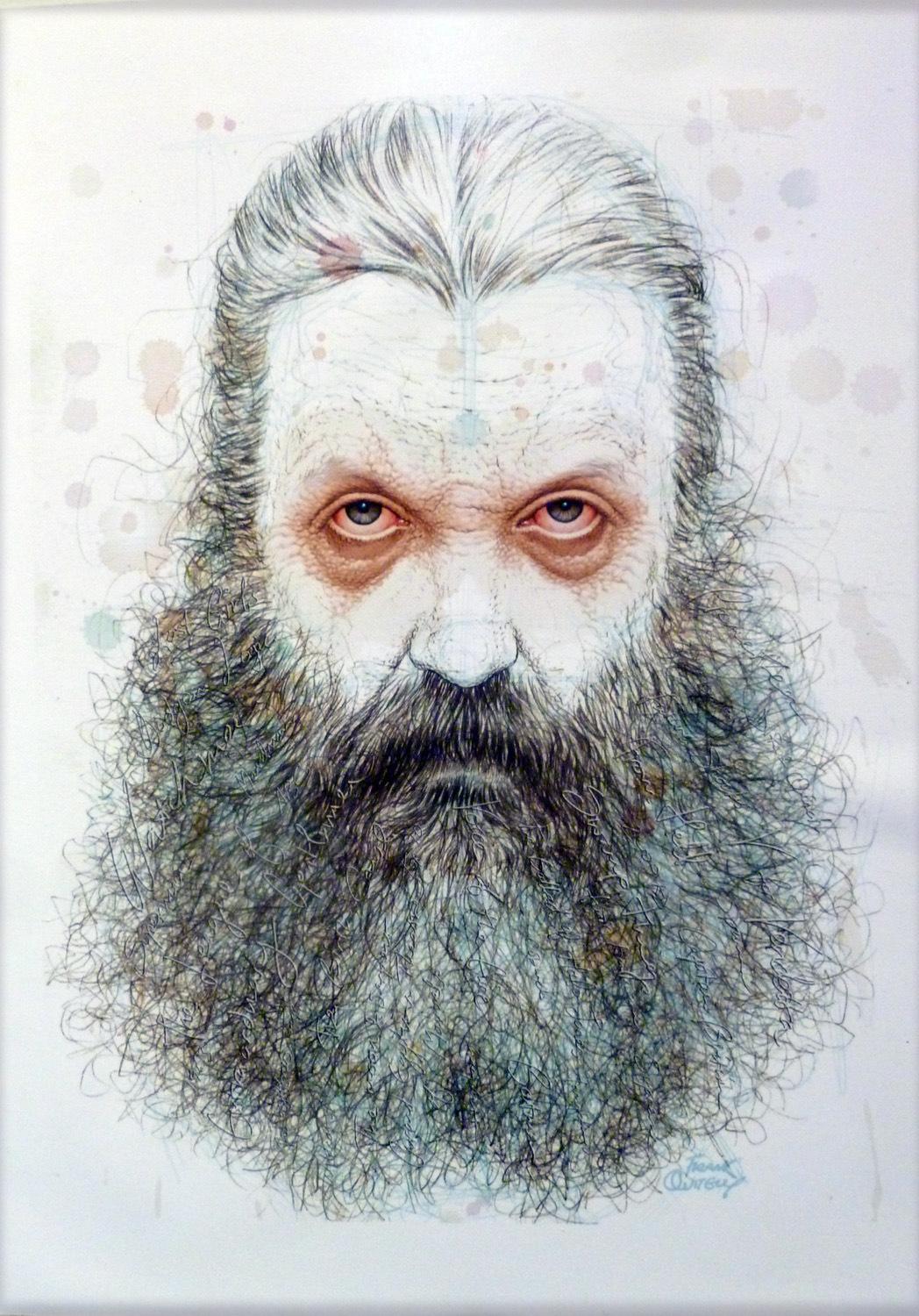



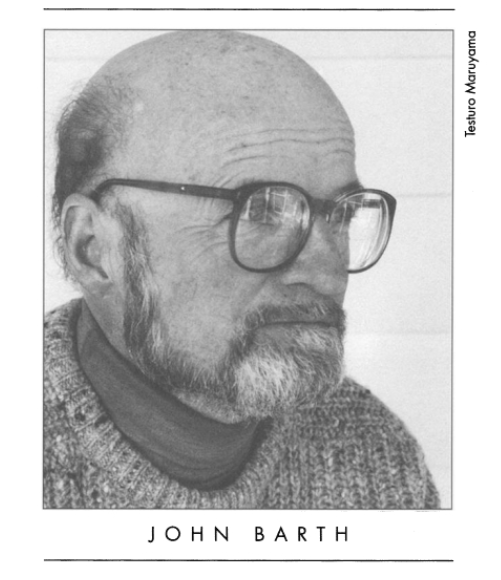

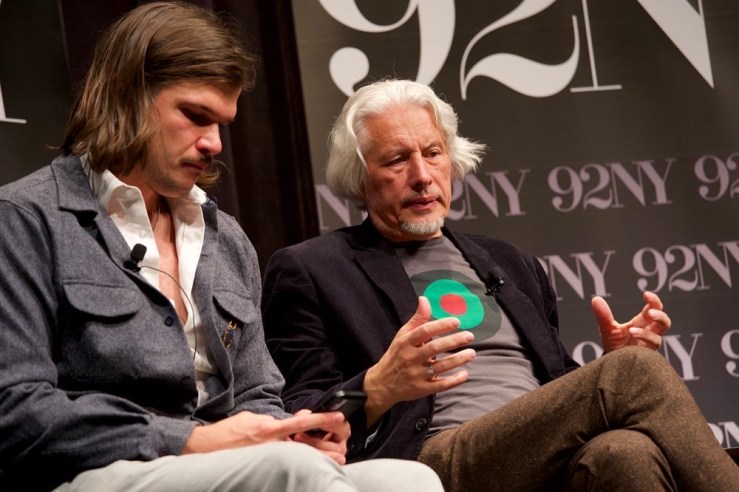
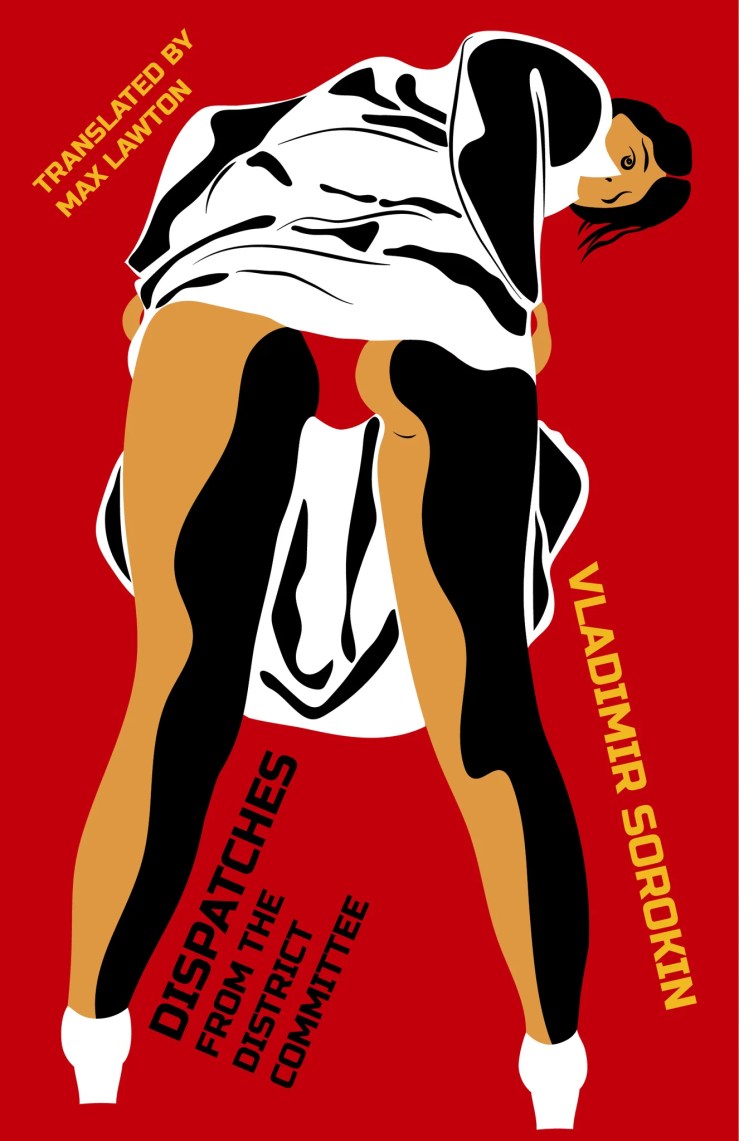


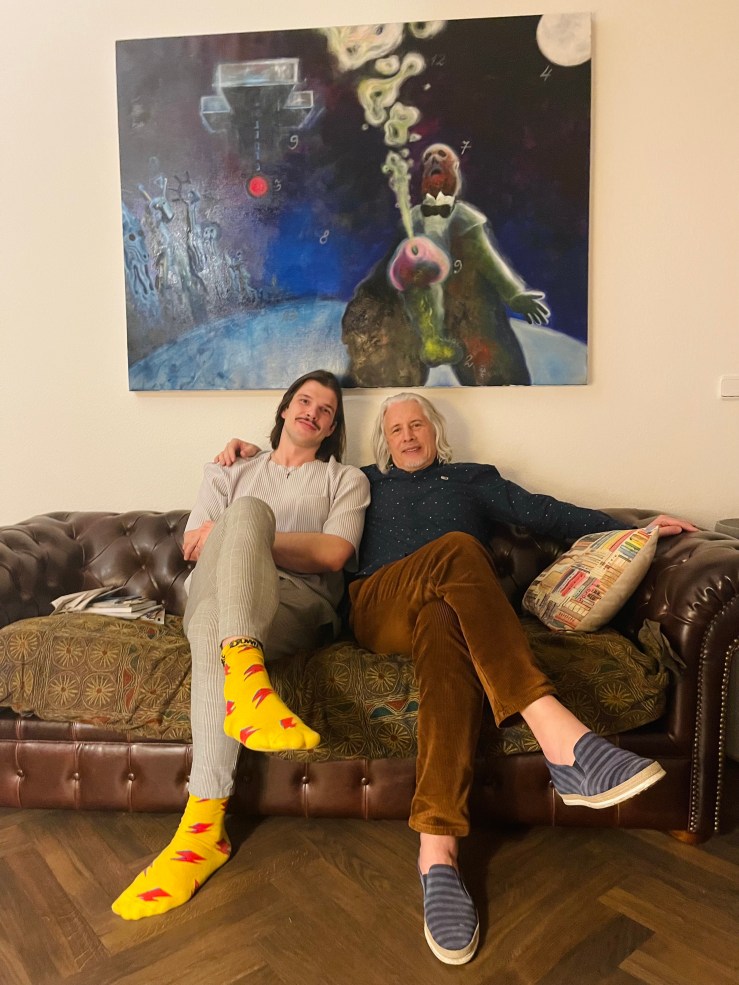
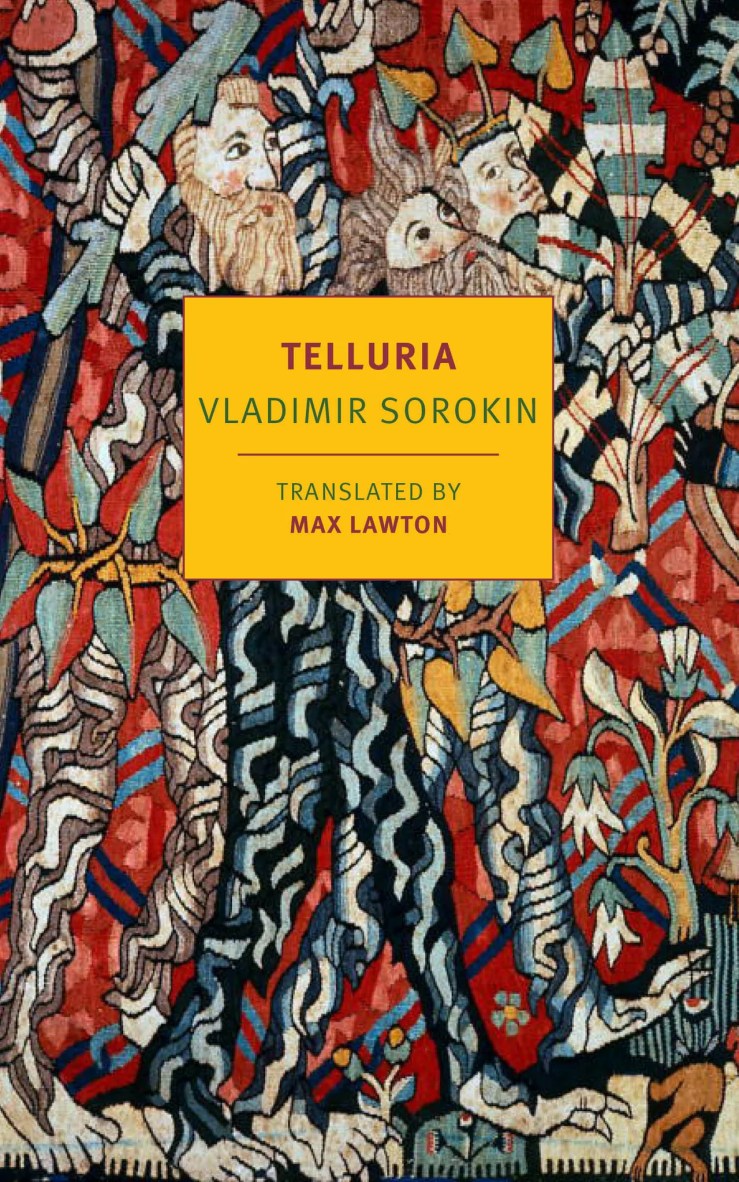
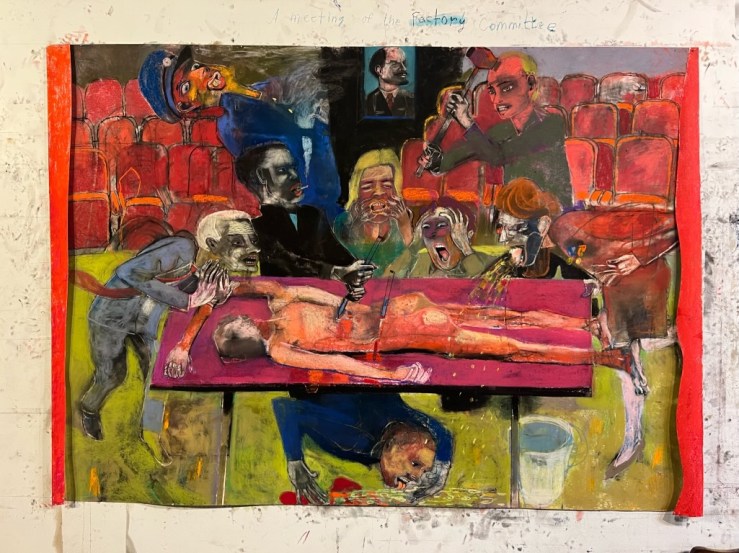
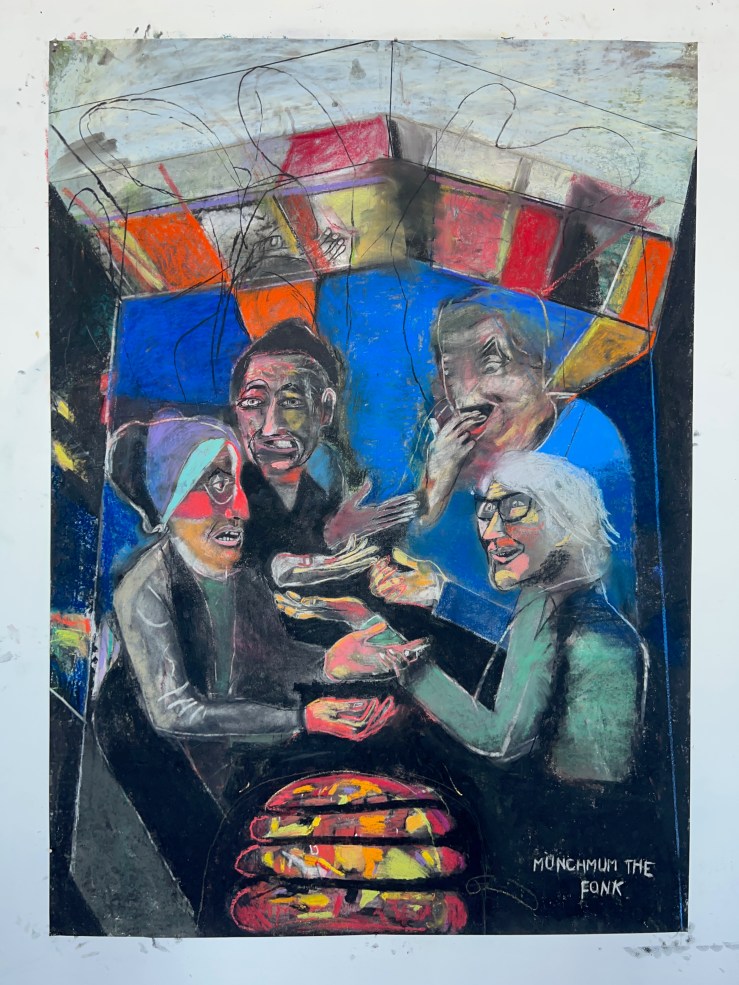


 Biblioklept