At the Uffizi, in Florence, is this odd painting by Titian. For a while, no one knew who the artist was. First the work was attributed to Leonardo and then to Sebastiano del Piombo. Though there’s still no absolute proof, today the critics are inclined to credit it to Titian. In the painting we see a man, still young, with long dark curly hair and a beard and mustache perhaps slightly tinged with red, who, as he poses, gazes off toward the right, probably toward a window that we can’t see, but still a window that somehow one imagines is closed, yet with curtains open or parted enough to allow a yellow light to filter into the room, a light that in time will become indistinguishable from the varnish on the painting.
The young man’s face is beautiful and deeply thoughtful. He’s looking toward the window, if he’s looking anywhere, though probably all he sees is what’s happening inside his head. But he’s not contemplating escape. Perhaps Titian told him to turn like that, to turn his face into the light, and the young man is simply obeying him. At the same time, one might say that all the time in the world stretches out before him. By this I don’t mean that the young man thinks he’s immortal. On the contrary. The young man knows that life renews itself and that the art of renewal is often death. Intelligence is visible in his face and his eyes, and his lips are turned down in an expression of sadness, or maybe it’s something else, maybe apathy, none of which excludes the possibility that at some point he might feel himself to be master of all the time in the world, because true as it is that man is a creature of time, theoretically (or artistically, if I can put it that way) time is also a creature of man.
In fact, in this painting, time — sketched in invisible strokes — is a kitten perched on the young man’s hands, his gloved hands, or rather his gloved right hand which rests on a book: and this right hand is the perfect measure of the sick man, more than his coat with a fur collar, more than his loose shirt, perhaps of silk, more than his pose for the painter and for posterity (or fragile memory), which the book promises or sells. I don’t know where his left hand is.
How would a medieval painter have painted this sick man? How would a non-figurative artist of the twentieth century have painted this sick man? Probably howling or wailing in fear. Judged under the eye of an incomprehensible God or trapped in the labyrinth of an incomprehensible society. But Titian gives him to us, the spectators of the future, clothed in the garb of compassion and understanding. That young man might be God or he might be me. The laughter of a few drunks might be my laughter or my poem. That sweet Virgin is my friend. That sad-faced Virgin is the long march of my people. The boy who runs with his eyes closed through a lonely garden is us.
Tea heads are not like junkies. A junkie hands you the money, takes his junk and cuts. But tea heads don’t do things that way. They expect the peddler to light them up and sit around talking for half an hour to sell two dollars’ worth of weed. If you come right to the point, they say you are a “bring down.” In fact, a peddler should not come right out and say he is a peddler. No, he just scores for a few good “cats” and “chicks” because he is viperish. Everyone knows that he himself is the connection, but it is bad form to say so. God knows why. To me, tea heads are unfathomable.
There are a lot of trade secrets in the tea business, and tea heads guard these supposed secrets with imbecilic slyness. For example, tea must be cured, or it is green and rasps the throat. But ask a tea head how to cure weed and he will give you a sly, stupid look and come-on with some double-talk. Perhaps weed does affect the brain with constant use, or maybe tea heads are naturally silly.
The tea I had was green so I put it in a double boiler and set the boiler in the oven until the tea got the greenish-brown look it should have. This is the secret of curing tea, or at least one way to do it.
Tea heads are gregarious, they are sensitive, and they are paranoiac. If you get to be known as a “drag” or a “bring down,” you can’t do business with them. I soon found out I couldn’t get along with these characters and I was glad to find someone to take the tea off my hands at cost. I decided right then I would never push any more tea.
In 1937, weed was placed under the Harrison Narcotics Act. Narcotics authorities claim it is a habit-forming drug, that its use is injurious to mind and body, and that it causes the people who use it to commit crimes. Here are the facts: Weed is positively not habit-forming. You can smoke weed for years and you will experience no discomfort if your supply is suddenly cut off. I have seen tea heads in jail and none of them showed withdrawal symptoms. I have smoked weed myself off and on for fifteen years, and never missed it when I ran out. There is less habit to weed than there is to tobacco. Weed does not harm the general health. In fact, most users claim it gives you an appetite and acts as a tonic to the system. I do not know of any other agent that gives as definite a boot
to the appetite. I can smoke a stick of tea and enjoy a glass of California sherry and a hash house meal.
I once kicked a junk habit with weed. The second day off junk I sat down and ate a full meal. Ordinarily, I can’t eat for eight days after kicking a habit.
Weed does not inspire anyone to commit crimes. I have never seen anyone get nasty under the influence of weed. Tea heads are a sociable lot. Too sociable for my liking. I cannot understand why the people who claim weed causes crime do not follow through and demand the outlawing of alcohol. Every day, crimes are committed by drunks who would not have committed the crime sober.
There has been a lot said about the aphrodisiac effect of weed. For some reason, scientists dislike to admit that there is such a thing as an aphrodisiac, so most pharmacologists say there is “no evidence to support the popular idea that weed possesses aphrodisiac properties.” I can say definitely that weed is an aphrodisiac and that sex is more enjoyable under the influence of weed than without it. Anyone who has used good weed will verify this statement.
You hear that people go insane from using weed. There is, in fact, a form of insanity caused by excessive use of weed. The condition is characterized by ideas of reference. The weed available in the U.S. is evidently not strong enough to blow your top on and weed psychosis is rare in the States. In the Near East, it is said to be common. Weed psychosis corresponds more or less to delirium tremens and quickly disappears when the drug is withdrawn. Someone who smokes a few cigarettes a day is no more likely to go insane than a man who takes a few cocktails before dinner is likely to come down with the D.T.’s.
One thing about weed. A man under the influence of weed is completely unfit to drive a car. Weed disturbs your sense of time and consequently your sense of spatial relations. Once, in New Orleans, I had to pull over to the side of a road and wait until the weed wore off. I could not tell how far away anything was or when to turn or put on the brakes for an intersection.
On another distant December when the house was inaugurated, he had seen from that terrace the line of the hallucinated isles of the Antilles which someone pointed out to him in the showcase of the sea, he had seen the perfumed volcano of Martinique, over there general, he had seen the tuberculosis hospital, the gigantic black man with a lace blouse selling bouquets of gardenias to governors’ wives on the church steps, he had seen the infernal market of Paramaribo, there general, the crabs that came out of the sea and up through the toilets, climbing up onto the tables of ice cream parlors, the diamonds embedded in the teeth of black grandmothers who sold heads of Indians and ginger roots sitting on their safe buttocks under the drenching rain, he had see the solid gold cows on Tanaguarena beach general, the blind visionary of La Guayra who charged two reals to scare off the blandishments of death with a one-string violin, he had seen Trinidad’s burning August, automobiles going the wrong way, the green Hindus who shat in the middle of the street in front of their shops with genuine silkworm shirts and mandarins carved from the whole tusk of an elephant, he had seen Haiti’s nightmare, its blue dogs, the oxcart that collected the dead off the streets at dawn, he had seen the rebirth of Dutch tulips in the gasoline drums of Curacao, the windmill houses with roofs built for snow, the mysterious ocean liner that passed through the center of the city among the hotel kitchens, he had seen the stone enclosure of Cartagena de Indias, its bay closed off by a chain, the light lingering on the balconies, the filthy horses of the hacks who still yawned for the viceroys’ fodder, its smell of shit general sir, how marvelous, tell me, isn’t the world large, and it was, really, and not just large but insidious, because if he went up to the house on the reefs in December it was not to pass the time with those refugees whom he detested as much as his own image in the mirror of misfortune but to be there at the moment of miracles when the December light came out, mother—true and he could see once more the whole universe of the Antilles from Barbados to Veracruz, and then he would forget who had the double-three piece and go to the overlook to contemplate the line of islands as lunatic as sleeping crocodiles in the cistern of the sea, and contemplating the islands he evoked again and relived that historic October Friday when he left his room at dawn and discovered that everybody in the presidential palace was wearing a red biretta, that the new concubines were sweeping the parlors and changing the water in the cages wearing red birettas, that the milkers in the stables, the sentries in their boxes, the cripples on the stairs and the lepers in the rose beds were going about with the red birettas of a carnival Sunday, so he began to look into what had happened to the world while he was sleeping for the people in his house and the inhabitants of the city to be going around wearing red birettas and dragging a string of jingle bells everywhere, and finally he found someone to tell him the truth general sir, that some strangers had arrived who gabbled in funny old talk because they made the word for sea feminine and not masculine, they called macaws poll parrots, canoes rafts, harpoons javelins, and when they saw us going out to greet them and swim around their ships they climbed up onto the yardarms and shouted to each other look there how well-formed, of beauteous body and fine face, and thick-haired and almost like horsehair silk, and when they saw that we were painted so as not to get sunburned they got all excited like wet little parrots and shouted look there how they daub themselves gray, and they are the hue of canary birds, not white nor yet black, and what there be of them, and we didn’t understand why the hell they were making so much fun of us general sir since we were just as normal as the day our mothers bore us and on the other hand they were decked out like the jack of clubs in all that heat, which they made feminine the way Dutch smugglers do, and they wore their hair like women even though they were all men and they shouted that they didn’t understand us in Christian tongue when they were the ones who couldn’t understand what we were shouting, and then they came toward us in their canoes which they called rafts, as we said before, and they were amazed that our harpoons had a shad bone for a tip which they called a fishy tooth, and we traded everything we had for these red birettas and these strings of glass beads that we hung around our necks to please them, and also for these brass bells that can’t be worth more than a penny and for chamber pots and eyeglasses and other goods from Flanders, of the cheapest sort general sir, and since we saw that they were good people and men of good will we went on leading them to the beach without their realizing it, but the trouble was that among the I’ll swap you this for that and that for the other a wild motherfucking trade grew up and after a while everybody was swapping his parrots, his tobacco, his wads of chocolate, his iguana eggs, everything God ever created, because they took and gave everything willingly, and they even wanted to trade a velvet doublet for one of us to show off in Europeland, just imagine general, what a wild affair, but he was so confused that he could not decide whether that lunatic business came within the incumbency of his government, so he went back to his bedroom, opened the window that looked out onto the sea so that perhaps he might discover some new light to shed on the mix-up they had told him about, and he saw the usual battleship that the marines had left behind at the dock, and beyond the battleship, anchored in the shadowy sea, he saw the three caravels.
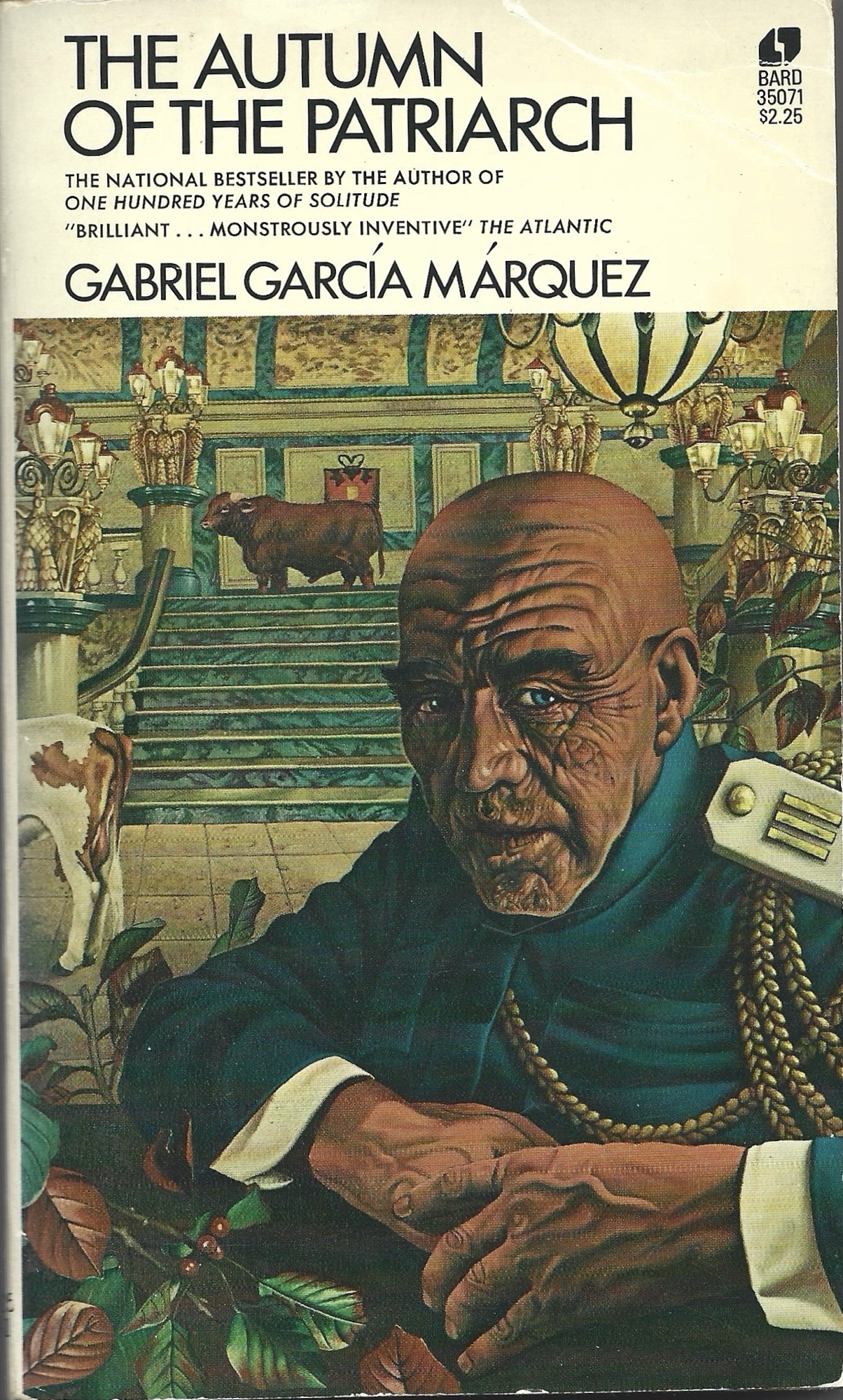
From Gabriel García Márquez’s The Autumn of the Patriarch in translation by Gregory Rabassa.
translated by Donald Gardner and Suzanne Jill Levine with collaboration by Infante
I remember when I was my husband’s fiancée. No, I’m lying, I wasn’t engaged yet, but he used to come and invite me out to the movies or take a walk and the day came when he invited me home to meet his family. It was Christmas Eve and it was already late, about eight o’clock, when he came to pick me up, and I was already beginning to think he wouldn’t come and everybody in the building rushed to their balconies to see us and my mother didn’t go to the balcony, because she knew they were all looking and she was very proud of me because my fiancé was rich and because he’d come to pick me up in a convertible to take me to dinner in his home and she told me, “Everybody in the neighborhood has seen him, child. He’ll have to marry you now. See that you don’t disappoint us” and I remember how disgusted I felt with my mother. It was Christmas Eve but it was very hot and I felt very distracted because I had put on the only presentable dress I had, a very summery one, and to show I had put it on for a purpose I said to my fiancé as soon as I got to the car, “It’s really hot, Ricardo,” and he said, “Yes, extremely. Would you like the top down?” He was very considerate and courteous and so kind.
When we got to his house I felt very good, because everyone was dressed informally, although the house was a very snazzy one in the Country Club and his father was delighted to have me and wanted to teach me to play golf the next day and we decided to eat in the garden though we drank our cocktails indoors. I felt very good with Arturo too, that’s Ricardo’s brother who was studying medicine, and with their mother who was very young and beautiful, a bit like a Cuban Myrna Loy, very distinguished-looking, and with Ricardo’s father who was tall and handsome and never stopped looking at me the whole evening. I had had a little to drink and we were sitting in the living room, talking and waiting for the turkey to be golden roasted, and Ricardo’s father invited me to go on a tour of the kitchen. I remember I didn’t feel well and that Ricardo’s father gripped me tightly by the arm as we went to the kitchen and as the house was half in darkness because of the Christmas tree the brilliant, almost white, light of the kitchen bothered me. I went and looked at the turkey and then I saw the girl who had brought us our drinks and who helped the chef (they were very rich and had a chef instead of a woman to cook for them) and then I saw she wasn’t old and I remembered that Ricardo’s mother had said something about her not being very experienced and I saw her in the light of the kitchen, as she was moving between the table and the sink and the refrigerator with the salads and she never once looked at us and I thought that her face was familiar and I saw that she was quite young and it was then that I realized she was a girl who had been at school with me in my pueblo before I came with my family to Havana and whom I hadn’t seen for ten years. She was so old, doctor, so worn out and she was the same age as me, exactly the same age and we had played together when we were girls and we were very good friends and both of us had a crush on Jorge Negrete and Gregory Peck and we used to sit out at night on the steps of my house and make plans for when we were grown up and I felt so uncomfortable that I couldn’t say hello to her, because it would make her feel so bad, and I had to leave the kitchen. Then, when I was in the living room again, I just about went back to the kitchen to say hello, because I thought I hadn’t said hello to her because I was afraid Ricardo’s family would see that I was from the country and had been very poor. But I didn’t go.
The meal took a very long time coming, I don’t know how long: something had happened to the turkey and we went on drinking and then Ricardo’s brother wanted to show me all around the house and first of all I went to see Ricardo’s room and then his brother’s room and I don’t know why but I went into the bathroom and the curtain of the shower was drawn and Ricardo’s brother said, “Don’t look,” and I was so curious I opened the curtain and looked and there in the shower, drenched in dirty water, was a skeleton that still had bits of flesh on it, a human skeleton, and Ricardo’s brother said, “I’m cleaning it!” I don’t know how I managed to get out of the bathroom nor how I went down the stairs nor how I managed to sit at the table in the patio to eat. All I remember is that Ricardo’s brother took me by the hand and kissed me and I kissed him and then he helped me across the dark room.
In the patio everything was very pretty, very green because of the lawn and beautifully lit up and the table was very well arranged with a very expensive tablecloth and they served me first because Ricardo’s mother insisted on it. And what I did was to look at the meat, the pieces of turkey, very well cooked, almost burnt-looking in the brown gravy, and put my knife and fork across my plate, lower my hands and start crying. I spoiled their Christmas for them, these people who were so kind and friendly, and I returned home worn out and so sad and quiet that not even my mother heard me come in.
Robert Coover passed away a few days ago at ninety-two years old. In his decades-spanning career, Coover published twenty-one novels, four plays, and four short story collections. He also published dozens of (as-yet) uncollected stories, essays, and a host of so-called “electronic fiction.” A fifth short story collection, 2018’s Going for a Beer, collected some of Coover’s greatest hits, and is generally an excellent starting place for those interested in Coover’s metatextual fabulism.
Coover didn’t start out as a metatextual fabulist. His first novel, 1966’s The Origin of the Brunists, is vivid, humanist realism with the slightest tinges of magic brightening its edges. 1968’s follow-up, The Universal Baseball Association, Inc., J. Henry Waugh, Prop., strays much deeper into the pop-myth fantasies that Coover would perfect in his mature career.
Coover’s 1969 collection Pricksongs & Descants shows a remarkable shift into postmodern metafiction. Pricksongs features some of his better stories, like “The Brother” (told from the point of view of the biblical Noah’s brother), “The Elevator,” and “The Magic Poker,” which begins with the sentence “I wander the island, inventing it” — a tidy encapsulation of Coover’s growing motif of the self-creating story. At times, this metatextual motif can exhaust the reader, as in Pricksongs’ capper “The Hat Act.” However, the collection features one of Coover’s best stories, “The Babysitter,” in which the titular character serves as a locus for a mundane suburban community’s collective repressed anxieties of sex and violence.
Coover would continue to explore such themes throughout his career, refining and sharpening his metatextual hat act in standout novels like Spanking the Maid (1982), Gerald’s Party (1986), and 1977’s The Public Burning—arguably Coover’s most important novel. It’s easy to think of The Public Burning as the last part of a loose postmodern American trilogy of large daring novels, the first two parts comprised of Pynchon’s Gravity’s Rainbow (1973) and William Gaddis’s J R (1975).
Indeed, Coover was regularly grouped with a (very white, very male) clique of postmodern American writers. In his 1980 essay “The Literature of Replenishment,” John Barth halfheartedly counted up the members: “By my count, the American fictionists most commonly included in the canon, besides the three of us at Tubingen [William H. Gass, John Hawkes and Barth himself], are Donald Barthelme, Robert Coover, Stanley Elkin, Thomas Pynchon, and Kurt Vonnegut, Jr.”
There was some chatter on social media that Coover’s passing left just Pynchon–and maybe Don DeLillo and Joseph McElroy–as the last living luminaries of twentieth-century US American postmodernist fiction. Of course, Pynchon really wasn’t a member of this or any other clique (he declined an invitation to Donald Barthelme’s so-called “postmodernists dinner“), and, as is too often the case with such groupings, Ishmael Reed’s contribution to American postmodernist fiction continues to be marginalized.
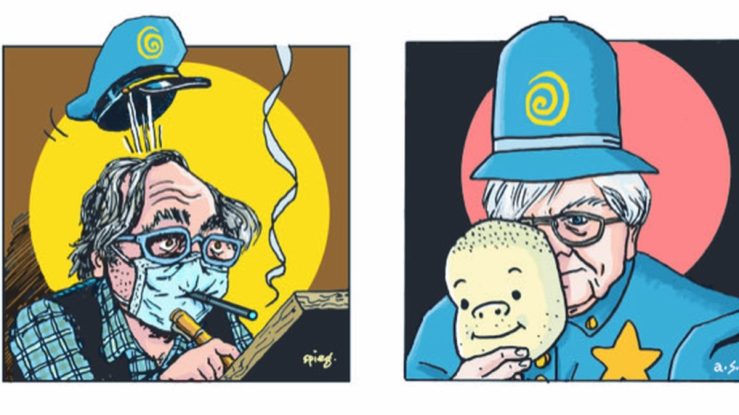
Let it stand then that Robert Coover, despite whatever connections and friendships he held with other writers and artists, was his own special self-made creation. He was prolific, especially later in life, publishing nine novels in the twenty-first century. One of these was The Brunist Day of Wrath (2014), a sequel to his debut; he also collaborated with comix artist Art Spiegelman on the graphic novelette Street Cop (2021) and even found a sliver of mainstream readers with Huck Out West, his wonderful 2017 “sequel” to Adventures of Huckleberry Finn. Coover’s latest novel Open House was published just over a year ago.
Clearly, Coover leaves behind a large body of work, and we’ll likely see more of his work collected and published over the next decade. I won’t pretend to have read most of what he’s written, but I’ve loved a lot of it—particularly Pricksongs & Descants, Huck Out West, Spanking the Maid, and Briar Rose, which, as far as I can recall, is likely the first thing I read of his (my girlfriend at the time’s sister had to read it in college; she professed that she hated it but thought I’d like it). The aforementioned 2018 collection Going for a Beer is a nice starting place for Coover; those more interested in novels might like Spanking the Maid. Or jump into one of his later short novels, like 2004’s Stepmother or 2018’s The Enchanted Prince, both of which exemplify his metamagicianist mode. Or hell, just go for the big boy, The Public Burning. Ultimately, Coover leaves behind a trove of trembling, writhing, vividly-living words, an oeuvre that will continue to engage readers fascinated by a certain stamp of so-called experimental literature–and for that I thank him.
The Spring 1980 issue of Northwestern University’s literary journal TriQuarterly included an early version of a chapter from Cormac McCarthy’s novel Blood Meridian. The TriQuarterly excerpt, published as “The Scalphunters,” is essentially Ch. XII of the finished 1985 Random House publication of Blood Meridian with some minor differences.
Consider, for example, the following paragraph–the seventh paragraph in “The Scalphunters” —
When the company set forth in the evening they continued south as before. The tracks of the murderers bore on to the west but they were white men who preyed on travelers in that wilderness and disguised their work in this way. The trail of the argonauts of course went no further than the ashes they left behind and the intersection of these vectors seemed the work of a cynical god, the traces converging blindly in that whited void and the one going on bearing away the souls of the others with them.
McCarthy significantly expands the passage in his final revision, underscoring Blood Meridian’s theme of witnessing:
When the company set forth in the evening they continued south as before. The tracks of the murderers bore on to the west but they were white men who preyed on travelers in that wilderness and disguised their work to be that of the savages. Notions of chance and fate are the preoccupation of men engaged in rash undertakings. The trail of the argonauts terminated in ashes as told and in the convergence of such vectors in such a waste wherein the hearts and enterprise of one small nation have been swallowed up and carried off by another the expriest asked if some might not see the hand of a cynical god conducting with what austerity and what mock surprise so lethal a congruence. The posting of witnesses by a third and other path altogether might also be called in evidence as appearing to beggar chance, yet the judge, who had put his horse forward until he was abreast of the speculants, said that in this was expressed the very nature of the witness and that his proximity was no third thing but rather the prime, for what could be said to occur unobserved?
Perhaps the most jarring differencethough is that in “The Scalphunters” McCarthy refers to his erstwhile protagonist not as the kid but as the boy. Here’s a longish passage from The TriQuarterly edit to give you a taste of that flavor:
Brown let the belt fall from his teeth. Is it through? he said.
It is.
The point? Is it the point? Speak up, man.
The boy drew his knife and cut away the bloody point deftly and handed it up. Brown held it to the firelight and smiled. The point was of hammered copper and it was cocked in its blood-soaked bindings on the shaft but it had held.
Stout lad, ye’ll make a shadetree sawbones yet. Now draw her.
The boy withdrew the shaft from the man’s leg smoothly and the man bowed on the ground in a lurid female motion and wheezed raggedly through his teeth. He lay there a moment and then he sat up and took the shaft from the boy and threw it in the fire and rose and went off to make his bed.
When the boy returned to his own blanket the ex-priest Tobin leaned to him and looked about stealthily and hissed at his ear.
Fool, he said. God will not love ye forever.
The boy turned to look at him.
Dont you know he’d of took you with him? He’d of took you, boy. Like a bride to the altar.
You must remember that there was a war on, when we were born. If we made her happy, then we didn’t add much to the collective sum of happiness in the whole of South London. First of all, the neighbours’ sons went marching off, sent to their deaths, God help them. Then the husbands, the brothers, the cousins, until, in the end, all the men went except the ones with one foot in the grave and those still in the cradle, so there was a female city, red-eyed, dressed in black, outside the door, and Grandma said it then, she said it again in 1939: ‘Every twenty years, it’s bound to happen. It’s to do with generations. The old men get so they can’t stand the competition and they kill off all the young men they can lay their hands on. They daren’t be seen to do it themselves, that would give the game away, the mothers wouldn’t stand for it, so all the men all over the world get together and make a deal: you kill off our boys and we’ll kill off yours. So that’s that. Soon done. Then the old men can sleep easy in their beds, again.’
Disjunction, simultaneity, irrationalism, anti-illusionism, self-reflexiveness, medium-as-message, political olympianism, and a moral pluralism approaching moral entropy—these are not the whole story either.
A worthy program for postmodernist fiction, I believe, is the synthesis or transcension of these antitheses, which may be summed up as premodernist and modernist modes of writing. My ideal postmodernist author neither merely repudiates nor merely imitates either his twentieth-century modernist parents or his nineteenth-century premodernist grandparents. He has the first half of our century under his belt, but not on his back. Without lapsing into moral or artistic simplism, shoddy craftsmanship, Madison Avenue venality, or either false or real naïveté, he nevertheless aspires to a fiction more democratic in its appeal than such late-modernist marvels (by my definition) as Beckett’s Texts for Nothing or Nabokov’s Pale Fire. He may not hope to reach and move the devotees of James Michener and Irving Wallace—not to mention the great mass of television-addicted non-readers. But he should hope to reach and delight, at least part of the time, beyond the circle of what Mann used to call the Early Christians: professional devotees of high art.
I feel this in particular for practitioners of the novel, a genre whose historical roots are famously and honorably in middle-class popular culture. The ideal postmodernist novel will somehow rise above the quarrel between realism and irrealism, formalism and “contentism,” pure and committed literature, coterie fiction and junk fiction. Alas for professors of literature, it may not need as much teaching as Joyce’s or Nabokov’s or Pynchon’s books, or some of my own. On the other hand, it will not wear its heart on its sleeve, either; at least not its whole heart. (In a recent published exchange between William Gass and John Gardner, Gardner declares that he wants everybody to love his books; Gass replies that he would no more want his books to be loved by everybody than he’d want his daughter to be loved by everybody, and suggests that Gardner is confusing love with promiscuity.) My own analogy would be with good jazz or classical music: One finds much on successive listenings or close examination of the score that one didn’t catch the first time through; but the first time through should be so ravishing—and not just to specialists—that one delights in the replay.
Lest this postmodern synthesis sound both sentimental and impossible of attainment, I offer two quite different examples of works which I believe approach it, as perhaps such giants as Dickens and Cervantes may be said to anticipate it. The first and more tentative example (it is not meant to be a blockbuster) is Italo Calvino’s Cosmicomics (1965): beautifully written, enormously appealing space-age fables—“perfect dreams,” John Updike has called them—whose materials are as modern as the new cosmology and as ancient as folktales, but whose themes are love and loss, change and permanence, illusion and reality, including a good deal of specifically Italian reality. Like all fine fantasists, Calvino grounds his nights in local, palpable detail: Along with the nebulae and the black holes and the lyricism, there is a nourishing supply of pasta, bambini, and good-looking women sharply glimpsed and gone forever. A true postmodernist, Calvino keeps one foot always in the narrative past—characteristically the Italian narrative past of Boccaccio, Marco Polo, or Italian fairy tales—and one foot in, one might say, the Parisian structuralist present; one foot in fantasy, one in objective reality, etc. It is appropriate that he has, I understand, been chastized from the left by the Italian communist critics and from the right by the Italian Catholic critics; it is symptomatic that he has been praised by fellow authors as divergent as John Updike, Gore Vidal, and myself. I urge everyone to read Calvino at once, beginning with Cosmicomics and going right on, not only because he exemplifies my postmodernist program, but because his fiction is both delicious and high in protein.
An even better example is Gabriel García Márquez’s One Hundred Years of Solitude (1967): as impressive a novel as has been written so far in the second half of our century and one of the splendid specimens of that splendid genre from any century. Here the synthesis of straightforwardness and artifice, realism and magic and myth, political passion and nonpolitical artistry, characterization and caricature, humor and terror, are so remarkably sustained that one recognizes with exhilaration very early on, as with Don Quixote and Great Expectations and Huckleberry Finn, that one is in the presence of a masterpiece not only artistically admirable, but humanly wise, lovable, literally marvelous. One had almost forgotten that new fiction could be so wonderful as well as so merely important. And the question whether my program for postmodernism is achievable goes happily out the window, like one of García Márquez’s characters on flying carpets. Praise be to the Spanish language and imagination! As Cervantes stands as an exemplar of premodernism and a great precursor of much to come, and Jorge Luis Borges as an exemplar of dernier cri modernism and at the same time as a bridge between the end of the nineteenth century and the end of the twentieth, so Gabriel García Márquez is in that enviable succession: an exemplary postmodernist and a master of the storyteller’s art.
It goes without saying that critical categories are as more or less fishy as they are less or more useful. I happen to believe that just as an excellent teacher is likely to teach well no matter what pedagogical theory he suffers from, so a gifted writer is likely to rise above what he takes to be his aesthetic principles, not to mention what others take to be his aesthetic principles. Indeed, I believe that a truly splendid specimen in whatever aesthetic mode will pull critical ideology along behind it, like an ocean liner trailing seagulls. Actual artists, actual texts, are seldom more than more or less modernist, postmodernist, formalist, symbolist, realist, surrealist, politically committed, aesthetically “pure,” “experimental,” regionalist, internationalist, what have you. The particular work ought always to take primacy over contexts and categories. On the other hand, art lives in human time and history, and general changes in its modes and materials and concerns, even when not obviously related to changes in technology, are doubtless as significant as the changes in a culture’s general attitudes, which its arts may both inspire and reflect. Some are more or less trendy and superficial, some may be indicative of more or less deep malaises, some perhaps healthy correctives of or reactions against such malaises.
For conveying ideas, novels are among the least functional and most decorative of the blunt instruments. (Could this be a universal truth, some starry, operative mathematical principle? Most stars are decorative too, of course, their function merely to peg the universe in place like studs in upholstery, servicing the elegancies, strumming its physics like a man with a blue guitar, fleshing all the centripetals and centrifugals, stringing the planets like beads, some beautiful pump of placement, arranging night, moving the planetary furniture, and fixing the astronomical data, but less useful, finally, in the sense that a handful more here or a dollop less there could make as much of a never mind as corks or rhythm, less useful, finally, than mail or ice cream.) And if, a few times in a way, novels like Richard Henry Dana’s Two Years Before the Mast or Beecher Stowe’s Uncle Tom’s Cabin or Steinbeck’s Grapes of Wrath come along to legislate, or raise a consciousness or two, or rouse a rabble, to make, I mean, what history or the papers call a difference, why that’s decorative, too, I think, a lip service the system, touching the bases like a superstitious braille, pays art—like, oh, the claims made a few years back for the “We Are the World” folks when it was really the Catholic Relief Services already on site during the Ethiopian famine that did the heavy lifting.
Well it’s not the novelist’s fault. Not that they don’t deserve some of the blame, leaking encouragement like someone paying out line to fish, some of your have-cake-and-eat-its like a little miracle of the loaves. And there are still a few big mouths who stake claims for the ameliorative shamanism of—hark! this is interesting: not the book so much as the writer—the practice of fiction—the loyal, Nutso Art Jerk Groupie, like some devoted cultist, the last Deadhead, say, worrying like holy beads the shoelace on his wrist he thinks is a bracelet making confrontation with an Elvis Presley impersonator.
Isn’t it pretty to think so, though? To take oneself as seriously as one’s readers sometimes do? To believe, if only briefly, and if only by the light off the gloss of the brittlest mood swing, in the justice or even the palpability of one’s cause, to Don Quixote principle, any principle, and raise to the level of purpose what in the final analysis is only what given egos, fashionably or not, fashion or no, frozen in mere season’s hipped au courantness, perceive as beauty. Continue reading ““The Rest of the Novel” — Stanley Elkin”→
Mrs. White at the Red Shop showed me the beady-eyed garment, but I can’t pay for it. I’m broke! I already own a gold ring and a gold-filled wristwatch and I am very uncomfortable with these. My eyes sweep the garment and its charms.
I am tempted to say this is how love works, burying everyone in the same style.
Through a fault of my own I set off as if I’m on a horse and just point and go to the next village.
This village is where flowers are painted on the sides of my house—big red dots, big yellow balls.
At home, stuck over a clock’s pretty face, is a note from my husband to whom I do not show affection. With a swallow of tap water, I take a geltab.
By this time I had not yet apologized for my actions. Last night my husband told me to get up out of the bed and to go into another room.
My husband’s a kind man, a clever man, a patient man, an honest man, a hard-working man.
Many people have the notion we live in an age where more people who behave just like he does lurk.
See, I may have a childlike attitude, but a woman I once read about attempted a brand new direction with a straight face.
Five years ago, I was fortunate enough to interview Margaret Carson about her translation of a collection of the artist Remedios Varo’s written work. Margaret has since expanded on that collection, adding new material from her dive into Varo’s archives, resulting in On Homo rodans and Other Writings, new this summer from Wakefield Press.On Homo rodans and Other Writings offers readers a fascinating trip through Varo’s imagination. Brimming with impossible images, surreal jokes, and dreamy fragments, the work is more than just an addendum to Varo’s career as an artist. I highly recommend it to those interested in surrealist writing in general. Margaret was kind (and patient!) enough to talk with me again over the course of a few weeks via email. I am grateful for her generosity and for her work in bringing Varo’s words to monoglots such as myself.
In addition to her Varo books, Margaret Carson’s translations include Sergio Chejfec’s Baroni, A Journeyand My Two Worlds. She is Associate Professor in the Modern Languages Department at Borough of Manhattan Community College, The City University of New York.
Photograph of Margaret Carson by Beowulf Sheehan.
Biblioklept: Margaret, congratulations on the publication of On Homo rodans and Other Writings, the expanded edition of your English translation of Remedios Varo’s writings! Many of our readers might be familiar with Varo’s wonderful paintings but not know about her writing. How would you characterize the prose collected in On Homo rodans and Other Writings?
Margaret Carson: Thanks, it’s great to have the translation back in print! It’s mainly writings found after Remedios Varo’s death in notebooks and on loose pages. The writings are quite varied: several odd and delightful stories (three of them new to this edition), a fairy tale, letters to friends and strangers, her famous recipe “To Provoke Erotic Dreams,” a poem that invokes the moon, dream narratives, and a few other gems, such as the title piece, “On Homo rodans,” a faux anthropological treatise that accompanied her sculpture of a human-like torso on a giant wheel, made out of chicken, turkey and fish bones.
Homo rodans sculpture in its glass case. Photograph by Margaret Carson.
Varo’s extraordinary creativity and weird sense of humor come across just as much in her writings as in her paintings. I think readers fascinated by Varo, the artist, will also be won over by her gifts as a writer. Simply put, she’s as clever a writer as she is a painter.
Biblioklept: So, let’s get into the stories and other material new to this edition and how you came to translate it into English. Some of this material hasn’t been published before, even in Spanish. If my understanding is correct, Walter Gruen, Varo’s last life partner, donated a significant collection of her works to the Museo de Arte Moderno in Mexico City in 2000. In 2018—after the publication of your translated collection Letters, Dreams & Other Writings—the Varo estate bequeathed more of Varo’s writings to the Museo de Arte Moderno. Is that right?
MC: Yes. In the early 2000s Walter Gruen and his wife Anna Alexandra Varsoviano (a friend of Varo’s who he married after the artist’s death) donated about thirty-eight of her works to the Museo de Arte Moderno (MAM), making it the largest repository of paintings by Varo in the world. Walter Gruen died in 2008, and Anna Alexandra Varsoviano in 2015. (I was lucky enough to meet them both in person: Walter Gruen in 2000 and Anna Alexandra Varsoviano some years later.) In her will, Anna Alexandra bequeathed a trove of Varo’s notebooks, letters, preparatory drawings, photos, and other items to MAM, many of which were displayed in 2018 in an exhibition celebrating the donation: Adictos A Remedios Varo: Nuevo Legado 2018. It was at that exhibition that I first saw Varo’s notebooks, open to pages containing narratives, letters and other pieces, in Varo’s own handwriting. I could instantly recognize them because I’d translated the same texts for Letters, Dreams and Other Writings, except for that book I used a collection of Varo’s writings published in Mexico in the 1990s, Cartas, sueños y otros textos, edited by the Spanish scholar Isabel Castells.
Because the new Wakefield edition mostly uses archival materials as its source, and isn’t a direct translation of texts from an existing book, the estate requested that we give it a new title. So, thinking about Varo’s tour-de-force anthropological spoof, we renamed it On Homo rodans and Other Writings.
A page from the Homo rodans manuscript. Photograph by Margaret Carson.
Biblioklept: What kind of access did the museum give you to the manuscript materials?
MC: When I requested an appointment to consult the archive at MAM, I indicated my area of interest: Varo’s notebooks and any stray papers relating to her writings. So when I visited for a few days in July 2022, an archivist assisted me by bringing out her notebooks one at a time as well as folders containing loose papers. You can’t imagine how excited I was not only to see but to touch these old, faded composition books and to turn their pages to discover what Varo had written or drawn on them. There are about a dozen notebooks in all, mostly school composition books for children. I was snapping photos right and left! I’m very grateful to the Museo and to their archivists for guiding me through the notebooks and for their interest in the project.
Cover of one of Varo’s notebooks. Photograph by Margaret Carson.
Biblioklept: Varo was born in Spain, and her painting career sparked in earnest in France, but she really flourished as a painter in Mexico. Her work seems to find a growing audience in the USA; do you have a sense of her reputation in Mexico?
MC: Remedios Varo came into her own as an artist in Mexico City; when she began to exhibit, she was an immediate success. Her first solo show, in 1956 at the Galería Diana, was a sell-out, as was a subsequent solo show in 1961. Sadly, Varo suddenly died in 1963. Her posthumous reputation is in large part due to Walter Gruen and his efforts to keep her in the public eye. The first catalog of her work, whose publication was overseen by Gruen and funded by Varo’s friend and patron Eva Sulzer, came out just three years after her death, in 1966, with contributions by some heavy hitters: the poet Octavio Paz, the French intellectual Roger Caillois, and the Mexican philosopher Juliana González, a personal friend of Varo’s. Since then, four editions of Varo’s catalogue raisonné have been published in Mexico, the last in 2008. (Alas, all are now out of print but available in many research libraries.) People are deeply fascinated by Varo’s paintings. Special exhibitions of her work at the Museo de Arte Moderno always draw record crowds (as they do in other cities as well, for example, the recent Remedios Varo: Science Fictions exhibition in Chicago, which was one of their best attended shows ever).
Biblioklept: Gruen seems to have led a fascinating life.
MC: Yes, but not without its tragedies. The little I know comes from Janet Kaplan’s biography of Varo, his obituary in the Mexican daily La Jornada, and from the Adictos a Remedios Varo catalog. Like Varo, he was fortunate to get out of war-torn Europe, but only after he experienced the worst. He was born in Austria, started medical school in the 1930s, got kicked out because he was Jewish, was arrested by the Gestapo and sent to Dachau and then Buchenwald. After liberation, he made his way to Mexico City with his wife Klari Willner and it was there that he met Varo and others in the European refugee community. His wife died in Mexico in a drowning accident in the late 1940s, while Varo was living in Venezuela. It was some time after Varo’s return to Mexico that she and Gruen got together. Gruen had established his record store by then, the Sala Margolín, which for decades was the essential go-to place for classical music fans in Mexico City.
A year after Varo’s death, in 1964, Gruen organized an exhibition of her work at the Palacio de Bellas Artes, and it’s at that show that Thomas Pynchon, on a trip to Mexico City, saw Embroidering the Earth’s Mantle /Bordando el manto terrestre, which was immortalized in the novel The Crying of Lot 49. Together with Anna Alexandra Varsoviano, Gruen worked to secure Varo’s legacy as an artist and to safeguard what she left behind. From the perspective of Varo’s writings, it was crucial that her notebooks and papers remain as a single cache of documents and not dispersed. After Varsoviano’s death, the entire archive including this collection of writings passed to the Museo de Arte Moderno.
Embroidering the Earth’s Mantle, 1961, Remedios Varo
Biblioklept: This new edition of Varo’s writings includes three stories that were previously unpublished, even in Spanish. Do you know why they weren’t published before now?
MC: No, I don’t know why. The stories are unquestionably in Varo’s handwriting, and they’re marvelous. It would be a good question to ask Walter Gruen or Anna Alexandra.
Biblioklept: Speaking of her handwriting—did you revise any of the material you’d already translated after seeing it in her manuscript?
MC: To some extent, yes. As I mentioned before, for Letters, Dreams …. (2018), I used as my source text a collection that had already been published in Mexico. As I was translating, I’d occasionally come across bracketed ellipses [. . .], and I wasn’t sure what was being signaled. Had a word or sentence in the original been cut, or was it illegible at that point? I found no editorial explanation, so I simply carried over the bracketed ellipses into the English.
In preparing this new edition, I made sure to look for those same bracketed passages in the manuscripts to see if I could discover what Varo had actually written. I found some wonderful things. All the ellipses in the Mistress Thrompston story, for example, were places where Varo had drawn weird mathematical formulas meant to be read as proper names. So now, instead of “[. . .] Magazine,” you’ll see that its name is “WTrons – X√yl Magazine.” The Marquis of Ornitobello’s daughter, whose name had been dropped completely, returns to the story: she’s called √Ax8. These are the little touches where you see Varo being Varo. She loved playing with math. In Disobedient Plant/Planta insumisashe even painted mathematical formulas into the hair of the scientist and into the tendrils of the plants. Happily, Wakefield Press was able to incorporate Varo’s mathematical doodles and other hand-drawn whimsies into the published book.
Disobedient Plant, 1958, Remedios Varo
Another kind of revision I made after seeing the manuscripts may seem trivial, but in all instances Varo wrote “etc.” not “et cetera,” so I restored “etc.” And in “On Homo rodans” she used the ligature “æ” in her invented Latin, so I restored that as well.
Something that surprised me on reading the original manuscripts was that Varo often wrote super-long sentences—what writing instructors would call “comma splices” or “run-ons.” I initially wanted to restore these sentences to their original length because in their raw state there’s a kind of fast-forward momentum. You get pulled along as she adds one thing after another to her narratives, almost breathlessly. But in the end, for the sake of readability, I normalized the punctuation a bit by breaking up some of the enormously long sentences.
There were maybe only one or two times when I changed the translation of a word after seeing that Varo had written something different from what the editor of the previous volume had transcribed. Nothing major. Of course, like all translators, I’m an obsessive reviser, so in preparing this new edition I couldn’t help but look over the previous translation to polish and tweak. I didn’t need the manuscripts for that. As they say, a translation is never finished….
Biblioklept: I’m curious if your “editor’s voice” clashed at all with your “translator’s voice” when it came to revising Varo’s comma splices and fused sentences. And were there clashes elsewhere, when it came to, say, new word choices?
MC: Hmm, I haven’t thought of the two roles clashing before. I think we worked pretty harmoniously together. The editor would have probably liked more time to revise the introduction and endnotes, and to think about the best way to order the texts within the book, while the translator, eager to get the translation back into print, was more like, “Let’s wrap up!”
Biblioklept: One section new to this edition are a handful of brief poemish texts collected as “Images in Words.” A few of these word-image-poem-texts (?!) contain strikethroughs and doodles, as you mentioned before. Many of these pieces feature phrases that correspond to motifs we see in Varo’s visual art (trees, pulleys, stars, knitters, etc.). To your knowledge, do these image fragments correspond to any of Varo’s paintings? Do you have a sense that these were “plans” for paintings–pieces of visual art that started in language first?
MC: It’s difficult to know with any certainty, but they do seem like plans for paintings that started off in language first. They could be Varo’s earliest ideas: flashes of images, possibly from dreams, that she developed as preliminary drawings and eventually, fully fleshed out in paintings.
When Varo was once asked if she was a writer as well as a painter, she replied, “I sometimes write as if I were making a sketch” (“A veces escribo como si trazase un boceto”).A lot has been made of that one sentence because it’s the only time we know of that Varo speaks of her writing. I used to think she was very modestly describing her writing as a whole, including her creative writing, but now I believe she was referring specifically to these poem-like fragments, these sketches in words. When an idea came to her, I imagine her grabbing her notebook and opening it to a blank page, sometimes to make a quick sketch, other times to jot down a few words. Sometimes she did both on the same page.
Do the fragments correspond to any paintings? Yes, if you’re familiar with her work, you can immediately make connections. For example, from the bottom of p. 131:
character from peeling wall participating in something with another character who is real
Metamorphosis
Mimicry
The abandoned room, someone inside the table, inside the armchair
as well, perhaps inside the wall — — — —
The first two lines seem to describe the painting Harmony / Armonía, in which there’s an ethereal figure emerging from a peeled-back wall to play with an object on a musical staff (a snail?). The other “real” character sits at a table across from the apparition and plays with a polyhedron-like object on the staff. Why did Varo cross the lines out? Walter Gruen speculated that it was because she had finished the painting.
Harmony, 1956, Remedios Varo
The next two lines refer to the well-known painting Mimesis / Mimetismo, in which she depicts a woman undergoing a metamorphosis – she’s taking on the characteristics of the chair she’s sitting in. (Side note: Varo’s catalogue raisonné translates the title of this painting as Mimesis, which isn’t wrong, but it makes me think more of the Erich Auerbach book and literary mimesis. I believe a better English translation would be “Mimicry,” as in insect mimicry, a phenomenon of particular interest to the surrealists. See Roger Caillois’s 1935 essay “Mimétisme et psychasthénie légendaire,” in the surrealist journal Minotaure).
They represent just one moment in the evolution of an artist’s idea. It’s said that Varo was very private in her studio practice. No one knows for sure, but it’s likely she used her notebooks (which also doubled as sketchbooks) at the earliest stages of a painting, when her ideas were hatching.
Biblioklept: Can you expand on how Varo was private in the studio?
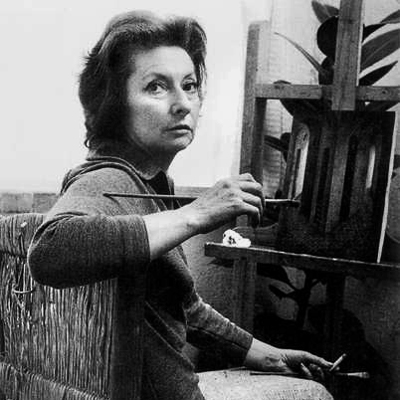
MC: I can only talk about her studio in a limited way, from clues provided in photos and in a few accounts. I also talked a bit about Varo’s apartment-studio with Xabier Lizarraga Cruchaga, her godson, who as a boy used to visit Varo in her studio quite often (so she didn’t completely exclude visitors). Her studio was a room on the top floor of the building she lived in, accessible by a private flight of stairs. A wide doorway in the studio opened to a small, north-facing terrace where she kept plenty of plants. You can see the studio in a series of photos Kati Horna took of Varo for a magazine article that appeared in 1960. In the article, two photos show Varo at work, one at a drafting table and the other at her easel. The painting on the easel is Farewell /La despedida, with only the architectural elements of the painting in place (she would later add the departing lovers, their shadows, and the cat that looks on). Observe the white lump on the left side of the easel. That’s a piece of quartz. She apparently used quartz to incise fine lines into her paintings to expose the gesso underneath. Quartz comes up a few times in her writings as well. Let’s say she had an affinity for quartz and its mysterious qualities.
She also mentions her studio in one of her dream narratives, which begins like this:
“I dreamed I was asleep in my bedroom and a loud noise woke me up. The noise came from upstairs, from the studio, and it was as if someone were dragging a chair. I thought that this meant someone was trying to get in from the terrace and was pushing the armchair that was against the door.” (p. 100)
She goes on to narrate a terrifying dream, but note that she’s indirectly giving the basic layout of her apartment-studio.
As to her practices while at work in her studio, more and more is being written in English. In fact, for the first time ever, an in-depth investigation of her paintings by art conservators was done in connection with the recent Remedios Varo: Science Fictionsexhibition at the Art institute of Chicago. For an excellent overview of Varo’s approaches as an artist, and for descriptions of some of her techniques, check out this blog post by members of the AIC curatorial team.
Biblioklept: Varo didn’t strongly pursue exhibiting her art, and she didn’t publish any of her writing in her lifetime, right? Why do you think that was?
MC About her artwork, that’s not true. Varo was totally out there as an artist and very much interested throughout her career in exhibiting her work. As an emerging artist in the 1930s, she didn’t sit back and wait for things to happen. In the 1930s she moves to Barcelona, the home of the avant-garde in Spain, and joins artists who were radically breaking with whatever the conventions were back then. She’s on the map as an artist of note as early as 1936, when her paintings are included in the landmark Exposició Logicofobista in Barcelona. Later, after the Spanish Civil War breaks out and she moves to Paris, she’s in the 1938 Exposition Internationale du Surréalisme and images of her work are published in important Surrealist journals such as Minotaure and Trajectoire du rêve. After the Nazi invasion of France, she flees Europe for Mexico City in 1941 and there’s a pause in her exhibitions (she turned to commercial art to make a living) until 1955, when she exhibits new paintings in a group show of women artists that includes Leonora Carrington and Alice Rahon.
Announcement for “Seis pintoras.” Photograph by Margaret Carson.
This is Varo’s breakthrough show in Mexico City. The following year she is offered her first solo show, which is a great success, leading to new commissions and to (among other things) the magazine article I mentioned above with photos by Kati Horna. In no way did she have a secret life as a painter.
Remedios Varo Wearing a Mask by Leonora Carrington, 1957. Photograph by Kati Horna.
We don’t know as much about her ambitions as a writer, but she wasn’t secretive about that, either. She definitely collaborated with Leonora Carrington on some writings—for example, they have a collaborative play, El santo cuerpo grasoso, not translated yet into English. In this new edition there’s Varo’s part of what I believe was an exquisite corpse novel written with Carrington. Another “public” writing is the title piece of the collection, On Homo rodans. It’s a handwritten manuscript that was never published in the marketplace sense of the word. But Varo certainly intended for others to read it, if only a small audience of friends. (After her death On Homo rodans would be published in a small facsimile edition of 250 copies, put out by a small press in Mexico City in 1970.)
The surprise is that Varo’s excellence as a writer and storyteller still goes unmentioned. It’s a small body of writings, but some of these stories are remarkable. For example, the first three: “In a field in the state of Morelos…,” “Dear friend, I believe it’s necessary to tell you…” “One day when Maria was coming back from school…” (They have no titles, so they’re identified by their opening lines.) I was astounded, amused, captivated when I first read them….talk about the pleasures of the text! Who knew she was such a talented writer? I’m hoping that people who are passionate about Varo, the artist, will be curious about her writings and will find some powerful connections there to her art—and that they’ll also stay with her for her writing alone.
A calendar is a necrology, in the parlance, though the ornament of the seventeenth century—as here: various monstrosities arrayed in the bottom margin—may suggest otherwise. Stated more plainly: earlier versions perform the slaughter in a courtly manner, in red letters, these resembling a pattern of stains on the skin—or so one annotation explains it, alert to the keenest features of certain medieval diseases. The feasts appear on the left side, and the saints on the right. The Egyptian days are thought unlucky. In the statute book: a month is twenty-eight days, but sometimes fewer, each week shortened in accordance with the mourning period, for which the days are renamed—and later replaced with daggers. The renderings of the death scenes, centuries hence—a drowning chair, its legs splendidly embellished; a gallows imagined as a velvet hat—must await a less cursory interpretation. The gentleman, in any event, survives ninety days in his sickbed, trembling at the center of the room. But the insects are quite tranquil in disposition, while—elsewhere in the house—a blade attends to an untoward portion of mutton. In the child’s calendar: some pages display only four days—the four corners, as it were, of a boy’s disappointment—each square fashioned as a polite little room, within which the villain has hidden your possessions: hats, garments, shoes. And now the child’s device, a red X, blots out the line—just as the stock collar, his father’s, obscures the most prominent lesions and scars. No doubt the comparison is too extravagant—and yet the postscript explains the afternoon as a pane of glass, or as ashes in the hands of the family. They stand on the front lawn—not long ago the scene of a strangling—and then repair to the gallery, where the celebration begins, per tradition, at three o’clock: a choice of soups—brown or white—followed by cod’s head and buttered turnips, and then a cake of some considerable distinction.
Detail from Night float: alternative sequence for witches, 2023 by Michael McGrath
—A father, Stephen said, battling against hopelessness, is a necessary evil. He wrote the play in the months that followed his father’s death. If you hold that he, a greying man with two marriageable daughters, with thirtyfive years of life, nel mezzo del cammin di nostra vita, with fifty of experience, is the beardless undergraduate from Wittenberg then you must hold that his seventyyear old mother is the lustful queen. No. The corpse of John Shakespeare does not walk the night. From hour to hour it rots and rots. He rests, disarmed of fatherhood, having devised that mystical estate upon his son. Boccaccio’s Calandrino was the first and last man who felt himself with child. Fatherhood, in the sense of conscious begetting, is unknown to man. It is a mystical estate, an apostolic succession, from only begetter to only begotten. On that mystery and not on the madonna which the cunning Italian intellect flung to the mob of Europe the church is founded and founded irremovably because founded, like the world, macro and microcosm, upon the void. Upon incertitude, upon unlikelihood. Amor matris, subjective and objective genitive, may be the only true thing in life. Paternity may be a legal fiction. Who is the father of any son that any son should love him or he any son?
What the hell are you driving at?
I know. Shut up. Blast you. I have reasons.
Amplius. Adhuc. Iterum. Postea.
Are you condemned to do this?
—They are sundered by a bodily shame so steadfast that the criminal annals of the world, stained with all other incests and bestialities, hardly record its breach. Sons with mothers, sires with daughters, lesbic sisters, loves that dare not speak their name, nephews with grandmothers, jailbirds with keyholes, queens with prize bulls. The son unborn mars beauty: born, he brings pain, divides affection, increases care. He is a new male: his growth is his father’s decline, his youth his father’s envy, his friend his father’s enemy.
In rue Monsieur-le-Prince I thought it.
—What links them in nature? An instant of blind rut.
Am I a father? If I were?
Shrunken uncertain hand.
—Sabellius, the African, subtlest heresiarch of all the beasts of the field, held that the Father was Himself His Own Son. The bulldog of Aquin, with whom no word shall be impossible, refutes him. Well: if the father who has not a son be not a father can the son who has not a father be a son? When Rutlandbaconsouthamptonshakespeare or another poet of the same name in the comedy of errors wrote Hamlet he was not the father of his own son merely but, being no more a son, he was and felt himself the father of all his race, the father of his own grandfather, the father of his unborn grandson who, by the same token, never was born, for nature, as Mr Magee understands her, abhors perfection.
Stephen Dedalus, holding forth in Ulysses. (Context, if necessary: The referent of He in the second paragraph is William Shakespeare; the play is of course Hamlet).
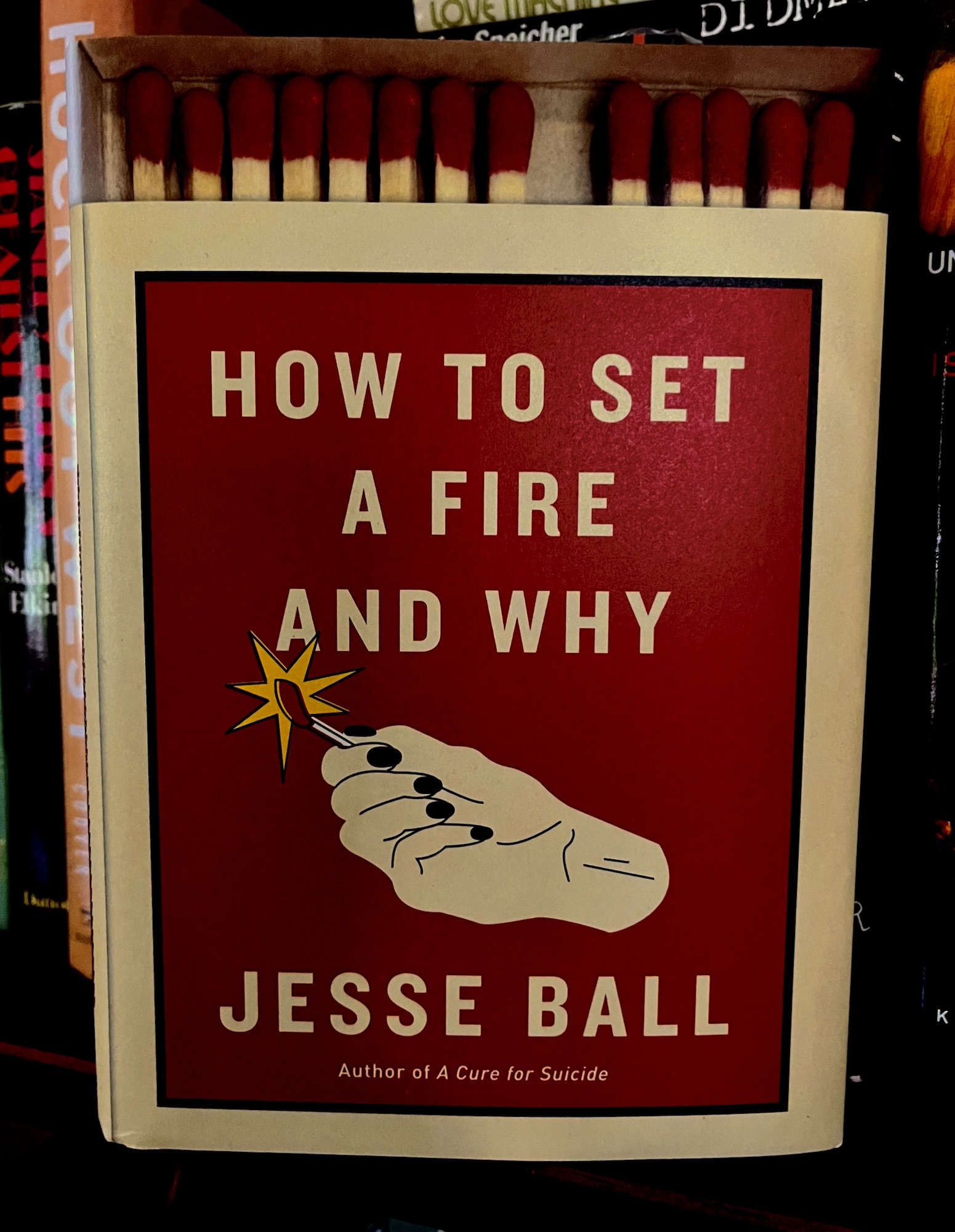
Jesse Ball’s 2016 novel How to Set a Fire and Why covers a few tumultuous months in the life of Lucia Stanton, anarchist daughter of anarchist parents, now living with her aging anarchist aunt after the death of her (anarchist) father and subsequent mental breakdown and institutionalization of her (anarchist) mother.
The narrative begins with the aftermath of Lucia’s expulsion from school for stabbing a classmate with a pencil. The classmate’s crime? Touching Lucia’s lighter, a capital offense. I wrote Lucia’s lighter, but she—Lucia, the first-person narrator of Jesse Ball’s 2016 novel How to Set a Fire and Why—she always refers to it as her father’s lighter: “His corpse is actually on it—I mean, not his death corpse, but his regular one, the body that falls off us all the time. It’s what I have left of him, and I treasure it.”
So Lucia’s off to a new school, trailed by rumors of graphite-based violence that don’t help her win new friends. Her poverty doesn’t help her popularity either (did I mention that she and her aunt are practicing anarchists?) But she’s in luck, sorta, because she hears that this school has a “Sonar Club”:
I’m sure that doesn’t mean anything to you. You’re wondering, why is she happy about some Sonar Club. That doesn’t sound even remotely fun. Well, I have a friend—I do—who told me about something he heard about from someone else—and what it is, is this:
Right now, there are clubs forming up all over the country. They call themselves sonar clubs, or even radio clubs—but what they are is clubs for people who want to set fires, for people who are fed up with wealth and property, and want to burn everything down.
S – O – N – A – R = A – R – S – O – N
And there’s the essential surface conflict of How to Set a Fire and Why: will Lucia, like, shift her collectivist-anarchist ideals toward something more, uh, destructive? Will she burn it all down?
The real plot of the book though is about a teenage girl going through some shit. Lucia is sharp, witty, but caustic and clearly depressed. She is also incredibly observant and very, very intelligent. Ball’s greatest strength in the novel is harnessing Lucia’s spiky but vulnerable intellect; we ride her first-person narration persuaded by her maybe-genius, but also aware of all of her blind spots. Teens know the Truth, but the Truth often blinds them to reality. Not that Lucia isn’t self-aware; consider her take on her own intellect:
My aunt says that I am naturally curious. That means that I don’t need to be taught how to learn. Some people have a disadvantage at the beginning, and they are not curious. These people have trouble learning. It seems like not being curious is the worst thing of all. Curious people aren’t necessarily good at learning what you want them to learn, though. They are too busy learning about other things.
The best bits of How to Set a Fire let Lucia riff on her observations. There’s a poignant detailed description of her father’s lighter (“My father’s is matte black and has a white dot in the center. I haven’t seen another like it”). There’s an explanation and analysis of the rules of cee-lo, which Lucia decides exploits outsiders. She praises both My Dinner with Andre and the music of Erik Satie. She makes predictions and shares their outcomes. She has sex and takes drugs. She visits her mother at the institution. She’s afraid a lot, and probably with good reason: “When I think about what my future holds, it is a bit like looking into the sun. I flinch away, or I don’t and my eyes get burned down a bit, like candles, and then I can’t see for a while.”
Most of Lucia’s observations are about people: I did not count the nouns in the novel, but I imagine people would have to be up there as one of its most common words. A representative sample might be this early simple nugget: “History is just people behaving badly.” Lucia is cynical, sure, and with good reason. How to Start a Fire often echoes the coming-of-age cynicism of The Catcher in the Rye, whose narrator was also flawed and intelligent and blind to what he could not see. (We are all of course blind to what we cannot see.) But Lucia’s not entirely unforgiving. “People aren’t all horrible. They aren’t. Sometimes you find a good one, at least for a while—even if it’s just for twenty minutes or so,” she concedes.
Lucia’s voice is the reason to read How to Start a Fire. It’s compelling and funny and persuasive and hurt. It seems authentic, and I admire the risk Ball has taken—it’s not easy to write a teenage girl who is also maybe-genius-would-be-arsonist. The plot proper of How to Start a Fire never really commits to anarchism or revolution however—sure, things happen—but we never really find out why Sonar Clubs might be taking off around the nation, let alone, like, how Lucia fits into all that. But I don’t think that’s really what Ball is doing here—I think he’s marking off a measure of time in a character’s life:
When people write books about childhood, and about being a kid—they always talk about how endless it is, and about how there is no thought of time. Everything just stretches and stretches. I think the opposite is the case. When you’re young, you feel like things are constantly ending. As soon as you get used to something, it goes away.








 Biblioklept