“James Joyce” — James Huneker

“James Joyce,” a chapter from James Huneker’s collection of criticism, Unicorns (1917).

Who is James Joyce? is a question that was answered by John Quinn, who told us that the new writer was from Dublin and at present residing in Switzerland; that he is not in good health—his eyes trouble him—and that he was once a student in theology, but soon gave up the idea of becoming a priest. He is evidently a member of the new group of young Irish writers who see their country and countrymen in anything but a flattering light. Ireland, surely the most beautiful and most melancholy island on the globe, is not the Isle of Saints for those iconoclasts. George Moore is a poet who happens to write English, though he often thinks in French; Bernard Shaw, notwithstanding his native wit, is of London and the Londoners; while Yeats and Synge are essentially Celtic, and both poets. Yes, and there is the delightful James Stephen, who mingles angels’ pin-feathers with rainbow gold; a magic decoction of which we never weary. But James Joyce, potentially a poet, and a realist of the De Maupassant breed, envisages Dublin and the Dubliners with a cruel scrutinising gaze. He is as truthful as Tchekov, and as grey—that Tchekov compared with whose the “realism” of De Maupassant is romantic bric-à-brac, gilded with a fine style. Joyce is as implacably naturalistic as the Russian in his vision of the sombre, mean, petty, dusty commonplaces of middle-class life, and he sometimes suggests the Frenchman in his clear, concise, technical methods. The man is indubitably a fresh talent.

Emerson, after his experiences in Europe, became an armchair traveller. He positively despised the idea of voyaging across the water to see what is just as good at home. He calls Europe a tapeworm in the brain of his countrymen. “The stuff of all countries is just the same.” So Ralph Waldo sat in his chair and enjoyed thinking about Europe, thus evading the worries of going there too often. It has its merit, this Emersonian way, particularly for souls easily disillusioned. To anticipate too much of a foreign city may result in disappointment. We have all had this experience. Paris resembles Chicago, or Vienna is a second Philadelphia at times; it depends on the colour of your mood. Few countries have been so persistently misrepresented as Ireland. It is lauded to the eleventh heaven of the Burmese or it is a place full of fighting devils in a hell of crazy politics. Of course, it is neither, nor is it the land of Lover and Lever; Handy Andy and Harry Lorrequer are there, but you never encounter them in Dublin. John Synge got nearer to the heart of the peasantry, and Yeats and Lady Gregory brought back from the hidden spaces fairies and heroes.

Is Father Ralph by Gerald O’Donovan a veracious picture of Irish priesthood and college life? Is the fiction of Mr. Joyce representative of the middle class and of the Jesuits? A cloud of contradictory witnesses passes across the sky. What is the Celtic character? Dion Boucicault’s The Shaughraun? Or isn’t the pessimistic dreamer with the soul of a “wild goose,” depicted in George Moore’s story, the real man? Celtic magic, cried Matthew Arnold. He should have said, Irish magic, for while the Irishman is a Celt, he is unlike his brethren across the Channel. Perhaps he is nearer to the Sarmatian than the continental Celt. Ireland and Poland! The Irish and the Polish! Dissatisfied no matter under which king! Not Playboys of the Western World, but martyrs to their unhappy temperaments. Continue reading ““James Joyce” — James Huneker”

The Inhumanity Museum


Scissors, Richard Diebenkorn

Near the end of the first cycle-section of Doris Lessing’s novel The Golden Notebook, protagonist Anna Wulf abandons the pretense of personal narrative in favor of pastiche, collage, clipping. Our heroine cuts and pastes material directly from the newspapers she’s been reading into her blue notebook:

[At this point the diary stopped, as a personal document. It continued in the form of newspaper cuttings, carefully pasted in and dated.]

March, 50

The modeller calls this the ‘H-Bomb Style’, explaining that the ‘H’ is for peroxide of hydrogen, used for colouring. The hair is dressed to rise in waves as from a bomb-burst, at the nape of the neck. Daily Telegraph.

July 13th, 50

There were cheers in Congress today when Mr Lloyd Bentsen, Democrat, urged that President Truman should tell the North Koreans to withdraw within a week or their towns would be atom-bombed. Express.

July 29th, 50

Britain’s decision to spend £100 million more on Defence means, as Mr Attlee has made clear, that hoped-for improvements in living standards and social services must be postponed. New Statesman.

Aug. 3, 50

America is to go right ahead with the H Bomb, expected to be hundreds of times more powerful than the atom bombs. Express.

The passages continue for pages in the same vein until:

30th March 2nd H-BOMB EXPLODED. Express.

This section of The Golden Notebook fits neatly into what I’ve come to think of as the Inhumanity Museum. The writer clips from the newspaper and passes those fragments to the author, who tosses them to the speaker, the narrator, a character, perhaps—and asks: What to do with these? Can you believe this? Are there even words for this? 

Which is the appeal to the writer, I think, of clippings that belong to the Inhumanity Museum: That the journalist telegraphs (plainly, simply, succinctly) what the novelist may deem ineffable.

I’ve appropriated the term the Inhumanity Museum from William H. Gass’s novel Middle C:

The gothic house he and his mother shared had several attic rooms, and Joseph Skizzen had decided to devote one of them to the books and clippings that composed his other hobby: the Inhumanity Museum. He had painstakingly lettered a large white card with that name and fastened it to the door. It did not embarrass him to do this, since only he was ever audience to the announcement. Sometimes he changed the placard to an announcement that called it the Apocalypse Museum instead. The stairs to the third floor were too many and too steep for his mother now. Daily, he would escape his sentence in order to enter yesterday’s clippings into the scrapbooks that constituted the continuing record:

Friday June 18, 1999

Sri Lanka. Municipal workers dug up more bones from a site believed to contain the bodies of hundreds of Tamils murdered by the military. Poklek, Jugoslavia. 62 Kosovars are packed into a room into which a grenade is tossed. Pristina, Jugoslavia. It is now estimated that 10,000 people were killed in the Serbian ethnic-cleansing pogram..

There is more

Tomato and Knife, Richard Diebenkorn

I’m still not sure exactly how the Inhumanity Museum fits into Middle C’s tale of fraud and music. Maybe it’s just Gass’s excuse to unload some of the material he’s been clipping for years. (Maybe I need to reread Middle C).

Here is Gass, in a 2009 interview, discussing William Gaddis (the emphasis is mine): 

We were very close, even though we spent most of our time apart. I really had the warmest… We had great times. We both had the same views: Mankind, augh hsdgahahga!!!!. And he would read the paper and make clippings out of it. He was always saying, “Did you read…!?” We would both exalt in our gloom.

“Mankind [unintelligible]!” Ha! Continue reading “The Inhumanity Museum”

Riff on Aronofsky’s Noah

1. Noah continues director Darren Aronofsky’s streak of making films that I will never watch more than once.

2. (The film is new on DVD &c.; I dutifully missed in the theater).

3. (Although I did see Aronofsky’s first feature Pi in the theater—at my university’s student union. I liked the claustrophobic paranoia of Pi, but the film was also silly, histrionic even, and I did not understand the film’s handling of metaphysics—mostly because the film does not understand its own metaphysical vision).

4. (Noah, for its part, does seem to understand its own metaphysical vision; or, rather, it understands a version of its own metaphysical vision).

5. Aronofsky’s Noah takes place in a post-apocalyptic landscape: Cities are failing, the world is barren, dry, the ground seems to be comprised of basalt and ash. The people in his Prediluvian world use a mishmash of technologies, some of which seem fairly advanced (strip-mining, metallurgy, advanced textiles, etc.)—but these technologies also seem stymied, stuck, abortive last grasps at progress. Noah looks at times like a Mad Max film, or even Hillcoat’s adaptation of The Road.

6. Aronofsky’s Noah is a post-apocalyptic pre-apocalypse film.

7. Aronofsky’s Noah attempts an answer to both Adam and Eve’s expulsion from Eden and Cain’s murder of Abel.

8. Aronofsky’s Noah foregrounds the radical infanticide at the heart of the flood myth. 

9. From A. Samuel Kimball’s The Infanticidal Logic of Evolution and Culture:

. . . when he promises never again to subject the world to such destruction, God memorializes the irreversibility of his massively -cidal violence and binds the future that will transpire to the futurity that will now never come to pass. Indeed, God destroys an infinite number of futures with the respective deaths of the Flood’s victims, for whom the waters of the Flood will never stop flooding, never cease obliterating the future. When he ratifies his promise in the covenant with Noah and his descendants, God inscribes the future reproductivity of the Noahic lineage in the limitless infanticidism of the Flood.

10. Aronofsky’s Noah gains most, if not all, of its moral tension in depicting Noah’s attempt to negate the future reproductivity of the Noahic lineage.

11. Should humanity be allowed to exist after The Flood? is Noah’s (and Noah’s) central question. Aronofsky’s answer to this question is, I think, ultimately ambiguous. While Noah’s own infanticidal violence (an extension of his attempt to prevent his sons from begetting offspring) is suspended (by love!), Aronofsky represents this suspension with ambivalence. Noah, drunk in a cave, invites us to look on his naked failure. 

12. Aronofsky’s Noah is most successful as a kind of failed boilerplate color-by-numbers summer-popcorn-big-budget-action flick. It’s just too weird to fully adhere to its formula, but it hangs together by the formula nonetheless, jostling, uneasy. 

13. Aronofsky’s Noah features giant fallen angels encased in rock. These golems are probably the signal special effect of the film, and a sore reminder of the pervasive influence of the special effects battle sequences in Peter Jackson’s Lord of the Rings

14. This was easily my favorite sequence of Noah:

15. (And yet that sequence still suffers from a kind of queasy supernatural cheesiness that infects Aronofsky’s work).

16. After watching the film, I sought reviews, which led me quickly to John Nolte’s paranoid (and unintentionally hilarious) take on the film at the right-wing website Breitbart. Nolte clearly enjoyed the film and he repeatedly praises its techniques, production values, and acting, but condemns it as “blasphemous” in depicting God as “some kind of tree-hugger.” “Aronofsky is the anti-Michelangelo,” Nolte declares, “a master craftsman using his talents to a dishonest and wicked end.” That wicked end is “using the story of Noah to twist Christianity into something it is not…[Noah is] a genius piece of propagandizing that is sure to lead many away from God under the mistaken belief that through left-wing environmentalism they are coming closer to Him.”

Nolte’s strident praise/condemnation is hilarious and hyperbolic.

Does he actually believe that this movie is aesthetically affecting enough to motivate any kind of change in belief?

17. (Reviews like Nolte’s are important to me because they help to remind me of the subjectivity of aesthetic experience. He saw a completely different film (with his completely different eyes) than I did).

18. My favorite Aronofsky film, and the only one that I would consider watching again, is The Fountain. I think that The Fountain might be a kind of precursor film to Noah, a trial-run even, although I have no evidence for this claim.

19. I started this riff with the claim that I have no desire to rewatch Aronofsky’s films, and that Noah continues this pattern. Aronofksy is an auteur, and like most auteurs, I’m sure rewatching his films would enrich an understanding of the themes and problems he’s trying to address. However, I find his films repulsive, by which I mean the opposite of compelling. I have never wanted to exit a fictional world as much as I wanted to escape Requiem for a Dream. I found The Wrestler depressing and empty. I’m afraid if I watch Black Swan again it will turn out that Aronofsky was actually not attempting to make a comedy about psychosis, but was rather actually serious about his melodrama’s tragic scope.

20. Noah isn’t repulsive, but it isn’t great either. Flawed doesn’t even begin to describe the film—yes, it survives its own competing impulses of spectacle-bombast and introspective-character-study, but never synthesizes them. It’s unclear who the film is for. The film resolves in a moment of supposed-uplift, positing “love” –of offspring– as a solution, but it also binds that solution/blessing in the cursing of offspring.

Both of these moments feel wholly inauthentic. In the end, what remains is the bitter aftertaste of Noah’s contempt—and his anxiety at failing to create a utopia devoid of humans.

Under the Skin Riff

IMG_2027

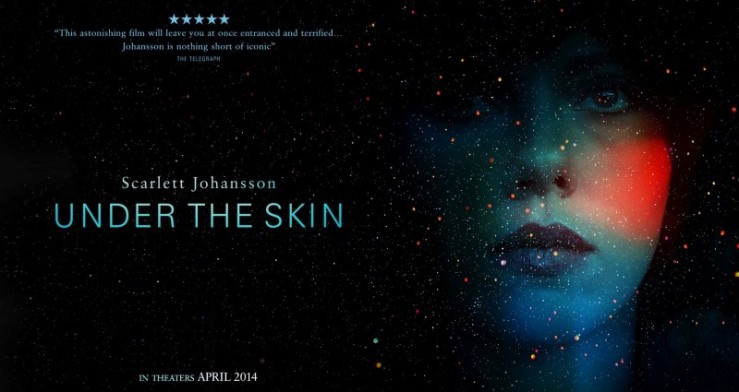
1. I hadn’t read a review of Under the Skin until after I watched it, but I had gleaned an idea of it based on taglines and posters—something like “Scarlett Johansson as a sexy alien seducing men in Scotland.”

2. That is not what the film is.

3. Under the Skin is an aesthetic experience. Now, this phrase, aesthetic experience, this phrase is extremely pretentious, and the way I’ve used it here also strikes me as pretentious, and even worse, not particularly clear. Any film could be described as an aesthetic experience. Films are, after all, simply light and sound.

4. Under the Skin is best experienced as light and sound—as aesthetic.

5. I’ve neglected to mention the film’s director, Jonathan Glazer, who directed another film I love, Sexy Beast.

6. For Under the Skin, Glazer adapted Michel Faber’s novel of the same name. I haven’t read the book, but a cursory cruise over its Wikipedia page suggests that Glazer dissolved most of the plot, keeping just the frame, or the idea of a frame for his film.

7. What I liked most about Under the Skin: The film is not really about anything. The film just happens. 

8. Point 7 is a terrible description! Of course the film is about something—but its themes and motifs are overdetermined and underexplained—or not explained at all.

9. There is very little dialogue in the film—no exposition or explanation for what’s happening, let alone a conversation that might guide the audience to how to think or feel about what’s happening.

10. (Okay: This is not entirely true, but it is mostly true. There is a key conversation, if it can be called that, between Johansson’s unnamed character and a man with a deformed face). 

11. The bits of dialogue that do evince often seem unscripted and random. The men Johansson’s character picks up speak in thick Scottish accents, their voices often obscured behind a din of traffic, buzz of music, or the thick glass windows of the van she drives around in. 

12. (A favorite moment of auditory distortion in Under the Skin: In a domestic scene, in a kitchen, cleaning up, a man turns on his radio and just-barely tunes in a station. Deacon Blue’s “Real Gone Kid” plays through a hazy crackle. Lovely).

13. The sound mixing in the film is beautiful—waves crashing, the clip-clop of horse hooves on a high road, the wind blowing heavy through tall evergreens—these auditory cues mix in with Mica Levi’s creepy, lush score, which channels Krzysztof Komeda’s work and Bernard Herrmann’s Psycho score through Portishead and Loveless

Scarlett Johansson Under the Skin

14. Sound and light—those shots: Cinematographer Daniel Landin is the secret star of the film. Every shot is gorgeous, painterly, and if Glazer often allows a scene to linger just past an acceptable threshold, it’s because he’s in love with the film’s dark beauty. 

15. (And/or: Glazer lets his shots linger so long to provoke the viewer into a kind of hypnotic discomfort).

16. The film’s early visual references to Kubrick’s 2001 are a bit on-the-nose—too on-the-nose, too expected. As the film progresses, the shots take their cues not from Kubrick’s sci-fi classic, but his most painterly film, Barry Lyndon

17. (Under the Skin also reminded me of Upstream Color, Moon, The Man Who Fell to Earth, Tree of Life, and Morvern Callar).

18. The film is best enjoyed, as I’ve said, as an aesthetic experience, art, if that’s the word you like. I think that viewers who attempt to impose their own narrative logic on the film will attune their energy to the wrong frequency. Let the aesthetic happen.

19. (The beach sequence in this film is one of the best scenes I’ve watched in a long, long time).

20. I have completely and purposefully neglected to mention anything about the plot, because I do not think the plot, in the sense of plot-as-arrangement-of-action matters to the film. The film’s aesthetic is the plot.

21. And Under the Skin’s aesthetic is the film’s theme. This film is about seeing, hearing. Touch, taste, smell.

You can boil that down to whichever theory floats your boat—the male gaze, alienation, othering, sexual subversion, radical feminism, etc.—but I think that imposing any schema, any deep reading here, may be a way of anesthetizing the film’s aesthetic.

22. Highly recommended.


Kevin Thomas Discusses His Illustrated Book Reviews with Biblioklept

Kevin Thomas’s new book Horn! (from OR Books) collects the book reviews he’s been doing for the past few years at the Rumpus. Kevin reviews new books (and occasionally reissues) in comic strip form. Over a series of emails, Kevin talked with me about his process, how he got started, the books that have stuck with him the most over the years, and his theory that The Life Aquatic with Steve Zissou is a secret remake of Three Amigos!  Find Kevin on Goodreads,Twitter, and Tumblr.
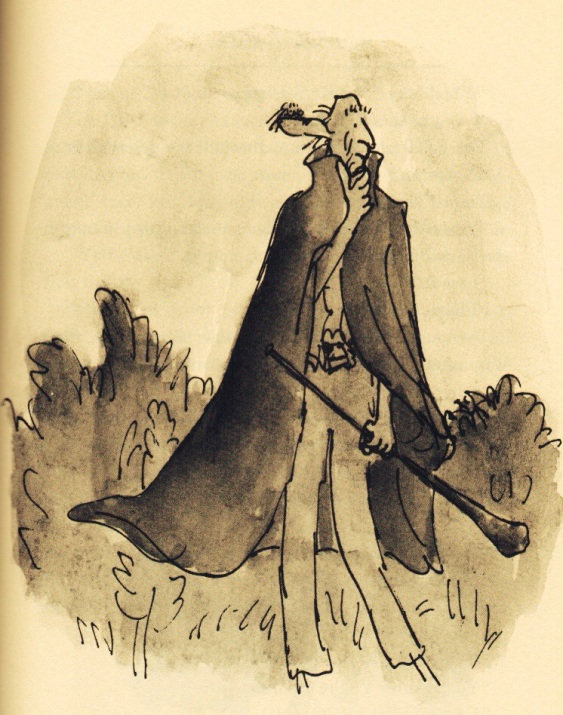
Biblioklept: You’ve been reviewing books at The Rumpus for a couple of years now in your strip Horn! How did the strip start? Did it start with The Rumpus, or before?

Kevin Thomas: I had been making these primitive autobiographical webcomics under the “Horn!” moniker for about a year when The Rumpus Book Club started. One of the selling points of the book club was that if you reviewed a book and the editors liked it, they’d publish it on the site. So I dedicated one comic a month to reviewing these books, and after the third submission was accepted, The Rumpus asked me if I wanted to make it a regular strip.

Biblioklept: What other kinds of comics did you make before that? Did you have any training or background in cartooning?

KT: No, I was trained, to put it generously, to be a composer. Before that I wanted to be a poet. I had great teachers in both of those fields, but never even thought about taking a studio art class. Maybe the fact that I hadn’t yet tried and failed at comics was what drew me to it. Continue reading “Kevin Thomas Discusses His Illustrated Book Reviews with Biblioklept”

Snowpiercer Riff

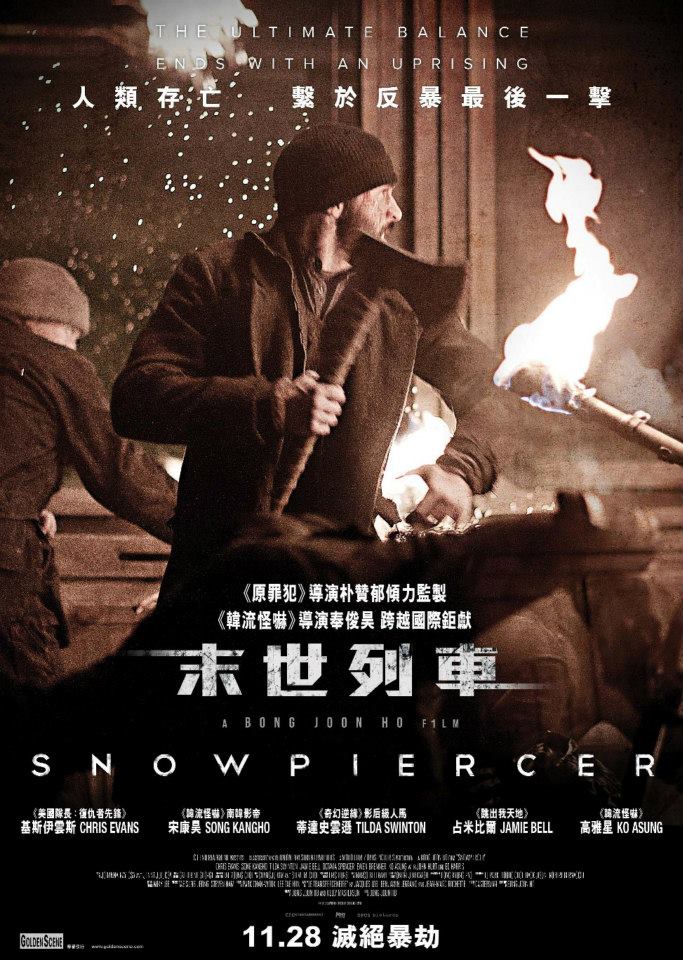
snowpiercer-hong-kong-poster

1. Snowpiercer, 2013, directed by Bong Joon Ho and produced by Park Chan Wook, is a sci-fi dystopian set on a mega-train, where the vestiges of humanity survive, protected from the new ice age outside. The plot involves the third-class passengers’ revolt against the elites who enjoy a privileged life at the head of the train. Etc.

2. You’ve seen this movie before, read this book before. You’ve played this video game.

3. Metropolis, Soylent Green12 MonkeysHalf-Life 2The Time Machine, the MaddAddam trilogy, Children of Men, BioShockZardozLogan’s Run, Brave New World, BrazilThe City of Lost ChildrenBad Dudes, Die HardThe Polar Express, etc.

4. Points 2 and 3 are lazy writing, and Snowpiercer deserves better. Although the film is not especially original, it does have a clear point of view, its own aesthetics, and an engaging, energetic rhythm, powered by strong (if purposefully cartoonish) performances from its cast.

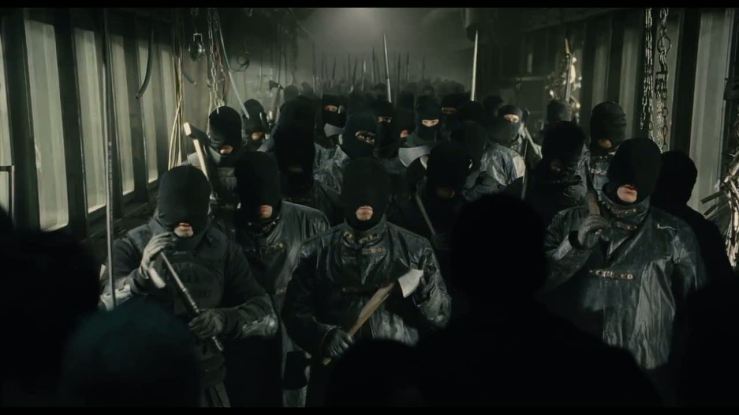
5. Snowpiercer is essentially structured like a video game. The heroes, a rebel alliance led by Chris Evans (Captain America, looking like The Edge from U2 for half the film), clear each train car—each game board—before moving on to the next challenge. An early standout scene involves a fight with a band of ninjas who for some reason ritually slaughter a fish before battle (the scene echoes the famous hammer hallway fight in Old Boy, a film directed by Snowpiercer producer Chan Wook Park). 

snowpiercer-trailer-2

6. The simple narrative structure of Snowpiercer allows the filmmakers to highlight the plot’s allegorical dimension. Highlight is the wrong verb: What I mean to say is hammer. Snowpiercer is not especially subtle in its critique of capitalism, with the engine that powers the train as a metaphor for capitalism itself—the engine determines the form of the train which in turn shapes the form of the society that must live in the train.

7. At Jacobin, Peter Frase offers a strong argument that the film challenges the entire system of capitalism and ultimately advocates transcendence of the system—not internal revolution.

8. While I think Frase’s essay offers a compelling analysis, I think that he simply wants the film to be better than it is. Snowpiercer, despite an apparent subversive streak, is still a Hollywoodish spectacle of violence and noise. It cannot transcend its own tropes (it can’t even revolutionize them). The vision of transcendence it offers is a rhetorical trick; not only that, it’s a stale trick, one that we can find at the end of any number of dystopian fictions: The exit door, the escape hatch, the way out.

9. I want to talk about that exit door—the end of the film: so major spoilers ahead. Continue reading “Snowpiercer Riff”

The BFG, Roald Dahl’s Love Letter to His Lost Daughter

20140706-210704-76024020.jpg

Roald Dahl’s 1982 children’s classic The BFG begins with a dedication to the author’s daughter: “For Olivia: 20th April 1955 — 17th November 1962.”

If I had noticed the dedication when I first read The BFG as a child, I certainly didn’t think about it then. The slim sad range of those dates would have meant nothing to me, eager as I was to dig into a book about child-eating giants, secure in my own childish immortality. However, when I started reading the book with my daughter, the dedication howled out to me, thoroughly coloring the lens through which I read.

Had Olivia Twenty Dahl not died from measles encephalitis at only seven, had she continued to live to be alive now, she would be approaching her sixtieth birthday. But because she died as a seven-year-old little girl, she remained a seven-year-old little girl to me, the reader, who saw her spirit under every page. 

I believe she remained a seven-year-old little girl for Dahl as well—at least in the imaginative world of The BFG where she is recast as the hero Sophie. Reading The BFG, it was impossible for me not to immediately connect Sophie to Olivia, those names with their Greek roots and their long O‘s. It was also impossible for me not to connect these two girls to my own daughter Zoe, who is also seven.

(Parenthetically, I’ll admit that biographical interpretation of literature is often a terrible practice—especially when combined with a touch of reader-response criticism—and that what I am doing here is not something I think advisable, let alone commendable. And yet the central affective power for me in reading The BFG—as an adult to my little girl—rests in my inescapable intuition that Dahl wrote the book to make his daughter live again, to live forever). Continue reading “The BFG, Roald Dahl’s Love Letter to His Lost Daughter”

The Cranky Brilliance of Dwight Macdonald | Masscult and Midcult Reviewed

20140625-134004-49204118.jpg
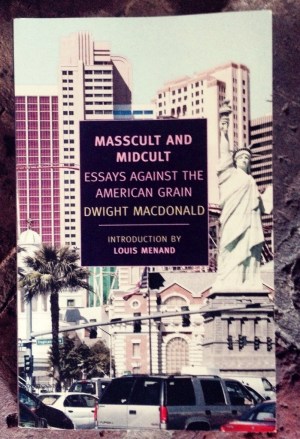
Masscult and Midcult: Essays Against the American Grain
 (NYRB) collects ten pieces by cultural critic Dwight Macdonald. First published between the late 1950s and the early 1970s, the essays here feature varied subjects, always attacked through the same critical lens. Whether he’s excoriating late-period Hemingway, deriding structural linguistics, lamenting the Revised Standard Version of the Bible, or chewing up a now-forgotten bestseller, Macdonald centers the brunt of his attack on the creeping “impostures and vulgarizations” of what he called Masscult and Midcult.

In “Masscult and Midcult,” the longest and perhaps most effective essay in the collection, Macdonald defines, illustrates, and analyzes his neologisms against the historical backdrop of a rising commercial culture. “Masscult is bad in a new way,” he tells us,” it doesn’t even have the theoretical possibility of being good . . . It is not just unsuccessful art. It is non-art. It is even anti-art.” He continues:

Masscult offers its customers neither an emotional catharsis nor an aesthetic experience, for these demand effort. The production line grinds out a uniform product whose humble aim is not even entertainment, for this too implies life and hence effort, but merely distraction. It may be stimulating or narcotic, but it must be easy to assimilate. It asks nothing of its audience, for it is “totally subjected to the spectator. And it gives nothing.

Macdonald views Masscult as the unfortunate inevitability of capitalism and the burgeoning middle class—or, more appropriately, Middlebrow class. Macdonald is deeply concerned with the location of brows, referring to himself as Highbrow throughout the collection (even once casually dropping We highbrows, a little bone to the reader, perhaps). He repeatedly points out that the virtue of Lowbrowness is that the Lowbrow know where their brows are in relation to higher brows. Folk art is not just acceptable, it’s good stuff, important in its hierarchical relationship to High Art. It’s those damn Middlebrows that cause confusion. For Macdonald, Midcult is thus the real threat:

…the danger to High Culture is not so much from Masscult as from a peculiar hybrid bred from the latter’s unnatural intercourse with the former. A whole middle culture has come into existence and it threatens to absorb both its parents. This intermediate form—let us call it Midcult—has the essential qualities of Masscult—the formula, the built-in reaction, the lack of any standard except popularity—but it decently covers them with a cultural figleaf. In Masscult the trick is plain—to please the crowd by any means. But Midcult has it both ways: it pretends to respect the standards of High Culture while in fact it waters them down and vulgarizes them. 

Macdonald uses case samples from Hemingway, Thornton Wilder, Archibald MacLeish, and Stephen Vincent Benet to demonstrate the creeping vulgarity of Midcult posing as High Art.  

Indeed, Macdonald almost always focuses on negative examples, perhaps taking for granted that his audience will be guided to a better understanding of High Culture through…I don’t know? Osmosis? He clearly shows a strong affection for the Modernists (up through Faulkner, with a special love for Joyce and Picasso), but the essays in the collection rarely explore in detail exactly why the good stuff is so good. He comes closest in “Updating the Bible” when he points out that the Revised Standard Version strips too much of the King James Version’s poetic strangeness, poetic strangeness that startles, engages, and demands the attention—the work—of the reader. Elsewhere, he connects the avant-garde of the Modernists to an aesthetic tradition going back to the Renaissance (and Periclean Greece before it), and while these moments are satisfying, they are hardly explored with the same vigor Macdonald applies to pulling away Midcult’s figleaf.

Neither does Macdonald prescribe medicine to go along with his devastating diagnoses. To a reader who felt his criticism should be more constructive, Dwight Macdonald replies: “I’ve always specialized in negative criticism—literary, political, cinematic, cultural—because I’ve found so few contemporary products about which I could be ‘constructive’ without hating myself in the morning.” A succinct summary of the entire book, that.

Something of the force of Macdonald’s personality evinces in that reply, a combative, cranky, brilliant personality that asserts the nuances of its own subjectivity as if they were Aesthetic Law. And Macdonald is so, so, so perceptive, building each case thoroughly on textual grounds—citation, history, context—that make me blush here for not attempting his thoroughness in kind. But that would take more space and time than We Postmoderns should like to allot, no? (Maybe this review would gain more rhetorical force were I to simply make it a list of cat gifs).

Macdonald’s diagnoses remain prescient. His 1958 annihilation of James Gould Cozzens’s novel By Loved Possessed takes to task not just the author, but also the Masscult audience that made the book a best seller and the Midcult critics who sanctified the book’s artistic merits. With a few simple substitutions, the essay might be updated to critique Jonathan Franzen’s Freedom. In “The String Untuned,” ostensibly a review of the Third Edition of Webster’s New International Dictionary, Macdonald complains that the influence of structuralism, whatever merits it may have, has crumbled the authority of lexicography to the point that they “have untuned the string, made a sop of the solid structure of English, and encouraged the language to eat up” previous authorities. Essays like “The Book-of-the-Millennium Club” and “The Triumph of Fact” critique the increasing American tendency to look only for self-improvement in Art—to look for not just the digested form, but the predigested form. A footnote to “Masscult and Midcult” puts it plainly: “the Midcult audience always wants to be Told.” Ours is a time of explainer sites, listicles, speed-reading apps, and “curators” who boil entire works of philosophy down to feel-good quotes aimed at the reader’s desire for self-improvement and self-satisfaction.

Some gaps and miscalculations mar Masscult and Midcult. There’s no reckoning with the approach of postmodernism—or if there is, such a reckoning only evinces in the denial that an artful synthesis of the High and Low might be possible. (It’s worth noting here that Macdonald views Ulysses as a critique of vulgar culture, not a synthesis of vulgar culture. What would he make of Pynchon?). And while Macdonald beats up on poor Norman Rockwell, there’s nothing in the collection that deals with the nascent Pop Art movement. (Perhaps Warhol was too Midcult to merit mention; perhaps Macdonald did write about Pop Art somewhere else). His hatred for rock and roll feels purely reactionary, and his insistence that rock’s superior jazz is a folk art (and not a High Art) is just plain wrong. Also, Macdonald, for all his talk of the avant-garde and challenging comfortable conventions, writes exclusively about white men. There are few mentions of persons of color or women in the collection. I wonder what Macdonald thought of Flannery O’Connor, say, who succinctly echoed his own views when she wrote: “Art never responds to the wish to make it democratic; it is not for everybody; it is only for those who are willing to undergo the effort needed to understand it.”

At the core of these essays though is a cranky brilliance, a burning, engaging intelligence that seeks to upend simple, comfortable assumptions about how we view, interact with, and think about art. Are we to be mere consumers—and not just consumers, but infantilized consumers, baby birds gulping down material that’s already been predigested for us? Or are we willing to put in the work, to dare strong strangeness—to be confused, to not know, to feel discomfort, alienation, newnessMasscult and Midcult doesn’t just evoke these questions, it formally answers them by challenging and provoking, offering a critical rubric for winnowing the wheat from the chaff, or, to use Macdonald’s metaphor, escaping “not only from the Masscult depths but also from the agreeable ooze of the Midcult swamp.” For all the apparent bitterness, there’s something nourishing here. Macdonald’s essays retain a critical power that transcends their ostensible subjects, a power that rips the poseur’s figleaf away. Great stuff.    


Horn! — Kevin Thomas’s Collected Reviews (Book Acquired, 6.14.2014)

20140618-113731-41851102.jpg

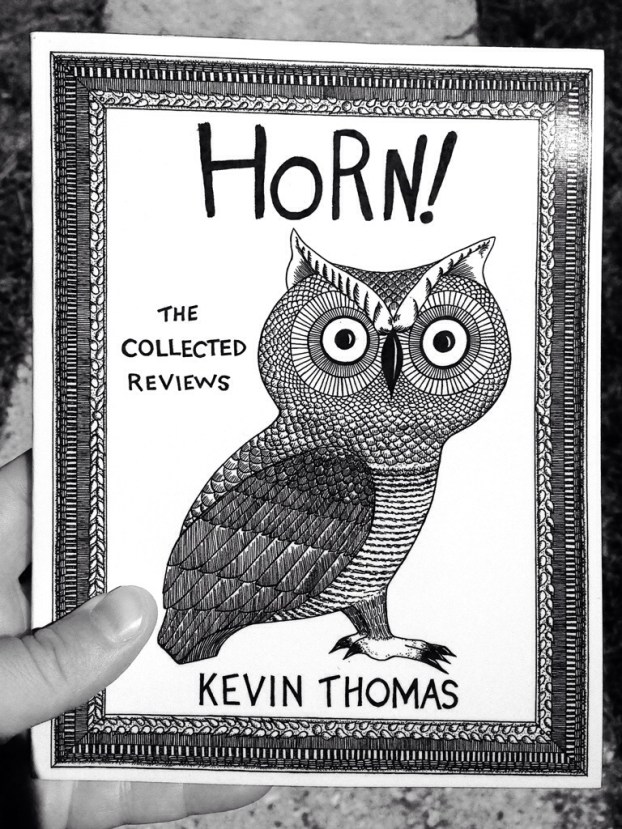
Kevin Thomas has been doing illustrated reviews of contemporary books for The Rumpus for a few years now. Now, the good people of OR Books have published the reviews in one volume—HORN! The Collected Reviews.

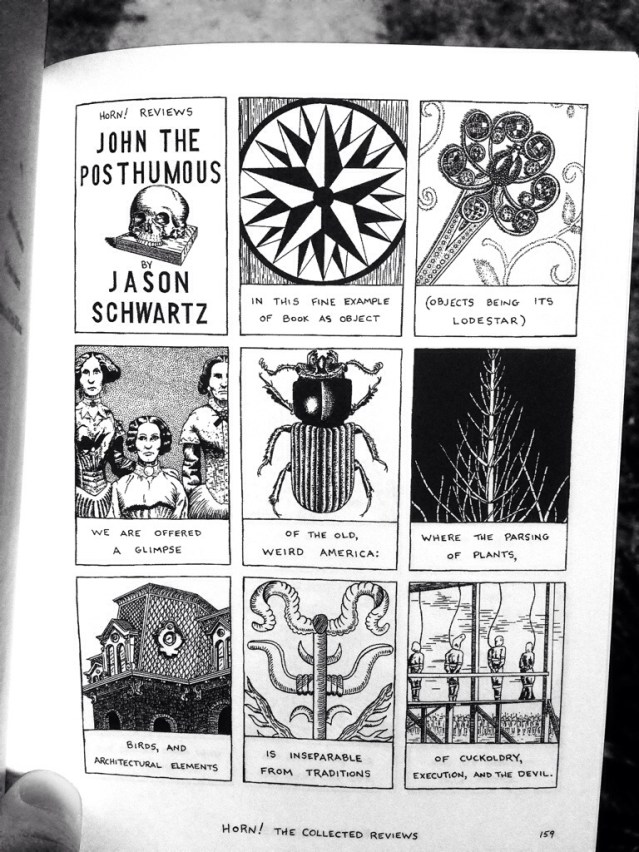
I’d read a few of Thomas’s reviews in the past and always been a bit jealous at his control of his medium—of his ability to go past or through or beyond the language under discussion to provoke with a sequence of images. Reviews is maybe not the right term—commentaries seems more fitting. Take his review of George Saunders’s Tenth of December for example, which manages to condense an overview of the collection’s themes along with a viewpoint on those themes into nine small panels. (I needed over 2000 words for my own review of the Saunders book).

Thomas’s technique works especially well with novels that are very difficult to write about/after, like one of my favorite recent titles, Jason Schwartz’s John the Posthumous. I stammered and hiccuped through my essay; Thomas explicates, illustrates, and piques reader interest—again, in just nine panels.

20140618-113733-41853283.jpg

I’ve been trying to limit myself to just a few strips a day from the collection, but more often than not I’ve failed, curious to see Thomas’s takes on Levin’s The Instructions (a novel I couldn’t finish), Peter Hook’s memoir, Renata Adler’s Speedboat (yes!) and more. Great stuff.

“Go to hell, Roberto” | Roberto Bolaño’s The Unknown University

The Unknown University, Roberto Bolaño’s poetry collection—his complete poems, a bilingual edition, lovely, beautiful, over 800 pages—has been shifted all over my messy house this past month, wedged into ad hoc shelves, even conspicuously, for a time, fatly weighing down another Bolaño text, The Insufferable Gaucho (which I’ve been reading in tandem with/against The Unknown University), swollen and warped with saltwater from the gray Atlantic ocean.

I pecked at The Unknown University discursively, avoiding end notes, taking the rest of the Bolañoverse as my guide or frame or map or background for these poems. I read randomly, trying one poem at a time in no special order, taking crude stabs at the Spanish text on the left hand pages, clumsily matching them against Laura Healy’s fine translation, a poetics that matches the tone and rhythm and cadence and vibe of Bolaño’s other translators, Natasha Wimmer and Chris Andrews.

Then last night, a tale from The Insufferable Gaucho compelled me to read from The Unknown University straightwise, linear, 1-2-3, non-discursively, to take a stab at an orderly trajectory, reading it like a novel in fragments, perhaps.

The book is divided into three parts, each comprised of their own chapters or individual books. Last night I read, or reread, the first half of the first part: The Snow-NovelGuirat de BornelhStreets of BarcelonaIn the Reading Room of Hell.

The examples and citations in this riff come from those books, but I’d suggest that the images, motifs, and themes of these early poems—switchblades, hell, abysses, poets, girls, detectives, assassins, hunchbacks, genitals, sex, madness, blood—resonate throughout the entire volume (and throughout Bolaño’s oeuvre).

Perhaps the most central theme is Bolaño himself; The Unknown University often reads like a diffuse autobiography, with Bolaño’s concern for his own place in literature at the fore.

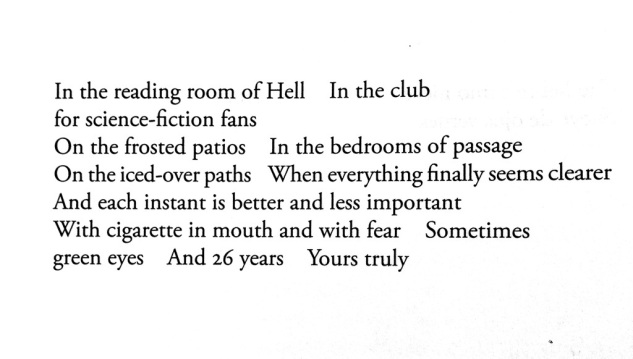
We see that anxiety in the first poem shared by the editors, a piece from 1990 included in the book’s intro:

Even a decade earlier, Bolaño prophesied that he would be carried to hell, a primal setting of the Bolañoverse. Bolaño’s romantic ancestor Jorge Luis Borges famously imagined Paradise as a kind of library. Bolaño inverts that image:

20140609-152831-55711939.jpgIn another poem, Bolaño seems to obliquely address Borges again (“Dear, this isn’t Paradise”), while also name-checking the heroes of that “club / for science-fiction fans” (including some perhaps-unlikely figures):
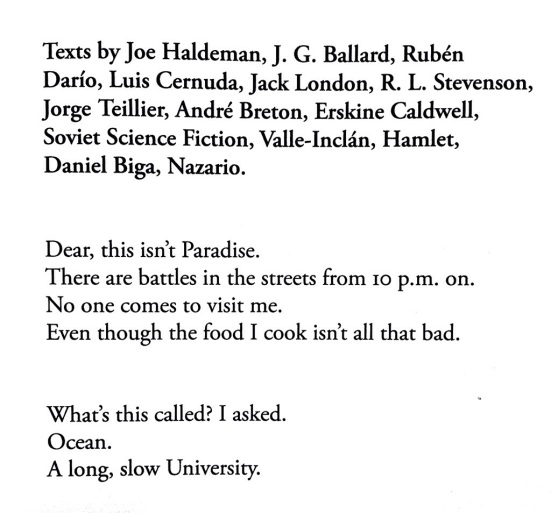
20140609-152831-55711467.jpg“A long, slow University.” Yes.
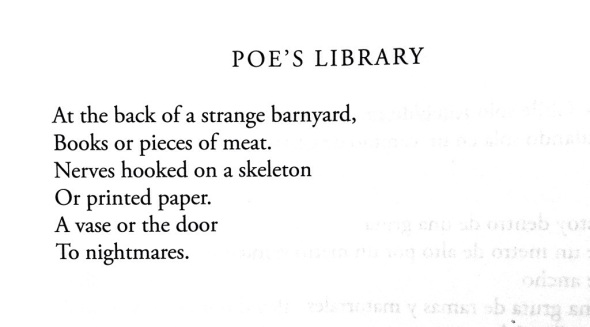
But how could Bolaño leave his hero Edgar Allan Poe from the curriculum? Oh, never mind. Here he is: 

20140609-152830-55710956.jpg

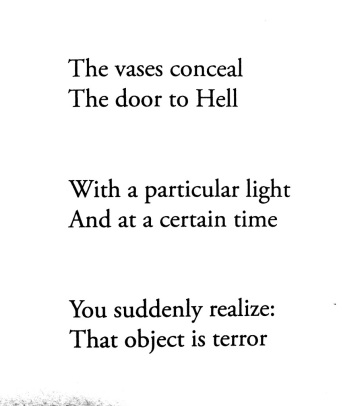
The vase—Pandora’s box, Keats’s urn?—is a central image in these early poems. Dark, beautiful, and transformative, Bolaño seems to posit the vase—an object rendered somewhat mundane in its traditional place as an aesthetic object—as a portal to the abyss:

20140609-152830-55710494.jpg

Elsewhere our poet warns/invites us: “The nightmare begins over there, right there. / Further up, down, everything’s part of the / nightmare. Don’t stick your hand in that urn. Don’t / stick your hand in that hellish vase.” Reading the poem forces us to stick our hand in the vase.

If Bolaño seems occasionally melodramatic in his poems, a thrall to Baudelaire, he’s also keenly aware of it, even this early in his career. A twinning of irony and earnestness characterizes Bolaño’s writing, a savage self-reflexive humor that doesn’t necessarily reveal itself on first reading. When he begins a poem about a lost love, “Go to hell, Roberto, and remember you’ll never stick it in again,” the sentiment is simultaneously tragic and comic, the kind of personal confession that connects to the reader’s own experiences. “To be honest I don’t remember much now,” our narrator confides near the end, before the devastating conclusion, “She loved me forever / She crushed me.”

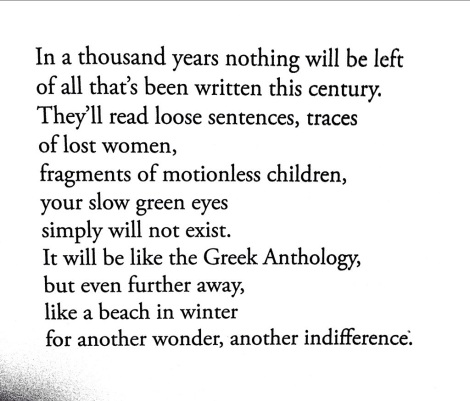
For Bolaño though, what’s perhaps most crushing is the loss of literature:

20140609-161756-58676319.jpg

And yet Bolaño sticks his arm into the vase, walks out over the chasm, dares for his poems to perhaps earn the right to be one of those “loose sentences, traces . . . fragments” that may survive.

In the very early poem “Work,” Bolaño romanticizes his own literary posterity:

Poetry that might champion my shadow in days to come

when I’ll be just a name not the man who wandered

with empty pockets, worked in slaughterhouses

on the old and on the new continent.

I seek credibility not durability for the ballads

I composed in honor of very real girls.

And mercy for my years before 26.

Seems like a reasonable request.

I don’t know if these poems are good or bad or excellent or what. I do know that I loved reading them and that they are of a piece with everything else I’ve read by Bolaño. The best moments recall his best writing, that strange mix of plain, even understated language, set against romantic violence and terrible madness. The poems here don’t distill the best of Bolaño into burning kernels of visceral realism; rather, they feel like the liquid filament of the Bolañoverse. Fantastic.

More to come.

The Unknown University is available now from New Directions.

William T. Vollmann’s Europe Central | A Short Riff on a Long Book

Kilian Eng
Kilian Eng

1. William T. Vollmann’s Europe Central,  811 pages in my Penguin trade paperback edition (including end notes), is a virtuoso attempt to describe or measure or assess or explain or analyze the Eastern front of WWII, a part of the war that in my American ignorance I know, or knew (no, know) so little about.

2. The book covers 1914-1975, most of the composer Dmitri Dmitriyevich Shostakovich’s life. If Europe Central has a hero, it is Shostakovich.

From the book’s last end note, “An Imaginary Love Triangle: Shostakovich, Karmen, Konstantinovaskya”:

When I think of Shostakovich, and when I listen to his music, I imagine a person consumed by fear and regret, a person who (like Kurt Gerstein) did what little he could to uphold the good—in this case, freedom of artistic creation, and the mitigation of other people’s emergencies. He became progressively more beaten down, and certainly experienced difficulty saying no—a character trait which may well have kept him alive in the Stalinist years. In spite of the fact that he joined the Party near the end, to me he is a great hero—a tragic hero, naturally.

That’s Vollmann’s own authorial voice, of course, and there we have perhaps the most concise condensation of Europe Central.

3. Maybe a clarification though: Europe Central is not (just) a fictional biography of Shostakovich: There are many, many other characters that Vollmann uses to power his beast: the Soviet director Roman Karmen and the translator Elena Konstantinovskaya, those other points in the book’s central love triangle; German artist Käthe Kollwitz; Samizdat poet Anna Akhmatova; Generals Paulus (German) and Vlasov (Soviet)—similarly disgraced; SS man Kurt Gerstein, who oversees death camps; there’s Lenin, there’s Stalin. There’s “the Sleepwalker,” one Adolf Hitler. And many, many more.

4. Is Europe Central too big?

No. I don’t think so.

5. I lazily suggested that the book uses Shostakovich as an organizing principle. We could also argue for Operation Barbarossa (Germany’s disastrous invasion of the USSR) as the book’s main thrust. Or, we might say that the book reframes Wagner’s Ring Cycle. Or that it somehow restages Shostakovich’s Opus 40 and Opus 110. (Back to Shostakovich!).

6. Or the telephone! Yes, that totem of modernity, communication, power—the telephone!—the telephone is the central image of Europe Central. Indeed, it initiates the novel: “A squat black telephone, I mean an octopus, the god of our Signal Corps…” That octopus, those tendrils, those lines of communication snake throughout Europe Central.

7. Another description of Europe Central, perhaps, from one of its earliest chapters—

Most literary critics agree that fiction cannot be reduced to mere falsehood. Well-crafted protagonists come to life, pornography causes orgasms, and the pretense that life is what we want it to be may conceivably bring about the desired condition. Hence religious parables, socialist realism, Nazi propaganda. And if this story likewise crawls with reactionary supernaturalism, that might be because its author longs to see letters scuttling across ceilings, cautiously beginning to reify themselves into angels. For if they could only do that, then why not us?

8. Was that enough of Vollmann’s language for this short riff?

No?

I shared various citations from Europe Central on Biblioklept as I read it, even riffing a bit now and then. Check out some of Vollmann’s strange, wonderful prose—it’s far more convincing than anything I can write about his book.

So:

On parables and their value

On Käthe Kollwitz, who kept painting poor people.

On the assurance of a sleepwalker.

On the musicality of a weeping son.

On the more-than-real reality of representations of reality.

On monarchs, murderers, martyrs, lunatics, perverts, etc.

On abjection.

On lending books as one of the purest expressions of love.

10. I left off from the list above one of the finest passages in the book, a section where the unnamed “I” narrator of some of the Soviet sections of Europe Central shifts into Shostakovich’s consciousness, and then, perhaps, into Vollmann’s own authorial voice—and then back. The narratological dimensions here are too big to suss out in my lazy riff, but I find the passage’s main thrust one of the most compelling issues of modern art (or Modern Art, if you prefer): Can art use irony to conceal its true feelings? Can love be self-ironic? And if so, how does this complicate the truth of the expression?

I think this matters because Vollmann thinks this matters—put another way, Vollmann believes in Art and Truth and, significantly, in Love, and the power of love against the backdrop of totalitarianism, despotism, murder, privation, starvation, rape, maiming, gas chambers, mass graves, infanticide, total war…

11. What Vollmann achieves in Europe Central, through the reality and fictionality (and reality of the fictionality of the reality) of his characters, is a language of love. Vollmann posits love, or the possibility of love, or the possibility of imagining the possibility of love, as a response to despair.

12. Point 11 is maybe a way of saying that Europe Central is about so much more than central Europe during WWII—but if you’re at all familiar with Vollmann, gentle reader, of course you’d expect that. Still, I learned a lot about a subject which I thought I knew something about.

Whether or not Vollmann is a generous writer depends on your perspective—you’re swimming in the deep end here, and many of the connections between the different sections don’t cohere until you’ve got the hang of the book. But once you get the hang of it—once you learn to read it—Vollmann’s generosity is almost overbearing in its profundity. How did he research it, do all the reading that went into it, and still make all the voices sing? How? 

13. Europe Central is probably not the best starting place for Vollmann, but I think it will appeal to fans of certain giant polyglossic postmodern novels. I’ll admit to a predilection for WWII metafictions, too, but I can’t really anticipate how readers of historical fiction might regard what Vollmann does here. Can I end by writing Highly recommended? I don’t know. I’m not sure who this book is for… but I loved it.

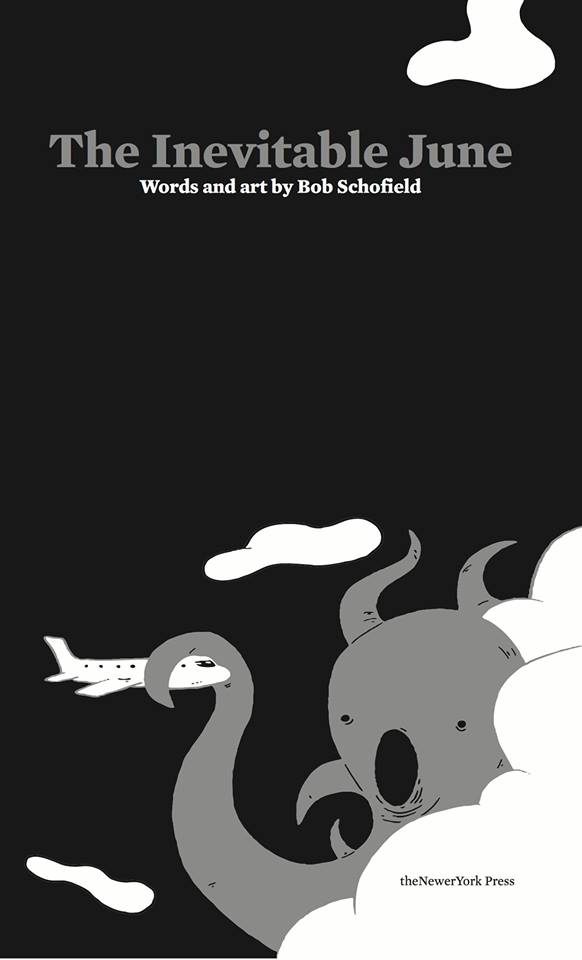
The Beautiful Weirdness of Bob Schofield’s The Inevitable June

TIJ-COVER

Bob Schofield’s The Inevitable June continues theNewerYork Press’s dedication to beautiful weirdness. They’ve billed The Inevitable June as “words and art,” which is truth in advertising, yes, but is also a way of avoiding putting a label on this strange little book.

Is it a comic? A novella? A thought experiment? A prose-poem? A flip-book? Something entirely new? Yes.

But entirely new is wrong too, because, as the billing states, what we’ve got here are those ancient raw elements of storytelling, words and pictures, resynthesized into something that, in its strangeness, evokes newness and surpasses novelty. 

2

An initial simplicity of form, both in written and drawn line, allows the reader’s consciousness to slip into the strangeness of June. We begin with a simple black-on-white square (emblem of a page or a screen? (or hey man it’s just a square?)) which turns into a cube, or a box rather, one side open (a door; a window) its interior obscured. Should the reader stick his head in? Yes. The book seems to take place in this box, an imaginative dream-machine that we might recall from a childhood or two. 

What follows is an almanac of tragicomic weirdness, each entry logging the events of a new morning in an eternal June.

1

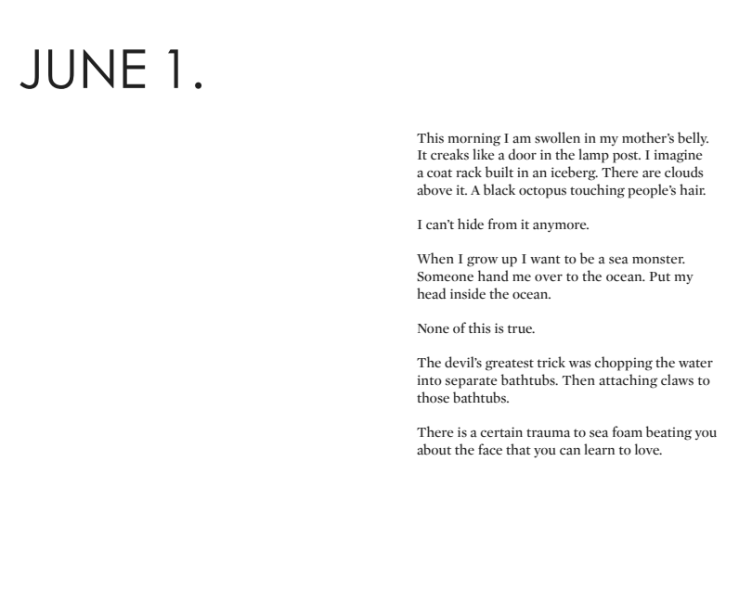
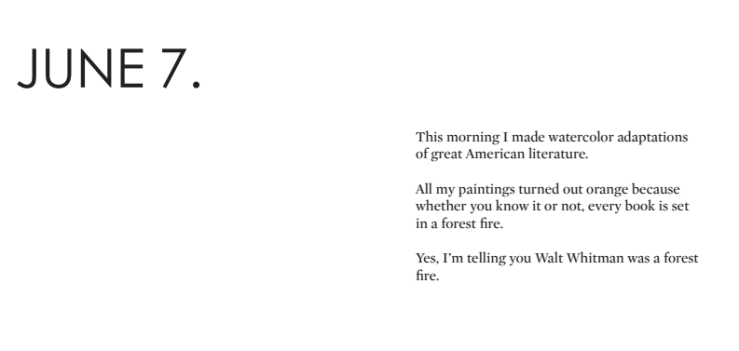
The clarity and concreteness of Schofield’s prose jars against its symantic expression, evoking a dream-nightmare world of continual creation and destruction. Every morning the world begins—and ends—anew, complete with new metaphors which crumble or dissolve or give way under the strain of the next morning’s creation.

3

The Inevitable June echoes with images of oceans and fires, glass airplanes and invisible pilots, octopuses and yetis, angels and demons. Its transmutations both challenge and invite the reader to play a game where the rules have not been, cannot be, verbalized. 

4

Is the game consciousness?

A version of consciousness anyway, a metaphor for consciousness—a collection of words and art, black and white lines, inky abysses and blank fields of possibility. If The Inevitable June attests that imaginative power can transform, it also underscores the costs and conditions of that transformation—the edges, the borders, the limits—the constraints of time, the days on a calendar. Interposed, our protagonist travels, falls, rises, dreams, and performs his various identities.   

I read Schofield’s  book a few times (it’s short) in different formats—on a laptop, a tablet, and then the physical book. Oh, and on my iPhone. I reread that thing on an iPhone waiting in my car to pick up my son from school. It was a different read each time, offering new strangenesses, new pathways, pratfalls, and pitfalls. The Inevitable June is not for all readers, obviously, but it gave me some joy in its puzzles and prose. Recommended.

Curation and Creation in Only Lovers Left Alive, Jim Jarmusch’s Vampire Film

20140520-082414-30254444.jpg

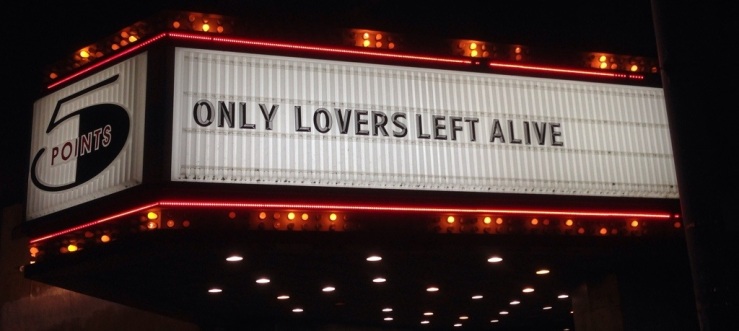
Jim Jarmusch’s latest film Only Lovers Left Alive is excellent. 

Moody, sometimes funny, always gorgeous, and largely plotless, the film centers on two vampires—Adam and Eve, played by Tom Hiddleston and Tilda Swinton—who fill their long lives with music, literature, and love. At its core, the film is an elegiac love song to aesthetic originary creation in the age of the curator.

As Mike D’Angelo points out in his smart review

What really interests Jarmusch is immortality, or at least longevity. How would we behave if we lived for centuries, and were free to do pretty much anything we wanted? What sort of aesthetes and collectors might we become? … In this world, the vampire’s primary function is to appreciate the things we humans take for granted; they’re much more like curators than monsters.


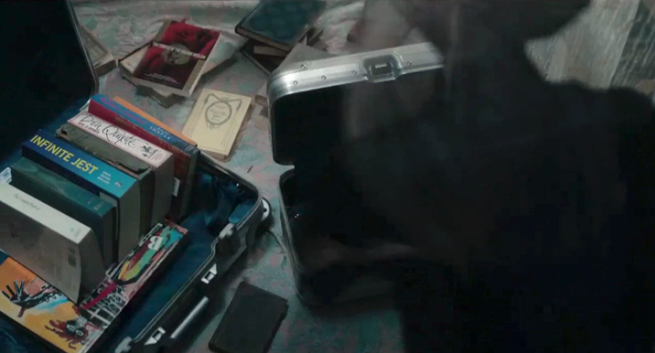
Eve’s curatorial powers are enviable—she merely has to touch an object to know its age (and quality). She touches Adam’s beloved Gibson guitar, declaring “1905.” As she packs her suitcase full of books (Don QuixoteInfinite Jest, and Kafka all make the cut), she scrolls her fingers through pages briskly but lovingly, seeming to absorb each one instantly.

book5

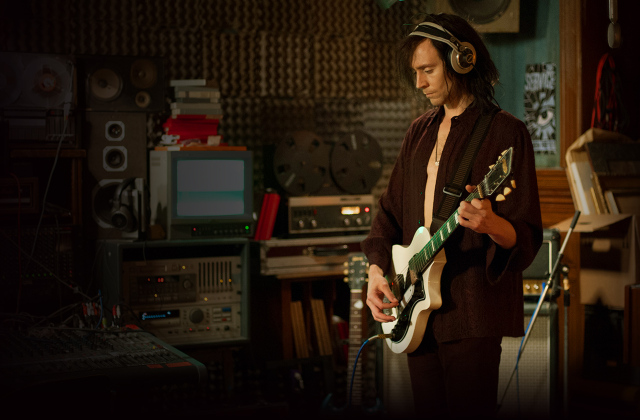
Adam’s curatorial impulses manifest in his collection of antique musical and electronic equipment, his claustrophobic crumbling mansion a mad scientist’s lab of sight and sound. Adam creates plodding dirges, death songs, elegies for the end of romance. Reclusive cult hero, he hides in the outskirts of Detroit from his growing fanbase who demand to know who made this music. Like Wyatt, the masterful forger of William Gaddis’s novel The Recognitions, Adam wonders what people want from the person that they couldn’t get from the work of art. Still, as he mournfully complains to Eve, Adam wants a reflection, something to echo back to him. His fans—the “zombies”—are not enough.

adam

Eve’s library and Adam’s studio allow Jarmusch to perform his own curatorial impulses. On one wall in a room of Adam’s mansion hang the portraits of dozens of writers and musicians, including Blake, Poe, Twain, and Christopher Marlowe. Marlowe it turns out is a vampire—and the real author of Shakespeare to boot. 

It might be tempting to accuse Jarmusch of merely providing fan service for hipsters, but there’s more going on here than simple name-checking. Adam’s wall isn’t simply a shrine for hero-worship. Instead, it feels like a gallery of family portraits. 

Some viewers may find Adam and Eve’s aesthetic obsessions insufferable. As if in anticipation of this criticism—and as a sort of counter argument—Jarmusch plants an internal critique of his lovers in the film in the form of Eve’s kid sis Ava, an impulsive, strangely immature, and ultimately tacky vampire. In her acrimonious parting with Adam and Eve, Ava curses the pair as “condescending snobs.” She is, of course, absolutely correct.only-lovers-left-alive02

Adam and Eve are snobs, but perhaps living through eons will do that to a body, so what should we expect? Adam, black-haired, always dressed in black, veers along a desperate, suicidal spectrum, writing dirges for the end of the world. Eve, golden-haired, clothed in white, must constantly remind Adam of eternal recurrence, a motif figured in Jarmusch’s repeated shots of spinning 45rpm records. Adam mourns the death of Detroit, but Eve tells him that it will bloom again when the “cities of the South are burning.”

Only Lovers Left Alive is peppered with these notes of apocalypse, but Eve tempers them with a kind of weary optimism: She and her lover will survive, and they will preserve what is worth preserving, worth loving. Not only will they curate, they will also create. As the film rushes to its ending in Tangier (my biggest criticism is that we could use another half hour)—oh, and that word “ending”: yeah, look out, fair warning, some spoilers ahead—as the film rushes to its ending, Adam and Eve experience intense blood withdrawal.  Continue reading “Curation and Creation in Only Lovers Left Alive, Jim Jarmusch’s Vampire Film”

“His romantic ancestor, his ancestor of the romantic death” | Bolaño and Borges

Jorge Luis Borges is first mentioned in the sixth paragraph of Roberto Bolaño’s masterful short story “The Insufferable Gaucho.” In this paragraph, the narrator tells us that the story’s hero, an ex-judge named Pereda, believed “the best Argentine writers were Borges and his son; any further commentary on that subject was superfluous.”

Several paragraphs later, Bolaño’s narrator explicitly references Borges’s short story “The South,” the precursor text for “The Insufferable Gaucho.” The reference to Borges is tied again to Pereda’s son, the writer Bebe.

Leaving tumultuous Buenos Aires, basically destitute from the Argentine Great Depression, Pereda heads to the countryside to take up residence in his family’s ancient ranch. Departing the train and arriving to a rural town, 

Inevitably, he remembered Borges’s story “The South,” and when he thought of the store mentioned in the final paragraphs his eyes brimmed with tears. Then he remembered the plot of Bebe’s last novel, and imagined his son writing on a computer, in an austere room at a Midwestern university. When Bebe comes back and finds out I’ve gone to the ranch . . . , he thought in enthusiastic anticipation.

Bolaño essentially appropriates the plot of “The South” for his tale “The Insufferable Gaucho” and inserts a version of himself into this revision. Bolaño is “Bebe” here, an author who “wrote vaguely melancholy stories with vaguely crime-related plots,” his name phonically doubling the series of mirrors and precursors that Bolaño, mystery man, leaves as clues: Bebe, B-B, Borges-Bolaño, Belano-Bolaño. (Is this too wild a conjecture, dear reader? Mea culpa). 

And Pereda then? A stand-in for Borges’s Juan Dahlmann (hero of “The South,” who “considered himself profoundly Argentinian”), surely, but also, maybe also—a stand-in for (a version of) Borges.

What I mean to say:

Bolaño, displaced Chilean, writes “The Insufferable Gaucho” as an intertextual love letter to his displaced father, the Argentine Jorge Luis Borges. Continue reading ““His romantic ancestor, his ancestor of the romantic death” | Bolaño and Borges”

Selections from One-Star Amazon Reviews of Thomas Pynchon’s Gravity’s Rainbow

[Ed. note: The following citations come from one-star Amazon reviews of Thomas Pynchon’s novel Gravity’s Rainbow. Yes, I’ve done this a few times before (see also: George Orwell’s 1984, Melville’s Moby-Dick, Joyce’s Ulysses and Markson’s Wittgenstein’s Mistress) and to be clear, I think some of the one-star reviews of Gravity’s Rainbow make some interesting points–although most of the reviewers seem to be upset over the book’s reputation/status, and attack that (and by extension, postmodernism) instead of attempting to analyze what Pynchon was actually, y’know, trying to do. I’ve preserved the reviewers’ unique styles of punctuation and spelling].

Who put it into Pynchon’s head that he could write?

After reading over one hundred fifty pages, all I could believe was the story set during WWII, but I wasn’t sure.

This is not literature. 

After I finished reading this book twenty years ago, I left it in my apartment building’s laundry room for whomever might be interested in it. The book sat there for months and nobody was interested in it enough to take it home. Finally, it was ruined when a water pipe burst and, I presume, it is now landfill in Staten Island.

Tedious. 

There is not an ounce of humanity in this book.  I finally threw it against a wall in disgust.

Pynchon writes liberal, paranoid diatribes against any and all institutions, especially conservative ones 

I felt empty and used.

I’ve been told the nominating committee (made up mostly of book reviewers) nominated this for the Pulitzer Prize as best fiction. The awards committee (mostly book editors) rejected it as an unreadable piece of crap. I agree with the editors.

This book’s failings are in part a function of it’s time — the early 70’s – when culture was naively experimental, half-baked, vulgar, and exhibitionist.

When one contrasts Vonnegut’s Slaughterhouse Five with this book, it’s like comparing an Olympic sprinter with an obese man running for the bus with a hot dog in one hand and a soda in the other.

I honestly preferred J.G. Ballard’s Crash to this book.

It seems to me it’s very easy to be “a literary master” in this way. It’s much more difficult to write something very clear and simple that people can easily understand (and yet still be profound and say something new).

Woody Allen used to be funny. Monty Python was occasionally funny. 

Any author who uses “further” for “farther” (as Pynchon does, among many other errors) should never make anyone’s “best novelist” list.

To this reader, Pynchon sounds like the unabomber with a better thesaurus. 

One of those books that professors are constantly forcing students to read because the novelist can’t attract a following on his own merits and ability to entertain. 

I only finished it beacuse I was on jury duty. 

I thought this novel was a complete waste of my time and it amazes me to hear so many praise what I think was paranoid and resembles silly cult literature. My father had a book back in the fifties sponsored by an extreme right wing group that was equally paranoid and absurd.

Pynchon couldn’t write anything funny if his life depended upon it.

Pynchon is like a high school football bully who says “Okay, I’m gonna trow da ball as hard as I can–you see if you can catch it”. No thanks Spike.

I mean, even the first page of this book offends my sensibilities.

An entire novel centered on the unrealistic, flimsy idea that a man getting erections will attract missiles? Some missiles may be heat seaking but the temperature of blood found in the groin during erections is no longer near the degree it takes to attract heat seaking weaponry. Get your facts right, Pynchon. A scientist you ain’t.

Reminds me of John Coltrane’s Ascension album, which for the entire album sounds like the band is warming up but never gets to play, but the elitist snobs just adore it.

A good argument for a good old fashioned book burning. 

The majority of this book consists of sentence after sentence and paragraph after paragraph that don’t have any apparent correlation to each other.

wow, all the hard work that this man put in just to bore me! the effort alone is worth a star. gallant attempt mr pynchon.

This is one of those “university novels” (as opposed to “popular” novels that people actually read and love) that “you have to work hard at to appreciate”. 

It’s like viewing a `painting’ of a blank canvas titled Untitled. 

I lived in Germany a few years ago and found this book in a train station. Someone had just walked off and left it. After about ten pages, realizing that Pynchon was an intellectual rip-off artist, I secured it a trash can where no one could find it. I like to think I protect the public from pollution.

Maybe it’s entertaining if you take huge quantities of lsd, otherwise it’s a nightmare. 

It is terrible.

I cannot summarize the story, because I couldnt find one.

obviously written by some self-loving, over-indulged, hippie.

I tend to lump this book in with the rest of the general malaise surrounding the innate nihilism of Postmodernism. 

This book makes me a little sad, because I think that Pynchon, had he not gone over to the dark side, could have been a brilliant prose stylist, if not anything else.

feels like being flayed alive by words alone. I wanted to stab myself in the head just to relieve the pain.

This is like Ulysses. 

Add a star if you enjoy constant reference to penises and vulva and all kinds of deviant sex acts.

I should sue the author for migraine.

To sum it up: it is too much work to read this book.

Riff on William Shakespeare

  1. William Shakespeare, the Greatest Living American Author, turns 450 today.
  2. (There may be some, uh, factual, problems with the preceding sentence, but I’ll let it stand).
  3. (After all, to write after Shakespeare requires some gall, a bit of fakery, maybe an outright lie or two).
  4. 450! (Could I even hit 450 points on a riff?)
  5. “Shakespeare invented us,” Harold Bloom repeatedly insists in his big fat book The Western Canon.
  6. (I might be misquoting; the prospect of putting the effort of fact checking into this riff horrifies me).
  7. “Shakespeare—whetting, frustrating, surprising and gratifying,” F. Scott Fitzgerald jotted down in his notebook.
  8. We don’t actually have a record of Shakespeare’s birth, although we do know he was baptized on 26 April 1564.
  9. And died 23 April 1616.
  10. It’s likely that Shakespeare was born on 23 April 1564.
  11. Or, perhaps: There’s something symmetrical, neat, poetic about Shakespeare dying on his birthday.
  12. Ingrid Bergman died on her birthday.
  13. As did Thomas Browne.
  14. As did Yasujrio Ozu.
  15. And, according to tradition: Moses, David, Mohammad.
  16. So why not Shakespeare, born on his deathday?
  17. We want a teleological neatness with Shakespeare: We want his last play to be The Tempest, a tragicomedy that somehow synthesizes all before it; we can claim Prospero a commanding stand-in for Shakespeare.
  18. (These claims overlooking of course that Shakespeare’s last work was likely a forgettable collaboration with John Fletcher, The Two Noble Kinsmen).
  19. The Two Noble Kinsmen was based on Chaucer’s The Knight’s Tale.
  20. (Shakespeare of course “based” his works on other works; the man was not one for original plotting (thank goodness)).
  21. “Chaucer had a deeper knowledge of life than Shakespeare,” claimed Ezra Pound.
  22. “Let the reader contradict that after reading both authors, if he chooses to do so,” he truculently added.
  23. To Coleridge though Shakespeare was “myriad-minded Shakespeare” — Our myriad-minded Shakespeare.
  24. Dryden credited him with “the largest and most comprehensive soul.”
  25. Suggesting also that, “Shakespeare’s magic could not copied be.”
  26. I’m not sure about that.
  27. How many versions of Hamlet have been attempted?
  28. Were not some of these Hamlets magical—magical enough, at least?
  29. Ulysses?
  30. Infinite Jest?
  31. The Lion King?
  32. Oedipus Rex?
  33. David Markson points out somewhere—forgive me for not rising from my fat ass to go verify—that Shakespeare couldn’t possibly have read Sophocles’ Oedipus as there was no English translation yet available.
  34. And how many books did Shakespeare read?
  35. (Chaucer, often credited with a library of sixty).
  36. Speculation, speculation!
  37. Shakespeare Truthers.
  38. Or Anti-Stratfordians—whatever you want to call them.
  39. Walt Whitman was a Shakespeare Truther.
  40. Believing no commoner could write the plays, but “only one of the ‘wolfish earls’ so plenteous in the plays themselves, or some born descendant and knower, might seem to be the true author of those amazing works.”
  41. Amazing that, that Walt Whitman, who could so bombastically conceive himself every man, woman, child, a cosmos, etc.—that he couldn’t credit a commoner with the depth of imagination to produce the plays that Whitman called “greater than anything else in recorded literature.”
  42. David Markson: “Scholars who are convinced that Shakespeare must certainly have been a military man.  Or a lawyer.  Or closely associated with royalty.  Or even a Jew. To which Ellen Terry: Or surely a woman.”
  43. For some Shakespeare Truthers, evidence of his lack of authorship is to be found in the different ways he supposedly signed his name!
  44. Willm Shakp.
  45. William Shakspēr.
  46. Wm Shakspē.
  47. William Shakspere.
  48. Willm Shakspere.
  49. William Shakspeare.
  50. The last of these from his 1616 will, in which he famously bequeathed his second-best bed to his wife Anne Hathaway.
  51. “He was a rich country gentleman, Stephen said, with a coat of arms and landed estate at Stratford and a house in Ireland yard, a capitalist shareholder, a bill promoter, a tithefarmer. Why did he not leave her his best bed if he wished her to snore away the rest of her nights in peace?” Continue reading “Riff on William Shakespeare”

Laurent Binet’s HHhH Is a Thrilling Intertextual Adventure Story

View of Prague — Oskar Kokoschka

The ugly fact is books are made out of books. The novel depends for its life on the novels that have been written.

–Cormac McCarthy, interview in The New York Times, 1992.

Novelist’s personal genre. For all its seeming fragmentation, nonetheless obstinately cross-referential and of cryptic interconnective syntax.

–David Markson, The Last Novel, 2007

I think I’m beginning to understand. What I’m writing is an infranovel.

–Laurent Binet, HHhH, 2010 / English trans. by Sam Taylor, 2012.

. . . it’s safe to say that in a true war story nothing is absolutely true.

–Tim O’Brien, The Things They Carried, 1990.

From the current (18 April 2014) Wikipedia entry for Laurent Binet’s novel HHhH:

HHhH is the debut novel of French author Laurent Binet. It recounts Operation Anthropoid, the assassination of Nazi leader Reinhard Heydrich in Prague during World War II. It was awarded the 2010 Prix Goncourt du Premier Roman.

The novel follows the history of the operation and the life of its protagonists – Heydrich and his assassins Jozef Gabčík and Jan Kubiš. But it is also interlaced with the author’s account of the process of researching and writing the book, his commentary about other literary and media treatments of the subject, and reflections about the extent to which the behavior of real people may of necessity be fictionalised in a historical novel.

The title is an acronym for Himmlers Hirn heisst Heydrich (“Himmler‘s brain is called Heydrich”), a quip about Heydrich said to have circulated in Nazi Germany.

If I were the narrator of HHhH—which is to say, if I were a version of Binet, a version that I might describe (and am describing, I guess) as Binet-the-writer-performing-Binet-the-author-performing-Binet-the-author-as-narrator-narrating-the-author-trying-to-write-HHhH (awful description)—if I were the narrator of HHhH I’d probably now dole out a droll little chapter about how the gesture I’ve just committed (lazily using Wikipedia to summarize the novel and prefacing that lazy summary with a few citations that might make cribbing from Wikipedia seem, I dunno, clever (which I do not think said cribbing is))—If I were the narrator of HHhH I might riff on how what I just did  is the result of some kind of 21st-century paralysis induced by an overload of information combined with a deep sincere genuine honest-to-gawd love for my subject.

Or maybe I’d just claim to be writing an infrareview.

Has this been a bad start?

I think HHhH gets off to a bad start, but I could be wrong.

Maybe you should judge for yourself, dear reader. Here is its first paragraph:

Gabčík—that’s his name—really did exist. Lying alone on a little iron bed, did he hear, from outside, beyond the shutters of a darkened apartment, the unmistakable creaking of the Prague tramways? I want to believe so. I know Prague well, so I can imagine the tram’s number (but perhaps it’s changed?), its route, and the place where Gabčík waits, thinking and listening. We are at the corner of Vyšehradská and Trojická. The number 18 tram (or the number 22) has stopped in front of the Botanical Gardens. We are, most important, in 1942. In The Book of Laughter and Forgetting, Milan Kundera implies that he feels a bit ashamed at having to name his characters. And although this shame is hardly perceptible in his novels, which are full of Tomášes, Tominas, and Terezas, we can intuit the obvious meaning: what could be more vulgar than to arbitrarily give—from a childish desire for verisimilitude or, at best, mere convenience—an invented name to an invented character? In my opinion, Kundera should have gone further: what could be more vulgar than an invented character?

Actually, rereading it now, this seems like a perfect start, although I’ll admit it stalled me on the first few attempts. I mean, that’s a bit alienating, yes? Names, dates, places—and then a shift to Kundera, the immediate assault on fiction? But it fits, in retrospect. Maybe this is another way of saying that HHhH, despite a difficult first few chapters (What is the book aboutWhat is the book?) quickly becomes thrilling, engrossing, a cerebral spy novel, a study in power and terror, a love letter to Prague, a moody bit of flanerie, at times—and mostly an intertextual adventure yarn that shouldn’t work but does, that succeeds wildly.

In chapters that are often short, punchy, and precise, Binet spends much of the first part of the novel building the character of Reinhard Heydrich, “‘the Hangman,’ ‘the Butcher,’ ‘the Blond Beast.” Binet’s Heydrich is fascinating but never sympathetic, a psychological portrait that Binet draws in spite of himself. The author’s radical ambivalence is evident in two early consecutive chapters, which are worth sharing in full, I think, as they illustrate both Binet’s prose as well as his program. Chapter 16:

Little Heydrich—cute, blond, studious, hardworking, loved by his parents. Violinist, pianist, junior chemist. A boy with a shrill voice which earns him a nickname, the first in a long list: at school, they call him “the Goat.” At this point in his life, it is still possible to mock him without risking death. But it is during this delicate period of childhood that one learns resentment.

And Chapter 17:

In Death Is My Trade, Robert Merle creates a novelized biography of Rudolph Höss, the commandant of Auschwitz, based on firsthand accounts and on notes that Höss himself wrote in prison before being hanged in 1947. The whole of the first part is given over to his childhood and his unbelievably deadening upbringing at the hands of an ultraconservative and emotionally crippled father. It’s obvious what the author is trying to do: find the causes, if not the explanations, for the path this man would later take. Robert Merle attempts to guess—I say guess, not understand—how someone becomes commandant of Auschwitz.

This is not my intention—I say intention, not ambition—with regard to Heydrich. I do not claim that Heydrich ended up in charge of the Final Solution because his schoolmates called him “the Goat” when he was ten years old. Nor do I think that the ragging he took because they thought he was a Jew should necessarily explain anything. I mention these facts only for the ironic coloring they give to his destiny: “the Goat” will grow up to be the man called, at the height of his power, “the most dangerous man in the Third Reich.” And the Jew, Süss, will become the Great Architect of the Holocaust. Who could have guessed such a thing?

Throughout HHhH, Binet-the-narrator repeatedly voices his concerns for spending so much time on Heydrich; these anxieties are frequently tethered to other texts (as we see both in the first paragraph of the novel, and in the first line of Chapter 17). It’s not just that the Nazis in particular were such fastidious record-keepers (“The Nazis love burning books, but not files”); it’s also that WWII has arguably produced more literature—narrative entertainment!—than anyone could hope to wade through.

But Binet-narrator assures us he’s waded, especially into territories where Heyrdrich might show his yellow head. Blazoning an often truculent anxiety of influence, the narrator of HHhH reflects and opines on numerous Nazi narratives, from Kenneth Brannagh’s role as Heydrich in Conspiracy to Rutger Hauer in Twilight of the Eagles (adapted from a Robert Harris novel, it sounds like a ripoff of PK Dick’s The Man in the High Castle) to Jonathan Littell’s The Kindly Ones to William T. Vollmann’s Europe Central. Binet also lards the novel with historical documents, like journal entries, newspaper records, excerpts from speeches, etc., along with rumor and speculation. He often crams a story or an anecdote into HHhH that he claims has no business there, like the (apocryphal?) tale of a soccer match between occupied Ukraine and the Nazis:

. . . none of the main characters of Operation Anthropoid is involved, so theoretically it has no place in my novel. But one of the great advantages of the genre is the almost unlimited freedom it gives the author.

This kind of bait and switch is characteristic of HHhH, and it should be annoying as hell. But for some reason it isn’t—just the right amount of restraint? Just the right note of ironic dissonance? I’m not sure. Binet’s earnest pleas that he wishes to do justice to the reality of his characters can become overbearing at times, but the earnestness is tempered in a kind of postmodern distance. But maybe I brought that with me. (Although of course the reader bears some responsibility, especially in such an intertextual reading).

Binet-as-narrator pleads at the gaps in history:

My story has as many holes in it as a novel. But in an ordinary novel, it is the novelist who decides where these holes should occur. Because I am a slave to my scruples, I’m incapable of making that decision.

But of course the rhetoric here, the language itself, is a contrivance, a making, a bit of artifice—a decision. And, near the end of HHhH, exhausted from witnessing, from channeling that witnessing:

Worn-out by my muddled efforts to salute these people, I tremble with guilt at the thought of all those hundreds, those thousands, whom I have allowed to die in anonymity. But I want to believe that people exist even if we don’t speak of them.

Binet-as-narrator overestimates his powers if he thinks that he allowed those anonymous deaths. But his creation does not stink of hubris.

No, what happens here—and gosh darn, I’ve really failed to describe it adequatley—what HHhH ultimately offers is the very thing it sets out to deconstruct: A ripping, gripping adventure yarn. The final sequence—I really want to just lay it all out here, now, but c’mon, spoilers! You should read this book!—the final sequence deserves more than the review-hack cliches I’ll rest on here: Breathtaking, spellbinding, engrossing, thrilling, etc. Just wonderful, and Binet knows it, stretches it out, repeatedly gnashes and wails that he doesn’t want it to end, and for good reason—it’s really damn good.

I listened to Audible’s unabridged version of HHhH, narrated by John Lee (and then reread sections at night on my Kindle). Lee’s been a dealbreaker for me in the past (I barely made it through his narration of Martin’s A Feast for Crows and gave up on his take on China Miéville’s Kraken), but his evocation of the narrator’s voice here is perfect—intelligent, slightly ironic. Perhaps it helps that Binet is unequivocal about his characters’ voices (which are rare in the novel)—he’s always pointing out, Hey, look hereI’m the ventriloquist! I looked forward to the narrative in my commute and often lingered over chores to listen longer. Great stuff.

Is HHhH an infranovel? I don’t know because I don’t know really what Binet means by “infranovel.” It is an entertaining and smart take on a worn-out genre though, which is more than enough. Recommended.