From Zora Neale Hurston’s novelization of folklore, Mules and Men:
It was slavery time, Zora, when Big Sixteen was a man. They called ‘im Sixteen cause dat was de number of de shoe he wore. He was big and strong and Ole Massa looked to him to do everything.
One day Ole Massa said, “Big Sixteen, Ah b’lieve Ah want you to move dem sills Ah had hewed out down in de swamp.
“I yassuh, Massa.”
Big Sixteen went down in de swamp and picked up dem 12 X 12’s and brought ’em on up to de house and stack ,em. No one man ain’t never toted a 12 X 12 befo’ nor since.
So Ole Massa said one day, “Go fetch in de mules. Ah want to look ’em over.”
Big Sixteen went on down to, de pasture and caught dem mules by de bridle but they was contrary and balky and he tore de bridles to pieces pullin’ on ’em, so he picked one of ’em up under each arm and brought ’em up to Old Massa.
He says, “Big Sixteen, if you kin tote a pair of balky mules, you kin do anything. You kin ketch de Devil.”
“Yassuh, Ah kin, if you git me a nine-pound hammer and a pick and shovel!”
Ole Massa got Sixteen de things he ast for and tole ‘im to go ahead and bring him de Devil.
Big Sixteen went out in front of de house and went to diggin’. He was diggin’ nearly a month befo’ he got where he wanted. Then he took his hammer and went and knocked on de Devil’s door. Devil answered de door hisself.
“Who dat out dere?”
“It’s Big Sixteen.”
“What you want?”
“Wanta have a word wid you for a minute.”
Soon as de Devil poked his head out de door, Sixteen him over de head wid dat hammer and picked ‘im up and carried ‘im back to Old Massa.
Ole Massa looked at de dead Devil and hollered, “Take dat ugly thing ‘way from here, quick! Ah didn’t think you’d, ketch de Devil sho ’nuff.”
So Sixteen picked up de Devil and throwed ‘im back down de hole.
Way after while, Big Sixteen died and went up to Heben. But Peter looked at him and tole ‘im to g’wan ‘way from dere. He was too powerful. He might git outa order and there wouldn’t be nobody to handle ‘im. But he had to, go somewhere so he went on to hell.
Soon as he got to de gate de Devil’s children was playin’ in de yard and they seen ‘im and run to de house, says, “Mama, mama! Dat man’s out dere dat kilt papa!”
So she called ‘im in de house and shet de door. When Sixteen got dere she handed ‘im a li’l piece of fire and said, “You ain’t comin’ in here. Here, take dis hot coal and g’wan off and start you a hell uh yo’ own.”
So when you see a Jack O’Lantern in de woods at night you know it’s Big Sixteen wid his piece of fire lookin’ for a place to go.
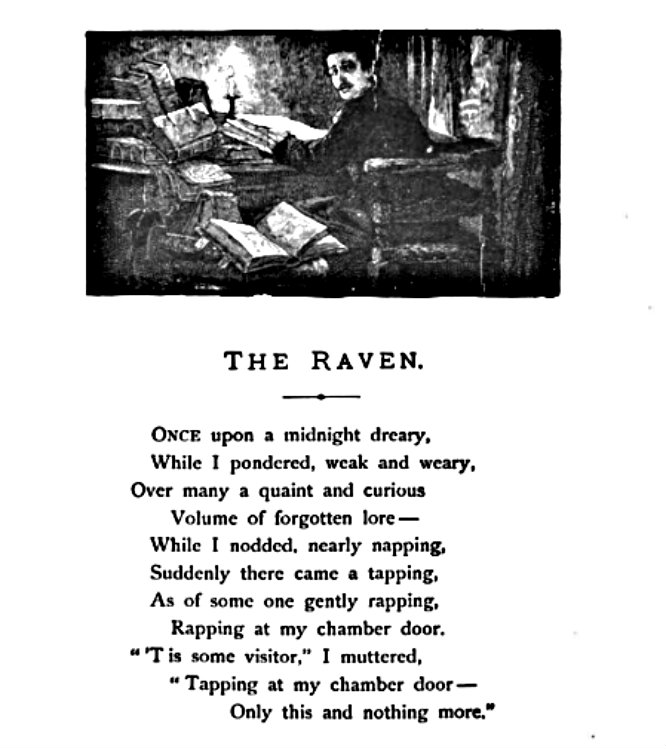
The public for whom Poe wrote, though grossly unappreciative of his art, was by no means unaccustomed to the horrors with which he dealt. America, besides inheriting the usual dark folklore of Europe, had an additional fund of weird associations to draw upon; so that spectral legends had already been recognised as fruitful subject-matter for literature. Charles Brockden Brown had achieved phenomenal fame with his Radcliffian romances, and Washington Irving’s lighter treatment of eerie themes had quickly become classic. This additional fund proceeded, as Paul Elmer More has pointed out, from the keen spiritual and theological interests of the first colonists, plus the strange and forbidding nature of the scene into which they were plunged. The vast and gloomy virgin forests in whose perpetual twilight all terrors might well lurk; the hordes of coppery Indians whose strange, saturnine visages and violent customs hinted strongly at traces of infernal origin; the free rein given under the influence of Puritan theocracy to all manner of notions respecting man’s relation to the stern and vengeful God of the Calvinists, and to the sulphureous Adversary of that God, about whom so much was thundered in the pulpits each Sunday; and the morbid introspection developed by an isolated backwoods life devoid of normal amusements and of the recreational mood, harassed by commands for theological self-examination, keyed to unnatural emotional repression, and forming above all a mere grim struggle for survival—all these things conspired to produce an environment in which the black whisperings of sinister grandams were heard far beyond the chimney corner, and in which tales of witchcraft and unbelievable secret monstrosities lingered long after the dread days of the Salem nightmare.
Poe represents the newer, more disillusioned, and more technically finished of the weird schools that rose out of this propitious milieu. Another school—the tradition of moral values, gentle restraint, and mild, leisurely phantasy tinged more or less with the whimsical—was represented by another famous, misunderstood, and lonely figure in American letters—the shy and sensitive Nathaniel Hawthorne, scion of antique Salem and great-grandson of one of the bloodiest of the old witchcraft judges. In Hawthorne we have none of the violence, the daring, the high colouring, the intense dramatic sense, the cosmic malignity, and the undivided and impersonal artistry of Poe. Here, instead, is a gentle soul cramped by the Puritanism of early New England; shadowed and wistful, and grieved at an unmoral universe which everywhere transcends the conventional patterns thought by our forefathers to represent divine and immutable law. Evil, a very real force to Hawthorne, appears on every hand as a lurking and conquering adversary; and the visible world becomes in his fancy a theatre of infinite tragedy and woe, with unseen half-existent influences hovering over it and through it, battling for supremacy and moulding the destinies of the hapless mortals who form its vain and self-deluded population. The heritage of American weirdness was his to a most intense degree, and he saw a dismal throng of vague spectres behind the common phenomena of life; but he was not disinterested enough to value impressions, sensations, and beauties of narration for their own sake. He must needs weave his phantasy into some quietly melancholy fabric of didactic or allegorical cast, in which his meekly resigned cynicism may display with naive moral appraisal the perfidy of a human race which he cannot cease to cherish and mourn despite his insight into its hypocrisy. Supernatural horror, then, is never a primary object with Hawthorne; though its impulses were so deeply woven into his personality that he cannot help suggesting it with the force of genius when he calls upon the unreal world to illustrate the pensive sermon he wishes to preach.
Hawthorne’s intimations of the weird, always gentle, elusive, and restrained, may be traced throughout his work. The mood that produced them found one delightful vent in the Teutonised retelling of classic myths for children contained in A Wonder Book and Tanglewood Tales, and at other times exercised itself in casting a certain strangeness and intangible witchery or malevolence over events not meant to be actually supernatural; as in the macabre posthumous novel Dr. Grimshawe’s Secret, which invests with a peculiar sort of repulsion a house existing to this day in Salem, and abutting on the ancient Charter Street Burying Ground. In The Marble Faun, whose design was sketched out in an Italian villa reputed to be haunted, a tremendous background of genuine phantasy and mystery palpitates just beyond the common reader’s sight; and glimpses of fabulous blood in mortal veins are hinted at during the course of a romance which cannot help being interesting despite the persistent incubus of moral allegory, anti-Popery propaganda, and a Puritan prudery which has caused the late D. H. Lawrence to express a longing to treat the author in a highly undignified manner. Septimius Felton, a posthumous novel whose idea was to have been elaborated and incorporated into the unfinished Dolliver Romance, touches on the Elixir of Life in a more or less capable fashion; whilst the notes for a never-written tale to be called “The Ancestral Footstep” shew what Hawthorne would have done with an intensive treatment of an old English superstition—that of an ancient and accursed line whose members left footprints of blood as they walked—which appears incidentally in both Septimius Felton and Dr. Grimshawe’s Secret. Continue reading ““The Weird Tradition in America,” H.P. Lovecraft’s analysis of American horror fiction”→
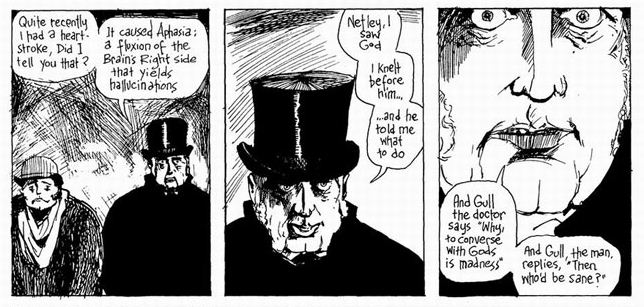
From Hell, Alan Moore and Eddie Campbell’s epic revision of the Jack the Ripper story, posits Sir William Gull, a physician to Queen Victoria, as the orchestrator of the Ripper murders that terrified Londoners at the end of the 19th century. The murders initially arise as a means to cover up an illegitimate son begat by foolish Prince Albert, Victoria’s grandson. However, for Gull the murders represent much more. The murders are part of the continued forces of “masculine rationality” that will constrain “lunar female power.” Gull is a high-level Mason; during a stroke, he experiences a vision of the Masonic god Jahbulon, one which prompts him to his “great work”–namely, the murders that will reify masculine dominance.
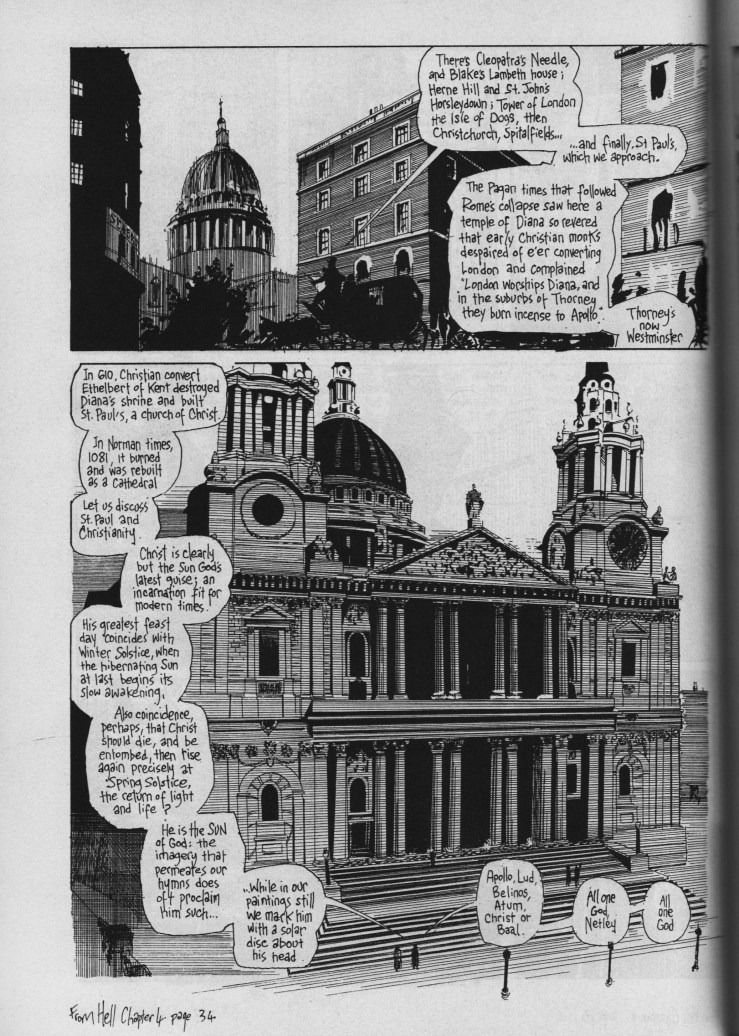
One of the standout chapters in the book is Gull’s tour of London, with his hapless (and witless) sidekick Netley. In a trip that weds geography, religion, politics, and mythology, Gull riffs on a barbaric, hermetic history of London, revealing the gritty city as an ongoing site of conflict between paganism and orthodoxy, artistic lunacy and scientific rationality, female and male, left brain and right brain. The tour ends with a plan to commit the first murder.
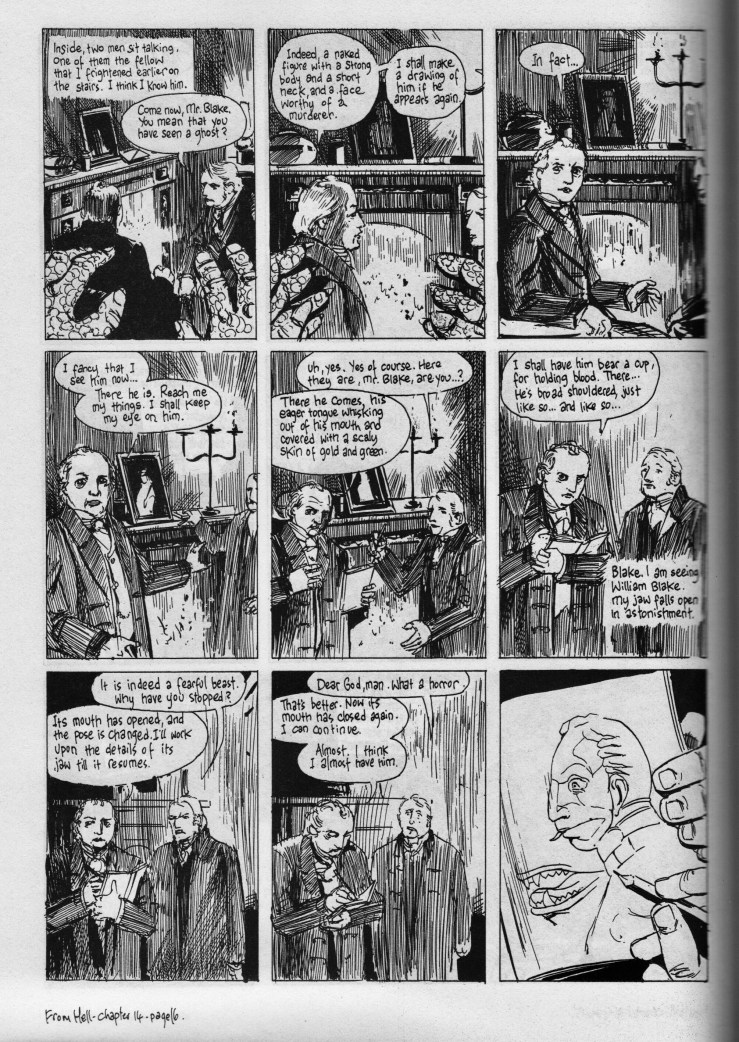
From there, the book picks up the story of Frederick Abberline, the Scotland Yard inspector charged with solving the murders. Of course, the murders are unsolvable, as the hierarchy of London–from the Queen down to the head of police–are well aware of who the (government-commissioned) murderer is. The police procedural aspects of the plot are fascinating and offer a balanced contrast with Gull’s mystical visions–visions that culminate in a climax of a sort of time-travel. Gull goes backwards (William Blake sees him in a vision and turns that vision into Ghost of Flea) and Gull goes forwards: he sees London at the end of the twentieth century, and receives a guarantee that his murder plot has had its intended effect.
From Hell takes many of its cues from the idea that history is shaped not by random events, but rather by tragic conspiracies that force people to willingly give up freedom to a “rational” authority. The book points repeatedly to the 1811 Ratcliffe Highway murders, which led directly to the world’s first modern police force. In our own time, if we’re open to conspiracy theories, we might find the same pattern in the 21st century responses to terrorism.
Although From Hell features moments of supernatural horror in Gull’s mysticism, it is the book’s grimy realism that is far more terrifying. London in the late 1880s is no place you want to be, especially if you are poor, especially if you are a woman. The city is its own character, a labyrinth larded with ancient secrets the inhabitants of which cannot hope to plumb. Despite the nineteenth century’s claims for enlightenment and rationality, this London is bizarrely cruel and deeply unfair. Campbell’s style evokes this London and its denizens with a surreal brilliance; his dark inks are by turns exacting and then erratic, concentrated and purposeful and then wild and severe. The art is somehow both rich and stark, like the coal-begrimed London it replicates. Although Moore has much to say, he allows Campbell’s art to forward the plot whenever possible. Moore is erudite and fascinating; even when one of his characters is lecturing us, it’s a lecture we want to hear. His ear for dialog and tone lends great sympathy to each of the characters, especially the unfortunate women who must turn to prostitution to earn their “doss” money. And while Abberline’s frustrations at having to solve a crime that no higher-ups want solve make him the hero of this story, Gull’s mystic madness makes him the narrative’s dominant figure.
From Hell is a fantastic starting place for anyone interested in Moore’s work, more self-contained than his comics that reimagine superhero myths, like Watchmen or Swamp Thing, and more satisfying and fully achieved than Promethea or V Is for Vendetta. Be forewarned that it is a graphic graphic novel, although I do not believe its violence is gratuitous or purposeless. Indeed, From Hell aspires to remark upon the futility and ugliness of cyclical violence, and it does so with wisdom and verve. Highly recommended.
Do you still need an idea for a jack o’ lantern? Are you a fan of Hayao Miyazaki films? Even the really sweet and gentle ones, like Ponyo and My Neighbor Totoro? And, are you, like, totally skilled at carving pumpkins? If so, have at it with this cool stencil by Flickr user PlayWithFire:
You can see variations on Totoro jack o’ lanterns–and other cool Miyazaki-inspired pumpkins here. From that set, here’s Flickr user C. Lambert’s Totoro pumpkin–
Dracula is a character in Roberto Bolaño’s dark opus 2666.
Specifically, I’m suggesting that Dracula (like, theCount Dracula) is the unnamed SS officer in “The Part About Archimboldi” who hosts a strange party in a Romanian castle.
II. I’m willing to concede that my idea is probably full of holes and more than a little silly, but I think there’s some textual support for such a claim.
III. I’ve already suggested on this blog that 2666 is full of lycanthropic transformations, and in that earlier essay, I linked werewolves to vampires (using the work of mythologist Sabine Baring-Gould).
It’s a work of mesmerism and transformation—vampire powers. Dracula showing up is a winking sick joke, a satire.
IV. In his post “Castle Dracula” at Infinite Zombies, Daryl L. L. Houston connects the many strands of vampirism that run through 2666, suggesting that “Bolaño is using the vampirism in the story, and Dracula in particular, to tie together some of the threads he’s been unwinding pertaining to insiders and outsiders, parasitism and consumption of people, and a sort of larger parasitism of nations.” Hence Aztec blood rituals, the Holocaust, the murder of helpless, marginalized women in Santa Teresa . . .
V. Okay, so back to that thesis. Let’s start with the first appearance of the unnamed SS officer:
At midmorning they came to a castle. The only people there were three Romanians and an SS officer who was acting as butler and who put them right to work, after serving them a breakfast consisting of a glass of cold milk and a scrap of bread, which some soldiers left untouched in disgust. Everyone, except for four soldiers who stood guard, among them Reiter, whom the SS officer judged ill suited for the task of tidying the castle, left their rifles in the kitchen and set to work sweeping, mopping, dusting lamps, putting clean sheets on the beds.
Fairly banal, right? Also, “midmorning” would entail, y’know, sunlight, which is poison for most vampires. Let me chalk this up to the idea that the SS officer is inside the castle, which is sufficiently gloomy and dark enough to protect him (I’m not going to get into any vampire rules that might spoil my fun, dammit!). In any case, hardly noteworthy. Indeed, the SS officer—a butler commanding house chores—seems hardly a figure of major importance.
VI. Next, we get the Romanian castle explicitly identified as “Dracula’s castle” and meet the actors for this milieu:
“And what are you doing here, at Dracula’s castle?” asked the baroness.
“Serving the Reich,” said Reiter, and for the first time he looked at her.
He thought she was stunningly beautiful, much more so than when he had known her. A few steps from them, waiting, was General Entrescu, who couldn’t stop smiling, and the young scholar Popescu, who more than once exclaimed: wonderful, wonderful, yet again the sword of fate severs the head from the hydra of chance.
(I love Popescu’s line here).
VII. Our principals soon take a tour of castle and environs, led by the SS officer (boldface emphasis is mine):
Soon they came to a crypt dug out of the rock. An iron gate, with a coat of arms eroded by time, barred the entrance. The SS officer, who behaved as if he owned the castle, took a key out of his pocket and let them in. Then he switched on a flashlight and they all ventured into the crypt, except for Reiter, who remained on guard at the door at the signal of one of the officers.
So Reiter stood there, watching the stone stairs that led down into the dark, and the desolate garden through which they had come, and the towers of the castle like two gray candles on a deserted altar. Then he felt for a cigarette in his jacket, lit it, and gazed at the gray sky, the distant valleys, and thought about the Baroness Von Zumpe’s face as the cigarette ash dropped to the ground and little by little he fell asleep, leaning on the stone wall. Then he dreamed about the inside of the crypt. The stairs led down to an amphitheater only partially illuminated by the SS officer’s flashlight. He dreamed that the visitors were laughing, all except one of the general staff officers, who wept and searched for a place to hide. He dreamed that Hoensch recited a poem by Wolfram von Eschenbach and then spat blood. He dreamed that among them they had agreed to eat the Baroness Von Zumpe.
He woke with a start and almost bolted down the stairs to confirm with his own eyes that nothing he had dreamed was real.
When the visitors returned to the surface, anyone, even the least astute observer, could have seen that they were divided into two groups, those who were pale when they emerged, as if they had glimpsed something momentous down below, and those who appeared with a half smile sketched on their faces, as if they had just been reapprised of the naivete of the human race.
Bolaño concludes the crypt passage by highlighting an essential ambiguity that courses throughout the entire “Castle Dracula” episode, a strange axis of horror/humor, romance/banality. What has been revealed in the crypt? We don’t know, of course, but our surrogate Reiter allows us access to a few visions of what might have happened, including terror and fear and cannibalism. (He employs Hawthorne’s escape hatch too—it was all a dream).
The Knight of Death, Salvador Dali
VIII. Then, supper time:
That night, during dinner, they talked about the crypt, but they also talked about other things. They talked about death. Hoensch said that death itself was only an illusion under permanent construction, that in reality it didn’t exist. The SS officer said death was a necessity: no one in his right mind, he said, would stand for a world full of turtles or giraffes. Death, he concluded, served a regulatory function.
Clearly it’s easy to link any of the dinnertime comments about death to Dracula, but note that the SS officer’s idea that death is a “regulatory function” is terribly banal, is quite literally regular—this idea contrasts with Hoensch’s more poetic notion that death is an illusion (an illusion that the SS officer, if he is in fact Count Dracula, would realize in a perfectly mundane way that foreclosed the necessity of metaphor).
IX. Dinner conversation turns to murder—obviously one of the central themes of 2666:
The SS officer said that murder was an ambiguous, confusing, imprecise, vague, ill-defined word, easily misused.
Again, ambiguity: on one hand, sure, an SS officer’s job was in large part about coordinating and executing mass murder. At the same time, we might appreciate that murder is a vague term if people are one’s lunch.
X. Then conversation turns to culture:
The SS officer said culture was the call of the blood, a call better heard by night than by day, and also, he said, a decoder of fate.
I’m pretty sure that this was the moment I started entertaining the fancy that the SS officer might be Dracula.
XI. Popescu the intellectual also seems to reconsider the SS officer:
The intellectual Popescu remained standing, next to the fireplace, observing the SS officer with curiosity.
XII. Then, they finally riff on Dracula. Significantly, the SS officer believes that Dracula is a good German (bold emphasis mine):
First they praised the assortment of little cakes and then, without pause, they began to talk about Count Dracula, as if they had been waiting all night for this moment. It wasn’t long before they broke into two factions, those who believed in the count and those who didn’t. Among the latter were the general staff officer, General Entrescu, and the Baroness Von Zumpe. Among the former were Popescu, Hoensch, and the SS officer, though Popescu claimed that Dracula, whose real name was Vlad Tepes, aka Vlad the Impaler, was Romanian, and Hoensch and the SS officer claimed that Dracula was a noble Teuton, who had left Germany accused of an imaginary act of treason or disloyalty and had come to live with some of his loyal retainers in Transylvania a long time before Vlad Tepes was born, and while they didn’t deny Tepes a real historical or Transylvanian existence, they believed that his methods, as revealed by his alias or nickname, had little or nothing to do with the methods of Dracula, who was more of a strangler than an impaler, and sometimes a throat slitter, and whose life abroad, so to speak, had been a constant dizzying spin, a constant abysmal penitence.
The SS officer is the noble Teuton. More importantly, we get language that connects Dracula to the murders in Santa Teresa, most of which are stranglings; we also get the idea that Dracula has had a “life abroad”—one outside of time—a life that might see his spirit inhabit and ventriloquize an industrial city in the north of Mexico. (Or not. I know. Look, I’m just riffing here).
We also get the idea of an abyss (this is the structure of 2666), as well as the idea of Dracula as a penitent of sorts.
So, let us recall that early in “The Part About the Crimes,” detective Juan de Dios Martinez is searching for a criminal dubbed The Penitent who desecrates churches and has committed a few murders in the process. He goes to psychologist Elvira Campos for help:
Sacraphobia is fear or hatred of the sacred, of sacred objects, especially from your own religion, said Elvira Campos. He thought about making a reference to Dracula, who fled crucifixes, but he was afraid the director would laugh at him. And you believe the Penitent suffers from sacraphobia? I’ve given it some thought, and I do. A few days ago he disemboweled a priest and another person, said Juan de Dios Martinez.
This is the first mention of Dracula in 2666, and he’s explicitly likened to the Penitent; later, as we see above, Dracula will be explicitly linked to penitence.
(I’m not suggesting that the Penitent is Dracula traveled to Mexico to piss in churches. What I want to say is that Dracula’s dark spirit ventriloquizes the text of 2666).
(I’m also suggesting, again, that 2666 be read intertextaully).
Riding with Death, Jean-Michel Basquiat
XIII. Our other principals continue to discuss Dracula, but I won’t belabor that discussion (I’d prefer you, dear reader, to return to the text).
I will summarize though: Popescu sees Dracula in nationalistic terms (“a Romanian patriot” who repels the Turks), and General Entrescu goes on a long rant about heroism and villainy and history, culminating in a lengthy digression on Jesus Christ (recall now that Entrescu will be crucified JC-style by his men).
One aside on the SS officer bears mentioning: we learn that “the fastidious SS officer” is the most sober conversant as he “scarcely wet his lips with alcohol.” (Because he’s a vampire who prefers blood! Muahahahaha!)
XIV. Fast forward a few hours. Our man Reiter, among fellow soldiers, sets out to explore the secret crannies and passageways of Castle Drac and play voyeur:
The room they came to was empty and cold, as if Dracula had just stepped out. The only thing there was an old mirror that Wilke lifted off the stone wall, uncovering a secret passageway.
Dracula’s spirit leaves the room, creating an opening, behind the ever-symbolic mirror. (Muahahahaha!). (2666: Mirror, tunnels, chambers, labyrinths).
They enter the passageway and come first upon our supposed Dracula, the SS officer:
And so they were able to look into the room of the SS officer, lit by three candles, and they saw the SS officer up, wrapped in a robe, writing something at a table near the fireplace. The expression on his face was forlorn. And although that was all there was to see, Wilke and Reiter patted each other on the back, because only then were they sure they were on the right path. They moved on.
XV. Dracula, the epistolary novel. Count Dracula, troubled writer of letters, will author the following scenes, his spirit ventriloquizing the principals all: Here, we find Reiter and his homeboy Wilke, lurking in a secret passage, jerking off to werewolf-cum-Jesus-Christ-figure Gen. Entrescu screwing the lovely Baroness Von Zumpe and reciting poetry (emphasis per usual mine):
Then Wilke came on the wall and mumbled something too, a soldier’s prayer, and soon afterward Reiter came on the wall and bit his lips without saying a word. And then Entrescu got up and they saw, or thought they saw, drops of blood on his penis shiny with semen and vaginal fluid, and then Baroness Von Zumpe asked for a glass of vodka, and then they watched as Entrescu and the baroness stood entwined, each with a glass in hand and an air of distraction, and then Entrescu recited a poem in his tongue, which the baroness didn’t understand but whose musicality she lauded, and then Entrescu closed his eyes and cocked his head as if to listen to something, the music of the spheres, and then he opened his eyes and sat at the table and set the baroness on his cock, erect again (the famous foot-long cock, pride of the Romanian army), and the cries and moans and tears resumed, and as the baroness sank down onto Entrescu’s cock or Entrescu’s cock rose up into the Baroness Von Zumpe, the Romanian general recited a new poem, a poem that he accompanied by waving both arms (the baroness clinging to his neck), a poem that again neither of them understood, except for the word Dracula,which was repeated every four lines, a poem that might have been martial or satirical or metaphysical or marmoreal or even anti-German, but whose rhythm seemed made to order for the occasion, a poem that the young baroness, sitting astride Entrescu’s thighs, celebrated by swaying back and forth, like a little shepherdess gone wild in the vastness of Asia, digging her nails into her lover’s neck, scrubbing the blood that still flowed from her right hand on her lover’s face, smearing the corners of his lips with blood, while Entrescu, undeterred, continued to recite his poem in which the word Dracula sounded every four lines, a poem that was surely satirical, decided Reiter (with infinite joy) as Wilke jerked off again.
I contend that the poem is the work of the SS officer, psychic mesmerist, the poet Dracula, a poem no one in the scene can understand, a dark satire that might also be a war poem or a love poem or an elegy, but definitely a dark satire, written in violence and sex and blood, a poem that ventriloquizes not only Entrescu, phallic delivery device, but also the baroness, and also Reiter and Wilke. And perhaps the reader.
XVI. Where to go after such a climax? Maybe point out that Dracula infects Reiter and Wilke, of whom we learn:
Some of their battalion comrades dubbed them the vampires.
(But better to return I think to our strange figure, the SS officer).
XVII. Here, his last appearance:
The next morning the detachment left the castle after the departure of the two carloads of guests. Only the SS officer remained behind while they swept, washed, and tidied everything. Then, when the officer was fully satisfied with their efforts, he ordered them off and the detachment climbed into the truck and headed back down to the plain. Only the SS officer’s car—with no driver, which was odd—was left at the castle. As they drove away, Reiter saw the officer: he had climbed up to the battlements and was watching the detachment leave, craning his neck, rising up on tiptoe, until the castle, on the one hand, and the truck, on the other, disappeared from view.
Dracula stays in Dracula’s castle; his spirit, his seed, his blood seeps out.
Jim Jarmusch’s film Only Lovers Left Alive is excellent.
Moody, sometimes funny, always gorgeous, and largely plotless, the film centers on two vampires—Adam and Eve, played by Tom Hiddleston and Tilda Swinton—who fill their long lives with music, literature, and love. At its core, the film is an elegiac love song to aesthetic originary creation in the age of the curator.
What really interests Jarmusch is immortality, or at least longevity. How would we behave if we lived for centuries, and were free to do pretty much anything we wanted? What sort of aesthetes and collectors might we become? … In this world, the vampire’s primary function is to appreciate the things we humans take for granted; they’re much more like curators than monsters.
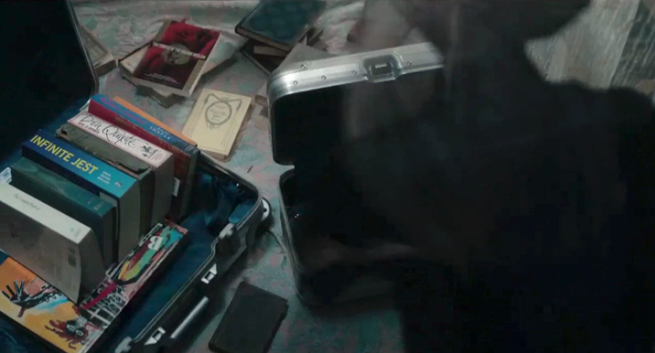
Eve’s curatorial powers are enviable—she merely has to touch an object to know its age (and quality). She touches Adam’s beloved Gibson guitar, declaring “1905.” As she packs her suitcase full of books (Don Quixote, Infinite Jest, and Kafka all make the cut), she scrolls her fingers through pages briskly but lovingly, seeming to absorb each one instantly.
Adam’s curatorial impulses manifest in his collection of antique musical and electronic equipment, his claustrophobic crumbling mansion a mad scientist’s lab of sight and sound. Adam creates plodding dirges, death songs, elegies for the end of romance. Reclusive cult hero, he hides in the outskirts of Detroit from his growing fanbase who demand to know who madethis music. Like Wyatt, the masterful forger of William Gaddis’s novel The Recognitions, Adam wonders what people want from the person that they couldn’t get from the work of art. Still, as he mournfully complains to Eve, Adam wants a reflection, something to echo back to him. His fans—the “zombies”—are not enough.
Eve’s library and Adam’s studio allow Jarmusch to perform his own curatorial impulses. On one wall in a room of Adam’s mansion hang the portraits of dozens of writers and musicians, including Blake, Poe, Twain, and Christopher Marlowe. Marlowe it turns out is a vampire—and the real author of Shakespeare to boot.
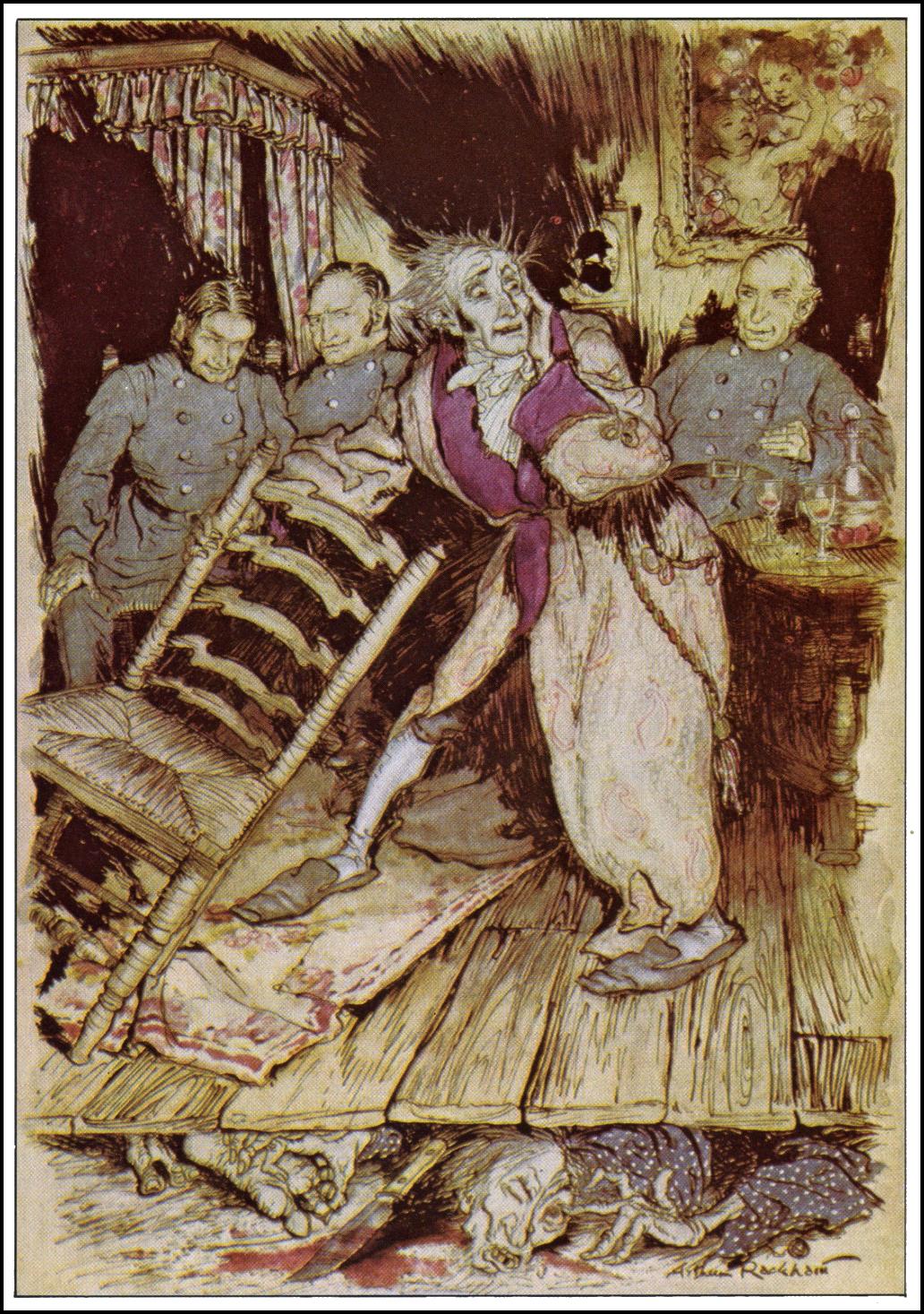
Illustration for Poe’s”The Tell-Tale Heart,” Arthur Rackham (1935)
“The Tell-Tale Heart”
by
Edgar Allan Poe
TRUE!—nervous—very, very dreadfully nervous I had been and am; but why will you say that I am mad? The disease had sharpened my senses—not destroyed—not dulled them. Above all was the sense of hearing acute. I heard all things in the heaven and in the earth. I heard many things in hell. How, then, am I mad? Hearken! and observe how healthily—how calmly I can tell you the whole story.
It is impossible to say how first the idea entered my brain; but once conceived, it haunted me day and night. Object there was none. Passion there was none. I loved the old man. He had never wronged me. He had never given me insult. For his gold I had no desire. I think it was his eye! yes, it was this! He had the eye of a vulture—a pale blue eye, with a film over it. Whenever it fell upon me, my blood ran cold; and so by degrees—very gradually—I made up my mind to take the life of the old man, and thus rid myself of the eye forever. Continue reading ““The Tell-Tale Heart” — Edgar Allan Poe”→
In Yoko Ogawa’s new collection Revenge, eleven stories of fascinating morbidity intertwine at oblique angles. Tale extends into tale: characters, settings, and images float intertextually from chapter to chapter, layering and reticulating themes of death, crime, consumption, and creation. (And revenge, of course. Let’s not forget revenge). Not quite a story cycle or a novel-in-tales, Revenge’s sum is nevertheless greater than its parts. It’s a brisk, engaging read, and as I worked my way to the final story, I already anticipated returning to the beginning to pull at the motifs threading through the book.
The book’s dominant motifs of death and food arrive in the first tale, “Afternoon Bakery,” where a mother tries to buy strawberry shortcakes for her dead son’s birthday—only the baker is too busy bawling to attend to sales. We learn why this baker is crying in “Fruit Juice,” the second story, a tale that ends inexplicably with an abandoned post office full of kiwi fruit. The third story, “Old Mrs. J” (one of Revenge’s stand-outs) perhaps answers where those kiwis came from. More importantly, “Old Mrs. J,” with its writer-protagonist, elegantly introduces the thematic textual instability of the collection. There’s a haunting suspicion here that the characters who glide from one tale to the next aren’t necessarily the silent extras they seem to be on the surface. Our characters, background and fore, are doppelgängers, ghost writers, phantoms.
The penultimate tale “Tomatoes and the Full Moon” lays the ghosting bare. Its protagonist is a magazine writer, whose “articles” really amount to little more than advertising. Staying at a seaside resort, he’s pestered by an old woman, one of the many witches who haunt Revenge. The old woman claims to be a novelist, and points out one of her books in the resort’s library:
Later, in my room, I read ‘Afternoon at the Bakery.’ It was about a woman who goes to buy a birthday cake for her dead son. That was the whole story. I should have gone back to my article, but I read her novel through twice, finishing for the second time at 3:00 a.m. The prose was unremarkable, as were the plot an characters, but there was an icy current running under her words, and I found myself wanting to plunge into it again and again.
The final line is perhaps a description of Revenge’s haunting intertextual program—although to be clear, Ogawa’s plot and characters are hardly “unremarkable,” and her prose, in Stephen Snyder’s English translation, is lucid and descriptive. It’s the “icy current running under her words” that makes Ogawa’s tales stick so disconcertingly in the reader’s psychic gullet. And if her prose is at times “unremarkable,” it’s all in the service of creating a unifying tone. All eleven tales are narrated in first-person, and each narrator is bound to the limits of his or her own language.
These limitations of language bump up against the odd, the spectacular, the alien, as in “Sewing for the Heart”:
She had explained that she was born with her heart outside of her chest—as difficult as that might be to imagine.
The line is wonderful in its mundane trajectory: Our narrator, an artisan bagmaker, witnesses this woman who lives with her heart outside her chest and concedes that such a thing might be “difficult . . . to imagine”! There’s something terribly paltry in this, but it’s also purposeful and controlled: Here we find the real in magical realism.
But this bagmaker can imagine, as we see in an extraordinary passage that moves from the phenomenological world of sight and sound and into the realm of our narrator’s strange desires:
She began to sing, but I could not make out the words. It must have been a love song, to judge from the slightly pained expression on her face, and the way she tightly gripped the microphone. I noticed a flash of white skin on her neck. As she reached the climax of the song, her eyes half closed and her shoulders thrown back, a shudder passed through her body. She moved her arm across her chest to cradle her heart, as though consoling it, afraid it might burst. I wondered what would happen if I held her tight in my arms, in a lovers’ embrace, melting into one another, bone on bone . . . her heart would be crushed. The membrane would split, the veins tear free, the heart itself explode into bits of flesh, and then my desire would contain hers—it was all so painful and yet so utterly beautiful to imagine.
Painful and utterly beautiful: Another description of Revenge.
Sometimes the matter-of-fact tone of the stories accounts for marvelous little eruptions of humor, as in “The Last Hour of the Bengal Tiger”:
At fifteen, I took an overdose of sleeping pills. I must have had a good reason for wanting to kill myself, but I’ve forgotten what it was. Perhaps I was just fed up with everything. At any rate, I slept for eighteen hours straight, and when I woke up I was completely refreshed. My body felt so empty and purified that I wondered whether I had, in fact, died. But no one in my family even seemed to have noticed that I had attempted suicide.
The scene is simultaneously devastating and hilarious, an evocation of abyssal depression coupled with mordant irony. The scene also underscores the dramatic uncertainty that underpins so many of the tales, where the possibility that the narrator is in fact a ghost or merely a character in someone else’s story is always in play.
There’s no postmodern gimmickry on display here though. Ogawa weaves her tales together with organic ease, her control both powerful and graceful. Her narrators contradict each other; we’re offered perspectives, glimpses, shades and slivers of meaning. A version of events recounted differently several stories later seems no more true than an earlier version, but each new detail adds to the elegant tangle. Like David Lynch and Roberto Bolaño, Ogawa traffics in beautiful, venomous, bizarre dread. Like those artists, she offers a discrete world we sense is complete and unified, even as our access to it is broken and discontinuous. And like Angela Carter, Ogawa channels the icy current seething below the surface of our darkest fairy tales, those stories that, with their sundry murders and crimes, haunt readers decades after first readings.
What I like most about Revenge is its refusal to relieve the reader. The book can be grisly at times, but Ogawa rarely goes for the lurid image. Instead, the real horror (and pleasure) of Revenge is the anxiety it produces in the reader, who becomes implicated in the crimes cataloged in the text. Witness to first-person narratives that often omit key clues, the reader plays detective—or perhaps accomplice. Recommended.
Revenge is new in handsome trade paperback from Picador; Picador also released Ogawa’s novel Hotel Iris in 2010.
After my father died, I began to wonder whether my turn might come sooner rather than later. What a pity! Later would have been so much more convenient! And what if my time might be even sooner than soon? Before I knew it, I would recognize death by its cold shining as of brass. Hence in those days, I do confess, I felt sometimes angry that the treasures of sunlight escaped my hands no matter how tightly I clenched them. I loved life so perfectly, at least in my own estimation, that it seemed I deserved to live forever, or at least until later rather than sooner. But just in case death disregarded my all-important judgments, I decided to seek out a ghost, in order to gain expert advice about being dead. The living learn to weigh the merits of preparation against those of spontaneity, which is why they hire investment counselors and other fortune-tellers. And since I had been born an American, I naturally believed myself entitled to any destiny I could pay for. Why shouldn’t my postmortem years stretch on like a lovely procession of stone lamps?
If you believe, as H.P. Lovecraft asserted, that all cemeteries are subterraneously connected, then it scarcely matters which one you visit; so I put one foot before the other, and within a half-hour found myself allured by the bright green moss on the pointed tops of those ancient stone columns of the third Shogun’s loyally suicided retainers. Next I found, glowing brighter than the daylight, more green moss upon the stone railings and torii enclosing these square plots whose tombstones strained upward like trees, each stone engraved with its undertenant’s postmortem Buddhist name.
The smell of moss consists of new and old together. Dead matter having decayed into clean dirt, the dirt now freshens into green. It is this becoming-alive that one smells. I remember how when my parents got old, they used to like to walk with me in a certain quiet marsh. The mud there smelled clean and chocolate-bitter. I now stood breathing this same mossy odor, and fallen cryptomeria-needles darkened their shades of green and orange while a cloud slid over the sun. Have you ever seen a lizard’s eyelid close over his yellow orb? If so, then you have entered ghostly regions, which is where I found myself upon the sun’s darkening. All the same, I had not gone perilously far: On the other side of the wall, tiny cars buzzed sweetly, bearing living skeletons to any number of premortem destinations. Reassured by the shallowness of my commitment, I approached the nearest grave.
The instant I touched the wet moss on the railing, I fell into communication with the stern occupant, upon whose wet dark hearthstone lay so many dead cryptomeria-tips. To say he declined to come out would be less than an understatement. It was enough to make a fellow spurn the afterlife! I experienced his anger as an electric shock. To him I was nothing, a rootless alien who lacked a lord to die for. Why should he teach me?
Humiliated, I turned away, and let myself into the lower courtyard behind the temple. Here grew the more diminutive ovoid and phallic tombs of priests. Some were incised with lotus wave-patterns. One resembled a mirror or hairbrush stood on end. I considered inviting myself in, but then I thought: If that lord up there was so cross, wouldn’t a priest have even less use for me?
So I pulled myself up to the temple’s narrow porch and sat there with my feet dangling over, watching cherry blossoms raining down on the tombs. The gnarled arms of that tree pointed toward every grave, and afternoon fell almost into dusk.
A single white blossom sped down like a spider parachuting down his newest thread. Then my ears began to ring—death’s call.
So I ran away. I sat down in my room and hid. Looking out my window, I spied death up boards and pouring vinegar on nails. Death killed a dog. What if I were next?









 Biblioklept