Want to celebrate William Shakespeare’s birthday (Shakes would be 446 today)? Sure you do. And, undoubtedly, you wish to do so in the geekiest way possible, right? Check out Geekosystem’s post, The Five Geekiest Ways to Celebrate Shakespeare’s Birthday.
Sylvia Beach was the nexus point for Modernist and ex-pat literature for much of the first half of the twentieth century, running the Left Bank bookstore Shakespeare & Company until the Nazi occupation of Paris in 1941. She was the first publisher of Joyce’s Ulysses, she translated Paul Valéry into English, and was close friends to a good many great writers, including William Carlos Williams, Ezra Pound, H.D., and Ernest Hemingway. In The Letters of Sylvia Beach, editor Keri Walsh compiles many of Beach’s letters from 1901 to just before her death in 1962. Framed by a concise biographical introduction and a useful glossary of correspondents, Letters reveals private insights into a fascinating literary period. There’s a sweetness to Beach’s letters, whether she’s inviting the Fitzgeralds to come to a dinner party or asking Richard Wright (“Dick”) how much he thinks a fair price for a record player is. The Letters of Sylvia Beach is out now from Columbia UP.
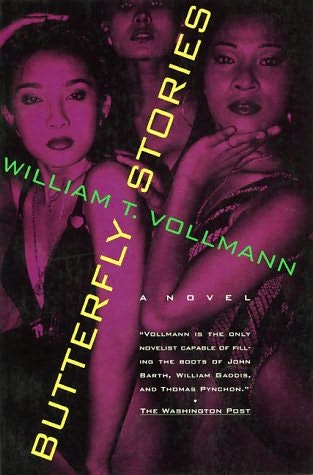
I’m a couple of chapters into William T. Vollmann’s 1993 novel Butterfly Stories, one of his (three? four? Dude’s prolific) books about prostitution. The bullied butterfly grows up to be a boy who wants to be a journalist and then a journalist/inept sex tourist in southeast Asia. Good stuff. Here’s a mordantly elegant passage:
Once he began to combine cutting his wrists and half-asphyxiating himself he believed that he’d found the ideal. Afterwards he’d dream of mummy sex with the gentle girl, by which he meant her body being suspended ropelessly above him, then slowly drifting down; when her knee touched his leg he jerked and then went limp there; her hands reached his hands, which died; her breasts rolled softly upon his heart which fibrillated and stopped; finally she lay on top of him, quite docile and still soft . . . He knew that the others didn’t like mummy sex, but that was because they didn’t understand it; they thought that it must be cold; they thought that she must paint her mouth with something to make it look black and smell horrible and soften like something rotten . . . He wanted to open her up until the pelvis snapped like breaking a wishbone. Would that be mummy sex?
Here’s a one-star review of the book from Amazon: “This book is a sordid collection of junk. I picked it out at random from a library shelf and did not enjoy/like/sympathize with even one thing about it. Don’t waste your time.” Guy didn’t like the mummy sex, I guess.
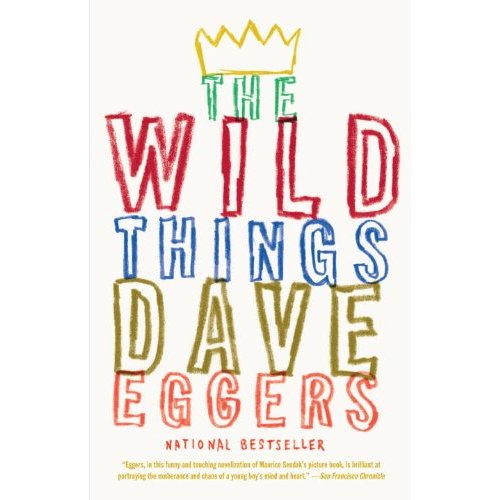
Been working through my reader’s copy of Dave Eggers’s The Wild Things, new in trade paperback from Vintage. I’m having a hard time envisioning a kind of review of the book that escapes the context of the book; that it’s a novelization of a movie script of a Maurice Sendak book of maybe a few dozen words. I loved that book growing up, so no reason that it should be adapted into a feature film, but hoped for the best due to Eggers’s involvement and the fact that the incomparable Spike Jonze was at the rudder. Or helm. Or whatever naval metaphor you wish. Anyway, I absolutely hated the movie–it was mostly melancholy and downright depressing at times. Whereas Sendak’s book channels the joys of transgressive energy while reiterating the need for stable familial order, Jonze’s movie was all sorrow and loss, the hangover of youth, each ecstasy overshadowed in darkness. Too much yin, not enough yang. Anyway. I’ll try to give the book its proper, fair due on its own terms without all that baggage. Full review forthcoming.
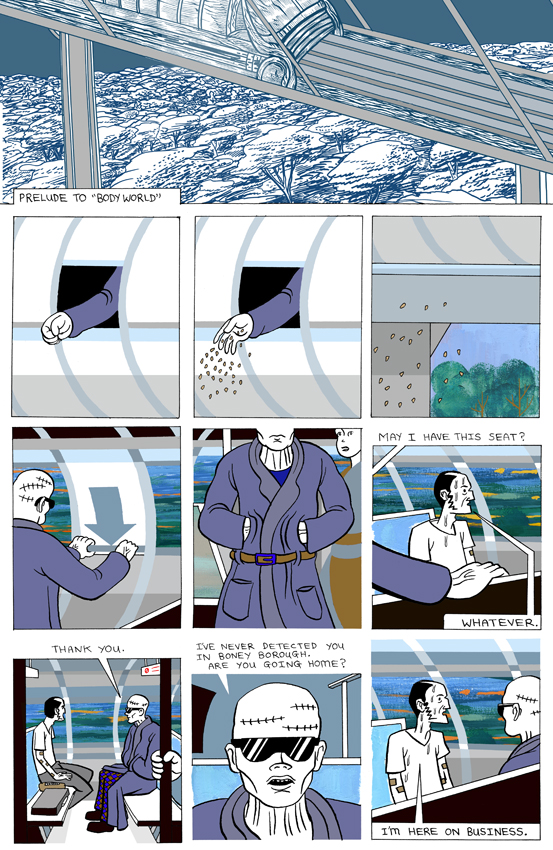
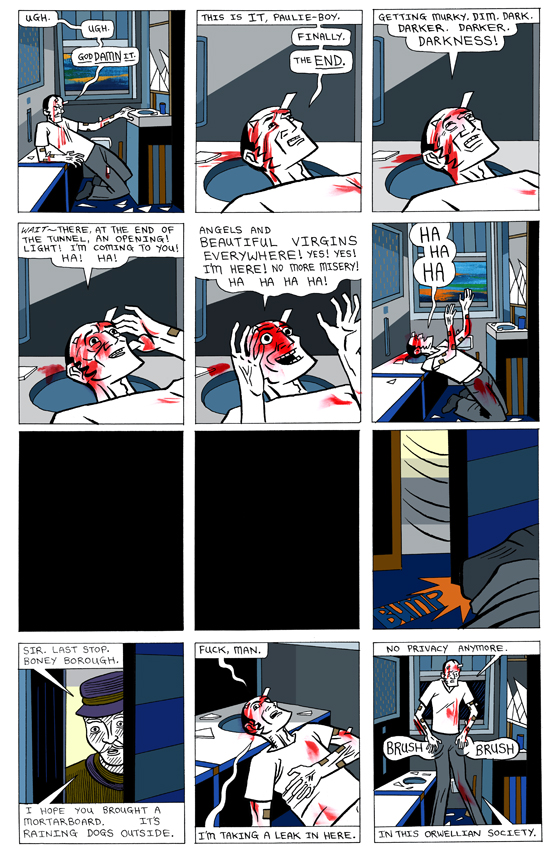
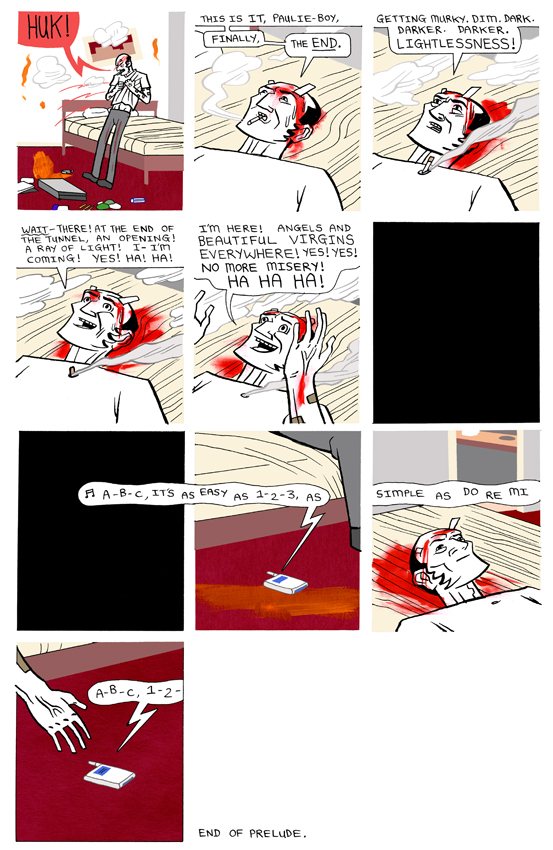
In the future Dash Shaw proposes in his graphic novel BodyWorld, the Second Civil War and rapid industrial growth have left most of America a concrete sprawl by 2060. An exception is Boney Borough, a (literal) green zone somewhere on the Atlantic seaboard. This small secluded town is a new Eden in an otherwise gray world. Enter Professor Paulie Panther, a fuck-up par excellence. He goes to Boney Borough as part of a freelance mission to find out about a new, strange plant he’s found there via the internet. Professor Panther, you see, is a botanist and poet, a would-be scientist who finds out about the psychopharmacological properties of plants by smoking them up in big fat joints (when he’s not too busy trying to commit suicide or stumbling around on one or more of the various drugs to which he’s addicted). Professor Panther is the perfect acerbic foil to the homogeneous folk of Boney Borough. He gets hot for teacher Jem Jewel, turns-on Peach Pearl, the small town girl who wants to go to the big city, and pisses off and confuses her dumb jock boyfriend Billy-Bob Borg. The alliterative names (along with Shaw’s sharp, cartoonish style) recall–and subvert–the classic all-Americanism of Archie comics. Professor Panther soon discovers that the mystery plant, when smoked, grants the user strange telepathic abilities–namely, users sense the “body-mind” of the bodies of others around them.
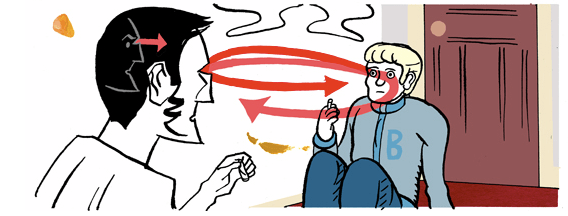
The plant’s telepathic effects allow Shaw to explore what happens within a literalized I-see-you-seeing-me-seeing-you-seeing-me (seeing-y0u-seeing-me . . .) structure. His bright Pop Art goes Cubist in psychedelic trip scenes, superimposing images to show a surreal conflation of not just the melding of two people’s pasts and presents, but those people’s perceptions of past and present. Very heady stuff–but seeing Shaw’s work is superior to my description, of course. Observe, as Panther sees Pearl seeing Panther seeing Pearl idealizing their attempt at romance:
BodyWorld is sardonically humorous in its psychoanalytic visions, guided in no small part by Professor Panther’s hilarious outsider perspective, but also tempered by Shaw’s larger project, a sci-fi satire of American exurbanist insularity. We wrote earlier this month about science fiction’s tendency to work within the dichotomy of wastelands and green zones, and Shaw’s work is no exception. His marvelous trick is to keep us within the green zone of Boney Borough the whole time and to make us identify with a waster, Panther. The greatest irony is that in this futurist vision, the zombies are the ones in the green zone.
Not everyone’s a conformist though. There are exceptions, of course, especially in the seedy Outer Rim where Panther takes up transient residence. We meet a psychotic latter-day Johnny Appleseed who certainly shares Panther’s weirdo proclivities. The episode is a marvelous spoof on the corny “origin stories” standard in Golden and Silver Age comics, with Shaw’s treatment more loving than mocking. To tell more about this weirdo might spoil the climax of Shaw’s graphic novel, and we don’t want to do that, of course, because you’re going to want to read it, aren’t you? Suffice to say that it’s part and parcel of Shaw’s program, a sweet and sour subversion of the 1950s comics and contemporary conformist groupthink politics. Shaw owes some debt to the neat precision, spacing, and rhythm of Chris Ware, as well as the haunting inks and sharp wit of Charles Burns but it would be a mistake to see this young talent as anything but original. Still, while we’re making comparisons: Richard Kelly could make a messy, sprawling treasure of a film out of BodyWorld.
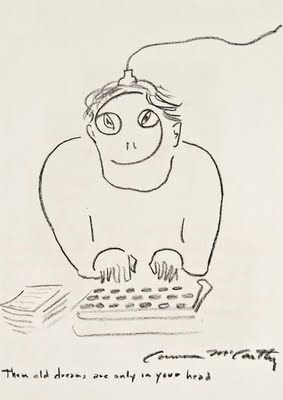
From Burt Britton’s collection of self-portraits, um, Self-portrait. McSweeney’s 34 has taken the work as inspiration. See a full gallery here, including portraits from Jorge Luis Borges, Maurice Sendak, and Margaret Atwood, among others. This goofy Cormac McCarthy self-portrait is priceless, especially from a guy famous for images of trees hanging with dead babies.
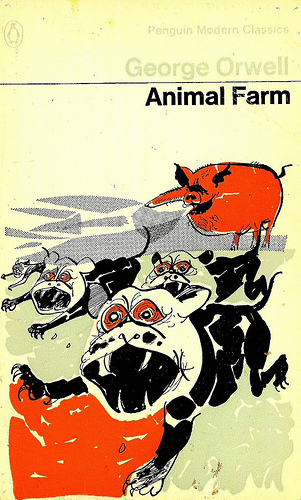
It is sobering to consider how close this novel came to remaining unpublished. Having survived Hitler’s bombing, the rather battered manuscript was sent to the office of TS Eliot, then an important editor at Faber & Faber. Eliot, a friendly acquaintance of Orwell’s, was a political and cultural conservative, not to say reactionary. But, perhaps influenced by Britain’s alliance with Moscow, he rejected the book on the grounds that it seemed too “Trotskyite”. He also told Orwell that his choice of pigs as rulers was an unfortunate one, and that readers might draw the conclusion that what was needed was “more public-spirited pigs”. This was not perhaps as fatuous as the turn-down that Orwell received from the Dial Press in New York, which solemnly informed him that stories about animals found no market in the US. And this in the land of Disney . . .
There’s an admirable precision to Denis Johnson’s Nobody Move, a dark and funny crime caper originally serialized in Playboy over four months in 2008, now available in trade paperback from Picador. Johnson limits himself to a handful of characters, a span of a few days, and four fifty-page segments to tell his story. Johnson’s economy resonates from his tight plotting and structure down to his cool, concise sentences. He works in noir archetypes, to be sure–there’s the hard-luck loser in over his head, the femme fatale with a troubled past (and present), the sadistic thug and his moll, and the sinister mastermind. Johnson’s feat here is to present all of this in a manner that’s simultaneously invigorating to the genre but also a confirmation of its pleasures.
Consider Johnson’s erstwhile protagonist, Jimmy Luntz. The name alone seems to tell us everything about this guy, a lousy gambler who spends much of his time on the run. He owes money to the wrong guys, and when a gorilla appropriately named Gambol comes to collect, Luntz makes the mistake of shooting but not killing him. Johnson traffics in immediacy in Nobody Move–there’s not a lot of backstory or dwelling on psychological motivation, thankfully–but he does offer up the occasional nugget, like this one:
Early in his teens Luntz had fought Golden Gloves. Clumsy in the ring, he’d distinguished himself the wrong way–the only boy to get knocked out twice. He’d spent two years at it. His secret was that he’d never, before or since, felt so comfortable or so at home as when lying on his back listening to the far-off music of the referee’s ten-count.
And that’s all the personal history we really need about Luntz. It’s the gaps in the story that are so engaging, that force the reader to play the role of detective in this crime story. To this end, Johnson starts the story in media res, with Luntz leaving a disappointing competition performance of his barbershop chorus. He spends much of the novel’s first half still in his white tux. The novel’s end — well, I won’t spoil the end, of course — but let’s just say that the end of the novel finds our characters poised for further nefarious adventures. But there I go, getting ahead of myself. A little more on plot: Gambol, wounded by Jimmy, finds himself being nursed by a woman named Mary. Their nascent relationship is one of the highlights of the book, funny and cruel, a bizarre study in unlikely romance. Meanwhile, Jimmy hooks up with Anita Desilvera, a dark-eyed bombshell with a serious drinking problem and a series of upcoming court dates. They complicate their problems by going on the lam together. Gambol eventually comes looking for Jimmy (he wants to literally eat his testicles) and drama and danger ensue.
Denis Johnson is arguably among the best living American writers today, having produces no fewer than two masterpieces (Tree of Smoke, one of my favorite books of the past ten years, and Jesus’ Son, one of my favorite books ever). So when he wrote a genre fiction piece under a deadline for Playboy, many critics and readers wondered what he was up to. Was he serious? How serious were we supposed to take the work? Did he need the money? The book itself offers some answers. Nobody Move is fantastic as a genre exercise, witty, dark, lean, and hard-boiled, transcending the bad or formulaic writing that can plague the genre’s novels but never trying to transcend its tropes. Put another way, Johnson here demonstrates that he can master a genre that is not his, and that he can do it under the constraints of space and time. That’s quite a feat, if you think about it, especially if you compare Nobody Move to Thomas Pynchon’s recent genre exercise, Inherent Vice, or the detective-centered works of Jonathan Lethem like Motherless Brooklyn and Gun, With Occasional Music. Pynchon’s work is in many ways a covert, loving goof on the genre, but it’s still more or less a “Thomas Pynchon” book. Lethem likes the idea of writing crime noir, but he wants to subvert it, mash it up with sci-fi, see it as a form of post-modern allegory. Roberto Bolaño is almost painfully aware of this in his fiction–his narrator in Distant Star gets to play at being a detective for a bit, but finds that it’s not nearly as fun as he would like it to be. The Savage Detectives views literature and art as a crime scene to puzzle out. And 2666 . . . well, you know about 2666 (hang on wait, you don’t know about 2666? You should really get that taken care of). Or take James Ellroy’s postmoderinst crime fiction, which owes, unwittingly or not, as much to Don DeLillo as it does to Raymond Chandler. These are all great writers, of course. But I think contrasting what they are trying to do with what Johnson is trying to do is instructive.
There’s a purity to Nobody Move, to its utter willingness to simply be what it is–and many folks won’t like that; they may even accuse Johnson of slumming. Perhaps they think it’s easy to write a tight, funny crime novel. Perhaps they know it’s not, and they think that Johnson is being solipsistic, or even mercenary. In any case, Nobody Move will probably stand outside of Johnson’s canon. And that’s unfair. Cinematic and highly visual, it recalls some of the Coen brothers’ finest work, like Blood Simple and The Man Who Wasn’t There, and even Tarantino’s Jackie Brown(minus the messy sprawl). Perhaps the best thing about Nobody Move–other than the sheer pleasure of reading it over a few afternoons, of course–is that it might motivate readers to pick up Jesus’ Son or even Tree of Smoke. For many readers, especially young readers, genre is a vital gateway to what many of us prejudicially call “more serious” literature. So pick up Nobody Move, read it, love it, and then pass it on to someone who needs to know about Denis Johnson. Recommended.
Nobody Move is available in trade paperback from Picador on April 24, 2010.
I’m finishing up Pantheon’s gorgeous new edition of BodyWorld, Dash Shaw’s graphic novel. Shaw originally serialized BodyWorld on his website from 2007-2009, but it’s nice to have it a big heavy physical form. Full review forthcoming, but in the meantime, check out the prelude (and go to Shaw’s website for more)–
1. Try to understand what the author wished to do, and do not blame him for not achieving what he did not attempt.
2. Give him enough direct quotation—at least one extended passage—of the book’s prose so the review’s reader can form his own impression, can get his own taste.
3. Confirm your description of the book with quotation from the book, if only phrase-long, rather than proceeding by fuzzy precis.
4. Go easy on plot summary, and do not give away the ending. (How astounded and indignant was I, when innocent, to find reviewers blabbing, and with the sublime inaccuracy of drunken lords reporting on a peasants’ revolt, all the turns of my suspenseful and surpriseful narrative! Most ironically, the only readers who approach a book as the author intends, unpolluted by pre-knowledge of the plot, are the detested reviewers themselves. And then, years later, the blessed fool who picks the volume at random from a library shelf.)
5. If the book is judged deficient, cite a successful example along the same lines, from the author’s ouevre or elsewhere. Try to understand the failure. Sure it’s his and not yours?
To these concrete five might be added a vaguer sixth, having to do with maintaining a chemical purity in the reaction between product and appraiser. Do not accept for review a book you are predisposed to dislike, or committed by friendship to like. Do not imagine yourself a caretaker of any tradition, an enforcer of any party standards, a warrior in an idealogical battle, a corrections officer of any kind. Never, never (John Aldridge, Norman Podhoretz) try to put the author “in his place,” making him a pawn in a contest with other reviewers. Review the book, not the reputation. Submit to whatever spell, weak or strong, is being cast. Better to praise and share than blame and ban. The communion between reviewer and his public is based upon the presumption of certain possible joys in reading, and all our discriminations should curve toward that end.
A book that’s a joy to read can be frustrating to translate when, for whatever reason, the process keeps jamming up. And it’s very hard to predict just how hard a book will be to translate until you really get down to it, because smallish but time-consuming problems can be virtually invisible on a first reading. But of course translating has its joys as well: moving in slow motion through a fictional world, exploring its dimmer recesses, listening to what echoes in it, handling rich vocabularies …
Got a great little gang of new noir (or at least noirish) novels from Picador last week. These handsome trade paperbacks are all available April 27, 2010. Full reviews all around forthcoming, but until then–
Denis Johnson’s Nobody Move is a tight snare drum of a comedy crime novel. Jimmy Luntz, still decked out in his white barbershop chorus tux (don’t ask) gets into trouble with a big gorilla he owns money too. On the run, he meets smoldering bombshell Anita. More trouble ensues. Nobody Move, originally serialized in Playboy, is a dark, funny genre exercise propelled by Johnson’s sharp dialogue and keen eye for detail. Johnson’s restraint and economy demonstrate writerly chops, but its his story and his characters that made me stay up too late reading last night.
I’m kind of embarrassed that I’d never heard of George V. Higgins’s seminal crime novel, The Friends of Eddie Coyle, the story of a down-on-his luck gunrunner trying to get a break on a three-year sentence. Picador’s new edition celebrates the book’s 40th anniversary. Higgins’s electric dialogue thrusts the reader right into the action, trading narrative clarity for a smoky milieu of backroom deals and gritty alleys. But my phrasing here sounds way too corny and trite. Forgive me, I don’t really know how to write about good crime fiction because I’m so unused to it. I’ll lazily favorably compare The Friends of Eddie Coyle to David Simon’s Baltimore crime epic The Wire.
I’ve been too engrossed with Coyle and Nobody Move the past few days to do more than skim over Clancy Martin’s How to Sell, a novel about grifters and scam artists in the jewelery world, but I did read and very much enjoy its first chapter, where the protagonist pawns his mother’s wedding ring (“the only precious thing she had left”) and yet still manages to keep reader sympathy (mine, at least). Martin worked for years in the fine jewelery business. He also translates Nietzsche and Kierkegaard. Zadie Smith says of How to Sell: “It’s a little like Dennis Cooper with a philosophical intelligence, or Raymond Carver without hope. But mostly it’s like itself.” I like that.
If you’re still not in a noirish mood, I’ll make one more attempt to piqué your interest. In what has to be one of the greatest opening shots in the history of cinema, Orson Welles begins his dark crime thriller Touch of Evilwith a continuous tracking shot of a car that . . . hang on, I shouldn’t tell you what happens if you don’t know yet. Just watch the scene. It mines the same border-horror that those other noir-masters Roberto Bolaño and David Lynch also evoke so well.
The New Yorker has published another short story by Roberto Bolaño. It’s called “Prefiguration of Lalo Cura”and it backgrounds a character from 2666, Olegario Cura Exposito(page 384, if you want to correlate things).The first paragraph:
It’s hard to believe, but I was born in a neighborhood called Los Empalados: The Impaled. The name glows like the moon. The name opens a way through the dream with its horn, and man follows that path. A quaking path. Invariably harsh. The path that leads into or out of Hell. That’s what it all comes down to. Getting closer to Hell or farther away. Me, for example, I’ve had people killed. I’ve given the best birthday presents. I’ve backed projects of epic proportions. I’ve opened my eyes in the dark. Once, I opened them by slow degrees in total darkness, and all I saw or imagined was that name: Los Empalados, shining like the star of destiny
The iPad is emphatically not a serious readers’ device: the only people who would genuinely consider it a Kindle killer are those for whom the idea of reading for pleasure died years ago; if it was ever alive. The people who will spout bullshit like “I read on screen all day” when what they really mean is “I read the first three paragraphs of the New York Times article I saw linked on Twitter before retweeting it; and then I repeat that process for the next eight hours while pretending to work.” That’s reading in the way that rubbing against women on the subway is sex.
Yann Martel’sBeatrice and Virgil tells the story of a writer named Henry whose follow-up novel to a surprise smash hit is rejected. He moves to a large metropolitan city, gets a dog and a cat, takes clarinet lessons, joins an amateur theater group, and slowly forgets about writing fiction altogether. One day a stranger sends Henry a short story by Gustave Flaubert called “St. Julian the Hospitator.” The sender has highlighted passages about Julian’s delight in slaughtering animals and also included a few pages of an original manuscript, a Beckettian play featuring two characters, Beatrice and Virgil. There’s also a note asking for help. Intrigued, or maybe bored, Henry visits the mysterious author, an old, creepy taxidermist (also named Henry). His play features two characters, Virgil, a howler monkey, and Beatrice, a donkey, who are trying to come to terms with a series of events they call The Horrors. The taxidermist’s project reignites Henry’s passion for writing and he’s soon helping the would-be playwright with revisions, blind to the inconsistencies and gaps in the old man’s strange behavior.
Beatrice and Virgil is a page turner, engaging, propulsive, and quite easy to read. It injects the philosophical and artistic concerns of literary fiction into the frame and pacing of a book designed for broader audiences. Martel displays his keenest literary skill in the early part of the novel, flitting through the kinds of subjects that bookish nerds of a certain postmodernist bent tend to obsess over: the possibilities and challenges of writing in a particular language, the complexity of pseudonymous fame, the intellectual allure of the essay versus the power of fiction to narrativize higher truth. To address this latter problem, Henry proposes that his new book comprise two sections–a work of narrative fiction and an essay to explicate that work. Why the need for an essay? Henry proposes to write an artful, fictive account of the Holocaust. The essay, which Henry wants published on the flip side of the fiction, thus eliminating a front/back cover distinction, is meant to explicate the fiction. In many ways the first section of Beatrice and Virgil functions as counterpoint to Henry’s proposed essay, concisely addressing the problems of using anything other than historical facts to represent the Holocaust.
After Henry gets the taxidermist’s package and reads “St. Julian the Hospitator,”Beatrice and Virgil moves into a faster rhythm and continues to accelerate to its end, never sagging. At times, Martel relies on stock phrasing and overt exposition to afford this pacing. I found myself wishing a few times that he would trust his audience a bit more. Is it really necessary to directly explain the titular allusion to Dante’s Divine Comedy? He could also be a bit less free with his narrator’s everyman style of questioning, a device employed often to propel the plot, but one somewhat inconsistent with Henry’s obvious intellectual acumen. Martel’s occasional use of lazy devices of the Dan Brown school directly contrasts the more experimental or postmodern aspects of his book. There’s the book’s initial section, which reads very much like a lyric essay; there’s the exegesis of “St. Julian”; there’s the taxidermist’s play, Beatrice and Virgil; there’s the book’s final section, “Games for Gustav.” This final section comprises thirteen short epigrams written in second-person perspective. “Games for Gustav,” Henry’s Holocaust art, demands audience identification with the victims of the Holocaust. Its brevity and ambiguity correlate to the narrative’s ahistorical engagement with the Holocaust and communicate a sense of apprehension and distance toward the subject. Is that subject Martel’s or Henry’s? In a piece I wrote last month aboutBeatrice and Virgil and the challenges of an aesthetic response to the Holocaust, I suggested that “Henry, a young French Canadian with no Jewish roots is utterly divorced from any authentic response to the Holocaust. He could write an academic essay on the subject, or a navel-gazing bit of metafiction that dithered over storytelling itself, but he essentially already has an answer to his own question of why there are so few artistic responses to the Holocaust–that to re-imagine or re-interpret or otherwise re-frame the real events of the Holocaust in art is to, at once, open oneself to dramatic possibilities of failure.”
Is Beatrice and Virgil an authentic response to the Holocaust? I won’t accuse Martel of using the Holocaust as a mere prop in his novel; indeed, anticipation of such an accusation is precisely what leads Henry to suffer over an essay to explicate his fiction. Martel’s book is about murder, horror, and how one might witness to or otherwise narrativize murder and horror; Henry’s “Games for Gustav” is just one of those attempts to witness. The novel engenders multiple readings then. We can take Henry’s “Games” as part and parcel of Martel’s program, read them perhaps as Martel’s own attempt at poetry after Auschwitz. This reading would subscribe to a traditional narrative arc–Henry faces a challenge, endures a perilous task, and finds resolution in his art: a valid artistic response to the Holocaust is possible. I think, however, that there is another, more complicated reading available, one far more ambiguous, one that places any aesthetic response to the Holocaust under suspicion. If we scrutinize the elements of traditional narrative fiction at work in the novel, we can see multiple ironies in Henry’s “hero arc,” ironies outside of Henry’s otherwise perspicacious gaze. To write an authentic aesthetic response to the Holocaust, Henry must face some kind of deathly extreme that will license such art. But is such a licensing, a conferring of authority possible? I won’t point to spoilers here but will say that I read the novel’s climax ironically. I believe it complicates Henry’s (and perhaps Martel’s) attempt to engage the Holocaust via metaphor and artifice and calls the novel’s resolution into question.
But these matters are probably better reserved for the detailed dialogues the book will no doubt inspire. Beatrice and Virgil raises essential questions of post-postmodernity, exploring the porous boundaries between autobiography and fiction, history and myth, and the limits of allegory. Its rewards are not in its answers but in its questions.
Beatrice and Virgil is new in hardback from Spiegel & Grau on April 13, 2010.
Last year, Saturday Night Live ran an unfunny parody of an infamous viral video. SNL sought to mock the 2009 Gathering of the Juggalos Infomercial which advertised the tenth anniversary spectacular for that venerable event. The Gathering of the Juggalos is an annual outdoor music and culture festival initiated by and starring Insane Clown Posse. The best way to (try to) understand it is to watch the infomercial. You can watch the infomercial and SNL‘s parody at Current, which I suggest you do now. Done? Okay.
SNL‘s parody is not funny, it is merely observational; that is to say, it doesn’t ever approach satire. It is unfunny mimicry of something far funnier. There is no topping the riotous authenticity of the thing in itself. The original Juggalo infomercial’s joyful exuberance resists SNL‘s ironic aims–it can’t really be satirized. It is beyond kitsch, and eventually even schadenfreude. It does not seem real. Can the ICP enterprise be in earnest, though? Take their new video “Miracles,” for example–are these guys for real? Take a few minutes to watch this. I insist. (NB: Lyrics NSFW).
The video, apparently directed by Lisa Frank, communicates a sincere adoration and sense of wonder and possibility in a world of shit that’ll shock your eyelids, like: long neck giraffes, pet cats and dogs, fucking shooting stars and fucking rainbows, UFOs, crows, ghosts, moms, kids . . . you know, pure motherfucking magic. There’s a paradox in Shaggy 2 Dope and Violent J in full malevolent get-up vamping in front of rainbows and stars and expressing anger at scientists who would dare to explain how fucking magnets work. Even more perplexing, earlier this year, ICP released the trailer for their Western film, Big Money Rustlas the deadly tale of debauchery, hedonism, and family love set in a small town of Mudbug. Again, I insist you watch the trailer. (NB: Language NSFW).
How might one go about satirizing that? It already seems framed as a parody of a parody. It’s anti-satiric. It self-ironizes. But again: How sincere are ICP?
Thomas Morton’s “In the Land of the Juggalos” (Vice magazine), the authoritative, in-depth investigation into the 2007 Gathering, reveals a close-knit culture of rejects reveling in “the worst aspects of goth, punk, gangsta rap, rave, nu-metal, and real metal to create a sub-culture so universally repulsive as to forestall any attempts at outside involvement.” Equally good, and more immediately accessible is Derek Erdman’s photo essay documenting the 2009 Gathering–the one advertised in the promo video. His marvelous, grotesque photos show a sincere audience, eager members of the Psychopathic Records “family.” Take a few minutes to suck it all in. These people are serious in their Juggaloness. But again, what of ICP themselves? They can’t be art-pranksters or scammers, can they? They are clearly serious about ICP as a money-making enterprise but what about as a form of art or cultural commentary? Can they be serious about the absurd sentimental content of “Miracles” or their woefully dumb Western film? Are they for real?
There is a radical authenticity about ICP’s project. It’s an autochthonous monster engendering a legion of mutant fans. Yet it also seems potently aware of its position. ICP/Juggalo culture strikes me as a form of ritual theater assuring a sense of belonging and even meaning in life to a group of people who choose to see themselves as outcast or othered. It is inconceivable to suggest that they are wholly or even partly unaware of how others see them; indeed, awareness of how others perceive them is exactly what gives meaning to being a down-assed ninja, a true Juggalo. They see you seeing them (seeing you seeing them).
Hence a condition of post-postmodernity, of a ludic and labyrinthine culture that produces subcultures resistant to irony, to parody, to the defenses of Modernism and the techniques of postmodernism. If we contrast the gap between SNL’s parody and the real thing, we might be led to what I think David Shields is trying to describe in his book Reality Hunger, a situation where the narrative techniques of modernity (and their counterparts in postmodernism) are no longer tenable forms of discourse and analysis in an increasingly technologically mediated world.
Experiment: Imagine that you wish to satirize (or parody) Walmart. Envision the details and observations you will use to mock the behemoth, its customers, its gross place in America. Then go to a Walmart. You are trumped. Hyperbole and irony are beyond you. There is no way to top the thing in itself. You are left merely with a set of observations, not insights. An ironic viewpoint does not cease to exist, but it can’t be supported via the traditional methods of Modernism or postmodernism. Contrast South Park‘s Walmart satire with the website People of Walmart. The former attempts to justify an ironic viewpoint through the logic of satire and mimesis. The latter is an ironic viewpoint of an objective reality. It’s not even parody. It’s “real.”
And this is why SNL’s Juggalo spoof signals the limits of parody and cultural parody’s satirical, mimetic aims. Like People of Walmart, it’s just an ironic viewpoint of an objective reality. The postmodern distortions of ICP (their clown paint, their mythos, their argot, their identities, their Faygo) and the surreal, trashy carnival of the Gathering present an objective reality radically open to a host of ironic semiotic machinations delivered in an earnestness that trumps satire. ICP have already done the work for you. Their world hosts ironic oppositions; their nihilistic anthem “Fuck the World” directly contradicts the sugary magical wonder of “Miracles.” The weird identity-symbiosis they share with their fans is wholly defined by radical otherness and alienation. If you take the time to wade through comment boards on ICP related videos, news, and articles (you shouldn’t do that, btw, dear reader), you’ll find a fierce hatred of Juggalos–a fierce hatred that paradoxically defines and confers identity upon the Juggalo. This is a priori irony. ICP’s aesthetic identity resists mockery, renders mockery moot. A recent internet video, “The Juggalo News,” attempts to satirize Juggalo culture. It’s mildly amusing but ultimately offers no insight. It’s failed satire.
Far better to dispense with pointless parody and enjoy ICP’s works for whatever they are. Re-watch “Miracles.” Around 1:09 or so Violent J raps: “I fed a fish to a pelican at Frisco bay / It tried to eat my cell phone” and Shaggy responds: “He ran away,” kicking a leg back and thrusting an arm forward in a pose evocative of Superman to illustrate the action of his bosom companion’s narrative. This is more precious than gold, Shaggy’s gesture, a miracle in “Miracles,” and I will take it as an earnest gift. ICP has brought me some measure of joy, and yes, tears (of laughter) in my time, so I do thank them.


 Sylvia Beach was the nexus point for Modernist and ex-pat literature for much of the first half of the twentieth century, running the Left Bank bookstore Shakespeare & Company until the Nazi occupation of Paris in 1941. She was the first publisher of Joyce’s Ulysses, she translated Paul Valéry into English, and was close friends to a good many great writers, including William Carlos Williams, Ezra Pound, H.D., and Ernest Hemingway. In The Letters of Sylvia Beach, editor Keri Walsh compiles many of Beach’s letters from 1901 to just before her death in 1962. Framed by a concise biographical introduction and a useful glossary of correspondents, Letters reveals private insights into a fascinating literary period. There’s a sweetness to Beach’s letters, whether she’s inviting the Fitzgeralds to come to a dinner party or asking Richard Wright (“Dick”) how much he thinks a fair price for a record player is. The Letters of Sylvia Beach is out now from
  I’m a couple of chapters into William T. Vollmann’s 1993 novel Butterfly Stories, one of his (three? four? Dude’s prolific) books about prostitution. The bullied butterfly grows up to be a boy who wants to be a journalist and then a journalist/inept sex tourist in southeast Asia. Good stuff. Here’s a mordantly elegant passage:
 Been working through my reader’s copy of Dave Eggers’s The Wild Things, new in trade paperback from Vintage. I’m having a hard time envisioning a kind of review of the book that escapes the context of the book; that it’s a novelization of a movie script of a Maurice Sendak book of maybe a few dozen words. I loved that book growing up, so no reason that it should be adapted into a feature film, but hoped for the best due to Eggers’s involvement and the fact that the incomparable Spike Jonze was at the rudder. Or helm. Or whatever naval metaphor you wish. Anyway, I absolutely hated the movie–it was mostly melancholy and downright depressing at times. Whereas Sendak’s book channels the joys of transgressive energy while reiterating the need for stable familial order, Jonze’s movie was all sorrow and loss, the hangover of youth, each ecstasy overshadowed in darkness. Too much yin, not enough yang. Anyway. I’ll try to give the book its proper, fair due on its own terms without all that baggage. Full review forthcoming.








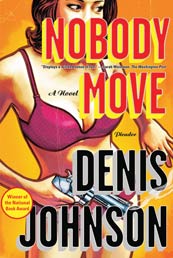 Denis Johnson’s Nobody Move is a tight snare drum of a comedy crime novel. Jimmy Luntz, still decked out in his white barbershop chorus tux (don’t ask) gets into trouble with a big gorilla he owns money too. On the run, he meets smoldering bombshell Anita. More trouble ensues. Nobody Move, originally serialized in Playboy, is a dark, funny genre exercise propelled by Johnson’s sharp dialogue and keen eye for detail. Johnson’s restraint and economy demonstrate writerly chops, but its his story and his characters that made me stay up too late reading last night.
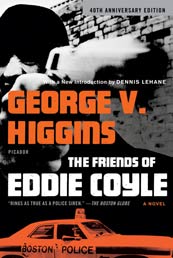 I’m kind of embarrassed that I’d never heard of George V. Higgins’s seminal crime novel, The Friends of Eddie Coyle, the story of a down-on-his luck gunrunner trying to get a break on a three-year sentence. Picador’s new edition celebrates the book’s 40th anniversary. Higgins’s electric dialogue thrusts the reader right into the action, trading narrative clarity for a smoky milieu of backroom deals and gritty alleys. But my phrasing here sounds way too corny and trite. Forgive me, I don’t really know how to write about good crime fiction because I’m so unused to it. I’ll lazily favorably compare The Friends of Eddie Coyle to David Simon’s Baltimore crime epic The Wire.
 I’ve been too engrossed with Coyle and Nobody Move the past few days to do more than skim over Clancy Martin’s How to Sell, a novel about grifters and scam artists in the jewelery world, but I did read and very much enjoy its first chapter, where the protagonist pawns his mother’s wedding ring (“the only precious thing she had left”) and yet still manages to keep reader sympathy (mine, at least). Martin worked for years in the fine jewelery business. He also translates Nietzsche and Kierkegaard. Zadie Smith says of How to Sell: “It’s a little like Dennis Cooper with a philosophical intelligence, or Raymond Carver without hope. But mostly it’s like itself.” I like that.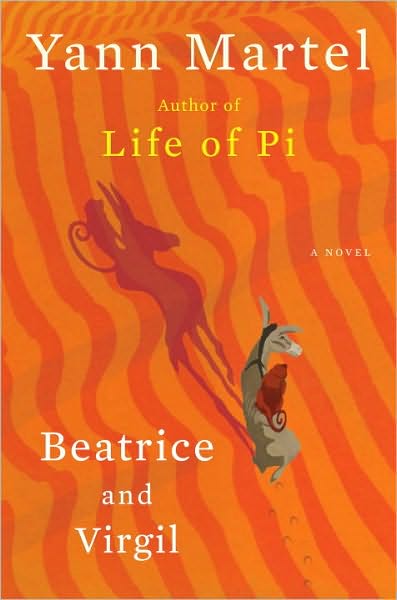
 Biblioklept