“The Yellow Paint” — Robert Louis Stevenson


“The Yellow Paint,” a short fable by Robert Louis Stevenson—

In a certain city there lived a physician who sold yellow paint. This was of so singular a virtue that whoso was bedaubed with it from head to heel was set free from the dangers of life, and the bondage of sin, and the fear of death for ever. So the physician said in his prospectus; and so said all the citizens in the city; and there was nothing more urgent in men’s hearts than to be properly painted themselves, and nothing they took more delight in than to see others painted. There was in the same city a young man of a very good family but of a somewhat reckless life, who had reached the age of manhood, and would have nothing to say to the paint: “Tomorrow was soon enough,” said he; and when the morrow came he would still put it off. She might have continued to do until his death; only, he had a friend of about his own age and much of his own manners; and this youth, taking a walk in the public street, with not one fleck of paint upon his body, was suddenly run down by a water-cart and cut off in the heyday of his nakedness. This shook the other to the soul; so that I never beheld a man more earnest to be painted; and on the very same evening, in the presence of all his family, to appropriate music, and himself weeping aloud, he received three complete coats and a touch of varnish on the top. The physician (who was himself affected even to tears) protested he had never done a job so thorough.

Some two months afterwards, the young man was carried on a stretcher to the physician’s house.

“What is the meaning of this?” he cried, as soon as the door was opened. “I was to be set free from all the dangers of life; and here have I been run down by that self-same water-cart, and my leg is broken.”

“Dear me!” said the physician. “This is very sad. But I perceive I must explain to you the action of my paint. A broken bone is a mighty small affair at the worst of it; and it belongs to a class of accident to which my paint is quite inapplicable. Sin, my dear young friend, sin is the sole calamity that a wise man should apprehend; it is against sin that I have fitted you out; and when you come to be tempted, you will give me news of my paint.”

     “Oh!” said the young man, “I did not understand that, and it seems rather disappointing. But I have no doubt all is for the best; and in the meanwhile, I shall be obliged to you if you will set my leg.”

“That is none of my business,” said the physician; “but if your bearers will carry you round the corner to the surgeon’s, I feel sure he will afford relief.”

Some three years later, the young man came running to the physician’s house in a great perturbation. “What is the meaning of this?” he cried. “Here was I to be set free from the bondage of sin; and I have just committed forgery, arson and murder.”

“Dear me,” said the physician. “This is very serious. Off with your clothes at once.” And as soon as the young man had stripped, he examined him from head to foot. “No,” he cried with great relief, “there is not a flake broken. Cheer up, my young friend, your paint is as good as new.”

“Good God!” cried the young man, “and what then can be the use of it?”

“Why,” said the physician, “I perceive I must explain to you the nature of the action of my paint. It does not exactly prevent sin; it extenuates instead the painful consequences. It is not so much for this world, as for the next; it is not against life; in short, it is against death that I have fitted you out. And when you come to die, you will give me news of my paint.”

“Oh!” cried the young man, “I had not understood that, and it seems a little disappointing. But there is no doubt all is for the best: and in the meanwhile, I shall be obliged if you will help me to undo the evil I have brought on innocent persons.”

     “That is none of my business,” said the physician; “but if you will go round the corner to the police office, I feel sure it will afford you relief to give yourself up.”

Six weeks later, the physician was called to the town gaol.

“What is the meaning of this?” cried the young man. “Here am I literally crusted with your paint; and I have broken my leg, and committed all the crimes in the calendar, and must be hanged tomorrow; and am in the meanwhile in a fear so extreme that I lack words to picture it.”

“Dear me,” said the physician. “This is really amazing. Well, well; perhaps, if you had not been painted, you would have been more frightened still.”
 

List with No Name #4

  1. A Tale of Two Cities
  2. Robinson Crusoe
  3. The Iliad
  4. Maggie: A Girl of the Streets
  5. Tender Is the Night
  6. Catch-22
  7. Native Son

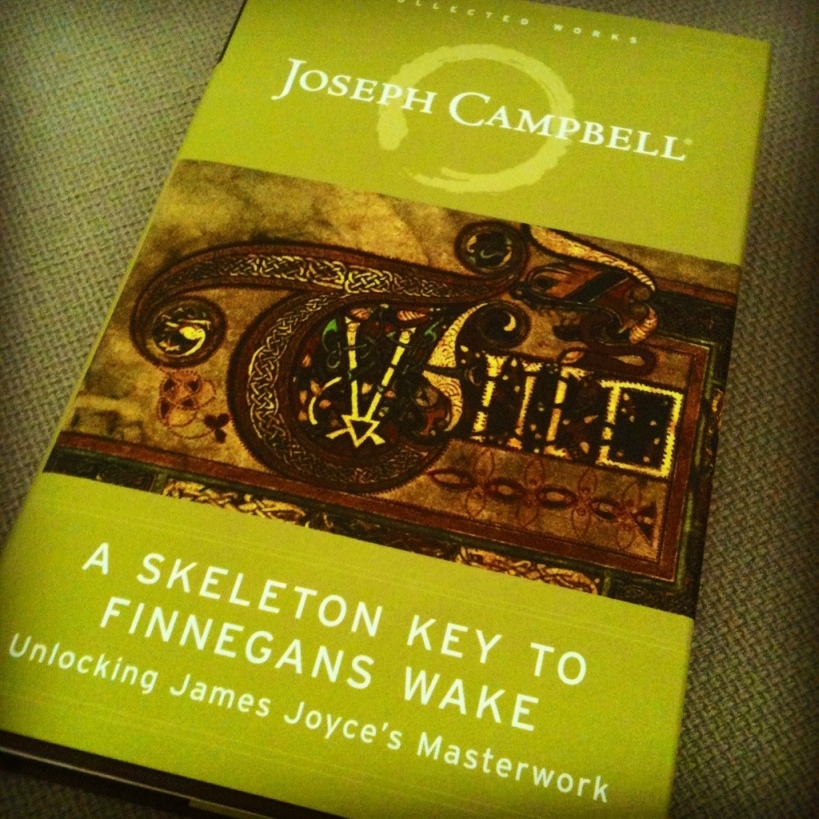
A Skeleton Key to Finnegans Wake (Book Acquired, 8.18.2012)


20120818-174214.jpg

A few weeks ago, for some reason beyond my ken, I stumbled into Finnegans Wake, read on the gentle glow of my Kindle Fire. I’ve been poking into the book for years now, but that particular night I read it with an ease—not an ease of understanding, but an ease of spirit, or of mind. Or ear, really. I had fun with it. I went back each night since then, sometimes only going through a page or two before slipping into slumbers.

Anyway, I’ve been searched for a used copy of Joseph Campbell’s Skeleton Key to the Wake for years, but I finally just broke down and ordered a new copy through my bookstore.  My plan is to read Finnegans Wake next year. It’s not a plan, so much as something I’ve just typed.


Bukowski Riff

Charles Bukowski would be 92 if he was still alive, which he isn’t because he died in 1994.

I first read Bukowski in 1994 or 1995.

I can’t remember how I had heard about him, exactly—he might have been on MTV actually (MTV used to promote writers, believe it or not. Writers used to be cool). The Boo Radleys called a song on their 1995 album Wake Up! “Charles Bukowski Is Dead,” and I know I’d read Bukowski by the time I heard the record. I don’t know. In all likelihood, I first read Bukowski by browsing his books at the local Barnes & Noble.

do know that I “borrowed” three beautiful Black Sparrow Press editions of Bukowski from a kid in high school journalism class. I do know that I never returned those books, and they’re still on a shelf with probably five or six other Bukowski volumes. I feel sort of bad about stealing them.

One of those books was/is Women, a rambling riff-novel about Bukowski’s fatter years as a poet of some renown, of some notoriety. I’ve probably read Women in full five times through. It’s hilarious, occasionally silly and hamfisted, and glorious in parts.

I read a lot of Bukowski in high school. A lot. My friends read Bukowski. We all read him, even his poetry. I remember the excitement a friend and I felt when we saw a quick shot of his novel Hollywood in the film Swingers. I don’t know why.

And then I kind of dropped Bukowski. This was when I was a junior or senior in college. I had seen the limitations of his prose, the brutality of his fiction, the sheer sloppiness of it all, the anger, the misogyny—I was aware of these things from the get-go, to be clear—but I became overly concerned with his status as not one of the greats, or as a popular writer, or as a writer from a macho-age better left behind.

But I never traded in my Bukowskis, or put them away. I kept them on the shelf. I go to them every now and then—not for  nourishment, but for what? I don’t know. The work is admittedly spotty—a weird brand of self-deprecation and self-mythology. Henry Chinaski. Hank. Bukowski the autodidact, hunched in an LA library, reading his Shakespeare, his Celine. Bukowski the impoverished drunk. Ugly Bukowski. Romantic Bukowski.

There’s no point to this riff, of course. I was in a faculty meeting all morning and I thought about Bukowski on his birthday. What I mean to say is that Bukowski is a writer I read so thoroughly and so intensely when I was at such a young age that I feel that I know him, or at least know the version of himself that he willed to be let known. But of course I don’t know him.


Unknown Pleasures (I Riff a Bit on Marcel Proust’s Swann’s Way)

20120809-105603.jpg

1. I was an undergrad in college when I first tried to read Marcel Proust. It was one of those things I did on my own, which is another way of saying that none of his writing was ever assigned to me; neither do I recall any of his writings even appearing in any of the anthologies I was assigned in high school; neither do I recall any of his writings appearing in any of the anthologies I’ve used as a teacher.

2. My initial interest in Proust, late in high school, when the name alone seemed so damn romantic, was aroused, like most people I’ll bet, by the fact that this guy basically wrote one long book, a book that seemed to have at least three names, not counting the names of the individual books and book-length chapters in those individual books.

3. But, like I said, I didn’t try to read Proust until college when I checked out the first volume from the university library. I think it might have actually been a compendium of two or more books that make up the Recherche. Anyway, I can’t recall much, except that I slugged it out through that interminable first chapter, “Combray,” getting absolutely nothing out of it.

4. Since then I’ve read a lot about Proust and his writing, enough to perhaps understand that my first foray into Swann’s Way was probably not from the best angle. I was into decidedly different stuff then—lots of the American postmodernists, English and Irish modernists, etc.—and Proust’s modernism was totally lost on me.

5. Re: Point 4: Perhaps a better way to put it would be to borrow Harold Bloom’s notion that strong/strange writers so assimilate their readers that the readers can no longer see the strangeness/strength. I was assimilated.

6. Wandering through the used book store I frequent, I spotted Lydia Davis’s translation of Swann’s Way and snapped it up, not because of any real interest in trying Proust again but because of a fannish devotion to Davis, or the idea that Davis would make Proust accessible.

7. (A brief fantasy I had as my hand hovered over the book, before my hand touched the book:

I imagined that Davis had turned Swann’s Way into a series of her own vignettes, that she had parsed and ventriloquized Proust, that her translation would be akin to “Ten Stories from Flaubert.”

This is not the case).

8. (While I’m being parenthetical: This riff started as a “books acquired” post, a post where I take a lousy photograph to document a new book that somehow arrives at Biblioklept World Headquaters. But I read so much of Swann’s Way that the original idea riffed out into this thing. Actually, go ahead and skip Point 8, if you haven’t already. Sorry).

9. The day after buying Davis’s translation I read “Combray” over two short airline trips.

10. Or should it be Combray?—it seems like a self-contained novel.

11. The opening paragraphs of “Combray” are an amazing and strange meditation on sleeping, or rather going to sleep, filled with wonderful little digressions. They are a simultaneously alienating and inviting way to open a book.

Proust writes—

Sometimes, as Eve was born from one of Adam’s ribs, a woman was born during my sleep from a cramped position of my thigh. Formed from the pleasure I was on the point of enjoying, she, I imagined, was the one offering it to me. My body, which felt in hers my own warmth, would try to find itself inside her, I would wake up.

Such a lovely set of images.

I marked it and moved on without trying to figure out exactly what it might mean.

12. Other moments are more lucid, penetrating, insightful:

Even the very simple act that we call “seeing a person we know” is in part an intellectual one. We fill the physical appearance of the individual we see with all the notions we have about him, and of the total picture that we form for ourselves, these notions certainly occupy the greater part.

“Combray” is full of these wonderful, subtle moments, and it includes some of the finest passages on reading and the transformative powers and pleasures of reading that I’ve encountered.

13. The phrase “unknown pleasures” pops out early in the book—is this where Joy Division got the album name?

14. Proust seems to hit on the idea of unknown pleasures again and again, speculative pleasures, idealized pleasures.

15. Introduced to the writer Bergotte by Swann and Bloch, the young narrator muses:

One of these passages by Bergotte, the third or fourth that I had isolated from the rest, filled me with a joy that could not be compared to the joy I had discovered in the first one, a joy I felt I was experiencing  in a deeper, vaster, more unified region of myself, from which all obstacles and partitions had been removed.

The passage concludes with the narrator deciding that he has accessed the “‘ideal passage’ by Bergotte,” an idealization through which he finds his mind “enlarged.”

16. Cataloging the meditations on unknown pleasures in the book would take forever though, and I’m just riffing here.

17. (Although I do love and will thus bring up a late passage where the narrator longs to walk in the woods with “a peasant girl,” one like a “local plant” (!), through which he will access new and individual and unknown pleasures, “Obscurely awaited, immanent and hidden. . . “).

18. Stray note: Swann is described as having a “Bressant-style” haircut, which the end notes describe as “a crew cut in front and longer in the back.” Is this not known colloquially as a mullet? Am I to understand that Swann sports a Kentucky waterfall?

19. Proust’s greatest strength in “Combray” seems to be his ability to move from the physical to the metaphysical, from object to memory. And then back again.

20. An empty statement: The writing is beautiful.

21.  Still, there’s something irksome about the narrator (Marcel?): I stopped writing “mama’s boy” in the margin after the third such notation.

22. Re: Point 21: Is this why I never stuck it out with Proust? Is this why, despite acknowledging “The writing is beautiful,” I am not particularly inclined to see what happens next? (And next and next and next . . .)

23. Re: Point 22: I think here of Cormac McCarthy’s assertion in a 1992 New York Times interview that Proust is “not literature” because it doesn’t “deal with issues of life and death.” McCarthy’s quote may or may not be out of context (not here; here it’s in perfectly sound context. I’m talking about proper context in the interview, which is to say that he may or may not have been riffing off the cuff).

24. Okay, from the McCarthy interview:

 His list of those whom he calls the “good writers” — Melville, Dostoyevsky, Faulkner — precludes anyone who doesn’t “deal with issues of life and death.” Proust and Henry James don’t make the cut. “I don’t understand them,” he says. “To me, that’s not literature. A lot of writers who are considered good I consider strange.”

25. Maybe I bring it up because I’ve read so much of McCarthy and the heroes on his list above and find them so compelling, find the protagonists and antagonists so compelling, and while Proust’s narrator is hardly repellent, I find myself occasionally wanting to give him a wedgie.

26. (Never having had the desire to give Ishmael a wedgie, or the underground man a wedgie, or Lucas Beauchamp a wedgie, or Cornelius Suttree a wedgie).

27. Okay. The sentiment I’ve just expressed seems cruel.

28. The same sensitivity I find occasionally overbearing in the narrator is exactly what makes so many of the passages and insights in the text so extraordinary.

29. The narrator is some kind of specialized receptive organic instrument, a psyche keenly attuned to the physical world who mediates that world through emotion, memory, psychological projection—language.

30. The narrator is some kind of membrane but also a self, his articulations winding from reader to self through memory to the natural world, to its phenomena, and back through desire, thought, anticipation, idealization, all back through memory again, back to the reader again. And if tracing these articulations is exhausting, the process also undeniably yields unknown pleasures.

List with No Name #2

  1. The first 20 minutes of 2001: A Space Odyssey
  2. The last 10 minutes of if . . . .
  3. The first half of Barry Lyndon but not the second half
  4. Every minute of Days of Heaven
  5. Every minute of Russian Ark
  6. The opening sequence of Ponyo
  7. The last five minutes of Aguirre, the Wrath of God
  8. The closing titles sequence of INLAND EMPIRE

“The Belly of the Whale” — Joseph Campbell

“The Belly of the Whale,” an early chapter of Joseph Campbell’s seminal work The Hero With a Thousand Faces:

The idea that the passage of the magical threshold is a transit into a sphere of rebirth is symbolized in the worldwide womb image of the belly of the whale. The hero, instead of conquering or conciliating the power of the threshold, is swallowed into the unknown, and would appear to have died.

Mishe-Nahma, King of Fishes,

In his wrath he darted upward,

Flashing leaped into the sunshine,

Opened his great jaws and swallowed

Both canoe and Hiawatha.

The Eskimo of Bering Strait tell of the trickster-hero Raven, how, one day, as he sat drying his clothes on a beach, he observed a whale-cow swimming gravely close to shore. He called: “Next time you come up for air, dear, open your mouth and shut your eyes.” Then he slipped quickly into his raven clothes, pulled on his raven mask, gathered his fire sticks under his arm, and flew out over the water. The whale came up. She did as she had been told. Raven darted through the open jaws and straight into her gullet. The shocked whale-cow snapped and sounded; Raven stood inside and looked around.

The Zulus have a story of two children and their mother swallowed by an elephant. When the woman reached the animal’s stomach, “she saw large forests and great rivers, and many high lands; on one side there were many rocks; and there were many people who had built their village there; and many dogs and many cattle; all was there inside the elephant.”

The Irish hero, Finn MacCool, was swallowed by a monster of indefinite form, of the type known to the Celtic world as a peist. The little German girl, Red Ridinghood, was swallowed by a wolf. The Polynesian favorite, Maui, was swallowed by his great-great-grandmother, Hine-nui-te-po. And the whole Greek  pantheon, with the sole exception of Zeus, was swallowed by its father, Kronos. The Greek hero Herakles, pausing at Troy on his way homeward with the belt of the queen of the Amazons, found that the city was being harassed by a monster sent against it by the sea-god Poseidon. The beast would come ashore and devour people as they moved about on the plain. Beautiful Hesione, the daughter of the king, had just been bound by her father to the sea rocks as a propitiatory sacrifice, and the great visiting hero agreed to rescue her for a price. The monster, in due time, broke to the surface of the water and opened its enormous maw. Herakles took a dive into the throat, cut his way out through the belly, and left the monster dead.

This popular motif gives emphasis to the lesson that the passage of the threshold is a form oE self-annihilation. Its resemblance to the adventure of the Symplegades is obvious. But here, instead of passing outward, beyond the confines of the visible world, the hero goes inward, to be born again. The disappearance corresponds to the passing of a worshiper into a temple—where he is to be quickened by the recollection of who and what he is, namely dust and ashes unless immortal. The temple interior, the belly of the whale, and the heavenly land beyond, above, and below the confines of the world, are one and the same. That is why the approaches and entrances to temples are flanked and defended by colossal gargoyles: dragons, lions, devil-slayers with drawn swords, resentful dwarfs, winged bulls. These are the threshold guardians to ward away all incapable of encountering the higher silences within. They are preliminary embodiments of the dangerous aspect of the presence, corresponding to the mythological ogres that bound the conventional world, or to the two rows of teeth of the whale. They illustrate the fact that the devotee at the moment of entry into a temple undergoes a metamorphosis. His secular character remains without; he sheds it, as a snake its slough. Once inside he may be said to have died to time and returned to the World Womb, the World Navel, the Earthly Paradise. The mere fact that anyone can physically walk past the temple guardians does not invalidate their significance; for if the intruder is incapable of encompassing the sanctuary, then he has effectually remained without. Anyone unable to understand a god sees it as a devil and is thus defended from the approach. Allegorically, then, the passage into a temple and the hero-dive through the jaws of the whale are identical adventures, both denoting, in picture language, the life-centering, life-renewing act.

“No creature,” writes Ananda Coomaraswamy, “can attain a higher grade of nature without ceasing to exist.” Indeed, the physical body of the hero may be actually slain, dismembered, and scattered over the land or sea—as in the Egyptian myth of the savior Osiris: he was thrown into a sarcophagus and committed to the Nile by his brother Set, and when he returned from the dead his brother slew him again, tore the body into fourteen pieces, and scattered these over the land. The Twin Heroes of the Navaho had to pass not only the clashing rocks, but also the reeds that cut the traveler to pieces, the cane cactuses that tear him to pieces, and the boiling sands that overwhelm him. The hero whose attachment to ego is already annihilate passes back and forth across the horizons of the world, in and out of the dragon, as readily as a king through all the rooms of his house. And therein lies his power to save; for his passing and returning demonstrate that through all the contraries of phenomenality the Un-create-Imperishable remains, and there is nothing to fear.

And so it is that, throughout the world, men whose function it has been to make visible on earth the life-fructifying mystery of the slaying of the dragon have enacted upon their own bodies the great symbolic act, scattering their flesh, like the body of Osiris, for the renovation of the world. In Phrygia, for example, in honor of the crucified and resurrected savior Attis, a pine tree was cut on the twenty-second of March, and brought into the sanctuary of the mother-goddess, Cybele. There it was swathed like a corpse with woolen bands and decked with wreaths of violets. The effigy of a young man was tied to the middle of the stem. Next day took place a ceremonial lament and blowing of trumpets. The twenty-fourth of March was known as the Day of Blood: the high priest drew blood from his arms, which he presented as an offering; the lesser clergy whirled in a dervish-dance, to the sound of drums, horns, flutes, and cymbals, until, rapt in ecstasy, they gashed their bodies with knives to bespatter the altar and tree with their blood; and the novices, in imitation of the god whose death and resurrection they were celebrating, castrated themselves and swooned.

And in the same spirit, the king of the south Indian province of Quilacare, at the completion of the twelfth year of his reign, on a day of solemn festival, had a wooden scaffolding constructed, and spread over with hangings of silk. When he had ritually bathed in a tank, with great ceremonies and to the sound of music, he then came to the temple, where he did worship before the divinity. Thereafter, he mounted the scaffolding and, before the people, took some very sharp knives and began to cut off his own nose, and then his ears, and his lips, and all his members, and as much of his flesh as he was able. He threw it away and round about, until so much of his blood was spilled that he began to faint, whereupon he summarily cut his throat.

John Steinbeck on Work Habits

Mark Twain used to write in bed—so did our greatest poet. But I wonder how often they wrote in bed—or whether they did it twice and the story took hold. Such things happen. Also I would like to know what things they wrote in bed and what things they wrote sitting up. All of this has to do with comfort in writing and what its value is. I should think that a comfortable body would let the mind go freely to its gathering.

You know I always smoke a pipe when I work—at least I used to and now I have taken it up again. It is strange—as soon as a pipe begins to taste good, cigarettes become tasteless. I find I smoke fewer and fewer cigarettes. Maybe I can cut them out entirely for a while. This would be a very good thing. Even with this little change, my deep-seated and perennial cigarette cough is going away. A few months without that would be a real relief.

I have dawdled away a good part of my free time now carving vaguely on a scrap of mahogany, but I guess I have been thinking too. Who knows. I sit here in a kind of a stupor and call it thought.

Now I have taken the black off my desk again, clear down to the wood, and have put a green blotter down. I am never satisfied with my writing surface.

My choice of pencils lies between the black Calculator stolen from Fox Films and this Mongol 2 3/8 F which is quite black and holds its point well—much better in fact than the Fox pencils. I will get six more or maybe four more dozen of them for my pencil tray.

I have found a new kind of pencil—the best I have ever had. Of course it costs three times as much too but it is black and soft but doesn’t break off. I think I will always use these. They are called Blackwings and they really glide over the paper.

In the very early dawn, I felt a fiendish desire to take my electric pencil sharpener apart. It has not been working very well and besides I have always wanted to look at the inside of it. So I did and found that certain misadjustments had been made at the factory. I corrected them, cleaned the machine, oiled it and now it works perfectly for the first time since I have it. There is one reward for not sleeping.

Today is a dawdly day. They seem to alternate. I do a whole of a day’s work and then the next day, flushed with triumph, I dawdle. That’s today. The crazy thing is that I get about the same number of words down either way. This morning I am clutching the pencil very tight and this is not a good thing. It means I am not relaxed. And in this book I want to be just as relaxed as possible. Maybe that is another reason I am dawdling. I want that calmness to settle on me that feels so good—almost like a robe of cashmere it feels.

It has been a good day of work with no harm in it. I have sat long over the desk and the pencil has felt good in my hand. Outside the sun is very bright and warm and the buds are swelling to a popping size. I guess it is a good thing I became a writer. Perhaps I am too lazy for anything else.

On the third finger of my right hand I have a great callus just from using a pencil for so many hours every day. It has become a big lump by now and it doesn’t ever go away. Sometimes it is very rough and other times, as today, it is as shiny as glass. It is peculiar how touchy one can become about little things. Pencils must be round. A hexagonal pencil cuts my fingers after a long day. You see I hold a pencil for about six hours every day. This may seem strange but it is true. I am really a conditioned animal with a conditioned hand.

I am really dawdling today when what I want to write is in my head. It is said that many writers talk their books out and so do not write them. I think I am guilty of this to a large extent. I really talk too much about my work and to anyone who will listen. If I would limit my talk to inventions and keep my big mouth shut about work, there would probably be a good deal more work done.

The callus on my writing finger is very sore today. I may have to sandpaper it down. It is getting too big.

The silly truth is that I can take almost any amount of work but I have little tolerance for confusion.

From John Steinbeck’s 1969 interview in The Paris Review.

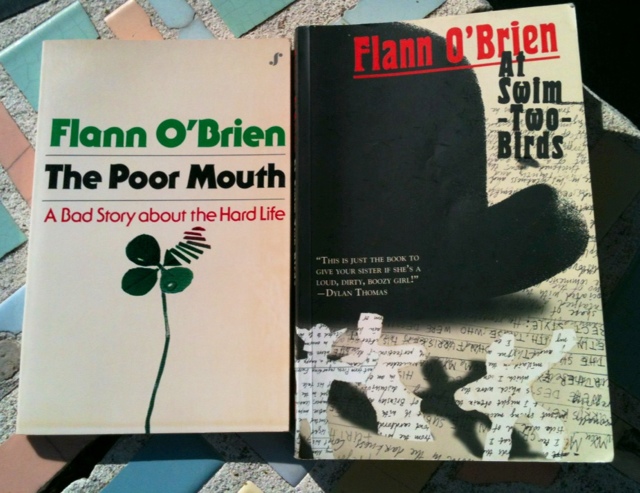
Flann O’Brien and Alasdair Gray (Books Acquired, 5.12.2012)

20120512-174120.jpg

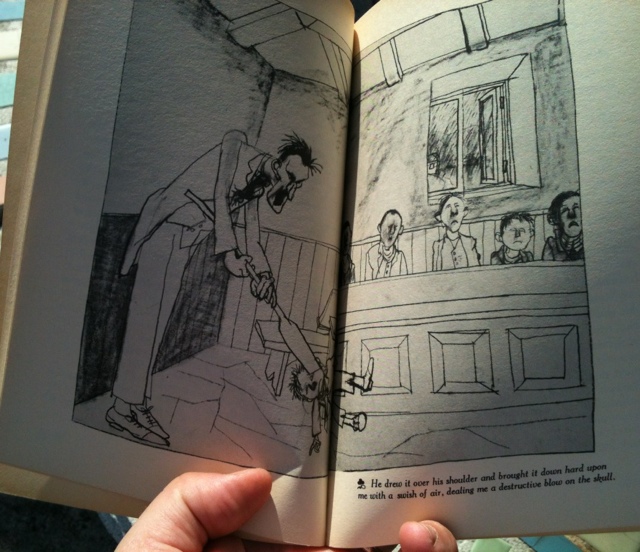
Picked up two more by Flann O’Brien after enjoying The Third Policeman so very much; thanks again to the reader suggestions on that one. The Poor Mouth has pictures:

20120512-175150.jpg
20120512-174128.jpg

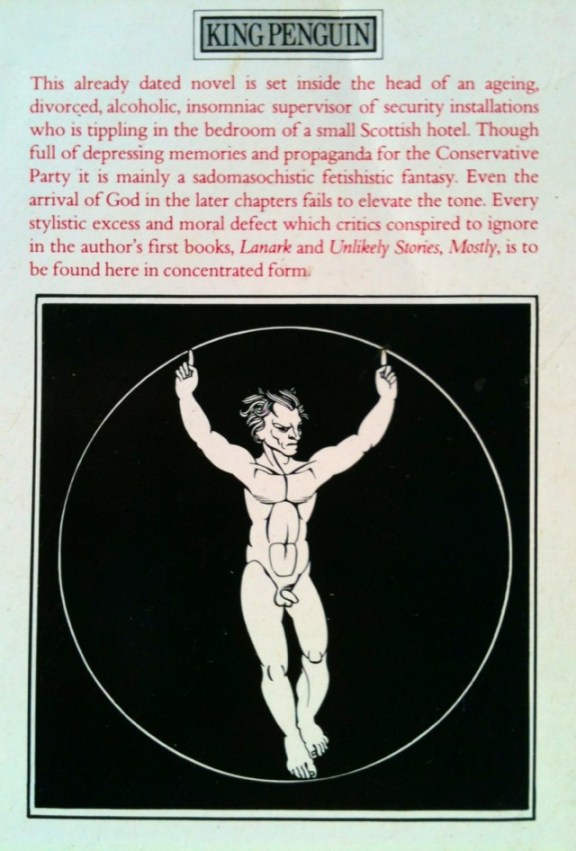
I was looking for Alasdair Gray’s first novel Lanark (no dice), but picked up 1982 Janine read the back and immediately knew I had to have it.

20120512-174146.jpg

I picked up Poor Things just to riffle a bit, and again, very intrigued. Also, another book with illustrations. Here’s one:

20120512-175200.jpg

And, as I shot these outside in the cheap showiness of nature, here’s a picture of a large plant’s tumescent bloom, because hey why not:

20120512-174156.jpg

“to sex brawl and dare” — A Poem from Surrealist Ghérasim Luca

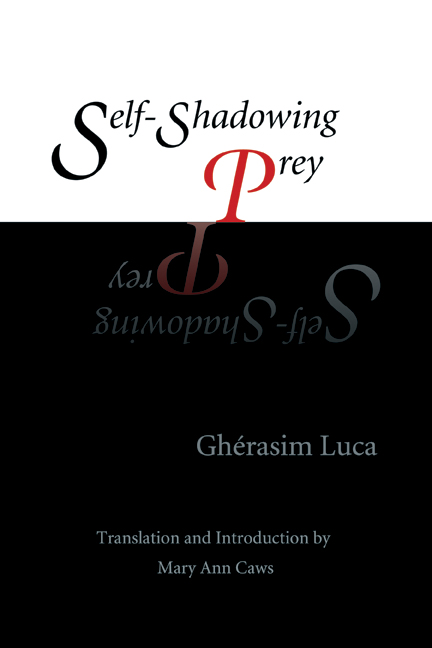
The good people at Contra Mundum Press are putting out the first English language translation of Romanian surrealist Ghérasim Luca’s Self-Shadowing Prey. Mary Ann Caws translates. Here’s the first poem in the book:

at the edge of a forest

whose trees are slender ideas

and each leaf a thought at bay

the vegetal reveals to us

the damned depths of an animal sect

or more precisely

an old insect anguish

waking up as man

the only way

the only basic weapon

to animate a mental state

that I hurry to write mantil

like a mantis

if only to mark

with a dry warning laugh

the devouring word

Entity and antithesis of the bush

a sort of wild and organic brush

grows in the head of that man

ravaged

by the heresy of parks and greenhouses

like the orgasm of a key

a lovely door

So the legendary passivity

the famous and ample passivity of plants

changes here to idle hate

to mad rage

to sex brawl and dare

luring by sap blood lava . . .

as rapid as the passage of woman

to beast

she empties us of a foul ancestral

wound

which in a spurt relieves us

of these fixed plaints

and these false death rattles plumbing us

our calm gestures of the interred

Now only terror

is still able to insert

in the tropism of body and of guilty

spirit

this prism as doubled echo

where brains and senses capture

the violent innocence

of a flora and a fauna

whose marriage is a long seizure

and a rape as slow as gold

in the implacable lead

And it’s around the mental equator

in the space delimited by the tropics

of a head

at the angle of the eye and what surrounds it

that the myth of a kind of utopian

jungle surges into the world

As virgin as the unknowable

or the other “face” of the moon

and never in the reach of a gun

or an axe

its prey is the snow

sand ball hip if not the trap

that the diffuse breath of a dream

lights up

For tangled

soldered to massive corkscrew keys

the vines

the branches stoves and rituals

fuse

around the forms placed

as if by miracle

at the crossroads of dryads

of druids and of man

So many points to aim at

all these yes and nos that

outside outside of time

of space and weight

select a sort of coupled oasis

and hamlet

to descend in these gods

from before the ages

the gods-place-beast-island-ash-fire

come forth as from the coupling of bird

and branch

and those exiled from the center

and from the shade of a golden foliage

will adore one day

between the walls of their somber cities

“Quite an Original” — Herman Melville on Hamlet, Don Quixote, and Satan

This is Chapter XLIV of Herman Melville’s The Confidence Man:

“Quite an original:” A phrase, we fancy, rather oftener used by the young, or the unlearned, or the untraveled, than by the old, or the well-read, or the man who has made the grand tour. Certainly, the sense of originality exists at its highest in an infant, and probably at its lowest in him who has completed the circle of the sciences.

As for original characters in fiction, a grateful reader will, on meeting with one, keep the anniversary of that day. True, we sometimes hear of an author who, at one creation, produces some two or three score such characters; it may be possible. But they can hardly be original in the sense that Hamlet is, or Don Quixote, or Milton’s Satan. That is to say, they are not, in a thorough sense, original at all. They are novel, or singular, or striking, or captivating, or all four at once.
More likely, they are what are called odd characters; but for that, are no more original, than what is called an odd genius, in his way, is. But, if original, whence came they? Or where did the novelist pick them up?

Where does any novelist pick up any character? For the most part, in town, to be sure. Every great town is a kind of man-show, where the novelist goes for his stock, just as the agriculturist goes to the cattle-show for his. But in the one fair, new species of quadrupeds are hardly more rare, than in the other are new species of characters—that is, original ones. Their rarity may still the more appear from this, that, while characters, merely singular, imply but singular forms so to speak, original ones, truly so, imply original instincts.

In short, a due conception of what is to be held for this sort of personage in fiction would make him almost as much of a prodigy there, as in real history is a new law-giver, a revolutionizing philosopher, or the founder of a new religion.

In nearly all the original characters, loosely accounted such in works of invention, there is discernible something prevailingly local, or of the age; which circumstance, of itself, would seem to invalidate the claim, judged by the principles here suggested.

Furthermore, if we consider, what is popularly held to entitle characters in fiction to being deemed original, is but something personal—confined to itself. The character sheds not its characteristic on its surroundings, whereas, the original character, essentially such, is like a revolving Drummond light, raying away from itself all round it—everything is lit by it, everything starts up to it (mark how it is with Hamlet), so that, in certain minds, there follows upon the adequate conception of such a character, an effect, in its way, akin to that which in Genesis attends upon the beginning of things.

For much the same reason that there is but one planet to one orbit, so can there be but one such original character to one work of invention. Two would conflict to chaos. In this view, to say that there are more than one to a book, is good presumption there is none at all. But for new, singular, striking, odd, eccentric, and all sorts of entertaining and instructive characters, a good fiction may be full of them. To produce such characters, an author, beside other things, must have seen much, and seen through much: to produce but one original character, he must have had much luck.

There would seem but one point in common between this sort of phenomenon in fiction and all other sorts: it cannot be born in the author’s imagination—it being as true in literature as in zoology, that all life is from the egg.

In the endeavor to show, if possible, the impropriety of the phrase, Quite an Original, as applied by the barber’s friends, we have, at unawares, been led into a dissertation bordering upon the prosy, perhaps upon the smoky. If so, the best use the smoke can be turned to, will be, by retiring under cover of it, in good trim as may be, to the story.

“He Squatted Among the Soft Womansmelling Garments” — A Strange Sex Scene from Faulkner

A strange, gross sex scene from William Faulkner’s  novel Light in August. As a child, the book’s anti-hero,Joe Christmas, an orphan of unclear parentage, sneaks off to suck sweet toothpaste from a tube. There, he surreptitiously witnesses a clandestine meeting between the orphanage’s dietitian and another worker:

In the quiet and empty corridor, during the quiet hour of early afternoon, he was like a shadow, small even for five years, sober and quiet as a shadow. Another in the corridor could not have said just when and where he vanished, into what door, what room. But there was no one else in the corridor at this hour. He knew that. He had been doing this for almost a year, ever since the day when he discovered by accident the toothpaste which the dietitian used.

Once in the room, he went directly on his bare and silent feet to the washstand and found the tube. He was watching the pink worm coil smooth and cool and slow onto his parchmentcolored finger when he heard footsteps in the corridor and then voices just beyond the door. Perhaps he recognised the dietitian’s voice. Anyway, he did not wait to see if they were going to pass the door or not. With the tube in his hand and still silent as a shadow on his bare feet he crossed the room and slipped beneath a cloth curtain which screened off one corner of the room. Here he squatted, among delicate shoes and suspended soft womangarments. Crouching, he heard the dietitian and her companion enter the room.

The dietitian was nothing to him yet, save a mechanical adjunct to eating, food, the diningroom, the ceremony of eating at the wooden forms, coming now and then into his vision without impacting at all except as something of pleasing association and pleasing in herself to look at—young, a little fullbodied, smooth, pink-and-white, making his mind think of the diningroom, making his mouth think of something sweet and sticky to eat, and also pink-colored and surreptitious. On that first day when he discovered the toothpaste in her room he had gone directly there, who had never heard of toothpaste either; as if he already knew that she would possess something of that nature and he would find it. He knew the voice of her companion also: It was that of a young interne from the county hospital who was assistant to the parochial doctor, he too a familiar figure about the house and also not yet an enemy.

He was safe now, behind the curtain. When they went away, he would replace the toothpaste and also leave. So he squatted behind the curtain, hearing without listening to it the woman’s tense whispering voice: “No! No! Not here. Not now. They’ll catch us. Somebody will—No, Charley! Please!” The man’s words he could not understand at all. The voice was lowered too. It had a ruthless sound, as the voices of all men did to him yet, since he was too young yet to escape from the world of women for that brief respite before he escaped back into it to remain until the hour of his death. He heard other sounds which he did know: a scuffing as of feet, the turn, of the key in the door. “No, Charley! Charley, please! Please, Charley!” the woman’s whisper said. He heard other sounds, rustlings, whisperings, not voices. He was not listening; he was just waiting, thinking without particular interest or attention that it was a strange hour to be going to bed. Again the woman’s fainting whisper came through the thin curtain: “I’m scared! Hurry! Hurry!”

He squatted among the soft womansmelling garments and the shoes. He saw by feel alone now the ruined, once cylindrical tube. By taste and not seeing he contemplated the cool invisible worm as it coiled onto his finger and smeared sharp, automatonlike and sweet, into his mouth. By ordinary he would have taken a single mouthful and then replaced the tube and left the room. Even at five, he knew that he must not take more than that. Perhaps it was the animal warning him that more would make him sick; perhaps the human being warning him that if he took more than that, she would miss it. This was the first time he had taken more. By now, hiding and waiting, he had taken a good deal more. By feel he could see the diminishing tube. He began to sweat. Then he found that he had been sweating for some time, that for some time now he had been doing nothing else but sweating. He was not hearing anything at all now. Very likely he would not have heard a gunshot beyond the curtain. He seemed to be turned in upon himself, watching himself sweating, watching himself smear another worm of paste into his mouth which his stomach did not want. Sure enough, it refused to go down. Motionless now, utterly contemplative, he seemed to stoop above himself like a chemist in his laboratory, waiting. He didn’t have to wait long. At once the paste which he had already swallowed lifted inside him, trying to get back out, into the air where it was cool. It was no longer sweet. In the rife, pinkwomansmelling, obscurity behind the curtain he squatted, pinkfoamed, listening to his insides, waiting with astonished fatalism for what was about to happen to him. Then it happened. He said to himself with complete and passive surrender: ‘Well, here I am.’

When the curtain fled back he did not look up. When hands dragged him violently out of his vomit he did not resist. He hung from the hands, limp, looking with slackjawed and glassy idiocy into a face no longer smooth pink-and-white, surrounded now by wild and dishevelled hair whose smooth bands once made him think of candy. “You little rat!” the thin, furious voice hissed; “you little rat! Spying on me! You little nigger bastard!”

“Walter, Leave Off” — D.H. Lawrence on Walt Whitman

From Lawrence’s chapter on Whitman in Studies in Classic American Literature (more):

POST-MORTEM effects?

But what of Walt Whitman?

The ‘good grey poet’.

Was he a ghost, with all his physicality?

The good grey poet.

Post-mortem effects. Ghosts.

A certain ghoulish insistency. A certain horrible pottage of human parts. A certain stridency and portentousness. A luridness about his beatitudes.

DEMOCRACY! THESE STATES! EIDOLONS! LOVERS, ENDLESS LOVERS!

ONE IDENTITY!

ONE IDENTITY!

I AM HE THAT ACHES WITH AMOROUS LOVE.

Do you believe me, when I say post-mortem effects ?

When the Pequod went down, she left many a rank and dirty steamboat still fussing in the seas. The Pequod sinks with all her souls, but their bodies rise again to man innumerable tramp steamers, and ocean-crossing liners. Corpses.

What we mean is that people may go on, keep on, and rush on, without souls. They have their ego and their will, that is enough to keep them going.

So that you see, the sinking of the Pequod was only a metaphysical tragedy after all. The world goes on just the same. The ship of the soul is sunk. But the machine-manipulating body works just the same: digests, chews gum, admires Botticelli and aches with amorous love.

I AM HE THAT ACHES WITH AMOROUS LOVE.

What do you make of that? I AM HE THAT ACHES. First generalization. First uncomfortable universalization. WITH AMOROUS LOVE! Oh, God! Better a bellyache. A bellyache is at least specific. But the ACHE OF AMOROUS LOVE!

Think of having that under your skin. All that!

I AM HE THAT ACHES WITH AMOROUS LOVE.

Walter, leave off. You are not HE. You are just a limited Walter. And your ache doesn’t include all Amorous Love, by any means. If you ache you only ache with a small bit of amorous love, and there’s so much more stays outside the cover of your ache, that you might be a bit milder about it.

I AM HE THAT ACHES WITH AMOROUS LOVE.

CHUFF! CHUFF! CHUFF!

CHU-CHU-CHU-CHU-CHUFF!

Reminds one of a steam-engine. A locomotive. They’re the only things that seem to me to ache with amorous love. All that steam inside them. Forty million foot-pounds pressure. The ache of AMOROUS LOVE. Steam-pressure. CHUFF!

An ordinary man aches with love for Belinda, or his Native Land, or the Ocean, or the Stars, or the Oversoul: if he feels that an ache is in the fashion.

It takes a steam-engine to ache with AMOROUS LOVE. All of it.

Walt was really too superhuman. The danger of the superman is that he is mechanical.

The Pale King Paperback (Book Acquired, 4.07.2012)

20120411-174813.jpg

I was happy to get a trade paperback of David Foster Wallace’s The Pale King this weekend (thanks Hachette!) for a few reasons. First, I detest hardback books — that didn’t stop me from picking up (and reviewingTPK when it debuted last year — but I know I’ll prefer this paperback for rereadings. More to the point, the paperback boasts four vignettes not published with the hardback last year, which I’m sure is in no way a cynical marketing ploy cooked up by the publishers. On those scenes:

20120411-172813.jpg

Okay, so yes, I read them. They’re short, and they don’t really add to the novel; actually, they probably take away from the Michael Pietsch’s fine editing work. Still, DFW fans will eat them up. I’ll try to reflect more later.

There’s also one of those reading group guide sections, which cracks me up. Are book clubs gonna read this book? I mean, I hope they do, but they’ll likely hate it. Here’s a question that caught my eye, mostly because I wrote a bit about §19 this summer.

20120411-174805.jpg

RIP Harry Crews — A Rambling Riff on a Southern Great

Harry Crews died today at 76 in Gainesville, FL, where he lived and worked for years.

This isn’t an obituary—I’m sure  you can find them elsewhere (I haven’t looked yet, but they’ll be out there)—it’s more a riff about me than Crews. Solipsistic, narcissistic, sure. Let’s say I feel a sense of unearned pride for the man, a geographical kinship, as if some of his bloody bravura might splatter on me, anoint me, confer on me a glimpse of his strange powers. (And although I would feel this way in any case, I’ll point out that Crews and I shared the same birthday). Maybe I should wait to write, put together a detailed overview of his work, delineate a chronological progression of his life and work . . . But it’s a warm spring day in Florida, I’m three beers down, a small buzz behind my eyes, the whir of the cheap electric fans on my backporch goading me into dim golden memory . . .

I graduated high school in 1997 and went to the University of Florida in Gainesville that fall—just in time to learn that Crews had retired his position in the Creative Writing department (he was also a graduate of the university) that spring. It was disappointing for me.

I’d read a few of Crews’s blistering, blustering novels, dark comic rants about the dirty malfeasance backwood Cracker folk get into after dark, and he’d come to occupy a fabled place in my impressionable mind—a Southern answer to the Bukowski and Henry Miller books I devoured in kind.

I was 18 and dramatically naïve. I honestly thought that I was going to write a Really Great Novel, and I honestly thought that Crews was going to teach me how. In that first semester of college, the poor underpaid graduate student who led the Creative Writing class I took—a class that all but killed a desire to write creatively for years (I write “all but” because I took a second fiction writing class that was the metaphorical nail in the coffin) informed  me that Crews was no longer writer-in-residence (!), that some guy named Padgett Powell had taken up that mantle. This news dispirited me, took some of the wind out of my romantic illusions (without, y’know, properly killing them off). Maybe I’d have stuck it through the program if I thought it might end in a seminar with Crews, it’s hard to say. (I’ll also point out that it took me years to give Padgett Powell a fair read).

I won’t pretend to be sad at the death of Harry Crews: 76 is pretty old if you drank and fought and lived like that man did, and he’s already given more literature to the world than most of us could ever hope to. I was more sad at 18 to learn that I wouldn’t learn from him (not realizing at that age that reading is a way of learning). These statements seem in bad taste as I write them, but I assure you they’re not. You’re being too sensitive. But I do want to connote some reverence for the man, for his work at least, for his tales of rage and poverty, for the truth he sussed out of the swampy south.

Here’s a shift: Barry Hannah, another Southern boy whose work I’ve come to love, was not on my radar until his death in 2010. This isn’t to say I wouldn’t have found his stuff if he hadn’t died then, but I think that we all know what I’m pointing to here, the grand appraisals and reappraisals that we focus on our late writers, whose deaths might entail a second life, a life again in new readers. And Crews deserves readers: His writing is raw and jagged and ugly. It’s hard to imagine someone producing something like A Feast of Snakes or The Gypsy’s Curse today—I mean it would just be too politically incorrect I suppose. Crews is the kind of cult writer whose cult will likely grow a little now, after his death.

Starting places: The anthology Classic Crews collects Crews’s memoir Childhood, the novels Car and The  Gypsy’s Curse, as well as some essays. There’s also Florida Frenzy, an essay collection larded with sex and violence and animals. You can’t go wrong with his novel A Feast of Snakes. Well, maybe you can. It’s actually entirely possible that Crews isn’t for your faint heart or delicate sensibilities—and that’s fine. But for those intrigued, come and get the grit.

“Sources Agree Rock Swoon Has No Past” — Barry Hannah Short Story

“Sources Agree Rock Swoon Has No Past” by Barry Hannah. This short short was published in the June 2000 issue of Harper’s from a reading Hannah gave in 1986 at the Sigma Tao Delta Society at the University of Mississippi. The story appeared in Hannah’s 1988 novel Hey Jack!:

“Pa. Is it really true the old eat their young?”

Gives pause.

“Couldn’t rightly say, son. I’m a mid man. Feels like I’m walking on ice meself. Go on down to the barn, ask Grandpa.”

Grandpa’s down there in the back shadows, some loose bales around his old brogies. Seems to be humming and eating, pulling a nail out of a rotten piece of board with a pair of pliers.

“Is it true, Grandpa?”

“Wyoming’s not my home . . .”

“Yer nuts, Grandpa.”

Sings, “Ate ol’ Granny in a choo-choo car”

Kid goes to the hut to see Grandpa’s father. Withered beyond longevity, a tiny man in dwarf’s overalls, deeply addicted to codeine and Valium, fears colored people; occasionally makes scratching protests on his old violin, which has become too large for him. Every disease has had its success with him. Now he’s bare;u a scab demanding infrequent nutrients. Bald as a beige croquet ball, he rolls his own.

They’ve fixed him up a mike with a cord into an ancient Silvertone amplifying box. Even his snores can be heard, slightly, out in the yard.

“Double Gramps, is it true that the old eat their young?”

“God damn, I’m old!” blasts over the kid, feedback piercing too. The old man faints, recovers, goes into a codeine wither.

“But my question. Please, Double Gramps.”

Almost accidentally, the old man fits bow to fiddle and scrawls out the grand trio of “Stars and Stripes Forever.” Endlessly. It goes on the entire afternoon, amplifier picking up a prouder stroke here and there, screeching.

The kid grows up, a rock star, aging at twenty-three. He’s already eating the young by the thousands when the second though hits him.

George Boorujy Talks to Biblioklept About Painting Animals and People, His New Show Blood Memory, and Throwing Bottled Drawings into New York Waterways

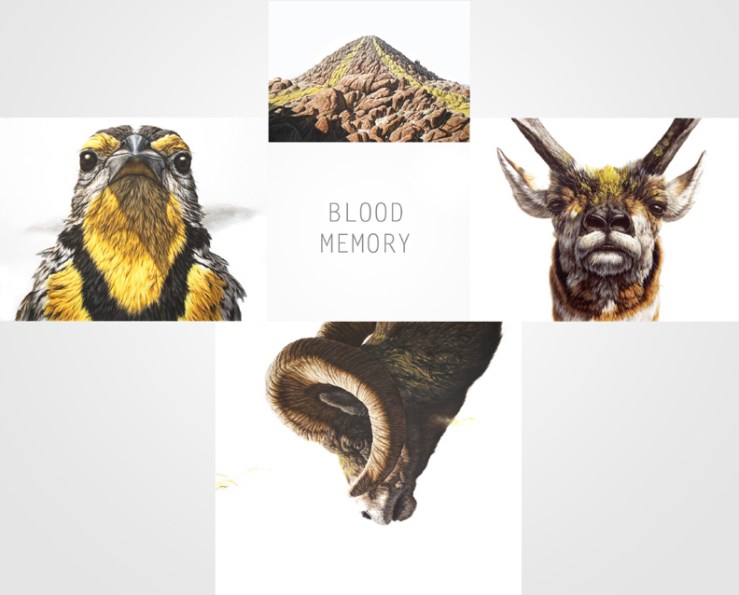
George Boorujy’s marvelous paintings explore humanity’s paradoxical engagements and disengagements with “Nature” — a system that we are manifestly a part of, yet nevertheless philosophically define ourselves against. The first Boorujy painting I saw, a gorgeous bluebird, stunned me: simultaneously delicate and fierce, it emanates pride but also an ineffable quality that surpasses rational, systematic thought. The painting’s vivid colors and subject recalled to me Albrecht Dürer’s Wing of a Blue Roller. I soon found more of Boorujy’s work at the P.P.O.W. Gallery home to the artist’s second solo show, Blood Memory (535 W. 22nd St., NYC, March 15th — April 14th). Blood Memory continues Boorujy’s depiction of animals and landscapes, subjects that resonate with his extensive travels across the US as well as his background in marine biology, a subject the New Jersey native initially pursued at the University of Miami before switching to a BFA. He completed his MFA at the School of Visual Arts in NYC. Boorujy is based out of Brooklyn; he paints and teaches, and works a project called New York Pelagic, where he launches original drawings of water birds (along with a questionnaire) in glass bottles into New York waterways. Check out his website.

Father -- George Boorujy -- Part of Blood Memory

I was thrilled to talk to George over a series of emails: he was personable, funny, and very generous. He ended his first email with one of the best sign-offs I’ve ever read: “I’m gonna go drink in the shower now.” Like many folks of delicate sensibilities and fine upbringing, I too enjoy shower beers. We rapped about Florida, ecology, Swamplandia!, the arts and sciences, the Hipster Mujahideen, the possibility of a racist ibis, and much more.

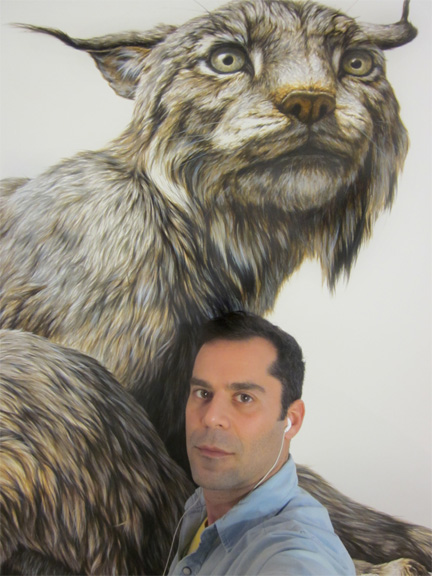
The Artist in repose next to the freshly completed work When Was It That I Knew You

Biblioklept: Tell us about your solo show at the P.P.O.W. Gallery. It’s called Blood Memory—what kind of pieces are you showing?

George Boorujy: Animals. Surprise! But really this is the most purely animal show or body of work that I’ve done. I think there’s only one piece that isn’t of an animal. They’re mostly portrait type pieces, some quite large. I’m finishing up a lynx which is 6 by 11 feet. It sort of looks like Goya’s Colossus. There’s a black white-tailed doe, a meadowlark, a blue jay, a ram, a pronghorn, a frigate bird, a cormorant, another few deer, a Burmese python (hi Florida!). And a mountain. I always seem to need a mountain.

Biblioklept: Your past work has often focused on animals and landscapes, often with implicit ecological arguments. I know you initially studied marine biology in school—how did that course of study influence your art?

GB: I think my brain is somewhat organized like a school where arts and sciences are lumped together. So I’m using the practice of art instead of the practice of science to explore the things I’m interested in. Art and science are very similar in many ways. They are often both a pursuit of the truth. Just different tools and methods are used. Although I am an environmentalist (whatever that actually means) I try not to have any explicit agenda with the work. I want it to stir the viewer or trigger something within them, but not give them an answer or a specific point of view. If I make a piece that shows a manipulated landscape, I’m not necessarily saying it is wrong to manipulate the landscape. We all do it, and we all take advantage of fossil fuels – I love fossil fuels! They’re amazing and we should respect them more and conserve them more – I just want to show what is. Same goes for the treatment of an animal. I’m sure they’re stand-ins for something in my deep sub-conscious, but they are also just what they are, with all attendant veins and ticks and dust in their fur.

Biblioklept: How do you make your animals look so imperious, so proud?

GB: I think maybe it’s because I make them big. I try to actually give them a very indifferent expression so that people can read whatever they want into it. I suppose there is an inherent pride in the form of the animal itself because it is the result of millions of years of evolution that have made it this far. A lot of people think they look sad, which isn’t intended either. I was leaving the studio a few months back when I had a lot of them up and they all looked very judgmental. But then it was better the next day.

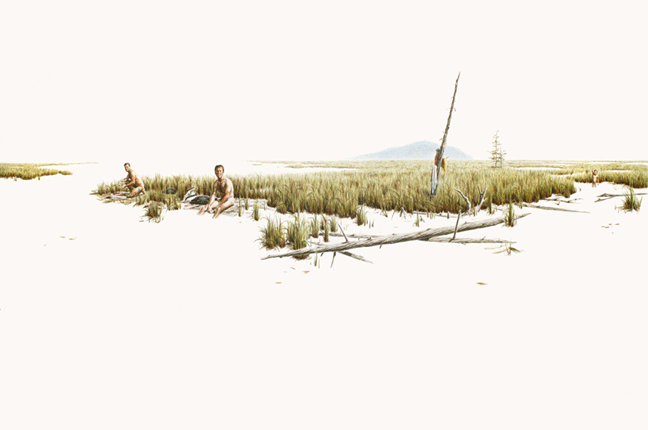
Hunters, George Boorujy

Biblioklept: Let’s shift to people for a moment (although people are animals too, of course). In works like Moraine and Hunters there’s a sense—at least for me—of distance, or almost intrusion (even voyeurism, if I’m being honest). I find your picture of Lincoln fascinating too. I’m curious about how you actually create these pictures: How do you plan them? How do you execute them? What motivates them?

GB: I’m happy that you felt like a voyeur. I never want the pieces to be just observations, I want them to be interactions. Those two pieces in particular could have ended up looking like dioramas or re-enactments or something if there wasn’t the eye contact and the acknowledgement of the viewer. In Hunters, there’s even a small boy hailing the viewer on the right hand side. As though the viewer was coming up in a canoe or something.

As much as I love to draw people, it’s tricky. As soon as you see someone you immediately jump to, “Who’s that? What’s her deal?” We have so much baggage and built in signifiers that it’s difficult to represent someone as a human not of a particular era or class or culture.  I wanted both of those pieces to look as though they could be taking place a thousand years in the future or ten thousand years in the past. Hence, no clothes. But no clothes in situations where there would be no clothes – on the beach (a clue there with the title, Moraine, as in a glacial moraine. I live in Brooklyn down the hill from a glacial moraine, and really all of Long Island is a glacial moraine), or in the case of Hunters, people who have just come out of the water or are doing something in the water. I had to be careful with how to depict the men – one of which is me – would they be bearded? I was afraid they’d look too caveman-ish, or too much like the Hipster Muhajideen (I coined that by the way). I wanted them to be kempt as I wasn’t interested in depicting a post apocalyptic scenario or a definable Paleolithic one either. I also like the play between the indifferent expressions on the men and the smiling hailing boy.

As far as creating them, with the animals I usually make a sculpture first and then make the two-dimensional image out of that because there would be no pictures of the animals in the poses and situations that I put them. With the people, I took some pictures of myself and my friends. Then I changed some things here and there. The girls are my sister and her childhood best friend – but they weren’t naked! They had on bathing suits! And the guys are me and my friend, although it’s my body both times because I changed my mind on a pose. Nudity is a funny thing – I wanted to show them naked, but not in a sexy way. So that’s why they’re pretty modest, even though I guess you can see my dick in the one.

That same issue came up with the Lincoln piece. Originally I thought about doing him full body. But then I knew people would just be looking at his penis, which wasn’t the point. It’s easy to be sensationalistic. Harder to go for the slow burn. And I love the slow burn. Not saying that I always get there, but I am more interested in that generally. I looked at as many pictures of Lincoln that I could find and then came up with a good amalgam. With him it was almost the opposite of what I do when depicting people. Instead of going for neutrality, I was interested in showing one of the most recognizable figures as what he – and all of us – was. A human, an animal. It’s sort of like what I’m always doing, trying to make people re-see what they have seen a million times. Like, what was Lincoln? What does a jack-rabbit really look like? What are we? What are these other beings, what makes a horse?.

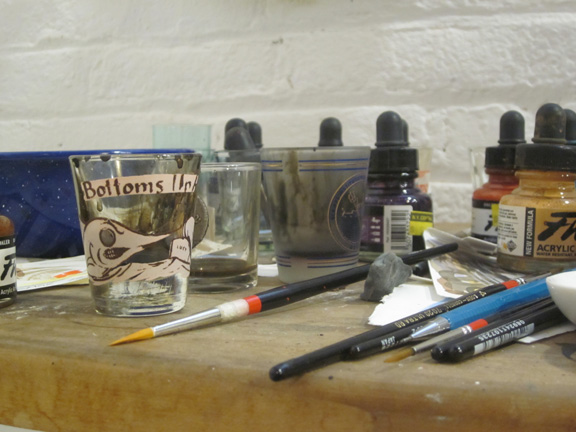
"I really do mix my inks in shot glasses. I'm not that much of a drunk."

Biblioklept: What are you reading now?

GB: This seems like a set-up but I actually am reading that biography of Audubon by Rhodes. It is such a good read. Tracing Audubon really traces the beginning of the country, and that guy got around. So you get these really interesting portraits of cities we know today in their infancy, and cities that were once prominent but are now considered backwaters. And the countryside and rivers before they were drastically changed. I often think about how weird it is that when my grandfather was a child we still had passenger pigeons and Carolina parakeets. That’s not so very long ago. Now the parakeets I see are introduced monk parakeets or escaped pets. If they become established then it will be less than a geological blip where we didn’t have parakeets here. The life between introduced and native is an interesting one to ponder.

Biblioklept: As we’re on birds, it seems like a good time to bring up your New York Pelagic project. You put original drawings of birds along with questionnaires in bottles and set them loose on New York waterways. Your blog discusses the motivations and goals behind the project in detail, but maybe you could give our readers a brief overview of your expectations? Is it difficult seeing your original work float away?

GB: It’s funny, I really had no idea what to expect. I was afraid none would ever be found. But, depending on how you count it, four or five have been found out of… 15? I actually have to update the blog and do some counting. So that’s a pretty good ration considering. I didn’t expect the project to become such an exploration of the city, I’ll tell you that much. But honestly, the history of New York is so amazing, and so rich, that you can’t pick your nose without flicking a booger on an old Dutch millstone or some such thing. And it is compelling. I didn’t expect to get so writer-y. I’ve never really written before, and it’s actually pretty fun. And as far as responses I was hoping people would be excited and happy. Which, except for once, they were.

As far as letting the work go, it is surprisingly easy. I thought I’d be more sad about it. But in actuality I’ve done some of them twice to make sure the one in the bottle is really good, not just middling. I want people to find something beautiful. And even if it never gets found there’s something very satisfying about letting something I’ve worked hard on go away. Christ, I ain’t no Buddhist, but there’s something zen about it I suppose. Maybe it’s a good foil to the other work I do which is so labor intensive and made to be seen and hopefully preserved. There’s also something so nice about it being pictures of seabirds that go (mostly) missing. We don’t see then really, just the gulls in the parking lot for most of us. The large majority of them live in habitats that don’t really overlap with ours.

Biblioklept: Let’s talk Florida — you went to Miami, I went to UF in Gainesville, and I live in Northeast Florida now, which is basically a different state than South Florida . . .

GB: Miami is totally a different country. From North Florida and from the rest of the U.S. I was always bummed about not doing a semester abroad when I was there, but then realized that going there is basically eight semesters abroad. So funny that you went to UF. Our big rivals were the Seminoles of course. Which I remember some people used to refer to as the Semen Holes. Which wasn’t as disturbing as a t-shirt I remember of our mascot — an ibis of all things! – jerking off on a Seminole Indian. I would kill for that shirt now, no matter how many racist nightmares it would induce. If an ibis can be racist against a Native American . . .

I love Florida in all it’s David Lynchian beauty. Hmmm . . . this brings me to something that I read recently having to do with Florida – [Karen Russell’s] Swamplandia! I hated it. And for very specific reasons. She is trying desperately to be funny, but she’s not. And it really brings down the whole thing.Every character in the book is trying so hard to out-quirk the next. There’s no straight man. Not that there has to be per se, but there is no anchor to the book. And I like flawed characters, but none of hers are particularly likeable. Even with all their quirks—in defter hands it would work. But like I said, she’s just not a funny writer and it seems like she thinks she has to be. Which is a shame, because there’s an interlude in the book (which I think was in The New Yorker) which is beautiful. So well written and evocative and moody. And well told. It’s not funny, but not everything has to be. I wish she had just expanded that into a whole novel instead of crowbarring a bunch of kooks around it. But now I’m listening to State of Wonder as I finish up a painting for the show and it is excellent.


Biblioklept:
Have you ever stolen a book?

GB: I thought I hadn’t, but then I realized I had. And this seems almost like a plant as well. It was a Swedish publication about Seabirds. And I really passively stole it from the New York Public Library. I honestly think I was the only one who ever took it out. And then I kept bringing it back late. And then one time it was so late that they just billed me for it as a lost book. I could have returned it, but it was only like 14 bucks! Over the years I had probably paid 20 in late fees on it already. Wait—maybe I didn’t steal one because I paid the 14 bucks. But it was somehow dishonest.