End of July blog

It is the end of July 2022 and I am on the seventh day of quarantine in my bedroom. I tested positive for COVID-19 again on Friday, and while I feel fine for the most part, the first few days of the illness were a fog. I had always thought I’d catch up on reading or watching films if I were to catch covid, but my brain didn’t work that way. Instead, I played a lot of online chess, losing a lot more than usual, with the extended editions of The Lord of the Rings films on in the background on an old laptop.

Over the past few days I’ve felt a lot better, and have been able to retain what I’ve read. A lot of that reading consisted of essay drafts for the online Summer B classes I’m teaching, which come to end very soon. But last night I was able to jump back into Vladimir Sorokin’s novel Blue Lard, in translation by Max Lawton (forthcoming from NYRB next year). It is simply amazing, a totally fucked up wild ride that’s impossible to summarize. Here’s a brief description from Max (via email): “The reader should be confused and it should hurt—then feel fucking good. This isn’t gloppy OLDOSEX; when reading Sorokin, we’re fucking nostrils with forked dicks (or—getting our nostrils fucked by the same).” THE READER SHOULD BE CONFUSED AND IT SHOULD HURT—THEN FEEL FUCKING GOOD! Yes!

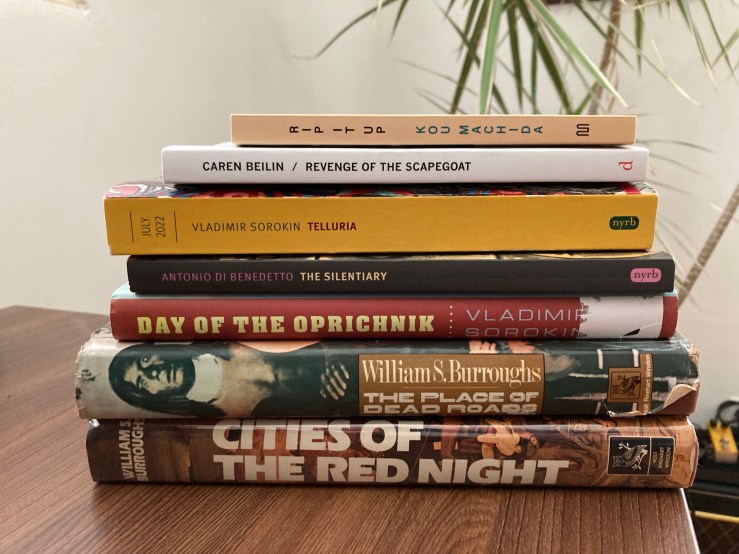
I have a big stack of books in the room, including several by Sorokin. They form a big stack only because I stacked them up to take the picture below to accompany this blog; previously they were in smaller stacks or strewn or in a basket to the right of my bed.

There’s a lot of Sorokin in the stack, but not Max Lawton’s Blue Lard translation, because it doesn’t exist in a hard copy in English. Day of the Oprichnik (trans. Jamey Gambrell) was good, but the language wasn’t nearly as rich as the language of Telluria—although Oprichnik felt like it could fit into Telluria, or at least the same universe. I got Their Four Hearts in the mail yesterday, and Ice a few weeks ago, but haven’t dipped into either.

Other thoughts on the stack: I felt well enough yesterday (aided by two coffees and a prednisone) to write something on Dashiel Carrera’s debut novel The Deer. I brought the Turgenev back here when I first tested positive with covid because it was on a stack on my coffee table of books I was ostensibly going to get to or needed to review. I read Blixa Barged’s Crosswise Europe back in June and couldn’t really think of anything to say about it. I had it out because I’ve been meaning to mail it to a friend.

I must’ve acquired the copy of McCarthy’s All the Pretty Horses on 14 July 2022, right before I left for a week in Washington, D.C. (the trip that undoubtedly resulted in the covid). I know the date because I posted some cool book covers on twitter that day.

I had painted our living room that week, which involved cleaning, moving, and sorting three ladder bookcases. I ended up culling about forty titles, and I took maybe half of those to the used bookstore on the fourteenth and turned them into a first edition hardback of All the Pretty Horses.

I wrote about acquiring Fernanda Melchor’s Paradais (and covid) in D.C. After I finish Blue Lard, this is on deck. Also in the stack but unread: Amina Cain’s A Horse at Night. Ugo Tognazzi’s The Injester is a cookbook from Contra Mundum. I read Anthony Michael Perri’s The Lonely Boxer earlier this month and need to write a review of it (it’s good!). The bottom three books (Powell, Lispector, O’Connor) I picked up at an estate sale two weeks ago (wrote about it here). I tried reading one of the Powell stories on Tuesday (or Wednesday?) but couldn’t focus.

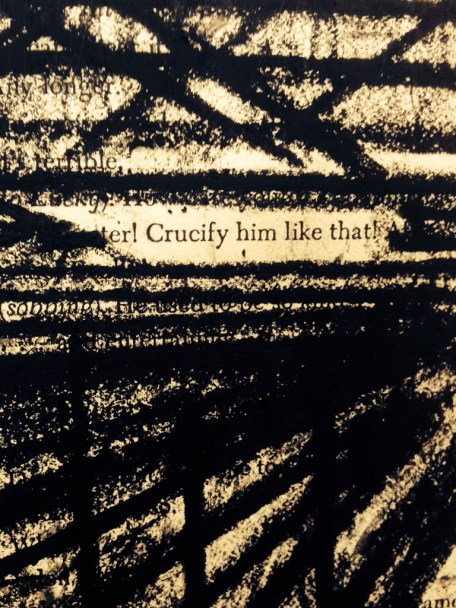
Wedged in the middle there is a Grove Press edition of Beckett’s Waiting for Godot that I had been destroying in office hours back in 2014. I had really been enjoying writing over it and posting pics of the pages I’d done, but someone wrote in to tell me that it was corny and for some reason that really got to me and I stopped. I was younger then (obviously); if someone did that today I’d probably ignore it completely.

I opened the book just now; I’d left off on page 24, although the last one I posted on the blog was page 22. Here is page 22:

20140626-162657-59217614.jpg

I’ll do page 25 now.

Here is page 25:

Not my best work, but I enjoyed the process!

So there’s the stack.

So, end of July, ass end of summer. There were positive times—hanging with extended family on the Fourth of July week on the beautiful Florida Gulf Coast (my now not-so-little cousins actually still wanted to play D&D). Some nice museum visits in D.C., some good reads in between. But July came in with a host of draconian Supreme Court rulings that seem to push the U.S. more steeply towards an outright autocracy in the making and closed with my spending over a week in quarantine, and the only good thing about the global heatwave that’s burned up the month might be that it seemed to wake a few people up to a future that’s already here. So, yeah, fuck July.

Last day of school

Today was the last day of school for my kids. They both started new schools this year (high school and middle school). It’s been a weird few years and a bad few days. My son chose not to attend the last two days but my daughter wanted to see her friends. My mother called me the afternoon of the Ulvade murders to ask if my kids were okay and I didn’t even know how to answer. My daughter has been in two active-shooter lockdowns already in her life and she’s not even 15. They’ve spent their entire life fully inscribed in this nightmare. One of the worst memories of my early parenthood was my daughter coming home from kindergarten and describing her first active-shooter practice drill: “Some of us were weeping,” she said. It was the word weeping that really stuck with my wife and me—the odd precision of it.

I don’t want to rant on here; that’s not what this blog is for, and not what I imagine those who check in on it want to read or see. I expressed my own sense of horror and despair obliquely on here the other day, in any case.

I spent too much of today staring at screens, reading, horrified and angry, still stunned by the stupidity of the world we’ve botched together. I tried to pick up the book I’ve been trying to read, but I found I couldn’t press into it, couldn’t focus on a sentence let alone a paragraph. I ended up playing a lot of internet chess, on the smaller screen.

And then I found myself exhausted, needing to get out of the house. So I pulled the same Friday trick I always do, which sometimes works and sometimes doesn’t. I went to the used bookstore down the road.

I like to browse and handle the material there, looking for oddities and weird scores. I ended up with a hardback ex-library copy of Vladimir Sorokin’s Day of the Oprichnik (trans. Jamey Gambrell, RIP). It’s in the stack below, a stack of books I’ve read or am (ostensibly) reading:

And so some mini-not-reviews, top to bottom:

Kou Machida’s Rip It Up (trans. Daniel Joseph): Read it back in April when I was finishing up the semester—it was a wonderful punk-psych antidote to final essay doldrums. Short, kinetic, caustic, and surreal. I wrote about the first part here.

Caren Beilin’s Revenge of the Scapegoat: This is the novel I attempted to start a few days ago, after finishing William Burroughs’s The Western Lands. I am having a hard time reading anything right now, let alone writing any proper review. I hope the thing I once had comes back.

Vladimir Sorokin’s Telluria (trans. Max Lawton): The best contemporary novel I’ve read in a long time—a polyglossic satirical epic pieced together in vital miniatures. Rich and dense but also loose and funny, Sorokin’s post-collapse world doesn’t seem all that bad.

Antonio di Benedtto’s The Silentiary (trans. Esther Allen): The narrator of this understated Kafkaesque novel cannot abide the increasing cacophony of 20th-century life. His resistance to noise is futile though, and comes at great cost to both himself and his family. The Silentiary is good stuff, but not as achieved as Di Benedetto’s novel Zama.

I bought Sorokin’s Day of Oprichnik today.

(Parenthetically: I went to the bookstore, as I stated above, to try to decompress, get away from screens, news, etc.—but I could not.

There was a young woman standing near the “RE” area in General Fiction having the loudest possible conversation one can have on a phone without actually yelling. She was talking at her mother about all the strife she has with her brother, who is also her roommate, and her father (who is divorced from the mother). The young woman cursed in almost every sentence she spoke, damning her brother for not taking out the trash, for not doing the dishes, etc. She near-shouted about her father’s siding with her brother, and about how the whole situation necessitates more therapy for her, and how she is the sane responsible one, while her brother is not. Her brother refuses to engage with her when she addresses him, claiming that he claims he can’t talk to her when she shouts, but how can she not be emotional when she’s angry? And how does that mean that she’s not rational, just because she’s yelling? And isn’t he really the abusive one, for shutting down on her and not responding when she, a grown-ass adult, is simply trying to confront him about not doing what he should be doing?

I put this information together in waves over 45 minutes. It was like running up a caustic radio show that tuned in and out depending on my proximity to its signal. Vile.)

William S. Burroughs’s final trilogy: I haven’t read WSB in ages, but I finished up his last novel, The Western Lands a few days ago (not pictured because it’s still in my car; I’d been rereading bits during carpool pick-up).. The final three books in Burroughs’s oeuvre are maybe his best (and most-overlooked), and The Place of Dead Roads is particularly fantastic.

Okay, I’m out of juice. I hope the summer is better for most of us, although there’s not much force in that verb, hope.

A few sentences on every Thomas Pynchon novel to date

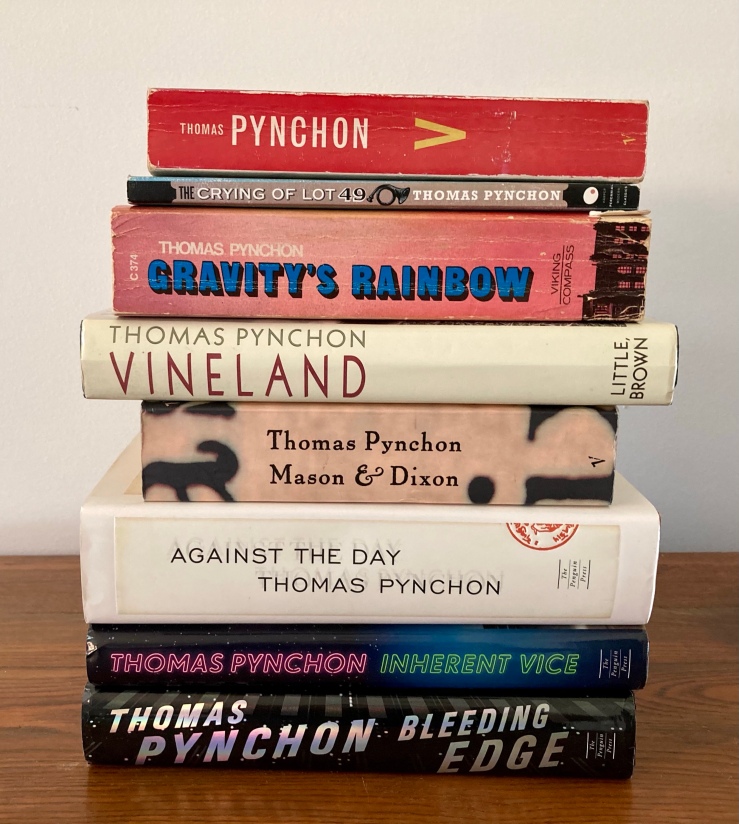
Today, 8 May 2022, is Thomas Ruggles Pynchon’s 85th birthday. Some of us nerds celebrate the work of one of the world’s greatest living authors with something called Pynchon in Public Day. In the past I’ve rounded up links to Pynchon stuff on Biblioklept and elsewhere. To celebrate, here are short riffs on Pynchon’s eight novels:

V. (1963)

I reread Pynchon’s first novel for the first time last year and found it far more achieved than I had remembered. For years I’ve always recalled it as a dress rehearsal for the superior and more complex Gravity’s Rainbow. And while V. certainly points in GR’s direction, even sharing some characters, it’s nevertheless its own entity. I first read V. as a very young man, and as I recall, thought it scattershot, zany, often very funny, but also an assemblage of set pieces that fail to cohere. Rereading it two decades later I can see that there’s far more architecture to its plot, a twinned, yoyoing plot diagrammed in the novel’s title. The twin strands allow Pynchon to critique modernism on two fronts, split by the world wars that mark the first half of the twentieth century. It’s a perfect starting point for anyone new to Pynchon, and its midpoint chapter, “Mondaugen’s Story,” is as good as anything else he’s written.

The Crying of Lot 49 (1966)

Pynchon’s shortest novel is not necessarily his most accessible: Crying is a dense labyrinth to get lost in. At times Pynchon’s second novel feels like a parody of L.A. detective noir (a well he’d return to in Inherent Vice), but there’s plenty of pastiche going on here as well. For example, at one point we are treated to a Jacobean revenge play, The Courier’s Tragedy, which serves as a kind of metatextual comment on the novel’s plot about a secret war between secret armies of…letter carriers. The whole mailman thing might seem ridiculous, but Pynchon’s zaniness is always doubled in sinister paranoia: The Crying of Lot 49 is a story about how information is disseminated, controlled, and manipulated. Its end might frustrate many readers. We never get to hear the actual crying of lot 49 (just as we never discover the “true” identity of V in V.): fixing a stable, centered truth is an impossibility in the Pynchonverse.

Gravity’s Rainbow (1973)

Unbelievably rich, light, dark, cruel, loving, exasperating, challenging, and rewarding, Pynchon’s third novel is one of a handful of books that end up on “difficult novel” lists that is actually difficult. The difficulty though has everything to do with how we expect a novel to “happen” as we read—Gravity’s Rainbow is an entirely new thing, a literature that responds to the rise of mass media as modernist painters had to respond to the advent of photography and moving pictures. The key to appreciating and enjoying Gravity’s Rainbow, in my estimation, is to concede to the language, to the plasticity of it all, with an agreement with yourself to immediately reread it all.

Vineland (1990)

It took Pynchon a decade and a half to follow up Gravity’s Rainbow. I was a boy when Vineland came out—it was obviously nowhere on my radar (I think my favorite books around this time would probably have been The Once and Future King, The Lord of the Rings trilogy, and likely a ton of Dragonlance novels). I do know that Vineland was a disappointment to many fans and critics, and I can see why. At the time, novelist David Foster Wallace neatly summed it up in a letter to novelist Jonathan Franzen: “I get the strong sense he’s spent 20 years smoking pot and watching TV.” Vineland is angry about the Reagan years, but somehow not angry enough. The novel’s villain Brock Vond seems to prefigure the authoritarian police detective Bigfoot Bjornsen of Inherent Vice, but Pynchon’s condemnation of Vond never quite reconciles with his condemnation of the political failures of the 1960s.  Vineland is ultimately depressing and easily my least-favorite Pynchon novel, but it does have some exquisite prose moments.

Mason & Dixon (1997)

If Mason & Dixon isn’t Pynchon’s best book, it has to be 1A to Gravity’s Rainbow’s 1. The novel is another sprawling epic, a loose, baggy adventure story chronicling Charles Mason and Jeremiah Dixon’s Enlightenment effort to survey their bit of the Western World. Mason & Dixon presents an initial formal challenge to its reader: the story is told in a kind of (faux) 18th-century vernacular. Diction, syntax, and even punctuation jostle the contemporary ear. However, once you tune your ear to the (perhaps-not-quite-so-trustworthy) tone of Rev. Wicks Cherrycoke (who tells this tall tall tale), Mason & Dixon somehow becomes breezy, jaunty, even picaresque. It’s jammed with all sorts of adventures: the talking Learned English Dog, smoking weed with George Washington, Gnostic revelations, Asiatic Pygmies who colonize the missing eleven days lost when the British moved from the Julian to the Gregorian calendar…Wonderful stuff. But it’s really the evocation of a strange, hedged, incomplete but loving friendship that comes through in Mason & Dixon.

Against the Day (2006)

Oof. She’s a big boy. At over a thousand pages, Against the Day is Pynchon’s longest novel. Despite its size, I think Against the Day is the best starting point for Pynchon. It offers a surprisingly succinct and clear summation of his major themes, which might be condensed to something like: resist the military-industrial-entertainment-complex, while also showing off his rhetorical power. It’s late period Pynchon, but the prose is some of his strongest stuff. The songs are tight, the pastiche is tighter, and the novel’s epic sweep comes together in the end, resolving its parodic ironies with an earnest love that I believe is the core of Pynchon’s worldview. I forgot to say what it’s about: It’s about the end of the nineteenth century, or, more accurately, the beginning of the twentieth century.

Inherent Vice (2009)

Inherent Vice is a leaner work than its two predecessors, but could stand to be leaner still. The book pushes towards 400 pages but would probably be stronger at 200—or 800. I don’t know. In any case, Inherent Vice is a goofy but sinister stoner detective jaunt that frags out as much as its protagonist, PI Doc Sportello. Paul Thomas Anderson’s film adaptation finds its way through those fragments to an end a bit different from Pynchon’s original (which is closer to an echo of the end of The Crying of Lot 49)—PTA’s film finds its emotional resolution in the restoration of couple—not the main couple, but adjacent characters—an ending that Pynchon pulled in his first novel V.

Bleeding Edge (2013)

While Bleeding Edge was generally well received by critics, it’s not as esteemed as his major works. I think that the novel is much, much better than its reputation though (even its reputation among Pynchon fans). Pynchon retreads some familiar plot territory—this is another detective novel, like Crying and Inherent Vice—but in many ways he’s doing something wholly new here: Bleeding Edge is his Dot Com Novel, his 9/11 Novel, and his New York Novel. It’s also probably his domestic novel, and possibly (dare I?) his most autobiographical, or at least autobiographical in the sense of evoking life with teenagers in New York City, perhaps drawing on material from his own life with wife and son in the city. It’s good stuff, but I really hope we get one more.

[Ed. note–Biblioklept ran a version of this post on 8 May 2021.]

A few thoughts on John Williams’ brilliant historical novel Augustus

At the beginning of April, an old friend (who wrote some excellent reviews on this site in the past) told me that I needed to read John Williams’ 1972 novel Augustus. I loved Williams’ Stoner, which I read (and reviewed) a decade ago, when its cult status seemed to explode thanks to a new edition from NYRB. After Stoner, I tried a few times to read Williams’ western, Butcher’s Crossing, but never got too deep into it. I handled copies of Augustus a few times at bookstores, but the subject didn’t appeal to me. But my friend recommended it, and he’s never steered me wrong, so I picked up a copy of Augustus and cracked it open.

I picked up a copy of Augustus and cracked it open and didn’t put it down that much, unless I had to, until I’d finished it. The novel tells a life story of Gaius Octavius Thurinus, grand nephew Julius Caesar, who suceeds and avenges his assassinated great uncle (and adoptive father) to become the first Emperor of Rome. I was surprised at how much Roman history I remembered—some of it through two Shakespeare plays, some of it through an old HBO show, but most of it from, like, school. And this is one of the most fascinating elements of Augustus—Williams takes an old story and revivifies it.

Essentially an epistolary novel, Augustus features a rotating cast of voices. Prominent among these voices are Augustus’ — or really, Octavian’s — core group of friends, Maecenas, Agrippa, and Virgil. We also hear from notables including Marc Antony, Cleopatra, Horace, and Ovid, as well as many other voices, both invented and historical. There’s something addictive about Williams’ lucid prose, which imbues each character’s voice with its own distinctive style without falling into rhetorical gimmickry.

The early parts of the novel focus on young Octavian’s rise—the assassination of Julius Caesar, the warring Triumvirate, the political intrigue which overlaps with familial duty. We see Octavian/Augustus from multiple perspectives, but Williams’ withholds his hero’s voice until late in the novel. It’s Augustus’ daughter Julia who emerges, slowly, as the novel’s most sympathetic (and ultimately tragic) hero. Her sections of the book are particularly poignant, and recall from Stoner the doomed relationship between William Stoner and his daughter Grace.

Augustus is sad and wise but never dour. Williams harnesses the intellect and soul of his characters, who are simultaneously mortal and timeless. So many passages seem to describe life in the present-day United States (as well as other Western democracies). Consider the lines Williams attributes to Augustus’ intellectual adviser Maecenas, writing late in his life to the historian Livy:

What you seem so unwilling to accept, even now, is this: that the ideals which supported the old Republic had no correspondence to the fact of the old Republic; that the glorious word concealed the deed of horror; that the appearance of tradition and order cloaked the reality of corruption and chaos; that the call to liberty and freedom closed the minds, even of those who called, to the facts of privation, suppression, and sanctioned murder. We had learned that we had to do what we did, and we would not be deterred by the forms that deceived the world.

The complacency, the greed, the cynical failure to not just live up to its expressed ideals, but to take for suckers those who would still believe in those ideals—there’s something heartbreaking about the way Augustus anticipates contemporary democracy in peril to spectacle, hypocrisy, and avarice.

The titular character takes over in the brilliant last act of Augustus. Our Emperor is an old man, melancholy, reflective, but ultimately hopeful that he’s left the empire in good hands (he hasn’t). His final letter echoes Maecenas’ concerns about the corruption of Roman ideals:

. . . I knew that my destiny was simply this: to change the world. Julius Caesar had come to power in a world that was corrupt beyond your understanding. No more than six families ruled the world; towns, regions, and provinces under Roman authority were the currencies of bribery and reward; in the name of the Republic and in the guise of tradition, murder and civil war and merciless repression were the means toward the accepted ends of power, wealth, and glory. Any man who had sufficient money could raise an army, and thus augment that wealth, thereby gaining more power, and hence glory. So Roman killed Roman, and authority became simply the force of arms and riches. And in this strife and faction the ordinary citizen writhed as helplessly as the hare in the trap of the hunter.

And yet Williams’ Augustus is a realist, but one who tempers his perceptions of reality in a compassionate idealism:

Do not mistake me. I have never had that sentimental and rhetorical love for the common people that was in my youth (and is even now) so fashionable. Mankind in the aggregate I have found to be brutish, ignorant, and unkind, whether those qualities were covered by the coarse tunic of the peasant or the white and purple toga of a senator. And yet in the weakest of men, in moments when they are alone and themselves, I have found veins of strength like gold in decaying rock; in the cruelest of men flashes of tenderness and compassion; and in the vainest of men moments of simplicity and grace.

I haven’t done enough to convey how wonderful Augustus is. Very highly recommended.

Hiroko Oyamado’s subtle novel The Hole captures the banal surreal loneliness of modern life

Hiroko Oyamada’s novel The Hole is a subtle, slim, slow-burn low-stakes horror story that tiptoes neatly between banality and surrealism. Our first-person narrator is Asahi, a young, recently-married woman. Asahi–or Asa, as she thinks of herself–is a part-time employee in a large city somewhere in Japan. She doesn’t really have any friends or hobbies, let alone any ambitions. When her husband Muneaki gets a job transfer to the countryside, Asa’s mother-in-law Tomiko offers the young couple the house next to hers, rent-free. The young couple’s economic situation means they can’t refuse, so they don’t. Asa’s only real acquaintance, a work buddy, remarks how lucky she is to be a housewife, but Asa is ambivalent.

That ambivalence radiates throughout The Hole. In David Boyd’s spare, direct translation, Oyamada pushes her hero into a stifling, stuffy, overheated summer. The skinny novel is an exercise in boredom-as-horror: Even before Asa arrives in her husband’s rural hometown, everything’s just a wee bit off. The cicadas vibrate at a different pitch; the locals seem to come from a different era; time seems to run backwards and forwards.

Without a car or job, Asa is essentially stranded, spending her days guilty over running the AC, and unable to communicate with her husband’s grandfather, who mutely gardens his hours away.

Her only cultural landmark is a 7-Eleven convenient store, where mother-in-law Tomiko sends her on an errand one day. The banal errand becomes a bizarre Carollonian quest—but a quest without a clear object. On her route to the convenience store (what could be more boring and inconvenient?) Asa spies a large, strange, dark-furred creature:

 It had wide shoulders, slender and muscular thighs, but from the knees down, its legs were as thin as sticks. The animal was covered in black fur and had a long tail and rounded ears. Its ribs were showing, but its back was bulky, maybe with muscle or with fat.

Frantically following it, she falls into a hole that fits her nearly perfectly (like a proscribed role, or a coffin, or like, whatever):

As I tried to move, I realized how narrow the hole really was. The hole felt as though it was exactly my size – a trap made just for me. The bottom of the hole was covered with something dry, maybe dead grass or straw. Looking toward the river through a break in the grass, all I could see was white light.

A mysterious white-clad neighbor named Sera (who calls Asa “the bride”) pulls her out from the hole, and she makes her way to the 7-Eleven, where a gang of strange children block her mission. She also meets an oddball who later claims to be the white rabbit to her lost Alice. He claims to be an unacknowledged mystery brother-in-law who lives in a shed, having relinquished adult responsibility. There are centipedes and bug bites and other strange goings on—and Asa  talks about absolutely none of it with her husband or mother-in-law.

The Hole captures the stifling omnipresence of loneliness. Asa is a sympathetic character, and while many of the details of her circumstance are particular to Japanese culture, the narrative resonates with the larger absurdities of contemporary life. Asahi’s loneliness burns all the more real for the novel’s surrealism. Her loneliness is the realest thing in The Hole, its presence never acknowledged because it cannot fully be named. The “loneliness” is more real than the quasi-mystical hole-digging creature that plagues the countryside, or the manic brother-in-law-who-lives-in-a-shed-in-the-backyard whom no one ever mentions. But unlike these surreal entities, Asa’s loneliness is never directly invoked.

The Hole will be somewhat familiar with anyone who’s climbed about in the Kafka tree. While Oyamada directly evokes Carroll’s Alice stories, her story is far less fanciful, its dire core obscured with a thin veneer of the banal. The Hole recalls the tone and mood of Kobo Abe’s The Woman in the Dunes, where the protagonist comes to be in an uncanny scenario that becomes uncannier by the moment. But Oyamada’s narrator doesn’t seem to demarcate the separation into unreality; rather, the novel absorbs its narrator into a new unreal-real reality.

The Hole is wonderfully dull at times, as it should be. It’s layered but brittle, with notes of a freshness just gone sour. It’s a quick, propulsive read—a thriller, even, perhaps—but its thrills culminate in sad ambiguity. Recommended.

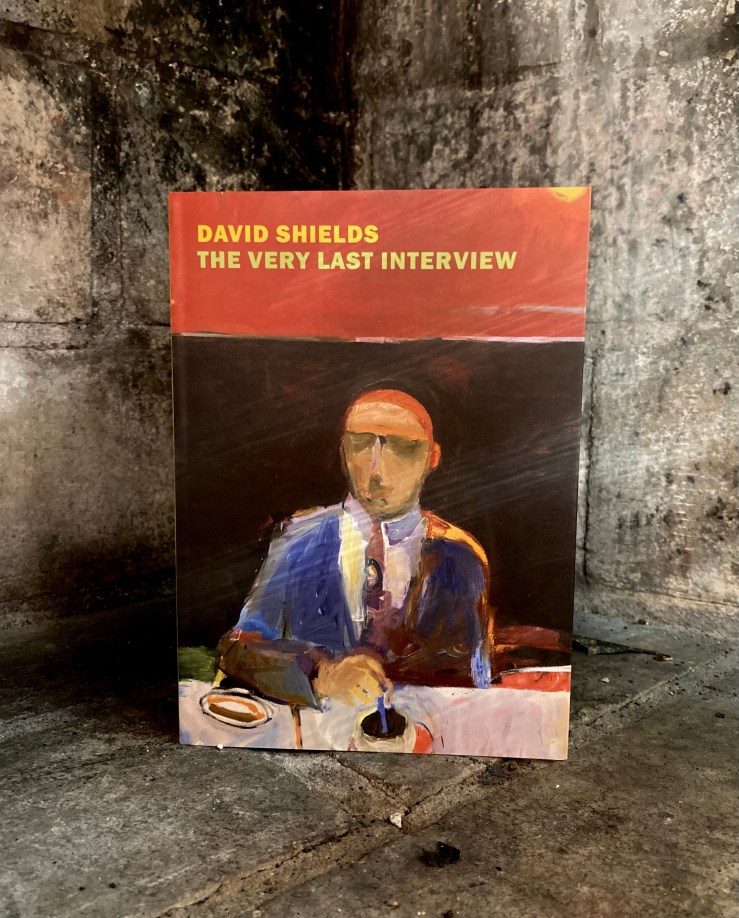
Is this a review of David Shields’ “autobiography” The Very Last Interview?

Is David Shields’ new book The Last Interview indeed an “autobiography in question form, with the reader working to supply answers based on the questions that follow,” as Bret Easton Ellis’ blurb attests?

Is it “Brilliant,” as Bret Easton Ellis’ blurb attests?

(Is this the same David Shields who authored Reality Hunger?)

Does, as Chris Kraus’ blurb states, Shields remix and reimagine “2,000 of the most annoying questions he’s been asked during his forty-year writing life”?

Is it really an “operatic tragic sojourn across American cultural life” (Kraus)?

Does The Very Last Interview confirm “Shields as the most dangerously important American writer since William S. Burroughs,” as Kenneth Goldsmith claims in his blurb?

(Is this the same Kenneth Goldsmith who was called out seven years ago for a publicly reading Michael Brown’s autopsy under the guise of “conceptual poetry”?)

Is it actually “very funny,” as Sheila Heti’s blurb contends?

Should I flip it over and actually dig in?

Is that a Richard Diebenkorn painting adorning the cover?

Are there actually five more blurbs once one opens the book?

Does Shields organize this “remix: of questions he’s (supposedly) been asked into chapters with titles like “Process,” “Truth,” “Art,” “Failure,” “Criticism,” and “Suicide”?

Does Shields open each chapter with epigraphs?

Does he attribute the authors of the epigraphs?

Is there an epigraph from Nietzsche?

Why doesn’t he attribute any of the interviewers at any point in The Very Last Interview?

Does David Shields believe he is a genius?

Does he believe that his audience will find delight or joy or even a momentary reprieve from reading The Very Last Interview?

When Jonathan Lethem (whose blurb makes the inside but not the back cover) claims he “blasted through it in one night,” is it possible that by “night” he means a thin hour or two?

Is the book skinnier than its 150 pages might suggest?

Are there any bits of the book that are, as Heti blurbed, “Very, very funny”?

How about this trio?

“When we are not sure, we are alive” — are you sure this is something that Graham Green said?

Can you prove it?

Do you know what “JSTOR” stands for?

Does this little blip skate closer to mildly amusing as opposed to very very funny?

But is there a general undertone of contempt that radiates in Shields’ curation of questions?

What about these?

Do you share my contempt for Greenpoint hipsters who look and act cool but whose work is about as challenging as a Toblerone bar?

Did you every study with Gordon Lish?

What did he like about your bracelet-cum-watch?

(What would we get if we removed the hyphens from the phrase bracelet-cum-watch?)

Is it possible that David Shields overestimates how interesting he is?

Does he really want us to empathize at points, to provide answers for questions, such as the ones below?

What’s the matter with you?

No, seriously. What is your underlying impasse?

Why can’t you feel?

What’s buried beneath that seeming numbness?

Anything?

Is The Last Interview pretentious, solipsistic, shallow, bathetic, and also very readable?

Is The Last Interview available in paperback from NYRB next month?

Are we done?

Are we?

Sunday equinox blog | Atlanta, Di Benedetto, a Paley poem, ghosting William S. Burroughs, etc.

My spring break, which is to say the spring break of the community college which employs me to teach English, rarely coincides with my children’s spring break, but this year it did, and we took full advantage, spending a week in Atlanta. We stayed in Inman Park, enjoying the BeltLine and the city’s vibe in general. Airport aside, I hadn’t been to Atlanta in twenty years, and I took pleasure in our week there. (I dug the High Museum in particular, and shared some favorites from our visit on Twitter.)

I can’t remember the last time I visited a city and didn’t buy a book. A Capella Books was a short walk from our place; it’s a small, well-curated bookshop with a limited selection. A Capella offered a number of signed books by musicians, including Billy Bragg and Chris Frantz. I thought I might regret not picking up a signed copy of Frantz’s memoir Remain in Love (which I read last year), but I feel no regret as I type this sentence. I also visited Posman Books at Ponce Market. It veers close to something like a tasteful gift shop/stationery joint, but the small fiction and poetry selection is pretty good, even if a lot of it is shelf candy. I think if I’d been willing to drive farther out I might’ve found some deeper cuts. (My wife pointed out that our local used bookstore, 1.1 miles away, has utterly spoiled me.)

Anyway: No books acquired in Atlanta. (I did buy some records though: Fat Mattress’s debut and Fleetwood Mac’s Heroes Are Hard to Find.)

I brought Esther Allen’s new translation of Antonio di Benedetto’s novel The Silentiary with me to reread on the trip. I read it back in January, dogeared it, and started a review, but found that I wanted to let it settle a bit. I liked it the first time round, but the reread revealed a sadder, deeper novel than I had initially estimated.

Other stuff I’ve been reading:

Grace Paley’s late collection of poems, Fidelity. Grand stuff. Sample:

I’ve also been picking through Helen Moore Barthelme’s biography Donald Barthelme: Genesis of a Cool Sound, although there’s nothing particularly revelatory about it.

I picked up the Paley and Barthelme when I swung by our campus library to get Don’t Hide the Madness, a series of conversations between Allen Ginsberg and William S. Burroughs. Burroughs is getting pretty close to the end of his life here, and Ginsberg seems to want to get him to further cement a cultural legacy through a late oral autobiography. Burroughs repeatedly derails these attempts though, which is hilarious. Burroughs talks about whatever comes to mind (often his guns). The cover by Robert Crumb is worth sharing:

I initially requested the Burroughs book because I’ve been rereading Cities of the Red Night—and absolutely loving it—and I was trying to figure out who it was who may or may not have played a role in ghostwriting the book with Burroughs. Cities is straighter than much of Burroughs’ work—but it’s still thoroughly Burroughsian. It’s entirely possible that a straighter hand cobbled Burroughs’ images and fragments together, at least to some extent, although I think it’s erroneous to refer to the novel as ghostwritten. As far as I can tell, the claim originates with Dennis Cooper’s obituary in the October 1997 issue of Spin:

My initial guess was that Cooper here insinuates that Victor Bockris helped arrange Cities of the Red Night. Bockris was around Burroughs a lot when Burroughs was working on Cities; however, Bockris suggests that it was Burroughs who corrected his prose:

From 1979 to 1981, I had the privilege of working with William Burroughs (aged sixty-five to sixty-seven) editing two books: my portrait With William Burroughs: A Report from the Bunker (St. Martins, 1996), and his selected essays, The Adding Machine (Arcade, 1996). At the same time, Burroughs was finishing his long-awaited novel, Cities of the Red Night (Holt, 1981), which would inaugurate a whole new person and period in his career, opening the doors to sixteen highly productive, positive years (1981-97) writing, painting, acting, performing, recording. Consequently, I suppose I am one of the ten to twelve people who ever got close enough to Bill professionally to see into his writing center. When I gave him the manuscript of With William Burroughs (75 percent of which was taped dialogue of conversations between Burroughs and fifteen other celebrities), he not only corrected the sometimes atrocious writing, he added a handful of precious inserts.

More digging seems to suggest that it was the artist Steven Lowe who helped Burroughs arrange Cities. Rick Castro’s appreciation of Lowe goes as far as to assert that, Lowe “was a ghostwriter for Burroughs, assisting on Cities of the Red NightJunkie, and a few other titles.”

Ultimately, I agree with Jamie Russell in Queer Burroughs (2001), that

The rumor that the post-Red Night trilogy texts were partly ghostwritten is perhaps…more of a compliment than the criticism it was intended to be, since it highlights Burroughs’ central theme of the 1980s and 1990s texts: the creation of a post-corporeal real. Who needs a body to write with anyway?

Typing that out, I realize that I’ve inserted an entirely different post into this Sunday equinox post. Oh well.

I love Cities of the Red Night—it’s funny and gross and oddly sweet and even sentimental, an ironic pastiche of the so-called “boys books” genre, as well as a howl against war, conformity, and the military-industrial-entertainment complex. The novel it most reminds me of (apart from other Burroughs’ novels) is Thomas Pynchon’s Against the Day.

I’m also, thanks to the audiobook, into the third section of Marlon James’ Moon Witch, Spider King. The second section focused on the protagonist Sogolon’s domestic life. Frankly, the section sags, although I understand that it likely girds the emotional core of the events to come. The novel pivots dramatically in section three, “Moon Witch.” Sogolon has lost her memory, and is in a strange sunken city centuries in the future. That’s the good shit. More thoughts to come.


A voice in her head that sound like her voice | Another report from Marlon James’s novel Moon Witch, Spider King

My last report from Marlon James’s Moon Witch, Spider King found the novel’s political machinations kicking in after its first seven chapters. Our hero Sogolon finds herself in the Northern Kingdom’s capital Fasisi. The capital is soaked in paranoia. The king is dying, a fact that cannot be admitted publicly or even privately (“The King is about his business,” courtiers and officials repeat). According to custom, it is the son of the king’s daughter who will take up his crown—only Princess Emini has been unable to conceive a child. Meanwhile, her brother Prince Lukid plots a coup, assisted (and likely designed, really), by the Aesi, a Machiavellian who may or may not have magic powers. The Aesi has engineered a literal witch hunt, accusing, arresting, and executing any woman who threatens his hold on power, with the aid of the Sangomin, a band of children necromancers with mutant powers (there’s a two-headed boy, a “razor boy,” a lizard girl, etc.)

The Aesi takes special note of Sogolon, recognizing an emerging power in her that others overlook. She’s wary of him, a feeling that only intensifies as she strikes up an odd friendship with Commander Ulu, a former commander of the Royal Guard who has no memories. Sogolon intuits that it’s likely that the Aesi is responsible for the memory loss, a suspicion that solidifies later in the novel. In an attempt to retain his memories, Ulu writes them down, filling every surface of his living quarters, and even writing in blood. Over time, Sogolon learns to read, with Ulu as a kind if unwitting teacher. Sogolon’s relationship with Keme also deepens, although she learns he has a wife and family.

The relative stability of Sogolon’s life ends when the king dies and Prince Likud claims the throne, taking up the mantle Kwash Moki. The Aesi’s schemes bear fruit-in a sequence that foregrounds the novel’s background trope of witch hunting, princess Emini is put on a trial for adultery. She’s exiled to a walled city of nuns, where she is to spend the rest of her life, and Sogolon is sent with her.

They never make it to the nunnery though. Presumably at the secret command of the Aeisi, the Sangomin attack their caravan killing everyone except Sogolon. She escapes, but the Sangomin track her down. As they attack, she seems to black out. She awakes to a scene of devastating violence she has no memory of. She appears to be in a giant crater, a “smooth bowl that she will have to climb out of.” There, she sees

…them floating, first the top half of the razor finger boy, his entrails dangling, his eyes gazing into nothing, and his legs nowhere to be seen. Slabs of loose white rock and cut white stone—the big man shattered in a multitude of pieces. She climb out and walk past the red and blue girl with the lizard tongue, her hands and legs swaying as if underwater, her face sleepy, the back of her head exploded with all of her shooting out. Perplexing it be, all three floating in air like they underwater, but everything stuck as if whatever happen don’t finish.

Sogolon comes to realize that she was the author of this destruction. When her life is threatened, Sogolon musters a telekinetic force that she refers to sometimes as “wind” or as the “push”–but she can’t control it (yet).

After wandering in the wilderness and cold, she’s found by Keme and other former members of the royal guard who are now part of the Red Army—the king Kwash Moki’s army. Keme has no memory of Sogolon. He brings her back to Fasisi, despite her protest (“They sent us on a fact finding mission, and you are the fact that we found”). Thus ends part one of Moon Witch, Spider King.

I’ve cobbled together a plot summary here, but I’m sure there are many gaps (and maybe some mistakes). In Moon Witch, we’re only privy to what Sogolon sees and hears, and while she’s a curious and perceptive girl, she’s also quite young and lacks any formal education. Much of our understanding of the plot is filtered through Sogolon’s intuition, and a major motif that emerges in these chapters is memory loss, as well as the power that controlling a narrative confers. The Aesi is able to rewrite history, to make people believe things that they witnessed first-hand could not be true.

At the same time the first part of Moon Witch, subtitled “No Name Woman,” is about a consciousness creating itself. Sogolon grew up imprisoned first in a termite mound, then in a whorehouse, then in the home of a fallen aristocrat. She had to name herself, teach herself to read, to scrape together her memories into a slim personal history. In the final sections of “No Name Woman,” the narrator repeats an attribution each time Sogolon enters into a dialogue with her emerging consciousness, as in the following example:

Wake up early girl, will yourself, say a voice in her head that sound like her.

This “voice in her head that sound like her” is Sogolon’s self-making, a consciousness reaching toward the “I” that disappears after the novel’s opening sentences:

One night I was in the dream jungle. It was not a dream, but a memory that jump up in my sleep to usurp it. And in the dream memory is a girl. See the girl.

After that second sentence, the first-person narrator disappears—only to reappear in the beginning of part two, “A Girl Is a Hunted Thing.” More thoughts to come.

See the girl | A report from Marlon James’s novel Moon Witch, Spider King

One night I was in the dream jungle. It was not a dream, but a memory that jump up in my sleep to usurp it. And in the dream memory is a girl. See the girl.

These four sentences open Marlon James’s novel Moon Witch, Spider King, the not-exactly sequel to 2019’s Black Leopard, Red WolfThat novel centered on Tracker and his quest to recover a missing child of enormous importance. Black Leopard, Red Wolf is a bizarre beast, a post-postmodern fantasy that queered its genre conventions and consistently contested the very notion that a story could ever be told straight. In it, Tracker segues between ever-shifting fellowships and nebulous nemeses–including the Moon Witch Sogolon, the protagonist of Moon Witch, Spider King.

Moon Witch, Spider King takes Sogolon as its viewpoint character, and the first seven chapters of this long, long novel (about a quarter of its 600ish pages) read far more straightforward than its predecessor. The narrative gambit of Black Leopard, Red Wolf is that Tracker, captured, is telling his story to an inquisitor—and that telling is a repeated deferral, teleporting through time and space (much like the “Ten and Nine Doors” that Tracker’s fellowship uses to teleport between city-states). Tracker does all he can do to tell any truth aslant. So far, James’s new novel follows a less demanding trajectory. The repeated invocation to “See the girl” follows our hero as her circumstances rise—although Sogolon experiences her rise in a picaresque, out-of-the-frying-pan-into-the-fire spirit.

We first find her an orphan of sort, a neglected witch-child more-or-less imprisoned in a termite hill by three cruel brothers, who blame her for killing their mother, who died birthing her. Sogolon even has to name herself. She escapes only to find herself in new peril, the house of Miss Azora. It’s a whorehouse, but Sogolon mixes potions to protect herself from its patrons–excepting one. The motif of male predation repeats in Moon Witch, as well as Sogolon’s resistance against those who would take her and take from her. In time, Sogolon finds herself into the house of a fallen aristocrat. Master Komwono may hold the title, but its Mistress Komwono who runs the show. Sogolon continues to spy and absorb, to play dumb, to use how others perceive her apparent weakness as an actual strength.

After Master Komwono dies under mysterious circumstances (take a guess!), Mistress Komwono is summoned back to the kingdom of Fasisi, from which she had previously been banished. A soldier named Keme is part of the caravan to bring the Komwono household to the capital, and Sogolon finds herself taken with the man. When they arrive at the palace, things take an even more sinister turn: the King is dying and his sister has disappeared (or been disapperead).

Here is where the plot machinations of Moon Witch truly kick in, shifting into a novel of political court intrigue. Mistress Komwono gives poor Sogolon to the princess of Fasisi, and she is drawn into all sorts of machinations. We begin to see the plotting of the Aesi (another of Tracker’s antagonists), whose Machiavellian moves are yet oblique to the young girl. In the meantime, witches are being burned, and Keme meets with his own fellowship (of griots and warriors and sentient lions) in a floating city. There’s a lot going on.

There’s a lot going on, but it’s a fun going on. See the girl, the narrator repeatedly intones, and James’s prose is marvelously vivid, setting strange scene after strange scene. And while the narrative voice, focused on Sogolon, is a removed third-person, I can’t help but now notice that the book opens with an I: “One night I was in the dream jungle”…who is this I, who so quickly disappears after a few sentences, replaced by the dream-memory incantation: See the girl.

(Parenthetically—while there are no Blood Meridian vibes so far to Moon Witch, Spider King, that incantation See the girl nevertheless seems to echo that McCarthy’s novel’s opening line, See the child (itself perhaps an echo of Melville’s Call me Ishmael.))

Anyway–I’m digging Moon Witch thus far. I’ve been auditing the audiobook (narrated by Bahni Turpin) and then rereading bits for clarification. So far, I think that anyone interested in what Marlon James is doing with this so-called Dark Star trilogy would be absolutely fine starting with this one. The line is straighter than Black Leopard, the thread is easier to follow, and it’s not necessary to know the contours or details of the plot of that “first” novel. But it still points to the wonderful queer weirdness of that novel. More to come.

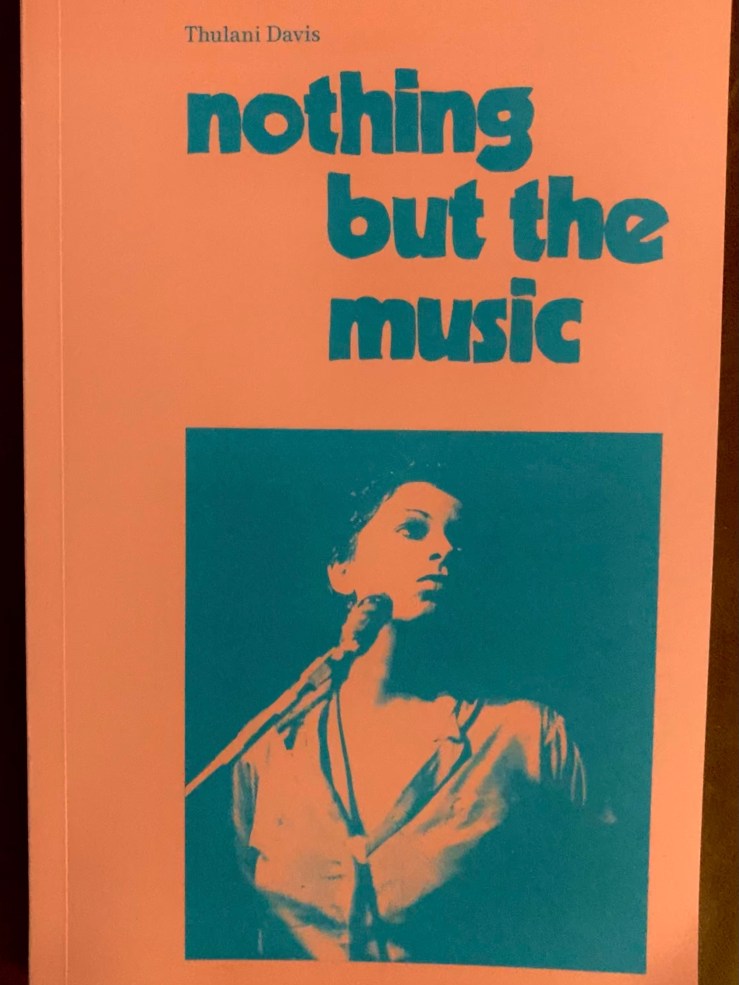
Behind God’s back | On Thulani Davis’s poetry collection Nothing but the Music

Here are the first lines of Thulani Davis’s 1978 poem “Mecca Flats 1907”:

On this landscape

Like a thin air

Hard to breathe

Behind God’s back

I see the doors

I wanted to underline the line Behind God’s back—such an image! But the book itself is so pretty, lithe, lovely. Better to leave it unmarked?

The book is Nothing but the Music, a new collection of Thulani Davis’s poems. Its subtitle Documentaries from Nightclubs, Dance Halls, & a Tailor’s Shop in Dakar: 1974-1992 is a somewhat accurate description of the content here. These are poems about music—about Cecil Taylor and The Commodores and Thelonious Monk and Henry Threadgill and Bad Brains and more. “About” is not really the right word, and of course these poems are their own music; reading them aloud reveals a complexity of rhyme and rhythm that might be lost to the eye on the page.

But where was I—I wanted to underline the line Behind God’s back, but I didn’t. I didn’t even dogear the page. Instead, I went back to read Davis’s acknowledgements, a foreword by Jessica Hagedorn, and an introduction by Tobi Haslett. The material sets the stage and provides context for the poems that follow. Davis’s acknowledgments begin:

I have heard this music in a lot of clubs that no longer exist, opera houses in Italy that will stand another hundred years parks in Manhattan, Brooklyn, L.A., San Francisco, and Washington, DC as well as on Goree Island and in Harare, Zimbabwe. Some of it was in lofts in lower Manhattan now inhabited by millionaires, crowded bistros in Paris that are close, and legendary sites like Mandel Hall and the Apollo, radio studios, recording studios, and my many homes.

Acknowledging the weird times that have persisted (behind God’s back or otherwise), Davis touches on the COVID-19 lockdown that took the joy of live music from her—and then returned it in the strange form of “masked protesters massed in the streets singing ‘Lean on Me'” during the protests following the murder of George Floyd.

Poems in Nothing but the Music resonate with the protests against police violence and injustice we’ve seen this year. The speaker of “Back Stage Drama (For Miami)” (surely Davis herself?) repeats throughout the poem that “I was gonna talk about a race riot,” but the folks around her are absorbed in other, perhaps more minute affairs:

They all like to hang out

Thinking is rather grim to them.

Composed in 1980, the poem documents an attempt to attempt to address the riots in May of the same year in Miami, Florida, after several police officers were acquitted in the murder of Arthur McDuffie, a black man.

The speaker of the poem embeds a poetic plea, a poem-within-a-poem:

I said, ‘they’re mad, they’re on the the bottom going down/

stung by white justice in a white town

and then there’s other colored people

who don’t necessarily think they’re colored people

taking up the middle/leaving them the ground.’

But her would-be audience is weary:

I am still trying to talk about this race riot.

Minnie looked up and said, ‘We don’t have anywhere

to put any more dead.’

Snake put on his coat to leave, ‘We never did,

we never did.’

1992’s “It’s Time for the Rhythm Revue” takes for its erstwhile subject the riots that ensued after the acquittal of the LAPD officers who beat Rodney King. The subject is far more complex though—the speaker of the poem desires joy of course, not violence:

did they acquit somebody in LA?

will we burn it down on Saturday

or dance to the Rhythm Revue

the not too distant past

when we thought we’d live on?

Is God’s back turned—or do the protagonists just live behind it?:

…I clean my house

listening to songs from the past

times when no one asked anyone

if they’d seen a town burn

cause baby everybody had.

In Nothing but the Music, music is part and parcel of the world, entangled in the violence and injustice of it all, not a mere balm or solace but lifeforce itself, a point of resistance against it all. In “Side A (Sir Simpleton/Celebration), the first of two poems on Henry Threadgill’s 1979 album X-75, Vol. I, Davis’s narrator evokes

at the turning of the day

in these winters/in the city’s bottomless streets

it seems sometimes we live behind god’s back

we/the life blood

of forgotten places/unhallowed ground

sometimes in these valleys

turning the corner of canyons now filled with blinding light streams caught between this rock & a known hard place

sometimes in utter solitude

a chorale/a sweetness/makes us whole & never lost

And again there that line, a note from a previous jam—it seems sometimes we live behind god’s back—I’ll dogear it here, digitally, underline it in my little blog scrapbook.

I think seems is the right verb though, above. Does the star of “Lawn Chair on the Sidewalk” not remain in God’s gaze?

there’s a junkie sunning himself

under my front tree

that tree had to fight for life

on this Brooklyn street

disease got to its limbs

while still young

Typing the lines out, I wonder who I meant by star above.

Nothing but the Music is filled with stars. Here’s avant-piano great Cecil Taylor in “C.T. at the Five Spot”:

this is not about romance & dream

it’s about a terrible command performance of the facts

of time & space & air

In a synesthestic moment, the speaker merges her art with its subject:

the player plays/Mr. Taylor plays

delicate separate licks of poems

brushes in tones lighter & tighter/closer in space

In the end it’s one art:

I have heard this music

ever since I can remember/I have heard this music

There are plenty more famous musicians, of course, but more often than not minor players emerge with the greatest force. There’s the unknown hornplayer whose ecstatic playing inspired 1975’s “He Didn’t Give Up/He Was Taken.” In “Leaving Goree” there are the “two Bambara women…gold teeth gleaming” who “sit like mountains” and then explode in song.

Davis crafts here characters with deft economy. Here’s the aforementioned couple of “Back Stage Drama (For Miami)”:

Snake & Minnie

who love each other dearly

drink in different bars,

ride home in separate cars.

They like to kiss goodnight

with unexplored lips.

They go out of town

to see each other open.

Or the hero of 1982’s “Bad Brains, A Band”—

the idea that they think must scare people to death

the only person I ever met from southeast DC

was a genius who stabbed her boyfriend for sneaking up on her in the kitchen

she was tone deaf and had no ear for French

she once burned her partner in bid whist

for making a mistake

At the core of it all is Davis’s strong gliding voice, pure and clean, channeling miracle music and synthesizing it into new sounds. The speaker of “C.T. at the Five Spot” assessed Taylor’s performance as a work of physics, a transcendence beyond “romance & dream,” but the speaker of 1982’s “Zoom (The Commodores)” gets caught up in the aural romance of The Commodore’s pop magic:

zoom I love you

cause you won’t say no/cause you don’t want to go

cause it’s so cruel without love

give me the tacky grandeur of Atlantic City

on the Fourth of July

the corny promises of Motown

give me the romance & the Zoom.

I love those corny promises too. The romance and the zoom are not, at least in my estimation, behind God’s back, but rather, if you believe in that sort of thing, might be God’s special dream. Nothing but the Music cooks raw joy and raw pain into something sublime. I like poems best when they tell stories, and Davis is a storyteller. The poems here capture place and time, but most of all sound, sound, rhythm, and sound. Lovely stuff.

Nothing but the Music is available from Blank Forms Editions.

[Ed. note–Biblioklept first published this review in Nov. 2020.]

A review of Octavia Butler’s dystopian novel Parable of the Sower

joga-put-k-samosozidaniyu-i-zdorovyu-iz-tryoh-shagov
Cover art for Parable of the Sower by John Jude Palencar 

Octavia Butler’s 1993 novel Parable of the Sower imagines what a radical affirmation of life might look like set against a backdrop of impending extinction. Set between 2024 and 2027, Parable of the Sower conjures  a crumbling America. Hyperinflation abounds, infrastructure is falling apart, water is scarce, environmental collapse is imminent, and the social institutions that bind the nation have all but frayed.

When we first meet our narrator Lauren Olamina, she is one of the lucky few who has a life of moderate comfort, stability, and security. Lauren lives in a gated community in a sort of compound with her brothers, stepmother, and father, an academic/preacher. Lauren’s father is the ersatz leader of this community,  He leads the neighborhood’s shooting practices, trains them in survival skills, and organizes a perimeter watch against the thieves and arsonists that constantly threaten their survival. He is the central role model for Lauren, who takes his lessons to heart. When the community finally fragments under an attack it can’t endure, Lauren is the only one of her family to survive. She even has the presence of mind to grab her bug-out bag.

After this initial staging of events, Parable of the Sower turns into a road novel. Lauren and two other survivors of the compound head north along the California freeways, slowly gathering followers. Lauren’s leadership drives the novel and inspires those around her. She offers her followers an alternative to the predation around them, a predation most strongly figured in the roving bands of arsonists that prey on travelers and communities alike. She offers her followers the prospect of belonging to a We—an interracial, inter-generational collective.

Lauren’s leadership capability derives from two strands. The first strand is the religion she is creating, an idea she calls “Earthseed.” The basic premise of Earthseed (one that the novel repeats ad nauseum) is that “God is Change.” Another tenet is that people are the seeds of the earth (like, uh, Earthseed—get it?). Lauren’s long-term vision is that humanity might seed a new planet. The post-WW2 dream of NASA and the futurity of exploration—a Manifest Destiny of the stars—glows in the background of Sower, and often points to a more interesting conclusion than the novel finally musters.

The second source of Lauren’s drive comes from a condition she suffers called hyperempathy or “sharing,” a mutation that’s the result of her birth-mother’s drug addiction during pregnancy. Simply put, when Lauren witnesses another person’s injury, she feels their pain. This affliction is a devastating weakness in a predatory, violent (non)society: for Lauren, self-defense entails self-harm. At the same time, Lauren’s hyperempathy is a strength—it makes her understand, at the most visceral level, the need for a community to work together in order to thrive in a world that seems to be dying.

Perhaps the greatest strength of Butler’s novel is that she shows her readers what Lauren can never quite see—namely that Lauren’s hyperempathy is a strength. Sower assumes the form of a journal, Lauren’s first-person recollections scrawled out in rare moments of respite from the terrors of the road. While her first-person perspective is generously broad (she seems to see a lot), she still never quite realizes that her hyperempathy contributes to her strength as a leader. Lauren’s hyperempathy necessitates imaginative forethought; it also entails a need to act decisively in times of crisis. And Parable of the Sower is all crisis, all the time.

Lauren’s journal style mixes the high with the low. She cribs the poetry of her Earthseed religion from the King James Version of the Bible, with often corny results. (I am pretty sure the corniness is unintentional). She’s also occasionally psychologically introspective, going through thought experiments to better understand those around her.

Despite its Earthseed flights into poetical musings and boldly-declared profundities, most of Lauren’s narrative is strangely mundane in its accounting of a slow apocalypse though. There are seemingly-endless lists of supplies to be bought or scavenged, survival chores to be checked off, and California roads to be traversed (sections of Parable of the Sower often reminded me more of the SNL recurring sketch “The Californians” than, say, Cormac McCarthy’s The Road). The bulk of Butler’s book hovers around disaster prepping, finding temporary shelter, and looting bodies, motifs that won’t seem strange to contemporary audiences reared on cable television and addicted to battle royale video games.

Lauren is 15 at the novel’s outset in 2024, yet she seems fully mature. If this was a coming-of-age novel, I missed it—Lauren, while far from perfect, is generally self-assured in her powers of decision making. At a quite literal level, she commands the narrative, propelling it forward without any of the wishy-washiness we might get from the narrator of, say, The Handmaid’s Tale. If Lauren second-guesses herself, she doesn’t bother to second-guess her second guesses. Butler seems to envision her rather as a hero-model for the coming disaster the novel anticipates. Much of Parable of the Sower reads like a checklist of What To Do After the End of Civilization.

The novel’s biggest weakness is that it can’t quite articulate just how bad things have gotten. Is this actually The End of Civilization? Butler paints a bleak picture. Drought is the new norm. Most Americans are illiterate. Work is hard to find. The roads are too dangerous to travel at night. Packs of feral dogs hunt down humans. Packs of feral children eat humans. Women live with the constant threat of rape. Overt racism is fully normalized. Company towns make a comeback, issuing scrip instead of currency, leading to indentured servitude. Water is a commodity to literally kill for, the police are essentially an organized gang, and a large portion of the population are addicted to a drug that makes setting fires better than sex. Murder is an open business, and there is no recourse to any established justice.

And at the same time that it evokes all of these apocalyptic images and themes, Butler’s novel points to tinges of normalcy—a presidential election carried out sans violence, the sense that a university system is still in play, various notations of different regulatory bodies. Parable of the Sower often reads like The Walking Dead or The Road, but then it might turn a weird corner to uncanny normalcy, where characters shop in a Walmart-like (if hyperbolized) superstore. As one character puts it,

Federal, state, and local governments still exist— in name at least— and sometimes they manage to do something more than collect taxes and send in the military. And the money is still good. That amazes me. However much more you need of it to buy anything these days, it is still accepted. That may be a hopeful sign— or perhaps it’s only more evidence of what I just said: We haven’t hit bottom yet.

Perhaps what I perceive here is simply Butler showing her narrator’s essential naivete, a naivete that doesn’t evince on the surface of the first-person narration. Lauren doesn’t know what she doesn’t know. She doesn’t fully understand how bad things have gotten because she doesn’t fully understand the potential in America that existed before her own life. But she does intuit how bad things are. Despite her intuition, she’s hopeful. This hope, and the despair that foregrounds it, evinces strongly in the final moments of the book. Lauren has finally made it to a kind of promised-land, a frontier-space where she can create a new life with a new love, a much-older man named Bankole. Bankole was a doctor in his old life, but now he’s a survivor. At the end of the novel, he mourns the American dream, the American we, and mourns that Lauren cannot mourn it with him:

He said nothing for a while. Then he stopped and put his hand on my shoulder to stop me. At first he only stood looking at me, almost studying my face. “You’re so young,” he said. “It seems almost criminal that you should be so young in these terrible times. I wish you could have known this country when it was still salvageable.”

“It might survive,” I said, “changed, but still itself.”

“No.” He drew me to his side and put one arm around me. “Human beings will survive of course. Some other countries will survive. Maybe they’ll absorb what’s left of us. Or maybe we’ll just break up into a lot of little states quarreling and fighting with each other over whatever crumbs are left. That’s almost happened now with states shutting themselves off from one another, treating state lines as national borders. As bright as you are, I don’t think you understand—I don’t think you can understand what we’ve lost. Perhaps that’s a blessing.”

Banokole’s summary of America in the late 2020s seems like a dire if hyperbolic prognostication of our current trajectory. More than a quarter century ago, Butler knew what was up. Butler also offered an answer to the problem in her mouthpiece Lauren, who replies to her (way-too-much older) lover Bankole, “We’ve got work to do.”

Parable of the Sower is not a particularly fun novel, although of course, it never intends to be. The dour tone is appropriate to its subject matter, I suppose, but that grim tone can become exhausting. The novel’s trajectory and moral vision keep it from falling into an exercise in nihilism or apocalypse porn, like, say, The Walking Dead. But like The Walking Dead, Butler’s novel often plods along. Maybe this is a rhetorical feature—maybe Butler intends her reader to feel just as weary and depressed as Lauren.

Parable of the Sower was published just a year after a superficially-similar novel, Neal Stephenson’s Snow Crash, which also presciently envisions a fragmenting America where like-groups seal themselves off from each other. In contrast though, Stephenson’s novel is zany and vibrant, a cartoon world devoid of any hyperempathy that might get in the way of anarchic fun. Over 25 years old now, many of the tropes in both Snow Crash and Parable of the Sower have so fully infiltrated our media—books and video games, films and television shows—that their initial vital strangeness is hard to detect.

The dystopian tropes of Parable of the Sower don’t feel particularly fresh in 2019, but the novel’s prescience still has an alarming bite. (Her sequel, Parable of the Talents, features a right-wing Presidential candidate who runs on the promise to “Make America great again”). Sower works best as an extended thought experiment on what might happen to society—to democracy in particular—when impending ecological collapse threatens our very existence. And Butler proposes a solution to the problems posed in her thought experiment: “We’ve got work to do.”

“We’ve got work to do” not only summarizes Parable of the Sower’s central message, it also describes current zeitgeist. Lauren would have been born in 2009; my daughter was born in 2007 and my son in 2010. She could be one of their classmates; she could be my own daughter. The novel’s vision of hyperempathy in the face of brutality and creeping fascism points back to that phrase — “We’ve got work to do” — which of course, requires a We. The we here is a radical affirmation, an echo even of the We the People that so boldly engendered a U.S. America. But Butler’s vision, conveyed through Lauren, is far more pluralistic and diverse than the We the framers evoked in the Preamble to the Constitution. Butler’s we names the namelessness of a coming society, a society that seems impossible and yet is possible, its possibility instantiated in the simple proof that it can be imagined. Parable of the Sower ultimately points toward the seeds of that imagining.

[Ed. note—Biblioklept first published this review in March of 2019.]

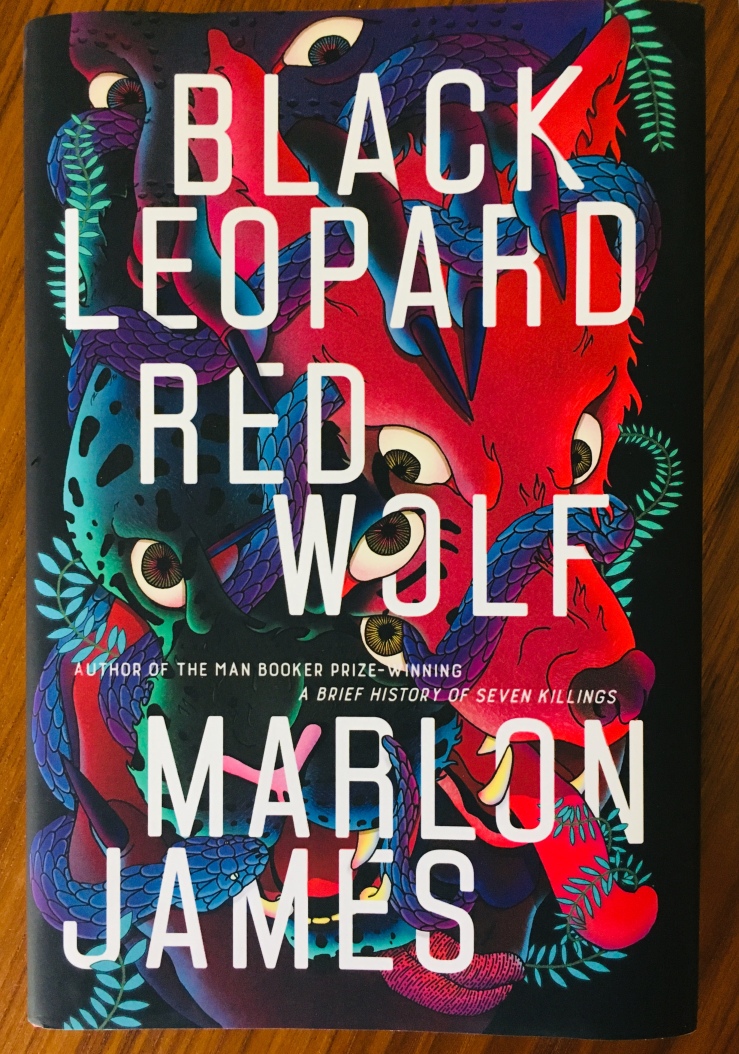
Marlon James’s Black Leopard, Red Wolf is a postmodern fantasy novel that challenges the conventions of storytelling itself

img_2496

Marlon James’s novel Black Leopard, Red Wolf is a postmodern fantasy that takes place in medieval sub-Saharan Africa. Set against the backdrop of two warring states, the North Kingdom and the South Kingdom, Black Leopard, Red Wolf is the story—or stories, really—of Tracker, a man “with a nose” who can track down pretty much anyone (as long as he’s got the scent).

The central quest of Black Leopard, Red Wolf is for Tracker to find and recover a missing child of great importance. An explanation of exactly how and why the child is so important is deferred repeatedly; indeed, James’s novel is as much a detective story as it is a fantasy. In his detective-quest, Tracker partners with a number of strange allies: a talkative giant (who tells us repeatedly that he is not a giant), an anti-witch who places charms on Tracker, a duplicitous Moon Witch, a skin-shedding warrior-spy, a sandy-colored soldier from an alien land, a surly archer, a very smart buffalo, and more, more, more.

I used the word allies above, but truculent Tracker is just as likely to fight against the members of his fellowship as he is to fight with them. Black Leopard, Red Wolf runs on the same logic we find in comic books, where heroes fight each other first and then figure out why they are fighting each other after the fact. Sure, they’ll band together to fight lightning zombies, vampires, or roof-walking night demons—but they’re just as likely to go at each other with brass knuckles, axes, or arrows right after.

Chief among Tracker’s  allies/rivals is the Leopard, a shapeshifter. Throughout the book, Tracker and the Leopard fall in and fall out, fight and fuck, laugh and scream. Their bond is forged early in the novel, when they work together to rescue Mingi children, outcast mutants with strange appearances and stranger abilities. These children become an ersatz family for Tracker and provide an emotional ballast to a novel that often reads like a violent tangle of chaotic, meaningless tangents.

The fact that Leopard and Tracker—the title characters for the novel (Tracker gets his eye sucked out by a were-hyena and replaces it with a magical wolf eye; don’t ask)—the fact that Leopard and Tracker save children, particularly strange children is central to understanding their motivations in their quest to save the missing child.

From the outset though, the reader has to doubt just how successful the quest will be. Black Leopard, Red Wolf opens with these intriguing sentences: “The child is dead. There is nothing left to know.” These lines for foreground the novel’s two major themes: radical infanticide and the problem of knowing what we know and (story)telling what we know.

James’s novel uses infanticidal threat as the impetus for its central plot, the fellowship’s quest to save a child. In the backdrop though is Tracker’s oedipal rage toward his father/grandfather (don’t ask), a rage born out of the infanticidal threats Tracker himself has survived. Tracker has survived, but he is not at peace. He is perhaps the angriest narrator I have ever read, quick to temper and driven by (oedipal) impulses of revenge against a target he cannot name. His anger boils over repeatedly, and not just at his foes, but at his partners and his lovers—the Leopard, in particular.

At the same time, Black Leopard, Red Wolf transports us to scenes of strange love and strange families. James’s novel shows how radical love—Tracker and his Mingi children—might mediate, disrupt, or upend the impulses of revenge. And yet there is nothing permanent or stable in this postmodern novel.

Indeed, Black Leopard, Red Wolf is very much about the problem of how we know what we know and how we can express what we know. Tracker is our narrator, but he doesn’t tell us his story straight (there is nothing straight about this queer novel). Tracker tells his stories—the novel—to someone he addresses as inquisitor, but we never learn how Tracker came to be the inquisitor’s captive. Like Sheherezade in One Thousand and One Nights, Tracker seems to spin his story as a life-saving trick.

Black Leopard, Red Wolf is a tangle, a fluid that courses this way and that, a jumble of time and space. Like the “Ten and Nine Doors” that Tracker’s fellowship uses to teleport from one city-state to another, the narrative leaps through time and space, discursive and discontinuous. Tracker nests his narrative as well. We get tales inside tales inside tales, a matryoshka doll without a clear and definite shape. I occasionally felt submerged in reading James’s novel, as if I’d disappeared into an undersea cave only to find some strange current that bore me elsewhere.

Late in Black Leopard, Red Wolf, Tracker neatly summarizes the novel’s deconstruction of a stable truth, and then reverses the roles, demanding testimony from the inquisitor:

And that is all and all is truth, great inquisitor. You wanted a tale, did you not? From the dawn of it to the dusk of it, and such is the tale I have given you. What you wanted was testimony, but what you really wanted was story, is it not true? Now you sound like men I have heard of, men coming from the West for they heard of slave flesh, men who ask, Is this true? When we find this, shall we seek no more? It is truth as you call it, truth in entire? What is truth when it always expands and shrinks? Truth is just another story.

James has planned to write two sequels to Black Leopard, Red Wolf in what he is calling his “Dark Star” trilogy, and he’s stated that each entry in the series will, like an episode in Akira Kurosawa’s 1950 film Rashomon, tell the story from another perspective. After all, “Truth is just another story.”

Of course, Tracker’s telling can be confounding, even exhausting. James’s prose often feels picaresque, one-damn-thing-happening-after-another, a phantasmagoria of sex and violence signifying nothing—only it doesn’t signify nothing. It means something. Many readers won’t want to puzzle that out though.

A lot of the plot is delivered after the fact of the action. We get a form of clunky post-exposition—another form of storytelling, really, with one character summarizing the fragmented details the reader has been wading through for another character. In a kind of metatextual recognition of his tale’s messiness, James will often wink at the reader through his characters. Summarizing pages and pages of plot for the Leopard (and the reader), Tracker finds himself befuddled:

I told the Leopard all this and this is truth, I was more confused by the telling than he was by listening. Only when he repeated all that I said did I understand it.

A few chapters later, the pattern repeats. “The more you tell me the less I know,” one character tells another. Even storytelling can’t stabilize the truth.

While the plot’s unwieldiness can become tiresome, it is not a defect of the book as much as an intentional feature. However, some of the battle scenes fall into a kind of mechanical repetition of blank violence. Tracker tells us again and again how he “hacked” or “yanked,” etc. in scenes that become duller and duller as there are more of them.

The book is far more fun when it’s weirder—Tracker getting trapped by a mutant spider demon who sprays webs all over his face, or Tracker swimming with mermaids to the land of the dead, or Tracker and his companion visiting a technologically-advanced tree city-state ruled by a mad queen. James’s best set pieces don’t need battles to reverberate with energy.

The sex is more interesting than the violence in Black Leopard, Red Wolf—and there’s plenty of both. “Fantastic beasts, fantastic urges,” our lead characters repeat to themselves. James’s novel is deeply horny, its characters fluidly shifting into all kinds of weird fucking. Tracker partners with various members of his fellowship in more ways than one. Sex is magic in Black Leopard, Red Wolf, too—only ten pages in, Tracker ejaculates on a witch, she flicks his semen into a river, fish eat it, and turn into mermaids who lead him to the land of the dead.

There’s so much more in Black Leopard, Red Wolf that I haven’t touched on. The novel is lurid and horny, abject and affecting. It’s often quite funny, and, in the end, it turned out to be unexpectedly moving. It’s also exhausting and confusing, and will likely prove divisive for many readers. It’s clear that Lord of the Rings was a reference point for James (the word “fellowship” is oft-repeated in his novel), but Black Leopard, Red Wolf reminded me more of Jonathan Littell’s The Kindly Ones than it did a traditional fantasy.

In its vivid weirdness and pure invention, James’s book also reminded me of Brian Catling’s novel The Vorrh. However, Catling’s novel often takes the colonialist viewpoint. Black Leopard, Red Wolf  points to a fantasy that could reverse our own history, potentially obliterate that viewpoint’s existence. When Tracker asks the inquisitor, “Now you sound like men I have heard of, men coming from the West for they heard of slave flesh, men who ask, Is this true?”, his questioning seems to point to the larger implications of the James’s Dark Star universe—a precolonial space with a looming threat from the West. Late in Black Leopard, Red Wolf, one character warns the others that the warring between the North and South Kingdoms, between tribes and city-states must end. There’s an existential threat on the horizon. I find the potential storytelling here intriguing.

Black Leopard, Red Wolf is clearly Not for Everybody. It’s violent and strange, and the sex in it will likely upset conservative readers. It’s also shaggy and unwieldy. It probably has a future as a cult novel. You just sort of have to go with its fluid (in every sense of that word) program and enjoy the ride. I enjoyed it very much and am looking forward to the sequel.

[Ed. note — Biblioklept first published this review in May of 2019. This novel’s sequel, Moon Witch, Spider King, is out next week.]

On Fran Ross’s postmodern picaresque novel Oreo

img_5795

Fran Ross’s 1974 novel Oreo is an overlooked masterpiece of postmodern literature, a delicious satire of the contemporary world that riffs on race, identity, patriarchy, and so much more. Oreo is a pollyglossic picaresque, a metatextual maze of language games, raps and skits, dinner menus and vaudeville routines. Oreo’s rush of language is exuberant, a joyful metatextual howl that made me laugh out loud. Its 212 pages galloped by, leaving me wanting more, more, more.

Oreo is Ross’s only novel. It was met with a handful of confused reviews upon its release and then summarily forgotten until 2000, when Northeastern University Press reissued the novel with an introduction by UCLA English professor Harryette Mullen(New Directions offered a wider release with a 2015 reissue, including Mullen’s introduction as an afterword.)

Mullen gives a succinct summary of Oreo in the opening sentence of her 2002 essay “‘Apple Pie with Oreo Crust’: Fran Ross’s Recipe for an Idiosyncratic American Novel“:

In Fran Ross’s 1974 novel Oreo, the Greek legend of Theseus’ journey into the Labyrinth becomes a feminist tall tale of a young black woman’s passage from Philadelphia to New York in search of her white Jewish father.

Mullen goes on to describe Oreo as a novel that “explores the heterogeneity rather than the homogeneity of African Americans.”

Oreo’s ludic heterogeneity may have accounted for its near-immediate obscurity. Ross’s novel celebrates hybridization and riffs–both in earnestness and irony—on Western tropes and themes that many writers of the Black Arts Movement of the 1960s and ’70s specifically rejected.

Indeed, Oreo still feels ahead of its time, or out of its time, as novelist Danzy Senna repeatedly notes in her introduction to the New Directions reissueSenna points out that “Oreo resists the unwritten conventions that still exist for novels written by black women today,” and writes that Ross’s novel “feels more in line stylistically, aesthetically, with Thomas Pynchon and Kurt Vonnegut than with Sonia Sanchez and Ntzoke Shange.”

In his review of Oreo, novelist Marlon James also posits Ross’s place with the postmodernists, suggesting that “maybe Ross is closer in spirit to the writers in the 70s who managed to make this patchwork sell,” before wryly noting, “Of course they were all white men: Vonnegut, Barth, Pynchon, and so on.”

Of course they were all white men. And perhaps this is why Oreo languished out of print so long. Was it erasure? Neglect? Institutional racism and sexism in publishing and literary criticism? Or just literal ignorance?

In any case, Ross belongs on the same postmodern shelf with Gaddis, Pynchon, Barth, Reed, and Coover. Oreo is a carnivalesque, multilingual explosion of the slash we might put between high and low. It’s a metatextual novel that plays zanily with the plasticity of its own form. Like Coover, Elkin, and Barthelme, Ross’s writing captures the spirit of mass media; Oreo is forever satirizing commercials, television, radio, film (and capitalism in general).

Ross plays with the page as well, employing quizzes, menus, and charts into the text, like this one, from the novel’s third page:

Screenshot 2020-07-24 at 3.14.00 PM

Oreo won me over with the postmodern paragraph that followed this chart, which I’ll share in full:

 A word about weather

There is no weather per se in this book. Passing reference is made to weather in a few instances. Assume whatever season you like throughout. Summer makes the most sense in a book of this length. That way, pages do not have to be used up describing people taking off and putting on overcoats.

What happens in Oreo? Well, it’s a picaresque, sure, but it goes beyond, as Ralph Ellison put it, being “one of those pieces of writing which consists mainly of one damned thing after another sheerly happening.” (Although there are plenty of damned things happening, sheerly or otherwise, after each other.)

Oreo is a mock-epic, a satirical quest for the titular Oreo to discover the “secret of her birth,” using clues left by her white Jewish father who, like her mother, has departed. All sorts of stuff happens along the way–run ins with rude store clerks, attempted muggings, rhyming little people with a psychopathic son camping in the park, a short voice acting career, a soiree with a “rothschild of rich people,” a witchy stepmother, and a memorable duel with a pimp. (And more, more, more.)

Throughout it all, Oreo shines as a cartoon superhero, brave, impervious, adaptable, and full of wit—as well as WIT (Oreo’s self-invented “system of self- defense [called] the Way of the Interstitial Thrust, or WIT.” In “a state of extreme concentration known as hwip-as [Oreo could] engage any opponent up to three times her size and weight and whip his natural ass.)

Indeed, as Oreo’s uncle declares, “She sure got womb, that little mother…She is a ball buster and a half,” underscoring the novel’s feminist themes as well as its plasticity of language. Here “womb” becomes a substitution for “balls,” a symbol of male potency busted in the next sentence. This ironic inversion might serve as a synecdoche for Oreo’s entire quest to find her father, a mocking rejoinder to patriarchy. As Oreo puts it, quite literally: “I am going to find that motherfucker.”

Find that motherfucker she does and—well, I won’t spoil any more. Instead, I implore you to check out Oreo, especially if you’re a fan of all those (relatively) famous postmodernist American novels of the late twentieth century. I wish someone had told me to read Oreo ages ago, but I’m thankful I read it now, and I look forward to reading it again. Very highly recommended.

[Ed. note — Biblioklept first published this review in July of 2020.]

Unread, 2021/Hope to read, 2022

Of course there were millions and millions of books that I left unread in 2021, but here are a few I hope to carve a space for sometime in the next year:

Heimito von Doderer’s The Strudlhof Steps (in translation by Vincent Kling) has been compared to Joyce and Döblin. I got a copy last month and couldn’t commit to the beast’s size. I was trying to make it through Thanksgiving and the end of the 2021 Fall term—this year I’ve favored short books and comfortable rereads I’ve bookended 2021 with rereads of Moby-Dick and Blood Meridian (such comfort!)—The Strudlhof Steps is long long long.

Also long long long (but not as compressed in its typography) is Pierre Senges’ Ahab (Sequels) (in translation is by Jacob Siefring). I’ve dipped into it a few times since I got a copy back in October, but haven’t been able to make the commitment I need to. I’ll get it in in 2022. (Sample here.)

I picked up Alan Garner’s novel Red Shift based on its cover and a blurb from Ursula K. LeGuin—also, it’s pretty short, and, like I’ve said, I’ve done well with short books this year. Hell, maybe I’ll even squeeze it in. Martin Levin’s 1973 minireview in the NYT:

Mr. Garner jump‐cuts nimbly through English history to underscore (I guess) the continuity of such commonalities as love and aggression. Macey is an early Briton, who talks Clockwork Orange style and lays about him in a hypnotic frenzy with his ceremonial stone axe. The axe‐head later becomes a talisman for Thomas Rowley (a 17th‐century citizen who cements it into his chimney) and for Tom, a young 20th‐century Now person, who sells it to the British Museum.

What links these three? Well, there is the artifact. And the place, a rural locus in Cheshire. Finally, there is selfless love —which seems to have survived the centuries. Macey is a twosome with a priestess in the corn festival, who is tender under some trying circumstances. Rowley’s wife stands by him during the bad times of Cromwell. Tom has tender bicycle outings with a student nurse.

Why three periods in time? Well, why not?

I’ve actually read a few chunks of John Berryman’s biography of Stephen Crane (which spine does not read so clearly in yon photograph above). I’ve been picking my way back through Crane, an underappreciated modernist master. I might not read the whole thing straight ever, but I will read it crooked.

Papa Hamlet showed up at the assend of the summer, by which I mean the very beginning of the Fall 2021 semester. This 1889 collaboritve novel by Arno Holz and Johannes Schlaf is available in English translation via James J. Conway for the first time ever. Read an excerpt here.

W.D. Clarke’s novel She Sang to Them, She Sang is a strange shape and volume. Also, for the first time in my life, my eyes are kinda fucked up. I have to wear different cheap glasses to see smaller print. This personal fact is embedded in my encounter with Clarke’s second novel.

I read Kobo Abe’s most famous novel Woman in the Dunes, but failed to get past the first ten pages of Secret Rendezvous (in English translation by Juliet Winters Carpenter). Woman in the Dunes is the sort of thing that I should’ve loved at 19, 20, 25. Maybe Rendezvous will do it for me in ’22.


Barthelme/Calvino/Garner/Jackson (Books acquired, 19 Nov. 2021)

Spent a spare hour this afternoon at the local used bookshop.

A few months ago I found a first edition of Donald Barthelme’s collection Forty Stories. This afternoon I picked up a first edition of my favorite Barthelme novel, The Dead Father. The jacket design–by Ruth Ansel–is really cool, which doesn’t really come through in the photograph. The back cover simply reverses the silver-black set up of the front cover; the spine reads bottom to top instead of top to bottom, like most U.S. titles.

I’ve never read Under the Jaguar Sun by Italo Calvino, but I picked it up because I enjoyed rereading three by Calvino earlier this year (and it’s very short and has a cool cover by Malcolm Tarlofsky).

I’d never heard of Alan Garner’s 1973 novel Red Shift until today. I always pull NYRB spines out, and the novel’s description on the back caught my attention. Part of the description:

In second-century Britain, Macey and a gang of fellow deserters from the Roman army hunt and are hunted by deadly local tribes. Fifteen centuries later, during the English Civil War, Thomas Rowley hides from the ruthless troops who have encircled his village. And in contemporary Britain, Tom, a precocious, love-struck, mentally unstable teenager, struggles to cope with the imminent departure for London of his girlfriend, Jan.

The blurb from Ursula K. Le Guin (“A bitter, complex, brilliant book”) made me pick it up. I love the NYRB cover, which has a My Bloody Valentine feeling to it, at least to me, but I also am a big proponent of genre covers–sci-fi/fantasy covers that might not be as “respectable” as the “literary” crossover covers that adorn works that live a second life. So I trekked over to the sci-fi/fantasy section to see if I could find another edition of Red Shift. This is what I found:

I regret not looking for the artist’s name now. I dig the Ballantine cover, but the NYRB edition was far more readable in the end.

From the sci-fi/fantasy section, I somehow wandered into U.S. history, staring at an endcap titled “Salem witchcraft.” I did not know that Shirley Jackson wrote a book about Salem—or Salem Village, as she points out in her initial note—a place that is not the same place as Salem—I did not know that Jackson wrote a book about the Salem (Village) witchcraft trials. I picked it up and started in and didn’t want to stop.

Apparently it’s a children’s book.

Donald Barthelme’s Sixty Stories in reverse: Chapter the Last, featuring Thirty Stories, Fifteen Stories, and Ten Stories

Previously,

Stories 60-55

Stories 54-49

Stories 48-43

Stories 42-37

Stories 36-31

Stories 30-25

Stories 24-19

Stories 18-13

Stories 12-7

Stories 6-1

I don’t know if there’s a need for a defense of Donald Barthelme, and I do know that I am not the person to mount that defense. I spent the last two months re-reading Sixty Stories along with/against Tracy Daugherty’s 2010 biography of Barthelme, Hiding Man. I read some other stuff, but most of the writing on this cursed website was about Barthelme’s stories.

Here’s the thing: these stories, even when soaked in the juices of their zeitgeist (“The Sandman,” “The Indian Uprising,” “Robert Kennedy Saved from Drowning”) more than hold up. They are still fresh, funny, strange, charming. I suppose they could be more upsetting–Barthelme’s world is never raw, and always displaces the visceral through a heavy salve of ironic refinements (and a three-martini haze).

But Barthelme’s rhetorical contortions vivify the forms that he parodies here—early French modernism (“Eugénie Grandet”) or Kafkaesque existentialism (“Me and Miss Mandible,” “The Sergeant”) or faux-academic essaying (“On Angels”). He transmutes the material into something more. In his introduction to the 2003 Penguin Classics edition of Sixty Stories that I read, David Gates remarks that,

Barthelme is a quintessential writer of the twentieth century, looking Janus-faced to both the past and future, and with a third eye turned inward. Yet he’s also an anomaly. Nobody before him really reads much like him: neither Beckett or Nabokov, nor such minimalist realists as Hemingway, nor such fabulists as Kafka and Borges…Nor has he become anyone’s Dead Father.

Gates’s appellation “Dead Father” is a nod to Barthelme’s best novel as well as the oedipal undercurrent that surges over and under his ouevre. Gates tries to situate Barthelme’s modernism, a modernism beholden to Dead Father Beckett, himself beholden to Dead Father Joyce.

But Gates never comes out and states what I think is clear after re-reading Sixty Stories (especially against Daugherty’s Barthelme biography)–Barthelme’s success is that he is a failed modernist. In his 1981 interview with J.D. O’Hara, Barthelme stated,

…my father was an architect of a particular kind—we were enveloped in modernism. The house we lived in, which he’d designed, was modern and the furniture was modern and the pictures were modern and the books were modern.

Raised a Modernist, Barthelme transcends Modernism.

And yet he was reticent of any terms that might fix him as something other. In a 1980 interview with Larry McCaffery, he called “‘postmodernism’…the least ugly, most descriptive” of the terms that had been used to pigeonhole his fiction.

He hedged more in his 1987 essay “Not Knowing,” musing that it was “not altogether clear as to who is supposed to be on the bus and who is not.” Postmodernism though is really just a descriptor. And we’re all on the bus.

Gates eventually settles on Barthelme as a “Dark Uncle” of literature, as opposed to a Dead Father. Like Nabokov, Gates suggests Barthelme may have imitators, but not true followers. (Gates does posit the potential of George Saunders to get there, and I’d argue no other living American writer (that I know of) would have at one time been fit to take up the Barthelme mantle, but kudos to Saunders for forging his own schmaltzy overly-empathetic path.)

But enough of Gates’s intro. It’s good. It’s very 2003–mentions of David Eggers, Harold Bloom, a lot of handwringing about postmodernism. (Somehow, unless I’m forgetting, Barthelme’s true contemporary Robert Coover isn’t mentioned.)

Anyway. The stuff in Sixty Stories still shines, still sings–and much of it is far more poignant than I would’ve initially credited.

So here are the silly lists.

If you want to turn Sixty Stories into Thirty Stories, here’s my edit (in reverse chronology):

“Bishop,” (previously uncollected, 1981)

“The Emerald,” (previously uncollected, 1981)

“The King of Jazz,” (Great Days, 1979)

“Cortes and Montezuma,” (Great Days, 1979)

“The Great Hug,” (Amateurs, 1976)

“The School,” (Amateurs, 1976)

“I Bought a Little City,” (Amateurs, 1976)

“At the End of the Mechanical Age,” (Amateurs, 1976)

“A Manual for Sons,” (The Dead Father, 1975)

“Eugénie Grandet,” (Guilty Pleasures, 1974)

“Nothing: A Preliminary Account” (Guilty Pleasures, 1974)

“Daumier” (Sadness, 1972)

“The Rise of Capitalism” (Sadness, 1972)

“The Sandman” (Sadness, 1972)

“The Glass Mountain” (City Life, 1970)

“The Policemen’s Ball” (City Life, 1970)

“Kierkegaard Unfair to Schlegel” (City Life, 1970)

“The Phantom of the Opera’s Friend” (City Life, 1970)

“On Angels” (City Life, 1970)

“Paraguay” (City Life, 1970)

“Views of My Father Weeping” (City Life, 1970)

“The Indian Uprising” (Unspeakable Practices, Unnatural Acts, 1968)

“See the Moon?” (Unspeakable Practices, Unnatural Acts, 1968)

“Report” (Unspeakable Practices, Unnatural Acts, 1968)

“Robert Kennedy Saved from Drowning” (Unspeakable Practices, Unnatural Acts, 1968)

“Game” (Unspeakable Practices, Unnatural Acts, 1968)

“The Balloon” (Unspeakable Practices, Unnatural Acts, 1968)

“For I’m the Boy” (Come Back, Dr. Caligari, 1964)

“Me and Miss Mandible” (Come Back, Dr. Caligari, 1964)

“A Shower of Gold” (Come Back, Dr. Caligari, 1964)


If you want to turn Sixty Stories into Fifteen Stories, here’s my edit (in reverse chronology):

“The Emerald,” (previously uncollected, 1981)

“The School,” (Amateurs, 1976)

“At the End of the Mechanical Age,” (Amateurs, 1976)

“A Manual for Sons,” (The Dead Father, 1975)

“Eugénie Grandet,” (Guilty Pleasures, 1974)

“Daumier” (Sadness, 1972)

“Kierkegaard Unfair to Schlegel” (City Life, 1970)

“On Angels” (City Life, 1970)

“Paraguay” (City Life, 1970)

“Views of My Father Weeping” (City Life, 1970)

“The Indian Uprising” (Unspeakable Practices, Unnatural Acts, 1968)

“Robert Kennedy Saved from Drowning” (Unspeakable Practices, Unnatural Acts, 1968)

“Game” (Unspeakable Practices, Unnatural Acts, 1968)

“The Balloon” (Unspeakable Practices, Unnatural Acts, 1968)

“Me and Miss Mandible” (Come Back, Dr. Caligari, 1964)


If you want to turn Sixty Stories into Ten Stories, here’s my edit (in reverse chronology):

“The Emerald,” (previously uncollected, 1981)

“A Manual for Sons,” (The Dead Father, 1975)

“Eugénie Grandet,” (Guilty Pleasures, 1974)

“Daumier” (Sadness, 1972)

“Kierkegaard Unfair to Schlegel” (City Life, 1970)

“Views of My Father Weeping” (City Life, 1970)

“The Indian Uprising” (Unspeakable Practices, Unnatural Acts, 1968)

“Game” (Unspeakable Practices, Unnatural Acts, 1968)

“The Balloon” (Unspeakable Practices, Unnatural Acts, 1968)

“Me and Miss Mandible” (Come Back, Dr. Caligari, 1964)


Donald Barthelme’s Sixty Stories in reverse, Part X

I am rereading Donald Barthelme’s Sixty Stories, starting with the sixtieth story and working my way to the first and writing about it.

Previous entries:

Stories 60-55

Stories 54-49

Stories 48-43

Stories 42-37

Stories 36-31

Stories 30-25.

Stories 24-19

Stories 18-13

Stories 12-7

In this post, stories 6-1, the beginning/end.

6. “The Balloon” (Unspeakable Practices, Unnatural Acts, 1968)

I’ve read “The Balloon” more than any other Barthelme story. I’ve read it at least three times a year, every year, for the past ten years, in the context of an American Literature after 1865 course I teach every Fall-Spring-Summer. It’s widely-anthologized. It’s over-anthologized. It’s probably most folks only exposure to Barthelme, which I think is strange—I think it’s a particularly challenging Barthelme story, even though it’s the Barthelme story I’ve read more than any other Barthelme story.

My students are often exasperated by the story, which seems to lack any traditional plot or character—but I think that’s kind of the point. “The Balloon” is about the creation of “The Balloon.” It’s a story about a story, as much as Barthelme would have protested the notion. This interpretation is not particularly radical. Just earlier this month, the writer Donald Antrim did a reading of “The Balloon” for The New Yorker’s fiction podcast. After the reading, fiction editor Deborah Treisman engages (or tries to engage) Antrim in a discussion of the meaning of the balloon. Antrim insists on rebuking the balloon’s metaphoricity, repeatedly claiming it’s a “real” balloon. Treisman points out that it’s just a story.

Le Ballon, 1862 by Édouard Manet

In his Barthelme biography Hiding Man, Tracy Daugherty spends several pages explaining allusions to Édouard Manet’s 1862 lithograph Le Ballon and the scandal that erupted when Manet showed his painting Olympia in 1865. Daugherty writes,

As many readers have observed, Don’s story considers public responses to art. But besides this general theme, he had in mind a specific set of reactions, in a crucial time.

In invoking Manet’s balloon and the Olympia scandal, Don encoded in his story an early chapter of the art that nourished him throughout his career; an art inseparable from social change, resistant to strict ordering, and opposed to the narrowing of perceptions required by commodification.

Daugherty’s analysis encapsulates what I take to be the signal passage of “The Balloon,” which passage you can read here.

2020-07-16_161411

5. “Will You Tell Me?” (Come Back, Dr. Caligari, 1964)

One of Barthelme’s more formally challenging stories, “Will You Tell Me?” begins strange (“Hubert gave Charles and Irene a nice baby for Christmas”) and gets even stranger. It’s a subtle satire on soap operas and convoluted prize (“The French countryside (the countryside of France) was covered with golden grass”) shot through anarchic glee:

In the cellar Paul continued making his bombs, by cellarlight. The bombs were made from tall Schlitz cans and a plastic substance which Paul refused to identify. The bombs were sold to other boys Paul’s age to throw at their fathers.

Note the ever-present oedipal theme in Barthelme’s work.

4. “For I’m the Boy” (Come Back, Dr. Caligari, 1964)

Like most of Barthelme’s stories, “For I’m the Boy” is a rewarding re-read. Among the stories in Sixty Stories culled from Come Back, Dr. Caligari, “For I’m the Boy” has a somewhat straightforward plot: A man named Bloomsbury has divorced his wife. He takes his two friends Whittle and Huber with her to the airport to see her off so that there will be no “weeping.” They then drive home, stopping for a bottle of brandy on the way. Whittle and Huber demand details of the divorce from Bloomsbury:

It would be interesting as well as instructive Whittle said casually, to know for instance at what point the situation of living together became untenable, whether she wept when you told her, whether you wept when she told you, whether you were the instigator or she was the instigator, whether there were physical fights involving bodily blows or merely objects thrown on your part and on her part, if there were mental cruelties, cruelties of what order and on whose part, whether she had a lover or did not have a lover, whether you did or did not, whether you kept the television or she kept the television, the disposition of the balance of the furnishings including tableware, linens, light bulbs, beds and baskets, who got the baby if there was a baby, what food remains in the pantry at this time, what happened to the medicine bottles including Mercurochrome, rubbing alcohol, aspirin, celery tonic, milk of magnesia, No-Doze and Nembutal, was it a fun divorce or not a fun divorce, whether she paid the lawyers or you paid the lawyers, what the judge said if there was a judge, whether you asked her for a “date” after the granting of the decree or did not ask, whether she was touched or not touched by this gesture if there was such a gesture, whether the date if there was such a date was a fun thing or not a fun thing – in short we’d like to get the feel of the event he said.

Give us the feeling,” they insist, but Bloomsbury refuses. At the end of the story Whittle and Huber literally beat it out of him with a brandy bottle and tire iron. The feeling emerges in the form of tears and blood.

In Hiding Man, Daugherty makes a strong argument that “For I’m the Boy” serves as an early aesthetic statement from Barthelme: art is “our most refined public expression of what is private, unreachable, unsayable…it fails–words cannot do the trick–but it is the best we have…art’s value lies in the fact that it offers forms for our experiences.”

2020-07-16_161411_1

3. “Me and Miss Mandible” (Come Back, Dr. Caligari, 1964)

“Me and Miss Mandible” is an excellent and absurd story told by an adult man who is “officially a child.” Here is the story’s opening:

Miss Mandible wants to make love to me but she hesitates because I am officially a child; I am, according to the records, according to the gradebook on her desk, according to the card index in the principal’s office, eleven years old. There is a misconception here, one that I haven’t quite managed to get cleared up yet. I am in fact thirty-five, I’ve been in the Army, I am six feet one, I have hair in the appropriate places, my voice is a baritone, I know very well what to do with Miss Mandible if she ever makes up her mind.

Our narrator handles the mix-up (if it could be called a mix-up) with bemused aplomb. Unlike the hero of Barthelme’s 1976 story “The Sergeant,” who similarly awakes to find himself affixed with the wrong identity, the narrator of “Mandible” seems to find opportunity in his predicament. There’s nothing especially sinister here; the situation is Kafkaesque, but the tone isn’t. The narrator gets to see the American educational system through the eyes of an experienced adult: “Everything is promised my classmates and I, most of all the future. We accept the outrageous assurances without blinking.”

As the story develops, the narrator comes to understand that these promises are perhaps undeliverable:

We read signs as promises. Miss Mandible understands by my great height, by my resonant vowels, that I will one day carry her off to bed. Sue Ann interprets these same signs to mean that I am unique among her male acquaintances, therefore most desirable, therefore her special property as is every thing that is Most Desirable. If neither of these propositions work out then life has broken faith with them.

I myself, in my former existence, read the company motto (“Here to Help in Time of Need”) as a description of the duty of the adjuster, drastically mislocating the company’s deepest concerns. I believed that because I had obtained a wife who was made up of wife-signs (beauty, charm, softness, perfume, cookery) I had found love. Brenda, reading the same signs that have now misled Miss Mandible and Sue Ann Brownly, felt she had been promised that she would never be bored again. All of us, Miss Mandible, Sue Ann, myself, Brenda, Mr. Goodykind, still believe that the American flag betokens a kind of general righteousness.

But I say, looking about me in this incubator of future citizens, that signs are signs, and that some of them are lies. This is the great discovery of my time here.

2. “A Shower of Gold” (Come Back, Dr. Caligari, 1964)

In “A Shower of Gold,” we find Peterson, “a minor artist” with a bad liver, mulling over whether or not to sell out by appearing on the television show Who Am I? He’s tormented by a series of absurd “punishments” for even considering selling out, including having the President of the United States show up and destroy one of his pieces of art. Finally though, broke and beerless, he condescends to the appearance. The tale ends with an epiphanic monologue:

I was wrong, Peterson thought, the world is absurd. The absurdity is punishing me for not believing in it. I affirm the absurdity. On the other hand, absurdity is itself absurd. Before the emcee could ask the first question, Peterson began to talk. “Yesterday,” Peterson said to the television audience, “in the typewriter in front of the Olivetti showroom on Fifth Avenue, I found a recipe for Ten Ingredient Soup that included a stone from a toad’s head. And while I stood there marveling a nice old lady pasted on the elbow of my best Haspel suit a little blue sticker reading THIS INDIVIDUAL IS A PART OF THE COMMUNIST CONSPIRACY FOR GLOBAL DOMINATION OF THE ENTIRE GLOBE. Coming home I passed a sign that said in ten-foot letters COWARD SHOES and heard a man singing “Golden earrings” in a horrible voice, and last night i dreamed there was a shoot- out at our house on Meat Street and my mother shoved me in a closet to get me out of the line of fire.” The emcee waved at the floor manager to turn Peterson off, but Peterson kept talking. “In this kind of world,” Peterson said, “absurd if you will, possibilities nevertheless proliferate and escalate all around us and there are opportunities for beginning again. I am a minor artist and my dealer won’t even display my work if he can help it but minor is as minor does and lightning may strike even yet. Don’t be reconciled. Turn off your television sets,” Peterson said, “cash in your life insurance, indulge in a mindless optimism. Visit girls at dusk. Play the guitar. How can you be alienated without first having been connected? Think back and remember how it was.” A man on the floor in front of Peterson was waving a piece of cardboard on which something threatening was written but Peterson ignored him and concentrated on the camera with the little red light. The little red light jumped from camera to camera in an attempt to throw him off balance but Peterson was too smart for it and followed wherever it went. “My mother was a royal virgin,” Peterson said, “and my father a shower of gold. My childhood was pastoral and energetic and rich in experiences which developed my character. As a young man I was noble in reason, infinite in faculty, in form express and admirable, and in apprehension…” Peterson went on and on and although he was, in a sense, lying, in a sense he was not.

Peterson takes up the mantle Perseus, an ironic hero for an absurd world.

1. “Margins” (Come Back, Dr. Caligari, 1964)

“Margins” is one of only two stories collected in Sixty Stories to directly address race relations in the United States (the other one is “The Sandman”). Interestingly, the “first” story of Sixty Stories is close to pure dialogue, the form that that Barthelme would land on almost exclusively in his latter years. The dialogue here is between Edward, a white man, and Carl, a black man. Edward is critiquing the margins and handwriting of a sandwich board Carl is wearing. This is the text of the sandwich board:

I Was Put In Jail in Selby County Alabama For Five Years For Stealing A Dollar and A Half Which I Did Not Do. While I Was In Jail My Brother Was Killed & My Mother Ran Away When I Was Little. In Jail I Began Preaching & I Preach to People Wherever I Can Bearing the Witness of Eschatological Love. I Have Filled Out Papers for Jobs But Nobody Will Give Me a Job Because I Have Been In Jail & The Whole Scene Is Very Dreary, Pepsi Cola. I Need Your Offerings to Get Food. Patent Applied For & Deliver Us From Evil.

Edward’s microaggressions swell to macroaggressions: “You look kind of crummy,” he tells Carl, and then asks, “Do you think I’m a pretty color…Are you envious?” When Carl replies, “No,” Edward pauses before offering a baffled, “but I’m what.” Carl tries to shift the conversation to something of substance: “Let’s talk about values or something.” Carl recommends a few books to Edward: Italo Svevo’s As a Man Grows Older and John Hawkes’s The Cannibal and The Beetleleg. But Edward isn’t interested in making connections. He demands to know Carl’s “inner reality.” But like Bloomsbury in “For I’m the Boy,” Carl keeps that inner reality for himself: “‘It’s mine,’ Carl said quietly.”

The aggression mounts: Edward accuses Carl of having lied on his sign about stealing a dollar and a half. Carl protests, but does admit to being a biblioklept:

“Mostly in drugstores, ” Carl said. “I find them good because mostly they’re long and narrow and the clerks tend to stay near the prescription counters at the back of the store, whereas the books are usually in those little revolving racks near the front of the store. It’s normally pretty easy to slip a couple in your overcoat pocket, if you’re wearing an overcoat ”

“But…”

“Yes, ” Carl said, “I know what you’re thinking. If I’ll steal books I’ll steal other things. But stealing books is metaphysically different from stealing like money. Villon has something pretty good to say on the subject I believe.

At the end of the story, Carl asks Edward to put on his sign for a minute so Carl can use a nearby restroom. “Boy, they’re kind of heavy aren’t they?” Edward declares, to which Carl replies, “They cut you a bit.” Barthelme notes Carl delivers the line with “a malicious smile.”

“Margins” might seem oblique on a first read, but rereading it there’s a lack of subtlety to Barthelme’s approach–the trading of the sign is a bit heavy handed. But the final strange image saves the story: “When Carl returned the two men slapped each other sharply in the face with the back of the hand-that beautiful part of the hand where the knuckles grow.”

Summary thoughts: Everything here is pretty strong. “Margins” and “Shower of Gold” have an energy that might make up for some zany misteps and heavyhanded symbolism, and “Will You Tell Me?” is a difficult but rewarding read. “Me and Miss Mandible” is Essential Barthelme (as is “The Balloon,” of course). Rereading “Mandible” simply confirmed its excellence. In contrast, I’ll admit that I didn’t remember “For I’m the Boy” at all, but found it to be surprisingly strong and unexpectedly moving for something that didn’t stick with me when I first read Sixty Stories. 

Going forward (in reverse): At some point early in this reverse reread I thought, Hey, maybe I’ll do the same thing with Forty Stories, but now, no, no, no. Maybe next year, maybe never. I will have one final post though. I’ll read David Gates’s introduction to my Penguin Classics edition of Sixty Stories and offer my own edits: Thirty StoriesFifteen Stories, and Ten Stories.