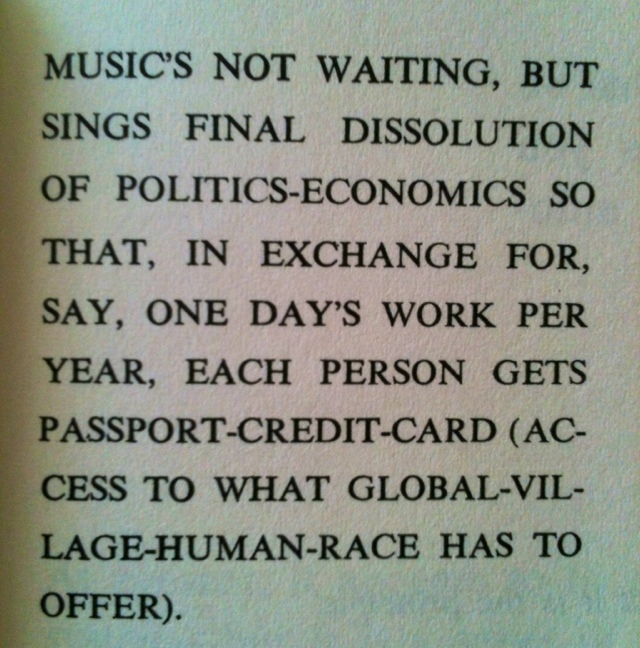
“Music’s Not Waiting” — John Cage

20120228-173143.jpg

(From John Cage’s A Year from Monday).

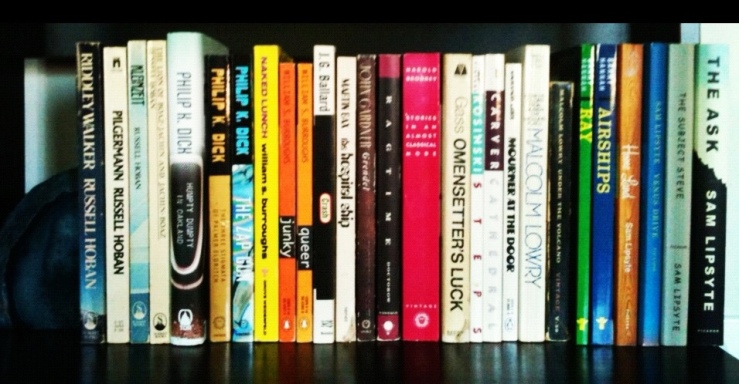
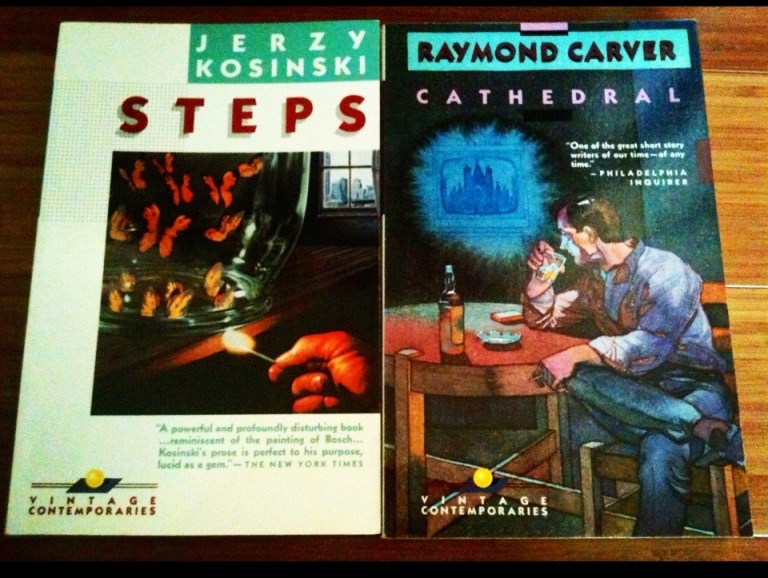
Book Shelves #10, 3.04.2012

20120304-125356.jpg

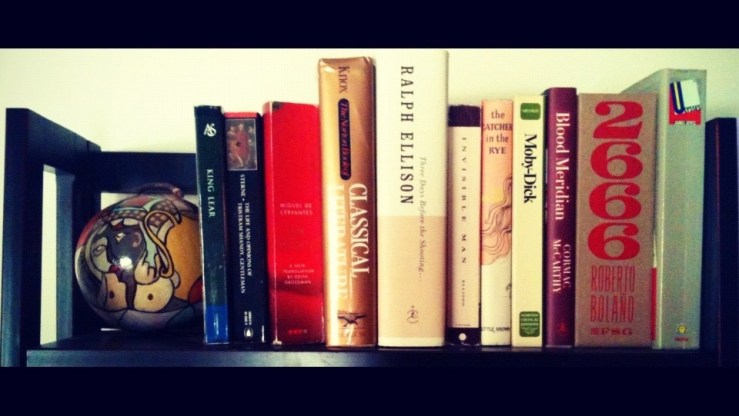
Book shelves series #10, tenth Sunday of 2012. I’m very ill today. These are some books; I own multiple copies of some of these. A painted gourd stands in as a book end. Look, I’m really ill today, these are books, I think you get the idea.

Have You Got Any Castles?

(Info. Yes, the cartoon does not have the most, uh, sensitive portrayal of nonwhite characters. Thanks, Jescie, for sending me the link).

Book Shelves #9, 2.26.2012

We should first of all distinguish stable classifications from provisional ones. Stable classifications are those which, in principle, you continue to respect; provisional classifications are those supposed to last only a few days, the time it takes for a book to discover, or rediscover, its definitive place. This may be a book recently acquired and not read yet, or else a book recently read that you don’t quite know where to place and which you have promised to yourself you will put away on the occasion of a forthcoming ‘great arranging’, or else a book whose reading has been interrupted and that you don’t to classify before taking it up again and finishing it, or else a book you have used constantly over a given period, or else a book you have taken down to look up a piece of information or a reference and which you haven’t yet put back in its place, or else a book that you can’t put back in its place, or else a book that you can’t put back in its rightful place because it doesn’t belong to you and you’ve several times promised to give it back, etc.

—Georges Perec, from “The Art and Manner of Arranging One’s Books”

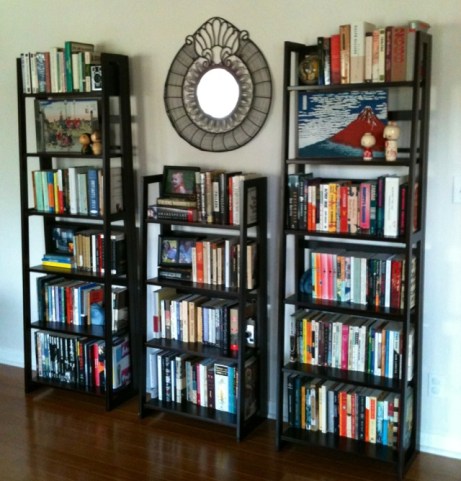
Book shelves series #9, ninth Sunday of 2012: In which I photograph three book shelves that I will examine more closely over the next several weeks.

Georges Perec goes on to admit that over three-quarters of his own books are provisionally categorized (at best). Libraries, like governments and tectonic plates and personalities, are not stable entities. Still, most of us try to impose some sense of order on our book collection, even if it’s an order apparent and relevant to ourselves alone. The three book shelves photographed below are probably the most “stable” in the house:

20120226-105205.jpg

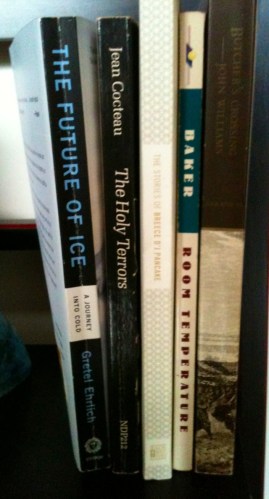
Despite an ongoing process of accretion, relocation, and removal, these shelves tend to remain fairly constant, with minor rearrangements happening maybe monthly instead of weekly or daily. As of today, there’s only one slim piece of a shelf “free”—that is, holding unsorted books waiting to be read, shelved, or, in one case, reviewed (I swear I’ll make another stab at writing up Breece D’J Pancake one day . . .). These books will be elsewhere by the time I get to photographing the shelf they rest on now:

20120226-105217.jpg

Teju Cole’s Open City Is a Strange, Marvelous Novel That Captures the Post-9/11 Zeitgeist

“And so when I began to go on evening walks last fall . . .” begins Julius, the perspicacious narrator of Teju Cole’s admirable and excellent début Open City. That opening “And” is significant, an immediate signal to the reader that this novel will refuse to align itself along (or even against) traditional arcs of plot and character development. We will meet Julius in media res, and we will leave him there, and along the way there will be learning and suffering and compassion and strange bubbles of ambiguity that threaten to burst out of the narrative.

As noted, Open City begins with Julius’s peripatetic voyages; he walks the night streets of New York City to ostensibly relieve the “tightly regulated mental environment of work.” Julius is completing his psychiatry fellowship at a hospital, and the work takes a toll on him, whether he admits it or not. In these night walks—and elsewhere and always throughout the novel—Julius shares his sharp observations, both concrete and historical. No detail is too small for his fine lens, nor does he fail to link these details to the raw information that rumbles through his mind: riffs on biology, history, art, music, philosophy, and psychology interweave the narrative. Julius maps the terrain of New York City against its strange, mutating history; like a 21st century Ishmael, he attempts to measure it in every facet—its architecture, its rhythms, its spirit. And if there is one thread that ties Julius’s riffs together it is the nightmare of history:

But atrocity is nothing new, not to humans, not to animals. The difference is that in our time it is uniquely well organized, carried out with pens, train carriages, ledgers, barbed wire, work camps, gas. And this late contribution, the absence of bodies. No bodies were visible, except the falling ones, on the day America’s ticker stopped.

Open City is the best 9/11 novel I’ve read, but it doesn’t set out to be a 9/11 novel, nor does it dwell on that day. Instead, Cole captures something of the post-9/11 zeitgeist, and at the same time situates it in historical context. When Julius remarks on the recent past, the concrete data of history writhes under the surface. He remarks that the 9/11 attack on the World Trade Center “was not the first erasure on the site,” and goes on to detail the 1960s cityscapes that preceded the WTC. Before those, there was Washington Market. Then Julius embarks, via imagination, into the pre-Colombian space of the people we now call Indians or Native Americans. “I wanted to find the line that connected me to my own part in these stories,” he concludes, peering at the non-site that simultaneously anchors these memory-spaces.

Julius’s line, like the lines that comprise New York City (and perhaps, if we feel the spirit of its democratic project, America itself) is a mixed one, heterogeneous and multicultural. Julius’s father, now dead, was an important man in Nigeria, where Julius enjoyed a relatively privileged childhood. Julius’s mother—they are now estranged—is German. He remarks repeatedly about his German grandmother’s own displacements during WWII, reflecting at one point that, from a historical perspective, it was likely impossible that she escaped Cossack rape.

Even though he sometimes seems reticent to do so, Julius delves into the strange violence that marks his lineage. He recalls a childhood fascination with Idi Amin; as a boy, he and his cousins would watch the gory film The Rise and Fall of Idi Amin repeatedly: ” . . . we enjoyed the shock of it, its powerful and stylized realism and each time we had nothing to do, we watched the film again.”

Fascinated horror evinces repeatedly in Open City. In just one example, Julius believes he sees “the body of a lynched man dangling from a tree”; as he moves closer to inspect, he realizes that it is merely canvas floating from a construction scaffold. Perhaps so attuned to history’s grand catalog of spectacular atrocity, Julius finds it lurking in places where it does not necessarily evince.

In turn, despite his profession as psychiatrist, Julius is wary of human sympathy. Throughout the novel, dark-skinned men engage him by calling him “brother.” He almost always deflects these attempts at connection, and internally remarks them as fatuous, or naïve, or false. This is not to say though that Julius doesn’t make significant (if often transitory) connections.

One of the organizing principles of Open City comes in the form of Julius’s infrequent visits to the home of his former English professor, Dr. Saito, who is slowly dying. Saito’s own memories float into Julius—this technique repeats throughout the novel—and we learn that he was interned as a young man during WWII; the sad fact is another ugly kink in the line of American history that Julius attempts to trace.

Julius also befriends Dr. Maillotte, an aging surgeon on a flight to Brussels, where he spends a few weeks of Christmas vacation, ostensibly looking for his oma (a task he performs half-heartedly at best). As Julius daydreams, Dr. Maillotte, European émigré, finds a place within his vision of family members and friends:

I saw her at fifteen, in September 1944, sitting on a rampart in the Brussels sun, delirious with happiness at the invaders’ retreat. I saw Junichiro Saito on the same day, aged thirty-one or thirty-two, unhappy, in internment, in an arid room in a fenced compound in Idaho, far away from his books. Out there on that day, also, were all four of my own grandparents: the Nigerians, the Germans. Three were gone by now, for sure. But what of the fourth, my oma? I saw them all, even the one I had never seen in real life, saw all of them in the middle of that day in September sixty-two years ago, with their eyes open as if shut, mercifully seeing nothing of the brutal half century ahead and better yet, hardly anything at all of all that was happening in their world, the corpse-filled cities, camps, beaches, and fields, the unspeakable worldwide disorder that very moment.

In Brussels, Julius meets Farouq, an angry young man with intellectual, Marxist tendencies. Farouq believes in a theory of “difference” and finds himself at odds with both the dominant Belgian culture and with Western culture in general. Julius’s conversations with Farouq are a highlight of the novel; they help to further contextualize the drama of diaspora in the post-9/11 world. Later, Julius finds a counterweight to some of Farouq’s extreme positions over a late lunch with Dr. Maillotte, who suggests that “For people to feel that they alone have suffered, it is very dangerous.” There’s a sense of reserved moderation to her critique—not outright dismissal nor condemnation, but simply a recognition that there are “an endless variety of difficulties in the world.”

Julius seems to tacitly agree with Maillotte’s assessment. His reluctance to accept brotherhood based on skin color alone speaks to a deeper rejection of simplicity, of tribe mentality, of homogeneity; it also highlights his essential alienation. At the same time, he’s acutely aware of how skin color matters, how identity can be thrust upon people, despite what claims to agency we might make. In search of the line that will connect him to his part of the American story, Julius finds unlikely “brothers” in Farouq, Maillotte, and Saito.

But let us not attribute to Julius a greater spirit than Cole affords him: Open City is a novel rich in ambiguity, with Julius’s own personal failures the most ambiguous element of all. While this is hardly a novel that revolves on plot twists, I hesitate to illustrate my point further for fear of clouding other readers’ perceptions; suffice to say that part of the strange, cruel pleasure of Open City is tracing the gaps in Julius’s character, his failures as a professional healer—and his failures to remark or reflect upon these failures.

But isn’t this the way for all of us? If history is a nightmare that we try to awake from—or, more aptly in a post-9/11 world, a nightmare that we awake to, to paraphrase Slavoj Žižek—then there is also the consolation and danger that time will free us from the memory of so much atrocity, that our collective memory will allow those concrete details to slip away, replaced with larger emblems and avatars that neatly smooth out all the wrinkles of ambiguity. “I wondered if indeed it was that simple, if time was so free with memory, so generous with pardons, that writing well could come to stand in the place of an ethical life,” Julius wonders at one point; later, Saito points out that “There are towns whose names evoke a real horror in you because you have learned to link those names with atrocities, but, for the generation that follows yours, those names will mean nothing; forgetting doesn’t take long.” Julius’s mission then is to witness and remark upon the historical realities, the nitty-gritty details that we slowly edge out of the greater narrative. And Cole? Well, he gives us a novel that calls attention to these concrete details while simultaneously exploring the dangerous subjectivity behind any storytelling.

If it needs to be said: Yes, Open City recalls the work of W.G. Sebald, who crammed his books with riffs on history and melancholy reflections on memory and identity. And yes, Open City is flâneur literature, like Sebald (and Joyce, and Bolaño, perhaps). But Cole’s work here does not merely approximate Sebald’s, nor is it to be defined in its departures. Cole gives us an original synthesis, a marvelous and strange novel about history and memory, self and other. It’s a rich text, the sort of book one wants to immediately press on a friend, saying, Hey, you there, read this, we need to talk about this. Very highly recommended.

Open City is new in trade paperpack from Random House.
Book Shelves #7, 2.12.2012

20120210-203625.jpg

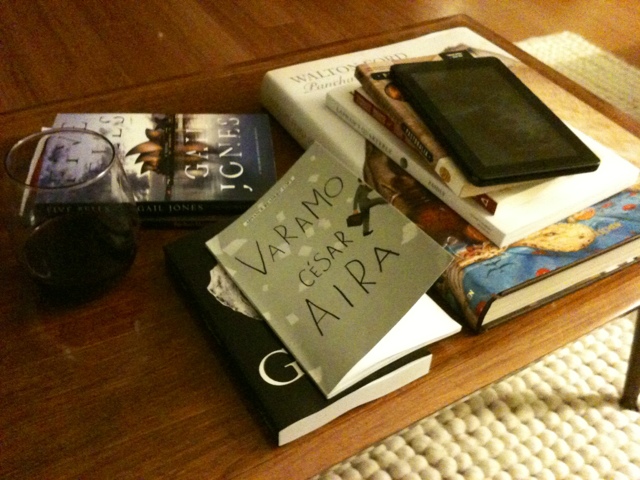
Book shelves series #7, seventh Sunday of 2012: In which I photograph a coffee table.

We have three coffee tables. This is one of them (it’s next to the unit I photographed last week). Like many folks’ coffee tables, I suppose, it gets littered with books; the books on this one tend to rotate. Pictured above: lots of recent books acquired, including the Aira on top and Stuart Kendall’s new translation of Gilgamesh. There’s also the new issue of Lapham’s Quarterly and, for some reason (can’t remember) George Saunders’s Pastoralia. The Kindle is also there: my daughter and I read the first three comics in a colorized version of Jeff Smith’s epic graphic novel Bone—amazing stuff, and the color adds depth and beauty to an already beautiful book. I took this photo on a Friday afternoon, or maybe Friday evening (or night). I was drinking wine.

The big book is Walton Ford’s Pancha Tantra, which my lovely wife gave me for Christmas. Some images:

20120210-203648.jpg

20120210-203656.jpg

20120210-203704.jpg

Book Acquired, 2.08.2012—D.H. Lawrence’s Apocalypse

20120209-145955.jpg

I need another book like I need a hole in the head, but, when I’ve had a stressful day at work, I like to browse the huge, labyrinthine used bookstore conveniently located just over a mile from my house. I don’t know how I wound up browsing D.H. Lawrence books, but Apocalypse stood out—first for its name, and second because, in a section of literally hundreds and hundreds of Lawrence volumes, it seemed to be the only one. Five minutes with the thing and I knew I was going to pick it up. It’s essentially a long essay on the Book of Revelation—and the concept of apocalypse and end-of-the-world in general.

Lawrence’s Studies in Classic American Literature is a seminal volume for me, one I return to repeatedly—but I’ve never made it through one of his novels; I even found his short fiction tedious. Anyway, read a huge chunk of this last night. More to come.

“Order Is Simply a Thin, Perilous Condition We Try to Impose on the Basic Reality of Chaos” (A Citation from William Gaddis’s Novel JR)

Near the beginning of William Gaddis’s sprawling novel J R, erstwhile protagonist Jack Gibbs rants about knowledge to his students:

Before we go any further here, has it ever occurred to any of you that all this is simply one grand misunderstanding? Since you’re not here to learn anything, but to be taught so you can pass these tests, knowledge has to be organized so it can be taught, and it has to be reduced to information so it can be organized do you follow that? In other words this leads you to assume that organization is an inherent property of the knowledge itself, and that disorder and chaos are simply irrelevant forces that threaten it from the outside. In fact it’s the opposite. Order is simply a thin, perilous condition we try to impose on the basic reality of chaos . . .

Book Acquired, 2.04.2012 — Cataclysm Baby

20120205-164712.jpg

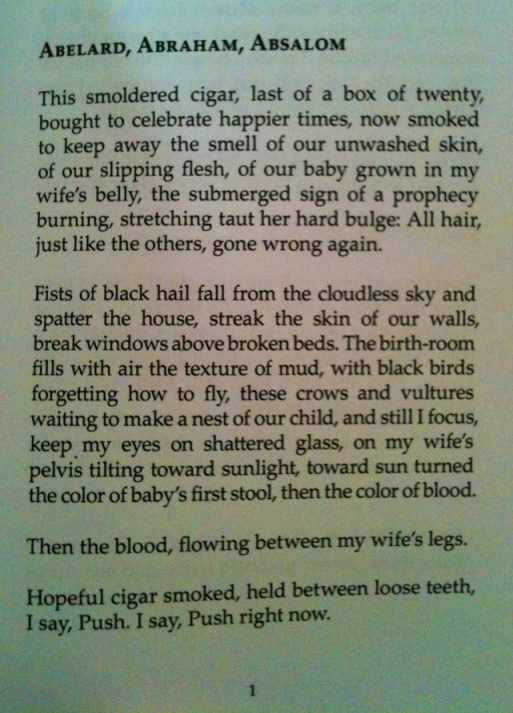
Okay, this one looks pretty cool—Cataclysm Baby by Matt Bell from indie Mud Luscious Press. More to come. Bell’s site describes the book as “twenty-six post-apocalyptic parenting stories, all narrated by fathers, each revealing some different family, some new end of the world.” First page:

20120205-164907.jpg

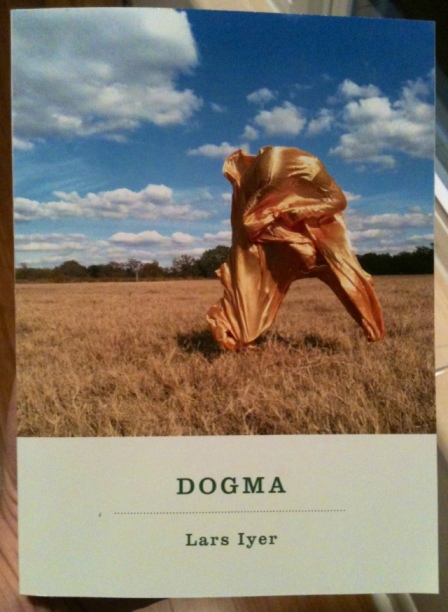
Book Acquired, 1.30.2012 — Dogma, Lars Iyer’s Sequel to Spurious

20120202-195422.jpg

Lars Iyer’s novel (or anti-novel, if you swing that way) Spurious was one of the better books I read last year. From my review:

Lars Iyer’s début novel Spurious is about two would-be intellectuals, W., the book’s comic hero, and his closest friend, our narrator Lars. They bitch and moan and despair: it’s the end of the world, it’s the apocalypse; they find themselves incapable of original thought, of producing any good writing. The shadow of Kafka paralyzes them. They travel about Europe, seeking out knowledge and inspiration — or at least a glimpse of some beautiful first editions of Rosenzweig. They attend dreadful academic conferences; they write letters. They flounder and fail.

Iyer was also kind enough to talk with me in a long, detailed interview.

So like basically I’m a fan, and I’ve been eager for Dogma, so I was psyched when an ARC showed up in Monday’s mail. Dogma is new from Melville House at the end of this month; more coverage to come.

Book Shelves #5, 1.29.2012

Book shelves series #5, fifth Sunday of 2012: In which we leave the southern wing of the house where the bedrooms are and enter a formal sitting room.

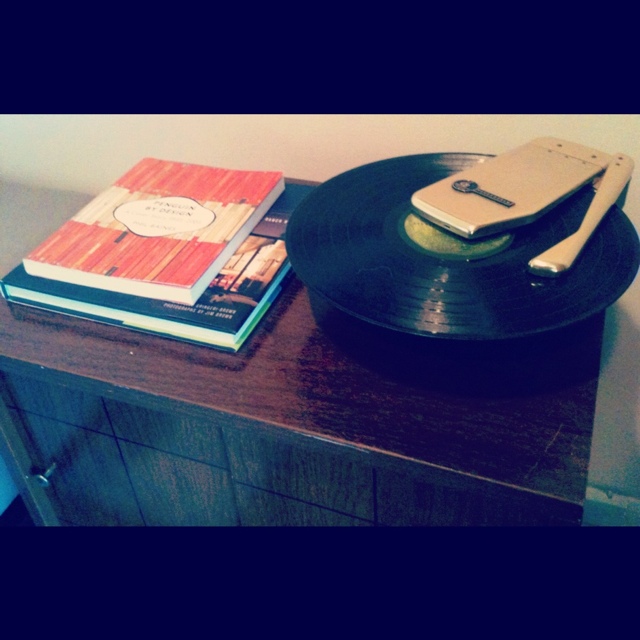
Okay. So. When I started this project, it was easy to identify the rooms in the house—they were bedrooms. As we go, I’ll have to occasionally make up names for rooms, often names that don’t really fit. Our house is a 1956 ranch with some of the atomic flavor, so it’s long and rectangular and very open—rooms open up into other rooms; spaces are demarcated more by ideas of rooms and not, say, walls. The house is essentially three sections; we’ve left the first, the bedrooms, and now move into a series of rooms for living and eating and cooking and sitting. And reading. I mapped out a little route for the rest of this series, and the first stop is this mid-century LP cabinet in what I’ll call, for lack of a better term, our formal sitting room. The cabinet once held many of my records but is now filled with comic books (more on those next week).

20120129-123357.jpg

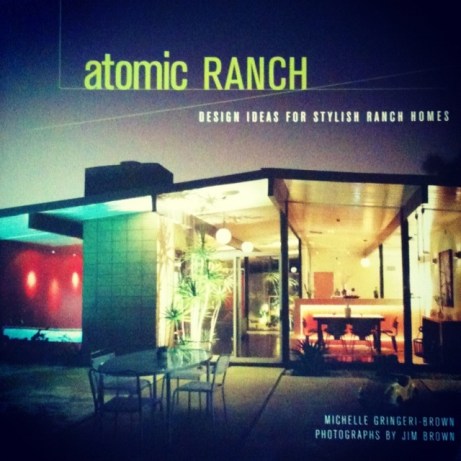
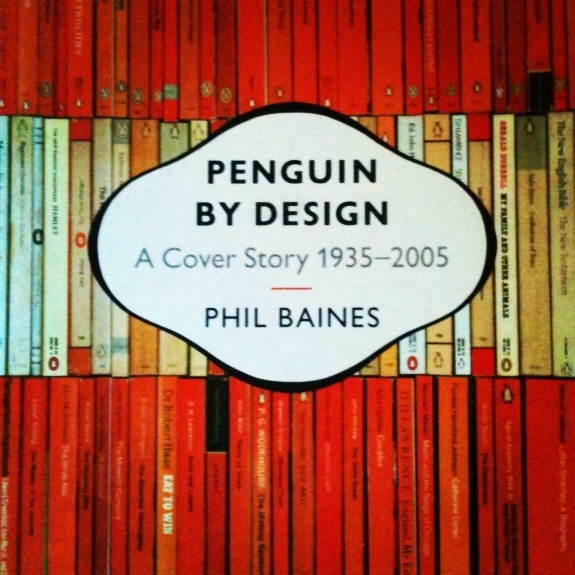
The books that set on top of it are coffee tablish, I suppose, and they tend to rotate, although there’s usually a stray novel or two that sets here as well. Today we’ll look at the two on top now: Penguin by Design and Atomic Ranch.

20120129-123410.jpg

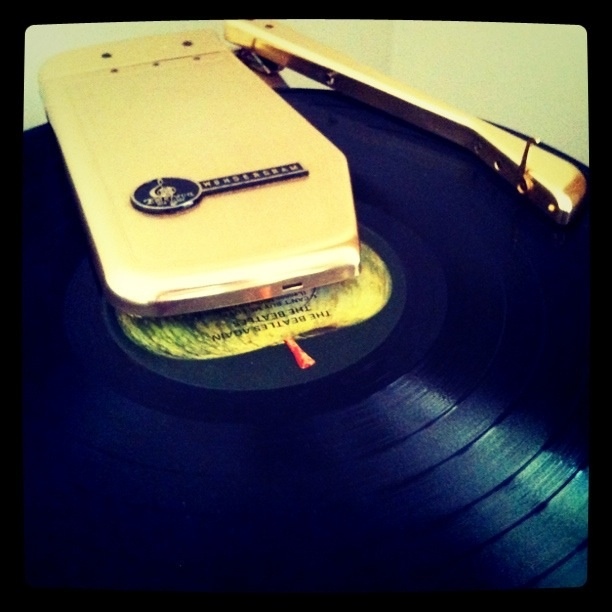
There’s also an Emerson Wondergram record player that sets on the table; I suppose it was the iPod of its day (see one in action here).

20120129-121621.jpg

Atomic Ranch is my wife’s, although I don’t really make such distinctions when it comes to books. We lived for years in a bungalow and she amassed books dedicated to craftsman homes during that time; when we moved to the ’50s ranch, she wanted this:

20120129-123515.jpg

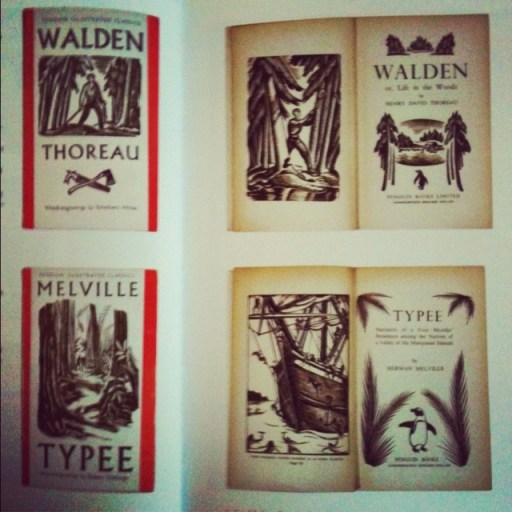
Penguin by Design is essential for anyone who drools over beautiful modern book covers.

20120129-123508.jpg

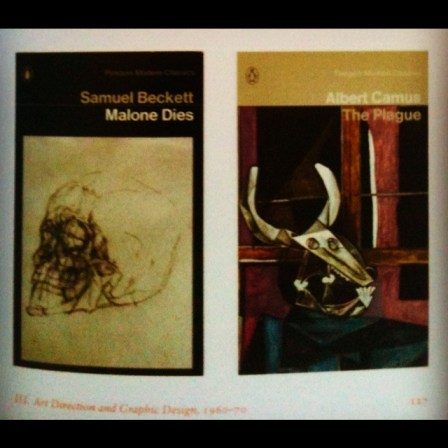
My pics are lousy—sorry—but just a few editions I’d love to pick up one day:

20120129-123417.jpg

20120129-123443.jpg

20120129-123449.jpg

Next week, we’ll look at some of the comic books inside the cabinet.

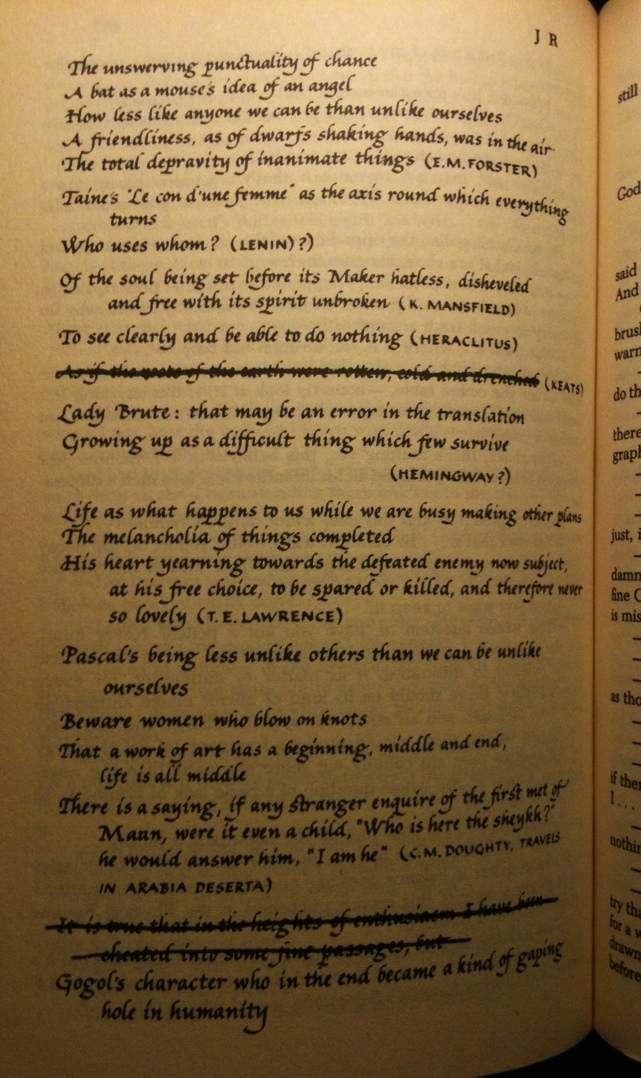
“The Unswerving Punctuality of Chance” (And Other Citations from William Gaddis’s Novel JR)

20120128-185406.jpg

In JR, the sprawling novel of capitalism and art by William Gaddis, Jack Gibbs loads his pockets with crumpled newspaper clippings, racing forms, and citations for a book he’s working on. “More trash,” he mutters about this list (which appears on page 486 of my Penguin Twentieth Century Classics Edition).

Books Acquired, 1.25.2012 (Malcolm Lowry, Paul Auster, and William Gaddis)

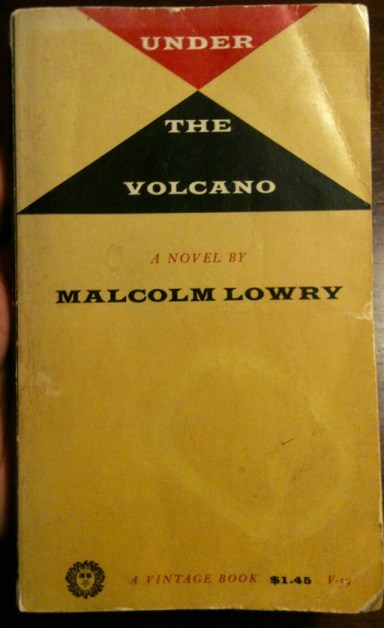
I go to the bookstore once a week, whether I need books or not, which I really don’t. This week, I picked up a book I’ve already read, Lowry’s late-modernist classic Under the Volcano, simply because I hate the cover of the version I have (a bland movie tie-in). Anyway, I’ve been prowling for a version that includes an introduction by William Vollmann, but I saw this midcentury paperback with a nice minimal vibe and had to snap it up (also, it was a dollar, and “I’d buy that for a dollar!”):

20120126-181349.jpg

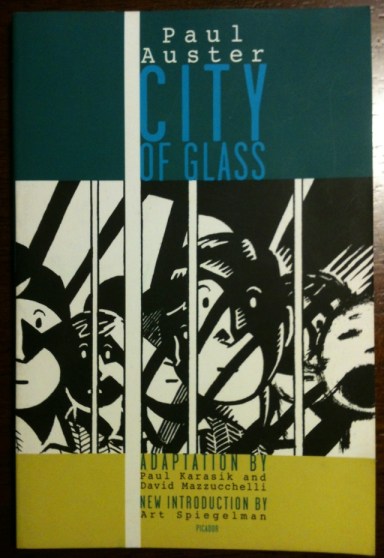
I’m not a huge Paul Auster fan, but I do like artist David Mazzucchelli’s work (especially his novel Asterios Polyp), so when I saw a crisp used copy of the graphic novelization of City of Glass (with an intro by Art Spiegelman), I had to snap it up:

20120126-181414.jpg

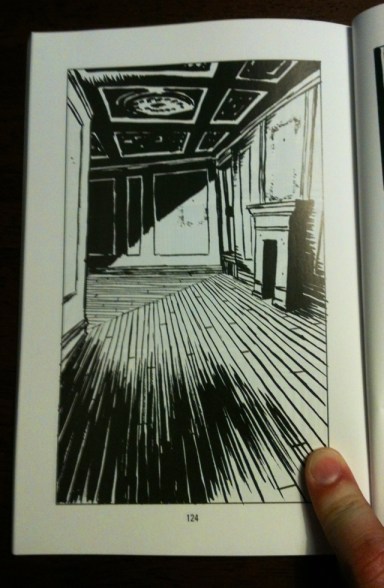
A splash page of a stark empty room which I’m sure is meaningful in some way:

20120126-181426.jpg

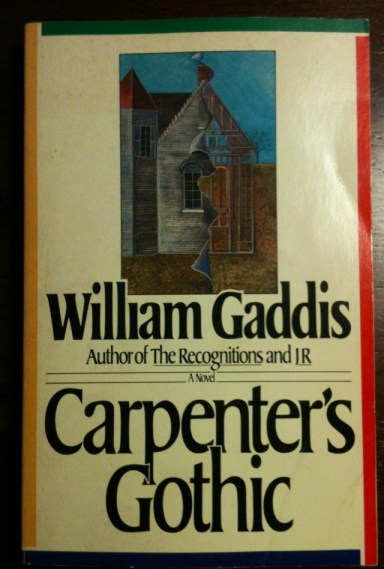
Also, couldn’t help pick up a used copy of Gaddis’s late novel Carpenter’s Gothic, even though I know there’s no way I’ll get to it anytime soon.

20120126-181435.jpg

“Value of Honest Books” — Nietzsche

Friedrich Nietzsche. From Mixed Opinions and Maxims:

(145) Value of honest books.—Honest books make the reader honest, at least by luring into the open his hatred and aversion which his sly prudence otherwise knows how to conceal best. But against a book one lets oneself go, even if one is very reserved toward people.

Books Acquired, 1.17.2012—Or, Here’s What’s New from Picador This Month

20120121-100054.jpg

The kind people at Picador sent me a box of books, including a memoir (Margaux Fragoso’s Tiger, Tiger), a few novels (The Lover’s Dictionary by David Levithan; Ralph Sassone’s The Intimates; Alan Glynn’s noir thriller Bloodland; Dieter Schlesak’s The Druggist of Auschwitz, which purports to be a “documentary novel”; and Zoë Heller’s first novel, Everything You Know), and a work of political science (Ari Berman’s Herding Donkeys).

A box of books is a bit overwhelming, but I make it a point to spend some time with every book that comes into Biblioklept World Headquarters. Here’s some thoughts on these.

I actually ended up reading almost all of The Lover’s Dictionary, despite it having the word “lover” in the title, which, jeez. When my wife picked it up, she said something like, “How can they call this a novel?” — fair question, because the book is structured like a dictionary. In point of illustration:

20120121-100117.jpg

I’ve got a bigger post on Levithan’s book coming up, one that tries to situate it in the context of other non-novelly novels—but in short it is a novel, a very contemporary one that tells the oldest story in the proverbial book (boy meets girl) in an elliptical way that suits our post-information age. Like I said more to come, but for now: The Lover’s Dictionary is funny, occasionally cruel, too-often saccharine, awfully real, sometimes deeply flawed, but consistently engaging (sorry for all the adverbs).

I imagine Margaux Fragoso’s memoir Tiger, Tiger will capture the fascination of a large audience, but half an hour of the book was almost more than I could bear. Not because Fragoso can’t write—far from it, in fact—but her subject matter, which is to say her stolen childhood, is rendered too raw,   too real for me; there’s nothing pulpy or lurid about Fragoso’s work, nor is there the aesthetic sheen of Lolita to gloss any of the ugly, sordid details.  Kathryn Harrison ponders the question of Tiger, Tiger’s audience in her favorable review at The New York Times:

So who — other than voyeurs looking for a sustained close-up of a pedophile in action — will want to read this book? To bear witness to a numbingly long series of violations of a child by a man who has honed his wickedness for decades is not more pleasant than it sounds. As a society we energetically oppose sexual abuse; as individuals most of us shy away from investigating a relationship characterized by creepy kisses and inappropriate fondling. Worse, we defend cowardice by calling it discretion — minding our own business. Maybe a book like “Tiger, Tiger” can help us be a little braver. Certainly, it took courage to write.

20120121-100131.jpg

Ralph Sassone’s The Intimates: sex scenes (straight and gay); lots of notations about parents; lots of characters.

Dieter Schlesak’s The Druggist of Auschwitz: This “documentary novel” blends actual testimony from the Frankfurt Auschwitz Trial, interviews with camp guards and prisoners, and fictional narrative to tell the true story of Dr. Victor Capesius, an SS officer who worked with Mengele. The book is less gimmicky than it sounds in this description, and if its documentary elements are blunter and less ambiguous than W.G. Sebald’s historical fragments, I suppose that’s what the subject matter merits.

Alan Glynn’s new novel Bloodland (a Picador paperback original) is a noirish thriller set against the backdrop of political and corporate intrigue. Glynn writes with terse immediacy, telegraphing the plot in short punchy sentences that recall James Ellroy (without the finnicky slang). The book reads almost like a movie script, vivid and concrete. It’s a fast-paced page turner with a smart plot, just the sort of thing one wants from a thriller.

20120121-103504.jpg

Herding Donkeys by Ari Berman: Honestly not my thing, but if you want to read about the DNC from the time of Howard Dean to the rise of Barrack Obama, this is probably a book for you.

Zoë Heller’s Everything You Know: This is new in paperback again after over a decade. The story focuses on a cantankerous, unlikable son-of-a-bitch named Willy Muller. Things aren’t going well for him: he’s just suffered a heart attack, his daughter’s committed suicide, and the public still believes he murdered his wife. No wonder he hates humanity. Heller is probably most famous for her novel Notes on a Scandal, which was adapted into an excellent film in 2006.

Biblioklept’s picks: The Lover’s Dictionary; Tiger, Tiger; Bloodland.

Margaret Atwood Talks About Twitter (Video)

“Being Dead While You’re Alive — That’s Real Death” — Henry Miller & Anaïs Nin on Death and Dreams