Not a review of Laurent Binet’s novel The Seventh Function of Language

411xfx2hll-_sl500_

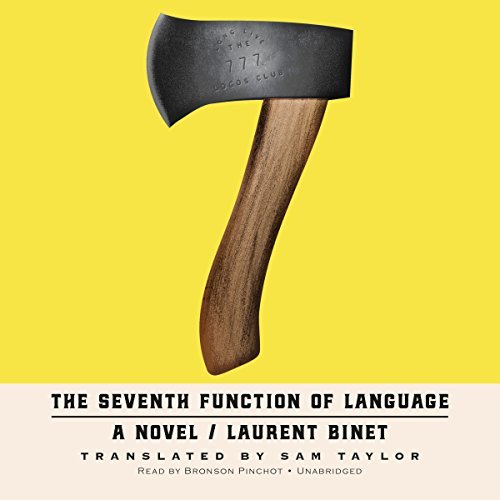
I was a big a fan of Laurent Binet’s novel HHhH, so I was excited when I heard about his follow up, The Seventh Function of Language. I was especially excited when I learned that The Seventh Function took the death of Roland Barthes as its starting point and post-structuralism in general as its milieu. I audited the audiobook (translated by Sam Taylor and read with dry wry humor by Bronson Pinchot).

The audiobook is twelve hours. If it had been six hours I might have loved it. But twelve hours was a bit too much.

Wait. Sorry. What is the novel about though? you may ask. This is not a review and I am feeling lazy and not especially passionate about the book, so here is the publisher’s-blurb-as-summary:

Paris, 1980. The literary critic Roland Barthes dies – struck by a laundry van – after lunch with the presidential candidate François Mitterand. The world of letters mourns a tragic accident. But what if it wasn’t an accident at all? What if Barthes was murdered?

In The Seventh Function of Language, Laurent Binet spins a madcap secret history of the French intelligentsia, starring such luminaries as Jacques Derrida, Umberto Eco, Gilles Deleuze, Michel Foucault, and Julia Kristeva – as well as the hapless police detective Jacques Bayard, whose new case will plunge him into the depths of literary theory. Soon Bayard finds himself in search of a lost manuscript by the linguist Roman Jakobson on the mysterious “seventh function of language.”

Kristeva! Eco! Derrida! All my childhood heroes are here!

So of course, y’know, I was interested. And I’m sure that the twenty-year-old version of me would have flipped out over Binet’s pastiche of postmodern theory and detective pulp fiction. But almost-forty me found the whole thing exhausting, a shaggy dog detective story with patches of the whole continental-philosophy-vs-analytical-philosophy debate sewn in with loose stitches.

The initial intellectual rush of what amounts to a Tel Quel fan fiction/murder-mystery/political thriller hybrid begins to wear thin about halfway through. Binet is smart and he’s writing about smart people, but the cleverness on display becomes irksome, especially when he’s drawing his characters’ big philosophical ideas in the broadest of strokes (Julia Kristeva arrives at her concept of abjection after a floating film on a glass of milk makes her ill).

Binet loves to cram his characters into social situations where they can wax philosophical (in the thinnest possible sense of that verb wax). The Seventh Function is larded with chatty cocktail parties where Kristeva and Foucault can toss out zinger after zinger. One of the novel’s centerpieces, an academic conference at Cornell, serves as an excuse for Binet to riff large (but shallow) on language philosophy. He even brings Chomsky and Searle to the conference to take on Derrida et al. (Binet also squeezes in a postmodern orgy here, in which Detective Bayard has a threesome with Hélène Cixous and Judith Butler). Such scenes are funny but baggy, overlong, and often feel like an excuse for Binet to show how clever he is. (And don’t even get me started on the fact that the novel’s central protagonist worries that he might be a character in a novel).

Binet is more successful at channeling his characters’ intellects during the high-risk debates of a secret society called the Logos Club. The best of these debates showcase thought-in-action, as Binet’s characters deconstruct various topics. Still, as engaging as some elements of the Logos Club debates are, they drag on too long, and the Club’s connection to the political-thriller aspect of the plot is pretty tenuous.  Indeed, the novel is so loose that a minor character has to show up at the end and explain how all the elements connect for both the reader and detectives alike.

What’s probably most remarkable about The Seventh Function (despite the fact that it features a who’s-who of postmodern theory for its cast) is just how one-note the novel is. After all, it’s a mashup. As Anthony Domestico puts it in his (proper and insightful) review at The San Francisco Chronicle, “The novel is three parts Tom Clancy to two parts Theory SparkNotes to one part sex romp.” The Seventh Function of Language should be a lot more fun than it is.  And it is fun at times, but not enough fun to sustain, say, twelve hours of an audiobook or 359 pages in hardcover.

As HHhH showed, Binet is a talented author, and even though The Seventh Function didn’t work for me, I’m interested to see what he does next. It’s possible that The Seventh Function didn’t float my proverbial boat precisely because I’m the ideal audience for the novel. If anything, it made me want to reread Umberto Eco’s Foucault’s Pendulum—but The Seventh Function also reminded me that I read Eco’s semiotics-detective story as a much younger man—as a kid in my early twenties who probably would’ve loved Binet’s novel. So maybe I should leave well enough alone.


Eddie Campbell’s canon of great graphic novels, 1977-2001

Eddie Campbell’s book Alec: How to Be an Artist (Eddie Campbell Comics, 2001) covers the “rise and fall of the graphic” over the course of a few decades. Alec combines memoir with art history and art criticism, all told through scratchy inks and spidery lettering (and plenty of pastiche–Campbell literally pastes the work of other comic artists of the last century throughout the book, along with “serious” artwork  ). While Campbell’s autobiographical stand-in “Alec MacGarry” is obviously central to the story, other figures loom here, including Bill Sienkiewicz (“Billy the Sink”), Art Spiegelman, Stephen Bissette, Dave Sim, Eastman and Laird—and especially Campbell’s From Hell partner, Alan Moore.

How to Be an Artist offers a fascinating and personal look at the time before (and immediately after) comic books reached a tipping point into (gasp!) serious artistic respectability. Witty, warm, and occasionally cruel, Campbell’s book explores the intersection of commerce and art in a very particular place and a very particular time.

The book was especially revelatory for me, I suppose: I transitioned from super hero comics to, like comix in the early nineties, a transition helped by works championed in How to Be an Artist, like Neil Gaiman and Dave McKean’s Sandman books and Dave Sim’s Cerebus. Indeed, the backpages of Cerebus in the late eighties and early nineties operated like a long messy ranty meditation on the theme of “How to be an (independent, successful, self-publishing) artist”—and it was also in the backpages of an issue of Cerebus that I first saw Campbell’s work (the prologue of From Hell was published in Cerebus #124).

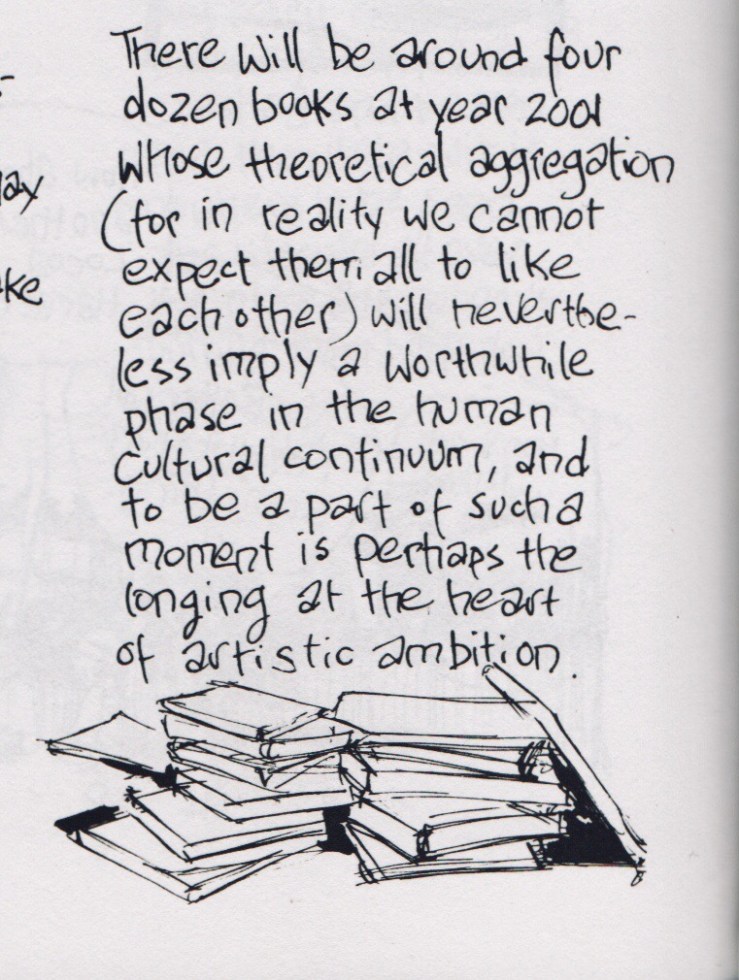
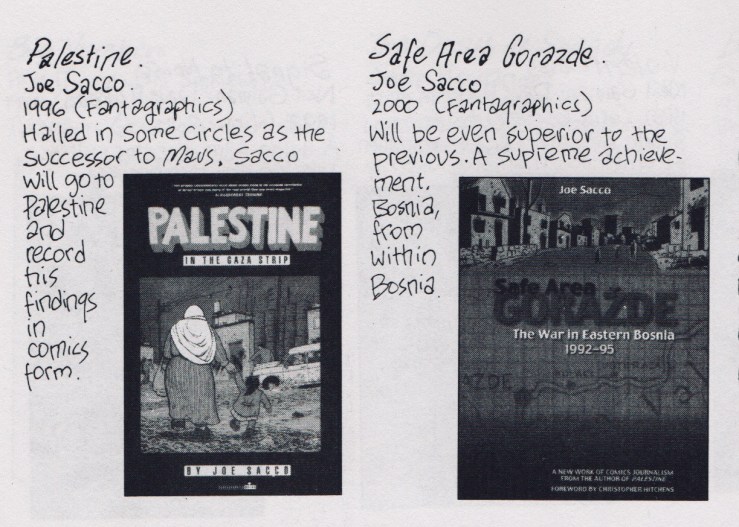
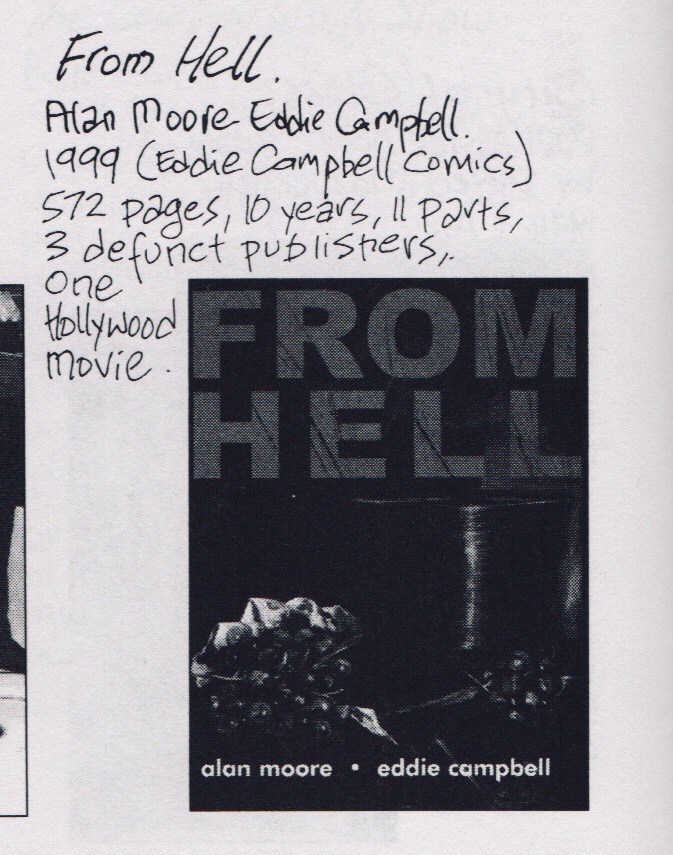
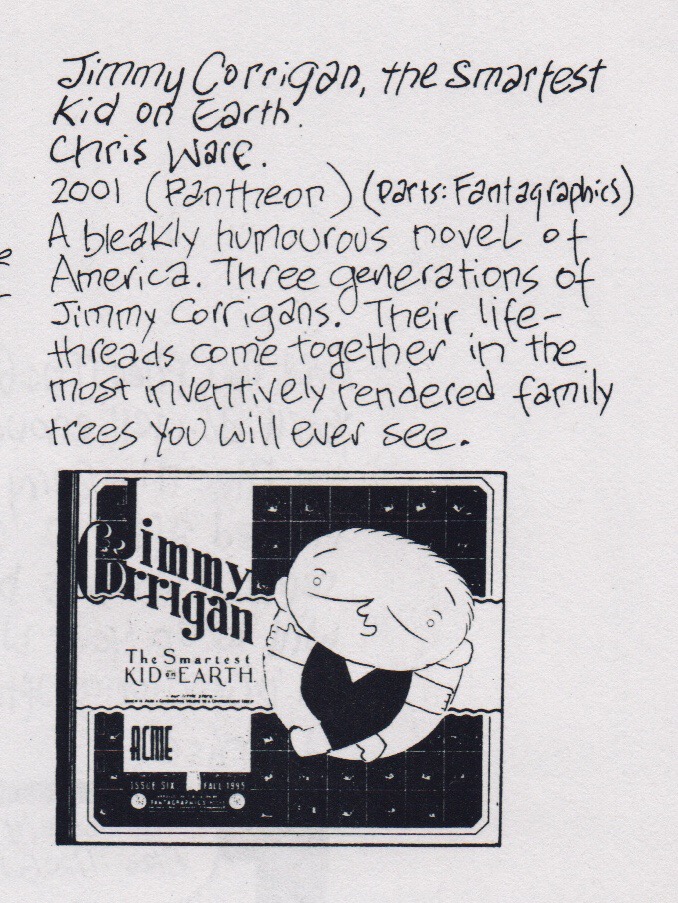
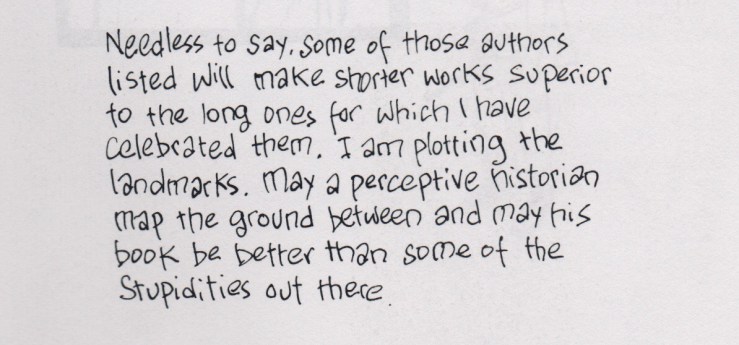
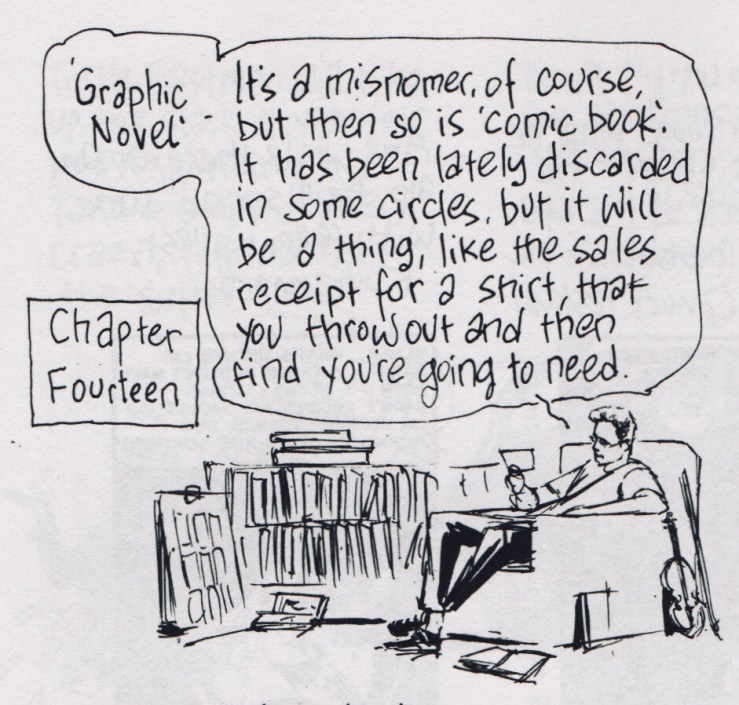
How to Be an Artist’s final chapter sees Campbell offer up a canon of “graphic novels” from 1977 to 2001 (I’ve typed out the full list at the bottom of this post). Campbell (or, properly, Campbell’s persona Alec) begins the chapter by dwelling on the problematic term “graphic novel”:

img_8424

After resolving to use the term, despite whatever problems might be attached to it, Campbell goes on to point out that, after the success of works like Watchmen and Maus, a glut of so-called “graphic novels” flooded the market place. He then goes about naming the best, those works that represent a “worthwhile phase in the human cultural continuum”:

img_8424-1

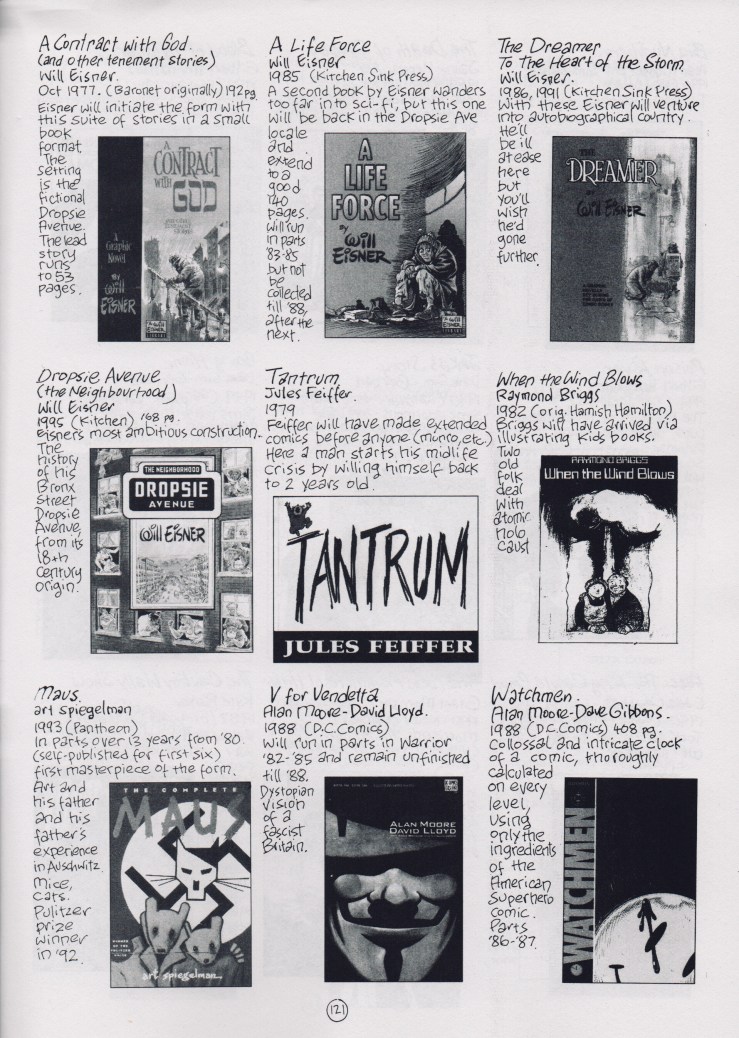
The list is organized semi-chronologically; Campbell groups works in a series together, as with Will Eisner’s Dropsie Ave books. Here’s the first page of the canon, to give you an idea of its form and layout (note that the list, like the entire book, is written in the future tense):

img_8425

I’ve never read When the Wind Blows.

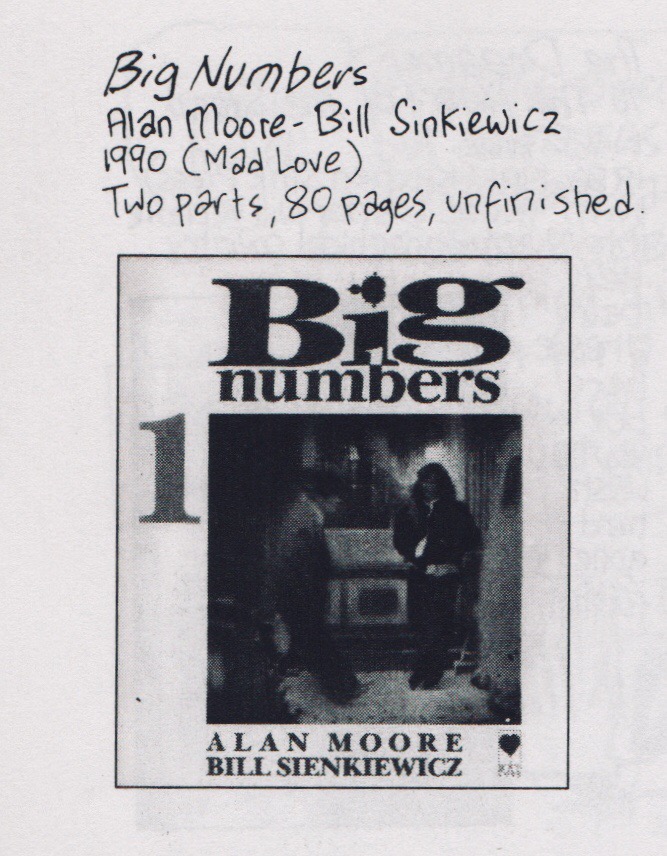
I’ve also never read, to my shame, the unfinished project Big Numbers (by Alan Moore and Bill Sienkiewicz). Campbell details the drama surrounding why the project was never finished in How to Be an Artist. I’ll have to track it down.

img_8427-2

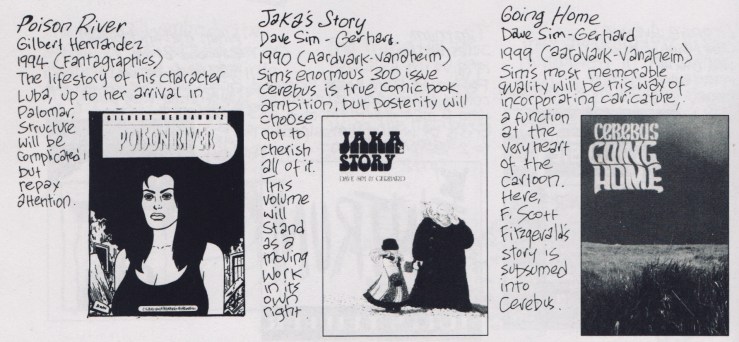
Campbell includes a trio of Love & Rockets novels. Poison River is the first one I read. I was a junior in high school; I checked it out from the public library. Somehow my mother saw it, flicked through it, and was mortified.

img_8427-1

Campbell seems to split the difference on Dave Sim’s Cerebus, including critical favorite Jaka’s Story along with the later novel Going Home (which sees Sim trying to reign in the project and steer it toward a conclusion). (Nobody asked me but I would’ve included Church & State and Church & State II).

img_8430

Joe Sacco’s comix-journalism is excellent, and Campbell includes both Palestine and Safe Area Gorazde. These “graphic novels” (they aren’t really graphic novels, except that they are) expanded what was possible not just in comics, but also in journalism.

img_8430-1

From Hell isn’t the only one of his own works that Campbell includes on his list—he also includes another Alec novel, The King of Canute Crowd. I love the gesture—an artist fully assured of the qualities in his best work. For the record, if pressed to name “the best graphic novel” I would probably immediately say, “Oh, it’s From Hell of course” (and then hem and haw and hedge, bringing up Chris Ware’s Building Stories, the first half of Sim’s Cerebus project, David Mazzucchelli’s Asterios Polyp, Love & Rockets, etc.).

img_8431

Chris Ware’s Jimmy Corrigan shows up on the list, of course. I’m sure Building Stories would be on here too—along with dozens of others—if the list were updated. Indeed, Campbell’s canon (my term, not his), ends with this disclaimer:

img_8431-1


Here’s the full list:


A Contract with God, Will Eisner, 1977

A Life Force, Will Eisner, 1985

The Dreamer, Will Eisner, 1986/1991

Dropsie Avenue, Will Eisner, 1995

Tantrum, Jules Feiffer, 1979

When the Wind Blows, Raymond Briggs, 1982

Maus, Art Spiegleman, 1991

V for Vendetta, Alan Moore and David Lloyd, 1988

Watchmen, Alan Moore and Dave Gibbons, 1988

Big Numbers, Alan Moore and Bill Sienkiewicz, 1990

The Death of Speedy, Jaime Hernandez, 1989

Blood of Palomar, Gilbert Hernandez, 1989

Poison River, Gilbert Hernandez, 1994

Jaka’s Story, Dave Sim and Gerhard, 1990

Going Home, Dave Sim and Gerhard, 1999

Alec: The King Canute Crowd, 1990

The New Adventures of Hitler, Grant Morrison and Steve Yeowell, 1990

The Cowboy Wally Show, Kyle Baker, 1987

Why I Hate Saturn, Kyle Baker, 1990

Violent Cases, Neil Gaiman and Dave McKean, 1987

Signal to Noise, Neil Gaiman and Dave McKean, 1992

Mr. Punch, Neil Gaiman and Dave McKean, 1995

Casanova’s Last Stand, Hunt Emerson, 1993

Tale of One Bad Rat, Bryan Talbot, 1995

City of Glass, Paul Auster/David Mazzucchelli, 1994

The Playboy/I Never Liked You, Chester Brown, 1991/1994

Stuck Rubber Baby, Howard Cruse, 1995

Palestine, Joe Sacco, 1996

Safe Area Gorazde, Joe Sacco, 2000

Ghost World, Daniel Clowes, 1997/2000

It’s a Good Life If You Don’t Weaken, Seth, 1997

Ethel and Ernest, Raymond Briggs, 1998

Gemma Bovery, Posy Simmonds, 1999

Cages, Dave McKean, 1998

Uncle Sam, Steve Darnall and Alex Ross, 1998

From Hell, Alan Moore and Eddie Campbell, 1999

Hicksville, Dylan Horrocks, 1998

The Jew of New York, Ben Katchor, 1998

Jimmy Corrigan, the Smartest Kid on Earth, Chris Ware, 2001

Goodbye, Chunky Rice, Craig Thompson, 1999

Dear Julia, Brian Biggs, 2000

Berlin, Jason Lutes, 2001


Selections from One-Star Amazon Reviews of Bram Stoker’s Dracula

[Editorial note: The following citations come from one-star Amazon reviews of Bram Stoker’s novel Dracula. I’ve preserved the reviewers’ original punctuation and spelling. More one-star Amazon reviews].


Crapula

hack author

Painfully verbose

he lives in a castle!

hard to understand

NOTHING is happening

find an abridged version

I have read many horror novels

may be the worst book ever written

being the avid vampire fan that I am

attempt to cash in on the vampire craze

cavort lasciviously with the sons of the devil

Watch the movie and save yourself some time

I’m always willing to read new vampire fiction

epistolary format is monotonous and repetitive

Turns out the vampire in this book is an old guy

It was so stupid and the movie was even stupider

If you’re like me, just tring this book to make yourself feel brave, forget it

I think I have been hacked or my late wife’s daughter is using our account

Any vampire fan knows that vampires roam the streets of upper middle class suburbia

Over the past couple years I’ve started a collection of vampire books which totals over 100 now

I’ll be returning this on my next trip to the library and sticking to the teen reading section for finding my next vampire novel

I fully realize that this is a fictional/fantasy tale containing elements that obviously require a certain amount of leeway and suspension of belief, but

Epostolary novel told from multiple perspectives about the vampire, Count Dracula, who is trying to invade London and turn everyone else into vampires. A bunch of rich guys and a chick decide to stop him.

no relationship between Lucy and the Count-which i suppose makes more sense as to why he bit her

up pops a homoerotic cover with naked men, one whose penis is exposed in the background

the book is down hill from the time Dracula is in London and it is decided that he must be destroyed

the method being used to advance the plot being in disuse since quite some time

he is not a suave romantic movie/play character but an angry stupid animal

Amazon markets this book not to children but homosexual adult men

The movie was so much better even with Keanu Reeves’ awful acting

what are the standards when it comes to classic books

It started so well and I don’t know what happen?

I do not recommend this product to anyone else

Maybe I’ve read too much Sookie and Twilight

it is a great deterrent to the modern reader

unspoiled virgins or destroyed whores

I was looking for the epic love story

the female characters are cloistered

No gore, no horror, no nothing

worthless female characters

illlogical under pinnings

There’s no STORY here

creepy, and disgusting

In style it is archaic

a very weird book

I call it a joke

no romance

boring plot

Sucked.

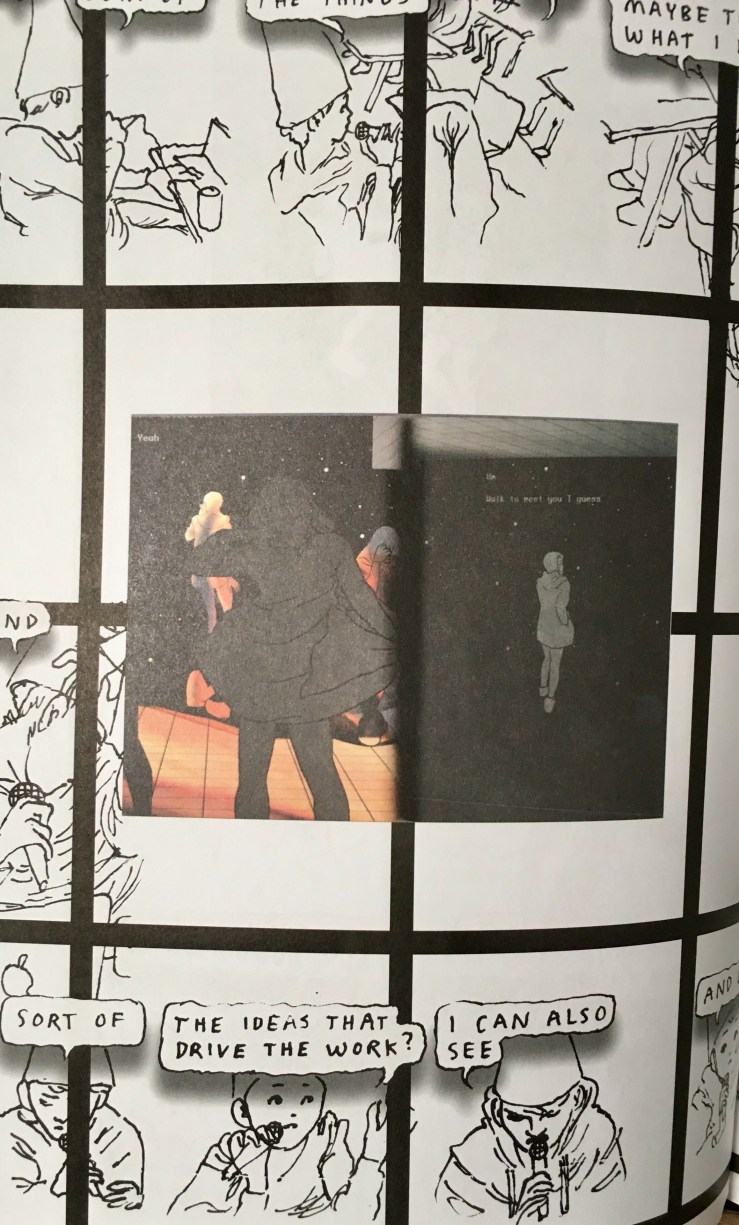
2001, Blaise Larmee’s enigmatic deconstruction of the graphic novel (Book acquired, 16 Oct. 2017)

img_8267

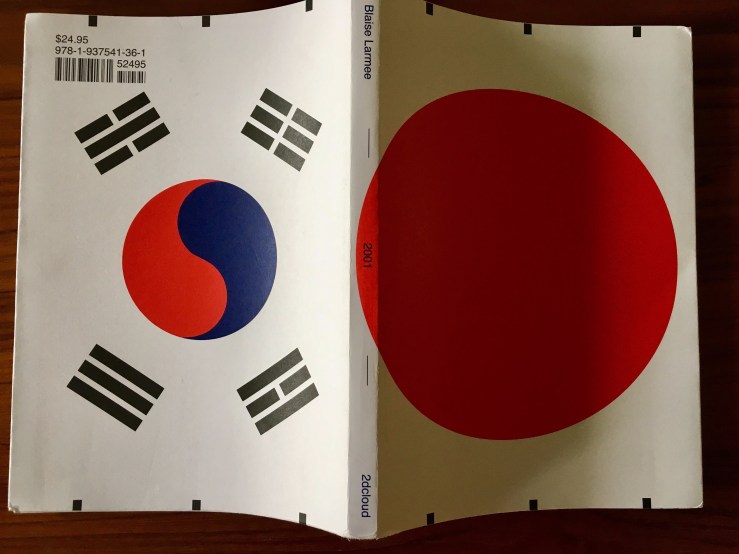
Blaise Larmee’s 2001 is new from 2dcloud. It showed up at the house a few weeks ago, its minimalist cover strange and intriguing.

img_8266.jpg

I’m not sure what the book is—is it a sort of metatextual commentary on Larmee’s webcomic of the same name? A kind of autobiographical riff? A deconstruction of the graphic novel form?

img_8271

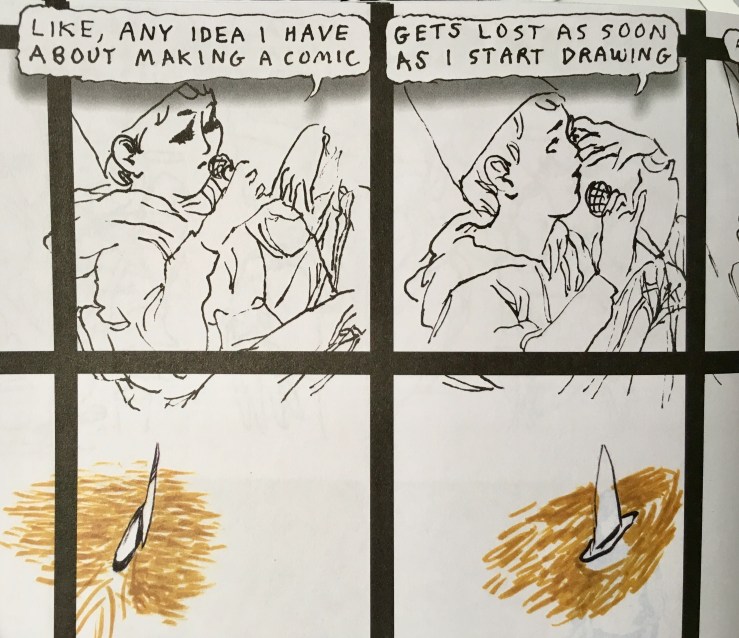
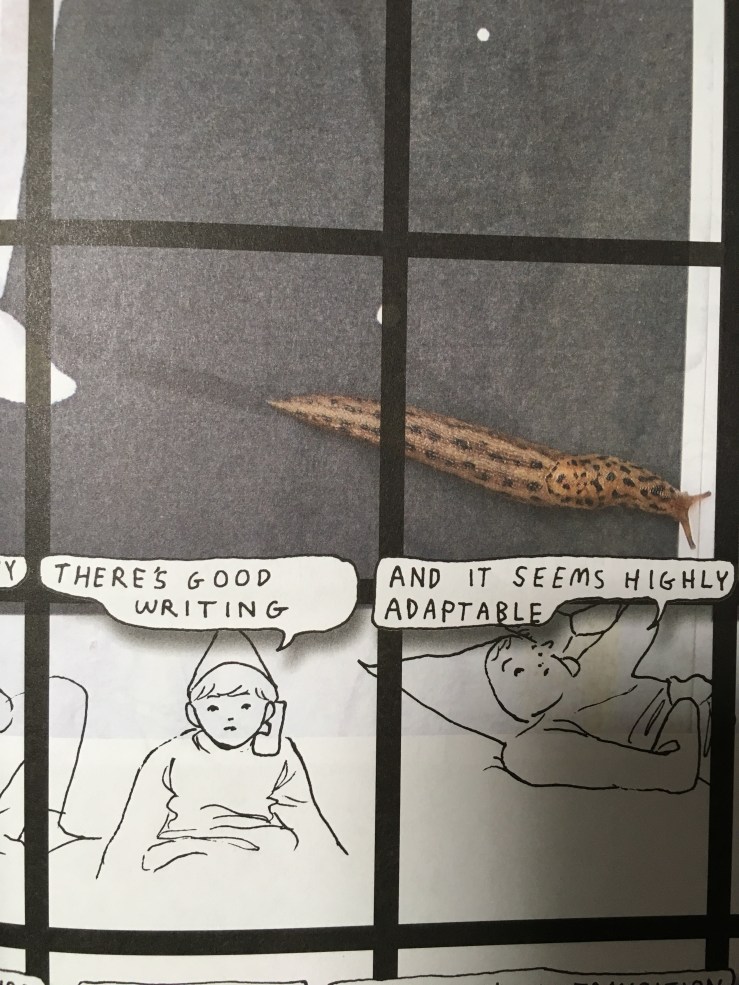
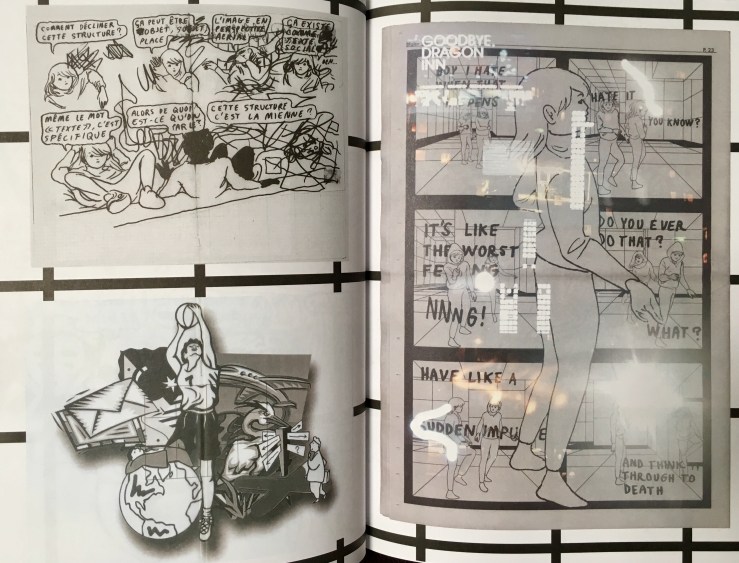
What Larmee’s book is is not as compelling, ultimately, as how it is—sketchy, loose, messy; littered with hi-res scans–receipts, crushed cans and bottles, a house key—scraps from the real that call attention to the narrative’s artifice.

img_8270

2001 is strange and fascinating in its fragmentary, elusory nature. Check it out.

img_8268

Almost no memory | A review of Kazuo Ishiguro’s The Buried Giant

In Kazuo Ishiguro’s 2015 novel The Buried Giant, a metaphysical mist engulfs sixth-century Britain, clouding the memories of all who inhabit the land. Saxons and Britons alike cannot recall their bellicose past. Against this mist, elderly Britons Axl and Beatrice seek their long-lost son. They meet a Saxon warrior who hunts an ancient she-dragon he’s vowed to slay. He’s aided by a youth, Edwin, who’s been exiled from his village after being bitten by a mythic creature. King Arthur’s aged nephew Sir Gawain lingers as a courtly protector, a figure from an already-bygone era; the mist seems to slowly rot his brain and his conscience, pushing him into paranoia and madness. There are Charonic ferrymen and awful ogres; there are mad monks and terrible pixies. A hellhound, a dragon, a poisoned goat. Rivers and mountains and crypts and villages. But most of all that mist.

Charon, Joachim Patinir

Ishiguro makes the reader experience that mist. He obscures. The action that occurs—and yes, there’s action here, measured action (often measured in a literal sense)—the action that occurs in The Buried Giant is almost always oblique, shadowed, indistinct, but also very mechanical. The memory-mist renders the world treacherous, immediate, a dark, vague place that offers its travelers no purchase of reference. Deceptive.

Forgive me for quoting at such length, but I think a longish passage here shows how and what Ishiguro is doing. Almost all of our principals are here, underground—note their procession, their movement—a constant motif in the novel, movement, single file or side by side—and the presence of a light, illumination—also a motif. Note the variety of interpretations of not knowing, not seeing, note the simple horror:

They went on into the tunnel, Sir Gawain leading, Axl following with the flame, Beatrice holding his arm from behind, and Edwin now at the rear. There was no option but to go in single file, the passage remaining narrow, and the ceiling of dangling moss and sinewy roots grew lower and lower until even Beatrice had to stoop. Axl did his best to hold the candle high, but the breeze in the tunnel was now stronger, and he was often obliged to lower it and cover the flame with his other hand. Sir Gawain though never complained, and his shape going before them, sword raised over his shoulder, seemed never to vary. Then Beatrice let out an exclamation and tugged Axl’s arm.

“What is it, princess?”

“Oh, Axl, stop! My foot touched something then, but your candle moved too quickly.”

“What of it, princess? We have to move on.”

“Axl, I thought it a child! My foot touched it and I saw it before your light passed. Oh, I believe it’s a small child long dead!”

“There, princess, don’t distress yourself. Where was it you saw it?”

“Come, come, friends,” Sir Gawain said from the dark. “Many things in this place are best left unseen.”

Beatrice seemed not to hear the knight. “It was over here, Axl. Bring the flame this way. Down there, Axl, shine it down there, though I dread to see its poor face again!”

Despite his counsel, Sir Gawain had doubled back, and Edwin too was now at Beatrice’s side. Axl crouched forward and moved the candle here and there, revealing damp earth, tree roots and stones. Then the flame illuminated a large bat lying on its back as though peacefully asleep, wings stretched right out. Its fur looked wet and sticky. The pig-like face was hairless, and little puddles had formed in the cavities of the outspread wings. The creature might indeed have been sleeping but for what was on the front of its torso. As Axl brought the flame even closer, they all stared at the circular hole extending from just below the bat’s breast down to its belly, taking in parts of the ribcage to either side. The wound was peculiarly clean, as though someone had taken a bite from a crisp apple.

“What could have done work like this?” Axl asked.

He must have moved the candle too swiftly, for at that moment the flame guttered and went out.

Ishiguro gives us mystery, interpretation, and then an incomplete, ambiguous revelation. (This is the basic structure of the novel). Beatrice never relents in her belief that she’s stumbled over a dead child. Brimming with lost children and lost parents and orphans, The Buried Giant is a novel of erasures. But an erasure leaves a trace, a violent, visceral marking into the page’s blankness. Revelation through absence.

We would have no plot, not really, without some overcoming of blankness, and Axl in particular overcomes the mist in his quest. A backstory fleshes out, in watery strokes albeit. The Buried Giant, as far as fantasy epics go, is awfully indistinct. Or rather, Ishiguro offers only mechanical and immediate glimpses into this world, a Britain on the cusp of the Middle Ages. Through Axl’s consciousness (and conscience), we see the vital precision in hand-to-hand combat, for example. Its patience, its slowness, its dependence on muscle memory. Or perhaps (dare I say) more boringly, we feel the very real peril involved in walking in the wild dark as an elderly person. The thrills in The Buried Giant come not from its sword and sorcery costumes, but from its Kafkaesque edges and gaps. This is a novel about not knowing.

And it’s here that The Buried Giant is most successful—as an evocation of not knowing. Axl and Beatrice’s quest unfolds as a series of choices and consequences severed, for the most part, from the anchor of memory. There’s an episodic vibe to the novel, a sense that it’s making itself up as it goes along. (It’s not). The novel strongly reminded me of some of the old RPGs I’d play on a Commodore 64 as a kid. The graphics weren’t great and I had to use my imagination a lot. The games were sometimes frustrating and slow. But perhaps you want a more, uh, literary comparison? Something more recent too? The Buried Giant recalls Ishiguro’s short story “A Village after Dark” a lot more than, say, A Game of Thrones or The Lord of the Rings. It’s a fantasy novel, but one that feels etiolated, its vivid colors drained. More Gustave Doré than Gustave Moreau.

While a precise indistinctness (forgive the oxymoron) is part of The Buried Giant’s program, there’s nothing indistinct about its heroes’ love for each other. Axl and Beatrice, A & B—can I say I came to love them? Or if I didn’t quite love them, I was rooting for them, say? Rooting for their survival, but specifically their survival as a they, a shared survival. Ishiguro successfully communicates their intimacy, their romance, their love, a love threatened by both the natural world and the supernatural return of lost memory. Their relationship is the heart of the novel upon which Ishiguro fixes his themes of memory, justice, vengeance, and love. Ishiguro’s commentary on those themes ultimately may feel pessimistic to many readers, particularly in the novel’s conclusion.

Excepting the ones that we love and return to and obsess over, we retain little of the novels that we read. What memories remain are kernels—the outline of a plot, a strange lingering phrase or detail, a bright or bold character, a theme, an idea, an image. It’s the love between Axl and Beatrice that I’ll likely recall most strongly from the shadows of The Buried Giant. If we can’t remember, we can at least experience.

[Editorial note: Biblioklept originally published this review in October, 2015],

Tether Book — Jen Mazza

tetherbookdec2010

Tether Book, 2011 by Jen Mazza (b. 1972)

The Radiance of Attention — Luc Tuymans

the-radiance-of-attention

The Radiance of Attention by Luc Tuymans (b. 1958)

Campbell, Dahl, Dick, Zelazny (Books acquired, 18 Sept. 2017)

dkca5zzxcaupkfj

I returned to classes on Monday after 10 humid, uncomfortable, and often scary days “off” due to Hurricane Irma. In the slim hour and change between my last lecture and my kids’ school dismissal, I swung by my favorite used bookshop. I was worried that it might have flooded, but the waters didn’t get to the inventory (well over a million books).

I picked up a a PKD Daw edition, a mass market paperback, Deus Irae, co-authored with Roger Zelazny. I’ve been picking up pretty much any early PKD mass market ppbk; new editions of his stuff tend to be pretty boring. I had to pick between two editions:

dkbor9ovoaaprkg

I also picked up Eddie Campbell’s Alec: How to Be an Artist, which I gobbled up the other day in two sittings. There’s a pretty neat canon of graphic novels at the end, which I’ll share later this week. The cover looks like an illustration of Roberto Bolaño to me.

I also picked up two Roald Dahl books we didn’t have, Esio Trot and Danny the Champion of the World, which my kids read immediately and greedily.

The shock of dysrecognition | Philip K. Dick defines science fiction

I will define science fiction, first, by saying what sf is not.  It cannot be defined as “a story (or novel or play) set in the future,” since there exists such a thing as space adventure, which is set in the future but is not sf: it is just that: adventures, fights and wars in the future in space involving super-advanced technology. Why, then, is it not science fiction? It would seem to be, and Doris Lessing (e.g.) supposes that it is. However, space adventure lacks the distinct new idea  that is the essential ingredient. Also, there can be science fiction set in the present: the alternate world story or novel. So if we separate sf from the future and also from ultra-advanced technology, what then do we have that can  be called sf?

We have a fictitious world; that is the first step: it is a society that does not in fact exist, but is predicated on our known society; that is, our known society acts as a jumping-off point for it; the society advances out of our own in some way, perhaps orthogonally, as with the alternate world story or novel. It is our world dislocated by some kind of mental effort on the part of the author, our world transformed into that which it is not or not yet. This world must differ from the given in at least one way, and this one way must be sufficient to give rise to events that could not occur in our society—or in any known society present or past. There must be a coherent idea involved in this dislocation; that is, the dislocation must be a conceptual one, not merely a trivial or bizarre one—this  is the essence of science fiction, the conceptual dislocation within the society so that as a result a new society is generated in the author’s mind, transferred to paper, and from paper it occurs as a convulsive shock in the reader’s mind, the shock of dysrecognition.  He knows that it is not his actual world that he is reading about.

Now, to separate science fiction from fantasy. This is impossible to do, and a moment’s thought will show why. Take psionics; take mutants such as we find in Ted Sturgeon’s wonderful MORE THAN HUMAN.  If the reader believes that such mutants could exist, then he will view Sturgeon’s novel as science fiction. If, however, he believes that such mutants are, like wizards and dragons, not possible, nor will ever be possible, then he is reading a fantasy novel. Fantasy involves that which general opinion regards as impossible; science fiction involves that which general opinion regards as possible under the right circumstances. This is in essence a judgment-call, since what is possible and what is not possible is not objectively known but is, rather, a subjective belief on the part of the author and of the reader.

Now to define good  science fiction. The conceptual dislocation—the new idea, in other words—must be truly new (or a new variation on an old one) and it must be intellectually stimulating to the reader; it must invade his mind and wake it up to the possibility of something he had not up to then thought of. Thus “good science fiction” is a value term, not an objective thing, and yet, I think, there really is such a thing, objectively, as good science fiction.

I think Dr. Willis McNelly at the California State University at Fullerton put it best when he said that the true protagonist of an sf story or novel is an idea and not a person. If it is good  sf the idea is new, it is stimulating, and, probably most important of all, it sets off a chain-reaction of ramification-ideas in the mind of the reader; it so-to-speak unlocks the reader’s mind so that that mind, like the author’s, begins to create. Thus sf is creative and it inspires creativity, which mainstream fiction by-and-large does not do. We who read sf (I am speaking as a reader now, not a writer) read it because we love to experience this chain-reaction of ideas being set off in our minds by something we read, something with a new idea in it; hence the very best science fiction ultimately winds up being a collaboration between author and reader, in which both create—and enjoy  doing it: joy is the essential and final ingredient of science fiction, the joy of discovery of newness.

(in a letter) May 14,1981

From a letter by Philip K. Dick, used as the preface to The Collected Stories of Philip K. Dick, Vol. 1.

Barry Hannah in Hollywood

635610880019438411-barry-hannah-rsd-release-front-cover-artwork

“Pull Back and Reload: Barry Hannah in Hollywood,” a wonderful article by Will Stephenson, is new this week in Oxford American. The article focuses on Hannah’s time in Hollywood in the early 1980s, trying to develop a movie script called Power and Light with Robert Altman. Altman, (not-so-)fresh from making cult jam Popeye, was enchanted by Hannah’s 1980 novel Ray. The director invited Hannah to stay in his Malibu home to work on a script:

Hannah had driven out to Hollywood proudly on his Triumph motorcycle, he and Altman having settled on a meeting place, whereupon Altman was to guide him the rest of the way to his home in Malibu. But when Altman arrived, Hannah hadn’t showed. The filmmaker waited for an hour, increasingly frustrated, until he noticed, across the street, a peep show and adult video store. As Rapp remembers him putting it, Altman thought to himself, “That fucker would be just crazy enough . . .” He wandered inside the adult emporium and there found Hannah, deeply absorbed.

The article is pretty great, larded with nuggets from Hannah’s correspondence and not a few wild anecdotes. Check it out.


Hurricane Irma reading riff

img_7920

I first started getting a tad—just a tad—nervous about Hurricane Irma on Monday, September 4th. This was Labor Day. I had the day off from work, and it was a good day: beer, barbecue, swimming. Etc. Hurricane Irma was already enormous, a monstropolous beast for the record books looming in the Atlantic to eat up our beloved Florida.

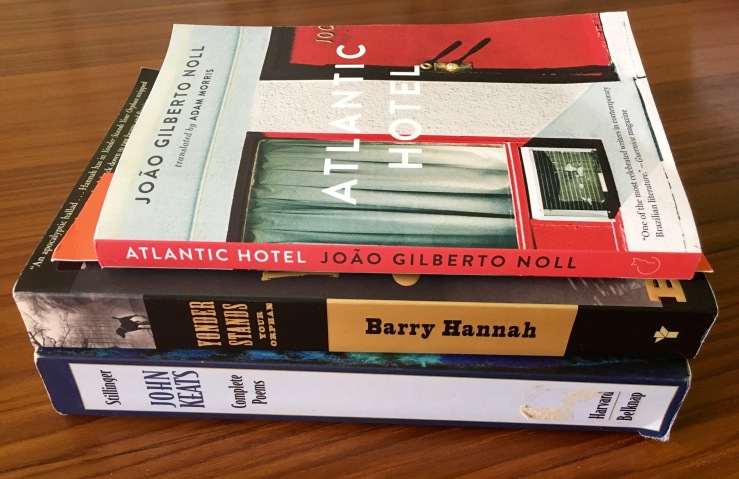
I was still reading Barry Hannah’s last novel Yonder Stands Your Orphan that day; I’d finish it up a few days later. It was excellent, full of great sentences, vignettes, riffs, rants, etc. I’d say it unraveled at the end but “unravel” implies a cohesiveness that maybe isn’t quite there—I’d have to read it again to see, and it’s worth a reread. Actually, in a sense, it coheres in that it collects a number of Hannah’s former characters into a picaresque of grotesque misadventures, hung loosely on a pimp-pornographer-outcast named Man Mortimer. Man Mortimer is the closest thing to a hero the novel has, and he’s pretty evil. Let me crib from an actual review; from Christopher Tayler’s 2001 write-up in the 2001 LRB:

The plot, such as it is, revolves around the depredations of a demonic big-city outsider called Man Mortimer, ‘a gambler, a liaison for stolen cars and a runner of whores, including three Vicksburg housewives’. Mortimer starts to take an interest in cutting people when he finds out that his sort-of girlfriend, Dee Allison – a single mother, nurse and ‘nun of apathy’ – has been unfaithful to him. Dee’s feral twin sons, meanwhile, find in a dried-up sinkhole a car containing the skeletons of Mortimer’s former lover and her child; they clean the skeletons up and take to carting them round the woods. Mortimer is initially concerned with avenging himself on Dee and reclaiming the evidence, but he soon graduates to fairly random attacks on all who cross his path – all, that is, except the poisonous Sidney Farté, who is delighted when Mortimer chops his father’s head off and replaces it with a football, since this speeds his inheritance of the family bait store.

Yonder Stands Your Orphan is often surreal and always dark; it often reminded me of David Lynch’s crime stories, with their grotesque gangsters and abject phantoms. Hell, there’s even a character named Frank Booth.

But where was I? Sorry. This riff is in part a way for me to collect the past few days into something coherent, to figure out what day it is, to prevent an unraveling. Yes, I was nervous on Labor Day, a tad. I had made a list at the beginning of that weekend of five items, chores, I mean, of which I’d accomplished four, including Clean gutters and roof. I did not complete the item I had listed as Hurricane audit.

I picked up a few flats of bottled water before my first class on Tuesday, September 5th. The shelves were already looking bare. I stopped by a Walmart and then a Lowe’s on the way home, failing to get a second gas can. Other people were starting to get a tad nervous. (Nervousness spreads like an infection).

By September 6th, it was nigh impossible to buy a generator in Jacksonville or any of its satellite cities. The college where I teach closed on Thursday, September 7th; my kids’ school closed. Everything started shutting down. There were lots of texts and calls between friends and family, basically amounting to, Should I stay or should I go? Back up plans, hotel reservations to hopefully cancel, etc.

I managed to get a generator on September 8th, which I’d crank up two days later. At this point it seemed clear, or relatively clear, that we were staying, and that family from Tampa Bay would be staying with us. September 8th was long: Trimming back suspicious branches, securing loose items from around the house’s perimeter, busting up an old playhouse that my kids really didn’t play on any more. Cooking meals that could be reheated on a grill. Rehashing plans, piling up supplies. Etc.

djogd1dvyaa_ul5

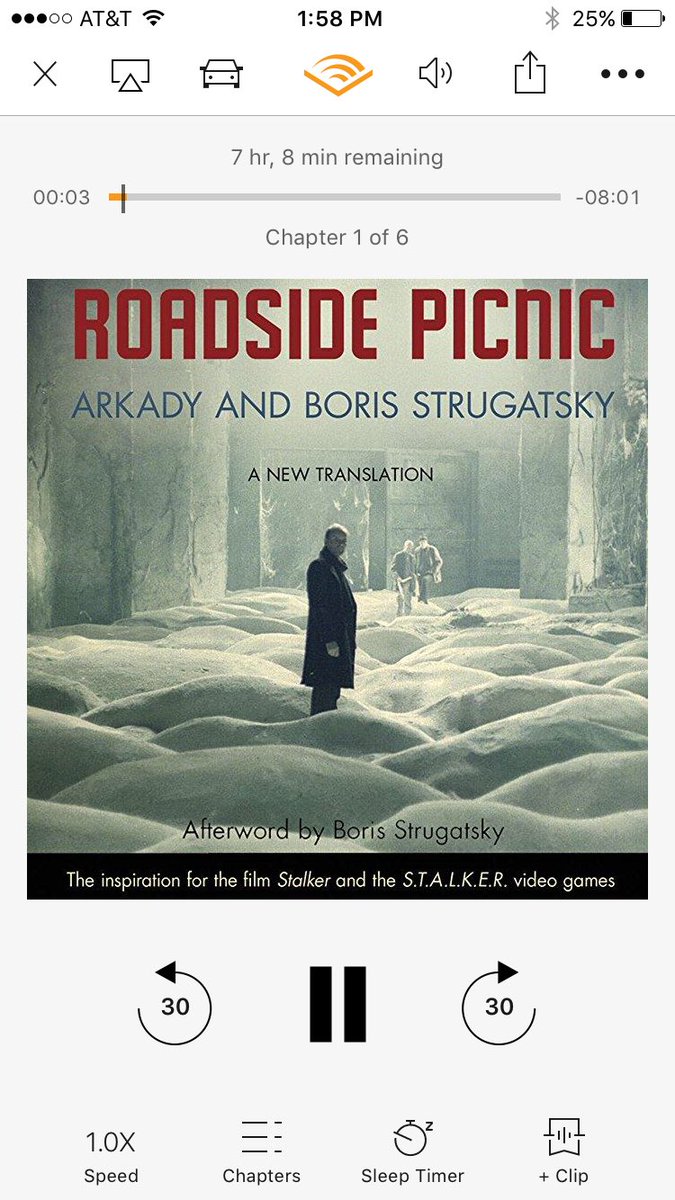
I finally got tired of listening to the radio (scaring the hell out of me) during this hurricane prep, and picked up the audiobook of Arkady and Boris Strugatsky’s Roadside Picnic, translated by Olena Bormashenko, and read by Robert Forster. I basically listened to each chapter twice over the next few days. The translation is inspiring—witty and raw, noir and smart, and Robert Forster’s narration is perfect—wry, dry, sad, and profound. I need to rewatch Tarkovsky’s Stalker now. I’m a bit ashamed that I haven’t read this one before, and I found its final moments especially moving (exhausted as I was). Highly recommended.

My evacuees arrived early September 9th. The next few days are a soggy blur. A nor’easter saturated northeast Florida; the St. Johns River was already, like, full, and the peninsula I live on (a peninsula on a peninsula), was loose. Like, not firm. Irma’s big bands started hitting the First Coast with a frank sincerity. We watched the local NFL team beat Houston’s team. There’s no symbolism or irony there. I was alternating vodka with coffee with green tea. Two twin pines lord over my house, one in the back, one in the front, maybe five decades old. They swayed and swayed, pelting fresh green pine cones onto the roof for the next 24 hours or so with an admirable consistency. By 10pm Sunday night I realized that I wouldn’t be able to sleep. We lost electrical  power, put the kids to bed. Branches started coming down, thudding with scary force, kick drums for the pine cones’ tight snare raps. Limbs like something heavier, thick bass notes. How did the kids sleep through it all?

img_7941

By candlelight, I read the first 66 pages of João Gilberto Noll’s novella Atlantic Hotel (English translation by Adam Morris) at some point that night. Atlantic Hotel is a picaresque nightmare, one weird horror turning into another. In a way, it was perfect reading for Irma’s approach, ominous and eerie. I also don’t know how much I registered, as I kept going out in the hard wind and slanted thick rain to put a big flashlight on my backyard, where the water kept creeping up and up, eventually getting too high for my gumboot but thankfully never spilling into my house. The feeling of reading Atlantic Hotel registered—the tone, the mood, the rhythm—but not the plot or the anonymous lead character. I’ll have to hit Reset on it.

By 3:00am the brunt of the storm cascaded over my own personal house (yes); the pine cones hailed down in a rhythm like hard rain, punctuated by larger crashes of pine limbs and other debris. For unreasonable reasons I will never know, I pulled out Keats and read Lamia with a bigass flashlight. The storm band somewhat subsided; I rested my eyes for an hour or two, then the whole thing commenced again. By nine in the morning it seemed the worst of the storm had passed, and I slept. Lamia snaked into my dreams, coiled into Irma. My son woke me up at 10:30am—a house down the street was on fire. Some asshole had cranked his generator in his garage—his closed garage!—next to his gas cans and propane tank and car. The garage burned; the car exploded, along with the other car in the driveway.

img_7930

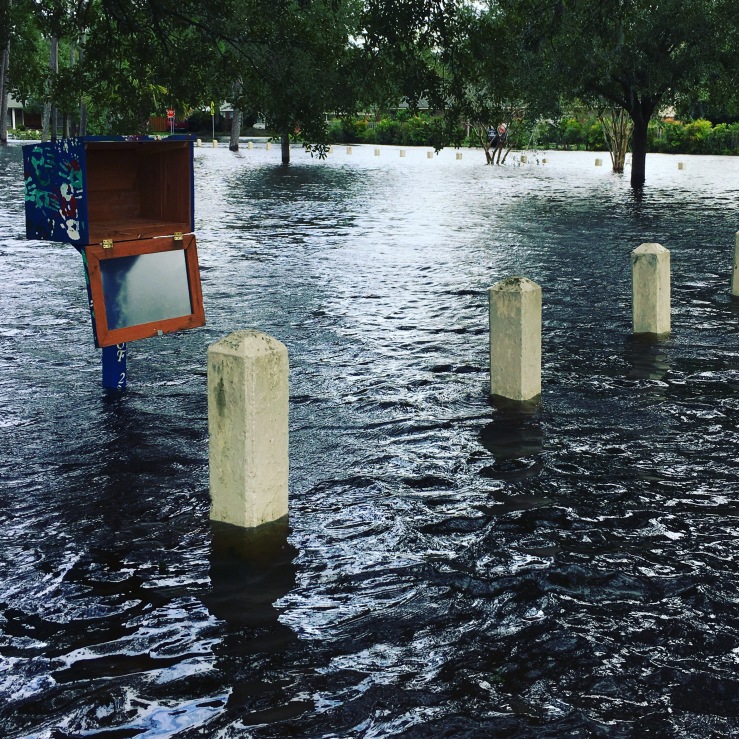
That Sunday, September 11th saw historic flooding in the urban core of Jacksonville. My kids’ school, about a third of a mile from my house, flooded. While trudging around in the late afternoon in our gumboots, happy to be free of our sweltering house for a bit, we saw two teams of Army Rangers paddle up a canal, onto the street, there to evacuate stranded old folks. Surreal. Word traveled about other locations underwater—a flooded Publix, a ruined boatyard, Memorial Park a lake. The worst rumor, to me anyway, was that my beloved used bookstore, Chamblin Bookmine, was underwater. I still can’t bring myself to go over there. I know where it is and how high the water got.

These past few days, I listened to my favorite audiobook during much of the cleanup—Richard Poe’s recording of Cormac McCarthy’s Blood Meridian. What a strange awful comfort. A tree fell on my carport and shed, but they held, sorta. My lawn is a stinking mess, the blazing sun pulling out the water in humid reeking waves. The squelch of it all is something damn else. The pine trees dropped plenty of enormous limbs, but none did real damage. Up on the roof yesterday, clearing one off, I shuddered at its size and weight. I shuddered because of course It could have been so much worse. I’m thankful.


He made a long eulogy on his dog Tiger | Nathaniel Hawthorne’s journal entry for August 26th, 1838

A rough-looking, sunburnt, soiled-shirted, odd, middle-aged little man came to the house a day or two ago, seeking work. He had come from Ohio, and was returning to his native place, somewhere in New England, stopping occasionally to earn money to pay his way. There was something rather ludicrous in his physiognomy and aspect. He was very free to talk with all and sundry. He made a long eulogy on his dog Tiger, yesterday, insisting on his good moral character, his not being quarrelsome, his docility, and all other excellent qualities that a huge, strong, fierce mastiff could have. Tiger is the bully of the village, and keeps all the other dogs in awe. His aspect is very spirited, trotting massively along, with his tail elevated and his head likewise. “When he sees a dog that’s anything near his size, he’s apt to growl a little,”–Tiger had the marks of a battle on him,–“yet he’s a good dog.”

From Nathaniel Hawthorne’s journal entry for August 26th, 1838. Collected in Passages from the American Note-Books.

In the passive voice, something happened, somebody was killed and so on (Barry Hannah)

The sheriff was doing a five-minute commentary on the Weekend Review on television Saturday night. Both Dee and Melanie watched.

“The world is full of middle-aged men who seek revenge. The anger passes for most when they see there is no way. The rate of incarceration is very low for first-time offenders of sixty. For some, there is a bigger engine of hate even then, running at the red line and very vigilant toward what they might consider insults or even bossiness. They aren’t just having it, the engine, like the others. They are it. They have not been aware of this, and their acts confound them. Those are ones you see on television or in the newspapers discussing sodomy, rape, kidnapping and murder in the passive voice, something happened, somebody was killed and so on, sometimes even giggling. ‘Mistakes were made, yes, when she was killed. I can’t remember, really.’ Such as that.”

From Barry Hannah’s 2001 novel Yonder Stands Your Orphan.

Two or three Barry Hannahs, depending on how you look at it (Books acquired, 14 and 18 Aug. 2017)

img_7707-1

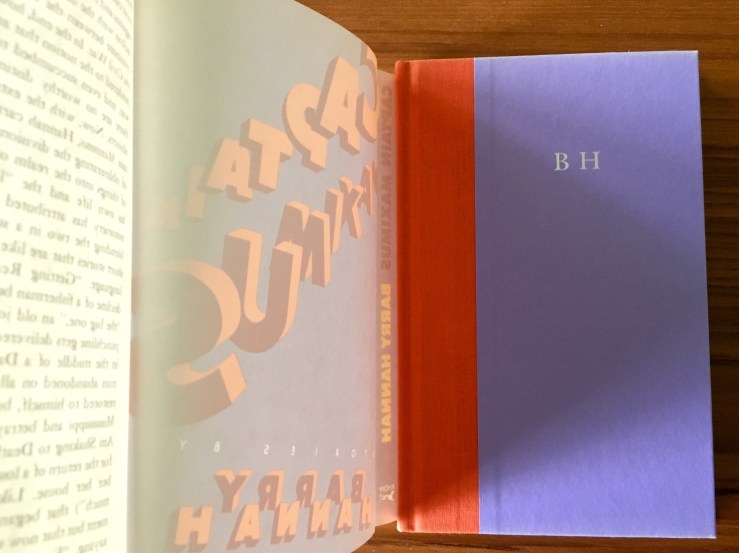
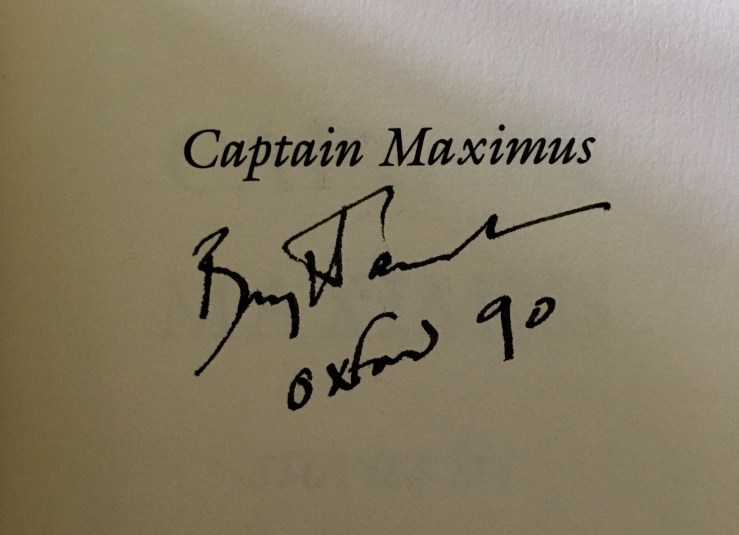
Earlier this summer I visited Alias East Books East in Los Angeles, where the clerk kindly let me handle a signed first edition of Barry Hannah’s novel Ray. It was like sixty bucks, so I didn’t handle it too fondly. But somehow the image of the signature rattled around in my silly skull all summer—probably because I spent a big chunk of July slurping up Long, Last, Happy. I wanted to find out some info about Hannah’s last quartet of stories—the last four stories in L, L, H—and doing a search of his name in Twitter led me to a link for a signed first-edition hardback copy of his slim 1985 collection Captain Maximus. (The title is a joke on his then-editor, Gordon “Captain Fiction” Lish, who apparently Hannah referred to as “Captain Minimus” in some of their letters). I might have had a scotch or two, but I bid on the book (eighteen bucks). No one else bid on it, so it’s mine now.

The cover is lovely, purple and orange, designed by Fred Marcellino, and under the bright shiny jacket is this:

img_7709

I love the reserved arrogance of those initials!

And of course the signature, dated five years after the book’s publication and geographically anchored to the town my grandfather and namesake attended college in—

img_7710

I didn’t actually own a copy of Captain Maximus beforehand, and I think the only stories from it included in Long, Last, Happy (which, by the way is a great starting place for Hannah) are “Fans,” “Ride, Fly, Penetrate, Loiter” and “Even Greenland” (you can read “Even Greenland” at Ben Marcus’s website). This particular copy has clearly never been read.  Which leads me to this afternoon. I went to my favorite used bookstore to pick up a copy of Ishmael Reed’s The Terrible Threes—I just finished The Terrible Twos, a novel that is too prescient and too funny and too cruel and you should read it read it read it—and well anyway, I went to see if maybe they had a copy of Yonder Stands Your Orphan, which they didn’t the last time I was there, but they did today. Under it was a well-thumbed 1986 Penguin paperback edition of Captain Maximus. I need to read Yonder (which hell by the way my god what a bad cover c’mon people) before I can write the Thing I want to write on the final stories in Long, Last, Happy (or at least I think I need to read it, or anyway, I want to). And the second copy of Captain Maximus, at three dollars in store credit, is something I don’t have to worry about cramming into a pocket or dropping into a bathtub or eventually giving away to a friend.

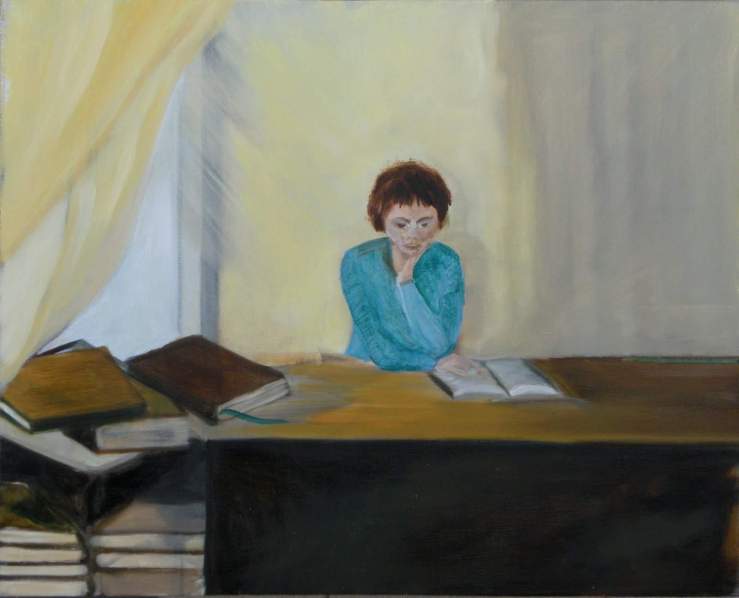
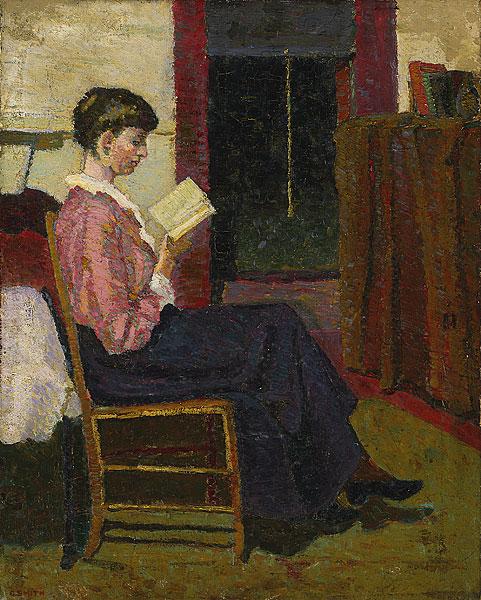
The Reader — Grace Cossington Smith

the-reader-1916.jpg!Large

The Reader, 1916 by Grace Cossington Smith (1908-1971)

A review of Gisèle Prassinos’s collection of surreal anti-fables, The Arthritic Grasshopper

img_7667

I can’t remember which particular Surrealist I was googling when I learned about Gisèle Prassinos. I do know that it was just a few weeks ago, and I’ve had an interest in Surrealist art and literature since I was a kid, so I was a bit stunned that I’d never heard of her before now—strange, given the origin of her first publication. In 1934, when she was 14, Prassinos was “discovered” by André Breton, and the Surrealists delighted in what they called her “automatic writing.” (Prassinos would later reject that label, and go as far as to declare that she had never been a surrealist). Her first book, La Sauterelle arthritique (The Arthritic Grasshopper) was published just a year later.

1-work
Prassinos reading her work to the Surrealists; photograph by Man Ray


I somehow found a .pdf of one of her stories, “A Nice Family,” a bizarre little tale that runs on its own surreal mythology. The story struck me as simultaneously grandiose and miniature, dense but also skeletal. It was impossible. Surreal. I wanted more.

Luckily, just this spring Wakefield Press released The Arthritic Grasshopper: Collected Stories, 1934-1944, a new English translation of a 1976 compendium of Prassinos’s tales, Trouver sans checher. The translation is by Henry Vale and Bonnie Ruberg, whose introduction to the volume is a better review and overview than I can muster here. Ruberg offers a miniature biography, and shares details from her letters and visits with Prassinos. She situates Prassinos within the Surrealists’ gender biases: “For a young writer such as Prassinos, being involved with the surrealists would have meant gaining access to resources like publishers, but it also would have meant being fetishized and marginalized.” Ruberg characterizes Prassinos’s tales eloquently and accurately—no simple feat given the material’s utter strangeness:

Taken collectively, their effect is a piercing cackle, a complete disorientation, rather than an ethical lesson. The politics of these stories are absurdist. They upend the world by making children dangerous, by reanimating the dead, by letting the carefully tended domestic deform, foam, and melt. No social structure holds power in the world of these stories—not on the basis of gender, or nationality, or class. The force that reigns is chaos.

Let’s look at that reigning chaos.

In “The Sensitivity of Others,” one of the earliest tales in the volume, we get the sparest narrative action seemingly possible: A speaker walks forward. And yet dream-nightmare touches impinge on all sides and on all senses. The opening line shows a world that is never stable, and if monsters and other dangers lurk just on the margins of our narrator’s shifting path, so do wonders and the promise of strange knowledge. Here’s the tale in full:

img_7666

I still have no idea what to make of the punchline there at the end, but those final images—a father, a faulty library, a power failure—hang heavy against the narrator’s trembling walk.

Many of Prassinos’s anti-fables conclude with such apparent non sequiturs, and yet the final lines can also cast a weird light back over the previous sentences. In “Photogenic Quality,” a dream-tale about the act of writing itself, the final line at first appears as sheer absurdity. A man receives a pencil from a child, whittles it into powder, blots the powder on paper, and throws the paper in the river (more things happen, too). The tale concludes with the man declaring, “Brass is made from copper and tin.” It’s possible to enjoy the absurdity here on its own; however, I think we can also read the last line as a kind of Abracadabra!, magic words that describe an almost alchemical synthesis—a synthesis much like the absurd modes of transformative writing that “Photogenic Quality” outlines.

img_7664

You’ll see above one of Allan Kausch’s illustrations for The Arthritic Grasshopper. Kausch’s collages pointedly recall Max Ernst’s surreal 1934 graphic novel Une semaine de bonté (A Week of Kindness). Kausch’s work walks a weird line between horror and whimsy; images from old children’s books and magazines become chimerical figures, sometimes cute, sometimes horrific, and sometimes both. They’re lovely.

img_7663

Surreal figures shift throughout the book—monks and kings, daughters and mothers, deep sea divers and knights and salesmen and talking horses—all slightly out of place, or, rather, all making new places. Even when Prassinos establishes a traditional space we might think we recognize—often a fairy trope—she warps its contours, shaping it into something else. “A Marriage Proposal,” with its unsuspecting title, opens with “Once upon a time” — but we are soon dwelling in impossibility: “the garter snake appeared in the doorway, arm in arm with the snail, who was slobbering with happiness.” Other stories, like “Tragic Fanaticism,” immediately condense fairy tales into pure images, leaving the reader to suss out connections. Here is that story’s opening line: “A black hole, a little old woman, animals.” At five pages, “Tragic Fanaticism” is one of the collection’s longer stories. It ends with a four line poem, sung by five red cats to the old woman: “Go home and burn / Darling / You’re the only one we’ll love / Trash Bin.”

I still have a number of stories to read in The Arthritic Grasshopper. I’ve enjoyed its tales most when taken as intermezzos between sterner (or compulsory) reading. There’s something refreshing in Prassinos’s illogic. In longer stretches, I find that I tire, get lazy—Prassinos’s imagery shifts quickly—there’s something even picaresque to the stories—and keeping up with its veering rhythms for tale after tale can be taxing. Better not to gobble it all up at once. In this sense, The Arthritic Grasshopper reminds me strongly of another recently-published volume of surreal, imagistic stories that I’ve been slowly consuming this year: The Complete Stories of Leonora Carrington. In their finest moments, both of these writers can offer new ways of looking at art, at narrative, at the world itself.

I described Prassinos’s tales as “anti-fables” above—a description that I think is accurate enough, as literary descriptions go—but that doesn’t mean there isn’t something that we can learn from them (although, to be very clear, I do not think literature has to offer us anything to learn). What Prassinos’s anti-fables do best is open up strange impossible spaces—there’s a kind of radical, amorphous openness here, one that might be neatly expressed in the original title to this newly-translated volume—Trouver sans checher—To Find without Seeking.

In her preface (titled “To Find without Seeking”) Prassinos begins with the question, “To find what?” Here is a question that many of us have been taught we must direct to all the literature we read—to interrogate it so that it yields moral instruction. Prassinos answers: “The spot where innocence rejoices, trembling as it first meets fear. The spot where innocence unleashes its ferocity and its monsters.” She goes on to describe a “true and complete world” where the “earth and water have no borders and each us can live there if we choose, in just the same way, without changing our names.” Her preface concludes by repeating “To find what?”, and then answering the question in the most perfectly (im)possible way: “In the end, the mind that doesn’t know what it knows: the free astonishing voice that speaks, faceless, in the night.” Prassinos’s anti-fables offer ways of reading a mind that doesn’t know what it knows, of singing along with the free faceless astonishing voice. Highly recommended.

A riff on rereading Carson McCullers’ novel The Heart Is a Lonely Hunter

  1. I’m not really sure what made me pick up Carson McCullers’ 1940 début novel The Heart Is a Lonely Hunter to read again.
  2. Actually, writing that sentence makes me remember: I was purging books, and the edition I have is extremely unattractive; I was considering trading it in. But I started reading it, realizing that I hadn’t reread it ever, that I hadn’t read it since I was probably a senior in high school or maybe a college freshman.
  3. So it was maybe two decades ago that I first read it. I would’ve been maybe 18, about five years younger than McCullers was when the novel was published (and not much older than its protagonist Mick Kelly). The Heart Is a Lonely Hunter never stuck with me like The Ballad of the Sad Café or her short stories did, but I remember at the time thinking it far superior to Faulkner—more lucid in its description of the Deep South’s abjection. (I struggled with Faulkner when I was young, but now see his tangled sentences and thick murky paragraphs are a wholly appropriate rhetorical reckoning with the nightmare of Southern history).
  4. And of course I preferred Flannery O’Connor to both at the time—her writing was simultaneously lucid and acid, cruel and funny. Maybe I still like her best of the three.
  5. O’Connor, in a 1963 letter: “I dislike intensely the work of Carson McCullers.”
  6. O’Connor again:

    When we look at a good deal of serious modern fiction, and particularly Southern fiction, we find this quality about it that is generally described, in a pejorative sense, as grotesque. Of course, I have found that anything that comes out of the South is going to be called grotesque by the Northern reader, unless it is grotesque, in which case it is going to be called realistic.

  7. The Heart Is a Lonely Hunter is at its best when it is at its most grotesque, which is to say, most realistic.
  8. Here’s a sample of that grotesque dirty realism from very late in the book, as Jake Blount (an alcoholic and would-be revolutionary) departs the small, unnamed Georgia town that the novel is set in—and the narrative:

    The door closed behind him. When he looked back at the end of the black, Brannon was watching from the sidewalk. He walked until he reached the railroad tracks. On either side there were rows of dilapidated two-room houses. In the cramped back yards were rotted privies and lines of torn, smoky rags hung out to dry. For two miles there was not one sight of comfort or space or cleanliness. Even the earth itself seemed filthy and abandoned. Now and then there were signs that a vegetable row had been attempted, but only a few withered collards had survived. And a few fruitless, smutty fig trees. Little younguns swarmed in this filth, the smaller of them stark naked. The sight of this poverty was so cruel and hopeless that Jake snarled and clenched his fists.

  9. The passage showcases some of McCullers’ best and worst prose tendencies. Her evocation of the South’s rural poverty condenses wonderfully in the image of “a few fruitless, smutty fig trees” — smutty!—but there’s also an underlying resort to cliché, into placeholders — “stark naked”; “clenched his fists.”
  10. (Maybe you think I’m picking on McCullers here, yes? Not my intention. I’ll confess I read a career-spanning compendium of Barry Hannah’s short stories, Long, Last, Happy right before I read The Heart Is a Lonely Hunter, and McCullers simply can’t match sentences with Our Barry. It’s an unfair comparison, sure. But).
  11. But McCullers was only 23 when The Heart Is a Lonely Hunter was published. Stock phrases must be forgiven, yes? Yes.
  12. And there are plenty of great moments on the page, like this one, in which (McCullers’ stand-in) Mick Kelly tries her young hand at writing:

    The rooms smelled of new wood, and when she walked the soles of her tennis shoes made a flopping sound that echoed through all the house. The air was hot and quiet. She stood still in the middle of the front room for a while, and then she suddenly thought of something. She fished in her pocket and brought out two stubs of chalk—one green and the other red. Mick drew the big block letters very slowly. At the top she wrote EDISON, and under that she drew the names of DICK TRACY and MUSSOLINI. Then in each corner with the largest letters of all, made with green and outlined in red, she wrote her initials—M.K. When that was done she crossed over to the opposite wall and wrote a very bad word—PUSSY, and beneath that she put her initials, too. She stood in the middle of the empty room and stared at what she had done. The chalk was still in her hands and she did not feel really satisfied.

    Who is ever really satisfied with their own writing though?

  13. We’re several hundred words into this riff and I’ve failed to summarize the plot of The Heart Is a Lonely Hunter. There really isn’t a plot per se, actually—sure, there are a development of ideas, themes, motifs, characters—yep—and sure, lots of things happen (the novel is episodic)—but there isn’t really a plot.
  14. The point above is absurd. Of course there is a plot, one which you could easily diagram in fact. Such a diagram would describe the sad strands of four misfits gravitating toward the deaf-mute, John Singer, the silent center of this sad novel. These sad strands tangle, yet ultimately fail to cohere into any kind of harmony with each other. Even worse, these strands fail to make a true connection with Singer. The misfits all essentially use him as a sounding board, a mute confessional booth. They think they love him, but they love his silence, they love his listening. They don’t learn about his own strange love and his own strange sadness.
  15. Or, if you really want to oversimplify plot: The Heart Is a Lonely Hunter is about growing up. In a novel with a number of tragic trajectories, it’s somehow the ending of the Mick Kelly thread that I found most affecting. She still dreams of making great grand music, of writing songs the world would love—but McCullers leaves her standing on her feet working overtime in Woolworth’s to get her family out of the hole. This is the curse of adulthood, of grasping onto dreams even as the world flattens them out into a big boring nothing. The final lines McCullers gives her, via the novel’s free indirect style, strike me as ambiguous:

    …what the hell good had it all been—the way she felt about music and the plans she had made in the inside room? It had to be some good if anything made sense. And it was too and it was too and it was
    too and it was too. It was some good.
    All right!
    O.K!
    Some good.

  16. Is Mick’s self-talk here a defense against disillusionment—one haunted by the truth of life’s awful boring ugliness—or a genuine earnest rallying against the ugliness—or perhaps a mix of both? “Some good” can be read both ironically and earnestly.
  17. Its navigation of irony and earnestness is where I find the novel most off balance. There’s a clumsy cynicism to The Heart Is a Lonely Hunter—a justified cynicism, to be sure, given its themes of racism, classicism, modern alienation—but McCullers’ approach to sussing out her big themes is often heavy-handed. Too often characters’ speeches and dialogues—particularly those of the working-class socialist Blount and Dr. Copeland, a black Marxist—feel forced. Entire dialectics that seem lifted from college lecture notes are shoved into characters’ mouths. Still: if I sometimes found such moments insufferable, McCullers nevertheless reminded me that she was pointedly addressing suffering.
  18. The earnestness there is mature, but the cynicism isn’t. I’m not quite sure what I mean by this—the cynicism isn’t deep? The cynicism is a pose, a viewpoint not fully, but nevertheless freshly, lived in. The cynicism is the cynicism that some of us like to try on when we’re 18, 19, 20, 21.
  19. And re: the point above—that’s good, right? I mean it’s good that McCullers channeled this pure and very real anger into her novel. Maybe I failed the novel, this time, in rereading it twenty years later and thinking repeatedly, But that’s the way the world is: Often awful and almost always unfair. Blount and Copeland are interesting but essentially paralyzed characters; they howl against injustice but McCullers can only make them act in modes of ineffective despair.
  20. Despair. This is a sad novel—a realistically sad novel, a grotesquely sad novel—sympathetic but never sentimental. (We Southerners love sugar and sentiment; bless her heart, McCullers cuts any hint of the latter out. And if Mick Kelly enjoys an ice cream sundae for her last dinner in the novel, note that she chases it with a bitter beer that gets her just drunk enough to keep going).
  21. But some of us like to laugh at and with despair, and The Heart Is a Lonely Hunter serves up a big bitter brew without a heady or hearty laugh to help you swallow it down. The novel’s humorlessness was perhaps by design—these characters dwell in absurd abjection. But absurdity often calls for a laugh, and laughter is not always sugar sweetness, but rather can be a reveling in bitterness—perhaps what I mean here, is that laughter is a sincere and deep reckoning with mature cynicism.
  22. I quoted O’Connor above, in point six; in the same lecture, she warned against writers (particularly Southern writers) giving into the need of the “tired reader…to be lifted up.” O’Connor often forced her characters into moments of radical redemption, moments that complicate her “tired reader’s” desire to have his “senses tormented or his spirits raised.” This modern reader, according to O’Connor, “wants to be transported, instantly, either to mock damnation or a mock innocence.” For O’Connor, the modern reader’s “sense of evil is diluted or lacking altogether, and so he has forgotten the price of restoration.” Restoration in O’Connor’s fiction is always purchased at a heavy cost—many readers can only see the cost, and not the redemption in her calculus.
  23. And restoration in The Heart Is a Lonely Hunter? Perhaps the novel’s greatest strength is its lack of sentimentality, its unwillingness to restore its characters to a mythical Eden. Indeed, McCullers’ setting never even posits a grace from which her characters might fall. Instead, the novel’s final moments leave us “suspended between radiance and darkness. Between bitter irony and faith.” Any restoration is impermanent, as the final line suggests: “And when at last he was inside again he composed himself soberly to await the morning sun.” If the morning sun promises a new tomorrow, a futurity, that futurity is nevertheless conditioned by the need to repeatedly “compose” oneself into a new being, always under the duress of “bitter irony and faith.” McCullers’ plot might side with bitter irony, but her belief in her characters’ beliefs—belief in the powers of art, politics, and above all love—point ultimately to an earnest faith in humanity to compose itself anew.