“The Magi,” A Stark Christmas Poem by William Butler Yeats

“The Magi” by William Butler Yeats. A Christmas poem that’s not about Christmas, I guess. I love the final image:

Now as at all times I can see in the mind’s eye,
In their stiff, painted clothes, the pale unsatisfied ones
Appear and disappear in the blue depth of the sky
With all their ancient faces like rain-beaten stones,
And all their helms of silver hovering side by side,
And all their eyes still fixed, hoping to find once more,
Being by Calvary’s turbulence unsatisfied,
The uncontrollable mystery on the bestial floor.


A Christmas Card from Günter Grass

(Via/more)

Illustration for Ben Marcus’s “G-D” (Catrin Morgan)

3_g-d-

Catrin Morgan‘s illustration for “G-D”  is part of the upcoming illustrated reissue of Ben Marcus’s cult jam The Age of Wire and String that the good people at Granta will put out.

“Meditatio” — Ezra Pound

“Meditatio,” Ezra Pound

When I carefully consider the curious habits of dogs
I am compelled to conclude
That man is the superior animal.

When I consider the curious habits of man
I confess, my friend, I am puzzled.

Take Vladimir Nabokov’s “Good Reader” Quiz

One evening at a remote provincial college through which I happened to be jogging on a protracted lecture tour, I suggested a little quiz—ten definitions of a reader, and from these ten the students had to choose four definitions that would combine to make a good reader. I have mislaid the list, but as far as I remember the definitions went something like this.

Select four answers to the question what should a reader be to be a good reader:

1. The reader should belong to a book club.
2. The reader should identify himself or herself with the hero or heroine.
3. The reader should concentrate on the social-economic angle.
4. The reader should prefer a story with action and dialogue to one with none.
5. The reader should have seen the book in a movie.
6. The reader should be a budding author.
7. The reader should have imagination.
8. The reader should have memory.
9. The reader should have a dictionary.
10. The reader should have some artistic sense.

The students leaned heavily on emotional identification, action, and the social-economic or historical angle. Of course, as you have guessed, the good reader is one who has imagination, memory, a dictionary, and some artistic sense–which sense I propose to develop in myself and in others whenever I have the chance.

—Vladimir Nabokov. Collected in Lectures on Literature.

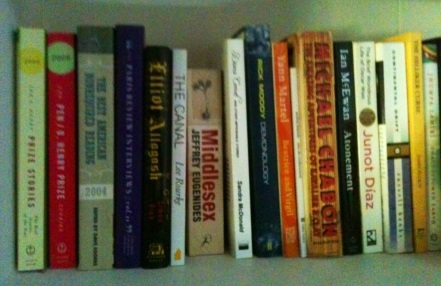
Book Shelves #48, 11.25.2012

20121125-115730.jpg


Book shelves series #48, forty-eighth Sunday of 2012

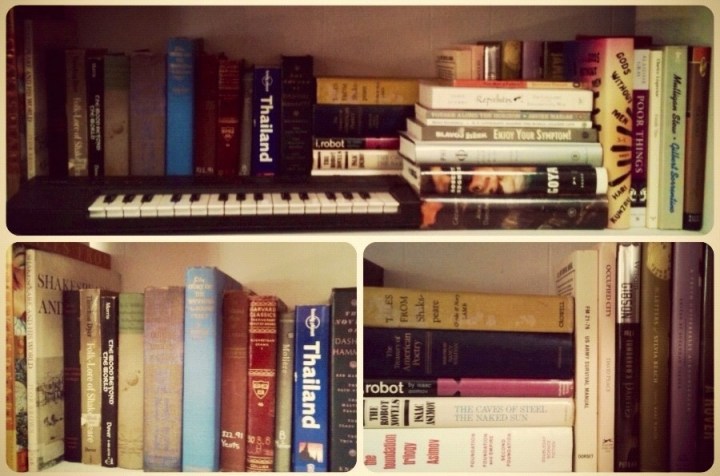
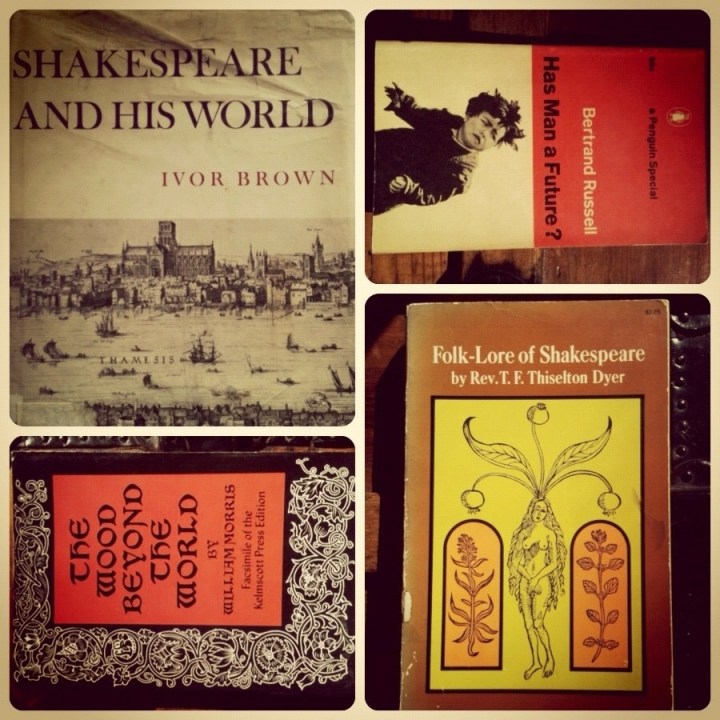
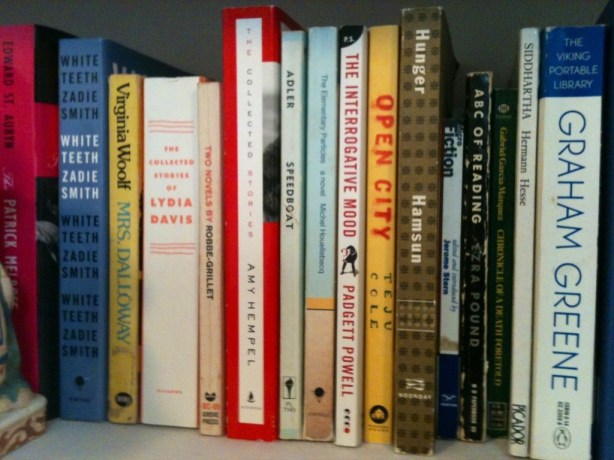
Another doublestocked shelf: The front stack (on the right) are all books I’ve been intending to read at some point, or been reading slowly or piecemeal. Behind and to the left: Lots of old hardbacks—some Yeats, some H.G. Wells, Arthurian legends, and Shakespeare-related texts. A totally misshelved and out-of date Lonely Planet guide (why is it there?). Some Asimov. A few faves:

20121125-115738.jpg


“I’m Searching” — Clarice Lispector

The opening paragraph to Clarice Lispector’s novel The Passion According to G.H.

Book Shelves #46, 11.11.2012

20121111-111049.jpg

Book shelves series #46, forty-sixth Sunday of 2012

Another double-stacked shelf. This one even has a stack of drifters.

This shelf is at my eye/arm level, and looking at it this way, I see that it gets a lot of shuffling—I can see where I started certain projects for the site.

I can see books that are in line, so to speak, for either proper shelving or for reading.

The mounding stack on the shelf below is a bit out of control, although most of what sits there comes from other places (I kinda sorta wrote about those here).

Below: Unsorted stuff that I’ve been reading of an afternoon:

20121111-111057.jpg

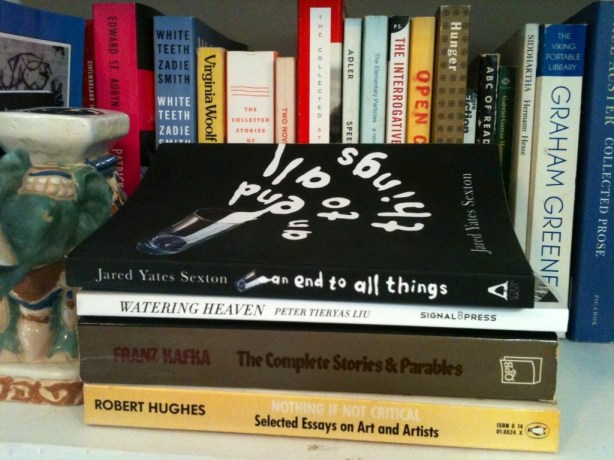
This is the front stack—books that need proper shelving elsewhere, books that I’ve read (and sometimes reviewed here) in the past few months, or meant to read, or in some other way consulted or read from:

20121111-111105.jpg

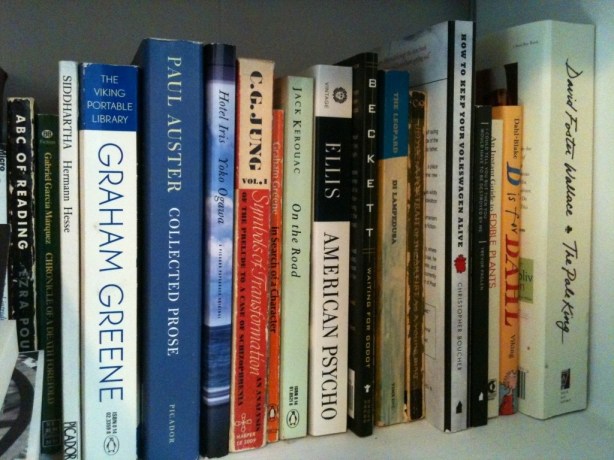
The far right side of the shelf—again, a very mixed bag. I think I originally intended to properly shelf everything here and then got sidetracked:

20121111-111113.jpg

Moving left:

20121111-111124.jpg

And here’s what’s behind the front stack—okay, I can see now the edges of an idea I had for shelving; I also see where I just abandoned that idea:

20121111-111133.jpg

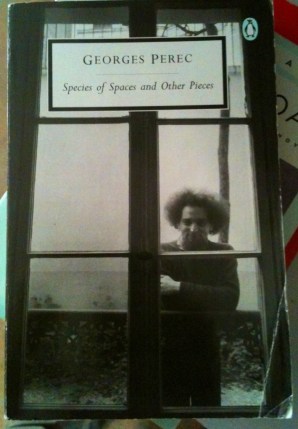
This whole project I blame on an essay by Georges Perec, collected in this one:

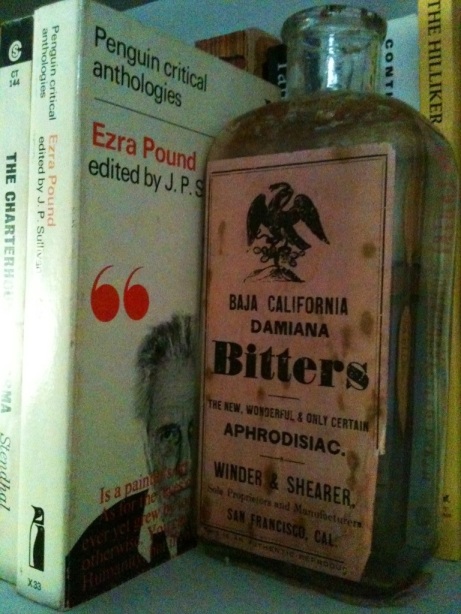
20121111-111157.jpg

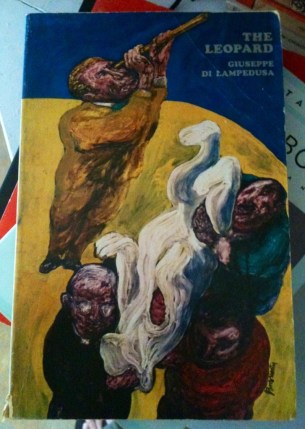
This is one of my favorite book covers:

20121111-111149.jpg

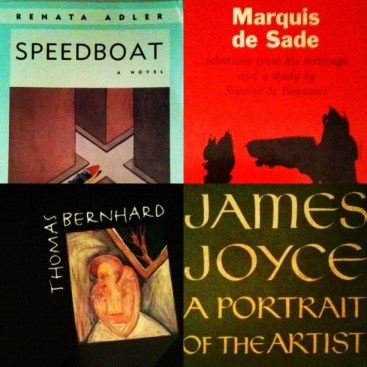
More covers I like from this shelf:

20121111-111204.jpg

Book Shelves #45, 11.04.2012

20121103-171422.jpg

Book shelves series #45, forty-fifth Sunday of 2012

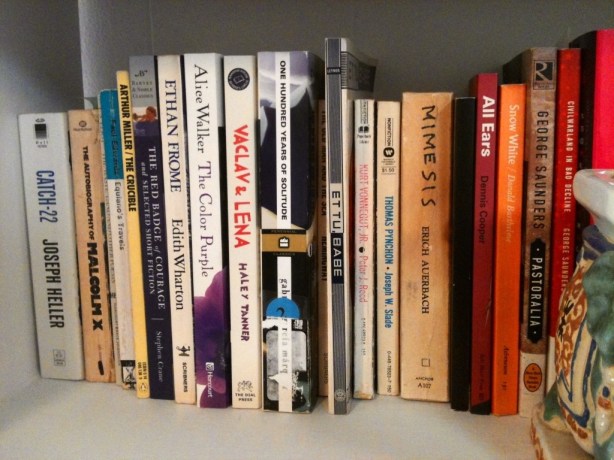
Yon shelf, murky, dim:

20121103-171436.jpg

Homeboy on the end, once my parents’,  tschotchke of time in ’80s South Africa, used to work as a bookend, now he just hangs out on this double-booked shelf.

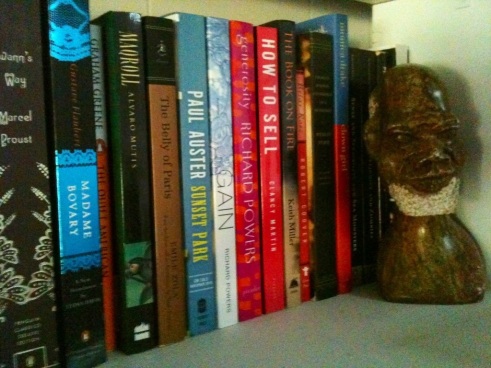
20121103-171448.jpg

Front layer:

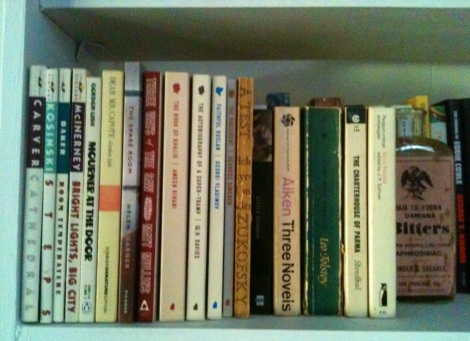
20121103-171458.jpg

Back layer, including a number of volumes (to be clear: Chabon, Martel, Diaz, Eugenides) I should just trade in.

20121103-171526.jpg

(Also: I hate this project and wish I’d never started it).

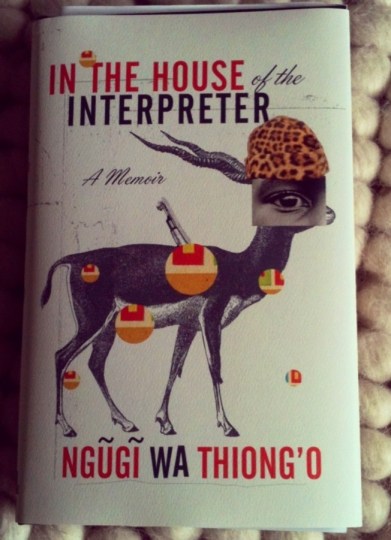
Ngugi wa Thiong’o’s Memoir — In the House of the Interpreter (Book Acquired, 10.24.2012)

20121025-161753.jpg

In the House of the Interpreter is a memoir from Ngugi wa Thiong’o. It’s new next month in hardback from Pantheon (lovely cover/design, on this one, Pantheon people. Seriously). Their blurb:

World-renowned Kenyan novelist, poet, playwright, and literary critic Ng˜ug˜ý wa Thiong’o gives us the second volume of his memoirs in the wake of his critically acclaimed Dreams in a Time of War.

In the House of the Interpreter richly and poignantly evokes the author’s life and times at boarding school—the first secondary educational institution in British-ruled Kenya—in the 1950s, against the backdrop of the tumultuous Mau Mau Uprising for independence and Kenyan sovereignty. While Ng˜ug˜ý has been enjoying scouting trips, chess tournaments, and reading about the fictional RAF pilot adventurer Biggles at the prestigious Alliance High School near Nairobi, things have been changing rapidly at home. Poised as he is between two worlds, Ng˜ug˜ý returns home for his first visit since starting school to find his house razed and the entire village moved up the road, closer to a guard checkpoint. Later, his brother Good Wallace, a member of the insurgency, is captured by the British and taken to a concentration camp. As for Ng˜ug˜ý himself, he falls victim to the forces of colonialism in the person of a police officer encountered on a bus journey, and he is thrown into jail for six days. In his second year at Alliance High School, the boarding school that was his haven in a heartless world is shattered by investigations, charges of disloyalty, and the politics of civil unrest.

In the House of the Interpreter hauntingly describes the formative experiences of a young man who would become a world-class writer and, as a political dissident, a moral compass to us all. It is a winning celebration of the implacable determination of youth and the power of hope.


Reading Chris Ware’s Building Stories / I just met

Continuing kinda sorta where we left off

Not sure of the name of this episode, but I’ll refer to it as I just met, a phrase that repeats twice in a huge headlinish font that seems to suggest, y’know, title:

20121021-201130.jpg

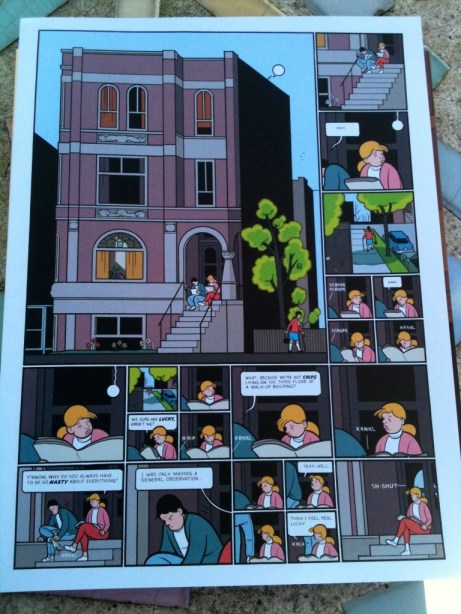
I just met uses a few pages to tell the story of a deteriorating relationship—what happens when two twenty-somethings turn into two mid-to-late-thirtysomethings?

The comic opens with an establishing shot of what I take to be the building in Building Stories; we also get a glimpse of what I assume will be another character, the beehive, and a few other details that surely will attach themselves to these panels in future readings. We also get the general bitter tone of the couple’s relationship:
20121021-201139.jpg

He was one of those dudes who was once in a band; she was one of those chicks who thought guys in bands were cool.

The romance of their initial hookup is summed up neatly in the pic below; knowing Ware’s spare, precise style, the trash on the floor seems to scream symbolic detail!

20121021-201147.jpg

The hurt and disappointment in I just met unfolds over just a few painful pages—painful mostly in their concrete reality.

We know who these people are, even if we’re lucky enough not to be them.

Just as in  Branford, the Best Bee in the World , which I read earlier (although, to be clear again, there are no reading directions or prescriptions for Building Stories), there’s a theme of eternal recurrence, of mistakes playing out again and again in a painful, recursive loop.

Just when Ware threatens to overstate the mundane repetitions his principals suffer, he pulls off a daring and effective move, transposing his characters into the psychic collective memory of a future that’s in many ways already familiar. The effect is simultaneously jarring and oddly reassuring—the promise that our capacity for human connection and deep empathy will never buckle under the threat of drastic technological change, but also suggesting that the cost of maintaining this emotional constant is deep, ugly pain.

20121021-201154.jpg

“Robinson Crusoe” — Kafka

“Robinson Crusoe” by Franz Kafka:

Had Robinson Crusoe never left the highest, or more correctly the most visible point of his island, from desire for comfort, or timidity, or fear, or ignorance, or longing, he would soon have perished; but since without paying any attention to passing ships and their feeble telescopes he started to explore the whole island and take pleasure in it, he managed to keep himself alive and finally was found after all, by a chain of causality that was, of course, logically inevitable.


Portrait of the Author Fyodor Dostoevsky — Vasily Perov

William H. Gass on Robert Walser: “His Is the Perfect Stroller’s Psychology”

William H. Gass on Robert Walser. From Gass’s introduction to Masquerade and Other Stories; also collected in Gass’s Finding a Form.

List with No Name #11

  1.  The Sailor Who Fell From Grace With the Sea
  2. The Big Sleep
  3. The Way of All Flesh
  4. Woodcutters
  5. The Melancholy of Resistance
  6. Aurelia and Other Writings
  7. The Hearing Trumpet
  8. The Invention of Morel
  9. The Narrow Road to the Deep North and Other Travel Sketches
  10. Today I Wrote Nothing
  11. The Red and the Black

The sound of pommelling on a sofa in Ulysses by James Joyce

From Wye’s Dictionary of Improbably Words.

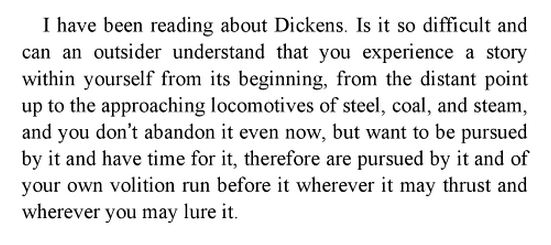
“I have been reading about Dickens” (Kafka)

(From Kafka’s Diaries).