
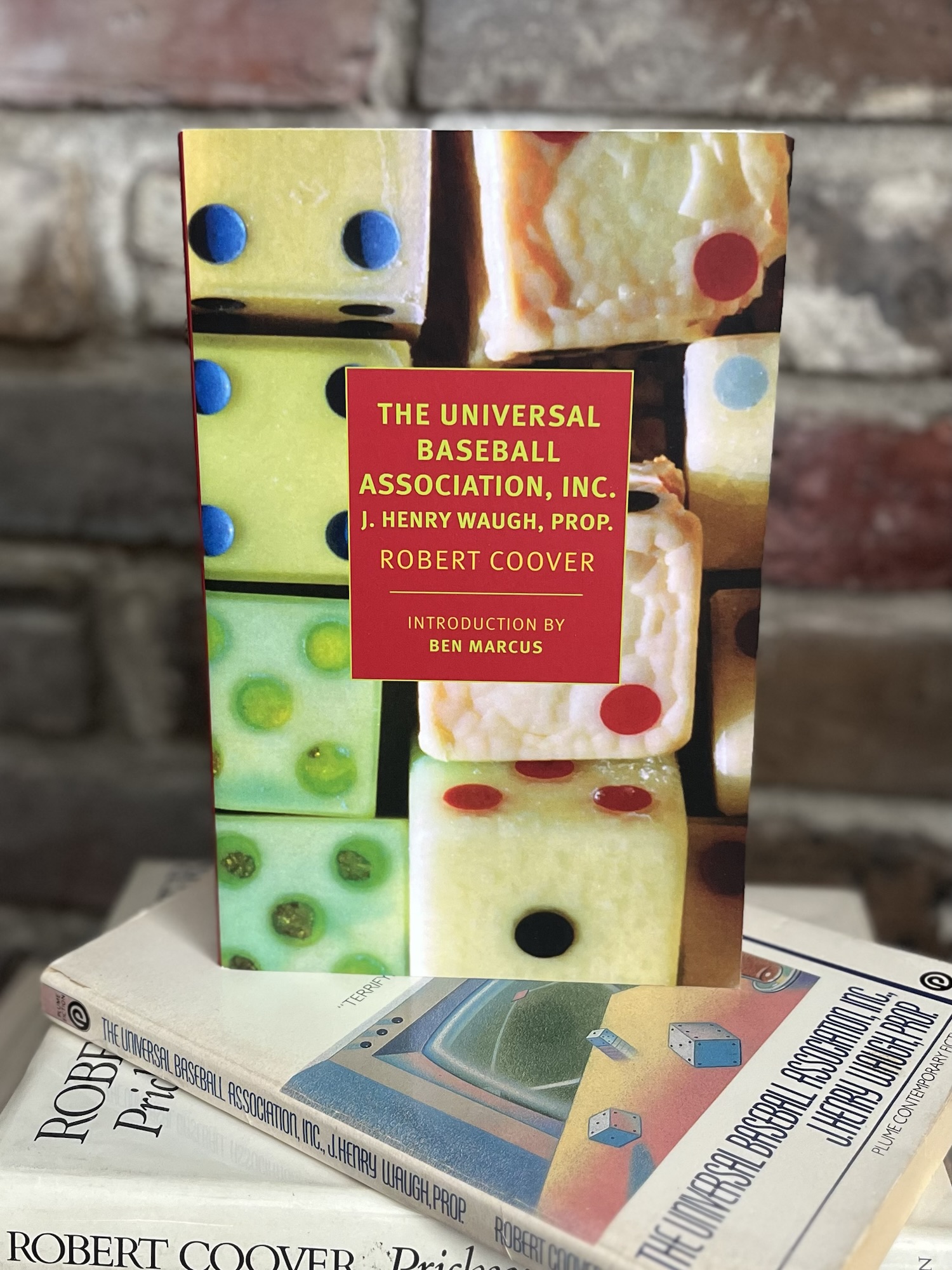
Robert Coover’s sophomore novel The Universal Baseball Association, Inc., J. Henry Waugh, Prop. is in print again via New York Review Books, with a new introduction by Ben Marcus. First published in 1968, The Universal Baseball Association connects the comparatively grounded late modernism of Coover’s first novel The Origin of the Brunists (1966) to the more overtly experimental postmodern fiction he became best known for — works like The Public Burning (1977), Spanking the Maid (1982), and Gerald’s Party (1986). In this light, The Universal Baseball Association makes an accessible point of entry into Coover’s oeuvre. (Coeuvre? Sorry. Sorry!) The Universal Baseball Association offers the conceptual daring and formal play of Coover’s mature work framed within a more emotionally-accessible narrative. Along with the metatextual fables collected in Pricksongs & Descants, it makes a strong starting place for readers coming to Coover for the first time. And unlike the zany and morally-elastic stories in Pricksongs & Descants (and a lot of Coover’s later work), UBA retains a realistic emotional core that many readers look for. It gives us someone to care about.
That someone is Henry Waugh, an accountant who spends his nights running a solitary baseball league of his own invention. He conjures his Universal Baseball Association with dice, elaborate scorecards, and meticulous record books — but most of all imagination. Henry’s is a coherent, vibrant world, a closed system with its own history, genealogy, politics, and language.
From the novel’s outset we sense that Henry’s game has already surpassed the imaginative confines of a normie’s pastime. Now in its fifty-sixth season, The Universal Baseball Association is an immersive, generative world, rich in folklore, mythos, culture. We also see (as those around him can see) that his fantasyland threatens to subsume him entirely. Our boy is hardly excelling at his day job, as his concerned coworker Lou points out. Much of the novel’s early tension comes from Henry’s attempt to bridge his fantasy world to the “real” world. But his endeavors to recruit others to the game fail.
Still, Henry tries. Early on, he describes his project to his “old friend” Hettie, a “neighborhood B-girl” he takes home from a dive bar after a few (too many) drinks:
“I’m an auditor for a baseball association.”
“I didn’t know they had auditors, too,” she said.
“Oh, yes. I keep financial ledgers for each club, showing cash receipts and disbursements…And a running journalization of the activity, posting of it all into permanent record books… Politics, too. Elections. Team captains. Club presidents. And every four years, the Association elects a Chancellor, and I have to keep an eye on that.”
Inebriated Henry boasts, fumbles, and flirts with Hettie; the scene is pure Coover — manic horniness wrapped in nerdiness (or maybe vice versa). Henry continues his awkward seduction with this zinger:
He took a grip on her behind. “People die, you know.”
It excites Hettie! And sure, hypothetical deaths on a game boy’s ledger are, like, sexy. It’s Henry’s idealism that really soars here though. He describes the hunt for perfection that drives his exquisite archival project:
…what a wonderful rare thing it is to do something, no matter how small a thing, with absolute unqualified utterly unsurpassable perfection! …to do a thing so perfectly that, even if the damn world lasted forever, nobody could ever do it better, because you had done it as well as it could possibly be done. …In a way, you know, it’s even sad somehow, because, well, it’s done, and all you can hope for after is to do it a second time.
How sad is Henry’s satisfied melancholy? — or is it melancholic satisfaction? A thing done perfectly is finished, fixed, closed. The league’s record books promise such permanence, but in doing so foreclose living possibility into completed fact. What could happen becomes only what has happened.
Henry tries to counter that closure by designing a system that lives, generates, and regenerates. He rejects games that repeat themselves mechanically, like pinball, which he dismisses as “a static game, utterly lacking the movement, grace, and complexity of real baseball.” Instead, he builds a structure governed by controlled randomness. It’s worth quoting at length some of Henry’s process to give you a taste of his rational mania:
When he’d finally decided to settle on his own baseball game, Henry had spent the better part of two months just working with the problem of odds and equilibrium points in an effort to approximate that complexity. Two dice had not done it. He’d tried three, each a different color, and the 216 different combinations had provided the complexity, all right, but he’d nearly gone blind trying to sort the colors on each throw. Finally, he’d compromised, keeping the three dice, but all white, reducing the total number of combinations to 56, though of course the odds were still based on 216. To restore—and, in fact, to intensify —the complexity of the multicolored method, he’d allowed triple ones and sixes—1-1-1 and 6-6-6—to trigger the more spectacular events, by referring the following dice throw to what he called his Stress Chart, also a three-dice chart, but far more dramatic in nature than the basic ones. Two successive throws of triple ones and sixes were exceedingly rare—only about three times in every two entire seasons of play on the average—but when it happened, the next throw was referred, finally, to the Chart of Extraodinary Occurrences, where just about anything from fistfights to fixed ball games could happen. These two charts were what gave the game its special quality, making it much more than just a series of hits and walks and outs. Besides these, he also had special strategy charts for hit-and-run plays, attempted stolen bases, sacrifice bunts, and squeeze plays, still others for deciding the ages of rookies when they came up, for providing details of injuries and errors, and for determining who, each year, must die.
That final detail, must die, is crucial. Mortality is a rule of the UBA, a key ingredient to the league’s emotional, psychological, and moral ballast. Death gives the game stakes, introducing irreversibility into an otherwise repeatable system. Death also exposes the risk at the heart of Henry’s design. The same randomness that generates excitement also engenders loss. And Henry must submit to that randomness, even though he created it, even if it means killing off one of his most beloved players:
Oh, sure, he was free to throw away the dice, run the game by whim, but then what would be the point of it? Who would [the player] really be then? Nobody, an empty name, a play actor. Even though he’d set his own rules, his own limits, and though he could change them whenever he wished, nevertheless he and his players were committed to the turns of the mindless and unpredictable—one might even say, irresponsible—dice. That was how it was. He had to accept it, or quit the game altogether.
Henry is the great Creator of this system, but he’s also subject to its rules, an order of his own grace. The autonomy of the league depends on his restraint. Without the rules, the players would collapse into pure fiction (which of course they are); with the rules, the players acquire a simulacrum of reality.
These rules restrain Henry; they are the mechanism by which his inventions become more than inventions, and nowhere is that mechanism clearer than in the act of naming:
…name a man and you make him what he is. Of course, he can develop. And in ways you don’t expect. Or something can go wrong. Lot of nicknames invented as a result of Rookie-year surprises. But the basic stuff is already there. In the name. Or rather: in the naming.
Like Adam naming the animals, Henry brings his players into being through language. They do not preexist their names. Naming is not just merely descriptive, but generative. Once named, a UBA player can develop, succeed, fail, even die, but nothing happens until the name enters the system.
(An aside: in the UBA, Coover gives his contemporary Thomas Pynchon a run for his money in the zany names department. (Zany songs, too, but this review is already bloated.))
The naming, the rules, the chronicles are all bound in the auspiciously-capitalized archive of the Universal Baseball Association, The Book. A grandiose tome,
it consisted of some forty volumes, kept in shelves built into the kitchen wall, along with the permanent record books, league financial ledgers, and the loose-leaf notebooks of running life histories. He seemed to find more to write about, the more he played the game, and he foresaw the day when the number of archive volumes would pass the number of league years.
Too, Henry’s Book is an amalgam of discursive textual approaches, all filtered through his manic imagination:
Style varied from the extreme economy of factual data to the overblown idiom of the sportswriter, from the scientific objectivity of the theoreticians to the literary speculations of essayists and anecdotalists. There were tape-recorded dialogues, player contributions, election coverage, obituaries, satires, prophecies, scandals…His own shifting moods, often affected by events in the league, also colored the reports, oscillating between notions of grandeur and irony, exultation and despair, enthusiasm and indifference, amusement and weariness. Lately, he had noticed a tendency toward melancholy and sentimentality. He hoped he’d get over it soon.
Henry’s archive expands, its relentless growth challenging the Association’s foundations. Record-keeping no longer mediates the league but rather constitutes it, collapsing the distinction between event and commentary. Statistics, essays, interviews, and speculative fragments stand on equal footing, none quite stabilizing the others. In this sense, the novel anticipates the metatextual logic of later works like the stories of Pricksongs & Descants and The Public Burning, where narration proliferates without authority and systems generate their own interpretive noise. Henry’s text-making generates layers of discourse that displace rather than resolve one another, much as Coover’s infamous story “The Babysitter” multiplies incompatible narrative versions without privileging a final account. The archive thickens without coherence. Henry’s attempt at a complete archive results in formal excess. It’s born of love, or obsession, or both, but Henry’s discursive text-making ultimately exposes the instability of both the league and the act of narration itself.
Coover juxtaposes the league’s self-enclosed textual machinery against the crowded, bodily immediacy of Henry’s everyday life. Scenes with his coworker Lou, especially in bars and restaurants, are full of conflicting textures and excess:
They bundled in, warm odors assailing them gently, past a sign that read: Go thy way and eat thy bread with joy! Piped-in radio music floated over the kitchen noises, the whump of doors, rattle of cocktail shakers, the bubble and buzz of underwater voices. Walls in a lush green with gold sparkle, cedar wainscoting, soft glow throughout, yet at the same time, linoleum floors and tawdry leatherette booths. Frilly lamps at the tables like little flowers, massive paintings and prints of whaling ships and dead pheasants on the walls. Elegant bar of carved wood in the romantic style, but the tabletops were cheap speckly formica. Dark-suited business types were conferring in one booth, young kids necking in the next. Yet somehow it all hung together okay.
Their meal (in Coover’s Henry’s free indirect imagination) tips into vivid grotesquerie:
Pink sea monsters, washed up on a shore of lettuce leaves and parsley, arrived, iced, their pungent sauce piercing through the present aroma of the Old Fashioneds’ bitters like an arrow: zingo! right to the nose! and to the palate! terrific!
The real world is messy, abject, excessive, embodied, lacking the clean structure of the league, but alive in a way the league cannot be. In the real world, bodies eat, drink, touch, but meaning is diffuse, nothing is fully accounted for. Real reality is a system without closure, with no stabilizing center. The UBA is Henry’s answer to messy reality.
But so and when the aforementioned tragic death of a beloved player occurs, Henry finds his fantasyland shaken, destabilized in ways his imagination had not anticipated. His careful system, with its ledgers and tables and charts cannot make meaning of the grief he feels. Already predisposed to melancholy, Henry slides into a depression that league play cannot resolve. There’s no joy in the game. A veteran player diagnoses the situation succinctly:
What if…we have passed, without knowing it, from a situation of sequential compounding into one of basic and finite yes-or-no survival, causing a shift of what you might call the equilibrium point, such that the old strategies, like winning ball games, sensible and proper within the old stochastic or recursive sets, are, under the new circumstances, insane!
By the outset of the novel’s final third act, Henry is in a bad place:
Not once, in the Universal Baseball Association’s fifty-six long seasons of play, had its proprietor plunged so close to self-disgust, felt so much like giving it up, a life misused, an old man playing with a child’s toy; he felt somehow like an adolescent caught masturbating… He was destroying the Association, he knew that now. He’d kept no records, hadn’t even logged a single entry in the Book.
As the UBA unravels, so do Henry’s relationships in the real world. He alienates and insults Hettie and his drunken bid to get Lou to play the game with him ends in another intrusion of wet, messy reality — Lou spills beer over the Henry’s charts and ledgers, the corporeal material of the game.
Dejected and alone in his apartment, drunkenly spinning, Henry returns to his game, a vengeful God cheating at dice to produce a 6-6-6 roll in an act of premeditated murder. The Creator has finally violated his own rules. Reality then literally spews out of our Henry, as he abjectly vomits “a red-and-golden rainbow arc of half-curded pizza over his Association” before passing out.
As the penultimate chapter begins, Henry has settled down a bit. The UBA’s season is over with no fanfare, no additional textuality beyond raw stats: “Journalists quit writing, just watched. Nobody interviewed anybody. No one sought autographs.” Nothing more to write.
Revivified, but a bit insane, Henry finds a way back to the “perfection” he’s previously thought, but now understands it as something from the insulated system he’d previously imagined:
he’d discovered…that perfection wasn’t a thing, a closed moment, a static fact, but process, yes, and the process was transformation…
By the end of the chapter, our hero transforms, synthesizing the imaginative and the real. A fantasy baseball player walks into a bar. There he finds all his favorite figments:
…Witness York and Ham Craft and Maggie Everts and Walt McCamish and Bo McBean, here they come! and Rag Rooney and Jaybird Wall and Cash Bailey with his champion Patsies, the whole goddamn whooping and hollering lot of them! and Chauncey O’Shea and Royce Ingram!
Our hero is finally subsumed into the game. He will not appear again in the novel.
The final, eighth chapter is set a hundred years in the future (the future of the UBA, that is), and is populated by the league descendants of Henry’s creation, now more philosophical (and disembodied) than ever. As one player remarks:
We have no mothers… The ripening of their wombs is nothing more than a ceremonious parable. We are mere ideas, hatched whole and hapless…”
The players have moved on to their own meta-narratives, without the authorial impositions of Henry. A kind of fatalistic-but-perhaps-optimistic view takes hold: “Even if there weren’t [a record-keeper], I think we’d have to play the game as though there were,” one player remarks.
The novel ends with a baseball game, a match nestled comfortably into a mythology generated from fateful Season LVI (a season so fateful that it rattled the Creator J.W.H. such that he has disappeared from the narrative). Descendants of that season’s two victims face off as pitcher and batter — but with the reassurance of the new perfection:
“It’s not a trial,” says Damon, glove tucked in his armpit, hands working the new ball. …”It’s not even a lesson. It’s just what it is.”
The radical inconclusiveness here is mirrored in Coover’s architecture for his eight-chapter baseball novel, which refuses to give its readers a perfect ninth inning. The structure seems to dare the reader to imagine that ninth inning.
In the Universal Baseball Association, games require a witness. The continuity of record keeping requires the fiction of someone who guarantees continuity. The league persists only at the cost Henry has been paying from the start: life displaced by its administration. For The Universal Baseball Association, Inc., J. Henry Waugh, Prop., the reader is the witness, called up to Coover’s minor majors (or is that vice versa?). It’s a workout for the imagination, I suppose — rules, events, records, history, myth.
And it’s more fun than I think I’ve expressed here — I’ve quoted Coover’s prose at length, maybe too much, but I don’t think I’ve fully conveyed how rich and hardy the text is, how warm and comforting the world that he conjures is, populated by singers and slingers and general bonhomie. It’s Famous Times All the Time, except when it’s melancholy, sad, or just plain bonkers. The Universal Baseball Association is part of the great American postmodern canon. Come and play.






 Biblioklept
