I’ve been meaning to watch William Friedkin’s 2006 film Bug for years but always found an excuse not to until earlier today, when the sky outside was grey and rainy enough for some psychological horror.
Bug’s horror is initially understated, fueled more by queasy tension and psychological drama than gore. Ashley Judd plays the lead, Agnes, who is slowly unraveling. She spends most of her time in a shitty rent-a-room at the Rustic Motel, where she takes drugs and alcohol to cover over the pain of losing her child. The crumpled dollar bills and jar of change we see early on, tips from her waitress job at a lesbian bar, are clearly running low. She can’t afford her cocaine habit. Slovenly and sweaty, her character’s depressed anxiety is neatly summed up in the two seconds she takes to “wash” a dirty plate by running it under the faucet and rubbing it with her naked hand. She then wipes her hand off on her shirt before cracking open a bottle of cheap wine.
She uses the alcohol not only to tamp down her pain, but also to numb herself against the incessant phone calls she gets from what she believes is her violent husband, an ex-con played by Harry Connick Jr. No one ever responds when she answers the phone.
That phone rings throughout the film, and in some ways it’s an organizing principle. It’s the first sound we here in the film—and the last, if we stick around through the credits (I have a theory about that if anyone’s interested).
The ringing phone immediately follows the film’s strange opening shot, a tableaux that doesn’t give the viewer any time get his bearings—it’s a strange neon room with a prone body in it. We eventually get there—and the shot repeats after the film’s credits. After that opening shot, Friedkin gives us a long, slow, gorgeous night time zoom in of the film’s primary setting, the Rustic Motel (in rural Oklahoma). The shot—the most open and free the viewer will be allowed to feel for the rest of Bug’s 100 minutes—parachutes us in gracefully to a weird, paranoid narrative.
Judd’s Agnes finds a partner in paranoid loneliness in Peter, a strange stranger played by Michael Shannon. Agnes’s friend RC introduces her to Peter, who watches the pair party while generally abstaining from drugs and alcohol and conversation. He does however mutter that he’s not a psycho. Shannon initially inhabits his role with a gentle oddity that recalls Billy Bob Thornton in Sling Blade, but his character’s paranoid potential for violence escalates when Agnes’s abusive ex tries to reenter her life. Oh, and the bugs. The bugs make everything worse.
Based on a play by Tracy Betts (who also wrote the screenplay), Bug’s greatest strength is its smallness. After its expansive sky-born opening shot, the film simply contracts into a claustrophobic small hell. There are only four main players, and most of the action is limited to Agnes’s room in the Rustic Motel, which Peter remodels, slowly transforming the room into a neon hell. Friedkin films Bug in lurid neon noir. The film feels of a piece with Denis Johnson’s novel Angels or Yuri Herrera’s recent mythological crime novels, and it undoubtedly found an admirer in Nicolas Winding Refn. His loose neon trilogy of Drive, Only God Forgives, and The Neon Demon share the same dark but vivid color palette that Friedkin conjures in Bug.
The first third of the film is arguably its strongest. Friedkin lets the plot come to slow boil. The narrative tangles into itself with a lugubrious, nervous energy that eventually boils over in a third act that relies heavily on the strength of maniac performances from Judd and Shannon, as well as Friedkin’s claustrophobic shots and wild lighting. How much a viewer likes Bug depends on how much that viewer allows himself to be entangled into the insanity at its end.
I’m glad I finally got around to Bug, but unlike Friedkin’s early films The French Connection and The Exorcist, I doubt I’ll watch it again. (And none of these are in the pantheon of his 1977 masterpiece Sorcerer, which I have literally made house guests watch with me on at least two occasions). It does remind me that I’ve yet to watch his films To Live and Die in L.A. and Killer Joe, which I will make a point of getting to this summer.
How I watched it: At first on an iPad via streaming service with earbuds very late at night, and incompletely (fell asleep or passed out 30 minutes in). Then, full rewatch via streaming service on a large television, with full attention.
I watched Martin Scorsese’s 1982 film The King of Comedy last weekend and then added it to a list of examples for a much bigger Thing I’ve been working on for a few years (and hence will never likely finish, unlike these Blog about posts). The much bigger Thing is about the relationship between Comedy and Horror—not purely the formal characteristics that belong to specific genres of literature, film, and art, but rather the relationship between the emotions themselves (with special attention to how literature, film, and art evoke that relationship).
The short thesis for this bigger Thing is that I think that comedy relies strongly on horror, and that the best provocations of horror are tempered in humor. There is a long list of examples in support of this thesis, including Goya and Bolaño and Larry David and Don Quixote and Candide and Thomas Bernhard and Surrealism and Get Out and etc. —-but that’s all for said bigger Thing, and the title of this post seems to promise Something (not a big Thing) on Martin Scorsese’s 1983 film The King of Comedy, which I recently rewatched.
I first saw The King of Comedy in the spring of 1998. I was a freshman at the University of Florida and had quickly discovered their library of films on VHS, which I would imbibe over my four years there. I started with stuff I was already a bit familiar with though. Like every other stupid eighteen-year old, I thought Taxi Driver was A Work of Genius (without fully understanding it), and I’d seen Goodfellas and Casino approximately one thousand times by this point. I started UF’s collection of Scorsese tapes with the neo-neorealism of Raging Bull, a brutal and hence thoroughly comprehensible character study, an ugly film shot in gorgeous black and white. The King of Comedy was next.
The internet in 1998 was not the internet of 2018. What I mean is that we generally learned about films through books and journals and magazines, or really other films, or really, really by word of mouth. I don’t think I had any word of mouth on The King of Comedy—what I mean is that I think I thought the film was a comedy. Which it is. Sort of. I mean, it’s funny—-very funny sometimes. But it’s also very cruel, and often scary and off putting, and generally queasy.
The King of Comedy stars Robert De Niro as Rupert Pupkin. That ridiculous name is on one hand a running joke, but on the other hand a vein of horror that pulsates throughout the film—an aberrant twitching oddity, a sort of literal curse, both on poor Rupert (who bears that name) and on every person who encounters him. Rupert is a would-be comedian who dreams (literally and often from his mother’s basement) of stardom. He dreams that he’ll achieve this stardom through a spotlight gig on The Jerry Langford Show, a Carson-style late night show hosted by Jerry Langford, played by a wonderfully fed-up Jerry Lewis.
Rupert is an autograph hound, an obsessive type of fan who makes Jerry’s life a literal terror. Rupert’s foil is Masha, a trust-fund baby played by Sandra Bernhard. Masha stalks Jerry with extreme competitive anxiety; her stalking is a lifestyle elevated to art. When Masha goes too far early in the film and hijacks Jerry’s limo, Rupert sees an opening—he saves the day, ousting Masha, but then he invades the limo (proving himself stalker supreme over Masha). In the limo ride, Rupert asks Jerry for help in advancing his career, and Jerry gives generous if general advice, which amounts to Put the work in and pay your dues. Rupert complains that he simply doesn’t have time to invest in doing the real hard grinding work, and basically demands that Jerry give him a shortcut.
In showing a deranged would-be artist who feels he’s entitled to bypass the years of work involved in honing a skill, Scorsese anticipates our current zeitgeist. Rupert Pupkin desires fame, adoration, and applause, but he is far less interested in producing an art that would earn these accolades. The King of Comedy slowly shows us that Pupkin is mentally ill, and that his disease is radically exacerbated by a culture of mass media.
The King of Comedy’s most sarcastic biteis that Rupert is eventually rewarded for his deranged behavior. He and Masha kidnap Jerry as part of a plan to get Rupert an opening set of The Jerry Langford Show. The plan succeeds, and Rupert executes it so that he not only gets to land his dream gig, he also gets to watch himself do it in front of The Girl He Liked in High School:
Rupert’s audacious gambit is part and parcel of a postmodern mass media era that makes only the slightest distinction between fame and infamy. Rupert is famous for doing something famous—and something horrific, kidnapping a beloved TV host. It’s his one bit of work, but it’s enough to land him a book deal, celebrity, and money (and a fairly short prison sentence).
Parts of Rupert’s monologue are funny, but other parts read like the memoir of a damaged soul trying to recover from an abusive childhood. And maybe these parts mix. Again, horror underwrites comedy.
This horror repeats in Scorsese’s framing of Rupert’s routine. There’s a dream-like quality to the monologue, with its television tube frame. This is not the first time we’ve seen this framing in King of Comedy—we get similar TV fantasies via Rupert’s deranged mind—but this time the plot asks us to think of it as “real,” even as Scorsese’s aesthetics suggest that the ending of the film may all be in Pupkin’s warped mind, the unseen clapping audience just another delusion of grandeur.
The same gesture is present at the end of Taxi Driver, which is essentially the twin of The King of Comedy. Travis Bickle—another ridiculous name, another loser—improbably ends up the hero of the narrative. But the conclusion of Taxi Driver has always struck me as the internal fantasy of its reactionary (anti-)hero. Likewise, The King of Comedy concludes in yet another fantasy in Rupert Pupkin’s addled consciousness.
With its metatextual contours and its insinuations of reality-as-mediated-by-mass-media, The King of Comedy is perhaps Scorsese’s most formally postmodern film (although his smaller follow-up After Hours might be his most thematically postmodern). It’s no wonder that the film didn’t land with audiences in 1983. Beyond its postmodern rhythms, The King of Comedy is essentially repulsive—nothing good happens; there is no clear hero; the world it depicts is devoid of any meaning not centered in relation to fame. Its satire is so black no light escapes. In comparison, Scorsese’s later films like Goodfellas and The Wolf of Wall Street are laugh riots.
The genius of The King of Comedy is something best felt. The film disrupts genre conventions (and audience expectations), pushing a comedy into a horror. Or maybe The King of Comedy is a horror film with comedic overtones. Or, really—I mean, what I really want to say here is:
The King of Comedy isn’t a horror film or a comedy film—like many of Scorsese’s best films, it’s a character study—realistic and engrossing and grotesque in its utter realism. Time has caught up with it. If Rupert Pupkin seemed an extreme example of the kind of derangement and alienation that could be aggravated by a mass media culture in the early 1980s, by today’s standards he’s perhaps charming. And that’s horrifying.
I have just finished Iris Murdoch’s 1958 novel The Bell. This is the first novel I have read by Murdoch and I now want to read more novels by Murdoch, which I suppose is the best praise I can offer the novel.
The Bell is set primarily in Imber House, a large old mansion in the English countryside. Imber House adjoins a Benedictine abbey; this nunnery is essentially closed off to the outside world. The residents of Imber House form a “brotherhood,” a laity of would-be acolytes who strive to find spiritual meaning in the commercial and often venal world of the postwar era. Various conflicts between these characters drive the plot of The Bell.
One of these conflicts, especially notable for a novel published in 1958, involves Michael, the leader of the Imber House community. A former schoolmaster who dreamed of joining the clergy, Michael lost his job in a small scandal for “seducing” one of his students, Nick, a teenage boy at the time. Over a decade later, circumstance brings Nick to Imber House, where his twin sister Katherine is staying. Katherine plans to join Imber Abbey; in the meantime, her family hopes that the religious solitude at Imber House will help Nick recover from his alcoholism. The conflict between Michael and Nick becomes further charged when the youngest member of Imber House, a teenager named Toby, befriends both of them.
I could go on about Michael and Nick and Toby and Katherine and etc., but the real star of The Bell is Dora Greenfield, a wonderfully complicatedly simple unassuming unpretentious flighty former art student who has recently left her demanding husband Paul. Through Murdoch’s precise free indirect style, we get to inhabit Dora’s constantly vacillating mind. Like many people, Dora does not know what she is going to do, and even when she thinks through a plan, she often ends up doing the opposite of what she had intended to do. There is a hilarious passage in the novel’s first chapter when Dora goes through a lengthy imaginative exercise about giving up her train seat to an elderly woman. Dora’s thought experiment ends like this:
She decided not to give up her seat.
She got up and said to the standing lady ‘Do sit down here, please. I’m not going very far, and I’d much rather stand anyway.’
The blank space between those sentences highlights a radical gap between contemplation and action.
The train-seat passage is one of many humorous episodes in The Bell, but Murdoch’s humor is underwritten by a deeper menacing anxiety, which can be neatly summed up in the novel’s opening sentences:
Dora Greenfield left her husband because she was afraid of him. She decided six months later to return to him for the same reason.
Those opening lines basically summarize the big thematic plot of The Bell—the conflict between controlling and ultimately abusive Paul and his much younger wife. (“She married him a little for his money,” Murdoch writes just a few paragraphs in, wedging the detail between more positive aspects of Paul’s character–the “a little” is just genius there, the slightest omission from Dora’s consciousness slipping into the third-person narrator for the briefest of moments). The opening lines of The Bell also showcase Murdoch’s rhetorical powers. Her comic precision here reverberates with a hazardous undertone.
Will Dora really return to her husband? Or will she become her own person—whatever that means? The Bell satisfies these questions with complex answers. The novel has every opportunity to veer toward pat conclusions. Murdoch fills her novel with images that suggest a conventional tragic conclusions, and then surpasses these conventions, turning them into something else. A death by drowning might be foreshadowed, but someone will learn to swim; an epiphany achieved in an art museum might not meet its achievement outside of aesthetic response; the Blakean contraries of innocence and experience might be synthesized into a new, original viewpoint. There’s something real about The Bell—it offers a realism that points outside of its own literary contours. The English novelist A.S. Byatt puts it far better than I can in her essay “Shakespearean Plot in the Novels of Irish Murdoch”:
…The Bell seems to me arguably Miss Murdoch‘s most successful attempt at realism, emotional and social—the tones of voice of the members of the religious community are beautifully caught, the sexual, aesthetic and religious passions and confusions of the three main characters, Dora, Michael, and, to a lesser extent, Toby, are delicately analysed with the combination of intellectual grasp and sensuous immediacy of George Eliot.
Byatt’s comparison to Eliot reminds me that I had intended to read Middlemarch some time this year—but to be fair to myself, I put The Bell on the same list. I won’t be reading Middlemarch next though; The Bell, with its story of a would-be utopian community, strongly reminded me of Nathaniel Hawthorne’s The Blithedale Romance, which I haven’t read in ages. And after I read that, I’d like to read another one by Iris Murdoch. Any recommendations?
I took a few paperback books with me when I went camping two weeks ago, but I didn’t actually read from them. Instead, I wound up reading (or rereading in some cases) a few of the tales in Stephen Crane’s collection The Open Boat and Other Stories, which I downloaded from Project Gutenberg onto my iPad thanks to a data connection from my phone. Rain was pouring down on my tent and for some reason, I want to reread “The Bride Comes to Yellow Sky,” popped into my head, so I made it happen. I don’t know how these details are germane to anything I am trying to say here.
What I am trying to say here is that I didn’t read “The Bride Comes to Yellow Sky” right away. Instead, I read a story I’d never read before, “A Man and Some Others.” This tale contains some of the most fantastic sentences I’ve read in ages. (This is what I’m trying to say here: That “A Man and Some Others” contains some magical fucking prose).
Here is the opening paragraph:
Dark mesquit spread from horizon to horizon. There was no house or horseman from which a mind could evolve a city or a crowd. The world was declared to be a desert and unpeopled. Sometimes, however, on days when no heat-mist arose, a blue shape, dim, of the substance of a spectre’s veil, appeared in the south-west, and a pondering sheep-herder might remember that there were mountains.
I confess that I might have had some beers and Bushmills that evening, but I read and reread the opening sentences of “A Man and Some Others” in a little loop, hypnotized by the way Crane’s prose collapses human agency into an overwhelming naturalism—a naturalism with just the slightest Romantic touch of “a spectre’s veil.” (In “The Open Boat,” Crane demonstrates a more masterful and more complete grappling of naturalism resisting (and perhaps ultimately synthesizing) the Romantic traces of his transcendentalist forebears. But that’s a topic for another riff).
“A Man and Some Others” is about a cowboy named Bill. Threatened off a range that he claims as his own by Mexican ranchers who see otherwise, Bill retaliates. Along the way he meets a stranger—a stand-in for Crane, perhaps—who bears witness to the whole fandango. As a story, “A Man and Some Others” is slight, a thin premise that exists primarily as a space for Bill to swagger around in for a few pages. Sure, there could be a critique of Manifest Destiny somewhere in there, but Crane’s tale never coheres into a fully realized allegory or satire (as the poet John Berryman pointed out in his study of Crane, “Crane‘s humor, finally, and his irony are felt as weird or incomprehensible.” Berryman was referring to War Is Kind, but the description fits here as well).
Crane’s humor and irony are on vivid display in the six paragraphs that make up the second short chapter of “A Man and Some Others.” In this section, we get the improbable and wild life story of Bill, which reads on the one hand as a hyperbolic archetype of American machoism, a kind of fabulous legend of Manifest Destiny. On the other hand, Bill’s bio strikes the reader as so thoroughly and lovingly true that it seems Crane must have wholly plagiarized the life of a real individual (or at least combined a few wild but true stories from a handful of folks).
I won’t comment any further, but instead offer those six paragraphs, which I simply could never improve upon:
Bill had been a mine-owner in Wyoming, a great man, an aristocrat, one who possessed unlimited credit in the saloons down the gulch. He had the social weight that could interrupt a lynching or advise a bad man of the particular merits of a remote geographical point. However, the fates exploded the toy balloon with which they had amused Bill, and on the evening of the same day he was a professional gambler with ill-fortune dealing him unspeakable irritation in the shape of three big cards whenever another fellow stood pat. It is well here to inform the world that Bill considered his calamities of life all dwarfs in comparison with the excitement of one particular evening, when three kings came to him with criminal regularity against a man who always filled a straight. Later he became a cow-boy, more weirdly abandoned than if he had never been an aristocrat. By this time all that remained of his former splendour was his pride, or his vanity, which was one thing which need not have remained. He killed the foreman of the ranch over an inconsequent matter as to which of them was a liar, and the midnight train carried him eastward. He became a brakeman on the Union Pacific, and really gained high honours in the hobo war that for many years has devastated the beautiful railroads of our country. A creature of ill-fortune himself, he practised all the ordinary cruelties upon these other creatures of ill-fortune. He was of so fierce a mien that tramps usually surrendered at once whatever coin or tobacco they had in their possession; and if afterward he kicked them from the train, it was only because this was a recognized treachery of the war upon the hoboes. In a famous battle fought in Nebraska in 1879, he would have achieved a lasting distinction if it had not been for a deserter from the United States army. He was at the head of a heroic and sweeping charge, which really broke the power of the hoboes in that country for three months; he had already worsted four tramps with his own coupling-stick, when a stone thrown by the ex-third baseman of F Troop’s nine laid him flat on the prairie, and later enforced a stay in the hospital in Omaha. After his recovery he engaged with other railroads, and shuffled cars in countless yards. An order to strike came upon him in Michigan, and afterward the vengeance of the railroad pursued him until he assumed a name. This mask is like the darkness in which the burglar chooses to move. It destroys many of the healthy fears. It is a small thing, but it eats that which we call our conscience. The conductor of No. 419 stood in the caboose within two feet of Bill’s nose, and called him a liar. Bill requested him to use a milder term. He had not bored the foreman of Tin Can Ranch with any such request, but had killed him with expedition. The conductor seemed to insist, and so Bill let the matter drop.
He became the bouncer of a saloon on the Bowery in New York. Here most of his fights were as successful as had been his brushes with the hoboes in the West. He gained the complete admiration of the four clean bar-tenders who stood behind the great and glittering bar. He was an honoured man. He nearly killed Bad Hennessy, who, as a matter of fact, had more reputation than ability, and his fame moved up the Bowery and down the Bowery.
But let a man adopt fighting as his business, and the thought grows constantly within him that it is his business to fight. These phrases became mixed in Bill’s mind precisely as they are here mixed; and let a man get this idea in his mind, and defeat begins to move toward him over the unknown ways of circumstances. One summer night three sailors from the U.S.S. Seattle sat in the saloon drinking and attending to other people’s affairs in an amiable fashion. Bill was a proud man since he had thrashed so many citizens, and it suddenly occurred to him that the loud talk of the sailors was very offensive. So he swaggered upon their attention, and warned them that the saloon was the flowery abode of peace and gentle silence. They glanced at him in surprise, and without a moment’s pause consigned him to a worse place than any stoker of them knew. Whereupon he flung one of them through the side door before the others could prevent it. On the sidewalk there was a short struggle, with many hoarse epithets in the air, and then Bill slid into the saloon again. A frown of false rage was upon his brow, and he strutted like a savage king. He took a long yellow night-stick from behind the lunch-counter, and started importantly toward the main doors to see that the incensed seamen did not again enter.
The ways of sailormen are without speech, and, together in the street, the three sailors exchanged no word, but they moved at once. Landsmen would have required two years of discussion to gain such unanimity. In silence, and immediately, they seized a long piece of scantling that lay handily. With one forward to guide the battering-ram, and with two behind him to furnish the power, they made a beautiful curve, and came down like the Assyrians on the front door of that saloon.
Mystic and still mystic are the laws of fate. Bill, with his kingly frown and his long night-stick, appeared at precisely that moment in the doorway. He stood like a statue of victory; his pride was at its zenith; and in the same second this atrocious piece of scantling punched him in the bulwarks of his stomach, and he vanished like a mist. Opinions differed as to where the end of the scantling landed him, but it was ultimately clear that it landed him in south-western Texas, where he became a sheep-herder.
The sailors charged three times upon the plate-glass front of the saloon, and when they had finished, it looked as if it had been the victim of a rural fire company’s success in saving it from the flames. As the proprietor of the place surveyed the ruins, he remarked that Bill was a very zealous guardian of property. As the ambulance surgeon surveyed Bill, he remarked that the wound was really an excavation.
“The main difficulty with Stanisław Ignacy Witkiewicz,” writes Soren Gauger in his translator’s note for Narcotics, “is that no matter what he was writing, it seems he wished he were writing something else.” Witkiewicz’s playful (and occasionally frustrating) discursive style is on vivid display in the six essays that comprise most of Narcotics (new in hardback from Twisted Spoon Press). Witkiewicz’s stylistic twists are one of the joys of Narcotics. A moralizing diatribe might veer into medical discourse; private anecdotes might shift into a rant on class theory or a patchy precis of a book about physiognomy. (All delivered in a semi-ironic-yet-wholly-sincere tone). In the case of Witkiewicz’s essay “Peyote,” we go from “Elves on a seesaw. (Comedic number)” to “A battle of centaurs turned into a battle between fantastical genitalia.” This last note is preceded by the observation that “Goya must have known about peyote.”
“Peyote” is the most vivid and surreal of the essays in Narcotics. Unlike the other sections, this chapter most closely resembles a conventional drug diary. “Peyote” begins with Witkiewicz taking his first of seven (!) peyote doses at six in the evening and culminating around eight the following morning with “Straggling visions of iridescent wires.” In increments of about 15 minutes, Witkiewicz notes each of his surreal visions. The wild hallucinations are rendered in equally surreal language: “Mundane disumbilicalment on a cone to the barking of flying canine dragons” here, “The birth of a diamond goldfinch” there. Gauger’s translation conveys not just the wild imagery, but also the wild linguistic spirit of Witkiewicz’s prose.
The prose in “Peyote” most closely approximates the spirit of Witkiewicz’s wonderful paintings. Narcotics includes 34 full-color reproductions of Witkiewicz’s art, which is reason enough to pick up this volume. According to Narcotics’ blurb, Witkiewicz (or Witkacy as he is commonly known) “established rules and types for his portrait work, marking the paintings and pastels with corresponding symbols and abbreviations of the substances he had either taken or, in the case of alcohol and nicotine, not taken at the time.”
For example, we see that Witkiewicz has noted that he had ingested cocaine and eucodal (a semi-synthetic opioid) in order to paint the Portrait of Michal Jagodowski (below). Narcotics includes a helpful “List of Symbols” as a glossary for the shorthand Witkiewicz used both in the text of his writings and in his paintings. (Although “her (herbata): tea” is included in the gloss, this vice regretfully does not merit its own essay).
In addition to peyote, we get essays on nicotine, alcohol, cocaine, morphine, and ether (a list that may remind you of a certain Queens of the Stone Age jam). In “Nicotine,” Witkiewicz despairs that “A person deadened by tobacco and alcohol…seeks even more mind-numbing entertainment to relax,” whether that be the “utterly depraved cinema with its vacuous attempts at artistry,” or the “sensory narcotization through music” achieved by “station surfing” on the radio. (Even worse is “chronic and brainless dancing, that most monstrous of modern society’s unacknowledged plagues”).
In “Alcohol,” Witkiewicz concedes that “alcohol lets you perform actions at a particular moment that otherwise would not have been possible right then,” before launching into a sustained attack on alcohol as a creative crutch. His most convincing (and depressing) line here is “alcohol is boring. Anyone who has abused it even mildly knows this to be true.” (If this were a different sort of review, I might riff here a bit on the fact that I drank no fewer than three glasses of Cabernet Sauvignon while writing about Narcotics).
Witkiewicz, despite his exorbitant indulgences, is a bit of a snob—a modernist snob though. From frenzied, enthusiastic experience he warns us that “cocaine is one of the worst kinds of filth,” before plugging his cocaine novel Farewell to Autumn and offering a synopsis of one of the novel’s chapters, a so-called “cocaine orgy.” (The editors of Narcotics graciously include a brief selection from Farewell to Autumn, as well as additional essays by Witkiewicz on hygiene and other matters).
In the last two essays, Wietkiewicz hands the reins over to friends (designated drivers?). In “Morphine,” Bohdan Filipowski warns that, “before you can taste the sweets of narcotic paradises you must first be miserable, you must first travel through all manner of hell and suffering in life, only then to find yourself in addled stupefaction, which ultimately is all there is.” The essay “Ether” — a drug that packs a “powerful metaphysical wallop” is attributed to “Dr. Dezydery Prokopowicz,” a pseudonym for Wietkiewicz’s friend, poet Stefan Glass.
The admonition that “before you can taste the sweets of narcotic paradises you must first be miserable” is pretty much the thesis for Narcotics, a book that simultaneously celebrates and reviles drug use. Misery is the byword here, a word we find repeated in in Henri Michaux’s 1956 collection Miserable Miracle. Published a quarter century after Narcotics, the two volumes share much in common. Too, Narcotics picks up some of the threads that we find in Thomas De Quincey’s Confessions of an English Opium-Eater(1821)–that foregrounding of suffering, even if it also anticipates the (exhaustive) drug literature of the 1960s, which wasn’t nearly so reticent about banging the narcotic gong. And yet Witkiewicz seems to wink at us through all the moralizing and apologia, suggesting that, yes, narcotics, are, like, bad—they are a crutch, a shortcut, a substitute for true artistic inspiration—but he also shows how utterly modern the process of consuming mind-and-body-altering substances is. Witkiewicz comprehends the dangers of narcotics. He’s out there on the ledge, dancing around a bit, his foot wagging over the precipice, while he grins and says, “Hey, don’t try this at home.”
Try this at home. Stanisław Ignacy Witkiewicz’s Narcotics, translated from the Polish by Soren Guager is new in hardback from Twisted Spoon Press. Just Say Yes.
Let me start by erasing my own anxieties about “reviewing” The Last Jedi (2017, dir. Rian Johnson). I saw it over a month ago in a packed theater with my wife and two young children. We loved it. I haven’t seen it since then, although I’d like to. Because I’ve only seen it once, this “review” will be far lighter on specific illustrating examples than it should be. Now, with some of those (writing) anxieties dispersed, if not exactly erased:
The Last Jedi strikes me as one of the best Star Wars films to date, of a piece with The Empire Strikes Back (1980, dir. Irvin Kershner) and Revenge of the Sith (2005, dir. George Lucas).
Not everyone agrees with me. Clearly, a lot of people hated Rian Johnson’s take on Star Wars. I won’t repeat the laundry list of gripes about The Last Jedi, but instead offer this: the numerous noisy denunciations of The Last Jedi can be rebutted via the terms, tropes, and tones of any of the previous films themselves. Put another way, anything “wrong” (tone choices, plot devices, casting, etc.) with The Last Jedi can be found to be “wrong” with any of the previous films. Furthermore, I don’t intend to directly rebut gripes about The Last Jedi here. Most attacks on the film simply amount to iterations of, “This film did not do what I wanted this film to do,” to which my reply would be, “Well, good.”
“Well, good” — the passionate reactions to The Last Jedi show the film’s power—both narratively and more importantly, aesthetically—to disturb a cultural sense of what the Star Wars franchise “is” or “is not.” In burning down much of the mythos (again, both narratively and aesthetically) of the films that preceded it, The Last Jedi opens up new space for the series to grow.
I enjoyed The Last Jedi’s most immediate predecessor, The Force Awakens (2015, dir. J.J. Abrams), but was critical of its inability to generate anything truly new. Riffing on The Force Awakens, I wrote that the film “is a fun entertainment that achieves its goals, one of which is not to transcend the confines of its brand-mythos. . . [the film] takes Star Wars itself (as brand-mythos) as its central subject. The film is ‘about’ Star Wars.” And, more to the point:
Isn’t there a part of us…that wants something more than the feeling of (the feeling of) a Star Wars film? That wants something transcendent—something beyond that which we have felt and can name? Something that we don’t know that we want because we haven’t felt it before?
The Last Jedi transcends the narrative stasis of The Force Awakens. “Stasis” is probably not a fair word to describe TFA. Abrams’s film excited viewers, roused emotions, offered engaging new characters, and even killed off a classic character via the classic Star Wars trope of Oedipal anxiety erupting in violent rage. TFA’s stasis is the static-but-not-stagnant excitement of having expectations confirmed. In contrast, Rian Johnson’s The Last Jedi punctures viewer expectations at almost every opportunity, aesthetically restaging tropes familiar to the series but then spinning them out in new, unforeseen directions.
The Last Jedi echoes visual tropes from The Empire Strikes Back in particular. Indeed, many fans believed that Rian Johnson’s TLJ would (or even should) reinterpret Irvin Kershner and Lawrence Kasdan’s entry into the series, much as J.J. Abrams had restaged A New Hope (1977, dir. George Lucas) with The Force Awakens. Instead, Johnson pushes the Star Wars narrative into new territory, with an often playful (and sometimes absurd) glee that has clearly upset many fans.
Johnson’s (successful) attempt to reinvent Star Wars might best be understood in terms of what the literary critic Harold Bloom has called the anxiety of influence. Bloom uses the anxiety of influence to describe an artist’s intense unease with all strong precursors. To succeed, new artists must overcome their aesthetic progenitors. Bloom compares the anxiety of influence to the Oedipal complex. An artist has to symbolically kill what has come before in order to thrive.
An apt description of franchise filmmaking’s inherent anxiety of influence can be found in Dan Hassler-Forest’s essay “The Last Jedi: Saving Star Wars from Itself,” published last year in the Los Angeles Review of Books:
An overwhelming anxiety of influence predictably permeates any new director’s attempt to elaborate on the world’s most famous entertainment franchise. In J. J. Abrams’s hands, this anxiety was clearly that of a fan-producer struggling to meet other fans’ expectations while also establishing a viable template for future installments. In doing so, his cinematic points of reference never seemed to extend far beyond the Spielberg-Lucas brand of Hollywood blockbusters that shaped his generation of geek directors, and he tried desperately to make up for what he lacks in auteurist vision with energy, self-deprecating humor, and generous doses of fan service.
But Rian Johnson is a filmmaker of an entirely different caliber. Just as Irvin Kershner and Lawrence Kasdan once added complexity, wit, and elegance to Lucas’s childish world of spaceships and laser swords, Johnson makes his whole film revolve around characters’ fear of repeating the past, and both the attraction and the risk of breaking away from tradition.
A break with any tradition, however, paradoxically confirms the power of that tradition. Johnson understands and clearly respects the Star Wars tradition. Despite what his detractors may believe, Johnson hasn’t erased or trampled upon the Star Wars mythos in The Last Jedi; rather, as the Modernist manifesto commanded, he’s made it new. Continue reading “The Last Jedi and the Anxiety of Influence”→
George Orr is not well. The meek protagonist of Ursula K. Le Guin’s novel The Lathe of Heaven abuses prescription drugs in a desperate and unsuccessful attempt to stop himself from falling asleep. Orr doesn’t want to sleep because he believes that his dreams come true—that they literally alter reality—but in such a way that no one but Orr realizes that the world has changed. Orr gets caught using a “Pharmacy Card” that doesn’t belong to him, and is court-ordered to begin treatment with a sleep research psychiatrist, Dr. William Haber. Although Haber initially doesn’t believe Orr’s claim to be cursed with “effective dreams” that transform reality, he soon realizes that Orr’s dreams somehow do come true. Then, via hypnotic suggestion (and an “Augmentor” device), Haber begins wielding Orr’s gift/curse as a clumsy tool to “better” the world.
The world of The Lathe of Heaven is grim, gray, dystopian. Published in 1971 and set in Portland in the palindromic year of 2002, Le Guin’s novel is depressingly prescient. Not only does she capture the onset of seventies malaise (the ashes of hope that burned out in the sixties), she also points to a future of environmental catastrophe:
Very little light and air got down to street level; what there was was warm and full of fine rain. Rain was an old Portland tradition, but the warmth—70° F on the second of March—was modern, a result of air pollution. Urban and industrial effluvia had not been controlled soon enough to reverse the cumulative trends already at work in the mid-twentieth century; it would take several centuries for the CO2 to clear out of the air, if it ever did. New York was going to be one of the larger casualties of the Greenhouse Effect, as the polar ice kept melting and the sea kept rising…
This is also a world of urban sprawl, overpopulation, malnutrition, and total war (a clusterfuck in the Middle East, wouldn’t you know). The government is a vague and menacing presence here—vaguely totalitarian, vaguely Big Brotheresque. We learn of the “New Federal Constitution of 1984,” one of many references to Orwell’s book. (The most obvious is our passive hero’s name).
So it’s no wonder that Haber sets about to create a utopia, right? Wouldn’t you, like, try to make the world a better place if you could? Haber is repeatedly described as a “benevolent man”—Le Guin withholds the word dictator—but the central theme comes through repeatedly: Is it possible to alter reality for the greater good? Or do we simply exist in nature, a part of everything around us?
Haber’s experiments with Orr’s mind have unintended consequences. How might we, say, cure overpopulation? How about an awful plague. Orr’s “effective dreams” revise history, rewrite reality, remap consciousness. But he’s never quite able to pull off the massive tasks Haber sets for him—end racism, end war, cure the damaged ecosystem (Le Guin is extremely pessimistic on this last front). Orr is burdened with the consciousness of multiple realities, and feels deep guilt for his role in uncreation. He starts to go crazy:
“I am cracking,” he said. “You must see that. You’re a psychiatrist. Don’t you see that I’m going to pieces? Aliens from outer space attacking Earth! Look: if you ask me to dream again, what will you get? Maybe a totally insane world, the product of an insane mind. Monsters, ghosts, witches, dragons, transformations—all the stuff we carry around in us, all the horrors of childhood, the night fears, the nightmares. How can you keep all that from getting loose? I can’t stop it. I’m not in control!”
“A country, a people…Those are strange and very difficult ideas.”
— Four Ways to Forgivenss, Ursula K. Le Guin (1995)
—Each of the novels in Ursula K. Le Guin’s so-called Hainish cycle obliquely addresses Wells’s question by tackling those strange and very difficult ideas of “a country, a people.” The best of these Hainish books do so in a manner that synthesizes high-adventure sci-fi fantasy with dialectical philosophy.
—What am I calling here “the best”? Well—
The Left Hand of Darkness
Planet of Exile/City of Illusions (treat as one novel in two discursive parts)
The Dispossessed
—(How oh how oh how dare I rank The Dispossessed—clearly a masterpiece, nay?—so low on that little list? It’s too dialectical, maybe? Too light on the, uh, high adventure stuff, on the fantasy and romance and sci-fi. Its ideas are too finely wrought, well thought out, expertly cooked (in contrast to the wonderful rawness of Rocannon’s World, for example). None of this is to dis The Dispossessed—it’s probably the best of the Hainish books, and the first one casual readers should attend to. (It was also the first one I read way back when in high school)).
—The novels in Le Guin’s so-called Hainish cycle are
Rocannon’s World (1966)
Planet of Exile (1966)
City of Illusions (1967)
The Left Hand of Darkness (1969)
The Dispossessed (1974)
The Word for World is Forest (1976)
Four Ways to Forgiveness (1995)
The Telling (2000)
—Okay, so I decided to include For Ways to Forgiveness in the above list even though most people wouldn’t call it a “novel” — but its four stories (novellas, really) are interconnected and tell a discrete story of two interconnected planets that are part of the Hainish world. And I pulled a quote from it above. So.
—(I keep modifying “Hainish cycle” with “so-called” because the books aren’t really a cycle. Le Guin’s world-building isn’t analogous to Tolkien’s Middle Earth or Faulkner’s Yoknapatawpha County. (Except when her world-building is analogous). But let us return to order).
People write me nice letters asking what order they ought to read my science fiction books in — the ones that are called the Hainish or Ekumen cycle or saga or something. The thing is, they aren’t a cycle or a saga. They do not form a coherent history. There are some clear connections among them, yes, but also some extremely murky ones. And some great discontinuities (like, what happened to “mindspeech” after Left Hand of Darkness? Who knows? Ask God, and she may tell you she didn’t believe in it any more.)
OK, so, very roughly, then:
Rocannon’s World, Planet of Exile, City of Illusions: where they fit in the “Hainish cycle” is anybody’s guess, but I’d read them first because they were written first. In them there is a “League of Worlds,” but the Ekumen does not yet exist.
—I agree with the author. Read this trilogy first. Read it as one strange book.
—(Or—again—pressed for time and wanting only the essential, read The Dispossessed and The Left Hand of Darkness—but you already knew that, no?).
Star Wars: The Force Awakens is a fun entertainment that achieves its goals, one of which is not to transcend the confines of its brand-mythos.
SW: TFA takes Star Wars itself (as brand-mythos) as its central subject. The film is “about” Star Wars.
To this end, SW: TFA is basically a remake of A New Hope. My saying this is not insightful and cannot be insightful.
In the first Star Wars film, A New Hope (aka Episode IV, aka simply Star Wars), George Lucas synthesized Flash Gordon and Kurosawa, Joseph Campbell and WWII serials into a cultural product that was simultaneously new and old, hokey and profound, campy and heroic.
SW: TFA is not a synthesis (and does not seek to be a synthesis); rather it is a transcription, repetition, and replication of the previous Star Wars films—particularly the so-called “original trilogy” (Episodes IV, V, and VI).
Hence, SW: TFA often feels like a greatest hits collection, its sequences and visuals (engaging and visually spectacular) cribbed from the previous films. I could spend the rest of the riff outlining the correspondences—major and minor—but why? The correspondences are intentionally obvious to anyone who has seen the film; furthermore, they are not allusions, but the formal structure of the film.
And this formal technique, this replication—it’s all very enjoyable and often warm and unexpectedly humorous and at times awfully sad even.
And I liked the new characters very much, which I was of course supposed to. They are all in some ways replications of previously existing characters, just as the set pieces and sequences they act in/out/upon are replications.
Let’s consider Rey, the heroine of The Force Awakens really quickly: She is, in some ways, a synthesis, but only a synthesis of the principals of the Star Wars brand-mythos: She is at once Han, Luke, and Leia: A figuration in the foreground: A childhood fantasy.
A childhood fantasy: Watching SW: TFA feels like watching a Star Wars film—which is the film’s intention, obviously.
But not obviously and really quickly and not a gripe: Isn’t there a part of us, by which us I mean me, that wants something more than the feeling of (the feeling of) a Star Wars film? That wants something transcendent—something beyond which we have felt and can name? Something that we don’t know that we want because we haven’t felt it before?
In that riff I wrote that, “J.J. Abrams is a safe bet. I can more or less already imagine the movie he’ll make.” That prediction was incorrect only in that I enjoyed the product that he made more than I thought I would. That prediction was wholly correct in that I could imagine the product Abrams made. It was easy to imagine. I’d already seen the film dozens of times before he even made it.
So, to return to point 11, the “not a gripe” point: Is the argument then that film as an art form allows us (the illusion of) a transcendent perspective? That film at its best, at its strongest and strangest, offers us a new way of seeing?
(Yes).
The Force Awakens is strong but not strange. Its major advancement (by which I mean break from previous films) evinces in its casting choices—but these reflect the progress of our own era, not the brand-mythos of Star Wars itself, which was of course always diverse.
The Force Awakens is fun. Entertaining. Like I wrote in point 1.
And, to repeat point 2 after repeating point 1: SW: TFA is “about” Star Wars.
So what do I mean by this? Consider for a minute what the other Star Wars films are “about.”
A New Hope is about escape and rescue, both in the literal, romantic, and metatextual sense.
The Empire Strikes Back is about Oedipal anxieties and Oedipal violence, family entanglements, friendships and loyalties.
Return of the Jedi is about restoration and redemption, a film about the genius of ecology over mechanization.
And while the (so-called) prequels are generally reviled, I like them: They are “about” something.
For example, Revenge of the Sith is about democracy and fascism, community and ego—and more of that Oedipal violence.
Indeed the entire series is Oedipally structured—which The Force Awakens replicates and continues.
Yet Abrams’s reverence for Star Wars bears no clear trace (at least on my first viewing) of Oedipal anxiety towards Lucas. No attempt to transcend or surpass—as such a move would entail a kind of critical (if metaphorical) violence directed at Lucas’s vision. (Notably, many of the criticisms of the so-called prequels rest on the way those films look beyond their predecessors (in a way that Abrams’s film doesn’t)).
“In order to criticize a movie, you have to make another movie,” said Jean-Luc Goddard.
And Harold Bloom: “Every poem is a misinterpretation of a parent poem. A poem is not an overcoming of anxiety, but is that anxiety…There are no interpretations but only misinterpretations, and so all criticism is prose poetry.”
Abrams’s goal was not to criticize Star Wars or poetically engage it; his goal was to praise it—to praise it as stasis, to replicate its comforts, to avow and vindicate its forms and tropes. And he succeeded.
And of course the biggest success of the film: I want to watch it again.
Ed. note–Biblioklept originally ran this riff in December, 2015. I’ll see the new film on Saturday.
Christmas approaches, so let me recommend a Christmas novel for you: Ishmael Reed’s The Terrible Twos (1982). I read it back in unChristmasy August and dipped into it a bit again today, looking for a passage or two to share. Maybe the bit where Santa Claus starts an anti-capitalist riot in Times Square?, or where the First Lady is electrocuted while lighting the White House Christmas tree?, or where the idiot U.S. President meets Harry Truman in AChristmas Carol tour of hell? I scrounged for a big fat citation that works on its own, but I kept wanting to build a frame, set a stage, and ended up with this instead, a “review,” a recommendation. A stage setting. Of course, Ishmael Reed’s novels create their own stages, their own contexts and rhythms, and each paragraph, each sentence, each note fits into that context, blaring or humming or blasting the reader. Reed’s satire is simultaneously bitter and salty and sweet and sharp sharp sharp, the sort of strange rich dish you gobble up too fast and then, Hell!, it gives you weird dreams. For months.
But nice fat slices of Reed’s prose rest can well on their own, as John Leonard’s 1982 NYT review of The Terrible Twos shows. Leonard’s review is ten paragraphs long and he quotes Reed in full for two of those paragraphs, including this one, the longest paragraph in the piece:
Two-year-olds are what the id would look like if the id could ride a tricycle. That’s the innocent side of 2, but the terrible side as well. A terrible world the world of 2-year-olds. The world of the witch’s door you knock on when your mother told you not to go near the forest in the first place. Pigs building houses of straw. Vain and egotistic gingerbread men who end up riding on the nose of a fox. Nightmares in the closet. Someone is constantly trying to eat them up. The gods of winter crave them – the gods of winter who, some say, are represented by the white horse that St. Nicholas, or St. Nick, rides as he enters Amsterdam, his blackamoor servant, Peter, following with his bag of switches and candy. Two-year-olds are constantly looking over their shoulders for the man in the shadows carrying the bag. Black Peter used to carry them across the border into Spain.
Leonard (who describes the paragraph as “a kind of jive transcendence”— I’ll settle for “transcendence”) offers up this nugget as a condensation of Reed’s themes and mythologies. The paragraph neatly conveys the central idea of Reed’s novel, that American capitalism refuses to allow its subjects to Grow Up. It’s a tidyish paragraph. Tidyish. Reed always sprawls into some new mumbo jumbo. The anarchic energy of his prose digs up old mythologies, boots skeletons out closets, and makes all the old ghosts of Western history sing and dance.
So there’s a lot going in The Terrible Twos’ not-quite 200 pages. Should I take a stab at unjumbling the plot? Okay, so: Reagan is elected president. Things are bad. Rough for, like, the people. Fast forward a few terms, to the early/mid-nineties (Reed’s future…this is a sci-fi fantasy). Former fashion model Dean Clift ascends to the Presidency. Only he’s just a puppet for his cabinet, a cabal of war-profiteering zealots secretly planning a genocidal operation that would not only destroy a nuclear-armed African nation, but also “rid America of surplus people.” Surplus = poor. After Clift’s wife dies in a freak (not-really-freak) Christmas-tree-lighting accident, his life changes, and Saint Nicholas (like, the real Santa) comes to visit him. Santa takes the President on a Dantean-cum-Dickensian trip through the hell of American past. The poor dumb idiot President transforms his soul. Hearing Truman lament the bombing of Hiroshima might do that (not that that’s the only horror that haunts this novel—but a nuclear winter is not a winter wonderland, and Reed’s characters, despite their verve, are all suffering from Cold War Blues). Clift goes on TV and advocates a Christmas Change—but too late. The conspiracy cabinet hits him with the 25th Amendment to the United States Constitution. Reed gives a history lesson to the highest office of the land, changes the man’s life, and then imprisons him in a sanatorium. Satire at its cruelest.
But hell, what am I doing here, foregrounding President Clift? Or even Santa? There’s so much more going on in The Terrible Twos: the secret sect of Nicolites who worship Saint Nick; devotees of Black Peter (a version of the Dutch tradition of “Zwarte Piet”); the North Pole syndicate; secret agents, thugs, and sundry assassins; punk rioters; a rasta dwarf (um, Black Peter). And somehow I’ve left out the novel’s semi-hapless hero, Nance Saturday…
Look, the plot—the picaresque, mumbo-jumbo, always-mutating plot of The Terrible Twos is, yes, fun—but it’s the prose, the energy, the commentary, and, yes, the prescience of the novel that makes it so engrossing and fun and terrifying. This is a book that begins: “By Christmas, 1980, the earth had had enough and was beginning to send out hints,” a book that has the American President meeting with the American Nazi Party in the Oval Office, a book that has one character comment to another, on the election of Reagan, that “It feels good to be a white man again with him in office.” The satire’s prescience is painful, but Reed’s wisdom—the ballast of this ever-shifting picaresque—anchors the commentary in a deeper condemnation: It has always been this way. Ishmael Reed seems so prescient because we keep failing the past. Same as it ever was. Thus The Terrible Twos plays out in a series of plots and schemes, retaliations and riots—but also wry comments and righteous resistance. And so if Reed’s analysis of American history is unbearably heavy, it also points towards a negation of that heavy history, towards a vision of something better.
I shall give the last words to Reed’s Santa:
Two years old, that’s what we are, emotionally—America, always wanting someone to hand us some ice cream, always complaining, Santa didn’t bring me this and why didn’t Santa bring me that…Nobody can reason with us. Nobody can tell us anything. Millions of people are staggering about and passing out in the snow and we say that’s tough. We say too bad to the children who don’t have milk….I say it’s time to pull these naughty people off their high chairs and get them to clean up their own shit. Let’s hit them where it hurts, ladies and gentlemen. In their pockets. Let’s stop buying their war toys, their teddy bears, their dolls, tractors, wagons, their video games, their trees. Trees belong in the forest.
“For me, the litmus test is always language,” George Saunders told Charlie Rose in a recent interview. “If the sentences are kind of jangly and interesting, then I know how to proceed.”
Saunders composes stories syntactically: his themes and plots and characters emerge from the right jangle, the right discordant note that simultaneously pleases and disturbs. This technique shows in his latest collection Tenth of December, a showcase for Saunders’s estimable verbal prowess and a reminder that he is one of America’s preeminent satirists.
Tenth of December also reveals some of Saunders’s limitations, the biggest of which is that he seems to write the same few stories again and again. Granted, these stories are sharp, funny, puncturing criticisms of American life—satires of corpocracy and the ways commerce infests language (and hence thought); satires of how late capitalism engenders cycles of manufactured desire and very-real despair; satires, ultimately, of how we see ourselves seeing others seeing us in ways that we don’t wish to be seen. Perhaps Saunders writes the same plots repeatedly because he thinks we need to read them repeatedly—and there’s certainly pleasure and humor and pathos in Tenth of December—but there isn’t any territory explored here that would be unfamiliar to anyone who read CivilWarLand in Bad Decline or Pastoralia.
Take “Escape from Spiderhead,” one of the stronger entries in December. This is pure Saundersville, a story nudging weirdly into a skewed future that might come too-true too soon. Said spiderhead is a prison command center where wardens subject their inmates to language and desire experiments, using drugs like “Verbaluce™, VeriTalk™, ChatEase™” (lord does Saunders love incaps) to manipulate the prisoners’ minds and bodies alike (all with consent, of course).
The story is a biting and often painful exploration of how our desires and actions might be constrained and controlled by others. It’s also an excellent excuse for Saunders to flex some of those verbal muscles of his:
He added some Verbaluce™ to the drip, and soon I was feeling the same things but saying them better. The garden still looked nice. It was like the bushes were so tight-seeming and the sun made everything stand out? It was like any moment you expected some Victorians to wander in with their cups of tea. It was as if the garden had become a sort of embodiment of the domestic dreams forever intrinsic to human consciousness. It was as if I could suddenly discern, in this contemporary vignette, the ancient corollary through which Plato and some of his contemporaries might have strolled; to wit, I was sensing the eternal in the ephemeral.
“Escape from Spiderhead” is one of several tales in Decemberthat ultimately posit selflessness and empathy as a metaphysical escape hatch, an out to all the post-postmodern awful. It’s a near-perfect little story, which is why it’s too bad when Saunders essentially repeats it (right down to the Verbaluce™/amplified language conceit) in “My Chivalric Fiasco.” (Perhaps “My Chivalric Fiasco” was necessary though; it provides the sole “weird theme park” story requisite to any Saunders collection).
An equal to “Spiderhead” is “The Semplica Girl Diaries,” the collection’s strongest condemnation of how capitalism engenders bizarre ethical positions within families, between neighbors—and even countries. The longest story in the collection, “The Semplica Girl Diaries” purports to be a harried middle class father’s diary, a conceit which gives Saunders plenty of space to jangle.
Our poor narrator just wants to keep up with the Joneses, a serious character flaw that often results in hilarious hyperbole. He takes his family to the birthday party of his daughter’s classmate. This classmate’s family is wealthy, perfect, glowing, healthy, innovative, happy:
Just then father (Emmett) appears, holding freshly painted leg from merry-go-round horse, says time for dinner, hopes we like sailfish flown in fresh from Guatemala, prepared with a rare spice found only in one tiny region of Burma, which had to be bribed out, and also he had to design and build a special freshness-ensuring container for the sailfish.
Set against such a pristine backdrop our hapless narrator’s own life seems stressful and shabby:
Household in freefall, future reader. Everything chaotic. Kids, feeling tension, fighting all day. After dinner, Pam caught kids watching “I, Gropius,” (forbidden) = show where guy decides which girl to date based on feeling girls’ breasts through screen with two holes. (Do not actually show breasts. Just guy’s expressions as he feels them and girl’s expression as he feels them and girl’s expression as guy announces his rating. Still: bad show.) Pam blew up at kids: We are in most difficult period ever for family, this how they behave?
I love how Saunders works I, Gropius in there—his dystopian touches work best when they are simultaneously over-the-top (idea) and graceful (delivery of idea). These moments of humor don’t deflate the extreme anxieties that “The Semplica Girl Diaries” produces; rather, the humorous, hyperbolic eruptions add to what turns out to be a horror story.
Like the narrator of “The Semplica Girl Diaries,” the eponymous would-be hero of “Al Roosten” is painfully attuned to how others might/do see him. “Al Roosten” is one of several of December’s exercises in how we see others seeing us (set against the backdrop of how we desire others to see us, etc.). The story starts at a charity auction where local businessmen are being auctioned off (including Roosten’s rival Donfrey—an echo of Emmett) and then heads precisely nowhere (or rather, remains entirely in poor Roosten’s skull). First paragraph:
Al Roosten stood waiting behind the paper screen. Was he nervous? Well, he was a little nervous. Although probably a lot less nervous than most people would be. Most people would probably be pissing themselves by now. Was he pissing himself? Not yet. Although, wow, he could understand how someone might actually—
That sentence-interrupting final dash precedes the intrusion of the “real,” phenomenological world into Roosten’s consciousness. There’s much of James Thurber’s “Walter Mitty” in “Al Roosten”—and, indeed, much of Mitty in Saunders generally—perhaps because Saunders’s jangles lead him to explore the strange gaps between thought and action, reality and imagination. It’s worth sharing a few paragraphs of Saunders’s technique:
Frozen in the harsh spotlight, he looked so crazy and old and forlorn and yet residually arrogant that an intense discomfort settled on the room, a discomfort that, in a non-charity situation, might have led to shouted insults or thrown objects but in this case drew a kind of pity whoop from near the salad bar.
Roosten brightened and sent a relieved half wave in the direction of the whoop, and the awkwardness of this gesture—the way it inadvertently revealed how terrified he was—endeared him to the crowd that seconds before had been ready to mock him, and someone else pity-whooped, and Roosten smiled a big loopy grin, which caused a wave of mercy cheers.
Roosten was deaf to the charity in this. What a super level of whoops and cheers. He should do a flex. He would. He did. This caused an increase in the level of whoops and cheers, which, to his ear, were now at least equal in volume to Donfrey’s whoops/cheers. Plus Donfrey had been basically naked. Which meant that technically he’d beaten Donfrey, since Donfrey had needed to get naked just to manage a tie with him, Al Roosten. Ha ha, poor Donfrey! Running around in his skivvies to no avail.
We can note here the transitions between what the world sees (in those first two paragraphs) to how Roosten sees the world seeing him. This is Saunders at perhaps his finest, showcasing a meticulous control of free indirect style; Roosten is simultaneously pathetically endearing and loathsome. He is attractive and repellent precisely because we understand him—what it is to see him, but also what it is to be seen in the way he is being seen.
The titular story, which closes the collection, also offers a Walter Mittyish figure, a “pale boy with unfortunate Prince Valiant bangs and cublike mannerisms” who sneaks off into the woods to fantasize about the Lilliputian “Nethers” who might try to kidnap his crush Suzanne (whom he’s never addressed, of course). “Somewhere there is a man who likes to play and hug, Suzanne said,” the poor boy imagines. Again, this is Saundersville, where we laugh out loud and then reprimand ourselves for our cruelty and then engage, empathize, say, Hey kid, I’ve been there too…
“Tenth of December” is a sort of rewrite of two stories from Pastoralia, “The End of FIRPO in the World” and “The Falls.” I suppose I don’t mind, but I wish that Saunders’s jangles might lead him to new plots. Despite its rehashing of these earlier stories, “Tenth of December” delivers possibly the strongest case for empathy-as-transcendence in the collection. Our boy gets a shot at actually living up to his haircut—he’ll valiantly help a suicidal terminally ill man, who will, in turn, help him. What the story illustrates best though is how impulse precedes action and action precedes thought, how action can be shot through with memory:
He was on his way down before he knew he’d started. Kid in the pond, kid in the pond, ran repetitively through his head as he minced. Progress was tree to tree. Standing there panting, you got to know a tree well. This one had three knots: eye, eye, nose. This started out as one tree and became two.
Suddenly he was not purely the dying guy who woke nights in the med bed thinking, Make this not true make this not true, but again, partly, the guy who used to put bananas in the freezer, then crack them on the counter and pour chocolate over the broken chunks, the guy who’d once stood outside a classroom window in a rainstorm to see how Jodi was faring with that little red-headed shit who wouldn’t give her a chance at the book table, the guy who used to hand-paint birdfeeders in college and sell them on weekends in Boulder, wearing a jester hat and doing a little juggling routine he’d—
There’s that dash again. Dare I liken it to the dashes of Poe, of Dickinson? Maybe, maybe not.
I’ve shared some highlights of December, which I believe outweigh its weaker spots, unremarkable pieces like “Puppy,” a transparent exercise in how class in America inheres through a system of seeing/not-seeing others, or “Exhortation,” an amusing but forgettable memorandum that reads like Saunders-doing-Saunders.
“Home” is really the only story I would’ve left out of December. It’s the story of a war veteran trying to reintegrate into a society that flatly reiterates “Thank you for your service” while doing precisely nothing to actually thank the vet. Saunders’s sentiments are clearly in the right place, but the story rings false and hollow, its authorial anger overriding the humanity of its characters. At its worst moments, “Home” gives us a world of shuffling grotesques whose quirks preëmpt any possibility for genuine pathos. Saunders, usually in command of language, seems strained here. And it’s not a strain of venturing into new territory; no, all of Saunders’s tricks and traps are on display here (including an unexplained/unexplored substance called MiiVOXmax). Perhaps that’s the problem. Perhaps there’s too much of the author in the story.
And maybe that’s why I like the short, visceral two-paragraph perfection of “Sticks” so much–it seems freer, sharper. At fewer than four hundred words it’s easily the shortest piece in the collection (and the shortest thing I’ve read by Saunders). “Sticks” condenses the harried middle class hero of almost every Saunders tale into one ur-Dad, stunning, sad, majestic. It’s also the oldest story in the collection, originally published by Harper’s in 1995, which means it predates the publication of all his other collections. I don’t know why Saunders included it in December but I’m glad he did. It breaks up some of his rut.
That rut, by the way, is a pleasure to roll through—a fast, funny pleasure, but a pleasure nonetheless. Saunders is very good at highlighting our culture’s ugly absurdities, and he usually does so with moving pathos. And if his jangly sentences are their own raison d’être, then so be it. They are harmonious and sour, soaring and searing. Recommended.
[Ed. note—Biblioklept first ran this review in April of 2013]
I don’t remember how old I was the first time I saw Blade Runner (dir. Ridley Scott, 1982), but I do remember that it had an instant and formative aesthetic impact on me. Blade Runner’s dark atmosphere and noir rhythms were cut from a different cloth than the Star Wars and Spielberg films that were the VHS diet of my 1980’s boyhood. Blade Runner was an utterly perplexing film, a film that I longed to see again and again (we didn’t have it on tape), akin to Dune (dir. David Lynch, 1984), or The Thing (dir. John Carpenter, 1982)—dark, weird sci-fi visions that pushed their own archetypes through plot structures that my young brain couldn’t quite comprehend.
By the time Scott released his director’s cut of the film in 1993, I’d read Philip K. Dick’s source novel Do Androids Dream of Electric Sheep? and enough other dystopian fictions to understand the contours and content of Blade Runner in a way previously unavailable to me. And yet if the formal elements and philosophical themes of Blade Runner cohered for me, the central ambiguities, deferrals of meaning, and downright strangeness remained. I’d go on to watch Blade Runner dozens of times, even catching it on the big screen a few times, and riffing on it in pretty much every single film course I took in college. And while scenes and set-pieces remained imprinted in my brain, I still didn’t understand the film. Blade Runner is, after all, a film about not knowing.
Like its predecessor, Blade Runner 2049 (dir. Denis Villeneuve, 2017) is also a film about not knowing. Moody, atmospheric, and existentialist, the core questions it pokes at are central to the Philip K. Dick source material from which it originated: What is consciousness? Can consciousness know itself to be real? What does it mean to have–or not have—a soul?
Set three decades after the original, Blade Runner 2049 centers on KD6-3.7 (Ryan Gosling in Drive mode). K is a model Nexus-9, part of a new line of replicants created by Niander Wallace and his nefarious Wallace Corporation (Jared Leto, who chews up scenery with tacky aplomb). K is a blade runner, working for the LAPD to hunt down his own kind. At the outset of the film, K doesn’t recognize the earlier model Nexuses (Nexi?) he “retires” as his “own kind,” but it’s clear that the human inhabitants of BR ’49’s world revile all “skinjobs” as the same: scum, other, less human than human. K, beholden to his human masters, exterminates earlier-model replicants in order to keep the civil order that the corporate police state demands. This government relies on replicant slave labor, both off-world—where the wealthiest classes have escaped to—and back here on earth, which is recovering from a massive ecological collapse. The recovery is due entirely to Niander Wallace’s innovations in synthetic farming—and his reintroduction of the previously prohibited replicants.
Our boy K “retires” a Nexus-8 at the beginning of the film. This event leads to the film’s first clue: a box buried under a dead tree. This (Pandora’s) box is an ossuary, the coffin for a (ta da!) female replicant (a Nexus-7 if you’re counting). Skip the next paragraph if you don’t want any plot spoilers.
George Saunders has won the 2017 Man Booker Prize for Fiction for his first novel Lincoln in the Bardo. He is the second American (in a row) to win this British prize after the prize’s rules were changed in 2013 to allow U.S. authors. (Paul Beatty’s The Sellout won last year).
I’m a fan of many of Saunders’s short stories, especially those in CivilWarLand in Bad Decline, which I did not review on this website, unlike the collections Pastoraliaand Tenth of December, which I did review on this website.
I really, really, really wanted to love Lincoln in the Bardo, but I didn’t. I tried to read it at least three times earlier this year and failed to make it past the halfway mark.
I first tried via the audiobook, a gimmicky affair that caught my interest. I’m a fan of audiobooks and like most humans I crave novelty. The Lincoln audiobook features 166 readers over a relatively slim seven and a half hours, and is led by the capable Nick Offerman, along with David Sedaris, George Saunders, Carrie Brownstein, Miranda July, Lena Dunham, et. al. I quit the first time maybe only an hour in, assuming that the chorus of narrators was throwing me off. But then I thought, Shit, Ed, it’s not even eight hours, just knock it out. After three hours I found that I genuinely hated it. So I picked up a physical copy from the library and tried again—maybe the audiobook was the wrong media—maybe I needed to see it on the page? But: Nope.
Lincoln in the Bardo might be a really good novel and I just can’t see it or hear it or feel it. I see postmodernism-as-genre, as form; I read bloodless overcooked posturing; I feel schmaltz. I failed the novel, I’m sure. I mean, I’m sure it’s good, right? The problem is me, as usual. I’m tempted here to launch into a long rant about how little contemporary fiction seems to do for me lately, but why? Why rant?
(The last really really great contemporary American novel I read was Atticus Lish’s Preparation for the Next Life, a novel that does everything I think Lincoln wants to do with a real raw precise blood-coursing intensity that I’ll never forget. And (I know this because I used my Twitter timeline as a reference just now) I just realized that I picked up Preparation for the Next Life on the same day that I downloaded the audiobook of Lincoln in the Bardo—so I was reading/auditing the novels at pretty much the exact same time. Look, let me very strongly recommend Atticus Lish’s novel Preparation for the Next Life).
In the second paragraph of this silly riff I wrote the words “I’m a fan of many of Saunders’s short stories.” One of those stories is a perfect two-paragraph joint, “Sticks,” which he included in Tenth of December. As I wrote in my review of that collection,
…the short, visceral two-paragraph perfection of “Sticks”…seems freer, sharper. At fewer than four hundred words it’s easily the shortest piece in the collection (and the shortest thing I’ve read by Saunders). “Sticks” condenses the harried middle class hero of almost every Saunders tale into one ur-Dad, stunning, sad, majestic. It’s also the oldest story in the collection, originally published by Harper’s in 1995, which means it predates the publication of all his other collections.
I figure out a way to insert “Sticks” into pretty much any literature class I teach—I love sharing it with students so I’ll share it with you:
Every year Thanksgiving night we flocked out behind Dad as he dragged the Santa suit to the road and draped it over a kind of crucifix he’d built out of metal pole in the yard. Super Bowl week the pole was dressed in a jersey and Rod’s helmet and Rod had to clear it with Dad if he wanted to take the helmet off. On Fourth of July the pole was Uncle Sam, on Veterans Day a soldier, on Halloween a ghost. The pole was Dad’s one concession to glee. We were allowed a single Crayola from the box at a time. One Christmas Eve he shrieked at Kimmie for wasting an apple slice. He hovered over us as we poured ketchup, saying, Good enough good enough good enough. Birthday parties consisted of cupcakes, no ice cream. The first time I brought a date over she said, What’s with your dad and that pole? and I sat there blinking.
We left home, married, had children of our own, found the seeds of meanness blooming also within us. Dad began dressing the pole with more complexity and less discernible logic. He draped some kind of fur over it on Groundhog Day and lugged out a floodlight to ensure a shadow. When an earthquake struck Chile he laid the pole on its side and spray-painted a rift in the earth. Mom died and he dressed the pole as Death and hung from the crossbar photos of Mom as a baby. We’d stop by and find odd talismans from his youth arranged around the base: army medals, theater tickets, old sweatshirts, tubes of Mom’s makeup. One autumn he painted the pole bright yellow. He covered it with cotton swabs that winter for warmth and provided offspring by hammering in six crossed sticks around the yard. He ran lengths of string between the pole and the sticks, and taped to the string letters of apology, admissions of error, pleas for understanding, all written in a frantic hand on index cards. He painted a sign saying LOVE and hung it from the pole and another that said FORGIVE? and then he died in the hall with the radio on and we sold the house to a young couple who yanked out the pole and left it by the road on garbage day.
I finished Philip K. Dick’s 1970 novel A Maze of Death this afternoon. The end made me tear up a little, unexpectedly. It’s a sad end, profoundly sad in some ways, and the unexpectedness of the sadness, is, like, particularly sad.
Sad because I didn’t quite expect (hence that adverb unexpectedly) Dick to stick any kind of ending, what, after nearly 200 pages of cardboard characters wandering through a pulp fiction death maze, ventriloquized by the author to perform monologues on consciousness and perception and reality and religion and prayer and faith and afterlife and salvation and so on and so on and so on.
A Maze of Death has some strong moments and strong images—one-way space shuttles, organic 3-D printers, riffs on a deity that would necessarily absorb the concept of a non-deity, a cosmic recapitulation of Odin, space sex, etc.—but on the whole A Maze of Death peters out towards the end, its energy sapped as Dick tires of revolving through (and killing off) the cast of characters (and consciousnesses) he’s assembled in his Haunted (Space) House. The thin allegory he’s patched together crumbles. Or perhaps it was only an allegory assembled for its author’s sad delight. In any case, the whole does not cohere. But no matter.
Too, A Maze of Death suffers perhaps in comparison to its twin, Dick’s bouncier 1969 ensemble satire Ubik. Hell, Ubik probably peters out too, but it’s funnier and sharper. Still: A Maze of Death delivers a strong conclusion, a thesis statement that will resonate with anyone who’s ever envied a machine’s “Off” switch.
But book reviews aren’t supposed to start with endings, right?
What is A Maze of Death about? I mean, that’s what a book review is supposed to do, maybe? Give up some of the plot, the gist, right? The short short answer is Death. (And, like, how does consciousness mediate the ultimate promise of a life-maze that leads to Death, the apparent undoing of consciousness?). But wait, that’s not the plot, that’s like, theme, which is just a way of condensing the plot. This paragraph has gotten us nowhere. I’m going to get up off my ass and walk across the room I’m in to pick up Lawrence Sutin’s 1989 biography of PKD, Divine Invasions and crib from the “Chronological Survey and Guide” at its end. Okay, here, from the entry for Maze:
A group of colonists encounter inexplicable doings—including brutal murders—on the supposedly uninhabited planet Delmark-O. They then learn the truth of Milton’s maxim that the mind creates its own heavens and hells. … In his forward to Maze Phil cites the help of William Sarill in creating the “abstract, logical” religion posed in the novel; Sarill, in interview, says he only listened as Phil spun late-night theories.
—Okay, wait—I promise I’ll return to Sutin’s lucid summary—but Damn, that’s it right there— “Phil spun late-night theories” —much of Maze reads like a late night amphetamine rant about consciousness, man—
The plots of Eye [in the Sky], Ubik, and Maze are strikingly similar: A group of individuals find themselves in a perplexing reality state and try to use each other’s individual perceptions (idios kosmos) to make sense of what is happening to them all (koinos kosmos). Only in Eye, written ten years earlier, is the effort successful. In Ubik and Maze, by contrast, individual insight and faith are the only means of piercing the reality puzzle. In Maze, Seth Morley alone escapes the dire fate of his fellow twenty-second-century Delmark-O “colonists” (who are in truth…
—Okay, wait, it looks like Sutin is eager to spoil the ending there—but honestly, the ending that I found so satisfying wasn’t the twist that Sutin goes on to describe in his summary. The ending that Dick gives to his main viewpoint character Seth Morley that I found so moving had nothing to do with plot. Sutin’s line “Morely alone escapes” echoes the actual language of Dick’s novel, which echoes the end of Moby-Dick, where Ishmael alone escapes the wreckage of the Pequod, which in turn echoes the book of Job, where a witness returns from disaster to exclaim, I only am escaped alone to tell thee. This is the core of storytelling, I suppose: witnessing, enduring, and telling again. But Dick’s Morely wants an out, an off switch, a way to break the circuit, to escape the maze. The end of the novel—am I spoiling, after I cut Sutin off for fear of spoiling? Very well, I spoil—the end of the novel posits storytelling as a kind of survival mechanism against the backdrop of the existential horror of endless and apparently meaningless space. And yet the hero Morely still wants out of the story, and Dick lets him out. Out into non-story, out into a kind of plant-like existence—life without consciousness, life without a story.
But what’s the story the others, the rest of the maze’s ensemble, create?—
There is a quaternity of gods in Maze—an admixture of Gnosticism, neo-Platonism, and Christianity; the Mentafacturer, who creates (God); the Intercessor, who through sacrifice lifts the Curse on creation (Christ); the Walker-on-Earth, who gives solace (Holy Spirit); and the Form Destroyer, whose distance from the divine spurs entropy (Satan/Archon/Demiurge)/ The tench, an old inhabitant of Delmark-O, is Phil’s “cypher” for Christ.
The “tench” is originally introduced as a kind of 3-D printer thing and I didn’t read it as a Christ figure at all, but what the hell do I know. In fact, I took the name (and figuration) to be a composite of the tensions between the characters—the allegorical forces at work in Dick’s muddy made-up late-night religion.
Anyway, I suppose you get some of the flavor of the novel there, dear reader—a mishmash of metaphysical mumbo jumbo, filtered through touches (and tenches) of space opera and good old fashioned haunted housery. A Maze of Death is a messy space horror that threatens to leave its readers unsatisfied right up until the final moments wherein it rings its sad coda, a reverberation that nullifies all its previous twists and turns in a soothing wash of emptiness. Not the best starting place for PKD, but I’m very glad I read it.
I can’t remember which particular Surrealist I was googling when I learned about Gisèle Prassinos. I do know that it was just a few weeks ago, and I’ve had an interest in Surrealist art and literature since I was a kid, so I was a bit stunned that I’d never heard of her before now—strange, given the origin of her first publication. In 1934, when she was 14, Prassinos was “discovered” by André Breton, and the Surrealists delighted in what they called her “automatic writing.” (Prassinos would later reject that label, and go as far as to declare that she had never been a surrealist). Her first book, La Sauterelle arthritique (The Arthritic Grasshopper) was published just a year later.
Prassinos reading her work to the Surrealists; photograph by Man Ray
I somehow found a .pdf of one of her stories, “A Nice Family,” a bizarre little tale that runs on its own surreal mythology. The story struck me as simultaneously grandiose and miniature, dense but also skeletal. It was impossible. Surreal. I wanted more.
Luckily, just this spring Wakefield Press released The Arthritic Grasshopper: Collected Stories, 1934-1944, a new English translation of a 1976 compendium of Prassinos’s tales, Trouver sans checher. The translation is by Henry Vale and Bonnie Ruberg, whose introduction to the volume is a better review and overview than I can muster here. Ruberg offers a miniature biography, and shares details from her letters and visits with Prassinos. She situates Prassinos within the Surrealists’ gender biases: “For a young writer such as Prassinos, being involved with the surrealists would have meant gaining access to resources like publishers, but it also would have meant being fetishized and marginalized.” Ruberg characterizes Prassinos’s tales eloquently and accurately—no simple feat given the material’s utter strangeness:
Taken collectively, their effect is a piercing cackle, a complete disorientation, rather than an ethical lesson. The politics of these stories are absurdist. They upend the world by making children dangerous, by reanimating the dead, by letting the carefully tended domestic deform, foam, and melt. No social structure holds power in the world of these stories—not on the basis of gender, or nationality, or class. The force that reigns is chaos.
Let’s look at that reigning chaos.
In “The Sensitivity of Others,” one of the earliest tales in the volume, we get the sparest narrative action seemingly possible: A speaker walks forward. And yet dream-nightmare touches impinge on all sides and on all senses. The opening line shows a world that is never stable, and if monsters and other dangers lurk just on the margins of our narrator’s shifting path, so do wonders and the promise of strange knowledge. Here’s the tale in full:
I still have no idea what to make of the punchline there at the end, but those final images—a father, a faulty library, a power failure—hang heavy against the narrator’s trembling walk.
Many of Prassinos’s anti-fables conclude with such apparent non sequiturs, and yet the final lines can also cast a weird light back over the previous sentences. In “Photogenic Quality,” a dream-tale about the act of writing itself, the final line at first appears as sheer absurdity. A man receives a pencil from a child, whittles it into powder, blots the powder on paper, and throws the paper in the river (more things happen, too). The tale concludes with the man declaring, “Brass is made from copper and tin.” It’s possible to enjoy the absurdity here on its own; however, I think we can also read the last line as a kind of Abracadabra!, magic words that describe an almost alchemical synthesis—a synthesis much like the absurd modes of transformative writing that “Photogenic Quality” outlines.
You’ll see above one of Allan Kausch’s illustrations for The Arthritic Grasshopper. Kausch’s collages pointedly recall Max Ernst’s surreal 1934 graphic novel Une semaine de bonté (A Week of Kindness). Kausch’s work walks a weird line between horror and whimsy; images from old children’s books and magazines become chimerical figures, sometimes cute, sometimes horrific, and sometimes both. They’re lovely.
Surreal figures shift throughout the book—monks and kings, daughters and mothers, deep sea divers and knights and salesmen and talking horses—all slightly out of place, or, rather, all making new places. Even when Prassinos establishes a traditional space we might think we recognize—often a fairy trope—she warps its contours, shaping it into something else. “A Marriage Proposal,” with its unsuspecting title, opens with “Once upon a time” — but we are soon dwelling in impossibility: “the garter snake appeared in the doorway, arm in arm with the snail, who was slobbering with happiness.” Other stories, like “Tragic Fanaticism,” immediately condense fairy tales into pure images, leaving the reader to suss out connections. Here is that story’s opening line: “A black hole, a little old woman, animals.” At five pages, “Tragic Fanaticism” is one of the collection’s longer stories. It ends with a four line poem, sung by five red cats to the old woman: “Go home and burn / Darling / You’re the only one we’ll love / Trash Bin.”
I still have a number of stories to read in The Arthritic Grasshopper. I’ve enjoyed its tales most when taken as intermezzos between sterner (or compulsory) reading. There’s something refreshing in Prassinos’s illogic. In longer stretches, I find that I tire, get lazy—Prassinos’s imagery shifts quickly—there’s something even picaresque to the stories—and keeping up with its veering rhythms for tale after tale can be taxing. Better not to gobble it all up at once. In this sense, The Arthritic Grasshopper reminds me strongly of another recently-published volume of surreal, imagistic stories that I’ve been slowly consuming this year: The Complete Stories of Leonora Carrington. In their finest moments, both of these writers can offer new ways of looking at art, at narrative, at the world itself.
I described Prassinos’s tales as “anti-fables” above—a description that I think is accurate enough, as literary descriptions go—but that doesn’t mean there isn’t something that we can learn from them (although, to be very clear, I do not think literature has to offer us anything to learn). What Prassinos’s anti-fables do best is open up strange impossible spaces—there’s a kind of radical, amorphous openness here, one that might be neatly expressed in the original title to this newly-translated volume—Trouver sans checher—To Find without Seeking.
In her preface (titled “To Find without Seeking”) Prassinos begins with the question, “To find what?” Here is a question that many of us have been taught we must direct to all the literature we read—to interrogate it so that it yields moral instruction. Prassinos answers: “The spot where innocence rejoices, trembling as it first meets fear. The spot where innocence unleashes its ferocity and its monsters.” She goes on to describe a “true and complete world” where the “earth and water have no borders and each us can live there if we choose, in just the same way, without changing our names.” Her preface concludes by repeating “To find what?”, and then answering the question in the most perfectly (im)possible way: “In the end, the mind that doesn’t know what it knows: the free astonishing voice that speaks, faceless, in the night.” Prassinos’s anti-fables offer ways of reading a mind that doesn’t know what it knows, of singing along with the free faceless astonishing voice. Highly recommended.
I’m not really sure what made me pick up Carson McCullers’ 1940 début novel The Heart Is a Lonely Hunter to read again.
Actually, writing that sentence makes me remember: I was purging books, and the edition I have is extremely unattractive; I was considering trading it in. But I started reading it, realizing that I hadn’t reread it ever, that I hadn’t read it since I was probably a senior in high school or maybe a college freshman.
So it was maybe two decades ago that I first read it. I would’ve been maybe 18, about five years younger than McCullers was when the novel was published (and not much older than its protagonist Mick Kelly). The Heart Is a Lonely Hunter never stuck with me like The Ballad of the Sad Café or her short stories did, but I remember at the time thinking it far superior to Faulkner—more lucid in its description of the Deep South’s abjection. (I struggled with Faulkner when I was young, but now see his tangled sentences and thick murky paragraphs are a wholly appropriate rhetorical reckoning with the nightmare of Southern history).
And of course I preferred Flannery O’Connor to both at the time—her writing was simultaneously lucid and acid, cruel and funny. Maybe I still like her best of the three.
O’Connor, in a 1963 letter: “I dislike intensely the work of Carson McCullers.”
When we look at a good deal of serious modern fiction, and particularly Southern fiction, we find this quality about it that is generally described, in a pejorative sense, as grotesque. Of course, I have found that anything that comes out of the South is going to be called grotesque by the Northern reader, unless it is grotesque, in which case it is going to be called realistic.
The Heart Is a Lonely Hunter is at its best when it is at its most grotesque, which is to say, most realistic.
Here’s a sample of that grotesque dirty realism from very late in the book, as Jake Blount (an alcoholic and would-be revolutionary) departs the small, unnamed Georgia town that the novel is set in—and the narrative:
The door closed behind him. When he looked back at the end of the black, Brannon was watching from the sidewalk. He walked until he reached the railroad tracks. On either side there were rows of dilapidated two-room houses. In the cramped back yards were rotted privies and lines of torn, smoky rags hung out to dry. For two miles there was not one sight of comfort or space or cleanliness. Even the earth itself seemed filthy and abandoned. Now and then there were signs that a vegetable row had been attempted, but only a few withered collards had survived. And a few fruitless, smutty fig trees. Little younguns swarmed in this filth, the smaller of them stark naked. The sight of this poverty was so cruel and hopeless that Jake snarled and clenched his fists.
The passage showcases some of McCullers’ best and worst prose tendencies. Her evocation of the South’s rural poverty condenses wonderfully in the image of “a few fruitless, smutty fig trees” — smutty!—but there’s also an underlying resort to cliché, into placeholders — “stark naked”; “clenched his fists.”
(Maybe you think I’m picking on McCullers here, yes? Not my intention. I’ll confess I read a career-spanning compendium of Barry Hannah’s short stories, Long, Last, Happy right before I read The Heart Is a Lonely Hunter, and McCullers simply can’t match sentences with Our Barry. It’s an unfair comparison, sure. But).
But McCullers was only 23 when The Heart Is a Lonely Hunter was published. Stock phrases must be forgiven, yes? Yes.
And there are plenty of great moments on the page, like this one, in which (McCullers’ stand-in) Mick Kelly tries her young hand at writing:
The rooms smelled of new wood, and when she walked the soles of her tennis shoes made a flopping sound that echoed through all the house. The air was hot and quiet. She stood still in the middle of the front room for a while, and then she suddenly thought of something. She fished in her pocket and brought out two stubs of chalk—one green and the other red. Mick drew the big block letters very slowly. At the top she wrote EDISON, and under that she drew the names of DICK TRACY and MUSSOLINI. Then in each corner with the largest letters of all, made with green and outlined in red, she wrote her initials—M.K. When that was done she crossed over to the opposite wall and wrote a very bad word—PUSSY, and beneath that she put her initials, too. She stood in the middle of the empty room and stared at what she had done. The chalk was still in her hands and she did not feel really satisfied.
Who is ever really satisfied with their own writing though?
We’re several hundred words into this riff and I’ve failed to summarize the plot of The Heart Is a Lonely Hunter. There really isn’t a plot per se, actually—sure, there are a development of ideas, themes, motifs, characters—yep—and sure, lots of things happen (the novel is episodic)—but there isn’t really a plot.
The point above is absurd. Of course there is a plot, one which you could easily diagram in fact. Such a diagram would describe the sad strands of four misfits gravitating toward the deaf-mute, John Singer, the silent center of this sad novel. These sad strands tangle, yet ultimately fail to cohere into any kind of harmony with each other. Even worse, these strands fail to make a true connection with Singer. The misfits all essentially use him as a sounding board, a mute confessional booth. They think they love him, but they love his silence, they love his listening. They don’t learn about his own strange love and his own strange sadness.
Or, if you really want to oversimplify plot: The Heart Is a Lonely Hunter is about growing up. In a novel with a number of tragic trajectories, it’s somehow the ending of the Mick Kelly thread that I found most affecting. She still dreams of making great grand music, of writing songs the world would love—but McCullers leaves her standing on her feet working overtime in Woolworth’s to get her family out of the hole. This is the curse of adulthood, of grasping onto dreams even as the world flattens them out into a big boring nothing. The final lines McCullers gives her, via the novel’s free indirect style, strike me as ambiguous:
…what the hell good had it all been—the way she felt about music and the plans she had made in the inside room? It had to be some good if anything made sense. And it was too and it was too and it was
too and it was too. It was some good.
All right!
O.K!
Some good.
Is Mick’s self-talk here a defense against disillusionment—one haunted by the truth of life’s awful boring ugliness—or a genuine earnest rallying against the ugliness—or perhaps a mix of both? “Some good” can be read both ironically and earnestly.
Its navigation of irony and earnestness is where I find the novel most off balance. There’s a clumsy cynicism to The Heart Is a Lonely Hunter—a justified cynicism, to be sure, given its themes of racism, classicism, modern alienation—but McCullers’ approach to sussing out her big themes is often heavy-handed. Too often characters’ speeches and dialogues—particularly those of the working-class socialist Blount and Dr. Copeland, a black Marxist—feel forced. Entire dialectics that seem lifted from college lecture notes are shoved into characters’ mouths. Still: if I sometimes found such moments insufferable, McCullers nevertheless reminded me that she was pointedly addressing suffering.
The earnestness there is mature, but the cynicism isn’t. I’m not quite sure what I mean by this—the cynicism isn’t deep? The cynicism is a pose, a viewpoint not fully, but nevertheless freshly, lived in. The cynicism is the cynicism that some of us like to try on when we’re 18, 19, 20, 21.
And re: the point above—that’s good, right? I mean it’s good that McCullers channeled this pure and very real anger into her novel. Maybe I failed the novel, this time, in rereading it twenty years later and thinking repeatedly, But that’s the way the world is: Often awful and almost always unfair. Blount and Copeland are interesting but essentially paralyzed characters; they howl against injustice but McCullers can only make them act in modes of ineffective despair.
Despair. This is a sad novel—a realistically sad novel, a grotesquely sad novel—sympathetic but never sentimental. (We Southerners love sugar and sentiment; bless her heart, McCullers cuts any hint of the latter out. And if Mick Kelly enjoys an ice cream sundae for her last dinner in the novel, note that she chases it with a bitter beer that gets her just drunk enough to keep going).
But some of us like to laugh at and with despair, and The Heart Is a Lonely Hunter serves up a big bitter brew without a heady or hearty laugh to help you swallow it down. The novel’s humorlessness was perhaps by design—these characters dwell in absurd abjection. But absurdity often calls for a laugh, and laughter is not always sugar sweetness, but rather can be a reveling in bitterness—perhaps what I mean here, is that laughter is a sincere and deep reckoning with mature cynicism.
I quoted O’Connor above, in point six; in the same lecture, she warned against writers (particularly Southern writers) giving into the need of the “tired reader…to be lifted up.” O’Connor often forced her characters into moments of radical redemption, moments that complicate her “tired reader’s” desire to have his “senses tormented or his spirits raised.” This modern reader, according to O’Connor, “wants to be transported, instantly, either to mock damnation or a mock innocence.” For O’Connor, the modern reader’s “sense of evil is diluted or lacking altogether, and so he has forgotten the price of restoration.” Restoration in O’Connor’s fiction is always purchased at a heavy cost—many readers can only see the cost, and not the redemption in her calculus.
And restoration in The Heart Is a Lonely Hunter? Perhaps the novel’s greatest strength is its lack of sentimentality, its unwillingness to restore its characters to a mythical Eden. Indeed, McCullers’ setting never even posits a grace from which her characters might fall. Instead, the novel’s final moments leave us “suspended between radiance and darkness. Between bitter irony and faith.” Any restoration is impermanent, as the final line suggests: “And when at last he was inside again he composed himself soberly to await the morning sun.” If the morning sun promises a new tomorrow, a futurity, that futurity is nevertheless conditioned by the need to repeatedly “compose” oneself into a new being, always under the duress of “bitter irony and faith.” McCullers’ plot might side with bitter irony, but her belief in her characters’ beliefs—belief in the powers of art, politics, and above all love—point ultimately to an earnest faith in humanity to compose itself anew.
Like many readers of Leo Tolstoy’s final work, Hadji Murad, I read the novella based on Harold Bloom’s praise in his work The Western Canon, where he declares it “my personal touchstone for the sublime of prose fiction, to me the best story in the world, or at least the best I have ever read.” It wasn’t just Bloom’s praise that attracted me to Hadji Murad—I had just finished Jonathan Littell’s bizarre opus The Kindly Ones, which devotes a lengthy section to WWII’s Eastern front in the Caucus mountains; Littell’s chapter traces the fallout after decades of Russian incursions. Hadji Murad takes place in 1851 and 1852 as the Caucasian people resist the encroaching Russian Empire. Littell’s book piqued my curiosity about a part of the world that still seems strange and alien, a genuinely multicultural place that signals the traditional border of East and West.
I’ll also admit that I’ve never really read Tolstoy, and the prospect of beginning with a novella was intriguing.
Hadji Murad tells the story of the real-life Caucasian Avar general Hadji Murad who fought under Imam Shamil, the leader of the Muslim tribes of the Northern Caucuses; Shamil was Russia’s greatest foe. The story begins in media res as Hadji Murad and two of his lieutenants flee from Shamil’s camp. Because of a feud born from familial drama, Shamil decides that Hadji Murad must die. The Imam captures and imprisons the rebel’s family. Hadji Murad begins the process of going over to the Russians; he plans to defect and then head a Russian-backed army to defeat Shamil. This is the basic plot—I will spoil no more.
In his essay “Leo Tolstoy, Two Hussars” (collected in Why Read the Classics?), Italo Calvino suggests—
It is not easy to understand how Tolstoy constructs his narratives. What other fiction writers make explicit – symmetrical patterns, supporting structures, counterbalances, link sequences — all remain hidden in Tolstoy. But hidden does not mean non-existent: the impression Tolstoy conveys of transferring ‘life’ just as it is on to the page (‘life’, that mysterious entity to define which we have to start from the written page) is actually merely the result of his artistry, that is to say an artifice that is more sophisticated and complex than many others.
Although Calvino writes of Two Hussars, his remarks are equally true of Hadji Murad. Tolstoy’s radical realism at times so disorients that it becomes hard to pick up the themes of the novella. Tolstoy, the grand director, shifts the action from his hero Hadji Murad to train his camera on an apparently insignificant character—for example, Butler, a happy-go-lucky Russian soldier with a Romantic outlook and a gambling problem. Then Tolstoy might focus on Prince Vorontsov and his wife Maria, who command at the Russian fortress Vozdvizhenskaya. In a wonderful setpiece, Tolstoy shows us a state dinner bristling with gossip and mannered energy. In another section, Tolstoy lets his camera follow bulky Czar Nicholas I, a vain womanizer who cannot see how disconnected he is from his subjects. The Czar cannot fathom the visceral consequences of his decisions. Yet Tolstoy makes no effort to connect the bloodshed in a massacre of a Chechen village to the Czar’s ambivalence or the richness of the dinner party. These connections are left to the reader.
The novella is almost a puzzle: the chapters are distinct setpieces that the reader must connect in order to see a bigger picture. This analysis should not suggest, however, any murkiness or ambiguity in Tolstoy’s chapters (let alone sentences). Hadji Murad is lucid, clear, and very sober, even when it depicts violence, confusion, and drunkenness. As Calvino points out, Tolstoy’s art replicates the messiness of “real life” in a way that seems mimetically appropriate to “real life’s” complexity, and at the same time to allow the reader to intellectually engage the narrative. Calvino again—
That fullness of life which is so much praised in Tolstoy by experts on the author is in fact — in this tale as much as in the rest of his oeuvre — the acknowledgement of an absence. As in the most abstract of narrators, what counts in Tolstoy is what is not visible, not articulated, what could exist but does not.
Again, Hadji Murad should not be taken for a work of abstraction. It is crushingly literal and historically concrete. What Calvino refers to then is the abstraction of narrative construction, the apparent invisibility of motive and meaning. And this is why wise readers will enjoy Hadji Murad. It’s one of those texts that confronts its readers with a problem to puzzle out. It’s one of those books that one finishes, feels a little stunned—cheated even!—and then wakes up the next morning thinking about, possibly having dreamed about it that night. And what does one do then? Why, pick it up again of course. Highly recommended.
[Editorial note: Biblioklept originally ran a version of this review in June, 2011. That review neglected to include the names of the translators, Aylmer and Louise Maude].


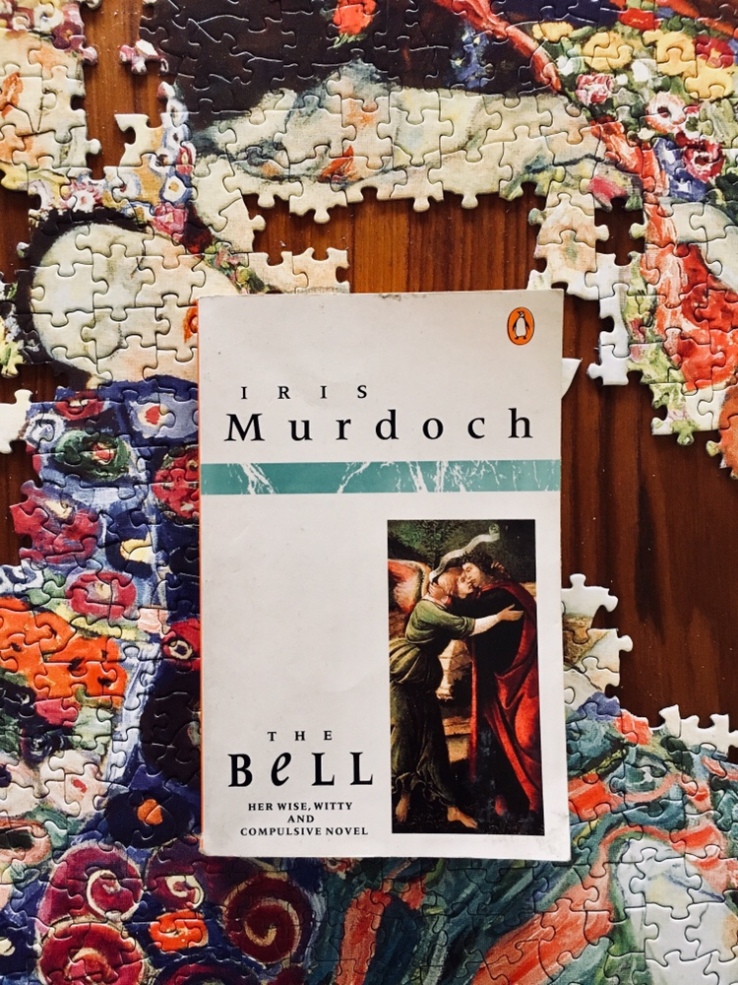
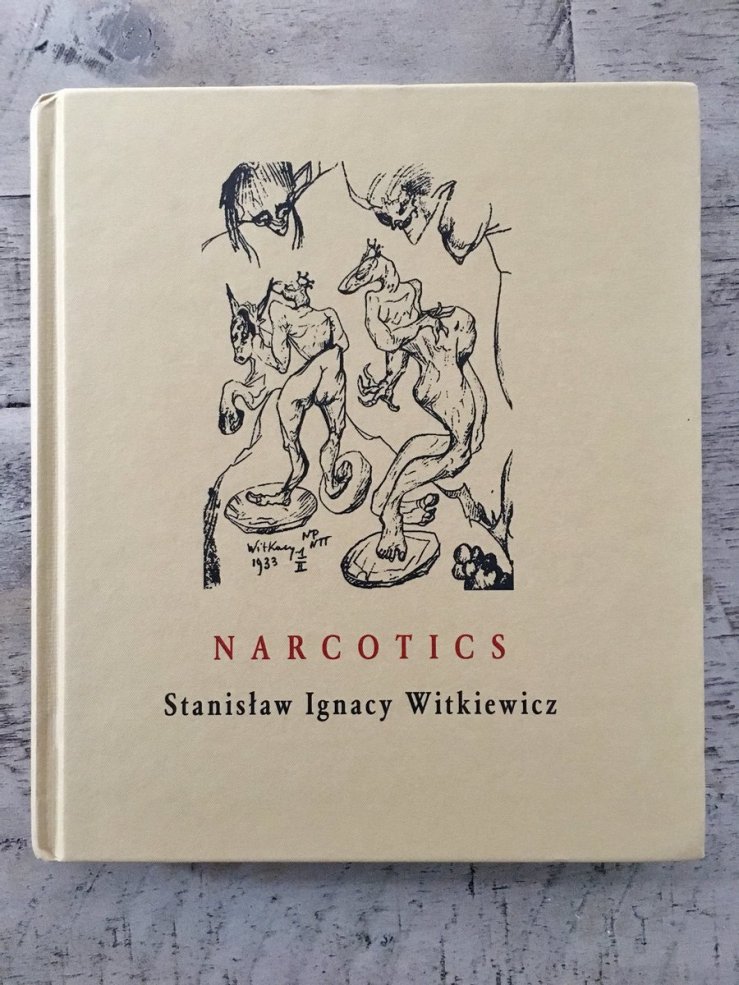
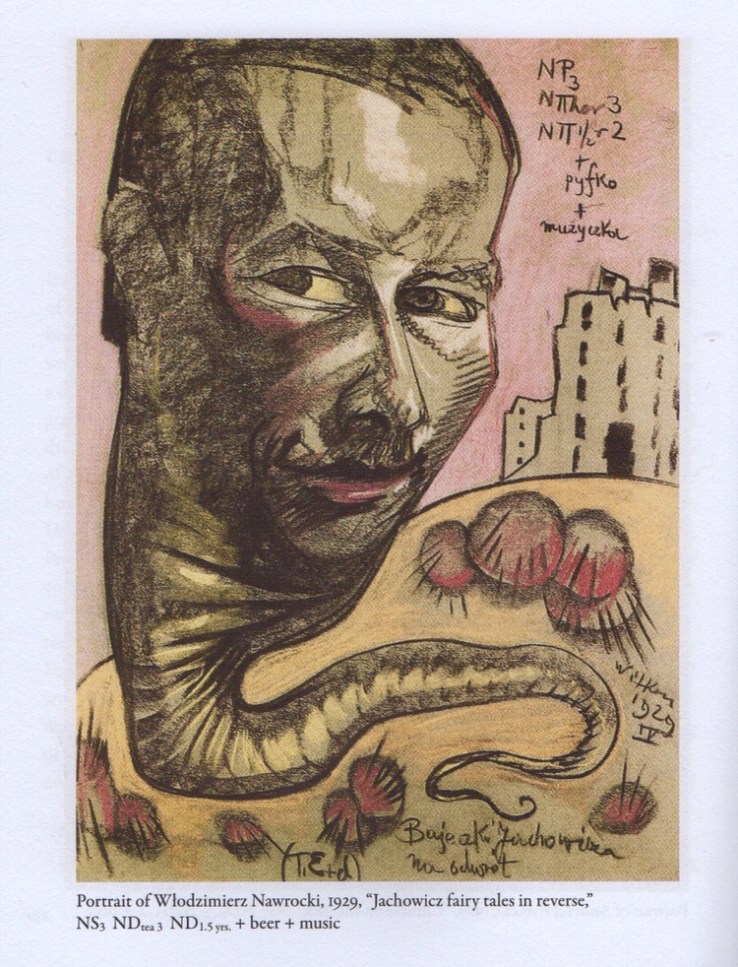




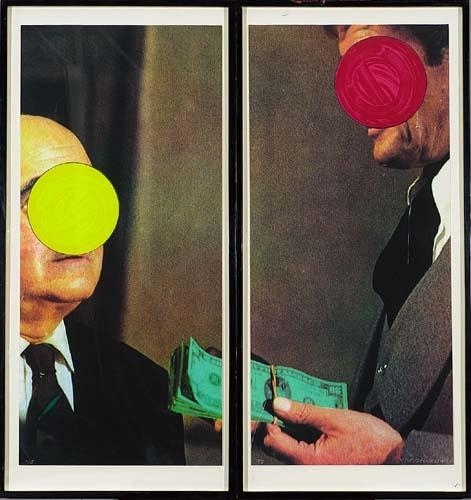

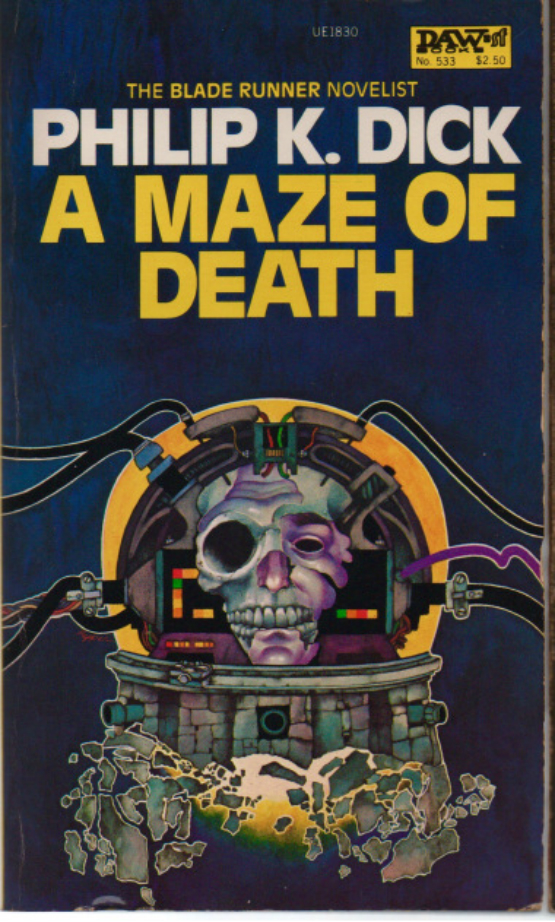


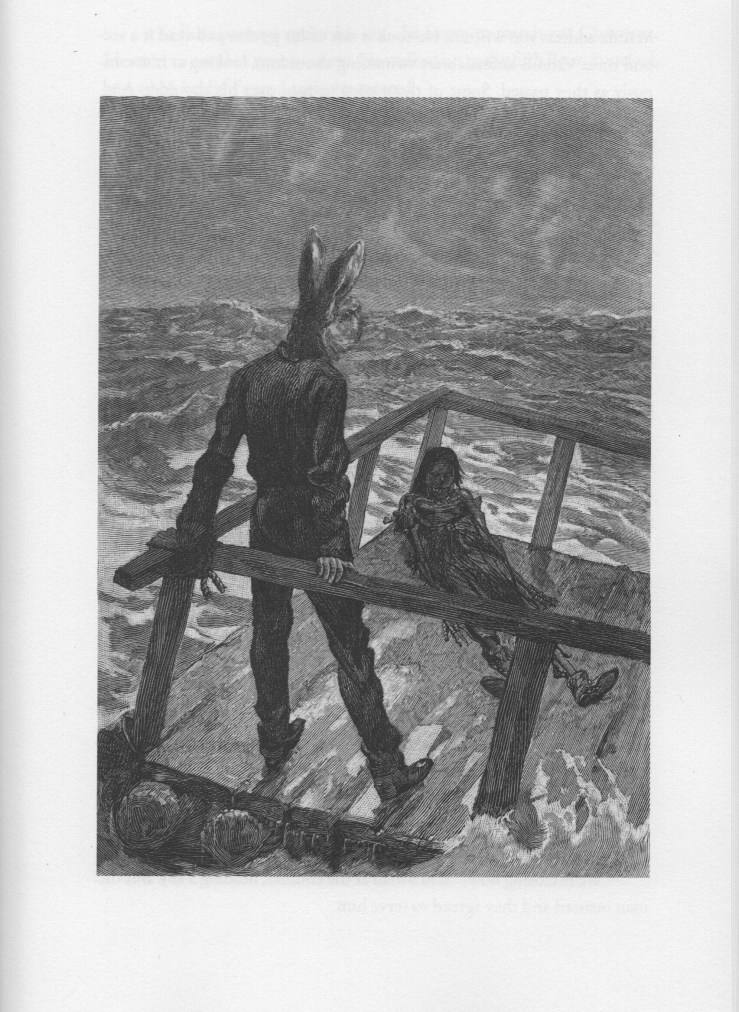

 Biblioklept