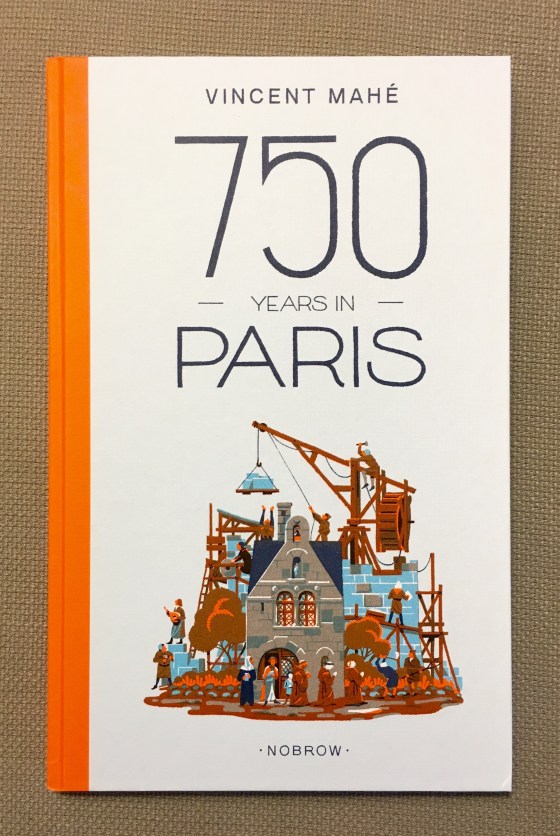
Two new(ish) graphic novels from Nobrow, Vincent Mahé’s 750 Years in Paris and Victor Hussenot’s The Spectators, showcase Paris as an enduring site of progression, turbulence, and renewal, both in culture and consciousness. Mahé’s 750 Years in Paris is a time-machine, putting its viewer in a stationary position to observe the dramatic changes in one building—and French society and culture—over the course of nearly a millennium. Hussenot’s The Spectators is a dream-machine, shuttling its characters through different skins, faces, and eyes. The titular spectators transcend not only time and space, but mind. Both books attest to the power of transformation while subtly noting the various forces that shape identity.
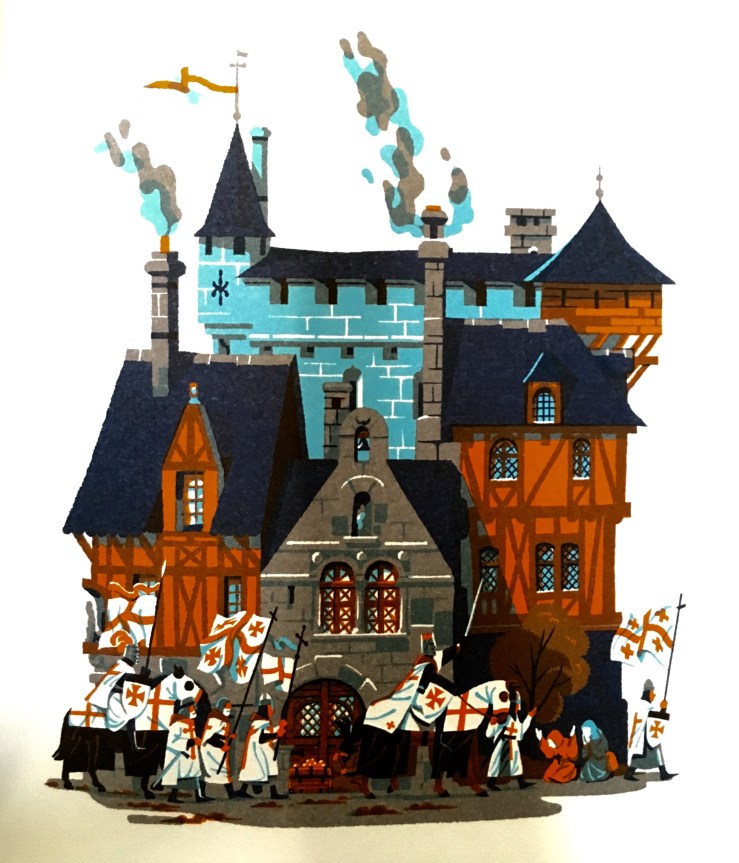
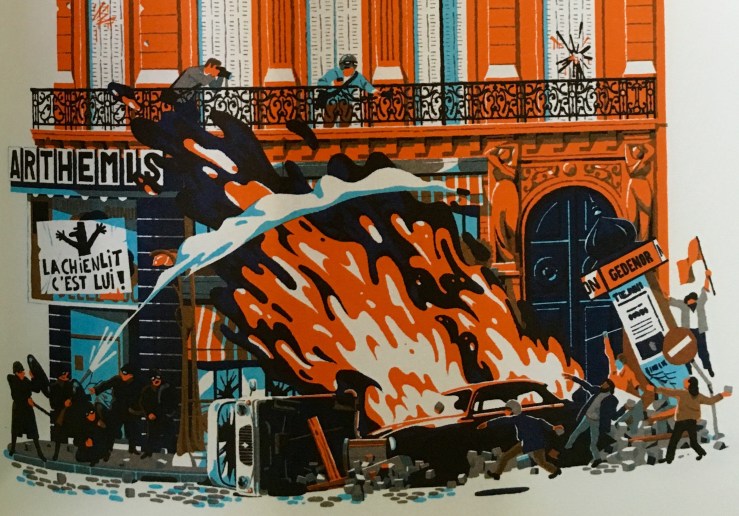
Vincent Mahé’s 750 Years in Paris begins in 1265 and moves its viewer through time to 2015. The book takes us through the Black Death Plague and the 100 Years War, the reigns of Louis XIV and IV, the storming of the Bastille and the Reign of Terror, Napoleon and Hausmann, a grand Metro and a terrible Flood. The second shot in this chronology shows us a Knights Templar procession in 1270. The crusaders remind us that Western history is inextricably bound in violence, religion, and territorial expansion—but also in the exchange of ideas, information, and knowledge. We get to May 1968 with a strong visual context for France’s history of intellectual turbulence.
The book ends in 2015; I’ll let Mahé’s image speak for itself:
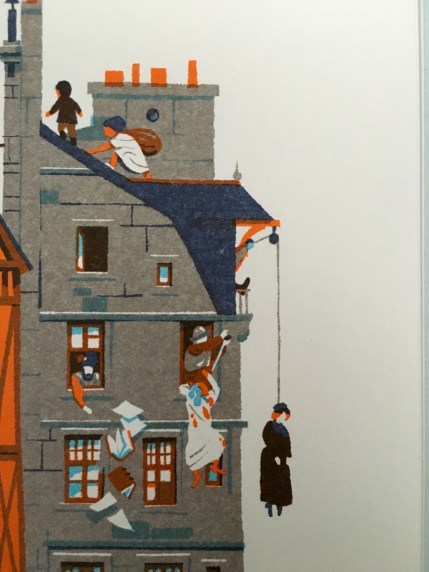
750 Years in Paris shows us that Paris not only survives drastic change, but progresses in the face of violence. When we see, for example, that a winch has been used to hang a Protestant during the St. Bartholomew’s Day Massacre of 1572—
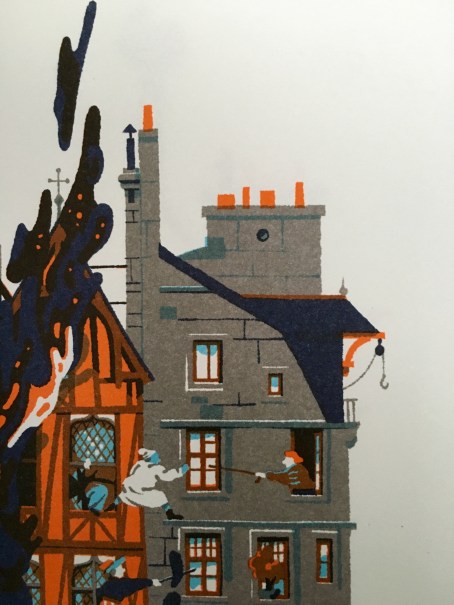
—it’s worth noting that on the next page, neighbors help each other during a terrible fire. The winch remains in the picture, a visual motif of progress, of building up.
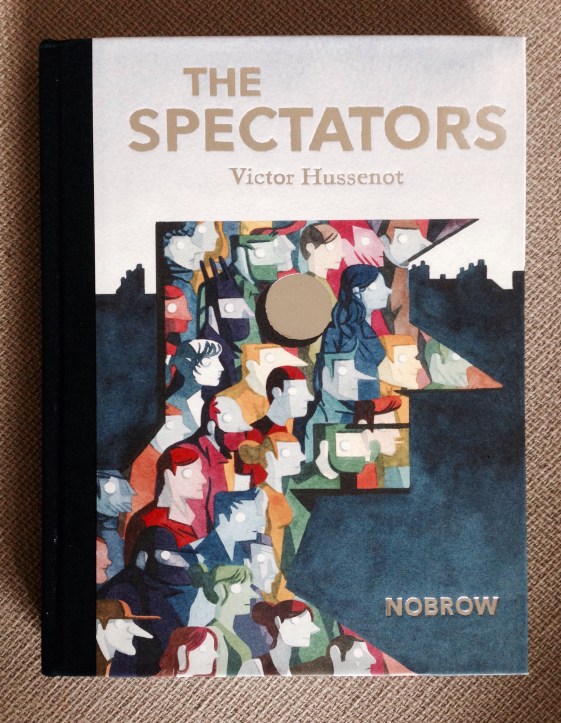
Like every Nobrow title I’ve read, Victor Hussenot’s The Spectators is better experienced than described. Its aesthetic is its narrative and its narrative is its aesthetic, flowing from a lovely dream-logic of identity shifts. Who shall I be today?, the book asks.
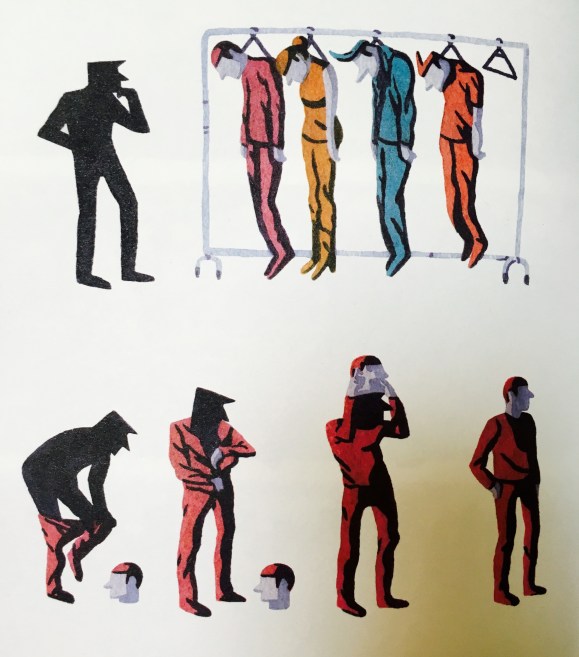
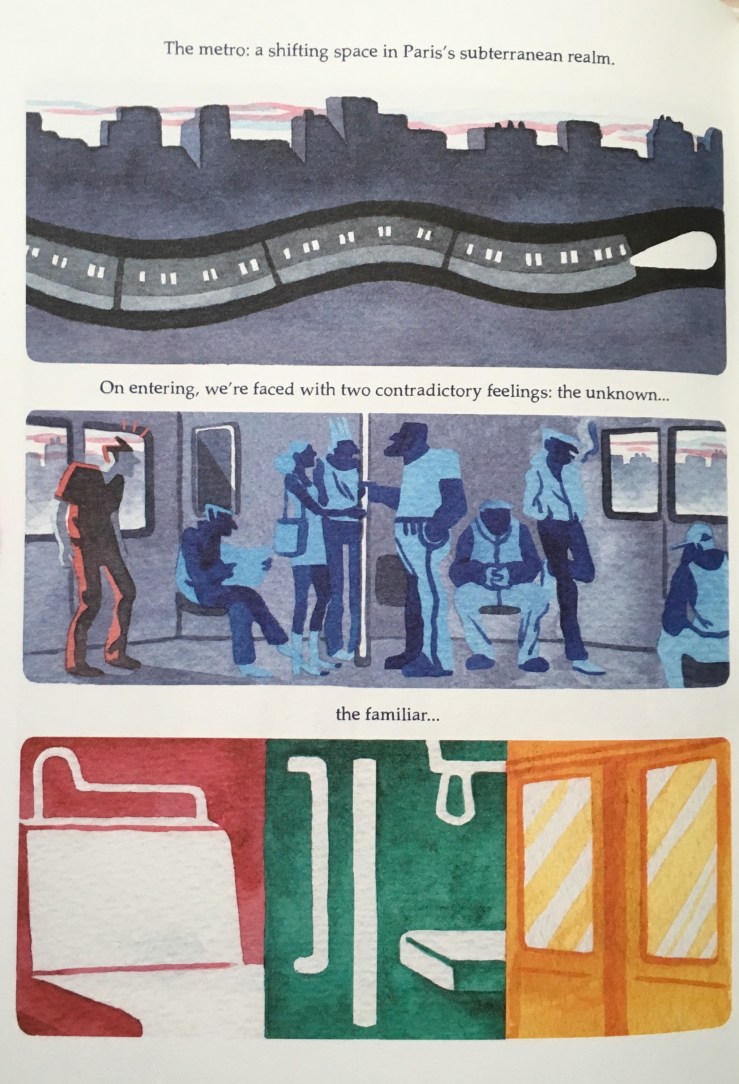
The titular spectators try on different skins, wear different hats, look through different eyes. Paris’s metro becomes a labyrinth dream-lab, where the spectators create the world anew by synthesizing known with unknown:
This vision of synthesis carries the narrative through a poetic examination of individuality and society. How much of me is me? Hussenot frames his characters in the geometry of picture puzzles, only to blur the borders that would constrain them.
It’s possible to imagine the spectators of Hussenot’s book gazing on Mahé’s ever-changing Paris building. Or, conversely, we can take Mahé’s building as one of Hussenot’s spectators—another shapeshifter in a city of shapeshifters.
I’ll close with an image from The Spectators that points towards a dream of synthesis, of infinite perspective, of unity. We have here not just a dream, but a vision of progress:
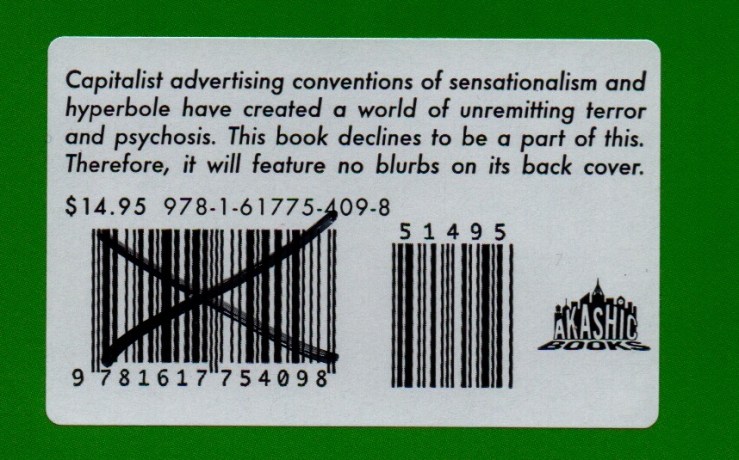
This is the blurb for Ian Svenonius’s book Censorship Now!!:
The non-blurb is of course a blurb.
If you think that that move is brilliant, or even funny, you might dig Censorship Now!!
Publisher Akashic Books has the good sense to offer a description of the book:
In this outrageous and hilarious new essay collection, underground music icon Ian F. Svenonius tackles such diverse subjects as IKEA, Apple, the weather, the gentrification of punk by indie rock, Marion Barry, the film Heathers, Christian pornography, vampires, hoarding, the role of sugar in empire-building, how to properly tip at restaurants, the return of the hat in men’s fashion, and other highly topical matters. No one is left unscathed, and more than a few will be left scratching their heads even as they laugh.
In high school, I dug Svenonius’s first band Nation of Ulysses—more as a concept than for the music, really (I much preferred Dischord label mates Fugazi). The goofy-seriousiousness of Nation of Ulysses was entertaining and confusing, but like later musical projects The Make-Up and Weird War, Svenonius’s band never struck me as quite as dangerous as they wanted to be.
My best friend was always a bigger fan of Svenonius than I was—enough to have read the dude’s first book, The Psychic Soviet. I texted him when I first started reading Censorship Now!!, complaining that I couldn’t tell if Svenonius was serious or if the book was all a schtick, an ageing scenester’s put-on. My pal replied that Svenonius was “a professional sloganeer,” and that every sentence of The Psychic Soviet was a “pull quote.”
Every line a pull quote, every sentence a slogan is how Censorship Now!! reads (if those two exclamation marks didn’t tip you off). The book’s essays read like the rants of someone’s older brother trying to hip you to the truth, man. But after you grow up you wonder why the brother’s still living in his parents’ basement. Okay. That sounds a bit too, I don’t know, rude of me (?) — but I can’t find anything particularly profound in Svenonius’s raging against Apple and Wikipedia and the bourgeoisie. (His riff on Ikea (“Ikea wants couples to break up”) reeks of a bad comedy routine).
Censorship Now!! (which always reads like a talk book, and never as prose) is simultaneously reactionary and nostalgic. Svenonius hates all the things you’d expect him to (NPR, Urban Outfitters, Arcade Fire, gentrification) and even some things you might not expect (tipping). Loose opinion and easy reference are employed instead of facts (sample slogan: “Destroy All Facts” How revolutionary!).
Does it matter? It doesn’t matter. The fourteen year-old me would’ve loved this shit. There’s a fourteen year-old out there that would love it now.
I also read Autobiography of Red and Red Doc> by Anne Carson during September-October, but erased everything I tried to write on them. I found Autobiography particularly excellent—a real How is this possible? kind of read.
Roberto Bolaño’s short story “The Return” is so good that it has two perfect opening paragraphs:
I have good news and bad news. The good news is that there is life (of a kind) after this life. The bad news is that Jean-Claude Villeneuve is a necrophiliac.
That’s a hell of a way to start a story! Bolaño lays out his two themes—the afterlife and necrophilia—in a jovial, almost cavalier, but dare I say sweet, even charming way. And then this paragraph:
Death caught up with me in a Paris disco at four in the morning. My doctor had warned me, but some things are stronger than reason. I was convinced, mistakenly (and even now it’s something I regret), that drinking and dancing were not the most hazardous of my passions. Another reason I kept going out every night to the fashionable places in Paris was my routine as a middle manager at Fracsa; I was after what I couldn’t find at work or in what people call the inner life: the buzz that you get from a certain excess.
Those are the first two paragraphs, and maybe they’ll entice you to read the story. However, the following riff includes what some people might consider spoilers; my hope is that if you’ve never read it before, you’ll take it on faith that “The Return” is a great, great story and you’ll go read it and stop reading this riff now. (Maybe come back later though after you’ve read it).
“The Return” is a ghost story that transmutes the horror of death and the abjection of the corpse into love, empathy, and communication—and art. It’s a beautiful ghost tale in the Romantic, Gothic tradition of Edgar Allan Poe, from whom Bolaño drew heavily. However, while Poe’s tales of necrophilia (like the poem “Annabel Lee,” “The Fall of the House of Usher,” and “Berenice” to name just a few) obsess over repression, loss, burial, and imperfect and violent attempts at restoration, Bolaño’s “The Return” offers its readers a peaceful reconciliation with death. It’s collected in The Return (New Directions, English translation by Chris Andrews), which is a perfect introduction to Bolaño—so many great stories there (“Buba,” “Clara,” “William Burns,” etc.). So go read it.
George Orr is not well. The meek protagonist of Ursula K. Le Guin’s novel The Lathe of Heaven abuses prescription drugs in a desperate and unsuccessful attempt to stop himself from falling asleep. Orr doesn’t want to sleep because he believes that his dreams come true—that they literally alter reality—but in such a way that no one but Orr realizes that the world has changed. Orr gets caught using a “Pharmacy Card” that doesn’t belong to him, and is court-ordered to begin treatment with a sleep research psychiatrist, Dr. William Haber. Although Haber initially doesn’t believe Orr’s claim to be cursed with “effective dreams” that transform reality, he soon realizes that Orr’s dreams somehow do come true. Then, via hypnotic suggestion (and an “Augmentor” device), Haber begins wielding Orr’s gift/curse as a clumsy tool to “better” the world.
The world of The Lathe of Heaven is grim, gray, dystopian. Published in 1971 and set in Portland in the palindromic year of 2002, Le Guin’s novel is depressingly prescient. Not only does she capture the onset of seventies malaise (the ashes of hope that burned out in the sixties), she also points to a future of environmental catastrophe:
Very little light and air got down to street level; what there was was warm and full of fine rain. Rain was an old Portland tradition, but the warmth—70° F on the second of March—was modern, a result of air pollution. Urban and industrial effluvia had not been controlled soon enough to reverse the cumulative trends already at work in the mid-twentieth century; it would take several centuries for the CO2 to clear out of the air, if it ever did. New York was going to be one of the larger casualties of the Greenhouse Effect, as the polar ice kept melting and the sea kept rising…
This is also a world of urban sprawl, overpopulation, malnutrition, and total war (a clusterfuck in the Middle East, wouldn’t you know). The government is a vague and menacing presence here—vaguely totalitarian, vaguely Big Brotheresque. We learn of the “New Federal Constitution of 1984,” one of many references to Orwell’s book. (The most obvious is our passive hero’s name).
So it’s no wonder that Haber sets about to create a utopia, right? Wouldn’t you, like, try to make the world a better place if you could? Haber is repeatedly described as a “benevolent man”—Le Guin withholds the word dictator—but the central theme comes through repeatedly: Is it possible to alter reality for the greater good? Or do we simply exist in nature, a part of everything around us?
Haber’s experiments with Orr’s mind have unintended consequences. How might we, say, cure overpopulation? How about an awful plague. Orr’s “effective dreams” revise history, rewrite reality, remap consciousness. But he’s never quite able to pull off the massive tasks Haber sets for him—end racism, end war, cure the damaged ecosystem (Le Guin is extremely pessimistic on this last front). Orr is burdened with the consciousness of multiple realities, and feels deep guilt for his role in uncreation. He starts to go crazy:
“I am cracking,” he said. “You must see that. You’re a psychiatrist. Don’t you see that I’m going to pieces? Aliens from outer space attacking Earth! Look: if you ask me to dream again, what will you get? Maybe a totally insane world, the product of an insane mind. Monsters, ghosts, witches, dragons, transformations—all the stuff we carry around in us, all the horrors of childhood, the night fears, the nightmares. How can you keep all that from getting loose? I can’t stop it. I’m not in control!”
In Ch. 23 of Cormac McCarthy’s novel Blood Meridian our protagonist the kid—now the man but always the kid—has cause to kill a kind of postfiguration of himself, Elrod, an ornery youth who attempts to murder the kid in the dark of night:
I knowed you’d be hid out, the boy called.
He pushed back the blanket and rolled onto his stomach and cocked the pistol and leveled it at the sky where the clustered stars were burning for eternity. He centered the foresight in the milled groove of the framestrap and holding the piece so he swung it through the dark of the trees with both hands to the darker shape of the visitor.
I’m right here, he said.
The boy swung with the rifle and fired.
You wouldnt of lived anyway, the man said.
When Elrod’s traveling companions come to fetch his body, we get this microbiography:
They come out here from Kentucky mister. This tyke and his brother. His momma and daddy both dead. His grandaddy was killed by a lunatic and buried in the woods like a dog. He’s never knowed good fortune in his life and now he aint got a soul in this world.
The line about the grandfather “killed by a lunatic and buried in the woods like a dog” instantly recalled for me the judge’s tale about the harnessmaker in Ch. XI. The tale begins thus:
In the western country of the Alleghenies some years ago when it was yet a wilderness there was a man who kept a harness shop by the side of the Federal road. He did so because it was his trade and yet he did little of it for there were few travelers in that place. So that he fell into the habit before long of dressing himself as an indian and taking up station a few miles above his shop and waiting there by the roadside to ask whoever should come that way if they would give him money. At this time he had done no person any injury.
And climaxes thus:
As they walked out they spoke of life in such a wild place where such people as you saw you saw but one and never again and by and by they came to the fork in the road and here the traveler told the old man that he had come with him far enough and he thanked him and they took their departure each of the other and the stranger went on his way. But the harnessmaker seemed unable to suffer the loss of his company and he called to him and went with him again a little way upon the road. And by and by they came to a place where the road was darkened in a deep wood and in this place the old man killed the traveler. He killed him with a rock and he took his clothes and he took his watch and his money and he buried him in a shallow grave by the side of the road. Then he went home.
The judge’s story goes on a bit longer, but the remarkable moment is when he finishes, all the men of Glanton’s company claim to know the story, but in variations—part of the book’s dark take on the Emersonian oversoul. (Later in the same chapter: “What is true of one man, said the judge, is true of many”).
To return to Elrod (the name means something like God rules): I’ve always read the kid’s killing him as foreshadowing to the kid’s own final encounter with the judge later in the same chapter. Maybe the grandfather-lunatic-burial is just another one of the judge’s damn riddles, but it’s got me perplexed. Maybe best not to look for too much order in the dance?
The captain tapped the instrument in his gloved hand.
They dont seem concerned, do they?
No sir. They dont.
The captain smiled grimly. We may see a little sport here before the day is out.
The first of the herd began to swing past them in a pall of yellow dust, rangy slatribbed cattle with horns that grew agoggle and no two alike and small thin mules coalblack that shouldered one another and reared their malletshaped heads above the backs of the others and then more cattle and finally the first of the herders riding up the outer side and keeping the stock between themselves and the mounted company. Behind them came a herd of several hundred ponies. The sergeant looked for Candelario. He kept backing along the ranks but he could not find him. He nudged his horse through the column and moved up the far side. The lattermost of the drovers were now coming through the dust and the captain was gesturing and shouting. The ponies had begun to veer off from the herd and the drovers were beating their way toward this armed hides the painted chevrons and the hands and rising suns and birds and fish of every device like the shade of old work through sizing on a canvas and now too you could hear above the pounding of the unshod hooves the piping of the quena, flutes made from human bones, and some among the company had begun to saw back on their mounts and some to mill in confusion when up from the offside of those ponies there rose a fabled horde of mounted lancers and archers bearing shields bedight with bits of broken mirrorglass that cast a thousand unpieced suns against the eyes of their enemies. A legion of horribles, hundreds in number, half naked or clad in costumes attic or biblical or wardrobed out of a fevered dream with the skins of animals and silk finery and pieces of uniform still tracked with the blood of prior owners, coats of slain dragoons, frogged and braided cavalry jackets, one in a stovepipe hat and one with an umbrella and one in white stockings and a bloodstained weddingveil and some in headgear of cranefeathers or rawhide helmets that bore the horns of bull or buffalo and one in a pigeontailed coat worn backwards and otherwise naked and one in the armor of a Spanish conquistador, the breastplate and pauldrons deeply dented with old blows of mace or sabre done in another country by men whose very bones were dust and many with their braids spliced up with the hair of other beasts until they trailed upon the ground and their horses’ ears and tails worked with bits of brightly colored cloth and one whose horse’s whole head was painted crimson red and all the horsemen’s faces gaudy and grotesque with daubings like a company of mounted clowns, death hilarious, all howling in a barbarous tongue and riding down upon them like a horde from a hell more horrible yet than the brim tone land of Christian reckoning, screeching and yammering and clothed in smoke like those vaporous beings in regions beyond right knowing where the eye wanders and the lip jerks and drools.
Oh my god, said the sergeant.
The legion of horribles passage comes near the end of Ch. IV of Cormac McCarthy’s Blood Meridian, and is probably the passage I see cited most often from the book—which makes sense: It comes early enough in the novel and doesn’t really need much context—other than its own language—to mean. And of course its language—well, that’s the occasion, yes? The passage condenses the book’s violence into a baroque and surreal fevered dream (to steal a phrase from the passage). We have here an ornate parcel, a prefiguration of ecstatic violence.
I remember the first time I read this passage. It was 2008, very late at night, and it just sort of short circuited whatever brains I had left. I had to go back and start the novel again, hit reset. I’m revisiting Blood Meridian (I’ve reread it at least once every year since I first read it, a common practice of many of its fans I’ve realized over the years) after having just revisited Suttree. Blood Meridian always seems funnier and darker, and somehow—how?!—more violent.
The legion of horribles passage is not acutely violent in and of itself; rather it stages the violence that explodes in the next few paragraphs, a dizzying, overwhelming violence. Scenes of rape and murder.
I claimed in my first paragraph that the passage doesn’t require context, but here’s some anyway: We have there at the beginning Captain White and his sergeant. White—appropriately named—plans to lead his unauthorized band of irregulars into Mexico to loot and spoil and steal. He’s recruited the kid, the would-be protagonist of Blood Meridian. With its vile nativism, xenophobia, and racism, Captain White’s recruitment monologue (which doesn’t really persuade the kid as much as the simple promise of a horse, rifle, and saddle) wouldn’t be out of place in American politics today. White’s racism makes his initial impression of the fabled horde that will kill all but a handful of his men—and, spoiler, behead him—all the more ironic/moronic: “We may see a little sport here before the day is out,” he grimly jests. This seems to me almost the set-up to a punchline, with a long excursion into a description of the advancing “horde from hell” as the meat of the joke (Joke!?), with the final punchline/payoff in the sergeant’s dry horrified realization: “Oh my god.”
In Suttree, McCarthy synthesizes American literature; in Blood Meridian, he’s condensing something more primal. Myth and history, time and space, whorled into blood and violence.
We can see this condensation of myth and history in the very language of the legion of horribles passage. McCarthy offers a nightmare vision of time collapsed into a single violent, overwhelming space—and as I go now to pull an example, I find that there are too many, that the passage is all example, all detail, all image.
Or, okay, hell, just one image then—the “armor of a Spanish conquistador, the breastplate and pauldrons deeply dented with old blows of mace or sabre done in another country by men whose very bones were dust”—there, that’s it, that’s all of it, history, myth, violence.
Or just the words themselves, the diverse diction, culled from so many roots and tongues (attic, biblical)—and the compounding of words (bloodstained, weddingveil, headgear, cranefeathers, rawhide, pigeontailed, etc.), the compression and synthesis of words, the force of the words. The onomatopoeia. The barbaric yawps.
What happens next? Okay, I’d say, Read the book—but I’ve already told you—the horde eviscerates White’s men. The kid survives, somehow, and the first section of Blood Meridian seems to end—as if this fabled horde, this legion of horribles were merely a preamble to the darker violence to come—a preview of the Glanton Gang and their sinister commandant Judge Holden.
At the end of Cormac McCarthy’s novel Suttree, I mean?
Look, before we go any farther, let’s be clear—this little riff is intended for those who’ve read the book. Anyone’s welcome to read this riff of course, but I’m not going to be, y’know, summarizing the plot or providing an argument that you should read Suttree (you should; it’s great)—and there will be what I suppose you’d call spoilers.
Oarsman is a sculpture by David Phelps, located at the northwest corner of Gay and Church Streets in Knoxville, TN. This photo is by Wes Morgan, part of his Searching for Suttree series.
So anyway—Does Suttree die at the end of Cormac McCarthy’s novel Suttree?
This question percolated in the background of my brain as I revisited Suttree this month via Michael Kramer’s amazing audiobook version (I also reread key sections—especially the last), in large part because of comments made on my 2010 review of the novel.
The first comment suggesting that Suttree dies at the end of the novel came in 2012 from poster “Jack foy,” who suggested that Suttree “has died in the boat and that it is his corpse cariied [sic] from there and his spirit and not his body hitching a ride at the finale.”
Earlier this year, a commenter named Julie Seeley responded to Jack foy’s idea; her response is worth posting in full:
I kind of agree that Suttree dies at the end also–or at least there are a lot of indications that the ending is meant to be ambiguous. Suttree reflects on his life, saying something to the effect of “I was not unhappy.” He visits his own houseboat and finds the door off and a corpse in his bed. A driver picks him up and says, “Come on,” even though Suttree had never even stuck out his thumb to hitch-hike It feels oddly similar to Dickinson’s “Because I could not stop for Death, He kindly stopped for me.” All of the scenery whizzing by faster and faster does feel like (sorry for the cliche) his life sort of flashing before him. This was a thought-provoking novel that I am looking forward to reading again soon.
Julie Seeley’s analysis is persuasive and her connection to Dickinson is especially convincing upon rereading the book’s final paragraphs. In my Suttree review, I argued that the book is a synthesis of American literature, tracing the overt connections to Faulkner and Frost, Poe and Cummings, Ellison and Steinbeck, before laundry listing:
…we find Mark Twain, Herman Melville, Ernest Hemingway, Walt Whitman, Emerson and Thoreau, Emily Dickinson, and William Carlos Williams, to name just a few writers whose blood courses through this novel (even elegant F. Scott Fitzgerald is here, in an unexpected Gatsbyish episode late in the novel).
Revisiting Suttree this month I found myself again impressed with McCarthy’s command of allusion and reference. Its transcendentalist streak stood out in particular. (Or perhaps more accurately, I sensed the generative material of the American Renaissance writers filtered through the writers that came before Suttree). But one American Renaissance writer I failed to name in my original review was Dickinson’s (near) contemporary Nathaniel Hawthorne, whose work of course filters through all serious American novels. There are plenty of echoes of Hawthorne in Suttree—Hawthorne’s tales in particular—but it’s the way that Hawthorne ends his tales that interests me here. Like the dashes that conclude many of Dickinson’s poems (including “Because I could not stop for Death”), Hawthorne’s conclusions are frequently ambiguous. Like the conclusion of Suttree.
So: Does Suttree die at the end of Cormac McCarthy’s novel Suttree?
Well, wait. Let’s go back to the beginning. Of the novel, I mean. Like I said, I’d had this question buzzing around in the back of my head as I revisited the book.
So, the beginning. Well, I’d forgotten that Suttree had a twin brother who had died at birth. The twin resurfaces a few times in the text, and there’s even a scene in the musseling section featuring a set of twins. Does Suttree’s twin brother’s death in infancy prefigure Suttree’s own death? How could it not? But—at the same time—hey, it’sambiguous if Suttree dies; should I have stated my answer to my own damn question earlier?—hey, at the same time, the twin brother’s death is not Suttree’s death sentence, right? It simply introduces a motif—the dead body. Continue reading “Does Suttree die? | A riff on Cormac McCarthy’s novel Suttree”→
-Okay. I’ll try. The narrator is Gordon Lish—a version of Gordon Lish, of course (Gordon!), who tells us about a cryptographic “test” his aunt, an agent for the National Reconnaissance Office, sent him in 1963.
-Why did she send him this test?
-Poor Gordon was jobless and had a wife and kids to support and-
-You mean his kid the novelist Atticus Lish?
-Please don’t interrupt; no, these, these are other kids; Atticus comes later, but Lish does write about him in Cess. Anyway-
-What does he say about Atticus?
-He writes that “Atticus is, a, you know, a writer by Christ—is a novelist, by Christ, is indeed, if I, by Keerist, may say so myself, ever so proudly so, ever so rivalrously so, a novelist of nothing less than of rank.” Okay?
-Okay.
-So: The narrator gets this “test” from his aunt and-
-What does it look like? What is it?
-It’s a long list of esoteric words.
-May I see?
-It’s a pretty long list.
-How long?
-About 170 pages, about 22 words per page.
-May I see a section then?
-Sure:
-Whoa!
-That’s what I thought too! In fact, I first got a digital copy from publisher OR—so I was just reading, you know, on an iPad—which is, I mean, if you can imagine, I wasn’t doing the flicking through thing, the physical browsing thing—so I had no idea that there would be this big long list of words as like, the main course. I was shocked. It was electric. Continue reading “A review of Gordon Lish’s novel (spokening) Cess”→
I only wrote a few riffs and reviews in August, failing to write at length about Gordon Lish’s Cess and Victor Hussenot’s The Spectators and Vladimir Nabokov’s Pale Fire. Also: Neal Stephenson’s novel The Diamond Age, which I audited the audiobook of—great stuff, a novel that posits the book as a primary and insuperable technology. And some films too—Michael Mann’s Thief (amazing); Quest for Fire (why were the Baby Boomers so obsessed with cave people?); Ex Machina (a well-acted design-porn riff on Bluebeard that has no real ideas about its central theme, human consciousness).
I also watched and loved and didn’t write about the second season finale of True Detective—loved it—a tragic hyperbole, a big exclamation point, a sympathetic punchline to the season’s paternal anxieties. I found the final shot unexpectedly moving—the season’s female leads moving through the traffic of humanity, strapped with a child, knives, the future.
I wrote a barely-coherent, probably incoherent review of Philip K. Dick’s novel Martian Time-Slip. The sub(or is it super?)text of the review is that I am a Permanently Paranoid American.
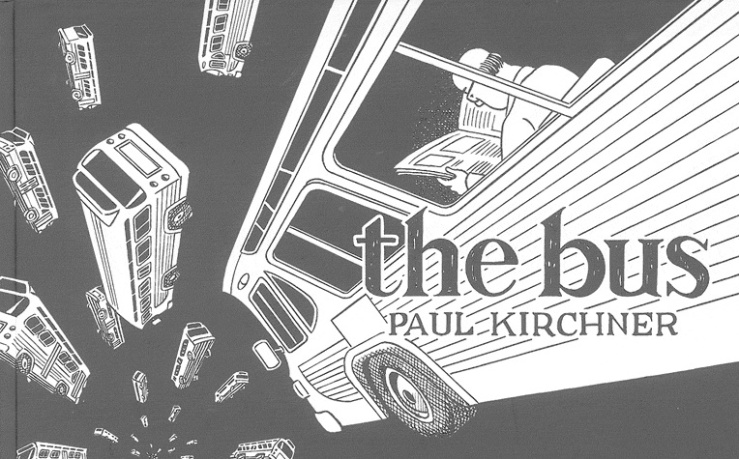
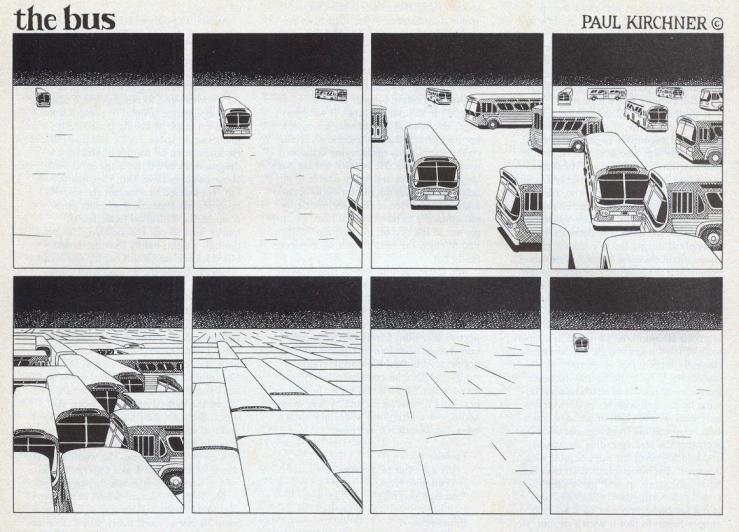
For the past year, I’ve run a strip from Paul Kirchner’s cult classic The Bus each Sunday. The strips come from an album posted at Imgur full of high quality scans. I posted the last scan last week.
I’ve enjoyed posting the strips tremendously. I first saw a few strips at an image forum I frequent, and quickly found the Imgur album. Posting one each Sunday was my way of, well, not bingeing on them.
The Bus is a profound strange wonderful trip. Kirchner’s visions often evoke Escher’s paradoxes, and the best of his strips make us attend closely to what we’d otherwise dismiss. The Bus is subtle and sly, occasionally (very occasionally) dark, but also, I would argue, sensitive—there’s something deeply endearing about the strip’s central human protagonist, an often passive (even hapless) passenger, a kind of late-20th century Everyman. Continue reading “The Bus, Paul Kirchner’s marvelous and surreal comic strip trip”→
A colleague dropped by today, burst in my office really, if you’ll forgive the cliché, animated, ecstatic almost—Read this!—he commanded, thrusting a big fat hardbacked Gore Vidal volume in front of me. Read this, his finger pointing to the last paragraph of the 1981 essay “Pink Triangle and Gold Star” (ostensibly a review of Renaud Camus’ novel Tricks). So I read it. See? It’s just like today! my colleague declared. Vidal’s essay ends with a call for the unity of marginalized people to resist “our ruling class” — the banks, The Wall Street Journal, the Pentagon — and “their kindly voice,” Ronald Reagan. We then had a brief discussion about Donald Trump’s bid for the presidency, something I have until now refused to talk about at all because it’s all just too weird.
I sometimes feel like I’m living in a Thomas Pynchon novel.
I sometimes feel like I’m living in a J.G. Ballard short story.
I sometimes feel like I’m living in some distorted, slipped timeline.
Reading Philip K. Dick’s novel Martian Time-Slip, I kept wanting to burst into someone’s office, animated, pointing to a paragraph, crying, Read this! See? It’s just like today!
Not that we’ve colonized Mars but—
—colonial metaphors, yes? Cowboys and Indians…
But also, that we’d want the final frontier to be just like home: Desert Mars with green lawns, irrigated flower gardens. Swimming pools. Dick’s Mars is California 1964 and California 2015. And: a water-scarce environment to come.
Did I mention that the novel is set in 1994?
I sometimes feel like I’m living in a Don DeLillo novel.
But where was I? I launched into this riff with a long anecdote, so—What my colleague and I worked into was, ultimately, a discussion of the sheer irreality of modern life—the paranoia that permeates American culture, the sense that the last two decades seem like a bad repetition of Bad Times that outdated textbooks told us had been conquered.
(Or maybe I’m just getting old).
(Sorry for the scatterbrainededness of this ordeal. I finished the novel this afternoon and if I don’t get this down now it seems I won’t get anything down).
So obviously you can find alienation, instability, and repetition right there in the title Martian Time-Slip.
And Dick loads the novel with images and props and ideas to evoke those themes of alienation, instability, and repetition: autism, primitivism, schizophrenia.
Colonies, camps, U.N. as World Police.
Health food.
And land speculation.
And abjection.
And abjection erupts in paranoia and irreality, pointing to a People Who Aren’t People:
He saw, through the man’s skin, his skeleton. It had been wired together, the bones connected with fine copper wire. The organs, which had withered away, were replaced by artificial components, kidney, heart, lungs—everything was made of plastic and stainless steel, all working in unison but entirely without authentic life. The man’s voice issued from a tape, through an amplifier and speaker system.
Possibly at some time in the past the man had been real and alive, but that was over, and the stealthy replacement had taken place, inch by inch, progressing insidiously from one organ to the next, and the entire structure was there to deceive others.
—so the sense that the contemporary person is just a technological mediation, a deception, inauthentic. (Dear reader, attach this passage to what you will, but it seems to me surpassing prescient).
I’ve done a poor job of outlining the plot, right? Sorry. But look, it’s a Philip K. Dick novel, and certainly one of his better ones—and if you’re a more-than-casual reader, you know it, I think, and if you’ve read his finest—VALIS, The Man in the High Castle, Ubik, A Scanner Darkly, Palmer Eldritch—you might should could read Time-Slip.
But so plot, well: Here’s Lawrence Sutin on the novel, from Divine Invasions: A Life of Philip K. Dick:
Life in the bleak Martian colonies bears a striking resemblance to business as usual on modern-day Earth…In the parched Martian colonies, grasping Arnie Kott is the chief of the powerful plumber’s union (based on the fifties Berkely Co-op Phil despised for its wrangling politics). The little guy, repairman Jack Bohlen, is a onetime schizophrenic who still lives with schizophrenia’s aftereffects. An autistic kid, Manfred Steiner, slipslides helplessly forward and backward in time, into realms of entropy and death.
Arnie seeks to capitalize on Manfred’s timeslipping, and Dick—who, let’s just admit it, isn’t always the most writerly writer (whatever that means) handles the time slippage with rhetorical aplomb, making the reader slip-slide through time with Manfred, Arnie, and Jack. I shared an extended passage a few days ago as an example; it shows us (a version of) Manfred decaying in a future Martian slum. The imagery is abject and pitiful, evoking again the notion of a human’s decay into machination:
He lay there for a hundred and twentythree years and then his artificial liver gave out and he fainted and died. By that time they had removed both his arms and legs up to the pelvis because those parts of him had decayed.
He didn’t use them anyhow. And without arms he didn’t try to pull the catheter out, and that pleased them.
Time-Slip rockets into rhetorical reverberation, cycling its final chapters into a strange decay. The timeslips jar the reader’s narrative perception—Hey wait, didn’t I already read this?—unsettling expectations, and ultimately suggesting that thisMartian Time-Slip is just one version of Martian Time-Slip. That there are other timelines, distorted, slipped.
And there are threads—wires, if we want to borrow one of the novel’s motifs—that don’t fully connect. There are short circuits, misfires, gaps. Dick tears into the real stuff, the inner material, and pulls it up to the surface without putting it all back together too neatly.
There’s even a slippiness to Dick’s resolved wires (if you’ll excuse my torturing the metaphor). The novel concludes in a strange jolt of domestic restoration, a kind of farce of the traditional comedic and tragic conventions where all returns to normal—there is no normal, never—and so No normal never is, paradoxically, paranoiacally, normal.
I sometimes feel like I’m living in a Philip K. Dick novel.
The final episode of the second season of True Detective airs on HBO tomorrow tonight [9 Aug 2015]. Popular and critical consensus seems to decree that this finale can only redeem Nic Pizzolatto’s supposed sophomore slump. I’m very much looking forward to the episode, as I’ve looked forward to each episode this season.
Season 2 of True Detective is a much, much better show than its many noisy naysayers might maintain. It’s a neon noir satire, a potboiler bubbling over with lurid, sticky flux. It’s hilarious and anxious and abject. I riff more on it in point 10 if you want to jump down there now. (Or indulge my anxieties, if that’s your deal).
A friend of mine pointed out over drinks a few weeks back that this season of the show will be reevaluated in a few years, after the True Detective serials have run their course. We agreed that the season will likely be reconsidered in a far more positive light. (Think season 2 of The Wire, if you will).
Re: point 3—I’ve talked about the show all season long with friends—texted about it, etc. There’s something still vital there, no matter how much it may seem to curdle compared to season one. Maybe you’ve talked about it with your friends too, no?
And re: point 4: I’ve had more people email or tweet me asking me to write about True Detective than anything ever. So, like, I’m trying, here.
…I could not bring myself to write about the ending, in part because of the (perceived) negative backlash the conclusion received. I felt the need to address haters and doubters, when what I really wanted to comment on was the sheer beauty of the episode—its aesthetics, its greenness. Critics emphasized the bromantic ending, or the moment where Cohle seems to retreat (uncharacteristically) to metaphysics, but for me the signal moment was achieved when Hart is asked by his ex-wife and children, who attend him in his hospital bed, if he is alright. This question links back to a domestic lull in the middle of episode four. We see Hart and Cohle as roommates, as Lucinda Williams’s gentle song “Are You Alright?” plays. This is the middle of the series, and also the central question of the series: Are you alright? At the end of the series, Hart attempts to affirm that he is alright, but it is clear to everyone—audience, family, and Hart himself—that he isn’t.
In that big fat quote above, I wrote that “I felt the need to address haters and doubters” about the end of season one; similarly, part of the anxiety of writing about season 2 is that one falls into the position of having to address the “discussion” — almost all negative chatter — about season 2 — instead of, you know, discussing the mood, aesthetics, and tone.
And of course season 2 was born into a kind of Oedipal anxiety over its progenitor. Season 1 seemed to come from nowhere, black, electric, crackling with the charisma of its two leads.
(I’m such a nerd that I had a dream a few weeks before the début of the second season where I dreamed I saw the second season and it wasn’t nearly as good as the first. Inside the dream, I knew that this was my subconscious helping to deflate anxieties. And over a fucking TV show! What’s wrong with me?) Well let’s get to whatever point I might have:
The second season of True Detective can be read as a satire—on noir, on L.A. stories, on hardboiled pulp, on masculine anxieties. Yes: But it also plays as a satire on television itself, on viewer expectations even. Sincere satire never fully announces itself as such. This second season of True Detective is sincere satire.
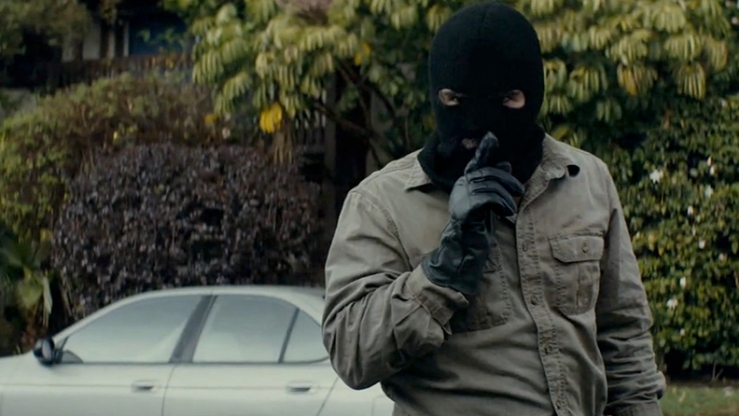
One satirical reading rule for True Detective Season 2 is introduced in the first episode, “The Western Book of the Dead.” In one of its more memorable sequences, Ray Velcoro dons a mask before beating up an Los Angeles Times reporter who was working on an “eight-part series” to expose corruption in Vinci. The scene reads as a metatextual prick at viewers hoping to have this eight-part series laid out neatly for them.
The lurid violence here succeeds by connecting to a kernel of pathos for its perpetrator, Ray Velcoro (Colin Farrell). Velcoro is surely the reason to watch this season. He anchors the satire in sincerity.
We can find similar sincere satire in True Detective season 2’s superior cousin, Paul Thomas Anderson’s film adaptation of Inherent Vice. There are plenty of plot convergences between these two, but the tonal overlap is more interesting to me.
Well, plot of course—
—but wait a moment with plot: Mood. Ambiance. Tone. —Of course they are linked, plot and feeling—but this season has done a marvelous job evoking the dreadnights of David Lynch (and if the directors seem to borrow a bit heavily from Mulholland Drive or Lost Highway, so much the better). And The Long Goodbye. And Chinatown (talk about Oedipal anxieties!). But also Kiss Kiss Bang Bang (why not?). Or even The Big Lebowski.
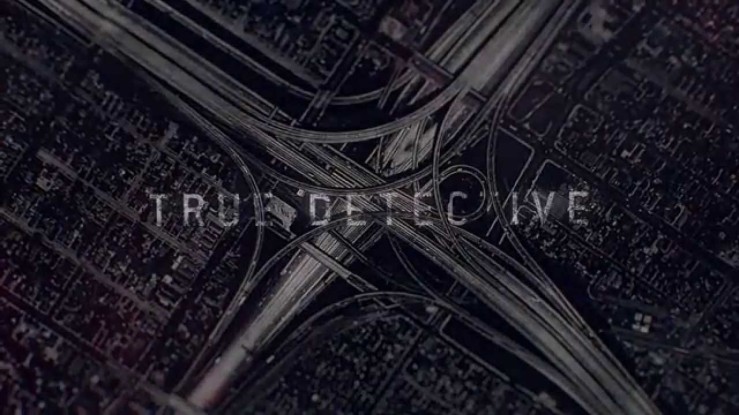
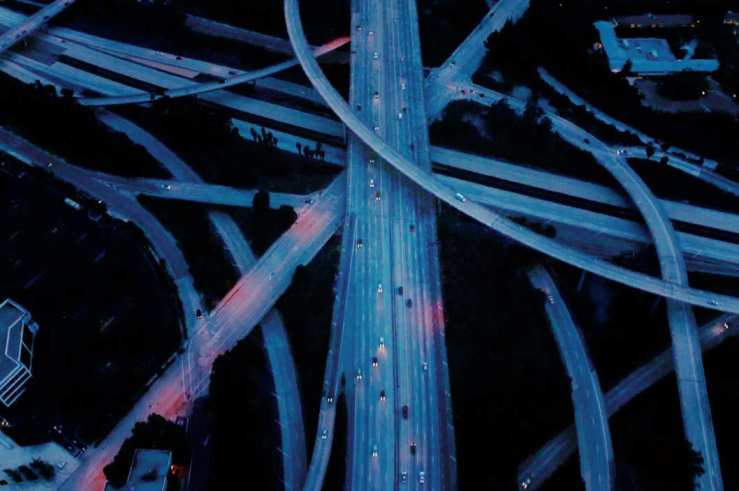
And the plot? What? Another reading rule, indulge me, indulge me, comes in the series’ overuse of aerial shots of L.A. freeways—big converging loops, sometimes black white gray, but often glowing lurid neon at night. The plot is easy to write off as a shaggy dog mess (see also Inherent Vice, Twin Peaks, The Big Lebowski), but it’s not. It does fit together (just like the plots of those examples I proffered parenthetically). You can even have someone explain the plot to you if you like. Ascending from the confusing and abject trenches, the looping freeways’ tangled violence resolves into a beautiful, complete, pulsing picture.
And there are other reading rules that guide a viewer toward TD2’s satire—the bizarre cliffhanger “death” of Velcoro at the end of only the second episode, for example. The scene was thoroughly convincing in its morbidity and illogic, an illogic predicated on its audience’s intimate relationship with hoary TV tropes of yore.
Or? Or the body of our (ostensible) murder victim, Ben Caspere, chauffeured about a la Weekend at Bernies? Or the scene at the Chessani estate? Or Woodrugh’s cheeks flapping in the wind? Or the saloon that Velcoro frequents, with a witch guitarist on retainer? Or the Elvis impersonator? Or the Good People commune? (Reminds me that I forgot to namedrop The Source Family in points 15 or 16). Or the garbage apocalypse movie? Rick fucking Springfield? The masks? The dildos? The knives? The teeth? The eyes? Or the fucking orgy scene, with its wonderful syrup soundtrack?
The satire overwhelms, I mean, re: point 19. The satire normalizes, elides its own satirical contours. L.A. and Environs of TD2 is absurd, abject, and surreal. It’s fun stuff.
And this, re: point 20, is what maybe fails to connect with so many viewers who’ve been so critical of the season—It takes itself tooseriously! is a common accusation.But no, I don’t think it does, not a bit.
This isn’t to say that the actors aren’t acting so seriously—sometimes to the point that they appear to be in entirely different series from each other. Vince Vaughn is an easy example here. He’s not just playing against type as Frank Semyon, he’s playing against strength. And common sense. And maybe even good taste. (Although I don’t think good taste has anything to do with TD2). Vaughn’s Semyon occasionally comes to life when he’s back in his rough-and-tumble element, but for the most part, his character seems to be one long deadpan (emphasis on dead) satire of audience expectations.
Let me anticipate: Look, pal, are you saying that Vince Vaughn is bad on purpose in True Detective? No. That’s not what I’m saying. I’m saying that he was a bad but interesting bet for the role, and I think he was cast as a satirical jab at audience expectations.
And but still, re: point 22, re VV’s Semyon: When, on his revenge kick in ep 5, he delivers the simile “It’s like blue balls in your heart,” what other option is there but to laugh hysterically? I mean, spit out your precious bourbon even, if it’s in your mouth! Blue balls in your heart is a satirical metaphor, the punchline to the series’ set-ups of masculine anxieties. It’s an especially excellent example of one of many, many lines in TD2 that oozes pulp. The audience is to chew that pulp and like it. (Or do a spit-take).
25 points seem like too many points in a riff, as these things go, and too much has been written about True Detective Season 2 anyway—which attests maybe to its zeitgeistiness, if not its greatness. I’ve enjoyed the season very much, and I do not care at all if its loops cohere into some greater picture in the finale. I’ll happily settle for some ridiculous hardboiled neon noir satire.
Early in J.G. Ballard’s 2003 novel Millennium People, our narrator David Markham remarks that “A vicious boredom ruled the world, for the first time in human history, interrupted by meaningless acts of violence.” The sentence delivers three of the novel’s key terms: boredom, meaningless, and violence. These words (or iterations of these words) repeat so often in Millennium People that any connotative spark they might bear becomes dulled. Even the violence becomes boring.
The violence in the novel resonates from its central plot about a middle-class revolution in Chelsea Marina, an “enclave of middle-class decorum.” Corporate psychologist David Markham is drawn into this revolution after his ex-wife dies in an apparently-meaningless bombing at Heathrow Airport. (She dies at the baggage carousel—symbolically-overloaded and thoroughly-Ballardian). Initially, Markham’s goal is to infiltrate the group as a kind of unwitting police spy. However, he soon takes part in acts of terrorism and meaningless violence, led in large part by Kay Churchill, an ex-film studies professor who rails against the evils of Hollywood and travel. Soon, Kay ventriloquizes Markham:
…I could hear her voice inside my head: bullying, pleading, sensible and utterly mad. The middle class was the new proletariat, the victims of a centuries-old conspiracy, at last throwing off the chains of duty and civic responsibility.
Kay eventually leads Markham to Millennium People’s would-be heart of darkness, demented pediatrician Dr. Richard Gould. Kay and Markham:
‘Richard says that people who find the world meaningless find meaning in pointless violence.’
‘Richard? Dr Richard Gould?’
‘You’ll meet him again, when he’s ready. He’s the leader of our middle-class rebellion. His mind is amazingly clear, like those brain-damaged children he looks after. In a way, he’s one of them.’
Kay is a far more interesting character than Gould. Unfortunately, Ballard teases out Gould as the Big Bad, occasionally having him show up to dialogue with Markham on finding big-em Meaning in all the meaninglessness of the world. God as a Void, the evils of the 20th century infecting the new millennium, etc. These ideas repeat and repeat and repeat, bumping along a muddled plot. Indeed, much of the plot and many of the themes of Millennium People might be condensed into this conversation between Markham and his one-time colleague/boring-assed doppelgänger Henry the psychologist. Markham speaks first in this exchange, explaining the revolution to Henry (I’ve added bold-faced emphasis if you’re in a hurry):
‘Middle-class pique. We sense we’re being exploited. All those liberal values and humane concern for the less fortunate. Our role is to keep the lower orders in check, but in fact we’re policing ourselves.’
Henry watched me tolerantly over his whisky. ‘Do you believe all that?’
‘Who knows? The important thing is that the people at Chelsea Marina believe it. It’s amateurish and childish, but the middle classes are amateurish, and they’ve never left their childhoods behind. But there’s something much more important going on. Something that ought to worry your friends at the Home Office.”
“And that is?’
‘Decent and level-headed people are hungry for violence.’
‘Grim, if true.’ Henry put down his whisky. ‘Directed at what?’
‘It doesn’t matter. In fact, the ideal act of violence isn’t directed at anything.’
‘Pure nihilism?’
‘The exact opposite. This is where we’ve all been wrong – you, me, the Adler, liberal opinion. It isn’t a search for nothingness. It’s a search for meaning. Blow up the Stock Exchange and you’re rejecting global capitalism. Bomb the Ministry of Defence and you’re protesting against war. You don’t even need to hand out the leaflets. But a truly pointless act of violence, shooting at random into a crowd, grips our attention for months. The absence of rational motive carries a significance of its own.‘
While Ballard’s diagnosis of the end of the 20th century is both perceptive and prescient, the novel’s repetitions build to very little. Ballard puts his interlocutors into fascinating territory, but then squirms away. Here’s Gould holding forth to Markham:
We’re living in a soft-regime prison built by earlier generations of inmates. Somehow we’ve got to break free. The attack on the World Trade Center in 2001 was a brave attempt to free America from the 20th Century. The deaths were tragic, but otherwise it was a meaningless act. And that was its point.
Markham then immediately turns the conversation to the Heathrow bombing that killed his ex-wife. The potential for a shocking exchange simply veers back to the novel’s central thesis.
And that thesis becomes muddied. Markham, Gould, Kay, and other revolutionaries make bold, radical declarations, but often append them in a sentimentality at odds with their revolutionary claims. Ballard’s characters let us know that they think murder is wrong. The contradiction between the impulse for meaningless violence and the core (and very middle-class) values that often restrains the impulse remains unexplored. This unresolved contradiction might have been a purposeful tactic meant to highlight the limits of our narrator’s desire for real revolution, but there’s little to lead a reader to this conclusion beyond his own hopeful imagination. Ballard seems as uncommitted as the characters.
A lack of force and shock—that’s the problem of Millennium People, I suppose. It’s unfair and unproductive to expect Ballard to rewrite Crash or High-Risehere, even though he’s playing with many of the same themes and motifs. And yet those novels exist. Dr. Richard Gould is a pale answer to Crash’s Dr. Robert Vaughan (or Richard Wilder of High-Rise or Strangman of The Drowned World or Dr. Barbara of Rushing to Paradise…). Ballard’s satire suffers from a lack of full commitment. The hyperbole peters out; the tonal inconsistencies, far from clashing, become dull.
Still, there’s much to commend in Millennium People even if it falls short of Ballard’s finest work. The novel’s larded with little riffs and satirical observations: “America invented the movies so it would never need to grow up,” Kay remarks. Markham observes in a riot “the outrage of professional men and women who had never known pain and whose soft bodies had been pummelled only by their lovers and osteopaths.” We’re informed that “From now on ordering an olive ciabatta is a political act.” (I would love to read the notebook where Ballard recorded these phrases, if such a treasure exists).
Millennium People’s prescience—like most of Ballard’s previous work—only comes into sharper relief over time. The erosion of the middle class, the spike in income inequality, the inability of regular working people to live in places like London or New York City anymore—Ballard’s mapped it all out here. The contemporary world Ballard satirizes in Millennium People—published just a few years before his death in 2009—is already thoroughly Ballardian. The millennium caught up to the man.
With the bad taste of a recentish YAish post-apocalyptish novel in my brain, I riffled through some old sci-fi titles, hoping to find something to hit “reset.” J.G. Ballard’s 1975 novel High-Rise—which I hadn’t read since I was a teenager—wrapped me up immediately with its opening sentence:
Later, as he sat on his balcony eating the dog, Dr Robert Laing reflected on the unusual events that had taken place within this huge apartment building during the previous three months.
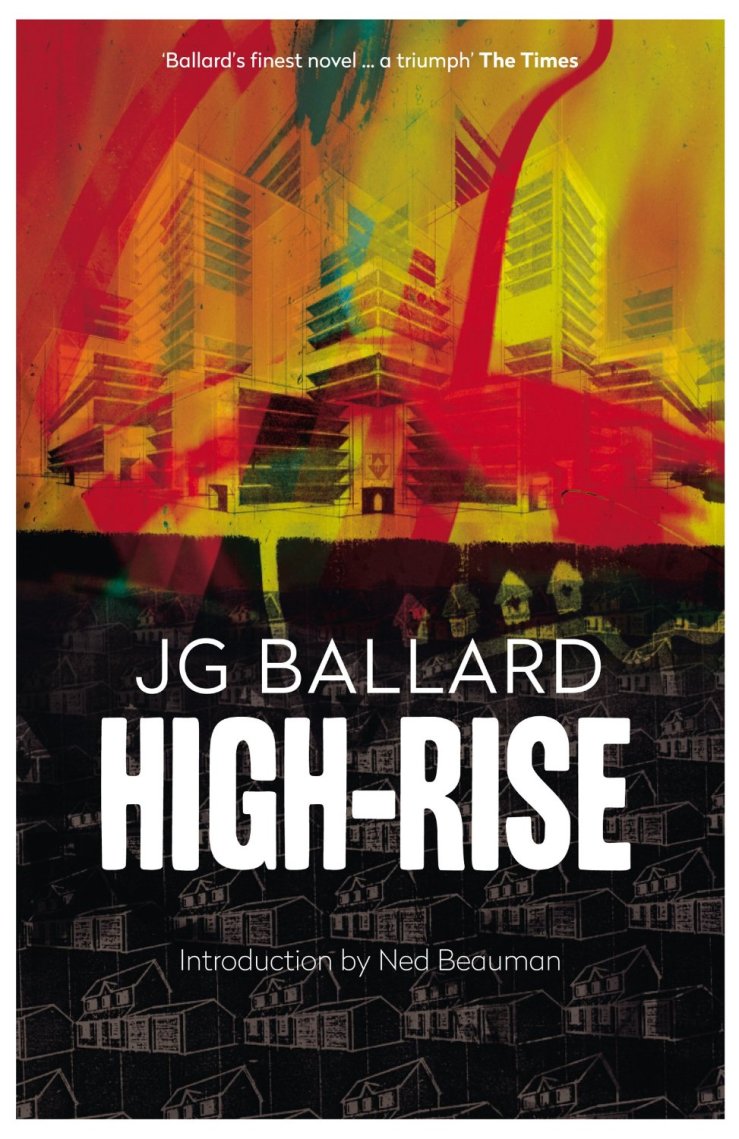
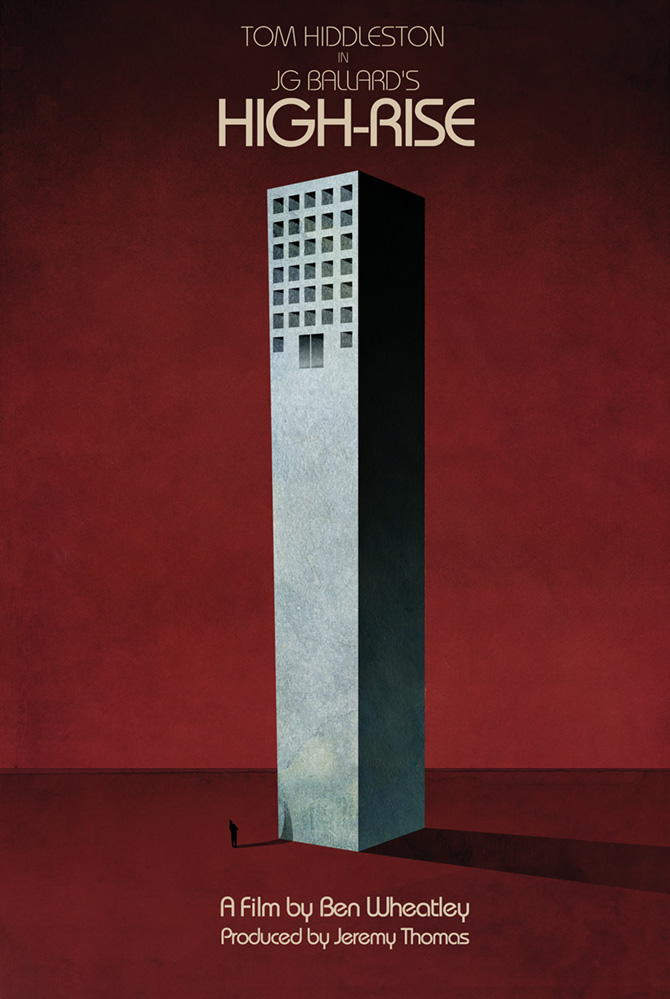
(If the promise of that first line doesn’t intrigue you, High-Rise isn’t for you. Maybe you’ll enjoy all the old High-Rise covers I couldn’t help but to scatter through this riff).
The first chapter of High-Rise is aptly titled “Critical Mass.” This is a book where things, uh, escalate quickly, if you’ll forgive my indulging in the parlance of our times. Ballard dispenses with any simmering in his tale of depraved debauchery (or is that debauched depravity?). He gets that pot boilin’.
Depravity. Debauchery. Degeneration. The boiling pot of late-20th century consciousness.
So, what is High-Rise about? Like, the plot, man? Class-war in a high-rise condo: A self-contained society that fails, its id overspilling into sex and violence: The veneer dissolved in piss and spite. And the best part? Ballard dispenses with any sort of explanation whatsoever. We begin at critical mass. He counted on his late-20th-century reader to intuit the whole damn deal (or throw down the book in defensive disgust).
Ballard structures the book around three anti-heroes, who represent, probably, id, ego, and superego—or rather, what I mean to say is ironic send-ups of id, ego, and superego—with the high-rise itself a kind of consciousness in crisis.
From the middle-class (and perhaps ego)—the 25th floor—there’s Dr. Robert Laing—not really a practicing doctor, no, but he works at a teaching hospital. Ballard tricks us into thinking he’s the protagonist—which I guess he is!—by which I mean audience surrogate, and also typical Ballardian hero (divorced; mama issues; a drinker). His name may recall to you the (anti-)psychiatrist R.D. Laing (as well as, perhaps, Language).
We might find a tidy—as in sanitary–summary of High-Rise in this brief excerpt, where our ego hero Laing packs away his tools and totems of the old world in anticipation of the new one to come:
In this suitcase-sized cavity he hid away his cheque book and insurance policies, tax returns and share certificates. Lastly, he forced in his medical case with vials of morphine, antibiotics and cardiac stimulants. When he nailed the floorboards back into place he felt that he was sealing away for ever the last residues of his previous life, and preparing himself without reservation for the new one to come.
The phrase “to come” — as in a future to come — repeats throughout High-Rise—a kind of irony, ultimately, that I shouldn’t step all over here. I’ll get back to that momentarily, but—
Ballard soon trips us up by shifting his free-indirect style from Laing to Richard Wilder of the 2nd floor. A bestial brawny brawly dude (and the only father in this trio of anti-heroes) Wilder (c’mon with that name man!) is id id id all the way down (up). Wilder’s also a filmmaker, a camera in his hand, a sensing thing all the way down (up). He causes some problems.
(The idea that a middle-class man like Wilder might represent the proletariat here is addressed in more (although oblique) depth in Ballard’s 2003 novel Millennium People).
And then the super-ego/upper crust: Anthony Royal (O!c’mon with that name dammit!) of the penthouse. He’s the literal architect of the high-rise, which makes him possibly maybe probably responsible for its many, many design flaws, which boil down to intake, outtake, and power, but look like parking, garbage, and electricity.
And so Ballard shuttles us between these three consciousnesses, like the elevators that symbolically anchor this novel. (Anchor is a terrible verb for these mobile metaphors. Or maybe it’s the precise verb).
Like I said in point 5, Ballard doesn’t really bother to foreground the causes for the high-rises’s society’s degenerate descent (ascent?)—instead, he offers concrete contours and psychological descriptions. Like this one, when a psychiatrist (yep) offers this analysis to Laing (and the reader, of course):
I had a bucket of urine thrown over me this afternoon. Much more of that and I may take up a cudgel myself. It’s a mistake to imagine that we’re all moving towards a state of happy primitivism. The model here seems to be less the noble savage than our un-innocent post-Freudian selves, outraged by all that over-indulgent toilet-training, dedicated breast-feeding and parental affection — obviously a more dangerous mix than anything our Victorian forebears had to cope with. Our neighbours had happy childhoods to a man and still feel angry. Perhaps they resent never having had a chance to become perverse . . .
(“Perverse” is a term that repeats throughout High-Rise, and I had to leave in those bucket of urine and cudgel details).
The concrete contours, the description, the late-20th century analysis—that’s the reason to boil along with High-Rise. The book is fucking fun in its thrilling awful decadence—it’s Lord of the Flies for adults, with the spiritual mumbo-jumbo replaced with psychiatric mumbo-jumbo. Or Salò.
Back to that future to come thing, here’s another citation, at some length (enjoy those concrete contours), but with my emphasis in boldface if you’re in some big fucking hurry:
Still uncertain how long he had been awake, or what he had been doing half an hour earlier, Laing sat down among the empty bottles and refuse on the kitchen floor. He gazed up at the derelict washing-machine and refrigerator, now only used as garbage-bins. He found it hard to remember what their original function had been. To some extent they had taken on a new significance, a role that he had yet to understand. Even the run-down nature of the high-rise was a model of the world into which the future was carrying them, a landscape beyond technology where everything was either derelict or, more ambiguously, recombined in unexpected but more meaningful ways. Laing pondered this — sometimes he found it difficult not to believe that they were living in a future that had already taken place, and was now exhausted.
Ballard’s describing the late 20th century there, but perhaps he intuits the beginning of the 21st as well.
—Or maybe those are the same thing, I suppose—I mean, High-Rise was published in 1975, four decades ago, but doesn’t feel that old. For some perspective, Karel Capek’s War with the Newts was published in 1936, almost forty years before High-Rise, and that novel doesn’t feel horribly dated either, a tribute to its sharp satire.
—Which is my way of transitioning to the probably completely non-controversial idea that High-Rise is wonderful dark satire. Ballard ushers our consciousness to the high-rise’s summit through surrogate Laing, the limited concrete prose focused on the failed doctor’s misperception of transcendence. Laing perceives himself as the conquering brute, alpha male par excellence, inheritor not only of the falling high-rise, but also its female cohort, his harem in a future to come, his genealogical generativity restored. Laing can’t see that he’s been x’ed out of this equation, the failed phallic figure jutting impotently into mother sky.
So you know that High-Rise is going to be a movie? A Major Motion Picture? Starring Tom Hiddleston? As cynical as I am, I think the book should make a fine film—it’s adaptable, yes. It could even be a great video game. A video game where you eat a dog. A video game where you think you win, but you don’t.
David Foster Wallace’s 1996 novel Infinite Jest poses rhetorical, formal, and verbal challenges that will confound many readers new to the text. The abundance of (or excess of) guides and commentaries on the novel can perhaps have the adverse and unintentional consequence of making readers new to Infinite Jest believe that they can’t “get it” without help. Much of the online analyses and resources for Infinite Jest are created by and targeted to readers who have finished or are rereading the novel. While I’ve read many insightful and enlightening commentaries on the novel over the years (and, in particular, over the past six weeks rereading IJ), my intuition remains that the superabundance of analysis may have the paradoxical effect of actually impeding readers new to the text. With this in mind, I’d suggest that first-time readers need only a dictionary and some patience.
(Still: Two online resources that might be useful are “Several More and Less Helpful Things for the Person Reading Infinite Jest,” which offers a glossary and a few other unobtrusive documents, and “Infinite Jest: A Scene-by-Scene Guide,”which is not a guide at all, but rather a brief series of synopses of each scene in the novel, organized by page number and year; my sense is that this guide would be helpful to readers attempting to delineate the novel’s nonlinear chronology—however, I’d advise against peeking ahead).
The big advantage (and pleasure) of rereading Infinite Jest is that the rereader may come to understand the plot anew; IJ is richer and denser the second go around, its themes showing brighter as its formal construction clarifies. The rereader is free to attend to the imagery and motifs of the novel more intensely than a first-time reader, who must suss out a byzantine plot propelled by a plethora of characters. Readers new to IJ may find it helpful to attend from the outset to some of the novel’s repeated images, words, and phrases. Tracking motifs will help to clarify not only the novel’s themes and “messages,” but also its plot. I’ve listed just a few of these motifs below, leaving out the obvious ones like entertainment, drugs, tennis (and, more generally, sports and games), and death. The list is in no way definitive or analytic, nor do I present it as an expert; rather, it’s my hope that this short list might help a reader or two get more out of a first reading.
‘I miss TV,’ Orin said, looking back down. He no longer smiled coolly.
‘The former television of commercial broadcast.’
‘I do.’
‘Reason in several words or less, please, for the box after REASON,’ displaying the board.
‘Oh, man.’ Orin looked back up and away at what seemed to be nothing, feeling at his jaw around the retromandibular’s much tinier and more vulnerable throb. ‘Some of this may sound stupid. I miss commercials that were louder than the programs. I miss the phrases “Order before midnight tonight” and “Save up to fifty percent and more.” I miss being told things were filmed before a live studio audience. I miss late-night anthems and shots of flags and fighter jets and leathery-faced Indian chiefs crying at litter. I miss “Sermonette” and “Evensong” and test patterns and being told how many megahertz something’s transmitter was broadcasting at.’ He felt his face. ‘I miss sneering at something I love. How we used to love to gather in the checker-tiled kitchen in front of the old boxy cathode-ray Sony whose reception was sensitive to airplanes and sneer at the commercial vapidity of broadcast stuff.’
‘Vapid ditty,’ pretending to notate.
‘I miss stuff so low-denominator I could watch and know in advance what people were going to say.’
‘Emotions of mastery and control and superiority. And pleasure.’
‘You can say that again, boy. I miss summer reruns. I miss reruns hastily inserted to fill the intervals of writers’ strikes, Actors’ Guild strikes. I miss Jeannie, Samantha, Sam and Diane, Gilligan, Hawkeye, Hazel, Jed, all the syndicated airwave-haunters. You know? I miss seeing the same things over and over again.’ …
The man tended to look up at him like people with legs look up at buildings and planes. ‘You can of course view entertainments again and again without surcease on TelEntertainment disks of storage and retrieval.’
Orin’s way of looking up as he remembered was nothing like the seated guy’s way of looking up. ‘But not the same. The choice, see. It ruins it somehow. With television you were subjected to repetition. The familiarity was inflicted. Different now.’
‘Inflicted.’
‘I don’t think I exactly know,’ Orin said, suddenly dimly stunned and sad inside. The terrible sense as in dreams of something vital you’ve forgotten to do. The inclined head’s bald spot was freckled and tan. ‘Is there a next item?’
—From David Foster Wallace’s novel Infinite Jest (1996).
Perception, Plato said, is a form of pain.
The working consciousness, for instance, is narrow, shuttered by utility, its transitions eased by habit past reflection like a thief. Impulses from without or from within must use some strength to reach us, we do not go out to them. Machines are made this way. Alert as lights and aimed like guns, they only see the circle of their barrels. How round the world is; how like a well arranged. Thus when desire is at an ebb and will is weak, we trail the entertainer like a child his mother, restless, bored and whining: what can I do? what will amuse me? how shall I live? Then
L’ennui, fruit de la morne incuriosite,
Prend les proportions de l’immortalite.
The enjoyment of sensation as sensation, a fully free awareness, is very rare. We keep our noses down like dogs to sniff our signs. Experience must mean. The content of an aimless consciousness is weak and colorless; we may be filled up by ourselves instead—even flooded basements, some days, leak the other way—and then it’s dread we feel, anxiety.
To tie experience to a task, to seek significance in everything, to take and never to receive, to keep, like the lighter boxer, moving, bob and weave, to fear the appearance of the self and every inwardness: these are such universal characteristics of the average consciousness that I think we can assume that popular culture functions fundamentally with regard to them.
—From William H. Gass’s essay “Even if, by All the Oxen in the World.” (1968). Collected in Fiction and the Figures of Life. The lines of verse are from Baudelaire, which I suppose is a third citation, no?
 The book ends in 2015; I’ll let Mahé’s image speak for itself:








 One satirical reading rule for True Detective Season 2 is introduced in the first episode, “The Western Book of the Dead.” In one of
  And the plot? What? Another reading rule, indulge me, indulge me, comes in the series’ overuse of aerial shots of L.A. freeways—big converging loops, sometimes black white gray, but often glowing lurid neon at night. The plot is easy to write off as a shaggy dog mess (see also Inherent Vice, Twin Peaks, The Big Lebowski), but it’s not. It does fit together (just like the plots of those examples I proffered parenthetically).


 Biblioklept