
Detail from Saul and the Witch of Endor, 1777 by Benjamin West (1738-1820)

Detail from Saul and the Witch of Endor, 1777 by Benjamin West (1738-1820)
—but did you ever think? She was up on that elbow again, turned to him so his hand fell still on the white of the sheet, —about light years?
—About what?
—I mean if you could get this tremendously powerful telescope? and then if you could get far enough away out on a star someplace, out on this distant star, and you could watch things on the earth that happened a long time ago really happening? Far enough away, he said, you could see history, Agincourt, Omdurman, Crécy… How far away were they she wanted to know, what were they, stars? constellations? Battles he told her, but she didn’t mean battles, she didn’t want to see battles, —I mean seeing yourself… Well as far as that goes he said, get a strong enough telescope you could see the back of your own head, you could —That’s not what I meant. You make fun of me don’t you.
—Certainly not, why would…
—I mean seeing what really happened back when…
—All right, set up a mirror on Alpha Centauri then, you’d sit right here with your telescope watching yourself four, about four and a half years ago is that what you…
—No.
—But I thought…
—Because I don’t want to see that! She pulled away, pulled up the sheet, staring up at the ceiling. —But you’d just see the outside though, wouldn’t you. You’d just see the mountain you’d see it go down and you’d see all the flames but you wouldn’t see inside, you wouldn’t see those faces again and the, and you wouldn’t hear it, a million miles away you wouldn’t hear the screams… What screams, he wanted to —No, no that one’s too close, find one further away… and he subsided, looking at the sheet clenched to her throat and the length of her gone under it, recommending Sirius, setting up business on the Dog Star, the brightest of them all, watching what happened eight and a half? nine years ago? —I told you what happened… the sheet clenched firm, —I told you last night no, twenty, twenty five years away when it was all still, when things were still like you thought they were going to be?
From the beginning of the fifth chapter of William Gaddis’s 1985 novel Carpenter’s Gothic. I’d never heard of this thought experiment until now.

Deer Skull (Georgia O’Keeffe), 1961 by Todd Webb (1905-2000)

I went to the book store this afternoon to pick up a copy of the latest graphic novel in by Kazu Kibuishi’s Amulet series for my kids, and of course I browsed a while. Looking for a copy of Anne Carson’s Plainwater, I ended up finding Angela Carter’s 1972 novel Infernal Desire Machines of Doctor Hoffman. It’s a British edition, 1985, Penguin, with a lovely Boschian cover by James Marsh. Here’s a detail from the cover:

I’ve wanted to pick up Carter’s novel since I read about it on a silly good dystopian fiction list last year, and I’m thrilled that I was able to get one with a Marsh cover. This particular cover, along with Marsh’s cover for The Bloody Chamber, are included in Phil Baines lovely book Penguin by Design.
Baines’s book doesn’t include any of Marsh’s fantastic covers of J.G. Ballard novels, opting instead to include Dave Pelham’s versions. I love both Pelham and Marsh’s Ballard covers, and would love to get my mitts on one at some point. I always browse for old mass market paperbacks of sci-fi authors I like — Philip K. Dick, Ursula K. LeGuin, the Strugatsky Brothers, J.G. Ballard — hoping to find an interesting cover, something inventive and fun, something from before their works were, under the cloak of awful respectability, given safe, boring literary covers. I didn’t find any Ballard editions with Marsh or Pelham covers, but I did come across this lovely pair of mass market paperback:

They’re US Vintage versions, 1985, with covers by Chris Moore. There’s like a proto-Cherry 2000 thing going on here that I kinda love, but I already own these novels, and I don’t love the covers quite enough. So instead, this post. Here are the covers of my copies of Crash and Concrete Island:

While Henry Sene Yee’s cover design for my copy of Concrete Island (using a photograph by Kevin Laubacher) isn’t terrible, it is a good example of what I mean by boring respectable literary covers. Still, this trade edition (Picador, 2001) is really readable—I mean, it’s easy to read. The pages are nice, the typeset is great, etc. (And the book is killer). I actually like the cover of my copy of Crash, a lot (design by Michael Ian Kaye and Melissa Hayden), but it’s also trying just a little too hard. (Again—very readable version from FS&G’s Noonday Press imprint, 1994).
While I had to pass today on the mass market copies of Crash and Concrete Island today—not because they would have set me back five bucks in store credit, but because I don’t need them, because I hope some kid goes in there and picks them up—while I had to pass on those lurid beauties, I did pick up a mass market 1967 copy of The Crystal World. Publisher Berkley Medallion didn’t bother to name the cover designer/artist, and I haven’t been able to track it down, but it is, I admit, a bit disappointing—an early pulp bid for literary respectability. At least I can be on the look out for a weirder one in the future.

The fourth of seven unnumbered chapters in William Gaddis’s Carpenter’s Gothic is set over the course of Halloween, moving from morning, into afternoon, and then night. Halloween is an appropriately Gothic setting for the midpoint of Gaddis’s postmodern Gothic novel, and there are some fascinating turns in this central chapter.
A summary with spoilers is not necessary here. Suffice to say that our heroine Elizabeth Booth is left alone on Halloween in the dilapidated Rural Gothic style house she and her awful husband Paul rent from mysterious Mr. McCandless. As Paul exits the house to go on one his many fruitless business trips, he notices that some neighborhood kids have already played their Halloween tricks:
He had the front door open but he stood there, looking out, looking up, —little bastards look at that, not even Halloween till tonight but they couldn’t wait… Toilet paper hung in disconsolate streamers from the telephone lines, arched and drooped in the bared maple branches reaching over the windows of the frame garage beyond the fence palings where shaving cream spelled fuck. —Look keep the doors locked, did this last night Christ knows what you’re in for tonight… and the weight of his hand fell away from her shoulder, —Liz? just try and be patient? and he pulled the door hard enough for the snap of the lock to startle her less with threats locked out than herself locked in, to leave her steadying a hand on the newel…
The kids’ Halloween antics take on a particularly sinister aspect here, set against the stark New England background Gaddis conjures. We get gloomy streamers, desolate trees, and the bald, ugly signification of one lone word: fuck. (Fuck and its iterations, along with Gaddis’s old favorite God damn, are bywords in Carpenter’s Gothic). Paul’s reading of this scene is also sinister; he underscores the Gothic motif in telling Elizabeth to “keep the doors locked” because she doesn’t know what she’s “in for tonight.” Tellingly, the aural snap of Paul’s exit shows us that Elizabeth is ultimately more paranoid about being locked in. Indeed, by the middle of the novel, we see her increasingly trapped in her (haunted) house. The staircase newel, an image that Gaddis uses repeatedly in the novel, becomes her literal support. Elizabeth spends the rest of the morning avoiding chores before eventually vomiting and taking a nap.
Then, Gaddis propels us forward a few hours with two remarkable paragraphs (or, I should say, two paragraphs upon which I wish to remark). Here is the first post-nap paragraph:
She woke abruptly to a black rage of crows in the heights of those limbs rising over the road below and lay still, the rise and fall of her breath a bare echo of the light and shadow stirred through the bedroom by winds flurrying the limbs out there till she turned sharply for the phone and dialed slowly for the time, up handling herself with the same fragile care to search the mirror, search the world outside from the commotion in the trees on down the road to the straggle of boys faces streaked with blacking and this one, that one in an oversize hat, sharing kicks and punches up the hill where in one anxious glimpse the mailman turned the corner and was gone.
What a fantastic sentence. Gaddis’s prose here reverberates with sinister force, capturing (and to an extent, replicating) Elizabeth’s disorientation. Dreadful crows and flittering shadows shake Elizabeth, and searching for stability she telephones for the time. (If you are a young person perhaps bewildered by this detail: This is something we used to do. We used to call a number for the time. Like, the time of day. You can actually still do this. Call the US Naval Observatory at 202-762-1069 if you’re curious what this aesthetic experience is like). The house’s only clock is broken, further alienating Elizabeth from any sense of normalcy. In a mode of “fragile care,” anxious Elizabeth glances in the mirror, another Gothic symbol that repeats throughout this chapter. She then spies the “straggle of boys” (a neat parallel to the “black rage of crows” at the sentence’s beginning) already dressed up in horrorshow gear for mischief night and rumbling with violence. The mailman—another connection to the outside world, to some kind of external and steadying authority—simply disappears.
Here is the next paragraph:
Through the festoons drifting gently from the wires and branches a crow dropped like shot, and another, stabbing at a squirrel crushed on the road there, vaunting black wings and taking to them as a car bore down, as a boy rushed the road right down to the mailbox in the whirl of yellowed rust spotted leaves, shouts and laughter behind the fence palings, pieces of pumpkin flung through the air and the crows came back all fierce alarm, stabbing and tearing, bridling at movement anywhere till finally, when she came out to the mailbox, stillness enveloped her reaching it at arm’s length and pulling it open. It looked empty; but then there came sounds of hoarded laughter behind the fence palings and she was standing there holding the page, staring at the picture of a blonde bared to the margin, a full tumid penis squeezed stiff in her hand and pink as the tip of her tongue drawing the beading at its engorged head off in a fine thread. For that moment the blonde’s eyes, turned to her in forthright complicity, held her in their steady stare; then her tremble was lost in a turn to be plainly seen crumpling it, going back in and dropping it crumpled on the kitchen table.
The paragraph begins with the Gothic violence of the crows “stabbing and tearing” at a squirrel. Gaddis fills Carpenter’s Gothic with birds—in fact, the first words of the novel are “The bird”—a motif that underscores the possibility of flight, of escape (and entails its opposite–confinement, imprisonment). These crows are pure Halloween, shredding small mammals as the wild boys smash pumpkins. Elizabeth exits the house (a rare vignette in Carpenter’s Gothic, which keeps her primarily confined inside it) to check the mail. The only message that has been delivered to her though is from the Halloween tricksters, who cruelly laugh at their prank. The pornographic image, ripped from a magazine, is described in such a way that the blonde woman trapped within it comes to life, “in forthright complicity,” making eye contact with Elizabeth. There’s an intimation of aggressive sexual violence underlying the prank, whether the boys understand this or not. The scrap of paper doubles their earlier signal, the shaving creamed fuck written on the garage door.
Elizabeth recovers herself to signify steadiness in return, demonstratively crumpling the pornographic scrap—but she takes it with her, back into the house, where it joins the other heaps of papers, scraps, detritus of media and writing that make so much of the content of the novel. Here, the pornographic scrap takes on its own sinister force. Initially, Elizabeth sets out to compose herself anew; the next paragraph finds her descending the stairs, “differently dressed now, eyeliner streaked on her lids and the
colour unevenly matched on her paled cheeks,” where she answers the ringing phone with “a quaver in her hand.” The scene that follows is an extraordinary displacement in which the phone takes on a phallic dimension, and Elizabeth imaginatively correlates herself with the blonde woman in the pornographic picture. She stares at this image the whole time she is on the phone while a disembodied male voice demands answers she cannot provide:
The voice burst at her from the phone and she held it away, staring down close at the picture as though something, some detail, might have changed in her absence, as though what was promised there in minutes, or moments, might have come in a sudden burst on the wet lips as the voice broke from the phone in a pitch of invective, in a harried staccato, broke off in a wail and she held it close enough to say —I’m sorry Mister Mullins, I don’t know what to… and she held it away again bursting with spleen, her own fingertip smoothing the still fingers hoarding the roothairs of the inflexible surge before her with polished nails, tracing the delicate vein engorged up the curve of its glistening rise to the crown cleft fierce with colour where that glint of beading led off in its fine thread to the still tongue, mouth opened without appetite and the mascaraed eyes unwavering on hers without a gleam of hope or even expectation, —I don’t know I can’t tell you!
Gaddis’s triple repetition of the verb burst links the phone to the phallus and links Elizabeth to the blonde woman. This link is reinforced by the notation of the woman’s “mascaraed eyes,” a detail echoing the paragraph’s initial image of Elizabeth descending the stairs with streaked eyeliner. The final identification between the two is the most horrific—Elizabeth reads those eyes, that image, that scrap of paper, as a work “without a gleam of hope or even expectation.” Doom.
Elizabeth is “saved,” if only temporarily, by the unexpected arrival of the mysterious Mr. McCandless, who quickly stabilizes the poor woman. Gaddis notes that McCandless “caught the newel with her hand…He had her arm, had her hand in fact firm in one of his.” When he asks why she is so upset, she replies, “It’s the, just the mess out there, Halloween out there…” McCandless chalks the mess up to “kids with nothing to do,” but Elizabeth reads in it something more sinister: “there’s a meanness.” McCandless counters that “it’s plain stupidity…There’s much more stupidity than there is malice in the world.” This phrase “Halloween out there” repeats three times in the chapter, suggesting a larger signification—it isn’t just Halloween tonight, but rather, as McCandless puts it, the night is “Like the whole damned world isn’t it.” It’s always Halloween out there in Carpenter’s Gothic, and this adds up to mostly malice of mostly stupidity in this world—depending on how you read it.
The second half of the chapter gives over to McCandless, who comes to unexpectedly inhabit the novel’s center. Elizabeth departs, if only for a few hours, leaving McCandless alone, if only momentarily. A shifty interlocutor soon arrives on the thresh hold of his Carpenter Gothic home, and we learn some of his fascinating background. It’s a strange moment in a novel that has focused so intently on the consciousness of Elizabeth, but coming in the novel’s center, it acts as a stabilizing force. I won’t go into great detail here—I think much of what happens when McCandless is the center of the narrative is best experienced without any kind of spoiler—but we get at times from him a sustained howl against the meanness and stupidity of the world. He finally ushers his surprise interlocutor out of his home with the following admonition: “It’s Halloween out there too.”

Skull with Candle, 1983 by Gerhard Richter (b. 1932)

Hide and Seek, 1945 by Pavel Tchelitchew (1898-1957)
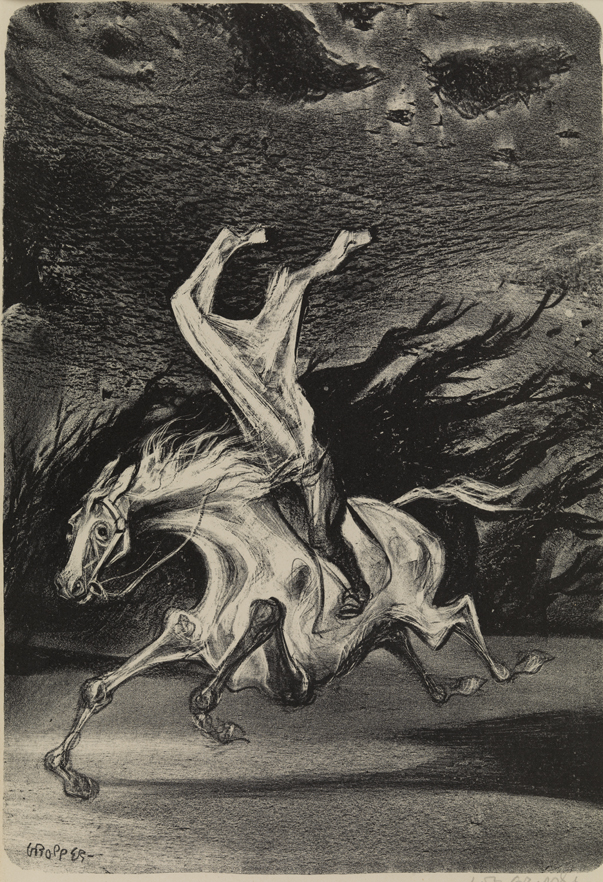
Headless Horseman, 1953 by William Gropper (1897-1977)
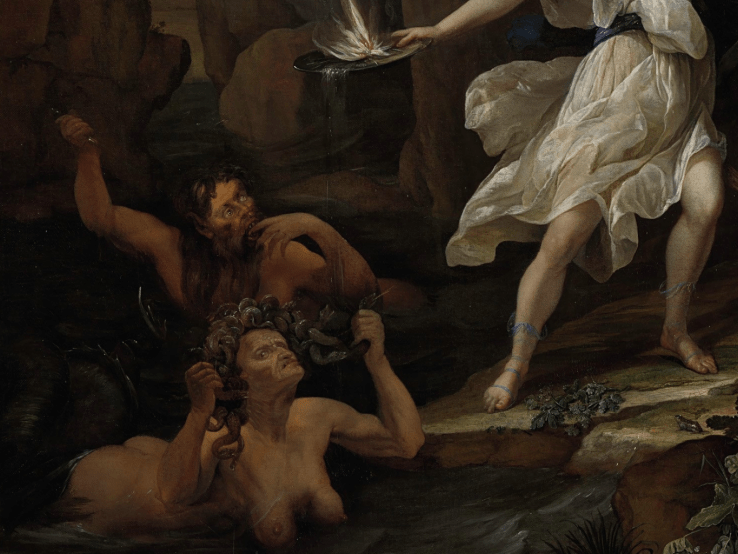
Detail from Circe Punishes Glaucus by Transforming Scylla into a Monster, 1695 by Eglon van der Neer (1636–1703)
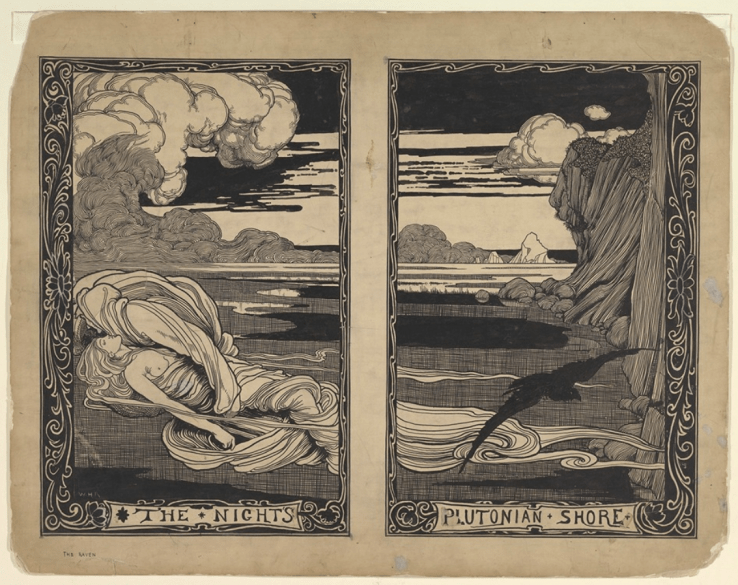
The Night’s Plutonian Shore, 1909 by William Heath Robinson (1872-1944)

This afternoon I was reading, or really, I now know, rereading Gordon Lish’s 1996 interview with Rob Trucks, and while reading (rereading) this interview, I experienced terrible déjà vu, the kind of déjà vu that upsets one like a bad itch tucked away and wriggling in an unscratchable little alcove in the back of one’s mind. Only of course now I know that I wasn’t necessarily experiencing what can rightfully be called déjà vu; rather, I was simply failing to fully remember having read something several years prior—in this case, Gordon Lish’s 1996 interview with Rob Trucks.
Early bits of the interview set me tingling. Stuff about Julia Kristeva’s Powers of Horror. Stuff about DeLillo. Lots of Lish’s anxiety about Blood Meridian. But my (non)déjà vu exploded when Lish shared the following story while discussing his (anxiety of) influences:
I read Wallace Stevens a lot, since you asked about influence. I read Stevens’s letters a lot. I’m eager to find all sorts of connections between Stevens’s life and my own, right down to, and I’ll put this to you, my extraordinary discovery not long ago that the face on the coin, on the half dollar coin, and on the dime that I gazed at so often as a child in honor o my idea of an American woman, since I come from an immigrant family, what a great American woman looked like, the one that you would have to bed in lieu of all other women you could not bed, turns out to have been modeled for a sculptor who was a landlord in Chelsea. he was, in fact, Stevens’s landlord when he and Elsie Kachel, his wife, were living in Chelsea, and the design on the coin was modeled by Stevens’s wife, so that it’s fair to make the claim that I was infatuated with Steven’s wife, or at least her profile, from the time I was five or six or seven years old. You looked at the dime, you looked at the half dollar, and you saw Stevens’s wife, amazingly.
When I read this amazingly amazing anecdote the déjà vu had passed pulsating—it was humming, whirring in the background, trying to attach to something, eventually coming up with, “David Markson? Is this something you read in a David Markson novel?” Instead of trying to search through Markson’s work (where I’m sure, or now not really sure, but rather somewhat sure, I read the anecdote of Wallace Stevens getting into a fistfight with a much younger Ernest Hemingway off the coast of Key West) for this Elsie Kachel Stevens reference, I simply did a basic internet search to get some more background on Lish’s claim that the poet Wallace Stevens’s wife served as the profile model on at least two coins of U.S. currency. The story more or less checks out (with a lot of passive voice).
Here is a photograph of the dime in question, which was designed by Adolph Weinman and minted in 1916:
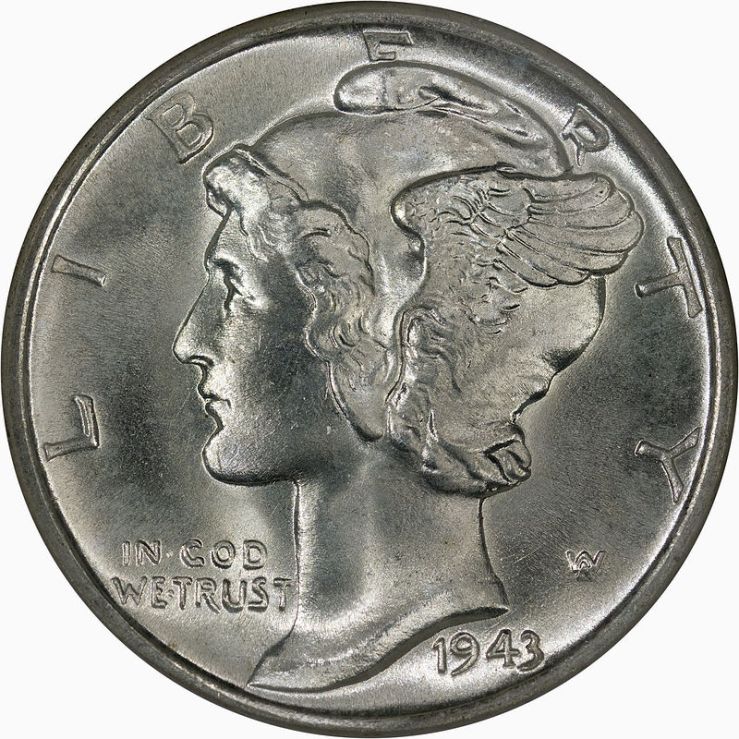
And here is a photograph of Elsie Kachel Stevens:

And here is a photograph of the bust that Adolph Weinman made of Elsie Kachel Stevens:

Anyway. I went back to the interview, still tingling a little, but also a bit preoccupied—I needed to prepare our dinner of tacos, kids needed to get to piano lessons, the dog need walking, etc. And as I hurtled through the interview, I got to a moment when Lish tells his interlocutor, “I use my dick, mainly, to write the first time, and I’m using my brains to do the revisions. I mean, not my brain. I’m using rather practiced sequences of motions that have to do chiefly with mind or chiefly with know-how. I’m trying to stick it into the page the first time out.” And then, a few paragraphs later, this nugget:
Q: So Self-Imitation is still a dick book?
A: It’s a dick book. All my books are dick books.
And then I laughed out loud and then I remembered that I had not only read this interview, but I had even written about it years ago on this idiot blog of mine. And so my itch was scratched.
I read—by which I mean reread—Gordon Lish’s 1996 interview with Rob Trucks in Conversations with Gordon Lish (edited by David Winters and Jason Lucarelli), a collection chocked full of tingly bits and fat juicy morsels and etc.

Saint Bernard Crushing a Demon, 1563 by Marcello Venusti (1512–1579)

Breakfast, 2011 by Eteri Chkadua
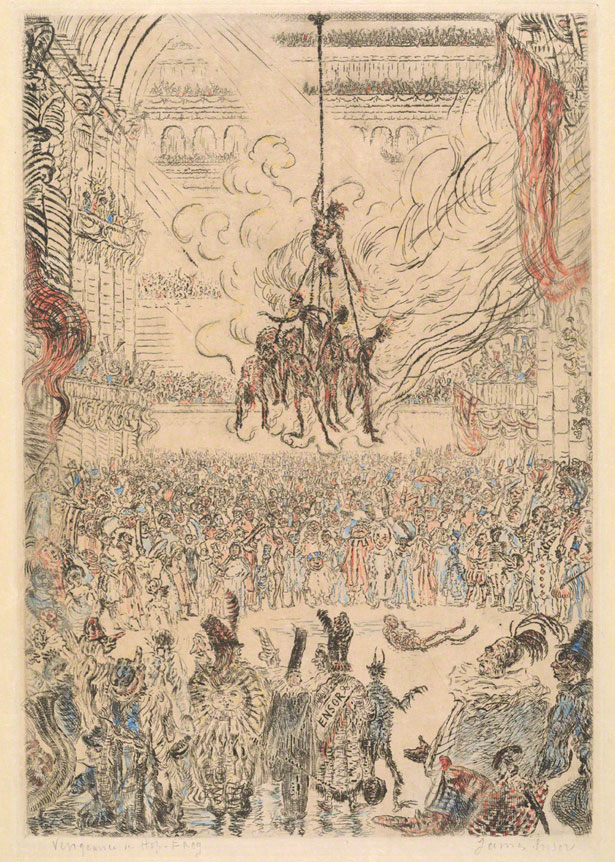
Hop-Frog’s Revenge, 1898 by James Ensor (1860-1949)
Ensor’s illustration was inspired by Edgar Allan Poe’s 1849 tale “Hop-Frog.”
“Hop-Frog”
by
Edgar Allan Poe
I NEVER knew anyone so keenly alive to a joke as the king was. He seemed to live only for joking. To tell a good story of the joke kind, and to tell it well, was the surest road to his favor. Thus it happened that his seven ministers were all noted for their accomplishments as jokers. They all took after the king, too, in being large, corpulent, oily men, as well as inimitable jokers. Whether people grow fat by joking, or whether there is something in fat itself which predisposes to a joke, I have never been quite able to determine; but certain it is that a lean joker is a rara avis in terris.
About the refinements, or, as he called them, the ‘ghost’ of wit, the king troubled himself very little. He had an especial admiration for breadth in a jest, and would often put up with length, for the sake of it. Over-niceties wearied him. He would have preferred Rabelais’ ‘Gargantua’ to the ‘Zadig’ of Voltaire: and, upon the whole, practical jokes suited his taste far better than verbal ones.
At the date of my narrative, professing jesters had not altogether gone out of fashion at court. Several of the great continental ‘powers’ still retain their ‘fools,’ who wore motley, with caps and bells, and who were expected to be always ready with sharp witticisms, at a moment’s notice, in consideration of the crumbs that fell from the royal table.
Our king, as a matter of course, retained his ‘fool.’ The fact is, he required something in the way of folly–if only to counterbalance the heavy wisdom of the seven wise men who were his ministers–not to mention himself. Continue reading “Hop-Frog’s Revenge — James Ensor”
So, in the work I’ve tried to do, in J R, especially the awful lot of description and narrative interference, as I see it now, in The Recognitions, where I am awfully pleased with information that I have come across and would like to share it with you-so I go on for two pages about, oh, I don’t know, the medieval Church,… the forgery, painting, theories of forgery and so forth, and descriptions, literally, of houses or landscapes. And when I got started on the second novel, which was J R, 726 pages, almost entirely my intention was to get the author out of there, to oblige the characters to create themselves and each other and their story, and all of it in dialogue.
An excerpt from William Gaddis’s New York State Writers Institute reading, April 4, 1990.
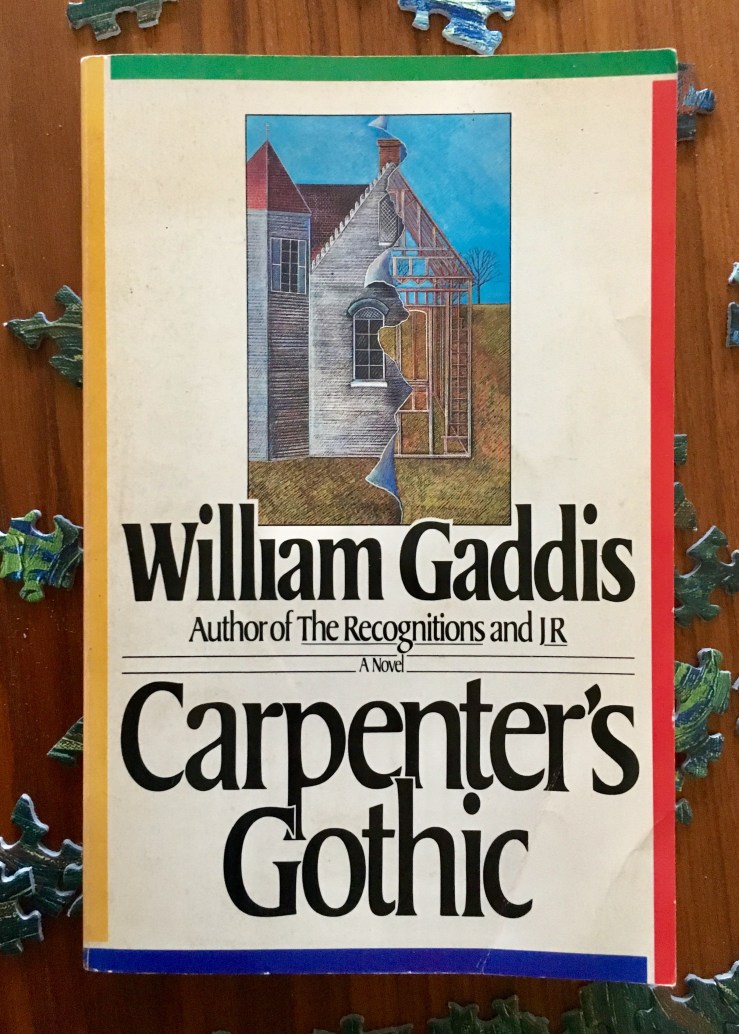
I have blazed through the first three (unnumbered) chapters of William Gaddis’s third novel Carpenter’s Gothic (1985) this weekend, consuming the prose with an urgency I did not expect. After all, Gaddis is (at least according to Jonathan Franzen) “Mr. Difficult,” right?
But Carpenter’s Gothic is not especially difficult, or does not feel that way to me, anyway—although I’m sure I find it so readable in large part because I’ve read Gaddis’s second novel J R twice already, and Carpenter’s Gothic is written in the same style as J R. The first time I read J R I did find its style tremendously challenging. Gaddis strips almost all exposition and scene-setting in J R. The novel’s 726 pages are comprised primarily in dialogue, often unattributed, leaving the reader to play director, producer, and cinematographer. Reading it a second time was, in a way, like reading it for the first time, revealing one of the best and arguably most important American novels of the second-half of the twentieth century.
In any case, reading J R has taught me how to read Carpenter’s Gothic, which is told in the same style. Carpenter’s Gothic is a smaller novel though, both literally (around 250 pages) and figuratively. While J R sports a large cast, sprawling and interlinked plots, divergent tones, and a wide array of themes, Carpenter’s Gothic is restrained to a few talking characters, whom Gaddis keeps confined to an isolated house somewhere in New England. (It is from this house’s architectural design that the novel gets its title).
The central character is Elizabeth Booth, 33, an heiress locked out of her inheritance. Elizabeth is married to an awful abusive man named Paul, a racist Vietnam Veteran who embodies almost every characteristic of what we now think of as toxic masculinity. Elizabeth is recovering from an as-yet-unspecified accident, and spends most of her time confined to her rented house, fielding phone calls. Some of these phone calls are from folks related to her husband’s latest scheme with a televangelist. Other calls are from her friend Edith who has run off to sunny Jamaica—a prospect of escape that entices Elizabeth. Even more calls come for the mysterious owner of the house, McCandless, who eventually shows up in the third chapter.
McCandless’s visit sparks something in Elizabeth. She gets to glance into his locked study, crammed with papers and books and even a piano, and she takes him for a writer, but he claims he’s a geologist. His short visit inspires Elizabeth to dig up the draft of a book, or something like a book, she’s been working on, and add a few notes. The romantic impulse is eventually punctured by her husband’s return.
Carpenter’s Gothic’s relentless interiority and inherent bitterness can give the novel a claustrophobic feeling, and reading it often reminds me of the scenes in J R that are set in the ramshackle 96th Street apartment shared by Bast and Gibbs. And yet its interiority always branches outward, evoking an exotic and pulsating world that Elizabeth might love to experience. There’s Montego Bay, there’s Orson Welles in Jane Eyre, there’s the nomadic Masai of central east Africa. Etc. But Elizabeth’s experiences are mediated by newspapers, magazine articles, phone calls, and old movies on television. It’s quite sad and frustrating.
Elizabeth thus far fits neatly into American literature’s motif of the confined woman: Walt Whitman’s 29th bather, Kate Chopin’s Mrs. Mallard, William Carlos Williams’ young housewife, Charlotte Perkins Gilman’s distressed and nervous heroine. There are many, many more, of course. I’m not quite half way through Carpenter’s Gothic–no spoilers from you please, readers!—and curious what Gaddis will do with his heroine. Will there be an escape? Freedom? A happy ending?
So many 19th and 20th century American writers seemed unsure of what to do with their heroines, even after they had freed them (Kate Chopin’s Edna Pontellier is a particularly easy go-to example, but again: there are more). Carpenter’s Gothic seems set on a tragic track, but Gaddis has a way of making his readers recognize the farcical contours in tragedy.
I haven’t given a taste of Gaddis’s prose yet. I will share, as a closing, the novel’s opening two-sentence paragraph, which I think is simply marvelous, and which I had to read at least three times before I could turn to the novel’s second page. Here it is:
The bird, a pigeon was it? or a dove (she’d found there were doves here) flew through the air, its colour lost in what light remained. It might have been the wad of rag she’d taken it for at first glance, flung at the smallest of the boys out there wiping mud from his cheeks where it hit him, catching it up by a wing to fling it back where one of them now with a broken branch for a bat hit it high over a bough caught and flung back and hit again into a swirl of leaves, into a puddle from rain the night before, a kind of battered shuttlecock moulting in a flurry at each blow, hit into the yellow dead end sign on the corner opposite the house where they’d end up that time of day.
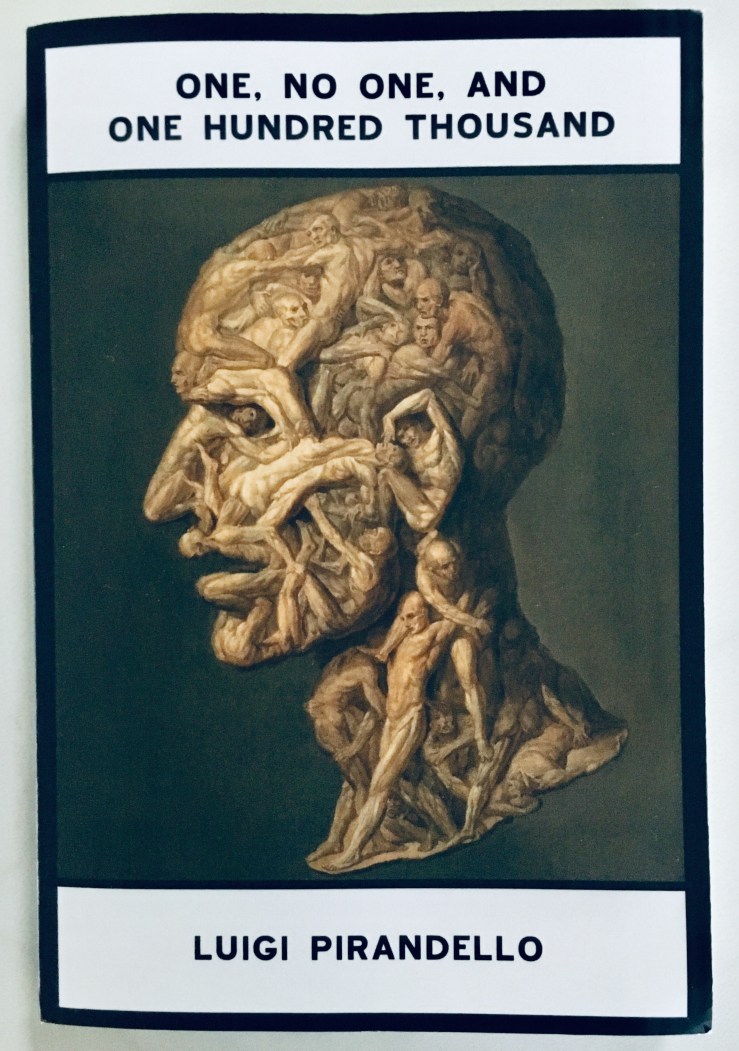
Luigi Pirandello’s One, No One, and One Hundred Thousand (English translation by William Weaver) is new in print again from Spurl Editions. Their blurb:
Translated from Italian by William Weaver, who wrote of One, No One, and One Hundred Thousand, “The definition of madness, the problem of identity, the impossibility of communicating with others and with being (or knowing) one’s self … Nowhere are these themes more intensely and wryly treated than in this spare, terse novel.”
Luigi Pirandello’s extraordinary final novel begins when Vitangelo Moscarda’s wife remarks that Vitangelo’s nose tilts to the right. This commonplace interaction spurs the novel’s unemployed, wealthy narrator to examine himself, the way he perceives others, and the ways that others perceive him. At first he only notices small differences in how he sees himself and how others do; but his self-examination quickly becomes relentless, dizzying, leading to often darkly comic results as Vitangelo decides that he must demolish that version of himself that others see.
Pirandello said of his 1926 novel that it “deals with the disintegration of the personality. It arrives at the most extreme conclusions, the farthest consequences.” Indeed, its unnerving humor and existential dissection of modern identity find counterparts in Samuel Beckett’s Molloy trilogy and the works of Thomas Bernhard and Vladimir Nabokov.
 Biblioklept