William Melvin Kelley’s Dunfords Travels Everywhere (Book acquired, 9 Sept. 2020)

Earlier this summer, I “discovered” the long-neglected novels of William Melvin Kelley, first through an essay on postmodern fiction by Black American authors (I can’t find the essay now, but I think it was by Bernard Bell), and then in a more-widely circulated article at The New Yorker. I then read Kelley’s first novel A Different Drummer and his fourth novel, demWhat I really wanted to read though was Kelley’s final novel, Dunfords Travels Everywheres, which is generally described as his most postmodern and Joycean. 

Dunfords was, at that point, not in print. I had no success finding it at my local used bookshop, so I looked on Abebooks, where I discovered that the cheapest copies were going for a hundred bucks.

Fortunately, Anchor Books has reissued Dunfords Travels Everywheres—it’s out later this month. Even better, they’ve included the many pen-and-ink illustrations for the book that Kelley commissioned from his wife Aiki. These illustrations were not included in the novel’s first edition in 1970. Here is one of her illustrations:

Proper review in the works; for now, here’s publisher Anchor’s blurb:

William Melvin Kelley’s final work, a Joycean, Rabelaisian romp in which he brings back some of his most memorable characters in a novel of three intertwining stories.

Ride on out with Rab and Turt, two o’New Afriqueque’s toughfast, ruefast Texnosass Arangers, as they battle Chief Pugmichillo and ricecure Mr. Charcarl Walker-Rider. Cut in on Carlyle Bedlowe, wrecker of marriage, saver of souls.

Or just along with Chig Dunford, product of Harlem and private schools, on the circular voyage of self-discovery that takes him from Europe’s Café of One Hand to Harlem’s Jack O’Gee’s Golden Grouse Bar & Restaurant.

Beginning on an August Sunday in one of Europe’s strangest cities, Dunfords Travels Everywheres but always returns back to the same point—the “Begending”—where Mr. Charcarl’s dream becomes Chig Dunford’s reality (the “Ivy League Negro” in the world outside the Ivory Tower).

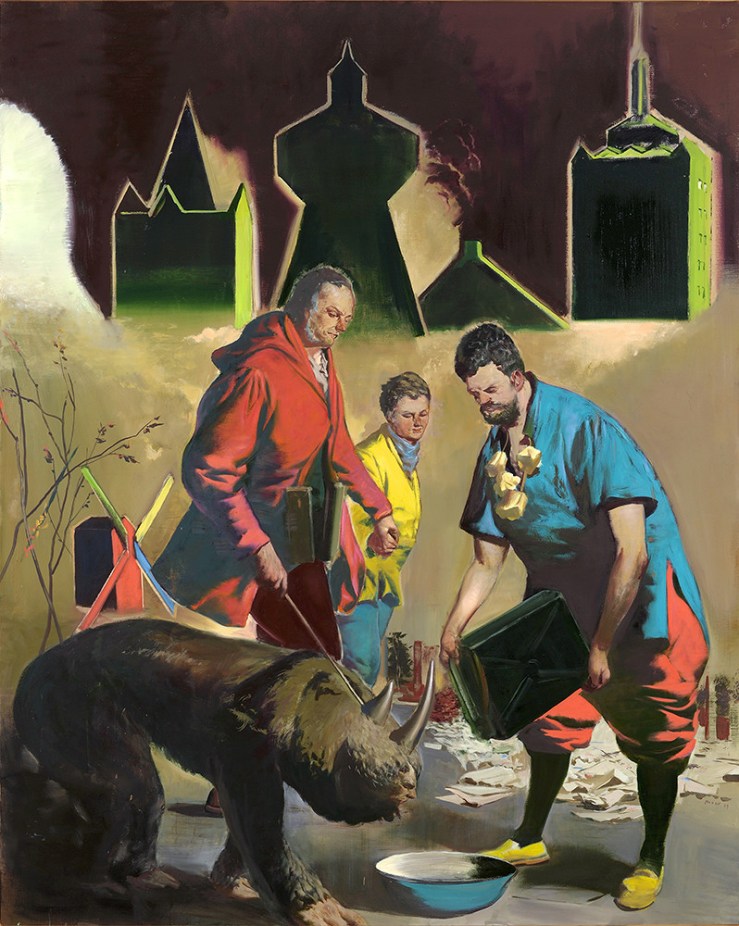
Towers — Neo Rauch

Türme (Towers), 2011 by Neo Rauch (b. 1960)

Untitled — Peter Busch

Untitled, 2020 by Peter Busch (b. 1971)

“On Walking Backwards” — Anne Carson

Atlantic Civilisation — André Fougeron

Atlantic Civilisation, 1953 by André Fougeron (1913–1998)

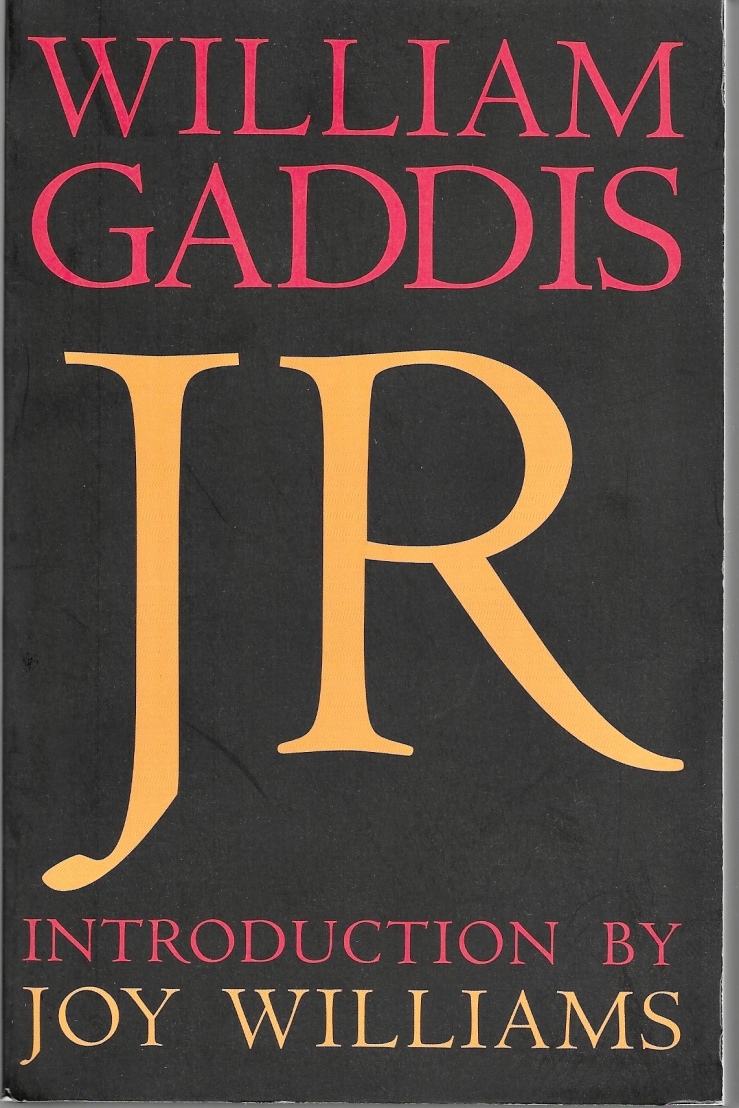
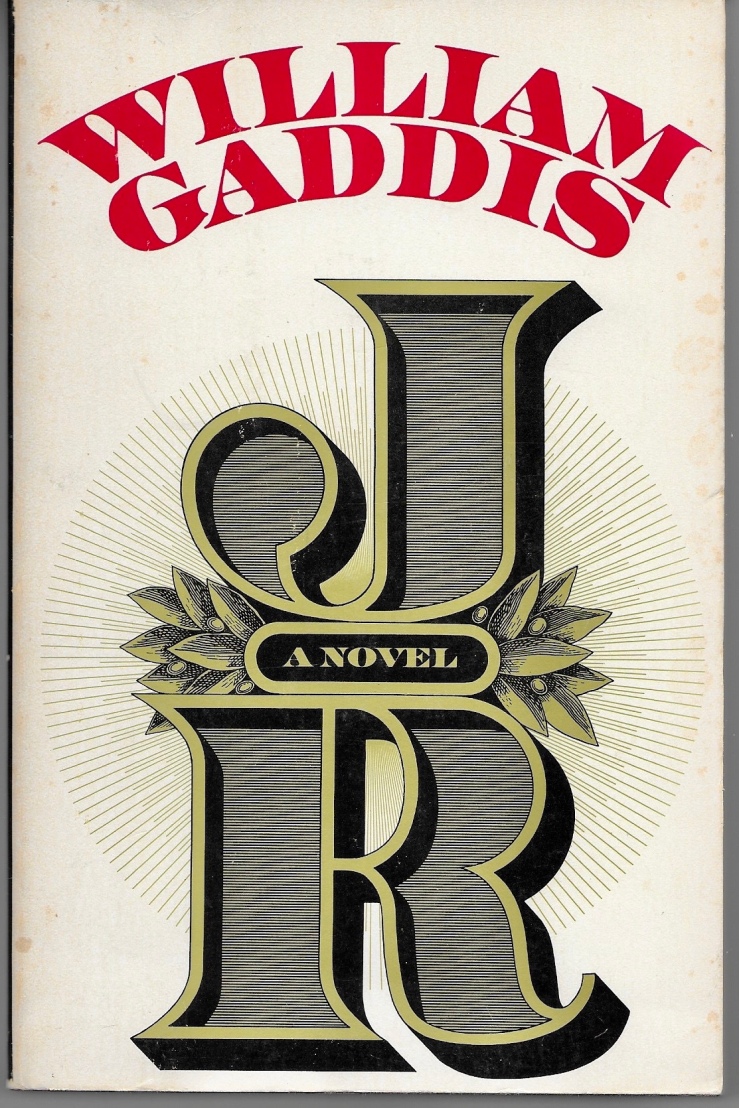
J R J R J R | Three Books

J R by William Gaddis. 2020 trade paperback edition by NYRB. Cover design by Katy Homans. Introduction by Joy Williams (xi pages). 770 pages.

J R by William Gaddis. 1993 trade paperback edition by Penguin. Cover art is a detail of an Associated Gas and Electric Company stock certificate “Courtesy of William Gaddis.” No designer credited. Introduction by Frederick R. Karl (xxi pages). 726 pages.

J R by William Gaddis. 1975 trade paperback edition by Borzoi/Knopf. Cover design by Janet Halverson. 726 pages.

On Walker Percy’s postmodern Gothic novel Lancelot

Walker Percy’s 1977 novel Lancelot opens with an invitation: “Come into my cell. Make yourself at home.”

The invitation is to both the reader and to the titular Lancelot’s audience of one, a friend from his college days he calls Percival. Percival listens to Lancelot’s increasingly-insane, unceasing monologue without interruption.

Lancelot Lamar—Lance, to friends—tells his story from his cell in the Center for Aberrant Behavior. It’s New Orleans, sometime in the mid-seventies. The dream of the sixties has curdled and soured, its failed would-be revolution of love turned to rot.

Lance’s (electrically-sexual) love for his wife Margot begins to sour, fester, and rot. He discovers by chance that he is not the father of their daughter Siobhan, and quickly comes to suspect that Siobhan is the product of Margot’s infidelity with Merlin, a filmmaker whom Margot, an always-aspiring actress, has known for years.

Merlin and his crew are filming at Lance’s ancestral manse, Bell Isle. Belle Isle was once a Great House in its parish, but modernity (and postmodernity) have a way of rotting out traditions. Margot, heiress to a new-money Texas fortune, restores the ancestral home to something-close-to its former glory. Belle Isle and the Lamar name might rub some good old fashioned Southern Aristocracy off on her. Despite those oil dollars, the Lamars still need to allow tour groups to visit Belle Isle—gawking Michiganders and Yankees and the like—in order to keep in the black.

Lancelot Lamar himself has long since stopped working. A one-time liberal who helped the NAACP, he trained as a lawyer, but latterly has taken to lust and drink. At the outset of his tale, our debauched wastrel spends his days in the pigeonnier of Belle Isle slurping bourbon and smoking cigs. His discovery that his daughter is not his own revitalizes him—it’s the revelation—nay, the apocalypse—that splits his life in two: “my life is divided into two parts, Before and After,” he tells Percival in cell.

Percival says all of thirteen words in the novel. Or, really, two words: twelve yeses and one no. It’s never quite clear if Percival is a failed psychiatrist or a failed priest or some hybrid of both, but we do know that Lancelot has long admired Percival since their school days, when the austere intellectual literally jumped ship to swim to a deserted island for a Thoreau-inspired think. Percival, or Lancelot’s ideation of Percival, serves not only as a confessor’s ear, but also as Lancelot’s avatar of intellectual spirituality. In contrast, visceral once-virile Lance (with his oh-so-phallic mantle) rests on his most vibrant college laurels: he once ran 110 yards against the Alabama Crimson Tide.

But back to Lancelot of the Before and After. Specifically, the After. After discovering his wife’s apparent infidelity (infidelities?), Lance enlists the help of his retainer Elgin, the son of Belle Isle’s Black housekeepers. Elgin is an MIT student and a technical genius, a figure whose ascendancy Lancelot can understand but perhaps not fully appreciate. A scion of the South and a one-time “liberal,” Lancelot is unable to fully understand his own racism, even as he understands Elgin’s intellectual and technocratic superiority.

Still, Lancelot comprehends the failure of the 1960’s liberalism to fully follow through on its utopian promise. He relies on Elgin’s gratitude to him, but admits,

…in truth I had done very little for him, the kind of easy favors native liberals do and which are almost irresistible to the doer, if not to the done to, yielding as they do a return of benefit to one and a good feeling to the other all out of proportion to the effort expended. That was one of the pleasures of the sixties: it was so easy to do a little which seemed a lot. We basked in our sense of virtue and what we took to be their gratitude. Maybe that was why it didn’t last very long. Who can stand gratitude?

Driven by his own motives, tech-whiz Elgin sets up secret cameras all around Belle Isle as part of Lancelot’s movie-making scheme: our monologist plans to catch his wife in the act, either with Merlin or another lover. Percy’s postmodernism is subtle but effective here. We see Belle Isle through layers, a Gothic playground of both real and imaginary depravities, some staged, some extemporaneous, all set against the backdrop of the sins of the Gothic South.

Like William Gaddis’s 1985 novel Carpenter’s Gothic, Percy’s Lancelot is a work of Gothic postmodernism. Belle Isle has been converted to a theme park version of its aristocratic past, glossed up for tourists and film crews. It’s certainly not the scene of domestic bliss.

Lancelot’s monologue starts to boil over into crazed horror, taking the reader (and his auditor Percival) into strange new spaces. Belle Isle becomes a haunted house, scene of repeated debaucheries on the cusp of disaster. The film crew prepares a massive weather machine to simulate a hurricane for their fantasy even as a massive hurricane approaches to destroy the real world. But maybe Lance, in his perverted quest, will destroy that world first.

Lancelot’s Gothic quest is for the anti-Grail, the Unholy Grail. As the novel unravels towards its crazed ending, Lancelot’s consciousness ping-pongs about in philosophical ranting. Our hero stands against postmodernity, against the nascent eighties, against the collapse of the Romantic sixties and its failed revolution. He plans a third Revolution, the final part in the trilogy initiated by the American Revolution and the Civil War. Lancelot’s increasingly unhinged screeds disturb both Percival and the reader. His apocalyptic urge for a great cleansing veers into strange, misogynistic territory.

A failed knight who cannot see his own failure, he becomes obsessed with the woman celled next to him, Anna, victim of a gang rape whom he both fetishizes and idealizes. Lancelot reads like a Southern companion to Martin Scorsese’s 1976 film Taxi Driver. Lance reminds one of Travis Bickle: both are strange, nihilistic, optimistic idealists, would-be knights seeking to save damsels in a fallen world, praying for some great rain to come and cleanse the filth of sin away. 

And like Taxi Driver, Percy’s novel—released around the same time, of course—seems like an early analysis of the failure of the sixties. It’s the burn out, the hangover, the realization that the dream was just a dream, and that the business of reality is cruel and cold and dirty. Perhaps insanity is the proper response.

There’s so much in Lancelot I’ve failed to unpack: Its analysis of America–North, South, and West–its treatment of Hollywood, its strange gnostic tinges, its weird tangled and often colliding philosophies. Lancelot Lamar is an enthralling monologist, witty, severe, pathetic and sympathetic, simultaneously cartoonish and ferociously real. I’ve also failed to convey how funny this novel is—Percy’s prose crackles and zaps, zips and dips, turns into weird little unexpected nooks. I ate it up.

Lancelot was the first Walker Percy novel I’ve read, but it won’t be the last. Great stuff.

“Pressure Drop” (Live in ’75) — Toots and the Maytals

RIP Toots Hibbert, 1942-2020

A very incomplete list of good or adequate (and primarily indirect) 9/11 novels and short stories

The Names, Don DeLillo (1982)

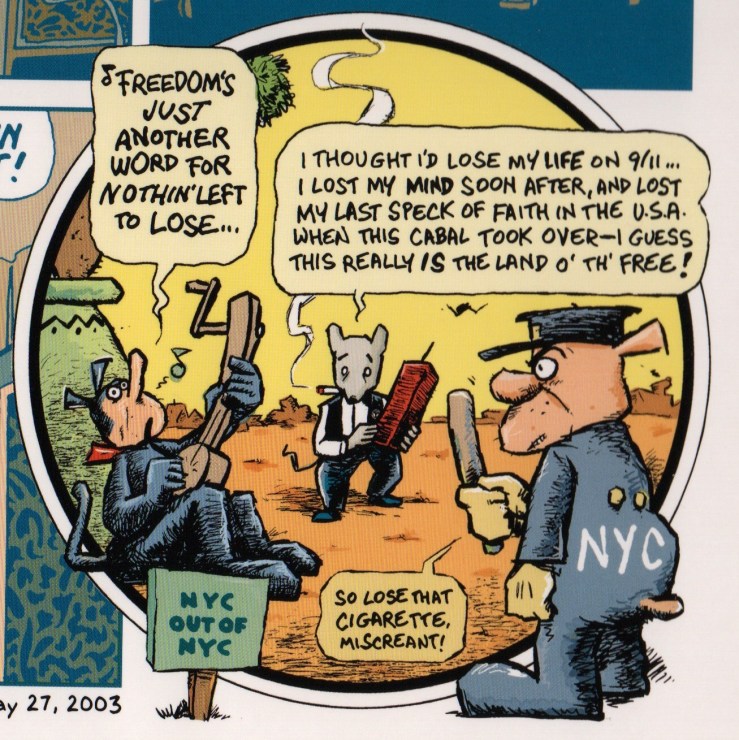
In the Shadow of No Towers, Art Spiegelman (2004)

“The Suffering Channel,” David Foster Wallace (2004)

Falling Man, Don DeLillo (2007)

“The Vision of Peter Damien,” Chris Adrian (2008)

Open City, Teju Cole (2011)

Bleeding Edge, Thomas Pynchon (2013)

Preparation for the Next Life, Atticus Lish (2014)

“Doppelgänger, Poltergeist,” Denis Johnson (2017)

Lost my mind soon after (Art Spiegelman)

From In the Shadow of No Towers by Art Spiegelman, Pantheon, 2004.

Blog about blogging for fourteen years (and not blogging so much lately)

Yesterday afternoon, prepping notes for an evening class, I recalled that this blog Biblioklept turned fourteen. I was typing out some notes for an American literature class I teach (and have taught for years now) on Wednesday nights, and something about it resonated with me–What is on 9 September?–and then I remembered why the date should catch in my memory. I posted the first Biblioklept post on 9 Sept. 2006. It was on Lorraine Hansberry’s play A Raisin in the Sun and it was all of four sentences long. I was teaching AP Lang and AP Lit at an inner-city high school in Jacksonville, FL at the time, and I suppose that we must have been reading Raisin at the time. I still know pretty much every line of the play.

I know large chunks of the text that I was preparing my notes for last night, Mark Twain’s novel Adventures of Huckleberry Finn. Some semesters I sleepwalked through my American lit classes, others I find myself revitalized by the material. Lately I’ve been sleepwalking–since 2017ish, if I’m honest, but having to do everything over Zoom has necessitated change. I spent a big chunk of the last few days revisiting Leslie Fiedler and Arnold Weinstein and Harold Bloom and Ralph Ellison on Huck Finn, trying to synthesize the material into something new that might zap me enough to zap my students through Zoom.

In years past I might’ve smuggled my notes into a blog post, a trick I used to pull every now and then, but I didn’t seem to have the energy when I got up today. I had a few composition classes to prep for, as well as remedial college reading class where half of the students speak English as a second language. I needed to figure out a way to communicate through the screen again, a way to figure out how to wrangle all my body language into a tiny digital square. It’s a bit exhausting, but we’ve all been exhausted, right? I’m healthy, my family is healthy, we have enough to eat, the air is still breathable, the water still potable, etc.

I’ve thought about ending this blog a lot in the past two years. I’ve seen so many of the blogs that I admired and conversed with and interacted with disappear over the last five or six or seven years. I still keep a blogroll (called “Elsewhere,” at the bottom of the site), but many of the links there have melted off into unupdated ghosts or, worse, collapsed into vacant 404s. (Is there an archive somewhere of Mark Wood’s wood s lot? Is someone–who?–going to keep David Berman’s Menthol Mountains up?). Other spaces that I had once thought were blogs, or at least bloggish, like The Millions and LitHub, turned out to be other things entirely.

Is this even a blog? A weblog? I’m not sure. For a long time Biblioklept seemed to me a hybrid of the “traditional” blogging that came out of LiveJournal and other spaces with the more image-centric universe of sites like tumblr. I’m not sure what it is anymore. I like to post paintings on here. I like figure painting in particular. I’m jealous of my wife’s art history degree, and have spent the past ten or so years trying to catch up to her.

I’d write about art more but I feel terribly unqualified.

I’d write about literature more but I feel exhausted by it so often, so terribly uninvigorated.

Here’s a big stack of books that I stacked up from three stacks stacked around our stack-stocked house:

Some of these are books that I’m reading and will finish soon (Walker Percys Lancelot, Walter Serner’s Last Loosening), some are books that I keep dipping in and out of (Domini’s The Sea-God’s HerbThe Big Fat Gary Lutz, Pierre Senges’s Studies of Silhouettes), some are books that have recently come into the house and need to be restacked elsewhere. At least one is an enigmatic new indie that I need to muster a review of (look, go buy Guillermo Stitch’s weirdass novel Lake of Urine. It might not be your cup of tea but it is in no way boring, either at the plot or prose level).

But yeah, I wish I blogged about books more.

When I look at that first four-sentence post back in 2006 I feel a bit envious. What the fuck made me feel it was acceptable to string those clauses together so cavalierly? Later September posts (like one on Klaus Kinski’s memoir, or a “review” of Jonathan Lethem’s Fortress of Solitude show a little more dedication to fuller description (maybe even the germ of an inkling of an iota of analysis), but on the whole, those early posts–I mean, just looking at them now–I think I was having a lot more fun.

2006 was different and I was different–still in my mid (okay maybe late twenties), still sans children, still up to see a scuzzy band at a scuzzy bar on a week night even if it meant getting up hungover at 5:30am to teach high school downtown. I was closer in age to the students I taught then than I am to the students in my classes now. Most of my students now would, what, be starting kindergarten in 2006?

2006 was different and blogging seemed full of possibility—possibility of communication, transformation, elation, etceteration. There wasn’t really Facebook yet, or Twitter, or Reddit. Or rather, all of these social media platforms existed, but they were newborn, untested (at least by the masses), not the primary spaces for engagement over the internet. Internet 2.0 was just starting, really, and the second wave of blogging—with blogs like Biblioklept—seemed as vital as any other online presence.

(Should I mention that I only started blogging because two of my friends had started blogs and both of them, independently, insisted I do it because I’d be good at it? So I started, riffing mainly on books that I’d stolen, or at least gotten for free somehow, and those stories ran out, and at some point publishers started sending me books, and then a decade or so passed.)

Today, nothing about Biblioklept feels vital to me, and I realize the hubris in a 27 year old, a 30 year old, that thought the blog was important somehow. In retrospect, I realize that the feeling of doing something important (namely, discussing literature) was really the weird feeling of joy and energy I used to have. And sometimes I still grab a little piece of that old joy when I type out some characters, some words into the little big WordPress box. (I’ve had to retrofit to using WordPress’s old or “classic” editor. They updated to a block editor which I despise, another sign of my age perhaps. (Or maybe, just maybe, the block editor fucking sucks.)) And well so anyway yeah. I’m not really sure what the point of this post is. It’s not a rant, right? It kinda feels like a half-assed apology, but, like, for what?

I guess I wish I had it in me to post more—to post shorter riffs, maybe—to get back to that initial spirit of writing too fast and maybe not thinking too hard.

Anyway. I really do appreciate all of you who have read and looked and lurked for five, six, ten, twelve, fourteen years. Really.

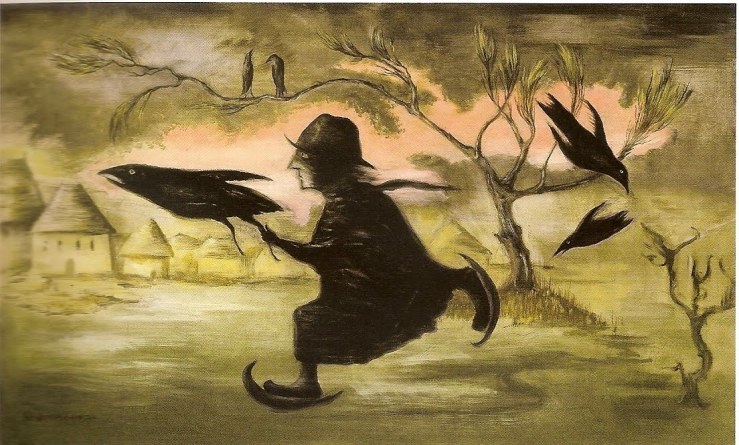
Crow Catcher — Leonora Carrington

Crow Catcher, 1990 by Leonora Carrington (1917–2011)

The Fourteen Daggers — Kay Sage

The Fourteen Daggers, 1942 by Kay Sage (1898-1963)

Almost Paradise — Josh Keyes

Almost Paradise, 2018 by Josh Keyes (b. 1969)

Thanatos — Jacek Malczewski

Thanatos, 1899 by Jacek Malczewski (1854-1929)

Pierre Senges takes on Kafka’s fragments in Studies of Silhouettes (Book acquired, 2 Aug. 2020)

I’ve enjoyed digging into Pierre Senges’s Studies of Silhouettes since its arrival last week. The book is forthcoming from Sublunary Editions thanks to a translation by Jacob Siefring. Here’s Siefring’s blurb, which explains Senges’s project here:

Each of the texts in this work proceed from the fragments and cryptic beginnings found scattered throughout the notebooks Max Brod took possession of after Kafka’s death. The results tend to be as variable as they are unexpected: outlines of tales, madcap soliloquies, fairy tale inversions, strange parables, comedic monologues. In some instances a single fragment of Kafka’s is reprised multiple times, yielding parallel but divergent texts. Other times, a unique fragment is driven to its logical extreme, or gives way to a dizzying cascade of ab absurdum speculation, and one marvels how the development could have been otherwise. As one might expect, all of Kafka’s familiar obsessions—the night and its terrors, the law, justice and its lack, bureaucracy, animals, et cetera—are here in force. Each passage begins in boldface to indicate the hand of the Prague lawyer, before giving way to Senges’s liberties.

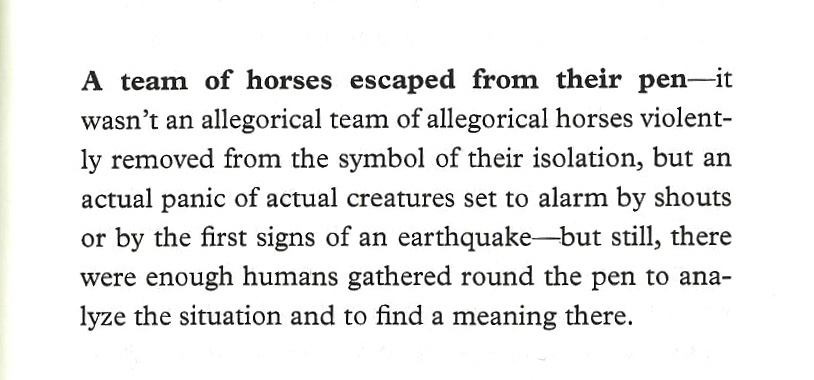
I’ve been dipping in at random, between the other few books I’ve been reading, and it’s good stuff. Here’s a sample:

Read my review of Pierre Senges’s Geometry in the Dust here.

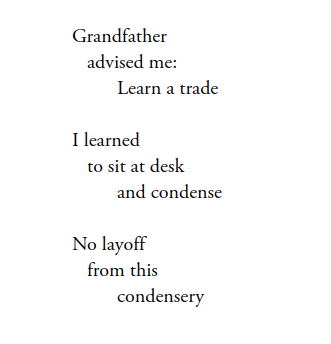
“Poet’s work” — Lorine Niedecker