The obligatory 2015 year-end list

img_1228

Favorite Reading Experiences

I finally read Thomas Pynchon’s novel Gravity’s Rainbow in full in 2015. Then I immediately read it again (which is sort of like really reading it), occasionally dipping into Steven Weisenburger’s A Gravity’s Rainbow Companion. Rewarding, hilarious, challenging, perplexing, Gravity’s Rainbow is too brilliant to look at directly, and is perhaps best approached slantwise, as one Ms. Dickinson of Amherst has advised.

On page 588 of Gravity’s Rainbow, the narrator (?!) suggests that we “Check out Ishmael Reed.” So I did. His novel Mumbo Jumbo is like nothing I’ve ever read before—the reviewer’s crutch “dazzling performance” comes to mind, because Mumbo Jumbo is a performance (jazz, bebop, soft shoe, vaudeville, a hoodoo magic show, an exorcism: performance art), and it does dazzle, overwhelm, energize, haunt, titillate, reverberate, howl…and there are pictures! Reed uses photos in a way that Sebald would a few decades later—documentary evidence of a sort. I don’t know. I just don’t know.

Like Reed’s novel, Anne Carson’s novel-poem-myth-book Autobiography of Red is impossible to categorize and extremely difficult to describe. I tried to write about it a few times on this site and failed, which is fine. What matters here is the reading experience: Carson’s book zapped me, gave me tingles, reminded me that what I want to think and feel when I read is, How is this possible? How is this allowed? (Another huge thank you to BLCKDGRD for sending me Autobiography of Red and its sorta-sequel Red Doc>).

Also: Nabokov’s Pale FireTwo Serious Ladies by Jane BowlesHomesick by Lucia Berlin and Evan Dara’s novel Fleewhich I loved reading with Biblioklept contributor Ryan Chang .

And finally, Ursula K. Le Guin, whose so-called Hainish Cycle I read most of this year. I still have to read The Telling, but great stuff, and a full write-up early in the new year.

Favorite Books I Read in 2015 That Were Actually Published in 2015

Signs Preceding the End of the World, Yuri Herrera

Cess, Gordon Lish

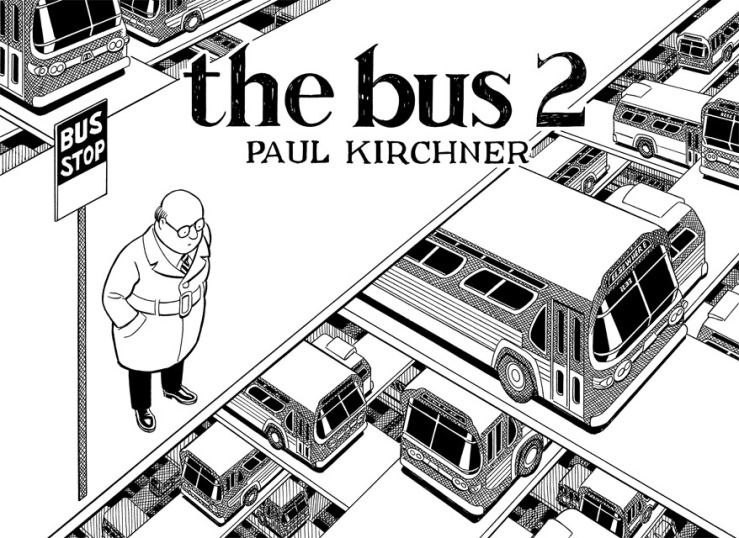
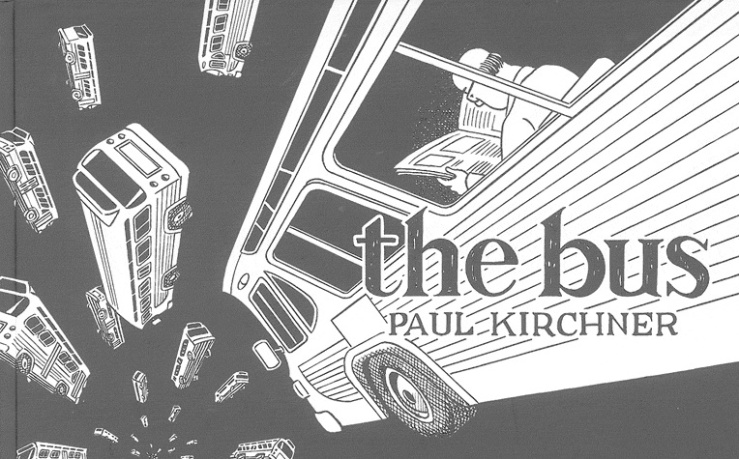
The Bus 2, Paul Kirchner

Mislaid, Nell Zink (although I liked The Wallcreeper better, but hey, it was published last year)

Favorite Indie Presses of 2015

You can’t beat Nobrow, Dorothy, OR, and/or And Other Stories.

Favorite Films I Saw in 2015 That Came Out in 2015

IMG_0340

I had a relatively contrarian opinion of Fury Road, but I enjoyed it overall, I suppose. The Force Awakens was a better spectacle for my money/nostalgia. Overall, 2015 was kind of a weak year for movies, filled with overrated indies, comic book schlock, and self-serious entertainments that Tried Too Hard. Hard to Be a God was the only thing that really zapped me, although a quick google shows that it was actually released in 2014.

You know, Inherent Vice was released in late 2014 too, but I saw it and loved it and obsessed over it in 2015…so, Inherent Vice, yeah…

I also liked that Scientology documentary, which was full-on Pynchon.

Favorite Television Shows of 2015

I thought the second season of Fargo was near-perfect and found the tawdry spectacle of The Jinx thrilling, but there was no show I enjoyed watching and reading about more than the second season of True Detective

Favorite Albums of 2015

The albums I listened to the most this year were soundtracks that came out before 2015: Inherent Vice and The Good, The Bad, and The Ugly. But I did like a number of new albums this year, including Joanna Newsom’s Divers, Jim O’Rourke’s Simple Songs, and Destroyer’s Poison Season.

Favorite Books I Didn’t Finish in 2015

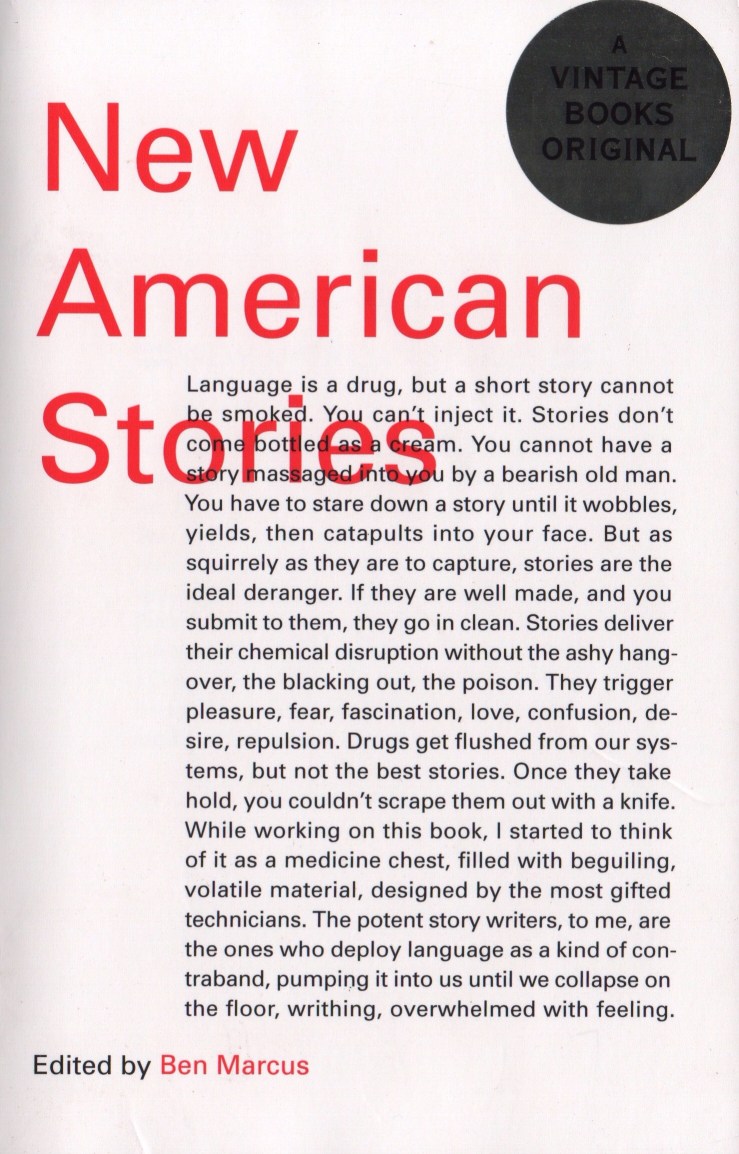
I’ve been crawling my way through a full read of Leslie Fiedler’s Love and Death in the American Novel, but: No end in sight. I also read most of the essays in William T. Vollmann: A Critical Companion (check out my interview with the editors). I also read a hefty chunk of the Ben Marcus-edited collection New American Stories. My favorite discursive reading though was dipping into William H. Gass’s nonfiction.

Favorite Rereads

…speaking of Gass—well, I read his essay “Even If, by All the Oxen in the World” in conjunction with a reread of David Foster Wallace’s Infinite Jest, which turned out to be most rewarding—both the rereading and the reading-in-conjunction. Reading Infinite Jest for the first time since 2001 ended up being a deflating, even depressing experience, but I wouldn’t trade it. I also reread against the second reading of Gravity’s Rainbow. Other rereading highlights included Pynchon, Ursula K. Le Guin, High Rise by J.G. Ballard, and Blood Meridian by Cormac McCarthy (which I’ve reread every year since I first read it). But it was McCarthy’s Suttree that I got the most out of rereading this year.

2016

I’ll finish out Le Guin’s Hainish books with The Telling, and then probably crack into William H. Gass’s Eyes. In between I might read Marianne Fritz’s novel The Weight of Things. More Lucia Berlin for sure. Thomas Bernhard if it ever cools down again. (End of December 2015 and it feels like early summer here in Florida). I’d also love to take a shot at William T. Vollmann’s The Dying Grass, but who knows…there are always more pages than hours.

A probably incomplete list of books I read in 2015

The Crying of Lot 49, Thomas Pynchon*

Dockwood, Jon McNaught

A German Picturesque, Jason Schwartz*

Inherent Vice, Thomas Pynchon*

Two Serious Ladies, Jane Bowles

Flee, Evan Dara

Birchfield Close, Jon McNaught

Nazi Literature in the Americas, Roberto Bolaño*

Signs Preceding the End of the World, Yuri Herrera

Infinite Fictions, David Winters

Syrian Notebooks, Jonathan Littell

Girl in a Band, Kim Gordon

Can’t and Won’t, Lydia Davis

Gravity’s Rainbow, Thomas Pynchon

Gaha: Babes of the Abyss, Jon Frankel

The Spectators, Victor Hussenot

Mumbo Jumbo, Ishmael Reed

Infinite Jest, David Foster Wallace*

The Wallcreeper, Nell Zink

Cess, Gordon Lish

Station Eleven, Emily St. John Mandel

High Rise, J.G. Ballard*

Millennium People, J.G. Ballard

Pale Fire, Vladimir Nabokov

Mislaid, Nell Zink

The Diamond Age, Neal Stephenson

Culture and Value, Ludwig Wittgenstein

Martian Time-Slip, Philip K. Dick

Autobiography of Red, Anne Carson

Suttree, Cormac McCarthy*

Blood Meridian, Cormac McCarthy*

Red Doc>, Anne Carson

The Buried Giant, Kazuo Ishiguro

The Lathe of Heaven, Ursula K. Le Guin

The Bus, Paul Kirchner

The Bus 2, Paul Kirchner

The Free-Lance Pall Bearers, Ishmael Reed

Vertigo, Joanna Walsh

Rocannon’s World, Ursula K. LeGuin

Censorship Now!!, Ian Svenonius

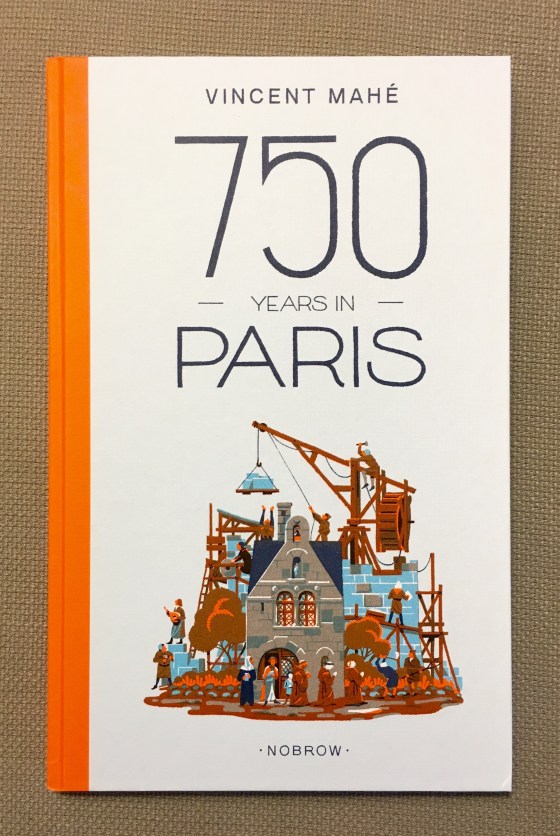
750 Years in Paris, Vincent Mahé

The Dispossessed, Ursula K. Le Guin*

The Word for World Is Forest, Ursula K. Le Guin

Planet of Exile, Ursula K. Le Guin

City of Illusions, Ursula K. Le Guin

Homesick, Lucia Berlin

The Left Hand of Darkness, Ursula K. Le Guin*

* indicates a reread

Thirty-point riff on Star Wars: The Force Awakens

Rey-Star-Wars-Episode-7-Force-Awakens

  1. Star Wars: The Force Awakens is a fun entertainment that achieves its goals, one of which is not to transcend the confines of its brand-mythos.
  2. SW: TFA takes Star Wars itself (as brand-mythos) as its central subject. The film is “about” Star Wars.
  3. To this end, SW: TFA is basically a remake of A New Hope. My saying this is not insightful and cannot be insightful.
  4. In the first Star Wars film, A New Hope (aka Episode IV, aka simply Star Wars), George Lucas synthesized Flash Gordon and Kurosawa, Joseph Campbell and WWII serials into a cultural product that was simultaneously new and old, hokey and profound, campy and heroic.
  5. SW: TFA is not a synthesis (and does not seek to be a synthesis); rather it is a transcription, repetition, and  replication of the previous Star Wars films—particularly the so-called “original trilogy” (Episodes IV, V, and VI).
  6. Hence, SW: TFA often feels like a greatest hits collection, its sequences and visuals (engaging and visually spectacular) cribbed from the previous films. I could spend the rest of the riff outlining the correspondences—major and minor—but why? The correspondences are intentionally obvious to anyone who has seen the film; furthermore, they are not allusions, but the formal structure of the film.
  7. And this formal technique, this replication—it’s all very enjoyable and often warm and unexpectedly humorous and at times awfully sad even.
  8. And I liked the new characters very much, which I was of course supposed to. They are all in some ways replications of previously existing characters, just as the set pieces and sequences they act in/out/upon are replications.
  9. Let’s consider Rey, the heroine of The Force Awakens really quickly: She is, in some ways, a synthesis, but only a synthesis of the principals of the Star Wars brand-mythos: She is at once Han, Luke, and Leia: A figuration in the foreground: A childhood fantasy.
  10. A childhood fantasy: Watching SW: TFA feels like watching a Star Wars film—which is the film’s intention, obviously.
  11. But not obviously and really quickly and not a gripe: Isn’t there a part of us, by which us I mean me, that wants something more than the feeling of (the feeling of) a Star Wars film? That wants something transcendent—something beyond that which we have felt and can name? Something that we don’t know that we want because we haven’t felt it before?
  12. Re: Point 11: I already made an (awfully) oblique argument at some length almost three years ago about franchise films in general and Star Wars films in particular, arguing (maybe arguing) for, say, Wong Kar Wai to direct the next Star Wars film.
  13. In that riff I wrote that, “J.J. Abrams is a safe bet. I can more or less already imagine the movie he’ll make.” That prediction was incorrect only in that I enjoyed the product that he made more than I thought I would. That prediction was wholly correct in that I could imagine the product Abrams made. It was easy to imagine. I’d already seen the film dozens of times before he even made it.
  14. So, to return to point 11, the “not a gripe” point: Is the argument then that film as an art form allows us (the illusion of) a transcendent perspective? That film at its best, at its strongest and strangest, offers us a new way of seeing?
  15. (Yes).
  16. The Force Awakens is strong but not strange. Its major advancement (by which I mean break from previous films) evinces in its casting choices—but these reflect the progress of our own era, not the brand-mythos of Star Wars itself, which was of course always diverse.
  17. The Force Awakens is fun. Entertaining. Like I wrote in point 1.
  18. And, to repeat point 2 after repeating point 1: SW: TFA is “about” Star Wars.
  19. So what do I mean by this? Consider for a minute what the other Star Wars films are “about.”
  20. A New Hope is about escape and rescue, both in the literal, romantic, and metatextual sense.
  21. The Empire Strikes Back is about Oedipal anxieties and Oedipal violence, family entanglements, friendships and loyalties.
  22. Return of the Jedi is about restoration and redemption, a film about the genius of ecology over mechanization.
  23. And while the (so-called) prequels are generally reviled, I like them: They are “about” something.
  24. For example, Revenge of the Sith is about democracy and fascism, community and ego—and more of that Oedipal violence.
  25. Indeed the entire series is Oedipally structured—which The Force Awakens replicates and continues.
  26. Yet Abrams’s reverence for Star Wars bears no clear trace (at least on my first viewing) of Oedipal anxiety towards Lucas. No attempt to transcend or surpass—as such a move would entail a kind of critical (if metaphorical) violence directed at Lucas’s vision. (Notably, many of the criticisms of the so-called prequels rest on the way those films look beyond their predecessors (in a way that Abrams’s film doesn’t)).
  27. “In order to criticize a movie, you have to make another movie,” said Jean-Luc Goddard.
  28. And Harold Bloom: “Every poem is a misinterpretation of a parent poem. A poem is not an overcoming of anxiety, but is that anxiety…There are no interpretations but only misinterpretations, and so all criticism is prose poetry.”
  29. Abrams’s goal was not to criticize Star Wars or poetically engage it; his goal was to praise it—to praise it as stasis, to replicate its comforts, to avow and vindicate its forms and tropes. And he succeeded.
  30. And of course the biggest success of the film: I want to watch it again.

A review of Paul Kirchner’s surreal sequel, The Bus 2

couv-1

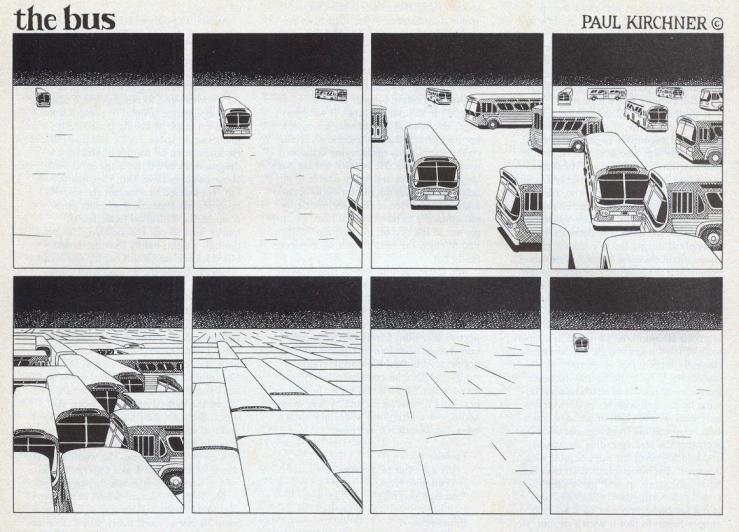
Paul Kirchner’s cult classic comic strip The Bus originally ran in Heavy Metal from 1979-1985. The (anti-)story of “a hapless commuter and a demonic bus” (as Kichner put it himself in a recent memoir at The Boston Globe), The Bus, at its finest moments, transcends our expectations for what a comic strip can and should do. Sure, Kirchner delivers the set-ups, gags, japes, and jests we expect from a cartoon—but more often than not The Bus surpasses the confines of its form and medium. Its protagonist The Commuter is an allegorical everyman, a passenger tripping through an absurd world. Kirchner’s strip often shows us ways to see that absurd world—which is of course our own absurd world—with fresh eyes.

Thanks in part to the internet (and, in particular, an album of scans posted at Imgur), Kirchner’s comic has found a new audience. Over the past few years, Kirchner’s produced more than 40 new strips, which are now collected in one handsome volume as The Bus 2 (or the bus 2 if you like) from French publisher Tanibis EditionsTanibis also has collected the original run of The Bus in an edition that’s more complete (and polished) than the Imgur album. These books are fantastic stuff.

The Bus 2 picks up in full satirical mode with an intro that informs us that “the studio that produced ‘The Bus’ was forced to shut down” in 1985; “Its closing left over 70 talented employees jobless.” The intro unwinds over a few pages—we’re told the bus itself and the “commuter’s iconic overcoat” are now in museums, and that the role of the commuter in this sequel will be played by the son of the actor who played the original commuter. From the outset, Kirchner uses irony to draw our attention to the artificiality of his strip, highlighting The Bus as a performance, an entertainment focused on the utterly mundane topic of a daily commute. And even though the intro unfolds over four pages, Kirchner keeps it true to form—literally: Six equal black and white panels.

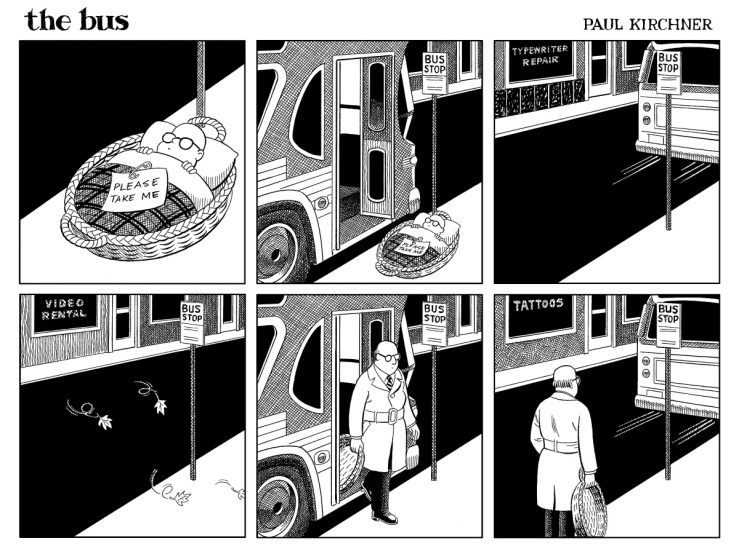
The first strip in the new collection positions The Commuter as an ironic hero, a foundling in a basket like Moses or Superman (note the signs that Kirchner employs to show the passage of time):

01 Continue reading “A review of Paul Kirchner’s surreal sequel, The Bus 2”

Two graphic novels about Paris reviewed: 750 Years in Paris and The Spectators

IMG_0534

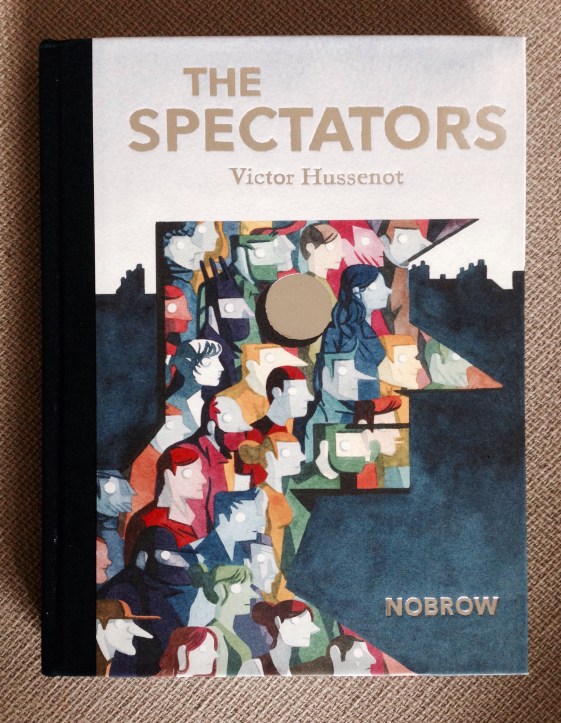
Two new(ish) graphic novels from Nobrow, Vincent Mahé’s 750 Years in Paris and Victor Hussenot’s The Spectators, showcase Paris as an enduring site of progression, turbulence, and renewal, both in culture and consciousness. Mahé’s 750 Years in Paris is a time-machine, putting its viewer in a stationary position to observe the dramatic changes in one building—and French society and culture—over the course of nearly a millennium. Hussenot’s The Spectators is a dream-machine, shuttling its characters through different skins, faces, and eyes. The titular spectators transcend not only time and space, but mind. Both books attest to the power of transformation while subtly noting the various forces that shape identity.

IMG_0614

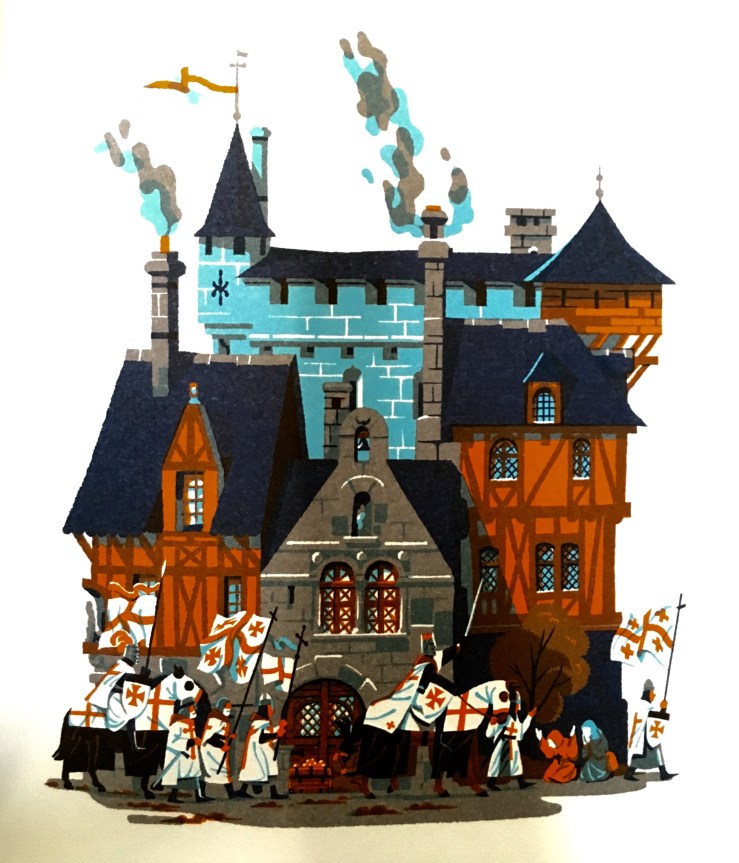
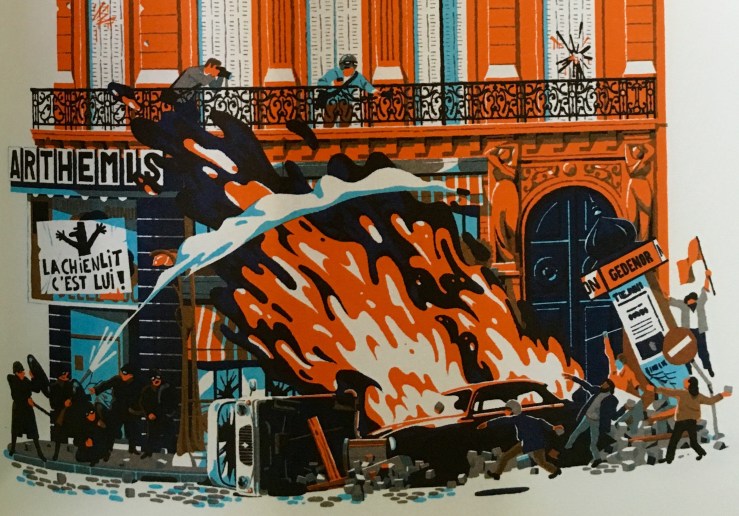
Vincent Mahé’s 750 Years in Paris begins in 1265 and moves its viewer through time to 2015. The book takes us through the Black Death Plague and the 100 Years War, the reigns of Louis XIV and IV, the storming of the Bastille and the Reign of Terror, Napoleon and Hausmann, a grand Metro and a terrible Flood. The second shot in this chronology shows us a Knights Templar procession in 1270. The crusaders remind us that Western history is inextricably bound in violence, religion, and territorial expansion—but also in the exchange of ideas, information, and knowledge. We get to May 1968 with a strong visual context for France’s history of intellectual turbulence.

IMG_0613The book ends in 2015; I’ll let Mahé’s image speak for itself:
IMG_0612

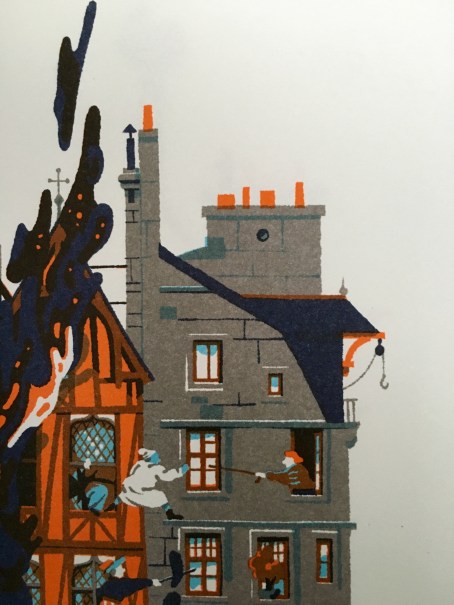
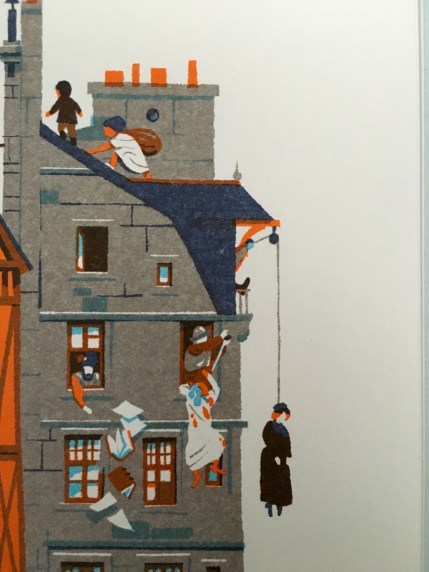
750 Years in Paris shows us that Paris not only survives drastic change, but progresses in the face of violence. When we see, for example, that a winch has been used to hang a Protestant during the St. Bartholomew’s Day Massacre of 1572—

IMG_0615

—it’s worth noting that on the next page, neighbors help each other during a terrible fire. The winch remains in the picture, a visual motif of progress, of building up.IMG_0617

image

Like every Nobrow title I’ve read, Victor Hussenot’s The Spectators is better experienced than described. Its aesthetic is its narrative and its narrative is its aesthetic, flowing from a lovely dream-logic of identity shifts. Who shall I be today?, the book asks.

IMG_0608

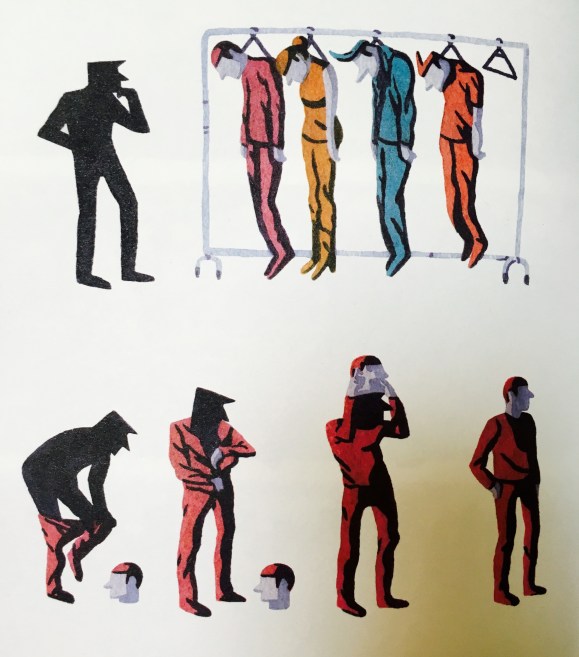
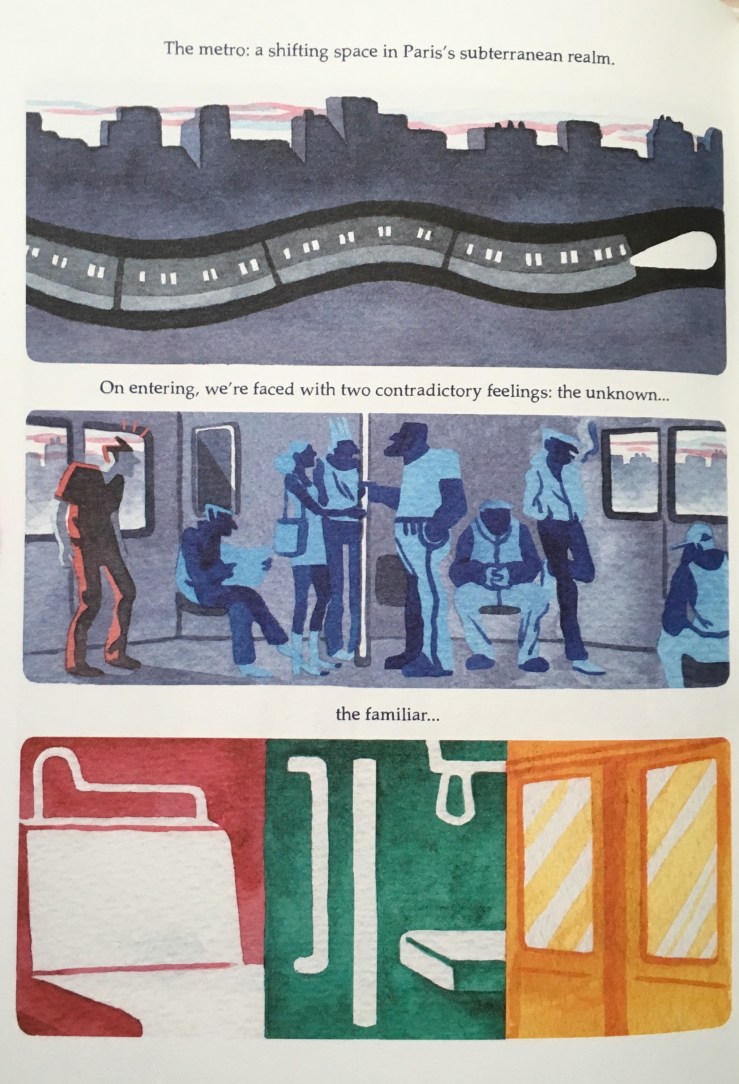
The titular spectators try on different skins, wear different hats, look through different eyes. Paris’s metro becomes a labyrinth dream-lab, where the spectators create the world anew by synthesizing known with unknown:IMG_0609

This vision of synthesis carries the narrative through a poetic examination of individuality and society. How much of me is me? Hussenot frames his characters in the geometry of picture puzzles, only to blur the borders that would constrain them.

It’s possible to imagine the spectators of Hussenot’s book gazing on Mahé’s ever-changing Paris building. Or, conversely, we can take Mahé’s building as one of Hussenot’s spectators—another shapeshifter in a city of shapeshifters.

I’ll close with an image from The Spectators that points towards a dream of synthesis, of infinite perspective, of unity. We have here not just a dream, but a vision of progress:

IMG_0610

A riff on my favorite ghost story, Roberto Bolaño’s “The Return”

Roberto Bolaño’s short story “The Return” is so good that it has two perfect opening paragraphs:

I have good news and bad news. The good news is that there is life (of a kind) after this life. The bad news is that Jean-Claude Villeneuve is a necrophiliac.

That’s a hell of a way to start a story! Bolaño lays out his two themes—the afterlife and necrophilia—in a jovial, almost cavalier, but dare I say sweet, even charming way. And then this paragraph:

Death caught up with me in a Paris disco at four in the morning. My doctor had warned me, but some things are stronger than reason. I was convinced, mistakenly (and even now it’s something I regret), that drinking and dancing were not the most hazardous of my passions. Another reason I kept going out every night to the fashionable places in Paris was my routine as a middle manager at Fracsa; I was after what I couldn’t find at work or in what people call the inner life: the buzz that you get from a certain excess.

Those are the first two paragraphs, and maybe they’ll entice you to read the story. However, the following riff includes what some people might consider spoilers; my hope is that if you’ve never read it before, you’ll take it on faith that “The Return” is a great, great story and you’ll go read it and stop reading this riff now. (Maybe come back later though after you’ve read it).

“The Return” is a ghost story that transmutes the horror of death and the abjection of the corpse into love, empathy, and communication—and art. It’s a beautiful ghost tale in the Romantic, Gothic tradition of Edgar Allan Poe, from whom Bolaño drew heavily. However, while Poe’s tales of necrophilia (like the poem “Annabel Lee,” “The Fall of the House of Usher,” and “Berenice” to name just a few) obsess over repression, loss, burial, and imperfect and violent attempts at restoration, Bolaño’s “The Return” offers its readers a peaceful reconciliation with death. It’s collected in The Return (New Directions, English translation by Chris Andrews), which is a perfect introduction to Bolaño—so many great stories there (“Buba,” “Clara,” “William Burns,” etc.). So go read it.

Continue reading “A riff on my favorite ghost story, Roberto Bolaño’s “The Return””

A review of Ursula K. Le Guin’s novel The Lathe of Heaven

The City I Dream, Victor Brauner

George Orr is not well. The meek protagonist of Ursula K. Le Guin’s novel The Lathe of Heaven abuses prescription drugs in a desperate and unsuccessful attempt to stop himself from falling asleep. Orr doesn’t want to sleep because he believes that his dreams come true—that they literally alter reality—but in such a way that no one but Orr realizes that the world has changed. Orr gets caught using a “Pharmacy Card” that doesn’t belong to him, and is court-ordered to begin treatment with a sleep research psychiatrist, Dr. William Haber. Although Haber initially doesn’t believe Orr’s claim to be cursed with “effective dreams” that transform reality, he soon realizes that Orr’s dreams somehow do come true. Then, via hypnotic suggestion (and an “Augmentor” device), Haber begins wielding Orr’s gift/curse as a clumsy tool to “better” the world.

The world of The Lathe of Heaven is grim, gray, dystopian. Published in 1971 and set in Portland in the palindromic year of 2002, Le Guin’s novel is depressingly prescient. Not only does she capture the onset of seventies malaise (the ashes of hope that burned out in the sixties), she also points to a future of environmental catastrophe:

Very little light and air got down to street level; what there was was warm and full of fine rain. Rain was an old Portland tradition, but the warmth—70° F on the second of March—was modern, a result of air pollution. Urban and industrial effluvia had not been controlled soon enough to reverse the cumulative trends already at work in the mid-twentieth century; it would take several centuries for the CO2 to clear out of the air, if it ever did. New York was going to be one of the larger casualties of the Greenhouse Effect, as the polar ice kept melting and the sea kept rising…

This is also a world of urban sprawl, overpopulation, malnutrition, and total war (a clusterfuck in the Middle East, wouldn’t you know). The government is a vague and menacing presence here—vaguely totalitarian, vaguely Big Brotheresque. We learn of the “New Federal Constitution of 1984,” one of many references to Orwell’s book. (The most obvious is our passive hero’s name).

So it’s no wonder that Haber sets about to create a utopia, right? Wouldn’t you, like, try to make the world a better place if you could? Haber is repeatedly described as a “benevolent man”—Le Guin withholds the word dictator—but the central theme comes through repeatedly: Is it possible to alter reality for the greater good? Or do we simply exist in nature, a part of everything around us?

Haber’s experiments with Orr’s mind have unintended consequences. How might we, say, cure overpopulation? How about an awful plague. Orr’s “effective dreams” revise history, rewrite reality, remap consciousness. But he’s never quite able to pull off the massive tasks Haber sets for him—end racism, end war, cure the damaged ecosystem (Le Guin is extremely pessimistic on this last front). Orr is burdened with the consciousness of multiple realities, and feels deep guilt for his role in uncreation. He starts to go crazy:

“I am cracking,” he said. “You must see that. You’re a psychiatrist. Don’t you see that I’m going to pieces? Aliens from outer space attacking Earth! Look: if you ask me to dream again, what will you get? Maybe a totally insane world, the product of an insane mind. Monsters, ghosts, witches, dragons, transformations—all the stuff we carry around in us, all the horrors of childhood, the night fears, the nightmares. How can you keep all that from getting loose? I can’t stop it. I’m not in control!”

Continue reading “A review of Ursula K. Le Guin’s novel The Lathe of Heaven”

A conversation about New American Stories, an anthology edited by Ben Marcus (Part 2)

Biblioklept contributor Ryan Chang and I continue our discussion of New American Stories, an anthology edited—or maybe “curated” is the right word, although I’m not sure—by Ben Marcus.  Read the first part of our exchange here. In this exchange we discuss holes, white American violence, paranoia, stories by Clare Vaye Watkins, Robert Coover, Lydia Davis, and Tao Lin, and that “Wait! Why? How?” feeling that good fiction can produce.

IMG_0136

Ryan Chang: What’d you think of the Claire Vaye Watkins story?

Edwin Turner: Yeah…so… “Diggings.” It’s taken me so long to get back to you about this one because I don’t really have anything intelligent to say about it. Which is really strange: I think I’ve told you that I’ve been obsessed with holes for a few years now, and the aesthetics of digging in particular. I’ve been compiling a bibliography on writings about holes, so I guess “Diggings” fits into that. And I like the general milieu and everything, the Western thing. And I appreciate Watkins lucid storytelling style. I do. But I found myself having to slog through it, and then the end, the sort of climax or whatever…I don’t know. No spoilers for the readers, but it didn’t ring my bell. Again, I’m not saying anything particularly interesting about it. I think my problem might be with the length of the story—to be clear, that’s my problem, not the story’s—but with a few notable exceptions (“Bartleby,” “The Metamorphosis”), superlong short stories don’t do it for me. I’d rather read a novella I guess.

I’m pretty sure “Diggings” is the longest selection in New American Stories. Lydia Davis’s “Men” is obviously the shortest in the book—it’s one of her better ultrashorts, and it’s already been widely anthologized via blogs and Twitter. I wish one of her longer pieces was included though–maybe something like “Marie Curie, So Honorable Woman.” But I’ve fallen into the stupid trap of What Would Ed Do?

Another short piece in the collection is Robert Coover’s “Going for a Beer,” which is a Perfect Short Story. Just perfect. It’s a perfect postmodern gesture without any gimmickry, a story about storytelling that’s actually a story. But maybe I only think it’s so perfect because I’ve read it so many times now and even used it in the classroom. Your thoughts?

RC: There are a few things I really like about Watkins’ “Diggings.” For one, I think the voice is what really carries this story, and the pretense of the subheadings. It certainly lends the story this epic-ness that, for the most part, it does well, but my resistance to this story comes from its place within the collection.

But first, I want to touch on the hole motif. There’s the easy reading of the kind of digging and the value invested in it. The tenuous promises of a new start, or a restart. The neutrality of money; that is, one’s self-worth is in direct proportion to one’s ownership. But Watkin’s story is a critique of that very American myth of manifest destiny. Was it ever good for anything? In this light, the story seems fine. A well-executed story with enough of the right moves to keep me going. I’m impressed by Watkins’ pacing, as well as how convincing this voice is. I don’t think we should forget that. Watkins’ inflection of that gruff, macho Westernly voice is what’s most convincing for me, and contributes to the irony that enables the critique of the American myth overall. Also, to end, I’m happy to see that the principle antagonists—besides the characters’ own desires—are the “Chinamen,” who are often footnoted or forgotten in the long history of white American violence.

But to be a little academic—that the collection ends with this critique of manifest destiny and (white) Americanness strikes me as counterproductive, or redundant, to the kind of politics this collection may (may!) be advocating: the flexibility of the American voice. I’m talking about Sayrafiezadeh’s story, and your point that the protagonist can’t listen, that no one can really listen. It’s redundant to me because that theme is shot through the entire collection. Did we really need it recapitulated again? And have it be our final punctuation mark on an otherwise strong and smart anthology? This is probably my own What Would Ryan Do? situation. The story reads like a watered-down version of the punch this collection attempts to make with “Diggings.” But we should remember that this is only one anthology compiled from one editor—whose own work we both really dig (God; no pun intended)—from a body of literature that would be impossible to completely anthologize. The best things about metaphors is that they fail to fully figure their abstract possibilities in text, fixing their content in time and place; instead, they point outside of themselves. That’s exactly what NAS does here: it says, the “American Story” is flexible, strange, and ever-moving. All its permutations cannot possibly be contained.

OK, but, I like that my response is going to end on a few considerations of Coover’s story, “Going For a Beer.” In an interview, Marcus says that it’s under Coover’s tutelage where he began to cut his storytelling teeth, and you can see a lot of resonance between, say, Marcus’s early work and Coover. But even now, the one thing they share—as well as Watkins—is a commitment to the strange.

You’re right to say that it’s a perfect example of a kind of postmodern fiction without any of the gimmickry, and a “Perfect Story” in this capacity. The way it calls attention to itself is, yeah, by foregrounding the artifice of storytelling through storytelling. But it’s not a “trick,” it’s a tweak: instead of one central conflict for the protagonist, we get a replication of several conflicts, they produce the next in the series. Our readerly expectations of conflict-resolution are turned upside down; Coover collapses the arc between readerly anticipation and pacing. Always, we’re like: “Wait! Why? How?” It hinges on when Coover makes the protagonist think—by merely thinking, the action happens, and we’re led into the next sentence of the story. In that light, it’s very Quixotic, and how the story calls attention to itself in that postmodern way. I could try to break this story down more to its components, but that’s not completely our purpose. But even if I did break this down some more, it wouldn’t suck out any of the magic of Coover’s story. Which is how, I think, Marcus understands language as a drug. The certain, indubitable and inevitable syntactical arrangement of words has this inexplicable effect on both us and the writer. The mystery is what keeps stories going.

ET: I got some of that “Wait! Why? How?” feeling from Tao Lin’s “Love Is a Thing on Sale for More Money Than There Exists,” although at a far more subtle level—maybe more like, wait–why?–huh?. Like Coover’s “Going for a Beer,” Lin’s story feels effortless—but a different kind of effortless. Coover’s tale is masterful and precise. There’s something a little tossed-off to Lin’s story; a riffing poetry which gives the story some of the energy it needs: “You, the botched clone of you, the Miami Dolphins, Cocoa Puffs, paper plates, a dwindling supply of clam juice. That was life.” Wait–why?–huh? “Love Is a Thing on Sale” (wait, do I need to name the whole name? Does it remind you of a Raymond Carver title?) — “Love Is a Thing on Sale for More Money Than There Exists” has almost no plot—it’s very Tao Linish. It also captures something of the post-millennial malaise and paranoia of the previous decade. Reading it I thought, “Ah, yes, that feeling”—like there was still a freshness to that exhaustion. We learn that our protagonist Garret “often suspected that The Future Was Now,” which of course it was. And now passed.

The hole pops up as a metaphor again, although I’m not sure what Lin’s doing with it besides the very, very obvious (“There’ere’s a hole in you/Gets emptier, ah-oh, each day” is a line from “Sigh (Hole),” the “radio hit that year”). The story seems best to me when it strays from its Barthelmesque absurdities into actual emotional contemplation, as when Garret, via Lin’s free indirect style, wonders about love and truth and being considerate—that love requires real attention, consideration, punctuality. (Garret is deeply flawed too, of course).

I was surprised at how much I enjoyed “Love Is a Thing on Sale,” especially because it frequently annoyed me, with its ultra-specific signifiers of capitalism (“KFC spork”!) juxtaposed with its leery vagueness (the protagonists “flew down to Florida” for a vacation. Florida, the fourth largest state in the US. Florida. Florida, which has an east coast but also a west coast. And where do they go in Florida? Fucking Red Lobster, man). One of my favorite moments of the story is actually one of these sparks of vagueness, of sheer impossibility, of how language is a drug that can compress banality into radical action: “A few minutes passed, and then Kristy got up, called the airline place, called a cab, and flew to New York. The next day, though, she flew back, and the rest of the week in Florida was very calm and sunny.” That passage is a piece of fantasy.

RC: Mm, yeah, there’s certainly a confidence in Coover’s story that isn’t in Lin’s, but it doesn’t mean his prose is any less precise. Part of the magic in Coover’s story is watching him handle the technique he’s devised and watching him perform it, amazed that we’re buying his gambit. Though we’re puzzled, we’re not in disbelief as to what’s happening. The absurdity of his narrator’s thought generating the action becomes self-reflexive because, again, it’s an ironic joke of how stories work. Someone thinks of something, and then it happens. Continue reading “A conversation about New American Stories, an anthology edited by Ben Marcus (Part 2)”

Almost no memory | A review of Kazuo Ishiguro’s The Buried Giant

In Kazuo Ishiguro’s 2015 novel The Buried Giant, a metaphysical mist engulfs sixth-century Britain, clouding the memories of all who inhabit the land. Saxons and Britons alike cannot recall their bellicose past. Against this mist, elderly Britons Axl and Beatrice seek their long-lost son. They meet a Saxon warrior who hunts an ancient she-dragon he’s vowed to slay. He’s aided by a youth, Edwin, who’s been exiled from his village after being bitten by a mythic creature. King Arthur’s aged nephew Sir Gawain lingers as a courtly protector, a figure from an already-bygone era; the mist seems to slowly rot his brain and his conscience, pushing him into paranoia and madness. There are Charonic ferrymen and awful ogres; there are mad monks and terrible pixies. A hellhound, a dragon, a poisoned goat. Rivers and mountains and crypts and villages. But most of all that mist.

Charon, Joachim Patinir

Ishiguro makes the reader experience that mist. He obscures. The action that occurs—and yes, there’s action here, measured action (often measured in a literal sense)—the action that occurs in The Buried Giant is almost always oblique, shadowed, indistinct, but also very mechanical. The memory-mist renders the world treacherous, immediate, a dark, vague place that offers its travelers no purchase of reference. Deceptive.

Forgive me for quoting at such length, but I think a longish passage here shows how and what Ishiguro is doing. Almost all of our principals are here, underground—note their procession, their movement—a constant motif in the novel, movement, single file or side by side—and the presence of a light, illumination—also a motif. Note the variety of interpretations of not knowingnot seeing, note the simple horror:

They went on into the tunnel, Sir Gawain leading, Axl following with the flame, Beatrice holding his arm from behind, and Edwin now at the rear. There was no option but to go in single file, the passage remaining narrow, and the ceiling of dangling moss and sinewy roots grew lower and lower until even Beatrice had to stoop. Axl did his best to hold the candle high, but the breeze in the tunnel was now stronger, and he was often obliged to lower it and cover the flame with his other hand. Sir Gawain though never complained, and his shape going before them, sword raised over his shoulder, seemed never to vary. Then Beatrice let out an exclamation and tugged Axl’s arm.

“What is it, princess?”

“Oh, Axl, stop! My foot touched something then, but your candle moved too quickly.”

“What of it, princess? We have to move on.”

“Axl, I thought it a child! My foot touched it and I saw it before your light passed. Oh, I believe it’s a small child long dead!”

“There, princess, don’t distress yourself. Where was it you saw it?”

“Come, come, friends,” Sir Gawain said from the dark. “Many things in this place are best left unseen.”

Beatrice seemed not to hear the knight. “It was over here, Axl. Bring the flame this way. Down there, Axl, shine it down there, though I dread to see its poor face again!”

Despite his counsel, Sir Gawain had doubled back, and Edwin too was now at Beatrice’s side. Axl crouched forward and moved the candle here and there, revealing damp earth, tree roots and stones. Then the flame illuminated a large bat lying on its back as though peacefully asleep, wings stretched right out. Its fur looked wet and sticky. The pig-like face was hairless, and little puddles had formed in the cavities of the outspread wings. The creature might indeed have been sleeping but for what was on the front of its torso. As Axl brought the flame even closer, they all stared at the circular hole extending from just below the bat’s breast down to its belly, taking in parts of the ribcage to either side. The wound was peculiarly clean, as though someone had taken a bite from a crisp apple.

“What could have done work like this?” Axl asked.

He must have moved the candle too swiftly, for at that moment the flame guttered and went out.

Ishiguro gives us mystery, interpretation, and then an incomplete, ambiguous revelation. (This is the basic structure of the novel). Beatrice never relents in her belief that she’s stumbled over a dead child. Brimming with lost children and lost parents and orphans, The Buried Giant is a novel of erasures. But an erasure leaves a trace, a violent, visceral marking into the page’s blankness. Revelation through absence.

We would have no plot, not really, without some overcoming of blankness, and Axl in particular overcomes the mist in his quest. A backstory fleshes out, in watery strokes albeit. The Buried Giant, as far as fantasy epics go, is awfully indistinct. Or rather, Ishiguro offers only mechanical and immediate glimpses into this world, a Britain on the cusp of the Middle Ages. Through Axl’s consciousness (and conscience), we see the vital precision in hand-to-hand combat, for example. Its patience, its slowness, its dependence on muscle memory. Or perhaps (dare I say) more boringly, we feel the very real peril involved in walking in the wild dark as an elderly person. The thrills in The Buried Giant come not from its sword and sorcery costumes, but from its Kafkaesque edges and gaps. This is a novel about not knowing.

And it’s here that The Buried Giant is most successful—as an evocation of not knowing. Axl and Beatrice’s quest unfolds as a series of choices and consequences severed, for the most part, from the anchor of memory. There’s an episodic vibe to the novel, a sense that it’s making itself up as it goes along. (It’s not). The novel strongly reminded me of some of the old RPGs I’d play on a Commodore 64 as a kid. The graphics weren’t great and I had to use my imagination a lot. The games were sometimes frustrating and slow. But perhaps you want a more, uh, literary comparison? Something more recent too? The Buried Giant recalls Ishiguro’s short story “A Village after Dark” a lot more than, say, A Game of Thrones or The Lord of the Rings. It’s a fantasy novel, but one that feels etiolated, its vivid colors drained. More Gustave Doré than Gustave Moreau.

While a precise indistinctness (forgive the oxymoron) is part of The Buried Giant’s program, there’s nothing indistinct about its heroes’ love for each other. Axl and Beatrice, A & B—can I say I came to love them? Or if I didn’t quite love them, I was rooting for them, say? Rooting for their survival, but specifically their survival as a they, a shared survival. Ishiguro successfully communicates their intimacy, their romance, their love, a love threatened by both the natural world and the supernatural return of lost memory. Their relationship is the heart of the novel upon which Ishiguro fixes his themes of memory, justice, vengeance, and love. Ishiguro’s commentary on those themes ultimately may feel pessimistic to many readers, particularly in the novel’s conclusion.

Excepting the ones that we love and return to and obsess over, we retain little of the novels that we read. What memories remain are kernels—the outline of a plot, a strange lingering phrase or detail, a bright or bold character, a theme, an idea, an image. It’s the love between Axl and Beatrice that I’ll likely recall most strongly from the shadows of The Buried Giant. If we can’t remember, we can at least experience.

A bicentennial edition of Jane Austen’s Emma from Penguin Classics

IMG_0032

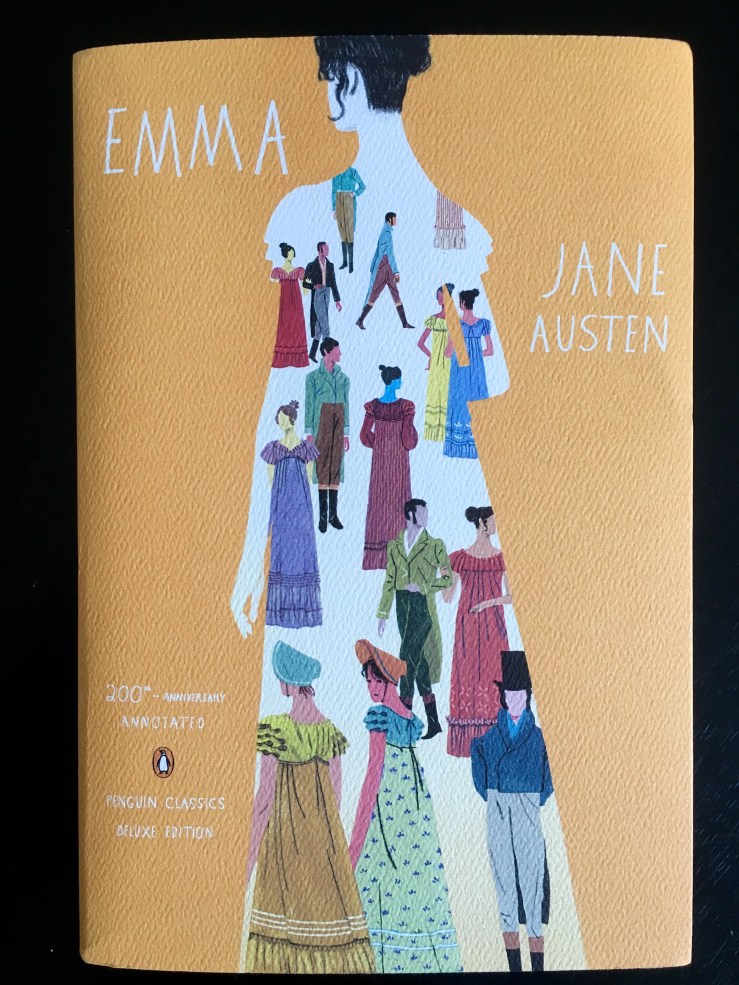
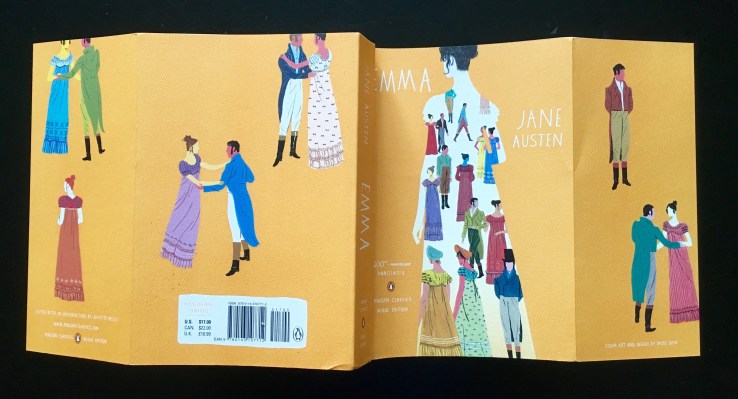
Last month, to mark its bicentennial, Penguin Classics published a deluxe edition of Jane Austen’s novel Emma. It’s a beautiful, hefty book, with deckle edges, French flaps, and a cool cover by Dadu Shin.

IMG_0038

Beyond its obvious aesthetic appeal, Penguin’s new edition offers its readers helpful resources, including a note on spelling in the novel, a glossary, and a range of essays that offer context for better appreciating the plot (topics include “Dancing,” “Food,” and “Health”). Indeed, this edition seems geared towards helping younger readers appreciate and enjoy Emma. In a prefatory note, editor Juliette Wells writes:

This edition is designed to help. It’s a reader’s edition, not a scholarly one. In other words, the information you’ll find here is intended to support your understanding and appreciation of Emma rather than to instruct you in literary terms, theoretical perspectives, or critical debates. In choosing what to include, I’ve borne in mind what I’ve heard from students and others over the years about what has intrigued, and frustrated, them in reading this novel.

Wells’s brief introduction helps offer new readers context about the novel’s composition, publication, and reception. She even offers a short series of tips for reading Emma (sample: “If you’re feeling frustrated or bored because nothing much seems to be happening, remember that Austen’s own contemporaries commented on how little plot Emma contains and how ordinary its characters and events are”). The edition also features helpful maps (by Wells), along with illustrations and title pages from previous editions. The volume concludes with a suggested reading and viewing list “for further exploration.”

Emma is obviously in the public domain and available in plenty of inexpensive versions (like the Dover Thrift copy I read in high school)—but this new Penguin Classics edition makes a strong case for itself as the future go-to version for high school students. Wells’s editorial vision (and the aesthetic design of the book) show a strong love for Austen’s text that will carry over to a new generation of readers.  Continue reading “A bicentennial edition of Jane Austen’s Emma from Penguin Classics”

Fabled horde, legion of horribles | Blood Meridian riff

The captain watched through the glass.

I suppose they’ve seen us, he said.

They’ve seen us.

How many riders do you make it?

A dozen maybe.

The captain tapped the instrument in his gloved hand.

They dont seem concerned, do they?

No sir. They dont.

The captain smiled grimly. We may see a little sport here before the day is out.

The first of the herd began to swing past them in a pall of yellow dust, rangy slatribbed cattle with horns that grew agoggle and no two alike and small thin mules coalblack that shouldered one another and reared their malletshaped heads above the backs of the others and then more cattle and finally the first of the herders riding up the outer side and keeping the stock between themselves and the mounted company. Behind them came a herd of several hundred ponies. The sergeant looked for Candelario. He kept backing along the ranks but he could not find him. He nudged his horse through the column and moved up the far side. The lattermost of the drovers were now coming through the dust and the captain was gesturing and shouting. The ponies had begun to veer off from the herd and the drovers were beating their way toward this armed hides the painted chevrons and the hands and rising suns and birds and fish of every device like the shade of old work through sizing on a canvas and now too you could hear above the pounding of the unshod hooves the piping of the quena, flutes made from human bones, and some among the company had begun to saw back on their mounts and some to mill in confusion when up from the offside of those ponies there rose a fabled horde of mounted lancers and archers bearing shields bedight with bits of broken mirrorglass that cast a thousand unpieced suns against the eyes of their enemies. A legion of horribles, hundreds in number, half naked or clad in costumes attic or biblical or wardrobed out of a fevered dream with the skins of animals and silk finery and pieces of uniform still tracked with the blood of prior owners, coats of slain dragoons, frogged and braided cavalry jackets, one in a stovepipe hat and one with an umbrella and one in white stockings and a bloodstained weddingveil and some in headgear of cranefeathers or rawhide helmets that bore the horns of bull or buffalo and one in a pigeontailed coat worn backwards and otherwise naked and one in the armor of a Spanish conquistador, the breastplate and pauldrons deeply dented with old blows of mace or sabre done in another country by men whose very bones were dust and many with their braids spliced up with the hair of other beasts until they trailed upon the ground and their horses’ ears and tails worked with bits of brightly colored cloth and one whose horse’s whole head was painted crimson red and all the horsemen’s faces gaudy and grotesque with daubings like a company of mounted clowns, death hilarious, all howling in a barbarous tongue and riding down upon them like a horde from a hell more horrible yet than the brim tone land of Christian reckoning, screeching and yammering and clothed in smoke like those vaporous beings in regions beyond right knowing where the eye wanders and the lip jerks and drools.

Oh my god, said the sergeant.

  1. The legion of horribles passage comes near the end of Ch. IV of Cormac McCarthy’s Blood Meridian, and is probably the passage I see cited most often from the book—which makes sense: It comes early enough in the novel and doesn’t really need much context—other than its own language—to mean. And of course its language—well, that’s the occasion, yes? The passage condenses the book’s violence into a baroque and surreal fevered dream (to steal a phrase from the passage). We have here an ornate parcel, a prefiguration of ecstatic violence.
  2. I remember the first time I read this passage. It was 2008, very late at night, and it just sort of short circuited whatever brains I had left. I had to go back and start the novel again, hit reset.  I’m revisiting Blood Meridian (I’ve reread it at least once every year since I first read it, a common practice of many of its fans I’ve realized over the years) after having just revisited Suttree. Blood Meridian always seems funnier and darker, and somehow—how?!—more violent.
  3. The legion of horribles passage is not acutely violent in and of itself; rather it stages the violence that explodes in the next few paragraphs, a dizzying, overwhelming violence. Scenes of rape and murder.
  4. I claimed in my first paragraph that the passage doesn’t require context, but here’s some anyway: We have there at the beginning Captain White and his sergeant. White—appropriately named—plans to lead his unauthorized band of irregulars into Mexico to loot and spoil and steal. He’s recruited the kid, the would-be protagonist of Blood Meridian. With its vile nativism, xenophobia, and racism, Captain White’s recruitment monologue (which doesn’t really persuade the kid as much as the simple promise of a horse, rifle, and saddle) wouldn’t be out of place in American politics today. White’s racism makes his initial impression of the fabled horde that will kill all but a handful of his men—and, spoiler, behead him—all the more ironic/moronic: “We may see a little sport here before the day is out,” he grimly jests. This seems to me almost the set-up to a punchline, with a long excursion into a description of the advancing “horde from hell” as the meat of the joke (Joke!?), with the final punchline/payoff in the sergeant’s dry horrified realization: “Oh my god.”
  5. In Suttree, McCarthy synthesizes American literature; in Blood Meridian, he’s condensing something more primal. Myth and history, time and space, whorled into blood and violence.
  6. We can see this condensation of myth and history in the very language of the legion of horribles passage. McCarthy offers a nightmare vision of time collapsed into a single violent, overwhelming space—and as I go now to pull an example, I find that there are too many, that the passage is all example, all detail, all image.
  7. Or, okay, hell, just one image then—the “armor of a Spanish conquistador, the breastplate and pauldrons deeply dented with old blows of mace or sabre done in another country by men whose very bones were dust”—there, that’s it, that’s all of it, history, myth, violence.
  8. Or just the words themselves, the diverse diction, culled from so many roots and tongues (attic, biblical)—and the compounding of words (bloodstained, weddingveil, headgear, cranefeathers, rawhide, pigeontailed, etc.), the compression and synthesis of words, the force of the words. The onomatopoeia. The barbaric yawps.
  9. What happens next? Okay, I’d say, Read the book—but I’ve already told you—the horde eviscerates White’s men. The kid survives, somehow, and the first section of Blood Meridian seems to end—as if this fabled horde, this legion of horribles were merely a preamble to the darker violence to come—a preview of the Glanton Gang and their sinister commandant Judge Holden.

Does Suttree die? | A riff on Cormac McCarthy’s novel Suttree

Does Suttree die?

At the end of Cormac McCarthy’s novel Suttree, I mean?

Look, before we go any farther, let’s be clear—this little riff is intended for those who’ve read the book. Anyone’s welcome to read this riff of course, but I’m not going to be, y’know, summarizing the plot or providing an argument that you should read Suttree (you should; it’s great)—and there will be what I suppose you’d call spoilers.

oarsman2
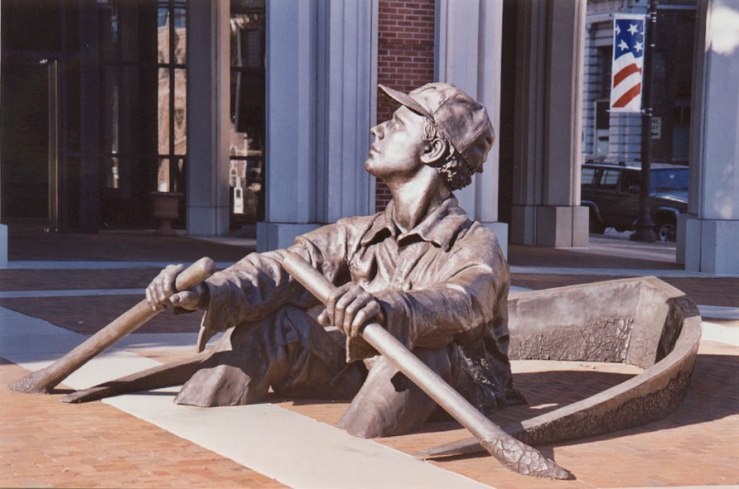
Oarsman is a sculpture by David Phelps, located at the northwest corner of Gay and Church Streets in Knoxville, TN. This photo is by Wes Morgan, part of his Searching for Suttree series.

So anyway—Does Suttree die at the end of Cormac McCarthy’s novel Suttree?

This question percolated in the background of my brain as I revisited Suttree this month via Michael Kramer’s amazing audiobook version (I also reread key sections—especially the last), in large part because of comments made on my 2010 review of the novel.

The first comment suggesting that Suttree dies at the end of the novel came in 2012 from poster “Jack foy,” who suggested that Suttree “has died in the boat and that it is his corpse cariied [sic] from there and his spirit and not his body hitching a ride at the finale.”

Earlier this year, a commenter named Julie Seeley responded to Jack foy’s idea; her response is worth posting in full:

I kind of agree that Suttree dies at the end also–or at least there are a lot of indications that the ending is meant to be ambiguous. Suttree reflects on his life, saying something to the effect of “I was not unhappy.” He visits his own houseboat and finds the door off and a corpse in his bed. A driver picks him up and says, “Come on,” even though Suttree had never even stuck out his thumb to hitch-hike It feels oddly similar to Dickinson’s “Because I could not stop for Death, He kindly stopped for me.” All of the scenery whizzing by faster and faster does feel like (sorry for the cliche) his life sort of flashing before him. This was a thought-provoking novel that I am looking forward to reading again soon.

Julie Seeley’s analysis is persuasive and her connection to Dickinson is especially convincing upon rereading the book’s final paragraphs. In my Suttree review, I argued that the book is a synthesis of American literature, tracing the overt connections to Faulkner and Frost, Poe and Cummings, Ellison and Steinbeck, before laundry listing:

…we find Mark Twain, Herman Melville, Ernest Hemingway, Walt Whitman, Emerson and Thoreau, Emily Dickinson, and William Carlos Williams, to name just a few writers whose blood courses through this novel (even elegant F. Scott Fitzgerald is here, in an unexpected Gatsbyish episode late in the novel).

Revisiting Suttree this month I found myself again impressed with McCarthy’s command of allusion and reference. Its transcendentalist streak stood out in particular. (Or perhaps more accurately, I sensed the generative material of the American Renaissance writers filtered through the writers that came before Suttree). But one American Renaissance writer I failed to name in my original review was Dickinson’s (near) contemporary Nathaniel Hawthorne, whose work of course filters through all serious American novels. There are plenty of echoes of Hawthorne in Suttree—Hawthorne’s tales in particular—but it’s the way that Hawthorne ends his tales that interests me here. Like the dashes that conclude many of Dickinson’s poems (including “Because I could not stop for Death”), Hawthorne’s conclusions are frequently ambiguous. Like the conclusion of Suttree.

So: Does Suttree die at the end of Cormac McCarthy’s novel Suttree?

Well, wait. Let’s go back to the beginning. Of the novel, I mean. Like I said, I’d had this question buzzing around in the back of my head as I revisited the book.

So, the beginning. Well, I’d forgotten that Suttree had a twin brother who had died at birth. The twin resurfaces a few times in the text, and there’s even a scene in the musseling section featuring a set of twins. Does Suttree’s twin brother’s death in infancy prefigure Suttree’s own death? How could it not? But—at the same time—hey, it’s ambiguous if Suttree dies; should I have stated my answer to my own damn question earlier?—hey, at the same time, the twin brother’s death is not Suttree’s death sentence, right? It simply introduces a motif—the dead body. Continue reading “Does Suttree die? | A riff on Cormac McCarthy’s novel Suttree”

A review of Gordon Lish’s novel (spokening) Cess

image

-What is the book about?

-Language.

-I mean, like, what’s the plot?

-Okay. I’ll try. The narrator is Gordon Lish—a version of Gordon Lish, of course (Gordon!), who tells us about a cryptographic “test” his aunt, an agent for the National Reconnaissance Office, sent him in 1963.

-Why did she send him this test?

-Poor Gordon was jobless and had a wife and kids to support and-

-You mean his kid the novelist Atticus Lish?

-Please don’t interrupt; no, these, these are other kids; Atticus comes later, but Lish does write about him in Cess. Anyway-

-What does he say about Atticus?

-He writes that “Atticus is, a, you know, a writer by Christ—is a novelist, by Christ, is indeed, if I, by Keerist, may say so myself, ever so proudly so, ever so rivalrously so, a novelist of nothing less than of rank.” Okay?

-Okay.

-So: The narrator gets this “test” from his aunt and-

-What does it look like? What is it?

-It’s a long list of esoteric words.

-May I see?

-It’s a pretty long list.

-How long?

-About 170 pages, about 22 words per page.

-May I see a section then?

-Sure:

image

-Whoa!

-That’s what I thought too! In fact, I first got a digital copy from publisher OR—so I was just reading, you know, on an iPad—which is, I mean, if you can imagine, I wasn’t doing the flicking through thing, the physical browsing thing—so I had no idea that there would be this big long list of words as like, the main course. I was shocked. It was electric. Continue reading “A review of Gordon Lish’s novel (spokening) Cess”

The Bus, Paul Kirchner’s marvelous and surreal comic strip trip

wccAP24 - Imgur

For the past year, I’ve run a strip from Paul Kirchner’s cult classic The Bus each Sunday. The strips come from an album posted at Imgur full of high quality scans. I posted the last scan last week.

The Bus originally ran in Heavy Metal from 1979-1985; Kirchner’s done a few  over 40 new strips over the past few years, as he notes in a recent memoir-piece at The Boston GlobeThe new strips will be collected in The Bus 2 from Editions Tanibis. Editions Tanibis also has collected the original run of The Bus in an edition that’s more complete than the Imgur page.

Screenshot 2015-08-30 at 11.51.44 AM

I’ve enjoyed posting the strips tremendously. I first saw a few strips at an image forum I frequent, and quickly found the Imgur album. Posting one each Sunday was my way of, well, not bingeing on them.

WQlfiuH - Imgur

The Bus is a profound strange wonderful trip. Kirchner’s visions often evoke Escher’s paradoxes, and the best of his strips make us attend closely to what we’d otherwise dismiss. The Bus is subtle and sly, occasionally (very occasionally) dark, but also, I would argue, sensitive—there’s something deeply endearing about the strip’s central human protagonist, an often passive (even hapless) passenger, a kind of late-20th century Everyman. Continue reading “The Bus, Paul Kirchner’s marvelous and surreal comic strip trip”

A riff on Philip K. Dick’s novel Martian Time-Slip

Untitled, Zdislav Beksinski
  1. A colleague dropped by today, burst in my office really, if you’ll forgive the cliché, animated, ecstatic almost—Read this!—he commanded, thrusting a big fat hardbacked Gore Vidal volume in front of me. Read this, his finger pointing to the last paragraph of the 1981 essay “Pink Triangle and Gold Star” (ostensibly a review of Renaud Camus’ novel Tricks).  So I read it. See? It’s just like today! my colleague declared. Vidal’s essay ends with a call for the unity of marginalized people to resist “our ruling class” — the banks, The Wall Street Journal, the Pentagon — and “their kindly voice,” Ronald Reagan. We then had a brief discussion about Donald Trump’s bid for the presidency, something I have until now refused to talk about at all because it’s all just too weird.
  2. I sometimes feel like I’m living in a Thomas Pynchon novel.
  3. I sometimes feel like I’m living in a J.G. Ballard short story.
  4. I sometimes feel like I’m living in some distorted, slipped timeline.
  5. Reading Philip K. Dick’s novel  Martian Time-Slip, I kept wanting to burst into someone’s office, animated, pointing to a paragraph, crying, Read this! See? It’s just like today!
  6. Not that we’ve colonized Mars but—
  7. —colonial metaphors, yes? Cowboys and Indians…
  8. But also, that we’d want the final frontier to be just like home: Desert Mars with green lawns, irrigated flower gardens. Swimming pools. Dick’s Mars is California 1964 and California 2015. And: a water-scarce environment to come.
  9. Did I mention that the novel is set in 1994?
  10. I sometimes feel like I’m living in a Don DeLillo novel.
  11. But where was I? I launched into this riff with a long anecdote, so—What my colleague and I worked into was, ultimately, a discussion of the sheer irreality of modern life—the paranoia that permeates American culture, the sense that the last two decades seem like a bad repetition of Bad Times that outdated textbooks told us had been conquered.
  12. (Or maybe I’m just getting old).
  13. (Sorry for the scatterbrainededness of this ordeal. I finished the novel this afternoon and if I don’t get this down now it seems I won’t get anything down).
  14. So obviously you can find alienation, instability, and repetition right there in the title Martian Time-Slip.
  15. And Dick loads the novel with images and props and ideas to evoke those themes of alienation, instability, and repetition: autism, primitivism, schizophrenia.
  16. Colonies, camps, U.N. as World Police.
  17. Health food.
  18. And land speculation.
  19. And abjection.
  20. And abjection erupts in paranoia and irreality, pointing to a People Who Aren’t People:
  21. He saw, through the man’s skin, his skeleton. It had been wired together, the bones connected with fine copper wire. The organs, which had withered away, were replaced by artificial components, kidney, heart, lungs­—­everything was made of plastic and stainless steel, all working in unison but entirely without authentic life. The man’s voice issued from a tape, through an amplifier and speaker system.

    Possibly at some time in the past the man had been real and alive, but that was over, and the stealthy replacement had taken place, inch by inch, progressing insidiously from one organ to the next, and the entire structure was there to deceive others.

  22. —so the sense that the contemporary person is just a technological mediation, a deception, inauthentic. (Dear reader, attach this passage to what you will, but it seems to me surpassing prescient).
  23. I’ve done a poor job of outlining the plot, right? Sorry. But look, it’s a Philip K. Dick novel, and certainly one of his better ones—and if you’re a more-than-casual reader, you know it, I think, and if you’ve read his finest—VALISThe Man in the High CastleUbikA Scanner DarklyPalmer Eldritch—you might should could read Time-Slip.
  24. But so plot, well: Here’s Lawrence Sutin on the novel, from Divine Invasions: A Life of Philip K. Dick:
  25. Life in the bleak Martian colonies bears a striking resemblance to business as usual on modern-day Earth…In the parched Martian colonies, grasping Arnie Kott is the chief of the powerful plumber’s union (based on the fifties Berkely Co-op Phil despised for its wrangling politics). The little guy, repairman Jack Bohlen, is a onetime schizophrenic who still lives with schizophrenia’s aftereffects. An autistic kid, Manfred Steiner, slipslides helplessly forward and backward in time, into realms of entropy and death.

  26. Arnie seeks to capitalize on Manfred’s timeslipping, and Dick—who, let’s just admit it, isn’t always the most writerly writer (whatever that means) handles the time slippage with rhetorical aplomb, making the reader slip-slide through time with Manfred, Arnie, and Jack. I shared an extended passage a few days ago as an example; it shows us (a version of) Manfred decaying in a future Martian slum. The imagery is abject and pitiful, evoking again the notion of a human’s decay into machination:
  27. He lay there for a hundred and twenty­three years and then his artificial liver gave out and he fainted and died. By that time they had removed both his arms and legs up to the pelvis because those parts of him had decayed.

    He didn’t use them anyhow. And without arms he didn’t try to pull the catheter out, and that pleased them.

  28. Time-Slip rockets into rhetorical reverberation, cycling its final chapters into a strange decay. The timeslips jar the reader’s narrative perception—Hey wait, didn’t I already read this?—unsettling expectations, and ultimately suggesting that this Martian Time-Slip is just one version of Martian Time-Slip. That there are other timelines, distorted, slipped.
  29. And there are threads—wires, if we want to borrow one of the novel’s motifs—that don’t fully connect. There are short circuits, misfires, gaps. Dick tears into the real stuff, the inner material, and pulls it up to the surface without putting it all back together too neatly.
  30. There’s even a slippiness to Dick’s resolved wires (if you’ll excuse my torturing the metaphor). The novel concludes in a strange jolt of domestic restoration, a kind of farce of the traditional comedic and tragic conventions where all returns to normal—there is no normal, never—and so No normal never is, paradoxically, paranoiacally, normal.
  31. I sometimes feel like I’m living in a Philip K. Dick novel.

A conversation about New American Stories, an anthology curated by Ben Marcus (Part 1)

IMG_8017

Over the next few weeks, Biblioklept contributor Ryan Chang and I will be discussing New American Stories, an anthology edited—or maybe “curated” is the right word, although I’m not sure—by Ben Marcus.  

Edwin Turner: You got your copy of New American Stories? Let’s talk about the cover, the intro, and the first story,  Saïd Sayrafiezadeh’s “Paranoia.”

Ryan Chang: The cover and the introduction, and hence the context of the selections, elegantly mesh, which is more than I can say for 99% of covers. But I like anything that Mendelsund touches. It’s quiet, understated, but an excellent visual metaphor for what Marcus discusses in his introduction. The best part about this cover is the spot where part of the word “Stories” tries to mingle with the blocked passage from the introduction. The two don’t merely coexist, or mesh at all, but exist in this static conflict. It seems to be what Marcus wants most out of this new anthology; it occurs to me that I don’t have a lot of anthologies because a) I find them pretty boring, b) if it’s going to be an anthology, it’s going to be non-Anglo and -American — most of the time, the anthologies featuring these authors are already on my shelf in one way or another, and when I flip through them in the book store, the new context in which I find an author (say, someone like Richard Yates and Barry Hannah) isn’t new and exciting.


img_8019ET:
The cover is great—spine too. I agree with you that it’s “quiet”—although that’s a strange word, y’know, considering there’s so much going on there—so much text. But the book is handsome, and the cover presents as a baseline postmodern conundrum—
Where does the text begin? The authorship question is there too, on the second page, the “Also by Ben Marcus” page—as if Marcus were the author of the collection. Which in a way he kinda sorta is—the whole mixtape/DJ/curator thing—I mean he’s the author of the “anthology,” the tracklist, the occasion. I’m generally suspicious of the overuse of the term “curator,” but I think it’s ultimately more apt than editor. And Marcus spins a cool set. The book is a tasty gateway drug.

Anthologies were really important to me when I was 15, 16, 23…but now I tend to think of them entirely in teaching terms, often in very jaded terms, honestly. I would love to be able to look over the selections here with fresher eyes, if you know what I mean. As a freshman in college, I read the 1994 anthology The Vintage Book of Contemporary Short Stories, which Tobias Wolff edited. It would be impossible for me to overestimate the importance of that for me—it introduced me to Barry Hannah, Denis Johnson, Ann Beattie, Raymond Carver, and all these other writers who simply weren’t on my radar. In retrospect, I realize that that anthology represented a very particular kind of writing, but I think Wolff captured something of an era there.

RC: The posture of most anthologies is to celebrate/represent the coalesced spirit of a kind of writing, or an era. And I only realized this reading through Marcus’s introduction. He writes, “This anthology aims to present … a sampler of behaviors and feelings we can very nearly have only through reading. A sourcebook of compulsory emotions.” I really like this. The focus of NAS is on language — as is to be expected in Marcus’s hands — and not on, say, a particular identity, era, or whatever. This is an anthology about the breadth of styles and forms — which brings me back to the cover. It’s a really brilliant illustration of Marcus’s guiding aesthetic principle in his own work and here: the productive tension between form and content. The scope of selection is wide, and encouraging from someone known to run in “experimental circles.” This is an anthology about aesthetic modes, not being an American.

ET: Parts of Marcus’s introduction feel a little like a wide-eyed sermon for the choir to me, but maybe I’m being cynical. Maybe I want him to be cynical with me. We all know why we’re here; get to the stories. His riffs on language and what and why we (might) use language offer an adequate “defense” of the title/mission New Stories—but there’s not really an engagement with the American aspect there, which, I suppose, might have played into a deeply ideological thing, a statement thing. Maybe A Sourcebook of Compulsory Emotions is a much much better title. But—but! But that first story, Saïd Sayrafiezadeh’s “Paranoia”—that’s a very American story, or, rather, that’s a story about America: nationalism, capitalism, racism, militarism, football, a Fourth of July scene? Oh, and, paranoia.

RC: The first story is a great opener, I think. It’s a classic realist mode, which, after reading the introduction, will get the reader to think, “Will something weird happen?” The weirdness that happens is the “moral honesty” that Marcus talks about in the introduction: the weirdness is in how normal this story is. I say classic and realist and I mean that the plot is straightforward, its language is plain and mostly functional (that is, free of any acoustical poetic attention or syntactical destruction), and about, quote-unquote, real people. Here’s the weird, and it’s not even that weird: the small talk we take for granted — i.e., when we ask the other person how they’re doing; in “Paranoia,” it’s the weather — becomes this refrain for each section in the story; Sayrafiezadeh deftly shows that repetition — i.e. stability — gives only the illusion of comfort, and that comfort in almost-knowing the weather is a salve against the American reality: that the worst will always happen. I won’t give the story away for anyone reading this post, but “Paranoia” works on two really brilliant moves. They’re pretty obvious maneuvers, but I think it shows that even in a more straightforward form, if one hones in on the tension between form and content — that is, diction/syntax and images the former evokes — some affecting writing is bound to occur. The other way — a commitment to a particular position — political, moral or otherwise — comes off cheap and stale.

ET: “Paranoia” asks its reader to attend closely to diction: “That word’s not called for!” is a through-line in the story. I almost wrote tale for story there (attending to diction), but “Paranoia” is not a tale. There’s no neat bow at the end. It succeeds on vibe, on mood, on the evocation of menace its title promises.

RC: Yeah, you’re right — it demands that the reader divert their attention away from the televised bombings of “the peninsula,” and on the subversive, subdermal ways in which language organizes reality — exactly how Marcus describes language in his introduction.

ET: So…let’s read the last story together next, no? Then, you pick one that’s a reread for you, but not for me, and we’ll read it—and then I’ll do the same—pick a reread for me that you haven’t read? Good?

A riff on True Detective Season 2’s neon noir satire

maxresdefault

  1. The final episode of the second season of True Detective airs on HBO tomorrow tonight [9 Aug 2015]. Popular and critical consensus seems to decree that this finale can only redeem Nic Pizzolatto’s supposed sophomore slump. I’m very much looking forward to the episode, as I’ve looked forward to each episode this season.
  2. Season 2 of True Detective is a much, much better show than its many noisy naysayers might maintain. It’s a neon noir satire, a potboiler bubbling over with lurid, sticky flux. It’s hilarious and anxious and abject. I riff more on it in point 10 if you want to jump down there now. (Or indulge my anxieties, if that’s your deal).
  3. A friend of mine pointed out over drinks a few weeks back that this season of the show will be reevaluated in a few years, after the True Detective serials have run their course. We agreed that the season will likely be reconsidered in a far more positive light. (Think season 2 of The Wire, if you will).
  4. Re: point 3—I’ve talked about the show all season long with friends—texted about it, etc. There’s something still vital there, no matter how much it may seem to curdle compared to season one. Maybe you’ve talked about it with your friends too, no?
  5. And re: point 4: I’ve had more people email or tweet me asking me to write about True Detective than anything ever. So, like, I’m trying, here.
  6. And re: point 5: I’m guessing folks wanted me to write about this season maybe because I wrote about it so damn much last year: About its agon with consciousness, its dreams and nightmares, its literary touches, its weakest episode, and its werewolves. And then I kind of failed to write, at least immediately, about the finale, and when I did write about it, I buried it in a riff on things I wish I’d written about, writing:

    …I could not bring myself to write about the ending, in part because of the (perceived) negative backlash the conclusion received. I felt the need to address haters and doubters, when what I really wanted to comment on was the sheer beauty of the episode—its aesthetics, its greenness. Critics emphasized the bromantic ending, or the moment where Cohle seems to retreat (uncharacteristically) to metaphysics, but for me the signal moment was achieved when Hart is asked by his ex-wife and children, who attend him in his hospital bed, if he is alright. This question links back to a domestic lull in the middle of episode four. We see Hart and Cohle as roommates, as Lucinda Williams’s gentle song “Are You Alright?” plays. This is the middle of the series, and also the central question of the series: Are you alright? At the end of the series, Hart attempts to affirm that he is alright, but it is clear to everyone—audience, family, and Hart himself—that he isn’t.

  7. In that big fat quote above, I wrote that “I felt the need to address haters and doubters” about the end of season one; similarly, part of the anxiety of writing about season 2 is that one falls into the position of having to address the “discussion” — almost all negative chatter — about season 2 — instead of, you know, discussing the mood, aesthetics, and tone.
  8. And of course season 2 was born into a kind of Oedipal anxiety over its progenitor. Season 1 seemed to come from nowhere, black, electric, crackling with the charisma of its two leads.
  9. (I’m such a nerd that I had a dream a few weeks before the début of the second season where I dreamed I saw the second season and it wasn’t nearly as good as the first. Inside the dream, I knew that this was my subconscious helping to deflate anxieties. And over a fucking TV show! What’s wrong with me?) Well let’s get to whatever point I might have:
  10. The second season of True Detective can be read as a satire—on noir, on L.A. stories, on hardboiled pulp, on masculine anxieties. Yes: But it also plays as a satire on television itself, on viewer expectations even. Sincere satire never fully announces itself as such. This second season of True Detective is sincere satire.
  11. true-detective-western-book-deadOne satirical reading rule for True Detective Season 2 is introduced in the first episode, “The Western Book of the Dead.” In one of its more memorable sequences, Ray Velcoro dons a mask before beating up an Los Angeles Times reporter who was working on an “eight-part series” to expose corruption in Vinci. The scene reads as a metatextual prick at viewers hoping to have this eight-part series laid out neatly for them.
  12. The lurid violence here succeeds by connecting to a kernel of pathos for its perpetrator, Ray Velcoro (Colin Farrell). Velcoro is surely the reason to watch this season. He anchors the satire in sincerity.
  13. We can find similar sincere satire in True Detective season 2’s superior cousin, Paul Thomas Anderson’s film adaptation of Inherent Vice. There are plenty of plot convergences between these two, but the tonal overlap is more interesting to me.
  14. Well, plot of course—
  15. —but wait a moment with plot: Mood. Ambiance. Tone. —Of course they are linked, plot and feeling—but this season has done a marvelous job evoking the dreadnights of David Lynch (and if the directors seem to borrow a bit heavily from Mulholland Drive or Lost Highway, so much the better). And The Long Goodbye. And Chinatown (talk about Oedipal anxieties!). But also Kiss Kiss Bang Bang (why not?). Or even The Big Lebowski.
  16. 09-true-detective.w529.h352.2xAnd the plot? What? Another reading rule, indulge me, indulge me, comes in the series’ overuse of aerial shots of L.A. freeways—big converging loops, sometimes black white gray, but often glowing lurid neon at night. The plot is easy to write off as a shaggy dog mess (see also Inherent Vice, Twin PeaksThe Big Lebowski), but it’s not. It does fit together (just like the plots of those examples I proffered parenthetically). You can even have someone explain the plot to you if you like. Ascending from the confusing and abject trenches, the looping freeways’ tangled violence resolves into a beautiful, complete, pulsing picture.
  17. And there are other reading rules that guide a viewer toward TD2’s satire—the bizarre cliffhanger “death” of Velcoro at the end of only the second episode, for example. The scene was thoroughly convincing in its morbidity and illogic, an illogic predicated on its audience’s intimate relationship with hoary TV tropes of yore.
  18. Or the insane gunfight at the end of the fourth episode (an answer, we know—and not a full answer, just a different one—to the famous thrilling single-take shot at the end of the fourth episode of the first season). The scene begins with nonchalant swagger and escalates into Michael-Bay-on-the-cheap territory. The hyperbole untethers from reality—it really gets out of hand fast—delivering an overabundance of violent spectation. The satire punctures any veneer of reality—but only momentarily. The end of the scene finds our detectives realizing how awful things went.
  19. Or? Or the body of our (ostensible) murder victim, Ben Caspere, chauffeured about a la Weekend at Bernies? Or the scene at the Chessani estate? Or Woodrugh’s cheeks flapping in the wind? Or the saloon that Velcoro frequents, with a witch guitarist on retainer? Or the Elvis impersonator? Or the Good People commune? (Reminds me that I forgot to namedrop The Source Family in points 15 or 16). Or the garbage apocalypse movie? Rick fucking Springfield? The masks? The dildos? The knives? The teeth? The eyes? Or the fucking orgy scene, with its wonderful syrup soundtrack?
  20. The satire overwhelms, I mean, re: point 19. The satire normalizes, elides its own satirical contours. L.A. and Environs of TD2 is absurd, abject, and surreal. It’s fun stuff.
  21. And this, re: point 20, is what maybe fails to connect with so many viewers who’ve been so critical of the season—It takes itself too seriously! is a common accusation. But no, I don’t think it does, not a bit.
  22. This isn’t to say that the actors aren’t acting so seriously—sometimes to the point that they appear to be in entirely different series from each other. Vince Vaughn is an easy example here. He’s not just playing against type as Frank Semyon, he’s playing against strength. And common sense. And maybe even good taste. (Although I don’t think good taste has anything to do with TD2). Vaughn’s Semyon occasionally comes to life when he’s back in his rough-and-tumble element, but for the most part, his character seems to be one long deadpan (emphasis on dead) satire of audience expectations.
  23. Let me anticipate: Look, pal, are you saying that Vince Vaughn is bad on purpose in True Detective? No. That’s not what I’m saying. I’m saying that he was a bad but interesting bet for the role, and I think he was cast as a satirical jab at audience expectations.
  24. And but still, re: point 22, re VV’s Semyon: When, on his revenge kick in ep 5, he delivers the simile “It’s like blue balls in your heart,” what other option is there but to laugh hysterically? I mean, spit out your precious bourbon even, if it’s in your mouth! Blue balls in your heart is a satirical metaphor, the punchline to the series’ set-ups of masculine anxieties. It’s an especially excellent example of one of many, many lines in TD2 that oozes pulp. The audience is to chew that pulp and like it. (Or do a spit-take).
  25. 25 points seem like too many points in a riff, as these things go, and too much has been written about True Detective Season 2 anyway—which attests maybe to its zeitgeistiness, if not its greatness. I’ve enjoyed the season very much, and I do not care at all if its loops cohere into some greater picture in the finale. I’ll happily settle for some ridiculous hardboiled neon noir satire.