In his introduction to Mikhail Bulgakov’s novel The Master and Margarita, Richard Pevear (who translated the book with Larissa Volokhonsky) notes
the qualities of the novel itself — its formal originality, its devastating satire of Soviet life, and of Soviet literary life in particular, its ‘theatrical’ rendering of the Great Terror of the thirties, the audacity of its portrayal of Jesus Christ and Pontius Pilate, not to mention Satan.
Pevear also offers a concise (if mechanical) summary:
The novel in its definitive version is composed of two distinct but interwoven parts, one set in contemporary Moscow, the other in ancient Jerusalem (called Yershalaim). Its central characters are Woland (Satan) and his retinue, the poet Ivan Homeless, Pontius Pilate, an unnamed writer known as ‘the master’, and Margarita. The Pilate story is condensed into four chapters and focused on four or five large-scale figures. The Moscow story includes a whole array of minor characters. The Pilate story, which passes through a succession of narrators, finally joins the Moscow story at the end, when the fates of Pilate and the master are simultaneously decided.
As you might gather from its translator’s descriptions, there’s a lot going on in The Master and Margarita.
Bulgakov satirizes early Soviet life, particularly focusing on the phonies and fops who populate Moscow’s art scene. This aspect of the narrative is full of disappearances; characters are taken away forever by the secret police. Bulgakov elides the secret police from the reader, a brilliant rhetorical move that heightens the book’s paranoia. The paranoid comedy edges quickly into horror though as the reality of living in such confined spaces and under such controlled surveillance bleeds into Bulgakov’s fantasy.
Indeed, the realities of life in the Soviet police state (“No papers, no person”) come across as far scarier than the supernatural characters of The Master and Margarita. Woland’s retinue, in particular his cat Behemoth (who seems to grace—can that be the right verb?—the covers of most editions of the novel), imbue the novel with a compelling manic energy. The most memorable sequences for most readers will likely involve Woland’s troupe’s antics, including their wild performance at the Variety Theatre, which climaxes in this bit of comic violence before culminating in a rush of greed and gratuitous nudity:
And an unheard-of thing occurred. The fur bristled on the cat’s back, and he gave a rending miaow. Then he compressed himself into a ball and shot like a panther straight at Bengalsky’s chest, and from there on to his head. Growling, the cat sank his plump paws into the skimpy chevelure of the master of ceremonies and in two twists tore the head from the thick neck with a savage howl.
The two and a half thousand people in the theatre cried out as one. Blood spurted in fountains from the torn neck arteries and poured over the shirt-front and tailcoat. The headless body paddled its feet somehow absurdly and sat down on the floor. Hysterical women’s cries came from the audience. The cat handed the head to Fagott, who lifted it up by the hair and showed it to the audience, and the head cried desperately for all the theatre to hear:
‘A doctor!’
(Don’t worry, Bengalsky gets his head back. Sort of).
Another highlight of the book is the Walpurgis Night episode—Chapter 23, “The Great Ball at Satan’s”—which I’d argue can stand on its own, free of context, as a lovely, dark, bizarre short story. Margarita plays hostess to a seemingly-endless parade of “kings, dukes, cavaliers, suicides, poisoners, gallowsbirds, procuresses, prison guards and sharpers, executioners, informers, traitors, madmen, sleuths, seducers,” who arrive via fireplace, their corpses reanimated to take part in the grand dance. Bulgakov cribs freely from history, populating the episode with condemned persons obscure and infamous alike.
The Walpurgisknacht episode highlights The Master and Margarita‘s strong Easter/Faust theme, which plays out for several characters who are reborn (figuratively or otherwise). The least interesting of these by far is the master himself. But perhaps this is unfair. It’s entirely plausible that the master is the storyteller of The Master and Margarita. In any case, his unnamed novel (within the text) depicts an alternate version of Jesus of Nazareth’s crucifixion, and it’s here that we find what I take to be The Master and Margarita’s most interesting and complex character, “the fifth procurator of Judea, Pontius Pilate.” The episodes with Pilate (who employs his own secret police, a wonderful parallel to the Soviet setting) offer a kind of moral ballast to the supernatural sequences, which fluctuate between manic-comic anxiety and big-R Romanticism. Of all the souls in turmoil in The Master and Margarita’s, I found the depiction of Pilate’s troubles the most profound.
The Master and Margarita’s lurching structure threatens narrative coherence until the novel’s final moments, when the master meets his creation. The moment is unexpectedly poignant, and does much to amend some of the novel’s ungainliness. The middle sections in particular get bogged down, as Bulgakov subjects his Muscovite extras to all sorts of fates (some more terrible than others). While some of these episodes are funny, and they certainly give the book some of its satirical power, they ultimately read as variations on a theme. I found my eyes glazing over in the novel’s epilogue when Bulgakov decides to check in on the survivors.
I’ve failed to remark on so much of The Master and Margarita, and I’m certain that much of its rich allusive texture was lost on me. (I should point out here how helpful the end notes of my edition were). Persons interested in early Soviet life who have not yet found their way to Bulgakov’s novel will wish to do so (as well as the work of Bulgakov’s contemporary Sigizmund Krzhizhanovsky); the novel also makes a strange but worthy companion piece to William Gaddis’s enormous Faust tale The Recognitions. Although The Master and Margarita sags at times, at its finest moments—of which there are many—it is funny, dark, and engrossing.
1. Here is a rambling riff if ever I rambled and riffed:
2, First, look, that lovely image—it’s by Jean Giraud, aka Moebius. I came across it a week or two ago and digitally nabbed it.
I love Moebius’s work in general and something about the image reminds me of Thomas Pynchon’s Against the Day, although maybe I’m too immersed in the thick novel to not have much of what I see recall it in some ways.
Something about the airship and the horseman recalls an early passage where Reef Traverse, in the American West, dream-reads the airship adventures of The Chums of Chance into existence. (There are parts of Against the Day that recall to me Cormac McCarthy’s westerns (sometimes—often—called anti-westerns, but come, let’s be adults)…where was I going here? It’s Friday and I’ve consumed the better part (aka “all”) of a bottle of rosé and now I’m circling round some odd notes here—yes—the western/Western thing: Manifest Destiny, etc. — I see it in the Moebius illustration, but of course I bring it with me like a sickness. I move on).
3. ” . . . boys to your bellybone and chuck a chum a chance!” — This is from James Joyce’s Finnegans Wake (85.8). Pointed out to me by Roman Tsivkin, this seems like a most reasonable/splendid source for the namesake of our aeronaut adventurers (who seem rather, uh, absent of late in the final moments of the Bilocations book I’m in right now).
—Some form of the word invisible appears 173 times—
—The word inconvenience or inconvenient — 84 times—
—The phrase the day — 213 times (usually in a cadence suggestive of the book’s title—some kind of rhythm to it, anyway)—
—The phrase against the day — once (unless you count the chapter (book, really) called “Against the Day,” or the colophon, or what-have-you)—
5. I’m a few sections past this, but a nice passage to end on of a Friday night:
Among students of mathematics here, chloral hydrate was the preferred drug. Sooner or later, whatever the problem being struggled with, having obsessed themselves into nightly insomnia, they would start taking knockout drops to get to sleep—Geheimrat Klein himself was a great advocate of the stuff—and next thing they knew, they were habitués, recognizing one another by the side-effects, notably eruptions of red pimples, known as “the dueling scars of chloralomania.” On Saturday nights in Göttingen, there was always sure to be at least one chloral party, or Mickifest.
It was a peculiar gathering, only intermittently, as you’d say, brisk. People were either talking wildly, often to themselves and without seeming to pause for breath, or lounging draped in pleasurable paralysis across the furniture or, as the evening went along, flat on the floor in deep narcosis.
In the opening scene of Josh Melrod and Tara Wray’s new documentary Cartoon College, aspiring cartoonist Ryland Ianelli lays out the reality that, despite all the progress the medium has made as an art form worthy of respect, comic books are still outré: “It’s gotten easier to talk to people who are open to the idea of comics being worthwhile—but at the point you say, Yes I’m going to school for comics, they’re completely ready to dismiss you.”
Cartoonists have always been outsiders—even in art schools, a traditional gathering spot for outsiders—and it’s this feeling of alienation and displacement that undergirds the emotional platform of Cartoon College. The film is not just about the Center for Cartoon Studies (CSS), a highly-selective two year MFA program founded in 2005 in White River Junction, Vermont, or the cadre of master cartoonists who inspired the school, and, in some cases teach there. For plenty of comix nerds (like me), it’s enough to see masters like Art Spiegelman, Charles Burns, Lynda Barry, and Chris Ware talk about the art, medium, and business of cartooning. But this documentary offers more. Cartoon College succeeds because it tells the genuinely moving and engaging story of its students, self-described outcasts who find a sense of community and even family in the program.
Melrod and Wray take us into the extreme demands of the CSS program. In the first year (“boot camp”), students practice fundamentals—drawing, theory, writing, history. In the second year, the students produce a thesis—a finished work of some kind—to determine if they pass the program and receive an MFA. All this work is to ensure that students “will be ready to face the uncertainty of a career in one of the most labor-intensive, drudgery inducing art forms,” as the film puts it.
The faculty (all distinguished cartoonists, including Stephen Bissette, James Sturm, and Alec Longstreth, who are featured prominently in the film) repeatedly remind students and audience alike that most of cartooning is labor-intensive drudgery: it’s not really that fun, it requires lots of discipline, and most people can’t cut it. The CSS, like most art schools, employs a workshop technique to help students grow, get feedback—and also, implicitly, as a means of maintaining quality control. Workshop scenes and other critiques are often some of the most painful moments in the film, as they highlight the very personal stakes for the aspiring cartoonists, who quite literally put their lives into their work.
Melrod and Wray wisely compose their narrative around just a few of these students, while giving us enough scenes with others to flesh out the film. Blair Sterrett gives the film a definitive arc. He’s clearly a troubled, struggling artist, trying to channel his former experiences as a Mormon missionary into a thesis, but as the deadline approaches, it’s clear his book’s unfinished. Sterrett’s scenes (particularly an early critique) are very moving, and—a bit of a spoiler—there’s a triumphant feeling when he returns to the CSS to finish his MFA.
We find another arc in Jen Vaughn, who has too many jobs and too many ideas. Of all the student artists, she seems the most open to the camera, and her self-assured posture by turns belies a greater vulnerability and depth. In one illuminating scene at the MoCCA Fest, Vaughn tries to pique a muted festival goer’s interest in her project Menstruation Station; when he walks away without seeming to say anything we catch a glimpse of weariness bordering on desperation.
There’s also Al Wesolowsky, who at 61 is the oldest student. An archaeologist at Boston University, Wesolowsky tries his hand at the CSS program despite his self-admitted limitations as a draftsman. In some ways he’s the soul of the film. At one point he delivers a brief monologue wherein he describes the loneliness he feels at having no family, but the pleasure he’s found in a makeshift family at CSS.
Loneliness and alienation are perhaps the bedrock themes of comix and cartooning, as anyone who’s read Spiegelman or Ware or Burns—or really any of the master cartoonists interviewed in Cartoon College—can attest. Spiegelman is the first professional to pop up in the film, after the filmmakers have already introduced us to the students, and one of the first comments he makes is that comix allows cartoonists to come into contact with “a bunch of other outcasts.” This sentiment is repeated again and again, by students, teachers, and masters alike; we learn that Ryland Ianelli was voted Prom Queen by the cruel students of his high school; student Casey Bohn tells us that everyone in his small town thought he was “gay or British”; Lynda Barry puts it plain: “Childhood seemed to me like it lasted too long.”
Of all the master cartoonists on screen, I was most captivated by Chris Ware, who comes across as reflective, cerebral, and even philosophical. He points out that cartoonists are always “sifting through generations”,” handing down tropes, skills, ideas. Ware, chronicler of loneliness, perhaps makes the strongest case for cartoonists-as-community.
The idea that the students need to foster a community is reinforced by Bissette, who tells the that they must share contacts, share ideas, and be colleagues. Bissette and the other CSS instructors repeatedly emphasize the publishing dimension of cartooning, paying special attention to the idea that these cartoonists can self-publish. Cartoon College is larded with shots of students hand-crafting their art, and Bissette likens what they are doing to Warhol and his Factory. He also points out that this new generation’s desire is not to draw Spider-Man or Batman but their own creations.
An energetic scene at the MoCCA Fest shows this cottage industry at work, as artists buy and trade for each other’s work. But the instructors and pros are very clear—or try to be clear—about the economic realities most cartoonists will face. Ware and Burns point out that commercial illustration is a necessity to feed their other projects. Juxtaposed with these moments, our students describe their dreams of a comfortable retirement and book deals, a moment undercut by Lynda Barry gleefully pointing out that she makes most of her moeny selling “shit on E-bay.”
It might have been tempting for Melrod and Wray to cram all the footage they had of famous cartoonists like Barry, Françoise Mouly, Scott McCloud, and others into Cartoon College, but to the filmmakers’ credit they use the masters sparingly. Art Spiegelman tells us at one point that “We think in bursts of language, not in long Jamesian sentences…the number of words that might be able to fit in a speech balloon are the core of a linguistic thought.” The insight is intended for cartooning, but the filmmakers apply it to their medium, letting the camera do much of the work for them, offering only the most essential moments (like when Charles Burns completes a sketch and the student audience breaks into applause). Cartoon College is at its best when it shows us the difficult experiences of the students intercut with commentary by the seasoned, successful professionals, who understand precisely the pain these people are undergoing.
Before I started watching Cartoon College, I wondered who it was for. My interest in Spiegelman, Ware, Burns, et al. was enough to prod my interest (and the soundtrack featuring Archers of Loaf, Portastatic, and Tortoise didn’t hurt)—but would the film appeal to, uh, non-geeks? Ultimately, I think the documentary is about the drive toward art and self-expression, and the ways that communities and relationships can form around this drive. Cartoon College offers an intriguing story about real people trying to do something that they love, and I enjoyed that. This is a film about the impetus, motivation, and hard, hard work that goes into the creative process. Great stuff.
1. This is one of the most extraordinary passages I’ve read so far in Pynchon’s Against the Day (pages 422-24 of my Penguin hardback).
It comes almost at the end of Iceland Spar, the second of the AtD’s five books, working as a surreal, dream-logic climax to the chapter.
Our heroes the Chums of Chance experience an existential identity crisis, one that makes them wonder if they themselves were mere dreamers, readers of the dime novels that chronicled their adventures, and not, y’know, actual adventurers:
Meantime, now and then in the interstices of what was after all not a perpetual midwestern holiday, the former crew of the Inconvenience became aware of doubts creeping in. What if they weren’t harmonica players? really? If it was all just some elaborate hoax they’d chosen to play on themselves, to keep distracted from a reality too frightening to receive the vast undiscriminating light of the Sky, perhaps the not-to-be-spoken-of betrayal now firmly installed at the heart of the . . . the Organization whose name curiously had begun to escape them . . . some secret deal, of an unspecified nature, with an ancient enemy . . . but they could find no entries in any of the daily Logs to help them remember. . . .
Had they gone, themselves, through some mutation into imperfect replicas of who they once were? meant to revisit the scenes of unresolved conflicts, the way ghosts are said to revisit places where destinies took a wrong turn, or revisit in dreams the dreaming body of one loved more than either might have known, as if whatever happened between them could in that way be put right again? Were they now but torn and trailing afterimages of clandestine identities needed on some mission long ended, forgotten, but unwilling or unable to be released from it? Perhaps even surrogates recruited to stay behind on the ground, allowing the “real” Chums to take to the Sky and so escape some unbearable situation? None of them may really ever have been up in a skyship, ever walked the exotic streets or been charmed by the natives of any far-off duty station. They may only have once been readers of the Chums of Chance Series of boys’ books, authorized somehow to serve as volunteer decoys. Once, long ago, from soft hills, from creekside towns, from libraries that let kids lie on the floor where it’s cool and read the summer afternoons away, the Chums had needed them . . . they came.
WANTED Boys for challenging assignments, must be fit, dutiful, ready, able to play the harmonica (“At a Georgia Camp Meeting” in all keys, modest fines for wrong notes), and be willing to put in long hours of rehearsal time on the Instrument. . . Adventure guaranteed!
So that when the “real” Chums flew away, the boys were left to the uncertain sanctuary of the Harmonica Marching Band Training Academy. . . . But life on the surface kept on taking its usual fees, year by year, while the other Chums remained merrily aloft, kiting off tax-free to assignments all over the world, perhaps not even remembering their “deps” that well anymore, for there was so much to occupy the adventurous spirit, and the others— “groundhogs” in Chums parlance—had known, surely, of the risks and the costs of their surrogacy. And some would drift away from here as once, already long ago, from their wholesome heartland towns, into the smoke and confusion of urban densities unimagined when they began, to join other ensembles playing music of the newer races, arrangements of Negro blues, Polish polkas, Jewish klezmer, though others, unable to find any clear route out of the past, would return again and again to the old performance sites, to Venice, Italy, and Paris, France, and the luxury resorts of old Mexico, to play the same medleys of cakewalks and rags and patriotic airs, to sit at the same café tables, haunt the same skeins of narrow streets, gaze unhappily on Saturday evenings at the local youngsters circulating and flirting through the little plazas, unsure whether their own youth was behind them or yet to come. Waiting as always for the “true” Chums to return, longing to hear, “You were splendid, fellows. We wish we could tell you about everything that’s been going on, but it’s not over yet, it’s at such a critical stage, and the less said right now the better. But someday . . .”
“Are you going away again?”
“So soon?”
“We must. We’re just so sorry. The reunion feast was delicious and much appreciated, the harmonica recital one we shall never forget, especially the ‘coon’ material. But now . . .”
So, once again, the familiar dwindling dot in the sky.
“Don’t be blue, pal, it must’ve been important, they really wanted to stay this time, you could tell.”
“What are we going to do with all this extra food?”
“And all the beer nobody drank!”
“Somehow I don’t think that’ll be a problem.”
But that was the beginning of a certain release from longing, as if they had been living in a remote valley, far from any highways, and one day noticed that just beyond one of the ridge-lines all this time there’d been a road, and down this road, as they watched, came a wagon, then a couple of riders, then a coach and another wagon, in daylight which slowly lost its stark isotropy and was flowed into by clouds and chimney smoke and even episodes of weather, until presently there was a steady stream of traffic, audible day and night, with folks beginning to venture over into their valley to visit, and offering rides to towns nearby the boys hadn’t even known existed, and next thing anybody knew, they were on the move again in a world scarcely different from the one they had left. And one day, at the edge of one of these towns, skyready, brightwork gleaming, newly painted and refitted and around the corner of a gigantic hangar, waiting for them, as if they had never been away, there was their ship the good old Inconvenience. And Pugnax with his paws up on the quarterdeck rail, tail going a mile a minute, barking with unrestrained joy.
4. Which, to rehash the point of the riff I linked to in point 3 above, is to say that the passage is very much about reader-identification, about the ways that we dream ourselves into the novels we read—that the places they occupy are very real.
So much of Against the Day is about doubling, about secret identities, secret powers, secret lives—the invisible (the word “invisible” pops up again and again and again in this book)—that we can lead these whole other lives in our imagination, and that books fuel these lives, etc.
5. This book of Against the Day is named for Iceland spar, a crystal with double-refraction properties. Earlier, the stage magician/minor character Luca Zombini (“Light Zombie”?) reveals that he’s actually split people into two versions of themselves (evidence of such doppelgangers are scattered throughout the novel) using the mineral in his shows.
When our Chums finally reassume the mantles of their “true identities” we’re told that “they were on the move again in a world scarcely different from the one they had left” — are these the same Chums, the same aircrew, the same adventurers? The adverb “scarcely” seems to work some strange magic here.
6. In any case, their loyal hound Pugnax identifies them as the real McCoy, his “tail going a mile a minute, barking with unrestrained joy.”
Another riff on/citation from Thomas Pynchon’s Against the Day.
In this episode, our heroes, Chums of Chance Chick Counterfly (chief science officer) and Darby Suckling (chief horndog) have found their way to an off-brand time machine, managed and (shoddily) maintained by Dr. Zoot (whose doctorate seems unlikely). Dr. Zoot sends the boys (ostensibly) to the future for a brief glimpse:
They seemed to be in the midst of some great storm in whose low illumination, presently, they could make out, in unremitting sweep across the field of vision, inclined at the same angle as the rain, if rain it was—some material descent, gray and wind-stressed—undoubted human identities, masses of souls, mounted, pillioned, on foot, ranging along together by the millions over the landscape accompanied by a comparably unmeasurable herd of horses. The multitude extended farther than they could see—a spectral cavalry, faces disquietingly wanting in detail, eyes little more than blurred sockets, the draping of garments constantly changing in an invisible flow which perhaps was only wind. Bright arrays of metallic points hung and drifted in three dimensions and perhaps more, like stars blown through by the shock waves of the Creation. Were those voices out there crying in pain? sometimes it almost sounded like singing. Sometimes a word or two, in a language almost recognizable, came through. Thus, galloping in unceasing flow ever ahead, denied any further control over their fate, the disconsolate company were borne terribly over the edge of the visible world. . . .
The chamber shook, as in a hurricane. Ozone permeated its interior like the musk attending some mating dance of automata, and the boys found themselves more and more disoriented. Soon even the cylindrical confines they had entered seemed to have fallen away, leaving them in a space unbounded in all directions. There became audible a continuous roar as of the ocean—but it was not the ocean—and soon cries as of beasts in open country, ferally purring stridencies passing overhead, sometimes too close for the lads to be altogether comfortable with—but they were not beasts. Everywhere rose the smell of excrement and dead tissue.
Each lad was looking intently through the darkness at the other, as if about to inquire when it would be considered proper to start screaming for help.
“If this is our host’s idea of the future—” Chick began, but he was abruptly checked by the emergence, from the ominous sweep of shadow surrounding them, of a long pole with a great metal hook on the end, of the sort commonly used to remove objectionable performers from the variety stage, which, being latched firmly about Chick’s neck, had in the next instant pulled him off into regions indecipherable. Before Darby had time to shout after, the Hook reappeared to perform a similar extraction on him, and quick as that, both youngsters found themselves back in the laboratory of Dr. Zoot. The fiendish “time machine,” still in one piece, quivered in its accustomed place, as if with merriment. (403-04)
I think the most obvious interpretation here is that our Chums witness part of a battle of the Great War, which is where Against the Day seems to be heading.
What I find most fascinating, though, is the way that Pynchon moves from the physical to the metaphysical in the series of images the Chums witness.
We get an image of “undoubted human identities, masses of souls, mounted, pillioned, on foot, ranging along together by the millions over the landscape accompanied by a comparably unmeasurable herd of horses” seems simultaneously concrete and metaphysical, specific but also hyperbolic.
The scene continues to tread this line—we witness “a spectral cavalry, faces disquietingly wanting in detail, eyes little more than blurred sockets, the draping of garments constantly changing in an invisible flow which perhaps was only wind.”
On one hand, our disoriented Chums (to whose perspective Pynchon limits us) perceive ghosts here (almost cartoonish ghosts, I might add, of the holes-cut-out-for-eyes variety); on the other hand, the “blurred sockets” suggest gas masks and the “constantly changing” garments could perhaps be the variety of uniforms (and armor) of the soldiers.
Continuing: “Bright arrays of metallic points hung and drifted in three dimensions and perhaps more” — Bullets? Bayonets? Missiles? The concrete image is then likened to “stars blown through by the shock waves of the Creation.” The physical shifts into the metaphysical again as Pynchon sends “the disconsolate company . . . terribly over the edge of the visible world.”
Here, the Chums seem to experience the Great War as an intensely compressed allegorical sensation.
The second paragraph in the above citation moves the boys into “a space unbounded in all directions” where they perceive “a continuous roar as of the ocean—but it was not the ocean—and soon cries as of beasts in open country, ferally purring stridencies passing overhead, sometimes too close for the lads to be altogether comfortable with—but they were not beasts.”
The Chums have no language to describe what they hear; Pynchon has to mediate the similes available to them in negation. But we (and Darby and Chick, of course) know that this place is no bueno: “Everywhere rose the smell of excrement and dead tissue.”
Where have they gone? Are they still in the midst of war—are the sounds planes, bombs? World War I? WWII, site of that other giant Pynchon novel? Hiroshima? Vietnam? The WTC on 9/11? Where? When?
I take the second paragraph to be a brief homage to the penultimate chapter of H.G. Wells’s slim novel The Time Machine (frequently and directly invoked throughout this particular episode of AtD, btw). At the end of that novella, the time traveler, dispensing with Eloi and Morlock alike, takes his machine to the brink of time, to witness the end of the earth and our solar system: “A horror of this great darkness came on me. The cold, that smote to my marrow, and the pain I felt in breathing, overcame me. I shivered, and a deadly nausea seized me.” The Chums of Chance seem to witness a similar extinction.
Ah, but this is Pynchon, of course—so and how does the episode end? With a gag. In a vaudevillian twist, our players are removed from the stage via hook as the time machine, their audience, quivers “as if with merriment.”
Despite the zaniness of this exit, keep in mind that our heroes are hooked around their necks, lassoed by a noose of sorts—Pynchon saves them, but at the same time visually suggests their death, linking back to the image of mass extinction at the core of the passage.
The paintings in this riff are by the late Polish artist Zdzisław Beksiński; like all of his work they are untitled.
1. The passage I’ll be riffing on todayis hardly the funniest or most dazzling piece of writing I’ve encountered so far in Thomas Pynchon’s massive, shaggy novel Against the Day. However, I think this stretch of writing neatly and concisely illustrates the perspective (maybe world view is a better term; hell, we could even go with fancy-pants Weltanschauung here) of who I take to be the novel’s most prominent villain, ruthless robber baron Scarsdale Vibe.
More significantly, I think this passage illustrates the ways that Pynchon’s big novel analyzes American history and illuminates the contemporary American zeitgeist.
2. The block quote citations are continuous, although I’ll be interrupting. The passage starts at the very bottom of page 331 and goes through 334 in my hardback Penguin first edition.
3. Okay, so a bit of context:
Our scene is mostly a dialogue, or a monologue really, between Scarsdale Vibe and his Other, Foley Walker, who took Scarsdale’s place in the Civil War, took a bullet to the brain, and now, like so many of the characters in Against the Day, has special powers (he can hear voices that tell him how to invest (Scarsdale’s) money in the market).
Back at Pearl Street, the two Vibes were sitting over brandy and cigars.
“A tough one to figure, that kid,” Foley opined. “Sure hope we ain’t got another Red in the root cellar like his old man.”
The “kid” here is hero Kit Traverse, and his old man — the “Red in the root cellar” — is the recently-deceased-on-Scarsdale’s-orders Webb Traverse, the Kieselguhr Kid, enemy of the captains of industry.
Scarsdale is backing Kit in the hopes that he’ll become “the next Edison” — and not, significantly, the next Tesla.
5. (Tesla v. Edison—another set of doubles in the book.
Tesla, Serbian-American, mad magician, prophet of science, seer of the invisible, wants to provide free power for all is clearly allied (in Pynchon’s book, that is) with the unions, the Traverses, labor—the good guys.
His double, Edison: American-American, reputed idea-thief, dog-electrocuter; Edison, a hustler who sweated out idea after idea, perhaps gracelessly; Edison, whose methods and inventions could generate corporate profits.
Tesla remarked of Edison, after his death: “he had a veritable contempt for book learning and mathematical knowledge, trusting himself entirely to his inventor’s instinct and practical American sense”).
6. Note that Scarsdale wouldn’t hesitate to kill Kit:
“Our duty would be no less clear. There are hundreds of these abscesses suppurating in the body of our Republic,” an oratorical throb creeping into Scarsdale’s voice, “which must be removed, wherever they are found. No other option. The elder Traverse’s sins are documented—once they were brought to light, he was as good as lost. Should there be moral reservations, in a class war, about targeting one’s enemies? You have been in this game long enough to appreciate how mighty are the wings we shelter beneath. How immune we are kept to the efforts of these muckraking Reds to soil our names. Unless—Walker, have I missed something? you aren’t developing a soft spot.”
As Scarsdale’s was not the only voice Foley had to attend to, he erred, as usual, on the side of mollification. He held out his glowing Havana. “If you can find a soft spot, use it to put this out on.”
“What happened to us, Foley? We used to be such splendid fellows.”
“Passage of Time, but what’s a man to do?”
“Too easy. Doesn’t account for this strange fury I feel in my heart, this desire to kill off every damned socialist and so on leftward, without any more mercy than I’d show a deadly microbe.”
“Sounds reasonable to me. Not like that we haven’t bloodied up our hands already here.” Scarsdale gazed out his window at a cityscape once fair but with the years grown more and more infested with shortcomings. “I wanted so to believe. Even knowing my own seed was cursed, I wanted the eugenics argument to be faulty somehow. At the same time I coveted the bloodline of my enemy, which I fancied uncontaminated, I wanted that promise, promise unlimited.”
Foley pretended his narrowing of gaze was owing to cigarsmoke. “Mighty Christian attitude,” he commented at last, in a tone as level as he could make it.
Here we see Scarsdale’s hatred of organized labor, of anything that impedes on his profits, get tangled into the ideology that underwrites this conflict. He even cites the conflict as “a class war.” This class war interweaves into his personal life: he is usurping the coveted “bloodline of my enemy” by attempting to adopt Kit.
7. The scene then takes on a religious dimension, exploring a “Mighty Christian attitude”:
“Foley, I’m as impatient with religious talk as the next sinner. But what a burden it is to be told to love them, while knowing that they are the Antichrist itself, and that our only salvation is to deal with them as we ought.”
Pynchon’s villain here sounds like so many figures on the contemporary American Evangelical right, who repeatedly conflate their political/cultural enemies with “Antichrist” as a means to avoid the Jesusian imperative to love the Other.
8. Remember, wealthy Scarsdale—his father, really—was able to buy a deferment from the Civil War; Foley took his place:
It did not help Foley’s present mood that he had awakened that morning from a recurring nightmare of the Civil War. The engagement was confined to an area no bigger than an athletic field, though uncountable thousands of men had somehow been concentrated there. All was brown, gray, smoky, dark. A lengthy exchange of artillery had begun, from emplacements far beyond the shadowy edges of the little field. He had felt oppressed by the imminence of doom, of some suicidal commitment of infantry which no one would escape. A pile of explosives nearby, a tall, rickety wood crib of shells and other ammunition began to smolder, about to catch fire and blow up at any moment, a clear target for the cannonballs of the other side, which continued to come in, humming terribly, without pause. . . .
Foley has actually fought and been wounded and risked. He’s literally put skin in the game.
In contrast, Scarsdale Vibe was able to continue amassing and controlling wealth—just like other robber barons who bought deferments and then profited from the war (Andrew Carnegie, J.D. Rockefeller, and Jay Gould, just to name a few).
9. Note how Scarsdale, claiming “My civil war has yet to come,” pitches the conflict between capital and labor in terms of a holy war:
“I didn’t have my war then,” Scarsdale had been saying. “Just as well. I was too young to appreciate what was at stake anyway. My civil war was yet to come. And here we are in it now, in the thick, no end in sight. The Invasion of Chicago, the battles of Homestead, the Coeur d’Alene, the San Juans. These communards speak a garble of foreign tongues, their armies are the damnable labor syndicates, their artillery is dynamite, they assassinate our great men and bomb our cities, and their aim is to despoil us of our hard-won goods, to divide and subdivide among their hordes our lands and our houses, to pull us down, our lives, all we love, until they become as demeaned and soiled as their own. О Christ, Who hast told us to love them, what test of the spirit is this, what darkness hath been cast over our understanding, that we can no longer recognize the hand of the Evil One?
Note the xenophobia here, the fear that the dark Other with their “garble of foreign tongues” will try “to pull us down, our lives, all we love.” Good thing this poor rich captain of industry will fight for Real America!
10. Scarsdale, weary from carrying his White Man’s Burden:
“I am so tired, Foley, I have struggled too long in these thankless waters, I am as an unconvoyed vessel alone in a tempest that will not, will never abate. The future belongs to the Asiatic masses, the pan-Slavic brutes, even, God help us, the black seething spawn of Africa interminable. We cannot hold. Before these tides we must go under. Where is our Christ, our Lamb? the Promise?”
Seeing his distress, Foley meant only to comfort. “In our prayers—”
“Foley, spare me that, what we need to do is start killing them in significant numbers, for nothing else has worked. All this pretending—’equality,’ ‘negotiation’—it’s been such a cruel farce, cruel to both sides. When the Lord’s people are in danger, you know what he requires.”
“Smite.”
“Smite early and often.”
And there it is: The ideological veneer of demagoguery quickly gives way to the violent impulses seething underneath. Scarsdale’s Real America has no place for equality and negotiation. Just smiting.
11. And then quoth Foley:
“Hope there’s nobody listening in on this.”
I can’t help but read this as a joke, an echo (pre-echo?) of Nixonian paranoia. The direct recognition that there is a gap between intention at the core and the way that intention is represented (hidden) on the surface (in language, in gesture).
12. But Scarsdale is unafraid:
“God is listening. As to men, I have no shame about what must be done.” A queer tension had come into his features, as if he were trying to suppress a cry of delight.
“But you, Foley, you seem kind of—almost—nervous.” Foley considered briefly. “My nerves? Cast iron.” He relit his cigar, the matchflame unshaking. “Ready for anything.”
Scarsdale’s God is the god of the white man robber baron Real American capitalist, and “God is listening” not because he is omnipresent but because he is on Scarsdale’s side.
13. Foley doesn’t quite buy this resolve:
Aware of the Other Vibe’s growing reluctance to trust reports from out in the field, Foley, who usually was out there and thought he had a good grasp on things, at first resentful and after a while alarmed, had come to see little point these days in speaking up. The headquarters in Pearl Street seemed more and more like a moated castle and Scarsdale a ruler isolated in self resonant fantasy, a light to his eyes these days that was not the same as that old, straightforward acquisitive gleam. The gleam was gone, as if Scarsdale had accumulated all the money he cared to and was now moving on in his biography to other matters, to action in the great world he thought he understood but—even Foley could see—was failing, maybe fatally, even to ask the right questions about anymore.
Foley, who actually served in war, “who usually was out there,” can see that Scarsdale can only see what he wants to see—the Other Vibe lives in “a moated castle” as a “ruler isolated in self resonant fantasy,” blinded by the lights of his xenophobic ideology, which has moved beyond mere money to pursue some other greater power.
14. Foley, so far anyway, proves an important contrast, a balance even, to Scarsdale’s zealous evil. Through his eyes we can see the effects that isolation have taken on Scarsdale, who is becoming increasingly paranoid, anxious—crazy even. Scarsdale is completely divided from the men and women who create his wealth—he doesn’t understand (let alone empathize with) the average American—yet he sees himself as the God-appointed, self-created savior of America (an America with no place for equality or negotiation). The ways in which this passage diagnoses certain attitudes in contemporary American politics/big-business strikes me as so transparent that I won’t remark on them at further length. Pynchon’s novel documents the tail-end of the Gilded Age through the end of the Great War, showing us that the conflicts of the past are the conflicts of today—and tomorrow.
2. So I read The Tramp Steamer’s Last Port of Call last week. At 66 pages (in a tiny font), it’s the shortest novella in the book. It’s also the first story where we don’t really get an adventure or misadventure of Maqroll, who more or less sits this one out. Instead, an unnamed narrator—a writer of mundane tracts but also poems—tells the story. And of course, because this is Mutis, there is a second storyteller embedded in this tale, a Basque sailor, captain of the titular steamer. The shifting, labyrinthine connections between the steamer, the narrator, the Basque sailor, and a Lebanese woman named Warda frame the plot of The Tramp Steamer’s Last Port of Call.
3. Even though Maqroll the Gaviero is on the margins of this tale, the text resonates with his weary, picaresque spirit. And even though his name doesn’t even appear until the novella’s second half, we nevertheless get one of the more lucid descriptions of our anti-hero thus far in the collection:
The other man, whose name he never understood clearly but who was also called Gaviero, was treated by Bashur with unreserved familiarity and listened to with the greatest attention in matters relating to commercial shipping and the operation of freighters in the most remote corners of the world. The Basque could not determine if Gaviero was a nickname, a surname, or simply a designation left over from the time he was a lookout in his youth. A man of few words, with a rather odd, corrosive sense of humor, he was extremely attentive and sensitive in his friendships, knowledgeable about the most unexpected professions, and, while not a womanize, very conscious of, one might say dependent on, a feminine presence.
4. As fate—and fate is the major theme of The Tramp Steamer’s Last Port of Call (and maybe all of Maqroll, and maybe all of Latin American literature, and maybe all of literature, but specifically the major theme of The Tramp Steamer’s Last Port of Call, which organizes itself around the interconnections between its narrator and the Basque captain)—as fate would have it, the narrator knows the Gaviero,
an old friend whose confidences and tales I have been collecting for many years, considering them of some interest to those who enjoy hearing about the unusual, contrary lives of people who do not follow the common path of gray routine in an age of mindless conformity.
(The above citation is, of course, a wonderful metatextual review of Mutis’s big book).
The narrator doesn’t reveal that he knows the Gaviero though; he doesn’t wish to pollute the Basque captain’s story.
5. Back to fate and chance for a moment: “Chance is always suspect, and much that is fraudulent imitates it.” This might be the thesis statement of The Tramp Steamer’s Last Port of Call. Maybe.
6. The Tramp Steamer’s Last Port of Call, much like the novellas that precede it, is very much a study of heterogeneity, depicting of a world of shifting identities and ever-changing motivations and outcomes. Words like labyrinth, maze, and intertwine repeat in the text, whether Mutis is describing rivers or cultures or individuals. The text is larded with blends and syntheses, but I’ll grab one simple example, one of the rare times this particular novella returns to the Gaviero. Talking to the narrator, the Basque captain says:
I realized that my own provincial and national prejudices had kept me from seeing the enormous wealth of experience and the solid, warm humanity of this man, whose nationality I never learned, as I never learned the correct pronunciation of his name, which sounded vaguely Scottish but could also have been Turkish or Iranian. I found out later that he carried a Cypriot passport. But that doesn’t mean anything, because he himself hinted I should not put too much faith in its authenticity.
7. What is most authentic in the ever-shifting world Mutis depicts? I think it’s food. I can’t think of another writer who depicts scenes of gustation with such sybaritic pleasure. Mutis never neglects to describe a meal, even on a humble tugboat:
Each tug had two cabins for passengers, who shared with the captain the food prepared by two Jamaican women whose culinary talents we never tired of celebrating. The pork in plum sauce, the rice with coconut and fried plantains, the succulent stews made of river fish, and, and indispensable and always welcome complement to the meals, the miraculously refreshing pear juice with vodka that left us splendidly disposed to enjoy the constantly changing panorama of the river and its banks; thanks to the magic of that imponderable drink, everything took place in a velvety, contented distance that we never attempted to decipher.
8. Okay, authentic might not be right word. Everything in Mutis’s novella is authentic, true even when it’s not true. I suppose I mean stable. But: Our narrator warns us that if we try to replicate the pear and vodka drink we’ll fail, like all the others who try.
9. Let me try again: What is most authentic—I realize I’ve already employed the superlative; mea culpa—what is most authentic in the world that Mutis depicts is the strange intersections of pleasure and sorrow, the way these modes intertwine the labyrinths of our lives.
The Tramp Steamer’s Last Port of Call is a beautiful, dark, sad love story.
Possibly alert to the dangers of doting on his hero, Mutis next provides a tale in which Maqroll hardly appears, except as a cherished acquaintance of the principals. In “The Tramp Steamer’s Last Port of Call,” the shortest of the lot and one of the best, the narrator relates an experience he himself has had, in a voice close to what we know of Mutis’s own life: “I had to go to Helsinki to attend a meeting of directors of internal publications for various oil companies.” In Helsinki, he asks to be driven to the point from which he can see across the Gulf of Finland to St. Petersburg, a shimmering sight passingly eclipsed by the transit of a decrepit tramp steamer:
The captain’s bridge, and the row of cabins on the deck for crew members and occasional passengers, had been painted white a long time before. Now a coat of grime, oil, and urine gave them an indefinite color, the color of misery, of irreparable decadence, of desperate, incessant use. The chimerical freighter slipped through the water to the agonized gasp of its machinery and the irregular rhythm of driving rods that threatened at any moment to fall silent forever.
He sees the wretched, plucky ship, which fragmentary letters on its bow identify as the Halcyon, three more times—in Costa Rica, in Jamaica, and in the delta of the Orinoco River. Its apparition invades his dreams. While on another errand for the oil company, travelling downriver to a strike-threatened seaport refinery, he occupies one of the two cabins in a small tugboat; the other is occupied by a Basque sea captain called Jon Iturri, who, it turns out, was the captain of the ghostly tramp steamer, which broke up and sank in the Orinoco. Its owner, Iturri relates, was a Lebanese woman, a younger sister of Abdul Bashur, named Warda. At their first meeting, he says, he was stunned by her “almost Hellenic” beauty:
“Her blue-black hair was as dense as honey and fell to shoulders as straight as those of the kouros in the Athens Museum. Her narrow hips, curving gently into long, somewhat full legs, recalled statues of Venus in the Vatican Museum and gave her erect body a definitive femininity that immediately dispelled a certain boyish air. Large, firm breasts completed the effect of her hips.”
As he got to know her better, his admiration intensified: “Warda, when she was naked, acquired a kind of aura that emanated from the perfection of her body, the texture of her moist, elastic skin, and that face: seen from above, when we were in bed, it took on even more of the qualities of a Delphic vision.” But the lovestruck captain was fifty, and a non-Muslim, and Warda was twenty-four and, the longer she lived in Europe, ever more approving of the conservative ways of her native Lebanon. The tramp steamer, which she inherited from an uncle, was financing her European sojourn with its hard-won profits; she flew to Iturri’s ports of call and spent rapturous days in hotels with him, but their romance could last only as long as the fragile tramp steamer did. Warda’s perfect, elastic, symmetrical beauty was one with the listing, disintegrating body of the ship as it conveyed her aging lover from port to port. The story, Mutis tells us at the outset, “has something of the eternal legends that have bewitched us over the centuries”; he ends by assuring us that “there has been only one love story since the beginning of time.” Not a happy one.
1. Francisco Goya’s Asalto de ladrones — Highwaymen Attacking a Coach in Ingles, 1786-87. Oil on canvas. 169 by 127 cm. Currently in some lucky soul’s private collection.
2. I love this painting.
3. It’s easy—and probably correct—to call Goya’s work dark. We can see that in his engraving series The Disasters of War and Caprichos, or his famous works Third of May 1808 or Saturn Devouring His Son. And the darkness, the heaviness, in these works, isn’t just in the subject but also on the canvas, in the grooves of the etchings. The blacks and browns blister; the acid goes to work.
4. It would be wholly wrong to suggest that Goya only painted the dark—but even his most joyful paintings, like Playing at Giants or The Swing contain a dark kernel. (Or, perhaps, maybe I find that kernel there, suggested by his oeuvre).
5. The blue skies of Playing at Giants and The Swing both pale in comparison to the top third of Highwaymen Attacking a Coach.
That beautiful bright blue sky is somehow the darkest aspect of this very dark painting, a terrible, terrible joke, an ironic reminder of glorious nature’s inglorious indifference to misery, suffering, murder, rape.
6. Moving down—the tree: long, twisting, phallically jutting into the blue sky. It seems to crookedly shift in the wind. Softly echoed by those happy little clouds it takes us down to the vernal forest floor, where we seem to be just-off-the-beaten-path.
7. I’ll admit to a certain fascination with the concept of highway robbery—the perils of the path, the road as a dangerous place, Barry Lyndon, Robin Hood, etc.—but what Goya gives us here is shock and horror.
8. If we continue to move our eyes down from that blue sky, we find, just off-center, a gun-wielding usurper perched on a lovely gilded carriage, its mules patiently stalled.
9. Left to right: Murder victim number one, his jacket open, torn, his ribs and breast bloodied—he’s already a corpse, but his naked skin suggests something even more sinister.
10. Just beside victim number one, a passenger fights for his life against a bandit brandishing a knife. Their twisted, violent grappling prefigures the threat of rape that lurks under the painting.
11. To the right of this strange couple, another couple—aristocratic mother-father team—plead for their lives, their palms facing up to that blue sky. The man’s cloak is earth-brown, and the woman’s cape black, but between them rests—I don’t know? Some pink bundle. The hem of the woman’s dress? Something bloodied? The suggestion of infanticide?
12. We find their guard uselessly sprawled to the right, his worthless sword neatly parallel to the gun under the grappling couple, blood trickling from under his blood-red coat. As Robert Hughes points out in his long biography of Goya, the guard’s corpse figures “the same pose that Goya would repeat several times in future drawings and paintings to indicate a dead body, so that it became part of his shorthand for death”; Hughes goes on to remind us that this sprawl is the same one we can see of “the dead man facedown to the left of the French firing squad in the Tres de Mayo, his hands scrabbling palms-down to the earth.”
13. Immediately above the guard, and to the viewer’s left of him, stands his likely assassin, his chest bared and his gun (jutting from the pelvis) now confidently trained on our hapless couple.
14. Gunman #2 is not half so menacing though as his partner who occupies the low dark center of the painting.
His hat cocked ever-so-slightly to the right, this central bandit, clothed in greenish-gold garb, raises a rope in his left hand. The rope signifies every awful kind of horror the viewer cares (“cares” is not the right verb) to imagine, but it’s the action that bandit performs with his right hand that is somehow the most menacing gesture of the painting: We can almost hear him coo, “Shhhhhhhh…”
15. And our poor victims? Their hands up, in supplication, what do they have to look to? Perhaps, like the attendant viewer, they return to the sky blue sky.
He had brought with him a dime novel, one of the Chums of Chance series, The Chums of Chance at the Ends of the Earth, and for a while each night he sat in the firelight and read to himself but soon found he was reading out loud to his father’s corpse, like a bedtime story, something to ease Webb’s passage into the dreamland of his death.
Reef had had the book for years. He’d come across it, already dog-eared, scribbled in, torn and stained from a number of sources, including blood, while languishing in the county lockup at Socorro, New Mexico, on a charge of running a game of chance without a license. The cover showed an athletic young man (it seemed to be the fearless Lindsay Noseworth) hanging off a ballast line of an ascending airship of futuristic design, trading shots with a bestially rendered gang of Eskimos below. Reef began to read, and soon, whatever “soon” meant, became aware that he was reading in the dark, lights-out having occurred sometime, near as he could tell, between the North Cape and Franz Josef Land. As soon as he noticed the absence of light, of course, he could no longer see to read and, reluctantly, having marked his place, turned in for the night without considering any of this too odd. For the next couple of days he enjoyed a sort of dual existence, both in Socorro and at the Pole. Cellmates came and went, the Sheriff looked in from time to time, perplexed.
At odd moments, now, he found himself looking at the sky, as if trying to locate somewhere in it the great airship. As if those boys might be agents of a kind of extrahuman justice, who could shepherd Webb through whatever waited for him, even pass on to Reef wise advice, though he might not always be able to make sense of it. And sometimes in the sky, when the light was funny enough, he thought he saw something familiar. Never lasting more than a couple of watch ticks, but persistent. “It’s them, Pa,” he nodded back over his shoulder. “They’re watching us, all right. And tonight I’ll read you some more of that story. You’ll see.”
Riding out of Cortez in the morning, he checked the high end of the Sleeping Ute and saw cloud on the peak. “Be rainin later in the day, Pa.”
“Is that Reef? Where am I? Reef, I don’t know where the hell I am—”
“Steady, Pa. We’re outside of Cortez, headin up to Telluride, be there pretty soon—”
“No. That’s not where this is. Everthin is unhitched. Nothin stays the same. Somethin has happened to my eyes. . . .”
“It’s O.K.”
“Hell it is.”
—From Thomas Pynchon’s novel Against the Day (215).
1. There’s so much I like about this passage.
2. First, Pynchon explicitly ties together two groups of his characters here. Pynchon connects the Traverses of Colorado with those champions of the ether, The Chums of Chance.
And he does it through a novel, which I’ll get to in a minute.
3. I’ve already remarked on the adventurous, even light-hearted tone of the Chums of Chance episodes, which often buoy the narrative out of its byzantine winding.
4. The Chums passages contrast strongly with the Colorado episodes featuring the Traverses.
While Pynchon is not really known for his pathos or the depth of his characters, the Traverse story line is genuinely moving. We see the family disintegrate against the greed of the Colorado mining rush. Patriarch Webb cannot hold his family together, and he gives over to a deep bitterness; his union becomes his raison d’etre, and he undertakes dangerous secret missions to fight the forces of capitalism. It’s worth giving Webb’s opinion at length:
“Here. The most precious thing I own.” He took his union card from his wallet and showed them, one by one. “These words right here”—pointing to the slogan on the back of the card— “is what it all comes down to, you won’t hear it in school, maybe the Gettysburg Address, Declaration of Independence and so forth, but if you learn nothing else, learn this by heart, what it says here—‘Labor produces all wealth. Wealth belongs to the producer thereof.’ Straight talk. No doubletalking you like the plutes do, ’cause with them what you always have to be listening for is the opposite of what they say. ‘Freedom,’ then’s the time to watch your back in particular—start telling you how free you are, somethin’s up, next thing you know the gates have slammed shut and there’s the Captain givin you them looks. ‘Reform’? More new snouts at the trough. ‘Compassion’ means the population of starving, homeless, and dead is about to take another jump. So forth. Why, you could write a whole foreign phrase book just on what Republicans have to say.”
5. It’s also worth pointing out that Webb is likley the Kieselguhr Kid: He has a secret identity and secret powers, like many of the characters who inhabit Against the Day.
6. The Traverse passages recall the social realism of Steinbeck at times, with a dose of the moralizing we might find in Upton Sinclair. There’s also a heavy dash of Ambrose Bierce’s cynicism, and something of Bret Harte’s milieu here.
A kind of ballast for Pynchon’s flightier whims? Not sure.
7. Returning to our initial citation:
As prodigal son Reef Traverse moves his father’s corpse across Colorado, he reads from The Chums of Chance at the Ends of the Earth. We learn that he’s had the dime novel for years and we learn of its physical condition — “dogeared, scribbled in, torn and stained from a number of sources, including blood.” The book is a kind of abject survivor, a physical totem with powers of endurance, which, in turn, grants metaphysical powers on its user-reader.
8. (Parenthetical (i.e. unexplored) aside: The cover of The Chums of Chance at the Ends of the Earth features handsome, uptight Lindsay Noseworth facing off against a “bestially rendered gang of Eskimos.” Here is our Manifest Destiny; here is our White Man’s Burden).
9. The Chums of Chance at the Ends of the Earth allows Reef brief transcendence of time (“whatever ‘soon’ meant”) and space (it provides him escape from his jail cell).
10. Also: The Chums of Chance at the Ends of the Earth grants its reader the power to read in the dark. There is something of a huge in-joke here that all late-night readers will appreciate.
Also: the major motif of At the End of the Day is darkness and light. The Chums of Chance at the Ends of the Earth works as a kind of self-illuminating object outside the confines of the physical world, but only when the user is not conscious of this power (“As soon as he noticed the absence of light, of course, he could no longer see to read”).
11. The Chums of Chance at the Ends of the Earth bestows upon Reef, its operator, “a sort of dual existence, both in Socorro and at the Pole.” This relationship, again, won’t be unfamiliar to voracious readers. Hell, many of us chase that transcendent space the rest of our lives. The older we get, the harder it is to get back to Dickensian London or Rivendell or Crusoe’s island or Narnia or Thornfield Hall or wherever it was that we got to live out part of our dual existence.
Here Reef, a grown-ass man, gets to be one of the Chums and traverse an alien frontier.
12. And the biggie: Somehow this dime novel wakes the dead.
Now, it’s easy to say that Webb doesn’t really talk to Reef, just as we can easily say that Reef doesn’t really head to the pole with the Chums, doesn’t really transcend time and space, etc. We could look for simple answers in psychology—Reef has internalized his father’s voice; Reef is going mad.
But I think Pynchon’s presentation of the scene suggests something more—but something I don’t know how to name or describe, only a fifth of the way into this book. Something to look for in any case.
And so thus end with Webb’s line: “Somethin has happened to my eyes.”
The Sleep of Reason Produces Monsters (detail), Francisco Goya
Composed in 1836, Georg Büchner’s novella-fragment Lenz still seems ahead of its time. While Lenz’s themes of madness, art, and ennui can be found throughout literature, Büchner’s strange, wonderful prose and documentary aims bypass the constraints of his era.
Let me share some of that prose. Here is the opening paragraph of Lenz:
The 20th, Lenz walked through the mountains. Snow on the peaks and upper slopes, gray rock down into the valleys, swatches of green, boulders, firs. It was sopping cold, the water trickled down the rocks and leapt across the path. The fir boughs sagged in the damp air. Gray clouds drifted across the sky, but everything so stifling, and then the fog floated up and crept heavy and damp through the bushes, so sluggish, so clumsy. He walked onward, caring little one way or another, to him the path mattered not, now up , now down. He felt no fatigue, except sometimes it annoyed him that he could not walk on his head. At first he felt a tightening in his chest when the rocks skittered away, the gray woods below him shook, and the fog now engulfed the shapes, now half-revealed their powerful limbs; things were building up inside him, he was searching for something, as if for lost dreams, but was finding nothing. Everything seemed so small, so near, so wet, he would have liked to set the earth down behind an oven, he could not grasp why it took so much time to clamber down a slope, to reach a distant point; he was convinced he could cover it all with a pair of strides.
Büchner sets us on Lenz’s shoulder, moving us through the estranging countryside without any exposition that might lend us bearings. The environment impinges protagonist and reader alike, heavy, damp, stifling. Büchner’s syntax shuffles along, comma splices tripping us into Lenz’s manic consciousness, his mind-swings doubled in the path that is “now up, now down.” We feel the “tightening” in Lenz’s chest as the “rocks skittered away,” as the “woods below him shook” — the natural world seems to envelop him, cloak him, suffocate him. It’s an animist terrain, and Büchner divines those spirits again in the text. The claustrophobia Lenz experiences then swings to another extreme, as our hero, his consciousness inflated, feels “he could cover [the earth] with a pair of strides.
And that baffling line: “He felt no fatigue, except sometimes it annoyed him that he could not walk on his head.” Well.
The end notes to the Archipelago edition I read (translated by Richard Sieburth) offer Arnold Zweig’s suggestion that “this sentence marks the beginning of modern European prose,” as well as Paul Celan’s observation that “whoever walks on his head has heaven beneath him as an abyss.”
Celan’s description is apt, and Büchner’s story repeatedly invokes the abyss to evoke its hero’s precarious psyche. Poor Lenz, somnambulist bather, screamer, dreamer, often feels “within himself something . . . stirring and swarming toward an abyss toward which he was being swept by an inexorable force.” Lenz is the story of a young artist falling into despair and madness.
The Man Made Mad by Fear, Gustave Courbet
But perhaps I should offer a more lucid summary. I’ll do that in the next paragraph, but first: Let me just recommend you skip that paragraph. Really. What I perhaps loved most about Lenz was piecing together the plot through the often elliptical or opaque experiences we get via Büchner’s haunting free indirect style. The evocation of a consciousness in turmoil is probably best maintained when we read through the same confusion that Lenz experiences. I read the novella cold based on blurbs from William H. Gass and Harold Bloom and I’m glad I did.
Here is the summary paragraph you should skip: Jakob Lenz, a writer of the Sturm and Drung movement (and friend and rival to Goethe), has recently suffered a terrible episode of schizophrenia and “an accident” (likely a suicide attempt). He’s sent to pastor-physician J.F. Oberlin, who attends to him in the Alsatian countryside in the first few weeks of 1778. During this time Lenz obsesses over a young local girl who dies (he attempts to resurrect her), takes long walks in the countryside, cries manically, offers his own aesthetic theory, prays, takes loud late-night bath in the local fountain, receives a distressing letter, and, eventually, likely—although it’s never made entirely explicit—attempts suicide again and is thusly shipped away.
Büchner bases his story on sections of Oberlin’s diary, reproduced in the Archipelago edition. In straightforward prose, these entries fill in the expository gaps that Büchner has so elegantly removed and replaced with the wonder and dread of Lenz’s imagination. The diary’s lucid entries attest to the power of Büchner’s speculative fiction, to his own art and imagination, which so bracingly take us into a clouded mind.
In Sieburth’s afterword (which also offers a concise chronology of Lenz’s troubled life), our translator points out that “Like De Quincey’s “The Last Days of Immanuel Kant” or Chateaubriand’s Life of Rancé, Büchner’s Lenz is an experiment in speculative biography, part fact, part fabrication—an early nineteenth-century example of the modern genre of docufiction.” Obviously, any number of postmodern novels have explored or used historical figures—Public Burning, Ragtime, and Mason & Dixon are all easy go-to examples. But Lenz is more personal than these postmodern fictions, more an exploration of consciousness, and although we are treated to Lenz’s ideas about literature, art, and religion, we access this very much through his own skull and soul. He’s not just a placeholder or mouthpiece for Büchner.
Lenz strikes me as something closer to the docufiction of W.G. Sebald. Perhaps it’s all the ambulating; maybe it’s the melancholy; could be the philosophical tone. And, while I’m lazily, assbackwardly comparing Büchner’s book to writers who came much later: Thomas Bernhard. Maybe it’s the flights of rant that Lenz occasionally hits, or the madness, or the depictions of nature, or hell, maybe it’s those long, long passages. The comma splices.
Chronologically closer is the work of Edgar Allan Poe, whose depictions of manic bipolar depression resonate strongly with Lenz—not to mention the abysses, the torment, the spirits, the doppelgängers. Why not share another sample here to illustrate this claim? Okay:
The incidents during the night reached a horrific pitch. Only with the greatest effort did he fall asleep, having tried at length to fill the terrible void. Then he fell into a dreadful state between sleeping and waking; he bumped into something ghastly, hideous, madness took hold of him, he sat up, screaming violently, bathed in sweat, and only gradually found himself again. He had to begin with the simplest things in order to come back to himself. In fact he was not the one doing this but rather a powerful instinct for self preservation, it was as if he were double, the one half attempting to save the other, calling out to itself; he told stories, he recited poems out loud, wracked with anxiety, until he came to his sense.
Here, Lenz suspends his neurotic horror through storytelling and art—but it’s just that, only a suspension. Büchner doesn’t blithely, naïvely suggest that art has the power to permanently comfort those in despair; rather, Lenz repeatedly suggests that art, that storytelling is a symptom of despair.
The Last Judgment (detail), Rogier van der Weyden
What drives despair? Lenz—Lenz—Büchner (?)—suggests repeatedly that it’s Langeweile—boredom. Sieburth renders the German Langeweile as boredom, a choice I like, even though he might have been tempted to reach for its existentialist chain-smoking cousin ennui. When Lenz won’t get out of bed one day, Oberlin heads to his room to rouse him:
Oberlin had to repeat his questions at length before getting an answer: Yes, Reverend, you see, boredom! Boredom! O, sheer boredom, what more can I say, I have already drawn all the figures on the wall. Oberlin said to him he should turn to God; he laughed and said: if I were as lucky as you to have discovered such an agreeable pastime, yes, one could indeed wile away one’s time that way. Tedium the root of it all. Most people pray only out of boredom; others fall in love out of boredom, still others are virtuous or depraved, but I am nothing, nothing at all, I cannot even kill myself: too boring . . .
Lenz fits in neatly into the literature of boredom, a deep root that predates Dostoevsky, Camus, and Bellow, as well as contemporary novels like Lee Rourke’s The Canal and David Foster Wallace’s The Pale King.
Ultimately, the boredom Lenz circles around is deeply painful:
The half-hearted attempts at suicide he kept on making were not entirely serious, it was less the desire to die, death for him held no promise of peace or hope, than the attempt, at moments of excruciating anxiety or dull apathy bordering on non-existence bordering on non-existence, to snap back into himself through physical pain. But his happiest moments were when his mind seemed to gallop away on some madcap idea. This at least provided some relief and the wild look in his eye was less horrible than the anxious thirsting for deliverance, the never-ending torture of unrest!
The “never-ending torture of unrest” is the burden of existence we all carry, sloppily fumble, negotiate with an awkward grip and bent back. Büchner’s analysis fascinates in its refusal to lighten this burden or ponderously dwell on its existential weight. Instead, Lenz is a character study that the reader can’t quite get out of—we’re too inside the frame to see the full contours; precariously perched on Lenz’s shoulder, we have to jostle along with him, look through his wild eyes, gallop along with him on the energy of his madcap idea. The gallop is sad and beautiful and rewarding. Very highly recommended.
At first the “noise” seemed no more than the ensemble of magnetoatmospheric disturbances which the boys had long grown used to, perhaps here intensified by the vastly resonant space into which they were moving ever deeper. But presently the emission began to coalesce into human timbres and rhythms—not speech so much as music, as if the twilit leagues passing below were linked by means of song.
Lindsay, who was Communications Officer, had his ear close to the Tesla device, squinting attentively, but at last withdrew, shaking his head. “Gibberish.”
“They are calling for help,” ~delared Miles, “clear as day and quite desperately, too. They claim to be under attack by a horde of hostile gnomes, and have set out red signal lamps, arranged in concentric circles.”
“There they are!” called Chick Counterfly, pointing over the starboard quarter.
“Then there is nothing to discuss,” declared Randolph St. Cosmo. “We must put down and render aid.”
They descended over a battlefield swarming with diminutive combatants wearing pointed hats and carrying what proved to be electric crossbows, from which they periodically discharged bolts of intense greenish light, intermittently revealing the scene with a morbidity like that of a guttering star.
“We cannot attack these fellows,” protested Lindsay, “for they are shorter than we, and the Rules of Engagement clearly state—”
“In an emergency, that choice lies at the Commander’s discretion,” replied Randolph.
They were soaring now close above the metallic turrets and parapets of a sort of castle, where burned the crimson lights of distress. Figures could be discerned below gazing up at the Inconvenience. Peering at them through a nightglass, Miles stood at the conning station, transfixed by the sight of a woman poised upon a high balcony. “My word, she’s lovely!” he exclaimed at last.
Their fateful decision to land would immediately embroil them in the byzantine politics of the region, and eventually they would find themselves creeping perilously close to outright violation of the Directives relating to Noninterference and Height Discrepancy, which might easily have brought an official hearing, and perhaps even disfellowshipment from the National Organization. For a detailed account of their subsequent narrow escapes from the increasingly deranged attentions of the Legion of Gnomes, the unconscionable connivings of a certain international mining cartel, the sensual wickedness pervading the royal court of Chthonica, Princess of Plutonia, and the all-but-irresistible fascination that subterranean monarch would come to exert, Circelike, upon the minds of the crew of Inconvenience (Miles, as we have seen, in particular), readers are referred to The Chums of Chance in the Bowels of the Earth—for some reason one of the less appealing of this series, letters having come in from as far away as Tunbridge Wells, England, expressing displeasure, often quite intense, with my harmless little intraterrestrial scherzo.
After their precipitate escape from the ill-disposed hordes of thickset indigenous, over another night and day, as time is reckoned on the surface, the Chums swept through the interior of the Earth and at last out her Northern portal, which they beheld as a tiny circle of brightness far ahead. As before, all remarked the diminished size of the planetary exit. It was a tricky bit of steering, as they emerged, to locate the exact spot, on the swiftly dilating luminous circumference, where they might with least expenditure of time find themselves in the vicinity of the schooner Etienne-Louis Malus, carrying the Vormance Expedition toward a fate few of its members would willingly have chosen.
1.The above citation comprises the final paragraphs of The Light Over the Ranges, the first book in Thomas Pynchon’s massive, byzantine novel Against the Day, which is perhaps too massive and too byzantine for me to approach in any way other way than the occasional riff and citation as I read it.
2. The Light Over the Ranges both begins and ends by focusing on The Chums of Chance, an intrepid band of adventurers who sail their skyship Inconvenience into every manner of trouble. The passage above—which, hey, don’t worry, there are no real spoilers there—-the passage above showcases a jocular, jaunty voice that Pynchon employs frequently throughout the book, a voice appropriate to pulp fiction, to serialized “boy’s novels,” to speculative fiction narratives, etc. The voice is somehow simultaneously engaged and detached, urging its listener to care about the heroes in peril, but also acknowledging its own formal artificiality, the flatness of its characters, their position as placeholders or checkerboard pieces in Pynchon’s big project.
3. The voice that relates the Chums of Chance episodes is wonderfully didactic, its earnest, moral tone buoying the narrative into adventure (and fun!); at the same time, everything else in the novel—its violence, its class warfare, its analysis of exploitation—-ensures that this voice is to be read and interpreted with dark irony.
4. And yet the spirit of adventure, of fun—of imagination—inheres (and not just in the episodes with the Chums).
5. The Chums of Chance: Miles Blundell, Chick Counterfly, Lindsay Noseworth, Darby Suckling, and commander Randolph St. Cosmo. The names are Pynchonian, tautologies be damned! (They also remind me of porn aliases). I am remiss: Let me include Pugnax, a dog of discerning literary taste, his ability to read just one of many seemingly-metaphysical powers Pynchon grants his characters in Against the Day.
6. My favorite paragraph in the above citation is the penultimate one, where we find our heroes “creeping perilously close to outright violation of the Directives relating to Noninterference and Height Discrepancy” by diving into a strange underworld adventure and battling The Legion of Gnomes. Pynchon (or Pynchon’s adventure-voice, if’n ya’ll permit me) offers us a too-brief peek at “the royal court of Chthonica, Princess of Plutonia, and the all-but-irresistible fascination that subterranean monarch would come to exert, Circelike, upon the minds of the crew of Inconvenience” and then refers us to The Chums of Chance in the Bowels of the Earth, a book we cannot read because it doesn’t exist.
7. But what am I saying? Of course The Chums of Chance in the Bowels of the Earth exists!—we just have to imagine it.
At some point I acquired the notion, probably a fair one, that comparing writers to other writers is critically lazy. At the same time, writers write after other writers, through other writers, to other writers, against other writers, in other writers, out of other writers, on top of other writers, and so on. Literature is archaeological. And if I’m honest, a lot of the time it’s the comparison to another writer that prompts my interest in a writer I haven’t read.
Let me get to what I was getting at:
Sigizmund Krzhizhanovsky: Russian, 1887-1950: His collection Memories of the Future: Seven stories in spirited translation by Joanne Turnbull: Available in English from the good folks at NYRB: It’s the sort of book that deserves its own book. Etc.
In lieu of writing that book, quite beyond my power, I’ll compare Sigizmund Krzhizhanovsky to some other writers in the hope of piquing your interest in this neglected master.
***
KAFKAESQUE
You knew I would start here.
Four years senior to Krzhizhanovsky, Mr. Kafka of Prague was our Russian writer’s contemporary (if we want to use our postmodern imaginations). I was tempted to simply type “K” for Kafka, but they are both K. Kafkaesque is invoked frequently enough to potentially sap the adjective’s potency, but consider that the same nebulous yet very real forces that shaped (warped?) Kafka (which, in turn Kafka shaped (warped) in his own writing) shaped (warped?) Krzhizhanovsky. Unseen, displaced authority, alienation, and absurdity, yes, but also humor, the line of hysteria, the constraining order that induces madness. The nightmare of modernity.
From “The Branch Line”:
“Speaking in more modern terms,” the fine print went on, “our nightmares, weighing as they do on the brain, gradually form a sort of moral ceiling that is always about to come crashing down on one’s head: some of our customer’s call this ‘world history.’ But that’s not the point. The point is the durability, unwakeability, high depressiveness, and wide availability of our nightmares: mass-market products good for all eras and classes, nighttime and daytime, moonlight and sunlight, closed eyes and open.”
BULGAKOVIAN
If Kafka was Krzhizhanovsky’s psychical contemporary, Mikhail Bulgakov (Russian, b. 1891) is his geographic one. Both men were writing through (and to some extent, against) the Russian Revolution, rendering the crowded buzz of new Moscow in manic strokes. Humming under the surface of Bulgakov’s masterpiece The Master and Margarita is the threat of disappearance, the loss of personal space, but also absurd humor. These themes run through the seven stories collected in Memories of the Future, but perhaps evince most strongly in “Quadraturin” (maybe Krzhizhanovsky’s most famous story), where furtive bachelor Sutulin obtains a samizdat device that expands his tiny apartment—ad infinitum into limitless space and terror.
From “Quadraturin”:
In their sleep and in their fear, the occupants of the quadratures adjacent to citizen Sutulin’s eighty-six square feet couldn’t make head or tail of the timbre and intonation of the cry that woke them in teh middle of the night and compelled them to rush to the threshold of the Sutulin cell: for a man who is lost and dying in the wilderness to cry out is both futile and belated: but if even so—against all sense—he does cry out, then, most likely, thus.
BORGESIAN
So much of Kafkaesque applies to Borgesian, and perhaps I’ve quickly run up against one of the central problems of comparison: The originary: The source of the source: Primary (etc.). No matter. Krzhizhanovsky’s modernism is Borgesian: Tale-telling: nested tales, circular tales, winding tales, labyrinths and mirrors, trap doors and hidden texts (motives), narrators who tell us a story as if it’s just a distraction in the middle of some bigger story we won’t get to hear—yet. Could there be a more Borgesiantitle than “The Bookmark,” a tale loaded with hundreds of tales. (Okay, maybe not hundreds, but still loaded with that Scheherazade programming, that infinite looping…).
From “Someone Else’s Theme”:
And an invented person makes the greatest impression, naturally, on the seemingly not-invented, real person who, upon finding his reflection in a book, feels replaced and redoubled. This person cannot forgive his feeling of double insult: here I, a real, not-invented person, shall go to my grave and nothingness in ten or twenty years, whereas this fabricated, not-real “almost I” shall go on living and living as though it were the most natural thing in the world; more unforgivable still is the awareness that someone, some author, made you up like an arithmetic problem, what’s more he figured you out, arrived at an answer over which you struggled your entire life in vain, he divined your existence without ever having met you, he penned his way into your innermost thoughts, which you tried so hard to hide from yourself. One must refute the author and vindicate oneself. At once!
HAWTHORNESQUE
It might be easy to go to Poe for a comparison: He’s famous for his tales, and Krzhizhanovsky is a tale-master—whereas Hawthorne’s estimable short stories are often overlooked because he happened to write what may or may not be The Great American Novel. But Hawthorne’s dark romantic imagination, his weird sci-fi streak, and his wry sense of humor offer a better frame of reference for Krzhizhanovsky’s contours. Krzhizhanovsky is also fond of Hawthorne’s closing gambit, the “It-was-all-a-dream-or-hey-was-it?” maneuver. Both writers practice allegorical destabilization in their deeply darkly ironic parables. Soul detectives.
From “The Branch Line”:
He knew from experience that dreams, like the thieves in the parable, come unseen, they slip under foreheads, trying to avoid the eyes, and only there—under the cranial roof, safe and sound, sprawled the brain—do they throw off their invisibility.
DOSTOEVSKIAN
Krzhizhanovsky directly invokes several Russian writers by name, including Gogol and Turgenev, but Fyodor Dostoevsky seems to pop up the most. This makes sense. Dostoevsky is Krzhizhanovsky’s parent-writer. Or maybe Raskolnikov is. Or maybe the Underground Man is. Like Dostoevsky, Krzhizhanovsky crafts alienated loners and thrusts them into absurd moral quandaries.
From “Red Snow”:
Resignation to one’s fate takes practice. Like any art. Or so citizen Shushashin maintains. He begins every day—after putting on his shoes and washing his face, before throwing on his jacket—with an exercise. Again, the expression is his. This expression works like this: he walks over to the wall, puts his back up against it and stands there in an attitude of utter resignation. For a minute or two. And that’s all. The exercise is over. He can begin to live.
O’BRIENESQUE
Flann O’Brien’s The Third Policeman channels Crime and Punishment via the dream machines of Hawthorne, Wells, Verne et al—all elements we might find in Memories of the Future. And of course O’Brien is Kafkaesque, Borgesian, etc. The stories-within-stories, the fake philosophers, the hefty strawmen, the dreams, the nightmares…Must I draw this out?
From “The Bookmark”:
‘I remember I tossed all night, my elbows bumping against the hard theme that layers our entire life. My pen, as soon as I dipped it in ink, wrote Animal Disputans. That was the title. Next came…Perhaps this doesn’t interest you?’
‘Please go on.’
‘I took the title and the first verses of my song, if you will, from an old and long-forgotten book by the Danish humorist Holberg. This book—Nicolai Klimmi Her subterraneum, I believe it’s called—describes the fantastic adventures of a traveler who winds up, I can’t remember how, inside the Earth. The traveler is astonished to find that inside the planet, as inside a hermetically sealed vessel, lives a race with its own hermetically sealed State system, way of life, culture, everything that is customary in such cases. Over time the life of these undergroundlings—once rife with wars and conflict, cut off, hidden away beneath miles of crust—sorted itself out and settled into a harmonious routine. The problems of the hermetically sealed were all solved, everything ironed out and agreed upon. But in memory of those long-ago wars, Nicolai Klimmi tells us—no, please listen, it’s rather touching—the land’s noblest and richest magnates raised animal disputans. There isn’t anything to argue about in an isolated country where everything has been determined and predetermined in saecula saculorum but these disputants were trained for the purpose, fed a special diet that irritated the liver and sublingual nerve, then pitted against one another and forced to argue till they were hoarse and foaming at the mouth—to unanimous laughter and merry halloos from the lovers of old traditions…
PHILDICKIAN
I think we can all agree that Memories of the Future could be the title of a Philip K. Dick story, right? The story of the same title (the longest in the collection, a novella, really) strongly recalls Dick, channeling him through time travel, and Phildickian themes course throughout the book: Paranoia, identity crisis, cynicism, the realization that the waking life might conceal alternative consciousness…
From “The Branch Line”:
Haven’t we managed to unify dreams? Haven’t we hoodwinked humanity with that sweet million-brain dream of brotherhood, a united dream about unity? Flags the color of poppy petals flutter above the crowds. Reality is fighting back. But its blazing suns don’t frighten the newly ascendant underground. Sleepers’ eyes are shielded by eyelids. Yesterday’s utopia has become today’s science. We’ll break the backs of facts. We’ll rout their status quos: you’ll see those status quos turn tail and run. If an ‘I’ should rise up against our ‘we’, we’ll hurl him down a well of nightmares headfirst. We’ll hide the sun behind black blots, we’ll plunge the whole world into a deep, static slumber. We’ll even put the idea of waking to sleep, and if it resists, we’ll gouge out its eyes.
BOLAÑOESQUE
While reading Memories of the Future, I sometimes pretended that Krzhizhanovsky (and his doppelganger writer-protagonists) were versions of Boris Abramovich Ansky, the dissident Russian writer who appears (via diaries and fragments) in “The Part About Archimboldi” in Roberto Bolaño’s 2666. Sure, I brought some of that metatextual layering with me, but Krzhizhanovsky’s Borgesian stories repeatedly destabilize the notion of an authoritative narrator or storyteller, like matryoshka dolls that open into eggs that open into dreams and nightmares. Like Bolaño’s work, Krzhizhanovsky’s writing skates across an abyss of horror. The Krzhizhanovskian milieu shares psychic space with the Bolañoverse—in particular, both writers seem to love to walk their characters through graveyards.
From “The Thirteenth Category of Reason”:
That’s how it always is: first you call on your friends, and then—when the hearses have delivered them—on their graves. Now my turn too has come to exchange people for graves. The cemetery where I go more and more often lies behind high crenelated walls and looks from the outside like a fortress: only when the fighters have all fallen will the gates open. You walk in—first past a chaos of crosses, then past the inner wall—to the new crossless cemetery: gone are the monumental statics of the old human sepulchers, the massive family vaults and stone angels with their penguin-like wings grazing the earth: red metal starts on thin wire stems fidget nervously in the wind.
***
By way of conclusion, I’ll submit that Krzhizhanovsky is just as notable for his divergences from the writers I’ve listed above as he is for any similarities. There are also plenty of names that could be added to the list above, and readers of Krzhizhanovsky will likely protest that I’ve failed to underscore the political underpinnings of his writing (for the record, the seven stories in Memories of the Future clearly respond to (and in many ways protest and satirize) early Soviet politics and lifestyle, but Krzhizhanovsky’s approach is coded, oblique, and in this sense, timeless).
I’ll end with with another citation from “The Thirteenth Category of Reason,” a story that plays with Kant’s twelve categories of conception. Krzhizhanovsky’s work is always dialogic; he’s always performing voices, but occasionally one slips through that I take to be a more direct version of the author’s own. Here, Krzhizhanovsky offers a possible thesis statement for his project—his desire to write outside the confines of reason, his desire to find meaning in “all our figments and alogisms”:
For you see, all those who are off (I won’t look for another definition) or, rather, out of their heads, evicted, so to speak, from all twelve Kantian categories of reason, must naturally seek refuge in a thirteenth category, a sort of logical lean-to slouched against objective obligatory thinking. Given that the thirteenth category of reason is where we entertain, in essence, all our figments and alogisms, the old gravedigger may be useful to my projected cycle of “fantastic” stories.
That projected cycle of fantastic stories is Memories of the Future.
Marshall Brooks’s recent collectionof memoir-essays Paperback Island explores the ways that friendship and place influence what we read, how we read, and how we make—and keep—books. Marshall began his career in publishing in 1971, reading manuscripts for Harry Smith at his legendary publishing house The Smith. In 1979 he created Arts End Press. Subtitled Street Bibliography Essays, Marshall’s latest book provides fascinating insights into a world of post-Beat publishing that is slowly slipping away (that is, aside from in memories and books). Marshall was kind enough to talk to me over a series of emails. He was generous and thoughtful, and also interested in my own life—in my kids, in my reading and teaching, but also in the bookstores in my community. It was a pleasure to talk with him. The end of our email exchange found him in NYC, attending a memorial for Harry Smith. Marshall lives in Vermont with his wife and two sons. Check out his website and read my review of Paperback Island.
Biblioklept: Will you tell us a little bit about how Paperback Island came together?
MB: My original idea was to write about the books that a friend and I shared in our youth and on into our early twenties. My friend was a champion reader. I had recently published a piece about this reading friendship. A strictly “about books” piece related to the story sounded like a good idea, but I quickly became bored with just writing about the books alone. In the end, it was not a challenging enough assignment. A recently completed piece about attending Tuli Kupferberg’s funeral and another piece celebrating sub-underground journalist Sid Bernard more ably filled the bill in terms of complementing the first story. From there, the book took on a life of its own. By the end, I was hard put to keep up with its various twists and turns. It was unlike any other writing experience that I have ever had. Owing to my wife’s keen editorial encouragement, I persisted — for the better part of a year. It is really a book about people whose lives are, or were, inextricably intertwined with books. I love books, but I love people more. My journalist friend Bill Ruehlmann pointed this out in his review of the book. He’s right. Ultimately, PAPERBACK ISLAND is all about love.
Biblioklept: The opener about that “champion reader,” Liam O’Dell, resonated strongly with me, as I imagine it will with other people who love books and reading—most of us have had someone in our lives who pushes us to read new stuff, different stuff.
In the same essay, you talk about how the early 1970s was a kind of information age that prefigured the internet. At the time were you aware of a shift in access to information, books, etc., or was this change something you only noticed after reflection?
MB: I was very conscious of the shift at the time. It was intoxicating.
Biblioklept: What was that shift like, as a reader? What sources were most important to you?
MB: Beginning in public school — ca. 1966 – 1971 — new paperbacks were for sale in the schools, courtesy of a special program to encourage independent reading. A lot of Signet books to begin with, and, later in high school, Vintage Books, among others. These books had all been designed (or, in many cases, redesigned) with an entirely new, young hip readership in mind. (E.g., 1984 and ANIMAL FARM.) They were not the drear-looking relics of my parents’ generation. The new, fresh book design suggested possibility to me. Genuine potential, plus limitless variety. Memorable reads: THE MYTH OF SISYPHUS (with cover art by Leo Lionni — Leo’s son, Mannie is a fan of PAPERBACK ISLAND, by the way); Dos Passos’s USA trilogy (with pen & ink illus. by Reginald Marsh); A CONTROVERSY OF POETS contemporary poetry anthology (Anchor Books, 1965, ed. by Paris Leary and Robert Kelly); EXPRESSWAYS, poems by J.D. Reed (Simon & Schuster, 1969, pb ed.); STUDS LONIGAN, by James T. Farrell (Signet). The underground / alternative press was also an important influence (these papers being highly visible in Boston — they were hawked on the sidewalk all over town). The underground press scene dramatically symbolized that just anything could be written about and printed. Indeed, thought. The papers’ contents often made little or no positive impression on me, but the overall freewheelingness of the papers certainly did. Society, obviously, was becoming much more fluid, looser — Richard Nixon or no. Impossible for a teenager to miss. There were also two reliably good sources for small press publications in Cambridge: the Grolier and Pangloss bookshops. The former only sold — sells — poetry. Most of the time, I did not know what to make of the little magazines that I bought. But this was a good thing — something I looked forward to — being another instance of where you had to make up your own mind about something owing to its relative strangeness, its resistance to categorization. I put a great deal by being able to do this.
Portrait of the Writer Posing by the Grave of Fruitlands Communard Joseph Palmer
Biblioklept: You bring up James T. Farrell here—there’s a fascinating chapter of Paperback Island about how you came to possess a large number of his paperback books. It’s one of several microlibraries discussed in the book. Why are microlibraries important in the age of digital archives?
MB: As you know, children’s books — in traditional book form — remain popular with both children and their parents. In the same vein, I believe that micro libraries fulfill a similar need. The physical surprise quality of the book is married with other special elements and the experience of the book (or books) becomes very much more than simply its contents. In the case of the JTF Paperback Library, Farrell himself is physically detectable. For all that I know, his DNA may well be present (he left enough fingerprints). For some people, myself included, having an author’s library — either whole or in part — can be a stirring experience. Humbling, too. Digital archives have their place, but I don’t think you can savor them in quite the same way that you can a cache of books — a collection you feel privileged to either own or borrow from. I think we all need a form of savor. Bibliophiles, notoriously, know where to find theirs.
Biblioklept: Do you feel antipathy toward e-readers like the Kindle or Nook?
MB: Not at all. My wife just returned from a writer’s conference in Boston (theme: using social media). The breaking word in Boston was that all sales are up — e-books, traditional books, and so on. If there are more readers everywhere, great. I also think that many books should only be available electronically or are best served this way.
Biblioklept: What kind of books are best served electronically?
MB: To return briefly to the idea of the 1970s prefiguring the internet and related developments, I remember well the 1971 publication of the COMPACT EDITION OF THE OXFORD ENGLISH DICTIONARY being hailed as revolutionary at the outset. William Buckley reviewed the, then, space-age OED in the NY TIMES and shared with everyone how he was customizing his copy with Scotch-taped tabs so as to facilitate his word searches. 12 volumes, 150 pounds worth of books, shot down to two crisply printed volumes (slipcased, replete with a high-end Bausch & Lomb magnifying glass in its own drawer). All this via the miracle of offset printing technology. 21 years later, the cd-rom version of the OED arrived. I still have my copy of the two volume OED, by the way, purchased for a dollar from the Book of the Month Club 30 years ago. But I honestly don’t know if the BOMC, itself, still exists. Well, easily enough clarified — I’ll Google it. [Ans.: It exists. M.B.]
It is difficult to imagine the OED not being served well by the latest technology in light of e-media’s enhanced cross-referencing and search powers, for example, or the ability to present a practically limitless amount of information, which, previously, had to be squelched. All sorts of books, could benefit, really, via the e-book format including guilty pleasure reads. Why sacrifice — or recycle, even — wood pulp on their account? But in the instance of Sid Bernard’s THIS WAY TO THE APOCALYPSE, designed by Stephen Dwoskin — who so deftly exploited both “hot” and “cold” type in his design work, and was, later, a noted underground filmmaker as well — I’ll opt for the original letterpress edition over any other. Likewise, the companionably funky, pocket-size 3rd edition of the AMC NEW ENGLAND CANOEING GUIDE (1971), with its map pockets fore and aft within the inside covers. (THE AMC GUIDE — Liam O’Dell’s bible, by the way.) The new stuff can be great — and lead to wonderful things — but let us not disparage good, traditional book design either.
Biblioklept: How did you meet Harry Smith? What were some of your early experiences at The Smith?
MB: I met Harry Smith in June 1971. After having written him earlier in the year inquiring after work — of any kind — Harry offered me a part-time editorial job doing a little of this and that. It was a decidedly free-form proposition. I went to The Smith in lieu of attending my high school graduation in Massachusetts. Located at 5 Beekman Street, in Downtown, NYC, The Smith office was a dream come true. Both atmospherically speaking and in every other conceivable way. Prior to my arrival at The Smith, I had never been in the company of adults whose main objectives in life centered on poetry and writing, exclusively. This was another world entirely. One of good humor, too, I should add. Harry, himself, had a fine sense of humor. He and I laughed a lot together, practically non-stop. All sorts of people dropped by the office. Menke Katz, the first poet that I was ever introduced to. Novelist Clancy Sigal, just in, no doubt, from London (where he was based). Bob Reinhold, who wrote Stanley Kubrick’s first movie script. Harry knew a lot of people like Bob. Obscure writers and literary personalities that only a place like NYC could sustain in bulk. Practically within minutes of our meeting, Harry gave me keys to the amply cluttered two-room office to have copied so that I could let myself in and out; he also gave me mss. to read. I continued to read mss. throughout my time at The Smith as part of my job. (The absolutely infinite variety of typing styles and stationery was fascinating to me, by the way.) I was to put aside anything that might be of interest to Harry. News gathering for the muckraking THE NEWSLETTER (On the State of the Culture) was something that went on all of the time. If you are lucky enough to find copies of THE NEWSLETTER (in a university special collection, say), they form a uniquely excellent record of both mainstream and alternative publishing from that era. Essential, as well as being a tearjerker — that world is entirely vanished.
Biblioklept: I like that you bring up the mechanics, the physicality of working for a publisher — the “infinite variety of typing styles and stationery” — which I think plays a key part of Paperback Island. You talk about your first hand press, and how it allowed you to become a maker. Why do you think the physical experience of reading—of touching the material—has such an impact on some readers?
MB: Happily, I don’t really know the answer to your question. What Jessie Sheeler wrote about the “undiscoverable, inevitable prospect” of Caspar David Friedrich’s painting — in her discussion of Scottish poet Ian Finlay’s sea inscriptions — may have to suffice here: “not to be explained, but only acknowledged” (LITTLE SPARTA, THE GARDEN OF IAN HAMILTON FINLAY, Jessie Sheeler). Ever since 1995, when I edited a book about books, people have always 1) asked me what I think the fate of the physical book will be (short ans.: it will survive) and 2) shared with me how much it means to them to hold a book in hand. When I received the proof copy of PAPERBACK ISLAND I was thrilled to see it at long last, but it also felt a bit off. For one thing, it hadn’t bulked up in quite the way that I had anticipated. Come to find out, 30 or so pages were missing from the book. The corrected version arrived a few days later. I could tell without even opening the package that the book was as it should be — by its weight — it felt exactly right. Corrected, its spine is a good sixteenth of an inch wider. Within that fraction of difference (a 2.25 oz difference in terms of weight) dwells a better book, and not just because the missing pages have been restored. “Better proportions” Joseph Beuys might have said, who in 1964 once proposed elevating the Berlin Wall by 5 cm for just this reason. Beuys’s subversiveness aside, we live in a world where the Golden Ratio and like phenomena appear to count for something deep within us.
Biblioklept: What do you think about contemporary self-publishing?
MB: Regarding “self-publishing” — I am very glad that I came up when I did, when traditional publishing was unquestionably dominant and independent publishing was just about to manifest itself as a bona fide mass movement. (Another phenomenon of the 1970s, the proliferation of small presses. Compare the size of the 7th ed. of the INTERNATIONAL DIRECTORY OF LITTLE MAGAZINES & SMALL PRESSES, 1971-72, some 100 pp., to that of the 11th ed., 1975-1976, which is 304 pp. long. The 40th ed., 2004-05, is 790 pp.) My main concern regarding contemporary self-publishing is that it we may lose sight of the positive chemistry that can, in fact, exist between an author and a publisher. And who, really, keeps the designation “self-publishing” alive these days? I often wonder. Many people and businesses (including schools) who couldn’t be bothered with a small independent press — much less a self-published author — a few short years ago, are only too happy nowadays to service a prospective self-publishing author for a handsome fee.
One of my favorite publishing stories, ever, is as follows. Bern Porter, nuclear scientist, bibliographer, publisher, and promulgator of “founds” . . . for his Bern Porter Books listing in the DIRECTORY OF LITTLE MAGAZINES & SMALL PRESSES, 2004-2005, gave the founding year of his press as 1911 — his birth year. For the number of books his press published, or anticipated publishing: “467 titles 2003; expects 482 titles 2004, 493 titles 2005.” In the end, brilliant publishing is brilliant publishing.
Biblioklept: Growing up in the early nineties, there was this whole undergroundish traffick in zines, some professionally produced, some made via copy machines out of local 7-11 stores; a lot of the zines were connected to indie and punk music, but also comix and poetry and art. I love blogging and other internet platforms that allow for a “publication” of sort, but I sometimes wonder about the local connections that might be lost.
One of the things I like about Paperback Island is the evocation of place, of setting, of how physical places influence reading. The story about Susanna Cuyler letting you stay in her apartment so that you could read her book is really fascinating.
MB: You’ve hit the nail on the head — place is, in fact, important. Who can, for example, think of City Lights Books and not think of City Lights Bookstore and San Francisco? (When I was 16, I took a Greyhound Bus cross country from Boston, to see City Lights for myself. Incidentally, it was the first bookshop that I ever encountered that provided its own map for the purposes of navigating its offerings.) Likewise, Shakespeare & Co. and Paris. And on. One of the main reasons that I began submitting poetry to The Smith was that I was intrigued by its address: 5 Beekman St., NYC. (Quite a place it turns out — just Google it!). I believe that a good book sets you on an endless journey. So, these associative qualities are, in fact, critical. And, it seems to me, form the very foundation for a site such as Biblioklept’s. To come back to something that I said earlier, though, in the end it’s about people. And making connections with people.
As a bibliographic note, a master of celebrating place was Dick Higgins with his Something Else Press. Across bottom of Daniel Spoerri’s THE MYTHOLOGICAL TRAVELS OF A MODERN SIR JOHN MANDEVILLE (1970) the title page reads: “Something Else, Inc. / in New York City, by the Parking Lot of the Chelsea Hotel.” Locales would change from one Something Else title to another, by the way. Earlier, in 1968, the dateline read: “New York / Cologne / Paris.” Time, place, and beyond. Everything is possible. Dick was having his fun, but it was provocative, meaningful fun, too.
Biblioklept: Have you ever stolen a book?
MB: No, I have never stolen a book per se. Certainly not from a bookstore. I do have several library books that were never checked out — once upon a time, decades ago, back in college — for one reason or another (e.g., extreme laziness) and need to be returned. Of this I am guilty. (Guiltier than, apparently, Keith Richards, and his decades-overdue library books, which at least he bothered to check out as a youth. See the NY TIMES, 24 May 2013, p. C2.). I am terribly slow reader, by the way. I am still working my way through ULYSSES, the same copy that I bought in my teens in Liam O’Dell’s company, at the Book Clearing House in Boston. It took me years to get beyond the first page owing to the arresting Ernst Reichl typographic book design. To this day, I have never seen a display type letterpress “s” to match Reichl’s (full-page in size, as you may recall; appropriately enough, Leopold Bloom, himself, was knowledgeable about printing and the “specing” of type). On a distant note, the loaning of books and records to friends (and vice versa): I can’t think of anything finer. One of Life’s stronger points.
There’s something gently elegiac about Marshall Brooks’s Paperback Island, which collects over a dozen essays on reading. While Brooks’s essays on books, libraries, publishers, and the friendships that hold all of them together are never dour, they nevertheless evoke a world now shifting into the realm of memory alone.
It’s fitting then that the starting point for the book is beat legend Tuli Kupferberg’s funeral. Here, Brooks runs into Susanna Cuyler, who lends him her apartment in New York just so he can read her book Not Just Another Voice there: “There was no overlooking the fact that her apartment and her book are virtually one,” writes Brooks. This early detail hooked me, encapsulating so much of the themes of time, place, and friendship that Paperback Island emphasizes.
The lead essay in the collection is “Paperback Island.” Here, Brooks relates an adolescent friendship codified in books: “Besides symbolizing the excitement of what books can mean to people, especially young people who are in the process of formulating their own world, these books are all that remain to me of this once close friendship.” Brooks renders the transformative power that this bookswapping friendship had on him, set against the backdrop of the culture shift of the late sixties and early seventies:
Informationally, and in other ways as well, the early 1970s prefigured the Internet. Vast amounts of information, heretofore beyond the reach of the masses, became available. The visually compartmentalized newsprint portions of Harper’s Magazine and the encyclopedic paperbound Whole Earth Catalog come immediately to mind, as does the collectively-produced—via the Boston Women’s Health Collective—1970 paperback, Our Bodies, Ourselves. Design-wise, they all accelerated the absorption of information from off the printed page in completely innovative ways, which today’s web pages perforce echo. In conjunction with FM radio, foreign films, Super 8 film, Swinger cameras, stereo records, tape cassettes , early video, offset printing, the 1976 Freedom of Information Act, and such empowering movements as Women’s Lib, etc. , they revolutionized the lives of everyone, and youth culture in particular.
It would perhaps be easy for Brooks to have crammed his book with anecdotes illustrating the effects of these changes, but instead Paperback Island focuses on something much more personal, following the tone of its eponymous essay. There are memory-essays for Tuli Kupferberg, James T. Farrell, and Sidney Bernard, whose rogue journalism collection This Way to the Apocalypse I am now on the lookout for. In the background of all of this looms Harry Smith, the poet-publisher and founder of The Smith, where Brooks cut his teeth in the seventies. Smith’s influence on Brooks resonates in loving passages like this one:
A legendary figure in the American small press movement, Harry more than fulfilled the role of patron-protector for countless contributors to his press. He impressively looked the role, too, nowhere more so than when he grandly made the circuit at small press fair . . . The Smith published scores of unknown and neglected writers . . . The press resembled nothing else in the publishing world large or small partly for this reason. I had always assumed that a place exactly like it existed, somewhere. That it had to. (Why else write, really?) A place where poetry counted for everything. Fate, in its greatness, encouragingly provided for its existence, and Harry Smith supplied that place.
It’s that sense of place that comes through so strongly in Paperback Island, whether Brooks is describing the offices of The Smith or the hotels that James T. Farrell adored. Brooks also captures the strange ways that microlibraries evolve from place, time, and friendship (he inherited many of Farrell’s paperbacks). I think most bibliophiles will instantly understand Brooks’s impulse to collect, catalog, keep the tomes.
And of course there are the bookshops, the wanderings, the meanderings, the notes on books and how we find them. A late riff on visiting a Boston Barnes & Noble finds Brooks picking up a Nook and reading a passage from Austen’s Pride & Prejudice—his first time with an e-reader. The moment is not couched in resentment or alienation but simply experience—encountering an old book in a new way.
I should point out that Brooks has illustrated Paperback Island with photographs—of people, places, books—the things that make the book. (Books are made out of other books, some writer said). The photos are printed in rich color and add a documentary dimension to the book. Here’s a striking image of the closing of the Upper West Side branch of Shakespeare & Company—an image that perhaps captures more of the elegiac underpinnings of Paperback Island than I can do in words:
Paperback Island is shot-through with bibliophilia, a love of books that encompasses writers, readers, libraries, and publishers, yes—but also the mechanics of the book, the physical properties. It’s a love letter to books and the people who make them—and not just the writers and publishers, but the readers who make them, preserve them—and the friends who pass them on, make sure that others read them.
In a latter essay, “Physical Allure of the Book,” Brooks writes, “My friend Roger Skillings became a writer on account of picking up a Penguin edition of James Joyce’s Dubliners in a train station in Rome.” I’ll end this write-up in what I take to be the spirit of Brooks’s book, sharing a little anecdote of my own about a book I can’t part with.
In 2002 I was wandering Jimbocho, an area of Tokyo crammed with nearly 200 bookshops. I found, lying in the gutter but unsullied, a paperback Penguin Book — The Essential James Joyce, edited by Harry Levin. I glanced around, trying to see if the book was somehow connected to a nearby vendor, but it didn’t seem to be for sale. In any case, I surreptitiously slipped the book into my bag and walked on. I read “The Dead” on the train ride home. I’ve kept the book to this day, even though I have no need of a Joyce digest. I can’t help it. I love it.
1. I managed to avoid reading anything about Shane Carruth’s new film Upstream Color before I saw it.
I just knew that this was the guy who did Primer, this was his new film, and I wanted to see it because Primer was so strange and engaging.
2. Two immediate responses after viewing Upstream Color:
i). The desire to see Upstream Color again and
ii). The desire to read what other people thought about Upstream Color.
3. (My wife and I, reading the credits, pausing the credits, reassessing the film against the backdrop of the credits, arguing about the film, discussing the film, etc.).
4. I think it’s better that if you have any interest at all in Upstream Color that you just see it cold [update/warning: the comments section of this post is full of spoilers]. But I know that 100 minutes is an investment of time, so maybe you’d like some kind of précis or at least description. So, a loose attempt, which surely will devolve into fragments and references:
Upstream Color is a sci-film, sort of.
Or maybe its a mystery film about ethics and biology.
Maybe a nature film, sort of.
Henry David Thoreau’s Walden.
Worms—parasites.
Theft.
Pigs.
Shades of Philip K. Dick, David Cronenberg, Terence Malick, but also something utterly original.
Mind control.
Trauma.
Ambient music.
Orchids.
Sampling nature.
Memory.
Swimming.
Drowning.
Creation: knitting, paper chains, music, seeds, life, children, etc.
A film that can and should be described as poetic.
It’s a love story, too.
5. It occurs to me that there’s a trailer for the film. I haven’t seen it yet. Should we watch it?
6. Does that do it for you? I don’t know how to do this anymore. Recommend things. I don’t know, the trailer makes the film perhaps look more pretentious than it is. It isn’t pretentious. It isn’t even confusing—just perplexing, haunting, troubling.
7. (Wanted: Quinoa Valley Record Co., complete discography).
8. My take on Upstream Color, spoiler-free, supporting-detail-free:
The film is about agency, about drive, about how the characters (and, implicitly, us, we, the audience, who identify with the characters on the screen) may be driven by something beyond us, something controlling us like a parasite (internal) or from afar like a ventriloquist (external). That even when we do assert agency the effect, the fallout, the shape lays beyond us, upstream.
9. (This morning, my wife telling me about her dream, a nightmare that our young daughter had ingested hallucinogenic mushrooms, clearly a response to the film).
10. I haven’t done a good job of really saying anything about the film. So, lazily:
I think Caleb Crain provides a perceptive and persuasive reading of the film in his essay “The Thoreau Poison.” He reads the film through the American transcendentalists, particularly Thoreau, of course, but also Emerson and Hawthorne.
There’s also a piece at Slate by Forrest Wickman that perhaps over-explicates but nonetheless offers perspective, including elements of Carruth’s own take.
11. (I will avoid Carruth’s explanation of the film until I’ve seen it a second time. Maybe I’ll avoid his explanation forever).
12. A take on Upstream Color that I don’t quite buy into (the take is my own): The film perhaps invites us to find metaphysical entities in two of its secondary characters, both of whom exert influence (creative and destructive) over the primary characters. Something something godlike, something something devillike.
I like that the film offers this simple duality and then crushes it, shows something far more complicated, suggests a cycle far more strange.
13. (White orchid. Blue orchid. Yellow orchid).
14. Upstream Color features minimal dialogue and nothing approaching traditional exposition, but we still learn about its characters, come to feel for them, feel their desires and traumas. The film is cerebral and philosophical, but it’s also emotional, offering an aesthetic that sublimely overwhelms the viewer.
15. Carruth wrote, produced, directed, scored, photographed, cast and starred in Upstream Color. (I’m sure he did a lot of other stuff too). He also distributed the film himself. The entire filmmaking process was untouched by the Hollywood system. There’s so much hope for film as an art form in this knowledge.
16. Parting thoughts: See Upstream Color. Resist imposing whatever film grammar you usually bring with you to the movies. Resist the temptation to see the film as a puzzle to figure out. See Upstream Color.
I’m tempted to say that Carl Shuker’s novel Anti Lebanon is full of twists, but twists isn’t the right word—it’s more like the novel’s trajectory repeatedly escapes the reader’s expectations, driving into increasingly alien terrain.
Anti Lebanon begins as a somewhat traditional novel focused on Leon Elias, “thirty years old, East Beiruti Greek Orthodox.” Leon has dropped out of university, leaving his degree in hydrogeology unfinished. Leon has since taken a job as the security guard of an abandoned amusement park, a symbolic stand-in for Lebanon’s tourist economy. The Arab Spring has destabilized Lebanon, leaving its Christian population in a precarious position as Hezbollah dominates the government—and the streets. After dropping out of school, Leon creates an experimental short film, In the anti Lebanon, a film “about his family and his sister and their history” — a history of mixed cultures (Leon’s mother is Japanese) and pain (his sister, a soldier, was assassinated).
The early parts of Anti Lebanon seem to set the stage for a fairly conventional novel with strong political overtones, one that explores Leon’s guilt over his sister’s violent death and his conflicted place as a sensitive and artistic soul who’s the son an infamous warrior, all set against the backdrop of Christian Lebanon in the tumult of the Arab Spring. But then Shuker takes us other places. Lots of other places.
The crucible for this change comes after a night of drinking ends in violence and theft. I don’t want to spoil too much—this is a novel that constantly had me rereading entire passages, asking, Wait, what?—but let’s just say Leon, complicit in a crime, ends up moving a body by motorcycle. Let me share some of Shuker’s prose in a passage that reveals the novel’s major metaphysical gambit:
This time there was no crash and it probably was the alcohol but the pain of the thing’s biting was gristly and sharp and also distant and allied with the shock of the fall so he rode though it for it seemed several dozen feet— the most important thing was not to fall again. He came to a controlled halt, stopped the bike, and then over his shoulder punched the thing’s face several times, his knuckle hitting soft then hitting helmet, and it bit again and this time harder and it stung and went deeper, a popping sound or feeling in his neck that suddenly got desperately deep and he punched again and then he rolled violently and writhed in the grasp of the thing they had created and he fell over deliberately, twisting so as to topple over sideways upon and hurt and stop the thing, and he hit the ground landing on its arm and this dislodged the biting helmeted head and he pulled up its hands and wriggled away over the concrete like his sister palming herself away from her disappeared foot and he scrambled up, and the thing just lay there inert and still, wired to the scooter in a position absurd, all tied up and crooked and ruined and wrong. He stood and held his hot neck looking at the fallen boy and then knew that someone else was there.
Is Leon now a vampire? The novel answers this question clearly even as it refuses to explain or define what, exactly, being a vampire means. Anti Lebanon at times threatens to become an allegory of Mideast politics and history, using vampirism as its major trope, but then Shuker shifts us into new, weird territory. An appropriately Borgesian chapter titled “Labyrinth” moves Leon and the reader into a propulsive engine of dream logic; we’re never quite sure exactly what is happening as Leon gives over to dark, primal violence.
Such violence inheres from history and geography and mythology. It’s worth sharing another passage at length to see how Shuker traces these contours, plunging character and reader into history’s strange tangles. Here, vampire Leon drinks a guard’s lifeblood—the beginning of an oblique spree—and tunnels into mythos, plumbing the history of his land to arrive at his sister’s murder:
Semi-unhinged single Christian men, living alone in brutalist concrete boxes on the borderlands with their rage and a shrieking TV, a simonized gun and a cross on the wall, were approached and made use of. Aries, Andromeda, and Perseus slowly wheeled across the dead guard’s sunglasses. Christian snipers took positions around Mar Mikhael overlooking Electricité du Liban. A secret. Leon, labyrinthine, tunneled from shadow to shadow. The criminal and the victim alike return to the scene of the crime. Would the Israelis come? The taste of blood was hot: There was juniper, vetyver, and chypres too, copper drying down to a powder, wealth and breadth of deathless rivers in endless cycle, over centuries, aeons, untouched and untouchable: Nahr al Kalb, the dog river, collecting on its rock walls the signatures of dead empires: the steles of Ramses II, Nebuchadnezzar, Napoleon III and Caracalla, General Gouraud and The XXI British Army Corps with Le Détachement Français de Palestine et Syrie occupied Beirut and Tripoli: October 1918 AD; and Nahr Ibrahim, the blood river, which flows red: iron-rich soil rusting, seeding red anemones of the rebirth along its banks. The land still bearing the imprint of its creator, still running with the blood of Adonis in cascades; cataracts of rust. The march crossed the exact point on the Green Line where the Black Saturday ID checkpoints were erected once upon a time and to cross was to have your ID checked for religion and your throat cut in the passenger seat, watched over by Phalange HQ, past Makhlouf’s sandwich store— his weakness, his frailty. He told her about the last shot, what he alone saw: that the assassin didn’t even look as he ruined her; as he ruined him.
From here—well, let’s just say that Leon goes, and that the book moves into a picaresque rhythm, erupting with Bolañoesque moments of horror and strange shifts into the unreal (there’s a moment at the end of an episode in Israel that confounded everything I’d read so far in the book, the effect approaching alterity). It would spoil too much of Anti Lebanon to delineate all its movements; suffice to say its unsettling shifts are grounded in motifs of dogs, water, film, art, crashes, the peri, the vampire.
Shuker’s book isn’t for everyone. Those looking for a classic Gothic horror or a sexy vampire romp will likely be disappointed (and probably confused). Shuker also throws his reader into the metaphorical deep end of Mideast politics and history, offering little exposition that might help explain some of the complexity. There’s a trust in the reader there that I admire (even as I often headed to Wikipedia to learn about Lebanon’s civil wars, the Druze, its relationship to Syria, Palestine, Israel…). That trust is best returned to the author—a trust to follow him where he goes, because frankly you won’t be able to see ahead. Anti Lebanon is unpredictable, strange, and very rewarding.
1. Listening to someone’s dreams is usually pretty boring. Reading about someone’s dreams is even worse.
Except when it’s not, of course.
2. Perec, describing his dream journal La Boutique Obscure:
I thought I was recording the dreams
I was having; I have realized that it was
not long before I began having dreams
only in order to write them.
These dreams—overdreamed, overworked,
overwritten—what could I then
expect of them, if not to make them into
texts, a bundle of texts left as an o)ering
at the gates of that “royal road” I still
must travel with my eyes open?
4. The dreams in La Boutique Obscure, rendered in fairly concrete prose (Perec avoids analysis), were recorded between 1968-1972.
5. I’ve been slowly reading the essays and riffs and lists collected in Perec’s Species of Spaces and Other Pieces over the past few years. There’s something wonderful about picking the book up at random and finding some little quip or note (or entire essay) that illuminates some fascinating aspect of what we might initially take to be a dull topic.
La Boutique Obscure works the same way.
6. Sample:
7. Many of the elements that we see in Dream No. 24 / “Cats” run throughout the collection: Friends, doors, streets, houses, apartments, disasters, performances, lists, etc. etc. Note also Perec’s refusal to analyze or contextualize or otherwise attempt to make meaning out of the dream.
8. My favorite pieces in the collection are the ones that convey more plot—adventures, chases, fragments of films and plays—but there’s also pleasure in Perec’s shortest pieces, which often resemble imagist poems—like “The stone bridge”:
9. A good review, a responsible review, might try to situate Perec’s dream journal against his role as Oulipo gamesmaster, or set the entries against Perec’s biography, or maybe compare it to other dream journals. Or maybe even try to tackle it as a novel, or a novelish book.
10. But I’m more interested in the aesthetic experience of reading La Boutique Obscure. The book is fun, distracting, and divergent. Perec’s refusal to interpret his dreams leaves plenty of space for the reader to make his own connection—and if need be, interpretations—but to be clear, the same banal anxieties that inform our own dreams are what Perec traces the contours of in La Boutique Obscure. The book’s greatest strength is its imagery, its evocation of place, space, movement. To fault it for lacking depth would be to entirely miss the point.
11. Reading La Boutique Obscure provides another nagging reminder that I have yet to read Life A User’s Manual.

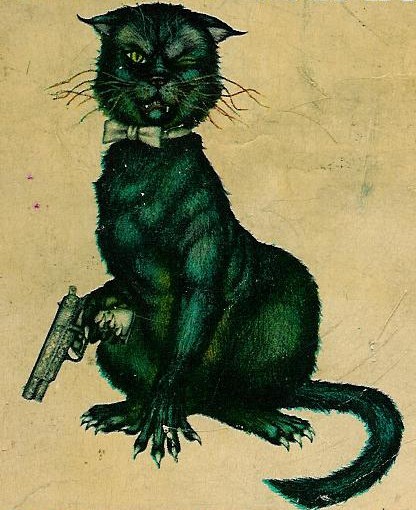
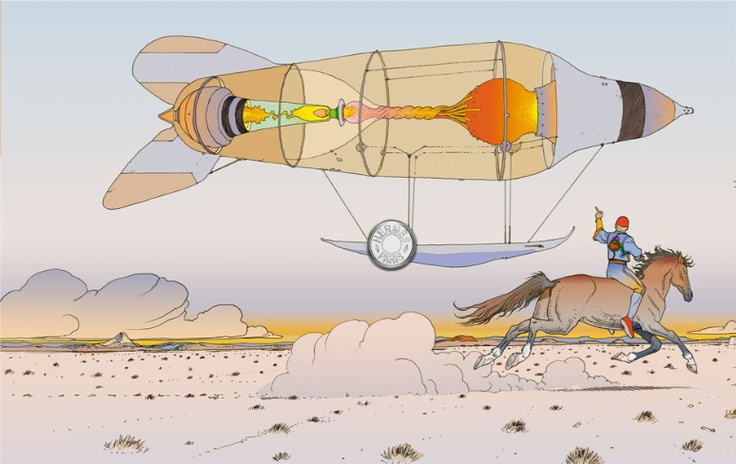
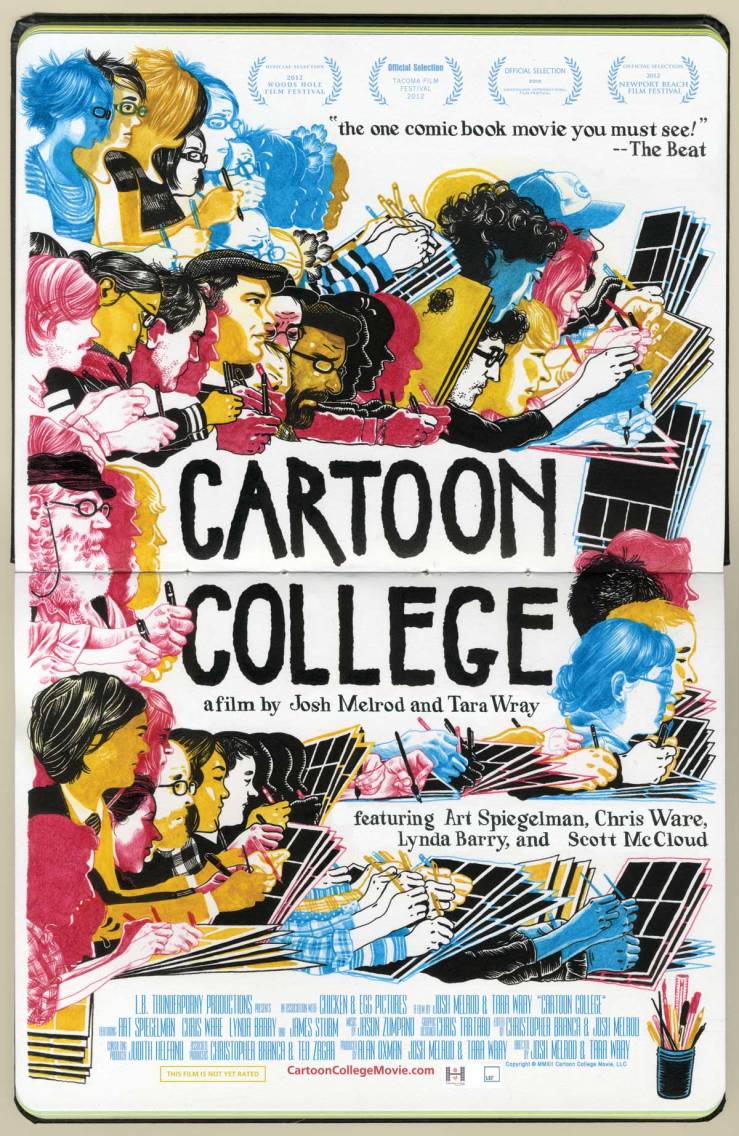


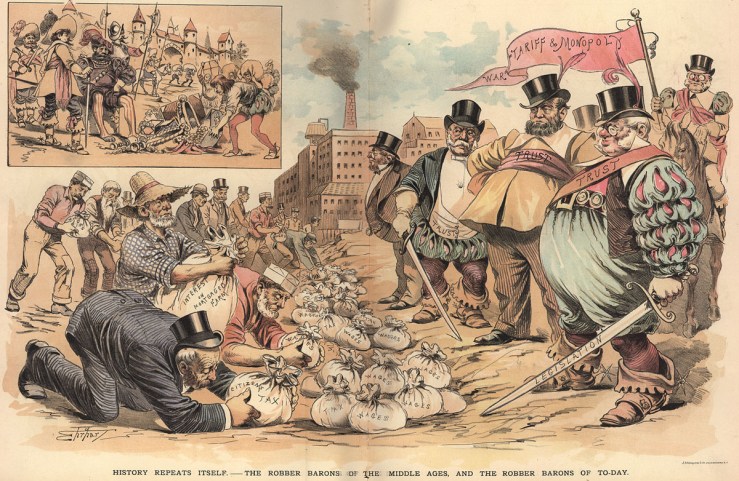


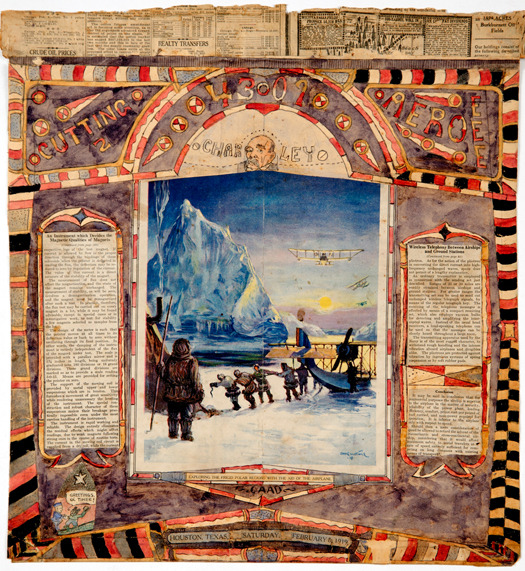
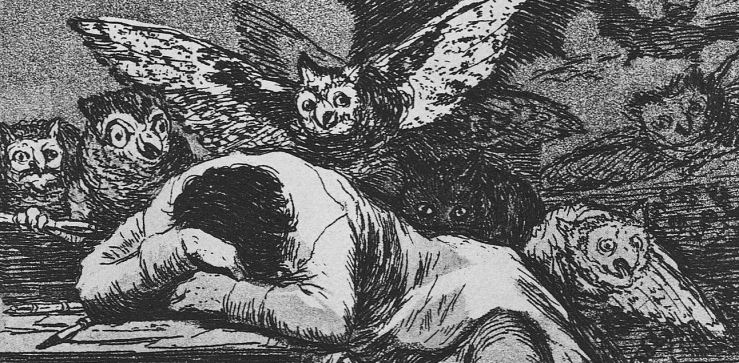
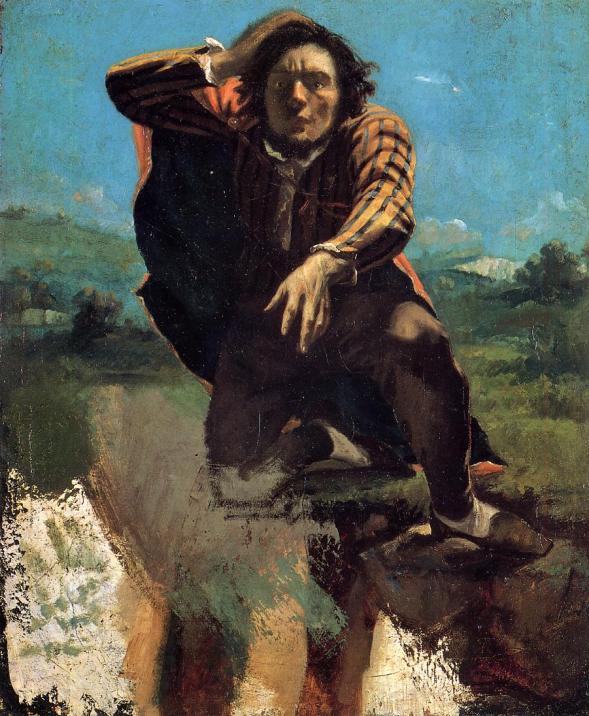


 Marshall Brooks’s recent collection of memoir-essays Paperback Island explores the ways that friendship and place influence what we read, how we read, and how we make—and keep—books. Marshall began his career in publishing in 1971, reading manuscripts for Harry Smith at his legendary publishing house The Smith. In 1979 he created Arts End Press. Subtitled Street Bibliography Essays, Marshall’s latest book provides fascinating insights into a world of post-Beat publishing that is slowly slipping away (that is, aside from in memories and books). Marshall was kind enough to talk to me over a series of emails. He was generous and thoughtful, and also interested in my own life—in my kids, in my reading and teaching, but also in the bookstores in my community. It was a pleasure to talk with him. The end of our email exchange found him in NYC, attending a memorial for Harry Smith. Marshall lives in Vermont with his wife and two sons. Check out
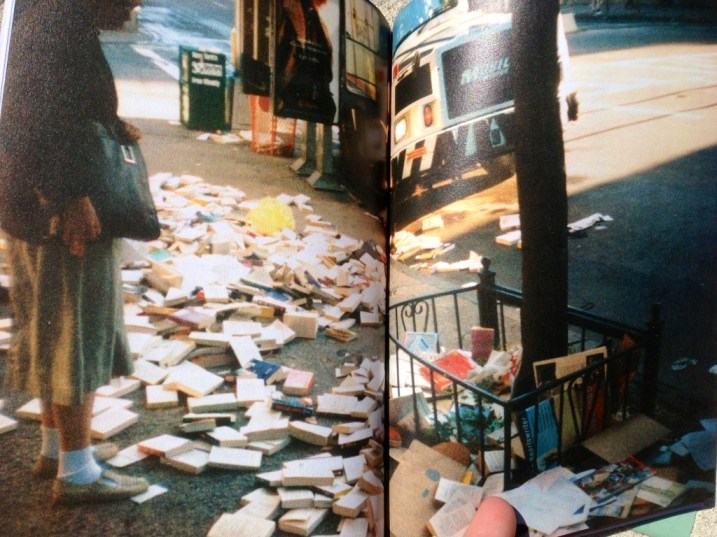




 Biblioklept