
No more my splintered heart and maddened hand were turned against the wolfish world | Riff 4 on rereading Herman Melville’s Moby-Dick (A Bosom Friend/Nightgown/Biographical/Wheelbarrow)

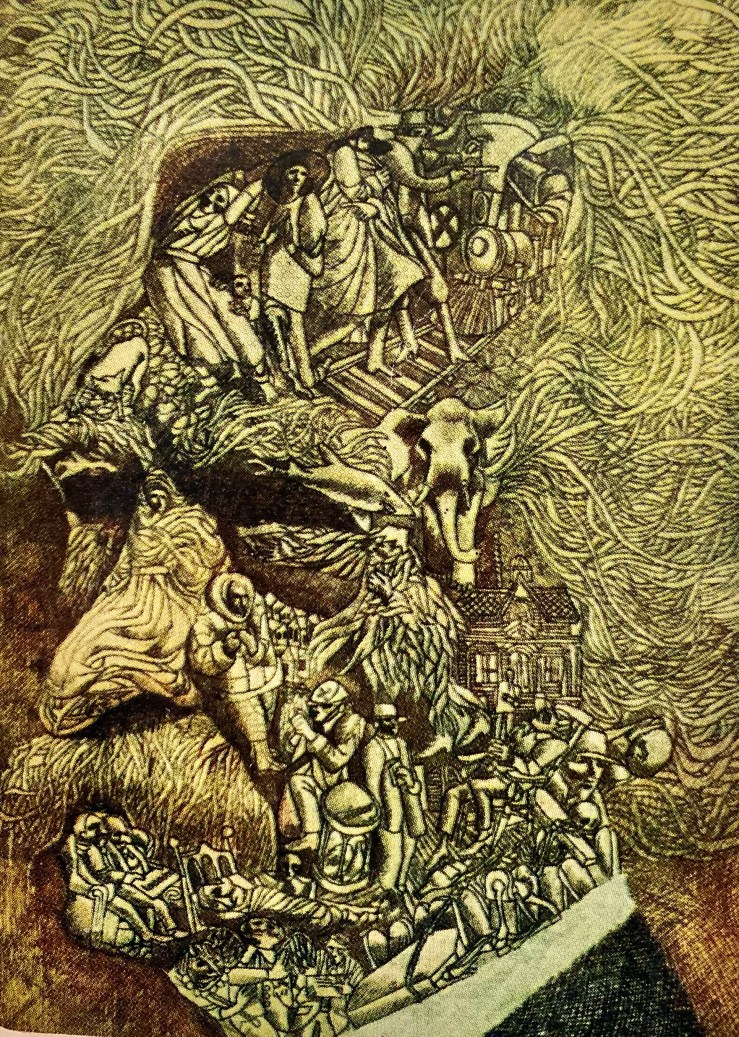
Moby-Dick illustration by Barry Moser

I. “A Bosom Friend” (Ch. 10)  is another one of the remarkable key early chapters of Moby-Dick. It twins Ch. 4, “The Counterpane,” book-ending Ishmael’s Wild New Bedford Nights with Queequeg.

II. While Ishmael’s largehearted acceptance and quick love for Queequeg probably does not seem as eccentric to contemporary readers as it might have been to Melville’s 1851 audience, it’s nevertheless an enduring emblem of Moby-Dick’s expansive spirit.

“Better sleep with a sober cannibal than a drunken Christian,” Ish intones in Ch. 3; by Ch. 10, he admiringly attests that, “Queequeg was George Washington cannibalistically developed.” In a curt but not impolite dismissal of his own culture’s moral compass, Ish declares he’ll, “try a pagan friend…since Christian kindness has proved but hollow courtesy.” Like Huck Finn, another American prototype who wishes to escape into the wild, Ishmael will always value raw truth over empty artifice.

III. There are so many good lines in “A Bosom Friend,” but I think this must be my favorite:

…I began to be sensible of strange feelings. I felt a melting in me. No more my splintered heart and maddened hand were turned against the wolfish world.

Ishmael claims that Queequeg, a “soothing savage” has “redeemed” the world for him.

IV. It is more than possible (and so much has been written on M-D that I’m sure much has been made on the topic) that Ish (and Melville) has (have) taken what might be a complex and nuanced character in Queequeg and othered it into a flat projection screen.

Ishmael, who finds “no civilized hypocrisies and bland deceits” in Queeg, might be accused of turning his bosom friend into a romanticized avatar of Ish’s own desire for a noble “savage” unconstrained by the dictates of Christian morality. However, the events of the novel and its developed characterization of Queequeg do not merit such a facile reading (or is my estimation at this point).

V. Indeed—and to jump ahead, maybe—in Ch. 12, “Biographical,” we learn Queequeg’s origin story.

Queeg is a prince of “Rokovoko, an island far away to the West and South.”

Pause a moment, and look it up, seek it out.

(Wait! “It is not down in any map; true places never are.”)

Queequeg desires to travel the world in the hopes of advancing his culture, and, like so many folks in M-D, runs away to sea (to see). However, his time on whaleboats and in ports of the western world soon soon reveal to him that “it’s a wicked world in all meridians.”

He decides to “die a pagan.”

VI. Notably and necessarily, Queequeg’s “Biographical” chapter is delivered entirely in Ishmael’s voice (unlike Ch. 9, “The Sermon,” where Father Mapple overtakes the narrative).

Queequeg is always a linguistic outsider in M-D—and indeed, an outsider in general, an outsider among outsiders—but also a superhuman superhero, as the events of Ch. 13, “The Wheelbarrow,” show.

VII. I seem to be skipping around, so, fine, okay—

—in “The Wheelbarrow,” Ish and Queeg take a packet schooner from New Bedford to Nantucket, where they plan to join a whaling ship’s crew. On the schooner, one of the several “boobies and bumpkins” aboard mocks Queequeg. Queeg catches ahold of the redneck and tosses him playfully into the air, leaving him shaken but unhurt. Captain, crew, and passengers threaten the “devil” outsider, but chaos erupts when the main-sail’s boom sets loose due because of high winds. The boom knocks the redneck into the ocean. Others panic; Queeg calmly secures the spar dives into the ocean, and rescues his mocker: “The poor bumpkin was restored,” Ishmael remarks. He then tells us that “From that hour I clove to Queequeg like a barnacle; yea, till poor Queequeg took his last long dive,” foreshadowing that not all are to be resurrected in Moby-Dick.

VIII. (Or, alternately—all are to be resurrected in Moby-Dick, but only through Ishmael’s wailing tale.)

IX. But I have skipped around so much—back to Ch. 10, “A Bosom Friend.” In one of the more-remarked upon moments in the book, Ish and Queeg tie the knot after a good smoke:

…he pressed his forehead against mine, clasped me round the waist, and said that henceforth we were married; meaning, in his country’s phrase, that we were bosom friends; he would gladly die for me, if need should be. In a countryman, this sudden flame of friendship would have seemed far too premature, a thing to be much distrusted; but in this simple savage those old rules would not apply.

X. Ishmael then, through a kind of tortuous logic, describes why he, “a good Christian; born and bred in the bosom of the infallible Presbyterian Church,” “must turn idolator” and pray to Queeg’s pagan idol. It’s what God would want him to do, see? Ishmael’s logic is predicated on two simple principles:

–He is “to do to my fellow man what I would have my fellow man to do to me”

and

–“Queequeg is my fellow man”

For me, the remarkable part of Ishmael’s commitment to Queequeg isn’t the first Jesusian imperative to do unto others—it is, in other terms, to recognize the other as a fellow man.This recognition is the moral imperative of Moby-Dick.

XI. And then a sweet ending: “Thus, then, in our hearts’ honeymoon, lay I and Queequeg—a cosy, loving pair.”

XII. “Nightgown,” Ch. 11, is a short chapter where something remarkable and likely inexplicable occurs: Ishmael and Queequeg learn to communicate.

And not just communicate at the level of base transaction or simple need, but rather share philosophical and even aesthetic viewpoints, as born out in the details of Queequeg’s story in Ch. 12, “Biographical.” Again, we might criticize Ishmael as ventriloquizing Queequeg, painting his own broad romantic visions over the possibility of a complex and nuanced character that Melville can’t muster. But I ultimately believe—or at least, I believe up until now on this reread—that Ish and Queeg’s accelerated ability to communicate points to an aspirational transcendental horizon, post-culture, post-language.

XIII. “Nightgown” also has one of my favorite moments in Moby-Dick, a little riff by Ishmael that anticipates the deconstruction of oppositions we later locate in the work of late twentieth-century language theorists:

We felt very nice and snug, the more so since it was so chilly out of doors; indeed out of bed-clothes too, seeing that there was no fire in the room. The more so, I say, because truly to enjoy bodily warmth, some small part of you must be cold, for there is no quality in this world that is not what it is merely by contrast. Nothing exists in itself. If you flatter yourself that you are all over comfortable, and have been so a long time, then you cannot be said to be comfortable any more. But if, like Queequeg and me in the bed, the tip of your nose or the crown of your head be slightly chilled, why then, indeed, in the general consciousness you feel most delightfully and unmistakably warm.

XIV. (As a final note—I remembered this passage in Thanksgiving, 2020, after receiving a very sad text message from my aunt, who we would not be seeing that year, after having not seen her for July 4th—like so many other people feeling the smallbig losses of the year, of the absences of festival and visitation—but also feeling those traditions of festival and visitation so much dearer and warmer in their absence. Nothing exists in itself.)

All these things are not without their meanings | Riff 3 on rereading Herman Melville’s Moby-Dick (Breakfast/The Street/The Chapel/The Pulpit/The Sermon)

I. Chapters 5 through 8 of Moby-Dick are all pretty short and showcase the novel’s ever-shifting moods. Ch. 5, “Breakfast,” brims with humor and energy, which extends through Ch. 6, “The Street.” However, by the time we get off the street and into “The Chapel” (Ch. 7), Ishmael takes a sober, somber turn, meditating on death. Ch. 8, “The Pulpit,” continues the serious, philosophical tone, setting the stage for Father Mapple to take over the narrative in Ch. 9, “The Sermon.”

II. “Breakfast” begins with Ishmael forgiving the landlord Peter Coffin for “skylarking with me not a little in the matter of [Ish’s] bedfellow,” Queequeg. Ish values the humor:

…a good laugh is a mighty good thing, and rather too scarce a good thing; the more’s the pity. So, if any one man, in his own proper person, afford stuff for a good joke to anybody, let him not be backward, but let him cheerfully allow himself to spend and be spent in that way. And the man that has anything bountifully laughable about him, be sure there is more in that man than you perhaps think for.

“Breakfast” has a bustling comic energy. Ish describes the various whalemen setting down to eat: “a brown and brawny company, with bosky beards; an unshorn, shaggy set, all wearing monkey jackets for morning gowns.” (I encourage you to read that line aloud.) We also get the spectacle of Queequeg, “cool as an icicle,” eating bloody beefsteaks at the head of the table—with his harpoon no less!

Moby-Dick illustration by Barry Moser

III. The comedic energy carries out into “The Street.” Here, Ishmael describes for us a carnival of cultures in New Bedford, a pavement teeming with “Feegeeans, Tongatobooarrs, Erromanggoans, Pannangians, and Brighggians” as well as “other sights still more curious, certainly more comical.” He gently mocks “the green Vermonters and New Hampshire men,” who head to New Bedford “athirst for gain and glory in the fishery,” pointing out their tendencies to overdress: “No town-bred dandy will compare with a country-bred one—I mean a downright bumpkin dandy.” Ish’s portrait of New Bedford extends to a description of its wealth and its beautiful homes, parks—and women. We get the sense that he’s over those “hypos” he was suffering in the novel’s opening chapter—or, rather, he’s intoxicated by the newness of his adventure.

IV. The atmospheric shift in “The Chapel,” is announced with a change in weather: “The sky had changed from clear, sunny cold, to driving sleet and mist.” Ishmael makes his way to a church peopled by “a small scattered congregation of sailors, and sailors’ wives and widows.” (A “scattered congregation” strikes me as an oxymoron.)

In strong contrast to the babble and verve of the two preceding chapters, in the chapel “muffled silence reigned, only broken at times by the shrieks of the storm.”

Ishmael gazes upon marble placards memorializing dead sailors, sailors who never returned, and reflects,

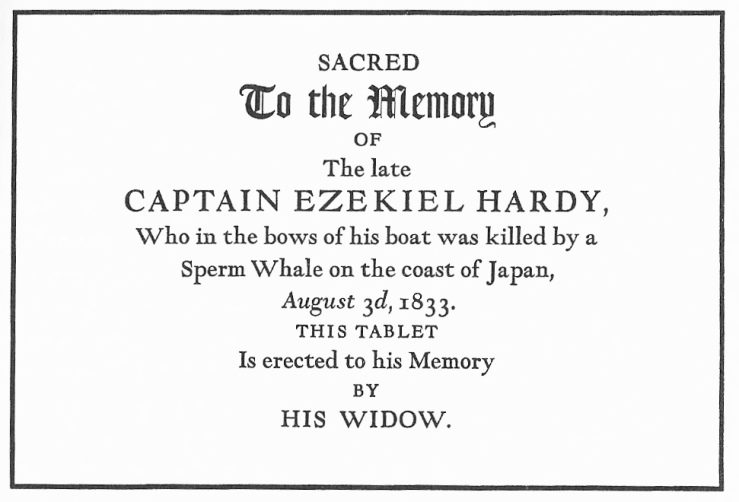
Oh! ye whose dead lie buried beneath the green grass; who standing among flowers can say—here, here lies my beloved; ye know not the desolation that broods in bosoms like these. What bitter blanks in those black-bordered marbles which cover no ashes! What despair in those immovable inscriptions! What deadly voids and unbidden infidelities in the lines that seem to gnaw upon all Faith, and refuse resurrections to the beings who have placelessly perished without a grave.

The line “refuse resurrections” calls back to Ch. 4, “The Counterpane,” where Ishmael gives us a rare glimpse into his past. Punished as a child to a kind of small death on the summer solstice (okay, he’s made to go to bed early)—the punished Ish hopes for a “resurrection” from his fate and is visited by some “nameless, unimaginable, silent form or phantom,” an ineffable something that simultaneously signals dread and hope.

Ishmael’s morbid pondering turns philosophical:

…how it is that we still refuse to be comforted for those who we nevertheless maintain are dwelling in unspeakable bliss; why all the living so strive to hush all the dead; wherefore but the rumor of a knocking in a tomb will terrify a whole city. All these things are not without their meanings.

And then in bit of foreshadowing of the book’s catastrophic conclusion, our narrator, thinking of the countless sailors lost and dead at sea, indulges in a bit of self-talk: “Yes, Ishmael, the same fate may be thine.”

V. “The Pulpit” isn’t a particularly memorable chapter, but it serves a significant rhetorical purpose. “The Chapel” gives us some of Ish’s most melancholy philosophizin’, culminating in self-talk about his own death. It’s an introspective, insular chapter; indeed, even as Ishmael furnishes us the details of the memorial placards, he confesses that he does “not pretend to quote.” Ish’s concern is ultimately not for the concrete particulars but for the abstract—the unnamed and unknown dead.

“The Pulpit” refocuses the narrative gaze, moving from Ishmael’s introspection to the imagery of Father Mapple ascending the stage to deliver his sermon.

VI. “The Sermon” is one of many chapters of Moby-Dick that can be read independent of the novel proper. It is one of my favorite chapters. Up until this point, we’ve largely been in Ishmael’s head, and the spare voices we get—a few lines of pidgin from Queequeg, some bantering with Peter Coffin—have the feel of reported speech. In “The Sermon” though, Ish’s consciousness gives way to Father Mapple’s. Mapple retells the story of Jonah in rapt detail, bringing “this book, containing only four chapters—four yarns—” to vivid life. His Jonah is a sympathetic deject on the run who finds himself resurrected in the belly of a whale.

Mapple’s sermon quickly edges out any of Ishmael’s stage directions, flowing out uninterrupted for paragraphs. It usurps the voice of the novel, prefiguring Ahab, whose voice will dominate in future chapters. Ghostly Ishmael seems to fall into the background of his own adventure at times, and “The Sermon” is an early rhetorical example of this phenomenon.

As Mapple’s sermon comes to its conclusion, Ishmael returns to the narrative, but he’s still at a distance, still a mechanical describer of sights and sounds, not an analyzer or thinker here.

And it’s the final line of the chapter that stuck out to me the most in this reread:

He said no more, but slowly waving a benediction, covered his face with his hands, and so remained kneeling, till all the people had departed, and he was left alone in the place.

If he is truly alone, then how does Ishmael witness his solitude?

Nameless, unimaginable, silent form or phantom | Riff 2 on rereading Herman Melville’s Moby-Dick (The Carpet-Bag/The Spouter-Inn/The Counterpane)

I. Much has been made of Ishmael’s first night with Queequeg, and I don’t aim to add to it in any estimable way. Ch. 4 of Moby-Dick—what I take to be a key chapter, although there are probably too many supposed keys to this great big book—Ch. 4 of Moby-Dick, “The Counterpane,” begins: “Upon waking next morning about daylight, I found Queequeg’s arm thrown over me in the most loving and affectionate manner.”

II. (Later Ish refers to Queeg’s “bridegroom clasp”; in the previous chapter, he tells us that he “never slept better in [his] life” — this after initially finding it impossible to fall asleep in Peter Coffin’s old bed, its mattress possibly “stuffed with corn-cobs or broken crockery.”)

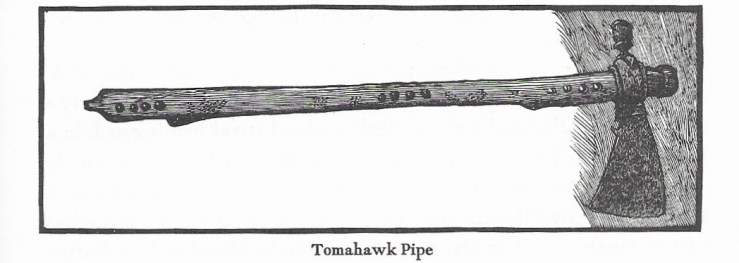
III. Like I said, much has been made of Ish & Queeg, and I don’t know what else I can say. I just love it. I love Ishmael’s initial horror, his yelling for landlord Coffin, his quick realization that his prejudices might be undone via first-hand/eye experience. “Better sleep with a sober cannibal than a drunken Christian,” he tells us, even if he’s wary of Queeg smoking his tomahawk pipe in bed: “It’s dangerous. Besides, I ain’t insured.”

Moby-Dick illustration by Barry Moser

IV. (M-D might be like the main American text in homosocial studies, I guess.)

V. Let’s come back to that key chapter “The Counterpane” in a moment—how about chapters 2 and 3, “The Carpet-Bag” and “The Spouter-Inn”? I guess here is a good place to be clear,

I don’t know who these riffs are for. I mean, I hope if you’ve never read Moby-Dick they make you want to read it and if you’ve read it before maybe it’ll spark you to read again. I don’t want this to just be me summarizing the book. Let me release my anxiety by leaving the italics and maybe opening a new numeral—

VI. “The Carpet-Bag”:

Ish leaves “Manhatto” and arrives in New Bedford, although he’s too late to make it to Nantucket to join the crew of a whaler and fulfill his mission of Not Being Suicidal. The chapter ends with this remarkable paragraph:

Now, that Lazarus should lie stranded there on the curbstone before the door of Dives, this is more wonderful than that an iceberg should be moored to one of the Moluccas. Yet Dives himself, he too lives like a Czar in an ice palace made of frozen sighs, and being a president of a temperance society, he only drinks the tepid tears of orphans.

The Lazarus theme twists all through M-D, right through its cataclysmic ending. It’s clearly there from the opening paragraphs—Ish’s wishes to revive himself—but this is the first overt reference.

VII. The resurrection motif is enriched in “The Counterpane.”

VIII. (Quote above—I really just love the imagery of rich boy Dives who “only drinks the tepid tears of orphans”! And the knock on his being in a temperance society!)

IX. “The Spouter-Inn”: A nice bit of worldbuilding, as the kids might say (M-D is surely a phantasy).

Proprietor Peter Coffin (“Coffin?—Spouter?—Rather ominous in that particular connexion”)—Peter Coffin is far funnier than I remembered. He fucks with Ish, setting him up for a night with Queeg, who’s been out selling a shrunken head. (In a marvelous little episode, he begins to sand down a dining bench for Ish to sleep on.)

Coffin (a carpenter of sorts) prefigures much of the death/rebirth theme to come in M-D. He also tiptoes the novel’s comic-tragic-something-else axis; his initial japes and jabs at Ish in this chapter give way to a heartfelt moment of near-tragedy, as he explains the origin of the bed Ish will share with Queeg:

—it’s a nice bed; Sal and me slept in that ere bed the night we were spliced. There’s plenty of room for two to kick about in that bed; it’s an almighty big bed that. Why, afore we give it up, Sal used to put our Sam and little Johnny in the foot of it. But I got a dreaming and sprawling about one night, and somehow, Sam got pitched on the floor, and came near breaking his arm. Arter that, Sal said it wouldn’t do.

The marriage bed is spliced to infanticidal violence, to the violent exclusion of children.

Moby-Dick illustration by Barry Moser

X. So let’s get to Ch. 4, to “The Counterpane,” Ishmael’s first night with Queequeg in ole Coffin’s marriage bed.

XI. I wrote “first night” above, but that’s wrong—it’s first morning I mean—the first morning after the first night. The day after.

XII. And yesterday, I wrote, in a riff on rereading M-D, that we get to know little of Ishmael’s past. I think that that statement’s true, but Ish does give us crucial information about the worst moment of his life, a kind of founding trauma that the rest of the novel’s quest might be set against.

XIII. Forgive the long quote:

My sensations were strange. Let me try to explain them. When I was a child, I well remember a somewhat similar circumstance that befell me; whether it was a reality or a dream, I never could entirely settle. The circumstance was this. I had been cutting up some caper or other—I think it was trying to crawl up the chimney, as I had seen a little sweep do a few days previous; and my stepmother who, somehow or other, was all the time whipping me, or sending me to bed supperless,

—Okay I have to pause here and ask—Why chimney?

XIV. Continue, Ish:

—my mother

Wait — “my mother”? Not “stepmother”?

XV. –sorry–

…my mother dragged me by the legs out of the chimney and packed me off to bed, though it was only two o’clock in the afternoon of the 21st June, the longest day in the year in our hemisphere. I felt dreadfully. But there was no help for it, so up stairs I went to my little room in the third floor, undressed myself as slowly as possible so as to kill time, and with a bitter sigh got between the sheets.

Our boy Ish is punished, sent to relinquish his consciousness (and any and all adventuring) on the summer solstice.

XVI. He continues (again, emphasis mine):

I lay there dismally calculating that sixteen entire hours must elapse before I could hope for a resurrection. Sixteen hours in bed! the small of my back ached to think of it. And it was so light too; the sun shining in at the window, and a great rattling of coaches in the streets, and the sound of gay voices all over the house.

Ish is without hope here. No Lazarus thing, no resurrection dealie. And all in the whitest brightest light. This in the satanic dark black white novel Moby-Dick.

XVII. Lil’ Ish’s trauma intensifies, and he begs reprieve from the wicked step-mom, but “she was the best and most conscientious of stepmothers, and back I had to go to my room.”

XVIII. He continues; the bold-face emphasis is mine:

For several hours I lay there broad awake, feeling a great deal worse than I have ever done since, even from the greatest subsequent misfortunes.

And then Ishmael has this wild nightmare-not-epiphany:

At last I must have fallen into a troubled nightmare of a doze; and slowly waking from it—half steeped in dreams—I opened my eyes, and the before sun-lit room was now wrapped in outer darkness. Instantly I felt a shock running through all my frame; nothing was to be seen, and nothing was to be heard; but a supernatural hand seemed placed in mine.

XIX. (Melville hits on the terror of a metaphysical encounter here, a phantom moment encoded into a childhood consciousness that cannot name what is happening to it.)

XX: And then Lil’ Ish’s counterpane of days past entangles with the current counterpane of “The Counterpane” in an

My arm hung over the counterpane, and the nameless, unimaginable, silent form or phantom, to which the hand belonged, seemed closely seated by my bed-side. For what seemed ages piled on ages, I lay there, frozen with the most awful fears, not daring to drag away my hand; yet ever thinking that if I could but stir it one single inch, the horrid spell would be broken. I knew not how this consciousness at last glided away from me; but waking in the morning, I shudderingly remembered it all, and for days and weeks and months afterwards I lost myself in confounding attempts to explain the mystery. Nay, to this very hour, I often puzzle myself with it.

XXI. (That “nameless, unimaginable, silent form or phantom” — prefiguration of Moby-Dick? of Ahab? of the cruel wet cold world? or just a child’s small big fears?)

XXII. (In any case, this seems to be Ishmael’s epiphanic founding trauma.)

XXIII. And to bring it back to where I started,

Much has been made of Ishmael’s first night with Queequeg.

Let’s end on the morning after—a kind of healing epiphany, coded in otherness, exploration, and strange love:

Now, take away the awful fear, and my sensations at feeling the supernatural hand in mine were very similar, in their strangeness, to those which I experienced on waking up and seeing Queequeg’s pagan arm thrown round me.

Behind God’s back | On Thulani Davis’s poetry collection Nothing but the Music

Here are the first lines of Thulani Davis’s 1978 poem “Mecca Flats 1907”:

On this landscape

Like a thin air

Hard to breathe

Behind God’s back

I see the doors

I wanted to underline the line Behind God’s back—such an image! But the book itself is so pretty, lithe, lovely. Better to leave it unmarked?

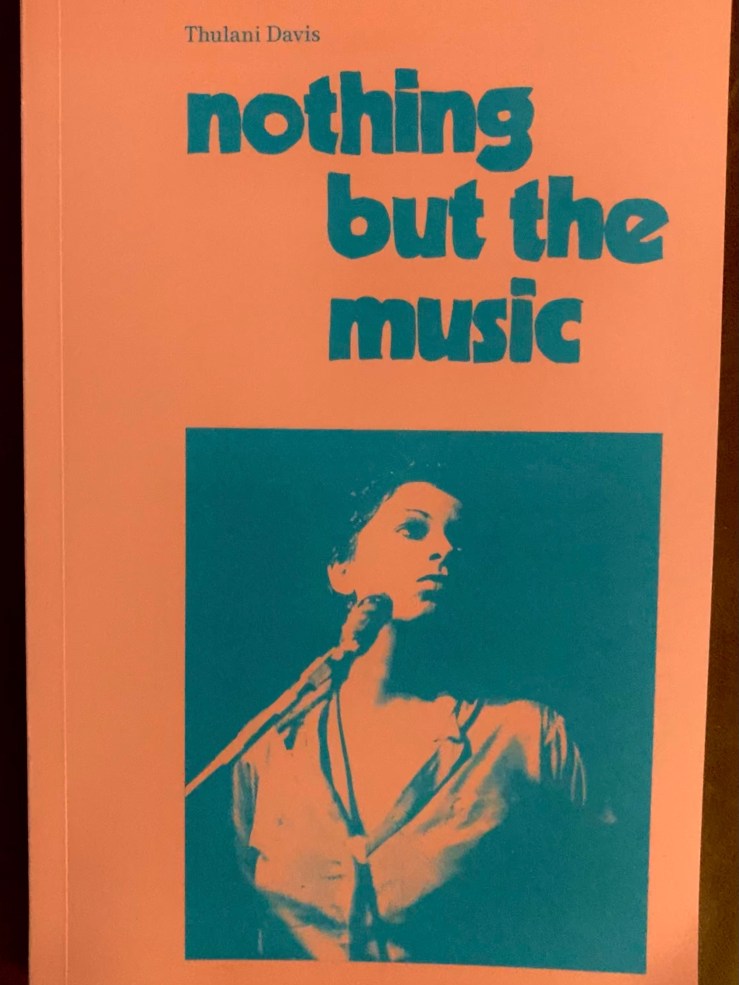
The book is Nothing but the Music, a new collection of Thulani Davis’s poems. Its subtitle Documentaries from Nightclubs, Dance Halls, & a Tailor’s Shop in Dakar: 1974-1992 is a somewhat accurate description of the content here. These are poems about music—about Cecil Taylor and The Commodores and Thelonious Monk and Henry Threadgill and Bad Brains and more. “About” is not really the right word, and of course these poems are their own music; reading them aloud reveals a complexity of rhyme and rhythm that might be lost to the eye on the page.

But where was I—I wanted to underline the line Behind God’s back, but I didn’t. I didn’t even dogear the page. Instead, I went back to read Davis’s acknowledgements, a foreword by Jessica Hagedorn, and an introduction by Tobi Haslett. The material sets the stage and provides context for the poems that follow. Davis’s acknowledgments begin:

I have heard this music in a lot of clubs that no longer exist, opera houses in Italy that will stand another hundred years parks in Manhattan, Brooklyn, L.A., San Francisco, and Washington, DC as well as on Goree Island and in Harare, Zimbabwe. Some of it was in lofts in lower Manhattan now inhabited by millionaires, crowded bistros in Paris that are close, and legendary sites like Mandel Hall and the Apollo, radio studios, recording studios, and my many homes.

Acknowledging the weird times that have persisted (behind God’s back or otherwise), Davis touches on the COVID-19 lockdown that took the joy of live music from her—and then returned it in the strange form of “masked protesters massed in the streets singing ‘Lean on Me'” during the protests following the murder of George Floyd.

Poems in Nothing but the Music resonate with the protests against police violence and injustice we’ve seen this year. The speaker of “Back Stage Drama (For Miami)” (surely Davis herself?) repeats throughout the poem that “I was gonna talk about a race riot,” but the folks around her are absorbed in other, perhaps more minute affairs:

They all like to hang out

Thinking is rather grim to them.

Composed in 1980, the poem documents an attempt to attempt to address the riots in May of the same year in Miami, Florida, after several police officers were acquitted in the murder of Arthur McDuffie, a black man.

The speaker of the poem embeds a poetic plea, a poem-within-a-poem:

I said, ‘they’re mad, they’re on the the bottom going down/

stung by white justice in a white town

and then there’s other colored people

who don’t necessarily think they’re colored people

taking up the middle/leaving them the ground.’

But her would-be audience is weary:

I am still trying to talk about this race riot.

Minnie looked up and said, ‘We don’t have anywhere

to put any more dead.’

Snake put on his coat to leave, ‘We never did,

we never did.’

1992’s “It’s Time for the Rhythm Revue” takes for its erstwhile subject the riots that ensued after the acquittal of the LAPD officers who beat Rodney King. The subject is far more complex though—the speaker of the poem desires joy of course, not violence:

did they acquit somebody in LA?

will we burn it down on Saturday

or dance to the Rhythm Revue

the not too distant past

when we thought we’d live on?

Is God’s back turned—or do the protagonists just live behind it?:

…I clean my house

listening to songs from the past

times when no one asked anyone

if they’d seen a town burn

cause baby everybody had.

In Nothing but the Music, music is part and parcel of the world, entangled in the violence and injustice of it all, not a mere balm or solace but lifeforce itself, a point of resistance against it all. In “Side A (Sir Simpleton/Celebration), the first of two poems on Henry Threadgill’s 1979 album X-75, Vol. I, Davis’s narrator evokes

at the turning of the day

in these winters/in the city’s bottomless streets

it seems sometimes we live behind god’s back

we/the life blood

of forgotten places/unhallowed ground

sometimes in these valleys

turning the corner of canyons now filled with blinding light streams caught between this rock & a known hard place

sometimes in utter solitude

a chorale/a sweetness/makes us whole & never lost

And again there that line, a note from a previous jam—it seems sometimes we live behind god’s back—I’ll dogear it here, digitally, underline it in my little blog scrapbook.

I think seems is the right verb though, above. Does the star of “Lawn Chair on the Sidewalk” not remain in God’s gaze?

there’s a junkie sunning himself

under my front tree

that tree had to fight for life

on this Brooklyn street

disease got to its limbs

while still young

Typing the lines out, I wonder who I meant by star above.

Nothing but the Music is filled with stars. Here’s avant-piano great Cecil Taylor in “C.T. at the Five Spot”:

this is not about romance & dream

it’s about a terrible command performance of the facts

of time & space & air

In a synesthestic moment, the speaker merges her art with its subject:

the player plays/Mr. Taylor plays

delicate separate licks of poems

brushes in tones lighter & tighter/closer in space

In the end it’s one art:

I have heard this music

ever since I can remember/I have heard this music

There are plenty more famous musicians, of course, but more often than not minor players emerge with the greatest force. There’s the unknown hornplayer whose ecstatic playing inspired 1975’s “He Didn’t Give Up/He Was Taken.” In “Leaving Goree” there are the “two Bambara women…gold teeth gleaming” who “sit like mountains” and then explode in song.

Davis crafts here characters with deft economy. Here’s the aforementioned couple of “Back Stage Drama (For Miami)”:

Snake & Minnie

who love each other dearly

drink in different bars,

ride home in separate cars.

They like to kiss goodnight

with unexplored lips.

They go out of town

to see each other open.

Or the hero of 1982’s “Bad Brains, A Band”—

the idea that they think must scare people to death

the only person I ever met from southeast DC

was a genius who stabbed her boyfriend for sneaking up on her in the kitchen

she was tone deaf and had no ear for French


she once burned her partner in bid whist

for making a mistake

At the core of it all is Davis’s strong gliding voice, pure and clean, channeling miracle music and synthesizing it into new sounds. The speaker of “C.T. at the Five Spot” assessed Taylor’s performance as a work of physics, a transcendence beyond “romance & dream,” but the speaker of 1982’s “Zoom (The Commodores)” gets caught up in the aural romance of The Commodore’s pop magic:

zoom I love you

cause you won’t say no/cause you don’t want to go

cause it’s so cruel without love

give me the tacky grandeur of Atlantic City

on the Fourth of July

the corny promises of Motown

give me the romance & the Zoom.

I love those corny promises too. The romance and the zoom are not, at least in my estimation, behind God’s back, but rather, if you believe in that sort of thing, might be God’s special dream. Nothing but the Music cooks raw joy and raw pain into something sublime. I like poems best when they tell stories, and Davis is a storyteller. The poems here capture place and time, but most of all sound, sound, rhythm, and sound. Lovely stuff.

Nothing but the Music is forthcoming from Blank Forms Editions.

Blog about some recent reading

I have a leak in my roof and I’ve canceled my Thanksgiving plans and I’m not sure what to do about the soft coup, but, books—

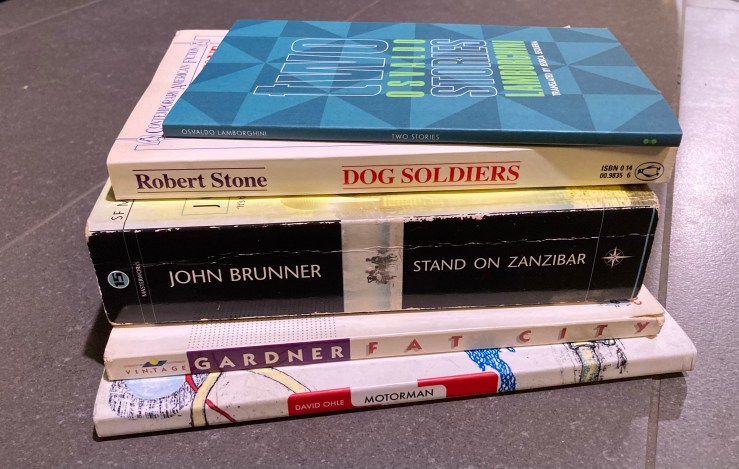
Top to bottom:

I’m still scratching my head about Two Stories by Osvaldo Lamborghini (translated by Jessica Sequeira). Sneaky strange stuff, prose-poem stuff like elastic concrete, or concrete elastic.

Started Robert Stone’s Dog Soldiers last night (on the late David Berman’s recommendation) and really digging it so far. Set at the end of the Vietnam War, it seems to be about a heroin deal going sideways. Maybe the CIA is involved, maybe not. Everyone’s a bit grimy. I guess it comes from the Hemingway tree, or really, maybe, the Stephen Crane tree—Denis Johnson’s tree, Leonard Gardner’s tree, Raymond Carver’s tree, etc. Reminds me a lot of Johnson’s Angels (and, to some extent, Tree of Smoke), but also Russell Banks’s 1985 novel Continental Drift, which I read years ago, hated, and still remember—which means I think it must be a really good novel?

I wrote Top to bottom up at the top, but Leonard Gardner’s Fat City is in line with Stone’s Dog Soldiers—Stone’s losers, I guess. The book is about an “old” boxer (he’s not thirty) on the way out of his career and a young boxer on the rise. (Rise here is a really suspect term.) I really can’t believe I was 41 when I read this. I should’ve read it at 20. I wouldn’t have understood it the same way, of course, and the biggest sincerest compliment I can pin on the novel is that I would’ve loved it at 20 but I know that I would’ve appreciated it more 20 years later. There are plenty of novels that I read and think, Hmm, would’ve loved this years ago, but now, nah, but Fat City is wonderful. It’s a boxing story, sure, but it’s really a book about bodies breaking down, aging, getting stuck in dreams and fantasies. Gardner’s only novel (!) is simultaneously mock-tragic and real tragic, pathetic and moving, and very very moving. Great stuff.

John Brunner’s big fat dystopian novel Stand on Zanzibar frankly overwhelmed me and then sorta underwhelmed me there at the end. This sci-fi classic is a big weird shaggy dog that managed to predict the future in all kinds of ways, and it’s mean and funny, but it’s also bloated and booming, the kind of novel that sucks all the air out of the room. It’s several dozen essays dressed up as sci-fi adventure—not a bad deal in and of itself—but there’s very little space left for the reader.

David Ohle’s lean mean mutant Motorman is a dystopia carved from stranger stuff. Ohle’s cult novel leaves plenty of room for the reader to wonder and wander around in. Abject, spare, funny, and depressing, Motorman sputters and jerks on its own nightmare logic. Its hapless hero Moldenke anti-quests through an artificial world, tumbling occasionally into strange moments of agency, but mostly lost and unillusioned in a broken universe. I loved it.

After I finished it, I made a list with no name of books that are “like” Motorman in their “unalikeness” to other books:


Blog about The Orange Eats Creeps, Grace Krilanovich’s Slutty Teenage Hobo Vampire Junkies novel

Hey, it’s Halloween, spooky times, dark times, right? So here’s a novel recommendation: Grace Krilanovich’s “Slutty Teenage Hobo Vampire Junkies” novel The Orange Eats Creeps.

Here is the first paragraph of The Orange Eats Creeps:

The sun is setting. The hobo vampires are waking up, their quest for crank and blood is just beginning. Over the course of the frigid night they will roam the area surrounding the train stop looking for warm bodies to suck, for cough syrup to fuel a night of debauched sexual encounters with fellow vampires and mortals alike. They distribute sexually transmitted diseases like the daily newspaper but they will never succumb, they will never die, just aging into decrepit losers inside a teenage shell. They have a sense of duty to their habit and their climax — twin addictions that inform their every move. They are lusty, sad creatures, these Slutty Teenage Hobo Vampire Junkies. They traverse the Pacific Northwest’s damp, shitty countryside, forests and big trees, the dusty fields and gravel pits clearing a path of desolation parallel to the rail lines of Oregon and Washington, the half-blown-out signs for supermarket chains in strip malls featuring exactly one nail place, one juice-slash-coffee place, and one freshmex-type grill chain restaurant. Here everything is coated in brown-grey paste like moss at the bottom of a crappy tree…

Krilanovich’s novel is coated in brown-grey paste, an accumulation of scum and cum and blood, a vampiric solution zapped by orange bolts of sex, pain, drugs, and rocknroll. It’s a riot grrrl novel, a psychobilly novel, a crustgoth novel. It’s a fragmented, ugly, revolting mess and I loved it. The Orange Eats Creeps is “A vortex of a novel,” as Steve Erickson puts it in his introduction, that will alternately suck in or repel readers.

The vortex of The Orange Eats Creeps recalls another black hole, Charles Burns’s Black Hole, also set in the Pacific Northwest, also crawling through subcultural punk detritus. Visually and thematically, there are also echoes of Kathryn Bigelow’s 1987 film Near Dark, Tim Hunter’s 1986 film River’s Edge, and Harmony Korine’s 1997 film Gummo. (And yeah, I’m sure a long essay could be worked out in the ways that this book grimes the gilt glam from Joel Schumacher’s 1987 film The Lost Boys.)

As a prose stylist, Krilanovich recalls Kathy Acker or William Burroughs, and the vomitiness and abject bodiness of it all is reminiscent of Julia Kristeva’s theory. Krilanovich’s style seems to have roots in punk rock, in zines, and cut-ups, in theft and weird Xerox collages. The novel is fragmentary, random. We’re trapped—trapped?—in the narrator’s ESP-consciousness, zipping through time and space, drugged out, immortal, wishing to nullify time and space, to achieve a comforting and insensate zero.

All the shooting galleries and basement punk shows and drugstore robberies and gallon buckets of cold coffee won’t be everyone’s cup of tea. Readers looking for a tightly-plotted vampire novel will find themselves frustrated. The lore here is a separate lore: foster families and parking lots and quick scores and quicker sex. The world is boxcars and group homes and 7-Elevens. But there’s plenty of weirdness: vampire boys, punk rock legends and would-be legends, a warlock, a serial killer called Dactyl, the Donner Party, and ESP, ESP, ESP. There’s a core quest: The narrator searches for her sister. Maybe the quest is a metaphor; hell, maybe vampirism itself is a metaphor in The Orange Eats Creeps. It doesn’t matter.

What matters is the aesthetic impression, a swirl of images, words, and motifs coagulating around the reader’s mind’s eye. The Orange Eats Creeps is a survey of consciousness in crisis—the crisis of late capitalism, with vampires making their way through a gig economy, addicted, transient, desperate, enthralled to a particularly Western weirdness. It doesn’t all work, but who cares? Good gross stuff.

Blog about some recent reading

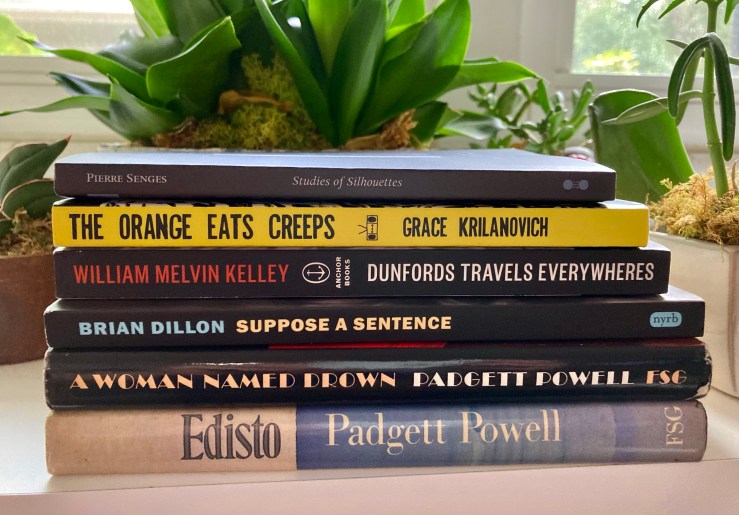
From the bottom of the stack to the top:

I read most of Padgett Powell’s 1984 debut Edisto in a few sittings, settling down easily into its rich evocation of a strange childhood in the changing Southern Sea Islands. I’d always been ambivalent about Powell, struggling and failing to finish some of his later novels (Mrs. Hollingsworth’s MenThe Interrogative Mood), but Edisto captured me from its opening lines. The story takes two simple tacks–it’s a coming of age tale as well as a stranger-comes-to-town riff. Powell’s sentences are lively and invigorating; they show refinement without the wearing-down of being overworked. The book is fresh, vital.

So when I finished Edisto, I thought I’d go for some more early Padgett. On Friday I picked up his second novel, A Woman Named Drown, started it that afternoon, and put it down 70 pages later the following afternoon. There wasn’t a single sentence that made me want to read the next sentence. Worse, it was turning into an ugly slog, a kind of attempt to refine Harry Crews’s dirty south into something closer to grimy eloquence. I like gross stuff, but this wasn’t my particular flavor.

In between, I took another palate cleansing essay from Brian Dillon’s collection Suppose a Sentence. Dillon’s collection of essays is perfect for resetting a reader’s mood between texts. Each essay reflects, sometimes obliquely, sometimes more directly on a single sentence from a range of authors. Good stuff.

I am working on a full review of William Melvin Kelley’s cult classic Dunfords Travels Everywheres. I have misused the phrase “cult classic” in the preceding sentence Dunfords has been long out of print, almost impossible to find, and largely unheralded for the past few decades. However, new editions from Anchor are rectifying this problem. The book is weird, a bit shaggy, funny and perplexing. More thoughts to come.

When I put down Powell’s A Woman Named Drown I picked up Grace Krilanovich’s novel The Orange Eats Creeps. I bought Orange back in July, pulling it out based on its spine (Two Dollar Radio, a small press I admire) and its title (c’mon!). The Steve Erickson blurb sealed the deal. I’m really digging Orange right now. It’s a novel about Slutty Teenage Hobo Vampire Junkies (the narrators term) bumming around and sucking blood and drugs in the Pacific Northwest. It reminds me a lot of Kathryn Bigelow’s film Near Dark, Tim Hunter’s film River’s Edge, and Harmony Korine’s film Gummo. There’s also a healthy dose of Twin Peaks in here, as well as the abject contours of Charles Burns’s Black Hole.

I’ve also been using Pierre Senges’s Studies of Silhouettes (English translation by Jacob Siefring) as literary palate cleansers, opening the book at random to read Senges’s strange riffs on Kafka’s leads. As Siefring’s blurb puts it, “Each of the texts in this work proceed from the fragments and cryptic beginnings found scattered throughout the notebooks Max Brod took possession of after Kafka’s death.” The results are sometimes very funny, sometimes profound, sometimes both. I hope to have a fuller review down the line.

Blog about book browsing on a Friday afternoon (and mostly looking at covers)

I’ve made a habit of prowling around my own shelves each week, trying to build a small stack of books I can part with. I then head up the street to trade the books in. Lately, I’ve done a decent job of leaving with far fewer books than I brought in to trade—hell, last Friday I came back with no books.

I always have a little mental checklist of books I’m hoping to come across. It mutates and swells, and I get lucky a lot of times. Sometimes I grab stuff at near-random. And other week’s are stale. Increasingly, I search for first editions and interesting mass market paperbacks, a reversal of a previous version of myself who found hardbacks clunky and mass market paperbacks cheap. Mass market editions tend to have wilder art, more interesting designs, and generally take more risks than contemporary, respectable trade paperbacks, as do older hardbacks. I ended up with three first editions. I was not especially looking for any of the books I acquired.

I was looking for certain books of course. Here are some interesting book covers I saw while looking for what I did not find.

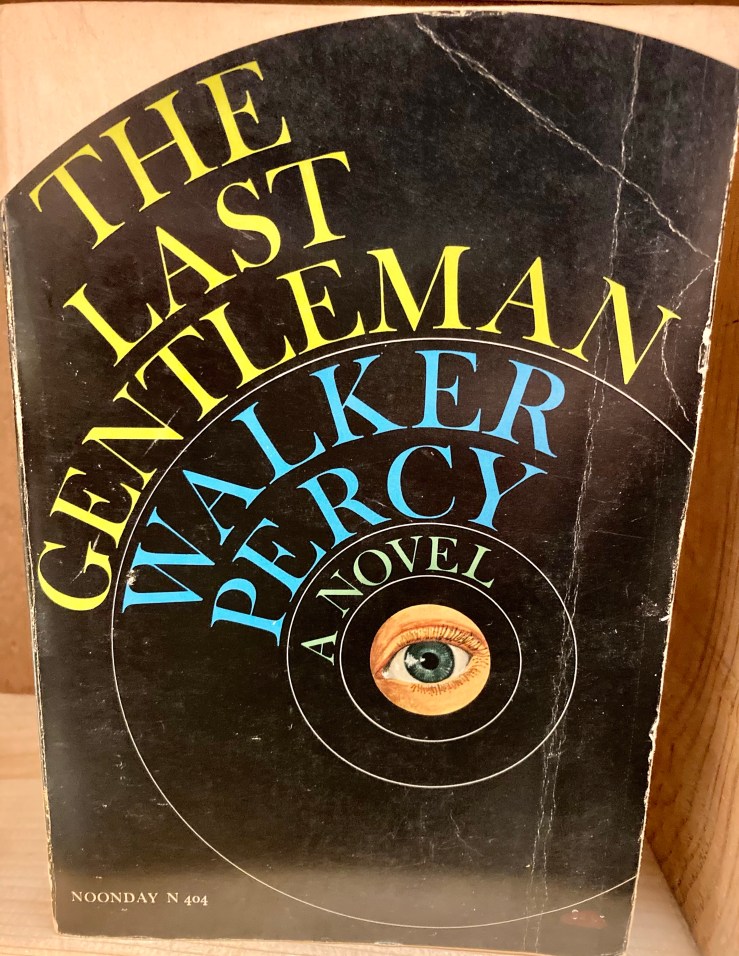
I was looking for Walker Percy’s second novel Love Among the Ruins. I’d found a copy at this same book store last year—a first edition in beautiful condition with a really cool cover. I almost bought it (I think it was seven bucks) and now regret not having done so. I’m sure I’ll regret skipping on both of these Percy books, both of which have cover designs by Janet Halverson.

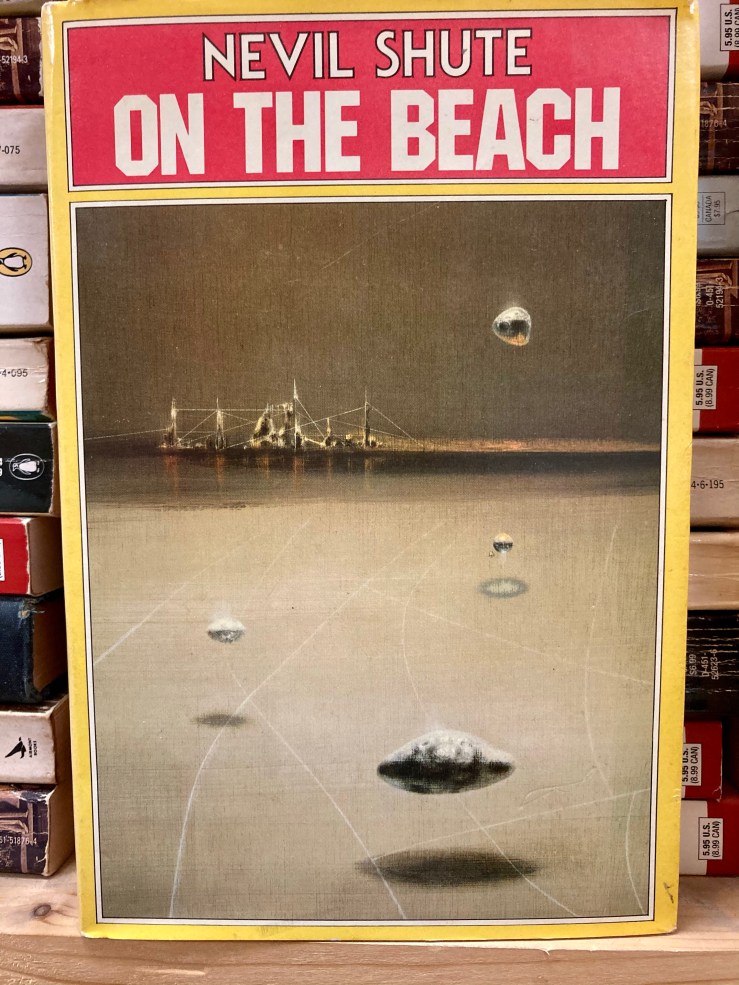
I wasn’t looking for anything in particular when I saw this hardback copy of Nevil Shute’s On the Beach, but the font on the spine attracted me. Love the cover painting, which is by Richard Powers (I assume this is a different Richard Powers than the American novelist).

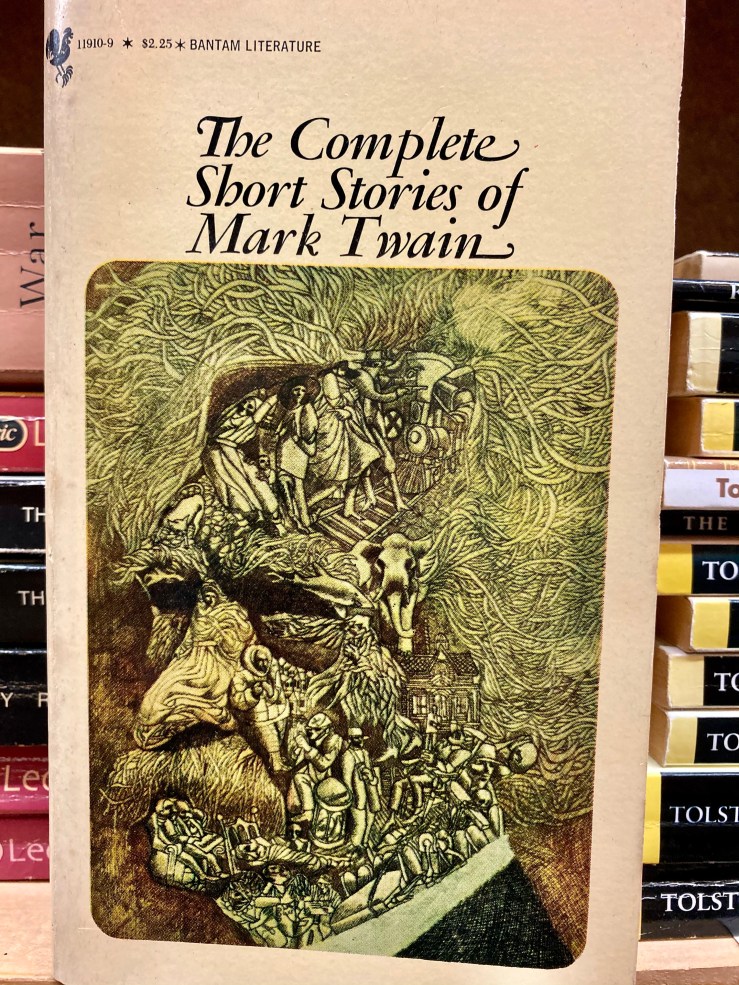
I wasn’t looking for anything in particular when I picked up this Bantam collection of Mark Twain stories, which has a very cool uncredited Giuseppe Arcimboldoesque cover. Not sure why I picked it out. But I love the cover.

I was hoping to score a cheap paperback copy of one of David Marskon’s early novels when I came across this edition of Thomas Mann’s Buddenbrooks with a cover by Ben Shahn.
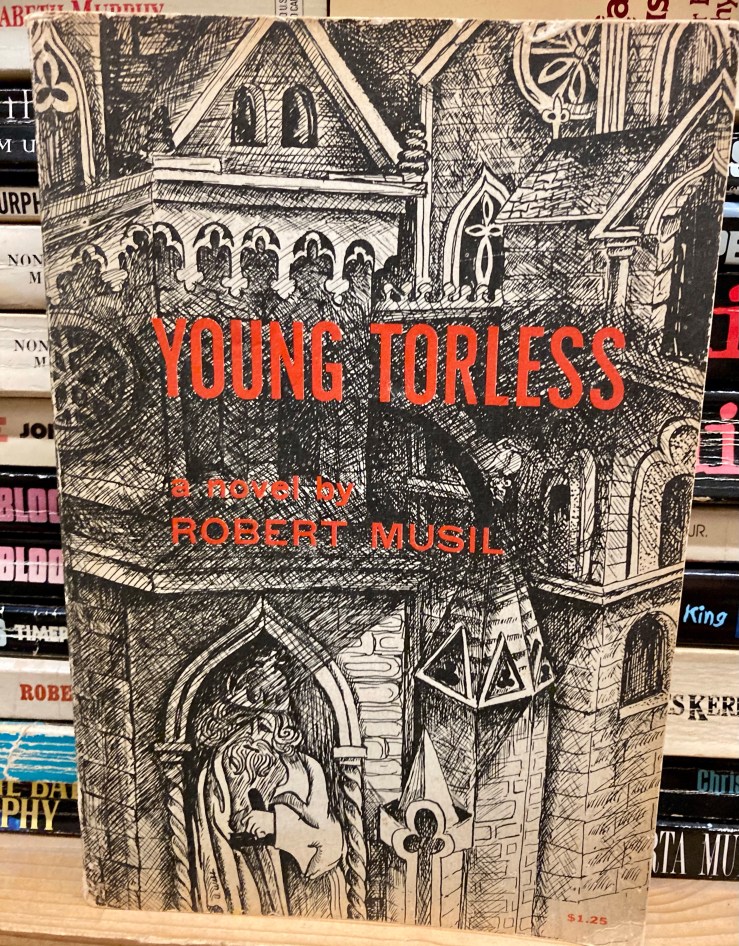
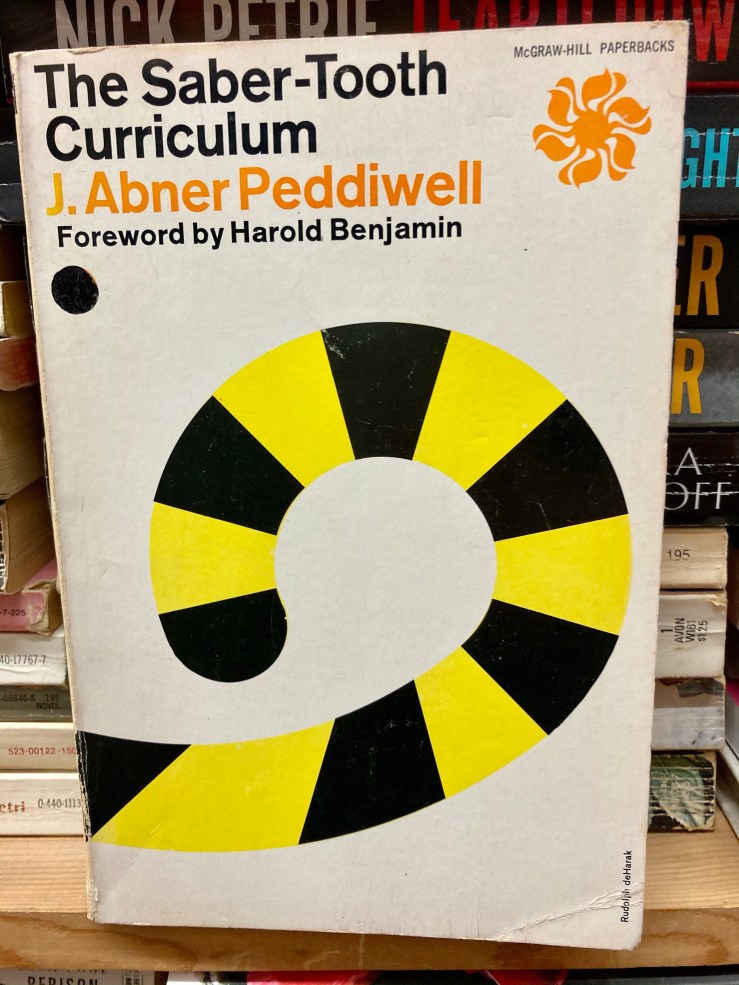
I was looking for anything by Gerald Murnane when I found this beautiful edition of Robert Musil’s Young Torless.

The bookshop I frequent separates “Classic Fiction” from “General Fiction” (with some somewhat arbitrary distinctions, in my opinion)—so I checked under the “PE” section in general fiction for a stray Walker Percy (no luck). Never heard of J.Abner Peddiwell’s The Saber-Tooth Curriculum but I love the simple expressive cover.

Walking past “PE,” “PI,” “PL” etc. I stopped at section on James Purdy to check out this edition of The Nephew. I’ve never been able to get into Purdy—seems so sad—but I love this cover.

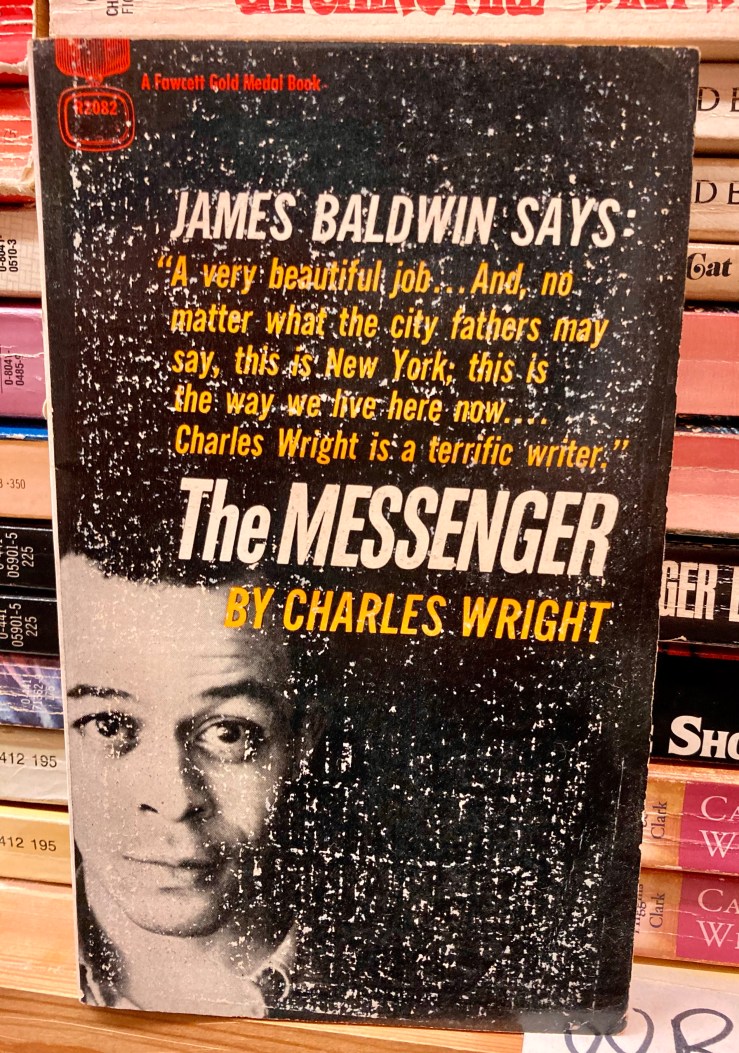
I was looking for an original edition of Charles Wright’s 1973 novel Absolutely Nothing to Get Alarmed About; I have it in an omnibus, but I’d love a stand alone if I could find one. I did see this edition of The Messenger. The cover is terrible and boring and has way too much text on it. I found a copy of The Messenger a few months ago with a far more interesting cover.

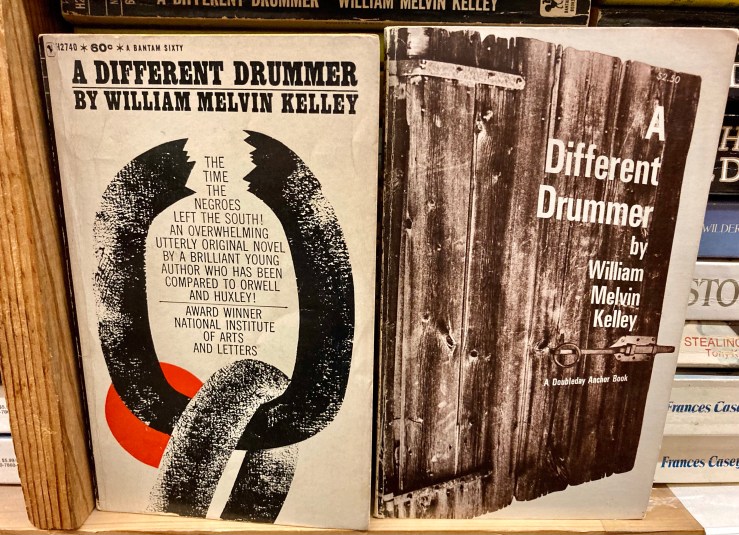
I was looking for one of the William Melvin Kelley novels I don’t have. I found a bunch of mass market copy paperback versions of his first novel, A Different Drummer. The copy on the left has a cool cover. I think I like my new reissue better though.

I always look for a copy of David Ohle’s cult novel Motorman and I never find it. I do like this vibrant cover for Chad Oliver’s The Shores of Another Sea.

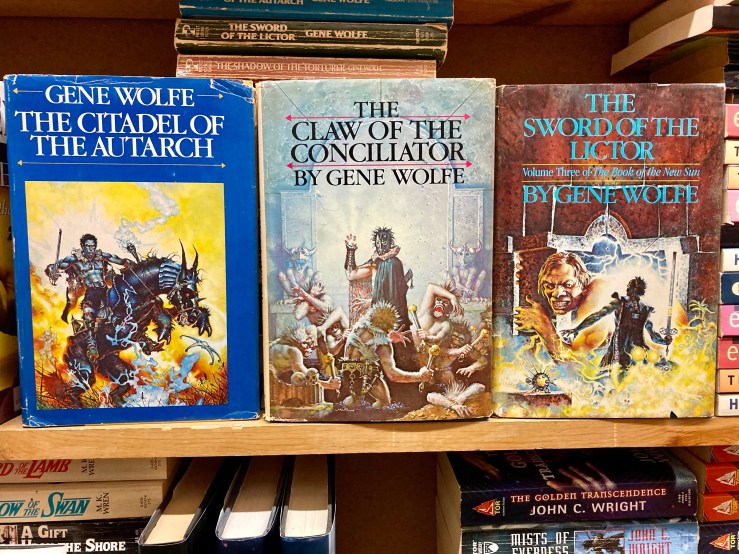
While I was in the sci-fi section, I passed by the Gene Wolfe area, and spied a complete hardback set of his seminal The Book of the New Sun tetralogy. I couldn’t pass up on a first hardback edition of the first in the series, The Shadow of the Torturer:

I also picked up a pristine first edition hardback copy of William Gaddis’s 1994 novel A Frolic of His Own. It’s the only Gaddis novel I’ve yet to read and buying a second copy seems like a good motivation to finally dig in.

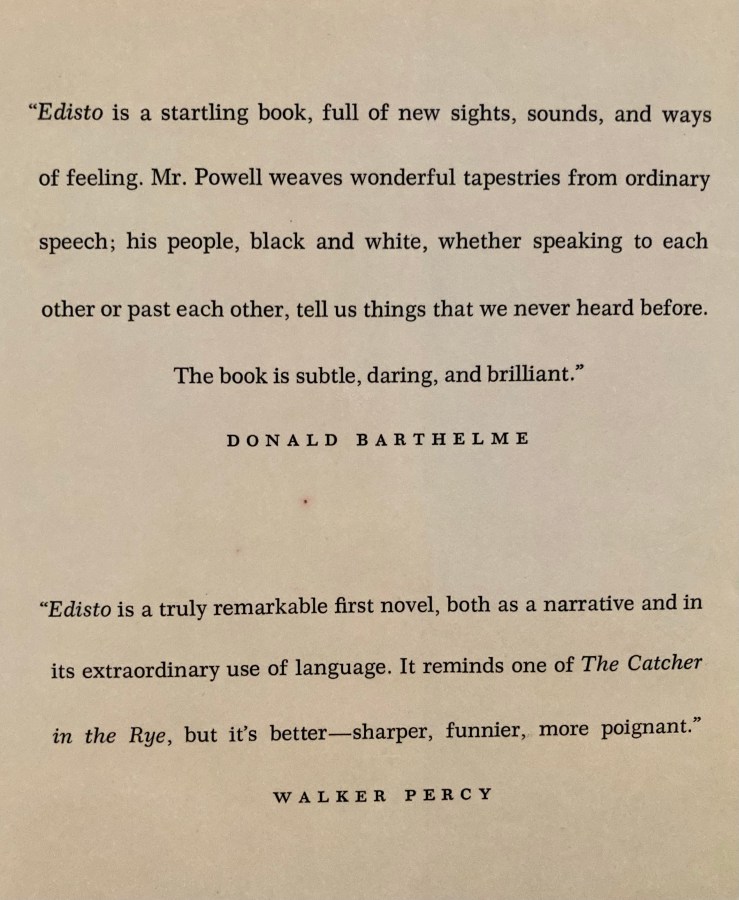
I also came across a first edition hardback copy of Padgett Powell’s first novel Edisto. I’ve always felt ambivalent about Powell. He was the writer in residence at the University of Florida when I was an undergrad there in the late nineties. He’d taken the post over from Harry Crews, and I always resented that for some reason, brought that resentment to the few readings I attended, never made it through anything but a few stories. But this copy of Edisto was only four bucks. And check out the blurbs on the back:

There’s my guy Barthelme. And then Percy, who brought me to the store today. I’ll give it a shot.


Peter Brooks’s Balzac’s Lives (Book acquired 29 Sept. 2020)

Peter Brooks’s study of Balzac is newish from NRYB.

The only thing I’ve read by Balzac is Donald Barthelme’s short story “Eugénie Grandet.”

NRYB’s blurb:

Balzac, more than anyone, invented the nineteenth-century novel, and Oscar Wilde went so far as to say that Balzac had invented the nineteenth century. But it was above all through the wonderful, unforgettable, extravagant characters that Balzac dreamed up and made flesh—entrepreneurs, bankers, inventors, industrialists, poets, artists, bohemians of both sexes, journalists, aristocrats, politicians, prostitutes—that he brought to life the dynamic forces of an era that ushered in our own. Peter Brooks’s Balzac’s Lives is a vivid and searching portrait of a great novelist as revealed through the fictional lives he imagined.

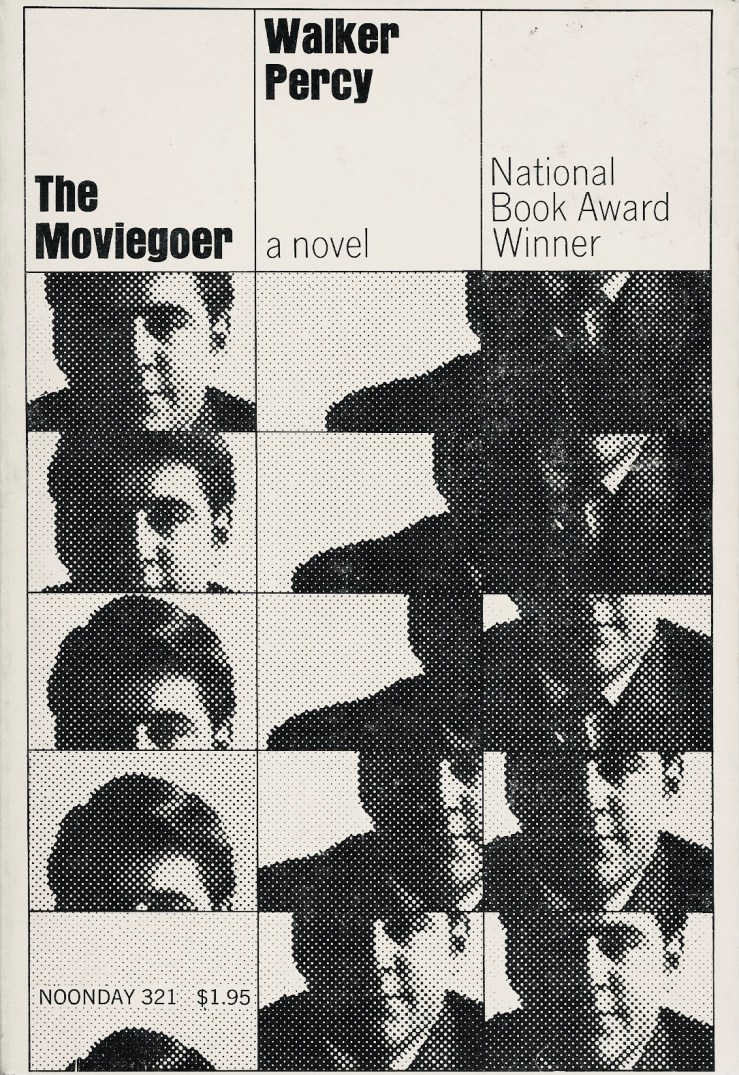
On The Moviegoer, Walker Percy’s existential novel of sad little happinesses and horny ennui

I jumped enthusiastically into Walker Percy’s first novel The Moviegoer (1961) last week. I read  his fourth novel Lancelot (1977) earlier this month. I loved Lancelot. I did not love The Moviegoer.

The Moviegoer is narrated by John Bickerson “Binx” Bolling, who works as a stockbroker in a suburb outside of New Orleans. A Korean War vet, Binx has never quite lived up to the aristocratic mantle his family expected of him. He should’ve been a doctor, a lawyer, that sort of thing. Instead, Binx ambles amiably (and sometimes not-so amiably) through a vague existence, searching for “the wonder.”

Binx is semi-determined not to be “distracted from the wonder,” an attendance to the possibility of spiritual transcendence. In Walker’s postwar American South, commercial culture and modern manners slowly suffocate spirit. Binx is a would-be philosopher attempting, usually unsuccessfully, to find a dram of wonder in a desacralized world. He fools around with his secretaries, reads novels, checks in on his earthy mother, and has drawn out philosophical conversations with the aunt who raised him after his father’s early death. His aunt too sees the fall of her world, her South—its long drawn out decline into the Big Modern New.

Binx is also deeply intimate with his aunt’s stepdaughter, his stepcousin Kate. (Note the Gothic tinge here, a semi-incestuous plot in this novel full of semi-themes and semi-plots.) Modern malaise is the theme of The Moviegoer, and Kate suffers her malaise far more intensely than Binx or anyone else. Semi-suicidal and prone to bouts of mania, she finds an anchor in Binx. But Binx is a loose anchor, a semi-anchor, a little anchor:

It is not a bad thing to settle for the Little Way, not the big search for the big happiness but the sad little happiness of drinks and kisses, a good little car and a warm deep thigh.”

The Moviegoer is full of sad little happinesses: bourbon in paper cups, dips in the Gulf of Mexico, moviegoing, natch. Binx’s post-aristocratic malaise is a privileged, horny malaise. A half-century after The Moviegoer’s publication, Binx’s ennui reads as blinkered, solipsistic, reactionary even. There’s a casual, even temperate sexism and racism to his worldview, which I suppose we might expect out of a midcentury novel by a white male. Binx seems unable or unwilling to regard the humanity of other humans as equal to his own deeply felt humanity. But he’s gentle (and even ironically genteel) in his outlook.

That outlook: the ennui in The Moviegoer is mostly polite and mostly well-mannered. And horny. Unlike the manic, dark, zany vitriol of his later novel Lancelot, the humor of Percy’s debut is lightly ironic, droll, even a touch whimsical at times. It’s almost lethargic. But I suppose a certain lethargy is to be expected from a novel that takes malaise as a theme.

Still, there are moments that puncture the malaise in The Moviegoer. In an earlyish section of the novel, Binx riffs on the classic This I Believe radio program (presumably the one hosted by Edward R. Murrow). Binx pokes gentle polite loving fun at the program in general, before proffering his own short essay:

“Here are the beliefs of John Bickerson Bolling, a moviegoer living in New Orleans,” it began, and ended, “I believe in a good kick in the ass. This—I believe.”

And yet just one line later Binx vacillates back, the conscience of tradition echoing in his grandfather’s phrase:

I soon regretted it, however, as what my grandfather would have called “a smart-alecky stunt” and I was relieved when the tape was returned. I have listened faithfully to This I Believe ever since.

Percy’s—excuse me Binx’s—anger immediately collapses—or maybe reconstitutes into—respect for for tradition and a resigned faithful commitment to listening.

But anger eventually boils over, even if Percy is quick to remove the pot from the burner. Very late in the novel, Binx delivers the closest thing in The Moviegoer to a rant:

Today is my thirtieth birthday and I sit on the ocean wave in the schoolyard and wait for Kate and think of nothing. Now in the thirty-first year of my dark pilgrimage on this earth and knowing less than I ever knew before, having learned only to recognize merde when I see it, having inherited no more from my father than a good nose for merde, for every species of shit that flies —my only talent—smelling merde from every quarter, living in fact in the very century of merde, the great shithouse of scientific humanism where needs are satisfied, everyone becomes an anyone, a warm and creative person, and prospers like a dung beetle, and one hundred percent of people are humanists and ninety-eight percent believe in God, and men are dead, dead, dead; and the malaise has settled like a fall-out and what people really fear is not that the bomb will fall but that the bomb will not fall—on this my thirtieth birthday, I know nothing and there is nothing to do but fall prey to desire.

The passage reads false to me, from the corny “dark pilgrimage” (Oh no! Your thirties!) to the aristocratic substitution merde to the complaint against humanism to the ultimate had-too-many-drinks-at-the-dinner-party pose that, Yeah, come come nuclear bomb. And does poor little rich boy Binx really want to fall prey to desire?

Ah! Prey to desire! Existential dread! A call to human feeling, an anxiety of the individual caught between the wonder and the flesh, the spirit and all that horny ennui. For a novel set in New Orleans at Mardi Gras, The Moviegoer is light on fun. Percy, via Binx, repeatedly insists that this is all serious business, even as the light irony drolly undercuts the novel’s core message. Binx comes off as a party guest eager to get along gently, afraid of the potential menace under his surface, but also incapable of accepting the menace under everyone else’s surface.

I wanted more menace. The Moviegoer, like its antecedent, Camus’s The Stranger, seems pointed toward howls of execration—but even if Binx might wish to howl at the absurd, he can’t.

From its opening paragraphs, The Moviegoer’s tone reminded me strongly of Camus’s 1942 novel The Stranger. I loved The Stranger when I was sixteen, appreciated it when I reread it at twenty for a course on existential literature, and have had the good sense to let it alone since. Those howls of execration at the end have always stuck with me. But I know I’ve changed over the past two decades, and I revere my memories of the book. I’d hate to find fault. 

The preceding paragraph is perhaps a rough draft of the following statement: I think I would’ve loved The Moviegoer if I had read it when I was much younger. This isn’t a knock on Percy’s prose, the novel’s voice, or the loose, lilting plot. I appreciated all those elements. The problem is me. The problem is that I already read The Stranger so long ago. And also so long ago—The Plague and The Fall and Nausea. And Waiting for Godot, and Invisible Man. And Hemingway and Salinger and Heller’s Catch-22, which The Moviegoer beat to win the 1962 National Book Award.

And then a few weeks ago, as a significantly older guy, I read Percy’s later novel, Lancelot.

Published in the late 1970s, Lancelot reads like a postmodern Gothic. It’s a parody of Southern gentility and movie-making, a riff on cultural incest, a howling execration of the century preceding it. It’s a ranting monologue worthy of Thomas Bernhard, more Notes from Underground than The Stranger, rough, mean, wild. It’s possible to read Lancelot as the weird dark cursed sequel to The Moviegoer, its sinister postmodern zaniness exploding the former novel’s mannered modernism.

If I was ultimately disappointed in The Moviegoer, it’s likely because I read Lancelot first. I wanted more of that dark weird flavor, that mad ranting fervor. The Moviegoer has its moments, and likely has more that I missed. I found the last line unexpectedly moving: “It is impossible to say.” (Nevermind the referent of that “It.” Suffice to say that we have found ourselves at Ash Wednesday.) But then Percy—or maybe his editors?—appended a goddamned epilogue to the whole affair, almost ruining the novel.

(It’s possible that I’ve fundamentally misread The Moviegoer, that I’ve missed something profound in it, that I’ve read in earnest what was meant in irony, that I’ve skated over wells of depth that seemed otherwise shallow.)

Anyway. Should I read another Percy novel? I’ll admit that Love in the Ruins (1971) seems far more interesting than the famous novel, this one, the one I’m ostensibly “reviewing.” Given the strength of Lancelot, I’ll give it a shot.


Blog about acquiring a Vintage Contemporaries edition of Barry Hannah’s Airships. (Special guest appearance by David Berman.)

2020-08-06_122106

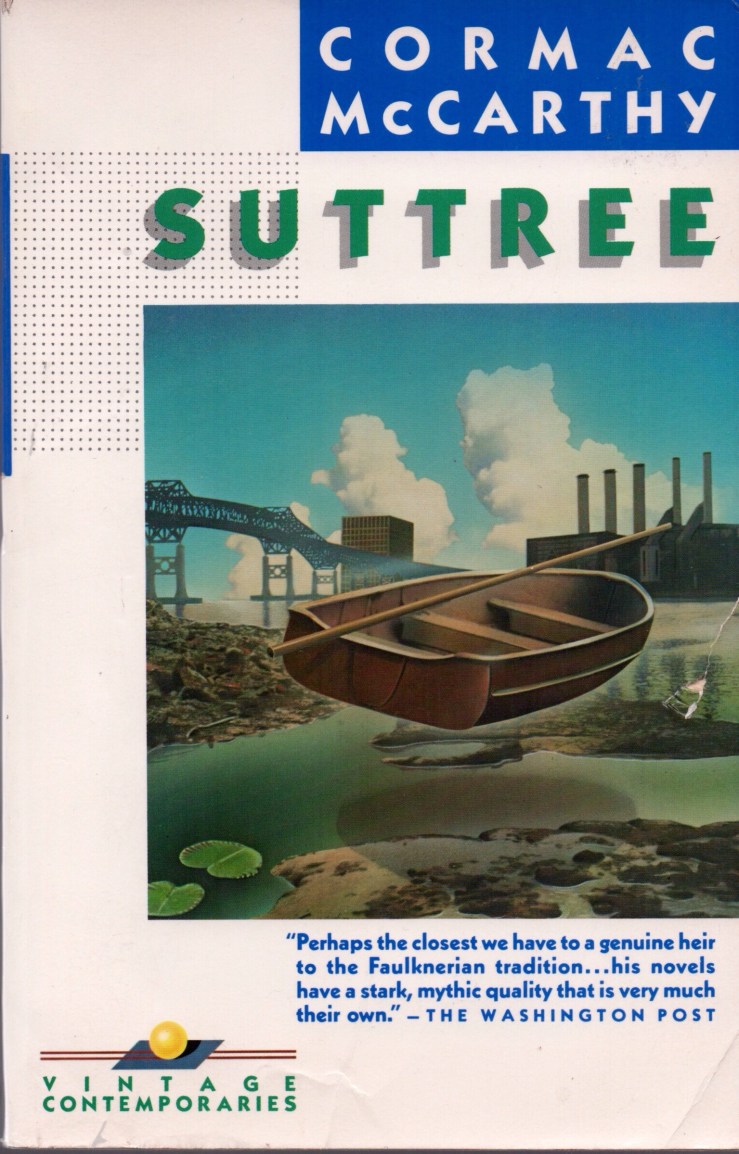
I’ve been a big fan of the Vintage Contemporaries 1980s series for ages now. The books were easily available, cheap and used, in the nineties, and I first read Raymond Carver and Jay McInerney in VC editions, later adding novels by Denis Johnson, Don DeLillo, Jerzy Kosinski to the burgeoning collection. I was thrilled to find a VC copy of Cormac McCarthy’s Suttree years ago; I wasn’t looking for it in particular, but the spine of a Vintage Contemporaries edition is hard to miss in a used bookstore. I picked it up of course, and gave the Vintage International edition I’d read to a friend who’d just finished Blood Meridian. The dark, moody Vintage International covers strongly contrast the bright, vivid VC edition (with a surreal painting by Marc Tauss):

IMG_8254

In time, I’d unshelve at least one or two VC editions when browsing a used bookstore, especially if it was an author I’d been meaning to read. I ended up reading and loving Joy Williams’ first collection, Taking Care, that way, as well as Charles Portis’s Norwood (which led to me reading every Portis novel I could get my hands on).

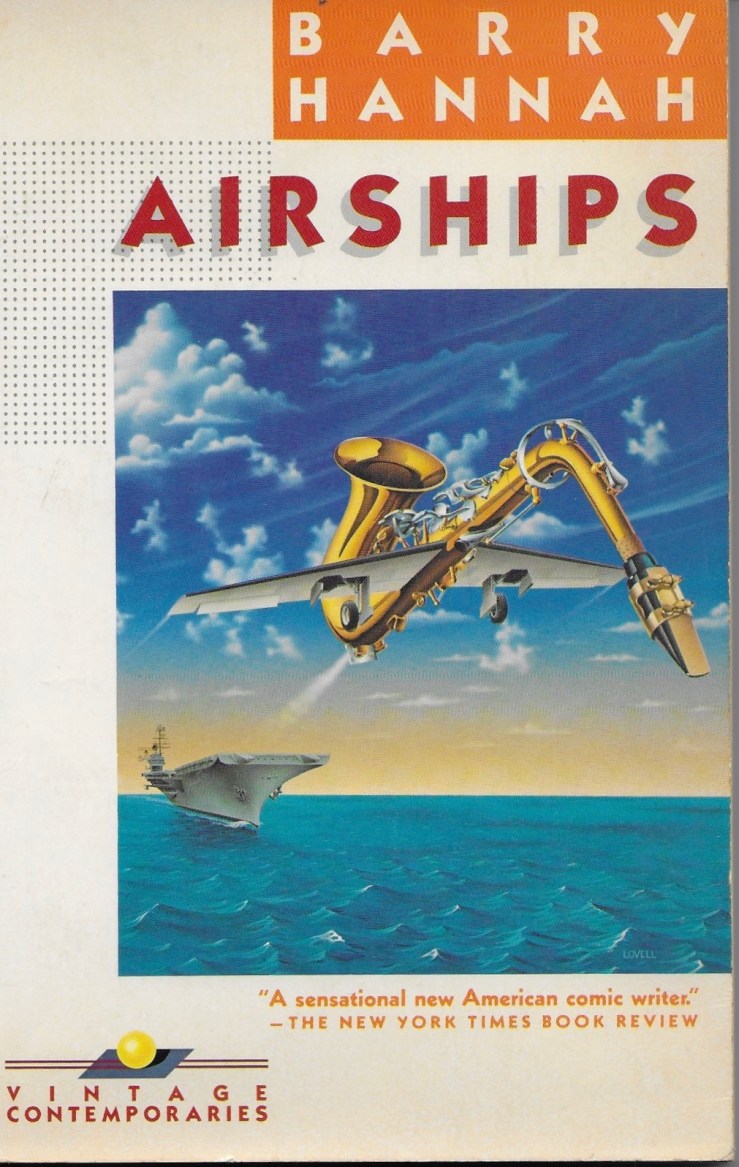
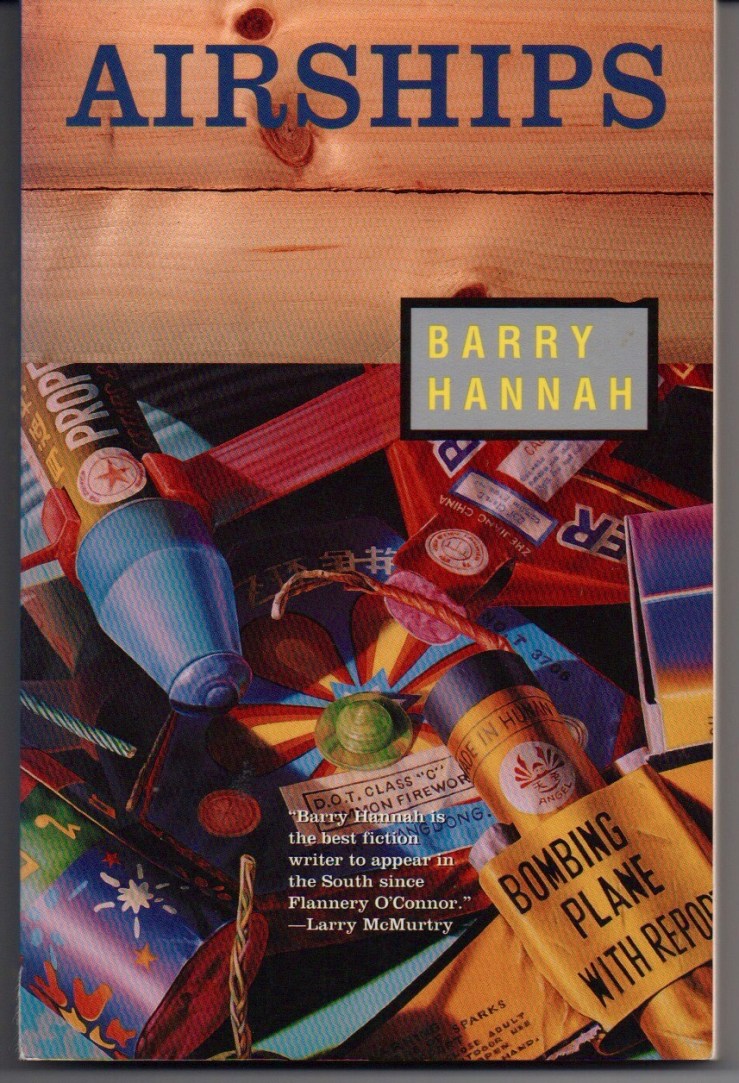
The one I really, really wanted though was the Vintage Contemporaries edition of Barry Hannah’s collection Airships. I must have seen it first–just the spine–in this great write up of VC designs at Talking Covers, and then added it to a mental list of titles to check for. There’s absolutely nothing wrong with the Grove Press copy I have of Airships; indeed, I really dig its photorealistic cover by Hannah’s contemporary Glennray Tutor—but I guess at this point I have to admit I’m collector (of cheap eighties paperbacks).

img_1423

I read them, books, too, of course. Here’s the intro to my 2011 review of Airships:

In his 1978 collection Airships, Barry Hannah sets stories in disparate milieux, from the northern front of the Civil War, to an apocalyptic future, to the Vietnam War, to strange pockets of the late-twentieth century South. Despite the shifts in time and place, Airships is one of those collections of short stories that feels somehow like an elliptical, fragmentary novel. There are the stories that correspond directly to each other — the opener “Water Liars,” for instance, features (presumably, anyway), the same group of old men as “All the Old Harkening Faces at the Rail.” The old men love to crony up, gossip, tell tall tales. An outsider spoils the fun in “Water Liars” by telling a truth more terrible than any lie; in “Harkening,” an old man shows off his new (much younger) bride. These stories are perhaps the simplest in the collection, the homiest, anyway, or at least the most “normal” (whatever that means), yet they are both girded by a strange darkness, both humorous and violent, that informs all of Airships.

Well so and anyway:

Yesterday, browsing my beloved used bookstore, I found, while not really looking for it, the Vintage Contemporaries edition of Airships. I was in the “H” section of General Fiction, looking for something by Chester Himes (which I found, but in the Mysteries section, which I really have never browsed before), and there it was, its spine singing to me from a low shelf. I was happy to note the cover is by Rick Lovell, who’s responsible for my favorite VC editions (along with, obviously, series designer Lorraine Louie). As a sort of cherry on top, my edition has a little gold sticker at the top of the inside cover, proclaiming “Square Books on the Square, Oxford Mississippi.” Hannah taught at Ole Miss for nearly three decades. Square Books is still there.

I was excited with my find and I’m a dork so I tweeted about it. The next tweet I saw in my timeline was this tweet by Christopher DeWeese (retweeted by the writer John Lingan):

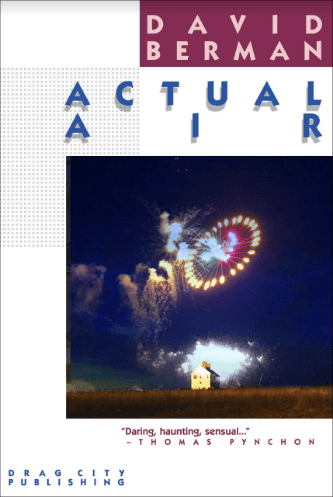
(I love the blurb by Thomas Pynchon.)

David Berman was a poet, musician, and singer (and more) who died almost exactly a EemWmbXXgAAvc3zyear ago. He was kind of a hero of mine, as far as these things go, and as such I never made an attempt to contact him, even when he linked to this blog on his blog, Menthol Mountains. I absolutely love the cover he made—or did he make it? I don’t actually know—but I know that he loved Vintage Contemporaries, that they were important to him. I recall John Lingan tweeting about having to cut some of his discussion about the series with Berman in his fantastic profile of the then-not-late artist. I couldn’t find the tweet, but I reached out to John, and he told me I remembered right; he also told me he recalled seeing a copy of Harold Brodkey’s First Love and Other Sorrows in Berman’s room.

I wonder if Berman and I had the same VC edition of First Love and Other Sorrows? The one with the Rick Lovell cover of butterflies on a sandcastle? Or maybe he had the one with the purple cover? I gave my copy to a good friend years ago, and have never seen one with the Lovell cover since.

I also wonder if Berman read the VC edition of Airships. I know he met Hannah, who apparently read Berman’s work. I recall now too that both men show up in The Minus Times Collected, which I never picked up. I’m going to order it now.


Blog about William Melvin Kelley’s first novel, A Different Drummer

img_5819

William Melvin Kelley’s 1962 debut novel A Different Drummer has eleven chapters. The first, and shortest, “The State,” opens like this:

AN EXCERPT from THE THUMB-NAIL ALMANAC . . . page 643;

An East South Central state in the Deep South, it is bounded on the north by Tennessee; east by Alabama; south by the Gulf of Mexico; west by Mississippi. 

I am a Southerner, and my brain turned into a wrangled wriggling squiggle trying to visualize where “the State” must be, before giving in to the next few lines that declare that “the  State’s” capital is Willson City (no such place of course), which is named after “Confederate General Dewey Willson…the chief architect of the two well-known victories at Bull’s Horn Creek and at Harmon’s Draw” (never happened).

And so well yeah Kelley has created his own Southern State, an amalgam of sin and poverty that sweats and skulks in the tradition of Faulkner’s Yoknapatawpha. Structurally, too, A Different Drummer recalls Faulkner’s work. Kelley makes his reader cobble the narrative together through myriad, rotating viewpoints—a white farmer, his son, porch talkers, and the members of the Willson family, the aristocratic descendants of Confederate General Dewey Willson, who make their living collecting rent.

We get the perspective of all four Willsons—daughter, brother, mother, and father—who put together a picture of a life entangled with the Calibans. The Calibans were the enslaved descendants of a mythical figure named “the African,” a kind of warrior-king who escapes slavery with his only child, only to be tracked for days and nights by Willson, who shoots him before he can dash the child’s brains to free him.

The Calibans work the Willsons’ land over decades, first as slaves and then as sharecroppers. This brings us to the novel’s central conceit. I’ll let the blurb of the Anchor reissue I read do the heavy lifting:

June, 1957. One hot afternoon in the backwaters of the Deep South, a young black farmer named Tucker Caliban salts his fields, shoots his horse, burns his house, and heads north with his wife and child. His departure sets off an exodus of the state’s entire black population, throwing the established order into brilliant disarray. Told from the points of view of the white residents who remained, A Different Drummer stands, decades after its first publication in 1962, as an extraordinary and prescient triumph of satire and spirit.

I had neglected the blurb until now, and had somehow missed the key idea of the second-to-last line: Told from the points of view of the white residents.

Kelley’s tactic here is extraordinary, and ultimately painful. We first get an “average” citizen of Sutton (the central setting of the novel in our unnamed “state,” Harry Leland, whose sentiments of race probably track with those of the hypothetical white moderate MLK warned us about. Leland’s not a bad guy and he’s trying to make his son a decent human being, but he doesn’t know what he doesn’t know.

We meet that son next, and see the narrative through his young eyes. Kelley’s satiric edge is perhaps sharpest here. The menfolk call the boy “Mister Leland,” an irony underlined when Tucker Caliban—whom Mister Leland counts as a friend—addresses the lad as such. It’s Mister Leland too who accompanies Bennett Bradshaw (excuse me, “THE REVEREND B.T. BRADSHAW [of] THE RESURRECTED CHURCH OF THE BLACK JESUS CHRIST OF AMERICA, INC., NEW YORK CITY,” as his business card attests)—it’s Mister Leland who accompanies Bradshaw (and his chauffeur) to the site of Tucker Caliban’s salted-and-abandoned farm. Unlike the various perspective characters, Bradshaw, an intellectual, understands Caliban’s motivation—and envies his spirit.

Caliban’s primal rejection and refusal of the Southern Way of Life is the novel’s central problem, a “problem” that Kelley addresses somewhat obliquely through primarily white eyes. The various Willsons attempt to reckon with both past and present, but their tools are limited, for the most part. The novel’s penultimate chapter is a series of journal entries by David Willson, starting when he’s a young man off to attend an Ivy up in New England.

Young David attends a socialist meeting, but is bored with “nothing but a bunch of fellows showing each other how much they knew about Marx.” He meets—guess who!—Bennett Bradshaw, and falls fast for the guy. (I might be spoiling too much of the plot here—look, it’s a strong book, skip this and read it.)

Willson’ friendship with Bennett adds a strange ballast late in the narrative, tipping the book in a different trajectory than the course it seemed to have previously been taking. Willson is a tragic Faulknerian figure, an intellect who wishes absolution from his namesake’s sins, from the Sins of the South, but who is also beholden to and limited by the dictates of his own time. Bennett too is limited and beholden. It’s Tucker Caliban who breaks the chains.

A Different Drummer is not the narrative I expected to read. I found Kelley’s name looking for works by black American postmodernists, which is how I found Fran Ross’s Oreo—an utterly postmodern novel, carnivalesque, polyglossic, metatextual. (In her essay on Ross’s novel, Harryette Mullen compares Oreo to Kelley’s last novel, 1970’s Dunfords Travels Everywheres.A Different Drummer’s rotating cast of viewpoint characters and its shifts in point of view point toward postmodern polyglossia, but Kelley’s novel is anchored in a kind of Faulknerian modernism. The great trick of it all though is the ironic layering here, where the only strong truth seems to be Tucker Caliban’s renunciation of white supremacy.

And this renunciation angers and ashames novel’s constituents, summed up in its final chapter, “The Men on the Porch.” Here we have a short, devastating exclamation point to the whole affair, which might be easily characterized by Flannery O’Connor, who said that

I have found that anything that comes out of the South is going to be called grotesque by the Northern reader, unless it is grotesque, in which case it is going to be called realistic.

Born in New York City and educated at Harvard, Kelley was nevertheless attuned to Southern rhythms, Southern voices, Southern eyes. To steal more from O’Connor, “we find that the writer” — here, Kelley— “has made alive some experience which we are not accustomed to observe every day, or which the ordinary man may never experience in his ordinary life.” Kelley’s realism, in the end, hurts—it’s too grotesque, too real. But it’s powerful and powerfully-written. Highly recommended.

On Fran Ross’s postmodern picaresque novel Oreo

img_5795

Fran Ross’s 1974 novel Oreo is an overlooked masterpiece of postmodern literature, a delicious satire of the contemporary world that riffs on race, identity, patriarchy, and so much more. Oreo is a pollyglossic picaresque, a metatextual maze of language games, raps and skits, dinner menus and vaudeville routines. Oreo’s rush of language is exuberant, a joyful metatextual howl that made me laugh out loud. Its 212 pages galloped by, leaving me wanting more, more, more.

Oreo is Ross’s only novel. It was met with a handful of confused reviews upon its release and then summarily forgotten until 2000, when Northeastern University Press reissued the novel with an introduction by UCLA English professor Harryette Mullen(New Directions offered a wider release with a 2015 reissue, including Mullen’s introduction as an afterword.)

Mullen gives a succinct summary of Oreo in the opening sentence of her 2002 essay “‘Apple Pie with Oreo Crust’: Fran Ross’s Recipe for an Idiosyncratic American Novel“:

In Fran Ross’s 1974 novel Oreo, the Greek legend of Theseus’ journey into the Labyrinth becomes a feminist tall tale of a young black woman’s passage from Philadelphia to New York in search of her white Jewish father.

Mullen goes on to describe Oreo as a novel that “explores the heterogeneity rather than the homogeneity of African Americans.”

Oreo’s ludic heterogeneity may have accounted for its near-immediate obscurity. Ross’s novel celebrates hybridization and riffs–both in earnestness and irony—on Western tropes and themes that many writers of the Black Arts Movement of the 1960s and ’70s specifically rejected.

Indeed, Oreo still feels ahead of its time, or out of its time, as novelist Danzy Senna repeatedly notes in her introduction to the New Directions reissueSenna points out that “Oreo resists the unwritten conventions that still exist for novels written by black women today,” and writes that Ross’s novel “feels more in line stylistically, aesthetically, with Thomas Pynchon and Kurt Vonnegut than with Sonia Sanchez and Ntzoke Shange.”

In his review of Oreo, novelist Marlon James also posits Ross’s place with the postmodernists, suggesting that “maybe Ross is closer in spirit to the writers in the 70s who managed to make this patchwork sell,” before wryly noting, “Of course they were all white men: Vonnegut, Barth, Pynchon, and so on.”

Of course they were all white men. And perhaps this is why Oreo languished out of print so long. Was it erasure? Neglect? Institutional racism and sexism in publishing and literary criticism? Or just literal ignorance?

In any case, Ross belongs on the same postmodern shelf with Gaddis, Pynchon, Barth, Reed, and Coover. Oreo is a carnivalesque, multilingual explosion of the slash we might put between high and low. It’s a metatextual novel that plays zanily with the plasticity of its own form. Like Coover, Elkin, and Barthelme, Ross’s writing captures the spirit of mass media; Oreo is forever satirizing commercials, television, radio, film (and capitalism in general).

Ross plays with the page as well, employing quizzes, menus, and charts into the text, like this one, from the novel’s third page:

Screenshot 2020-07-24 at 3.14.00 PM

Oreo won me over with the postmodern paragraph that followed this chart, which I’ll share in full:

 A word about weather

There is no weather per se in this book. Passing reference is made to weather in a few instances. Assume whatever season you like throughout. Summer makes the most sense in a book of this length. That way, pages do not have to be used up describing people taking off and putting on overcoats.

What happens in Oreo? Well, it’s a picaresque, sure, but it goes beyond, as Ralph Ellison put it, being “one of those pieces of writing which consists mainly of one damned thing after another sheerly happening.” (Although there are plenty of damned things happening, sheerly or otherwise, after each other.)

Oreo is a mock-epic, a satirical quest for the titular Oreo to discover the “secret of her birth,” using clues left by her white Jewish father who, like her mother, has departed. All sorts of stuff happens along the way–run ins with rude store clerks, attempted muggings, rhyming little people with a psychopathic son camping in the park, a short voice acting career, a soiree with a “rothschild of rich people,” a witchy stepmother, and a memorable duel with a pimp. (And more, more, more.)

Throughout it all, Oreo shines as a cartoon superhero, brave, impervious, adaptable, and full of wit—as well as WIT (Oreo’s self-invented “system of self- defense [called] the Way of the Interstitial Thrust, or WIT.” In “a state of extreme concentration known as hwip-as [Oreo could] engage any opponent up to three times her size and weight and whip his natural ass.)

Indeed, as Oreo’s uncle declares, “She sure got womb, that little mother…She is a ball buster and a half,” underscoring the novel’s feminist themes as well as its plasticity of language. Here “womb” becomes a substitution for “balls,” a symbol of male potency busted in the next sentence. This ironic inversion might serve as a synecdoche for Oreo’s entire quest to find her father, a mocking rejoinder to patriarchy. As Oreo puts it, quite literally: “I am going to find that motherfucker.”

Find that motherfucker she does and—well, I won’t spoil any more. Instead, I implore you to check out Oreo, especially if you’re a fan of all those (relatively) famous postmodernist American novels of the late twentieth century. I wish someone had told me to read Oreo ages ago, but I’m thankful I read it now, and I look forward to reading it again. Very highly recommended.

I haven’t written a review in sixty days–

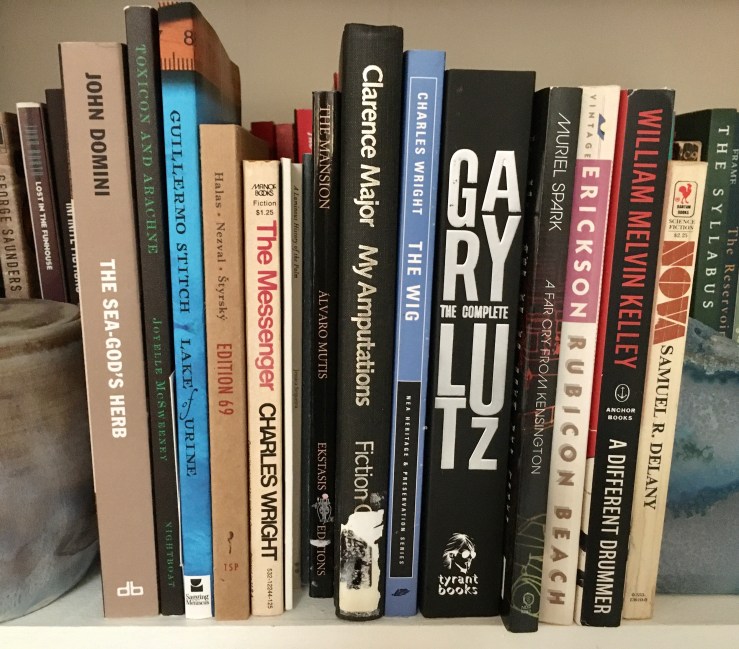
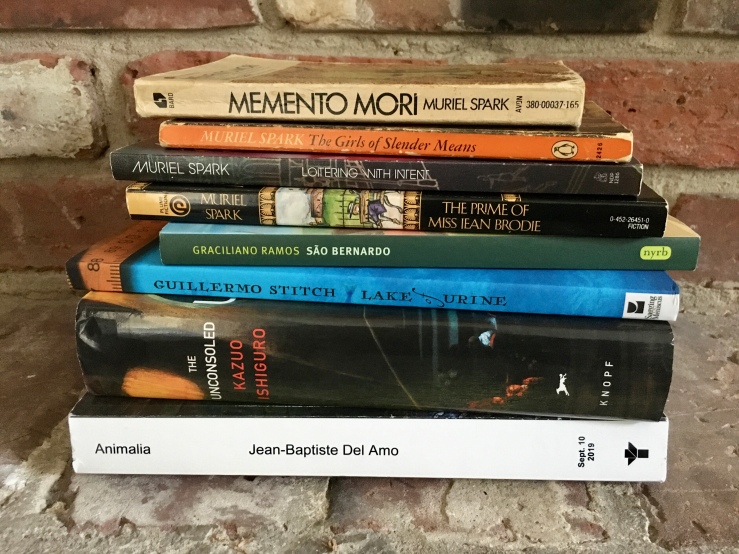
—and even then I didn’t even label it even, the non-review, as a “review” —- what was it, sixty days ago?—a thing on Thomas Pynchon’s latest novel Bleeding Edge which I managed to pound out in time for Pynchon’s 83rd birthday on 8 May 2020, sixty odd days ago. (All these days are odd, or if not odd, then boring, and very hot humid heavy here in Florida lately, filled with smaller and bigger dreads and excuses for and away from screens, me spinning proverbial plates to distract my kids and myself from the yawning hot nothingness of a campless, socially-distant, non-vacationing summer, etc.) I signed my name, Edwin Turner, to that non-review. I also signed my name to another non-review, another thing I called a “blog about” (this is still a blog about books, isn’t it? Not sure), a blog posted about twenty-four days ago, a few days after my forty-first birthday. I let an image of a stack of books guide that post, a stupid trick I use too often, or maybe not enough, I don’t know. There were some good books and great books in the photograph in the non-review that I would like to have written proper reviews of: Muriel Spark’s Loitering with Intent (great), Graciliano Ramos’s São Bernardo (good),  Guillermo Stitch’s Lake of Urine (good/weird/good weird)—and a book I have absolutely loved, Jean-Baptiste Del Amo’s Animalia (excellent, I think), which I have stopped in the dead middle of, for reasons that I am not sure about but which are certainly uninteresting, these reasons. There was also Kazuo Ishiguro’s The Unconsoled, which may or may not be great, and which I loved, and which I have no interest in “reviewing.” And more Muriel Spark novels. And I bought some more Spark novels, including A Far Cry from Kensington, which is on this double-stacked shelf of books that I need to or at least want to write about or am in any case reading or have read or intend to read; look, here’s a picture, what most of you will simply scroll and scan and then move on, never having read any of this blather—

img_5741

—not in the pic is the large gorgeous alienlanguage graphic novel Anasazi by Mike Mccubbins and Matt Bryan, a really excellent and very different book that I’ve dithered around (not) reviewing for months now (starting painful starts and stabs at reviews, deleting pretentious paragraphs about Wittgenstein, deleting three word “reviews” (Get this book!), etc.): Get this book!—and etc. I’ll never finish The Complete Gary Lutz (that’s a compliment). I listened to the audiobook of Steve Erickson’s novel Zeroville (read by Bronson Pinchot of True Romance and Cousin Balki fame) and loved it and picked up another Erickson novel—Rubicon Beach. Zeroville reminded me of the fictional novel version of Biskind’s Easy Riders, Raging Bulls that I didn’t know I wanted. It also made me want to watch more films, and I’ve been watching at least a film a night for a while now (Can I remember the past few nights?: Princess Mononoke, Withnail & I, C.H.U.D., Cocteau’s Beauty and the Beast, Week-End, Bringing Up Baby, Scanners, Lifeforce, The Battle for Algiers, Cutter’s Way); I listened to the audiobook of Nico Walker’s novel Cherry and liked it at first and then it really started to wear on me and then I kind of hated it by the end—my review of Cherry is “I would’ve fucking loved Cherry when I was 20″; I do not currently have an audiobook on deck. I read Claudia Rankine’s discursive memoir-poem-essay Citizen on July 3rd, and were I the kind of person who wore socks (I don’t wear socks if I can help it), they would have been knocked far, far from my hobbitfeet. I am not the right person to review Citizen but reading it was wonderful, painful, expansive. Reminded me a bit of David Markson and W.G. Sebald, but not at all like those things. Excellent stuff.

There must have been something else but I forget.

And I realize now that this post was not what I intended to write, but maybe I have to push this garbage out of me to move forward and actually write a review again (if, indeed, this is still a blog about books).

Blog about some recent reading

img_5662

From bottom to top:

I finally started Jean-Baptiste Del Amo’s Animalia last week. I took the book with me to a place we rented near Black Mountain, North Carolina for a week. I purposefully took only Animalia, leaving behind two books I was in the middle of—Muriel Spark’s Loitering with Intent and Guillermo Stitch’s Lake of Urine. I used the adverb purposefully in the previous sentence, although I’m not sure what my purpose was. I think I just wanted an associative break from the past few months. I read geographically, even in my own home. I read the first section of Animalia, often overwhelmed by its abject lifeforce. The novel begins in rural southwest France at the end of the nineteenth century, focusing on a family farm. The preceding sentence is a bad description: Animalia is, so far anyway, a visceral, naturalistic, and very precise rendering of humans as animals. I don’t think I’ve ever been as intrigued as to how a novel was translated, either. In Frank Wynne’s English translation, Del Amo’s prose carries notes and tones evocative of Faulkner or Cormac McCarthy. Del Amo employs precise Latinate words, using, for example, genetrix, instead of mother, as in this paragraph:

The genetrix, a lean, cold woman, with a ruddy neck and hands that are ever busy, affords the child scant attention. She is content merely to instruct her, to pass on the skills for those chores that are the preserve of their sex, and the child quickly learns to emulate her in her tasks, to mimic her gestures and her bearing. At five years old, she holds herself stiff and staid as a farmer’s wife, feet planted firmly on the ground, clenched fists resting on her narrow hips. She beats the laundry, churns the butter and draws water from the well or the spring without expecting affection or gratitude in return. Before Éléonore was born, the father twice impregnated the genetrix, but her menses are light, irregular, and continued to flow during the months when, in hindsight, she realizes that she was pregnant, though her belly had barely begun to swell. Although scrawny, she had a pot-belly as a child, her organs strained and bloated from parasitic infections contracted through playing in dirt and dungheaps, or eating infected meat, a condition her mother vainly attempted to treat with decoctions of garlic.

The paragraph, from early in Animalia, conveys the prose’s abject flavor. Read the rest of the excerpt at Granta.

Kazuo Ishiguro’s The Unconsoled is over 500 pages but somehow does not read like a massive novel, partly, I suppose, because the novel quickly teaches you how to read the novel. The key for me came about 100 pages in, when the narrator goes to a showing of 2001: A Space Odyssey starring Clint Eastwood and Yul Brynner. There’s an earlier reference to a “bleeper” that stuck out too, but it’s at the precise moment of this alternate 2001 that The Unconsoled’s just-slightly-different universe clicked for me. Following in the tradition of Kafka’s The CastleThe Unconsoled reads like a dream-fever set of looping deferrals. Our narrator, Ryder, is (apparently) a famous pianist who arrives at an unnamed town, where he is to…do…something?…to help restore the town’s artistic and aesthetic pride. (One way we know that The Unconsoled takes place in an alternate reality is that people care deeply about art, music, and literature.) However, Ryder keeps getting sidetracked, entangled in promises and misunderstanding, some dark, some comic, all just a bit frustrating. There’s a great video game someone could make out of The Unconsoled—a video game consisting of only side quests perhaps. Once the reader gives in to The Unconsoled’s looping rhythms, there’s an almost hypnotic pleasure to the book. Its themes of family disappointment, artistic struggle, and futility layer like musical motifs, ultimately suggesting that the events of the novel could take place entirely in Ryder’s consciousness, where he orchestrates all the parts himself. Under the whole thing though is a very conventional plot though—think a Kafka fanfic version of Waiting for Guffman. I loved it.

I will be posting a proper review of Guillermo Stitch’s Lake of Urine some time this month, so I won’t remark at length on it. I’m a little under halfway through (had to restart after returning from the mountains), and it seems to me that the plot is impossible to describe. Or maybe it’s really simple: A rural couple, Norabole and Bernard, escape from their small town and move to the big city (“Big City”). Norabole very quickly becomes the CEO of a huge company, with an eye toward creating “the world’s first Gothic conglomerate” (she plans to get an exorcist on the board, as well as having the company partake in an annual seance). Meanwhile, Bernard struggles to find employment and whips up seven course meals for his Noarbole. He also has apparently contracted (contracted?!) xenoglossiaLake of Urine is energetic and very funny and so so weird. Stitch seems to be doing whatever he wants on the page and I dig it.

I really enjoyed Graciliano Ramos’s novel São Bernardo (new translation by Padma Viswanathan), mostly for the narrator’s voice (which reminded me very much of Al Swearengen of Deadwood). Through somewhat nefarious means, Paulo Honorio takes over the run-down estate he used to toil on, restores it to a fruitful enterprise, screws over his neighbors, and exploits everyone around him. He decries at one point that “this rough life…gave me a rough soul,” which he uses as part confession and part excuse for his failure to evolve to the level his younger, sweeter wife would like him to. São Bernardo is often funny, but has a mordant, even tragic streak near its end. Ultimately, it’s Honorio’s voice and viewpoint that engages the reader. He paints a clear and damning portrait of himself and shows it to the reader—but also shows the reader that he cannot see himself. Good stuff.

Four by Muriel Spark. I’d never read her until May, and I’ve just been gobbling these up. I started with The Prime of Miss Jean Brodie, which is fantastic, and then read The Girls of Slender Means, which I liked even more than Prime. Slender Means unself-consciously employs some postmodern techniques to paint a vibrant picture of what the End of the War might feel like. The novel unexpectedly ends in a negative religious epiphany. (And the whole thing coincides with the bombings of Hiroshima and Nagasaki.) I then read Loitering with Intent, which is my favorite so far—just sharp as hell, and chock full of patterns and loops that I want to go back to again. I definitely will reread that one. I’m near the end of Memento Mori, a novel that concerns aging, memory, loss, and coming to terms with death. I was surprised to learn that this was Spark’s third novel, and that she would’ve been around 41—my age—when it was published. Most of the characters are over seventy, and Spark seems to inhabit their consciousness with a level of acuity that surprises me. Memento Mori is sharp and witty, but, barring some last minute shift, it’s not been my favorite Spark—but it’s still very good, and I want to read more. Any suggestions?

Melville/Ishiguro (Books acquired, 13 May 2020)

img_5465

My beloved bookstore reopened this Monday. This past Wednesday, I donned my finest mask, got into the car for the first time in a while, and drove the 1.1 miles to my beloved bookstore, which reopened this Monday. I had done curbside pickup on a few books for my kids sometime early in April, but I hadn’t been into a bookstore since the middle of March.

The staff were all wearing masks, as were the few customers in the store (with the exception of two elderly patrons). The store is a sprawling maze of stacks covering close to 25,000 (very irregular, bendy, weird) square feet (it’s not a small space), and the stacks were marked for distancing.

I managed to find all the books on my list—two dystopian teen novels for my not-quite-yet-teen daughter, novels by Roald Dahl and Neil Gaiman for the boy (who’s already finished both), a copy of My Brilliant Friend for my wife, who loved the filmic teevee adaptation (I gave my copy to my department head years ago, thinking she’d love it, but she never mentioned anything about it to me, and I don’t press), and two books for me: Kazuo Ishiguro’s 1995 novel The Unconsoled, which I’ve been meaning to read for ages, and Herman Melville’s fourth novel Redburn (which I’ve been meaning to read for awhile after reading Elizabeth Hardwick’s literary biography of Melville a few weeks ago). Edward Gorey did the Redburn cover, by the way.

Despite already being into four other novels, I started in on The Unconsoled. The novel reads like a hallucinatory series of side quests in the strangest first-person video game ever made–a novel of absurdity and art and time and memory, wherein the first-person narrator Ryder, on a mission he can never quite name or even possibly remember, constructs and deconstructs his (always-deferred) present “reality” on a moment-to-moment basis. The book is weird in the best way—it reminds me a lot of Alasdair Gray’s Lanark, Anna Kavan’s Ice, João Gilberto Noll’s Quiet Creature on the Corner, and pretty much everything by Kafka. I imagine it will frustrate many readers with its refusal to cohere or to settle on a plot, but I’m digging it big time.

Blog about Thomas Pynchon’s novel Bleeding Edge

img_5423

I finished reading Thomas Pynchon’s 2013 novel Bleeding Edge a few minutes before I started typing up this blog. I’d jotted down a few notes as I was reading the book over the past two weeks, thinking about writing a review or an essay about the novel, but lately I seem to sit on such notes and never hatch them into anything real.

Today, 8 May 2020 is Thomas Ruggles Pynchon’s 83rd birthday. Folks online like to celebrate with something called Pynchon in Public Day, which this year, thanks to These Paranoid Times, has become Pynchon in Private Day. Instead of doing a big list of links, images, and excerpts, this blog about Bleeding Edge will be my minor contribution.

Reviews usually offer some kind of plot summary, right? Here’s a really short summary: Bleeding Edge is Pynchon’s New York novel, his 9/11 novel, his internet novel. Not enough? Well…

Bleeding Edge is nearly 500 pages long and seems to have almost as many subplots—but the gist of the novel is that Maxine Tarnow, a now-unlicensed fraud examiner, undertakes a sprawling investigation that leads her to what may-or-may-not-be evidence of unidentified conspirators collaborating in some way to facilitate the 9/11 World Trade Center attacks. As is the case with any Pynchon, the gist isn’t the point—the subplots are the real point, those threads that tangle off into some other invisible tapestry, unrevealed to protagonist and reader alike. I’ll lazily borrow from the jacket blurb to offer a smattering of those subplots:

She soon finds herself mixed up with a drug runner in an art deco motorboat, a professional nose obsessed with Hitler’s aftershave, a neoliberal enforcer with footwear issues, plus elements of the Russian mob and various bloggers, hackers, code monkeys, and entrepreneurs, some of whom begin to show up mysteriously dead.

Tellingly, there’s even a tangle in the blurb: The neoliberal enforcer is Nicholas Windust (who uses a cattle prod to enforce his ideology on citizens of developing nations); the guy with “footwear issues” is Eric Outfield, a hacker and podophiliac. There are so many characters in Bleeding Edge that we can forgive even the jacket’s condensing a few into each other.

And yet for all its myriad subplots, Bleeding Edge is one of Pynchon’s more cohesive novels. It’s plot is not as baggy as the behemoth Against the Day, or as complicated as Gravity’s Rainbow, or as confusing as Inherent Vice, the novel that preceded it.

Like Inherent Vice, and Pynchon’s second novel, The Crying of Lot 49Bleeding Edge is a detective novel, albeit a highly unconventional one. Our detective Maxine Tarnow is a compelling central figure, and Pynchon sticks closely to her consciousness; indeed, Maxine is maybe the closest thing to a first-person-viewpoint Pynchon has given us. Maxine, who occasionally worries about her Yenta tendencies, is a mother of two near-adolescent boys, Otis and Ziggy. At the novel’s outset, she’s estranged from her husband Horst, but he soon re-enters the picture.

The domestic contours of Bleeding Edge are touching. Maxine plays video games with her children, tries to understand the culture that her boys are growing into, riffs on Beanie Babies and Pokemon and first-person shooters with them. (It’s hard not to map some of Pynchon’s bio here: Like Maxine, Pynchon lives on the Upper West Side, and his son Jackson is around the same age as Ziggy and Otis. I will refrain from more biographical speculation, mea culpa.) Bleeding Edge opens in the pre-tragic spring of 2001, with Maxine walking the boys to school. She wants to protect her boys, and in a telling image, she “drifts into a pick” to guard them from any hypothetical traffic.

That domestic theme resonates until the novel’s end—indeed, with its many tangled subplots, the most satisfying resolution happens in the last pages, when, a year later, Maxine’s boys walk to school by themselves. It’s a bittersweet moment, one in keeping with the novel’s balance of tragedy and comedy, zaniness and horror. Ultimately, Bleeding Edge is a comedy in the classical sense, signaling the restoration of family (families, really).

The domestic plot helps to frame Bleeding Edge, but it also stands in contrast to Maxine’s adventures after dark as her investigation into possible fraud at an internet startup leads her into ever-more bizarre territory. There are mysterious videotapes and immersive video games that may-or-may-not contain the souls of those who’ve departed “meatspace”: there are time-traveling soldiers and debauched internet launch parties. There is that “ideological enforcer,” Nick Windust, who Maxine finds herself imporbably drawn to. And, it’s a Pynchon novel, so there’s plenty of drugs, sex, and songs. Like New York City, Bleeding Edge is packed, crammed with details that evoke not just the city’s form, but also its ever-changing spirit.

Of course, the 9/11 World Trade Center attacks loom over the plot, especially the first two-thirds, where they are foreshadowed repeatedly. (Otis and Ziggy eat lunch with their father and his friend Jake at the top of the WTC early in the novel. It’s a windy day, and the boys are nervous as the building sways, but Jake assures them, ironically, that it’s “built like a battleship.”) Pynchon’s handling of the attacks is remarkably restrained—instead of pages and pages of those strange hours, he instead nimbly constructs the moments beforehand and the moments after. A few paragraphs before the attack, Horst, Ziggy, and Otis watch the Colts beat the Jets on Monday Night Football, a wonderfully banal detail that Pynchon explores in more sentences than the actual attack. The days after offer a New Yorker’s cold perspective on the swiftly-mutating jingoism that exploded across the nation after 9/11.

The 9/11 attacks, and America’s response to them, ultimately serve to recapitulate neoliberalism and late capitalism. Pynchon repeats these terms throughout Bleeding Edge, adding them to his lexicon of old standbys like paranoiainvisible, and convenience. Indeed, Bleeding Edge can be read as a sustained how against late capitalism. But the howl also repeatedly shows the complicity of all the howlers: Who doesn’t want convenience? Who doesn’t want the latest fad, the comfort of mass-produced “culture”? Bleeding Edge is littered with the detritus of late-nineties-early-oughts “culture”: Furbies, Britney Spears, Doom, Ambien sex, Bone Thugs-n-Harmony, Nas, the Mamma Mia! Broadway musical, Pokemon, etc. etc. etc. Pynchon has always compounded high and low culture into something new, but Bleeding Edge seems to insist that the twentieth century’s ideals of “high” culture no longer obtain.

Some of his characters find optimism of a new culture, one outside the proscriptions of late capitalism, in the internet. A “game” called DeepArcher takes on a mystical quality in Bleeding Edge, a dwelling place for lost souls. Yet some characters are not optimistic about the future of the internet, including Maxine’s father Ernie, who warns her that the internet was born from the military-industrial-complex, and to the military-industrial-complex it will return. Ernie’s elegy for the internet is prescient, and reads like Pynchon looking back from the future, back from 2010, 2011, 2012, when the money guys had already sewed the seeds of ruination.

Indeed, many of the characters in Bleeding Edge come off as mouthpieces for Pynchon’s own viewpoints, whether it’s Ernie riffing on ARPANET or the decline of labor in the US, or Maxine’s zen therapist Shawn, who rails that late capitalism is a scam headed towards its own exhaustion at the price of our planet. It’s the arrangement of these voices that makes the novel strong though—Pynchon shows the complicity of each voice, even as he shows their resistance to the ideological machine they were born into.

It’s really only Maxine that comes through as a fully-achieved, human, character. She’s complex as both a detective, and a mother. Like Doc Sportello of Inherent Vice, she’s already an outsider, having had her license revoked. Despite her general anti-establishment tendencies, she’s nevertheless attracted to the nefarious agent of neoliberal violence, Nicholas Windust. The attraction here echoes Frenesi Gates’ relationship with Brock Vond in Vineland (or even Doc Sportello’s “partnership” with Bigfoot in Inherent Vice), suggesting an ambiguous, amorphous delineation between “good” and “evil” in Pynchon’s characters. Windust is a villain, but Maxine—and Pynchon—try to redeem him.

Other villains are a bit more one-note, like the geek billionaire Gabriel Ice. It being his New York novel, Rudy Giuliani is a frequent target, as is “the paper of record,” the New York Times. George W. Bush and his gang are minor players here; keeping with its NYC theme, Bleeding Edge suggests the corruption of figures like Elliot Spitzer and Bernie Madoff are part and parcel of a corrupt and corrupting system. Maxine’s job is to search out that corruption, but she doesn’t have the tools to cure it.

I had two false starts over six years before finally finishing Bleeding Edge. I’ll admit that I didn’t think it was that good on those starts, but after finishing it today I’d say that it’s very good. It’s not Gravity’s Rainbow or Mason & Dixon, but what novels are? I also have to admit that the material in the book is maybe too close to many of us to fully assess. I was graduating college in the spring of 2001, when the novel begins. In early September, I was living in my parents’ house, waiting to move to my first “real” job in Tokyo. I was supposed to leave on 9/14. I ended up leaving a week later. Pynchon captures a time in America during which I was, at least theoretically, becoming an adult (a becoming which may or may not have happened yet). Reading Bleeding Edge helped evoke all the weirdness the 2000s were about to lay out for us. It made me angry again, or reminded me of the anger that I’d sustain for most of the decade. It reminded me of our huge ideological failure after 9/11, an ideological failure we are watching somehow fail even more today.  But I also loved the novel’s unexpectedly sweet domestic plot, and found a kind of solace even in its affirmation of family, even as its final image pointed to the kind of radical inconclusiveness at the heart of being a parent.

There are about a million things I wanted to riff on in this blog about this book. I’ve failed to remark on how funny the book is, how insightful, and how, at times, frustrating. On one page Pynchon would make me laugh out loud, a page or two later I’d groan at one of his bad puns (Pynchon has no problem picking the lowest-hanging fruit), and then maybe I’d be cringing at something (like, a rap song he wrote!) a few pages later, before getting transfixed by a beautiful, strange prose sequence. It’s a big book.

Bleeding Edge isn’t Thomas Pynchon’s best novel, nor is it a great starting place for readers new to Pynchon, but I’m glad I finally read it. And I really, really hope that it isn’t his last one.