Enjoy Thanksgiving with Our Literary Recipes Roundup

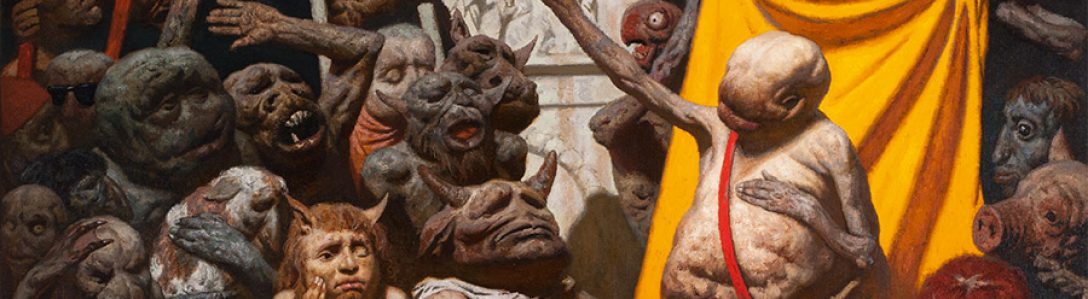
Fat Kitchen, Jan Steen

***

Enjoy Thanksgiving with our menu of literary recipes:

F. Scott Fitzgerald’s Turkey Twelve Ways

Zora Neale Hurston’s Mulatto Rice

Ian McEwan’s Fish Stew

James Joyce’s Burnt Kidney Breakfast

Herman Melville’s Whale Steaks

Ernest Hemingway’s Absinthe Cocktail, Death in the Afternoon

Vladimir Nabokov’s Eggs à la Nabocoque

Thomas Pynchon’s Banana Breakfast

Cormac McCarthy’s Turtle Soup

Robert Crumb’s Macaroni Casserole

Truman Capote’s Caviar-Smothered Baked Potatoes with 80-Proof Russian Vodka

Emily Dickinson’s Cocoanut Cake

Thomas Jefferson’s Vanilla Ice Cream

Charles Dickens’s Own Punch

Ben Jonson’s Egg Wine

Christmas Bonus:  George Orwell’s Recipes for Plum Cake and Christmas Pudding

Barry Hannah on Denis Johnson’s Book Jesus’ Son

Certain books, the ones I’m always looking for and hardly ever finding—true codes of entry into other hard spiritualities—you have to read while you’re walking, say, even through a crowded airport. Such was Denis Johnson’s Jesus’ Son. Those of us who’ve come out of the serious dope-and-drink world may have forgotten the strange poetry and curious religious cast of events, but Johnson hasn’t. It takes an authentic poet to catch the strange, tragic hope and cheer as well as the squalor of that life, and Johnson surely is one.

Barry Hannah on Denis Johnson’s Jesus’ Son; from the January, 1994 issue of SPIN.


Book Shelves #47, 11.18.2012

20121118-095349.jpg

Book shelves series #47, forty-seventh Sunday of 2012

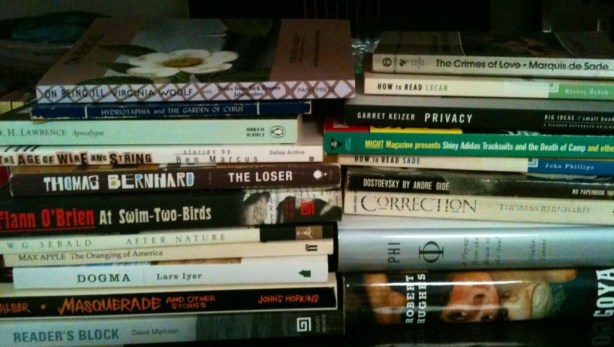
So this is what happens—books pile up. Okay, maybe that sentence is missing a clear subject: I pile books up.

This stack mounded on my record player over the last week; I intended to shelve about half of these:

20121118-095356.jpg

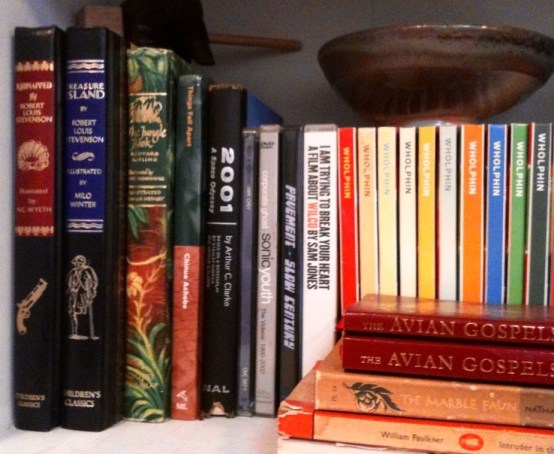
My shelving solution is woefully short-term (more double stocked shelves).

Anyway, this shelf is mostly other media, including DVDs, a few records, and playing cards.

Of note (perhaps) are the three illustrated volumes on the left that I’ve had forever.

20121118-095404.jpg

The illustrated Kidnapped features art by N.C. Wyeth:

20121118-095421.jpg

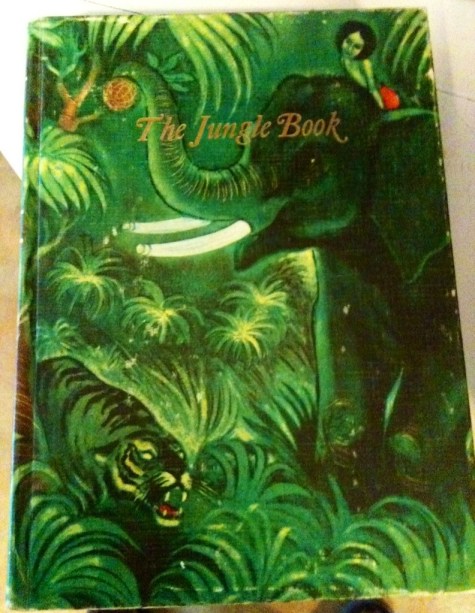
The illustrated Kipling was actually my father’s:

20121118-095431.jpg

Have you read Adam Novy’s novel The Avian Gospels? It’s good stuff.

20121118-095438.jpg

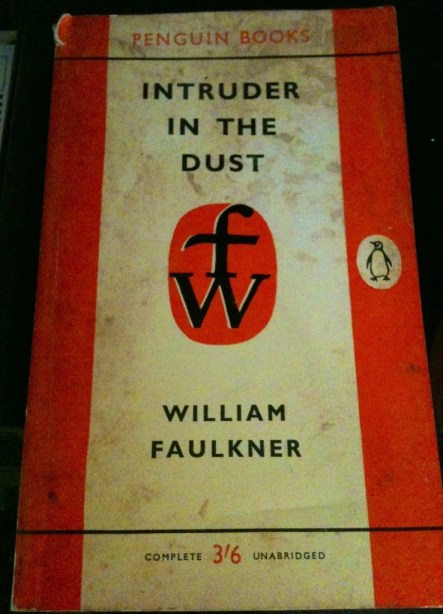
Like many bibliophiles, I’m a sucker for plain Penguins:

20121118-095445.jpg

Read Barry Hannah’s Profile of Johnny Cash (SPIN, 1994)

Read all of Barry Hannah’s 1994 SPIN magazine profile of Johnny Cash via Google Books.


Charles Dickens’s Own Punch

At Victorian Web, Philip V. Allingham shares a recipe for Charles Dickens’s punch:

“Charles Dickens’s Own Punch,” according to Brenda Marshall in The Charles Dickens Cookbook (1981), was that with which Mr. Micawber regales the eponymous youth in Chapter XXVIII of David Copperfield , the literary progeny with whom Dickens most closely identified himself. In an 1847 letter Dickens gave the following recipe for this second punch:

Peel into a very common basin (which may be broken in case of accident, without damage to the owner’s peace or pocket) the rinds of three lemons, cut very thin and with as little as possible of the white coating between the peel and the fruit, attached. Add a double handful of lump sugar (good measure [although Dickens had rather small hands]), a pint of good old rum, and a large wine-glass of good old brandy‹if it be not a large claret glass, say two. Set this on fire, by filling a warm silver spoon with the spirit, lighting the contents at a wax taper, and pouring them gently in. Let it burn three or four minutes at least, stirring it from time to time. Then extinguish it by covering the basin with a tray, which will immediately put out the flame. Then squeeze in the juice of the three lemons, and add a quart of boiling water. Stir the whole well, cover it up for five minutes, and stir again.

At this moment of crisis, the inimitable Boz suggests skimming off the lemon pips and doing some judicious sampling before one places the jug (sealed with leather on top) in a hot oven for ten minutes. However, the text’s editor proposes stove-top heating instead — “it could possibly alight in a modern oven.”


Portrait of Walt Whitman — Thomas Eakins

Virginia Woolf’s On Being Ill (Book Acquired, Some Time Last Month)

20121117-101041.jpg

The kind people of Paris Press were good enough to send me a reader copy of their 10th anniversary edition of Virginia Woolf’s essay “On Being Ill,” which they’ve collected with “Notes from Sick Rooms,” an essay by Julia Stephen—Woolf’s mother. Paris Press’s blurb:

Published together for the first time, Woolf and Stephen create a literary conversation between parent and child, patient and care giver, from the vantage points each experience in the world of illness. Originally published by Paris Press in 2002, this new edition doubles the length of the original book and includes a new introduction to Notes from Sick Rooms by eminent Woolf scholar Mark Hussey, and a new afterword by Rita Charon, founder and director of the Narrative Medicine program at Columbia University, along with the original introduction to On Being Ill by Hermione Lee, Woolf’s biographer.

Lee’s introduction seems to be an expansion of a piece she wrote for The Guardian in 2004; in that piece she wrote:

The story of the body’s life, and the part the body has to play in our lives, is one of Virginia Woolf’s great subjects. Far from being an ethereal, chill, disembodied writer, she is always transforming thoughts and feelings and ideas into bodily metaphors. She writes with acute – often extremely troubling – precision about how the body mediates and controls our life stories. Body parts are strewn all over her pages. Rage and embarrassment are felt in the thighs; a headache can turn into a whole autobiography; dressing up the body is an epic ordeal; and a clenched fist, feet in a pair of boots, the flash of a dress or the fingertip feel of a creature in a salt-water pool, can speak volumes.

Nowhere is her attention to body parts more eloquent and intense than in the essay “On Being Ill”. It is one of Woolf’s most daring, strange and original short pieces of writing, and it has more subjects than its title suggests. Like the clouds that its sick watcher, “lying recumbent”, sees changing shapes and ringing curtains up and down, this is a shape-changing essay.

Woolf announces her theme in a long, winding opening sentence that showcases some of the “shape-shifting” Lee alludes to:

Considering how common illness is, how tremendous the spiritual change that it brings, how astonishing, when the lights of health go down, the undiscovered countries that are then disclosed, what wastes and deserts of the soul a slight attack of influenza brings to view, what precipices and lawns sprinkled with bright flowers a little rise of temperature reveals, what ancient and obdurate oaks are uprooted in us by the act of sickness, how we go down in the pit of death and feel the waters of annihilation close above our heads and wake thinking to find ourselves in the presence of the angels and the harpers when we have a tooth out and come to the surface in the dentist’s arm-chair and confuse his “Rinse the mouth-rinse the mouth” with the greeting of the Deity stooping from the floor of Heaven to welcome us – when we think of this, as we are so frequently forced to think of it, it becomes strange indeed that illness has not taken its place with love and battle and jealousy among the prime themes of literature.

20121117-101050.jpg

And what of Stephen’s essay? It’s a practical, concrete, and mostly pragmatic approach to caring for sick people. Some parts compel more than others, as when Stephen discusses the absurd flights of fancy that might afflict the ill. In his introduction to “Notes from Sick Rooms,” Mark Hussey tries to amplify connections between the two texts that are either obvious (the texts share a common subject) or speculative (Stephen’s essay “foreshadows the wit and sharp observation that is characteristic of her famous daughter’s style”).  Hussey’s comments are best when they provide basic context and don’t try to force the reader into making connections. There’s also an afterward by Rita Charon, an internist, who again tries to synthesize the two texts. I suppose context is important, but there’s a sense of inflation here that I’m not entirely sure either essay (Woolf’s or Stephen’s) necessarily merits.

“The Tiger” — Kafka

Reading Chris Ware’s Building Stories / Big Four Panel Board Book

Continuing reading Chris Ware’s Building Stories; also, continuing the ad hoc naming of its “chapters”: let’s call this one the Big Four Paneled Board Book.

It’s big. Shown here in relation to a local brew (clearly the best way to illustrate scale):

20121116-170448.jpg

It’s difficult to describe how each chapter enriches the story of Building Stories. There’s something Borgesian about Ware’s novel—not in the sense that it’s something that Borges would have written—what I mean to suggest is it’s like something out of a Borges story—winding, maze-like, self-referential, but not solipsistic. Building Stories doesn’t come with a set of instructions, so the reader has to interact with it in a random way. What’s really thrilling and emotionally impactful is the way that each piece deepens the story and develops each character a little bit more.

In the forked path I’ve been following, Lonely Girl (this is the building’s name for her; we might also call her the Would-be Writer, The Diarist, or, perhaps, The Amputee) emerges as the central character, and she gets the lead story in the Big Four Panel Board book. She’s looking for a companion, so she places an ad:

20121116-170502.jpg

This tiny little square says so much: Ware wastes no space. Lonely Girl’s personal ad is in some ways a metonymy of Building Stories (and Ware’s oeuvre all together): it combines ironic, self-aware humor with a stark and devastating sense of loneliness.

Lonely Girl shows up as a character in the lives of her downstairs neighbors, the Sour Couple. The soda-swilling boyfriend wonders how she might have lost her leg. In some ways he serves as audience surrogate here—I doubt we’ll get the full story. (The boyfriend also entertains other fantasies about Lonely Girl’s body).

20121116-170509.jpg

Of course, the Lonely Landlady also gets her panel. We see more of her stunted life, her mother (and the building itself) a proverbial albatross around her neck. Ware uses the size and scope of the Big Book to optimum advantage; he knows that the book is so big (and his panels so small) that the reader simultaneously sees everything and comprehends nothing. Ware employs lines that crisscross from section to section, often running through narrative elements we’ve yet to engage, or sometimes tracing over what we’ve already seen. The effect is not disorienting, though—rather, Ware uses the visual space to show the ways in which his characters and narratives cross, abut, or fail to connect.

20121116-170524.jpg

The Big Book’s theme is in fact about cross-pollination, about the ways that different strands intersect, conmingle, blend (or fail to). It’s appropriate then when our old friend Branford the bee arrives:

20121116-170533.jpg

More to come.


Ben Jonson’s Egg Wine

From Books and my food: with literary quotations and original recipes for every day of the year by Elisabeth Luther Cary and Annie Maria Jones

Italo Calvino and Jorge Luis Borges

Goethe Comments on Shakespeare’s Henry IV

“Anacreontic” –Robert Herrick

“He ate and drank the precious words” — Emily Dickinson

“Guide for New Readers of Stendhal’s Charterhouse” — Italo Calvino

“Guide for New Readers of Stendhal’s Charterhouse” by Italo Calvino (Collected in Why Read the Classics?)

How many new readers will be attracted to Stendhal’s The Charterhouse of Parma by the new film version of the novel, shortly to be broadcast on television? Perhaps very few when compared to the total number of the TV audience, or perhaps very many when compared to the statistics for the number of books Italians read. But no data can ever supply us with the most important figure, and that is how many young people will be smitten right from the opening pages, and will be instantly convinced that this has to be the best novel ever written, recognising it as the novel they had always wanted to read and which will act as the benchmark for all the other novels they will read in later life. (I’m talking particularly about the opening chapters; as you get into it, you will find that it is a different novel, or several novels each different from the other, all of which will require you to modify your involvement in the plot; whatever happens, the brilliance of the opening will continue to influence you.)

This is what happened to me and to so many others in the various generations that have read the work in the last hundred years. (The Charterhouse came out in 1839, but you have to exclude the forty years that it had to wait before Stendhal was understood, a period he himself had foreseen with extraordinary precision; even although of all his works this was the most instantly successful, and could count for its launch on a lengthy and enthusiastic essay by Balzac, a good 72 pages long!) Continue reading ““Guide for New Readers of Stendhal’s Charterhouse” — Italo Calvino”

The Problems of Bartleby

20121112-120230.jpg

What are the problems of Herman Melville’s story “Bartleby, the Scrivener: A Story of Wall Street”?

This question seems like a bad starting place.

Let me share an anecdote instead.

—I was in the tenth grade the first time I read “Bartleby.”

At the time, I thought I was a teacher’s dream—a sharp reader, someone who loved English class, someone with opinions about the texts we read. Lots and lots of opinions. In retrospect, I realize that I was a nightmare for poor Ms. Hall, a wonderful teacher who I’m sure dreaded our meetings (there were like 15 guys in the class, all unruly).

Simply put, I didn’t want to do things her way.

So she gave me a copy of Billy Budd, Sailor and Other Stories and told me to read “Bartleby,” suggesting that there was something I might learn from it.

I don’t know if backfired is exactly the right term for the results of this experiment. I do know that “Bartleby” offered me a brilliant retort—a literary allusion!—to refuse any task I didn’t feel like undertaking in 10th grade English:

“I would prefer not to.”

—While we’re here—

“I would prefer not to”

So, this is clearly one of the problems of “Bartleby,” if not the core problem condensed into one utterance: Why would? Why the conditional?

Consider, vs. I prefer not to, a constative (or maybe even performative) utterance.

But Bartleby “would prefer not to.”

Contrast this with the imperative must that the narrator employs:

At the expiration of that period, I peeped behind the screen, and lo!
Bartleby was there.

I buttoned up my coat, balanced myself; advanced slowly towards him, touched his shoulder, and said, “The time has come; you must quit this place; I am sorry for you; here is money; but you must go.”

“I would prefer not,” he replied, with his back still towards me.

“You must.”

He remained silent.

Now I had an unbounded confidence in this man’s common honesty. He had frequently restored to me sixpences and shillings carelessly dropped upon the floor, for I am apt to be very reckless in such shirt-button affairs. The proceeding then which followed will not be deemed extraordinary.

“Bartleby,” said I, “I owe you twelve dollars on account; here are thirty-two; the odd twenty are yours.—Will you take it?” and I handed the bills towards him.

These brief lines perhaps serve to summarize Melville’s tale.

We see here the basic plot—our titular scrivener will not leave the lawyer’s office after weeks of refusing (although refusing is not quite the right word) to work.

We also see here what I take to be the theme of “Bartleby,” the strange ethical position Bartleby’s (conditional) would prefer not to places the narrator’s (imperative) must set against the moral backdrop of do unto others: namely, an impossible ethical position for a Wall Street lawyer especially and most of us in general.

And “Bartleby,” as you’ll no doubt recall, is in some ways Melville trying to work out the problems of Matthew 25:35-39—

For I was an hungred, and ye gave me meat: I was thirsty, and ye gave me drink: I was a stranger, and ye took me in:

Naked, and ye clothed me: I was sick, and ye visited me: I was in prison, and ye came unto me.

Then shall the righteous answer him, saying, Lord, when saw we thee an hungred, and fed thee? or thirsty, and gave thee drink?

When saw we thee a stranger, and took thee in? or naked, and clothed thee?

Or when saw we thee sick, or in prison, and came unto thee?

Perhaps our narrator tries to do these things—tries to feed and clothe and help this stranger Bartleby—but he can’t. Because Bartleby won’t give him an agency to relate to.

Because Bartleby’s utterance “I would prefer not to” denies the performative or constantive or declarative—indeed, it suspends or disrupts its own conditionality, the relation of the subject to its predicate verb.

Or consider one of Bartleby’s only other lines: “What is wanted?” His grammar again suspends agency, disrupts the notion of a stable I (let alone objective case me) that the narrator can interface with, dictate to, interrogate, see his own narcissistic reflection in).

—Hang on though, I was telling an anecdote. It was about the first time I read “Bartleby,” when I was fourteen or fifteen. This is the book:

20121112-150751.jpg

I stole it of course, or never returned it. Yes, that’s duct tape on its side. It is more or less falling apart. Here’s the back, barcode and all.

20121112-150740.jpg

Over the years, like many readers, I returned many times to “Bartleby,” reading it again in high school, then in college, then in grad school. I read it unassigned too, of course—when I read Kafka and it recalled itself to me, and when I read Moby-Dick for the first time. I read it when compelled. And then I read it with my own students. (I read most of the other stuff in the collection too, of course — Billy Budd and then later (why so much later?!) Benito Cereno).

I scrawled through so much of the book that my annotations are basically worthless, virtually everything underlined or circled:

20121112-151659.jpg

So we butt up against the problems of “Bartleby”—the problems of interpretation. How to figure an eponymous “hero” who is no more than a phantom, a trace, a lack? How to hash out a narrator who presents himself in relatively admirable terms and yet is so clearly an ethical failure? Why oh why would Bartleby prefer not to? Is the story a tragedy or a comedy? Does it present a world with rules, codes, ethics, or is all absurd here—nihilistic even? Is Bartleby a Christ figure? An ascetic monk? A ghost? Is the story just about Melville’s own anger over the poor reception of Pierre? How much of contemporary transcendentalist thought can we find in the story?

—Slight shift:

The kind people of Melville House were sporting enough to send a copy of “Bartleby” my way. The book is part of their HybridBooks project; these books offer “digital illuminations” along with traditional (uh, paper) books.

I’d requested a HybridBook—any one of them, really—because I now read about half the time on a Kindle Fire—so I was particularly interested in what a “hybrid” had to offer. What is the reading experience like?

First, the book itself is part of Melville House’s Art of the Novella series—beautiful, minimal design with French flaps. I read it on my porch the afternoon it arrived, enjoying its pristine, white, unmarked pages. Then, I checked out the “Digital Illuminations.”

The illuminations are available in several device-specific options, all easy to download with the QRC that comes with the book. I read most of the illuminations on my Kindle, but I also put them on my iPhone and my laptop. I had originally intended this post to be specifically about the digital illuminations, but hell, “Bartleby” is just too damn freighted a read for me at this point. Anyway, there’s a lot of good stuff in there, including “The Transcendentalist” by Ralph Waldo Emerson, selections from Jonathan Edwards and Joseph Priestly, Thoreau’s “Civil Disobedience,” and several excerpts from Melville himself, including letters, other books, and reviews. What I found must, uh, illuminating was “Of Some of the Sources of Poetry Amongst Democratic Nations” from Democracy in America by Alexis de Tocqueville. There are also illustrations, including a map; there’s even a recipe for ginger nuts. I wish that MH had included a digital copy of the book though. From a practical, concrete standpoint, I found it easier to switch between the free public domain version of “Bartleby” on my Kindle and MH’s illuminations than it would have been to pick up the physical book.

Now, to shift back (perhaps):

Do the digital illuminations help to answer or solve or address some of the problems of “Bartleby,” some of the issues posed above?

Should they?

—I suppose the hedging answer is yes and no.

The additional material illuminates some of the philosophical, political, historical, and even personal context for “Bartleby.” The material is edited with minimal intrusion, but with enough explication to clearly connect the various selections to Melville’s story. If I’m reading with my teacher hat on (this is a metaphor; there is no literal hat), I’d say you probably couldn’t do better than what Melville House has put together here. The digital illuminations provide a strong foundation for an informed reading, a range of texts that speak (obliquely or otherwise) to “Bartleby.”

Does it all add up to a deeper or richer understanding of “Bartleby”?

Should it?

—Well. No. And then no.

I mean, would we want a series of essays that would provide the missing pieces that would allow us to puzzle out “Bartleby”? Could we even trust such pieces, let alone trust ourselves to trust such pieces? Isn’t this strange uncertainty why “Bartleby” endures—and endures apart from Moby-Dick or Billy Budd, strange texts themselves, but also not nearly as confounding?

“Bartleby” simultaneously wriggles and plays dead; it burns with apparent wit but then reminds us that we might not be in on the joke. It is Kafkaesque thirty years before Kafka was even born. It shakes off its allegorical idiom the minute we think we might limn its contours. It makes us read it again because we cannot pin it down.

—But maybe you want to pin it down, tickle it, torture it, make it solve its problems (or at least respond, damn it!).

And maybe I claimed that “Bartleby” was about something—that it was about ethical relations, about duty to one’s fellows—especially when a fellow isn’t a fellow but rather the trace of a fellowthe idea of a fellowa ghost.

So, look, here’s a take on it:

The narrator—let’s call him Lawyer—Lawyer, see he’s a dick, in the parlance of our times. He’s a dick because he doesn’t know that he’s a dick, which is one of the constituting factors of the ontological state of being a dick. He also does not want to see himself as being a dick (this is another factor in the ontological state of being a dick). He wants to see himself as a good guy, this Wall Street dickhead, but Bartleby won’t let him do that. Bartleby won’t even let him see himself at all: Bartleby doesn’t reflect back. He prefers not to.

Our Lawyer, see, he’s all buttoned up, he’s snug (these are his words). He tells us upfront that he possesses “a profound conviction that the easiest way of life is the best”; he repeatedly points out the way that people are “useful” to him (or to others). He sees no possibility of an ethics outside of usefulness; on top of that, he cannot see that he cannot see any possibility of an ethics based on anything but “usefulness” (or the negative economy of obstruction figured in Bartleby).

And ah Bartleby, ah humanity: One time model employee, once apparently free from the eccentricities that plague the Lawyer’s other scriveners, Turkey and Nippers. Machinelike.

Bartleby mechanically completes large quantities of copies without comment or complaint.  But when asked to simply read in unison with Lawyer and his scriveners, Bartleby replies: “I would prefer not to.” Bartleby will not read with others—he is literally not on the same page as his colleagues.

Lawyer confronts Bartleby with his noncompliance; Bartleby repeats his mantra. Fuck mantra though because it’s not a mantra. It’s only repeated for Lawyer, to Lawyer, really, who can’t schematize/name/pin down Bartleby’s response. In fact, I would prefer not to so startles Lawyer that he says he’s  “unmanned” by the words. So he rationalizes Bartleby’s odd response, internalizes it, paraphrases it, if you like.

And then Bartleby ceases to even do his copying work. Oh the anarchy! But wait, there’s not even anarchy. There’s not even protest. There’s just big nothing. But not even big nothing—instead the smallest nothing (which proves that big nothing is possible).

So Lawyer attempts to “help” Bartleby. Lawyer believes doing so is his “Christian duty.” And to know that this duty has been met, Lawyer needs Bartleby to be his echo. But Bartleby’s I prefer not to denies this narcissistic exchange. He empties his I of ego (shades of Emerson’s Transparent Eyeball).

Confused, Lawyer tries to pay off Bartleby. When that doesn’t work, Lawyer actually packs up and moves to a new office. But even here he can’t cut off Bartleby. The office’s landlord comes to Lawyer to remove Bartleby.

And when Bartleby refuses to leave the office he is taken to “the Tombs”—prison.

Here, Lawyer tries to provide comfort for Bartleby (hearken ye back to Matthew 25:35-39). He arranges for Bartleby to receive good food in the prison. Bartleby prefers not to eat though, and dies curled up in the fetal position during a visit by Lawyer.

Lawyer is the first reader of Bartleby. But like many readers of “Bartleby,” he is confused.

Lawyer’s confusion results from his need for safety—for ease, for comfort, for a snug, buttoned-upness—and that safety is bought through an affirmation of first-person experience: namely, in the affirmation of the self in the other. That security is bought through assimilating another person’s first-person perspective. But Bartleby is empty of I, of self, of ego.

Bartleby would prefer not to: He will not be ventriloquized: He will not echo: He will not read from the same script: He will not be “of use,” as Lawyer puts it.

So Bartleby dissipates and dissolves: He goes down in the Tombs: a ghost, and impossibility, presence coupled with absence.

— And the epilogue:

We all recall the epilogue, yes?

Lawyer offers up “one little item of rumor,” a morsel, a “vague report . . . that Bartleby had been a subordinate clerk in the Dead Letter Office at Washington.” The idea tears the narrator up inside: “Dead letters! does it not sound like dead men?”

For Lawyer, Bartleby is a dead letter, a failed letter.

Did Melville worry that “Bartleby” would be a failed letter? That it would not find an audience? That his work would not be delivered? If he did, it seems too then that Bartleby’s negations foreclose or reject this concern. Not sure of how to wrap up this riff, I’ll retreat to the safety of my title.

We find the final problems (in basic narrative chronology, that is) of “Bartleby” in its final line. Has Lawyer learned from his experience? Can he empathize, finally feel something for Bartleby beyond the confines of a perceived ethical duty? Is Bartleby a place holder for all humanity? Or is Bartleby in opposition to humanity? What does it mean—-

Ah Bartleby! Ah humanity!

?
Read “A Baby Tramp,” A Short Story by Ambrose Bierce

“A Baby Tramp” by Ambrose Bierce

If you had seen little Jo standing at the street corner in the rain, you would hardly have admired him. It was apparently an ordinary autumn rainstorm, but the water which fell upon Jo (who was hardly old enough to be either just or unjust, and so perhaps did not come under the law of impartial distribution) appeared to have some property peculiar to itself: one would have said it was dark and adhesive — sticky. But that could hardly be so, even in Blackburg, where things certainly did occur that were a good deal out of the common.

For example, ten or twelve years before, a shower of small frogs had fallen, as is credibly attested by a contemporaneous chronicle, the record concluding with a somewhat obscure statement to the effect that the chronicler considered it good growing-weather for Frenchmen.

Some years later Blackburg had a fall of crimson snow; it is cold in Blackburg when winter is on, and the snows are frequent and deep. There can be no doubt of it — the snow in this instance was of the colour of blood and melted into water of the same hue, if water it was, not blood. The phenomenon had attracted wide attention, and science had as many explanations as there were scientists who knew nothing about it. But the men of Blackburg — men who for many years had lived right there where the red snow fell, and might be supposed to know a good deal about the matter — shook their heads and said something would come of it.

And something did, for the next summer was made memorable by the prevalence of a mysterious disease — epidemic, endemic, or the Lord knows what, though the physicians didn’t — which carried away a full half of the population. Most of the other half carried themselves away and were slow to return, but finally came back, and were now increasing and multiplying as before, but Blackburg had not since been altogether the same.

Of quite another kind, though equally ‘out of the common,’ was the incident of Hetty Parlow’s ghost. Hetty Parlow’s maiden name had been Brownon, and in Blackburg that meant more than one would think.

Continue reading “Read “A Baby Tramp,” A Short Story by Ambrose Bierce”