Seven Horror Stories Masquerading In Other Genres

We often identify genre simply by its conventions and tropes, and, when October rolls round and we want scary stories, we look for vampires and haunted houses and psycho killers and such. And while there’s plenty of great stuff that adheres to the standard conventions of horror (Lovecraft and Poe come immediately to mind) let’s not overlook novels that offer horror just as keen as any genre exercise. Hence: Seven horror novels masquerading in other genres:

cormac5.jpg_jpeg_300x1000_q85

Blood Meridian — Cormac McCarthy

In my review (link above), I called Blood Meridian “a blood-soaked, bloodthirsty bastard of a book.” The story of the Glanton gang’s insane rampage across Mexico and the American Southwest in the 1850s is pure horror. Rape, scalping, dead mules, etc. And Judge Holden. . . [shivers].

Rushing to Paradise — J.G. Ballard

On the surface, Ballard’s 1994 novel Rushing to Paradise seems to be a parable about the hubris of ecological extremism that would eliminate humanity from any natural equation. Dr. Barbara and her band of misfit environmentalists try to “save” the island of St. Esprit from France’s nuclear tests. The group eventually begin living in a cult-like society with Dr. Barbara as its psycho-shaman center. As Dr. Barbara’s anti-humanism comes to outweigh any other value, the island devolves into Lord of the Flies insanity. Wait, should Lord of the Flies be on this list? 

2666 — Roberto Bolaño

Okay. I know. This book ends up on every list I write. What can I do?

While there’s humor and pathos and love and redemption in Bolaño’s masterwork, the longest section of the book, “The Part about the Crimes,” is an unrelenting catalog of vile rapes, murders, and mutilations that remain unresolved. The sinister foreboding of 2666‘s narrative heart overlaps into all of its sections (as well as other Bolaño books); part of the tension in the book–and what makes Bolaño such a gifted writer–is the visceral tension we experience when reading even the simplest  incidents. In the world of 2666, a banal episode like checking into a motel or checking the answering machine becomes loaded with Lynchian dread. Great horrific stuff.

King Lear — William Shakespeare

Macbeth gets all the propers as Shakespeare’s great work of terror (and surely it deserves them). But Lear doesn’t need to dip into the stock and store of the supernatural to achieve its horror. Instead, Shakespeare crafts his terror at the familial level. What would you do if your ungrateful kids humiliated you and left you homeless on the heath? Go a little crazy, perhaps? And while Lear’s daughters Goneril and Regan are pure mean evil, few characters in Shakespeare’s oeuvre are as crafty and conniving as Edmund, the bastard son of Glouscester. And, lest I forget to mention, Lear features shit-eating, self-mutilation, a grisly tableaux of corpses, and an eye-gouging accompanied by one of the Bard’s most enduring lines: “Out vile jelly!Peter Brook chooses to elide the gore in his staging of that infamous scene:

The Trial — Franz Kafka

Kafka captured the essential alienation of the modern world so well that we not only awarded him his own adjective, we also tend to forget how scary his stories are, perhaps because of their absurd familiarity. None surpasses his unfinished novel The Trial, the story of hapless Josef K., a bank clerk arrested by unknown agents for an unspecified crime. While much of K.’s attempt to figure out just who is charging him for what is hilarious in its absurdity, its also deeply dark and really creepy. K. attempts to find some measure of agency in his life, but is ultimately thwarted by forces he can’t comprehend–or even see for that matter. Nowhere is this best expressed than in the famous “Before the Law” episode. If you’re too lazy to read it, check out his animation with narration by the incomparable Orson Welles:

Sanctuary — William Faulkner

In my original review of Sanctuary (link above), I noted that “if you’re into elliptical and confusing depictions of violence, drunken debauchery, creepy voyeurism, and post-lynching sodomy, Sanctuary just might be the book for you.” There’s also a corn-cob rape scene. The novel is about the kidnapping and debauching of Southern belle Temple Drake by the creepy gangster Popeye–and her (maybe) loving every minute of it. The book is totally gross. I got off to a slow start with Faulkner. If you take the time to read the full review above (in which I make some unkind claims) please check out my retraction. In retrospect, Sanctuary is a proto-Lynchian creepfest, and one of the few books I’ve read that has conveyed a total (and nihilistic) sense of ickiness.

n14559

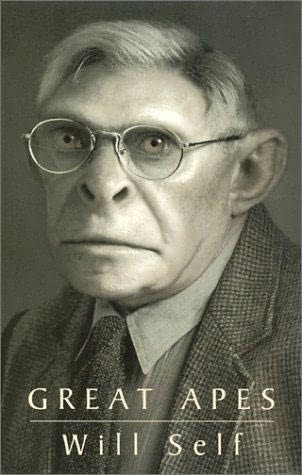
Great Apes — Will Self

Speaking of ickiness…Self’s 1997 novel Great Apes made me totally sick. Nothing repulses me more than images of chimpanzees dressed as humans and Great Apes is the literary equivalent (just look at that cover). After a night of binging on coke and ecstasy, artist Simon Dykes wakes up to find himself in a world where humans and apes have switched roles. Psychoanalysis ensues. While the novel is in part a lovely satire of emerging 21st-century mores, its humor doesn’t outweigh its nightmare grotesquerie. Great Apes so deeply affected us that I haven’t read any of Self’s work since.

[Ed. note: This post is a few years old. We run it again for Halloween and will run a follow up post later today].

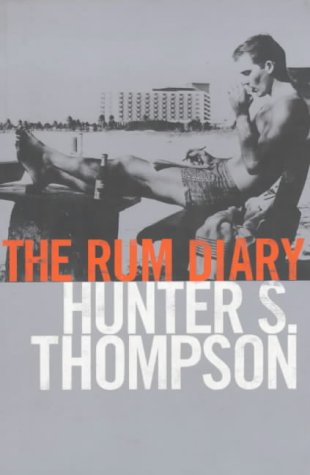
Hey, We Reviewed That Book The Rum Diary by Hunter S. Thompson, the One That Hollywood Turned into a Johnny Depp Movie

Set in the 1950s, Hunter S. Thompson’s second novel The Rum Diary chronicles the drunken misadventures of Paul Kemp, a journalist who moves from New York City to Puerto Rico to write for a small newspaper. While there, Kemp gets involved with a crazy couple who fight all the time (he develops a serious crush on the girl), attends a rum festival, and winds up in jail. Along the way there’s enough drinking to put Hemingway’s characters to shame, and plenty of nude swimming to boot.

Although The Rum Diary was written in the early sixties, it wasn’t published until 1998, long after the infamous gonzo godfather had made his indelible mark on the American literary consciousness. Thompson was 22 when he wrote The Rum Diary, a significant eight years younger than his stand-in in the novel, jaded journalist Paul Kemp. And while it’s easy to imagine that HST was born a cranky old man, at times Kemp’s world-weariness reads more like an affected pose rather than an earned cynicism.

The novel works best when HST focuses on denigrating the cretins, phonies, perverts, and degenerates that are never in short supply in his sick universe. Where the average travel writer might see a joyous festival throbbing with life and humanity, HST finds dread and disgust, fear and loathing. His frenzied yet steady prose moves quickly, adding to the general manic tone of the novel, and, despite its 200+ pages, The Rum Diary is an easy weekend read. Additionally, HST’s reflections on American imperialism and tourism in general remain relevant and fresh over forty years later.

The Rum Diary is hardly the HST starting place, but this is quite obvious (if, dear reader, this is not obvious to you, get thee to a bookstore posthaste and obtain Fear and Loathing in Las Vegas). However, for casual fans The Rum Diary will make an interesting beach read. Apparently a movie featuring HST friend-alum Johnny Depp (as Paul Kemp) is slated to come out next year, so stay one step ahead of Hollywood by reading this now. Recommended. [Editorial note: Yes, this review is a few years old. There’s a movie now, clearly].

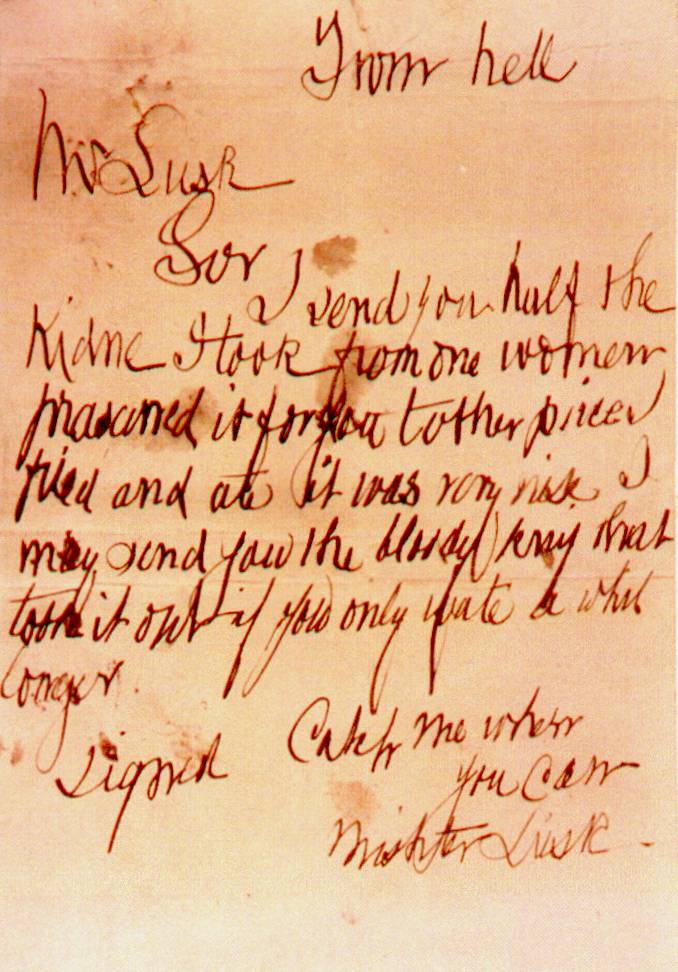
From Hell Letter

(Read our review of From Hell by Alan Moore and Eddie Campbell)


“Imagine You’re a Hyper-Educated Avant Gardist” — David Foster Wallace on David Lynch (Video)

Begins at 4:oo. (Transcript).

From Hell — Alan Moore & Eddie Campbell

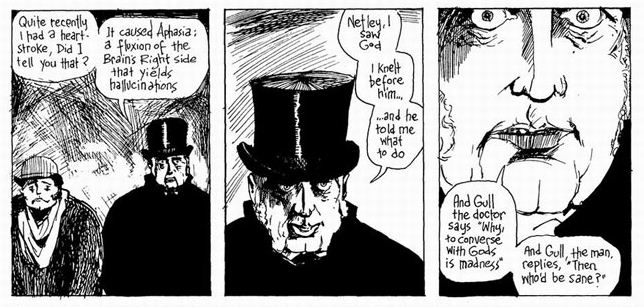
From HellAlan Moore and Eddie Campbell’s epic revision of the Jack the Ripper murders, posits Sir William Gull, a physician to Queen Victoria, as the orchestrator of the Jack the Ripper murders that terrified Londoners at the end of the 19th century. The murders initially arise out of the need to cover up the knowledge of the existence of an illegitimate son begat by foolish Prince Albert, Victoria’s grandson. However, for Gull the murders represent much more–they are part of the continued forces of “masculine rationality” that will constrain “lunar female power.” Gull is a high-level Mason; during a stroke, he experiences a vision of the Masonic god Jahbulon, one which prompts him to his “great work”–namely, the murders that will reify masculine dominance.

One of the standout chapters in the book is Gull’s tour of London, with his hapless (and witless) sidekick Netley. In a trip that weds geography, religion, politics, and mythology, Gull riffs on a barbaric, hermetic history of London, revealing the gritty city as an ongoing site of conflict between paganism and orthodoxy, artistic lunacy and scientific rationality, female and male, left brain and right brain. The tour ends with a plan to commit the first murder. From there, the book picks up the story of Frederick Abberline, the Scotland Yard inspector charged with solving the murders. Of course, the murders are unsolvable, as the hierarchy of London–from the Queen down to the head of police–are well aware of who the (government-commissioned) murderer is. The police procedural aspects of the plot are fascinating and offer a balanced contrast with Gull’s mystical visions–visions that culminate in a climax of a sort of time-travel, in which Gull not only sees London at the end of the twentieth century, but also receives a guarantee that his murder plot has had its intended effect. From Hell takes many of its cues from the idea that history is shaped not by random events, but rather by tragic conspiracies that force people to willingly give up freedom to a “rational” authority. The book points repeatedly to the 1811 Ratcliffe Highway murders, which led directly to the world’s first modern police force. In our own time, if we’re open to conspiracy theories, we might find the same pattern in the 21st century responses to terrorism (Patriot Act, anyone?).

Although From Hell features moments of supernatural horror in Gull’s mysticism, it is the book’s grimy realism that is far more terrifying. London in the late 1880s is no place you want to be, especially if you are poor, especially if you are a woman. The city is its own character, a labyrinth larded with ancient secrets the inhabitants of which cannot hope to plumb. Despite the nineteenth century’s claims for enlightenment and rationality, this London is bizarrely cruel and deeply unfair. Campbell’s style evokes this London and its denizens with a surreal brilliance; his dark inks are by turns exacting and then erratic, concentrated and purposeful and then wild and severe. The art is somehow both rich and stark, like the coal-begrimed London it replicates. Although Moore has much to say, he allows Campbell’s art to forward the plot whenever possible. Moore is erudite and fascinating; even when one of his characters is lecturing us, it’s a lecture we want to hear. His ear for dialog and tone lends great sympathy to each of the characters, especially the unfortunate women who must turn to prostitution to earn their “doss” money. And while Abberline’s frustrations at having to solve a crime that no higher-ups want solve make him the hero of this story, Gull’s mystic madness makes him the narrative’s dominant figure. Rereading this time, I realized there is no character he reminds me of as much as Judge Holden from Cormac McCarthy’s Blood Meridian. I’m also reading Joseph Conrad’s The Secret Agent now, a book that dovetails neatly with From Hell, both in its time and setting, but also in its exploration of social unrest and duplicitous authority. Both novels feature detectives fighting a complacent system, and both novels feature a working class that threatens to erupt in socialist or anarchist rebellion.

From Hell is a fantastic starting place for anyone interested in Moore’s work, more self-contained than his comics that reimagine superhero myths, like Watchmen or Swamp Thing, and more satisfying and fully achieved than Promethea or V Is for Vendetta. Be forewarned that it is a graphic graphic novel, although I do not believe its violence is gratuitous or purposeless. Indeed, From Hell aspires to remark upon the futility and ugliness of cyclical violence, and it does so with wisdom and verve. Highly recommended.

[Ed. note: We ran a version of this review last year; we run it again in celebration of Halloween].

Smaug Flies Round the Mountain — An Illustration by J.R.R. Tolkien

(More).

“Love Can Be Terribly Obscene” — D.H. Lawrence on Edgar Allan Poe

D.H. Lawrence on Edgar Allan Poe. From Studies in American Literature

Poe had experienced the ecstasies of extreme spiritual love. And he wanted those ecstasies and nothing but those ecstasies. He wanted that great gratification, the sense of flowing, the sense of unison, the sense of heightening of life. He had experienced this gratification. He was told on every hand that this ecstasy of spiritual, nervous love was the greatest thing in life, was life itself. And he had tried it for himself, he knew that for him it was life itself. So he wanted it. And he would have it. He set up his will against the whole of the limitations of nature.

This is a brave man, acting on his own belief, and his own experience. But it is also an arrogant man, and a fool.

Poe was going to get the ecstasy and the heightening, cost what it might. He went on in a frenzy, as characteristic American women nowadays go on in a frenzy, after the very same thing: the heightening, the flow, the ecstasy. Poe tried alcohol, and any drug he could lay his hand on. He also tried any human being he could lay his hands on.

His grand attempt and achievement was with his wife; his cousin, a girl with a singing voice. With her he went in for the intensest flow, the heightening, the prismayic shades of ecstasy. It was the intensest nervous vibration of unison, pressed higher and higher in pitch, till the blood-vessels of the girl broke, and the blood began to flow out loose. It was love. If you call it love.

Love can be terribly obscene.

It is love that causes the neuroticism of the day. It is love that is the prime cause of tuberculosis.

The nerves that vibrate most intensely in spiritual unisons are the sympathetic ganglia of the breast, of the throat, and the hind brain. Drive this vibration over-intensely, and you weaken the sympathetic tissues of the chest – the lungs – or of the throat, or of the lower brain, and the tubercles are given a ripe held.

But Poe drove the vibrations beyond any human pitch of endurance.

Being his cousin, she was more easily keyed to him.

Ray — Barry Hannah

ray

Barry Hannah’s slim 1980 novel Ray is a strange wonder, a poem rocket assured to offend any unsuspecting customer who wanders in unaware. I use the term “offend” here loosely: some may be offended by Hannah’s subject matter (booze, drugs, sex, violence), others may be offended by his refusal to submit to any of the conventions we expect from a “novel.” Sure, there are defined characters, conflicts, hints of a plot even, but don’t expect arc, easily recognizable growth, or even linearity. Hannah breaks almost every convention, right down to a first-person narration that shifts occasionally into a kind of second-person meditation and then into a faux-objective third-person voice and then into the third-person free indirect style that marks modernism. The subject Ray careens not just through perspectives but also through time. Here he is in Chapter V (this is the chapter in its entirety)—

I live in so many centuries. Everybody is still alive.

And if Ray is busy stumbling through his own psychic quagmire, shooting down planes in ‘Nam or killing Yankees under Jeb Stuart’s command, he’s also a very real, concrete personality, a doctor, a family man, an alcoholic, a suffering soul trying to navigate children and lovers and patients and neighbors in the swelter of Tuscaloosa, Alabama at the end of Carter’s presidency.

None of this should work, of course, but Hannah’s writing assimilates the reader, inculcates the reader, infects the reader. Ray is a dramatically unstable figure of the old school—misogynist, casually racist, the kind of doctor who finds himself “drinking five bottles of wine a day just to stay cool” — but Hannah’s syntactic powers (which he awards to his narrator Ray) become the core of a novel that by rights should run off the tracks, what with its sharp velocity and manic force and hairpin turns. But Ray doesn’t run off the tracks; it explodes them.

It’s hard to summarize the plot of this fragmentary novel, but I’ll give it a try (and at least share some of Hannah’s remarkable prose). Ray is a country doctor of some note and education, a former pilot who fought and killed in Vietnam, a man with literary ambitions who tries his hand at poetry and occasionally lectures at the local college. Here’s a taste of one of those lectures, showcasing Hannah’s wit, the radically ambivalent place of history in his work, and the core paradoxes of his lead character—

So now, class, I say:

“Americans have never been consistent. They represent gentleness and rage together. Franklin was the inventor of the stove, bifocals, and so on. Yet he abused his neglected family. Jefferson, with his great theories, could not actually release the slaves even though he regularly fornicated with one of them. One lesson we as Americans must learn is to get used to the conrarieties in our hearts and live with them.” Etc.

Lazy Blakean. In addition to his history lectures, Ray has even written a number of papers with unlikely titles about women and depressives and medicine; it is wholly ironic that Ray should lay claims to understanding women and depressed people, let alone understanding how to treat them. During the course of the novel he marries again, to a woman named Westy, and they combine their children into a post-nuclear family that recalls The Brady Bunch on Dexedrine and bourbon and weed (that description sounds far more negative than I intend; I’m trying to telegraph the spirit or tone of the novel, which is difficult, impossible). Ray’s lusty marriage to Westy doesn’t prevent his shambolic philandering. Not all of Ray’s infidelities are born of human weakness though. His love for a young woman named Sister from a white trash family called the Hooches deeply informs the novel; it also allows me another chance to quote from the novel—

Sister is always in love with somebody, sometimes me. There is a capricious wisdom she has about attaching herself to anybody for very long, although her loyalties are fast. She plays the guitar well and has a nice voice that she keeps to herself. Life has been such for her that she has no attitude at all. She expects no sympathy. Two of her teenage lovers died in an accident at the railroad tracks. That’s when I met Sister. I rode down to the tracks, and she was standing there in a long sleeping gown, two weeks after the accident.

“What’s wrong, girl?”

“I growed up.”

Along with Sister, a man named Charlie DeSoto plays a large role in Ray; indeed, at times the novel comes to inhabit his consciousness, as if he was some alter-ego of Ray. That consciousness also becomes unstuck in time. In a passage that recalls (and predates) Blood Meridian, DeSoto (via Ray?) migrates back to the mid 1500s, into the mind of one of Hernando DeSoto’s companions in arms. In a bizarre first-person sequence, this ancient Christian describes slaughtering 4,000 Indians under the command of the war chief Tuscaloosa. History is a nightmare that Ray cannot wake up from.

Ray is a strange fever dream, buzzing with tumult, beauty, filth, and ugly vitality. Our clumsy (anti?)hero cannot seem to reconcile his violent past (both as a fighter pilot in Vietnam and as an American with “contrarieties” in his heart) with his duty as a healer, a doctor. He tells us—

I am infected with every disease I ever tried to cure. I am a vicious nightmare of illnesses. God cured me with a memory that holds everything in my brain. There is no forgetting with me. Every name, every foot, every disease, every piece of jewelry hanging from an ear. Nothing is hazy.

If “Nothing is hazy” then everything is brought into vibrant foreground, all details afforded a prominent place, none pushed to a defining background. If “Nothing is hazy” then everything is hazy; contrariety rules.

Perhaps Ray might be summed up by one of its chapters, LII (again, in its entirety)—

To live and delight in healing, flying, fucking. Here are the men and women.

Hannah might have been heir to Faulkner, with his grotesque characters and bizarre syntax and challenging tropes (not to mention the sweaty ickiness of both writers’ prose). Ray also hearkens back to Henry Miller’s rants, although I’d suggest a larger, or at least more loving spirit in Hannah. There are even tinges of Bukoswki here. Ray also recalls Renata Adler’s strange novel Speedboat, another discursive, vaulting piece from the late ’70s. But comparing Ray to other works risks belying its radical originality, which is surely one of its great pleasures. Ray is not a novel for everyone, and those interested in Hannah might do better to begin with his equally strange compilation Airships, but those seeking a challenging, funny novel will appreciate Ray, a novel that explodes literary convention even as it reaffirms the affective power of literature. Highly recommended.


Books Acquired, 10.22.2011

20111023-103958.jpg

I was too busy on Saturday to document the books that arrived at Biblioklept World Headquarters, but here they are of a Sunday, both sporting impeccable design and, uh, burgundy.

Richard Locke’s Critical Children (Columbia UP) examines childhood in a number of novels, including Dickens, Twain, Peter Pan,Lolita, Catcher in the Rye, and The Turn of the Screw. Here’s Locke, synthesizing these figures in Holden Caulfield—

Salinger’s most famous character, sixteen-year-old Holden, is a holy rebel who combines elements of Oliver Twist and the Artful Dodger, Huckleberry Finn and Peter Pan. Like Oliver, Holden can be said to represent “the principle of Good surviving through every adverse circumstance, and triumphing at last.” Like the Artful Dodger, he is a quick-tongued urban trickster. Like Peter Pan, he mocks his own conventional (and comfortably affluent) society and wants to never grow up. But his most celebrated ancestor is Huckleberry Finn. Salinger transforms Huck the frontier fugitive into Holden the prep-school dropout: both boys’ famously provocative colloquial voices embody their quests for American freedom and authenticity.


20111023-104321.jpg

I can’t overstate the aesthetic pleasure I take in Def Jam Recordings:  The First 25 Years of the Last Great Record Label by Bill Adler and Dan Charnas. It’s huge—thick and big and crammed with photos and interviews and memories—all kinds of great stuff. It makes sense of course that Def Jam, a label as much about style as it was about music, would produce such a beautiful book, but this beast surpasses the expectations most of us might have for a coffee table book: it also functions as an oral history of the people, music, fashion, politics, money, and culture of Def Jam—the influence of which on popular culture simply cannot be underestimated. Full review forthcoming, but two random pics for now—


20111023-104019.jpg

20111023-104026.jpg


William S. Burroughs Talks About Allen Ginsberg

AV Club Interviews Daniel Clowes


The AV Club interviews comix creator Daniel Clowes. (Read our review of Clowes’s hilarious and acerbic book Wilson)From the interview—

The A.V. Club: People often ask musicians if they listen to their old albums or filmmakers if they watch their old movies, but do you reread your old comics?

Dan Clowes: I try not to. [Laughs.] It usually doesn’t lead to anything good. The only way I can ever experience them really is if I completely forgot what they were about. Once I send it off to the printer, I try to never look at the work again, if I can help it. Usually when I put together a book like this DeathRay hardcover or that Ghost World special edition, then I have to reread it and see if there is anything I want to change or any re-coloring I want to do. That’s when I’m faced with the actual work. When I’m working, I’m too close to it. I’m sort of inside, and I can’t see it at all. So when I have that experience of rereading it years later, it’s jarring.

King Lear on Occupy Wall Street

Through tatter’d clothes small vices do appear;
Robes and furr’d gowns hide all. Plate sin with gold,
And the strong lance of justice hurtless breaks;
Arm it in rags, a pigmy’s straw does pierce it.

King Lear, 4.6

(Some Very Handsome) Books Acquired, 10.18.2011 (Melville House Debuts The Neversink Library)

The good people at Melville House, debut The Neversink Library this week, a line of international titles that have been overlooked, neglected, and under-appreciated, many languishing out of print for years. I was pleased as punch to get three from the fall line up (another Neversink title coming out this Fall is a new edition of Karel Capek’s War with the Newts, covered by Biblioklept affiliate Noquar just a few weeks ago). Pics of the titles below—you can see how handsome and unified the design is here.

20111018-170431.jpg

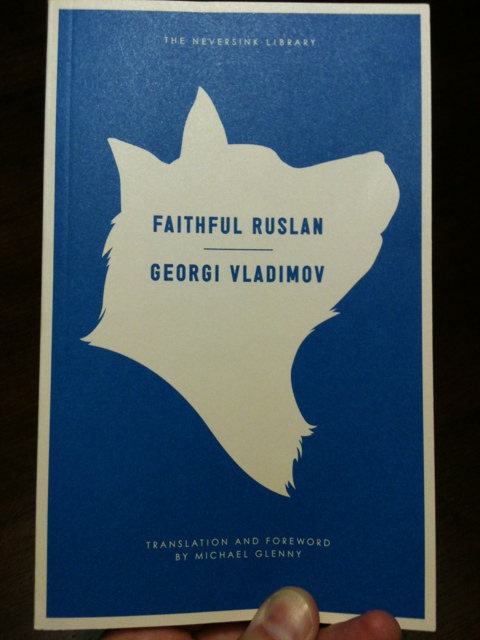
Georgi Vladimov’s Faithful Ruslan

Set in a remote Siberian depot immediately following the demolition of one of the gulag’s notorious camps and the emancipation of its prisoners, Faithful Ruslan is an embittered cri de oeur from a writer whose circumstances obliged him to resist the violence of arbitrary power. “Every writer who writes anything in this country is made to feel he has committed a crime,” Georgi Vladimov said. Dissident, he said, is a word that “they force on you.” His mother, a victim of Stalin’s anti-Semitic policy, had been interred for two years in one of the camps from which Vladimov derived the wrenching detail of Faithful Ruslan. The novel circulated in samizdat for more than a decade, often attributed to Solzhenitsyn, before its publication in the West led to Vladimov’s harassment and exile.

A starving stray, tortured and abandoned by the godlike “Master” whom he has unconditionally loved, Ruslan and his cadre of fellow guard dogs dutifully wait for the arrival of new prisoners—but the unexpected arrival of a work party provokes a climactic bloodletting. Fashioned from the perceptions of an uncomprehending animal, Vladimov’s insistently ironic indictment of the gulag spirals to encompass all of Man’s inexplicable cruelty.

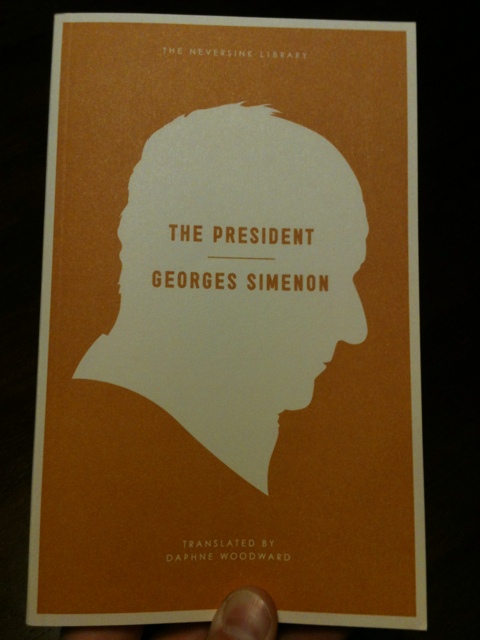
20111018-170446.jpgThe President by Georges Simenon—

At 82, the former premier lives in alert and suspicious retirement— self exile—on the Normandy coast, writing his anxiously anticipated memoirs and receiving visits from statesman and biographers. In his library is the self-condemning, handwritten confession of the premier’s former attaché, Chalamont, hidden between the pages of a sumptuously produced work of privately printed pornography—a confession that the premier himself had dictated and forced Chalamont to sign. Now the long-thwarted Chalamont has been summoned to form a new coalition in the wake of the government’s collapse. The premier alone possesses the secret of Chalamont’s guilt, of his true character—and has publicly vowed: “He’ll never be Premier as long as I’m alive . . . Nor when I’m dead, either.”

Inspired by French Premier Georges Clemenceau, The President is a masterpiece of psychological suspense and a probing account of the decline of power.

20111018-170456.jpg

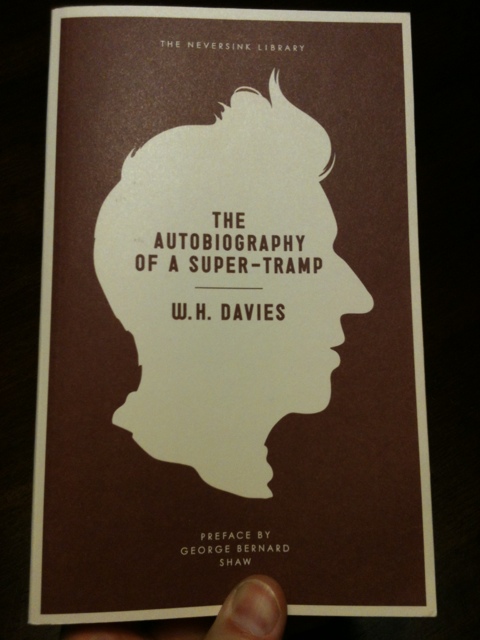
I think this is the one I’ll dip into first: The Autobiography of a Super-Tramp by W.H. Davies—

An untutored Welsh tramp who became a popular poet acclaimed by the conservative Georgians and the vanguard Ezra Pound alike, W. H. Davies surprised his contemporaries with the unlikeliest portrait of the artist as a young man ever written.

After a delinquent childhood Davies renounced home and apprenticeship and at twenty-two sailed to America—the first of more than a dozen Atlantic crossings, often made by cattle boat. From 1893 to 1899 he was schooled by the hard men of the road, disdaining regular work and subsisting by begging. Crossing Canada to join the “Klondyke” gold rush, Davies fell while hopping a train. His foot was crushed and his leg amputated. “All the wildness had been taken out of me,” Davies wrote, “and my adventures after this were not of my own seeking.”

Praised by Osbert Sitwell for his “primitive splendour and directness,” Davies evokes the beauty and frontier violence of turn-of-the-century America in prose that George Bernard Shaw commended to “literary experts for its style alone.” The insurgent wanderlust that found an American voice in Jack London and Jack Kerouac is expressed here in a raucous true adventure story by the man Shaw called “the incorrigible Supertramp who wrote this amazing book.”

“Some Factors Determining the Quality of a Translation” — Lydia Davis

From Lydia Davis’s insightful and entertaining essay “Some Notes on Translation and on Madame Bovary,” from issue 198 of The Paris Review

The quality and nature of a translation (let’s say from the French) depends on at least three things: the translator’s knowledge of French language, history, and culture; his or her conception of the task of the translation; and his or her ability to write well in English. These three variables have subsets that can recombine infinitely, which is why one work can have such widely differing translations. Publishers selecting a translator seem to proceed on the assumption that the most important qualification is the first. “Let’s ask Professor X, head of the French department at Y!” Often they completely ignore the second factor—how will Professor X approach the task of translating?—and certainly the third—what is Professor X’s writing style like? All three factors are vital, but in many instances, if one has to rank them, the third—how well the translator writes—may be the most important qualification, followed closely or equaled by the second—how he or she approaches translating, and it is the first that comes in last place, since minor lapses in a knowledge of the language, history, and culture may result in mistakes that are, in a beautifully written, generally faithful version, fairly easily corrected, whereas a misconception of the task of the translator and, worse, an inability to write well will doom the entire book through its every sentence.

Why I Abandoned Chad Harbach’s Over-Hyped Novel The Art of Fielding After Only 100 Pages

Genre fiction gets a bad rap from some readers and critics because it often rigidly follows a set of formal conventions, from plot to character to prose, to satisfy reader expectations. One mark of literary fiction, in opposition to genre fiction, might be that the literary work disrupts or destabilizes these conventions (works that get called experimental tend to explode these conventions or radically recombine them). Harold Bloom, in The Western Canon (and elsewhere), argues that it is the strangeness and originality of a work that confers its literary power; in some cases, he argues, this strangeness assimilates us (the readers, the culture) to the point that we can no longer recognize its strangeness. While Bloom may be a pompous windbag (and really, what literary critic worth his salt isn’t?), and I don’t always agree with him (especially in his unrelenting agon with “The School of Resentment”), I think he’s given us a good rubric by which to measure or understand what sets great literature apart from the ordinary, the conventional, the ephemeral.

I bring all of this up because it seems to me that literary fiction is its own genre, one with its own conventions, tropes, and formulations. The genre of literary fiction is as much a marketing tool, of course, as it is a set of conventions, and publishers release these books because the author’s Great Ambition and Sterling Prose and Big Ideas (in theory) cast esteem back on the publisher. And while there are plenty of great books with major houses behind them, many books claiming to be “literary fiction” are simply conventional retreads of an antiquated formula, outfitted in the grand themes of the day (these days, that tends to “identity”). These books offer no strangeness, make no attempt to open the realm of literary possibility. They are intellectual comfort food. And there’s nothing wrong with that, just as there’s nothing wrong with a good mystery novel. But I think we lie to ourselves when we overinflate the powers of our “literary” novelists. I enjoyed Jeffrey Eugenides’s middlebrow Middlesex as much as the next lad, for example, but still find it wildly overrated. Another example: Michael Chabon is not my cup of tea, but I wouldn’t argue against his talent. Still, even when he attempts the strange (The Yiddish Policemen’s Union, for example), he’s blandly trying territory already colonized by others. Give me Philip K. Dick or George V. Higgins any day.

My favorite novels tend toward strangeness; they upset or confound or baffle me. I love it when I have no idea what the novelist is doing. And while reckless innovation or experimentation for its own sake can sometimes fall flat (or fall apart), an interesting failure is better than another complacent, forgettable entry in the non-canon of contemporary “literary fiction.”

Which brings me to Chad Harbach’s wildly over-hyped novel The Art of Fielding.

Let me be up front: Yes, this is backlash. The acclaim directed at this novel deserves backlash—although I’d like to be clear up front that I’m not trying to attack the novel itself; that would be like attacking a run-of-the-mill sci-fi novel for indulging in run-of-the-mill sci-fi tropes. My aim is simply to point out that Harbach’s book is no great feat of literature, no work of astounding genius—it’s just run-of-the-mill literary fiction. And yes, I didn’t read past page 100, which conveniently is the last page of chapter 11. Why would I slog it out through 400 more pages when there are so many great books in the world that I haven’t read and precious little time in which to read them? And that’s the point of the rant that follows.

The book is not entirely terrible. It just isn’t very good, certainly not good enough to warrant the excessive praise that’s been heaped upon it. Cardboard characters, cliché after cliché (plot, character, prose), and plenty of bad writing. The dialogue is particularly heinous; I’m fine with unrealistic speech, but Harbach lacks subtlety or style. In fact, the book lost me on page 18, when the character Owen Dunne introduces himself to the protagonist Henry Skrimshander with this groan-inducing nugget: “My name’s Owen Dunne. I’ll be your gay mulatto roommate.” I suppose that the line is meant to be heard in a perhaps ironically self-reflexive sense—a metafictive gesture that extends from Dunne to the audience, like a knowing wink (and bypassing poor boring Henry), but it strikes me instead as utterly tone-deaf, showing us nothing about Dunne and his (supposed hip) cleverness and everything about Harbach’s inability to create concrete, real characters.

Dunne is a particularly grating character in a novel full of grating characters. The worst aspect of this character is that he is presented as an intellectual, but Harbach fails to harness his intellect in the text. We are told the names of some of the authors in his library; we hear some of his pretentious speech; he tells us how smart he is, and one senses that Harbach would have us believe him—only at no point in the first 100 pages are we treated to any real aspect of his intelligence. Critics, or people who write about books, have bent over backwards to call Fielding a smart book, to liken it to Jonathan Franzen or David Foster Wallace or, Jesus Christ, even Herman Melville. But Dunne is the simplest illustration that Harbach’s bench isn’t very deep; there is nothing here to approximate the mind of Hal Incandenza or the heart of Don Gately; there’s certainly no one here on par with Ishmael. But this is hardly Harbach’s fault, of course. Who can make an Ishmael?

If I appear to be attacking Harbach, please let me clarify: I think that he’s written a passable novel in the genre of “literary fiction” (which I contrast here now, for the sake of clarity, with strong literature or even canonical literature, if you like). But this book isn’t another Infinite Jest or Moby-Dick (as if one could even speak of “another” Moby-Dick); it isn’t even in the same league, and its champions do it no favors in overpraising it.

Let’s take a peek at some of that purple praise:

Here’s Michiko Kakutani in The New York Times, who, granted, manages to be wrong about almost everything all the time, but her gushing here is especially egregious—

Chad Harbach’s book “The Art of Fielding” is not only a wonderful baseball novel — it zooms immediately into the pantheon of classics, alongside “The Natural” by Bernard Malamud and “The Southpaw” by Mark Harris — but it’s also a magical, melancholy story about friendship and coming of age that marks the debut of an immensely talented writer.

Mr. Harbach, a co-founder and co-editor of the literary journal n + 1, has the rare abilities to write with earnest, deeply felt emotion without ever veering into sentimentality, and to create quirky, vulnerable and fully imagined characters who instantly take up residence in our own hearts and minds. He also manages to rework the well-worn, much-allegorized subject of baseball and make us see it afresh, taking tired tropes about the game (as a metaphor for life’s dreams, disappointments and hopes of redemption) and injecting them with new energy. In doing so he has written a novel that is every bit as entertaining as it is affecting.

She gets a few things right: Harbach’s characters are “quirky,” in the completely-unrealistic-and-totally-annoying sense; also, yes, the book is full of “tired tropes.” But the rest? I metaphorically throw up in my brain when I read her claim that these “vulnerable and fully imagined characters . . .  instantly take up residence in our own hearts and minds.” Get me the fuck out of your pronouns, Kakutani. Because Kakutani’s honeyed spewing was not enough, for some reason, the Times ran another glowing review just a few days later, where Gregory Clowes suggests—

Measured against other big, ambitious debuts by striving young writers (Harbach is a founder and editor of the literary magazine n+1), “The Art of Fielding” is surprisingly old-fashioned and almost freakishly well behaved. There’s some strained humor in the early going, when Harbach seems unsure of his register, but once he settles into a mildly satiric mode of psychological realism — the mode of latter-day Jonathan Franzen, rather than the high turbulence of David Foster Wallace — the book assumes an attractive, and fitting, 19th-century stateliness.

Franzen, whose blurb blazons Fielding’s cover, is an apt comparison (over-hyped, turgid, boring, middle class, middlebrow). And even though Wallace’s The Pale King was over-hyped in the wake of his suicide, I think the Franzen/Wallace disjunction is informative here: Wallace’s work is challenging, disruptive, strange.

When Clowes points out how “old-fashioned and almost freakishly well behaved” Fielding is, he signals the same sense of comfort that Kakutani finds in the work: Like most middling works of the “literary fiction” genre, Fielding provides its audience a sense of comfort, a confirmation that the literary constructions (and worldviews) of yore still exist.

Clowes then brings up the Herman Melville references in Fielding, which aren’t so much allusions as they are lazy infodumps about more interesting books. At least Clowes has the good sense not to find parallels between Melville’s grand, strange writing and Harbach’s bland business, unlike Ellen Wernecke at The AV Club, who wrote—

Harbach takes plenty of cues from other great baseball novels, like Bernard Malamud’s The Natural and Philip Roth’s The Great American Novel, but more so from Melville, in a display of cleverness that wraps around Westish life.

Harbach’s “display of cleverness” is absolutely the problem. Who wants a display of cleverness? To me, the first fifth of Fielding reads like a self-congratulatory wankfest of cleverness, where the audience is invited to alternately smirk or nod sagely (blankly), with protagonist Henry playing the small town rube (butt of the joke) and the fish out of water (audience surrogate in what is supposed to be the fascinating world of Westish, a stand-in for Harvard in the Midwest, which, let me just stop to say, is one of the more unconvincing settings I’ve ever read). There is no challenge to the reader; even worse, Harbach seems to rely on some sense of fellow-feeling or shared common ground from his readers to land his points. Home games are always easier. The reward Harbach offers seems to be a simple reconfirmation of the forms and tropes and tired language of the “literary fiction” genre.

I detest negative book reviews as much as I hate overpraise, so let me conclude by offering a short list of relatively contemporary books (past thirty or fifty years) that I think will challenge readers who want more from their novels than a retread of the old-fashioned and well behaved: Roberto Bolaño’s 2666, Renata Adler’s Speedboat, David Foster Wallace’s novels and short stories, Cormac McCarthy’s novels (especially Blood Meridian and Suttree), Russell Hoban’s Riddley Walker or Kleinzheit, Barry Hannah’s Airships and Ray, anything by W.G. Sebald, William T. Vollmann’s The Rifles or Butterfly Stories, Sam Lipsyte’s The Ask,  Lars Iyer’s Spurious, PK Dick’s The Man in the High Castle, Gordon Lish’s short stories, Denis Johnson’s Angels, Thomas Pynchon’s V, Don DeLillo’s Underworld or White Noise . . . but now I am riffing wankerishly—never my intent here. Just didn’t want to end on a negative note. I’d love to hear what I missed on this list.

More Wuthering Heights Humor from Hark! A Vagrant


At Hark! A Vagrant, Kate Beaton riffs some more on Wuthering Heights.

Dennis Cooper Talks About Being a “Cult Writer”

Again, raiding the Dennis Cooper interview from the new issue of The Paris Review (198/Fall 2011). Cooper discusses what a “normal” novel is in the interview, and here he talks about what it might mean to be a “cult writer.” I’ve long been interested in simply the idea of a “cult novel,” so I liked this bit, and thus share with you, kind reader—

You almost never see my name in print without the phrase cult writer glued to it. When I see that word, cult, attached to an artist, it always seems to be a begrudging way to acknowledge that the artist is talented and valuable to a moderate number of people whose passion for that artist’s work is understandable, to some degree, but nonetheless foreign. It’s a weird term because it’s complimentary but condescending and hierarchical at the same time. My work just seems to be a really odd duck. I feel like I’m on my own. I don’t mind that, but it’s a strange place to be sometimes.