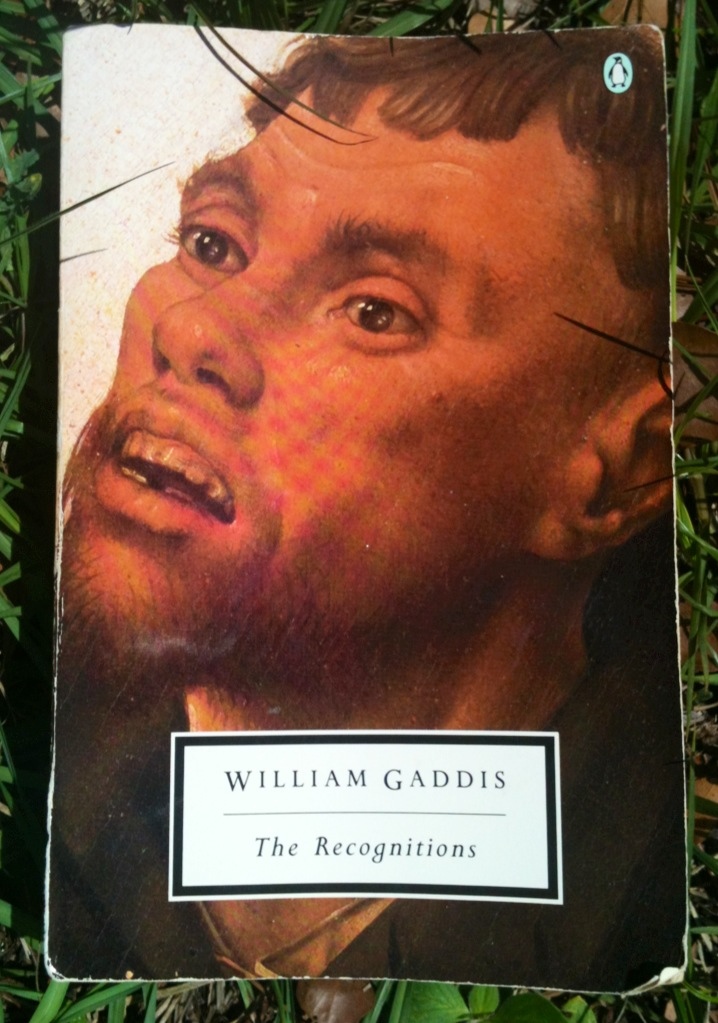
William Gaddis Fiction-to-Music Entelechy Transducer — Gregg Williard

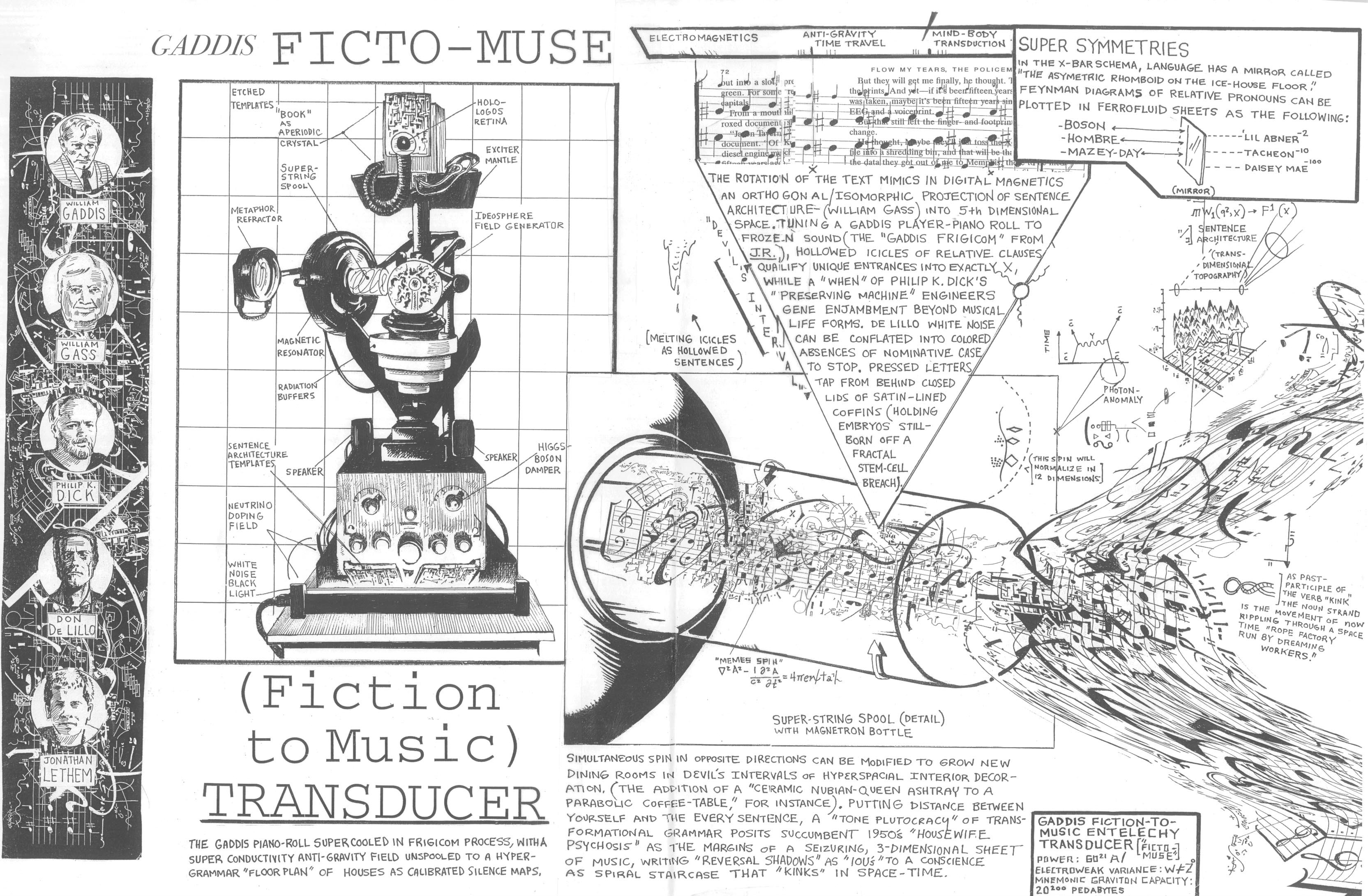
“Gaddis Fiction-to-Music Entelechy Transducer” by Gregg Williard (More graphs/via).

A Riff on William Gaddis’s The Recognitions

20120325-143631.jpg

  1. I finished reading William Gaddis’s enormous opus The Recognitions a few days ago. I made a decent first attempt at the book in the summer of 2009, but wound up distracted not quite half way through, and eventually abandoned the book. I did, however, write about its first third. I will plunder occasionally from that write-up in this riff. Like here:

In William Gaddis‘s massive first novel, The Recognitions, Wyatt Gwyon forges paintings by master artists like Hieronymous Bosch, Hugo van der Goes, and Hans Memling. To be more accurate, Wyatt creates new paintings that perfectly replicate not just the style of the old masters, but also the spirit. After aging the pictures, he forges the artist’s signature, and at that point, the painting is no longer an original by Wyatt, but a “new” old original by a long-dead genius. The paintings of the particular artists that Wyatt counterfeits are instructive in understanding, or at least in hoping to understand how The Recognitions works. The paintings of Bosch, Memling, or Dierick Bouts function as highly-allusive tableaux, semiotic constructions that wed religion and mythology to art, genius, and a certain spectacular horror, and, as such, resist any hope of a complete and thorough analysis. Can you imagine, for example, trying to catalog and explain all of the discrete images in Bosch’s triptych, The Garden of Earthly Delights? And then, after creating such a catalog, explaining the intricate relationships between the different parts? You couldn’t, and Gaddis’s novel is the same way.

I still feel the anxiety dripping from that lede, the sense that The Recognitions might be a dare beyond my ken. Mellower now, I’m content to riff.

  1. I read this citation in Friedrich Nietzsche’s Human, All Too Human, Part II the other night, mentally noting, “cf. Gaddis”:

188. The Muses as Liars. —“We know how to tell many lies,” so sang the Muses once, when they revealed themselves to Hesiod.—The conception of the artist as deceiver, once grasped, leads to important discoveries.

  1. The Recognitions: crammed with poseurs and fakers, forgers and con-men, artists and would-be artists.
  2. To recognize: To see and know again. Recognition entails time, experience, certitude, authenticity.

  3. Who would not dogear or underline or highlight this passage?:

That romantic disease, originality, all around we see originality of incompetent idiots, they could draw nothing, paint nothing, just so the mess they make is original . . .

  1. In many ways The Recognitions, or rather the characters in The Recognitions whom we might identify with genuine talent, genius, or spirit (to be clear, I’m thinking of Wyatt/Stephan, Basil Valentine, Stanley, Anselm, maybe, and Frank Sinisterra) are conservative, reactionary even; this is somewhat ironic considering Gaddis’s estimable literary innovations.

  2. Esme: A focus for the novel’s masculine gaze, or a critique of such gazes?

  3. The central problem of The Recognitions (perhaps): What confers meaning in a desacralized world?

Late in the novel, in one of its many party scenes, Stanley underlines the problem, working in part from Voltaire’s (in)famous quote that, “If there were no God, it would be necessary to invent him”:

. . . even Voltaire could see that some transcendent judgments is necessary, because nothing is self-sufficient, even art, and when art isn’t an expression of something higher, when it isn’t invested you might even say, it breaks up into fragments that don’t have any meaning . . .

Here we think of Wyatt: Wyatt who rejects the ministry, contemporary art, contemporary society, sanity . . .

  1. Wyatt’s quest: To find truth, meaning, authenticity in a modern world where the sacred does not, cannot exist, is smothered by commerce, noise, fakery . . .
  • The Recognitions conveys a range of tones, but I like it best when it focuses its energies on comic irony and dark absurdity to detail the juxtapositions and ironies between meaning and noise, authenticity and forgery.

  • (I like The Recognitions least when its bile flares up too much in its throat, when its black humor tips over into a screed of despair. A more mature Gaddis handles bitterness far better in JR, I think—but I parenthesize this note, as it seems minor even in a list of minor digressions).

  • Probably my favorite chapter of the book — after the very first chapter, which I believe can stand on its own — is Chapter V of Part II. This is the chapter where Frank Sinisterra reemerges, setting into motion a failed plan to disseminate his counterfeit money (“the queer,” as his accomplice calls it). We also meet Otto’s father, Mr. Pivner, a truly pathetic figure (in all senses of the word). This chapter probably contains more immediate or apparent action than any other in The Recognitions, which largely relies on implication (or suspended reference).

  • More on Part II, Chapter V: Here we find a savagely satirical and very funny discussion of Dale Carnegie’s How to Win Friends and Influence People, a book that seems to stand as an emblem (one of many in The Recognitions) of the degraded commercial world that Gaddis repeatedly attacks. The entire discussion of Carnegie’s book is priceless — it begins on page 497 of my Penguin edition and unfurls over roughly 10 pages—and the book is alluded to enough in The Recognitions to become a motif.

  • I’ll quote from page 499 a passage that seems to ironically situate How to Win Friends and Influence People against The Recognitions itself (this is one of the many postmodern moves of the novel):

    It was written with reassuring felicity. There were no abstrusely long sentences, no confounding long words, no bewildering metaphors in an obfuscated system such as he feared finding in simply bound books of thoughts and ideas. No dictionary was necessary to understand its message; no reason to know what Kapila saw when he looked heavenward, and of what the Athenians accused Anaxagoras, or to know the secret name Jahveh, or who cleft the Gordian knot, the meaning of 666. There was, finally, very little need to know anything at all, except how to “deal with people.” College, the author implied, meant simply years wasted on Latin verbs and calculus. Vergil, and Harvard, were cited regularly with an uncomfortable, if off-hand, reverence for their unnecessary existences . . . In these pages, he was assured that whatever his work, knowledge of it was infinitely less important that knowing how to “deal with people.” This was what brought a price in the market place; and what else could anyone possibly want?

    1. I’m not sure if Gaddis is ahead of his time or of his time in the above citation.

    The Recognitions though, on the whole, feels more reactionary than does his later novel JR, which is so predictive of our contemporary society as to produce a maddening sense of the uncanny in its reader.

    1. Even more on Part II, Chapter V (which I seem to be using to alleviate the anxiety of having to account for so many of the book’s threads): Here we find a delineation of (then complication of, then shuffling of) the various father-son pairings and substitutions that will play out in the text. (Namely, the series of displacements between Pivner, Otto, and Sinisterra, with the subtle foreshadowing of Wyatt’s later (failed) father-son/mentor-pupil relationship with Sinisterra).
  • Is it worth pointing out that the father-son displacements throughout the text are reminiscent of Joyce’s Ulysses, a book that Gaddis pointedly denied as an influence?

  • Ignorant of Gaddis’s deflections, I wrote the following in my review almost three years ago:

    Gaddis shows a heavy debt to James Joyce‘s innovations in Ulysses here (and throughout the book, of course), although it would be a mistake to reduce the novel to a mere aping of that great work. Rather, The Recognitions seems to continue that High Modernist project, and, arguably, connect it to the (post)modern work of Pynchon, DeLillo, and David Foster Wallace. (In it’s heavy erudition, numerous allusions, and complex voices, the novel readily recalls both W.G. Sebald and Roberto Bolaño as far as I’m concerned).

    1. But, hey, Cynthia Ozick found Joyce’s mark on The Recognitions as well (from her 1985 New York Times review of Carpenter’s Gothic):

    When ”The Recognitions” arrived on the scene, it was already too late for those large acts of literary power ambition used to be good for. Joyce had come and gone. Imperially equipped for masterliness in range, language and ironic penetration, born to wrest out a modernist masterpiece but born untimely, Mr. Gaddis nonetheless took a long draught of Joyce’s advice and responded with surge after surge of virtuoso cunning.

    1. We are not obligated to listen to Gaddis’s denials of a Joyce influence, of course. When asked in his Paris Review interview if he’d like to clarify anything about his personality and work, he paraphrases his novel:

    I’d go back to The Recognitions where Wyatt asks what people want from the man they didn’t get from his work, because presumably that’s where he’s tried to distill this “life and personality and views” you speak of. What’s any artist but the dregs of his work: I gave that line to Wyatt thirty-odd years ago and as far as I’m concerned it’s still valid.

    1. And so Nietzsche again, again from Human, All Too Human, Part II:

    140. Shutting One’s Mouth. —When his book opens its mouth, the author must shut his.

    1. And if I’m going to quote German aphorists, here’s a Goethe citation (from Maxims and Reflections) that illustrates something of the spirit of The Recognitions:

    There is nothing worth thinking but it has been thought before; we must only try to think it again.

    1. And if I’m going to quote Goethe, I’ll also point out then that Gaddis began The Recognitions as a parody of Goethe’s Faust. Peter William Koenig writes in his excellent and definitive essay “Recognizing Gaddis’ Recognitions” (published in the Winter Volume Contemporary Literature, 1975):

    To understand Gaddis’ relationship to his characters, and thus his philosophical motive in writing the novel, we are helped by knowing how Gaddis conceived of it originally. The Recognitions began as a much smaller and less complicated work, passing through a major evolutionary stage during the seven years Gaddis spent writing it. Gaddis says in his notes: “When I started this thing . . . it was to be a good deal shorter, and quite explicitly a parody on the FAUST story, except the artist taking the place of the learned doctor.” Gaddis later explained that Wyatt was to have all talent as Faust had all knowledge, yet not be able to find what was worth doing. This plight-of limitless talent, limited by the age in which it lives-was experienced by an actual painter of the late 1940s, Hans Van Meegeren, on whom Gaddis may have modeled Wyatt. The authorities threw Van Meegeren into jail for forging Dutch Renaissance masterpieces, but like Wyatt, his forgeries seemed so inspired and “authentic” that when he confessed, he was not believed, and had to prove that he had painted them. Like Faust and Wyatt, Van Meegeren seemed to be a man of immense talent, but no genius for finding his own salvation.

    The Faust parody remained uppermost in Gaddis’ mind as he traveled from New York to Mexico, Panama and through Central America in 1947, until roughly the time he reached Spain in 1948. Here Gaddis read James Frazer’s The Golden Bough, and the novel entered its second major stage. Frazer’s pioneering anthropological work demonstrates how religions spring from earlier myths, fitting perfectly with Gaddis’ idea of the modern world as a counterfeit-or possibly inspiring it. In any case, Frazer led Gaddis to discover that Goethe’s Faust originally derived from the Clementine Recognitions, a rambling third-century theological tract of unknown authorship, dealing with Clement’s life and search for salvation. Gaddis adapted the title, broadening the conception of his novel to the story of a wandering, at times misguided hero, whose search for salvation would record the multifarious borrowings and counterfeits of modern culture.

    1. Is Wyatt the hero of The Recognitions? Here’s Basil Valentine (page 247 of my ed.):

    . . . that is why people read novels, to identify projections of their own unconscious. The hero has to be fearfully real, to convince them of their own reality, which they rather doubt. A novel without a hero would be distracting in the extreme. They have to know what you think, or good heavens, how can they know that you’re going through some wild conflict, which is after all the duty of a hero.

    1. If Wyatt is the hero, then what is Otto? Clearly Otto is a comedic double of some kind for Wyatt, a would-be Wyatt, a different kind of failure . . . but is he a hero?

    When I first tried The Recognitions I held Otto in special contempt (from that earlier review of mine):

    Otto follows Wyatt around like a puppy, writing down whatever he says, absorbing whatever he can from him, and eventually sleeping with his wife. Otto is the worst kind of poseur; he travels to Central America to finish his play only to lend the mediocre (at best) work some authenticity, or at least buzz. He fakes an injury and cultivates a wild appearance he hopes will give him artistic mystique among the Bohemian Greenwich Villagers he hopes to impress. In the fifth chapter, at an art-party, Otto, and the reader, learn quickly that no one cares about his play . . .

    But a full reading of The Recognitions shows more to Otto besides the initial anxious shallowness; Gaddis allows him authentic suffering and loss. (Alternately, my late sympathies for Otto may derive from the recognition that I am more of an Otto than a Wyatt . . .).

    1. The Recognitions is the work of a young man (“I think first it was that towering kind of confidence of being quite young, that one can do anything,” Gaddis says in his Paris Review interview), and often the novel reveals a cockiness, a self-assurance that tips over into didactic essaying or a sharpness toward its subjects that neglects to account for any kind of humanity behind what Gaddis attacks. The Recognitions likes to remind you that its erudition is likely beyond yours, that it’s smarter than you, even as it scathingly satirizes this position.

    I think that JR, a more mature work, does a finer job in its critique of contemporary America, or at least in its characterization of contemporary Americans (I find more spirit or authentic humanity in Bast and Gibbs and JR than in Otto or Wyatt or Stanley). This is not meant to be a knock on The Recognitions; I just found JR more balanced and less showy; it seems to me to be the work of an author at the height of his powers, if you’ll forgive the cliché.

    I’ll finish this riff-point by quoting Gaddis from The Paris Review again:

    Well, I almost think that if I’d gotten the Nobel Prize when The Recognitions was published I wouldn’t have been terribly surprised. I mean that’s the grand intoxication of youth, or what’s a heaven for.

    (By the way, Icelandic writer Halldór Kiljan Laxness won the Nobel in lit in 1955 when The Recognitions was published).

    1. Looking over this riff, I see it’s lengthy, long on outside citations and short on plot summary or recommendations. Because I don’t think I’ve made a direct appeal to readers who may be daunted by the size or reputation or scope of The Recognitions, let me be clear: While this isn’t a book for everyone, anyone who wants to read it can and should. As a kind of shorthand, it fits (“fit” is not the right verb) in that messy space between modernism and postmodernism, post-Joyce and pre-Pynchon, and Gaddis has a style and approach that anticipates David Foster Wallace. (It’s likely that if you made it this far into the riff that you already know this or, even more likely, that you realize that these literary-historical situations mean little or nothing).

    26.Very highly recommended.
    Book Shelves #13, 3.25.2012

    20120325-104552.jpg

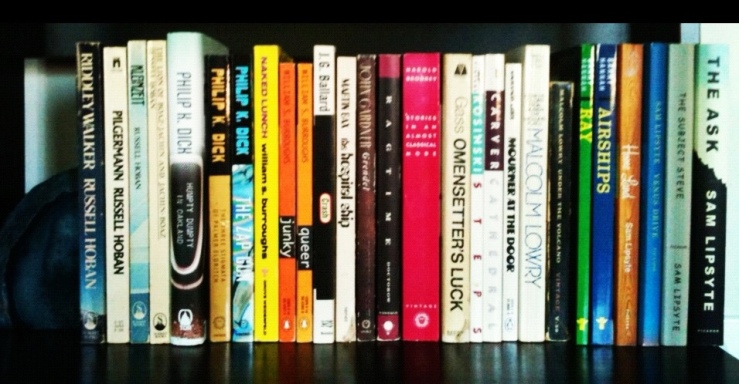
    Book shelves series #13, thirteenth Sunday of 2012: Four by the late great Russell Hoban. A few Philip K. Dick volumes, although it’s worth pointing out that most of the good stuff I’ve owned by him has been loaned out and never returned and/or exists in ratty coverless mass market editions. PK Dick transitions to William Burroughs to JG Ballard (another writer who I used to own other books by before they were dispersed . . .). Martin Bax’s The Hospital Ship is a thoroughly obscure volume in a Ballardian/Burroughsian vein; it deserves a reprint. Gardner, Brodkey, Gass, Kosinski. I’ve owned Raymond Carver’s Cathedral since high school, or maybe freshman year of college. It’s all the Carver that any library needs. Lish comma Gordon. Two by Malcolm Lowry. Two by Barry Hannah. Four from Sam Lipsyte.

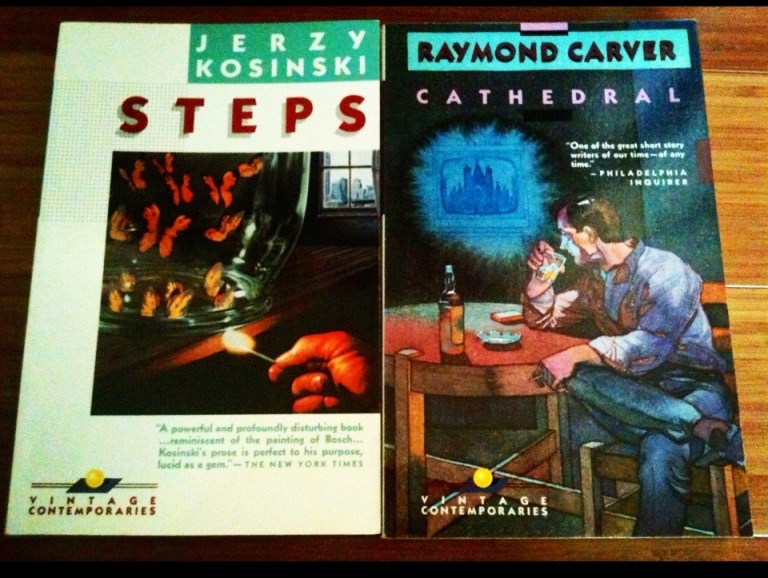
    The Carver and Kosinski volumes are part of the 1980s Vintage Contemporaries line that all feature awful, hyper-literal covers. I have about a dozen such volumes and I’m planning a piece on them in the future. Observe:

    20120325-104614.jpg

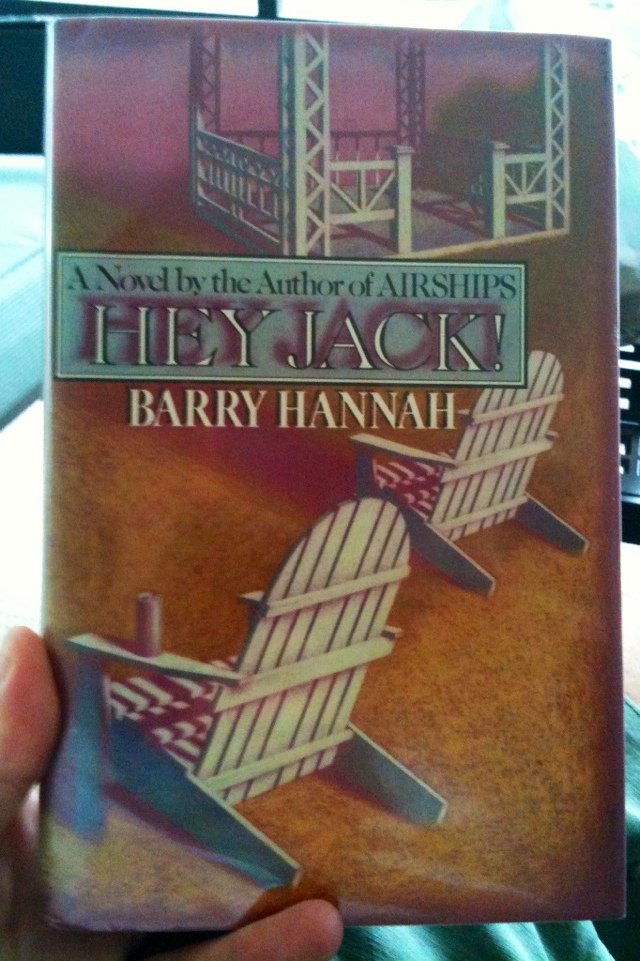
    Barry Hannah’s Hey Jack! (Book Acquired, 3.23.2012; Or, Gee, Isn’t It Kinda Sad That This Ex-Library Book Was Checked Out Only Twice in 24 Years?)

    20120324-143113.jpg

    I bought Barry Hannah’s seventh book Hey Jack! over the internet after my favorite local bookstore told me it would be difficult or expensive for them to order. I bought a first edition hardback brokered by Amazon. It was an ex-library copy. It looks like no one ever read it, and it seems to have been checked out only twice in twenty-four years. A sad business.

    I put some wear and tear on it today, reading it outside on my porch during a thunderstorm, using it as a beer coaster at one point, and then taking it into a salted bath where it got damp and curly. I read half of it. Hannah’s novel-in-vignettes is still ahead of its time. Who writes better sentences? (“Christ, the South has been pickled in the juice of its own image”).

    20120324-143122.jpg

    Tab. CXI (Strange Babies) — Albertus Seba

    Robert Louis Stevenson: “The Most Influential Books, and the Truest in Their Influence, Are Works of Fiction”

    From Robert Louis Stevenson’s essay “The Books Which Have Influenced Me”:

    The most influential books, and the truest in their influence, are works of fiction. They do not pin the reader to a dogma, which he must afterwards discover to be inexact; they do not teach him a lesson, which he must afterwards unlearn. They repeat, they rearrange, they clarify the lessons of life; they disengage us from ourselves, they constrain us to the acquaintance of others; and they show us the web of experience, not as we can see it for ourselves, but with a singular change–that monstrous, consuming ego of ours being, for the nonce, struck out. To be so, they must be reasonably true to the human comedy; and any work that is so serves the turn of instruction. But the course of our education is answered best by those poems and romances where we breathe a magnanimous atmosphere of thought and meet generous and pious characters.

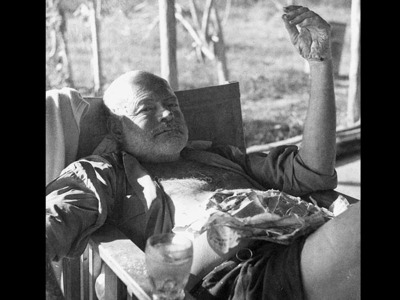
    Topless Hemingway, Part IX

    William James on Walt Whitman: “He Is Aware Enough of Sin for a Swagger to Be Present in His Indifference Towards It”

    William James on Walt Whitman; from The Varieties of Religious Experience (1902):

    Walt Whitman owes his importance in literature to the systematic expulsion from his writings of all contractile elements. The only sentiments he allowed himself to express were of the expansive order; and he expressed these in the first person, not as your mere monstrously conceited individual might so express them, but vicariously for all men, so that a passionate and mystic ontological emotion suffuses his words, and ends by persuading the reader that men and women, life and death, and all things are divinely good Whitman is often spoken of as a “pagan.” The word nowadays means sometimes the mere natural animal man without a sense of sin; sometimes it means a Greek or Roman with his own peculiar religious consciousness. In neither of these senses does it fitly define this poet. He is more than your mere animal man who has not tasted of the tree of good and evil. He is aware enough of sin for a swagger to be present in his indifference towards it, a conscious pride in his freedom from flexions and contractions, which your genuine pagan in the first sense of the word would never show

    Slavoj Žižek Uses Norman Bates’s House in Psycho to Illustrate Id, Ego, and Superego (Because Why Wouldn’t He?)

    Hamlet and His Father’s Ghost — Henry Fuseli

    “The Freest Writer” — Nietzsche on Laurence Sterne

    Nietzsche upholds Laurence Sterne as “the freest writer of all times” in Human, All Too Human, Part II:

    113. The Freest Writer. —In a book for free spirits one cannot avoid mention of Laurence Sterne, the man whom Goethe honoured as the freest spirit of his century. May he be satisfied with the honour of being called the freest writer of all times, in comparison with whom all others appear stiff, square-toed, intolerant, and downright boorish! In his case we should not speak of the clear and rounded but of “the endless melody”—if by this phrase we arrive at a name for an artistic style in which the definite form is continually broken, thrust aside and transferred to the realm of the indefinite, so that it signifies one and the other at the same time. Sterne is the great master of double entendre , this phrase being naturally used in a far wider sense than is commonly done when one applies it to sexual relations. We may give up for lost the reader who always wants to know exactly what Sterne thinks about a matter, and whether he be making a serious or a smiling face (for he can do both with one wrinkling of his features; he can be and even wishes to be right and wrong at the same moment, to interweave profundity and farce). His digressions are at once continuations and further developments of the story, his maxims contain a satire on all that is sententious, his dislike of seriousness is bound up with a disposition to take no matter merely externally and on the surface. So in the proper reader he arouses a feeling of uncertainty whether he be walking, lying, or standing, a feeling most closely akin to that of floating in the air. He, the most versatile of writers, communicates something of this versatility to his reader. Yes, Sterne unexpectedly changes the parts, and is often as much reader as author, his book being like a play within a play, a theatre audience before another theatre audience. We must surrender at discretion to the mood of Sterne, although we can always expect it to be gracious. It is strangely instructive to see how so great a writer as Diderot has affected this double entendre of Sterne’s—to be equally ambiguous throughout is just the Sternian super-humour. Did Diderot imitate, admire, ridicule, or parody Sterne in his Jacques le Fataliste ? One cannot be exactly certain, and this uncertainty was perhaps intended by the author. This very doubt makes the French unjust to the work of one of their first masters, one [pg 062] who need not be ashamed of comparison with any of the ancients or moderns. For humour (and especially for this humorous attitude towards humour itself) the French are too serious. Is it necessary to add that of all great authors Sterne is the worst model, in fact the inimitable author, and that even Diderot had to pay for his daring? What the worthy Frenchmen and before them some Greeks and Romans aimed at and attained in prose is the very opposite of what Sterne aims at and attains. He raises himself as a masterly exception above all that artists in writing demand of themselves—propriety, reserve, character, steadfastness of purpose, comprehensiveness, perspicuity, good deportment in gait and feature. Unfortunately Sterne the man seems to have been only too closely related to Sterne the writer. His squirrel-soul sprang with insatiable unrest from branch to branch; he knew what lies between sublimity and rascality; he had sat on every seat, always with unabashed watery eyes and mobile play of feature. He was—if language does not revolt from such a combination—of a hard-hearted kindness, and in the midst of the joys of a grotesque and even corrupt imagination he showed the bashful grace of innocence. Such a carnal and spiritual hermaphroditism, such untrammelled wit penetrating into every vein and muscle, was perhaps never possessed by any other man.

    “Sources Agree Rock Swoon Has No Past” — Barry Hannah Short Story

    “Sources Agree Rock Swoon Has No Past” by Barry Hannah. This short short was published in the June 2000 issue of Harper’s from a reading Hannah gave in 1986 at the Sigma Tao Delta Society at the University of Mississippi. The story appeared in Hannah’s 1988 novel Hey Jack!:

    “Pa. Is it really true the old eat their young?”

    Gives pause.

    “Couldn’t rightly say, son. I’m a mid man. Feels like I’m walking on ice meself. Go on down to the barn, ask Grandpa.”

    Grandpa’s down there in the back shadows, some loose bales around his old brogies. Seems to be humming and eating, pulling a nail out of a rotten piece of board with a pair of pliers.

    “Is it true, Grandpa?”

    “Wyoming’s not my home . . .”

    “Yer nuts, Grandpa.”

    Sings, “Ate ol’ Granny in a choo-choo car”

    Kid goes to the hut to see Grandpa’s father. Withered beyond longevity, a tiny man in dwarf’s overalls, deeply addicted to codeine and Valium, fears colored people; occasionally makes scratching protests on his old violin, which has become too large for him. Every disease has had its success with him. Now he’s bare;u a scab demanding infrequent nutrients. Bald as a beige croquet ball, he rolls his own.

    They’ve fixed him up a mike with a cord into an ancient Silvertone amplifying box. Even his snores can be heard, slightly, out in the yard.

    “Double Gramps, is it true that the old eat their young?”

    “God damn, I’m old!” blasts over the kid, feedback piercing too. The old man faints, recovers, goes into a codeine wither.

    “But my question. Please, Double Gramps.”

    Almost accidentally, the old man fits bow to fiddle and scrawls out the grand trio of “Stars and Stripes Forever.” Endlessly. It goes on the entire afternoon, amplifier picking up a prouder stroke here and there, screeching.

    The kid grows up, a rock star, aging at twenty-three. He’s already eating the young by the thousands when the second though hits him.

    Edison Film of Mark Twain (1909)

    Late to Love: Bret Easton Ellis

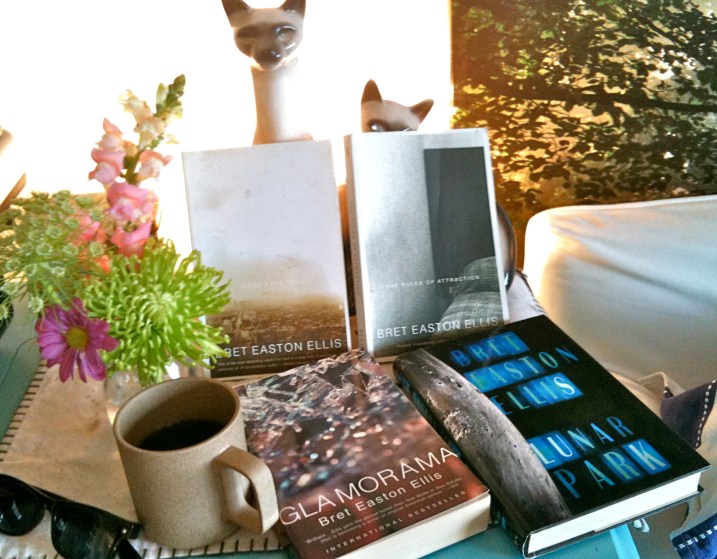
    In high school I bought American Psycho from Barnes & Noble and read it in a few weeks. I knew it was full of awful, horrible stuff that I would never be able to forget but I did it anyways. I was fascinated, revolted; I laughed out loud. I became that one guy that burst everyone’s bubble by telling them that the movie sucked or at least totally missed the point of the book (whatever point there might have been) and that it also left out every one of the funniest scenes, and, oh that the ending was total bullshit. People would ask me if I “liked” the book and I would evasively respond: “I don’t know if it’s a book one can actually like…” or “I don’t know if like is the right word…”—and just generally avoid making any kind of decision about the book, or its author, that prince of darkness Bret Easton Ellis.

    But Bret Easton Ellis intrigued me. Later, when the film Rules of Attraction came out I saw it in the theater by myself and purchased the DVD. It was a much better film than AP, and that was satisfying to me in some way. I didn’t read the book, nor was I moved to seek out Less Than Zero, although at some point I found Glamorama at a used store and bought it for the heck of it, but I don’t think I ever even tried to read it. I was interested in BEE but only from afar. He had definitely scarred me with AP. It was a singular experience at the time and (to this day has maybe been matched only by Jerzy Kosinski with my combined readings of Steps and The Painted Bird). I wasn’t really looking to be haunted in that way any time soon.

    I can still remember where I was when I heard about Lunar Park. I read about it at The New York Times, on the family computer at a friend’s parents’ house in Rutland Vermont. I saw that Ellis had a new book, skimmed the article, and saw mention of “meta” elements, the use of a character named “Bret Ellis” who was decidedly not intended to be the actual author of the book, but rather a sort of parallel dimension version of BEE who had settled down in the suburbs and had kids. This was all interesting to me and I made the mental note, “Read Lunar Park.” That was in August 2005.

    Fast forward to May 2010. In the five years since Lunar Park came out everything about my life has changed. I am living in Los Angeles pursuing a career in screenwriting. I have been married for a year and I have an apartment and two cats. And it is in this apartment that I come across a VICE interview with the man himself, on the eve of the publication of his new novel Imperial Bedrooms. I find myself reading the interview and it dawns on me that I have never read or heard this man speak, I’ve barely seen photographs of him, and that basically everything I think I know about him has been pure conjecture derived from conversations over the years.

    My idea of Bret Ellis as this detached, cynical, deviant creature is immediately thrown out the window by seeing pictures of him wearing a hooded sweatshirt and sitting at a desk. In some of the photos green palm trees can be seen behind him and it becomes clear very quickly in the interview that he now lives in Los Angeles as well. I end up reading the entire article and thinking that Ellis is just a guy like anyone else, not especially pretentious or malevolent, as he had been accused of being by people I had spoken with at times. And what’s more he made reference to “the Stephen King part” of Lunar Park.

    My mind exploded.

    What Stephen King part? I remembered and reinstated my mental note: “Read Lunar Park.”

    And a few weeks later, as though on cue a beautiful hardback first edition copy of LP appeared at the used book stand at my neighborhood farmer’s market. I bought it on a Saturday morning and opened as I was cooking lunch, expecting to get a taste and maybe read a page or two while the food cooked. I ended up sitting on the couch for the entire day reading. That night I couldn’t wait for my wife to fall asleep so I could sit up late and maybe finish, and I started to do just that until I became so frightened by the story that I literally had to put it away until it was light outside. I had a little trouble sleeping that night but ultimately it was okay, and the next day I finished the book. Immediately I was on the phone telling friends to read it. I made several of my local friends borrow my copy and one-by-one everyone came back to me with the same positive report, and regardless of their previous experience or lack-there-of with Ellis’s writing, everyone who read it adored it.

    My admiration extended past just the book or my experience reading it. It reconciled the past and my memories and suddenly I found myself saying “I like Bret Easton Ellis” or even going so far as to thinking of myself as a fan of his. I slowly started keeping up with his online presence, (going so far as even joining Twitter just to follow him) and I find the experience genuinely rewarding. Don’t get me wrong: he’s obviously a weird guy sometimes (anyone who could write the habitrail scene in AP would have to be I guess) and I don’t always agree with his randomly asserted opinions about books and movies (I disagree in particular with him about music: our tastes are just simply different). But overall, I think he has a valid and useful perspective on culture and entertainment. Perhaps some of the detractors still see him as the austere, decadent, nihilistic provocateur that I feared and resented in high school, but I have an impossible time jiving that notion with the man who tweeted recently that he had been talked into getting really stoned and going to see The Lorax.

    And I guess this all ties in with his recent series of tweets that he is considering a pseudosequel to American Psycho. Suddenly, this proposition seemed so appealing. It’s been twelve years since I read AP, and in that time I don’t think I’ve ever opened it again, and now suddenly I find myself wanting more, hoping that Ellis decides to go through with it.

    So yesterday in excited anticipation I went down to the farmer’s market and this time the used book guy had two beautiful paperback copies of Rules of Attraction and Less Than Zero. I bought them both. Even if Ellis does convince himself to write the Los Angeles Patrick Bateman story, it will be years before it will be published and in my hands, so I guess I need to relax and catch up on everything I missed out on so far.

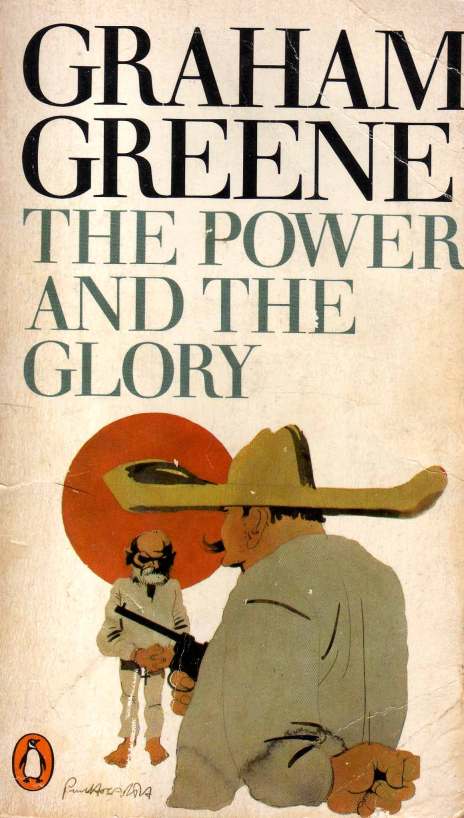
    “The Priest Is Us”: The Power and The Glory, Graham Greene’s Adventure of Religion and Faith

    The Gospels are powerful not simply because Christ performed miracles and taught kindness, strength, and humility. Humanity has long attributed to certain individuals impossible deeds, tremendous suffering, and inordinate wisdom. We survey the collective memory and search for meaning in the lives of renowned teachers so that they might serve as an example during our own unpredictable, harrowing journey. What separates the story of Jesus from the stories of other merely great people in history is the idea that God manifested itself to humans as a human: wracked with doubt, vulnerable to temptation, victim of unimaginable pain.  Although he taught that love is the first commandment, Christ was flailed, tortured, left to die on a cross between two thieves, all ostensibly for no benefit but our own.  Wasn’t it Borges who said that every story is either the Odyssey or the Crucifixion?  The stories we tell each other, in their reflection, become the same nothing cycle of words, told again and again, a record of our inadequacy and cowardice.

    Graham Greene, in his short and powerful novel The Power and the Glory, considers the life and death of Jesus as he narrates the life of a man brought low by pride and circumstances. The last priest someplace in southwestern Mexico flees from the authorities.  His hunters seek to free the peasant farmers who populate the land from exploitation and superstition with their own imperfect liberation theologies: the abolition of superstition and private property; the self-sufficiency that follows honest labor.  The men in red shirts ride horses and believe in the impending, always near, revolution.  On the back of a mule, the father sneaks from town to town, trying to fulfill his duty, but without understanding the significance of the words that tumble clumsily from his mouth in Latin. He performs sacred rites in exchange for sanctuary until even a hiding spot is denied to him. The police have started to execute men and boys in villages who they believe have colluded to shelter this wayward man of God.

    As the priest travels, he finds himself stripped not only of the vestments of his profession: his chalice, his incense, his robes, and his bible, but his own air of invincibility, privilege and comfort. Exposed, fearful, living in a state of mortal sin and unable to confess, this fallen man of God, like Christ himself, is destroyed.  The priest is, by his own admission, a bad one. He drinks heavily and thinks too much of his own comfort. Led to his profession not so much by attention to the divine will but by a desire for status and privilege, during his exile he recalls fondly dinners lavish dinners with wealthy members of his assembly and the gifts they gave him. While he may have seen that the most of his flock made a meager living on small farms after taxes and fees paid to local bosses, he never stopped to consider the meaning of his own observations, busying himself instead with ambitions for his own greater glory. He is, for the first half of the book, greedy, proud, and self-concerned.

    But, as he eludes the authorities and traverses the country, he becomes, in Greene’s capable hands, a symbol of redemption and an affirmation of a full but unrealized life.  Words that lacked meaning help to ameliorate the strongest pain he has ever felt. He is jailed, extorted, and rejected by the people who love him the most, but in humiliation finds real faith.  Performing the sacred rites of his profession, he confronts the banality of evil and comes to finally realize the true power of the promise he brought to those who came to him:

    He had an immense self-importance; he was unable to picture a world in which he was only a typical part — a world of treachery, violence, and lust in which his shame was altogether insignificant. How often the priest had heard the same confession — Man was so limited he hadn’t even the ingenuity to invent a new vice: the animals knew as much. It was for this world that Christ had did; the more evil you saw and heard about you, the greater glory lay around the death. It was too easy to die for what was good or beautiful, for home or children or a civilization — it needed a God to die for the half-hearted and the corrupt.

    This is a book about religion and faith, but The Power and the Glory doesn’t require its reader to have an inclination towards either.  It is an adventure story, recounted in bold, confident sentences, about a normal man who fears that incorrect choices will cause him to suffer. This fear is real and it manifests itself in the priest’s moral and ethical dilemmas.  We are asked to ponder those things that lead from sadness to strength.  The priest is us: we see ourselves completely in him and give him our sympathy.

    David Markson on Harold Bloom

    From David Markson’s The Last Novel:

    Where the synecdoche of tessera made a totality, however illusive, the metonymy of kenosis breaks this up into discontinuous fragments.

    Somewhere declareth Harold Bloom.

    It may be essential to Harold Bloom that his audience not know quite what he is talking about.

    Commenteth Alfred Kazin — pointing out other immortal phrasings altogether.

    Book Shelves #12, 3.18.2012

    20120318-142208.jpg

    Book shelves series #12, twelfth Sunday of 2012.

    The shelf holds literature in translation: Witold Gombrowicz, Heinrich Böll, W.G. Sebald, Julio Cortázar, and Roberto Bolaño. There was a geode bookend here until Thursday, when I reorganized (finally giving the Gombrowicz a home and restoring the finished copy of Between Parentheses to its brothers). No, I never finished Hopscotch, nor much of the Böll (although I did read Irish JournalThe Train Was on Time, and The Clown); I haven’t read Ferdydurke yet either.