“The Monstropolous Beast Had Left His Bed” — Zora Neale Hurston’s Hurricane

In Chapter 18 of her novel Their Eyes Were Watching God, Zora Neale Hurston imagines a hurricane descending on the Everglades as a cosmic monster. Her description comes in part from accounts of the 1928 Great Lake Okeechobee Hurricane—

Ten feet higher and far as they could see the muttering wall advanced before the braced-up waters like a road crusher on a cosmic scale. The monstropolous beast had left his bed. Two hundred miles an hour wind had loosed his chains. He seized hold of his dikes and ran forward until he met the quarters; uprooted them like grass and rushed on after his supposed-to- be conquerors, rolling the dikes, rolling the houses, rolling the people in the houses along with other timbers. The sea was walking the earth with a heavy heel.

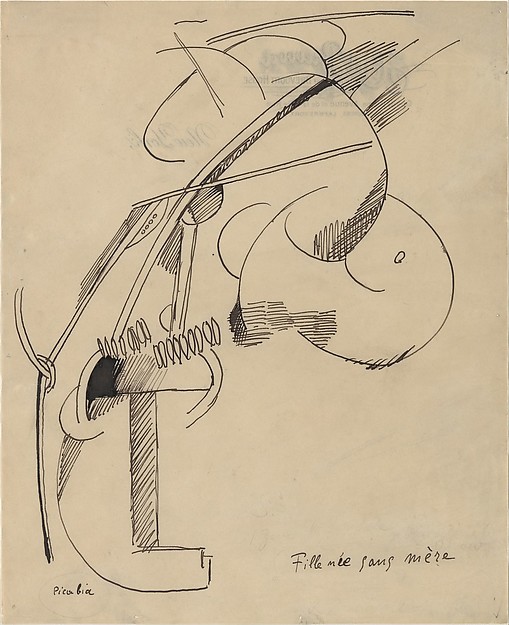
Girl Born without a Mother — Francis Picabia

dp242072

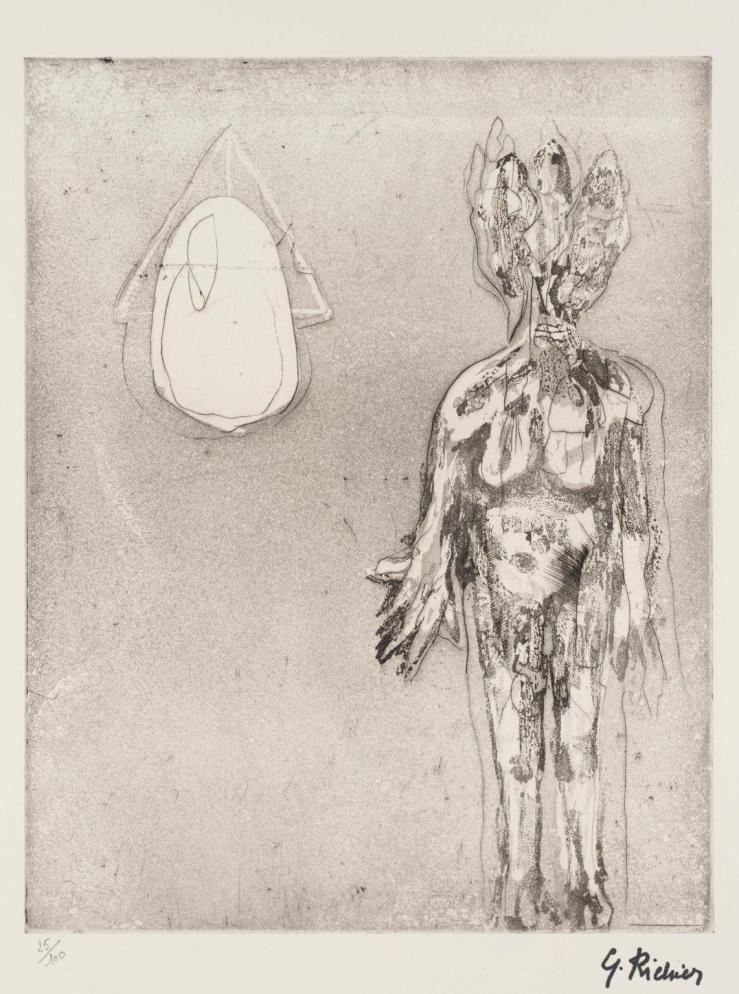
The Hydra — Germaine Richier

The Hydra 1954-5, published 1961 by Germaine Richier 1902-1959

A riff on the Westworld pilot, “The Original”

img_0409

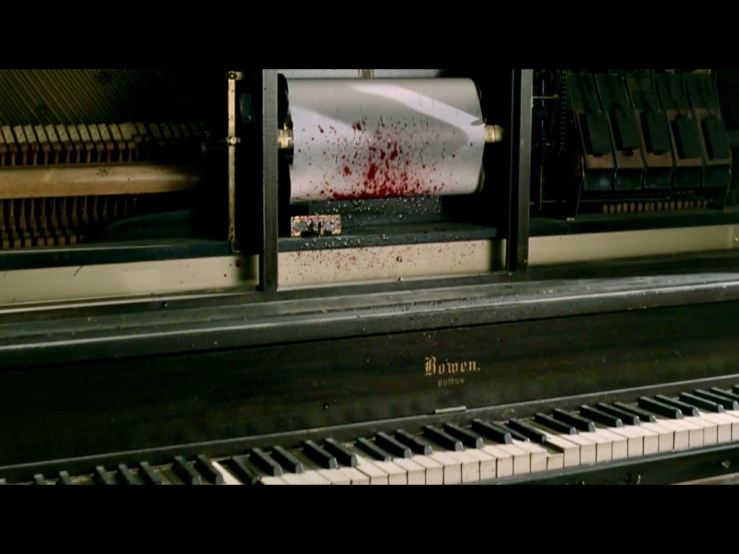
Watching HBO’s new show Westworld, I couldn’t help but think of the late American novelist William Gaddis’s obsession for player-pianos. The narrator of Gaddis’s final novel Agapē Agape howls that the player piano “was the plague spreading across America…its punched paper roll at the heart of the whole thing, of the frenzy of invention and mechanization and democracy and how to have art without the artist and automation, cybernetics.” Here was the idea of art, the artifice of art. Spiritless spirit. Automation.

Director Jonathan Nolan threads these automaton player pianos throughout “The Original,” Westworld’s ironically-titled pilot episodeThe motif is a perhaps-unsubtle reminder of Westworld’s core conflict—automation vs. spirit, real vs. copy, authentic vs. simulation. Human vs. machine.

You know the story of course: whether from Westworld’s source material (Michael Crichton’s 1973 film of the same name), or from Ridley Scott’s Blade Runner or Philip K. Dick in general, or The Matrix, or Battlestar Galactica (original or reboot), or Pinocchio, or AI, or Pygmalion, or Baudrillard, or just generally being alive in the 21st century….or…or…or…you know the story of course. (Oh, and, uh westerns too, natch).

Knowing the story enriches this particular reboot (or reimagining or re-whatever) of Westworld’s pregnant possibilities, and “The Original” is at its finest when tweaking its tropes.

For example, James Marsden’s fresh-faced Teddy Flood arrives to Westworld a noob, a surrogate for the audience—just another “Newcomer,” a human tourist among the amusement park’s android “Hosts” looking for fun and trouble, right? An early reveal shows that he’s actually a Host too though (gadzooks!), an automaton pining after fresh-faced series lead Evan Rachel Wood’s Dolores Abernathy. (I suppose having a fresh face is easy when the lab operatives can grow you a new one each night).

img_0406

The bait-and-switch gambit with Flood plays out in a riveting scene with ringer Ed Harris, the Man in Black, hardly a “Newcomer” and a seemingly unwelcome guest. He reveals that he’s been coming to Westworld for “over thirty years,” and we later learn that the theme park’s automatons haven’t had major glitches in (You guessed it!thirty years. “We’re overdue,” says Westworld’s operations manager, Theresa Cullen (played by Sidse Babett Knudsen–and by the way, that quote’s from my bad memory so don’t quote me on it). Foreshadowing! With the Man in Black creepin’ ’round and takin’ automaton scalps Blood Meridian style, there’s sure to be trouble!

But wait—Westworld can make its own trouble for its own damn self without mysterious outside agents, thank you very much. Dr. Ford (played by Anthony Hopkins, another ringer, and please don’t make me comment on the symbolically-overdetermined character name) has updated the “Hosts” with a new operating system, which includes a new program for “reveries.” These reveries have the replicants all fucked up. In short, the automatons, the Hosts, start going off-script (literally)—asking philosophical questions about the nature of their reality (and pouring milk over corpses).

Ford doesn’t care though—as he explains to Jeffrey Wright’s Bernard Lowe (Westworld’s head programmer), humanity, what with curing all its diseases, etc., can’t progress anymore — “This is as good as we’ll get.” So, like, why not trigger the Singularity? To return to our player piano motif, if only momentarily, Ford would like to inspirit art into the artificial. He wants, or at least moments of “The Original” suggest he wants, to teach the Hosts to play.

But the security forces behind the scenes decide it’s probably not good for their guests to be subjected to unknown quirks. They remand some of these suspect automatons to a creepy Bluebeard’s closet full of other decomissioned replicants that surely won’t be any kind of problem down the line in Westworld, right?

As my quick overview suggests, Westworld brims with potential. Indeed, “The Original,” despite a tight plot, often feels overpacked. There’s not just a season’s worth of plot lines lurking in here, but a whole series’ worth. As a result, “The Original” leaves many interesting characters on the margins for now (Thandie Newton’s brothel madam in particular).  I suppose keeping key players on the sidelines makes sense, especially as the pilot is exposition-heavy as it is (a fault with any number of TV pilots, from Game of Thrones to The Sopranos. Not every show can emerge autochthonous and fully-realized out of the gate like True Detective).

And yet even stuffed with emerging plots, Westworld finds time for a cinematic shooting-slaughter sequence that I suppose many viewers found thrilling but I found admittedly cold. With zero stakes at this early point, the scene felt like any other American TV show where meaningless bodies are gunned to pieces. Maybe that was the point though?

In any case, the punchline to the shooting sequence—one of the Newcomers (a prototypical Ugly American doof) Saves the Day! right before the baddie-Host can give his Big Speech—the punchline didn’t make me laugh so much as grimace. “The Original” is full of tonal inconsistencies and missed opportunities for sharp satire and dark humor. I hope Westworld loosens up a bit, gets a bit weirder, bites more from J.G. Ballard’s playbook. The pilot seems to go for profundity over weirdness, as if the showmakers must telegraph at all times: This is a Dark Serious Show. (Did I mention that director and creator Jonathan Nolan is Christopher Nolan’s brother?).

If the arcade shooter sequence is a dud (or, rather, the simulacrum of a real shootout, an authentic inauthenticity), the final scenes of “The Original” make up for it. In an echo of Blade Runner’s final sequence, Hopkins’s Ford squares off with his creation, Dolores’s father Peter. Peter has found a photograph depicting a girl in Times Square, and the cognitive dissonance of this unreality has him goin’ straight-glitch, quotin’ Shakespeare, and generally blowin’ android gaskets. We find out he’s been rebooted a number of times, and was once the leader of a cannibal cult in a Westworld scenario called “The Dinner Party.” (Har har! That pun works on at least two levels). Peter perhaps has realized he’s but a player in play—but not a true player, just a copy of a player, a simulacrum.

img_0407

Westworld is acutely aware of its own layers of simulacra. The show constantly calls attention to itself as a show, as a play. Early in “The Original,” the camera pulls up from travelers on a train to reveal a god’s-eye diorama of the terrain—a moving diorama that recalls the intro to Game of Thrones (the show Westworld would replace in your hearts and on your screens). The Westworld is surveyed by producers and showrunners making adjustments—just like Westworld. We have here a metacommentary on television, a self-consciously postmodern (and thus, post-postmodern) gesture. Not just automation and artifice, but artists! Not just player pianos, but players!

The diorama shot also reveals the Big Dream embedded in Westworld’s Big Nightmare. We have here that mythic American promise: The Frontier, the Territory that Huck Finn swears to light out to in order to duck the constraints of those who would “sivilize” him. “I take SPACE to be the central fact to man born in America,” declared Charles Olson in the beginning of Call Me Ishmael, his study of Melville’s whale. “I spell it large because it comes large here. Large, and without mercy.” The Newcomers, the tourists, flock to Westworld because it is a safe and constrained territory, a SPACE that is sivilized, yet masked to appear otherwise, garbed in the myth of danger, the empty promises of our National Pastimes, Sex & Violence. Dr. Ford plants reveries—dreams—into his automatons, disrupting civilization’s veneer of order. This is the new Frontier that Westworld promises to explore.
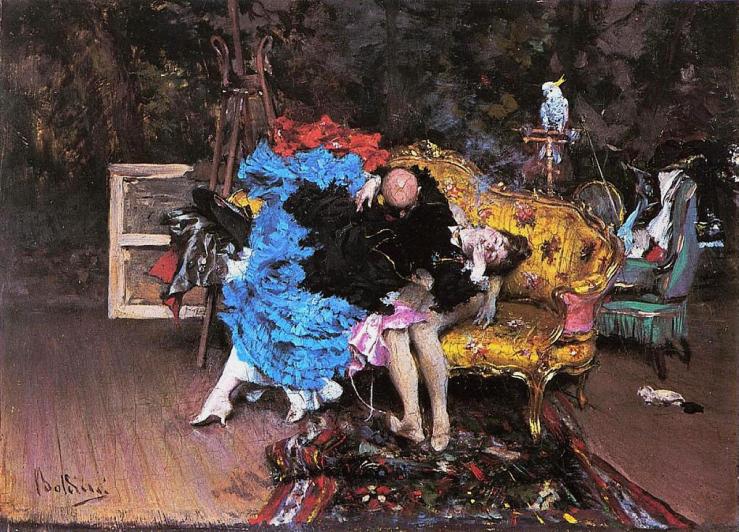
The Model and the Mannequin — Giovanni Boldini

the-model-and-the-mannequin-1873

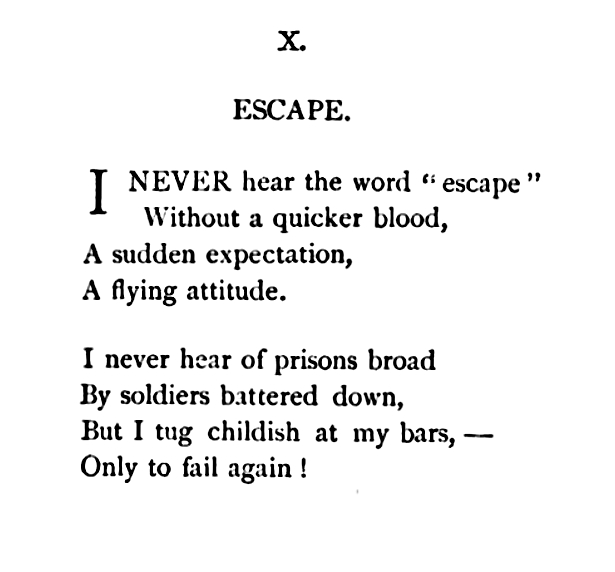
Fail again (Emily Dickinson)

escape


Shack — Niccolo Cannicci

capanno

Sunday Comics

img_3714

img_3715img_3716

Three pages from Will Eisner’s “Izzy the Cockroach and the Meaning of Life,” part of A Life Force, collected in Eisner’s The Contract with God Trilogy, Norton, 2006.

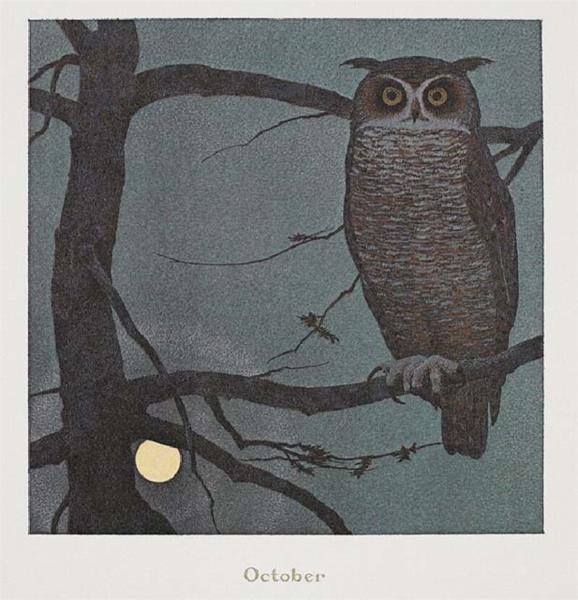
October — Alex Colville

october-1979large

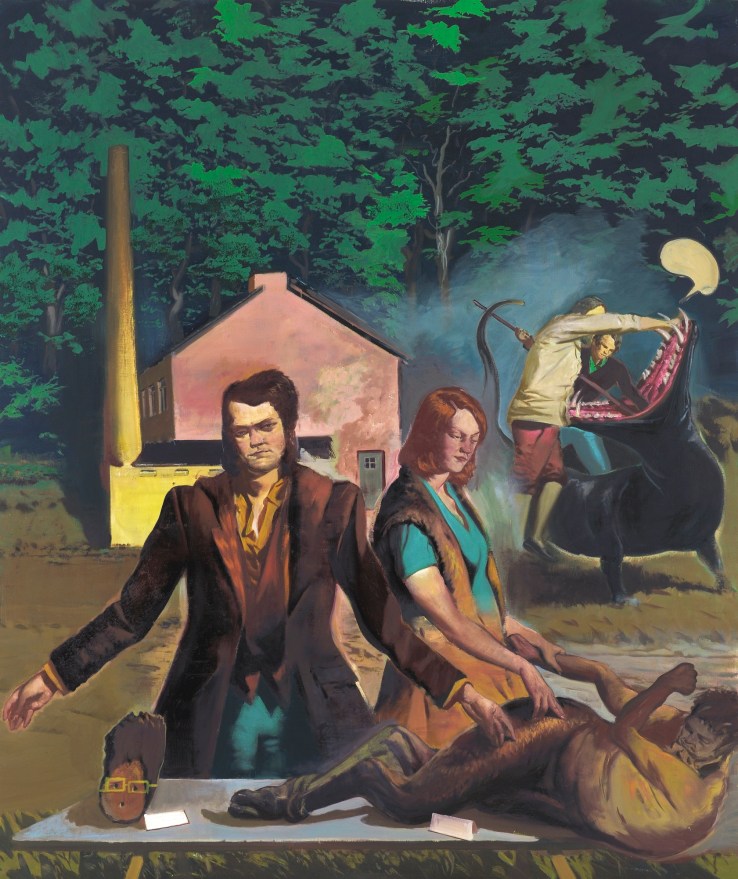
The Offer — Neo Rauch

109l14024_7pf6n

Still Life — Gregorio Sciltian

gregoriosciltian28129

“October” — Tom Clark

october

Gravity’s Rainbow, annotations and illustrations for pages 257-58

The War has been reconfiguring time and space into its own image 1. The track runs in different networks now. What appears to be destruction is really the shaping of railroad spaces to other purposes, intentions he can only, riding through it for the first time, begin to feel the leading edges of… .2

He checks in to the Hotel Nimbus 3, in an obscure street in the Niederdorf or cabaret section of Zürich. The room’s in an attic, and is reached by ladder. There’s also a ladder outside the window, so he reckons it’ll be O.K. 4 When night comes down he goes out looking for the local Waxwing rep, finds him farther up the Limmatquai, under a bridge, in rooms full of Swiss watches, clocks and altimeters 5. He’s a Russian named Semyavin. Outside boats hoot on the river and the lake. Somebody upstairs is practicing on a piano: stumbling, sweet lieder. Semyavin pours gentian brandy 6 into cups of tea he’s just brewed. “First thing you have to understand is the way everything here is specialized. If it’s watches, you go to one café. If it’s women, you go to another. Furs are subdivided into Sable, Ermine, Mink, and Others. Same with dope: Stimulants, Depressants, Psychomimetics… . What is it you’re after?”

“Uh, information?” Gee, this stuff tastes like Moxie… .

“Oh. Another one.” Giving Slothrop a sour look. “Life was simple before the first war. You wouldn’t remember. Drugs, sex, luxury items. Currency in those days was no more than a sideline, and the term ‘industrial espionage’ was unknown. But I’ve seen it change—oh, how it’s changed. The German inflation, that should’ve been my clue right there, zeros 7 strung end to end from here to Berlin. I would have stern talks with myself. ‘Semyavin, it’s only a temporary lapse away from reality 8. A small aberration, nothing to worry about. Act as you always have—strength of character, good mental health. Courage, Semyavin! Soon all will be back to normal.’ But do you know what?”

“Let me guess.”

A tragic sigh. “Information. What’s wrong with dope and women? 9 Is it any wonder the world’s gone insane, with information come to be the only real medium of exchange?”

“I thought it was cigarettes.”

“You dream.” He brings out a list of Zürich cafés and gathering spots. Under Espionage, Industrial, Slothrop finds three. Ultra, Lichtspiel, and Sträggeli 10. They are on both banks of the Limmat, and widely spaced.

“Footwork,” folding the list in an oversize zoot-suit pocket 11.

“It’ll get easier. Someday it’ll all be done by machine. Information machines. You are the wave of the future.” 12

If there is a central thread through these Gravity’s Rainbow annotations—and I’m not claiming that there is one—but if there is a central thread I’ve been trying to tease out, it’s that GR, despite being a complex and confounding conundrum, repeatedly clarifies its thesis. The narrator spells out another summary of the tale, this time in a dozen words.

The “he” here is Our Main Man Tyrone Slothrop en route to Zurich. It’s the spring of 1945, and we’re at the end of the second part of Gravity’s Rainbow, “Un Perm ‘au Casino Hermann Goering,” and riding into part three, “In the Zone.” Here, the war—excuse me, The War—is an entropy pushing out into “other purposes.”

Weisenburger notes in A Gravity’s Rainbow Companion that “The Nimbus appears to be a fictional hotel.”

You, dear reader, of course know that a “nimbus” is a cloud. I’ve always been partial to Magritte’s clouds.

black-magic-1945
Black Magic, Rene Magritte, 1945

“Nimbus” is also a term for the halo or aureola that often surrounds sacred or supernatural figures in artistic representation, like the rainbow that shimmers around Albion in Blake’s Albion Rose.

Albion Rose, William Blake, 1793-1796

Later, in his hot air balloon escape from Marvy’s Mothers, Slothrop and his pirate pilot Schnorp will try to hide in a cloud.

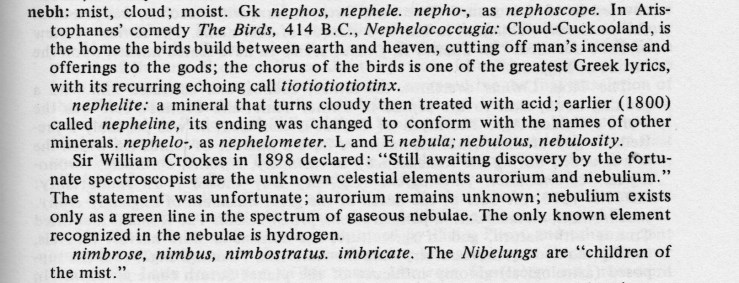
From Joseph T. Shipley’s The Origin of English Words: A Discursive Dictionary of Indo-European Roots (1984). Check his last notation (the Nibelungen are a motif in Gravity’s Rainbow):

img_3681

As GR progresses, Our Free Agent Slothrop gets better and better at spotting means of escape (he’ll note the keys left in an unattended car later in Peenemünde, for example). A ladder up, a ladder down. Rise, ascend, escape. Repeat.

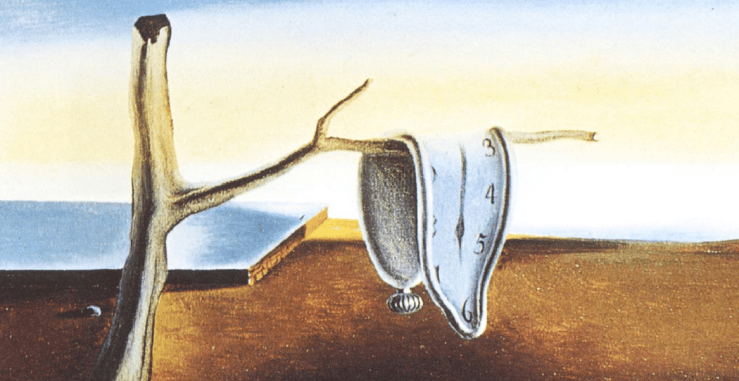
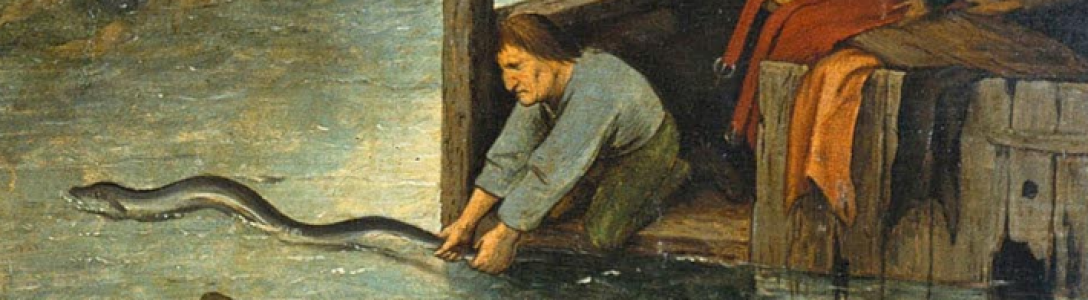
All devices for measuring, obviously—ones and zeroes and all that. Slothrop is a disruptive force to traditional means of measurement, natch.

screenshot-2016-09-30-at-5-56-54-pm
The Persistence of Memory (detail), Salvador Dali, 1931

6 “French and Swiss liqueur distilled from the roots of gentian plants; also called Enzian” (Weisenburger, A Gravity’s Rainbow Companion).

Cf. Oberst Enzian, introduced on page 100—Enzian meets Slothrop a few dozen pages later and pushes Marvy from a train.

7 The inflation, the zeros…Pynchon intricately repeats his motifs, ever-threading them throughout the novel.

8 And who among us has not assured themselves that “it’s only a temporary lapse away from reality”? Semyavin’s complaint seems to be the default position of the 20th century. It’s downright quaint or naive in the 21st.

Reality is not a stable story, a progress, a culmination, but rather a entropic mess, a shuffling chaos, one big etc.

9 Nothing.

10 Weisenburger gives “Ultra, Lichtspiel, and Sträggeli” as nightclubs, and offers that Sträggeli means “‘specter,’ a ‘play of light’ (or Lichtspiel); in the same context, ‘Ultra’ refers to the very high frequency light waves in any spectrum of illumination.” Synonyms.

11 The zoot suit is another motif in GR (another kind of uniform that Slothrop dons—a non-uniform? a uniform of resistance?), and Pynchon’s evocation of the Los Angeles Zoot Suit Riots of 1943 (roughly 10 pages earlier) is a superb little number of storytelling.

M.2011.94a-b
Zoot Suit (1940-1942), Los Angeles County Museum of Art

The zoot suit received an unnecessary revival in the 1990s. I was then an impressionable lad in my very-late teens/early twenties, yet still had the sense to find this attire revolting. It’s possible now to see that the zoot suit revival gelled with the zeitgeist’s preference for baggy garb—hip-hop, mall goth, and skate culture clothes in particular.

12 Clearly prescient lines—both in the spring of 1945 and in 1973 when GR was published. Pynchon explores the idea of these information ideas in his 2009 novel Inherent Vice.

I love the metaphorical evocation of Slothrop as “the wave of the future” — a cliche that the narrative literalizes.

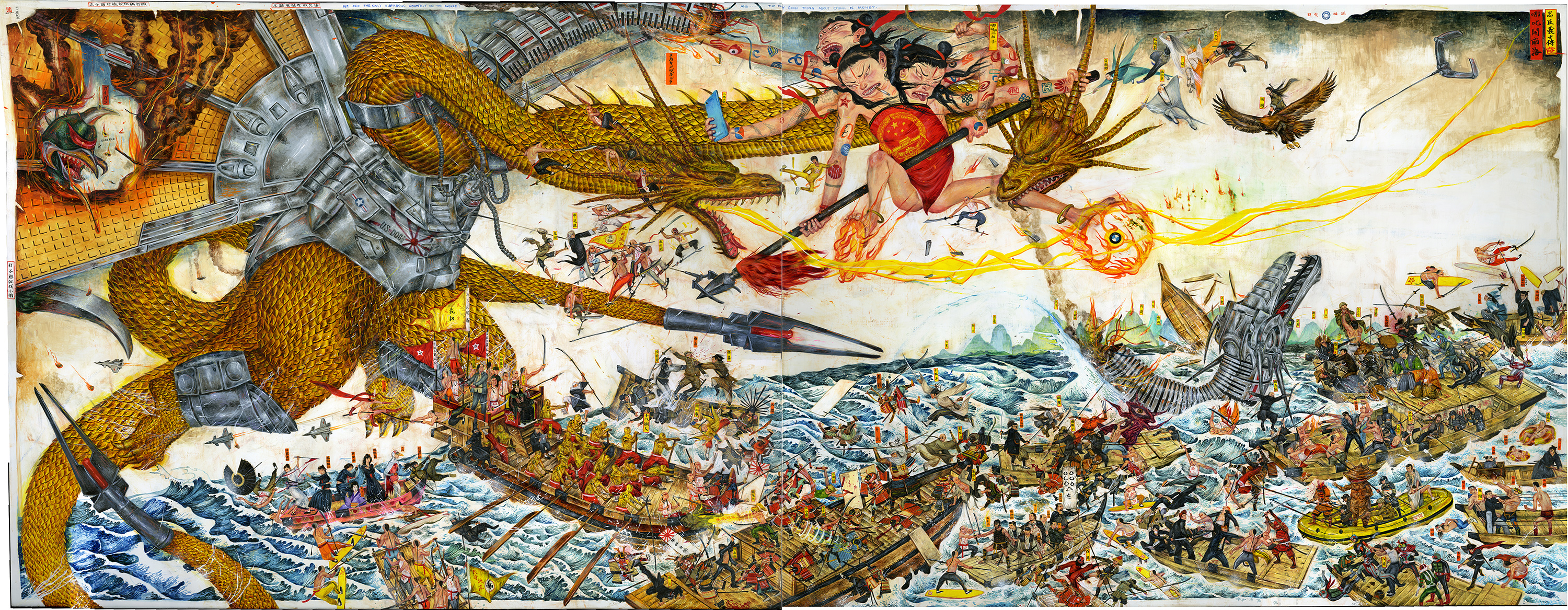
The Loyal Retainers (detail) — Mu Pan

screenshot-2016-09-30-at-5-58-58-pm

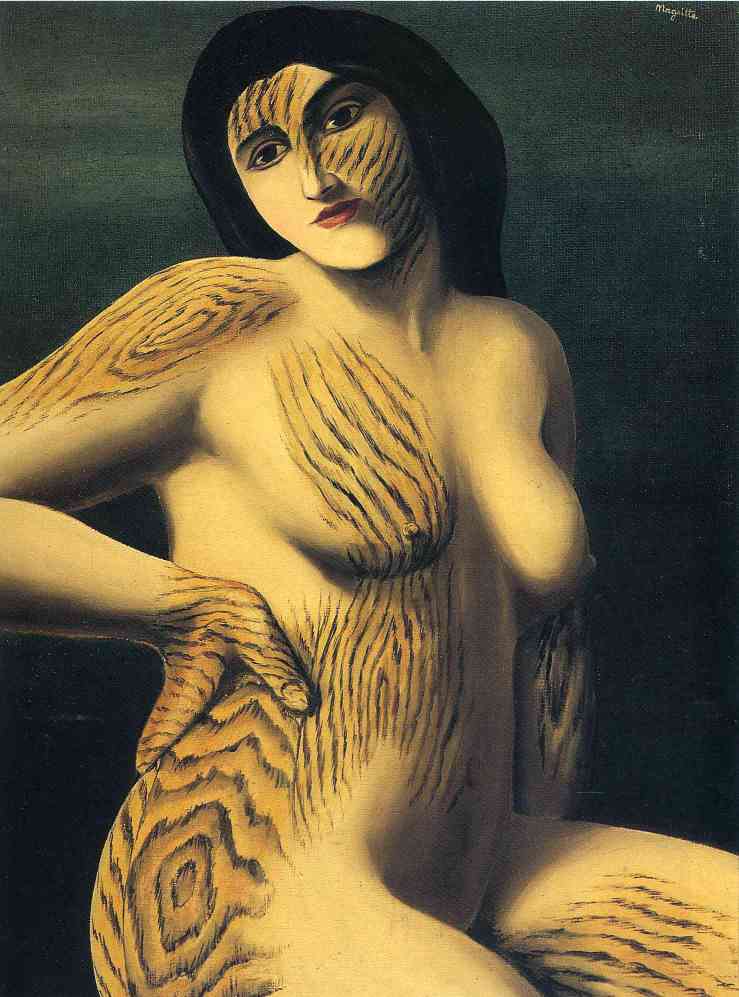
Discovery — Rene Magritte

31b8c9430d48dfe310fdde58825afda3

Grainy black and white video of Alex Chilton & company making Like Flies on Sherbert