Let’s get the obvious out of the way first: The Pisstown Chaos is an improbably perfect and beautiful name for a novel. If you don’t like the title, The Pisstown Chaos isn’t for you. It is a foul, abject, hilarious, zany vaudeville act, a satire of post-apocalyptic literature, an extended riff on American hucksterism. It’s very funny and will make most readers queasy.
The author of The Pisstown Chaos is David Ohle. The novel was published in 2008; it is the second of three “sequels” to Ohle’s 1972 cult classic Motorman. You do not have to have read Motorman or The Age of Sinatra (2004) to “understand” The Pisstown Chaos. (But you’ll probably want to dig into those if you dig The Pisstown Chaos’s uh pungent urinous ammonia bouquet)
Moldenke, hero of Motorman, is a bit player in The Pisstown Chaos, a walk on, a song-and-dance man with no songs or dances. A storyteller. He’s a zombie, too — a “stinker” in the novel’s parlance — adorned in “black rags and a wide-brimmed white hat,” sporting “an inch-long tube of flesh protruding from just below his ear [which] had the general appearance and shape of an infant’s finger, but lacked a nail. In the end of the tube, a small hole leaked a clear, gelatinous fluid.”
Moldenke, we are to infer, is one of the “Victims of the Pisstown parasite…thought of as dead, but not enough to bury. Gray haggard, poorly dressed, they lay in gutters, sat rigidly on public benches, floated along canals and drank from rain-filled gutters.” He may or may not be centuries old.
It’s not clear how far into the future we are in the Ohleverse (it doesn’t really matter). After “the Great Forgetting,” and multiple and ongoing Chaoses, the world has regressed, or progressed, or really mutated, into a dusty, wet, gross, nasty post-infrastructure reality. You might read The Pisstown Chaos as a slapstick zombie Western.
The Reverend Hooker presides over this wonderfully abject world. Hooker’s loose theocratic federation revolves elliptically around a “shifting” scheme. Nothing is permanent, everything is moving, plates spinning on poles. Folks receive their shifting papers and must relocate from, say, a cozy cottage to a prison camp. Or they might end up paired with a new concubine or some such.
That’s the fate of Mildred Balls, née Mildred Vink, who meets Jacob Balls on the road to Witchy Toe. The pair meet cute and get on famously. (And who wouldn’t; after all, suave Jacob Balls was the inventor of the “finely-grained, yellow-tinged powder” known as “Jake” — a kind of post-apocalyptic Bud Light.) Optimistic Jacob is optimistically optimistic of all the shifting, attesting his belief that “in any culture, when boredom and apathy take hold, the currency is debased and the decline is irreversible…What could be more of a tonic than a random redistribution of the populace?” Mildred is less convinced: “The whole scheme is idiotic.”
The Pisstown Chaos focuses on the Balls clan — primarily an older Mildred and her young adult grandkids, Roe and Ophelia. There are stinkers and imps, shifting folk consuming urpflanz, willy, and Jake on their way via Q-ped to Indian Apple or Bum Bay. Reverend Hooker is always lurking in the margins, too, before taking over the narrative’s final pages in a mock apotheosis that brought a stupid smile to my face.
Ohle’s narrative isn’t exactly a picaresque, but it runs on the same energy. Each chapter opens with a series of frank excerpts from the Pisstown rag, the City Moon. Here’s one update of news you need:
A fondness for pickled lips has led to the arrest of a Kootie Fiyo, a stinker known to be a trader in tooth gold and a vicious biter. Fiyo was just leaving the impeteria in South Pisstown when two Guards entered. The proprietor said, “That stink can eat more imp lips than I can heap in front of him. “
The City Moon is not just a source for the goods on a stinker’s glimpse of pickled imps’ lips, but also a gloss on the undead (or un-undead’s) physiology:
What then is a final-stage stinker’s life like? It has been described by scientists as showing a poverty of sensation and a low body temperature. In their nostrils is the persistent odor of urpmilk. The membrane which lines their mouth is extremely tough and is covered with thick scales. They like to touch fur and drink their own urine. Because they have been known to go without food for as long as eighteen years, we can assume that their sense of time passing is also very different from our own.
The Stinker Problem is likely the signature event of whatever century we are in. There’s probably an icky metaphor or allegory somewhere in there, but I find myself disinterested in that end of the novel. But still: Consider Mildred–who wants to find a “cure” for stinkerism–in charge of a crew of stinkers who, after their daily labors, commit “to walking in circles and searching the ground.” But these are not geologists peering into the navel of the world: “‘No, Miss,’ Spanish Johnny said, ‘We like to get dizzy and faint. It’s the way we have fun.'” We’ve all been there.
Mildred’s granddaughter Ophelia commands much of the narrative, shifting about her stations in life. Her domestic comedy with servants Red and Peters is a class-conscious comic delight. Our Miss Madame goes through a series of abject slapstick routines with the Help (including an enema gag that uh, gag me yeah). Here’s a foul episode in the life of Ophelia Balls:
She walked carefully from slippery stone to slippery stone until she got to the potting shed, then blew out the candle. She tried the door and found it locked. Wiping the dirty door-glass, she looked in at Peters, lying on the peat pile with his pants pulled down, fanning his rear with a handful of straw. Red, sitting beside him in Mildred Balls’s underwear, combed Peters’s coarse hair with a tortoise-shell comb. Peters’s cheeks were flushed, his eyes half-closed. When Ophelia entered, the scene seemed all the more lurid for the dim lantern and its flicker.
“I hope you don’t take any offense,” Red said, “but I’ve just mated with Peters here.”
Peters sat up. “I was quietly potting geraniums when that idiot stepped out of a dark corner and made advances, clumsy, lewd advances, with his big willy sticking out. I tried, but I couldn’t resist him.”
“Is that true, Red, that he put up resistance?”
“He lies like a rug. He clearly indicated he wanted me to sex him good and sex him hard.”
Ophelia saw the pointlessness of going any further with the inquiry. “All is forgiven. Let’s move past this.”
“I’ll serve the swan,” Red said.
If I’ll serve the swan isn’t your kinda punchline, The Pisstown Chaos ain’t your cup of Jake. It’s a rich, smelly, gross novel, fun, funny, fueled with 19th-century inventions viewed through piss-colored glasses, aimed at the apocalyptic future. It’s smoked imp-meat served with urpsmoke, a vaudeville buzz against the zombies in the gutter. When I was a kid we held our breath when we passed cemeteries. There are other ceremonies, other totems, but warding off the dead remains a concern.
I have neglected the Balls scion, young Roe, who eventually finds himself attending the Reverend Hooker. Late in the novel, Roe Balls prepares an enema for the theocrat; Hooker then delivers a sermon:
“I’ll warm up the bathroom right away, sir, and get the enema bag ready.”
Once Roe had firmly inserted the hose, the Reverend sat on the pot and closed his eyes. “There, that’s it, Roe. It’s in well enough.”
“Shall I leave you alone now, sir?”
“No. Don’t leave. Let me sermonize a little. I’ll tell you a story, a story with a lesson. In the days when all men were good, they had miraculous power. Lions, mountains, whales, jellyfish, hagfish, birds, rocks, clouds, seas, moved quietly from place to place, just as men ordered them at their whim and fancy. But the human race at last lost its miraculous powers through the laziness of a single man. He was a woodman in the Fertile Crescent. One morning he went into the forest to cut firewood for his master’s hearth. He sawed and split all day, until he had a considerable stack of hickory and oak. Then he stood before the pile and said, ‘Now, march off home!’ The great bundle of wood at once got up and began to walk, and the woodman tramped on behind it. But he was a very lazy man. Now, why shouldn’t I ride instead of galloping along this dusty road, he said to himself, and jumped up on the bundle of wood as it was walking in front of him and sat down on top of it. As soon as he did, the wood refused to go. The woodman got angry and began to strike it fiercely with his axe, all in vain. Still the wood refused to go. And from that time the human race had lost its power.”
The punchlines accumulate after the Rev. Hooker’s fable — young Roe’s deadpan line “That certainly explains everything I’ve ever wondered about, sir” made me laugh aloud when I read it, and the following asswipe line is too much — but I think we have here in the fable a key to the novel. Not the key, but a key.
In the Rev’s woodman’s fable, humans once wielded Promethean power over the world. But that power’s contingent; it exists only when humans move with the world, attentive to its rhythms and limits. When the woodman attempts to ride the wood and make it a convenience instead of walking alongside it, cooperation collapses. S’all she wrote.
Ohle’s chaotic, grotesque world echoes his some-time collaborator William Burroughs’ alien abjection. It will also be comfortingly/nauseatingly familiar (familiar?!) with anyone who digs David Cronenberg’s corporeal horrors. The Pisstown Chronicles will also appeal to weirdos who dig the abject fictions of Vladmir Sorokin, José Donoso, and Antoine Volodine.
The Pisstown Chaos is not a novel for everyone, but there’s a certain type of reader who will love wading through its abject humor, grotesque imagery, and absurdist chaos. Ohle’s post-convenience world grunts and howls; it’s dark, vivid, gross, and hilarious. That scent will linger. Highly recommended.
Dinah Brooke’s 1973 novel Lord Jim at Home had been out of print for five decades — and had never gotten a U.S. release — until McNally Editions republished in 2023 with a new foreword by the novelist Ottessa Moshfegh. I always save forewords until after I’ve finished a novel, so I missed Moshfegh’s implicit advice to go into Lord Jim at Home cold. She notes that the recommendation she received to read it “came with no introduction,” and that “I wouldn’t have wanted the effect of the novel to be mitigated in any way, so I’m reluctant to introduce it now.”
I am not reluctant to write about Brooke’s novel because I am so enthusiastic about it and I think those with tastes in literature similar to my own will find something fascinating in its plot and prose. However, l agree with Moshfegh’s advice that Lord Jim at Home is best experienced free from as much mitigating context as possible. I had never heard of the novel before lifting it from a bookseller’s shelf, attracted by the striking cover; I flipped it over to read a blurb parsed from Moshfegh’s foreword attesting that Brooke’s novel “was an instrument of torture. It’s that good.” The inside flap informed me that reviews upon its publication “described it as ‘squalid and startling,’ ‘nastily horrific,’ and a ‘monstrous parody’ of upper-middle class English life.” I was sold.
Lord Jim at Home is squalid and startling and nastily horrific. It is abject, lurid, violent, and dark. It is also sad, absurd, mythic, often very funny, and somehow very, very real for all its strangeness. The novels I would most liken Lord Jim at Home to, at least in terms of the aesthetic and emotional experience of reading it, are Ann Quin’s Berg, Anna Kavan’s Ice, Mervyn Peake’s Gormenghast novels, Virginia Woolf’s Mrs. Dalloway, and James Joyce’s Portrait (as well as bits of Ulysses). (I have not read Conrad’s Lord Jim, which Brooke has taken as something of a precursor text for Lord Jim at Home.)
After finishing Lord Jim at Home, I read it again by accident. At first I intended to take a few notes for a possible review, but after the first few pages I just kept reading. On a second reading, Brooke’s novel was just as strange—maybe even stranger—even if I was able to read it much more quickly, finding myself quicker to tune into the novel’s competing (and complementary) narrative registers. I found it far more precise, too, in the rhetorical development of its themes; Brooke’s styles and tones shift to capture the different ages of its hero. The novel begins in a mythical, archetypal mode and works its way through various registers, exploring the tropes of schoolboy novels, romances, war stories, adventure tales, modernism, realism, and journalism. But despite its shifting modes, Lord Jim at Home is not a parodic pastiche. Rather, at its core, Lord Jim at Home skewers how aesthetic modes—primarily those derived from notions of class and manners—cover over abject cruelty. As Moshfegh puts it in her forward, Lord Jim at Home is “an accurate portrayal of how fucked-up people behave, artfully conveyed in a way that nice people are too polite to admit they understand.”
I’ve tried to be clear that I think it’s best to come to Lord Jim at Home without too much context—it’s best to just go with the novel’s strangeness. Below, however, I offer a more detailed discussion of the novel, its language, and some elements of the plot for those so inclined.
The following discussion of Vladimir Sorokin’s novel Blue Lard (in translation by Max Lawton) is intended for those who have read or are reading the book. It contains significant spoilers; to be very clear, I strongly recommend entering Blue Lard cold.
The first hundred or so pages of Sorokin’s Blue Lard switch between Boris Gloger’s letters to his lover and the narratives of seven cloned Russian writers (the clone-narratives are, textually speaking, included in Boris’s letters).
The shifts between these layered texts are initially quite disarming. Boris’s letters are filled with invented futurese, neologisms, and Chinese slang; the clone-narratives each impose their own linguistic taxes (and rewards) on the reader.
However, these first hundred pages do establish some of the baselines one might expect of a traditional novel: setting (a futuristic laboratory in frozen northeast Siberia), characters (scientists with a military guard—and seven clones), and a basic mission (cloning Russian writers who, in writing their compositions, produce an enigmatic substance called blue lard).
That mission is a clear success by the time we get to Boris’s last letter (dated 8 April for those keeping track), and our team, “the arbiters of the BL-3 Project, have total L-rights to relax.” So they decide to throw a cocktail party. (“It’s sometimes necessary to drink cocktails all day. Not, of course, for L-harmony, rips ni ma de, but JUST ‘CAUSE,” bold Boris boasts boldly.)
As in some of the previous scenes of hard-drinking downtime, the BL-3 Project’s futuristic cocktail party feels like something from a pop sci-fi film. Much of the dialogue seems inscrutable in a first run through the novel, but the jargon and bickering and bantering over political and cultural circumstances alien to the reader are simply texture–verbal adornment to fill out the scene.
Sorokin does bolster his futurese with occasional asides of historical analysis though:
Everything is working out for the Chinese now, just as it did for the Americans in the twentieth century, the French in the nineteenth century, the English in the eighteenth century, the Germans in the seventeenth century, the Italians in the sixteenth century, the Russians in the fifteenth century, the Italians in the fourteenth century, and the Jews in the first (I think) century.
That “I” is Boris, although the style of the party section has subtly but significantly shifted from the flirtatious and gossipy tone of his love letters home.
But enough with style! Back to the party!
There is drinking and dancing and drinking and drinking and drinking. The ol’ fashioned colonel whips up a batch of whiskey sours (“A drink for lonely men who test AEROSEX once a month and prefer books to holo-bubbles,” a geneticist opines), and from there, the BL-3 Project crew goes to town in inventing ever-more daring cocktails.
Here is the recipe for Fan Fei’s CHINA 21:
5 measures of tomato juice
3 measures of spiritus vini
2 measures of red ants
1 measure of salty ice
1 pod of red pepper
Our party is in full drunken swing, abject sweat flung from the dancefloor, another round of cocktails called for, when all of a sudden the novel’s perspective upends itself (again).
The disruptive narrative event here would, again, not be out of place in a sci-fi actioner. A band of rebels (the “Brothers,” as they refer to themselves) breach the laboratory’s bunker, exchange gunshots with the soldiers, and kill everyone but our heretofore main character, Boris.
But the stylistic shift is intense—we go from the strange comfort of Boris’s letters to a new style, one utterly outside of Boris’s consciousness. Indeed, it’s through the eyes of these invading “Brothers” that we actually see Boris for the first time: The Brothers-centered narrator informs us he is “rail-thin… His face was narrow and swarthy skin clung to the bones of his skull. Metal plates in complicated shapes were visible beneath the skin of his temples.” He is the last living witness to the BL-3 Project—but not for long.
Again, the scene plays out as a cinematic trope, the scientist interrogated before his death. Boris isn’t much use explaining just what the blue lard is for or how it works. But he does tell us there’s
something called the MINOBO Project. I don’t know the details… [but] they’re building a reactor on the moon, a constant-energy reactor. They’re building it in the shape of pyramids… pyramids made of fifth-generation superconductors and blue lard… layers… layers and layers of it… and that allows them to plus-directly solve the problem of perpetual energy.
Our one-time narrator is then summarily executed, his brains ironically sprayed over a safety placard.
We are now firmly in the narrative purview of the Brothers. They harvest the blue lard from the bodies of the clones and head back to their lair, mumbling about their poor diet and their ever-constant war with “the whorish” who populate the surface of the earth. They are of the Earth-Fuckers, a bizarre monastic sect dwelling in a strange hierarchical series of underground caverns that seem to descend infinitely into the earth.
The narrative too moves with these earth-fucking brothers, as does the blue lard, a vibrant constant in a constantly-changing scene. Along the way we are treated to ever-stranger rituals and routines. Sorokin, in Lawton’s deft translation, gives us a surreal but limpid portrait of this subterrestrial monastery, where sacred cloister gives way to another sacred cloister:
The descent was quick––the staircase led into a large, dusky hall with a marble floor and marble walls. In the hall, there were ten marble desks, at which bald men in black suits were sitting. Green lamps were burning atop their desks. On the wall, a sigil made of rock crystal, jasper, and granite was illuminated in green light: a man copulating with the earth.
The blue lard slowly makes its way down to “the magister” who informs the reader that when he looks at his hands, he sees tiny golden children’s hands on his wrist. These tiny golden children’s hands speak to him through a language based on wrist rotations. He has transcribed some of these communications, including something called “The Swim,” a very short story about a group of military swimmers who hold torches aloft to create a constellation of language. They are swimming raft of lighted language, passing by crowds who read from afar the quotations they have created—quotations that the swimmers themselves cannot rightly read. They are, quite literally, marks. The story “The Swim” is actually a version of an older Sorokin short story, underscoring the intertextual nature of Blue Lard’s internal and external composition. This is a novel about writing; or, a novel about writing writing.
The Earth-Fuckers section of Blue Lard is probably where, on first reading, I truly gave into the novel’s strange wave and just went with it. After all, my dear epistolarian Boris Gloger was now deceased and I found myself far from the false stability of the BL-3 Project’s base. The section plays out as a series of wonderful deferrals, stories that descend into new stories as one Earth-Fucker descends to a new level of their strange subterranean labyrinth. There’s the infanticidal Nadelina, who gives birth to a child by a different father every year–twenty-six children in total in Max’s translation (one for each letter of the English-language alphabet?). She sacrifices the children so that she might always be able to “water the earth with her milk.” There are three mischievous “babes” — devilishly horny little cherubs who float around in what could be the set of a nightmarish technicolor Hollywood musical. There’s the history lesson of the great schism between the Northern and Southern Earth-Fuckers. There are enormous genitals.
The Earth-Fuckers section is larded with surreal episodes (all anchored in precise, clear imagery), but a re-read reveals that Sorokin is not solely interested in throwing bizarre satirical scenarios at his reader. Traditional novel-making elements are in play here, even if it’s easy to miss them in a dazzled first read. As Sorokin prepares to transition to a new sequence, he offers his readers a recap of the story so far, a blunt summary from an Earth-Fucker’s perspective. After declaring the blue lard an “eternal substance” that will never burn or freeze but “shall forever be exactly as warm as the blood of man,” we get this exchange:
And how did the whorish manage to produce this substance?
By accident, oh my father. They were doing whorish experiments restoring and regrowing people from the memories in their bones. These were people of various professions. But only those people who had at some point written down their fantasies on paper turned out to be capable of producing blue lard.
Again, Blue Lard is writing about writing (about writing about writing…). And, soon, another writer will enter the text and deliver the textual tissue between Blue Lard’s lobes: “The Indigo Pill.”
The following discussion of Vladimir Sorokin’s novel Blue Lard (in translation by Max Lawton) is intended for those who have read or are reading the book. It contains significant spoilers; to be very clear, I strongly recommend entering Blue Lard cold.
Previously on Blue Lard…We enjoyed the first of our clone narratives, Dostoevsky-2’s “Count Reshetovsky” (our dear correspondent Boris brag’s that the tale’s composition will yield “up to 6 kg. of blue lard”).
It is now Akhmatova-2’s turn to whip up some blue lard. Boris reports that “During the script-process, the object didn’t become at all deformed. Just heavy bleeding: vaginal and nasal.” Sorokin mixes abjection with creation. The Anna Akhmatova clone composes the song-poem “Three Nights.” I confess much of my idea of Ann Akhmatova’s poetry is informed by her sympathetic characterization in William T. Vollmann’s novel Europe Central—I’ve read fewer than a dozen of her poems, I’d guess—but nevertheless I found “Three Nights” very, very funny. Sorokin skewers Akhmatova in his parodic evocation of her earnest declaiming, perhaps lovingly, perhaps not, but with a fine ear, as telegraphed in Max Lawton’s translation. The plaintive sincerity of Akhmatova-2’s poem culminates in a riff on the old “farmer’s daughters” joke:
They rubbed sheep’s fat over his hard plow,
So that he could better plow the girls,
The three kolkhoznitsas-in-arms stripped down to their skin,
They lay down next to Comrade Akhmat.
Oh my!
Comrade Akhmat plowed them all night,
Gaptieva––three times,
Gazmanova––three times,
Khabibulina––three times.
Oh my!
Oh my! (A few pages later we’re treated (treated?) to the image of Lenin’s “heavy balls…crimson balls…shaggy balls… his hunchbacked balls.)
The clone narratives take over the text proper of Blue Lard (at least for now) and Boris’s tender letters to his tender bastard dwindle in length. (Boris does note in a letter dated 15 January that he’s reading Romance of the Three Kingdoms (attributed to Luo Guanzhong); perhaps the 14th-century historical novel , with its real-life figures and its epic sweep, signals a precursor text for Blue Lard.)
Our next clone is Platonov-3. Of all the cloned writers, Andrei Platonov was the one with whom I was most unfamiliar. That didn’t stop me from enjoying the scenario the first time I encountered it. It’s an actioner, featuring fight scenes on a train—uh, excuse me, a proletarian lumpomotive. Our hero is Bubnov, a stoker, machinist, engineer (and fighter) who takes on a new mission. The passenger who gives him this mission has to yell these new orders over “the class roar of the furnace with his bourgeois voice.” Such satirical lines riddle Platonov-3’s episode; later after digging a mass grave (I suppose such a scene shouldn’t be so slapstick, but it is), Bubnov’s comrade “got ready to say something sentimental, but was only able to growl because of the poverty of a human language that had entirely dried up in revolutionary winds.” I won’t spoil the trick of Platonov-3’s story, but it’s of a piece with Snowpiercer or The Train to Busan; one can easily reimagine Sorokin’s cloned Platonov-3’s riff as a sci-fi horror flick.
Another letter from Boris to bastard transitions to our next clone narrative, a one-act play by Chekhov-3 called “The Burial of Attis” (I should clarify that Boris includes the clone compositions in his letters). On my first reading of Blue Lard, I tuned into the depravity and linguistic difficulty of Boris’s letters. In the letter of 16 January that precedes Chekhov-3’s story, for instance, he complains that the colonel makes a pass at him while they are both drunk, tempting him to “test” some drug called “3 plus Caroline.” Boris’s letters are filled with futurese along with Chinese slang (he describes the colonel as a “hangkong mujian,” for example). A reread reveals more straightforward plotting elements–the letter of the 19th reminds us that this isn’t just a science mission but a military operation; the base is loaded with soldiers. And guns!
But on to Chekhov-3’s play, “The Burial of Attis.” The titular character is a beloved borzoi, now deceased. Attis belonged to Viktor Nikolayevich Polozov, a young aristocrat who seems to be barely maintaining his ancestral estate. He’s aided Anton, an aging footman. A former lover shows up at the burial, but he shouts her away in disgust after she declares that unlike dead people, “Dead dogs look just like dogs that are alive.” Later, an alcoholic neighbor, Dr. Schtange comes by to tie one on; in his drunkenness he urges Polozov to sell the ancestral manse: “Sell everything, sell it all! And as soon as possible! All this junk, all this decay, all this graveside garbage. A Chinese vase, a stuffed shark, these crystal goblets, what the devil are they to you?!” He does recommend keeping the weapons collection though, including a certain Mexican throwing knife. Chekhov-3’s Mexican throwing knife? Again, no spoilers, but the monologue that Polozov delivers at the end of the play is something else. A selection:
All things correspond to their names. The Chinese vase was, is, and shall always be a Chinese vase. Crystal is crystal and shall be thus until the day the moon falls to earth. You stood amidst these dead things––a living, warm-blooded man––and you alone did not correspond to your name. It wasn’t to do with the properties of your soul, not because of your decency or your wickedness, your honesty or your deceitfulness, not because of the good or the evil that was inside of you. You simply did not have a name… A person cannot have a name… They’re mere titles. We have no name. And never shall.
“There’s something M-unpleasant in this script,” muses Boris, “But I can’t figure out just what.” Something to return to later?
Nabokov-7’s “Kardosso’s Way” is up next. The clone has composed this text “in blood,” which, as Boris archly notes, “the original [Nabokov] couldn’t quite manage.” The linguistic fussiness of Nabokov-7’s composition is soaked in some of the foulest culinary abjection since Roger Mexico and Pig Bodine served snot soup, vomit vichyssoise wart waffles in Gravity’s Rainbow. “I only eat white meat!” the golddigger Svetalana exclaims before digging into a “silver dish filled with the prostates of catamites baked in grated cheese and generously sprinkled with lemon juice.” Later, “having nepresnified herself,” Svetlana “immersed her feet in a vase filled with ferret pâté.” And what to order when dining out?
The spouses never betrayed their gastronomic preferences, as they always ordered an 1889 Tokay, a swamp grass salad, the roots of elderly proletarians’ wisdom teeth, marengo made from bolonkas, parchment with toad caviar, and the menisci of third league Belarussian football players under a pile of vomit. For dessert, Svetlana would have rock crystal with whipped bull saliva or “Lair.” Having eaten their fill, they would move on to the jointer-inlaid tabernacle, wipe the prisms and trample the hamsters for forty minutes, then slide down the larded chute into the cloakroom.
The diction above is obscure, to be sure, but it’s possible to figure out what a marengo made of bolonkas might look like (you might not want to imagine what it would taste like, natch). Beyond obscurantism though, Nabokov-7 lards his narrative with terms that seem utterly alien to any known language: geobnorobdy, sodictio, nepresenified, half-gronzezily… In his recent interview on this blog, translator Max Lawton stated that he “worked in a few of Nabokov’s pet words,” but I’m not sure if jebraifying was one of those.
“I’m sending this one without comment,” Boris begins his letter of 18 January, referring to Pasternak-1’s 13-stanza poem “Pussy.” “You know I can’t stand Russcenities. Because of this, I offer no commentary,” he appends. I too will withhold commentary on the Pasternak pastiche, but will note that Boris’s brief letter reminds us that their experiment is part of a military operation: a certain Sgt. Prut allows him to shoot off a Cyclops-238 MC, a “slaughtersome thing” that Boris notes “could easily hew a clearing into our taiga all the way to the ocean.”
The last of the clone narratives, Tolstoy-4’s, is my favorite of the group. We get three chapters from the middle of an unnamed novel set in what seems to be 17th-century Russia. In media res, we find out that, “Having spent the whole winter in Pospelov, the old prince Mikhail Savvich found out about Boris’s duel too late, after his son’s wound had already closed up, and, along with it, so too had the whole business of his quarrel with Nesvitsky closed up and scabbed over.” So prodigal Boris returns home, where he will relax by bear hunting with his father and his father’s retainers. These scenes are richly-detailed and wonderful to walk through. Sorokin doesn’t seem to parody or skewer Tolstoy, nor does he mimic or mock him (at least to my ear)—instead the Tolstoy-4 passages evoke what I sense is a tempered if contested respect for the old master. Of all the clones, this narrative points to Sorokin’s intertextual competition with Tolstoy, which Sorokin enters into not with barbed neologisms or depraved abjection (although there is a bit of that here!), but with strange pop-fantasy eruptions. Accompanying the aristocrats and their retinue on their hunt are three “crushers,” a bizarre Cerberus troop of beasts who also seem to be men. The crushers speak in cracked, harsh voices and possess hands, yet walk leashed and lick their master’s lardshined boots. (Tatyana Tolstoya’s 2000 novel The Slynx (in English translation by Jamey Gambrell) would expand on these “crushers,” reinventing them as “degenerators,” human hybrid slaves used as beasts of burden.) Later, as Boris recuperates in a bathhouse, the wound he received in the duel reopens and one of the crushers gently licks it clean. Sorokin weaves abjection and purity in this strange bathhouse tableaux. The wound/scabbing motif here at the end of Tolstoy-4’s narrative echoes a remarkable passage from the section’s outset:
How does an awakened person differ from one who is awakened a s i t w e r e ? An awakened individual, that is to say, an individual who has been awakened by their conscience once and for all, has shaken off the evil of indifference to the lives of other people, as if it were a scab strongly and tightly clinging to the body, which, like a shell or suit of armor, clings to the conscience of every contemporary person living in contemporary society, which is based on the lawful oppression of certain people, the weak and the poor, by other people, the strong and the rich; this awakened individual will always evaluate all his deeds and misdeeds based on his new, young conscience, which has just awoken from its slumber. A person who is awakened, a s i t w e r e, shall continue to evaluate his deeds and misdeeds based not on his conscience, but on the shape of the scab of socially legitimized deception that clings to his conscience, continuing to flatter himself as before.
I would read an entire novel by Tolstoy-4; at the same time, I love that we only get three chapters, reifying Blue Lard’s apparently discontinuous structure. The writing of the section is evocative enough that we can imagine our own befores and afters if we like.
The first six clone narratives included linguistic aberrations–mechanical repetitions, scatological eruptions, perverted interludes, abject impossibilities–but the only real syntactical tic throughout Tolstoy-4’s story are three iterations of a sentence that might best be understood as “Sonya, get the hammer out of the cupboard” — although we see those words recombined, repeated, and inverted. Is this the Sonya of War and Peace? A version of Sofiya Tostoya? Is this Sonya merely (merely!) the verbal tic of cloned version of a nineteenth-century Russian realist whose erregen object is a stuffed albino panther? Does it matter?
Ahead: cocktail hour, dance party, armed combat, earthfuckers, THE SWIM, THE INDIGO PILL…
Frank Cauldhame, the narrator of Iain Banks’s 1984 debut novel The Wasp Factory, is a teenage psychopath. Frank lives with his eccentric father on an island in rural Scotland. He is an unregistered person with “no birth certificate, no National Insurance number,” nothing to officially prove his existence. He enjoys this unofficial existence, patrolling his island, which he protects through various rituals.
One of these rituals is to construct and maintain “Sacrifice Poles,” and when we first meet Frank, he is “making the rounds” of these talismans: “One of the Poles held a rat head with two dragonflies, the other a seagull and two mice.” Frank has to keep plenty of dead animals on hand for his ritual defenses, and he kills them by slingshot, air-gun, explosives, and even an improvised flamethrower. (Readers sensitive to depictions of animal cruelty, or just cruelty in general, may wish to avoid The Wasp Factory.)
Another of Frank’s rituals consists of sacrificing a live wasp to the titular Wasp Factory (“beautiful and deadly and perfect,” in our narrator’s words). Frank has devised the Wasp Factory as a bizarre death trap built from “the face of the old clock which used to hang over the door of the Royal Bank of Scotland in Porteneil.” Once introduced to the Factory, the poor wasp can fall prey to one of a dozen different deaths, including the Boiling Pool, the Spider’s Parlour, the Acid Pit, or even “the rather jocularly named Gents (where the instrument of ending is [Frank’s] own urine, usually quite fresh).”
Frank’s urine becomes an important motif in The Wasp Factory. We learn fairly early that he is a “unique eunuch,” supposed victim of a dog bite accident that has left him forever unmanned (and deeply misogynistic). Our lad must piss sitting down, a shame he accepts with a hateful forbearance. Urine flows throughout the novel, an abject magical potion.
Indeed, Frank’s rituals frequently call for the most abject residues and excretions for the magic to work. Consider the Naming Ceremony he performs for a new weapon he’s purchased:
I smeared the metal, rubber and plastic of the new device with earwax, snot, blood, urine, belly-button fluff and toenail cheese, christened it by firing the empty sling at a wingless wasp crawling on the face of the Factory, and also fired it at my bared foot, raising a bruise.
Parts of me thought all this was nonsense, but they were in a tiny minority. The rest of me knew this sort of thing worked. It gave me power, it made me part of what I own and where I am. It makes me feel good.
Were it not for the animal cruelty, Frank’s rituals, no matter how abject, might be the stuff of antic children’s games–playing war, building dams, shooting pellets at cans, and so forth. But the ritualized animal murders are part and parcel of Frank’s most sadistic crimes. He is a serial killer.
Frank confesses his crimes early in The Wasp Factory, and the Scribner trade paperback edition uses his confession as copy on the back of the book to entice would-be readers, so I don’t think I’ll spoil much by sharing it:
Two years after I killed Blyth I murdered my young brother Paul, for quite different reasons than I’d disposed of Blyth, and then a year after that I did for my young cousin Esmerelda, more or less on a whim.
That’s my score to date. I haven’t killed anybody for years, and don’t intend to ever again.
It was just a stage I was going through.
The punchline there at the end is indicative of the dark humor that pervades The Wasp Factory. The edition I’m quoting includes blurbs from negative reviews as well, again highlighting Banks’s mordant glee with the monster he’s conjured. “Rubbish!” declares The Times of London; “There’s nothing to force you, having been warned, to read it; nor do I recommend it,” warns The Scotsman.
Elsewhere, Banks’s humor is earthier, as when Frank recounts some of the early days of his homeschooling at the hands of his ex-hippy chemist father:
For years I believed Pathos was one of the Three Musketeers, Fellatio was a character in Hamlet, Vitreous a town in China, and that the Irish peasants had to tread the peat to make Guinness.
There’s also a sweet streak to the book as well as Frank himself, who, despite his psychotic behavior, is a genuinely caring person at times. His relationship to his only friend, a dwarf named Jamie, is damn near tender; Frank perches Jamie on his shoulders so that the latter can better see the awful punk bands at the local pub.
Frank also cares deeply for his older brother Eric. In the first line of the novel, we learn that Eric has “escaped”; we soon learn he’s escaped from a psychiatric ward he’d been sent to after terrorizing the town folk. Eric’s insane crimes also involve animal cruelty: burning local dogs; force-feeding children worms.
The plot of The Wasp Factory is actually quite simple: What will happen when Eric comes home? Banks keeps the pot boiling through a series of phone calls Eric makes to Frank. We come to see that while Frank might be a psychopath, he is not insane in the way that his older brother is. (A late reveal in the novel that explains the cause of Eric’s insanity is one of the most disgusting pieces of prose I’ve ever read (I write this in admiration.)) In the meantime, Frank attempts to break into the office door that his father has always kept locked.
These twin plots—prodigal son coming home, daddy’s secret locked door—drive the action of The Wasp Factory (oh, and Frank’s basement is full of explosive cordite, too). The book’s real weight comes not from the plot, but from Frank’s narration. He’s a perceptive intelligence, and tuning into his voice is by turns mesmerizing and horrifying.
Not everyone will enjoy The Wasp Factory, as I’ve tried to make as clear as possible in this review. To borrow from The Scotsman, “There’s nothing to force you, having been warned, to read it.” And even admirers may find the twist ending a bit dated and the final moments of Frank’s deep reflection a bit rushed. But Banks does give the reader a conclusion, when it might have been so much easier to leave his characters (and readers) in a noncommittal fuzz of ambiguity. There’s a point of view here, even if it disturbs. The Wasp Factory is a truly fucked up coming-of-age novel, an abject anti-Huckleberry Finn whose narrator makes Holden Caulfield seem perfectly well adjusted. Not for everyone, but I loved it. Recommended.
You can read the full text of Vladimir Sorokin’s beautiful, abject, horrifying very long short story “Nastya” at The Baffler.
The novella-length piece swirls between fairy tale magic and Sadean cruelty. It is probably best if you consume “Nastya” on an empty stomach—like his novel Their Four Hearts, “Nastya” is reminiscent of Pasolini’s horrifying masterpiece Salò, or the 120 Days of Sodom. And like Their Four Hearts, this story is translated by Max Lawton, who vividly conveys the dream-nightmare-reality energy of Sorokin’s prose.
“Nastya” is from the collection Red Pyramid, which will publish in Lawton’s English-language translation early next year. (You can read the title story here.)
A GRAYISH-BLUE LULL BEFORE DAWN, a slow boat on the heavy mirror of Denezh Lake, emerald caverns in the juniper bushes creeping menacingly toward the white wash of the alpine waters.
Nastya turned the brass knob of the door to the balcony and pushed it open. The thick, reeded glass swam to the right, splintering the landscape with its parallel flutes and mercilessly dividing the little boat into twelve pieces. A damp avalanche of morning air flowed through the open door, embraced her, and shamelessly flew up into her nightgown.
Nastya inhaled greedily through her nose and walked out onto the balcony.
Her warm feet recognized the cool wood, and its boards creaked gratefully. Nastya lay her hands upon the peeling paint of the railing, tears came to her eyes as she took in the motionless world: the left and right wings of the manor, the garden’s milky green, the severity of the linden grove, the sugar-cube church on the hill, the willow branches lying on the ground, the stacks of mown grass.
Nastya rolled her wide, thin shoulders, let down her hair, and stretched out with a moan, listening to her vertebrae crack as her body woke up.
And here is a sentence from later in the story that made me laugh out loud:
I forced myself through the last half of Gwendoline Riley’s 2017 novel First Love wondering if I actually liked her latest novel My Phantoms, a book I read just a few weeks ago.
(What do I mean to capture in the puny verb like?)
The material of First Love will be familiar to anyone who’s read My Phantoms, and I kept mentally underlining the similarities: first-person narrator, woman, living in London, a city she is culturally alienated from; bad parents–abusive asshole dad, narcissistic dippy mum. Vegetarian cooking.
Like My Phantoms, First Love is a slim, spare, precise study of passive-aggressive cruelty, sublimated dreams, and lowered expectations. Pervading the novel is a general sense that one would prefer not to get stuck in a corner with any of these characters at a party, let alone end up living with one.
The thrust of First Love (one wouldn’t call it a plot, which isn’t a negative criticism) is something like this: Neve, a thirty-three-year-old writer (who makes some money teaching) is married to a man named Edwyn, who is a generation older from her, and suffering a heart condition. His heart condition has left him close to death at least once, but it also doubles as a symbol for his trashed spirit: Edwyn’s heart condition is that Edwyn has the heart of an asshole.
Edwyn belittles and abuses Neve, condescends her feminism, and generally bullies her. Most of the abuse is verbal, but sometimes it is physical. The abuse is always awful though—an abuse of spirit, of love.
Riley announces the themes of this awful “love” by the novel’s fourth paragraph:
We don’t talk much in the evenings, but we’re very affectionate. When we cuddle on the landing, and later in the kitchen, I make little noises—little comfort noises—at the back of my throat, as does he. When we cuddle in bed at night, he says, ‘I love you so much!’ or ‘You’re such a lovely little person!’ There are pet names, too. I’m ‘little smelly puss’ before a bath, and ‘little cleany puss’ in my towel on the landing after one; in my dungarees I’m ‘you little Herbert!’ and when I first wake up and breathe on him I’m his ‘little compost heap’ or ‘little cabbage.’ Edwyn kisses me repeatingly, and with great emphasis, in the morning.
There have been other names, of course.
‘Just so you know,’ he told me last year, ‘I have no plans to spend my life with a shrew. Just so you know that. A fishwife shrew with a face like a fucking arsehole that’s had…green acid shoved up it.’
‘You can always just get out if you find me so contemptible,’ he went on, feet apart, fists clenched, glaring at me over on the settee. ‘You have to get behind the project, Neve, or get out.’
What’s the project? you might wonder, as does Neve—well, it’s not “winding up” Edwyn and “feel like shit all the time!’”
Does Edwyn actually feel abused by Neve’s behavior?
Riley certainly gives the man plenty of opportunities to vocalize his self-pitying and abusive rants. The central totem Edwyn hangs his anger on is an episode in which Neve drank alcohol excessively and vomited (apparently) all over the couple’s apartment. Riley does not depict the episode because Neve, natch, cannot recall it. The bits we get from it involve Edwyn’s violence, his anger. An ugly and true recollection of the sweaty abject reality of a hangover.
Much of First Love is mired in abjection—sweat and grime and piss and shit. Early in the book Neve and Edwyn exchange reminiscences of their young mothers on the toilet, Neve’s suffering IBS, Edwyn terrified of “The thundering waterfall of her first piss” in the early morning. “Terrifying. I thought bodies were terrifying.”
The abject reality of bodies and filth repulses Edwyn, and he buries his repulsion into a store of misogynistic tropes and curses that explode with more ugly frequency as First Love progresses. “You live in shit, so we all have to live in shit, is that right?” he demands of Neve, who he repeatedly accuses of slovenliness, filth. For Edwyn, Neve’s apparent uncleanliness is also related to her Northernness, underscoring the novel’s themes of class and place. Neve herself capitulates, reminiscing:
But was anybody clean back then? When I think of my friends’ houses, they weren’t any less filled with shit. Here were cold, cluttered bedrooms, greased sheets. The kitchens were a horror show: ceilings bejewelled with pus-coloured animal fat, washing-up sitting in water which was spangled like phlegm. Our neighbour’s house, where we went after school, was an airlocked chamber smelling of bins that hadn’t been put out. There was a long skid mark, I remember, on one of the towels in their bathroom. It was there for three years.
So—I did grow up in shit. It was no slander.
Shit, filth, stupidity, dishonesty. (Mother looking up slyly from a crying jag.)
I did use to be sick a lot. No slander, though Edwyn didn’t know it.
Edwyn doesn’t know fucking anything. I was relieved in the novel’s final moments, where the narrative disappeared him.
But now and so I go back to the beginning of this riff and see the opening clause, I forced: I did force myself to finish First Love, poison cup. And, that second sentence up at the top: Did I like the novel? No. Reading it hurt. Riley offers up raw reality, ugly, abject, mean. The novel is well-written, which I don’t mean pejoratively: no seams show, and thematic resonance carries from minute details: dialogue, concrete imagery, minor moments that coalesce into an abject portrait of sick “love,” messy and cruel. I am so happy that I’m now outside of the thing.
It’s October, and maybe you want some light heavy reading, something titillating but deep, sharp, maybe a little gross at times, always unnerving, right?
How about reading Angela Carter’s 1974 collection Fireworks?
Subtitled Nine Profane Pieces, the collection features nine profane pieces. Actually, I don’t think profane is the right adjective (although I’d always cede to Carter’s judgment in matters of diction). Many, no, most, of these stories approach the spiritual—albeit in a roundabout, okay, profane, manner. In the phallically-titled “Penetrating to the Heart of the Forest,” for example, Carter reimagines Adam and Eve in a new garden through a lens that ironizes both Rousseau’s notion of the noble savage as well as the European colonial project in general. There’s also some mild incest in the tale, to boot—so, okay, sure, profane.
The noun in Carter’s subtitle, pieces, is wholly accurate: the selections in Fireworks have a unified tone, but are disparate in form. There are fabulous thrillers here (“The Loves of Lady Purple,” the story of a puppet prostitute who sucks the life out of her ventriloquist master), morality tales (“Master,” a riff on the Great White Hunter with a figurative middle finger pointed in the general direction of Defoe’s Crusoe), and reminiscences that approach so-called autofiction (“A Souvenir of Japan” and “The Smile of Winter,” mementos of the years Carter lived in Japan). “Flesh and the Mirror” expands on Carter’s years in Japan, but swerves into Borgesian territory; “Reflections” goes straight through the Borgesian mirror into Burroughs world (William S., with just a touch of Edgar R.).
The strongest piece in the collection, at least in my estimation, is “The Executioner’s Beautiful Daughter,” which reads like a travelogue into incestuous abjection. “Here we are, high in the uplands,” our detached narrator begins, before offering up an anthropological catalog of life in that upland. The barest ghost of a plot clutches onto “The Executioner’s Beautiful Daughter,” and the piece is all the stronger for it. Instead, we get a cold, ugly study in cruelty and horror.
Readers new to Carter might prefer to start with her seminal 1979 collection The Bloody Chamber, a book whose inverted fairy tales eviscerate the adjective I used in the previous clause, that adjective seminal. The Bloody Chamber is great! (Check out “Wolf-Alice” for a taste.) (And while I’m hanging out in parentheses, I’ll point out that Burning Your Boats collects pretty much all of Carter’s short fiction.) But back to Fireworks—if the pieces here are not as refined and unified as the anti-fairy tales that comprise Carter’s more-celebrated collection The Bloody Chamber, they are all the more fascinating as studies in sadomasochism, alienation, and the emerging of a new literary consciousness. Great stuff.
Vladimir Sorokin’s novel Their Four Hearts (in English translation by Max Lawton) made me physically ill several times. To be clear, the previous statement is a form of praise. I finished it a few weeks ago and put it on a high shelf where no one in my family might come across it.
I picked up Their Four Hearts on the strength of the first Sorokin novel I read, Telluria, and the third, Blue Lard (both also in translation by Max Lawton). The kinetic energy of those novels evoked cinema in my mind’s eye—something akin to Alejandro Jodorowsky’s surreal Holy Mountain or Luis Buñuel’s comic masterpiece L’Age d’Or—narratives that engender their own new visual grammars. In Their Four Hearts, I again found a cinematic comparison, this time in Pier Paolo Pasolini’s study of depravity and cruelty, Salò, or the 120 Days of Sodom.
Like Salò, Sorokin’s Their Four Hearts explores seemingly every form of depravity in extreme detail. It is not for the faint of heart or stomach. (Sorokin’s potent language, in Lawton’s sharp translation, would eviscerate the cliches that precede this parenthetical aside.) Their Four Hearts is fairly short—200 pages, including over 30 pages of charcoal illustrations by Greg Klassen—but I had parcel it out over four distinct sittings. (After the second time I had to put it down because of nausea, I decided to avoid reading it close to mealtimes.)
Frontispiece for Their Four Hearts, Greg Klassen
Before I touch briefly on that depravity, it might be useful to interested readers to offer a gloss on the plot of Their Four Hearts. There is no recognizable plot. Or, rather, the plot hides behind the accumulation of violent, abject details, forever unavailable to a reader, no matter how keen a detective that reader might be. It is a cannibalizing plot, both literally and figuratively, stochastic, absurd, consuming its own horrific iterations.
But, like, what is it about?, hypothetical you might ask. In lieu of a list of depravities, let me cannibalize the back cover copy:
Their Four Hearts follows the violent and nonsensical missions carried out by a group of four characters who represent Socialist Realist archetypes: Seryozha, a naive and optimistic young boy; Olga, a dedicated female athlete; Shtaube, a wise old man; and Rebrov, a factory worker and a Stakhanovite embodying Soviet manhood. However, the degradation inflicted upon them is hardly a Socialist Realist trope. Are the acts of violence they carry out a more realistic vision of what the Soviet Union forced its “heroes” to live out? A corporealization and desacralization of self-sacrificing acts of Soviet heroism? How the Soviet Union truly looked if you were to strip away the ideological infrastructure? As we see in the long monologues Shtaube performs for his companions––some of which are scatological nonsense and some of which are accurate reproductions of Soviet language––Sorokin is interested in burrowing down to the libidinal impulses that fuel a totalitarian system and forcing the reader to take part in them in a way that isn’t entirely devoid of aesthetic pleasure.
Libidinal forces . . . totalitarian system . . . forcing the reader . . . aesthetic pleasure?
Aesthetic pleasure? Pleasure is doing a lot in that phrase, although I was admittedly alternately rapt by Their Four Hearts even while I was (quite literally) disgusted. I’ve read enough Sorokin to this point that I didn’t have to be forced into the surreal, jarring logic of the plot, finding instead deeply dark humor in it, where possible (although more often than not, horror without humor).
“Rebrov took a noose out of his pocket and put it around Alexandra Olegnova’s neck,” Greg Klassen
I have resisted turning this ostensible “review” into a catalog of the horrors Sorokin offers in Their Four Hearts. These horrors are all the more horrible for their sensory evocation set against their seemingly senseless (lack of) meaning. When the foursome, very early in the novel, drug and murder Seryozha’s parents, remove the glans from his father’s penis, and pop into the kid’s mouth to suck on, does that mean something exterior to the novel’s own aesthetics? That the quartet continues to trade the glans off, taking turns sucking on it throughout the novel—are we to plumb that for some kind of allegorical gloss? Or do we simply ride with it? Their Four Hearts confounds its readers, creating not only its own inventions of vocabulary, but its own grammar of storytelling.
Instead of my describing further the horrors of Their Four Hearts (murder, pedophilia, parricide, torture, mutilation, coprophagia, rape, cannibalism, etc. ), it might be more profitable for interested readers to inspect the illustrations by Greg Klassen I’ve included in this review. Reminiscent of George Grosz or Hans Bellmer, Klassen’s charcoals capture the tone and vibe of Their Four Hearts. They add to the text’s cinematic quality. (Publisher Dalkey Archive should have given Klassen the cover.)
“With only a few strokes, Schtaube opened up the maxillary sinus cavities in the corpse’s face,” Greg Klassen
By now you likely have a clear idea if Their Four Hearts is For You or Not For You. I found the experience of reading Sorokin’s novel paradoxically compelling and repellent. (One of the closest experiences I can compare reading it to was eating beef chitterlings at a Korean restaurant in Tokyo. The waitress brought the raw gray intestines to our table, where we grilled them ourselves over charcoal, dipping them in sauces. We ate three orders.)
“He skewered all of their hands on the first meter-long spoke,” Greg Klassen
Telluria and the forthcoming Blue Lard are much better starting places for those interested in Sorokin, but his translator Lawton suggested in an interview that,
…any new reader of Sorokin [should] immediately chase TELLURIA with THEIR FOUR HEARTS: those two combined give something like a complete picture of the master at work.
It’s a strange chaser, and it leaves a flavor unlike anything else I’ve ever tasted. Highly recommended.
Max Lawton and Vladimir Sorokin, under a painting by Sorokin entitled Whether I Am a Trembling Creature. Photograph by Ecem Lawton.
My favorite book this year is Vladimir Sorokin’s novel Telluria, which is new in English thanks to NYRB and translator Max Lawton. I was deeply impressed with Lawton’s translation—lively, humorous, polyglossic, and lots of fucking fun. I was thrilled that Lawton agreed to an interview. We spent the last few weeks trading emails and also chatting via Twitter in what ended up being a very fun conversation for me.
While our interview takes Telluria as its starting point, Lawton talks at length about his other Sorokin translations, as well as forthcoming translations by Jonathan Littell, as well as his own fiction.
Biblioklept: Please: describe Telluria.
Max Lawton: TELLURIA is “Oxen of the Sun” as sci-fi novel, without any notion of a language’s generation—without any notion of “progress.” It is fractal and rhizome, scattered out over 50 chapters, with the only hint of redemption coming in a narcotic vision of Christ. TELLURIA is about pushing one’s mastery of style to the point where it begins to break down—in the mode of late Miles. It is at these moments of breaking down that something new begins to come into being. On the level of content, TELLURIA suggests that the small is always more charming—more desirable—than the master narrative. Nationalism, he suggests, can only be cute if it’s a doll-sized state that’s doing the nationalizing. Anything bigger is monstrous. The book, then, is an ode to difference. And a challenge to land-grabbing, logos-hijacking imperialists who believe in a single story. For Sorokin, the world is a million different textures, a million different languages, and no ONE can be said to triumph.
Biblioklept: I want to come back to notions of triumph and redemption later, particularly with the final chapter of Telluria in mind. But before we get in the weeds (a favorite place of mine), tell us a little bit about how you came to translate Sorokin. When did you first read him?
ML: I first read Sorokin after encountering a comparison made between him and Houellebecq in a review of ICE (probably in The New York Times). Angsty teen that I was, there could have been no higher praise. As it turned out, however, this was a red herring. Sorokin neither bore nor bears any resemblance to Houellebecq. Given that introduction, ICE was mostly confusing.
A few years after that, I dug into BLUE LARD in French, which was a truly formative reading experience. To read something so chilly, brutal, beautiful, and, most importantly, incomprehensible––it changed me entirely. I read it while teaching at a French immersion camp for children and a fellow counselor and I took to using neologisms from the book as slang between ourselves (“mais, c’est top-direct, mon brave!”). Embarrassing to think about now, but perhaps important.
During my four years of Russian study, then, at constant war with the thorniness of the language, Sorokin was the carrot on the stick that kept me going. All I wanted was to read him in the original. To read what hadn’t been translated. To translate him, perhaps. I bought BLUE LARD in Brighton Beach during a class field trip after one year of study and nearly wept when I tried to read it. It would take a great deal more work than I’d already done.
Immediately after college, my Russian good enough (I thought), I translated a big chunk of BLUE LARD and sent it to Sorokin. He liked it, impressed by whatever promise he saw in first swing, and we began to work together. It was then that I realized how ill-prepared I was for the job and, during the next few years at Oxford, Middlebury, and Columbia, I worked very hard to get my Russian up to snuff––to deserve the work I’d somehow lucked into.
Sorokin and I also began to become friends––a process that was crystallized by my first night in Russia: supper with Vladimir at Café Pushkin and a long stroll through the city.
For the next four years, we worked together relentlessly with no prospect of publication, emailing almost every day. I drafted four books before we eventually broke through with NYRB and Deep Vellum (which acquired Dalkey soon after we got in touch). While I would never recommend this approach to any other young translator, the drafts (fairly polished) helped get editors interested––no one really trusts the readers they hire to write reports about books in languages they can’t read…
Max Lawton. Photograph by Ecem Lawton.
Biblioklept: What I’ve read so far of Blue Lard has made my head spin. The idea of attempting it in a whole other alphabet seems unreal to me, so I could imagine going about translating it might be daunting at times–but also very rewarding.
When I was reading Telluria, I would often think, This seems like it would be really fun to translate! There’s all these different voices, registers, dialects, grammars, and so on bubbling along (I loved the centaur’s voice in particular).
ML: TELLURIA was a work that offered me immense freedom as I translated it. Sorokin’s conceit in writing the thing was not to symbolically represent a particular historical period or something like that, but to give voice to difference itself. 50 voices and 50 differences. Because of that, my task was monomaniacal in its complexity: to follow Sorokin out into deep waters of difference and, like him, give birth to 50 absolutely unique voices. I felt like a guitarist called up to play with Miles Davis on the DARK MAGUS tour. I had to be impenetrable where he was impenetrable, ungainly where he was ungainly, and senseless where he was senseless; anything less would have been a betrayal of what makes the book worth reading. As such, I appealed to Chaucer (for the centaur), Céline (for the bagmen), Turgenev translations (for the hunting), Faulkner and McCarthy (for the oral narratives about highly rural situations––what a blessing that we have a commensurate American tradition of SOUTHERN SKAZ FICTION able to render the Leskovian oral narratives that Sorokin fucks with), Ginsberg (for the “Howl” rip-off), Mervyn Peake (for the overripe fantasy-novel fun), and a great many others. Sometimes, Sorokin’s deranged signifiers come forth from very specific literary and historical phenomena. At others, he plays freely. In the former case, I tread very carefully (and Sorokin also watches my step). You’re right to say that TELLURIA was fun to translate for precisely that reason. And, indeed, BLUE LARD was also very fun to translate at certain points––dealing with the futuristic neologisms in the epistolary section and the Earthfuckers’ world––, but I had to tread carefully when dealing with the arch deconstructions of Soviet speech and the parodies of famous Russian writers.
Maybe the common trajectory of both Miles’s and Coltrane’s careers would be valuable to think of here. Playing in their early bands, you would have been constantly (and neurotically) thinking of the impending changes as you played. Later on, not so much… But that didn’t mean there wasn’t something rather precise at stake within the chaos… I too sometimes think and worry about impending changes––in THE NORM, certain sections of BLUE LARD, certain sections of MARINA’S 30TH LOVE… ––, whereas, at others, I am more free, but still after something very precise.
Biblioklept: Is Blue Lard the next one NYRB will publish?
ML: Yes, BLUE LARD is coming out in 2023, along with a collection of Soviet-themed short stories entitled DISPATCHES FROM THE DISTRICT COMMITTEE from Dalkey (the latter of which will also be illustrated by Greg Klassen).
Then THE NORM is coming out in 2024, along with ROMAN from Dalkey.
Then RED PYRAMID (selected stories) is coming out in 2025, along with MARINA’s 30TH LOVE from Dalkey. All dates are subject to change.
We have yet to place DOCTOR GARIN, THE SUGAR KREMLIN, MANARAGA, some of the short stories, and the complete plays. Sorokin is, thank God, still writing an awful lot. So there is much to look forward to.
In lining up this release schedule, our goal was to marry the extremity of Sorokin’s early work to the evenness and warmth of his later work. Leaving out either side of the equation creates an image that is simultaneously distorted and uninteresting. Insane, aberrant violence is just as valuable as Chekhovian sentence-surface.
Greg Klassen, illustration for “A Hearing of The Factory Committee.” From Dispatches from the District Committee.
Biblioklept: Your use of the adjective “Chekhovian” in your last sentence prompts me to ask where you situate Sorokin within (or perhaps against) the Russian literary tradition. You were quoted in a recent New York Times profile as saying, “Sorokin has earned his place in the canon.” Can you expand on that? How do you believe Sorokin sees himself with respect to the history of Russian literature?
ML: Canon-formation doesn’t depend so much on author as on reception––and, since BLUE LARD, Sorokin has been very lucky in that regard. So, whereas many people once treated Sorokin’s work with a high degree of suspicion, they no longer have that luxury. His influence on younger writers, on philosophers, on philologists, on cinema, on popular thought… his unbelievable ability in having predicted what Russia’s become… beyond the question of quality, Sorokin is simply too important not to be read.
He also happens to be the best writer writing in Russian since Nabokov, but I digress…
In a certain respect, one might think of him as a Sadean trickster who, in the second half of his career, developed a Chekhovian or Zhivago-esque soul… I’m not sure how Sorokin himself would respond to such a characterization. He’s been a very religious dude since he started writing, but I know he’s also highly cognizant of the difference between DOCTOR GARIN (which I’m very excited to translate) and THEIR FOUR HEARTS. His early work has a highly destructive relationship to the canon. For example, here’s the back-cover text of DISPATCHES FROM THE DISTRICT COMMITTEE as I wrote it (which means this will double as a record of the censorship imposed upon me by Dalkey (just kidding Will and Chad!):
For the new to come into being, the old must be destroyed: burnt to the ground. Cultural stagnation and unreflective canon-worship are a sure recipe for aesthetic decay. In the career-spanning Soviet-themed stories that make up DISPATCHES FROM THE DISTRICT COMMITTEE (many of which are drawn from his legendary collection MY FIRST WORKING SATURDAY), Sorokin eviscerates the old, the dull, and the calcified with a feces-dipped dagger. Once upon a time, it seemed that the coprophagia, necrophilia, grievous bodily harm, Joycean gibberish, transgressive sexuality, and aberrant Bataillean metaphysics that make up these stories might be a satanic incantation uttered to bring a New Russia into being. Alas, they’ve now become a monument to that which never was: a rune etched in PUS, SHIT, CUM, and LARD.
Sorokin’s later work still has this pus-, shit-, and cum-drenched side to it, but paired with a deep sort of Christian warmth––as in the chapter in TELLURIA that describes the man who spent a great deal of time with the apostles by way of tellurium-wedges. I can’t help but see Sorokin himself in that man. The latter mode of Christian mysticism is, of course, more in line with the Russian canon as a whole, but what happens when you combine it with the former impulse I describe in the back-cover text?
Greg Klassen, illustration for “Geologists.” From Dispatches from the District Committee.
Biblioklept: So, you’ve now brought up that particular late chapter of Telluria twice, where an exhausted man returns to his family after a long philosophical quest for meaning—the chapter ends in an affirmation, one delivered via a tellurium nail trip.
Many of the characters seek similar confirmations or comforts when they have tellurium nails hammered into their heads by the professional “carpenters” who are almost something like a class of monks. Other voices in the book search for escape or novelty via tellurium—not necessarily transcendence.
Do you think that the returning father in the particular chapter you’ve mentioned embodies a moral vision in Sorokin’s work?
And what do you make of the final chapter, where the driver — the same one we’ve seen earlier in the novel, if I’m not mistaken? — goes alone into the woods to make a new and solitary life for himself: “Seemed like my hands’d been longin’ for carpenters’ work,” he declares, before hewing logs and building a cabin.
ML: As for Sorokin’s moral compass, it’s hard to say. It seems to me that Sorokin mostly portrays God by way of His absence. THEIR FOUR HEARTS is a particularly striking example of this. But there’s also a strain of more old-fashioned Russian mysticism (which I’ve alluded to above) sometimes at play. The religious chapter is a good example of this (the Jesus trip), as is the hankering for a more simple rural life—the plagal cadence with which the novel comes to an end. That ending is a near-perfect rhyme with another Sorokin story called “The Governor,” which I’d be happy to send you. This longing for rural Russian Orthodoxy is often submitted to the same brutal criticism as everything else in his work is (like in ROMAN and THE NORM, in which Sorokin destroys his own personal ideal, just as the Bolsheviks destroyed the great cathedrals of Moscow).
At what point does violence intersect with God? If one were to strip out the explicitly religious and moral moments, what would it look like for a kind religious man to submit what he considers his highest impulses to a brutal species of live surgery—sort of like in the underwhelming [David Cronenberg film] CRIMES OF THE FUTURE? I don’t have the answer to this question. But it’s the same ambiguity that exists between Sorokin’s dissidence and his apolitical aestheticism: the driving enigma of his work.
Biblioklept:Telluria might be many English-language readers’ first introduction to Sorokin. How representative do you think it is of his work as a whole—thematically, formally, linguistically…?
ML: As I suggest above, TELLURIA is the work of a kinder and more gentle Sorokin—a Sorokin whose masterpiece is DOCTOR GARIN. His early work is far more likely to call forth an affective bodily rejection to the content that’s been read (a good, honest response to any work of literature: vomiting).
More than anything else, the early Sorokin responds to a single dictate: in an interview he gave when he was younger, he complains that Tolstoy was such a consummate God of his own creation in WAR AND PEACE that he should also have included descriptions of how Natasha Rostova shits and fucks—of how her sweaty underarms smell at the end of long balls. This is the mission of much of Sorokin’s early work: to become the God of every level of his literary creation.
The later Sorokin operates in a more logocentric world—one in which the body is not quite so overwhelmingly present (though it’s certainly still there…).
I recommend any new reader of Sorokin to immediately chase TELLURIA with THEIR FOUR HEARTS: those two combined give something like a complete picture of the master at work.
Biblioklept: In Telluria and Blue Lard, certain words and phrases are italicized, quoted, or capitalized—and particular voices tend to showcase this kind of emphasized phrasing more than others. Is this part of your translation technique? Something original to Sorokin’s typographic style?
ML: For the most part, I adhere quite rigidly to Sorokin’s own typographical choices. This is true without exception when it comes to boldface, quotes, and capital letters. However, the italics seem to play a more complex role in Sorokin’s voice. Sometimes, they’re merely used to indicate a sort of fantastical technology or a new concept. In those cases, I don’t fiddle. At other moments, they represent a kind of ironical intonation. Or… maybe not ironical. Let’s say: a very Sorokinian tone. As such, when this tone appears in the translation in a way that it didn’t in the original, I think the italics can be used as a powerful tool to smooth out some of the weirdnesses that might otherwise have been bothersome in the new text.
However, I use this technique sparingly. It’s something of an emergency fix––mimicking Sorokin’s sometimes overripe and ironical tone when normal language disappears in the interstitial moment between the two languages…
I’m generally very devoted to Sorokin’s original, but in spirit rather than letter. The experience of reading my translations should be much like that of reading Sorokin in the original; this goal necessitates creative solutions that are not––though fools may call them––mistranslations.
As a footnote: though my own fiction generally couldn’t be more different from Sorokin’s, I did take the italics and run with ’em––a feature of my style for which I’m also indebted to Will Self’s style in the Technology Trilogy––UMBRELLA, SHARK, and PHONE (three of my all-time favorites).
Biblioklept: I’m also curious about the footnotes in Telluria, which give a gloss for certain non-English words and phrases (usually Chinese). Are those Sorokin’s or yours?
ML: All of the footnotes dealing with other languages are Sorokin’s, all of the ones dealing with Russian are mine (I think there are two of the latter).
Biblioklept: There’s no introduction composed for Telluria, which is unusual for NYRB classics. Do you have any insight on that editorial choice?
ML: For a little while, I was rather taken up by the notion (one held very dearly by Vladimir) that the book should speak for itself entirely––without the intercession of any scholar or critic. Part of this has to do with the weird stranglehold held by Slavic scholars over the words of the writers they purport to explain to the world. In no other comparable world literature do scholars demand such a high degree of compliance from their authors. Sorokin has often complained to me that “Slavicists always want the forewords and never the afterwords.” And is it so insane that he should want the first word of the book to be… the first word of the book?
In this context, Sorokin and I love to bring up the anecdote of Pound showing Mussolini the Cantos and being so utterly delighted when il Duce exclaimed, “ma questo è divertente!”
This, then, is what the ideal reader of Sorokin’s work should immediately exclaim upon reading the first few lines of his texts. And his reader will surely not have such an unmediated reaction if, on the first page, he meets, not with the words of the author, but with a tangled gristle-bit of academic jargon:
TELLURIA exists in the interstitial space between the ultra-left Hegelian notion of the state’s disintegration as reinterpreted by Marx, but without reference to the monetary policy predominantly worked out in the initial chapters of DAS KAPTIAL, whereas the aberrant references to rightist dogma serve to underpin the fundamentally ambiguous approach to polyphony-as-palimpsest in the context of a global carnival utterly distinct from Dostoevskian scandal.
However, I’ve since softened.
Sorokin’s stuff could use a little explanation and, especially if we get interesting writers to engage with and write on Sorokin, the benefits of such critical apparati far outweigh the downsides. As such, Will Self will be introducing two of the coming short-story collections, Blake Butler will be introducing another, and I can’t yet reveal the other INCREDIBLE writers we have lined up.
Introductions dope enough to make the ideal reader also exclaim “ma questo è divertente!”
Biblioklept: I totally get Sorokin’s point. When I set out to read a book by an author I love or watch a film by filmmakers I love, I like to go in cold—no summaries or trailers. But the key there is that I already love (or pick your verb) the creator in question, which means at some point there’s already been an introduction. For a lot of us that’s as simple as a friend whose taste we trust (like my friend who insisted we see Fargo in the theater), or maybe a teacher who can present a frame for us to better understand the work (I can’t imagine reading The Sound and The Fury without at least a fuzzy precis). For the record, I think Telluria works great without an introduction, because the book’s shape (or “plot,” such as it is), reveals itself in the reading. And the reading is delicious. I do think though that Blue Lard might benefit from a brief introduction, so I’ll offer my unasked-for services: “This shit is wild. Just go for it. Don’t try to make it do what you think a novel should be doing. Just go with it.”
ML: BLUE LARD is about that state of confusion—ontological and linguistic—as it unfurls. To introduce the text beyond something like your pithy statement above might be a disservice to the book. The reader should be confused and it should hurt—then feel fucking good. This isn’t gloppy OLDOSEX; when reading Sorokin, we’re fucking nostrils with forked dicks (or—getting our nostrils fucked by the same).
The book’s real introduction is the Nietzsche quote at the beginning.
Does FINNEGANS WAKE need an introduction? Is one even possible?
I loved BLUE LARD when I first read it precisely because I had no point of reference for understanding it. Much like SCHATTENFROH (another text I’m working on).
Biblioklept: The Michael Lentz novel, right? Tell us about that one.
ML: Oh man… where to start. The book is a brick. The densest thing I’ve translated and among the densest things I’ve ever read. It’s a story about a Father. And Nazi Germany. And the Baroque (as such). And a chair. And online torture vids. It’s written in a very alienating mode. Like chewing on the blackest of black bread. And yet there’s something so enticing about the damn thing. As with BLUE LARD, a cliff face made of only black ice. I want to climb it, want not to slip, but the sliding down once I’ve lost hold is part of the pleasure. I’m honored to be working with the mighty Matthias Friedrich on this. Without him, I fear my German wouldn’t be quite up to the task.
I’m close online pals with Andrei of THE UNTRANSLATED and SCHATTENFROH is one of a few books he’s proselytized that I’m sampling. I’ll do the first that gets picked up. The others are: Moresco’s GAMES OF ETERNITY trilogy (with the great Francesco Pacifico on board as editor), Laiseca’s LOS SORIAS (would like an editor for this as well––ideally a Hispanophone translator from English into Spanish), and Goldshtein’s REMEMBER FAMAGUSTA. These books are not the easiest of reading (and they’re long––hence: expensive for me (us) to translate). If you’d like to see one of these samples, just ask! Especially if you work at a publishing house!
And there are more possible future plans in the works as well…
Biblioklept: You’re also translating titles by Jonathan Littell. Can you tell us a little about those?
ML: So I’ve just finished his short book on a Belgian Nazi entitled THE DAMP AND THE DRY (turned it in today). Despite all my little polemics with the notion of a Skeleton Key, one might be forgiven for reading THE DAMP AND THE DRY as a Skeleton Key for THE KINDLY ONES (one of my 30 fave books, for sure).
AN OLD STORY is the real juicy bit: a novel, 300-some pages of metaphysics in superposition—war, sex, death, solitude, orgy, pegging, self-dissection… as if Sade had happened to write the best nouveau roman ever put to page. The book absolutely rules. My first time through, I read it in a day. Vomiting, weeping, and throbbingly erect for ten hours straight.
It’s a great experience to work with Jonathan who edits my work a lot, as compared to Vladimir who just hands me the wheel. Two different styles, both with downsides and benefits.
I also want to translate a few old Russian novels: PETER THE FIRST by Alexei Nikolaevich Tolstoy, IT’S ME, EDDIE by Eduard Limonov, THE SILVER PRINCE by Alexei Konstantinovich Tolstoy, THE LESSER DEMON by Fyodor Sologub, and A HUNTER’S SKETCHES by Ivan Turgenev. And am determined to do two novels by the great Turkish novelist Oğuz Atay, working with the formidable Ralph Hubbell (whose translation of Atay’s stories coming out next year from NYRB is a must-read––WAITING FOR THE FEAR). And… and… maybe a few things by Céline, working with Iain Sinclair, one of my favorite novelists. And the three insanely fucked volumes of MICROFICTIONS––the most contemporary of abjectness in 10 frames or less, but 500 times––1000 pages per book. And Guyotat’s late novels––would kill to do those. And be killed by doing them. And… and…
Enough for now. Enough to keep me busy for decades. But also some things I’m not allowed to talk about.
Biblioklept:An Old Story sounds to be cut from the same cloth as The Kindly Ones, which I loved too. You mentioned your own fiction—can you touch on that some?
ML: The cool thing is how different UVH [Une vielle histoire; An Old Story] is from THE KINDLY ONES. It shows the extent to which Jonathan has legs as a writer. To do something that doesn’t deal in history or linear narrative AT ALL, then to succeed no less spectacularly than in THE KINDLY ONES… well, it rocks to have done something that dope.
My own fiction is difficult to talk about. Until it’s published, it really is unbecomingly vain to wax eloquent on the subject. I can say that I have two collections of intertwined stories (THE WORLD vols. 1+2)––tangled up in the same way A HUNTER’S SKETCHES and THE ATROCITY EXHIBITION are––and a novel (PROGRESS). In the interests of being as objective and unannoying as possible, here’s the synopsis of PROGRESS agents and publishers get:
It’s October, 2020. On a Saturday night, a college sophomore and his best friend engage in a radical act of sexual experimentation with their female acquaintance. The next day, a prolonged series of crashes heard through a dormitory window heralds the end of something. In simple terms: all wheels stop spinning and all screens stop shining. Afraid of this new world and the people they share a city with, the two boys make the precipitous decision to begin walking from their place of study in NYC to the narrator’s home in Ohio. As they walk, the formerly platonic contours of their relationship give way to something else. Maneuvering across the concrete skin of America, the boys slumber in the empty belly of a dead country in blissful ignorance of the threat hanging over them.
Opening as a campus novel, morphing into a melancholy psychogeographic exploration of a country-carcass, and ending as a psychedelic vision of the end of history, Progress is about what happens when rules change. Conceived of and started before the pandemic, this novel is a particularly relevant read in our current historical moment. Written with the chilly object-fixation of Peter Handke and the wry humor of Will Self, Progress is also deeply indebted to Vladimir Sorokin’s shamanistic and scatological engagements with Russian history. To put it another way: Progress is The Road meets Call Me By Your Name with a dash of Dhalgren. It is a transmission both awful and enormous from the heart of our new American age.
It’s not for me to say if it’s good or not. Hopefully it sees the light of day soon, then the Owl of Minerva shall get to flying… Greg Klassen will be illustrating both volumes of stories and I hope my friend Zoe Guttenplan, an amazing book designer who will be doing hyper-Soviet designs for four (or more) of the coming Sorokin books, will be doing abstract, pornographic photo-art to accompany them as well. PROGRESS will be simple in its publication: a normal book with only text. I want both volumes of THE WORLD to be hyper-decadent editions. Coming soon. I hope.
As it happens, Zoe might also be snapping pics for an article Will Self and I will hopefully be co-writing next year around Bloomsday… a throwback to a more Gonzo style of journalism… all I can say…
Greg Klassen, illustration for “My First Working Saturday.” From Dispatches from the District Committee.
Biblioklept: Have you ever stolen a book?
ML: For my translation process, digital texts are a necessity. They really do save me a lot of time. As such, the ready availability of Russian novels in PDF form on the internet has been an occasional boon to my work. However, I always then buy the physical copy too (if I don’t have it already).
Digital without physical is like body without soul. Feeling the translated pages tick up from 0 is also something I can’t do without (their almost furred texture on my right thumb as I flip through ‘em).
But I’ve never stolen a physical book. Never even lost a library book. A boring dude who saves his wildest transgressions for the printed page.
Max Lawton is not a boring dude. (Stealing books does not make you interesting, kids. Unless it does.)
Max Lawton is a translator, novelist, and musician. He received his BA in Russian Literature and Culture from Columbia University and his MPhil from Queen’s College, Oxford, where he wrote a dissertation comparing Céline and Dostoevsky. He has translated many books by Vladimir Sorokin and is currently translating works by Jonathan Littell. Max is also the author of a novel and two collections of stories currently awaiting publication. He is writing his doctoral dissertation on phenomenology and the twentieth-century novel at Columbia University, where he also teaches Russian. He is a member of four heavy-music groups.
Dracula is a character in Roberto Bolaño’s dark opus 2666.
Specifically, I’m suggesting that Dracula (like, theCount Dracula) is the unnamed SS officer in “The Part About Archimboldi” who hosts a strange party in a Romanian castle.
II. I’m willing to concede that my idea is probably full of holes and more than a little silly, but I think there’s some textual support for such a claim.
III. I’ve already suggested on this blog that 2666 is full of lycanthropic transformations, and in that earlier essay, I linked werewolves to vampires (using the work of mythologist Sabine Baring-Gould).
It’s a work of mesmerism and transformation—vampire powers. Dracula showing up is a winking sick joke, a satire.
IV. In his post “Castle Dracula” at Infinite Zombies, Daryl L. L. Houston connects the many strands of vampirism that run through 2666, suggesting that “Bolaño is using the vampirism in the story, and Dracula in particular, to tie together some of the threads he’s been unwinding pertaining to insiders and outsiders, parasitism and consumption of people, and a sort of larger parasitism of nations.” Hence Aztec blood rituals, the Holocaust, the murder of helpless, marginalized women in Santa Teresa . . .
V. Okay, so back to that thesis. Let’s start with the first appearance of the unnamed SS officer:
At midmorning they came to a castle. The only people there were three Romanians and an SS officer who was acting as butler and who put them right to work, after serving them a breakfast consisting of a glass of cold milk and a scrap of bread, which some soldiers left untouched in disgust. Everyone, except for four soldiers who stood guard, among them Reiter, whom the SS officer judged ill suited for the task of tidying the castle, left their rifles in the kitchen and set to work sweeping, mopping, dusting lamps, putting clean sheets on the beds.
Fairly banal, right? Also, “midmorning” would entail, y’know, sunlight, which is poison for most vampires. Let me chalk this up to the idea that the SS officer is inside the castle, which is sufficiently gloomy and dark enough to protect him (I’m not going to get into any vampire rules that might spoil my fun, dammit!). In any case, hardly noteworthy. Indeed, the SS officer—a butler commanding house chores—seems hardly a figure of major importance.
VI. Next, we get the Romanian castle explicitly identified as “Dracula’s castle” and meet the actors for this milieu:
“And what are you doing here, at Dracula’s castle?” asked the baroness.
“Serving the Reich,” said Reiter, and for the first time he looked at her.
He thought she was stunningly beautiful, much more so than when he had known her. A few steps from them, waiting, was General Entrescu, who couldn’t stop smiling, and the young scholar Popescu, who more than once exclaimed: wonderful, wonderful, yet again the sword of fate severs the head from the hydra of chance.
(I love Popescu’s line here).
VII. Our principals soon take a tour of castle and environs, led by the SS officer (boldface emphasis is mine):
Soon they came to a crypt dug out of the rock. An iron gate, with a coat of arms eroded by time, barred the entrance. The SS officer, who behaved as if he owned the castle, took a key out of his pocket and let them in. Then he switched on a flashlight and they all ventured into the crypt, except for Reiter, who remained on guard at the door at the signal of one of the officers.
So Reiter stood there, watching the stone stairs that led down into the dark, and the desolate garden through which they had come, and the towers of the castle like two gray candles on a deserted altar. Then he felt for a cigarette in his jacket, lit it, and gazed at the gray sky, the distant valleys, and thought about the Baroness Von Zumpe’s face as the cigarette ash dropped to the ground and little by little he fell asleep, leaning on the stone wall. Then he dreamed about the inside of the crypt. The stairs led down to an amphitheater only partially illuminated by the SS officer’s flashlight. He dreamed that the visitors were laughing, all except one of the general staff officers, who wept and searched for a place to hide. He dreamed that Hoensch recited a poem by Wolfram von Eschenbach and then spat blood. He dreamed that among them they had agreed to eat the Baroness Von Zumpe.
He woke with a start and almost bolted down the stairs to confirm with his own eyes that nothing he had dreamed was real.
When the visitors returned to the surface, anyone, even the least astute observer, could have seen that they were divided into two groups, those who were pale when they emerged, as if they had glimpsed something momentous down below, and those who appeared with a half smile sketched on their faces, as if they had just been reapprised of the naivete of the human race.
Bolaño concludes the crypt passage by highlighting an essential ambiguity that courses throughout the entire “Castle Dracula” episode, a strange axis of horror/humor, romance/banality. What has been revealed in the crypt? We don’t know, of course, but our surrogate Reiter allows us access to a few visions of what might have happened, including terror and fear and cannibalism. (He employs Hawthorne’s escape hatch too—it was all a dream).
The Knight of Death, Salvador Dali
VIII. Then, supper time:
That night, during dinner, they talked about the crypt, but they also talked about other things. They talked about death. Hoensch said that death itself was only an illusion under permanent construction, that in reality it didn’t exist. The SS officer said death was a necessity: no one in his right mind, he said, would stand for a world full of turtles or giraffes. Death, he concluded, served a regulatory function.
Clearly it’s easy to link any of the dinnertime comments about death to Dracula, but note that the SS officer’s idea that death is a “regulatory function” is terribly banal, is quite literally regular—this idea contrasts with Hoensch’s more poetic notion that death is an illusion (an illusion that the SS officer, if he is in fact Count Dracula, would realize in a perfectly mundane way that foreclosed the necessity of metaphor).
IX. Dinner conversation turns to murder—obviously one of the central themes of 2666:
The SS officer said that murder was an ambiguous, confusing, imprecise, vague, ill-defined word, easily misused.
Again, ambiguity: on one hand, sure, an SS officer’s job was in large part about coordinating and executing mass murder. At the same time, we might appreciate that murder is a vague term if people are one’s lunch.
X. Then conversation turns to culture:
The SS officer said culture was the call of the blood, a call better heard by night than by day, and also, he said, a decoder of fate.
I’m pretty sure that this was the moment I started entertaining the fancy that the SS officer might be Dracula.
XI. Popescu the intellectual also seems to reconsider the SS officer:
The intellectual Popescu remained standing, next to the fireplace, observing the SS officer with curiosity.
XII. Then, they finally riff on Dracula. Significantly, the SS officer believes that Dracula is a good German (bold emphasis mine):
First they praised the assortment of little cakes and then, without pause, they began to talk about Count Dracula, as if they had been waiting all night for this moment. It wasn’t long before they broke into two factions, those who believed in the count and those who didn’t. Among the latter were the general staff officer, General Entrescu, and the Baroness Von Zumpe. Among the former were Popescu, Hoensch, and the SS officer, though Popescu claimed that Dracula, whose real name was Vlad Tepes, aka Vlad the Impaler, was Romanian, and Hoensch and the SS officer claimed that Dracula was a noble Teuton, who had left Germany accused of an imaginary act of treason or disloyalty and had come to live with some of his loyal retainers in Transylvania a long time before Vlad Tepes was born, and while they didn’t deny Tepes a real historical or Transylvanian existence, they believed that his methods, as revealed by his alias or nickname, had little or nothing to do with the methods of Dracula, who was more of a strangler than an impaler, and sometimes a throat slitter, and whose life abroad, so to speak, had been a constant dizzying spin, a constant abysmal penitence.
The SS officer is the noble Teuton. More importantly, we get language that connects Dracula to the murders in Santa Teresa, most of which are stranglings; we also get the idea that Dracula has had a “life abroad”—one outside of time—a life that might see his spirit inhabit and ventriloquize an industrial city in the north of Mexico. (Or not. I know. Look, I’m just riffing here).
We also get the idea of an abyss (this is the structure of 2666), as well as the idea of Dracula as a penitent of sorts.
So, let us recall that early in “The Part About the Crimes,” detective Juan de Dios Martinez is searching for a criminal dubbed The Penitent who desecrates churches and has committed a few murders in the process. He goes to psychologist Elvira Campos for help:
Sacraphobia is fear or hatred of the sacred, of sacred objects, especially from your own religion, said Elvira Campos. He thought about making a reference to Dracula, who fled crucifixes, but he was afraid the director would laugh at him. And you believe the Penitent suffers from sacraphobia? I’ve given it some thought, and I do. A few days ago he disemboweled a priest and another person, said Juan de Dios Martinez.
This is the first mention of Dracula in 2666, and he’s explicitly likened to the Penitent; later, as we see above, Dracula will be explicitly linked to penitence.
(I’m not suggesting that the Penitent is Dracula traveled to Mexico to piss in churches. What I want to say is that Dracula’s dark spirit ventriloquizes the text of 2666).
(I’m also suggesting, again, that 2666 be read intertextaully).
Riding with Death, Jean-Michel Basquiat
XIII. Our other principals continue to discuss Dracula, but I won’t belabor that discussion (I’d prefer you, dear reader, to return to the text).
I will summarize though: Popescu sees Dracula in nationalistic terms (“a Romanian patriot” who repels the Turks), and General Entrescu goes on a long rant about heroism and villainy and history, culminating in a lengthy digression on Jesus Christ (recall now that Entrescu will be crucified JC-style by his men).
One aside on the SS officer bears mentioning: we learn that “the fastidious SS officer” is the most sober conversant as he “scarcely wet his lips with alcohol.” (Because he’s a vampire who prefers blood! Muahahahaha!)
XIV. Fast forward a few hours. Our man Reiter, among fellow soldiers, sets out to explore the secret crannies and passageways of Castle Drac and play voyeur:
The room they came to was empty and cold, as if Dracula had just stepped out. The only thing there was an old mirror that Wilke lifted off the stone wall, uncovering a secret passageway.
Dracula’s spirit leaves the room, creating an opening, behind the ever-symbolic mirror. (Muahahahaha!). (2666: Mirror, tunnels, chambers, labyrinths).
They enter the passageway and come first upon our supposed Dracula, the SS officer:
And so they were able to look into the room of the SS officer, lit by three candles, and they saw the SS officer up, wrapped in a robe, writing something at a table near the fireplace. The expression on his face was forlorn. And although that was all there was to see, Wilke and Reiter patted each other on the back, because only then were they sure they were on the right path. They moved on.
XV. Dracula, the epistolary novel. Count Dracula, troubled writer of letters, will author the following scenes, his spirit ventriloquizing the principals all: Here, we find Reiter and his homeboy Wilke, lurking in a secret passage, jerking off to werewolf-cum-Jesus-Christ-figure Gen. Entrescu screwing the lovely Baroness Von Zumpe and reciting poetry (emphasis per usual mine):
Then Wilke came on the wall and mumbled something too, a soldier’s prayer, and soon afterward Reiter came on the wall and bit his lips without saying a word. And then Entrescu got up and they saw, or thought they saw, drops of blood on his penis shiny with semen and vaginal fluid, and then Baroness Von Zumpe asked for a glass of vodka, and then they watched as Entrescu and the baroness stood entwined, each with a glass in hand and an air of distraction, and then Entrescu recited a poem in his tongue, which the baroness didn’t understand but whose musicality she lauded, and then Entrescu closed his eyes and cocked his head as if to listen to something, the music of the spheres, and then he opened his eyes and sat at the table and set the baroness on his cock, erect again (the famous foot-long cock, pride of the Romanian army), and the cries and moans and tears resumed, and as the baroness sank down onto Entrescu’s cock or Entrescu’s cock rose up into the Baroness Von Zumpe, the Romanian general recited a new poem, a poem that he accompanied by waving both arms (the baroness clinging to his neck), a poem that again neither of them understood, except for the word Dracula,which was repeated every four lines, a poem that might have been martial or satirical or metaphysical or marmoreal or even anti-German, but whose rhythm seemed made to order for the occasion, a poem that the young baroness, sitting astride Entrescu’s thighs, celebrated by swaying back and forth, like a little shepherdess gone wild in the vastness of Asia, digging her nails into her lover’s neck, scrubbing the blood that still flowed from her right hand on her lover’s face, smearing the corners of his lips with blood, while Entrescu, undeterred, continued to recite his poem in which the word Dracula sounded every four lines, a poem that was surely satirical, decided Reiter (with infinite joy) as Wilke jerked off again.
I contend that the poem is the work of the SS officer, psychic mesmerist, the poet Dracula, a poem no one in the scene can understand, a dark satire that might also be a war poem or a love poem or an elegy, but definitely a dark satire, written in violence and sex and blood, a poem that ventriloquizes not only Entrescu, phallic delivery device, but also the baroness, and also Reiter and Wilke. And perhaps the reader.
XVI. Where to go after such a climax? Maybe point out that Dracula infects Reiter and Wilke, of whom we learn:
Some of their battalion comrades dubbed them the vampires.
(But better to return I think to our strange figure, the SS officer).
XVII. Here, his last appearance:
The next morning the detachment left the castle after the departure of the two carloads of guests. Only the SS officer remained behind while they swept, washed, and tidied everything. Then, when the officer was fully satisfied with their efforts, he ordered them off and the detachment climbed into the truck and headed back down to the plain. Only the SS officer’s car—with no driver, which was odd—was left at the castle. As they drove away, Reiter saw the officer: he had climbed up to the battlements and was watching the detachment leave, craning his neck, rising up on tiptoe, until the castle, on the one hand, and the truck, on the other, disappeared from view.
Dracula stays in Dracula’s castle; his spirit, his seed, his blood seeps out.
[Ed. note: This post was originally published in 2012. Happy Halloween!]
I think I should have loved Nog, Rudolph Wurlitzer’s 1969 cult novel.
Nog is druggy, abject, gross, and shot-through with surreal despair, a Beat ride across the USA. Wurlitzter’s debut novel is told in a first-person I that constantly deconstructs itself, then reconstructs itself, then wanders out into a situation that atomizes that self again.
Nog reads like a hallucinatory accounting of the American literature before it, starting with a narrator who aims for transcendentalism, but is “wrenched out of two months of calm” by the sight of a young woman walking the beach:
There was something about her large breasts under her faded blue tee shirt, the quick way she bent down, her firm legs in their rolled-up white jeans, her thin ankles – it was her feet, actually; they seemed for a brief, painful moment to be elegant.
Right in the first paragraph, Wurlitzer announces themes of travel (feet) and weird oedipal angles (those “large breasts”) that will pulsate throughout the novel. The image of the young lady zaps our narrator:
I had to pull out, I thought, I was beginning to notice things, lists were forming, comparisons were on the way. And now I don’t have the octopus.
Nog is larded with comparisons and lists and octopuses (or octopi, if you prefer—our (un-)helpful narrator points out both are acceptable). The narrator lists beaches, lakes, and rivers, a motif of travel and horizons that underscores the novel’s surreal critique of Manifest Destiny. The octopuses fit more neatly with Nog’s pscyhosphere of bodies wrangling bodies, possessed limbs wriggling willy-nilly, groping, prodding, promising. Wurlitzer uses similes and metaphors that repeatedly compare both people and situations to squid or octopuses, and also evokes the image without naming it in imagery (including a really gross menage a trois).
I have not described the plot of Nog yet. Describing the plot would not be impossible, I guess, but it would involve typing out most of the novel. Nog is a surreal picaresque fueled on All Of The Drugs and All Of The Sex, both a product and critique of the End Of The Sixties that birthed it. (Forgive all that capitalization.) Here is the slim blurb from indie Two Dollar Radio, which republished the novel a decade ago:
In Wurlitzer’s signature hypnotic and haunting voice, Nog tells the tale of a man adrift through the American West, armed with nothing more than his own three pencil-thin memories and an octopus in a bathysphere.
Nog is certainly a surreal Western, one organized around three memories that Our Hero keeps reinventing (memories often anchored by an octopus).
There are characters, of course, but the characterization is vague, hazy, slip-sliding. Wurlitzer sticks to Narrator and his foils Meridith and Lockett for the most part. The pair are Ur-Parents and Ur-Partners who his narrator fucks, fucks over, and gets fucked over by. At times, the narrator—who may or may not be Nog his damnself—even becomes iterations of Meridith or Lockett. In an effort to share Wurlitzer’s prose style in Nog, here is a paragraph from late in the novel that comes close to summarizing it, but not really summarizing it, due to its surreal aporia:
I’m not cold or warm. I might be approaching both. I don’t remember when I’ve last fallen asleep. I’m not asleep or awake. I first met Meridith over a jar of artichoke hearts. But it’s Lockett now… There’s no possibility of an erection. The supermarket was crowded. The colors were warm. Lockett’s hands moved easily over the frozen-meat packages, slipping them into his army overcoat. We discovered each other stealing. I had four jars of artichoke hearts in my pocket. Lockett kept me from being busted. He straightened me out. He sold me a doctor’s bag and gave me connections.
“There’s no possibility of an erection” ! — of course Thomas Pynchon blurbed Nog. Wurlitzer’s novel is an unmediated riff on Manifest Destiny’s ugly horniness (or is it hornyness — Wurlitzer and other authorities won’t sing on this matter). There are buffalo shoots, rapes, and all that westward expansion. But by the Space Age Nineteen-Sixties, where were the borders? As the narrator comments/laments:
Nothing for it but to plunge on to the manufactured end. The Pacific is gone.
No place to go but into the surreal.
But Nog also exemplifies everything wrong with the late sixties—a kind of self-indulgent, (literally-)masturbatory psychoromp that frequently tests the patience of its audience. (By “its audience” I mean “me.”)
Nog is dark and foul, poisonous, an indictment of the End Of A Big Dream (forgive my capitalization). It’s not fun, nor did I find it funny—maybe because I read it right after Charles Wright’s much funnier novel The Wig (1966), a novel that collapses the horror and humor of the Dream Of The Sixties (eh, capitalization) into something far sharper, funnier, surrealer, and ecstaicer (or is it ecstackier—authorities diverge on this matter).
Or maybe I didn’t dig Nog the way I wanted to because I read it during The Weirdest Spring Break Of My Life, in the quarantine that we’re all going through, uncomforted by its abject digressions, its plasticity, its refusal to mean in a healthy, wholesome, unvirused way.
Maybe I should read it again, in Healthier Times.
Nog for now reads a bit-too-disturbing, which I guess is actually Good, according to the traditional rubric that I’ve used to measure novels—the whole disturb the comfortablemodel, right? Maybe I’m disturbed, anxious, agoraphobic, hypochondriac. But this is a Bad Trip.
Nog reads like a bad trip right to its end. Near the novel’s end, our narrator (who may-or-may-not-be Nog, or Lockett — or locket or lock it) takes a bad trip on a ship to “the manufactured end” — to Manifest Destiny Done Run Out. Here’s the authoritarian captain:
“The main thing,” he says, “is to be obedient for a long time, and in one and the same direction. Keep to the same space. Don’t try to go to new ports. Eight hundred Chinese were imported to build a railroad alongside the Canal. They committed suicide when they were deprived of their opium. They strangled or hanged themselves or sat down on the beach and waited for the tide to drown them. Let that be a lesson to you. Be kind to her.”
I have no idea what to make of the captain’s advice to the narrator. On one hand, it seems antithetical to the spirit of the novel—of movement, of going in new directions and mooring in new ports. At the same time, it highlights the cruelty of the American Project of Manifest Destiny (goddamn dude, all those Capital Letters!) as a kind of murder-suicide.
João Gilberto Noll’s short novel Lord is an abject and surreal tale of madness. Madness is perhaps not the correct term, although it does point towards Lord’s gothic and abject modes. Perhaps it’s more accurate to say that in Lord, Noll gives us a consciousness dissolving and reconstituting itself, a first-person voice shifting from one reality to the next with absurdly picaresque energy.
That first-person voice is “a Brazilian who wrote books that were mostly well received by critics but not the public.” The Brazilian novelist travels to cold winter London on an unspecified “mission.” Indeed, the mission remains unspecified to both reader and narrator alike, although it does seem to involve an English university. The man who arranges for the narrator to come to London is himself a shifting cipher in Lord, transforming into different entities—at least in the narrator’s (often paranoid) view. We get the sense in Lord that consciousness is always under radical duress, that a state of being might collapse at any time or give way to some other, unknown state of being.
Throughout Lord, Noll dramatizes abject consciousness in turmoil. Early on, the narrator, already feeling uncertain about why he has moved halfway across the world, arrives at a university’s Portuguese department. In a book-lined office, he attempts to stabilize himself through the textual “reality” of printed matter:
The walls were covered with books. I trailed my hand over them as if to confirm the reality I was living in. Though I knew I was not living an unreality per se—like those born out of a simple dream and ending up in a nightmare, which we can only escape from when we wake up sweaty, trembling, and confused.
The irony is that the narrator has not fully comprehended yet that he is living an unreality, that he is actually narrating the nightmare. Noll’s hero is an unfixed voice, a voice that can’t square the signifiers around him with any stable signified meaning in his consciousness.
Slowly (but not too slowly—Lord moves at a steady clip), the narrator embraces this abjection and wills the dissolution of his self and its reformation into some new other. “My tiredness did not demand sleep, but, damn!, how I craved some indistinguishability between bodies, volumes, and formats,” he tells us.
The narrator carries his project of transformation even farther, applying cosmetics and hair dye to alter his appearance and “find a new source for [his] new formation”:
My lack of definition was already greater than me, although I had lost myself and begun to suspect that even my English boss couldn’t do anything to bring me back to me. I needed to keep up this task of being every- one somehow, because without it I wouldn’t even make it as far as the corner: without asking anyone, I happened to have overcome being the individual whom I had mechanically created for other people. I had to find a new source for my new formation, even now in my fifties, and that fountain would come from him, that light brown-haired man with makeup on, who lived in London for the time being without exactly remembering why.
Lord’s narrator takes this new version of himself on various London adventures, most of which are lurid and gross, and many of which are downright horny. Our Brazilian writer (who is slowly unbecoming a Brazilian writer) visits museums and has weird sex encounters, sleeps on the streets and takes a soapy bath with a Professor of Latin American Studies. Lord moves at a rapid and occasionally bewildering pace, giving the narrator’s quest a mock-ironic urgency. In Edgar Garbeletto’s capable English translation from the Portuguese, the paragraphs go on for pages but the sentences are choppy, riddled with colons and dashes, lurches and leaps, falls and stops.
Through this turbulent rhetoric, Lord’s narrator channels other voices, sublimating them into the text proper. The narrator absorbs bits and pieces of the other voices he encounters, dissolving his consciousness into and out of them as he strives for transformation. He also absorbs bits and pieces of bodies—fluids and other detritus, other abject bits of our human borders.
Our narrator is obsessed with borders, but his transgression of them has little to do with a moral framework. For the narrator, moral semblance is simply the result of an “individual…mechanically created for other people.” Rather, the narrator is fascinated by what makes a consciousness conscious. However, he’s not yet willing to cross the ultimate border, despite his fascination. In one little episode of Lord, our hero happens upon a dying man on the street. He watches the man pass from life:
I squeezed his hand. His mouth opened, and I could see the pool of blood that had overflowed his rotten teeth. That death, in some way, in some corner of my mind, gave me tremendous satisfaction. Someone was not afraid to go all the way to the end. To do for others what everyone tried to avoid. I wished I could follow him, but I didn’t have his bravery; I lacked the necessary elements to consummate the act. I needed that hug today.
A strange hug indeed!
The apparent finality of death as cessation-of consciousness holds a certain appeal to Lord’s narrator, whose quest is perhaps to overcome abjection via transformation. But it’s not easy,
It’s not just a snap, man: it’s being stuck in this limbo between staying in England and going back to South America that made me unrecognizable to myself anymore, it didn’t let me transfigure myself, it wouldn’t let me leave this stupid little body here, vomit myself out in disgust, or turn me into someone else.
Indeed, the quest in Lord might be summarized by that phrase: “vomit myself out in disgust.” While the voice in Lord remains untethered by the normal strictures of narrative (or even moral) logic, it is hardly free or disembodied. Indeed, the relationship between bodies and consciousness is perhaps the primary problem of Lord. Our narrator’s voice has a body that can’t catch up to what’s happening in its consciousness. Hence the novel’s preoccupation with the corporeal reality of bodies: blood, urine, semen, sweat, vomit…all the leaking stuff of humanity spurting out, transgressing the apparent borders and showing those borders are but a moral fiction.
In one abject episode, our narrator attempts to dispel London himself from his consciousness:
On a corner in Bloomsbury, a totally unexpected need to vomit hit me. I wiped myself with a sheet of newspaper that was fluttering by. But I couldn’t stop; I realized it was London I was throwing up, London with its ghosts and impossible missions, already entirely unsuccessful.
Tellingly, the narrator grasps a newspaper that just happens to be “fluttering by” to clean himself, to restore the moral fiction of an arranged, presentable self. The newspaper, like the books in the university office, is another nod to Lord’s metatextual motif. The written word proves to be illusory as an anchor in Noll’s novel—it cannot codify consciousness, it cannot fix meaning. Hence, the novel’s strange, disruptive rhetorical program, which takes first-person consciousness and literally deconstructs it.
The fact that Noll’s hero is/was a writer, “a Brazilian who wrote books that were mostly well received by critics but not the public,” suggests another metatextual nod. Lord’s narrator is a strange cipher of Noll himself. In 2004, the year Lord was published, Noll served as writer-in-residence at the Centre for the Study of Brazilian Culture and Society at King’s College London. But the narrator is a cipher of Noll only—a voice that deconstructs and reconstructs itself, autofiction that dissolves the self.
This abject voice tries to reinvent itself from the outside in, only to vomit the inside back out again. Utter disintegration seems fatally imminent; madness seems inescapable. As one reaches the final pages of Lord, one senses that the narrative might fall apart into nothing—which, to be clear, it doesn’t. Lord sticks its ending a strangely and suitably satisfying way. I won’t give away the end, but instead reverse the course of my previous sentence: Lord falls apart into something.
Like Quiet Creature on the Cornerand Atlantic Hotel (the other Noll books currently available in English translation), Lord is propelled on its own dream-nightmare logic. It’s fucked-up, gross, abject, and surreal. It’s permeated by a vague horror. Reading it might make parts of your stomach hurt. I like these particular flavors, and I particularly like a book that doesn’t just upset me with its themes and its plot, but also with its style and its rhetoric. Lord certainly isn’t for everyone, but I loved it, and I think that there’s an audience of weirdos out there like me who will really dig this book too. Highly recommended.
João Gilberto Noll’s Lord is new from Two Lines Press. It is the third novel by Noll Two Lines has published. I hope they publish more.
Several creatures wake up, semi-human and semi-animal, seated on a tribunal dais. Their memory doesn’t give them any self-knowledge, they knew nothing about the affair that they must judge, or even about the world where they’ve landed. The only landmark they have at their disposal is the individual lamp that illuminates a bit of the table before them. The darkness all around is without hope. Silence reigns, crushing, and prolongs itself. Aware that the situation must be untangled in one way or another, they all imagine being observed by their neighbors with discontent and even hatred. In reality, all share, without knowing it, a vertiginous feeling of guilt and solitude. The strangeness of the situation reinforces itself every moment; immobility grow stronger. The minutes flow, more and more painful. The only way to put an end to the unbearable seems to be to take the floor. Their voice must be heard, they must seem to take on their judiciary function competently. After having cleared its throat, the massive animal who is in the middle, and therefore assumes the need to play the role of president, opens the dossier placed in front of it and begins to read it with thundering voice. Startled by the excessive vibration of its vocal chords, painfully embarrassed by the words it pronounces, it nonetheless continues its speech. What it has before it is a prose poem, surrealist, a completely incongruous text. The creatures sitting to its left and its right have collapsed at the idea that they must now prove their existence and therefore respond. In order not to underscore its own foreignness to the world, each one to the world, each one in turn pretends to know the procedure and intervenes, masking it’s fears under an aggressive excess of confidence. The readings follow one after the other. The poems are not always of a trivial nature and, on the contrary, abound in imprecations and personal attacks; however, they are formulated in a sufficiently obscure manner that each magistrate feels deeply implicated. The tribunal session has no end. The nightmare has no escape.
From Antoine Volodine’s short story “The Theory of the Image According to Maria Three-Thirteen.” English translation by Katina Rodgers (Dalkey, 2014).
The microfiction, which points to the abject nature of writing/speaking (and witnessing), by the titular heroine, is also a macrofiction for both the story itself, and, perhaps, Volodine’s entire post-exotic project.
In Mudbite, Dave Cooper conjures a perverse and lurid dreamworld that seethes and wriggles with its own nightmare logic. The erstwhile hero of this world is Eddy Table, an apparent alter-ego for Cooper himself. Mudbite collects two new Eddy Table adventures, “Mud River” and “Bug Bite”, abject fantasias of intense sexual anxiety rendered in Cooper’s compellingly repellent style.
The two tales are bound tête-bêche; after you finish “Bug Bites”, you can flip the book over and read “Mud River.” Or maybe you’ll read the stories in the other order. Mudbite’s playful design invites the reader to participate in ordering the relationship between the stories. Cooper’s inimitable aesthetic unifies the project’s themes of aberrant sexuality and libidinal anxieties.
Dracula is a character in Roberto Bolaño’s dark opus 2666.
Specifically, I’m suggesting that Dracula (like, theCount Dracula) is the unnamed SS officer in “The Part About Archimboldi” who hosts a strange party in a Romanian castle.
II. I’m willing to concede that my idea is probably full of holes and more than a little silly, but I think there’s some textual support for such a claim.
III. I’ve already suggested on this blog that 2666 is full of lycanthropic transformations, and in that earlier essay, I linked werewolves to vampires (using the work of mythologist Sabine Baring-Gould).
It’s a work of mesmerism and transformation—vampire powers. Dracula showing up is a winking sick joke, a satire.
IV. In his post “Castle Dracula” at Infinite Zombies, Daryl L. L. Houston connects the many strands of vampirism that run through 2666, suggesting that “Bolaño is using the vampirism in the story, and Dracula in particular, to tie together some of the threads he’s been unwinding pertaining to insiders and outsiders, parasitism and consumption of people, and a sort of larger parasitism of nations.” Hence Aztec blood rituals, the Holocaust, the murder of helpless, marginalized women in Santa Teresa . . .
V. Okay, so back to that thesis. Let’s start with the first appearance of the unnamed SS officer:
At midmorning they came to a castle. The only people there were three Romanians and an SS officer who was acting as butler and who put them right to work, after serving them a breakfast consisting of a glass of cold milk and a scrap of bread, which some soldiers left untouched in disgust. Everyone, except for four soldiers who stood guard, among them Reiter, whom the SS officer judged ill suited for the task of tidying the castle, left their rifles in the kitchen and set to work sweeping, mopping, dusting lamps, putting clean sheets on the beds.
Fairly banal, right? Also, “midmorning” would entail, y’know, sunlight, which is poison for most vampires. Let me chalk this up to the idea that the SS officer is inside the castle, which is sufficiently gloomy and dark enough to protect him (I’m not going to get into any vampire rules that might spoil my fun, dammit!). In any case, hardly noteworthy. Indeed, the SS officer—a butler commanding house chores—seems hardly a figure of major importance.
VI. Next, we get the Romanian castle explicitly identified as “Dracula’s castle” and meet the actors for this milieu:
“And what are you doing here, at Dracula’s castle?” asked the baroness.
“Serving the Reich,” said Reiter, and for the first time he looked at her.
He thought she was stunningly beautiful, much more so than when he had known her. A few steps from them, waiting, was General Entrescu, who couldn’t stop smiling, and the young scholar Popescu, who more than once exclaimed: wonderful, wonderful, yet again the sword of fate severs the head from the hydra of chance.
(I love Popescu’s line here).
VII. Our principals soon take a tour of castle and environs, led by the SS officer (boldface emphasis is mine):
Soon they came to a crypt dug out of the rock. An iron gate, with a coat of arms eroded by time, barred the entrance. The SS officer, who behaved as if he owned the castle, took a key out of his pocket and let them in. Then he switched on a flashlight and they all ventured into the crypt, except for Reiter, who remained on guard at the door at the signal of one of the officers.
So Reiter stood there, watching the stone stairs that led down into the dark, and the desolate garden through which they had come, and the towers of the castle like two gray candles on a deserted altar. Then he felt for a cigarette in his jacket, lit it, and gazed at the gray sky, the distant valleys, and thought about the Baroness Von Zumpe’s face as the cigarette ash dropped to the ground and little by little he fell asleep, leaning on the stone wall. Then he dreamed about the inside of the crypt. The stairs led down to an amphitheater only partially illuminated by the SS officer’s flashlight. He dreamed that the visitors were laughing, all except one of the general staff officers, who wept and searched for a place to hide. He dreamed that Hoensch recited a poem by Wolfram von Eschenbach and then spat blood. He dreamed that among them they had agreed to eat the Baroness Von Zumpe.
He woke with a start and almost bolted down the stairs to confirm with his own eyes that nothing he had dreamed was real.
When the visitors returned to the surface, anyone, even the least astute observer, could have seen that they were divided into two groups, those who were pale when they emerged, as if they had glimpsed something momentous down below, and those who appeared with a half smile sketched on their faces, as if they had just been reapprised of the naivete of the human race.
Bolaño concludes the crypt passage by highlighting an essential ambiguity that courses throughout the entire “Castle Dracula” episode, a strange axis of horror/humor, romance/banality. What has been revealed in the crypt? We don’t know, of course, but our surrogate Reiter allows us access to a few visions of what might have happened, including terror and fear and cannibalism. (He employs Hawthorne’s escape hatch too—it was all a dream).
The Knight of Death, Salvador Dali
VIII. Then, supper time:
That night, during dinner, they talked about the crypt, but they also talked about other things. They talked about death. Hoensch said that death itself was only an illusion under permanent construction, that in reality it didn’t exist. The SS officer said death was a necessity: no one in his right mind, he said, would stand for a world full of turtles or giraffes. Death, he concluded, served a regulatory function.
Clearly it’s easy to link any of the dinnertime comments about death to Dracula, but note that the SS officer’s idea that death is a “regulatory function” is terribly banal, is quite literally regular—this idea contrasts with Hoensch’s more poetic notion that death is an illusion (an illusion that the SS officer, if he is in fact Count Dracula, would realize in a perfectly mundane way that foreclosed the necessity of metaphor).
IX. Dinner conversation turns to murder—obviously one of the central themes of 2666:
The SS officer said that murder was an ambiguous, confusing, imprecise, vague, ill-defined word, easily misused.
Again, ambiguity: on one hand, sure, an SS officer’s job was in large part about coordinating and executing mass murder. At the same time, we might appreciate that murder is a vague term if people are one’s lunch.
X. Then conversation turns to culture:
The SS officer said culture was the call of the blood, a call better heard by night than by day, and also, he said, a decoder of fate.
I’m pretty sure that this was the moment I started entertaining the fancy that the SS officer might be Dracula.
XI. Popescu the intellectual also seems to reconsider the SS officer:
The intellectual Popescu remained standing, next to the fireplace, observing the SS officer with curiosity.
XII. Then, they finally riff on Dracula. Significantly, the SS officer believes that Dracula is a good German (bold emphasis mine):
First they praised the assortment of little cakes and then, without pause, they began to talk about Count Dracula, as if they had been waiting all night for this moment. It wasn’t long before they broke into two factions, those who believed in the count and those who didn’t. Among the latter were the general staff officer, General Entrescu, and the Baroness Von Zumpe. Among the former were Popescu, Hoensch, and the SS officer, though Popescu claimed that Dracula, whose real name was Vlad Tepes, aka Vlad the Impaler, was Romanian, and Hoensch and the SS officer claimed that Dracula was a noble Teuton, who had left Germany accused of an imaginary act of treason or disloyalty and had come to live with some of his loyal retainers in Transylvania a long time before Vlad Tepes was born, and while they didn’t deny Tepes a real historical or Transylvanian existence, they believed that his methods, as revealed by his alias or nickname, had little or nothing to do with the methods of Dracula, who was more of a strangler than an impaler, and sometimes a throat slitter, and whose life abroad, so to speak, had been a constant dizzying spin, a constant abysmal penitence.
The SS officer is the noble Teuton. More importantly, we get language that connects Dracula to the murders in Santa Teresa, most of which are stranglings; we also get the idea that Dracula has had a “life abroad”—one outside of time—a life that might see his spirit inhabit and ventriloquize an industrial city in the north of Mexico. (Or not. I know. Look, I’m just riffing here).
We also get the idea of an abyss (this is the structure of 2666), as well as the idea of Dracula as a penitent of sorts.
So, let us recall that early in “The Part About the Crimes,” detective Juan de Dios Martinez is searching for a criminal dubbed The Penitent who desecrates churches and has committed a few murders in the process. He goes to psychologist Elvira Campos for help:
Sacraphobia is fear or hatred of the sacred, of sacred objects, especially from your own religion, said Elvira Campos. He thought about making a reference to Dracula, who fled crucifixes, but he was afraid the director would laugh at him. And you believe the Penitent suffers from sacraphobia? I’ve given it some thought, and I do. A few days ago he disemboweled a priest and another person, said Juan de Dios Martinez.
This is the first mention of Dracula in 2666, and he’s explicitly likened to the Penitent; later, as we see above, Dracula will be explicitly linked to penitence.
(I’m not suggesting that the Penitent is Dracula traveled to Mexico to piss in churches. What I want to say is that Dracula’s dark spirit ventriloquizes the text of 2666).
(I’m also suggesting, again, that 2666 be read intertextaully).
Riding with Death, Jean-Michel Basquiat
XIII. Our other principals continue to discuss Dracula, but I won’t belabor that discussion (I’d prefer you, dear reader, to return to the text).
I will summarize though: Popescu sees Dracula in nationalistic terms (“a Romanian patriot” who repels the Turks), and General Entrescu goes on a long rant about heroism and villainy and history, culminating in a lengthy digression on Jesus Christ (recall now that Entrescu will be crucified JC-style by his men).
One aside on the SS officer bears mentioning: we learn that “the fastidious SS officer” is the most sober conversant as he “scarcely wet his lips with alcohol.” (Because he’s a vampire who prefers blood! Muahahahaha!)
XIV. Fast forward a few hours. Our man Reiter, among fellow soldiers, sets out to explore the secret crannies and passageways of Castle Drac and play voyeur:
The room they came to was empty and cold, as if Dracula had just stepped out. The only thing there was an old mirror that Wilke lifted off the stone wall, uncovering a secret passageway.
Dracula’s spirit leaves the room, creating an opening, behind the ever-symbolic mirror. (Muahahahaha!). (2666: Mirror, tunnels, chambers, labyrinths).
They enter the passageway and come first upon our supposed Dracula, the SS officer:
And so they were able to look into the room of the SS officer, lit by three candles, and they saw the SS officer up, wrapped in a robe, writing something at a table near the fireplace. The expression on his face was forlorn. And although that was all there was to see, Wilke and Reiter patted each other on the back, because only then were they sure they were on the right path. They moved on.
XV. Dracula, the epistolary novel. Count Dracula, troubled writer of letters, will author the following scenes, his spirit ventriloquizing the principals all: Here, we find Reiter and his homeboy Wilke, lurking in a secret passage, jerking off to werewolf-cum-Jesus-Christ-figure Gen. Entrescu screwing the lovely Baroness Von Zumpe and reciting poetry (emphasis per usual mine):
Then Wilke came on the wall and mumbled something too, a soldier’s prayer, and soon afterward Reiter came on the wall and bit his lips without saying a word. And then Entrescu got up and they saw, or thought they saw, drops of blood on his penis shiny with semen and vaginal fluid, and then Baroness Von Zumpe asked for a glass of vodka, and then they watched as Entrescu and the baroness stood entwined, each with a glass in hand and an air of distraction, and then Entrescu recited a poem in his tongue, which the baroness didn’t understand but whose musicality she lauded, and then Entrescu closed his eyes and cocked his head as if to listen to something, the music of the spheres, and then he opened his eyes and sat at the table and set the baroness on his cock, erect again (the famous foot-long cock, pride of the Romanian army), and the cries and moans and tears resumed, and as the baroness sank down onto Entrescu’s cock or Entrescu’s cock rose up into the Baroness Von Zumpe, the Romanian general recited a new poem, a poem that he accompanied by waving both arms (the baroness clinging to his neck), a poem that again neither of them understood, except for the word Dracula,which was repeated every four lines, a poem that might have been martial or satirical or metaphysical or marmoreal or even anti-German, but whose rhythm seemed made to order for the occasion, a poem that the young baroness, sitting astride Entrescu’s thighs, celebrated by swaying back and forth, like a little shepherdess gone wild in the vastness of Asia, digging her nails into her lover’s neck, scrubbing the blood that still flowed from her right hand on her lover’s face, smearing the corners of his lips with blood, while Entrescu, undeterred, continued to recite his poem in which the word Dracula sounded every four lines, a poem that was surely satirical, decided Reiter (with infinite joy) as Wilke jerked off again.
I contend that the poem is the work of the SS officer, psychic mesmerist, the poet Dracula, a poem no one in the scene can understand, a dark satire that might also be a war poem or a love poem or an elegy, but definitely a dark satire, written in violence and sex and blood, a poem that ventriloquizes not only Entrescu, phallic delivery device, but also the baroness, and also Reiter and Wilke. And perhaps the reader.
XVI. Where to go after such a climax? Maybe point out that Dracula infects Reiter and Wilke, of whom we learn:
Some of their battalion comrades dubbed them the vampires.
(But better to return I think to our strange figure, the SS officer).
XVII. Here, his last appearance:
The next morning the detachment left the castle after the departure of the two carloads of guests. Only the SS officer remained behind while they swept, washed, and tidied everything. Then, when the officer was fully satisfied with their efforts, he ordered them off and the detachment climbed into the truck and headed back down to the plain. Only the SS officer’s car—with no driver, which was odd—was left at the castle. As they drove away, Reiter saw the officer: he had climbed up to the battlements and was watching the detachment leave, craning his neck, rising up on tiptoe, until the castle, on the one hand, and the truck, on the other, disappeared from view.
Dracula stays in Dracula’s castle; his spirit, his seed, his blood seeps out.
[Ed. note: This post was originally published in 2012].
I was too young the first time I took a crack at Paul Bowles’ 1949 debut novel The Sheltering Sky. I was maybe 15 or 16 I think, reading a lot of Hemingway, Vonnegut, and William Burroughs at the time. I couldn’t click with Bowles.
Two decades later—by which I mean this January—I read/audited The Stories of Paul Bowles and fell in a weird love with them: Spare but sharp, wild but obscure, his fables refuse to square with our expectations. They are menacing, awful, loaded with strangers and travelers and outcasts. The characters do not know what is happening to them—indeed, they do not even know that they do not know what is happening to them. Sometimes the story’s narrator does not seem to know what is happening, and if the narrator does know what is happening, he’s not going to throw anything but the barest bones to the reader to piece together.
The best of the stories are wonderfully confusing, like “Tapiama,” the surreal, abject tale of a photographer’s picaresque journey into a mad foreign night. Bowles’ style succeeds in lucidly conveying the murk of a crashing consciousness:
The photographer had begun to suspect that something had gone very wrong inside him. He felt sick, but since he was no longer a living creature he could not conceive it in those terms. He had shut his eyes and put his hand over his face. “It’s going around backward,” he said. The undrunk cumbiamba was in his other hand.
Saying the sentence had made it more true. It was definitely going around backward. The important thing was to remember that he was alone here and that this was a real place with real people in it. He could feel how dangerously easy it would be to go along with the messages given him by his senses, and dismiss the whole thing as a nightmare in the secret belief that when the breaking-point came he could somehow manage to escape by waking himself up.
“Tapiama” is probably my favorite thing by Bowles, or at least the tale that best exemplifies what I like best in Bowles—the alienation of a stranger in a strange land, the creepy ickiness of realizing the unreal. Bowles’ characters are frequently tourists who wish to be more than tourists, who make ironic-romantic claims towards becoming travelers. He awakens these travelers to reality’s nightmare. There’s a quality here that I love, that dread noir thing that other storytellers like David Lynch and Roberto Bolaño evoke so well.
Bowles’ early stories succeed in evoking anxious, uncanny dread — “The Scorpion,” “By the Water,” “You Are Not I” are all easy go-to examples. I found the later tales in The Stories of Paul Bowles less intriguing, but emotionally richer. Sadder. Bowles’ later stuff grows more bitter, more resentful. The earlier tales are strange, sharp, and driven by weird nightmare alienation and sinister surrealism. But they also open into possibility, exploration, and radical newness. The later tales, composed in the 1980s, seem to me a closing off, not just in themes and tone, but also in style. They retreat into formalist modernism. There’s a palpable resistance to postmodernism in the later stories, an elegiac tone that romanticizes (even through multiple ironies) the post-War colonial past.
After I read The Stories of Paul Bowles, I read The Sheltering Sky, the fan favorite of this cult author. I’ll admit I was disappointed, although I probably failed the novel, not the other way around. I liked it best in its rawest moments, its looser strands creeping out like tendrils in another direction; often these tendrils were cut off in the service of a more formally organized novel—a novel that sags heavily in the middle, but explodes into a weird nightmare in the end as Kit, the book’s true hero, travels in a way her husband Port fails to.
The Sheltering Sky is larded with fantastic moments and meditations though, like the one below. Here, Bowles shows that to be human is to invest an aesthetic (and simultaneously anesthetic) viewpoint into one’s daily life—and that to invest in this viewpoint is to calculate psychic and emotional costs and payoffs:
He did not look up because he knew how senseless the landscape would appear. It takes energy to invest life with meaning, and at present this energy was lacking. He knew how things could stand bare, their essence having retreated on all sides to beyond the horizon, as if impelled by a sinister centrifugal force. He did not want to face the intense sky, too blue to be real, above his head, the ribbed pink canyon walls that lay on all sides in the distance, the pyramidal town itself on its rocks, or the dark spots of oasis below. They were there, and they should have pleased his eye, but he did not have the strength to relate them, either to each other or to himself, he could not bring them into any focus beyond the visual. So he would not look at them.
While I was admittedly disappointed in The Sheltering Sky, I found much in it to propel me on into more of Bowles’ writing. I next read Up Above the World—mostly because of its title. Phrases and iterations of “out in the world” repeat through Bowles’ writing, so it intrigued me. This 1966 novel has a reputation as being one of Bowles’ lesser novels, but I enjoyed it more than The Sheltering Sky—perhaps my expectations were lower.
Up Above the World’s reputation as a slighter work might have to do with the fact that it’s something of a genre fiction—a slow-burn thriller, a crime story really. There’s a cinematic structure to it, and a plainness to its tone that belies a murderous intensity. I won’t spoil the trick of the novel, but it twists in sinister, delightful ways, leaving loose threads for the reader to tie together.
I’ll close by sharing my favorite passage from Up Above the World. This moment comes in the crux of the novel, in its middle when Dr. Slade—a tourist who perhaps had the pretensions of being a traveler—shifts from one dimension to the next:
He reached out his hand and pressed the door handle, took two or three steps on the spongy grass, and raised his head. In front of him, not three feet away, there was a face—a muzzle, rather, for it surely belonged to an animal—looking at him with terrible intensity. It was unmoving, fashioned from a nameless, constantly dripping substance. Unmoving, yet it must have moved, for now the mouth was much farther open; long twisted tendons had appeared in each cheek. He watched, frozen and unbelieving, while the whole jaw swiftly melted and fell away, leaving the top part of the muzzle intact. The eyes glared more savagely than before; they were telling him that sooner or later he would have to pay for having witnessed that moment of its suffering. He took a step backward and looked again. There were only leaves and shadows of leaves, no muzzle, no eyes, nothing. But the leaves were pulsating with energy. At any moment they could could swell and become something other than what they were.
At any moment they could could swell and become something other than what they were: This is the monstrous power of Bowles’ best moments—his ability to evoke visceral reality, his ability to show how consciousness transforms the real into the surreal, even as it tries to navigate that reality. He shows that we are all tourists in our own heads.


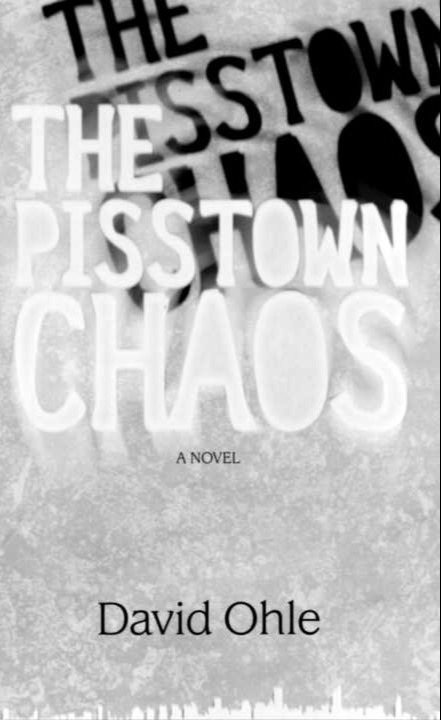




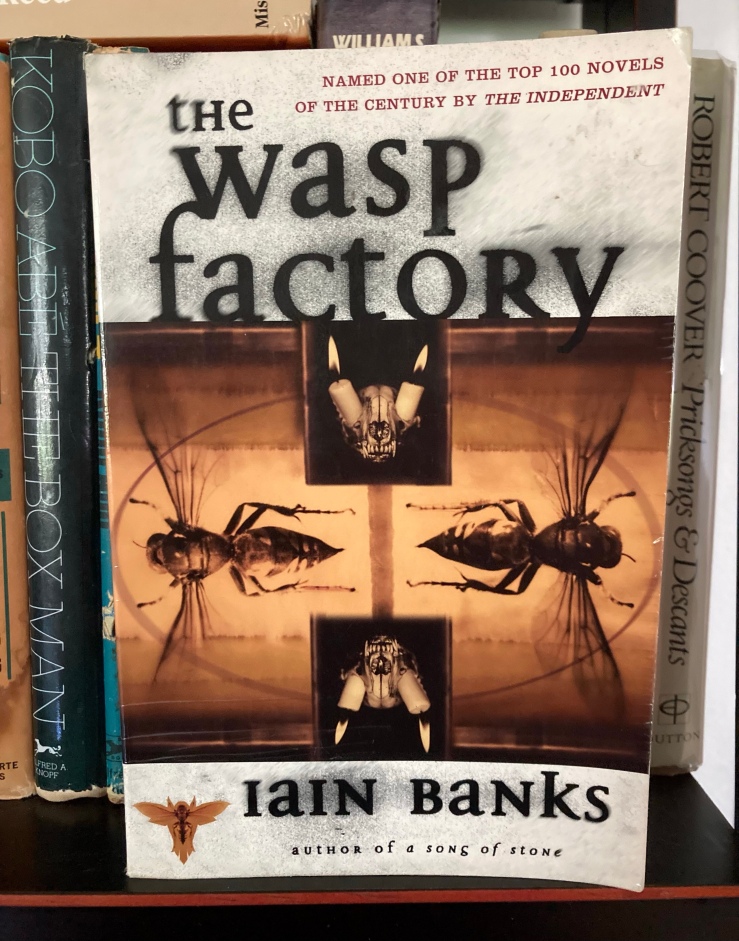
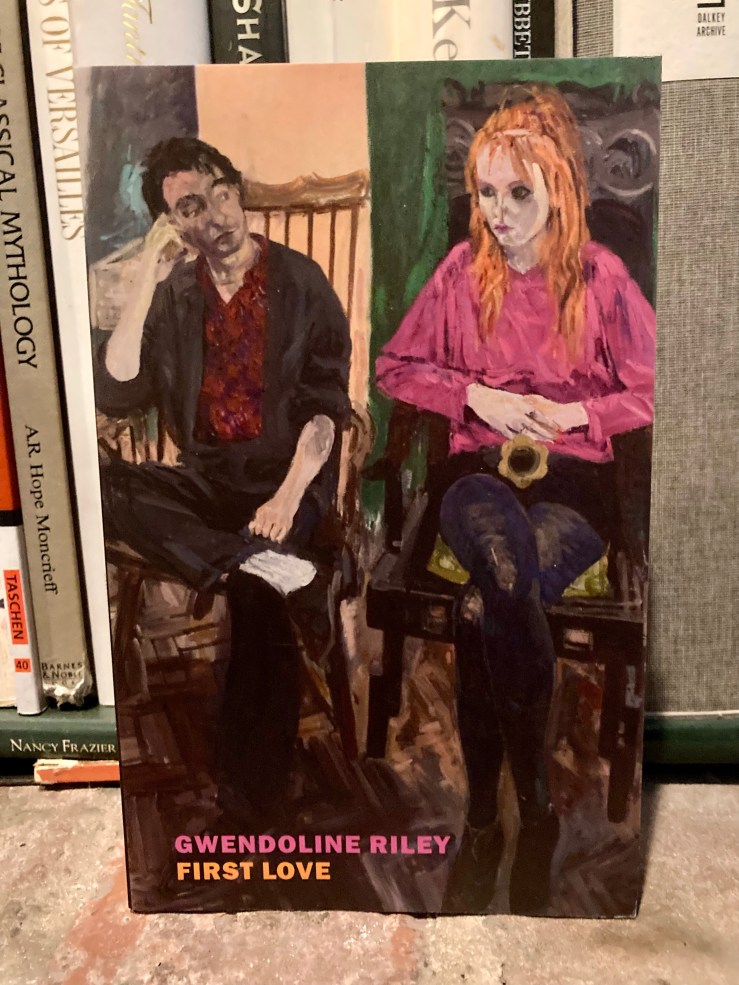


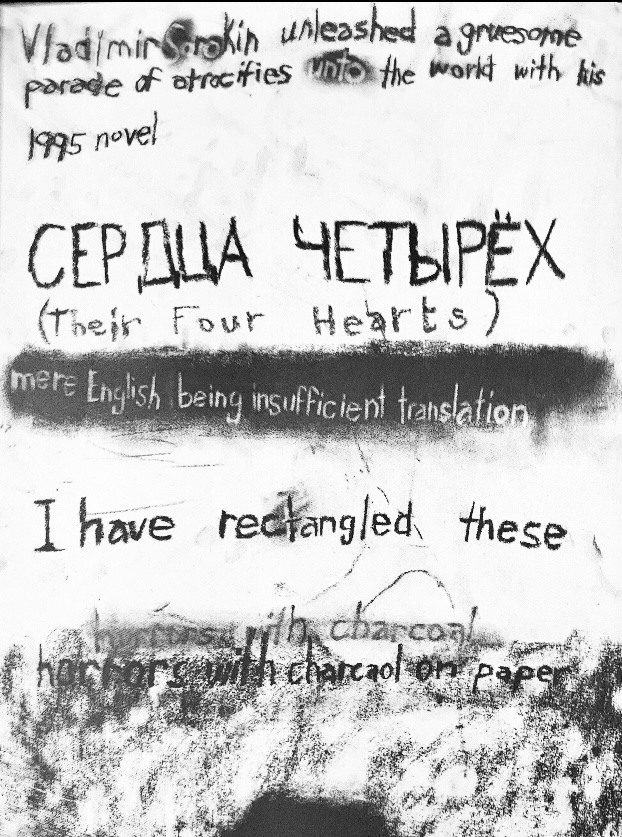

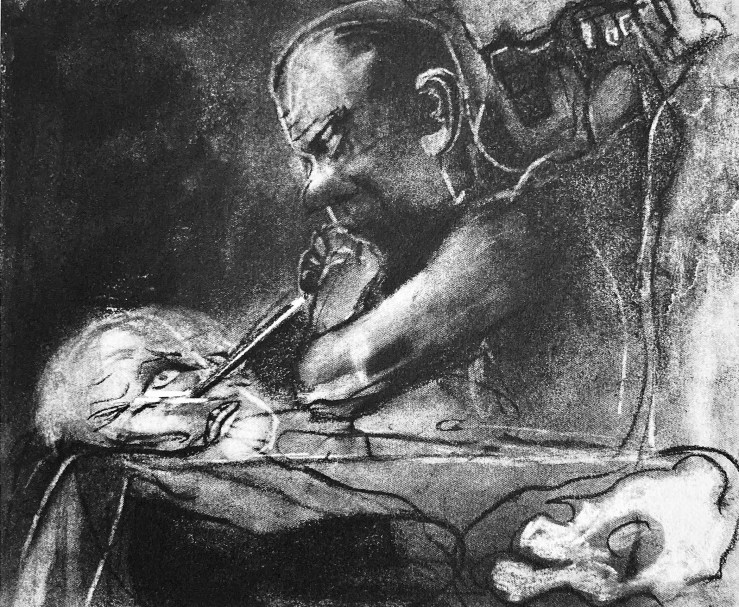
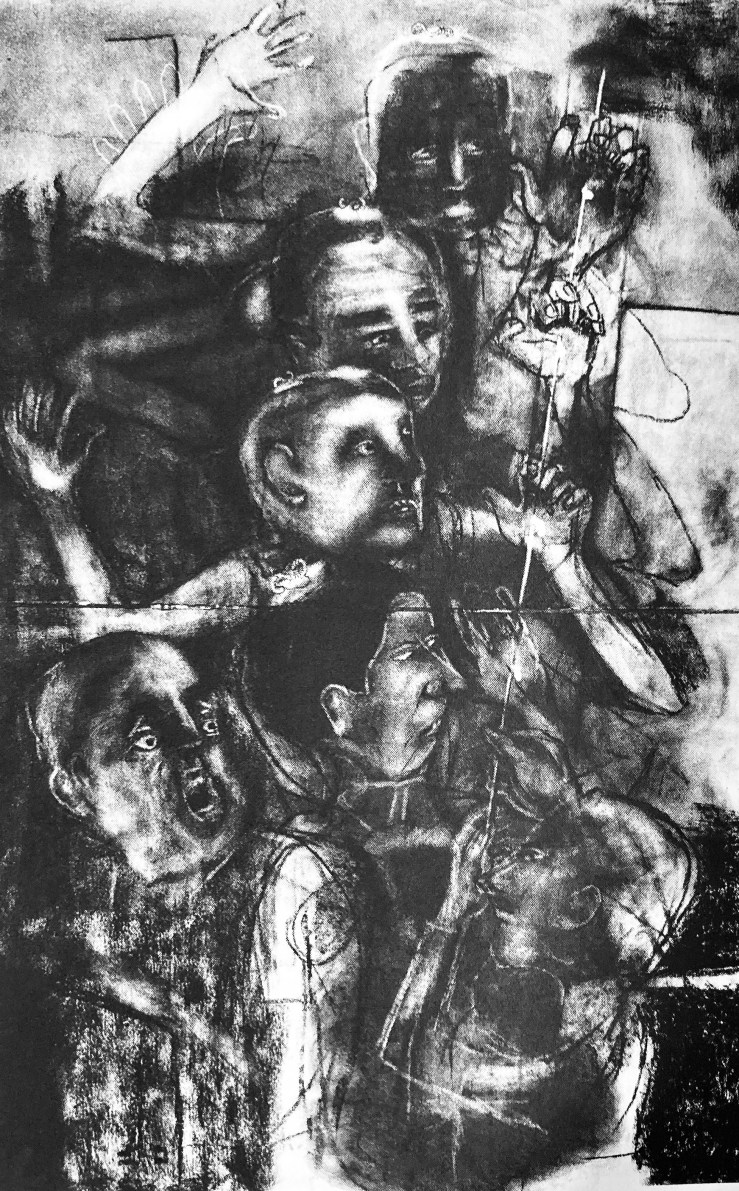



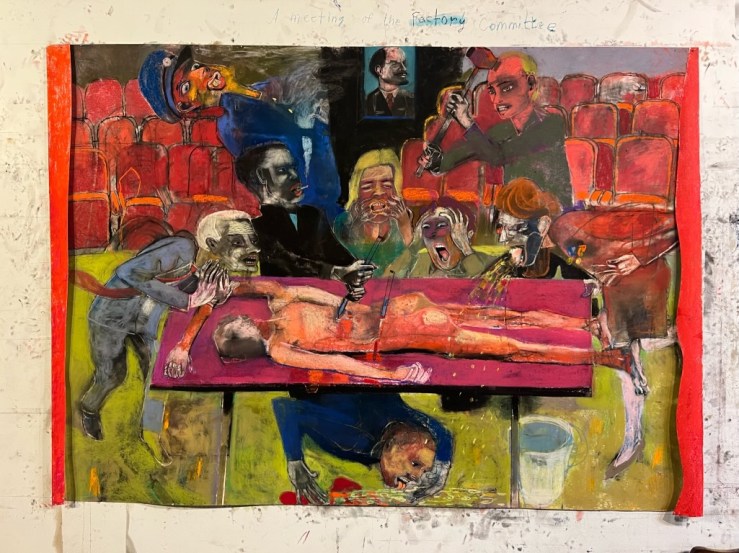
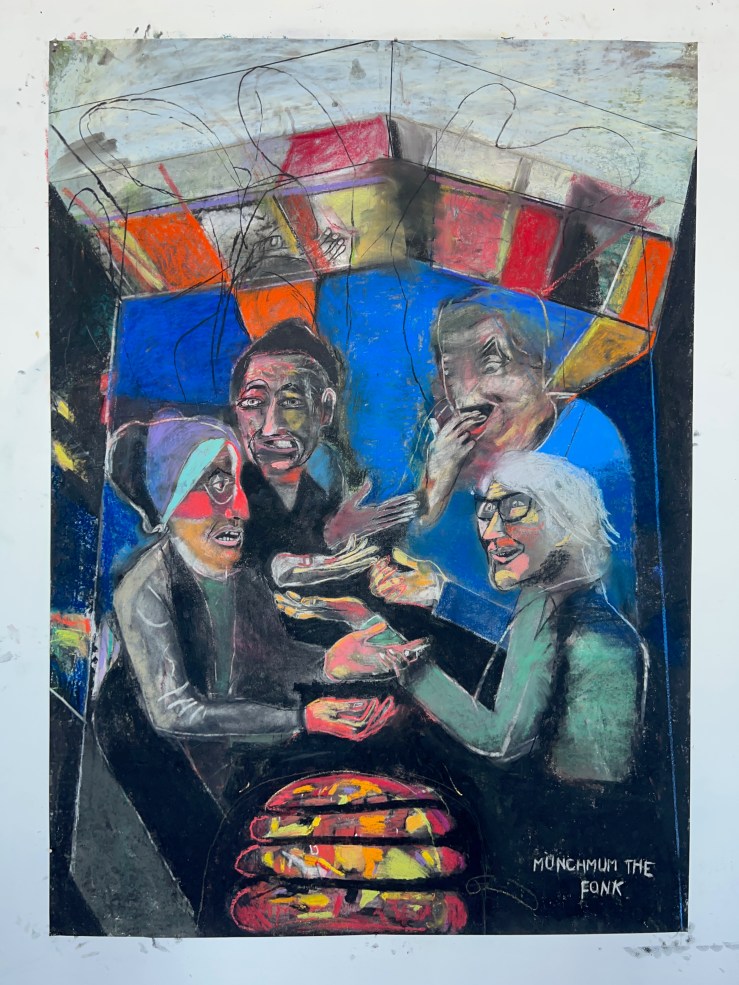



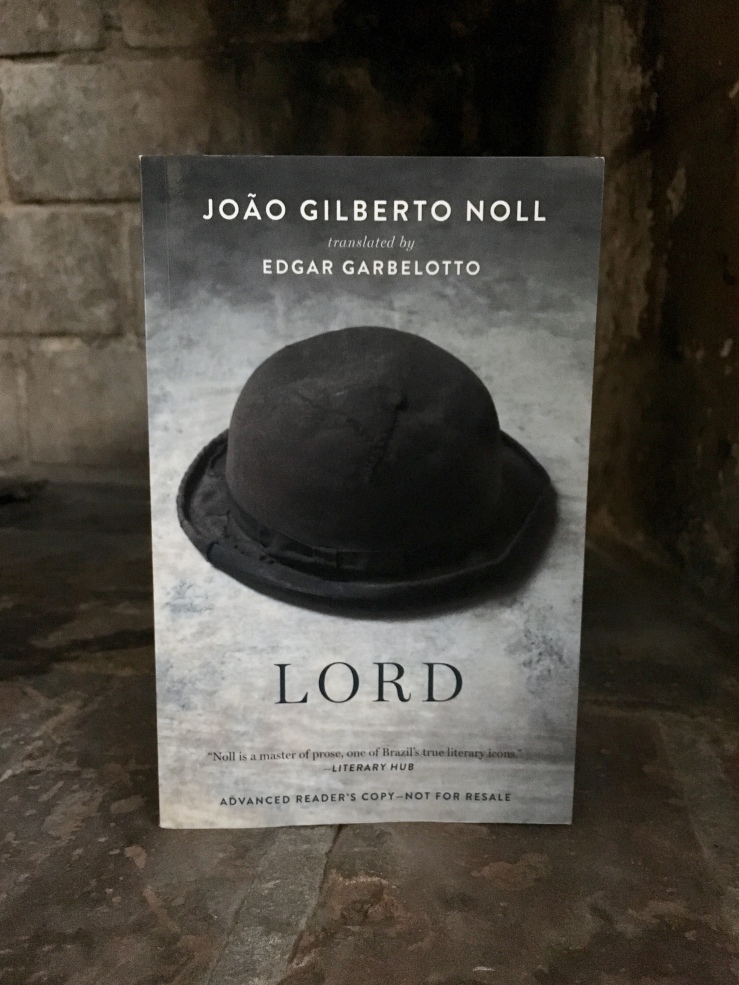
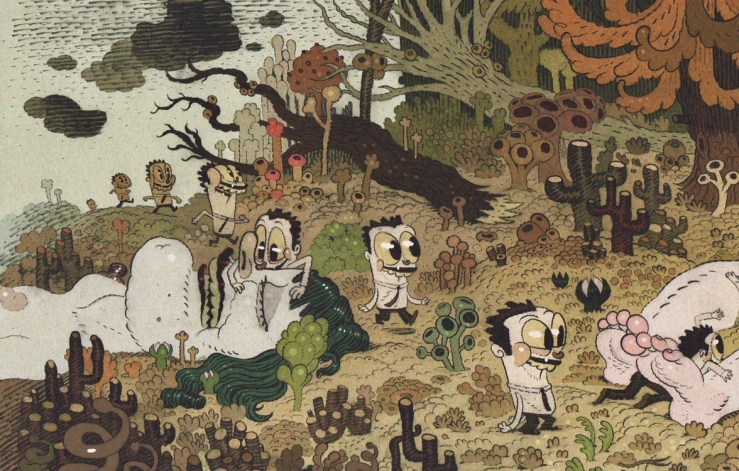
 Biblioklept