I Review House of Holes, Nicholson Baker’s Ovidian Raunchfest

In his Paris Review interviewNicholson Baker says that “one of the questions House of Holes is trying to answer” is: is “there still a point to writing words about sex when you can see anything you want, and a lot of things you don’t want to see, on the Web?” The book answers a goofy, gooey, bright-hearted “yes” to this question, unfolding its pornographic vignettes in a surreal Ovidian holiday, a midsummer’s night sexfest that sails lusty and smiling over the borders of morality, social convention, and plain old biology. Baker creates an organic, oozing world where genitalia is swapped freely between lovers, where one might exchange an arm for a bigger dick, where old tattoos get fucked away, where a woman and a tree can make sweet, sweet love:

She looked out from her high-splayed vantage and she said, “I’m a treefucking woman!” Dappled sunlight shone and emptied itself onto her. She squeezed her Kegeling love muscle around the smooth, thickened branch within, and when the wind came up again all the leaves twittered and shook. The tree itself shuddered: It was having some kind of orgasm.

If it seems like I’m getting ahead of myself, citing text before outlining plot, I assure you I’m not: There really isn’t much of a plot to House of Holes. Well, if there is one, it’s something like this: Lila, a large-breasted madame runs The House of Holes, an equal-opportunity brothel/fantasy factory that can only be accessed through portals that appear in strange spaces. This pornographic Arcadia operates on slippery wet-dream logic in which strangers cheerfully and eagerly engage in all sorts of raunch. Characters of varying physical attributes screw their way through a surreal holiday. There are a few conflicts, most of which are too light to touch on (this is a light book, for sure).

Two conflicts stand out with some (slight) weight though:

First, there’s the Pornmonster, “a personification of polymorphousness unlike anything the world of human suck-fuckery has ever known.” The Pornmonster is the mutant offspring of all the bad porn slurry collected on a pornsucking mission (don’t ask). The Pornmonster is typical of Baker’s tone throughout House of Holes, and its polymorphousness embodies the book’s depictions of sexual metamorphoses. This monster is tamed through playful, loving lust, and becomes a good guy, its raw sexual energy redirected for the forces of good (i.e., good sex). This is a book full of good guys.

Second, there’s the Pearloiner, an embittered, sexually-jealous TSA agent who steals clitorises (two of our heroines are afflicted by this heinous crime). The Pearloiner is a product of post-Homeland Security draconian measures, and her inclusion is about as close to contemporary culture criticism that House of Holes approaches. Sexy fun times interest Baker more.

Like the Pornmonster, the Pearloiner finds herself redeemed at the end of the book; moral shifts of allegiance are as easy as physical transformations in House of Holes. The Pearloiner and the Pornmonster alike atone their sins with a facile simplicity that fits the ludic silliness of Baker’s book. They are invited to participate in the handjob contest that (quite literally) climaxes the book. It’s an easy, orgasmic end to an easy, orgasmic book.

In some ways, House of Holes is more remarkable for what it’s not. Most of the so-called pornographic literature (or literature of pornography, if you prefer) that I’ve read has a darker streak. (I’m thinking of Anaïs Nin, Henry Miller, de Sade,The Story of O, Alan Moore’s The Lost Girls, etc.). Holes shares Willliam Burroughs’s sense of surreal transmogrification and picaresque rambling and J.G. Ballard’s infatuation with the bizarre intersections of sex and technology, but it’s never sinister or cruel, or honestly, even disturbing.

House of Holes is a fundamentally good-natured book,” suggests Baker in his Paris Review interview, also pointing out that it’s a work of “crazy joy”—and he’s absolutely right: The book is joyous, good-natured, affable even. When Baker approaches a remotely Sadean cuckold fantasy he punctures it with a politeness that’s humorous—but he also dramatically lowers any stakes that may have been in play. In short, this is a novel of pure fun, of infinite gain and no loss (quite literally—Lose an arm? Get it back. Lose a clit? Get it back). Holes is silky and slippery and light, more ephemeral than ethereal in the end.

But shame on me. I seem to be faulting the book for not doing something it never sets out to do (namely, I seem to be faulting Holes for a lack of depravity and depth and darkness, three “d’s” the book’s rubric never sets out to register). It’s pure fantasy stuff, reminiscent of the partner-swapping exercise A Midsummer Night’s Dream (I am not saying Baker is Shakespeare) or the erotic shifts in Metamorphoses (ditto: Baker is no Ovid) or the voluptuous Victorian serial The Pearl: dreamy, and perhaps (small r) romantic, but not turbulent—sure, Holes will ruffle unwitting feathers (let’s be clear, it’s pointedly sexually graphic), but it’s unlikely to damage anyone’s soul. (If you’re worried about soul-damage, check out the editorial style-sheet for Holes, which lays out Baker’s invented porn-lexicon).

Is House of Holes a novel or a flimsy pornographic riff? Baker is less interested in ideas than he is in sensations, or rather representations of sensations (which is the most literature can do anyway, I suppose). Holes is unwilling to offer any answers or explications about the deep mysteries behind human desire, but it does pose questions about those desires, and it poses those questions with shameless glee. A fun, breezy read.

Smoking Makes You Look Cool, Part II (More Pics of Writers Smoking)

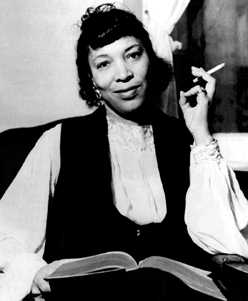
Zora Neale Hurston
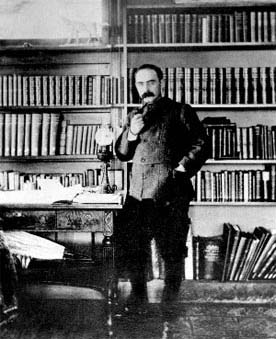
Rudyard Kipling
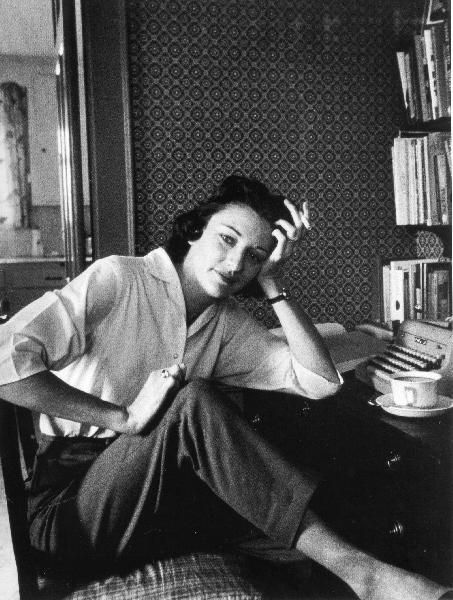
Anne Sexton 
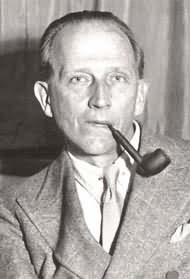
A.A. Milne
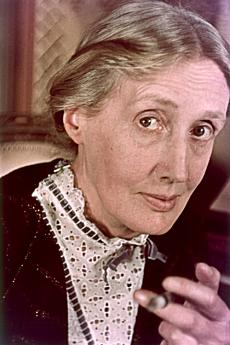
Virginia Woolf
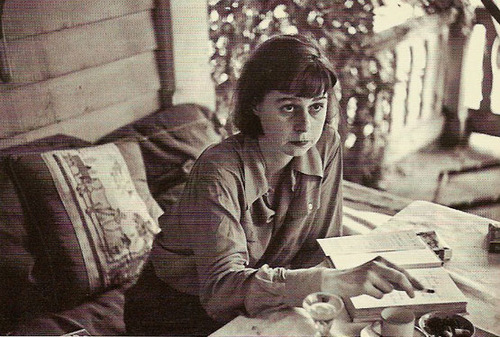
Carson McCullers
Dylan Thomas
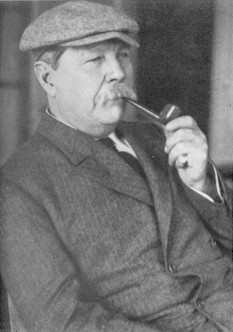
Arthur Conan Doyle
Lillian Hellman
Raymond Carver

(For more pics of writers smoking, check out our first gallery—and don’t worry, people already expressed their hatred for what they perceived to be our endorsement of smoking there).

“Order Is Simply a Thin, Perilous Condition We Try to Impose on the Basic Reality of Chaos” (A Citation from William Gaddis’s Novel JR)

Near the beginning of William Gaddis’s sprawling novel J R, erstwhile protagonist Jack Gibbs rants about knowledge to his students:

Before we go any further here, has it ever occurred to any of you that all this is simply one grand misunderstanding? Since you’re not here to learn anything, but to be taught so you can pass these tests, knowledge has to be organized so it can be taught, and it has to be reduced to information so it can be organized do you follow that? In other words this leads you to assume that organization is an inherent property of the knowledge itself, and that disorder and chaos are simply irrelevant forces that threaten it from the outside. In fact it’s the opposite. Order is simply a thin, perilous condition we try to impose on the basic reality of chaos . . .

Book Acquired, 2.01.2012

20120205-164602.jpg

Haley Tanner’s acclaimed novel Vaclav & Lena is new in trade paperback (excellent cover on this one, by the bye). From Page Pulp’s review:

You could try to categorize this book as a love story or an immigrant story, but it is really simply a human story.  Like life itself, it can be sometimes funny, sometimes awkward (like the scene where Vaclav’s father walks in on him getting out the tub and makes a wrong assumption about what Vaclav was doing), sometimes happy, sometimes sad, and yes, sometimes incredibly dark.  It reflects the human experience so well, but never feels cliché.  Tanner’s prose has a simplicity that mimics the characters’ imperfect English.  She creates beauty with her words, but is never too flowery. This allows the story to shine through, unobscured. Her characters almost do not seem like characters; after awhile they start to feel wondrously real, like you could reach out and touch Lena’s messy black curls.  Tanner is adept at shaping both the story and the characters so that they feel realistic.

Biblioklept Talks to Daniel Nayeri About Capturing Voice, Being a YA Gatekeeper, and Writing His Novella Quartet on an iPhone

Daniel Nayeri was born in Iran and spent a couple of years as a refugee before immigrating to Oklahoma at age eight with his family. He is the author of Straw House, Wood House, Brick House, Blow, a collection of four novellas; Kirkus called it, “Provocative and deeply satisfying,” Bookpage named it “a delightful amalgam of the high and the low, the silly and the sublime,”and the BCCB mentioned the “breathtakingly vivid word smithery” in its starred review.

In addition to his writing, Daniel is an editor of picture books, novels, and graphic novels at Houghton Mifflin Harcourt, an accomplished filmmaker, and a professional pastry chef.

Daniel was kind enough to talk to us about his work via email.

Biblioklept: Your book was composed entirely on an iPhone. Can you tell us a bit about that process? How did you start? How intentional was the process in the beginning? Did you use a specific program? Did you edit on the iPhone at all?

Daniel Nayeri: Several years ago, I was reading an article about the “cell phone novel” phenomenon in Japan. The tone of the article was basically, “check out this super popular thing in Japan that all the literary folks hate.” It described the authors as these quiet teen girls, and early-twenty-something women, who would dash off a few chapters on the subway and email them to a website service. The authors didn’t do themselves any favors by saying they disliked reading “real” books, and the critics didn’t do themselves any favors by flipping out and wondering out loud if this trend meant the “death of the author.”

For me, the fascinating tidbit came from a few comments that noted the possible effects of writing on a cell phone. Every undergrad discusses the interplay of form and content (Dickens’s serialized form, the oral iterations of the Iliad, etc). I got really excited about forcing my imagination to live in an incredibly small space. The Japanese authors discussed that when they moved to computers, their vocabulary became “richer” and their “sentences have also grown longer.” I wanted to see if I could push those boundaries out a little (maybe I’m the crazy person who tries to paint the Mona Lisa on an Etch-a-Sketch).

As for the program I used. I bought the first-gen iPhone, so I was using the notepad app that comes with the phone (without cut and paste). To edit, I got very tired of deleting sentences and retyping them three pages down, so I created a code system. For example, if I wanted to move a paragraph up by two pages, I would bracket off the section I wanted and place a symbol next to it. Then I would go up two pages and just place the same symbol. By the end of my editing, there would be pages of work that were nothing but symbols, connected with various prepositions.

Biblioklept: Did you always have the idea to write a quartet of novellas over different genres? How did the idea come about?

DN: I think in general, novels have gotten fatter. As an editor, my first pass on nearly every manuscript is to ask for major cuts. I’m actually kind of petulant about it. My position is that if a book isn’t going to be as good as Anna Karenina, then it probably shouldn’t be as long.

It’s a reactionary position to take, so I thought I would challenge myself with telling stories and building worlds as large and as complex as I could possibly make them, with the limitation of 35-45 thousand words. Obviously, I sort of cheated by connecting some of my thoughts and themes in a collection of four. Hypocrisy and petulance—that’s the sort of delightful company you’ll get if you find yourself working with me.

(Another reason was that I’m still young, and I’d like to learn a lot more before I start demanding the attention of readers for five hundred pages at a time).

Biblioklept: What challenges did you face when working in the variety of genres you worked in?

DN: Presenting four very different voices (to whatever extent one might think it succeeded) is the aspect of this project I am most proud of, actually. The nicest thing anyone has said about the book so far has been to say it is, “the literary equivalent of a singer with a four-octave range.”

To me, it represents the ability to assimilate—a quality any first-generation immigrant valorizes at one point or another. When I first came to the states, I quickly took up the Texas/Oklahoma speech patterns. I was a voracious cataloguer of idioms. When I moved to New York, I did the same. I picked up “kitchen Spanish” in my years as a pastry chef. I love local parlance. As a kid struggling with English, having a proficient knowledge of colloquial expressions represented mastery over the language.

So to me, genres and forms with heavy use of lingo (sports writing, noir, poetry) were the height literary achievement. It sounds backwards, but if you learned the queen’s English first, then you value Huckleberry Finn’s jargon highest of all.

Biblioklept:  Straw House, Wood House, Brick House, Blow is being marketed as a YA book. There’s been some debate in the past few years about a perceived sense of darkness or violence in YA. What place do dark or violent themes have in YA fiction?

DN: I almost never think about this as a writer. I almost never stop thinking about it in my capacity as an editor at Houghton Mifflin Harcourt. My personal interests keep me PG-13, generally. But geez, people send me some crazy-inappropriate material—even for general consumption. Lots of incest. Lots of racial hang-ups. Lots of creepy.

I believe strongly in an editor’s responsibility to put out well-written work (whether or not it’s politically or ethically aligned with one’s self). The old Voltaire quote -– “I disapprove of what you say, but will defend to the death your right to say it” –- has difficult implications for “gatekeepers” in any media.

But just because there is an ethical challenge to acquire broadly, doesn’t mean the public can’t resist-—meaning that the marketplace often creates pressure to move material toward the unobjectionable. When minors are involved, however, I would hope there are adults who will curate the material. I think the majority of adults agree that there is such a thing as “age appropriateness.” I think both sides of the argument are often concern-trolling-—one side saying kids shouldn’t hear the f-word, and the other side screaming censorship to the culling of anything short of snuff-porn.

The conversation seems to dance around a rating system (as with the MPAA for films, or the ESA for video games), but that has a ton of complications. I’m not sure what I think of a rating system, personally. I just think the discussion would be more interesting than making fun of people over Twitter.

Biblioklept:  What are you working on next?

DN: Straw House has four very western genres, so I’m working on another set of four stories, but this time in eastern genres. I’m from Iran and immigrated to Oklahoma, so collections about the East West interaction have always fascinated me (Rushdie wrote a great essay collection call East West).

There’s an Ibn Battuta travelogue, a 1001 Nights tale, a parable, etc. I’m about halfway finished.

Biblioklept: Have you ever stolen a book?

DN: I’ve never stolen from a retailer, but when I was in middle school, I volunteered at the local library. When I forgot to return books after a long time, the head librarian would let me go into the database and erase my fine, as well as the book itself. That’s how I got my first copy of The Fellowship of the Ring, a CD of Boston’s greatest hits, and a book on juggling. So basically what I’m saying is that I was pretty hardcore.

Gertrude Stein Talks American Football, American Indians

In a 1934 radio interview, Gertrude Stein talks American football:

INTERVIEWER: You saw the Yale-Dartmouth game a week ago Saturday didn’t you? Did you understand that in the American way or the football way or how?

STEIN: IN the American way. The thing that interested me was that the Modern American in his movements and his actions in a football game so resembled the red Indian dance and it proves that the physical country that made the one made the other and that the red Indian is still with us. They just put their heads down solemnly together and then double over, while on the sidelines the substitutes move in a jiggly way just like Indians. Then they all get down on all fours just like Indians.

INTERVIEWER: But those jiggles are just warming-up exercises.

STEIN: It doesn’t make any difference what they are doing it for, they are just doing it, like the way the Indian jiggles in the Indian dance and then there is that little brown ball they all bend down and worship.

INTERVIEWER: But the ideas in that is to get the ball across the goal line.

STEIN: But don’t you suppose I know that, and don’t you suppose the Indians had just as much reason and enjoyed their dancing just as much?

“List of Social Changes that Would Assist the Flourishing of Literary Beauty” — William T. Vollmann

“List of Social Changes that Would Assist the Flourishing of Literary Beauty” by William T. Vollmann. Originally published in his essay, “Something to Die For” (Review of Contemporary Fiction) but excised here from Expelled from Eden, the Vollmann reader I’m finding addictive—-

1. Abolish television, because it has no reverence for time.

2. Abolish the automobile, because it has no reverence for space.

3. Make citizenship contingent upon literacy in every sense. Thus, politicians who do not write every word of their own speeches should be thrown out of office in disgrace. Writers who require editors to make their books “good” should be depublished.

4. Teach reverence for all beauty, including that of the word.

The AV Club Interviews Lynda Barry

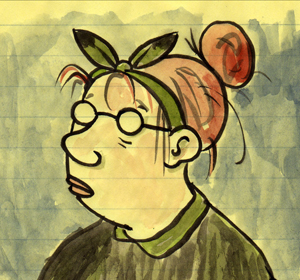
The AV Club’s Tasha Robinson interviews comix legend Lynda Barry. In the (rather lengthy) interview, Barry discusses teaching her craft–

It’s a really hard thing to teach students. The two things I always try to teach them is, one, you have to stay in motion. It doesn’t mean that you have to just write blah, blah, blah, blah, blah. Write the alphabet. You have to stay in motion. And the other thing is, when you get stuck, don’t read over what you just wrote. Especially if you have a computer. Maybe by hand is not so bad, but with a computer, what happens is… My experience has always been that there is a point when the story just stops. Always. You know, it’s just like when you’re dancing. There’s a time when you’re fake-dancing, because the groove has stopped. Then you’re back in the groove. So if people understood that that’s a natural part of making something, and they knew what to do during that time… But what people will do if they’re writing on a computer is, when that time comes and it’s quiet for a minute, they panic and go back and start fixing stuff above it that was not even broken. You can’t start to fix something until you know what it’s for, you know? So I always try to get my students to just sustain the state of mind for a certain amount of time. Even though I use 24 panels for my students, they’ll have seven minutes to just sustain this open state of mind while they’re writing, keep their hand in motion. But it’s really tough to get them to believe me, to just to even give it a try. And then once they do, it’s really fun.

Biblioklept Interviews Mahendra Singh About Fitting Lewis Carroll into a Protosurrealist Straitjacket with Matching Dada Cufflinks

Mahendra Singh’s new book is a graphic-novelization of Lewis Carroll’s epic poem The Hunting of the Snark (read our review). Singh was kind enough to talk to us about his project over a series of emails. The Hunting of the Snark is available now in hardback from Melville House. You can read more about Singh’s work at his website.

Biblioklept: Where did your interest in Carroll originate?

Singh: I read the Alice books as a child and only read the Snark when I was a teenager. The Alice’s were fun, as was the Snark, but it also puzzled me at first. It was hard-core Nonsense and it took me a while to digest it, and half-way understand it. It was a great mental stretching exercise, still is. Kids need that sort of thing if they want their brains to grow up to be something besides consumer units.

Alice’s game of Nonsense is really a warm-up to the Snark’s. When Carroll got to the Snark, he’d had a bit of practice and was in top form. The Snark is really Alice 2.0, the more expensive professional upgrade to Nonsense Making.

When I was young, I had odd reading tastes. From 70s SF to Aristophanes to the Ramayana; I was a little piggy. What I usually liked was a complex, completely furnished fictional world, along with a nice musicality with words. What really turned me on was when that fictional world would be logically intertwined with the real world, past or present. In short, one world would be a sort of code for the other.

I think a lot of kids still like that, it’s really the basic premise of most storytelling, although nowadays it is often so deeply monetized and predigested that it’s hard to really enjoy or even benefit from.

In any case, everything Carroll wrote fit my tastes, but the Snark was extra-special, the difference being that this epic poem (the only genuine Victorian epic poem and I’ll defend that claim against all comers), this epic took the Alice premise of mismatching appearances and meaning and took it to its logical conclusion, which itself is another Nonsense paradox doubled upon itself — beware these Carrollian infinite regressions!

In the Snark, the story-telling code of Nonsense is perfected. Most of the elements are still drawn from the familiar, real world but they are so recombined that their appearances and meaning are impossible to decipher anymore. And yet the persistent, nagging feeling of a genuine logic behind it all still remains.

I think for most young people who are thinking things over, the above Snarkian description is a pretty accurate of their budding world view. And anyway, breaking world-codes was pure catnip for me, it’s the essence of reading, good reading anyway.

And I have to mention the poetry. I’ve always loved poetry and Carroll’s verse skills in the Snark are the perfect vehicle for what he’s doing. Their anapestic bounce, their goofy mouth feel (the mouthfeel of Old English poetry charms and chants) make a perfect vehicle for the code. It’s a bit of a music hall, Gilbert & Sullivan feel to what is technically a tragic verse epic.

I wouldn’t say I’m a full-bore Carrollian Obsessive, I’ve met plenty of them and they’re dangerous … quiet, nattily dressed librarians with bow ties and a deadpan penchant for puns and parody. Book editors concealing rural silos crammed full of  highly addictive Carrollian Nonsense. Carrollian Illuminatis cleverly disguised as entomologists hanging out at obscure Snarkian forestry associations.

I’m just a Carrollian Nutter, I’m harmless as long as I have access to drawing materials. And pictures of Snarks.

Biblioklept: You’ve described your work on Snark as “fitting Lewis Carroll into a protosurrealist straitjacket with matching Dada cufflinks.” Why do the techniques of surrealism and Dada lend themselves to Carroll?

Singh: Surrealism is one of those things that everyone can point at but few can define. It’s the idea of awakening the sleeper within us and letting them speak to us in their own dream language of pictures and words. Since dreams are a universal form of memory that draw upon every possible human experience, Surrealism is sort of the simultaneous dream-memory of everything.

Protosurrealism is what I call the comfy, cozy Carrollian straitjacket I’ve trapped my Snark in. Carroll was himself hailed as a protosurrealist by the founding fathers of this odd cult, Breton, Aragon, etc. His work, with its dreamlike logic and free associations entranced them and they regarded him as a unique trail-blazer in their explorations. And his verse, to me, is the epitome of the dream world; all poetry (Nonsense or otherwise) must surely be the natural, Adamic language of dreams!

The Surrealist Max Ernst was an enormous inspiration to me — his technique of using 19th-century engravings to illustrate dream stories is brilliant; the old-fashioned, realistic visual style gives them a jarring sense of authority. Realism is the optimal style of the determined dreamer! The urban dreamscapes and dream-eroded objects of Giorgio de Chirico and his brother, the unjustly neglected Alberto Savinio, were also part of my bag of tricks. And of course, references to Rene Magritte are scattered everywhere in this Snark. Magritte’s various techniques for undermining systems of linguistic and visual meaning are ideally suited to navigating the Carrollian Multiverse.
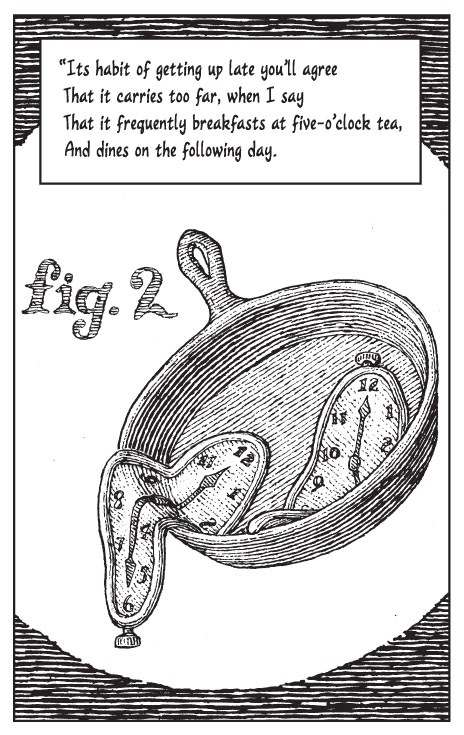
It’s hard to illustrate an idea and oddly enough, the Snark is really a poem of ideas, couched in the form of a tragic epic and then declaimed by a master comedian. One thing I wanted to avoid was doing literal drawings of the scenes in it; I wanted the Snark to constantly bring up a stream of associations, references, insinuations, all of them triggering more and faster allusions, what I call a gateway Surrealism that leaves readers hopelessly addicted and desperate for more! Don’t say no, kids!

I’ll add that protosurrealism is the 21st-century application of 19th-century answers to 20th-century problems. The application is this 21st century Snark, the answers are the Victorian rendering style I used and also Carroll’s entire invention of Victorian Nonsense, and the questions are the existential questions that 20th-century artists couched in the language of Surrealism.

Plus, let’s face it, Surrealism just looks cooler! Who wants a postmodernist or abstract expressionist Snark? And the smart kids love it, they’re still young enough to dare to question the sordid, official version of reality. Which is where Dada comes in — there’s a bit of it in my Snark and it’s there because Dada was the ultimate poke in Western Civ’s eye. If the idea of using a blank map isn’t pure Dada, what is it then?

It’s odd having to discuss this in words, proof positive that the Surrealist project remains unfinished. In a perfect Surrealist world, the meaning of my Snark would bleed out of the book and contaminate the reader’s world until they could not distinguish where the Snark began or reality left off. And that’s the essence of Carrollian Nonsense, fiddling with the logical doors of perception.

Biblioklept: Much of surrealist and Dadaist art seems to be an immediate response to mechanical reproduction. In Snark, you seem to at times be reconfiguring, recombining, recontextualizing otherwise familiar images. How do you work? How do you go about creating your art? Can you describe your process?

Singh: Mechanical reproduction can be a loaded phrase. Walter Benjamin gave it quite the kick in the pants, pointing out that it is a degradation of the cult object, a commodification, etc. But the problem is us, the public. A work of art has absolutely no meaning or value except what the viewer puts into it. This is a very important point. If art is degraded or degrades others, it is our choice.
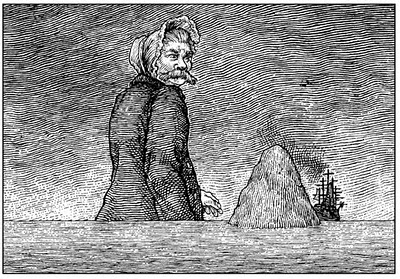
Poor Benjamin, a smart guy but always wriggling back into a Marxist strait-jacket just as useless as medieval Scholasticism or modern neoconservatism. At least Carrollian Nonsense makes the kiddies giggle! He never grasped that all philosophy is individual psychology (and wish-fulfilment) in essence. That’s why the Banker in my Snark is Karl Marx — revenge was sweet! I also included Nietzsche as the Bonnet-maker and Heidegger as the Barrister to round things off. I can assure you, several philosophers were injured in the course of this production. A broken ontology can be quite painful.

Nothing has meaning or value unless we decide it does. For years, readers have puzzled over the meaning behind the Snark. It’s another Carrolian Zen koan : the meaning is the meaning. It’s always been staring us in the face, the meaning of the Snark is a verb, it is to search for meaning and when doing so, one automatically generates a meaniningful purpose just as naturally as a spider ejects its web. Inside this silky web is the comfort of whatever logic you feel up to (and that is the secret pleasure of Carrollian Nonsense) and outside the web is just chaos, a Boojum!

In my Snark I’ve mashed up artists including Hieronymous Bosch, Grünewald, Titian, Théodore Géricault, David, Ingres, even George Herriman and also many Surrealists such as Man Ray, Dali, Magritte, etc. There are musicians and authors, the Beatles and Gilbert and Sullivan, Edgar Allan Poe, the Comte de Lautremont, even Victorian parlor games and optical illusions. The idea was to create a web, a labyrinth of allusions in which to hunt the Snark. Some of the references will be familiar but some will not and the reader, if so inclined, can hunt them down on their own. It’s a hunt within a hunt, another Carrollian regression.

The educational aspect is important to me. I really do hope some of the kids who read this will get curious and start off on their own, pillaging a library, ransacking a museum, sneaking into the opera, whatever turns them on. The smart kids are hungry for culture. We must get them thinking, to get them to manufacture and own their own meanings before a mass-marketing goon does it for them.
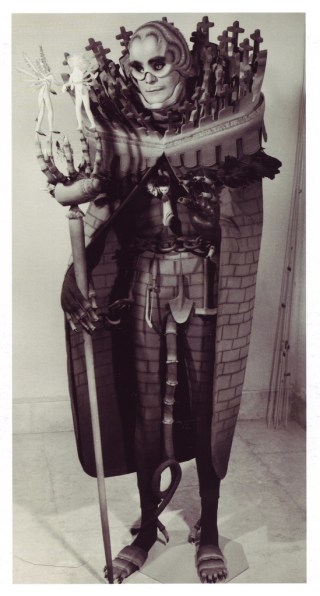
The actual process of creating the imagery was simple, it’s basically me lying on a sofa, maybe a quick snooze and then free-associating while pondering the text. The cover image is a good example, it’s also the illustration for the whiskered Snarks who scratch and the feathered Snarks who bite. This made me think of Old Scratch, the devil, AKA Lucifer, who was once an angel with feathered wings who also showed a nasty tendency to bite the hand that feeds. I had a vague visual memory of seeing a photo of a surrealist devil; I rummaged through some books until I found it — Denise Bellon’s photo of the Québécois Surrealist, Jean Benoit, at a costume party.

The slippers are what caught my eye, it made me think of Old Scratch lounging at home in Pandemonium, his day off, not bothering to shave, hence the whiskers that scratch. I made the toes unequal on a lark, it just seemed right to have Satan misshapen but afterwards I came up with a cabalistic explanation which I won’t bore you with for now.

I then did a pencil drawing on tissue paper, constantly refining and adding or deleting, this was the slowest part of the entire Snark, the pencils. Afterwards I did the pen and ink drawing atop the tissue, on Denril, a synthetic vellum. This is an old technical illustrator’s work habit, which is how I started out actually, in the 80s.

This business of free associating while simultaneously referring to one’s internal visual memory is only possible if one has spent many years romping though books and museums. You cannot be a serious illustrator if you don’t read and look voraciously, all the time. And above all, don’t look at too much rubbish or you will start drawing rubbish. Art students reading this, take heed! You are what you see.

Recombining Surrealism and other –isms, along with the free associations triggered by Carroll’s Nonsense verse, creates a matrix which allows the reader to move seamlessly back and forth between the worlds of dreams, culture, memory and emotion. Those readers who catch the references will enjoy the historical and even non-verbal logic binding them, the rest is up to you.

You are really bringing the meaning with you, and when confronted by my Snark I hope it triggers a cascade of free associations, a mental phenomenon which is the precursor to dreaming, the royal road of Surrealism and Carrollian Nonsense.

Biblioklept: How does your work respond to the nine illustrations by Henry Holiday that originally accompanied Carroll’s text?

Singh: Holiday’s illustrations are odd things, I’ve never been very keen on them. He was a graceful artist usually, very talented and yet these drawings are a bit grotesque, ugly perhaps. They just don’t look so appealing to me. The technique is flawless though, a very classic British style of line work that lasted well into the 1940s.

Some Snarkologists believe that Holiday worked with Carroll to hide a secret meaning in the art. Angles and distances have been measured, objects analysed,  hidden shapes discovered and reconfigured. Who knows? It’s unlikely but in any case, you can’t avoid Holiday if you’re doing the Snark.

I used some of his symbols, the bare-breasted woman and her anchor representing Hope, a very british motif which suits the nautical nature of much of the quest. His picture of the Beaver doing its math problem inspired me to treat that entire Fit the Fifth as a long variation upon the Temptation of St. Anthony, especially the version by Bosch. Holiday really nailed that one. I have to confess that Flaubert’s version is a favorite book of mine and I tried to give this part of the Snark the same baroque, over the top feeling of deranged pagan vs. Christian imagery.

Holiday also crammed a considerable number of small details in the Beaver illustration. It’s quite a contrast to the style of the other big Carroll illustrator, Sir John Tenniel, who favored a cleaner look. Nowadays this technique is called “chicken fat” and I used a lot of chicken fat in my Snark, more than Holiday. Of course, with only 9 drawings, he had to keep to a slower visual tempo. That was another reason I did it as a graphic novel — I could vary the tempo quite a bit and really overwhelm the reader with chicken fat when the verses demanded it.

On the other hand, doing it as a graphic novel required creating a narrative visual thread through the whole thing, something which Holiday really didn’t need. In this case, my idea was to make it a theatrical presentation, each Fit a new set change until the end, when Carroll is revealed as the spectator in the empty hall. Carroll was fond of theatricals and the Snark does have a stagey feel to it anyway.

Biblioklept: Have you ever stolen a book?

Singh: Yes, Aces High, a lavishly illustrated book about British fighter pilot aces of WWI. It once graced the shelves of the high school I once attended in a desultory manner (myself, not the book). I was, and still am, fascinated by all things aviation and I could not bear the sight of that wonderful book languishing there, unremarked, unappreciated. I still know the difference between a Sopwith Pup and a Sopwith Camel and I love a well-executed Immelman at the crack of dawn. It was wrong to do and I can only plead callow youth in my defence. Don’t do it, kids! It isn’t worth it! Gosh, I hope Mrs. Merrill isn’t reading this . .  .

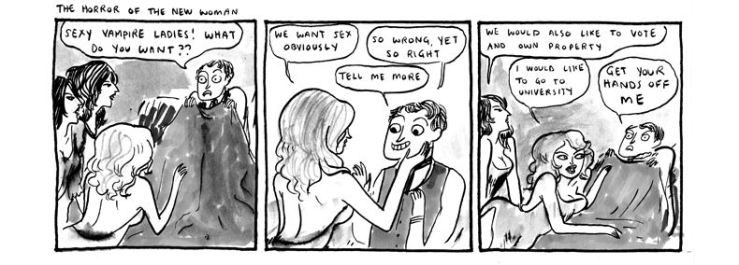
“Sexy Vampire Ladies!” — Kate Beaton Does Dracula

At Hark, A Vagrant!, cartoonist Kate Beaton riffs on Bram Stoker’s Dracula. Here’s a sample, but all of her comics are funny–


"The Horror of the New Woman" - Kate Beaton


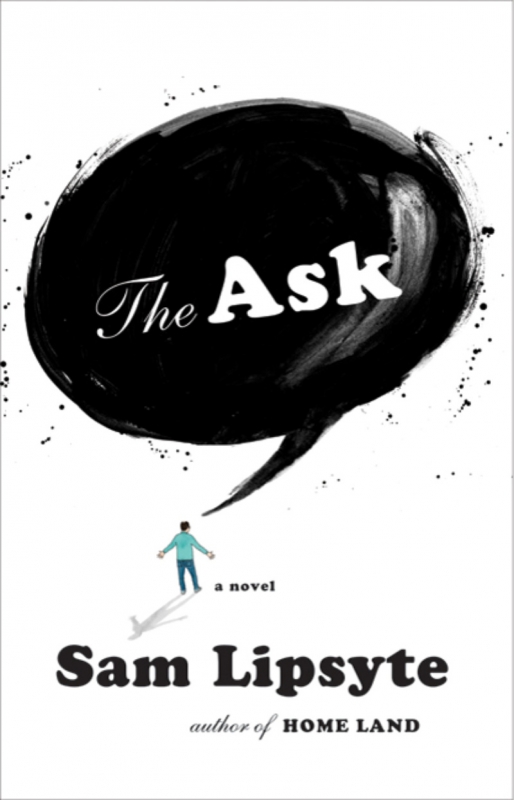
The Ask — Sam Lipsyte

I listened to the audiobook version of Sam Lipsyte’s hilarious, wistful, mean, and devastating novel The Ask last week. I invented chores and took any scenic route available when driving to get more of the book faster, frequently laughing out loud, or grimacing, or even feeling weird and shameful pangs of remorseful identification with the book’s protagonist and narrator, Milo Burke. I’m going to do my best to unpack the book’s themes–particularly the way it simultaneously eulogizes, valorizes, and mocks the American Dream–but first I need to get something out-of-the-way, a mea culpa of sorts.

As I mentioned, I listened to the book, but I don’t have a copy, so, shamefully, I can’t really quote any of Lipyste’s marvelous sentences. He is a master stylist, capable of zapping our dead modern idioms with the kind of alarming twists that highlight just how vacant language has become. Lipsyte also has a gift for rhythm, tone, and cadence, and he’s a master of the deadpan punchline. While the sentences in his last novel Home Land sometimes felt overly fussed over, straining under their own polish, The Ask showcases an effortless style that both seduces and repels. Lipsyte reads The Ask audiobook himself, yet lets the tone and cadence of his words dictate the tone and timbre of his voice. It’s all very good. And you’ll have to just take my word for all that as I have nothing to quote now (I’m sure I’ll re-review the book when I pick it up in paperback, though).

The plot is rather thin: Milo Burke, who once aspired to being a celebrated painter, now works for the grants department of a mediocre liberal arts college. His job, essentially, is to beg wealthy parents and alumni to donate massive gifts of cash to the school — this is “the ask.” Or rather, that was his job before he got fired for losing his cool with the spoiled brat daughter of a major patron. This leaves Milo moping around Queens, drinking too much, and pissing off the wife he is slowly becoming estranged from. Which is a shame, because he’s trying to be a good husband and father to his young son; despite his own shitty childhood–boozing, philandering father, emotionally absent mother–Milo is doing his best to give his family the American Dream. He’s more or less abandoned his own dreams of being a painter, and along with it, the weird faith he located in the various theorists–Marxists, feminists, deconstructionists, etc.–who informed his art school years. Much of the novel finds Milo pondering not just on the value (or lack thereof) in his liberal arts education, but also on the friends and anti-friends who he slummed with in those days. Just as the narrator of Home Land dwells on his high school days, Milo Burke can’t quit thinking about his college years in The Ask.

That past returns in the form of Purdy, a rich kid who slummed with Milo and his druggy art kid friends back in their college days. Purdy is incredibly wealthy even after the stock market crashes of the late 2000s, and has Milo specifically reinstated by the university to officiate an intended “give” (the answer to “the ask”). Purdy’s real intention though is to turn Milo into a kind of bag man, a go-between to deliver large sums of cash to Purdy’s caustically embittered illegitimate son Don, an Iraq War vet who’s lost both his legs to an IED. This arrangement thrusts Milo into Purdy’s surreal world of privilege and power, but also puts him into contact with a deranged, maimed, and deeply, deeply hurt young man who will, essentially, change the way that he examines the world and his role in it.

I’m now going to gloss over much of the book: there are many, many very funny situations, strange characters, and wonderful little insights. And now that theme I mentioned: the death of the American Dream.

Late in the novel, Milo calls America “Dead America.” Earlier in the novel, he complains that America never got to be Rome; that America is a dying, crumbling empire that never even got to revel in its hedonist excesses. Milo is keenly aware that his own white, white-collar, privileged, urban existence as a liberal-arts-educated American puts him in a position of greater material comfort than 99.9% of the rest of the people in the world, yet this fact does nothing to assuage his despair–in fact, it exacerbates it. Milo is ashamed of his despair, too-cognizant of its implications. His shame becomes a meta-, self-referential shame, and it leads to Milo essentially surrendering any power or agency he might have claimed in the universe. His liberal arts education and his own sensitivities render him feckless and bitter, always grumbling over the cosmic injustice of modern, Dead America. He is a walking, rambling critique of power, yet–as his wife likes to point out–he never does anything about the injustice he perceives. It’s only after interacting with Don that Milo begins to see an inroad to agency.

Don is, it must be said, a miserable, caustic human being, a racist blackmailer, and perennially cruel to anyone who extends a hand. He’s also performed the most real “give” in the novel–he’s lost his legs for Dead America, sacrificing his own mobility and freedom (those constituents of the dream) for the freedom of others, or at least for the illusion of other people’s freedom. Don’s toxic behavior makes him utterly repellent and thoroughly anti-heroic, but in Milo’s identification with the young man–and in Milo’s willingness to lose financial security and familial stability by essential siding with Don over Purdy– there is a glimmer (just a glimmer) of redemption and agency for Milo. Don embodies everything about America that Milo (and presumably Lipsyte) hates, yet he has also answered “the ask,” both literally and symbolically. The novel invokes then not just scathing ironic attack on the American Dream, but also a pity that reveals an intrinsic (and perhaps childish) wish to believe, a wish to make Dead America live again. The novel ends with Milo reclaiming (or maybe just claiming) some degree of agency, beginning with getting back an old war knife his father had given him, a clear symbol of paternal, phallic power (the kind that his liberal arts education told him was bad, bad, bad). And yet there’s no resolution, no pat answers–how could there be? Instead, the novel ends in another crisis–not Milo’s this time, but Don’s. But I won’t spoil that, because, hey, you’re going to read this now, aren’t you? Very highly recommended.

Albert Dubout’s Charming Illustrations for Don Quixote

Überblog A Journey Round My Skull has posted (another) fantastic set of illustrations for Don Quixote, this time by French cartoonist and illustrator Albert Dubout. See some of our favorites below, but check out A Journey’s post for more (including a link to all 381 images from the book)–

“By the Mouth for the Ear” — William Gass on Good Writing

More from The Paris Review’s vaults. In an interview from 1977, William Gass weighs in on the oral/aural aspects of literature–

I think contemporary fiction is divided between those who are still writing performatively and those who are not. Writing for voice, in which you imagine a performance in the auditory sense going on, is traditional and old-fashioned and dying. The new mode is not performative and not auditory. It’s destined for the printed page, and you are really supposed to read it the way they teach you to read in speed-reading. You are supposed to crisscross the page with your eye, getting references and gists; you are supposed to see it flowing on the page, and not sound it in the head. If you do sound it, it is so bad you can hardly proceed. It can’t all have been written by Dreiser, but it sounds like it. Gravity’s Rainbow was written for print, J.R. was written by the mouth for the ear. By the mouth for the ear: that’s the way I’d like to write. I can still admire the other—the way I admire surgeons, bronc busters, and tight ends. As writing, it is that foreign to me.

Angels — Denis Johnson

Angels, Denis Johnson’s 1983 début novel, begins as a small book about not very much and ends as a small book about pretty much everything. Johnson has a keen eye and keener ear for the kinds of marginal characters many of us would rather overlook all together, people who live and sweat and suffer in the most wretched, unglamorous, and anti-heroic vistas of a decayed America. The great achievement of the novel (beyond Johnson’s artful sentences) is in staging redemption for a few–not all, but a few–of its hopeless anti-heroes.

Take Jamie, for instance. Angels opens on this unfortunate young woman as she’s hauling her two young children onto a Greyhound bus. She’s leaving her cheating husband for relatively unknown prospects, lugging her children around like literal and symbolic baggage. Jamie should be sympathetic, but somehow she’s not. She’s someone we’d probably rather not look at, yelling at her kids while she drags on a Kool. Even she knows it. Of two nuns on the bus: “But Jamie could sense that they found her make-up too thick, her pants too tight. They knew she was leaving her husband, and figured she’d turn for a living to whoring. She wanted to tell them what was what, but you can’t talk to a Catholic.” Jamie finds a closer companion, or at least someone equally bored and equally prone to drinking and substance abuse, in Bill Houston. The ex-con, ex-navy man is soon sharing discreet boilermakers with her on the back of the bus, and she makes the first of many bad decisions in deciding to shack up with him over the next few weeks in a series of grim motels.

The bus, the bus stations, the motels, the bars–Johnson details ugly, urgent gritty second-tier cities and crumbling metropolises at the end of the seventies. The effect is simply horrifying. This is a world that you don’t want to be in. Johnson’s evocation never veers into the grotesque, however; he never risks tipping into humor, hyperbole, or distance. The poetic realism of his Pittsburgh or his Chicago is virulent and awful, and as Jamie drunkenly and druggily lurches toward an early trauma, one finds oneself hoping that even if she has to fall, dear God, just let those kids be okay. It’s tempting to accuse Johnson of using the kids to manipulate his audience’s sympathy, but that’s not really the case. Sure, there’ s a manipulation, but it veers toward horror, not sympathy. (And anyway, all good writing manipulates its audience). Johnson’s milieu here is utterly infanticidal and Jamie is part and parcel of the environment: “Jamie could feel the muscles in her leg jerk, she wanted so badly to kick Miranda’s rear end and send her scooting under the wheels, of, for instance, a truck.”

Jamie is of course hardly cognizant of the fact that her treatment of her children is the psychological equivalent of kicking them under a truck. She’s a bad mother, but all of the people in this novel are bad; only some are worse–much worse–than others. Foolishly looking for Bill Houston on the streets of Chicago, she notices that “None of these people they were among now looked at all legitimate.” Jamie is soon conned, drugged, and gang-raped by a brother and his brother-in-law; the sister/wife part of that equation serves as babysitter during the horrific scene.

And oh, that scene. I put the book down. I put the book away. For two weeks. The scene is a red nightmare, the tipping point of Jamie’s sanity, and the founding trauma that the rest of the novel must answer to–a trauma that Bill Houston, specifically, must somehow pay for, redress, or otherwise atone. The rape and its immediate aftermath are hard to stomach, yet for Johnson it’s no mere prop or tasteless gimmick. Rather, the novel’s narrative thrust works to somehow answer to the rape’s existential cruelty, its base meanness, its utter inhumanity. Not that getting there is easy.

Angels shifts direction after the rape, retreating to sun-blazed Arizona, Bill Houston’s boyhood home and home to his mother and two brothers. There’s a shambling reunion, the book’s closest moment of levity, but it’s punctuated and punctured by Jamie’s creeping insanity, alcoholism, and drug addiction. Johnson’s signature humor is desert-dry and rarely shows up to relieve the narrative tension. Jamie hazily evaporates into the background of the book as the Houston brothers, along with a dude named Dwight Snow, plan a bank robbery. Another name for Angels might be Poor People Making Bad Decisions out of Sheer Desperation. Burris, the youngest Houston, has a heroin habit to feed. James Houston is just bored and nihilistic and seems unable to enjoy his wife and child and home. On hearing about the bank robbery plan, Jamie achieves a rare moment of insight: “Rather unexpectedly it occurred to her that her husband Curt, about whom she scarcely ever thought, had been a nice person. These people were not. She knew that she was in a lot of trouble: that whatever she did would be wrong.” And of course, Jamie’s right.

The bank robbery goes wrong–how could it not?–but to write more would risk spoiling much of the tension and pain at the end of Angels. Those who’ve read Jesus’ Son or Tree of Smoke will see the same concern here for redemption, the same struggle, the same suffering. While Jesusian narratives abound in our culture, Johnson is the rare writer who can make his characters’ sacrifices count. These are people. These are humans. And their ugly little misbegotten world is hardly the sort of thing you want to stumble into, let alone engage in, let alone be affected by, let alone be moved by. But Johnson’s characters earn these myriad affections, just as they earn their redemptions. Angels is clearly not for everyone, but fans of Raymond Carver and Russell Banks should make a spot for it on their reading lists (as well as Johnson fans like myself who haven’t gotten there yet). Highly recommended.

“The Authentic American Apocalyptic Novel” — Harold Bloom on Blood Meridian

The Triumph of Death, Pieter Bruegel the Elder, c. 1562

Harold Bloom’s esteem for Blood Meridian may have done much to advance the novel’s reputation over the past decade. His essay on the book, first published in his 2000 collection How to Read and Why and later included as the preface to Random House’s Modern Library editions, makes a strong case for Blood Meridian’s canonical status. Bloom begins, in typical Bloomian fashion–the anxiety of influence is always at work–by situating McCarthy’s book against other heavies–

Blood Meridian (1985) seems to me the authentic American apocalyptic novel, more relevant even in 2000 than it was fifteen years ago. The fulfilled renown of Moby-Dick and of As I Lay Dying is augmented by Blood Meridian, since Cormac McCarthy is the worthy disciple both of Melville and of Faulkner. I venture that no other living American novelist, not even Pynchon, has given us a book as strong and memorable as Blood Meridian . . .

The Garden of Earthly Delights — Hell, Hieronymus Bosch, 1503-1504

Bloom goes  on to rate Blood Meridian over DeLillo’s Underworld, several books by Philip Roth, and even McCarthy’s own All the Pretty Horses. Indeed, Bloom proclaims Blood Meridian “the ultimate Western, not to be surpassed.” This doesn’t mean that Bloom is at home with the book’s violence; he confesses that it took him two attempts to read through its “overwhelming carnage.” Still, he makes a case for reading it in spite of its gore–

Nevertheless, I urge the reader to persevere, because Blood Meridian is a canonical imaginative achievement, both an American and a universal tragedy of blood. Judge Holden is a villain worthy of Shakespeare, Iago-like and demoniac, a theoretician of war everlasting. And the book’s magnificence–its language, landscape, persons, conceptions–at last transcends the violence, and converts goriness into terrifying art, an art comparable to Melville’s and to Faulkner’s.

Bloom repeatedly invokes Melville and Faulkner in his essay, arguing that Blood Meridian’s “high style” is one of its key strengths (unlike fellow aesthetic critic James Wood, who seems to think that McCarthy is a windbag). The trajectory of Bloom’s essay follows Melville and Shakespeare, finding in Judge Holden both a white whale (and not so much an Ahab) and an Iago. He writes–

Since Blood Meridian, like the much longer Moby-Dick, is more prose epic than novel, the Glanton foray can seem a post-Homeric quest, where the various heroes (or thugs) have a disguised god among them, which appears to be the Judge’s Herculean role. The Glanton gang passes into a sinister aesthetic glory at the close of chapter 13, when they progress from murdering and scalping Indians to butchering the Mexicans who have hired them.

I think that Bloom’s great insight here is to read the book as a prose epic as opposed to a linear novel; to see that Blood Meridian foregrounds a deeply tragic and ironic reworking of the great American myth of Manifest Destiny. While hardly a pastiche, the book is somehow a collage; a massive, deafening collage that numbs, stuns, and overwhelms with its layers of thick, bloody prose. The effect is akin to the apocalyptic paintings of Hieronymus Bosch and Pieter Bruegel. Dense and full of allusion, paintings like The Triumph of Death and The Garden of Earthly Delights surge over the senses, destabilizing narrative logic. Like Blood Meridian, these paintings employ a graphic grammar that disorients and then reorients. They are apocalyptic in all senses of the word: both revelatory and portentously conclusive. And like Blood Meridian, they showcase “a sinister aesthetic glory” (to use Bloom’s term), a terrible, awful, awesome ugliness that haunts us with repulsive beauty.

Six Versions of Blood Meridian

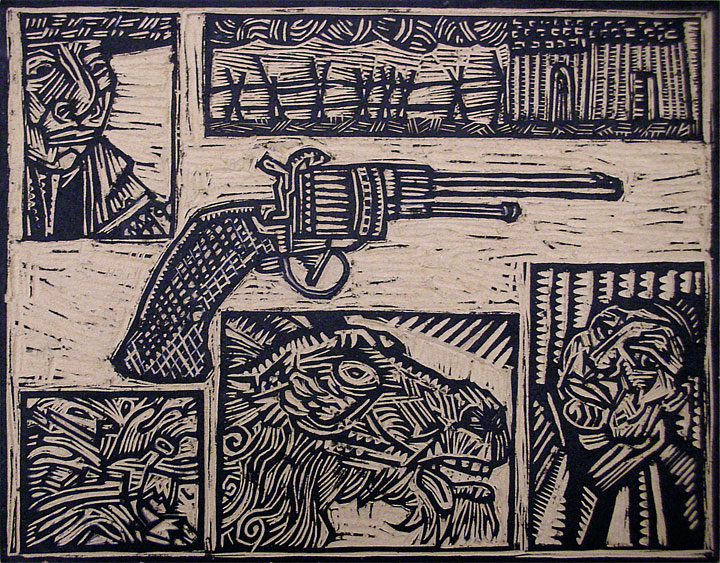
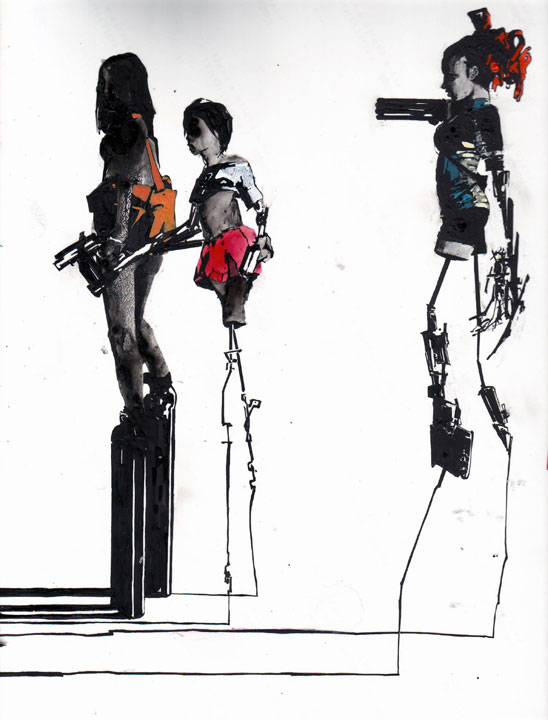
Six Versions of Blood Meridian is an ongoing project where six artists–Zak Smith, Sean McCarthy, John Mejias, Craig Taylor, Shawn Cheng, and Matt Wiegle–illustrate each page of Cormac McCarthy’s novel Blood Meridian. Zak Smith’s illustrations are particularly intriguing; he depicts the Glanton gang as women, a strange inversion that for some reason recalls the “Circe/Nighttown” episode of Joyce’s Ulysses. The Six Versions project’s eclectic range of styles and interpretations makes for one of the more fascinating approaches to a contemporary illuminated manuscript that I’ve seen on the internet (I’m also keen on Matt Kish’s handling of Moby-Dick). A few examples–

They aint worth no fifty dollars.
Dawn saw them deployed in a long file over the plain...
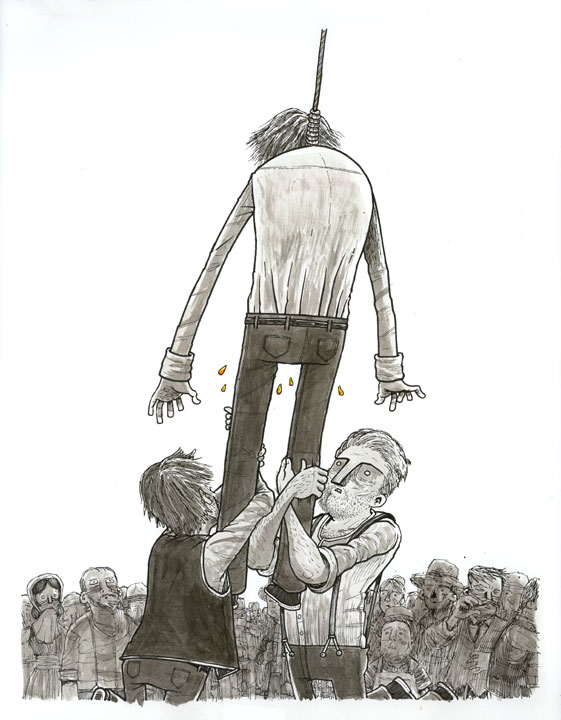
He sees a parricide hung in a crossroads hamlet...

if…. — Lindsay Anderson

41ahznwegjl_ss500_.jpg

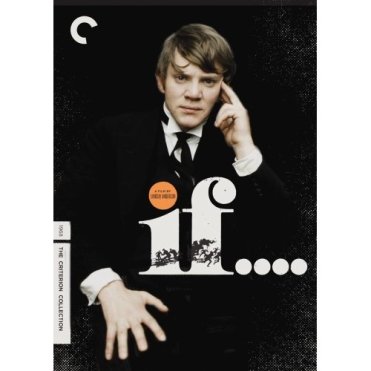
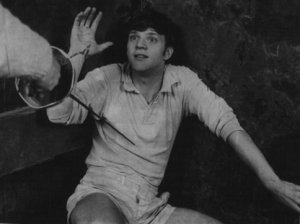
Criterion has finally given Lindsay Anderson‘s 1968 classic if…. a proper DVD release. if…. is one of my all time favorite films. Mick Travis (played with savage aplomb by a very young Malcolm McDowell) leads “The Crusaders,” a band of rebels who defy “The Whips,” the cruel upperclassmen who mete out harsh punishments at their stringent English boarding school. “What I want to know is when do we live?” asks restless Mick. However, the life of individual freedom that he wants to live is so suppressed by the cruel and dominating hierarchy of his school (a microcosm of British society) that he must take liberty by force. In one scene, the Crusaders playfully fence with each other, declaring “Death to all tyrants!” The playfulness quickly slips into violence, as the repressed urges of these would-be revolutionaries flare up. When Mick is cut, he shows his wounded hand and declares with pride “Blood! Real blood!”

if1.jpg

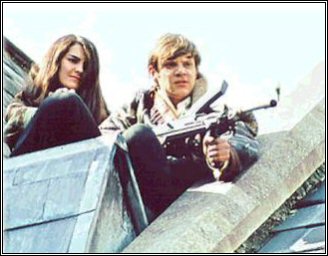
Anderson loads if…. with myriad revolutionary images that foreshadow the film’s shocking ending, at the same time tempering if…. with a surrealist sense of humor that satirizes the inherent dangers in institutionalized education and groupthink in general. if…. is bitingly funny, oddly sexy, and unlike any other film I’ve ever seen. The new edition looks great (much better than my VHS dub) and sounds great, and the commentary track provided by Malcolm McDowell and film critic David Robinson is insightful and surely a must for fans of the film. But who am I kidding, if you’re a fan of this film you’ve already seen the release and listened to the commentary–right?

if.jpg