“The Value of Not Understanding Everything” — Grace Paley

“The Value of Not Understanding Everything”

by

Grace Paley


The difference between writers and critics is that in order to function in their trade, writers must live in the world, and critics, to survive in the world, must live in literature.

That’s why writers in their own work need have nothing to do with criticism, no matter on what level.

In fact, since seminars and discussions move forward a lot more cheerily if a couple of bald statements are made, I’ll make one: You can lunge off into an interesting and true career as a writer even if you’ve read nothing but the Holy Bible and the New York Daily News, but that is an absolute minimum (read them slowly).

Literary criticism always ought to be of great interest to the historian, the moralist, the philosopher, which is sometimes me. Also to the reader—me again—the critic comes as a journalist. If it happens to be the right decade, he may even bring great news.

As a reader, I liked reading Wright Morris’s The Territory Ahead. But if I—the writer—should pay too much attention to him, I would have to think an awful lot about the Mississippi River. I’d have to get my mind off New York. I always think of New York. I often think of Chicago, San Francisco. Once in a while Atlanta. But I never think about the Mississippi, except to notice that its big, muddy foot is in New Orleans, from whence all New York singing comes. Documentaries aside, my notions of music came by plane.

As far as the artist is concerned, all the critic can ever do is make him or break him. He can slip him into new schools, waterlog him in old ones. He can discover him, ignore him, rediscover him … Continue reading ““The Value of Not Understanding Everything” — Grace Paley”

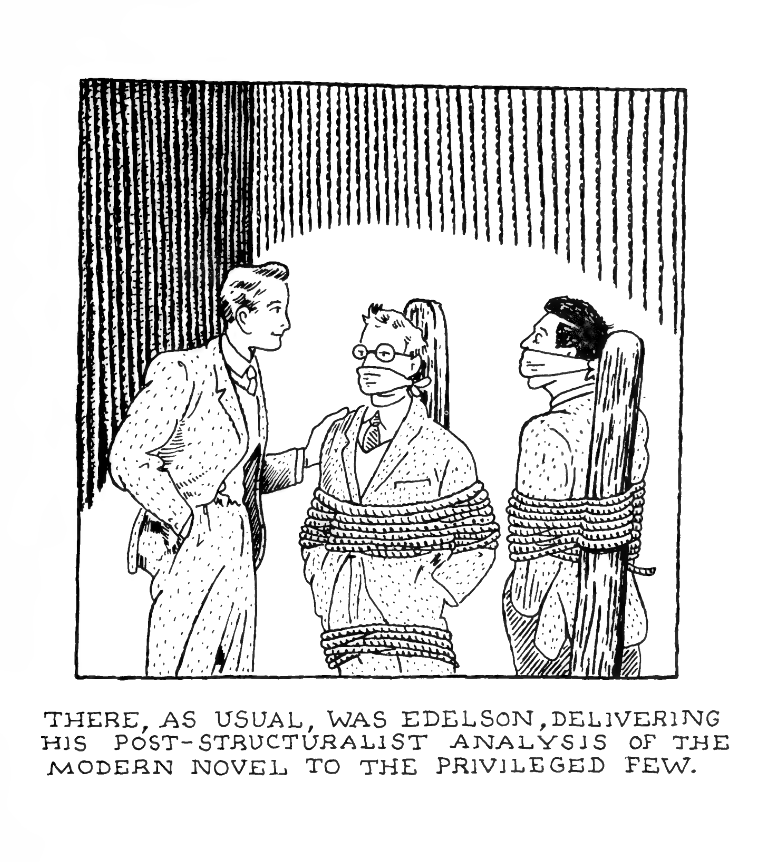
Literary criticism | Glen Baxter

“Daily Reviewer-Haupt” — David Markson

The novel should now try simply to be Funny, Brutalist, and Short | From B.S. Johnson’s novel Christie Marly’s Own Double-Entry

‘Christie,’ I warned him, ‘it does not seem to me possible to take this novel much further. I’m sorry.’

‘Don’t be sorry,’ said Christie, in a kindly manner, ‘don’t be sorry. We don’t equate length with importance, do we ? And who wants long novels anyway ? Why spend all your spare time for a month reading a thousand-page novel when you can have a comparable aesthetic experience in the theatre or cinema in only one evening ? The writing of a long novel is in itself an anachronistic act : it was relevant only to a society and a set of social conditions which no longer exist.’

‘I’m glad you understand so readily,’ I said, relieved.

‘The novel should now try simply to be Funny, Brutalist, and Short,’ Christie epigrammatised.

‘I could hardly have expressed it better myself,’ I said, pleased, ‘I’ve put down all I have to say, or rather I will have done in another twenty-two pages, so surely. . . .”

‘So I do go on a little longer ?’ interrupted Christie.

‘Yes, Christie, you go on to the end,’ I assured him, and myself went on : ‘Surely no reader will wish me to invent anything further, surely he or she can extrapolate only too easily from what has gone before ?’

‘If there is a reader,’ said Christie. ‘Most people won’t read it.’

‘Politicians, policemen, some educators and many others treat “most people” as idiots.’

‘So writers may too ?’

‘On the contrary. “Most people” are right not to read novels today.’

‘You’ve said all this before.’

‘I’m very likely to say it again, too, since it’s true.’

A pause. Then suddenly Christie said :

‘Your work has been a continuous dialogue with form ?’

‘If you like,’ I replied diffidently.

‘Only one of the things it’s been,’ said Christie generously. ‘It’s something to aspire to, becoming a critic ! Though there are too many exclamation marks in this novel already.’

Another pause. One of the girls in what is ill-reputed to be a brothel opposite hung out the shirt of what might be her ponce. Christie smiled gently, turned back to me.

‘But I am to go on for a while ?’

‘Of course,’ I assured him again.

‘Until I have everything ?’

‘Yes, Christie, until you have everything.’

The excerpt above is the complete text of Ch. XXI of B.S. Johnson’s 1973 novel, Christie Marly’s Own Double-Entry. The title of the chapter is “In which Christie and I have it All Out; and which You may care to Miss Out.” The chapter begins with this epigraph:

. . . the novel, during its metamorphosis in respect of content and form, necessarily regards itself ironically. It denies itself in parodistic forms in order to be able to outgrow itself.
Széll Zsuzsa
Válságés regény (p. 101)
Akadémia (Hungary) 1970
transl. by Novák Gyorgy

This particular chapter might stand as a synecdoche of Christie Marly’s Own Double-Entry itself.

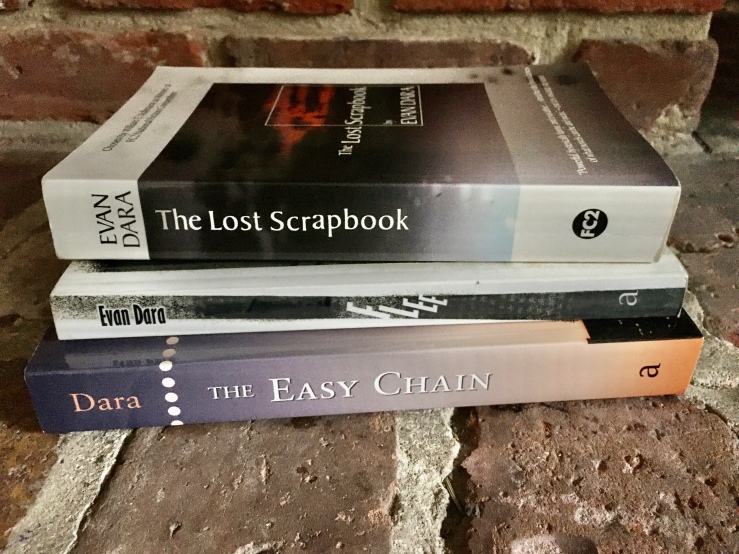
Daniel Green on the radically disruptive books of Evan Dara

Literary critic Daniel Green has written a longish essay on the writings of Evan Dara. Titled, “Giving Voice: On the Work of Evan Dara,” the essay situates Dara’s work within the context of its postmodern forebears and so-called “experimental” literature in general. Green contends that,

…it is obvious once one begins reading these novels that the author wants to subvert any presumptions we might have that the novel we are reading will bear enough family resemblance to those we have read before that it will be explicable according to the “rules” we believe we have learned about how novels should proceed. Clearly it intends to replace those rules with others applicable only to this work (although any one of Dara’s novels certainly does then provide direction in reading the others), rules that we will have to learn as we read. In this way, Dara’s novels work like all of their predecessors in the lineage of “experimental” fiction, presenting the reader with a heterodox formal arrangement the reader must learn to assimilate by attending closely to the new patterns the work establishes as alternatives to those patterns more conventional fiction has predisposed us to expect. Indeed, in the challenge they pose to the assumption that the conventional patterns define the novel as a form, Dara’s novels are arguably the most radically disruptive books in American fiction since, say, Gilbert Sorrentino in a work like Mulligan Stew (1979)

Much of Green’s essay is devoted to Dara’s 1995 debut, The Lost Scrapbook, which is a great starting point for anyone interested in Dara. Green describes The Lost Scrapbook as a work that

seems to consist of a series of disconnected episodes (some longer than others) leaning heavily on interior monologue and introducing “characters” whose relationships to each other are not immediately apparent. Moreover, these self-standing scenes don’t merely succeed each other but at times appear to merge, one dissolving into the other, as if the novel’s discourse represents a radio set whose dial is being tuned, bringing in one station before moving on to another.

Green also discusses Dara’s follow-ups to The Lost Scrapbook, 2007’s The Easy Chain and 2013’s Flee, as well as Dara’s most recent work, a 2018 play titled Provisional Biography of Mose Eakins. Green’s reading of the latter seems to inform his conclusion that Dara is ultimately “a moralist, not an aesthete,” a claim that I’m not quite sure I fully agree with (maybe he’s both?)—but I haven’t reread the works (although reading Green’s essay makes me want to). Green’s essay is, to my knowledge the only lengthy measure of Dara’s career to date, although I’m sure it won’t be the last of this under-read and important contemporary writer.

Read “Giving Voice: On the Work of Evan Dara” by Daniel Green.

Read my 2016 interview with Daniel Green.

Read my review of Evan Dara’s play Provisional Biography of Mose Eakins.

Daniel Mendelsohn’s Ecstasy and Terror (Book acquired, some time last week)

img_3918

I got a review copy of Daniel Mendelsohn’s collection Ecstasy and Terror some time early last week. I’ve read a few of the pieces in here before (“A Critic’s Manifesto” is one that I recalled in particular). Ecstasy and Terror is out in October from NYRB. Their blurb:

This collection of essays exemplifies the range, depth, and erudition that have made Daniel Mendelsohn “required reading for anyone interested in dissecting culture” (The Daily Beast). Here Mendelsohn once again casts an eye at literature, film, television, and the personal essay, filtering his insights through his training as a scholar of classical antiquity in surprising and illuminating ways.

Many of these essays examine how we continue to look to the Greeks and Romans as models: some argue for the surprising modernity of canonical works (Bacchae, the Aeneid), while others detect a “Greek DNA” in our responses to the Boston Marathon bombings and the assassination of JFK. Modern topics are treated, too, from the “aesthetics of victimhood” in Hanya Yanagihara’sA Little Life to the novels of Karl Ove Knausgaard, and from Game of Thrones to recent films about artificial intelligence—a subject, Mendelsohn reminds us, that was already of interest to Homer.

The collection also brings together for the first time a number of Mendelsohn’s personal essays, including his “critic’s manifesto” and a touching memoir of his boyhood correspondence with the historical novelist Mary Renault.

No writer has produced such inconsistent characters as nature herself has (From Melville’s The Confidence-Man)

…it may be urged that there is nothing a writer of fiction should more carefully see to, as there is nothing a sensible reader will more carefully look for, than that, in the depiction of any character, its consistency should be preserved. But this, though at first blush, seeming reasonable enough, may, upon a closer view, prove not so much so. For how does it couple with another requirement—equally insisted upon, perhaps—that, while to all fiction is allowed some play of invention, yet, fiction based on fact should never be contradictory to it; and is it not a fact, that, in real life, a consistent character is a rara avis? Which being so, the distaste of readers to the contrary sort in books, can hardly arise from any sense of their untrueness. It may rather be from perplexity as to understanding them. But if the acutest sage be often at his wits’ ends to understand living character, shall those who are not sages expect to run and read character in those mere phantoms which flit along a page, like shadows along a wall? That fiction, where every character can, by reason of its consistency, be comprehended at a glance, either exhibits but sections of character, making them appear for wholes, or else is very untrue to reality; while, on the other hand, that author who draws a character, even though to common view incongruous in its parts, as the flying-squirrel, and, at different periods, as much at variance with itself as the butterfly is with the caterpillar into which it changes, may yet, in so doing, be not false but faithful to facts.

If reason be judge, no writer has produced such inconsistent characters as nature herself has. It must call for no small sagacity in a reader unerringly to discriminate in a novel between the inconsistencies of conception and those of life as elsewhere. Experience is the only guide here; but as no one man can be coextensive with what is, it may be unwise in every ease to rest upon it. When the duck-billed beaver of Australia was first brought stuffed to England, the naturalists, appealing to their classifications, maintained that there was, in reality, no such creature; the bill in the specimen must needs be, in some way, artificially stuck on.

But let nature, to the perplexity of the naturalists, produce her duck-billed beavers as she may, lesser authors some may hold, have no business to be perplexing readers with duck-billed characters. Always, they should represent human nature not in obscurity, but transparency, which, indeed, is the practice with most novelists, and is, perhaps, in certain cases, someway felt to be a kind of honor rendered by them to their kind. But, whether it involve honor or otherwise might be mooted, considering that, if these waters of human nature can be so readily seen through, it may be either that they are very pure or very shallow. Upon the whole, it might rather be thought, that he, who, in view of its inconsistencies, says of human nature the same that, in view of its contrasts, is said of the divine nature, that it is past finding out, thereby evinces a better appreciation of it than he who, by always representing it in a clear light, leaves it to be inferred that he clearly knows all about it.

But though there is a prejudice against inconsistent characters in books, yet the prejudice bears the other way, when what seemed at first their inconsistency, afterwards, by the skill of the writer, turns out to be their good keeping. The great masters excel in nothing so much as in this very particular. They challenge astonishment at the tangled web of some character, and then raise admiration still greater at their satisfactory unraveling of it; in this way throwing open, sometimes to the understanding even of school misses, the last complications of that spirit which is affirmed by its Creator to be fearfully and wonderfully made.

At least, something like this is claimed for certain psychological novelists; nor will the claim be here disputed. Yet, as touching this point, it may prove suggestive, that all those sallies of ingenuity, having for their end the revelation of human nature on fixed principles, have, by the best judges, been excluded with contempt from the ranks of the sciences—palmistry, physiognomy, phrenology, psychology. Likewise, the fact, that in all ages such conflicting views have, by the most eminent minds, been taken of mankind, would, as with other topics, seem some presumption of a pretty general and pretty thorough ignorance of it. Which may appear the less improbable if it be considered that, after poring over the best novels professing to portray human nature, the studious youth will still run risk of being too often at fault upon actually entering the world; whereas, had he been furnished with a true delineation, it ought to fare with him something as with a stranger entering, map in hand, Boston town; the streets may be very crooked, he may often pause; but, thanks to his true map, he does not hopelessly lose his way. Nor, to this comparison, can it be an adequate objection, that the twistings of the town are always the same, and those of human nature subject to variation. The grand points of human nature are the same to-day they were a thousand years ago. The only variability in them is in expression, not in feature.

But as, in spite of seeming discouragement, some mathematicians are yet in hopes of hitting upon an exact method of determining the longitude, the more earnest psychologists may, in the face of previous failures, still cherish expectations with regard to some mode of infallibly discovering the heart of man.

From Herman Melville’s novel The Confidence-Man.

the book (is an extension of the eye) — Jen Mazza

jenmazza_thebookjenmazza_extensionofeye

the book (is an extension of the eye), 2012 by Jen Mazza (b. 1972)

The Journal of David Foster Wallace Studies, Vol. 1, Issue 1 (Book acquired, 28 Jan. 2019)

img_2152

The Journal of David Foster Wallace Studies is a peer-reviewed academic journal devoted to the work of David Foster Wallace. The Journal is published by the DFW Society.

img_2153

Here is the table of contents for Vol. 1, issue 1;

img_2154

I enjoyed Nash’s essay on boredom and attention in The Pale King, and found Saylor’s piece on race in Wallace’s fiction—focusing on Wallace’s whiteness within the context of his overall project of literary empathy–especially interesting.

I’m glad to see the journal finally in print after a few years of chatter about its creation. Perhaps there might be a future article or two that takes on the current wave of anti-Wallace think pieces that have been floating around lately.

Seek it like a dream | Another blog about Gaddis’s The Recognitions

Screenshot 2018-11-18 at 2.44.13 PM

Earlier this week, continuing my audit of William Gaddis’s 1955 novel The Recogntions, I felt a tingling sense of recognition in the following lines from which Basil Valentine reads from “a copy of Thoreau” (this is at the very end of Part I, on page 265):

What you seek in vain for, half your life, one day you come full upon, all the family at dinner. You seek it like a dream, and as soon as you find it you become its prey.

I attributed this tingling recognition to having read The Recognitions before (and to having read Part I once before that)—but then I realized that I’d read the line far, far more recently: It’s the epigraph to Gaddis’s fourth novel A Frolic of His Own, which I’d opened up again just a few weeks ago (and subsequently put back down).

This recognition is nothing special and certainly uninteresting to longtime Gaddis fans, but it motivated me enough to look more into the remark, so I plugged it into Google and quickly found  J. M. Tyree’s essay “Henry Thoreau, William Gaddis, and the Buried History of an Epigraph.” Tyree’s essay was originally published in New England Review but I found it, natch, on Steven Moore’s The Gaddis Annotations.

Tyree’s essay is a fascinating read, tracking the strange history of the line. Thoreau’s words, it turns out, are not exactly Thoreau’s words—rather, they are Emerson’s recollections of a conversation between the pair from a walk in the woods. Additionally, Emerson wrote and attributed these words after Thoreau’s death. The remark initially appeared in Emerson’s literary eulogy “Thoreau,” published in the August 1862 edition of Atlantic Monthly. As Tyree observes,

This detail, which seems highly trivial at first, in fact slyly reinforces the theme of original and copy supersaturating Gaddis’s novel. The very nature of authorship falls into question here, in a manner similar to the problem of Socrates and Plato: is Thoreau’s saying from Emerson or from Thoreau, or is it from both?

While issues of originality and authenticity of authorship clearly correlate to the themes of The Recognitions, Tyree’s essay is most interesting to me in the ways by which it situates Gaddis’s work with/against the American Renaissance tradition. Tyree gives us some of the flavor of that tradition, recontextualizing Gaddis’s epigraph in a full paragraph of Emerson’s. Here’s Emerson eulogizing his friend Thoreau:

It was a pleasure and a privilege to walk with him. He knew the country like a fox or a bird, and passed through it as freely by paths of his own. He knew every track in the snow or on the ground, and what creature had taken this path before him. One must submit abjectly to such a guide, and the reward was great . . . Presently he heard a note which he called that of the night-warbler, a bird he had never identified, had been in search of twelve years, which always, when he saw it, was in the act of diving down into a tree or bush, and which it was vain to seek; the only bird that sings indifferently by night and by day. I told him he must beware of finding and booking it, lest life should have nothing more to show him. He said, “What you seek in vain for, half your life, one day you come full upon, all the family at dinner. You seek it like a dream, and as soon as you find it you become its prey.”

Tyree situates the passage within the contrasting (and quickly diverging) philosophies of the old friends: “Emerson was essentially cosmic in his Transcendentalism, while Thoreau sought the divine in the actual empirical details of nature.”

Tyree’s essay becomes most interesting to me when he begins to interpret just what the hell the quote means. His analysis hovers around the word family, underlining an obsession of American literature: escape from domesticity. Here’s Tyree’s paraphrase of the Thoreau’s/Emerson’s line:

One finds the object of a long quest, quite suddenly, at the family dinner table. But in the moment of discovery, something seems to go wrong; rather than capturing the truth, one becomes its prey.  Clearly, the conversation here has expanded beyond night-warblers. Thoreau is now speaking of truth and its relationship to the family dinner table.

Tyree then susses out Thoreau’s complicated relationship with Emerson’s family:

It is possible to make too much of the fact that Thoreau’s intellectual life, as both a thinker and a man, developed in Emerson’s shade, in the shelter of Emerson’s house and family. But it is clear that Thoreau was often of two minds about living with or near Emerson. In a September 1841 letter….Thoreau told a friend that he was “living with Mr. Emerson in very dangerous prosperity.”

That “dangerous prosperity” of domestic life echoes one of the grand themes of American literature—namely, civilization is a blockade to be surpassed on the trek into wild nature, individuality, and freedom. Domestic duty interferes with such adventures. Just ask Rip Van Winkle, Ishmael, or Huck Finn. (Or perhaps Hawthorne’s cautionary figure, Young Goodman Brown).

Tyree underlines the point (final emphasis mine):

In the exchange over the night-warbler, the family is again identified in terms of danger; the quest is a danger to the family, or the family is a danger to the quest. One might read this as Thoreau’s critique of what would now be called Emerson’s “lifestyle.” A man who is the prey to truth must leave the dinner table to find it, but Emerson, in the comfort of his household, among his family, will never book the night-warbler. Thoreau does not say that having “all the family at dinner” stops one’s seeking, only that one becomes the prey of a protracted, half-conscious quest at mealtime. Then, one must decide what to do about it—whether to search out the night-warbler or not, and how to do it. The question seems to be whether the truth can be found through the life of the family, or whether one must leave it behind in some sense.

In The Recognitions, Wyatt circumvents the danger to his quest by not only removing himself from family (in the form of his wife Esther), but from removing himself from society in general. In J R (1975), most of Gaddis’s heroes find themselves unable to reconcile to Wyatt’s solution; their seeking fumbled out in half measures, neatly figured in the 96th Street apartment apartment shared by Gibbs, Eigen, and Bast. This hellhole is a transitory space, an inbetweeness of domesticity and city wilderness. Carpenter’s Gothic (1985) offers a more thorough critique of the impulse in American literature to send its (generally masculine) characters out into the wild spaces where they can transcend all the trappings of domesticity that bog them down. Carpenter’s Gothic confines its heroine to one haunted house, the men in her life flitting in and out if like silly birds on foiled quests. That domestic confinement reaches a kind of apotheosis in Gaddis’s posthumous novel Agapē Agape (2002), the stifling uninterrupted monologue of a man in a room, fighting against entropy.

And what about A Frolic of His Own (1994)? Well I haven’t read it yet.

“Quite an original” (From Herman Melville’s novel The Confidence-Man)

“Quite an original:” A phrase, we fancy, rather oftener used by the young, or the unlearned, or the untraveled, than by the old, or the well-read, or the man who has made the grand tour. Certainly, the sense of originality exists at its highest in an infant, and probably at its lowest in him who has completed the circle of the sciences.

As for original characters in fiction, a grateful reader will, on meeting with one, keep the anniversary of that day. True, we sometimes hear of an author who, at one creation, produces some two or three score such characters; it may be possible. But they can hardly be original in the sense that Hamlet is, or Don Quixote, or Milton’s Satan. That is to say, they are not, in a thorough sense, original at all. They are novel, or singular, or striking, or captivating, or all four at once.

More likely, they are what are called odd characters; but for that, are no more original, than what is called an odd genius, in his way, is. But, if original, whence came they? Or where did the novelist pick them up?

Where does any novelist pick up any character? For the most part, in town, to be sure. Every great town is a kind of man-show, where the novelist goes for his stock, just as the agriculturist goes to the cattle-show for his. But in the one fair, new species of quadrupeds are hardly more rare, than in the other are new species of characters—that is, original ones. Their rarity may still the more appear from this, that, while characters, merely singular, imply but singular forms so to speak, original ones, truly so, imply original instincts.

In short, a due conception of what is to be held for this sort of personage in fiction would make him almost as much of a prodigy there, as in real history is a new law-giver, a revolutionizing philosopher, or the founder of a new religion.

In nearly all the original characters, loosely accounted such in works of invention, there is discernible something prevailingly local, or of the age; which circumstance, of itself, would seem to invalidate the claim, judged by the principles here suggested.

Furthermore, if we consider, what is popularly held to entitle characters in fiction to being deemed original, is but something personal—confined to itself. The character sheds not its characteristic on its surroundings, whereas, the original character, essentially such, is like a revolving Drummond light, raying away from itself all round it—everything is lit by it, everything starts up to it (mark how it is with Hamlet), so that, in certain minds, there follows upon the adequate conception of such a character, an effect, in its way, akin to that which in Genesis attends upon the beginning of things.

For much the same reason that there is but one planet to one orbit, so can there be but one such original character to one work of invention. Two would conflict to chaos. In this view, to say that there are more than one to a book, is good presumption there is none at all. But for new, singular, striking, odd, eccentric, and all sorts of entertaining and instructive characters, a good fiction may be full of them. To produce such characters, an author, beside other things, must have seen much, and seen through much: to produce but one original character, he must have had much luck.

There would seem but one point in common between this sort of phenomenon in fiction and all other sorts: it cannot be born in the author’s imagination—it being as true in literature as in zoology, that all life is from the egg.

From Herman Melville’s novel The Confidence-Man.

No writer has produced such inconsistent characters as nature herself has (From Melville’s The Confidence-Man)

…it may be urged that there is nothing a writer of fiction should more carefully see to, as there is nothing a sensible reader will more carefully look for, than that, in the depiction of any character, its consistency should be preserved. But this, though at first blush, seeming reasonable enough, may, upon a closer view, prove not so much so. For how does it couple with another requirement—equally insisted upon, perhaps—that, while to all fiction is allowed some play of invention, yet, fiction based on fact should never be contradictory to it; and is it not a fact, that, in real life, a consistent character is a rara avis? Which being so, the distaste of readers to the contrary sort in books, can hardly arise from any sense of their untrueness. It may rather be from perplexity as to understanding them. But if the acutest sage be often at his wits’ ends to understand living character, shall those who are not sages expect to run and read character in those mere phantoms which flit along a page, like shadows along a wall? That fiction, where every character can, by reason of its consistency, be comprehended at a glance, either exhibits but sections of character, making them appear for wholes, or else is very untrue to reality; while, on the other hand, that author who draws a character, even though to common view incongruous in its parts, as the flying-squirrel, and, at different periods, as much at variance with itself as the butterfly is with the caterpillar into which it changes, may yet, in so doing, be not false but faithful to facts.

If reason be judge, no writer has produced such inconsistent characters as nature herself has. It must call for no small sagacity in a reader unerringly to discriminate in a novel between the inconsistencies of conception and those of life as elsewhere. Experience is the only guide here; but as no one man can be coextensive with what is, it may be unwise in every ease to rest upon it. When the duck-billed beaver of Australia was first brought stuffed to England, the naturalists, appealing to their classifications, maintained that there was, in reality, no such creature; the bill in the specimen must needs be, in some way, artificially stuck on.

But let nature, to the perplexity of the naturalists, produce her duck-billed beavers as she may, lesser authors some may hold, have no business to be perplexing readers with duck-billed characters. Always, they should represent human nature not in obscurity, but transparency, which, indeed, is the practice with most novelists, and is, perhaps, in certain cases, someway felt to be a kind of honor rendered by them to their kind. But, whether it involve honor or otherwise might be mooted, considering that, if these waters of human nature can be so readily seen through, it may be either that they are very pure or very shallow. Upon the whole, it might rather be thought, that he, who, in view of its inconsistencies, says of human nature the same that, in view of its contrasts, is said of the divine nature, that it is past finding out, thereby evinces a better appreciation of it than he who, by always representing it in a clear light, leaves it to be inferred that he clearly knows all about it.

But though there is a prejudice against inconsistent characters in books, yet the prejudice bears the other way, when what seemed at first their inconsistency, afterwards, by the skill of the writer, turns out to be their good keeping. The great masters excel in nothing so much as in this very particular. They challenge astonishment at the tangled web of some character, and then raise admiration still greater at their satisfactory unraveling of it; in this way throwing open, sometimes to the understanding even of school misses, the last complications of that spirit which is affirmed by its Creator to be fearfully and wonderfully made.

At least, something like this is claimed for certain psychological novelists; nor will the claim be here disputed. Yet, as touching this point, it may prove suggestive, that all those sallies of ingenuity, having for their end the revelation of human nature on fixed principles, have, by the best judges, been excluded with contempt from the ranks of the sciences—palmistry, physiognomy, phrenology, psychology. Likewise, the fact, that in all ages such conflicting views have, by the most eminent minds, been taken of mankind, would, as with other topics, seem some presumption of a pretty general and pretty thorough ignorance of it. Which may appear the less improbable if it be considered that, after poring over the best novels professing to portray human nature, the studious youth will still run risk of being too often at fault upon actually entering the world; whereas, had he been furnished with a true delineation, it ought to fare with him something as with a stranger entering, map in hand, Boston town; the streets may be very crooked, he may often pause; but, thanks to his true map, he does not hopelessly lose his way. Nor, to this comparison, can it be an adequate objection, that the twistings of the town are always the same, and those of human nature subject to variation. The grand points of human nature are the same to-day they were a thousand years ago. The only variability in them is in expression, not in feature.

But as, in spite of seeming discouragement, some mathematicians are yet in hopes of hitting upon an exact method of determining the longitude, the more earnest psychologists may, in the face of previous failures, still cherish expectations with regard to some mode of infallibly discovering the heart of man.

From Herman Melville’s novel The Confidence-Man.

“Fragment” — William Carlos Williams

Capture

Not a review of Laurent Binet’s novel The Seventh Function of Language

411xfx2hll-_sl500_

I was a big a fan of Laurent Binet’s novel HHhH, so I was excited when I heard about his follow up, The Seventh Function of Language. I was especially excited when I learned that The Seventh Function took the death of Roland Barthes as its starting point and post-structuralism in general as its milieu. I audited the audiobook (translated by Sam Taylor and read with dry wry humor by Bronson Pinchot).

The audiobook is twelve hours. If it had been six hours I might have loved it. But twelve hours was a bit too much.

Wait. Sorry. What is the novel about though? you may ask. This is not a review and I am feeling lazy and not especially passionate about the book, so here is the publisher’s-blurb-as-summary:

Paris, 1980. The literary critic Roland Barthes dies – struck by a laundry van – after lunch with the presidential candidate François Mitterand. The world of letters mourns a tragic accident. But what if it wasn’t an accident at all? What if Barthes was murdered?

In The Seventh Function of Language, Laurent Binet spins a madcap secret history of the French intelligentsia, starring such luminaries as Jacques Derrida, Umberto Eco, Gilles Deleuze, Michel Foucault, and Julia Kristeva – as well as the hapless police detective Jacques Bayard, whose new case will plunge him into the depths of literary theory. Soon Bayard finds himself in search of a lost manuscript by the linguist Roman Jakobson on the mysterious “seventh function of language.”

Kristeva! Eco! Derrida! All my childhood heroes are here!

So of course, y’know, I was interested. And I’m sure that the twenty-year-old version of me would have flipped out over Binet’s pastiche of postmodern theory and detective pulp fiction. But almost-forty me found the whole thing exhausting, a shaggy dog detective story with patches of the whole continental-philosophy-vs-analytical-philosophy debate sewn in with loose stitches.

The initial intellectual rush of what amounts to a Tel Quel fan fiction/murder-mystery/political thriller hybrid begins to wear thin about halfway through. Binet is smart and he’s writing about smart people, but the cleverness on display becomes irksome, especially when he’s drawing his characters’ big philosophical ideas in the broadest of strokes (Julia Kristeva arrives at her concept of abjection after a floating film on a glass of milk makes her ill).

Binet loves to cram his characters into social situations where they can wax philosophical (in the thinnest possible sense of that verb wax). The Seventh Function is larded with chatty cocktail parties where Kristeva and Foucault can toss out zinger after zinger. One of the novel’s centerpieces, an academic conference at Cornell, serves as an excuse for Binet to riff large (but shallow) on language philosophy. He even brings Chomsky and Searle to the conference to take on Derrida et al. (Binet also squeezes in a postmodern orgy here, in which Detective Bayard has a threesome with Hélène Cixous and Judith Butler). Such scenes are funny but baggy, overlong, and often feel like an excuse for Binet to show how clever he is. (And don’t even get me started on the fact that the novel’s central protagonist worries that he might be a character in a novel).

Binet is more successful at channeling his characters’ intellects during the high-risk debates of a secret society called the Logos Club. The best of these debates showcase thought-in-action, as Binet’s characters deconstruct various topics. Still, as engaging as some elements of the Logos Club debates are, they drag on too long, and the Club’s connection to the political-thriller aspect of the plot is pretty tenuous.  Indeed, the novel is so loose that a minor character has to show up at the end and explain how all the elements connect for both the reader and detectives alike.

What’s probably most remarkable about The Seventh Function (despite the fact that it features a who’s-who of postmodern theory for its cast) is just how one-note the novel is. After all, it’s a mashup. As Anthony Domestico puts it in his (proper and insightful) review at The San Francisco Chronicle, “The novel is three parts Tom Clancy to two parts Theory SparkNotes to one part sex romp.” The Seventh Function of Language should be a lot more fun than it is.  And it is fun at times, but not enough fun to sustain, say, twelve hours of an audiobook or 359 pages in hardcover.

As HHhH showed, Binet is a talented author, and even though The Seventh Function didn’t work for me, I’m interested to see what he does next. It’s possible that The Seventh Function didn’t float my proverbial boat precisely because I’m the ideal audience for the novel. If anything, it made me want to reread Umberto Eco’s Foucault’s Pendulumbut The Seventh Function also reminded me that I read Eco’s semiotics-detective story as a much younger man—as a kid in my early twenties who probably would’ve loved Binet’s novel. So maybe I should leave well enough alone.


Selections from One-Star Amazon Reviews of Margaret Atwood’s The Handmaid’s Tale

[Editorial note: The following citations come from one-star Amazon reviews of Margaret Atwood’s novel The Handmaid’s Tale. (For the record, I think The Handmaid’s Tale is pretty great).

 I’ve preserved the reviewers’ original punctuation and spelling. More one-star Amazon reviews].


shrill

Strange

no hope

anti male story

boring and odd

Feminist dogma

anti-religious zeal

poorly researched

futuristic yet dated

no good verses evil

Political propaganda

socialist point of view

Too many adjectives!!

extremely depressing

It all-around too much

tries to be all futuristic

I’m not a Christian, but

Overuse of punctuation

Sorry but no one liked it

a lot of words were used

twisted grossness and blah

Not a feminist novel for sure

Actually, it is about infertility

Written by a 12-year-old shut in

It’s hard to glean what happened

Not realistic as a futuristic fantasy

pointless exercise in self-contempt

annoying stream-of-consciousness style

these fertile women aren’t treated badly

an academic’s paranoid bondage fantasy

a lot of sexual situations and foul language

The reader is always in a confused state of mind

The main character doesn’t grow or learn anything

The author created a lot of terms but didn’t explain them

literally fills the pages by talking about grocery shopping

obviously has an ax to grind with Judeo-Christian principle

There isn’t much focus on what women are not allowed to do

Mostly just someone running errands in an American dystopia

an author who obviously doesn’t understand the passages from the Bible

main character is weak, conviction less and incapable of making any exciting moves

I’m going to bury it in the ground and let the worms eat all those words unfit for human consumption

drones on and on about brick sidewalks and rays of sunlight and tulips and blue stripes on kitchen towels

Is this supposed to be 1984, Brave New World, or even Hunger Games? If you compare it to any of those books, it is utter fail.

I’ve often wished that someone would rewrite the end of Huckleberry Finn (Paul Bowles)

I’ve often wished that someone would rewrite the end of Huckleberry Finn, delivering it from the farcical closing scenes which Twain, probably embarrassed by the lyrical sweep of the nearly completed book, decided were necessary if the work were to be appreciated by American readers. It’s the great American novel, damaged beyond repair by its author’s senseless sabotage. I’d be interested to have your opinion, or do you feel that the book isn’t worth having an opinion about, since a botched masterpiece isn’t a masterpiece at all? Yet to counterfeit the style successfully, so that the break would be seamless and the prose following it a convincing continuation of what came before—that seems an impossible task. So I shan’t try it, myself.

From Paul Bowles’s short story “Unwelcome Words.”

The merely clever writer (Georg Christoph Lichtenberg)

screenshot-2016-12-29-at-4-04-38-pm

From Georg Christoph Lichtenberg’s The Waste Books. English translation by R.J. Hollingdale. NYRB.