My mother dropped off several boxes of books, comics, and papers I hadn’t delved into in probably 20 years—stuff I’d left at my parents’ house, intending to retrieve at some point. One book I reacquired was a Czechoslovakian folk and fairy tale collection with the nondescript name Animal Fairy Stories (retold by Alena Benesova and translated into English by Ruth Shepherd), a volume collecting over a hundred stories from all over the globe.
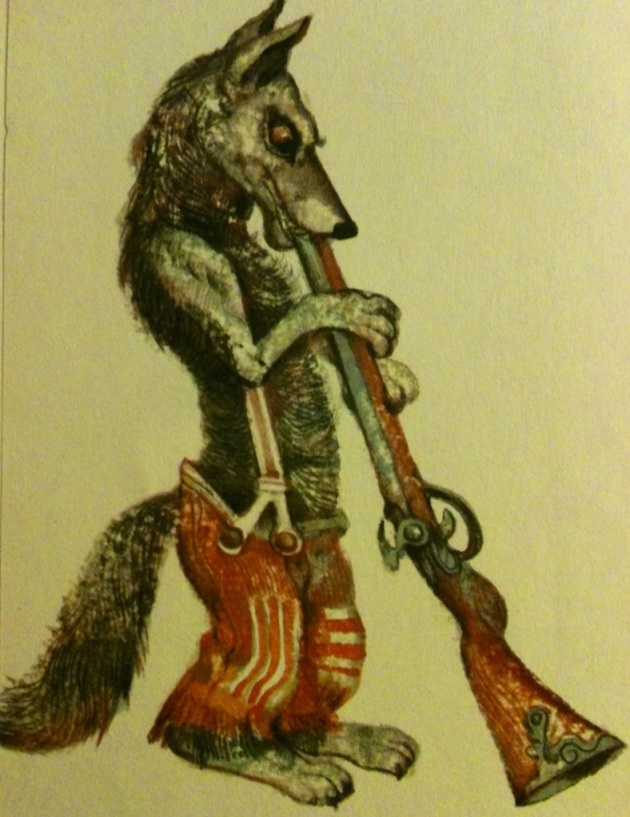
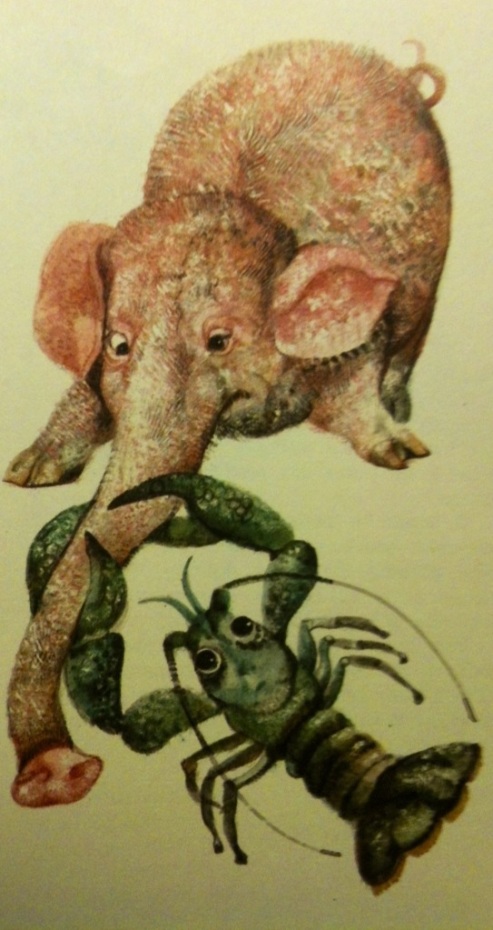
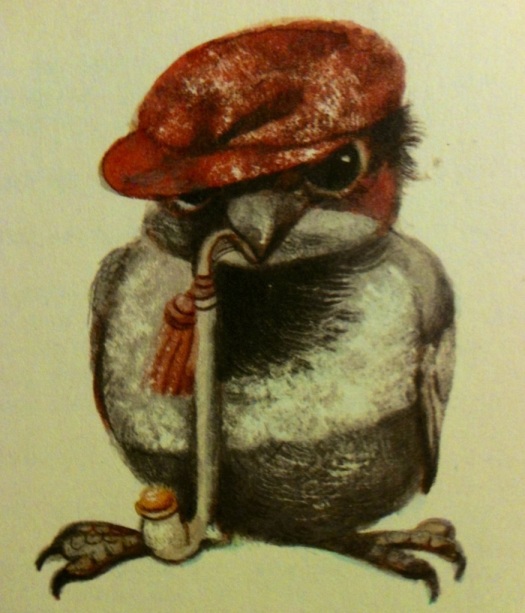
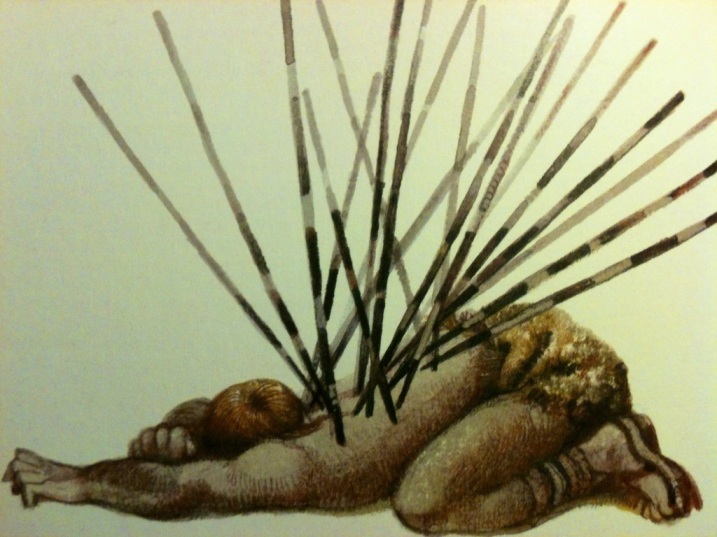
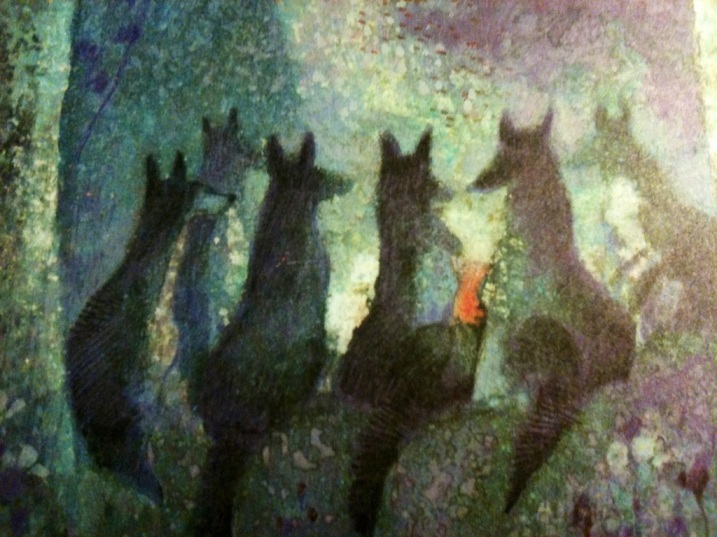
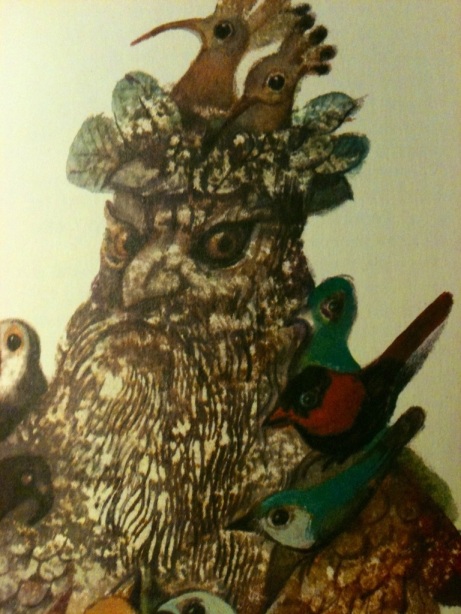
These stories had a tremendous impact on me as a child. Most describe a time “when the world was still young and everything was very different,” an amorphous, shifting world full of tricksters and their dupes, kings always precariously poised to fall and fail, interspecies cohabitation, and lots and lots of death. As important as these stories were in forming my reading habits and taste, the book’s illustrations by Czech artist Karel Franta had an even more profound and unsettling impact on my imagination. His strange, marvelous paintings somehow imprinted on my psyche, mixing in with the horror and joy and fascination that all those early stories entailed. Reading over a dozen animal tales with my own children last night, I was taken aback at how precisely each of Franta’s illustrations was etched into my brain, and how each image burned with its own special humor or terror or confusion or weird delight.
Below are a few of his paintings; I’ve tried to share a sampling that showcases his mix of strange pathos, unsettling humor, and dreamworld evocation.
Ben Marcus’s The Flame Alphabet is newish in trade paperback from the nice people at Vintage. I’ve been wanting to read it after absorbing Marcus’s The Age of Wire and String last year. I hear that The Flame Alphabet is more conventional than that earlier work, although a breakfast-menu-as-novel would be more conventional, really. Anyway, this one is up on deck, so no blurbage this time.
In place of the normal blurb I offer with these “book acquired” posts, here’s Marcus on David Markson (from “The Genre Artist,” published in a 2003 issue of The Believer):
. . . when, for example, David Markson, an expository novelist who fired the starting gun for fictions of information and proved that pure exposition can be alarmingly moving, who purposefully tells instead of shows, is dismissed in The New York Times for failing to provide a story in his novel Reader’s Block, no discussion follows about why, exactly, fiction must have one (at 150 words in the book review, how could any discussion follow?). Nor do we learn what a story might have looked like in such an exquisitely felt book that, to summarize, catalogs the various ways historical figures have hated whole races of people and/or died by their own hands. (Yes, you should read this book.)
Markson should have presumably, under the fiction-must-have-a-story criteria, zeroed in on one of his hundreds of characters and gone deep, doing that good old-time psychological work, the person-making stuff, dramatizing how such an interesting fellow had gone on to hate Jews and/or kill himself. Markson should have used more words like “then.” He should have sequenced. He seems to have forgotten that literature is supposedly a time-based art.
Markson’s amnesia is one of the happy accidents of the last decade of fiction writing. By eschewing a fetishistic, conventional interest in character, or a dutiful allegiance to moment creation, to occurrence itself, Markson accomplishes what a story, slogging through time and obedient to momentum, arguably could not: a commanding, obsessive portrait of single behaviors throughout history, a catalog of atrocity that overwhelms through relentless example. In truth, it’s a novel that can be read as an essay, but unlike most essays, it’s lyrically shrewd, poetry in the form of history, and it’s brave enough to provide creepy, gaping holes where we normally might encounter context (the burden of the conventional essayist).
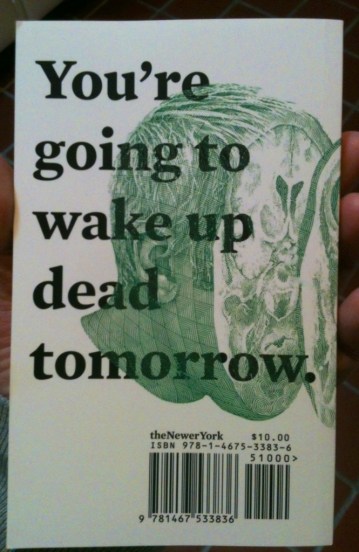
TheNewerYorkis a new little magazine or journal or whatever you want to call it, featuring short fiction, poetry, art, lists, labels, fake reviews, and other stuff. Issue #2, clocking in at just over 80 pages fits neatly into a man’s jacket pocket and can be read in queues or at red lights or in between other readings or discreetly during end of semester faculty meetings. (I’m pretty sure you could read it in other occasions but I didn’t). You can see the front cover above; here’s the back cover, featuring this worrisome promise:
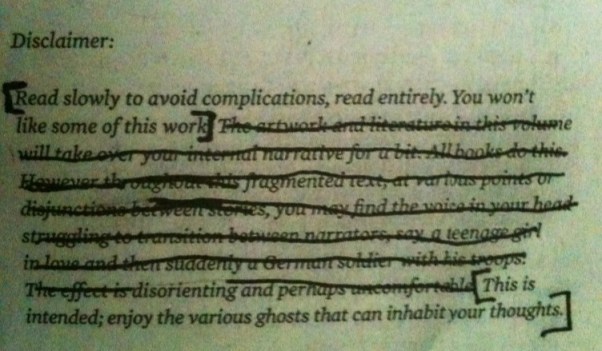
Maybe the best way to summarize (what I take to be) theNewerYork’s aesthetic/literary mission is to show off the issue’s disclaimer (which is preceded by a fancy Foucault quote):
“You won’t like some of this work” seems like a fair warning, but theNewerYork is more hit than miss, starting with its excellent opener, ‘The Thank You War” by Elliot L. Ackerman, a four-paragraph flash that tackles how would-be patriotic citizens bungle human relationships with returning soldiers. Also very good is Jamie Grefe’s list “Over Thirteen,” which is a lovely little horror story that makes meaningful use of the reader’s imagination. Another list, Bruce Harris’s “Nearly A Dozen Things Sherlock Holmes Never Said” made me laugh (sample: “Watson, you’re right.”)
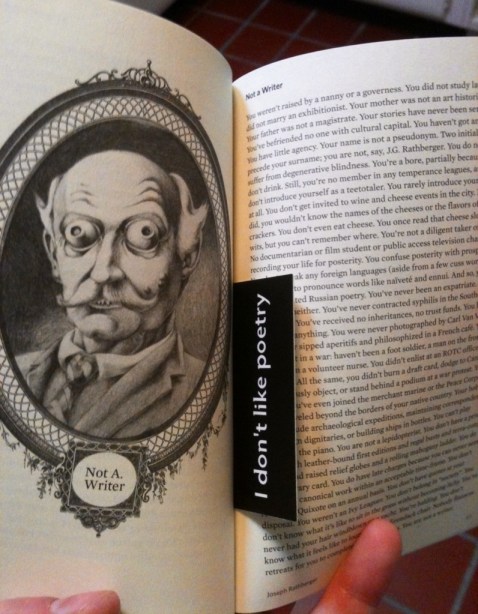
One of my favorite pieces in the volume is “Not a Writer” by Joseph Rathberger (indexed as “A Put Down”). You can see it below, filling up a page; you can also see the art that precedes it and the nifty bookmark that comes with the issue:
Most of the art in the issue is black and white and all of it is varied (in style and in quality). Here is Food Poop by Shaina Yang:
TheNewerYork’s willingness to showcase experimentation in what goes on paper for people to look at and read is both a strength and a weakness. Most of the pieces succeed, even when they shouldn’t (why is a Google translation from “Baby Got Back” from English to Latin and then back into English so funny?). The pieces in the issue that don’t succeed fail on their own terms: half-formed or poorly executed ideas, the occasionally gimmicky experiment, and, thankfully more rarely, pieces that feel too imitative. But like I said, most of the texts in theNewerYork’s second issue succeed, which is to say they entertain or amuse or baffle or occasionally move the reader. What I like most about theNewerYork is its spirit, which is daring and experimental without the heavy robes of irony that often cloak these sorts of operations. A promising beginning.
2. There are seven Maqroll novellas; I’ve read the first three. They are excellent.
3. Let me steal from Cianci’s review. He describes Maqroll the Gaviero as
a fleshed-out character, as well as the embodiment of an ideal: the knife fighters and Viking poets idolized by Borges, a mixture of Robinson Crusoe, Sam Spade, and Don Quixote. He indulges fantasy but prepares for disappointment. He lives between lawlessness and acceptability.
4. The Gaviero—the lookout—is a picaro, a roguish but poetical sailor. Mutis’s book is picaresque, carnivalesque, a river—or maybe a maze—of storytelling.
5. This is maybe what Maqroll is about: storytelling. Each Maqroll novella is framed as another’s story, or a found document—you know this trick, you’ve read Borges, right?
6. The book is crammed with stories, stories that lead to other stories, that recall other stories, that tell their own stories—or cover over other stories.
7. A line that might instructively illustrate point 6: In Ilona Comes with the Rain, Mutis unpacks the life of a minor character, a sea captain named Wito. Consider his opening gambit:
His life deserves an entire book. It was so full of adventures, some of which he hurried over as if they were hot coals, that one became lost in their labyrinthine complexity.
The life described here could just as well be the Gaviero’s.
8. Well of course, that’s what Mutis is doing, channeling and conveying and expressing Maqroll’s life, a life of picaresque adventures (and titular misadventures), of loss and gain, of love and despair, drinking, sailing, scheming and plotting—a life full of allusions and hints and digressions. Mutis’s technique is marvelous (literally; he made this reader marvel): he gives us an aging (anti-)hero, a hero whose life is overstuffed with stories and mishaps and feats and enterprises and hazards; he gives us one strand of that life at a time in each novella—but then he points to the other adventures, the other serials of Maqroll that we would love to tune into if only we could.
9. To illustrate point 8: Consider Maqroll in Un Bel Morir, doing some time in prison: His consciousness floats to other prisons, other countries: Afghanistan, British Columbia: And then we get those stories, miniature epics—and nested within them, their own characters tell stories.
10. There’s a wonderful timelessness to Maqroll, a sense that the adventures exist somehow before the postmodern world, that they belong to the pulp fictions of jungle adventure…
11. (Indeed, re: point 10: In Ilona, we find one character who is unstuck in time, taking a Naopleonic lover during a transcontinental voyage…)
12. I’ve already noted the Borgesian quality of Mutis’s tales, brought up their picaresque scope (a la Cervantes), so let me lazily compare Mutis to others: let me note the sprawl of his storytelling, which recalls García Márquez—only more compact, more precise. Let me suggest that there’s something of Kafka in there too—indeed, the first novella, The Snows of the Admiral seems to me a reworking of “Before the Law.” (The tale is also conspicuously quixotic; tilting at windmills and all that). Conrad of course, but also something of Melville—the grand (Moby-Dick) and the sly (The Confidence Man). And hell, also something of Edgar Rice Burroughs’s high adventure, or even, dare I say it, the better parts of the Indiana Jones films.
13. Lazy as I am, I’ve failed to quote Mutis at any length—a shame, because it’s wonderful prose (translated by Edith Grossman, by the way). So here’s a little morsel—one that I think captures why we tell stories—from the appendix to Un Bel Morir, the last of the three novellas I read; before I offer it up I’ll conclude my riff by saying how happy I am that there are four more of these Maqroll novellas to read:
All the stories and lies about his past accumulating until they formed another being, always present and naturally more deeply loved than his own pale, useless existence composed of nausea and dreams.
I got a little lax with these “books acquired” posts at the end of last year—chalk it up to end of semester deadlines and meetings, family-oriented holiday stuff, and an awful illness. Anyway–
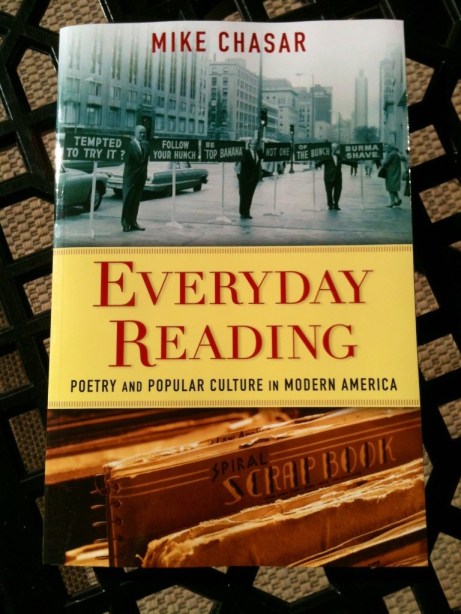
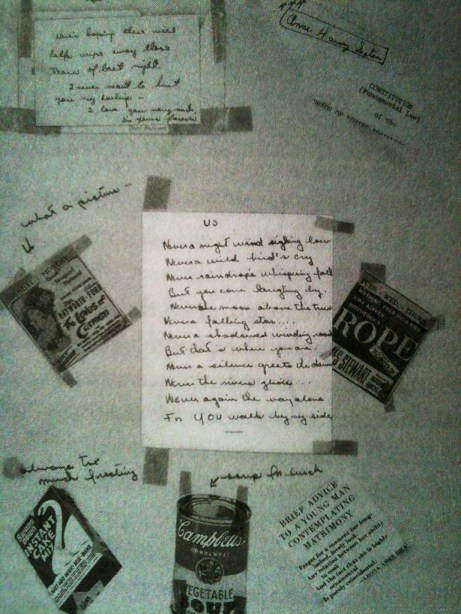
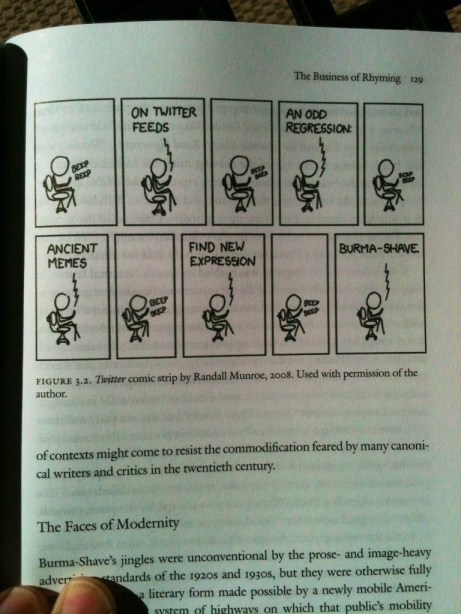
Mike Chasar’s Everyday Reading: Poetry and Popular Culture in Modern America, new from Columbia University Press is pretty cool: it’s kind of a dialogic study of how poetry evinces (or infiltrates or collides or emerges from or is bound by) a variety of popular media. Some of the most fascinating chapters dwell on scrapbooking. Here’s Columbia U of P’s blurb:
Exploring poetry scrapbooks, old-time radio show recordings, advertising verse, corporate archives, and Hallmark greeting cards, among other unconventional sources, Mike Chasar casts American poetry as an everyday phenomenon consumed and created by a vast range of readers. He shows how American poetry in the first half of the twentieth century and its reception helped set the stage for the dynamics of popular culture and mass media today.
Poetry was then part and parcel of American popular culture, spreading rapidly as the consumer economy expanded and companies exploited its profit-making potential. Poetry also offered ordinary Americans creative, emotional, political, and intellectual modes of expression, whether through scrapbooking, participation in radio programs, or poetry contests. Reenvisioning the uses of twentieth-century poetry, Chasar provides a richer understanding of the innovations of modernist and avant-garde poets and the American reading public’s sophisticated powers of feeling and perception.
A couple of snaps from the book—pics of pages from one of those scrapbooks—
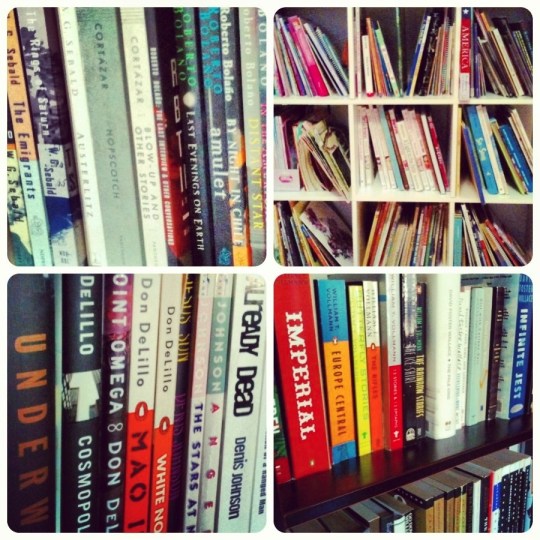
Book shelves series #53, fifty-third—and final!—Sunday of 2012: In which I take a few photos at random.
I somehow managed to squeeze 52 weeks of shots out of all the book-bearing surfaces of my home (—oh—I did one week from my office).
For the last in this series (yay!) I simply walked through the rooms of the house, took a few shots, and then put them in digital frames.
For the most part, my method was thoughtless, although I did grab a pic of a bookcase new to our house (second pic, top left) that dominates my son’s room.
I also took a pic of Perec’s essay collection because one of his essays inspired this (awful, awful) project.
From that essay, “The Art and Manner of Arranging One’s Books”:
We should first of all distinguish stable classifications from provisional ones. Stable classifications are those which, in principle, you continue to respect; provisional classifications are those supposed to last only a few days, the time it takes for a book to discover, or rediscover, its definitive place. This may be a book recently acquired and not read yet, or else a book recently read that you don’t quite know where to place and which you have promised to yourself you will put away on the occasion of a forthcoming ‘great arranging’, or else a book whose reading has been interrupted and that you don’t to classify before taking it up again and finishing it, or else a book you have used constantly over a given period, or else a book you have taken down to look up a piece of information or a reference and which you haven’t yet put back in its place, or else a book that you can’t put back in its place, or else a book that you can’t put back in its rightful place because it doesn’t belong to you and you’ve several times promised to give it back, etc.
So, what did I get out of doing this project?
1. Photographing books is difficult—I mean physically. They all reflect light differently.
2. Doing a regularly-scheduled project is difficult.
As the day was pleasant, Madame Valmonde drove over to L’Abri to see Desiree and the baby.
It made her laugh to think of Desiree with a baby. Why, it seemed but yesterday that Desiree was little more than a baby herself; when Monsieur in riding through the gateway of Valmonde had found her lying asleep in the shadow of the big stone pillar.
The little one awoke in his arms and began to cry for “Dada.” That was as much as she could do or say. Some people thought she might have strayed there of her own accord, for she was of the toddling age. The prevailing belief was that she had been purposely left by a party of Texans, whose canvas-covered wagon, late in the day, had crossed the ferry that Coton Mais kept, just below the plantation. In time Madame Valmonde abandoned every speculation but the one that Desiree had been sent to her by a beneficent Providence to be the child of her affection, seeing that she was without child of the flesh. For the girl grew to be beautiful and gentle, affectionate and sincere – the idol of Valmonde.
It was no wonder, when she stood one day against the stone pillar in whose shadow she had lain asleep, eighteen years before, that Armand Aubigny riding by and seeing her there, had fallen in love with her. That was the way all the Aubignys fell in love, as if struck by a pistol shot. The wonder was that he had not loved her before; for he had known her since his father brought him home from Paris, a boy of eight, after his mother died there. The passion that awoke in him that day, when he saw her at the gate, swept along like an avalanche, or like a prairie fire, or like anything that drives headlong over all obstacles.
Monsieur Valmonde grew practical and wanted things well considered: that is, the girl’s obscure origin. Armand looked into her eyes and did not care. He was reminded that she was nameless. What did it matter about a name when he could give her one of the oldest and proudest in Louisiana? He ordered the corbeille from Paris, and contained himself with what patience he could until it arrived; then they were married. Continue reading ““Desiree’s Baby” — Kate Chopin”→
Unless one is wealthy there is no use in being a charming fellow. Romance is the privilege of the rich, not the profession of the unemployed. The poor should be practical and prosaic. It is better to have a permanent income than to be fascinating. These are the great truths of modern life which Hughie Erskine never realised. Poor Hughie! Intellectually, we must admit, he was not of much importance. He never said a brilliant or even an ill-natured thing in his life. But then he was wonderfully good-looking, with his crisp brown hair, his clear-cut profile, and his grey eyes. He was as popular with men as he was with women, and he had every accomplishment except that of making money. His father had bequeathed him his cavalry sword, and a History of the Peninsular War in fifteen volumes. Hughie hung the first over his looking-glass, put the second on a shelf between Ruff’s Guide and Bailey’sMagazine, and lived on two hundred a year that an old aunt allowed him. He had tried everything. He had gone on the Stock Exchange for six months; but what was a butterfly to do among bulls and bears? He had been a tea-merchant for a little longer, but had soon tired of pekoe and souchong. Then he had tried selling dry sherry. That did not answer; the sherry was a little too dry. Ultimately he became nothing, a delightful, ineffectual young man with a perfect profile and no profession. Continue reading ““The Model Millionaire” — Oscar Wilde”→
Lily, the caretaker’s daughter, was literally run off her feet. Hardly had she brought one gentleman into the little pantry behind the office on the ground floor and helped him off with his overcoat than the wheezy hall-door bell clanged again and she had to scamper along the bare hallway to let in another guest. It was well for her she had not to attend to the ladies also. But Miss Kate and Miss Julia had thought of that and had converted the bathroom upstairs into a ladies’ dressing-room. Miss Kate and Miss Julia were there, gossiping and laughing and fussing, walking after each other to the head of the stairs, peering down over the banisters and calling down to Lily to ask her who had come.
It was always a great affair, the Misses Morkan’s annual dance. Everybody who knew them came to it, members of the family, old friends of the family, the members of Julia’s choir, any of Kate’s pupils that were grown up enough and even some of Mary Jane’s pupils too. Never once had it fallen flat. For years and years it had gone off in splendid style as long as anyone could remember; ever since Kate and Julia, after the death of their brother Pat, had left the house in Stoney Batter and taken Mary Jane, their only niece, to live with them in the dark gaunt house on Usher’s Island, the upper part of which they had rented from Mr Fulham, the corn- factor on the ground floor. That was a good thirty years ago if it was a day. Mary Jane, who was then a little girl in short clothes, was now the main prop of the household for she had the organ in Haddington Road. She had been through the Academy and gave a pupils’ concert every year in the upper room of the Antient Concert Rooms. Many of her pupils belonged to better-class families on the Kingstown and Dalkey line. Old as they were, her aunts also did their share. Julia, though she was quite grey, was still the leading soprano in Adam and Eve’s, and Kate, being too feeble to go about much, gave music lessons to beginners on the old square piano in the back room. Lily, the caretaker’s daughter, did housemaid’s work for them. Though their life was modest they believed in eating well; the best of everything: diamond-bone sirloins, three-shilling tea and the best bottled stout. But Lily seldom made a mistake in the orders so that she got on well with her three mistresses. They were fussy, that was all. But the only thing they would not stand was back answers.
Of course they had good reason to be fussy on such a night. And then it was long after ten o’clock and yet there was no sign of Gabriel and his wife. Besides they were dreadfully afraid that Freddy Malins might turn up screwed. They would not wish for worlds that any of Mary Jane’s pupils should see him under the influence; and when he was like that it was sometimes very hard to manage him. Freddy Malins always came late but they wondered what could be keeping Gabriel: and that was what brought them every two minutes to the banisters to ask Lily had Gabriel or Freddy come. Continue reading ““The Dead” — James Joyce”→
Book shelves series #52, fifty-second Sunday of 2012: In which, in this penultimate chapter, we return to the site of entry #1.
The first entry in this project was my bedside nightstand. This is what it looked like back in January:
This is it this morning:
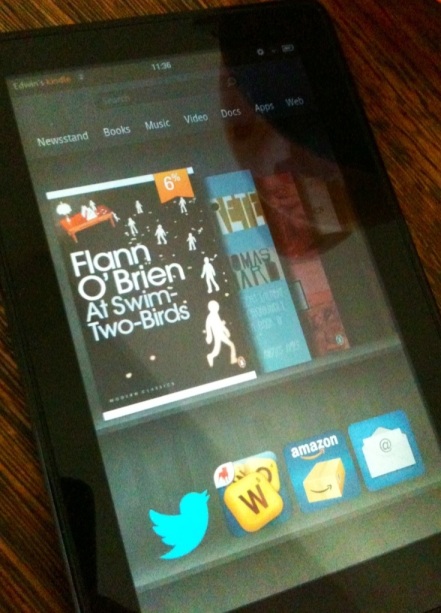
This is the major difference:
The Kindle Fire has changed my late night shuffling habits.
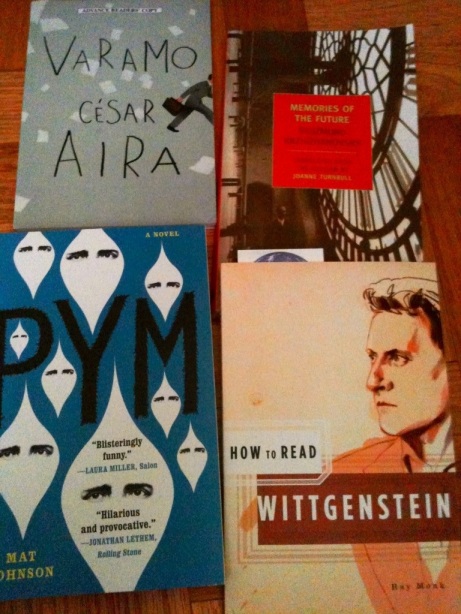
Here are the books that are in the nightstand:
I read the Aira novel but completely forgot about it, which I’m sure says more about me than it.
Have no idea why this is in there:
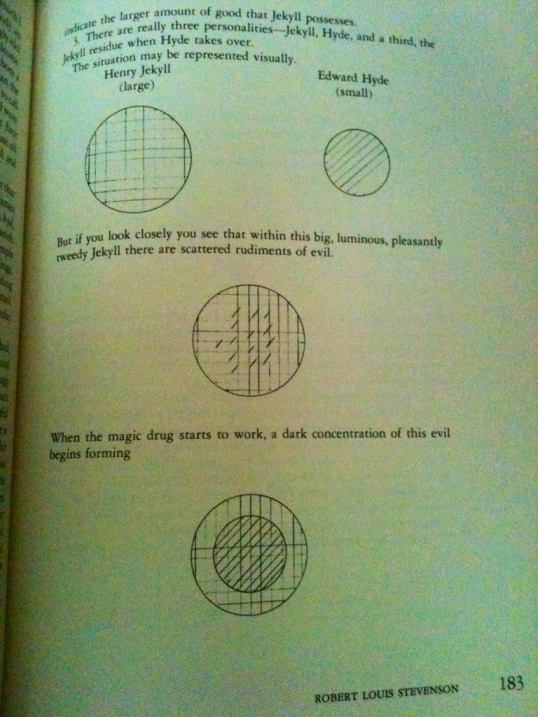
But it’s a fun book. With pictures! Sample:
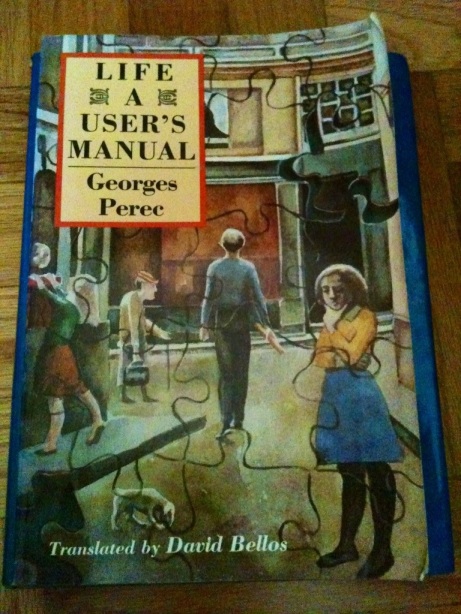
Finally, Perec’s Life A User’s Manual—this is one of my reading goals for 2013. It seems like a good way to close out this penultimate post, as one of Perec’s essays inspired this project
“Every library answers a twofold need, which is often also a twofold obsession: that of conserving certain objects (books) and that of organizing them in certain ways”
—Georges Perec, from ”Brief Notes on the Art and Manner of Arranging One’s Books” (1978)
I just read the first few chapters of The President in Her Towers, Tom Whalen’s satire of academia—good stuff: short, punchy chapters that illustrate the reality of academia in all its paranoid surreality. Here’s publisher Ellipsis Press’s blurb:
Through the corridors of the university’s Humanities and Sciences Towers, rumors are swirling about the President: her bizarre decrees, her midnight meetings, her strange projects (the Head-in-Progress, the Activated Eye, the Gestation Chamber). The President’s dedicated personal assistant, Thomas (a.k.a. Herr Abjectus), is charged with investigating and reporting on these and other matters, but it won’t be easy—especially since the President has disappeared. And now there is a new rumor: that she has been marked for assassination
This one looks pretty cool—André Maurois’s 1928 novel Climates. Here’s publisher Other Press’s blurb:
Written in 1928 by French biographer and novelist Andre Maurois, Climates became a best seller in France and all over Europe. The first 100,000 copies printed of its Russian translation sold out the day they appeared in Moscow bookstores. This magnificently written novel about a double conjugal failure is imbued with subtle yet profound psychological insights of a caliber that arguably rivals Tolstoy’s. Here Phillipe Marcenat, an erudite yet conventional industrialist from central France, falls madly in love with and marries the beautiful but unreliable Odile despite his family’s disapproval. Soon, Phillipe’s possessiveness and jealousy drive her away. Brokenhearted, Phillipe then marries the devoted and sincere Isabelle and promptly inflicts on his new wife the very same woes he endured at the hands of Odile. But Isabelle’s integrity and determination to save her marriage adds yet another dimension to this extraordinary work on the dynamics and vicissitudes of love.
I haven’t had time to dip into Climates yet, but it got a compelling write-up in The New Yorker last month. Excerpt:
At first sight, “Climates” is a simple fable. It tells of Philippe Marcenat, the heir to a provincial paper-mill business, who falls in love with the woman of his dreams, Odile Malet. He loses her, but is later loved in turn by Isabelle de Cheverny, a woman not of his dreams at all, although he tries (“Vertigo”-ishly) to make her so. We follow first Philippe and then Isabelle as they reflect on their love. There is a happy ending of sorts, though not for Philippe. Maurois has summarized his first vision of the story, in its bare-bones form, as:
Part 1. I love, and am not loved.
Part 2. I am loved, and do not love.
Put that way, it sounds like a perfectly balanced diptych. In fact, it is neither balanced nor anywhere near simple. Each of these four “love” and “non-love” elements conceals some complication, something moving at cross-purposes to it. Beneath what seems to be love, there lurks tyranny or submission, or a mixture of both. Beneath what seems to be non-love, there is… it’s hard to say what, but something indefinable that looks very much like love.















 Biblioklept