Read “The Marker,” a very short story by Robert Coover

“The Marker”

by

Robert Coover

One of “Seven Exemplary Fictions” from Pricksongs and Descants 


Of the seven people (Jason, his wife, the police officer, and the officer’s four assistants), only Jason and his wife are in the room. Jason is sitting in an armchair with a book in his hand, a book he has doubtless been reading, although now he is watching his wife get ready for bed. About Jason: he is tall and masculine, about 35, with strong calloused hands and a sensitive nose; he is deeply in love with his wife. And she: she is beautiful, affectionate, and has a direct and charming manner of speaking, if we were to hear her speak. She seems always at ease.

Nude now, she moves lightly about the room, folding a sweater into a drawer, hanging up Jason’s jacket which he had tossed on the bed, picking up a comb from the floor where it had fallen from the chest of drawers. She moves neither pretentiously nor shyly. Whatever meaning there might be in her motion exists within the motion itself and not in her deliberations.

At last, she folds back the blankets of the bed (which is across the room from Jason), fluffs her short blonde hair, crawls onto the fresh sheets on her hands and knees, pokes gently at the pillows, then rolls down on her back, hands under her head, gazing across the room at Jason. She watches him, with the same apparent delight in least motions, as he again picks up his book, finds his place in it, and inserts a marker. He stands, returns her gaze for almost a minute without smiling, and then does smile, at the same time placing his book on the table. He removes his clothes, hooking his trousers over the back of the armchair and tossing the other things on the seat cushion. Before extinguishing the light behind his chair, he glances across the room at his wife once more, her tanned body gay and relaxed, a rhythm of soft lines on the large white canvas of the bed. She smiles, in subtle recognition perhaps of the pleasure he finds in her. He snaps out the light.

In the darkness, Jason pauses a moment in front of the armchair. The image of his wife, as he has just seen her, fades slowly (as when, lying on a beach, one looks at the reflection of the sun on the curving back of the sea, then shuts tight his eyes, letting the image of the reflected sun lose its brilliance, turn green, then evaporate slowly into the limbo of uncertain associations), gradually becoming transformed from that of her nude body crackling the freshness of the laundered sheets to that of Beauty, indistinct and untextured, as though still emerging from some profound ochre mist, but though without definition, an abstract Beauty that contains somehow his wife’s ravaging smile and musical eyes. Jason, still facing the bed, walks steadily toward it, his right hand in front of him to feel for it in the dark. When he has reached the spot where he expects the bed, he is startled not to find it. He retraces his steps, and stumbles into… what? the chest of drawers! Reoriented now by the chest of drawers, he sets out again and, after some distance, touches a wall. He starts to call out to his wife, but hears her laugh suddenly: she is up to some kind of joke, he says to himself with a half-smile. He walks boldly toward the laugh, only to-find himself—quite by surprise—back at the armchair! He fumbles for the lamp and snaps the switch, but the light does not turn on. He snaps the switch several times, but the lamp definitely does not work. She has pulled the plug, he says to himself, but without really believing it, since he could not imagine any reason she would have for doing so. Once again, he positions himself in front of the armchair and crosses the room toward the bed. This time, however, he does not walk confidently, and although almost expecting something of the sort, is no less alarmed when he arrives at, not the bed, but a door. He gropes along the wall, past a radiator and a wastebasket, until he reaches a corner. He starts out along the second wall, working methodically now, but does not take more than five steps when he hears his wife’s gentle laugh right in his ear. He turns around and finds the bed… just behind him!

Although in the strange search he has lost his appetite for the love act, he quickly regains it at the sound of her happy laugh and the feel, in the dark, of her cool thighs. In fact, the experience, the anxiety of it and its riddles, seems to have created a new urgency, an almost brutal wish to swallow, for a moment, reason and its inadequacies, and to let passion, noble or not, have its hungry way. He is surprised to find her dry, but the entry itself is relaxed and gives way to his determined penetration. In a moment of alarm, he wonders if this is really his wife, but since there is no alternate possibility, he rejects his misgivings as absurd. He leans down over her to kiss her, and as he does so, notices a strange and disagreeable odor.

At this moment, the lights come on and the police officer and his four assistants burst into the room. “Really!” cries the police officer, pulling up short. “This is quite disgusting!”

Jason looks down and finds that it is indeed his wife beneath him, but that she is rotting. Her eyes are open, but glazed over, staring up at him, without meaning, but bulging as though in terror of him. The flesh on her face is yellowish and drawn back toward her ears. Her mouth is open in a strangely cruel smile and Jason can see that her gums have dried and pulled back from her teeth. Her lips are black and her blonde hair, now long and tangled, is splayed out over the pillow like a urinal mop spread out to dry. There is a fuzzy stuff like mold around the nipples of her shrunken breasts. Jason tries desperately to get free from her body, but finds to his deepest horror that he is stuck! “This woman has been dead for three weeks,” says the officer in genuine revulsion.

Jason strikes wildly against the thighs in his effort to free himself, jolts one leg off the bed so that it dangles there, disjointed and swinging, the long yellow toenails scratching on the wooden floor. The four assistants seize Jason and wrench him forcibly away from the corpse of his dead wife. The body follows him punishingly in movement for a moment, as a sheet of paper will follow a comb after the comb has been run through hair; then, freed by its own weight, it falls back in a pile on the badly soiled sheets. The four men carry Jason to the table where his book still lies with its marker in it. They hold him up against the table and the police officer, without ceremony, pulls Jason’s genitals out flat on the tabletop and pounds them to a pulp with the butt of his gun.

He leaves Jason writhing on the floor and turns to march out, along with his four assistants. At the door he hesitates, then turns back to Jason. A flicker of compassion crosses his face.

“You understand, of course,” he says, “that I am not, in the strictest sense, a traditionalist. I mean to say that I do not recognize tradition qua tradition as sanctified in its own sake. On the other hand, I do not join hands with those who find inherent in tradition some malignant evil, and who therefore deem it of terrible necessity that all custom be rooted out at all costs. I am personally convinced, if you will permit me, that there is a middle road, whereon we recognize that innovations find their best soil in traditions, which are justified in their own turn by the innovations which created them. I believe, then, that law and custom are essential, but that it is one’s constant task to review and revise them. In spite of that, however, some things still make me puke!” He turns, flushed, to his four assistants. “Now get rid of that fucking corpse!” he screams.

After wiping his pink brow with a handkerchief, he puts it to his nose and turns his back on the bed as the men drag away, by the feet, the unhinged body of Jason’s wife. The officer notices the book on the table, the book Jason has been reading, and walks over to pick it up. There is a slight spattering of blood on it. He flips through it hastily with one hand, the other still holding the hand kerchief to his nose, and although his face wears an expression of mild curiosity, it is difficult to know if it is sincere. The marker falls to the floor beside Jason. The officer replaces the book on the table and walks out of the room.

“The marker!” Jason gasps desperately, but the police officer does not hear him, nor does he want to.

And who’s to help us now the old Queen’s dead? | Robert Coover

My sweetheart and I had sealed our commitment at high noon. My father had raised a cup to our good fortune, issued a stern proclamation against peddlers, bestowed happiness and property upon us and all our progeny, and the party had begun. Whole herds had been slaughtered for our tables. The vineyards of seven principalities had filled our casks. We had danced, sung, clung to one another, drunk, laughed, cheered, chanted the sun down. Bards had pilgrimaged from far and wide, come with their alien tongues to celebrate our union with pageants, prayers, and sacrifices. Not soon, they’d said, would this feast be forgotten. We’d exchanged epigrams and gallantries, whooped the old Queen through her death dance, toasted the fairies and offered them our firstborn. The Dwarfs had recited an ode in praise of clumsiness, though they’d forgotten some of the words and had got into a fight over which of them had dislodged the apple from Snow White’s throat, pushing each other into soup bowls and out of windows. They’d thrown cakes and pies at each other for awhile, then had spilled wine on everybody, played tug-of-war with the Queen’s carcass, regaled us with ribald mimes of regicide and witch-baiting, and finally had climaxed it all by buggering each other in a circle around Snow White, while singing their gold-digging song. Snow White had kissed them all fondly after-wards, helped them up with their breeches, brushed the crumbs from their beards, and I’d wondered then about my own mother, who was she?—and where was Snow White’s father? Whose party was this? Why was I so sober? Suddenly I’d found myself, minutes before midnight, troubled by many things: the true meaning of my bride’s name, her taste for luxury and collapse, the compulsions that had led me to the mountain, the birdshit on the glass coffin when I’d found her. Who were all these people, and why did things happen as though they were necessary? Oh, I’d reveled and worshipped with the rest of the party right to the twelfth stroke, but I couldn’t help thinking: we’ve been too rash, we’re being overtaken by something terrible, and who’s to help us now the old Queen’s dead?

From “The Dead Queen” by Robert Coover.

In which Robert Coover admits to shoplifting William Gaddis’s The Recognitions

It was the grad-school summer of ’60, I was lingering in Chicago past quarter’s end to edit the university calendar, earn some pennies to help pay the obstetrician who would deliver our firstborn in August, subletting a friend’s basement flat, and using the down time to do a lot of reading, which that summer of occasional light fingered forays into bookstores (I have done penance through the years since, buying more than I can possibly read) included, simultaneously, two big fat novels: Saul Bellow’s Adventures of Augie March (Bellow was already a Chicago legend and I was a fan of Dangling Man and Victim) and William Gaddis’s The Recognitions (he was unknown to me, recommended by some forgotten person), with the immediate consequence that I found Bellow’s Chicago saga of Augie humping the old fellow to the local whorehouses a boisterous treat, a tale I felt as if my own (just look out the window, there they go), whereas the Gaddis book was difficult to get into (all that talk, I kept losing my place); but as the month wore on, Augie’s tale paled even as it moved south into the sun and soon the book got tossed in disappointment across the room, while in Gaddis’s great universal satire the characters behind the voices (all that talk!) had come vividly alive, and the likes of Basil Valentine and Esther and Wyatt, Stanley, Esme and Otto, and Recktall Brown (Recktall Brown!) and Agnes Deigh and the Town Carpenter had moved into the basement flat with me, companions for life, far from noble though they mostly were and failing even to last the book out, their lives eclipsed by chatter’s echoey art.

From “William Gaddis: A Portfolio,” published in Conjunctions no. 41 (2003).

Read “Whatever He Sees, He Sees Soft,” a very short story by Julio Cortázar

“Whatever He Sees, He Sees Soft”

by

Julio Cortázar

translated by Robert Coover and Pilar Coover

I know a great softener, a fellow who, whatever he sees, he sees soft, softens it merely by seeing it, not by looking at it for he doesn’t look, he only sees, he goes around seeing things and all of them are terribly soft, which makes him happy because he doesn’t like hard things at all.

There was a time when no doubt he saw things hard, being then still able to look, for he who looks sees twice: he sees what he’s seeing and at the same time it is what he sees, or at least it could be, or would like to be, or would not like to be, all exceedingly philosophical and existential means of locating oneself and locating the world. But one day when he was about twenty years old, he began to stop looking, this fellow, because in point of fact he had very soft skin, and the last few times he’d wanted to look straight out at the world, the sight had torn his skin in two or three places, and naturally my friend said. Hey baby, this won’t do! Whereupon one morning he’d started just seeing instead, very carefully, only that, nothing but seeing-and from then on, of course, whatever he saw, he saw soft, softened it simply by seeing it, and he was happy because he couldn’t abide hard things at all.

“Trivializing vision” is what a professor from Bahía Blanca called it, a surprisingly felicitous expression coming as it did from Bahía Blanca, but my friend paid it no heed, and not only that, but when he saw the professor, he naturally saw him as remarkably soft, and so invited him home for cocktails, introduced him to his sister and aunt, the whole event transpiring in an atmosphere of great softness.

It bothers me a little, I must say, because whenever my friend sees me, I feel like I’m going completely soft, and even though I know it’s got nothing to do with me, but rather with the image of me my friend has, as the professor from Bahía Blanca would say, just the same it bothers me, because nobody likes to be seen as some kind of semolina pudding, and so get invited to the movies to watch cowboys or get talked to for hours about how lovely the carpets are in the Embassy of Madagascar.

What’s to be done with my friend? Nothing, of course, At all events, see him but never look at him: how, I ask, could we look at him without, horribly, risking utter dissolution? He who sees only must be seen only: a wise and melancholy moral which goes, I am afraid, beyond the laws of optics.

Read “A Sudden Story,” a very short tale by Robert Coover

“A Sudden Story” by Robert Coover
Once upon a time, suddenly, while it still could, the story began. For the hero, setting forth, there was of course nothing sudden about it, neither about the setting forth, which he’d spent his entire lifetime anticipating, nor about any conceivable endings, which seemed, like the horizon, to be always somewhere else. For the dragon, however, who was stupid, everything was sudden. He was suddenly hungry and then he was suddenly eating something. Always, it was like the first time. Then, all of a sudden, he’d remember having eaten something like that before: a certain familiar sourness… And, just as suddenly, he’d forger. The hero, coming suddenly upon the dragon (he’d been trekking for years through enchanted forests, endless deserts, cities carbonized by dragonbreath, for him “suddenly” was not exactly the word), found himself envying, as he drew his sword (a possible ending had just loomed up before him, as though the horizon had, with the desperate illusion of suddenness, tipped), the dragon’s tenseless freedom. Freedom? the dragon might have asked, had he not been so stupid, chewing over meanwhile the sudden familiar sourness (a memory… ?) on his breath. From what? (Forgotten.)

RIP Robert Coover, Prince of American Metafiction

RIP Robert Coover, 1932-2024

Robert Coover passed away a few days ago at ninety-two years old. In his decades-spanning career, Coover published twenty-one novels, four plays, and four short story collections. He also published dozens of (as-yet) uncollected stories, essays, and a host of so-called “electronic fiction.” A fifth short story collection, 2018’s Going for a Beer, collected some of Coover’s greatest hits, and is generally an excellent starting place for those interested in Coover’s metatextual fabulism.

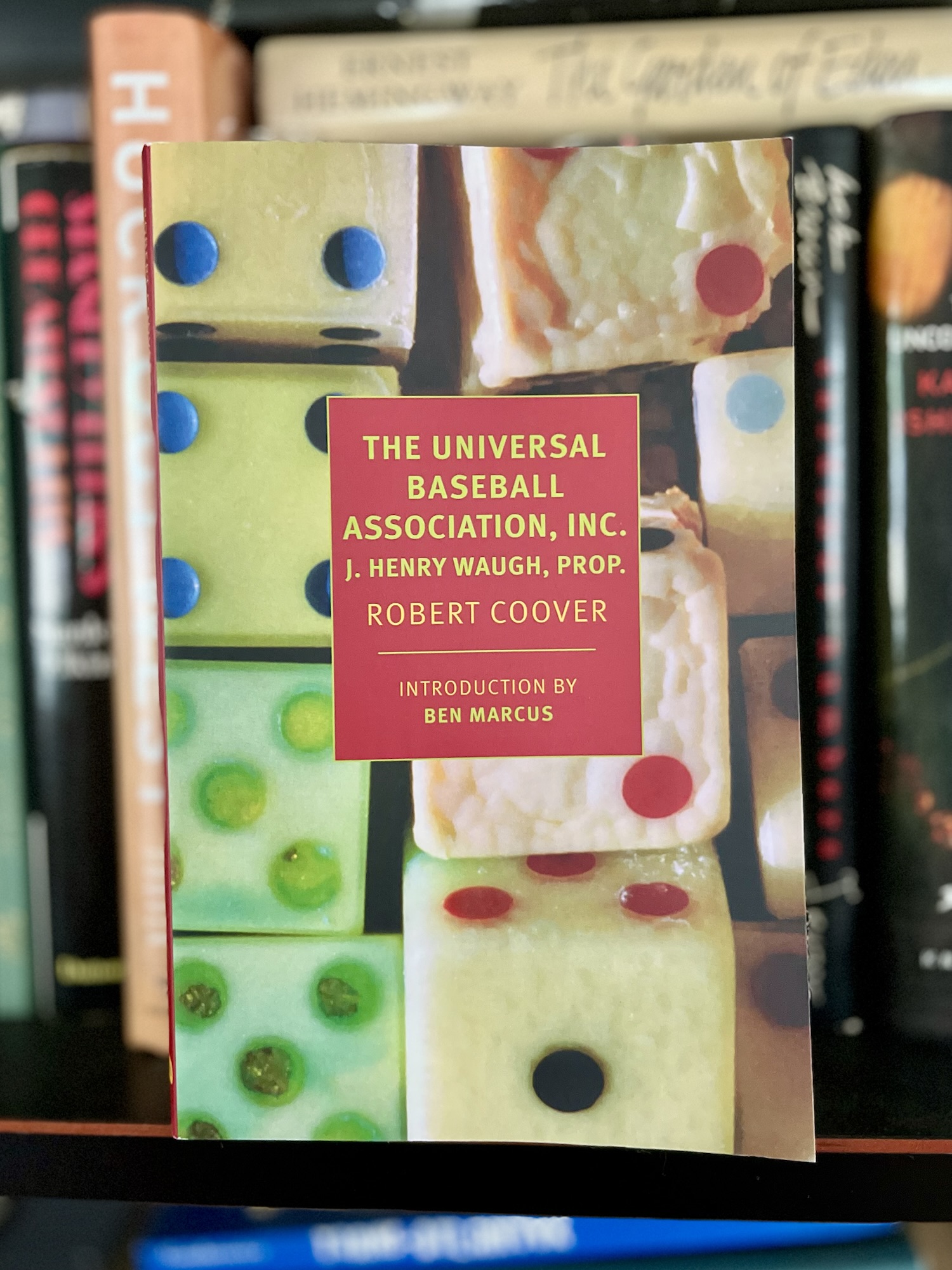
Coover didn’t start out as a metatextual fabulist. His first novel, 1966’s The Origin of the Brunists, is vivid, humanist realism with the slightest tinges of magic brightening its edges. 1968’s follow-up, The Universal Baseball Association, Inc., J. Henry Waugh, Prop., strays much deeper into the pop-myth fantasies that Coover would perfect in his mature career.

Coover’s 1969 collection Pricksongs & Descants shows a remarkable shift into postmodern metafiction. Pricksongs features some of his better stories, like “The Brother” (told from the point of view of the biblical Noah’s brother), “The Elevator,” and “The Magic Poker,” which begins with the sentence “I wander the island, inventing it” — a tidy encapsulation of Coover’s growing motif of the self-creating story. At times, this metatextual motif can exhaust the reader, as in Pricksongs’ capper “The Hat Act.” However, the collection features one of Coover’s best stories, “The Babysitter,” in which the titular character serves as a locus for a mundane suburban community’s collective repressed anxieties of sex and violence.

Coover would continue to explore such themes throughout his career, refining and sharpening his metatextual hat act in standout novels like Spanking the Maid (1982), Gerald’s Party (1986), and 1977’s The Public Burning—arguably Coover’s most important novel. It’s easy to think of The Public Burning as the last part of a loose postmodern American trilogy of large daring novels, the first two parts comprised of Pynchon’s Gravity’s Rainbow (1973) and William Gaddis’s J R (1975).

Indeed, Coover was regularly grouped with a (very white, very male) clique of postmodern American writers. In his 1980 essay “The Literature of Replenishment,” John Barth halfheartedly counted up the members: “By my count, the American fictionists most commonly included in the canon, besides the three of us at Tubingen [William H. Gass, John Hawkes and Barth himself], are Donald Barthelme, Robert Coover, Stanley Elkin, Thomas Pynchon, and Kurt Vonnegut, Jr.”

There was some chatter on social media that Coover’s passing left just Pynchon–and maybe Don DeLillo and Joseph McElroy–as the last living luminaries of twentieth-century US American postmodernist fiction. Of course, Pynchon really wasn’t a member of this or any other clique (he declined an invitation to Donald Barthelme’s so-called “postmodernists dinner“), and, as is too often the case with such groupings, Ishmael Reed’s contribution to American postmodernist fiction continues to be marginalized.

Let it stand then that Robert Coover, despite whatever connections and friendships he held with other writers and artists, was his own special self-made creation. He was prolific, especially later in life, publishing nine novels in the twenty-first century. One of these was The Brunist Day of Wrath (2014), a sequel to his debut; he also collaborated with comix artist Art Spiegelman on the graphic novelette Street Cop (2021) and even found a sliver of mainstream readers with Huck Out West, his wonderful 2017 “sequel” to Adventures of Huckleberry Finn. Coover’s latest novel Open House was published just over a year ago.

Clearly, Coover leaves behind a large body of work, and we’ll likely see more of his work collected and published over the next decade. I won’t pretend to have read most of what he’s written, but I’ve loved a lot of it—particularly Pricksongs & DescantsHuck Out WestSpanking the Maid, and Briar Rose, which, as far as I can recall, is likely the first thing I read of his (my girlfriend at the time’s sister had to read it in college; she professed that she hated it but thought I’d like it). The aforementioned 2018 collection Going for a Beer is a nice starting place for Coover; those more interested in novels might like Spanking the Maid. Or jump into one of his later short novels, like 2004’s Stepmother or 2018’s The Enchanted Prince, both of which exemplify his metamagicianist mode. Or hell, just go for the big boy, The Public Burning. Ultimately, Coover leaves behind a trove of trembling, writhing, vividly-living words, an oeuvre that will continue to engage readers fascinated by a certain stamp of so-called experimental literature–and for that I thank him.


Robert Coover reads “The Fall Guy’s Faith”

“The Fall Guy’s Faith”

by

Robert Coover


Falling from favor, or grace, some high artifice, down he dropped like a discredited predicate through what he called space (sometimes he called it time) and with an earsplitting crack splattered the base earth with his vital attributes. Oh, I’ve had a great fall, he thought as he lay there, numb with terror, trying desperately to pull himself together again. This time (or space) I’ve really done it! He had fallen before of course: short of expectations, into bad habits, out with his friends, upon evil days, foul of the law, in and out of love, down in the dumps—indeed, as though egged on by some malevolent metaphor generated by his own condition, he had always been falling, had he not?—but this was the most terrible fall of all. It was like the very fall of pride, of stars, of Babylon, of cradles and curtains and angels and rain, like the dread fall of silence, of sparrows, like the fall of doom. It was, in a word, as he knew now, surrendering to the verb of all flesh, the last fall (his last anyway: as for the chips, he sighed, releasing them, let them fall where they may)—yet why was it, he wanted to know, why was it that everything that had happened to him had seemed to have happened in language? Even this! Almost as though, without words for it, it might not have happened at all! Had he been nothing more, after all was said and done, than a paraphrastic curiosity, an idle trope, within some vast syntactical flaw of existence? Had he fallen, he worried as he closed his eyes for the last time and consigned his name to history (may it take it or leave it), his juices to the soil (was it soil?), merely to have it said he had fallen? Ah! tears tumbled down his cheeks, damply echoing thereby the greater fall, now so ancient that he himself was beginning to forget it (a farther fall perhaps than all the rest, this forgetting: a fall as it were within a fall), and it came to him in these fading moments that it could even be said that, born to fall, he had perhaps fallen simply to be born (birth being less than it was cracked up to be, to coin a phrase)! Yes, yes, it could be said, what can not be said, but he didn’t quite believe it, didn’t quite believe either that accidence held the world together. No, if he had faith in one thing, this fallguy (he came back to this now), it was this: in the beginning was the gesture, and that gesture was: he opened his mouth to say it aloud (to prove some point or other?), but too late—his face cracked into a crooked smile and the words died on his lips . . .

“The Brother” — Robert Coover

“The Brother”

by

Robert Coover


right there right there in the middle of the damn field he says he wants to put that thing together him and his buggy ideas and so me I says “how the hell you gonna get it down to the water?” but he just focuses me out sweepin the blue his eyes rollin like they do when he gets het on some new lunatic notion and he says not to worry none about that just would I help him for God’s sake and because he don’t know how he can get it done in time otherwise and though you’d have to be loonier than him to say yes I says I will of course I always would crazy as my brother is I’ve done little else since I was born and my wife she says “I can’t figure it out I can’t sec why you always have to be babyin that old fool he ain’t never done nothin for you God knows and you got enough to do here fields need plowin it’s a bad enough year already my God and now that red-eyed brother of yours wingin around like a damn cloud and not knowin what in the world he’s doin buildin a damn boat in the country my God what next? you’re a damn fool I tell you” but packs me some sandwiches just the same and some sandwiches for my brother Lord knows his wife don’t have no truck with him no more says he can go starve for all she cares she’s fed up ever since the time he made her sit out on a hillside for three whole days rain and everything because he said she’d see God and she didn’t see nothin and in fact she like to die from hunger nothin but berries and his boys too they ain’t so bright neither but at least they come to help him out with his damn boat so it ain’t just the two of us thank God for that and it ain’t no goddamn fishin boat he wants to put up neither in fact it’s the biggest damn thing I ever heard of and for weeks wees I’m tellin you we ain’t doin nothin but cuttin down pine trees and haulin them out to his field which is really pretty high up a hill and my God that’s work lemme tell you and my wife she sighs and says I am really crazy r-e-a-1-l-y crazy and her four months with a child and tryin to do my work and hers too and still when I come home from haulin timbers around all day she’s got enough left to rub my shoulders and the small of my back and fix a hot meal her long black hair pulled to a knot behind her head and hangin marvelously down her back her eyes gentle but very tired my God and I says to my brother I says “look I got a lotta work to do buddy you’ll have to finish this idiot thing yourself I wanna help you all I can you know that but” and he looks off and he says “it don’t matter none your work” and I says “the hell it don’t how you think me and my wife we’re gonna eat I mean where do you think this food comes from you been puttin away man? you can’t eat this goddamn boat out here ready to rot in that bastard sun” and he just sighs long and says “no it just don’t matter” and he sits him down on a rock kinda tired like and stares off and looks like he might even for God’s sake cry and so I go back to bringin wood up to him and he’s already started on the keel and frame God knows how he ever found out to build a damn boat lost in his fog where he is Lord he was twenty when I was born and the first thing I remember was havin to lead him around so he didn’t get kicked by a damn mule him who couldn’t never do nothin in a normal way just a huge oversize fuzzyface boy so anyway I take to gettin up a few hours earlier ever day to do my farmin my wife apt to lose the baby if she should keep pullin around like she was doin then I go to work on the boat until sundown and on and on the days hot and dry and my wife keepin good food in me or else I’d of dropped sure and no matter what I say to try and get out of it my brother he says “you come and help now the rest don’t matter” and we just keep hammerin away and my God the damn thing is big enough for a hundred people and at least I think at least it’s a place to live and not too bad at that at least it’s good for somethin but my wife she just sighs and says no good will come of it and runs her hands through my hair but she don’t ask me to stop helpin no more because she knows it won’t do no good and she’s kinda turned into herself now these days and gettin herself all ready and still we keep workin on that damn thing that damn boat and the days pass and my brother he says we gotta work harder we ain’t got much time and from time to time he gets a coupla neighbors to come over and give a hand them sucked in by the size and the novelty of the thing makin jokes some but they don’t stay around more than a day or two and they go away shakin their heads and swearin under their breath and disgusted they got weaseled into the thing in the first place and me I only get about half my place planted and sec to my stock as much as I can my wife she takes more care of them than I can but at least we won’t starve we say if we just get some rain and finally we get the damn thing done all finished by God and we cover it in and out with pitch and put a kinda fancy roof on it and I come home on that last day and I ain’t never goin back ain’t never gonna let him talk me into nothin again and I’m all smellin of tar and my wife she cries and cries and I says to her not to worry no more I’ll be home all the time and me I’m cryin a little too though she don’t notice just thinkin how she’s had it so lonely and hard and all and for one whole day I just sleep the whole damn day and the rest of the week I work around the farm and one day I get an idea and I go over to my brother’s place and get some pieces of wood left over and whaddaya know? they are all livin on that damn boat there in the middle of nowhere him and his boys and some women and my brother’s wife she’s there too but she’s madder than hell and carpin at him to get outa that damn boat and come home and he says she’s got just one more day and then he’s gonna drug her on the boat but he don’t say it like a threat or nothin more like a fact a plain fact tomorrow he’s gonna drug her on the boat well I ain’t one to get mixed up in domestic quarrels God knows so I grab up the wood and beat it back to my farm and that evenin I make a little cradle a kinda fancy one with little animal figures cut in it and polished down and after supper I give it to my wife as a surprise and she cries and cries and holds me tight and says don’t never go away again and stay close by her and all and I feel so damn good and warm about it all and glad the boat thing is over and we get out a little wine and we decide the baby’s name is gonna be either Nathaniel or Anna and so we drink an extra cup to Nathaniel’s health and we laugh and we sigh and drink one to Anna and my wife she gently fingers the little animal figures and says they’re beautiful and really they ain’t I ain’t much good at that sorta thing but I know what she means and then she says “where did you get the wood?” and I says “it’s left over from the boat” and she don’t say nothin for a moment and then she says “you been over there again today?” and I says “yes just to get the wood” and she says “what’s he doin now he’s got the boat done?” and I says “funny thing they’re all living in the damn thing all except the old lady she’s over there hollerin at him how he’s gettin senile and where does he think he’s sailin to and how if he ain’t afraid of runnin into a octypuss on the way he oughta get back home and him sayin she’s a nut there ain’t no water and her sayin that’s what she’s been tellin him for six months” and my wife she laughs and it’s the happiest laugh I’ve heard from her in half a year and I laugh and we both have another cup-of wine and my wife she says “so he’s just livin on that big thing all by hisself?” and I says “no he’s got his boys on there and some young women who are maybe wives of the boys or somethin I don’t know I ain’t never seen them before and all kinda damn animals and birds and things I ain’t never seen the likes” and my wife she says “animals? what animals?” and I says “oh all kinds I don’t know a whole damn menagerie all clutterin and stinkin up the boat God what a mess” and my wife laughs again and she’s a little silly with the wine and she says “I bet he ain’t got no pigs” and “oh yes I seen them” I says and we laugh thinkin about pigs rootin around in that big tub and she says “I bet he ain’t got no jackdaws” and I says “yes I seen a couple o£ them too or mostly I heard them you couldn’t hardly hear nothin else” and we laugh again thinkin about them crows and his old lady and the pigs and all and my wife she says “I know what he ain’t got I bet he ain’t got no lice” and we both laugh like crazy and when I can I says “oh yes he does less he’s took a bath” and we both laugh til! we’re cryin and we finish off the wine and my wife says “look now I fyiow what he ain’t got he ain’t got no termites” and I says “you’re right I don’t recollect no termites maybe we oughta make him a present” and my wife she holds me close quiet all of a sudden and says “he’s really movin Nathaniel’s really movin” and she puts my hand down on her round belly and the little fella is kickin up a terrific storm and I says kinda anxious “does it hurt? do you think that—?” and “no” she says “it’s good” she says and so I says with my hand on her belly “here’s to you Nathaniel” and we drain what’s left in the bottom of our cups and the next day we wake up in each other’s arms and it’s rainin and than God we say and since it’s rainin real good we stay inside and do things a round the place and we’re happy because the rain has come just in time and in the evenin things smell green and fresh and delicious and it’s still rainin a little but not too hard so I decide to take a walk and I wander over by my brother’s place thinkin I’ll ask him if he’d like to take on some pet termites to go with his collection and there by God is his wife on the boat and I don’t know if he drug her on or if she just finally come by herself but she ain’t sayin nothin which is damn unusual and the boys they ain’t sayin nothin neither and my brother he ain’t sayin nothin they’re just all standin up there on top and gazin off and I holler up at them “nice rain ain’t it?” and my brother he looks down at me standin there in the rain and still he don’t say nothin but he raises his hand kinda funny like and then puts it back on the rail and I decide not to say nothin about the termites and it’s startin to rain a little harder again so I turn away and go back home and I tell my wife about what happened and my wife she just laughs and says “they’re all crazy he’s finally got them all crazy” and she’s cooked me up a special pastry with £rcsh meat and so we forget about them but by God the next day the rain’s still comin down harder than ever and water’s beginnin to stand around in places and after a week of rain I can see the crops is pretty well ruined and I’m havin trouble keepin my stock fed and my wife she’s cryin and talkin about our bad luck that we might as well of built a damn boat as plant all them crops and still we don’t figure things out I mean it just don’t come to our minds not even when the rain keeps spillin down like a ocean dumped upsidedown and now water is beginnin to stand around in big pools really big ones and water up to the ankles around the house and Icakin in and pretty soon the whole damn house is gettin fulla water and I keep sayin maybe we oughta go use my brother’s boat till this blows over but my wife she says “never” and then she starts in cryin again so finally I says to her I says “we can’t be so proud I’ll go ask him” and so I set out in the storm and I can hardly see where I’m goin and I slip up to my neck in places and finally I get to where the boat is and I holler up and my brother he comes out and he looks down at where I am and he don’t say nothin that bastard he just looks at me and I shout up at him I says “hey is it all right for me and my wife to come over until this thing blows over?” and still he don’t say a damn word he just raises his hand in that same sillyass way and I holler “hey you stupid sonuvabitch I’m soakin wet goddamn it and my house is fulla water and my wife she’s about to have a kid and she’s apt to get sick all wet and cold to the bone and all I’m askin you—” and right then right while I’m still talkin he turns around and he goes back in the boat and I can’t hardly believe it me his brother but he don’t come back out and I push up under the boat and I beat on it with my fists and scream at him and call him ever name I can think up and I shout for his boys and for his wife and for anybody inside and nobody comes out “Gowdamn you” I cry out at the top of my lungs and half sobbin and sick and then feelin too beat out to do anythin more I turn around and head back for home but the rain is thunderin down like mad now and in places I gotta swim and I can’t make it no further and I recollect a hill nearby and I head for it and when I get to it I climb up on top of it and it feels good to be on land again even if it is soggy and greasy and I vomit and retch there awhile and move further up and the next thing I know I’m wakin up the rain still in my face and the water halfway up the hill toward me and I look cut and I can see my brother’s boat is fioatin and I wave at it but I don’t see nobody wave back and then I quick look out towards my own place and all I can see is the top of it and of a sudden I’m scared scared about my wife and I go tearin for the house swimmin most all the way and cryin and shoutin and the rain still comin down like crazy and so now well now I’m back here on the hill again what little there is left of it and I’m figurin maybe I got a day left if the rain keeps comin and it don’t show no signs of stoppin and I can’t see my brother’s boat no more gone just water how how did he know? that bastard and yet I gotta hand it to him it’s not hard to see who’s crazy around here I can’t see my house no more I just left my wife inside where I found her I couldn’t hardly stand to look at her the way she was

Mass-market Monday | Robert Coover’s The Origin of the Brunists

The Origin of the Brunists, Robert Coover. Banatm Books Edition (1978). No cover designer credited. 534 pages.

This Bantam reprint of Coover’s first novel coincided with their mass-market paperback publication of The Public Burning.

I wrote a bit on The Origin of the Brunists a few years back. From that riff:

Coover’s metafiction always points back at its own origin, its own creation, a move that can at times take on a winking tone, a nudging elbow to the reader’s metaphorical ribs—Hey bub, see what I’m doing here? Coover’s metafictional techniques often lead him and his reader into cartoon landscapes, where postmodernly-plastic characters bounce manically off realistic contours. The best of Coover’s metafictions (like “The Babysitter,” 1969) tease their postmodern plastic into a synthesis of character, plot, and theme. However, in  large doses Coover’s metafictions can tax the reader’s patience and will—the simplest example that comes to mind is “The Hat Act” (from Pricksongs & Descants, 1969), a seemingly-interminable  Möbius loop that riffs on performance, trickery, and imagination. (And horniness).

I’m dwelling on Coover’s metafictional myth-making because I think of it as his calling card. And yet Origin of the Brunists bears only the faintest traces of Coover’s trademark metafictionalist moves (mostly, so far anyway, by way of its erstwhile hero, the journalist Tiger Miller). Coover’s debut reads rather as a work of highly-detailed, highly-descriptive realism, a realism that pushes its satirical edges up against the absurdity of modern American life. It reminds me very much of William Gass’s first novel Omensetter’s Luck (1966) and John Barth’s first two novels, The Floating Opera (1956) and The End of the Road (1958). (Barth heavily revised both of the novels in 1967). There’s a post-Faulknerian style here, something that can’t rightly be described as modern or postmodern. These novels distort reality without rupturing it in the way that the authors’ later works do. Later works like Barth’s Chimera (1973), Gass’s The Tunnel (1995), and Coover’s The Public Burning (1977) dismantle genre structures and tropes and rebuild them in new forms.

Mass-market Monday | Robert Coover’s The Public Burning

The Public Burning, Robert Coover. Banatm Books Edition (1978). No cover designer credited. 661 pages.

A 1977 Book Ends column in The New York Times offers a fairly succinct blurb for The Public Burning:

The Public Burning is a blend of fact and fantasy, using dozens of real and fictional names. Among the real persons named in this “metafiction” are President Eisenhower, Senator Joseph McCarthy, J. Edgar Hoover, Billy Graham, Norman Vincent Peale, Edward Teller, Walt Disney, Cecil B. DeMille, former prosecuting attorney Irving Saypol and Judge Irving Kaufman. About one‐half of the novel narrated by Vice President Richard M. Nixon…

The Book Ends piece, which appeared a few months before the book’s publication (and notes the difficulties the book found securing a publisher brave enough to put it out), includes a brief interview with Coover about The Public Burning:

“I had the idea for the book 11 years ago. I thought it would be a novella and not a book of over 500 pages. I felt that the event was something that had been repressed. If you mentioned the Rosenberg case, people were turned off or young persons didn’t know what it had been all about.

“Their execution — plus the prevalence of old‐fashioned American hoopla—gave me the central metaphor for the book. In 1968, I was looking for a narrator. After Nixon was elected President, he served that purpose. He had been a participant in the background of the Rosenberg case. As President, he was powerful, pious and pompous. I needed a clown act to intersperse with the circus act. And so Nixon became the clown. Clowns are sympathetic when you get to know them.”

The Public Burning was the first book I read by Coover, and I read it when I was too young to fully appreciate it; I think I simply wasn’t soaked enough in its history. Revisiting it, even in brief today, reminded me that it’s likely as relevant as ever, and that its diagnoses of the first half of America’s twentieth century is up there with Gravity’s Rainbow or J. R.

John Barth’s brief description of Donald Barthelme’s so-called postmodernist dinners

1fa8c7cbf8dc977653f7750905725da4
Photograph from “The Postmodernists Dinner,” 1983 by Jill Krementz (b. 1940)

In John Barth’s 1989 New York Times eulogy for Donald Barthelme, Barth gives a brief description of two so-called postmodernist dinners, both of which I’ve written on this blog before.

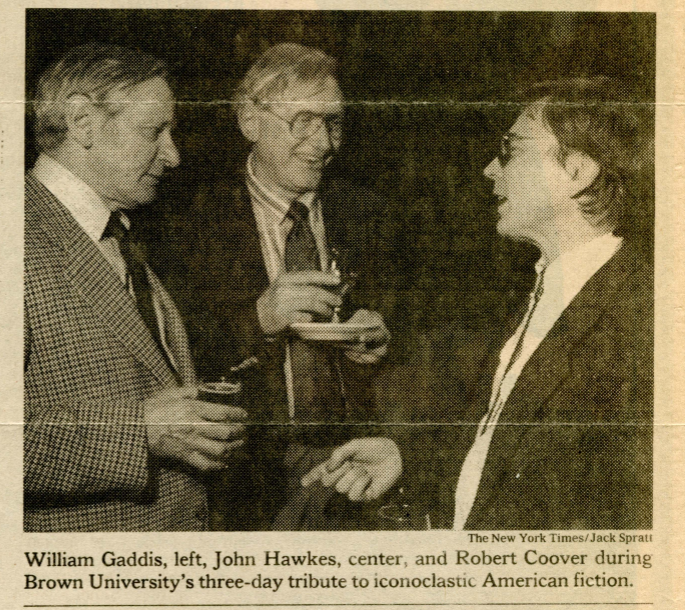
…though [Barthelme] tsked at the critical tendency to group certain writers against certain others ”as if we were football teams” – praising these as the true ”post-contemporaries” or whatever, and consigning those to some outer darkness of the passe – he freely acknowledged his admiration for such of his ”teammates,” in those critics’ view, as Robert Coover, Stanley Elkin, William Gaddis, William Gass, John Hawkes, Thomas Pynchon and Kurt Vonnegut, among others. A few springs ago, he and his wife, Marion, presided over a memorable Greenwich Village dinner party for most of these and their companions (together with his agent, Lynn Nesbit, whom Donald called ”the mother of postmodernism”). In 1988, on the occasion of John Hawkes’s academic retirement, Robert Coover impresarioed a more formal reunion of that team, complete with readings and symposia, at Brown University. Donald’s throat cancer had by then already announced itself – another, elsewhere, would be the death of him – but he gave one more of his perfectly antitheatrical virtuoso readings.

More on the first dinner here.

More on the second dinner here.

Books acquired, 26 Jan. 2024

Last Friday, I drove across a bridge to a library on the other side of the city for a Friends of the Library sale. I was hoping for a nice leisurely afternoon browse, figured I’d find a few titles worth my efforts, and I’d fill out the 10 dollar brown paper grocery bag with books I could trade for store credit elsewhere. I ended up filling the bag almost immediately, mostly with heavy hardbacks, resulting in my weak arm quickly settling into a painful fatigue that killed my browsing vibe.

Here are the books I picked up:

–A paperback copy of Thomas S. Klise’s cult classic The Last Western. It was in the “nonfiction” section, which I didn’t really browse that studiously, but its cover nevertheless stood out to me. I bought a copy of it from an online used bookseller online six years ago (and was very disappointed that the seller had appended a retail barcode sticker to its cover).

–A paperback omnibus of Salem Kirban’s early seventies “prophecy” apocalypse novels 666 and its sequel 1000. I’d thumbed through a worn copy of 666 sometime last year—the title of and its cracked spine calling to me from the shelf of the sci-fi section. Kirban’s “novel” is a millennialist screed conveyed in a tawdry postmodern manner, and it didn’t seem worth the eight bucks the used bookstore was asking at the time—but I didn’t mind snuggling it into the paper bag last Friday, oddity that it is.

–A hardback copy of Don DeLillo’s novel Zero K. I skipped it when it came out, and I don’t think DeLillo’s done anything good since Point Omega.

–A hardback copy of John Barth’s novel Every Third Thought. I think that Barth’s best work is decades behind him, but every now and then I try something newer, and this 2011 novel is one of his shorter recentish efforts.

–A hardback copy of Leni Zumas’ novel Red Clocks. I had never heard of this book, but the spine enticed me enough to pick it up when I was browsing the “sci fi” section at the booksale, and the premise–America has outlawed and criminalized abortion–seemed depressingly dystopian enough to take it with me.

–A hardback copy of Sven Birkert’s collection of literary criticism, An Artificial Wilderness. Includes chapters on Thomas Bernhard, Umberto Eco, Borges, and “The School of Gordon Lish” among many, many others.

–A Vintage Contemporaries Edition of Raymond Carver’s Where I’m Calling From, a collection I have not read in over two decades.

–A hardback copy of Jesse Ball’s novel How to Set a Fire and Why. I liked his 2011 novel The Curfew, so maybe I’ll like this?

–A hardback copy of Jeanette Winterson’s novel Frankisstein; reviews of this 2019 novel intrigued me at the time it was published (and I do like a good Frankenstein riff).

–A hardback copy of Robert Coover’s novel Huck Out West. An amazing sequel to Twain’s novel; I reviewed it on this site years ago. This handsome edition shall replace the ugly advance copy I got years ago. I might need to revisit it in anticipation of Percival Everett’s take on Twain’s Huck’s Jim—James.

–A hardback copy of Lawrence Ferlinghetti’s late novel Little Boy, which The Guardian described as a “novel-cum-memoir-cum-grand finale.” (Too much cum, The Guardian.)

–A Library of America edition of The Complete Novels of Eudora Welty. I hate to admit what I will now admit: I love love love Welty’s short stories, but have never read one of her novels.

–A hardback copy of Walker Percy’s Thanatos Syndrome. Again, a late-period work by old master, likely not his finest stuff, but hey. I burned through his first four novels a few years ago—Lancelot was my favorite.

Have a weird Xmas (Blog about books acquired in Dec. 2023)

Maybe an hour ago, browsing in a used bookstore, I opened a worn and some might say dirty copy of Iain Banks’s 1985 novel Walking on Glass. The very first page of this old book was inscribed with the following:

Have a weird Xmas ’90

                 John

This copy of Iain Banks’s 1985 novel Walking on Glass—a 1990 Abacus trade paperback printed in London, the embossing on its cover yellowed by wear on its cover and back near its spine—this particular copy was addressed to no named person, its inscription signed by a name so anonymous we apply it to unidentified cadavers and prostitute clients.

I take myself to be the unidentified person being addressed by the identified generic John, wishing me weird wellness, a ghost of Xmas past.

Earlier this year I made the tragic mistake of not pulling the trigger on first-edition hardbacks of Banks’s first two novels, The Wasp Factory and Walking on Glass. I hadn’t read Banks at that point, and my familiarity with his work came almost entirely of his proximity to the J.G. Ballard titles I routinely perused. I ended up reading and loving The Wasp Factory this summer (reviewed it here), and the blurb on the back of Walking on Glass promising further perversions intrigues me too, of course.

Today, I also came across a first-edition, first-U.S.-printing of Roberto Bolaño’s opus 2666It was marked at a third of the original cover price and has never been read. I could not leave it behind.

I actually traded some books in today, including my trade paperback of Alasdair Gray’s Poor Things. I had recently reread the novel in anticipation of Yorgos Lanthimos’ film adaptation, and, during that reread, oddly came across an inexpensive pristine first edition of the novel while browsing for something else. Maybe a week or two after finding that hardback of Poor Things, I found a hardback first edition of Gray’s 1990 novel Something Leather. Unlike Poor Things, which features lots of art and typographic adventures, Something Leather is pretty standard (apart from a few chapter heading illustrations)—but it does have a lovely cover under its cover:

Maybe a week after that, I was browsing with my son, who wanted a collection of Harlan Ellison short stories. I was shocked that we couldn’t find any—I had given away two mass market collections to some students maybe seven or eight years ago in a purge. Apparently a lot of it is out of print, but a “greatest hits” collection is coming out this spring. Anyway, I ended up finding hardback editions of Robert Coover’s Whatever Happened to Gloomy Gus of the Chicago Bears? Denis Johnson’s novel Fiskadaro. 

The Johnson is a British edition, Chatto & Windus, and while it’s hardly my favorite novel by him, I found its form too attractive to pass (and it was, like, cheaper than a beer in the same bookstore). I also picked up a book by Lewis Nordan, a slim collection of short stories called Welcome to the Arrow-Catcher Fair. I picked it up because I love those horrid lovely wonderful gross stylish Vintage Contemporaries editions, and then acquired it based on the blurb, which compared it to Flannery O’Connor, Ellen Gilchrist, and Harry Crews. Here it is next to my Vintage Contemporaries copy of Denis Johnson’ Fiskadaro:

I hope you have a weird Xmas. And I hope that John, wherever they are, has a weird Xmas too.

Don was there, as well as William Gass, Stanley Elkin, William Gaddis, and half a dozen others of the postmodernist bent.


The New Yorker: Last week, there was a three-day festival in your honor at Brown University, in Providence—titled, in part, “Celebrating the Unspeakable Practices of Robert Coover”—featuring appearances by many of your colleagues and admirers, including T. C. Boyle, Don DeLillo, Alexandra Kleeman, Marlon James, Edwidge Danticat, Paul Auster, and many others. What was the stimulus for the festival?

Robert Coover: “Unspeakable Practices” was the title of a farewell party I organized for the then retiring professor and great metafictionist John Hawkes, in 1988—a title taken from Donald Barthelme’s book of stories “Unspeakable Practices, Unnatural Acts.” Don was there, as well as William Gass, Stanley Elkin, William Gaddis, and half a dozen others of the postmodernist bent. After that, over the years, we continued with a sequence of vanguard literary ingatherings, calling them all “Unspeakables.” In effect, this was the last one and perhaps the most brilliant of the lot, peopled by old friends and many former students, now celebrated writers in their own right. The readings on the final day by Edwidge Danticat, Rick Powers, Siri Hustvedt, Don DeLillo, and Paul Auster were sensational, some of the best public performances I’ve ever heard. Its whole title was meant to include my creation of the International Writers Project and its freedom-to-write predecessors at Brown, as well as my pioneer digital language workshops in hyperfiction and “cave writing” (writing in immersive 3-D), both programs launched at Brown in 1989. It was a great party, a party that began with the performance of a short sequence from my son Roderick’s radio play based on “Gerald’s Party,” and ending with a reiteration of an old festival favorite, the “Unspeakable Circus.”

From a brief 2018 exchange between the great American novelist Robert Coover and Deborah Treisman (published in The New Yorker). More on Coover’s “Unspeakable Practices” event here.

“The Wayfarer” — Robert Coover

“The Wayfarer”

by

Robert Coover


I came upon him on the road. I pulled over, stepped out, walked directly over to him where he sat. On an old milestone. His long tangled beard was a yellowish gray, his eyes dull with the dust of the road. His clothes were all of a color and smelled of mildew. He was not a sympathetic figure, but what could I do?

I stood for a while in front of him, hands on hips, but he paid me no heed. I thought: at least he will stand. He did not. I scuffed up a little dust between us with the toe of my boot. The dust settled or disappeared into his collection of it. But still, he stared obliviously. Vacantly. Perhaps (I thought): mindlessly. Yet I could be sure he was alive, for he sighed deeply from time to time, He is afraid to acknowledge me, I reasoned. It may or may not have been the case, but it served, for the time being, as a useful premise. The sun was hot, the air dry. It was silent, except for the traffic.

I cleared my throat, shifted my feet, made a large business of extracting my memo-book from my breast pocket, tapped my pencil on it loudly. I was determined to perform my function in the matter, without regard to how disagreeable it might prove to be. Others passed on the road. They proffered smiles of commiseration, which I returned with a pleasant nod. The wayfarer wore a floppy black hat. Tufts of yellow-gray hair poked out of the holes in it like dead wheat. No doubt, it swarmed. Still, he would not look at me.

Finally, I squatted and interposed my face in the path of his stare. Slowly—painfully, it would seem—his eyes focused on mine. They seemed to brighten momentarily, but I am not sure why. It could have been joy as easily as rage, or it could have been fear. Only that: his eyes brightened; his face remained slack and inexpressive. And it was not a glow, nothing that could be graphed, it was just a briefest spark, a glimmer. Then dull again. Filmy as though with a kind of mucus smeared over. And he lost the focus. I don’t know whether or not in that instant of perception he noticed my badge. I wished at the time that he would, then there could be no further ambiguities. But I frankly doubted that he did. He has traveled far, I thought. Continue reading ““The Wayfarer” — Robert Coover”

“The Brother” — Robert Coover

“The Brother”

by

Robert Coover


right there right there in the middle of the damn field he says he wants to put that thing together him and his buggy ideas and so me I says “how the hell you gonna get it down to the water?” but he just focuses me out sweepin the blue his eyes rollin like they do when he gets het on some new lunatic notion and he says not to worry none about that just would I help him for God’s sake and because he don’t know how he can get it done in time otherwise and though you’d have to be loonier than him to say yes I says I will of course I always would crazy as my brother is I’ve done little else since I was born and my wife she says “I can’t figure it out I can’t sec why you always have to be babyin that old fool he ain’t never done nothin for you God knows and you got enough to do here fields need plowin it’s a bad enough year already my God and now that red-eyed brother of yours wingin around like a damn cloud and not knowin what in the world he’s doin buildin a damn boat in the country my God what next? you’re a damn fool I tell you” but packs me some sandwiches just the same and some sandwiches for my brother Lord knows his wife don’t have no truck with him no more says he can go starve for all she cares she’s fed up ever since the time he made her sit out on a hillside for three whole days rain and everything because he said she’d see God and she didn’t see nothin and in fact she like to die from hunger nothin but berries and his boys too they ain’t so bright neither but at least they come to help him out with his damn boat so it ain’t just the two of us thank God for that and it ain’t no goddamn fishin boat he wants to put up neither in fact it’s the biggest damn thing I ever heard of and for weeks wees I’m tellin you we ain’t doin nothin but cuttin down pine trees and haulin them out to his field which is really pretty high up a hill and my God that’s work lemme tell you and my wife she sighs and says I am really crazy r-e-a-1-l-y crazy and her four months with a child and tryin to do my work and hers too and still when I come home from haulin timbers around all day she’s got enough left to rub my shoulders and the small of my back and fix a hot meal her long black hair pulled to a knot behind her head and hangin marvelously down her back her eyes gentle but very tired my God and I says to my brother I says “look I got a lotta work to do buddy you’ll have to finish this idiot thing yourself I wanna help you all I can you know that but” and he looks off and he says “it don’t matter none your work” and I says “the hell it don’t how you think me and my wife we’re gonna eat I mean where do you think this food comes from you been puttin away man? you can’t eat this goddamn boat out here ready to rot in that bastard sun” and he just sighs long and says “no it just don’t matter” and he sits him down on a rock kinda tired like and stares off and looks like he might even for God’s sake cry and so I go back to bringin wood up to him and he’s already started on the keel and frame God knows how he ever found out to build a damn boat lost in his fog where he is Lord he was twenty when I was born and the first thing I remember was havin to lead him around so he didn’t get kicked by a damn mule him who couldn’t never do nothin in a normal way just a huge oversize fuzzyface boy so anyway I take to gettin up a few hours earlier ever day to do my farmin my wife apt to lose the baby if she should keep pullin around like she was doin then I go to work on the boat until sundown and on and on the days hot and dry and my wife keepin good food in me or else I’d of dropped sure and no matter what I say to try and get out of it my brother he says “you come and help now the rest don’t matter” and we just keep hammerin away and my God the damn thing is big enough for a hundred people and at least I think at least it’s a place to live and not too bad at that at least it’s good for somethin but my wife she just sighs and says no good will come of it and runs her hands through my hair but she don’t ask me to stop helpin no more because she knows it won’t do no good and she’s kinda turned into herself now these days and gettin herself all ready and still we keep workin on that damn thing that damn boat and the days pass and my brother he says we gotta work harder we ain’t got much time and from time to time he gets a coupla neighbors to come over and give a hand them sucked in by the size and the novelty of the thing makin jokes some but they don’t stay around more than a day or two and they go away shakin their heads and swearin under their breath and disgusted they got weaseled into the thing in the first place and me I only get about half my place planted and sec to my stock as much as I can my wife she takes more care of them than I can but at least we won’t starve we say if we just get some rain and finally we get the damn thing done all finished by God and we cover it in and out with pitch and put a kinda fancy roof on it and I come home on that last day and I ain’t never goin back ain’t never gonna let him talk me into nothin again and I’m all smellin of tar and my wife she cries and cries and I says to her not to worry no more I’ll be home all the time and me I’m cryin a little too though she don’t notice just thinkin how she’s had it so lonely and hard and all and for one whole day I just sleep the whole damn day and the rest of the week I work around the farm and one day I get an idea and I go over to my brother’s place and get some pieces of wood left over and whaddaya know? they are all livin on that damn boat there in the middle of nowhere him and his boys and some women and my brother’s wife she’s there too but she’s madder than hell and carpin at him to get outa that damn boat and come home and he says she’s got just one more day and then he’s gonna drug her on the boat but he don’t say it like a threat or nothin more like a fact a plain fact tomorrow he’s gonna drug her on the boat well I ain’t one to get mixed up in domestic quarrels God knows so I grab up the wood and beat it back to my farm and that evenin I make a little cradle a kinda fancy one with little animal figures cut in it and polished down and after supper I give it to my wife as a surprise and she cries and cries and holds me tight and says don’t never go away again and stay close by her and all and I feel so damn good and warm about it all and glad the boat thing is over and we get out a little wine and we decide the baby’s name is gonna be either Nathaniel or Anna and so we drink an extra cup to Nathaniel’s health and we laugh and we sigh and drink one to Anna and my wife she gently fingers the little animal figures and says they’re beautiful and really they ain’t I ain’t much good at that sorta thing but I know what she means and then she says “where did you get the wood?” and I says “it’s left over from the boat” and she don’t say nothin for a moment and then she says “you been over there again today?” and I says “yes just to get the wood” and she says “what’s he doin now he’s got the boat done?” and I says “funny thing they’re all living in the damn thing all except the old lady she’s over there hollerin at him how he’s gettin senile and where does he think he’s sailin to and how if he ain’t afraid of runnin into a octypuss on the way he oughta get back home and him sayin she’s a nut there ain’t no water and her sayin that’s what she’s been tellin him for six months” and my wife she laughs and it’s the happiest laugh I’ve heard from her in half a year and I laugh and we both have another cup-of wine and my wife she says “so he’s just livin on that big thing all by hisself?” and I says “no he’s got his boys on there and some young women who are maybe wives of the boys or somethin I don’t know I ain’t never seen them before and all kinda damn animals and birds and things I ain’t never seen the likes” and my wife she says “animals? what animals?” and I says “oh all kinds I don’t know a whole damn menagerie all clutterin and stinkin up the boat God what a mess” and my wife laughs again and she’s a little silly with the wine and she says “I bet he ain’t got no pigs” and “oh yes I seen them” I says and we laugh thinkin about pigs rootin around in that big tub and she says “I bet he ain’t got no jackdaws” and I says “yes I seen a couple o£ them too or mostly I heard them you couldn’t hardly hear nothin else” and we laugh again thinkin about them crows and his old lady and the pigs and all and my wife she says “I know what he ain’t got I bet he ain’t got no lice” and we both laugh like crazy and when I can I says “oh yes he does less he’s took a bath” and we both laugh til! we’re cryin and we finish off the wine and my wife says “look now I fyiow what he ain’t got he ain’t got no termites” and I says “you’re right I don’t recollect no termites maybe we oughta make him a present” and my wife she holds me close quiet all of a sudden and says “he’s really movin Nathaniel’s really movin” and she puts my hand down on her round belly and the little fella is kickin up a terrific storm and I says kinda anxious “does it hurt? do you think that—?” and “no” she says “it’s good” she says and so I says with my hand on her belly “here’s to you Nathaniel” and we drain what’s left in the bottom of our cups and the next day we wake up in each other’s arms and it’s rainin and than God we say and since it’s rainin real good we stay inside and do things a round the place and we’re happy because the rain has come just in time and in the evenin things smell green and fresh and delicious and it’s still rainin a little but not too hard so I decide to take a walk and I wander over by my brother’s place thinkin I’ll ask him if he’d like to take on some pet termites to go with his collection and there by God is his wife on the boat and I don’t know if he drug her on or if she just finally come by herself but she ain’t sayin nothin which is damn unusual and the boys they ain’t sayin nothin neither and my brother he ain’t sayin nothin they’re just all standin up there on top and gazin off and I holler up at them “nice rain ain’t it?” and my brother he looks down at me standin there in the rain and still he don’t say nothin but he raises his hand kinda funny like and then puts it back on the rail and I decide not to say nothin about the termites and it’s startin to rain a little harder again so I turn away and go back home and I tell my wife about what happened and my wife she just laughs and says “they’re all crazy he’s finally got them all crazy” and she’s cooked me up a special pastry with £rcsh meat and so we forget about them but by God the next day the rain’s still comin down harder than ever and water’s beginnin to stand around in places and after a week of rain I can see the crops is pretty well ruined and I’m havin trouble keepin my stock fed and my wife she’s cryin and talkin about our bad luck that we might as well of built a damn boat as plant all them crops and still we don’t figure things out I mean it just don’t come to our minds not even when the rain keeps spillin down like a ocean dumped upsidedown and now water is beginnin to stand around in big pools really big ones and water up to the ankles around the house and Icakin in and pretty soon the whole damn house is gettin fulla water and I keep sayin maybe we oughta go use my brother’s boat till this blows over but my wife she says “never” and then she starts in cryin again so finally I says to her I says “we can’t be so proud I’ll go ask him” and so I set out in the storm and I can hardly see where I’m goin and I slip up to my neck in places and finally I get to where the boat is and I holler up and my brother he comes out and he looks down at where I am and he don’t say nothin that bastard he just looks at me and I shout up at him I says “hey is it all right for me and my wife to come over until this thing blows over?” and still he don’t say a damn word he just raises his hand in that same sillyass way and I holler “hey you stupid sonuvabitch I’m soakin wet goddamn it and my house is fulla water and my wife she’s about to have a kid and she’s apt to get sick all wet and cold to the bone and all I’m askin you—” and right then right while I’m still talkin he turns around and he goes back in the boat and I can’t hardly believe it me his brother but he don’t come back out and I push up under the boat and I beat on it with my fists and scream at him and call him ever name I can think up and I shout for his boys and for his wife and for anybody inside and nobody comes out “Gowdamn you” I cry out at the top of my lungs and half sobbin and sick and then feelin too beat out to do anythin more I turn around and head back for home but the rain is thunderin down like mad now and in places I gotta swim and I can’t make it no further and I recollect a hill nearby and I head for it and when I get to it I climb up on top of it and it feels good to be on land again even if it is soggy and greasy and I vomit and retch there awhile and move further up and the next thing I know I’m wakin up the rain still in my face and the water halfway up the hill toward me and I look cut and I can see my brother’s boat is fioatin and I wave at it but I don’t see nobody wave back and then I quick look out towards my own place and all I can see is the top of it and of a sudden I’m scared scared about my wife and I go tearin for the house swimmin most all the way and cryin and shoutin and the rain still comin down like crazy and so now well now I’m back here on the hill again what little there is left of it and I’m figurin maybe I got a day left if the rain keeps comin and it don’t show no signs of stoppin and I can’t see my brother’s boat no more gone just water how how did he know? that bastard and yet I gotta hand it to him it’s not hard to see who’s crazy around here I can’t see my house no more I just left my wife inside where I found her I couldn’t hardly stand to look at her the way she was

“I learned my realism from Kafka” | Art Spiegelman and Robert Coover have a conversation at The Believer

There’s a nice conversation between Art Spiegelman and Robert Coover at The BelieverThe pair have collaborated on an illustrated “novelette” called Street Cop. 

Their discussion begins with Street Cop but expands much further, touching on postmodernism, realism (“Our Zeitgeist has left us mostly with shards of media as our reality,” says Spiegelman; “When people ask me, I say that I learned my realism from Kafka,” replies Coover”), time and space, the desire for happy endings, and more. But like I said, it begins with Street Cop:

ART SPIEGELMAN: So first: why a street cop?

ROBERT COOVER:Well, I wrote Street Cop in 2019. It emerged, like everything I write, from anxieties about the present. I had written about private eyes, but the dumb street cop was something new. I liked the idea of a guy who would be technologically inept. It’s about a bumbler who began his career as a crook and drug dealer, before accidentally becoming a cop who stumbles his way through a techno-city where the landscape changes daily thanks to 3D printing—blurring past, present and future. His job is to convict suspects rather than solve crimes, but all he wants, really, is to return to the old part of town, a seamy noir-like zone where his urges, and their many flaws, are permissible.

AS:When I first read and signed on to illustrate your story early in 2020’s quarantine, I was grateful to dive into a Dystopia Next Door and escape the one that surrounded us even in the bucolic bunker in the woods we’d retreated to from NYC. Choking on an overdose of toxic news, and compulsively “doom-scrolling”—I really love that phrase—I found the Covid-free air of Street Cop breathable because at least it didn’t have the twin viruses of the Covid pandemic and Trump directly confronting me. Still, the very first picture I drew had Covids in it—it was inevitable that they found their way into the prescient present of the story.

Read the rest of the conversation here.