The Never-Ending Torture of Unrest | Georg Büchner’s Lenz Reviewed

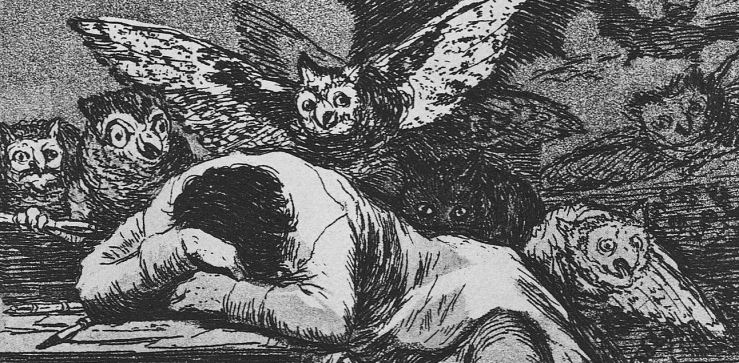
sleep of reason
The Sleep of Reason Produces Monsters (detail), Francisco Goya

Composed in 1836, Georg Büchner’s novella-fragment Lenz still seems ahead of its time. While Lenz’s themes of madness, art, and ennui can be found throughout literature, Büchner’s strange, wonderful prose and documentary aims bypass the constraints of his era.

Let me share some of that prose. Here is the opening paragraph of Lenz:

The 20th, Lenz walked through the mountains. Snow on the peaks and upper slopes, gray rock down into the valleys, swatches of green, boulders, firs. It was sopping cold, the water trickled down the rocks and leapt across the path. The fir boughs sagged in the damp air. Gray clouds drifted across the sky, but everything so stifling, and then the fog floated up and crept heavy and damp through the bushes, so sluggish, so clumsy. He walked onward, caring little one way or another, to him the path mattered not, now up , now down. He felt no fatigue, except sometimes it annoyed him that he could not walk on his head. At first he felt a tightening in his chest when the rocks skittered away, the gray woods below him shook, and the fog now engulfed the shapes, now half-revealed their powerful limbs; things were building up inside him, he was searching for something, as if for lost dreams, but was finding nothing. Everything seemed so small, so near, so wet, he would have liked to set the earth down behind an oven, he could not grasp why it took so much time to clamber down a slope, to reach a distant point; he was convinced he could cover it all with a pair of strides.

Büchner sets us on Lenz’s shoulder, moving us through the estranging countryside without any exposition that might lend us bearings. The environment impinges protagonist and reader alike, heavy, damp, stifling. Büchner’s syntax shuffles along, comma splices tripping us into Lenz’s manic consciousness, his mind-swings doubled in the path that is “now up, now down.” We feel the “tightening” in Lenz’s chest as the “rocks skittered away,” as the “woods below him shook” — the natural world seems to envelop him, cloak him, suffocate him. It’s an animist terrain, and Büchner divines those spirits again in the text. The claustrophobia Lenz experiences then swings to another extreme, as our hero, his consciousness inflated, feels “he could cover [the earth] with a pair of strides.

And that baffling line: “He felt no fatigue, except sometimes it annoyed him that he could not walk on his head.” Well.

The end notes to the Archipelago edition I read (translated by Richard Sieburth) offer Arnold Zweig’s suggestion that “this sentence marks the beginning of modern European prose,” as well as Paul Celan’s observation that “whoever walks on his head has heaven beneath him as an abyss.”

Celan’s description is apt, and Büchner’s story repeatedly invokes the abyss to evoke its hero’s precarious psyche. Poor Lenz, somnambulist bather, screamer, dreamer, often feels “within himself something . . . stirring and swarming toward an abyss toward which he was being swept by an inexorable force.” Lenz is the story of a young artist falling into despair and madness.
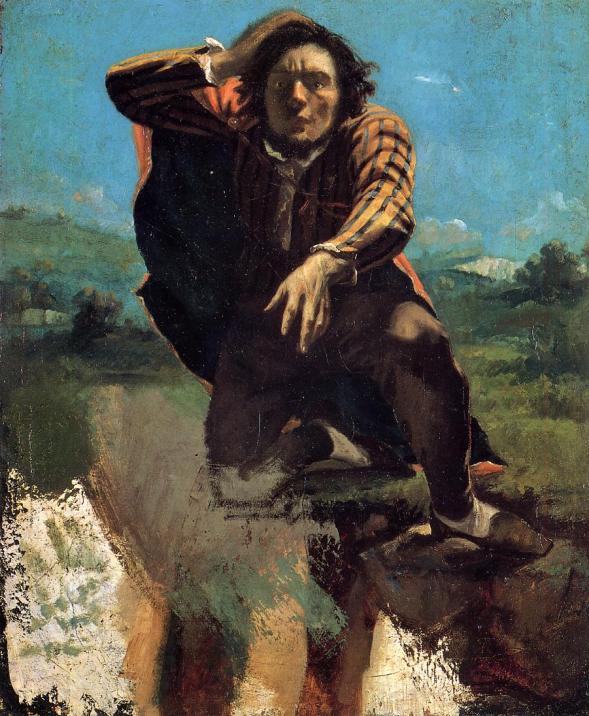
The Man Made Mad by Fear, Gustave Courbet

But perhaps I should offer a more lucid summary. I’ll do that in the next paragraph, but first: Let me just recommend you skip that paragraph. Really. What I perhaps loved most about Lenz was piecing together the plot through the often elliptical or opaque experiences we get via Büchner’s haunting free indirect style. The evocation of a consciousness in turmoil is probably best maintained when we read through the same confusion that Lenz experiences. I read the novella cold based on blurbs from William H. Gass and Harold Bloom and I’m glad I did.

Here is the summary paragraph you should skip: Jakob Lenz, a writer of the Sturm and Drung movement (and friend and rival to Goethe), has recently suffered a terrible episode of schizophrenia and “an accident” (likely a suicide attempt). He’s sent to pastor-physician J.F. Oberlin, who attends to him in the Alsatian countryside in the first few weeks of 1778. During this time Lenz obsesses over a young local girl who dies (he attempts to resurrect her), takes long walks in the countryside, cries manically, offers his own aesthetic theory, prays, takes loud late-night bath in the local fountain, receives a distressing letter, and, eventually, likely—although it’s never made entirely explicit—attempts suicide again and is thusly shipped away.

Büchner bases his story on sections of Oberlin’s diary, reproduced in the Archipelago edition. In straightforward prose, these entries fill in the expository gaps that Büchner has so elegantly removed and replaced with the wonder and dread of Lenz’s imagination. The diary’s lucid entries attest to the power of Büchner’s speculative fiction, to his own art and imagination, which so bracingly take us into a clouded mind.

In Sieburth’s afterword (which also offers a concise chronology of Lenz’s troubled life), our translator points out that “Like De Quincey’s “The Last Days of Immanuel Kant” or Chateaubriand’s Life of Rancé, Büchner’s Lenz is an experiment in speculative biography, part fact, part fabrication—an early nineteenth-century example of the modern genre of docufiction.” Obviously, any number of postmodern novels have explored or used historical figures—Public Burning, Ragtime, and Mason & Dixon are all easy go-to examples. But Lenz is more personal than these postmodern fictions, more an exploration of consciousness, and although we are treated to Lenz’s ideas about literature, art, and religion, we access this very much through his own skull and soul. He’s not just a placeholder or mouthpiece for Büchner.

Lenz strikes me as something closer to the docufiction of W.G. Sebald. Perhaps it’s all the ambulating; maybe it’s the melancholy; could be the philosophical tone. And, while I’m lazily, assbackwardly comparing Büchner’s book to writers who came much later: Thomas Bernhard. Maybe it’s the flights of rant that Lenz occasionally hits, or the madness, or the depictions of nature, or hell, maybe it’s those long, long passages. The comma splices.

Chronologically closer is the work of Edgar Allan Poe, whose depictions of manic bipolar depression resonate strongly with Lenz—not to mention the abysses, the torment, the spirits, the doppelgängers. Why not share another sample here to illustrate this claim? Okay:

The incidents during the night reached a horrific pitch. Only with the greatest effort did he fall asleep, having tried at length to fill the terrible void. Then he fell into a dreadful state between sleeping and waking; he bumped into something ghastly, hideous, madness took hold of him, he sat up, screaming violently, bathed in sweat, and only gradually found himself again. He had to begin with the simplest things in order to come back to himself. In fact he was not the one doing this but rather a powerful instinct for self preservation, it was as if he were double, the one half attempting to save the other, calling out to itself; he told stories, he recited poems out loud, wracked with anxiety, until he came to his sense.

Here, Lenz suspends his neurotic horror through storytelling and art—but it’s just that, only a suspension. Büchner doesn’t blithely, naïvely suggest that art has the power to permanently comfort those in despair; rather, Lenz repeatedly suggests that art, that storytelling is a symptom of despair.
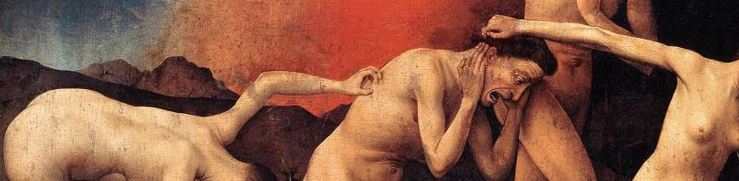
The Last Judgment (detail), Rogier van der Weyden

What drives despair? Lenz—Lenz—Büchner (?)—suggests repeatedly that it’s Langeweile—boredom. Sieburth renders the German Langeweile as boredom, a choice I like, even though he might have been tempted to reach for its existentialist chain-smoking cousin ennui. When Lenz won’t get out of bed one day, Oberlin heads to his room to rouse him:

Oberlin had to repeat his questions at length before getting an answer: Yes, Reverend, you see, boredom! Boredom! O, sheer boredom, what more can I say, I have already drawn all the figures on the wall. Oberlin said to him he should turn to God; he laughed and said: if I were as lucky as you to have discovered such an agreeable pastime, yes, one could indeed wile away one’s time that way. Tedium the root of it all. Most people pray only out of boredom; others fall in love out of boredom, still others are virtuous or depraved, but I am nothing, nothing at all, I cannot even kill myself: too boring . . .

Lenz fits in neatly into the literature of boredom, a deep root that predates Dostoevsky, Camus, and Bellow, as well as contemporary novels like Lee Rourke’s The Canal and David Foster Wallace’s The Pale King.

Ultimately, the boredom Lenz circles around is deeply painful:

The half-hearted attempts at suicide he kept on making were not entirely serious, it was less the desire to die, death for him held no promise of peace or hope, than the attempt, at moments of excruciating anxiety or dull apathy bordering on non-existence bordering on non-existence, to snap back into himself through physical pain. But his happiest moments were when his mind seemed to gallop away on some madcap idea. This at least provided some relief and the wild look in his eye was less horrible than the anxious thirsting for deliverance, the never-ending torture of unrest!

The “never-ending torture of unrest” is the burden of existence we all carry, sloppily fumble, negotiate with an awkward grip and bent back. Büchner’s analysis fascinates in its refusal to lighten this burden or ponderously dwell on its existential weight. Instead, Lenz is a character study that the reader can’t quite get out of—we’re too inside the frame to see the full contours; precariously perched on Lenz’s shoulder, we have to jostle along with him, look through his wild eyes, gallop along with him on the energy of his madcap idea. The gallop is sad and beautiful and rewarding. Very highly recommended.

W.G. Sebald’s Former Students Share His Writing Advice

In the fall of 2001—only a few months before his too-early death—W.G. Sebald taught a fiction workshop at the University of East Anglia. Two of the students from the workshop, David Lambert and Robert McGill have revisited their notes from that workshop and have compiled Sebald’s writing advice into a fascinating document, posted at Richard Skinner’s blog.

My favorite section:

On Reading and Intertextuality

  • Read books that have nothing to do with literature.
  • Get off the main thoroughfares; you’ll see nothing there. For example, Kant’s Critique is a yawn but his incidental writings are fascinating.
  • There has to be a libidinous delight in finding things and stuffing them in your pockets.
  • You must get the servants to work for you. You mustn’t do all the work yourself. That is, you should ask other people for information, and steal ruthlessly from what they provide.
  • None of the things you make up will be as hair-raising as the things people tell you.
  • I can only encourage you to steal as much as you can. No one will ever notice. You should keep a notebook of tidbits, but don’t write down the attributions, and then after a couple of years you can come back to the notebook and treat the stuff as your own without guilt.
  • Don’t be afraid to bring in strange, eloquent quotations and graft them into your story. It enriches the prose. Quotations are like yeast or some ingredient one adds.
  • Look in older encyclopaedias. They have a different eye. They attempt to be complete and structured but in fact are completely random collected things that are supposed to represent our world.
  • It’s very good that you write through another text, a foil, so that you write out of it and make your work a palimpsest. You don’t have to declare it or tell where it’s from.
  • A tight structural form opens possibilities. Take a pattern, an established model or sub-genre, and write to it. In writing, limitation gives freedom.
  • If you look carefully you can find problems in all writers. And that should give you great hope. And the better you get at identifying these problems, the better you will be at avoiding them.

(Via Conversational Reading; via Richard Skinner’s blog)


Three Notes on Thomas Bernhard’s Novel Correction (Plot, Prose, and a Riff)

1. Thomas Bernhard’s novel Correction is nominally the story of an unnamed narrator who leaves England after a severe illness to return to his native Austria to “sift and sort” the writings of his childhood friend Roithamer.

Roithamer, a brilliant but insane scientist, is the self-exiled son of an old, wealthy family. He uses an unexpected inheritance to fund an idealistic project: the building of a perfect Cone in the isolated heart of the Kobernausser forest. Roithamer envisions this Cone as the perfect home for his sister to live in (although he doesn’t bother to actually, y’know, talk to her about it). Roithamer’s sister dies almost immediately after taking up residence in the Cone. Roithamer then commits suicide.

Correction is divided into two sections, each a single, long, dense paragraph with no text break for the reader to rest upon. Bernhard’s sentences wind and unwind and rewind, sometimes snaking out for pages at a time; like Samuel Beckett, to whom he is often compared, Bernhard is a master of the comma splice. The effect is exhausting.

The first section of Correction is “Hoeller’s Garret,” named after the novel’s primary physical setting. Hoeller is a taxidermist who has built his own house in the Aurach gorge as a sort of dare to nature itself. Hoeller’s house inspires Roithamer’s Cone, and Hoeller’s garret becomes Roithamer’s work space—which is to say thinking space—for planning and executing his idealistic project.

Following Roithamer’s suicide, the unnamed narrator too moves into Hoeller’s garret, one of many formal repetitions in Correction (these formalizing plot repetitions are echoed in Bernhard’s syntactic repetitions).

In “Hoeller’s Garret” we learn about the childhood friendship between the narrator, Hoeller, and Roithamer. The paragraph (or chapter, if you will) includes details about Roithamer’s troubled family as well as an early horrific encounter with death, themes that will repeat throughout the novel.

The second section, “Sifting and Sorting,” finds the narrator working though Roithamer’s (mostly autobiographical) papers. The narrator appends a simple tag like “thus, Roithamer” or “so Roithamer” as attribution to Roithamer’s first-person statements, but this device pops up less and less as the book progresses, and it becomes clear that Roithamer has ventriloquized the narrative.

“Sifting and Sorting” focuses on Roithamer’s unhappy childhood, his endless fights with his mother, and his wish to perfect an idealization (namely, his Cone). The narrator channels Roithamer who channels the voices of his mother and father (and occasionally his detested brothers)—and of course, the reader channels all. The narrator slowly gives over to Roithamer’s voice as the novel’s final pages rush out in a series of diary entries, and Bernhard’s taxing syntax performs a mesmerist act on the reader, who, stunned, must return to the text in yet another repetition.

2. I’ve thus far failed to illustrate any of the above claims with an example of Bernhard’s prose.

It’s possible to plunder Correction for tight phrases, sharp, dark aphorisms, and other little bits of strange wisdom, but that doesn’t really convey the effect of what it’s like to read Bernhard’s sentences.

Better then to offer an example. Here’s the novel’s second sentence, via its English translator, Sophie Wilkins:

The atmosphere in Hoeller’s house was still heavy, most of all with the circumstances of Roithamer’s suicide, and seemed from the moment of my arrival favorable to my plan of working on Roithamer’s papers there, specifically in Hoeller’s garret, sifting and sorting Roithamer’s papers and even, as I suddenly decided, simultaneously writing my own account of my work on these papers, as I have here begun to do, aided by having been able to move straight into Hoeller s garret without any reservations on Hoeller’s part, even though the house had other suitable accommodations, I deliberately moved into that four-by-five-meter garret Roithamer was always so fond of, which was so ideal, especially in his last years, for his purposes, where I could stay as long as I liked, it was all the same to Hoeller, in this house built by the headstrong Hoeller in defiance of every rule of reason and architecture right here in the Aurach gorge, in the garret which Hoeller had designed and built as if for Roithamer’s purposes, where Roithamer, after sixteen years in England with me, had spent the final years of his life almost continuously, and even prior to that he had found it convenient to spend at least his nights in the garret, especially while he was building the Cone for his sister in the Kobernausser forest, all the time the Cone was under construction he no longer slept at home in Altensam but always and only in Hoeller’s garret, it was simply in every respect the ideal place for him during those last years when he, Roithamer, never went straight home to Altensam from England, but instead went every time to Hoeller’s garret, to fortify himself in its simplicity (Hoeller house) for the complexity ahead (Cone), it would not do to go straight to Altensam from England, where each of us, working separately in his own scientific field, had been living in Cambridge all those years, he had to go straight to Hoeller’s garret, if he did not follow this rule which had become a cherished habit, the visit to Altensam was a disaster from the start, so he simply could not let himself go directly from England to Altensam and everything connected with Altensam, whenever he had not made the detour via Hoeller’s house, to save time, as he himself admitted, it had been a mistake, so he no longer made the experiment of going to Altensam without first stopping at Hoeller’s house, in those last years, he never again went home without first visiting Hoeller and Hoeller’s family and Hoeller’s house, without first moving into Hoeller’s garret, to devote himself for two or three days to such reading as he could do only in Hoeller s garret, of subject matter that was not harmful but helpful to him, books and articles he could read neither in Altensam or in England, and to thinking and writing what he found possible to think and write neither in England nor in Altensam, here I discovered Hegel, he always said, over and over again, it was here that I really delved into Schopenhauer for the first time, here that I could read, for the first time, Goethe’s Elective Affinities and The Sentimental Journey, without distraction and with a clear head, it was here, in Hoeller’s garret, that I suddenly gained access to ideas to which my mind had been sealed for decades before I came to this garret, access, he wrote, to the most essential ideas, the most important for me, the most necessary to my life, here in Hoeller’s garret, he wrote, everything became possible for me, everything that had always been impossible for me outside Hoeller’s garret, such as letting myself be guided by my intellectual inclinations and to develop my natural aptitudes accordingly, and to get on with my work, everywhere else I had always been hindered in developing my aptitudes but in Hoeller’s garret I could always develop them most consistently, here everything was congenial to my way of thinking, here I could always indulge myself in exploring all my intellectual possibilities, here my intellectual possibilities, here in Hoeller’s garret my head, my mind, my whole constitution were suddenly relieved from all the outside world’s oppression, the most incredible things were suddenly no longer incredible, the most impossible (thinking!) no longer impossible.

If you’re interested, that’s 722 words (I wrote about 500 words before Bernhard’s sentence, if you need a point of contrast).

The repetition is easy to note even by absently gazing over the passage. The repeated phrase “Hoeller’s garret” stands out in particular, introducing the reader to the novel’s primary setting and establishing this “ideal place” in context against Altensam (the hated aristocratic home), England (self-imposed exile of a sort), and the Cone (the ideal ideal place).

We can also track a subtle shift in the final third of the sentence, as Roithamer’s voice ventriloquizes the narrator’s. Note how in the first third of the sentence, the narrator employs the first-person pronoun “I” which soon disappears in the middle third to be replaced by “he” (referring to Roithamer), until finally transforming into an “I” again in the final third—only this “I” is Roithamer’s “I.” This sentence demonstrates not only the demanding sentence structure that characterizes Correction as a whole, but also its narrative program of ventriloquism.

3. Okay. So I’ve offered plot summary, a lump of text, and a few comments on Bernhard’s prose—but I’ve hardly made a go of untangling the knotty density of Correction. (Although is that really what I came here to do? I don’t know. I hope not). Here are some stray, loose thoughts on Correction, offered here with little support (and the vague promise that I’ll write more about Correction in the future—shorter, more focused posts that hopefully expand on these ideas):

Correction shows how idealism, and specifically the will to create and perfect the ideal, leads to breakdown, death, insanity, suicide.

The Cone is a massive idealized phallus that reduces the agency of Roithamer’s sister, isolates her, and becomes her tomb.

Roithamer is part of a long tradition in literature of strange sister-lovers, dudes who dote on—and idealize—their sisters too much.

Roithamer seems to suffer from a sort-of reverse Oedipus complex, where he identifies with the strength of his father and hates his mother, who he sees as a cultural philistine, lower class, anti-intellectual. This complex leads to chauvinism against women in general, and possibly prevents him from better understanding his sister, who he essentially imprisons.

Correction reminded me often of Poe’s story “The Fall of the House of Usher.”

Correction reminded me often of W.G. Sebald’s novel Austerlitz, although Correction obviously came first, and Sebald clearly cited Bernhard as an influence.

At some of its rantier points, Correction reminded me of Notes from Underground.

Correction took me forever to read, mostly because every time I picked it back up I had to twist my way into its circular, repetitive rhythms anew. Lots of rereading.

My auditory imagination: In time, it was Werner Herzog’s voice that read Correction to me.

Correction performs its own deconstruction.

Correction is often so scathing and harsh in its treatment of humanity as to be difficult to swallow. One has to step back repeatedly and remind oneself that Roithamer is not sane.

Correction is also very, very funny at times—astonishingly so, even. Its humor is truly absurd, the absurdity of a parent’s funeral, or the absurdity of simply having to go on. I can’t help but cite a favorite line here—“waking up is the always frightening minimum of existence.”

The other side of “waking up is the always frightening minimum of existence” is of course death in general, or suicide in particular. Correction posits suicide as the ultimate correction, the final clearing gesture. The ideal.

And, not a thought on Correction, but a question for readers: What next? — ConcreteThe Loser, or Yes?

Sebald’s After Nature (Book Acquired, 9.21.2012)

20120930-142202.jpg

W.G. Sebald’s poetry collection After Nature. Not really poetry. Or maybe it is poetry. I don’t know what poetry is.

List with No Name #8


  1. Robert Walser
  2. Franz Kafka
  3. Henry Miller
  4. Thomas Bernhard
  5. David Markson
  6. Renata Adler
  7. W.G. Sebald
  8. Lydia Davis
  9. Ben Marcus


“Little Is Known of the Life of Matthias Grünewald of Aschaffenburg” — W.G. Sebald

Little is known of the life of

Matthias Grünewald of Aschaffenburg.

The first account of the painter

In Joachim von Sandrart’s German Academy

of the year 1675 begins with the notice

that the author knows not one person living

who could provide a written or oral

testimony of that praiseworthy hand.

We may trust the report by Sandrart,

for a portrait in Würzburg museum

has preserved him, aged eighty-two,

wide awake and with eyes uncommonly clear.

Lightly in grey and black,

he writes, Mattheus had painted the outer

wings of an altarpiece made by Dürer

of Mary’s ascension in the

Preachers’ convent in Frankfurt and

thus had lived at around 1505.

Exceedingly strange was the transfiguration

of Christ on Mount Tabor

limned in watercolours, especially

one cloud of wondrous beauty, wherein

above the Apostles convulsed

with awe, Moses and Elijah appear,

a marvel surpassed.

Then in the Mainz cathedral

there had been three altar panels

with facing fronts and reverse

sides painted, one of them

showing a blind hermit who, as he crosses

the frozen Rhine river with a boy

to guide him, is assaulted by two murderers

and beaten to death. Anno 1631 or ’32,

this panel in the wild war of that era

had been taken away and sent off to Sweden

but by shipwreck beside many other

such pieces of art had perished

in the depths of the sea.

At Isenheim, Sandrart had not been,

but had heard of the altar-work there,

which, he writes, was so fashioned that

real life could scarce have been other

and where, it was said, a St. Anthony with

demons meticulously drawn was to be seen.

Except for a St. John with hands clasped

of which he, Sandrart, when at one time in Rome

he was counterfeiting the pope, had caught sight,

with certainty this was all that was not lost

of the work of Aschaffenburg

painter of whom, besides, he knew only

that most of the time he had

resided in Mainz, led a reclusive

melancholy life and been ill-married.

—W.G. Sebald. Chapter II of “…As Snow on the Alps.” From After Nature.

“Thomas Browne Was Born in London on the 19th of October, 1605, the Son of a Silk Merchant” — W.G. Sebald


Thomas  Browne was born in London on the 19th of October 1605, the son of a silk merchant. Little is known of his childhood, and the accounts of his life following completion of his master’s degree at Oxford tell us scarcely anything about the nature of his later medical studies. All we know for certain is that from his twenty-fifth to his twenty-eighth year he attended the universities of Montpellier, Padua and Vienna, then outstanding in the Hippocratic sciences, and that just before returning to England, received a doctorate in medicine from Leiden. In January 1632, while Browne was in Holland, and thus at a time when he was engaging more profoundly with the mysteries of the human body than ever before, the dissection of a corpse was undertaken in public at the Waaggebouw in Amsterdam—the body being that of Adriaan Adriaanszoon alias Aris Kindt, a petty thief of that city who had been hanged for his misdemeanours an hour or so earlier. Although we have no definite evidence for this, it is probable that Browne would have heard of the dissection and was present at the extraordinary event, which Rembrandt depicted in his painting of the Guild of Surgeons, for the anatomy lessons given every year in the depth of winter by Dr Nicolaas Tulp were not only of the greatest interest to a student of medicine but constituted in addition a significant date in the agenda of a society that saw itself as emerging from the darkness into the light. The spectacle, presented before a paying public drawn from the upper classes, was no doubt a demonstration of the undaunted investigative zeal in the new sciences; but it also represented (though this surely would have been refuted) the archaic ritual of dismembering a corpse, of harrowing the flesh of the delinquent even beyond death, a procedure then still part of the ordained punishment. That the anatomy lesson in Amsterdam was about more than a thorough knowledge of the inner organs of the human body is suggested by Rembrandt’s representation of the ceremonial nature of the dissection—the surgeons are in their finest attire, and Dr Tulp is wearing a hat on his head—as well as by the fact that afterwards there was a formal, and in a sense symbolic banquet. If we stand today before the large canvas of Rembrandt’s The Anatomy Lesson in the Mauritshuis we are standing precisely where those who were present at the dissection in the Waaggebouw stood, and we believe that we see what they saw then: in the foreground, the greenish, prone body of Aris Kindt, his neck broken and his chest risen terribly in rigor mortis. And yet it is debatable whether anyone ever really saw that body, since the art of anatomy, then in its infancy, was not least a way of making the reprobate body invisible. It is somehow odd that Dr Tulp’s colleagues are not looking at Kindt’s body, that their gaze is directed just past it to focus on the open anatomical atlas in which the appalling physical facts are reduced to a diagram, a schematic plan of the human being, such as envisaged by the enthusiastic amateur anatomist René Descartes, who was also, so it is said, present that January morning in the Waaggebouw. In his philosophical investigations, which form one of the principal chapters of the history of subjection, Descartes teaches that one should disregard the flesh, which is beyond our comprehension, and attend to the machine within, to what can fully be understood, be made wholly useful for work, and, in the event of any fault, either repaired or discarded.

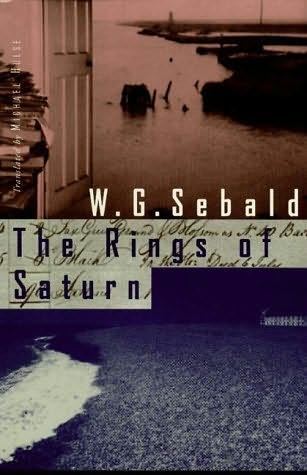
A passage from W.G. Sebald’s book The Rings of Saturn


I Review Patience (After Sebald), an Oppressively Overstylized Documentary

Let’s get this out of the way first:

I love W.G. Sebald’s The Rings of Saturn.

I think it’s an important book—but more than that I think it’s an engrossing, good, excellent book, an enlarging book, a bewildering book, a depressing book, an intelligent book, an extraordinarily affecting book.

reviewed The Rings of Saturn  and you can read that review if you feel the urge for me to support those claims in greater detail.

Better yet, read Sebald’s book.

Whatever you do, please don’t use Grant Gee’s new documentary Patience (After Sebald) as a substitution for actually reading Sebald. It’s not that Gee’s film doesn’t lovingly attempt to approximate the spirit of Saturn. No, Gee and his cast of writers, architects, historians, and other Sebaldians clearly attempt to match the rhythms and moods and content of Saturn—and herein lies the film’s failure.

In an essay on Virginia Woolf—a writer who shows up in both Sebald and in Patience—literary critic (and Sebald champion) James Wood notes the anxiety of influence always at work between the artistic subject and the would-be critic:  “The competition is registered verbally. The writer-critic is always showing a little plumage to the writer under discussion.” Wood here is specifically calling attention to Woolf’s own critical powers—of her ability to transcend merely reviewing a work, of her status as a poet-critic—but I think he gives us a simple little rubric for evaluating critical work in general: the truly excellent stuff goes its own route. Gee’s film so dutifully commits to visually and aurally replicating the melancholy and erudite mood of Saturn that it often seems cartoonish or clumsy—or, even worse, dreadfully boring.

It’s not fair to put down one filmmaker for not being more like another, but I wish Gee had taken a page out of, say Errol Morris’s book. Morris’s style is, in a sense, to remove style, to eliminate the aesthetic shield between the subject and the camera/audience. In contrast, Patience is overstylized to an almost embarrassing degree. The film veers between lethargic, numbing black and white shots of the places that Sebald visited on his walking tour in Saturn, occasional archival footage, and slippery impositions of text, maps, documents, and talking heads—sometimes delivered in a bizarre, agitated pace. Perhaps the tone I’ve just described may seem appropriate to any critical measurement of Saturn; in my review of Sebald’s novel, I noted that one element of saturnine melancholy is “sluggishness and moroseness, paradoxically paired with an eagerness for action” — but Gee’s lack of restraint here is bad art school stuff. It’s as if he doesn’t trust the viewer to simply listen to (let alone watch) a talking head for a minute.

A few notes on those talking heads:

There are some very smart people here saying some really cool things about Sebald—writers like Rick Moody and Iain Sinclair, lit critic Barbara Hui (if you’re a Sebald fan you might’ve already seen her maps of his walks), some historians and architects and so on. There are also excerpts of Michael Silverblatt’s Bookworm interview with Sebald woven into the film, sometimes to great effect. Especially interesting are remarks from Christopher MacLehose, Sebald’s publisher, who recounts the time he asked the author which genre his book belonged to. Sebald replied, “Oh, I like all of the categories.”

Gee’s technique with his band of experts is to mostly cast their voices over cold landscape shots, occasionally superimposing a head for a few seconds in a ghostly mishmash that dissolves—along with the voice—into another shot or another voice. Sometimes this is really frustrating because, hey, maybe we’re missing some enlightening remarks, but more often than not it’s frustrating in its sloppiness. Film editing that constantly calls attention to itself is tiresome. The film is at its best when it it stops trying to honor/compete with Saturn and instead imparts some meaningful information about the man and his work. When Patience relaxes enough to simply show archival footage of RAF training flights, it’s a welcome moment from the film’s earnest, torpid buzz.

I realize “torpid buzz” is an oxymoron, but I think it fits Patience. In fact, it might be exactly what Gee was going for. There’s an oppressiveness about the film that belies the often gorgeous and expansive and empty shots of Suffolk, and yes, to be clear, there’s often a similar oppressiveness in Sebald’s book—an oppression of history, of self, of other—but this paradox does not translate well into film.

Sebald makes ample room for his reader; we get to go on this excursion with him. He lets us puzzle out his themes, connect all his strange dots (or not, if we so choose, or, perhaps just as likely, find ourselves unable). The gaps in clear meaning make Saturn such a strange, engrossing book, the kind of book that you return to again and again, the kind of book you press on others (I’ve given away two copies to date). In contrast to the breathing room that Sebald allows his readers, Patience feels somehow stifling and simultaneously small.  There’s a brickishness to it, a forceful inclination to fill in all those marvelous Sebaldian gaps. And while yes, some of these people have some really keen insights about Sebald and Saturn, over the film’s interminable 80 minutes these opinions and insights and back stories start to torture meaning out of the text. Any potential reader has had much of her intellectual work removed at this point.

But perhaps I’ve been harsh without illustrating enough. Here’s psychoanalytic critic Adam Phillips who probably gets more voice time than anyone else in Patience; throughout the film he repeatedly over-explains Sebald’s project. I’ll shut up and let him talk (these are a few clips strung together, if my memory is sussing this out right):

Did you watch it? I watched it too—and it seems pretty cool at under four minutes, I’ll admit. But over the course of the film the heavy, “arty” edits, the overexplaining, well . . .  it’s too much.

Admittedly, only ten minutes into the film I asked myself who the film was for. As a fan of the book I’d much prefer to just spend 80 minutes of my time rereading parts of it. Or, alternately, a straightforwardish biography would be nice too. And I suppose there are many, many people who will love what Gee’s done (the film has gotten plenty of rave reviews, including one by A.O. Scott at the Times). I also suppose many folks will commend Gee for trying out his own hybrid, for showing a little plumage. This is another way of saying that I think that Gee has turned in the film he intended to make—it just wasn’t for me.

What Does the Internet Think About DFW, Franzen, Lydia Davis, Bolaño, Atwood, and Some Other Contemporaryish Writers?

What Does the Internet Think? is a somewhat addictive site that aggregates and analyzes opinions on the internet — I’m not sure exactly how it does this, but it’s fun. I plugged in a few writers this morning (when I should have been working) and here share the results (and, yes, I know that this means almost nothing. Just for fun).


Book Shelves #12, 3.18.2012

20120318-142208.jpg

Book shelves series #12, twelfth Sunday of 2012.

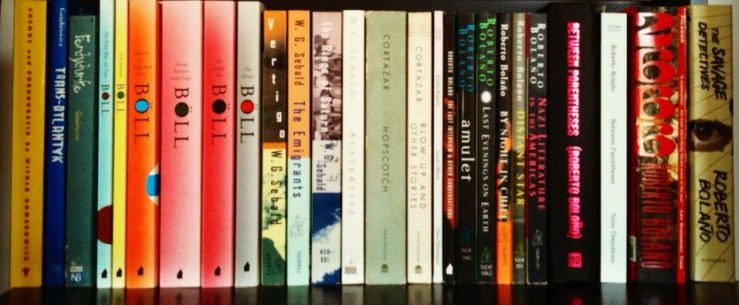
The shelf holds literature in translation: Witold Gombrowicz, Heinrich Böll, W.G. Sebald, Julio Cortázar, and Roberto Bolaño. There was a geode bookend here until Thursday, when I reorganized (finally giving the Gombrowicz a home and restoring the finished copy of Between Parentheses to its brothers). No, I never finished Hopscotch, nor much of the Böll (although I did read Irish JournalThe Train Was on Time, and The Clown); I haven’t read Ferdydurke yet either.

Teju Cole’s Open City Is a Strange, Marvelous Novel That Captures the Post-9/11 Zeitgeist

“And so when I began to go on evening walks last fall . . .” begins Julius, the perspicacious narrator of Teju Cole’s admirable and excellent début Open City. That opening “And” is significant, an immediate signal to the reader that this novel will refuse to align itself along (or even against) traditional arcs of plot and character development. We will meet Julius in media res, and we will leave him there, and along the way there will be learning and suffering and compassion and strange bubbles of ambiguity that threaten to burst out of the narrative.

As noted, Open City begins with Julius’s peripatetic voyages; he walks the night streets of New York City to ostensibly relieve the “tightly regulated mental environment of work.” Julius is completing his psychiatry fellowship at a hospital, and the work takes a toll on him, whether he admits it or not. In these night walks—and elsewhere and always throughout the novel—Julius shares his sharp observations, both concrete and historical. No detail is too small for his fine lens, nor does he fail to link these details to the raw information that rumbles through his mind: riffs on biology, history, art, music, philosophy, and psychology interweave the narrative. Julius maps the terrain of New York City against its strange, mutating history; like a 21st century Ishmael, he attempts to measure it in every facet—its architecture, its rhythms, its spirit. And if there is one thread that ties Julius’s riffs together it is the nightmare of history:

But atrocity is nothing new, not to humans, not to animals. The difference is that in our time it is uniquely well organized, carried out with pens, train carriages, ledgers, barbed wire, work camps, gas. And this late contribution, the absence of bodies. No bodies were visible, except the falling ones, on the day America’s ticker stopped.

Open City is the best 9/11 novel I’ve read, but it doesn’t set out to be a 9/11 novel, nor does it dwell on that day. Instead, Cole captures something of the post-9/11 zeitgeist, and at the same time situates it in historical context. When Julius remarks on the recent past, the concrete data of history writhes under the surface. He remarks that the 9/11 attack on the World Trade Center “was not the first erasure on the site,” and goes on to detail the 1960s cityscapes that preceded the WTC. Before those, there was Washington Market. Then Julius embarks, via imagination, into the pre-Colombian space of the people we now call Indians or Native Americans. “I wanted to find the line that connected me to my own part in these stories,” he concludes, peering at the non-site that simultaneously anchors these memory-spaces.

Julius’s line, like the lines that comprise New York City (and perhaps, if we feel the spirit of its democratic project, America itself) is a mixed one, heterogeneous and multicultural. Julius’s father, now dead, was an important man in Nigeria, where Julius enjoyed a relatively privileged childhood. Julius’s mother—they are now estranged—is German. He remarks repeatedly about his German grandmother’s own displacements during WWII, reflecting at one point that, from a historical perspective, it was likely impossible that she escaped Cossack rape.

Even though he sometimes seems reticent to do so, Julius delves into the strange violence that marks his lineage. He recalls a childhood fascination with Idi Amin; as a boy, he and his cousins would watch the gory film The Rise and Fall of Idi Amin repeatedly: ” . . . we enjoyed the shock of it, its powerful and stylized realism and each time we had nothing to do, we watched the film again.”

Fascinated horror evinces repeatedly in Open City. In just one example, Julius believes he sees “the body of a lynched man dangling from a tree”; as he moves closer to inspect, he realizes that it is merely canvas floating from a construction scaffold. Perhaps so attuned to history’s grand catalog of spectacular atrocity, Julius finds it lurking in places where it does not necessarily evince.

In turn, despite his profession as psychiatrist, Julius is wary of human sympathy. Throughout the novel, dark-skinned men engage him by calling him “brother.” He almost always deflects these attempts at connection, and internally remarks them as fatuous, or naïve, or false. This is not to say though that Julius doesn’t make significant (if often transitory) connections.

One of the organizing principles of Open City comes in the form of Julius’s infrequent visits to the home of his former English professor, Dr. Saito, who is slowly dying. Saito’s own memories float into Julius—this technique repeats throughout the novel—and we learn that he was interned as a young man during WWII; the sad fact is another ugly kink in the line of American history that Julius attempts to trace.

Julius also befriends Dr. Maillotte, an aging surgeon on a flight to Brussels, where he spends a few weeks of Christmas vacation, ostensibly looking for his oma (a task he performs half-heartedly at best). As Julius daydreams, Dr. Maillotte, European émigré, finds a place within his vision of family members and friends:

I saw her at fifteen, in September 1944, sitting on a rampart in the Brussels sun, delirious with happiness at the invaders’ retreat. I saw Junichiro Saito on the same day, aged thirty-one or thirty-two, unhappy, in internment, in an arid room in a fenced compound in Idaho, far away from his books. Out there on that day, also, were all four of my own grandparents: the Nigerians, the Germans. Three were gone by now, for sure. But what of the fourth, my oma? I saw them all, even the one I had never seen in real life, saw all of them in the middle of that day in September sixty-two years ago, with their eyes open as if shut, mercifully seeing nothing of the brutal half century ahead and better yet, hardly anything at all of all that was happening in their world, the corpse-filled cities, camps, beaches, and fields, the unspeakable worldwide disorder that very moment.

In Brussels, Julius meets Farouq, an angry young man with intellectual, Marxist tendencies. Farouq believes in a theory of “difference” and finds himself at odds with both the dominant Belgian culture and with Western culture in general. Julius’s conversations with Farouq are a highlight of the novel; they help to further contextualize the drama of diaspora in the post-9/11 world. Later, Julius finds a counterweight to some of Farouq’s extreme positions over a late lunch with Dr. Maillotte, who suggests that “For people to feel that they alone have suffered, it is very dangerous.” There’s a sense of reserved moderation to her critique—not outright dismissal nor condemnation, but simply a recognition that there are “an endless variety of difficulties in the world.”

Julius seems to tacitly agree with Maillotte’s assessment. His reluctance to accept brotherhood based on skin color alone speaks to a deeper rejection of simplicity, of tribe mentality, of homogeneity; it also highlights his essential alienation. At the same time, he’s acutely aware of how skin color matters, how identity can be thrust upon people, despite what claims to agency we might make. In search of the line that will connect him to his part of the American story, Julius finds unlikely “brothers” in Farouq, Maillotte, and Saito.

But let us not attribute to Julius a greater spirit than Cole affords him: Open City is a novel rich in ambiguity, with Julius’s own personal failures the most ambiguous element of all. While this is hardly a novel that revolves on plot twists, I hesitate to illustrate my point further for fear of clouding other readers’ perceptions; suffice to say that part of the strange, cruel pleasure of Open City is tracing the gaps in Julius’s character, his failures as a professional healer—and his failures to remark or reflect upon these failures.

But isn’t this the way for all of us? If history is a nightmare that we try to awake from—or, more aptly in a post-9/11 world, a nightmare that we awake to, to paraphrase Slavoj Žižek—then there is also the consolation and danger that time will free us from the memory of so much atrocity, that our collective memory will allow those concrete details to slip away, replaced with larger emblems and avatars that neatly smooth out all the wrinkles of ambiguity. “I wondered if indeed it was that simple, if time was so free with memory, so generous with pardons, that writing well could come to stand in the place of an ethical life,” Julius wonders at one point; later, Saito points out that “There are towns whose names evoke a real horror in you because you have learned to link those names with atrocities, but, for the generation that follows yours, those names will mean nothing; forgetting doesn’t take long.” Julius’s mission then is to witness and remark upon the historical realities, the nitty-gritty details that we slowly edge out of the greater narrative. And Cole? Well, he gives us a novel that calls attention to these concrete details while simultaneously exploring the dangerous subjectivity behind any storytelling.

If it needs to be said: Yes, Open City recalls the work of W.G. Sebald, who crammed his books with riffs on history and melancholy reflections on memory and identity. And yes, Open City is flâneur literature, like Sebald (and Joyce, and Bolaño, perhaps). But Cole’s work here does not merely approximate Sebald’s, nor is it to be defined in its departures. Cole gives us an original synthesis, a marvelous and strange novel about history and memory, self and other. It’s a rich text, the sort of book one wants to immediately press on a friend, saying, Hey, you there, read this, we need to talk about this. Very highly recommended.
Open City is new in trade paperpack from Random House.

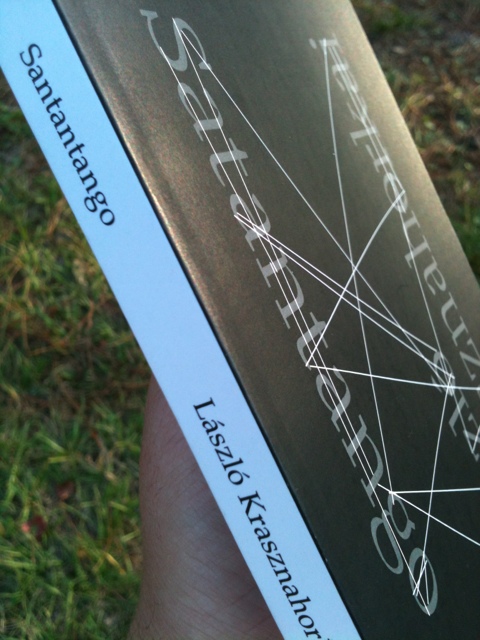
Book Acquired, 12.06.2011 — Or, I Photograph My Reader’s Copy of Satantango in the Cheap Showiness of Nature

20111208-172836.jpg

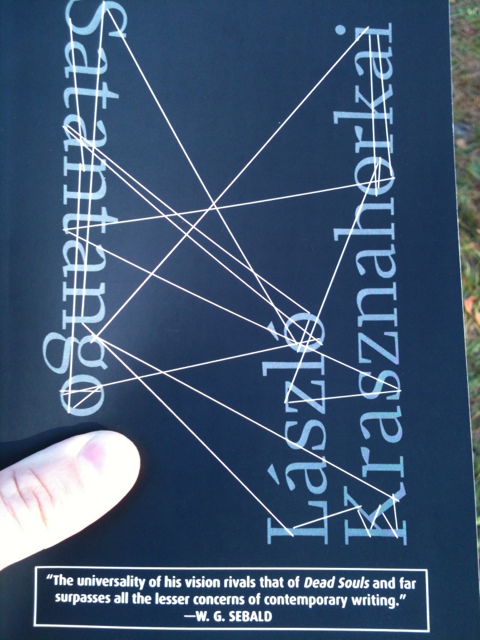
Damn. Check this out. László Krasznahorkai’s novel Satantango, the title of which does not apparently include diacritical marks in its new (first published!) English translation.

Publisher New Direction’s description:

Already famous as the inspiration for the filmmaker Béla Tarr’s six-hour masterpiece, Satantango is proof, as the spellbinding, bleak, and hauntingly beautiful book has it, that “the devil has all the good times.” The story of Satantango, spread over a couple of days of endless rain, focuses on the dozen remaining inhabitants of an unnamed isolated hamlet: failures stuck in the middle of nowhere. Schemes, crimes, infidelities, hopes of escape, and above all trust and its constant betrayal are Krasznahorkai’s meat. “At the center of Satantango,” George Szirtes has said, “is the eponymous drunken dance, referred to here sometimes as a tango and sometimes as a csardas. It takes place at the local inn where everyone is drunk. . . . Their world is rough and ready, lost somewhere between the comic and tragic, in one small insignificant corner of the cosmos. Theirs is the dance of death.” “You know,” Mrs. Schmidt, a pivotal character, tipsily confides, “dance is my one weakness.”

New Directions has a fantastic record when it comes to lit in translation, and Satantango has been long anticipated by English-reading audiences, due in large part to Béla Tarr’s movie (which is more like seven and a half hours, which I meant to watch this summer but couldn’t because I want to watch it with no interruptions, but I have kids and a wife, so, hey).

I got into it a bit last night, and, I don’t know if it’s just the advance reader copy I got or what, but there are no paragraph breaks, which is a grueling rhetorical technique, a big dare to readers, really (see also: W.G. Sebald’s Austerlitz (note: Sebald blurbs Satantango)). The advance reader copy also has a delightful typo on the spine, one that makes the book sound like, I dunno, if Santana made a tango record. Or maybe Santa n’ Tango for ever (Cash will no doubt be jealous). More to come.

20111208-172845.jpg

W.G. Sebald on Bookworm

W.G. Sebald talks with Michael Silverblatt on KCRW’s Bookworm show. (Yes, the podcast is almost a decade old, but I’d never heard it before; it was recorded just days before Sebald’s death in an automobile accident).

Biblioklept Recommends Five Novels, Some of Them New, Not All of Them German

I shouldn’t be reading five novels at once. It’s a terrible idea, a symptom of a bad habit that I thought I’d broken, but after abandoning Levin’s tedious tome The Instructions and wasting my time on Shteyngart’s insipid dystopian novel Super Sad True Love Story, I found myself absorbed by a lovely little cache that had been neatly, patiently stacked for a few weeks now.
I’m only 60 or so pages into Lars Iyer’s Spurious — about a third of the way through — and at the rate I’m reading, I won’t finish it until the end of this month. It’s not that it’s slow or tedious or hard work: quite the opposite, in fact — it’s funny and lively, even when it’s erudite and depressive. I’ve enjoyed taking it in as a series of vignettes or skits or riffs. Spurious is about, or seems to be about (the term must be placed under suspicion) two would-be intellectuals, W. and his friend the narrator. They bitch and moan and despair: it’s the end of the world, it’s the apocalypse; they find themselves incapable of original thought, of producing any good writing. The shadow of Kafka paralyzes them. They travel about Europe, seeking out knowledge and inspiration — or at least a glimpse of some beautiful first editions. W. is cruel to the narrator, calling him fat and deriding his intellect for sport. But it’s all in good fun. Or maybe not. I’m really enjoying Spurious and have no hesitation recommending it; however, like a strong shot of bourbon, it’s best enjoyed frequently but in small doses. Spurious is brand spanking new from Melville House.

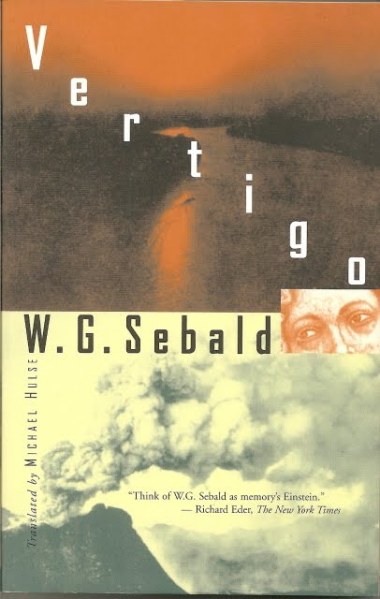
Iyer’s book dovetails nicely with W.G. Sebald’s first novel, Vertigo, which I picked up expressly to get the bad taste of Shteyngart out of my brain. Both books are haunted by Kafka, both  blur the lines between fiction and biography, both are works of and about flânerie, and both are melancholy. The book comprises four sections; the first section tells the story of the romantic novelist Stendhal (or, more to the point, a version of Stendhal); the second section details two trips Sebald made to Italy, one in 1980, and one in 1987; the third section, which I just read last night, describes a trip Kakfa took to Italy near the end of his life. I’m almost certain that I’ve read this section, “Dr. K Takes the Waters at Riva,” before — but I can’t remember where or when. It was strange reading it, almost as if I were experiencing some of the vertigo that permeates the volume. Full review forthcoming.
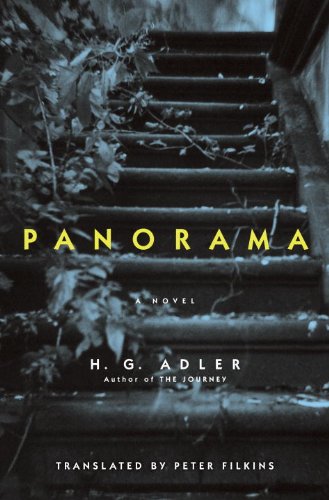
Kafka was a German-speaking Jewish writer from Prague. So was H.G. Adler, author of Panorama, new in English for the first time (hardback; Random House). Another way to transition from the Sebald paragraph above to this write-up of Panorama might be to point out that Sebald references Adler in Austerlitz, a book that tries to measure continental memory of the Holocaust. Adler survived the Holocaust, forced first into Theresienstadt and then Auschwitz, where his wife and mother were murdered in the gas chambers. Panorama is an autobiographical bildungsroman, with its hero young Josef Kramer standing in for Adler, and while it will clearly work its way into grim territory, the beginning — which is to say, the part that I’ve read so far — is bucolic and sweet and strange, as we see young Josef at home with his family. There’s a cinematic scope to Adler’s prose — Panorama is a Modernist work, one where the narrative freely dips into its protagonist’s mind. More to come.

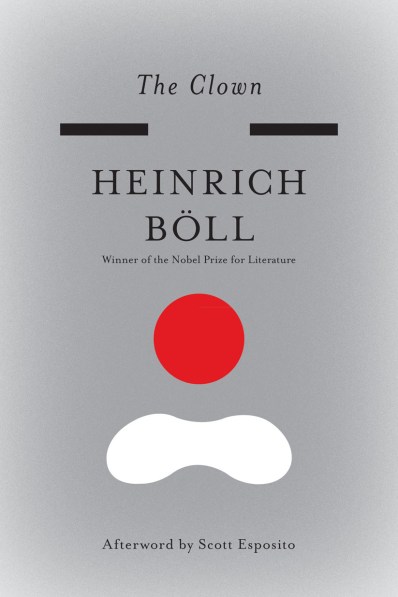
Continuing in this Teutonic vein is Heinrich Böll’s novel The Clown (also Melville House). It’s postwar Germany, and Hans Schnier is a clown who’s crashing and burning. He hurts himself–purposefully–during a performance (at one of the increasingly more provincial venues he finds himself playing for these days) and retreats to Bonn, where he holes up in his small apartment and makes angry desperate phone calls (and tries not to drink too much brandy) and reflects on his past. What’s eating him up? His gal Marie, basically his common-law wife, has reverted back to her Catholic ways and up and left him for some chump named Zupfner. Schnier rants against a complacent and complicit German bourgeoisie, spitting vitriol against Protestants and Catholics alike; some of the best parts of the novel though are his ravings about art and the role of the “artiste” in society. Also: he can smell over the phone. Full review soon.
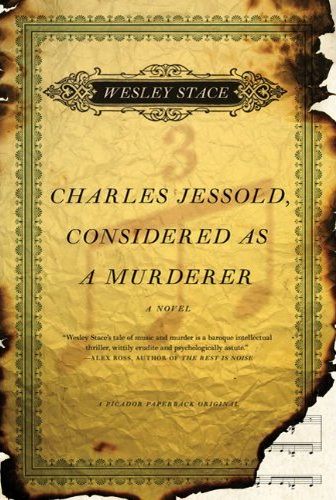
Wesley Stace’s new novel Charles Jessold, Considered as a Murderer (new from Picador) is a musical murder mystery set in the early part of 20th century Britain. Our (seemingly less than reliable) narrator Leslie Shepherd is a music critic with an aristocratic background who likes to spend his weekends collecting folk songs with other rich boys in the towns surrounding their country manors. He’s smitten (platonically, of course) with Charles Jessold, a middle class composer with a spark of avant-garde genius, and wins the younger man’s friendship quickly when he tells the story of Carlo Gesualdo, a fifteenth century composer/lord who kills his wife and her lover. (Notice the etymological connection between their names?) This tale of murder and cuckoldry is doubled in the ballad “Little Musgrave“; when Jessold and Shepherd find a new variation of the ballad, they set out to write the next (only?) great English opera, an adaptation of “Musgrave.” Oh, and that plot? The book opens with a news clipping reporting that Jessold killed his wife and her lover, and then himself, after the première of his opera Little Musgrave. Life imitates art imitates life. Stace has a keen ear for the period he writes about as well as a seemingly encyclopedic knowledge about music, but he also has the good sense to restrain himself and remember that he’s delivering a murder mystery. I’ve been enjoying Jessold quite a bit, and will return to it when I finish writing these lines. (And, for what it’s worth, part of Jessold is set in Germany).
“Walking in the Footsteps of W.G. Sebald” — Stuart Jeffries Retraces The Rings of Saturn

Stuart Jeffries retraces W.G. Sebald’s coastal walk from The Rings of Saturn. Video after the jump. Continue reading ““Walking in the Footsteps of W.G. Sebald” — Stuart Jeffries Retraces The Rings of Saturn”

W.G. Sebald: Image, Archive, Modernity — J.J. Long

In W.G. Sebald: Image, Archive, Modernity, J.J. Long posits that the work of the late German author W.G. Sebald is best understood as the struggle for autonomous subjectivity in a world conditioned by the power structures of modernity. If the term “power structures” wasn’t a big enough tip-off, yes, Long’s analysis of Sebald is largely Foucauldian, and although he cites Foucault more than any other theorist (Freud is a distant second), the book is not a dogged attempt to make Sebald’s prose stick to Foucault’s theories. Rather, Long uses Foucault’s techniques to better understand Sebald’s works. As such, Long examines the ways that modernity affects power on the human body in Sebald’s work, tracing his protagonists’ encounters with modern institutions that exert power via archive and image.
From the outset, Long distinguishes his book-length study on Sebald from the tradition of so-called Holocaust studies, as well as some of the other foci that dominate analyses of Sebald — “trauma and memory, melancholy, photography, travel and flânerie, intertextuality and Heimat.” Long claims that these are simply “epiphenomena” of the “problem of modernity” that dominates Sebald’s work, and goes on to scrutinize Sebald’s novels like The Emigrants, Austerlitz, and The Rings of Saturn by focusing instead on the various ways that modern institutions proscribe power on the subject’s body. Long writes–

Sebald is interested in the ways in which subjectivity in modernity is formed by archival and representational systems through which various forms of disciplinary power are exercised. He is also concerned with the scope that might exist for eluding disciplinary power or reconfiguring its archival systems in order to assert a degree of subjective autonomy or evade the determinations of power/knowledge.

Long’s study of Sebald is very much a description of modernity; in particular, of modernity as a series of affects of power and discipline upon the subject (again, very Foucauldian). It’s not particularly surprising then that Long, after locating so many Sebaldian traumas in the 19th and early 20th centuries, asserts that Sebald is a modernist and not a postmodernist. He bases this claim not on the formal elements of Sebald’s prose, which he readily concedes can just as easily be read as postmodernist, but rather on the way his “texts respond to the specific historical constellation” of modernity. Long continues–
What is notable about Sebald is that the fictional worlds he constructs are not postmodern spaces of global capital, hyperspace and ever-faster cycles of production, consumption and waste (despite his narrators’ occasional visits to McDonald’s). His texts do not present unrelated present moments in time, nor do they partake of the waning of history that is frequently noted as a characteristic of the postmodern. Sebald’s spaces are those of an earlier modernity that are deeply marked by the traces of history.

If the question of whether or not a book is postmodern or modern strikes you as merely academic, that’s because it is merely academic. Long makes a solid case for Sebald-as-modernist, but the best parts of his book are really his Foucauldian analyses of Sebald’s texts. They make you want to go back and reread (or, in some cases read for the first time.) I’m inclined to believe that Sebald (along with a host of other writers) is better described as something beyond modern or postmodern, something we might not have a name for yet, but that’s fine–we need distance, time. In Long’s take, Sebald is, of course, trying to sort out the detritus of modernity–even as it’s happening to him. But I’m not sure if that makes him a modernist.

W.G. Sebald: Image, Archive, Modernity is available now from Columbia University Press.

The Rings of Saturn — W.G. Sebald

rings

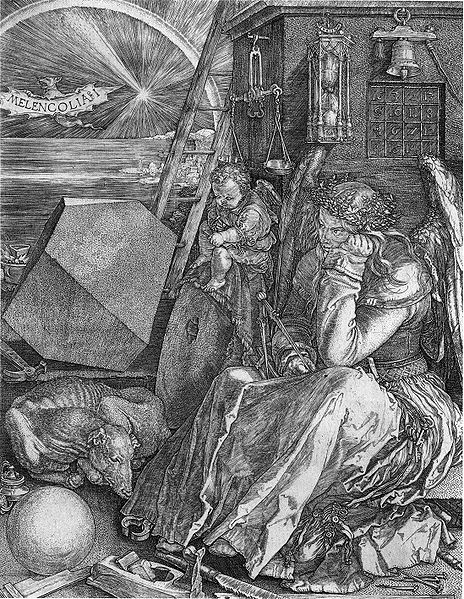
Early on in W.G. Sebald‘s strange and beautiful novel The Rings of Saturn, the erudite narrator (seemingly) offhandedly alludes to Albrecht Dürer’s 1514 engraving Melencolia I. Rings is larded with such references, stuffed to the gills with analysis of history and literature and art (and so much more), but the quick allusion to Melencolia I seems a particularly informative way of interpreting–or at least comprehending–Sebald’s grand, glorious book. Before we begin though, it will be useful to quickly summarize the plot: In 1992, a German intellectual named W.G. Sebald takes a walking tour of the east coast of England. He visits old English manors, the homes of dead writers, decaying seaside resorts, abandoned islands, and many other melancholy spots. In true King Lear style, he wanders the heath a bit. But this walking tour is not the real plot: no, instead, Sebald, in a casual, sometimes wryly humorous, and mostly melancholy tone reflects on the global and historical implications of a host of subjects far too numerous to try to list here. In other words, this is a very smart book about everything.

464px-durer_melancholia_i1

The Rings of Saturn, as its title suggests, is a book about melancholy (Renaissance medical texts identified Saturn with the bodily humor melancholy–black bile–indicated by sluggishness and moroseness, paradoxically paired with an eagerness for action (hence the modern word saturnine)). The melancholy of Rings pervades the whole text and even infiltrates each sentence. Like Dürer’s engraving, Sebald’s text is complexly and richly detailed, overflowing with allusion and symbolic registry that defies simple or easy interpretation. Just as Dürer situates the winged figure of genius at the (slightly off-) center of his image, contemplative yet dreamy, we find Sebald’s narrator to be a flighty genius made forlorn by the world he sees. And yet, just as Dürer’s figure is ultimately ambiguous (is he despondent or merely in the throes of absent fancy? Is he shirking his duty or contemplating a new grand work?) so too does Sebald’s narrator resist any simple interpretation. The narrative bulk of Rings consists of the narrator’s perspectives on history and memory, art and economics, literature and suffering. Like the myriad strange objects that surround the figure of genius in Dürer’s engraving, the connections between the subjects of the narrator’s lessons seem tenuous at first (indeed, several interpretations of Dürer’s piece have argued that it is simply a failed allegorical vision). As the text develops, we begin to see how the narrator’s obsession with, say, Thomas Browne’s skull connects to a biographical account of Joseph Conrad, or early English colonial forays into Imperial China, or reflections on the life cycle of the herring. Like the objects that litter Dürer’s engraving, the narrator’s varied lessons are detailed things, concretizations of history, or art, or literature, or science, and, at the same time–like Dürer’s objects–the narrator’s lessons are also symbols connected to grander abstractions. The work–and joy–of the reader is to link these symbols, these abstractions, into meaning. This is no simple task, but Sebald’s masterful writing ensures that it is a rewarding (and downright fun) adventure.

The flip side to melancholy is the potential energy writhing within its dramatic inertia. The very nature of the narrator’s simple quest–a walking tour–dramatizes this energy; at the same time, the decay and erosion of English coastal life threatens to overwhelm it for good. The narrator’s access to so much human knowledge, both miserable and horrible, attests to the power of history to survive through–but also to paradoxically crush–the living. This paradox of melancholy, dramatized in Dürer’s Melencolia I, is neatly summed up in a line from the first page of The Rings of Saturn (a page I immediately returned to after finishing the book, I must add):

At all events, in retrospect I became preoccupied not only with the unaccustomed sense of freedom but also with the paralysing horror that had come over me at various times when confronted with the traces of destruction, reaching far back into the past, that were evident to me even in that remote place.

In this “remote place,” this forlorn milieu, Sebald’s narrator (Sebald?) again and again uses the lens of history to–again paradoxically–attempt to come to terms with history, both collective and individual.

The result of all this is a wonderful, engaging read, on par with the greatest books I’ve read. Sebald’s command of language, his ability to dip into another’s voice recalls Roberto Bolaño’s great work 2666; Sebald’s narrator, in his will to understand and catalog recalls Ishmael in Melville’s masterpiece Moby-Dick, as does his human sympathy, humor, and sensitivity. At the same time, Sebald’s scope spills out of the conventional borders of what we’ve come to know as the novel. While hardly as dry–or neutral–as a history or science text, Sebald’s narrator’s takes on sericulture, or the life of Joseph Conrad, or the relationship between art museums and the sugar trade of the 18th century all vibrate with an intense truthfulness that informs and engages the reader without ever falling into didactic prattle.

At the end of The Rings of Saturn, Sebald’s narrator returns to Thomas Browne’s skull again–only this time resurrected, a living brain. He discusses at length Browne’s Musaem Clausum, an imaginary library that Browne invented containing texts, artifacts, and relics of every manner of wonder. Sebald’s narrator goes on for pages listing the contents of Musaem Clausum with fervor and passion–the reader realizes that the book, and the narrator, could go on and on, detailing these wonders and their connected histories under more intense scrutiny. Rings replicates both Browne’s Musaem Clausum and Dürer’s engraving, offering readers a tour through myriad marvels–and if the walk is melancholy and strange, it is also profound and beautiful, and very, very rewarding. Very highly recommended.