No knightly hero | Gravity’s Rainbow, annotations and illustrations for page 364

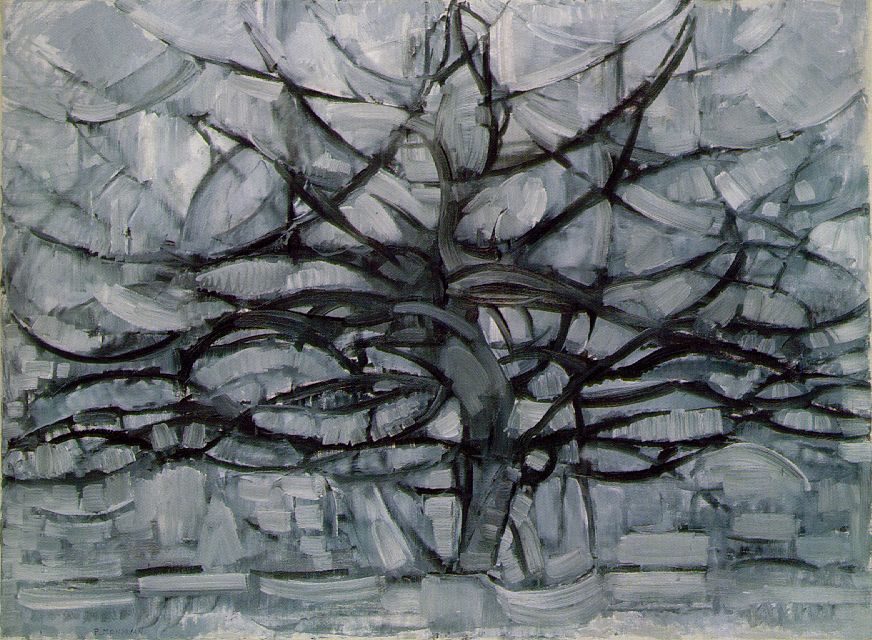
The Gray Tree, Piet Mondrian (1911)

Toward dusk, the black birds descend, millions 1  of them, to sit in the branches of trees nearby. The trees grow heavy with black birds, branches like dendrites of the Nervous System 2  fattening, deep in twittering nerve-dusk, in preparation for some important message… . 3

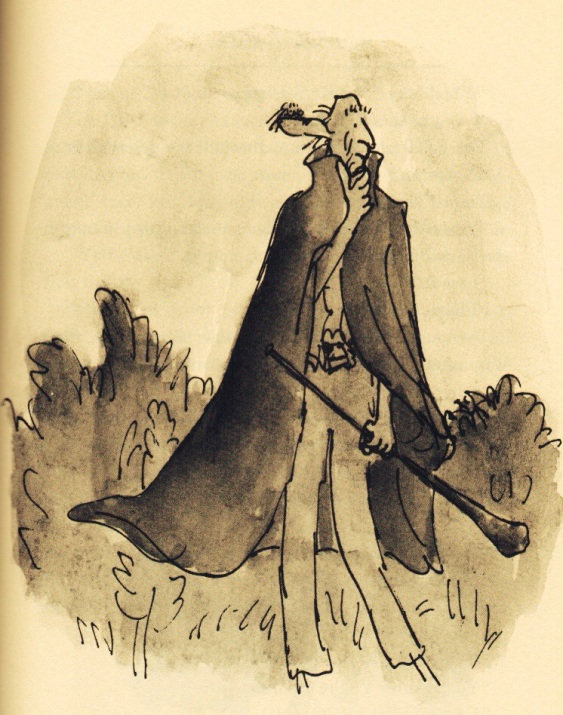
Later in Berlin, down in the cellar among fever-dreams with shit leaking out of him at gallons per hour, too weak to aim more than token kicks at the rats 4 running by with eyes fixed earnestly noplace, trying to make believe they don’t have a newer and dearer status among the Berliners, at minimum points on his mental health chart, when the sun is gone so totally it might as well be for good, Slothrop’s dumb idling heart 5 sez: The Schwarzgerät is no Grail, Ace, that’s not what the G in Imipolex G stands for. And you are no knightly hero 6. The best you can compare with is Tannhäuser 7, the Singing Nincompoop—you’ve been under one mountain at Nordhausen, been known to sing a song or two with uke accompaniment, and don’tcha feel you’re in a sucking marshland of sin out here, Slothrop? maybe not the same thing William Slothrop, vomiting a good part of 1630 away over the side of that Arbella 8, meant when he said “sin.” . . . But what you’ve done is put yourself on somebody else’s voyage 9—some Frau Holda, some Venus in some mountain—playing her, its, game… you know that in some irreducible way it’s an evil game. You play because you have nothing better to do 10, but that doesn’t make it right. And where is the Pope whose staff’s gonna bloom for you? 11

From page 364 of Thomas Pynchon’s novel Gravity’s Rainbow.

1 A million black birds sounds like a hyperbole of crows, but Berlin 1945, post-V-E Day—which is like, where we are here—I mean, it’s a desperate deathly ghastly place. So maybe buzzards and dreadful crows abound.

2 Cf. the discussion between nerve cells in pages 148-49.

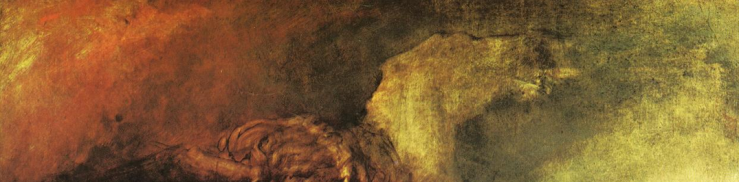
Drawing of Purkinje cells (A) and granule cells (B) from pigeon cerebellum, Santiago Ramón y Cajal (1899)

3  What’s the important message? Oh wait, we’re still in the marvelous tree-crow-dendrite simile—the “twittering nerve-dusk”—so the “message” the crow-tree-branches awaits is just part of the, uh, metaphor. Or not? I mean, this is a novel in large part about expectation—about waiting for the bomb to fall, waiting for the Sword of Damocles to descend. And also: awaiting a message of Return.

But: What a lovely little simile. Pynchon’s powers as a prose stylist seem under-remarked upon.

4 Cf. page 359: “Last week, in the British sector someplace, Slothrop, having been asshole enough to drink out of an ornamental pond in the Tiergarten, took sick.”

The cellar, the diarrhea, the rats….I’ve written it before: Gravity’s Rainbow is a thoroughly abject novel—full of assholes (literal) and shit (literal) and toilets (literal). (And oh, also: metaphorical too, metaphorical too). Slothrop here is sick, literally evacuating—but also figuratively evacuating. A few pages later he’ll evacuate into his next identity, Rocket Man.

Cf. page 553, from Slothrop’s “Partial List of Wishes on Evening Stars for This Period”:

“Let me be able to take a shit soon.”

5  I counted 75 words in the dependent clause that precedes Pynchon’s finally introducing the independent clause—which is to say subject and verb

“Slothrop’s dumb idling heart sez”

(My count is likely off; I counted once and I’ve had some bourbon. I counted “fever-dreams” as two words, although I think you’re not supposed to do that).

Anyway: That’s a lot of dependent-clauseauge before, like, the main idea—which I guess, from a prose/aesthetic analysis, is the, uh, main idea—ascent, suspension—and then an immediate divergence (and note how Pynchon simultaneously deflates and invigorates his predicate verb “sez” with colloquial zeal).

6  Many of Gravity’s Rainbow’s motifs almost cohere here. Pynchon highlights two of Slothrop’s ostensible “quests” — the Schwarzgerät (the mysterious “black device” that will be installed in rocket 00000 (present), and the sexy sinister plastic Imipolex G (past). (But also both, obviously: Future).

Slothrop’s dumb heart denies any knightly virtue, rejects Romanticism—and, perhaps, Modernism’s ironic obsessions with Romanticism.

(I think the passage above, what with its ravens and Venus-denial and grail-refusal, is a tidy antonym to Rossetti’s depiction of the Grail…and yet I’d argue Pynchon’s writing bears a Pre-Raphaelite streak)—

The Damsel of the Holy Grail, Dante Gabriel Rossetti (1874)

The episode strikes me as utterly true, a moment of honest self-speech. As Emily Dickinson put it: “I like a look of Agony / Because I know it’s true.” (One of Slothrop’s ancestor’s plagiarized Ms. Dickinson on his gravestone). And yet and yet and yet…Perhaps Tyrone S. is being a bit too harsh on himself (who among us hasn’t cast a harsh gaze into the mirror?).

Slothrop expels the old identity here, the old dreams, the old, evacuating space for the arrival of “Raketemensch,” — Rocketman!

Rocketman points to an emerging postmodern hero—a comic bookish hero, perhaps—totemic, sure, but also Pop, cartoonish, textual—framed (literally) in the conventions of previous centuries’ conceptions of “heroism.”

7  Cf. page 299: “There is that not-so-rare personality disorder known as Tannhäuserism. Some of us love to be taken under mountains, and not always with horny expectations.” I annotated the page here.  Slothrop seems to accept the abject mantle of a bard, a laze, a loaf, a lingerer. I think of Whitman here, proud to lean and loafe at his ease at the beginning of Song of Myself, only to “effuse [his] flesh in eddies, and drift it in lacy jags” in the poem’s closing lines. Like Whitman’s persona, Slothrop will dissipate.

8 Cf. pages 203-04 (annotations here), wherein Slothrop’s vomiting ancestor William Slothrop, in a remarkable passage of hysteron proteron, travels backwards from the New World to the Old.

9 One of the central paranoias of Gravity’s Rainbow is that you might be on their voyage. How much agency do you have in your own life? And what’s the cost of asserting that agency? How many identities do you have to evacuate? And in the end—what’s left?

10 Boredom strikes me as one of (if not the) central theme connecting Modernism, postmodernism, and post-postmodernism.

11 Cf. the Tannhäuser story/footnote 7.

Or: Simply note the motif of bloom, of fruition, of phallic life, of promise. In fuller context though—it’s a bloom too late. The question blooms from Slothrop’s self-speech, but also extends to you and me, reader.

Or: Cf. the opening of Gravity’s Rainbow. From the sixth paragraph:

“You didn’t really believe you’d be saved. Come, we all know who we are by now. No one was ever going to take the trouble to save you, old fellow. . . .”

>intoxication o’r dizziness< | On "starting" Arno Schmidt's enormous novel Bottom's Dream

img_3817

Arno Schmidt’s 1970 novel Bottom’s Dream is finally available in English translation by John E. Woods. The book has been published by the Dalkey Archive.

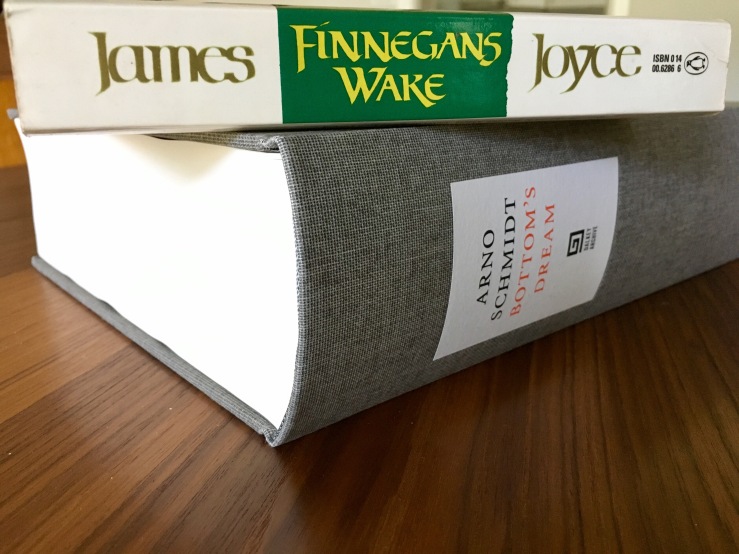
It is enormous.

As you can see in the picture above: Enormous.

But what’s Bottom’s Dream about? (This is the wrong question).

Dalkey’s blurb:

“I have had a dream past the wit of man to say what dream it was,” says Bottom. “I have had a dream, and I wrote a Big Book about it,” Arno Schmidt might have said. Schmidt’s rare vision is a journey into many literary worlds. First and foremost it is about Edgar Allan Poe, or perhaps it is language itself that plays that lead role; and it is certainly about sex in its many Freudian disguises, but about love as well, whether fragile and unfulfilled or crude and wedded. As befits a dream upon a heath populated by elemental spirits, the shapes and figures are protean, its protagonists suddenly transformed into trees, horses, and demigods. In a single day, from one midsummer dawn to a fiery second, Dan and Franzisca, Wilma and Paul explore the labyrinths of literary creation and of their own dreams and desires.

And Wikipedia’s summary:

The novel begins around 4 AM on Midsummer’s Day 1968 in the Lüneburg Heath in northeastern Lower Saxony in northern Germany, and concludes twenty-five hours later. It follows the lives of 54-year-old Daniel Pagenstecher, visiting translators Paul Jacobi and his wife Wilma, and their 16-year-old daughter Franziska. The story is concerned with the problems of translating Edgar Allan Poe into German and with exploring the themes he conveys, especially regarding sexuality.

Did I mention that it’s enormous?

Look, I know that dwelling on a book’s size probably has nothing to do with literary criticism, but Bottom’s Dream poses something of a special case. As an article on Bottom’s Dream at The Wall Street Journal points out, Schmidt’s opus is 1,496 pages long, contains over 1.3 million words, and weighs 13 pounds.

It’s a physical challenge as well as a mental challenge.

And, Oh that mental challenge!

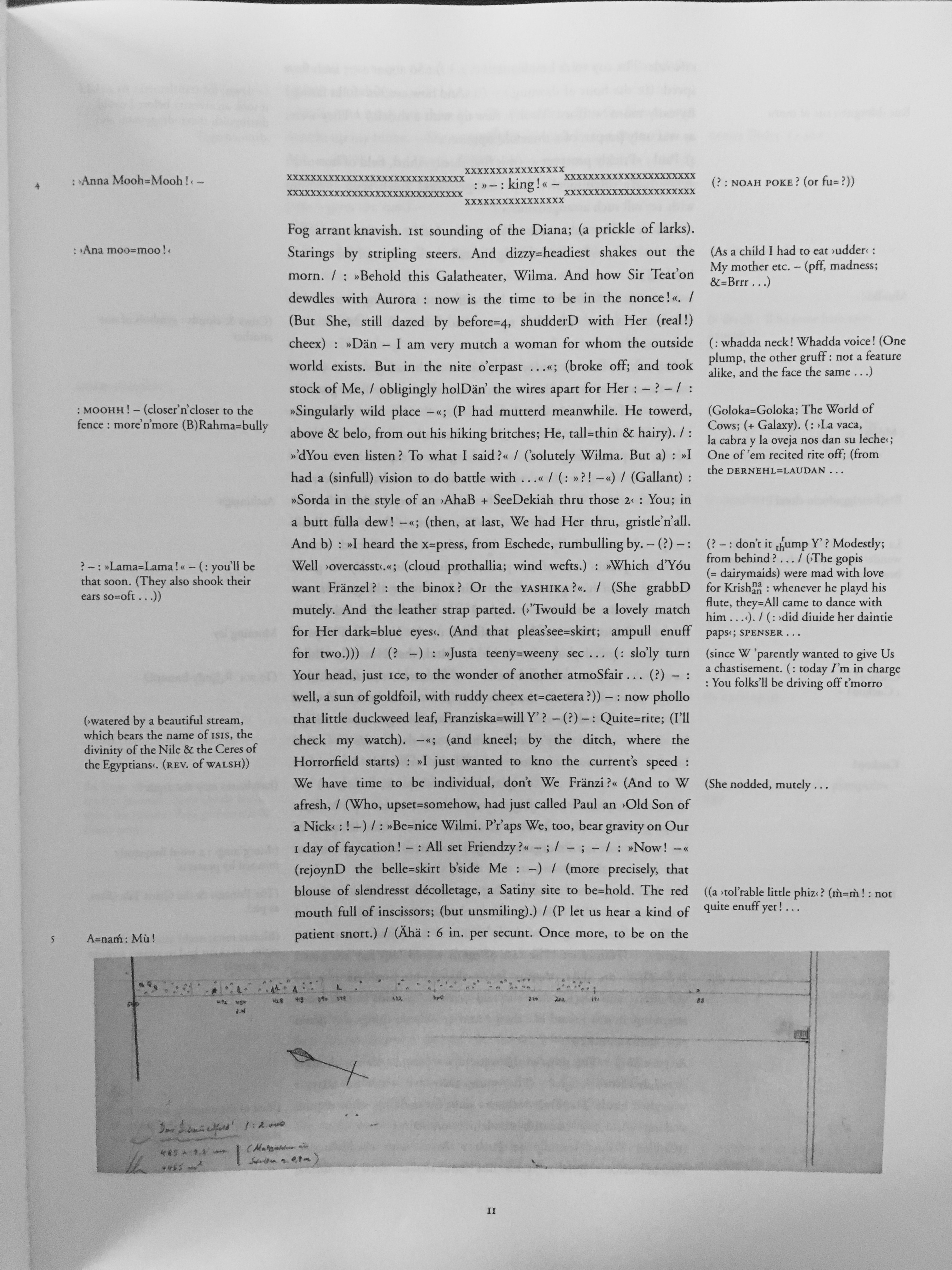
Here’s the first page of Bottom’s Dream (the pic links to a much larger image):

img_3901

Hmmm…? What do you think?

The obvious easy reference point here is Joyce’s Finnegans Wake, which indeed Schmidt was actively following, both in form and style: competing columns, a fragmentary and elusive/allusive style, collage-like metacommentary, an etymological explosion—words as paint, text as meaning. Etc.

(Did I mention it’s a lot longer than Finnegans Wake? Did I mention it’s enormous?)

img_3841

Here’s a glimpse at two random pages (don’t be afraid to click on that image and get the full, y’knoweffect):

img_3811

I’ll never forget one of my graduate school professors warning us not to “peer too long into Finnegans Wake.” He called it an abyss. (The man loved Joyce’s work, by the way, and had studied under Hugh Kenner. I’m not sure if he meant abyss pejoratively. It was, like I say, a warning).

Bottom’s Dream seems like an abyss. As its title (a reference to A Midsummer Night’s Dream) suggests, “it hath no bottom.”

After nine days, I’m “on” page 21 of Schmidt’s novel now, and I have no idea what’s going on. And not just because it’s a primal gobbledygook wordmass. No, part of my incomprehension results from a very strong physical reaction to “reading” Bottom’s Dream. This physical reaction goes beyond the size of the volume—although there’s certainly something to the size. I more or less have to read the thing on my dining room table; it’s dreadfully uncomfortable on a couch, and probably impossible on my hammock or in the bathtub. I can’t really hold it while I read it. I think this matters, although I can’t really say how right now. The multiple columns, marginalia, images, etc. are engaging but also fragment my attention—and I generally find myself flicking through Bottom’s Dream, rather than sustaining the will to follow the “plot.” Right now, anyway, I find myself wrapped up in the aesthetics of reading Bottom’s Dream. It’s a tactile read. I enjoy it most when I smooth my hands over it, jump out of the stream, 20, 30, 100 pages forward, backwards. Relax a little.

Otherwise, Bottom’s Dream becomes a bit of a nightmare for me: I get all dizzy, thirsty, my eyes seem to thrum. Something going on in the inner-ear. It’s like a slow-motion panic attack. When that abyss-stress comes on, I jump ahead.

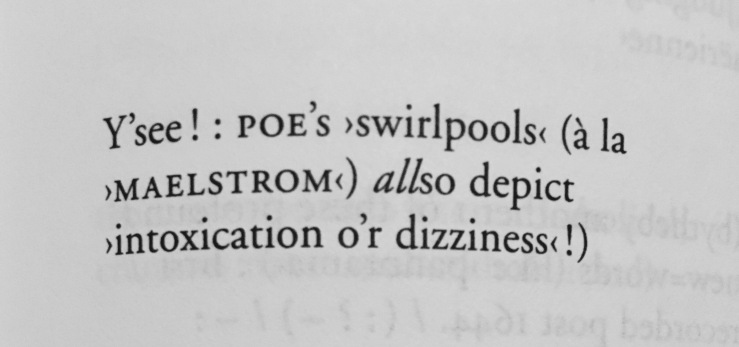
Which is how I found this bit of marginalia (I wish I’d recorded the page when I photographed it; but, also: the iPhone camera is a better recorder of Bottom’s Dream’s aesthetic textuality than any word-processing program. Even a scanner might straighten some of its bends and arcs, its voluminous volume):

img_3818

Yes! Poe’s >swirlpools<! >intoxication o’r dizziness<! — there’s a description for me of my own reaction to reading Bottom’s Dream.

Poe might be something of a guide for me if I do try to stick out wandering through Bottom’s Dream, and his story “A Descent into the Maelstrom,” referenced above, seems a particularly nice parallel to Schmidt’s bigass book.

“Descent” relates the tale of a sailor (a voyager!–a, like, metaphorical reader, y’know) transformed by his encounter with the “Moskoestrom” —a swirling abyss from which no one returns. This vortex, “absurd and unintelligible,” breaks the sailor, “body and soul.” He can’t comprehend the storm. It’s unknowable, un-nameable. At best, he is able to make a sidelong glance at it, but can never plumb its depths. And not only is his glance broken, but all of his senses are fragmented. He escapes the maelstrom, but is unrecognizable to the sailors who rescue him. He becomes the voice of the vortex, the metonymy of a force he can perceive but can’t comprehend.

The maelstrom—the vortex, the abyss—this, for Poe, was language.

I’m not sure how deep I’ll travel into Schmidt’s maelstrom. I managed large sections of Finnegans Wake—but I had a guide in Joseph Campbell’s Skeleton Key. Someone to map out the terrain, show me the ropes, etc.

Obviously, there isn’t much English-language scholarship on Bottom’s Dream right now (and in a very real and radical sense that I’m not touching on here, Woods’s translation is its own separate book). There are a few blogs taking on Schmidt’s monster though. The Untranslated has been writing (in English) about the original German text for over a year now. At Messenger’s Booker, Tony Messenger has been writing about Woods’s translation. There might be some other folks out there attempting the same—if you know let me know. For now, my updates from this maelstrom will be sporadic at best.

Gravity’s Rainbow, annotations and illustrations for page 299 | Some of us love to be taken under mountains, and not always with horny expectations

In the Venusburg, John Collier (1901)

There is that not-so-rare personality disorder known as Tannhäuserism 1 . Some of us love to be taken under mountains, and not always with horny expectations 2 .—Venus, Frau Holda, her sexual delights—no, many come, actually, for the gnomes , the critters smaller than you, for the sepulchral way time stretches along your hooded strolls down here, quietly through courtyards that go for miles, with no anxiety about getting lost… no one stares, no one is waiting to judge you… out of the public eye… even a Minnesinger needs to be alone…4  long cloudy-day indoor walks… the comfort of a closed place, where everyone is in complete agreement about Death 5. Slothrop knows this place. Not so much from maps he had to study at the Casino 6 as knowing it in the way you know someone is there… .

Plant generators are still supplying power. Rarely a bare bulb will hollow out a region of light 7 . As darkness is mined and transported from place to place like marble, so the light bulb is the chisel that delivers it from its inertia, and has become one of the great secret ikons of the Humility, the multitudes who are passed over by God and History 8. When the Dora prisoners 9  went on their rampage, the light bulbs in the rocket works were the first to go: before food, before the delights to be looted out of the medical lockers and the hospital pharmacy in Stollen Number 1, these breakable, socketless (in Germany the word for electric socket is also the word for Mother—so, motherless too 10 ) images were what the “liberated” had to take… .

From Thomas Pynchon’s Gravity’s Rainbow, page 299. All ellipses are Pynchon’s

1 Tannhäuser was a 13th-century German Minnesinger, a troubadour—a knight-poet. A bard, I guess. Is Slothrop a bard, a knight-poet—a knight-errant? Not sure. (He’ll later deny he’s on a grail-quest).

In German legend, Tannhäuser falls from grace when he discovers Venusberg, the underground home of Venus. He stays there a year, neglecting his betrothed and indulging in erotic delights. Teutonic Christian knight that he is, Tannhäuser leaves Vensuberg (Hörselberg) for Rome to beg forgiveness from Pope Urban IV, who denies him, saying absolution would be as impossible as his papal staff flowering in bloom. The staff does bloom—but not until Tannhäuser has disappeared back into the Venusian underworld (and his gal Lisaura has killed herself in grief).

2006au1525_jpg_l
Title page to ‘The Story of Venus and Tannhäuser’ Aubrey Beardsley (1895)

Cf. the sonnet on pages 532-33 of Gravity’s Rainbow:

Where is the Pope whose staff will bloom for me?
Her mountain vamps me back, with silks and scents,
Her oiled, athletic slaves, her languid hints
Of tortures transubstantiate to sky,
To purity of light-of bonds that sing,
And whips that trail their spectra as they fall.
At weather’s mercy now, I find her call
At every turn, at night’s foregathering.

I’ve left no sick Lisaura’s fate behind.
I made my last confession as I knelt,
Agnostic, in the radiance of his jewel…
Here, underneath my last and splintering wind,
No song, no lust, no memory, no guilt:
No pentacles, no cups, no holy Fool…

The Tannhäuser myth connects to Gravity’s Rainbow’s Orphean motif, and readers may take note of the hero’s descent played against the mystical “blooming” of a staff…eh, what with the sexy phallic overtones and all.

And we can use the third line of Gravity’s Rainbow here to describe the bloom on the staff: “It is too late” (3).

2 “Some of us love to be taken under mountains, and not always with horny expectations” — one problem with reading Gravity’s Rainbow only once or twice is that it is too full of great sentences and you’ll likely miss them. Pynchon continues to deflate what he has inflated (only to inflate it again)—sex will give over to death—or, an un-death (an un-sex) here. Slothrop inert, underground, in the tombs.

3 Cf. Pynchon’s 2006 novel Against the Day, wherein (briefly, too briefly), the heroic Chums of Chance take on “the increasingly deranged attentions of the Legion of Gnomes, the unconscionable connivings of a certain international mining cartel, the sensual wickedness pervading the royal court of Chthonica, Princess of Plutonia, and the all-but-irresistible fascination that subterranean monarch would come to exert, Circelike, upon the minds of the crew of Inconvenience [ETC.]”

4 . “…out of the public eye… even a Minnesinger needs to be alone…”

pynchon-simpsons-0-01

5 A perhaps puzzling line, if only because I think I get what everyone’s in “agreement about Death” here—Death as a kind of cozy promise that we all say “Fuck off” too in lieu of “long cloudy-day indoor walks” (and the horny expectations of underground sexbergs). I’m interested on anyone else’s ideas, of course.

6 The Casino Hermann Goering—Slothrop’s last “official” assigned post.

7 We privilege light over darkness; Pynchon inverts the image here: light is a violent “chisel”; darkness is a commodity to be mined.

The bulb becomes one of GR’s most powerful motifs, culminating in the late (and essential) episode “Byron the Bulb” (find Harold Bloom’s essay on Byron the Bulb if ye can).

References to Byron, via the indispensable folks at References to Byron, via the indispensable Pynchon Wiki:

“a bulb over his head burning all night long. He dreamed that the bulb was a representative of Weissmann, a creature whose bright filament was its soul” 426-27; “a theatre marquee whose sentient bulbs may have looked on […] witnesses to grave and historical encounters” 464; “The Story of” 647-55; “Someday he will know everything, and be just as impotent as before” 654; “electrical tidal wave” 665; “young Jack may have had one of them Immortal Lightbulbs then go on overhead” 688; screwed into Gustav’s kazoo hashpipe, 745

8 Pynchon loves to underline his big theme of “preterite vs elect” in Gravity’s Rainbow. There’s something sweet and even sad in the idea of the Humiliated, the preterite, finding an “ikon” in a lightbulb—a self-spark, a fragment of light. (I riffed a bit a while ago on GR’s theme of fragmentation and the dream of wholeness, the redemption of total light).

9 Laborers in the Mittelbau-Dora concentration camp who were forced to work toward producing V-2 rockets for the Nazis. Myth—Venus, gnomes, etc.—tips back into the horrific reality of slave labor. Pynchon seems to cast the Dora laborers as the preterite, grasping at their own spark of redemption by looting lightbulbs…and then reframes their preterite condition in the ironic quotation marks around “freedom.”

10  I don’t think the German word for electric socket, steckdose, corresponds so much to the word for “mother,” but maybe…it does? In any case, the etymology does seem to correspond to the concept of absence, or cavity, which permeates this episode of GR.

I looked for the root of “socket” in Josepth T. Shipley’s The Origins of English Words: A Discursive Dictionary of Indo-European Roots, and while I didn’t find anything about mothers or Venus or lightbulbs, I did find a connection to another of Gravity’s Rainbow’s big motifs: Pigs!—-

img_3852


“A wild dream of a witch-meeting” | Westworld episode two reviewed

img_0415

Had Goodman Brown fallen asleep in the forest, and only dreamed a wild dream of a witch-meeting?

“Young Goodman Brown,” Nathaniel Hawthorne (1835)

Nathaniel Hawthorne’s “Young Goodman Brown” was thrumming through my head the second time I watched “Chestnut,” the second episode of Westworld. In Hawthorne’s classic American tale, a naive youth ventures into the dark evil woods—for reasons never fully expressed—and witnesses his community’s Satanic inversion: Witches and wizards and a “devilish Indian behind every tree.” The narrator’s gambit (Was it all just a dream?) doesn’t ultimately matter—Brown’s experience irrevocably change him. He crosses the threshold of his domestic door, traipses into unknown terrors, and becomes a new person.

Last week, in my review of Westworld’s pilot, I wrote that the series engages “that mythic American promise: The Frontier, the Territory that Huck Finn swears to light out to in order to duck the constraints of those who would ‘sivilize’ him.” For Twain the territory is freedom; for dark Hawthorne the frontier is freedom’s dark twin terror. We find a bit of both in this episode of Westworld. (Along with wizards and Indians).

Our naive youth here is William (Jimmi Simpson). William arrives at Westworld for the first time, “guided” by his loutish friend Logan, who chooses to “go straight evil” (if I may echo a guest’s line from last week). Westworld’s pilot episode pulled a bait-and-switch last week, presenting Teddy Flood (James Marsden) as the naive youth, new to town, only to reveal that he is actually an automaton, a “host.” William provides a more traditional audience surrogate, and his opening sequences are closer to what we might expect from a traditional pilot episode. William’s entering Westworld also feels a bit like the beginning of a video game. (Westworld often feels like a video game. I mean that as a compliment).

We enter the Westworld with William; we savor the bespoke attire he’s offered; we glance with apprehension and desire at the guns on display. In a pivotal shot, William—and perhaps the audience—must make an important choice: White hat—or black?

img_0412

William chooses white, and much of his narrative in “Chestnut” is spent establishing his contrast to his “friend” Logan, who has donned a black hat, of course. William shows empathy, restraint, and civil humanity to the park’s automaton hosts, whereas Logan uses and abuses them with sadistic abandon. While Logan engages in an orgy (thanks HBO!), William rejects sex, declaring that he has “someone real waiting at home.” William hence represents a “family man” archetype. Perhaps he’s like Young Goodman Brown who just wanted to get home to his wife Faith.

Will crossing the threshold change William too? Yes. Of course. It’s a television show. For Hawthorne’s hero the results were dire: “A stern, a sad, a darkly meditative, a distrustful, if not a desperate man, did he become, from the night of that fearful dream.” Maybe Westworld will find a more optimistic path for William.

But this isn’t a show that’s generally optimistic about domesticity. In the pilot episode, we saw that one android father can simply be swapped out for another android father. (Mothers, android or otherwise, remain absent). In the one glimpse of a full family we get in that episode, we hear the father advise that crossing the river is “too adult” for the son. The Territory is a wild space ripe for masculine domination. Westworld continues the American fantasia of exploration and destiny-manifestin’.

“Chestnut” continues Westworld’s breaking down of familial order in two plot lines that seem to converge. In one such plot, The Man in Black (Ed Harris) kills the cousins and then the wife of a host he claims is an “old friend.” (More on the Man in the Black in a moment). In a second plot line, told mostly in nightmare-flashback mode, Thandie Newton’s character Maeve is a mother whose family is apparently killed by Indians. (More on the convergence of these plotlines in a moment too).

I was happy to see Maeve get screentime this week. Her nightmares throughout “Chestnut” echo Hawthorne’s observation that our dreams alter our realities, that our night-consciousness is vital, real. (Perhaps this is Dr. Ford’s design when he injects “reveries” into his automaton’s new programming system in Westworld’s pilot). Maeve’s dreams begin to affect her work performance, so she’s hauled repeatedly into Westworld’s underground body shop for reconditioning—and a possible decommissioning. Maeve delivers the same monologue three times to different guests in the episode. Each segment feels like a separate audition, the producers leering offstage. Westworld again draws attention to its own form, its metatextuality, its “TV-showness,” as it were.

img_0419

Maeve’s “truest” performance comes underground—she somehow bypasses “sleep mode” and wakes up in the middle of the (real) nightmare: the Westworld labs and body shops. In an echo of the scalping motif that slices through the episode, Maeve grabs a scalpel and takes off, running deeper into the nightmare. The sequence is aesthetically arresting, wonderfully weird, and ultimately devastating when she finally happens upon the heaped bodies of her android fellows. Maeve’s underground odyssey furthers the Big Plot of Westworld thus far: How much consciousness–and self-consciousness –do these androids have? I’m digging how the series takes on memory, dream, and reality.

img_0420

Maeve’s performance is under pressure specifically because Lee Sizemore, Westworld’s narrative director (ahem, head writer), wants to cull dead weight to make room for his new campaign, “Odyssey on the Red River.” Sizemore, who we’re invited to view as a kind of Hollywood hack asshole, assures the assembled management team that this new storyline’s grotesque savagery (meta meta meta) will make it look like “”Hieronymous Bosch was doodling kittens.” Sizemore’s smugly assured that Dr. Ford, who hasn’t commented on the story in years, won’t interfere. So of course Ford shoots him down.

Ford is the true magician of Westworld. He regards Sizemore as a huckster, a fraud peddling cheap tricks. Ford blasts Sizemore’s claim that Westworld will “tell the guests who they are,” arguing that Westworld’s true potential is to transform and transmute the guests into what they can be. Ford notes at one point in the episode that the guests crave nuance, subtlety, mystery. They want witchcraft; they want a spell that transmogrifies chaos into magic.

Where does Ford’s magic come from? Boredom! In a wonderful discussion with (what I’m assuming simply has to be) a replicant version of himself as a child, Ford twists the old idiom and suggests that “only boring people cannot conceive of boredom.” He guides the replicant child to a desert vision of the “Town with the White Church,” pointing to the imaginative possibility of the Territory—to the frontier’s magic. The Black Sabbath in the wilderness is all in the wizard’s mind. “You see what a bored mind can conjure,” Ford tells the boy, and then charms a snake, declaring, perhaps a bit glumly, that, “Everything in this world is magic, except to the magician.” Ford dismisses the boy, and later brings Bernie Lowe (Jeffrey Wright) up to the surface to survey the desert terrain, the rocks where he will build this church. (Bernie dons a brown baseball cap. No black or white stetson for Bernie).

img_0414

But The Man in Black: He’s pure Black Hat. Compellingly, Dr. Ford’s thoughts on subtlety and magic parallel The Man in Black’s. (White wizard/Black wizard?). “When you’re suffering, that’s when you’re most real” he snarls at an automaton he’s interrogating, echoing Emily Dickinson’s “I like a look of agony / Because I know it’s true.”

The Man in Black’s back in town, not a stranger, in search of something called The Maze, willing to scalp androids, smash families, kill cousins, wives, daughters, etc. to get clues—ah but wait, I’m forgetting, They’re just androids, right?

Is The Man in Black an android too?

“I’ve been coming here for 30 years,” he reminds us. (Westworld  wants us to remember this three-decade benchmark—recall that the last time the park faced trouble was thirty years ago). But then, and perhaps without much of that magic subtlety, he tells us: “In a sense, I was born here.” Egads! 

img_0418

Black’s plot converges with Maeve’s nightmare in a Satanic reverie. Indian marauders have chased Maeve and her (dream)daughter into a cabin corner; one enters and shape-shifts into The Man in Black, knife out, ready to scalp her.

Is this now? Is this then? Is this real? Is this dream?

I started with Hawthorne’s “Young Goodman Brown,” so I’ll end with it. The Man in Black—but also Dr. Ford, perhaps—recall to me Brown’s traveling companion into the woods (lovely dark and deep), an old wizard who bears “a considerable resemblance” to the young (good?)man. The old mage steers YGB deeper into the Frontier, into the Territory, into the Weird, and he protests about going over the line:

“Too far, too far!” exclaimed the goodman, unconsciously resuming his walk. “My father never went into the woods on such an errand, nor his father before him. We have been a race of honest men and good Christians, since the days of the martyrs. And shall I be the first of the name of Brown, that ever took this path and kept–”

“Such company, thou wouldst say,” observed the elder person, interrupting his pause. “Well said, Goodman Brown! I have been as well acquainted with your family as with ever a one among the Puritans; and that’s no trifle to say. I helped your grandfather, the constable, when he lashed the Quaker woman so smartly through the streets of Salem. And it was I that brought your father a pitch-pine knot, kindled at my own hearth, to set fire to an Indian village, in King Philip’s War. They were my good friends, both; and many a pleasant walk have we had along this path, and returned merrily after midnight. I would fain be friends with you, for their sake.”

Hawthorne here lays out an American history of religious persecution, the murder of indigenous peoples, and hypocrisy, themes that find their echo in Westworld’s continuation of the American myth.

Or maybe it’s the Territory itself, the dream/nightmare of the Frontier:

America is not a young land: it is old and dirty and evil before the settlers, before the Indians. The evil is there waiting.

Naked Lunch, William Burroughs (1959)

A riff on the Westworld pilot, “The Original”

img_0409

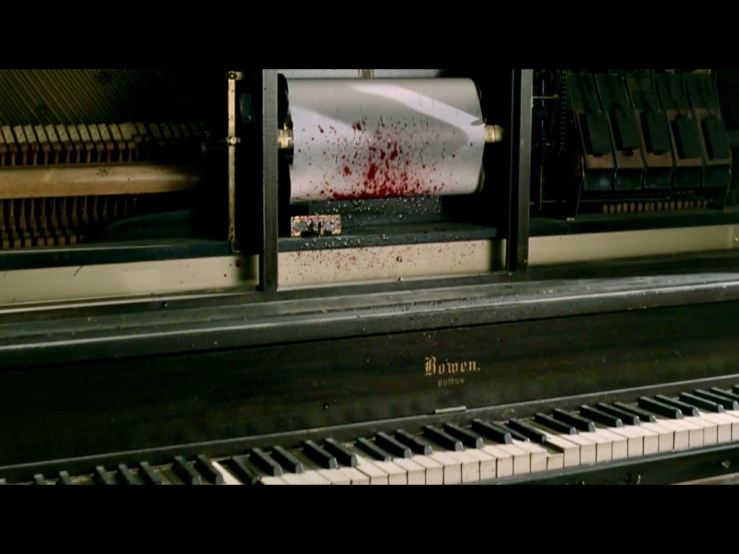
Watching HBO’s new show Westworld, I couldn’t help but think of the late American novelist William Gaddis’s obsession for player-pianos. The narrator of Gaddis’s final novel Agapē Agape howls that the player piano “was the plague spreading across America…its punched paper roll at the heart of the whole thing, of the frenzy of invention and mechanization and democracy and how to have art without the artist and automation, cybernetics.” Here was the idea of art, the artifice of art. Spiritless spirit. Automation.

Director Jonathan Nolan threads these automaton player pianos throughout “The Original,” Westworld’s ironically-titled pilot episodeThe motif is a perhaps-unsubtle reminder of Westworld’s core conflict—automation vs. spirit, real vs. copy, authentic vs. simulation. Human vs. machine.

You know the story of course: whether from Westworld’s source material (Michael Crichton’s 1973 film of the same name), or from Ridley Scott’s Blade Runner or Philip K. Dick in general, or The Matrix, or Battlestar Galactica (original or reboot), or Pinocchio, or AI, or Pygmalion, or Baudrillard, or just generally being alive in the 21st century….or…or…or…you know the story of course. (Oh, and, uh westerns too, natch).

Knowing the story enriches this particular reboot (or reimagining or re-whatever) of Westworld’s pregnant possibilities, and “The Original” is at its finest when tweaking its tropes.

For example, James Marsden’s fresh-faced Teddy Flood arrives to Westworld a noob, a surrogate for the audience—just another “Newcomer,” a human tourist among the amusement park’s android “Hosts” looking for fun and trouble, right? An early reveal shows that he’s actually a Host too though (gadzooks!), an automaton pining after fresh-faced series lead Evan Rachel Wood’s Dolores Abernathy. (I suppose having a fresh face is easy when the lab operatives can grow you a new one each night).

img_0406

The bait-and-switch gambit with Flood plays out in a riveting scene with ringer Ed Harris, the Man in Black, hardly a “Newcomer” and a seemingly unwelcome guest. He reveals that he’s been coming to Westworld for “over thirty years,” and we later learn that the theme park’s automatons haven’t had major glitches in (You guessed it!thirty years. “We’re overdue,” says Westworld’s operations manager, Theresa Cullen (played by Sidse Babett Knudsen–and by the way, that quote’s from my bad memory so don’t quote me on it). Foreshadowing! With the Man in Black creepin’ ’round and takin’ automaton scalps Blood Meridian style, there’s sure to be trouble!

But wait—Westworld can make its own trouble for its own damn self without mysterious outside agents, thank you very much. Dr. Ford (played by Anthony Hopkins, another ringer, and please don’t make me comment on the symbolically-overdetermined character name) has updated the “Hosts” with a new operating system, which includes a new program for “reveries.” These reveries have the replicants all fucked up. In short, the automatons, the Hosts, start going off-script (literally)—asking philosophical questions about the nature of their reality (and pouring milk over corpses).

Ford doesn’t care though—as he explains to Jeffrey Wright’s Bernard Lowe (Westworld’s head programmer), humanity, what with curing all its diseases, etc., can’t progress anymore — “This is as good as we’ll get.” So, like, why not trigger the Singularity? To return to our player piano motif, if only momentarily, Ford would like to inspirit art into the artificial. He wants, or at least moments of “The Original” suggest he wants, to teach the Hosts to play.

But the security forces behind the scenes decide it’s probably not good for their guests to be subjected to unknown quirks. They remand some of these suspect automatons to a creepy Bluebeard’s closet full of other decomissioned replicants that surely won’t be any kind of problem down the line in Westworld, right?

As my quick overview suggests, Westworld brims with potential. Indeed, “The Original,” despite a tight plot, often feels overpacked. There’s not just a season’s worth of plot lines lurking in here, but a whole series’ worth. As a result, “The Original” leaves many interesting characters on the margins for now (Thandie Newton’s brothel madam in particular).  I suppose keeping key players on the sidelines makes sense, especially as the pilot is exposition-heavy as it is (a fault with any number of TV pilots, from Game of Thrones to The Sopranos. Not every show can emerge autochthonous and fully-realized out of the gate like True Detective).

And yet even stuffed with emerging plots, Westworld finds time for a cinematic shooting-slaughter sequence that I suppose many viewers found thrilling but I found admittedly cold. With zero stakes at this early point, the scene felt like any other American TV show where meaningless bodies are gunned to pieces. Maybe that was the point though?

In any case, the punchline to the shooting sequence—one of the Newcomers (a prototypical Ugly American doof) Saves the Day! right before the baddie-Host can give his Big Speech—the punchline didn’t make me laugh so much as grimace. “The Original” is full of tonal inconsistencies and missed opportunities for sharp satire and dark humor. I hope Westworld loosens up a bit, gets a bit weirder, bites more from J.G. Ballard’s playbook. The pilot seems to go for profundity over weirdness, as if the showmakers must telegraph at all times: This is a Dark Serious Show. (Did I mention that director and creator Jonathan Nolan is Christopher Nolan’s brother?).

If the arcade shooter sequence is a dud (or, rather, the simulacrum of a real shootout, an authentic inauthenticity), the final scenes of “The Original” make up for it. In an echo of Blade Runner’s final sequence, Hopkins’s Ford squares off with his creation, Dolores’s father Peter. Peter has found a photograph depicting a girl in Times Square, and the cognitive dissonance of this unreality has him goin’ straight-glitch, quotin’ Shakespeare, and generally blowin’ android gaskets. We find out he’s been rebooted a number of times, and was once the leader of a cannibal cult in a Westworld scenario called “The Dinner Party.” (Har har! That pun works on at least two levels). Peter perhaps has realized he’s but a player in play—but not a true player, just a copy of a player, a simulacrum.

img_0407

Westworld is acutely aware of its own layers of simulacra. The show constantly calls attention to itself as a show, as a play. Early in “The Original,” the camera pulls up from travelers on a train to reveal a god’s-eye diorama of the terrain—a moving diorama that recalls the intro to Game of Thrones (the show Westworld would replace in your hearts and on your screens). The Westworld is surveyed by producers and showrunners making adjustments—just like Westworld. We have here a metacommentary on television, a self-consciously postmodern (and thus, post-postmodern) gesture. Not just automation and artifice, but artists! Not just player pianos, but players!

The diorama shot also reveals the Big Dream embedded in Westworld’s Big Nightmare. We have here that mythic American promise: The Frontier, the Territory that Huck Finn swears to light out to in order to duck the constraints of those who would “sivilize” him. “I take SPACE to be the central fact to man born in America,” declared Charles Olson in the beginning of Call Me Ishmael, his study of Melville’s whale. “I spell it large because it comes large here. Large, and without mercy.” The Newcomers, the tourists, flock to Westworld because it is a safe and constrained territory, a SPACE that is sivilized, yet masked to appear otherwise, garbed in the myth of danger, the empty promises of our National Pastimes, Sex & Violence. Dr. Ford plants reveries—dreams—into his automatons, disrupting civilization’s veneer of order. This is the new Frontier that Westworld promises to explore.

Samuel R. Delany’s Dhalgren: I quit

Samuel Delany’s 1975 novel Dhalgren:

I got to page 258 (of 801 pages, in the 2001 Vintage paperback edition).

On that page, the visiting poet (Visiting Poet?)—he’s visiting the post-apocalyptic city of Bellona, which is I guess the central character of Dhalgren (I guess?)—on that page, Ernest Newboy (go ahead and groan at that name), declares:

There’s no reason why all art should appeal to all people.

I took that as a sign that I could go ahead and quit Dhalgren. 

Delany’s cult novel initially appealed to me, but: No.

I’m trying, right now, to think of a novel I’ve wanted to like more but didn’t like than Dhalgren. (Thomas Disch’s 334, maybe, which Dhalgren resembles? Ballard’s Millenium People, which suggests that somewhere out there there’s a better Delany novel I need to read—like I read the wrong one, the famous one?).

I wanted to like Dhalgren because it’s weird and messy and post-apocalyptic and discursive and shambling and tripping and plotless and vibe vibe vibe…but mostly I found it boring. And the prose was often, uh, bad.

(I just read William Gibson’s foreword to the thing, in which he declares it a “prose-city…a literary singularity…executed by the most remarkable prose stylist to have emerged from the culture of American science fiction.” Nah. (Gibson’s intro has this real awful Baby Boomer you-had-to-be-there-man tone to it too)).

There are bits and pieces of Dhalgren that were interesting enough to make me keep wading through the rubbish: tree sex, hologram gangs, the unnamed apocalypse, the specter of violence, the drugs, the weapons…but to give you an idea of this novel’s rhythm, the central protagonist, Kid, spends a sizable chunk of the novel’s third chapter moving furniture from one apartment to another.

The Kid also wants to be a poet, and Delany spends a lot of time dipping into our boy’s notebook. It’s bad stuff, cringeworthy, and not in an Isn’t-he-a-bad-writer? way. Delany’s own prose veers hippy dippy too—a mirror. (Mirrors and lenses and prisms and recursion images twist through the 250 pages I read. Reality’s an illusion, man. Or not. Or memory. Or something).

I’ve had every kind of warning that Delany’s novel is plotless and will refuse to cohere (Gibson: “Dhalgren does not answer”). I fucking love those kinds of novels. But they have to have something else: Good sentences, one after another. Humor that’s actually, uh, funny. A point of feeling or message beyond the kind of apocalypse vibe I absorbed by reading comics (and comix) when I was 11, 12, 13. Less furniture moving.

Anyway, I’m unconvinced that anything wonderful’s going to pop out in the next 550 or so pages. And I’m fine, at this point, of being wrong, and ready to move on to something else.

A review of Lucia Berlin’s excellent short story collection, A Manual for Cleaning Women

img_3290

The 43 stories that comprise Lucia Berlin’s excellent collection A Manual for Cleaning Women braid together to reveal a rich, dirty, sad, joyous world—a world of emergency rooms and laundromats, fancy hotels and detox centers, jails and Catholic schools. Berlin’s stories jaunt through space and time: rough mining towns in Idaho; country clubs and cotillions in Santiago, Chile; heartbreak in New Mexico and New York; weirdness in Oakland and Berkeley; weirdness in Juarez and El Paso.

The center of this world—I’ll call it the Berlinverse, okay?—the center of the Berlinverse is Lucia Berlin herself. “Her life was rich and full of incident, and the material she took from it for her stories was colorful, dramatic and wide-ranging,” writes Lydia Davis in her foreword to Manual. (You can read Davis’s foreword at The New Yorker; it’s a far more convincing case for Berlin than I can manage here). Yes, Berlin’s life was crammed with incident—-so perhaps the strangest moment in A Manual for Cleaning Women is the three-page biography that appends the volume. The bio is strange in how un-strange it is, how it neatly lays out in a few paragraphs the information of Berlin’s life, information we already know as real, as true, from reading the preceding stories. She’s large, she contains multitudes.

Truth is a central theme in these stories. In “Here It Is Saturday,” a version of Berlin teaches fiction writing to prison inmates. She tells them, “you can lie and still tell the truth.” (As I describe the scenario for “Here It Is Saturday” I realize how hokey it sounds—I suppose there are lots of potentially-hokey moments in Berlin’s stories, yet her cruelty and humor deflate them).

In a crucial moment in the late short story “Silence,” the narrator tells us,

I exaggerate a lot and I get fiction and reality mixed up, but I don’t actually ever lie.

The narrator of “Silence” is, of course, a version of Berlin—fictionalized, sure, a persona, yep, an exaggeration, maybe—but she’s utterly believable.

“Silence” is one of many stories that repeat aspects of Berlin’s biography—we get little Lu’s childhood, a father away at the big war, a drunkenly absent mother, a bad drunk grandfather. A Syrian friend betrayed. Nuns. A good drunk uncle. A hit and run. Am I rushing through it? Sorry. To read Berlin is to read this material again and again, in different ways, through different perspectives and filters. “Silence” is particularly interesting to me because it combines material from two earlier stories not collected in Manual: “Stars and Saints” and “The Musical Vanity Boxes,” both published in Black Sparrow Press’s 1990 collection Homesick. These earlier stories are sharper, rawer, and dirtier; the later story—and Berlin’s later stories in general—strike me as more refined. Wiser, perhaps, sussing grace from abject memory.

Berlin’s recollections of the different figures in her life drive these stories, and it’s fascinating to see how key memories erupt into different tales. Berlin’s narrator’s alcoholic grandfather, a famous Texan dentist, sometimes emerges as a sympathetic if grotesque comedic figure, only to appear elsewhere as an abusive monster. Cousin Bella Lynn is a comedic foil in “Sex Appeal,” but an important confidante in “Tiger Bites” (a story of a visit to an abortion provider in Juarez). Several stories center on sister Sally, dying of cancer.

Berlin’s narrator’s four sons (Berlin had four sons) are often in the margins of the stories, but when she mines material from them the results are painful and superb. I note “her sons” in the previous line, but what I really want to note is the friend of one of her sons, a boy she calls Jesse. He shows up in the short “Teenage Punk,” where he’s our narrator’s date to go look at some cranes in a ditch at sunrise. That’s pure Lucia Berlin—weird abject unnatural natural beauty.:

We crossed the log above the slow dark irrigation ditch, over to the clear ditch where we lay on our stomachs, silent as guerrillas. I know, I romanticize everything. It is true though that we lay there freezing for a long time in the fog. It wasn’t fog. Must have been mist from the ditch or maybe just the steam from our mouths.

That brief paragraph showcases much of her technique: Inflation-deflation-resolution-hesitation. The high, low, the in-between. Jesse shows up again in one of the volume’s lengthier (and more painful) tales, “Let Me See You Smile,” a story of police brutality, scandal, and alcoholism.

Most of the stories in Manual are in some way about alcoholism, with the ur-narrator’s mother’s alcoholism haunting the book. In the near-elegy “Panteón de Dolores,” the narrator finds her mother drunk and weeping. When she tries to comfort her mother, she’s rejected; the mother wails, “…the only romance in my life is a midget lamp salesman!” The narrator-daughter reflects, “this sounds funny now, but it wasn’t then when she was sobbing, sobbing, as if her heart would break.” Berlin often punctures her punchlines. In “Mama,” Berlin consoles her dying sister Sally by weaving a fictional ditty about their mother, a paragraph that ends, “She has never before known such happiness.” The story assuages some of her sister’s grief by transmuting it into a realization of love, but the narrator? — “Me…I have no mercy.”

And yet a search for some kind of mercy, some kind of grace propels so many of the stories in A Manual for Cleaning Women. The three-pager “Step,” set in a half-way house, details the residents watching a boxing match between Wilfred Benitez and Sugar Ray Leonard. The recovering (and not-so-recovering) drunks “weren’t asking Benitez to win, just to stay in the fight.” He stays in to the last round before touching his right knee to the canvas. Berlin’s stand-in whispers, “God, please help me.” In “Unmanageable,” the alcoholic narrator finds some measure of grace from others. First from the NyQuil-swilling drunks who share saltine crackers with her in a kind of communion as they wait, shaking, for the liquor store to open at six a.m. And then, from her children. Her oldest son hides her car keys from her.

The same sons are on the narrator’s mind at the end of “Her First Detox,” in which Berlin’s stand-in’s plan for the future takes the form of a shopping list. She’ll cook for her boys when she gets home:

Flour. Milk. Ajax. She only had wine vinegar at home, which, with Antabuse, could throw her into convulsions. She wrote cider vinegar on the list.

Berlin’s various viewpoint characters don’t always do the best job of taking care of themselves, but taking care of other people is nevertheless a preoccupation with the tales in Manual. “Lu” takes care of her dying father in “Phantom Pain”; there’s sick sister Sally; the four sons, of course; a heroin-addicted husband; assorted strays, sure; an old couple in failing health in “Friends”; and the disparate patients who wander in and out of these tales, into doctor’s offices, into emergency rooms, into detox clinics.

And the cleaning women. Caretakers too, of a sort. Laundromats and washing machines are motifs throughout A Manual for Cleaning Women, and it’s no surprise that “Ajax” made the shopping list from “Her First Detox” that I quoted above. An easy point of comparison for Berlin’s writing is the so-called “dirty realism” of Raymond Carver, Denis Johnson, and Carson McCullers. But if Berlin’s realism is dirty, what are we to make of her concern with cleaning, with detox?

As a way of (non-)answering this question, here’s the entirety of the shortest tale in A Manual for Cleaning Women, “Macadam”:

When fresh it looks like caviar, sounds like broken glass, like someone chewing ice.

I’d chew ice when the lemonade was finished, swaying with my grandmother on the porch swing. We gazed down upon the chain gang paving Upson Street. A foreman poured the macadam; the convicts stomped it down with a heavy rhythmic beat. The chains rang; the macadam made the sound of applause.

The three of us said the word often. My mother because she hated where we lived, in squalor, and at least now we would have a macadam street. My grandmother just so wanted things clean — it would hold down the dust. Red Texan dust that blew in with gray tailings from the smelter, sifting into dunes on the polished hall floor, onto her mahogany table.

I used to say macadam out loud, to myself, because it sounded like the name for a friend.

There’s so much in those four paragraphs. Berlin collapses geography and genealogy into ten sentences: daughter, mother, grandmother. Texas, “squalor,” convicts. A road—a new road. Berlin’s narrator converts crushed stone into caviar, then the ice left over after sweet lemonade—and then into the magic of a friend. There’s a lot of beauty in dirt.

I could go on and on about A Manual for Cleaning Women—about how its loose, sharp tales are far more precise than their jagged edges suggest, about its warmth, its depth, its shocking humor, its sadness, its insight. But all I really mean to say is: It’s great, it’s real, it’s true—read it.

A Manual for Cleaning Women is new in trade paperback from Picador. You can read the first story in the collection, “Angel’s Laundromat,” at Picador’s website.


Another short report from The Charterhouse of Parma

img_3114
Robert Andrew Parker’s ilustration to Ch. 4 of The Charterhouse of Parma

After many, many false starts, I’ve finished Stendhal’s 1839 cult classic The Charterhouse of Parma.  (I read Richard Howard’s 1999 Modern Library translation).

I really, really wanted to quit around Ch. 25 (of 28). I’ll admit at times I broke a rule I’d made nearly two decades ago, now: I allowed my mind to wander. I thought of other things: A variation on a muffin recipe I was planning to make for my kids. A possible review of William Friedkin’s 1977 film Sorcerer. Lunch. What book I might read next as an antidote to Charterhouse.

The end of the novel is an utter slog. No duels, no escapes. Just courtly intrigues and courtly romances. And ironic sermons. Then, in the last chapter, a new character shows up! Some dandy named Gonzo! Out of nowhere! To move the plot along! (Stendhal pulls a similar stunt in the back half of the novel, when it first starts to really drag—he brings in a lunatic-bandit-poet-assassin named Ferrante).

And then—okay, maybe this is something close to a spoiler, but I don’t think so—and then, Stendhal seems to get bored with his novel. In the last chapter, he skips a few years in a few sentences (this, in a novel where every damn decision each character frets over goes on and on for paragraphs) and then kills everyone (not really. But really, sorta. I mean, the last chapter of The Charterhouse of Parma almost feels like season six of Game of Thrones, where the action is accelerated at a pace that seems to ironize all the previous scheming and plotting).

Stendhal supposedly dictated Charterhouse over 50-something days (I think I read that somewhere…I’ve yet to read Howard’s afterword to the novel, or Balzac’s study…I’ll save those for later, after I remember the best bits of the novel more fondly). But where was I? Oh, yeah: Stendhal supposedly dictated Charterhouse over a two-month period, and I get the feeling he was getting bored with it there at the end. Which is in some ways appropriate, as The Charterhouse of Parma is all about boredom. Phrases like “boring,” “bored,” and “boredom” pop up again and again. There’s something wonderfully modernist (or Modernist) about that.

img_3115
Robert Andrew Parker’s ilustration to Ch. 11 of The Charterhouse of Parma

Of course all that boredom is punctuated with moments of wonderful action—battles and duels! Indeed, Charterhouse never really surpasses its fourth chapter, a strikingly modern depiction of the Battle of Waterloo.

Stendhal is great at conveying action and violence while stripping it from Romantic illusions—and at the same time, he presents those Romantic illusions, making them ironic (again—this is probably one of the first Modern novels, and I’m sure someone has already said that somewhere, but hey).

Stendhal is also wonderfully adept at capturing a human mind thinking. Whether it’s the Machiavellian machinations of Count Mosca, or our (ever)greenhorn hero Fabrizio, or the real hero of Charterhouse, Fabrizio’s aunt Gina, Stendhal takes pains to show his characters thinking through their problems and schemes. Not only do the heroes and villains of The Charterhouse of Parma think, they think about what other characters will think (about what they have thought…). The novel in some ways is about metacognition. But thought about thought may be a product of boredom. And it often produces boredom.

Balzac was a great admirer of Charterhouse, as was Italo Calvino, and countless writers too. Indeed, the novel is, I suppose, a cult favorite for writers, which makes sense: Stendhal crowds each page with such psychological realism, such rich life, that every paragraph seems its own novel. I’ll admit that by page 400 or so I was exhausted though.

I’ve noted here a few times that Charterhouse is a “Modernist” novel; perhaps “proto-Modernist” is the term I need. (Again—I’m sure that countless lit critics have sussed over this; pardon my ignorant American ass). And yet Charterhouse also points back at the novels before it, the serialized novels, the epistolary novels, the romances and histories and etceteras of the seventeenth and sixteenth centuries. My favorite lines of the novel were often our ironic narrator’s brief asides like, “Doubtless the reader grows tired…” or “The conversation went on for hours more in trivial detail…” or “The letter went on for pages more after the same fashion…” (These aren’t actual quotes, dear reader, but I think I offer a fair paraphrase here). Stendhal’s modernism, or Modernism, or proto-Modernism, or whatever, is his wily irony, his winking at the novel’s formal characteristics. My own failing, then, is to perhaps want more of this. As I wrote last time I riffed on it, what I suppose I want is a postmodern condensation of The Charterhouse of Parma, such as Donald Barthelme’s 1968 story “Eugénie Grandet,” which parodied Honoré de Balzac’s 1833 novel Eugénie Grandet. 

Screenshot 2016-07-25 at 5.08.00 PM

How much of Balzac’s novel is lovingly leapt through right here?!

This wish of mine is of course my failure, not the novel’s.

The Charterhouse of Parma is undoubtedly an oddity, a work of genius, often thrilling, and often an utter slog. I suppose I’m glad that I finally finished it after so many years of trying, but I’m not sure if I got what I wanted out of it. The failure is mine.

I’ll close with the novel’s final line though, which I adore:

TO THE HAPPY FEW

The Garden of Eden, Ernest Hemingway’s Tale of Doomed Polyamory

In general, I dislike reviews that frontload context—get to the book, right? So here’s a short review of Ernest Hemingway’s The Garden of Eden: it is stranger than most of what Hemingway wrote, by turns pleasant, uncomfortable, bewildering, and beautiful. And readable. It’s very, very readable. Young people (or older folks; let’s not be prejudiced) working their way through Hemingway shouldn’t put The Garden of Eden on the back-burner in favor of his more famous works, and anyone who might have written off Hemingway as unreflective macho bravado should take a look at some of the strange gender games this novel has to offer. So, that’s a recommendation, okay?

Now on to that context, which I think is important here. See, The Garden of Eden is one of those unfinished novels that get published posthumously, put together by editors and publishers and other book folk, who play a larger role than we like to admit in the finished books we get from living authors anyway. For various reasons, cultural, historical, etc., we seem to favor the idea of the Singular Artistic Genius who sculpts beauty and truth out of raw Platonic forms that only he or she can access (poor tortured soul). The reality of how our books get to us is a much messier affair, and editors and publishers and even literary studies departments in universities have a large hand in this process, one we tend to ignore in favor of the charms of a Singular Artistic Genius. There’s a fascinating process there, but also a troubling one. Editing issues complicate our ideals of (quite literally) stable authority—is this what the author intended?, we ask (New Critics be damned!). David Foster Wallace and Michael Pietsch, Raymond Carver and Gordon Lish, Franz Kafka and Max Brod, Mary Shelley and Percy Shelley . . . not to mention Shakespeare, Chaucer, Beowulf, The Bible, Homer, etc. etc. etc. But you’re here to read about The Garden of Eden, right gentle reader? Mea culpa. I’ve been blathering away. Let me turn the reins over to the estimable talents of E.L. Doctorow, who offers the following context in his 1986 review of the book in The New York Times

Since Hemingway’s death in 1961, his estate and his publishers, Charles Scribner’s Sons, have been catching up to him, issuing the work which, for one reason or another, he did not publish during his lifetime. He held back ”A Moveable Feast” out of concern for the feelings of the people in it who might still be alive. But for the novel ”Islands in the Stream” he seems to have had editorial misgivings. Even more deeply in this category is ”The Garden of Eden,” which he began in 1946 and worked on intermittently in the last 15 years of his life and left unfinished. It is a highly readable story, if not possibly the book he envisioned. As published it is composed of 30 short chapters running to about 70,000 words. A publisher’s note advises that ”some cuts” have been made in the manuscript, but according to Mr. Baker’s biography, at one point a revised manuscript of the work ran to 48 chapters and 200,000 words, so the publisher’s note is disingenuous. In an interview with The New York Times last December, a Scribners editor admitted to taking out a subplot in rough draft that he felt had not been integrated into the ”main body” of the text, but this cut reduced the book’s length by two-thirds.

So, yeah. The version we have of The Garden of Eden is heavily cut, and also likely heavily arranged. But that’s what editors do, and this is the book we have (for now, anyway—it seems like on the year of its 25th anniversary of publication, and the 50th anniversary of Hemingway’s death that Scribner should work toward putting out an unedited scholarly edition) — so I’ll talk about that book a bit.

The Garden of Eden tells the story of a few months in the lives of a young newlywed couple, David Bourne, an emerging novelist, and his wife Catherine, a trust fund baby flitting about Europe. The novel is set primarily on the French Riviera, in the thin sliver of high years between the two big wars. David and Catherine spend most of their days in this Edenic setting eating fine food and making love and swimming and riding bikes and fishing. And drinking. Lots and lots of drinking. Lots of drinking. It all sounds quite beautiful—h0w about a taste?

On this morning there was brioche and red raspberry preserve and the eggs were boiled and there was a pat of butter that melted as they stirred them and salted them lightly and ground pepper over them in the cups. They were big eggs and fresh and the girl’s were not cooked quite as long as the young man’s. He remembered that easily and he he was happy with his which he diced up with the spoon and ate with only the flow of the butter to moisten them and the fresh early morning texture and the bite of the coarsely ground pepper grains and the hot coffee and the chickory-fragrant bowl of café au lait.

Hemingway’s technique throughout the novel is to present the phenomenological contours of a heady world. It’s lovely to ride along with David and Catherine, rich and free and beautiful.

Their new life together is hardly charmed, however. See, Catherine gets a haircut—

Her hair was cropped as short as a boy’s. It was cut with no compromises. It was brushed back, heavy as always, but the sides were cut short and the ears that grew close to her head were clear and the tawny line of her hair was cropped close to her head and smooth and sweeping back. She turned her head and lifted her breasts and said, “Kiss me please.” . . .

“You see, she said. “That’s the surprise. I’m a girl. But now I’m a boy too and I can do anything and anything and anything.”

“Sit here by me,” he said. “What do you want, brother.”

David’s playful response—calling his wife “brother”—covers up some of his shock and fear, but it also points to his underlying curiosity and gender confusion. And indeed, Catherine’s new haircut licenses her to “do anything and anything and anything” — beginning with some strange bed games that night—

He had shut his eyes and he could feel the long light weight of her on him and her breasts pressing against him and her lips on his. He lay there and felt something and then her hand holding him and searching lower and he helped with his hands and then lay back in the dark and did not think at all and only felt the weight and the strangeness inside and she said, “Now you can’t tell who is who can you?”

“No.”

“You are changing,” she said. “Oh you are. You are. Yes you are and you’re my girl Catherine. Will you change and be my girl and let me take you?”

“You’re Catherine.”

“No. I’m Peter. You’re my wonderful Catherine. You’re my beautiful, lovely Catherine. You were so good to change. Oh thank you, Catherine, so much. Please understand. Please know and understand. I’m going to make love to you forever.”

David, partial stand-in for Hemingway, transforms into a girl who feels “something” during sex with Catherine (or, ahem, Peter)—note that that “something” has no clear referent. As their gender inverting games continue (much to David’s horror), Hemingway’s usually concrete language retreats to vague proforms without referents, “it”s without antecedents; his usually precise diction dissolves in these scenes, much as the Bournes’ marriage dissolves each time Catherine escalates the gender inversion. David gives her the nickname “Devil,” as if she were both Eve and Serpent in their Garden. Catherine’s transformations continue as she cuts her hair back even more, and sunbathes all the time so that she can be as dark as possible. She dyes her hair a silver blonde and makes David get his hair cut and dyed the same.

The bizarre behavior (shades of Scott and Zelda?) culminates in Catherine introducing another woman into the marriage. Marita falls in love with both David and Catherine, but her lesbian sex with Catherine only accelerates the latter’s encroaching insanity. David is initially radically ambivalent to the ménage à trois proposed by his wife; he has the good sense to see that a three-way marriage is ultimately untenable and that his wife is going crazy. He vacillates between hostility and love for the two women, but eventually finds a support system in Marita as it becomes increasingly apparent (to all three) that Catherine is depressed and mentally unstable, enraged that David has ceased to write about the pair’s honeymoon adventures on the Riviera. Catherine has been bankrolling David; jealous of good reviews from his last novel, she insists that he write only their story, but David would rather write “the hardest story” he knows—the story of his childhood in East Africa with his father, a big game hunter.

In some of the most extraordinary passages of The Garden of Eden, David writes himself into his boyhood existence, trailing a bull elephant with his father through a jungle trek. David has spotted the elephant by moonlight, prompting his father and his father’s fellow tracker and gun bearer Juma to hunt the old beast. As they trail the animal, David begins to realize how horrible the hunt is, how cruel it is to kill the animal for sport. The passages are somewhat perplexing given Hemingway’s reputation as a hunter. Indeed, this is one of the major features of The Garden of Eden: it repeatedly confounds or complicates our ideas about Hemingway the man’s man, Hemingway the writer, Hemingway the hunter. David describes the wounded, dying elephant—

They found him anchored, in such suffering and despair that he could no longer move. He had crashed through the heavy cover where he had been feeding and crossed a path of open forest and David and his father had run along the heavily splashed blood trail. Then the elephant had gone on into thick forest and David had seen him ahead standing gray and huge against the trunk of a tree. David could only see his stern and then his father moved ahead of him and he followed and they came alongside the elephant as though he was a ship and David saw the blood coming from his flanks and running down his sides and then his father raised his rifle and fired and the elephant turned his head with the great tusks moving heavy and slow and looked at them and when his father fired the second barrel the elephant seemed to sway like a felled tree and came smashing down toward them. But he was not dead. He had been anchored and now he was down with his shoulder broken. He did not move but his eye was alive and looked at David. He had very long eyelashes and his eye was the most alive thing David had ever seen.

David succeeds in writing this “hard” story, and the passages are remarkable in their authenticity—David’s story is a good story, the highlight of the book perhaps; it’s not just Hemingway telling us that David wrote a great story, we actually get to experience the story itself as well as the grueling process by which it was made. Hemingway and his surrogate David show us—make us experience—how difficult writing really is, and then share the fruit of that labor with us. These scenes raise the stakes of The Garden of Eden, revealing how serious David is when he remarks (repeatedly) that the writing is the most important thing—that it outweighs love, it surpasses his marriage. These realizations freight the climax of the novel all the more heavily, but I will avoid anymore spoilers.

The Garden of Eden has some obvious flaws. Marita is underdeveloped at best for such an important character, and her love for David and Catherine remains unexplored, and in fact barely remarked upon. The biggest problem with the book is its conclusion, which feels too pat, too obvious for such a strange, amorphous book. It is here that the presence of an editorial hand seems clearest, to the extent that I wonder if the short little chapter that concludes the novel wasn’t cobbled together from a few stray sentences throughout the manuscript. But The Garden of Eden, despite some shortcomings, is a book well worth reading. The novel complicates not just Hemingway’s reputation, but also our sense of Hemingway’s sense of himself. Recommended.

[Ed. note: Biblioklept originally published a version of this review in August of 2011]

A short report from The Charterhouse of Parma

img_2734

Have you read Honoré de Balzac’s 1833 novel Eugénie Grandet?

I haven’t, but I’ve read the Wikipedia summary.

I’ve also read, several times, Donald Barthelme’s 1968 parody, “Eugénie Grandet,” which is very very funny.

Have you read  Stendhal’s 1839 novel The Charterhouse of Parma?

After repeated false starts, I seem to be finishing it up (I’m on Chapter 19 of 28 of Richard Howard’s 1999 Modern Library translation).

I brought up Eugénie Grandet (Balzac’s) to bring up “Eugénie Grandet” (Barthelme’s). Stendhal’s (1830’s French) novel Charterhouse keeps reminding me of Barthelme’s (1960’s American) short story “Eugénie Grandet,” which is, as I’ve said, a parody of Honoré de Balzac’s (1830’s French) novel Eugénie Grandet. Balzac and Stendhal are pre-Modernists (which is to say they were modernists, I suppose). Donald Barthelme wanted to be a big em Modernist; his postmodernism was inadvertent. By which I mean— “postmodernism” is just a description (a description of a description really, but let me not navelgaze).

Well and so: I find myself often bored with The Charterhouse of Parma and wishing for a condensation, for a Donald Barthelme number that will magically boil down all its best bits into a loving parody that retains its themes and storylines (while simultaneously critiquing them)—a parody served with an au jus of the novel’s rich flavor.

My frequent boredom with the novel—and, let me insert here, betwixt beloved dashes, that one of my (many) favorite things about Charterhouse is that it is about boredom! that phrases like “boredom,” boring,” and “bored” repeat repeatedly throughout it! I fucking love that! And Stendhal, the pre-Modernist (which is to say “modernist”), wants the reader to feel some of the boredom of court intrigue (which is not always intriguing). The marvelous ironic earnest narrator so frequently frequents phrases like, “The reader will no doubt tire of this conversation, which went on for like two fucking hours” (not a direct quote, although the word “fuck” shows up a few times in Howard’s translation. How fucking Modern!)—okay—

My frequent boredom with the novel is actually not so frequent. It’s more like a chapter to chapter affair. I love pretty much every moment that Stendhal keeps the lens on his naive hero, the intrepid nobleman Fabrizio del Dongo. In love with (the idea of) Napoleon (and his aunt, sorta), a revolutionist (not really), a big ell Liberal (nope), Fabrizio is a charismatic (and callow) hero, and his chapters shuttle along with marvelous quixotic ironic energy. It’s picaresque stuff. (Fabrizio reminds me of another hero I love, Candide). Fabrizio runs away from home to join Napoleon’s army! Fabrizio is threatened with arrest! Fabrizio is sorta exiled! Fabrizio fucks around in Naples! Fabrizio joins the priesthood! Fabrizio might love love his aunt! Fabrizio fights a duel! Fabrizio kills a man! (Not the duel dude). Fabrizio is on the run (again)! Fabrizio goes to jail! Fabrizio falls in love!

When it’s not doing the picaresque adventure story/quixotic romance thing (which is to say, like half the time) Charterhouse is a novel of courtly intrigues and political machinations (I think our boy Balzac called it the new The Prince). One of the greatest strengths of Charterhouse is its depictions of psychology, or consciousness-in-motion (which is to say Modernism, (or pre-modernism)). Stendhal takes us through his characters’ thinking…but that can sometimes be dull, I’ll admit. (Except when it’s not). Let me turn over this riff to Italo Calvino, briefly, who clearly does not think the novel dull, ever—but I like his description here of the books operatic “dramatic centre.” From his essay “Guide for New Readers of Stendhal’s Charterhouse:

All this in the petty world of court and society intrigue, between a prince haunted by fear for having hanged two patriots and the ‘fiscal général’ (justice minister) Rassi who is the incarnation (perhaps for the first time in a character in a novel) of a bureaucratic mediocrity which also has something terrifying in it. And here the conflict is, in line with Stendhal’s intentions, between this image of the backward Europe of Metternich and the absolute nature of those passions which brook no bounds and which were the last refuge for the noble ideals of an age that had been overcome.

The dramatic centre of the book is like an opera (and opera had been the first medium which had helped the music-mad Stendhal to understand Italy) but in The Charterhouse the atmosphere (luckily) is not that of tragic opera but rather (as Paul Valéry discovered) of operetta. The tyrannical rule is squalid but hesitant and clumsy (much worse had really taken place at Modena) and the passions are powerful but work by a rather basic mechanism. (Just one character, Count Mosca, possesses any psychological complexity, a calculating character but one who is also desperate, possessive and nihilistic.)

I disagree with Calvino here. Mosca is an interesting character (at times), but hardly the only one with any psychological complexity. Stendhal is always showing us the gears ticking clicking wheeling churning in his characters’ minds—Fabrizio’s Auntie Gina in particular. (Ahem. Excuse me–The Duchessa).

But Duchess Aunt Gina is a big character, perhaps the secret star of Charterhouse, really, and I’m getting read to wrap this thing up. So I’ll offer a brief example rather from (what I assume is ultimately) a minor character, sweet Clélia Conti. Here she is, in the chapter I finished today, puzzling through the puzzle of fickle Fabrizio, who’s imprisoned in her dad’s tower and has fallen for her:

Fabrizio was fickle; in Naples, he had had the reputation of charming mistresses quite readily. Despite all the reserve imposed upon the role of a young lady, ever since she had become a Canoness and had gone to court, Clélia, without ever asking questions but by listening attentively, had managed to learn the reputations of the young men who had, one after the next, sought her hand in marriage; well then, Fabrizio, compared to all the others, was the one who was least trustworthy in affairs of the heart. He was in prison, he was bored, he paid court to the one woman he could speak to—what could be simpler? What, indeed, more common? And this is what plunged Clélia into despair.

Clélia’s despair is earned; her introspection is adroit (even as it is tender). Perhaps the wonderful trick of Charterhouse is that Stendhal shows us a Fabrizio who cannot see (that he cannot see) that he is fickle, that Clélia’s take on his character is probably accurate—he’s just bored! (Again, I’ve not read to the end). Yes: What, indeed, could be more common? And one of my favorite things about Charterhouse is not just that our dear narrator renders that (common) despair in real and emotional and psychological (which is to say, um Modern) terms for us—but also that our narrator takes a sweetly ironic tone about the whole business.

Or maybe it’s not sweetly ironic—but I wouldn’t know. I have to read it post-Barthelme, through a post-postmodern lens. I’m not otherwise equipped.

Bored of Hell

img_3055

I am bored of Hell, Henri Barbusse’s 1908 novel of voyeurism.

Maybe I should blame the 1966 English translation (from the French) by Robert Baldick, which often feels stuffily stuffy for a book about “childbirth, first love, marriage, adultery, lesbianism, illness, religion and death” (as our dear translator puts it in his brief preface). Maybe I should blame it on Baldick, but that seems rash and wrong, and I have no basis of comparison, do I?

So I blame it on myself, this boredom of Hell.

Why write then? Why not write it off, rather, which is to say, do not write—I don’t know.

I’m bored with Hell and there are half a dozen novels I’ve recently  read (or am reading) that I should commend, recommend, attempt to write about—but here I am bored of Hell, and writing about it. Maybe it’s—and the it here refers to writing about Hell, a book I confesss a boredom of—maybe it’s because I’ve allowed myself over the last few days to good lord skim the goddamned infernal thing, not skimming for a replenishing sustenance, but rather looking for the juicy fat bits, the best bits, in the same way a teenaged version of myself skimmed Henry Miller and Anaïs Nin in a powerful sweat.

(I was a teenage cliché).

Maybe it’s that the best bits of Hell weren’t juicy enough. (In this novel, an unnamed narrator espies all sorts of sensual (and nonsensual) shenanigans through a small hole in his hotel room). Or maybe the juicy bits were juicy, but the translation dried them out. So many of the sentences made me want to close the book. But it’s unfair for me to write this, I suppose, without offering a sample. Here, from early in the novel, is an excerpt that did make me want to keep going:

The mouth is something naked in the naked face. The mouth, which is red with blood, which is forever bleeding, is comparable to the heart: it is a wound, and it is almost a wound to see a woman’s mouth.

And I begin trembling before this woman who is opening a little and bleeding from a smile. The divan yields warmly to the embrace of her broad hips; her finely-made knees are close together, and the whole of the centre of her body is in the shape of a heart.

…Half-lying on the divan, she stretches out her feet towards the fire, lifting her skirt slightly with both hands, and this movement uncovers her black-stockinged legs.

And my flesh cries out…

Those last ellipses were mine. Did you want more? I did, I admit. And yet after 50 pages, I grew bored. The voyeurism was boring—sprawling. Perhaps I’m lazy. Perhaps I want my voyeurism condensed. Maybe…weirder. I don’t know. Reader, I skimmed. I skimmed, like I said, for morsels—but also to the end, the the final chapter, to the final exquisite not boring paragraph, which I’ll share with you now before “I have done,” as the narrator states in this final section. Promised paragraph:

I believe that confronting the human heart and the human mind, which are composed of imperishable longings, there is only the mirage of what they long for. I believe that around us there is only one word on all sides, one immense word which reveals our solitude and extinguishes our radiance: Nothing! I believe that the word does not point to our insignificance or our unhappiness, but on the contrary to our fulfillment and our divinity, since everything is in ourselves.

The BFG, Roald Dahl’s love letter to his lost daughter

20140706-210704-76024020.jpg

Roald Dahl’s 1982 children’s classic The BFG begins with a dedication to the author’s daughter: “For Olivia: 20th April 1955 — 17th November 1962.”

If I had noticed the dedication when I first read The BFG as a child, I certainly didn’t think about it then. The slim sad range of those dates would have meant nothing to me, eager as I was to dig into a book about child-eating giants, secure in my own childish immortality. However, when I started reading the book with my daughter, the dedication howled out to me, thoroughly coloring the lens through which I read.

Had Olivia Twenty Dahl not died from measles encephalitis at only seven, had she continued to live to be alive now, she would be approaching her sixtieth birthday. But because she died as a seven-year-old little girl, she remained a seven-year-old little girl to me, the reader, who saw her spirit under every page.

I believe she remained a seven-year-old little girl for Dahl as well—at least in the imaginative world of The BFG where she is recast as the hero Sophie. Reading The BFG, it was impossible for me not to immediately connect Sophie to Olivia, those names with their Greek roots and their long O‘s. It was also impossible for me not to connect these two girls to my own daughter Zoe, who is also seven.

(Parenthetically, I’ll admit that biographical interpretation of literature is often a terrible practice—especially when combined with a touch of reader-response criticism—and that what I am doing here is not something I think advisable, let alone commendable. And yet the central affective power for me in reading The BFG—as an adult to my little girl—rests in my inescapable intuition that Dahl wrote the book to make his daughter live again, to live forever).

The BFG does not have an especially complex plot: Young Sophie, up late at night, is snatched away to a strange country by a giant whom she spies blowing dreams into a room of sleeping children (she does not of course know at the time that he is blowing dreams into the room). Luckily, this is the Big Friendly Giant. Unluckily, she’s stuck in his cave, where he must hide her from nine awful giants (including the Fleshlumpeater, the Meatdripper, and the aptly named Childchewer), who set off into the world each night to guzzle “human beans” (they especially love to eat children). The BFG, smaller than the other giants, refuses to partake in their infanticidal, anthropophagic practices, dining instead on stinky snozzcumbers. While the other giants are out gobbling up humans, the BFG is in Dream Country collecting dream blobs, which he mixes into wonderful visions and blows into children’s homes at night. Sophie and the BFG concoct a special dream for the Queen of England and through this scheme manage to capture the nine terrible giants. Sophie and The BFG live happily ever after.

Dahl’s command of language in The BFG marks the book as one of his strongest achievements. The most obvious and endearing aspect of the book’s language is the voice of the BFG, who invents, inverts, and generally twists up nouns, verbs, and adjectives into a fine mess. He tells Sophie:

Words . . . is oh such a twitch-tickling problem to me all my life. So you must simply try to be patient and stop squibbling. As I am telling you before, I know exactly what words I am wanting to say, but somehow or other they is always getting squiff-squiddled around.

That squiff-squiddling though is what gives the giant’s voice such power. The tinges of nonsense actually reify and amplify what the BFG intends to say. There’s a sing-songy, burbling, bubbling rhythm to the BFG’s speech, which I took great joy in performing aloud for my daughter. Dahl clearly understood that his prose would be read aloud.

The BFG’s trouble with “correct” language derives from the fact that he never got to go to school. In fact, he’s learned everything he knows from one book: Nicholas Nickleby, “By Dahl’s Chickens,” the BFG tells Sophie. The underlying problem that governs the plot of Nicholas Nickleby is the unexpected death of Nicholas’s father. Dahl might have picked any of Charles Dickens’s novels here, but I believe he chose this one to thematically answer to The BFG’s secret plot: A missing father to match a missing daughter.

Dahl also not-so-subtly inserts his own name into the authorial position in this scene, which occurs about half way into the novel. This insertion happens again in the novel’s final chapter, which is appropriately titled “Author.” The book ends with the nine awful giants captured and held in a pit deep in the earth (shades of the Titans), their infanticidal violence contained and suspended, but still alive, still potential. The Queen has an enormous house built for the BFG right by her own palace, with a small cottage for Sophie in-between. The vision, rendered in Quentin Blake’s marvelous wobbly inks, suggests a fairy tale ending, as Sophie finds an ersatz family in the Queen (more of a fairy godmother) and the BFG, her new father.

And yet Sophie too takes on something of a parental role, teaching the BFG to read and write. He soon “started to write essays about his own past life.” Sophie reads these and urges him to become “a real writer … Why don’t you start by writing a book about you and me?”

Reading this chapter the other night devastated me and delighted my daughter. She cackled in glee and I found myself unable to perform the BFG’s voice through my tears. I finished the novel in my own, regular voice, doing my best not to let the sharp cracks of the emotion I felt break into those final lines, where we learn that the BFG, too modest to put his own name on his book (published by the Queen to bring joy to children), has chosen a pseudonym—the one on the spine of the book, Roald Dahl.

The BFG was of course always an author, even before he was literate; his medium was the dream, and he used dreams to tell stories to bring joy to children. He gave these dreams as protest, resistance, and counterattack to the consuming violence of his nine awful brothers.

Dahl’s rhetorical trick at the end of The BFG—claiming his own name as the pseudonym for the book’s real author, the Big Friendly Giant—is far less whimsical than a surface glance suggests. Rather, I find in it something sad, dark, and sincere, a moment of deep love and deep pain. The transposition—the squiff-squiddling, if you will—of the two names signals Dahl’s recasting of himself as the eternal BFG, bringing joy to children all over the world. The BFG gets to live happily ever after with his dream-daughter Sophie (the recast Olivia), their home and family sanctioned and provided for by the land’s highest authority.

But even before the Queen grants the father-daughter pair their own homestead, Sophie has already found her place by the giant—behind his ear, where she whispers to him. Is this not the fantasy of a consciousness that communicates beyond time, beyond death, directly and without the intermediary of a physical body?

Did Dahl hear Olivia’s voice in his own ear decades after her death? Did her spirit speak to him? Speculation of that sort is not my place or intention, and as I type it out, the suggestion appears far more lurid than I wish. I do know that the image was inescapable for me as I finished The BFG with my own daughter.

Our love and care for our children is shaded and intensified by an understanding of their fragility, their mortality, their susceptibility to disease, accident, chaos, the carelessness of others…factors easily metaphorized into child-eating giants. Our love for our own children precludes an equal love for children who are not our own, despite whatever ethical systems we claim to practice and subscribe to.

And this is what I find so moving about The BFG: Dahl converts the personal (and infinite) loss of his own daughter into a loving gift he seeks to share with all children. He shared that gift with me when I was a child, when I never imagined that I would grow up to be an adult with a child of my own to whom I would read that gift again, in a new, strange, sad, dark, joyous way.

Maybe all I am trying to say here, in this long, long-winded way, is Thank you.

[Ed. Note. Biblioklept ran a version of this review in July of 2014. Steven Spielberg’s film adaptation of The BFG is in wide release this week].


Books I’ll (probably) never finish (yet return to again and again)

img_2732

A week or so ago, I wrote about the books (specifically novels) that I can’t seem to finish despite beginning them five, six, seven plus times. In that post, I noted that there “are certain books I’ll probably never ‘finish,’ that I have no aim of finishing,” and hence didn’t include in my silly little list. Such titles seemed to need their own post.

“Finish” is probably the wrong verb to use to denote the act of reading, in traditional sequence, all the words on all the pages of a grand great novel. I have never really “finished” the books that I’ve read the most times from cover to cover—books like Adventures of Huckleberry FinnTheir Eyes Were Watching GodMoby-Dick, UlyssesBlood Meridian2666. Something about such books remains somewhere inside of me, unfinished (in contrast to the many, many novels—most often contemporary “literary” fictions—that I truly finish by reading and then jettisoning from memory). The great books that I’ve finished are unfinished. Something of the really great novels wriggles around in the background of consciousness, whispering, howling.

Putting together a little list of books I’m always reading but will likely never finish was not difficult, although I should clarify that I’ve intentionally left off a good number of critical texts—stuff like Derrida, Foucault, Kristeva, etc.—as well as the letters, notebooks, and journals of writers that I return to again and again. I tried to stick to novels. But are the works pictured/listed here—Tristram ShandyThe Anatomy of MelancholyDon QuixoteFinnegans Wake, and 1982, Janine—are these actually novels? The question is complex and productive, but I’ll answer it with the simple, “Yes, but– 

(And yet, parenthetically: That the novelness of these novels is suspect is perhaps a key to why these are the works that fascinate me, that these unnovelly novels make me stumble; I resort to shelving them, grab for critical interpretations, guides, commentaries, etc.—in the hopes of…of what?)

Joyce’s Finnnegans Wake is a nice starting place for this little list. The novel’s famous opening line (“riverrun, past Eve and Adam’s, from swerve of shore to bend of bay, brings us by a commodius vicus of recirculation back to Howth Castle and Environs”) actually completes the novel’s “final” (non-)sentence (“A lone a last a loved a long the”). So Finnegans Wake is a loop, an infinite jest. Over the past decade, I’ve dipped into the book again and again, using Joseph Campbell’s Skeleton Key as a friendly guide. I’ve learned to have fun with Finnegans Wake, taking something from its language, its connections, its syntheses, while abandoning the pretense that I’ve anything to gain by trucking through it at full speed just to “finish” it.

I pick up Laurence Sterne’s The Life and Opinions of Tristram Shandy, Gentleman less often than I used to, having recovered from trying to understand it. The novel seems to me proof that the term “postmodern” is simply a description of a way of seeing, and not a set of aesthetic conditions. Also, I love that Sterne loves the dash—

It’s perhaps a great moral failing on my part that I’ve never made it past the first few chapters of the Second Part of Don QuixoteI’m familiar with it, largely by way of Nabokov’s lectures and summaries. Anyway, I fail to understand Don Quixote; I fail to read it rightly.

Alasdair Gray’s 1982, Janine doesn’t have the same reputation as the other novels I’ve listed here; its inclusion wasn’t so much an afterthought but a realization—I bought it four years ago and have yet to shelve it. It’s always on a coffee table, the edge of a sofa, next to my bed, cooing, Start again. I start reading it and then I skip ahead to its weird black heart, then I read from the end, then I go back to the beginning. Then I put it aside, having made no “progress.”

I don’t know what Robert Burton’s The Anatomy of Melancholy is. Is it a novel? (Wait. I think we went through this above). I first encountered it as a bewildered undergrad, checking out an old huge hardback edition from the library. I made a small dent (aided by Ritalin). All that Latin is Greek to me. In his preface to the NYRB edition, William H. Gass advises, “Be prepared to proceed slowly and you will soon go swiftly enough. Read a member a day; it will chase gloom away.” I have not read a member a day, but I do like to pull Melancholy from the shelf late at night, after a few glasses of wine, and dip into it somewhere. I will never finish it.

And yet I’ve retained more from these unfinished novels than most of the contemporary fiction novels I’ve read. Anna Livia Plurabelle. The priest burning poor Quixote’s beautiful books. The marbled pages, the blacked out pages, the squiggles of Tristram Shandy. The typographic explosions in 1982, Janine. The dirty bits. The lists. The force of language, above all.

In a sense, not “finishing” these grand weird novels keeps them vital to me, present somehow, promising in their possibility, taunting and tantalizing in their pregnant unfinishabilty.

Dissolving boundaries | Elena Ferrante’s Neapolitan Novels

Organism (detail), Fred Tomaselli

A few weeks ago I finished The Story of the Lost Child, the last of Elena Ferrante’s so-called Neapolitan Novels, and now perhaps have enough distance to comment on them briefly.

The novels have been much-hyped, which initially put me off (nearly as much as their awful kitschy covers), but the same friend who urged me to give Bolaño’s 2666 a go (after I misfired with The Savage Detectives) insisted I read Ferrante.

I’m glad I did. From the earliest pages of the first novel, My Brilliant Friend, Ferrante crafts a world—a brutal neighborhood in Naples—which seems real, full, squirming with dirty bloody life. The novel also reminded me of 2666, although I couldn’t figure out why at first (my friend had not suggested a connection). A simple answer is that both novels are propulsive, addictive, impossibly rich, and evocative of specific and real worlds, real worlds anchored in dreams and nightmares.

But it’s also the horror. Ferrante, like Bolaño, captures the horrific violence under the veneer of civilization. While My Brilliant Friend and its three “sequels” (they are one novel, to be sure) undertake to show the joys and triumphs and sadnesses of a life (and more than one life), they also reverberate with the sinister specter of abjection—the abjection of violence, of history, and of the body itself. The novels are messy, bloody, and tangled, their plot trajectories belying conventional expectations (in the same way that the novels’ awful covers belie their internal excellence—kitschy romantic smears glossing over tumult).

It’s this horrific abjection that fascinates me most about the novels. I’ll offer two longish passages from the final book in the quartet, The Story of the Lost Child, to showcase Ferrante’s prowess with (what I take to be her dominant) theme and tone.

The first passage comes fairly early in the long novel, when our (now mature) heroine Lenù encounters a suicide’s corpse:

No answer. I knocked harder, I opened the door cautiously, the room was dark. I called him, silence, I turned on the light.

There was blood on the pillow and on the sheet, a large blackish stain that extended to his feet. Death is so repellent. Here I will say only that when I saw that body deprived of life, that body which I knew intimately, which had been happy and active, which had read so many books and had been exposed to so many experiences, I felt both repulsion and pity. [He] had been a living material saturated with political culture, with generous purposes and hopes, with good manners. Now he offered a horrible spectacle of himself. He had rid himself so fiercely of memory, language, the capacity to find meaning that it seemed obvious the hatred he had for himself, for his own skin, for his moods, for his thoughts and words, for the brutal corner of the world that had enveloped him.

Ferrante’s passage here strongly echoes Julia Kristeva’s 1980 essay “Approaching Abjection.” Kristeva writes (emphasis mine):

The corpse…upsets even more violently the one who confronts it as fragile and fallacious chance….as in true theater, without makeup or masks, refuse and corpses show me what I permanently thrust aside in order to live. These body fluids, this defilement, this shit are what life withstands, hardly and with difficulty, on the part of death. There, I am at the border of my condition as a living being. My body extricates itself, as being alive, from that border…the corpse, the most sickening of wastes, is a border that has encroached upon everything. It is no longer I who expel — “I” is expelled.

In my reading, Ferrante’s heroines Lenù and Lila are detectives of the abject, of the (literally) unnamable forces of culture (and oh-what-a-culture patriarchal Naples is!) that threaten subjectivity. They each seek to assert an I in a world that would devastate such an assertion.

Lenù and Lila claim their assertion through creative agency—through art. And Ferrante’s greatest strength, perhaps, in the Neapolitan Novels is that she harnesses this art, she conveys the brilliance of these brilliant friends, and does not merely “tell” the reader of their brilliance (like so many contemporary “literary” novels do). Ferrante shows authorship (and genius) as a shared, collaborative process, not an isolation, but a synthesis.

If these novels concern synthesis, they also show fracture, fragmentation, and dissolution. Observe Lenù and Lila in a key moment from The Story of the Lost Child , during a calamitous earthquake (again, emphasis mine):

She exclaimed: Oh Madonna, an expression I had never heard her use. What’s wrong, I asked. Gasping for breath, she cried out that the car’s boundaries were dissolving, the boundaries of Marcello, too, at the wheel were dissolving, the thing and the person were gushing out of themselves, mixing liquid metal and flesh. She used that term: dissolving boundaries.

It was on that occasion that she resorted to it for the first time; she struggled to elucidate the meaning, she wanted me to understand what the dissolution of boundaries meant and how much it frightened her. She was still holding my hand tight, breathing hard. She said that the outlines of things and people were delicate, that they broke like cotton thread. She whispered that for her it had always been that way, an object lost its edges and poured into another, into a solution of heterogeneous materials, a merging and mixing. She exclaimed that she had always had to struggle to believe that life had firm boundaries, for she had known since she was a child that it was not like that—it was absolutely not like that—and so she couldn’t trust in their resistance to being banged and bumped. Contrary to what she had been doing, she began to utter a profusion of overexcited sentences, sometimes kneading in the vocabulary of the dialect, sometimes drawing on the vast reading she had done as a girl. She muttered that she mustn’t ever be distracted: if she became distracted real things, which, with their violent, painful contortions, terrified her, would gain the upper hand over the unreal ones, which, with their physical and moral solidity, pacified her; she would be plunged into a sticky, jumbled reality and would never again be able to give sensations clear outlines. A tactile emotion would melt into a visual one, a visual one would melt into an olfactory one, ah, what is the real world, Lenù, nothing, nothing, nothing about which one can say conclusively: it’s like that. And so if she didn’t stay alert, if she didn’t pay attention to the boundaries, the waters would break through, a flood would rise, carrying everything off in clots of menstrual blood, in cancerous polyps, in bits of yellowish fiber.

Kristeva’s abjection is again strongly embodied in those last few lines—the dissolution, the unspeakable and repressed forces, the trauma. The rivers of abject bodily filth. Here’s Kristeva, again from “Approaching Abjection” (my emphasis):

A massive and sudden emergence of uncanniness, which, familiar as it might have been in an opaque and forgotten life, now harries me as radically separate, loathsome. Not me. Not that. But not nothing, either. A “something” that I do not recognize as a thing. A weight of meaninglessness, about which there is nothing insignificant, and which crushes me. On the edge of nonexistence and hallucination, of a reality that, if I acknowledge it, annihilates me. There, abject and abjection are my safeguards. The primers of my culture.

Lila and Lenù face abjection, the primer of their culture. They trace its contours, aim at ways of speaking the unspeakable—through friendship and the fruits of that friendship: storytelling. The storytelling offers a literal form to handle the abject violence of the culture in its many, many forms (corrupt politicians, abusive fathers, abusive husbands, predatory rapists, predatory lenders, Cammorist gangsters, systemic class inequality, religion…).

The storytelling confronts abjection without seeking a transcendence, an exit, an out. Ferrante recognizes that humans are violent animals, and doesn’t want to comfort us. In an interview, she said:

I’m drawn, rather, to images of crisis, to seals that are broken. When shapes lose their contours, we see what most terrifies us…I cling to those that are painful, those that arise from a profound crisis of all our illusions. I love unreal things when they show signs of firsthand knowledge of the terror, and hence an awareness that they are unreal, that they will not hold up for long against the collisions.

Ferrante’s Neapolitan Novels have no interest in consoling their readers. Yet they do evoke an essential power of storytelling, a power not to transcend abjection, but rather to endure a subjectivity through abjection: Love. “Love is something spoken, and it is only that: poets have always known it,” writes Kristeva in another essay, “Throes of Love: The Field of the Metaphor.” In the Neapolitan Novels, Lenù speaks her love to her brilliant lost friend Lila. The result is moving and exhausting, an epic of fragments, a saga as discontinuous and unexpected as a real and full life. And if not all those fragments will stick in my memory, what comes through in the end is a sense of love, an author’s love her characters that persuades the readers to love them too.

Organism (detail), Fred Tomaselli

What book have you started the most times without ever finishing?

img_2691

What book have you started the most times without ever finishing?

I asked this question on Twitter a few days ago (and then asked it a few more times, probably annoying some of the nice people who follow me), and I’ll write a bit about some of the responses later this week. I’m hoping too that some of this blog’s readers will share the novel (or novels) they’ve opened the most times without actually ever finishing.

I got to dwelling on the question a bit after talking with two friends, separately, over the past few weeks, both of whom were having a tough time with Gravity’s Rainbow. Up until last year, Gravity’s Rainbow would easily have been my first answer to this question. How many times did I try to read it between 1997 and 2015? Probably like, what, once a year? At least? And while I don’t think Gravity’s Rainbow is the best starting place for Pynchon, the book is endlessly rewarding, and fits nicely into a little mental shelf comprised of books I made plenty of false starts on before finally finishing (Moby-DickUlyssesInfinite Jest…titles that cropped up on Twitter in answer to my silly question).

Gravity’s Rainbow impacted me so much that I immediately reread it. But I don’t think I would’ve gotten there if I hadn’t read more Pynchon first—and honestly, if I didn’t trust certain critics, if I didn’t trust the book’s reputation. But what about all the books I keep cracking open but can’t quite crack into? Am I missing something? I’m probably missing something.

I rounded up most of the novels I could think of that I’ve tried to read at least four times (conspicuously absent is Dostoevsky’s The Idiot, which I’ve tried to read, hell, what four times? Five including an audiobook?)—I’ll riff a little on them. (As an aside: There are certain books I’ll probably never “finish,” that I have no aim of finishing, which I’m not riffing on here—I’ll write about them separately. The include Tristram ShandyThe Anatomy of MelancholyDon Quixote, and Finnegans Wake).

 Nathaniel Hawthorne is one of my favorite writers, yet I can’t get past Ch. 6 of The Marble Faun. His pal Melville’s Moby-Dick is easily one of my favorite books, one that I return to again and again, and yet I can’t seem to get through Pierre without skimming. I “read” the book in grad school, but I didn’t really read it. I’m fairly determined to read both of these, if only to ameliorate my shame as a would-be completist.

Stendhal’s The Charterhouse of Parma is another book I’m determined to finish (at some point, not now! Not today!—is there another translation besides the Moncrieff?!). If the bookmark in the edition above is true, I made it to page 43 on my last attempt (stopping in the middle of a chapter—never a good sign).

By my wholly unscientific calculations, Thomas Mann’s Death in Venice is the book I’ve started and quit the most times. It’s not even a novel. It’s barely a novella. I should be able to finish it. Maybe it’s a stamina issue. Maybe if I could just sit and read it in one go…

I’ll never finish Nabokov’s Laughter in the Dark, but I tried to finish it repeatedly because I, uh, took it from a bookstore without, uh, purchasing it first—the only time I ever did such a thing. When I was a kid. A stupid kid. I confessed (on this blog, years ago—not to the store. The store is gone).

I think I might have read too much Thomas Bernhard too fast, because I keep stalling out on The Lime Works. To be fair, it’s almost impossible for me to read Bernhard in hot or warm weather, and I live in Florida, so the Thomas-Bernhard-reading-weather window is slim. Next winter.

Watching Tarr’s film adaptation of Laszlo Krasznahorkai’s Satantango was difficult enough. (No, I did not do it one sitting). I tried. I tried. I doubt I’ll ever try again.

My Struggle, Book 1. Again, I tried, I tried. Several times. I can’t get down with Knausgaard.

I’ve tried to read Georges Perec’s Life A User’s Manual every summer for a few years now, and I’m not really sure why I can’t get past Part I (about 75 pages or so in). Every time I start into Life, I feel as if I’m missing something, as if some of its humor or complexity is lost on me. Maybe I need something like A User’s Manual for Life A User’s Manual.

I’m sure I’m forgetting plenty of titles (I’m really great at not finishing novels)—but these are the ones that stand out in recent years.

By way of closing: I’m almost finished with Stanley Elkin’s 1975 novel The Franchiser, which would’ve been on this list just a few months ago.

And again, I’d love to hear what novel (or novels) you’ve started the most times without finishing (yet!).


A review of João Gilberto Noll’s surreal novella Quiet Creature on the Corner

img_2588

Brazilian writer João Gilberto Noll’s 1991 novella Quiet Creature on the Corner is new in English translation (by Adam Morris) from Two Lines Press.

The book is probably best read without any kind of foregrounding or forewarning.

Forewarning (and enthusiastic endorsement): Quiet Creature on the Corner is a nightmarish, abject, kinetic, surreal, picaresque read, a mysterious prose-poem that resists allegorical interpretation. I read it and then I read it again. It’s a puzzle. I enjoyed it tremendously.

So…what’s it about?

For summary, I’ll lazily cite the back of the book:

Quiet Creature on the Corner throws us into a strange world without rational cause and effect, where everyone always seems to lack just a few necessary facts. The narrator is an unemployed poet who is thrown in jail after inexplicably raping his neighbor. But then he’s abruptly taken to a countryside manor where all that’s required of him is to write poetry. What do his captors really want from him?

There’s a lot more going on than that.

So…what’s it about? What’s the “a lot more”?

Okay then.

Maybe let’s use body metaphors. Maybe that will work here.

We are constantly leaking. Blood, sweat, tears. Piss, shit, decay. Cells sloughing off. Snot trickling. Vomit spewing. Shuffling of this mortal etc.

(—Are we off to a bad start? Have I alienated you, reader, from my request that you read Noll’s novella?—)

What I want to say is:

We are abject: there are parts of us that are not us but are us, parts that we would disallow, discard, flush away. We are discontinuous, rotten affairs. Bodies are porous. We leak.

We plug up the leaks with metaphors, symbols, tricks, gambits, recollections,  reminiscences. We convert shame into ritual and ritual into history. We give ourselves a story, a continuity. An out from all that abjection. An organization to all those organs. We call it an identity, we frame it in memory.

What has this to do with Noll’s novella?, you may ask, gentle reader. Well. We expect a narrative to be organized, to represent a body of work. And Quiet Creature on the Corner is organized, it is a body—but one in which much of the connective tissue has been extricated from the viscera.

We never come to understand our first-person narrator, a would-be poet in the midst of a Kafkaesque anti-quest. And our narrator never comes to understand himself (thank goodness). He’s missing the connective tissue, the causes for all the effects. Quiet Corner exposes identity as an abject thing, porous, fractured, unprotected by stabilizing memory. What’s left is the body, a violent mass of leaking gases liquids solids, shuttling its messy consciousness from one damn place to the next.

Perhaps as a way to become more than just a body, to stabilize his identity, and to transcend his poverty, the narrator writes poems. However, apart from occasional brusque summaries, we don’t get much of his poetry. (The previous sentence is untrue. The entirety of Quiet Creature on the Corner is the narrator’s poem. But let’s move on). He shares only a few lines of what he claims is the last poem he ever writes: “A shot in the yard out front / A hardened fingernail scraping the tepid earth.” Perhaps Quiet Creature is condensed in these two lines: A violent, mysterious milieu and the artist who wishes to record, describe, and analyze it—yet, lacking the necessary tools, he resorts to implementing a finger for a crude pencil.  Marks in the dirt. An abject effort. A way of saying, “I was here.” A way of saying I.

Poetry perhaps offers our narrator—and the perhaps here is a big perhaps—a temporary transcendence from the nightmarish (un)reality of his environs. In an early episode, he’s taken from jail to a clinic where he is given a nice clean bed and decides to sleep, finally:

I dreamed I was writing a poem in which two horses were whinnying. When I woke up, there they were, still whinnying, only this time outside the poem, a few steps a way, and I could mount them if I wanted to.

Rest, dream, create. Our hero moves from a Porto Alegre slum to a hellish jail to a quiet clinic and into a dream, which he converts into a pastoral semi-paradise. The narrator lives a full second life here with his horses, his farm, a wife and kids. (He even enjoys a roll in the hay). And yet sinister vibes reverberate under every line, puncturing the narrator’s bucolic reverie. Our poet doesn’t so much wake up from his dream; rather, he’s pulled from it into yet another nightmare by a man named Kurt.

Kurt and his wife Gerda are the so-called “captors” of the poet, who is happy, or happyish, in his clean, catered captivity. He’s able to write and read, and if the country manor is a sinister, bizarre place, he fits right in. Kurt and Gerda become strange parent figures to the poet. Various Oedipal dramas play out—always with the connective tissue removed and disposed of, the causes absent from their effects. We get illnesses, rapes, corpses. We get the specter of Brazil’s taboo past—are Germans Kurt and Gerda Nazis émigrés? Quiet Creature evokes allegorical contours only to collapse them a few images later.

What inheres is the novella’s nightmare tone and rhythm, its picaresque energy, its tingling dread. Our poet-hero finds himself in every sort of awful predicament, yet he often revels in it. If he’s not equipped with a memory, he’s also unencumbered by one.

And without memory the body must do its best. A representative passage from the book’s midway point:

Suddenly my body calmed, normalizing my breathing. I didn’t understand what I was doing there, lying with my head in a puddle of piss, deeply inhaling the sharp smell of the piss, as though, predicting this would help me recover my memory, and the memory that had knocked me to the floor appeared, little by little, and I became fascinated, as what had begun as a theatrical seizure to get rid of the guy who called himself a cop had become a thing that had really thrown me outside myself.

Here, we see the body as its own theater, with consciousness not a commander but a bewildered prisoner, abject, awakened into reality by a puddle of piss and threatened by external authorities, those who call themselves cops.  Here, a theatrical seizure conveys meaning in a way that supersedes language.

Indeed our poet doesn’t harness and command language with purpose—rather, he emits it:

No, I repeated without knowing why. Sometimes a word slips out of me like that, before I have time to formalize an intention in my head. Sometimes on such occasions it comes to me with relief, as though I’ve felt myself distilling something that only once finished and outside me, I’ll be able to know.

And so, if we are constantly leaking, we leak language too.

It’s the language that propels Noll’s novella. Each sentence made me want to read the next sentence. Adam Morris’s translation rockets along, employing comma splice after comma splice. The run-on sentences rhetorically double the narrative’s lack of connecting tissue. Subordinating and coordinating conjunctions are rare here. Em dashes are not.

The imagery too compels the reader (this reader, I mean)—strange, surreal. Another passage:

Our arrival at the manor.

The power was out. We lit lanterns.

I found a horrible bug underneath the stove. It could have been a spider but it looked more like a hangman. I was on my knees and I smashed it with the base of my lantern. The moon was full. The low sky, clotted with stars, was coming in the kitchen window. December, but the night couldn’t be called warm—because it was windy. I was crawling along the kitchen tiles with lantern in hand, looking for something that Kurt couldn’t find. I was crawling across the kitchen without much hope for my search: he didn’t the faintest idea of where I could find it.

What was the thing Kurt and the narrator searched for? I never found it, but maybe it’s somewhere there in the narrative.

Quiet Creature on the Corner is like a puzzle, but a puzzle without a reference picture, a puzzle with pieces missing. The publishers have compared the novella to the films of David Lynch, and the connection is not inaccurate. Too, Quiet Creature evokes other sinister Lynchian puzzlers, like Roberto Bolaño’s 2666 (or Nazi Literature in the Americas, which it is perhaps a twin text to). It’s easy to compare much of postmodern literature to Kafka, but Quiet Creature is truly Kafkaesque. It also recalled to me another Kafkaesque novel, Alasdair Gray’s Lanark—both are soaked in a dark dream logic. Other reference points abound—the paintings of Francis Bacon, Leon Golub, Hieronymus Bosch, Goya’s etchings, etc. But Noll’s narrative is its own thing, wholly.

I reach the end of this “review” and realize there are so many little details I left out that I should have talked about–a doppelgänger and street preachers, an election and umbanda, Bach and flatulence, milking and mothers…the wonderful crunch of the title in its English translation—read it out loud! Also, as I reach the end of this (leaky) review, I realize that I seem to understand Quiet Creature less than I did before writing about it. Always a good sign.

João Gilberto Noll’s Quiet Creature on the Corner isn’t for everyone, but I loved it, and look forward to future English translations—Two Lines plans to publish his 1989 novel Atlantic Hotel in the spring of next year. I’ll probably read Quiet Creature again before then. Hopefully I’ll find it even weirder.

A conversation with Mahendra Singh on American Candide, the drooling imbecility of contemporary politics and mass-media, comix vs. comics, and much, much more

Mahendra Singh is an author, illustrator and editor in Montreal. His other published books include a graphic novel version of The Hunting of the Snark, illustrations for D.A. Powell’s Cocktails, BSFA-award winner Adam Roberts’s 20 Trillion Leagues Under the Sea and Martin Olson’s NYT-best selling Adventure Time Encyclopaedia. American Candide is his first novel—read my review of it here. He was kind enough to talk with me about American Candide over a series of emails.

ac_final-cover4x7_300dpi-small

Biblioklept: How long have you been working on American Candide? When did you get the germ for the book?

Mahendra Singh: The Iraq War and its brazen marketing campaign got me started on American Candide. Not just the war but the hopelessness of opposing it made me realize how lightly the Enlightenment sits upon modern America. The way that people insisted upon being told what to think, it was torn from 18th-century headlines. Also, the ease with which religion fit into the war’s marketing scheme, almost like it was made for that …  It’s not just the USA, of course, this is human nature throughout the world but since modern America is the equivalent of the Ancien Regime in so many ways, a riposte from the Enlightenment seemed indicated.

I had always wanted to update a classic that is only a classic because it no longer stings. Voltaire’s attacks on god, the military, imperialism and money don’t make many people squirm anymore. I wanted genuine squirm … I wanted younger readers to realize that we read the classics not because of dead white guys or because everybody-says-so but because the classics show us how little human nature changes. And once you realize that things were just as weird in the 18th-century, then you are embarked on the path of genuine free-thinking. It worked for some of the Founding Fathers so it’s actually double-plus-more patriotic than being clueless-and-proud-of-it.

I started working seriously on American Candide around the time of Hurricane Katrina (which could have been a 21st-century Lisbon Earthquake if it had happened to Boston) and the book’s first draft was done in about 3 months. I wanted to match Voltaire’s MO as best as possible:

1. Same word count
2. As close to the original plot as possible
3. Easy to read with no stylistic stuff to impede the story. Voltaire knew people don’t want to be preached to, they want to laugh and then you slip them the mickey. Hence the book can be read in three sessions (toilet, subway, opium den), I really did plan that.

After the first draft, it took several years to finish because I also freelance as an illustrator. Unlike Voltaire, I don’t live off the stock market.

Biblioklept: Was there a particular translation of Candide that you worked from or favored? Or did you read it in French, perhaps?

MAHENDRA_SINGH_headshot_lor
Mahendra Singh

MS: I used the Barnes & Noble reprint of the old Henry Morley translation, revised by Lauren Walsh. I am not too fussy about translations and this one is fine. But the number one reason I got this edition is that it features the excellent illustrations of Alan Odle, a sort of Bloomsbury precursor of Ralph Steadman. I don’t know much about him but his sense of the grotesque was unique. An inspired choice of illustrator for this text. The cover price of $4.95 also influenced my decision.

I’ve read Candide in French and Morley is a bit more turgid than The Master … Voltaire’s French is slightly flatter and lighter. My French is not very good, most Francophones freak out when they hear me mangling their mother tongue. They are more touchy about that than Anglophones, which probably explains why English is the global lingua franca, ha!

Even people who don’t speak a word of French freak out when I do so. Must be the moustache, like watching Saddam Hussein doing his cocktail party impression of Pepe le Pew. You WILL laugh.

Biblioklept: I first read Candide in Lowell Bair’s translation, with some awfully bawdy illustrations (by Sheilah Beckett) that left an indelible mark on me. The book zapped me. I was in the 10th grade and I didn’t know that such literature existed—that serious literature, like, the lit that the English teacher assigned could be like Marvel Comics, with folks dying in wild ways and then coming back to life. I want to come back to illustrations in Candide in a bit, but I’m curious about your first encounter with the book…

MS: After a bit of internet poking, I found some samples of your Candide illustrator, Sheilah Beckett, and was very impressed. That old-fashioned, fluid American draftsmanship, I love it. I did some more poking and found the first Candide I read, probably when I was about 12 years old, the Washington Square Press paperback with Zadig included, translator Tobias Smollett. I remember enjoying both stories as amazingly fast-paced ripping yarns. I was also a Gulliver’s Travels fan and Smollett must have made the connection even stronger.

My father was an English professor so our home was a bookworm’s paradise, he had a home and office library. I had read pretty widely in the classics by then and I remember sensing that there was something hidden behind the surface in Voltaire, not quite accessible to a kid and thus even more intriguing. The authorial perversity of punishing the hero and allowing the wicked to prosper without ever once doing something about it, it was very adult … but clearly not the standard-issue adult of 1960s-70s America.

That is the genius of Voltaire, when it comes to ideas AND execution, he is perpetual beta. The Enlightenment still inspires fear and loathing in most quarters, the drooling imbecility of contemporary politics and mass-media is proof positive of that.

tumblr_o6tewcm2fr1s4y9aso1_500

Biblioklept: The drooling imbecility of contemporary politics and mass-media is what makes American Candide a possible book, a funny book, but also, I think, a somewhat sad book.

MS: I made a reader laugh and weep simultaneously, success at last! The original Candide was also black-humored but at least Voltaire’s readers could hope that their on-going Enlightenment was going to change things. We know nothing’s changed that much and American Candide wallows in that particular Slough of Despond. We are a drooling species of slack-jawed idiots and the more we try to clean up, the more we smear ourselves filthy.

The core message of the Enlightenment is thinking-for-yourself, as clearly and simply as possible. It’s very difficult, no matter how clever we think we are, it’s genuine hard work and we are a profoundly lazy and shiftless species. You will never get a majority of Homo sapiens to simultaneously think logically about anything (especially in voting booths). We only think in disorganized spurts, usually on our own and in the privacy of our own homes, just in case any other monkeys are snooping around, looking for easy egg-head prey.

The current American political mess is just mass cognition waxing and waning in a natural cycle, it’s not an American thing, it’s a human thing. The wicked revel in their cleverness while the mob cheers them on, despite the hurt it does them … that’s as old as the Peloponnesian War. At some point, things will improve, probably after considerable pain and suffering for those who least deserve it and most tried to get out of its way. A clinching argument to prove the suitability of god’s plan for us if you think god was made in the human image.

Life’s a bummer but perhaps after we struggle and suffer all our lives for mostly nothing in particular, we’ll die and be reborn as cute puppies or cuddly kittens. That’s what religion’s about, mostly … it is all a bit sad, I agree, but it could be even worse — what if all the rubbish inside people’s heads was actually true?

So let’s count our blessings and laugh, laugh, laugh!

Continue reading “A conversation with Mahendra Singh on American Candide, the drooling imbecility of contemporary politics and mass-media, comix vs. comics, and much, much more”

Posted in Art