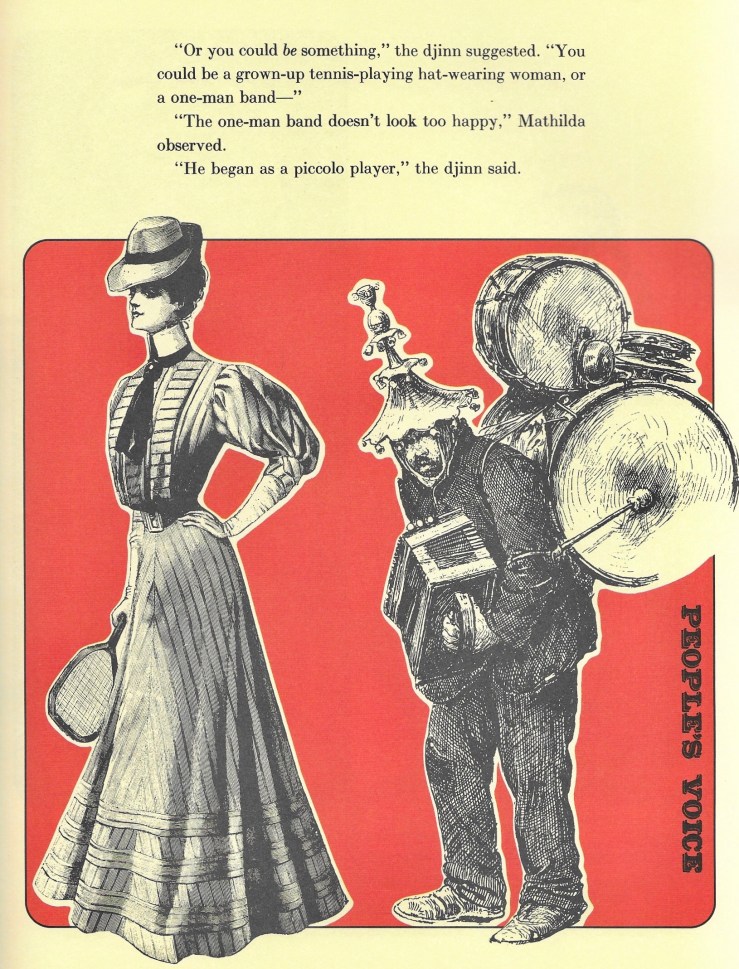
From Donald Barthelme’s children’s book The Slightly Irregular Fire Engine; or The Hithering Thithering Djinn.

From Donald Barthelme’s children’s book The Slightly Irregular Fire Engine; or The Hithering Thithering Djinn.
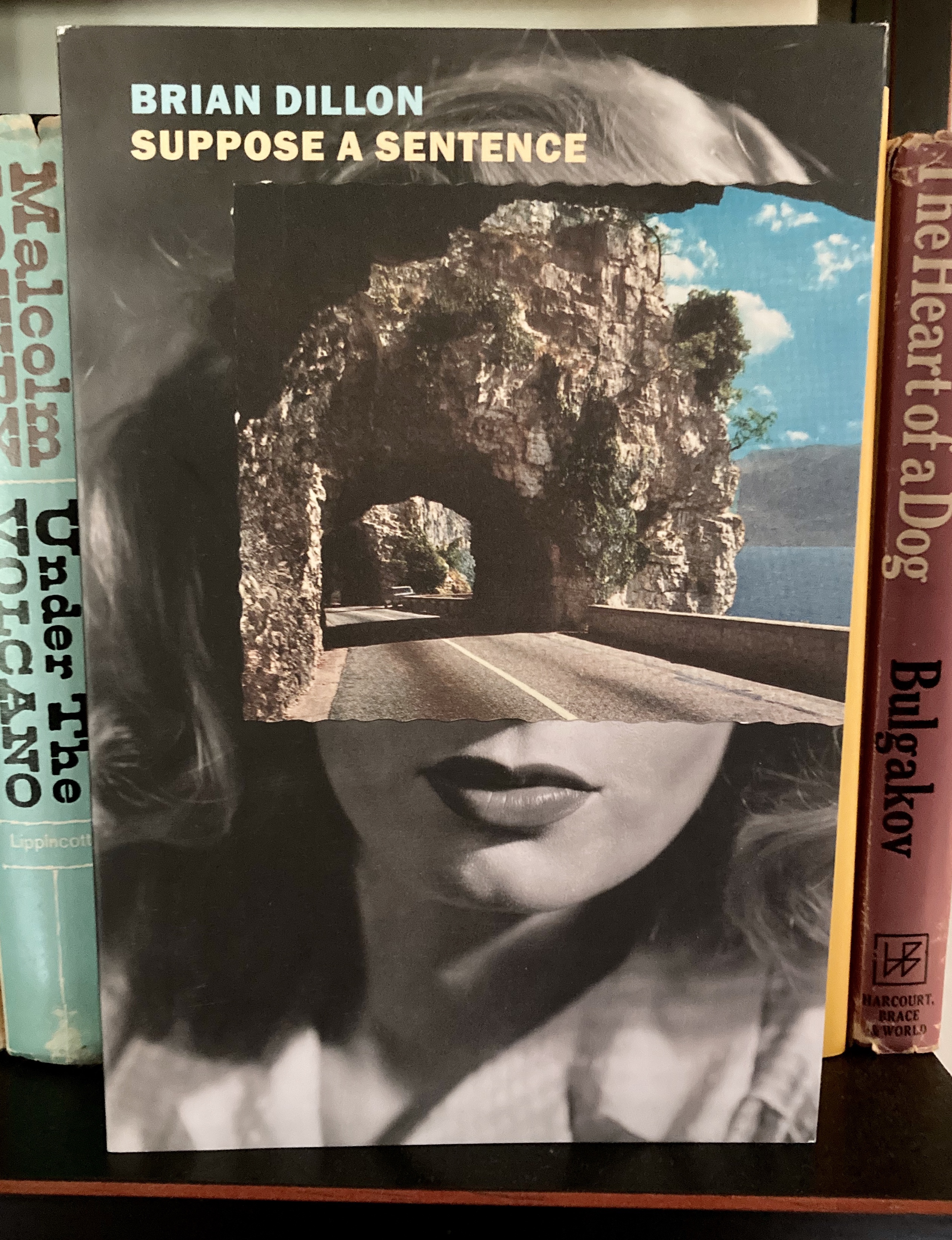
Brian Dillon’s Suppose a Sentence is a collection of 27 essays that each take a single sentence as their starting point. Organized chronologically by author dates, the collection begins with Shakespeare and Donne and works its way to Anne Carson and Anne Boyer (with Eliot, Stein, Beckett, Bowen et al along the way). When it showed up at Biblioklept World Headquarters last week I was intrigued, and admittedly jumped to the end to read the pieces on Carson and Boyer. In subsequent days I read the pieces on Shakespeare (Dillon takes his sentence “O, o, o, o” from Hamlet, but finds the vowels reputation throughout the playwright’s oeuvre) and Robert Smithson (in the middle of the book). I’ve decided to settle down and read in order at a leisurely pace—a chapter a day?
In the meantime, NYRB’s blurb
In Suppose a Sentence, Brian Dillon, whom John Banville has called “a literary flâneur in the tradition of Baudelaire and Walter Benjamin,” has written a sequel of sorts to Essayism, his roaming love letter to literature. In this new book Dillon turns his attention to the oblique and complex pleasures of the sentence. A series of essays prompted by a single sentence—from Shakespeare to Janet Malcolm, John Ruskin to Joan Didion—the book explores style, voice, and language, along with the subjectivity of reading. Both an exercise in practical criticism and a set of experiments or challenges, Suppose a Sentence is a polemical and personal reflection on the art of the sentence in literature. Whether the sentence in question is a rigorous expression of a state of vulnerability, extremity, even madness, or a carefully calibrated arrangement, Dillon examines not only how it works and why but also, in the course of the book, what the sentence once was, what it is today, and what it might become tomorrow.
A great shout went up near the doorway, bodies flowed toward a fattish pale young man who’d appeared carrying a leather mailsack over his shoulder.
“Mail call,” people were yelling. Sure enough, it was, just like in the army. The fat kid, looking harassed, climbed up on the bar and started calling names and throwing envelopes into the crowd. Fallopian excused himself and joined the others.
Metzger had taken out a pair of glasses and was squinting through them at the kid on the bar. “He’s wearing a Yoyodyne badge. What do you make of that?”
“Some inter-office mail run,” Oedipa said.
“This time of night?”
“Maybe a late shift?” But Metzger only frowned. “Be back,” Oedipa shrugged, heading for the ladies’ room.
On the latrine wall, among lipsticked obscenities, she noticed the following message, neatly indited in engineering lettering:
“Interested in sophisticated fun? You, hubby, girl friends. The more the merrier. Get in touch with Kirby, through WASTE only. Box 7391. L. A.”
WASTE? Oedipa wondered. Beneath the notice, faintly in pencil, was a symbol she’d never seen before, a loop, triangle and trapezoid, thus:

It might be something sexual, but she somehow doubted it. She found a pen in her purse and copied the address and symbol in her memo book, thinking: God, hieroglyphics. When she came out Fallopian was back, and had this funny look on his face.
“You weren’t supposed to see that,” he told them. He had an envelope. Oedipa could see, instead of a postage stamp, the handstruck initials PPS.
“Of course,” said Metzger. “Delivering the mail is a government monopoly. You would be opposed to that.”
Fallopian gave them a wry smile. “It’s not as rebellious as it looks. We use Yoyodyne’s inter-office delivery. On the sly. But it’s hard to find carriers, we have a big turnover. They’re run on a tight schedule, and they get nervous. Security people over at the plant know something’s up. They keep a sharp eye out. De Witt,” pointing at the fat mailman, who was being hauled, twitching, down off the bar and offered drinks he did not want, “he’s the most nervous one we’ve had all year.”
“How extensive is this?” asked Metzger.
“Only inside our San Narciso chapter. They’ve set up pilot projects similar to this in the Washington and I think Dallas chapters. But we’re the only one in California so far. A few of your more affluent type members do wrap their letters around bricks, and then the whole thing in brown paper, and send them Railway Express, but I don’t know . . .”
“A little like copping out,” Metzger sympathized.
“It’s the principle,” Fallopian agreed, sounding defensive. “To keep it up to some kind of a reasonable volume, each member has to send at least one letter a week through the Yoyodyne system. If you don’t, you get fined.” He opened his letter and showed Oedipa and Metzger.
Dear Mike, it said, how are you? Just thought I’d drop you a note. How’s your book coming? Guess that’s all for now. See you at The Scope.
“That’s how it is,” Fallopian confessed bitterly, “most of the time.”
“What book did they mean?” asked Oedipa.
Turned out Fallopian was doing a history of private mail delivery in the U. S., attempting to link the Civil War to the postal reform movement that had begun around 1845. He found it beyond simple coincidence that in of all years 1861 the federal government should have set out on a vigorous suppression of those independent mail routes still surviving the various Acts of ’45, ’47, ’51 and ’55, Acts all designed to drive any private competition into financial ruin. He saw it all as a parable of power, its feeding, growth and systematic abuse, though he didn’t go into it that far with her, that particular night. All Oedipa would remember about him at first, in fact, were his slender build and neat Armenian nose, and a certain affinity of his eyes for green neon.
So began, for Oedipa, the languid, sinister blooming of The Tristero.
From The Crying of Lot 49 by Thomas Pynchon.


I managed to snag a cheap used copy of William Melvin Kelley’s fourth novel Dem (or, more properly, dem) yesterday. I usually just snap a pic when I do these book acquired posts, but the cover for this 1969 Collier mass-market, by Leo and Diane Dillon, was simply too good not to scan.
I read not-quite-half of dem today, and the Dillons’ cover captures Kelley’s hypercolor satire of white upper-middle-class America: the infantalized businessman, attended by a black domestic, his bored wife not-quite-off-scene; and hey—look in that mirror.
I’ll admit that the book was hard to break into for the first few moments, until a wild moment around page 20 or so, that I’m still waiting on the novel to deliver upon (or, as it seems at this point, to depart from entirely). Kelley’s style in dem is choppier, sharper, more cartoonish than his Faulknerian debut A Different Drummer and if dem skews towards absurd irony where Drummer was heroic-tragic, both novels are rooted in intense anger tempered by strange empathy.
As its subheading attests, dem is, like Drummer, a take on white people viewing black people, and over a half-century after its publication, many of the tropes Kelley employs here still ring painfully true. His “hero,” Mitchell Pierce is a lazy advertising executive, bored with his wife, a misogynist who occasionally longs to return to the “wars in Asia.” He’s also deeply, profoundly racist; structurally racist; the kind of racist who does not think of his racism as racism. At the same time, Kelley seems to extend little parcels of sympathy to Pierce, even as he reveals the dude to be a piece of shit, as if to say, What else could he end up being in this system but a piece of shit?
The novel I’m most interested in reading by Kelley is his last, 1970’s Dunfords Travels Everywheres, long out of print and hard (read: expensive on the internet) to find. It is, apparently, his most postmodern novel, his most polyglossic, and, if the stuff I’ve read on it is accurate, it represents his most profound satirical break/engagement with reality. Fortunately, it’s getting a reprint this fall. Looking forward to it.
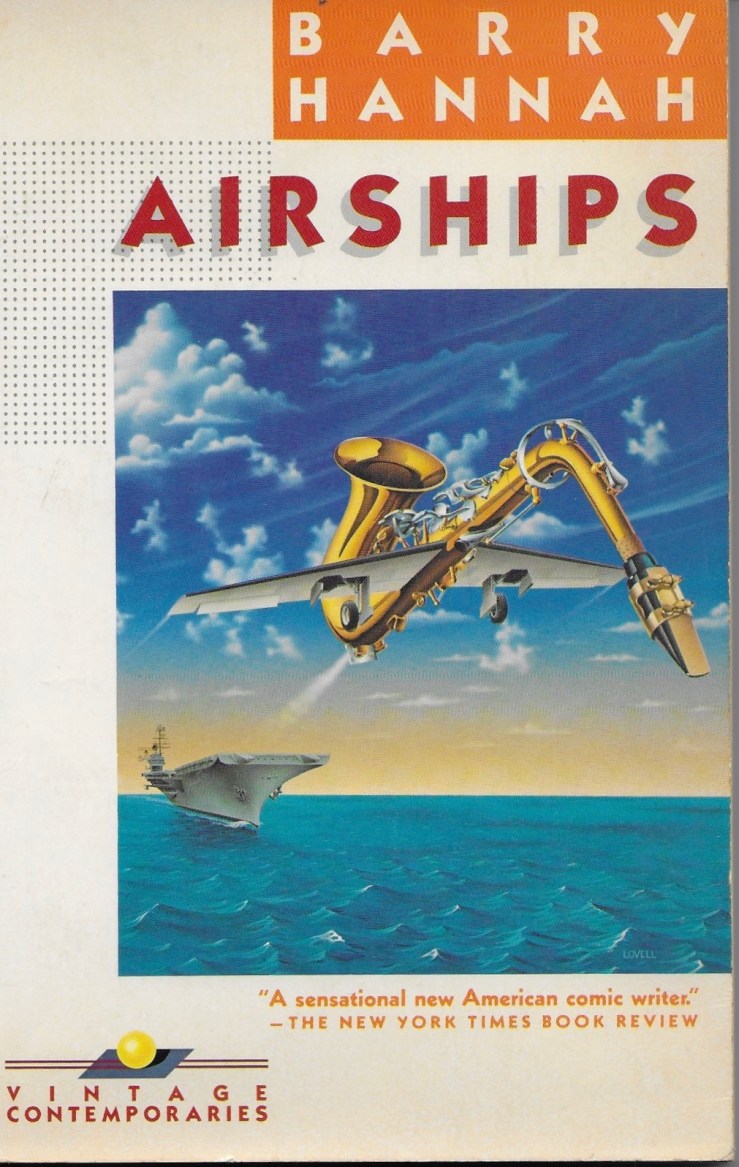
I’ve been a big fan of the Vintage Contemporaries 1980s series for ages now. The books were easily available, cheap and used, in the nineties, and I first read Raymond Carver and Jay McInerney in VC editions, later adding novels by Denis Johnson, Don DeLillo, Jerzy Kosinski to the burgeoning collection. I was thrilled to find a VC copy of Cormac McCarthy’s Suttree years ago; I wasn’t looking for it in particular, but the spine of a Vintage Contemporaries edition is hard to miss in a used bookstore. I picked it up of course, and gave the Vintage International edition I’d read to a friend who’d just finished Blood Meridian. The dark, moody Vintage International covers strongly contrast the bright, vivid VC edition (with a surreal painting by Marc Tauss):
In time, I’d unshelve at least one or two VC editions when browsing a used bookstore, especially if it was an author I’d been meaning to read. I ended up reading and loving Joy Williams’ first collection, Taking Care, that way, as well as Charles Portis’s Norwood (which led to me reading every Portis novel I could get my hands on).
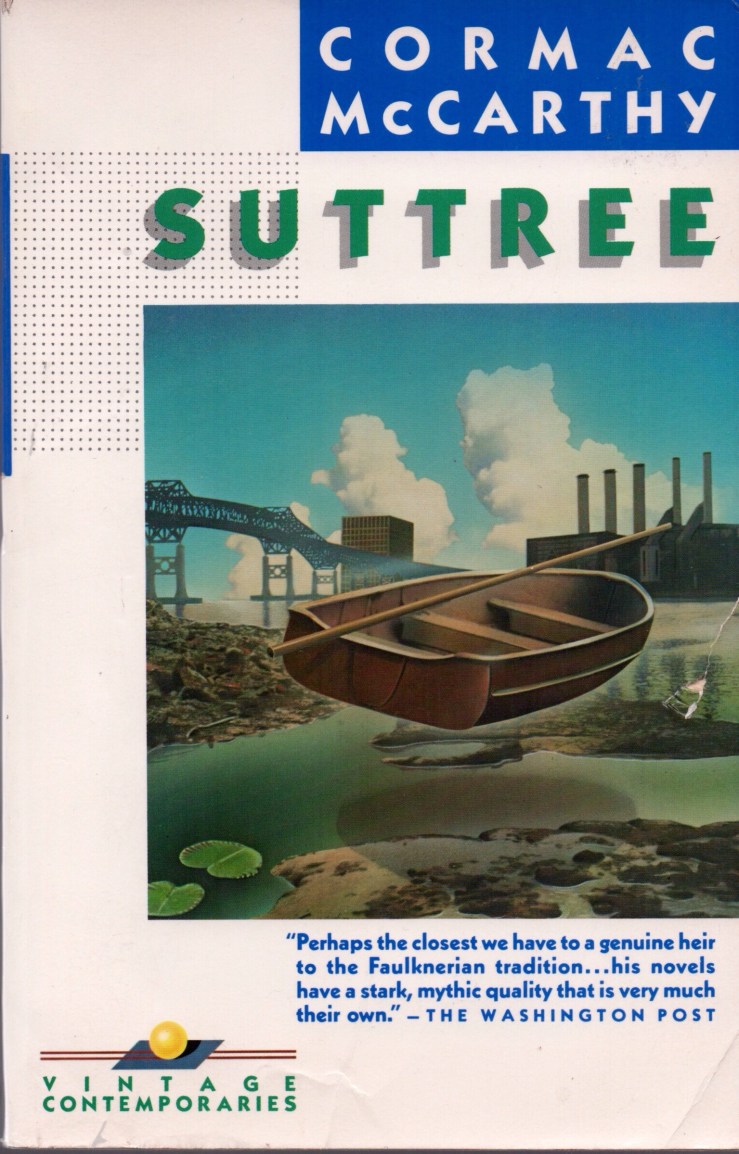
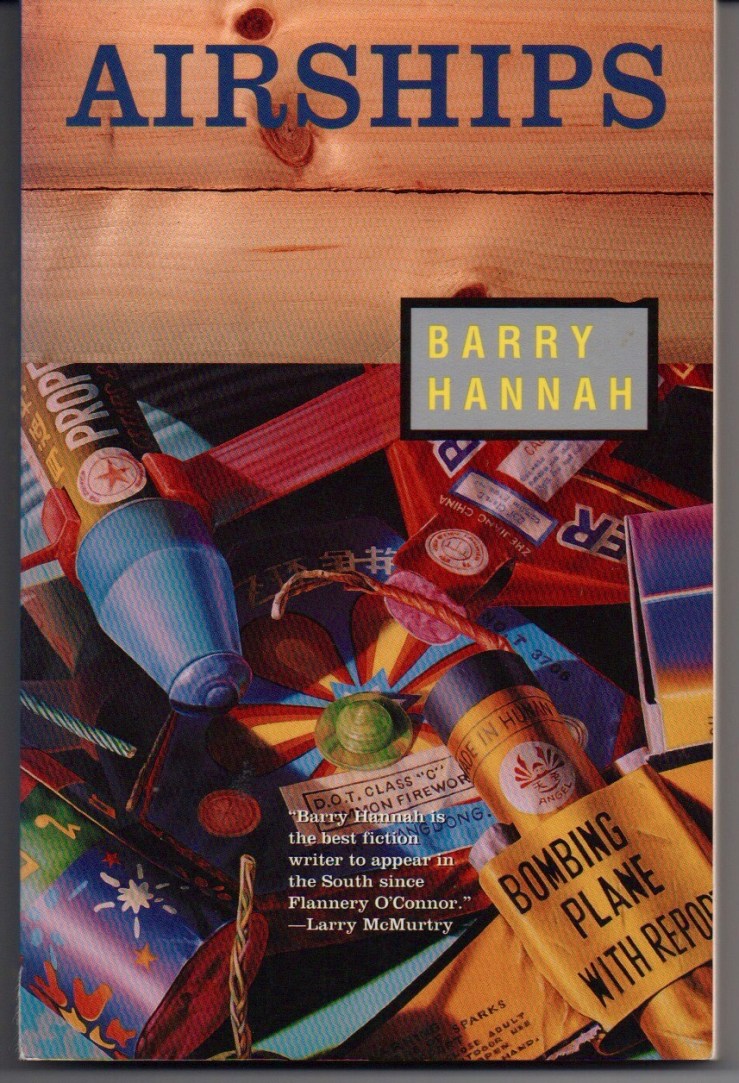
The one I really, really wanted though was the Vintage Contemporaries edition of Barry Hannah’s collection Airships. I must have seen it first–just the spine–in this great write up of VC designs at Talking Covers, and then added it to a mental list of titles to check for. There’s absolutely nothing wrong with the Grove Press copy I have of Airships; indeed, I really dig its photorealistic cover by Hannah’s contemporary Glennray Tutor—but I guess at this point I have to admit I’m collector (of cheap eighties paperbacks).
I read them, books, too, of course. Here’s the intro to my 2011 review of Airships:
In his 1978 collection Airships, Barry Hannah sets stories in disparate milieux, from the northern front of the Civil War, to an apocalyptic future, to the Vietnam War, to strange pockets of the late-twentieth century South. Despite the shifts in time and place, Airships is one of those collections of short stories that feels somehow like an elliptical, fragmentary novel. There are the stories that correspond directly to each other — the opener “Water Liars,” for instance, features (presumably, anyway), the same group of old men as “All the Old Harkening Faces at the Rail.” The old men love to crony up, gossip, tell tall tales. An outsider spoils the fun in “Water Liars” by telling a truth more terrible than any lie; in “Harkening,” an old man shows off his new (much younger) bride. These stories are perhaps the simplest in the collection, the homiest, anyway, or at least the most “normal” (whatever that means), yet they are both girded by a strange darkness, both humorous and violent, that informs all of Airships.
Well so and anyway:
Yesterday, browsing my beloved used bookstore, I found, while not really looking for it, the Vintage Contemporaries edition of Airships. I was in the “H” section of General Fiction, looking for something by Chester Himes (which I found, but in the Mysteries section, which I really have never browsed before), and there it was, its spine singing to me from a low shelf. I was happy to note the cover is by Rick Lovell, who’s responsible for my favorite VC editions (along with, obviously, series designer Lorraine Louie). As a sort of cherry on top, my edition has a little gold sticker at the top of the inside cover, proclaiming “Square Books on the Square, Oxford Mississippi.” Hannah taught at Ole Miss for nearly three decades. Square Books is still there.
I was excited with my find and I’m a dork so I tweeted about it. The next tweet I saw in my timeline was this tweet by Christopher DeWeese (retweeted by the writer John Lingan):
(I love the blurb by Thomas Pynchon.)
David Berman was a poet, musician, and singer (and more) who died almost exactly a 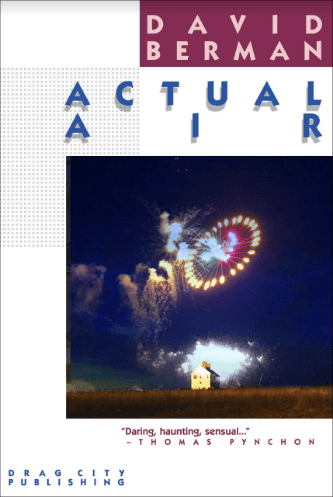 year ago. He was kind of a hero of mine, as far as these things go, and as such I never made an attempt to contact him, even when he linked to this blog on his blog, Menthol Mountains. I absolutely love the cover he made—or did he make it? I don’t actually know—but I know that he loved Vintage Contemporaries, that they were important to him. I recall John Lingan tweeting about having to cut some of his discussion about the series with Berman in his fantastic profile of the then-not-late artist. I couldn’t find the tweet, but I reached out to John, and he told me I remembered right; he also told me he recalled seeing a copy of Harold Brodkey’s First Love and Other Sorrows in Berman’s room.
I wonder if Berman and I had the same VC edition of First Love and Other Sorrows? The one with the Rick Lovell cover of butterflies on a sandcastle? Or maybe he had the one with the purple cover? I gave my copy to a good friend years ago, and have never seen one with the Lovell cover since.
I also wonder if Berman read the VC edition of Airships. I know he met Hannah, who apparently read Berman’s work. I recall now too that both men show up in The Minus Times Collected, which I never picked up. I’m going to order it now.

Sigizmund Krzhizhanovsky’s Unwitting Street is new in English translation by Joanne Turnbull from NYRB. I loved the first collection of Krzhizhanovsky’s stories that I read, Memories of the Future (also translated by Joanne Turnbull) and wrote about it here, comparing his weird fables to Kafka, Borges, and Philip K. Dick, among others. (I also really enjoyed the collection Autobiography of a Corpse (another Turnbull translation).
There are eighteen tales in Unwitting Street, most of them rather short. A few of the pieces are fragments or sketches. I read the opener this morning, “Comrade Punt,” which was a bit wacky and unexpectedly whimsical.
Here’s NYRB’s blurb for Unwitting Street, which is out in August:
When Comrade Punt does not wake up one Moscow morning—he has died—his pants dash off to work without him. The ambitious pants soon have their own office and secretary. So begins the first of eighteen superb examples of Sigizmund Krzhizhanovsky’s philosophical and phantasmagorical stories. Where the stories included in two earlier NYRB collections (Memories of the Future and Autobiography of a Corpse) are denser and darker, the creations in Unwitting Street are on the lighter side: an ancient goblet brimful of self-replenishing wine drives its owner into the drink; a hypnotist’s attempt to turn a fly into an elephant backfires; a philosopher’s free-floating thought struggles against being “enlettered” in type and entombed in a book; the soul of a politician turned chess master winds up in one of his pawns; an unsentimental parrot journeys from prewar Austria to Soviet Russia.
 In his 1992 interview with The New York Times, Cormac McCarthy said, “The ugly fact is books are made out of books. The novel depends for its life on the novels that have been written.” McCarthy’s masterpiece Blood Meridian, as many critics have noted, is made of some of the finest literature out there–the King James Bible, Moby-Dick, Dante’s Inferno, Paradise Lost, Faulkner, and Shakespeare. While Blood Meridian echoes and alludes to these authors and books thematically, structurally, and linguistically, it also owes much of its materiality to Samuel Chamberlain’s My Confession: The Recollections of a Rogue.
Chamberlain, much like the Kid, Blood Meridian’s erstwhile protagonist, ran away from home as a teenager. He joined the Illinois Second Volunteer Regiment and later fought in the Mexican-American War. Confession details Chamberlain’s involvement with John Glanton’s gang of scalp-hunters. The following summary comes from the University of Virginia’s American Studies webpage—
According to Chamberlain, John Glanton was born in South Carolina and migrated to Stephen Austin’s settlement in Texas. There he fell in love with an orphan girl and was prepared to marry her. One day while he was gone, Lipan warriors raided the area scalping the elderly and the children and kidnapping the women- including Glanton’s fiancee. Glanton and the other settlers pursued and slaughtered the natives, but during the battle the women were tomahawked and scalped. Legend has it, Glanton began a series of retaliatory raids which always yielded “fresh scalps.” When Texas fought for its independence from Mexico, Glanton fought with Col. Fannin, and was one of the few to escape the slaughter of that regiment at the hands of the Mexican Gen. Urrea- the man who would eventually employ Glanton as a scalp hunter. During the Range Wars, Glanton took no side but simply assassinated individuals who had crossed him. He was banished, to no avail, by Gen. Sam Houston and fought as a “free Ranger” in the war against Mexico. Following the war he took up the Urrea’s offer of $50 per Apache scalp (with a bonus of $1000 for the scalp of the Chief Santana). Local rumor had it that Glanton always “raised the hair” of the Indians he killed and that he had a “mule load of these barbarous trophies, smoke-dried” in his hut even before he turned professional.
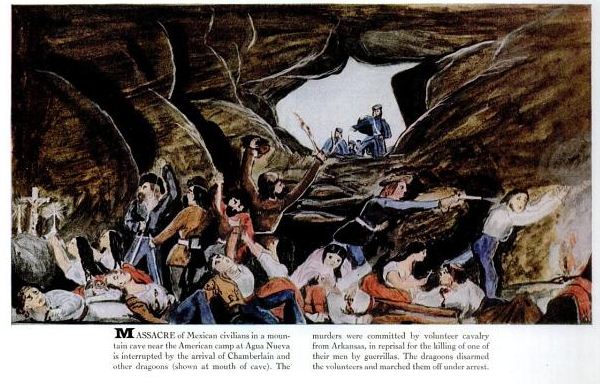
Chamberlain’s Confession also describes a figure named Judge Holden. Again, from U of V’s summary–
Glanton’s gang consisted of “Sonorans, Cherokee and Delaware Indians, French Canadians, Texans, Irishmen, a Negro and a full-blooded Comanche,” and when Chamberlain joined them they had gathered thirty-seven scalps and considerable losses from two recent raids (Chamberlain implies that they had just begun their careers as scalp hunters but other sources suggest that they had been engaged in the trade for sometime- regardless there is little specific documentation of their prior activities). Second in command to Glanton was a Texan- Judge Holden. In describing him, Chamberlain claimed, “a cooler blooded villain never went unhung;” Holden was well over six feet, “had a fleshy frame, [and] a dull tallow colored face destitute of hair and all expression” and was well educated in geology and mineralogy, fluent in native dialects, a good musician, and “plum centre” with a firearm. Chamberlain saw him also as a coward who would avoid equal combat if possible but would not hesitate to kill Indians or Mexicans if he had the advantage. Rumors also abounded about atrocities committed in Texas and the Cherokee nation by him under a different name. Before the gang left Frontreras, Chamberlain claims that a ten year old girl was found “foully violated and murdered” with “the mark of a large hand on her throat,” but no one ever directly accused Holden.
 It’s fascinating to note how much of the Judge is already there–the pedophilia, the marksmanship, the scholarship, and, most interesting of all, the lack of hair. Confession goes on to detail the killing, scalping, raping, and raiding spree that comprises the center of Blood Meridian. Chamberlain even describes the final battle with the Yumas, an event that signals the dissolution of the Glanton gang in McCarthy’s novel.

 Content aside, Chamberlain’s prose also seems to presage McCarthy’s prose. In his book Different Travelers, Different Eyes, James H. Maguire notes that, “Both venereal and martial, the gore of [Chamberlain’s] prose evokes Gothic revulsion, while his unschooled art, with its stark architectural angles and leaden, keen-edged shadows, can chill with the surreal horrors of the later Greco-Italian painter Giorgio de Chirico.” Yes, Chamberlain was an amateur painter (find his paintings throughout this post), and undoubtedly some of this imagery crept into Blood Meridian.
 You can view many of Chamberlain’s paintings and read an edit of his Confession in three editions of Life magazine from 1956, digitally preserved thanks to Google Books–here’s Part I, Part II, and Part III. Many critics have pointed out that Chamberlain’s narrative, beyond its casual racism and sexism, is rife with factual and historical errors. He also apparently indulges in the habit of describing battles and other events in vivid detail, even when there was no way he could have been there. No matter. The ugly fact is that books are made out of books, after all, and if Chamberlain’s Confession traffics in re-appropriating the adventure stories of the day, at least we have Blood Meridian to show for his efforts.
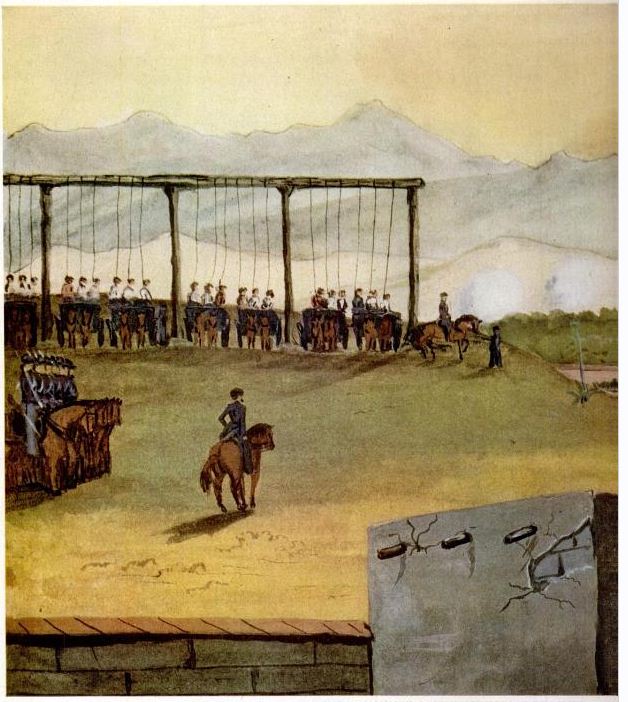
[Ed. note–Biblioklept first ran this post in September of 2010.]
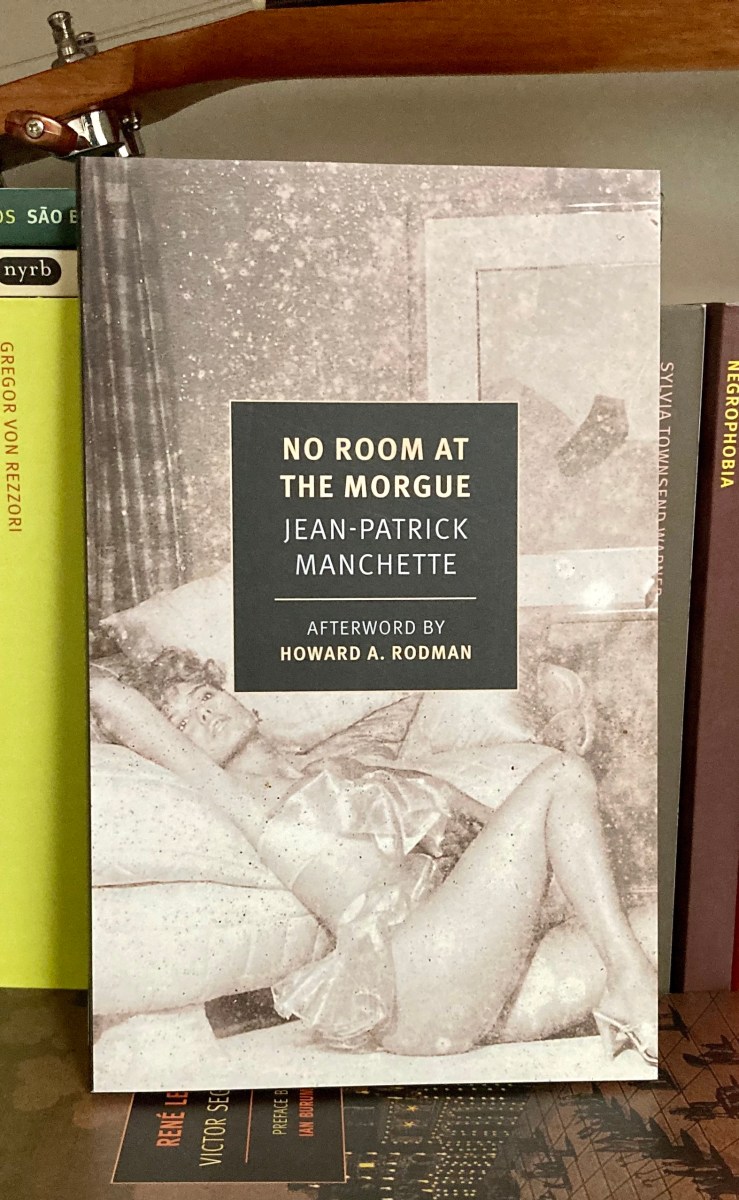
Jean-Patrick Manchette’s detective noir novel No Room at the Morgue (translated by Alyson Waters) is forthcoming in August from NYRB.
Their blurb:
No Room at the Morgue came out after Jean-Patrick Manchette had transformed French crime fiction with such brilliantly plotted, politically charged, unrelentingly violent tales as Nada and The Mad and the Bad. Here, inspired by his love of Dashiell Hammett, Manchette introduces Eugene Tarpon, private eye, a sometime cop who has set up shop after being kicked off the force for accidentally killing a political demonstrator. Months have passed, and Tarpon desultorily tries to keep in shape while drinking all the time. No one has shown up at the door of his office in the midst of the market district of Les Halles. Then the bell rings and a beautiful woman bursts in, her hands dripping blood. It’s Memphis Charles, her roommate’s throat has been cut, and Memphis can’t go to the police because they’ll only suspect her. Can Tarpon help?
Well, somehow he can’t help trying. Soon bodies mount, and the craziness only grows.

Business card for the NC-based artist Hannah Dansie, likely obtained at an arts fair in Asheville, NC, late 2018. Inside Charles Portis’s The Dog of the South, pages 106-07. Did I finish The Dog of the South? Yes I did.

An actual bookmark from the indie publisher Two Dollar Radio, obtained in 2020 when I purchased their edition of Rudolph Wurlitzer’s Nog. Inside Rudolph Wurlitzer’s Nog, between the cover and the first page. Did I finish Nog? Yes I did.

Entrance ticket for Wat Pho, obtained in Bangkok, Thailand, in the fall of 2002. Found inside Thomas Pynchon’s V., pages 228-29 (the beginning of “Mondaugen’s Story.” Did I finish V.? Yes I did.

Postcard from the Greek indie publisher Pilotless Press celebrating Allen Kechagiar’s chapbook The Mundane History of Lockwood Heights. Obtained via the publisher in 2012. Inside of Barry Hannah’s Long, Last, Happy, page 254-55. Did I finish The Mundane History of Lockwood Heights? Yes I did.
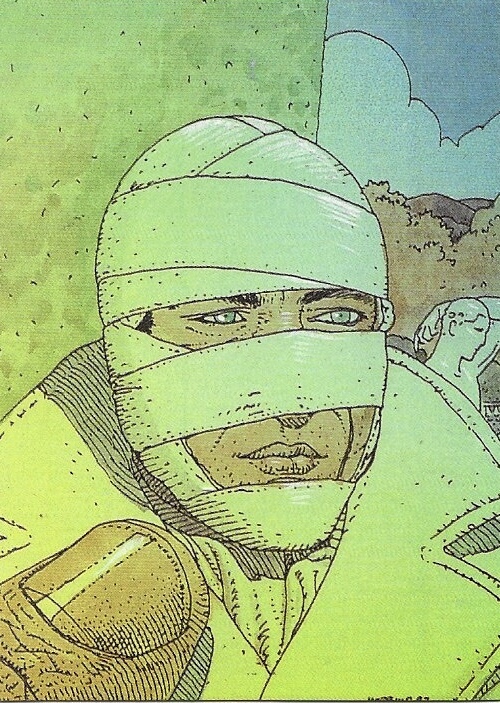
Card #30 (from Airtight Garage) of a set of Moebius collector cards, circa 1993. Obtained in a pack of Moebius Collector Cards purchased from Floating World Comics in Portalnd, Oregon, in July of 2019. Inside Jim Dodge’s Fup, pages 24-25. Did I finish Fup? No I did not.
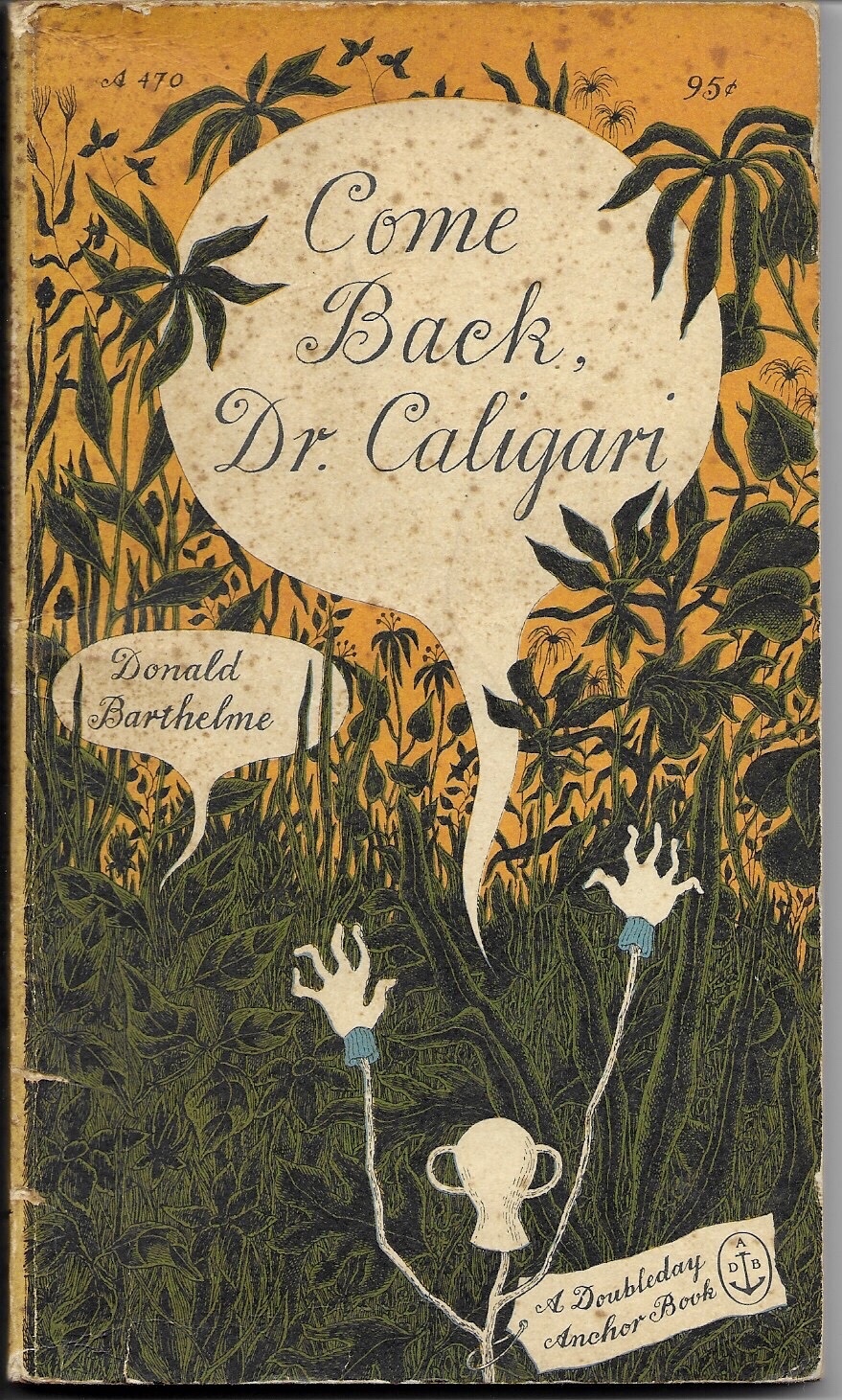

Come Back, Dr. Caligari by Donald Barthelme. Mass-market paperback from Anchor Books, 1965. Cover art and design by Edward Gorey.
I’d only ever seen the Milton Glaser cover for Barthelme’s first collection of stories, Come Back, Dr. Caligari, and was thrilled to pick up this Gorey Anchor cover the other day. I’d almost picked up the Glaser version years ago, but it wasn’t in great shape, and I was pretty sure that all of the stories in Caligari are contained in Sixty Stories and Forty Stories (I could be wrong). I love the richness of Gorey’s cover.

Nova by Samuel R. Delany. Mass-market paperback from Bantam Books, 1979. Cover art by Eddie Jones (not credited); no designer credited.
I couldn’t make it through Delany’s cult favorite Dhalgren a few years back, but Nova was easier sledding. The book is a riff on Moby-Dick, tarot, monoculture, and the grail quest. It’s jammed with ideas and characters, and if it never quite coheres into something transcendent, it’s a fun quick read (even if the ending, right from the postmodern metatextual playbook is too clever by half).

Mr Pye by Mervyn Peake. Mass-market papberback from Penguin Books, 1982. Cover art by Mervyn Peake; no designer credited.
While Mr Pye isn’t as rich, dense, or abjectly weird as Peake’s Gormenghast trilogy, it is wry and sharp, a strange morality play that made me laugh out loud a few times. (It also has a few shades of Wicker Man to it–but not too much). Good stuff.
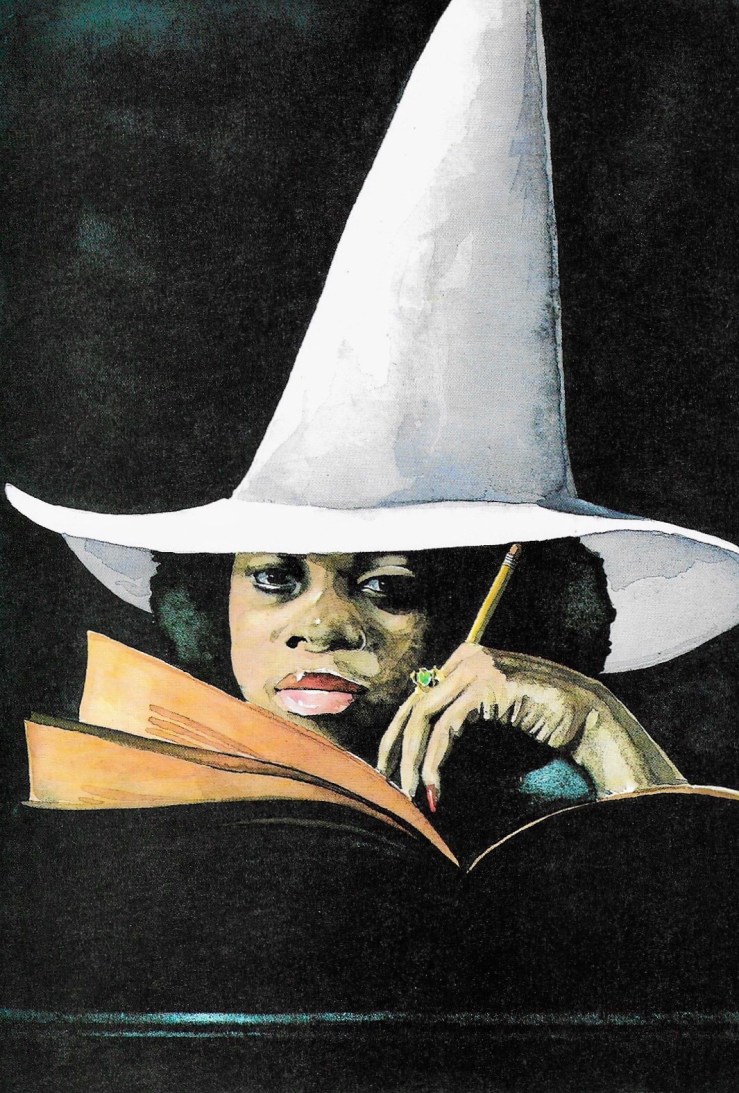
Barry Moser’s illustration for Lynne Reid Banks’s “The Hare and the Black-and-White Witch.” From The Magic Hare, Avon, 1994.

From Donald Barthelme’s children’s book The Slightly Irregular Fire Engine; or The Hithering Thithering Djinn.
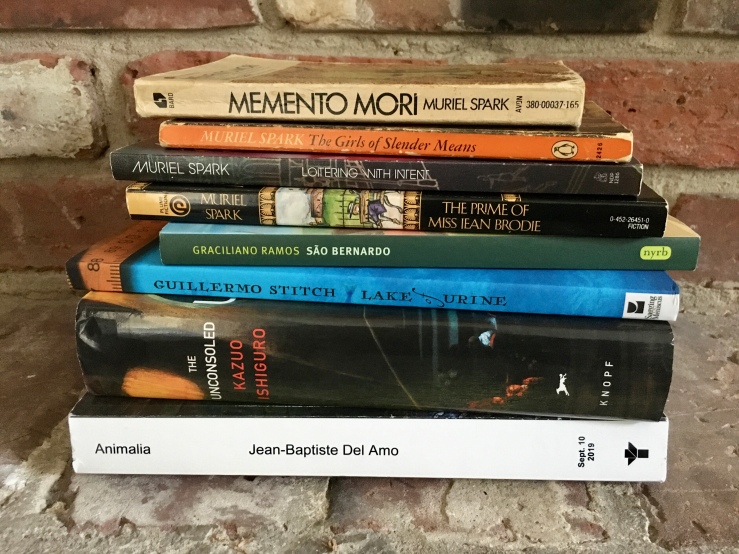
From bottom to top:
I finally started Jean-Baptiste Del Amo’s Animalia last week. I took the book with me to a place we rented near Black Mountain, North Carolina for a week. I purposefully took only Animalia, leaving behind two books I was in the middle of—Muriel Spark’s Loitering with Intent and Guillermo Stitch’s Lake of Urine. I used the adverb purposefully in the previous sentence, although I’m not sure what my purpose was. I think I just wanted an associative break from the past few months. I read geographically, even in my own home. I read the first section of Animalia, often overwhelmed by its abject lifeforce. The novel begins in rural southwest France at the end of the nineteenth century, focusing on a family farm. The preceding sentence is a bad description: Animalia is, so far anyway, a visceral, naturalistic, and very precise rendering of humans as animals. I don’t think I’ve ever been as intrigued as to how a novel was translated, either. In Frank Wynne’s English translation, Del Amo’s prose carries notes and tones evocative of Faulkner or Cormac McCarthy. Del Amo employs precise Latinate words, using, for example, genetrix, instead of mother, as in this paragraph:
The genetrix, a lean, cold woman, with a ruddy neck and hands that are ever busy, affords the child scant attention. She is content merely to instruct her, to pass on the skills for those chores that are the preserve of their sex, and the child quickly learns to emulate her in her tasks, to mimic her gestures and her bearing. At five years old, she holds herself stiff and staid as a farmer’s wife, feet planted firmly on the ground, clenched fists resting on her narrow hips. She beats the laundry, churns the butter and draws water from the well or the spring without expecting affection or gratitude in return. Before Éléonore was born, the father twice impregnated the genetrix, but her menses are light, irregular, and continued to flow during the months when, in hindsight, she realizes that she was pregnant, though her belly had barely begun to swell. Although scrawny, she had a pot-belly as a child, her organs strained and bloated from parasitic infections contracted through playing in dirt and dungheaps, or eating infected meat, a condition her mother vainly attempted to treat with decoctions of garlic.
The paragraph, from early in Animalia, conveys the prose’s abject flavor. Read the rest of the excerpt at Granta.
Kazuo Ishiguro’s The Unconsoled is over 500 pages but somehow does not read like a massive novel, partly, I suppose, because the novel quickly teaches you how to read the novel. The key for me came about 100 pages in, when the narrator goes to a showing of 2001: A Space Odyssey starring Clint Eastwood and Yul Brynner. There’s an earlier reference to a “bleeper” that stuck out too, but it’s at the precise moment of this alternate 2001 that The Unconsoled’s just-slightly-different universe clicked for me. Following in the tradition of Kafka’s The Castle, The Unconsoled reads like a dream-fever set of looping deferrals. Our narrator, Ryder, is (apparently) a famous pianist who arrives at an unnamed town, where he is to…do…something?…to help restore the town’s artistic and aesthetic pride. (One way we know that The Unconsoled takes place in an alternate reality is that people care deeply about art, music, and literature.) However, Ryder keeps getting sidetracked, entangled in promises and misunderstanding, some dark, some comic, all just a bit frustrating. There’s a great video game someone could make out of The Unconsoled—a video game consisting of only side quests perhaps. Once the reader gives in to The Unconsoled’s looping rhythms, there’s an almost hypnotic pleasure to the book. Its themes of family disappointment, artistic struggle, and futility layer like musical motifs, ultimately suggesting that the events of the novel could take place entirely in Ryder’s consciousness, where he orchestrates all the parts himself. Under the whole thing though is a very conventional plot though—think a Kafka fanfic version of Waiting for Guffman. I loved it.
I will be posting a proper review of Guillermo Stitch’s Lake of Urine some time this month, so I won’t remark at length on it. I’m a little under halfway through (had to restart after returning from the mountains), and it seems to me that the plot is impossible to describe. Or maybe it’s really simple: A rural couple, Norabole and Bernard, escape from their small town and move to the big city (“Big City”). Norabole very quickly becomes the CEO of a huge company, with an eye toward creating “the world’s first Gothic conglomerate” (she plans to get an exorcist on the board, as well as having the company partake in an annual seance). Meanwhile, Bernard struggles to find employment and whips up seven course meals for his Noarbole. He also has apparently contracted (contracted?!) xenoglossia. Lake of Urine is energetic and very funny and so so weird. Stitch seems to be doing whatever he wants on the page and I dig it.
I really enjoyed Graciliano Ramos’s novel São Bernardo (new translation by Padma Viswanathan), mostly for the narrator’s voice (which reminded me very much of Al Swearengen of Deadwood). Through somewhat nefarious means, Paulo Honorio takes over the run-down estate he used to toil on, restores it to a fruitful enterprise, screws over his neighbors, and exploits everyone around him. He decries at one point that “this rough life…gave me a rough soul,” which he uses as part confession and part excuse for his failure to evolve to the level his younger, sweeter wife would like him to. São Bernardo is often funny, but has a mordant, even tragic streak near its end. Ultimately, it’s Honorio’s voice and viewpoint that engages the reader. He paints a clear and damning portrait of himself and shows it to the reader—but also shows the reader that he cannot see himself. Good stuff.
Four by Muriel Spark. I’d never read her until May, and I’ve just been gobbling these up. I started with The Prime of Miss Jean Brodie, which is fantastic, and then read The Girls of Slender Means, which I liked even more than Prime. Slender Means unself-consciously employs some postmodern techniques to paint a vibrant picture of what the End of the War might feel like. The novel unexpectedly ends in a negative religious epiphany. (And the whole thing coincides with the bombings of Hiroshima and Nagasaki.) I then read Loitering with Intent, which is my favorite so far—just sharp as hell, and chock full of patterns and loops that I want to go back to again. I definitely will reread that one. I’m near the end of Memento Mori, a novel that concerns aging, memory, loss, and coming to terms with death. I was surprised to learn that this was Spark’s third novel, and that she would’ve been around 41—my age—when it was published. Most of the characters are over seventy, and Spark seems to inhabit their consciousness with a level of acuity that surprises me. Memento Mori is sharp and witty, but, barring some last minute shift, it’s not been my favorite Spark—but it’s still very good, and I want to read more. Any suggestions?

III. “The Voices of Time” (1960)
IV. “The Overloaded Man” (1961)
VI. “Thirteen to Centaurus” (1962)
VII. “The Subliminal Man” (1963)
VIII. “End-Game” (1963)
XI. “The Terminal Beach” (1964)
XII. “The Drowned Giant” (1964)
XIII. “The Beach Murders” (1966)
XIV. “The Assassination of John Fitzgerald Kennedy Considered as a Downhill Motor Race” (1966)
XV. “Why I Want to Fuck Ronald Reagan” (1968)
XVI. “Notes Towards a Mental Breakdown” (1976)
XVII. “The Index” (1977)
XVIII. “The Dead Time” (1977)
XIX. “News from the Sun” (1981)
XX. “Myths of the Near Future” (1982)
XXI. “Memories of the Space Age” (1982)
XXII. “Answers to a Questionnaire” (1985)
XXIII. “A Guide to Virtual Death” (1992)
At 1200 pages and just under 100 stories, The Complete Short Stories is frankly too complete—but I read them all anyway. The list above is my suggestion for a volume I’d call The Essential Short Stories of J.G. Ballard. Each selection on the list is linked to a riff I wrote; in several cases, links to the full text of the story can be found at the riff.
[Ed. note: Biblioklept originally ran a series of posts on The Complete Short Stories of J.G. Ballard between October 2013 and March 2014.]

PREVIOUSLY:
Introductions + stories 1956-1959
“The Subliminal Man,” Black Friday, and Consumerism
IN THIS RIFF:
“Dream Cargoes” (1990)
“A Guide to Virtual Death” (1992)
“The Message from Mars” (1992)
“Report from an Obscure Planet” (1992)
“The Secret Autobiography of J G B” (1981/2009)
“The Dying Fall” (1996)
“Dream Cargoes” (1990)
By the 1990s Ballard had written essentially the same stories over and over—with diminishing returns. Some of the weakness in the later entries in the Complete Short Stories can be attributed to Ballard’s prescience. The world caught up to him at some point, blunting his satire into something goofier, more cartoonish, but also sharpening the reactionary streak that always glowed under the surface of his writing. At his peak, Ballard used his stories to provoke readers into looking at their culture in a new way, and the best of those stories still retain a futurist power. However, many of the late period stories blazon their moral outrage in a wearisome didactic streak.
1990’s “Dream Cargoes” is paint-by-numbers Ballard: Themes of time, sleep, mutation, ecological disaster, birds, etc. The plot anticipates one of Ballard’s weaker novels, Rushing to Paradise (1994), a day-glo nightmare about misguided attempts to steward the forces of nature. And like Rushing to Paradise, the prose here is weak—Ballard relies on the stock phrases that litter his earliest stories.
“The Message from Mars” (1992) / “Report from an Obscure Planet” (1992) / “A Guide to Virtual Death” (1992)
“The Message from Mars” anticipates public disinterest in astronomy (and science in general), the end of NASA’s space shuttle program, and China’s emerging dominance as a world power with space flight capability. So there you go. (It also posits the horror of a President Quayle!). Ballard sends a group of astronauts on a Mars mission, refuses to share their findings with us, and then leaves them, once they land, in their space shuttle, where they live on for decades, silent, incommunicado, alienated from humanity in their self-imposed exile. Ballard’s cynicism is balanced by his refusal to overstate any kind of moral here—the story succeeds in its evocation of mystery.
“Report from an Obscure Planet” is another riff on millennial anxieties, written in the perspective of a “we” condemning the human race for its shortsighted, disastrous treatment of the planet. Ballard doesn’t seem to keen on the future wonders promised by computers:
Driven by the need for a more lifelike replica of the scenes of carnage that most entertained them, the people of this unhappy world had invented an advanced and apparently interiorised version of their television screens, a virtual replica of reality in which they could act out their most deviant fantasies. These three–dimensional simulations were generated by their computers, and had reached a stage of development in the last years of the millennium in which the imitation of reality was more convincing than the original. It may even have become the new reality to the extent that their cities and highways, their fellow citizens and, ultimately, themselves seemed mere illusions by comparison with the electronically generated amusement park where they preferred to play. Here they could assume any identity, create and fulfill any desire, and explore the most deviant dreams.
While “Report from an Obscure Planet” uses a didactic narrator and a heavy hand to telegraph its message, its companion piece “A Guide to Virtual Death” is far more fun, wicked, and shockingly accurate (if wildly hyperbolic). Sure, yes, okay—another list from Ballard, and okay, yes, sure—I tend to be keen on his lists (“The Index,” “The Assassination of John Fitzgerald Kennedy Considered as a Downhill Motor Race”)—but they also tend to be his strongest pieces. As usual with his list-stories, Ballard feels obligated to begin with a note:
For reasons amply documented elsewhere, intelligent life on earth became extinct in the closing hours of the 20th Century. Among the clues left to us, the following schedule of a day’s television programmes transmitted to an unnamed city in the northern hemisphere on December 23, 1999, offers its own intriguing insight into the origins of the disaster.
6.00 am Porno–Disco. Wake yourself up with his–and–her hard–core sex images played to a disco beat.
7.00 Weather Report. Today’s expected micro–climates in the city’s hotel atriums, shopping malls and office complexes. Hilton International promises an afternoon snow–shower as a Christmas appetiser.
7.15 News Round–up. What our news–makers have planned for you. Maybe a small war, a synthetic earthquake or a famine–zone! charity tie–in.
7.45 Breakfast Time. Gourmet meals to watch as you eat your diet cellulose.
Brief but Essential. Go ahead and read the whole thing.
“The Dying Fall” (1996) / “The Secret Autobiography of J G B” (1981/2009)
The American edition of Complete Stories is more complete than the British volume, including two extra stories. “The Dying Fall” (read it here if you like) is an unfortunate last entry, a weak note in a grand tome. It’s not bad; it’s simply not good, yet another revenge tale with a bad wife, etc. It feels like a frame for Ballard to riff on architecture and psychoanalysis.
“The Secret Autobiography of J G B” is much stronger (you can read it here), although it was also composed at his peak and republished (“rediscovered”) after his death. The final lines would have made a fitting end for the entire collection:
When the summer was followed by a mild autumn, B had established a pleasant and comfortable existence for himself. He had abundant stocks of tinned food, fuel, and water with which to survive the winter. The river was nearby, clear and free of all pollution, and petrol was easy to obtain, in unlimited quantities, from the filling stations and parked cars. At the local police station, he assembled a small armory of pistols and carbines, to deal with any unexpected menace that might appear.
But his only visitors were the birds, and he scattered handfuls of rice and seeds on his lawn and on those of his former neighbors. Already he had begun to forget them, and Shepperton soon became an extraordinary aviary, filled with birds of every species.
Thus the year ended peacefully, and B was ready to begin his true work.
On the horizon:
I am done! Sort of. One more post—I’ll revisit these riffs and select the tales that I would include in a collection I would call The Essential Short Stories of J.G. Ballard.
[Ed. note: Biblioklept originally ran a series of posts on The Complete Short Stories of J.G. Ballard between October 2013 and March 2014.]

PREVIOUSLY:
Introductions + stories 1956-1959
“The Subliminal Man,” Black Friday, and Consumerism
IN THIS RIFF:
“A Host of Furious Fancies” (1980)
“News from the Sun” (1981)
“Memories of the Space Age” (1982)
“Myths of the Near Future” (1982)
“Report on an Unidentified Space Station” (1982)
“The Object of the Attack” (1984)
“Answers to a Questionnaire” (1985)
“The Man Who Walked on the Moon” (1985)
“The Secret History of World War 3” (1988)
“Love in a Colder Climate” (1989)
“The Enormous Space” (1989)
“The Largest Theme Park in the World” (1989)
“War Fever” (1989)
“News from the Sun” (1981) / “Myths of the Near Future” (1982) / “Memories of the Space Age” (1982)
Let me first confess how happy I am to be finished with this enormously enormous book (okay, not physically enormous on my Kindle, but still…). Let me also confess to dread at having to finish out these riffs (no, no one is forcing me, but still…). At this point, I feel like I could write my own Ballard story—a crazed astronaut here, a drained swimming pool there, a femme fatale, some psychotropic drugs, armchair psychology, a swamp, some birds (perhaps), a plane or two, time obsession, sex obsession, space obsession. Obsession obsession Anyway. Ballard arguably peaks in the early 1980s; everything after reads like a day-glow Keith Haringesque pop-approximation of his grittier seventies stuff—or (worse) scolding wrapped up in little morality plays.
But, like I said (wrote), Ballard is in his prime in the early 1980s, and “News,” “Myths,” and “Memories” are some of his finest stories (file these triplets in my quasi-fictional-but-c’mon-we-can-make-this-happen collection The Essential Short Stories of J.G. Ballard)—they are also some of his most Ballardian, riffing on space-travel-as-cosmic-taboo, paranoid parables obsessed with time. A particularly Ballardian paragraph (from “Memories”):
He had almost ceased to breathe. Here, at the centre of the space grounds, he could feel time rapidly engorging itself. The infinite pasts and future of the forest had fused together. A long–tailed parakeet paused among the branches over his head, an electric emblem of itself more magnificent than a peacock. A jewelled snake hung from a bough, gathering to it all the embroidered skins it had once shed.
(Parenthetical aside: “Myths” and “Memories” are both set in Florida. Ballard’s depiction of Florida feels thoroughly inauthentic (I’m Floridian), but that inauthenticity also feels thoroughly appropriate).
“A Host of Furious Fancies” (1980)
Ballard constructs this little tale around a psychoanalytic reading of Cinderella:
The entire fairy tale of Cinderella was being enacted, perhaps unconsciously, by this deranged heiress. If she herself was Cinderella, Dr Valentina Gabor was the fairy godmother, and her magic wand the hypodermic syringe she waved about so spectacularly. The role of the pumpkin was played by the ‘sacred mushroom’, the hallucinogenic fungus from which psilocybin was extracted. Under its influence even an ancient laundry van would seem like a golden coach. And as for the ‘ball’, this of course was the whole psychedelic trip.
But who then was Prince Charming? As I arrived at the great mansion at the end of its drive it occurred to me that I might be unwittingly casting myself in the role, fulfilling a fantasy demanded by this unhappy girl. . . .
For all my resistance to that pseudo–science, it occurred to me that once again a psychoanalytic explanation made complete sense of these bizarre events and the fable of Cinderella that underpinned them. I walked up the staircase past the dismembered clock. Despite the fear–crazed assault on them, the erect hands still stood upright on the midnight hour – that time when the ball ended, when the courtships and frivolities of the party were over and the serious business of a real sexual relationship began. Fearful of that male erection, Cinderella always fled at midnight.
Etc.
Ballard’s Freudian riff would be more interesting as an essay.
(The story also showcases some of his typical chauvinism: The psychiatrist is described as the “woman psychiatrist” — just as earlier a dentist is referred to as a “lady dentist,” etc. Straight through to the end of the collection. In the 1990s).
“Report on an Unidentified Space Station” (1982) / “The Enormous Space” (1989)
“Report” and “Space” both read like takes on Sigizmund Krzhizhanovsky’s Soviet-era short story “Quadraturin” — both concern space, that corollary to time, and, just as Ballard repeatedly posits time as a matter of perspective, he treats space—area—the same way here. “Report” is a bit more satisfying than “Space,” which feels like a retread of so many of Ballard’s revenge stories—only with, uh, some comical cannibalism.
“Attack” and “Questionnaire” are maybe the same story—only “Questionnaire” is essentially perfect, whereas “Attack” feels like a clumsy, heavy first draft (but only because “Questionnaire” exists—do you see what I mean by this?)
Both stories showcase Ballard’s syntheses of religion (messianic; apocalyptic) and assassination (political; media-saturated). While “Attack” employs a discursive-but-still-linear approach to the theme, “Answers to a Questionnaire” gives us a discontinuous but more engaging riff in the form of (uh) exactly what its title promises. First fifth:
1) Yes.
2) Male (?)
3) do Terminal 3, London Airport, Heathrow.
4) Twenty–seven.
5) Unknown.
6) Dr Barnardo’s Primary, Kingston–upon–Thames; HM Borstal, Send, Surrey; Brunel University Computer Sciences Department.
7) Floor cleaner, Mecca Amusement Arcades, Leicester Square.
8) If I can avoid it.
9) Systems Analyst, Sperry–Univac, 1979–83.
10) Manchester Crown Court, 1984.
11) Credit card and computer fraud.
12) Guilty.
13) Two years, HM Prison, Parkhurst.
14) Stockhausen, de Kooning, Jack Kerouac.
15) Whenever possible.
16) Twice a day.
17) NSU, Herpes, gonorrhoea.
18) Husbands.
19) My greatest ambition is to turn into a TV programme.
20) I first saw the deceased on 17 February 1986, in the chapel at London Airport. He was praying in the front pew.
Essential, natch.
“The Man Who Walked on the Moon” (1985)
I should’ve wedged this passable but ultimately forgettable little tale in elsewhere. J.G. Ballard’s faux memoir of a faux astronaut. Pass.
“The Secret History of World War 3” (1988)
“The Secret History of World War 3” is Ballard’s “I told you so” sequel to one of his best stories (frankly a much better story), 1968’s “Why I Want to Fuck Ronald Reagan.” In his unofficial sequel, Ballard imagines (the horror!) of a third Reagan term (post-Bush 1), in which the country is obsessed with the President’s (lack of) health:
…the nation’s TV screens became a scoreboard registering every detail of the President’s physical and mental functions. His brave, if tremulous, heartbeat drew its trace along the lower edge of the screen, while above it newscasters expanded on his daily physical routines, on the twenty–eight feet he had walked in the rose garden, the calorie count of his modest lunches, the results of his latest brain–scan, read–outs of his kidney, liver and lung function. In addition, there was a daunting sequence of personality and IQ tests, all designed to reassure the American public that the man at the helm of the free world was more than equal to the daunting tasks that faced him across the Oval Office desk.
The story concerns a man who—alone, always alone, despite his wife, I mean this is Ballard here, hero’s alone (and right, justified) in his paraonoia—a man who is the only person to remember the brief outbreak of WW3, wedged, as it is, among updates of Ronnie and Nancy’s bowel movements. The story is farcical but juvenile, and if it seems surprisingly sophomoric, it’s worth noting that “TSHofWW3” echoes not just “Fuck Ronald Reagan,” but also one of Ballard’s earliest efforts, “Escapement” (1956), where a man sits on his couch in disbelief as his wife (stand-in for the whole world) fails to perceive what he perceives.
“Love in a Colder Climate” (1989) / “The Largest Theme Park in the World” (1989) /“War Fever” (1989)
A trio of late period lectures blazoned in the day glow approximations that anyone who live in the late eighties will not-so-fondly recall. Ballard evokes the neon apocalyptic impulses of the day, reworking his familiar themes—reproduction, civilization, war (etc.). Our baroque surrealist’s strokes are broader, not as sharp, more magnified—more Haring than Delvaux. Michel Houellebecq will pick up JGB’s torch here (with arguably better results) a decade and a half later.
On the horizon:
A handful of stories of the nineties: Or: Ballard returns to the same well with diminishing returns.
[Ed. note: Biblioklept originally ran a series of posts on The Complete Short Stories of J.G. Ballard between October 2013 and March 2014.]
 Biblioklept