Marlon James’s Black Leopard, Red Wolf is a postmodern fantasy novel that challenges the conventions of storytelling itself

img_2496

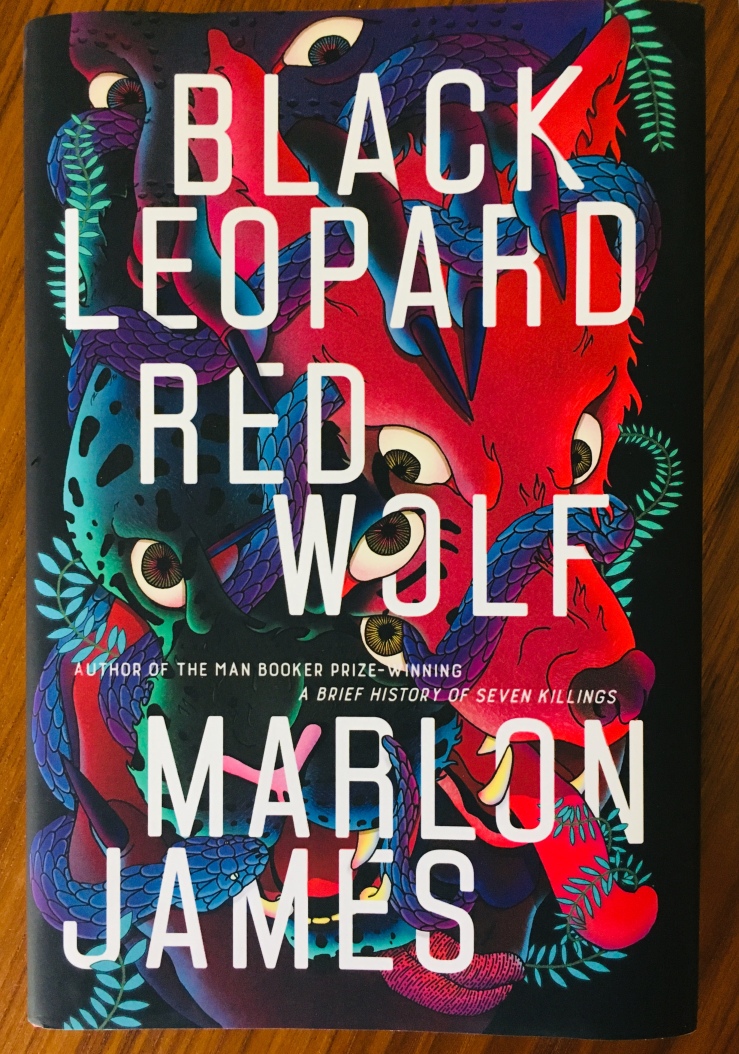
Marlon James’s novel Black Leopard, Red Wolf is a postmodern fantasy that takes place in medieval sub-Saharan Africa. Set against the backdrop of two warring states, the North Kingdom and the South Kingdom, Black Leopard, Red Wolf is the story—or stories, really—of Tracker, a man “with a nose” who can track down pretty much anyone (as long as he’s got the scent).

The central quest of Black Leopard, Red Wolf is for Tracker to find and recover a missing child of great importance. An explanation of exactly how and why the child is so important is deferred repeatedly; indeed, James’s novel is as much a detective story as it is a fantasy. In his detective-quest, Tracker partners with a number of strange allies: a talkative giant (who tells us repeatedly that he is not a giant), an anti-witch who places charms on Tracker, a duplicitous Moon Witch, a skin-shedding warrior-spy, a sandy-colored soldier from an alien land, a surly archer, a very smart buffalo, and more, more, more.

I used the word allies above, but truculent Tracker is just as likely to fight against the members of his fellowship as he is to fight with them. Black Leopard, Red Wolf runs on the same logic we find in comic books, where heroes fight each other first and then figure out why they are fighting each other after the fact. Sure, they’ll band together to fight lightning zombies, vampires, or roof-walking night demons—but they’re just as likely to go at each other with brass knuckles, axes, or arrows right after.

Chief among Tracker’s  allies/rivals is the Leopard, a shapeshifter. Throughout the book, Tracker and the Leopard fall in and fall out, fight and fuck, laugh and scream. Their bond is forged early in the novel, when they work together to rescue Mingi children, outcast mutants with strange appearances and stranger abilities. These children become an ersatz family for Tracker and provide an emotional ballast to a novel that often reads like a violent tangle of chaotic, meaningless tangents.

The fact that Leopard and Tracker—the title characters for the novel (Tracker gets his eye sucked out by a were-hyena and replaces it with a magical wolf eye; don’t ask)—the fact that Leopard and Tracker save children, particularly strange children is central to understanding their motivations in their quest to save the missing child.

From the outset though, the reader has to doubt just how successful the quest will be. Black Leopard, Red Wolf opens with these intriguing sentences: “The child is dead. There is nothing left to know.” These lines for foreground the novel’s two major themes: radical infanticide and the problem of knowing what we know and (story)telling what we know.

James’s novel uses infanticidal threat as the impetus for its central plot, the fellowship’s quest to save a child. In the backdrop though is Tracker’s oedipal rage toward his father/grandfather (don’t ask), a rage born out of the infanticidal threats Tracker himself has survived. Tracker has survived, but he is not at peace. He is perhaps the angriest narrator I have ever read, quick to temper and driven by (oedipal) impulses of revenge against a target he cannot name. His anger boils over repeatedly, and not just at his foes, but at his partners and his lovers—the Leopard, in particular.

At the same time, Black Leopard, Red Wolf transports us to scenes of strange love and strange families. James’s novel shows how radical love—Tracker and his Mingi children—might mediate, disrupt, or upend the impulses of revenge. And yet there is nothing permanent or stable in this postmodern novel.

Indeed, Black Leopard, Red Wolf is very much about the problem of how we know what we know and how we can express what we know. Tracker is our narrator, but he doesn’t tell us his story straight (there is nothing straight about this queer novel). Tracker tells his stories—the novel—to someone he addresses as inquisitor, but we never learn how Tracker came to be the inquisitor’s captive. Like Sheherezade in One Thousand and One Nights, Tracker seems to spin his story as a life-saving trick.

Black Leopard, Red Wolf is a tangle, a fluid that courses this way and that, a jumble of time and space. Like the “Ten and Nine Doors” that Tracker’s fellowship uses to teleport from one city-state to another, the narrative leaps through time and space, discursive and discontinuous. Tracker nests his narrative as well. We get tales inside tales inside tales, a matryoshka doll without a clear and definite shape. I occasionally felt submerged in reading James’s novel, as if I’d disappeared into an undersea cave only to find some strange current that bore me elsewhere.

Late in Black Leopard, Red Wolf, Tracker neatly summarizes the novel’s deconstruction of a stable truth, and then reverses the roles, demanding testimony from the inquisitor:

And that is all and all is truth, great inquisitor. You wanted a tale, did you not? From the dawn of it to the dusk of it, and such is the tale I have given you. What you wanted was testimony, but what you really wanted was story, is it not true? Now you sound like men I have heard of, men coming from the West for they heard of slave flesh, men who ask, Is this true? When we find this, shall we seek no more? It is truth as you call it, truth in entire? What is truth when it always expands and shrinks? Truth is just another story.

James has planned to write two sequels to Black Leopard, Red Wolf in what he is calling his “Dark Star” trilogy, and he’s stated that each entry in the series will, like an episode in Akira Kurosawa’s 1950 film Rashomon, tell the story from another perspective. After all, “Truth is just another story.”

Of course, Tracker’s telling can be confounding, even exhausting. James’s prose often feels picaresque, one-damn-thing-happening-after-another, a phantasmagoria of sex and violence signifying nothing—only it doesn’t signify nothing. It means something. Many readers won’t want to puzzle that out though.

A lot of the plot is delivered after the fact of the action. We get a form of clunky post-exposition—another form of storytelling, really, with one character summarizing the fragmented details the reader has been wading through for another character. In a kind of metatextual recognition of his tale’s messiness, James will often wink at the reader through his characters. Summarizing pages and pages of plot for the Leopard (and the reader), Tracker finds himself befuddled:

I told the Leopard all this and this is truth, I was more confused by the telling than he was by listening. Only when he repeated all that I said did I understand it.

A few chapters later, the pattern repeats. “The more you tell me the less I know,” one character tells another. Even storytelling can’t stabilize the truth.

While the plot’s unwieldiness can become tiresome, it is not a defect of the book as much as an intentional feature. However, some of the battle scenes fall into a kind of mechanical repetition of blank violence. Tracker tells us again and again how he “hacked” or “yanked,” etc. in scenes that become duller and duller as there are more of them.

The book is far more fun when it’s weirder—Tracker getting trapped by a mutant spider demon who sprays webs all over his face, or Tracker swimming with mermaids to the land of the dead, or Tracker and his companion visiting a technologically-advanced tree city-state ruled by a mad queen. James’s best set pieces don’t need battles to reverberate with energy.

The sex is more interesting than the violence in Black Leopard, Red Wolf—and there’s plenty of both. “Fantastic beasts, fantastic urges,” our lead characters repeat to themselves. James’s novel is deeply horny, its characters fluidly shifting into all kinds of weird fucking. Tracker partners with various members of his fellowship in more ways than one. Sex is magic in Black Leopard, Red Wolf, too—only ten pages in, Tracker ejaculates on a witch, she flicks his semen into a river, fish eat it, and turn into mermaids who lead him to the land of the dead.

There’s so much more in Black Leopard, Red Wolf that I haven’t touched on. The novel is lurid and horny, abject and affecting. It’s often quite funny, and, in the end, it turned out to be unexpectedly moving. It’s also exhausting and confusing, and will likely prove divisive for many readers. It’s clear that Lord of the Rings was a reference point for James (the word “fellowship” is oft-repeated in his novel), but Black Leopard, Red Wolf reminded me more of Jonathan Littell’s The Kindly Ones than it did a traditional fantasy.

In its vivid weirdness and pure invention, James’s book also reminded me of Brian Catling’s novel The Vorrh. However, Catling’s novel often takes the colonialist viewpoint. Black Leopard, Red Wolf  points to a fantasy that could reverse our own history, potentially obliterate that viewpoint’s existence. When Tracker asks the inquisitor, “Now you sound like men I have heard of, men coming from the West for they heard of slave flesh, men who ask, Is this true?”, his questioning seems to point to the larger implications of the James’s Dark Star universe—a precolonial space with a looming threat from the West. Late in Black Leopard, Red Wolf, one character warns the others that the warring between the North and South Kingdoms, between tribes and city-states must end. There’s an existential threat on the horizon. I find the potential storytelling here intriguing.

Black Leopard, Red Wolf is clearly Not for Everybody. It’s violent and strange, and the sex in it will likely upset conservative readers. It’s also shaggy and unwieldy. It probably has a future as a cult novel. You just sort of have to go with its fluid (in every sense of that word) program and enjoy the ride. I enjoyed it very much and am looking forward to the sequel.
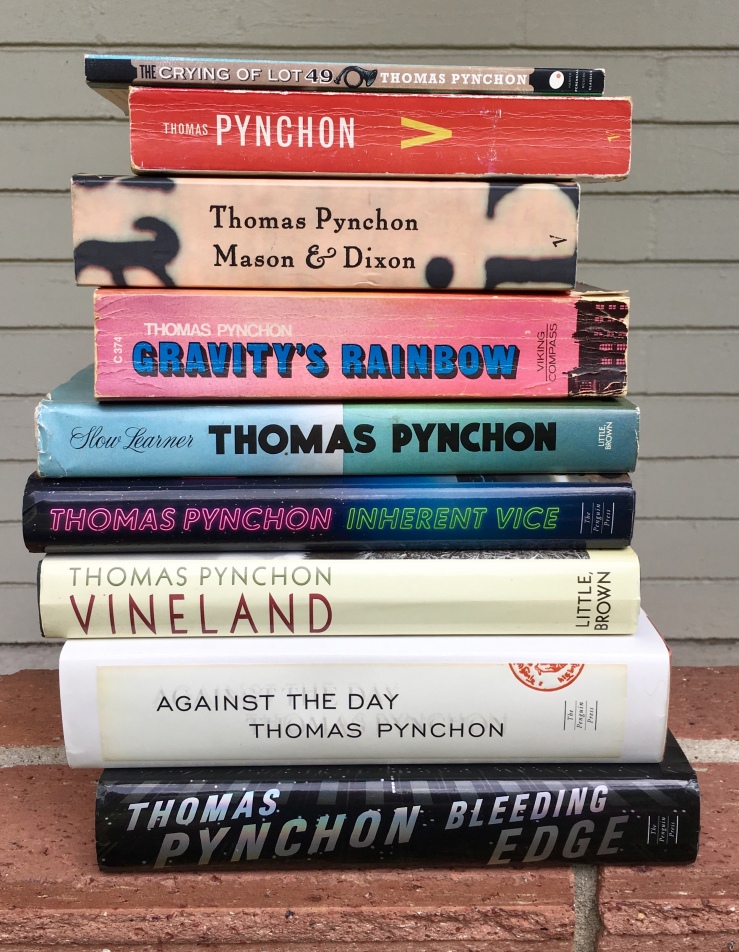

Pynchon in Public Post, 2019

img_2774

Today is the 82nd birthday of the American author Thomas Ruggles Pynchon, which a lot of jokers on the internet have turned into Pynchon in Public Day.

The spirit of Pynchon in Public Day is zany fun, and mostly centers around reading Pynchon’s works in public and spreading the muted post horn symbol from The Crying of Lot 49 around as much as possible. I am the last person in the world who will read a book in a coffee shop, but I did don my second 49 shirt today—-

66581c11-b06d-4dfe-89e3-0bc25fa0c64c

—and head to the bookstore to pick up the only Pynchon novel I don’t own, Bleeding Edge. More on that in second, but—no real recognition on the shirt today, although I’ve gotten some reactions to the other muted post horn shirt I own over the years, mostly from booksellers (not that interesting I know).

A few years ago though, wandering around downtown Los Angeles (wearing a muted post horn shirt), a stranger passing opposite me on the sidewalk hailed me with this question: “Are you the Trystero, guy?” At least that’s what I thought I said. I looked confused, asked, “What?” and he repeated — “Are you the Trystero guy?”

This particular moment struck me with a neat silly wave of minor paranoia, a Pynchonian moment, maybe—was this some kind of call sign for me to repeat, a password in a game of good fun? So I did the only thing that seemed sensible and replied, “Yes, I am the Trystero.”

The guy then proceeded to tell me that he loved my coffee. This confused me, so I told him that loved his coffee. Then he looked confused. After a few minutes on the hot July L.A. sidewalk we finally figured out a few things: He was referring to Trystero Coffee, which he showed me all about on his iPhone, and I was referring to The Crying of Lot 49, which he promised to read at the end of our exchange.

So anyway I went to the bookstore and picked up Bleeding Edge (and a few other books too, I admit). Along with Vineland, it’s the only Pynchon novel I haven’t read (despite two attempts on each). I’ll read Bleeding Edge before May 8th, 2020 though.

I started a retry of Vineland though. I had hoped to get past the farthest I remember going in—like the first 90 pages—before this post—-but I only made it through the first five chapters these past two days (through page 67). Still, I’d forgotten all about Ch. 5, the “Kahuna Airlines” chapter, which steers the book into new territory, and even though it still hasn’t hooked me yet (unlike the other Pynchons at this point), I’m starting to appreciate it for what I guess it is: Pynchon’s analysis of the eighties, of the absorption of the counterculture into culture, of nostalgia. The jokes are often hilarious and terrible, sometimes simultaneously. Pynchon sets up a Loony Tunes diner bit to deliver the execrable punchline, “Check’s in the mayo” for example. Pynchon names a lawn care company “The Marquis de Sod.” There’s a moment where protagonist Zoyd Wheeler pays for a ludicrous psychedelic party dress with “a check both he and the saleslady shared a premonition would end up taped to this very cash register after failing to clear,” a wonderful little throwaway line that shows Zoyd’s brokeassedness and empathy (and also highlights the Lebowski-Pynchon overlap, if you like). The line that’s cracked me up each time I’ve read it though is Zoyd’s daughter Prairie’s punker boyfriend being described as “the NBA-sized violence enthusiast who might or might not be fucking his daughter.” It’s just so dumb and poetic. I had also missed a few things — the night manager of Bodhi Dharma Pizza is named “Baba Havabananda,” a reference I’m thinking to Gravity’s Rainbow (“Have a banana”). There’s also a reference to the Vulcan hand salute, which shows up improbably in Pynchon’s next novel, Mason & Dixon (more on that here). And there’s the whole Bigfoot motif too, which Pynchon would echo in Inherent Vice, with Zoyd and Zuniga prefigurations of Doc Sportello and Bigfoot Bjornsen. And like every Pynchon novel, I’m sure I’ve already missed a ton of stuff.

Anyway, more on Vineland to come. In the meantime, if you haven’t read Pynchon–why not check him out?

The extinction of the dodo | A passage from Thomas Pynchon’s Gravity’s Rainbow

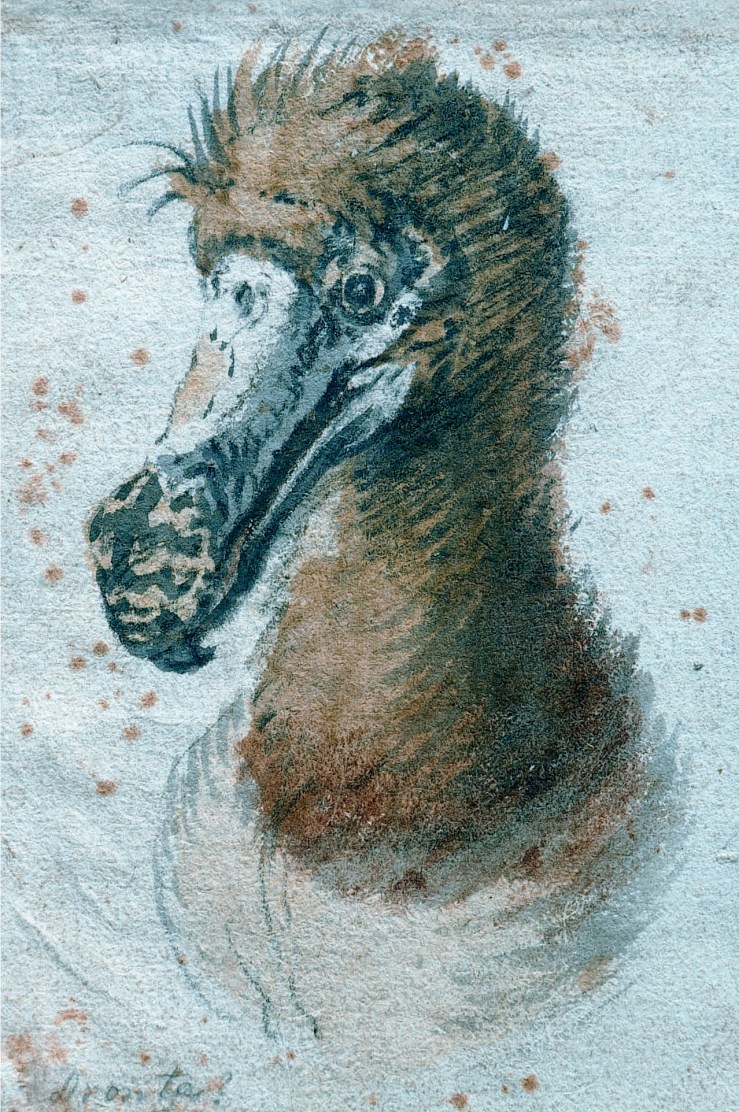
saftleven_dodo
Dodo, 1638 by Cornelis Saftleven (1607-1681)

He left the dodoes to rot, he couldn’t endure to eat their flesh. Usually, he hunted alone. But often, after months of it, the isolation would begin to change him, change his very perceptions—the jagged mountains in full daylight flaring as he watched into freak saffrons, streaming indigos, the sky his glass house, all the island his tulipomania. The voices—he insomniac, southern stars too thick for constellations teeming in faces and creatures of fable less likely than the dodo—spoke the words of sleepers, singly, coupled, in chorus. The rhythms and timbres were Dutch, but made no waking sense. Except that he thought they were warning him… scolding, angry that he couldn’t understand. Once he sat all day staring at a single white dodo’s egg in a grass hummock. The place was too remote for any foraging pig to’ve found. He waited for scratching, a first crack reaching to net the chalk surface: an emergence. Hemp gripped in the teeth of the steel snake, ready to be lit, ready to descend, sun to black-powder sea, and destroy the infant, egg of light into egg of darkness, within its first minute of amazed vision, of wet downstirred cool by these south-east trades… . Each hour he sighted down the barrel. It was then, if ever, he might have seen how the weapon made an axis potent as Earth’s own between himself and this victim, still one, inside the egg, with the ancestral chain, not to be broken out for more than its blink of world’s light. There they were, the silent egg and the crazy Dutchman, and the hookgun that linked them forever, framed, brilliantly motionless as any Vermeer. Only the sun moved: from zenith down at last behind the snaggleteeth of mountains to Indian ocean, to tarry night. The egg, without a quiver, still unhatched. He should have blasted it then where it lay: he understood that the bird would hatch before dawn. But a cycle was finished. He got to his feet, knee and hip joints in agony, head gonging with instructions from his sleeptalkers droning by, overlapping, urgent, and only limped away, piece at right shoulder arms.

Continue reading “The extinction of the dodo | A passage from Thomas Pynchon’s Gravity’s Rainbow”

Three potential starting points for reading Thomas Pynchon

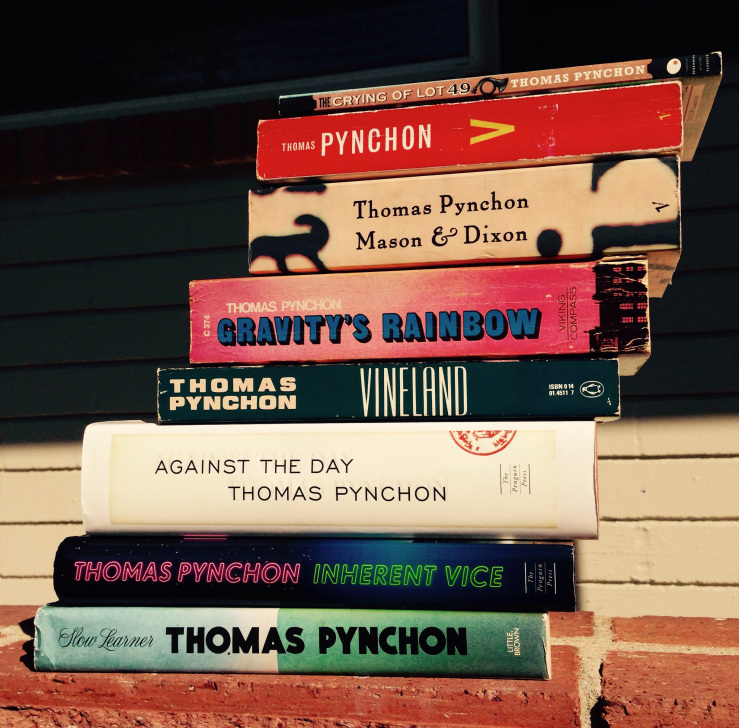
image1

Today is Pynchon in Public Day, so here are three books that I think may make good entry points for those interested in, but perhaps unnecessarily daunted by, Thomas Pynchon. My intuition is that many readers’ first experiences reading Pynchon may have been like mine: I read The Crying of Lot 49 as a college assignment, found it bewildering and baffling, and despite understanding almost none of it, I then attempted Gravity’s Rainbow (the key word is attempted (failed will also do in a pinch)).

Many readers start with The Crying of Lot 49 because it’s short. While I like the novel (I wrote about it here), it’s also extraordinarily dense, a box so crammed with jokes and japes that some fail to spring out at full force. Lot 49 is a much better reading experience after you’ve read more of Pynchon.

Lots of readers new to Pynchon plunge into Gravity’s Rainbow, probably because it’s famous. I love love love Gravity’s Rainbow, but along with Mason & Dixon (which may be my favorite Pynchon novel), I do not think it is a good starting place for Pynchon. Gravity’s Rainbow is a rich, ringing vortex, a seven-hundred-and-something pager that almost necessitates that its reader immediately reread it. Gravity’s Rainbow is a very funny and very tragic book, and I think it is the work of genius that its reputation suggests—but it’s also one of the few books I can think of that get put on lists of Big Difficult Novels that is, actually, Difficult.

So here are my suggestions for starting places for Pynchon.

img_2195

Against the Day, 2006.

Okay. So maybe you’re saying, Waitisn’t that one, like, really long? Reader, you’re correct. At 1,085 pages Against the Day is Pynchon’s longest novel to date. But it’s also one of his most accessible, and, most importantly, it offers a condensation of Pynchon’s Big Ideas and Big Themes. (I wrote a list of 101 possible descriptors for Against the Day, if you’re interested in a short take; I also riffed on the book at some length in a series of posts).

img_2194

V., 1963.

V. is Thomas Pynchon’s first novel. It’s also the first Pynchon novel I read and loved and (possibly) understood. Like Against the DayV. lays out many of the themes and styles (and even a character or two) that appear elsewhere Pynchon’s oeuvre. In a loose sense, V. feels like a dress rehearsal for Gravity’s Rainbow. Oh, it’s also pretty discursive—in fact, you can read chunks of it almost as short stories. In fact, here’s a good way to break into Pynchon: Get V., and read Ch. 9–it stands on its own as a long short story, the tale of Kurt Mondaugen—and colonialism, siege paranoia, dark dread, etc.

img_2197

Inherent Vice, 2009.

I’ve heard Inherent Vice dismissed as “Pynchon lite,” which may be true—I’ve read the book twice now and if its shaggy threads connect, I can’t see it (unlike, say, Gravity’s Rainbow, which resolves like a complicated math problem). Still, Inherent Vice makes a nice gateway drug to Pynchon—it’s funny and loose, and even though it rambles through an enormous cast of characters and settings, it’s ultimately far, far more contained than sprawling novels like Mason & Dixon and Gravity’s Rainbow. Paul Thomas Anderson’s film adaptation also makes an interesting visual counterpart to the novel—which it somehow simultaneously condenses and expands. Inherent Vice—the novel—also seems to me a kind of bookend or sequel to The Crying of Lot 49. (I wrote a bit about that here).

Last thought: Ignore my suggestions. Pick any novel that interests you by Pynchon and dive in. Don’t get too frustrated if you’re not sure what’s going on. A lot of the time, that’s the point of it all. Enjoy it.

[Ed. note–Biblioklept ran a version of this post on 8 May 2016].

The fragrance of the arbutus is spicy and exquisite | Nathaniel Hawthorne’s journal entry for April 28th, 1851

April 28th.–For a week we have found the trailing arbutus pretty abundant in the woods. A day or two since, Una found a few purple violets, and yesterday a dandelion in bloom. The fragrance of the arbutus is spicy and exquisite.

Nathaniel Hawthorne’s journal entry for April 28th, 1851. From Passages from the American Note-Books

Problem with you Markson you’ve got no God damned fellow feeling in bosom (William Gaddis)

Problem with you Markson you’ve got no God damned fellow feeling in bosom, put yourself in the poor bastard’s place: like if your wife wrote a novel and the best agent in town declined to handle it, would you go around giving a free ride to the agent’s clients? I mean why the hell do you think some poor bastard wants to be a book calumnist in the first place.

–A 1975 letter from William Gaddis to David Markson. Collected in Letters of William Gaddis, edited by Steven Moore. Moore provides this context for Gaddis’s satirical letter:

When Christopher Lehmann-Haupt’s negative review of J R appeared in the daily New York Times on 30 October, Markson sent a postcard the same day to WG reading: “Dear Bill—Fuck Christopher Lehmann-Haupt!” (Lehmann-Haupt had also written a negative review of Markson’s Going Down five years earlier.) Gaddis’s reply, undated and without salutation, plays on a joke in J R whereby a foreigner takes literally a dictionary definition of “sympathy” (488–89)…

Baudelaire/Musil (Books acquired, mid-April 2019)

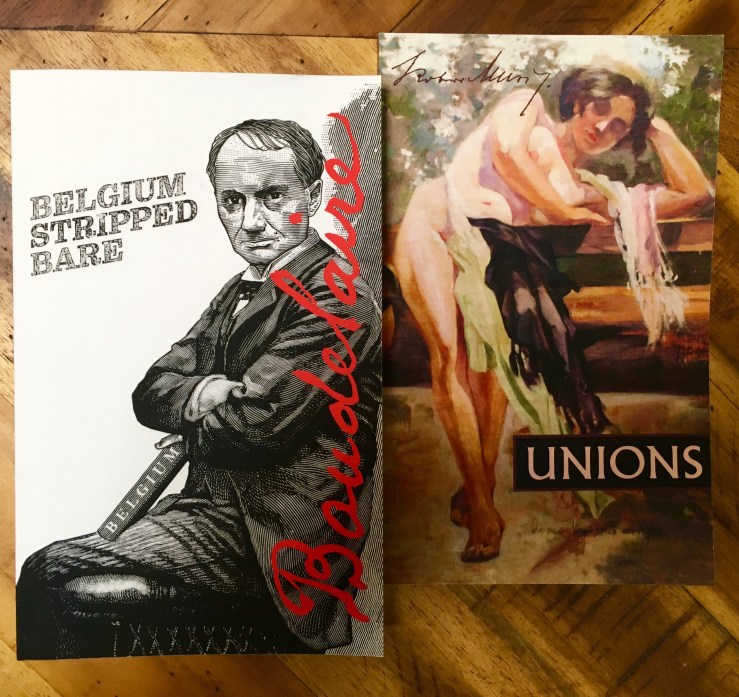
img_2678

Contra Mundum has two new ones in translation.

Robert Musil’s Unions, translated by Genese Grill, comprises two early stories, “The Completion of Love” and “The Temptation of Quiet Veronica.” From Contra Mundum’s blurb.


The stories in Unions, drawn from Martha’s [Marcovaldi, Musil’s wife] life, explode conventional morality; explore questions of self, union, and dissolution of self; and approximate exceptional sensations of erotic and intellectual perception in a shimmering and exceedingly dense proliferation of metaphors. The images, Musil tells us in a note, are the bone, not just the skin, of these carefully crafted stories. Each word is as motivated as the internal and external moments it attempts to embody in language. Although Musil did not continue to work in this experimental style in his later writing, in a late note he affirmed that Unions, the fruit of much artistic struggle and deep personal engagement, was the only one of his books that he sometimes still read from.

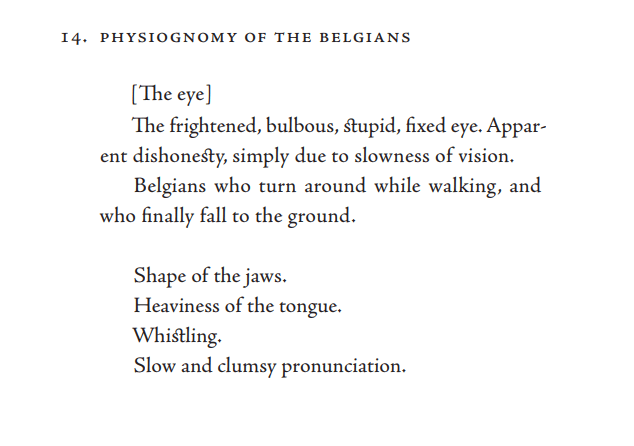
Belgium Stripped Bare is bad boy Baudelaire’s bad-mood visit to Belgium in the mid-1860s. This translation by Rainer J. Hanshe is comprised of Baudelaire’s journal entries, observations, and clippings of his time in Belgium, the place he left Paris for in 1864 in self-imposed exile. The entries, like this one, are fucking mean:

Screenshot 2019-04-25 at 5.25.28 PM

And I have no idea what to make of this—

Screenshot 2019-04-25 at 5.30.48 PM

I have yet to read Hanshe’s lengthy introduction for context, though—but from the blurb:

 Belgium Stripped Bare is an aesthetico-diagnostic litany of often vitriolic observations whose victory is found in the act of analysis itself, in the intoxication of diagnosis, just as great comedians exult in caustic and biting observations of society, a slap in the face of the status quo.

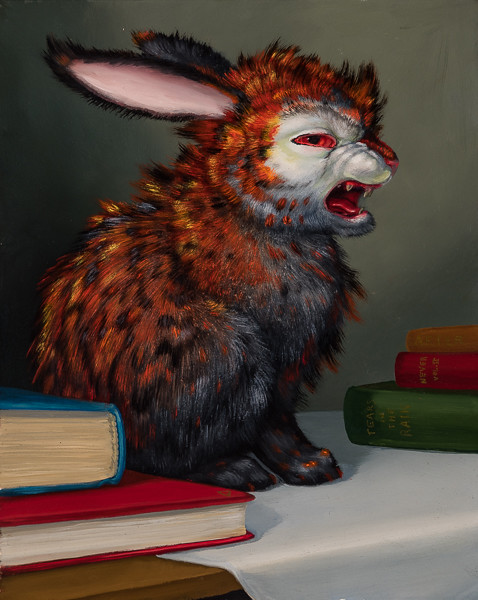
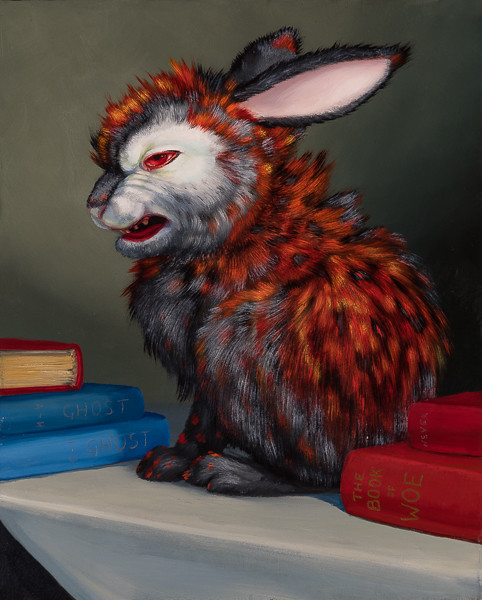
Cigarette Bunnies 1 and 2 — Laurie Hogin

35442627762_717aa8934e_b35442627722_267d012529_b

Cigarette Bunnies 1 and Cigarette Bunnies 2, 2016 by Laurie Hogin (b. 1963)

Hooped pots, sneak-cup, and other drinking customs in Shakespeare’s plays

Drinking Customs.

Shakespeare has given several allusions to the old customs associated with drinking, which have always varied in different countries. At the present day many of the drinking customs still observed are very curious, especially those kept up at the universities and inns-of-court. Alms-drink was a phrase in use, says Warburton, among good fellows, to signify that liquor of another’s share which his companion drank to ease him. So, in “Antony and Cleopatra” (ii. 7) one of the servants says of Lepidus: “They have made him drink alms-drink.”

By-drinkings.This was a phrase for drinkings between meals, and is used by the Hostess in “1 Henry IV.” (iii. 3), who says to Falstaff: “You owe money here besides, Sir John, for your diet, and by-drinkings.”

Hooped Pots.In olden times drinking-pots were made with hoops, so that, when two or more drank from the same tankard, no one should drink more than his share. There were generally three hoops to the pots: hence, in “2 Henry VI.” (iv. 2), Cade says: “The three-hooped pot shall have ten hoops.” In Nash’s “Pierce Pennilesse” we read: “I believe hoopes on quart pots were invented that every man should take his hoope, and no more.” The phrases “to do a man right” and “to do him reason” were, in years gone by, the common expressions in pledging healths; he who drank a bumper expected that a bumper should be drunk to his toast. To this practice alludes the scrap of a song which Silence sings in “2 Henry IV.” (v. 3): “Do me right, And dub me knight: Samingo.” He who drank, too, a bumper on his knee to the health of his mistress was dubbed a knight for the evening. The word Samingo is either a corruption of, or an intended blunder for, San Domingo, but why this saint should be the patron of topers is uncertain.

Rouse.According to Gifford, [972] a rouse was a large glass in which a health was given, the drinking of which, by the rest of the company, formed a carouse. Hamlet (i. 4) says: “The king doth wake to-night, and takes his rouse.” The word occurs again in the following act (1), where Polonius uses the phrase “o’ertook in’s rouse;” and in the sense of a bumper, or glass of liquor, in “Othello” (ii. 3), “they have given me a rouse already.”

Sheer Ale. This term, which is used in the “Taming of the Shrew” (Induction, sc. 2), by Sly—“Ask Marian Hacket, the fat ale-wife of Wincot, if she know me not: if she say I am not fourteen pence on the score for sheer ale”—according to some expositors, means “ale alone, nothing but ale,” rather than “unmixed ale.”

Sneak-cup. This phrase, which is used by Falstaff in “1 Henry IV.” (iii. 3)—“the prince is a Jack, a sneak-cup”—was used to denote one who balked his glass.

From Thomas Firminger Thiselton-Dyer’s indispensable volume Folk-lore of Shakespeare.

Easter in Shakespeare

From Thomas Firminger Thiselton-Dyer’s indispensable volume Folk-lore in Shakespeare:

Easter. According to a popular superstition, it is considered unlucky to omit wearing new clothes on Easter Day, to which Shakespeare no doubt alludes in “Romeo and Juliet” (iii. 1), when he makes Mercutio ask Benvolio whether he did “not fall out with a tailor for wearing his new doublet before Easter.” In East Yorkshire, on Easter Eve, young folks go to the nearest market-town to buy some new article of dress or personal adornment to wear for the first time on Easter Day, as otherwise they believe that birds—notably rooks or “crakes”—will spoil their clothes. In “Poor Robin’s Almanac” we are told: “At Easter let your clothes be new, Or else be sure you will it rue.” Some think that the custom of “clacking” at Easter—which is not quite obsolete in some counties—is incidentally alluded to in “Measure for Measure” (iii. 2) by Lucio: “his use was, to put a ducat in her clack-dish.” [649] The clack or clap dish was a wooden dish with a movable cover, formerly carried by beggars, which they clacked and clattered to show that it was empty. In this they received the alms. Lepers and other paupers deemed infectious originally used it, that the sound might give warning not to approach too near, and alms be given without touching the person. A popular name for Easter Monday was Black Monday, so called, says Stow, because “in the 34th of Edward III. (1360), the 14th of April, and the morrow after Easter Day, King Edward, with his host, lay before the city of Paris; which day was full dark of mist and hail, and so bitter cold, that many men died on their horses’ backs with the cold. Wherefore unto this day it hath been call’d the Blacke Monday.” Thus, in the “Merchant of Venice” (ii. 5), Launcelot says, “it was not for nothing that my nose fell a-bleeding on Black Monday last at six o’clock i’ the morning.”

Are you okay, brother?

Cells tighter than shells, you spinning into spirals, quick-silver, thrashing the water, making stars scatter (Ann Quin)

Beyond these, illuminated by past summers, one summer remained that stayed the sun long into the night after you had watched the others; others with their fathers knee-deep, belly-button unconcerned, roly-poly mothers stretching out of the sea. Whiter than starch hands on bat and ball, you failed to catch. Tents, buckets, spades; others that went on digging barricades. You castle-bound, spying on princesses, honey-gold, singing against the blue, if touched surely their skin would ooze? Aware of own smell, skin-texture, sun in eyes, lips, toes, the softness underneath, in between, wondering what miracle made you, the sky, the sea. Conscious of sound, gulls hovering, crying, or silent at rarer intervals, their swift turns before being swallowed by the waves. Then no sound, all suddenly would be soundless, treading softly, dividing rocks with fins, and sword-fish fingers plucking away clothes, that were left with your anatomy, huddled like ruffled birds waiting. A chrysalis heart formed on the water’s surface, away from the hard-polished pebbles, sand-blowing and elongated shadows. Away, faster than air itself, dragon-whirled. Be given to, the sliding of water, to forget, be forgotten; premature thoughts—predetermined action. In a moment fixed between one wave and the next, the outline of what might be ahead. On your back, staring into space, becoming part of the sky, a speckled bird’s breast that opened up at the slightest notion on your part. But the hands, remember the hands that pulled your legs, that doubled you up, and dragged you down? Surprised at non-resistance. Voices that called, creating confusion. Cells tighter than shells, you spinning into spirals, quick-silver, thrashing the water, making stars scatter. Narcissus above, staring at a shadow-bat spreading out, finally disappearing into the very centre of the ocean. They were always there waiting by the edge, behind them the cliffs extended. Your head disembodied, bouncing above the separate force of arms and legs, rhythmical, the glorious sensation of weightlessness, moon-controlled, and far below your heart went on exploring, no matter how many years came between, nor how many people were thrust into focus. That had surely been the beginning, the separating of yourself from the world that no longer revolved round you, the awareness of becoming part of, merging into something else, no longer dependent upon anyone, a freedom that found its own reality, half of you the constant guardian, watching your actions, your responses, what you accepted, what you might reject.

From Ann Quin’s novel Berg.

RIP Gene Wolfe

genewolfebw

RIP Gene Wolfe, 1931-2019

Gene Wolfe died today. He was 87. Tor’s obit includes these details:

Gene Wolfe was born in New York on May 7, 1931. He studied at Texas A&M for a few years before dropping out and fighting in the Korean War. After his return to the US he finished his degree at the University of Houston. He was an engineer, and worked as the editor of the professional journal Plant Engineering. He was also instrumental in inventing the machine that cooks Pringles potato chips.

…Wolfe went on to write over 30 novels, with his best best-known work, The Book of The New Sun, spanning 1980-1983. The series is a tetralogy set in the Vancian Dying Earth subgenre, and follows the journey of Severian, a member of the Guild of Torturers, after he is exiled for the sin of mercy.

Last night, I fell asleep listening to Chapter 15 of the audiobook version of Gene Wolfe’s 1980 novel The Shadow of the Torturer, the first book in The Book of the New Sun.I have been falling asleep to Chapter 15 of this particular audiobook for about three nights now. Before that, I was falling asleep to Chapter 14. There is nothing particularly boring about the book. I put headphones in my ears take sleeping pills and fall asleep to an audiobook every night. There’s something about plugging into a narrative that’s not my own life that takes me out of all the anxieties that creep out at bedtime. I get through 15, maybe 20 minutes, and I’m out. I restart a few minutes before the last bit I remember. Anyway, I fell asleep to Chapter 15 — “Baldanders” — last night. I might’ve even made it a little bit into Chapter 16. I’ll find out tonight.

I first read The Shadow of the Torturer as a young teen. I was too young for the book—I don’t think I fully appreciated its scope. I read the next book in The Book of the New Sun series, but I don’t remember if I finished it out. In a year or two, I had abandoned fantasy, a mistake that I corrected years later. Youthful indiscretion. I reread a chunk of The Shadow of the Torturer again in my twenties and found it more complex than I remember. Then I mistakenly left the mass market paperback copy I was reading at a beach condo we had conned from someone’s friend’s grandmother for the weekend, and that was that—until this February, when a brief Twitter conversation prompted me to get the audiobook. I’ve been listening to it every night since, and at the rate I’m going through it I’ll probably be done by the end of the summer. I’m digging it.

Will Wolfe now gain a wider audience outside of the sci-fi/fantasy cult audience now that he has died? Maybe. I mean, that happens sometimes, right? His work is challenging though, employing strange diction and proffering only the smallest crumbs of exposition. Ultimately, it’s clear that Gene Wolfe was a writer’s writer, as evidenced by a 2015 profile of him in The New Yorker which proclaimed him “sci-fi’s difficult genius”—

Wolfe has published more than twenty-five novels and more than fifty stories, and has won some of science fiction and fantasy’s most prestigious awards. But he has rarely, if ever, been considered fully within the larger context of literature. His books contain all of the nasty genre tropes—space travel, robots, even dragons—and he hasn’t crossed into the mainstream on the strength of a TV or movie adaptation. Wolfe himself sees the trappings of science fiction and fantasy, the spaceships and so on, as simply “a sketchy outline of the things that can be done.” But even within fantasy fandom, Wolfe’s work presents difficulties. His science fiction is neither operatic nor scientifically accurate; his fantasy works are not full of clanging swords and wizardly knowledge. But ask science-fiction or fantasy authors about Gene Wolfe and they are likely to cite him as a giant in their field. Ursula K. Le Guin once called Wolfe “our Melville.”

Blog about some recent reading

img_2644

I am reading too many books right now.

The big book I am reading is Marlon James’s surreal fantasy Black Leopard, Red Wolf. I am a little over half way through this long, long book, which is by turns rich, dazzling, baffling, and befuddling. Black Leopard, Red Wolf is a fantasy-quest novel set in a mythical medieval Africa. The story is told by Tracker, a detective under magical protection who uses his magnificent nose to search for a missing boy, Tracker is aided (and sometimes stymied) on this quest by a strange and ever-shifting fellowship of superpowered heroes and antiheroes, including a sad, talkative giant, a mysterious witch, and the titular Leopard. Leopard is a shapeshifter, and Tracker’s erstwhile partner, both in adventures and in love. “Fantastic beasts, fantastic appetites,” he remarks at one point, summarizing the novel’s horny program. “The more you tell me, the less I know,” another character remarks, summarizing the novel’s shaggy structure. Black Leopard, Red Wolf unspools its plot in the most confounding way. Tracker is hardly a reliable narrator, but we are not even sure if he is the primary narrator. He’s telling his tale to an Inquisitor, but the tale-telling spins ever on, each story a deferral. And those deferrals often open into other storytellers, who tell stories with their own embedded stories. James’s book is like a matryoshka doll full of blood and guts and fucking and surreal ceiling-walking demons. It’s as much a detective story as a fantasy, but for all its genre troping, it makes few concessions to its various genres’ conventional forms. Reading Black Leopard, Red Wolf often feels more like playing a really long game of very weird Dungeons & Dragons campaign with an inventive Dungeon Master making wild shit up as he goes along than it does a cohesive and coherent story. I’m digging the play so far.

The other long book I’m reading—crawling through, really—is Robert Coover’s The Origin of the Brunists. I loved the first 100 pages or so, but it’s turning into a slog. The novel’s climactic crisis, a mining disaster, occurs very early in the novel, an interesting gambit given that the novel is about an apocalyptic cult awaiting the end of the world. This apparent second crisis, a consequence of the first crisis, is then deferred. Coover explores this deferral and its consequences over a series of non-climaxes that we see through the eyes of the (many many too many) characters. There are little pockets of Origin that are fantastic, but too little humor to buoy the novel—it gets weighed down under its unwieldy cast and the authorial sense that This Is A Big Important Novel About Life. I will finish it though.

I loved loved loved Ann Quni’s novel Berg. I will do a full review of this marvelous weird claustrophobic novel when it comes out from And Other Stories in the U.S. this summer, but for now: Just amazing. The novel, originally published in 1964, begins like this: “A man called Berg, who changed his name to Greb, came to a seaside town intending to kill his father…” That, my friends, is basically the plot. Berg is a grisly Oedipal comedy that will make some readers’ skin crawl. Great stuff.

Anthony Howell’s Consciousness (with Mutilation) is another strange one. It’s part memoir, part collage, part family history, often told in a dreamlike prose, but also sometimes conveyed with reportorial simplicity. Check it out.

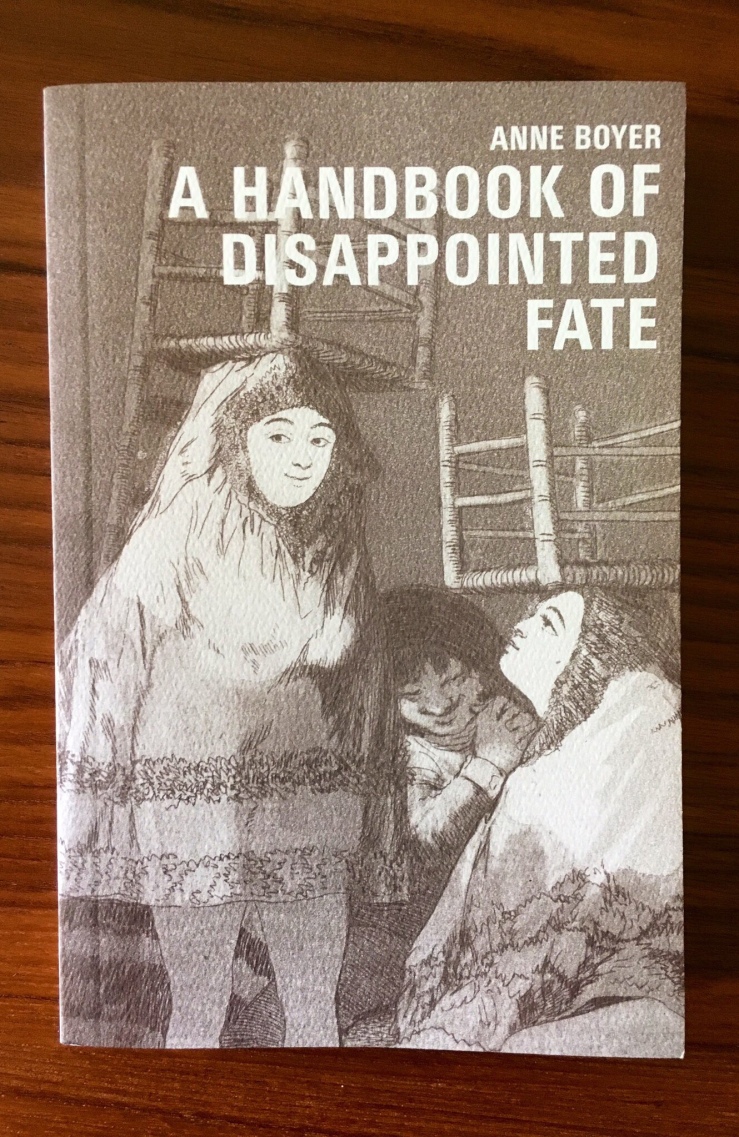
I’ve also been reading Anne Boyer’s A Handbook of Disappointed Fate, a discursive collection of essays, lists, little anti-poems, etc. More thoughts to come, but I really dig the feeling of reading it.

Finally, I picked up Leslie Fiedler’s 1964 book of criticism Waiting for the End this Friday. Fiedler begins with the (then-recent) deaths of Hemingway and Faulkner. Fiedler uses the deaths of these “old men” to riff on the end of Modernism, although he never evokes the term. Neither does he use the term “postmodernism” in his book, although he edges towards it in his critiques of kitsch and middlebrow culture, and especially in his essay “The End of the Novel.” In parts of the book, he gets close to describing, or nearing a description of, an emergent postmodernist literature (John Barth and John Hawkes are favorite examples for Fiedler), but ultimately seems more resigned to writing an elegy for the avant garde. Other aspects of Waiting for the End, while well-intentioned, might strike contemporary ears as problematic, as the kids say, but Fiedler’s sharp and loose style are welcome over stodgy scholarship. Ultimately, I find the book compelling because of its middle position in its take on American literature. It’s the work of a critic seeing the beginnings of something that hasn’t quite emerged yet—but his eye is trained more closely on what’s disappearing into the past.

Anne Boyer’s A Handbook of Disappointed Fate (Book acquired, 8 April 2019)

img_2617

A tremendous thank you to to BLCKDGRD for sending me a copy of Anne Boyer’s strange discursive book of essays-poems-critiques-I-do-not-know-whats A Handbook of Disappointed Fates. It showed up in the mail unexpectedly, and I figured it might be from him (he posted excerpts last week). I’m really digging the book so far, although I haven’t been reading it in a straight line. I did start at the beginning though, which starts like this:

img_2624

(Bartleby prefers not to arrive in this essay on “No,” but it is nevertheless rather rich in its refusals).

Thanks to my friend again.

Blog about giving books away and buying books for a friend and acquiring some books for myself

img_2588

This morning my dean told me that I needed to pack up my office over the summer as the building I’m in will be undergoing a renovation. Even though I knew this was coming, the prospect hit me as a series of big anxiety waves. My walls are covered with masks, art, pictures. I have file drawers of student work going back over a decade. And books. Lots and lots of books. Books and art and stuff that I don’t really have room for anywhere else, even for a season.

Three shelves in my office are doublestacked with old mass market paperbacks from my youth—-Vonnegut, Edgar Rice Burroughs, Hemingway, Jack London, Philip K. Dick, Richard Adams, Stephen Crane, etc. Shabby books, well worn, glue splitting. Over the years I’ve acquired nicer versions of the ones I want to reread, but my sentimental attachment to this small library of paperbacks doesn’t quite fade. When I taught high school, they were the bulk of my classroom library. I insisted on their return, and was always disappointed in students who seemed interested in certain novels but never quite managed to steal them. I was always thrilled when a student would ask to borrow one “over the summer” and then forget to return it.

This sorry shabby mass-market library has been depleted over my past decade teaching community college. Every semester, a few students ask if they can borrow something they see on the shelves when they stop by to chat. It is the most wonderful feeling to give a young person a copy of Brave New World (“I’ve heard it’s good”) or Cat’s Cradle (“Is it as good as Slaughterhouse Five?”) of Studies in Classic American Literature and then insist that they keep it and not worry about returning it.

This morning, a young man approached me after class and told me he’d noticed I had a copy of Do Androids Dream Electric Sheep? in my office—could he maybe borrow it? He made a point of calling it Do Androids Dream Electric Sheep? and not Blade Runner, despite the fact that it’s a movie tie-in. He seemed so happy when I repeated that the book was his now.

Earlier that morning I gave another student my copy of Howard Zinn’s A People’s History of the United States. He’s taken a couple of classes with me, and based on our conversations and his writing, I thought he could us the book more than I could. Again—young kid so happy to get a book, to think that someone thought he should read a particular book—I recall the feeling so vividly, from the other side. I love watching the old library dwindle away. Maybe I can give away more before I have to pack it up again.

img_2578

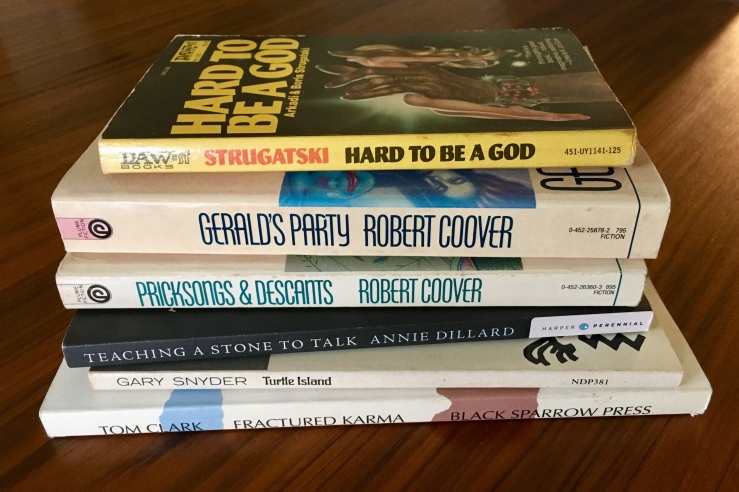
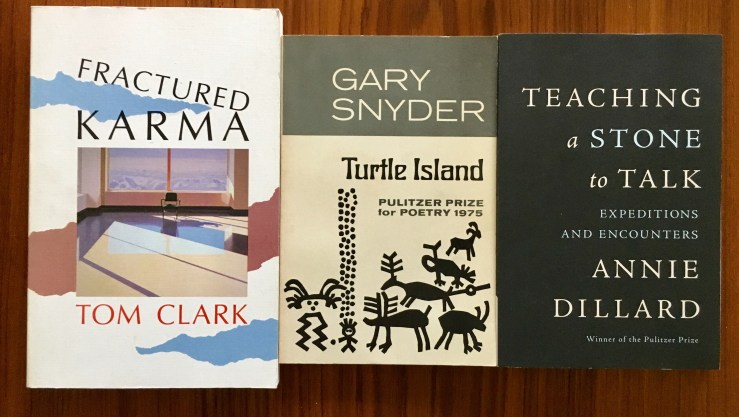
After classes and office hours I swung by my beloved bookstore. I do this a lot on Fridays, in the spare hour that I have between work and picking up kids. I had a little mission this time—buying some books for a great old friend who turns forty this weekend. He loves hiking and camping and poetry—more than I love those things, I think—so I asked twitter to throw out some recommendations, which they did. I had fun browsing the “Nature” section. I ended up getting three: Tom Clark’s Fractured Karma (a favorite of mine), Gary Snyder’s Turtle Island (I had never heard of it until today), and Annie Dillard’s Teaching a Stone to Walk (I dug a few of the short essays I read in the store). I enjoyed buying books for my friend. I am almost 100% he never reads this blog so I’m sure my posting this will not spoil his present, and, if not, Happy Birthday.

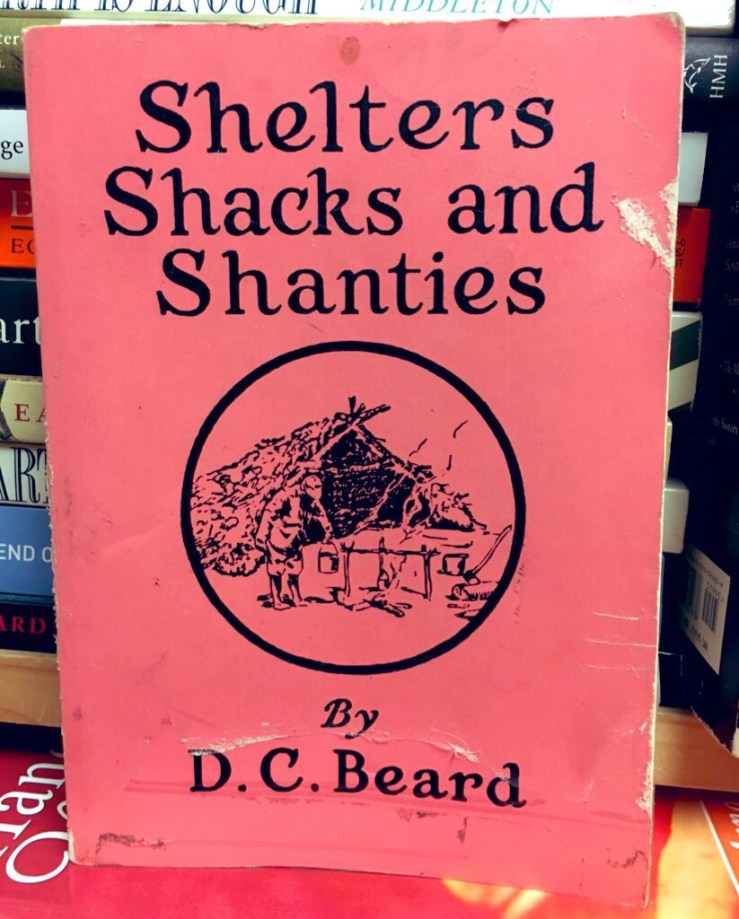
While browsing the “Nature” section, I resisted Shelters Shacks and Shanties—for now. Apologies to D.C. Beard, whose hut diagrams are exquisite:

img_2575

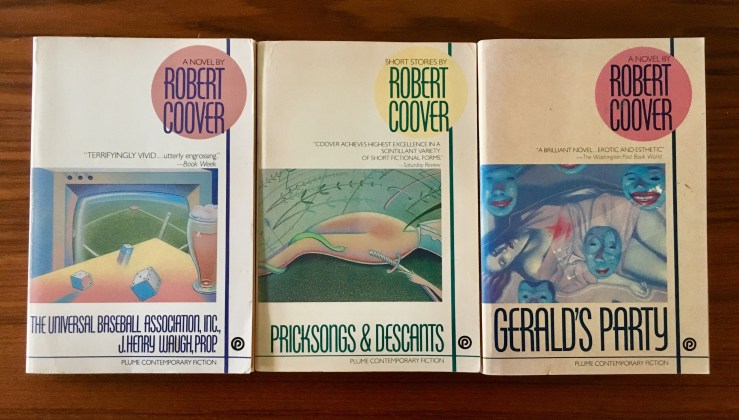
I of course selfishly picked up books for myself, although I didn’t browse for myself. I keep a silly geeky list of names to check in on, including Robert Coover. Even though I’m slogging my way through his first novel, The Origin of the Brunists, I still have a desire to read its sequel, The Brunist Day of Wrath. No wrath, but I picked up Plume editions of Pricksongs & Descants (which I’ve read but didn’t own) and Gerald’s Party (which I haven’t read and now own). The editions match the copy of  The Universal Baseball AssociationInc., J. Henry Waugh, Prop. I picked last summer (and no I have not read goddamn it).

img_2589

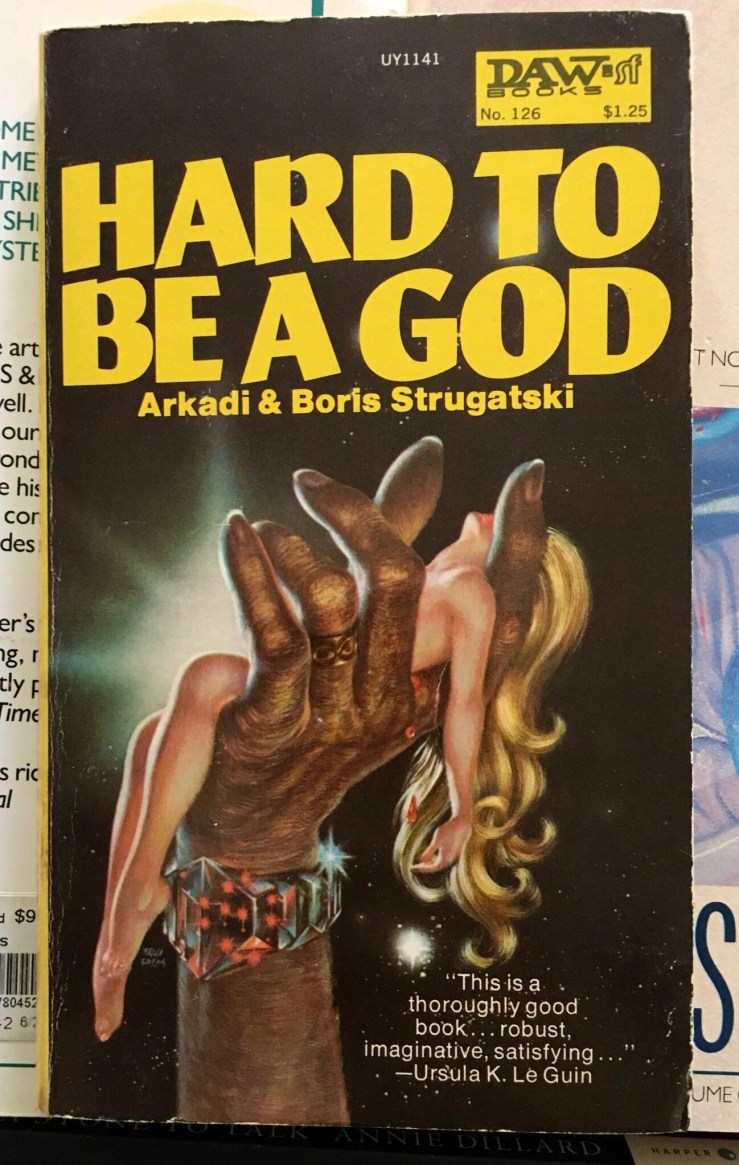
I was also thrilled to pick up a 1974 Daw Paper edition of Wendayne Ackerman’s translation of Arkadi and Boris Strugatsky’s Hard to Be a God. I read Olena Bormashenko’s translation as an e-book a few years ago, after seeing Aleksei German’s film adaptation. (I loved Bormashenko’s translation of Snail on the Slope, by the way).

img_2577

This copy of Hard to Be a God, blurbed by Ursula K. Le Guin, will end up in a stack on my shelf of massmarket paperbacks, cheap pulp editions with colorful, zany, vibrant covers. Lovely unroughed, somehow pristine copies of Philip K. Dick and Stanislaw Lem and Ishmael Reed and Ursual K. Le Guin and J.G. Ballard and etcetera that’s been building up over the years, a private collection—but another library I’m sure I’ll eventually end up giving away.

Weissmann’s Tarot | Gravity’s Rainbow

img_4289-1

WEISSMANN’S TAROT

Weissmann’s Tarot is better than Slothrop’s. Here are the real cards, exactly as they came up.

Significator: Knight of Swords

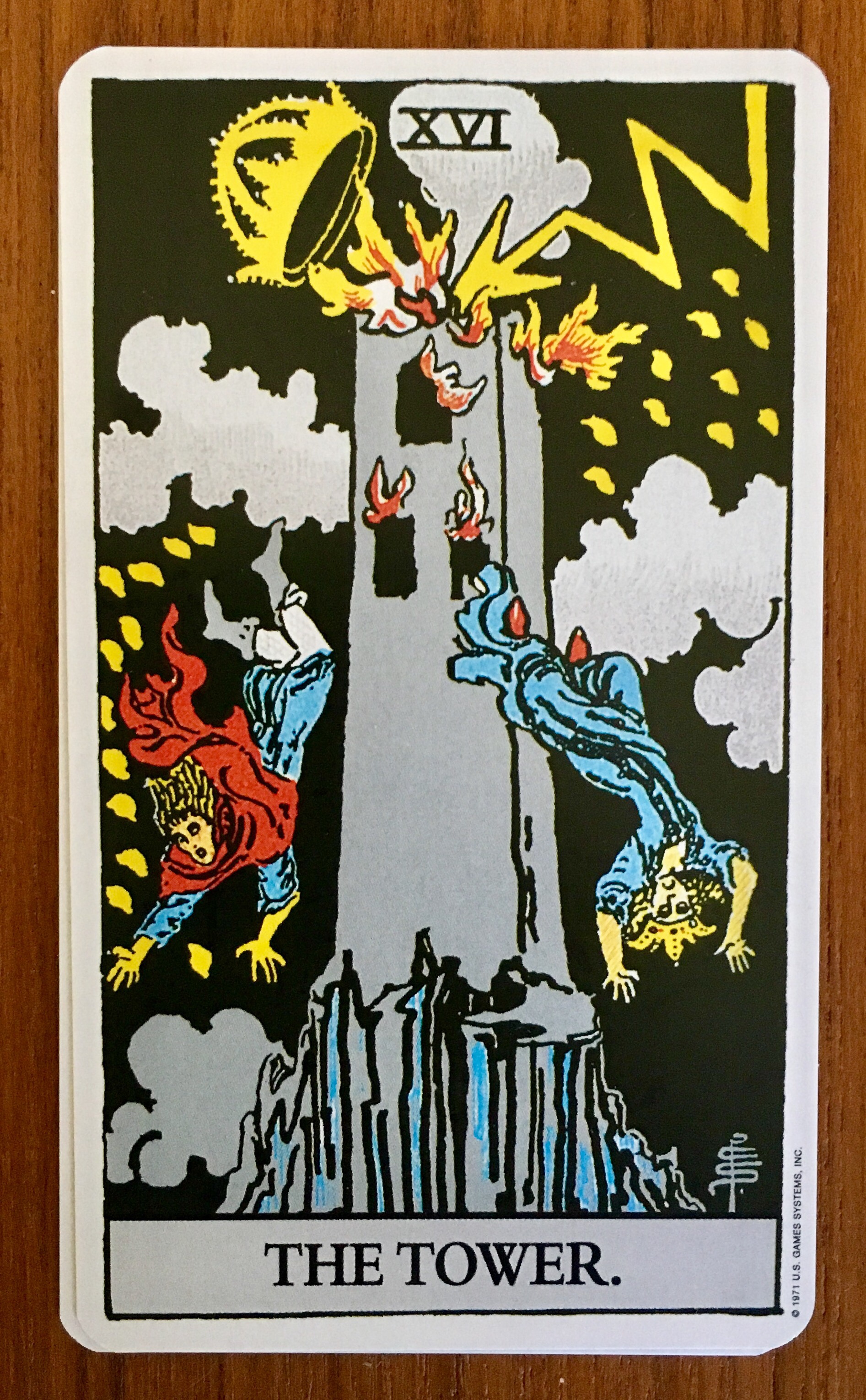
Covered by: The Tower

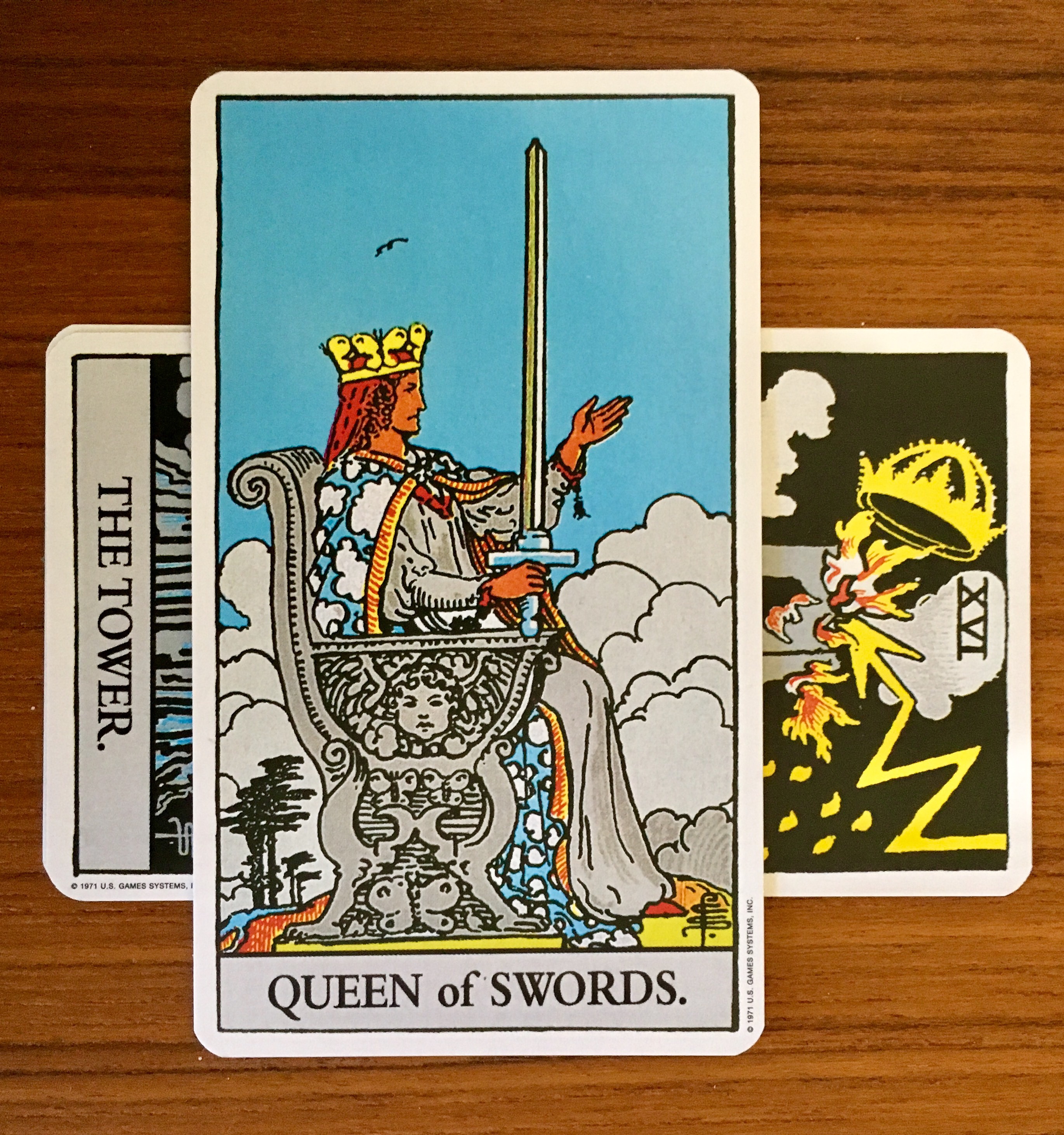
Crossed by: Queen of Swords

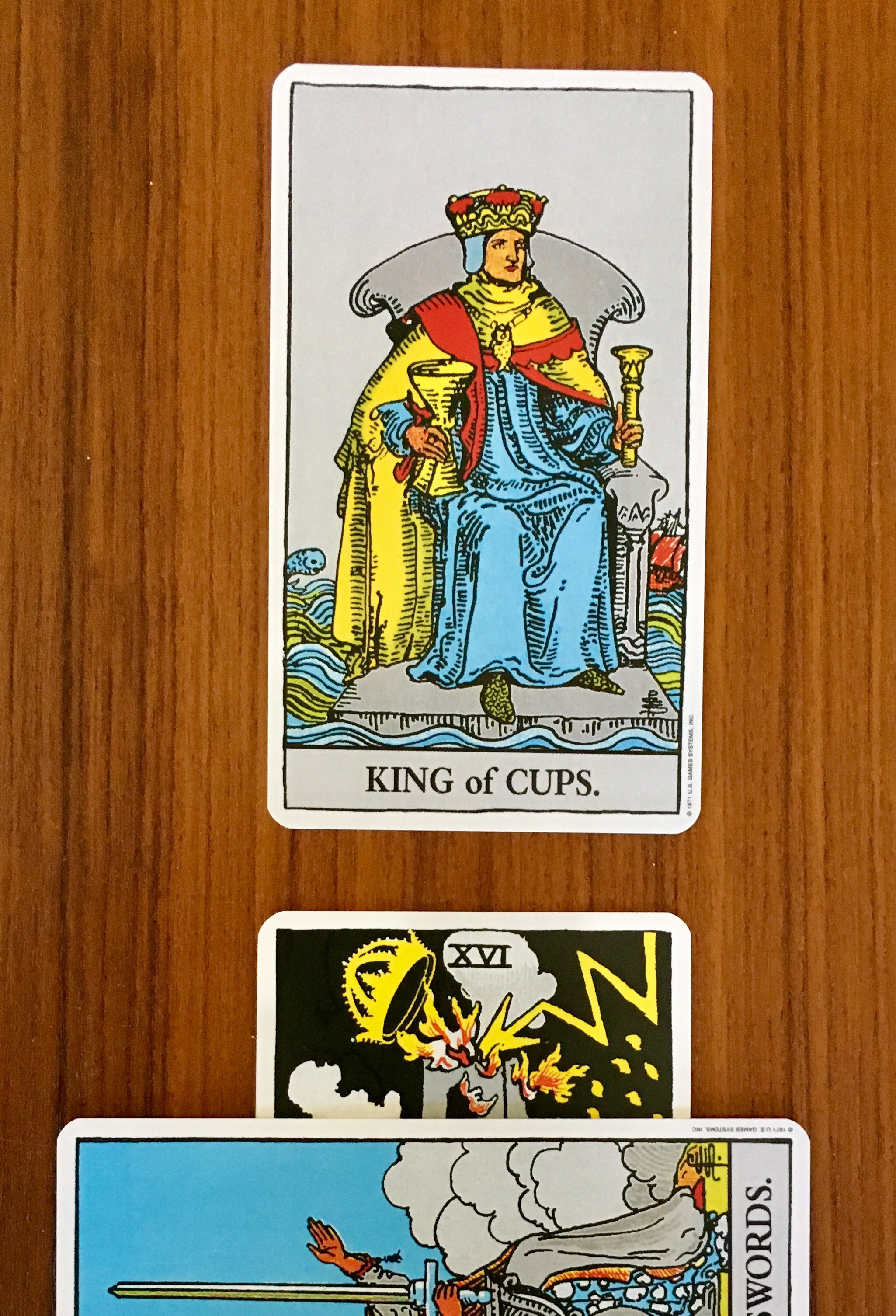
Crowning: King of Cups

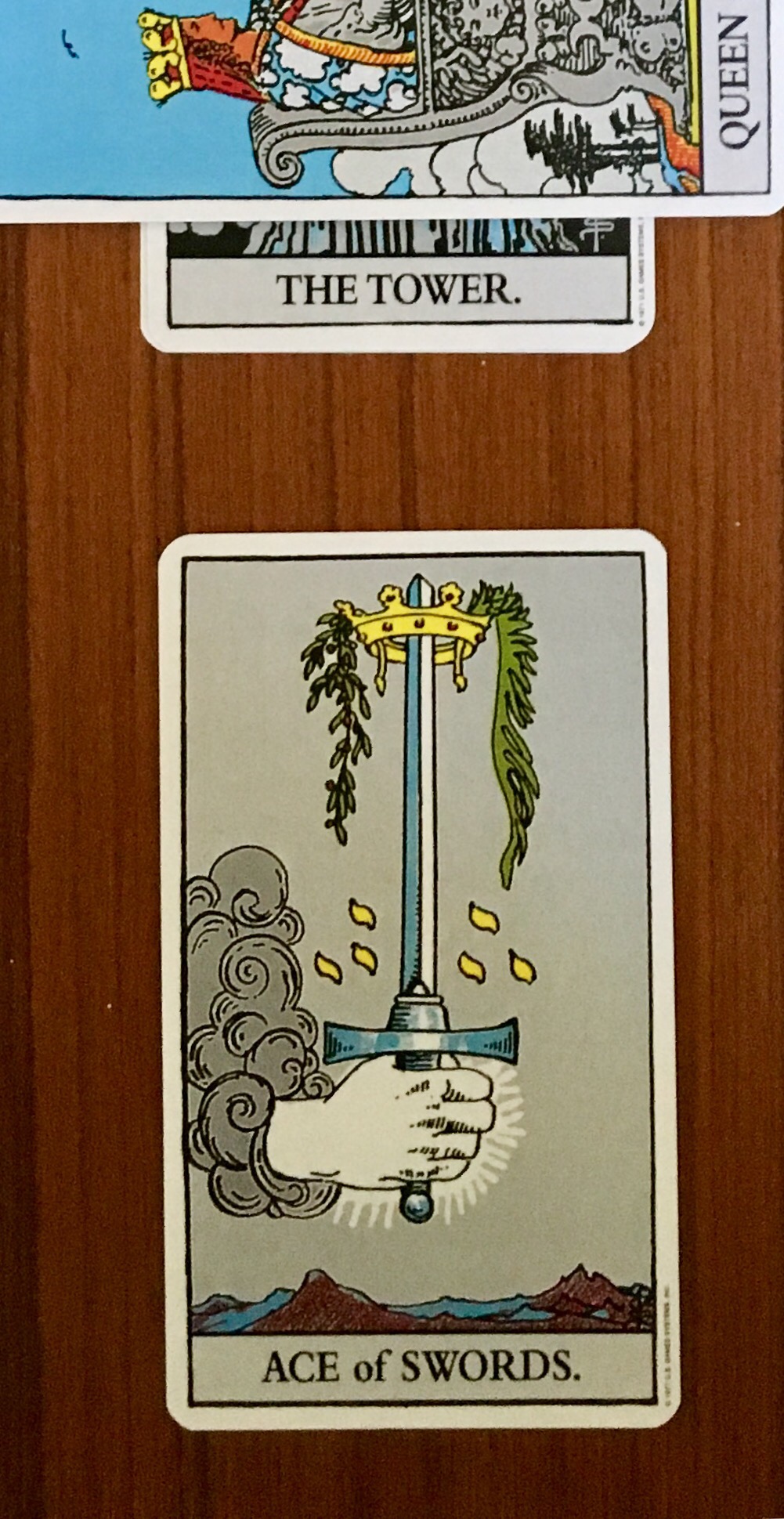
Beneath: Ace of Swords

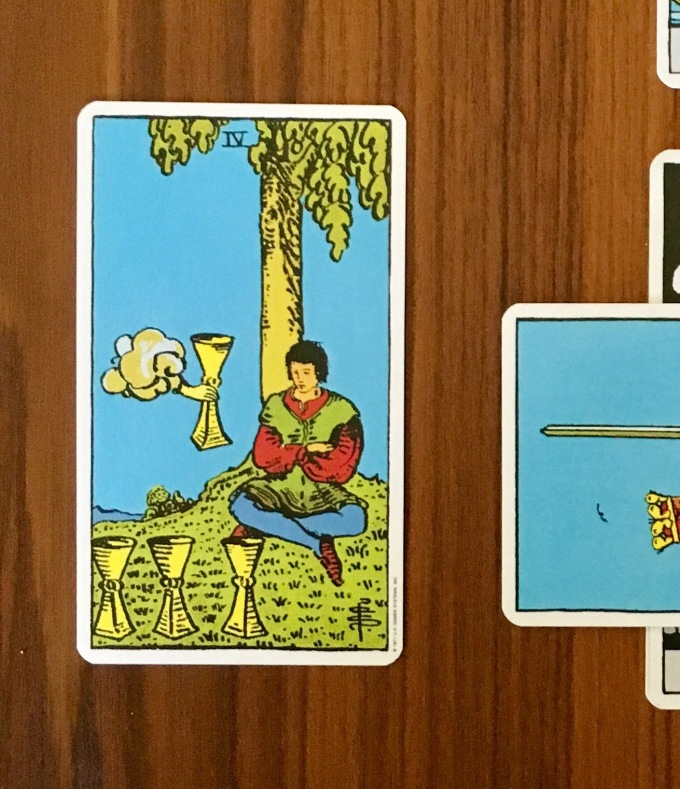
Before: 4 of Cups

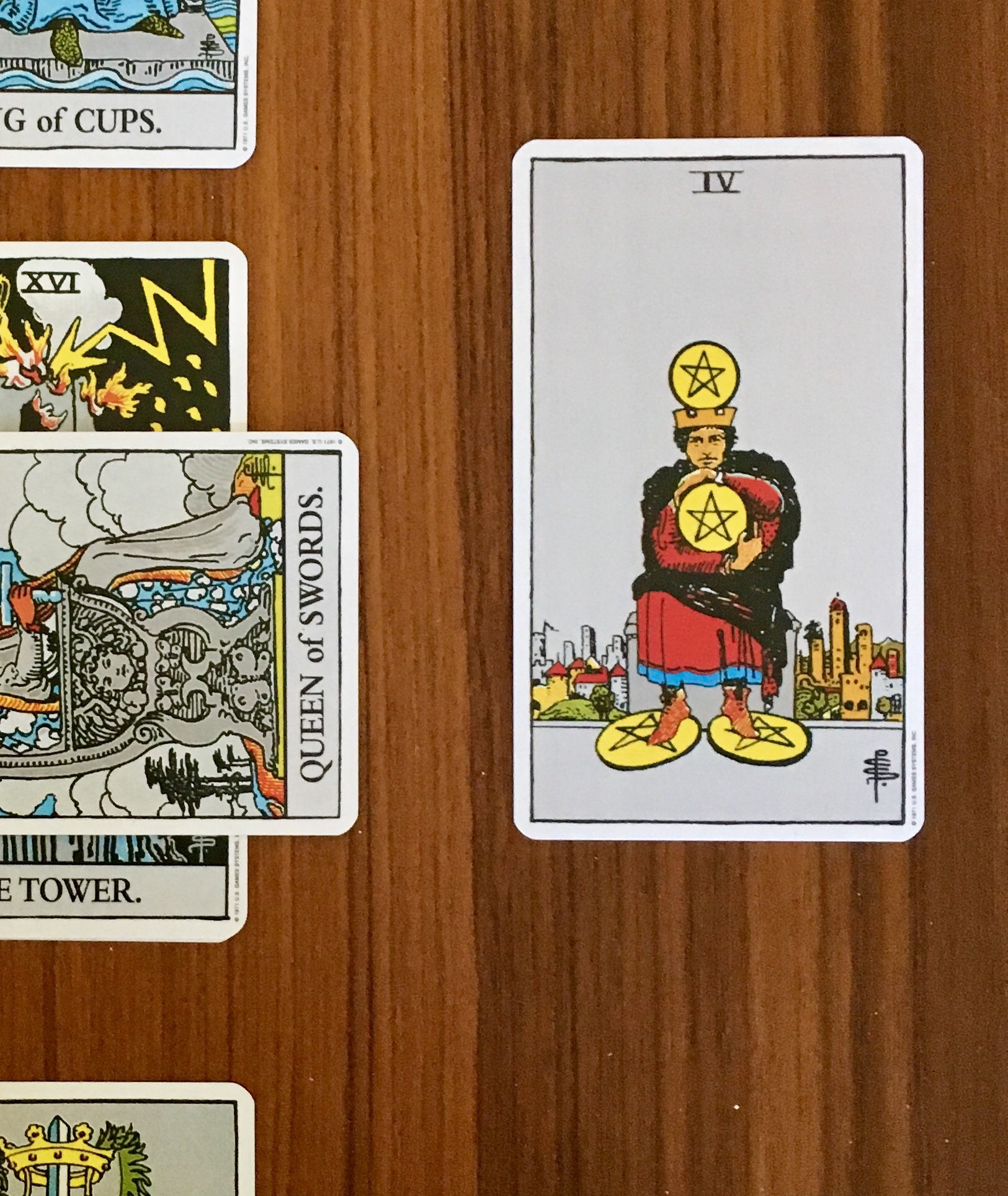
Behind: 4 of Pentacles

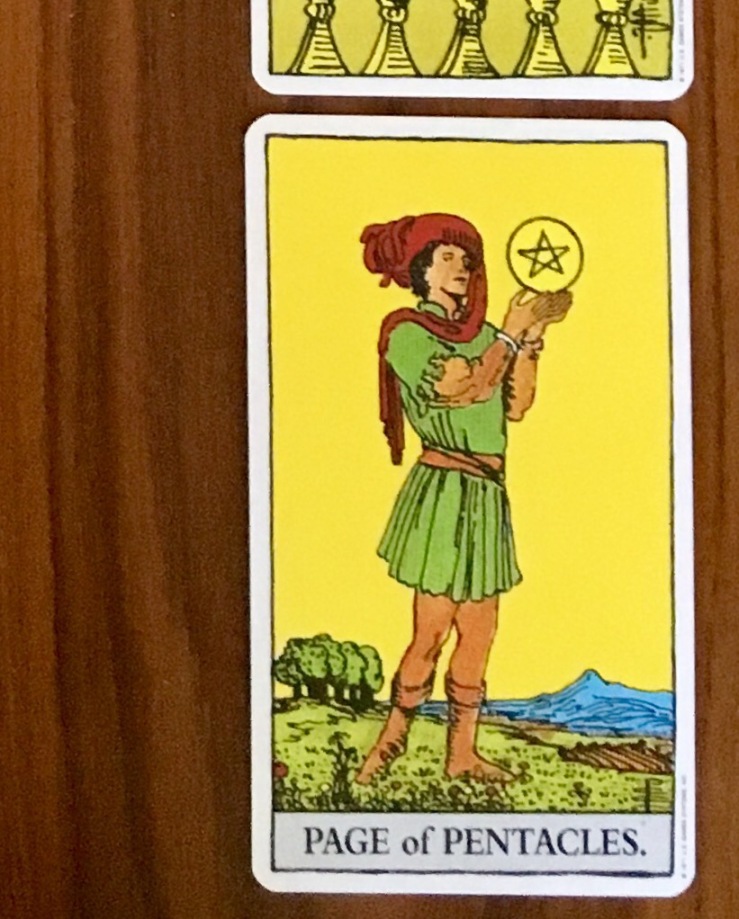
Self: Page of Pentacles

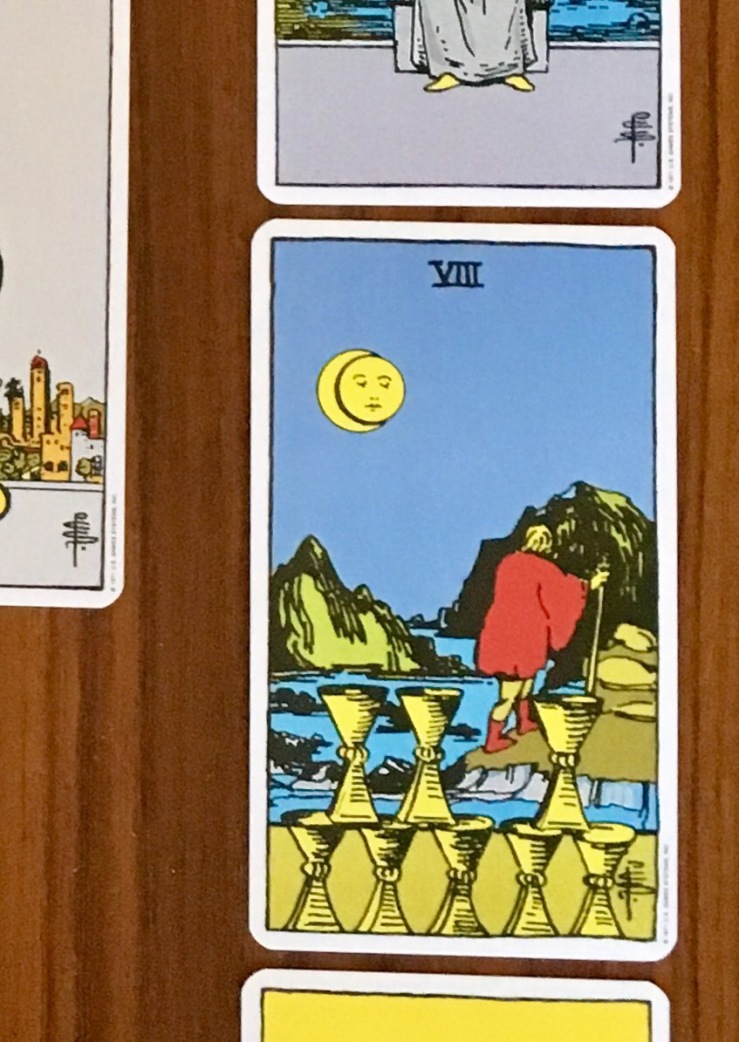
House: 8 of Cups

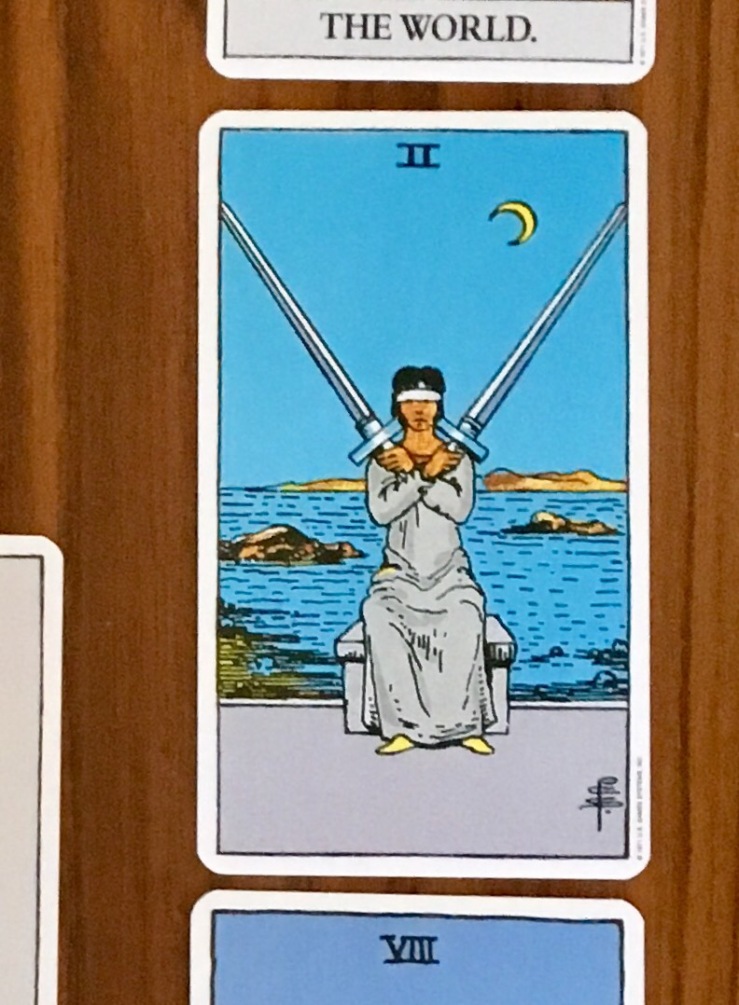
Hopes and Fears: 2 of Swords

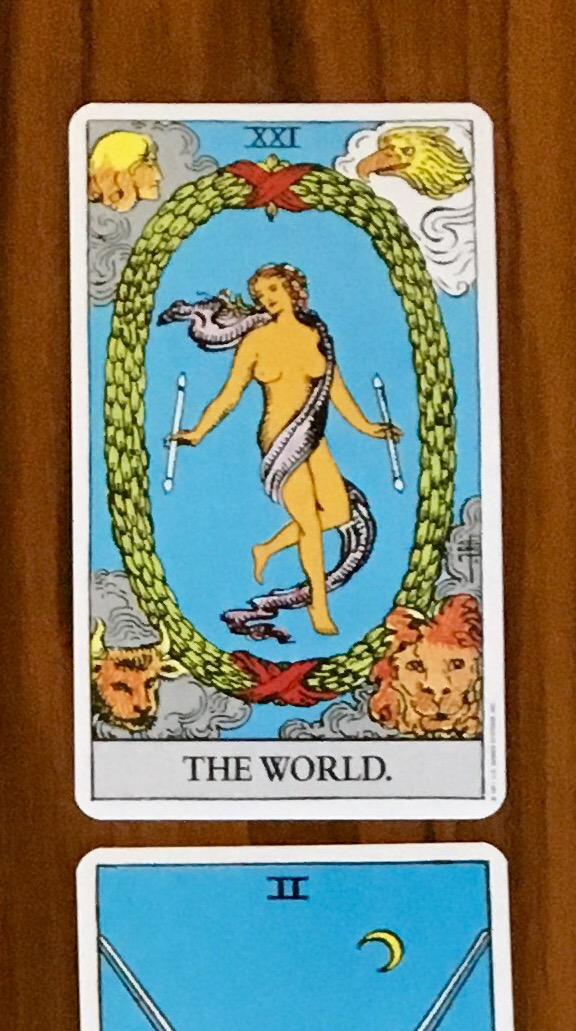
What will come: The World

From page 746 of Gravity’s Rainbow. 

img_4301
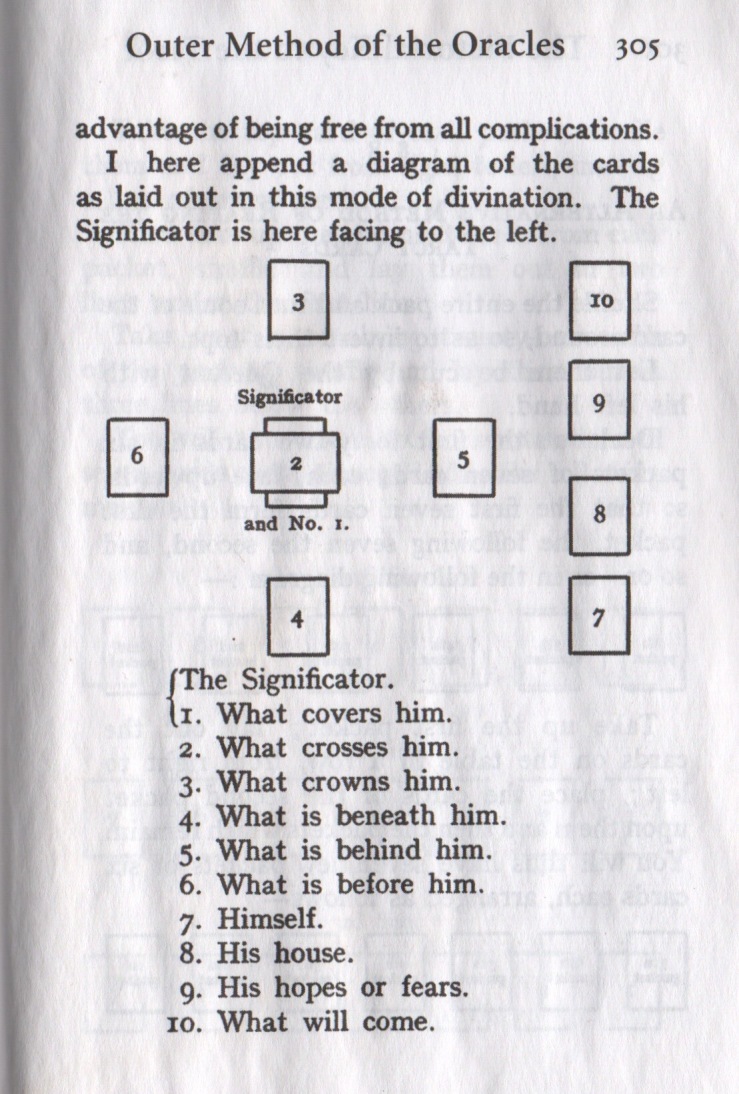
A diagram of the Celtic cross spread that Pynchon uses for Blicero’s tarot. From A.E. Waite’s The Pictorial Key to the Tarot (1910). The tarot cards I’ve used in this post were illustrated by Pamela Colan Smith.

img_4292

He appears first with boots and insignia shining as the rider on a black horse, charging in a gallop neither he nor horse can control, across the heath over the giant grave-mounds, scattering the black-faced sheep, while dark stands of juniper move dreamily, death-loving, across his path in a parallax of unhurrying fatality, presiding as monuments do over the green and tan departure of summer, the dust-colored lowlands and at last the field-gray sea, a prairie of sea darkening to purple where the sunlight comes through, in great circles, spotlights on a dancing-floor.

He is the father you will never quite manage to kill. The Oedipal situation in the Zone these days is terrible. There is no dignity. The mothers have been masculinized to old worn moneybags of no sexual interest to anyone, and yet here are their sons, still trapped inside inertias of lust that are 40 years out of date. The fathers have no power today and never did, but because 40 years ago we could not kill them, we are condemned now to the same passivity, the same masochist fantasies they cherished in secret, and worse, we are condemned in our weakness to impersonate men of power our own infant children must hate, and wish to usurp the place of, and fail… . So generation after generation of men in love with pain and passivity serve out their time in the Zone, silent, redolent of faded sperm, terrified of dying, desperately addicted to the comforts others sell them, however useless, ugly or shallow, willing to have life defined for them by men whose only talent is for death.

img_4293

Of 77 cards that could have come up, Weissmann is “covered,” that is his present condition is set forth, by The Tower. It is a puzzling card, and everybody has a different story on it. It shows a bolt of lightning striking a tall phallic structure, and two figures, one wearing a crown, falling from it. Some read ejaculation, and leave it at that. Others see a Gnostic or Cathar symbol for the Church of Rome, and this is generalized to mean any System which cannot tolerate heresy: a system which, by its nature, must sooner or later fall. We know by now that it is also the Rocket.

Members of the Order of the Golden Dawn believe The Tower represents victory over splendor, and avenging force. As Goebbels, beyond all his professional verbalizing, believed in the Rocket as an avenger.

On the Kabbalist Tree of Life, the path of The Tower connects the sephira Netzach, victory, with Hod, glory or splendor. Hence the Golden Dawn interpretation. Netzach is fiery and emotional, Hod is watery and logical. On the body of God, these two Sephiroth are the thighs, the pillars of the Temple, resolving together in Yesod, the sex and excretory organs.

But each of the Sephiroth is also haunted by its proper demons or Qlippoth. Netzach by the Ghorab Tzerek, the Ravens of Death, and Hod by the Samael, the Poison of God. No one has asked the demons at either level, but there may be just the wee vulnerability here to a sensation of falling, the kind of very steep and out-of-scale fall we find in dreams, a falling more through space than among objects. Though the different Qlippoth can only work each his own sort of evil, activity on the path of The Tower, from Netzach to Hod, seems to’ve resulted in the emergence of a new kind of demon (what, a dialectical Tarot? Yes indeedyfoax! A-and if you don’t think there are Marxist-Leninist magicians around, well you better think again!). The Ravens of Death have now tasted of the Poison of God… but in doses small enough not to sicken but to bring on, like the Amanita muscaria, a very peculiar state of mind… . They have no official name, but they are the Rocket’s guardian demons.

img_4294

Weissmann is crossed by the Queen of his suit. Perhaps himself, in drag. She is the chief obstacle in his way.

img_4296

At his foundation is the single sword flaming inside the crown: again, Netzach, victory. In the American deck this card has come down to us as the ace of spades, which is a bit more sinister: you know the silence that falls on the room when it comes up, whatever the game.

img_4298

Behind him, moving out of his life as an influence, is the 4 or Four of Pentacles, which shows a figure of modest property desperately clutching on to what he owns, four gold coins—this feeb is holding two of them down with his feet, balancing another on his head and holding the fourth tightly against his stomach, which is ulcerous. It is the stationary witch trying to hold her candy house against the host of nibblers out there in the dark.

img_4299

Moving in, before him, comes a feast of cups, a satiety. Lotta booze and broads for Weissmann coming soon.

img_4300-4

Good for him—although in his house he is seen walking away, renouncing eight stacked gold chalices. Perhaps he is to be given only what he must walk away from.

img_4300-2

Perhaps it is because in the lees of the night’s last cup is the bitter presence of a woman sitting by a rocky shore, the Two of Swords, alone at the Baltic edge, blindfolded in the moonlight, holding the two blades crossed upon her breasts… the meaning is usually taken as “concord in a state of arms,” a good enough description of the Zone nowadays, and it describes his deepest hopes, or fears.

img_4300-3

Himself, as the World sees him: the scholarly young Page of Pentacles, meditating on his magic gold talisman. The Page may also be used to stand for a young girl. But Pentacles describe people of very dark complexion, and so the card almost certainly is Enzian as a young man. And Weissmann may at last, in this limited pasteboard way, have become what he first loved.

img_4295-1

The King of Cups, crowning his hopes, is the fair intellectual-king.

If you’re wondering where he’s gone, look among the successful academics, the Presidential advisers, the token intellectuals who sit on boards of directors. He is almost certainly there. Look high, not low.

img_4289

His future card, the card of what will come, is The World.

img_4289-1

The language in this post is from pages 746-49 of Thomas Pynchon’s novel Gravity’s Rainbow. Elements of this post found their way into some annotations I made a few years ago on page 539 of Gravity’s Rainbow.