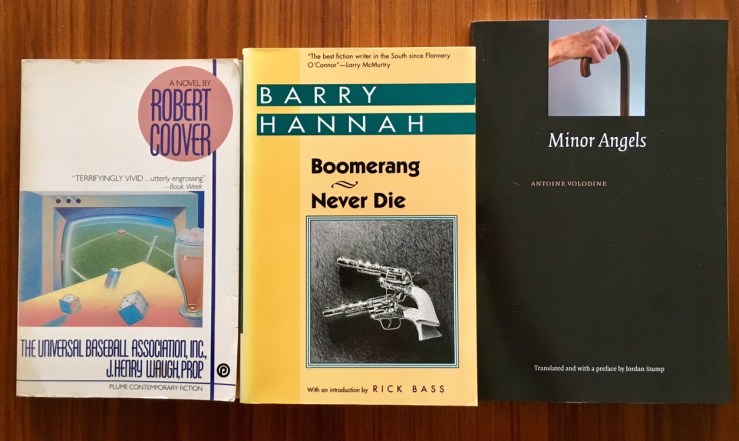
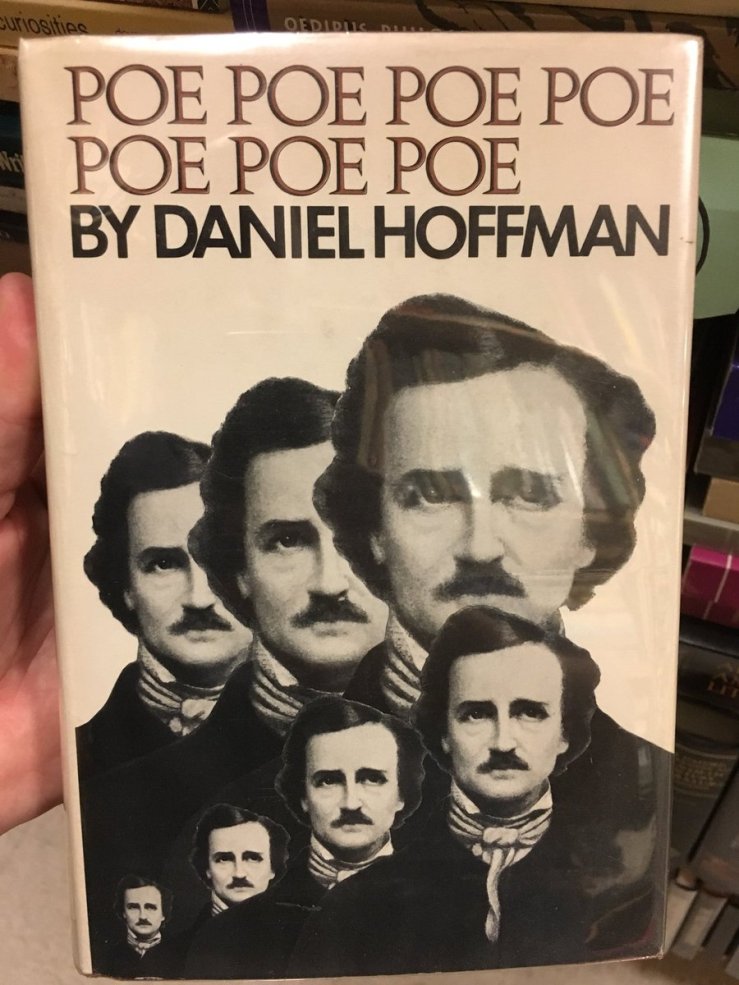
I had ordered Antoine Volodine’s Minor Angels through my favorite bookstore, and it came in yesterday. It’s slim but expensive (ah! university presses!) and ate up all of my store credit, but still I picked up used copies of Robert Coover’s second novel The Universal Baseball Association, Inc., J. Henry Waugh, Prop. and Barry Hannah’s Boomerang b/w Never Die (some of the only Hannah I’ve yet to read). I was tempted also by the title and cover of Daniel Hoffman’s 1971 Poe Poe Poe Poe Poe Poe Poe—but I was not tempted enough to acquire it.
An eminent philosopher among my friends, who can dignify even your ugly furniture by lifting it into the serene light of science, has shown me this pregnant little fact. Your pier-glass or extensive surface of polished steel made to be rubbed by a housemaid, will be minutely and multitudinously scratched in all directions; but place now against it a lighted candle as a centre of illumination, and lo! the scratches will seem to arrange themselves in a fine series of concentric circles round that little sun. It is demonstrable that the scratches are going everywhere impartially and it is only your candle which produces the flattering illusion of a concentric arrangement, its light falling with an exclusive optical selection. These things are a parable. The scratches are events, and the candle is the egoism of any person now absent…
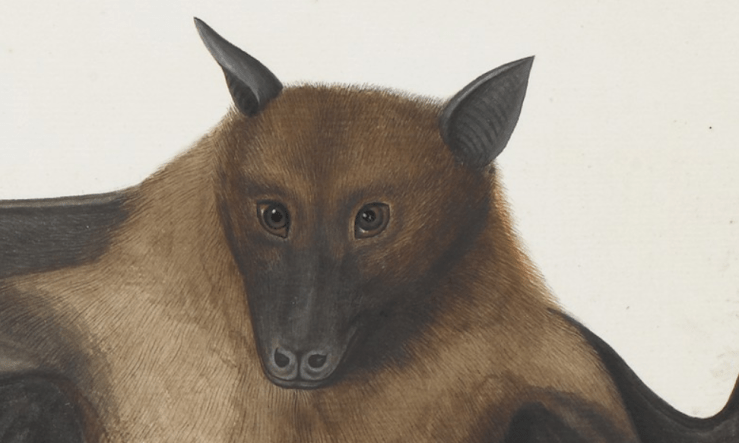
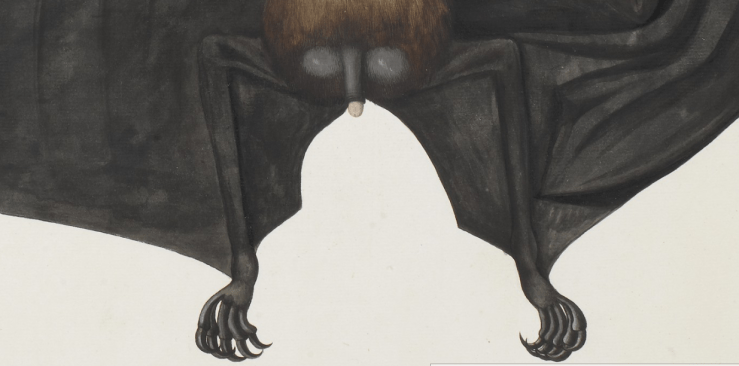
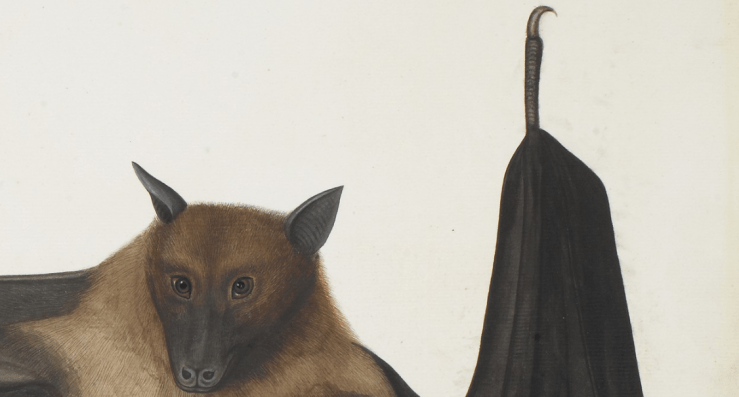
These are links to some of the longer pieces I’ve written so far this year. The painting of the great Indian fruit bat (c. 1777-1782) is attributed to Bhawani Das or one of his followers.
From D.H. Lawrence’s chapter on Whitman in Studies in Classic American Literature (more):
POST-MORTEM effects?
But what of Walt Whitman?
The ‘good grey poet’.
Was he a ghost, with all his physicality?
The good grey poet.
Post-mortem effects. Ghosts.
A certain ghoulish insistency. A certain horrible pottage of human parts. A certain stridency and portentousness. A luridness about his beatitudes.
DEMOCRACY! THESE STATES! EIDOLONS! LOVERS, ENDLESS LOVERS!
ONE IDENTITY!
ONE IDENTITY!
I AM HE THAT ACHES WITH AMOROUS LOVE.
Do you believe me, when I say post-mortem effects ?
When the Pequod went down, she left many a rank and dirty steamboat still fussing in the seas. The Pequod sinks with all her souls, but their bodies rise again to man innumerable tramp steamers, and ocean-crossing liners. Corpses.
What we mean is that people may go on, keep on, and rush on, without souls. They have their ego and their will, that is enough to keep them going.
So that you see, the sinking of the Pequod was only a metaphysical tragedy after all. The world goes on just the same. The ship of the soul is sunk. But the machine-manipulating body works just the same: digests, chews gum, admires Botticelli and aches with amorous love.
I AM HE THAT ACHES WITH AMOROUS LOVE.
What do you make of that? I AM HE THAT ACHES. First generalization. First uncomfortable universalization. WITH AMOROUS LOVE! Oh, God! Better a bellyache. A bellyache is at least specific. But the ACHE OF AMOROUS LOVE!
Think of having that under your skin. All that!
I AM HE THAT ACHES WITH AMOROUS LOVE.
Walter, leave off. You are not HE. You are just a limited Walter. And your ache doesn’t include all Amorous Love, by any means. If you ache you only ache with a small bit of amorous love, and there’s so much more stays outside the cover of your ache, that you might be a bit milder about it.
I AM HE THAT ACHES WITH AMOROUS LOVE.
CHUFF! CHUFF! CHUFF!
CHU-CHU-CHU-CHU-CHUFF!
Reminds one of a steam-engine. A locomotive. They’re the only things that seem to me to ache with amorous love. All that steam inside them. Forty million foot-pounds pressure. The ache of AMOROUS LOVE. Steam-pressure. CHUFF!
An ordinary man aches with love for Belinda, or his Native Land, or the Ocean, or the Stars, or the Oversoul: if he feels that an ache is in the fashion.
It takes a steam-engine to ache with AMOROUS LOVE. All of it.
Walt was really too superhuman. The danger of the superman is that he is mechanical.
Zora Neale Hurston’s 1931 book Barracoon: The Story of the Last “Black Cargo” has finally been published. The book is based on Hurston’s 1927 interviews with Cudjo Lewis, the last known survivor of the transatlantic slave trade. Barracoon went previously unpublished due in part to Hurston’s refusal to revise the prose into a “standard” English. Hurston wrote Barracoon in a phonetic approximation of Cudjo’s voice. While this vernacular style may pose (initial) challenges for many readers, it is the very soul of the book in that it transmits Cudjo’s story in his own voice, tone, and rhythm. Hurston used vernacular diction throughout her work, but Cudjo’s voice is singular; it bears a distinctly different sound than the characters of Their Eyes Were Watching God, Hurston’s most famous novel. It is hard to conceive a more compelling version of Barracoon than this one, the one Hurston refused to compromise, with its intense, vital orality.
What is Barracoon about? I shall liberally borrow my summary from the book’s introduction, penned by Hurston scholar and biographer Deborah G. Plant:
On December 14, 1927, Zora Neale Hurston took the 3:40 p.m. train from Penn Station, New York, to Mobile, to conduct a series of interviews with the last known surviving African of the last American slaver—the Clotilda. His name was Kossola, but he was called Cudjo Lewis. He was held as a slave for five and a half years in Plateau-Magazine Point, Alabama, from 1860 until Union soldiers told him he was free. Kossola lived out the rest of his life in Africatown (Plateau). Hurston’s trip south was a continuation of the field trip expedition she had initiated the previous year.
Oluale Kossola had survived capture at the hands of Dahomian warriors, the barracoons at Whydah (Ouidah), and the Middle Passage. He had been enslaved, he had lived through the Civil War and the largely un-Reconstructed South, and he had endured the rule of Jim Crow. He had experienced the dawn of a new millennium that included World War I and the Great Depression. Within the magnitude of world events swirled the momentous events of Kossola’s own personal world.
Zora Neale Hurston, as a cultural anthropologist, ethnographer, and folklorist, was eager to inquire into his experiences. “I want to know who you are,” she approached Kossola, “and how you came to be a slave; and to what part of Africa do you belong, and how you fared as a slave, and how you have managed as a free man?” Kossola absorbed her every question, then raised a tearful countenance. “Thankee Jesus! Somebody come ast about Cudjo! I want tellee somebody who I is, so maybe dey go in de Afficky soil some day and callee my name and somebody say, ‘Yeah, I know Kossula.’”
Those final sentences should give you a quick taste of Barracoon’s central rhetorical conceit. After her own introductory chapter (which details the historical circumstances of the Clotilda’s illegal journey to West Africa), Hurston lets Cudjo inspirit the text, telling his own story in his own voice. Hurston, who spent three months with Cudjo, initially interposes herself in the story, as we see early in the book’s first chapter:
“My grandpa, he a great man. I tellee you how he go.”
I was afraid that Cudjo might go off on a tangent, so I cut in with, “But Kossula, I want to hear about you and how you lived in Africa.”
He gave me a look full of scornful pity and asked, “Where is de house where de mouse is de leader? In de Affica soil I cain tellee you ’bout de son before I tellee you ’bout de father; and derefore, you unnerstand me, I cain talk about de man who is father (et te) till I tellee you bout de man who he father to him, (et, te, te, grandfather) now, dass right ain’ it?
This brief “cutting in” is one of the last moments in the narrative that Hurston attempts to steer Cudjo in a particular direction. Instead, she befriends the old man, bringing him watermelons, hams, peaches, and other treats. These little gifts serve to frame Cudjo’s narrative as he moves from one episode to the next. Otherwise, Hurston disappears into the background, an ear for Cudjo’s voice, a witness for his story.
Cudjo’s story is astounding. He describes life in his own West African village and the terrible slaughter of his people at the hands of “de people of Dahomey,” a tribe that eventually sells Cudjo and the other young people of his village to white men. Cudjo describes his early enslavement in Alabama, which took place in secret until the Civil War, and his eventual freedom from bondage. He tells Hurston about the founding of Africatown, a community of West Africans. He describes his life after capture and slavery—his marriage, his children, his near-fatal railroad accident. Cudjo’s life and his children’s lives were incredibly difficult. They were always othered:
“All de time de chillun growin’ de American folks dey picks at dem and tell de Afficky people dey kill folks and eatee de meat. Dey callee my chillun ig’nant savage and make out dey kin to monkey.
“Derefo’, you unnerstand me, my boys dey fight. Dey got to fight all de time. Me and dey mama doan lak to hear our chillun call savage. It hurtee dey feelings. Derefo’ dey fight. Dey fight hard. When dey whip de other boys, dey folks come to our house and tellee us, ‘Yo’ boys mighty bad, Cudjo. We ’fraid they goin’ kill somebody.”
Somehow most devastating in a narrative full of devastation are the deaths of Cudjo’s children. After his daughter dies in infancy, his namesake is killed by a sheriff, a scene that resonates with terrible pain in 2018:
Nine year we hurtee inside ’bout our baby. Den we git hurtee again. Somebody call hisself a deputy sheriff kill de baby boy now.
He say he de law, but he doan come ’rest him. If my boy done something wrong, it his place come ’rest him lak a man. If he mad wid my Cudjo ’bout something den he oughter come fight him face to face lak a man. He doan come ’rest him lak no sheriff and he doan come fight him lak no man.
Another of his sons is decapitated in a railroad accident. A third son, angry with the injustice of the world, simply disappears: “My boy gone. He ain’ in de house and he ain’ on de hill wid his mama. We both missee him. I doan know. Maybe dey kill my boy. It a hidden mystery.”
Cudjo, ever the survivor, went on to outlive his wife and all of his children. In her foreword to Barracoon, Alice Walker captures the pain and pathos of this remarkable position:
And then, the story of Cudjo Lewis’s life after Emancipation. His happiness with “freedom,” helping to create a community, a church, building his own house. His tender love for his wife, Seely, and their children. The horrible deaths that follow. We see a man so lonely for Africa, so lonely for his family, we are struck with the realization that he is naming something we ourselves work hard to avoid: how lonely we are too in this still foreign land: lonely for our true culture, our people, our singular connection to a specific understanding of the Universe. And that what we long for, as in Cudjo Lewis’s case, is gone forever. But we see something else: the nobility of a soul that has suffered to the point almost of erasure, and still it struggles to be whole, present, giving.
I cannot improve on Walker’s phrase here. Hurston brings that “nobility of soul” to life via Cudjo’s own rich language.
While Barracoon is of a piece with Hurston’s anthropological collections Mules and Men and Tell My Horse, it does not read like an autoethnography. It is rather a compelling first-person narrative. Hurston collecteed stories from Cudjo–fables, parables, games—but these are included as an appendix, a wise narrative choice as any attempt to integrate them into the main narrative would hardly be seamless. The appendix adds to the text’s richness without imposing on it, and links it to Hurston’s work as a folklorist.
I’ve noted some of the additional material already—Walker’s foreword, the appendix of folklore, as well as Plant’s introduction. Included also is an afterword by Plant that contextualizes Barracoon within Hurston’s academic career, a list of the original residents of Africatown, a glossary, a bibliography, and a lengthy compendium of endnotes. This editorial material frames the historic and academic importance of Barracoon, and will be of great interest to anyone who wishes to study the subject more. However, Cudjo’s narrative stands on its own as a sad, compelling, essential story. It’s amazing it took this long to reach a wider audience. Recommended.
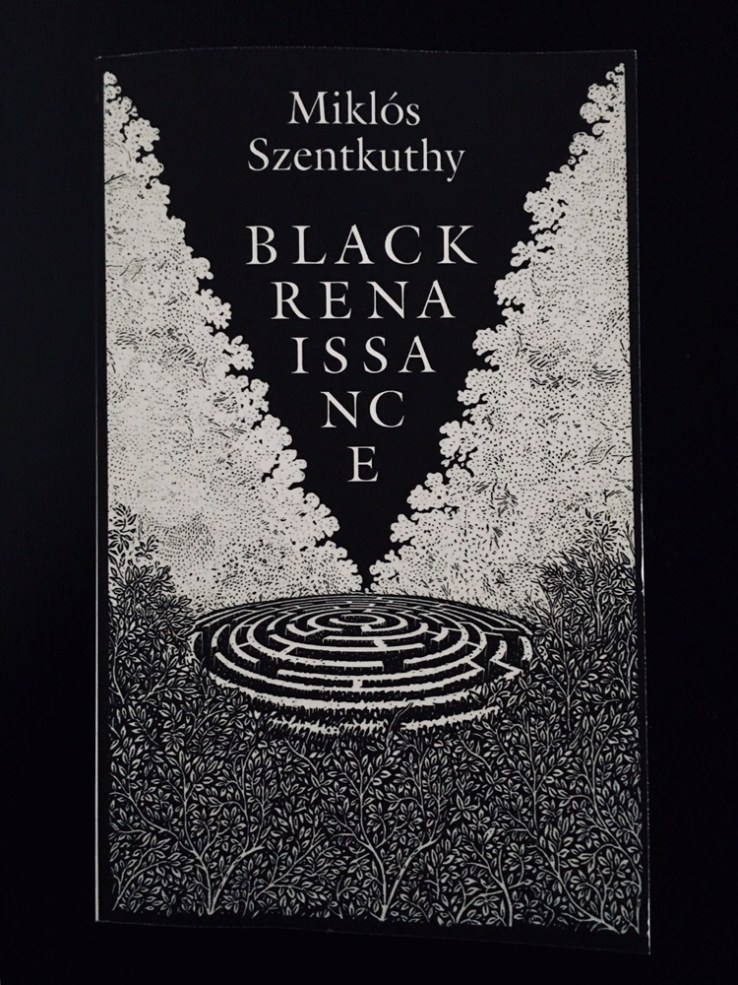
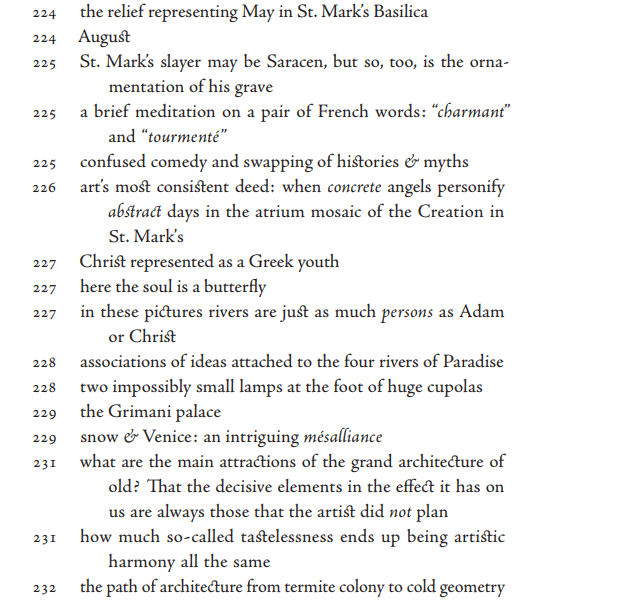
Miklós Szentkuthy’s Black Renaissance is new from Contra Mundum in English translation by Tim Wilkinson. It showed up at the house today. I just read the Table of Contents, which is not a thing I usually read, but…they were compelling. Sample:
Black Renaissance, the second volume of the St. Orpheus Breviary, is the continuation of Miklós Szentkuthy’s synthesis of 2,000 years of European culture. St. Orpheus is Szentkuthy’s Virgil, an omniscient poet who guides us not through hell, but through all of recorded history, myth, religion, and literature, albeit reimagined as St. Orpheus metamorphosizes himself into kings, popes, saints, tyrants, and artists. At once pagan and Christian, Greek and Hebrew, Asian and European, St. Orpheus is a mosaic of history and mankind in one supra-person and veil, an endless series of masks and personae, humanity in its protean, futural shape, an always changing function of discourse, text, myth, & mentalité.
Through St. Orpheus’ method, disparate moments of history become synchronic, are juggled to reveal, paradoxically, their mutual difference and essential similarity. “Orpheus wandering in the infernal regions,” says Szentkuthy, “is the perennial symbol of the mind lost amid the enigmas of reality. The aim of the work is, on the one hand, to represent the reality of history with the utmost possible precision, and on the other, to show, through the mutations of the European spirit, all the uncertainties of contemplative man, the transiency of emotions and the sterility of philosophical systems.”
In Black Renaissance, the dramatic scenes and philosophical passages (never a fog of abstractions, more the world and tone of Nietzsche’s Zarathustra) parade before the reader ostensibly as three characters, by way of three Orphean masks: Renaissance and baroque composer Claudio Monteverdi, architect and engineer Filippo Brunelleschi, and a tutor to the young Elizabeth Tudor. From Monteverdi’s impassioned search for an opera subject in the works of Tacitus to his meditations on divinities, to Brunelleschi’s diving into the works of Herodotus so as to illustrate Greek history, Szentkuthy veers through the Renaissance, sounding a pessimistic ‘basso continuo’ on psychology, sin, metaphysics, truth and relativism.
Through Orpheus’ final mask, that of the tutor of Elizabeth, it is eros and theology, two of Szentkuthy’s fundamental concerns, that receive yet another complex and engrossing dramatization. Metaphysics, Rationalism, and existentialist despair all spin through the author-narrator’s kaleidoscope as he closes his Black Renaissance by discoursing on the Revelation of St. John the Divine. A thousand attempts at defining physical and spiritual, heavenly and earthly love all fail.
Grim grey double plus unfun, Michael Radford’s 1984 adaptation of George Orwell’s 1948 novel 1984 is painful to watch. I think I first saw the film when I was in high school, in the mid-nineties, probably after I read the book, and I never bothered to watch it again until this morning. (It’s probably not a morning film). I might wait another 20 years to watch it again.
1984 is about as faithful to its source novel as it could be, capturing Orwell’s grim vision in relentlessly bleak (and occasionally gorgeous) shots of a dystopian post-war London. The film’s initial “worldbuilding” scenes are some of its most intriguing, including scenes of Winston Smith not fully participating in the Two Minutes Hate, looking for black market razors, prowling among the proles, and generally not fitting in among his peers. John Hurt is perfect as Winston Smith. His eyes convey an intelligent soul in despair, a soul slowly pulsing under a stoic mask that Winston has to wear to survive. Surviving isn’t enough though, and Winston finds his soul ignited by Julia (Suzanna Hamilton). The pair’s illicit love affair is doomed, and the great tragedy of 1984 is their ultimate betrayals of each other and themselves.
Roger Deakins’ cinematography is a highlight of 1984, particularly in the rare scenes in which gray gives way to green. The Eurythmics soundtrack is hardly intrusive, and the music they made was quite good, but the film would have done better to dispense with extra-diegetic music altogether. Radford’s direction is remarkably understated; drama evolves from setting and vibe. And even in more direct moments, Radford is subtle, as when Winston scratches out his own thoughts (thoughtcrimes!) on paper. Some directors might feel compelled to underline such moments, drive the thesis in—but Radford shows us Winston in the process of discovering his own thoughts and feelings.
Faithful to its source material, 1984 is in no way a fun film, but it conveys the book’s central message and core humanity admirably. I’ve always preferred Brave New World to 1984—not that the two need to be in a contest—but Huxley’s book, with its zany details and wild contours is simply more engaging. There’s more complexity to its flavors (if not its argument). Sure, 1984 has its strong flavors too, but a big bitter bite with sour notes is not something one returns to again and again.
How I watched it: On a large television, via a streaming service, with full attention.
When Ralph Waldo Emerson informed—or rather, perhaps, warned us—that we are what our mothers made us, we might dismiss it as received opinion and let it go at that, like the broken clock which is right twice a day, like the self-evident answer contained in Freud’s oft-quoted query “What do women want?” when, as nature’s handmaid, she must want what nature wants which is, quite simply, More. But which woman? Whose mother, Emerson’s? A woman so in thrall to religion that we confront another dead end; or Freud’s? or even one’s own, even mine, offering an opportune bit of wisdom to those of us engaged in the creative arts, where paranoia is almost an occupational hazard: “Bill, just try to remember,” she said, “there is much more stupidity than there is malice in the world,” an observation lavish with possibilities recalling Anatole France finding the fool more dangerous than the rogue because “the rogue does at least take a rest sometimes, the fool never.”
This is hardly to see stupidity and malice as mutually exclusive: look at your morning paper, where their combined forces explode exponentially (women and children first) from Bosnia to Belfast, unlike the international “intelligence community” so self-contained in its malice-free exercises that it generally ensnares only its own dubious cast of players. Of further importance is the distinction between stupidity and ignorance, since ignorance is educable, while stupidity’s self-serving mission is the cultivation and exploitation of ignorance, as politicians are keenly aware.
How, then, might Emerson’s mother have seen herself stumbling upon Thomas Carlyle’s vision of her son as a “hoary-headed and toothless baboon”? Or Freud’s, in the gross unlikelihood of her reading the Catholic World’s review of her son’s book Moses and Monotheism as “poorly written, full of repetitions . . . and spoiled by the author’s atheistic bias and his flimsy psychoanalytic fancies”? Goethe’s Wilhelm Meister dismissed as “sheer nonsense” by the Edinburgh Review and, a good century later, the hero of Saul Bellow’s Dangling Man ridiculed as a “pharisaical stinker” in Time magazine, John Barth’s The End of the Road recommended by Kirkus Reviews “for those schooled in the waste matter of the body and the mind,” and William Faulkner’s Absalom, Absalom! shrugged off as the “final blowup of what was once a remarkable, if minor, talent” by The New Yorker magazine where, just forty years later, “a group of avant-garde critics has put forward the idea that books should be made unreadable. This movement has manifest advantages. Being unreadable, the text repels reviewers, critics, anthologists, academic literati, and other parasitical forms of life,” indicting the author of the novel JR wherein “to produce an unreadable text, to sustain this foxy purpose over 726 pages, demands rare powers. Mr. Gaddis has them.” “You’re a fool, a fool!” the distraught mother of Dostoevski’s ill-fated hero Nikolay Stavrogin cries out at the “parasitical forms of life” surrounding her. “You’re all ungrateful fools. Give me my umbrella!”
(“Mothers” is collected in The Rush to Second Place).
In Mudbite, Dave Cooper conjures a perverse and lurid dreamworld that seethes and wriggles with its own nightmare logic. The erstwhile hero of this world is Eddy Table, an apparent alter-ego for Cooper himself. Mudbite collects two new Eddy Table adventures, “Mud River” and “Bug Bite”, abject fantasias of intense sexual anxiety rendered in Cooper’s compellingly repellent style.
The two tales are bound tête-bêche; after you finish “Bug Bites”, you can flip the book over and read “Mud River.” Or maybe you’ll read the stories in the other order. Mudbite’s playful design invites the reader to participate in ordering the relationship between the stories. Cooper’s inimitable aesthetic unifies the project’s themes of aberrant sexuality and libidinal anxieties.
Antoine Volodine’s collection of loosely-connected stories Writers (2010; English translation by Katina Rogers, Dalkey Archive, 2014) is 108 pages. I have read the first four of the seven stories here—the first 54 pages. This is the first book by Volodine that I have read. Antoine Volodine is in fact a pseudonym, I know, but I don’t know much else about the writer. I’ve been meaning to read him for a few years, after some good folks suggested I do so, but I’ve never come across any of his books in the wild until this weekend. After I finish Writers I will read more about Volodine, but for now I am enjoying (?) how and what this book teaches me about the bigger project Volodine seems to be working towards.
That bigger project evinces in the first story in the collection, “Mathias Olbane,” which centers on the titular character, a writer who tries to hypnotize himself into a suicide attempt. Poor Mathias goes to prison for twenty-six years — “He had assassinated assassins.” Like most of the figures in Writers (so far anyway—you see by the title of this post that I am reporting from half way through, yes?) — like most of the figures in Writers, Mathias is a revolutionary spirit, resisting capitalist power and conformist order through radical violence. Before prison, Mathias wrote two books. The first, An Autumn at the Boyols’ “consisted of eight short texts, inspired by fantasy or the bizarre, composed in a lusterless but impeccable style. Let’s say that it was a collection that maintained a certain kinship with post-exoticism…” The description of the book approximates a description of Writers itself; notably, Volodine identifies his own genre as post-exoticism. Autumn at the Boyols’ doesn’t sell at all, and its sequel, Splendor of the Skiff (which “recounted a police investigation, several episodes of a global revolution, and traumatizing incursions into dream worlds”) somehow fares even worse. Mathias begins a new kind of writing in prison:
…after twenty-six years in captivity, he had forged approximately a hundred thousand words, divided as follows:
sixty thousand first and last names of victims of unhappineess
twenty thousand names of imaginary plants, mushrooms, and herbs
ten thousand names of places, rivers, and localities
and ten thousand various words that do not belong to any language, but have a certain phonetic logic that makes them sound familiar
I love the mix of tones here: Mathias Olbane’s grand work is useless and strange and sad and ultimately unknowable, and Volodine conveys this with both sinister humor and dark pathos. Once released from prison, our hero immediately becomes afflicted with a rare and incurable and painful disease. Hence, the suicide urge. But let’s move on.
The second tale in Writers, “Speech to the Nomads and the Dead,” offers another iteration of post-exotic writing, both in form and content. The story plays out like a weird nightmare. Linda Woo, isolated and going mad in a prison cell, conjures up an audience of burn victims, an obese dead man, Mongolian nomads, and several crows. She delivers a “lesson” to her auditors (a “lesson,” we learn, is one of post-exoticism’s several genres). The lesson is about the post-exotic writers themselves. She names a few of these post-exotic writers (Volodine is addicted to names, especially strange names), and delivers an invective against the modern powers that the post-exotic writers write against:
Post-exoticism’s writers…have in their memory, without exception, the wars and the ethnic and social exterminations that were carried out from one end of the 20th century to the other, they forget none and pardon none, they also keep permanently in mind the savageries and the inequalities that are exacerbated among men…
The above excerpt is a small taste of Woo’s bitter rant, which goes on for long sentence after long sentence (Volodine is addicted to long sentences). Like Mathias Olbane, Linda Woo writes in the face of futility, creating the “post-exotic word,” a word that creates an “absurd magic” that allows the post-exotic writers to “speak the world.”
Linda Woo’s name appears in the next story in Writers, “Begin-ing,” if only in passing. This story belongs to an unnamed writer, yet another prisoner. Wheelchair-bound, he is interrogated and tortured by two insane inmates who have taken over their prison, having killed their captors. The pair, Greta and Bruno Khatchatourian, are thoroughly horrific, spouting abject insanities that evoke Hieronymus Boschs’s hell. They are terrifying, and I had a nightmare the night that I read “Begin-ing.” It’s never quite clear if Greta and Bruno Khatchatourian are themselves post-exotic writers gone mad or just violent lunatics on the brink of total breakdown. In any case, Volodine affords them dialogue that veers close to a kind of horror-poetry. “We can also spew out the apocalypse,” Greta defiantly sneers. They torture the poor writer. Why?
They would like it, in the end, if he came around to their side, whether by admitting that he’s been, for a thousand years, a clandestine leader of dark forces, or by tracing for them a strategy that could lead them to final victory. … They would like above all for him to help them to drive the dark forces out from the asylum, to prepare a list of spies, they want him to rid the world of the last nurses, of Martians, of colonialists, and of capitalists in general.
The poor writer these lunatics torture turns inward to his own formative memories of first writings, of begin-ing, when he created his own worlds/words in ungrammatical misspelled scrawlings, filling notebook after notebook. Volodine unspools these memories in sentences that carry on for pages, mostly centering on the writer’s strange childhood in an abject classroom where he engages in depravities that evoke Pasolini’s Salò. And yet these memories are the writer’s comfort—or at least resistance—to the lunatics’ violence. Volodine’s prose in “Begin-ing” conjures Goya’s various lunatics, witches, demons, and dogs. It’s all very upsetting stuff.
Courtyard with Lunatics, 1794 by Francisco Goya (1746-1828)
After the depravity of “Begin-ings,” the caustic comedy of the next story “Acknowledgements” is a welcome palate cleanser. In this story’s twelve pages (I wish there were more!) Volodine simultaneously ridicules and exults the “Acknowledgements” page that often appends a novel, elevating the commonplace gesture to its own mock-heroic genre. The story begins with the the hero-writer thanking “Marta and Boris Bielouguine, who plucked me from the swamp that I had unhappily fallen into along with the bag containing my manuscript.” The “swamp” here is not a metaphor, but a literal bog the writer nearly drowned in. And the manuscript? A Meeting at the Boyols’, a title that recalls poor Mathias Olbane’s first book An Autumn at the Boyols’. Each paragraph of “Acknowledgments” is its own vignette, a miniature adventure in the form of a thank-you note to certain parties. Most of the vignettes end in sex or death, or an escape from one of the two. “Grad Litrif and his companion Lioudmila” as well as “the head of the Marbachvili archives” (oh the names in this story!) are thanked for allowing the writer
…to access the notebooks of Vulcain Marbachvili, from which I was able, for my story Long Ago to Bed Early, to copy several sentences before the earthquake struck that engulfed the archives. My thanks to these three people, and apologies to the archivist, as I was sadly unable to locate either her name or her body in the rubble.
“Acknowledgments” is littered with such bodies—sometimes victims of disasters and plagues, and elsewhere the bodies of the married or boyfriended women the writer copulates with before escaping into some new strange circumstances (he often thanks the husbands and the boyfriends, and in one inspired moment, thanks a gardener “who one day had the presence of mind to detain Bernardo Balsamian in the orchard while Grigoria and I showered and got dressed again”). He thanks a couple who shows him their collection of 88 stuffed guinea pigs; he thanks “the leader of the Muslim Bang cell” who, during his “incarceration in Yogyakarta…forbid the prisoners on the floor from sodomizing” him; he thanks the “Happy Days” theater troupe who “had the courage” to perform his play Djann’s Awakening three times “before a rigorously empty room.” Most of the acknowledgments connect the writer’s thank-you to a specific book he’s written. I’m tempted to list them all (oh the names!), but just a few—Tomorrow the Otters, Eve of Pandemic, Journal of Pandemonium, Goodbye Clouds, Goodbye Romeo, Mlatelpopec in Paradise, Macbeth in Paradise, Hell in Paradise…Without exaggeration: “Acknowledgements” is one of the funniest stories I’ve ever read.
With its evocations of mad and obscure writers, Volodine’s books strongly reminds me of Roberto Bolaño’s work. And yet reading it is not like reading an attempt to copy another writer—which Volodine is in no way doing—but rather like reading a writer who has filtered much of the same material of the 20th century through himself, and has come to some of the same tonal and thematic viewpoints—Volodine’s labyrinth is dark and weird and sinister and abject, but also slightly zany and terribly funny. More to come.
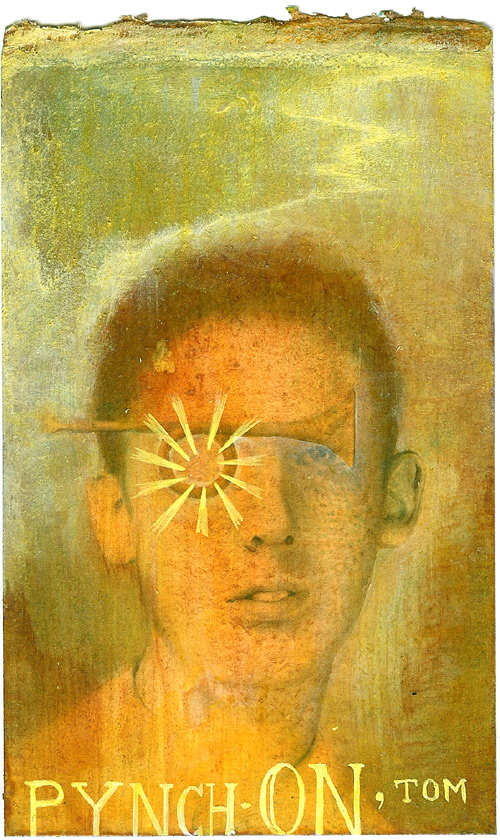
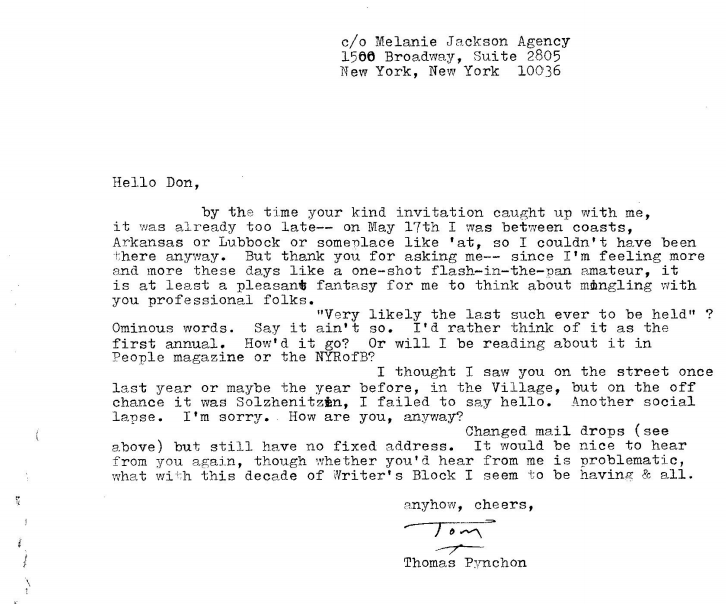
To date, Thomas Ruggles Pynchon (American, b. 1937), has published eight novels and one collection of short stories. These books were published between 1963 and 2013. On this day, Thomas Ruggles Pynchon’s 81st birthday, I present my ranking of his novels. My ranking is completely subjective, essentially incomplete (in that I haven’t read two of Pynchon’s novels all the way through), and thoroughly unnecessary. My ranking should be disregarded, but I do not think it should be treated with any malice. You are most welcome to make your own ranking in the comments section of this post, or perhaps elsewhere online, or on a scrap of your own paper, or in personal remarks to a friend or loved one, etc. I have not included the short story collection Slow Learner (1984) in this ranking because it is not a novel.
Here is the list, ranked from not-greatest to greatest:
8. Bleeding Edge (2013)
I have never made it past the first thirty pages of Bleeding Edge, despite two attempts. I don’t even own it. I will probably read it in ten years and see something there that I didn’t see in 2013 or 2015 but for now, I’m not sure.
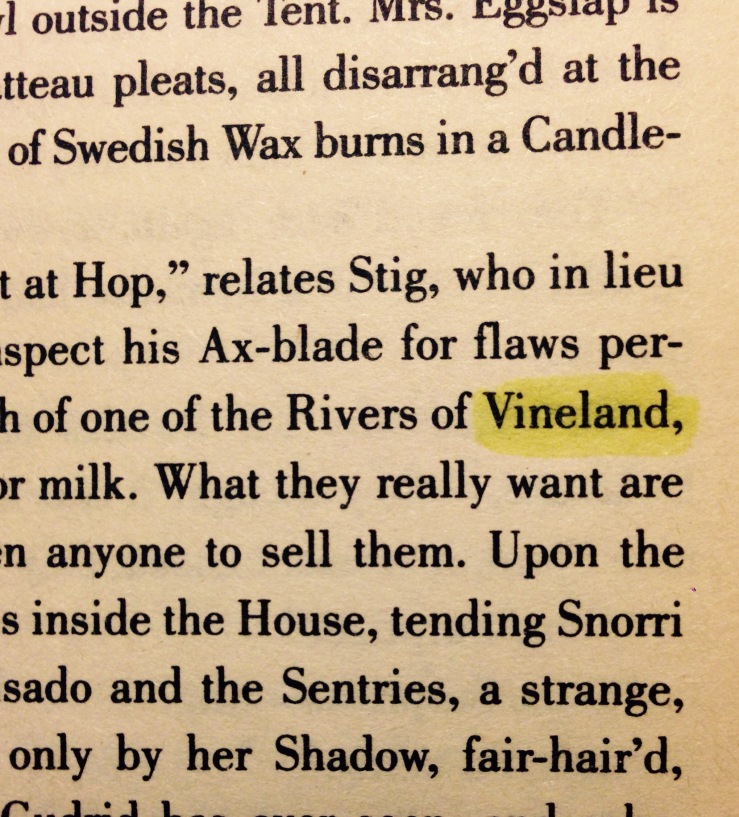
7. Vineland (1990)
Vineland is the other Pynchon novel I haven’t managed to finish. I’ve tried three times, including a semi-serious shot last year where I stalled after the fourth chapter (around 90 pages in). Vineland seems to have a strange status for Pynchon cultists—its a cult novel in an oeuvre of cult novels, I guess. Perhaps Vineland has a sturdier core to it than I can sense, but even though I dig the goofy humor, I haven’t yet found something to grab onto.
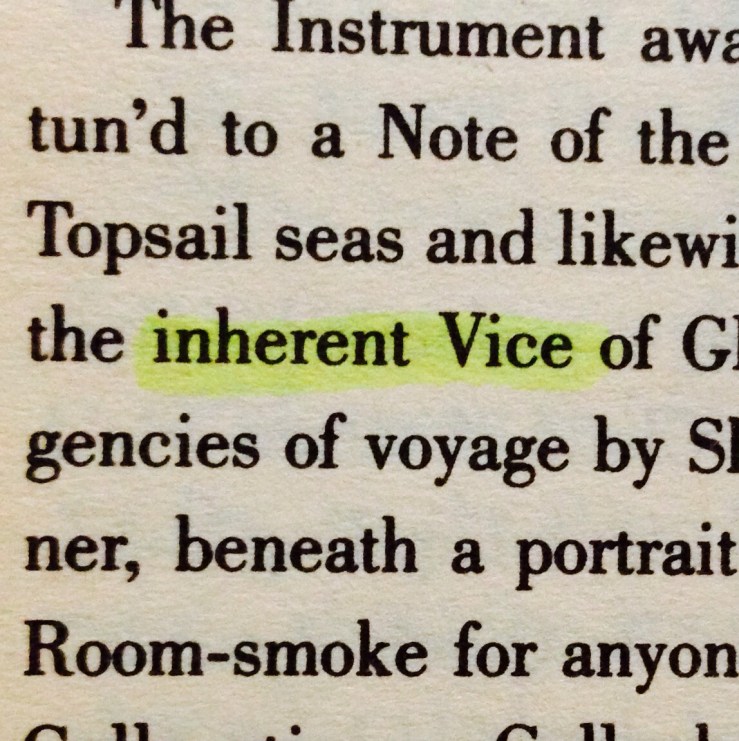
6. Inherent Vice (2009)
I love Inherent Vice. It has a bit of a reputation of being “Pynchon lite,” whatever that means, but I think it’s a much denser book than a first reading might suggest—its shaggy baggy breeziness coheres into something stronger on a second or third read. Inherent Vice is both a diagnosis of the sixties and a prognosis of a future to come.
5. V. (1963)
V. makes a good starting place for anyone new to Pynchon. Even though it’s his first novel, V. already stages Pynchon’s major themes (paranoia, technology, entropy, globalism) in an elastic and discursive narrative style and a zany (and sometimes sinister) tone. These elements continued throughout the next half century in Pynchon’s writing. V. shares a few characters with Gravity’s Rainbow, and in many ways it feels like a dress rehearsal for that bigger, grander, fuller novel—but it reverberates with its own richness. The ninth chapter, the story of of Kurt Mondaugen, is a particularly dark and decadent bit of writing.
4. The Crying of Lot 49 (1966)
The Crying of Lot 49 doesn’t so much convert paranoia into hope as it shows that the two are part and parcel of the same impulse of a consciousness that has to know that it cannot know. Pynchon’s dualities here feel new—paranoia/hope is wrapped into zaniness/horror. He sends us to escape into thelabyrinth. I wrote new in the previous sentence, but Pynchon’s ambiguities resonate with American literature’s dark romantic traditions—Melville, Hawthorne, O’Connor, et al.
3. Against the Day (2006)
Against the Day glides into its sprawl, billowing out into genre trajectories that transcend the boundaries of the plot’s dates (1893-1918). Pynchon’s longest novel to date earns its 1,085-page run, pivoting between comic fantasy, high adventure, flânerie escapade, scientific treatise, and a byzantine global mystery—all weighed down by the ballast of rising modernism. Pynchon merges these styles, both “high” and “low,” into something thoroughly Pynchonian. Despite its length, Against the Day is perhaps Pynchon’s clearest indictment of sinister power, neatly figured in the oligarch Scarsdale Vibe. Just writing about it here makes me want to revisit it again and check in on The Chums of Chance and their marvelous airship The Inconvenience.
2. Mason & Dixon (1997)
Pynchon’s zany/sinister tonal axis, comic bravado, and genre-shifting modes rarely result in what folks narrowly think of as literary realism. His characters can be elastic, cartoonish even—allegorical sometimes (and even grotesque). Mason & Dixon takes two historically real (and historically famous) characters as its subject, and, in a wonderfully hyperbolic 18th-century style, takes the duo on a fantastic journey to measure the world. How does one measure the world though? Pynchon takes on seemingly every subject under the sun in Mason & Dixon, and the novel is very much about the problems and limitations of measuring (and describing, and knowing) itself. But what comes through most strongly in all of Pynchon’s fantasia is the weight of Mason and Dixon’s friendship. It’s the most real thing in a wonderfully unreal novel.
1. Gravity’s Rainbow (1973)
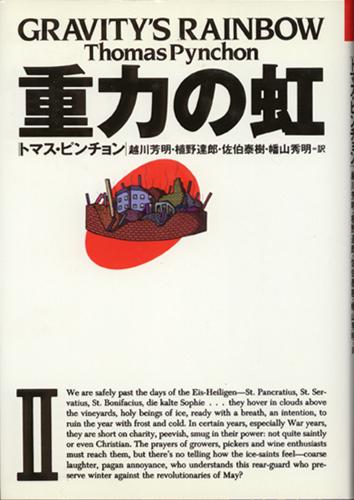
Gravity’s Rainbow is probably the best American postmodern novel ever produced. In any case, I haven’t read another novel that so acutely dissects postwar America. Pynchon extends Eisenhower’s warning of the “military-industrial complex” by adding another element: entertainment. The intuition here surpasses prescience. The problem with Gravity’s Rainbow is that it cannot be read—it has to be reread. Its themes, motifs, and symbols are easy to miss on a first pass through, when you’re likely bugeyed and bewildered. Rereading Gravity’s Rainbow is like reading it for the first time. You have to let the book teach you how to read it. Let it teach you.
Captain Geoffrey “Pirate” Prentice’s bodacious banana breakfast for a bunch of hung over army officers (Gravity’s Rainbow)—
Routine: plug in American blending machine won from some Yank last summer, some poker game, table stakes, B.O.Q. somewhere in the north, never remember now….Chop several bananas into pieces. Make coffee in urn. Get can of milk from cooler. Puree ‘nanas in milk. Lovely. I would coat all the booze-corroded stomachs of England. . . . Bit of marge, still smells all right, melt in the skillet. Peel more bananas, slice lengthwise. Marge sizzling, in go long slices. Light oven whoomp blow us all up someday oh, ha, ha, yes. Peeled whole bananas to go on broiler grill soon as it heats. Find marshmallows. . . .
“You one of those right wing nut outfits?” inquired the diplomatic Metzger. Fallopian twinkled. “They accuse us of being paranoids.” “They?” inquired Metzger, twinkling also. “Us?” asked Oedipa.
“Not quite how it sorts out. Differences among the world religions are in fact rather trivial when compared to the common enemy, the ancient and abiding darkness which all hate, fear, and struggle against without cease”— he made a broad gesture to indicate the limitless taiga all around them— “Shamanism. There isn’t a primitive people anywhere on Earth that can’t be found practicing some form of it. Every state religion, including your own, considers it irrational and pernicious, and has taken steps to eradicate it.”
“What? there’s no ‘state religion’ in the U.S.A., pardner, we’ve got freedom of worship, it’s guaranteed in the Constitution—keeps church and state separate, just so’s we don’t turn into something like England and keep marching off into the brush with bagpipes and Gatling guns, looking for more infidels to wipe out. Nothing personal o’ course.”
“The Cherokee,” replied Prance, “the Apache, the massacre of the Sioux Ghost Dancers at Wounded Knee, every native Red Indian you’ve found, you people have either tried to convert to Christianity or you’ve simply killed.”
“I suggest it was about the fear of medicine men and strange practices, dancing and drug-taking, that allow humans to be in touch with the powerful gods hiding in the landscape, with no need of any official church to mediate it for them. The only drug you’ve ever been comfortable with is alcohol, so you went in and poisoned the tribes with that. Your whole history in America has been one long religious war, secret crusades, disguised under false names. You tried to exterminate African shamanism by kidnapping half the continent into slavery, giving them Christian names, and shoving your peculiar versions of the Bible down their throats, and look what happened.”
“The Civil War? That was economics. Politics.”
“That was the gods you tried to destroy, waiting their hour, taking their revenge. You people really just believe everything you’re taught, don’t you?”
“I’ll be in the bar,” said Reef. Yzles-Bains was in fact one of the few places on the continent of Europe where a sober Anarchist could find a decent Crocodile—equal amounts of rum, absinthe, and the grape spirits known as trois-six—a traditional Anarchist favorite, which Loïc the bartender, a veteran of the Paris Commune, claimed to have been present at the invention of.
1. You may never get to touch the Master, but you can tickle his creatures. 2. The innocence of the creatures is in inverse proportion to the immorality of the Master. 3. If they can get you asking the wrong questions, they don’t have to worry about answers. 4. You hide, they seek. 5. Paranoids are not paranoid because they’re paranoid, but because they keep putting themselves, fucking idiots, deliberately into paranoid situations.
“Somebody quoted Norman Mailer as saying that he wasn’t a better writer because his contemporaries weren’t better…I don’t know whether he really said that or not, but the point I want to make is that no one in Pynchon’s generation can make that statement. If we’re not as good as we should be it’s not because there isn’t a standard. And I think Pynchon, more than any other writer, has set the standard. He’s raised the stakes.”
THE NEXT DAY Reef, Cyprian, and Ratty were out on the Anarchists’ golf course, during a round of Anarchists’ Golf, a craze currently sweeping the civilized world, in which there was no fixed sequence—in fact, no fixed number—of holes, with distances flexible as well, some holes being only putter-distance apart, others uncounted hundreds of yards and requiring a map and compass to locate. Many players had been known to come there at night and dig new ones. Parties were likely to ask, “Do you mind if we don’t play through?” then just go and whack balls at any time and in any direction they liked. Folks were constantly being beaned by approach shots barreling in from unexpected quarters. “This is kind of fun,” Reef said, as an ancient brambled guttie went whizzing by, centimeters from his ear.
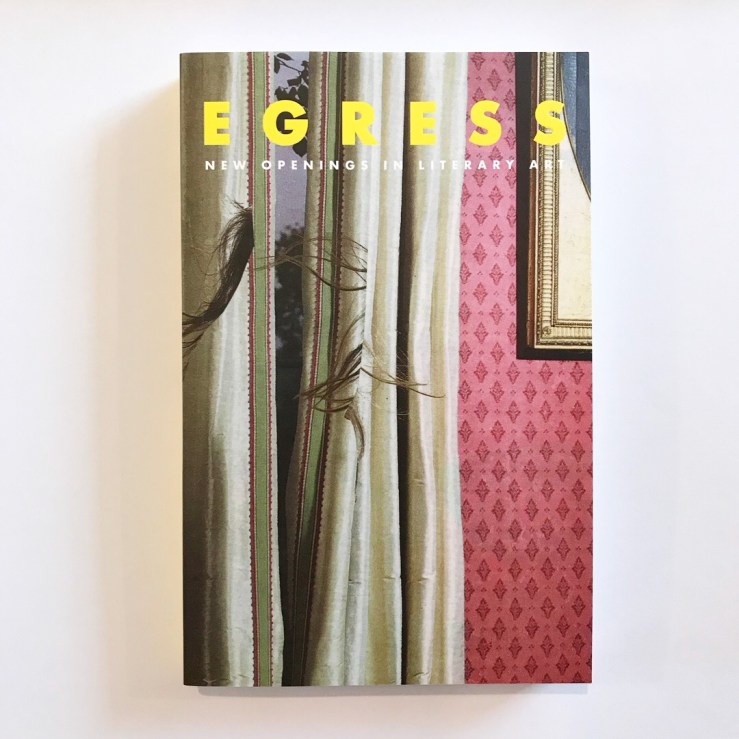
David Winters: Literally: the act or way of leaving a place; an emergence, opening or exit. Egress is also a biannual literary magazine devoted to showcasing the most innovative writers on both sides of the Atlantic today. Our first issue features, among others, Gordon Lish, Diane Williams, Sam Lipsyte, Kathryn Scanlan, David Hayden and Kimberly King Parsons.
Biblioklept: How long has Egress been incubating? How did the magazine come about?
DW: Incubation began in May 2017, over a lunch of okonomiyaki in Bloomsbury, London. We met through Gordon Lish. Little Island had published Lish’s White Plains, as well as books by his students Russell Perrson and Jason Schwartz. I’d also alerted Andrew to the work of David Hayden, author of Darker with the Lights On, who has two new stories in Egress #1. So, there was a sense of shared tastes. A sense, too, that UK literary magazines–despite the efforts of a few pioneers—lacked the avant-garde spirit of US publications like NOON and New York Tyrant. We both saw a space for something new. Okonomiyaki, for the benefit of your readers, are a type of savoury Japanese pancake.
Andrew Latimer: Through David and Gordon Lish, I’d discovered writers like Christine Schutt and Sam Lipsyte (both in Egress #1) and desperately wanted a vehicle for engaging this type of work here, in the UK. Egress – the name, the style, the design – all came about quite naturally from a desire to bring writing like this into one place.
Biblioklept: For readers unfamiliar, can you describe the Lishian aesthetic, at least as you see it?
DW: Well, in a sense, there’s no such thing. Journalists in the eighties harped on about ‘minimalism’—a stupid label, with little purchase on the writers in question. Sven Birkerts once claimed there was a ‘School of Gordon Lish’. But Lish’s influence can’t be reduced in that way. Over the decades, hundreds of very different writers have worked with him, learned from him, bounced off him, swerved away from him. What the best of them have in common is an acute sensitivity to the power of language, and a commitment to creating new and lasting art—art that stands apart from the marketplace. Those are also the qualities we prize at Egress. But they are hardly restricted to “Lishian” fiction.
Biblioklept: That “acute sensitivity to the power of language” is on display in the two fictions from Lish in Egress #1, “Jawbone” and “Court of the Kangaroo.” The first Lish story, “Jawbone,” is about this seemingly unimportant minuscule moment, but Lish turns the whole thing into a drama about language itself. There’s this line in “Jawbone” that I kept tripping over, rereading and rereading: “Like lucky thing for the local citizenry someone on your side was there in there on duty on the nightbeat last night in the crapper last night.” The line is simultaneously gorgeous and ugly, elegant and clunky—rapturous really.
AL: Rereading is the key here. We’re familiar with rereading whole stories that we like or ones with endings that puzzle us. But what Lish, and writers of this ilk, ask us to do is to reread sentences in the course of making our first reading. This assumes a reader, a listener even, with the patience to linger over the page, its construction. (Gary Lutz prefers a “page-hugging” to a page-turning reader.)
DW: “Gorgeous and ugly” — exactly, yes. Donald Barthelme once said, “every writer in the country can write a beautiful sentence, or a hundred. What I am interested in is the ugly sentence that is also somehow beautiful.” Lish, when he was teaching, called this “burnt tongue”: “God only listens to those whose tongues are burnt, twisted, crippled.” Writers of fiction can achieve extraordinary power by attending to everything wrong, skewed, erratic in their natural speech — and, rather than being afraid of that wrongness, amplifying it on the page. But power of this kind needn’t be purely spontaneous; it can also be elicited by editing. The sentence you mention went through multiple revisions; Lish reworks his stories obsessively, right up to the final proof stage. When I edit fiction, in my lesser way, I often look out for those off-kilter sentences, isolate them, tweak them, try to increase their tension and pressure.
Biblioklept: How much and what kind of editing did you guys do with Egress #1. I mean, were the authors submitting finished pieces, or were you working with them through the process?
DW: It varies. Some stories are, with the authors’ approval, heavily edited. Some authors come to us in such command of their material that no editing is necessary. Sometimes, editing is simply about discovery: finding the new. Sometimes it’s about reinvention: getting stuck in and making it new. Between these extremes, there’s a whole spectrum of interventions.
Biblioklept: I’ll admit that I opened Egress with the idea that I’d probably go straight to Lish and then maybe read Christine Schutt or Evan Lavender-Smith—some of the writers I’d already read before—before reading ones that were new to me. However, the first story in Egress #1, which is by Kimberly King Parsons had a title that grabbed my attention: “Mr. Corpulent Wants Polaroid Proof.” So I started there, and all the sentences made me want to keep reading, and then read into her second story. Then I read the next story, Grant Maierhofer’s “Everybody’s Darling.” (The opening line “I suppose I took to mother’s unders when the end became too sure” sort of insisted Keep going). How important is sequencing the stories (and essays) of Egress and what was that process like? How much of your editorial mission involves opening up a place for newer voices?
DW: Openings are important. Andrew and I share the view that stories should command attention from their very first sentence–what some would call the ‘attack’. Again, though, an attack doesn’t have to be nailed down straight away; it can emerge in the process of revision. However they’re made, the best openings astonish, seduce, compel us, as you say, to ‘keep going’.
And if literary art is about attention, so too is the art of the literary magazine. Drawing attention to unknown writers has long been the mission of little magazines, ever since the heyday of modernism. Incidentally, this has also been my mission as a critic. When I started writing about Christine Schutt, Evan Lavender-Smith and others, they were largely overlooked and unpublished in the UK. Both in mainstream literary journalism and in the academy, critical attention often fixates on the famous and commercially successful. This is especially true of prose fiction, which inhabits a different institutional ecosystem to, say, poetry. With the current renaissance of small presses, the pendulum is starting to swing the other way. Even so, the writers who make the Booker Prize shortlist or get reviewed in The Guardian are not, by and large, the writers who’ll be remembered decades from now. The market exerts a powerful pull on our collective attention. Good publishing, like good criticism, resists that pull. The task is to look away from what everyone else is looking at–look at what they’re not looking at–and then make them see.
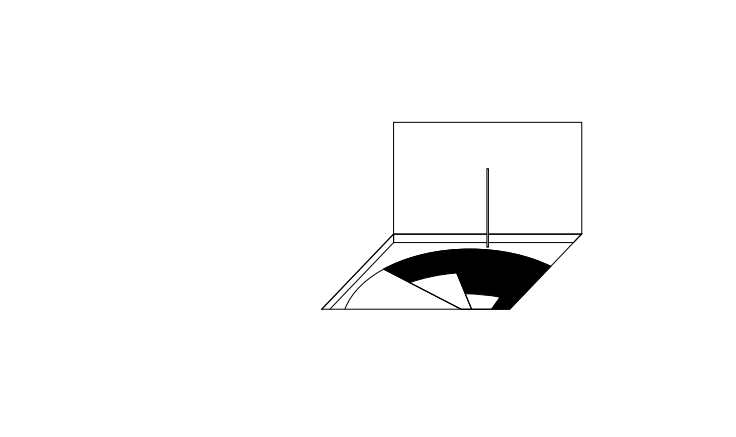
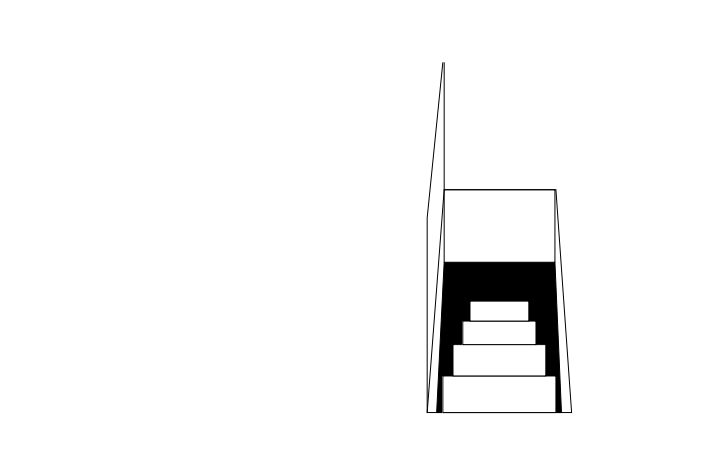
AL: Absolutely – and the sequencing of the stories and essays plays a huge part in showcasing those new voices. As a reader, there is always that pull to go to the names you know and love first. (It’s part of why you pick up a magazine.) But, as an editor, you can’t just rely on the big names; you’ve got to be in the business of making new ones. You have a responsibility to disrupt the reader’s expectations, to put things in their way. Beyond names and reputations, there’s also a careful and deliberate counterpointing of the work in Egress. David and I think about how one story or essay speaks to another, how it’s placement can enrich another’s meaning, its rhythms. This kind of editorial work, the imposition of an overarching rhythm to the issue, wills the reader to ‘keep going’. Catrin Morgan’s illustrations (of various egresses – trapdoors and staircases) are a neat visual cue to the reader to push on, to explore what’s round the corner.
Illustration for Egress #1 by Catrin Morgan
Biblioklept: Some of this blog’s readers might know Catrin Morgan from her illustrated version of Ben Marcus’s The Age of Wire and String. How did you get her involved with Egress? Do you plan for each issue to have a different artist?
AL: Originally we asked her for an image for the front cover, but she ended up drawing all these bizarre stairs and exits that were so compelling I just had to use them. I’d like to continue using her illustrations throughout the text for the future, but there will be a new artist featured in the colour plates each issue. The “artist” for this issue is Hob Broun.
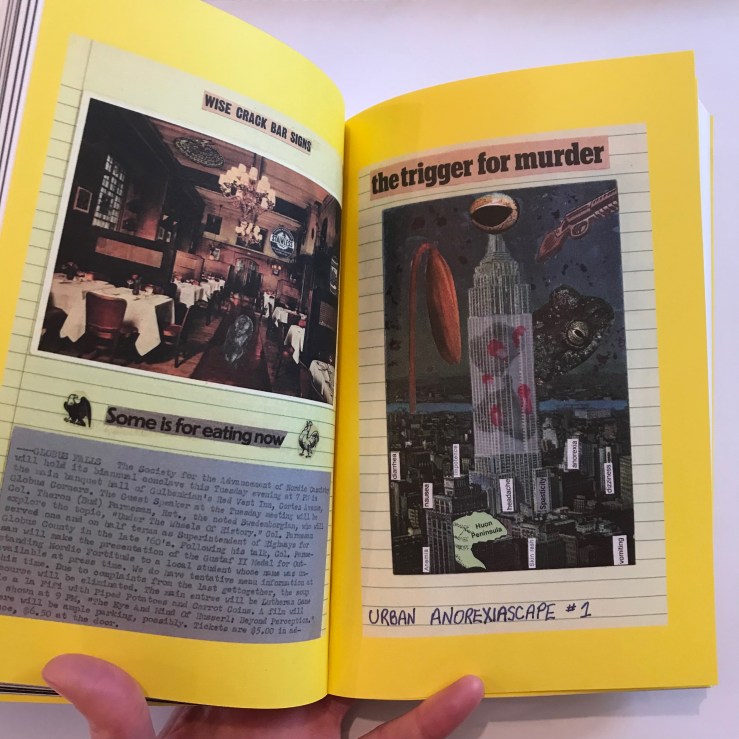
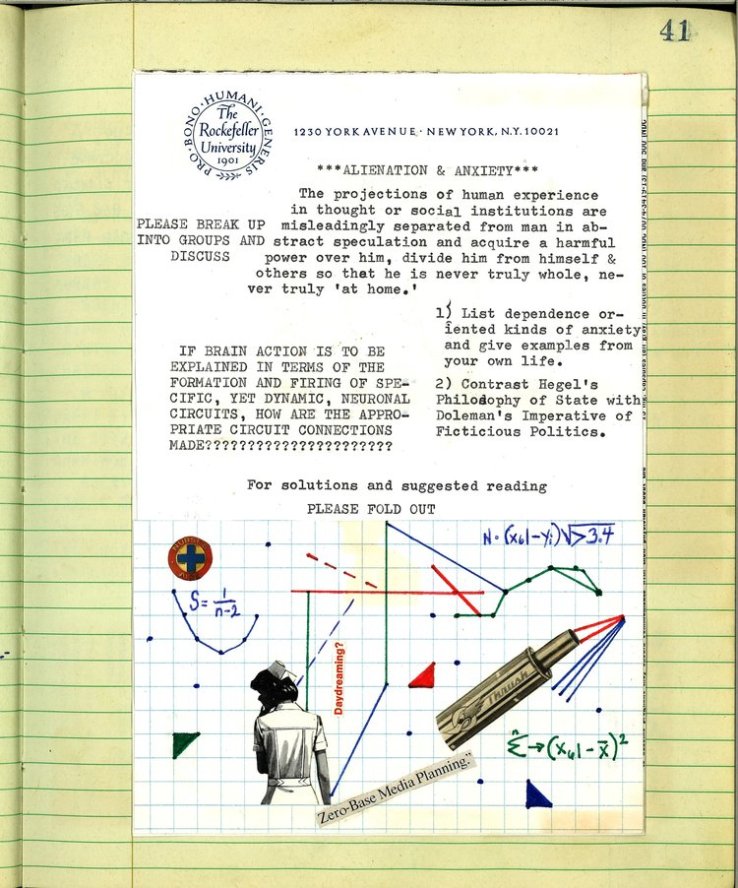
Biblioklept: I know David has been enthusiastic about Hob Broun’s writing for a few years. Broun is sort of a “writer’s writer’s writer,” if that makes sense. The first issue of Egress features a section titled “Remembering Hob Broun: 1950-1987”; in addition to remembrances from the novelist Sam Lipsyte and Kevin McMahon, who befriended Broun when they attended Reed College together in the late sixties, you include a full color selection from one of Broun’s journals. Can you describe some of the journal for readers, and talk a bit about how the Broun section came together? For readers unfamiliar with Broun, what’s the appeal?
DW: Broun is a ‘writer’s (writer’s) writer’ only in that he isn’t well-known–his work isn’t at all opaque or aloof. He published three books in his lifetime, the novels Odditorium (1983) and Inner Tube (1985), and the superb short story collection Cardinal Numbers (1988). While writing Inner Tube, Broun underwent emergency surgery to remove a spinal tumour. He was left paralysed from the neck down. Remarkably, he finished the novel–and wrote the stories in Cardinal Numbers–using a kind of writing-machine: an oral catheter (or ‘sip-and-puff device’) connected to a customised word processor, triggered by his breath whenever a letter flashed on the screen. This aspect of Broun’s life lends itself to mythologization: what better image of writerly dedication? At the same time, it risks obscuring what really matters: the work itself. I was delighted, then, when Kevin McMahon got in touch. Kevin’s essay only glances at Broun’s illness, giving us, instead, a vivid portrait of the man behind the myth. Best of all, Kevin sent us Broun’s personal journal. It’s an extraordinary artefact–a scrapbook of doctored magazine clippings and miniature, fragmentary narratives–unmistakably Brounian in its pulpy, screwball surreality. Broun’s journal is continuous with his fiction (Cardinal Numbers contains the manifesto-like statement, ‘modus operandi: montage, collage, bricolage’), but, unlike his fiction, it wasn’t created for public consumption. Not unlike the art of, say, Ray Johnson or Joseph Cornell, it gives us a glimpse of a private world, a game played for inscrutable reasons—what Don DeLillo calls “the pure game of making up”. Our celebration of Broun ends with a wonderful essay by Sam Lipsyte–a writer Andrew and I both revere–who captures his essence far better than either of us ever could.
Biblioklept: Which of Broun’s three books do you think is the best starting place for folks interested in his work after reading about him in Egress?
DW: Cardinal Numbers, without a doubt. Open Road recently reissued all three titles as e-books, but I’d recommend picking up the old Knopf hardbacks, which can be had for as little as a dollar. Another Broun novel–a previously unpublished manuscript–might be out in a year or two.
Biblioklept: Maybe Egress could get a hold of a few pages.
DW: We’ve been looking at some of his unpublished work, yes.
Biblioklept: Why is it necessary to publish Egress in a physical, print form?
AL: Why is Egress in print? There are so many reasons, but I’ll focus on one. The role of curation has never been more important as it is now. We are distracted: information, entertainment, stuff causes our attention to bleed from one thing to the next. Egress, like all the best journals and mags, is a highly curated affair. David and I wanted there to be a palpable sensation derived from receiving and reading each issue of the magazine. The style of writing, the artwork, the design. Much of that effect relies on all the pieces being enclosed between covers – simultaneously held together and also cut off, if only briefly, from everything else that’s going on. It’s hard, likely impossible, to get that same sense of quietude, to enforce focus, when reading on a screen as infinite worlds suggest themselves merely clicks away. As well as this, there’s an indispensable sense of occasion one gets from a print magazine: ‘when is it out?’ The magazine, as a format, craves temporality.
Biblioklept: Do you envision future issues of Egress publishing some of the authors featured in the first issue?
AL: Yes, definitely.
Biblioklept: There’s an obvious aesthetic value to a literary journal or magazine publishing the same authors frequently, but are there any risks?
DW: There are risks and rewards. Magazines like Egress serve two roles in the culture. Our primary role is to discover and promote new writers. Often unpublished, unagented, and lacking industry connections, these writers reside at the margins. But we believe in them, fervently, and we believe they deserve to be heard. This gives rise to a second role. You might even call it a moral responsibility. Newness needs to be nurtured, protected, given a space in which it can grow. One contributor to Egress #1 only began writing fiction six months ago. She’d published nothing before she came to us. But what she’s doing is truly unique. Will we publish her again? You bet. We’ll do everything in our power to support her work. The same goes for any writer we believe in. If you do that and keep doing it–if you keep bringing new writers together–you become something more than a magazine. You become a community. Look at the best literary magazines of recent decades–from The Quarterly through to elimae, NOON, Tyrant and Unsaid–and that’s what you’ll see: artistic communities. Temporary autonomous zones; bubbles in which innovation can flourish. The risk, of course–and here I could name several lesser litmags–is that such communities can solidify into coteries, stables, ‘closed shops’. We’ll champion writers as long as they need us, but we’ll never close ourselves off in that way. After all, the real thrill is when someone comes to you from out of nowhere–no publications, no social media accounts, no ‘platform’, fuck, even no cover letter–just power on the page.
Biblioklept: Have you ever stolen a book?
DW: Sure, when they’re overpriced or out of print. Worse, I’ve had others steal them for me. Years ago, a friend went to great lengths to liberate Ilya Prigogine and Isabelle Stengers’ Order Out of Chaos from a university library for me. And a contributor to Egress #2 once smuggled an exorbitantly priced theology monograph out of a bookshop on my behalf. (Sorry Julie—see you in prison!)
AL: I’m bad for stealing books from places I’m staying at — friends’, hostels, BnBs — especially if I think I’d appreciate the book more myself. My favourite steal so far has been Epitaph of a Small Winner by Machado de Assis, which I’ve read the covers off so can’t return that now (not that I would).
Illustration for Egress #1 by Catrin Morgan
The first issue of Egressis out now in the UK. It will be available in the US on 21 June 2018.
David Winters is a literary critic. He has written for the Times Literary Supplement, the Los Angeles Review of Books, Bookforum, The Brooklyn Rail and elsewhere. He currently holds a postdoctoral research fellowship at the University of Cambridge, where he is writing a book about Gordon Lish. He co-edits both Egress and 3:AM Magazine, and can be found online at www.davidwinters.uk.








 To date, Thomas Ruggles Pynchon (American, b. 1937), has published eight novels and one collection of short stories. These books were published between 1963 and 2013. On this day, Thomas Ruggles Pynchon’s 81st birthday, I present my ranking of his novels. My ranking is completely subjective, essentially incomplete (in that I haven’t read two of Pynchon’s novels all the way through), and thoroughly unnecessary. My ranking should be disregarded, but I do not think it should be treated with any malice. You are most welcome to make your own ranking in the comments section of this post, or perhaps elsewhere online, or on a scrap of your own paper, or in personal remarks to a friend or loved one, etc. I have not included the short story collection Slow Learner (1984) in this ranking because it is not a novel.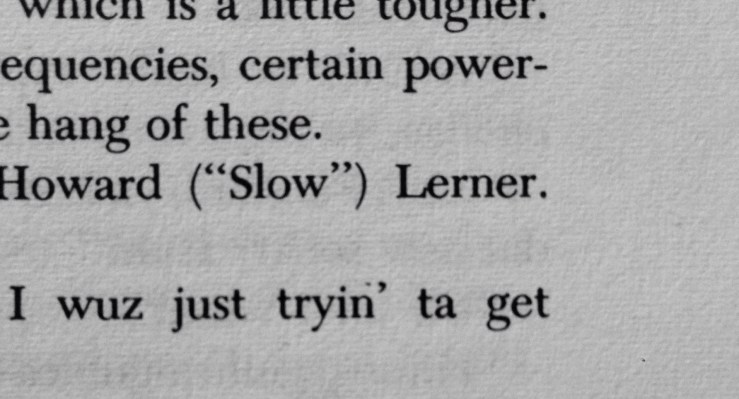







 Biblioklept