Dinah Brooke’s 1973 novel Lord Jim at Home had been out of print for five decades — and had never gotten a U.S. release — until McNally Editions republished in 2023 with a new foreword by the novelist Ottessa Moshfegh. I always save forewords until after I’ve finished a novel, so I missed Moshfegh’s implicit advice to go into Lord Jim at Home cold. She notes that the recommendation she received to read it “came with no introduction,” and that “I wouldn’t have wanted the effect of the novel to be mitigated in any way, so I’m reluctant to introduce it now.”
I am not reluctant to write about Brooke’s novel because I am so enthusiastic about it and I think those with tastes in literature similar to my own will find something fascinating in its plot and prose. However, l agree with Moshfegh’s advice that Lord Jim at Home is best experienced free from as much mitigating context as possible. I had never heard of the novel before lifting it from a bookseller’s shelf, attracted by the striking cover; I flipped it over to read a blurb parsed from Moshfegh’s foreword attesting that Brooke’s novel “was an instrument of torture. It’s that good.” The inside flap informed me that reviews upon its publication “described it as ‘squalid and startling,’ ‘nastily horrific,’ and a ‘monstrous parody’ of upper-middle class English life.” I was sold.
Lord Jim at Home is squalid and startling and nastily horrific. It is abject, lurid, violent, and dark. It is also sad, absurd, mythic, often very funny, and somehow very, very real for all its strangeness. The novels I would most liken Lord Jim at Home to, at least in terms of the aesthetic and emotional experience of reading it, are Ann Quin’s Berg, Anna Kavan’s Ice, Mervyn Peake’s Gormenghast novels, Virginia Woolf’s Mrs. Dalloway, and James Joyce’s Portrait (as well as bits of Ulysses). (I have not read Conrad’s Lord Jim, which Brooke has taken as something of a precursor text for Lord Jim at Home.)
After finishing Lord Jim at Home, I read it again by accident. At first I intended to take a few notes for a possible review, but after the first few pages I just kept reading. On a second reading, Brooke’s novel was just as strange—maybe even stranger—even if I was able to read it much more quickly, finding myself quicker to tune into the novel’s competing (and complementary) narrative registers. I found it far more precise, too, in the rhetorical development of its themes; Brooke’s styles and tones shift to capture the different ages of its hero. The novel begins in a mythical, archetypal mode and works its way through various registers, exploring the tropes of schoolboy novels, romances, war stories, adventure tales, modernism, realism, and journalism. But despite its shifting modes, Lord Jim at Home is not a parodic pastiche. Rather, at its core, Lord Jim at Home skewers how aesthetic modes—primarily those derived from notions of class and manners—cover over abject cruelty. As Moshfegh puts it in her forward, Lord Jim at Home is “an accurate portrayal of how fucked-up people behave, artfully conveyed in a way that nice people are too polite to admit they understand.”
I’ve tried to be clear that I think it’s best to come to Lord Jim at Home without too much context—it’s best to just go with the novel’s strangeness. Below, however, I offer a more detailed discussion of the novel, its language, and some elements of the plot for those so inclined.
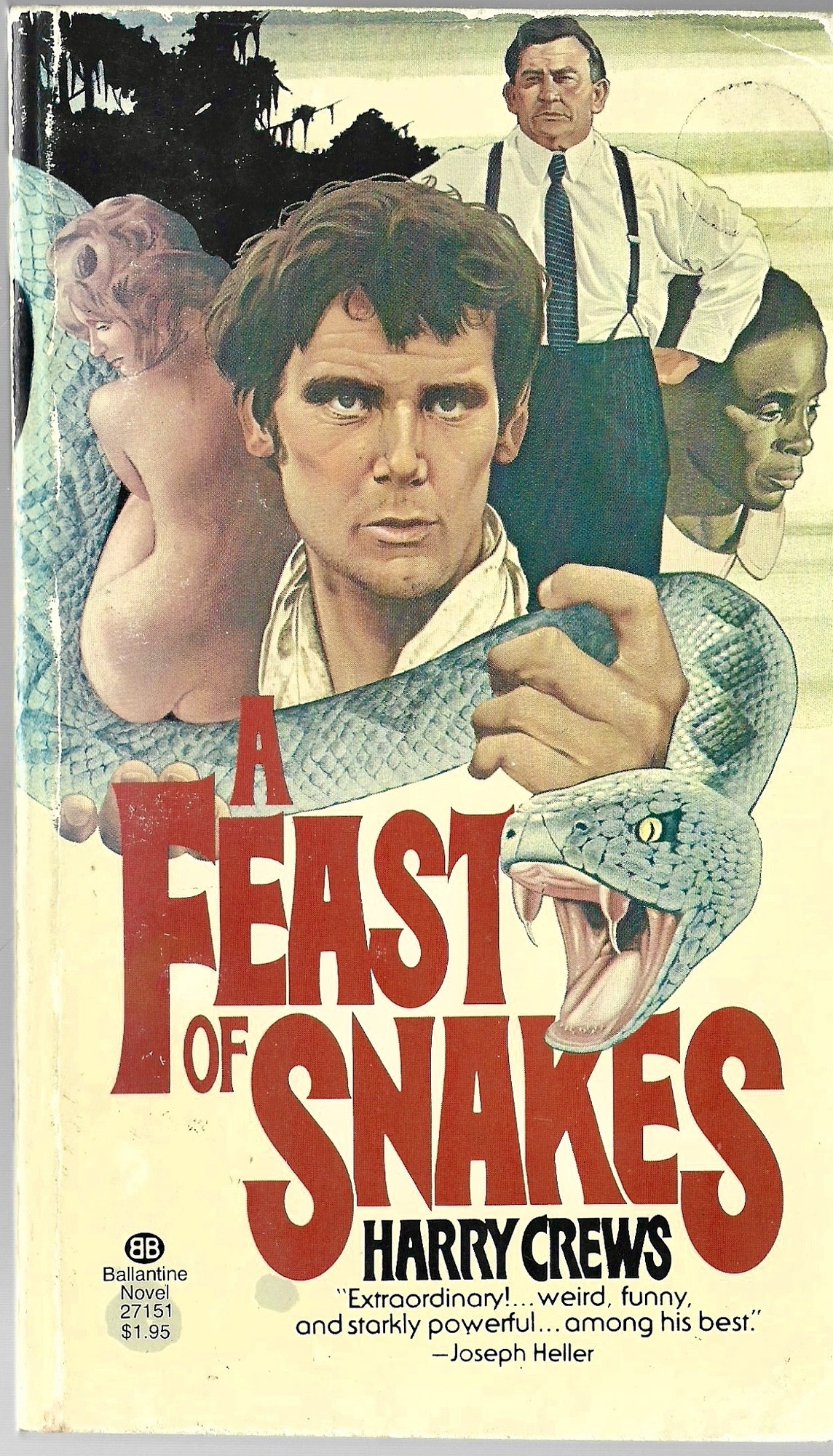
A Feast of Snakes, Harry Crews. Ballantine Books, first edition, first printing (1978). No cover artist credited. 165 pages.
While the cover designer and artist aren’t credited, there is a signature on the back which I believe is “Gentile.” If anyone has a guess as to the artist’s full name I’d be happy to hear it.
From the novel: not quite a recipe for snakes:
When they got to his purple double-wide, Joe Lon skinned snakes in a frenzy. He picked up the snakes by the tails as he dipped them out of the metal drums and swung them around and around his head and then popped them like a cowwhip, which caused their heads to explode. Then he nailed them up on a board in the pen and skinned them out with a pair of wire pliers. Elfie was standing in the door of the trailer behind them with a baby on her hip. Full of beer and fascinated with what Joe Lon could feel—or thought he could—the weight of her gaze on his back while he popped and skinned the snakes. He finally turned and looked at her, pulling his lips back from his teeth in a smile that only shamed him.
He called across the yard to her. “Thought we’d cook up some snake and stuff, darlin, have ourselves a feast.”
Her face brightened in the door and she said: “Course we can, Joe Lon, honey.”
Elfie brought him a pan and Joe Lon cut the snakes into half-inch steaks. Duffy turned to Elfie and said: “My name is Duffy Deeter and this is something fine. Want to tell me how you cook up snakes?”
Elfie smiled, trying not to show her teeth. “It’s lots of ways. Way I do mostly is I soak’m in vinegar about ten minutes, drain’m off good, and sprinkle me a little Looseanner redhot on’m, roll’m in flour, and fry’m is the way I mostly do.”
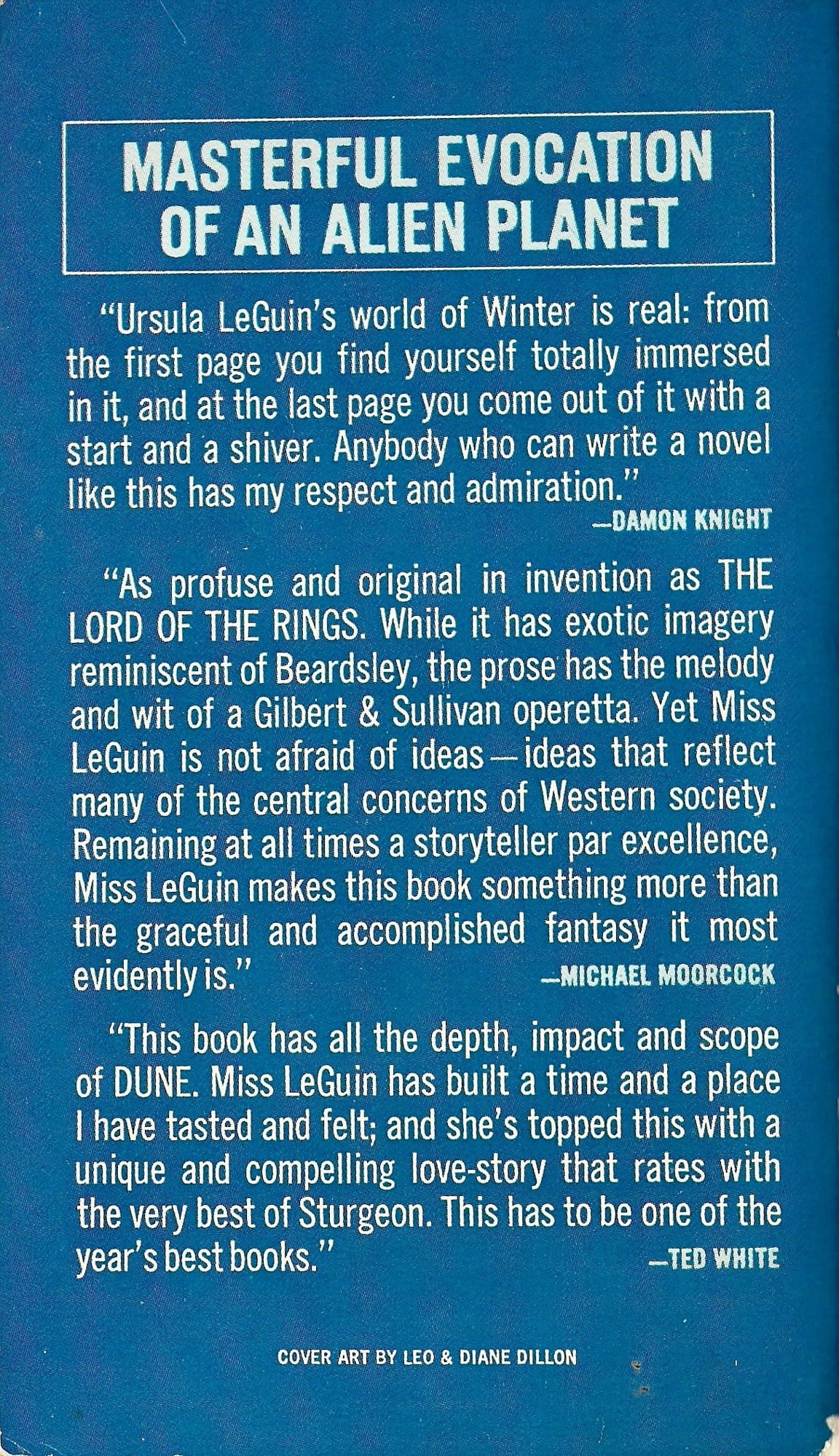
—The Left Hand of Darkness is amazing. Perfect in its strange imperfections and crammed with fables and myths and misunderstandings, it is the apotheosis of Le Guin’s synthesis of adventure with philosophy. Darkness is about shadows and weight. About pulling weight—literally, figuratively. It’s also the story of an ice planet. (A stranger comes to the ice planet!). It’s a political thriller. It’s a sexual thriller. But the impression that lingers strongest: The Left Hand of Darkness is one of the better literary evocations of friendship (its precarious awful strange wonderful tenuous strength) that I’ve ever read.
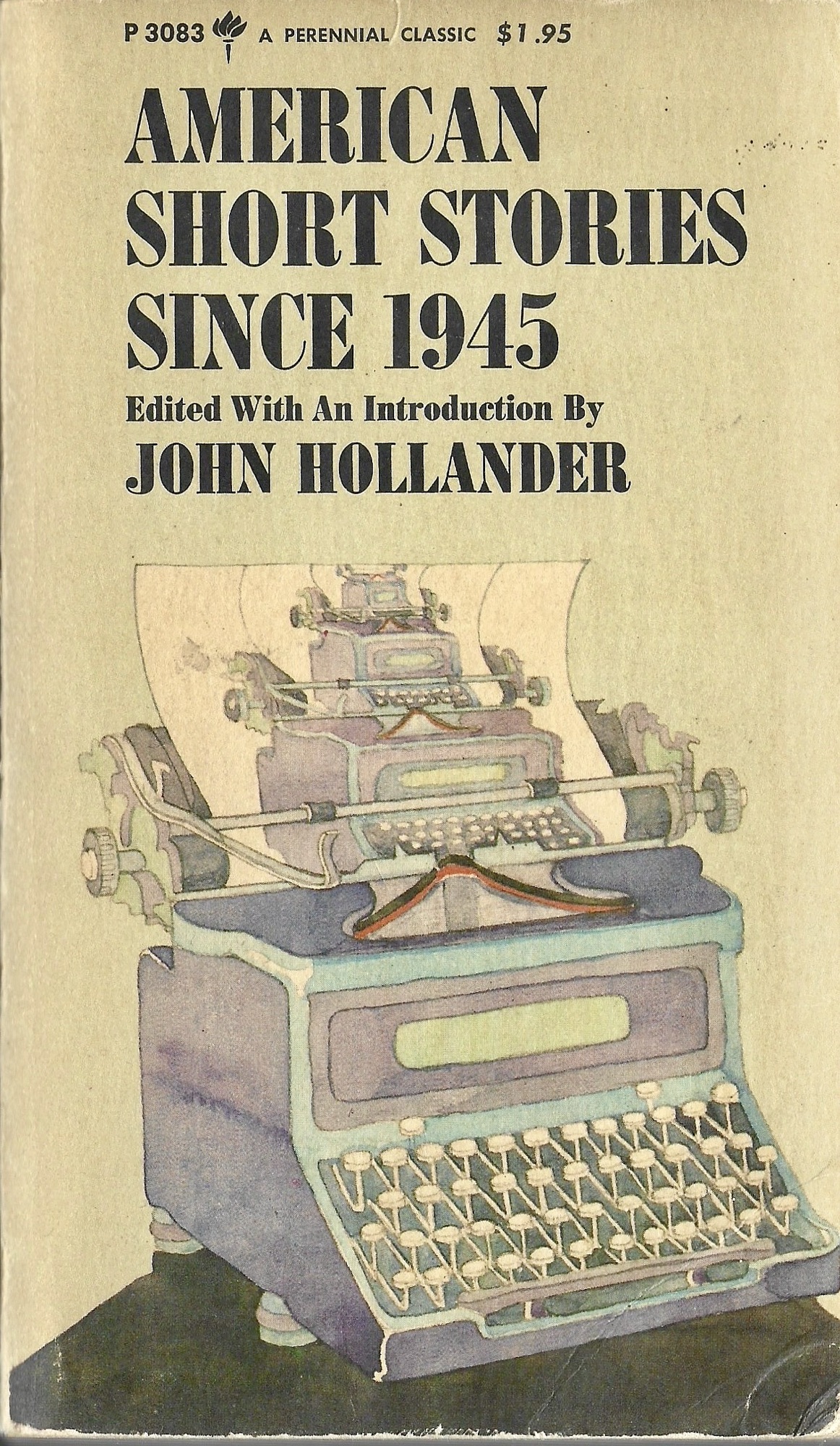
American Short Stories since 1945, edited by John Hollander. Perennial Classics, first edition, 1968. Cover design by Emanuel Schongut. 525 pages.
I think it was the title and the spine that first intrigued me when I pulled American Short Stories since 1945 from the shelf of a used book store: What would the selections be? How many years does the collection span? If Emanuel Schongut’s exquisite cover didn’t sell me on the book (which it did, all two dollars of it!), then the track list on the back certainly would have. And not so much for the authors I’d already read–Gass, Pynchon, Barthelme, O’Connor, Baldwin, and so on—but for the ones I hadn’t heard of, or at least didn’t think I’d heard of. Paul Goodman? Gilbert Rogin? Jeremy Larner? George P. Elliott? The poet who compiled the collection, John Hollander, writes in his introduction that it “aims to show the major shapes taken by shorter fiction in America since the end of World War II.” It’s the sort of book I wish I’d found when I was much, much younger, the kind of mixtape that would have sent me a lot of strange, wonderful directions.
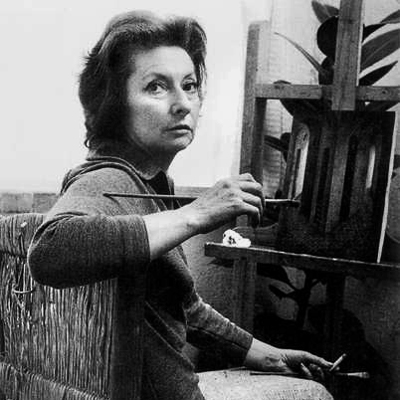
Five years ago, I was fortunate enough to interview Margaret Carson about her translation of a collection of the artist Remedios Varo’s written work. Margaret has since expanded on that collection, adding new material from her dive into Varo’s archives, resulting in On Homo rodans and Other Writings, new this summer from Wakefield Press.On Homo rodans and Other Writings offers readers a fascinating trip through Varo’s imagination. Brimming with impossible images, surreal jokes, and dreamy fragments, the work is more than just an addendum to Varo’s career as an artist. I highly recommend it to those interested in surrealist writing in general. Margaret was kind (and patient!) enough to talk with me again over the course of a few weeks via email. I am grateful for her generosity and for her work in bringing Varo’s words to monoglots such as myself.
In addition to her Varo books, Margaret Carson’s translations include Sergio Chejfec’s Baroni, A Journeyand My Two Worlds. She is Associate Professor in the Modern Languages Department at Borough of Manhattan Community College, The City University of New York.
Photograph of Margaret Carson by Beowulf Sheehan.
Biblioklept: Margaret, congratulations on the publication of On Homo rodans and Other Writings, the expanded edition of your English translation of Remedios Varo’s writings! Many of our readers might be familiar with Varo’s wonderful paintings but not know about her writing. How would you characterize the prose collected in On Homo rodans and Other Writings?
Margaret Carson: Thanks, it’s great to have the translation back in print! It’s mainly writings found after Remedios Varo’s death in notebooks and on loose pages. The writings are quite varied: several odd and delightful stories (three of them new to this edition), a fairy tale, letters to friends and strangers, her famous recipe “To Provoke Erotic Dreams,” a poem that invokes the moon, dream narratives, and a few other gems, such as the title piece, “On Homo rodans,” a faux anthropological treatise that accompanied her sculpture of a human-like torso on a giant wheel, made out of chicken, turkey and fish bones.
Homo rodans sculpture in its glass case. Photograph by Margaret Carson.
Varo’s extraordinary creativity and weird sense of humor come across just as much in her writings as in her paintings. I think readers fascinated by Varo, the artist, will also be won over by her gifts as a writer. Simply put, she’s as clever a writer as she is a painter.
Biblioklept: So, let’s get into the stories and other material new to this edition and how you came to translate it into English. Some of this material hasn’t been published before, even in Spanish. If my understanding is correct, Walter Gruen, Varo’s last life partner, donated a significant collection of her works to the Museo de Arte Moderno in Mexico City in 2000. In 2018—after the publication of your translated collection Letters, Dreams & Other Writings—the Varo estate bequeathed more of Varo’s writings to the Museo de Arte Moderno. Is that right?
MC: Yes. In the early 2000s Walter Gruen and his wife Anna Alexandra Varsoviano (a friend of Varo’s who he married after the artist’s death) donated about thirty-eight of her works to the Museo de Arte Moderno (MAM), making it the largest repository of paintings by Varo in the world. Walter Gruen died in 2008, and Anna Alexandra Varsoviano in 2015. (I was lucky enough to meet them both in person: Walter Gruen in 2000 and Anna Alexandra Varsoviano some years later.) In her will, Anna Alexandra bequeathed a trove of Varo’s notebooks, letters, preparatory drawings, photos, and other items to MAM, many of which were displayed in 2018 in an exhibition celebrating the donation: Adictos A Remedios Varo: Nuevo Legado 2018. It was at that exhibition that I first saw Varo’s notebooks, open to pages containing narratives, letters and other pieces, in Varo’s own handwriting. I could instantly recognize them because I’d translated the same texts for Letters, Dreams and Other Writings, except for that book I used a collection of Varo’s writings published in Mexico in the 1990s, Cartas, sueños y otros textos, edited by the Spanish scholar Isabel Castells.
Because the new Wakefield edition mostly uses archival materials as its source, and isn’t a direct translation of texts from an existing book, the estate requested that we give it a new title. So, thinking about Varo’s tour-de-force anthropological spoof, we renamed it On Homo rodans and Other Writings.
A page from the Homo rodans manuscript. Photograph by Margaret Carson.
Biblioklept: What kind of access did the museum give you to the manuscript materials?
MC: When I requested an appointment to consult the archive at MAM, I indicated my area of interest: Varo’s notebooks and any stray papers relating to her writings. So when I visited for a few days in July 2022, an archivist assisted me by bringing out her notebooks one at a time as well as folders containing loose papers. You can’t imagine how excited I was not only to see but to touch these old, faded composition books and to turn their pages to discover what Varo had written or drawn on them. There are about a dozen notebooks in all, mostly school composition books for children. I was snapping photos right and left! I’m very grateful to the Museo and to their archivists for guiding me through the notebooks and for their interest in the project.
Cover of one of Varo’s notebooks. Photograph by Margaret Carson.
Biblioklept: Varo was born in Spain, and her painting career sparked in earnest in France, but she really flourished as a painter in Mexico. Her work seems to find a growing audience in the USA; do you have a sense of her reputation in Mexico?
MC: Remedios Varo came into her own as an artist in Mexico City; when she began to exhibit, she was an immediate success. Her first solo show, in 1956 at the Galería Diana, was a sell-out, as was a subsequent solo show in 1961. Sadly, Varo suddenly died in 1963. Her posthumous reputation is in large part due to Walter Gruen and his efforts to keep her in the public eye. The first catalog of her work, whose publication was overseen by Gruen and funded by Varo’s friend and patron Eva Sulzer, came out just three years after her death, in 1966, with contributions by some heavy hitters: the poet Octavio Paz, the French intellectual Roger Caillois, and the Mexican philosopher Juliana González, a personal friend of Varo’s. Since then, four editions of Varo’s catalogue raisonné have been published in Mexico, the last in 2008. (Alas, all are now out of print but available in many research libraries.) People are deeply fascinated by Varo’s paintings. Special exhibitions of her work at the Museo de Arte Moderno always draw record crowds (as they do in other cities as well, for example, the recent Remedios Varo: Science Fictions exhibition in Chicago, which was one of their best attended shows ever).
Biblioklept: Gruen seems to have led a fascinating life.
MC: Yes, but not without its tragedies. The little I know comes from Janet Kaplan’s biography of Varo, his obituary in the Mexican daily La Jornada, and from the Adictos a Remedios Varo catalog. Like Varo, he was fortunate to get out of war-torn Europe, but only after he experienced the worst. He was born in Austria, started medical school in the 1930s, got kicked out because he was Jewish, was arrested by the Gestapo and sent to Dachau and then Buchenwald. After liberation, he made his way to Mexico City with his wife Klari Willner and it was there that he met Varo and others in the European refugee community. His wife died in Mexico in a drowning accident in the late 1940s, while Varo was living in Venezuela. It was some time after Varo’s return to Mexico that she and Gruen got together. Gruen had established his record store by then, the Sala Margolín, which for decades was the essential go-to place for classical music fans in Mexico City.
A year after Varo’s death, in 1964, Gruen organized an exhibition of her work at the Palacio de Bellas Artes, and it’s at that show that Thomas Pynchon, on a trip to Mexico City, saw Embroidering the Earth’s Mantle /Bordando el manto terrestre, which was immortalized in the novel The Crying of Lot 49. Together with Anna Alexandra Varsoviano, Gruen worked to secure Varo’s legacy as an artist and to safeguard what she left behind. From the perspective of Varo’s writings, it was crucial that her notebooks and papers remain as a single cache of documents and not dispersed. After Varsoviano’s death, the entire archive including this collection of writings passed to the Museo de Arte Moderno.
Embroidering the Earth’s Mantle, 1961, Remedios Varo
Biblioklept: This new edition of Varo’s writings includes three stories that were previously unpublished, even in Spanish. Do you know why they weren’t published before now?
MC: No, I don’t know why. The stories are unquestionably in Varo’s handwriting, and they’re marvelous. It would be a good question to ask Walter Gruen or Anna Alexandra.
Biblioklept: Speaking of her handwriting—did you revise any of the material you’d already translated after seeing it in her manuscript?
MC: To some extent, yes. As I mentioned before, for Letters, Dreams …. (2018), I used as my source text a collection that had already been published in Mexico. As I was translating, I’d occasionally come across bracketed ellipses [. . .], and I wasn’t sure what was being signaled. Had a word or sentence in the original been cut, or was it illegible at that point? I found no editorial explanation, so I simply carried over the bracketed ellipses into the English.
In preparing this new edition, I made sure to look for those same bracketed passages in the manuscripts to see if I could discover what Varo had actually written. I found some wonderful things. All the ellipses in the Mistress Thrompston story, for example, were places where Varo had drawn weird mathematical formulas meant to be read as proper names. So now, instead of “[. . .] Magazine,” you’ll see that its name is “WTrons – X√yl Magazine.” The Marquis of Ornitobello’s daughter, whose name had been dropped completely, returns to the story: she’s called √Ax8. These are the little touches where you see Varo being Varo. She loved playing with math. In Disobedient Plant/Planta insumisashe even painted mathematical formulas into the hair of the scientist and into the tendrils of the plants. Happily, Wakefield Press was able to incorporate Varo’s mathematical doodles and other hand-drawn whimsies into the published book.
Disobedient Plant, 1958, Remedios Varo
Another kind of revision I made after seeing the manuscripts may seem trivial, but in all instances Varo wrote “etc.” not “et cetera,” so I restored “etc.” And in “On Homo rodans” she used the ligature “æ” in her invented Latin, so I restored that as well.
Something that surprised me on reading the original manuscripts was that Varo often wrote super-long sentences—what writing instructors would call “comma splices” or “run-ons.” I initially wanted to restore these sentences to their original length because in their raw state there’s a kind of fast-forward momentum. You get pulled along as she adds one thing after another to her narratives, almost breathlessly. But in the end, for the sake of readability, I normalized the punctuation a bit by breaking up some of the enormously long sentences.
There were maybe only one or two times when I changed the translation of a word after seeing that Varo had written something different from what the editor of the previous volume had transcribed. Nothing major. Of course, like all translators, I’m an obsessive reviser, so in preparing this new edition I couldn’t help but look over the previous translation to polish and tweak. I didn’t need the manuscripts for that. As they say, a translation is never finished….
Biblioklept: I’m curious if your “editor’s voice” clashed at all with your “translator’s voice” when it came to revising Varo’s comma splices and fused sentences. And were there clashes elsewhere, when it came to, say, new word choices?
MC: Hmm, I haven’t thought of the two roles clashing before. I think we worked pretty harmoniously together. The editor would have probably liked more time to revise the introduction and endnotes, and to think about the best way to order the texts within the book, while the translator, eager to get the translation back into print, was more like, “Let’s wrap up!”
Biblioklept: One section new to this edition are a handful of brief poemish texts collected as “Images in Words.” A few of these word-image-poem-texts (?!) contain strikethroughs and doodles, as you mentioned before. Many of these pieces feature phrases that correspond to motifs we see in Varo’s visual art (trees, pulleys, stars, knitters, etc.). To your knowledge, do these image fragments correspond to any of Varo’s paintings? Do you have a sense that these were “plans” for paintings–pieces of visual art that started in language first?
MC: It’s difficult to know with any certainty, but they do seem like plans for paintings that started off in language first. They could be Varo’s earliest ideas: flashes of images, possibly from dreams, that she developed as preliminary drawings and eventually, fully fleshed out in paintings.
When Varo was once asked if she was a writer as well as a painter, she replied, “I sometimes write as if I were making a sketch” (“A veces escribo como si trazase un boceto”).A lot has been made of that one sentence because it’s the only time we know of that Varo speaks of her writing. I used to think she was very modestly describing her writing as a whole, including her creative writing, but now I believe she was referring specifically to these poem-like fragments, these sketches in words. When an idea came to her, I imagine her grabbing her notebook and opening it to a blank page, sometimes to make a quick sketch, other times to jot down a few words. Sometimes she did both on the same page.
Do the fragments correspond to any paintings? Yes, if you’re familiar with her work, you can immediately make connections. For example, from the bottom of p. 131:
character from peeling wall participating in something with another character who is real
Metamorphosis
Mimicry
The abandoned room, someone inside the table, inside the armchair
as well, perhaps inside the wall — — — —
The first two lines seem to describe the painting Harmony / Armonía, in which there’s an ethereal figure emerging from a peeled-back wall to play with an object on a musical staff (a snail?). The other “real” character sits at a table across from the apparition and plays with a polyhedron-like object on the staff. Why did Varo cross the lines out? Walter Gruen speculated that it was because she had finished the painting.
Harmony, 1956, Remedios Varo
The next two lines refer to the well-known painting Mimesis / Mimetismo, in which she depicts a woman undergoing a metamorphosis – she’s taking on the characteristics of the chair she’s sitting in. (Side note: Varo’s catalogue raisonné translates the title of this painting as Mimesis, which isn’t wrong, but it makes me think more of the Erich Auerbach book and literary mimesis. I believe a better English translation would be “Mimicry,” as in insect mimicry, a phenomenon of particular interest to the surrealists. See Roger Caillois’s 1935 essay “Mimétisme et psychasthénie légendaire,” in the surrealist journal Minotaure).
They represent just one moment in the evolution of an artist’s idea. It’s said that Varo was very private in her studio practice. No one knows for sure, but it’s likely she used her notebooks (which also doubled as sketchbooks) at the earliest stages of a painting, when her ideas were hatching.
Biblioklept: Can you expand on how Varo was private in the studio?
MC: I can only talk about her studio in a limited way, from clues provided in photos and in a few accounts. I also talked a bit about Varo’s apartment-studio with Xabier Lizarraga Cruchaga, her godson, who as a boy used to visit Varo in her studio quite often (so she didn’t completely exclude visitors). Her studio was a room on the top floor of the building she lived in, accessible by a private flight of stairs. A wide doorway in the studio opened to a small, north-facing terrace where she kept plenty of plants. You can see the studio in a series of photos Kati Horna took of Varo for a magazine article that appeared in 1960. In the article, two photos show Varo at work, one at a drafting table and the other at her easel. The painting on the easel is Farewell /La despedida, with only the architectural elements of the painting in place (she would later add the departing lovers, their shadows, and the cat that looks on). Observe the white lump on the left side of the easel. That’s a piece of quartz. She apparently used quartz to incise fine lines into her paintings to expose the gesso underneath. Quartz comes up a few times in her writings as well. Let’s say she had an affinity for quartz and its mysterious qualities.
She also mentions her studio in one of her dream narratives, which begins like this:
“I dreamed I was asleep in my bedroom and a loud noise woke me up. The noise came from upstairs, from the studio, and it was as if someone were dragging a chair. I thought that this meant someone was trying to get in from the terrace and was pushing the armchair that was against the door.” (p. 100)
She goes on to narrate a terrifying dream, but note that she’s indirectly giving the basic layout of her apartment-studio.
As to her practices while at work in her studio, more and more is being written in English. In fact, for the first time ever, an in-depth investigation of her paintings by art conservators was done in connection with the recent Remedios Varo: Science Fictionsexhibition at the Art institute of Chicago. For an excellent overview of Varo’s approaches as an artist, and for descriptions of some of her techniques, check out this blog post by members of the AIC curatorial team.
Biblioklept: Varo didn’t strongly pursue exhibiting her art, and she didn’t publish any of her writing in her lifetime, right? Why do you think that was?
MC About her artwork, that’s not true. Varo was totally out there as an artist and very much interested throughout her career in exhibiting her work. As an emerging artist in the 1930s, she didn’t sit back and wait for things to happen. In the 1930s she moves to Barcelona, the home of the avant-garde in Spain, and joins artists who were radically breaking with whatever the conventions were back then. She’s on the map as an artist of note as early as 1936, when her paintings are included in the landmark Exposició Logicofobista in Barcelona. Later, after the Spanish Civil War breaks out and she moves to Paris, she’s in the 1938 Exposition Internationale du Surréalisme and images of her work are published in important Surrealist journals such as Minotaure and Trajectoire du rêve. After the Nazi invasion of France, she flees Europe for Mexico City in 1941 and there’s a pause in her exhibitions (she turned to commercial art to make a living) until 1955, when she exhibits new paintings in a group show of women artists that includes Leonora Carrington and Alice Rahon.
Announcement for “Seis pintoras.” Photograph by Margaret Carson.
This is Varo’s breakthrough show in Mexico City. The following year she is offered her first solo show, which is a great success, leading to new commissions and to (among other things) the magazine article I mentioned above with photos by Kati Horna. In no way did she have a secret life as a painter.
Remedios Varo Wearing a Mask by Leonora Carrington, 1957. Photograph by Kati Horna.
We don’t know as much about her ambitions as a writer, but she wasn’t secretive about that, either. She definitely collaborated with Leonora Carrington on some writings—for example, they have a collaborative play, El santo cuerpo grasoso, not translated yet into English. In this new edition there’s Varo’s part of what I believe was an exquisite corpse novel written with Carrington. Another “public” writing is the title piece of the collection, On Homo rodans. It’s a handwritten manuscript that was never published in the marketplace sense of the word. But Varo certainly intended for others to read it, if only a small audience of friends. (After her death On Homo rodans would be published in a small facsimile edition of 250 copies, put out by a small press in Mexico City in 1970.)
The surprise is that Varo’s excellence as a writer and storyteller still goes unmentioned. It’s a small body of writings, but some of these stories are remarkable. For example, the first three: “In a field in the state of Morelos…,” “Dear friend, I believe it’s necessary to tell you…” “One day when Maria was coming back from school…” (They have no titles, so they’re identified by their opening lines.) I was astounded, amused, captivated when I first read them….talk about the pleasures of the text! Who knew she was such a talented writer? I’m hoping that people who are passionate about Varo, the artist, will be curious about her writings and will find some powerful connections there to her art—and that they’ll also stay with her for her writing alone.
We visited Seattle over the fourth week of June 2024, our first time there.
We met up with some old friends and took our son to see his favorite band play at the Woodland Park Zoo. Unlike my last getaway (to Atlanta) I was carless and a bit more encumbered (kids, friends, friends’ kids, etc.), so I wasn’t able to get to as many bookstores as I would have liked to—but I still got to quite a few.
We stayed in the Belltown neighborhood. Full of restaurants, bars, and independent shops, Belltown’s about a ten or fifteen minute walk to the famous and touristy Pike Place Market, which, despite being famous and touristy also boasts some really cool little shops—including Left Bank Books which features “anti-authoritarian, anarchist, independent, radical and small-press titles.” They also have a section devoted to “Transgressive Literature/Weird Shit.”
Left Bank’s collection of used stuff is impressive, as are the myriad and diverse offering of zines. My son picked up a bunch of art zines and comix and I left with anarcho-surrealist Ron Sakolsky’s prose mixtape Scratching the Tiger’s Belly.
Also impressive at Pike Place is BLMF Literary Saloon, brimming with towers of reasonably-priced used books. Lionheart Bookstore is a bit less chaotic than BLMF and sells newer titles, with fewer used books. (Less chaotic is not a knock on BLMF, by the way.) I didn’t succumb to picking up a first-(US)-edition of J.G. Ballard’s The Day of Creation there, maybe because I was already carrying around some LPs my son bought at Holy Cow Records. We also stopped by Chin Music Press. They make some beautiful books.
I think my favorite spot at Pike Place though was Lamplight Books. There was a nice collection of used literature (including a lot of so-called weird shit). The proprietor patiently let me handle first editions of Ballard, Barthelme, Borges, and Burroughs books (among other non-B titles). They were happy when I picked up Jacob Siefring’s translation of Rabelais’s Doughnuts by Pierre Senges, proudly letting me know that I was supporting not just a local indie bookshop but a local indie press, Sublunary Editions.
Despite the crowds of tourists in Pike Place lining up to go into the world’s oldest Starbucks (which, as my pal pointed out, is no different than lining up to gawk at the first CVS or first Harbor Freight), Pike Place has some nice niche shops. (Our lunch at the terrace of The Pink Door was lovely, too.)
While thrifting and record shopping in the so-called “hipster” Capitol Hill neighborhood, my crew indulged me in a too-long browse at The Elliot Bay Book Company. I’m generally a used-bookstore guy–I tend to order new titles from my local used bookshop, and I’m mostly out looking for the weird shit–but I’m always impressed by stores like Elliot Bay, which features the kind of odd and out of the way stuff you won’t find at a Barnes & Noble. I have silly little “tests” I like to do in stores that sell new books, checking to see if they stock certain authors, and, if so, which titles, and Elliot Bay excelled. (No Antoine Volodine, though, but I assume someone picked up the last copy of Radiant Terminus.) There, I picked up Lord Jim at Home by Dinah Brooke. The lovely evocative cover was facing outward and appended with a bookseller’s note. The flap copy notes that when “Lord Jim at Home, was first published in 1973, it was described as ‘squalid and startling,’ ‘nastily horrific,’ and a ‘monstrous parody’ of upper-middle class English life” so I figured I could get down with that.
I suppose I could remark more on Seattle itself.
We were there for six days and seven nights, which is clearly not long enough to take the measure of any major city. The weather was wonderful—sunny with maximum temps of around 80 degrees Fahrenheit, a relief after weeks of a Florida heatwave mired in a humid and insufferable drought. Even a day hiking on Mt. Ranier was warmer than we expected. (We had a nice early dinner in Enumclaw that day; a charming town, we all agreed. Curious about this quaint hamlet, I read the Enumclaw Wikipedia page aloud to my crew as we drove back to our Belltown digs before stopping, aghast, thinking of the children.) Seattle itself was more touristy than I expected, and perhaps a bit more depressing. In both Belltown and Capitol Hill we witnessed far more addicts nodding than I might have expected, although no one bothered us. Most of the patrons in the bars, restaurants, and shops we visited in these neighborhoods seemed like they were from Some Other Place, transplants to this big city who might also move at any time to Some Other Place. Even in the warm weather it was a bit cold.
We did some of the touristy things, too: The Museum of Pop Culture (the Nirvana exhibit was depressing; I loved looking at their guitar collection and jamming with my wife and son in their Sound Lab space. The stop-motion-animation exhibit was cool); the Chihuly Garden and Glass museum was unexpectedly beautiful and curated in a way that made me appreciate the glass anew (we saw a baby rabbit, wholly unafraid, snacking in the garden); the Space Needle views were amazing (its history, an optimistic ideal of American progression, brought me down before I got on the fast elevator up). I’m not sure if any of it really cohered for me into the kernel of angst I get when I fall in love with a city—a city like Mexico City or New Orleans or Tokyo or Los Angeles—but that’s fine. We shouldn’t be falling in love all the time.
The show at the zoo provides a nice addendum to what I’ve written (even if it happened in the middle of the week). My son loved seeing the band with the awful name that I am Too Old to really get and I loved seeing him get to see them and loving them. What I loved was seeing the crowd of freaks and weirdos and nerds and normies, all so unconcerned, it seemed to me, with being hip or being seen as hip, so unconcerned with doing anything aside from taking the sensual summer solstice air. Everyone seemed so chill, so unuptight.
Maybe it was the overpriced zoo beers coursing in my ugly veins, but I loved the city a little bit right then, forgiving it for any of the ways it had failed to live up to the imaginary picture of Seattle that my twelve-year-old brain had manifested over three decades ago. Maybe I was seeing the fruition of the dream I’d latched onto, so so long ago, a dream for a place where people didn’t have to struggle so hard just to like, be who they are. I think I remember, for maybe a good half hour or so then, loving Seattle.
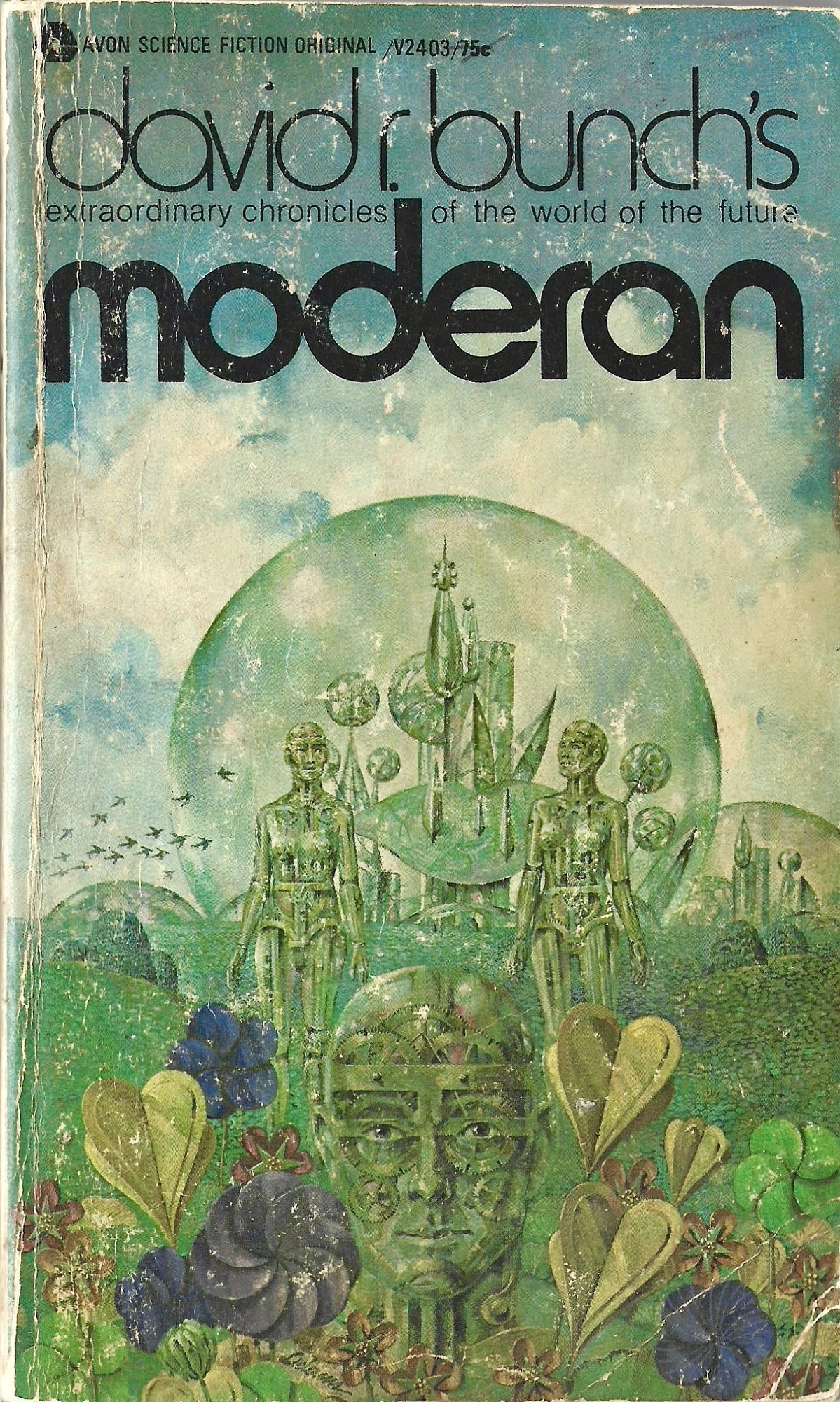
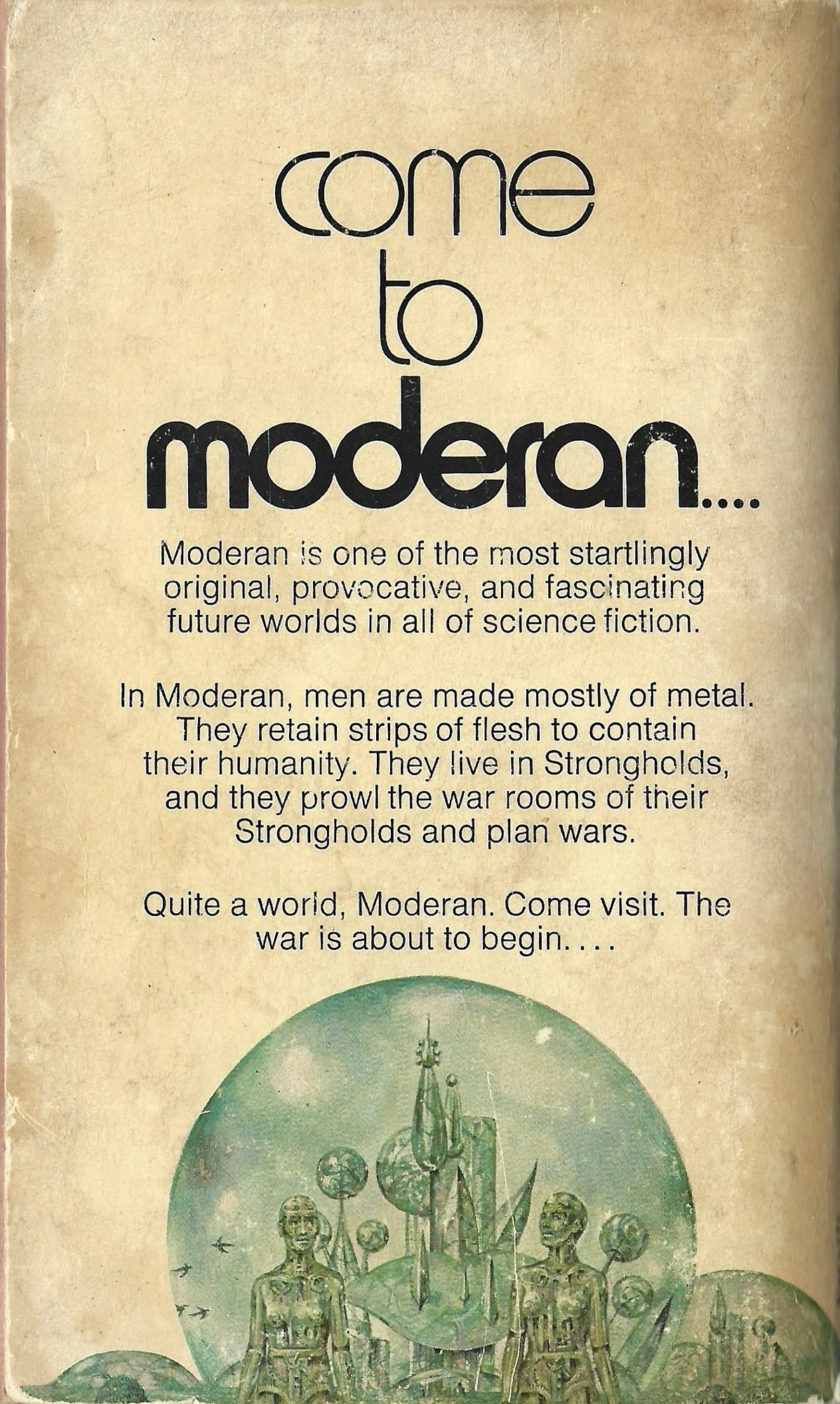
Moderan, David R. Bunch. Avon Books, first edition (1971). No cover artist credited. 240 pages.
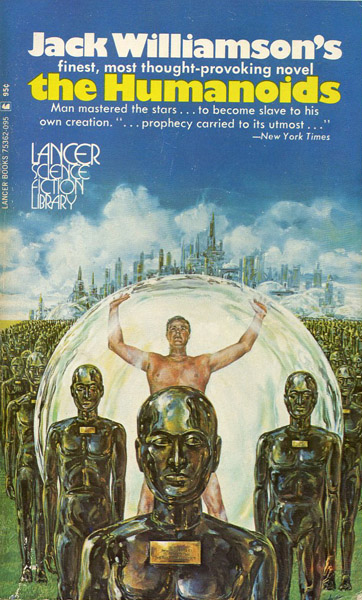
The uncredited Boschian cover for this 1971 mass-market paperback edition of Moderan is by Norman Adams. (Adams did a similar cover in 1972 for Jack Williamson’s novel The Humanoids.)
I think copies of this volume were expensive and hard to find previous to NYRB’s 2018 release of a new edition of Moderan (which included eleven new tales). That’s the version I read—although I was happy to snap this old paperback up for three bucks at a used bookstore. I wrote of the novel in my 2018 reading round-up:
Moderan works as a post-nuke dystopian satire on toxic masculinity. The tropes here might seem familiar—cyborgs and dome homes, caste systems and ultraviolence, a world of made and not born ruled by manunkind (to steal from E.E. Cummings)—it’s the way that Bunch conveys this world that is so astounding. Moderan is told in its own idiom; the voice of our narrator Stronghold-10 booms with a bravado that’s ultimately undercut by the authorial irony that lurks under its surface. The book seems equal to the task of satirizing the trajectory of our zeitgeist in a way that some contemporary satirists have failed to.
At the post office the woman finally got a good long look at the monster, a stare. She was breathing the same air, not as before, deprived.
When she had first sighted the monster, this woman had not been sure whether or not to trust her instinct.
Was it a monster?
What it was was a monstrous posture she had seen, and the hair on top of the head was heaped so that it appeared as a bulge of hair, with far too much hair coming down at the side, so as to be an abnormal amount. Otherwise, the form of the monster was spindly. It was a small-sized monster.
The eyes were pale turquoise. The facial skin was milky milky white. The nose was a short, finely shaped nose. The mouth was full-lipped, painted coral. The hair was the woman’s favorite color hair—cinnamon color. The voice was girl-like when the woman heard it. The black-inked handwriting on the brown-paper-wrapped package was indecipherable from the distance it was observed from, but it was a curvaceous handwriting. The high-heeled shoes with ankle straps were made of metallic gold leather. The purse was like bronze.
Okay, the emergence of this bombshell has gone on long enough for me. Occasionally I select a man, but my preference is for women who could easily steal away my beloved husband who is not taboo.
Carnality is common in rude society. The incarnation is temporary or permanent.
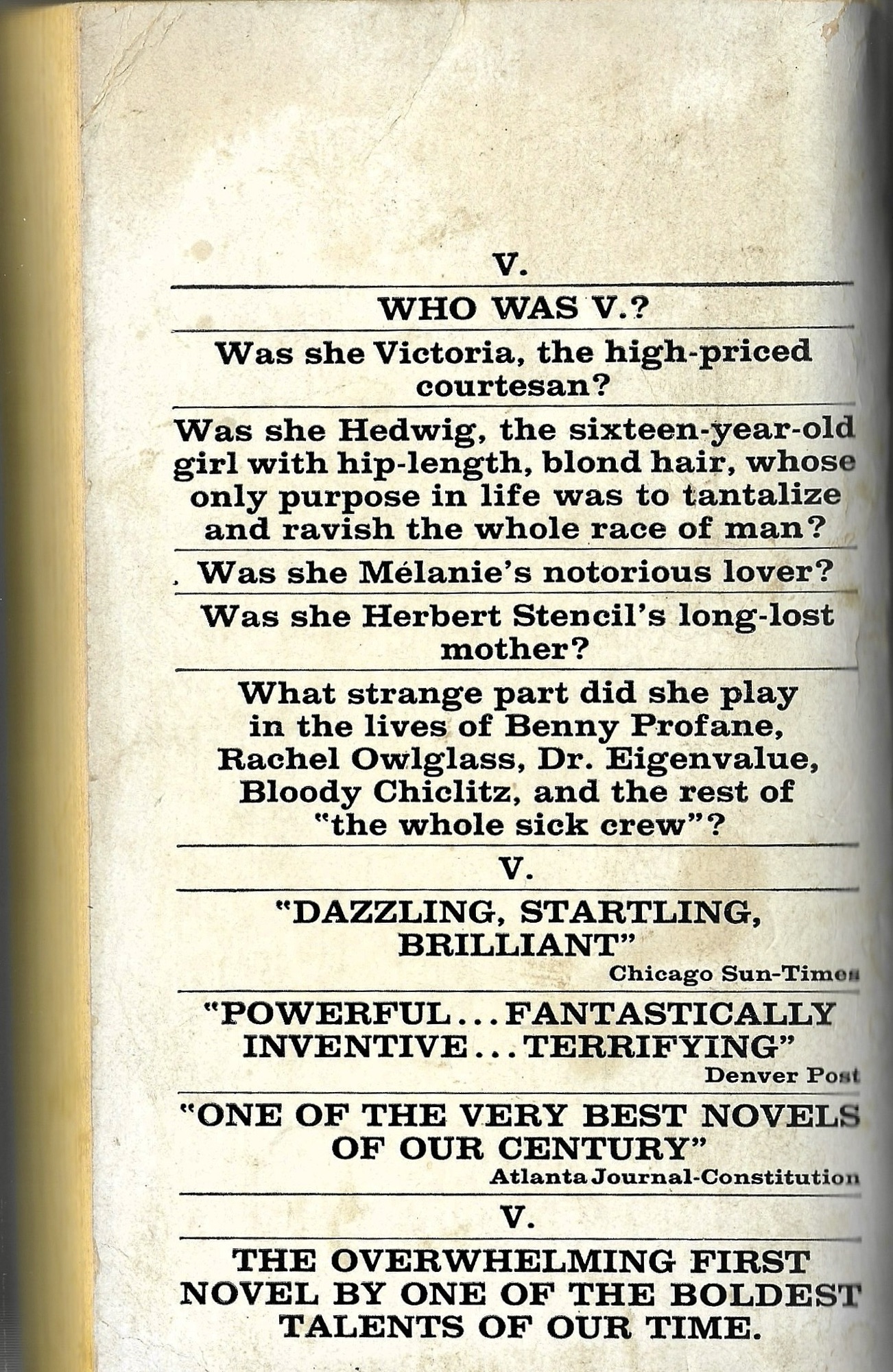
Redburn, Herman Melville. Doubleday Anchor Books (1957). Cover art by Edward Gorey. 301 pages.
Redburn is as good a place as any to start with Melville, I suppose. From Elizabeth Hardwick’s essay “Melville in Love,” which prompted me to finally read Redburn:
Melville’s state of mind is revealed…with a purity of expressiveness in the novel Redburn, one of his most appealing and certainly the most personal of his works. He is said to have more or less disowned the book, more rather than less, since he claimed it was only written for tobacco. Whether this is a serious misjudgment of his own work or a withdrawal, after the fact, from having shown his early experience of life without his notable reserve and distance is, of course, not clear. For a contemporary reader, Redburn, the grief-stricken youth, cast among the vicious, ruined men on the ship, walking the streets of Liverpool in the late 1830s, even meeting with the homosexual hustler Harry Bolton might have more interest than Typee’s breadfruit and coconut island and the nymph, Fayaway. But it is only pertinent to think of Redburn on its own: a novel written after Typee, Omoo, and Mardi in the year 1849, ten years after he left Lansingburgh to go on his first voyage.
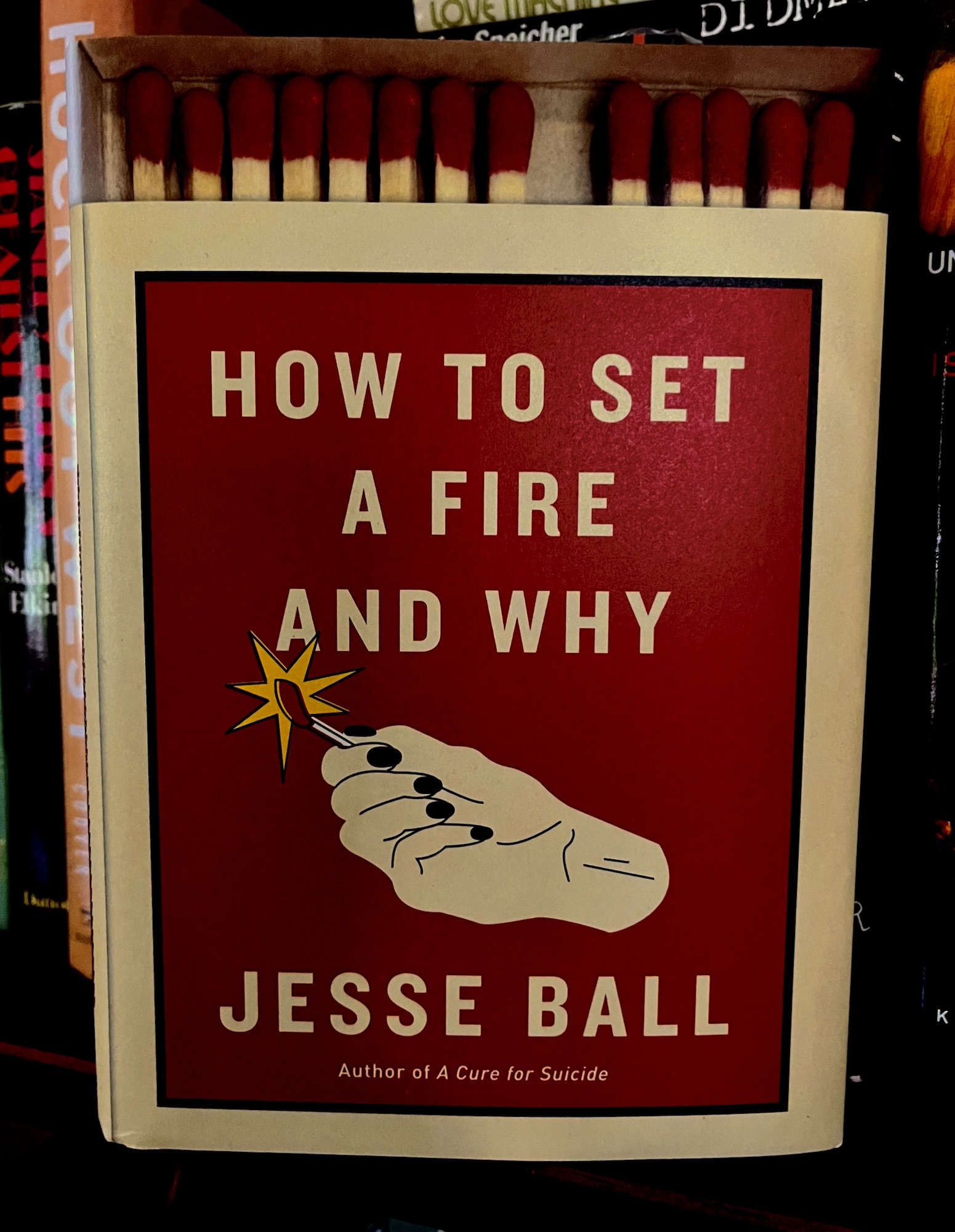
Jesse Ball’s 2016 novel How to Set a Fire and Why covers a few tumultuous months in the life of Lucia Stanton, anarchist daughter of anarchist parents, now living with her aging anarchist aunt after the death of her (anarchist) father and subsequent mental breakdown and institutionalization of her (anarchist) mother.
The narrative begins with the aftermath of Lucia’s expulsion from school for stabbing a classmate with a pencil. The classmate’s crime? Touching Lucia’s lighter, a capital offense. I wrote Lucia’s lighter, but she—Lucia, the first-person narrator of Jesse Ball’s 2016 novel How to Set a Fire and Why—she always refers to it as her father’s lighter: “His corpse is actually on it—I mean, not his death corpse, but his regular one, the body that falls off us all the time. It’s what I have left of him, and I treasure it.”
So Lucia’s off to a new school, trailed by rumors of graphite-based violence that don’t help her win new friends. Her poverty doesn’t help her popularity either (did I mention that she and her aunt are practicing anarchists?) But she’s in luck, sorta, because she hears that this school has a “Sonar Club”:
I’m sure that doesn’t mean anything to you. You’re wondering, why is she happy about some Sonar Club. That doesn’t sound even remotely fun. Well, I have a friend—I do—who told me about something he heard about from someone else—and what it is, is this:
Right now, there are clubs forming up all over the country. They call themselves sonar clubs, or even radio clubs—but what they are is clubs for people who want to set fires, for people who are fed up with wealth and property, and want to burn everything down.
S – O – N – A – R = A – R – S – O – N
And there’s the essential surface conflict of How to Set a Fire and Why: will Lucia, like, shift her collectivist-anarchist ideals toward something more, uh, destructive? Will she burn it all down?
The real plot of the book though is about a teenage girl going through some shit. Lucia is sharp, witty, but caustic and clearly depressed. She is also incredibly observant and very, very intelligent. Ball’s greatest strength in the novel is harnessing Lucia’s spiky but vulnerable intellect; we ride her first-person narration persuaded by her maybe-genius, but also aware of all of her blind spots. Teens know the Truth, but the Truth often blinds them to reality. Not that Lucia isn’t self-aware; consider her take on her own intellect:
My aunt says that I am naturally curious. That means that I don’t need to be taught how to learn. Some people have a disadvantage at the beginning, and they are not curious. These people have trouble learning. It seems like not being curious is the worst thing of all. Curious people aren’t necessarily good at learning what you want them to learn, though. They are too busy learning about other things.
The best bits of How to Set a Fire let Lucia riff on her observations. There’s a poignant detailed description of her father’s lighter (“My father’s is matte black and has a white dot in the center. I haven’t seen another like it”). There’s an explanation and analysis of the rules of cee-lo, which Lucia decides exploits outsiders. She praises both My Dinner with Andre and the music of Erik Satie. She makes predictions and shares their outcomes. She has sex and takes drugs. She visits her mother at the institution. She’s afraid a lot, and probably with good reason: “When I think about what my future holds, it is a bit like looking into the sun. I flinch away, or I don’t and my eyes get burned down a bit, like candles, and then I can’t see for a while.”
Most of Lucia’s observations are about people: I did not count the nouns in the novel, but I imagine people would have to be up there as one of its most common words. A representative sample might be this early simple nugget: “History is just people behaving badly.” Lucia is cynical, sure, and with good reason. How to Start a Fire often echoes the coming-of-age cynicism of The Catcher in the Rye, whose narrator was also flawed and intelligent and blind to what he could not see. (We are all of course blind to what we cannot see.) But Lucia’s not entirely unforgiving. “People aren’t all horrible. They aren’t. Sometimes you find a good one, at least for a while—even if it’s just for twenty minutes or so,” she concedes.
Lucia’s voice is the reason to read How to Start a Fire. It’s compelling and funny and persuasive and hurt. It seems authentic, and I admire the risk Ball has taken—it’s not easy to write a teenage girl who is also maybe-genius-would-be-arsonist. The plot proper of How to Start a Fire never really commits to anarchism or revolution however—sure, things happen—but we never really find out why Sonar Clubs might be taking off around the nation, let alone, like, how Lucia fits into all that. But I don’t think that’s really what Ball is doing here—I think he’s marking off a measure of time in a character’s life:
When people write books about childhood, and about being a kid—they always talk about how endless it is, and about how there is no thought of time. Everything just stretches and stretches. I think the opposite is the case. When you’re young, you feel like things are constantly ending. As soon as you get used to something, it goes away.
The following discussion of Vladimir Sorokin’s novel Blue Lard (in translation by Max Lawton) is intended for those who have read or are reading the book. It contains significant spoilers; to be very clear, I strongly recommend entering Blue Lard cold.
I’ve had too many false starts with this last (for now) riff on Blue Lard that I’ve ended up rereading the last 100 or so pages maybe four times now. When I first started this ridiculous series of riffs–way back in February!–I promised to surf Blue Lard’s wave; I have not done that. I’ve bogged myself down in summarizing. I’ve found myself reading Wikipedia entry after Wikipedia entry of the various Soviet luminaries–politicians, artists, writers, scientists, etc.–who lard the end of the novel. I’ve tried to figure out the ending by going back to the epistolary beginning. I’ve tried, I suppose, to flesh out the thesis I arrived at in the last riff I did, where I suggested that “Blue Lard is hypersurreal, shocking, deviant. But it’s also more balanced and nuanced than a first go-through might suggest, not just absurdist shit-throwing and jabberwocky, but an accomplished analysis of the emerging post-Soviet era.”
So well where were we? Or rather, where are we? The novel’s final section begins with Hitler loading his family, his bodyguard, his lover Khrushchev and a retinue of ninjas into his private plane. They abscond with the cache of blue lard and make their way to Germany to meet up with their old pal Hitler, irking Beria and his murderous allies.
On route to Hitler’s Berghof, Stalin’s wife Nadezhda reads aloud the first act of a new play by Konstantin Simonov, A Glass of Russian Blood. The play seems to be an allegory framing the Soviet intelligentsia as literal bloodsuckers, vampires feasting on the proletariat. Khrushchev dismisses the play’s subject as “fashionable rancor”; Stalin is more charitable, remarking that “Every writer has his ups and downs.” As usual, I found myself going down a rabbit hole, trying to glean a possible critique of the Simonov’s journal Novy Mir in particular and Soviet literature in general. This is not the way to read Blue Lard. Meanwhile, unconcerned with absurd theater, Stalin’s daughter is hungry; she declares she’d like to eat a unicorn. (In one of the earlier translations of Blue Lard I read, Max includes a footnote explaining that he’s substituted unicorn for the original tyanitolkai (тяни-Толкай) in the interest of readability.)
Back in Moscow, Beria is trying to track down Stalin and the missing blue lard. He’s also ordered the torture of Andrei Sakharov who’s been condemned for, as his torturer notes, suggesting that “Time is a head of cabbage and all events are just aphids eating their way through it” — a complete rejection of Soviet communism’s teleological conception of historical materialism.
Sakharov’s torturer is Alexander Khvat, who the narrator informs us was “the lead investigator on the case of the sinister saboteur Vavilov who’d devoted his life to cultivating ‘quick ergot’ and using it to infect Kuban wheat.” The historical Vavilov, which is to say our historical Vavilov, was an agrinomical geneticist who tried to use science to feed the world.
But Sorokin’s critique doesn’t seem to be aimed at Soviet communism alone; rather, he seems to condemn the brutal stupidity and close-mindedness of those who fear what they do not comprehend. Blue Lard’s absurdity and violence critiques power—and the fear of loss of power that consumes those who hold power.
Stalin’s crew passes over the great Prague Wall which separates the West from the East, the Third Reich and its partner the USSR, and soon arrive at the Berghof:
The long, unusually smooth tarmac of the airfield was reminiscent of a frozen mountain lake and ran up against a granite statue of Hitler’s head, carved from an entire mountain by the efforts of Arno Breker and six thousand French and British prisoners.
The Hitlers (the führer has married mistress Eva in this reality) and the Stalins kiss their hellos and with their accompanying entourages head to yet another of Blue Lard’s many, many feasts. (The narrator notes that “Meanwhile, in the plane, Ajooba, Sisul, and the ninjas were quickly and professionally strangling the airplane’s crew” — the adverb professionally there is marvelous.)
Just as he does with Stalin, Sorokin renders Hitler in kitschy pop-glam strokes:
Hitler put his unfinished glass down on a tray held up to him by an SS servant, then, opening his long arms in the narrow sleeves of a dark-blue frock coat, lace cuffs spilling out of them, walked over to Stalin, his high-heeled shoes with their golden spurs loudly knocking against the marble. Eva followed him, her thin body nestled snugly into a leopard dress.
Tacky-glam of Hitler of Blue Lard is also a bit of a carnivore, unlike the vegetarian of our own historical record. “The table was covered primarily in meat-based hors d’oeuvres, as the Führer couldn’t stand fruits and vegetables,” the narrator notes. But he’s still an animal lover. When he pets his dog Blondie, his hands sparkle and crackle with electric energy. This Hitler shoots electrical beams from his fingertips, a talent that helps him win WW2.
Blue Lard’s final sequence in Hitler’s Berghof is full of depravities and (soap) operatics. Hitler essentially rapes Vesta, while her mother Nadezdha watches through a keyhole. Stricken, Nadezdha makes a call to her on-again-off-again lover Boris Leonidovich—presumably Boris Pasternak (we encountered his clone, author of the thirteen-stanza poem “Pussy” in the first section of Blue Lard), who chastises her for the sin of “pleonasm” (!) after she accuses him of cheating on her with “that jester… that clown… that idiot” Shklovsky (presumably the literary theorist Viktor Shklovsky).
Then all kinds of shit goes down. I’ve gotten bogged down in over-summarizing again; not my intention. The final strands of Blue Lard twist about like fragments of old spy films or war films—double crosses, unclear intentions. Heinrich Himmler shows up with just a few pages left in the novel, a thousand-pound mutant (Jabba to Hitler’s Emperor? Did Sorokin, like, get mad coked up and watch Return of the Jedi and write Blue Lard?)
It all ends, or doesn’t end, with Stalin injecting blue lard into his brain, which then expands and expands and expands:
Iosif Stalin’s brain gradually filled up the entire universe, absorbing its planets and stars. After 126,407,500 years, the brain turned into a black hole and began to shrink. After 34,564,007,330 years, the brain had shrunk back to the original size of Iosif Stalin’s brain. But the mass of the leader’s brain was 345,000 times greater than the mass of the sun. Then Stalin remembered about the pear.
And opened his eyes.
And now we are back where we started, a hundred years or so from Stalin’s then-present. An old, old man with a thick rural accent, he attends to the bratty recipient of Boris Gloger’s letters. In fact, he gives the brat the missive from Gloger dated 2 January (2048) that initiates Blue Lard—we are in a strange loop. (Is this an endorsement or refutation of the aphids-in-a-head-of-cabbage theory of time?) The letter’s recipient, Gloger’s “tender bastard,” tosses it to the ground after just a few sentences or two.
He’s more interested in the outfit he’ll wear to the Easter ball, a special outfit Stalin has apparently tailored: a mantle composed of blue lard. So rise again.
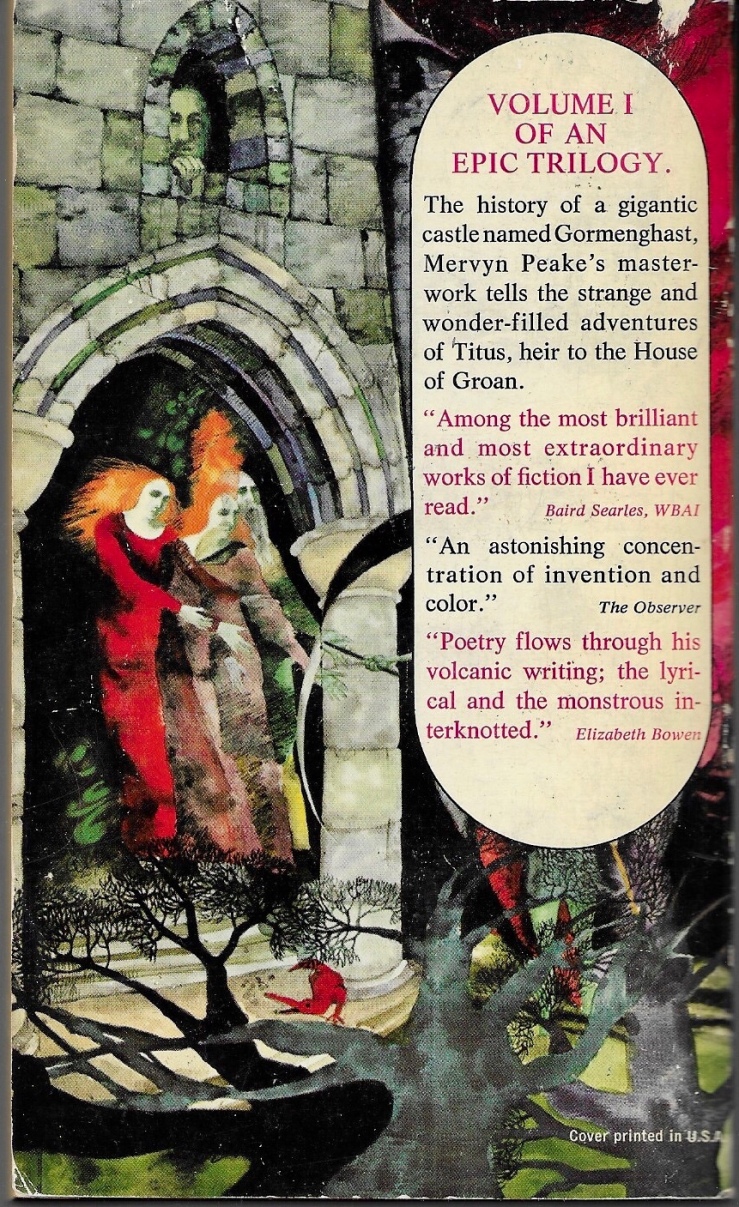
Titus Groan, Mervyn Peake. Ballantine Books (1968). No cover artist credited. 543 pages.
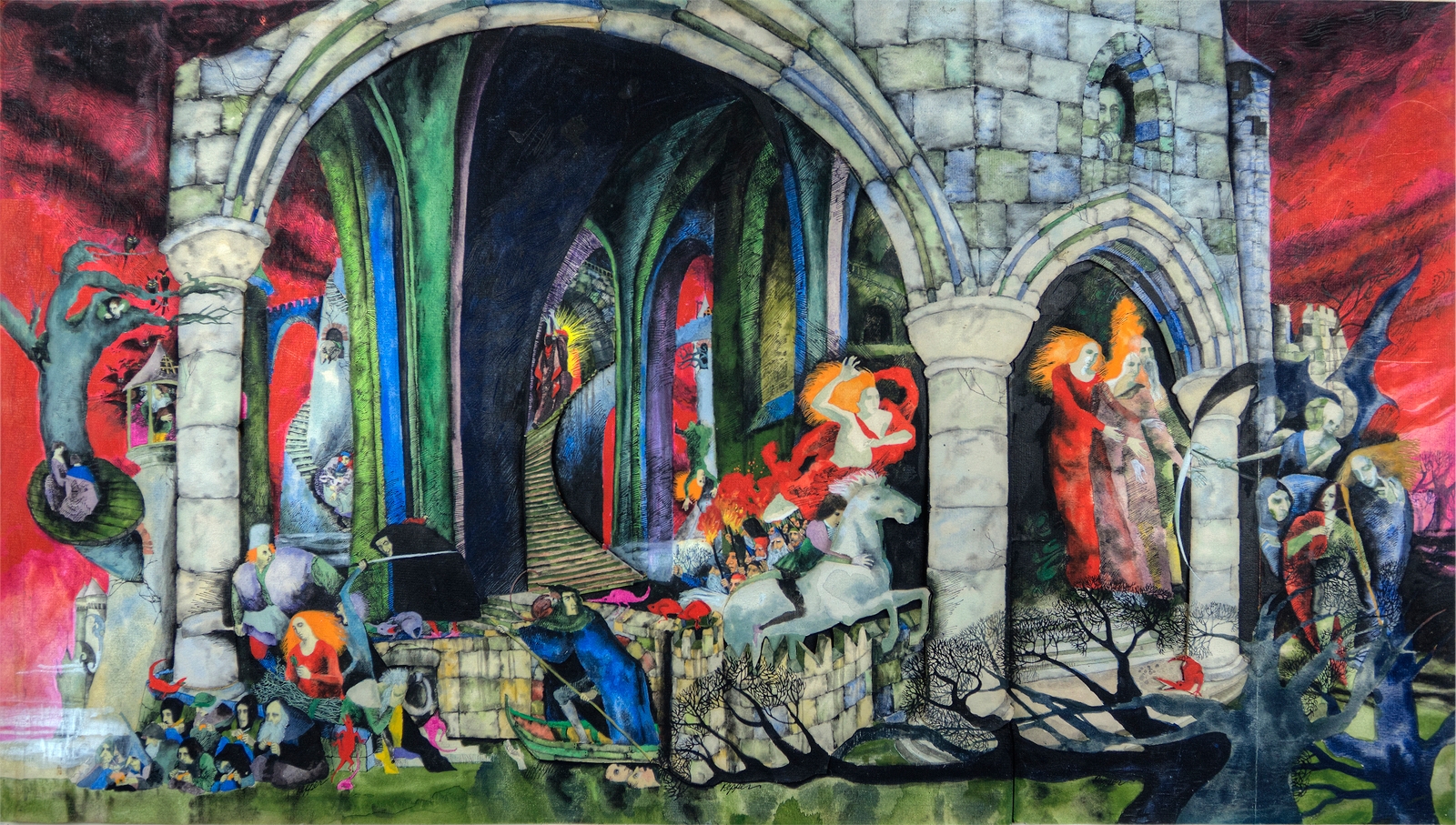
The uncredited cover artist is Bob Pepper, who also provided the covers for Ballantine editions of the other two novels in Peake’s Gormenghast trilogy, Gormenghast and Titus Alone. The covers are actually segments from one painting:
The edition also includes black and white illustrations by Peake (including eight glossy inset pages).
I have no idea how I had never even heard of Mervyn Peake’s Gormenghast trilogy until some point late in 2019. I grew up reading fantasy and yet somehow never encountered these strange, dense books. I consumed them in 2020, pressing extra copies on my son.
The first of Mervyn Peake’s strange castle (and then not-castle trilogy (not really a trilogy, really)), Titus Groan is weird wonderful grotesque fun. Inspirited by the Machiavellian antagonist Steerpike, Titus Groan can be read as a critique of the empty rituals that underwrite modern life. It can also be read for pleasure alone.
Gormenghast, Mervyn Peake
Probably the best novel in Peake’s trilogy, Gormenghast is notable for its psychological realism, surreal claustrophobia, and bursts of fantastical imagery. We finally get to know Titus, who is a mute infant in the first novel, and track his insolent war against tradition and Steerpike. The novel’s apocalyptic diluvian climax is amazing.
Titus Alone, Mervyn Peake
A beautiful mess, an episodic, picaresque adventure that breaks all the apparent rules of the first two books. The rulebreaking is fitting though, given that Our Boy Titus (alone!) navigates the world outside of Gormenghast—a world that doesn’t seem to even understand that a Gormenghast exists (!)—Titus Alone is a scattershot epic. Shot-through with a heavy streak of Dickens, Titus Alone never slows down enough for readers to get their bearings. Or to get bored. There’s a melancholy undercurrent to the novel. Does Titus want to get back to his normal—to tradition and the meaningless lore and order that underwrote his castle existence? Or does he want to break quarantine?
Extent of preserved material: A five-page lightly-corrected typescript, plus an earlier draft of five pages, heavily corrected and with other holograph notes.
The Story: Gorland as a boy of nine shoplifted cheap fishing tackle, and then his cousin stole a pocket knife from him. This sense that even those who steal for fun can be stolen from fills him with disappointment. As an adult in the narrative present, he meets a young woman who tells him that her friends are of two kinds: those who feel shame when they steal and those who don’t: Gorland feels sadness at this vision of a world of thieves. Gorland as an adult is a collector of books and finds out that an unpleasant bookshop owner has somehow stolen some of his, making him wonder if all the books in her shop are stolen. He thinks of different ways to shoplift a book, and takes a new standard edition of Kierkegaard’s Works of Love on his way out as she is distracted.
Works of Love is Kierkegaard’s most direct engagement with the concept of love-across-humankind: that is, agapē. The relevance is presumably that the model of human relations in which everyone steals from everyone else as a way of getting even and balancing their debts is a purely inverted counterpart to an Agapeic world of interaction through love.
Relation toGaddis’sPublished Writings: Ends with direct reference to a theorist of agapē, and hence a relevant text for AgapēAgape. A character in the shop asks for a book of poetry by WH Auden, whose early poems (eg “A Summer Night” or “Lullaby”) often suggest the precedence of love for all people over love for individuals.
Also a mention of central character “felt for a moment like Raskolnikov,” so another source for Gaddis’s explicit reference to the 19th-century Russians.
Other Notes and Mentions Elsewhere? N/A
The above selection is included in an exhaustive (but not exhausting) trip through the Gaddis archives, part of Electronic Book Review’s special issue, “Gaddis at His Centenary.” Our trip conductors are Gaddis scholars Ali Chetwynd (who organized and edited the special issue) and Joel Minor (who curates Washington University’s marvelous Modern Literature Collection. Titled “William Gaddis’s Unpublished Stories and Novel-Prototypes: An Archival Guide,” the piece diligently details Gaddis’s unpublished prose fiction, situating the pieces in the larger context of his five published novels. There are even some plot charts for Ducdame, a precursor for The Recognitions.
I chose to share the entry for “Gorland at Large” above because it concerns a biblioklept.
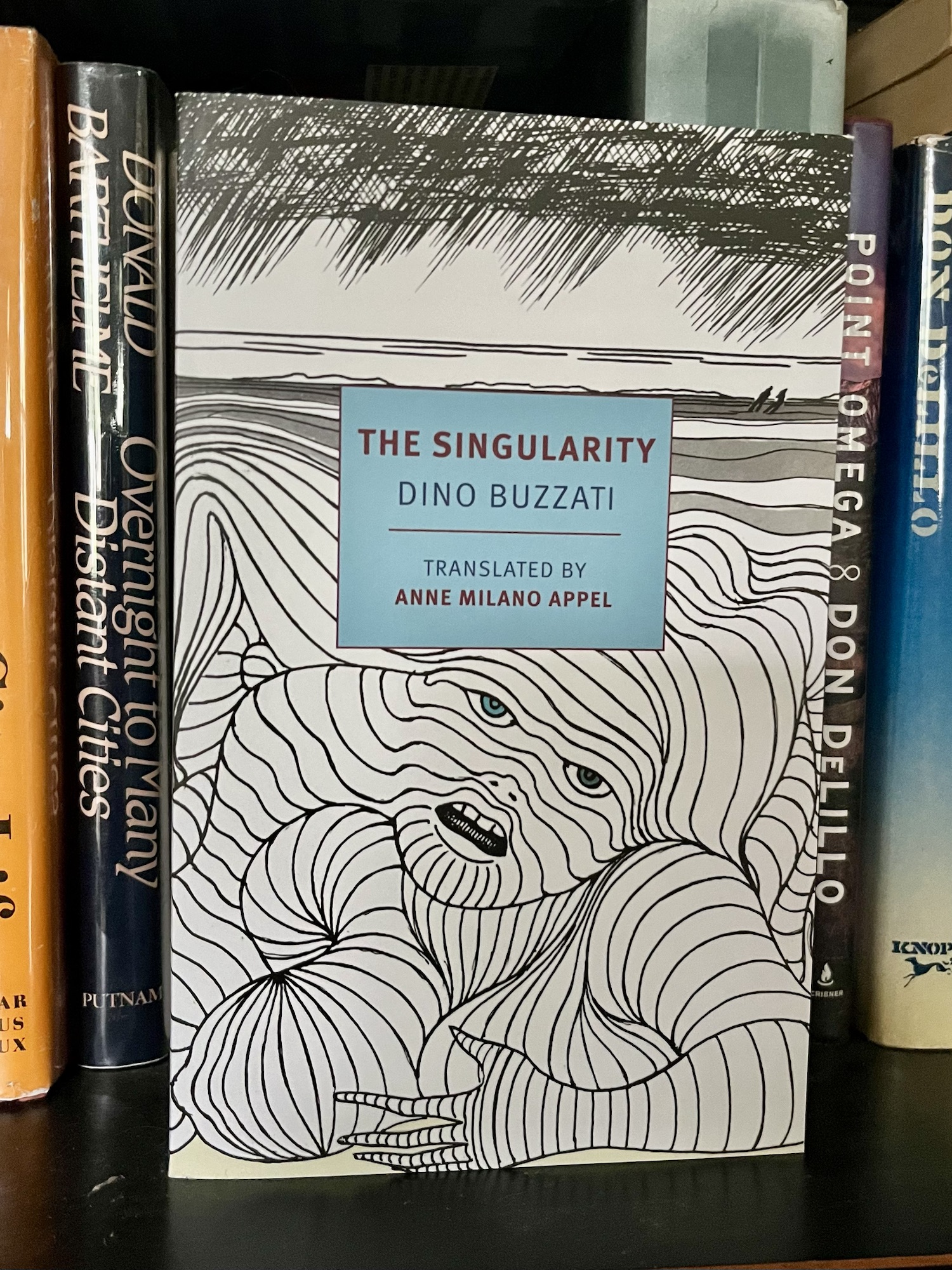
NYRB has another new translation of an old Dino Buzzati novel on deck—it’s a 1960 sci-fi called The Singularity in translation by Anne Milano Appel. NYRB’s blurb:
At the beginning of Dino Buzzati’s The Singularity, Ermanno Ismani, an unassuming university professor, is summoned by the minister of defense to accept a two-year, top-secret mission at a mysterious research center, isolated from the world among forests, plunging cliffs, and high mountains. What’s he supposed to do there? Not clear. How long will he be there? No saying.
Still, Ismani takes the mystifying job and, accompanied by his no-nonsense wife, Elisa, heads to the so-called Experimental Camp of Military Zone 36, wondering whether, in the midst of the Cold War, it’s some sort of nuclear project he’s been assigned to. But no, the colleagues the couple meets on arrival assure them, it’s nothing like that. It’s much, much more powerful.
At the center of the research complex is strange, shining, at times murmurous, white wall. Behind it, a deep gorge drops away, full of wires and radio towers and mobile sensors and a host of eccentric structures. A question begins to dawn: Could this be the shape of consciousness itself? And if so, whose?
Buzzati’s novella of 1960, a pioneering work of Italian science fiction, is published here in a brisk new translation by Anne Milano Appel. In it, Buzzati explores his favorite themes of love and longing while offering a startlingly prescient parable of artificial intelligence.
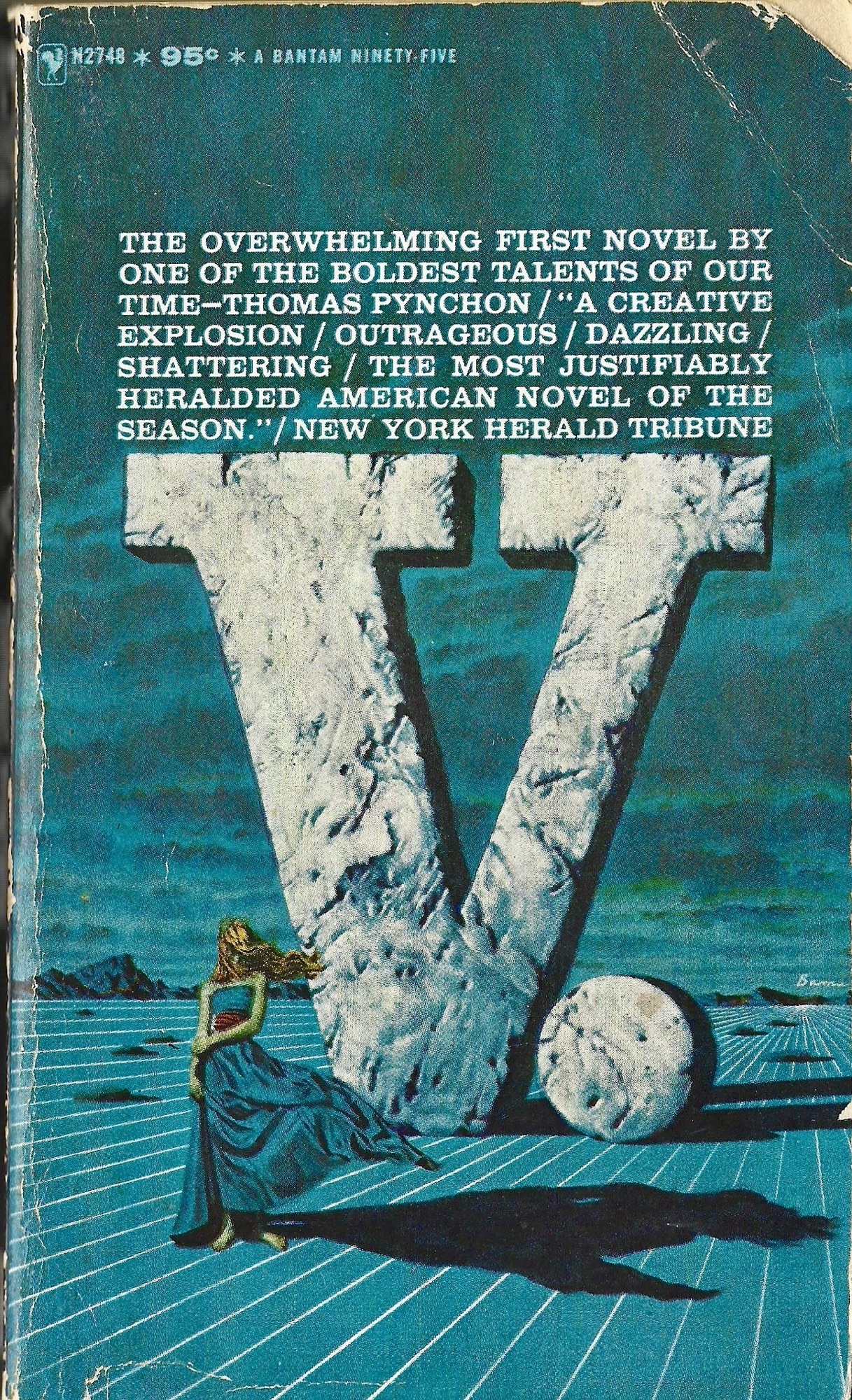
The grist, grit, and horror of the big postwar world will cling to the present. Nobody’s stepping down from heaven, or Heaven, and there are no magic words—but there is a kind of love, a loving with your mouth shut, a kind of radical, earnest, transcendent love that Pynchon evokes, soils, and sanctifies here.










 Previously on Blue Lard…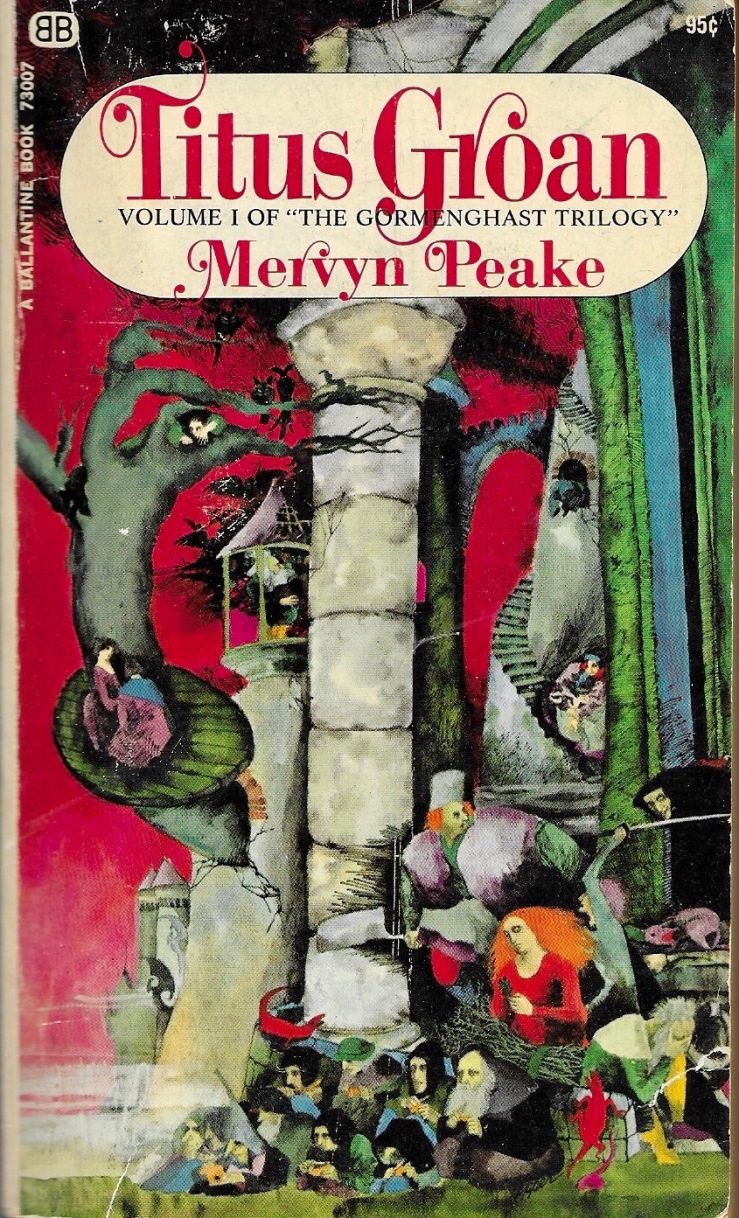

 Biblioklept