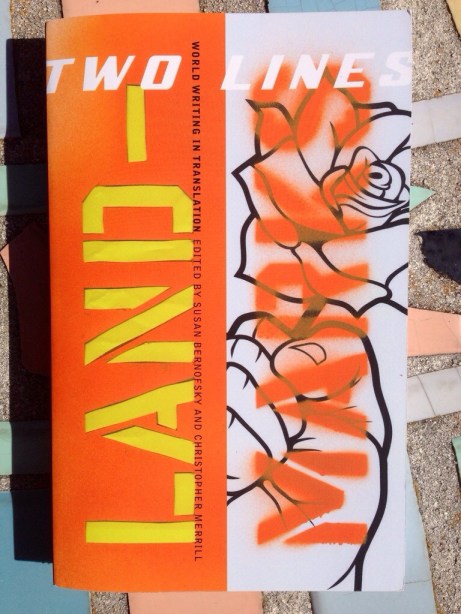
Landmarks, newish from Two Lines Press, collects poetry and prose in English translation. The collection features over a dozen languages and includes a special selection on the Arab Spring. I snacked on this book over the past few weeks, reading it at random whenever a nook of free time presented itself. There are still a few selections I haven’t gotten to yet, but most of what’s collected here is superb, thanks to editors Susan Bernofsky (who you probably know from her Robert Walser translations) and Christopher Merrill.
Two Lines’ blurb:
The premiere anthology of international literature returns for its 20th anniversary with stellar new prose and poetry, headlined by a collection of writing dedicated to the Arab Spring.
Coedited by leading German translator Susan Bernofsky and celebrated poet and translator Christopher Merrill, Landmarks gives us never-before-seen work from over 20 nations. Lauded Argentine author Juan Jose Saer, widely considered the heir to Jorge Luis Borges, transforms a photo of Earth from space into a tense, alcohol-fueled meditation on emptiness. Scholastique Mukasonga’s heartbreaking story ponders how so many of her fellow Rwandans could participate in a bloody genocide. And the Soviet absurdist Daniil Kharms is found among the volume’s many poets, alongside Yehuda Amichai—widely considered Israel’s greatest modern bard—and the up-and-coming Brazilian Ana Martins Marques.
In a special section of vital new work from the Middle East, ten writers provide an artist’s insight into the momentous events of the 2010 Arab Spring. Iraqi poet Naseer Hassan reveals haunting, everyday images from his nation. Ali Al Jallawi, twice imprisoned for critiquing of Bahrain’s political regime, ponders his relationship to God. And in Egyptian writer Mona Elnamoury’s surrealist story, images of torture and terror give way to a spectacular dream beneath the folds of an otherworldly quilt.
A truly a global education, Landmarks continues two proud decades of exploring the riches of world literature and making connections between the abundance of amazing work being produced around the world.
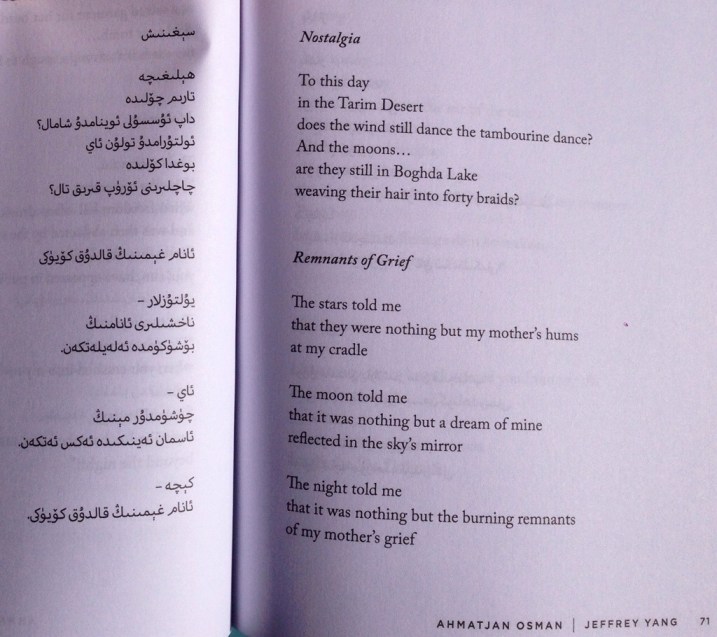
Maybe the best feature of Landmarks is the rich insight it offers into translation. Each selection is prefaced with an introduction that offers context for the writer and the conditions of the writing, as well as the translation process itself. The poems are printed in two languages as well—the original on the left, the translation on the right. (Prose selections only feature the first page of original language printed alongside the translation). Being able to see the form and contours of the poem next to its translation is fascinating. Even if the poem was composed in an alphabet utterly foreign to me, being able to see it in its original form still offers a sense of its rhythm. Great stuff.
Two from Ahmatjan Osman, translated from Uyghur by Jeffrey Yang:
In society he was called “Handsome Signoles.” His name was Vicomte Gontran-Joseph de Signoles.
An orphan, and possessed of an ample fortune, he cut quite a dash, as it is called. He had an attractive appearance and manner, could talk well, had a certain inborn elegance, an air of pride and nobility, a good mustache, and a tender eye, that always finds favor with women.
He was in great request at receptions, waltzed to perfection, and was regarded by his own sex with that smiling hostility accorded to the popular society man. He had been suspected of more than one love affair, calculated to enhance the reputation of a bachelor. He lived a happy, peaceful life—a life of physical and mental well-being. He had won considerable fame as a swordsman, and still more as a marksman.
“When the time comes for me to fight a duel,” he said, “I shall choose pistols. With such a weapon I am sure to kill my man.”
One evening, having accompanied two women friends of his with their husbands to the theatre, he invited them to take some ice cream at Tortoni’s after the performance. They had been seated a few minutes in the restaurant when Signoles noticed that a man was staring persistently at one of the ladies. She seemed annoyed, and lowered her eyes. At last she said to her husband:
“There’s a man over there looking at me. I don’t know him; do you?”
The husband, who had noticed nothing, glanced across at the offender, and said:
“No; not in the least.”
His wife continued, half smiling, half angry:
“It’s very tiresome! He quite spoils my ice cream.”
The husband shrugged his shoulders.
“Nonsense! Don’t take any notice of him. If we were to bother our heads about all the ill-mannered people we should have no time for anything else.”
But the vicomte abruptly left his seat. He could not allow this insolent fellow to spoil an ice for a guest of his. It was for him to take cognizance of the offence, since it was through him that his friends had come to the restaurant. He went across to the man and said:
“Sir, you are staring at those ladies in a manner I cannot permit. I must ask you to desist from your rudeness.”
It is rather an interesting tale, said the Dead Father, which I shall now tell. I had been fetched by the look of a certain maiden, a raven-haired maiden —He looked at Julie, whose hand strayed to her dark dark hair.
A raven-haired maiden of great beauty. Her name was Tulla. I sent her many presents. Little machines, mostly, a machine for stamping her name on strips of plastic, a machine for extracting staples from documents, a machine for shortening her fingernails, a machine for removing wrinkles from fabric with the aid of steam. Well, she accepted the presents, no difficulty there, but me she spurned. Now as you might imagine I am not fond of being spurned. I am not used to it. In my domains it does not happen but as ill luck would have it she lived just over the county line. Spurned is not a thing I like to be. In fact I have a positive disinclination for it. So I turned myself into a haircut —A haircutter? asked Julie. A haircut, said the Dead Father. I turned myself into a haircut and positioned myself upon the head of a member of my retinue, quite a handsome young man, younger than I, younger than I and stupider, that goes without saying, still not without a certain rude charm, bald as a bladder of lard, though, and as a consequence somewhat diffident in the presence of ladies. Using the long flowing sideburns as one would use one’s knees in guiding a horse —The horseman is still following us, Thomas noted. I wonder why.
— I sent him cantering off in the direction of the delectable Tulla, the Dead Father went on. So superior was the haircut, that is to say, me, joined together with his bumbly youngness, for which I do not blame him, that she succumbed immediately. Picture it. The first night. The touch nonesuch. At the crux I turned myself back into myself (vanishing the varlet) and we two she and I looked at each other and were content. We spent many nights together all roaratorious and filled with furious joy. I fathered upon her in those nights the poker chip, the cash register, the juice extractor, the kazoo, the rubber pretzel, the cuckoo clock, the key chain, the dime bank, the pantograph, the bubble pipe, the punching bag both light and heavy, the inkblot, the nose drop, the midget Bible, the slot-machine slug, and many other useful and humane cultural artifacts, as well as some thousands of children of the ordinary sort. I fathered as well upon her various institutions useful and humane such as the credit union, the dog pound, and parapsychology. I fathered as well various realms and territories all superior in terrain, climatology, laws and customs to this one. I overdid it but I was madly, madly in love, that is all I can say in my own defense. It was a very creative period but my darling, having mothered all this abundance uncomplainingly and without reproach, at last died of it. In my arms of course. Her last words were “enough is enough, Pappy.” I was inconsolable and, driven as if by a demon, descended into the underworld seeking to reclaim her.
I found her there, said the Dead Father, after many adventures too boring to recount. I found her there but she refused to return with me because she had already tasted the food-of-hell and grown fond of it, it’s addicting. She was watched over by eight thunders who hovered over her and brought her every eve ever more hellish delicacies, and watched over furthermore by the ugly-men-of-hell who attacked me with dreampuffs and lyreballs and sought to drive me off. But I removed my garments and threw them at the ugly-men-of-hell, garment by garment, and as each garment touched even ever-so-slightly an ugly-man-of-hell he shriveled into a gasp of steam. There was no way I could stay, there was nothing to stay for; she was theirs.
Then to purify myself, said the Dead Father, of the impurities which had seeped into me in the underworld I dived headfirst into the underground river Jelly, I washed my left eye therein and fathered the deity Poolus who governs the progress of the ricochet or what bounces off what and to what effect, and washed my right eye and fathered the deity Ripple who has the governing of the happening of side effects/unpredictable. Then I washed my nose and fathered the deity Gorno who keeps tombs warm inside and the deity Libet who does not know what to do and is thus an inspiration to us all. I was then beset by eight hundred myriads of sorrows and sorrowing away when a worm wriggled up to me as I sat hair-tearing and suggested a game of pool. A way, he said, to forget. We had, I said, no pool table. Well, he said, are you not the Dead Father? I then proceeded to father the Pool Table of Ballambangjang, fashioning the green cloth of it from the contents of an alfalfa field nearby and the legs of it from telephone poles nearby and the dark pockets of it from the mouths of the leftover ugly-men-of-hell whom I bade stand with their mouths open at the appropriate points —”
What was the worm’s name? Thomas asked.
I forget, said the Dead Father. Then, just as we were chalking our cues, the worm and I, Evil himself appeared, he-of-thegreater-magic, terrible in aspect, I don’t want to talk about it, let me say only that I realized instantly that I was on the wrong side of the Styx. However I was not lacking in wit, even in this extremity. Uncoiling my penis, then in the dejected state, I made a long cast across the river, sixty-five meters I would say, where it snagged most conveniently in the cleft of a rock on the farther shore. Thereupon I hauled myself hand-over-hand ‘midst excruciating pain as you can imagine through the raging torrent to the other bank. And with a hurrah! over my shoulder, to show my enemies that I was yet alive and kicking, I was off like a flash into the trees.
“Some of Us Had Been Threatening Our Friend Colby” by Donald Barthelme
Some of us had been threatening our friend Colby for a long time, because of the way he had been behaving. And now he’d gone too far, so we decided to hang him. Colby argued that just because he had gone too far (he did not deny that he had gone too far) did not mean that he should be subjected to hanging. Going too far, he said, was something everybody did sometimes. We didn’t pay much attention to this argument. We asked him what sort of music he would like played at the hanging. He said he’d think about it but it would take him a while to decide. I pointed out that we’d have to know soon, because Howard, who is a conductor, would have to hire and rehearse the musicians and he couldn’t begin until he knew what the music was going to be. Colby said he’d always been fond of Ives’s Fourth Symphony. Howard said that this was a “delaying tactic” and that everybody knew that the Ives was almost impossible to perform and would involve weeks of rehearsal, and that the size of the orchestra and chorus would put us way over the music budget. “Be reasonable,” he said to Colby. Colby said he’d try to think of something a little less exacting.
Hugh was worried about the wording of the invitations. What if one of them fell into the hands of the authorities? Hanging Colby was doubtless against the law, and if the authorities learned in advance what the plan was they would very likely come in and try to mess everything up. I said that although hanging Colby was almost certainly against the law, we had a perfect moralright to do so because he was our friend, belonged to us in various important senses, and he had after all gone too far. We agreed that the invitations would be worded in such a way that the person invited could not know for sure what he was being invited to. We decided to refer to the event as “An Event Involving Mr. Colby Williams.” A handsome script was selected from a catalogue and we picked a cream-colored paper. Magnus said he’d see to having the invitations printed, and wondered whether we should serve drinks. Colby said he thought drinks would be nice but was worried about the expense. We told him kindly that the expense didn’t matter, that we were after all his dear friends and if a group of his dear friends couldn’t get together and do the thing with a little bit of eclat, why, what was the world coming to? Colbv asked if he would be able to have drinks, too, before the event. We said,”Certainly.”
The next item of business was the gibbet. None of us knew too much about gibbet design, but Tomas, who is an architect, said he’d look it up in old books and draw the plans. The important thing, as far as he recollected, was that the trapdoor function perfectly. He said that just roughly, counting labor and materials, it shouldn’t run us more than four hundred dollars. “Good God !” Howard said. He said what was Tomas figuring on, rosewood? No, just a good grade of pine, Tomas said. Victor asked if unpainted pine wouldn’t look kind of “raw,” and Tomas replied that he thought it could be stained a dark walnut without too much trouble.
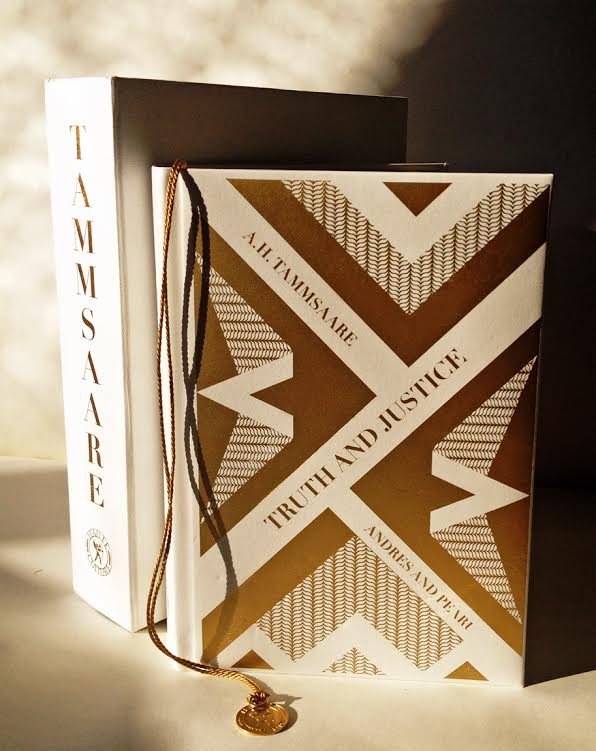
Luis de Miranda:Haute Culture is a new venture in luxury publishing with a mission to bring masterpieces of global literature to English-speaking readers around the world. Since your site is called “Biblioklept,” I’ll start by saying that we are a new kind of Robin Hood: we give to both the “poor” and the “rich.” We offer free e-books to the modern global reader interested in discovering hidden gems of classic European literature and, simultaneously, we offer individuals of greater means the opportunity to become mini-Medici’s, actively supporting culture while enjoying a luxurious limited edition book that will increase in value year after year.
This model is summed up in our slogan: Physical books should be sublime, digital books should be free. The sales of our limited luxury editions—each a distinctive art object—support the distribution of free e-books for each of our titles. Buyers of our limited editions, in effect, become benefactors—or “Book Angels,” as we call them. I believe this model will satisfy collectors and book lovers.
Furthermore, as e-books become cheaper and cheaper, I want to create a model that does not depend on the diminishing revenues of e-book sales and allows us to reach as many readers as possible, particularly younger readers. If we want younger generations to read quality literature, and not just the latest bestsellers, free e-books are the way to go.
Biblioklept: Is the possible disconnect between electronic books and “luxury” an issue? Does this new publishing model privilege the book as an aesthetic object?
LdM: This model privileges the free distribution of quality literature and it reinvents the physical book as a cult object. I aim to create unique objects that make the poetry of texts tangible. As we all spend more time in front of screens, I believe that the experiential aspect of the printed book will become more important, with readers looking for a higher quality object. I foresee the return of the “gentleman’s library” (or “gentlewoman’s library”), with fine leather volumes and limited editions—the polar opposite of e-books. Our limited editions will embody my great respect for the ritual of reading and for the craftsmanship of book making, while at the same time subsidizing the free distribution of our e-books and building a new global audience for iconic European literary masters.
Biblioklept: Is Haute Culture the first group to employ this model, to your knowledge?
LdM: Yes. We are innovating and experimenting. I don’t know if ours will be an economically viable model in the end, but it is definitely a desirable one. Since we are exploring uncharted territory, we have to take things step by step. We are avoiding the established highways over artificial ponds, and attempting to build our own bridge. We might fail or we might create a new path that the others will soon follow.
Biblioklept: Why did you choose A.H. Tammsaare’s Truth and Justice as the first book in this series?
LdM: Our first publication is actually a new translation and an ultra-limited bilingual edition of the Flaubert novella, Felicity: The Tale of the Simple Heart. In December 2013, it will be on sale at Assouline Boutiques in New York, Los Angeles, London, and Paris.
Volume I of Tammsaare’s Truth and Justice is planned for publication in 2014. It is a fine example of an untranslated classic. Tammsaare himself is an icon of 20th century Estonian literature. Two museums, a monument, and a park in the center of Tallinn are all dedicated to him. Unlike some traditional classics, which are widely referred to but rarely read, his masterpiece, Truth and Justice, still retains its place at the front of Estonian bookshelves and yet this epic work has never been translated into English. I also have some personal reasons for launching the press with an Estonian icon like Tammsaare. I wrote my last novel in Estonia three years ago and I wanted to pay homage to the land that inspired me.
Biblioklept: What is Tammasaare’s book about? Why is it important?
LdM: Truth and Justice is considered Tammsaare’s most important work. It was written during the rise of dictators—Hitler, Stalin, Mussolini—and it captures the evolution of Estonia from Tsarist province to independent state. Though it’s deeply rooted in Estonian peasant life, the first volume deals with timeless literary and philosophical issues, developing a vigorous, straightforward narrative that addresses the dual nature of the human psyche.
The book’s characters, storylines, and language continue to inform Estonia’s culture today. References to Truth and Justice are pervasive, and one hears its echoes in contemporary Estonian literature, as well as other art forms. One need only call two men “Andres and Pearu” for any Estonian to understand the nature of their relationship.
Volume I presents life in an Estonian village, as farmers battle against nature during the last quarter of the 19th century. The two main characters, both unique and powerful men, represent the essential conflicts of human nature: not only good vs. evil, but also hope vs. conservatism, conquest vs. pettiness. The saga explores how human impulses compete with each other and complete the characters.
Although the first volume seems entirely dedicated to peasant life in rural Estonia at the threshold of modernity, the book deals with fundamental issues that are quite relevant today. You might say this book reflects what we are trying to do at Haute Culture. Truth and Justice is a story of simple people who work the land endlessly, striving to build a world were truth and justice prevail, where good is fostered and protected, not killed by conformity or lack of courage. Beautiful things grow slowly like plants. Perhaps this is a lesson for all the capitalists of the world.
Luis de Miranda
Biblioklept: What future plans do you have for Haute Culture? What other books would you like to publish?
LdM: We are currently translating a Russian book by the cult novelist Yuri Mamleyev, called Shatuny. We are working with one of the best Russian to English translators, Marian Schwartz, who translated Bulgakov and Berberova. Shatuny is a mind-blowing, hallucinatory story about the quest for absolute truth. Maybe we are obsessed by truth?
Bringing untranslated texts to English readers around the world is one aspect of a wider mission to bring singular, fine, original works to the global corpus. That has always been my goal—to democratize access to culture. I’ve been to the Frankfurt Book Fair many times and met with publishers and agents in New York. I’ve noticed not only that many great European works have not been translated to English, but also that the mainstream US and UK publishers tend to translate only genre bestsellers—thrillers for example.
English is now the international language and I believe it’s possible, and indeed essential to bring to the international psyche works that aren’t standardized and cliché, but truly represent a unique viewpoint. I plan to build a catalogue that only includes masterpieces. Publishers who rely on the old publishing model must often publish potential bestsellers they secretly despise, yet there are so many excellent contemporary classics waiting to be discovered and translated into English. With Haute Culture, I refuse to compromise. Literature has the potential to create a more diverse and interconnected world, but in order to reach that potential we must fight against a profit-driven culture.
Biblioklept: Have you ever stolen a book?
LdM: When I was 18, I had a summer job at a bookshop in the Pompidou Center in Paris. At the end of my first day, I took about 20 books home with me, feeling that I had found Ali Baba’s cave, but a few days later I felt guilty and replaced all the books on their shelves.
A young man and girl meet together, each in search of a person to be known by some particular sign. They watch and wait a great while for that person to pass. At last some casual circumstance discloses that each is the one that the other is waiting for. Moral,–that what we need for our happiness is often close at hand, if we knew but how to seek for it.
The journal of a human heart for a single day in ordinary circumstances. The lights and shadows that flit across it; its internal vicissitudes.
Distrust to be thus exemplified: Various good and desirable things to be presented to a young man, and offered to his acceptance,–as a friend, a wife, a fortune; but he to refuse them all, suspecting that it is merely a delusion. Yet all to be real, and he to be told so, when too late.
A man tries to be happy in love; he cannot sincerely give his heart, and the affair seems all a dream. In domestic life, the same; in politics, a seeming patriot; but still he is sincere, and all seems like a theatre.
An old man, on a summer day, sits on a hill-top, or on the observatory of his house, and sees the sun’s light pass from one object to another connected with the events of his past life,–as the school-house, the place where his wife lived in her maidenhood,–its setting beams falling on the churchyard.
An idle man’s pleasures and occupations and thoughts during a day spent by the seashore: among them, that of sitting on the top of a cliff, and throwing stones at his own shadow, far below.
A blind man to set forth on a walk through ways unknown to him, and to trust to the guidance of anybody who will take the trouble; the different characters who would undertake it: some mischievous, some well-meaning, but incapable; perhaps one blind man undertakes to lead another. At last, possibly, he rejects all guidance, and blunders on by himself.